Introduction
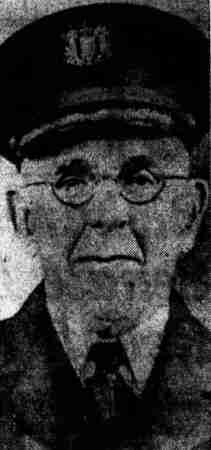
A. Lincoln James
Abraham Lincoln James, better known in his day as A.L. James and A. Lincoln James, was a career officer with the Camden Police Department. His career spanned 40 years. He was a close friend of David Baird Sr., twice the sheriff of Camden County, once a U.S. Senator and Republican party leader in Camden and South Jersey.
A. Lincoln James was born on August 14, 1863 at 817 Federal Street in Camden. His parents were Edward T. and Caroline S. James. His parents were both originally from Pennsylvania but had been living in New Jersey since the mid-1850s. Edward T. James had served as a volunteer fireman prior to the founding of the professional department in 1869, and was a member of the Camden Fire Department from September of 1871 until May 6, 1873. Edward T. James also served as a trustee of the Camden Cemetery from 1870 until his own death in 1886.
The James family remained in the 800 block of Federal Street until at least 1870. By May of 1871 they had moved to 109 North 8th Street. The 1880 Census shows A. Lincoln James living with parents at 109 North 8th Street working as a box maker. His father and oldest brother, Wesley B. James, worked as coopers. An older sister, Mary, worked making shoes. Also at home were younger brothers Edward and Forest James. A. Lincoln James began working as a cabinet maker shortly afterwards. He was still living at home 1881, according to the City Directory for that year.
On October 23, 1882 A. Lincoln James married Carrie DePugh at Union Methodist Episcopal Church in Camden, with Rev. John R. Gaskill officiating. A daughter Lizzie C. James, was born in June 1883. Daughter Anna May James was born November 30, 1885. The 1885 City Directory shows the family at 743 Pennsylvania Avenue. A. Lincoln James was then working as a driver. He soon went back to his previous work as a cabinet maker.
The 1888 City Directory puts the family at 944 Carpenter Street, while the 1890–1891 edition has them at 814 Carpenter Street. A son, Charles H. James was born November 9, 1890.
A. Lincoln James was first appointed to the Camden Police Department on March 12, 1892. That year he is found in the City Directory at 812 Market Street. He is listed from 1894 to 1895 at 917 Carpenter Street and from 1896 to 1898 at 209 North 9th Street. He resigned twice before taking a permanent appointment on August 1, 1899. He and his family lived at 122 North 8th Street in 1899 and were still there in 1901. By the time the 1902 City Directory was compiled, the James family had moved to 124 North 8th Street, a property that they held an interest in until at least 1949, although James made his home from 1917 until his death at 922 Cooper Street. He also had a summer home in Wildwood, New Jersey.
A. Lincoln James was promoted to Sergeant in 1905 and to Captain in 1908. He served with distinction until his retirement on December 31, 1932. A fine baseball player even into his late 30s and 40s, he played third base for the Camden Police Department team as late as 1907.
A. Lincoln James was approved for a pension in November of 1932. He finished the year out working, and began his retirement on New Year’s Day, 1933. In 1937, while at his home in Wildwood, A. Lincoln James suffered a stroke. He was brought back to Camden, where he died at West Jersey Hospital on November 22, 1937. He was buried at Lakeview Memorial Park in Cinnaminson, New Jersey. Besides his widow, A. Lincoln James was survived by his three children and five grandchildren. Mrs. James remained at 922 Cooper Street until at least the summer of 1940. By the summer of 1941 she and widowed daughter Anna M. Walz moved back to 124 North 8th Street. Mrs. Carrie James joined her husband in 1949. Anna Walz taught in the Camden School system for 16 years, before retiring in 1959.
He Announces the Names
Camden Daily Telegram —
The Mayor Appoints the New Force To-day.
MANY OLD OFFICERS TAKEN BACK.
Some Surprise Manifested at the Mayor’s Appointment of Dodd Instead of Jones—This Afternoon All the Names Will be Announced.
The Mayor stated this morning to the newspaper fraternity that he would not announce his nominations for the police department until four o’clock this afternoon. It was expected that these would be announced this morning and in consequence there were a number of applicants for appointment on the force early this morning at the City Hall, hoping that the lightning would strike them.
Yesterday afternoon the mayor in addition to his nomination of Chief Dodd and Lieutenants Foster and Pettit appointed Frank Matlack, Jacob Woodsides, Alfred Hayden and John Dall, all of the Sixth Ward. The above were policemen under Mayor Westcott, before the Democratic Police Commission took charge of the Department.
Patrolman Griffin, Democrat, tendered his resignation yesterday to Mayor Westcott, to take effect to-day.
The appointment of Chief Dodd was quite a surprise to the public in general, as it was thought that Captain Jones would be named for the position. Many believed such an appointment would be in very good form, as Captain Jones’ knowledge of men and his military training would have made him a chief par excellence. The Mayor, however, probably thought that as Mr. Dodd had been so unceremoniously kicked out by the Democrats, it was nothing more than justice to again offer him the position which he had filled in a creditable manner for a number of years.
APPOINTED ON THE FORCE.
Mayor Westcott this afternoon made the following appointments:
First Ward—William E Cromly, George Cable, Henry R. Curtis, O. Glen Stackhouse.
Second Ward—Lincoln James, John Pratt, Samuel Bakley, Benj Middleton.
Third Ward—William Selby, Albert Myers, Edward Hartman.
Fourth Ward—Caleb Williams, Richard Golden, William Schregler, Ralph Bond.
Fifth Ward—William Harvey, Harry Mines and Oscar Weaver.
Sixth Ward—Jacob Woodsides, Frank Matlack, Albert Hayden and John Dall.
Seventh Ward—Josiah Sage, Henry Peters, Charles Lederman, Wm. Butts.
Eighth Ward—Alexander Alcorn, Chas. Leightenberg, Ferdinand Laird
There was no appointments made for the Ninth ward.
Side-Splitting Farce Goes On
Camden Daily Telegram —
Chairman Burrough Did Not Sit With the Committee.
HE IS SAID TO BE DISGUSTED
Additional Charges Against Policemen, But the Witnesses Fail to Substantiate the Specifications Made by Office Seekers.
The Police Committee of City Council, last night, resumed the hearings of the charges against the policemen. The Council chamber was again crowded with prospective policemen and office seekers of all descriptions. Chairman Burroughs of the committee was absent and it was stated that he was disgusted at the manner in which the farce is being carried on. The other two members of the committee were present and Mr. Silvers, the Third ward statesman, acted as chairman. He was flanked on the right by His Honor, the Mayor. Previous to the hearings the Mayor heard some suggestions from his new adviser, who is William H. Sparks, of kidney cure fame, and a Democrat who had been an office seeker in the Democratic party for a number of years. Dr. “Mark Hanna” Davis for some reason or other is not participating in the deliberation of the Reformers. It is said that he is disgusted and was heard to make the remark that there are but two political parties, the Republican and Democratic, and he did not believe in Reform.
E. G. C. Bleakley, after some delay, moved the charges against Policeman Bond. Officer Bond was charged by ex-Policeman “Ikey” Shreeve with being asleep in the post office building on March 15, and also with leaving his post of duty.
The first witness called was the complainant, and he testified that on the morning in question he found Policeman Bond asleep in the post office building, about 4 o’clock. The witness fixed the time by a man on the street asking him the hour. He knew he was asleep from the fact that he heard him snoring.
Policeman Bond, in his own defense, admitted going into the post office to light his pipe, but denied being asleep. He stated that he did not see Mr. Shreeve, but saw Constable Voight.
John Hefferan was called, and testified that on the morning in question he was with Policeman Bond about 6 o’clock on Federal street.
Irving L. Buckle, a newspaper carrier, testified that he saw Bond on Federal street between half-past 3 and 4 o’clock.
Thomas A. Stockham also testified that he saw Officer Bond on the morning in question about 3 o’clock.
Joseph Robinson, night watchman at the post office, said that he never saw Mr. Bond asleep in the building.
The next case that was moved was the charges against Policeman A. Lincoln James. The charge in the case was made by a young man named John J. Browning, of Cedar street, near Fifth. He charged James with being in an intoxicated condition on the morning of April 13, in the saloon of Edward McCabe, No. 900 Market street. The first witness called in this case was the complainant. He testified that he was in McCabe’s saloon and saw James there about midnight and believed him to be intoxicated. On cross-examination he said he had been drinking and that James treated him. He said that he was not an applicant for a position on the police force.
The next witness in this case was a gem. He is known as John J., alias “Limpy,” Logan, and is a familiar figure on Market street between Fourth and Sixth at all hours of the day and night. He was recently appointed as a watchman in the Water Department, by the Reform Water Committee, but his appointment was one of those which was held up by a writ of certiorari. Logan swore that he saw James in McCabe’s saloon and said the policeman had about nine drinks. He felt certain that James was intoxicated and that he was half drunk when he came into the saloon. The witness on cross examination admitted that he had plenty of beer and that they were coming at a good gait.
John Dorsey, a companion of Logan, corroborated the testimony of his bosom friend and became very indignant when asked if James did not treat him. He said that he had been drinking and paid for all he got.
Policeman James admitted that he was in McCabe’s saloon on the date mentioned. He said he had been in Stockton and arrived at McCabe’s about midnight and while there he had four glasses of beer.
Edward McCabe, the proprietor of the saloon, testified that James was in his place about midnight, but denied that he was intoxicated.
I. Newton Hillman and Hilton Taylor also testified to seeing James and were positive that he was not in an intoxicated condition.
The charges against Policemen Elwyn Steen and William Comley were then taken up. Both of the men were charged with the same offense and were placed on trial together. Lawyer Grey opposed to going to trial without Comley being present as he said he had been informed that he was sick.
Mr. Bleakley opposed his motion and said that Comley was seen in the corridor of the hall early in the evening.
The committee decided to go on with the hearing.
The charge in this case was made by Thomas Neville who swore that both of the policemen were seen to enter the office of Messrs. Shivers & Moffett, on the morning of May 6, at 12.15, and that they remained there until 1.30 a. m.
Counsel for Policeman Steen admitted that his client was in the office of Shivers & Moffett on the date specified, but denied that he remained as long as was charged.
Policeman Steen was put on the stand and testified that on the morning of May 6 he met Policeman Comley, who informed him that he believed there was some person in the office of Shivers & Moffett and Comley asked him to go with him. He said that when they reached the office they found a window open. They then made a search of the premises and also the lumber yard. He testified that the place had been frequently robbed and that Messrs. Shivers & Moffett had furnished Policeman Comley with a key, for the purpose of going through the place.
Henry Moffett, a member of the firm of Shivers & Moffett, testified that the firm had furnished a key to Policeman Comley.
At this juncture Mr. Bleakley went through the crowd and finally landed ex-Excise Commissioner Jacob Gnang on the stand. He said that he knew Policeman Comley and saw him standing in the corridor of the Hall early in the evening.
After considerable delay, occasioned by a conference, between the committee, Mayor Hatch, Acting City Clerk Kramer and Lawyer Bleakley, the committee decided not to take up any more charges and adjourned the hearings until to-morrow night.
As soon as Mayor Hatch reached the Police Department he ordered Chief Dodd to suspend Policeman Comley.
No decisions were given in the other cases.
Added to the “Finest.”
Camden Daily Courier —
Mayor Hatch Names Fifteen New Policemen this Afternoon
Six Out of the Lot Have Worn the Blue Before—William Horner Made a Sergeant—A Great Crowd Filled the City Hall Corridors This Morning Ready to Don Uniforms.
The headquarters of the Police Department and the office of Mayor Hatch at the City Hall this morning was the centre of attraction for a score or more of citizens who are quite anxious to don a policeman’s uniform and become one of the Mayor’s finest. No matter if the life of a policeman is not a happy one, so long as there are $17 per week in it. The gathering was brought about by the rumor having gone forth that the Mayor would some time to-day make the appointment and swear in the men appointed. Hence the gathering and the looks of expectancy upon the faces of those that would a copper be. They were doomed to disappointment, however, as Mayor Hatch, after calling two or three into his private office and swearing them in, informed the rest that he would name the full list to-morrow. To a “Courier” reporter the Mayor stated that he had some of the men picked, but would not give out their names until he had them all ready. The appointments are made under an ordinance recently passed instructing the Mayor to increase the police force of the city. It will give an additional policeman to each word [sic].
However, at three o’clock this afternoon Mayor Hatch had finished the work of selecting the new men and announced the list as follows:
First ward—William Lyons.
Second ward—William Thompson. A. Lincoln James.
Third ward—Isaac Toy.
Fourth ward—James Tatem.
Fifth ward—Casper Hart.
Sixth ward—Thomas Brothers.
Seventh ward—John Anderson. George Purnell.
Eighth ward—Alfred F. Snow.
Ninth ward—David Clark.
Tenth ward—Thomas Reed. Howard McPherson.
Eleventh ward—Edward R. Thomas
Twelfth ward—John Zane.
Of these a number of the names are quite familiar because their owners have worn the blue before. These are James, Hart, Brouthers, Anderson, Reed and Zane. The latter, now appointed from the Twelfth ward, was in the old days of Republican rule, in Stockton, the chief of police of that place. For years previously he had been on the county’s constabulary force.
Mayor Hatch also announced the appointment of William Horner to be sergeant of the Third district.
Here’s Camden’s Finest, With Whiskers, in 1898
Camden Courier-Post —
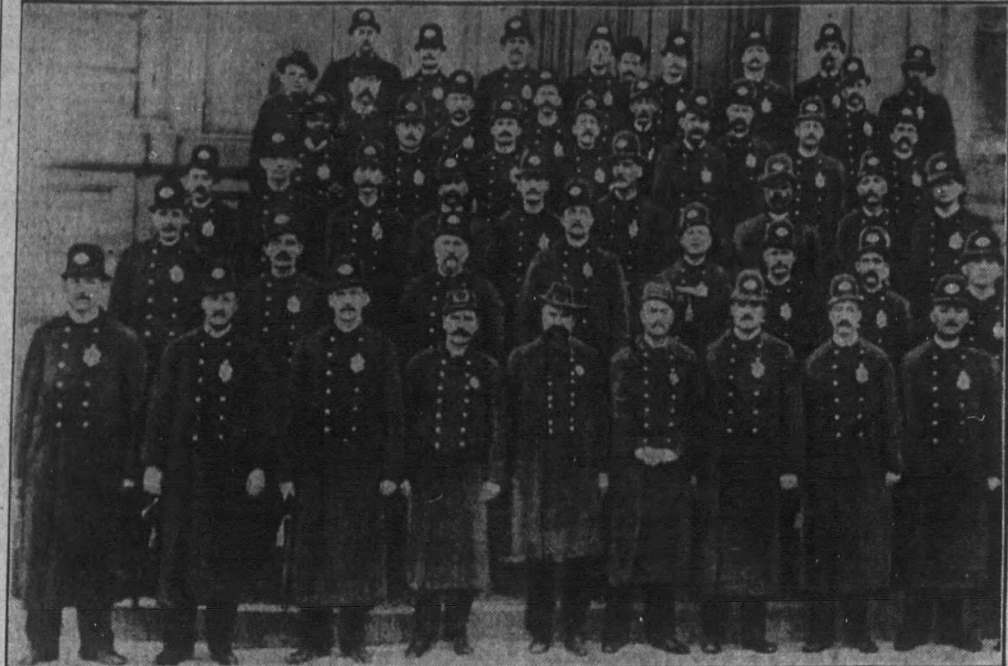
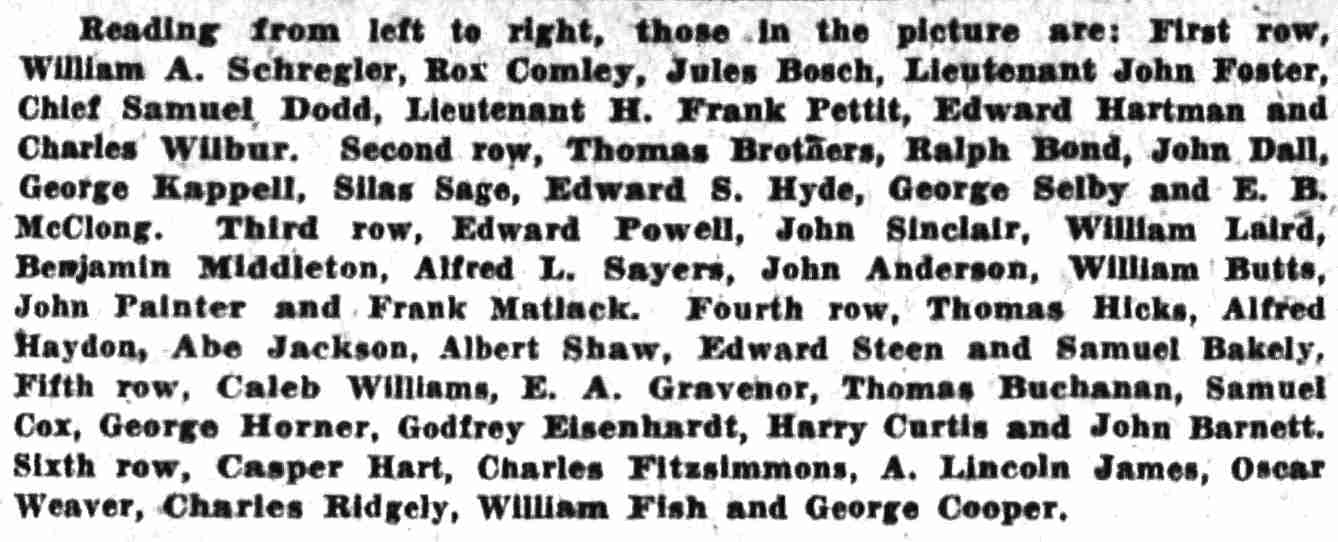
Reading from left to right, those in the picture are: First row, William A. Schregler, Rox Comley, Jules Bosch, Lieutenant John Foster, Chief Samuel Dodd, Lieutenant H. Frank Pettit, Edward Hartman and Charles Wilbur. Second row, Thomas Brothers, Ralph Bond, John Dall, George Kappell, Silas Sage, Edward S. Hyde, George Selby and E. B. McClong. Third row, Edward Powell, John Sinclair, William Laird, Benjamin Middleton, Alfred L. Sayers, John Anderson, William Butts, John Painter and Frank Matlack. Fourth row, Thomas Hicks, Alfred Haydon, Abe Jackson, Albert Shaw, Edward Steen and Samuel Bakely. Fifth row, Caleb Williams, E. A. Gravenor, Thomas Buchanan, Samuel Cox, George Horner, Godfrey Eisenhardt, Harry Curtis and John Barnett. Sixth row, Casper Hart, Charles Fitzsimmons, A. Lincoln James, Oscar Weaver, Charles Ridgely, William Fish and George Cooper.
Camden’s Police Force Increased
Philadelphia Inquirer —
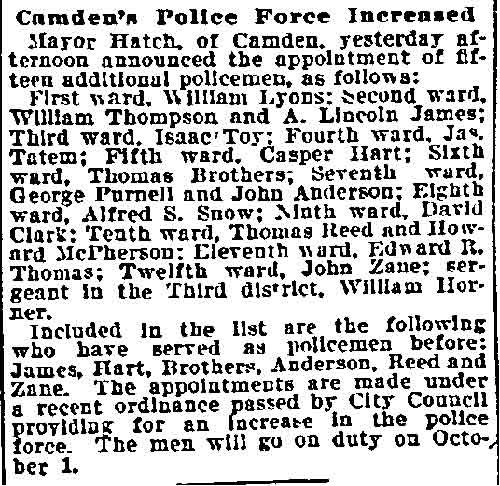
Mayor Hatch, of Camden, yesterday afternoon announced the appointment of fifteen additional policemen, as follows:
First ward, William Lyons; Second ward, William Thompson and A. Lincoln James; Third ward, Isaac Toy; Fourth ward, Jas. Tatem; Fifth ward, Casper Hart; Sixth ward, Thomas Brothers; Seventh ward, George Purnell and John Anderson; Eighth ward, Alfred S. Snow; Ninth ward, David Clark; Tenth ward, Thomas Reed and Howard McPherson; Eleventh ward, Edward R. Thomas; Twelfth ward, John Zane; sergeant in the Third district, William Horner.
Included in the list are the following who have served as policemen before: James, Hart, Brothers, Anderson, Reed and Zane. The appointments are made under a recent ordinance passed by City Council providing for an increase in the police force. The men will go on duty on October 1.
Camden Police Team Ready
Camden Daily Courier —
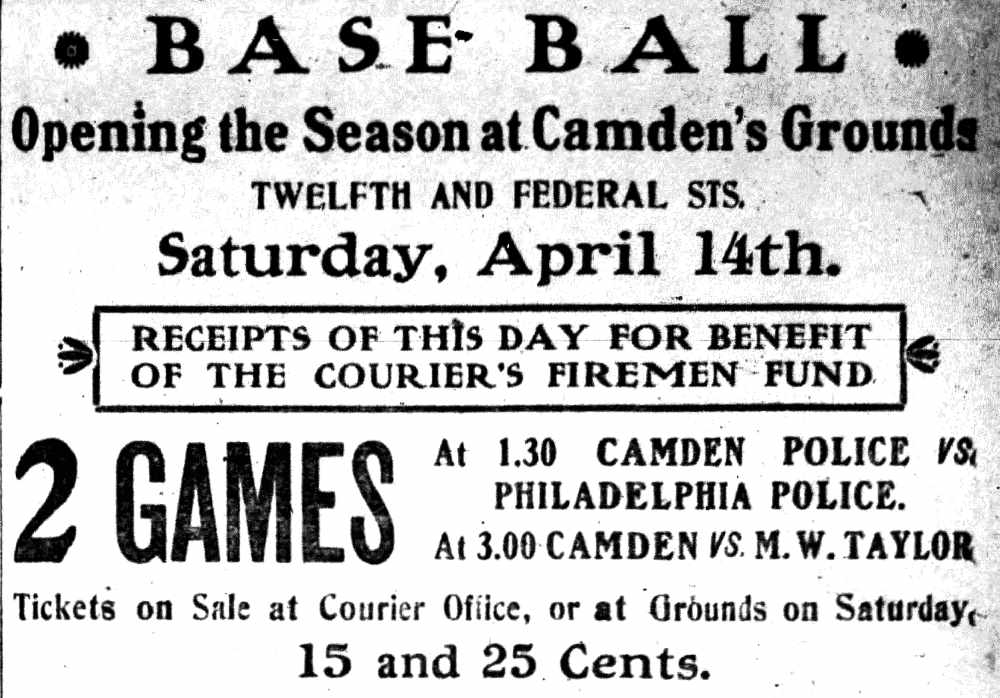
BASE BALL
Opening the Season at Camden’s Grounds TWELFTH AND FEDERAL STS. Saturday, April 14th.
RECEIPTS OF THIS DAY FOR BENEFIT OF THE COURIER’S FIREMEN FUND
2 GAMES At 1.30 CAMDEN POLICE VS. PHILADELPHIA POLICE. At 3.00 CAMDEN VS. M. W. TAYLOR
Tickets on Sale at Courier Office, or at Grounds on Saturday, 15 and 25 Cents.
Camden Police Team Ready
Camden Daily Courier —
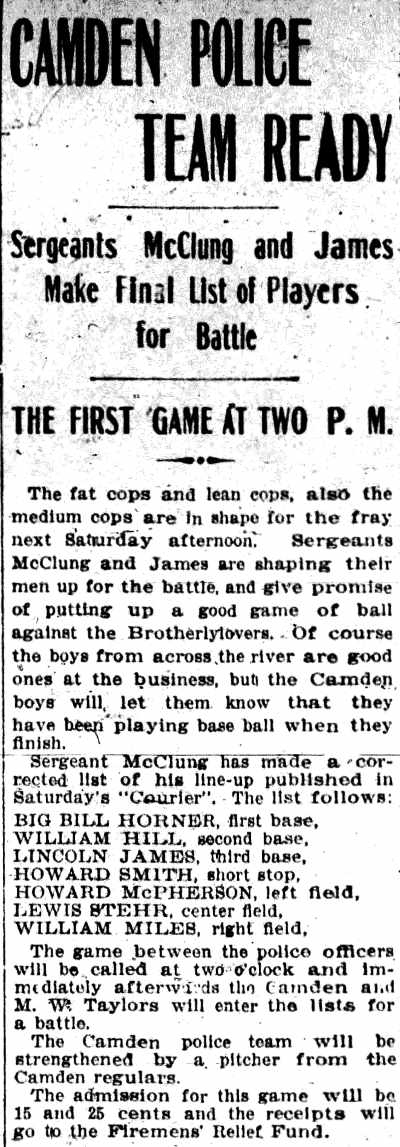
Sergeants McClung and James Make Final List of Players for Battle
THE FIRST GAME AT TWO P. M.
The fat cops and lean cops, also the medium cops are in shape for the fray next Saturday afternoon. Sergeants McClung and James are shaping their men up for the battle, and give promise of putting up a good game of ball against the Brotherlylovers. Of course the boys from across the river are good ones at the business, but the Camden boys will let them know that they have been playing base ball when they finish.
Sergeant McClung has made a corrected list of his line-up published in Saturday’s “Courier”. The list follows: BIG BILL HORNER, first base, WILLIAM HILL, second base, LINCOLN JAMES, third base, HOWARD SMITH, short stop, HOWARD McPHERSON, left field, LEWIS STEHR, center field, WILLIAM MILES, right field,
The game between the police officers will be called at two o’clock and immediately afterwards the Camden and M. W. Taylors will enter the lists for a battle.
The Camden police team will be strengthened by a pitcher from the Camden regulars.
The admission for this game will be 15 and 25 cents and the receipts will go to the Firemens’ Relief Fund.
North 8th Street Property
Camden Daily Courier —
A. Lincoln James – North 8th Street
Camden Increases Its Police Force
Philadelphia Inquirer —
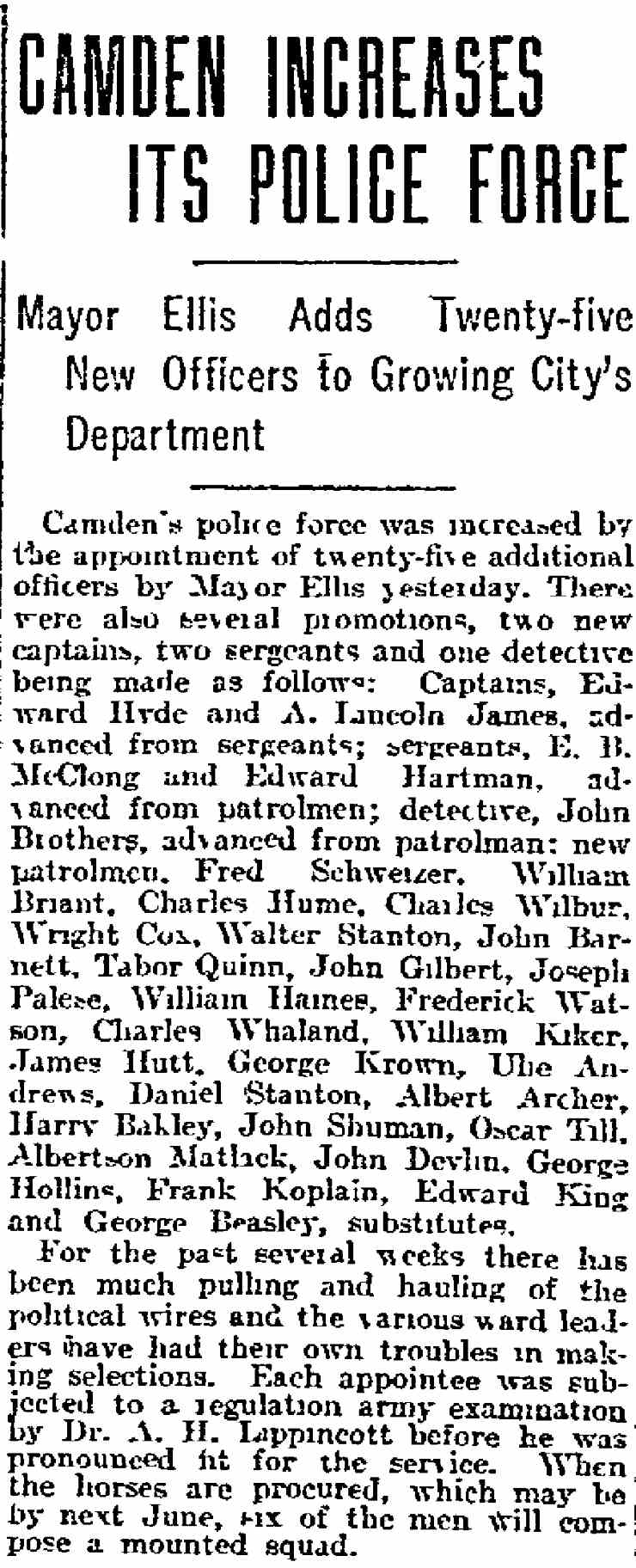
Mayor Ellis Adds Twenty-five New Officers to Growing City’s Department
Camden’s police force was increased by the appointment of twenty-five additional officers by Mayor Ellis yesterday. There were also several promotions, two new captains, two sergeants and one detective being made as follows: Captains, Edward Hyde and A. Lincoln James, advanced from sergeants; sergeants, E. B. McClong and Edward Hartman, advanced from patrolmen; detective, John Brothers, advanced from patrolman: new patrolmen. Fred Schweizer, William Briant, Charles Hume, Charles Wilbur, Wright Cox, Walter Stanton, John Barnett, Tabor Quinn, John Gilbert, Joseph Palese, William Haines, Frederick Watson, Charles Whaland, William Kiker, James Hutt, George Krown, Ube Andrews, Daniel Stanton, Albert Archer, Harry Bakley, John Shuman, Oscar Till, Albertson Matlack, John Devlin, George Hollins, Frank Koplain, Edward King and George Beasley, substitutes.
For the past several weeks there has been much pulling and hauling of the political wires and the various ward leaders have had their own troubles in making selections. Each appointee was subjected to a regulation army examination by Dr. A. H. Lappincott [sic] before he was pronounced fit for the service. When the horses are procured, which may be by next June, six of the men will compose a mounted squad.
Second Ward Had a Fine Pinochle
Camden Daily Courier —
Representatives From Other Ward Clubs Contested for Prizes
SPENT A SOCIAL EVENING
The Second Ward Republican Club had a gala time last night. They had advertised the event and invited their friends to a pinochle contest, and when it came time to start play all the tables were filled and more would have participated but for the large crowd present.
Those who found no seats at the tables watched the progress of the contest, and every misplay was noted and the player taunted with his carelessness or ignorance.
Later in the evening refreshments were served, and all who attended pronounced it one of the most enjoyable evenings they had spent in a long time. There were members present from the Third, Fifth and Ninth Ward Republican Clubs, as well as representatives from the Liberty Park, Fireside and Italian Republican organizations. The prize winners were: A. L. James, 405, Second ward; George Beasley, 401, Second ward; Albert Shaw, 393, Fifth ward; Scott Franklin, 392, Second ward; M. Lizenby, 376, Fifth ward, and Frank Garrison, 296, Ninth ward.
Coursey Breaks Down While Story of Cold-Blooded Killing of Karl Kellmann Is Told by Detective
Camden Post-Telegram —
Two “Pals,” Too, Accused of Crime
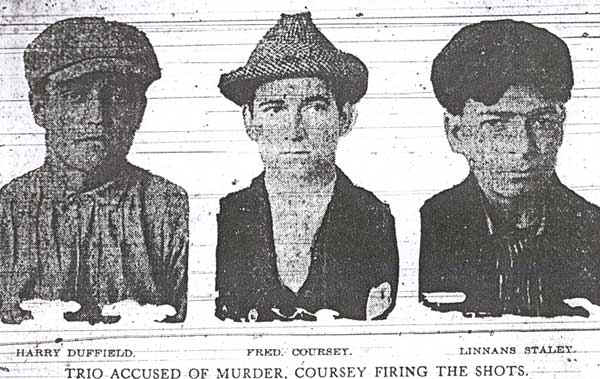
Harry Duffield. Fred. Coursey. Linnans Staley.
Trio Accused of Murder, Coursey Firing the Shots.
Collapsing when arraigned in Police Court this morning before Recorder Stackhouse on the charge of killing Karl Kellmann, aged 18 years, of 2919 High street, at Twenty-seventh and Sherman streets, shortly before midnight Saturday, Fred Coursey, alias “Mexican Pete,” alias “Cowboy Pete,” aged 20 years, of 121 North Twenty-first street, who admits firing the fatal shots while committing robbery, and Harry Duffield, aged 21 years, of 407 North Forty-first street, who acknowledged masking his face with a handkerchief and being with Coursey, sobbed piteously, resting their heads on the railing of the dock, while John Painter, the veteran detective, was briefly reciting the story.
When Recorder Stackhouse asked what became of the young man who was shot and Painter replied that he died, Coursey and Duffield sobbed afresh, and when Recorder Stackhouse committed them without bail Policemen Frost and Kay had to help them.
Linnans Staley, aged 21 years, of 1819 Federal street, who confessed that he was in the robbery plot but later got scared and hid in the bushes, was scarcely able to stand, and when his mother broke down as he was committed as a principal he staggered and would have fallen but for Sergeant McClong.
Prosecutor Boyle announced this morning that the Grand Jury will be recalled for Thursday of this week and the case will be made the special order of the day.
Without the slightest clue to start with in the most brutal murder committed in recent years in Camden county, police and detectives under the personal direction of Chief Gravenor in two hours arrested two of the three prisoners and obtained their signatures to confessions and before sunrise the other was lodged behind the bars at the City Hall.
According to their statements to the police the prisoners while drinking on a lot near Twenty-first and Federal streets on Saturday night planned to go to a lone spot near Twenty-seventh and Sherman streets to hold someone up to get money and jewelry to buy more drink. Coursey had a 38-calibre cowboy pistol and Duffield used Coursey’s bandanna as a mask. Staley weakened before the spot selected was reached and at the time of the murder was hiding in a clump of weeds a short distance away.
The murdered boy was the son of Karl and Lulu D. Kellmann. He was a member of the Bible class of Grace Presbyterian Church, East Side, and active in church work.
Saturday night was the closing of a carnival given on High street between Twenty-seventh and Thirtieth streets. Karl was there and made several purchases. At one booth he bought a necktie, from another some ice cream and a box of candy and spent some time conversing with the young ladies connected with the church.
When it grew rather late he noticed that Misses Bertha and Bessie Skillen, of 815 North Thirty-fourth street, the latter a teacher in Grace Church Sunday-school, were without an escort and he volunteered to see them home. They accepted his invitation to be their escort. He saw them safely home and he was on his way back and had reached a point on the east side of Twenty-seventh street south of Sherman street and near the foot of the bridge that spans the Pennsylvania Railroad tracks when two men jumped out from behind a tree and as one commanded him to hold up his hands the other began to shoot.
The first shot struck him in the breast and turned him partially around. The next ploughed a hole through his neck, knocking him down, and the third went wide.
Screaming for help he tried to rise to his feet and was on his knees when Night Yardmaster Albert Ludlow and Brakeman Joseph Wittick, who were on the opposite side of the bridge, ran to his assistance. By the light of their lanterns they saw that he was seriously hurt and they took him to ’Squire Sasse’s house nearby to await the arrival of the ambulance. As the railroaders sped across the bridge Ludlow saw a man run down the tracks in the direction of Seventeenth street.
In the signal tower at Pavonia station known as C. B. the operator, Thomas Sink, heard the shots and cries for help and ’phoned to Captain James at Police Headquarters that a murder had been committed. Sink also saw a man run down through the weeds and bushes on the east side of the bridge toward the railroad tracks.
Policeman Hurlock and Schmid, ’Squire and Mrs. Sasse and several others were out on the street before the railroad men reached the Sasse home and all hurried to ’phones to notify police headquarters.
In less than five minutes by use of the red light system Captain James had every officer on duty on the East Side hurrying to the scene, officers stationed at every bridge, ferry house and railroad terminal, and the downtown auto with Detectives Schregler, Painter, Brothers and Moffett on its way to East Camden.
On information from the railroad men Sergeant Horner took all the East Side officers and the four detectives and they worked westward among the cars while Captain James started Policemen Colsey and Kelly to walk eastward from Fifteenth street until they met the main body.
The search proved fruitless and as they returned to the bridge one of the men picked up a green bandanna with yellow spots and sheep burrs embeded [sic] on it on the incline near the signal tower. Later he recalled that the man who went down the slope wore a Khaki shirt and cap.
The handkerchief was recognized as the kind used by “Indian Bill” May, and Detectives Brothers and Policeman Abbott were sent to arrest him. They found May and Eugene Cafferty asleep in a moving van in Marlton avenue. “Indian Bill” soon established an alibi.
Detective Schregler and a couple of officers who were sure that the description of the man with the khaki shirt tallied with Duffield started for his brother’s house, but failed to find him there. About this time the downtown auto turned into Twenty-seventh street to get Karl’s father, mother and sister and take them to the hospital. Councilman Finkeldey and a friend shouted to the crew that a woman was down and out on a step nearby, but the crew yelled back that they were on an emergency run and the woman would keep until they returned. Fireman J. H. Vickers walked across the street to investigate and found that the supposed woman was Duffield and that he seemed to be asleep.
Vickers shook him and as he got up he said something about the shooting that aroused Vickers’ curiosity and he ’phoned to Police Headquarters. Captain James immediately notified Chief Gravenor, who was on the scene and the latter sent Detective Moffett to investigate. When Moffett arrived he learned that Duffield had taken a Westfield avenue car. Moffett returned to the bridge and he and Detective Painter and Chief Gravenor took the down-town auto for Duffield’s home.
Painter went to the front door and saw Duffield in the act of taking off his shoes. Moffett in going around to the back door to prevent his escape that way passed by the window at which Duffield was sitting.
Grasping Duffield by the collar Moffett pulled him through the window to the ground. As soon as he landed on his feet, according to the Chief and detectives, Duffield said that Coursey did the shooting.
Placing him in the auto they next drove close to Coursey’s home and with Policeman Potter who knew the man wanted, the detectives entered the house with drawn revolvers while other officers guarded all avenues of escape.
Coursey was found akwake [sic] on a cot and while he was covered with revolvers Detective Painter searched his trunk and found the weapon that he later admitted using. It was empty. The detectives late yesterday afternoon found three used shells adjoining the house near a spot where Coursey said he had thrown them.
In order to keep the men apart they were taken to the City Hall separately and questioned and after they decided to tell all Sergeant E. B. McClong reduced their statements to writing and they signed them. It was on the strength of these statements that Staley was arrested.
Young Kellmann was taken into the hospital at 12.20 a. m. Chief Surgeon Schellenger saw at a glance that there was no hope for him and so notified Captain James, and Sergeant McClong was sent to the hospital to get all information possible.
The unfortunate youth could only speak a few words at a time because of the hemorrhages. All Sergeant McClong was able to get from him was that he was told to hold up his hands and that the shooting instantly began. The only description he could give was that they were small men and that the attack was so sudden that he could not tell whether they were black or white.
The injured young man kept asking the doctors if he was going to die, but they did not answer. He was conscious when his father and mother arrived and then sank rapidly until the end, dying at 1.50 o’clock, 90 minutes after he was admitted. Mother and father were prostrated and were taken home by the up-town auto.
County Physician Jones conducted the autopsy yesterday morning. He said that either wound would have caused death. The bullet in the breast pierced the right lung at the top and lodged in the cavity. It is now in the doctor’s possession. The other bullet went clear through the neck.
Coursey and Duffield have been working in the Pavonia car yard. The former was born in El Paso, Texas, but has lived East nearly all his life. He is an expert shot and was a member of the vaudeville team of Coursey & Cook, according to their letter heads presenting a fifteen-minute thriller.
Duffield was only recently paroled for robbing Gallagher’s saloon, Nineteenth and Federal streets of a lot of drinkables. Staley has been arrested several times on petty charges but was never convicted of crime. When Duffield’s coat was examined at the City Hall, it was found to contain sheep burrs.
To a reporter Coursey said that whenever he was drinking he had to get his gun and shoot something or somebody. He insisted that all were in on the job and that they let the man who preceded Kellman go over the bridge without molestation because he didn’t look as if he had any too much money.
Yesterday morning Assistant Prosecutor Wolverton and Stenographer Cleary called at the City Hall. The prisoners were examined by Mr. Wolverton and their statements taken by Mr. Cleary, but there was little or nothing new elicited.
Murderer’s Wife Supplied Revolver, Smuggling It In Covered by Fruit
Camden Post-Telegram —
Confessing Supplying Pistol, in Spite of Husband’s Denial That She Was Guiltless, Mrs. Ashbridge Is Held Without Bail on Charge of Conspiracy in Aiding and Abetting Escape From Jail
With Wilson T. Ashbridge under guard in a cell in what was formerly known as Murderer’s Row, the police and county detectives today redoubled their energies towards the capture of George E. Thompson, the forger who escaped with Ashbridge from the County Jail on Monday night after murdering one keeper and wounding another. Stirring the police of all cities in the East to renewed activity, another circular was sent out today by the authorities giving notice of the reward of $500 offered for Thompson’s capture. Attention was strongly directed in the circular due to the fact that one of the fingers of Thompson’s left hand is missing.
The gun with which Ashbridge murdered jailor Isaac Hibbs and wounded Jailor Ellis was smuggled into the jail by Mrs. Ashbridge on Saturday morning. With it went a box of cartridges. The weapon and bullets were passed to Ashbridge in a basket of fruit, being at the bottom of the basket. The jailors were busy at the time she called and as she frequently had brought her husband fruit they did not take precaution to search the basket. Mrs. Ashbridge bought the gun and cartridges on the written request of her husband.
Her confession as to the very grave part she played in the escape and murder was made to the Prosecutor late yesterday afternoon after she had first insisted she had no knowledge of how the gun got into the jail and after her husband had repeatedly declared that the revolver was supplied by Thompson. The revolver, fully loaded, was still carried by Ashbridge when he was captured in the Keystone Hotel…
… by Recorder Stackhouse without bail for conspiracy in aiding and abetting the escape of her husband and George E. Thompson from the County Jail on Monday night.
The court room was packed to suffocation by a morbidly curious crowd, composed primarily of women. A strange silence spread through the court room when the little woman was led into the court room by Captain Schregler. The regular formality of placing prisoners in the dock was dispensed with the woman’s case.
Prosecutor De Unger pointed to the high witness chair and Mrs. Ashbridge sat in it. She evaded the gaze of the crowd, looking intently at the floor and through a window on the Washington Street side. She wore a blue skirt and a white waist. She was without her hat. Her hair was carefully arranged and she wore nose glasses.
Resting her chin on her right hand her arm and hand were seen to tremble slightly. So quiet was the room that a pin dropping could have been heard.
“Mrs. Marian Ashbridge,” called the Recorder.
“Yes, Sir” was the faint reply of the woman, who did not even look up at the call of her name.
“This complaint charges you with delivering to Wilson Ashbridge and George E. Thompson a pistol and aiding and abetting them in escaping from the County Jail, where they had been lawfully committed. Do you plead guilty or not guilty,” said the Recorder as he read the complaint.
The woman said nothing. Detective Schregler was then called as the complainant. He told of the confession made by the woman and produced the revolver which the woman purchased and which Ashbridge used in his daring escape. The gun, Captain Schregler said, was purchased in a pawnshop at Eleventh and Arch Streets, Philadelphia, on Friday of last week and was delivered to Ashbridge on Saturday morning along with a box of cartridges. “Marian, I will hold you without bail,” said the Recorder.
As the woman was being led from the court room by Captain Schregler and Sergeant Reed the crowd made a rush for the door leading from the court room, whereupon orders were given by the police to the crowd and many were prevented from rushing out. Everybody seemed anxious to secure a closer look at the unfortunate woman.
Visitors were denied Mrs. Ashbridge. Not even her children were permitted to be brought before her, although the broken-hearted mother asked for them.
“Oh, God, I don’t know why I did this; why I left the little ones to go with Wilson,” tearfully expostulated Mrs. Ashbridge to the kind-hearted matron, who spent the best part of last night with the distraught woman.
“If I could only see little Marian,” sobbed the woman in the arms of Mrs. Kirkpatrick, who informed her that perhaps she could see them today.
Last evening the only support Mrs. Ashbridge had was a cup of tea. The morning she sipped a portion of a cup of coffee. She told Matron Kirkpatrick that she was not hungry.
“Everybody hounded me, I had no friends, and that’s why I went with my husband, because he was the only friend I had left,” said Mrs. Ashbridge. “He was a good boy, but was easily led.” The wife said even before her marriage that Ashbridge would run around with other girls, but he always returned to her and she forgave him. She said he seemed to have a spell over her and she couldn’t leave him.
“I love my husband, still and will stand by him to the end,” sobbed the little woman to Mrs. Kirkpatrick. She told how her relatives disowned her and how after her father’s death she went to live with strangers. When her husband fostered the plan to escape she willingly consented to aid him. She drew $100 out of the bank and purchased clothes and the gun and bullets. She never faltered in her plan.
“My heart aches for that woman,” said Matron Kirkpatrick this morning to a Post-Telegram reporter. “She’s a good girl, but was easily led into her present predicament. It only goes to show what a woman will do for the man she loves, no matter how base a wretch he may be. Mrs. Ashbridge is more to be pitied than scorned.
Recorder Stackhouse this morning produced a copy of the marriage of the couple, performed by him on July 28, 1914. The marriage was performed at the instance of Assistant Prosecutor Butler after Ashbridge wronged the girl. Constable William E. Headley and William C. Ashbridge, the latter father of the murderer, were witnesses.
As told in yesterday’s Post-Telegram, Ashbridge and his wife and their captors arrived at the City Hall from Chester shortly after 2:00 o’clock. After a brief stay they were taken to the Court House and turned over to Prosecutor Kraft, Ashbridge being taken into the Prosecutor’s private office and Mrs. Ashbridge being placed under guard in the ante room.
Taking full blame for the murder of Hibbs and the wounding of Ellis, Ashbridge declared that none of the shots were fired by Thompson.
“I shot both men,” he declared, “but Thompson gave me the gun. He had it since Saturday.” He repeated this assertion several times in the course of his examination, adding each time that his wife had no part in supplying the firearm. His voluntary insistence in…
… exercise corridor of their cells in response to his request that he wanted to show him a note that had been left for him, he asked the aged keeper to step inside the corridor. Evidently suspecting something was wrong Hibbs refused to enter the corridor. When Ashbridge repeated his request that Hibbs step inside, Thompson, who was immediately behind Ashbridge, said something to the murderer. Ashbridge could not exactly recall what the expression was. At any rate it was then that he fired and Hibbs fell to the floor with his death wound. To take Hibbs’ keys and open the door leading from the exercise room to the corridor was the work of but an instant. It was then that Ellis confronted Ashbridge at the other end of the corridor. He refused to throw up his hands when the murderer so ordered. Instead, the plucky jailor grappled with the slayer, who again brought the gun into play, twice wounding the remaining jailor.
Ashbridge did not say why he wanted Hibbs to step inside the corridor. One surmise is that the pair had planned to get the old man into the corridor, overpower him, take his keys and after gagging him place him in a cell, depending on the gun to awe any prisoners who might make an outcry. But whatever their plan was in this respect it miscarried. Hibbs would not enter the corridor and was shot down where he stood.
Thompson carried both his own and Ashbridge’s coats when they fled. As Ashbridge had decided to do the talking with Hibbs when the jailor came to lock them in their cells it was agreed that it would not be wise for the murderer to be wearing a coat. This might look suspicious to Hibbs and in all likelihood he would refuse to open the door. Hence it was decided that Thompson should take both coats. He also carried Ashbridge’s cap and his own Panama.
The coats and hats were adjusted as they ran down the spiral stairway leading to the street. They walked slowly into Sixth Street; increasing their pace up Sixth Street after crossing Market and after turning into Cooper walked very rapidly. They turned north on Third Street to Main and thence to the Vine Street ferry, where they caught the boat leaving at 7:15 for Philadelphia. Landing on the other side the fugitives exchanged hats. They walked rapidly to Broad Street Station, where Mrs. Ashbridge was in waiting, this arrangement having been made when she smuggled the gun in to her husband on Saturday morning.
Accompanied by Thompson the Ashbridges walked out Market Street to Thirty-second Street. Here Thompson left them and after walking the street for a brief while longer the slayer and his wife boarded a trolley car for Chester, where a few hours later the murderer’s short-lived liberty was so dramatically terminated.
Although jailor Ellis still insists that three shots were fired before he was attacked and in spite of the positive declaration of Alfred Williams, the trusty, that three shots were fired at Hibbs, Ashbridge claims that Hibbs was shot only once and that two bullets were used on Ellis. He said that the three empty shells which the detectives found in his pocket contained the only bullets fired in the jail. The post mortem examination made yesterday by County Physician Stem bears out his contention as to the number of shots fired. Only one bullet was found and that had penetrated the jailor’s heart.
“That’s the truth about the shooting,” declared Ashbridge. “I fired the shots— three of them in all— and the gun was given me by Thompson. My wife had nothing to do with it. Don’t blame her.”
Enroute back to the prison from which he had made his tragic getaway on Monday night, Ashbridge passed through the ante room where his wife was under guard. He stopped, kissed her, gently caressed her cheek, told her not to worry and passed on to the jail, from whence his next exit will be to the electric chair.
Haggard and very weak Mrs. Ashbridge was at once taken before the Prosecutor. With due regard for her condition Mrs. Ashbridge was handled very gently. At first she insisted that she had no part in getting the gun, but under skillful handling she finally broke down and confessed that she had supplied the revolver.
She stated that on Friday night she received a letter from her husband telling her that he planned to escape from the jail on Monday night and that he needed a revolver to make certain that his scheme would not fail. He requested that she procure the pistol and cartridges and personally deliver them on Saturday. Being anxious to aid her husband in every way possible she readily decided to do as he requested.
Accordingly she purchased the needed articles in a Philadelphia pawnshop on Friday afternoon, paying $3.00 for the pistol and 67 cents for the cartridges. She kept them over night and on Saturday safely delivered the weapon and bullets to her husband in the bottom of a basket of fruit. At the same time Ashbridge asked her to go with him and when she agreed to share his fate he told her to meet him in Broad Street Station, Philadelphia, shortly after seven o’clock on Monday night. He further told her that he had carefully studied the situation and did not see how it was possible for his plan to miscarry. On Monday morning she sent her children to the home of Mrs. Anna Dick and later in the day sent the letter to Mrs. Dick telling of her “rash deed” and enclosing $10 for the children.
As Mrs. Ashbridge told her story she spoke in a very low tone. Most of the time her eyes were cast down and as she concluded her brief narrative she sobbed convulsively and was in a state of utter collapse. Reviving somewhat when given cold water Mrs. Ashbridge was turned over to the police and taken back to City Hall to await her hearing this morning.
The prison key stolen by Ashbridge from Hibbs’ murdered body was recovered this morning by Detective Doran in the yard of Dr. Frank, 2025 Chestnut Street, Philadelphia. The recovery of the key was due to information given by Ashbridge, after he had been locked up in jail yesterday afternoon. Ashbridge, when questioned as to the whereabouts of the key, said that Thompson had it and that he had seen him toss it over a wall of a residence near Twenty-third and Chestnut Streets on Monday night while he and his wife and Thompson were walking to Thirty-second Street.
Detective Doran and Constable Voight went to Philadelphia late yesterday afternoon and searched in vain for the key in the vicinity of Twenty-third and Chestnut Streets until darkness came on. Detective Doran renewed the search early this morning. There is a high wall fronting the yard at the home of Dr. Frank, and a search of the grounds resulted in the finding of the key, which was returned to Sheriff Haines.
Ashbridge is confined in a large cell in what is known as Section E. As cellmates he has two persons who are being held as witnesses to the crime. Sheriff Haines has assigned three constables, Gardner, Ford, and Addison. They will work on eight-hour shifts and will see that Ashbridge does not attempt any further escape or try to end his life.
Sergeant Detective Kane of the Chicago Police Department today took to Chicago Alfred Williams, who was an eyewitness to the murder of Hibbs. Williams, an Italian, served six months here on a charge of false pretence in obtaining money from a number of Italian grocers under the pretence that he represented the Roma Grocery Company. After his arrest and sentence here the police of Chicago lodged a detainer against Williams who is wanted in the West for a like crime.
The body of Jailor Hibbs will be exposed to view tonight at his home, 913 South 8th Street. Services will be conducted by Reverend Harry Bradway, pastor of Eighth Street Methodist Episcopal Church. Members of the Seventh Ward Republican Club, Mutual Aid and the Liberty Beneficial Society will attend in a body.
Tomorrow morning the body will be taken to Langhorne, where services will be held in the Friends Meeting House, after which interment will be made in the burial ground by the Schroeder-Kephart Company. Friends may call this evening to pay their respects.
Ashbridge will not be tried until December. On the day he was listed for trial of murdering Mrs. Dunbar his lawyer, Assemblyman Wolverton, was ill. In the interim the entire panel of jurors for the April term of court was discharged following a case of alleged tampering. This makes it necessary that he be held until September for trial unless the Court should otherwise decree, which is hardly likely.
Ashbridge is 22 years old and not 27, as previously stated. His real age was disclosed by the certificate of his marriage. He was 20 when he wedded two years ago.
The Howard Marshall who mailed a letter to a woman in Baltimore is not Freeholder Howard Marshall of the Eighth Ward, as was reported to the Prosecutor yesterday. Mr. Kraft’s investigation disclosed that Freeholder Marshall does not know either Ashbridge or Thompson and that as a matter of fact the Marshall in question is an East Sider and no relative to the freeholder, who was naturally much upset at being mistakenly dragged into the case.
E.S. Fry, proprietor of the Keystone Hotel, Chester, where the couple were caught, told the story of the capture both to the city police and Prosecutor Kraft.
“Late on Monday night I received a call from another hotel, requesting that I take care of a man and his wife for the evening,” said Mr. Fry. “I waited until a little before midnight when the couple arrived. He seemed nervous and registered in a shaky hand, and I was suspicious that there was something wrong.”
“I did not pay much attention to the way he registered until the next morning when I examined the register and saw that he had neglected to register his wife. He signed ‘Mr. Smythe, Washington, D.C.’ I communicated my suspicions to my wife and told her to go observe the couple, too. Then I went out on the porch and picked up a morning newspaper. On the front page were the pictures of the two men who escaped.”
“I instantly recognized Ashbridge, but was not just sure of my identity of the man, so I decided to get a better look at him. At the breakfast table I observed him more closely and feeling sure of my ground I called Captain Schregler, afterward securing the service of two negro policemen, whom I placed on guard outside the hotel, giving them orders not to allow the couple to leave. The officers, William Padgett and William Robinson, took their positions outside the hotel, ready for the signal to enter when I gave it.”
“Ashbridge arose.”
“What’s the matter,” he exclaimed. “You know what’s the matter,” replied Mr. Fry, who brought in Captain Schregler and Detective Hunt. Schregler and Hunt instantly recognized the fugitive.
Before Ashbridge had a chance to move his arms were pinioned by his sides and Policeman Hunt had extracted the murder gun from his right hip pocket. It was fully loaded. In the same pocket were seventeen additional cartridges and in a suitcase in his room, Number 9, was a fresh box of cartridges.
“The little wife was crying bitterly,” said Mr. Fry. “She leaned her head upon his shoulder and the husband tried to console her.”
Captain Schregler sent a telegram to Chiefs Gravenor and Hyde with the startling news that Ashbridge had been caught.
On the way back to Camden Mrs. Ashbridge began to cry. She was sitting beside Captain Schregler, and he tried to console her. Her sobs increased, and Ashbridge called to her to “take it easy.”
This seemed to quiet her a bit, and Schregler spoke to her kindly, saying that she would not be blamed very much for her part in the escape. “That’s not worrying me” she answered. “I am worried about ‘Wil’.”
“Well, you women beat me” was Schregler’s comment. “What did you want to help him escape for, anyhow? He had beaten you, deserted you for another woman and when she turned him down, he killed her. Yet you make up with him, leave your kids and risk everything to help him escape. Seems to me the worse men treat you women, the more you will do for them.”
“Lots of truth in what you say,” remarked Mrs. Ashbridge, with a sigh.
Mr. Fry was the center of attention. Everybody seemed anxious to hear his story.
“I’m not going back until I collect that $500 either,” he was heard to say. The capturer was formerly coroner of Delaware County.
Scenes of excitement were prevalent when the automobile of Chief Gravenor with Detective-chauffer David Hunt at the wheel, Captain Schregler and the prisoners in the rear and Chief Dodd, of the Pennsylvania Railroad police force in the front seat came from the Federal Street Ferry. E.S. Fry, the hotel proprietor who caught the Ashbridges, was also in the car.
Ashbridge and his wife were instantly recognized. The news spread like wildfire and was passed along the route of the machine to police headquarters.
Thinking that the prisoners would be brought to the Prosecutors office, a battery of newspapermen and photographers were camped on the Court House plaza. When someone cried in bellowed tones “There they go,” the scribes and photographers started in hot pursuit behind the automobile.
The officers upon reaching the City Hall had to fight their way through the dense crowd which had gathered outside Police Headquarters. Many stood tiptoed to get a good glance at the prisoners who were abashed at their predicament.
Pulling her black straw hat over her face, Mrs. Ashbridge leaned on her husband’s arm. To hide his face the murderer pulled the Panama hat, which he had secured from Thompson, over his countenance.
Preliminary questioning was done by Captain A.L. James, after which the officers and prisoners were escorted upstairs to the office of Chief Gravenor.
Still clenching the stump of a cheap cigarette in the corner of his mouth, Ashbridge had a pitiful look on his face. He was much thinner than he was when he was arrested for the murder of the Dunbar girl. On his upper lip was a small mustache, which he raised during the last week.
His beautiful and baby-like eyes still retained their piercing stare. The murderer looked wild-eyed at persons in the room. He seemed to take delight in singling out persons in the room and “staring them out.” None seemed courageous enough to return Ashbridge’s strange stare. He looked distressed but the only betraying sign of nervousness was his incessant twitching of his fingers. Seated on the couch in the chief’s room, Ashbridge talked freely.
His wife dried away the tears as they trickled down her reddened face but after regaining her composure she seemed quite calm. She intently watched Captain Schregler and Detective Hunt as they searched through her husband’s clothes.
When the trip for the Court House was being arranged the two prisoners, still handcuffed together, walked in the outer room of the chief’s office. It was then that the wife broke down slightly. She choked back a sob and leaned her head on her husband’s shoulder. Ashbridge did likewise and patted her on the back, at the same time, saying something in a suppressed tone of voice. The only persons in the room at the time were Assistant Chief Hyde and a Post-Telegram reporter. Neither was able to catch the words uttered. Captain Schregler, Chief Gravenor, and Detective Hunt later entered the room and the start for the Court House was made.
The crowd below which was camped about the entrance to the building awaited with patient expectancy, when the news was spread that the prisoners were leaving the building.
Camera men took their positions, ready to snap the couple, but the Ashbridges fooled them. Before the door leading to the street was opened Ashbridge drew his wife to him and with their free hands pulled their hats over their faces, thus eluding the photographers, who resorted to every means to secure a photograph.
Once inside the automobile the prisoners seemed content until the Court House was reached when another large crowd was on hand to greet them. Both repeated the trick of hiding their faces.
After Ashbridge was taken to his cell his wife was ordered taken to the detention department in the City Hall. Captain Schregler and Detective Hunt half-carrying the sobbing and broken-hearted woman, who has aroused some sympathy for her courageousness in taking such a desperate chance for the man she loved, the father of her children and a cruel murderer.
“What other woman would do as much as she has for her husband,” was the query advanced by one of the spectators in the Court House corridor as Mrs. Ashbridge passed through on her way to the waiting automobile.
Many Accused of Election Frauds
Philadelphia Inquirer —
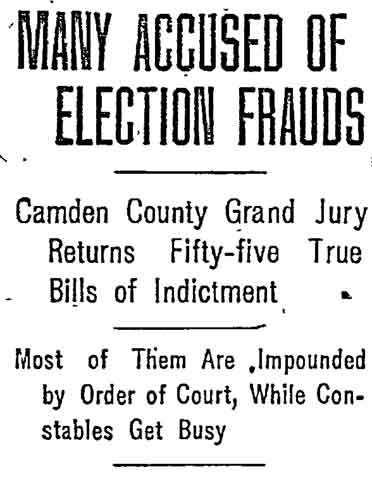
Camden County Grand Jury Returns Fifty-five True Bills of Indictment
Most of Them Are Impounded by Order of Court, While Constables Get Busy
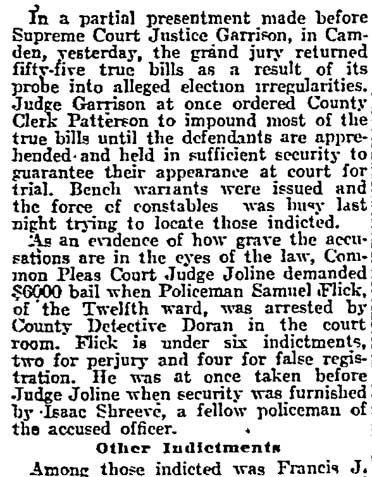
In a partial presentment made before Supreme Court Justice Garrison, in Camden, yesterday, the grand jury returned fifty-five true bills as a result of its probe into alleged election irregularities. Judge Garrison at once ordered County Clerk Patterson to impound most of the true bills until the defendants are apprehended and held in sufficient security to guarantee their appearance at court for trial. Bench warrants were issued and the force of constables was busy last night trying to locate those indicted.
As an evidence of how grave the accusations are in the eyes of the law, Common Pleas Court Judge Joline demanded $6000 bail when Policeman Samuel Flick, of the Twelfth ward, was arrested by County Detective Doran in the court room. Flick is under six indictments, two for perjury and four for false registration. He was at once taken before Judge Joline when security was furnished by Isaac Shreeve, a fellow policeman of the accused officer.
Other Indictments
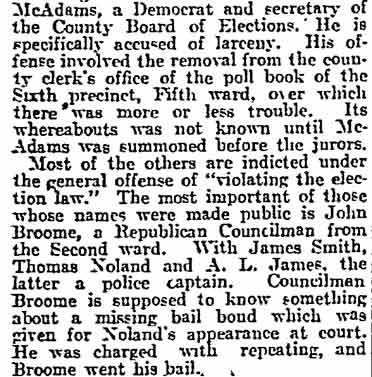
Among those indicted was Francis J. McAdams, a Democrat and secretary of the County Board of Elections. He is specifically accused of larceny. His offense involved the removal from the county clerk’s office of the poll book of the Sixth precinct, Fifth ward, over which there was more or less trouble. Its whereabouts was not known until McAdams was summoned before the jurors.
Most of the others are indicted under the general offense of “violating the election law.” The most important of those whose names were made public is John Broome, a Republican Councilman from the Second ward. With James Smith, Thomas Noland and A. L. James, the latter a police captain. Councilman Broome is supposed to know something about a missing bail bond which was given for Noland’s appearance at court. He was charged with repeating, and Broome went his bail.
Indicted on Five Counts
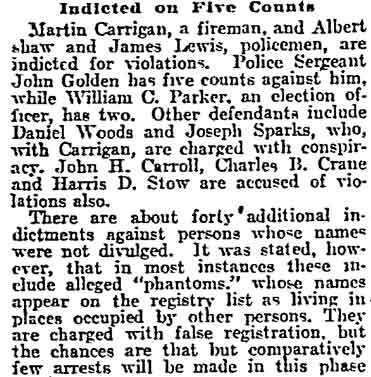
Martin Carrigan, a fireman, and Albert Shaw and James Lewis, policemen, are indicted for violations. Police Sergeant John Golden has five counts against him, while William C. Parker, an election officer, has two. Other defendants include Daniel Woods and Joseph Sparks, who, with Carrigan, are charged with conspiracy. John H. Carroll, Charles B. Crane and Harris D. Stow are accused of violations also.
There are about forty additional indictments against persons whose names were not divulged. It was stated, however, that in most instances these include alleged “phantoms,” whose names appear on the registry list as living in places occupied by other persons. They are charged with false registration, but the chances are that but comparatively few arrests will be made in this phase of the matter.
Probe Still Deeper
The fact that it was announced that the presentment was but partial indicates that the probe is not ended. It is asserted that it has just begun and that the finding of indictments presented yesterday is merely the opening wedge for even more searching investigation. When the jurors will be summoned again is not known, Prosecutor Scovel desiring to clean up the calendder [sic], which is greatly overburdened at present, before conducting any further investigation.
Many men prominent in professional and political life were in the court room when the presentment was made, quite a few being on the anxious bench themselves.
Among the seventy-eight true bills found by the grand jury yesterday in connection with the ordinary Criminal Court business and aside from the election cases were indictments against the officers of the Young Republican Club of the Second ward and the Camden Aerie, No. 65, Fraternal Order of Eagles. They are specifically charged with giving indecent exhibitions, and in addition the organizations are accused of keeping disorderly houses.
These cases resulted from reports made by the Law and Order League, whose agents attended “innocent amusements” given by the organizations. The class of entertainment is declared to have had the Seeley dinner and other such events beaten a mile. Not only the officers are indicated [sic], but also Lottie Fayette, of Philadelphia, and a male companion, who assisted materially in the festivities.
Old Camden Police Team Had Loads of Fun in 1907
Camden Courier-Post —

WHEN FATHER WAS A BOY!
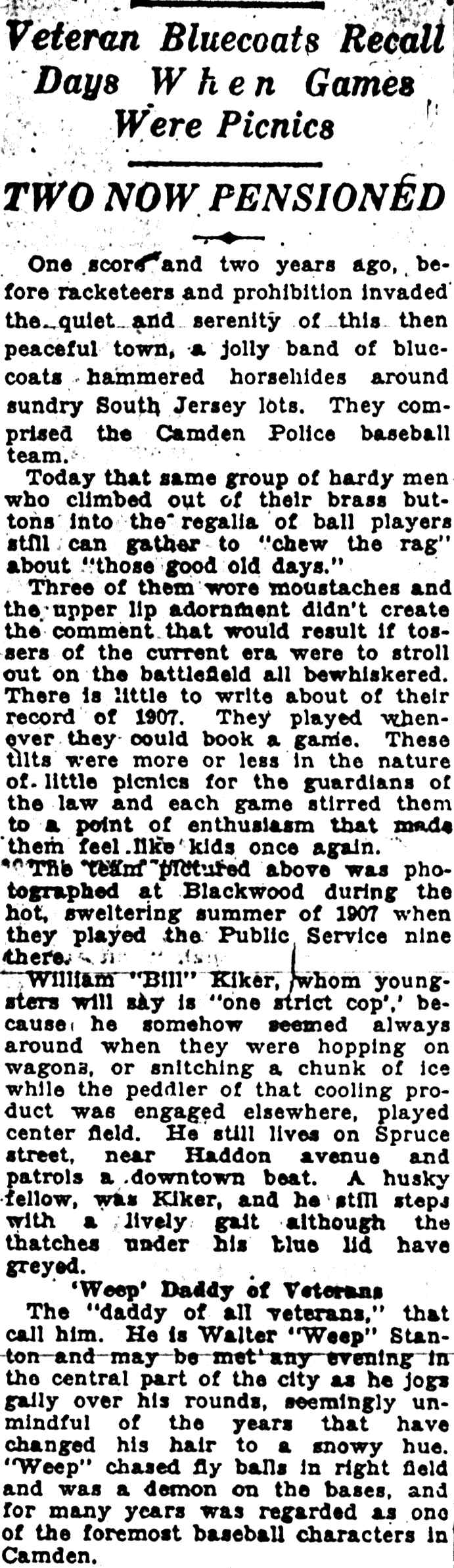
Veteran Bluecoats Recall Days When Games Were Picnics
Two Now Pensioned
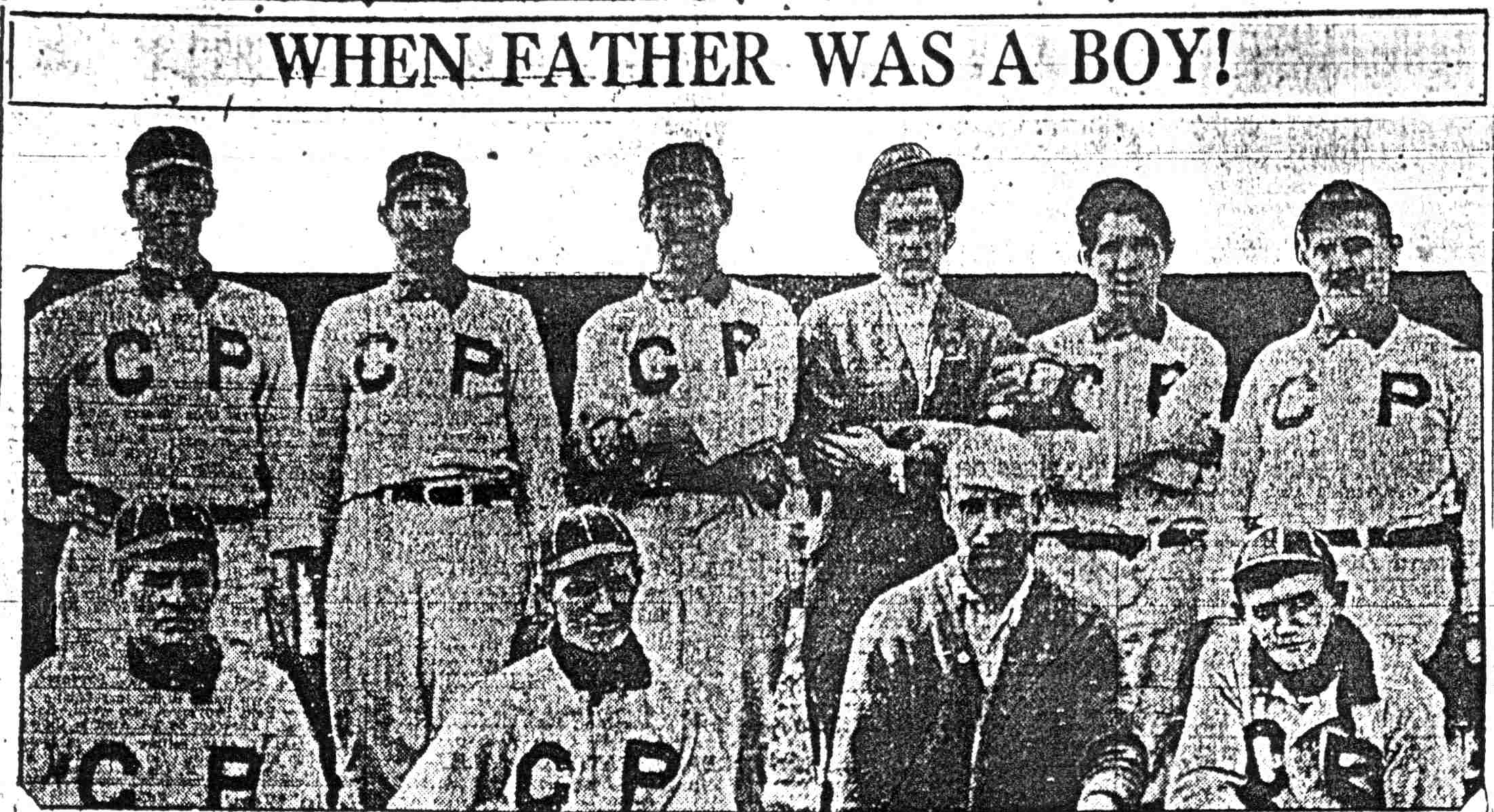
THE CAMDEN POLICE TEAM OF 1907. Front row, left to right — William Kiker, Walter “Weep” Stanton, “Dick” Haines, Lou “Dutch” Urban. Back row — Charles Whalen, Fred Lechleidner, George Hill, Otto Erdbrink, George “Babe” Clayton and Captain Lincoln James.
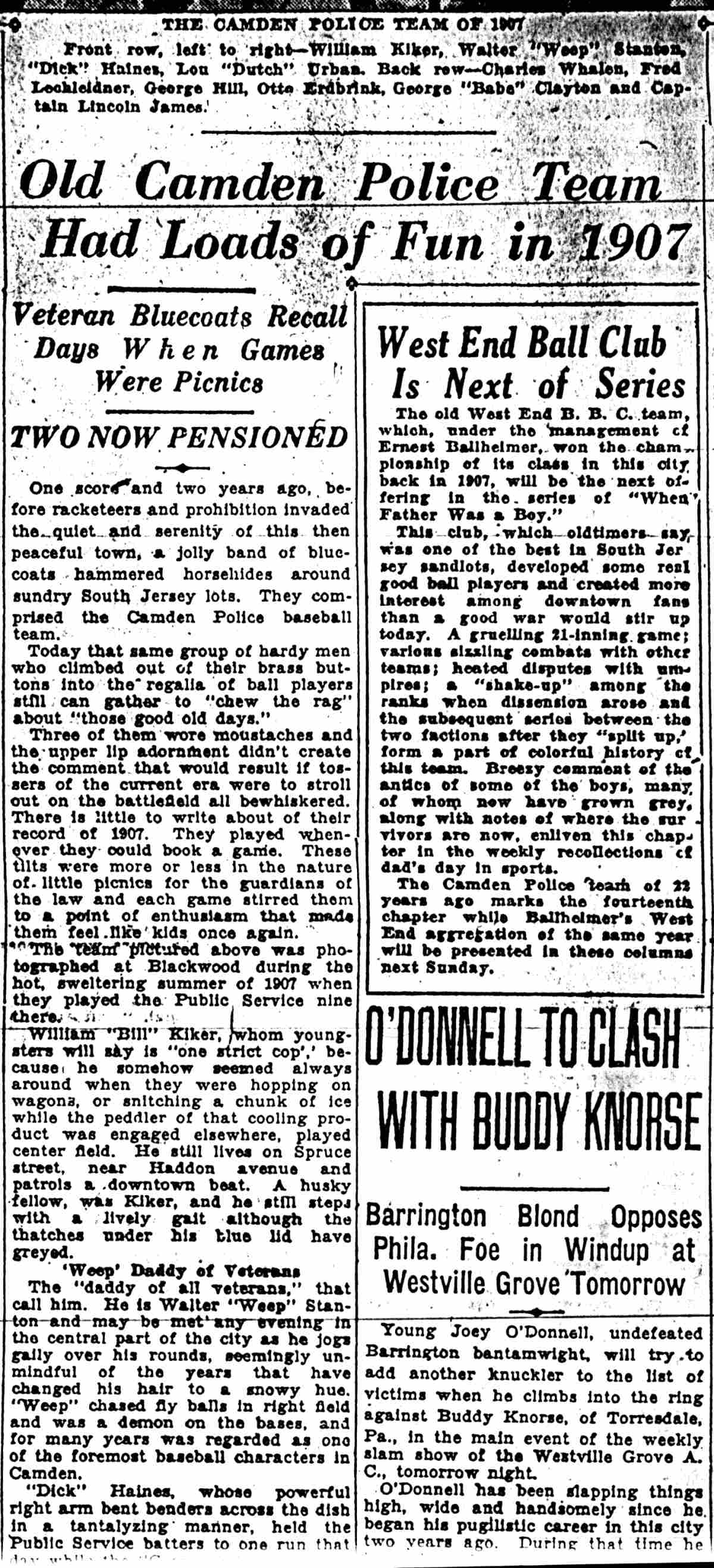
One score and two years ago, before racketeers and prohibition invaded the quiet and serenity of this then peaceful town, a jolly band of bluecoats hammered horsehides around sundry South Jersey lots. They comprised the Camden Police baseball team.
Today that same group of hardy men who climbed out of their brass buttons into the regalia of ball players still can gather to “chew the rag” about “those good old days.”
Three of them wore moustaches and the upper lip adornment didn’t create the comment that would result if tossers of the current era were to stroll out on the battlefield all bewhiskered. There is little to write about of their record of 1907. They played whenever they could book a game. These tilts were more or less in the nature of little picnics for the guardians of the law and each game stirred them to a point of enthusiasm that made them feel like kids once again.
The team pictured above was photographed at Blackwood during the hot, sweltering summer of 1907 when they played the Public Service nine there.
William “Bill” Kiker, whom youngsters will say is “one strict cop,” because he somehow seemed always around when they were hopping on wagons, or snitching a chunk of ice while the peddler of that cooling product was engaged elsewhere, played center field. He still lives on Spruce street, near Haddon avenue and patrols a downtown beat. A husky fellow, was Kiker, and he still steps with a lively gait although the thatches under his blue lid have greyed.
‘Weep’ Daddy of Veterans
The “daddy of all veterans,” that call him. He is Walter “Weep” Stanton and may be met any evening in the central part of the city as he jogs gaily over his rounds, seemingly unmindful of the years that have changed his hair to a snowy hue. “Weep” chased fly balls in right field and was a demon on the bases, and for many years was regarded as one of the foremost baseball characters in Camden.
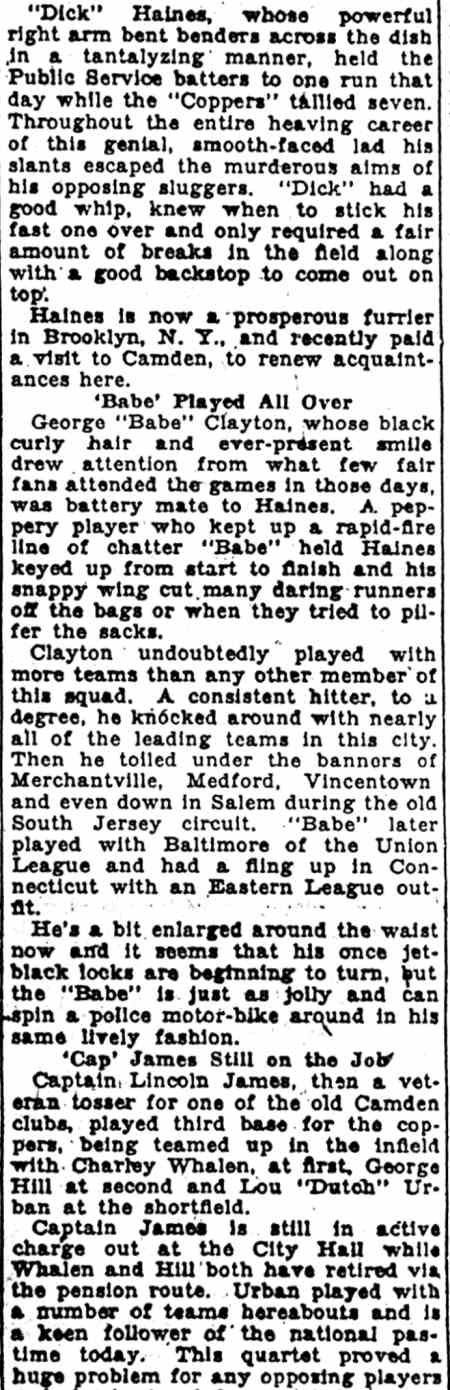
“Dick” Haines, whose powerful right arm bent benders across the dish in a tantalizing manner, held the Public Service batters to one run that day while the “Coppers” tallied seven. Throughout the entire heaving career of this genial, smooth-faced lad his slants escaped the murderous aims of his opposing sluggers. “Dick” had a good whip, knew when to stick his fast one over and only required a fair amount of breaks in the field along with a good backstop to come out on top. Haines is now a prosperous furrier in Brooklyn, N. Y., and recently paid a visit to Camden, to renew acquaintances here.
‘Babe’ Played All Over
George “Babe” Clayton, whose black curly hair and ever-present smile drew attention from what few fair fans attended the games in those days, was battery mate to Haines. A peppery player who kept up a rapid-fire line of chatter “Babe” held Haines keyed up from start to finish and his snappy wing cut many daring runners off the bags or when they tried to pilfer the sacks. Clayton undoubtedly played with more teams than any other member of this squad. A consistent hitter, to a degree, he knocked around with nearly all of the leading teams in this city. Then he toiled under the banners of Merchantville, Medford, Vincentown and even down in Salem during the old South Jersey circuit. “Babe” later played with Baltimore of the Union League and had a fling up in Connecticut with an Eastern League outfit. He’s a bit enlarged around the waist now and it seems that his once jet-black locks are beginning to turn, but the “Babe” is just as jolly and can spin a police motor-bike around in his same lively fashion.
‘Cap’ James Still on the Job
Captain Lincoln James, then a veteran tosser for one of the old Camden clubs, played third base for the coppers, being teamed up in the infield with Charley Whalen, at first, George Hill at second and Lou “Dutch” Urban at the shortfield. Captain James is still in active charge out at the City Hall while Whalen and Hill both have retired via the pension route. Urban played with a number of teams hereabouts and is a keen follower of the national pastime today. This quartet proved a huge problem for any opposing players and freely handed out headaches to umpires.
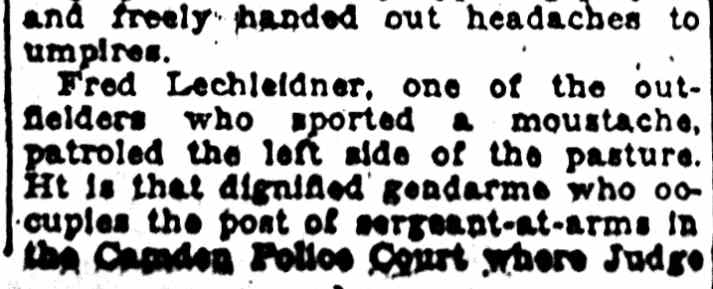
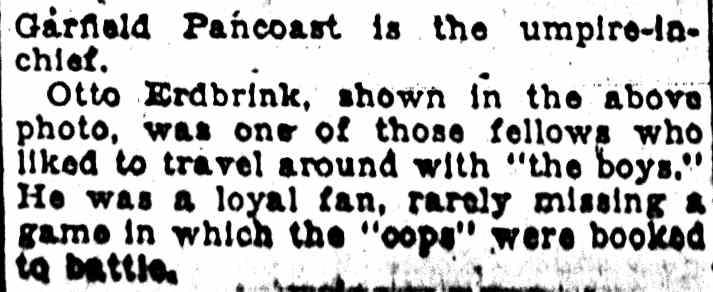
Fred Lechleidner, one of the outfielders who sported a moustache, patroled the left side of the pasture. He is that dignified gendarme who occupies the post of sergeant-at-arms in the Camden Police Court where Judge Garfield Pancoast is the umpire-in-chief.
Otto Erdbrink, shown in the above photo, was one of those fellows who liked to travel around with “the boys.” He was a loyal fan, rarely missing a game in which the “cops” were booked to battle.
30 Cops Shifted Today in Opening of New District
Camden Courier-Post —

Shake-Up in Camden Force is Most Drastic in History
SMITH AT CITY HALL
Drastic shifts in the Camden police department, affecting more than 30 members of the force became effective at 8 a.m. today.
The shake-up, announced yesterday by Commissioner David S. Rhone, director of public safety, is the result of creation of a fourth police district.
The outstanding changes are the promotion of Sergeant of Detectives George Ward to acting lieutenant in the First district, supplanting Sergeant Samuel Nayler, who is sent to headquarters, and the return to the city detective bureau of Acting County Detective Howard Smith.
Smith was detailed to the second district today and was assigned to a robbery investigation in the thirteenth ward.
District Captaincies Abolished
With the shifts, the rank of district captain is abolished. Instead, lieutenants will be in charge of the districts. Captains will be in charge only of the traffic and detective bureaus and headquarters, Commissioner Rhone said.
The removal of Sergeant Naylor from the First District was not unexpected, since he had been “on the carpet” last October as a result of a speakeasy shooting in his district. Naylor, though holding the rank of sergeant, was acting captain of the district.
He was threatened with dismissal by Chief Stehr and Commissioner Rhone if the vice conditions in the First District were not cleaned up. The situation came to a climax with the wounding of Charles Arini and Louis Dei Duca in a speakeasy at Third and Mickle streets in October. It was reported Naylor was to be removed from the district several times since.
Ward Again Promoted
Ward was promoted to sergeant of detectives two months ago. Under the transfer, he is promoted again, remaining as acting lieutenant for a year, until he takes an examination for a lieutenancy.
Other police officers now acting-lieutenants will become lieutenants after examination.
Naylor, who was in charge of the First district for several years, will serve as desk sergeant under Capt. A. Lincoln James.
The return of Smith to the city detective bureau was requested by Prosecutor Clifford A. Baldwin, it is understood. Smith has been a county detective for more than eleven years. He first was transferred to the prosecutor’s office at the request of Prosecutor Charles A. Wolverton. Although a Republican, he was retained there under Prosecutor Ethan P. Wescott. Although some surprise was occasioned by the announcement of Smith’s return to the city force, inasmuch as the new prosecutor is a Republican, it was said that Baldwin wished to begin his term with an entire new force.
Worked For City Also
Although Smith acted for the county and was paid by the county, he received a salary of $1 a year to retain him in the city so that he could be recalled at any time.
Through the shift, Sergeant Charles Laib, serving under Traffic Inspector Charles T. Humes, is elevated to acting captain of the traffic department. In the future all motorcycle men with the exception of George Clayton will report direct to Humes and Laib instead of to headquarters.
Ralph Bakley, who has been acting sergeant of the First District, has been named acting lieutenant of the Second District, and Thomas Cunningham, who was acting captain of the Second District, becomes acting lieutenant of the new Fourth District. William Horner, who has been acting captain of the Third District, is elevated to the rank of acting lieutenant and remains in charge of that district.
Widow's Property on North 8th Street
Camden Courier-Post —
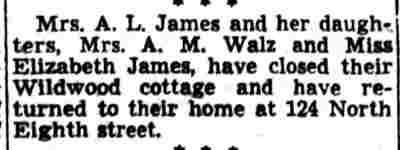
A. Lincoln James – North 8th Street
Property Listings
Camden Courier-Post —
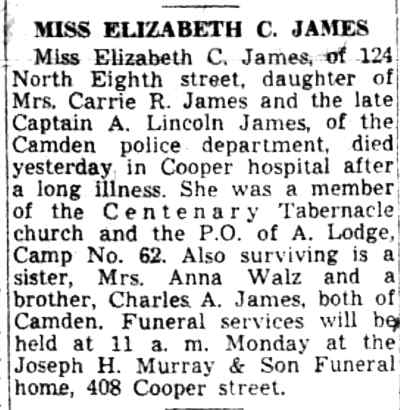
A. Lincoln James – North 8th Street
Estate Notice
Camden Courier-Post —
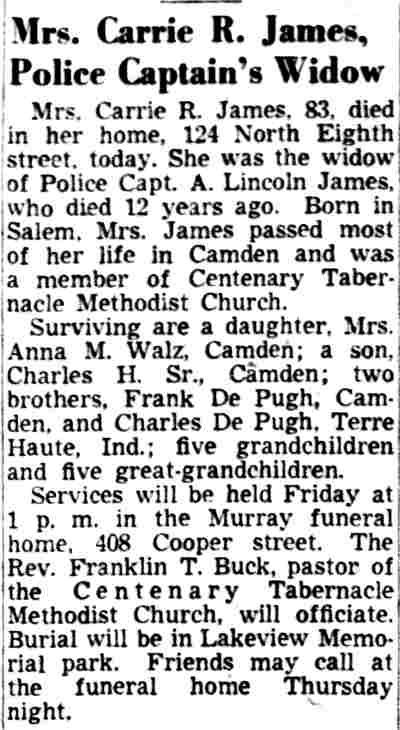
A. Lincoln James – North 8th Street
Sergeant Bentley Quits Police Force
Camden Post-Telegram —
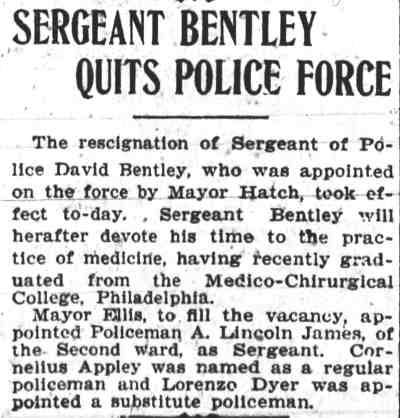
The rescignation [sic] of Sergeant of Police David Bentley, who was appointed on the force by Mayor Hatch, took effect to-day. Sergeant Bentley will herafter [sic] devote his time to the practice of medicine, having recently graduated from the Medico-Chirurgical College, Philadelphia.
Mayor Ellis, to fill the vacancy, appointed Policeman A. Lincoln James, of the Second ward, as Sergeant. Cornelius Appley was named as a regular policeman and Lorenzo Dyer was appointed a substitute policeman.
New Sergeant Goes on Duty
Camden Daily Courier —
David F. Bentley Made His Last Pull at 3 O’clock This Morning.
HAPPENINGS ON THE EAST SIDE
Sergeant David F. Bentley, who resigned as a member of the police force to devote his entire time to the practice of medicine, made his last “pull” over an East Side patrol box at 3 o’clock this morning, after nearly seven years of service. He was appointed sergeant of police six and a half years ago by Mayor Hatch.
Sergeant Bentley spent much time in reading all kinds of literature. Suddenly, after looking over some work in a physician’s office, he decided to take up the study of medicine. Between hours Bentley attended college and graduated with high honors from the Medico-Chirurgical College, Philadelphia, and also passed a most excellent examination in New Jersey. Dr. Bentley, of a genial disposition, made many friends throughout Camden who wish him success in his chosen profession.
A. Lincoln James, who has been on the force for fifteen years, donned the chevrons of a sergeant last night and will do duty in the First district. Sergeant James succeeded Dr. Bentley, who resigned to assume charge of his growing practice.
The new sergeant has distinguished himself by many acts of bravery in the discharge of his duty.
When it became known that Sergeant Bentley was about to resign friends of many policemen called on Mayor Ellis in their interest. After canvassing the merits of the candidates Mayor Ellis selected Policeman James for the position.
Three Veteran Cops Will Go on Pension as Old Year Fades
Camden Courier-Post —
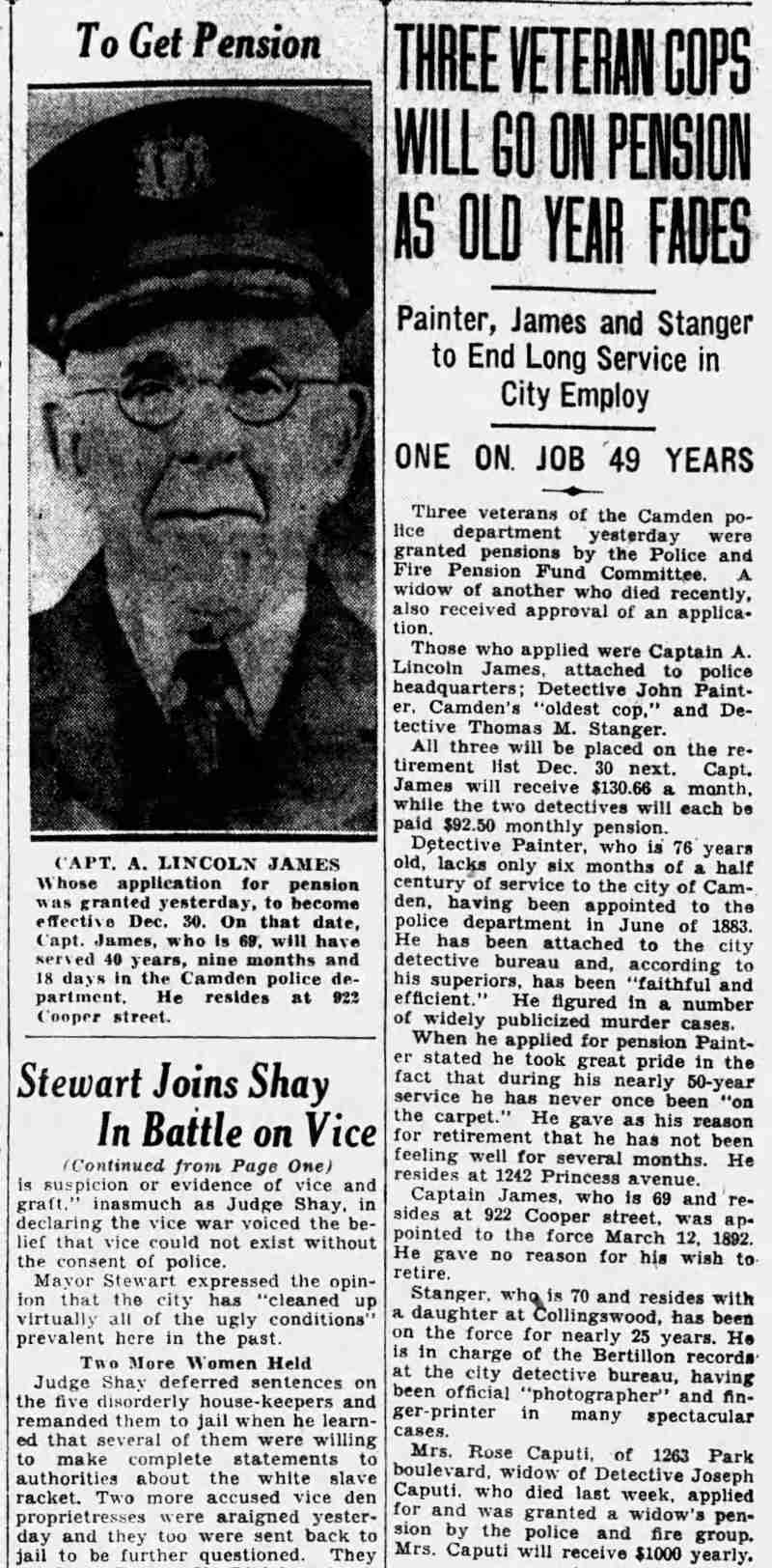
CAPT. A. LINCOLN JAMES – Whose application for pension was granted yesterday, to become effective Dec. 30. On that date, Capt. James, who is 69, will have served 40 years, nine months and 18 days in the Camden police department. He resides at 922 Cooper street.
Three Veteran Cops Will Go on Pension as Old Year Fades
Camden Courier-Post —
Painter, James and Stanger to End Long Service in City Employ
ONE ON JOB 49 YEARS
To Get Pension
CAPT. A. LINCOLN JAMES
Whose application for pension was granted yesterday, to become effective Dec. 30. On that date, Capt. James, who is 69, will have served 40 years, nine months and 18 days in the Camden police department. He resides at 922 Cooper street.
Three veterans of the Camden police department yesterday were granted pensions by the Police and Fire Pension Fund Committee. A widow of another who died recently, also received approval of an application.
Those who applied were Captain A. Lincoln James, attached to police headquarters; Detective John Painter, Camden’s “oldest cop,” and Detective Thomas M. Stanger.
All three will be placed on the retirement list Dec. 30 next. Capt. James will receive $130.66 a month, while the two detectives will each be paid $92.50 monthly pension.
Detective Painter, who is 76 years old, lacks only six months of a half century of service to the city of Camden, having been appointed to the police department in June of 1883. He has been attached to the city detective bureau and, according to his superiors, has been “faithful and efficient.” He figured in a number of widely publicized murder cases.
When he applied for pension Painter stated he took great pride in the fact that during his nearly 50-year service he has never once been “on the carpet.” He gave as his reason for retirement that he has not been feeling well for several months. He resides at 1242 Princess avenue.
Captain James, who is 69 and resides at 922 Cooper street, was appointed to the force March 12, 1892. He gave no reason for his wish to retire.
Stanger, who is 70 and resides with a daughter at Collingswood, has been on the force for nearly 25 years. He is in charge of the Bertillon records at the city detective bureau, having been official “photographer” and finger-printer in many spectacular cases.
Mrs. Rose Caputi, of 1263 Park boulevard, widow of Detective Joseph Caputi, who died last week, applied for and was granted a widow’s pension by the police and fire group. Mrs. Caputi will receive $1000 yearly.
Stewart Joins Shay In Battle on Vice
is suspicion or evidence of vice and graft,” inasmuch as Judge Shay, in declaring the vice war voiced the belief that vice could not exist without the consent of police.
Mayor Stewart expressed the opinion that the city has “cleaned up virtually all of the ugly conditions” prevalent here in the past.
Two More Women Held
Judge Shay deferred sentences on the five disorderly house-keepers and remanded them to jail when he learned that several of them were willing to make complete statements to authorities about the white slave racket. Two more accused vice den proprietresses were arraigned yesterday and they too were sent back to jail to be further questioned. They [cut off at the crop edge]
Cops Are Shifted by Mayor Stewart
Camden Courier-Post —
Retirements on Pension Cause Changes; Sergeant Petit, Traffic Head
Police Sergeant Nathan Petit yesterday was named head of the city traffic bureau to succeed Lieut. Charles L. Laib, who will retire on pension tonight.
A number of other transfers to fill vacancies left by other members of the police department who are to accept pensions were made yesterday by Mayor Roy R. Stewart.
Lieut. Samuel Johnson will be assigned in charge of police headquarters in place of Capt. A. Lincoln James and will serve also as a desk-sergeant on the 8 a.m. to 4 p.m. shift daily. Policeman William Robertson will be made an acting desk-sergeant to fill the vacancy left by Johnson.
Policeman Frederick Watson, who has been doing special work in the detective bureau, will be returned to police headquarters to work at his old position of jailor in place of Samuel Hibbert, another pensioner.
Detective William Boettcher will be assigned to take over the duties of Detective Thomas Stanger, who also will retire tonight. Stanger has been in charge of Bertillion [sic] records and police photographic work for many years.
Rumors to the effect that Lieutenants George Ward and George Frost would be shifted from their present positions were spiked in the announcement that Petit would take charge of the traffic division.
The reports at city hall had it that Frost would be named to succeed Laib and that Ward would be placed in charge of the detective division in place of Lieutenant Louis Shaw, but Mayor Stewart announced that both Ward and Frost will remain in the present positions. Ward is acting desk sergeant in charge of police headquarters during the day shift. Frost has been in charge of the police school and pistol target range.
Although not announced by Mayor Stewart, Frost is expected to be named inspector of personnel, taking over the duties formerly performed by Inspector Charles T. Humes, in addition to his former duties as head of the police school.
Petit will not be named an acting lieutenant, the mayor said, but will hold his title of sergeant. He will, however, be in absolute charge of the traffic division and will not alternate on the three shifts with the other two sergeants.
Policeman Robertson is named desk sergeant in place of Sergeant Thomas Murphy, who will retire on pension tonight with the others.
In announcing the changes, Mayor Stewart said that they would not mean anything more financially to the men and would not be actual advancements.
Funeral Saturday for Captain James
Camden Courier-Post —
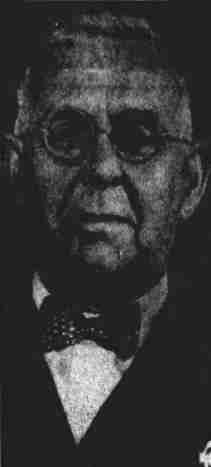
CAPT. A. LINCOLN JAMES – Veteran Camden policeman died early yesterday following a stroke suffered at his seashore home.

Police Veteran Was Pioneer in Camden Civic Life; Aided Needy
Long Career Ended
Police Captain James is dead.
The veteran officer—Abraham Lincoln James—who retired five years ago, friend and confidant of the men with whom he worked as patrolman and captain, of the “down-and-outer,” died in West Jersey Hospital at 2 a. m. yesterday. He was taken there Sunday from his Summer home in Wildwood after suffering a stroke. He was 74.
The funeral will be held at 11 a. m., Saturday, at the funeral home of Joseph H. Murray and Son, 408 Cooper street. Burial will be private.
Born Aug. 14, 1863, at 817 Federal street, Captain James was a resident of Camden all his life. For the last 20 years he had lived at 922 Cooper street.
Close Friend of Elder Baird
With his death, the ranks of the old time veterans associated with politics and public affairs, those who were the active ones in Camden many years were further thinned. Captain James was a close friend of the late former U. S. Senator David Baird. In those bygone days one of the political headquarters was the cigar store operated by John O’Brien at Ninth and Market streets.
A friend of the “down-and-outer,” Captain James helped many wayfarers who came to police headquarters for night’s lodgings. The next morning Captain James saw to it that the lodgers had breakfast from money which he supplied. And many a job he got for such men who had “lost their grip.”
Captain James first was appointed to the police as a patrolman in March, 1892. He resigned twice before accepting a permanent appointment August 1, 1899. He was made a captain January 1, 1908, and was in charge of police headquarters until his retirement on pension December 31, 1932. Police headquarters in those days was in the old city hall, Haddon avenue and Washington street.
Started as Cabinetmaker
Prior to joining the police James was a cabinetmaker with the old firm of Graham & Armstrong, remembered by old residents of the city as the concern which made the cabinets in which spools of cotton were displayed for sale in stores.
Captain James was secretary of the Police Beneficial Association, a member of the Brotherhood of America Welcome Circle, and of the Centenary Tabernacle M. E. Church, Fifth and Cooper streets, where he was a regular attendant.
He is survived by his widow, Carrie R.; a son, Charles H. James, former all-around star athlete of Sewell School; two daughters, Elizabeth and Mrs. Anna Walz, and five grandchildren, Charles H., Jr., Robert Carlton, Elmer J., Jr., of Oaklyn; Mrs. Mildred Collins, of Hollywood, Cal., and Lincoln of Chester Pa.