John J. Burleigh
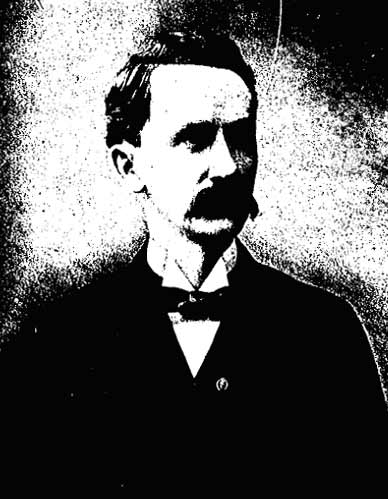
John J. Burleigh
JOHN J. BURLEIGH was born in 1855 to Irish immigrant parents. His father, a doctor, died around the same time John Burleigh was born. At 14 he learned how to operate a telegraph, and he went to work at the age of 15. His initiative and ability were soon recognized, and he rose rapidly in the business world. He was instrumental in founding some of the first telegraph and telephone systems in South Jersey, and also was involved in bringing electricity to Atlantic City. At the age of 42 he was already in three building and loan associations, and was running many other businesses as well.
In the late 1880s John J. Burleigh made his home at 326 State Street. As his fortunes progressed, so did his address. By 1890 he had moved to 323 Cooper Street. This would later become the home of lawyer Francis D. Weaver. By 1906 he had moved to Merchantville.
John J. Burleigh was a member of and very active in the affairs of the Church of the Immaculate Conception on Broadway at Market Street. On January 28, 1897 J. J. Burleigh was one of several dignitaries who were in attendance at the opening of the Catholic Lyceum on Broadway at Federal Street, adjacent to the church. Other attendees included New Jersey Governor John W. Griggs, Mayor John L. Westcott, late Attorney-General Samuel H. Grey, Camden city solicitor J. Willard Morgan, Senator H. W. Johnson, then-Assemblymen Louis Derousse and Scovel, Sheriff David Baird Sr., then-Postmaster Harry B. Paul, ex-Judge Armstrong, Architect Henry S. Dagit, George A. Frey, and H. L. Bonsall. The Lyceum would evolve into Camden Catholic High School.
By 1906 he was vice-president of the Public Service Corporation, the predecessor of today’s Transport of New Jersey. By 1915 he founded and was president of the Broadway Trust Company bank on Broadway in Camden.
John J. Burleigh passed away on February 8, 1917 at the age of 62, at his home at Maple Avenue and Cove Road, Merchantville.
Corporation Elections
Philadelphia Inquirer —
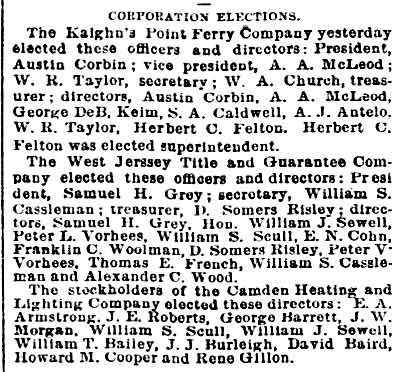
CORPORATION ELECTIONS.
The Kaighn’s Point Ferry Company yesterday elected these officers and directors: President, Austin Corbin; vice president, A. A. McLeod; W. R. Taylor, secretary; W. A. Church, treasurer; directors, Austin Corbin, A. A. McLeod, George DeB. Keim, S. A. Caldwell, A. J. Antelo. W. R. Taylor, Herbert C. Felton. Herbert C. Felton was elected superintendent.
The West Jersey Title and Guarantee Company elected these officers and directors: President, Samuel H. Grey; secretary, William S. Cassleman; treasurer, D. Somers Risley; directors, Samuel H. Grey, Hon. William J. Sewell, Peter L. Vorhees, William S. Scull, E. N. Cohn, Franklin C. Woolman, D. Somers Risley, Peter V. Vorhees, Thomas E. French, William S. Cassleman and Alexander C. Wood.
The stockholders of the Camden Heating and Lighting Company elected these directors: E. A. Armstrong, J. E. Roberts, George Barrett, J. W. Morgan, William S. Scull, William J. Sewell, William T. Bailey, J. J. Burleigh, David Baird, Howard M. Cooper and Rene Gillon.
Camden County Republicans
1894
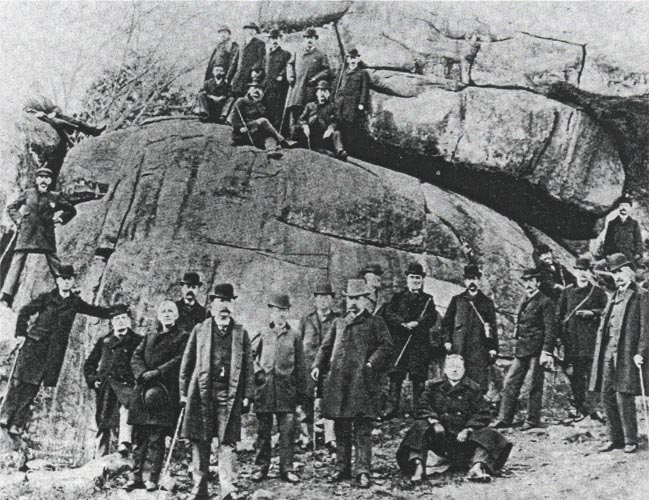

Camden County Republican leaders, 1894
John J. Burleigh
Biographical Review — 1897
Biographical Review — 1897
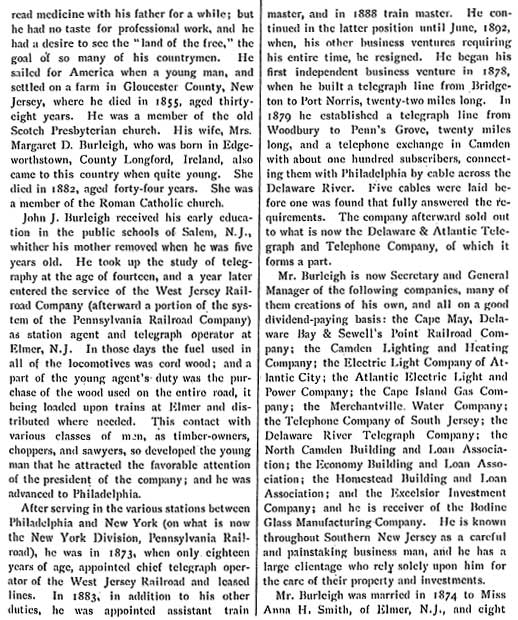
JOHN J. BURLEIGH, one of the foremost financiers of Camden, N.J., is a man who has pushed his way to the front by his own energy. He was born in Gloucester County, New Jersey, in 1855, the only child of Francis and Margaret (Dolan) Burleigh, who were both of Irish birth.
Francis Burleigh, who was born in Newtown, Lima Vady, Londonderry, in the north of Ireland, was the son of a physician, and read medicine with his father for a while; but he had no taste for professional work, and he had a desire to see the “land of the free,” the goal of so many of his countrymen. He sailed for America when a young man, and settled on a farm in Gloucester County, New Jersey, where he died in 1855, aged thirty-eight years. He was a member of the old Scotch Presbyterian church. His wife, Mrs. Margaret D. Burleigh, who was born in Edgeworthstown, County Longford, Ireland, also came to this country when quite young. She died in 1882, aged forty-four years. She was a member of the Roman Catholic church.
John J. Burleigh received his early education in the public schools of Salem, N.J., whither his mother removed when he was five years old. He took up the study of telegraphy at the age of fourteen, and a year later entered the service of the West Jersey Railroad Company (afterward a portion of the system of the Pennsylvania Railroad Company) as station agent and telegraph operator at Elmer, N.J. In those days the fuel used in all of the locomotives was cord wood; and a part of the young agent’s duty was the purchase of the wood used on the entire road, it being loaded upon trains at Elmer and distributed where needed. This contact with various classes of men, as timber-owners, choppers, and sawyers, so developed the young man that he attracted the favorable attention of the president of the company; and he was advanced to Philadelphia.
After serving in the various stations between Philadelphia and New York (on what is now the New York Division, Pennsylvania Railroad), he was in 1873, when only eighteen years of age, appointed chief telegraph operator of the West Jersey Railroad and leased lines. In 1883, in addition to his other duties, he was appointed assistant train master, and in 1888 train master. He continued in the latter position until June, 1892, when, his other business ventures requiring his entire time, he resigned. He began his first independent business venture in 1878, when he built a telegraph line from Bridgeton to Port Norris, twenty-two miles long. In 1879 he established a telegraph line from Woodbury to Penn’s Grove, twenty miles long, and a telephone exchange in Camden with about one hundred subscribers, connecting them with Philadelphia by cable across the Delaware River. Five cables were laid before one was found that fully answered the requirements. The company afterward sold out to what is now the Delaware & Atlantic Telegraph and Telephone Company, of which it forms a part.
Mr. Burleigh is now Secretary and General Manager of the following companies, many of them creations of his own, and all on a good dividend-paying basis: the Cape May, Delaware Bay & Sewell’s Point Railroad Company; the Camden Lighting and Heating Company; the Electric Light Company of Atlantic City; the Atlantic Electric Light and Power Company; the Cape Island Gas Company; the Merchantville Water Company; the Telephone Company of South Jersey; the Delaware River Telegraph Company; the North Camden Building and Loan Association; the Economy Building and Loan Association; the Homestead Building and Loan Association; and the Excelsior Investment Company; and he is receiver of the Bodine Glass Manufacturing Company. He is known throughout Southern New Jersey as a careful and painstaking business man, and he has a large clientage who rely solely upon him for the care of their property and investments.
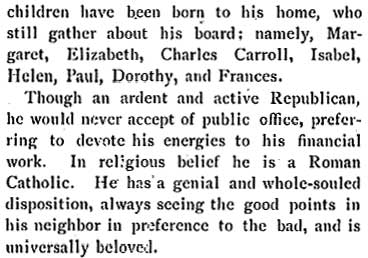
Mr. Burleigh was married in 1874 to Miss Anna H. Smith, of Elmer, N.J., and eight children have been born to his home, who still gather about his board: namely, Margaret, Elizabeth, Charles Carroll, Isabel, Helen, Paul, Dorothy, and Frances.
Though an ardent and active Republican, he would never accept of public office, preferring to devote his energies to his financial work. In religious belief he is a Roman Catholic. He has a genial and whole-souled disposition, always seeing the good points in his neighbor in preference to the bad, and is universally beloved.
Camden Lighting and Heating Company Annual Meeting
Philadelphia Inquirer —
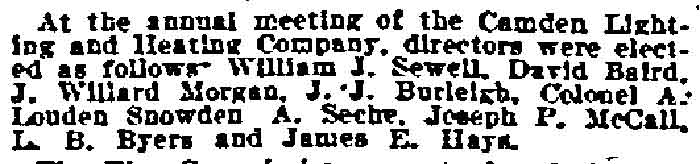
At the annual meeting of the Camden Lighting and Heating Company, directors were elected as follows: William J. Sewell, David Baird, J. Willard Morgan, J. J. Burleigh, Colonel A. Louden Snowden, A. Seche, Joseph P. McCall, L. B. Byers and James E. Hays.
They Dined with Minister Wu
Trenton Times —
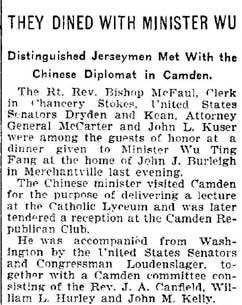
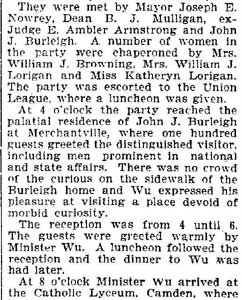
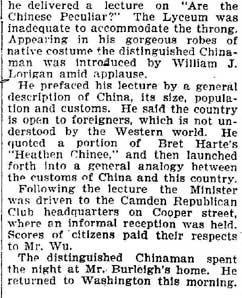
The Rt. Rev. Bishop McFaul, Clerk in Chancery Stokes, United States Senators Dryden and Kean, Attorney General McCarter and John L. Kuser were among the guests of honor at a dinner given to Minister Wu Ting Fang at the home of John J. Burleigh in Merchantville last evening.
The Chinese minister visited Camden for the purpose of delivering a lecture at the Catholic Lyceum and was later tendered a reception at the Camden Republican Club.
He was accompanied from Washington by the United States Senators and Congressman Loudenslager, together with a Camden committee consisting of the Rev. J. A. Canfield, William L. Hurley and John M. Kelly.
Royal Welcome for Ex-Sheriff Baird
Philadelphia Inquirer —
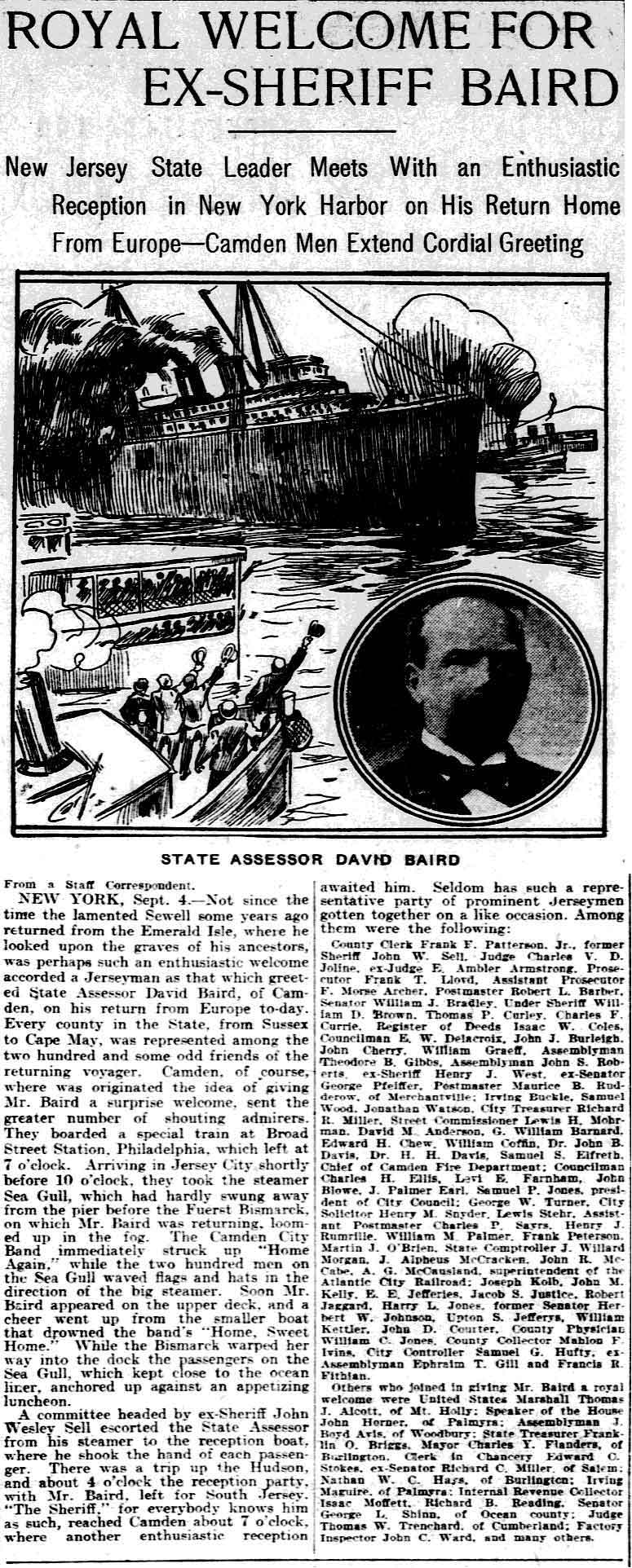
New Jersey State Leader Meets With an Enthusiastic Reception in New York Harbor on His Return Home From Europe—Camden Men Extend Cordial Greeting
STATE ASSESSOR DAVID BAIRD
From a Staff Correspondent.
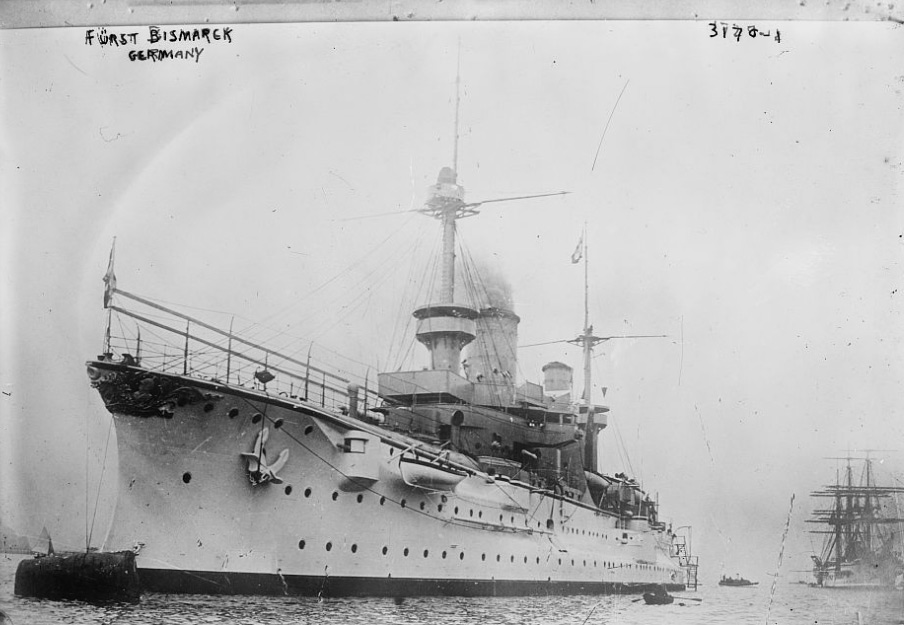
NEW YORK, Sept. 4.—Not since the time the lamented Sewell some years ago returned from the Emerald Isle, where he looked upon the graves of his ancestors, was perhaps such an enthusiastic welcome accorded a Jerseyman as that which greeted State Assessor David Baird, of Camden, on his return from Europe to-day. Every county in the State, from Sussex to Cape May, was represented among the two hundred and some odd friends of the returning voyager. Camden, of course, where was originated the idea of giving Mr. Baird a surprise welcome, sent the greater number of shouting admirers. They boarded a special train at Broad Street Station, Philadelphia, which left at 7 o’clock. Arriving in Jersey City shortly before 10 o’clock, they took the steamer Sea Gull, which had hardly swung away from the pier before the Fuerst Bismarck, on which Mr. Baird was returning, loomed up in the fog. The Camden City Band immediately struck up “Home Again,” while the two hundred men on the Sea Gull waved flags and hats in the direction of the big steamer. Soon Mr. Baird appeared on the upper deck, and a cheer went up from the smaller boat that drowned the band’s “Home, Sweet Home.” While the Bismarck warped her way into the dock the passengers on the Sea Gull, which kept close to the ocean liner, anchored up against an appetizing luncheon.
A committee headed by ex-Sheriff John Wesley Sell escorted the State Assessor from his steamer to the reception boat, where he shook the hand of each passenger. There was a trip up the Hudson, and about 4 o’clock the reception party, with Mr. Baird, left for South Jersey. “The Sheriff,” for everybody knows him as such, reached Camden about 7 o’clock, where another enthusiastic reception awaited him. Seldom has such a representative party of prominent Jerseymen gotten together on a like occasion. Among them were the following:
County Clerk Frank F. Patterson, Jr., former Sheriff John W. Sell, Judge Charles V. D. Joline, ex-Judge E. Ambler Armstrong, Prosecutor Frank T. Lloyd, Assistant Prosecutor F. Morse Archer, Postmaster Robert L. Barber, Senator William J. Bradley, Under Sheriff William D. Brown, Thomas P. Curley, Charles F. Currie, Register of Deeds Isaac W. Coles, Councilman E. W. Delacroix, John J. Burleigh, John Cherry, William Graeff, Assemblyman Theodore B. Gibbs, Assemblyman John S. Roberts, ex-Sheriff Henry J. West, ex-Senator George Pfeiffer, Postmaster Maurice B. Rudderow, of Merchantville; Irving Buckle, Samuel Wood, Jonathan Watson, City Treasurer Richard R. Miller, Street Commissioner Lewis H. Mohrman, David M. Anderson, G. William Barnard, Edward H. Chew, William Coffin, Dr. John B. Davis, Dr. H. H. Davis, Samuel S. Elfreth, Chief of Camden Fire Department; Councilman Charles H. Ellis, Levi E. Farnham, John Blowe, J. Palmer Earl, Samuel P. Jones, president of City Council; George W. Turner, City Solicitor Henry M. Snyder, Lewis Stehr, Assistant Postmaster Charles P. Sayrs, Henry J. Rumrille, William M. Palmer, Frank Peterson, Martin J. O’Brien, State Comptroller J. Willard Morgan, J. Alpheus McCracken, John R. McCabe, A. G. McCausland, superintendent of the Atlantic City Railroad; Joseph Kolb, John M. Kelly, E. E. Jefferies, Jacob S. Justice, Robert Jaggard, Harry L. Jones, former Senator Herbert W. Johnson, Upton S. Jefferys, William Kettler, John D. Courter, County Physician William C. Jones, County Collector Mahlon F. Ivins, City Controller Samuel G. Hufty, ex-Assemblyman Ephraim T. Gill and Francis R. Fithian.
Others who joined in giving Mr. Baird a royal welcome were United States Marshall Thomas J. Alcott, of Mt. Holly; Speaker of the House John Herner, of Palmyra; Assemblyman J. Boyd Avis, of Woodbury; State Treasurer Franklin O. Briggs, Mayor Charles Y. Flanders, of Burlington, Clerk in Chancery Edward C. Stokes, ex-Senator Richard C. Miller, of Salem; Nathan W. C. Hays, of Burlington; Irving Maguire, of Palmyra; Internal Revenue Collector Isaac Moffett, Richard B. Reading, Senator George L. Shinn, of Ocean county; Judge Thomas W. Trenchard, of Cumberland; Factory Inspector John C. Ward, and many others.
Fürst Bismarck
1903
Recital at Catholic Lyceum
Philadelphia Inquirer —
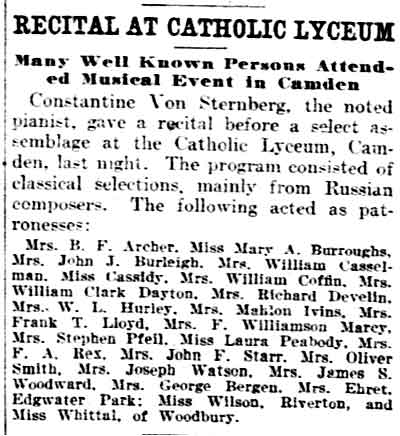
Many Well Known Persons Attended Musical Event in Camden
Constantine Von Sternberg, the noted pianist, gave a recital before a select assemblage at the Catholic Lyceum, Camden, last night. The program consisted of classical selections, mainly from Russian composers. The following acted as patronesses:
Mrs. B. F. Archer, Miss Mary A. Burroughs, Mrs. John J. Burleigh, Mrs. William Casselman, Miss Cassidy, Mrs. William Coffin, Mrs. William Clark Dayton, Mrs. Richard Develin, Mrs. W. L. Hurley, Mrs. Mahlon Ivins, Mrs. Frank T. Lloyd, Mrs. F. Williamson Marcy, Mrs. Stephen Pfeil, Miss Laura Peabody, Mrs. F. A. Rex, Mrs. John F. Starr, Mrs. Oliver Smith, Mrs. Joseph Watson, Mrs. James S. Woodward, Mrs. George Bergen, Mrs. Ehret, Edgewater Park; Miss Wilson, Riverton, and Miss Whittal, of Woodbury.
Camden County Transfers
Philadelphia Inquirer —
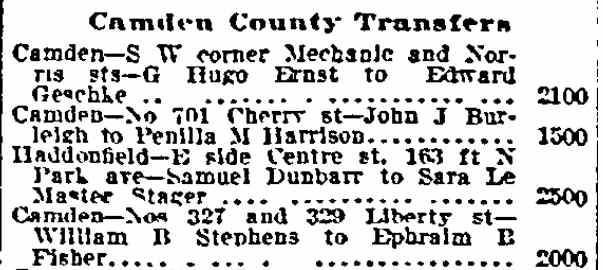
Camden—S W corner Mechanic and Norris sts—G Hugo Ernst to Edward Geschke ... 2100
Camden—No 701 Cherry st—John J Burleigh to Penilla M Harrison ... 1500
Haddonfield—E side Centre st, 163 ft N Park ave—Samuel Dunbarr to Sara Le Master Stager ... 2500
Camden—Nos 327 and 329 Liberty st—William B Stephens to Ephraim B Fisher ... 2000
Baird Holds a Christmas Party
Philadelphia Inquirer —
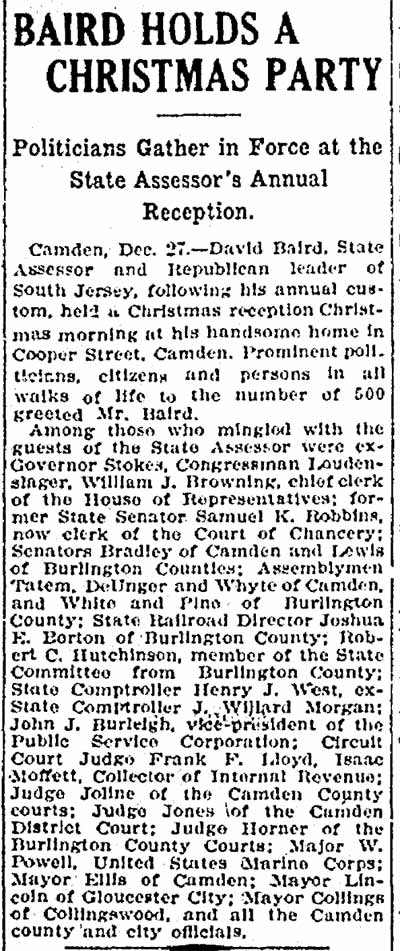
Politicians Gather in Force at the State Assessor’s Annual Reception.
Camden, Dec. 27.—David Baird, State Assessor and Republican leader of South Jersey, following his annual custom, held a Christmas reception Christmas morning at his handsome home in Cooper Street, Camden. Prominent politicians, citizens and persons in all walks of life to the number of 500 greeted Mr. Baird.
Among those who mingled with the guests of the State Assessor were ex-Governor Stokes, Congressman Loudenslager, William J. Browning, chief clerk of the House of Representatives; former State Senator Samuel K. Robbins, now clerk of the Court of Chancery; Senators Bradley of Camden and Lewis of Burlington Counties; Assemblymen Tatem, DeUnger and Whyte of Camden, and White and Pino of Burlington County; State Railroad Director Joshua E. Borton of Burlington County; Robert C. Hutchinson, member of the State Committee from Burlington County; State Comptroller Henry J. West, ex-State Comptroller J. Willard Morgan; John J. Burleigh, vice-president of the Public Service Corporation; Circuit Court Judge Frank F. [sic] Lloyd, Isaac Moffett, Collector of Internal Revenue; Judge Joline of the Camden County courts; Judge Jones of the Camden District Court; Judge Horner of the Burlington County Courts; Major W. Powell, United States Marine Corps; Mayor Ellis of Camden; Mayor Lincoln of Gloucester City; Mayor Collings of Collingswood, and all the Camden county and city officials.
Trolley Demands to Be Presented Today
Philadelphia Inquirer —
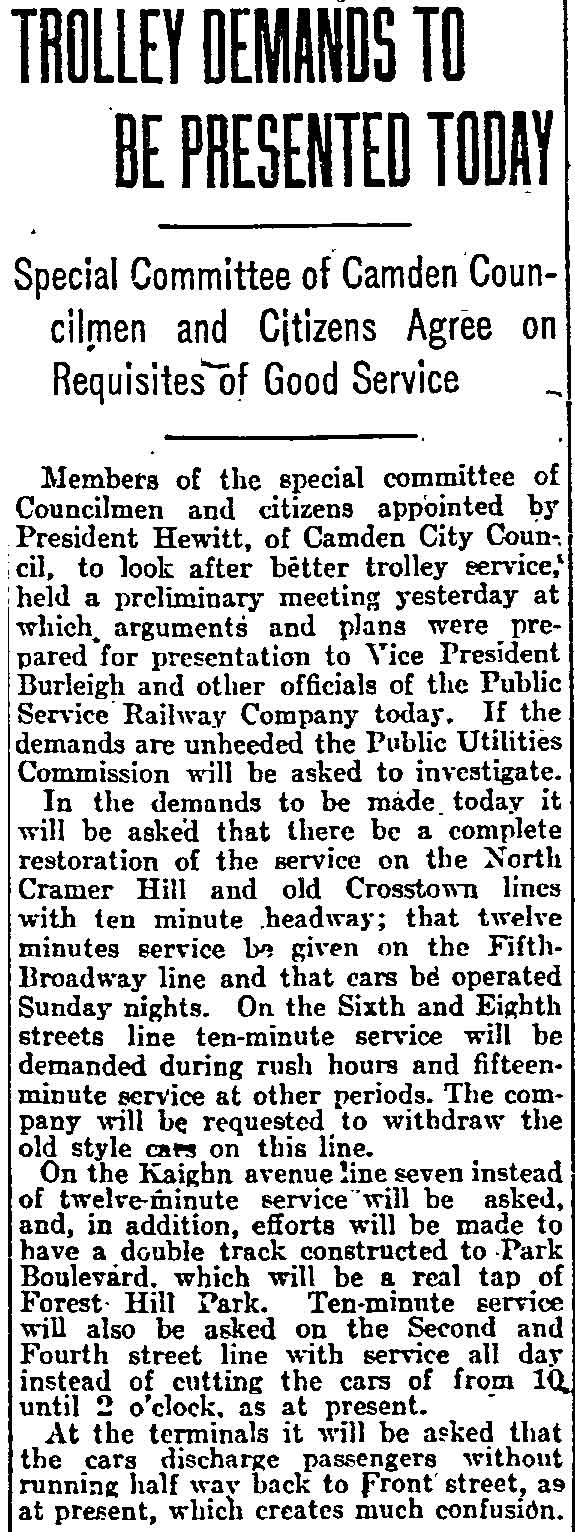
Special Committee of Camden Councilmen and Citizens Agree on Requisites of Good Service
Members of the special committee of Councilmen and citizens appointed by President Hewitt, of Camden City Council, to look after better trolley service, held a preliminary meeting yesterday at which arguments and plans were prepared for presentation to Vice President Burleigh and other officials of the Public Service Railway Company today. If the demands are unheeded the Public Utilities Commission will be asked to investigate.
In the demands to be made today it will be asked that there be a complete restoration of the service on the North Cramer Hill and old Crosstown lines with ten minute headway; that twelve minutes service be given on the Fifth-Broadway line and that cars be operated Sunday nights. On the Sixth and Eighth streets line ten-minute service will be demanded during rush hours and fifteen-minute service at other periods. The company will be requested to withdraw the old style cars on this line.
On the Kaighn avenue line seven instead of twelve-minute service will be asked, and, in addition, efforts will be made to have a double track constructed to Park Boulevard, which will be a real tap of Forest Hill Park. Ten-minute service will also be asked on the Second and Fourth street line with service all day instead of cutting the cars of [sic] from 10 until 2 o’clock, as at present.
At the terminals it will be asked that the cars discharge passengers without running half way back to Front street, as at present, which creates much confusion.
Broadway Trust Company
Bank Directory —
Broadway Trust Company
Broadway below Walnut St., Camden, N.J.
J. J. BURLEIGH, President
ANTHONY KOBUS, Vice President — WM. J. COOPER, Vice President
BURLEIGH H. DRAPER, Secretary and Treasurer
Directors: John J. Burleigh, William Mills, Dr. S. G. Bushey, Anthony J. Oberst, Ralph D. Childrey, John Wesley Sell, Robert H. Comey, Dr. Marvin A. Street, William J. Cooper, Wilbert L. Sweeten, George A. Frey, Edward B. Stone, Albert Fogg, Adam Schlorer, Frederick Grant, Bernhard F. Schroeder, John B. Kates, Edward Schuster Jr., Dr. Grant E. Kirk, John O. Wilson, Anthony Kobus
John J. Burleigh Succumbs After Lengthy Illness
Camden Courier —
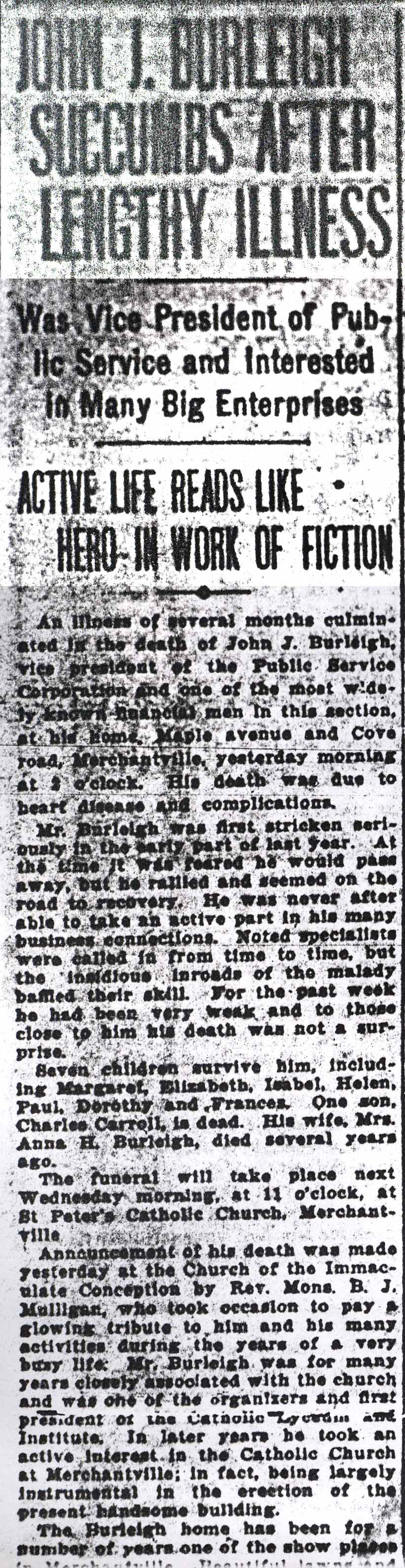
Was Vice President of Public Service and Interested in Many Big Enterprises
ACTIVE LIFE READS LIKE HERO IN WORK OF FICTION
An illness of several months culminated in the death of John J. Burleigh, vice president of the Public Service Corporation and one of the most widely-known business men in this section, at his home, Maple avenue and Cove road, Merchantville, yesterday morning at 9 o’clock. His death was due to heart disease and complications.
Mr. Burleigh was first stricken seriously in the early part of last year. At the time it was feared he would pass away, but he rallied and seemed on the road to recovery. He was never able to take an active part in his many business connections. Noted specialists were called in from time to time, but the insidious inroads of the malady baffled their skill. For the past week he has been very weak and to those close to him his death was not a surprise.
Seven children survive him, including Margaret, Elizabeth, Isabel, Helen, Paul, Dorothy and Frances. One son, Charles Carroll, is dead. His wife, Mrs. Anna H. Burleigh, died several years ago.
The funeral will take place next Wednesday morning, at 11 o’clock, at St. Peter’s Catholic Church, Merchantville.
Announcement of his death was made yesterday at the Church of the Immaculate Conception by Rev. Mons. B. J. Mulligan, who took occasion to pay a glowing tribute to him and his many activities during the years of a very busy life. Mr. Burleigh was for many years closely associated with the church and was one of the organizers and first president of the Catholic Lyceum and Institute. In later years he took an active interest in the Catholic Church at Merchantville; in fact, being largely instrumental in the erection of the present handsome building.
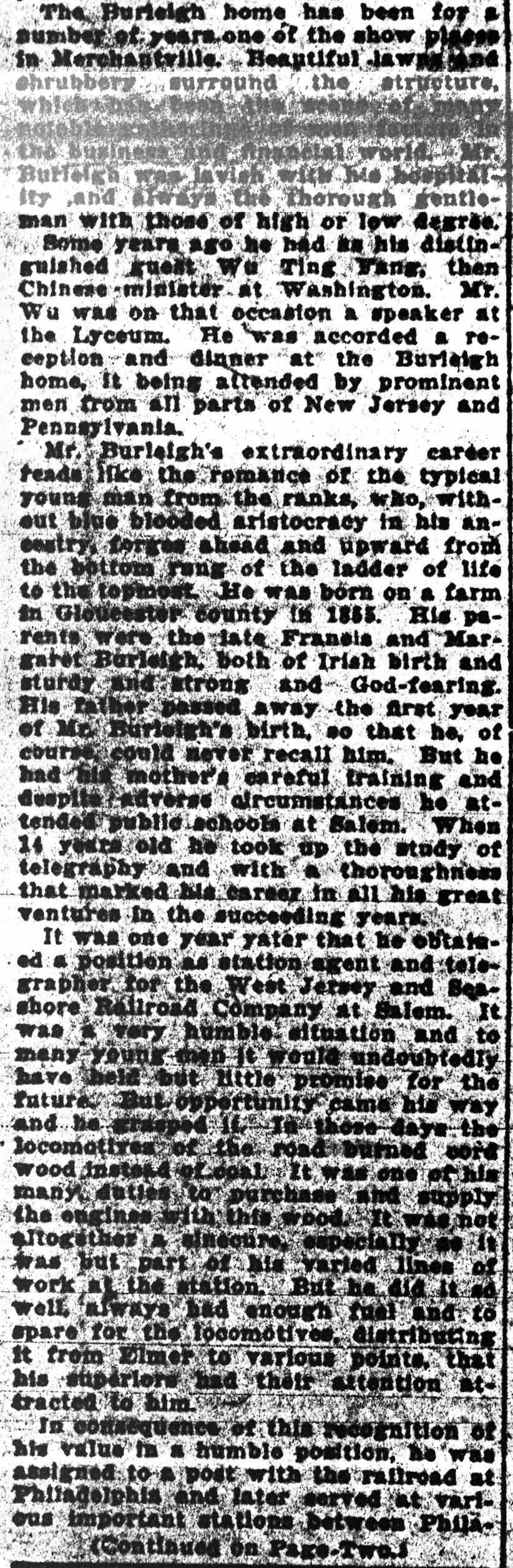
The Burleigh home has been for a number of years one of the show places in Merchantville. Beautiful lawns and shrubbery surround the structure, which has been the scene of many [illegible] in the business and financial world. Mr. Burleigh was lavish with his hospitality and always the thorough gentleman with those of high or low degree.
Some years ago he had as his distinguished guest Wu Ting Fang, then Chinese minister at Washington. Mr. Wu was on that occasion a speaker at the Lyceum. He was accorded a reception and dinner at the Burleigh home, it being attended by prominent men from all parts of New Jersey and Pennsylvania.
Mr. Burleigh’s extraordinary career reads like the romance of the typical young man from the ranks, who, without blue blooded aristocracy in his ancestry, forges ahead and upward from the bottom rung of the ladder of life to the topmost. He was born on a farm in Gloucester county in 1855. His parents were the late Francis and Margaret Burleigh, both of Irish birth and sturdy and strong and God-fearing. His father passed away the first year of Mr. Burleigh’s birth, so that he, of course, could never recall him. But he had his mother’s careful training and despite adverse circumstances he attended public schools at Salem. When 14 years old he took up the study of telegraphy and with a thoroughness that marked his career in all his great ventures in the succeeding years.
It was one year later that he obtained a position as station agent and telegrapher for the West Jersey and Seashore Railroad Company at Salem. It was a very humble situation and to many young men it would undoubtedly have held but little promise for the future. But opportunity came his way and he grasped it. In those days the locomotives of the road burned cord wood instead of coal. It was one of his many duties to purchase and supply the engines with this wood. It was not altogether a sinecure, especially as it was but part of his varied lines of work at the station. But he did it so well, always had enough fuel and to spare for the locomotives, distributing it from Elmer to various points, that his superiors had their attention attracted to him.
In consequence of this recognition of his value in a humble position, he was assigned to a post with the railroad at Philadelphia and later served at various important stations between Philadelphia and New York. In 1873, when but 18 years old, he was made chief telegrapher for the West Jersey and its leased lines.
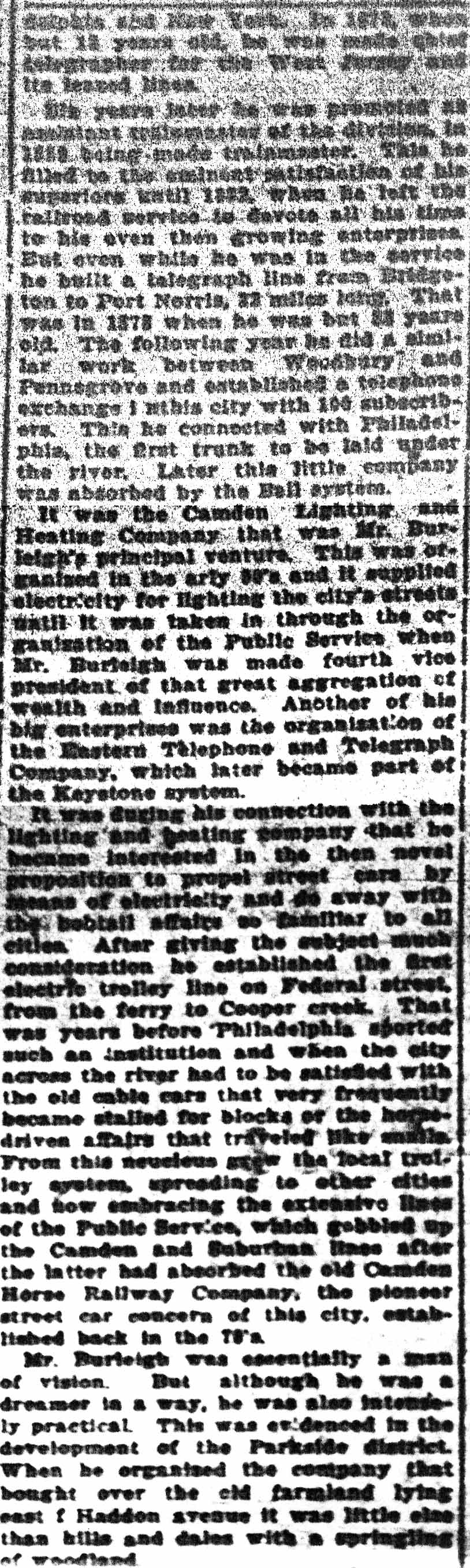
Ten years later he was promoted as assistant trainmaster of the division, in 1888 being made trainmaster. This he filled to the eminent satisfaction of his superiors until 1892, when he left the railroad service to devote all his time to his even then growing enterprises. But even while he was in the service he built a telegraph line from Bridgeton to Port Norris, 22 miles long. That was in 1878 when he was but 23 years old. The following year he did a similar work between Woodbury and Pennsgrove and established a telephone exchange in this city with 100 subscribers. This he connected with Philadelphia, the first trunk to be laid under the river. Later this little company was absorbed by the Bell system.
It was the Camden Lighting and Heating Company that was Mr. Burleigh’s principal venture. This was organized in the early 80’s and it supplied electricity for lighting the city’s streets until it was taken in through the organization of the Public Service when Mr. Burleigh was made fourth vice president of that great aggregation of wealth and influence. Another of his big enterprises was the organization of the Eastern Telephone and Telegraph Company, which later became part of the Keystone system.
It was during his connection with the lighting and heating company that he became interested in the then novel proposition to propel street cars by means of electricity and do away with the bobtail affairs so familiar to all cities. After giving the subject much consideration he established the first electric trolley line on Federal street, from the ferry to Cooper creek. That was years before Philadelphia sported such an institution and when the city across the river had to be satisfied with the old cable cars that very frequently became stalled for blocks or the horse-driven affairs that traveled like snails. From this nucleus grew the local trolley system, spreading to other cities and now embracing the extensive lines of the Public Service, which gobbled up the Camden and Suburban lines after the latter had absorbed the old Camden Horse Railway Company, the pioneer street car concern of this city, established back in the 70’s.
Mr. Burleigh was essentially a man of vision. But although he was a dreamer in a way, he was also intensely practical. This was evidenced in the development of the Parkside district. When he organized the company that bought over the old farmland lying east of Haddon avenue it was little else than hills and dales with a sprinkling of woodland [article continues]