Introduction
JOSEPHUS JENNINGS, also known as Joseph Jennings, was well-known musician and bandleader in Camden. His band, popularly known as Jennings Band was also known as Jennings’ Sixth Regiment Band and later as Jennings’ Third Regiment Band was quite famous in Camden from the 1880s right on up America’s entry into World War I in 1917. It was organized as the National Cornet Band in 1868 and became the Sixth Regiment Band in 1871. In its later years the band was known as Jennings’ Third Regiment Band, as the old Sixth New Jersey Regiment had been replaced in Camden by the Third in a reorganization of New Jersey’s National Guard Units. The name stuck even after Joseph Jennings retired as bandmaster in 1910.
George Reeser Prowell wrote about the band’s early days in his History of Camden County, New Jersey, published in 1886:
The National Cornet Band was organized in 1868, with Joseph Jennings as leader. In 1871 the name was changed to the Sixth Regiment Band and it was mustered into the service of the National Guard, and was the only regimental band in the State for years. Their present band-room is at the Sixth Regiment Armory, southwest corner of West and Mickle Streets. The present members are Joseph Jennings, John Roth, Augusta Buese, Gordon Phillips, Lewis Seal, Charles Landwehr, Charles Felcon, John Brown, D. C. Newman Collins, Alfred Colbins, Charles Bowyer, Isaac Heins, Joseph Young, Richard Richardson, Benjamin A. Woolman, Harry Carles, William Stevenson, Frederick Klaproth, Henry Myers, G. Philip Stephany, Adam Markgraft, Charles Ellis, Emerson Ogborn, Charles Frost, Hiram Hirst.
Bandleader Joseph Jennings was in the newspapers for a tragic reason in the fall of 1902, when his son, W. Price Jennings, and another boy, John Coffin, were murdered. Their killer, Paul Woodward, was quickly arrested, tried, and executed.
The Sixth Regiment Armory, which was the home of the band for many years, was destroyed by fire in 1906. Three Camden firefighters, George W. Shields, William Hillman, and William Jobes, were killed while fighting this blaze, and several other firefighters were injured.
Joseph Jennings led the band into 1912 when he retired. Joseph Bossle Sr. took over as bandmaster and reorganized the band. He led the band until 1919 when he took over the Tall Cedars of Lebanon band, which his son, Joseph Bossle Jr., had organized a few years before.
Joseph Jennings last resided at 319 North 3rd Street in Camden. He died on April 5, 1914 and was buried at Evergreen Cemetery in Camden.
Thomas M.K. Lee Post No. 5, G.A.R. — Philadelphia Inquirer, June 1, 1880
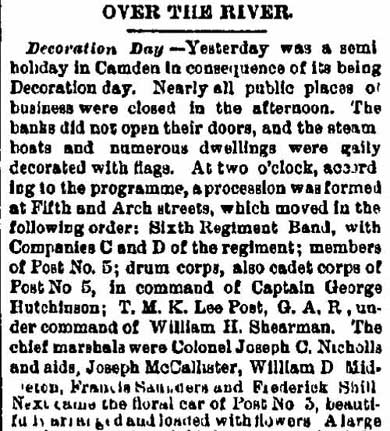
OVER THE RIVER.
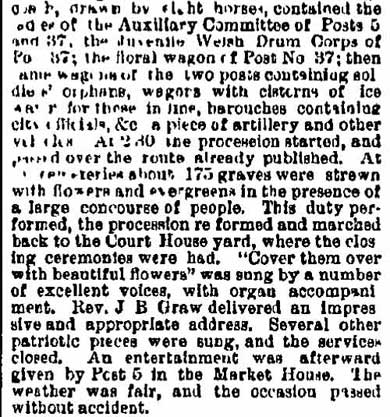
DECORATION DAY.—Yesterday was a semi holiday in Camden in consequence of it being Decoration day. Nearly all public places of business were closed in the afternoon. The banks did not open their doors, and the steam boats and numerous dwellings were gaily decorated with flags. At two o’clock, according to the programme, a procession was formed at Fifth and Arch streets, which moved in the following order: Sixth Regiment Band, with Companies C and D of the regiment; members of Post No. 5; drum corps, also cadet corps of Post No. 5, in command of Captain George Sutton; T. M. K. Lee Post, G. A. R., under command of William H. Shearman. The chief marshals were Colonel Joseph C. Nicholls and aids, Joseph McAllister, William D. Middleton, Francis Saunders and Frederick Shill. Next came the floral car of Post No. 5, beautifully arranged and loaded with flowers. A large one, drawn by eight horses, contained the remains of the Auxiliary Committee of Posts 5 and 37; the Juvenile Welsh Drum Corps of Post 37; the floral wagon of Post No. 37; then came wagons of the two posts containing soldiers’ orphans, wagons with cisterns of ice water for those in line, barouches containing city officials, &c., a piece of artillery and other vehicles. At 2:30 the procession started, and passed over the route already published. At Evergreen about 175 graves were strewn with flowers and evergreens in the presence of a large concourse of people. This duty performed, the procession reformed and marched back to the Court House yard, where the closing ceremonies were had. “Cover them over with beautiful flowers” was sung by a number of excellent voices, with organ accompaniment. Rev. J. B. Graw delivered an impressive and appropriate address. Several other patriotic pieces were sung, and the services closed. An entertainment was afterward given by Post 5 in the Market House. The weather was fair, and the occasion passed without accident.
DIED FROM HIS INJURIES.—About twelve o’clock on yesterday Lewis Werts, aged about twenty years, who had his leg crushed by a car of the Fourth street line at Broad avenue, on Saturday afternoon week, died from the effects of his injuries, lockjaw having set in. He lost an arm six months ago by a rail road accident.
RUNAWAY HORSE.—Yesterday morning a horse became frightened on Federal, near Broadway, and dashed down the street with furious speed. A young man named Davis, at Third and Federal, ran into the street, seized the reins, succeeded in stopping the animal before any damage was sustained.
SERIOUS FALL.—A young lad, son of Abraham Anderson, who resides on Cooper street, near Camden while playing yesterday, accidentally fell from a fence, and broke his leg near the knee.
BALLROAD SMASH.—About four o’clock yesterday a train of cars struck a wagon at Seventh and Sycamore streets, demolishing the vehicle, but, fortunately, no one was injured.
COMMITTED.—Justice Cassady yesterday committed James McCulley, Lemuel Ridell and Charles Wilson, for being quarrelsome and disorderly.
Philadelphia Inquirer — June 12, 1890
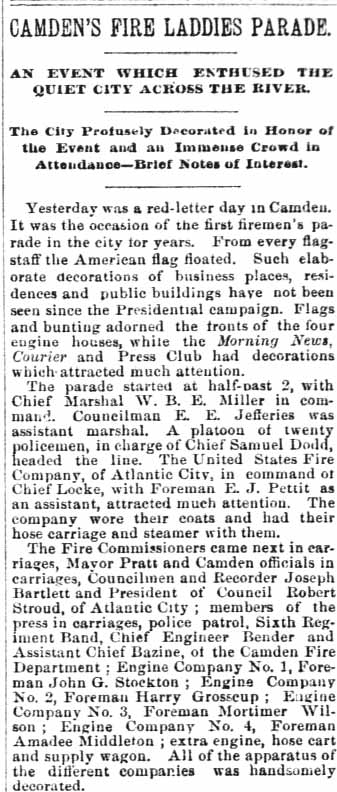
CAMDEN’S FIRE LADDIES PARADE.
AN EVENT WHICH ENTHUSED THE QUIET CITY ACROSS THE RIVER.
The City Profusely Decorated in Honor of the Event and an Immense Crowd in Attendance—Brief Notes of Interest.
Yesterday was a red-letter day in Camden. It was the occasion of the first firemen’s parade in the city for years. From every flagstaff the American flag floated. Such elaborate decorations of business places, residences and public buildings have not been seen since the Presidential campaign. Flags and bunting adorned the fronts of the four engine houses, while the Morning News, Courier and Press Club had decorations which attracted much attention.
The parade started at half-past 2, with Chief Marshal W. B. E. Miller in command. Councilman E. E. Jefferies was assistant marshal. A platoon of twenty policemen, in charge of Chief Samuel Dodd, headed the line. The United States Fire Company, of Atlantic City, in command of Chief Locke, with Foreman E. J. Pettit as an assistant, attracted much attention. The company wore their coats and had their hose carriage and steamer with them.
The Fire Commissioners came next in carriages, Mayor Pratt and Camden officials in carriages, Councilmen and Recorder Joseph Bartlett and President of Council Robert Stroud, of Atlantic City; members of the press in carriages, police patrol, Sixth Regiment Band, Chief Engineer Bender and Assistant Chief Bazine, of the Camden Fire Department; Engine Company No. 1, Foreman John G. Stockton; Engine Company No. 2, Foreman Harry Grosscup; Engine Company No. 3, Foreman Mortimer Wilson; Engine Company No. 4, Foreman Amadee Middleton; extra engine, hose cart and supply wagon. All of the apparatus of the different companies was handsomely decorated.
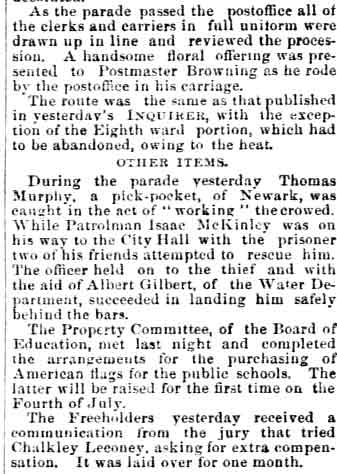
As the parade passed the postoffice all of the clerks and carriers in full uniform were drawn up in line and reviewed the procession. A handsome floral offering was presented to Postmaster Browning as he rode by the postoffice in his carriage.
The route was the same as that published in yesterday’s Inquirer, with the exception of the Eighth ward portion, which had to be abandoned, owing to the heat.
OTHER ITEMS.
During the parade yesterday Thomas Murphy, a pick-pocket, of Newark, was caught in the act of “working” the crowd. While Patrolman Isaac McKinley was on his way to the City Hall with the prisoner two of his friends attempted to rescue him. The officer held on to the thief and with the aid of Albert Gilbert, of the Water Department, succeeded in landing him safely behind the bars.
The Property Committee, of the Board of Education, met last night and completed the arrangements for the purchasing of American flags for the public schools. The latter will be raised for the first time on the Fourth of July.
The Freeholders yesterday received a communication from the jury that tried Chalkley Leconey, asking for extra compensation. It was laid over for one month.
Camden Post-Telegram — February 28, 1896
MUSIC HAS CHARMS
As Was Shown by the Enthusiasm at the Jennings’ Band Concert.
Philadelphia Inquirer — February 23, 1901
CAMDEN’S PRIDE PARADES BEFORE CITY’S PEOPLE
Policemen and Firemen Make Their Initial Turnout and Present a Creditable Appearance—Reviewed by Officials—How the Departments Have Grown
With a line up that could not be surpassed by the famous “Broadway Squad” of New York, Camden’s policemen, or most of them, turned out in review yesterday. The military carriage of the men excited much favorable comment, especially among those who were not aware that the men have been drilled every week for a year past by Colonel D. B. Murphy, of the National Guard of New Jersey. The policemen were followed by an array of firemen and a variety of apparatus that made many of the natives gasp in astonishment. Altogether the procession was a revelation to Camden residents who thought they were well informed about their city.
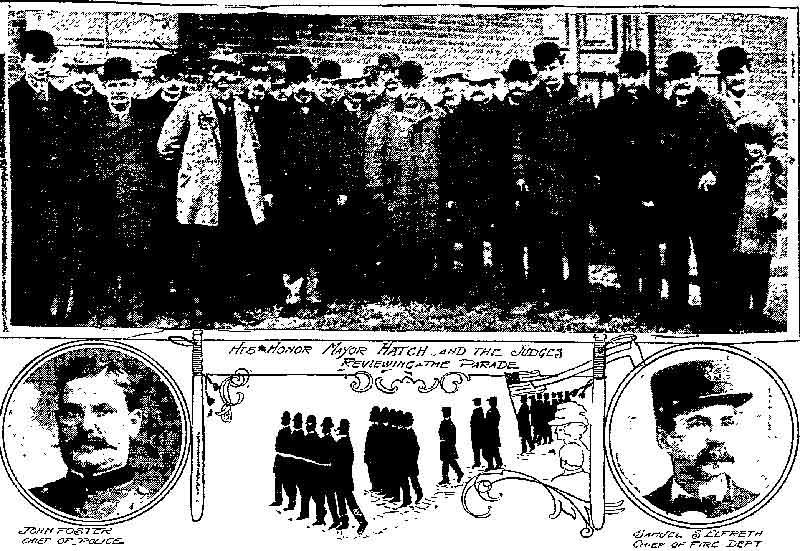
The procession was headed by Jennings’ Third Regiment Band. Then came Chief John Foster, of the Police Department, followed by a line composed of Police Captains Stanley, Alberts and Doyle and Sergeant Bentley. Following them under the silken folds of “Old Glory,” which he carried with a steady grasp, was Policeman George A. Donovan, a colored member of the force. Two platoons of forty policemen each were led by Sergeants Horner and Hyde. The police patrol wagons and the city ambulance brought up the end of the policemen’s line. The total police force of the city consists of ninety nine men.
The City Band, followed by Chief Samuel S. Elfreth, of the Fire Department, in a carriage, marked the head of the firemen’s line. The seventy-two men of this department were in two sections, the first being led by Assistant Chief Samuel Buzine, of the department headquarters, and the second by Assistant Chief Benjamin Kellum of the East Side. Between the two sections marched the Ivy Fife and Drum Corps. The apparatus in line consisted of six hose carts, five engines, three hook and ladder trucks, two chemical engines and a supply wagon.
The growth of Camden’s police department may be seen by a comparison of the present with the year 1862, when six policemen sufficed to protect the entire city, which was then divided in three wards. In 1876 there were only sixteen policemen in the city and nine regular firemen under one chief. There were, however, thirty extra men subject to call by the chief.
The parade yesterday was reviewed by Mayor Hatch and the City Councilmen from the balcony on the Broadway side of the Court House.
The Paul Woodward Murder Case — October 1, 1902 to January 14, 1903
On October 1, 1902 Paul Woodward murdered two young boys by giving them poison, one of them being Joseph Jennings’ son, Walter Price Jennings. Frank T. Lloyd, then Camden County prosecutor, was responsible for leading the investigation and prosecuting the case. Paul Woodward was arrested on October 4, 1902, and was quickly indicted on murder charges. Woodward was tried and found guilty in November of 1902. Woodward was sentenced to death, with sentence to be carried out on January 7, 1903. Efforts to gain a new trial failed, as did the appeal for clemency. Paul Woodward was executed on schedule at the Camden County jail, with Sheriff Christopher J. Mines Jr. supervising.
People involved in this case: Joseph Jennings — Jennings’ Third Regiment Band — Frank T. Lloyd — Dr. William S. Jones — William D. Hart — Dr. Paul N. Litchfield — F. Morse Archer — John Foster — John Painter — John Cherry — Isaac Toone — Paul Woodward — George M. Beringer — Charles G. Garrison — J. Wesley Sell — Christopher J. Mines Jr. — Frederick A. Rex — J. Frederick Voigt — George F. Kappel — Isaac Toy — Harry S. Scovel — Francis Ford Patterson Jr. — John S. Smith — Hugh Boyle — George H. Stineford Sr. — Frank S. Albright — Thomas Walton — Dr. William H. Iszard — Fred George
Philadelphia Inquirer — October 3, 1902
TWO CAMDEN BOYS HAVE DISAPPEARED
John Coffin, 11 years old, son of William Coffin, division freight agent of the Pennsylvania Railroad, and Price Jennings, 14 years old, son of Leader Joseph Jennings, of the Third Regiment Band, are missing from their homes and the Camden police have been asked to locate them.
They started for the Trenton fair Wednesday and failed to return. All intermediate points have been communicated with, but the lads have not been heard from.
Philadelphia Inquirer — October 4, 1902
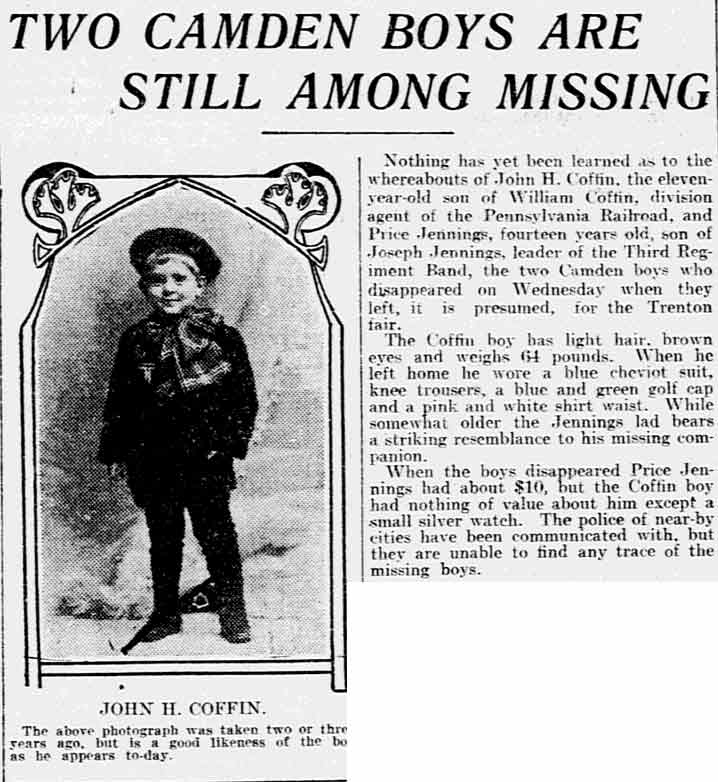
TWO CAMDEN BOYS ARE STILL AMONG MISSING
Nothing has yet been learned as to the whereabouts of John H. Coffin, the eleven-year-old son of William Coffin, division agent of the Pennsylvania Railroad, and Price Jennings, fourteen years old, son of Joseph Jennings, leader of the Third Regiment Band, the two Camden boys who disappeared on Wednesday when they left, it is presumed, for the Trenton fair.
The Coffin boy has light hair, brown eyes and weighs 64 pounds. When he left home he wore a blue cheviot suit, knee trousers, a blue and green golf cap and a pink and white shirt waist. While somewhat older the Jennings lad bears a striking resemblance to his missing companion.
When the boys disappeared Price Jennings had about $10, but the Coffin boy had nothing of value about him except a small silver watch. The police of near-by cities have been communicated with, but they are unable to find any trace of the missing boys.
Philadelphia Inquirer — October 5, 1902
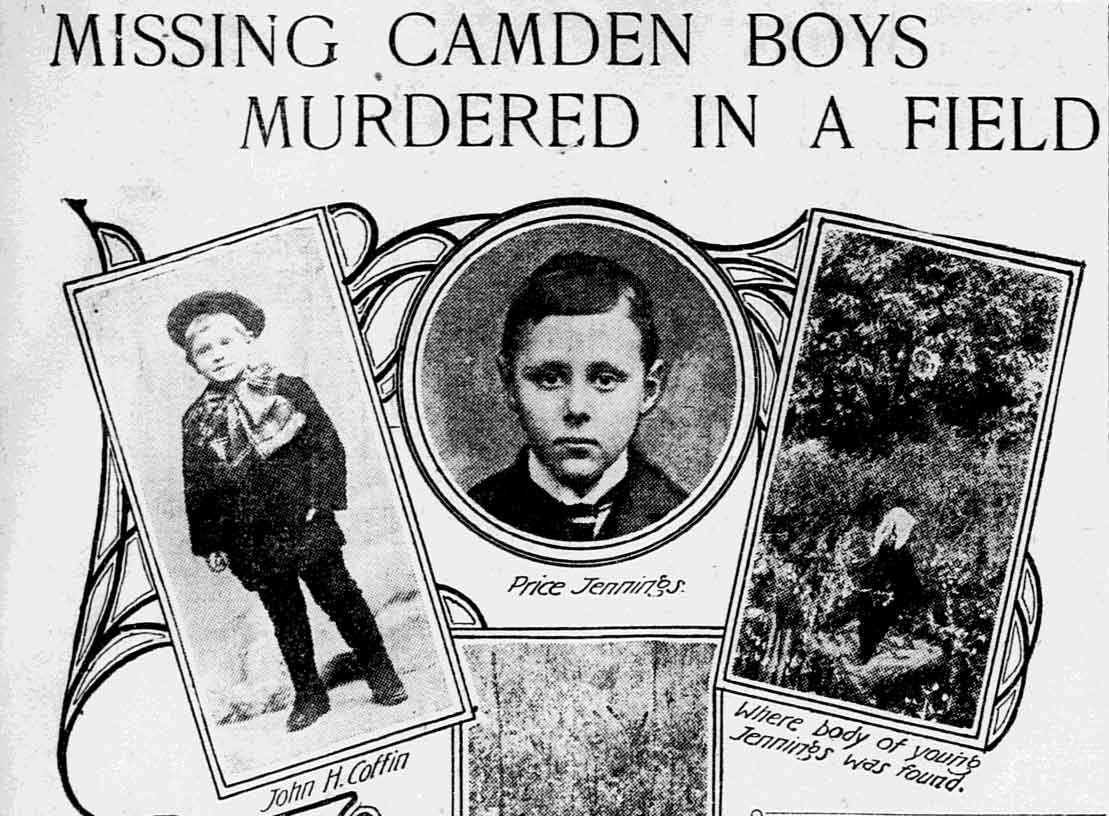
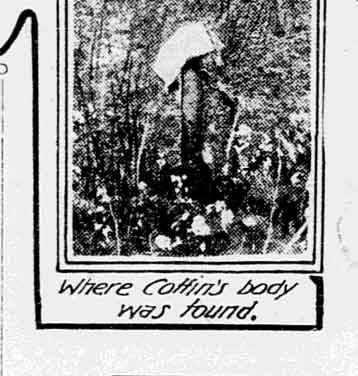
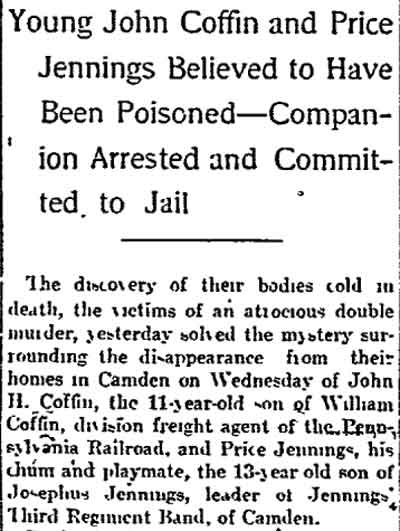
MISSING CAMDEN BOYS MURDERED IN A FIELD
Young John Coffin and Price Jennings Believed to Have Been Poisoned—Companion Arrested and Committed to Jail
The discovery of their bodies cold in death, the victims of an atrocious double murder, yesterday solved the mystery surrounding the disappearance from their homes in Camden on Wednesday of John H. Coffin, the 11-year-old son of William Coffin, division freight agent of the Pennsylvania Railroad, and Price Jennings, his chum and playmate, the 13-year old son of Josephus Jennings, leader of Jennings’ Third Regiment Band, of Camden.
Paul Woodward, 18 years old, a companion of both the boys, is charged with their murder and is locked up in the county jail awaiting the further action of the authorities. There are no evidences of external injuries and the only theory to which the police can attribute the cause of death is that the assassin of the boys administered poison to them, and it is along this line that County Physician Jones and Prosecutor Lloyd are conducting an investigation.
The details surrounding the atrocious crime makes it one the like of which has never been known in the criminal history of this section of the country. The youth of the boys, their heretofore relations of good companionship, and many other circumstances make of it an almost unparalleled crime, and while there is said to be every evidence of a motive for the murder, in the opinion of those who are in close touch with the case, it is an instance in which the work is that of a degenerate boy in whom all sense of right and wrong have long since been dead. Certain it is that the crime has stirred the people of Camden and vicinity to a feverish heat to which it has not been stirred since the days following the murder of Annie Leconey.
Found in a Field
The bodies of both the lads were found yesterday morning in a field near the Haddon Heights Station of the Reading Railroad on what is known as the Lippincott farm, about a quarter mile from Station Avenue. The body of young Jennings was found lying in a clump of bushes and less than forty yards away lay the remains of Coffin. Both bodies were stiff and in a state of decomposition. Coffin’s body was the first discovered, and it was not long after when that of his companion was found.
No sooner did the news of the discovery become known than the greatest excitement prevailed through the city of Camden and its suburbs. All sorts of rumors began to circulate, some of them hinting that the bodies were in a horribly mutilated condition and that the work was that of a negro. In a short time, however, whatever element of mystery there was about the case, so far as present indications go, was dissipated when the identification of the bodies was made and the arrest of young Woodward was accomplished soon afterwards.
Then the mystery began to clear somewhat
Both boys disappeared from their homes on Wednesday afternoon. When they failed to return that night the police were notified and a description of them was sent around the country adjacent to Camden and also to Philadelphia. Some persons said they had gone to Trenton to the fair, while others told of having seen them in the vicinity of Haddon Heights Station. Nothing came of these statements at the time, and meanwhile the boys failed to return home. Coffin’s father was of the opinion that the boys had been kidnapped, but this theory was not held by the police.
First Body Discovered
Late Friday night, Clarence Kreuson, whose home is at Haddon Heights, and a friend of his, Frank Johnson, who lives in this city, were returning from an afternoon of blackbird shooting. While crossing the field they came across the body of a boy. It was lying in the bushes, half concealed, and when they made a closer examination they discovered that life was extinct. In alarm Kreuson and his companion ran to the home of A. H. Wood, near-by, and communicated their intelligence. Wood immediately sent a telephone message to Coroner Litchfield in Camden, apprising him of the discovery. That official, through some misunderstanding, thought it was a man named Brown who had been talking to him. He hitched up his horse and drove to Haddon Heights, but was unable to locate the body. He was also unable to locate anyone named Brown. Further investigation was, therefore, postponed until yesterday morning, when the Coroner again visited the scene and found the body in the bushes.
From the clothing worn it was thought at first it might be Coffin’s, and after it had been brought to the Morgue, William Coffin, the lad’s father, was sent for. He was accompanied by Kingston Jennings, elder brother of the other missing boy. Mr. Coffin when nerved to look at the remains, exclaimed, “My God, it’s Price. Where is my boy. He must be found.” The identification was then made complete by the dead boy’s brother.
Meanwhile a number of persons had been going over the field where the body had been found in the search for clues that might lead to a discovery of the murderer of the boy, when one of them chanced across the remains of the other lad lying under a dead tree. This body was identified on the spot by Detective Curtis, of the Pennsylvania Railroad. The lad’s body was also taken to the Morgue and laid on a slab alongside of his chum.
Police at Work
The police in the interim had not been idle, and after scouring the vicinity of the place where the bodies had been found, came across Lillian Martin, the 15-year-old daughter of J. Wilson Martin, who conducts a “Cyclers’ Rest” at Collings avenue and the White Horse pike. She remembered having seen two boys answering the description of the dead lads in their place on Wednesday. They were accompanied by an older and a taller boy. Jennings seemed to have considerable money and purchased three pies and three bottles of soda water. After that they left the place and she never saw them again until she looked upon their bodies.
Prosecutor Frank Lloyd at once set to work, and Detective Hart was sent in search of young Woodward. Inquiry at his home, at 221 Benson street, brought the response that he was not at home. His mother learned what he was wanted for, and about 2 o’clock sent for Detective Hart and turned the boy over to him. She accompanied him to the Prosecutor’s office and, talking to the newspaper reporters, said that beyond being addicted to the use of cigarettes Paul was a good boy. She persisted that he could not have committed the crime as he was home all of Wednesday, Thursday and yesterday until the afternoon, when he went to Philadelphia to visit relatives. What the police are reported to view with importance is a statement that the mother is also alleged to have made to the effect that on Wednesday he had bothered her a great deal about money for a hat and shoes. While the authorities will make no admission, it is intimated that the motive they ascribe for the crime is robbery, and that the fact that Jennings had $10 when he disappeared was what led to his murder, and the murder of the other little fellow followed as a necessity for hiding the crime, as well as to get possession of a silver watch he is said to have had.
Identified Woodward
After young Woodward was taken into the Prosecutor’s office, besides the Prosecutor there were present Assistant Prosecutor F. Morse Archer, Court Stenographer Berry, Chief of Police Foster, of Camden; Chief of Police Linderman, of Merchantville, and Detectives Painter and Hart. In a few minutes Detective Cherry arrived with Lillian Martin. The latter had been cautioned not to say anything to anybody, either in or out of the room. She was inside for less than thirty seconds, and when she came out she is reported to have said that Woodward was the young man whom she had seen with the boys on Wednesday in her father’s place. She was taken back a second and a third time, and after the latter, it is said, she told the detectives that she was certain he was the person. She then left for her home, where she resisted all attempts to interview her.
In the meantime Recorder Stackhouse issued a commitment for Woodward on the oath of Detective Cherry, charging the young man with the murder of Coffin. Jennings’ name was not mentioned, as Coffin’s answered the same purpose.
While this was going on County Physician Jones was holding an autopsy in the basement of the jail, where the morgue is located. A personal examination showed that there were no external marks of violence, and in order to clinch the result of the autopsy he summoned from Philadelphia Professors Copeland and Rosenberger, of the Jefferson Hospital. Dr. Copeland performed the autopsy, and was at work until nearly 6 o’clock, when it was announced that no results other than that death was not due to external injuries, had been accomplished.
Prosecutor Lloyd said: “There was a double murder. Of that much we are certain. Death was not due to external injuries. What we suspect you will have to conjecture. The organs of both the boys have been sent to a chemist for examination. More than that I cannot say, except that we have arrested Paul Woodward on suspicion and that he is charged with the murder. The same man that killed one of the boys no doubt killed the other. All I ask now is that judgment be suspended for a few days, when I believe all will be cleared up.”
Woodward Visited Mr. Coffin
Mr. Coffin, whose home is at 305 North Third street, yesterday said: “It’s an awful blow that has come to me and I hardly know what to say. It does seem to me that Paul Woodward exerted an evil influence over my boy. I remember now that on Thursday he came to the house and wanted me to hire him to look for John. He then said that he thought he could find him.”
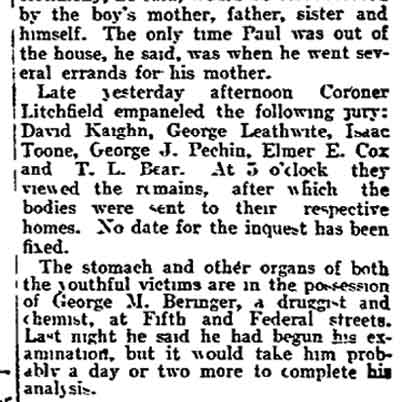
At the Woodward home it was stated that the mother and father of the boy had gone to Philadelphia. Charles May, a boarder, said there would be no trouble in proving that Paul was home all day of Wednesday, as well as the day following. He said that on each of those nights the boy had been in bed by 8 o’clock. This testimony, he said, would be corroborated by the boy’s mother, father, sister and himself. The only time Paul was out of the house, he said, was when he went several errands for his mother.
Late yesterday afternoon Coroner Litchfield empaneled the following jury: David Kaighn, George Leathwhite, Isaac Toone, George J. Pechin, Elmer E. Cox and T. L. Bear. At 5 o’clock they viewed the remains, after which the bodies were sent to their respective homes. No date for the inquest has been fixed.
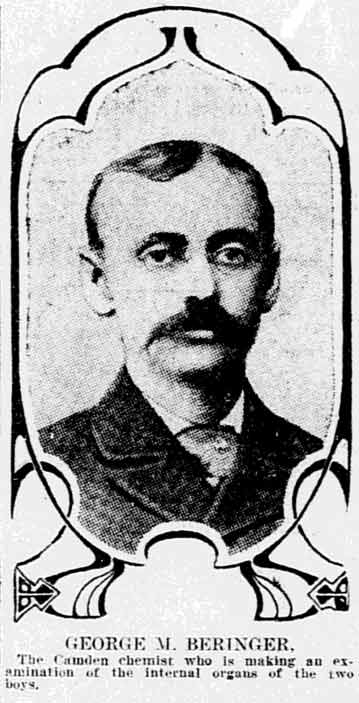
The stomach and other organs of both the youthful victims are in the possession of George M. Beringer, a druggist and chemist, at Fifth and Federal streets. Last night he said he had begun his examination, but it would take him probably a day or two more to complete his analysis.
Philadelphia Inquirer — October 6, 1902
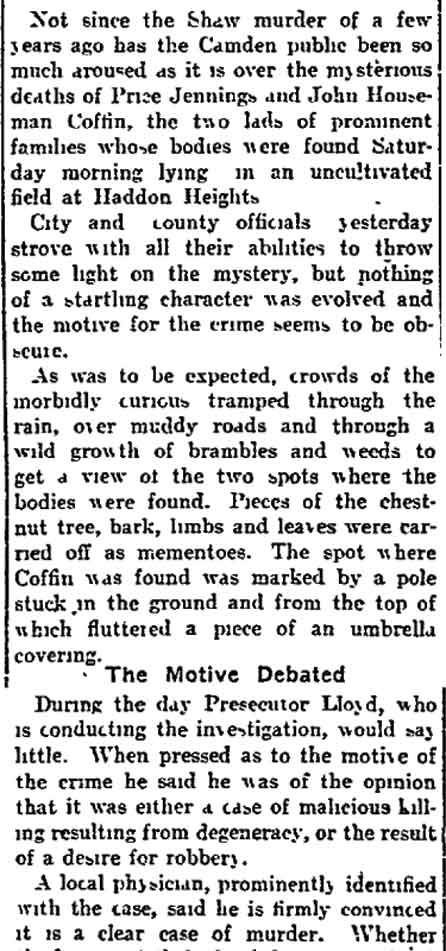
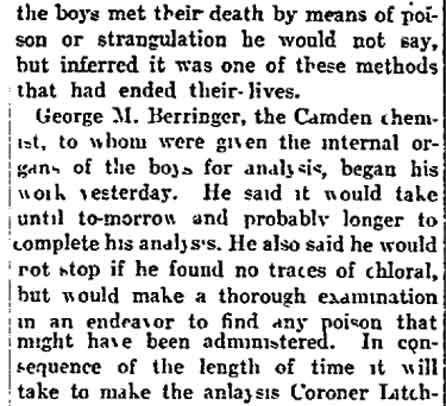
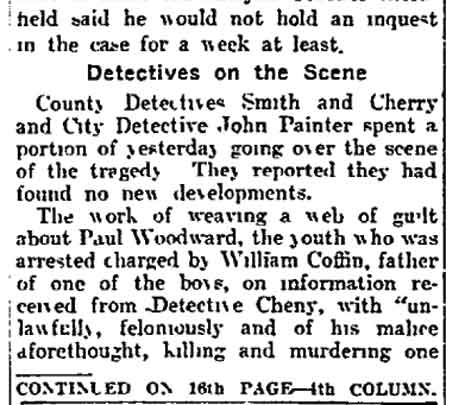
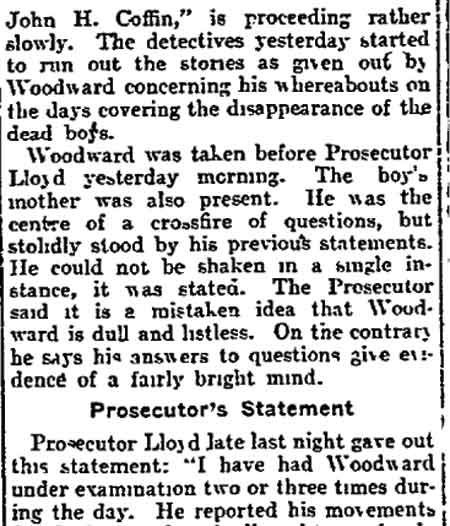
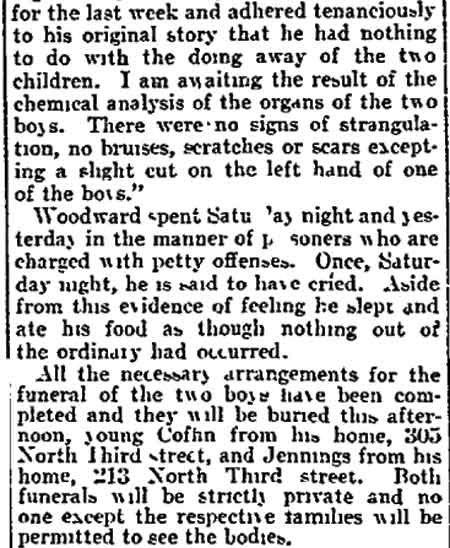
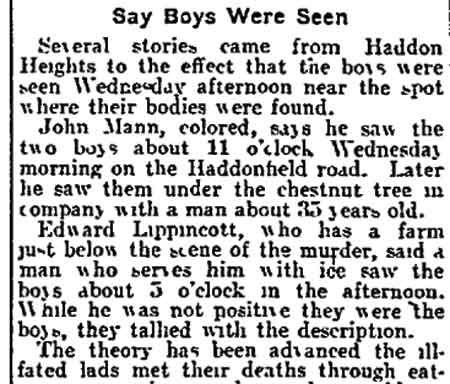
DEEP MYSTERY STILL ENVELOPS CAMDEN TRAGEDY
Authorities Apparently at Sea Regarding Theory for Lads’ Taking Off — They Were Murdered — Such Is the Belief of Prosecutor Lloyd and Others in the Case — Woodward Under Fire — Declares Not Guilty of the Awful Crime — Two Boys to Be Buried To-day
Trinity Baptist Church — John S. Smith — George M. Beringer
Philadelphia Inquirer — October 7, 1902
WOMAN INVOLVED IN CAMDEN MYSTERY
After Being Questioned by the Prosecutor She Is Committed to the County Jail — Believed to Be an Important Arrest
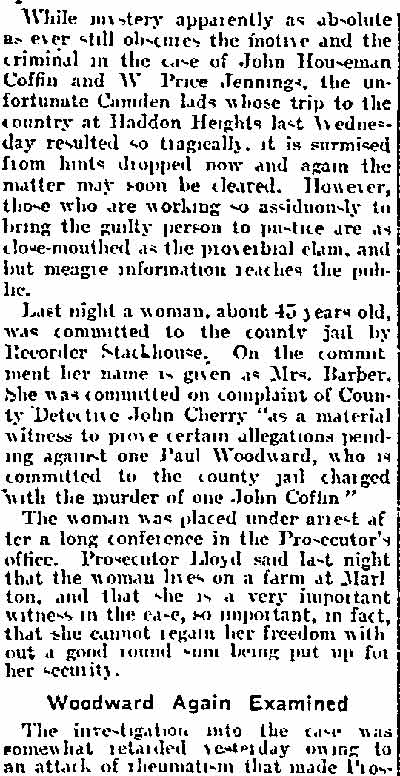
While mystery apparently as absolute as ever still obscures the motive and the criminal in the case of John Houseman Coffin and W. Price Jennings, the unfortunate Camden lads whose trip to the country at Haddon Heights last Wednesday resulted so tragically, it is surmised from hints dropped now and again the matter may soon be cleared. However, those who are working so assiduously to bring the guilty person to justice are as close-mouthed as the proverbial clam, and but meagre information reaches the public.
Last night a woman, about 45 years old, was committed to the county jail by Recorder O. Glen Stackhouse. On the commitment her name is given as Mrs. Barber. She was committed on complaint of County Detective John Cherry “as a material witness to prove certain allegations pending against one Paul Woodward, who is committed to the county jail charged with the murder of one John Coffin.”
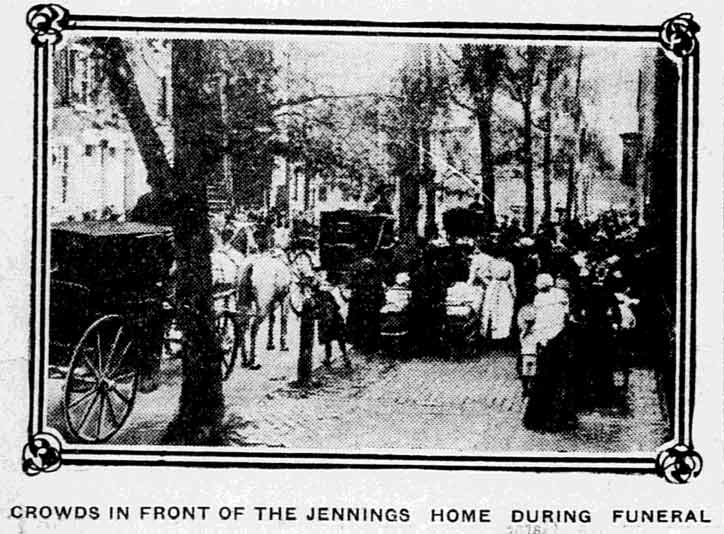
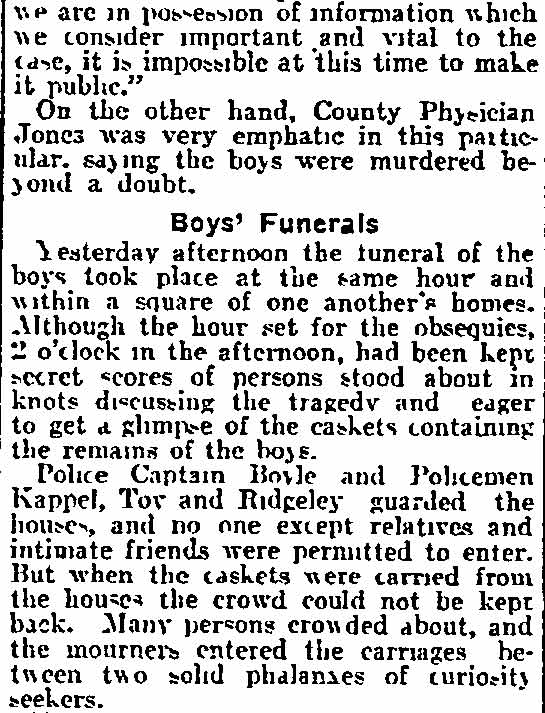
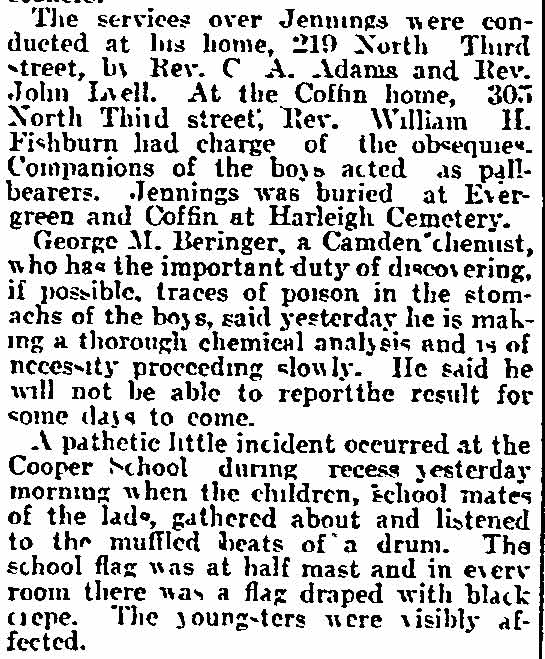
Yesterday afternoon the funeral of the boys took place at the same hour and within a square of one another’s homes. Police Captain Hugh Boyle and Policemen George F. Kappel, Isaac Toy and Charles D. Ridgley guarded the houses. The services over Jennings were conducted at his home, 219 North Third street, by Rev. C.A. Adams and Rev. John Lyell. At the Coffin home, 305 North Third street, Rev. William H. Fishburn had charge of the obsequies.
A pathetic little incident occurred at the Cooper School during recess yesterday morning when the children, school mates of the lads, gathered about and listened to the muffled beats of a drum. The school flag was at half mast and in every room there was a flag draped with black crepe.
Philadelphia Inquirer — October 8, 1902
WOODWARD HAS KNOWLEDGE OF CAMDEN MURDER
So Confessed to Officers, Who Searched New York at Prisoner’s Instance
NO HAND IN THE CRIME
But Said He Knew Name of the Man Who Committed Awful Deed
YOUTH’S STRENUOUS DAY
Taken to the Scene of the Tragedy and Closeted With the Prosecutor
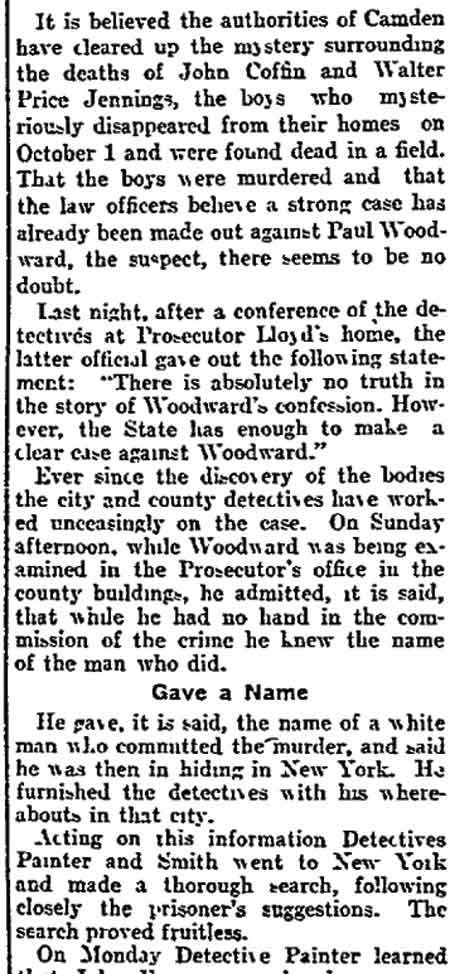
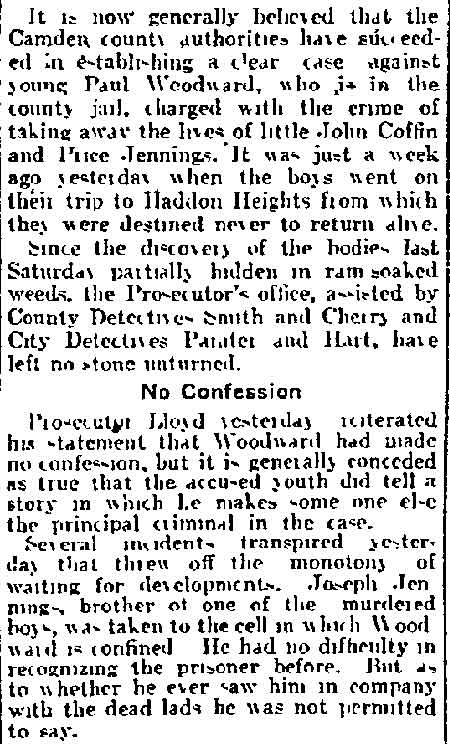
It is believed the authorities of Camden have cleared up the mystery surrounding the deaths of John Coffin and Walter Price Jennings, the two lads who mysteriously disappeared from their homes on October 1 and were found dead in a field. That the boys were murdered and that the law officers believe a strong case has already been made out against Paul Woodward, the suspect, there seems to be no doubt.
Last night, after a conference of the detectives at Prosecutor Lloyd’s home, the latter official gave out the following statement: “There is absolutely no truth in the story of Woodward’s confession. However, the State has enough to make a clear case against Woodward.”
Ever since the discovery of the bodies the city and county detectives have worked unceasingly on the case. On Sunday afternoon, while Woodward was being examined in the Prosecutor’s office in the county buildings, he admitted, it is said, that while he had no hand in the commission of the crime he knew the name of the man who did.
Gave a Name
He gave, it is said, the name of a white man who committed the murder, and said he was then in hiding in New York. He furnished the detectives with his whereabouts in that city.
Acting on this information Detectives Painter and Smith went to New York and made a thorough search, following closely the prisoner’s suggestions. The search proved fruitless.
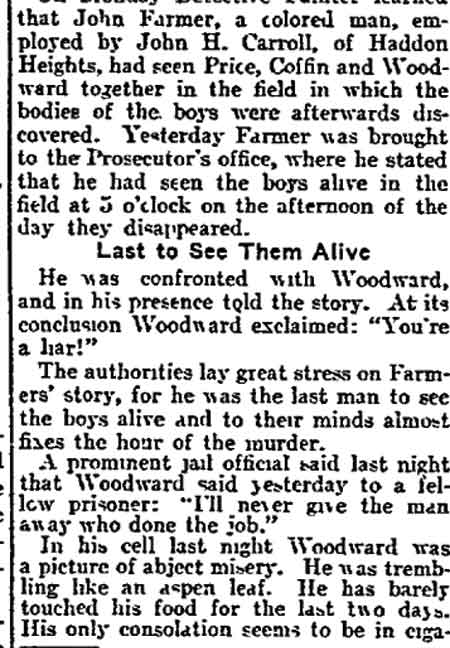
On Monday Detective Painter learned that John Farmer, a colored man, employed by John H. Carroll, of Haddon Heights, had seen Price, Coffin and Woodward together in the field in which the bodies of the boys were afterwards discovered. Yesterday Farmer was brought to the Prosecutor’s office, where he stated that he had seen the boys alive in the field at 3 o’clock on the afternoon of the day they disappeared.
Last to See Them Alive
He was confronted with Woodward, and in his presence told the story. At its conclusion Woodward exclaimed, “You’re a liar!”
The authorities lay great stress on Farmer’s story, for he was the last man to see the boys alive and to their minds almost fixes the hour of the murder.
A prominent jail official said last night that Woodward said yesterday to a fellow prisoner: “I’ll never give the man away who done the job.”
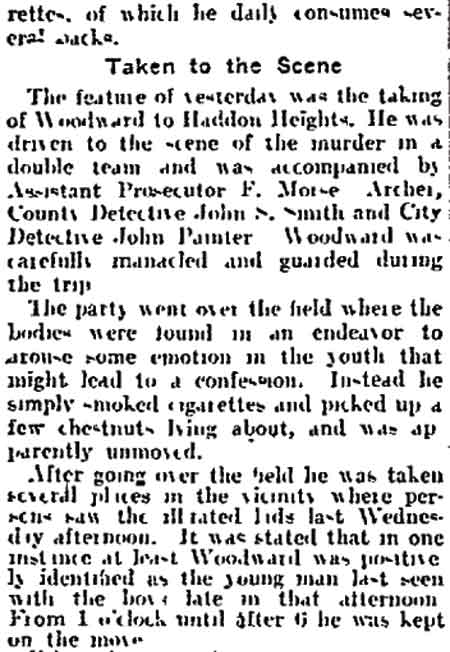
In his cell last night Woodward was a picture of abject misery. He was trembling like an aspen leaf. He has barely touched his food for the last two days. His only consolation seems to be in cigarettes, of which he daily consumes several packs.
Taken to the Scene
The feature of yesterday was the taking of Woodward to Haddon Heights. He was driven to the scene of the murder in a double team and was accompanied by Assistant Prosecutor F. Morse Archer, County Detective John S. Smith and City Detective John Painter. Woodward was carefully manacled and guarded during the trip.
The party went over the field where the bodies were found in an endeavor to arouse some emotion in the youth that might lead to a confession. Instead he simply smoked cigarettes and picked up a few chestnuts lying about, and was apparently unmoved.
After going over the field he was taken to several places in the vicinity where persons saw the ill-fated lads last Wednesday afternoon. It was stated that in one instance at least Woodward was positively identified as the young man last seen with the boys late in that afternoon. From 1 o’clock until after 6 he was kept on the move.
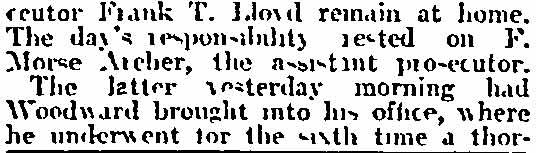
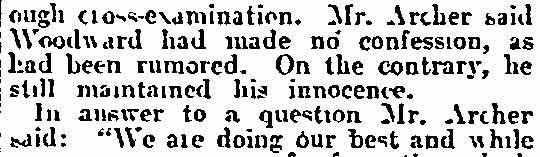
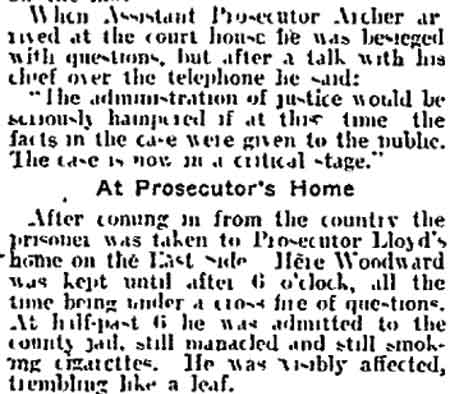
When Assistant Prosecutor Archer arrived at the court house he was besieged with questions, but after a talk with his chief over the telephone he said: “The administration of justice would be seriously hampered if at this time the facts in the case were given to the public. The case is now in a critical stage.”
At Prosecutor’s Home
After coming in from the country the prisoner was taken to Prosecutor Lloyd’s home on the East side. Here Woodward was kept until after 6 o’clock, all the time being under a cross fire of questions. At half-past 6 he was admitted to the county jail, still manacled and still smoking cigarettes. He was visibly affected, trembling like a leaf.
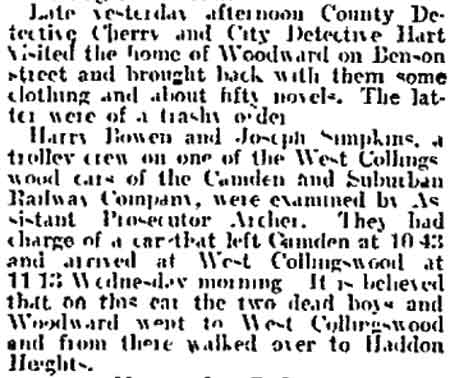
Late yesterday afternoon County Detective Cherry and City Detective Hart visited the home of Woodward on Benson street and brought back with them some clothing and about fifty novels. The latter were of a trashy order.
Harry Bowen and Joseph Simpkins, a trolley crew on one of the West Collingswood cars of the Camden and Suburban Railway Company, were examined by Assistant Prosecutor Archer. They had charge of a car that left Camden at 10:43 and arrived at West Collingswood at 11:13 Wednesday morning. It is believed that on this car the two dead boys and Woodward went to West Collingswood and from there walked over to Haddon Heights.
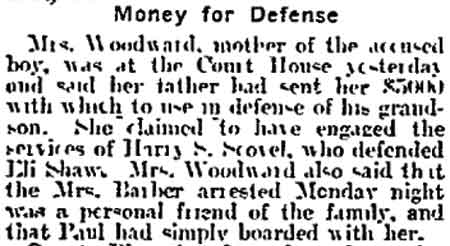
Money for Defense
Mrs. Woodward, mother of the accused boy, was at the Court House yesterday and said her father had sent her $5,000 with which to use in defense of his grandson. She claimed to have engaged the services of Harry S. Scovel, who defended Eli Shaw. Mrs. Woodward also said that the Mrs. Barber arrested Monday night was a personal friend of the family, and that Paul had simply boarded with her.
County Physician Jones has advanced a theory as to the killing of the boys. He maintains poison was administered with no intention of killing. According to his theory, the boys were given “knockout drops,” or chloral, in sufficient quantities to kill a man. It was the intention of the murderer, however, to just give them a sufficient quantity to render them unconscious, and while in this state discover them at the solicitation of the boys’ families and receive a reward.
Philadelphia Inquirer — October 9, 1902
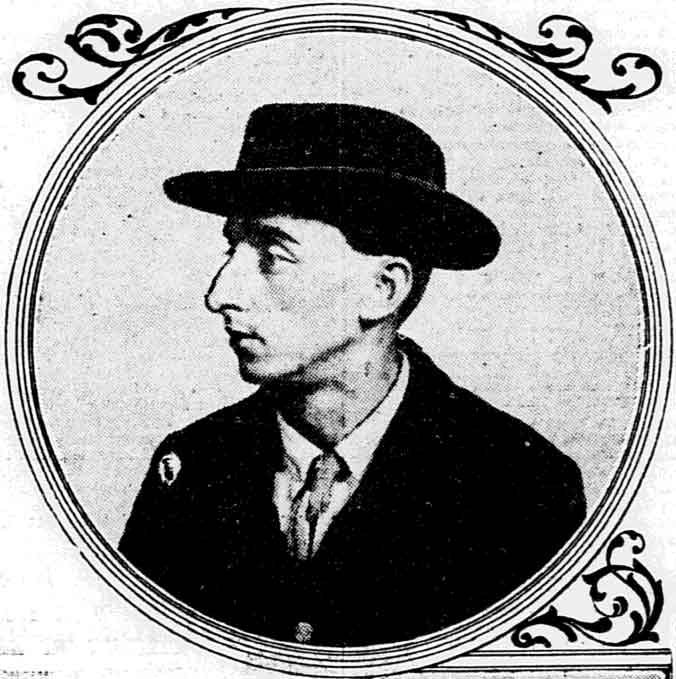
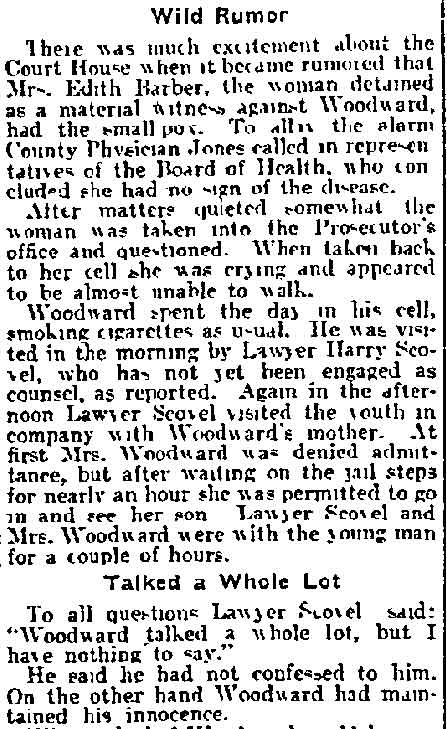
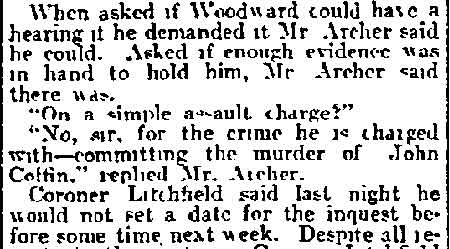
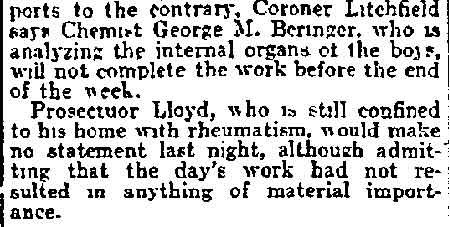
CAMDEN’S MYSTERY IS STILL UNSOLVED
While Authorities Are at Work, Public Watch and Wait. Weaving a Net About Paul Woodward, the Young Suspect Now in Jail
Philadelphia Inquirer — October 10, 1902
Prosecutor Lloyd Declares That Woodward Is the Guilty Man
NO MORE ARRESTS LIKELY
Weaving Web Around Alleged Slayer of the Murdered Boys
“Beyond all question the murderer of these little boys is now in jail and the public’s anxiety can now be allayed,” said Prosecutor Frank T. Lloyd last night in making the first important statement concerning the tragedy of last week, when John Coffin and W. Price Jennings, two Camden lads, were murdered in an uncultivated field near Haddon Heights. The mystery which has enshrouded the case since the discovery of the bodies last Friday has almost been cleared up with the exception of the report of Chemist George M. Beringer, who is making an analysis of the internal organs of the boys.
Prosecutor Lloyd gave out the following statement shortly before 8 o’clock at his home on the East Side:
“Because of a suspicion that more than one person was engaged in the murder of these little boys the State has been obliged to work with much secrecy and to withhold from the press the result of our work. That suspicion is now removed. Beyond all question the murderer is now in jail and the public’s anxiety can be allayed. Woodward was alone the perpetrator of this crime.
Case Nearly Complete
“It is my duty to say this much in view of the deep public concern and the apprehension of other parents having little ones, but it would be improper for me to state the character or the quantity of evidence upon which our conclusions are based. I will only say that with the exception of the report of the chemist, which has not yet been received, the State’s case is almost complete.
“Woodward himself has made a number of statements, which, while not confessions, will be materially helpful toward securing his conviction.”
This statement precludes the possibility of another arrest being made in connection with the case, as has been currently reported during the week.
There were several conferences held yesterday between Assistant Prosecutor Archer and Detectives Smith, Cherry, Painter and Hart and Chief of Police Linderman, of Merchantsville. During one of the conferences John Farmer, the colored man who recognized Woodward as having been seen with the boys last Wednesday afternoon, was called in and closely questioned. Following the detectives departed apparently on several different clues.
Detectives Hard at Work
Detective Hart subsequently returned with a Mrs. Somers, said to reside on Royden street. She was interviewed by the Assistant Prosecutor, but what connection she has with the case the authorities refused to divulge. The woman refused to talk.
Louis Ross, a German, who resides near Haddon Heights, was also called into the Prosecutor’s office late in the afternoon. At first he was thought to be an important witness, but it was afterwards learned that he knew little about the case.
Detective Robert J. McKentry, of Philadelphia, and Detective Smith took over the river Mrs. William H. Hubbert and another young woman. It is at the home of Mrs. Hubbert, at West Philadelphia, that Woodward said he was present last Friday night.
Woodward became rather obdurate yesterday, refusing the usual prison fare. He waited until his mother sent him coffee and other victuals. The accused youth was at first placed in the cell formerly occupied by Lafayette Gruff, the wife murderer, who was hanged September 19. He has now been placed in another cell.
Philadelphia Inquirer — October 11, 1902
MORE ARRESTS IN CAMDEN MYSTERY
Following the statement given out Thursday night by Prosecutor Frank T. Lloyd the authorities have made additional arrests. First came the arrest of William Woodward, another brother of the prisoner, held them for a time, but then released them. Later three additional arrests were made. These were those of William Woodward, who had been arrested, and Mrs. Edith Woodward with her were also taken in custody. Charles May, 28 years old, and William May, his East London, both of whom boarded at the Woodward home on Benson Street. When asked the significance of the arrests Prosecutor Lloyd said: “It is decided advisable to lock them up as witnesses and possible accessories after the fact.”
More Arrests Made
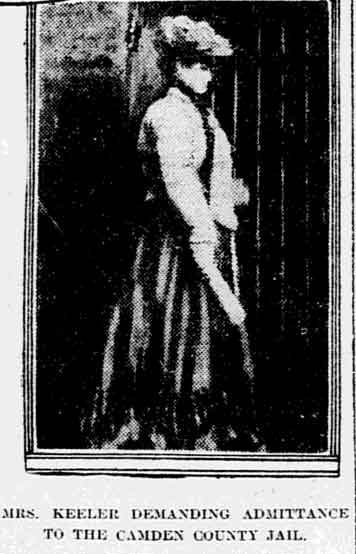
Contrary to the inference in the Press statement, word from the prosecutor’s statement, three additional arrests were made. These were of Woodward’s mother Mrs. Woodward, with her were also taken in custody. Charles May, 28 years old, and William May, his East London, both of whom boarded at the Woodward home on Benson Street. When asked the significance of the arrests Prosecutor Lloyd said: “It is decided advisable to lock them up as witnesses and possible accessories after the fact.”
Denied Admittance to Jail
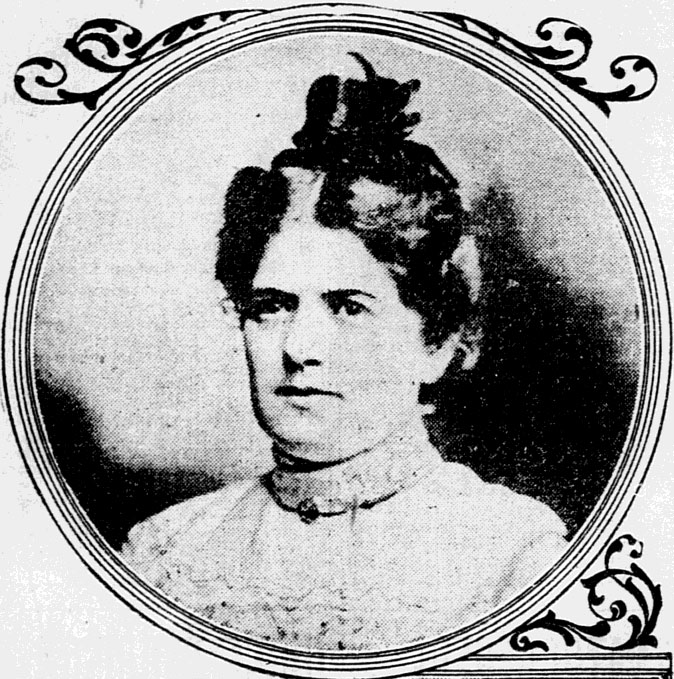
Mrs. Keeler then went to the jail door and demanded admittance of other Detectives. She was permitted to enter and visited Woodward’s cell, where she conferred with the prisoner for nearly an hour.
Prosecutor Lloyd went to Haddon Heights in company with County Detectives. The remains of the murdered boys are still at their homes. Detective Smith interrogated for the boys’ internal organs analysis. He was taken to the Prosecutor’s office. It is stated he had not presented his report of the chemical examination.
Philadelphia Inquirer — October 12, 1902
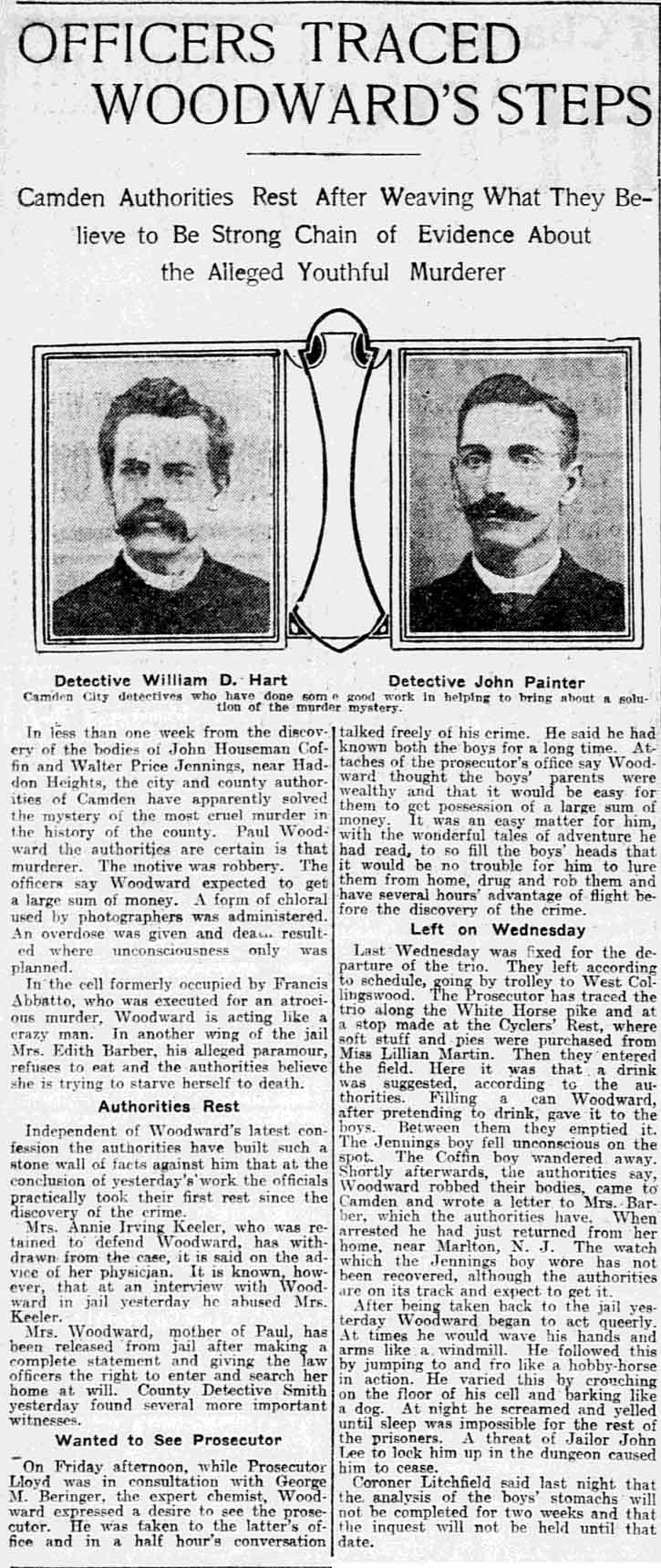
OFFICERS TRACED WOODWARD'S STEPS
Camden Authorities Rest After Weaving What They Believe to Be Strong Chain of Evidence About the Alleged Youthful Murderer
[Portraits: Detective William D. Hart | Detective John Painter — Camden City detectives who have done some good work in helping to bring about a solution of the murder mystery.]
In less than one week from the discovery of the bodies of John Houseman Coffin and Walter Price Jennings, near Haddon Heights, the city and county authorities of Camden have apparently solved the mystery of the most cruel murder in the history of the county. Paul Woodward the authorities are certain is that murderer. The motive was robbery. The officers say Woodward expected to get a large sum of money. A form of chloral used by photographers was administered. An overdose was given and death resulted where unconsciousness only was planned.
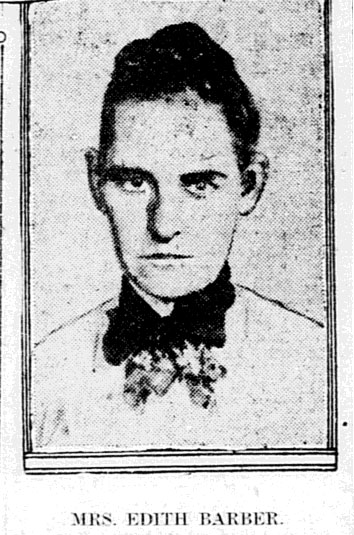
In the cell formerly occupied by Francis Abbatto, who was executed for an atrocious murder, Woodward is acting like a crazy man. In another wing of the jail Mrs. Edith Barber, his alleged paramour, refuses to eat and the authorities believe she is trying to starve herself to death.
Authorities Rest
Independent of Woodward’s latest confession the authorities have built such a stone wall of facts against him that at the conclusion of yesterday’s work the officials practically took their first rest since the discovery of the crime.
Mrs. Annie Irving Keeler, who was retained to defend Woodward, has withdrawn from the case, it is said on the advice of her physician. It is known, however, that at an interview with Woodward in jail yesterday he abused Mrs. Keeler.
Mrs. Woodward, mother of Paul, has been released from jail after making a complete statement and giving the law officers the right to enter and search her home at will. County Detective Smith yesterday found several more important witnesses.
Wanted to See Prosecutor
On Friday afternoon, while Prosecutor Lloyd was in consultation with George M. Beringer, the expert chemist, Woodward expressed a desire to see the prosecutor. He was taken to the latter’s office and in a half hour’s conversation talked freely of his crime. He said he had known both the boys for a long time. Attaches of the prosecutor’s office say Woodward thought the boys’ parents were wealthy and that it would be easy for them to get possession of a large sum of money. It was an easy matter for him, with the wonderful tales of adventure he had read, to so fill the boys’ heads that it would be no trouble for him to lure them from home, drug and rob them and have several hours’ advantage of flight before the discovery of the crime.
Left on Wednesday
Last Wednesday was fixed for the departure of the trio. They left according to schedule, going by trolley to West Collingswood. The Prosecutor has traced the trio along the White Horse pike and at a stop made at the Cyclers’ Rest, where soft stuff and pies were purchased from Miss Lillian Martin. Then they entered the field. Here it was that a drink was suggested, according to the authorities. Filling a can Woodward, after pretending to drink, gave it to the boys. Between them they emptied it. The Jennings boy fell unconscious on the spot. The Coffin boy wandered away. Shortly afterwards, the authorities say, Woodward robbed their bodies, came to Camden and wrote a letter to Mrs. Barber, which the authorities have. When arrested he had just returned from her home, near Marlton, N. J. The watch which the Jennings boy wore has not been recovered, although the authorities are on its track and expect to get it.
After being taken back to the jail yesterday Woodward began to act queerly. At times he would wave his hands and arms like a windmill. He followed this by jumping to and fro like a hobby-horse in action. He varied this by crouching on the floor of his cell and barking like a dog. At night he screamed and yelled until sleep was impossible for the rest of the prisoners. A threat of Jailor John Lee to lock him up in the dungeon caused him to cease.
Coroner Litchfield said last night that the analysis of the boys’ stomachs will not be completed for two weeks and that the inquest will not be held until that date.
Philadelphia Inquirer — October 13, 1902
ANOTHER ARREST IN MURDER CASE
West Philadelphian and a Supposed Companion of Young Paul Woodward Taken in Custody
There is but little remaining in the way of a mystery for the Camden county authorities to clear up in the murder case of little John Coffin and W. Price Jennings, of Camden. After working practically day and night during the past week Prosecutor Lloyd and his able assistants have brought to light such strong evidence against Paul Woodward, the young man in the county jail charged with the crime, that it will be next to impossible to refute it.
James Sheiding
Philadelphia Inquirer — October 14, 1902
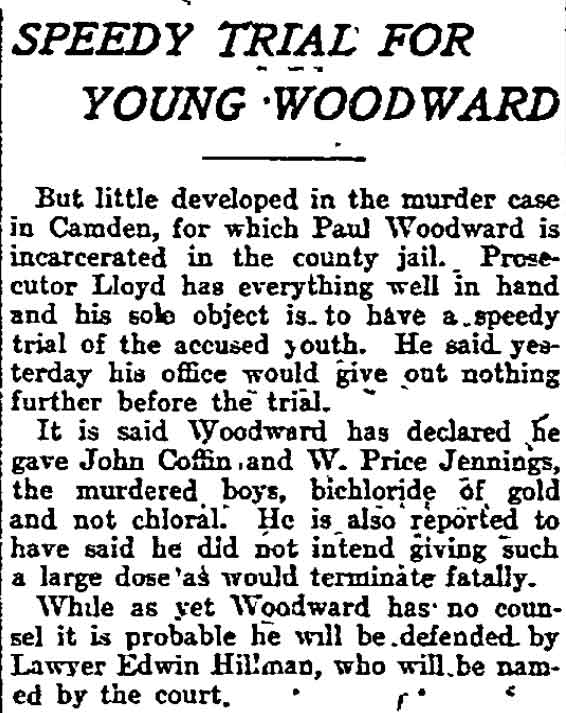
SPEEDY TRIAL FOR YOUNG WOODWARD
But little developed in the murder case in Camden, for which Paul Woodward is incarcerated in the county jail. Prosecutor Lloyd has everything well in hand and his sole object is to have a speedy trial of the accused youth. He said yesterday his office would give out nothing further before the trial.
It is said Woodward has declared he gave John Coffin and W. Price Jennings, the murdered boys, bichloride of gold and not chloral. He is also reported to have said he did not intend giving such a large dose as would terminate fatally.
While as yet Woodward has no counsel it is probable he will be defended by Lawyer Edwin Hillman, who will be named by the court.
Philadelphia Inquirer — October 15, 1902
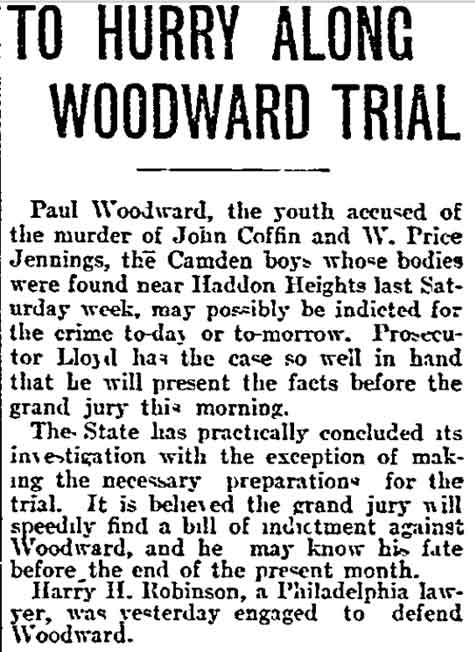
TO HURRY ALONG WOODWARD TRIAL
Paul Woodward, the youth accused of the murder of John Coffin and W. Price Jennings, the Camden boys whose bodies were found near Haddon Heights last Saturday week, may possibly be indicted for the crime to-day or to-morrow. Prosecutor Lloyd has the case so well in hand that he will present the facts before the grand jury this morning.
The State has practically concluded its investigation with the exception of making the necessary preparations for the trial. It is believed the grand jury will speedily find a bill of indictment against Woodward, and he may know his fate before the end of the present month.
Harry H. Robinson, a Philadelphia lawyer, was yesterday engaged to defend Woodward.
Philadelphia Inquirer — October 16, 1902
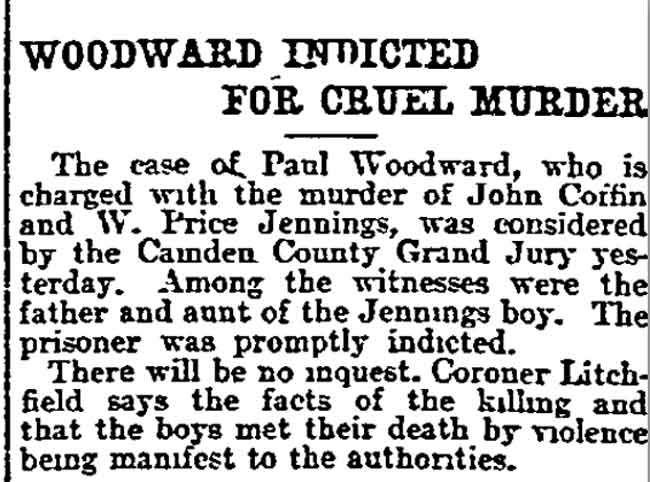
WOODWARD INDICTED FOR CRUEL MURDER
The case of Paul Woodward, who is charged with the murder of John Coffin and W. Price Jennings, was considered by the Camden County Grand Jury yesterday. Among the witnesses were the father and aunt of the Jennings boy. The prisoner was promptly indicted.
There will be no inquest. Coroner Litchfield says the facts of the killing and that the boys met their death by violence being manifest to the authorities.
Philadelphia Inquirer — October 19, 1902
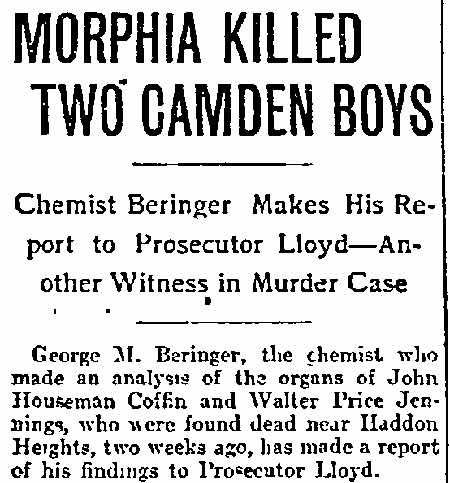
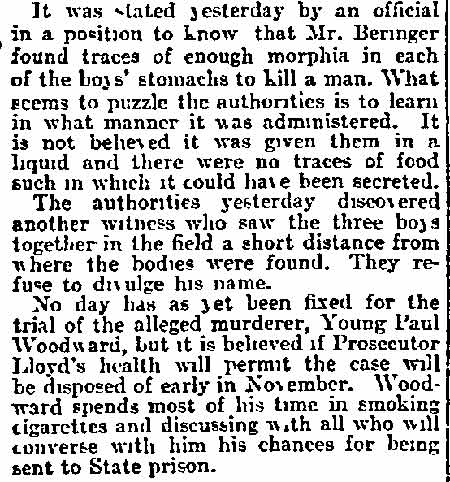
MORPHIA KILLED TWO CAMDEN BOYS
Chemist Beringer Makes His Report to Prosecutor Lloyd — Another Witness in Murder Case
George M. Beringer, the chemist who made an analysis of the organs of John Houseman Coffin and Walter Price Jennings, who were found dead near Haddon Heights two weeks ago, has made a report of his findings to Prosecutor Lloyd.
Philadelphia Inquirer — October 22, 1902
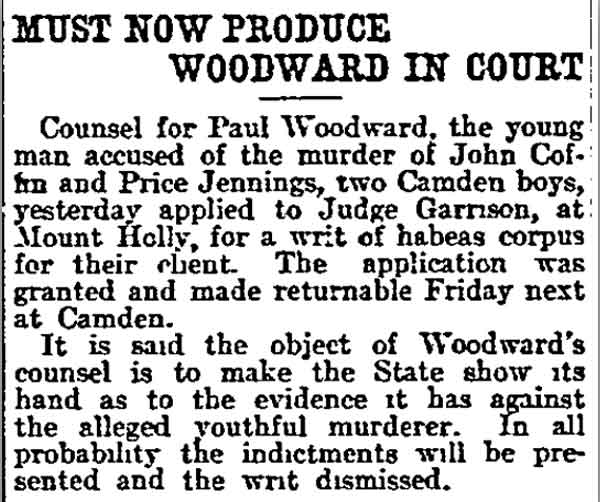
MUST NOW PRODUCE WOODWARD IN COURT
Counsel for Paul Woodward, the young man accused of the murder of John Coffin and Price Jennings, two Camden boys, yesterday applied to Judge Garrison, at Mount Holly, for a writ of habeas corpus for their client. The application was granted and made returnable Friday next at Camden.
It is said the object of Woodward’s counsel is to make the State show its hand as to the evidence it has against the alleged youthful murderer. In all probability the indictments will be presented and the writ dismissed.
Philadelphia Inquirer — October 24, 1902
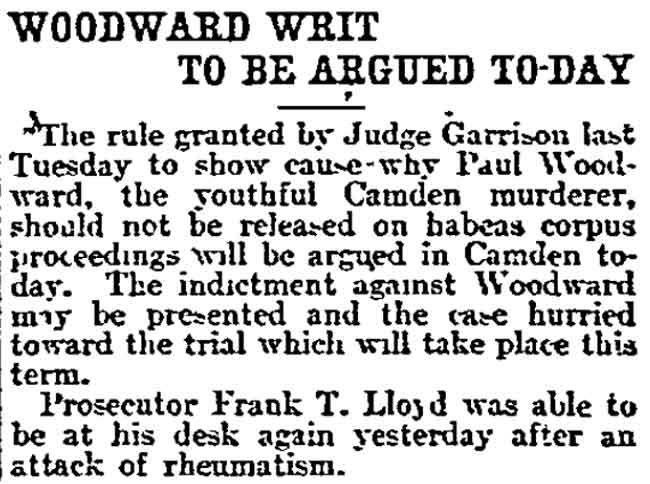
WOODWARD WRIT TO BE ARGUED TO-DAY
The rule granted by Judge Garrison last Tuesday to show cause why Paul Woodward, the youthful Camden murderer, should not be released on habeas corpus proceedings will be argued in Camden to-day. The indictment against Woodward may be presented and the case hurried toward the trial which will take place this term.
Prosecutor Frank T. Lloyd was able to be at his desk again yesterday after an attack of rheumatism.
Philadelphia Inquirer — October 25, 1902
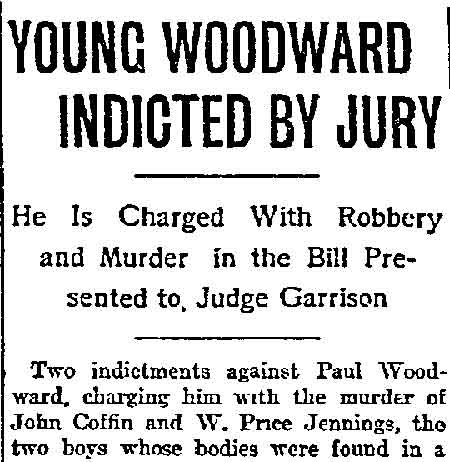
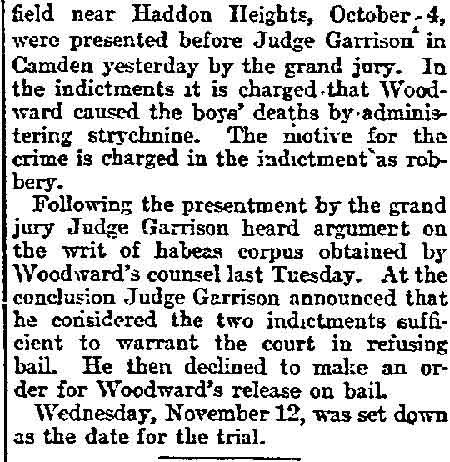
YOUNG WOODWARD INDICTED BY JURY
He Is Charged With Robbery and Murder in the Bill Presented to Judge Garrison
Two indictments against Paul Woodward, charging him with the murder of John Coffin and W. Price Jennings, the two boys whose bodies were found in a field near Haddon Heights, have been presented to Judge Garrison. Prosecutor Frank T. Lloyd is to give the case precedence in the trial list.
Philadelphia Inquirer — October 31, 1902
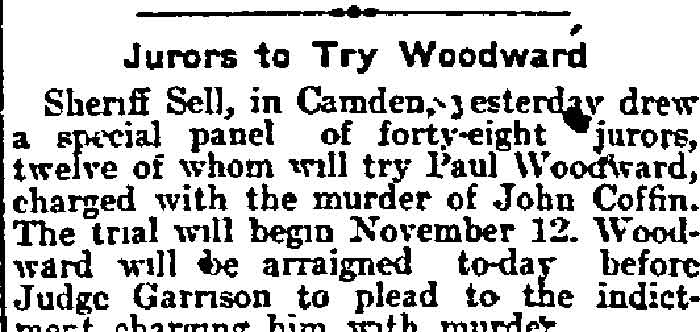
JURORS TO TRY WOODWARD
Sheriff Sell, in Camden, yesterday drew a special panel of forty-eight jurors, twelve of whom will try Paul Woodward, charged with the murder of John Coffin. The trial will begin November 12. Woodward will be arraigned to-day before Judge Garrison to plead to the indictment charging him with murder.
Philadelphia Inquirer — November 1, 1902
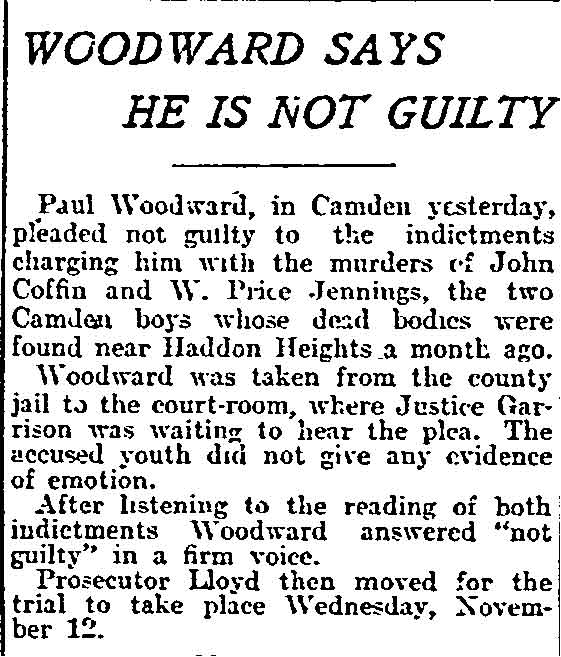
WOODWARD SAYS HE IS NOT GUILTY
Paul Woodward, in Camden yesterday, pleaded not guilty to the indictments charging him with the murders of John Coffin and W. Price Jennings, the two Camden boys whose dead bodies were found near Haddon Heights a month ago.
Woodward was taken from the county jail to the court-room, where Justice Garrison was waiting to hear the plea. The accused youth did not give any evidence of emotion.
After listening to the reading of both indictments Woodward answered “not guilty” in a firm voice. Prosecutor Lloyd then moved for the trial to take place Wednesday, November 12.
Philadelphia Inquirer — November 12, 1902
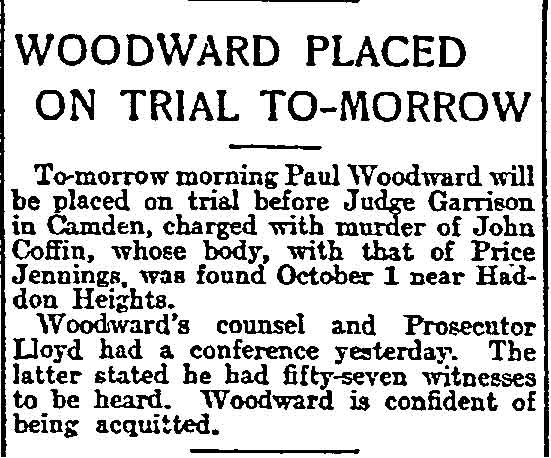
WOODWARD PLACED ON TRIAL TO-MORROW
To-morrow morning Paul Woodward will be placed on trial before Judge Garrison in Camden, charged with murder of John Coffin, whose body, with that of Price Jennings, was found October 1 near Haddon Heights. Woodward’s counsel and Prosecutor Lloyd had a conference yesterday. The latter stated he had fifty-seven witnesses to be heard. Woodward is confident of being acquitted.
Trenton Evening Times — November 12, 1902
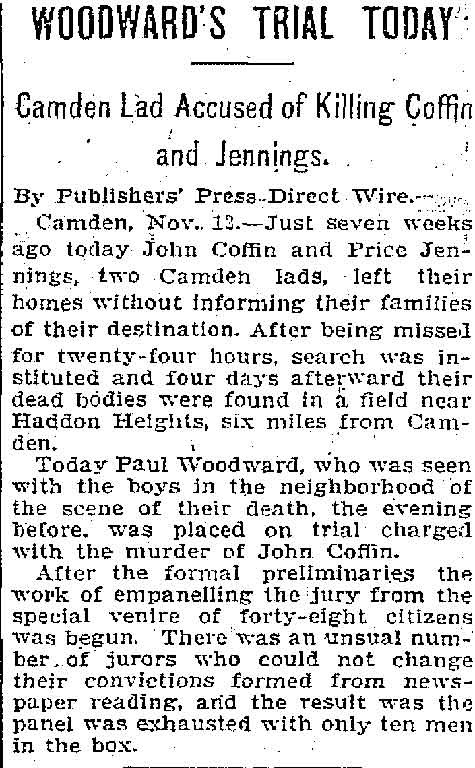
WOODWARD’S TRIAL TODAY
Camden Lad Accused of Killing Coffin and Jennings.
Camden, Nov. 12.—Just seven weeks ago today John Coffin and Price Jennings, two Camden lads, left their homes without informing their families of their destination. After being missed for twenty-four hours, search was instituted and four days afterward their dead bodies were found in a field near Haddon Heights, six miles from Camden.
Today Paul Woodward, who was seen with the boys in the neighborhood of the scene of their death, the evening before, was placed on trial charged with the murder of John Coffin.
Philadelphia Inquirer — November 13, 1902
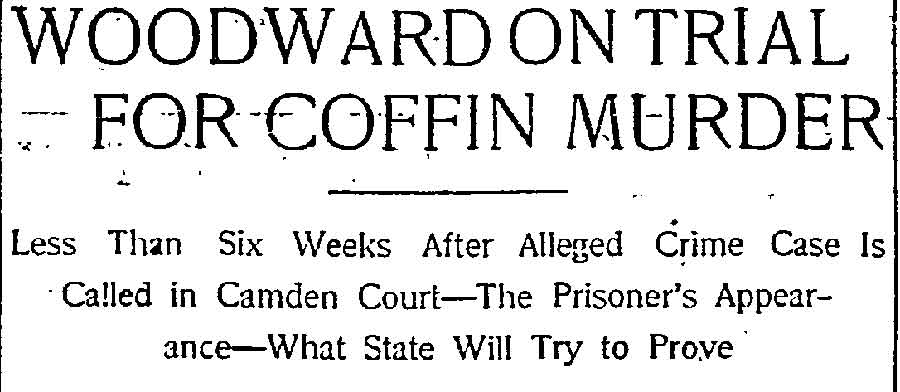
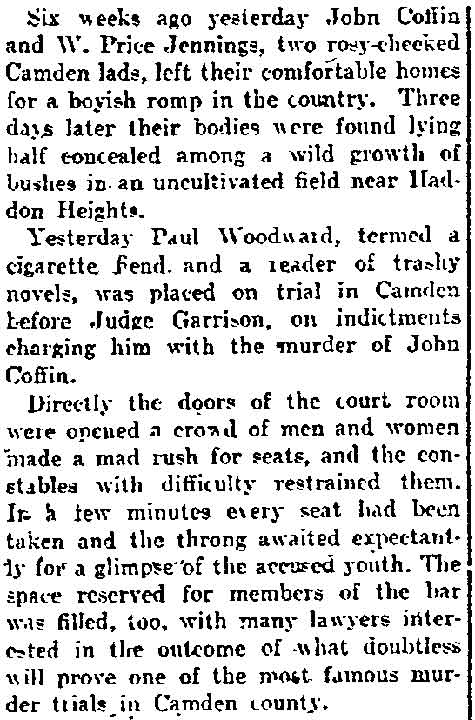
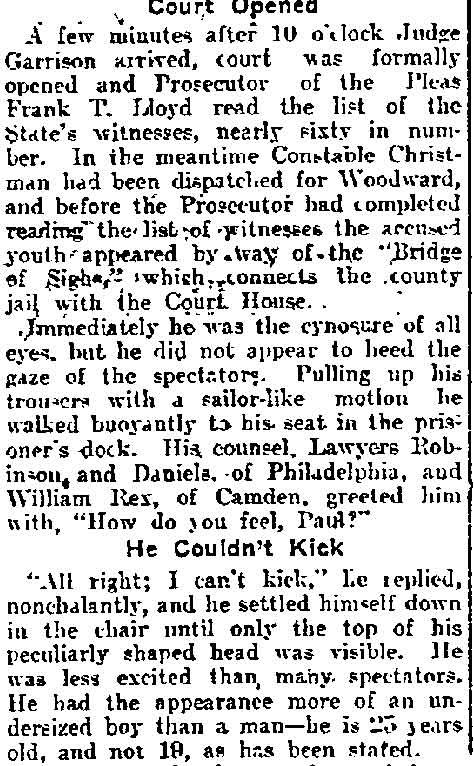
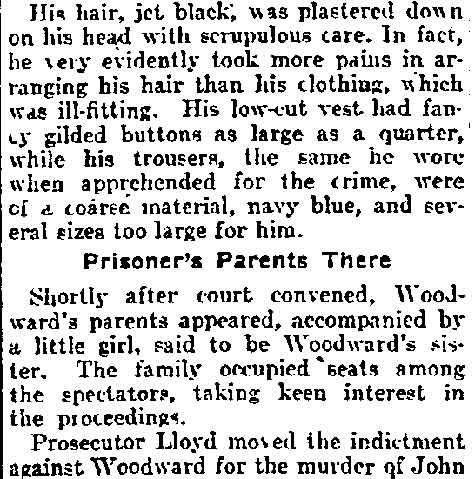
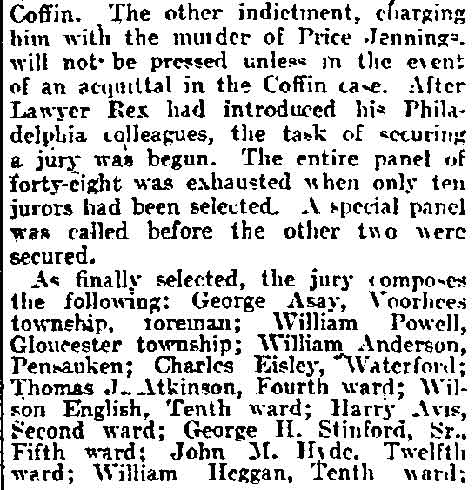
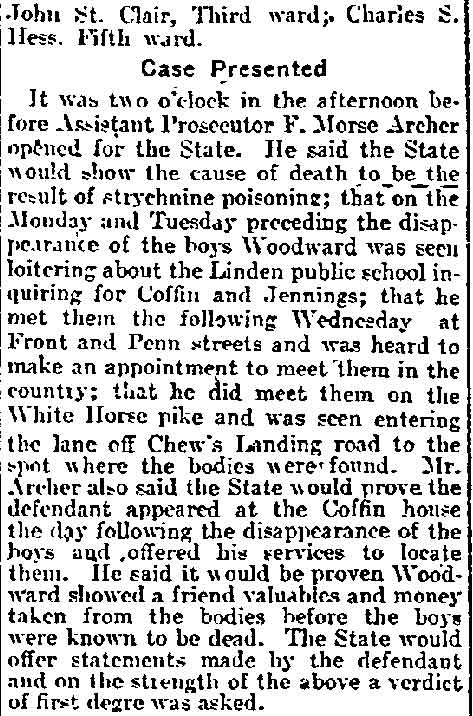
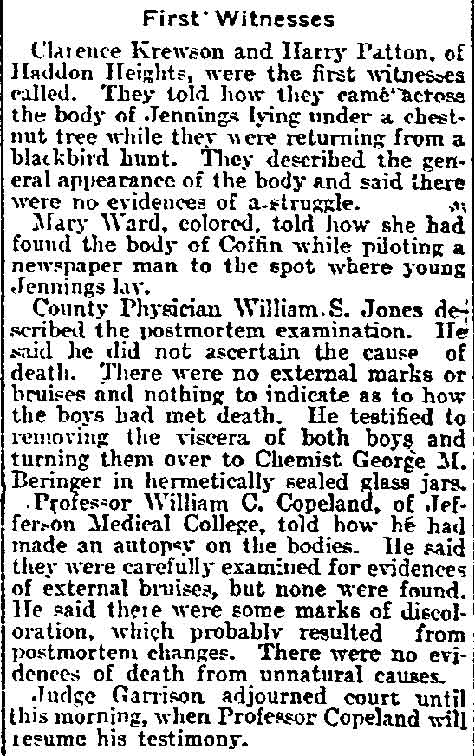
Named: William Robinson, George Asay, William Powell, William Anderson
Charles Eiley, Thomas J. Atkinson, Wilson English, Harry Avis
George H. Stineford Sr., John M. Hyde, William Heggan, John St. Clair
Charles S. Hess, William Rex, and Linden School.
Philadelphia Inquirer — November 14, 1902
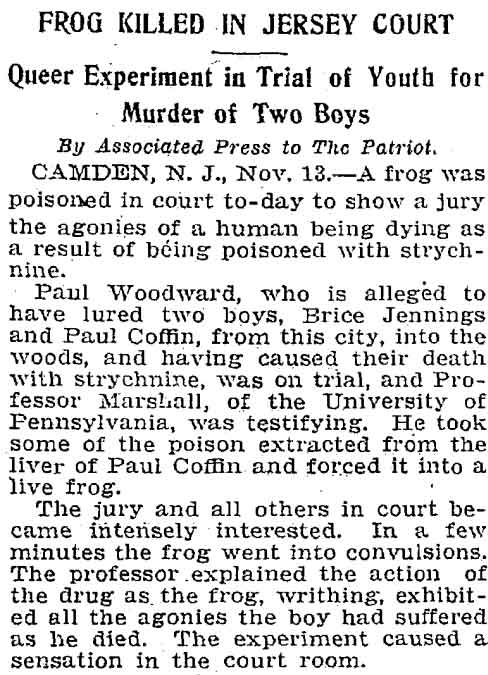
FROG KILLED IN JERSEY COURT
Queer Experiment in Trial of Youth for Murder of Two Boys
CAMDEN, N. J., Nov. 13.—A frog was poisoned in court to-day to show a jury the agonies of a human being dying as a result of being poisoned with strychnine.
Paul Woodward, who is alleged to have lured two boys, Brice Jennings and Paul Coffin, from this city, into the woods, and having caused their death with strychnine, was on trial, and Professor Marshall, of the University of Pennsylvania, was testifying. He took some of the poison extracted from the liver of Paul Coffin and forced it into a live frog.
The jury and all others in court became intensely interested. In a few minutes the frog went into convulsions. The professor explained the action of the drug as the frog, writhing, exhibited all the agonies the boy had suffered as he died. The experiment caused a sensation in the court room.
Philadelphia Inquirer — November 15, 1902
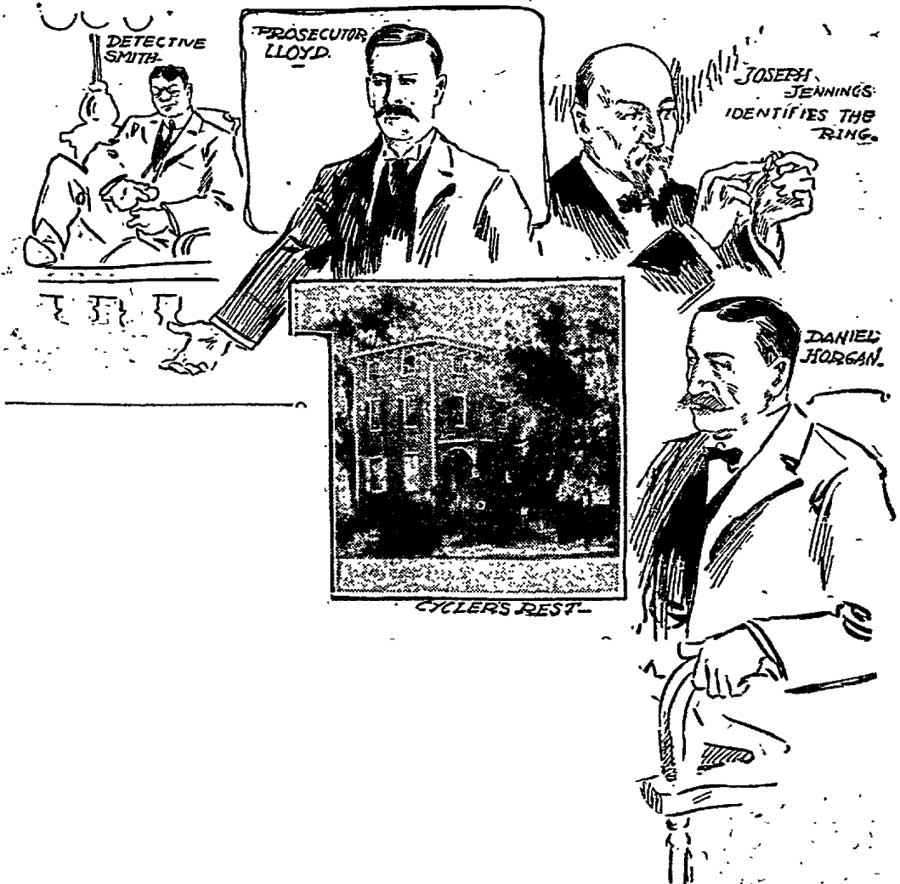
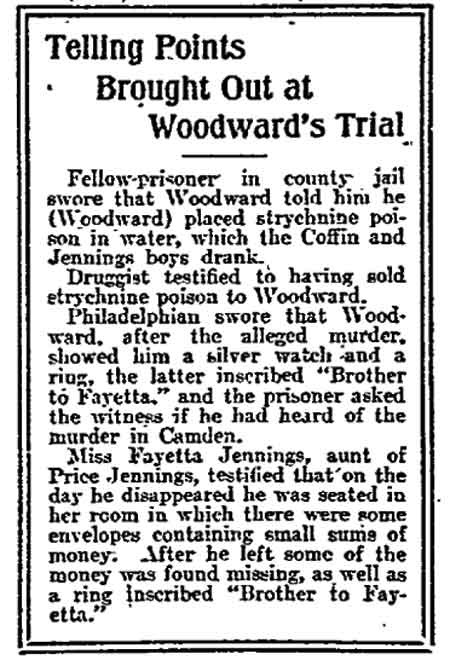
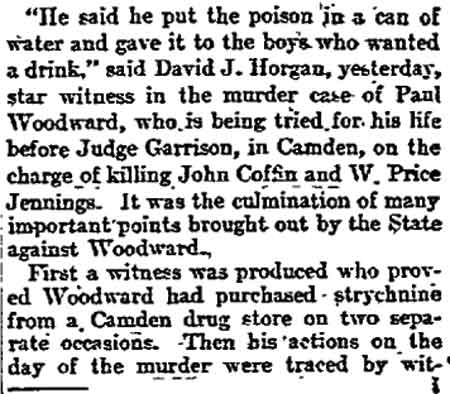
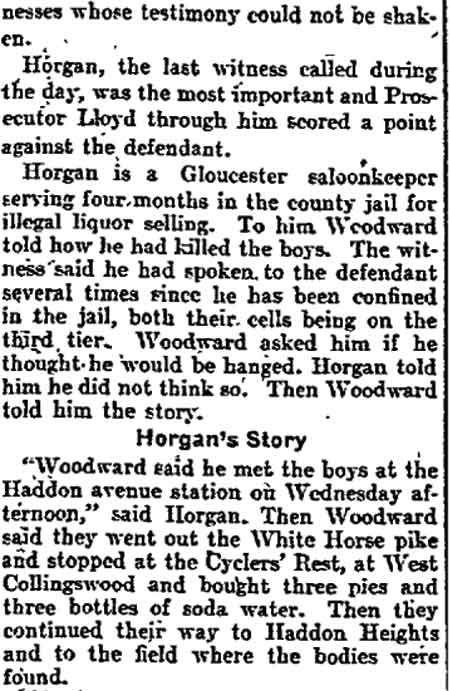
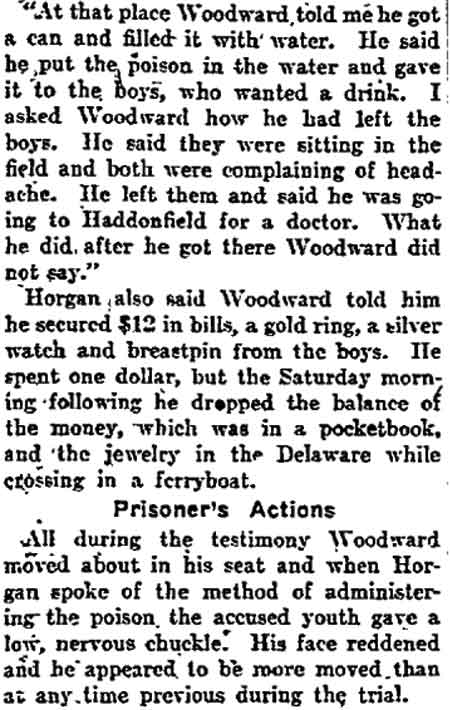
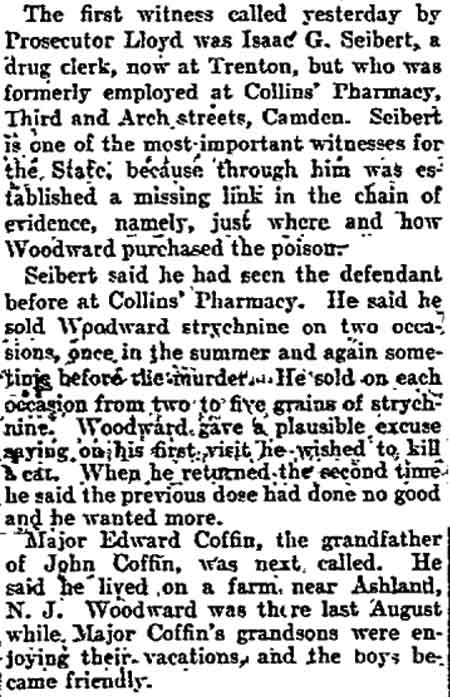
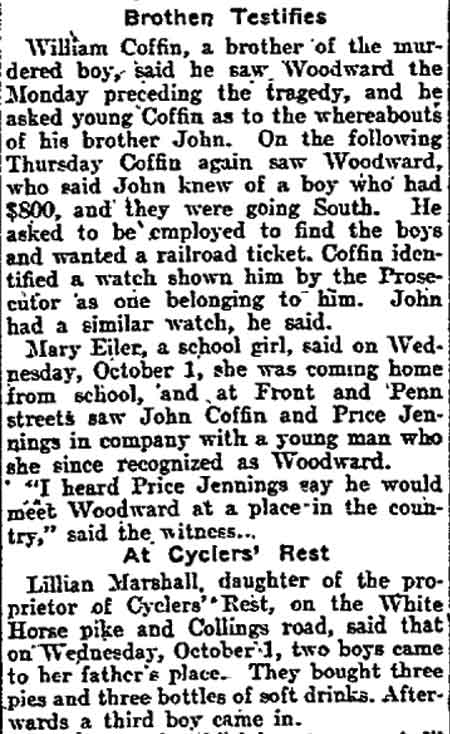
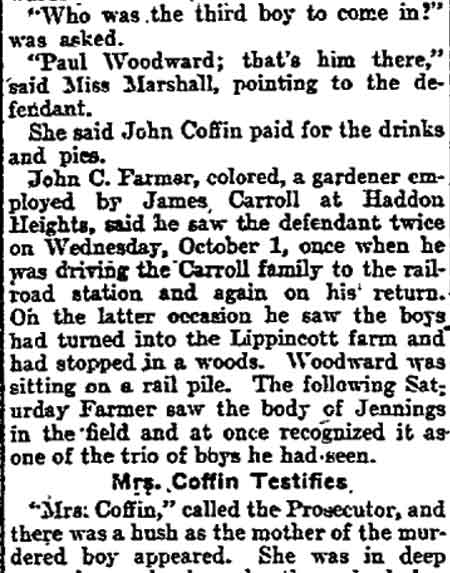
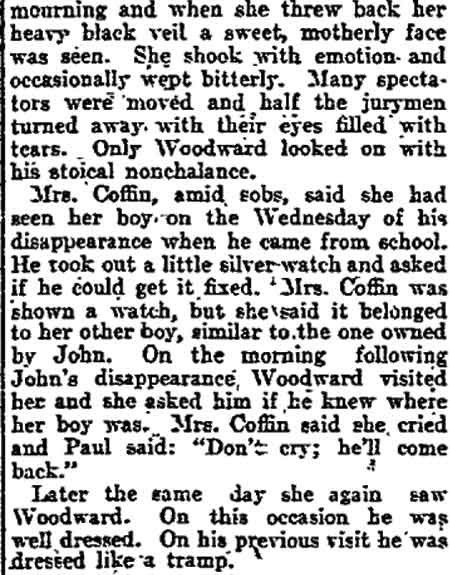
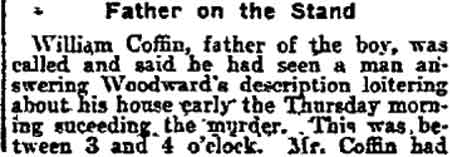
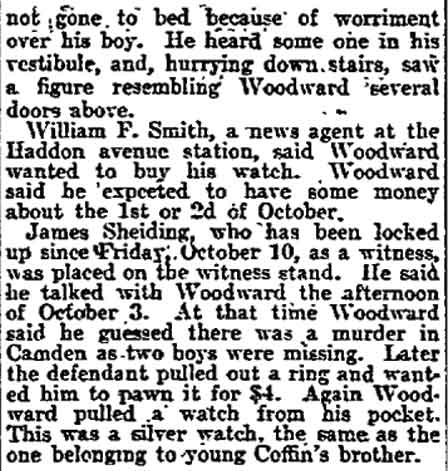
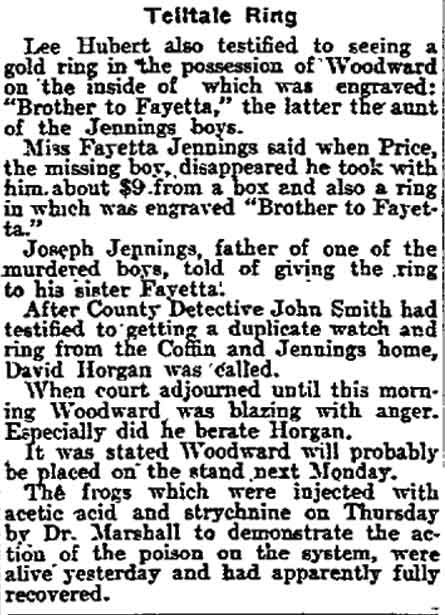
Named: Daniel J. Horgan, Isaac Siebert, W. Wilmer Collins, Druggist, Major Edward Coffin
Coffin’s Corner, Ashland, William Coffin, William Coffin Jr., Mary Eiler
William F. Smith, James Sheiding, Fayetta Jennings, and Lee Hubert.
Philadelphia Inquirer — November 16, 1902
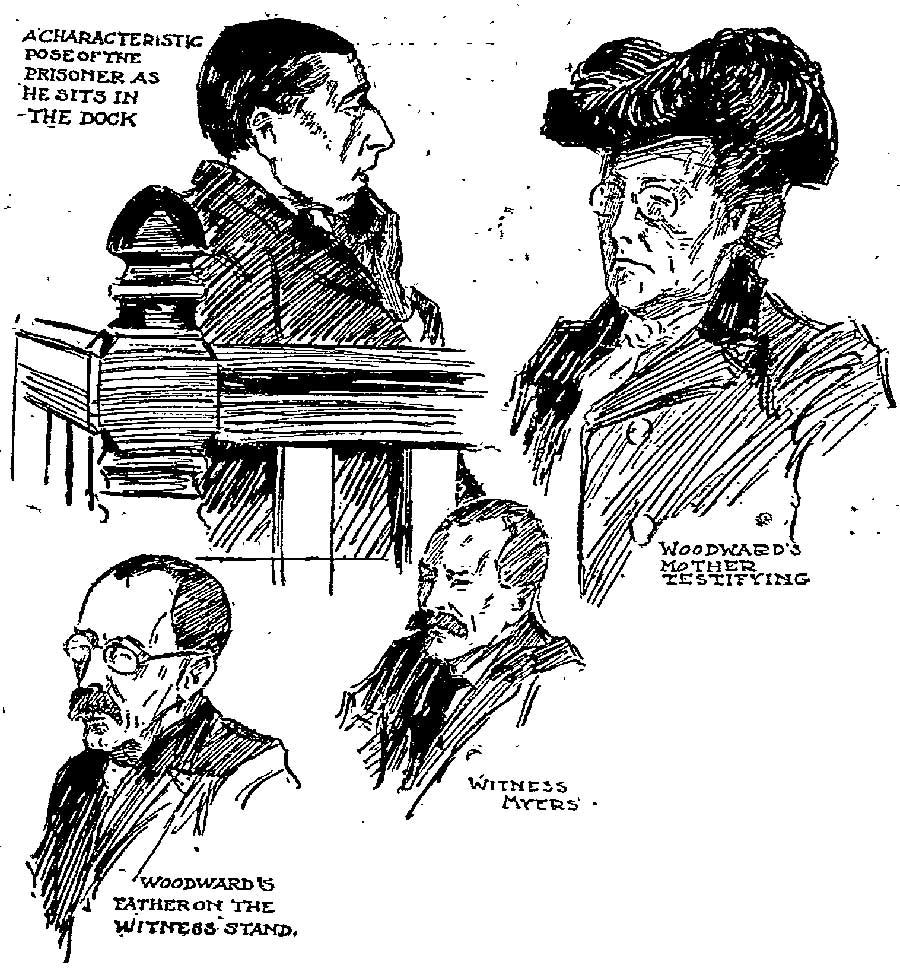

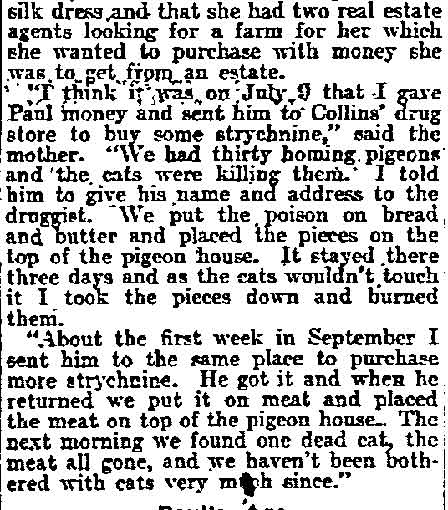
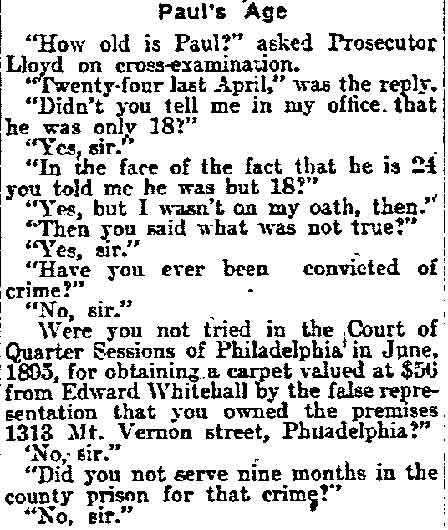
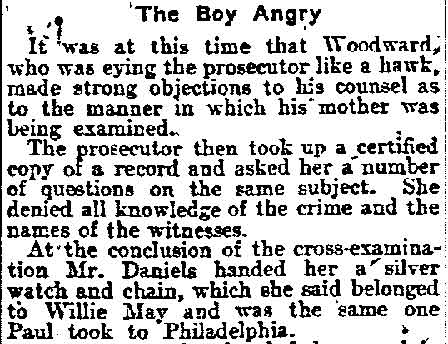
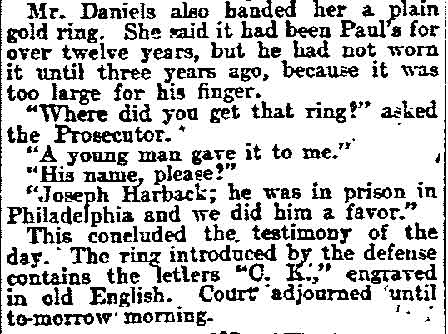
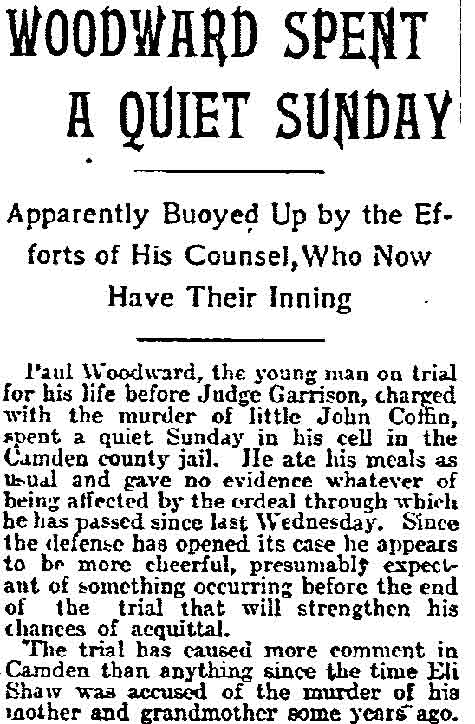
WOODWARD’S PARENTS ON STAND; BOY IN A RAGE
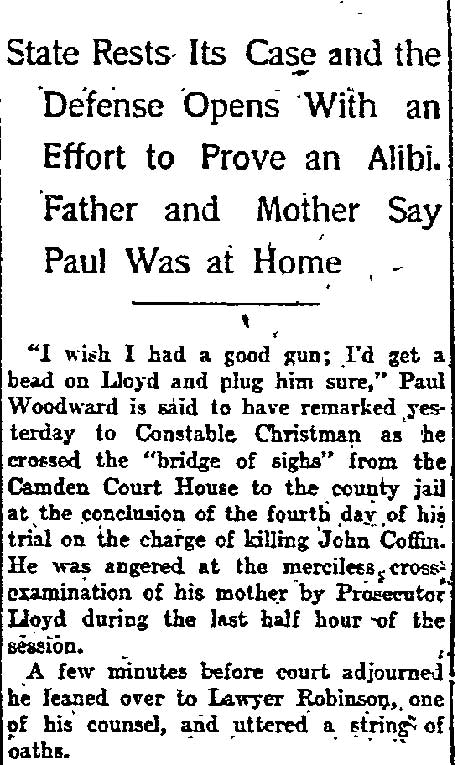
State Rests Its Case and the Defense Opens With an Effort to Prove an Alibi. Father Thomas Woodward and Mother Bella Woodward Say Paul Was at Home.
“I wish I had a good gun; I’d get a bead on Lloyd and plug him sure,” Paul Woodward is said to have remarked to Constable Christman as he crossed the “bridge of sighs” from the Camden Court House to the county jail at the conclusion of the fourth day of his trial on the charge of killing John Coffin. He was angered at the merciless cross-examination of his mother by Prosecutor Lloyd during the last half hour of the session.
Defense counsel Lawyer Daniels outlined that it would be proven Woodward could not have been present when the crime was committed.
Philadelphia Inquirer — November 17, 1902
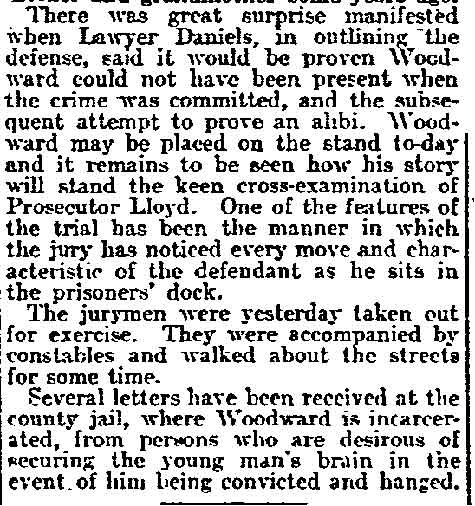
There was great surprise manifested when Lawyer Daniels, in outlining the defense, said it would be proven Woodward could not have been present when the crime was committed, and the subsequent attempt to prove an alibi. Woodward may be placed on the stand to-day and it remains to be seen how his story will stand the keen cross-examination of Prosecutor Lloyd.
The jurymen were yesterday taken out for exercise. They were accompanied by constables and walked about the streets for some time.
Several letters have been received at the county jail, where Woodward is incarcerated, from persons who are desirous of securing the young man’s brain in the event of him being convicted and hanged.
Philadelphia Inquirer — November 18, 1902


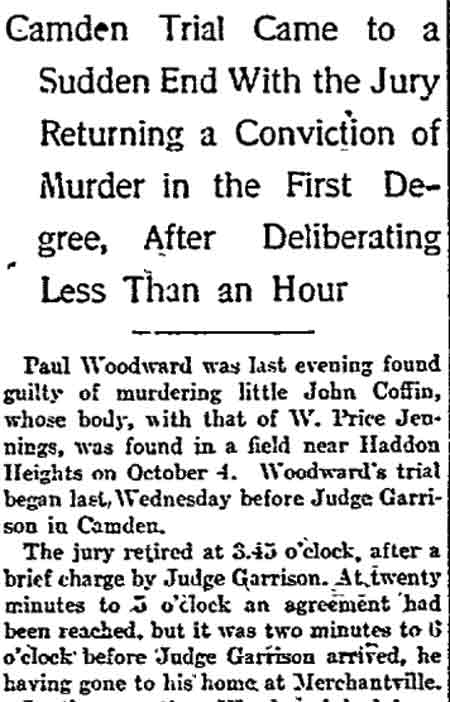
WOODWARD SMILED WHEN HE HEARD DEATH VERDICT
Camden Trial Came to a Sudden End With the Jury Returning a Conviction of Murder in the First Degree, After Deliberating Less Than an Hour
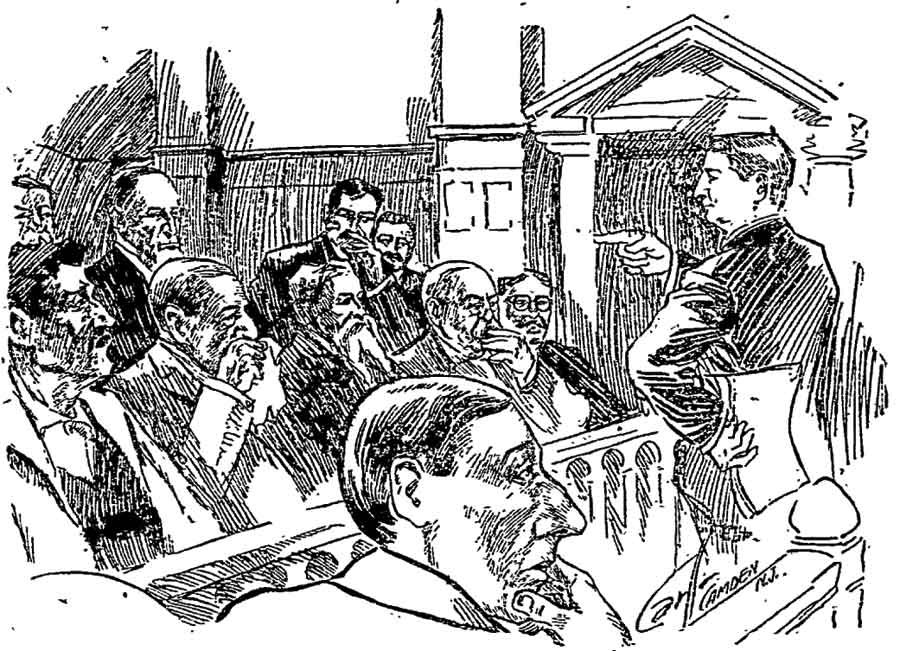
[Illustration caption: Attorney Robinson Making His Address to the Jury. Paul Woodward in Foreground.]
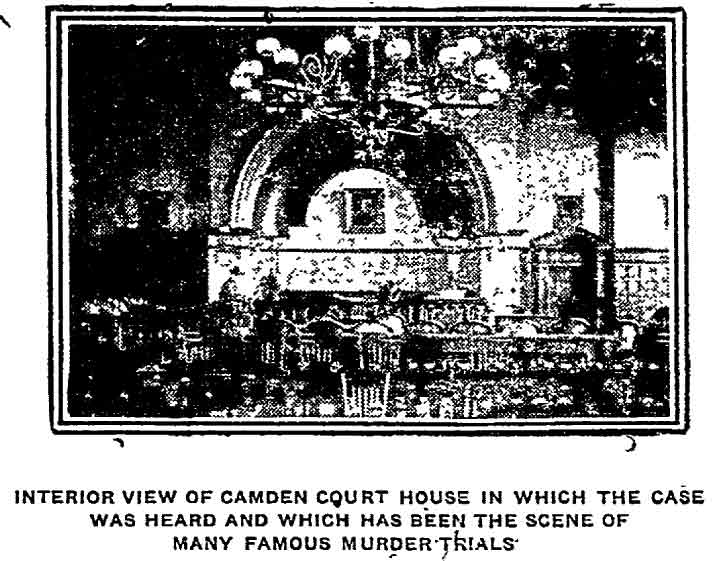
[Photo caption: Interior View of Camden Court House in Which the Case Was Heard and Which Has Been the Scene of Many Famous Murder Trials.]
Paul Woodward was last evening found guilty of murdering little John Coffin, whose body, with that of W. Price Jennings, was found in a field near Haddon Heights on October 4. Woodward’s trial began last Wednesday before Judge Garrison in Camden.
The jury retired at 3.45 o’clock, after a brief charge by Judge Garrison. At twenty minutes to 5 o’clock an agreement had been reached, but it was two minutes to 6 o’clock before Judge Garrison arrived, he having gone to his home at Merchantville.
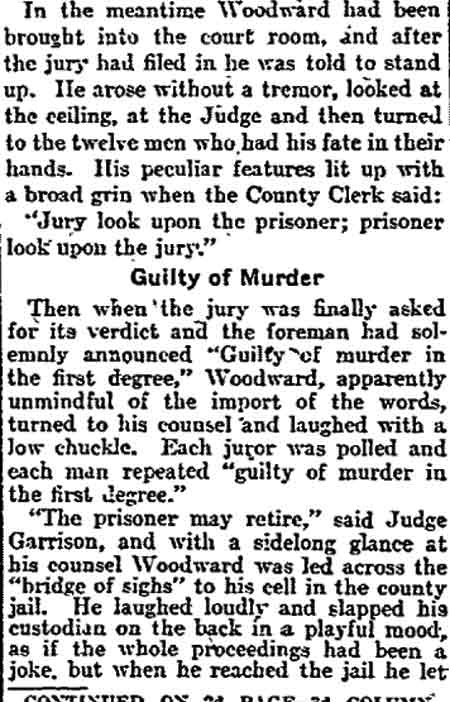
In the meantime Woodward had been brought into the court room, and after the jury had filed in he was told to stand up. He arose without a tremor, looked at the ceiling, at the Judge and then turned to the twelve men who had his fate in their hands. His peculiar features lit up with a broad grin when the County Clerk said:
“Jury look upon the prisoner; prisoner look upon the jury.”
Guilty of Murder
Then when the jury was finally asked for its verdict and the foreman had solemnly announced “Guilty of murder in the first degree,” Woodward, apparently unmindful of the import of the words, turned to his counsel and laughed with a low chuckle. Each juror was polled and each man repeated “guilty of murder in the first degree.”
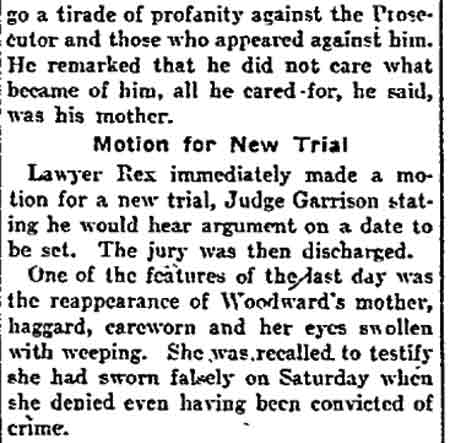
“The prisoner may retire,” said Judge Garrison, and with a sidelong glance at his counsel Woodward was led across the “bridge of sighs” to his cell in the county jail. He laughed loudly and slapped his custodian on the back in a playful mood, as if the whole proceedings had been a joke, but when he reached the jail he let go a tirade of profanity against the Prosecutor and those who appeared against him. He remarked that he did not care what became of him, all he cared for, he said, was his mother.
Motion for New Trial
Lawyer Rex immediately made a motion for a new trial, Judge Garrison stating he would hear argument on a date to be set. The jury was then discharged.
One of the features of the last day was the reappearance of Woodward’s mother, haggard, careworn and her eyes swollen with weeping. She was recalled to testify she had sworn falsely on Saturday when she denied even having been convicted of crime.
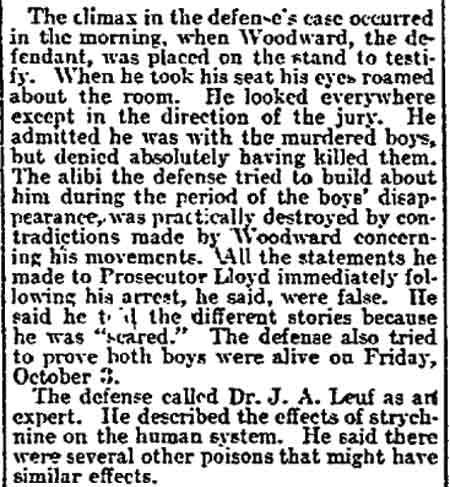
The climax in the defense’s case occurred in the morning, when Woodward, the defendant, was placed on the stand to testify. When he took his seat his eyes roamed about the room. He looked everywhere except in the direction of the jury. He admitted he was with the murdered boys, but denied absolutely having killed them. The alibi the defense tried to build about him during the period of the boys’ disappearance, was practically destroyed by contradictions made by Woodward concerning his movements. All the statements he made to Prosecutor Lloyd immediately following his arrest, he said, were false. He said he told the different stories because he was “scared.” The defense also tried to prove both boys were alive on Friday, October 3.
The defense called Dr. J. A. Leuf as an expert. He described the effects of strychnine on the human system. He said there were several other poisons that might have similar effects.
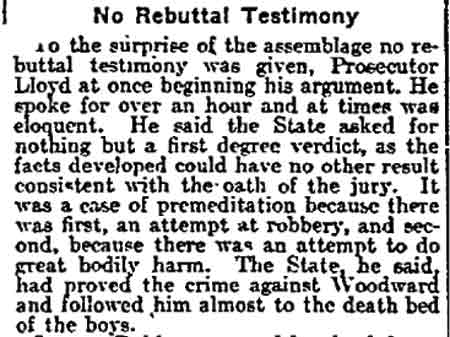
No Rebuttal Testimony
To the surprise of the assemblage no rebuttal testimony was given, Prosecutor Lloyd at once beginning his argument. He spoke for over an hour and at times was eloquent. He said the State asked for nothing but a first degree verdict, as the facts developed could have no other result consistent with the oath of the jury. It was a case of premeditation because there was first, an attempt at robbery, and second, because there was an attempt to do great bodily harm. The State, he said, had proved the crime against Woodward and followed him almost to the death bed of the boys.
Lawyer Robinson opened for the defense. He spoke for over an hour. “Paul is not guilty and if you follow the evidence you must acquit him,” concluded the defense.
Judge Garrison’s charge lasted just four minutes. He explained the law covering the case. He said anyone administering poison for robbery was guilty of murder in the first degree. If, however, it was not proven to the jury beyond a reasonable doubt that the defendant administered the poison, then he should be acquitted.
The jury then retired at 3.45.
Another postal card was received yesterday, asking for Woodward’s brain, but these seekers after the convicted man’s gray matter will be disappointed.
Philadelphia Inquirer — November 19, 1902
THINKS WOODWARD IS DEFICIENT
That Paul Woodward, the Camden murderer of John Coffin and W. Price Jennings, is mentally deficient is likely to be made the basis of a plea by his counsel for commutation of the death penalty in his case before the Board of Pardons. That his conduct since conviction has been such as to furnish some ground for the appeal is believed by some of those with whom he has come in contact.
Far from being impressed by his terrible position Woodward laughs and jokes with his jailers.
He does not want ordinary prison fare. He asked a turnkey if a convicted murderer was not entitled to have his meals, including wine, brought from a restaurant. When he was jocularly told that he was, he exclaimed:
“Maybe I won’t live high! Then, I don’t care for myself; all I care for is my mother.”
During the day he saw James Bland, who is accused of the murder of James Morrisey. To Bland he said:
“Oh! don’t you get gay; you won’t eat your Christmas dinner either.”
Philadelphia Inquirer — November 21, 1902
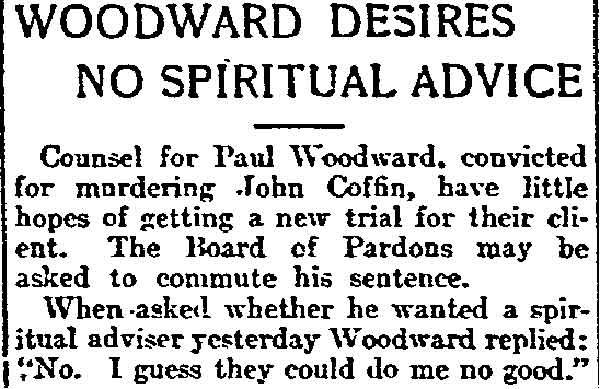
WOODWARD DESIRES NO SPIRITUAL ADVICE
Counsel for Paul Woodward, convicted for murdering John Coffin, have little hopes of getting a new trial for their client. The Board of Pardons may be asked to commute his sentence.
When asked whether he wanted a spiritual adviser yesterday Woodward replied: “No. I guess they could do me no good.”
Philadelphia Inquirer — November 22, 1902
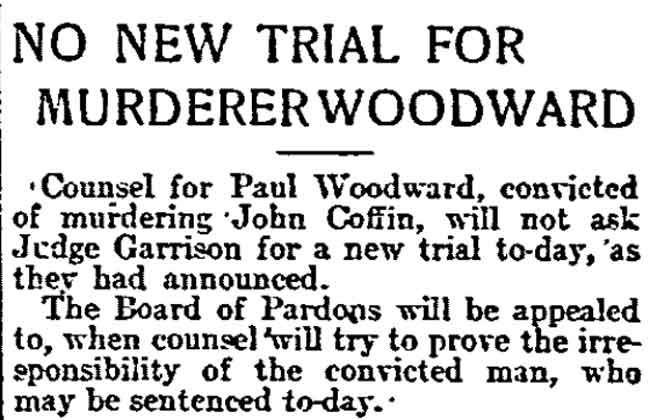
NO NEW TRIAL FOR MURDERER WOODWARD
Counsel for Paul Woodward, convicted of murdering John Coffin, will not ask Judge Garrison for a new trial to-day, as they had announced. The Board of Pardons will be appealed to, when counsel will try to prove the irresponsibility of the convicted man, who may be sentenced to-day.
Philadelphia Inquirer — November 23, 1902
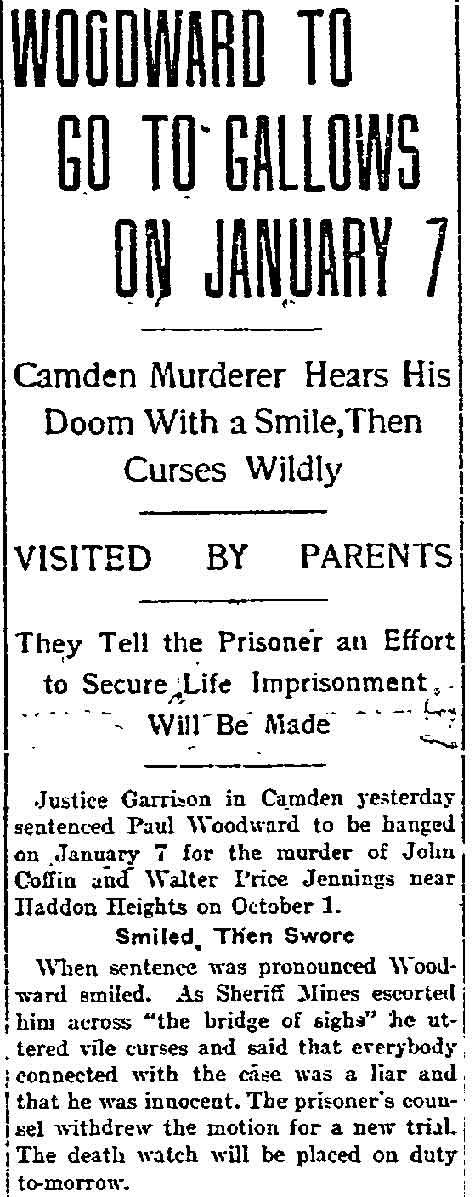
WOODWARD TO GO TO GALLOWS ON JANUARY 7
Camden Murderer Hears His Doom With a Smile, Then Curses Wildly
VISITED BY PARENTS
They Tell the Prisoner an Effort to Secure Life Imprisonment Will Be Made
Justice Garrison in Camden yesterday sentenced Paul Woodward to be hanged on January 7 for the murder of John Coffin and Walter Price Jennings near Haddon Heights on October 1.
Smiled, Then Swore
When sentence was pronounced Woodward smiled. As Sheriff Mines escorted him across “the bridge of sighs” he uttered vile curses and said that everybody connected with the case was a liar and that he was innocent. The prisoner’s counsel withdrew the motion for a new trial. The death watch will be placed on duty to-morrow.
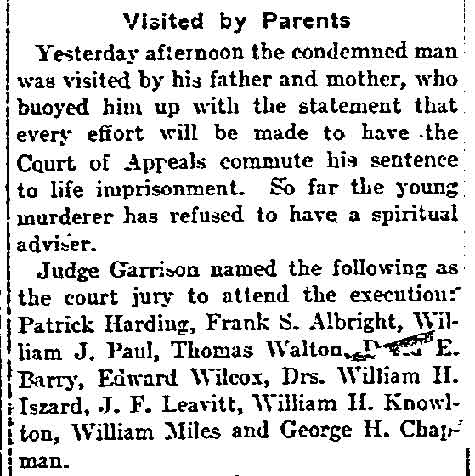
Visited by Parents
Yesterday afternoon the condemned man was visited by his father and mother, who buoyed him up with the statement that every effort will be made to have the Court of Appeals commute his sentence to life imprisonment. So far the young murderer has refused to have a spiritual adviser.
Judge Garrison named the following as the court jury to attend the execution: Patrick Harding, Frank S. Albright, William J. Paul, Thomas Walton, David E. Barry, Edward Wilcox, Drs. William H. Iszard, J. F. Leavitt, William H. Knowlton, William Miles and George H. Chapman.
Philadelphia Inquirer — November 26, 1902
DEATH WATCH ON WOODWARD
The death watch was yesterday placed on Paul Woodward, the young man in the Camden County Jail under sentence of death for murdering John Coffin and W. Price Jennings. He is under surveillance day and night. Yesterday he acted queerly, as though making an effort to have his jailors believe him insane.
Philadelphia Inquirer — November 29, 1902
WOODWARD HAD MANY VICES
Some Things That Prosecutor Lloyd Held Back
From the Prosecutor’s office in Camden it is learned that much more evidence was in hand than that which was presented against Paul Woodward, convicted of murdering John Coffin and W. Price Jennings and who is under sentence to be hanged. The Prosecutor had knowledge that Woodward blackmailed a South Camden woman and her husband, almost resulting in a separation. Then he is said to have proposed to a young man a scheme of operating a “knock-out” resort.
Kalamazoo Gazette — November 29, 1902
WERE HIS RUIN.
Cigarettes Make Him a Demon and a Murderer.
“Cigarettes have been my ruin. I will never smoke another,” said Paul Woodward, the condemned murderer of John Coffin and Price Jennings, who has been sentenced to death. “Since I was a small boy I have smoked those things,” Woodward continued, “and they have driven me crazy. Yes, I am dangerously crazy. I do things against my own will.”
Salt Lake Telegram — December 2, 1902
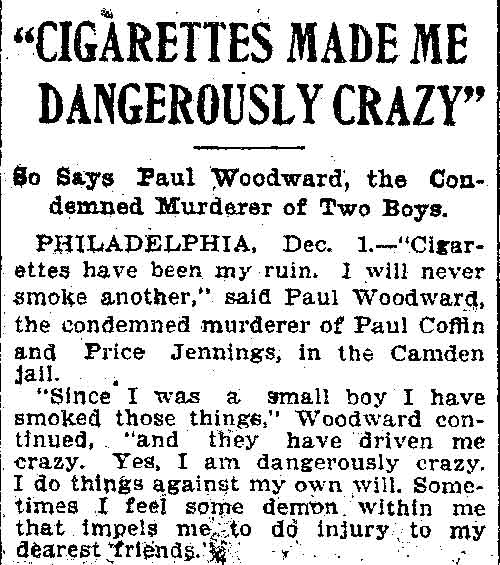
“CIGARETTES MADE ME DANGEROUSLY CRAZY”
So Says Paul Woodward, the Condemned Murderer of Two Boys.
“Cigarettes have been my ruin. I will never smoke another,” said Paul Woodward, the condemned murderer of John Coffin and Price Jennings, in the Camden jail. “Since I was a small boy I have smoked those things,” Woodward continued, “and they have driven me crazy. Yes, I am dangerously crazy. I do things against my own will. Sometimes I feel some demon within me that impels me to do injury to my dearest friends.”
Philadelphia Inquirer — December 4, 1902
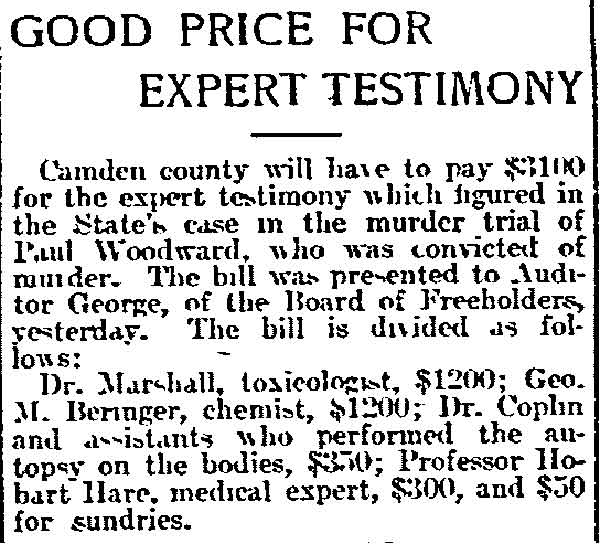
GOOD PRICE FOR EXPERT TESTIMONY
Camden county will have to pay $3100 for the expert testimony which figured in the State’s case in the murder trial of Paul Woodward, who was convicted of murder. The bill was presented to Auditor George, of the Board of Freeholders, yesterday. The bill is divided as follows: Dr. Marshall, toxicologist, $1200; Geo. M. Beringer, chemist, $1200; Dr. Cophn and assistants who performed the autopsy on the bodies, $350; Professor Hobart Hare, medical expert, $300, and $50 for sundries.
Philadelphia Inquirer — December 7, 1902
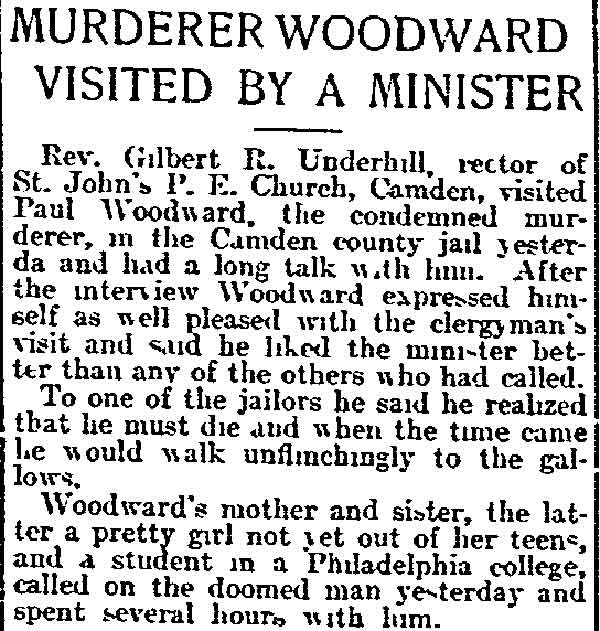
MURDERER WOODWARD VISITED BY A MINISTER
Rev. Gilbert R. Underhill, rector of St. John’s P. E. Church, Camden, visited Paul Woodward, the condemned murderer, in the Camden county jail yesterday and had a long talk with him. After the interview Woodward expressed himself as well pleased with the clergyman’s visit and said he liked the minister better than any of the others who had called.
To one of the jailors he said he realized that he must die and when the time came he would walk unflinchingly to the gallows.
Philadelphia Inquirer — December 9, 1902
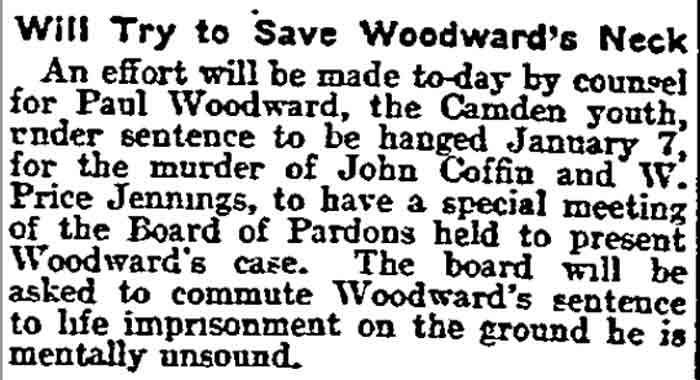
WILL TRY TO SAVE WOODWARD’S NECK
An effort will be made to-day by counsel for Paul Woodward, the Camden youth, under sentence to be hanged January 7, for the murder of John Coffin and W. Price Jennings, to have a special meeting of the Board of Pardons held to present Woodward’s case. The board will be asked to commute Woodward’s sentence to life imprisonment on the ground he is mentally unsound.
Philadelphia Inquirer — December 12, 1902
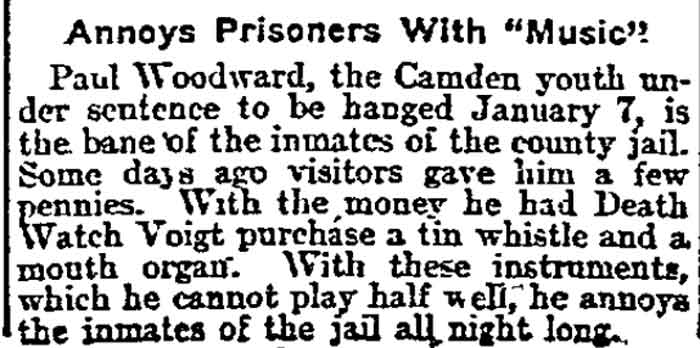
ANNOYS PRISONERS WITH “MUSIC”
Paul Woodward, the Camden youth under sentence to be hanged January 7, is the bane of the inmates of the county jail. Some days ago visitors gave him a few pennies. With the money he had Death Watch Voigt purchase a tin whistle and a mouth organ. With these instruments, which he cannot play half well, he annoys the inmates of the jail all night long.
Philadelphia Inquirer — December 14, 1902
Woodward, Condemned Boy Slayer, Operates Phonograph in the County Jail
IS HAVING LOTS OF FUN
Familiar Strains Ring Through the Cells to Youthful Prisoner’s Great Delight
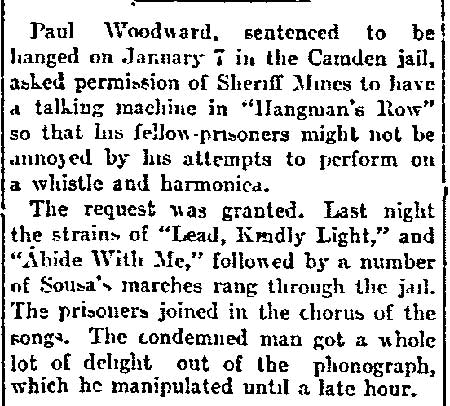
Paul Woodward, sentenced to be hanged on January 7 in the Camden jail, asked permission of Sheriff Mines to have a talking machine in “Hangman’s Row” so that his fellow-prisoners might not be annoyed by his attempts to perform on a whistle and harmonica.
The request was granted. Last night the strains of “Lead, Kindly Light,” and “Abide With Me,” followed by a number of Sousa’s marches rang through the jail. The prisoners joined in the chorus of the songs. The condemned man got a whole lot of delight out of the phonograph, which he manipulated until a late hour.
Philadelphia Inquirer — December 15, 1902
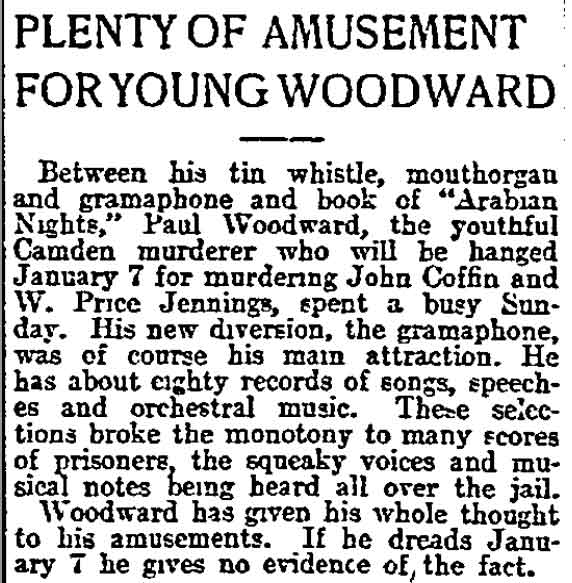
PLENTY OF AMUSEMENT FOR YOUNG WOODWARD
Between his tin whistle, mouthorgan and gramaphone and book of “Arabian Nights,” Paul Woodward, the youthful Camden murderer who will be hanged January 7 for murdering John Coffin and W. Price Jennings, spent a busy Sunday. His new diversion, the gramaphone, was of course his main attraction. He has about eighty records of songs, speeches and orchestral music. Woodward has given his whole thought to his amusements. If he dreads January 7 he gives no evidence of the fact.
Philadelphia Inquirer — December 17, 1902
PARDON BOARD ON WOODWARD’S CASE
Governor Will Reprieve Prisoner If Action Is Not Taken by December 24
TRENTON, N. J., Dec. 16—The case of Paul Woodward, the condemned Camden murderer, is to be considered by the Court of Pardons. This was promised to-day by Governor Murphy to Lawyer Fred A. Rex. Governor Murphy says if the case has not been reached when the court adjourns, December 24, he will grant Woodward a reprieve until some action is taken.
Mr. Rex’s ground for appeal is that there was some intermarrying of relatives in Woodward’s family which might justify a degree of insanity that would warrant the commutation of the condemned man’s sentence.
In the jail at Camden Woodward continues to amuse himself with his gramophone. He is sanguine of getting his death sentence commuted. He eats and sleeps regularly and apparently does not worry in the least.
Philadelphia Inquirer — December 21, 1902
KNIFE FOUND IN WOODWARD’S CELL
Its Discovery Apparently Explains the Murderer’s Declaration That He Would Never Be Hanged
The seeming confidence with which Paul Woodward, sentenced to be hanged January 7 in the Camden county jail for the murder of the Jennings and Coffin boys, expressed himself that he would not be executed was easily accounted for when in a search of his cell the other day a pocket knife with an edge as keen as a razor was found. Several times had the officials searched the cell thoroughly as they supposed. Each time Woodward met their efforts with a mocking laugh. Convinced that there was something hidden one of the “watch” placed his fingers in a pipe in the cell and pulled forth the knife.
Philadelphia Inquirer — December 25, 1902
TRYING TO SAVE WOODWARD’S NECK
The New Jersey Court of Pardons, in secret session, yesterday, gave a hearing to counsel for Paul Woodward, the Camden murderer, who is under sentence to be hanged on January 7. Counsel asked for a commutation of sentence on the ground of insanity. The court postponed decision in the matter until next Tuesday, in order to give counsel an opportunity to present testimony.
Philadelphia Inquirer — December 26, 1902
MURDERER WOODWARD HAD MERRY CHRISTMAS
Paul Woodward, the youthful murderer in the Camden County Jail under sentence of death for killing John Coffin and W. Price Jennings, spent a happy Christmas. It was a happy one because he had plenty to eat—stewed chicken, mince pie, candy, etc.—and also because he has an idea he will not be hanged, at least on January 7.
Philadelphia Inquirer — December 30, 1902
LAST EFFORT TO SAVE WOODWARD
Lawyer Frederick A. Rex, counsel for Paul Woodward, the youth under sentence to be hanged January 7 for the murder of John Coffin and W. Price Jennings, will go to Trenton to-day to ask that Woodward’s sentence be commuted to life imprisonment. Woodward’s counsel has little prospect of getting anything favorable from the Board of Pardons, however.
Philadelphia Inquirer — December 31, 1902
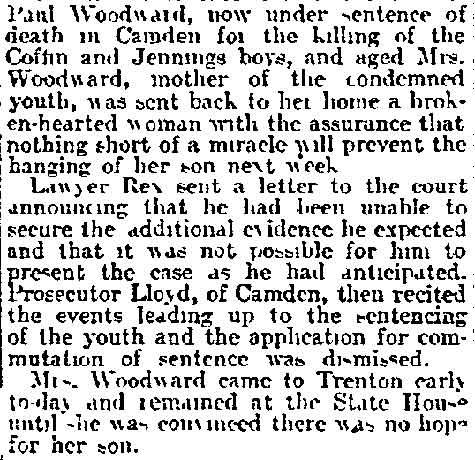
WOODWARD’S LAST HOPE VANISHED
Court of Pardons Refuses to Interfere in Case of Camden’s Condemned Murderer — TRENTON, N. J., Dec. 30—The Court of Pardons in special session this afternoon refused to interfere in the case of Paul Woodward, the Camden youth condemned to be hanged January 7 for the murder of John Coffin and W. Price Jennings.
Philadelphia Inquirer — January 1, 1903
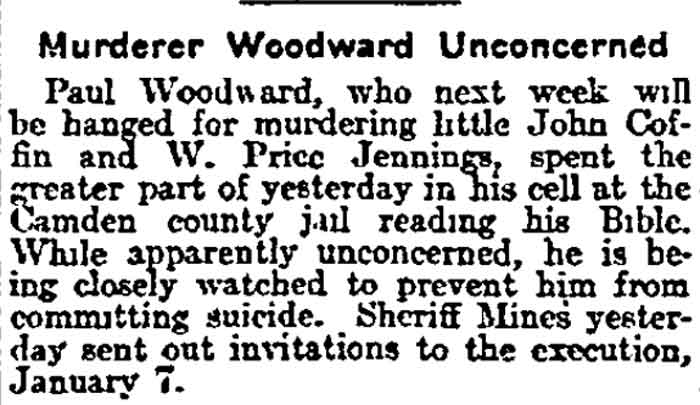
MURDERER WOODWARD UNCONCERNED
Paul Woodward, who next week will be hanged for murdering little John Coffin and W. Price Jennings, spent the greater part of yesterday in his cell at the Camden county jail reading his Bible. While apparently unconcerned, he is being closely watched to prevent him from committing suicide. Sheriff Mines yesterday sent out invitations to the execution, January 7.
Philadelphia Inquirer — January 3, 1903
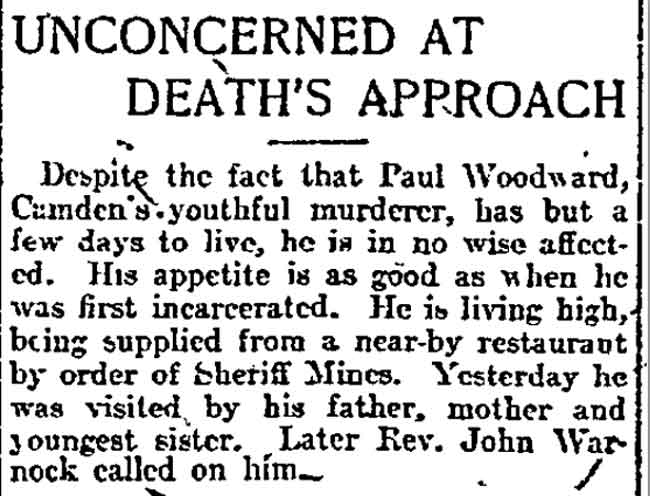
UNCONCERNED AT DEATH’S APPROACH
Despite the fact that Paul Woodward, Camden’s youthful murderer, has but a few days to live, he is in no wise affected. His appetite is as good as when he was first incarcerated. He is living high, being supplied from a near-by restaurant by order of Sheriff Mines. Yesterday he was visited by his father, mother and youngest sister. Later Rev. John Warnock called on him.
Philadelphia Inquirer — January 5, 1903
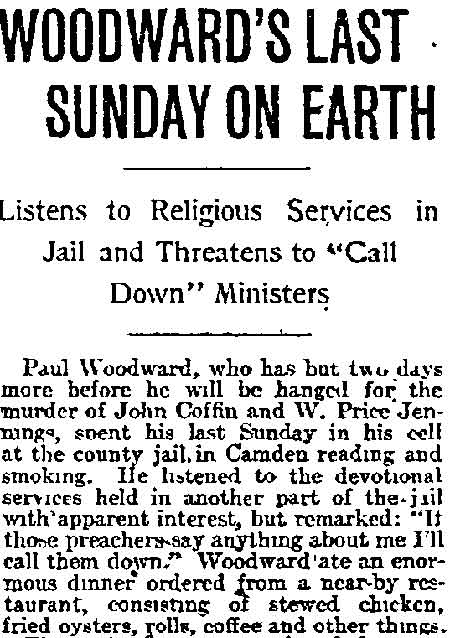
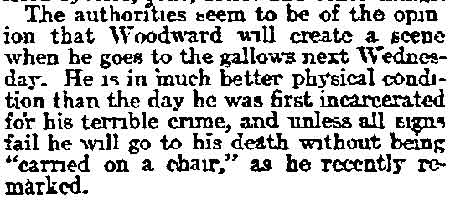
WOODWARD’S LAST SUNDAY ON EARTH
Listens to Religious Services in Jail and Threatens to “Call Down” Ministers
Paul Woodward, who has but two days more before he will be hanged for the murder of John Coffin and W. Price Jennings, spent his last Sunday in his cell at the county jail in Camden reading and smoking. He listened to the devotional services held in another part of the jail with apparent interest, but remarked: “If those preachers say anything about me I’ll call them down.” Woodward ate an enormous dinner ordered from a near-by restaurant, consisting of stewed chicken, fried oysters, rolls, coffee and other things.
Philadelphia Inquirer — January 6, 1903
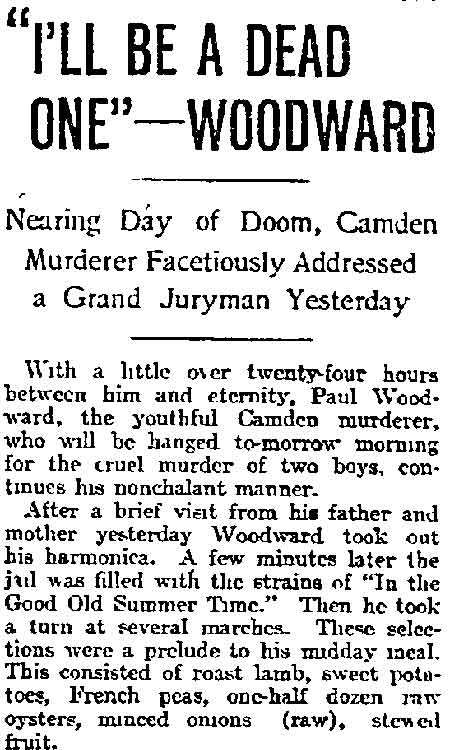
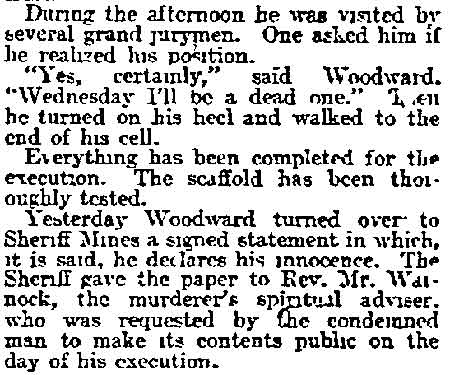
“I’LL BE A DEAD ONE”—WOODWARD
Nearing Day of Doom, Camden Murderer Facetiously Addressed a Grand Juryman Yesterday
With a little over twenty-four hours between him and eternity, Paul Woodward, the youthful Camden murderer, who will be hanged to-morrow morning for the cruel murder of two boys, continues his nonchalant manner. After a brief visit from his father and mother yesterday Woodward took out his harmonica. A few minutes later the jail was filled with the strains of “In the Good Old Summer Time.” This consisted of roast lamb, sweet potatoes, French peas, one-half dozen raw oysters, minced onions (raw), stewed fruit.
Philadelphia Inquirer — January 7, 1903
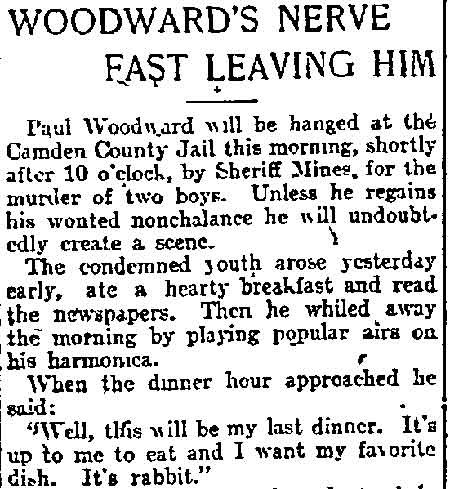
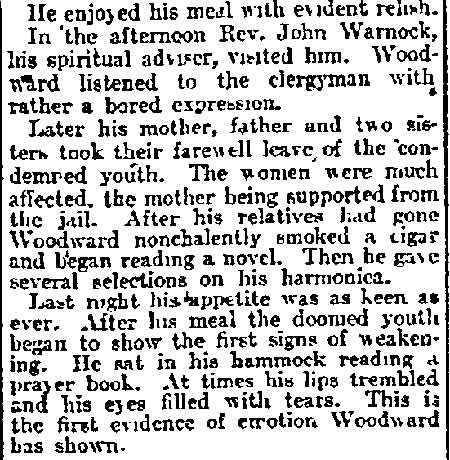
WOODWARD’S NERVE FAST LEAVING HIM
Paul Woodward will be hanged at the Camden County Jail this morning, shortly after 10 o’clock, by Sheriff Mines, for the murder of two boys. Unless he regains his wonted nonchalance he will undoubtedly create a scene. The condemned youth arose yesterday early, ate a hearty breakfast and read the newspapers. Then he whiled away the morning by playing popular airs on his harmonica.
Wilkes-Barre Times — January 7, 1903
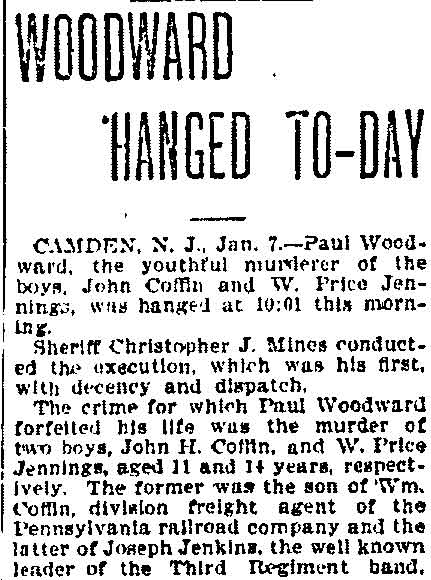
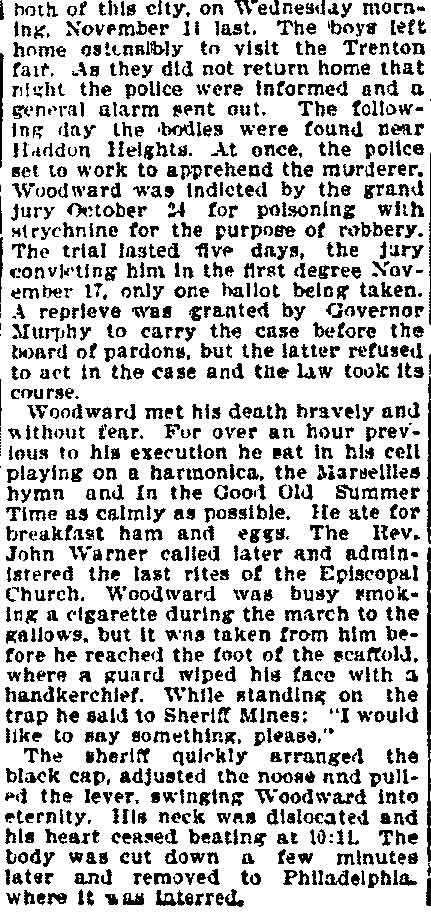
WOODWARD HANGED TO-DAY
CAMDEN, N. J., Jan. 7.—Paul Woodward, the youthful murderer of the boys, John Coffin and W. Price Jennings, was hanged at 10:01 this morning. Sheriff Christopher J. Mines conducted the execution, which was his first, with decency and dispatch. The former was the son of Wm. Coffin, division freight agent of the Pennsylvania railroad company and the latter of Joseph Jennings, the well known leader of the Third Regiment band.
Philadelphia Inquirer — January 8, 1903
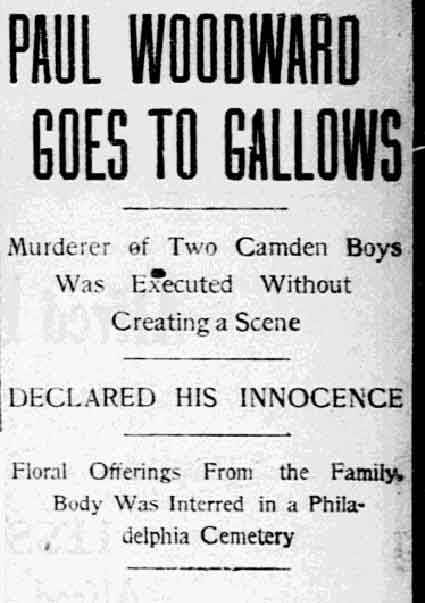
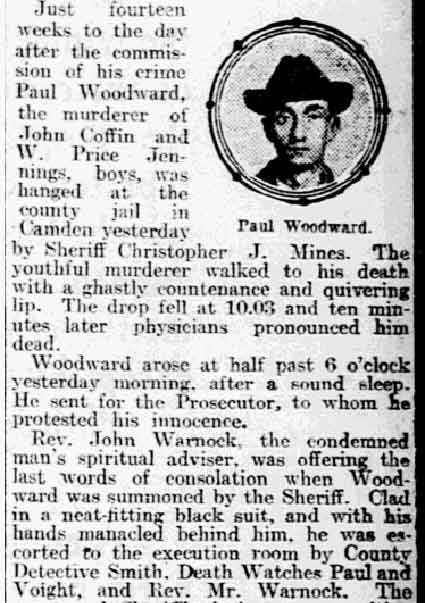
Murderer of Two Camden Boys Was Executed Without Creating a Scene
DECLARED HIS INNOCENCE
Floral Offerings From the Family, Body Was Interred in a Philadelphia Cemetery
Just fourteen weeks to the day after the commission of his crime Paul Woodward, the murderer of John Coffin and W. Price Jennings, boys, was hanged at the county jail in Camden yesterday by Sheriff Christopher J. Mines. The youthful murderer walked to his death with a ghastly countenance and quivering lip. The drop fell at 10:03 and ten minutes later physicians pronounced him dead.
Woodward arose at half past 6 o’clock yesterday morning, after a sound sleep. He sent for the Prosecutor, to whom he protested his innocence.
Rev. John Warnock, the condemned man’s spiritual adviser, was offering the last words of consolation when Woodward was summoned by the Sheriff. Clad in a neat-fitting black suit, and with his hands manacled behind him, he was escorted to the execution room by County Detective Smith, Death Watches Paul and Voight, and Rev. Mr. Warnock.
Court and Sheriff’s juries were awaiting with bared heads. Sheriff Mines stood near the foot of the gallows as the prisoner entered the door leading to the jail corridor.
Woodward, pale as death, had just a moment’s time before Sheriff Mines took him by the arm, led him up the thirteen steps to the platform, adjusted the black cap, knotted the rope, and a moment later the trap opened. Woodward shot down until his feet nearly touched the floor. The rope twisted and the body swung around for a few minutes. The physicians present said death had been painless. The body was taken down at 10:42, placed in charge of undertakers and deposited in a handsome casket, on the lid of which was:
PAUL A. WOODWARD,
Died January 7th, 1903,
In his 25th year.
In a cab the family followed the hearse to a Philadelphia cemetery, where interment was made.
Just before the execution took place two floral pieces were taken into the jail to be placed on the casket. It was reported that they were sent by Woodward’s family.
One was a pillow of carnations and roses having in the centre in immortelles the word “Innocent.”
The other was a palm-shaped arrangement of greens and white carnations, tied with a satin ribbon on which were the words “Too Soon.”
Those who witnessed the hanging were surprised at the cool manner in which the murderer conducted himself just before the execution. He had been fully expected to make a scene.
The statement sworn to by Woodward before J. Fred George, notary public, was given out after the execution. It was a lengthy document. The youth admitted meeting young Coffin and Jennings, but said his original intention was not robbery. The two boys and he, he said, had agreed to rob several houses in the country.
The boys weakened and refused to be a party to the robberies. Then, according to the statement, he decided to kill the boys for self-protection. He said he had provided himself with pies in advance and the poison was placed in them.
Two other statements were given out by Woodward. Both were rambling stories and contradictory.
Philadelphia Inquirer — January 17, 1903
MURDER CASE FINALLY CLOSED
The last chapter in the murder of John Coffin and W. Price Jennings, for which Paul Woodward was recently hanged, was enacted yesterday when Prosecutor Lloyd directed County Clerk Patterson to cancel the indictment charging Woodward with the murder of young Jennings. It was done simply to make the records in the case complete.
Camden Post-Telegram — June 18, 1910

There will be no fireworks at Moorestown on July 4. The entertainment on that day will be furnished by the Moorestown Field Club and Jennings’ Band of Camden.
Philadelphia Inquirer — October 16, 1910
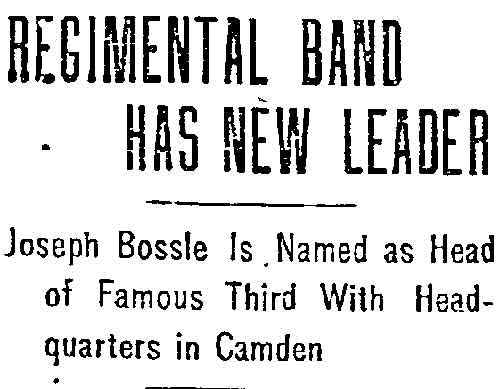
REGIMENTAL BAND HAS NEW LEADER
Joseph Bossle Is Named as Head of Famous Third With Headquarters in Camden
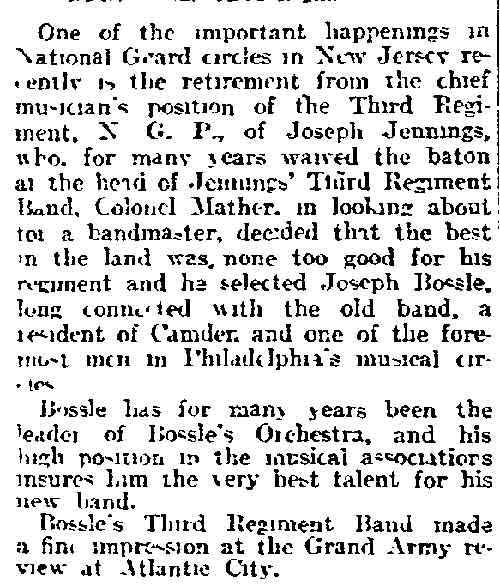
One of the important happenings in National Guard circles in New Jersey recently is the retirement from the chief musician’s position of the Third Regiment, N. G. P., of Joseph Jennings, who, for many years waived the baton at the head of Jennings’ Third Regiment Band. Colonel Mather, in looking about for a bandmaster, decided that the best in the land was, none too good for his regiment and he selected Joseph Bossle, long connected with the old band, a resident of Camden, and one of the foremost men in Philadelphia’s musical circles.
Bossle has for many years been the leader of Bossle’s Orchestra, and his high position in the musical associations insures him the very best talent for his uses.
Bossle’s Third Regiment Band made a fine impression at the Grand Army review at Atlantic City.
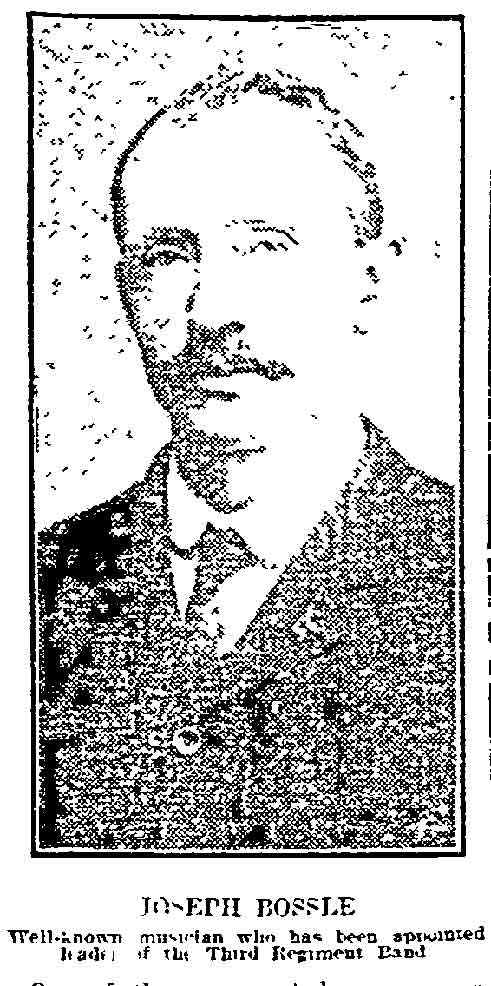
JOSEPH BOSSLE
Well-known musician who has been appointed leader of the Third Regiment Band.
Camden Post-Telegram — October 14, 1912

JENNINGS’ BAND
At Munger & Long’s To-night. — Moose Band Friday Night.
Philadelphia Inquirer — April 6, 1914
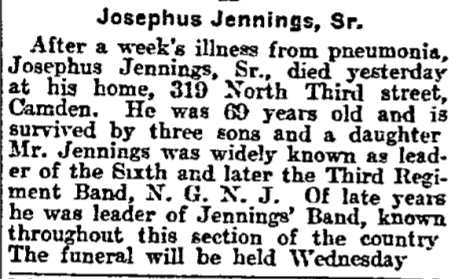
Josephus Jennings, Sr.
After a week’s illness from pneumonia, Josephus Jennings, Sr., died yesterday at his home, 319 North Third street, Camden. He was 69 years old and is survived by three sons and a daughter. Mr. Jennings was widely known as leader of the Sixth and later the Third Regiment Band, N. G. N. J. Of late years he was leader of Jennings’ Band, known throughout this section of the country. The funeral will be held Wednesday.
Bridgeton Evening News — April 11, 1914

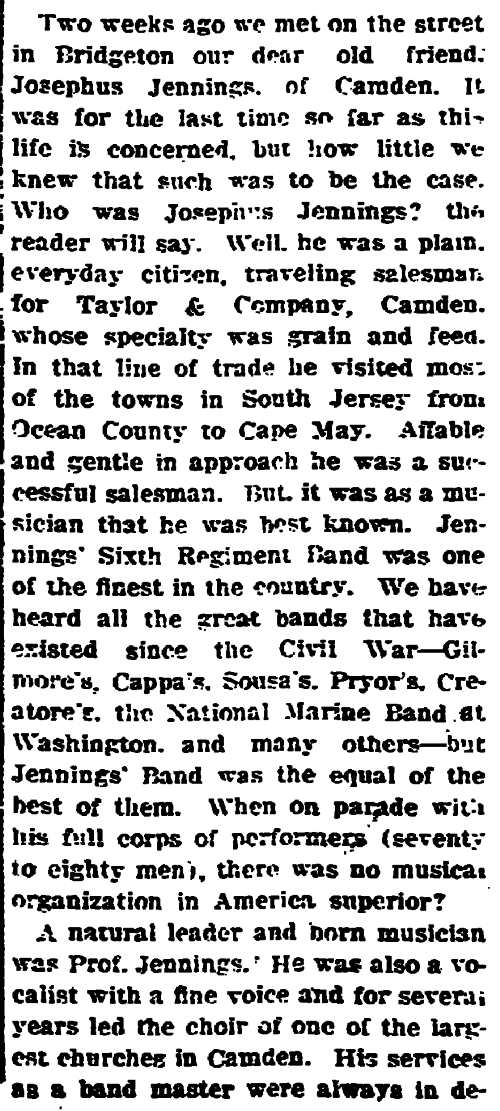
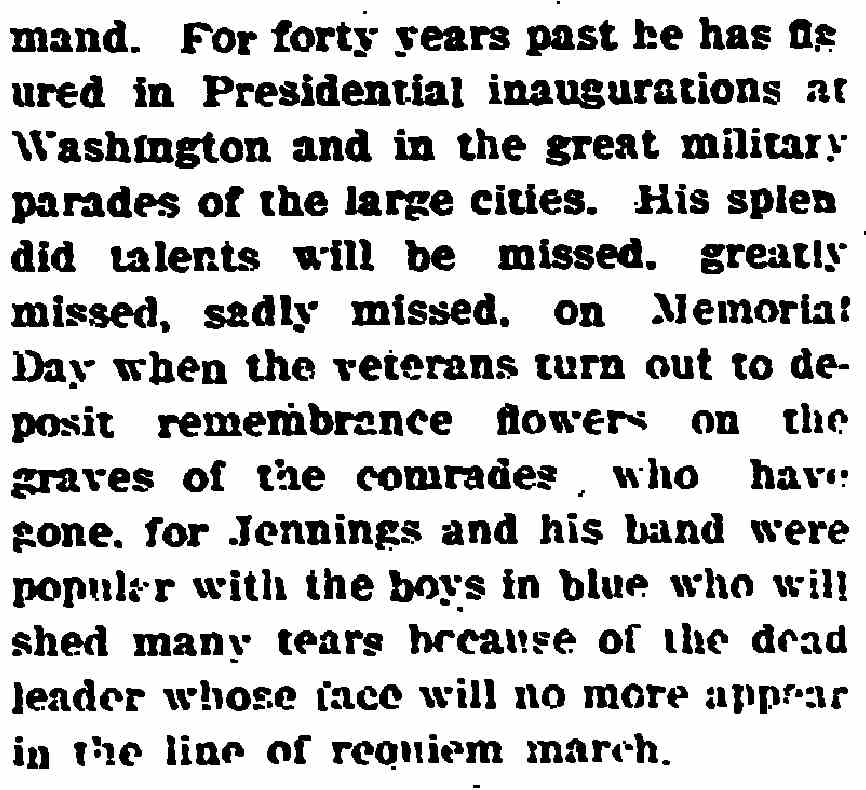
POLITICAL CHAT: ODDS AND ENDS BY I. T. NICHOLS
Two weeks ago we met on the street in Bridgeton our dear old friend, Josephus Jennings, of Camden. It was for the last time so far as this life is concerned, but how little we knew that such was to be the case. Who was Josephus Jennings? the reader will say. Well, he was a plain, everyday citizen, traveling salesman for Taylor & Company, Camden, whose specialty was grain and feed. In that line of trade he visited most of the towns in South Jersey from Ocean County to Cape May. Affable and gentle in approach he was a successful salesman. But it was as a musician that he was best known. Jennings’ Sixth Regiment Band was one of the finest in the country. We have heard all the great bands that have existed since the Civil War—Gilmore’s, Cappa’s, Sousa’s, Pryor’s, Creatore’s, the National Marine Band at Washington, and many others—but Jennings’ Band was the equal of the best of them. When on parade with his full corps of performers (seventy to eighty men), there was no musical organization in America superior?
A natural leader and born musician was Prof. Jennings. He was also a vocalist with a fine voice and for several years led the choir of one of the largest churches in Camden. His services as a band master were always in demand. For forty years past he has figured in Presidential inaugurations at Washington and in the great military parades of the large cities.
His splendid talents will be missed, greatly missed, sadly missed, on Memorial Day when the veterans turn out to deposit remembrance flowers on the graves of the comrades who have gone, for Jennings and his band were popular with the boys in blue who will shed many tears because of the dead leader whose face will no more appear in the line of requiem march.
Philadelphia Inquirer — May 7, 1914
FIREMEN TO PARADE IN GLOUCESTER CITY
Fifteen Companies to Participate in Pageant Saturday When New Engine Is Housed
Special to The Inquirer. GLOUCESTER CITY, N. J., May 6.—At a meeting of the Board of Fire Commissioners and Fire Department today arrangements were completed for the firemen’s parade to be held on Saturday in connection with the housing of the new fire engine. About fifteen fire companies will participate...
[Continuation — see charlesworthington-050714-inq-1.md]
...panies will participate, and Mayor Mealey, who is chief of the fire department, will be marshal, with William Known and Thomas Cozan as his aides.
The parade will start from the hose house on Bergen street. At the reviewing stand, in front of the City Hall, the judges will decide the winners. The judges will be Sheriff Joseph E. Nowrey, Mayor Charles Ellis, of Camden; Mayor Milliard F. Cattell, of Woodbury; Chief Worthington, of the Camden Fire Department, and Chief Baxter, of Philadelphia. Jennings’ Band will head the line, followed by the city officials in automobiles.
The Boy Scouts will assist in patrolling the route, along with a number of Camden police. Prizes will be awarded for the company having the largest number of men in line; the company coming the furthest distance; the company having the best band, and the best equipped company.
Camden Courier-Post — November 4, 1949
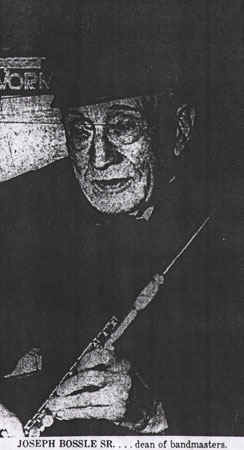

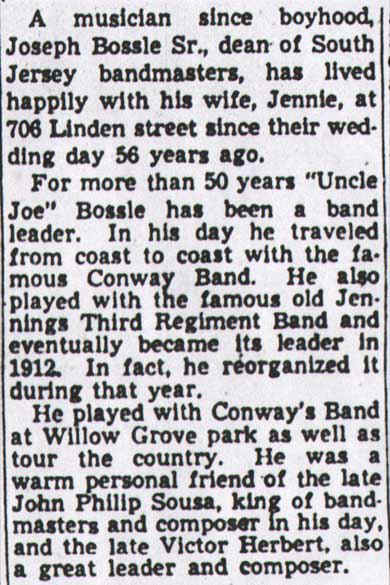
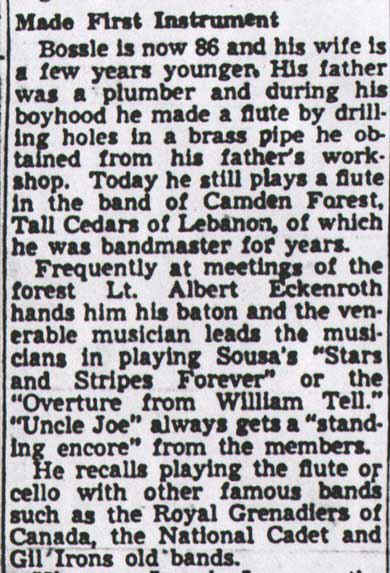
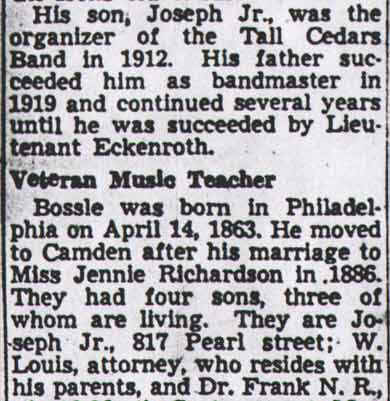
Named: Linden Street, Pearl Street
Joseph Bossle Jr., W. Louis Bossle, Dr. N.R. Bossle, Charles Bossle
Tall Cedars of Lebanon, Albert Eckenroth
Jennings’ Band, Conway’s Band, John Philip Sousa, and Victor Herbert.