Introduction
WILLIAM SCHREGLER was born in New York in May of 1867 to John and Rose Schregler. Besides William, the family included brother George and sisters Lillian and Nellie. After living for a time in Pennsylvania around 1882, the Schregler family appears to have come to Camden in the mid-1880s. The 1887–1888 Directory shows them living at 443 South 5th Street. Subsequent directories show them at 441 South 5th Street. It appears that John Schregler had passed prior to the 1887–1888 Directory’s compilation, as he is not listed. Rose Schregler is listed as widow in the 1888–1890 Directory. In these years Rose Schregler conducted a cigar store, while William worked as a cigar maker for Jacob H. Leon at 103 North 2nd Street. Jacob Leon was also a constable, and it may well have been through his influence that William Schregler obtained a position with the Camden Police Department. By the time the census was taken in 1900, William Schregler had been appointed Detective. He would remain in the Detective Bureau the remainder of his life, except for a brief period in 1906, when after the death of Chief John Foster, he served as Camden’s Acting Chief of Police.
The 1900 and 1910 Census shows the Schreglers living at 443 West Street, at the southwest corner of West and Washington streets. By 1910, adjacent to the Schregler home, at 434 Washington Street, lived William and Mary Welch. The oldest son, Walter Welch, would join Camden’s Police Department sometime after 1910 and go on to have a long and distinguished career, retiring as a Captain.
William F. Schregler was Captain of Detectives when the census was next taken, in January of 1920. He and his sisters Lillian and Nellie were renting a home at 226 North 10th Street.
After a career that spanned four decades, William Schregler died suddenly on October 17, 1927. He was succeeded as Captain of Detectives by John W. Golden, who would later become Chief of Police. Another future chief, Arthur Colsey, also served in Detectives under Captain Schregler’s command.
The Camden Primaries
Philadelphia Inquirer —
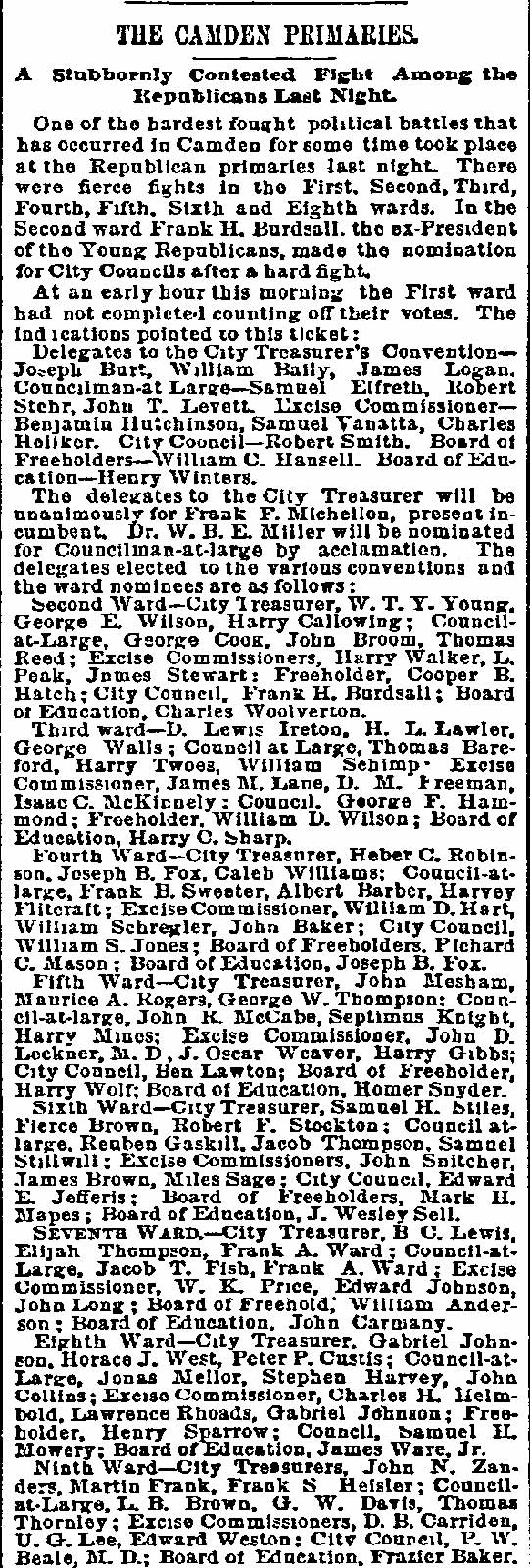
THE CAMDEN PRIMARIES
A Stubbornly Contested Fight Among the Republicans Last Night.
One of the hardest fought political battles that has occurred in Camden for some time took place at the Republican primaries last night. There were fierce fights in the First, Second, Third, Fourth, Fifth, Sixth and Eighth wards. In the Second ward Frank H. Burdsall, the ex-President of the Young Republicans, made the nomination for City Council almost a certainty.
At an early hour this morning the First ward had not completed counting off their votes. The indications pointed to this ticket:
Delegates to the City Treasurer’s Convention—Joseph Burt, William Bailly, James Logan. Councilman-at-Large—Samuel Elfreth, Robert Smith, John Cullen. City Council—Robert Smith, Benjamin Hutchinson, Samuel Yanaitis, Charles Hollnor. Board of Education—George W. C. Hansell. Board of Education—Henry Winters.
The delegates to the City Treasurer will indicate favor for W. P. Micheles, present incumbent. Dr. W. B. E. Miller will be nominated for Councilman-at-Large for acclamation. The delegates went to the various conventions and the ward nominees are as follows:
Second Ward—City Treasurer, W. Y. T. Young; Council, H. Wilson, Harvey; Councilman-at-Large, George Cook, John Brown, Thomas Brooks, Edward Roberts, John Brooks, George Peck, James Stewart; Freeholder, Cooper B. Hatch; City Council, Frank H. Burdsall; Board of Education, Charles Helmbold.
Third ward—D. Lewis Iretoo, H. L. Lawler, George Walls; Council at Large, Thomas Barber, Harvey; Council, James Stewart; Excise Commissioner, James M. Lane, D. M. Freeman, Isaac C. McKinney; Council, George F. Hannigan, Frank Michellon, E. D. Wilson; Board of Education, Harry C. Sharp.
Fourth Ward—City Treasurer, Heber C. Robinson; Councilman-at-Large, William D. Hart, Frank B. Sweeten, Albert Barber, Harvey Flitcraft; Excise Commissioner, William D. Hart, William Selle; City Council, Frank Michellon, William S. Jones; Board of Freeholders, Richard C. Mason; Board of Education, Joseph B. Fox.
Fifth Ward—City Treasurer, D. Lewis Ireton, Maurice A. Rogers, George W. Thompson; Council-at-Large, John R. McCabe, Solomon Knight, Harry Sanford; City Council, Hipolene Dine, Lockner, J. Oscar Weaver, Harry Gibbs; City Council, Elford S. Fish, Frank Chandler, Harry Weil; Board of Education, Homer Snyder.
Sixth Ward—City Treasurer, Samuel H. Stiles, Frederick W. Larkin; Councilman-at-Large, Reuben Gaskill, Jacob Thompson, Samuel Stillwell; Excise Commissioner, John Snifcher, Matthew Lewis, Elijah Thompson, Frank A. Ward, E. Jefferis; Board of Freeholders, Mark H. Mapes; Board of Education, J. Wesley Sell.
Seventh Ward—City Treasurer, Matthew Lewis, Elijah Thompson, Frank A. Ward; Councilmen-at-Large, Jacob T. Fish, Frank A. Ward; Excise Commissioner, D. M. Freeman, John Long; Board of Freehold, William Anderson; Board of Education, John Carmany.
Eighth Ward—City Treasurer, Samuel Johnson, Horace J. West, Peter P. Custis; Council-at-Large, Jonas Mellor, Stephen Harvey, John Zanders; Commissioner, James M. Lane; Freeholder, Lawrence Rhoads, Gabriel Johnson; Freeholder, Henry Sparrow; Council, Samuel H. Stiles, George W. C. Hansell; Ulie G. Lee.
Ninth Ward—City Treasurer, John N. Zanders, Martin Frank, Frank S. Heister; Councilman-at-Large, George H. Thornley; Excise Commissioners, D. B. Carriden, U. G. Lee, Thomas Weston; City Council, Elijah Thompson, Frank W. Baker.
He Announces the Names
Camden Daily Telegram —
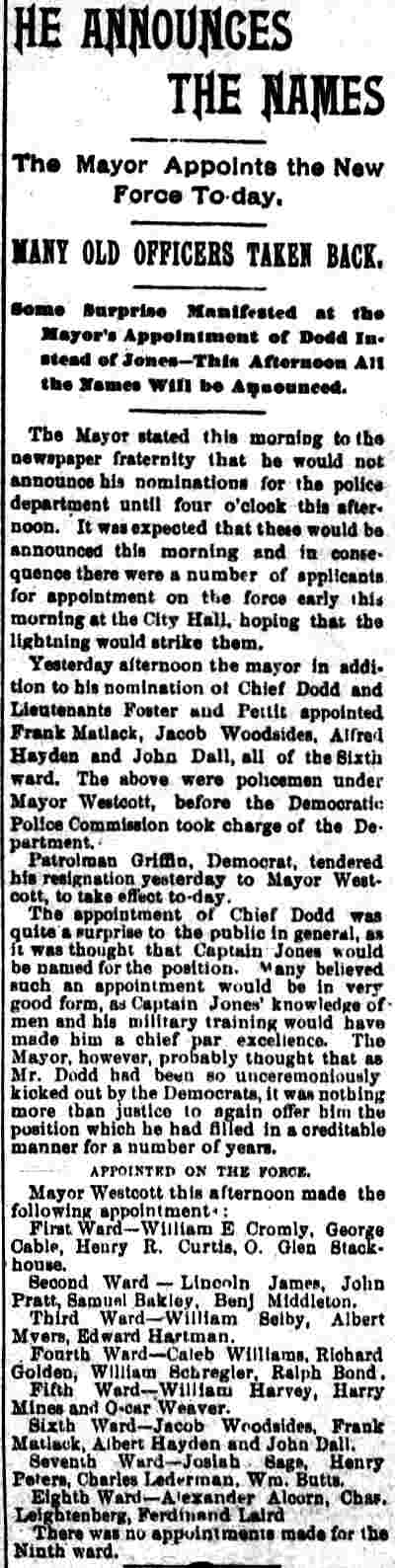
HE ANNOUNCES THE NAMES
The Mayor Appoints the New Force To-day.
MANY OLD OFFICERS TAKEN BACK.
Some Surprise Manifested at the Mayor’s Appointment of Dodd Instead of Jones — This Afternoon All the Names Will be Announced.
The Mayor stated this morning to the newspaper fraternity that he would not announce his nominations for the police department until four o’clock this afternoon. It was expected that these would be announced this morning and in consequence there were a number of applicants for appointment on the force early this morning at the City Hall, hoping that the lightning would strike them.
Yesterday afternoon the mayor in addition to his nomination of Chief Dodd and Lieutenants Foster and Pettit appointed Frank Matlack, Jacob Woodsides, Alfred Hayden and John Dall, all of the Sixth Ward. The above were policemen under Mayor Westcott, before the Democratic Police Commission took charge of the Department.
Patrolman Griffin, Democrat, tendered his resignation yesterday to Mayor Westcott, to take effect to-day.
The appointment of Chief Dodd was quite a surprise to the public in general, as it was thought that Captain Jones would be named for the position. Many believed such an appointment would be in very good form, as Captain Jones’ knowledge of men and his military training would have made him a chief par excellence. The Mayor, however, probably thought that as Mr. Dodd had been so unceremoniously kicked out by the Democrats, it was nothing more than justice to again offer him the position which he had filled in a creditable manner for a number of years.
APPOINTED ON THE FORCE.
Mayor Westcott this afternoon made the following appointments:
First Ward — William E Cromly, George Cable, Henry R. Curtis, O. Glen Stackhouse.
Second Ward — Lincoln James, John Pratt, Samuel Bakley, Benj Middleton.
Third Ward — William Selby, Albert Myers, Edward Hartman.
Fourth Ward — Caleb Williams, Richard Golden, William Schregler, Ralph Bond.
Fifth Ward — William Harvey, Harry Mines and Oscar Weaver.
Sixth Ward — Jacob Woodsides, Frank Matlack, Albert Hayden and John Dall.
Seventh Ward — Josiah Sage, Henry Peters, Charles Lederman, Wm. Butts.
Eighth Ward — Alexander Alcorn, Chas. Leightenberg, Ferdinand Laird
There was no appointments made for the Ninth ward.
Bread Thief Shot
Philadelphia Inquirer —
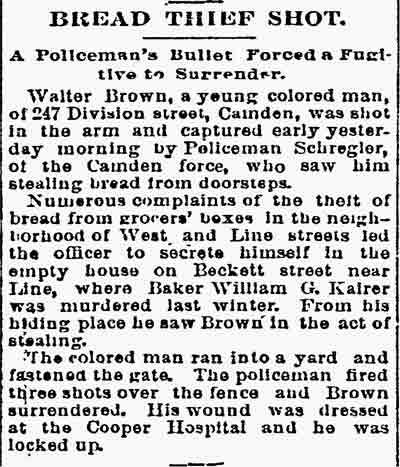
A Policeman’s Bullet Forced a Fugitive to Surrender.
Walter Brown, a young colored man, of 247 Division street, Camden, was shot in the arm and captured early yesterday morning by Policeman Schregler, of the Camden force, who saw him stealing bread from doorsteps.
Numerous complaints of the theft of bread from grocers’ boxes in the neighborhood of West and Line streets led the officer to secrete himself in the empty house on Beckett street near Line, where Baker William G. Kairer was murdered last winter. From his hiding place he saw Brown in the act of stealing.
The colored man ran into a yard and fastened the gate. The policeman fired three shots over the fence and Brown surrendered. His wound was dressed at the Cooper Hospital and he was locked up.
Over in Camden
Philadelphia Inquirer —
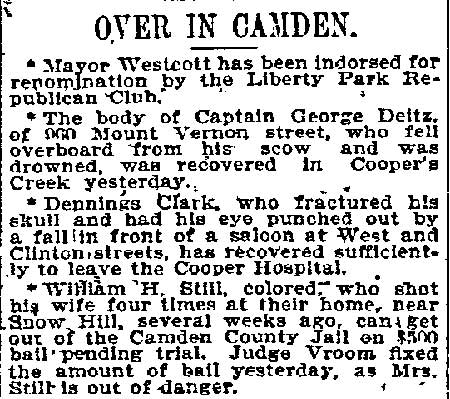
OVER IN CAMDEN.
* Mayor Westcott has been indorsed for renomination by the Liberty Park Republican Club.
* The body of Captain George Deitz, of 960 Mount Vernon street, who fell overboard from his scow and was drowned, was recovered in Cooper’s Creek yesterday.
* Dennings Clark, who fractured his skull and had his eye punched out by a fall in front of a saloon at West and Clinton streets, has recovered sufficiently to leave the Cooper Hospital.
* William H. Still, colored, who shot his wife four times at their home, near Snow Hill, several weeks ago, can get out of the Camden County Jail on $500 bail pending trial. Judge Vroom fixed the amount of bail yesterday, as Mrs. Still is out of danger.
Fires yesterday caused $200 damage at Albert Fleet’s residence, 300 North Ninth street, and a loss of $25 at the home of Samuel Harring, 619 North Front street, while at Mrs. Boyson’s house, Point and Elm streets, a hundred pigeons were burned to death.
Samuel Harmon, a colored sneak thief, made the mistake of attempting to strip a clothes line in Policeman Schregler’s back yard while the officer was at home eating his dinner. Harmon will regret his mistake during the thirty days he is to spend in the county jail.
Recovery from Bullet Wound
Philadelphia Inquirer —

Policeman William Schregler, who had a sinking spell last week as the result of the bullet wound in his body, is much improved and it is now thought that he will recover without the necessity of an operation.
Armed Desperadoes Swoop Down on East Camden
Philadelphia Inquirer —

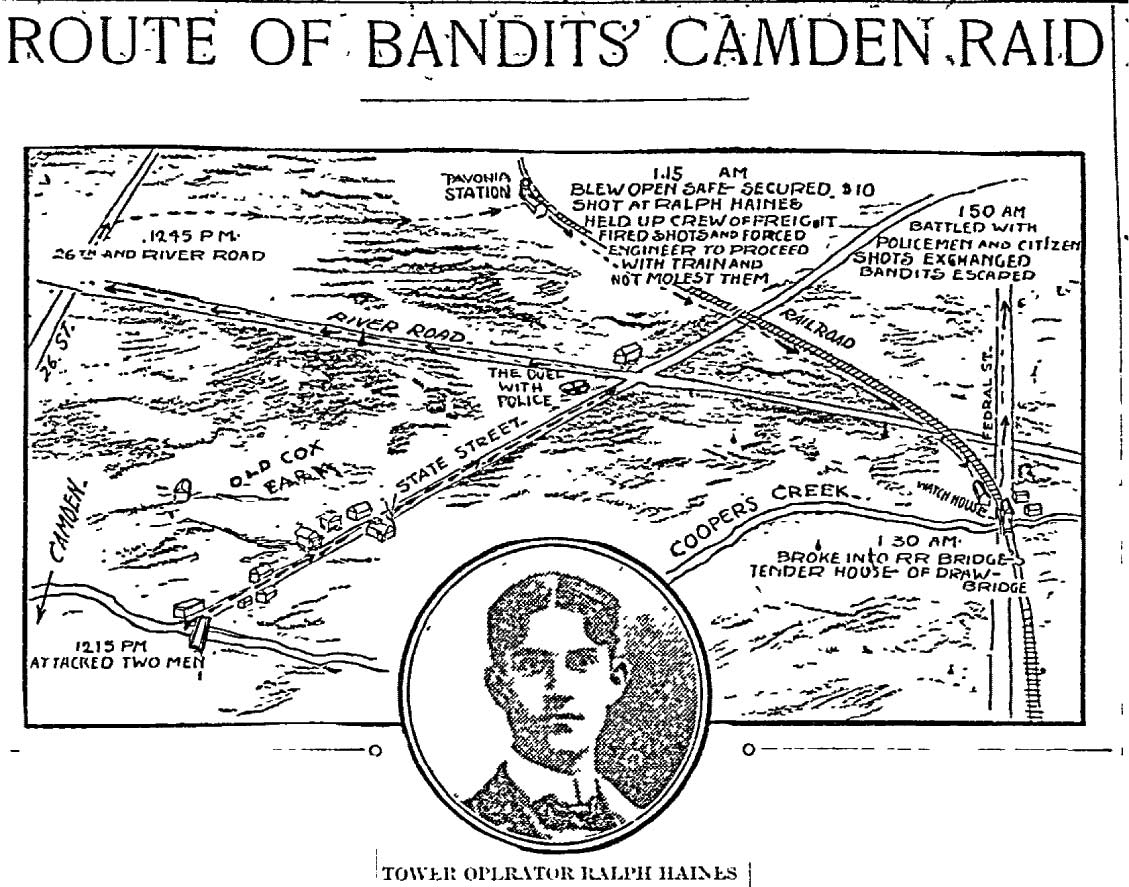
ARMED DESPERADOES SWOOP DOWN ON EAST CAMDEN
First Hold Up Bridge Watchman, Compelling Him to Place Mask on Face of One of the Bandits
Battle With Policeman After Blowing Up Safe in Pavonia Station—Shoot at Tower Operator Who Telegraphs for Help
In true Wild West fashion five heavily armed desperadoes swooped down upon East Camden yesterday morning, and within two hours they had emptied their revolvers several times over, held up a bridge tender, cut telephone wires, blew up a safe, ordered a train crew to move on, perforated a tower house with bullets and finally made their escape. It was all done between 12.15 o’clock, when the bandits began operations at the State street bridge over Cooper Creek, and 1.50, when they gave final battle to policemen and citizens out Federal street, and disappeared in the darkness.
Never in Camden county’s history was there such a bold intrusion. The bandits are supposed to be a part of the gang which murdered Operator Clendenen, near Jersey Shore, Pa., and which has been terrorizing railroad operators and tower men in all parts of Pennsylvania and New Jersey recently.
First Appearance
It was shortly after 12 o’clock when the bandits appeared at the State street bridge at Cooper’s Creek. David Loughead and Oscar Till, bridge tenders, had just prepared to retire for the night. Loughead left Till to go to a boat house nearby. He had been gone but a short time when Till heard voices in the rear of the bridge house.
Bridgeman Till observed several men standing at the end of the bridge, and believing that they anticipated attacking him he locked the doors and laid his revolver on the bunk. Suddenly the door was forced open and in tumbled five men. Four of the bandits were masked. Instantly the frightened bridge tender was looking into the barrels of five revolvers.
“I surrender,” said Till.
“That’s all right, old pal,” replied one of the robbers, “but we want your money. You see we are a little short of funds, and it’s getting along about Christmas time.”
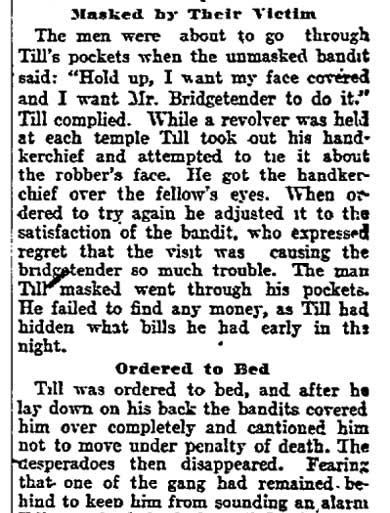
Masked by Their Victim
The men were about to go through Till’s pockets when the unmasked bandit said: “Hold up, I want my face covered and I want Mr. Bridgetender to do it.” Till complied. While a revolver was held at each temple Till took out his handkerchief and attempted to tie it about the robber’s face. He got the handkerchief over the fellow’s eyes. When ordered to try again he adjusted it to the satisfaction of the bandit, who expressed regret that the visit was causing the bridgetender so much trouble. The man Till masked went through his pockets. He failed to find any money, as Till had hidden what bills he had early in the night.
Ordered to Bed
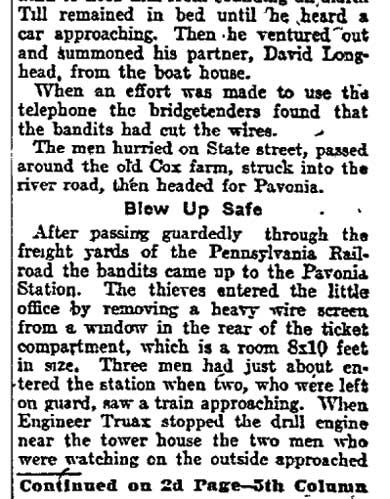
Till was ordered to bed, and after he lay down on his back the bandits covered him over completely and cautioned him not to move under penalty of death. The desperadoes then disappeared. Fearing that one of the gang had remained behind to keep him from sounding an alarm, Till remained in bed until he heard a car approaching. Then he ventured out and summoned his partner, David Loughead, from the boat house.
When an effort was made to use the telephone the bridgetenders found that the bandits had cut the wires.
The men hurried on State street, passed around the old Cox farm, struck into the river road, then headed for Pavonia.
Blew Up Safe
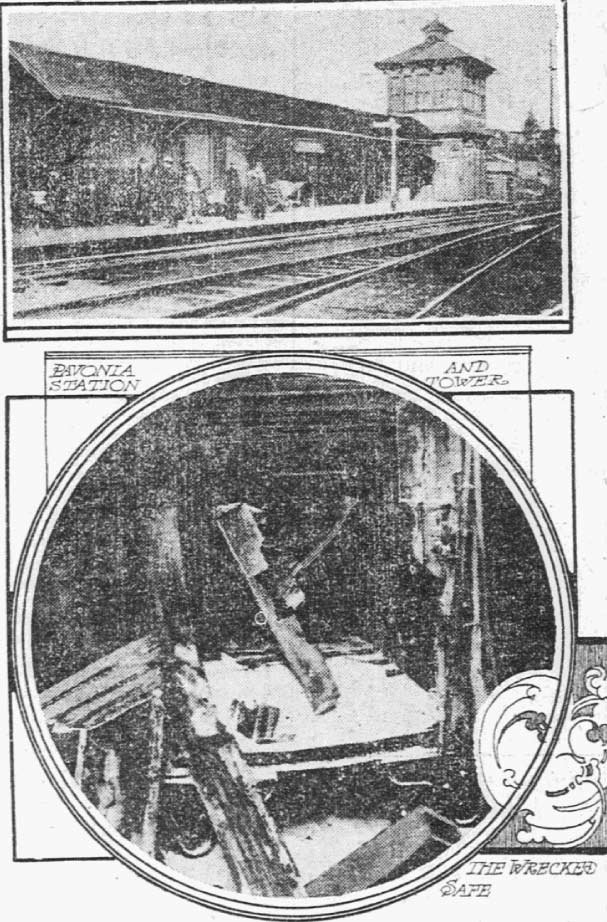
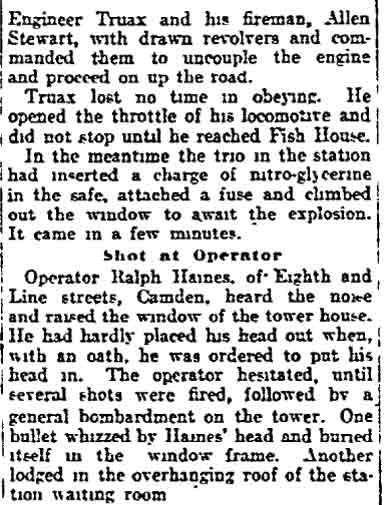
After passing guardedly through the freight yards of the Pennsylvania Railroad the bandits came up to the Pavonia Station. The thieves entered the little office by removing a heavy wire screen from a window in the rear of the ticket compartment, which is a room 8x10 feet in size. Three men had just about entered the station when two, who were left on guard, saw a train approaching. When Engineer Truax stopped the drill engine near the tower house the two men who were watching on the outside approached Engineer Truax and his fireman, Allen Stewart, with drawn revolvers and commanded them to uncouple the engine and proceed on up the road.
Truax lost no time in obeying. He opened the throttle of his locomotive and did not stop until he reached Fish House.
In the meantime the trio in the station had inserted a charge of nitro-glycerine in the safe, attached a fuse and climbed out the window to await the explosion. It came in a few minutes.
Shot at Operator
Operator Ralph Haines, of Eighth and Line streets, Camden, heard the noise and raised the window of the tower house. He had hardly placed his head out when, with an oath, he was ordered to put his head in. The operator hesitated, until several shots were fired, followed by a general bombardment on the tower. One bullet whizzed by Haines’ head and buried itself in the window frame. Another lodged in the overhanging roof of the station waiting room.
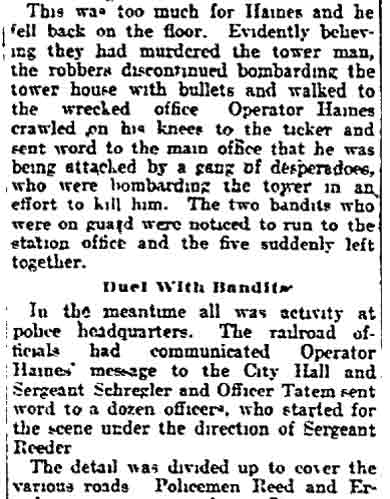
This was too much for Haines and he fell back on the floor. Evidently believing they had murdered the tower man, the robbers discontinued bombarding the tower house with bullets and walked to the wrecked office. Operator Haines crawled on his knees to the ticker and sent word to the main office that he was being attacked by a gang of desperadoes, who were bombarding the tower in an effort to kill him. The two bandits who were on guard were noticed to run to the station office and the five suddenly left together.
Duel With Bandits
In the meantime all was activity at police headquarters. The railroad officials had communicated Operator Haines’ message to the City Hall and Sergeant Schregler and Officer Tatem sent word to a dozen officers, who started for the scene under the direction of Sergeant Reeder.
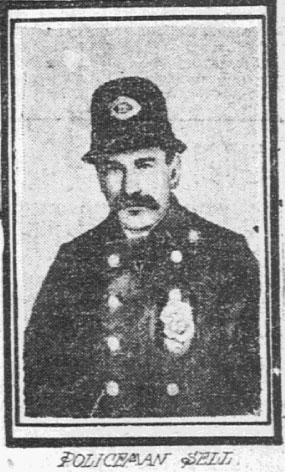
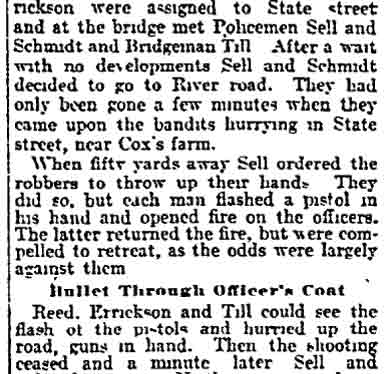
The detail was divided up to cover the various roads. Policemen Thomas Reed and Errickson were assigned to State street and at the bridge met Policemen Sell and Schmidt and Bridgeman Till. After a wait with no developments Sell and Schmidt decided to go to River road. They had only been gone a few minutes when they came upon the bandits hurrying in State street, near Cox’s farm.
When fifty yards away Sell ordered the robbers to throw up their hands. They did so, but each man flashed a pistol in his hand and opened fire on the officers. The latter returned the fire, but were compelled to retreat, as the odds were largely against them.
Bullet Through Officer’s Coat
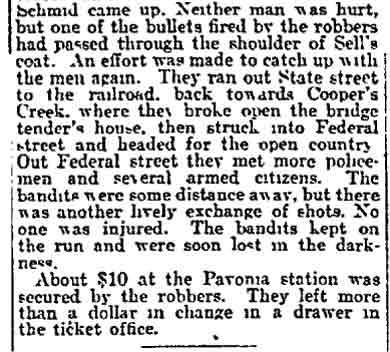
Reed, Errickson and Till could see the flash of the pistols and hurried up the road, guns in hand. Then the shooting ceased and a minute later Sell and Schmidt came up. Neither man was hurt, but one of the bullets fired by the robbers had passed through the shoulder of Sell’s coat. An effort was made to catch up with the men again. They ran out State street to the railroad, back towards Cooper’s Creek, where they broke open the bridge tender’s house, then struck into Federal street and headed for the open country. Out Federal street they met more policemen and several armed citizens. The bandits were some distance away, but there was another lively exchange of shots. No one was injured. The bandits kept on the run and were soon lost in the darkness.
About $10 at the Pavonia station was secured by the robbers. They left more than a dollar in change in a drawer in the ticket office.
Camden Police Form Organization
Philadelphia Inquirer —
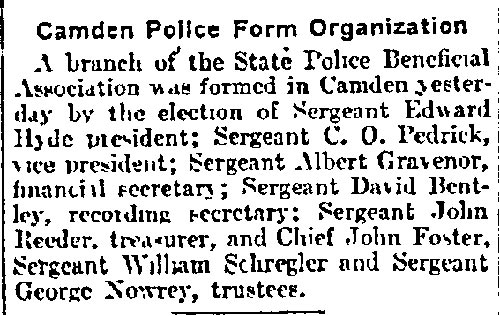
Camden Police Form Organization
A branch of the State Police Beneficial Association was formed in Camden yesterday by the election of Sergeant Edward Hyde president; Sergeant C. O. Pedrick, vice president; Sergeant Albert Gravenor, financial secretary; Sergeant David Bentley, recording secretary; Sergeant John Reeder, treasurer, and Chief John Foster, Sergeant William Schregler and Sergeant George Nowrey, trustees.
Camden News Notes
Philadelphia Inquirer —
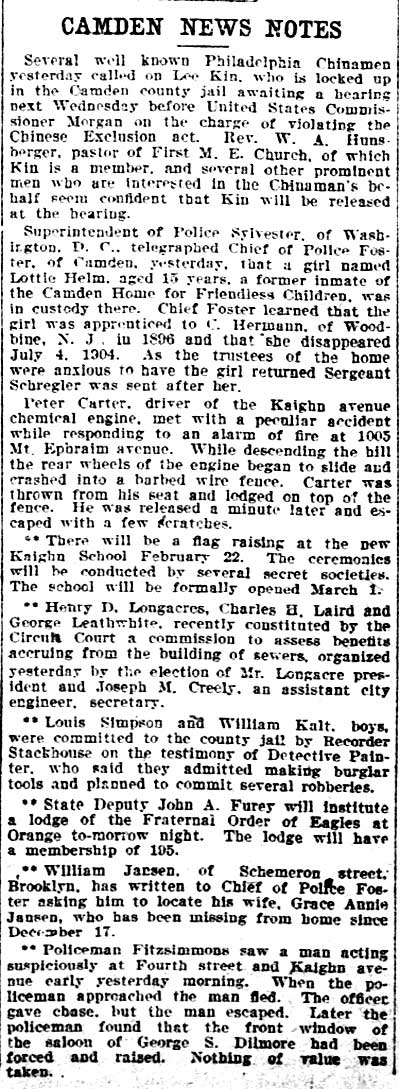
CAMDEN NEWS NOTES
Superintendent of Police Sylvester telegraphed Chief Foster that Charlotte “Lottie” Helm, aged 15 years, had been taken into custody at Washington, D. C. Sergeant Schregler was sent after her. The girl is a resident of Camden and was reported missing by her parents some time ago. She had been in the custody of the police at Washington, who say she was found there with a man.
Driver Peter Carter, of Engine Company No. 1, suffered injuries that may prove serious when the heavy engine, returning at speed from a fire early this morning, struck a trolley car at the corner of Broadway and Federal street. Carter was thrown violently from his seat against the dashboard. He was taken to the Cooper Hospital, where examination showed fracture of the ribs.
Philadelphia Inquirer — September 20, 1905
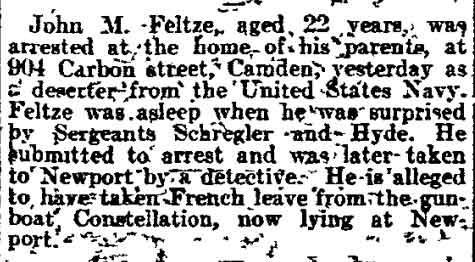
Philadelphia Inquirer, September 20, 1905. Full article available in PDF. Related to William Schregler, Edward S. Hyde, John M. Feltze, and Carbon Street.
Woman Sent Negro Into the Street
Philadelphia Inquirer —
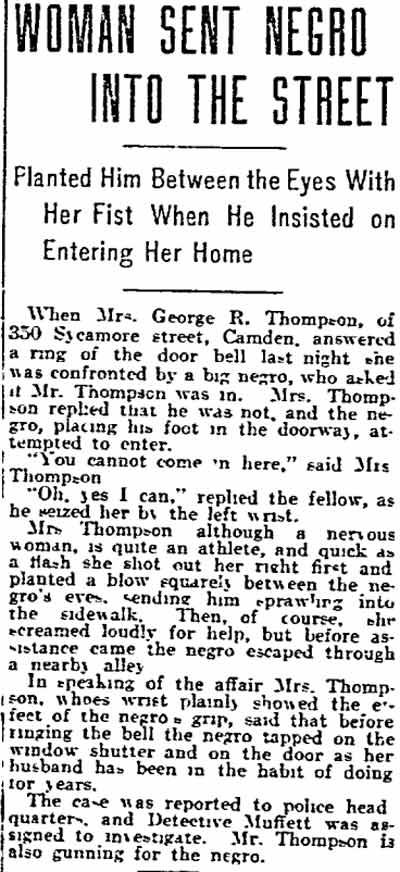
WOMAN SENT NEGRO INTO THE STREET
Planted Him Between the Eyes With Her Fist When He Insisted on Entering Her Home
When Mrs. George R. Thompson, of 350 Sycamore street, Camden, answered a ring of the door bell last night she was confronted by a big negro, who asked if Mr. Thompson was in. Mrs. Thompson replied that he was not, and the negro, placing his foot in the doorway, attempted to enter.
“You cannot come in here,” said Mrs. Thompson.
“Oh, yes I can,” replied the fellow, as he seized her by the left wrist.
Mrs. Thompson although a nervous woman, is quite an athlete, and quick as a flash she shot out her right fist and planted a blow squarely between the negro’s eyes, sending him sprawling into the sidewalk. Then, of course, she screamed loudly for help, but before assistance came the negro escaped through a nearby alley.
In speaking of the affair Mrs. Thompson, whose wrist plainly showed the effect of the negro’s grip, said that before ringing the bell the negro tapped on the window shutter and on the door as her husband has been in the habit of doing for years.
The case was reported to police headquarters, and Detective Muffett was assigned to investigate. Mr. Thompson is also gunning for the negro.
Chief Foster to Be Buried To-morrow
Philadelphia Inquirer —
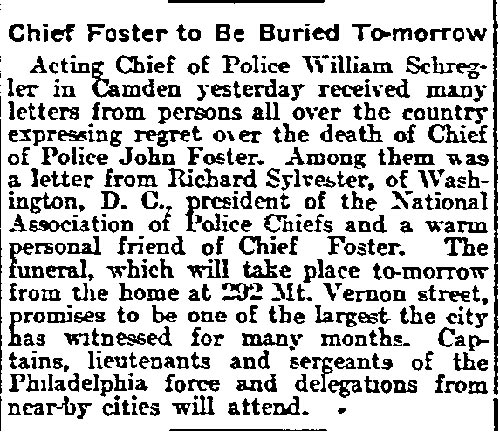
Acting Chief of Police William Schregler in Camden yesterday received many letters from persons all over the country expressing regret over the death of Chief of Police John Foster. Among them was a letter from Richard Sylvester, of Washington, D. C., president of the National Association of Police Chiefs and a warm personal friend of Chief Foster. The funeral, which will take place to-morrow from the home at 202 Mt. Vernon street, promises to be one of the largest the city has witnessed for many months. Captains, lieutenants and sergeants of the Philadelphia force and delegations from near-by cities will attend.
Three Firemen Met Death in Camden Blaze
Philadelphia Inquirer —
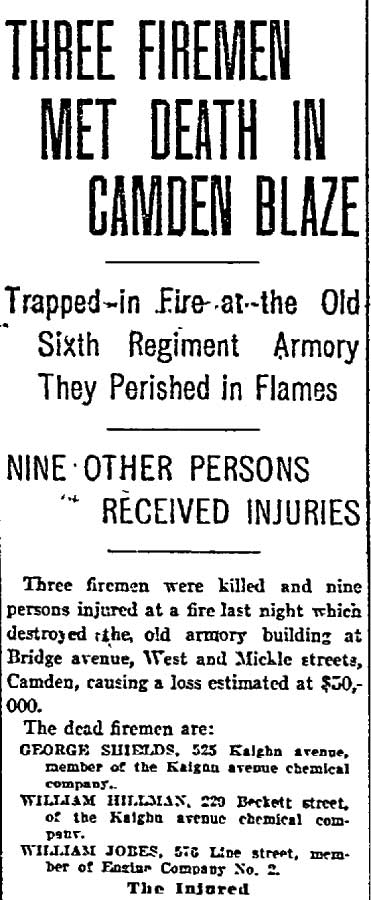
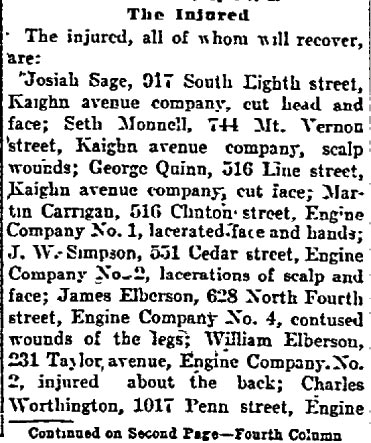
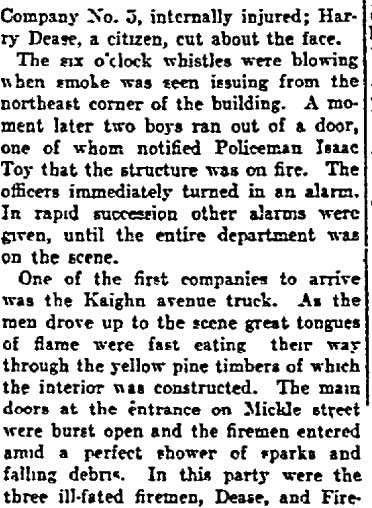
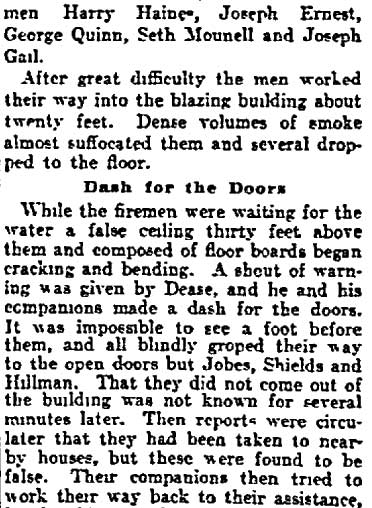
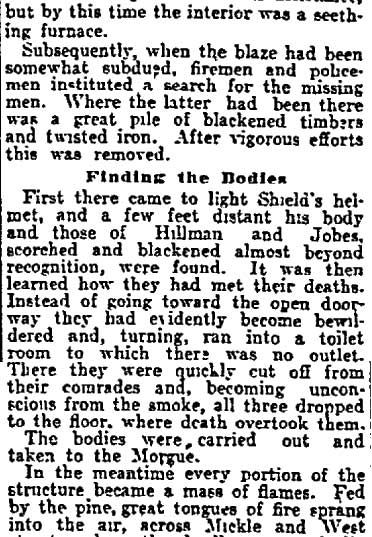
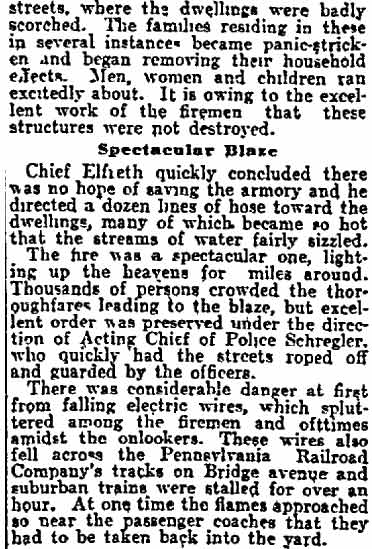
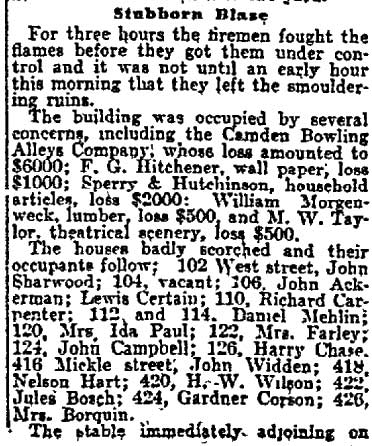
THREE FIREMEN MET DEATH IN CAMDEN BLAZE
Trapped in Fire at the Old Sixth Regiment Armory They Perished in Flames
NINE OTHER PERSONS RECEIVED INJURIES
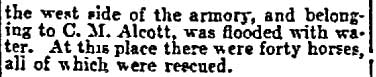
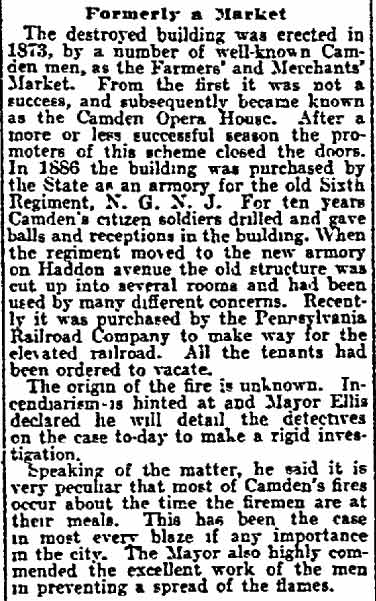
Three firemen were killed and nine persons injured at a fire last night which destroyed the old armory building at Bridge avenue, West and Mickle streets, Camden, causing a loss estimated at $50,000.
The dead firemen are: George Shields, 525 Kaighn avenue, member of the Kaighn avenue chemical company; William Hillman, 229 Beckett street, of the Kaighn avenue chemical company; William Jobes, 576 Line street, member of Engine Company No. 2. Full article available in PDF.
Suicide Attempt Foiled in Camden Jail
Philadelphia Inquirer —
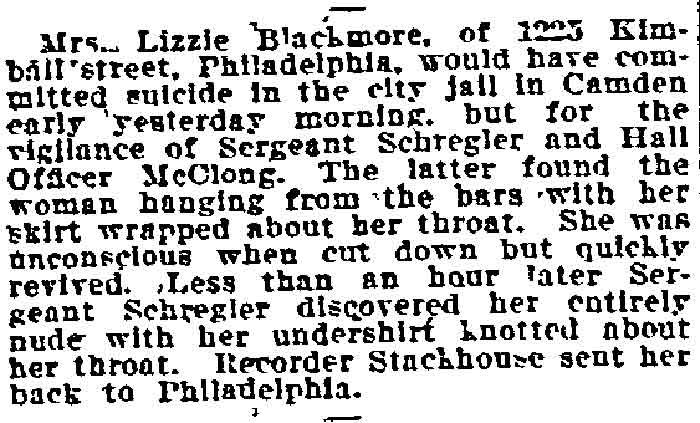
Mrs. Lizzie Blackmore, of 1225 Kimball street, Philadelphia, would have committed suicide in the city jail in Camden early yesterday morning, but for the vigilance of Sergeant Schregler and Hall Officer McClong. The latter found the woman hanging from the bars with her skirt wrapped about her throat. She was unconscious when cut down but quickly revived. Less than an hour later Sergeant Schregler discovered her entirely nude with her undershirt knotted about her throat. Recorder Stackhouse sent her back to Philadelphia.
Sent Bullet in Head After Shooting Wife
Philadelphia Inquirer —
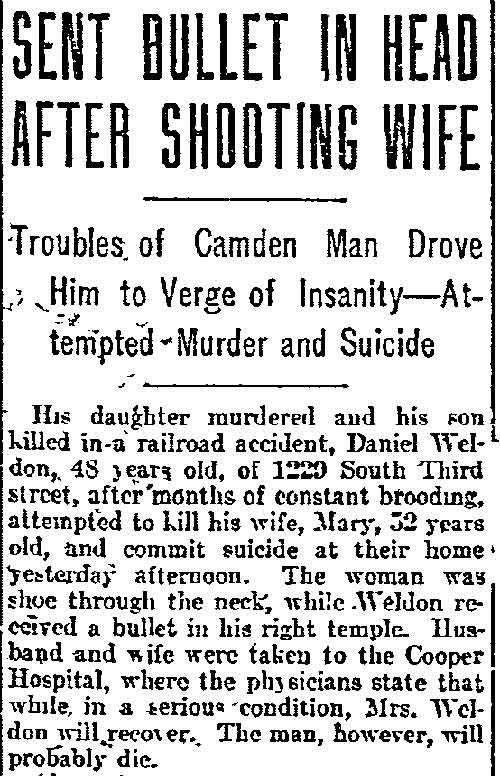
SENT BULLET IN HEAD AFTER SHOOTING WIFE
Troubles of Camden Man Drove Him to Verge of Insanity—Attempted Murder and Suicide
His daughter murdered and his son killed in a railroad accident, Daniel Weldon, 48 years old, of 1229 South Third street, after months of constant brooding, attempted to kill his wife, Mary, 52 years old, and commit suicide at their home yesterday afternoon. The woman was shot through the neck, while Weldon received a bullet in his right temple. Husband and wife were taken to the Cooper Hospital, where the physicians state that while in a serious condition, Mrs. Weldon will recover. The man, however, will probably die.
About five years ago Weldon’s daughter, Mrs. Edith Hill, was shot to death by her husband, Robert, who was hanged. Shortly after the man’s son was caught between cars and crushed to death. Weldon suffered great mental anguish, so much, so, in fact, that he became a victim of melancholia. For the past six months or so his condition became such that it was thought he was going insane. Mrs. Weldon never thought for an instant that he would attack her, however.
On a cot in the hospital the woman told Hall Officer McClong that she and her husband had had a domestic quarrel, during which the man started upstairs, exclaiming:
“I’m tired of this; I’m going to end it all.”
Less than a minute later he returned with a loaded revolver in his hand. Walking up to Mrs. Weldon, he fired point blank at her head, but the bullet took effect in her neck. Then he presented the weapon to his right temple and fired. Husband and wife were found by neighbors lying within a few feet of one another on the floor. The ambulance was summoned and both were hurried to the hospital.
Pistol Shot Nearly Precipitated a Riot
Philadelphia Inquirer —
PISTOL SHOT NEARLY PRECIPITATED A RIOT
Negroes Turned on White Man Who Discharged Weapon on Crowded South Camden Street
A race riot was narrowly averted at Broadway and Mt. Vernon street, Camden, last night while the streets were thronged, when Harry Gedling, a young man, discharged a pistol at several negroes as they were passing down the street. The negroes turned after the shot was fired, and Gedling fled. Policeman Fiore Troncone gave chase and caught Gedling after running several blocks. Several citizens went to Troncone’s assistance and kept the crowd off while he took the prisoner to the nearest patrol box. Afterward he was locked up in the city jail. Gelding [sic] told Acting Chief Schregler that he shot at the negroes because he was afraid they intended to attack him.
On account of the feeling in the southern section of the city between white and colored residents Acting Chief Schregler has instructed the policeman to prevent crowds assembling, and on the slightest breach of the peace to arrest all violators.
Mystery in Fall from Aerial Car
Philadelphia Inquirer —
MYSTERY IN FALL FROM AERIAL CAR
Authorities of Two Counties Probing Death of Young Man Who Was Killed at Washington Park
Acting under instructions from Judge Lewis Starr, of Woodbury, and under a formal complaint of larceny, Edward Clendaniel, aged 22 years, of 2810 Emerald street, and William Harper, aged 21 years, of 3536 Lee street, Philadelphia, who were arrested in Camden, were yesterday taken to Woodbury jail to await the finding of the Camden Coroner’s jury which will inquire to-morrow into the death of Harry Turner, aged 25 years, of 524 West Huntington street, Philadelphia, from injuries received by a fall from the aerial railway at Washington Park last Friday night.
Coroner Fithian yesterday impanelled the jury, with Louis H. Leigh, a clerk in the office of the Receiver of Taxes, as foreman, and the jury at once viewed the body. Coroner Fithian said that Turner’s skull was fractured, his right arm broken, his face badly battered and his body covered with cuts and bruises, and that the inquest was to determine whether Turner’s death was accidental or violent.
Acting Chief of Police Schregler, because of the contradictory stories told by Clendaniel and Harper, who admitted being with Turner at the time he was injured, decided to lock them up. Schregler put them in the same cell with Pauli Dupon, a runaway boy, and told the little fellow to keep his eyes and ears open. Several hours later, when the men were in deep slumber, Dupon told the Acting Chief that he saw one of the men hand the other a pocketbook containing money, with instructions to hide it. Schregler woke them and got the purse, which contained $25. Later Turner’s father identified the body. When shown the pocketbook he said it belonged to his son.
Schregler then questioned Clendaniel and Harper, and each accused the other of taking the purse from Turner. Schregler immediately notified the Gloucester county authorities at Woodbury, and Judge Starr came to Camden and had a conference with the police authorities.
Should the inquest prove that Turner’s death was accidental the two men will be held for larceny. Turner’s gold watch and chain presented to him on his 21st birthday and worn by him when he left home, were found by Chief Allen, of the Washington Park police, at the place where Turner fell. When Coroner Fithian searched the body he found $4.80. Turner’s father says he had $45 when he left home.
Handing Out Gunning Licenses in Camden
Philadelphia Inquirer —
HANDING OUT GUNNING LICENSES IN CAMDEN
County Clerk Patterson and His Office Force Work Overtime to Meet Gunners’ Demands
From the time County Clerk Frank Patterson opened his office in Camden yesterday until last night there was a constant coming and going of sportsmen anxious to get gunning licenses for the opening of the season tomorrow. The entire clerical force was kept busy, and, while usually the office closes at noon on Saturday, it was kept open until 5 o’clock to accommodate the sportsmen. Ofttimes they had their dogs with them and the occasional baying made the office sound like a field where cotton tails are skurrying to secure cover.
In all, it is estimated that at least three thousand licenses have been issued by Clerk Patterson, and it seems likely that the fields in and about Camden county will have a small army of gunners by the peep of day tomorrow morning. Not only have resident but non-resident licenses as well have been issued by the score, mostly to Philadelphians. While there has been some grumbling over the fact that it is necessary for the gunners to put up $1.50 for the privilege of hunting rabbits, as a rule, they look upon the matter as being beneficial to real sportsmen, as it has a tendency to eliminate the small pot hunters.
Those who have been over the haunts of the rabbits say they are exceedingly plentiful, especially in the lower end of Camden county, and farther south in Gloucester and Cumberland counties.
That the cotton tails will have to keep on the move is evident from the fact that Camden’s Police Department is to send to the woods such a squad of able sportsmen as Policemen James Clay, George Cooper, Fiore Troncone, Edward Pike, Walter Stanton, Oscar Weaver, Albert Shaw and Sergeants William Schregler, James Tatem and Edward Hartman.
Camden Holds Four as Counterfeiters
Philadelphia Inquirer —
CAMDEN HOLDS FOUR AS COUNTERFEITERS
Secret Service Men, After One, Bag Unexpected, More-Sought-For Suspect
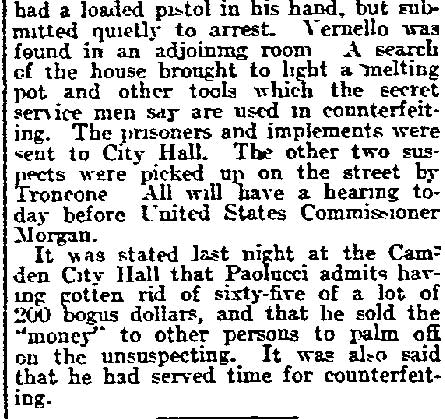
Raiding a house at 403 Cherry street, Camden, last evening for the purpose of arresting Luigi Vernello, against whom suspicion of passing counterfeit money has long been directed, Camden police and Secret Service agents, captured a man for whom government officers have been searching for months on a charge of being the maker of spurious coins. The later is Vincenzo Paolucci, aged 23 years, whose address is given as 912 South Twelfth street, Philadelphia. According to the police, he confesses to manufacturing counterfeit dollars and dimes. Two other Italians, Uco Belloassi and Michael Finimore, are also under arrest in Camden on suspicion of being concerned in the circulation of the bogus money.
When counterfeit dollars and dimes of good workmanship made their appearance in Camden several weeks ago Policeman Troncone, an Italian, was assigned to the case. It was not long before suspicion was directed to Vernello, and after both the suspect and his 13-year-old daughter were trailed for days to stores in different parts of the city sufficient evidence was had to justify an arrest. In the meantime Secret Service Agent Matthew Griffin declared that the stuff circulated in Camden was made by the same hand which manufactured that passed in Philadelphia, supposedly Paolucci. Though the officers were satisfied that Vernello had no hand in the making of the money, it was deemed best last night to raid the Cherry street house, little dreaming that Paolucci was there.
In the raiding party were Agents Griffin and Tate, Policeman Troncone and City Detectives Brothers and Schregler. Three entered by the front way and the other two the back. Ascending to the second floor, Griffin was amazed to come face to face with Paolucci. The latter had a loaded pistol in his hand, but submitted quietly to arrest. Vernello was found in an adjoining room. A search of the house brought to light a melting pot and other tools which the secret service men say are used in counterfeiting. The prisoners and implements were sent to City Hall. The other two suspects were picked up on the street by Troncone. All will have a hearing today before United States Commissioner Morgan.
It was stated last night at the Camden City Hall that Paolucci admits having gotten rid of sixty-five of a lot of 200 bogus dollars, and that he sold the “money” to other persons to palm off on the unsuspecting. It was also said that he had served time for counterfeiting.
Camden's Reputed Counterfeiters Held
Philadelphia Inquirer —
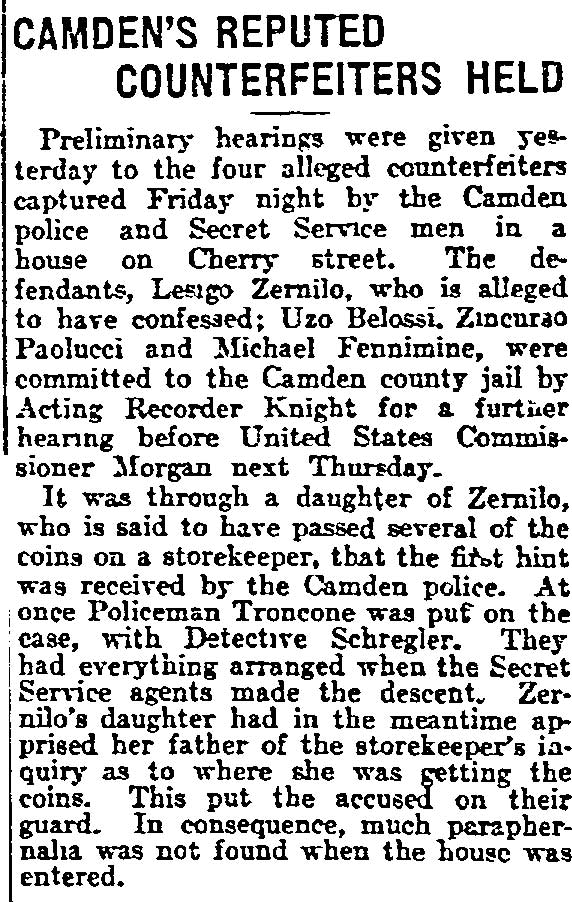
Preliminary hearings were given yesterday to the four alleged counterfeiters captured Friday night by the Camden police and Secret Service men in a house on Cherry street. The defendants, Lesigo Zernilo, who is alleged to have confessed; Uzo Belossi, Zincurao Paolucci and Michael Fennimine, were committed to the Camden county jail by Acting Recorder Knight for a further hearing before United States Commissioner Morgan next Thursday.
It was through a daughter of Zernilo, who is said to have passed several of the coins on a storekeeper, that the first hint was received by the Camden police. At once Policeman Troncone was put on the case, with Detective Schregler. They had everything arranged when the Secret Service agents made the descent. Zernilo’s daughter had in the meantime apprised her father of the storekeeper’s inquiry as to where she was getting the coins. This put the accused on their guard. In consequence, much paraphernalia was not found when the house was entered.
Dunn Brothers Arrested
Philadelphia Inquirer —
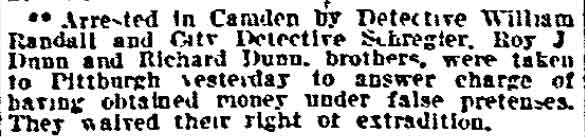
Arrested in Camden by Detective William Randall and City Detective Schregler, Roy J. Dunn and Richard Dunn, brothers, were taken to Pittsburgh yesterday to answer charge of having obtained money under false pretenses. They waived their right of extradition.
Defends His Shooting Man
Philadelphia Inquirer —
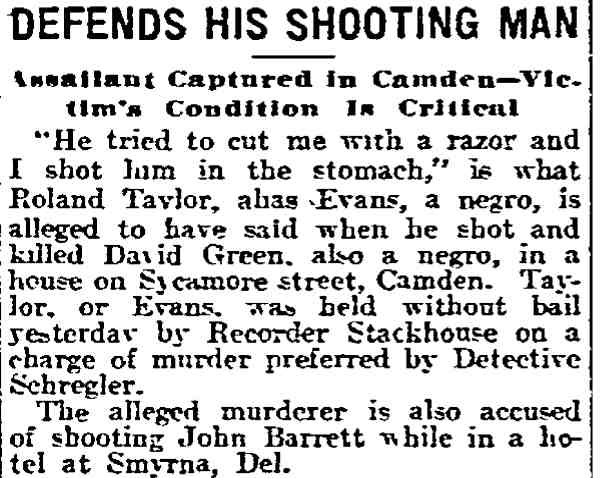
Assailant Captured in Camden—Victim’s Condition Is Critical
“He tried to cut me with a razor and I shot him in the stomach,” is what Roland Taylor, alias Evans, a negro, is alleged to have said when he shot and killed David Green, also a negro, in a house on Sycamore street, Camden. Taylor, or Evans, was held without bail yesterday by Recorder Stackhouse on a charge of murder preferred by Detective Schregler. The alleged murderer is also accused of shooting John Barrett while in a hotel at Smyrna, Del.
New Year Shot Near Heart
Philadelphia Inquirer —
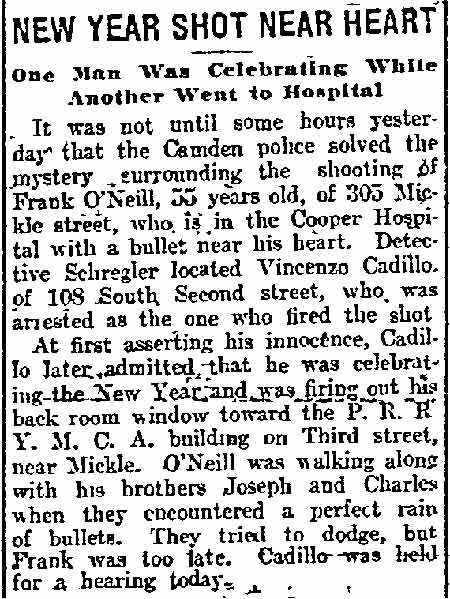
NEW YEAR SHOT NEAR HEART
One Man Was Celebrating While Another Went to Hospital
It was not until some hours yesterday that the Camden police solved the mystery surrounding the shooting of Frank O’Neill, 55 years old, of 305 Mickle street, who is in the Cooper Hospital with a bullet near his heart. Detective Schregler located Vincenzo Cadillo, of 108 South Second street, who was arrested as the one who fired the shot. At first asserting his innocence, Cadillo later admitted that he was celebrating the New Year and was firing out his back room window toward the P. R. R. Y. M. C. A. building on Third street, near Mickle. O’Neill was walking along with his brothers Joseph and Charles when they encountered a perfect rain of bullets. They tried to dodge, but Frank was too late. Cadillo was held for a hearing today.
Get Chamberlain as He Leaves Jail
Philadelphia Inquirer —
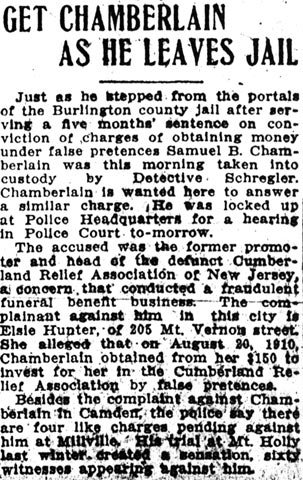
GET CHAMBERLAIN AS HE LEAVES JAIL
Just as he stepped from the portals of the Burlington county jail after serving a five months’ sentence on conviction of charges of obtaining money under false pretences Samuel B. Chamberlain was this morning taken into custody by Detective Schregler. Chamberlain is wanted here to answer a similar charge. He was locked up at Police Headquarters for a hearing in Police Court to-morrow.
The accused was the former promoter and head of the defunct Cumberland-Mercer Relief Association of New Jersey, a concern that conducted a fraudulent funeral benefit business. The complainant against him in this city is Elsie Hunter, of 205 Mt. Vernon street. She alleged that on August 20, 1910, Chamberlain obtained from her $150 to invest for her in the Cumberland Relief Association by false pretences. Besides the complaint against Chamberlain in Camden, the police say there are four like charges pending against him at Millville. His trial at Mt. Holly last winter created a sensation, sixty witnesses appearing against him.
Boy's Brutal Murderer Collapses at Hearing
Camden Post-Telegram —
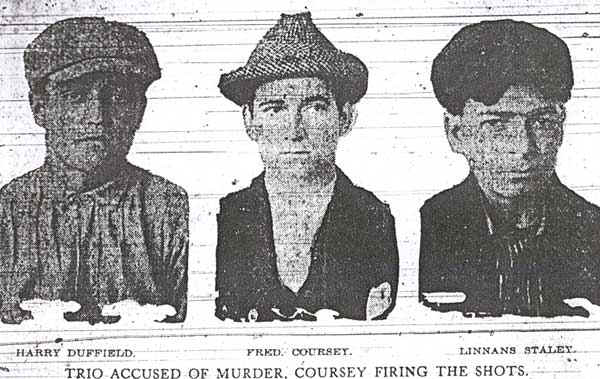
TRIO ACCUSED OF MURDER. COURSEY FIRING THE SHOTS.
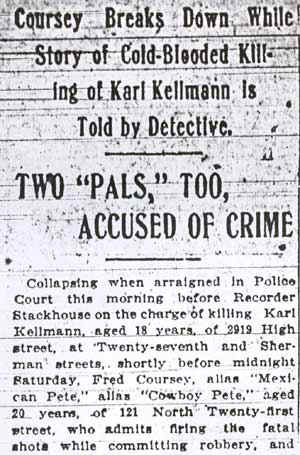
Coursey Breaks Down While Story of Cold-Blooded Killing of Karl Kellmann Is Told by Detective.
TWO “PALS,” TOO, ACCUSED OF CRIME
Collapsing when arraigned in Police Court this morning before Recorder Stackhouse on the charge of killing Karl Kellmann, aged 18 years, of 2919 High street, at Twenty-seventh and Sherman streets, shortly before midnight Saturday, Fred Coursey, alias “Mexican Pete,” alias “Cowboy Pete,” aged 20 years, of 121 North Twenty-first street, who admits firing the fatal shots while committing robbery, and Harry Duffield, aged 21 years, of 407 North Forty-first street, who acknowledged masking his face with a handkerchief and being with Coursey, sobbed piteously, resting their heads on the railing of the dock, while John Painter, the veteran detective, was briefly reciting the story.
When Recorder Stackhouse asked what became of the young man who was shot and Painter replied that he died, Coursey and Duffield sobbed afresh, and when Recorder Stackhouse committed them without bail Policemen Frost and Kay had to help them.
Linnans Staley, aged 21 years, of 1819 Federal street, who confessed that he was in the robbery plot but later got scared and hid in the bushes, was scarcely able to stand, and when his mother broke down as he was committed as a principal he staggered and would have fallen but for Sergeant McClong.
Prosecutor Boyle announced this morning that the Grand Jury will be recalled for Thursday of this week and the case will be made the special order of the day.
Without the slightest clue to start with in the most brutal murder committed in recent years in Camden county, police and detectives under the personal direction of Chief Gravenor in two hours arrested two of the three prisoners and obtained their signatures to confessions and before sunrise the other was lodged behind the bars at the City Hall.
According to their statements to the police the prisoners while drinking on a lot near Twenty-first and Federal streets on Saturday night planned to go to a lone spot near Twenty-seventh and Sherman streets to hold someone up to get money and jewelry to buy more drink. Coursey had a 38-calibre cowboy pistol and Duffield used Coursey’s bandanna as a mask. Staley weakened before the spot selected was reached and at the time of the murder was hiding in a clump of weeds a short distance away.
The murdered boy was the son of Karl and Lulu D. Kellmann. He was a member of the Bible class of Grace Presbyterian Church, East Side, and active in church work.
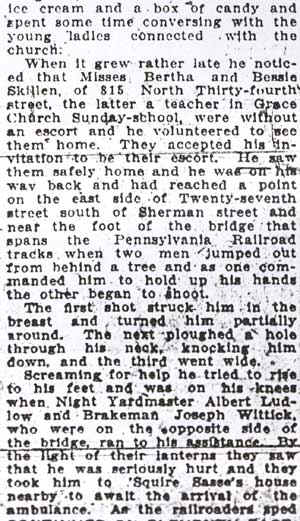
Saturday night was the closing of a carnival given on High street between Twenty-seventh and Thirtieth streets. Karl was there and made several purchases. At one booth he bought a necktie, from another some ice cream and a box of candy and spent some time conversing with the young ladies connected with the church.
When it grew rather late he noticed that Misses Bertha and Bessie Skillen, of 815 North Thirty-fourth street, the latter a teacher in Grace Church Sunday-school, were without an escort and he volunteered to see them home. They accepted his invitation to be their escort. He saw them safely home and he was on his way back and had reached a point on the east side of Twenty-seventh street south of Sherman street and near the foot of the bridge that spans the Pennsylvania Railroad tracks when two men jumped out from behind a tree and as one commanded him to hold up his hands the other began to shoot.
The first shot struck him in the breast and turned him partially around. The next ploughed a hole through his neck, knocking him down, and the third went wide.
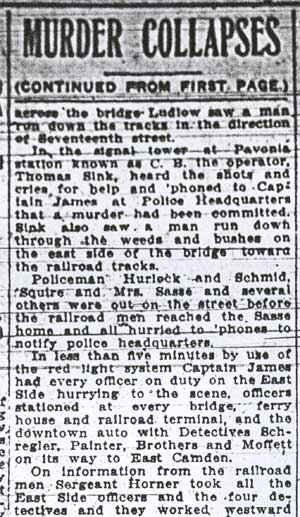
Screaming for help he tried to rise to his feet and was on his knees when Night Yardmaster Albert Ludlow and Brakeman Joseph Wittick, who were on the opposite side of the bridge, ran to his assistance. By the light of their lanterns they saw that he was seriously hurt and they took him to ’Squire Sasse’s house nearby to await the arrival of the ambulance. As the railroaders sped across the bridge Ludlow saw a man run down the tracks in the direction of Seventeenth street.
In the signal tower at Pavonia station known as C. B. the operator, Thomas Sink, heard the shots and cries for help and ’phoned to Captain James at Police Headquarters that a murder had been committed. Sink also saw a man run down through the weeds and bushes on the east side of the bridge toward the railroad tracks.
Policeman Hurlock and Schmid, ‘Squire and Mrs. Sasse and several others were out on the street before the railroad men reached the Sasse home and all hurried to ’phones to notify police headquarters.
In less than five minutes by use of the red light system Captain James had every officer on duty on the East Side hurrying to the scene, officers stationed at every bridge, ferry house and railroad terminal, and the downtown auto with Detectives Schregler, Painter, Brothers and Moffett on its way to East Camden.
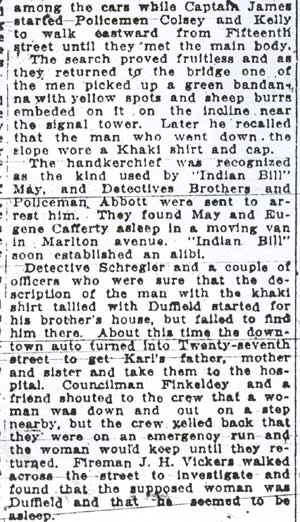
On information from the railroad men Sergeant Horner took all the East Side officers and the four detectives and they worked westward among the cars while Captain James started Policemen Colsey and Kelly to walk eastward from Fifteenth street until they met the main body.
The search proved fruitless and as they returned to the bridge one of the men picked up a green bandanna with yellow spots and sheep burrs embedded on it on the incline near the signal tower. Later he recalled that the man who went down the slope wore a Khaki shirt and cap.
The handkerchief was recognized as the kind used by “Indian Bill” May, and Detectives Brothers and Policeman Abbott were sent to arrest him. They found May and Eugene Cafferty asleep in a moving van in Marlton avenue. “Indian Bill” soon established an alibi.
Detective Schregler and a couple of officers who were sure that the description of the man with the khaki shirt tallied with Duffield started for his brother’s house, but failed to find him there. About this time the downtown auto turned into Twenty-seventh street to get Karl’s father, mother and sister and take them to the hospital. Councilman Finkeldey and a friend shouted to the crew that a woman was down and out on a step nearby, but the crew yelled back that they were on an emergency run and the woman would keep until they returned. Fireman J. H. Vickers walked across the street to investigate and found that the supposed woman was Duffield and that he seemed to be asleep.
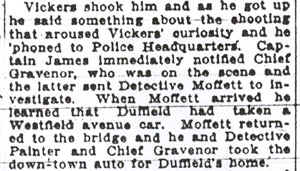
Vickers shook him and as he got up he said something about the shooting that aroused Vickers’ curiosity and he ’phoned to Police Headquarters. Captain James immediately notified Chief Gravenor, who was on the scene and the latter sent Detective Moffett to investigate. When Moffett arrived he learned that Duffield had taken a Westfield avenue car. Moffett returned to the bridge and he and Detective Painter and Chief Gravenor took the down-town auto for Duffield’s home.
Painter went to the front door and saw Duffield in the act of taking off his shoes. Moffett in going around to the back door to prevent his escape that way passed by the window at which Duffield was sitting.
Grasping Duffield by the collar Moffett pulled him through the window to the ground. As soon as he landed on his feet, according to the Chief and detectives, Duffield said that Coursey did the shooting.
Placing him in the auto they next drove close to Coursey’s home and with Policeman Potter who knew the man wanted, the detectives entered the house with drawn revolvers while other officers guarded all avenues of escape.
Coursey was found awake on a cot and while he was covered with revolvers Detective Painter searched his trunk and found the weapon that he later admitted using. It was empty. The detectives late yesterday afternoon found three used shells adjoining the house near a spot where Coursey said he had thrown them.
In order to keep the men apart they were taken to the City Hall separately and questioned and after they decided to tell all Sergeant E. B. McClong reduced their statements to writing and they signed them. It was on the strength of these statements that Staley was arrested.
Young Kellmann was taken into the hospital at 12.20 a. m. Chief Surgeon Schellenger saw at a glance that there was no hope for him and so notified Captain James, and Sergeant McClong was sent to the hospital to get all information possible.
The unfortunate youth could only speak a few words at a time because of the hemorrhages. All Sergeant McClong was able to get from him was that he was told to hold up his hands and that the shooting instantly began. The only description he could give was that they were small men and that the attack was so sudden that he could not tell whether they were black or white.
The injured young man kept asking the doctors if he was going to die, but they did not answer. He was conscious when his father and mother arrived and then sank rapidly until the end, dying at 1.50 o’clock, 90 minutes after he was admitted. Mother and father were prostrated and were taken home by the up-town auto.
County Physician Jones conducted the autopsy yesterday morning. He said that either wound would have caused death. The bullet in the breast pierced the right lung at the top and lodged in the cavity. It is now in the doctor’s possession. The other bullet went clear through the neck.
Coursey and Duffield have been working in the Pavonia car yard. The former was born in El Paso, Texas, but has lived East nearly all his life. He is an expert shot and was a member of the vaudeville team of Coursey & Cook, according to their letter heads presenting a fifteen-minute thriller.
Duffield was only recently paroled for robbing Gallagher’s saloon, Nineteenth and Federal streets of a lot of drinkables. Staley has been arrested several times on petty charges but was never convicted of crime. When Duffield’s coat was examined at the City Hall, it was found to contain sheep burrs.
To a reporter Coursey said that whenever he was drinking he had to get his gun and shoot something or somebody. He insisted that all were in on the job and that they let the man who preceded Kellman go over the bridge without molestation because he didn’t look as if he had any too much money.
Yesterday morning Assistant Prosecutor Wolverton and Stenographer Cleary called at the City Hall. The prisoners were examined by Mr. Wolverton and their statements taken by Mr. Cleary, but there was little or nothing new elicited.
Reformatory Escapees Arrested
Woodbury Times —
For escaping from Jamesburg Reformatory, two boys, Robert Alburger, 14 years old, of 444 Henry street, Camden, and Charles Rump, 16 years old, of Hoboken, were arrested at the former’s home in Camden Tuesday night by City Detectives Schregler and Brothers and Captain Stanley. They were returned to the reformatory yesterday morning. Alburger and Rump are two of five boys who escaped from the home Monday night.
Embezzler Arrested at Victor Talking Machine Plant
Philadelphia Inquirer —
Wanted in Baltimore to answer a charge of embezzlement, John Lonerio was arrested at the Victor Talking Machine Company’s plant yesterday by Detective Schregler and Troncone. The man, who was held pending requisition papers, is alleged to have embezzled $83 from Steward and Co., by whom he was employed.
Shoots Woman and Kills Self in Rage
Philadelphia Inquirer —
Rebuked for Drinking Camden Man Writes Farewell Note and Commits Double Crime
Enraged because his common law wife rebuked him for heavy drinking, John Smith, aged about 40 years, wrote a farewell note then shot the woman and killed himself at their home, 311 Cleveland Terrace, Camden, last night. Both were taken to Cooper Hospital, where he died several hours after being admitted. The woman is not expected to recover.
The crazed man sent three bullets into the woman, two lodging in her chest and the other in her head back of the right ear. He then pressed the pistol to his left breast and pulled the trigger, and as he lay on the floor sent another bullet into his left side.
While hospital doctors were operating on the man Detective Schregler found the following note in his pocket:
“To whom it may concern—Send word to Mrs. R. Harrington, 2728 West Dauphin street, Philadelphia; also to Alexander Smith, 802 Somerset street, Philadelphia. My wife and child live in Odessa, Del., Box 95, Pearl Irene Cochran is Mrs. George Parker, now known as Mrs. John Smith. The children are all my own. We have lived together for better or worse for fifteen years.”
“JOHN SMITH,”
The Irene Cochran referred to is said by the police to be the wounded woman. Her condition is such that she could give no information to the police about the shooting except to say that she was Mrs. John Smith and that her husband shot her. Smith would not say a word until the doctors told him he was going to die. He then gave his name and became silent until death came.
The four children referred to lived at the Cleveland Terrace house with the couple. The eldest is 9 years old. They are being cared for at the City Hall. None of the children seemed to know much about the tragedy, except that their parents had words at the dinner table because the man had come home drunk.
He left the table angry, they said, and the woman followed. A minute later five shots rang out, and when the police arrived they found the man and woman stretched out on the floor. In the hands of the man was a revolver with all of the cartridges exploded.
Girl Victim's Brother Accuses Man
Philadelphia Inquirer —
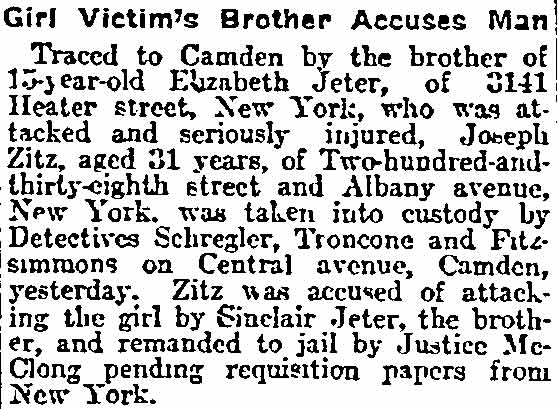
Traced to Camden by the brother of 15-year-old Elizabeth Jeter, of 3141 Heater street, New York, who was attacked and seriously injured, Joseph Zitz, aged 31 years, of Two-hundred-and-thirty-eighth street and Albany avenue, New York, was taken into custody by Detectives Schregler, Troncone and Fitzsimmons on Central avenue, Camden, yesterday. Zitz was accused of attacking the girl by Sinclair Jeter, the brother, and remanded to jail by Justice McClong pending requisition papers from New York.
Burglars in Rooms as Families Sleep
Camden Post-Telegram —
Gain Entrance to Two Homes from Shed Roofs and Ransack Bed Chambers
WEARING APPAREL WAS ALSO TAKEN
Although it was evident that bold burglars who effected entrance through the second story back windows of two South Camden houses early this morning had ransacked the rooms while the inmates lay sleeping, nothing was taken aside from clothing. The places entered were the homes of Frederick Linderman, 817 Broadway, and Nathan Bateman, 1754 South 9th Street.
When the families arose this morning, they were surprised to find that their rear bedroom windows had been forced open. The intruders climbed to the shed roof in each instance, then easily effected an entrance. Then when the families were wrapped in the slumber of the early morning the burglars went about, gathered up some odds and ends of clothing and then decamped. Nothing else of value was taken.
Detective Captain Schregler has his men investigating.
Bicycle Thief Arrested
Philadelphia Inquirer —
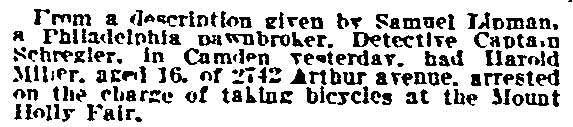
From a description given by Samuel Lipman, a Philadelphia pawnbroker, Detective Captain Schregler, in Camden yesterday, had Harold Miller, aged 16, of 2742 Arthur avenue, arrested on the charge of taking bicycles at the Mount Holly Fair.
Charged with Robbing Girl He Was to Wed
Philadelphia Inquirer —
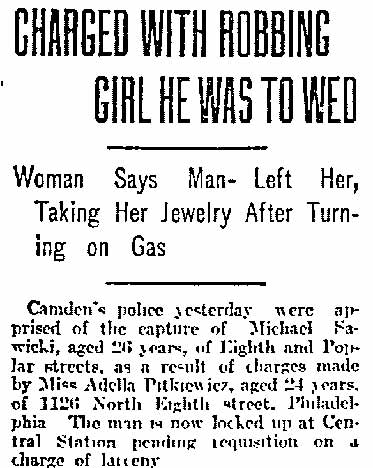
Woman Says Man Left Her, Taking Her Jewelry After Turning on Gas
Camden’s police yesterday were apprised of the capture of Michael Sawicki, aged 26 years, of Eighth and Poplar streets, as a result of charges made by Miss Adella Pitkiewicz, aged 24 years, of 1126 North Eighth street, Philadelphia. The man is now locked up at Central Station pending requisition on a charge of larceny.
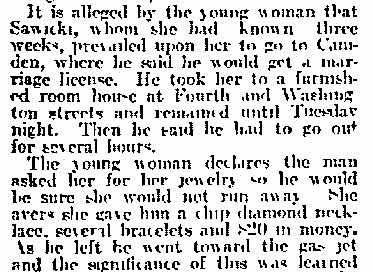
It is alleged by the young woman that Sawicki, whom she had known three weeks, prevailed upon her to go to Camden, where he said he would get a marriage license. He took her to a furnished room house at Fourth and Washington streets and remained until Tuesday night. Then he said he had to go out for several hours.
The young woman declares the man asked her for her jewelry so he would be sure she would not run away. She avers she gave him a chip diamond necklace, several bracelets and $20 in money. As he left he went toward the gas jet and the significance of this was learned later, for the young woman asserts she found the man had turned on the gas and had it not been for the windows being raised she would probably have been asphyxiated.
It was when the woman of the house heard the young stranger calling for help that her plight was discovered. Detective Captain Schregler had Detective Stanley and Policeman Miloch get her story and since then a search had been made for Sawicki. His whereabouts were learned by the young woman and she quickly notified the police so that his arrest followed.
Suspect Is Discharged
Philadelphia Inquirer —
Suspect Is Discharged
Owing to the lack of definite evidence against Peter Conchella, arrested in connection with the attempt to blow up the home of Michael Gi Letto, at 271 Pine street, early last Tuesday morning, the man was discharged from custody on his own recognizance by order of Detective Captain Schregler, in Camden yesterday.
Arrest Youth as Fugitive
Philadelphia Inquirer —
Arrest Youth as Fugitive
When word was received by Detective Captain Schregler, of Camden, to look out for Russell Pray, aged 19 years, who was charged with stealing $28 from Andrew Ruppell, superintendent of the township farm at Hillsboro, Somerset county, N. J., the police were asked whether they had seen any suspicious persons about. Policeman Laib said he had seen a youth flitting in and out of a house on Marlton avenue, East Camden. This stranger was taken into custody and proved to be the man wanted by the Somerset county authorities. Pray, admitting he had taken the money while employed on the farm, was taken into custody pending his removal to Somerset county.
Merrill Confesses; Is Also Deserter
Philadelphia Inquirer —
MERRILL CONFESSES; IS ALSO DESERTER
Defaulting Express Agent Would Now Like to Return to British Service
It was a sudden impulse that prompted Albert Merrill, or Mayall as he is also known, to take the $8000 entrusted to his care last Saturday as an agent for the Adams Express Company, according to his story to the Camden police last night, after his arrest at North Adams, Mass., Wednesday night. The arrest was the result of the police of that city being apprised of his supposed presence there by Detective Captain Schregler, of Camden, whose clue was a letter left by the man and which was addressed to the New England town.
Merrill appeared to be rather pleased that he had ended his trip when he reached Camden. At least he did not take his plight very seriously, telling the police that he thought it very likely that if he made a clean breast of the matter the court would be lenient with him. He confided the fact that he had formerly been in the British navy and that he had “jumped” his service some years ago. Because of this and his offense he said he thought it likely the United States authorities would be willing to deport him and that his native land would be as pleased to have him aboard one of the warships.
It was asserted by Merrill that there is no woman in the case. He had often acted as a messenger for the Adams Express Company during the three years of his employ, in which he had transferred large sums from various points, but had never been tempted to purloin the cash, according to his story. When he was sent to Wildwood Saturday to bring the $8000 to a banking institution in this city, however, he declared a sudden impulse came over him to convert the money to his own use. But for the fact that he decided to visit his brother at North Adams before he left for Canada the chances of getting him would have been slim.
When he packed the money in his suit case and after he thought he had destroyed everything that might lead to his whereabouts, Merrill left immediately for North Adams where he went to his brother’s home. It was when the two went to a hotel that the detectives made their appearance. The brother was mistaken for the man sought and he was surprised when he learned that it was Albert who was wanted for the embezzlement, nothing having been said by the express agent as to his peculation.
Merrill admitted to Captain Schregler that it was his intention of going from North Adams to Detroit and thence into Canada and after that to make his way to Australia. After a time he said he planned to return to England.
Murderer and Forger Escape Jail After Shooting Keepers, Killing One
Camden Post-Telegram —
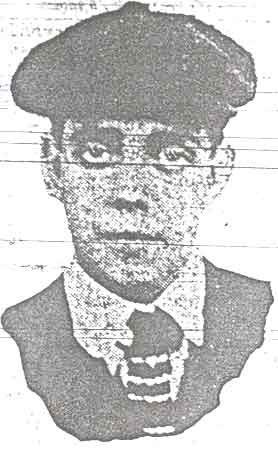
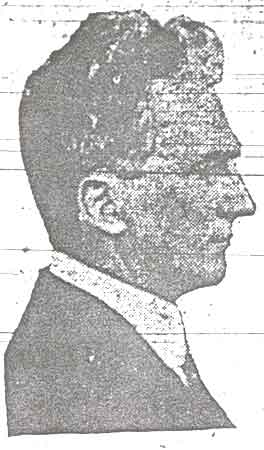
WILSON ASHBRIDGE — GEORGE E. THOMPSON
Murdering one jailor and wounding another with a revolver that had been smuggled into them by outside confederates, Wilson T. Ashbridge, slayer of Mrs. Elizabeth Dunbar, and Francis Murphy, alias George E. Thompson, a check forger, made their escape from the county jail a few minutes before seven o'clock last night.
Ashbridge with his wife was caught at noon in the Keystone Hotel in Chester PA where they registered at one o'clock this morning.
Thompson is still at liberty but from the confident manner of Prosecutor Kraft his early arrest seems assured.
The murdered jailor was Isaac Hibbs, aged 65 years of 913 South 8th Street. The wounded keeper is Joseph Ellis, aged 45 years, of 416 Carteret Street. Shot twice, he is in Cooper Hospital. His condition today is very satisfactory.
Thompson, who is 41 years old, forged a check for $650 which he gave to V.M. Fulton as part of the purchase price of an automobile. The forgery was discovered before the deal was completed and his arrest followed on June 8. he also passed a forged check for $15 on State Motor Vehicle Agent Kraft. He, too, was awaiting trial. In spite of the positive evidence against him Thompson had spurned all efforts to have him plead guilty and it is now believed that he was sparring for time while hatching a plan to escape. He s no doubt the master mind.
R.L. Hunter, a farmer of Bensalem Township, Bucks County PA, about four miles above Torres dale, reported to the Philadelphia police the morning that he had seen a man answering Ashbridge's description on the Bucks Road at daylight. The man asked the way to Riegelsville.
According to Hunter, the man was dressed in a dark suit, and had no hat. His clothing was wet. Hunter did not see anything suspicious in his actions, and after giving him directions, they parted.
Upon seeing the paper with a picture of Ashbridge, the farmer was struck by its resemblance to the man with whom he had talked. He hurried to Tacony and notified the police.
The State police, who patrol that section of the county, and who have an office at Langhorne, were immediately notified as were the surrounding towns.
The shootings took place in different parts of the jail. Hibbs was murdered in the exercise room just outside the cell room on the Sixth and Arch corner of the building. Ellis was shot down in the corridor just outside the Market Street end of the building when he heroically grappled with Ashbridge after the latter had pointed a gun at his head. In spite of his wounds Ellis dragged himself to a telephone and after notifying Police Headquarters of what had happened he collapsed.
Only one of the two bullets is still in Ellis. It entered the groin on the right side and is buried in the muscles of the leg, having taken a downward course for seven or eight inches. The other bullet struck Ellis in the right breast and came out in the left breast, traversing the upper fleshy parts of the body.
Hibbs was almost instantaneously killed by a bullet that went within an inch of his heart, producing a hemorrhage. The bullet was extracted this morning from the body early this morning in an autopsy performed at the morgue by County Physician Stem. In spite of the fact that it is pretty well established that three shots were fires in the attack on Hibbs, only one of the bullets took effect.
“But it makes little difference which of the two men handled the gun” said Prosecutor Kraft this morning. “Both are equally guilty of this murder and what we are concerned about now is the recapture of the gunmen.” Mr. Kraft added that it his purpose to examine all of the prisoners in that part of the jail where Hibbs was murdered to determine fully who fired the fatal shot.
The escape had been carefully planned and timed to the minute. Of course the desperate prisoners were aided by confederates on the outside and it is the general belief that a high powered motor car was in waiting for them not far from the jail. They are known to have been in possession of money and openly boasted yesterday that it was their intention to leave the prison last night. These boasts were made to two young ladies connected with a religious organization who called on the tom men yesterday to offer spiritual reconciliation. The girls are frequent visitors to the jail and naturally their efforts at evangelization were directed in the main toward Ashbridge, because of the fact that he was accused of murder. These girls, whose identity officials will not disclose, were closeted with Prosecutor Kraft until one o'clock this morning. Both declared that on their visit yesterday they were told by Ashbridge and Thompson that it was the last day they expected to spend in jail.
“We are going to get away from here tonight and we've got money to help us after we are out ” said Ashbridge, who further told the girls he had considerable cash sewed up in the waistband of his trousers. The girls begged the prisoners not to do anything that would cause them more trouble and they told the Prosecutor that Ashbridge and Thompson promised them that they would not make any effort to escape. In their talks with the girls neither of the prisoners said a word that would indicate that they would kill if necessary to escape. The full force of their boast did not dawn on the religious workers and for this reason it never occurred tot hem to inform the Sheriff of what the prisoners had in said.
A general jail delivery of at least all the men confined in hat is known as the untried department, where the two were held, was only averted by the prompt arrival of the police on their beat, which was made easy by means of the keys taken from the prostrate body of Hibbs. Ashbridge and Thompson left all of the doors open and the vanguard of the inrushing police found the prisoners swarming all over the corridors on the east side of the prison. In the wild excitement following the double shooting and escape none else thought of freedom and a checking up of the inmates after they had been herded in the exercise room of the untried department accounted accounted for all but the fugitive slayers.
The department, in which the two men were confined is the same one which William Brown and Charles Berger made their sensational escape several years ago by sawing away the bars on the Federal Street front of the jail. Thrilling as it was, the former escape was insignificant in comparison with last night's tragic event.
With the full force of the keepers out of the way- one dead and the other suffering from gunshot wounds at first supposed to have been fatal- Ashbridge and Thompson had nothing between them and freedom but the door entering from the spiral stairway leading to the narrow entrance of the Sixth and Market Streets end of the Court House, With the keys taken from Hibbs they opened the door and in a few seconds were breathing the free air. It was still daylight when the daring murderers walked from the building and although they were no doubt seen by some of the scores of persons passing it is certain that they managed to control themselves to such an extent as not to arouse any undue suspicion. The exit they used to escape is that used by the general public and therefore persons passing calmly in and out of the door would not in any manner be thought to have been connected with a jail delivery. However the shots which had laid low the keepers had been plainly heard on all four sides of the building and it is strange that no one has yet been found who can give positive information as to what course the fleeing men took and whether they were aided in their flight by an automobile.
While the police and detectives of Camden and all other cities in the East are watching railroad terminals, steamship lines, and all other avenues of travel in response t the general alarm sent out last night, Prosecutor Kraft is bending all his energies to learn who smuggled in the revolver which the fugitives used. Thus far this feature of the case is as complete a mystery as it was last night. Mr. Kraft and Sheriff Haines are satisfied, however, that only one gun was used for both shootings. It was at first thought that each man had a pistol when they left the jail; that one of them armed himself with the gun that Hibbs was supposed to have carried, but it was determined that Hibbs was not armed when he went into the jail last night. There was no occasion for him to come in contact with any of the prisoners and for that reason he left his revolver in his desk in the office. even had he carried it he would have little chance to use it, so cold-bloodedly was he slain as he unsuspectingly fell into the trap laid for him by the desperate gunmen. There is also some conflict as to how at least on of the fugitives was dressed. Alfred Williams, who witnessed the murder of Hibbs, said that Ashbridge was without coat or ha when he dashed out of the cell-room, and that Thompson carried his coat and hat under his arm. However in a description of the two men given at the Prosecutor's office it was set forth that Ashbridge wore a bue serge suit and a checkered cap. The coat that he is supposed to have taken bore the mark of “Tull- the Tailor,” of Jacksonville, Florida. ad had been borrowed by him from another prisoner. He wore tan shoes. Ashbridge is 27 years old, 5 feet 7-1/2 inches in height and weighs 137 pounds. He has brown hair, smooth face and is of light complexion.
Thompson wore a brown suit and a Panama hat. He is 41 years old 5 feet seven inches in height, and weighs 175 pounds. He has brown bushy hair, is minus one of the fingers on his left hand, and is light complexioned.
The tan shoes worn by Ashbridge were also borrowed from one of the prisoners. He got them on Saturday and remarked that he wanted to look neat.
Keepers Ellis and Hibbs were reading in the prison office last evening when Hibbs glanced up at the clock and noticed that it was a few minutes of seven. “Joe, I'm going back and out the boys in their cells,” he said to Ellis and with his keys in his hand he started for the cell room in the untried department. A thirty foot long corridor runs from the office to the barred and grated door opening into the department in which the cells are situated. This department is about the size of three ordinary school rooms and in the southeastern corner of the jail are the cells, in two tiers.
Around the cells is a three foot corridor into which all the cells doors open and in which all the prisoners are permitted to walk when they are not allowed out in the main room. When the inmates are ordered into their cells and their doors closed the doors are locked from the outside of the steel cage by means of a lever worked by the jailor. Thus every cell door can be made secure without the keepers coming into actual contact with the prisoners. In addition to the bars around the corridor fronting on the double tier of cells there is a fine mesh heavy wire screening.
As Hibbs approached the lever which is operated to shut the cell doors after the prisoners have retired from the corridors, Ashbridge was leaning against the grating of his cell, Number 18. Thompson was lounging a few feet away.
“Daddy, open the door, I want you to see this note,” said Ashbridge to the keeper, at the same time displaying a piece of paper which he had in his hand. Never giving a thought that he was about to perform an act that which was absolutely necessary for the carrying-out of the well laid plot, or that he was going to his doom, or was even in danger, “Daddy,” as the aged keeper was known to all the prisoners, opened the door without hesitation.
As he swung wide the big steel frame, Ashbridge quickly stepped out and the next instant was pressing a gun against the abdomen of the jailor.
“Throw up your hands, you ___ ___ ___” he commanded.
“What are you up to, what's this mean, asked the keeper, apparently not realizing he had been trapped.
For reply Thompson jumped out the door, wrenched the gun from Ashbridge's grasp and with an oath began firing at Hibbs, who sank to the floor at the first shot. Only a few feet away and the only other person in the exercise room, although the shooting could have been seen by any other prisoners who had not retired to their cells, Alfred Williams, trusty, is emphatic in his assertion that Thompson fired the shot that killed Hibbs and that he fired three times.
“It's a wonder they did not get me,” said Williams. “Ashbridge and I could not hit it and in his desperate mood I am surprised he didn't kill me, too.” Williams, who has just completed a six months' sentence for obtaining money from Italian grocers by falsely representing himself as an agent for a wholesale house in Chicago and who is wanted in the Windy City for the same offense, says the whole transaction took less than a minute and that the moves came so fast he and the other prisoners were powerless to aid.
“It was like a flash of lightning” said Williams, “and before I could fully understand what had happened Ashbridge had grabbed Daddy's keys' which had fallen to the floor, and was off like a deer for the barred door. Ashbridge had taken the smoking gun from Thompson, who had his hat and coat under his arm and who was right behind the other one.
“As they hurried through the door after Ashbridge had opened it with Daddy's keys Daddy called to me to raise him. I put my arm under his head and lifted him slightly from the floor. 'Hold my hands' he sad to me. I took hold of his hands and the next minute he died in my arms. Then I heard two more shots and I knew they got Joe Ellis.”
Startled by the shots, and he is emphatic there were three in rapid succession, Ellis leaped to his feet and without taking the time to arm himself ran from the office and turned into the corridor just as Ashbridge, wild-eyed and gun in his hand, came running toward him. Halting three yards away Ashbridge pointed the revolver at Ellis' head and ordered him to throw up his hands.
For reply and without fear of himself the keeper dashed at the murderer and the next instant they wee locked in each others embrace. Working loose the hand which held the gun, Ashbridge pulled the trigger. The bullet struck Ellis in the breast, but the wound was not sufficient to render him helpless. However, before he could grip the pistol arm, Ashbridge fired again and the keeper fell back with a bullet in his groin.
“The second shot got me,” said Ellis to Prosecutor Kraft and Assistant Prosecutor Butler at the hospital. “The first one wasn't bad but my strength left me when the second bullet struck. Ashbridge was the only one I saw. I did not see Thompson.”
“Dragging himself to the office Ellis managed to reach a telephone and called up the police.
“This is Ellis at the county jail; come quick. Ashbridge has shot me” he weakly said over the phone to Captain Hyde. Then the receiver fell from his hand and he dropped to the floor, but after a minute or two managed to climb into chair.
While patrol loads of policemen where being hurried to the Court House from the First and Second District station houses, Reserve Officer Charles Hose, on duty at Broadway and Federal Street, who had heard the shots, ran to the Court House and from the office of Assistant Custodian John Lack phoned up to the jail. Ellis managed to answer and in a few word told what had happened. They ran up to the jail and were admitted by Ellis, who was rapidly growing weaker from loss of blood, the trail of which plainly showed just where the injured keeper had moved.
“I guess Ashbridge got away and the jail is all open, you had better take care of the rest of the prisoners,” said Ellis to Hose and Lack. The fugitive-murderers had left all doors open and the other occupants of the untried department were swarming through the corridors. Their curses and yells and the shrieks and cries of the female prisoners had turned the place into a perfect bedlam. With the aid of other policemen who swarmed into the Court House like bees, the prisoners were soon herded into the exercise room, where Trusty Williams checked the up and accounted for all but Ashbridge and Thompson.
With the faint hope that the missing pair had not risked leaving the building but had secreted themselves in the structure, the courthouse was searched from pit to dome, but no trace of the men were found.
Detective Doran was the first of the Prosecutor's staff to reach the scene. Mr. Kraft and the balance of the staff soon followed. In the lower end of the county, on official business, Sheriff Haines was reached by phone and Under Sheriff Hewitt was summoned from Pitman and until an early hour this morning the officials were is conference and examining numerous prisoners.
State Detective Walter Le Torneau furnished Prosecutor Kraft with a promising “tip” this morning when he learned that Thompson gave a letter to Freeholder Howard Marshall, of the Eighth Ward, to mail on Sunday. Mr. Marshall states that the letter was addressed to a woman by the name or Mrs. Shelton, in Baltimore MD.
Marshall was attending religious service in the jail when Thompson approached him.
“Put this is your pocket and mail it it for me when you go out,” said Thompson to Mr. Marshall, who agreed to carry out the request. Dropping the letter in the mail box Marshall allowed the incident to pass without further notice.
Detective Le Torneau learned this morning that Marshall had spoken to the incident to a friend and the sleuth notified the Prosecutor, The tip will be run down the Prosecutor stated.
Funeral services for Hibbs will be held on Thursday from his late residence. The body will be taken to Langhorne PA where interment will be made in the Friends' Cemetery under the direction of the Schroeder-Kephart Company. Services will be conducted Wednesday evening by Reverend Henry Bradway, pastor of the Eighth Street Methodist Episcopal Church.
POLICE QUICKLY AT WORK
Although the murderous prisoners made their escape, it was no fault of the local police department, which threw out a “dragnet system” that covered practically every outlet fropm the city. as soon as the call reached headquarters the red lights were flashing and every officer and detective who could be reached was sent out on the “man hunt” which was pursued with vigor.
Passing automobiles were pressed into service by the detectives and officers and all haste was made for the ferries, railroad yards, terminals, and trolley points. Citizens cooperated with the police in their efforts to run down the escaping prisoners.
Assistant Chief Hyde received the call from Jailor Ellis, who though wounded himself summoned strength enough to reach the phone.
“This is Jailor Ellis. Hibbs and me have been shot by that man Ashbridge and help quick!” was the startling message which came over the phone to Chief Hyde about one minute past seven.
It was just at the time the shifts were going on and off at the local station houses. Chief Hyde lost no time. He called to Machine Operator “eddie” King to send the message to the station houses and flash the red lights. This was done and as fast as the men could run they covered the various points.
The auto patrols were dispatched with all hands to the Court House and the wounded men hurried to the hospital. Coroner Robert G. Schroeder reached the hospital as Hibbs and Ellis were being admitted and he tool charge of the situation and got in touch with Prosecutor Kraft and County Physician Stem.
Detective Captain Schregler was hurriedly summoned, and his men were sent in all directions. Detective Brothers boarded a waiting automobile and a record run was made for the Federal Street ferry. Sergeant Humes was picked up and in four minutes after the call was received from Ellis Detective Brothers had the ferry covered.
Detectives Troncone, Painter and Murray and Captain Schregler covered the Kaighn Avenue, Vine Street, and Cramer Hill ferry lines.
Detective Brothers got in touch with the Pennsylvania Railroad officials who put their detective force to work searching freight and passenger cars. The orders were sent out from the railroad office to stop and search every fright train. Dispatches were also sent to Trenton, Mount Holly, and Burlington and it was not long before the news of the atrocious deed had spread throughout the country and many distant places.
Trolley cars were stopped and searched by the police, but not the slightest trace could be found of the escaped prisoners. The police left nothing undone in the “man-hunt.”
When news of the affair spread through the city phone calls began to come in to headquarters. Over fifty persons called up to tell the police that they had seen the two men at various places. The “tips” were all run down but none materialized.
Officers Arthur Colsey and Theodore Guthrie, who were on their vacations. lent their aid to Chief Hyde. Policeman Colsey pressed his automobile into service and carried the police to various parts of the city.
Co-operating closely with Prosecutor Kraft's detectives the city officials formed a combination which in nine times out of ten would have been successful, but the escaped men cleverly eluded their pursuers.
Assisted by Coroner Schroeder, County Physician Stem held a post mortem examination on Hibbs' body. The bullet which caused the death was located in the region of the heart, It passed through the victim's lung, causing a hemorrhage, which resulted in death. Following the examination the body was taken by the Schroeder-Kephart Company at the family's orders to be prepared for burial.
ASHBRIDGE'S FIRST CRIME
The brutal crime for which Ashbridge stood indicted but untried was committed on the night of January 22 at Ninth and Market Streets. It developed that the murderer had followed his intended victim from the morning hours. He trailed her to the home of her sister, a Mrs. Meredith, of 911 Market Street, and laid in wait in the darkness of a building that fatal Saturday night.
Mrs. Dunbar came out of the house and stood on the northeast corner while waiting for a ferry-bound trolley car. She intended going to Sicklerville that night to visit her relatives. With her at the time was her 7-year-old daughter, Eleanor, and her father, Charles Dunbar. Ashbridge advanced toward the woman, who was startled when she saw him. She called to her father that she “didn't want anything to do with Ashbridge.”
Before the father could interfere the young murderer whipped out a revolver and covered the father and the woman. He then struck the woman violently in the face with his fist and as she was reeling under the force of the brutal blow Ashbridge fired, the first bullet taking effect in the woman's chest. The brutal murderer then stood over his prostrate victim and holding the revolver less than five inched from his victim's body he pumped four more shots into her.
Policeman Howard Smith and Policeman Taylor were a square distant. Smith saw the entire proceedings and screamed at Ashbridge to stop shooting. A crowd quickly gathered and Dr. Maldeis, who lives nearby, came running to the scene to aid the stricken woman.
Officer Taylor espied Ashbridge in the crowd, The murderer made no effort to run, but stood his ground. Detecting the murderer trying to slip something up his sleeve, Taylor pounced upon him and bore him to the ground, at the same time taking the gun away from him and slipping the handcuffs over the murderer's wrists. Policeman Taylor had to draw his revolver to keep back the large crowd that was threatening. Showing no concern whatever, Ashbridge calmly waited until the police auto arrived. In the meantime the murdered woman's still warm body was placed in a “jitney” and with Officer Smith and Dr. Maldeis a hurry run was made for Cooper Hospital but when the institution was reached, Mrs. Dunbar was pronounced dead.
Ashbridge was taken to the hospital by Policeman Taylor in the police auto. He asked “how she is.” Informed that he had accomplished his purpose, the young murderer asked to see the woman. When the white sheet covering the still form of the murdered woman was drawn from the face Ashbridge leaned over and kissed the forehead of the woman. He was then taken to the County jail and locked up. Before Recorder Stackhouse on the following Monday Ashbridge pleaded guilty.
Ashbridge was infatuated with the woman, who was a member of the Temple Theater chorus. Becasue of Ashbridge's persistent attentions she was compelled to give up her position. Mrs. Dunbar had previously accepted Ashbridge's attentions, thinking that he was unmarried, but upon learning that he had a wife and child she informed him that it would be best for them not to see each other, but the young man refused to discontinue his attentions.
On the day of the shooting Ashbridge was seen in various places. He is said to have followed the woman to the Federal Street ferry, but lost track of her. Around noon he was seen at Front and Pearl Streets by Policeman Boyd, who ordered him to move on. Boyd was about to arrest him as a suspicious character, but Ashbridge pleaded that he was looking for a friend. All that day Ashbridge followed the woman until night, when he cruelly murdered her.
The murderer came from a respectable family. Dissipation is thought to have caused the young man to lose his sense of reasoning. Rather good-looking, Ashbridge had tender baby-like eyes and his case excited sympathy among the more tender-hearted people.
Sweetmeats, tasty sandwiches, and other small luxuries were said to have been given the young murderer while he languished in his cell. He had many visitors. Recently Ashbridge was taken violently ill after eating some crabs which were given him by a friend. He and Jailor Hibbs were very friendly.
THOMPSON A CLEVER FORGER
Thompson, or Murphy, was a self-styled lawyer and was committed by Recorder Stackhouse in June3 for forging checks to the amount of $1,055. The worthless checks were “worked” on the McClelland-Fulton Auto Company and Motor Vehicle Agent A.C. Kraft.
When a check for $150 presented to the automobile company by Thompson and drawn to the order of “G.E. Thompson” on the Harrisonburg, Virginia National Bank came back from the home office of the Studebaker Company as worthless, Mr. Fulton called in the police.
Thompson had previously presented a check for $890 as payment on an automobile. This check was drawn on Thompson's favor on the Coatesville National Bank and was purported to have been signed by Louis L. Gibney, a hotel man of Downington PA. This check was still in the possession of Mr. Fulton when Thompson was arrested after the first check was returned marked “no funds.”
The clever swindler also presented a bad check to Agent Kraft for $15 for which he received the license to operate the automobile which he proposed buying.
Detective Troncone arrested Thompson at Fifth and Market Streets on June 2. The defendant had been living in a room at 220 North Fifth Street.
Giving his home address as Daytona, Florida, Thompson represented himself as a lawyer. well dressed and wearing nose glasses, Thompson was an intelligent appearing man, he had a bushy pompadour which was streaked with gray and talked in a persuasive manner. His forgeries on Mr. Gibney's signature were so clever that Gibney himself could not tell the difference.
After Thompson's arrest Detective Captain Schregler sent out notices to several southern cities. He received responses from Harrisonburg, Norfolk, and Petersburg Virginia and that Thompson was wanted in all three cities for check forgeries.
Bert Hibbs, a city foreman and a son of the slain jailor, was murdered early Sunday morning, December 25, 1910 when his throat was cut by Charles Ridgway, a negro, aged 22 years, of Seventh and Sycamore Streets. It was about 12:20 on Christmas morning that Hibbs while crossing the lots at Seventh and Sycamore was accosted by Ridgeway, who wanted to shake hands with Hibbs. The latter refused, a quarrel ensued and Ridgeway whipped out a razor and slashed Hibbs across the throat with such violence that his head was nearly severed. Hibbs died while on the way to the hospital. Ridgway was arrested after a battle by Detectives Schregler, Painter and Brothers and several officers at his home, 1207 Lilly Row.
Indicted for murder Ridgway pleaded non vult. On April 24, 1911, to a charge of murder in the second degree, he was sentenced to 25 years in state Prison at hard labor.
SECOND MURDER IN JAIL
This is the second murder and second escape from the present jail. The first murder took place in November, 1907, when George Stewart, a young negro, stabbed to death John Snell, who was awaiting trial for carrying in the business of fortune telling. Stewart was in jail on a charge of dealing in opium and cocaine. He had a complete opium layout in his cell. He and Snell had a quarrel and he stabbed Snell to death in his cell. He was tried and convicted and sentenced to be electrocuted during the week of February 8, 1908. He was electrocuted on February 4, being the first man to suffer the death penalty by electrocution.
On July 13, 1910 William T. Brown, alias Gillespie, who had been sentenced to seven years on a charge of forgery, and Charles Berger, who was under sentence for picking pockets, made their escape from jail after sawing the bars on the Federal Street front. They climbed over the balustrade to the roof, descended through a trapdoor, climbed down stairs and walked leisurely through the Court House building and out into the street unnoticed. They entered an automobile and were driven away. They crossed to Philadelphia on a North Cramer Hill Ferry boat.
Several weeks later Brown was arrested in New York City and was sentenced to Auburn Prison on an old charge. His term will expire shortly and he has also applied to the Court of Pardons of this State for a parole. A detainer has been lodged against him at the State prison where he his located and he will; be brought back and resentenced. Berger was captured in Chicago and was brought back and served a term at Trenton.
Ashbridge Caught in Chester Hotel Along With Wife
Camden Post-Telegram —
EXTRA
Fugitive Murderer Waives Extradition and Detective Schregler Brings Couple to Camden in Motor Car. PAIR REGISTERED IN EARLY MORNING
Captured at noon with his wife in the Keystone Hotel at Chester PA, Wilson Ashbridge, who escaped from the County Prison last night with George E. Thompson, a forger, after killing Jailor Hibbs and shooting Jailor Ellis, is again in the County Jail.
Ashbridge admits that he shot both men. He said the gun was given to him by Thompson.
The coupe were captured in their room at the Keystone Hotel by Captain of Detectives Schregler and Policeman David Hunt, who hurried to Chester in Chief Gravenor's automobile ion receipt of a message that a man answering to the description if the published picture of Ashbridge registered there early this morning with a woman as his wife.
Ashbridge offered no resistance when the officers entered his room. He waived extradition and being handcuffed was placed in the machine with his wife and hurried to this city.
Schregler sat in the rear of the machine between Ashbridge and his wife.
They reached City Hall at 2:10 o'clock this afternoon. Ashbridge was smoking a cigarette and looked sullen.
When the murderer saw a battery of photographers getting ready to take their pictures, Ashbridge shielded his wife's face with his hat and hid his own face as best he could in his handcuffed condition.
They were taken upstairs to the Chief's office and later sent to the Prosecutor's office.
Ashbridge takes blame for the double shooting, but insists that his wife did not give him the gun, saying that Thompson supplied the weapon.
The police knew last night that Mrs. Ashbridge was with her husband or intended to go with him. This information came in a letter turned over to the police by a Mrs. Dick, of East Camden, who was carting for the children. The envelope cautioned her not to open the letter until 7:00 o'clock last night.
Mrs. Ashbridge said in the note that she was going to do a rash act and might not see the children again.
In the cell occupied by Thompson the following note was found by Detective Painter.
"Ashbridge has made up his mind to leave this place. I have decided to go with him.
"It may seem like suicide and if anything happens send my body to the University of Pennsylvania"
"THOMPSON"
Seventeen loaded cartridges were also found in the cell.
The detectives and their prisoners were accompanied to Camden by E.S. Fry, proprietor of the Chester hotel, where the couple were caught.
There is no question but that Mrs. Ashbridge knew all bout the plan to escape. Where she met her husband has not been discovered.
A reward of $1,000- $500 for each- was today offered by the Prosecutor.
Murderer's Wife Supplied Revolver, Smuggling It In Covered by Fruit
Camden Post-Telegram —
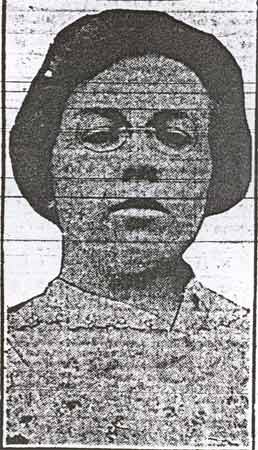
Confessing Supplying Pistol, in Spite of Husband's Denial That She Was Guiltless, Mrs. Ashbridge Is Held Without Bail on Charge of Conspiracy in Aiding and Abetting Escape From Jail
The gun with which Ashbridge murdered jailor Isaac Hibbs and wounded Jailor Ellis was smuggled into the jail by Mrs. Ashbridge on Saturday morning. With it went a box of cartridges. The weapon and bullets were passed to Ashbridge in a basket of fruit, being at the bottom of the basket. The jailors were busy at the time she called and as she frequently had brought her husband fruit they did not take precaution to search the basket. Mrs. Ashbridge bought the gun and cartridges on the written request of her husband.
Her confession as to the very grave part she played in the escape and murder was made to the Prosecutor late yesterday afternoon after she had first insisted she had no knowledge if how the gun got into the jail and after her husband had repeatedly declared that the revolver was supplied by Thompson. The revolver, fully loaded, was still carried by Ashbridge when he was captured in the Keystone Hotel…
… by Recorder Stackhouse without bail for conspiracy in aiding and abetting the escape of her husband and George E. Thompson from the County Jail on Monday night.
The court room was packed to suffocation by a morbidly curious crowd, composed primarily of women. A strange silence spread through the court room when the little woman was led into the court room by Captain Schregler. The regular formality of placing prisoners in the dock was dispensed with the woman's case.
Prosecutor De Unger pointed to the high witness chair and Mrs. Ashbridge sat in it. She evaded the gaze of the crowd, looking intently at the floor and through a window on the Washington Street side. She wore a blue skirt and a white waist. She was without her hat. her hair was carefully arranged and she wore nose glasses.
Resting her chin on her right hand her arm and hand were seen to tremble slightly. So quiet was the room that a pin dropping could have been heard.
“Mrs. Marian Ashbridge,” called the Recorder.
“Yes, Sir” was the faint reply of the woman, who did not even look up at the call of her name.
“This complaint charges you with delivering to Wilson Ashbridge and George E. Thompson a pistol and aiding and abetting them in escaping from the County Jail, where they had been lawfully committed. Do you plead guilty or not guilty,” said the Recorder as he read the complaint.
“The woman said nothing. DetectiveSchregler was then called as the complainant. He told of the confession made by the woman and produced the revolver which the woman purchased and which Ashbridge used in his daring escape. The gun, Captain Schregler said, was purchased in a pawnshop at Eleventh and Arch Streets, Philadelphia, on Friday of last week and was delivered to Ashbridge on Saturday morning along with a box of cartridges. ”Marian, I will hold you without bail,“: said the Recorder.
As the woman was being led from the court room by Captain Schregler and Sergeant Reed the crowd made a rush for the door leading from the court room, whereupon orders were given by the police to the crowd and many were prevented from rushing out. Everybody seemed anxious to secure a closer look at the unfortunate woman.
Visitors were denied Mrs. Ashbridge. Not even her children were permitted to be brought before her, although the broken-hearted mother asked for them.
“Oh, God, I don't know why I did this; why I left the little ones to go with Wilson,” tearfully expostulated Mrs. Ashbridge to the kind-hearted matron, who spent the best part of last night with the distraught woman.
“If I could only see little Marian,” sobbed the woman in the arms of Mrs. Kirkpatrick, who informed her that perhaps she could see them today.
Last eveneing the only support Mrs. Ashbridge had was a cup of tea. The morning she sipped a portion of a cup of coffee. She told Matron Kirkpatrick that she was not hungry.
:Everybody hounded me, I had no friends, and that's why I went with my husband, becasue he was the only friend I had left,“ said Mrs. Ashbridge. ”He was a good boy, but was easily led.“ The wife said even before her marriage that Ashbridge would run around with other girls, but he always returned to her and she forgave him. She said he seemed to have a spell over her and she couldn't leave him.
“I love my husband, still and will stand by him to the end,” sobbed the little woman to Mrs. Kirkpatrick. She told how her relatives disowned her and how after her father's death she went to live with strangers. When her husband fostered the plan to escape she willingly consented to aid him. She drew $100 out of the bank and purchased clothes and the gun and bullets. She never faltered in her plan.
“My heart aches for that woman,” said Matron Kirkpatrick this morning to a Post-Telegram reporter. “She's a good girl, but was easily led into her present predicament. It only goes to show what a woman will do for the man she loves, no matter how base a wretch he may be. Mrs. Ashbridge is more to be pitied than scorned.
Recorder Stackhouse this morning produced a copy of the marriage of the couple, performed by him on July 28, 1914. The marriage was performed at the instance of Assistant Prosecutor Butler after Ashbridge wronged the girl. Constable William E. Headley and William C. Ashbridge, the latter father of the murderer, were witnesses.
As told in yesterday's Post-Telegram, Ashbridge and his wife and their captors arrived at the City Hall from Chester shortly after 2:00 o'clock. After a brief stay they were taken to the Court House and turned over to Prosecutor Kraft, Ashbridge being taken into the Prosecutor's private office and Mrs. Ashbridge being placed under guard in the ante room.
Taking full blame for the murder of Hibbs and the wounding of Ellis, Ashbridge declared that none of the shots were fired by Thompson.
“I shot both men,” he declared, “but Thompson gave me the gun. He had it since Saturday.” He repeated this assertion several times in the course of his examination, adding each time that his wife had no part in supplying the firearm. His voluntary insistence in…
… exercise corridor of their cells in response to his request that he wanted to show him a note that had been left for him, he asked the aged keeper to step inside the corridor. Evidently suspecting something was wrong Hibbs refuse to enter the corridor. When Ashbridge repeated his request that Hibbs step inside, Thompson, why was immediately behind Ashbridge, said something to the murderer. Ashbridge could not exactly recall what the expression was. At any rate it was then that he fired and Hibbs fell to the floor with his death wound. To take Hibbs keys and open the door leading from the exercise room to the corridor was the work of but an instant. It was then that Ellis confronted Ashbridge at the other end of the corridor. He refused to throw up his hands when the murderer so ordered. Instead, the plucky jailor grappled with the slayer, who again brought the gun into play, twice wounding the remaining jailor.
Ashbridge did not say why he wanted Hibbs to step inside the corridor. One surmise is that the pair had planned to get the old man into the corridor, overpower him, take his keys and after gagging him place him in a cell, depending ion the gun to awe any prisoners who might make an outcry. But whatever their plan was in this respect it miscarried. Hibbs would not enter the corridor and was shot down where he stood.
Thompson carried both his own and Ashbridge's coats when they fled,. As Ashbridge had decided to do the talking with Hibbs when the jailor came to lock them in their cells it was agreed that it would not be wise for the murderer to be wearing a coat. This might look suspicious to Hibbs and in all likelihood he would refuse to open the door. Hence it was decided that Thompson should take both coats. He also carried Ashbridge's cap and his own Panama.
The coats and harts were adjusted as they ran down the spiral stairway leading to the street. They walked slowly into Sixth Street; increasing their pace up Sixth Street after crossing Market and after turning into Cooper walked very rapidly. They turned north on Third Street to Main and thence to the Vine Street ferry, where they caught the boat leaving at 7:15 for Philadelphia. Landing on the other side the fugitives exchanged hats. They walked rapidly to Broad Street Station, where Mrs. Ashbridge was in waiting, this arrangement having been made when she smuggled the gun in to her husband on Saturday morning.
Accompanied by Thompson the Ashbridges walked out Market Street to Thirty-second Street. Here Thompson left them and after walking the street for a brief while longer the slayer and his wife boarded a trolley car for Chester, where a few hours later the murderer's short-lived liberty was so dramatically terminated.
Although jailor Ellis still insists that three shots were fired before he was attacked and in spite of the positive declaration of Alfred Williams, the trusty, that three shots were fired at Hibbs, Ashbridge claims that Hibbs was shot only once and that two bullets were used on Ellis. He said that the three empty shells which the detectives found in his pocket contained the only bullets fired in the jail. The post mortem examination made yesterday by County Physician Stem bears out his contention as to the number of shots fired. Only one bullet was found and that had penetrated the jailor's heart.
“That's the truth about the shooting,” declared Ashbridge. “I fired the shots- three of them in all- and the gun was given me by Thompson. My wife had nothing to do with it. Don't blame her.”
Enroute back to the prison from which he had made his tragic getaway on Monday night, Ashbridge passed through the ante room where his wife was under guard. He stopped, kissed her, gently caressed her cheek, told her not to worry and passed on to the jail, from whence his next exit will be to the electric chair.
Haggard and very weak Mrs. Ashbridge was at once taken before the Prosecutor. With due regard for her condition Mrs. Ashbridge was handled very gently. At first she insisted that she had no part in getting the gun, but under skillful handling she finally broke down and confessed that she had supplied the revolver.
She stated that on Friday night she received a letter from her husband telling her that he planned to escape from the jail on Monday night and that he needed a revolver to make certain that his scheme would not fail. He requested that she procure the pistol and cartridges and personally deliver them on Saturday. being anxious to aid her husband in every way possible she readily decided to do as he requested.
Accordingly she purchased the needed articles in a Philadelphia pawnshop on Friday afternoon, paying $3.00 for the pistol and 67 cents for the cartridges. She kept them over night and on Saturday safely delivered the weapon and bullets to her husband in the bottom of a basket of fruit. At the same time Ashbridge asked her to go with him and when she agreed to share his fate he told her to meet him in Broad Street Station, Philadelphia, shortly after seven o'clock on Monday night. He further told her that he had carefully studied the situation and did not see how it was possible for his plan to miscarry. On Monday morning she sent her children to the home of Mrs. Anna Dick and later in the day sent the letter to Mrs. Dick telling of her “rash deed” and enclosing $10 for the children.
As Mrs. Ashbridge told her story she spoke in a very low tone. Most of the time her eyes were cast down and as she concluded her brief narrative she sobbed convulsively and was in a state of utter collapse. Reviving somewhat when given cold water Mrs. Ashbridge was turned over to the police and taken back to City Hall to await her hearing this morning.
The prison key stolen by Ashbridge from Hibbs' murdered body was recovered this morning by Detective Doran in the yard of Dr. Frank, 2025 Chestnut Street, Philadelphia. The recovery of the key was sue to information given by Ashbridge, after he had been locked up in jail yesterday afternoon. Ashbridge, when questioned as to the whereabouts of the key, said that Thompson had it and that he had seen him toss it over a wall of a residence near Twenty-third and Chestnut Streets on Monday night while he and his wife and Thompson were walking to Thirty-second Street.
Detective Doran and Constable Voight went to Philadelphia late yesterday afternoon and searched in vain for the key in the vicinity of Twenty-third and Chestnut Streets until darkness came on. Detective Doran renewed the search early this morning. There is a high wall fronting the yard at the home of Dr. Frank, and a search of the grounds resulted in the finding of the key, which was returned to Sheriff Haines.
Ashbridge is confined in a large cell in what is known as Section E. As cellmates he has two persons who are being held as witnesses to the crime. Sheriff Haines has assigned three constables, Gardner, Ford, and Addison. They will work on eight-hour shifts and will see that Ashbridge does not attempt any further escape or try to end his life.
Sergeant Detective Kane of the Chicago Police Department today took to Chicago Alfred Williams, who was an eyewitness to the murder of Hibbs. Williams, an Italian, served six months here on a charge of false pretence in obtaining money from a number of Italian grocers under the pretence that he represented the Roma Grocery Company. After his arrest and sentence here the police of Chicago lodged a detainer against Williams who is wanted in the West for a like crime.
The body of Jailor Hibbs will be exposed to view tonight at his home, 913 South 8th Street. Services will be conducted by Reverend Harry Bradway, pastor of Eighth Street Methodist Episcopal Church. Members of the Seventh Ward Republican Club, Mutual Aid and the Liberty Beneficial Society will attend in a body.
Tomorrow morning the body will be taken to Langhorne, where services will be held in the Friends Meeting House, after which interment will be made in the burial ground by the Schroeder-Kephart Company. Friends may call this evening to pay their respects.
Ashbridge will not be tried until December. On the day he was listed for trial of murdering Mrs. Dunbar his lawyer, Assemblyman Wolverton, was ill. In the interim the entire panel of jurors for the April term of court was discharged following a case of alleged tampering. This makes it necessary that he be held until September for trial unless the Court should otherwise decree, which is hardly likely.
Ashbridge is 22 years old and not 27, as previously stated. His real age was disclosed by the certificate of his marriage. He was 20 when he wedded two years ago,
The Howard Marshall who mailed a letter to a woman in Baltimore is not Freeholder Howard Marshall of the Eighth Ward, as was reported to the Prosecutor yesterday. Mr. Kraft's investigation disclosed that Freeholder Marshall does not know either Ashbridge or Thompson and that as a matter of fact the Marshall in question is an East Sider and to relative to the freeholder, who was naturally much upset at being mistakenly dragged into the case.
E.S. Fry, proprietor of the Keystone Hotel, Chester, where the couple were caught, told the story of the capture both to the city police and Prosecutor Kraft.
“Late on Monday night I received a call from another hotel, requesting that I take care of a man and his wife for the evening,” said Mr. Fry. “I waited until a little before midnight when the couple arrived. He seemed nervous and registered in a shaky hand, and I was suspicious that there was something wrong.”
“I did not pay much attention to the way he registered until the next morning when I examined the register and saw that he had neglected to register his wife. He signed 'Mr. Smythe, Washington, D.C.' I communicated my suspicions to my wife and told her to go observe the couple, too. Then I went out on the porch and picked up a morning newspaper. On the front page were the pictures of the two men who escaped.”
“I instantly recognized Ashbridge, but was not just sure of my identity of the man, so I decided to get a better look at him. At the breakfast table I observed him more closely and feeling sure of my ground I called Captain Schregler, afterward securing the service of two negro policemen, whom I placed on guard outside the hotel, giving them orders not to allow the couple to leave. The officers, William Padgett and William Robinson, took their positions outside the hotel, ready for the signal to enter when I gave it.”
“Ashbridge arose.”
“What's the matter,” he exclaimed. “You know what's the matter,” replied Mr. Fry, who brought in Captain Schregler and Detective Hunt. Schregler and Hunt instantly recognized the fugitive.
Before Ashbridge had a chance to move his arms were pinioned by his sides and Policeman Hunt had extracted the murder gun from his right hip pocket. It was fully loaded. In the same pocket were seventeen additional cartridges and in a suitcase in his room, Number 9, was a fresh box of cartridges.
“The little wife was crying bitterly,” said Mr. Fry. “She leaned her head upon his shoulder and the husband tried to console her.”
Captain Schregler sent a telegram to Chiefs Gravenor and Hyde with the startling news that Ashbridge had been caught.
On the way back to Camden Mrs. Ashbridge began to cry. She was sitting beside Captain Schregler, and he tried to console her. Her sobs increased, and Ashbridge called to her to “take it easy.”
This seemed to quiet her a bit, and Schregler spoke to her kindly, saying that she would not be blamed very much for her part in the escape. “That's nopt worrying me” she answered. “I am worried about 'Wil'.”
“well you women beat me” was Schregler's comment. “What did you want to help him escape for, anyhow? He had beaten you, deserted you for another woman and when she turned him down, he killed her. Yet you make up with him, leave your kids and risk everything to help him escape. Seems to me the worse men treat you women, the more you will do for them.”
“Lots of truth in what you say'” remarked Mrs. Ashbridge, with a sigh.
Mr. Fry was the center of attention. Everybody seemed anxious to hear his story.
“I'm not going back until I collect that $500 either,” he was heard to say. The capturer was formerly coroner of Delaware County.
Scenes of excitement were prevalent when the automobile of Chief Gravenor with Detective-chauffer David Hunt at the wheel, Captain Schregler and the prisoners in the rear and Chief Dodd, of the Pennsylvania Railroad police force in the front seat came from the Federal Street Ferry. E.S Fry, the hotel proprietor who caught the Ashbridges, was also in the car.
Ashbridge and his wife were instantly recognized. The news spread like wildfire and was passed along the route of the machine to police headquarters.
Thinking that the prisoners would be brought to the Prosecutors office, a battery of newspapermen and photographers were camped on the Court House plaza. When someone cried in bellowed tones “There they go,” the scribes and photographers started in hot pursuit behind the automobile.
The officers upon reaching the City Hall had to fight their way through the dense crowd which had gathered outside Police Headquarters. Many stood tiptoed to get a good glance at the prisoners who were abashed at their predicament.
Pulling her black straw hat over her face, Mrs. Ashbridge leaned on her husband's arm. To hide his face the murderer pulled the Panama hat, which he had secured from Thompson, over his countenance.
Preliminary questioning was done by Captain A.L. James, after which the officers and prisoners were escorted upstairs to the office of Chief Gravenor.
Still clenching the stump of a cheap cigarette in the corner of his mouth, Ashbridge had a pitiful look on his face. He was much thinner than he was when he was arrested for the murder of the Dunbar girl. On his upper lip was a small mustache, which he raised during the last week.
His beautiful and baby-like eyes still retained their piercing stare. The murderer looked wild-eyed at persons in the room. He seemed to take delight in singling out persons in the room and “staring them out.” None seemed courageous enough to return Ashbridge's strange stare. He looked distressed but the only betraying sign of nervousness was his incessant twitching of his fingers. Sweated on the couch in the chief's room, Ashbridge talked freely.
His wife dried away the tears as they trickled down her reddened face but after regaining her composure she seemed quite calm. She intently watched Captain Schregler and Detective Hunt as they searched through her husband's clothes.
When the trip for the Court House was being arranged the two prisoners, still handcuffed together, walked in the outer room of the chief's office. It was then that the wife broke down slightly. She choked back a sob and leaned her head on her husband's shoulder. Ashbridge did likewise and patted her on the back, at the same time, saying something in a suppressed tone of voice. The only persons in the room at the time were Assistant Chief Hyde and a Post-Telegram reporter. Neither was able to catch the words uttered. Captain Schregler, Chief Gravenor, and Detective Hunt later entered the room and the start for the Court House was made.
The crowd below which was camped about the entrance to the building awaited with patient expectancy, when the news was spread that the prisoners were leaving the building.
Camera men took their positions, ready to snap the couple, but the Ashbridges fooled them. Before the door leading to the street was opened Ashbridge drew his wife to him and with their free hands pulled their hats over their faces, thus eluding the photographers, who resorted top every means to secure a photograph.
Once inside the automobile the prisoners seemed content until the Court House was reached when another large crowd was on hand to great them. Both repeated the trick of hiding their faces.
After Ashbridge was taken to his cell his wife was ordered taken to the detention department in the City Hall. Captain Schregler and Detective Hunt half-carrying the sobbing and broken-hearted woman, who has aroused some sympathy for her courageousness in taking such a desperate chance for the man she loved, the father of her children and a cruel murderer.
“What other woman would do as much as she has for her husband,” was the query advanced by one of the spectators in the Court House corridor as Mrs. Ashbridge passed through on her way to the waiting automobile.
W. Wentz, of Haddon, Victim of Auto Fire
Philadelphia Inquirer —
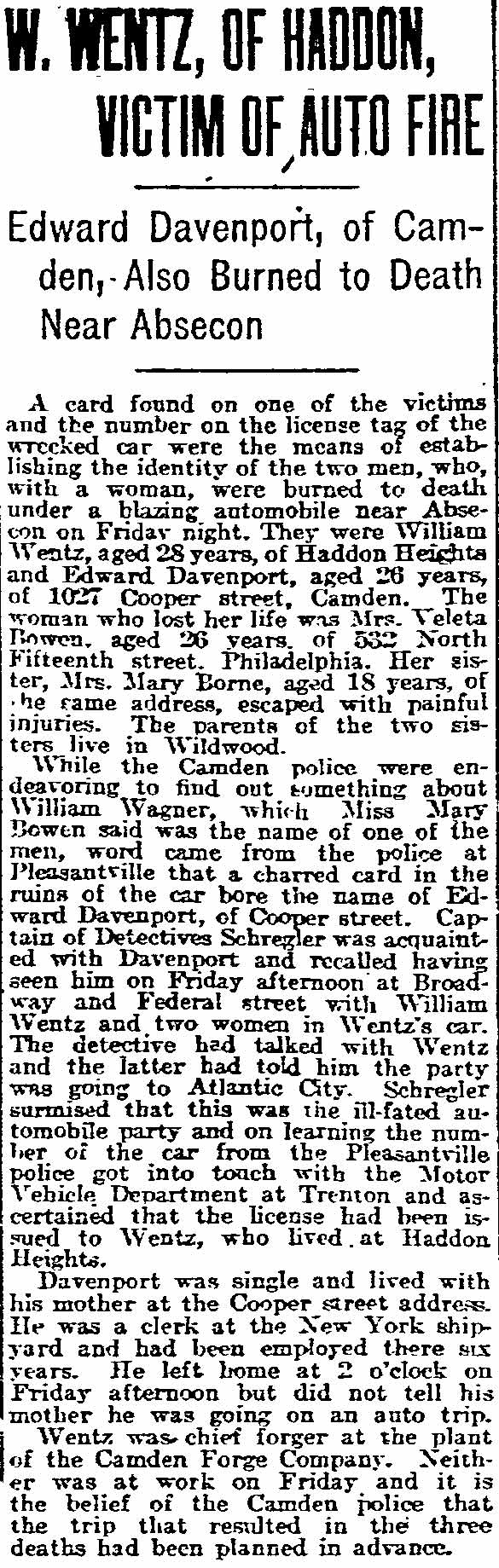
W. WENTZ, OF HADDON, VICTIM OF AUTO FIRE
Edward Davenport, of Camden, Also Burned to Death Near Absecon
A card found on one of the victims and the number on the license tag of the wrecked car were the means of establishing the identity of the two men, who, with a woman, were burned to death under a blazing automobile near Absecon on Friday night. They were William Wentz, aged 28 years, of Haddon Heights and Edward Davenport, aged 26 years, of 1027 Cooper street, Camden. The woman who lost her life was Mrs. Veleta Bowen, aged 26 years, of 532 North Fifteenth street, Philadelphia. Her sister, Mrs. Mary Borne, aged 18 years, of the same address, escaped with painful injuries. The parents of the two sisters live in Wildwood.
While the Camden police were endeavoring to find out something about William Wagner, which Miss Marie Bowen said was the name of one of the men, word came from the police at Pleasantville that a charred card in the ruins of the car bore the name of Edward Davenport, of Cooper street. Captain of Detectives Schregler was acquainted with Davenport and recalled having seen him on Friday afternoon at Broadway and Pearl street with William Wentz and two women in Wentz’s car. The detective had talked with Wentz and the latter had told him the party was going to Atlantic City. Schregler surmised that this was the ill-fated automobile party and on learning the number of the car from the Pleasantville police got into touch with the Motor Vehicle Department at Trenton and ascertained that the license had been issued to Wentz, who lived at Haddon Heights.
Davenport was single and lived with his mother at the Cooper street address. He was a clerk at the New York shipyard and had been employed there six years. He left home at 2 o’clock on Friday afternoon but did not tell his mother he was going on an auto trip.
Wentz was chief forger of the plant of the Camden Forge Company. Neither man was married they say. It is the belief of the Camden police that the trip that resulted in the three deaths had been planned in advance.
Police Arrest New Camden Storekeeper
Philadelphia Inquirer —
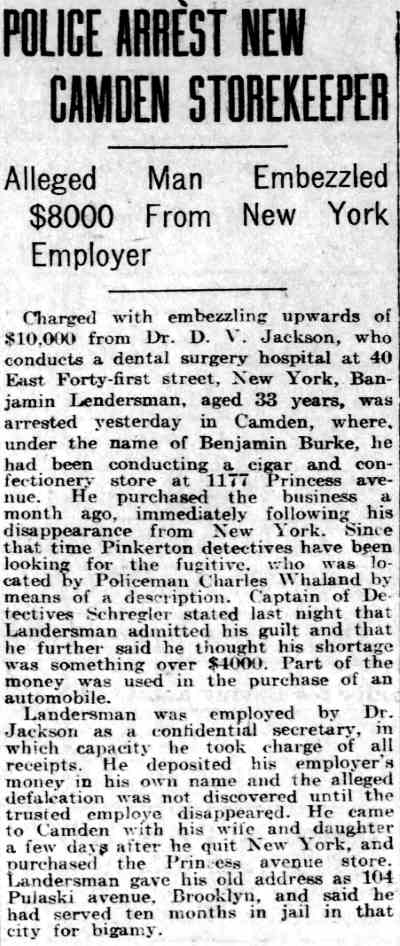
POLICE ARREST NEW CAMDEN STOREKEEPER
Alleged Man Embezzled $8000 From New York Employer
Charged with embezzling upwards of $10,000 from Dr. D. V. Jackson, who conducts a dental surgery hospital at 40 East Forty-first street, New York, Banjamin Lendersman, aged 33 years, was arrested yesterday in Camden, where, under the name of Benjamin Burke, he had been conducting a cigar and confectionery store at 1177 Princess avenue. He purchased the business a month ago, immediately following his disappearance from New York. Since that time Pinkerton detectives have been looking for the fugitive, who was located by Policeman Charles Whaland by means of a description. Captain of Detectives Schregler stated last night that Landersman admitted his guilt and that he further said he thought his shortage was something over $4000. Part of the money was used in the purchase of an automobile.
Landersman was employed by Dr. Jackson as a confidential secretary, in which capacity he took charge of all receipts. He deposited his employer’s money in his own name and the alleged defalcation was not discovered until the trusted employe disappeared. He came to Camden with his wife and daughter a few days after he quit New York, and purchased the Princess avenue store. Landersman gave his old address as 104 Pulaski avenue, Brooklyn, and said he had served ten months in jail in that city for bigamy.
Widow and Brother Held in Camden
Philadelphia Inquirer —
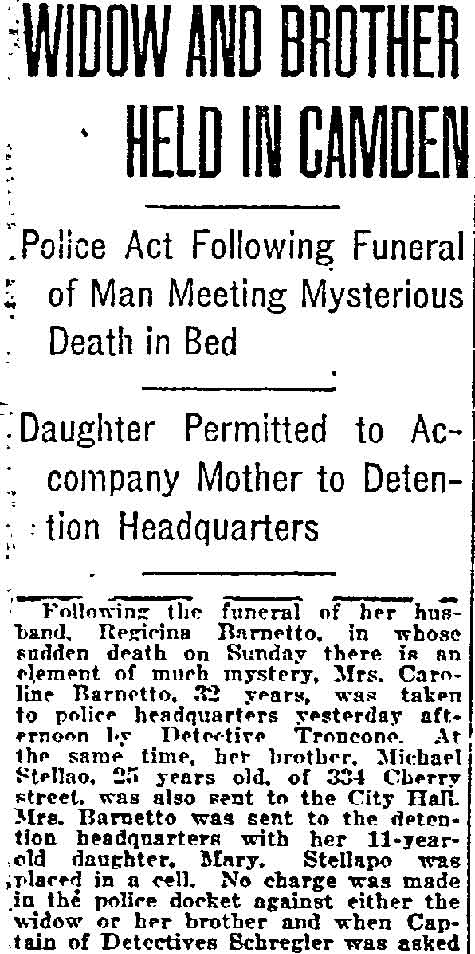
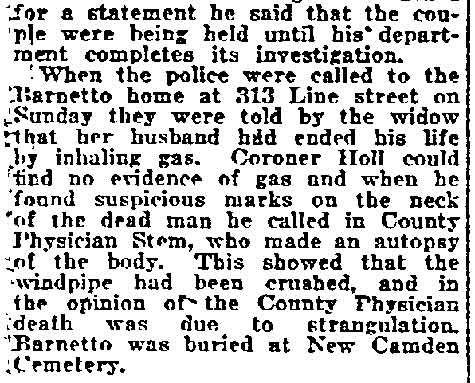
WIDOW AND BROTHER HELD IN CAMDEN
Police Act Following Funeral of Man Meeting Mysterious Death in Bed
Daughter Permitted to Accompany Mother to Detention Headquarters
Following the funeral of her husband, Regicina Barnetto, in whose sudden death on Sunday there is an element of much mystery, Mrs. Caroline Barnetto, 32 years, was taken to police headquarters yesterday afternoon by Detective Troncone. At the same time, her brother, Michael Stellao, 25 years old, of 334 Cherry street, was also sent to the City Hall. Mrs. Barnetto was sent to the detention headquarters with her 11-year-old daughter, Mary. Stellapo was placed in a cell. No charge was made in the police docket against either the widow or her brother and when Captain of Detectives Schregler was asked
for a statement he said that the couple were being held until his department completes its investigation.
When the police were called to the Barnetto home at 313 Line street on Sunday they were told by the widow that her husband had ended his life by inhaling gas. Coroner Holl could find no evidence of gas and when he found suspicious marks on the neck of the dead man he called in County Physician Stem, who made an autopsy of the body. This showed that the windpipe had been crushed, and in the opinion of the County Physician death was due to strangulation. Barnetto was buried at New Camden Cemetery.
Murdered Woman's Husband Is Defiant Prisoner in Camden
Philadelphia Inquirer —
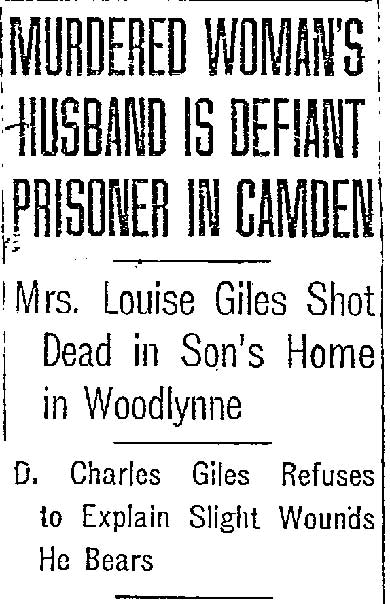
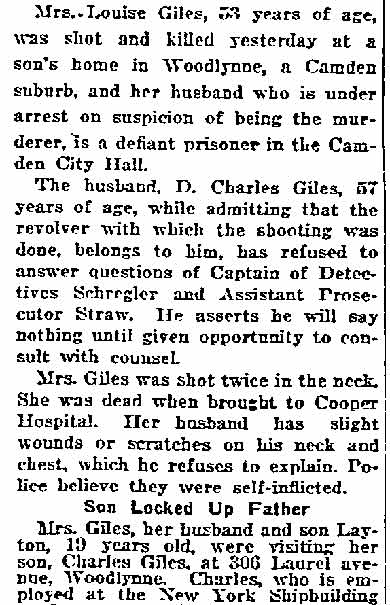
MURDERED WOMAN'S HUSBAND IS DEFIANT PRISONER IN CAMDEN
Mrs. Louise Giles Shot Dead in Son's Home in Woodlynne
D. Charles Giles Refuses to Explain Slight Wounds He Bears
Mrs. Louise Giles, 53 years of age, was shot and killed yesterday at a son’s home in Woodlynne, a Camden suburb, and her husband who is under arrest on suspicion of being the murderer, is a defiant prisoner in the Camden City Hall.
The husband, D. Charles Giles, 57 years of age, while admitting that the revolver with which the shooting was done, belongs to him, has refused to answer questions of Captain of Detectives Schregler and Assistant Prosecutor Straw. He asserts he will say nothing until given opportunity to consult with counsel.
Mrs. Giles was shot twice in the neck. She was dead when brought to Cooper Hospital. Her husband has slight wounds or scratches on his neck and chest, which he refuses to explain. Police believe they were self-inflicted.
Son Locked Up Father
Mrs. Giles, her husband and son Layton, 19 years old, were visiting her son, Charles Giles, at 306 Laurel avenue, Woodlynne. Charles, who is employed at the New York Shipbuilding yards, was not at home when the shooting occurred.
According to Layton Giles, his father and mother were in the bathroom when he heard two shots. He ran to the room and found his mother lying face down upon the floor, while his father was seated upon one side of the bathtub with a smoking revolver in his right hand. He told the police that his father resisted vigorously when he attempted to take the revolver from him.
The young man looked his father in a rear room while he telephoned to Camden for the police. A patrol wagon and crew carried Mrs. Giles and her husband to Cooper Hospital, where she was pronounced dead. Giles was locked up at the City Hall.
“I Won’t Admit Anything”
Captain Schregler at once attempted to question Giles. The prisoner, after stating he had had words with his wife because she had complained that he was not providing properly for her support, became sullen and said:
“I won’t admit anything. I will answer no more questions until I have had opportunity to consult a lawyer. I am too nervous to talk about anything now.”
He maintained the same attitude later when taken to the office of the assistant prosecutor.
At one time he lived on Chambers avenue, Camden, near Washington street. He has a summer home at Pitman and is regarded as well to do. During the last three years he has not been working, but, together with his wife, has spent much time visiting his children. He had been in Woodlynne about three weeks.
Giles has three other children besides his sons, Charles and Layton. There are two daughters, Mrs. Ada Bell, 25 Glenwood avenue, Bloomfield, N. J., and Mrs. Blanche Januria, of Sixth and Elm streets, Camden, and a son, Harold L. Giles, of 95 Ellis street, Bloomfield, N.J.
Alleged Auto Thief Held in Camden
Philadelphia Inquirer —
Alleged Auto Thief Held in Camden
Arrested at Grossman’s garage at Second street and Kaighn avenue, Camden, on a charge of the theft of a car owned by C. S. Van Pelt, of 2523 South Millick street, Philadelphia, William Sing, 32 years old, of 2611 South Sixty-first street, Philadelphia, is said by Captain of Detectives Schregler to have admitted his guilt to the charge. He will be formally held for requisition today by Recorder Stackhouse. The car was stolen on June 28 from Van Pelt’s garage and was located at the Kaighn avenue garage by Detective Whaland. The machine had been left there by a man who offered it for sale for $250 and who was to return for his money. Whaland waited at the garage and when Sing called for payment he was arrested.
Hacked Remains of David Paul, Missing Bank Messenger, Discovered by Gunners
(Mt. Holly) New Jersey Mirror —
The Authorities of Burlington county have another baffling murder mystery to solve.
On Saturday four duck hunters, William and James Cutts, and C.B. Inston, of Tabernacle, and George W. Duncan, of Audubon were passing through the pine forest at Irick's Crossing, near Tabernacle, when their attention was attracted by an automobile track following an old and rarely used trail leading to a stream toward which the gunners were making.
As the car was miles off the nearest traveled road the tracks aroused the curiosity of the men and they followed them. In a short time they came upon a freshly made mound over which dead leaves had been thrown. Leading to the mound from the shallow stream nearby were tracks of men and also marks as though some heavy object has been dragged by the men making the tracks. Thinking perhaps that a deer had been shot and secreted there, one or two of the men scratched around the end of the mound with sticks and within six inches of the surface a human foot was unearthed.
This put an unexpected phase upon the situation and the gunners decided to let Sheriff Haines continue the investigation.
Word was hastily phoned to the jail at Mount Holly and the Sheriff and Detective Parker lost no time in reaching the scene of the tragic discovery. The new-made and crude grave was then opened under the Sheriff's direction. The body proved to be that of a man, fully dressed except for his coat which was lying buried deeper and under the body. The feet were tied with a heavy rope such as is used in towing automobiles and they were resting upward and back over the dead man's head. As soon as the features were uncovered Sheriff Haines recognized the dead man as David S. Paul, of Camden, a bank runner, who had been reported missing by the Broadway Trust Company of Camden ten days before, with $65,000 in cash and liberty bonds and $12,500 in checks besides a number of cancelled checks. The body was badly mutilated and it was evident that a brutal murder had been committed.
Apparently Paul had been dead but a few hours and the remains were in a good state of preservation when discovered by the merest chance by the gunning party. There was a deep gash on the head as though made by a axe or hatchet, and the forehead was crushed in. Another ghastly wound just above one ear, alone was sufficient to have caused almost instant death.
Every indication pointed to the man having been killed and buried within twenty-four hours of the discovery of the crime. The rigor of death had not yet set in and the victim's face appeared to have been freshly shaven. The marks on the ground accompanying the feet tracks leading from the stream about a hundred feet away, were quickly explained when the body was unearthed. Evidently those who brought the body to the unfrequented spot had attempted to secret it in the stream, but finding the water too shallow to conceal the corpse, they had dragged it out again by the rope which bound the feet and pulled it to the spot where the grave was quickly made and the body of the unfortunate man shoved into it.
The clothes which Paul wore bore every evidence of being new. The shoes also had evidently just been purchased and the soles bore no evidence of wear. A search of the body failed to reveal any of the cash which the bank messenger is alleged to have taken when he so suddenly dropped out of sight while on his way across the ferry to go to a bank in Philadelphia to take the money, securities and checks for his employers. Only one cent was found in the pockets of the dead man. In the coat was a bundle of checks, said to have been cancelled.
There had been no attempt to conceal the identity of the dead man. His watch which had stopped at 9:37, was found in his pocket and a stickpin and in his tie and (as written) a pair of sleeve buttons remained in the cuffs.
How the dead man came to his untimely end and how his body happened to be buried in the far away spot in the pines miles from any human habitation, was a mystery when the body was first discovered and it seems to be as much so today, although the authorities here, as well as those of Camden and Philadelphia, are exerting every effort to run down the criminals.
It will be recalled that Paul, who was 59 years of age, enjoyed the confidence of the bank officials by whom he had been employed for many years. He was a recent visitor in Mount Holly where he had a son, Harry Paul, and other relatives.
On the morning of October 5 Paul started across the river to Philadelphia in company with another bank employee with a satchel said immediately afterward to contain $10,000 in cash and $12,500 in checks. This statement has since been revised and the amount of cash and Liberty Bonds that Paul carried is now variously stated to have been from $45,000 to $65,000. Upon reaching the other bank the other employee became separated from Paul whether by accident or through Paul's design is not yet known and after an attempt to find him at the ferry house, he went at once to the bank and reported his companion's disappearance.
The Central Trust Company was immediately notified and after all efforts to get in touch with the missing messenger had failed the Camden and Philadelphia police were asked to locate Paul. Nothing more was seen or heard of him until his hacked body was discovered in the pines near Tabernacle ten days after his disappearance. What the missing bank runner did during the interim, where he spent his time or with whom he associated while the police of the county were searching for him has not yet been learned but it is expected that the mystery will be solved before long.
One clue which seemed to put under suspicion the occupants of a yellow car turned out to be valueless when the owner, hearing of the authorities suspicions, came forward, gave his address as Haddonfield and proved that he drove a party in his yellow car inspecting some real estate in the pines shortly before the discovery of the body of the murdered man.
Detective Parker yesterday said that he had just picked up what he considered the first piece of valuable evidence in the case since he stated to work on it on Saturday. He declined to state what this evidence was for the present.
There are endless theories being advanced as to how the dead man met his fate and in explanation of his disappearance with the large sum of money entrusted to his custody. Some officials incline to the view that Paul was killed either in Philadelphia or Camden and his body taken to the lonely spot at Irick's Crossing in the confident belief that it never would be discovered or at least not until time had obliterated identifying marks.
Another theory is that the murdered man was taken alive in the automobile and killed near the spot where his body and rifled clothes were found. There is no means of telling which theory is correct at this time, quite as possibly both theories are at fault.
The body was taken in charge by Coroner Isaac Clover who ordered it removed to the undertaking establishment of Cline & Sons, at Vincentown. There Dr. Longsdorf, of Mount Holly and Dr. Stein, of Camden, performed an autopsy, the result of which showed that Paul come to his death by wounds to the head, probably inflicted by a dull axe or hatchet.
There was a conference in Mount Holly on Sunday in which officers of Camden and Burlington counties participated. Those taking part were reticent after coming out of the room in which that meeting was held. In the discussion of the crime and the preparation of plans for running down the murderers, if there were more than one, were Sheriff Haines, Clifford R. Powell and County Detective Parker, of this county, and Prosecutor Wolverton, and Detectives Schregler and Doran, of Camden county.
A reward of $1,000 offered by the Broadway Trust Company for the apprehension of Paul shortly after his disappearance is to be increased now for information leading to the capture of his murderers. It is easily the most mystifying case that had come to the attention of the Burlington county officials for many years but they express confidence that it will be solved and the criminals run down.
Constable Cramer Dies of Wounds; Batchelder Caught
Camden Daily Courier —
Actor Held for Murder Says Camden Officer Drew Gun While Serving Attachment Writ at Tuckahoe but Eye Witnesses Testify Cramer Never Had Chance for Life
Tragedy Followed Long Disagreement Over Payment on Automobile
CAPE MAY SHERIFF PREFERS CHARGE OF MURDER
CONSTABLE CRAMER DIES OF WOUNDS; BATCHELDER CAUGHT
Actor Held for Murder Says Camden Officer Drew Gun While Serving Attachment Writ at Tuckahoe but Eye Witnesses Testify Cramer Never Had Chance for Life-
Tragedy Followed Long Disagreement Over Payment on Automobile
CAPE MAY SHERIFF PREFERS CHARGE OF MURDER
ConstableWilliam Cramer, of 647 Willard Street, died at 9:00 this morning in the City Hospital, Atlantic City, from wounds sustained when he was shot three times yesterday afternoon by Harry Batchelder, vaudeville actor, 45 years old, of 419 Haddon Avenue.
Cramer was serving a writ of attachment from the Camden County District Court when shot by Batchelder. The latter was arrested at midnight by Captain of Detectives William Schregler and City Detective Fiore Troncone at Audubon. He will be taken to Cape May Court House late today for a preliminary hearing on a charge of murder preferred by Sheriff Tomlin, of Cape May County.
Joseph and James Albright, of 455 South 6th Street, were with Cramer when he was shot. They are proprietors of a tire store at 431 Federal Street, and the Corson Garage, 6th and Line Streets.
Batchelder says he shot Cramer when the constable pulled a revolver on him. The Albrights say Cramer did not show a revolver and never had a chance for his life.
A forerunner of the shooting occurred Friday night when Batchelder caused the arrest of Joseph Albright for stealing his car. He was taken to police headquarters with Constable Cramer.
It was then learned that James Albright had secured a writ of attachment from the District Court Friday, and Cramer was sent out to serve it. The writ charged Batchelder owed Albright $20.00 for a tire and repairs on his machine.
Cramer said he seized the car in front of Batchelder's home and instructed Albright to tow it to his garage. While they were towing the car to the garage, Batchelder called a policeman. He charged Albright with stealing his machine.
Gave Check, Left Headquarters
Batchelder later told Captain Schregler he did not know Cramer was a constable. He offered to settle the claim to get his car. Cramer told him the bill was $20.00 and $20.00 for costs. They agreed to settle for $30.00. Batchelder gave Cramer a check for the amount and left police headquarters with his car.
Captain Schregler learned today that Batchelder went to see a lawyer Saturday morning. The lawyer advised him to stoop payment on the check. Captain Schregler was informed Batchelder took the attorney's advice.
After he learned payment had been stopped, Cramer started out again Sunday to serve the writ. He was accompanied by the Albright brothers. The three men went to Batchelder's home and learned he had gone to his bungalow at Tuckahoe with his wife in an automobile. Cramer and the Albright brothers went to Tuckahoe.
Fired Five Times
“We located Batchelder in a field in his automobile about a half mile from his home” said Joseph Albright this morning.
“As we approached the machine Batchelder yelled ‘Don't come near me!'.”
“He yelled that twice, but Cramer paid no attention to the man's warning. Then Batchelder pulled out a revolver and fired five times at Cramer. Cramer dropped in his tracks, moaning with pain.”
Runs Away With Wife
“Batchelder started his car and ran full speed across the field. I ran after him and traced him to his bungalow on the Cape May County side of the Tuckahoe River. He and his wife jumped into a truck and drove away as I approached.”
“I ran back to my brother and Cramer and we started for Tuckahoe with the wounded man. We notified a constable in Tuckahoe about the shooting, but he said he did not want to have anything to do with the case.”
“We took Cramer to a drug store and the druggist told us he did not want to treat him. Then we drove as fast as our car could take us to ocean City. Cramer was growing weaker every minute. We took him to the office of Dr. Allen Corson. He advised us to take Cramer to the hospital in Atlantic City. We then drove to that city.”
Cramer was operated on last night at the City Hospital. He failed to regain consciousness until he died at 9:00 this morning. Two bullets were taken from his abdomen, and one from his right wrist. Two of the bullets fired by Batchelder evidently went wild.
The Atlantic City police notified Camden and Cape May County authorities. Every Roadway in South Jersey was watched throughout Sunday afternoon and night.
Captain Schregler and Detective Troncone learned that Batchelder had friends in Audubon. They went to the home of Harry Grow, 315 Chestnut Avenue. They found Batchelder and his wife at that address. Batchelder was immediately arrested and taken to police headquarters. Sheriff Tomlin, at Cape May Court House, was notified today and started for Camden to take the slayer to Cape May for trial.
Cramer, 65 Years Old, In Poor Health
Cramer was 65 years old and had long been a sufferer from asthma. He leaves a wife, one son and one daughter. His wife was told about the shooting last night and hurried to Atlantic City. She was with him when he died.
The slain man had been attached to the District Court three years. He was appointed constable three years ago and elected last fall for a term of five years from the Tenth Ward on the Republican ticket.
cramer had gained a reputation for fearlessness in the performance of his duty. He figured in a duel with Constable Zinger in the Highland section a year ago over the serving of a writ.
He later was charged with assault and battery on a woman, whose piano he seized on a District Court writ. Cramer said the woman tried to stop him from taking the piano by sitting on top of it. He ordered the moving men, whom he employed to take the instrument, to push it out of her parlor into the doorway. As they did she was knocked from the top of the piano. The case never went to court.
Batchelder Had Good Reputation
Batchelder bore an excellent reputation up until the time of the shooting. He was widely known as a musician. He performed on bells and xylophone and appeared frequently in vaudeville comedy sketches. He staged a number of theatrical enterprises of his own in this and other cities.
Brothers Refute Batchelder Plea of Self Defense
Camden Daily Courier —
Actor-Slayer Taken to Jail In Cape May County, Where He Will Be Tried
NO REVOLVER ON CRAMER
BROTHERS REFUTE BATCHELDER PLEA OF SELF DEFENSE
Actor-Slayer Taken to Jail In Cape May County, Where He Will Be Tried
NO REVOLVER ON CRAMER
Harry Batchelder, vaudeville actor, of this city, charged with murdering Constable William T. Cramer, while the constable was attempting to attach Batchelder's automobile.
Batchelder was taken to Cape May Court House late yesterday by Sheriff Tomlin and Constable Newkirk.
The accused man will plead self-defense, it was learned today.
“Yes I shot him, but to protect my life,” said the prisoner to Captain of Detectives Schregler and Detective Troncone, when he was arrested in Audubon. He declined to discuss the case further. Samuel M. Shay has been engaged as his counsel.
No Revolver On Cramer
Though Batchelder insists Cramer pointed a revolver at him, the fact is refuted by John and Joseph Albright, Camden garage owners, who accompanied Cramer on his visit to Tuckahoe, and by the fact that no revolver was found on his body.
The brothers, who had obtained a judgment against Batchelder for repairs to his car, declare as Cramer approached, Batchelder cried:
”Don't come near me!”
cramer, however, ignored the warning and Batchelder at once began firing.
According to an autopsy performed by County Physician Souder, of Atlantic County, the bullets perforated Cramer's lungs, heart, and abdomen.
Belated Medical Aid
Three hours elapsed before Cramer, bleeding profusely from the bullet wounds, received medical attention. This was due to the remoteness of hospitals from the scene of the shooting. Cramer was finally brought to the Atlantic City Hospital at 7:00, although the shooting occurred about 4:00.
The shooting was the result of a dispute over a claim of $20.00 for repairs to the automobile of Batchelder.
It was reported Batchelder had been advised he was immune from attachment proceedings because he was in a county other than the one in which judgment had been obtained against him.
cramer, however, was proceeding under the garage lien act, which would enable him to seize the car in any part of the State.
Batchelder will be tried in Cape May County, as the shooting occurred there. Cape May officials said today they will press for a verdict of murder in the first degree in his case. They pointed out that the Statutes hold that a person killing an officer in pursuance of his duty is guilty of first degree murder.
Insanity Patient Boy's Kidnapper
Philadelphia Inquirer —
INSANITY PATIENT BOY'S KIDNAPPER
Confessed Abductor of Carl Carlin, Camden, Guilty of Offense Before
Steps Taken to Have Man Arrested at Wilmington Sent Back to Asylum
Confessing that he kidnapped three-year-old Carl Carlin from East Camden on October 16, Charles E. Hemphill, a former inmate of the State Hospital for the Insane, at Trenton, was brought to Camden yesterday from Wilmington, where he was arrested Wednesday.
“I was reading a funny paper when I saw the boy playing near the bridge,” said Hemphill in a statement to the police. “I asked him if he wanted to take a ride on a trolley car and he said he did. I took him along with me and we went to Philadelphia and then out into the country. I did not hurt the boy.”
Asked to further tell where he had been with the lad, Hemphill wandered in his explanation. From scraps of his conversation it was gleaned that three of the seven nights he was away with the Carlin boy were spent in a railroad station and two other nights they were given shelter at the home of a Mrs. Anna Smith, as he remembered it.
Carl Carlin, the kidnapped boy, was taken to the City Hall yesterday afternoon by Detective King. Hemphill was brought from a cell to a room in the Detective Bureau and the little fellow was ushered into his presence. As soon as Carl caught sight of Hemphill he ran screaming from the room and almost went into hysterics. With a faraway look on his face, Hemphill remained silent.
Asked About Coat
“Is that the same coat he had on when you took him away?” Hemphill was asked when his attention was drawn to the light jacket worn by the boy. “No, he had on a blue coat,” replied the prisoner. A coat of blue material was worn by Carl on the day he was kidnapped.
Hemphill has no recollection of kidnapping five-year-old Alice Monroe, of 942 Federal street, who was enticed away from her home on the afternoon of September 8 and abandoned the same night in a woods near Audubon. The prisoner answers in every way the description of the man who took the child away, and the police are satisfied of his guilt.
Hemphill was sent to the State Asylum from Woodbury in 1908 in a similar case. He lived at Clayton, where he was arrested after enticing the eight-year-old daughter of a neighbor. He kept the girl out all night, but did not harm her.
The case was recalled yesterday by County Detective Steelman, who said that Hemphill was adjudged insane by a commission appointed to inquire into his mental condition. Steelman also stated that Hemphill has fled from the asylum several times and that on each occasion when he regains his liberty he is sent back for enticing children away. “He does not harm the children,” said the detective. “He has a mania for the company of little folks and apparently cannot resist the temptation for enticing them away. He loves to buy them candy and will spend his last penny on them.”
Tried to Get Back
Further inquiry at Woodbury developed the fact that Hemphill had made rain efforts to get back into the hospital after his “escape” on September 2. This information comes to the authorities of Gloucester county through a letter from Mr. Henry Cotton, of the State Hospital, asking that voluntary commitment papers be made out for Hemphill. It was further stated that the man had applied at the hospital to be taken back on September 23, stating that he was hungry and out of work. The hospital authorities refused to admit him without a commitment and later wrote to the County Clerk of Gloucester county for such papers.
Hemphill was not regarded as a prisoner at the asylum. Nor was his sanity regarded as of a dangerous nature. He roamed at will around the grounds and frequently wandered away only to be sent back when he would fall into the hands of the law after enticing some child away from home.
He willingly accompanied Detectives Painter and King from Wilmington to Camden and made no effort to hide his guilt in the Carlin case. It is the intention of Captain Schregler to have Hemphill formally adjudged insane and sent back to the asylum as prisoner.
Watchman Shot, Robbers Sought
Philadelphia Inquirer —
Although a bullet fired by one of two negro robbers passed clear through his chest, John Brazier, a private watchman of Camden, has a chance for recovery at Cooper Hospital. The bullet dropped to the floor when surgeons at Cooper Hospital removed Brazier’s clothing. The watchman’s condition is serious, but the doctors say he has a fighting chance. He was shot at Fourth and Line streets, Monday night, when he resisted the negroes, who demanded that he hand over his money. Brazier, although wounded, fired at the robbers as they fled. One of the men temporarily halted at the first shot, and it is the belief of the officer that the bullet took effect.
Captain Schregler is of the opinion that the robbers are the same two who held up and robbed Thomas Pine of $6 at the point of a revolver. Pine lives at 667 Vanhook street and was held up at Sixth and Mechanic streets. Two colored men are being held on suspicion, but Captain of Detectives Schregler does not believe they are the bandits.
$3000 Man's Lure to Fire Building
Camden Daily Courier —
Prisoner Confesses to Arson; Blames His Employer, Both Under Arrest
Boleslaw Ziemba, 1555 Mt. Ephraim Avenue, confessed today to Captain of Detectives Schregler that he set fire to the property at 1426 Broadway at the instigation of his employ-er, John Makel, so he could obtain $3000 he had put into the business. Makel conducted an automobile agency at the Broadway address. Both men are under arrest and will face charges of arson preferred by Fire Chief peter d. carter.
Ziemba told the detective chief in the presence of his aides, King and Painter, who investigated the case, that sometime ago he had loaned Makel $3000 and in turn had been given a job at the agency. He stated that he had asked Makel for his money and his employer then than said that he, Ziemba, set fire to the building and that the insurance money would provide the means to erect a new and handsome building and he could have a better job and get his money back quicker.
Firemen saved the building from destruction after the first floor had been partly consumed by flames.
On an examination of the premises, Chief Carter said he found kindling wood saturated with gasoline and oil placed in piles between joists of the second floor. He also discovered that rags soaked in oil had been placed in cracks in the flooring. Even the driveway had been liberally dosed with gasoline and oil, the chief stated. The arrests followed the examination of the arson evidence at police headquarters.
Charged with Homicide in Shooting
Philadelphia Inquirer —
Charged with homicide for the killing of Clinton R. Roberts, colored, who he caught robbing the hennery at his home, Antonio Speer, 38 years old, of 1209 South Eighth street, was yesterday held without bail by Recorder Starkhouse. The complaint was made by Captain of Detectives Schregler. Speer admitted that he shot Roberts and said he fired when he feared the negro would attack him. Supreme Court Justice Katzenbach will be asked to admit Speer to bail.
Wed Man and Girl Located in Camden
Philadelphia Inquirer —
WED MAN AND GIRL LOCATED IN CAMDEN
Couple Arrested and Returned to Their Former Homes in Bristol, Tenn.
Phila. Man Held in Connection With Two Damage Suits for Total of $30,000
Declared to have left a very comfortable home, Ethel Griffen, 17 years old, of Bristol, Tenn., was found in an apartment with John Mabe, 30 years old, of the same city, at Third and Penn streets, Camden, by the police yesterday. They were placed under arrest by City Detective Samuel Johnson, and were taken back to their home town. Mabe has a wife and three children.
Detective Captain Schregler received word several days ago of the disappearance of the couple. He instituted a search in Camden, found the girl working in a hotel while Mabe was employed in a local plant.
“I’m glad to get back home,” said Mabe, “and they can’t get me back fast enough.”
He told the police he had planned to work in Camden and send money to his family in Bristol.
“But how about the girl?” Mabe was asked.
“She followed me here,” he replied.
“Yes, I followed him,” admitted the girl. “We have been friends for some time. I know his wife and he is acquainted with my family.”
Police Find Bloodstained Hatchet and Hidden Vault in Hyghcock's Voodoo Den
Camden Courier-Post —
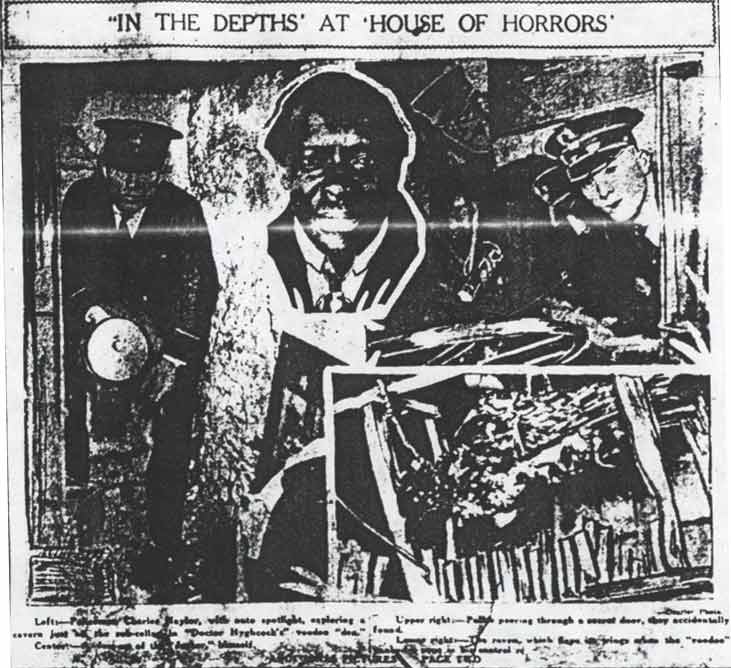
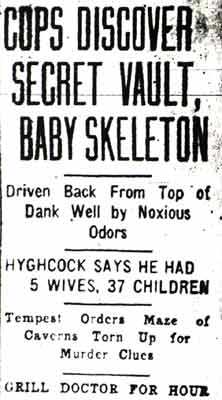
Police investigating the “voodoo den” of H.H. Hyghcock, 413-15 Liberty Street, whose arrest on suspicion of murder made several important discoveries today.
They are:
1- The finding of a bloodstained hatchet buried under the floor of one of the underground rooms.
222- Discovery of a hidden vault, the entrance freshly cemented and covered with wall-papered boards
3- Discovery of what is believed to be a well under the “sacrifice room.” When the police tore off the lid of the well today, they were driven from the underground passage by the odor that emanated from the large hole.
4- A blood-stained mattress cover, hidden in a second story rear room, was found.
5- Police digging in the underground den this afternoon unearthed the skeleton of a baby, the fourth infant's body found in the “voodoo den.”
6- Lastly, police say Hyghcock is the biggest liar they have ever seen.
When informed of the finding of the supposed vault Director Tempest instructed Captain Gordon to “tear it out if you have to tear down the house.”
The police questioned the “voodoo medicine man” for an hour this morning during which he admitted he is a bigamist. He confessed that he had five wives and is the father of 37 children.
Hyghcock Questioned For Hour
After spending the night in a prison cell, Hyghcock was taken before deputy director Tempest . In the room at the same time was Chief Tatem, Captains Colsey, Golden, Humes, and Sieh.
Hyghcock was visibly serious as he sat in a chair facing the police officials. He clasped and unclasped his hands and stroked his goatee as his eyes shifted around the room.
Director Tempest started the first shot of a barrage of questions that swept over the voodoo man before he was allowed to leave the room.
For nearly an hour the medicine man matched his wits with those of the police. Several times he seemed about to crack and reveal something startling but caught himself just as he was to fall into a trap.
As each questioned was asked him Hyghcock repeated it slowly and after thinking a few seconds made answer.
“Hyghcock” director Tempest began, “how many children have you?”
“Newspaper reporters printed stories that I have thirty-two children” the prisoner answered. “That is all wrong. I have thirty-seven children.”
Five Wives, Says Hyghcock
“How many wives have you had?”
“Five” he answered.
“All living?”
“Two are living.”
“Are you a bigamist?”
“Yes, I guess you would call me that. I don't know where my fourth wife is now.”
“How long have you been married to this wife?”
“Thirty-two years”
“All your children living?”
“All but two.”
“Where are the other thirty five?”
“Scattered all over.”
“How many women have you killed in your time?”
During the questioning of his married life Hyghcock smiled continuously as he answered the questions.
The last question had the effect of an electric shock upon the prisoner.
“Come on, come on,” Director Tempest said. “How many women have you killed?” This was one question that Hyghcock did not repeat.
Says He Bought Dead Bodies
“I never killed any women” he answered as he looked at the faces of those gathered around him.
“How many operations have you performed in that den of yours?”
I didn't perform any operations“
“How do you account for the finding of those bodies of these infants in the cellar?”
“I bought those babies from Dr. White on South Street in Philadelphia.”
“You are lying, aren't you?”
“No sir” Hyghcock said, as he toyed with his hat.
“Tell the truth now. How many women died in that house of yours?”
“Who said I killed anybody?”
“We have the goods on you, so you might as well come clean. Your daughter has told us she saw you kill that light skinned colored woman when your wife was away. What did you kill that woman for?”
“My daughter say that? She must be wrong.”
“Why should your daughter say you killed a woman if you did not? We know you shot that woman and your daughter saw you do it. Why should your daughter say such a thing if it were not true?”
Stumped by Daughter's Tale
Beads of perspiration broke out on the prisoner's face.
“I don't know” he answered.
“Didn't you take a woman's body out of that house not so long ago?”
“No.”
“How many women have died in that house?”
“Only my daughter.”
“Are you a physician?”
“Sorta of a physician.”
“Why do you have the stethoscope in your home?”
“What kind of thing is that?”
“Are you a physician and well acquainted with surgical instruments?”
“Yes, sorta,” Hyghcock said. The stress was beginning to tell on him.
“And you don't know what a stethoscope is? You are not a doctor, Hyghcock. you are a liar.”
“Yes sir” he answered.
“Are you a regular minister?”
“Sorta. I'm an evangelist.”
“Ordained?”
“What do you mean? I've been an evangelist since I was a child.”
“Ever been arrested before?”
“Yes, in Philadelphia. Man I was with shot a woman with a baby in her arms.”
“You did the shooting, didn't you?”
“No sir.”
“But you shot the woman in your house on Liberty Street, didn't you?
“No sir.”
Women Boarders
“How many women do you keep at your house at one time?”
“Four or Five”
“What for?”
“Boarders.”
“You are lying now, aren't you?”
“No sir.”
“How many women have you killed?”
“None.”
“What do you know about the bloody hatchet we found in your cellar?”
“I don't know anything about it. Where did you find it?”
“We are asking the questions, you just answer them.”
“Did you ever have a hatchet?”
“Yes, I lost it six months ago.”
“How did the blood get on it?”
“I don't know.”
“Why did you cement that vault?”
“What vault?”
“The vault in your cellar that you just cemented a short time ago. You might as well come clean and tell us about what is hidden behind that cement wall because we are going to find it out.”
Hyghcock shifted in his chair and the perspiration flowed in a stream from his forehead. He bit his lips.
“There is nothing much there” he said after thinking for fully a minute.
Walls Against Water
“What did you build it for?”
“To keep the water out.”
“Why didn't you cement up the rest of the cellar?”
“I don't know.”
“You know that we know you are lying, don't you?”
Hyghcock did not answer that question.
“Why did you dig out all those rooms in the cellar?”
“For church services.”
“Did you use about 65 small rooms underground for church services?”
“Yes.”
TEXT illegible
TEXT illegible
TEXT illegible
TEXT illegible
“In the room way back under the yard. That was he main church?”
“How can you take nine people and put them in 35 rooms?”
“I don't know”
“The why did you have so many rooms?”
“The people wanted them.”
“What people?”
“My congregation.”
“Are you a regular minister?”
“Mr. Johnson in Newport News told me I could be a minister.”
“What was that room where the crow was swinging on the board supposed to be?”
Noah's Ark Room
“That was the Noah's ark room. The bird was on the ark.”
“What was the idea of having ropes to make the stuffed bird flap his wings?”
“That was part of the church service.”
“How many women are you in love with?”
“I don't know. A lot are in love with me.”
“Hyghcock, you have been performing illegal operations in that house of yours, and we have more than 100 letters from women that were sent to you. Those letters contain evidence that will be used against you. What have you to say about them? You read the letters, because they were open when we found them.”
“Just what particular letters are you talking about?”
Director Tempest then went through some letters and mentioned the names and addresses of the senders. Many of them were from white women. To each letter called to his attention Hyghcock said:
“I just can't recall reading that letter.”
“How about this letter from Ann Miller of Philadelphia telling you that she was thorough with you because you killed the man next door?”
“I don't remember seeing that letter.”
“You are lying Hyghcock, and you had better come clean and tell the truth.”
“Women Stuck on me”
Then letters containing endearing terms were read to him. Asked what he had to say about them, he answered:
“They are some of the women who are stuck on me.”
“How many women are stuck on you? Are there as many as 100?”
“I don't think there are that many. I know women all over the country and they write to me.”
What do women all over the country write to you for?“
“I guess they like me.”
“I guess they do,” Director Tempest said as he gazed at the prisoner, who averted his glances.“
“Ever perform any operations on any of these women?”
“No sir”
“Then what do they write to you about?”
“I don't know.”
“What is in that well under the board in the cellar?”
“What well?”
“Did you throw any bodies down there?”
“No sir, I ain't hid no bodies.”
“Where did you bury the women who died in your house?”
“Nobody died there.”
“Why did you go out late at night in your automobile with a shovel?”
“Who said so?”
“You did, didn't you?”
“I can't recall.”
Says He Took Women Into Tunnels
“Just think for a minute”
“Nope, I can't recall.”
“Did you take women into those underground rooms”
“Yes, I took them down to church services.”
“Didn't take any men down there, did you?”
“No sir.”
“How did you come to dig all those rooms?”
“I was looking for money.”
“What do you mean?”
“When I first moved into the house I dug in the cellar one day and found $25.00”
“What has that got to do with the rooms?”
“Well, I kept on digging and found $300.00 more.”
“Yes, go on.”
“Go on where?”
“What gave you the idea for all of the rooms?”
“Well, when I moved into the house there were rooms directly under the XXXXX and I dug XXXX the back yard XXXXX XXXX XXXXXXXX.”
“For how long have you been live there?”
“Eight or ten years”
“Who dug that cellar with you?”
“A man by the name of ______ (Name withheld at the request of the police).”
“What did he do?”
Becomes Badly Mixed
“He helped me to make the room- the chapel.”
“Did he help you get rid of the bodies?”
“No sir.”
“Who did help you get rid of them?”
“Nobody.”
“Did it all yourself?”
“Did I do it all myself- yes, sir- no, sir.”
“Well, what do you mean?”
“I mean I didn't do anything. I hid no bodies.”
“What did you bury the hatchet for?”
“I didn't bury any hatchet”
“How did it happen the hatchet was covered with blood?”
“I don't know.”
“What did you have those shovels and picks down in the cellar for?”
“To dig with.”
“Dig what?”
“What is is this religious college you have up by Willow Grove?”
“Who told you about that?”
“You tell me about it now.”
“I started a church up there.”
“You built shacks and rented them to colored people for $30.00 a month and then charged them $10.00 a month extra. What was the extra $10.00 for?”
“It was for the Lord.”
“What do you mean Lord Hyghcock?”
“No for the church.”
Sold Willow Grove Settlement
“Do you still have the church settlement?”
“No, I sold it.”
“Sold the church too?”
“Yes.”
“Why did you tell your wife you would kill her if she went into the cellar of the house where all those rooms were?”
“Who said so”
“You did, didn't you?”
“I can't recall.”
“When you would have a crowd of women in the rooms you would send our wife away, wouldn't you?”
“Not exactly.”
“Speaking of illegal operations, do you know Miss…”
“Who ain't one of the women I operated on.”
“Who are some of these women, then?”
“I ain't operated on any women?”
“Did you tell women to keep away from you?”
“Yes.”
“Tell us about how you shot that woman and buried her body?”
“I ain't shot nobody”
“How did you kill her, with that hatchet?”
“No sir.”
“Come on, tell us how you killed her?”
“I didn't kill any women.”
“The woman just died in the house, oh?”
“No sir.”
“How about the man who lived next door whom you said you killed?”
“I didn't kill anybody.”
When Tempest finished, each of the police captains fired a barrage of questions at Hyghcock.“
Several times under severe questioning by Captain Golden, Hyghcock became confused and gave evasive answers.
Turning to Captain Schregler, Director Tempest said:
“He's a liar, take him upstairs.”
Mrs. Hyghcock Quizzed
Hyghcock was then taken up to the bureau for further questioning by detectives. His wife was quizzed in an adjoining room and when she was taken back to her cell, their seven year-old daughter, who told the police her father killed a woman in the house when she was questioned again repeated her version of the killing.
During the questioning of Hyghcock in the Detective Bureau, Commissioner Middleton came into the room. He sat with the detectives as they questioned the 71 year-old medicine man.
Where the Ropes Came From
A Broadway hardware merchant called at police headquarters today and told the police that he had been selling rope to Hyghcock for the past two years.
“He would come into the store and buy the rope in six foot lengths. He would also buy barn lanterns by the dozen. I often wondered what he intended to use them for but I never asked him.”
The ceiling of the underground den was a cobweb of ropes, which operated through pulling and rang bells, opened doors, and made the raven in “Noah's Ark” flap his wings.
That Hyghcock contemplated more cement work, when discovered yesterday when the police found a load of sand in the front part of the cellar. In the afternoon a truck with fifteen bags of cement came to the Hyghcock house.
The driver, seeing the crowd, drove away, taking the cement with him.
Director Tempest sent a detail of police and firemen to destroy the maze of underground tunnels and “torture chambers” under the “voodoo” houses. The entire cellar of the two houses will be dug up to a depth of six feet in an effort to learn if any human bodies are buried there.
The 'voodoo palace“ was raided early yesterday morning by a detail of police who arrested ”Dr.“ H.H. Hyghcock, a 71 year-old ”medicine man“. When the police searched the house yesterday they discovered the bodies of two small infants hidden in one of the underground rooms.
County detectives who went on the case yesterday and city police are endeavoring to learn if any women were murdered in the house. The decision to tear out the thirty-five underground rooms came at a conference at police headquarters last night between Prosecutor Wescott, City Prosecutor Bernard Bertman, Director Tempest, and Chief Tatem.
Each of the officials declared that he believed a digging up of the cellar would reveal the finding of human bodies.
Will Do It Monday
'I am going to order a detail of firemen and policemen to the cellar of the two houses“ Director Tempest said, ”with instructions to tear out every one of those rooms in the cellar. After the cellar is cleared the policemen and firemen will dig up every foot of the cellar. I have some information which I cannot divulge that leads one to believe that our search will not be unsuccessful. It is not probable, however that the work of clearing up that underground “hotel” will be started before Monday.“
“In my police experience I have never seen anything that compares with that underground voodoo den.”
Hyghcock as questioned for several hours last night by detectives. He refused to make any statements, even when he was shown incriminating letters that were found in his home. The police seized more than 100 of the letters which were mailed from every state in the Union. Many will be used against the “physician” when he is placed on trial as they reveal he practiced medicine without a license.
The police place great stress upon the statement of Hyghcock's seven year-old daughter who told them that her father killed a woman in the house a week ago and buried her body. The child is being held in custody as a material witness as is the wife of the “medicine man.”
Last night more than 5,0000 morbid curious people gathered at the Hyghcock house and stormed the doors seeking admittance to the underground passages. A detail o police inside the house fought back the crowd. A riot call was sounded at 9:00 o'clock and two details of police were rushed to the scene. The crowd was driven back and the street roped off. During the excitement the front door was smashed in by the crowd.
Today detectives are reading the large bale of letters found in the house. They also seized the prisoner's set of books, which show he received large sums of money from superstitious persons for “love and enemy” charms. The books contain the names and addresses of more than 1,000 of Hyghcock's customers.
Police said that although Hyghcock has only been a resident of this city for three years, he has amassed a small fortune and owns considerable property here and in Pennsylvania. They said that several years ago Hyghcock built a small chapel near Willow Grove. Around this chapel he erected 20 small frame houses. he rented them to colored folks who joined his religious sect and in addition to the rent paid him an assessment of $10 a month which he said he turned over to the Lord.
Three Years of Work
When Hyghcock was taken from his cell in police headquarters last night to be questioned he smiled as the cell doors clanged open. He was taken to detective headquarters and questioned, but refused to make any statement. he will be questioned again today.
The police said he must have spent nearly three years building the underground “chamber of horrors” So quietly did he work that none of his neighbors knew the spooky subway rooms existed. Most of the excavating was done between midnight and 3 o'clock in the morning.
Entering the house at 413 Liberty Street, a visitor sees a small counter and a candy show case. Arrayed on shelves behind the counter are bottles of pop and packages of cigarettes. Three feet away from the counter toward the kitchen is a door leading into a hallway three feet square. A winding flight of steps lead to the upper floors and a door in the hallway opens opens on to a narrow winding stairway into the cellar.
Secret Winding Passages
Once in the cellar the visitor finds himself in a small alley running toward the front of the house. In this alley are shelves filled with roots and herbs. The aisle turns at right angles to the right and one sees a large door upon which is printed “Noxvill.” A heavy spring slams the door to. The visitor is then in complete darkness. In front of him is a winding, twisting passageway, barley three feet wide, Directly over his head are ropes running along the ceiling which control the opening and closing of doors and the ringing of bells.
To the right is a dark room. The rays of a flashlight thrown into the room reveals a stuffed bird resting on a swinging shelf. A pull on one of the many ropes causes the crow to flap his wings. Just ahead in the passageway, and to the right and left are three doors. Sleigh bells are fastened to each of the doors. The door to the right leads to a tunnel connecting with the house at 415 Liberty Street, next door. The other doors lead into other rooms and n the rooms are other doors leading into still other rooms.
Rooms Poorly Furnished
And so on down the entire length of the cellar.
In the rooms which are not more than four feet square there is very little furniture. The walls and partitions are made of packing box lumber covered with various pieces of wall paper, one shade bordering on the other. In each “den” a kerosene lantern, or lamp hung on ah hook. The air is stifling.
In the room known to the police as the “Graveyard” are three lanterns and several spades and picks lying on the dirt floor. The soil shows that it has recently been dug up.
Still following the dark passages the visitor find himself confronted with a door, with a glass panel in the bottom. A heavy spring makes the door hard to open, but a pull on one of the many strands of rope running along the ceiling and the door swings slowly open without the least effort. it is controlled in some mysterious manner by weights.
Hyghcock has undermined his entire back yard. Back under the yard runs the passageway with the dens turning off to the right or left. In one of the underground rooms a large clock instead of being placed high on the wall is fastened down near the ground. The clock was functioning yesterday but was four hours fast.
Tunnels Become Confusing
Now the passageways gets narrower and darker and the odor is sickening. Towards the extreme rear of the room is the “Sacrifice Chapel.” This contains a baptismal bath, a large Bible, a XXXXX and a carriage wheel with various colored spokes. The wheel spins from an iron peg driven into the wall. Everywhere is seen patchwork carpenter work. A birds-eye view of the underground rooms reminds one of the futurist, or cubist, paintings. In one of the rooms the floors are covered with freshly laid cement. The police will endeavor to find if anything is buried underneath the flooring.
Just ahead is daylight. One finds a small hole in the roof where a chimney or a uphill coal stove extrudes into the yard. This follows another maze of doors. In several parts of the tunnel thick doors can be opened at the same time to form a triangle. Not twenty more feet down his dark passageway and a ladder leading upward is seen. It is a hastily constructed affair and the top rungs are covered with grips made of automobile tires.
A walk through the upper story of the two houses show that bedrooms have been partitioned off to make three rooms.
He Doted Bells
Overhead is the network of ropes operating on pulleys the XXXXX XX XXXX XXXX. In the underground rooms and tunnels, XXXX XXXXX and a door XXXX XXXX. XXXX XXXX will open or a bell will ring. Hyghcock just doted on bells. The largest bell is fastened to a door on the third floor. This one can be sounded from the rear room in the tunnel by means of the rope. Bells are everywhere. They range from baby bell rattles to large cow bells.
The rooms on the upper floors each contain beds. Yesterday they were in disorder. The bed clothing was scattered on the floor and the floors were strewn with papers, letters, books, and clothing. In a closet in a third story room was found two new dolls in a basin, glassware, phonograph records- everything imaginable. The rooms resembled “junk shops.”
Yesterday the police spent most of their time searching for bloodstains on the floors and walls of the buildings. Trunks were forced open and those were found to contain soiled linens. The police questioned Hyghcock's seven year-old daughter.
“How many men did your father kill in here?” Patrolman Charley Naylor asked the girl?
Says “Pop” Killed Woman
“My Pop did not kill any men” the child answered, “ but when my mother was in Washington to see my sister not long ago, a woman came to the house and started to fight with Pop. It was late at night. They fought terrible and they were in the big room in the front of the house. I saw them fighting and my Pop got a gun and shot the woman. Pop took her out in the automobile and buried her. He told me to keep quiet and said the woman was sick and died and he buried her in a cemetery.
The child was taken to police heads when she was again questioned by Director Tempest and Chief Tatem. The police tried to get her to change her story but she refused to do so and stuck to the narrative she first told in her home. Her mother was then arrested and detained as a material witness.
Persons living in the neighborhood said today that on two occasions they had seen Hyghcock place large bundles in the back of his car at night, place a shovel in the rear of the car and drive away.
The police have been unable to learn much so far about Hyghcock prior to coming to this city. They do know that he came here from Norfolk VA where he still claims to be in the undertaking business.
Strange Powders Sold
Hyghcock, the police said, manufactured powders and sold them to colored people as good luck chars. if a woman was unfriendly with another woman she went to Hyghcock and for $12 she received a small bottle of powder. This she sprinkled in front of her enemy and from then on “everything will suffer for the enemy because she would be pursued by evil spirits and her luck would be something terrible.”
If a superstitious young man who “rolled the bones” as a pastime wanted to stage a winning streak, he would visit the medicine man. For $40.00 he would give the man with the gambling instinct a blue powder that he was supposed to rub on his hands just before it was his time to “roll.” Powder to keep another woman from stealing one's husband went for $30.09. Hyghcock's records show. What the 9 cents was for is not known. IN one day, the police said, Hyghcock sold more than $190 worth of powder that originally cost about twenty cents.
The more serious charge against the prisoner is that he used the building for immoral purposes and for performing illegal operations.
Captains Shifted
Camden Courier-Post —
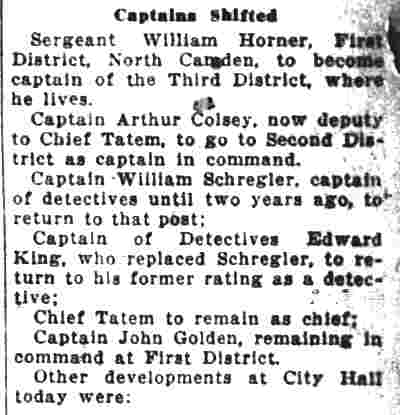
Captains Shifted
Sergeant William Horner, First District, North Camden, to become captain of the Third District, where he lives.
Captain Arthur Colsey, now deputy to Chief Tatem, to go to Second District as captain in command.
Captain William Schregler, captain of detectives until two years ago, to return to that post;
Captain of Detectives Edward King, who replaced Schregler, to return to his former rating as a detective;
Chief Tatem to remain as chief;
Captain John Golden, remaining in command at First District.
Other developments at City Hall today were:
Some Old Hall Familiars
Camden Courier-Post —
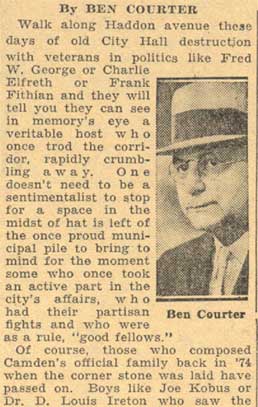
By Ben Courter
Crumbling City Building Brings to Mind Many Who Once Took Active Part in Affairs of Camden and Spirited Political Scraps
By BEN COURTER
Walk along Haddon avenue these days of old City Hall destruction with veterans in politics like Fred W. George or Charlie Elfreth or Frank Fithian and they will tell you they can see in memory’s eye a veritable host who once trod the corridor, rapidly crumbling away. One doesn’t need to be a sentimentalist to stop for a space in the midst of hat is left of the once proud municipal pile to bring to mind for the moment some who once took an active part in the city’s affairs, who had their partisan fights and who were as a rule, “good fellows.”
Of course, those who composed Camden’s official family back in ‘74 when the corner stone was laid have passed on. Boys like Joe Kobus or Dr. D. Louis Ireton who saw the
corner stone laying are now men well along life’s journey and they too have memories of the Hall through the many years. Mayor John H. Jones, as related in a previous article, died the year the Hall was started. He was succeeded by John Morgan who served a year. Then came James W. Ayres, Claudius W. Bradshaw, Jesse W. Pratt, J. Leighton Wescott and Cooper B. Hatch, all of whom have died. The surviving mayors who once held forth in the office at the southwest corner are Joseph E. Nowrey, Charles H. Ellis, Frank H. Vanhart, Victor King, General Winfield S. Price. With the advent of Mayor Roy Stewart quarters were taken in the great stone pile at Sixth and Market.
The City Clerks
Joseph C. Nicholls was city clerk when the Hall was started, succeeded by Joseph Bontemps, Fred W. Tarr, Frank F. Michellon, Richard C. Thompson, D. Cooper Carman, Thad P. Varney, Morris Odell and William D. Brown, all of whom have died. The survivors are Colonel Harry C. Kramer, now at Washington, Isaac V. Bradley, “Al” White and Frank S. Albright, the last of the clerks in
the old building and now happily with us in the new structure.
But there were scores more who were familiar figures in the nearly two generations that have passed. One expects to see, for instance, Levi Farnham, city engineer for nearly two score years, come tramping out of the wrecked corridor to make his way to see how Farnham Park is progressing. There is sure to be memories of the hearty laugh of “Pete” Young, who was Varney’s assistant, and like as not there will be heard the gruff note from “old” Colonel Sam Hufty, “watchdog of the treasury for many a year and a job his father held before him. One can see, too, George A. Frey, long city treasurer, who was quite rightfully proud when the experts, who made the survey in 1923, reported that of the more than $18,000,000 he handled every penny was accounted for.
And surely passing what is left of what used to be the police department one can hear the hearty laughs of “Bill” Schregler or Jules Bosch or the pestering gasps of poor old Cale Williams who had the asthma and
whose difficulties in getting calls under the new fangled signal system were rather tragic. Captain Hugh Boyle had a better time of it in getting those calls and so did Jimmie Tatem, later chief and now retired. Looking in the old police room one can see the domino game of 35 years ago going on with Schreg and Billy Husted, Dan Hassett or John Courter, Jimmie Polk, Frank Albright or Billy Paul interested as if it was a huge staked poker game. Peculiarly enough the uplifters of the time never fussed about that domino game, which, after all, was played to while away the late hours of night until something turned up.
The Old Health Board
Across the way were Gene Roberts, the perennial secretary of the old
Board of Health; Henry B. Francis, the “admiral” who fought with Farragut, or Joe Starr, who did his part in rounding up the property owners to get the Line Ditch swamp filled in and graded. Of all that board only Reuben Gaskill survives. Dr. John F. Leavitt, many years health physician, is living in retirement.
Up in the Council Chamber, now virtually gone, old-timers will tell you they can yet hear Fred Finkelday in a brush with Joe Potter, the later of the councilman-at-large, or the booming voice of John Broome bringing order out of chaos. John’s brother, Howard, by the way, was for a time an efficient water engineer who died at the early age of 35 of pneumonia. His son is now secretary to Mayor Stewart.
Theer was the ill-fated George Felton, treasurer, who ended his life; Billy Doyle and J. Fred Newton, William Osler, Water Chief Hollingsworth, John McCabe, Constantine Scout and Larry King, all quite kindly recalled by many who pass the crumbling old Hall. One wonders what City Gardeners “Uncle Jake” Fish or John Schilke would say with their lawn all awry these days of destruction, a lawn they worked early and late to keep green throughout the Summer. Most of these have passed as the Hall is passing and even after the wreckers have finished their job who doubts but that the plot changed into a breathing spot along the Seventh street boulevard will not continue to have these memories to the older residents of Camden?