Introduction
JOHN BROTHERS was born in Ireland. The 1900 Census gives a birthday of April 16, 1860, but other census indicate a birthday in 1858. He appears in the 1870 Census living in Newton Township, in Camden County, New Jersey with his widowed mother Margaret and older brothers William, James, and Thomas, and William's wife Mary. In 1871 Newton Township was incorporated into Camden, forming the Seventh and Eighth Wards. The 1872 City Directory shows the family living in Sycamore Street, east of Eighth Street in the Seventh Ward. The 1876 and 1877 Directories show them at 823 Chestnut Street. The 1880 Census Finds the family at 521 Spruce Street. John Brothers was still at that address, working as a laborer, when the 1887 Directory was published.
The Brothers family would maintain a presence in the 500 block of Spruce Street through at least 1917. Neighbors in 1880 included Henry Upjohn, a varnish maker who was killed in a bad fire in 1899, and John Streeper, who served on the police and fire departments in Camden at different times.
Involving themselves in local politics, both Thomas and John Brothers eventually became career police officers. In the years prior to Civil Service and especially in the years prior to 1905, when there was a great deal of political instability in Camden, city employees, policemen and sometimes firemen were hired and fired after a change in government. John Brothers first appears as a policeman in the 1890–1891 City Directory also shows him as a policeman, living at 527 Spruce Street. The 1891 City Directory reveals that he moved to 406 Sycamore Street. The 1892 Directory does not show him in public employ. From 1893 through 1898 John Brothers worked as a janitor, the last three years as the janitor of the C.A. Bergen School. John Brothers lived at 432 Walnut Street in 1893 and 1894, 1001 South 5th Street in 1896, and is listed at 937 South 5th Street in 1896 and 1897. The 1898 Directory shows him at 917 Broadway. John Brothers married during the 1890s, but no children came of this marriage.
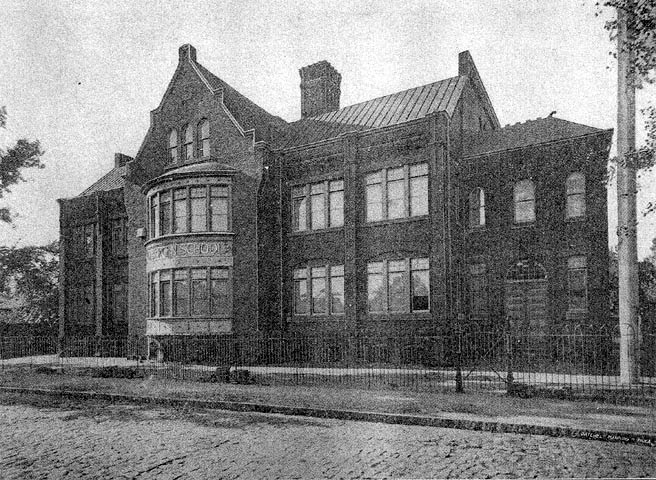
The C.A. Bergen School
A change in local government cost John Brothers his job at the C.A. Bergen School in June of 1898. His political connections paid off, and he was given a post as deputy keeper at the State Prison in Trenton, New Jersey. He and wife Emma went to Trenton for a couple of years, living at 311 South Broad Street in 1900 and 1901. By the spring of 1905 he had returned to Camden. In July of 1905 he was reappointed to the Camden Police Department. The 1906 City Directory shows him living at 1108 Newton Avenue, and the 1907 Directory lists him at 518 Spruce Street, where he stayed through 1909. John Brothers was promoted to Detective in 1908, and was involved in many significant cases.
The 1910 Census and City Directories through 1917 show John and Emma Brothers at 524 Spruce Street. This Census also indicated that both John and Emma both had previously been married, however, as of this writing nothing is known about that. By the end of 1919 John and Emma Brothers had moved to 811 Haddon Avenue. Emma was in poor health at the time. Not long after the Census was taken they moved to 1010 South 5th Street. Emma Brothers passed away on September 11, 1921. A newspaper article reporting her passing gives an address of 1019 South 5th Street, this, however appears to be a typographical error.
John Brothers remarried not long afterwards. His new wife, the former Mrs. Nettie C. Jacobs, was a well known dog fancier. The 1922 and 1923 City Directories show him and Nettie C. Brothers at 1427 Kaighn Avenue in Parkside.
Close to the often un-enforced retirement age of 65, John Brothers was reported to be considering retirement due to either ill-health or disability in November of 1922. John Brothers does not appear in Camden Directories after 1923 nor does he appear in the 1930 Census. Mrs. Nettie Brothers does, however. She was living in Mt. Holly, New Jersey when the Census was taken in April. The Census indicates she was a widow at that point.
In the Political Whirl
Philadelphia Inquirer —
Camden in a Lively Congressional Contest.
ANTI-GRATZ WORKERS ENCOURAGED
Campaign Jottings of Interest Gathered at the City and State Committee Headquarters of Both Parties.
There was widespread interest in the Republican delegate election in Camden county last night. Delegates were chosen to the Congressional District Convention, which meets at Bridgeton on Thursday next. Hon. Thomas H. Dudley and Christopher Bergen were the rival candidates, and the latter’s friends claim to have carried every ward in the city.
During the voting at the Fourth ward polls Policeman Ikey Scheeve got into an altercation with two men named Richmond and Walters. It is alleged that he used a blackjack without provocation. The two men who were assaulted immediately engaged the services of a lawyer, who will cause Sheeve’s arrest to-day on the charge of assault and battery. Following are the delegates elected in Camden city and in the various townships:
First Ward—W. Baily, Isaac Githens, George Barrett, Frank Welch and Howland Croft.
Second Ward—J. Willard Somers, Frank C. Somers, John Wells, W. H. Day and Samuel Bakely.
Third Ward—Dilwyn Pettit, J. Milton Powell, David Freeman, Sr., George Denny and Albion Lane.
Fourth Ward—Everett Ackley, Samuel M. Gall, William Ireton, Joseph Brown and Howard Lee.
Fifth Ward—Christopher J. Mines, Jr., Frederick Parker, John H. Miller, David Rankin and Samuel Roach.
Sixth Ward—A. R. Dease, James Brown, Isaac Robinson, John Brother and James Hewitt.
Seventh Ward—John C. Edwards, M. D. Cornish, William K. Price, Reuben Gaskill and John W. Everman.
Eighth Ward—Samuel H. Mourey, William H. Smith, Herman Helmbold, E. Thompson and Thomas Watson.
Stockton township was carried by Dudley, and W. Harrison Livermore carried Woodbury. Centre, Delaware and Haddon townships of Camden county were carried by Bergen.
The Congressional district includes Camden, Gloucester, Cumberland, Salem and Cape May counties. The indications are that Congressman Hires will be renominated.
Police Appointments
Philadelphia Inquirer —
The annual meeting of the Camden Excise Board was held last evening, when Thomas Harman, Republican, was elected president. One license was granted and three transferred. The following applicants were refused: John H. Green, No. 5 South Third street; Frederick Funk, Seventh and Cherry streets; Samuel Beaton, Sixth and Clinton streets; John Brothers, Second and Stevens streets.
A Gale in the City
Philadelphia Inquirer —
Philadelphia Catches the Small End of the Cyclone.
Vessels Damaged in the River
Fears That the Shipwreck and Loss of Life Have Been Very Heavy—General Anxiety Felt for Friends at the Seashore Resorts.
A Boat Containing Five Men Upset.
A bad accident in the Delaware was added to the damages and dangers of the storm yesterday. A party of Camden young men started down the river in the morning in the sloop Petrel. The party was composed of George Morgan, of Fifth and Spruce streets; Harry Mines, of Third and Pine; S. R. Lodge, living on Penn street, above Third; John Brothers, of Broadway and Mount Vernon, and John Myers, of Taylor avenue. The party was opposite Cohansey creek, about 30 miles down the river, when the wind grew so strong that it was impossible to manage the boat, and she went over into the waves.
The men by hard struggling were able to hold on until Captain Hogate, of the Philip Ford, rescued them. The Petrel was lost.
Camden Gunners Wrecked.
Philadelphia Inquirer —
Narrow Escape of Nine Men and Loss of the Yacht Perry.
Nine Camden young men who started for Reedy Island down the Delaware in the cabin sloop yacht Samuel Perry were wrecked at Cohansey creek and two narrowly escaped drowning Monday night. The men were Jeremiah Bennett, Officer John Brothers, William Chew, Samuel Lodge, who was the captain of the craft; George Hunt, George Meyers, Hugh McLaughlin, Harry Mines and George Morgan. The boat was 33 feet long and not any too seaworthy. In going about just off Cohansey Light the first flaw of the coming storm caught them with a back wind and immediately turned them over, and all hands made for the yawl, into which they were safely placed. The wind freshened as they came within six hundred yards of the mouth of the creek and the yawl capsized, plunging the men into the water. Two of the company could not swim, George Morgan and Hugh McLaughlin, and they were saved with difficulty by their companions. The men were landed in an exhausted condition and were brought back to Camden on the Delaware extension of the Pennsylvania Road.
Nothing was saved excepting four guns belonging to the party, Mr. Chew losing, besides, a gold watch, $50 in money. Messrs. Chew and McLaughlin are laid up from exposure. The Samuel Perry went to pieces. She was the property of a Camden man.
Dunkle’s Case Off
Philadelphia Inquirer —
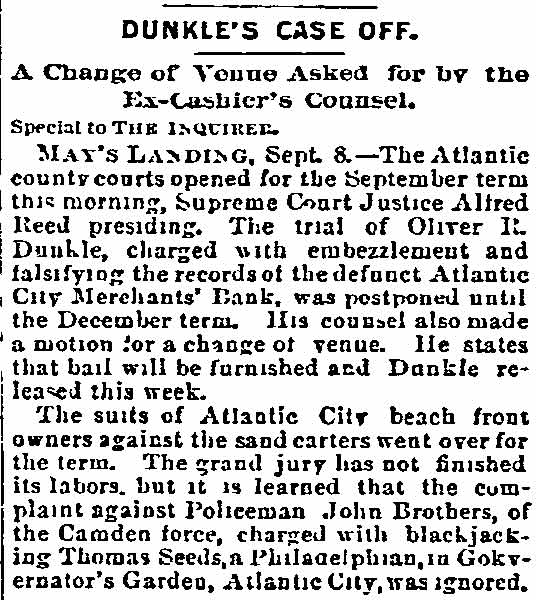
A Change of Venue Asked for by the Ex-Cashier’s Counsel
Special to THE INQUIRER
MAY’S LANDING, Sept. 8.—The Atlantic county courts opened for the September term this morning, Supreme Court Justice Alfred Reed presiding. The trial of Oliver R. Dunkle, charged with embezzlement and falsifying the records of the defunct Atlantic City Merchants’ Bank, was postponed until the December term. His counsel also made a motion for a change of venue. He states that bail will be furnished and Dunkle released this week.
The suits of Atlantic City beach front owners against the sand carters went over for the term. The grand jury has not finished its labors, but it is learned that the complaint against Policeman John Brothers, of the Camden force, charged with blackjacking Thomas Seeds, a Philadelphian, in Governor’s Garden, Atlantic City, was ignored.
Sixth Ward Republican Club Elects Delegates
Philadelphia Inquirer —

The Sixth Ward Republican Club has elected City Clerk Varney, Deputy Sheriff Sell, William D. Brown, E. E. Jefferis and John Brothers as delegates to the State League of Republican Clubs.
Police News
Philadelphia Inquirer —
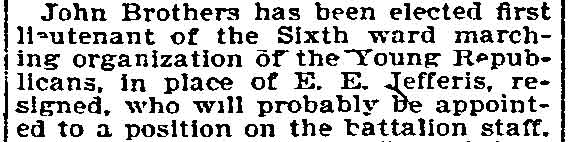
John Brothers has been elected first lieutenant of the Sixth ward marching organization of the Young Republicans, in place of E. E. Jefferis, resigned. Who will probably be appointed to a position on the battalion staff.
Hot Time in the Flats
Camden Daily Telegram —
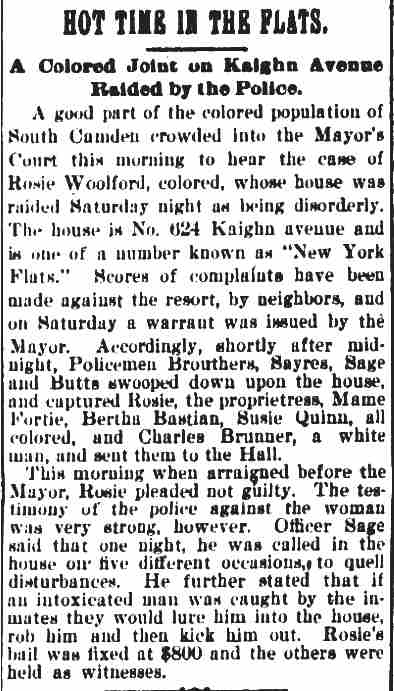
A Colored Joint on Kaighn Avenue Raided by the Police.
A good part of the colored population of South Camden crowded into the Mayor’s Court this morning to hear the case of Rosie Woolford, colored, whose house was raided Saturday night as being disorderly. The house is No. 624 Kaighn avenue and is one of a number known as “New York Flats.” Scores of complaints have been made against the resort, by neighbors, and on Saturday a warrant was issued by the Mayor. Accordingly, shortly after midnight, Policemen Brouthers, Sayres, Sage and Butts swooped down upon the house, and captured Rosie, the proprietress, Mame Fortie, Bertha Bastian, Susie Quinn, all colored, and Charles Brunner, a white man, and sent them to the Hall.
This morning when arraigned before the Mayor, Rosie pleaded not guilty. The testimony of the police against the woman was very strong, however. Officer Sage said that one night, he was called in the house on five different occasions, to quell disturbances. He further stated that if an intoxicated man was caught by the inmates they would lure him into the house, rob him and then kick him out. Rosie’s bail was fixed at $800 and the others were held as witnesses.
Thirteen Victims of the Reform Ax
Philadelphia Inquirer —
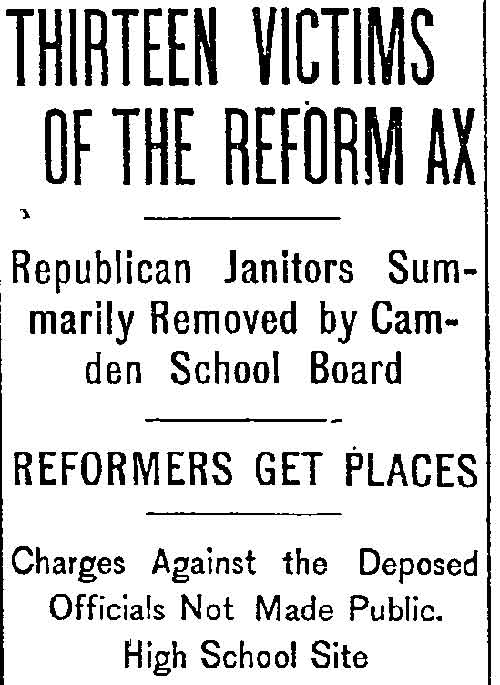
Republican Janitors Summarily Removed by Camden School Board
REFORMERS GET PLACES
Charges Against the Deposed Officials Not Made Public. High School Site
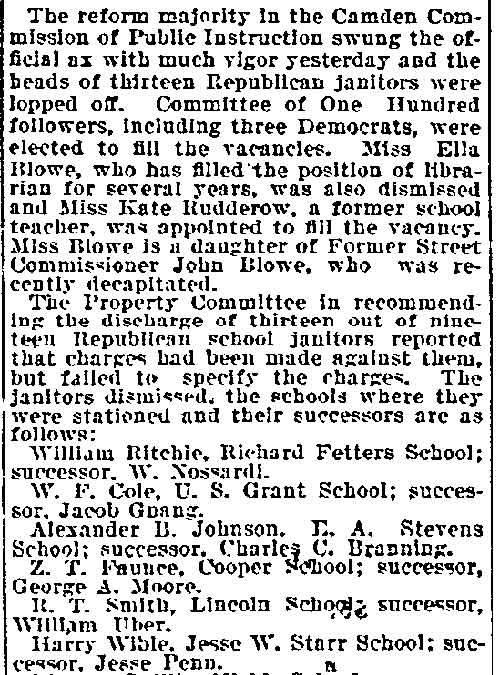
The reform majority in the Camden Commission of Public Instruction swung the official ax with much vigor yesterday and the heads of thirteen Republican janitors were lopped off. Committee of One Hundred followers, including three Democrats, were elected to fill the vacancies. Miss Ella Blowe, who has filled the position of librarian for several years, was also dismissed and Miss Kate Rudderow, a former school teacher, was appointed to fill the vacancy. Miss Blowe is a daughter of Former Street Commissioner John Blowe, who was recently decapitated.
The Property Committee in recommending the discharge of thirteen out of nineteen Republican school janitors reported that charges had been made against them, but failed to specify the charges. The janitors dismissed, the schools where they were stationed and their successors are as follows:
William Ritchie, Richard Fetters School; successor, W. Nossardi.
W. F. Cole, U. S. Grant School; successor, Jacob Gnang.
Alexander B. Johnson, E. A. Stevens School; successor, Charles C. Branning.
Z. T. Faunce, Cooper School; successor, George A. Moore.
R. T. Smith, Lincoln School; successor, William Uber.
Harry Wible, Jesse W. Starr School; successor, Jesse Penn.
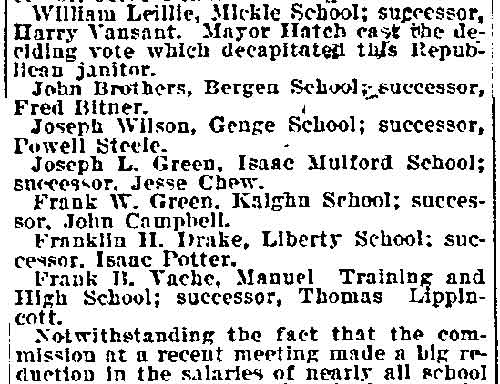
William Leillie, Mickle School; successor, Harry Vansant. Mayor Hatch cast the deciding vote which decapitated this Republican janitor.
John Brothers, Bergen School; successor, Fred Bitner.
Joseph Wilson, Genge School; successor, Powell Steele.
Joseph L. Green, Isaac Mulford School; successor, Jesse Chew.
Frank W. Green, Kaighn School; successor, John Campbell.
Franklin H. Drake, Liberty School; successor, Isaac Potter.
Frank B. Vache, Manual Training and High School; successor, Thomas Lippincott.
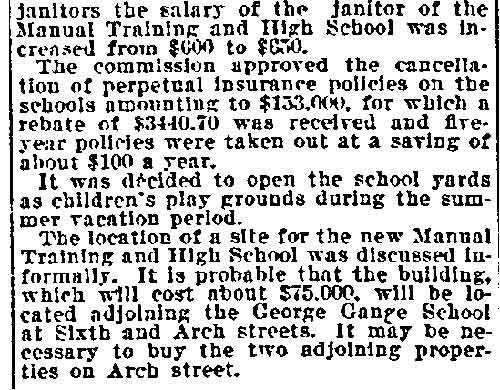
Notwithstanding the fact that the commission at a recent meeting made a big reduction in the salaries of nearly all school janitors the salary of the janitor of the Manual Training and High School was increased from $600 to $670.
The commission approved the cancellation of perpetual insurance policies on the schools amounting to $133,000, for which a rebate of $3440.70 was received and five-year policies were taken out at a saving of about $100 a year.
It was decided to open the school yards as children’s play grounds during the summer vacation period.
The location of a site for the new Manual Training and High School was discussed informally. It is probable that the building, which will cost about $75,000, will be located adjoining the George Genge School at Sixth and Arch streets. It may be necessary to buy the two adjoining properties on Arch street.
John Brothers Goes to Trenton
Philadelphia Inquirer —

John Brothers, a Republican who was recently removed by the Reformers from his position as janitor of one of the public schools, has been appointed a deputy keeper in the State prison at Trenton.
Will Be Mayor’s Private Secretary
Philadelphia Inquirer —
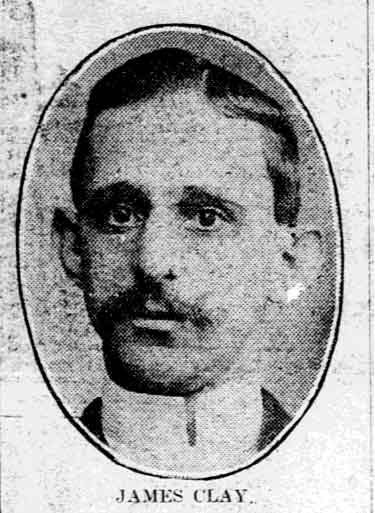
James Clay.
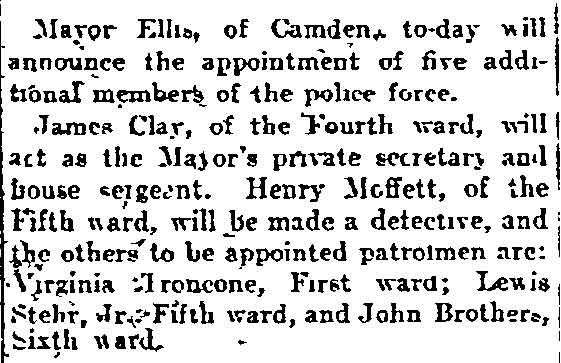
Mayor Ellis, of Camden, to-day will announce the appointment of five additional members of the police force.
James Clay, of the Fourth ward, will act as the Mayor’s private secretary and house sergeant. Henry Moffett, of the Fifth ward, will be made a detective, and the others to be appointed patrolmen are: Virginia [sic] Troncone, First ward; Lewis Stehr, Jr., Fifth ward, and John Brothers, Sixth ward.
Detective Moffett Begins His Duties
Camden Post-Telegram —
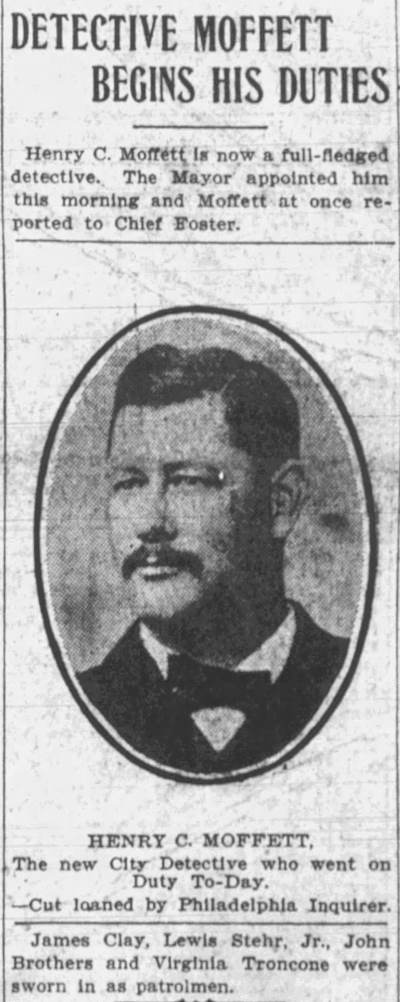
Henry C. Moffett is now a full-fledged detective. The Mayor appointed him this morning and Moffett at once reported to Chief Foster.
HENRY C. MOFFETT, The new City Detective who went on Duty To-Day. —Cut loaned by Philadelphia Inquirer.
James Clay, Lewis Stehr, Jr., John Brothers and Virginia [sic] Troncone were sworn in as patrolmen.
New Officers Sworn In
Philadelphia Inquirer —
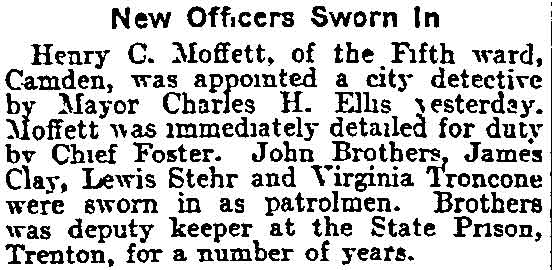
Henry C. Moffett, of the Fifth ward, Camden, was appointed a city detective by Mayor Charles H. Ellis yesterday. Moffett was immediately detailed for duty by Chief Foster. John Brothers, James Clay, Lewis Stehr and Virginia Troncone were sworn in as patrolmen. Brothers was deputy keeper at the State Prison, Trenton, for a number of years.
Auto Struck Policeman
Philadelphia Inquirer —
Officer Albert Keaser Badly Injured in Camden
Run down by an automobile at Broadway and Chestnut streets, Camden, Policeman Albert Keaser was severely injured last night. Keaser jumped from a trolley car directly in front of the machine. Before the chauffeur could turn aside the auto knocked the policeman to the ground, tearing two holes in his right leg and badly bruising him about the body. He was taken to the patrol house and then to his home on Washington street.
Policeman John Brothers in the meanwhile had arrested the occupants of the machine. Taken to the City Hall they gave the names of Alexander and Leon Rudolph, sons of a prominent Camden business man. It was shown that the affair was purely accidental and after their father had promised to produce his sons when requested they were discharged from custody.
Four Culprits Go to Prison
Philadelphia Inquirer —
Thomas White, Richard Lewis, James T. Smith and Edward Benson were taken to State prison at Trenton by Sheriff Somers, of Camden, yesterday. White and Lewis were each sentenced to two years for stealing a tray containing diamonds from a jewelry store. Smith was caught committing burglary by Policeman John Brothers, who recognized the fellow as having served a sentence while he (Brothers) was a State prison deputy keeper. Smith was sentenced to five years. Benson received a similar sentence for assaulting Mrs. Clymer on a road near Haddonfield.
Police Almost Got Cool Bath
Camden Daily Courier —
Someone Pulled Plug Out of a Chute-the-Chute Boat
FEARED A DUCKING IN LAGOON
Policemen “AL” Snow, “Jack” Brothers, “Tommie” Reed, “Tommie” Murphy and “Jeff” Kay, who acted as an escort to the youngsters of this city on their annual outing as guests of William J. Thompson, at Washington Park, yesterday, had rather an exciting experience. Snow and Brothers especially were for a time in a fair way of taking an involuntary plunge into the lagoon at the foot of the chute-the-chute affair.
After the children had been carefully looked after the bluecoats concluded to have a little pleasure on their own hook.
“Let’s try the chutes,” suggested Reed.
“Agreed,” said the other four in unison.
In a short time the quartet of coppers were being taken up on the elevator to the top of the tower. Then down the slide they went in the usual hurried manner. As soon as the water in the lagoon was encountered “Jack” Brothers felt something on his back. A hasty glance revealed the fact that there was a small sized geyser issuing from a hole in the flat bottomed scow. The plug had been removed and through the two inch aperture the water was rushing in at a great rate. In fact the ungainly craft began filling. The chap at the end who acted as sculler went toward shore, when Kay, Reed and Murphy jumped out onto the wharf.
Then, with Snow and Brothers still aboard, the scow drifted toward the middle of the place. All the time the water was entering and when it had reached the seats the sculler jumped overboard, leaving “Jack” and “Al” in the lurch.
“No, you don’t; you come back here,” commanded “Jack” to the oarsman.
The latter, thinking the officer was going to shoot, climbed back into the scow and then sculled to the wharf, when the two hopped ashore.
They are wondering as to who was responsible for the removal of the plug.
Camden Increases Its Police Force
Philadelphia Inquirer —
Mayor Ellis Adds Twenty-five New Officers to Growing City’s Department
Camden’s police force was increased by the appointment of twenty-five additional officers by Mayor Ellis yesterday. There were also several promotions, two new captains, two sergeants and one detective being made as follows: Captains, Edward Hyde and A. Lincoln James, advanced from sergeants; sergeants, E. B. McClong and Edward Hartman, advanced from patrolmen; detective, John Brothers, advanced from patrolman: new patrolmen. Fred Schweizer, William Briant, Charles Hume, Charles Wilbur, Wright Cox, Walter Stanton, John Barnett, Tabor Quinn, John Gilbert, Joseph Palese, William Haines, Frederick Watson, Charles Whaland, William Kiker, James Hutt, George Krown, Ube Andrews, Daniel Stanton, Albert Archer, Harry Bakley, John Shuman, Oscar Till, Albertson Matlack, John Devlin, George Hollins, Frank Koplain, Edward King and George Beasley, substitutes.
For the past several weeks there has been much pulling and hauling of the political wires and the various ward leaders have had their own troubles in making selections. Each appointee was subjected to a regulation army examination by Dr. A. H. Lappincott [sic] before he was pronounced fit for the service. When the horses are procured, which may be by next June, six of the men will compose a mounted squad.
Police News
Philadelphia Inquirer —

After an investigation by Detective Brothers the police have learned that the note left by two young women last Saturday, in which they hinted at suicide, was a joke. Both have returned home.
Escaped Patient Captured
Philadelphia Inquirer —

Five hours after he escaped from a sanatorium at Byberry, Pa., Michael Morgan was captured in Camden by Detectives Brothers and Moffett.
Police News
Philadelphia Inquirer —

Detective Brothers yesterday located in a Philadelphia pawnshop a quantity of silverware and other articles stolen from the home of Mrs. Emma Thompson, of 210 Taylor Avenue.
Barber Breaks Away from Detective
Philadelphia Inquirer —
Arrested by Detective Brothers on a serious charge made by Elmer Calloway, a 14 year-old boy, Alfor Printz, a barber, broke away from the sleuth and made an effort to escape. As he turned Broadway and Kaighn avenue at full speed Reserve Policeman Brothers, a brother of the detective, felled him with his club, and recapture was easy. Relatives have asked the police to have him examined as to his sanity.
CAMDEN NEWS NOTES -- Walton Jewelry Recovered
Philadelphia Inquirer —
CAMDEN NEWS NOTES
A watch and other jewelry stolen two weeks ago from the residence of P. A. Walton, 730 Linden Street, were recovered yesterday in a Philadelphia pawnshop by Detective Brothers.
Camden Holds Four as Counterfeiters
Philadelphia Inquirer —
Secret Service Men, After One, Bag Unexpected, More-Sought-For Suspect
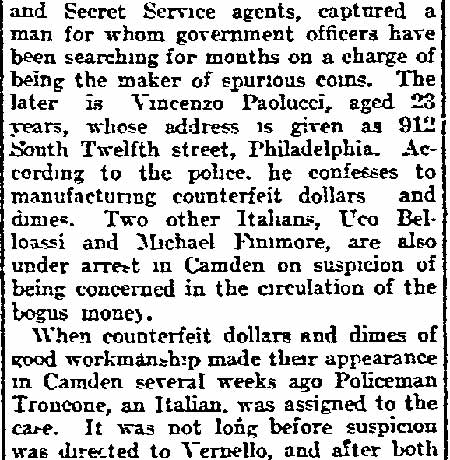
Raiding a house at 403 Cherry street, Camden, last evening for the purpose of arresting Luigi Vernello, against whom suspicion of passing counterfeit money has long been directed, Camden police and Secret Service agents, captured a man for whom government officers have been searching for months on a charge of being the maker of spurious coins. The later [sic] is Vincenzo Paolucci, aged 23 years, whose address is given as 912 South Twelfth street, Philadelphia. According to the police, he confesses to manufacturing counterfeit dollars and dimes. Two other Italians, Uco Belloassi and Michael Finimore, are also under arrest in Camden on suspicion of being concerned in the circulation of the bogus money.
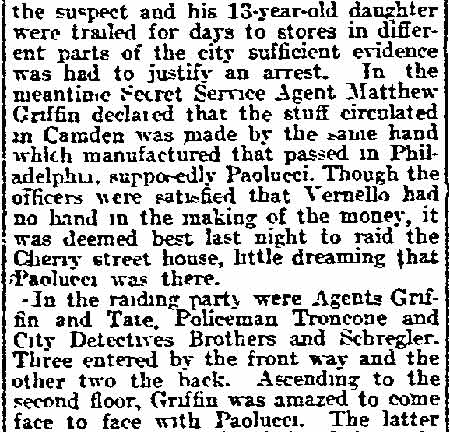
When counterfeit dollars and dimes of good workmanship made their appearance in Camden several weeks ago Policeman Troncone, an Italian, was assigned to the care [sic]. It was not long before suspicion was directed to Vernello, and after both the suspect and his 13-year-old daughter were trailed for days to stores in different parts of the city sufficient evidence was had to justify an arrest. In the meantime Secret Service Agent Matthew Griffin declared that the stuff circulated in Camden was made by the same hand which manufactured that passed in Philadelphia, supposedly Paolucci. Though the officers were satisfied that Vernello had no hand in the making of the money, it was deemed best last night to raid the Cherry street house, little dreaming that Paolucci was there.
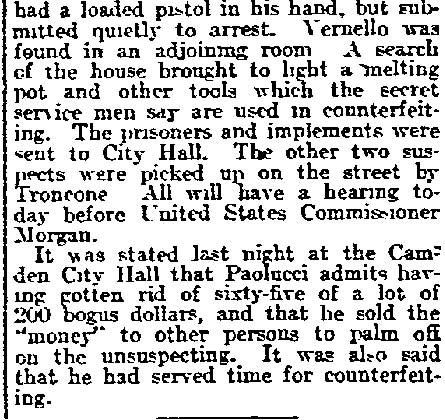
In the raiding party were Agents Griffin and Tate, Policeman Troncone and City Detectives Brothers and Schregler. Three entered by the front way and the other two the back. Ascending to the second floor, Griffin was amazed to come face to face with Paolucci. The latter had a loaded pistol in his hand, but submitted quietly to arrest. Vernello was found in an adjoining room. A search of the house brought to light a melting pot and other tools which the secret service men say are used in counterfeiting. The prisoners and implements were sent to City Hall. The other two suspects were picked up on the street by Troncone. All will have a hearing today before United States Commissioner Morgan.
It was stated last night at the Camden City Hall that Paolucci admits having gotten rid of sixty-five of a lot of 200 bogus dollars, and that he sold the “money” to other persons to palm off on the unsuspecting. It was also said that he had served time for counterfeiting.
Camden News Notes
Philadelphia Inquirer —
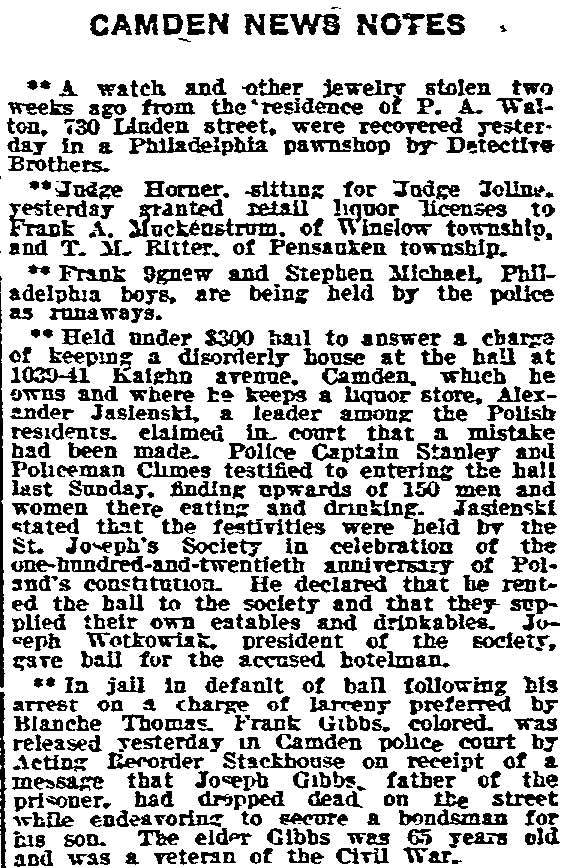
A watch and other jewelry stolen two weeks ago from the residence of P. A. Walton, 730 Linden street, were recovered yesterday in a Philadelphia pawnshop by Detective Brothers.
Judge Horner, sitting for Judge Joline, yesterday granted retail liquor licenses to Frank A. Muckenstrum, of Winslow township, and T. M. Ritter, of Pensauken township.
Frank Agnew and Stephen Michael, Philadelphia boys, are being held by the police as runaways.
Held under $300 bail to answer a charge of keeping a disorderly house at the hall at 1039-41 Kaighn avenue, Camden, which he owns and where he keeps a liquor store, Alexander Jasienski, a leader among the Polish residents, claimed in court that a mistake had been made. Police Captain Stanley and Policeman Climes testified to entering the hall last Sunday, finding upwards of 150 men and women there eating and drinking. Jasienski stated that the festivities were held by the St. Joseph’s Society in celebration of the one-hundred-and-twentieth anniversary of Poland’s constitution. He declared that he rented the ball [sic] to the society and that they supplied their own eatables and drinkables. Joseph Wotkowiak, president of the society, gave bail for the accused hotelman.
In jail in default of bail following his arrest on a charge of larceny preferred by Blanche Thomas, Frank Gibbs, colored, was released yesterday in Camden police court by Acting Recorder Stackhouse on receipt of a message that Joseph Gibbs, father of the prisoner, had dropped dead on the street while endeavoring to secure a bondsman for his son. The elder Gibbs was 65 years old and was a veteran of the Civil War.
Found Stockings in Her “Rat”
Philadelphia Inquirer —
When 16-year-old Josephine Desperak was taken to the Camden city jail by Detective Brothers yesterday on suspicion of stealing $20 and four pairs of socks, the money was located, but the socks were nowhere in evidence. Matron Kirkpatrick searched the girl, but still the stockings were not found. When Josephine emerged from the minute examination Detective Brothers told the girl to “let down” her hair. As she did so the stockings were found wrapped about the “rat” the girl had been wearing beneath her luxuriant tresses. Recorder Stackhouse sent her to the county jail.
Coursey Breaks Down While Story of Cold-Blooded Killing of Karl Kellmann Is Told by Detective
Camden Post-Telegram —
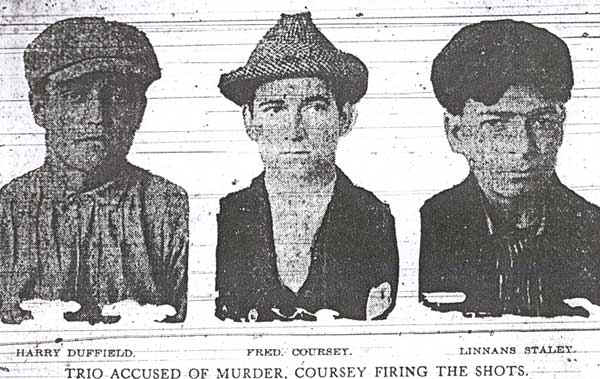
Two “Pals,” Too, Accused of Crime
Harry Duffield. Fred. Coursey. Linnans Staley.
Trio Accused of Murder, Coursey Firing the Shots.
Collapsing when arraigned in Police Court this morning before Recorder Stackhouse on the charge of killing Karl Kellmann, aged 18 years, of 2919 High street, at Twenty-seventh and Sherman streets, shortly before midnight Saturday, Fred Coursey, alias “Mexican Pete,” alias “Cowboy Pete,” aged 20 years, of 121 North Twenty-first street, who admits firing the fatal shots while committing robbery, and Harry Duffield, aged 21 years, of 407 North Forty-first street, who acknowledged masking his face with a handkerchief and being with Coursey, sobbed piteously, resting their heads on the railing of the dock, while John Painter, the veteran detective, was briefly reciting the story.
When Recorder Stackhouse asked what became of the young man who was shot and Painter replied that he died, Coursey and Duffield sobbed afresh, and when Recorder Stackhouse committed them without bail Policemen Frost and Kay had to help them.
Linnans Staley, aged 21 years, of 1819 Federal street, who confessed that he was in the robbery plot but later got scared and hid in the bushes, was scarcely able to stand, and when his mother broke down as he was committed as a principal he staggered and would have fallen but for Sergeant McClong.
Prosecutor Boyle announced this morning that the Grand Jury will be recalled for Thursday of this week and the case will be made the special order of the day.
Without the slightest clue to start with in the most brutal murder committed in recent years in Camden county, police and detectives under the personal direction of Chief Gravenor in two hours arrested two of the three prisoners and obtained their signatures to confessions and before sunrise the other was lodged behind the bars at the City Hall.
According to their statements to the police the prisoners while drinking on a lot near Twenty-first and Federal streets on Saturday night planned to go to a lone spot near Twenty-seventh and Sherman streets to hold someone up to get money and jewelry to buy more drink. Coursey had a 38-calibre cowboy pistol and Duffield used Coursey’s bandanna as a mask. Staley weakened before the spot selected was reached and at the time of the murder was hiding in a clump of weeds a short distance away.
The murdered boy was the son of Karl and Lulu D. Kellmann. He was a member of the Bible class of Grace Presbyterian Church, East Side, and active in church work.
Saturday night was the closing of a carnival given on High street between Twenty-seventh and Thirtieth streets. Karl was there and made several purchases. At one booth he bought a necktie, from another some ice cream and a box of candy and spent some time conversing with the young ladies connected with the church.
When it grew rather late he noticed that Misses Bertha and Bessie Skillen, of 815 North Thirty-fourth street, the latter a teacher in Grace Church Sunday-school, were without an escort and he volunteered to see them home. They accepted his invitation to be their escort. He saw them safely home and he was on his way back and had reached a point on the east side of Twenty-seventh street south of Sherman street and near the foot of the bridge that spans the Pennsylvania Railroad tracks when two men jumped out from behind a tree and as one commanded him to hold up his hands the other began to shoot.
The first shot struck him in the breast and turned him partially around. The next ploughed a hole through his neck, knocking him down, and the third went wide.
Screaming for help he tried to rise to his feet and was on his knees when Night Yardmaster Albert Ludlow and Brakeman Joseph Wittick, who were on the opposite side of the bridge, ran to his assistance. By the light of their lanterns they saw that he was seriously hurt and they took him to ’Squire Sasse’s house nearby to await the arrival of the ambulance. As the railroaders sped across the bridge Ludlow saw a man run down the tracks in the direction of Seventeenth street.
In the signal tower at Pavonia station known as C. B. the operator, Thomas Sink, heard the shots and cries for help and ’phoned to Captain James at Police Headquarters that a murder had been committed. Sink also saw a man run down through the weeds and bushes on the east side of the bridge toward the railroad tracks.
Policeman Hurlock and Schmid, ’Squire and Mrs. Sasse and several others were out on the street before the railroad men reached the Sasse home and all hurried to ’phones to notify police headquarters.
In less than five minutes by use of the red light system Captain James had every officer on duty on the East Side hurrying to the scene, officers stationed at every bridge, ferry house and railroad terminal, and the downtown auto with Detectives Schregler, Painter, Brothers and Moffett on its way to East Camden.
On information from the railroad men Sergeant Horner took all the East Side officers and the four detectives and they worked westward among the cars while Captain James started Policemen Colsey and Kelly to walk eastward from Fifteenth street until they met the main body.
The search proved fruitless and as they returned to the bridge one of the men picked up a green bandanna with yellow spots and sheep burrs embeded [sic] on it on the incline near the signal tower. Later he recalled that the man who went down the slope wore a Khaki shirt and cap.
The handkerchief was recognized as the kind used by “Indian Bill” May, and Detectives Brothers and Policeman Abbott were sent to arrest him. They found May and Eugene Cafferty asleep in a moving van in Marlton avenue. “Indian Bill” soon established an alibi.
Detective Schregler and a couple of officers who were sure that the description of the man with the khaki shirt tallied with Duffield started for his brother’s house, but failed to find him there. About this time the downtown auto turned into Twenty-seventh street to get Karl’s father, mother and sister and take them to the hospital. Councilman Finkeldey and a friend shouted to the crew that a woman was down and out on a step nearby, but the crew yelled back that they were on an emergency run and the woman would keep until they returned. Fireman J. H. Vickers walked across the street to investigate and found that the supposed woman was Duffield and that he seemed to be asleep.
Vickers shook him and as he got up he said something about the shooting that aroused Vickers’ curiosity and he ’phoned to Police Headquarters. Captain James immediately notified Chief Gravenor, who was on the scene and the latter sent Detective Moffett to investigate. When Moffett arrived he learned that Duffield had taken a Westfield avenue car. Moffett returned to the bridge and he and Detective Painter and Chief Gravenor took the down-town auto for Duffield’s home.
Painter went to the front door and saw Duffield in the act of taking off his shoes. Moffett in going around to the back door to prevent his escape that way passed by the window at which Duffield was sitting.
Grasping Duffield by the collar Moffett pulled him through the window to the ground. As soon as he landed on his feet, according to the Chief and detectives, Duffield said that Coursey did the shooting.
Placing him in the auto they next drove close to Coursey’s home and with Policeman Potter who knew the man wanted, the detectives entered the house with drawn revolvers while other officers guarded all avenues of escape.
Coursey was found akwake [sic] on a cot and while he was covered with revolvers Detective Painter searched his trunk and found the weapon that he later admitted using. It was empty. The detectives late yesterday afternoon found three used shells adjoining the house near a spot where Coursey said he had thrown them.
In order to keep the men apart they were taken to the City Hall separately and questioned and after they decided to tell all Sergeant E. B. McClong reduced their statements to writing and they signed them. It was on the strength of these statements that Staley was arrested.
Young Kellmann was taken into the hospital at 12.20 a. m. Chief Surgeon Schellenger saw at a glance that there was no hope for him and so notified Captain James, and Sergeant McClong was sent to the hospital to get all information possible.
The unfortunate youth could only speak a few words at a time because of the hemorrhages. All Sergeant McClong was able to get from him was that he was told to hold up his hands and that the shooting instantly began. The only description he could give was that they were small men and that the attack was so sudden that he could not tell whether they were black or white.
The injured young man kept asking the doctors if he was going to die, but they did not answer. He was conscious when his father and mother arrived and then sank rapidly until the end, dying at 1.50 o’clock, 90 minutes after he was admitted. Mother and father were prostrated and were taken home by the up-town auto.
County Physician Jones conducted the autopsy yesterday morning. He said that either wound would have caused death. The bullet in the breast pierced the right lung at the top and lodged in the cavity. It is now in the doctor’s possession. The other bullet went clear through the neck.
Coursey and Duffield have been working in the Pavonia car yard. The former was born in El Paso, Texas, but has lived East nearly all his life. He is an expert shot and was a member of the vaudeville team of Coursey & Cook, according to their letter heads presenting a fifteen-minute thriller.
Duffield was only recently paroled for robbing Gallagher’s saloon, Nineteenth and Federal streets of a lot of drinkables. Staley has been arrested several times on petty charges but was never convicted of crime. When Duffield’s coat was examined at the City Hall, it was found to contain sheep burrs.
To a reporter Coursey said that whenever he was drinking he had to get his gun and shoot something or somebody. He insisted that all were in on the job and that they let the man who preceded Kellman go over the bridge without molestation because he didn’t look as if he had any too much money.
Yesterday morning Assistant Prosecutor Wolverton and Stenographer Cleary called at the City Hall. The prisoners were examined by Mr. Wolverton and their statements taken by Mr. Cleary, but there was little or nothing new elicited.
Haggerty Missed Kellmann’s Fate
Camden Post-Telegram —
Carman Street Man Passed Youth’s Slayers Shortly Before the Murder.
SPOKE TO DUFFIELD ON RAILROAD BRIDGE
Through the efforts of Detectives Painter and Moffett the identity of the man who crossed the railroad bridge at Twenty-seventh street just previous to the murder of Karl Kellmann on Saturday night has been established.
He is William Haggerty, of 2806 Carman street.
In their signed confessions Duffield and Coursey said that soon after reaching the bridge, bent on robbery, a man aproached [sic] but they decided not to hold him up. A few minutes later Kellmann came along and the killing followed.
According to Mr. Haggerty’s statement he had been visiting friends near the river front and was on his way home. As he approached the bridge he saw two men acting suspiciously and as he drew nearer he decided to be on the alert.
As he came up to them he saw that one of them was Duffield and after speaking to him pleasantly went on without being interfered with. The detectives are also investigating a rumor to the effect that prior to the murder the three young men attempted to hold up a railroad man on the lots near Twenty-seventh and Saunders streets.
Yesterday afternoon a young woman found a 38 calibre cartridge alongside of the house where Coursey lived and within a few feet of the spot where the three empty shells from Coursey’s gun were thrown. It was turned over to Detective Brothers.
Father Is Accused of Injuring Infant Son — 710 Woodland Avenue
Philadelphia Inquirer —
FATHER IS ACCUSED OF INJURING INFANT SON
Suffering from the last stages of spinal meningitis, Clarence Baker, 3 months old, of 710 Woodland avenue, was taken to the Cooper Hospital, Camden, last night in a dying condition.
As a result of a story told by Mrs. J. Higgins, an aunt, of 1422 South Tenth street, the father of the infant, Anthony Baker, was arrested by Detective Brothers and held pending a further investigation.
Mrs. Higgins told Dr. Paul Markley at the hospital that some night since the father, while on a drunken rampage, threw the little one on the floor. From this the disease is supposed to have developed, Dr. Markley stating to the police that it was hardly likely the infant can recover. When arrested Baker emphatically denied the story of Mrs. Higgins, asserting he loved his little son and would not harm him.
Jamesburg Reformatory Escapees Arrested in Camden
Woodbury Times —
For escaping from Jamesburg Reformatory, two boys, Robert Alburger, 14 years old, of 444 Henry street, Camden, and Charles Rump, 16 years old, of Hoboken, were arrested at the former’s home in Camden Tuesday night by City Detectives Schregler and Brothers and Captain Stanley. They were returned to the reformatory yesterday morning. Alburger and Rump are two of five boys who escaped from the home Monday night.
Police Pallbearers at Charlotte Guthridge Funeral
Philadelphia Inquirer —
At the funeral of Mrs. Charlotte Guthride [sic] from her home at 422 Walnut street yesterday, the pall bearers were all policemen, including Captain Edward Hyde, John Brothers, Thomas Brothers, and Thomas Guthridge, a nephew of the deceased.
Angry Suitor Shoots Woman, Kills Self
Philadelphia Inquirer —
Joseph Broadway Wounds Mrs. Lydia Harris After Advances Are Rejected
Angered because Mrs. Lydia Harris, 35 years old, who has a furnished room house at 512 Kaighn avenue, Camden, refused to return his affection, Joseph Broadway, 53 years old, of the same address, yesterday afternoon sent a bullet into the woman’s head over the left eye. He then turned the weapon on himself, sending a bullet into his own head over the left ear. At the Cooper Hospital, where both were sent by Detective Brothers, it was stated the woman will likely recover. The disappointed admirer died shortly after his admission.
For some time, it is asserted by the police, the man had been living with Mrs. Harris, although she did not give him any great encouragement. When yesterday afternoon he suggested that she marry him, she refused such an offer. Then he asked her to take a sociable drink with him. This she also refused. Then, walking toward the woman and drawing a revolver, Broadway said:
“Well, we might as well leave the world together.”
At that he deliberately shot the woman before she could get to a place of safety and when she fell he sent a bullet into his own head. Policeman Brothers was about to board a trolley car a short distance away when he heard the shots. He went to the house and found the man and woman in the kitchen, both of whom he had taken to the hospital at once.
Broadway was employed at the New York Shipbuilding Company’s plant and is said to come from Chesapeake City, Md. According to the police, Mrs. Harris is separated from her husband.
Wildwood Too Slow for Stella McCurdy
Philadelphia Inquirer —
“Wildwood is too slow for me in winter; I want diversion,” said Stella McCurdy, of that seaside resort, when she was taken to the Camden police headquarters yesterday. She was arrested on a charge preferred by Detectives Painter and Brothers, as she stepped from a train in the Pennsylvania Railroad station. She had packed her suitcase and was on her way to get married to a man she had met, but she had insufficient means when her father came from down shore and took her home.
Body of Infant Found
Philadelphia Inquirer —

Passing Turner Hall, Pine street below Broadway, Policeman Kleaver found a small bundle yesterday morning. On opening it he found the body of a new born male infant. Coroner Bentley sent the body to the Morgue and Detective Brothers is investigating.
Caught After Seven-Year Chase
Philadelphia Inquirer —
After a seven-year quest by the police, Frank Holt, aged 30 years, of Schnectady [sic] N. Y., was arrested in Camden yesterday by Detective Vandusen, of Schenectady and Detective Brothers of Camden. He was formally held by Recorder Stackhouse on a fugitive warrant to await the arrival of requisition papers. Holt is wanted on a charge of abandoning his wife and several children. According to Detective Vandusen he had been searching for Holt in seven States.
Detectives Find Fresh Clue to M’Carrick Boy
Philadelphia Inquirer —
Three Men With Lad Answering Description Seen in New Jersey
Philadelphia, Atlantic City and Camden Sleuths Conducting Search on Railroad
Ten days of relentless searching for 7-year-old Warren M’Carrick, who disappeared from near his home at 619 South Nineteenth street, a week ago last Thursday, received its first reward yesterday when detectives picked up in South Jersey the trail of three men, who, they believe, keep the boy in hiding during the daylight and travel with him by night.
Of the hundred or more clues and theories which have been thoroughly threshed out with the same discouraging result, the trail that was picked up at Clementon, N.J., and followed ten miles in a southern direction, supplied their first thread to a tangible solution of the mystery of the boy’s disappearance.
From a colored man who was not aware that the M’Carrick mystery was baffling the police, the first clue to the trio and the boy was obtained. The negro, Albert Hicks, was standing near the railroad station at Clementon, at 9.30 o’clock Saturday night, when he noticed three men, apparently Italians, and a 7-year-old boy resting on a darkened platform.
Unnoticed by anyone but Hicks, one of the three men removed a package containing cinnamon buns from his pocket and offered one to the lad, who was weeping. The boy took the bun in his free hand—one of the men held his other arm—and ate it ravenously.
Dragged Boy Down Tracks
Several minutes later, Hicks declared, the men, dragging the boy between them, continued down the railroad tracks. The treatment of the boy by the men impressed the colored man and prompted him to speak of the incident later. He considered a plan to offer to protect the lad, but feared to carry it out, believing that the supposed Italians carried knives.
Late Saturday night Hicks spoke of the three men and the boy to William Smith, a Clementon resident. Smith questioned the colored man and obtained from him a description of the lad. The description exactly tallied with the description of Warren M’Carrick, even to the long tassel on his red knitted cap and the rubber boots which the boy wore when he disappeared.
Employers of Hicks learned of the incident and communicated with Captain Cameron. The information was regarded in the same light as every other “clue” offered. The slightest suggestion or hint thus far given has been thoroughly investigated in the hope of at least obtaining a clue to work upon.
Detectives Impressed
Early yesterday morning Detectives Gleeson, Doyle and Belshaw went to Camden and conferred with Prosecutor Kraft. The Philadelphia detectives, with Prosecutor Kraft and Detectives Fitzsimmons and Brothers, of Camden, went to Clementon, where they interviewed Hicks.
The man’s narrative impressed the detectives, who immediately instituted a search in the vicinity. One of the detectives found the paper in which the cinnamon buns were wrapped and later discovered other evidences of the progress of the quartet along the railroad.
Hourly reports of their progress were made to Detective Lieutenant Tate who directed the search from City Hall yesterday. The reports of the investigators enthused others engaged, adding new vigor to the quest for the lad.
Convinced that the first semblance of a genuine clue had at last been uncovered Lieutenant Tate communicated with Chief of Police Woodruff of Atlantic City. The Atlantic City official was apprised of the developments and asked to co-operate in the search, which he willingly offered to do.
Railroad Lends Aid
Atlantic City detectives were sent northward along the tracks of the Atlantic City railroad while Philadelphia and Camden detectives and the constables of many New Jersey towns were proceeding southward. In this manner it was believed that if the supposed abductors were in the vicinity of the railroad they would be overtaken.
Officials of railroads operating in New Jersey also were notified of the clue and asked to give what aid they could. As a result station agents, brakemen and conductors were instructed to keep a sharp lookout for men answering the description of the suspects and the boy with them.
The New Jersey clue was further strengthened when a woman reported to the police that she had seen three men and a boy walking along the railroad tracks last night. At that time, she said, they were several miles north of Clementon. The woman did not know that Hicks had noticed them below Clementon.
Hicks accompanied the Philadelphia detectives on their search. He was questioned several times regarding the descriptions of the men who had the boy and each time the story he gave was the same. He declared that when the boy cried and refused to proceed with the trio one of them said: “Don’t do that or I will tell your mother.”
One of the suspects is described as being about 30 years old, 5 feet 6 inches in height and wearing a dark overcoat. The other two are said to be about 28 years old, and each wearing dark clothes. The three, Hicks declared, are dark complexioned.
In their search yesterday the detectives visited many farm houses and shacks. While they were in the vicinity of Clementon, Detectives Levins, Doran and Gribben, of the Camden force, conducted a search in that stretch of country between Berlin and Clementon, but without result.
To Renew Search Today
The development in New Jersey was regarded as a most important one by detectives. Early today the investigators will begin at the point they left off last night and will endeavor to find more traces of the three men and the boy. It is probable that an extra squad will take up the search tonight and remain at work until daylight.
James M’Carrick, father of the lad, spent yesterday afternoon in the Detective Bureau awaiting some definite word from the searchers. The clue from across the Delaware was by no means the only one which occupied the attention of investigators, as Captain Cameron is determined to investigate every clue no matter how idiotic it may seem.
Two of a score or more investigations made yesterday occupied many hours of the detectives’ time. One led to Jersey City and was followed out by Detective Frank O’Connor, who left the city late Saturday night and returned yesterday afternoon to report that his trip brought no result. The other led from Jenkintown to the extreme southern section of the city and was likewise unfounded.
A chance remark made by a colored woman living in a house in the rear of the M’Carrick home was responsible for the arrest of her and her husband yesterday morning. They are Henry Rosequeen and his wife, who live at 1821 Kater street. Neighbors reported to the police yesterday afternoon that while the couple were quarreling the woman said, “If you do that again I’ll tell what I know about you.”
Two policemen from the Twentieth and Fitzwater streets station went to the Kater street house and learned that the woman’s wrist had been cut. The colored man and his wife were taken to the police station and questioned. The remark, they learned, was a chance one and had nothing whatever to do with the McCarrick case.
With the New Jersey clue to spur them on the search for the boy will be continued with renewed vigor this morning. A reproduction of the lad’s photograph with the announcement that the city has offered $5000 reward for his recovery and the arrest of his supposed abductors is now in the police headquarters in almost every large city in the country.
Beginning tomorrow lantern slides bearing photographs of the lad will be flashed on the screen between performances in the motion picture theatres of Philadelphia and vicinity.
Betrayed by Letter to Girl
Philadelphia Inquirer —
Alleged to have been betrayed by the girl for whom he left his wife and children in Schenectady, N. Y., Wadyslav Okowsky, aged 24 years, was located and arrested in a house on Diamond Street, Camden, by Detective Brothers and Policeman Climes yesterday. He was held pending action on the part of the New York authorities, who accuse the man of abandonment. He is said to have written to a girl in Schenectady, to go to Camden to live with him as his wife. By that means his whereabouts were learned.
Arrest of Two Caused by Barrel of Chickens
Philadelphia Inquirer —
Charged with obtaining goods under false pretenses, Harry Bowen, aged 39 years, of 3637 Osage street, Philadelphia, and William Peters, of Fifth and Berkley streets, Camden, were each held under $1000 bail by Recorder Stackhouse, in Camden yesterday.
After shipping a barrel of chickens to Bowen at 17[?]2 Callowhill street, J. C. Elwell, a Salem farmer, became suspicious and sought the aid of the Camden police. Detective Brothers arrested the two men at the Camden terminal, where he alleges they were endeavoring to get possession of the chickens. The police say the property at the Callowhill street address is vacant.
Taken From Wife’s Side, Charged With Bigamy
Philadelphia Inquirer —
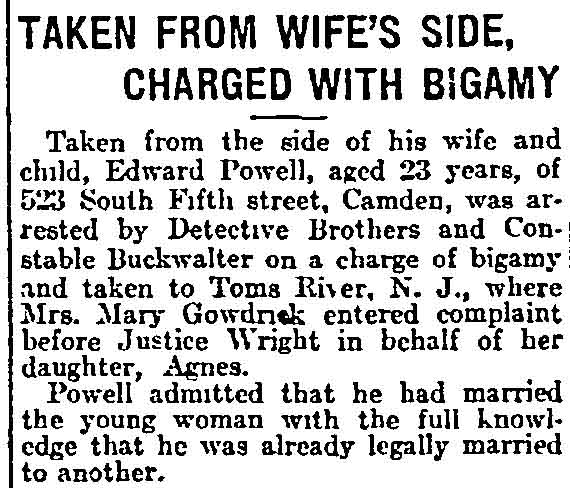
Taken from the side of his wife and child, Edward Powell, aged 23 years, of 523 South Fifth Street, Camden, was arrested by Detective Brothers and Constable Buckwalter on a charge of bigamy and taken to Toms River, N.J., where Mrs. Mary Gowdnek entered complaint before a justice in behalf of her daughter, Agnes. Powell admitted that he had married the young woman with the full knowledge that he was already legally married to another.
Missing Buttons Aid in Trapping Robber
Philadelphia Inquirer —
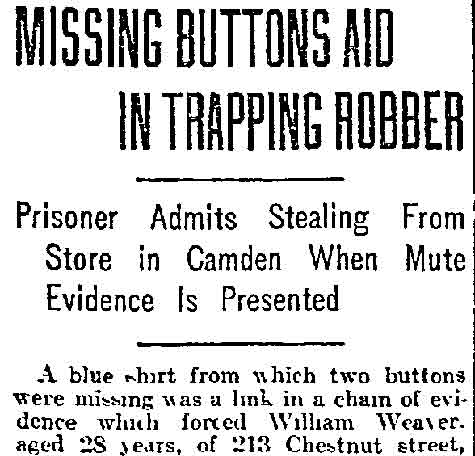
Prisoner Admits Stealing From Store in Camden When Mute Evidence Is Presented
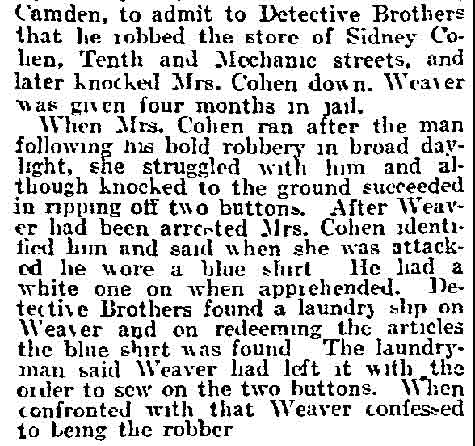
A blue shirt from which two buttons were missing was a link in a chain of evidence which forced William Weaver, aged 28 years, of 213 Chestnut street, Camden, to admit to Detective Brothers that he robbed the store of Sidney Cohen, Tenth and Mechanic streets, and later knocked Mrs. Cohen down. Weaver was given four months in jail.
When Mrs. Cohen ran after the man following his bold robbery in broad daylight, she struggled with him and although knocked to the ground succeeded in ripping off two buttons. After Weaver had been arrested Mrs. Cohen identified him and said when she was attacked he wore a blue shirt. He had a white one on when apprehended. Detective Brothers found a laundry slip on Weaver and on redeeming the articles the blue shirt was found. The laundryman said Weaver had left it with the order to sew on the two buttons. When confronted with that fact Weaver confessed to being the robber
Boys Confess Theft of Bike
Camden Post-Telegram —
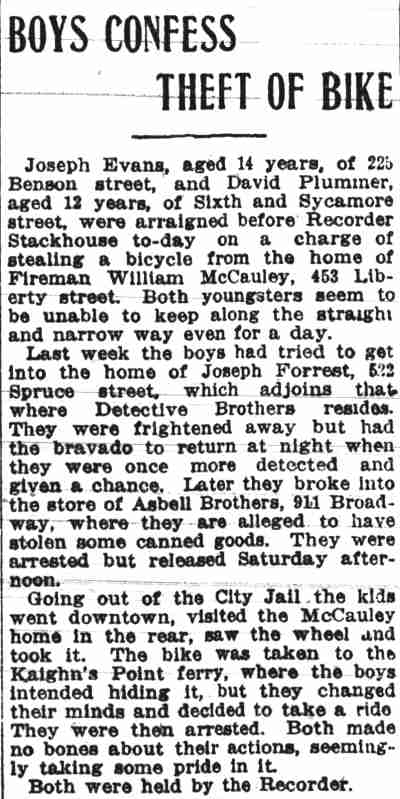
Joseph Evans, aged 14 years, of 225 Benson street, and David Plummer, aged 12 years, of Sixth and Sycamore street, were arraigned before Recorder Stackhouse to-day on a charge of stealing a bicycle from the home of Fireman William McCauley, 453 Liberty street. Both youngsters seem to be unable to keep along the straight and narrow way even for a day.
Last week the boys had tried to get into the home of Joseph Forrest, 52[?] Spruce street, which adjoins that where Detective Brothers resides. They were frightened away but had the bravado to return at night when they were once more detected and given a chance. Later they broke into the store of Asbell Brothers, 911 Broadway, where they are alleged to have stolen some canned goods. They were arrested but released Saturday afternoon.
Going out of the City Jail the kids went downtown, visited the McCauley home in the rear, saw the wheel and took it. The bike was taken to the Kaighn’s Point ferry, where the boys intended hiding it, but they changed their minds and decided to take a ride. They were then arrested. Both made no bones about their actions, seemingly taking some pride in it.
Both were held by the Recorder.
Locates Alleged Fugitive
Philadelphia Inquirer —
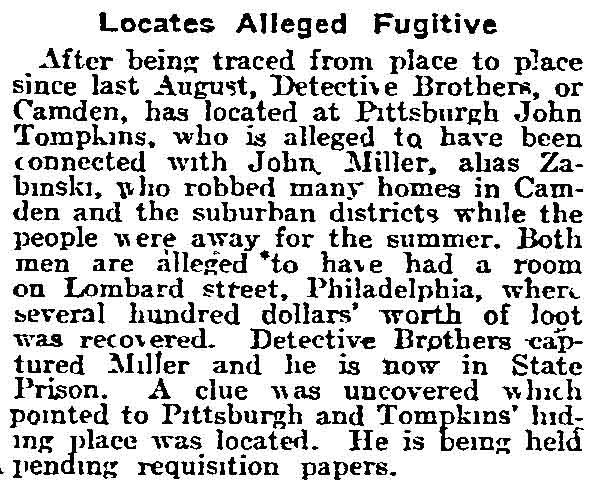
After being traced from place to place since last August, Detective Brothers, of Camden, has located at Pittsburgh John Tompkins, who is alleged to have been connected with John Miller, alias Zabinski, who robbed many homes in Camden and the suburban districts while the people were away for the summer. Both men are alleged to have had a room on Lombard street, Philadelphia, where several hundred dollars’ worth of loot was recovered.
Detective Brothers captured Miller and he is now in State Prison. A clue was uncovered which pointed to Pittsburgh and Tompkins’ hiding place was located. He is being held pending requisition papers.
Woman Unconscious, Man Arrested
Philadelphia Inquirer —
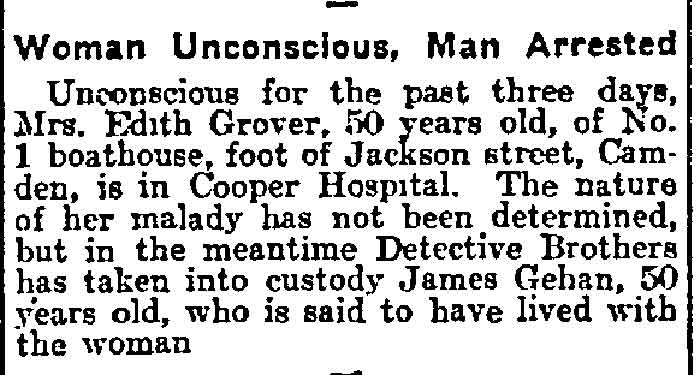
Unconscious for the past three days, Mrs. Edith Grover, 50 years old, of No. 1 boathouse, foot of Jackson street, Camden, is in Cooper Hospital. The nature of her malady has not been determined, but in the meantime Detective Brothers has taken into custody James Gehan, 50 years old, who is said to have lived with the woman [cut off at the crop edge]
Worthless Check Writer Jailed
Philadelphia Inquirer —
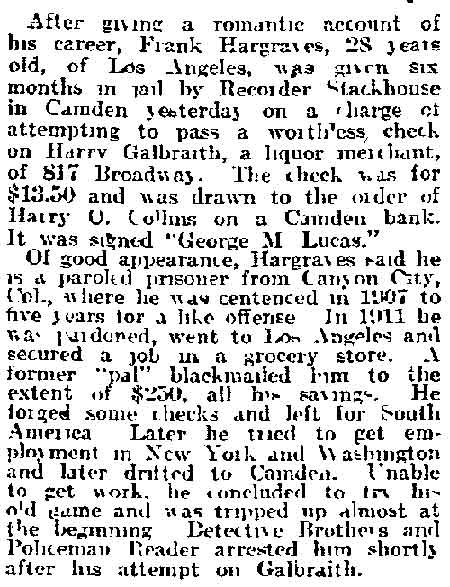
After giving a romantic account of his career, Frank Hargraves, 28 years old, of Los Angeles, was given six months in jail by Recorder Stackhouse in Camden yesterday on a charge of attempting to pass a worthless check on Harry Galbraith, a liquor merchant, of 817 Broadway. The check was for $13.50 and was drawn to the order of Harry O. Collins on a Camden bank. It was signed “George M. Lucas.”
Of good appearance, Hargraves said he is a paroled prisoner from Canyon City, Col., where he was sentenced in 1907 to five years for a like offense. In 1911 he was pardoned, went to Los Angeles and secured a job in a grocery store. A former “pal” blackmailed him to the extent of $250, all his savings. He forged some checks and left for South America. Later he tried to get employment in New York and Washington and later drifted to Camden. Unable to get work, he concluded to try his old game and was tripped up almost at the beginning. Detective Brothers and Policeman Reader arrested him shortly after his attempt on Galbraith.
Sent to Prison for Theft
Philadelphia Inquirer —
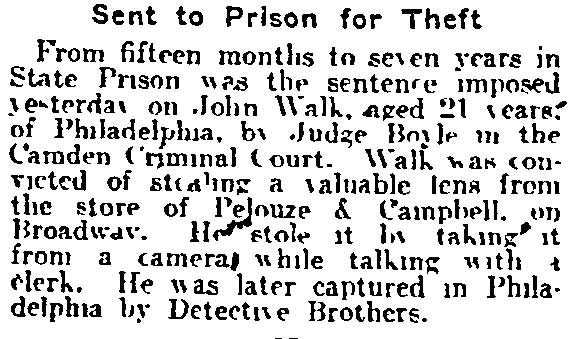
From fifteen months to seven years in State Prison was the sentence imposed yesterday on John Walk, aged 21 years, of Philadelphia, by Judge Boyle in the Camden Criminal Court. Walk was convicted of stealing a valuable lens from the store of Pelouze & Campbell, on Broadway. He stole it by taking it from a camera while talking with a clerk. He was later captured in Philadelphia by Detective Brothers.
Hold Boys for Rifling Mail
Philadelphia Inquirer —
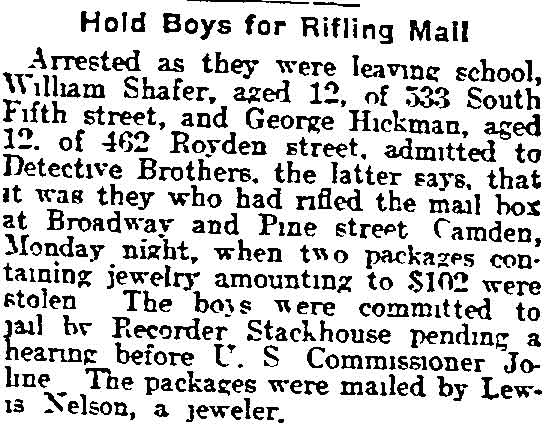
Arrested as they were leaving school, William Shafer, aged 12, of 533 South Fifth street, and George Hickman, aged 12, of 462 Royden street, admitted to Detective Brothers, the latter says, that it was they who had rifled the mail box at Broadway and Pine street, Camden, Monday night, when two packages containing jewelry amounting to $102 were stolen. The boys were committed to jail by Recorder Stackhouse pending a hearing before U. S. Commissioner Joline. The packages were mailed by Lewis Nelson, a jeweler.
Young Woman Jailed on Aunt’s Complaint
Philadelphia Inquirer —
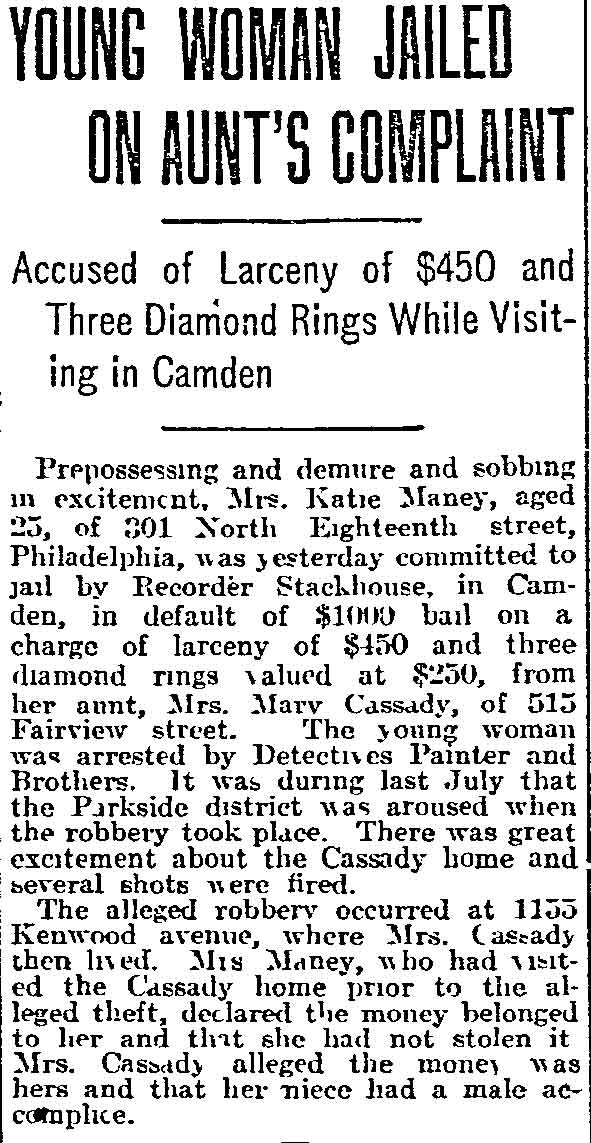
Accused of Larceny of $450 and Three Diamond Rings While Visiting in Camden
Miss Kate Maney was arrested on suspicion of robbing her aunt’s home on East avenue, Camden, on Sunday night. The alleged robbery was reported by Mrs. Mary Cassady, of 515 East avenue. While visiting there, Miss Maney is alleged to have stolen $450 in cash and jewelry valued at about $500. According to Detectives Painter and Brothers, there is considerable evidence against the accused.
Wilson Ashbridge and George E. Thompson
Camden Post-Telegram —
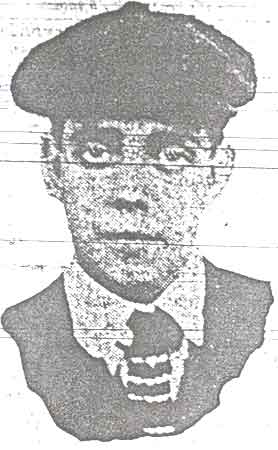
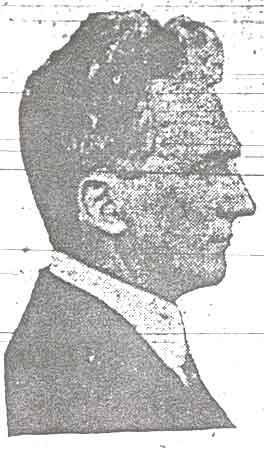
WILSON ASHBRIDGE — GEORGE E. THOMPSON
Murderer and Forger Escape Jail After Shooting Keepers, Killing One
Camden Post-Telegram —
Wilson Ashbridge, Who Shot and Killed Mrs. Elizabeth Dunbar and George E. Thompson, Check Swindler, Trap Jailor Hibbs by a Ruse and After Slaying Him Shoot Joe Ellis Who Intercepted Them in Flight.
Used Revolver Smuggled Into Prison by Confederates and Leave Jail Wide Open in Their Flight, a General Delivery Being Averted by Police Who Were Summoned by the Wounded Men.
Murdering one jailor and wounding another with a revolver that had been smuggled into them by outside confederates, Wilson T. Ashbridge, slayer of Mrs. Elizabeth Dunbar, and Francis Murphy, alias George E. Thompson, a check forger, made their escape from the county jail a few minutes before seven o’clock last night.
Ashbridge with his wife was caught at noon in the Keystone Hotel in Chester PA where they registered at one o’clock this morning.
Thompson is still at liberty but from the confident manner of Prosecutor Kraft his early arrest seems assured.
The murdered jailor was Isaac Hibbs, aged 65 years of 913 South 8th Street. The wounded keeper is Joseph Ellis, aged 45 years, of 416 Carteret Street. Shot twice, he is in Cooper Hospital. His condition today is very satisfactory.
Thompson, who is 41 years old, forged a check for $650 which he gave to V.M. Fulton as part of the purchase price of an automobile. The forgery was discovered before the deal was completed and his arrest followed on June 8. he also passed a forged check for $15 on State Motor Vehicle Agent Kraft. He, too, was awaiting trial. In spite of the positive evidence against him Thompson had spurned all efforts to have him plead guilty and it is now believed that he was sparring for time while hatching a plan to escape. He is no doubt the master mind.
R.L. Hunter, a farmer of Bensalem Township, Bucks County PA, about four miles above Torresdale, reported to the Philadelphia police the morning that he had seen a man answering Ashbridge’s description on the Bucks Road at daylight. The man asked the way to Riegelsville.
According to Hunter, the man was dressed in a dark suit, and had no hat. His clothing was wet. Hunter did not see anything suspicious in his actions, and after giving him directions, they parted.
Upon seeing the paper with a picture of Ashbridge, the farmer was struck by its resemblance to the man with whom he had talked. He hurried to Tacony and notified the police.
The State police, who patrol that section of the county, and who have an office at Langhorne, were immediately notified as were the surrounding towns.
The shootings took place in different parts of the jail. Hibbs was murdered in the exercise room just outside the cell room on the Sixth and Arch corner of the building. Ellis was shot down in the corridor just outside the Market Street end of the building when he heroically grappled with Ashbridge after the latter had pointed a gun at his head. In spite of his wounds Ellis dragged himself to a telephone and after notifying Police Headquarters of what had happened he collapsed.
Only one of the two bullets is still in Ellis. It entered the groin on the right side and is buried in the muscles of the leg, having taken a downward course for seven or eight inches. The other bullet struck Ellis in the right breast and came out in the left breast, traversing the upper fleshy parts of the body.
Hibbs was almost instantaneously killed by a bullet that went within an inch of his heart, producing a hemorrhage. The bullet was extracted this morning from the body early this morning in an autopsy performed at the morgue by County Physician Stem. In spite of the fact that it is pretty well established that three shots were fires in the attack on Hibbs, only one of the bullets took effect.
“But it makes little difference which of the two men handled the gun” said Prosecutor Kraft this morning. “Both are equally guilty of this murder and what we are concerned about now is the recapture of the gunmen.” Mr. Kraft added that it his purpose to examine all of the prisoners in that part of the jail where Hibbs was murdered to determine fully who fired the fatal shot.
The escape had been carefully planned and timed to the minute. Of course the desperate prisoners were aided by confederates on the outside and it is the general belief that a high powered motor car was in waiting for them not far from the jail. They are known to have been in possession of money and openly boasted yesterday that it was their intention to leave the prison last night. These boasts were made to two young ladies connected with a religious organization who called on the two men yesterday to offer spiritual reconciliation. The girls are frequent visitors to the jail and naturally their efforts at evangelization were directed in the main toward Ashbridge, because of the fact that he was accused of murder. These girls, whose identity officials will not disclose, were closeted with Prosecutor Kraft until one o’clock this morning. Both declared that on their visit yesterday they were told by Ashbridge and Thompson that it was the last day they expected to spend in jail.
“We are going to get away from here tonight and we’ve got money to help us after we are out ” said Ashbridge, who further told the girls he had considerable cash sewed up in the waistband of his trousers. The girls begged the prisoners not to do anything that would cause them more trouble and they told the Prosecutor that Ashbridge and Thompson promised them that they would not make any effort to escape. In their talks with the girls neither of the prisoners said a word that would indicate that they would kill if necessary to escape. The full force of their boast did not dawn on the religious workers and for this reason it never occurred to them to inform the Sheriff of what the prisoners had in said.
A general jail delivery of at least all the men confined in what is known as the untried department, where the two were held, was only averted by the prompt arrival of the police on their beat, which was made easy by means of the keys taken from the prostrate body of Hibbs. Ashbridge and Thompson left all of the doors open and the vanguard of the inrushing police found the prisoners swarming all over the corridors on the east side of the prison. In the wild excitement following the double shooting and escape none else thought of freedom and a checking up of the inmates after they had been herded in the exercise room of the untried department accounted for all but the fugitive slayers.
The department, in which the two men were confined is the same one which William Brown and Charles Berger made their sensational escape several years ago by sawing away the bars on the Federal Street front of the jail. Thrilling as it was, the former escape was insignificant in comparison with last night’s tragic event.
With the full force of the keepers out of the way— one dead and the other suffering from gunshot wounds at first supposed to have been fatal— Ashbridge and Thompson had nothing between them and freedom but the door entering from the spiral stairway leading to the narrow entrance of the Sixth and Market Streets end of the Court House. With the keys taken from Hibbs they opened the door and in a few seconds were breathing the free air. It was still daylight when the daring murderers walked from the building and although they were no doubt seen by some of the scores of persons passing it is certain that they managed to control themselves to such an extent as not to arouse any undue suspicion. The exit they used to escape is that used by the general public and therefore persons passing calmly in and out of the door would not in any manner be thought to have been connected with a jail delivery. However the shots which had laid low the keepers had been plainly heard on all four sides of the building and it is strange that no one has yet been found who can give positive information as to what course the fleeing men took and whether they were aided in their flight by an automobile.
While the police and detectives of Camden and all other cities in the East are watching railroad terminals, steamship lines, and all other avenues of travel in response to the general alarm sent out last night, Prosecutor Kraft is bending all his energies to learn who smuggled in the revolver which the fugitives used. Thus far this feature of the case is as complete a mystery as it was last night. Mr. Kraft and Sheriff Haines are satisfied, however, that only one gun was used for both shootings. It was at first thought that each man had a pistol when they left the jail; that one of them armed himself with the gun that Hibbs was supposed to have carried, but it was determined that Hibbs was not armed when he went into the jail last night. There was no occasion for him to come in contact with any of the prisoners and for that reason he left his revolver in his desk in the office. Even had he carried it he would have little chance to use it, so cold-bloodedly was he slain as he unsuspectingly fell into the trap laid for him by the desperate gunmen. There is also some conflict as to how at least one of the fugitives was dressed. Alfred Williams, who witnessed the murder of Hibbs, said that Ashbridge was without coat or hat when he dashed out of the cell-room, and that Thompson carried his coat and hat under his arm. However in a description of the two men given at the Prosecutor’s office it was set forth that Ashbridge wore a blue serge suit and a checkered cap. The coat that he is supposed to have taken bore the mark of “Tull— the Tailor,” of Jacksonville, Florida, and had been borrowed by him from another prisoner. He wore tan shoes. Ashbridge is 27 years old, 5 feet 7-1/2 inches in height and weighs 137 pounds. He has brown hair, smooth face and is of light complexion.
Thompson wore a brown suit and a Panama hat. He is 41 years old 5 feet seven inches in height, and weighs 175 pounds. He has brown bushy hair, is minus one of the fingers on his left hand, and is light complexioned.
The tan shoes worn by Ashbridge were also borrowed from one of the prisoners. He got them on Saturday and remarked that he wanted to look neat.
Keepers Ellis and Hibbs were reading in the prison office last evening when Hibbs glanced up at the clock and noticed that it was a few minutes of seven. “Joe, I’m going back and put the boys in their cells,” he said to Ellis and with his keys in his hand he started for the cell room in the untried department. A thirty foot long corridor runs from the office to the barred and grated door opening into the department in which the cells are situated. This department is about the size of three ordinary school rooms and in the southeastern corner of the jail are the cells, in two tiers.
Around the cells is a three foot corridor into which all the cells doors open and in which all the prisoners are permitted to walk when they are not allowed out in the main room. When the inmates are ordered into their cells and their doors closed the doors are locked from the outside of the steel cage by means of a lever worked by the jailor. Thus every cell door can be made secure without the keepers coming into actual contact with the prisoners. In addition to the bars around the corridor fronting on the double tier of cells there is a fine mesh heavy wire screening.
As Hibbs approached the lever which is operated to shut the cell doors after the prisoners have retired from the corridors, Ashbridge was leaning against the grating of his cell, Number 18. Thompson was lounging a few feet away.
“Daddy, open the door, I want you to see this note,” said Ashbridge to the keeper, at the same time displaying a piece of paper which he had in his hand. Never giving a thought that he was about to perform an act that which was absolutely necessary for the carrying-out of the well laid plot, or that he was going to his doom, or was even in danger, “Daddy,” as the aged keeper was known to all the prisoners, opened the door without hesitation.
As he swung wide the big steel frame, Ashbridge quickly stepped out and the next instant was pressing a gun against the abdomen of the jailor.
“Throw up your hands, you ___ ___ ___” he commanded.
“What are you up to, what’s this mean,” asked the keeper, apparently not realizing he had been trapped.
For reply Thompson jumped out the door, wrenched the gun from Ashbridge’s grasp and with an oath began firing at Hibbs, who sank to the floor at the first shot. Only a few feet away and the only other person in the exercise room, although the shooting could have been seen by any other prisoners who had not retired to their cells, Alfred Williams, trusty, is emphatic in his assertion that Thompson fired the shot that killed Hibbs and that he fired three times.
“It’s a wonder they did not get me,” said Williams. “Ashbridge and I could not hit it and in his desperate mood I am surprised he didn’t kill me, too.” Williams, who has just completed a six months’ sentence for obtaining money from Italian grocers by falsely representing himself as an agent for a wholesale house in Chicago and who is wanted in the Windy City for the same offense, says the whole transaction took less than a minute and that the moves came so fast he and the other prisoners were powerless to aid.
“It was like a flash of lightning” said Williams, “and before I could fully understand what had happened Ashbridge had grabbed Daddy’s keys’ which had fallen to the floor, and was off like a deer for the barred door. Ashbridge had taken the smoking gun from Thompson, who had his hat and coat under his arm and who was right behind the other one.
“As they hurried through the door after Ashbridge had opened it with Daddy’s keys Daddy called to me to raise him. I put my arm under his head and lifted him slightly from the floor. ‘Hold my hands’ he said to me. I took hold of his hands and the next minute he died in my arms. Then I heard two more shots and I knew they got Joe Ellis.”
Startled by the shots, and he is emphatic there were three in rapid succession, Ellis leaped to his feet and without taking the time to arm himself ran from the office and turned into the corridor just as Ashbridge, wild-eyed and gun in his hand, came running toward him. Halting three yards away Ashbridge pointed the revolver at Ellis’ head and ordered him to throw up his hands.
For reply and without fear of himself the keeper dashed at the murderer and the next instant they were locked in each others’ embrace. Working loose the hand which held the gun, Ashbridge pulled the trigger. The bullet struck Ellis in the breast, but the wound was not sufficient to render him helpless. However, before he could grip the pistol arm, Ashbridge fired again and the keeper fell back with a bullet in his groin.
“The second shot got me,” said Ellis to Prosecutor Kraft and Assistant Prosecutor Butler at the hospital. “The first one wasn’t bad but my strength left me when the second bullet struck. Ashbridge was the only one I saw. I did not see Thompson.”
Dragging himself to the office Ellis managed to reach a telephone and called up the police.
“This is Ellis at the county jail; come quick. Ashbridge has shot me” he weakly said over the phone to Captain Hyde. Then the receiver fell from his hand and he dropped to the floor, but after a minute or two managed to climb into chair.
While patrol loads of policemen were being hurried to the Court House from the First and Second District station houses, Reserve Officer Charles Hose, on duty at Broadway and Federal Street, who had heard the shots, ran to the Court House and from the office of Assistant Custodian John Lack phoned up to the jail. Ellis managed to answer and in a few words told what had happened. They ran up to the jail and were admitted by Ellis, who was rapidly growing weaker from loss of blood, the trail of which plainly showed just where the injured keeper had moved.
“I guess Ashbridge got away and the jail is all open, you had better take care of the rest of the prisoners,” said Ellis to Hose and Lack. The fugitive-murderers had left all doors open and the other occupants of the untried department were swarming through the corridors. Their curses and yells and the shrieks and cries of the female prisoners had turned the place into a perfect bedlam. With the aid of other policemen who swarmed into the Court House like bees, the prisoners were soon herded into the exercise room, where Trusty Williams checked them up and accounted for all but Ashbridge and Thompson.
With the faint hope that the missing pair had not risked leaving the building but had secreted themselves in the structure, the courthouse was searched from pit to dome, but no trace of the men were found.
Detective Doran was the first of the Prosecutor’s staff to reach the scene. Mr. Kraft and the balance of the staff soon followed. In the lower end of the county, on official business, Sheriff Haines was reached by phone and Under Sheriff Hewitt was summoned from Pitman and until an early hour this morning the officials were in conference and examining numerous prisoners.
State Detective Walter Le Torneau furnished Prosecutor Kraft with a promising “tip” this morning when he learned that Thompson gave a letter to Freeholder Howard Marshall, of the Eighth Ward, to mail on Sunday. Mr. Marshall states that the letter was addressed to a woman by the name of Mrs. Shelton, in Baltimore MD.
Marshall was attending religious service in the jail when Thompson approached him.
“Put this in your pocket and mail it for me when you go out,” said Thompson to Mr. Marshall, who agreed to carry out the request. Dropping the letter in the mail box Marshall allowed the incident to pass without further notice.
Detective Le Torneau learned this morning that Marshall had spoken to the incident to a friend and the sleuth notified the Prosecutor. The tip will be run down the Prosecutor stated.
Funeral services for Hibbs will be held on Thursday from his late residence. The body will be taken to Langhorne PA where interment will be made in the Friends’ Cemetery under the direction of the Schroeder-Kephart Company. Services will be conducted Wednesday evening by Reverend Henry Bradway, pastor of the Eighth Street Methodist Episcopal Church.
POLICE QUICKLY AT WORK
Although the murderous prisoners made their escape, it was no fault of the local police department, which threw out a “dragnet system” that covered practically every outlet from the city. As soon as the call reached headquarters the red lights were flashing and every officer and detective who could be reached was sent out on the “man hunt” which was pursued with vigor.
Passing automobiles were pressed into service by the detectives and officers and all haste was made for the ferries, railroad yards, terminals, and trolley points. Citizens cooperated with the police in their efforts to run down the escaping prisoners.
Assistant Chief Hyde received the call from Jailor Ellis, who though wounded himself summoned strength enough to reach the phone.
“This is Jailor Ellis. Hibbs and me have been shot by that man Ashbridge and help quick!” was the startling message which came over the phone to Chief Hyde about one minute past seven.
It was just at the time the shifts were going on and off at the local station houses. Chief Hyde lost no time. He called to Machine Operator “Eddie” King to send the message to the station houses and flash the red lights. This was done and as fast as the men could run they covered the various points.
The auto patrols were dispatched with all hands to the Court House and the wounded men hurried to the hospital. Coroner Robert G. Schroeder reached the hospital as Hibbs and Ellis were being admitted and he took charge of the situation and got in touch with Prosecutor Kraft and County Physician Stem.
Detective Captain Schregler was hurriedly summoned, and his men were sent in all directions. Detective Brothers boarded a waiting automobile and a record run was made for the Federal Street ferry. Sergeant Humes was picked up and in four minutes after the call was received from Ellis Detective Brothers had the ferry covered.
Detectives Troncone, Painter and Murry and captain Schregler covered the Kaighn Avenue, Vine Street, and Cramer Hill ferry lines.
Detective Brothers got in touch with the Pennsylvania Railroad officials who put their detective force to work searching freight and passenger cars. The orders were sent out from the railroad office to stop and search every freight train. Dispatches were also sent to Trenton, Mount Holly, and Burlington and it was not long before the news of the atrocious deed had spread throughout the country and many distant places.
Trolley cars were stopped and searched by the police, but not the slightest trace could be found of the escaped prisoners. The police left nothing undone in the “man-hunt.”
When news of the affair spread through the city phone calls began to come in to headquarters. Over fifty persons called up to tell the police that they had seen the two men at various places. The “tips” were all run down but none materialized.
Officers Arthur Colsey and Theodore Guthrie, who were on their vacations, lent their aid to Chief Hyde. Policeman Colsey pressed his automobile into service and carried the police to various parts of the city.
Co-operating closely with Prosecutor Kraft’s detectives the city officials formed a combination which in nine times out of ten would have been successful, but the escaped men cleverly eluded their pursuers.
Assisted by Coroner Schroeder, County Physician Stem held a post mortem examination on Hibbs’ body. The bullet which caused the death was located in the region of the heart, It passed through the victim’s lung, causing a hemorrhage, which resulted in death. Following the examination the body was taken by the Schroeder-Kephart Company at the family’s orders to be prepared for burial.
ASHBRIDGE’S FIRST CRIME
The brutal crime for which Ashbridge stood indicted but untried was committed on the night of January 22 at Ninth and Market Streets. It developed that the murderer had followed his intended victim from the morning hours. He trailed her to the home of her sister, a Mrs. Meredith, of 911 Market Street, and laid in wait in the darkness of a building that fatal Saturday night.
Mrs. Dunbar came out of the house and stood on the northeast corner while waiting for a ferry-bound trolley car. She intended going to Sicklerville that night to visit her relatives. With her at the time was her 7-year-old daughter, Eleanor, and her father, Charles Dunbar. Ashbridge advanced toward the woman, who was startled when she saw him. She called to her father that she “didn’t want anything to do with Ashbridge.”
Before the father could interfere the young murderer whipped out a revolver and covered the father and the woman. He then struck the woman violently in the face with his fist and as she was reeling under the force of the brutal blow Ashbridge fired, the first bullet taking effect in the woman’s chest. The brutal murderer then stood over his prostrate victim and holding the revolver less than five inches from his victim’s body he pumped four more shots into her.
Policeman Howard Smith and Policeman Taylor were a square distant. Smith saw the entire proceedings and screamed at Ashbridge to stop shooting. A crowd quickly gathered and Dr. Maldeis, who lives nearby, came running to the scene to aid the stricken woman.
Officer Taylor espied Ashbridge in the crowd. The murderer made no effort to run, but stood his ground. Detecting the murderer trying to slip something up his sleeve, Taylor pounced upon him and bore him to the ground, at the same time taking the gun away from him and slipping the handcuffs over the murderer’s wrists. Policeman Taylor had to draw his revolver to keep back the large crowd that was threatening. Showing no concern whatever, Ashbridge calmly waited until the police auto arrived. In the meantime the murdered woman’s still warm body was placed in a “jitney” and with Officer Smith and Dr. Maldeis a hurry run was made for Cooper Hospital but when the institution was reached, Mrs. Dunbar was pronounced dead.
Ashbridge was taken to the hospital by Policeman Taylor in the police auto. He asked “how she is.” Informed that he had accomplished his purpose, the young murderer asked to see the woman. When the white sheet covering the still form of the murdered woman was drawn from the face Ashbridge leaned over and kissed the forehead of the woman. He was then taken to the County jail and locked up. Before Recorder Stackhouse on the following Monday Ashbridge pleaded guilty.
Ashbridge was infatuated with the woman, who was a member of the Temple Theater chorus. Because of Ashbridge’s persistent attentions she was compelled to give up her position. Mrs. Dunbar had previously accepted Ashbridge’s attentions, thinking that he was unmarried, but upon learning that he had a wife and child she informed him that it would be best for them not to see each other, but the young man refused to discontinue his attentions.
On the day of the shooting Ashbridge was seen in various places. He is said to have followed the woman to the Federal Street ferry, but lost track of her. Around noon he was seen at Front and Pearl Streets by Policeman Boyd, who ordered him to move on. Boyd was about to arrest him as a suspicious character, but Ashbridge pleaded that he was looking for a friend. All that day Ashbridge followed the woman until night, when he cruelly murdered her.
The murderer came from a respectable family. Dissipation is thought to have caused the young man to lose his sense of reasoning. Rather good-looking, Ashbridge had tender baby-like eyes and his case excited sympathy among the more tender-hearted people.
Sweetmeats, tasty sandwiches, and other small luxuries were said to have been given the young murderer while he languished in his cell. He had many visitors. Recently Ashbridge was taken violently ill after eating some crabs which were given him by a friend. He and Jailor Hibbs were very friendly.
THOMPSON A CLEVER FORGER
Thompson, or Murphy, was a self-styled lawyer and was committed by Recorder Stackhouse in June for forging checks to the amount of $1,055. The worthless checks were “worked” on the McClelland-Fulton Auto Company and Motor Vehicle Agent A.C. Kraft.
When a check for $150 presented to the automobile company by Thompson and drawn to the order of “G.E. Thompson” on the Harrisonburg, Virginia National Bank came back from the home office of the Studebaker Company as worthless, Mr. Fulton called in the police.
Thompson had previously presented a check for $890 as payment on an automobile. This check was drawn on Thompson’s favor on the Coatesville National Bank and was purported to have been signed by Louis L. Gibney, a hotel man of Downington PA. This check was still in the possession of Mr. Fulton when Thompson was arrested after the first check was returned marked “no funds.”
The clever swindler also presented a bad check to Agent Kraft for $15 for which he received the license to operate the automobile which he proposed buying.
Detective Troncone arrested Thompson at Fifth and Market Streets on June 2. The defendant had been living in a room at 220 North Fifth Street.
Giving his home address as Daytona, Florida, Thompson represented himself as a lawyer. Well dressed and wearing nose glasses, Thompson was an intelligent appearing man, he had a bushy pompadour which was streaked with gray and talked in a persuasive manner. His forgeries on Mr. Gibney’s signature were so clever that Gibney himself could not tell the difference.
After Thompson’s arrest Detective Captain Schregler sent out notices to several southern cities. He received responses from Harrisonburg, Norfolk, and Petersburg Virginia and that Thompson was wanted in all three cities for check forgeries.
Bert Hibbs, a city foreman and a son of the slain jailor, was murdered early Sunday morning, December 25, 1910 when his throat was cut by Clement Ridgway, a negro, aged 22 years, of Seventh and Sycamore Streets. It was about 12:20 on Christmas morning that Hibbs while crossing the lots at Seventh and Sycamore was accosted by Ridgeway, who wanted to shake hands with Hibbs. The latter refused, a quarrel ensued and Ridgeway whipped out a razor and slashed Hibbs across the throat with such violence that his head was nearly severed. Hibbs died while on the way to the hospital. Ridgway was arrested after a battle by Detectives Schregler, Painter and Brothers and several officers at his home, 1207 Lilly Row.
Indicted for murder Ridgway pleaded non vult. On April 24, 1911, to a charge of murder in the second degree, he was sentenced to 25 years in state Prison at hard labor.
SECOND MURDER IN JAIL
This is the second murder and second escape from the present jail. The first murder took place in November, 1907, when George Stewart, a young negro, stabbed to death John Snell, who was awaiting trial for carrying in the business of fortune telling. Stewart was in jail on a charge of dealing in opium and cocaine. He had a complete opium layout in his cell. He and Snell had a quarrel and he stabbed Snell to death in his cell. He was tried and convicted and sentenced to be electrocuted during the week of February 8, 1908. He was electrocuted on February 4, being the first man to suffer the death penalty by electrocution.
On July 13, 1910 William T. Brown, alias Gillespie, who had been sentenced to seven years on a charge of forgery, and Charles Berger, who was under sentence for picking pockets, made their escape from jail after sawing the bars on the Federal Street front. They climbed over the balustrade to the roof, descended through a trapdoor, climbed down stairs and walked leisurely through the Court House building and out into the street unnoticed. They entered an automobile and were driven away. They crossed to Philadelphia on a North Cramer Hill Ferry boat.
Several weeks later Brown was arrested in New York City and was sentenced to Auburn Prison on an old charge. His term will expire shortly and he has also applied to the Court of Pardons of this State for a parole. A detainer has been lodged against him at the State prison where he is located and he will be brought back and resentenced. Berger was captured in Chicago and was brought back and served a term at Trenton.
Alleged Panhandler’s Dog Wins Release for Him
Philadelphia Inquirer —
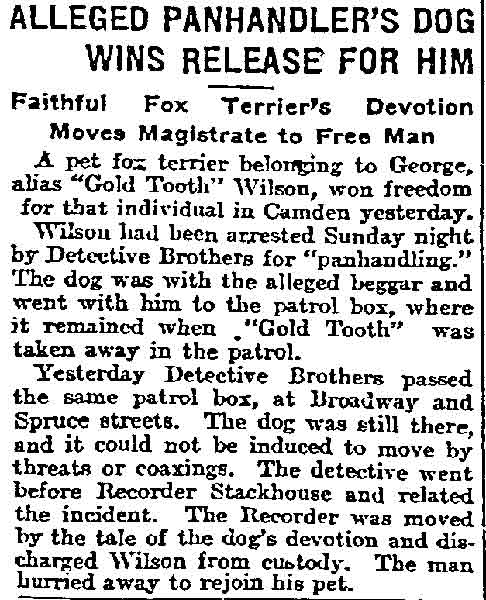
Faithful Fox Terrier’s Devotion Moves Magistrate to Free Man
A pet fox terrier belonging to George, alias “Gold Tooth” Wilson, won freedom for that individual in Camden yesterday.
Wilson had been arrested Sunday night by Detective Brothers for “panhandling.” The dog was with the alleged beggar and went with him to the patrol box, where it remained when “Gold Tooth” was taken away in the patrol.
Yesterday Detective Brothers passed the same patrol box, at Broadway and Spruce streets. The dog was still there, and it could not be induced to move by threats or coaxings. The detective went before Recorder Stackhouse and related the incident. The Recorder was moved by the tale of the dog’s devotion and discharged Wilson from custody. The man hurried away to rejoin his pet.
Detective Brothers Ill
Philadelphia Inquirer —

Taken ill in his office at the City Hall Detective Brothers is in Cooper Hospital undergoing treatment for a threatened attack of appendicitis.
Negro Who Shot Woman Caught
Philadelphia Inquirer —
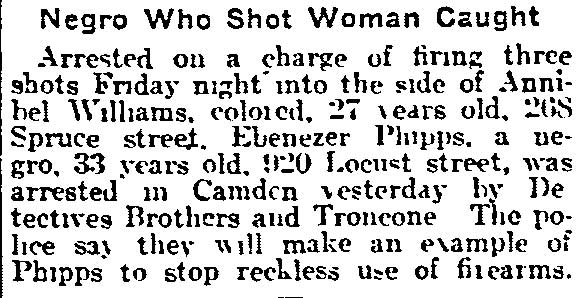
Arrested on a charge of firing three shots Friday night into the side of Annibel Williams, colored, 27 years old, 208 Spruce Street, Ebenezer Phipps, a negro, 33 years old, 920 Locust Street, was arrested in Camden yesterday by Detectives Brothers and Troncone. The police say they will make an example of Phipps to stop reckless use of firearms.
Police News
Philadelphia Inquirer —
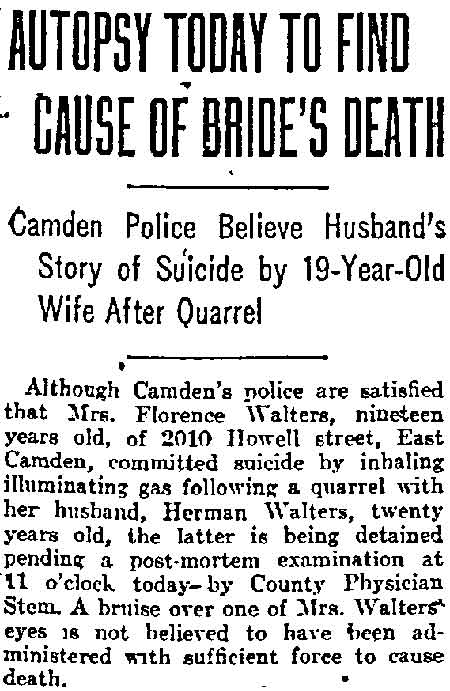
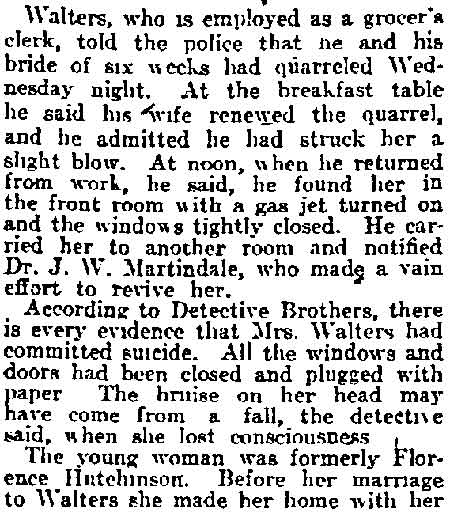
Named: Florence Hutchinson Walters, Dr. Frank O. Stem, Herman Walters, Dr. J.W. Martindale, John Brothers, Howell Street, and East Camden.
Burns Mail in Letter Box
Philadelphia Inquirer —
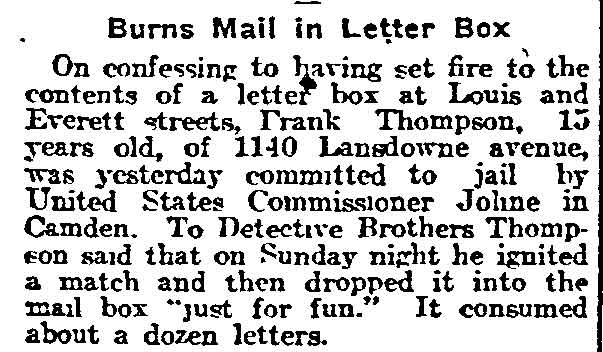
On confessing to having set fire to the contents of a letter box at Louis and Everett streets, Frank Thompson, 15 years old, of 1140 Lansdowne avenue, was yesterday committed to jail by United States Commissioner Joline in Camden. To Detective Brothers Thompson said that on Sunday night he ignited a match and then dropped it into the mail box “just for fun.” It consumed about a dozen letters.
Dead Among Stupefied
Philadelphia Inquirer —
Camden Woman Dies in Midst of Alcoholic Orgies
With four men stupid with drink lying about, the body of Mrs. Maggie Donnelly, 40 years old, was found in a vacant house at 844 Locust street, Camden, yesterday. Although the police are convinced that the woman’s death was due to alcoholism, the men were placed under arrest pending a hearing.
According to persons living in that neighborhood, the woman and her male companions had been noticed about the house the past several days, all much the worse for drink. When Detective Painter went to the house one of the men, Edward Kline, 42 years old, attacked him. With Detective Brothers he placed Kline, together with James Ford, 3[?] years old; John Smith, 40 years old, and Alonzo Fisher, 60 years old, under arrest.
The woman and the men have been frequently in the Recorder’s court [cut off at the crop edge]
Brennan Woman Jailed
Philadelphia Inquirer —
Refusing to say anything about the case, Jennie Brennan, 25 years old, of 325 Mickle street, who stabbed Osman Harding, 24 years old, of 267 Mechanic street, was yesterday committed to jail without bail by Recorder Stackhouse. The young woman’s face brightened when Detective Brothers reported that the man whom she had stabbed because of his alleged attack on her, was in an improved condition at Cooper Hospital and will very likely recover [cut off at the crop edge]
Undertaker Lindes Is Held Blameless
Camden Post-Telegram —
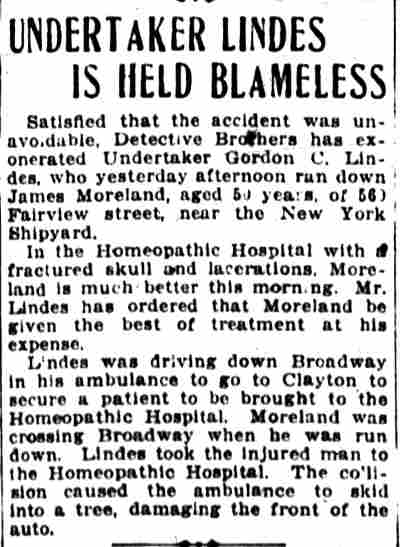
Satisfied that the accident was unavoidable, Detective Brothers has exonerated Undertaker Gordon C. Lindes, who yesterday afternoon run down James Moreland, aged 5[?] years, of 56[?] Fairview street, near the New York Shipyard.
In the Homeopathic Hospital with a fractured skull and lacerations, Moreland is much better this morning. Mr. Lindes has ordered that Moreland be given the best of treatment at his expense.
Lindes was driving down Broadway in his ambulance to go to Clayton to secure a patient to be brought to the Homeopathic Hospital. Moreland was crossing Broadway when he was run down. Lindes took the injured man to the Homeopathic Hospital. The collision caused the ambulance to skid into a tree, damaging the front of the auto.
Women Threaten Detective
Philadelphia Inquirer —
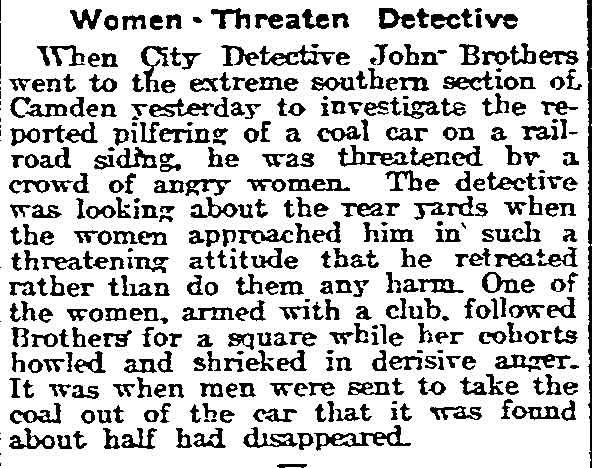
When City Detective John Brothers went to the extreme southern section of Camden yesterday to investigate the reported pilfering of a coal car on a railroad siding, he was threatened by a crowd of angry women. The detective was looking about the rear yards when the women approached him in such a threatening attitude that he retreated rather than do them any harm. One of the women, armed with a club, followed Brothers for a square while her cohorts howled and shrieked in derisive anger. It was when men were sent to take the coal out of the car that it was found about half had disappeared.
Detectives Disagree Over Quality of Beer
Philadelphia Inquirer —
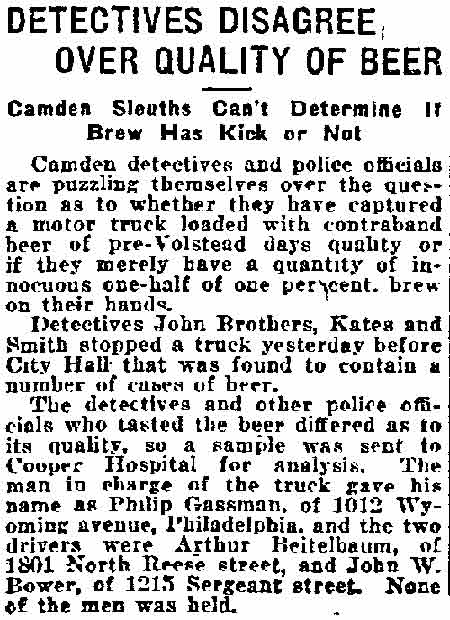
Camden Sleuths Can’t Determine If Brew Has Kick or Not
Camden detectives and police officials are puzzling themselves over the question as to whether they have captured a motor truck loaded with contraband beer of pre-Volstead days quality or if they merely have a quantity of innocuous one-half of one percent. brew on their hands.
Detectives John Brothers, Kates and Smith stopped a truck yesterday before City Hall that was found to contain a number of cases of beer.
The detectives and other police officials who tasted the beer differed as to its quality, so a sample was sent to Cooper Hospital for analysis. The man in charge of the truck gave his name as Philip Gassman, of 1012 Wyoming avenue, Philadelphia, and the two drivers were Arthur Beitelbaum, of 1801 North Reese street, and John W. Bower, of 1215 Sergeant street. None of the men was held.
‘Booze’ Mystery Soon Cleared Up
Camden Post-Telegram —
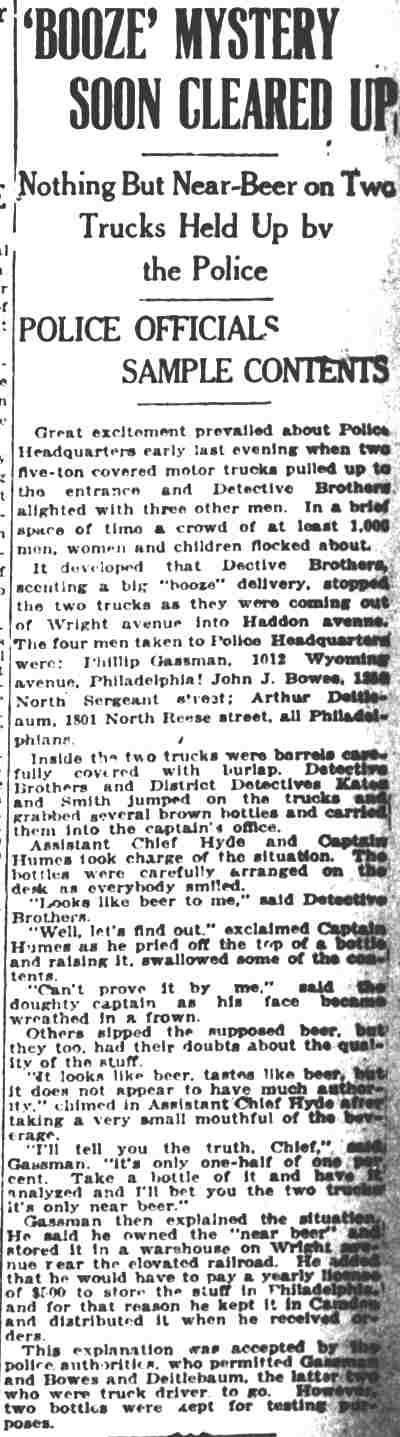
Nothing But Near-Beer on Two Trucks Held Up by the Police
POLICE OFFICIALS SAMPLE CONTENTS
Great excitement prevailed about Police Headquarters early last evening when two five-ton covered motor trucks pulled up to the entrance and Detective Brothers alighted with three other men. In a brief space of time a crowd of at least 1,000 men, women and children flocked about.
It developed that Dective [sic] Brothers, scenting a big “booze” delivery, stopped the two trucks as they were coming out of Wright avenue into Haddon avenue. The four men taken to Police Headquarters were: Phillip Gassman, 1012 Wyoming avenue, Philadelphia; John J. Bowes, 1[?][?]0 North Sergeant street; Arthur Deitlebaum, 1801 North Reese street, all Philadelphians.
Inside the two trucks were barrels carefully covered with burlap. Detective Brothers and District Detectives Kates and Smith jumped on the trucks and grabbed several brown bottles and carried them into the captain’s office.
Assistant Chief Hyde and Captain Humes took charge of the situation. The bottles were carefully arranged on the desk as everybody smiled.
“Looks like beer to me,” said Detective Brothers.
“Well, let’s find out,” exclaimed Captain Humes as he pried off the top of a bottle and raising it, swallowed some of the contents.
“Can’t prove it by me,” said the doughty captain as his face became wreathed in a frown.
Others sipped the supposed beer, but they too, had their doubts about the quality of the stuff.
“It looks like beer, tastes like beer, but it does not appear to have much authority,” chimed in Assistant Chief Hyde after taking a very small mouthful of the beverage.
“I’ll tell you the truth, Chief,” said Gassman. “It’s only one-half of one per cent. Take a bottle of it and have it analyzed and I’ll bet you the two trucks it’s only near beer.”
Gassman then explained the situation. He said he owned the “near beer” and stored it in a warehouse on Wright avenue rear the elevated railroad. He added that he would have to pay a yearly license of $[?]00 to store the stuff in Philadelphia and for that reason he kept it in Camden and distributed it when he received orders.
This explanation was accepted by the police authorities, who permitted Gassman and Bowes and Deitlebaum, the latter two who were truck driver [sic], to go. However, two bottles were kept for testing purposes.
Detective's Wife Dies
Philadelphia Inquirer —
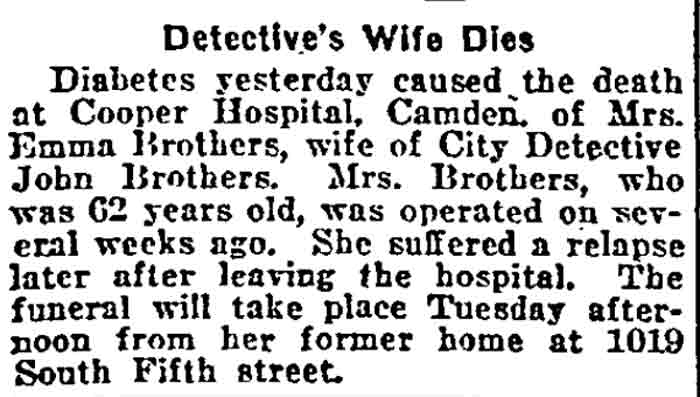
Diabetes yesterday caused the death at Cooper Hospital, Camden, of Mrs. Emma Brothers, wife of City Detective John Brothers. Mrs. Brothers, who was 62 years old, was operated on several weeks ago. She suffered a relapse later after leaving the hospital. The funeral will take place Tuesday afternoon from her former home at 1019 South Fifth Street.
Mrs. N. C. Jacobs Now Mrs. John Brothers
Philadelphia Inquirer —
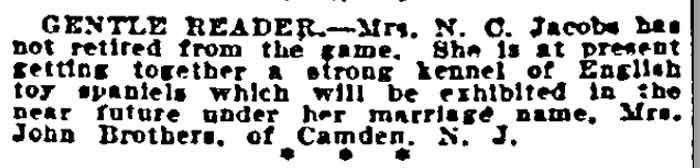
GENTLE READER.—Mrs. N. C. Jacobs has not retired from the game. She is at present getting together a strong kennel of English toy spaniels which will be exhibited in the near future under her marriage name, Mrs. John Brothers, of Camden, N. J.
Mrs. Brothers’ Kennel Notes
Philadelphia Inquirer —
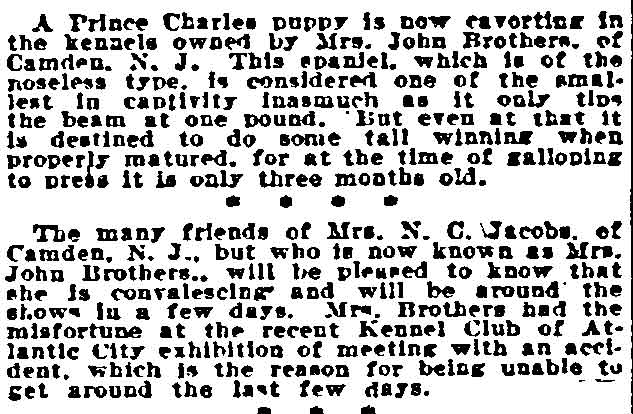
A Prince Charles puppy is now cavorting in the kennels owned by Mrs. John Brothers, of Camden, N. J. This spaniel, which is of the noseless type, is considered one of the smallest in captivity inasmuch as it only tips the beam at one pound. But even at that it is destined to do some tall winning when properly matured, for at the time of galloping to press it is only three months old.
The many friends of Mrs. N. C. Jacobs, of Camden, N. J., but who is now known as Mrs. John Brothers, will be pleased to know that she is convalescing and will be around the shows in a few days. Mrs. Brothers had the misfortune at the recent Kennel Club of Atlantic City exhibition of meeting with an accident, which is the reason for being unable to get around the last few days.
Camden to Improve 2 City Departments
Philadelphia Inquirer —
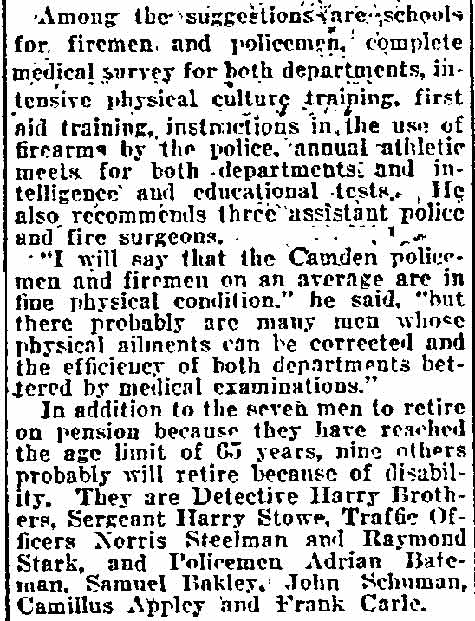
Surgeon Lippincott’s Recommendations for Police and Fire Approved
Woman Hurt When She Walks From Rear of One Train Into Another
In connection with the plan of the Police and Fire Committees of Camden City Council to make departments under their supervision modern in every particular, Dr. A. Haines Lippincott, surgeon to both departments, has submitted recommendations, which have received the approbation of the Councilmen.
Among the suggestions are schools for firemen and policemen, complete medical survey for both departments, intensive physical culture training, first aid training, instructions in the use of firearms by the police, annual athletic meets for both departments, and intelligence and educational tests. He also recommends three assistant police and fire surgeons.
“I will say that the Camden policemen and firemen on an average are in fine physical condition,” he said, “but there probably are many men whose physical ailments can be corrected and the efficiency of both departments bettered by medical examinations.”
In addition to the seven men to retire on pension because they have reached the age limit of 65 years, nine others probably will retire because of disability. They are Detective Harry Brothers, Sergeant Harry Stowe, Traffic Officers Norris Steelman and Raymond Stark, and Policemen Adrian Bateman, Samuel Bakley, John Schuman, Camillus Appley and Frank Carle.
Mrs. Brothers at the Dog Show
Philadelphia Inquirer —
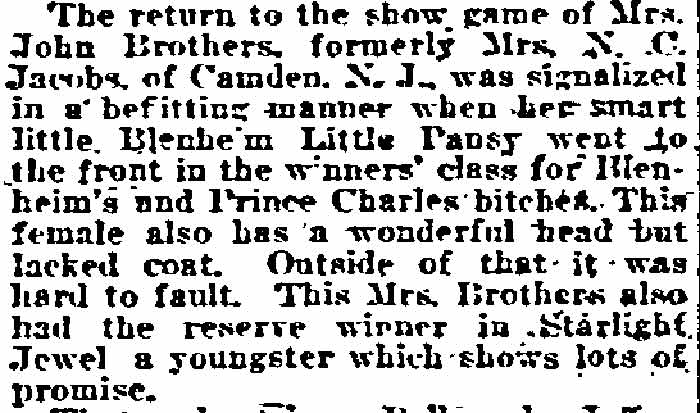
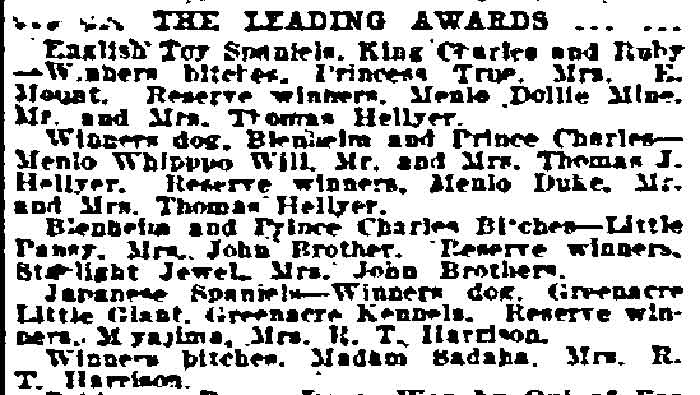
The return to the show game of Mrs. John Brothers, formerly Mrs. N. C. Jacobs, of Camden, N. J., was signalized in a befitting manner when her smart little Blenheim Little Pansy went to the front in the winners’ class for Blenheim’s and Prince Charles bitches. This female also has a wonderful head but lacked coat. Outside of that it was hard to fault. This Mrs. Brothers also had the reserve winner in Starlight Jewel, a youngster which shows lots of promise.
THE LEADING AWARDS
English Toy Spaniels, King Charles and Ruby—Winners bitches, Princess True, Mrs. E. Houst[?]. Reserve winners, Menlo Dollie Mi[?]e, Mr. and Mrs. Thomas Hellyer.
Winners dog, Blenheim and Prince Charles—Menlo Whippoo[?] Will, Mr. and Mrs. Thomas J. Hellyer. Reserve winners, Menlo Duke, Mr. and Mrs. Thomas Hellyer.
Blenheim and Prince Charles Bitches—Little Pansy, Mrs. John Brothers. Reserve winners, Starlight Jewel, Mrs. John Brothers.
Japanese Spaniels—Winners dog, Greenacre Little Giant, Greenacre Kennels. Reserve winners, Miyajima, Mrs. R. T. Harrison.
Winners bitches, Madam Sada[?]a, Mrs. R. T. Harrison. [cut off at the crop edge]