Introduction
JOSIAH SAGE was born in New Jersey, in May of 1862, according to the 1900 Census. His older sister Hannah married Charles Henry Peters in the late 1860s.
The 1880 Census shows Josiah Sage as single and working as an oil cloth painter. He married around 1882. His wife Rose bore a daughter, Kate, the following year. Both Josiah Sage and brother-in-law Charles Henry Peters were politically active and in March of 1890 Josiah Sage was appointed to the Camden Police Department. He served until 1899. In November of 1899 he was appointed to the Camden Fire Department, and served until his death in 1931.
The 1900 Census shows the Sage family at 821 Chestnut Street. There were four children at the time, daughter Kate and sons William, Jesse, and Howard. Another son, Russell Sage, was born in 1901.
Josiah Sage lived at 917 South 8th Street in 1906.
The 1910 and 1920 Census shows that Josiah Sage lived at 954 South 9th Street in Camden’s Seventh Ward. Wife Rose was alive in 1910, but had passed by January of 1920. Also living at the address were his sons William, Jesse, Howard, and Russell Sage. By 1920 William had married and had children of his own.
The 1930 Census shows Josiah Sage, then a widower, living at 1312 Rose Street as a boarder. The landlady was a 45 year-old divorcee, Anna Murphy. The census states his occupation as fireman for a utility. Josiah Sage died on May 7, 1931. He was buried at Arlington Cemetery in Pennsauken, New Jersey.
Josiah Sage’s son, Russell Sage, worked as a taxi driver in the 1920s and 1930s. He was arrested and questioned in connection with the murder of Joseph Cimino by Polack Joe Deven and in connection with the gangland slaying of Joseph “Mose” Flannery. Russell’s brother-in-law, Rollie Waterhouse, was convicted and served time in state prison for armed robbery.
Josiah Sage’s brother-in-law, Charles H. Peters, also served with the Camden Fire Department and as a Camden police officer.
Camden News Budget
Philadelphia Inquirer —
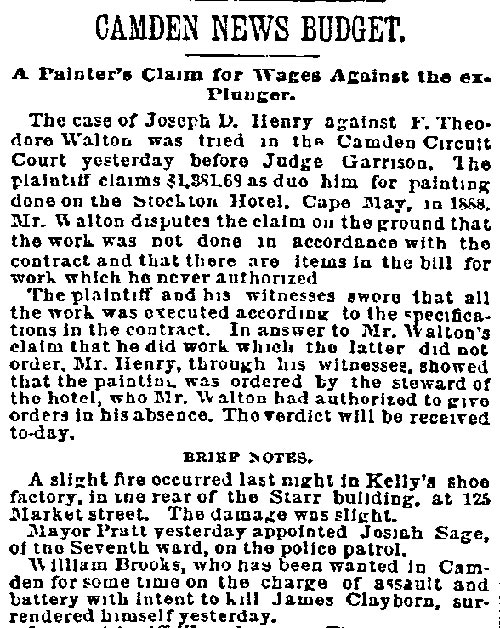
A Painter’s Claim for Wages Against the ex-Plunger.
The case of Joseph D. Henry against F. Theodore Walton was tried in the Camden Circuit Court yesterday before Judge Garrison. The plaintiff claims $1,[?]81.69 as due him for painting done on the Stockton Hotel, Cape May, in 1888. Mr. Walton disputes the claim on the ground that the work was not done in accordance with the contract and that there are items in the bill for work which he never authorized. The plaintiff and his witnesses swore that all the work was executed according to the specifications in the contract. In answer to Mr. Walton’s claim that he did work which the latter did not order, Mr. Henry, through his witnesses, showed that the painting was ordered by the steward of the hotel, who Mr. Walton had authorized to give orders in his absence. The verdict will be received to-day.
BRIEF NOTES.
A slight fire occurred last night in Kelly’s shoe factory, in the rear of the Starr building, at 125 Market street. The damage was slight.
Mayor Pratt yesterday appointed Josiah Sage, of the Seventh ward, on the police patrol.
William Brooks, who has been wanted in Camden for some time on the charge of assault and battery with intent to kill James Clayborn, surrendered himself yesterday.
Camden Police Baseball Challenge
Camden Post —
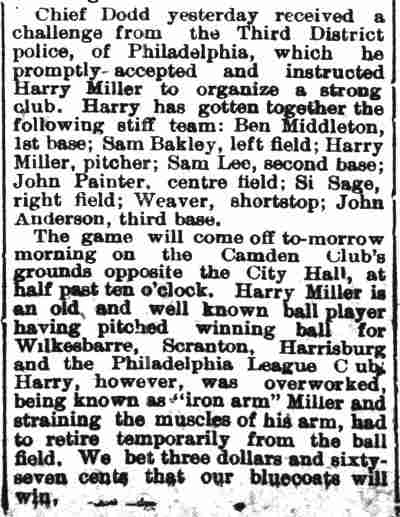
Chief Dodd yesterday received a challenge from the Third District police, of Philadelphia, which he promptly accepted and instructed Harry Miller to organize a strong club. Harry has gotten together the following stiff team: Ben Middleton, 1st base; Sam Bakley, left field; Harry Miller, pitcher; Sam Lee, second base; John Painter, centre field; Si Sage, right field; Weaver, shortstop; John Anderson, third base.
The game will come off to-morrow morning on the Camden Club’s grounds opposite the City Hall, at half past ten o’clock. Harry Miller is an old and well known ball player having pitched winning ball for Wilkesbarre, Scranton, Harrisburg and the Philadelphia League Club. Harry, however, was overworked, being known as “iron arm” Miller and straining the muscles of his arm, had to retire temporarily from the ball field. We bet three dollars and sixty-seven cents that our bluecoats will win.
Notes from Camden
Philadelphia Inquirer —
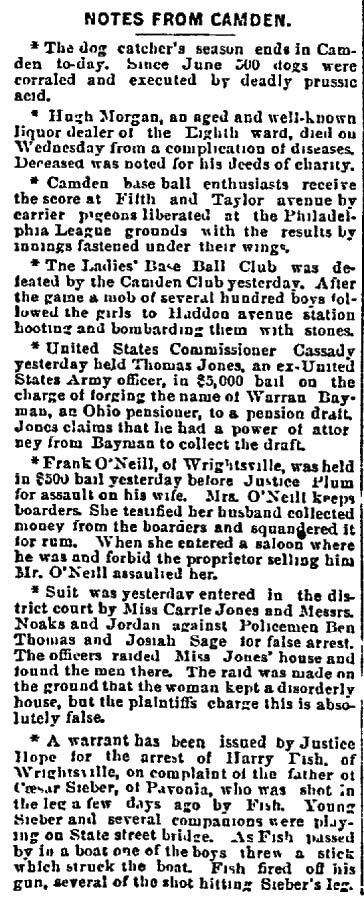
The dog catcher’s season ends in Camden to-day. Since June 500 dogs were corraled and executed by deadly prussic acid.
Hugh Morgan, an aged and well-known liquor dealer of the Eighth ward, died on Wednesday from a complication of diseases. Deceased was noted for his deeds of charity.
Camden base ball enthusiasts receive the score at Fifth and Taylor avenue by carrier pigeons liberated at the Philadelphia League grounds with the results by innings fastened under their wings.
The Ladies’ Base Ball Club was defeated by the Camden Club yesterday. After the game a mob of several hundred boys followed the girls to Haddon avenue station hooting and bombarding them with stones.
United States Commissioner Cassady yesterday held Thomas Jones, an ex-United States Army officer, in $5,000 bail on the charge of forging the name of Warran Bayman, an Ohio pensioner, to a pension draft. Jones claims that he had a power of attorney from Bayman to collect the draft.
Frank O’Neill, of Wrightsville, was held in $500 bail yesterday before Justice Plum for assault on his wife. Mrs. O’Neill keeps boarders. She testified her husband collected money from the boarders and squandered it for rum. When she entered a saloon where he was and forbid the proprietor selling him Mr. O’Neill assaulted her.
Suit was yesterday entered in the district court by Miss Carrie Jones and Messrs. Noaks and Jordan against Policemen Ben Thomas and Josiah Sage for false arrest. The officers raided Miss Jones’ house and found the men there. The raid was made on the ground that the woman kept a disorderly house, but the plaintiffs charge this is absolutely false.
A warrant has been issued by Justice Hope for the arrest of Harry Fish, of Wrightsville, on complaint of the father of Cæsar Sieber, of Pavonia, who was shot in the leg a few days ago by Fish. Young Sieber and several companions were playing on State street bridge. As Fish passed by in a boat one of the boys threw a stick which struck the boat. Fish fired off his gun, several of the shot hitting Sieber’s leg.
Damage Suits Against Thomas and Sage Decided for Policemen
Philadelphia Inquirer —
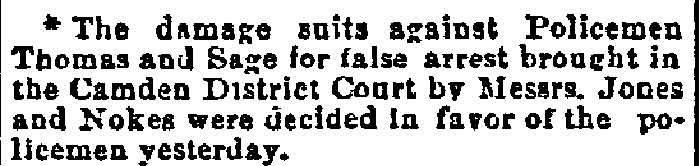
The damage suits against Policemen Thomas and Sage for false arrest brought in the Camden District Court by Messrs. Jones and Nokes were decided in favor of the policemen yesterday.
Philadelphia Inquirer, . Featuring Benjamin Thomas and Josiah Sage.
He Announces the Names
Camden Daily Telegram —
The Mayor Appoints the New Force To-day.
MANY OLD OFFICERS TAKEN BACK.
Some Surprise Manifested at the Mayor’s Appointment of Dodd Instead of Jones—This Afternoon All the Names Will be Announced.
The Mayor stated this morning to the newspaper fraternity that he would not announce his nominations for the police department until four o’clock this afternoon. It was expected that these would be announced this morning and in consequence there were a number of applicants for appointment on the force early this morning at the City Hall, hoping that the lightning would strike them.
Yesterday afternoon the mayor in addition to his nomination of Chief Dodd and Lieutenants Foster and Pettit appointed Frank Matlack, Jacob Woodsides, Alfred Hayden and John Dall, all of the Sixth Ward. The above were policemen under Mayor Westcott, before the Democratic Police Commission took charge of the Department.
Patrolman Griffin, Democrat, tendered his resignation yesterday to Mayor Westcott, to take effect to-day.
The appointment of Chief Dodd was quite a surprise to the public in general, as it was thought that Captain Jones would be named for the position. Many believed such an appointment would be in very good form, as Captain Jones’ knowledge of men and his military training would have made him a chief par excellence. The Mayor, however, probably thought that as Mr. Dodd had been so unceremoniously kicked out by the Democrats, it was nothing more than justice to again offer him the position which he had filled in a creditable manner for a number of years.
APPOINTED ON THE FORCE.
Mayor Westcott this afternoon made the following appointments:
First Ward—William E Cromly, George Cable, Henry R. Curtis, O. Glen Stackhouse.
Second Ward—Lincoln James, John Pratt, Samuel Bakley, Benj Middleton.
Third Ward—William Selby, Albert Myers, Edward Hartman.
Fourth Ward—Caleb Williams, Richard Golden, William Schregler, Ralph Bond.
Fifth Ward—William Harvey, Harry Mines and Oscar Weaver.
Sixth Ward—Jacob Woodsides, Frank Matlack, Albert Hayden and John Dall.
Seventh Ward—Josiah Sage, Henry Peters, Charles Lederman, Wm. Butts.
Eighth Ward—Alexander Alcorn, Chas. Leightenberg, Ferdinand Laird
There was no appointments made for the Ninth ward.
Two Men Shot in a Race Riot in Camden
Philadelphia Inquirer —
Both Victims Are Colored and One Is Probably Fatally Wounded.
POLICE USED PISTOLS
They Were Fired at When They Tried to Arrest the Fighters. “Crap” Game Started the Trouble.
In a race riot between white and colored men in South Camden last evening two colored men were shot. One of the two is seriously injured. When the police appeared upon the scene the white men turned their pistols against the officers, and their fire was returned. Arrests were made, however, without loss of life.
The night force were reporting at police headquarters for roll call at 6 o’clock last evening, when word was received that a race riot was in progress in the Seventh ward. Policemen Sayrs, George Anderson, Butts and Sage, the Seventh ward detail, were hastily dispatched to the scene.
They found a fierce fight in progress between a number of white and colored men, in which the former were using revolvers and the latter razors and clubs. As soon as they caught sight of the policemen the white men scattered.
Policeman Sayrs chased Thomas Glenn down Seventh street, near Walnut. The fugitive suddenly turned and fired his revolver at the officer. Policeman Sayrs dodged behind a freight car on Seventh street and emptied his revolver at Glenn. Howard Ever came to the officer’s assistance and Policemen Hyde and McClung joined in the chase. Glenn was finally captured in a house in which he had taken refuge.
One of the other fugitives fired at Policeman Butts, and that officer returned the fire, but neither was wounded.
The officers foun [sic] that Harry Cooper, of 706 Pine street, had been shot in the knee, and James Carter, of 332 Joint alley, had been shot in the stomach and hip during the riot. Both men are colored. They were sent to the Cooper Hospital. Carter is in a critical condition, as it is thought the bullet pierced his bladder. An operation will be necessary.
The officers arrested Henry Peters, son of Policeman Peters; John McDonald, Frank Whitaker and Thomas Glenn as the supposed assailants of the colored men. The prisoners claim that the fight started in the morning over a game of “crap,” and that the colored men left and returned in the evening with re-enforcements to “do up” the white men.
When searched at the City Hall Peters had a revolver and ball cartridges in his pocket. McDonald had a pair of brass knuckles. The police found a revolver at the scene of the fight.
Hot Time in the Flats
Camden Daily Telegram —
A Colored Joint on Kaighn Avenue Raided by the Police.
A good part of the colored population of South Camden crowded into the Mayor’s Court this morning to hear the case of Rosie Woolford, colored, whose house was raided Saturday night as being disorderly. The house is No. 624 Kaighn avenue and is one of a number known as “New York Flats.” Scores of complaints have been made against the resort, by neighbors, and on Saturday a warrant was issued by the Mayor. Accordingly, shortly after midnight, Policemen Brouthers, Sayres, Sage and Butts swooped down upon the house, and captured Rosie, the proprietress, Mame Fortie, Bertha Bastian, Susie Quinn, all colored, and Charles Brunner, a white man, and sent them to the Hall.
This morning when arraigned before the Mayor, Rosie pleaded not guilty. The testimony of the police against the woman was very strong, however. Officer Sage said that one night, he was called in the house on five different occasions, to quell disturbances. He further stated that if an intoxicated man was caught by the inmates they would lure him into the house, rob him and then kick him out. Rosie’s bail was fixed at $800 and the others were held as witnesses.
Here’s Camden’s Finest, With Whiskers, in 1898
Camden Courier-Post —
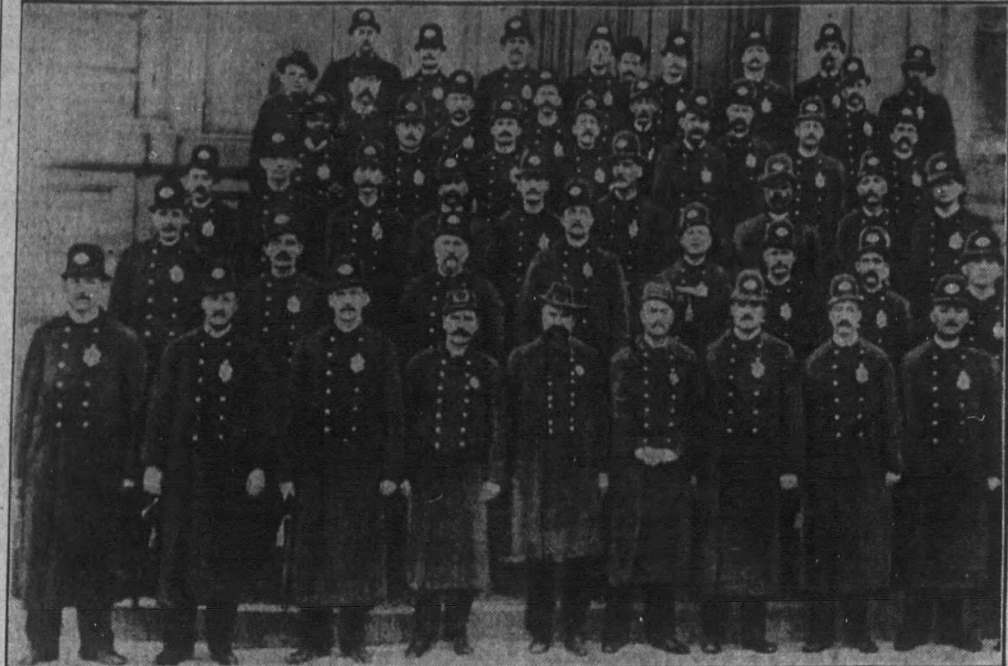
Reading from left to right, those in the picture are: First row, William A. Schregler, Rox Comley, Jules Bosch, Lieutenant John Foster, Chief Samuel Dodd, Lieutenant H. Frank Pettit, Edward Hartman and Charles Wilbur. Second row, Thomas Brothers, Ralph Bond, John Dall, George Kappell, Silas Sage, Edward S. Hyde, George Selby and E. B. McClong. Third row, Edward Powell, John Sinclair, William Laird, Benjamin Middleton, Alfred L. Sayers, John Anderson, William Butts, John Painter and Frank Matlack. Fourth row, Thomas Hicks, Alfred Haydon, Abe Jackson, Albert Shaw, Edward Steen and Samuel Bakely. Fifth row, Caleb Williams, E. A. Gravenor, Thomas Buchanan, Samuel Cox, George Horner, Godfrey Eisenhardt, Harry Curtis and John Barnett. Sixth row, Casper Hart, Charles Fitzsimmons, A. Lincoln James, Oscar Weaver, Charles Ridgely, William Fish and George Cooper.
Reformers Lop Off Chief Dodd’s Head
Philadelphia Inquirer —
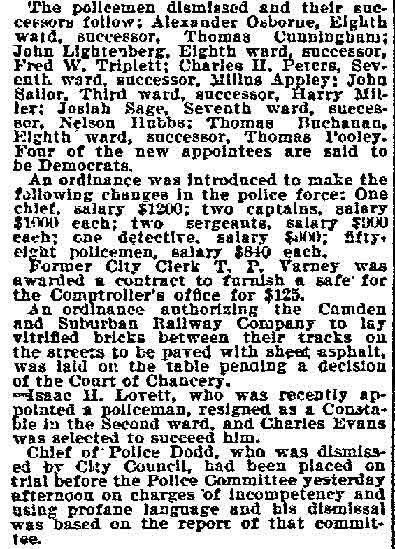
Six Republican Policemen Also Removed and Reformers Take Their Places
ADOPT ANNUAL BUDGET
Slight Reduction in Appropriations—Water Compromise Ratified by Council
Camden City Council last evening fixed the annual appropriations at $516,160, ratified the compromise with Contractor Pfeiffer by which pure water will be turned on to-morrow and dismissed Chief of Police Dodd and six Republican policemen. The appropriations as compared with last year are as follows:
| 1897. | 1898. | |
|---|---|---|
| Police . . . | $60,000 | $68,000 |
| Lighting . . . | 71,000 | 72,000 |
| Salaries . . . | 35,000 | 38,964 |
| Streets . . . | 42,000 | 38,000 |
| Culverts . . . | 12,000 | 12,000 |
| Water . . . | 56,000 | 60,000 |
| Liquidating Indebtedness . . . | 25,000 | 12,500 |
| Excise . . . | 2,500 | 2,500 |
| Dispensaries . . . | 4,000 | 4,000 |
| Parks . . . | 1,400 | 4,000 |
| Interest . . . | 115,000 | 105,946 |
| Building Commission . . . | 100 | 50 |
| Fire . . . | 47,000 | 44,000 |
| Property . . . | 8,000 | 6,500 |
| Elections . . . | 8,000 | 6,000 |
| District Court . . . | 4,000 | 4,000 |
| Printing . . . | 7,000 | 7,500 |
| Contingent . . . | 6,600 | 3,500 |
| Board of Health . . . | 4,000 | 3,500 |
| Poor . . . | 2,000 | 2,000 |
| G. A. R. . . . | 200 | 200 |
| Park Special Bonds . . . | 3,000 | |
| Sinking Fund . . . | 10,000 | 21,000 |
| Deficiency . . . | 10,000 | |
| Total . . . | $533,700 | $516,160 |
The policemen dismissed and their successors follow: Alexander Osborne, Eighth ward, successor, Thomas Cunningham; John Lightenberg, Eighth ward, successor, Fred W. Triplett; Charles H. Peters, Seventh ward, successor, Milins Appley; John Sailor, Third ward, successor, Harry Miller; Josiah Sage, Seventh ward, successor, Nelson Hubbs; Thomas Buchanan, Eighth ward, successor, Thomas Pooley. Four of the new appointees are said to be Democrats.
An ordinance was introduced to make the following changes in the police force: One chief, salary $1200; two captains, salary $1[?]00 each; two sergeants, salary $900 each; one detective, salary $[?]00; fifty-eight policemen, salary $840 each.
Former City Clerk T. P. Varney was awarded a contract to furnish a safe for the Comptroller’s office for $125.
An ordinance authorizing the Camden and Suburban Railway Company to lay vitrified bricks between their tracks on the streets to be paved with sheet asphalt, was laid on the table pending a decision of the Court of Chancery.
Isaac H. Lovett, who was recently appointed a policeman, resigned as a Constable in the Second ward, and Charles Evans was selected to succeed him.
Chief of Police Dodd, who was dismissed by City Council, had been placed on trial before the Police Committee yesterday afternoon on charges of incompetency and using profane language and his dismissal was based on the report of that committee.
Mayor Will Be Chief
Camden Post —
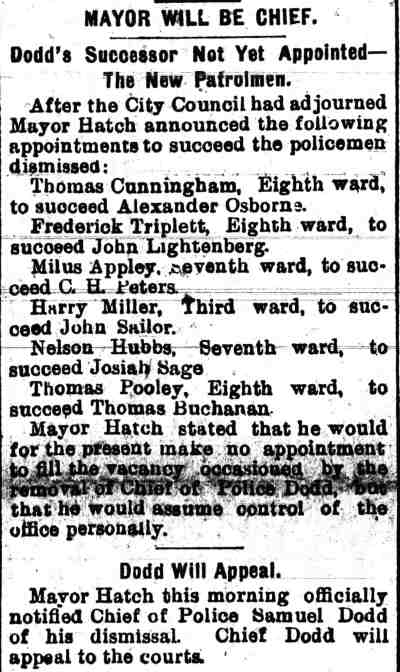
Dodd’s Successor Not Yet Appointed—The New Patrolmen.
After the City Council had adjourned Mayor Hatch announced the following appointments to succeed the policemen dismissed:
Thomas Cunningham, Eighth ward, to succeed Alexander Osborne.
Frederick Triplett, Eighth ward, to succeed John Lightenberg.
Milus Appley, Seventh ward, to succeed C. H. Peters.
Harry Miller, Third ward, to succeed John Sailor.
Nelson Hubbs, Seventh ward, to succeed Josiah Sage
Thomas Pooley, Eighth ward, to succeed Thomas Buchanan.
Mayor Hatch stated that he would for the present make no appointment to fill the vacancy occasioned by the removal of Chief of Police Dodd, but that he would assume control of the office personally.
Dodd Will Appeal.
Mayor Hatch this morning officially notified Chief of Police Samuel Dodd of his dismissal. Chief Dodd will appeal to the courts.
Camden’s Tax Rate $2.10
Philadelphia Inquirer —
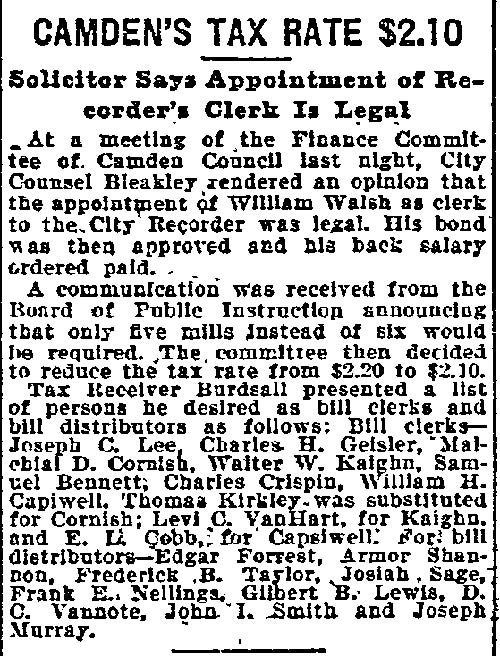
Solicitor Says Appointment of Recorder’s Clerk Is Legal
At a meeting of the Finance Committee of Camden Council last night, City Counsel Bleakley rendered an opinion that the appointment of William Walsh as clerk to the City Recorder was legal. His bond was then approved and his back salary ordered paid.
A communication was received from the Board of Public Instruction announcing that only five mills instead of six would be required. The committee then decided to reduce the tax rate from $2.20 to $2.10.
Tax Receiver Burdsall presented a list of persons he desired as bill clerks and bill distributors as follows; Bill clerks—Joseph C. Lee, Charles H. Geisler, Malachi D. Cornish, Walter W. Kaighn, Samuel Bennett; Charles Crispin, William H. Capiwell, Thomas Kirkley was substituted for Cornish; Levi C. VanHart, for Kaighn, and E. L. Cobb, for Capiwell. For bill distributors—Edgar Forrest, Armor Shannon, Frederick B. Taylor, Josiah Sage, Frank E. Nellings, Gilbert B. Lewis, D. C. Vannote, John I. Smith and Joseph Murray.
Quo Warranto Proceedings Issued Against Their Successors
Philadelphia Inquirer —
Trenton, N. J., Oct. 4.—Counsel for Henry S. Scovel, of Camden, to-day began quo-warranto proceedings in the supreme court on behalf of eight Camden policemen recently ousted from their positions by the common council of that city to require their eight successors to show by what warrant and authority they hold their respective offices and exercise the duties thereof.
The ousted officers are Abram Jackson, John Lighthouse, Josiah Sage, John Sinclair, William Selby, Thomas Buchanan, Albert F. Meyers and Caleb Brown, and their respective successors, Thomas Moore, Fred. Triplet, Allen Hubbs, Albert Geaser, Robert Miller, William Harris, Harry Hope and Isaac Brown. The cases will come up before the November term.
Could Not Agree on New Fireman
Philadelphia Inquirer —
Camden Councilmen From East Side Split on Selecting Appointees
There Is Also Trouble in the Second Ward — Benjamin Kellum Made Assistant Chief — Other Promotions
The Camden Fire Commissioners last evening selected firemen for the five new fire companies from all the wards except the Second, Eleventh and Twelfth, as the Councilmen in these wards could not agree on the candidates the appointments were laid over until Monday evening next.
In the Second ward the Councilmen have agreed on John W. Vanhart. The other candidates are W. Scott Franklin, backed by Freeholder Whyte, and Edgar Bolton, who is the choice of Mayor Hatch and Councilman McGill. Bolton will probably be selected.
In the Eleventh ward a meeting was held by the Councilmen and the candidates agreed upon. Councilman Arnold has since repudiate [sic] the agreement, and last evening presented a new set of names to the conference of the commissioners. Councilman Longacre presented those previously agreed upon.
In the Twelfth ward Councilman Lee submitted names in opposition to those of Councilman Leas. It is quite probable that the choice of Councilmen Leas and Longacre, who are members of the Fire Committee, will be selected.
Benjamin Kellum, foreman of Truck No. 1, was appointed assistant chief. He will have charge of the East Side companies.
Charles Robinson, of the Seventh ward; George B. Wade, of the Sixth ward; Albert Jones, of the Ninth ward; George Cox, of the Third ward; Edward Weston, of the Ninth ward, and Samuel Peoples, of the Fifth ward, were elected foremen. They will be assigned to their posts of duty on Monday.
The selection of new firemen was as follows: First ward, Harry B. Middleton, Harry Burroughs; Third ward, Robert W. Colkett, William G. Hillman; Fourth ward, James E. Navins, Charles Todd; Fifth ward, Daniel Smith, Peter B. Carter; Sixth ward, Alfred Hayden, Henry Elliott; Seventh ward, Josiah Sage, Samuel Price; Eighth ward, William Rose, Charles Sturgis; Ninth ward, Daniel Grimes, Harry Wagner; Tenth ward, Augustus Kester, William Simpson.
The commissioners presented the bell now in the William Penn hose house, East Side, to the First Baptist Church.
Big Blaze in Camden Entailed Nearly Half a Million Loss
Philadelphia Inquirer —
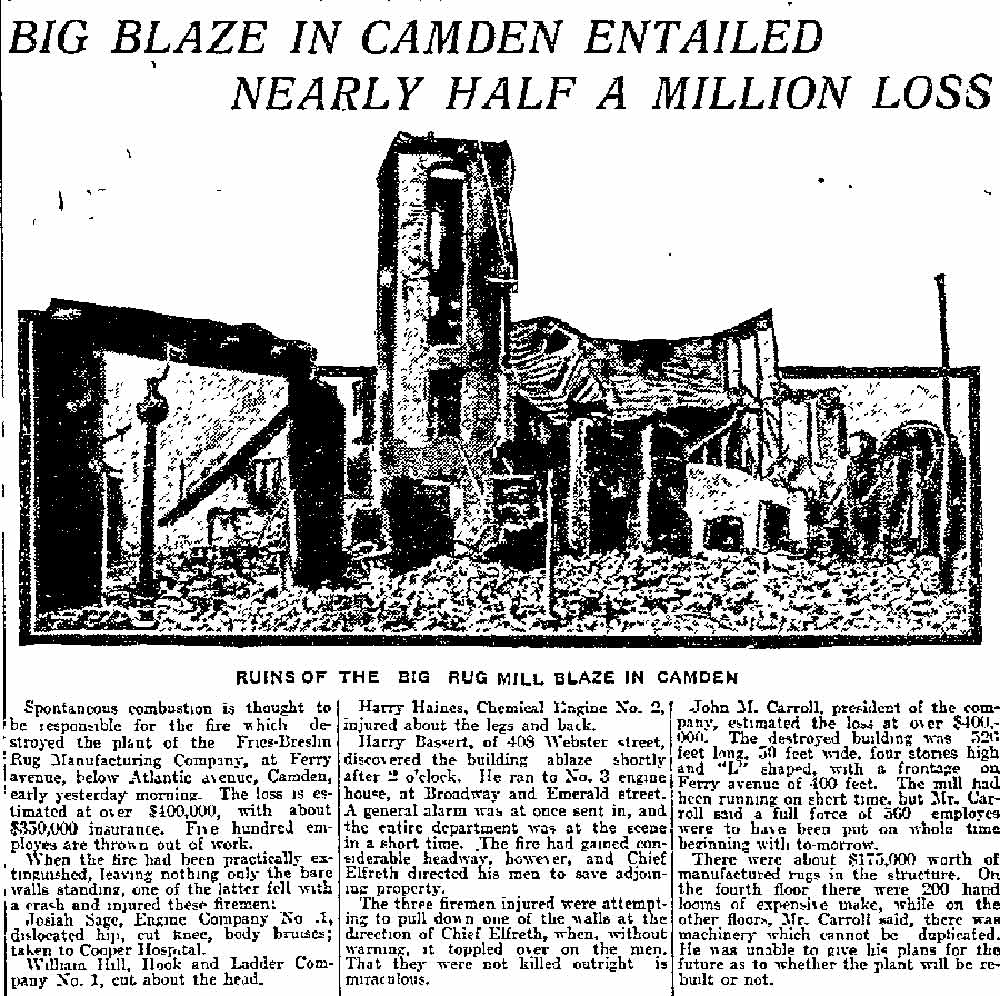
BIG BLAZE IN CAMDEN ENTAILED NEARLY HALF A MILLION LOSS
RUINS OF THE BIG RUG MILL BLAZE IN CAMDEN
Spontaneous combustion is thought to be responsible for the fire which destroyed the plant of the Fries-Breslin Rug Manufacturing Company, at Ferry avenue, below Atlantic avenue, Camden, early yesterday morning. The loss is estimated at over $400,000, with about $350,000 insurance. Five hundred employes are thrown out of work.
When the fire had been practically extinguished, leaving nothing only the bare walls standing, one of the latter fell with a crash and injured these firemen:
Josiah Sage, Engine Company No. 1, dislocated hip, cut knee, body bruises; taken to Cooper Hospital.
William Hill, Hook and Ladder Company No. 1, cut about the head.
Harry Haines, Chemical Engine No. 2, injured about the legs and back.
Harry Bassert, of 408 Webster street, discovered the building ablaze shortly after 2 o’clock. He ran to No. 3 engine house, at Broadway and Emerald street. A general alarm was at once sent in, and the entire department was at the scene in a short time. The fire had gained considerable headway, however, and Chief Elfreth directed his men to save adjoining property.
The three firemen injured were attempting to pull down one of the walls at the direction of Chief Elfreth, when, without warning, it toppled over on the men. That they were not killed outright is miraculous.
John M. Carroll, president of the company, estimated the loss at over $400,000. The destroyed building was 520 feet long, 50 feet wide, four stories high and “L” shaped, with a frontage on Ferry avenue of 400 feet. The mill had been running on short time, but Mr. Carroll said a full force of 500 employes were to have been put on whole time beginning with to-morrow.
There were about $175,000 worth of manufactured rugs in the structure. On the fourth floor there were 200 hand looms of expensive make, while on the other floors, Mr. Carroll said, there was machinery which cannot be duplicated. He was unable to give his plans for the future as to whether the plant will be rebuilt or not.
Philadelphia Inquirer, . Fries-Breslin Rug Manufacturing Company fire. Featuring Josiah Sage, Harry Haines Sr., Samuel S. Elfreth; Ferry Avenue, Atlantic Avenue, Webster Street, Broadway, Emerald Street.
Three Firemen Met Death in Camden Blaze
Philadelphia Inquirer —
Trapped in Fire at the Old Sixth Regiment Armory They Perished in Flames
NINE OTHER PERSONS RECEIVED INJURIES
Three firemen were killed and nine persons injured at a fire last night which destroyed the old armory building at Bridge avenue, West and Mickle streets, Camden, causing a loss estimated at $50,000.
The dead firemen are: GEORGE SHIELDS, 525 Kaighn avenue, member of the Kaighn avenue chemical company. WILLIAM HILLMAN, 229 Beckett street, of the Kaighn avenue chemical company. WILLIAM JOBES, 57[?] Line street, member of Engine Company No. 2.
The Injured
The injured, all of whom will recover, are: Josiah Sage, 917 South Eighth street, Kaighn avenue company, cut head and face; Seth Monnell, 744 Mt. Vernon street, Kaighn avenue company, scalp wounds; George Quinn, 516 Line street, Kaighn avenue company, cut face; Martin Carrigan, 516 Clinton street, Engine Company No. 1, lacerated face and hands; J. W. Simpson, 551 Cedar street, Engine Company No. 2, lacerations of scalp and face; James Elberson, 628 North Fourth street, Engine Company No. 4, contused wounds of the legs; William Elberson, 231 Taylor avenue, Engine Company No. 2, injured about the back; Charles Worthington, 1017 Penn street, Engine Company No. 3, internally injured; Harry Dease, a citizen, cut about the face.
The six o’clock whistles were blowing when smoke was seen issuing from the northeast corner of the building. A moment later two boys ran out of a door, one of whom notified Policeman Isaac Toy that the structure was on fire. The officers immediately turned in an alarm. In rapid succession other alarms were given, until the entire department was on the scene.
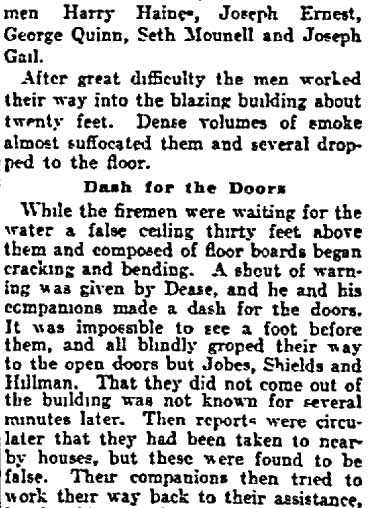
One of the first companies to arrive was the Kaighn avenue truck. As the men drove up to the scene great tongues of flame were fast eating their way through the yellow pine timbers of which the interior was constructed. The main doors at the entrance on Mickle street were burst open and the firemen entered amid a perfect shower of sparks and falling debris. In this party were the three ill-fated firemen, Dease, and Firemen Harry Haines, Joseph Ernest, George Quinn, Seth Mounell and Joseph Gail.
After great difficulty the men worked their way into the blazing building about twenty feet. Dense volumes of smoke almost suffocated them and several dropped to the floor.
Dash for the Doors
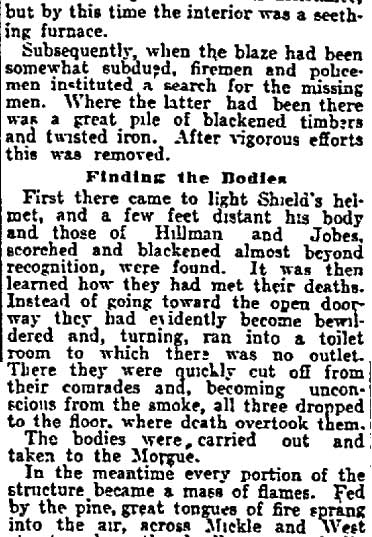
While the firemen were waiting for the water a false ceiling thirty feet above them and composed of floor boards began cracking and bending. A shout of warning was given by Dease, and he and his companions made a dash for the doors. It was impossible to see a foot before them, and all blindly groped their way to the open doors but Jobes, Shields and Hillman. That they did not come out of the building was not known for several minutes later. Then reports were circulated that they had been taken to nearby houses, but these were found to be false. Their companions then tried to work their way back to their assistance, but by this time the interior was a seething furnace.
Subsequently, when the blaze had been somewhat subdued, firemen and policemen instituted a search for the missing men. Where the latter had been there was a great pile of blackened timbers and twisted iron. After vigorous efforts this was removed.
Finding the Bodies
First there came to light Shield’s helmet, and a few feet distant his body and those of Hillman and Jobes, scorched and blackened almost beyond recognition, were found. It was then learned how they had met their deaths. Instead of going toward the open doorway they had evidently become bewildered and, turning, ran into a toilet room to which there was no outlet. There they were quickly cut off from their comrades and, becoming unconscious from the smoke, all three dropped to the floor, where death overtook them.
The bodies were carried out and taken to the Morgue.
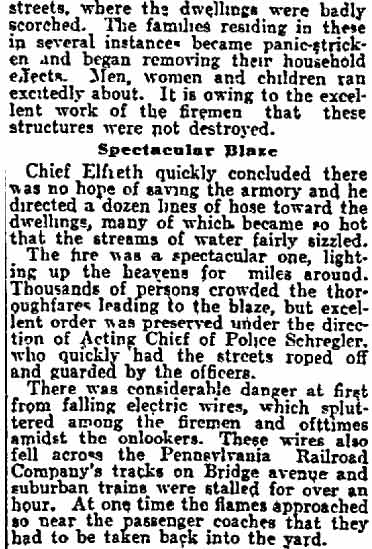
In the meantime every portion of the structure became a mass of flames. Fed by the pine, great tongues of fire sprang into the air, across Mickle and West streets, where the dwellings were badly scorched. The families residing in these in several instances became panic-stricken and began removing their household effects. Men, women and children ran excitedly about. It is owing to the excellent work of the firemen that these structures were not destroyed.
Spectacular Blaze
Chief Elfieth quickly concluded there was no hope of saving the armory and he directed a dozen lines of hose toward the dwellings, many of which became so hot that the streams of water fairly sizzled.
The fire was a spectacular one, lighting up the heavens for miles around. Thousands of persons crowded the thoroughfares leading to the blaze, but excellent order was preserved under the direction of Acting Chief of Police Schregler, who quickly had the streets roped off and guarded by the officers.
There was considerable danger at first from falling electric wires, which spluttered among the firemen and ofttimes amidst the onlookers. These wires also fell across the Pennsylvania Railroad Company’s tracks on Bridge avenue and suburban trains were stalled for over an hour. At one time the flames approached so near the passenger coaches that they had to be taken back into the yard.
Stubborn Blaze
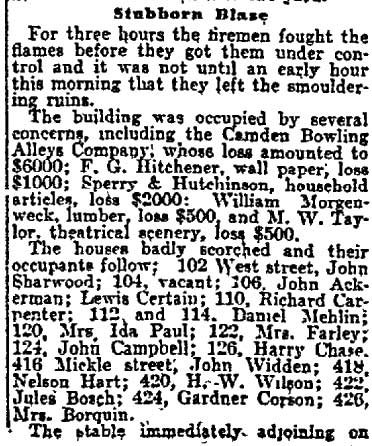
For three hours the firemen fought the flames before they got them under control and it was not until an early hour this morning that they left the smouldering ruins.
The building was occupied by several concerns, including the Camden Bowling Alleys Company; whose loss amounted to $6000; F. G. Hitchener, wall paper; loss $1000; Sperry & Hutchinson, household articles, loss $2000; William Morgenweck, lumber, loss $500, and M. W. Taylor, theatrical scenery, loss $500.
The houses badly scorched and their occupants follow; 102 West street, John Sharwood; 104, vacant; 106, John Ackerman; Lewis Certain; 110, Richard Carpenter; 112, and 114. Daniel Mehlin; 120, Mrs. Ida Paul; 122, Mrs. Farley; 124, John Campbell; 126, Harry Chase. 416 Mickle street, John Widden; 418, Nelson Hart; 420, H.-W. Wilson; 422, Jules Bosch; 424, Gardner Corson; 426, Mrs. Borquin.
The stable immediately adjoining on the west side of the armory, and belonging to C. M. Alcott, was flooded with water. At this place there were forty horses, all of which were rescued.
Formerly a Market
The destroyed building was erected in 1873, by a number of well-known Camden men, as the Farmers’ and Merchants’ Market. From the first it was not a success, and subsequently became known as the Camden Opera House. After a more or less successful season the promoters of this scheme closed the doors. In 1886 the building was purchased by the State as an armory for the old Sixth Regiment, N. G. N. J. For ten years Camden’s citizen soldiers drilled and gave balls and receptions in the building. When the regiment moved to the new armory on Haddon avenue the old structure was cut up into several rooms and had been used by many different concerns. Recently it was purchased by the Pennsylvania Railroad Company to make way for the elevated railroad. All the tenants had been ordered to vacate.
The origin of the fire is unknown. Incendiarism is hinted at and Mayor Ellis declared he will detail the detectives on the case to-day to make a rigid investigation.
Speaking of the matter, he said it is very peculiar that most of Camden’s fires occur about the time the firemen are at their meals. This has been the case in most every blaze if [sic] any importance in the city. The Mayor also highly commended the excellent work of the men in preventing a spread of the flames.
Flames Wrecked New High School
Philadelphia Inquirer —
Walls Left of Handsome Building Erected at Woodbury Only a Short Time Ago
Believed Blaze Originated in Boiler Room by Joists Taking Fire. Pride of County Seat
Special to The Inquirer.
WOODBURY, N. J., Dec. 19.—The William Milligan High School, a practically new institution that has been occupied just about a year, and cost, including the lot, about $88,000, was burned early this morning, and the building, with all its handsome furnishings, is a wreck. Only the walls are standing, and it will be necessary to tear the greater portion of these down to rebuild, which will be done at once. There is an insurance of about $60,000 on the buildings and furnishings.
From what can be ascertained the fire originated over the boiler in the engine room, which was on the extreme northwest end of the basement. The first floor joists were in close contact with the chimney, and it is supposed, according to Fire Chief A. W. Cattell, that sparks got on the wood work. It is also believed that the fire had been burning for about three hours, as when the firemen attempted to go in the front doors, the smoke was so thick that they were driven back.
Discovered Flames
Charles M. Garrett, who lives on New street, at the rear of the school house, was awakened by his wife. He saw a bright light in the engine room and knew there was a fire. He telephoned an alarm and firemen responded. Another alarm was sounded, and lines of hose were attached, but the pressure was so light that the stream would not reach far above the second story. Fire Chief Cattell telephoned to Camden, and ten minutes later Fire Chief Elfreth had an engine and Company No. 2 at the Camden terminal. In the meantime several firemen from Gloucester came, but there was little to do, except watch the fire. Several firemen attempted to go inside the building, and Foreman Edward Martin was injured by falling material, and Charles Graham, a Gloucester fireman, was knocked down by exploding chemicals in the laboratory.
A. A. Allard, the engineer, left the building last night about 5 o’clock, and is sure there was no smoke in the building at that time.
The school had sixteen rooms, including two recreation and a large assembly room, with a chemical laboratory, and two gymnasiums. In the commercial room were ten new typewriters, and new and up-to-date desks. These were all purchased at the beginning of the school year. In the basement was a new manual training outfit, which arrived only last week, but not unpacked, and some of this will probably be saved.
Woodbury has over a hundred out of town pupils who come here, and when they arrived this morning, all jubilant over the approaching holidays, some of the girls cried.
The Board of Education held a meeting this afternoon and decided to open the four upper rooms in the academy, rent three more in Green’s Block, two in the old Friends’ School, and it is possible that the old Starr homestead on Broad street will be used.
Prisoners in a Panic
During the fire the prisoners in the county jail, which is within a hundred yards of the school, were thrown into a panic. They were all locked in their cells.
The men, who were under Fire Chief Elfreth, of Camden, and those who did good work in connection with the local firemen, were George Weight, Harvey Watson, William Elverson, Harry Hankins, William Ladd, Chappis [sic] Lennox, Joseph Johnson, Josiah Savage, Augustus Dold and Arthur Wingate. The Gloucester firemen aided in every way possible.
Celebrations by 3 Fire Companies
Camden Post-Telegram —
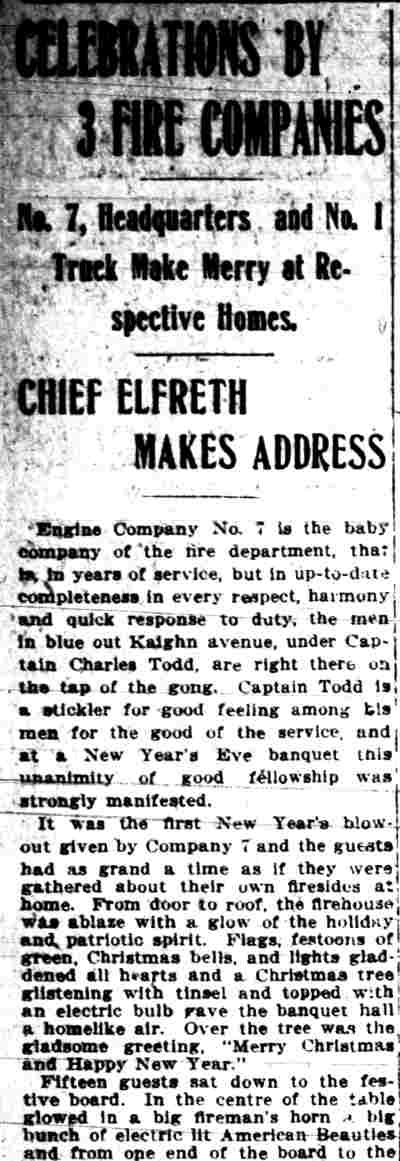
No. 7, Headquarters and No. 1 Truck Make Merry at Respective Homes.
CHIEF ELFRETH MAKES ADDRESS
Engine Company No. 7 is the baby company of the fire department, that is, in years of service, but in up-to-date completeness in every respect, harmony and quick response to duty, the men in blue out Kaighn avenue, under Captain Charles Todd, are right there on the tap of the gong. Captain Todd is a stickler for good feeling among his men for the good of the service, and at a New Year’s Eve banquet this unanimity of good fellowship was strongly manifested.
It was the first New Year’s blowout given by Company 7 and the guests had as grand a time as if they were gathered about their own firesides at home. From door to roof, the firehouse was ablaze with a glow of the holiday and patriotic spirit. Flags, festoons of green, Christmas bells, and lights gladdened all hearts and a Christmas tree glistening with tinsel and topped with an electric bulb gave the banquet hall a homelike air. Over the tree was the gladsome greeting, “Merry Christmas and Happy New Year.”
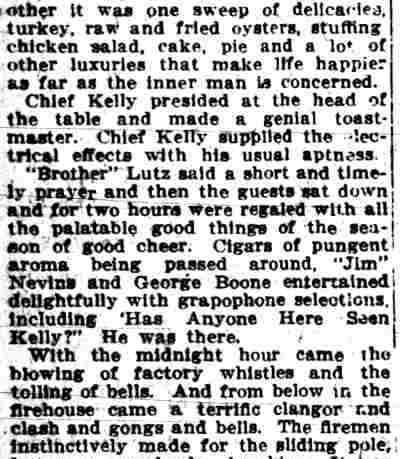
Fifteen guests sat down to the festive board. In the centre of the table glowed in a big fireman’s horn a big bunch of electric lit American Beauties and from one end of the board to the other it was one sweep of delicacies, turkey, raw and fried oysters, stuffing chicken salad, cake, pie and a lot of other luxuries that make life happier as far as the inner man is concerned.
Chief Kelly presided at the head of the table and made a genial toastmaster. Chief Kelly supplied the electrical effects with his usual aptness. “Brother” Lutz said a short and timely prayer and then the guests sat down and for two hours were regaled with all the palatable good things of the season of good cheer. Cigars of pungent aroma being passed around, “Jim” Nevins and George Boone entertained delightfully with grapophone selections, including ‘Has Anyone Here Seen Kelly?” He was there.
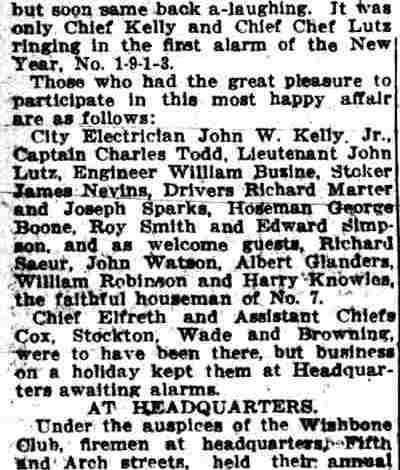
With the midnight hour came the blowing of factory whistles and the tolling of bells. And from below in the firehouse came a terrific clangor and clash and gongs and bells. The firemen instinctively made for the sliding pole, but soon same [sic] back a-laughing. It was only Chief Kelly and Chief Chef Lutz ringing in the first alarm of the New Year, No. 1-9-1-3.
Those who had the great pleasure to participate in this most happy affair are as follows:
City Electrician John W. Kelly, Jr., Captain Charles Todd, Lieutenant John Lutz, Engineer William Buzine, Stoker James Nevins, Drivers Richard Marter and Joseph Sparks, Hoseman George Boone, Roy Smith and Edward Simpson, and as welcome guests, Richard Saeur, John Watson, Albert Glanders, William Robinson and Harry Knowles, the faithful houseman of No. 7.
Chief Elfreth and Assistant Chiefs Cox, Stockton, Wade and Browning, were to have been there, but business on a holiday kept them at Headquarters awaiting alarms.
AT HEADQUARTERS.
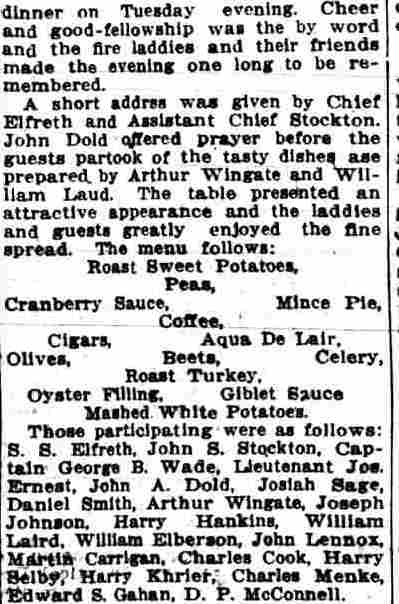
Under the auspices of the Wishbone Club, firemen at headquarters, Fifth and Arch streets, held their annual dinner on Tuesday evening. Cheer and good-fellowship was the by word and the fire laddies and their friends made the evening one long to be remembered.
A short addrss [sic] was given by Chief Elfreth and Assistant Chief Stockton. John Dold offered prayer before the guests partook of the tasty dishes ase [sic] prepared by Arthur Wingate and William Laud. The table presented an attractive appearance and the laddies and guests greatly enjoyed the fine spread. The menu follows:
Roast Sweet Potatoes,
Peas,
Cranberry Sauce, Mince Pie,
Coffee,
Cigars, Aqua De Lair,
Olives, Beets, Celery,
Roast Turkey,
Oyster Filling, Giblet Sauce
Mashed White Potatoes.
Those participating were as follows: S. S. Elfreth, John S. Stockton, Captain George B. Wade, Lieutenant Jos. Ernest, John A. Dold, Josiah Sage, Daniel Smith, Arthur Wingate, Joseph Johnson, Harry Hankins, William Laird, William Elberson, John Lennox, Martin Carrigan, Charles Cook, Harry Selby, Harry Khrier, Charles Menke, Edward S. Gahan, D. P. McConnell.
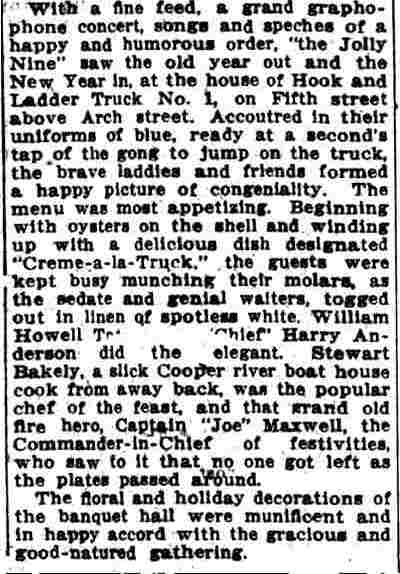
With a fine feed, a grand graphophone concert, songs and speches [sic] of a happy and humorous order, “the Jolly Nine” saw the old year out and the New Year in, at the house of Hook and Ladder Truck No. 1, on Fifth street above Arch street. Accoutred in their uniforms of blue, ready at a second’s tap of the gong to jump on the truck, the brave laddies and friends formed a happy picture of congeniality. The menu was most appetizing. Beginning with oysters on the shell and winding up with a delicious dish designated “Creme-a-la-Truck,” the guests were kept busy munching their molars, as the sedate and genial waiters, togged out in linen of spotless white. William Howell Tatem [?] and ‘Chief’ Harry Anderson did the elegant. Stewart Bakely, a slick Cooper river boat house cook from away back, was the popular chef of the feast, and that grand old fire hero, Captain “Joe” Maxwell, the Commander-in-Chief of festivities, who saw to it that no one got left as the plates passed around.
The floral and holiday decorations of the banquet hall were munificent and in happy accord with the gracious and good-natured gathering.
Fatally Hurt in Crossing Smash
Camden Post-Telegram —
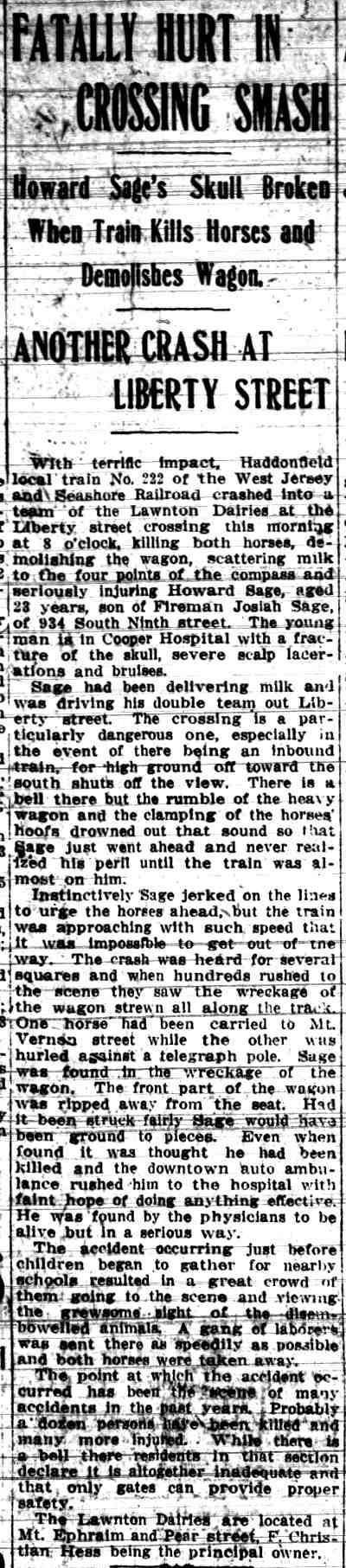
Howard Sage’s Skull Broken When Train Kills Horses and Demolishes Wagon.
ANOTHER CRASH AT LIBERTY STREET
With terrific impact, Haddonfield local train No. 222 of the West Jersey and Seashore Railroad crashed into a team of the Lawnton Dairies at the Liberty street crossing this morning at 8 o’clock, killing both horses, demolishing the wagon, scattering milk to the four points of the compass and seriously injuring Howard Sage, aged 23 years, son of Fireman Josiah Sage, of 934 South Ninth street. The young man is in Cooper Hospital with a fracture of the skull, severe scalp lacerations and bruises.
Sage had been delivering milk and was driving his double team out Liberty street. The crossing is a particularly dangerous one, especially in the event of there being an inbound train, for high ground off toward the south shuts off the view. There is a bell there but the rumble of the heavy wagon and the clamping of the horses’ hoofs drowned out that sound so that Sage just went ahead and never realized his peril until the train was almost on him.
Instinctively Sage jerked on the lines to urge the horses ahead, but the train was approaching with such speed that it was impossible to get out of the way. The crash was heard for several squares and when hundreds rushed to the scene they saw the wreckage of the wagon strewn all along the track. One horse had been carried to Mt. Vernon street while the other was hurled against a telegraph pole. Sage was found in the wreckage of the wagon. The front part of the wagon was ripped away from the seat. Had it been struck fairly Sage would have been ground to pieces. Even when found it was thought he had been killed and the downtown auto ambulance rushed him to the hospital with faint hope of doing anything effective. He was found by the physicians to be alive but in a serious way.
The accident occurring just before children began to gather for nearby schools resulted in a great crowd of them going to the scene and viewing the grewsome sight of the disembowelled animals. A gang of laborers was sent there as speedily as possible and both horses were taken away.
The point at which the accident occurred has been the scene of many accidents in the past years. Probably a dozen persons have been killed and many more injured. While there is a bell there residents in that section declare it is altogether inadequate and that only gates can provide proper safety.
The Lawnton Dairies are located at Mt. Ephraim and Pear street. F. Christian Hess being the principal owner.
Charm Presented to Deputy Chief
Camden Daily Courier —
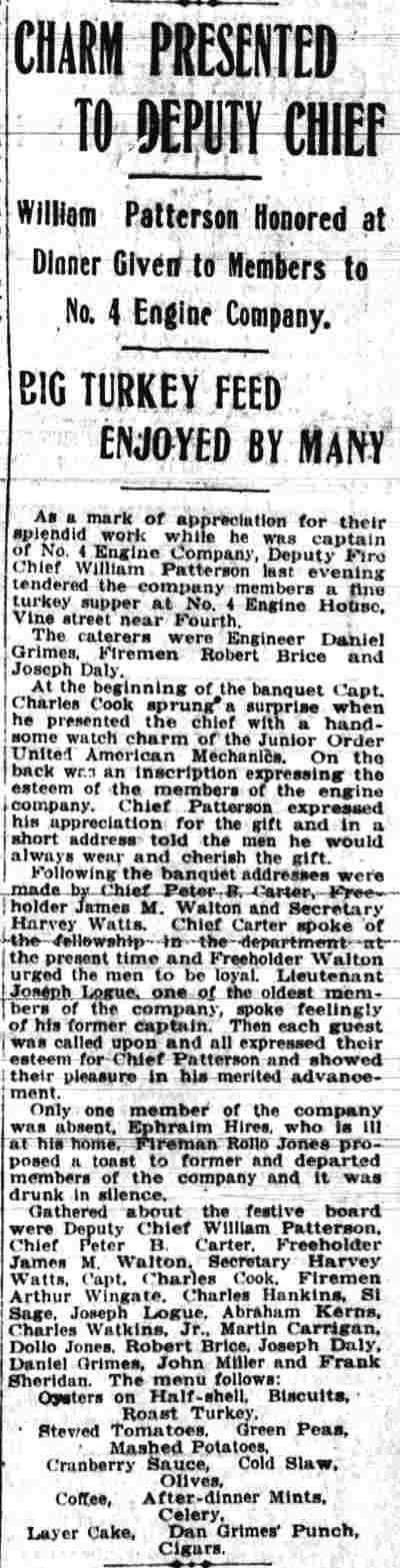
William Patterson Honored at Dinner Given to Members to No. 4 Engine Company.
BIG TURKEY FEED ENJOYED BY MANY
As a mark of appreciation for their splendid work while he was captain of No. 4 Engine Company, Deputy Fire Chief William Patterson last evening tendered the company members a fine turkey supper at No. 4 Engine House, Vine street near Fourth.
The caterers were Engineer Daniel Grimes, Firemen Robert Brice and Joseph Daly.
At the beginning of the banquet Capt. Charles Cook sprung a surprise when he presented the chief with a handsome watch charm of the Junior Order United American Mechanics. On the back was an inscription expressing the esteem of the members of the engine company. Chief Patterson expressed his appreciation for the gift and in a short address told the men he would always wear and cherish the gift.
Following the banquet addresses were made by Chief Peter B. Carter, Freeholder James M. Walton and Secretary Harvey Watts. Chief Carter spoke of the fellowship in the department at the present time and Freeholder Walton urged the men to be loyal. Lieutenant Joseph Logue, one of the oldest members of the company, spoke feelingly of his former captain. Then each guest was called upon and all expressed their esteem for Chief Patterson and showed their pleasure in his merited advancement.
Only one member of the company was absent, Ephraim Hires, who is ill at his home. Fireman Rollo Jones proposed a toast to former and departed members of the company and it was drunk in silence.
Gathered about the festive board were Deputy Chief William Patterson, Chief Peter B. Carter, Freeholder James M. Walton, Secretary Harvey Watts, Capt. Charles Cook, Firemen Arthur Wingate, Charles Hankins, Si Sage, Joseph Logue, Abraham Kerns, Charles Watkins, Jr., Martin Carrigan, Dollo [sic] Jones, Robert Brice, Joseph Daly, Daniel Grimes, John Miller and Frank Sheridan. The menu follows:
Oysters on Half-shell, Biscuits, Roast Turkey, Stewed Tomatoes, Green Peas, Mashed Potatoes, Cranberry Sauce, Cold Slaw, Olives, Coffee, After-dinner Mints, Celery, Layer Cake, Dan Grimes’ Punch, Cigars.
Josiah Sage
Camden Courier-Post —
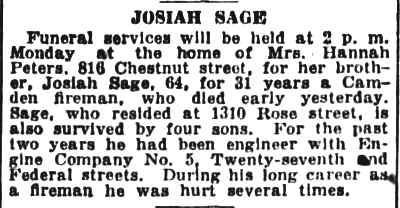
Funeral services will be held at 2 p. m. Monday at the home of Mrs. Hannah Peters, 816 Chestnut street, for her brother, Josiah Sage, 64, for 31 years a Camden fireman, who died early yesterday. Sage, who resided at 1310 Rose street, is also survived by four sons. For the past two years he had been engineer with Engine Company No. 5, Twenty-seventh and Federal streets. During his long career as a fireman he was hurt several times.
Sage Death Notice
Camden Courier-Post —
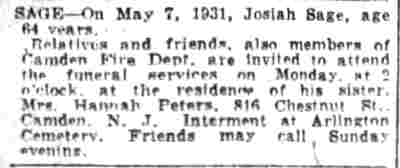
SAGE—On May 7, 1931, Josiah Sage, age 64 years.
Relatives and friends, also members of Camden Fire Dept., are invited to attend the funeral services on Monday, at 2 o’clock, at the residence of his sister, Mrs. Hannah Peters, 816 Chestnut St., Camden, N. J. Interment at Arlington Cemetery. Friends may call Sunday evening.
Police Shakeups of Today Mild Compared to Years Ago
Camden Courier-Post —
Force Changed Every Time Political Regime of City Shifted; Larry Doran Fired for Crossing Street to Get Cinnamon Bun; Old Patrol Recalled
By BEN COURTER
(Another in a series of articles on municipal affairs and personalities of yesteryear.)
Ben Courter
In “the good old days” when Camden’s police department was just about getting under way in accordance with the amended charter of 1872, the men in the ranks were the football of politics. Even if the phrase “to the victor belongs the spoils” had not yet been coined, it was in active force. A change of administration always meant a violent shakeup in the personnel of the department.
It has been so many years since Camden has had a real political shakeup, aside from the nonpartisan movement of seven years ago, that the younger element can have no personal recollection of upheavals marking the aftermath of Democrats succeeding Republicans or vice versa. Many of the men resigned on principle, but others stood their ground and with the faithful hungry for place on the police force it was necessary to take drastic measures.
Sometimes it did not require a party turnover, for bitter factional scraps resulted in reprisals. It then fell the lot of the police committee of city council to conduct hearings. They were usually acrimonious affairs with partisans of the G. O. P. often showing more spleen than in a strict party fight. These hearings were as a rule public, attracting big crowds of opponents and advocates of the accused. The charges ranged from conduct unbecoming an officer to neglect of duty and everything between.
Sometimes the charges were altogether ridiculous, as for instance when Larry Doran, now chief of the county detectives, was accused of going out of his beat to buy a cinnamon bun. He happened to be an appointee of Mayor Joseph E. Mowrey and no one questioned Doran’s ability as a cop or of his sincerity in patrolling his beat. But the Republicans had come back into the fold some 25 years ago and it was determined Larry should get out. Thus came the charge based on someone’s discovery he had crossed the street early one morning to get a bun. No one imagined it a very heinous offense at best, but it was all in the game of politics and the finding of the police committee was a foregone conclusion.
Findings, Usually Sustained
In some instances appeals were made to higher courts, but very little came of it since the committee was considered within its power to dismiss an officer if it saw fit. All necessary was to have the report accepted by council and since that was overwhelmingly Republican the work of the committee was a mere formality. Politics continues to play an important part in the appointments of cops or firemen, but for the past six years they have been under civil service, thus affording at least a measure of protection unless there actually has been some dereliction of duty.
Even though there were the changes wrought by political and factional wars, many men withstood the storms through the years. As a matter of fact it is evident that most of the men who have been accepted as representative of the force have had little difficulty in holding down their beats.
Mention has occasionally been made of one of Camden’s most spectacular police chiefs, Samuel Dodd. When he was first appointed by Mayor Pratt in the 80’s he was in the prime of life and certainly not inclined to give quarter to anyone. But he met with his first difficulties in the race track regime with the dual police departments, when the Democratic commission appointed William A. Davis in his stead. He was reinstated in 1893 after the Republicans had gained control of the state and had abolished the commissions.
Dodd then went along without further trouble until the advent of Hatch who appointed John Foster in 1898. Dodd was born in Burlington in 1841, but came to Camden as a young shoemaker and made himself vitally important to his fellow workers. In the 80’s Camden was a shoemaking and leather center. There were over 100 factories and hundreds of persons were employed. Thus it became an important factor in politics. Dodd loomed as a mayoralty candidate. Everything was cut and dried for him to enter the field when Pratt ran in 1885, but Dodd was prevailed upon to get out of the fight with the promise of being made police chief. That was later carried into effect.
Many years Chief Dodd has been dead, but old-timers around the city hall still have a very vivid recollection of him and his long coal black whiskers, which he had a habit of yanking when under some excitement.
First Patrol Wagon
It was during Dodd’s regime Camden sported its first patrol wagon, in May of 1893. It was something of an epochal event for Camden. Men nearing middle life who then were boys vividly recall the sensation created by the appearance of the little red wagon with “Camden Patrol” painted in gold on the red sides, not forgetting the big gong near the driver’s seat. And as the high steppers speeded through the city streets with a drunk or victim of an accident that gong was everlastingly sounded until the whole populace was brought to the doors. Chief Stehr’s father, Lewis H. Stehr; Oscar Weaver, “Si” Sage and “Nitchie” Golden were the first in the department who operated that famous wagon. It was the forerunner of the automobile police patrol and ambulance put in service July 14, 19[?].
When the first patrol went into service Camden’s streets were veritable “rocky roads to Dublin.” They were paved with cobble, even Broadway, Federal street and Kaighn avenue. Only Cooper street and a part of Benson sported asphalt blocks. Hence it was the object of the driver to pick out the best route possible by using horse car or trolley tracks if possible.
It certainly was no pleasure trip to the hall for a drunk and a road of torture to any unfortunate being toted to the hospital. But even at that it was an improvement over the archaic method of taking prisoners to jail by way of a pushcart. I have already mentioned in these annals the Roman holiday such an incident furnished the kids of the generation. If John Painter or Charlie Fitzsimmons pushed a cussin’ drunk from Kaighn Point to the hall they were sure to have a yelling mob of kids at their heels. Unfortunates who were ill or injured were usually taken to the hospital in horse-drawn cabs. But of course the conveniences of today were not even dreamed about.
Lieutenant Tommie Cunningham is among the veterans on the force who recalls those days of long ago, for last Tuesday marked the thirty-sixth anniversary of his appointment to the department. Tommie has seen the department grow from less than half a hundred men to five times that number. In all that time he has pounded a beat in South Camden or had charge of a detail of men or a district as at present.
“Jake” Woodside
In recalling some of the old-timers mention must also be made of Jacob Woodside, who was appointed October 1, 1898. He hailed from the Sixth ward and was among the valiant crew who sported luxurious mustaches. He was in his later years a sergeant in the Third district. Woodside, who had many staunch friends throughout the city, died several years ago.
Then there is “Cul” Errickson who was made a cop September 15, 1898, by Mayor Hatch. He was for many years sergeant at headquarters; a big, good-natured cop, too. He has been enjoying life these several years as a pensioner up around New Egypt.
Certainly one of the most substantial members of the force was Capt. Arthur A. Stanley, who was in charge of the downtown district for many years. He was appointed by Mayor Hatch July 15, 1898. Captain Stanley was a Civil war veteran and prominently identified with the G. A. R. He has been dead for many years. His son, Milton Stanley, was a detective in the department and also at the prosecutor’s office, but for several years has been living on a farm in South Jersey.
There is another veteran of the force still in harness, George Nowrey, brother of former Mayor Nowrey, appointed by Mayor Hatch August 1, 1898. He has been a sergeant in the department for many years.
On the same day Nowrey was appointed, John Reader was made a member of the force. He, too, was a sergeant when he died several years ago. He was father of Dr. A. B. Reader and Attorney Lawrence Reader, the latter one of the most prominent young men of the city when he died during the flu epidemic in 1918. “Larry” also was a member of council from the Thirteenth ward.