J. Wesley Sell
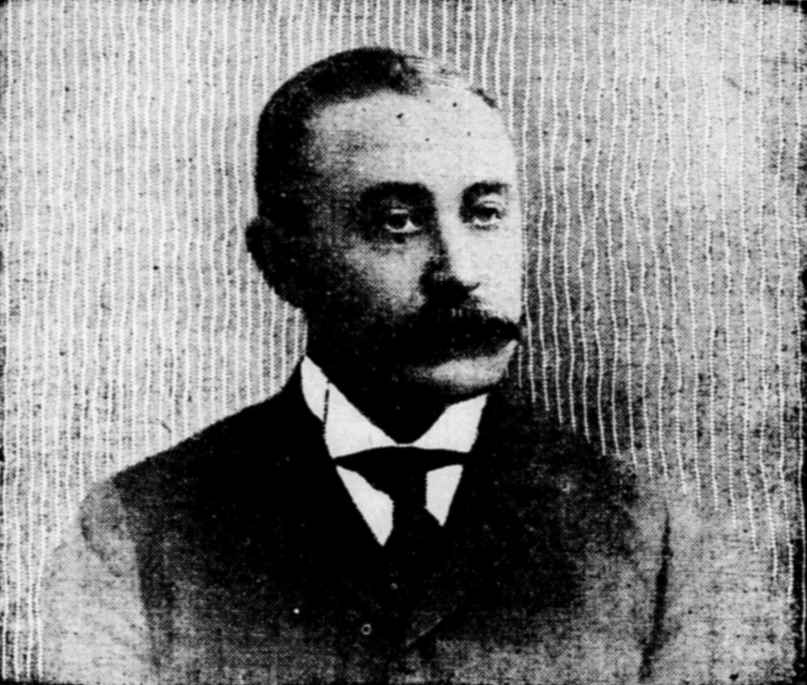
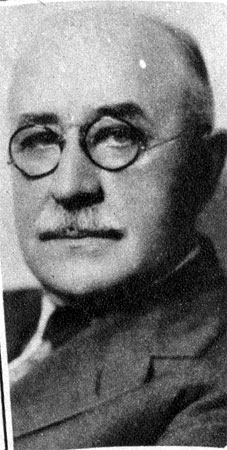
J. Wesley Sell
JOHN WESLEY SELL was born in 1864 in New Jersey, the youngest of six children born to German immigrant parents, Charles and Rosalie Sell. The Sell family resided at 435 Pine Street. Charles Sell was already living in Camden when the census was taken in 1860, and worked as a machinist. From an early age he went by his middle name, and later was known professionally as J. Wesley Sell. At the time of the 1880 Census, J. Wesley Sell, then 15, was working as a bookbinder. Older brother Ferdinand F. Sell’s occupation was listed as a cigar maker, while sister Emma Sell worked in shoes. Another older sister, Anna, was then unemployed.
During the following decade, J. Wesley Sell followed his brother into the cigar maker’s trade. He had other plans for himself, however, and the 1890–1891 Camden City Directory shows that he had changed his occupation to that of jeweler. During the 1880’s his father had passed away, and his brother Ferdinand F. Sell, a cobbler, had married and moved, first to a house at 933 Newton Avenue and then to Sherman Avenue in Cramer Hill. J. Wesley Sell was still living at 435 Pine Street at the end of the decade, where he lived with his widowed mother. His father had died in 1887. Rosalie Sell passed away in 1898, and was buried next to her husband at Evergreen Cemetery.
J. Wesley Sell in this period also became interested and active in politics, as a Republican. A friend and political ally of Frank Ford Patterson Jr., the two were known as “the Damon and Pythias of Camden politics… whose perpetual smiles and gentle demeanor have earned for them the sobriquet of the ‘Laughing Statesmen’,” according to the Trenton Times in March of 1902. He was elected Camden County Sheriff in 1899, and served a three year term. His brother Ferdinand, also a Republican committeeman, joined the Camden police department about the same time, where he served for 24 years.
J. Wesley Sell assumed the position of treasurer for Camden County in 1905, and served in that position for 33 years, retiring January of 1938. He also was serving as a member of the Board of Directors of the Broadway Trust Company bank in March of 1916.
J. Wesley Sell remained a bachelor for most of his life. At the time of both the 1920 and 1930 Census he was lodging with Mr. and Mrs. Theodostus Johnson at 528 Mickle Street. He married late in life, to Anna Pote, in January of 1936. After his retirement, Mr. and Mrs. Sell moved to 630 Diamond Street in Philadelphia. Brother Ferdinand F. Sell passed away in October of 1936 at the home of his daughter, Ella, wife of prominent photographer George A. Wonfor.
J. Wesley Sell passed away on January 23, 1940 after suffering a stroke the week before. After a funeral service at the Joseph H. Murray funeral home on Cooper Street, he was buried at North Cedar Hill Cemetery in Philadelphia.
Camden Base Ball Club Organized for the Season
Philadelphia Inquirer —
The Camden Base Ball Club has organized for the season, with Wesley Sell as president; Charles Turner, vice president; Fred Smith, secretary; Joseph Franklin, treasurer. An athletic association will be attached to the club the coming season.
Philadelphia Inquirer, November 25, 1887
The Republicans Win.
Philadelphia Inquirer —
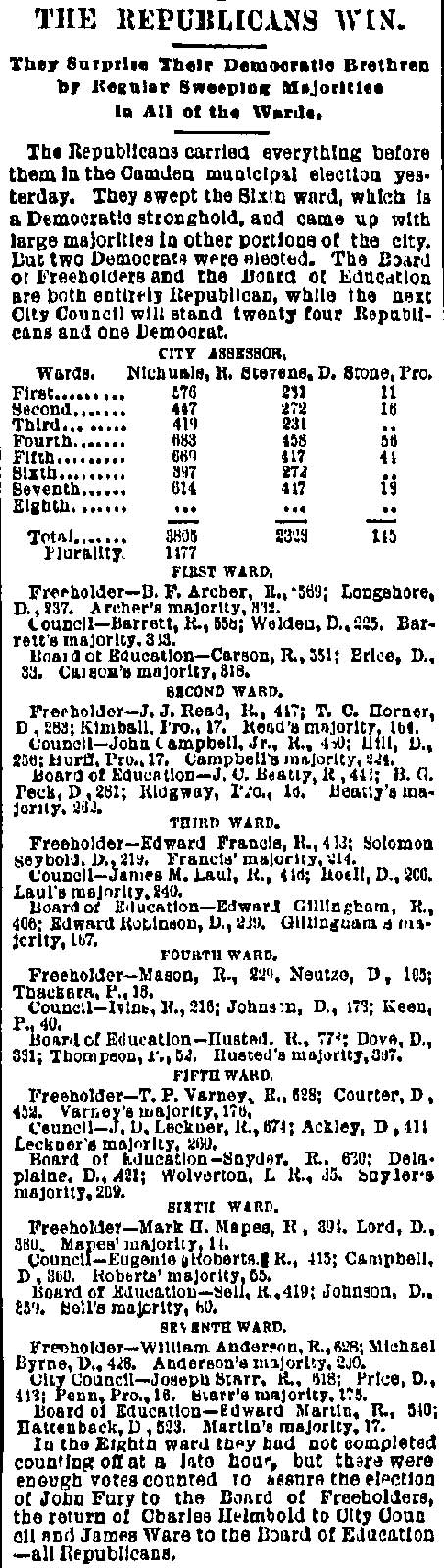
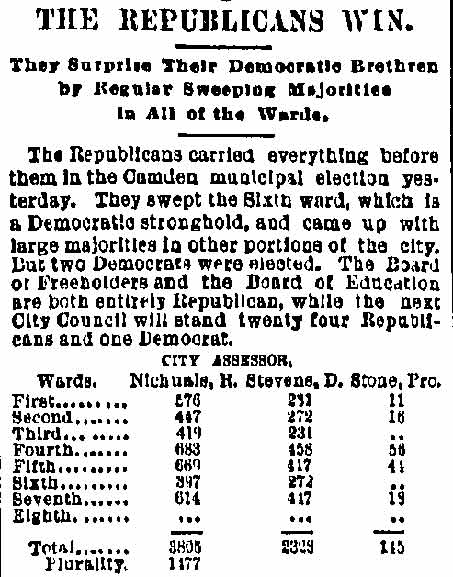
They Surprise Their Democratic Brethren by Regular Sweeping Majorities in All of the Wards.
The Republicans carried everything before them in the Camden municipal election yesterday. They swept the Sixth ward, which is a Democratic stronghold, and came up with large majorities in other portions of the city. But two Democrats were elected. The Board of Freeholders and the Board of Education are both entirely Republican, while the next City Council will stand twenty four Republicans and one Democrat.
CITY ASSESSOR.
Wards. Nichols, R. Stevens, D. Stone, Pro.
First… 576 231 11
Second… 447 272 16
Third… 419 231 —
Fourth… 683 458 56
Fifth… 669 417 41
Sixth… 397 272 —
Seventh… 614 417 19
Eighth… — — —
Total… 3805 2298 143
Plurality… 1177
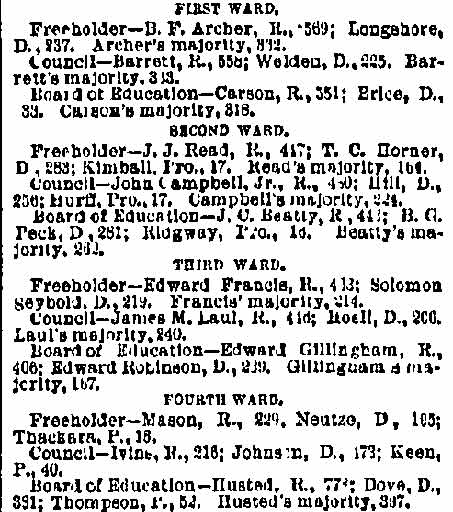
FIRST WARD.
Freeholder—B. F. Archer, R., 569; Longshore, D., 337. Archer’s majority, 232.
Council—Barrett, R., 556; Welden, D., 225. Barrett’s majority, 331.
Board of Education—Carson, R., 351; Erice, D., 33. Carson’s majority, 318.
SECOND WARD.
Freeholder—J. J. Read, R., 417; T. C. Horner, D., 253; Kimball, Pro., 17. Read’s majority, 164.
Council—John Campbell, Jr., R., 450; Hill, D., 256; Hurll, Pro., 17. Campbell’s majority, 194.
Board of Education—J. C. Beatty, R., 417; B. G. Peck, D., 261; Ridgway, Pro., 16. Beatty’s majority, 156.
THIRD WARD.
Freeholder—Edward Francis, R., 413; Solomon Seybold, D., 219. Francis’ majority, 194.
Council—James M. Laul, R., 440; Roell, D., 200. Laul’s majority, 240.
Board of Education—Edward Gillingham, R., 406; Edward Robinson, D., 239. Gillingham’s majority, 167.
FOURTH WARD.
Freeholder—Mason, R., 220; Neutze, D., 105; Thackara, P., 18.
Council—Irvine, R., 216; Johnson, D., 173; Keen, P., 40.
Board of Education—Husted, R., 788; Dove, D., 391; Thompson, I., 54. Husted’s majority, 397.
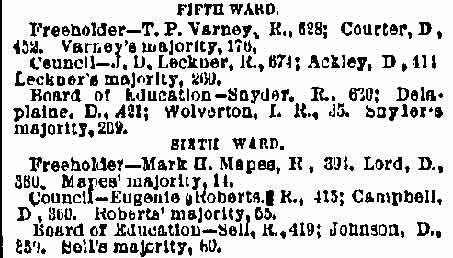
FIFTH WARD.
Freeholder—T. P. Varney, R., 628; Courter, D., 452. Varney’s majority, 176.
Council—J. D. Leckner, R., 674; Ackley, D., 411. Leckner’s majority, 263.
Board of Education—Snyder, R., 630; Delaplaine, D., 421; Wolverton, I. R., 45. Snyder’s majority, 209.
SIXTH WARD.
Freeholder—Mark H. Mapes, R., 391; Lord, D., 380. Mapes’ majority, 11.
Council—Eugene J. Roberts, R., 415; Campbell, D., 360. Roberts’ majority, 55.
Board of Education—Sell, R., 419; Johnson, D., 359. Sell’s majority, 60.
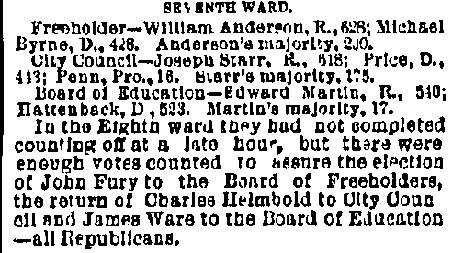
SEVENTH WARD.
Freeholder—William Anderson, R., 628; Michael Byrne, D., 428. Anderson’s majority, 200.
City Council—Joseph Starr, R., 518; Price, D., 413; Penn, Pro., 18. Starr’s majority, 175.
Board of Education—Edward Martin, R., 540; Hattenback, D., 523. Martin’s majority, 17.
In the Eighth ward they had not completed counting off at a late hour, but there were enough votes counted to assure the election of John Fury [sic] to the Board of Freeholders, the return of Charles Helmbold to City Council and James Ware to the Board of Education—all Republicans.
New Jersey News
Camden Board of Education and Other Local Gossip.
President Toone called the meeting of the Board of Education of 1887-1889, of Camden, to order last night. A motion to adjourn sine die prevailed, and after swearing in the following newly elected members the board organized: First ward, James R. Corson;* Second ward, I. C. Beatty;* Third ward, Edward Gillingham; Fourth ward, W. H. Husted,* Fifth ward, Homer Snyder; Sixth ward, J. Wesley Sell; Seventh ward, Edward A. Martin;* Eighth ward, James Ware;* all of whom are Republicans. Those marked thus (*) are re-elected members.
James A. Carson, of the First ward, was elected president, receiving 10 votes to 6 for Joseph M. Engard, of the Fifth ward. Charles Copewall, of the Fifth ward, was re-elected secretary on the third ballot. Martin V Bergen, Fred. A. Rex and C. V. D. Joline were re-elected superintendent, treasurer, and solicitor respectively.
The Fire Department were called out last night by a slight fire at Frank Lee Dickinson’s flour and feed store, Water and Vine Street.
The case of the estate of the late A. J. Greene again occupied the attention of the Camden Orphans’ Court yesterday.
The Camden Press Club will take charge of their newly fitted-up headquarters at No. 139 Federal Street to day. At a meeting held last night the following were added to the list of members: C. S. Magrath, editor Camden Democrat; Adam P. Sloan, Call and News; Robert F. McDougall, Item and Bulletin, and Alexander Schlessinger, editor Camden County Journal.
Affairs Over in Camden
Philadelphia Inquirer —
A Child’s Narrow Escape from Death by Fire. Educational Board Committees.
Ella Sneed, a 6-year old child, living with her parents at Tenth and Florence streets, Camden, was burned almost to death yesterday afternoon while playing around a bonfire on an adjoining lot. After the flames enveloped the child’s clothing she ran into the house crying for help. The mother succeeded in extinguishing the flames, not, however, until both were badly burned. The child was removed to the Cooper Hospital, where it’s recovery is considered doubtful.
At a meeting of the Camden Board of Education last evening, President Carson announced the following committees for the year: Finance, Jesse H. Carey, S. C. Muschamp, Joseph M. Engard, Edward Martin, Walter P. Sellers; teachers, Fred. W George, Homer M. Snyder, Thomas P. Powell, James Ware, Jr., Wilbur F. Carhart, Gabriel Johnson and Edward W. Sharp, at large; property, G. Genges Browning, E. W. Sharp, Daniel M. Stevens, F. W. George, James Ware, Jr., Gabriel Johnson and William A. Husted, at large; supplies, James Ware, Jr., Thomas P. Powell, W. A. Husted, H. C. Sharp, J. Wesley Sell; accounts, Stanley C. Muschamp, J. W. Sell, J. M. Engard, Edward Martin, Wilbur Carhart; printing, J. Wesley Sell, G. Genges Browning, Daniel M. Stevens, Edward Martin, Walter T. Sellers; books, Homer Snyder, J. H. Carey, W. A. Husted, Thomas P. Powell, Fred W. George; insurance, E. W. Sharp, H. M. Snyder, Gabriel Johnson, G. Genges Browning; library, H. C. Sharp, J. H. Carey, Daniel M. Stevens, W. F. Carhart and Joseph M. Engard.
Managing editor Upton S. Jeffers, of the Telegram, was presented last evening with a handsome oxidized and hand-painted hanging lamp by his journalistic friends of Camden. Mr. Jeffreys, who was recently married, is just about going to housekeeping.
A Dark Democratic Scheme
Philadelphia Inquirer —
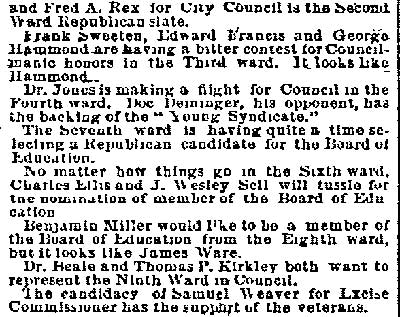
To Change Camden Ward Boundaries to Defeat Republican Candidates.
Camden political circles are agog over a rumored change of ward boundaries by the State Legislature. At present the boundaries are fixed by ordinance of Councils in a manner best suiting Republican interests. The nominee of the Sixth ward, E. Jeffries, will reside in the Eighth ward, in the event of the change and his candidacy will thus fail. Should the Republicans elect Mr. Jeffries the Democrats threaten to institute a contest.
Charles Lear is a candidate for the Board of Education to [sic] the First ward.
Sheriff Baird is backing Robert Smith for Council and Harry Winters for the Board of Education in the First ward.
Charles Wolverton for the Board of Education and Fred A. Rex for City Council is the Second Ward Republican slate.
Frank Sweeten, Edward Francis and George Hammond are having a bitter contest for Councilmanic honors in the Third ward. It looks like Hammond.
Dr. Jones is making a fight for Council in the Fourth ward. Doc Deminger, his opponent, has the backing of the “Young Syndicate.”
The Seventh ward is having quite a time selecting a Republican candidate for the Board of Education.
No matter how things go in the Sixth ward, Charles Ellis and J. Wesley Sell will tussle for the nomination of member of the Board of Education.
Benjamin Miller would like to be a member of the Board of Education from the Eighth ward, but it looks like James Ware.
Dr. Heale and Thomas P. Kirkley both want to represent the Ninth Ward in Council.
The candidacy of Samuel Weaver for Excise Commissioner has the support of the veterans.
The Camden Primaries
Philadelphia Inquirer —
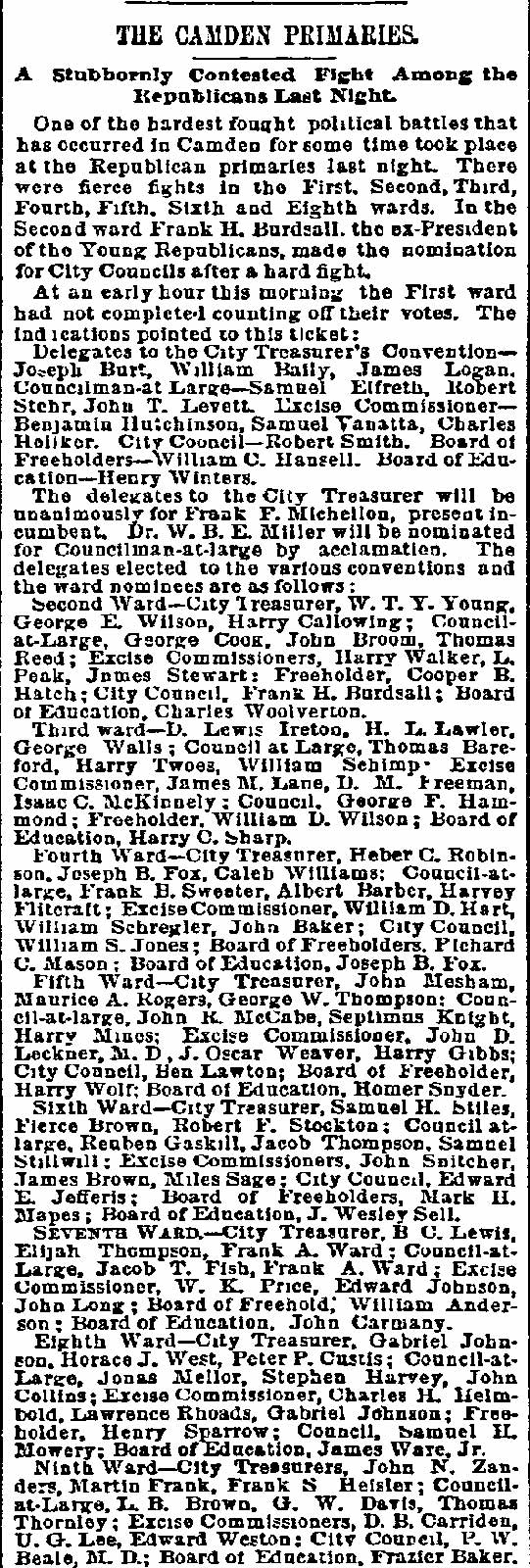
A Stubbornly Contested Fight Among the Republicans Last Night.
One of the hardest fought political battles that has occurred in Camden for some time took place at the Republican primaries last night. There were fierce fights in the First, Second, Third, Fourth, Fifth, Sixth and Eighth wards. In the Second ward Frank H. Burdsall, the ex-President of the Young Republicans, made the nomination for City Councils after a hard fight.
At an early hour this morning the First ward had not completed counting off their votes. The indications pointed to this ticket:
Delegates to the City Treasurer’s Convention—Joseph Burt, William Baily, James Logan. Councilman-at-Large—Samuel Elfreth, Robert Stehr, John T. Levett. Excise Commissioner—Benjamin Hutchinson, Samuel Vanatta, Charles Holiker. City Council—Robert Smith. Board of Freeholders—William C. Hansell. Board of Education—Henry Winters.
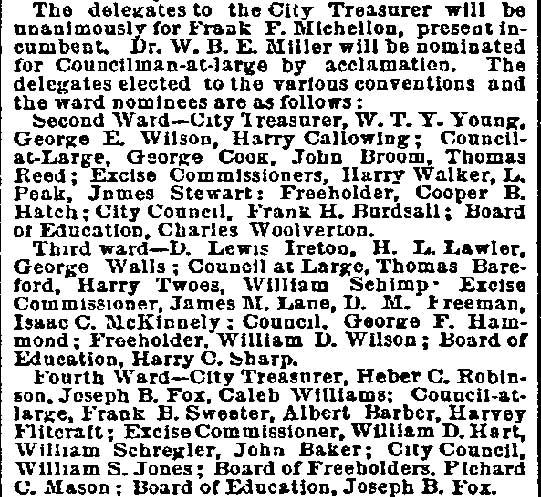
The delegates to the City Treasurer will be unanimously for Frank F. Michellon, present incumbent. Dr. W. B. E. Miller will be nominated for Councilman-at-large by acclamation. The delegates elected to the various conventions and the ward nominees are as follows:
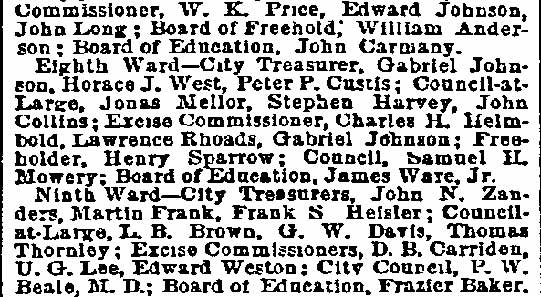
Second Ward—City Treasurer, W. T. Y. Young, George E. Wilson, Harry Callowing; Council-at-Large, George Cook, John Broom, Thomas Reed; Excise Commissioners, Harry Walker, L. Peak, James Stewart; Freeholder, Cooper B. Hatch; City Council, Frank H. Burdsall; Board of Education, Charles Woolverton.
Third ward—D. Lewis Ireton, H. L. Lawler, George Walls; Council at Large, Thomas Bareford, Harry Twoes, William Schimp; Excise Commissioner, James M. Lane, D. M. Freeman, Isaac C. McKinnely; Council, George F. Hammond; Freeholder, William D. Wilson; Board of Education, Harry C. Sharp.
Fourth Ward—City Treasurer, Heber C. Robinson, Joseph B. Fox, Caleb Williams; Council-at-large, Frank B. Sweeter [sic], Albert Barber, Harvey Flitcraft; Excise Commissioner, William D. Hart, William Schregler, John Baker; City Council, William S. Jones; Board of Freeholders, Richard C. Mason; Board of Education, Joseph B. Fox.
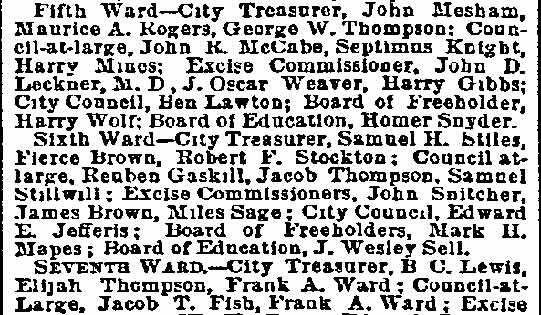
Fifth Ward—City Treasurer, John Mesham, Maurice A. Rogers, George W. Thompson; Council-at-large, John R. McCabe, Septimus Knight, Harry Mines; Excise Commissioner, John D. Leckner, M. D., J. Oscar Weaver, Harry Gibbs; City Council, Ben Lawton; Board of Freeholder, Harry Wolf; Board of Education, Homer Snyder.
Sixth Ward—City Treasurer, Samuel H. Stiles, Pierce Brown, Robert F. Stockton; Council at large, Reuben Gaskill, Jacob Thompson, Samuel Stillwill; Excise Commissioners, John Snitcher, James Brown, Miles Sage; City Council, Edward E. Jefferis; Board of Freeholders, Mark H. Mapes; Board of Education, J. Wesley Sell.
SEVENTH WARD.—City Treasurer, B. C. Lewis, Elijah Thompson, Frank A. Ward; Council-at-Large, Jacob T. Fish, Frank A. Ward; Excise Commissioner, W. K. Price, Edward Johnson, John Long; Board of Freehold, William Anderson; Board of Education, John Carmany.
Eighth Ward—City Treasurer, Gabriel Johnson, Horace J. West, Peter P. Custis; Council-at-Large, Jonas Mellor, Stephen Harvey, John Collins; Excise Commissioner, Charles H. Helmbold, Lawrence Rhoads, Gabriel Johnson; Freeholder, Henry Sparrow; Council, Samuel H. Mowery; Board of Education, James Ware, Jr.
Ninth Ward—City Treasurers, John N. Zanders, Martin Frank, Frank S. Heisler; Councilman-at-Large, L. B. Brown, G. W. Davis, Thomas Thornley; Excise Commissioners, D. B. Carriden, U. G. Lee, Edward Weston; City Council, P. W. Beale, M. D.; Board of Education, Frazier Baker.
A Condemned Lad’s Nerve
Philadelphia Inquirer —
John Hill Joked While Being Weighed for the Gallows.
John Hill, the colored lad who murdered Joseph Dodson, will be hanged to-morrow in the Camden county jail. The gallows will be erected and tested to-day. Hill was weighed yesterday by Deputy Sheriff Sell.
“I’ll bet you I don’t weigh over 104 pounds,” he jestingly remarked as he stepped on the scales.
The weight went down at 107 and Hill laughed and said:
“Well, I’ve lost the bet.”
Deputy Sell yesterday purchased the suit of black clothes in which Hill will be hanged. The murderer has been baptized by Rev. J. H. Scott, his spiritual adviser.
Harrisburg Patriot — April 14, 1893

Named: Henry J. West, J. Wesley Sell, John Hill, Albert Reed, Frederick A. Rex, Charles G. Garrison, Joseph Dodson, Marwood Derrickson, George W. Beckett, and Harrisburg Patriot, April 14, 1893.
Hill Faced Death with Firmness
Philadelphia Inquirer —

NEW JERSEY NEWS
The Youthful Colored Murderer Hanged in the Camden Jail.
Religion Braced His Nerves and He Felt No Fear.
A Quiet, Speedy Execution, and Death Was Quick and Apparently Painless—The Murder of Joseph Dodson Avenged Without the Usual Delay in Such Cases.
Camden county’s new gallows scored its first victim to-day when John Hill was hanged for the murder of Joseph Dodson. The execution took place at the County Jail. It was successfully conducted and was devoid of sensational incidents.
The gallows had been erected in a room with a lofty ceiling in the southeast corner of the jail building. Tall windows looked out on Federal street and Broadway, but they were veiled with dark curtains, which gave a sombre hue to the room. The instrument of death had been built on plans furnished by the Sheriff, modeled after the gallows used in the Philadelphia County Prison. There were two trap doors, which fell down when a lever was pulled, allowing the condemned man to fall about seven feet.
John Hill, the murderer, was a small, slender youth, in his 18th year. He had professed conversion after his conviction and walked firmly to the gallows, having overcome the terror of death by his religious faith.
AROUSED FROM HIS LAST SLEEP.
Hill was awakened from a sound slumber at 6.30 o’clock by Constable Renner, one of the death watch. He dressed himself in a new suit of black diagonal striped goods purchased by the Sheriff for the execution.
A gray mist hung like a veil before the jail windows, and Hill said he regretted this for he had hoped to see the sun shine once more before he died.
He displayed no fear of death, and when his lawyer, Frederick A. Rex, came at 8 o’clock to bid him good-bye the condemned lad said:
“I am not afraid to die, for I love Jesus.”
Hill ate sparingly of the breakfast of beefsteak and potatoes sent in from a neighboring restaurant, and satisfied his longing for pie by eating a big piece of the pastry. Then he lit a cigar and paced up and down the corridor until the arrival of his spiritual adviser, Rev. J. H. Scott, a colored Methodist minister. The last hour preceding the execution was spent in prayer and reading the Bible.
WORE A ROSE TO THE GALLOWS.
Before going to the gallows Constable Hunt handed the lad a white rose, which he pinned on his coat. When Hill’s body fell the rose broke from its stem.
At twenty minutes past 10 o’clock, County Clerk Barber called the roll of the Sheriff’s jury in the jailor’s office. They all responded and took the oath to see that the death penalty was carried into effect. Then the spectators were drawn up two by two, in a line at the left of the door from which the prisoner would emerge as he passed from the jail to the place of execution.
It was half-past 10 when these preparations were made and the condemned man sent for.
His hands had been secured behind his back with handcuffs and he walked with unfaltering steps down the iron stairways of the jail, through a dark passage way and into the corridor, where the Sheriff stood, with the black cap in his hand.
The minister walked by Hill’s side. In front were Deputy Sheriff Sell and ex-Deputy Joseph Porter. Constables Hunt and Renner, the death watch, brought up the rear. There was a shuffling of feet in the line of spectators and the procession moved along the corridor and into the dimly-lighted room, where the gallows stood.
FACED DEATH WITHOUT FLINCHING.
Hill looked at the instrument of death without flinching. He constantly repeated, in a whisper, “Jesus, save me.”
With firm tread he mounted the steps to the scaffold. The work of death was quickly done. There was no prayer or final speech. The minister whispered a last word of cheer and stepped back.
It took but a minute for the Sheriff to drop the noose over the lad’s head, for ex-Deputy Porter to pull down the black cap, and then both men stepped back from the drop. Hill did not waver.
The Sheriff reached for the cord attached to the lever under the drop, gave a short, quick pull, and as the doors fell with a crash the murderer’s body dropped, whirled once around, and then hung motionless.
A PAINLESS DEATH.
There were no convulsive movements of the body, although the legs were not pinioned. County Physician Iszard, assisted by Coroner’s Physician Mattern, of Philadelphia, and Drs. Tomlinson, Jones and Levis, of Camden, timed the fleeting spark of life.
In four minutes and fourteen seconds the pulse stopped beating and at the end of six minutes and fifty-seven seconds the action of the heart ceased. The body had been shaken slightly by a few tremors, but there was no death struggle.
After the body had been hanging for twenty minutes the noose was unloosened and the corpse carried into a room adjoining the jailor’s office. The eyes were closed and the face bore no evidence of a violent death.
The silent spectators formed a group around the corpse, while Rev. Mr. Scott read the Methodist service for the dead. Four hours later the physicians made an autopsy and late in the afternoon Coroner Jefferis conveyed the remains in his dead wagon to the New Camden Cemetery where they were interred in a grave paid for by the county.
SWIFT JERSEY JUSTICE.
Jersey justice has not been leaden-heeled in Hill’s case. It is less than six months since he committed the crime for which the law took his life. At 1 o’clock on Sunday morning, October 16, 1892, John Hill, secreted in the bushes near Reed & Derrickson’s saloon, at Seventh and Sycamore streets, fired a bullet into Joseph Dodson’s brain.
The latter was a young colored man who had beaten Hill during a row, a few days previously, in the dance hall attached to the saloon. Hill had threatened to get even with Dodson. He took a revolver from a drawer in the saloon, drank liquor to nerve himself for the deed, and then fired the fatal shot.
At the trial, early in February last, Hill swore that Reed & Derrickson, the proprietors of the saloon, had hired him to kill Dodson. The two men were tried as accessories and acquitted. Three weeks ago Hill confessed that his charge against these two men was false.
Politicians’ Day at Mt. Holly
POLITICIANS’ DAY AT MT. HOLLY
CANDIDATE GRIGGS SHOOK HUNDREDS OF HORNY HANDS AT THE BURLINGTON COUNTY FAIR.
CAMDEN WELL REPRESENTED
It Was a Fine Day, But the “Big Thursday” Crowd Was Smaller Than Last Year—A Canine Parachutist Killed—The Races—Other Jersey Matters.
Special to The Inquirer.
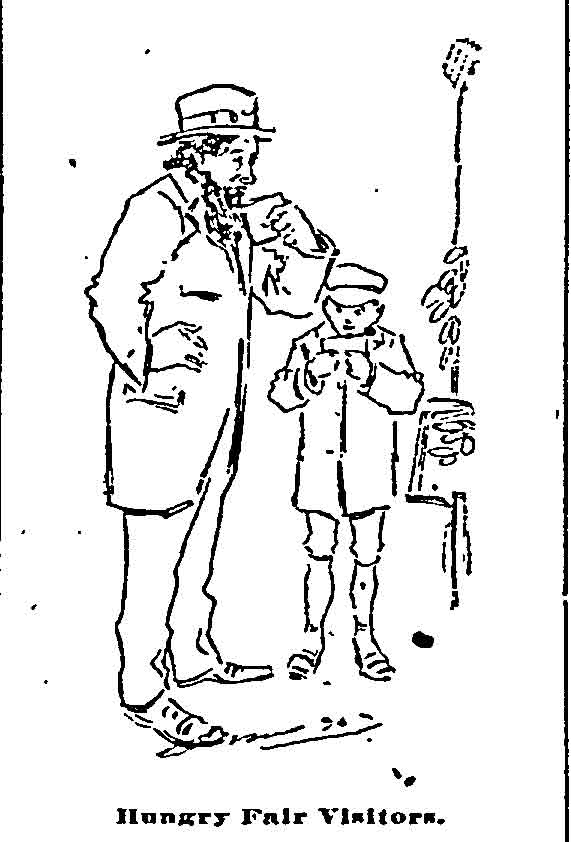
MOUNT HOLLY, N. J., Oct. 10.—The Mount Holly Fair, like all the other Jersey fairs, has its “Big Thursday.” That is the day the politicians get together to shake hands, swop stories and look after the political machine generally. The candidates make it a point to be present and try to win votes with cordial greetings and honeyed words. The Mount Holly Fair was favored with exceptionally fine weather for its “Big Thursday,” but the attendance was not as large as last year’s crowd.
The politicians congregated around a tent at the left of the grand stand. John W. Griggs, the Republican candidate for Governor, arrived on the grounds shortly after noon and was tendered a reception at the entrance. All the afternoon he was kept busy shaking hands with the grangers and telling them how glad he was to meet them. Mr. Griggs got lots of promises of votes. He made many friends among the farmers, who had their first chance of talking with him. Nearly every one addressed him as “Governor.”
Camden county was well represented by its leading political lights, among whom were: Senator William J. Sewell, ex-Sheriff David Baird, City Counsel J. Willard Morgan, City Clerk T. P. Varney, County Clerk Robert Barber, Mayor J. Leighton Westcott, Deputy Sheriff J. Wesley Sell, Frank Lloyd, William J. Thompson, Thomas P. Curley, Receiver of Taxes William A. Husted, Secretary of the Commission of Public Instruction W. D. Brown, Freeholder George Martin, ex-President of the City Council Arthur Bedell, Senator Maurice A. Rogers, ex-Senator George Pfeiffer, ex-Sheriff Henry J. West, William Bettle, Assemblyman Louis T. Derousse, Colonel George G. Felton, Coroner Jacob Justice, Councilman Richard Dease, ex-Sheriff Theodore B. Gibbs and Assemblyman William Barnard.
Gloucester county was represented by William Moore, Senator Daniel Packer, Congressman Henry C. Loudenslager, Dr. S. F. Stanger, County Clerk F. B. Ridgway and Lewis Starr.
Other prominent persons present were: Ex-Judge J. Frank Fort, State Comptroller W. S. Hancock, County Clerk Barker Gummere, of Mercer county; Prosecutor Charles E. Hendrickson, of Mount Holly; Frank B. Lee, son of Supreme Court Clerk Lee; Judge Clifford Stanley Simms, ex-Congressman James Buchanan, Lieutenant-Colonel Franklin Gaunt, of Burlington; Richard Miller, Robert Diamond and M. V. D. Dickinson, of Salem county; Judge Joseph H. Gaskill, Robert Hutchinson and ex-Sheriff Nathan Hays, of Burlington county.
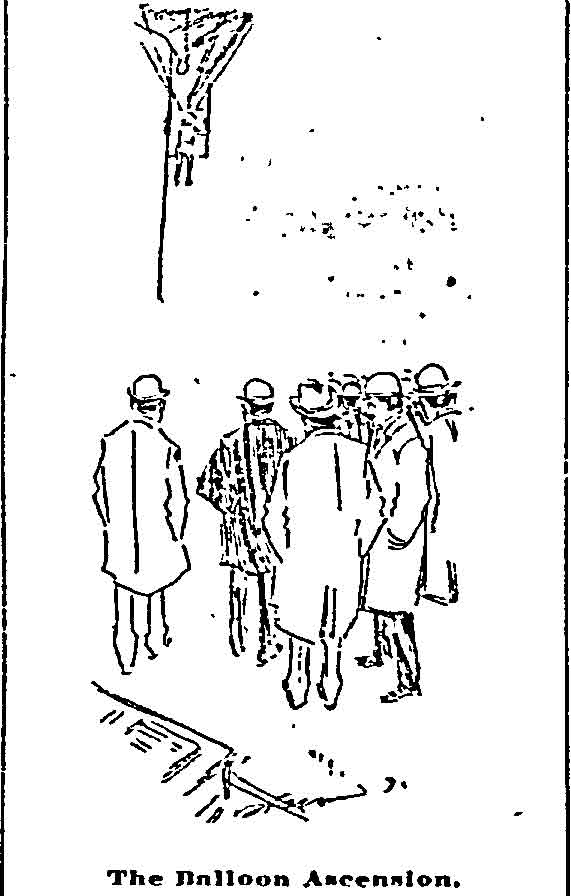
One of the features of the fair has been the daily ascension of a large balloon, from which a man and dog drop with parachutes. This afternoon the ropes which held the dog became loose. He dropped upon one of the booths and was killed.
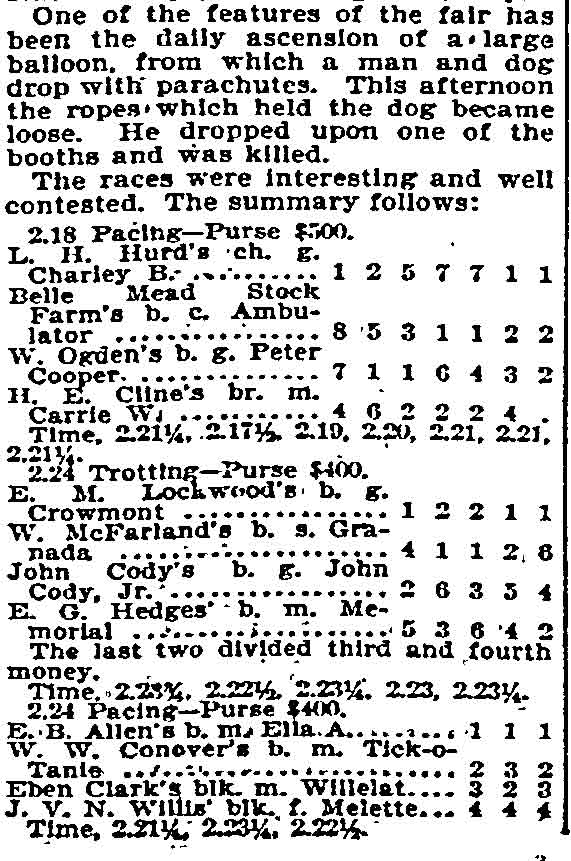
The races were interesting and well contested. The summary follows:
2.18 Pacing—Purse $500.
L. H. Hurd’s ch. g. Charley B....1 2 5 7 7 1 1
Belle Mead Stock Farm’s b. c. Ambulator....8 5 3 1 1 2 2
W. Ogden’s b. g. Peter Cooper....7 1 1 6 4 3 2
H. E. Cline’s br. m. Carrie W....4 6 2 2 2 4
Time. 2.21¼, 2.17½, 2.19, 2.20, 2.21, 2.21, 2.21¼.
2.24 Trotting—Purse $400.
E. M. Lockwood’s b. g. Crowmont....1 2 2 1 1
W. McFarland’s b. s. Granada....4 1 1 2 8
John Cody’s b. g. John Cody, Jr....2 6 3 5 4
E. G. Hedges’ b. m. Memorial....5 3 6 4 2
The last two divided third and fourth money.
Time. 2.23¾, 2.22½, 2.23¼, 2.23, 2.23¼.
2.24 Pacing—Purse $400.
E. B. Allen’s b. m. Ella A....1 1 1
W. W. Conover’s b. m. Tick-o-Tanie....2 3 2
Eben Clark’s blk. m. Willelat....3 2 3
J. V. N. Willis’ f. Melette....4 4 4
Time, 2.21¼, 2.23¼, 2.22½.
Lambert at Last Pays the Penalty
Philadelphia Inquirer —
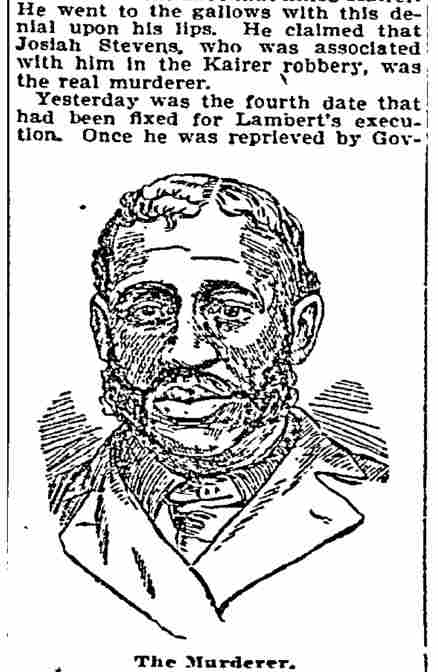
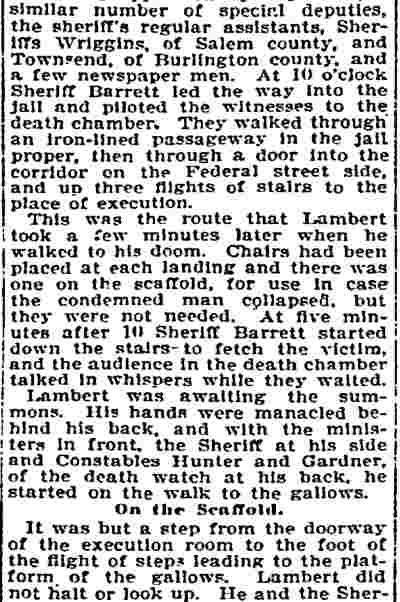
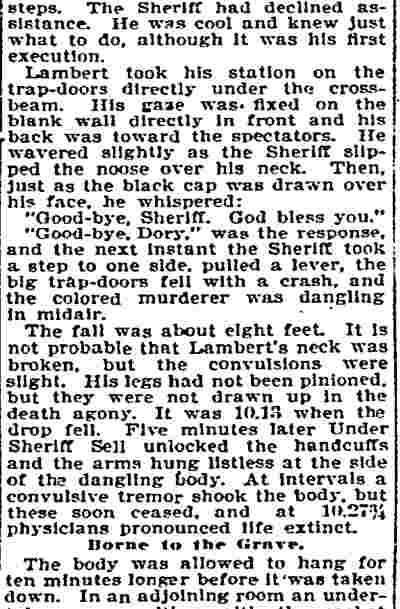
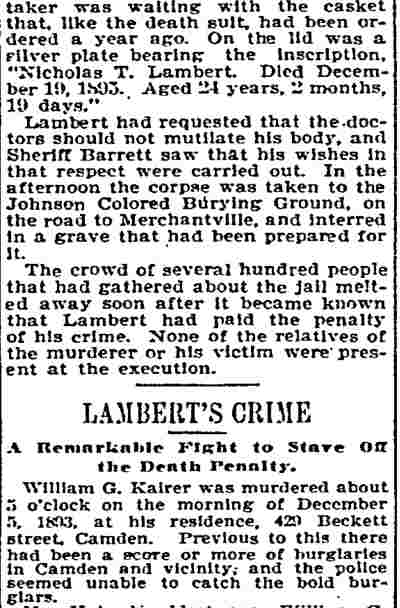
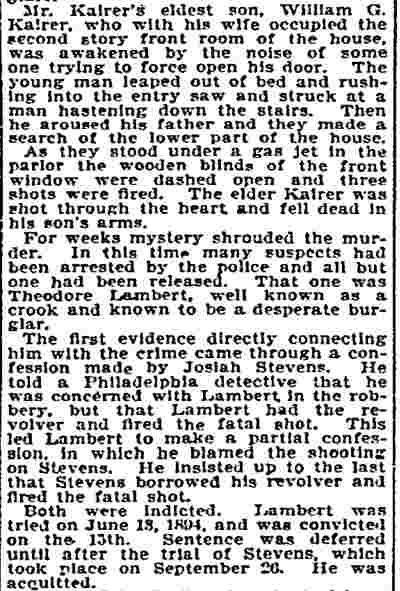
THE MURDERER OF BAKER KAIRER HANGED IN THE CAMDEN COUNTY JAIL
PROTESTED INNOCENCE TO THE END
HE SAID STEVENS FIRED THE FATAL SHOT
The Execution Devoid of Sensational Features—Lambert Walked Firmly to the Gallows—History of His Remarkable Case.
The Murderer.
Nicholas Theodore Lambert died on the gallows in the Camden county jail yesterday. He was hanged for the murder of William G. Kairer, a well-to-do cracker baker, of Camden. His death closes a case that was remarkable chiefly for the extraordinary efforts to save the condemned man from the gallows. Lambert was a bad man. From his youth up he had been a criminal. He had served time in prison for burglary and admitted while awaiting trial for murder that he had robbed a score or more of houses in and around Camden. But he denied that he had fired the shot that killed Kairer. He went to the gallows with this denial upon his lips. He claimed that Josiah Stevens, who was associated with him in the Kairer robbery, was the real murderer.
Yesterday was the fourth date that had been fixed for Lambert’s execution. Once he was reprieved by Governor Werts. Twice the United States Supreme Court interfered and postponed the hanging. The law finally claimed its victim after every ordinary and several extraordinary procedures had been resorted to to avert the death penalty.
Firm in the Face of Death.
Lambert’s death was devoid of sensation, as executions go. He walked to the scaffold without assistance. He did not flunk in the face of death. There was barely time for a whispered good-bye to the Sheriff and he was launched into eternity. He was hanged on the gallows that ended John Hill’s life about three years ago. It was erected in an unused and half-finished room on the top floor of the county jail building at the northwest corner of Broadway and Federal streets. The death chamber is directly over a part of the jail that is being fitted up for the use of female prisoners.
The scaffold stood over against a blank wall. On the other side windows let a flood of light into the bare room. Overhead were the gaunt rafters supporting the roof.
The heart-rending farewells between the condemned man and his mother and other relatives and friends had been uttered the night before. As the time drew on toward midnight the condemned seemed to realize for the first time that there was no further hope of escaping the death penalty.
“I can’t sleep,” he said to Constable Hunter, one of his death watch. “I feel oppressed, as if there was a heavy weight inside. I hope I will be able to walk to the gallows.”
At 1 o’clock Lambert sat down at a little table in his cell and for three hours he was busy with his pen writing farewell letters. There were six of these missives. The longest one was to his counsel, Lawyer John G. [sic] Semple, who had made such a gallant fight to save him. He thanked his lawyer and reiterated his assertion that he did not fire the shot that killed Kairer. One of the letters was to Mrs. Isabella Shipley, a resident of South Camden, who had displayed great interest in his case. The others were to personal friends. In all these missives Lambert gave expression to his religious faith and the belief that he had divine forgiveness of his sins.
Ready for the Rope.
About 6 o’clock the spiritual advisers of the condemned man entered his cell. They were colored ministers, Revs. W. H. Yocum, Thomas Als and H. C. Ashley. Under the soothing influence of prayer Lambert grew calmer, and when his breakfast, which consisted of half a dozen fried eggs, potatoes and coffee, was sent in from a restaurant opposite the jail, he ate heartily.
At 9 o’clock the suit of black clothing that had been ordered for his execution a year ago, was brought in and he dressed himself for the gallows. A barber had shaved him and trimmed his hair the previous night. He did not put on a collar.
The persons who were to witness the execution, in all less than forty, gathered in the sheriff’s office shortly before 10 o’clock. There was a jury of twelve appointed by the court, a similar number of special deputies, the sheriff’s regular assistants, Sheriffs Wriggins, of Salem county, and Townsend, of Burlington county, and a few newspaper men. At 10 o’clock Sheriff Barrett led the way into the jail and piloted the witnesses to the death chamber. They walked through an iron-lined passageway in the jail proper, then through a door into the corridor on the Federal street side, and up three flights of stairs to the place of execution.
This was the route that Lambert took a few minutes later when he walked to his doom. Chairs had been placed at each landing and there was one on the scaffold, for use in case the condemned man collapsed, but they were not needed. At five minutes after 10 Sheriff Barrett started down the stairs to fetch the victim, and the audience in the death chamber talked in whispers while they waited.
Lambert was awaiting the summons. His hands were manacled behind his back, and with the ministers in front, the Sheriff at his side and Constables Hunter and Gardner, of the death watch at his back, he started on the walk to the gallows.
On the Scaffold.
It was but a step from the doorway of the execution room to the foot of the flight of steps leading to the platform of the gallows. Lambert did not halt or look up. He and the Sheriff walked with firm tread up the steps. The Sheriff had declined assistance. He was cool and knew just what to do, although it was his first execution.
Lambert took his station on the trap-doors directly under the cross-beam. His gaze was fixed on the blank wall directly in front and his back was toward the spectators. He wavered slightly as the Sheriff slipped the noose over his neck. Then, just as the black cap was drawn over his face, he whispered:
“Good-bye, Sheriff. God bless you.”
“Good-bye, Dory,” was the response, and the next instant the Sheriff took a step to one side, pulled a lever, the big trap-doors fell with a crash, and the colored murderer was dangling in midair.
The fall was about eight feet. It is not probable that Lambert’s neck was broken, but the convulsions were slight. His legs had not been pinioned, but they were not drawn up in the death agony. It was 10.13 when the drop fell. Five minutes later Under Sheriff Sell unlocked the handcuffs and the arms hung listless at the side of the dangling body. At intervals a convulsive tremor shook the body, but these soon ceased, and at 10.27¾ physicians pronounced life extinct.
Borne to the Grave.
The body was allowed to hang for ten minutes longer before it was taken down. In an adjoining room an undertaker was waiting with the casket that, like the death suit, had been ordered a year ago. On the lid was a silver plate bearing the inscription, “Nicholas T. Lambert. Died December 19, 1895. Aged 24 years, 2 months, 19 days.”
Lambert had requested that the doctors should not mutilate his body, and Sheriff Barrett saw that his wishes in that respect were carried out. In the afternoon the corpse was taken to the Johnson Colored Burying Ground, on the road to Merchantville, and interred in a grave that had been prepared for it.
The crowd of several hundred people that had gathered about the jail melted away soon after it became known that Lambert had paid the penalty of his crime. None of the relatives of the murderer or his victim were present at the execution.
LAMBERT’S CRIME
A Remarkable Fight to Stave Off the Death Penalty.
William G. Kairer was murdered about 5 o’clock on the morning of December 5, 1893, at his residence, 429 Beckett street, Camden. Previous to this there had been a score or more of burglaries in Camden and vicinity; and the police seemed unable to catch the bold burglars.
Mr. Kairer’s eldest son, William G. Kairer, who with his wife occupied the second story front room of the house, was awakened by the noise of some one trying to force open his door. The young man leaped out of bed and rushing into the entry saw and struck at a man hastening down the stairs. Then he aroused his father and they made a search of the lower part of the house.
As they stood under a gas jet in the parlor the wooden blinds of the front window were dashed open and three shots were fired. The elder Kairer was shot through the heart and fell dead in his son’s arms.
For weeks mystery shrouded the murder. In this time many suspects had been arrested by the police and all but one had been released. That one was Theodore Lambert, well known as a crook and known to be a desperate burglar.
The first evidence directly connecting him with the crime came through a confession made by Josiah Stevens. He told a Philadelphia detective that he was concerned with Lambert in the robbery, but that Lambert had the revolver and fired the fatal shot. This led Lambert to make a partial confession, in which he blamed the shooting on Stevens. He insisted up to the last that Stevens borrowed his revolver and fired the fatal shot.
Both were indicted. Lambert was tried on June 1[?], 1894, and was convicted on the 13th. Sentence was deferred until after the trial of Stevens, which took place on September 26. He was acquitted.
Lawyer John L. Semple, who had been assigned by the court to defend Lambert, applied to Chancellor McGill for a writ of error. This was refused. The Governor granted a reprieve from Decembe [sic] 13 to January 3, 1895, on December 4, just one year from the date of the murder. On December 13—the day Lambert was to have been hanged—the Board of Pardons heard the case and refused to interfere.
Supreme Court Justice Garrison was asked for a writ of habeas corpus. This was peremptorily refused. Next Chief Justice Beasley was appealed to. He likewise refused. To Judge Dallas, of the United States Court, in Philadelphia, Semple now went. He referred the case to Judge Green, of the United States District Court at Trenton.
The hearing was set down for January 2, the day before Lambert was to be hanged. Lawyer Semple went to Trenton to find Judge Green, but the latter had gone away.
Lawyer Semple at once jumped a train for Washington, hunted up Justice Shiras, and induced him to issue a stay pending an appeal to his Court. Lambert’t [sic] lawyer got back to Camden in time to serve Justice Shiras’ order on the Sheriff an hour before the time fixed for the execution.
The next move in the remarkable case was the dismissal of the appeal by the United States Supreme Court. Governor Werts at once issued a second death warrant fixing the execution for June 27.
A writ of habeas corpus was refused [cut off at the crop edge]
Pool Room Warning
It was rumored yesterday that the poolroom at Seventeenth and Federal streets, Stockton, was to be reopened. Under Sheriff Sell at once dispatched three special officers to warn the gamblers that any attempt to resume business would result in their arrest.
Philadelphia Inquirer, March 5, 1899
Sheriff Sell Commissioned

County Clerk Barber yesterday received from Governor Voorhees the commissions of Sheriff Sell and Coroners Gaskill and Robinson. The latter was at once sworn in.
Philadelphia Inquirer, November 17, 1899
Abbatto Hanged in Camden Jail
Philadelphia Inquirer —
Quick Work by Sheriff Sell in Executing the Murderer of Genaro De Feo
Condemned Man Died Without a Struggle, and Was Buried in Potters’ Field
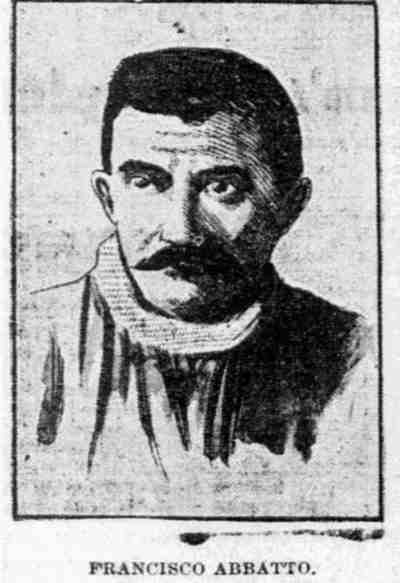
FRANCISCO ABBATTO.
John Wesley Sell, Sheriff of Camden county, had his first hanging yesterday, and he made a record for celerity in launching Francisco Abbatto into eternity. The earliest moment that the hanging could take place, under the order of the court, was 10 o’clock. Within 6 minutes after the hour struck Abbatto was standing on the gallows. A minute later the trap was sprung, and five minutes later the man was dead.
Abbatto slept soundly during his last night on earth. He was up betimes yesterday morning, and dressed himself in the black suit of clothes which he knew would be his death garments. He declined to eat any breakfast, but drank a cup of coffee. At 8 o’clock the priests came to prepare the condemned man for the end. They were Father Pozzi, of East Vineland, and Father Caruso, of the Church of Our Lady of Good Counsel, of Philadelphia.
FINAL PREPARATIONS.
The persons authorized by law to witness the execution, about forty in number, gathered in the Sheriff’s office by half past 9 o’clock. County Clerk Barber administered the oath to the twelve citizens appointed by Judge Garrison to see that the sentence of death was carried out. They were County Physician W. S. Jones, Dr. Alexander McAlister, Dr. S. Ramsdell, Dr. E. A. Y. Schellinger, Dr. A. H. Lippincott, Dr. Joseph Nicholson, Dr. Paul N. Mecray, Upton S. Jeffreys, Harry B. Paul, Charles R. Bacon, William H. Cole and County Detective John S. Smith.
The death jury were taken through the jail to the loft at the Broadway and Federal streets corner of the building, where the gallows awaited its victim.
A few minutes before 10 o’clock the Sheriff led his deputies and the newspaper men across the “Bridge of Sighs” to the jail, and they joined the group in the death chamber. The clock struck 10, and all was ready to execute the mandate of the law. Five minutes later a door at the foot of the gallows, leading into the jail opened, and the condemned man was seen walking to his doom.
QUICK EXECUTION.
The two priests were in the lead. They were silent, for they had finished their ministrations in the jail. Abbatto was supported on either side by Constable Voight, of the death watch, and County Detective Smith. He was pale, but he walked with a firm step. He paused an instant at the foot of the gallows, cast a furtive glance at the dangling rope, and then mounted the thirteen steps to the platform. The officers stepped back when they had placed the condemned man at the centre of the trap. An instant Abbatto stood gazing at a ray of sunlight on the floor, and then the black cap shut the light from his eyes. Quickly but carefully Sheriff Sell adjusted the noose, and then, at 10 07, as the murderer swayed like a reed in the wind the silence was broken by the crash of the falling trap doors and the body fell a distance of six feet.
Abbatto’s hands were manacled behind his back, but his legs were not pinioned. He did not struggle and only a few tremors shook his body. In five minutes the doctors found that the heart had ceased to beat, but the body was allowed to hang for twenty-eight minutes. Then it was taken in charge by Morgue Keeper O’Brien, and after the doctors had gotten through with it, it was buried in potter’s field. Death was due to strangulation, and the face of the dead man was not distorted.
ABBATTO’S CRIME.
Francisco Abbatto was hanged for the murder of Genaro DeFeo. The crime was committed on the night of April 22, 1899, in the woods near Blue Anchor, Camden county. After stabbing DeFeo to death, Abbatto hacked his victim’s head off. Both body and head were found in the woods by searchers eight days later. Abbatto boarded with DeFeo, and was enamoured of his wife. He induced Mrs. DeFeo to go to New York with him to search for her husband. When they returned Abbatto was arrested. At his trial he claimed that he had killed DeFeo during a quarrel. The Court of Errors and Appeals sustained the conviction and Governor Voorhees refused to grant a reprieve.
On the Conductors and the Motormen
Philadelphia Inquirer —
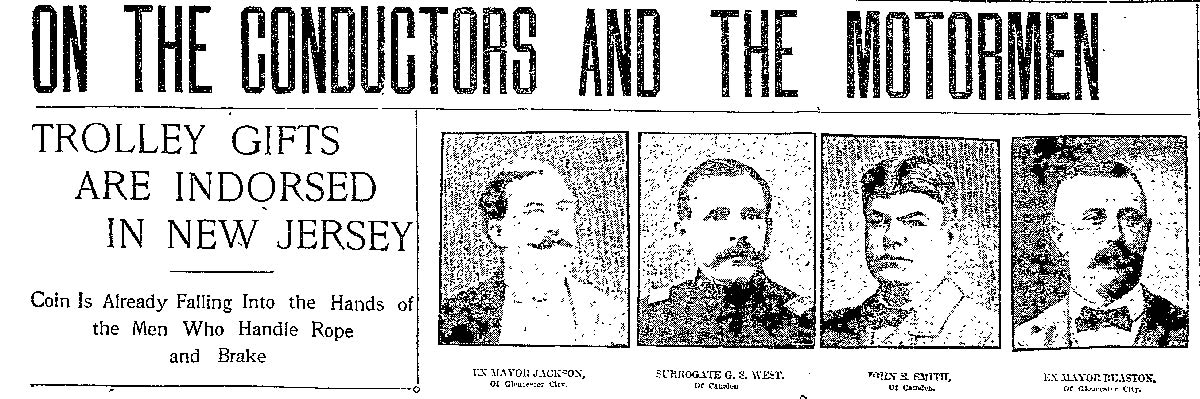
TROLLEY GIFTS ARE INDORSED IN NEW JERSEY
Coin Is Already Falling Into the Hands of the Men Who Handle Rope and Brake
EX MAYOR JACKSON, Of Gloucester City
SURROGATE G. S. WEST, Of Camden
JOHN S. SMITH, Of Camden
EX MAYOR BEASTON, Of Gloucester City
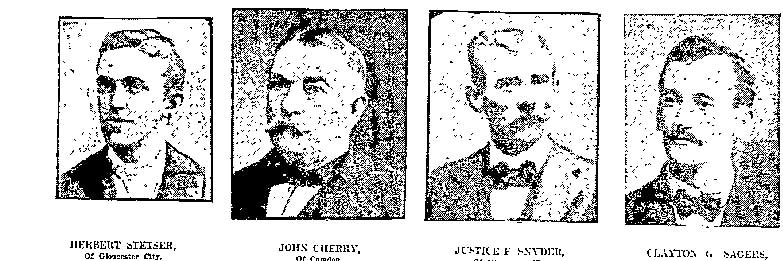
HERBERT STETSER, Of Gloucester City
JOHN CHERRY, Of Camden
JUSTICE F SNYDER, Of Gloucester City
CLAYTON G. SAGERS, Of Gloucester City
TALK WITH MEN WHO RUN THE CARS
Loud in Their Praise of The Inquirer’s Suggestion to Give to Worthy and Deserving Workmen
There is a determined effort in Camden to keep pace with other cities that have indorsed The Inquirer’s plan to give cheer to trolley conductors and motormen.
George S. West, Surrogate of Camden county, has been identified with all sorts of public movements, and is therefore qualified to speak with some authority about The Inquirer’s suggestion. “It is a good one,” he said yesterday. “I hope the people of Camden will act on it on Monday, and act liberally. These car men deserve a generous contribution.”
John Cherry and John S. Smith, Camden county detectives, use the trolley cars freely, and with characteristic readiness they had something to say about The Inquirer’s idea. “Tell the riders that hold free passes to remember the trolley men,” said Smith, while Cherry nodded assent. Cherry added: “We will contribute our share to the crew of every car we use on Monday.”
Prosecutor Frank T. Lloyd, of Camden county, said: “I approve of The Inquirer’s effort for the car men heartily, and I am glad to see The Inquirer push it so earnestly.”
John Wesley Sell, Sheriff of Camden county, said: “Yes, sir; put me down as one who indorses The Inquirer’s suggestion, and will act on it on Monday. The car men have always had my sympathy in their perpetually trying situations, and I would like to see everybody combine in a response to The Inquirer’s suggestion.”
Chief of Police John Foster, of Camden, is an earnest advocate of better treatment of men who spend their lives on the street in all sorts of weather. “The Inquirer’s idea of Christmas contributions to trolley men,” said he, “is one of the most practical suggestions I have ever heard of. I vote for it with both hands, and I hope the people of Camden will do their duty on Monday. I will do my part.”
“How would you like to be the conductor?”
Thus spoke Conductor George Gannett when he alighted from his car at the corner of Market and King streets, Gloucester City, yesterday afternoon after his day’s work, and holding up his change bag said to his fellow conductors waiting for their cars:
“This is what The Inquirer has done for me.”
There was just $6.35 in the bag, and that amount was given him in nickels and pennies through the suggestion of The Inquirer on his eight trips. Such was the case among other conductors on the Camden, Gloucester and Woodbury trolley cars, and together with the motormen they returned home to their families wreathed in smiles, as they were sure of having a Christmas turkey.
On all the cars of the Woodbury trolley road the passengers would either drop an extra nickel or say “keep the change.”
Conductor Gannett said to an Inquirer reporter after leaving the trolley office that he did not think he would get so much, but when the nickels came pouring in on every trip he opened his eyes and said to his motorman: “The Inquirer is a great paper and maybe we will not have turkey galore.”
Camden Trolley Men Wreathed in Smiles
Camden trolley men are looking with eagerness to a Christmas offering from their passengers on Monday, and some of the conductors are already wreathed in smiles over tips already given them by riders who do not expect to be in town on Monday. It is refreshing to see a meek-looking and mild-mannered conductor look closely at the change tendered him for a fare, and then smile expansively when he sees an extra coin for himself and the motorman.
“Thank you,” is uttered in tones that makes the riders smile at one another in pleasure. The conductor returns to the rear platform and beams on the passengers within the car, and when he reaches up and pulls the signal to the motorman to stop the car, the sound of the bell seems to be really musical.
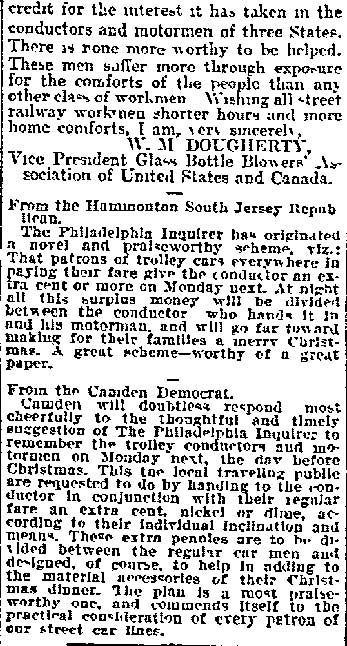
Vice Chief of Glassblowers Speaks To the Editor of The Inquirer.
The Philadelphia Inquirer deserves great credit for the interest it has taken in the conductors and motormen of three States. There is none more worthy to be helped. These men suffer more through exposure for the comforts of the people than any other class of workmen. Wishing all street railway workmen shorter hours and more home comforts, I am, very sincerely, W. M. DOUGHERTY, Vice President Glass Bottle Blowers’ Association of United States and Canada.
From the Hammonton South Jersey Republican.
The Philadelphia Inquirer has originated a novel and praiseworthy scheme, viz.: That patrons of trolley cars everywhere in paying their fare give the conductor an extra cent or more on Monday next. At night all this surplus money will be divided between the conductor who hands it in and his motorman, and will go far toward making for their families a merry Christmas. A great scheme—worthy of a great paper.
From the Camden Democrat.
Camden will doubtless respond most cheerfully to the thoughtful and timely suggestion of The Philadelphia Inquirer to remember the trolley conductors and motormen on Monday next, the day before Christmas. This the local travelling public are requested to do by handing to the conductor in conjunction with their regular fare an extra cent, nickel or dime, according to their individual inclination and means. These extra pennies are to be divided between the regular car men and designed, of course, to help in adding to the material accessories of their Christmas dinner. The plan is a most praiseworthy one, and commends itself to the practical consideration of every patron of our street car lines.
Hill Meets Death Without a Shudder
Philadelphia Inquirer —
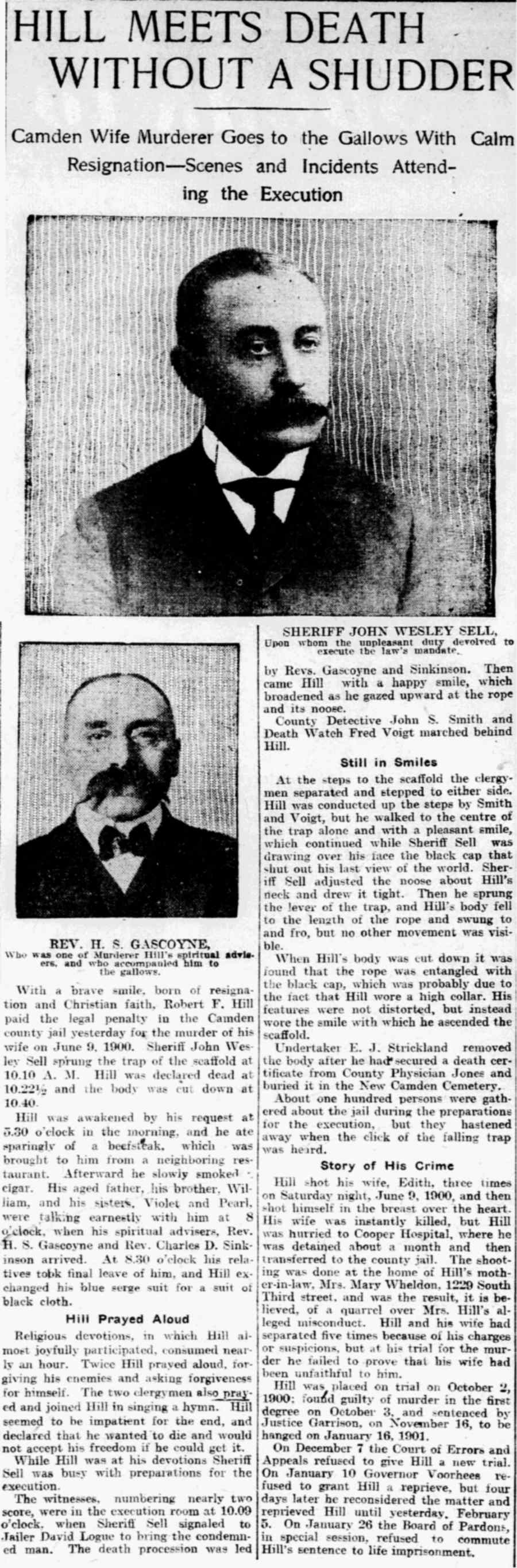
Camden Wife Murderer Goes to the Gallows With Calm Resignation—Scenes and Incidents Attending the Execution
Sheriff John Wesley Sell, Upon whom the unpleasant duty devolved to execute the law’s mandate.
Rev. H. S. Gascoyne, Who was one of Murderer Hill’s spiritual advisers, and who accompanied him to the gallows.
With a brave smile, born of resignation and Christian faith, Robert F. Hill paid the legal penalty in the Camden county jail yesterday for the murder of his wife on June 9, 1900. Sheriff John Wesley Sell sprung the trap of the scaffold at 10.10 A. M. Hill was declared dead at 10.22½ and the body was cut down at 10.40.
Hill was awakened by his request at 5.30 o’clock in the morning, and he ate sparingly of a beefsteak, which was brought to him from a neighboring restaurant. Afterward he slowly smoked a cigar. His aged father, his brother, William, and his sisters, Violet and Pearl, were talking earnestly with him at 8 o’clock, when his spiritual advisers, Rev. H. S. Gascoyne and Rev. Charles D. Sinkinson arrived. At 8.30 o’clock his relatives took final leave of him, and Hill exchanged his blue serge suit for a suit of black cloth.
Hill Prayed Aloud
Religious devotions, in which Hill almost joyfully participated, consumed nearly an hour. Twice Hill prayed aloud, forgiving his enemies and asking forgiveness for himself. The two clergymen also prayed and joined Hill in singing a hymn. Hill seemed to be impatient for the end, and declared that he wanted to die and would not accept his freedom if he could get it.
While Hill was at his devotions Sheriff Sell was busy with preparations for the execution.
The witnesses, numbering nearly two score, were in the execution room at 10.09 o’clock, when Sheriff Sell signaled to Jailer David Logue to bring the condemned man. The death procession was led by Revs. Gascoyne and Sinkinson. Then came Hill with a happy smile, which broadened as he gazed upward at the rope and its noose.
County Detective John S. Smith and Death Watch Fred Voigt marched behind Hill.
Still in Smiles
At the steps to the scaffold the clergymen separated and stepped to either side. Hill was conducted up the steps by Smith and Voigt, but he walked to the centre of the trap alone and with a pleasant smile, which continued while Sheriff Sell was drawing over his face the black cap that shut out his last view of the world. Sheriff Sell adjusted the noose about Hill’s neck and drew it tight. Then he sprung the lever of the trap, and Hill’s body fell to the length of the rope and swung to and fro, but no other movement was visible.
When Hill’s body was cut down it was found that the rope was entangled with the black cap, which was probably due to the fact that Hill wore a high collar. His features were not distorted, but instead wore the smile with which he ascended the scaffold.
Undertaker E. J. Strickland removed the body after he had secured a death certificate from County Physician Jones and buried it in the New Camden Cemetery.
About one hundred persons were gathered about the jail during the preparations for the execution, but they hastened away when the click of the falling trap was heard.
Story of His Crime
Hill shot his wife, Edith, three times on Saturday night, June 9, 1900, and then shot himself in the breast over the heart. His wife was instantly killed, but Hill was hurried to Cooper Hospital, where he was detained about a month and then transferred to the county jail. The shooting was done at the home of Hill’s mother-in-law, Mrs. Mary Wheldon, 1229 South Third street, and was the result, it is believed, of a quarrel over Mrs. Hill’s alleged misconduct. Hill and his wife had separated five times because of his charges or suspicions, but at his trial for the murder he failed to prove that his wife had been unfaithful to him.
Hill was placed on trial on October 2, 1900; found guilty of murder in the first degree on October 3, and sentenced by Justice Garrison, on November 16, to be hanged on January 16, 1901.
On December 7 the Court of Errors and Appeals refused to give Hill a new trial. On January 10 Governor Voorhees refused to grant Hill a reprieve, but four days later he reconsidered the matter and reprieved Hill until yesterday, February 5. On January 26 the Board of Pardons, in special session, refused to commute Hill’s sentence to life imprisonment.
Camden Court Jurors Drawn
CAMDEN COURT JURORS DRAWN
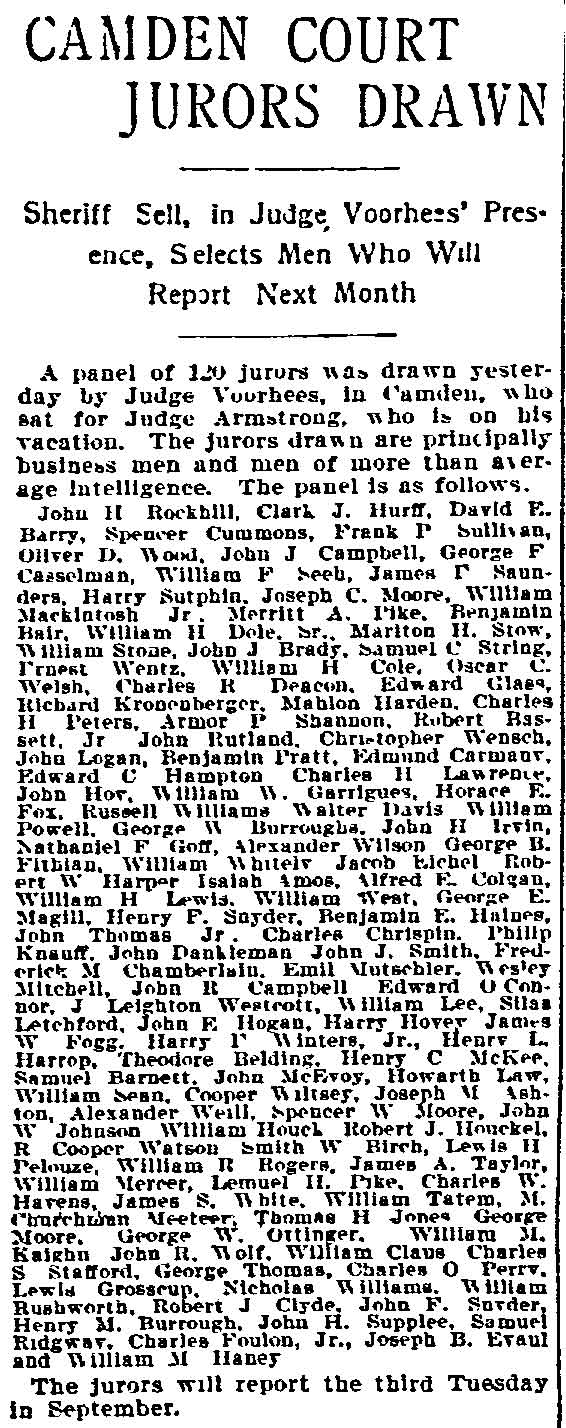
Sheriff Sell, in Judge Voorhees’ Presence, Selects Men Who Will Report Next Month
A panel of 120 jurors was drawn yesterday by Judge Voorhees, in Camden, who sat for Armstrong, who is on his vacation. The jurors drawn are principally business men and men of more than average intelligence. The panel is as follows:
John H. Rockhill, Clark J. Hurff, David E. Barry, Spencer Cummons, Frank P. Sullivan, Oliver D. Wood, John J. Campbell, George F. Casselman, William F. Seeb, James T. Saunders, Harry Sutphin, Joseph C. Moore, William Mackintosh Jr., Merritt A. Pike, Benjamin Hair, William H. Dole, Sr., Marlton H. Stow, William Stone, John J. Brady, Samuel C. String, Ernest Wentz, William H. Cole, Oscar C. Welsh, Charles R. Deacon, Edward Glass, Richard Kronenberger, Mahlon Harden, Charles H. Peters, Armor P. Shannon, Robert Bassett, Jr., John Rutland, Christopher Wensch, John Logan, Benjamin Pratt, Edmund Carmany, Edward C. Hampton, Charles H. Lawrence, John Hor, William W. Garrigues, Horace E. Fox, Russell Williams, Walter Davis, William Powell, George W. Burroughs, John H. Irvin, Nathaniel F. Goff, Alexander Wilson, George B. Fithian, William Whitely, Jacob Reichel, Robert W. Harper, Isaiah Amos, Alfred E. Colgan, William H. Lewis, William West, George E. Magill, Henry F. Snyder, Benjamin F. Haines, John Thomas, Jr., Charles Chrispin, Philip Knauff, John Dankleman, John J. Smith, Frederick M. Chamberlain, Emil Mutschler, Wesley Mitchell, John R. Campbell, Edward O’Connor, J. Leighton Westcott, William Lee, Silas Letchford, John E. Hogan, Harry Hover, James W. Fogg, Harry T. Winters, Jr., Henry L. Harrop, Theodore Belding, Henry C. McKee, Samuel Barnett, John McEvoy, Howarth Law, William Sean, Cooper Wiltsey, Joseph M. Ashton, Alexander Weill, Spencer W. Moore, John W. Johnson, William Houck, Robert J. Houckel, R. Cooper Watson, Smith W. Birch, Lewis H. Pelouze, William R. Rogers, James A. Taylor, William Mercer, Lemuel H. Pike, Charles W. Havens, James S. White, William Tatem, M. Churchman Meeteer, Thomas H. Jones, George Moore, George W. Ottinger, William M. Kaighn, John R. Wolf, William Claus, Charles S. Stafford, George Thomas, Charles O. Perry, Lewis Grosscup, Nicholas Williams, William Rushworth, Robert J. Clyde, John F. Snyder, Henry M. Burrough, John H. Supplee, Samuel Ridgway, Charles Poulon, Jr., Joseph B. Evaul and William M. Haney.
The jurors will report the third Tuesday in September.
Banquet for Correspondents
Banquet for Correspondents
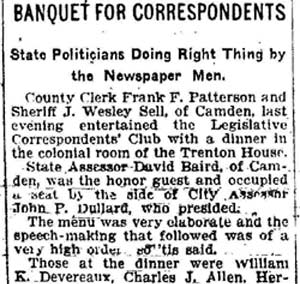
State Politicians Doing Right Thing by the Newspaper Men.
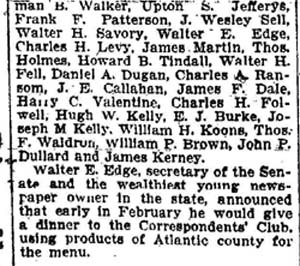
County Clerk Frank F. Patterson and Sheriff J. Wesley Sell, of Camden, last evening entertained the Legislative Correspondents’ Club with a dinner in the colonial room of the Trenton House. State Assessor David Baird, of Camden, was the honor guest and occupied a seat by the side of City Assessor John P. Dullard, who presided.
The menu was very elaborate and the speech-making that followed was of a very high order, so ‘tis said.
Those at the dinner were William K. Devereaux, Charles J. Allen, Her…
Frank F. Patterson Jr. — J. Wesley Sell — David Baird Sr. — Upton S. Jefferys — Trenton Times, January 15, 1902
Was Leaders’ Night
Many Lights in Republican Party Were at State House Last Night and All Had Business.
Not since the election of United States Senator Dryden has the State House entertained such a hevy [sic] of leading Republicans as it did last evening. Banking Commissioner William Bettle, with State Assessor Baird and other friends of the Pennsylvania Railroad Company were on hand for the purpose of urging the hungry Senators to let go of the tunnel bill. As has been told in the Times the measure is intended to permit the Pennsylvania Railroad Company to construct the Jersey end of its $40,000,000 tunnel. The Senate has been holding it up for six weeks and the railroad people were beginning to grow anxious. Several heart-to-heart talks were had with the Senators last night and the measure seems to have a brighter prospect now.
United States Senator John Kean and Congressman Charles N. Fowler, old-time political antagonists, came up from Washington to urge the reappointment of Principal Keeper Samuel S. Moore of the State Prison. Major E. J. Anderson, the supervisor at the prison, is making a vigorous fight against Moore.
First Assistant Postmaster General William M. Johnson also ran up from Washington.
Camden Delegations
Then there were great big delegations representing various localities, Camden, as usual, heading the list. Camden is just now very much agitated over the county judgeship soon to become vacant by the expiration of the term of E. Ambler Armstrong.
Judge Joseph H. Gaskill, of Burlington county, and W. J. Browning, of Camden, called upon the governor to urge the reappointment of Judge Armstrong. They had a long chat with his excellency, but were given no reassuring promises.
County Clerk Frank F. Patterson, Jr., and Sheriff J. Wesley Sell, the Damon and Pythias of Camden county politics, and whose genial ways and perpetual smiles have won for them the sobriquet of the “Laughing Statesmen,” were on hand to look the ground over. They would very much like to see City Solicitor Harry M. Snyder, of Camden, elevated to the bench. They are not opposing Judge Armstrong, however.
Colonel Samuel D. Dickinson, of Hudson, with Major Mark Fagan, of Jersey City, and a host of Republicans from the same bailiwick, were on hand to urge favorable consideration for Hudson measures, while Major Lankering and a delegation of Hoboken officials were looking after the needs of that interesting municipality.
Altogether it was the busiest Monday night that the session has seen, save only in the Senatorial fight.
Prisoner Fought in State Capitol
Philadelphia Inquirer —

Samuel Warwick Taken Into Custody in the Assembly Chamber After Struggle
HE THREATENED OFFICIALS
Sheriff Sell and Prosecutor Lloyd Caused the Arrest of the Man, Who Is Somewhat Eccentric
Special to The Inquirer.
TRENTON, N. J., March 19.—A sensation was created in the Assembly Chamber this afternoon when County Detective John F. Smith, of Camden, placed Samuel G. Warwick, of Glassboro, under arrest on a warrant charging him with threatening to take the lives of Sheriff J. Wesley Sell and Prosecutor Frank T. Lloyd. Warwick, who is somewhat eccentric, was standing at the rail of the house when Detective Smith placed him under arrest.
Warwick, who is of rather spare build, protested loudly, and Sergeant-at-Arms Frank Tantum went to the assistance of Smith, but the two big officials were unable to quiet the prisoner, and two additional men were pressed into service. Warwick was finally handcuffed and taken to Camden by Smith.
Imaginary Wrongs
For many weeks Warwick has been hanging about the legislative halls endeavoring to induce some one to introduce a bill to reimburse him for imaginary wrongs he claims to have suffered while serving a term in State prison. He was sent to prison for forgery, and upon being released sought to bring an action against the State on the ground that he had been rendered speechless because of the ill treatment he received in the prison.
In an unguarded moment one day at the State House he broke forth into good, strong speech. Nothing daunted, however, he has kept up his endeavor to get legislation reimbursing him for his alleged injury.
Held Up Nomination
It was stated by one of the Senators to night that Warwick was the means of holding up the nomination of Judge Jessup, of Gloucester county, by the Senate for upwards of a week. The cause of the delay was sought for in vain by some of Judge Jessup’s friends. It then leaked out that Warwick had entered a protest with several of the Senators against Judge Jessup. It was Judge Jessup who sentenced Warwick to prison.
The threats that Warwick has been making against Sheriff Sell and Prosecutor Lloyd have been so virulent and repeated that it was deemed necessary to take him into custody. He was taken to Camden this afternoon.
Pending an examination as to his sanity, Warwick was committed to jail in default of $1000 bail by Justice Schmitz, of Camden, last night, on the charge of threatening to kill Prosecutor Frank T. Lloyd and Sheriff John W. Sell. Some time ago Warwick was sentenced to pay a fine for robbing his boarding mistress, and in default was committed to the county jail. Under a custom prisoners are allowed to serve a day for each dollar of the fine imposed, but it was not allowed in this case. After serving several days over the usual allotted time he paid his fine and then demanded a rebate of $1 for each day. Because the Prosecutor and Sheriff refused his demand he made threats against their lives.
Nerving Himself for Execution
NERVING HIMSELF FOR EXECUTION
All the Arrangements Completed for the Hanging of a Wife-Murderer in Camden
Sheriff John Wesley Sell of Camden, yesterday completed all arrangements for the hanging of Samuel Vanstavern next Tuesday. A new suit of black clothes has been provided for the condemned man. He was shaved by the prison barber. His cell was again looked over for weapons or poison, and he was instructed that no speech will be permitted from the gallows.
With the assistance of former Sheriff West the gibbet was tested yesterday and everything worked satisfactorily. Vanstavern heard the thud as the trap was sprung, and a shudder passed over the wreck of a once powerful physique.
To a city official who visited the condemned man yesterday at the latter’s request Vanstavern said he felt better than he had for some time. Prison officials state he is trying to nerve himself for the final ordeal. His spiritual advisers, Revs. J. R. Mason and D. B. Green, spend a great deal of time with him. During their presence he seems to bear up fairly well, but in their absence he is an abject picture of distress.
J. Wesley Sell — Samuel Vanstavern — Rev. D. B. Green — Rev. John R. Mason — Henry J. West — Philadelphia Inquirer, April 6, 1902
Vanstaver Pays Death Penalty
VANSTAVER PAYS DEATH PENALTY
Murmurs Name of Wife He Murdered as Noose Slips About His Neck
Samuel Vanstavern, who killed his wife Katherine, November 29 last, expiated his crime on the gallows in the Camden county jail yesterday morning. The wind whistled and shrieked while torrents of rain pattered against the window panes, but this rather pleased the doomed man, for he remarked: “I’m glad the sun isn’t shining. I wanted it to rain to-day.”
Early in the morning Rev. John R. Mason, Rev. D. B. Green, Vanstavern’s spiritual advisers, visited him and gave him what consolation they could until the dread black cap was drawn over his head, shutting out forever the light of day.
A few minutes before 10 o’clock the march to the gallows began, Vanstavern singing in a firm voice: “I’ll Go Every Step of the Way.” One minute after ten the wretched man, who had spent many hours of anguish, walked into the execution room. He faltered, however, just for an instant, and then gathered himself together and proceeded. When in position for the noose to be placed about his neck he murmured:
“I’m coming, Katie.”
Then when the rope had been adjusted and the sombre cap was about to be drawn over his face, he bade the Sheriff good-bye.
At 10.03 Sheriff Sell sprang the trap and let the doomed man through. At 10.15 the man was pronounced dead and was cut down at 10.33. The physicians present found Vanstavern’s neck had been broken. The body was interred at noon at the old Camden Cemetery by Undertaker Jefferis.
Samuel Vanstavern was hanged for murdering his wife Katherine, whom he shot down in cold blood at Fourth and Chestnut streets, Friday night, November 29, 1901. They had not been living together for some years owing to Vanstavern’s ill treatment. On the night of the crime the man had been drinking heavily. Without a moment’s notice he opened fire and she died on the way to Cooper Hospital.
“I could not live without her,” said Vanstavern coolly, directly after the crime.
J. Wesley Sell — Samuel Vanstavern — Rev. D. B. Green — Rev. John R. Mason — E. E. Jefferis — Philadelphia Inquirer, April 9, 1902
Hummed a Hymn While in Hangman’s Hands
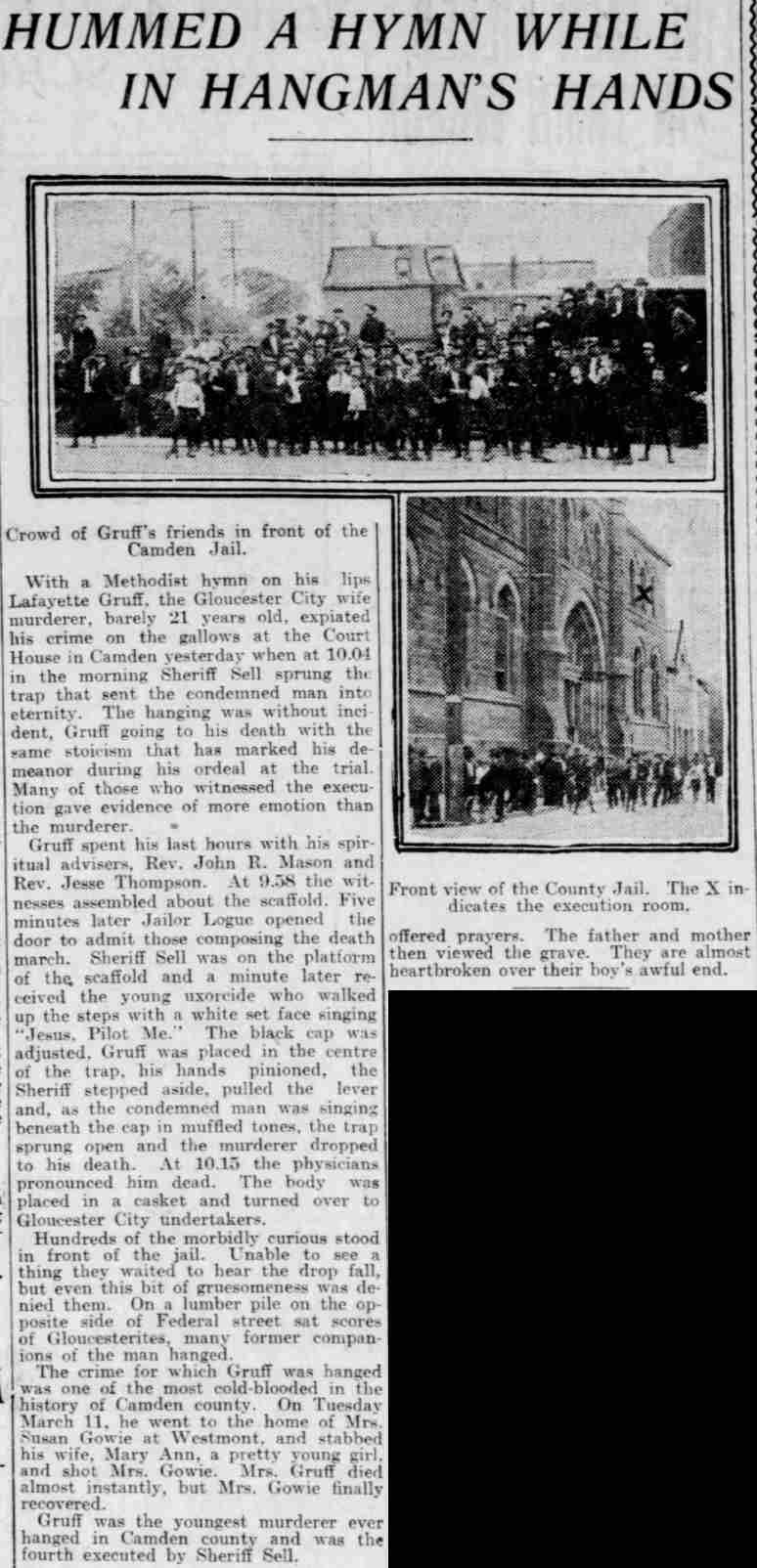
With a Methodist hymn on his lips Lafayette Gruff, the Gloucester City wife murderer, barely 21 years old, expiated his crime on the gallows at the Court House in Camden yesterday when at 10.04 in the morning Sheriff Sell sprung the trap that sent the condemned man into eternity. The hanging was without incident, Gruff going to his death with the same stoicism that has marked his demeanor during his ordeal at the trial. Many of those who witnessed the execution gave evidence of more emotion than the murderer.
Gruff spent his last hours with his spiritual advisers, Rev. John R. Mason and Rev. Jesse Thompson. At 9.58 the witnesses assembled about the scaffold. Five minutes later Jailor Logue opened the door to admit those composing the death march. Sheriff Sell was on the platform of the scaffold and a minute later received the young uxorcide who walked up the steps with a white set face singing “Jesus, Pilot Me.” The black cap was adjusted, Gruff was placed in the centre of the trap, his hands pinioned, the Sheriff stepped aside, pulled the lever and, as the condemned man was singing beneath the cap in muffled tones, the trap sprung open and the murderer dropped to his death. At 10.15 the physicians pronounced him dead. The body was placed in a casket and turned over to Gloucester City undertakers.
Hundreds of the morbidly curious stood in front of the jail. Unable to see a thing they waited to hear the drop fall, but even this bit of gruesomeness was denied them. On a lumber pile on the opposite side of Federal street sat scores of Gloucesterites, many former companions of the man hanged.
The crime for which Gruff was hanged was one of the most cold-blooded in the history of Camden county. On Tuesday March 11, he went to the home of Mrs. Susan Gowie at Westmont, and stabbed his wife, Mary Ann, a pretty young girl, and shot Mrs. Gowie. Mrs. Gruff died almost instantly, but Mrs. Gowie finally recovered.
Gruff was the youngest murderer ever hanged in Camden county and was the fourth executed by Sheriff Sell.
Philadelphia Inquirer, September 20, 1902
The Paul Woodward Murder Case — October 1902 to January 1903
On October 1, 1902 Paul Woodward murdered two young boys by giving them poison. Frank T. Lloyd, then Camden County prosecutor, was responsible for leading the investigation and prosecuting the case. Woodward was arrested on October 4, 1902, and was quickly indicted on murder charges. J. Wesley Sell was Camden County’s sheriff in October of 1902, nearing the end of his term. On October 31, 1902 Sheriff Sell drew a panel of potential jurors for the trial, which was scheduled to take place on November 12, 1902 before Judge Charles G. Garrison. Sheriff Sell was succeeded as Sheriff on November 12, 1902 by Christopher J. Mines Jr., who saw the case through to its conclusion. Paul Woodward was found guilty of murder in the first degree, and Judge Garrison sentenced him to death by hanging. Woodward was executed on January 7, 1903 at the Camden County Jail, with Sheriff Mines supervising.
Jurors to Try Woodward
Philadelphia Inquirer —
Sheriff Sell, in Camden, yesterday drew a special panel of forty-eight jurors, twelve of whom will try Paul Woodward, charged with the murder of John Coffin. The trial will begin November 12. Woodward will be arraigned to-day before Judge Garrison to plead to the indictment charging him with murder.
Republican Executive Committee Organized
The Camden County Republican Executive Committee organized by electing Surrogate Harry Reeves chairman; Under-Sheriff William D. Brown, secretary, and Former Sheriff J. W. Sell, treasurer.
Harry Reeves — William D. Brown — J. Wesley Sell — Philadelphia Inquirer, December 3, 1902
Royal Welcome for Ex-Sheriff Baird
Philadelphia Inquirer —
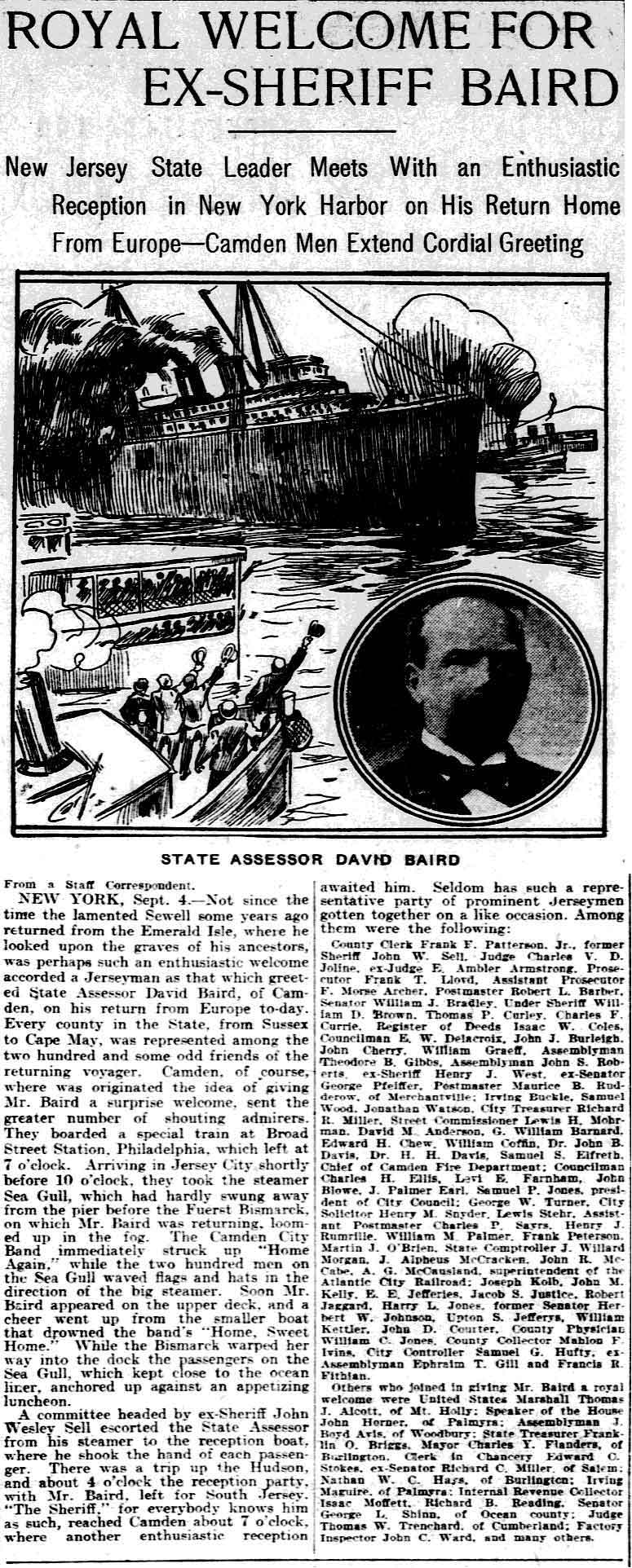
New Jersey State Leader Meets With an Enthusiastic Reception in New York Harbor on His Return Home From Europe—Camden Men Extend Cordial Greeting
STATE ASSESSOR DAVID BAIRD
From a Staff Correspondent.
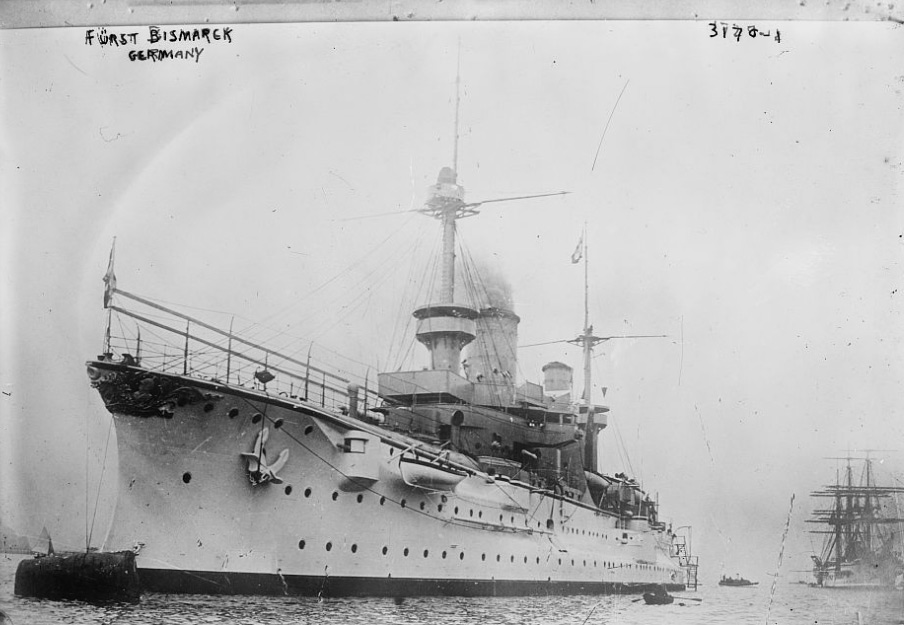
NEW YORK, Sept. 4.—Not since the time the lamented Sewell some years ago returned from the Emerald Isle, where he looked upon the graves of his ancestors, was perhaps such an enthusiastic welcome accorded a Jerseyman as that which greeted State Assessor David Baird, of Camden, on his return from Europe to-day. Every county in the State, from Sussex to Cape May, was represented among the two hundred and some odd friends of the returning voyager. Camden, of course, where was originated the idea of giving Mr. Baird a surprise welcome, sent the greater number of shouting admirers. They boarded a special train at Broad Street Station, Philadelphia, which left at 7 o’clock. Arriving in Jersey City shortly before 10 o’clock, they took the steamer Sea Gull, which had hardly swung away from the pier before the Fuerst Bismarck, on which Mr. Baird was returning, loomed up in the fog. The Camden City Band immediately struck up “Home Again,” while the two hundred men on the Sea Gull waved flags and hats in the direction of the big steamer. Soon Mr. Baird appeared on the upper deck, and a cheer went up from the smaller boat that drowned the band’s “Home, Sweet Home.” While the Bismarck warped her way into the dock the passengers on the Sea Gull, which kept close to the ocean liner, anchored up against an appetizing luncheon.
A committee headed by ex-Sheriff John Wesley Sell escorted the State Assessor from his steamer to the reception boat, where he shook the hand of each passenger. There was a trip up the Hudson, and about 4 o’clock the reception party, with Mr. Baird, left for South Jersey. “The Sheriff,” for everybody knows him as such, reached Camden about 7 o’clock, where another enthusiastic reception awaited him. Seldom has such a representative party of prominent Jerseymen gotten together on a like occasion. Among them were the following:
County Clerk Frank F. Patterson, Jr., former Sheriff John W. Sell, Judge Charles V. D. Joline, ex-Judge E. Ambler Armstrong, Prosecutor Frank T. Lloyd, Assistant Prosecutor F. Morse Archer, Postmaster Robert L. Barber, Senator William J. Bradley, Under Sheriff William D. Brown, Thomas P. Curley, Charles F. Currie, Register of Deeds Isaac W. Coles, Councilman E. W. Delacroix, John J. Burleigh, John Cherry, William Graeff, Assemblyman Theodore B. Gibbs, Assemblyman John S. Roberts, ex-Sheriff Henry J. West, ex-Senator George Pfeiffer, Postmaster Maurice B. Rudderow, of Merchantville; Irving Buckle, Samuel Wood, Jonathan Watson, City Treasurer Richard R. Miller, Street Commissioner Lewis H. Mohrman, David M. Anderson, G. William Barnard, Edward H. Chew, William Coffin, Dr. John B. Davis, Dr. H. H. Davis, Samuel S. Elfreth, Chief of Camden Fire Department; Councilman Charles H. Ellis, Levi E. Farnham, John Blowe, J. Palmer Earl, Samuel P. Jones, president of City Council; George W. Turner, City Solicitor Henry M. Snyder, Lewis Stehr, Assistant Postmaster Charles P. Sayrs, Henry J. Rumrille, William M. Palmer, Frank Peterson, Martin J. O’Brien, State Comptroller J. Willard Morgan, J. Alpheus McCracken, John R. McCabe, A. G. McCausland, superintendent of the Atlantic City Railroad; Joseph Kolb, John M. Kelly, E. E. Jefferies, Jacob S. Justice, Robert Jaggard, Harry L. Jones, former Senator Herbert W. Johnson, Upton S. Jefferys, William Kettler, John D. Courter, County Physician William C. Jones, County Collector Mahlon F. Ivins, City Controller Samuel G. Hufty, ex-Assemblyman Ephraim T. Gill and Francis R. Fithian.
Others who joined in giving Mr. Baird a royal welcome were United States Marshall Thomas J. Alcott, of Mt. Holly; Speaker of the House John Herner, of Palmyra; Assemblyman J. Boyd Avis, of Woodbury; State Treasurer Franklin O. Briggs, Mayor Charles Y. Flanders, of Burlington, Clerk in Chancery Edward C. Stokes, ex-Senator Richard C. Miller, of Salem; Nathan W. C. Hays, of Burlington; Irving Maguire, of Palmyra; Internal Revenue Collector Isaac Moffett, Richard B. Reading, Senator George L. Shinn, of Ocean county; Judge Thomas W. Trenchard, of Cumberland; Factory Inspector John C. Ward, and many others.
Fürst Bismarck
1903
Clerk Patterson on Second Term
Philadelphia Inquirer —
Popular Camden County Official Takes Oath of Office and Entertains Bondsmen and Others
County Clerk Frank F. Patterson, of Camden, at noon yesterday took the oath of office for a second term of five years. The oath was administered by Judge Joline in the presence of Mr. Patterson’s office force.
After taking the oath of office Mr. Patterson’s first official act was to reappoint Howard Truax as deputy county clerk and Frank Voigt as his assistant.
During Mr. Patterson’s previous term of office he made a host of friends through his courtesy and attention to those who called upon him for information.
Last night County Clerk Patterson gave an elaborate dinner at the Hotel Bellevue-Stratford to his bondsmen and several political friends.
Mr. Patterson under a recent law furnished a bond for $25,000 with the following bondsmen: Frank F. Patterson, Sr., David Baird, John W. Sell and William J. Bradley. These, including the following well-known Jerseymen, were Mr. Patterson’s guests at the banquet: Judge Charles G. Garrison, Judge A. B. Endicott, Judge C. V. D. Joline, Congressman H. C. Loudenslager, State Comptroller J. Willard Morgan, Assemblymen H. S. Scovel, Theodore B. Gibbs and Samuel P. Jones, Senators John G. Horner, J. Boyd Avis, Wood McKee and W. H. Jackson, State Assessor David Baird, Sheriff Frank C. Somers, Register Edward S. Delacroix, Prosecutor Frank T. Lloyd, Assistant Prosecutor F. Morse Archer, Surrogate Harry Reeves, Deputy Sheriff William D. Brown, Howard Truax, Robert Leyburne, Theodore N. Patterson, Wolcott J. Patterson, Irving Buckle, Joseph Burt, William S. Jones, John J. Leyburne, E. A. Y. Schellenger, Henry J. Cloud, Charles Middleton and Edward W. Humphreys.
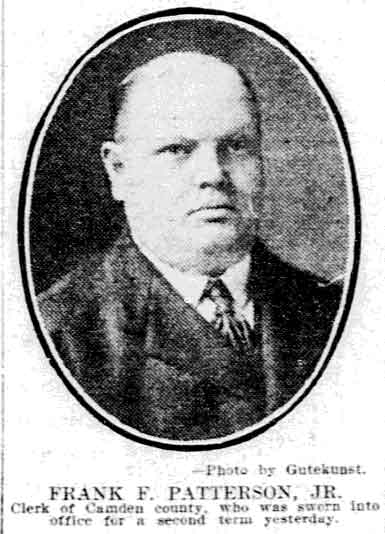
—Photo by Gutekunst
FRANK F. PATTERSON, JR.
Clerk of Camden county, who was sworn into office for a second term yesterday.
Camden News Notes
County Collector Sell has notified the several township and borough governments that have failed to pay their proportionate share towards the building of stone roads that unless the same is paid within ten days suit will be brought to recover the money.
Philadelphia Inquirer, January 27, 1907
Camden Election Officers Slow to Collect Checks

Camden election officers are evidently not in need of money, more than one-third of them having failed to call on County Collector Sell for their checks.
Philadelphia Inquirer, November 24, 1910
Over in Camden
Philadelphia Inquirer —
William Moebins entertained several Philadelphia singing societies at the City Hotel last evening.
Superintendent James Brown has moved from the City Hall to 640 Berkley street. His former quarters will be transformed into a police court room.
County Clerk Barber yesterday received from Governor Voorhees the commissions of Sheriff Sell and Coroners Gaskill and Robinson. The latter was at once sworn in.
Gottlieb Foehl, a wholesale liquor dealer, of the East Side, was fined $50 and costs by Recorder Nowrey yesterday for selling liquor in less quantity than one quart. Policeman Matlack was the complainant.
Charles Thomas, of 1872 Milton street, and Patrick Hayes, of No. 3 James court, laborers employed by the Vulcanite Paving Company, were struck by a trolley car at Broadway and Kaighn avenue yesterday, but were not seriously injured.
John Haas, 9 years old, of 615 Willard street, and Harold Cronce, 6 years old, of 1021 Penn street, were arraigned before Recorder Nowrey yesterday, charged with breaking into Andrew Lyons’ stables and attempting to steal a team. They are being held until Judge Armstrong can be communicated with.
Sixth Ward Republican Club Elects Delegates
Philadelphia Inquirer —

The Sixth Ward Republican Club has elected City Clerk Varney, Deputy Sheriff Sell, William D. Brown, E. E. Jefferis and John Brothers as delegates to the State League of Republican Clubs.
Bank Directory — March 1, 1916
Broadway Trust Company
Broadway below Walnut St. Camden, N. J.
J. J. BURLEIGH President
ANTHONY KOBUS Vice President — WM. J. COOPER Vice President
BURLEIGH H. DRAPER Secretary and Treasurer
Directors:
John J. Burleigh — William Mills
Dr. S. G. Bushey — Anthony J. Oberst
Ralph D. Childrey — John Wesley Sell
Robert H. Comey — Dr. Marvin A. Street
William J. Cooper — Wilbert L. Sweeten
George A. Frey — Edward B. Stone
Albert Fogg — Adam Schlorer
Frederick Grant — Bernhard F. Schroeder
John B. Kates — Edward Schuster Jr.
Dr. Grant E. Kirk — John O. Wilson
Anthony Kobus
Camden Hails Her Sons, Conquerors, at Victory Jubilee
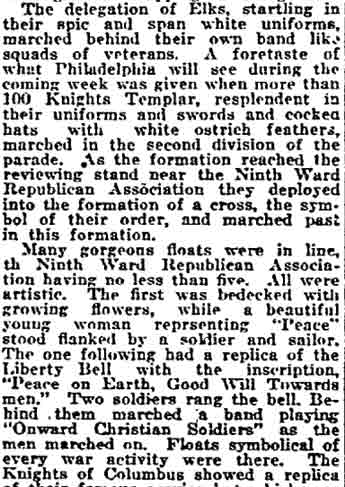
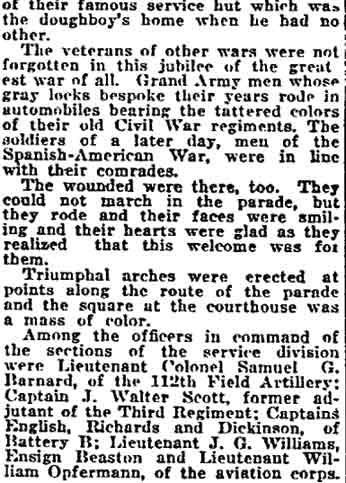
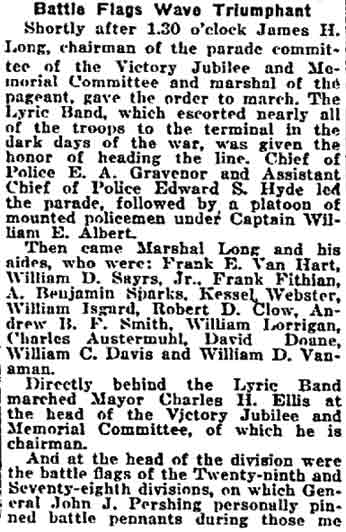
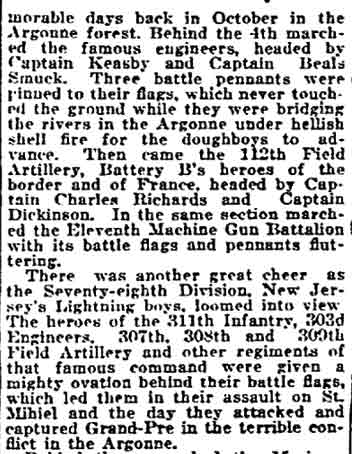
Battle Flags Wave in Triumph O’er Parade Reviewed by Admiral
Gray Veterans of G. A. R. and Wounded Ride; Centopath Passes in Reverential Hush
The Peace with victory which Camden’s sons along with millions of other soldiers of all the Allied countries helped to bring home was celebrated by a jubilee in Camden yesterday which eclipsed anything that the city across the Delaware has ever attempted in her history.
Nearly every man, woman and child who did not actually march in the jubilee parade stood on the side lines and watched it and cheered themselves hoarse as the soldiers and sailors who went out from their town to fight marched past, this time as the conquerors in the world’s greatest war.
Favored by glorious sunshine, a sunshine that was reflected in the faces of the people, the day’s proceedings went off perfectly. For months Mayor Ellis and all his city family, together with a large committee of leading citizens, had been planning the affair. Their handiwork stood the test. It was good.
Admiral Henry Wilson, commander-in-chief of the Atlantic Fleet, came to his boyhood home to be the principal guest of the city and chief reviewing officer of the jubilee. With him were national statesmen and municipal officials.
Soldiers, sailors, war workers, members of fraternal orders and men who fought under the flags of Canada, England, Italy and Poland, marched in the parade which was miles long. Every succeeding division seemed just a little better than the one which preceded it, and, when it was all over and the soldiers and sailors had filed into the old Third Regiment Armory to sit down to a piping hot banquet, the hardest thing of all was to say which had made the finest showing.
All Honor to the Dead
Amidst all the gayety and happiness there was a sober note expressed by the memorial cenotaph which preceded the parade and which brought every hat off as it passed in solemn silence.
The heroic figure of an American soldier in bronze standing on a granite pedestal which bore a gold star with the number 135, symbolical of the Camden county men who laid down their lives in their country’s cause, was carried along the route ten minutes before the parade commenced. Encircler [sic] by flowers and palms, it moved through the reverential hush which had fallen over the throngs.
While every organization in the county of Philadelphia was represented in the parade, to the thousands who lined the sidewalks, there was really only one great big important factor—the service men. And when those self-same service men, many of whom bearing the Distinguished Service Cross of their own United States, others wearing the Croix de Guerre, bestowed on them by the sister republic of France, and still others carrying on their breasts the Italian and British War Crosses, given them by grateful countries, marched down the streets and avenues, all the pent up emotion in thousands of hearts was let loose.
It mattered not whether the men were officers or enlisted men, black or white, neat or untidy, they were all soldiers and they had done all that was asked of them. Their home town honored them. The men in blue and the women in blue, too, received a welcome not one whit less feeling than their brothers in khaki.
They had a certain advantage over the doughboys, for they put half a dozen of the prettiest and smartest yoemanettes that ever wore Uncle Sam’s uniform at the head of their division. The crowd simply had to be with them.
Canada and England, too, had a detachment of men in line. About two dozen of these veterans, half of whom wore the ribbon of the Mons Star, showing that they were in service in France in 1914, were in line, and they marched snappily and smartly and drew their full modicum of pleasurable comments.
Red Cross women, some of them grandmothers, others young girls still in their teens, marched in their snowy white uniforms with their crosses of red emblazoned on headcover and breast. Salvation Army lassies who had cooked doughnuts right up under the muzzles of the guns were there with Y. M. C. A. and Knights of Columbus workers.
Elks, Masons, Knights Templar, Red Men, Moose and scores of other fraternal organizations turned out in all their glorious trappings and regalia.
The delegation of Elks, startling in their spic and span white uniforms, marched behind their own band like squads of veterans. A foretaste of what Philadelphia will see during the coming week was given when more than 100 Knights Templar, resplendent in their uniforms and swords and cocked hats with white ostrich feathers, marched in the second division of the parade. As the formation reached the reviewing stand near the Ninth Ward Republican Association they deployed into the formation of a cross, the symbol of their order, and marched past in this formation.
Many gorgeous floats were in line, th Ninth Ward Republican Association having no less than five. All were artistic. The first was bedecked with growing flowers, while a beautiful young woman reprsenting “Peace” stood flanked by a soldier and sailor. The one following had a replica of the Liberty Bell with the inscription, “Peace on Earth, Good Will Towards men.” Two soldiers rang the bell. Behind them marched a band playing “Onward Christian Soldiers” as the men marched on. Floats symbolical of every war activity were there. The Knights of Columbus showed a replica of their famous service hut which was the doughboy’s home when he had no other.
The veterans of other wars were not forgotten in this jubilee of the greatest war of all. Grand Army men whose gray locks bespoke their years rode in automobiles bearing the tattered colors of their old Civil War regiments. The soldiers of a later day, men of the Spanish-American War, were in line with their comrades.
The wounded were there, too. They could not march in the parade, but they rode and their faces were smiling and their hearts were glad as they realized that this welcome was for them.
Triumphal arches were erected at points along the route of the parade and the square at the courthouse was a mass of color.
Among the officers in command of the sections of the service division were Lieutenant Colonel Samuel G. Barnard, of the 112th Field Artillery; Captain J. Walter Scott, former adjutant of the Third Regiment; Captains English, Richards and Dickinson, of Battery B; Lieutenant J. G. Williams, Ensign Beaston and Lieutenant William Opfermann, of the aviation corps.
Battle Flags Wave Triumphant
Shortly after 1.30 o’clock James H. Long, chairman of the parade committee of the Victory Jubilee and Memorial Committee and marshal of the pageant, gave the order to march. The Lyric Band, which escorted nearly all of the troops to the terminal in the dark days of the war, was given the honor of heading the line. Chief of Police E. A. Gravenor and Assistant Chief of Police Edward S. Hyde led the parade, followed by a platoon of mounted policemen under Captain William E. Albert.
Then came Marshal Long and his aides, who were: Frank E. Van Hart, William D. Sayrs, Jr., Frank Fithian, A. Benjamin Sparks, Kessel Webster, William Isgard, Robert D. Clow, Andrew B. F. Smith, William Lorrigan, Charles Austermuhl, David Doane, William C. Davis and William D. Vanaman.
Directly behind the Lyric Band marched Mayor Charles H. Ellis at the head of the Victory Jubilee and Memorial Committee, of which he is chairman.
And at the head of the division were the battle flags of the Twenty-ninth and Seventy-eighth divisions, on which General John J. Pershing personally pinned battle pennants during those memorable days back in October in the Argonne forest. Behind the 4th marched the famous engineers, headed by Captain Keasby and Captain Beals Smuck. Three battle pennants were pinned to their flags, which never touched the ground while they were bridging the rivers in the Argonne under hellish shell fire for the doughboys to advance. Then came the 112th Field Artillery, Battery B’s heroes of the border and of France, headed by Captain Charles Richards and Captain Dickinson. In the same section marched the Eleventh Machine Gun Battalion with its battle flags and pennants fluttering.
There was another great cheer as the Seventy-eighth Division, New Jersey’s Lightning boys, loomed into view. The heroes of the 311th Infantry, 303d Engineers, 307th, 308th and 309th Field Artillery and other regiments of that famous command were given a mighty ovation behind their battle flags, which led them in their assault on St. Mihiel and the day they attacked and captured Grand-Pre in the terrible conflict in the Argonne.
Behind them marched the Marines, headed by Lieutenant Monitor Watchman, of the Fifth Regiment, Second Division. With the Marines marched the regular army units, men who had served in as many as five battles and wore three and four gold service stripes on their sleeves.
Then followed the naval contingent. They were commanded by Commander Francis W. Hoffman and Commander W. G. Hodgson.
The order “eyes left” flashed along the line as each platoon drew near the reviewing stand and Admiral Wilson with his band to his cap returned the salute. With the admiral on the stand were former United States Senator David Baird, Congressman William J. Browning, County Collector John S. Well, City Clerk W. D. Brown and others.
At the armory a splendid banquet was served to the soldiers and sailors. For days past corps Red Cross workers had been preparing the good things to eat and the men did full justice to them. They marched in the armory where the food was spread on the tables and enjoyed themselves while bands played. After dinner there were speeches. Mayor Ellis in welcoming the men said:
“This is one of the happiest moments of my life. I have waited patiently through months of trial for the glad day when I could bid you welcome to the City of Camden once again.
“We are planning to erect a lasting memorial in memory of those heroes who gave their lives and in memory of the valiant deeds you performed on land and sea.
“Camden will always cherish the memory of this day, rever the memory of your dead comrades and will inscribe your valiant deeds on that memorial. I bid you welcome in the name of the most patriotic little city in America. I thank you.”
Prosecutor Charles A. Wolverton welcomed the men on behalf of the county and paid a tribute to their valor recalling their wonderful victories of the Argonne and other battlefields of France.
Camden Gets $67,669 R. R. Tax
Camden City will receive $67,669.59 of the second-class railroad property tax apportioned to Camden county. The total is $72,458.61, a check for which was recovered yesterday from the State by County Collector Sell. The money is apportioned to the municipalities according their respective holdings. The smallest sum goes to Chesilhurst, which borough will receive a check for 38 cents.
Philadelphia Inquirer, December 14, 1919
Haines and Reinert Head G.O.P.; Madden To Lead Democrats
Camden Courier-Post —
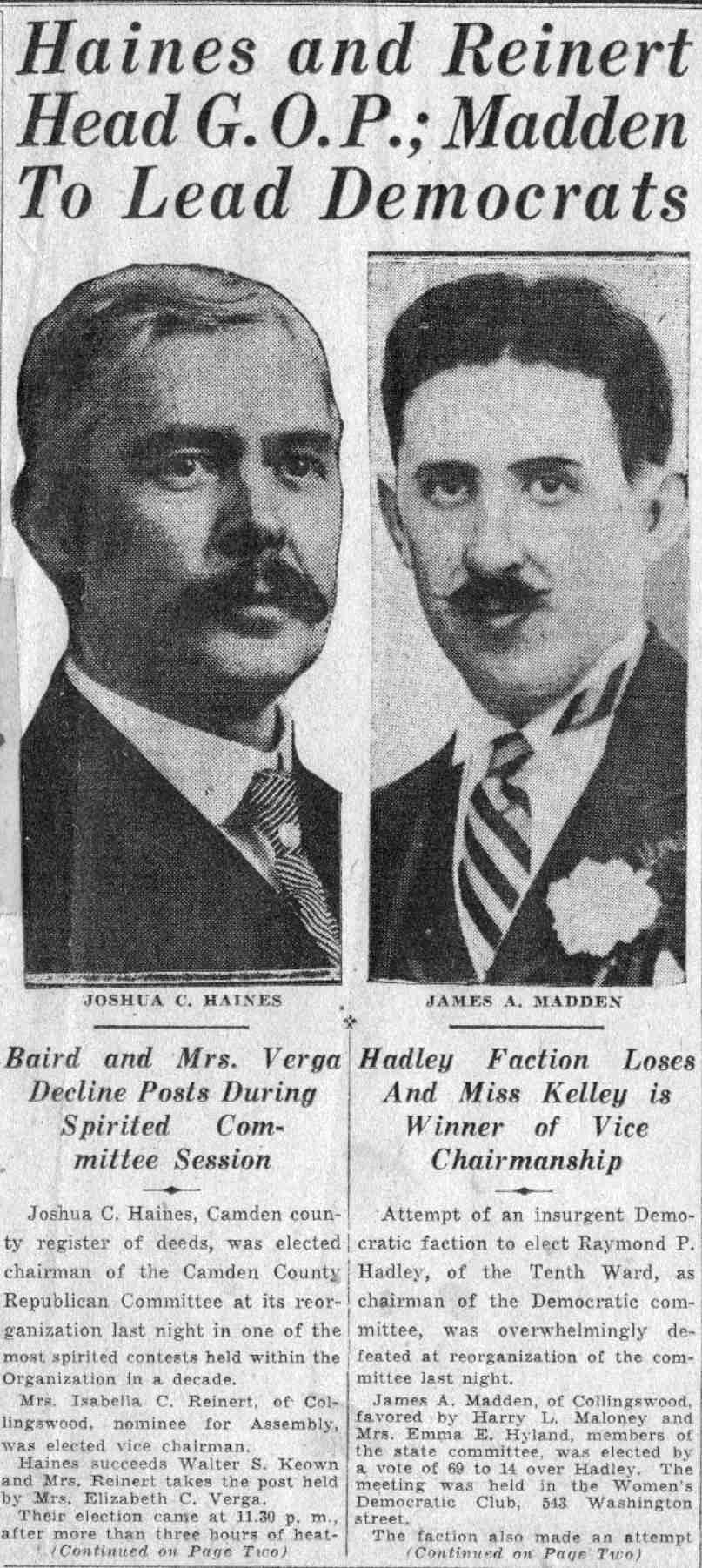
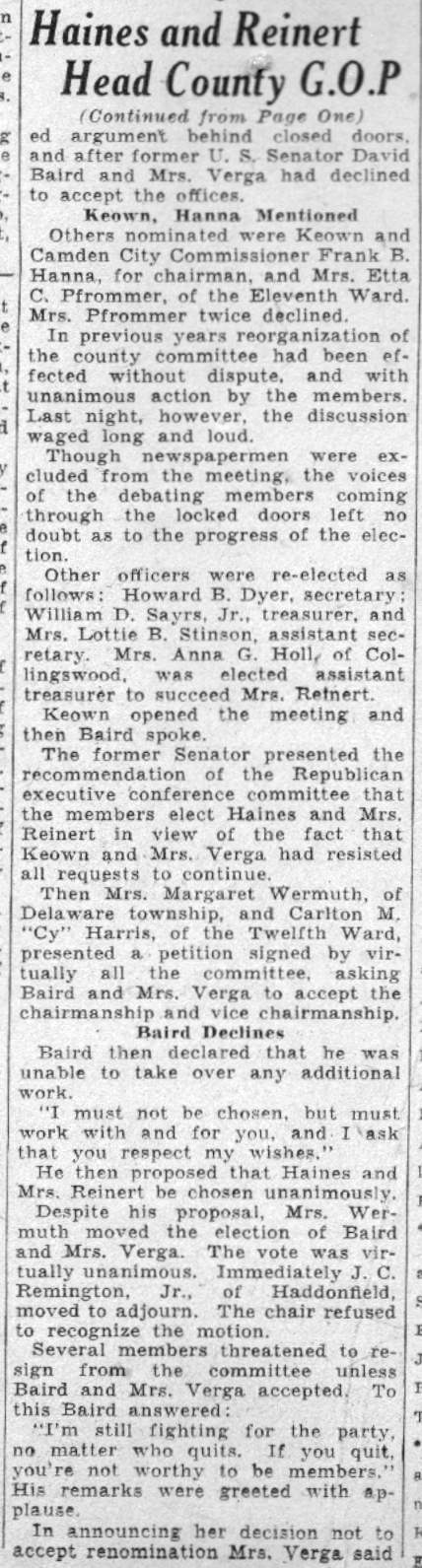

JOSHUA C. HAINES
Baird and Mrs. Verga Decline Posts During Spirited Committee Session
Joshua C. Haines, Camden county register of deeds, was elected chairman of the Camden County Republican Committee at its reorganization last night in one of the most spirited contests held within the Organization in a decade.
Mrs. Isabella C. Reinert, of Collingswood, nominee for Assembly, was elected vice chairman.
Haines succeeds Walter S. Keown and Mrs. Reinert takes the post held by Mrs. Elizabeth C. Verga.
Their election came at 11.30 p. m., after more than three hours of heated argument behind closed doors, and after former U. S. Senator David Baird and Mrs. Verga had declined to accept the offices.
Keown, Hanna Mentioned
Others nominated were Keown and Camden City Commissioner Frank B. Hanna, for chairman, and Mrs. Etta C. Pfrommer, of the Eleventh Ward. Mrs. Pfrommer twice declined.
In previous years reorganization of the county committee had been effected without dispute, and with unanimous action by the members. Last night, however, the discussion waged long and loud.
Though newspapermen were excluded from the meeting, the voices of the debating members coming through the locked doors left no doubt as to the progress of the election.
Other officers were re-elected as follows: Howard B. Dyer, secretary; William D. Sayrs, Jr., treasurer, and Mrs. Lottie B. Stinson, assistant secretary. Mrs. Anna G. Holl, of Collingswood, was elected assistant treasurer to succeed Mrs. Reinert.
Keown opened the meeting and then Baird spoke.
The former Senator presented the recommendation of the Republican executive conference committee that the members elect Haines and Mrs. Reinert in view of the fact that Keown and Mrs. Verga had resisted all requests to continue.
Then Mrs. Margaret Wermuth, of Delaware township, and Carlton M. “Cy” Harris, of the Twelfth Ward, presented a petition signed by virtually all the committee, asking Baird and Mrs. Verga to accept the chairmanship and vice chairmanship.
Baird Declines
Baird then declared that he was unable to take over any additional work.
“I must not be chosen, but must work with and for you, and I ask that you respect my wishes.”
He then proposed that Haines and Mrs. Reinert be chosen unanimously.
Despite his proposal, Mrs. Wermuth moved the election of Baird and Mrs. Verga. The vote was virtually unanimous. Immediately J. C. Remington, Jr., of Haddonfield, moved to adjourn. The chair refused to recognize the motion.
Several members threatened to resign from the committee unless Baird and Mrs. Verga accepted. To this Baird answered:
“I’m still fighting for the party, no matter who quits. If you quit, you’re not worthy to be members.” His remarks were greeted with applause.
In announcing her decision not to accept renomination Mrs. Verga said her duties as state vice chairman, taking her into all the 21 counties, made it impossible for her to continue to devote the time to the county committee which it deserved. She explained that her term as state vice chairman still has two years to run.
Haines Finally Elected
Then Baird announced his resignation from the chairmanship and Mrs. Verga from the vice chairmanship.
Keown was nominated for re-election and Haines and Hanna for election. Baird was renominated by Remington. Keown reiterated his insistence, announced several weeks ago, not to stand for re-election. Baird again declined.
Then Keown moved the election of Haines and Mrs. Reinert. The discussion which followed continued for three hours. Finally the vote was taken at 11.30 and Haines and Mrs. Reinert were declared elected.
Mrs. Reinert, however, declined the office, stating her candidacy for assembly would consume all her time. Then Mrs. Pfrommer was nominated, but she turned it down twice. After much persuasion Mrs. Reinert agreed to accept with the provision that she serve through the summer and that she be permitted to resign later, if she wished.
In a telegram to the committee, Congressman Charles A. Wolverton urged the election of Baird and Mrs. Verga.
The committee elected the following solicitors: Carl Kisselman, Edward R. Deibert, L. Scott Cherchesky, William E. A. King, J. Claud Simon, T. Philips Brown, J. H. Reiners, Jr., Rocco Palese and Morris Praissman.
The conference committee, which suggested Haines and Mrs. Reinert, comprises Baird, Keown, George R. Pelouze, Albert S. Woodruff, Mrs. Verga, Remington, Commissioners Hanna and Clay W. Reesman, Sayrs, William Wimer, Horace G. Githens, J. Wesley Sell and A. C. Middleton.
Members of the Republican County Committee, which organized last night, follow:
Camden City
(*-Indicates New Member)
First Ward—Robert Brennan and Marie Mackintosh.
Second—*William H. Heiser and Mary McCready.
Third—James Corea and *Susie Marchiano.
Fourth—James E. Tatem and *Mary A. Ivins.
Fifth—*Martin A. McNulty and Madeline Salvatore.
Sixth—Howard B. Dyer and Mary S. Hartung.
Seventh—Edward A. Kemble and Mary D. Guthridge.
Eighth—*Edmund A. Walsh and Mamie F. Piraine.
Ninth—Edward Holloway and Deborah Schuck.
Tenth—*Henry I. Haines and Lillian M. Walker.
Eleventh—Horace B. Beideman and Etta C. Pfrommer.
Twelfth—Carlton M. Harris and Mary E. Hamel.
Thirteenth—*Henry Knauer and Louella I. Whaland.
Fourteenth—*Jesse M. Donaghy and Lottie B. Stinson.
Gloucester City
First Ward—Walter H. Craig and E. C. Moffet.
Second—James A. Lewis and *Nellie Keebler.
Third—*James M. Officer and *Margaret P. Powell.
Suburban Districts
Audubon—*Marshall N. Hammon, Jr., and Laura Williams.
Barrington—Harry J. Stone and Margaret Taylor.
Bellmawr—*William C. Stillwill and Katherine Dyer.
Berlin Borough—Leslie M. Ewing and Esther B. Jaggard.
Berlin Township—Frank M. Tyson and Lydia M. Eckstein.
Brooklawn—Morton S. Broomall and C. Mae Marsh.
Chesilhurst—*William Wiegand, Sr., and Mary L. Lyons.
Clementon—J. Palmer Earl and Mabel Rogers.
Collingswood—Edward B. Rogers and Isabella C. Reinert.
Delaware Township—Leonard Hoffman, Sr., and Margaret E. Wermuth.
Gibbsboro—*P. Richard Cummings and *Ethel H. Bone.
Gloucester Township—*William E. Cozens and Mary W. Frazer.
Haddon Township—*Milton E. Hanson and *Eve W. Hannum.
Haddonfield—J. C. Remington, Jr., and Anna G. Holl.
Haddon Heights—Robert E. Bromley and Mary H. Tegge.
Hi-Nella—Samuel D. Mansfield and Elsie H. Castor.
Laurel Springs—Charles V. Osborne and Anna M. Hess.
Lawnside—Horace J. Bryant and Maidie M. Gibson.
Lindenwold—George T. Neely and Irene A. Haney.
Magnolia—*Charles T. Wood and *Lillian Shoemaker.
Merchantville—E. Durell Parker and Ruth K. Yarnall.
Mt. Ephraim—Harvey L. Jacoby and *Theresa Osler.
Oaklyn—John Beasley and *Mae Walker.
Pennsauken Township—*Andrew Stewart and Catherine Brooks.
Pine Hill—*Conrad Schmidt and Mary J. Smith.
Pine Valley—Clinton L. Bardo and Anna E. Howe.
Runnemede—*John S. Adams and *Mrs. John Gaunt.
Somerdale—Edward Arentzen and Louise Brusius.
Stratford—John T. Matthews and L. Mae Titus.
Voorhees Township—*George Ziesch and *Elizabeth Ebert.
Waterford Township—Thomas A. Fanelli and Catherine Zoppel.
Tavistock—Frank B. Middleton, Jr., and no committeewoman.
Winslow Township—Samuel Withers and Kathryn Wuertz.
Woodlynne—Thomas W. Leeson and Edna M. Fritsche.
LLOYD CRITICIZES LOCALITIES FOR DIVERTING MONEY
Tells Them They Are Trustees for County’s Share of Every Dollar Taken In
POSTPONES MANDAMUS
Supreme Court Justice Frank T. Lloyd yesterday “laid down the law” to four Camden county municipalities at a hearing of the county’s mandamus proceedings to compel payment of $426,952 in back taxes for the years 1930, 1931 and 1932.
After stressing the importance of setting aside the portion owed the state and county out of every tax dollar collected, Justice Lloyd held the cases over until the September term of court “in the hope that these taxes will be paid.”
‘Out of Clear Sky’
The four municipalities were represented by their respective borough, township or city clerks. The four and the amounts the county alleges are owed for state and county taxes are Pennsauken Township, $120,199.80; Gloucester City, $59,643.91; Lawnside Borough, $41,798, and Delaware Township, $31,958.03.
Firmin Michel, township solicitor for Pennsauken, pointed out that since December 15 his township has paid up $24,877 of taxes due and was making arrangements to pay the balance when the county’s suit was filed “out of a clear sky.”
After listening to a brief outline by George Rothermel, representing County Treasurer J. Wesley Sell, and counsel for the other municipalities, Justice Lloyd spoke.
“I understand that there are some officials of the municipalities here today,” said he, “and I want to say something to them and also to the municipal officials who are not here.”
Responsible as Trustees
“I am not unmindful of the serious financial conditions of municipalities but these governing bodies are in a degree trustees of the moneys received. When they receive moneys in taxes and a portion of this tax should be set aside for the county, they should not apply this portion for other uses to run that municipality.
“In some cases the municipalities have made a serious effort to pay their taxes but I want to stress the fact that these governing bodies can not use all of this money for general purposes.
“When local governments take in $1 in taxes, the persons in charge should immediately deduct the amount due the state and county and put it in a separate fund. If that had been done, this situation would not have arisen.
Word on ‘Fancy Schools’
“Now, another word to those operating governments. The present occasion calls for the close scrutiny of expenditures not only by municipal bodies but by school boards. The public is fed up on extravagance. Instead of the old fashioned modest school house, we now have those fancy high schools. These extravagances have aroused the taxpayers as never before.
“I’m not criticizing the school boards for what they did in the past, but they should try to amend in the future extravagance and waste. It is important, as you can see today by what is happening here, for drastic economy in local government.
“I am going to hold these writs until the opening day of court in the hope that these taxes may be paid.”
Camden Courier-Post, June 20, 1933
Pennsauken Orders Tax Money Divided
Segregation of the state’s and county’s share of Pennsauken taxes was ordered last night by the Township Committee meeting in an adjourned session. The taxes so collected and segregated will be turned over to County Treasurer J. Wesley Sell at convenient periods.
Walter Jones was granted a retail beverage license for his establishment at 6300 Magnolia avenue.
Camden Courier-Post, June 20, 1933
CITY SCRIP TO PASS MILLION THIS WEEK
Tax Payments Redeem $610,000; County’s $481,000 Cut to $170,000
Camden city scrip issued since April 1, will reach more than $1,000,000 worth when the city meets its end-of-the-month payroll with a new issue of $220,000 this week for 1500 employees.
County scrip since the first of April totals $481,000, according to County Treasurer J. Wesley Sell. Of that total, $311,000 has been redeemed. A new $25,000 county issue of scrip will be circulated this week in meeting the county payroll for 300 employees.
Of the city scrip, $610,000 already has been redeemed as taxes, according to records of City Comptroller Sidney P. McCord.
City and county officials said they did not know how much longer they will be issuing scrip or when they would be in a position to announce a definite redemption date.
The officials pointed out that through the issuance of Scrip they have been able to meet current obligations and have averted payless paydays for city and county employees.
In addition to operating expenses, the city has to meet a total of $2,415,000 in bonds and interest due between July 1 and the end of the year. McCord said efforts are being made to have bondholders agree to refund these bonds to mature in later years, so that, along with scrip, the city will be able to conserve as much cash as possible. Cash conservation has been difficult, McCord said, because tax collections have been far below those in previous years.
Asked whether the issuance of Scrip will enable the city to conserve enough cash to meet the obligations, McCord said he did not know.
County bonds maturing this year total $330,000, but these are to be refunded for later maturity under a resolution adopted by the board of freeholders June 15 which also authorized the refunding of $2,352,000 worth of bonds maturing next year. Sell said the county will not default on any of its obligations.
City Commissioner Harold W. Bennett, director of revenue and finance, said the end of June city payroll of $220,000 will be entirely in scrip, as well the $48,000 mid-June payroll. It will be the last pay for city teachers until their return from vacation in September.
Bennett pointed out that one of the reasons Scrip had to be resorted to was because the city could not borrow the money it needed to pay salaries and operate in anticipation of tax collections. The Scrip, he said, conserves what cash the city receives to meet debt items. Neither he nor McCord said he was free to reveal the amount of cash the City has on hand, nor the amount the city has received since April in proportion to scrip.
McCord said he will not know until the end of the year what affect the issuance of Scrip will have on the city’s financial situation.
“We won’t know until we balance our books at the close of the year,” he said. “I do know that one of the advantages of Scrip is that less of it has been issued than the city would have borrowed cash in the market, and so the city saves at least in interest charges.
“Other than to keep the city going, I don’t know what financial advantage Scrip is to Camden, except perhaps for a saving in interest on loans we could not make. All I know is that scrip has enabled us to meet our payrolls; we don’t have to borrow in the market, and we are conserving cash to meet our bonds, interest and other obligations when they come due. Cash receipts, however, are slow because of the slump in tax payments.
“The only way I see for the city to be in a better financial position is for it to receive more of the taxes due it for this and previous years. Non-payment of taxes, with delinquencies enormous during the last few years, has been one of the main reasons the city had to go on Scrip. Little money was coming in and we couldn’t borrow it as in former years. So the city had to issue the Scrip, a promise to pay with interest. Otherwise it would have been unable to pay its employees and it would have had to default on bonds and interest. Scrip, therefore, has kept the city going and it has been able to meet all its bills as they fall due.”
Commissioner Bennett said prompter payment of taxes has been encouraged through the issuance of Scrip. Taxpayers receiving it have redeemed it as taxes. In other cases, where they have cash, they have bought the scrip from others and used it to meet their debts to the city. Thus, he said the scrip has been kept in circulation and readily exchanged.
“Merchants of the city are to be commended for their co-operation,” Bennett said. “They have received Scrip since April for purchases made at their stores. In turn, they have met their taxes with the scrip offered by customers, many of whom have been doing their buying exclusively in Camden since circulation of scrip, thereby stimulating business here.
“In addition, various concerns and individuals have been buying up the city scrip for investment, saving it for redemption at a later date to profit by the interest it carries.
“Through Scrip, city employees have been saved from going without food, clothing and other necessities. We have averted payless paydays, and we are better off than other cities, whose plight is much worse than that of Camden.”
Camden Courier-Post, June 25, 1933
Collections Soar, Is Sell’s Report
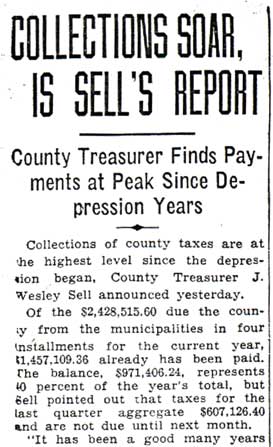
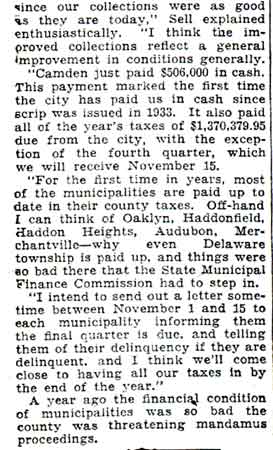
County Treasurer Finds Payments at Peak Since Depression Years
Collections of county taxes are at the highest level since the depression began, County Treasurer J. Wesley Sell announced yesterday. Of the $2,428,515.60 due the county from the municipalities in four installments for the current year, $1,457,109.36 already has been paid. The balance, $971,406.24, represents 40 percent of the year’s total, but Sell pointed out that taxes for the last quarter aggregate $607,126.40 and are not due until next month. “It has been a good many years since our collections were as good as they are today,” Sell explained enthusiastically. “I think the improved collections reflect a general improvement in conditions generally.
“Camden just paid $506,000 in cash. This payment marked the first time the city has paid us in cash since scrip was issued in 1933. It also paid all of the year’s taxes of $1,370,379.95 due from the city, with the exception of the fourth quarter, which we will receive November 15.
“For the first time in years, most of the municipalities are paid up to date in their county taxes. Off-hand I can think of Oaklyn, Haddonfield, Haddon Heights, Audubon, Merchantville—why even Delaware township is paid up, and things were so bad there that the State Municipal Finance Commission had to step in.
“I intend to send out a letter sometime between November 1 and 15 to each municipality informing them the final quarter is due, and telling them of their delinquency if they are delinquent, and I think we’ll come close to having all our taxes in by the end of the year.”
A year ago the financial condition of municipalities was so bad the county was threatening mandamus proceedings.
Camden Courier-Post, October 27, 1936
J. Wesley Sell Rites to Take Place Today
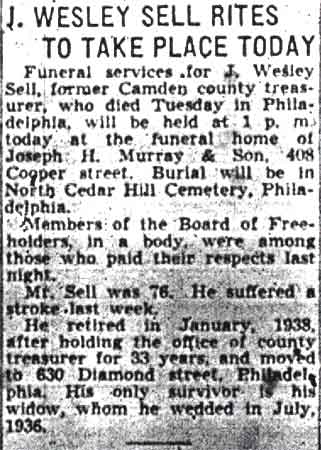
Funeral services for J. Wesley Sell, former Camden county treasurer, who died Tuesday in Philadelphia, will be held at 1 p.m. today at the funeral home of Joseph H. Murray & Son, 408 Cooper street. Burial will be in North Cedar Hill Cemetery, Philadelphia.
Members of the Board of Freeholders, in a body, were among those who paid their respects last night.
Mr. Sell was 76. He suffered a stroke last week. He retired in January, 1938, after holding the office of county treasurer for 33 years, and moved to 630 Diamond street, Philadelphia. His only survivor is his widow, whom he wedded in July, 1936.
Camden Courier-Post, January 27, 1940