Introduction
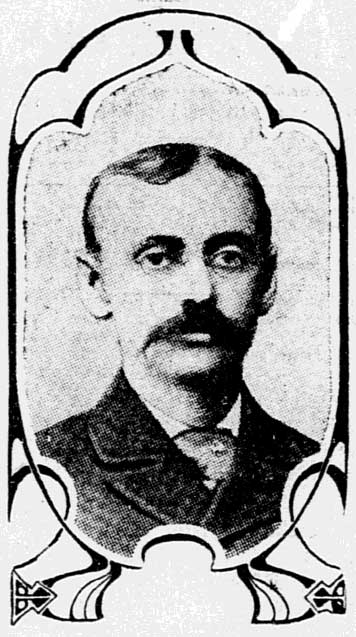
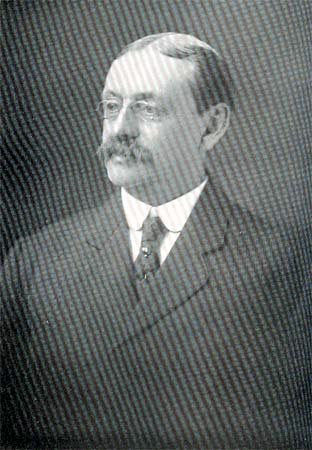
Dr. George M. Beringer Sr.
DR. GEORGE M. BERINGER SR. was born February 3, 1860 in Philadelphia PA to Levi D. and Rebecca Reinhart Beringer. He graduated from Central High School in Philadelphia in 1876, and from the Philadelphia College of Pharmacy in 1880, and began practicing pharmacy in Philadelphia. On October 3, 1882 he married Estella Wolfe of Camden NJ.
In 1892 the Beringers moved to Camden. George Beringer opened a pharmacy at 500 Federal Street which would survive into the 1950s. On May 13, 1900 the business barely escaped being destroyed when a large fire destroyed many homes and businesses in the 500 blocks of Federal Street and Taylor Avenue. George Beringer continued his education, receiving a Masters degree in pharmacy in 1903 and a Doctorate in 1914 from the University of the State of New Jersey.
Two sons were born to the Beringers, George M. Jr. in 1884, and Franklin L. Beringer the following year. Sadly, Franklin L. Beringer passed away in 1907.
Dr. Beringer was frequently called as an expert witness in State and Federal courts. He edited the American Journal of Pharmacy from 1917 to 1921, was the Chairman of the Board of trustees of the Philadelphia College of Pharmacy from 1910 to 1921, was a member of the committee of revision of the U.S. Pharmacopoeia and of the National Formulary. A prolific writer on subjects relating to pharmacy, he authored two pamphlets in 1917, Pharmaceutical Service in the French Army and The Departments of the Government Need the Advice of the Drug Trade. He also authored several hundred articles in the pharmacy journals of his day. He was President of the American Pharmacists Association in 1914, and was a member of the American Chemists Society, and the Academy of Natural Science in Philadelphia.
In his non-professional life, Dr. Beringer enjoyed gardening. He was a member of the Philadelphia Botanical Association and the Camden Dahlia Society. He also was member of the Rotary Club of Camden and served at one time as a member of the Camden City Planning Commission.
Dr. & Mrs. Beringer had two sons, George M. Jr., born in 1883, and Franklin L. Beringer, who died young. The Beringers made their home for many years at 414 North 5th Street, near the corner of North 5th and Fulton Place, and were there from the 1910s through the time of the 1920 census. 414 North 5th Street was one of the homes taken and razed to make way for the Delaware River (Ben Franklin) Bridge, which was completed and opened to traffic in 1926.
Dr. George M. Beringer died in 1928, and was buried at Harleigh Cemetery. He was survived by his wife, who joined him in 1940.
George M. Beringer Jr., who had followed his father into pharmacy, conducted the business after his father’s passing for many years. George M. Beringer Jr. and his family lived for many years at 1033 Cooper Street. George M. Beringer Jr. married Ada DuBell, the daughter of William DuBell and sister of Charles G. DuBell, the founders of the DuBell Lumber Company. George Beringer Jr. died in 1948. His son, George M. Beringer III, who was also involved in the family business, died in 1954.
Signature
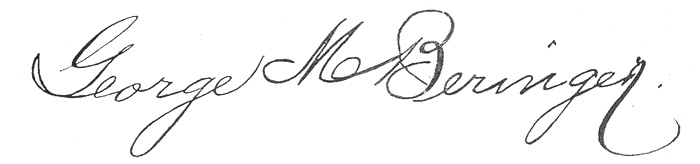
Signature of Dr. George M. Beringer, from South Jersey: A History 1624–1924
Over in Camden
Philadelphia Inquirer —
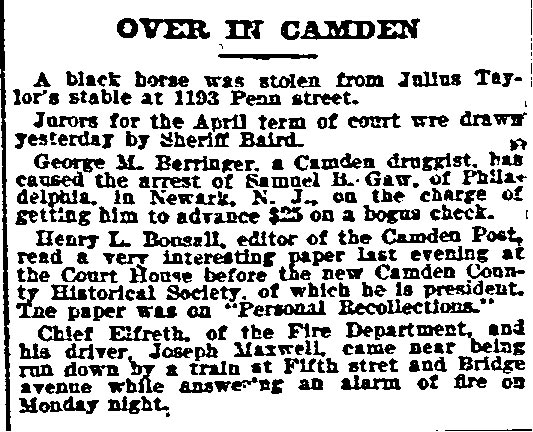
Over in Camden
Over in Camden
A black horse was stolen from Julius Taylor's stable at 1193 Penn street.
Jurors for the April term of court were drawn yesterday by Sheriff Baird.
George M. Berringer, a Camden druggist, has caused the arrest of Samuel B. Gaw, of Philadelphia, in Newark, N. J., on the charge of getting him to advance $25 on a bogus check.
Henry L. Bonsall, editor of the Camden Post, read a very interesting paper last evening at the Court House before the new Camden County Historical Society, of which he is president. The paper was on "Personal Recollections."
Chief Elfreth, of the Fire Department, and his driver, Joseph Maxwell, came near being run down by a train at Fifth street and Bridge avenue while answering an alarm of fire on Monday night.
Destructive Work of Flames in Camden
Philadelphia Inquirer —
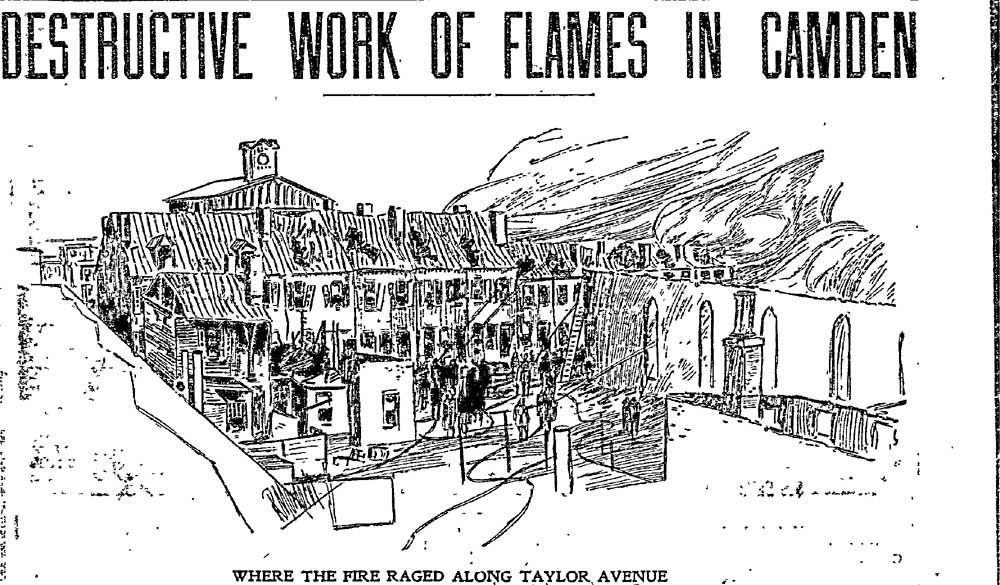
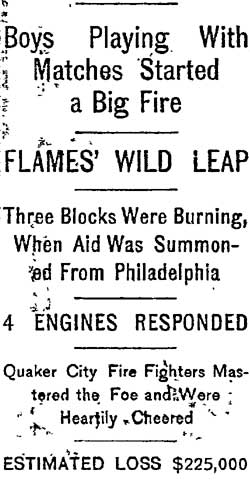
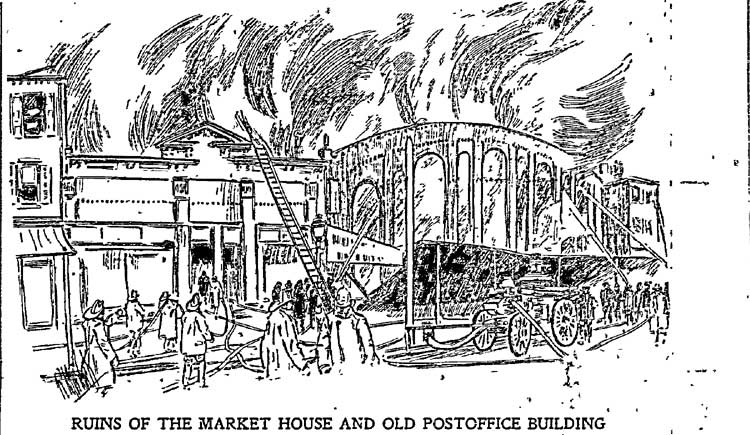
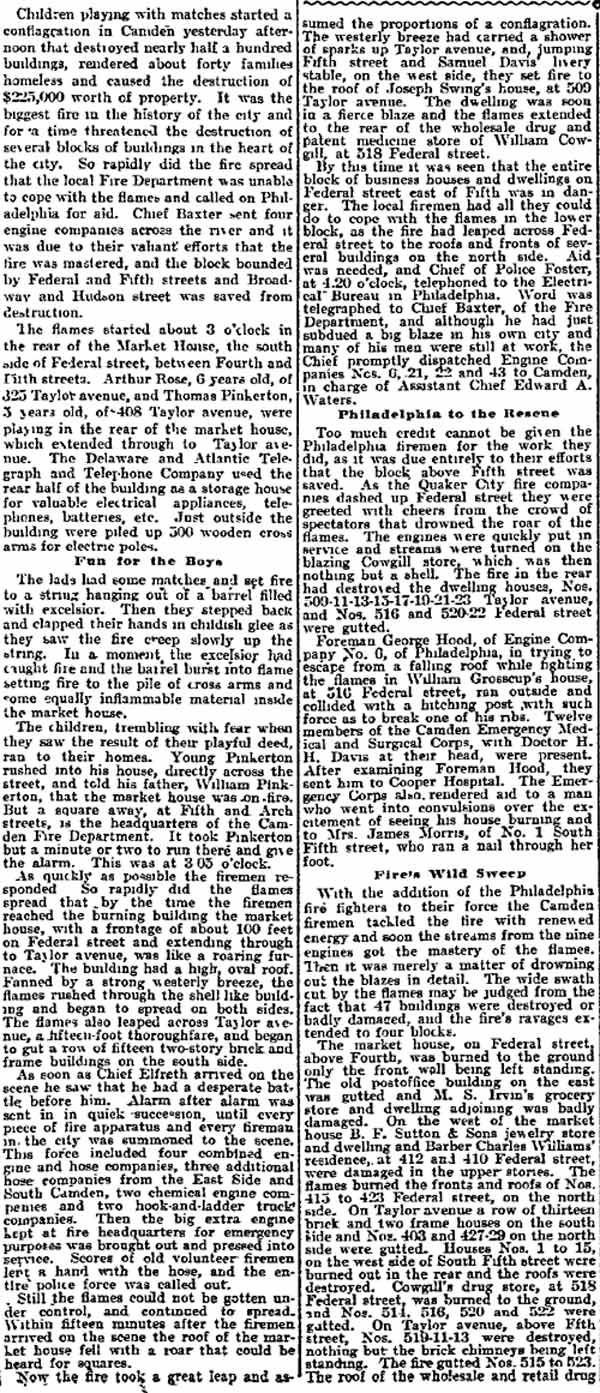
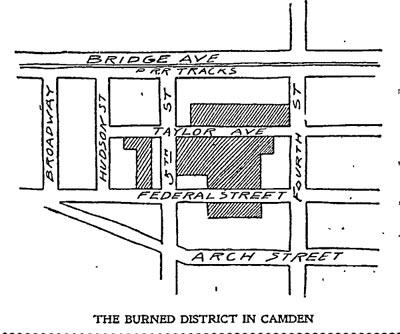

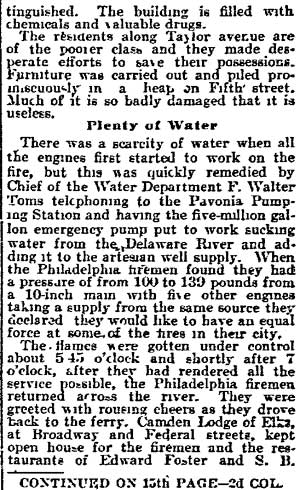
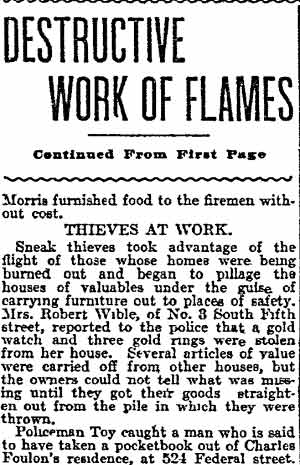
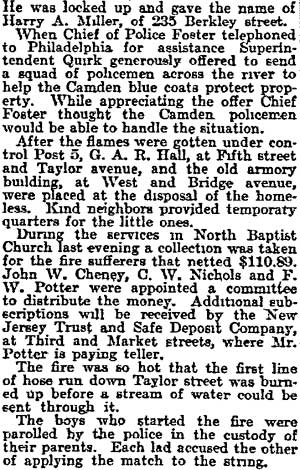
Philadelphia Inquirer, May 14, 1900. The fire of May 13, 1900 at Taylor Avenue and Federal Street. Mentioned: George M. Beringer, F. Walter Toms, Camden Lodge of Elks No. 293, Edward Foster, S.B. Morris, Broadway, Mrs. Robert Wible, Isaac S. Toy, Charles Foulon, Harry A. Miller, John Foster, John W. Cheney, North Baptist Church, Thomas M.K. Lee Post No. 5, G.A.R., New Jersey Safe Deposit & Trust Company, Berkley Street, Arthur Rose, Thomas Pinkerton, William Pinkerton, Joseph Swing, Samuel S. Elfreth, Dr. Henry H. Davis, Cooper Hospital.
The Paul Woodward Murder Case
to
On October 1, 1902 Paul Woodward murdered two young boys by giving them poison. Frank T. Lloyd, then Camden County prosecutor, was responsible for leading the investigation and prosecuting the case. George M. Beringer was called on to examine and investigate the forensic evidence of the crime, and to testify at the trial. Woodward was arrested on October 4, 1902, was indicted, tried, convicted of murder in the first degree, and on January 7, 1903 executed at the Camden County Jail.
People mentioned in connection with this case: Joseph Jennings – Jennings’ Third Regiment Band – Frank T. Lloyd – Dr. William S. Jones – William D. Hart – Dr. Paul N. Litchfield – F. Morse Archer – John Foster – John Painter – John Cherry – Isaac Toone – Paul Woodward – Charles G. Garrison – J. Wesley Sell – Christopher J. Mines Jr. – Frederick A. Rex – J. Frederick Voigt – George F. Kappel – Isaac Toy – Harry S. Scovel – Francis Ford Patterson Jr. – John S. Smith – Hugh Boyle – George H. Stineford Sr. – Frank S. Albright – Thomas Walton – Dr. William H. Iszard – Cooper School – Trinity Baptist Church – Linden School
Two Camden Boys Have Disappeared
Philadelphia Inquirer —
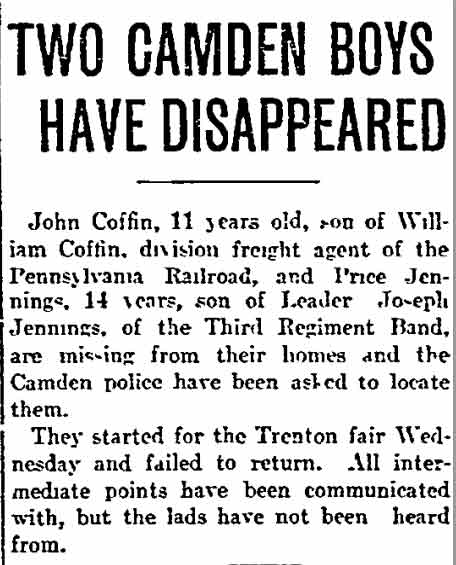
John Coffin, 11 years old, son of William Coffin, division freight agent of the Pennsylvania Railroad, and Price Jennings, 14 years old, son of Leader Joseph Jennings, of the Third Regiment Band, are missing from their homes and the Camden police have been asked to locate them.
They started for the Trenton fair Wednesday and failed to return. All intermediate points have been communicated with, but the lads have not been heard from.
Two Camden Boys Are Still Among Missing
Philadelphia Inquirer —
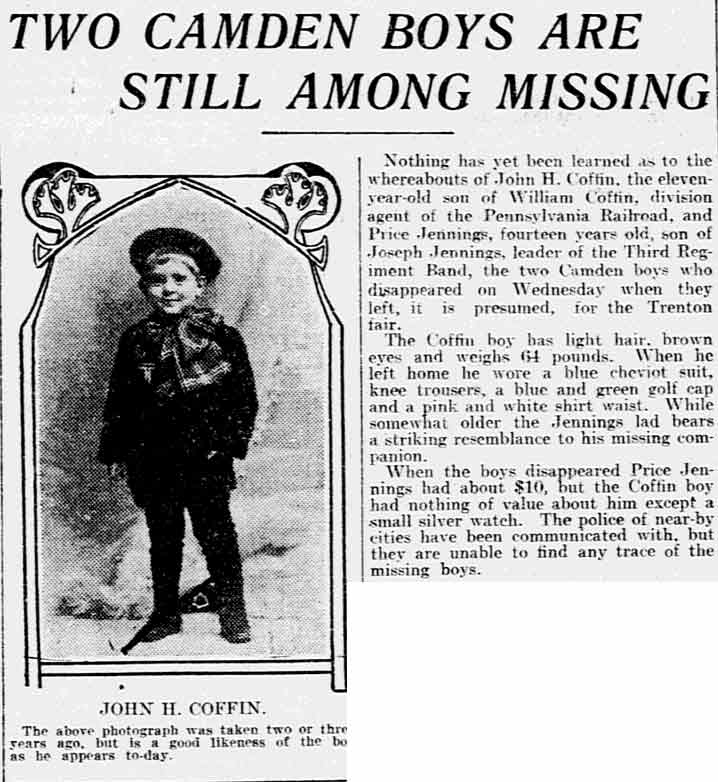
Nothing has yet been learned as to the whereabouts of John H. Coffin, the eleven-year-old son of William Coffin, division agent of the Pennsylvania Railroad, and Price Jennings, fourteen years old, son of Joseph Jennings, leader of the Third Regiment Band, the two Camden boys who disappeared on Wednesday when they left, it is presumed, for the Trenton fair.
The Coffin boy has light hair, brown eyes and weighs 64 pounds. When he left home he wore a blue cheviot suit, knee trousers, a blue and green golf cap and a pink and white shirt waist. While somewhat older the Jennings lad bears a striking resemblance to his missing companion.
When the boys disappeared Price Jennings had about $10, but the Coffin boy had nothing of value about him except a small silver watch. The police of near-by cities have been communicated with, but they are unable to find any trace of the missing boys.
Missing Camden Boys Murdered in a Field
Philadelphia Inquirer —
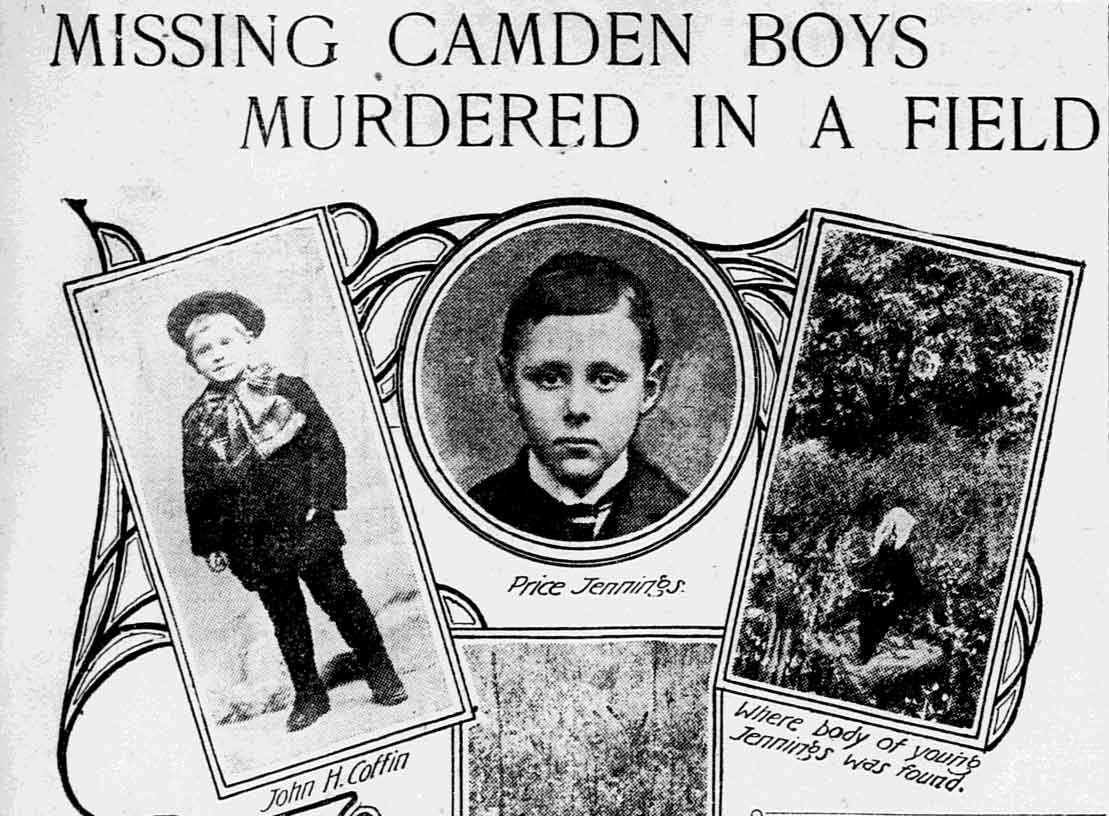
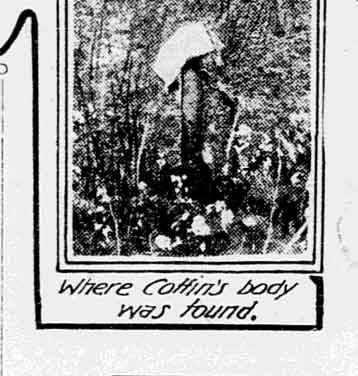
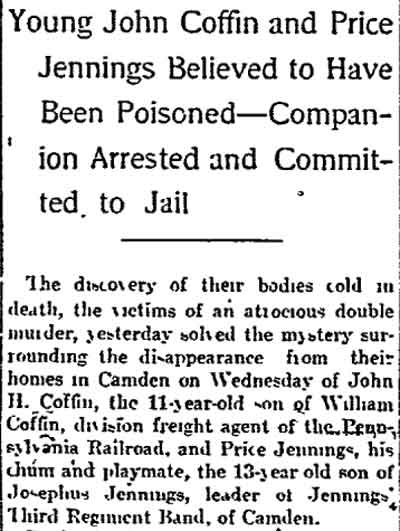
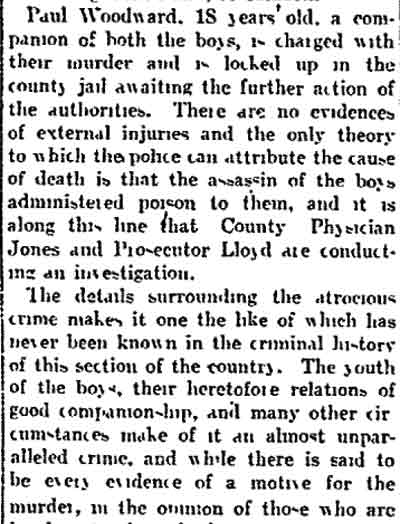
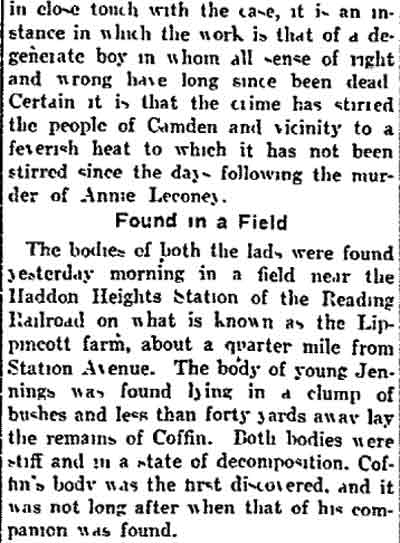
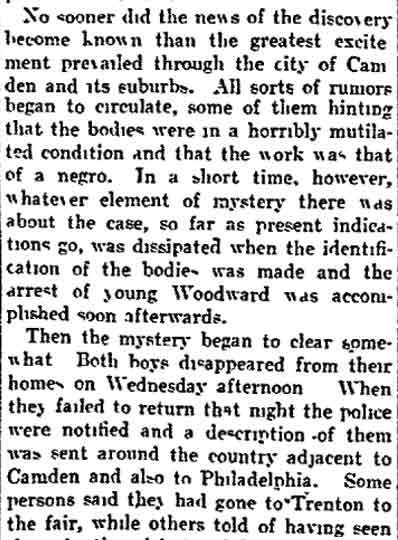
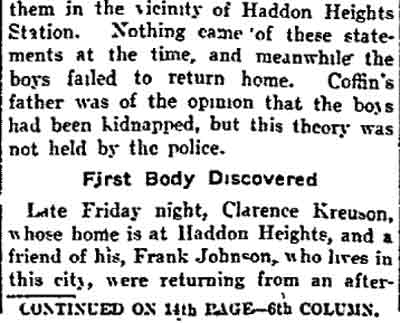
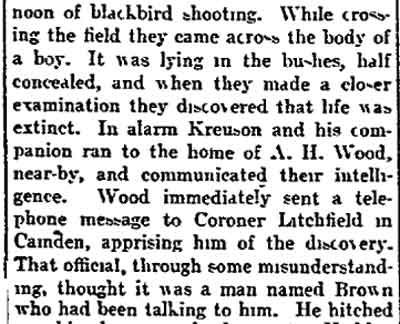
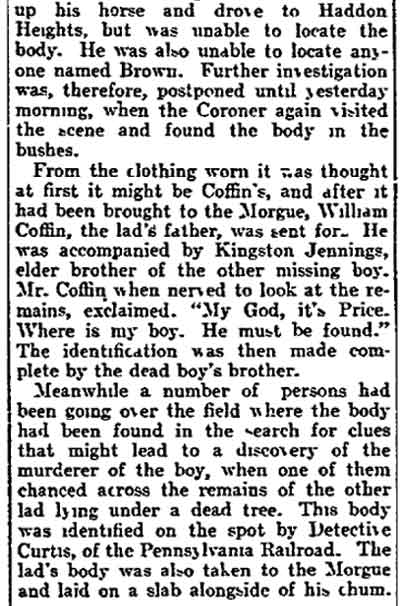
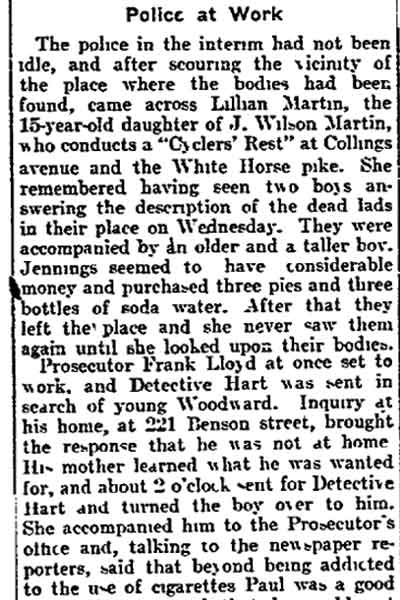
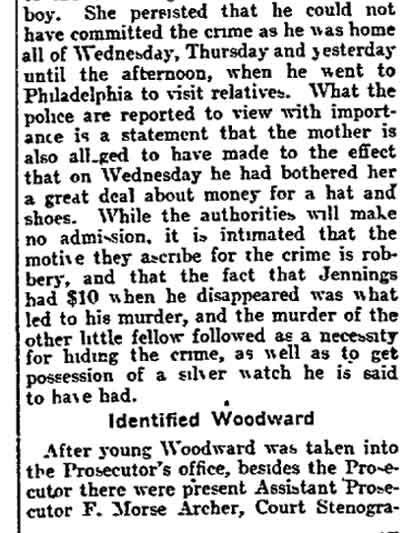
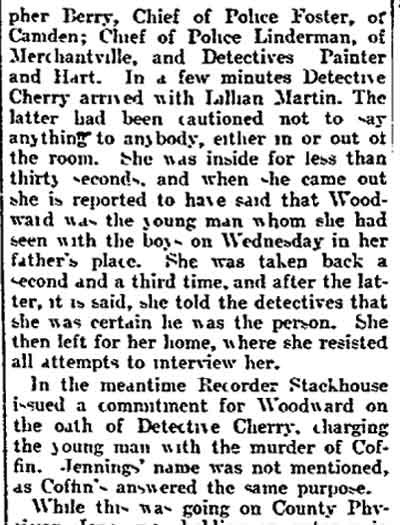
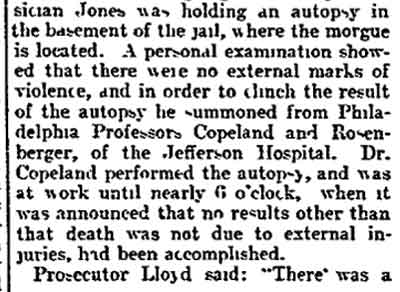
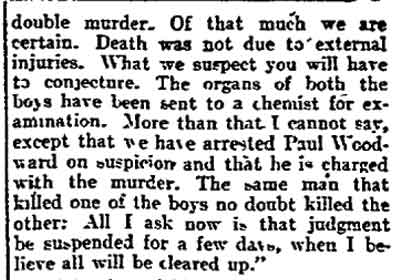
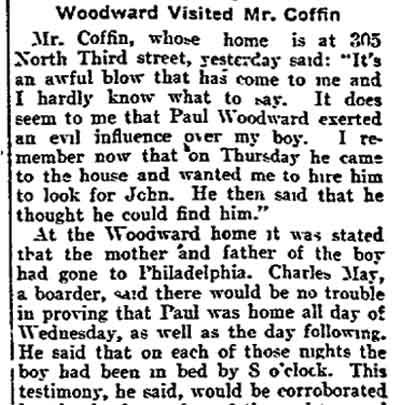
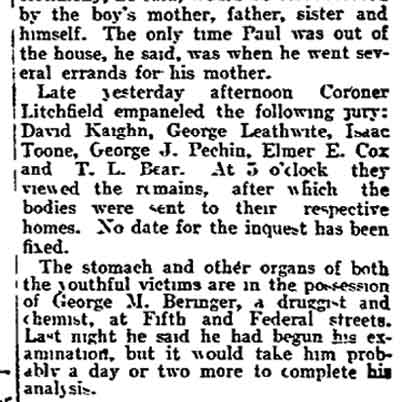
Philadelphia Inquirer, October 5, 1902. Mentioned: Frank T. Lloyd, Dr. William S. Jones, William D. Hart, Dr. Paul N. Litchfield, F. Morse Archer, John Foster, John Painter, John Cherry, Isaac Toone, Paul Woodward, Benson Street, North 3rd Street. Click image for PDF.
Deep Mystery Still Envelops Camden Tragedy
Philadelphia Inquirer —
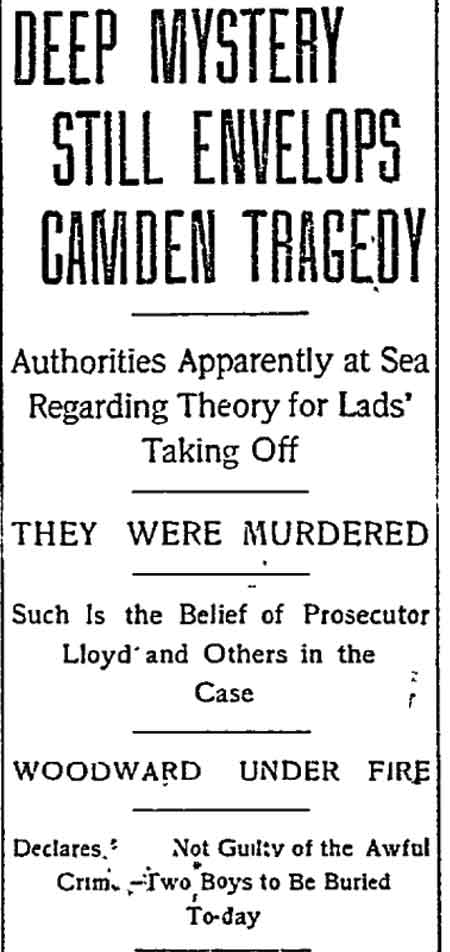
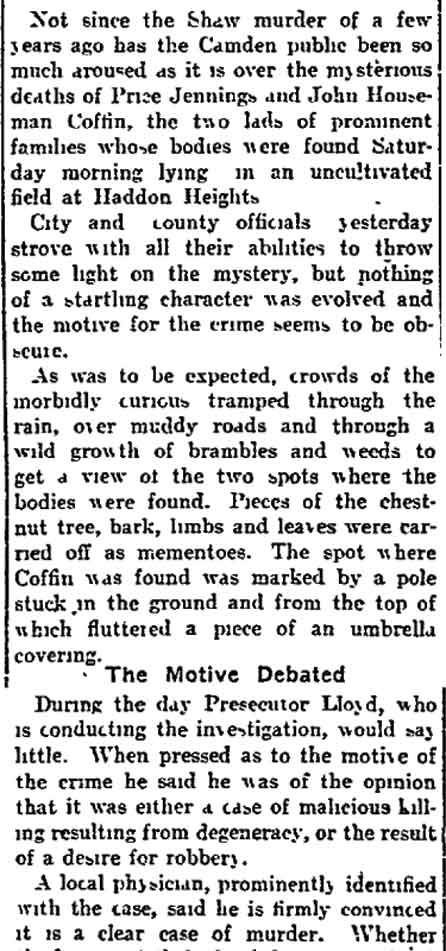
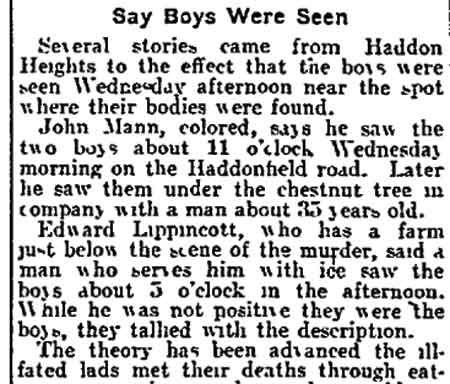
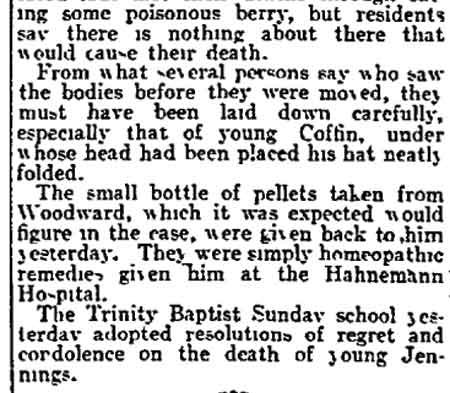
Authorities Apparently at Sea Regarding Theory for Lads’ Taking Off
THEY WERE MURDERED
Such Is the Belief of Prosecutor Lloyd and Others in the Case
WOODWARD UNDER FIRE
Declares Not Guilty of the Awful Crime — Two Boys to Be Buried To-day
Woman Involved in Camden Mystery
Philadelphia Inquirer —
After Being Questioned by the Prosecutor She Is Committed to the County Jail — Believed to Be an Important Arrest
While mystery apparently as absolute as ever still obscures the motive and the criminal in the case of John Houseman Coffin and W. Price Jennings, the unfortunate Camden lads whose trip to the country at Haddon Heights last Wednesday resulted so tragically, it is surmised from hints dropped now and again the matter may soon be cleared. However, those who are working so assiduously to bring the guilty person to justice are as close-mouthed as the proverbial clam, and but meagre information reaches the public.
Last night a woman, about 45 years old, was committed to the county jail by Recorder Stackhouse. On the commitment her name is given as Mrs. Barber. She was committed on complaint of County Detective John Cherry “as a material witness to prove certain allegations pending against one Paul Woodward, who is committed to the county jail charged with the murder of one John Coffin.”
The woman was placed under arrest after a long conference in the Prosecutor’s office. Prosecutor Lloyd said last night that the woman lives on a farm at Marlton, and that she is a very important witness in the case, so important, in fact, that she cannot regain her freedom without a good round sum being put up for her security.
Woodward Again Examined
The investigation into the case was somewhat retarded yesterday owing to an attack of rheumatism that made Prosecutor Frank T. Lloyd remain at home. The day’s responsibility rested on F. Morse Archer, the assistant prosecutor. The latter yesterday morning had Woodward brought into his office, where he underwent for the sixth time a thorough cross-examination. Mr. Archer said Woodward had made no confession, as had been rumored. On the contrary, he still maintained his innocence.
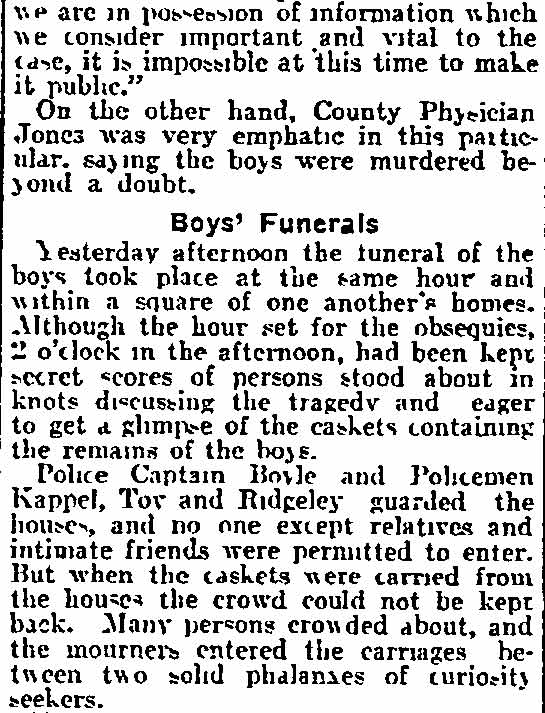
In answer to a question Mr. Archer said: “We are doing our best and while we are in possession of information which we consider important and vital to the case, it is impossible at this time to make it public.”
On the other hand, County Physician Jones was very emphatic in this particular, saying the boys were murdered beyond a doubt.
Boys’ Funerals
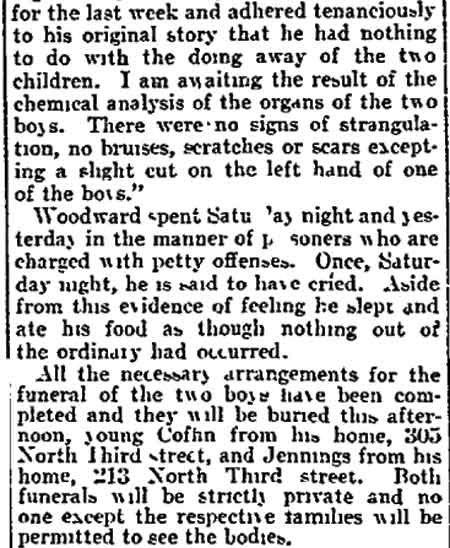
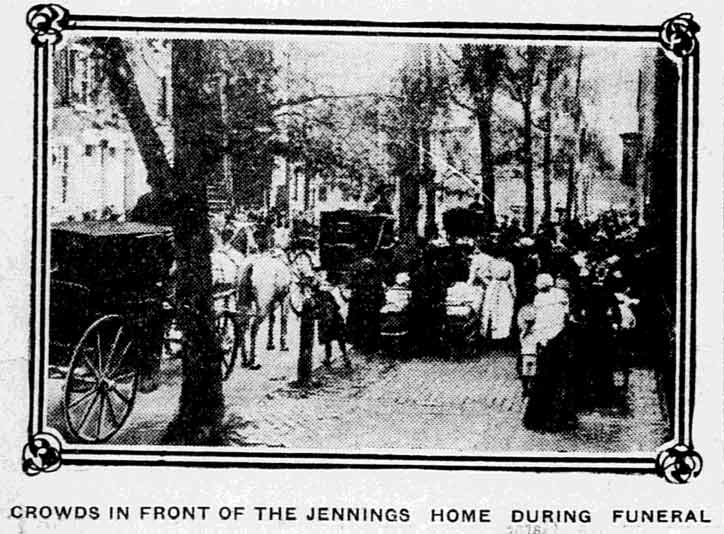
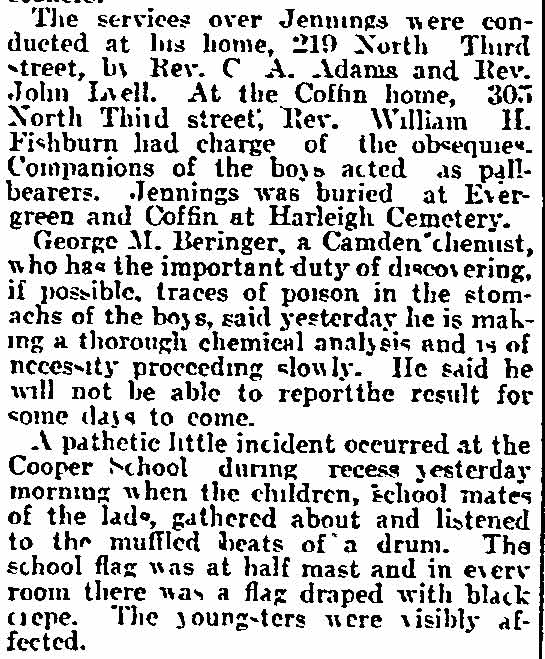
Yesterday afternoon the funeral of the boys took place at the same hour and within a square of one another’s homes. Although the hour set for the obsequies, 2 o’clock in the afternoon, had been kept secret scores of persons stood about in knots discussing the tragedy and eager to get a glimpse of the caskets containing the remains of the boys.
Police Captain Boyle and Policemen Kappel, Toy and Ridgeley guarded the houses, and no one except relatives and intimate friends were permitted to enter. But when the caskets were carried from the houses the crowd could not be kept back. Many persons crowded about, and the mourners entered the carriages between two solid phalanxes of curiosity seekers.
The services over Jennings were conducted at his home, 219 North Third street, by Rev. C. A. Adams and Rev. John Lyell. At the Coffin home, 305 North Third street, Rev. William H. Fishburn had charge of the obsequies. Companions of the boys acted as pallbearers. Jennings was buried at Evergreen and Coffin at Harleigh Cemetery.
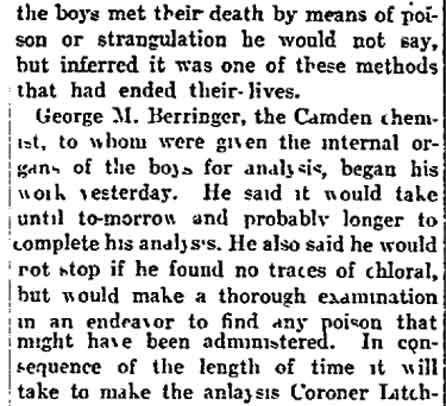
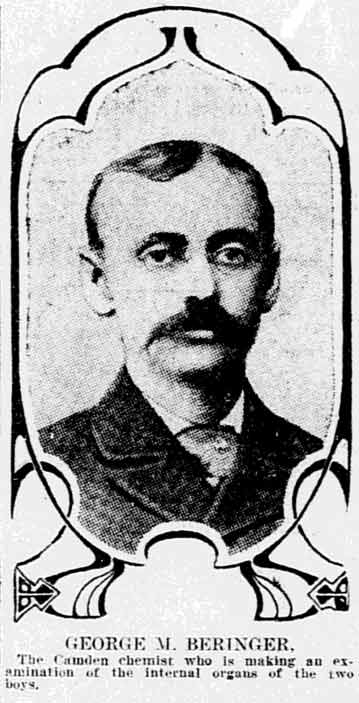
George M. Beringer, a Camden chemist, who has the important duty of discovering, if possible, traces of poison in the stomachs of the boys, said yesterday he is making a thorough chemical analysis and is of necessity proceeding slowly. He said he will not be able to report the result for some days to come.
A pathetic little incident occurred at the Cooper School during recess yesterday morning when the children, school mates of the lads, gathered about and listened to the muffled beats of a drum. The school flag was at half mast and in every room there was a flag draped with black crepe. The youngsters were visibly affected.
Woodward Has Knowledge of Camden Murder
Philadelphia Inquirer —
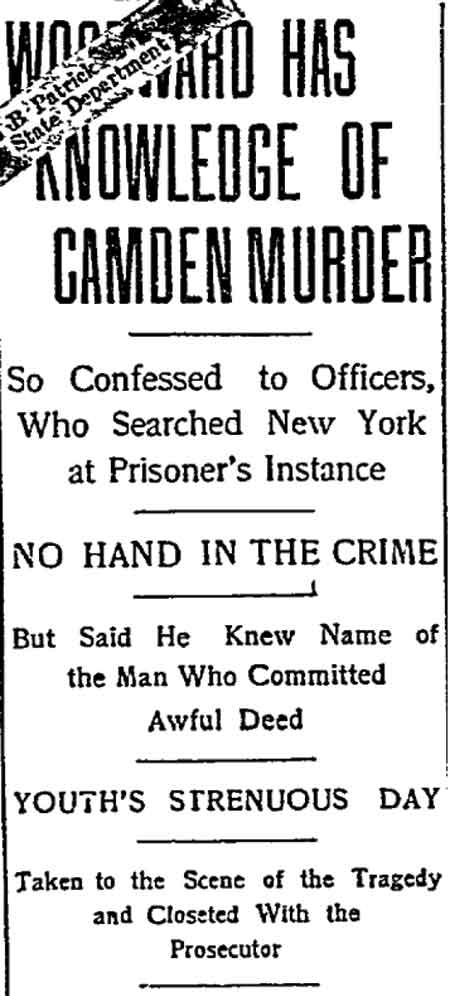
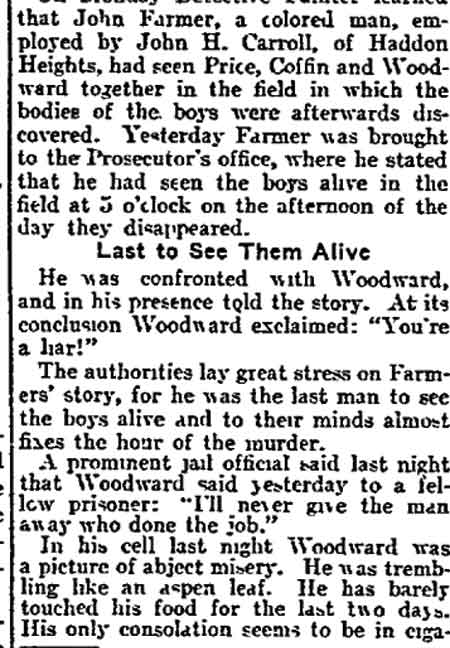
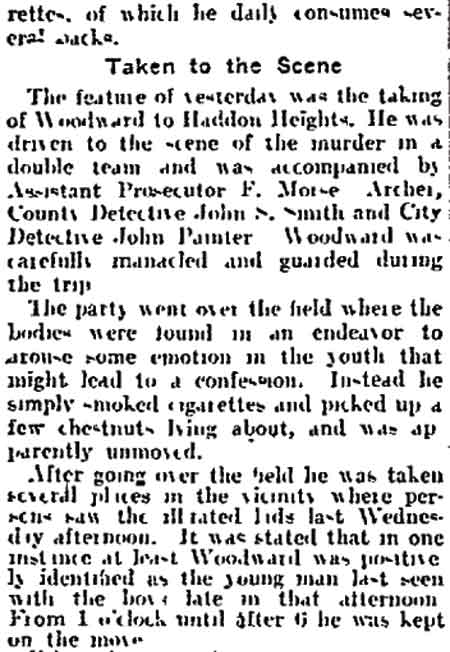
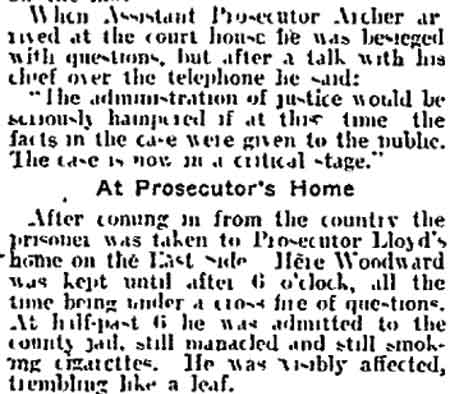
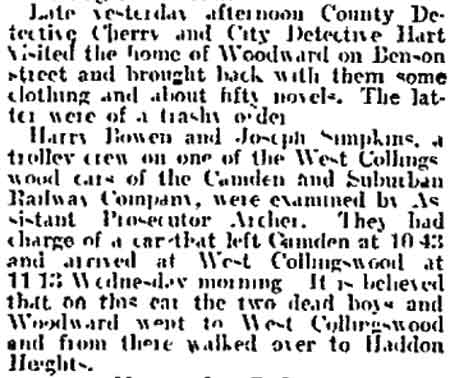
So Confessed to Officers, Who Searched New York at Prisoner’s Instance
NO HAND IN THE CRIME
But Said He Knew Name of the Man Who Committed Awful Deed
YOUTH’S STRENUOUS DAY
Taken to the Scene of the Tragedy and Closeted With the Prosecutor. Click image for PDF.
Camden’s Mystery Is Still Unsolved
Philadelphia Inquirer —
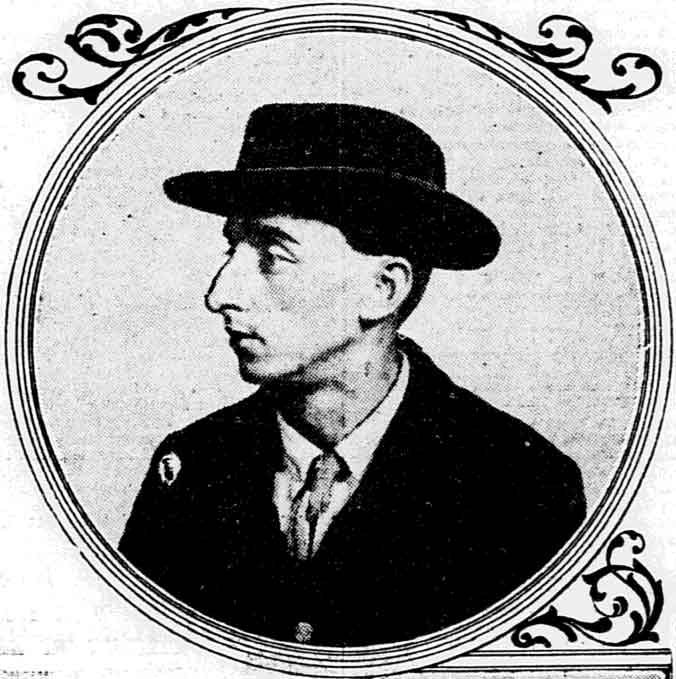
While Authorities Are at Work, Public Watch and Wait. Weaving a Net About Paul Woodward, the Young Suspect Now in Jail
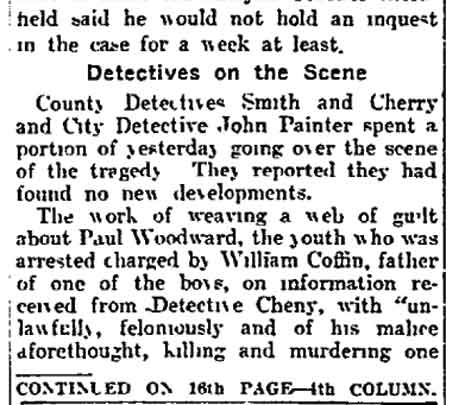
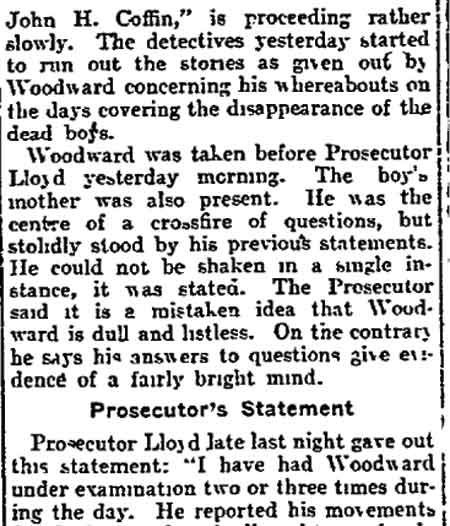
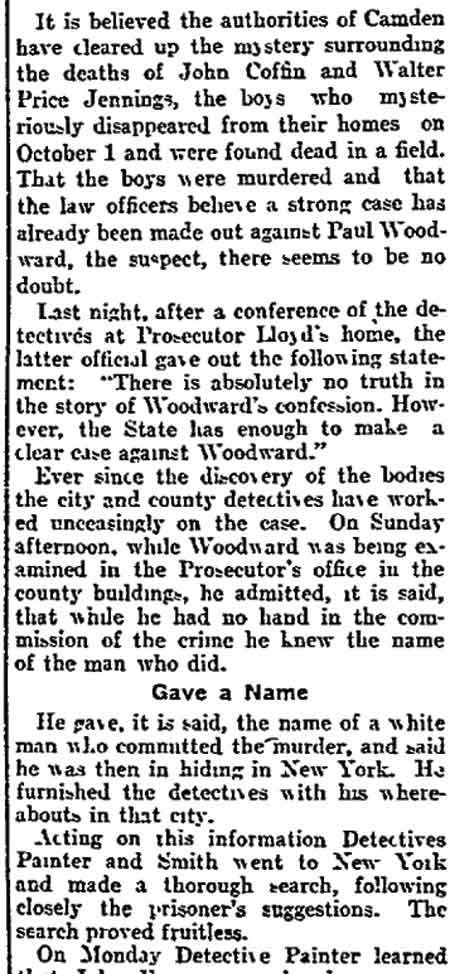
It is now generally believed that the Camden county authorities have succeeded in establishing a clear case against young Paul Woodward, who is in the county jail, charged with the crime of taking away the lives of little John Coffin and Price Jennings. It was just a week ago yesterday when the boys went on their trip to Haddon Heights from which they were destined never to return alive.
Since the discovery of the bodies last Saturday partially hidden in rain soaked weeds, the Prosecutor’s office, assisted by County Detectives Smith and Cherry and City Detectives Painter and Hart, have left no stone unturned.
No Confession
Prosecutor Lloyd yesterday reiterated his statement that Woodward had made no confession, but it is generally conceded as true that the accused youth did tell a story in which he makes some one else the principal criminal in the case.
Several incidents transpired yesterday that threw off the monotony of waiting for developments. Joseph Jennings, brother of one of the murdered boys, was taken to the cell in which Woodward is confined. He had no difficulty in recognizing the prisoner before. But as to whether he ever saw him in company with the dead lads he was not permitted to say.
Wild Rumor
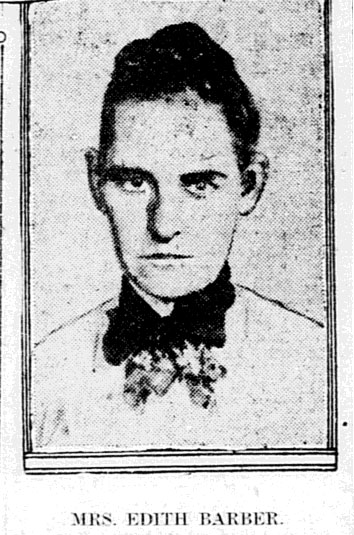
There was much excitement about the Court House when it became rumored that Mrs. Edith Barber, the woman detained as a material witness against Woodward, had the small pox. To allay the alarm County Physician Jones called in representatives of the Board of Health, who concluded she had no sign of the disease.
After matters quieted somewhat the woman was taken into the Prosecutor’s office and questioned. When taken back to her cell she was crying and appeared to be almost unable to walk.
Woodward spent the day in his cell, smoking cigarettes as usual. He was visited in the morning by Lawyer Harry Scovel, who has not yet been engaged as counsel, as reported. Again in the afternoon Lawyer Scovel visited the youth in company with Woodward’s mother. At first Mrs. Woodward was denied admittance, but after waiting on the jail steps for nearly an hour she was permitted to go in and see her son. Lawyer Scovel and Mrs. Woodward were with the young man for a couple of hours.
Talked a Whole Lot
To all questions Lawyer Scovel said: “Woodward talked a whole lot, but I have nothing to say.”
He said he had not confessed to him. On the other hand Woodward had maintained his innocence.
When asked if Woodward could have a hearing if he demanded it Mr. Archer said he could. Asked if enough evidence was in hand to hold him, Mr. Archer said there was.
“On a simple assault charge?”
“No, sir, for the crime he is charged with—committing the murder of John Coffin,” replied Mr. Archer.
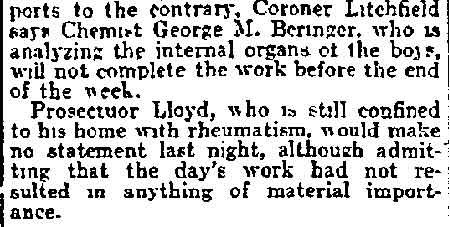
Coroner Litchfield said last night he would not set a date for the inquest before some time next week. Despite all reports to the contrary, Coroner Litchfield says Chemist George M. Beringer, who is analyzing the internal organs of the boys, will not complete the work before the end of the week. Click image for PDF.
Unraveling the Camden Mystery
Philadelphia Inquirer —
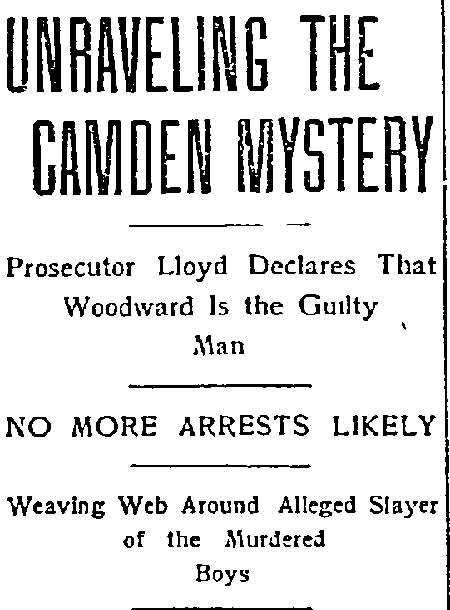
Prosecutor Lloyd Declares That Woodward Is the Guilty Man
NO MORE ARRESTS LIKELY
Weaving Web Around Alleged Slayer of the Murdered Boys
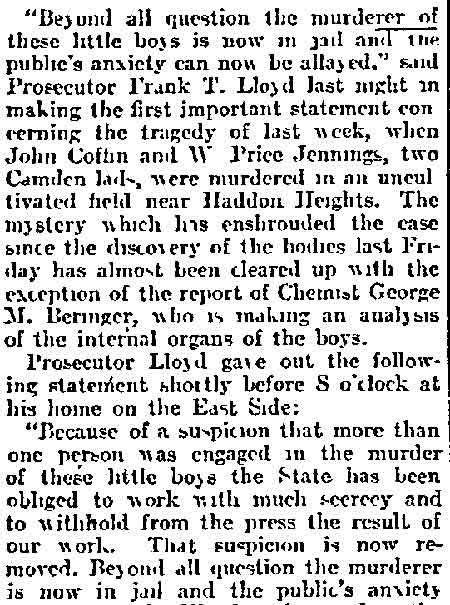
“Beyond all question the murderer of these little boys is now in jail and the public’s anxiety can now be allayed,” said Prosecutor Frank T. Lloyd last night in making the first important statement concerning the tragedy of last week, when John Coffin and W. Price Jennings, two Camden lads, were murdered in an uncultivated field near Haddon Heights. The mystery which has enshrouded the case since the discovery of the bodies last Friday has almost been cleared up with the exception of the report of Chemist George M. Beringer, who is making an analysis of the internal organs of the boys.
Prosecutor Lloyd gave out the following statement shortly before 8 o’clock at his home on the East Side:
“Because of a suspicion that more than one person was engaged in the murder of these little boys the State has been obliged to work with much secrecy and to withhold from the press the result of our work. That suspicion is now removed. Beyond all question the murderer is now in jail and the public’s anxiety can be allayed. Woodward was alone the perpetrator of this crime.
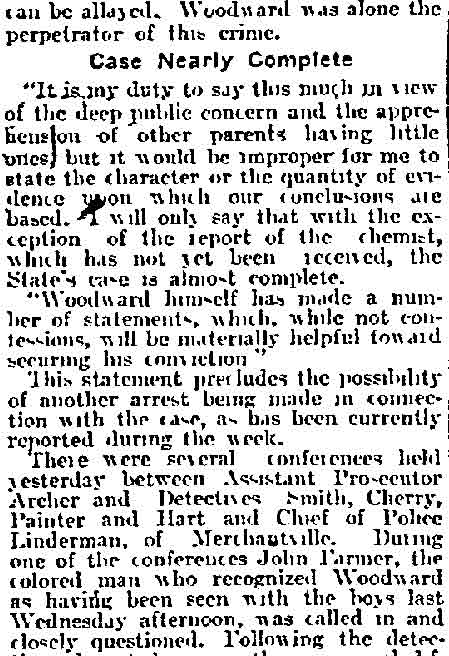
Case Nearly Complete
“It is my duty to say this much in view of the deep public concern and the apprehension of other parents having little ones, but it would be improper for me to state the character or the quantity of evidence upon which our conclusions are based. I will only say that with the exception of the report of the chemist, which has not yet been received, the State’s case is almost complete.
“Woodward himself has made a number of statements, which, while not confessions, will be materially helpful toward securing his conviction.”
This statement precludes the possibility of another arrest being made in connection with the case, as has been currently reported during the week.
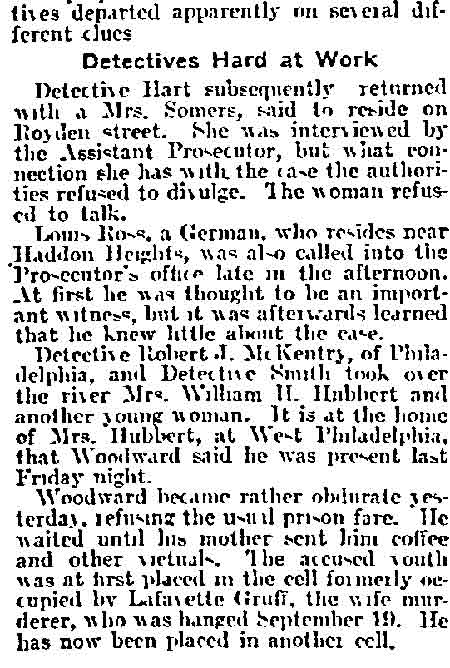
There were several conferences held yesterday between Assistant Prosecutor Archer and Detectives Smith, Cherry, Painter and Hart and Chief of Police Linderman, of Merchantsville. During one of the conferences John Farmer, the colored man who recognized Woodward as having been seen with the boys last Wednesday afternoon, was called in and closely questioned. Following the detectives departed apparently on several different clues.
Detectives Hard at Work
Detective Hart subsequently returned with a Mrs. Somers, said to reside on Royden street. She was interviewed by the Assistant Prosecutor, but what connection she has with the case the authorities refused to divulge. The woman refused to talk.
Louis Ross, a German, who resides near Haddon Heights, was also called into the Prosecutor’s office late in the afternoon. At first he was thought to be an important witness, but it was afterwards learned that he knew little about the case.
Detective Robert J. McKentry, of Philadelphia, and Detective Smith took over the river Mrs. William H. Hubbert and another young woman. It is at the home of Mrs. Hubbert, at West Philadelphia, that Woodward said he was present last Friday night.
Woodward became rather obdurate yesterday, refusing the usual prison fare. He waited until his mother sent him coffee and other victuals. The accused youth was at first placed in the cell formerly occupied by Lafayette Gruff, the wife murderer, who was hanged September 19. He has now been placed in another cell.
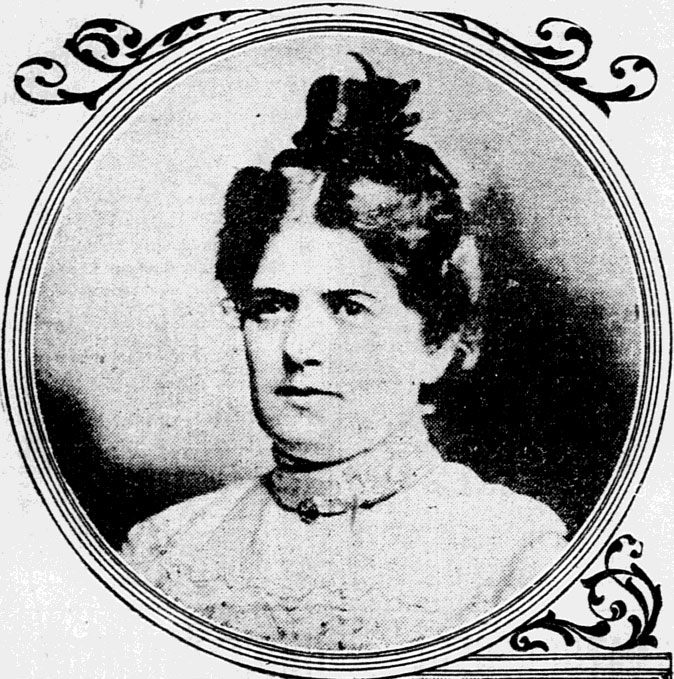
Paul Woodward’s Mother and Two Men Locked Up in the County Jail—Woman Lawyer to Defend the Prisoner
Philadelphia Inquirer —
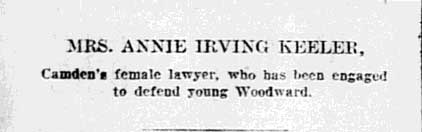
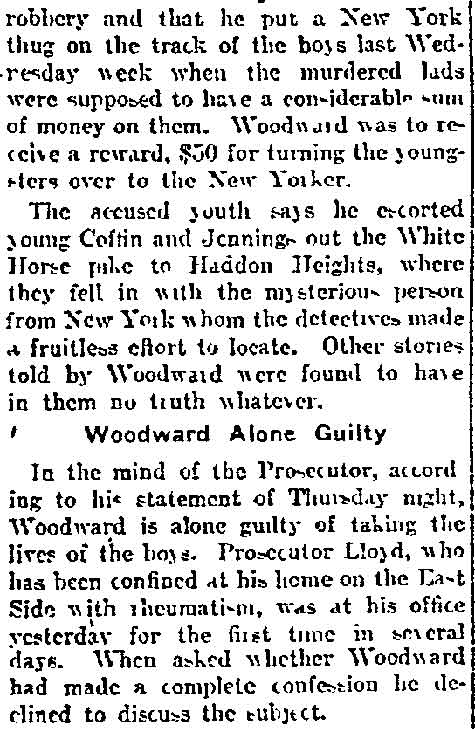
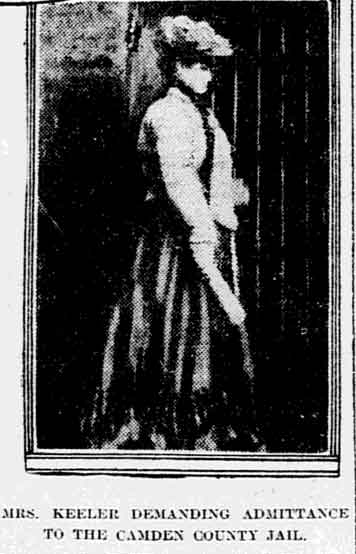
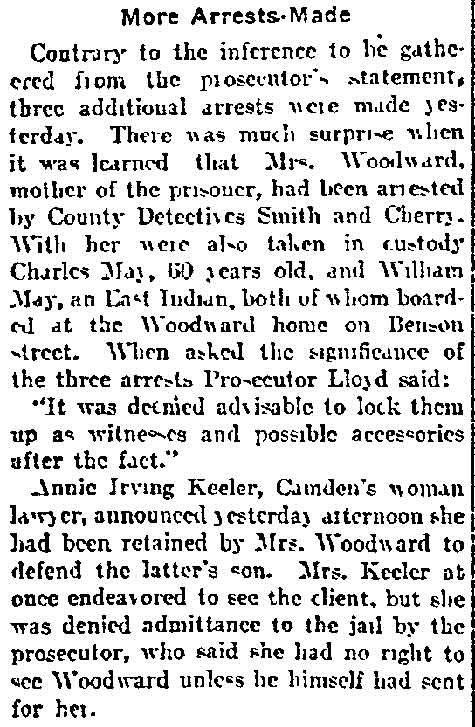
MORE ARRESTS IN CAMDEN MYSTERY. Click image for PDF.
Officers Traced Woodward’s Steps
Philadelphia Inquirer —
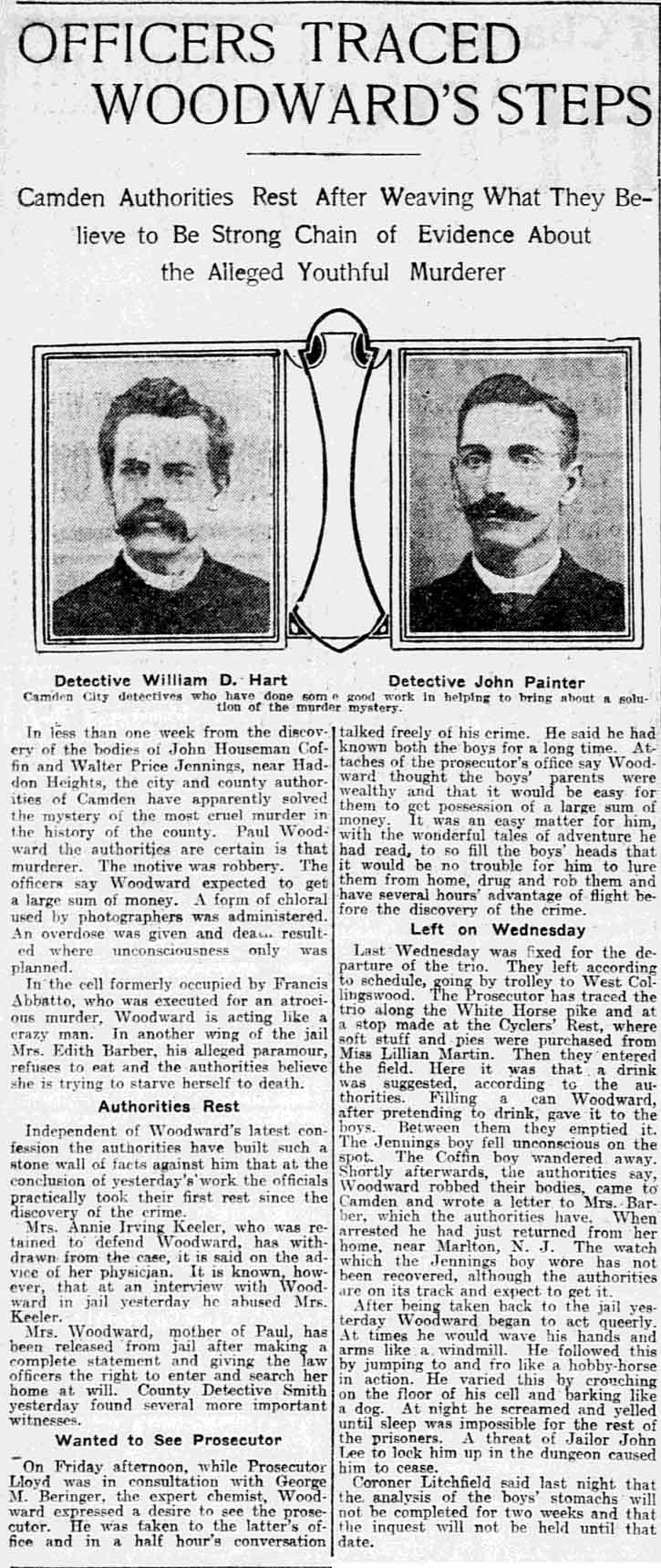
Philadelphia Inquirer, October 12, 1902. Mentioned: William D. Hart, John Painter, Frank T. Lloyd, Dr. Paul N. Litchfield, George M. Beringer, Francis Abbatto, John S. Smith, Annie Irving Keeler, John Houseman Coffin, Walter Price Jennings, Lillian Martin, Mrs. Edith Barber, Paul Woodward.
Another Arrest in Murder Case
Philadelphia Inquirer —
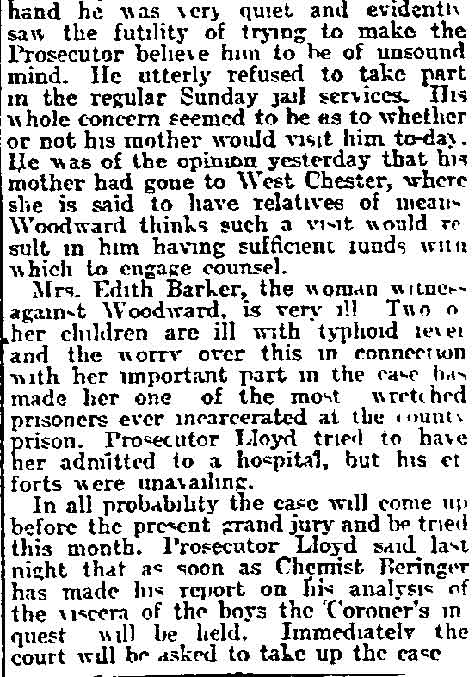
West Philadelphian and a Supposed Companion of Young Paul Woodward Taken in Custody
There is but little remaining in the way of a mystery for the Camden county authorities to clear up in the murder case of little John Coffin and W. Price Jennings, of Camden. After working practically day and night during the past week Prosecutor Lloyd and his able assistants have brought to light such strong evidence against Paul Woodward, the young man in the county jail charged with the crime, that it will be next to impossible to refute it.
The sixth arrest in the case was made yesterday, when James Sheiding was taken into custody by County Detective Smith and committed to the county jail by Recorder Stackhouse as “a material witness.” Sheiding, who lives in West Philadelphia, was lured across the river to Camden, when Detective Smith at once took him in custody.
The prisoner is believed to be the companion of Woodward who, on the Friday night preceding the discovery of the murdered boys, was in the company of the accused murderer. On that occasion it is said Woodward had considerable money and that Sheiding assisted him in spending it.
Woodward did not give any evidence yesterday of being insane. On the other hand he was very quiet and evidently saw the futility of trying to make the Prosecutor believe him to be of unsound mind. He utterly refused to take part in the regular Sunday jail services. His whole concern seemed to be as to whether or not his mother would visit him to-day. He was of the opinion yesterday that his mother had gone to West Chester, where she is said to have relatives of means. Woodward thinks such a visit would result in him having sufficient funds with which to engage counsel.
Mrs. Edith Barker, the woman witness against Woodward, is very ill. Two of her children are ill with typhoid fever and the worry over this in connection with her important part in the case has made her one of the most wretched prisoners ever incarcerated at the county prison. Prosecutor Lloyd tried to have her admitted to a hospital, but his efforts were unavailing.
In all probability the case will come up before the present grand jury and be tried this month. Prosecutor Lloyd said last night that as soon as Chemist Beringer has made his report on his analysis of the viscera of the boys the Coroner’s inquest will be held. Immediately the court will be asked to take up the case.
Speedy Trial for Young Woodward
Philadelphia Inquirer —
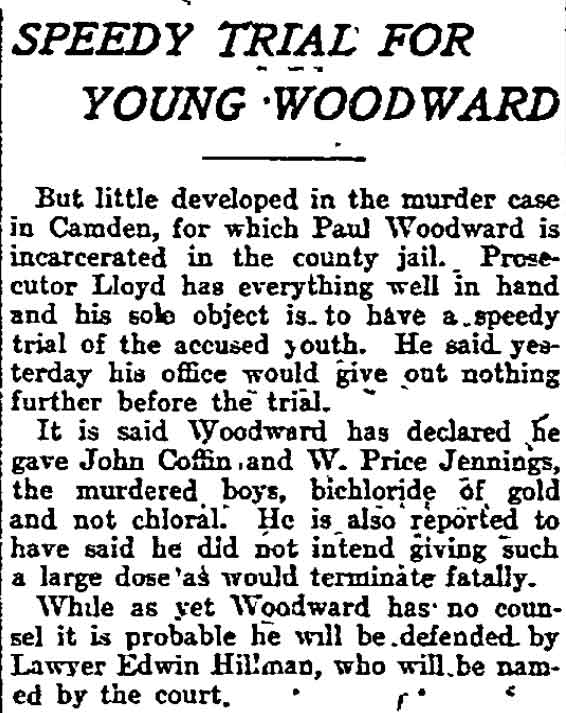
But little developed in the murder case in Camden, for which Paul Woodward is incarcerated in the county jail. Prosecutor Lloyd has everything well in hand and his sole object is to have a speedy trial of the accused youth. He said yesterday his office would give out nothing further before the trial.
It is said Woodward has declared he gave John Coffin and W. Price Jennings, the murdered boys, bichloride of gold and not chloral. He is also reported to have said he did not intend giving such a large dose as would terminate fatally.
While as yet Woodward has no counsel it is probable he will be defended by Lawyer Edwin Hillman, who will be named by the court.
To Hurry Along Woodward Trial
Philadelphia Inquirer —
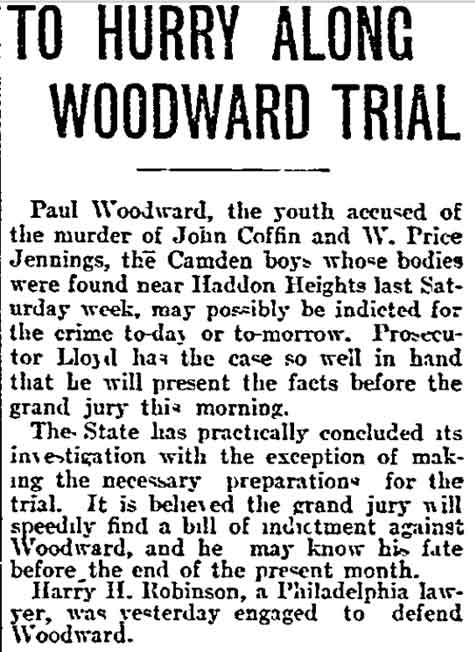
Paul Woodward, the youth accused of the murder of John Coffin and W. Price Jennings, the Camden boys whose bodies were found near Haddon Heights last Saturday week, may possibly be indicted for the crime to-day or to-morrow. Prosecutor Lloyd has the case so well in hand that he will present the facts before the grand jury this morning.
The State has practically concluded its investigation with the exception of making the necessary preparations for the trial. It is believed the grand jury will speedily find a bill of indictment against Woodward, and he may know his fate before the end of the present month.
Harry H. Robinson, a Philadelphia lawyer, was yesterday engaged to defend Woodward.
Woodward Indicted for Cruel Murder
Philadelphia Inquirer —
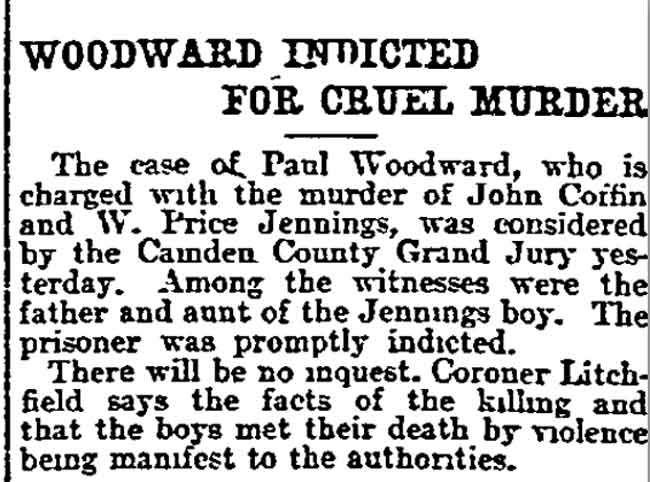
The case of Paul Woodward, who is charged with the murder of John Coffin and W. Price Jennings, was considered by the Camden County Grand Jury yesterday. Among the witnesses were the father and aunt of the Jennings boy. The prisoner was promptly indicted.
There will be no inquest. Coroner Litchfield says the facts of the killing and that the boys met their death by violence being manifest to the authorities.
Morphia Killed Two Camden Boys
Philadelphia Inquirer —
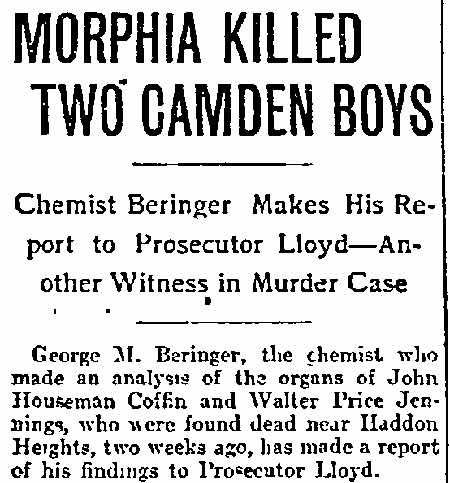
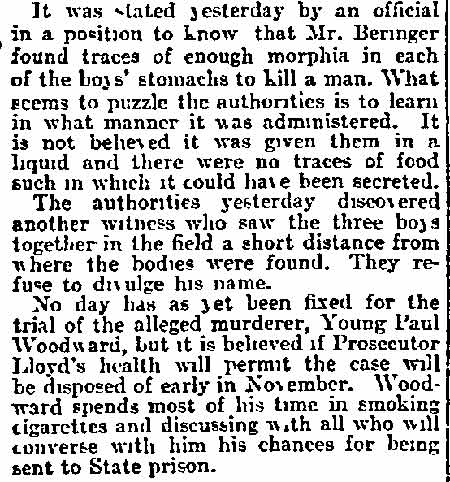
Chemist Beringer Makes His Report to Prosecutor Lloyd — Another Witness in Murder Case
George M. Beringer, the chemist who made an analysis of the organs of John Houseman Coffin and Walter Price Jennings, who were found dead near Haddon Heights two weeks ago, has made a report of his findings to Prosecutor Lloyd. Click image for PDF.
Must Now Produce Woodward in Court
Philadelphia Inquirer —
Counsel for Paul Woodward, the young man accused of the murder of John Coffin and Price Jennings, two Camden boys, yesterday applied to Judge Garrison, at Mount Holly, for a writ of habeas corpus for their client. The application was granted and made returnable Friday next at Camden.
It is said the object of Woodward’s counsel is to make the State show its hand as to the evidence it has against the alleged youthful murderer. In all probability the indictments will be presented and the writ dismissed.
Woodward Writ to Be Argued To-Day
Philadelphia Inquirer —
The rule granted by Judge Garrison last Tuesday to show cause why Paul Woodward, the youthful Camden murderer, should not be released on habeas corpus proceedings will be argued in Camden to-day. The indictment against Woodward may be presented and the case hurried toward the trial which will take place this term.
Prosecutor Frank T. Lloyd was able to be at his desk again yesterday after an attack of rheumatism.
Young Woodward Indicted by Jury
Philadelphia Inquirer —
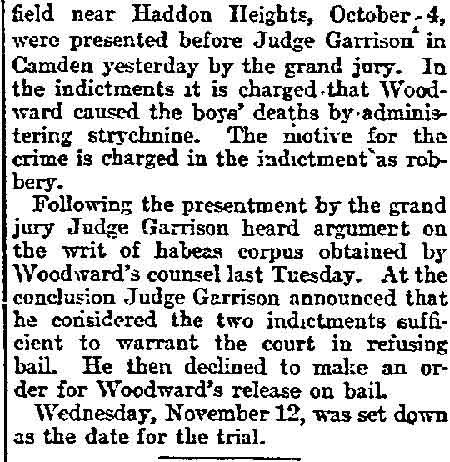
He Is Charged With Robbery and Murder in the Bill Presented to Judge Garrison
Two indictments against Paul Woodward, charging him with the murder of John Coffin and W. Price Jennings, the two boys whose bodies were found in a field near Haddon Heights, have been presented to Judge Garrison. Click image for PDF.
Jurors to Try Woodward
Philadelphia Inquirer —
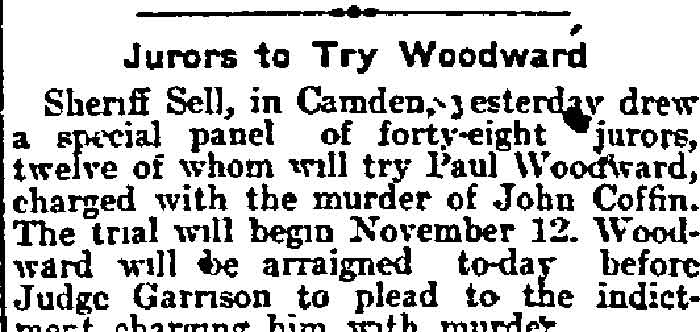
Sheriff Sell, in Camden, yesterday drew a special panel of forty-eight jurors, twelve of whom will try Paul Woodward, charged with the murder of John Coffin. The trial will begin November 12. Woodward will be arraigned to-day before Judge Garrison to plead to the indictment charging him with murder.
Woodward Says He Is Not Guilty
Philadelphia Inquirer —
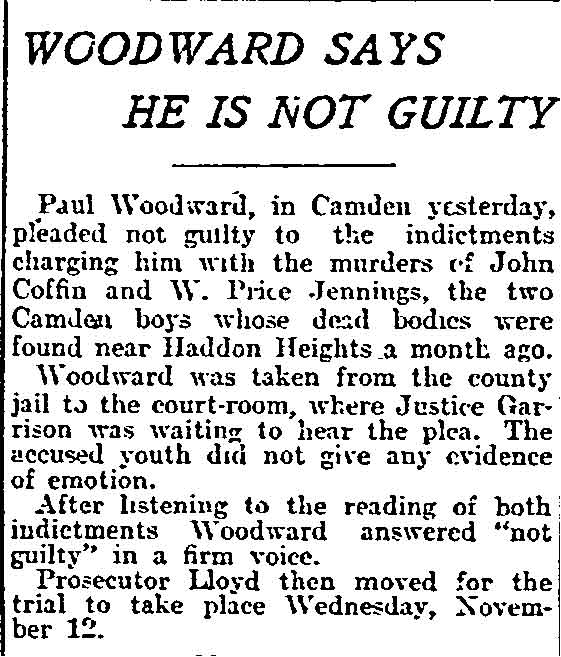
Paul Woodward, in Camden yesterday, pleaded not guilty to the indictments charging him with the murders of John Coffin and W. Price Jennings, the two Camden boys whose dead bodies were found near Haddon Heights a month ago.
Woodward was taken from the county jail to the court-room, where Justice Garrison was waiting to hear the plea. The accused youth did not give any evidence of emotion.
After listening to the reading of both indictments Woodward answered “not guilty” in a firm voice.
Prosecutor Lloyd then moved for the trial to take place Wednesday, November 12.
Woodward’s Trial Today
Trenton Evening Times —
Camden Lad Accused of Killing Coffin and Jennings.
Camden, Nov. 12.—Just seven weeks ago today John Coffin and Price Jennings, two Camden lads, left their homes without informing their families of their destination. After being missed for twenty-four hours, search was instituted and four days afterward their dead bodies were found in a field near Haddon Heights, six miles from Camden.
Today Paul Woodward, who was seen with the boys in the neighborhood of the scene of their death, the evening before, was placed on trial charged with the murder of John Coffin.
After the formal preliminaries the work of empanelling the jury from the special venire of forty-eight citizens was begun. There was an unusual number of jurors who could not change their convictions formed from newspaper reading, and the result was the panel was exhausted with only ten men in the box. Click image for PDF.
Woodward on Trial for Coffin Murder
Philadelphia Inquirer —
Less Than Six Weeks After Alleged Crime Case Is Called in Camden Court—The Prisoner’s Appearance—What State Will Try to Prove
Six weeks ago yesterday John Coffin and W. Price Jennings, two rosy-cheeked Camden lads, left their comfortable homes for a boyish romp in the country. Three days later their bodies were found lying half concealed among a wild growth of bushes in an uncultivated field near Haddon Heights.
Yesterday Paul Woodward, termed a cigarette fiend and a reader of trashy novels, was placed on trial in Camden before Judge Garrison, on indictments charging him with the murder of John Coffin.
Directly the doors of the court room were opened a crowd of men and women made a rush for seats, and the constables with difficulty restrained them. If a few minutes every seat had been taken and the throng awaited expectantly for a glimpse of the arrested youth. The space reserved for members of the bar was filled, too, with many lawyers interested in the outcome of what doubtless will prove one of the most famous murder trials in Camden county.
A few minutes after 10 o’clock Judge Garrison arrived and court was formally opened. Prosecutor Frank T. Lloyd read the list of the State’s witnesses. Quite early in the proceedings it was learned that a man had been dispatched for Woodward, and before the Prosecutor had concluded reading the list of witnesses the accused youth entered the bar room.
Immediately he was the exposure of all eyes, his peculiar appearance to hold the gaze of the spectators. His counsel, Lawyers Robinson and Harry S. Scovel of Philadelphia, with William Rex, of Camden, greeted him with, “How do you feel, Paul?”
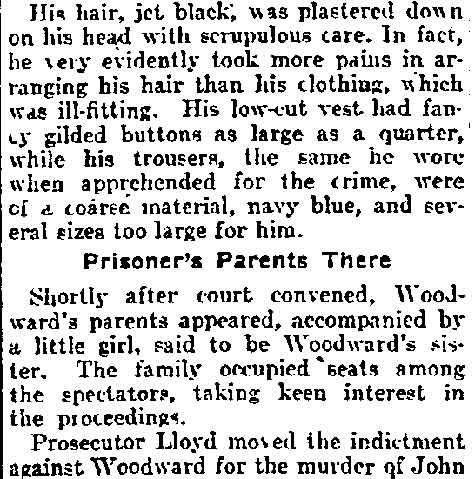
“All right, I can’t kick,” he replied, nonchalantly, and he settled himself down. He appeared more of an ordinariness than a boy of 15 years old, and not at all as has been stated. His hair, jet black, was plastered down on his head with scrupulous care. His low-cut vest had fancy gilded buttons as large as a quarter, while his trousers, the same as were worn when apprehended for the crime, were of a coarse material, navy blue, and several sizes too large for him.
Shortly after court convened, Woodward’s parents appeared, accompanied by a little girl, said to be Woodward’s sister. The family occupied seats among the spectators, taking keen interest in the proceedings.
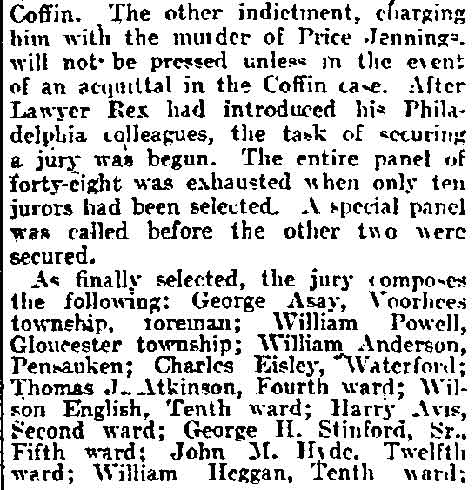
Prosecutor Lloyd moved the indictment against Woodward for the murder of John Coffin. The other indictment, charging him with the murder of Price Jennings, will not be pressed unless in the event of an acquittal in the Coffin case. After Lawyer Rex had introduced his Philadelphia colleagues, the task of securing a jury began. The entire panel of forty-eight was exhausted when only ten jurors had been selected. A special panel was called before the other two were secured.
As finally selected, the jury composed the following: George Asay, Woolwich township, foreman; William Powell, Gloucester township; William Anderson, Pemberton; Charles Eiley, Waterford; Thomas J. Atkinson, Fourth ward; Wilson English, Tenth ward; Harry Avis, Second ward; George H. Stineford Sr., Fifth ward; John M. Hyde, Twelfth ward; William Heggan, Tenth ward; John St. Clair, Third ward; Charles S. Hess, Fifth ward.
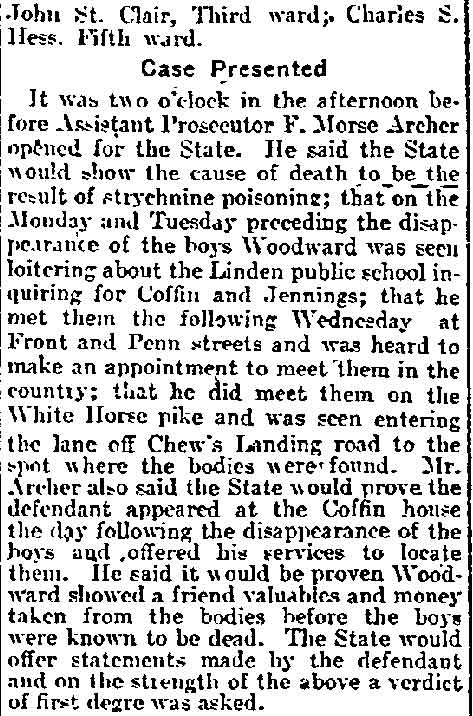
Prosecutor Lloyd opened the case for the State. He said the State would show trace of strychnine poisoning, that on the Monday and Thursday preceding the discovery of the bodies Woodward was loitering about the Linden School playing with local pupils, and that he met them on the following Wednesday at Front and Penn streets at a meeting spot where the bodies were later found. Click image for PDF.
Frog Killed in Jersey Court
Philadelphia Inquirer —
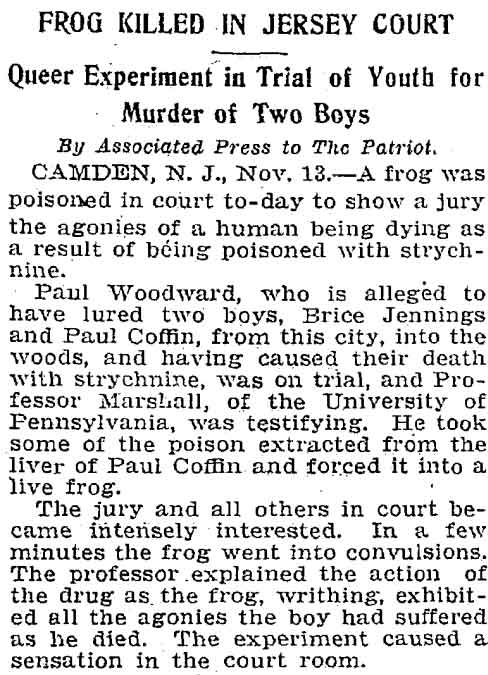
Queer Experiment in Trial of Youth for Murder of Two Boys
Camden, N. J., Nov. 13.—A frog was poisoned in court to-day to show a jury the agonies of a human being dying as a result of being poisoned with strychnine.
Paul Woodward, who is alleged to have lured two boys, Brice Jennings and Paul Coffin, from this city, into the woods, and having caused their death with strychnine, was on trial, and Professor Marshall, of the University of Pennsylvania, was testifying. He took some of the poison extracted from the liver of Paul Coffin and forced it into a live frog. The jury and all others in court became intensely interested. In a few minutes the frog went into convulsions. The professor explained the action of the drug as the frog, writhing, exhibited all the agonies the boy had suffered as he died. The experiment caused a sensation in the court room.
Telling Points Brought Out at Woodward’s Trial
Philadelphia Inquirer —

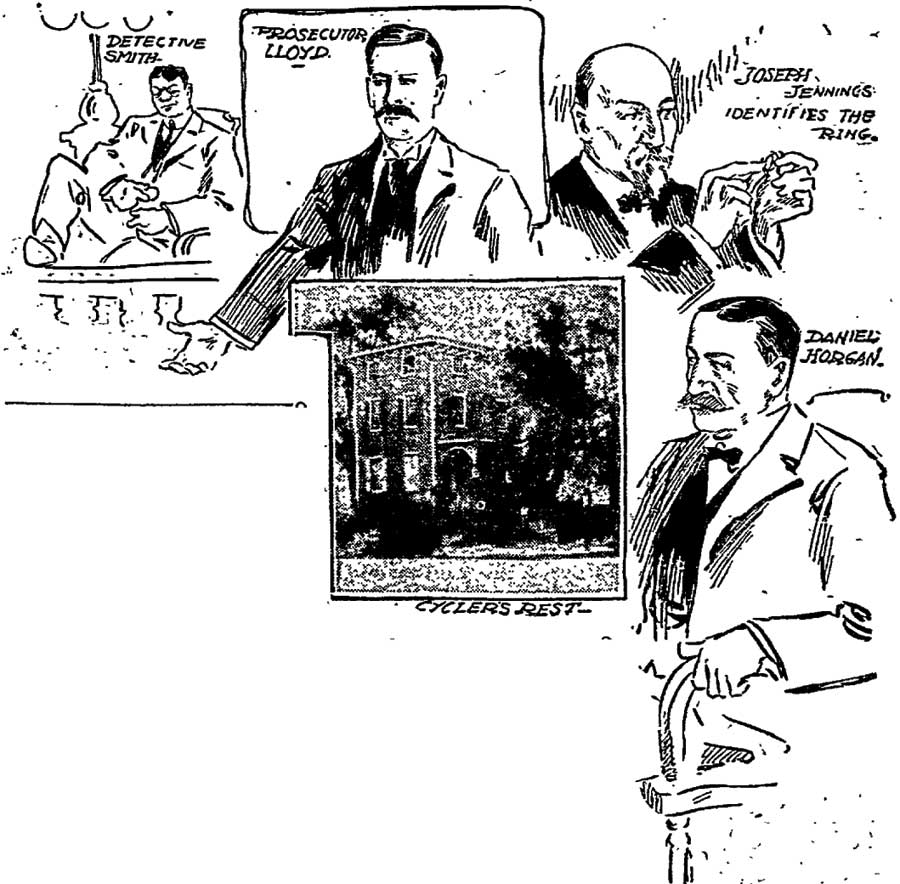
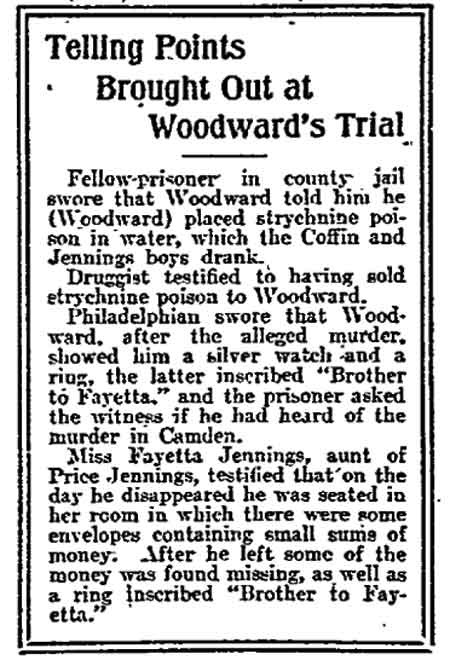
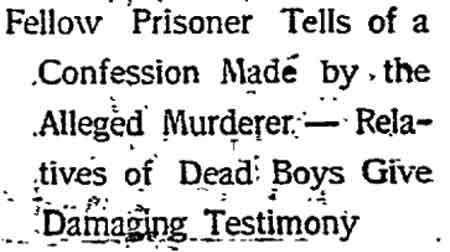
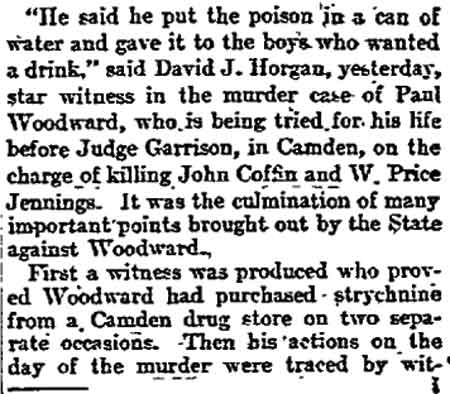
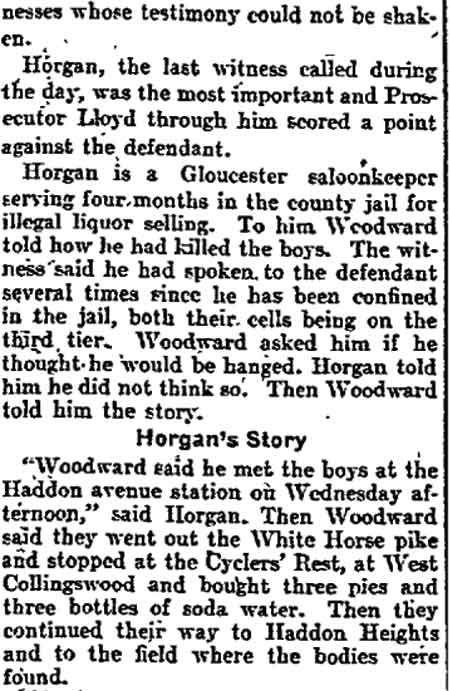
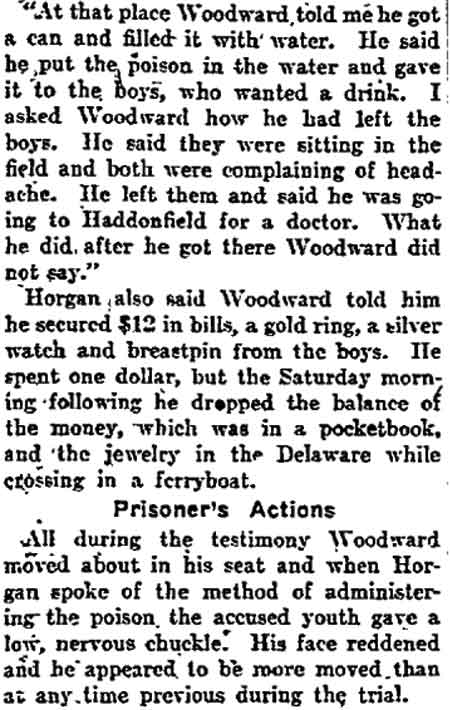
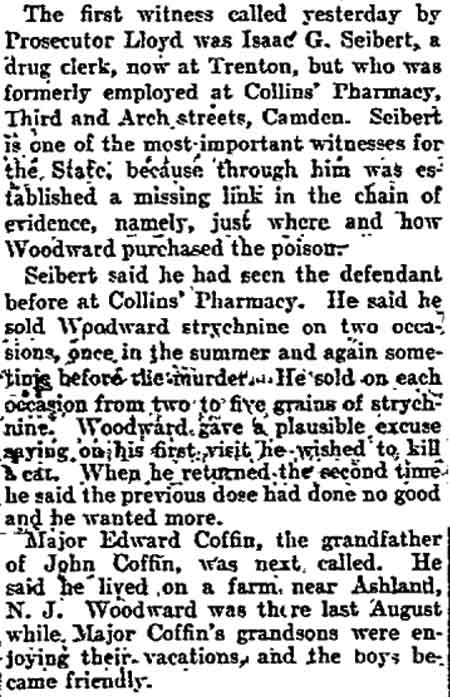
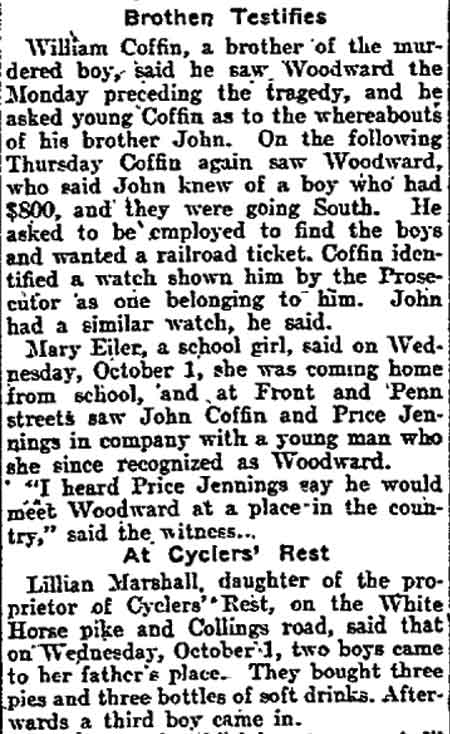
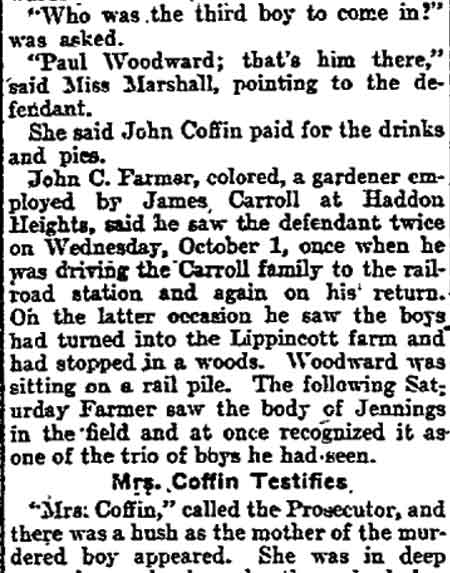
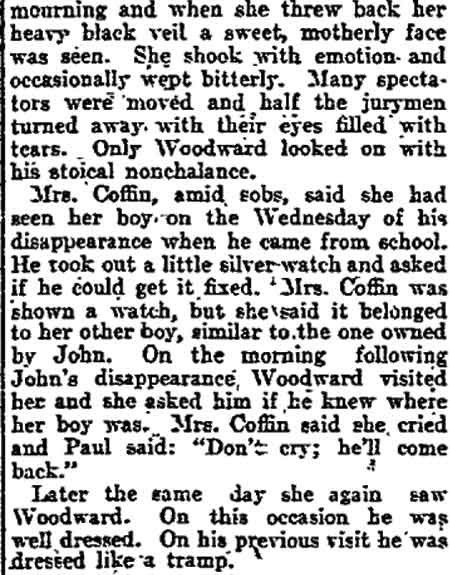
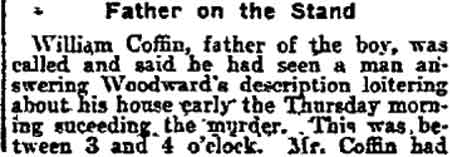
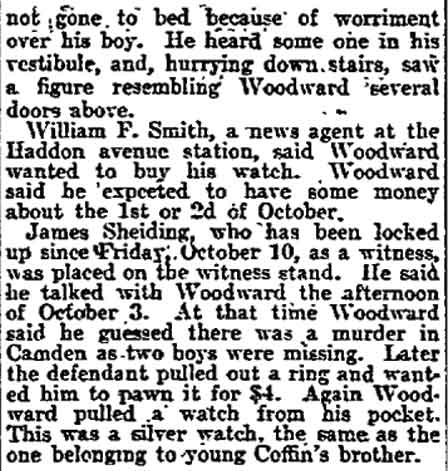
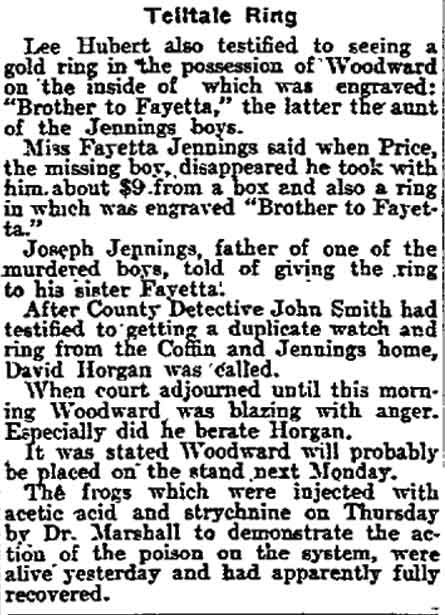
WOODWARD BOUGHT POISON, SAYS DRUGGIST. Philadelphia Inquirer, November 15, 1902. Mentioned: Daniel J. Horgan, Isaac Siebert, W. Wilmer Collins (Druggist), Major Edward Coffin, Coffin’s Corner (Ashland), William Coffin, William Coffin Jr., Mary Eiler, William F. Smith, James Sheiding, Fayetta Jennings, Lee Hubert.
Woodward’s Parents on Stand; Boy in a Rage
Philadelphia Inquirer —

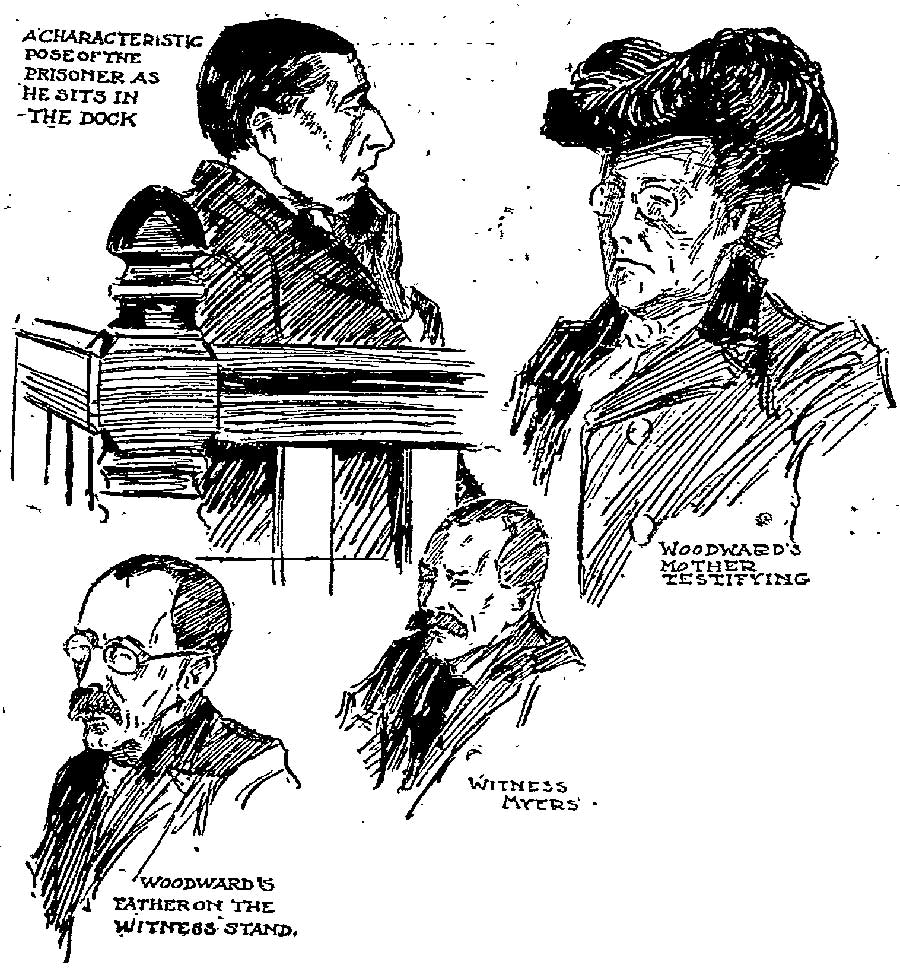
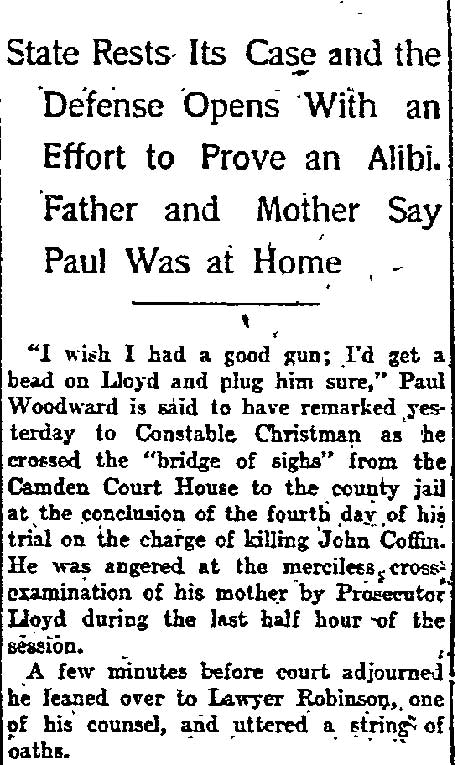

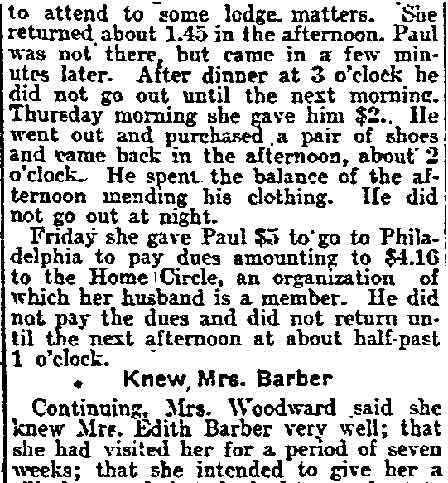
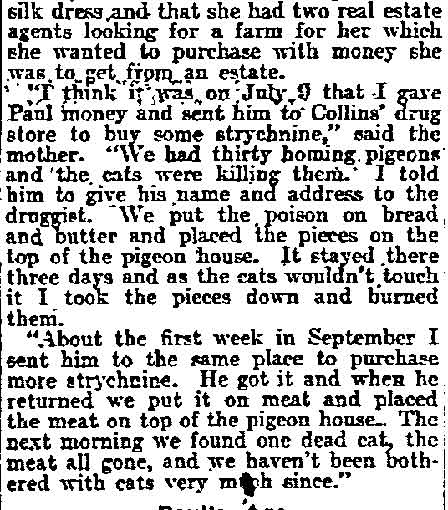
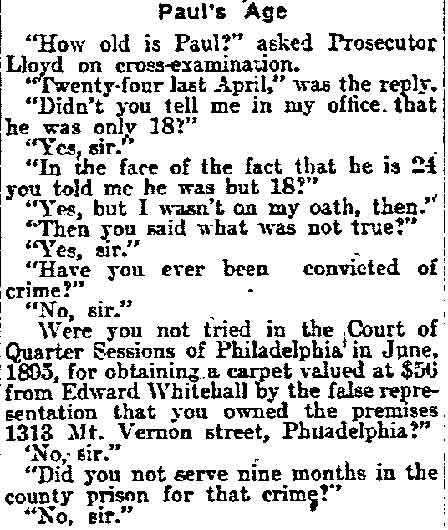
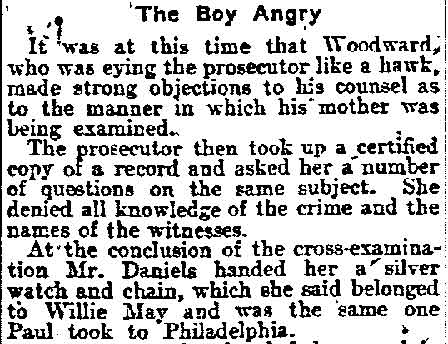
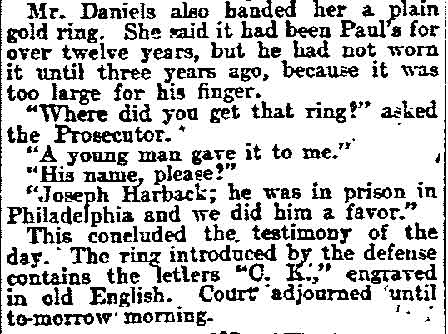
State Rests Its Case and the Defense Opens With an Effort to Prove an Alibi. Father and Mother Say Paul Was at Home.
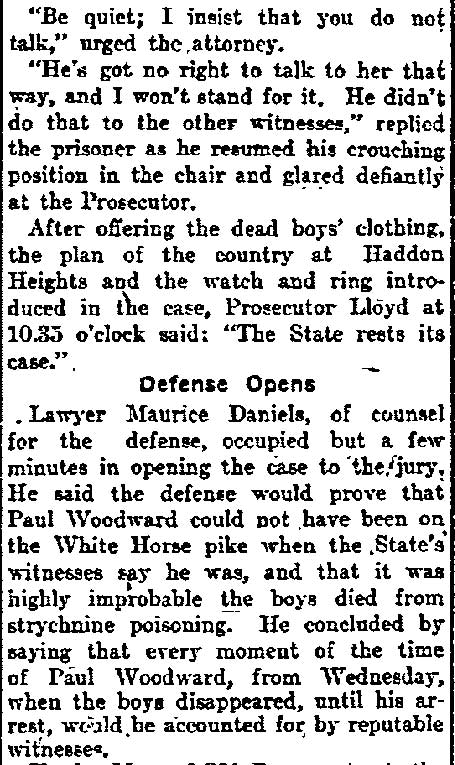
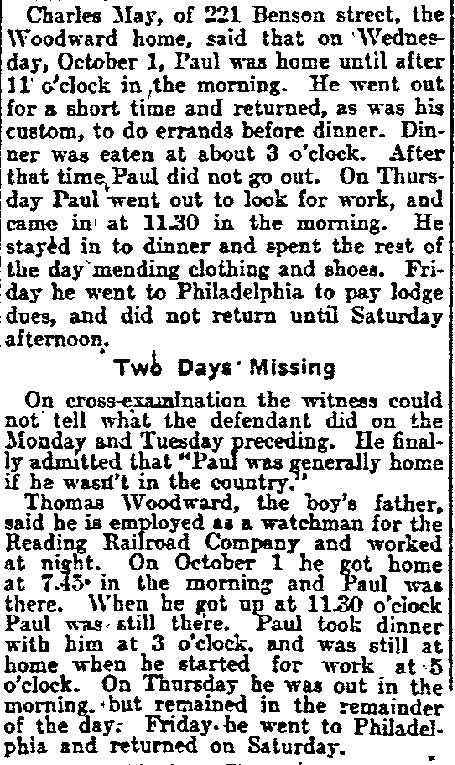
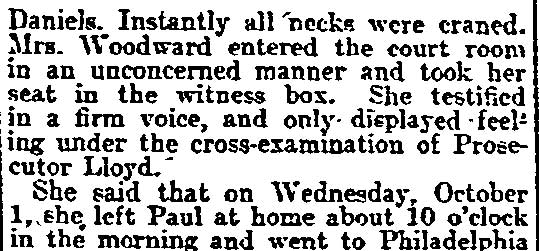
“I wish I had a good gun; I’d get a bead on Lloyd and plug him sure,” Paul Woodward is said to have remarked yesterday to Constable Christman as he crossed the “bridge of sighs” from the Camden Court House to the county jail at the conclusion of the fourth day of his trial on the charge of killing John Coffin. He was angered at the merciless cross-examination of his mother by Prosecutor Lloyd during the last half hour of the session.
A few minutes before court adjourned he leaned over to Lawyer Robinson, one of his counsel, and uttered a string of oaths. Click image for PDF.
Woodward Spent a Quiet Sunday
Philadelphia Inquirer —
Apparently Buoyed Up by the Efforts of His Counsel, Who Now Have Their Inning
Paul Woodward, the young man on trial for his life before Judge Garrison, charged with the murder of little John Coffin, spent a quiet Sunday in his cell in the Camden county jail. He ate his meals as usual and gave no evidence whatever of being affected by the ordeal through which he has passed since last Wednesday. Since the defense has opened its case he appears to be more cheerful, presumably expectant of something occurring before the end of the trial that will strengthen his chances of acquittal.
“The trial has caused more comment in Camden than anything since the time Eli Shaw was accused of the murder of his mother and grandmother some years ago.”
There was great surprise manifested when Lawyer Daniels, in outlining the defense, said it would be proven Woodward could not have been present when the crime was committed, and the subsequent attempt to prove an alibi. Woodward may be placed on the stand to-day and it remains to be seen how his story will stand the keen cross-examination of Prosecutor Lloyd. One of the features of the trial has been the manner in which the jury has noticed every move and characteristic of the defendant as he sits in the prisoners’ dock.
The jurymen were yesterday taken out for exercise. They were accompanied by constables and walked about the streets for some time.
Several letters have been received at the county jail, where Woodward is incarcerated, from persons who are desirous of securing the young man’s brain in the event of him being convicted and hanged. Click image for PDF.
Woodward Smiled When He Heard Death Verdict
Philadelphia Inquirer —

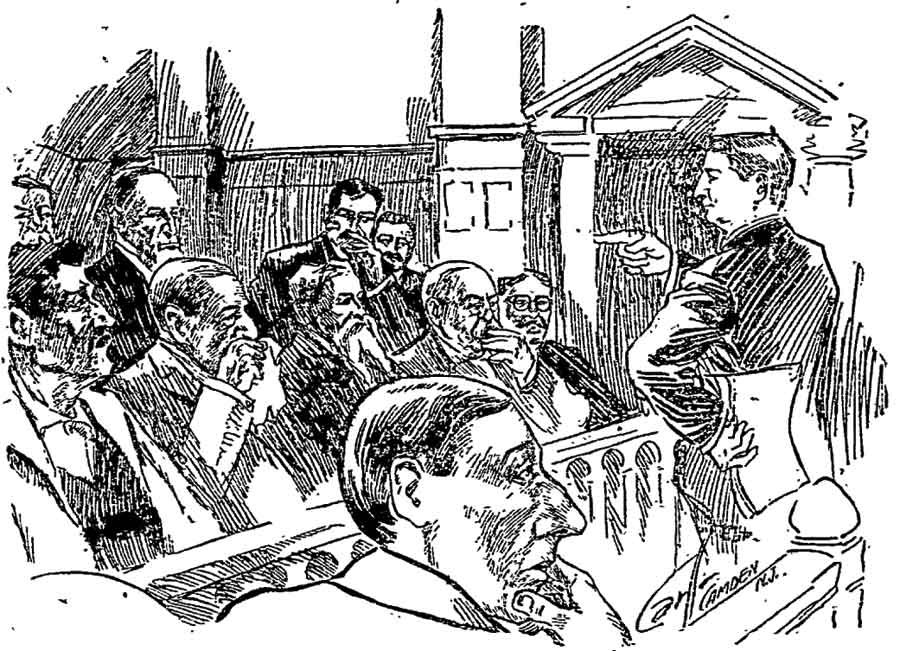

WOODWARD SMILED WHEN HE HEARD DEATH VERDICT
Camden Trial Came to a Sudden End With the Jury Returning a Conviction of Murder in the First Degree, After Deliberating Less Than an Hour
[Illustration caption: Attorney Robinson Making His Address to the Jury. Paul Woodward in Foreground.]
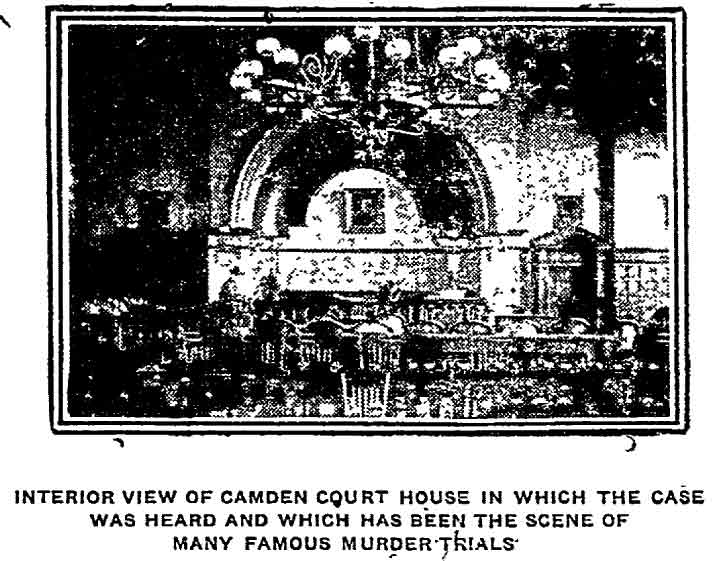
[Photo caption: Interior View of Camden Court House in Which the Case Was Heard and Which Has Been the Scene of Many Famous Murder Trials.]
Paul Woodward was last evening found guilty of murdering little John Coffin, whose body, with that of W. Price Jennings, was found in a field near Haddon Heights on October 4. Woodward’s trial began last Wednesday before Judge Garrison in Camden.
The jury retired at 3.45 o’clock, after a brief charge by Judge Garrison. At twenty minutes to 5 o’clock an agreement had been reached, but it was two minutes to 6 o’clock before Judge Garrison arrived, he having gone to his home at Merchantville.
In the meantime Woodward had been brought into the court room, and after the jury had filed in he was told to stand up. He arose without a tremor, looked at the ceiling, at the Judge and then turned to the twelve men who had his fate in their hands. His peculiar features lit up with a broad grin when the County Clerk said:
“Jury look upon the prisoner; prisoner look upon the jury.”
Guilty of Murder
Then when the jury was finally asked for its verdict and the foreman had solemnly announced “Guilty of murder in the first degree,” Woodward, apparently unmindful of the import of the words, turned to his counsel and laughed with a low chuckle. Each juror was polled and each man repeated “guilty of murder in the first degree.”
“The prisoner may retire,” said Judge Garrison, and with a sidelong glance at his counsel Woodward was led across the “bridge of sighs” to his cell in the county jail. He laughed loudly and slapped his custodian on the back in a playful mood, as if the whole proceedings had been a joke, but when he reached the jail he let go a tirade of profanity against the Prosecutor and those who appeared against him. He remarked that he did not care what became of him, all he cared for, he said, was his mother.
Motion for New Trial
Lawyer Rex immediately made a motion for a new trial, Judge Garrison stating he would hear argument on a date to be set. The jury was then discharged.
One of the features of the last day was the reappearance of Woodward’s mother, haggard, careworn and her eyes swollen with weeping. She was recalled to testify she had sworn falsely on Saturday when she denied even having been convicted of crime.
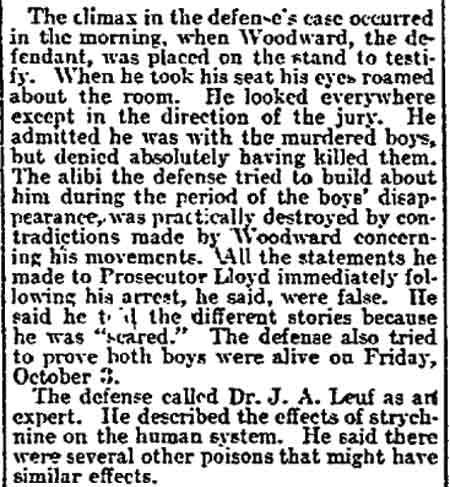
The climax in the defense’s case occurred in the morning, when Woodward, the defendant, was placed on the stand to testify. When he took his seat his eyes roamed about the room. He looked everywhere except in the direction of the jury. He admitted he was with the murdered boys, but denied absolutely having killed them. The alibi the defense tried to build about him during the period of the boys’ disappearance, was practically destroyed by contradictions made by Woodward concerning his movements. All the statements he made to Prosecutor Lloyd immediately following his arrest, he said, were false. He said he told the different stories because he was “scared.” The defense also tried to prove both boys were alive on Friday, October 3.
The defense called Dr. J. A. Leuf as an expert. He described the effects of strychnine on the human system. He said there were several other poisons that might have similar effects.
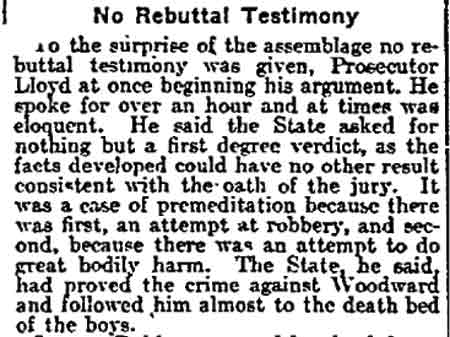
No Rebuttal Testimony
To the surprise of the assemblage no rebuttal testimony was given, Prosecutor Lloyd at once beginning his argument. He spoke for over an hour and at times was eloquent. He said the State asked for nothing but a first degree verdict, as the facts developed could have no other result consistent with the oath of the jury. It was a case of premeditation because there was first, an attempt at robbery, and second, because there was an attempt to do great bodily harm. The State, he said, had proved the crime against Woodward and followed him almost to the death bed of the boys.
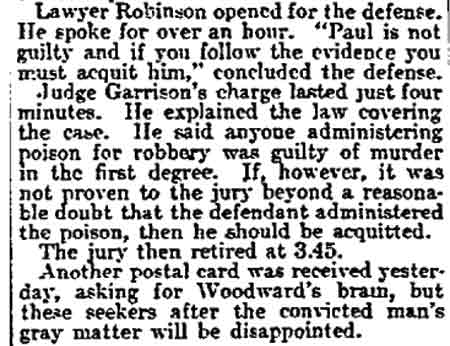
Lawyer Robinson opened for the defense. He spoke for over an hour. “Paul is not guilty and if you follow the evidence you must acquit him,” concluded the defense.
Judge Garrison’s charge lasted just four minutes. He explained the law covering the case. He said anyone administering poison for robbery was guilty of murder in the first degree. If, however, it was not proven to the jury beyond a reasonable doubt that the defendant administered the poison, then he should be acquitted.
The jury then retired at 3.45.
Another postal card was received yesterday, asking for Woodward’s brain, but these seekers after the convicted man’s gray matter will be disappointed.
Thinks Woodward Is Deficient
Philadelphia Inquirer —
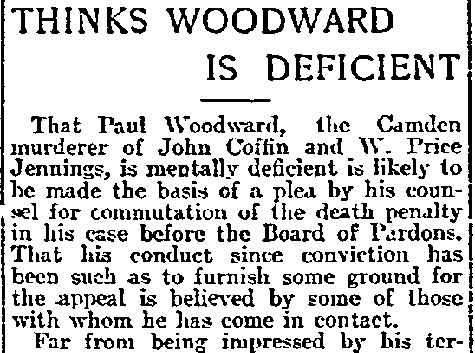
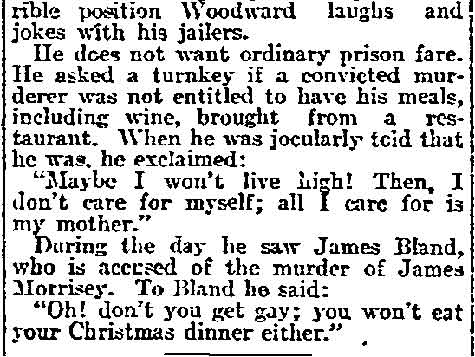
That Paul Woodward, the Camden murderer of John Coffin and W. Price Jennings, is mentally deficient is likely to be made the basis of a plea by his counsel for commutation of the death penalty in his case before the Board of Pardons. That his conduct since conviction has been such as to furnish some ground for the appeal is believed by some of those with whom he has come in contact.
Far from being impressed by his terrible position Woodward laughs and jokes with his jailers.
He does not want ordinary prison fare. He asked a turnkey if a convicted murderer was not entitled to have his meals, including wine, brought from a restaurant. When he was jocularly told that he was, he exclaimed:
“Maybe I won’t live high! Then, I don’t care for myself; all I care for is my mother.”
During the day he saw James Bland, who is accused of the murder of James Morrisey. To Bland he said:
“Oh! don’t you get gay; you won’t eat your Christmas dinner either.”
Woodward Desires No Spiritual Advice
Philadelphia Inquirer —
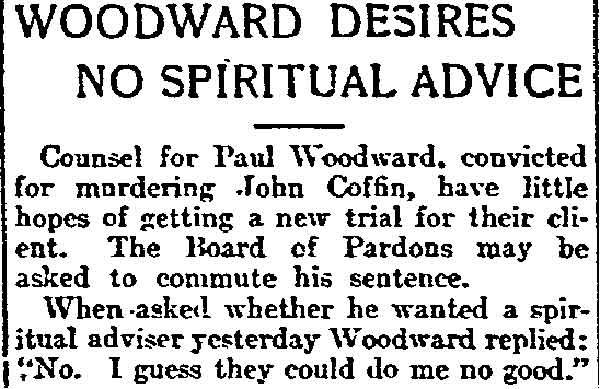
Counsel for Paul Woodward, convicted for murdering John Coffin, have little hopes of getting a new trial for their client. The Board of Pardons may be asked to commute his sentence.
When asked whether he wanted a spiritual adviser yesterday Woodward replied: “No. I guess they could do me no good.”
No New Trial for Murderer Woodward
Philadelphia Inquirer —
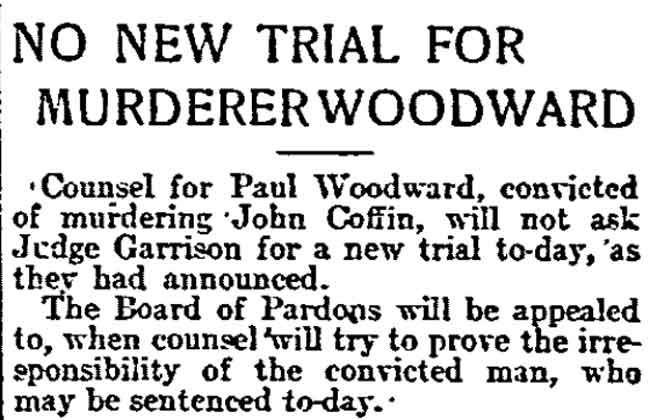
Counsel for Paul Woodward, convicted of murdering John Coffin, will not ask Judge Garrison for a new trial to-day, as they had announced.
The Board of Pardons will be appealed to, when counsel will try to prove the irresponsibility of the convicted man, who may be sentenced to-day.
Woodward to Go to Gallows on January 7
Philadelphia Inquirer —
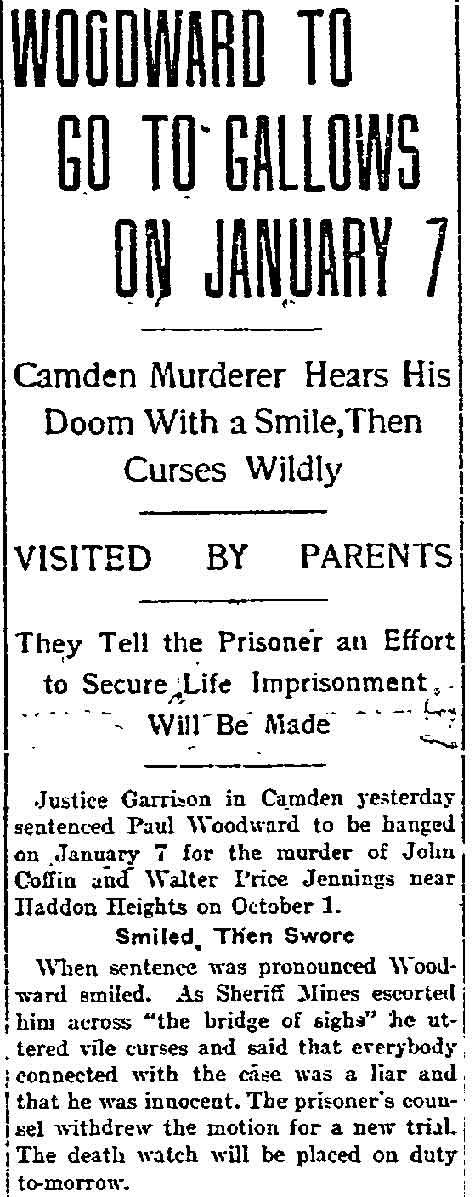
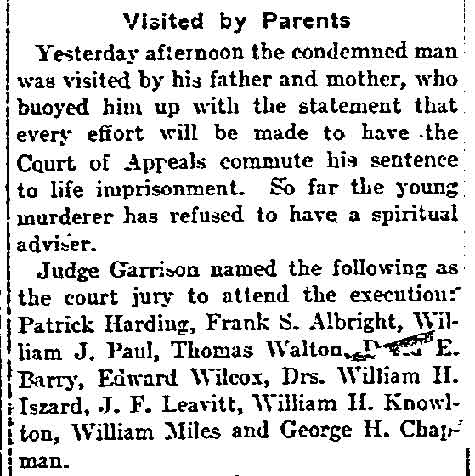
Philadelphia Inquirer, November 23, 1902. Mentioned: Patrick Harding, Frank S. Albright, William J. Paul, Thomas Walton, David E. Barry, Edward Wilcox, Dr. William H. Iszard, Dr. J.F. Leavitt, Dr. William H. Knowlton, Dr. William Miles, Dr. George H. Chapman, Charles G. Garrison, Paul Woodward. Click image for PDF.
Death Watch on Woodward
Philadelphia Inquirer —
Death Watch on Woodward
Death Watch on Woodward
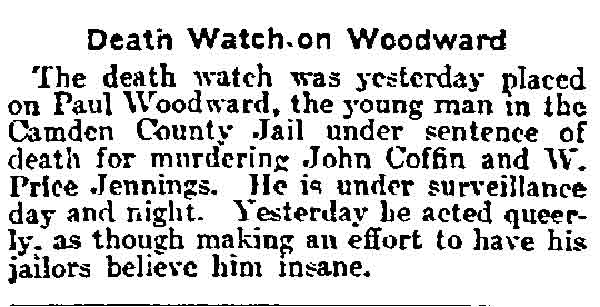
The death watch was yesterday placed on Paul Woodward, the young man in the Camden County Jail under sentence of death for murdering John Coffin and W. Price Jennings. He is under surveillance day and night. Yesterday he acted queerly, as though making an effort to have his jailors believe him insane.
Woodward Had Many Vices
Philadelphia Inquirer —
Woodward Had Many Vices
WOODWARD HAD MANY VICES
Some Things That Prosecutor Lloyd Held Back
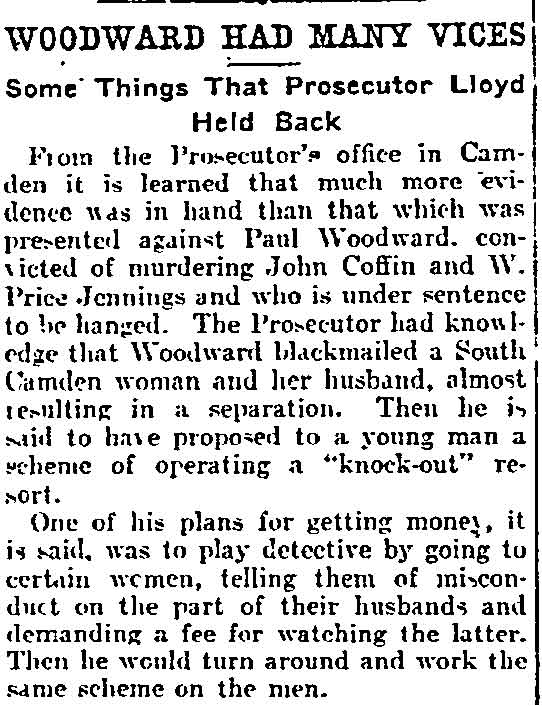
From the Prosecutor's office in Camden it is learned that much more evidence was in hand than that which was presented against Paul Woodward, convicted of murdering John Coffin and W. Price Jennings and who is under sentence to be hanged. The Prosecutor had knowledge that Woodward blackmailed a South Camden woman and her husband, almost resulting in a separation. Then he is said to have proposed to a young man a scheme of operating a "knock-out" resort.
One of his plans for getting money, it is said, was to play detective by going to certain women, telling them of misconduct on the part of their husbands and demanding a fee for watching the latter. Then he would turn around and work the same scheme on the men.
Were His Ruin.
Kalamazoo Gazette —
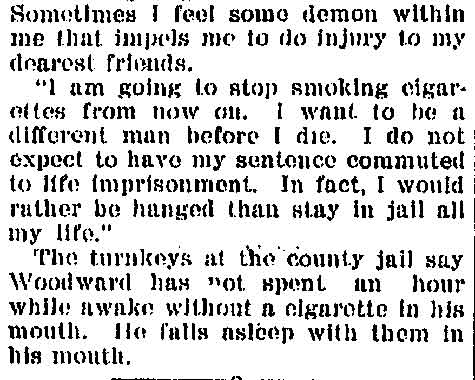
Cigarettes Make Him a Demon and a Murderer.
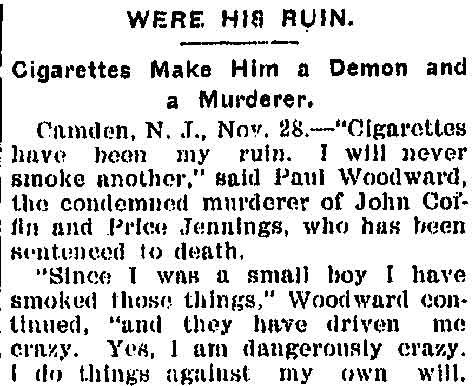
Camden, N. J., Nov. 28.—“Cigarettes have been my ruin. I will never smoke another,” said Paul Woodward, the condemned murderer of John Coffin and Price Jennings, who has been sentenced to death.
“Since I was a small boy I have smoked those things,” Woodward continued, “and they have driven me crazy. Yes, I am dangerously crazy. I do things against my own will.
“Cigarettes Made Me Dangerously Crazy”
Salt Lake Telegram —
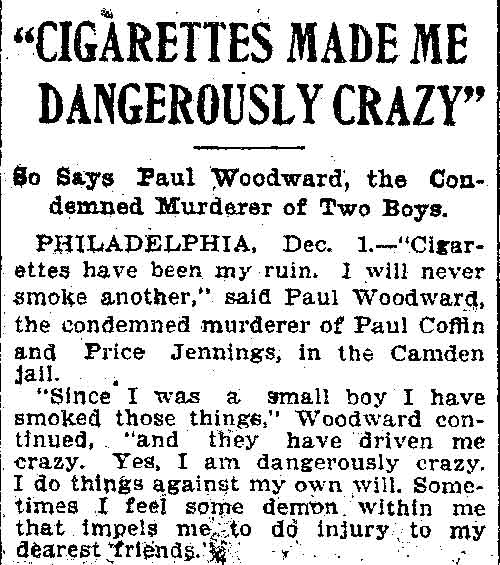
So Says Paul Woodward, the Condemned Murderer of Two Boys.
PHILADELPHIA, Dec. 1.—“Cigarettes have been my ruin. I will never smoke another,” said Paul Woodward, the condemned murderer of Paul Coffin and Price Jennings, in the Camden jail.
“Since I was a small boy I have smoked those things,” Woodward continued, “and they have driven me crazy. Yes, I am dangerously crazy. I do things against my own will. Sometimes I feel some demon within me that impels me to do injury to my dearest friends.”
Good Price for Expert Testimony
Philadelphia Inquirer —
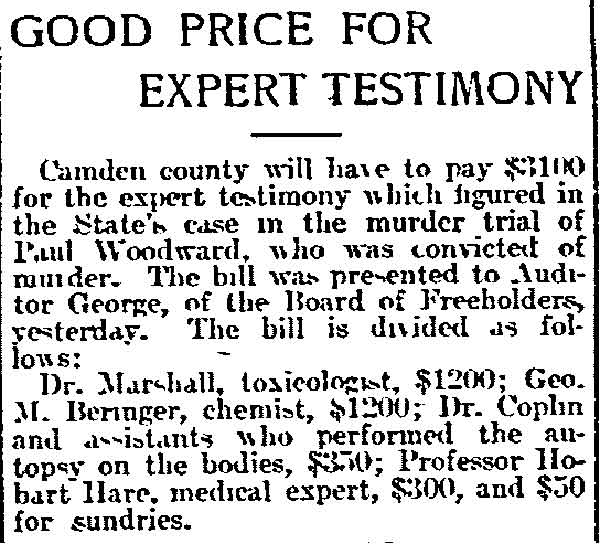
Camden county will have to pay $3100 for the expert testimony which figured in the State’s case in the murder trial of Paul Woodward, who was convicted of murder. The bill was presented to Auditor George, of the Board of Freeholders, yesterday. The bill is divided as follows: Dr. Marshall, toxicologist, $1200; Geo. M. Beringer, chemist, $1200; Dr. Cophn and assistants who performed the autopsy on the bodies, $350; Professor Hobart Hare, medical expert, $300, and $50 for sundries.
Murderer Woodward Visited by a Minister
Philadelphia Inquirer —
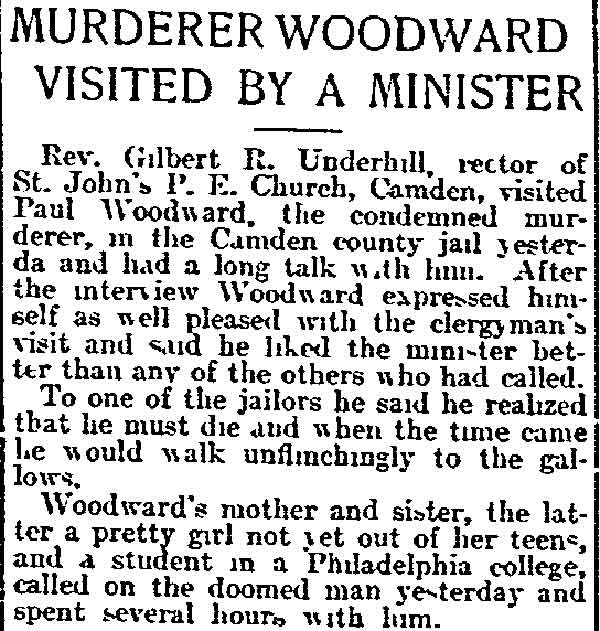
Rev. Gilbert R. Underhill, rector of St. John’s P. E. Church, Camden, visited Paul Woodward, the condemned murderer, in the Camden county jail yesterday and had a long talk with him. After the interview Woodward expressed himself as well pleased with the clergyman’s visit and said he liked the minister better than any of the others who had called.
To one of the jailors he said he realized that he must die and when the time came he would walk unflinchingly to the gallows.
Woodward’s mother and sister, the latter a pretty girl not yet out of her teens, and a student in a Philadelphia college, called on the doomed man yesterday and spent several hours with him.
Will Try to Save Woodward’s Neck
Philadelphia Inquirer —
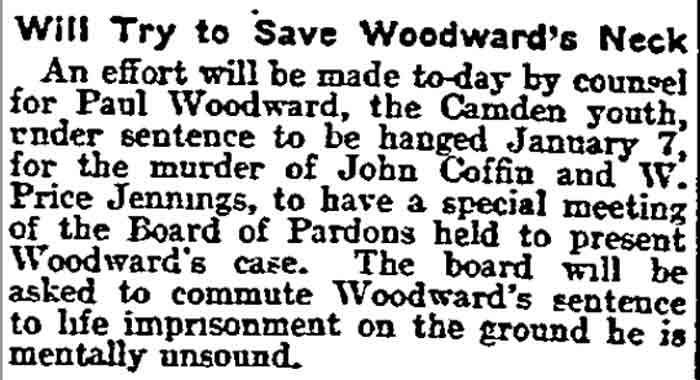
An effort will be made to-day by counsel for Paul Woodward, the Camden youth, under sentence to be hanged January 7, for the murder of John Coffin and W. Price Jennings, to have a special meeting of the Board of Pardons held to present Woodward’s case. The board will be asked to commute Woodward’s sentence to life imprisonment on the ground he is mentally unsound.
Annoys Prisoners With “Music”
Philadelphia Inquirer —
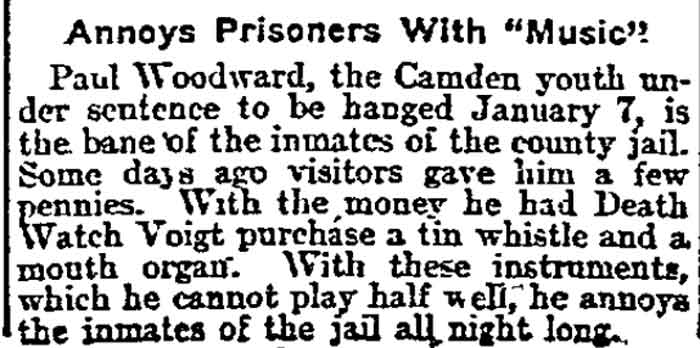
Paul Woodward, the Camden youth under sentence to be hanged January 7, is the bane of the inmates of the county jail. Some days ago visitors gave him a few pennies. With the money he had Death Watch Voigt purchase a tin whistle and a mouth organ. With these instruments, which he cannot play half well, he annoys the inmates of the jail all night long.
Murderer Given Talking Machine
Philadelphia Inquirer —
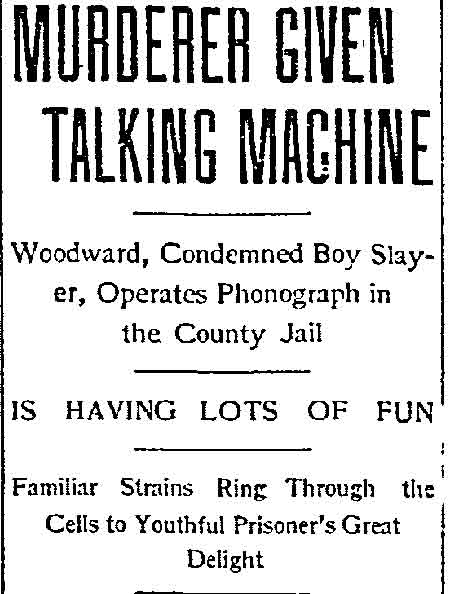
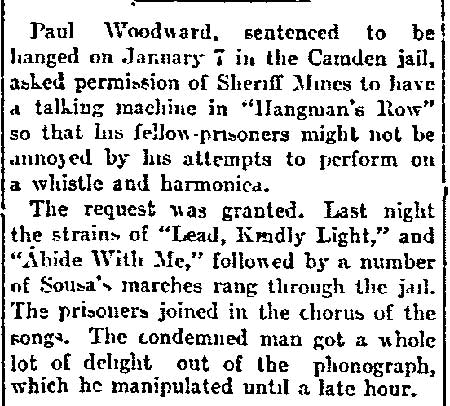
Woodward, Condemned Boy Slayer, Operates Phonograph in the County Jail
IS HAVING LOTS OF FUN
Familiar Strains Ring Through the Cells to Youthful Prisoner’s Great Delight. Click image for PDF.
Plenty of Amusement for Young Woodward
Philadelphia Inquirer —
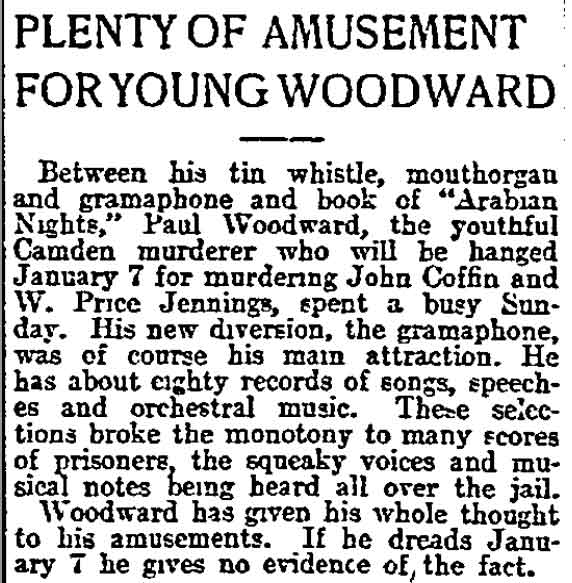
Between his tin whistle, mouthorgan and gramaphone and book of “Arabian Nights,” Paul Woodward, the youthful Camden murderer who will be hanged January 7 for murdering John Coffin and W. Price Jennings, spent a busy Sunday. His new diversion, the gramaphone, was of course his main attraction. He has about eighty records of songs, speeches and orchestral music. These selections broke the monotony to many scores of prisoners, the squeaky voices and musical notes being heard all over the jail.
Woodward has given his whole thought to his amusements. If he dreads January 7 he gives no evidence of the fact.
Pardon Board on Woodward’s Case
Philadelphia Inquirer —
Governor Will Reprieve Prisoner If Action Is Not Taken by December 24
TRENTON, N. J., Dec. 16—The case of Paul Woodward, the condemned Camden murderer, is to be considered by the Court of Pardons. This was promised to-day by Governor Murphy to Lawyer Fred A. Rex. Governor Murphy says if the case has not been reached when the court adjourns, December 24, he will grant Woodward a reprieve until some action is taken.
Mr. Rex’s ground for appeal is that there was some intermarrying of relatives in Woodward’s family which might justify a degree of insanity that would warrant the commutation of the condemned man’s sentence.
In the jail at Camden Woodward continues to amuse himself with his gramophone. He is sanguine of getting his death sentence commuted. He eats and sleeps regularly and apparently does not worry in the least.
Knife Found in Woodward’s Cell
Philadelphia Inquirer —
Its Discovery Apparently Explains the Murderer’s Declaration That He Would Never Be Hanged
The seeming confidence with which Paul Woodward, sentenced to be hanged January 7 in the Camden county jail for the murder of the Jennings and Coffin boys, expressed himself that he would not be executed was easily accounted for when in a search of his cell the other day a pocket knife with an edge as keen as a razor was found.
Several times had the officials searched the cell thoroughly as they supposed. Each time Woodward met their efforts with a mocking laugh. Convinced that there was something hidden one of the “watch” placed his fingers in a pipe in the cell and pulled forth the knife. Woodward has not done very much talking since—except to his favorite keeper. Click image for PDF.
Trying to Save Woodward’s Neck
Philadelphia Inquirer —
The New Jersey Court of Pardons, in secret session, yesterday, gave a hearing to counsel for Paul Woodward, the Camden murderer, who is under sentence to be hanged on January 7. Counsel asked for a commutation of sentence on the ground of insanity.
The court postponed decision in the matter until next Tuesday, in order to give counsel an opportunity to present testimony.
Murderer Woodward Had Merry Christmas
Philadelphia Inquirer —
Paul Woodward, the youthful murderer in the Camden County Jail under sentence of death for killing John Coffin and W. Price Jennings, spent a happy Christmas.
It was a happy one because he had plenty to eat—stewed chicken, mince pie, candy, etc.—and also because he has an idea he will not be hanged, at least on January 7.
Last Effort to Save Woodward
Philadelphia Inquirer —
Lawyer Frederick A. Rex, counsel for Paul Woodward, the youth under sentence to be hanged January 7 for the murder of John Coffin and W. Price Jennings, will go to Trenton to-day to ask that Woodward’s sentence be commuted to life imprisonment.
Woodward’s counsel has little prospect of getting anything favorable from the Board of Pardons, however.
Woodward’s Last Hope Vanished
Philadelphia Inquirer —
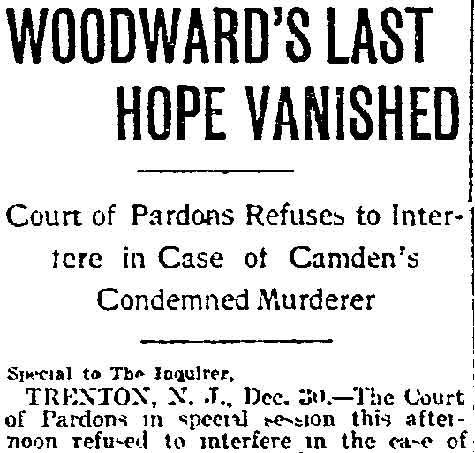
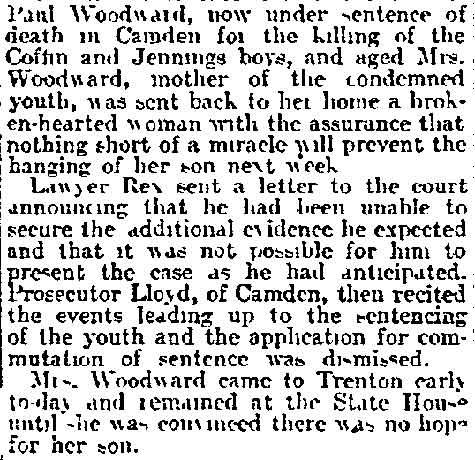
Court of Pardons Refuses to Interfere in Case of Camden’s Condemned Murderer
Trenton, N. J., Dec. 30—The Court of Pardons in special session this afternoon refused to interfere in the case of Paul Woodward, Camden’s condemned murderer. Click image for PDF.
Murderer Woodward Unconcerned
Philadelphia Inquirer —
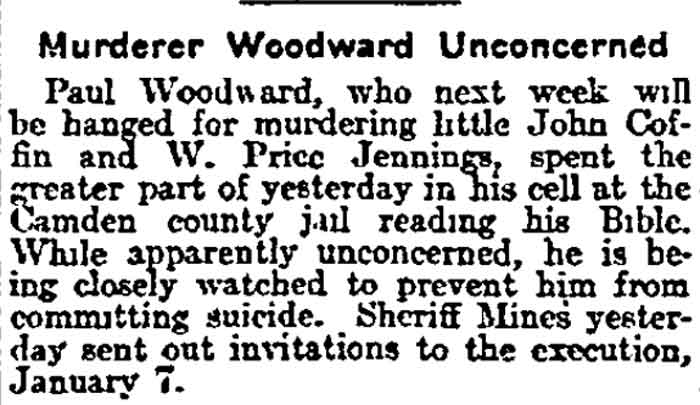
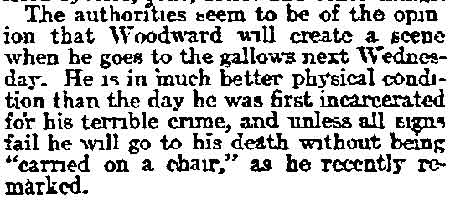
Paul Woodward, who next week will be hanged for murdering little John Coffin and W. Price Jennings, spent the greater part of yesterday in his cell at the Camden county jail reading his Bible. While apparently unconcerned, he is being closely watched to prevent him from committing suicide. Sheriff Mines yesterday sent out invitations to the execution, January 7.
Unconcerned at Death’s Approach
Philadelphia Inquirer —
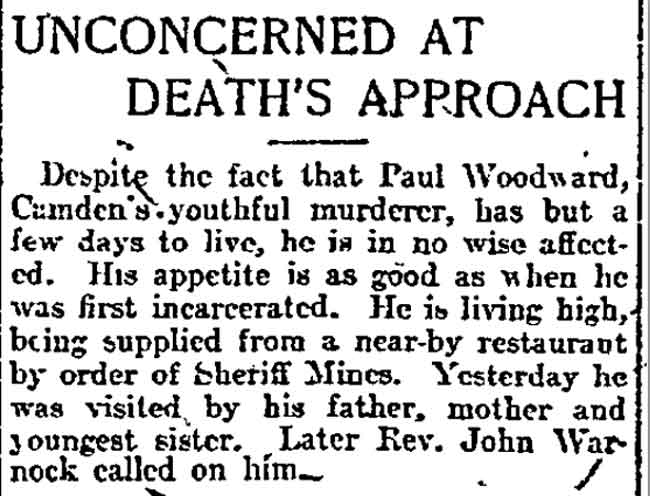
Despite the fact that Paul Woodward, Camden’s youthful murderer, has but a few days to live, he is in no wise affected. His appetite is as good as when he was first incarcerated. He is living high, being supplied from a near-by restaurant by order of Sheriff Mines. Yesterday he was visited by his father, mother and youngest sister. Later Rev. John Warnock called on him.
Woodward’s Last Sunday on Earth
Philadelphia Inquirer —
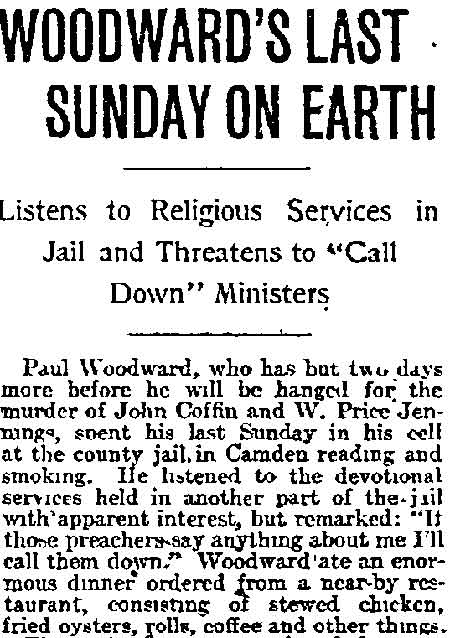
Listens to Religious Services in Jail and Threatens to “Call Down” Ministers
Paul Woodward, who has but two days more before he will be hanged for the murder of John Coffin and W. Price Jennings, spent his last Sunday in his cell at the county jail in Camden reading and smoking. He listened to the devotional services held in another part of the jail with apparent interest, but remarked: “If those preachers say anything about me I’ll call them down.” Woodward ate an enormous dinner ordered from a near-by restaurant, consisting of stewed chicken, fried oysters, rolls, coffee and other things. Click image for PDF.
“I’ll Be a Dead One”—Woodward
Philadelphia Inquirer —
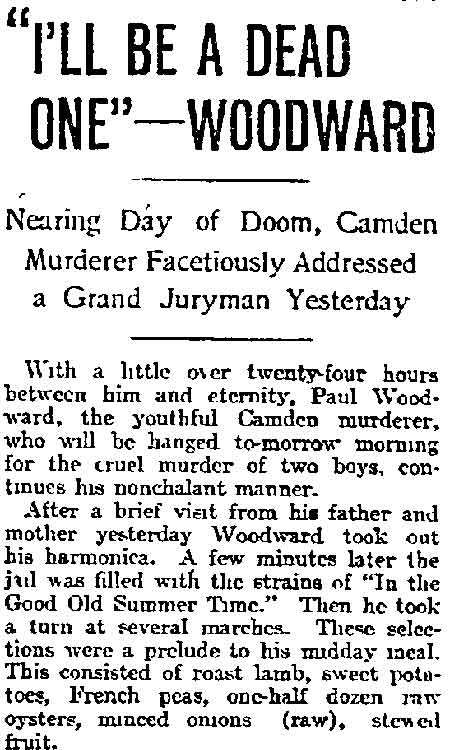
Nearing Day of Doom, Camden Murderer Facetiously Addressed a Grand Juryman Yesterday
With a little over twenty-four hours between him and eternity, Paul Woodward, the youthful Camden murderer, who will be hanged to-morrow morning for the cruel murder of two boys, continues his nonchalant manner.
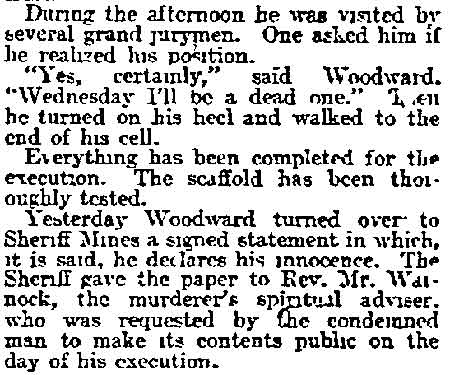
After a brief visit from his father and mother yesterday Woodward took out his harmonica. A few minutes later the jail was filled with the strains of “In the Good Old Summer Time.” Then he took a turn at several marches. These selections were a prelude to his midday meal. This consisted of roast lamb, sweet potatoes, French peas, one-half dozen raw oysters, minced onions (raw), stewed fruit. Click image for PDF.
Woodward’s Nerve Fast Leaving Him
Philadelphia Inquirer —
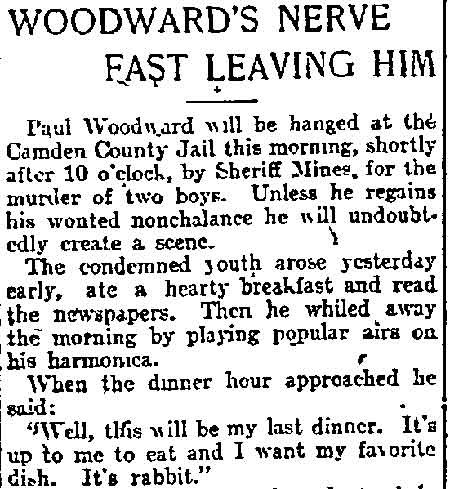
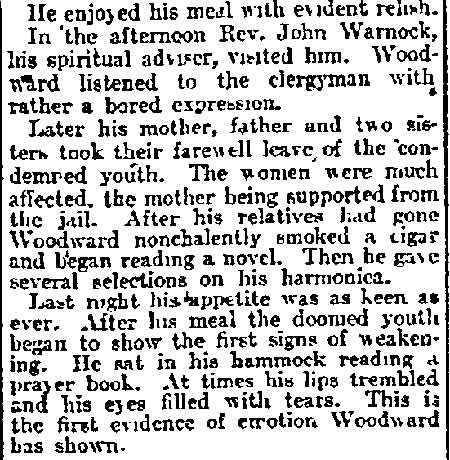
Paul Woodward will be hanged at the Camden County Jail this morning, shortly after 10 o’clock, by Sheriff Mines, for the murder of two boys. Unless he regains his wonted nonchalance he will undoubtedly create a scene.
The condemned youth arose yesterday early, ate a hearty breakfast and read the newspapers. Then he whiled away the morning by playing popular airs on his harmonica.
When the dinner hour approached he said: “Well, this will be my last dinner. It’s up to me to eat and I want my favorite dish. It’s rabbit.” Click image for PDF.
Woodward Hanged To-Day
Wilkes Barre Times —
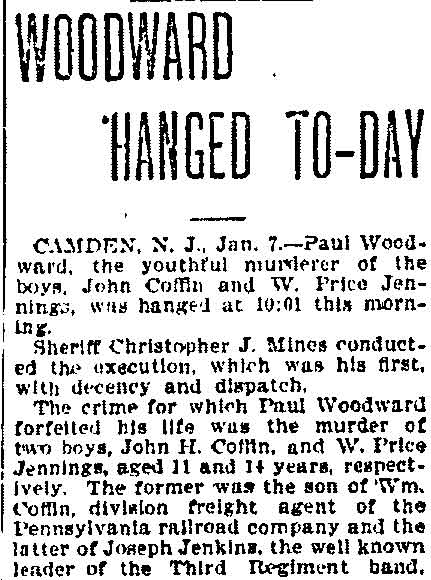
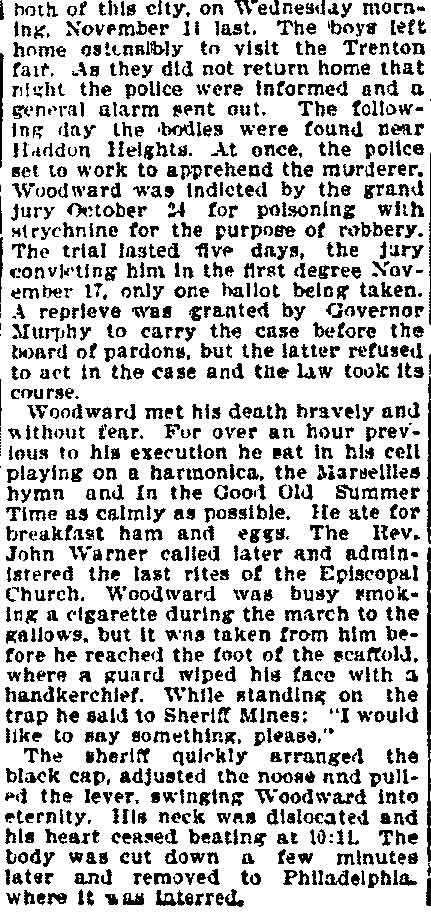
CAMDEN, N. J., Jan. 7.—Paul Woodward, the youthful murderer of the boys, John Coffin and W. Price Jennings, was hanged at 10:01 this morning.
Sheriff Christopher J. Mines conducted the execution, which was his first, with decency and dispatch.
The crime for which Paul Woodward forfeited his life was the murder of two boys, John H. Coffin and W. Price Jennings, aged 11 and 14 years, respectively. The former was the son of Wm. Coffin, division freight agent of the Pennsylvania railroad company and the latter of Joseph Jenkins, the well known leader of the Third Regiment band.
Paul Woodward Goes to Gallows
Philadelphia Inquirer —
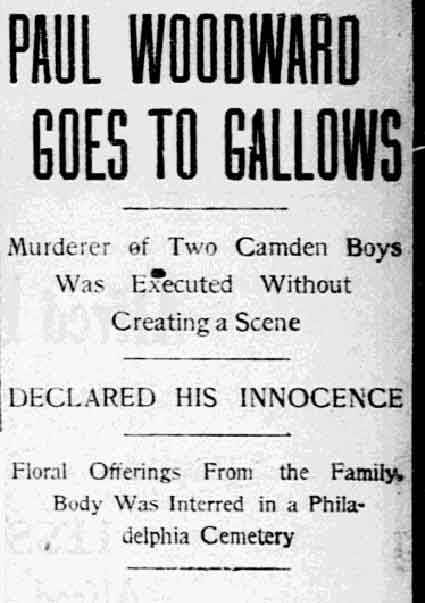
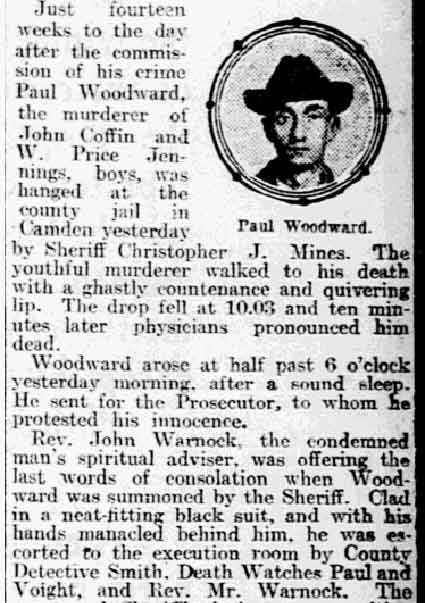
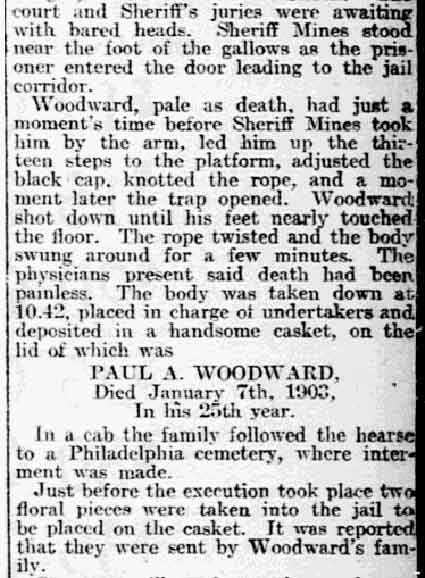
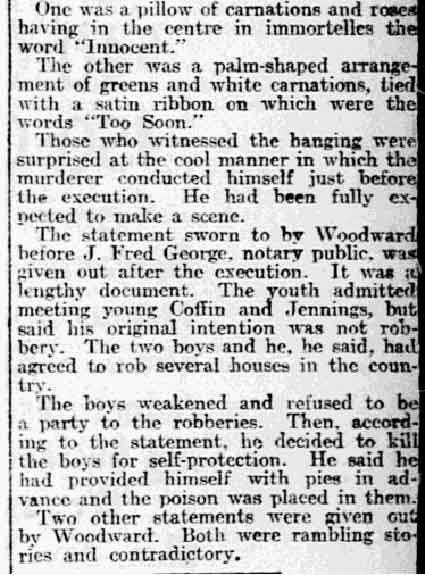
Murderer of Two Camden Boys Was Executed Without Creating a Scene
DECLARED HIS INNOCENCE
Floral Offerings From the Family, Body Was Interred in a Philadelphia Cemetery. Mentioned: Samuel Paul, Fred George.
Murder Case Finally Closed
Philadelphia Inquirer —
The last chapter in the murder of John Coffin and W. Price Jennings, for which Paul Woodward was recently hanged, was enacted yesterday when Prosecutor Lloyd directed County Clerk Patterson to cancel the indictment charging Woodward with the murder of young Jennings. It was done simply to make the records in the case complete.
Camden to Have Another Daily Newspaper
Philadelphia Inquirer —
Camden is to have another daily newspaper. The stockholders met yesterday and elected these officers: President, George M. Beringer; vice president, William E. Anthony; secretary, Newton B. T. Roney; treasurer, John Danenhower. It will be called the Daily News, and while it is to be a business proposition, it will be established mainly for the advocacy of the Colby-Record movement in New Jersey. It will be opposed to present local political conditions.
Want Property for Wharves
Philadelphia Inquirer —
Camden’s Board of Trade has received much support from the local business men in connection with the contemplated project for the city to purchase the extensive Dialogue property. Located below Kaighn’s Point and of considerable area, the property is looked upon as ideal for the establishment of municipal wharves. A special committee of the board, including Charles S. Boyer, George M. Beringer, William J. Cooper and Charles M. Curry, has been looking into the proposition and it was stated yesterday that the movement will shortly be brought to a focus. At present the property is in the hands of a receiver and the committee believes it could be purchased at better advantage than if a private corporation was in possession.
The Smoke Nuisance and Its Abatement
Camden Board of Trade —
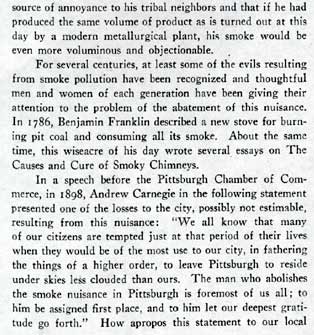
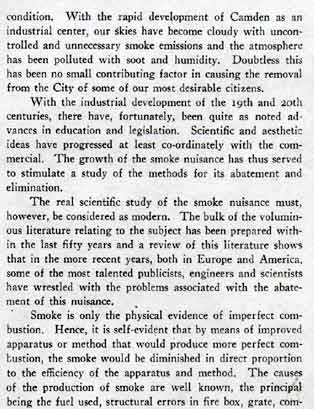
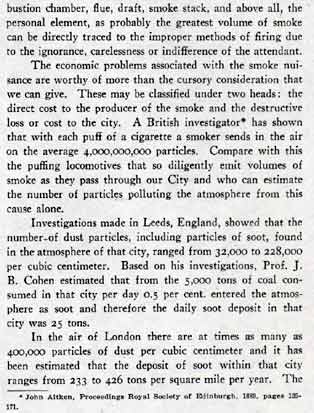
Camden Board of Trade, May 1916 — featuring Dr. George M. Beringer.
Police Department Changes
Philadelphia Inquirer —
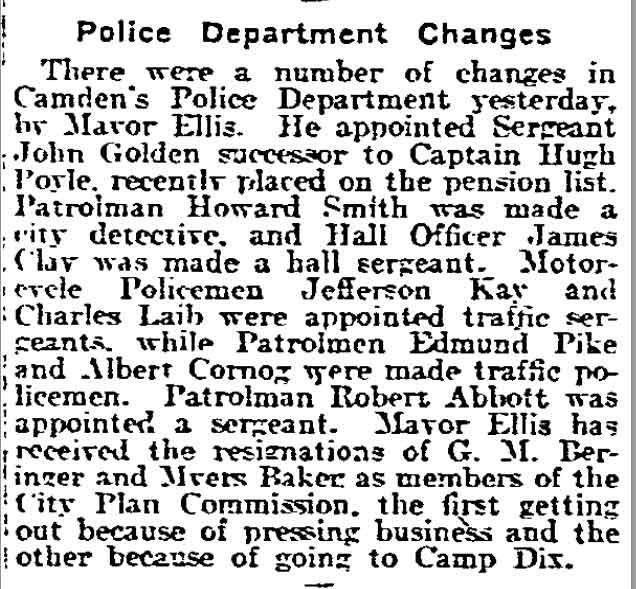
Philadelphia Inquirer, January 1, 1918. Mentioned: Albert L. Cornog, Charles Ellis, John Golden, Hugh Boyle, Howard Smith, James Clay, Charles Laib, Jefferson Kay, Edmund Pike, Robert Abbott, George M. Beringer, Meyers Baker.
From South Jersey: A History 1624–1924
GEORGE M. BERINGER—As a practicing pharmacist, as a manufacturer of pharmaceutical preparations and ethical medicines, as an expert in State and Federal courts in cases involving medicines and poisons, as an editor and author of notable repute in his profession, and as a leader in scientific and professional societies, Dr. George M. Beringer, the distinguished pharmacist of Camden, New Jersey, has few rivals to compete with him for supremacy in his profession. His manifold activities cover practically every phase of pharmacy, and whenever vital decisions affecting the profession are to be made his suggestion or advice is generally sought.
George M. Beringer, who designates himself simply as chemist and pharmacist, was born in Philadelphia, Pennsylvania, February 3, 1860, the son of Levi D. and Rebecca (Reinhart) Beringer. He received his preliminary education in the public schools and in the Central High School of Philadelphia, from which he was graduated in 1876, with the degree of Bachelor of Arts, and from which he received the Master’s degree five years later.
His early education developed a predisposition toward the sciences and he decided to take up the drug business as a vocation. Within a few weeks after graduating from high school he entered the employ of Bullock & Crenshaw, a leading Philadelphia firm engaged in the wholesale and retail drug business and in the supplying of chemicals and laboratory apparatus. Determined to thoroughly master student detail of his chose calling, he became a student in pharmacy and chemistry at the Philadelphia College of Pharmacy and was graduated from in l880. The degree of scholarship to which this testifies is the better realized when it is recalled that he was then only twenty years of age. Not contented with his knowledge of analytical chemistry and the methods of research, he took post-graduate instruction in the evenings with Dr. Henry Leffmann, the noted chemist and toxicologist, of Philadelphia, in the doctor’s private laboratory. In 1903, in recognition of his attainments and the valuable contributions to the various fields of science related to pharmacy, the Philadelphia College of Pharmacy conferred upon, him the honorary degree of Master of Pharmacy. In 1914, the University of the State of New Jersey bestowed upon him the honorary degree of Doctor of Pharmacy.
After his graduation, George M. Beringer continued the practice of pharmacy in Philadelphia, where he remained with his preceptors for twelve years more. During the period he rose rapidly in the esteem of the profession, and the important responsibilities which devolved upon him, he ably managed.
In 1892, he resigned to engage in business on his own account. He purchased the retail pharmacy of the late Albert P. Brown, which had been established at the northeast corner of Federal and Fifth streets, Camden, since 1862, and enjoyed the confidence of the medical profession and the patronage of the leading citizens of Camden City and surrounding suburban communities. This business under the management of Mr. Beringer has been continuously developed and expanded until it now embraces, in addition to the thoroughly equipped retail pharmacy, a wholesale department and laboratories for the manufacture of high class medical and pharmaceutical supplies, perfumes and toilet articles. The demands of this growing business became such, that in 1921 it was incorporated under the name of George M. Beringer, Inc., and properties situated at the southeast corner of Federal and Fifth streets with a frontage of forty feet and a depth of one hundred and forty-five feet with light and street ways on three sides, were purchased as the site for the future home of the business and to meet the present and future needs of the greatly expanded enterprise. This corporation is destined to become one of the largest in the country and its business is becoming more and more national in its scope, Dr. Beringer’s unimpeachable reputation giving the firm a standing that is of incalculable value, in the pursuit of the manufacture and sale of pharmaceutical preparations and reliable standard medicines.
His scientific connections are many. In 1892 he was chosen as the director of the Microscopical Laboratory, then conducted by the Alumni Association of the Philadelphia College of Pharmacy, and performed the duties of this position for two years until the association turned the laboratory over to the botanical department of the institution. For four years (1917–1921) he was editor of the American Journal of Pharmacy, the oldest American publication in its field. He has served as a member of the Committee of Revision of the United States Pharmacopoeia for the decade 1910–1920, and also during two revisions as a member of the Committee of Revision of the National Formulary. For a period of twenty-eight years (1893–1921) he was a trustee of his alma mater, the Philadelphia College of Pharmacy, and chairman of its board of trustees from 1910 to 1921. In 1913–14 he was president of the American Pharmaceutical Association, which bears the same important relations to pharmacy as the American Medical Association bears to medicine. Of this organization he has been a member for many years and presided at the annual meeting held in Detroit in 1914. He is a member also of the American Chemical Society, the Academy of Natural Science of Philadelphia, the Philadelphia Botanical Club, which he served for a time as president; the National Pharmaceutical Service Association, of which he was president during 1917–19, the period of American participation in the World War; and the New Jersey Pharmaceutical Association, of which he was president in 1905; and he is an honorary member of the Pennsylvania Pharmaceutical Association and of the Maryland Pharmaceutical Association.
Dr. Beringer has written many articles published in current pharmaceutical publications. He has served the State and Federal Government as chemical expert in several noted criminal cases, as well as in civil cases requiring special knowledge of toxicology, chemical methods and trade conditions. He is an adherent of Democratic principles in politics and was a member of the first Camden City Plan Commission. He was active in the Camden Board of Trade and has been a director in its successor, the Camden Chamber of Commerce, serving on a number of important committees. He is a member of the Methodist Episcopal church and his club affiliations are the Rotary Club, the Civic Club, the Camden Club, and the Philadelphia Botanical Club.
Dr. Beringer married, October 3, 1882, Estella F. Wolfe, of Camden, daughter of George Washington Wolfe and Ezilda (Rendolph) Wolfe, and they are the parents of two children: 1. George M., Jr., born January 30, 1884, a graduate of the Philadelphia College of Pharmacy, and now associated with his father in business. He was formerly president of the New Jersey Pharmaceutical Association, and member of the State Board of Pharmacy. 2. Franklin L., born December 27, 1885, died August 9, 1907.
Rotary Club Lends to 16 College Boys
Camden Courier-Post —
Eight Camden Youths, Now Graduates, Are Repaying Loans
Eight Camden boys last September were able to continue their studies in college and universities because, back in 1923, a Camden service club established a loan fund to aid worthy students.
Eight Camden boys, graduates of college, now are repaying various amounts of money advanced them from the College Loan Fund of the Camden Rotary Club. Five years ago, the club raised by subscription among its members a fund of $2,500. This has been augmented each year by appropriations from the club funds, and now the college loan fund amounts to nearly $5,000.
College and university students, both boys and girls, from Camden County, are eligible to borrow.
The fund is administered by a board of trustees, including Dr. George M. Beringer, chairman; Arthur E. Armitage, Treasurer; Charles H. Wagner, George Vollner, and Edward A. Mechling.
No Interest is charged until one year after graduation. It is the hope of the Rotary Club that loans will be re-paid “first obligation” during the “first year out.”
Of the sixteen students helped by the fund, four have gone to Syracuse University, two each to Gettysburg, Lehigh and Springfield and one each to George Washington University, University of Delaware, Rutgers, Swarthmore, Cornell and the Silver Bay School.
To add to this fund the Rotary Club will produce during the centennial celebration in Camden next month one of the most elaborate semi-professional shows ever staged in this region. This “Rotary Revue” will be staged at the New Walt Whitman Theatre, Forty-eighth Street and Westfield Avenue, February 27 and 28.
William M. Ogden, product of the dramatic school of Syracuse University and a protégé of Miss Lucy Dean Wilson, is in charge of the production. It will feature, among other acts, the Newton Coal Serenaders, who are well known from their frequent weekly radio broadcasts of the Newton Coal Radio Forum. Through the generosity of Charles A. Johnson, president of the George B. Newton Coal Company, Clarence Fuhrman, Camden musician, will be guest-conductor at both performances.
“We Make It”
Camden Courier-Post —
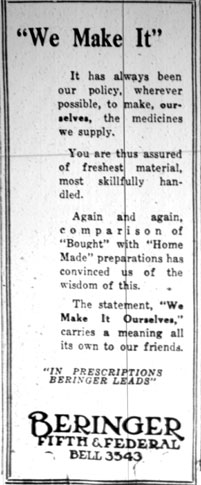
“We Make It”
It has always been our policy, wherever possible, to make, ourselves, the medicines we supply.
You are thus assured of freshest material, most skillfully handled.
Again and again, comparison of “Bought” with “Home Made” preparations has convinced us of the wisdom of this.
The statement, “We Make It Ourselves,” carries a meaning all its own to our friends.
“IN PRESCRIPTIONS BERINGER LEADS” — BERINGER, FIFTH & FEDERAL, BELL 3543
Garage Watchman Foils Whiskey Theft
Camden Courier-Post —
Tells Police of Man With Box; Liquor From Drugstore Found
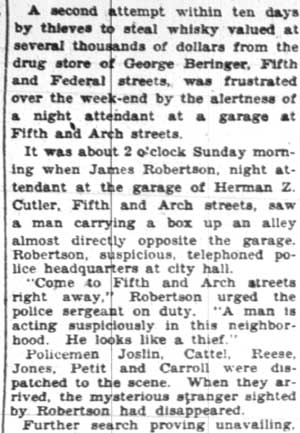
A second attempt within ten days by thieves to steal whisky valued at several thousands of dollars from the drug store of George Beringer, Fifth and Federal streets, was frustrated over the week-end by the alertness of a night attendant at a garage at Fifth and Arch streets.
It was about 2 o’clock Sunday morning when James Robertson, night attendant at the garage of Herman Z. Cutler, Fifth and Arch streets, saw a man carrying a box up an alley almost directly opposite the garage. Robertson, suspicious, telephoned police headquarters at city hall.
“Come to Fifth and Arch streets right away,” Robertson urged the police sergeant on duty. “A man is acting suspiciously in this neighborhood. He looks like a thief.”
Policemen Joslin, Cattel, Reese, Jones, Petit and Carroll were dispatched to the scene. When they arrived, the mysterious stranger sighted by Robertson had disappeared.
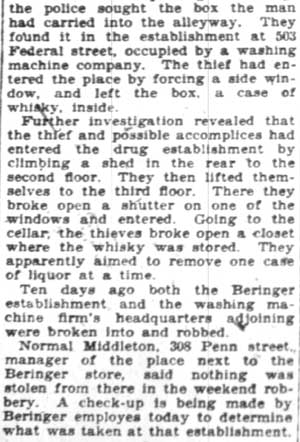
Further search proving unavailing, the police sought the box the man had carried into the alleyway. They found it in the establishment at 503 Federal street, occupied by a washing machine company. The thief had entered the place by forcing a side window, and left the box, a case of whisky, inside.
Further investigation revealed that the thief and possible accomplices had entered the drug establishment by climbing a shed in the rear to the second floor. They then lifted themselves to the third floor. There they broke open a shutter on one of the windows and entered. Going to the cellar, the thieves broke open a closet where the whisky was stored. They apparently aimed to remove one case of liquor at a time.
Ten days ago both the Beringer establishment and the washing machine firm’s headquarters adjoining were broken into and robbed.
Normal Middleton, 308 Penn street, manager of the place next to the Beringer store, said nothing was stolen from there in the weekend robbery. A check-up is being made by Beringer employees today to determine what was taken at that establishment.
The Beringer Family Plot at Harleigh Cemetery, Camden NJ
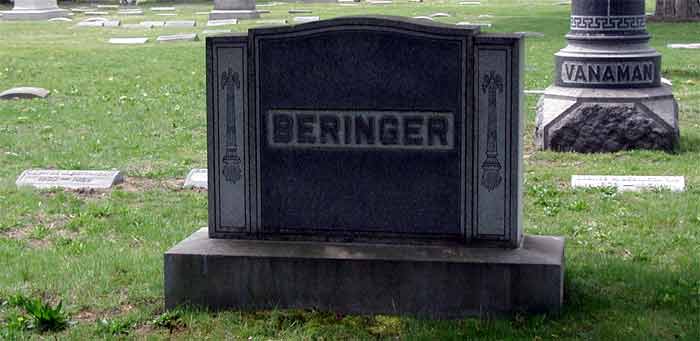


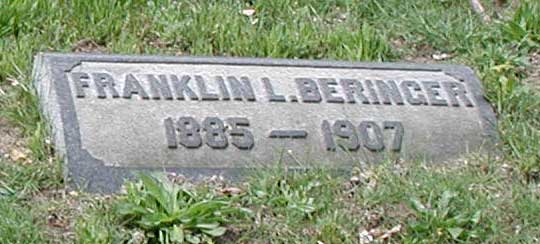
The Beringer family plot at Harleigh Cemetery, Camden NJ.
We Celebrate
Camden Courier-Post —
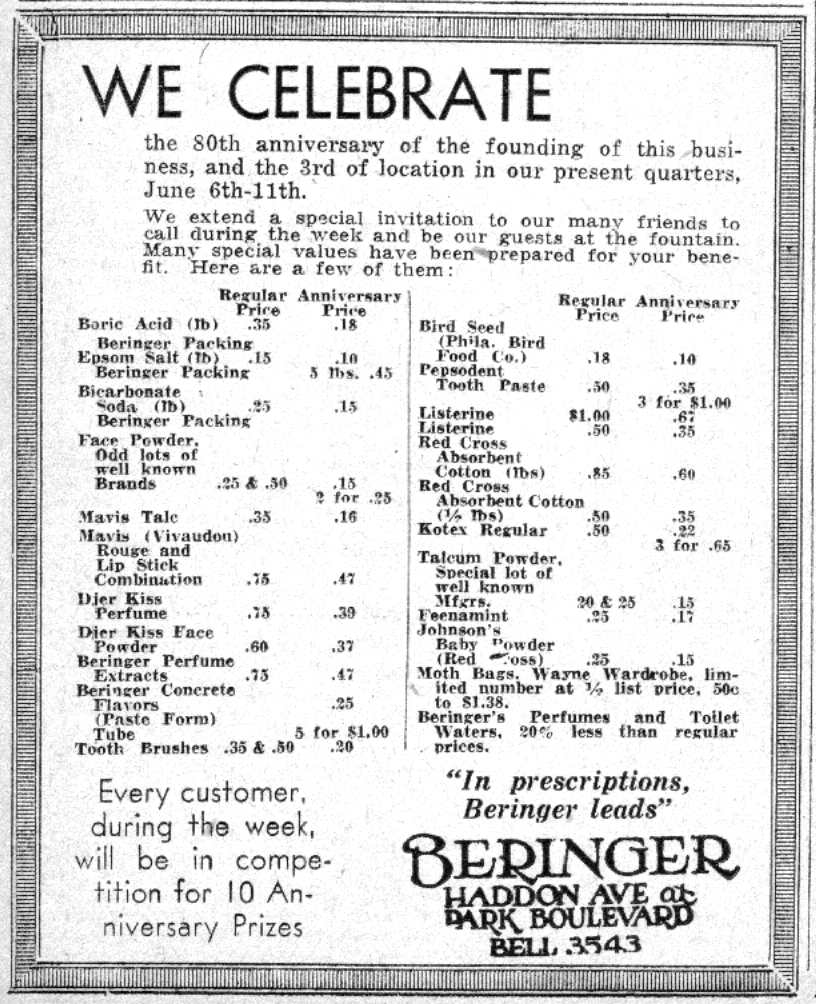
the 80th anniversary of the founding of this business, and the 3d of location in our present quarters, June 6th-11th.
We extend a special invitation to our many friends to call during the week and be our guests at the fountain. Many special values have been prepared for your benefit.
Every customer, during the week, will be in competition for 10 Anniversary Prizes. “In prescriptions, Beringer leads.” BERINGER, HADDON AVE & PARK BOULEVARD, BELL 3543