Introduction
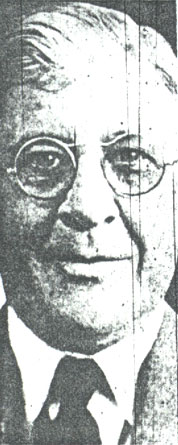
Frank S. Van Hart
FRANK S. VAN HART was born in 1875 in Pennsylvania. His family moved to Camden when he was a young boy. As a young man he was well known as an athlete. Frank S. Van Hart was widely regarded as one of the best second-basemen in South Jersey, playing for such local teams as the Howards and the Camden Athletic Association. Playing on the same teams as future major league stars William “Wid” Conroy and “Kid” Gleason, Van Hart was said to have turned down several offers to sign with minor league professional teams. In the days prior to million-dollar contracts, there were many superb ballplayers who chose to stay at home, work a regular job, and play semi-pro ball on the side.
Frank Van Hart played football for the Camden Athletic Association, which in those days played its games at North 3rd and Erie Streets. Among his team mates were William French and his brother Samuel J.T. French, George and Martin Bergen, and Tom Peterson. The French brothers and the two Bergens all became lawyers in Camden, and had notable careers, William French rising to the judgeship.
After starting his career with a rope company in Philadelphia, Frank S. Van Hart went to work in the office of the Esterbrook Pen Manufacturing Company in Camden. This led him to a sales job that saw travel to 29 states and Cuba, and culminated with his rise to the position of General Manager.
At the time of the 1920 census Frank S. Van Hart was living with wife Ida and son D. Spencer Van Hart at 851 Haddon Avenue, and working as a manager at the Esterbrook Pen Company. The home was later sold to Robert Blake, who operated a funeral home there from the mid 1940s to the 1960s.
Aligned politically with David Baird Sr., as president of Camden’s City Council Frank S. Van Hart was named to succeed Charles H. Ellis to serve as the acting mayor of Camden NJ in 1922 when Ellis was named as Camden’s Postmaster. He ran for Mayor in the election of 1923, but was defeated by Victor S. King. Frank S. Van Hart was the last Mayor to serve prior to the adoption of the commission system of government.
Frank S. Van Hart returned to private business after leaving the mayor’s office. By 1930 he had moved from Camden to 910 Station Avenue in Haddon Heights NJ. He later took a position as the General Manager of the Camden Lime Company.
Frank S. Van Hart retired in the fall of 1940, and moved to his long-time summer home at Pitman NJ. He died as a result of a sudden heart attack on January 11, 1941. Frank S. Van Hart was buried at Harleigh Cemetery in Camden, where he now rests next to his wife Ida.
Camden’s Mayor Has Field to Himself
Philadelphia Inquirer —
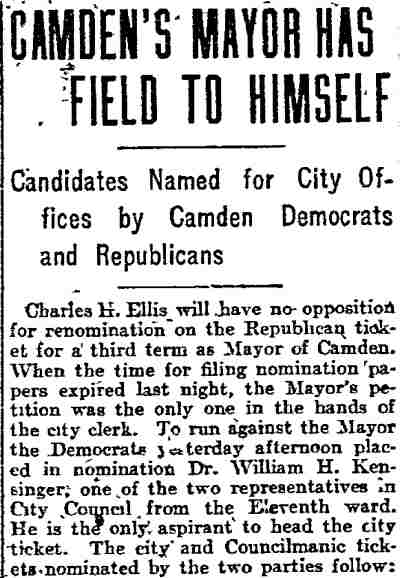
Candidates Named for City Offices by Camden Democrats and Republicans
Charles H. Ellis will have no opposition for renomination on the Republican ticket for a third term as Mayor of Camden. When the time for filing nomination papers expired last night, the Mayor’s petition was the only one in the hands of the city clerk. To run against the Mayor the Democrats yesterday afternoon placed in nomination Dr. William H. Kensinger; one of the two representatives in City Council from the Eleventh ward. He is the only aspirant to head the city ticket. The city and Councilmanic tickets nominated by the two parties follow:
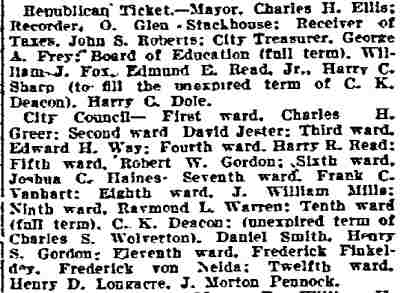
Republican Ticket.—Mayor, Charles H. Ellis; Recorder, O. Glen Stackhouse; Receiver of Taxes, John S. Roberts; City Treasurer, George A. Frey; Board of Education (full term), William J. Fox, Edmund E. Read, Jr., Harry C. Sharp (to fill the unexpired term of C. K. Deacon), Harry C. Dole.
City Council—First ward, Charles H. Greer; Second ward David Jester; Third ward, Edward H. Way; Fourth ward, Harry R. Read; Fifth ward, Robert W. Gordon; Sixth ward, Joshua C. Haines; Seventh ward, Frank C. Vanhart; Eighth ward, J. William Mills; Ninth ward, Raymond L. Warren; Tenth ward (full term), C. K. Deacon; (unexpired term of Charles S. Wolverton), Daniel Smith, Henry S. Gordon; Eleventh ward, Frederick Finkeldey; Frederick von Neida; Twelfth ward, Henry D. Longacre, J. Morton Pennock.
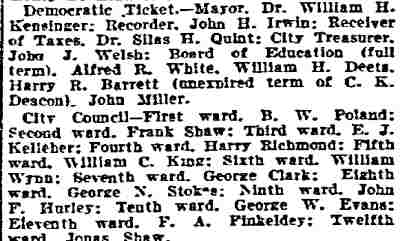
Democratic Ticket.—Mayor, Dr. William H. Kensinger; Recorder, John H. Irwin; Receiver of Taxes, Dr. Silas H. Quint; City Treasurer, John J. Welsh; Board of Education (full term), Alfred R. White, William H. Deets, Harry R. Barrett (unexpired term of C. K. Deacon), John Miller.
City Council—First ward, B. W. Poland; Second ward, Frank Shaw; Third ward, E. J. Kelleher; Fourth ward, Harry Richmond; Fifth ward, William C. King; Sixth ward, William Wynn; Seventh ward, George Clark; Eighth ward, George N. Stokes; Ninth ward, John F. Hurley; Tenth ward, George W. Evans; Eleventh ward, F. A. Finkeldey; Twelfth ward, Jonas Shaw.
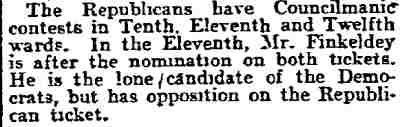
The Republicans have Councilmanic contests in Tenth, Eleventh and Twelfth wards. In the Eleventh, Mr. Finkeldey is after the nomination on both tickets. He is the lone candidate of the Democrats, but has opposition on the Republican ticket.
Retiring Councilman to Serve as President
Philadelphia Inquirer —
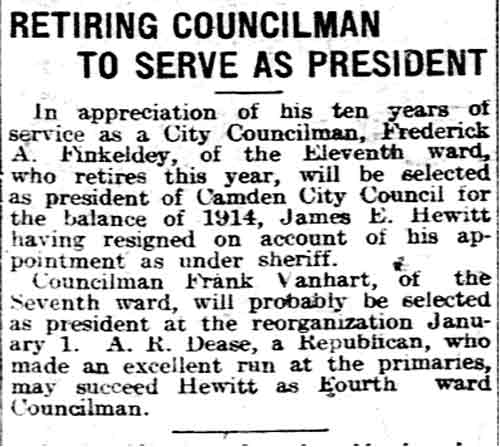
In appreciation of his ten years of service as a City Councilman, Frederick A. Finkeldey, of the Eleventh ward, who retires this year, will be selected as president of Camden City Council for the balance of 1914, James E. Hewitt having resigned on account of his appointment as under sheriff.
Councilman Frank Vanhart, of the Seventh ward, will probably be selected as president at the reorganization January 1. A. R. Dease, a Republican, who made an excellent run at the primaries, may succeed Hewitt as Fourth ward Councilman.
Mary J. Ball Home and Day Nursery
Philadelphia Inquirer —
The Mary J. Ball Home and Day Nursery yesterday elected the following board of trustees: William J. Cooper, William F. Rose, H. C. Sharp, Frank Vanhost, H. C. Dole, L. B. Reoder, Mrs. Stephen Pfeil, Mrs. J. W. F. Bleakly, Mrs. John W. Croft, Mrs. Rose Batters, Dr. Emma M. Richardson. Mrs. Pfeil was elected chairman of the executive committee.
Camden at a Glance
Philadelphia Inquirer —
A very healthy mayoralty boom has been launched in behalf of Councilman Frank Vanhart by his constituents in the Seventh ward. [cut off at the crop edge]
Names River Committee
Philadelphia Inquirer —
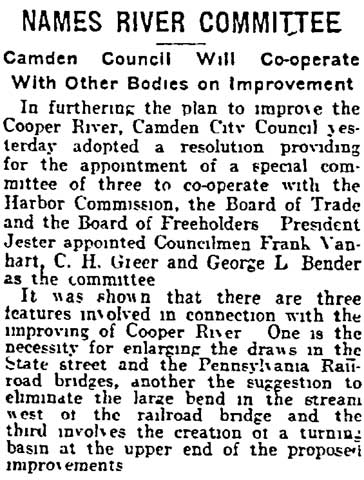
Camden Council Will Co-operate With Other Bodies on Improvement
In furthering the plan to improve the Cooper River, Camden City Council yesterday adopted a resolution providing for the appointment of a special committee of three to co-operate with the Harbor Commission, the Board of Trade and the Board of Freeholders President Jester appointed Councilmen Frank Vanhart, C. H. Greer and George L. Bender as the committee
It was shown that there are three features involved in connection with the improving of Cooper River One is the necessity for enlarging the draws in the State street and the Pennsylvania Railroad bridges, another the suggestion to eliminate the large bend in the stream west of the railroad bridge and the third involves the creation of a turning basin at the upper end of the proposed improvements
Esterbrook Pen Manufacturing Company
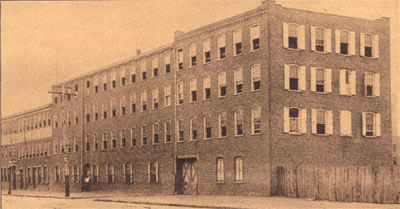
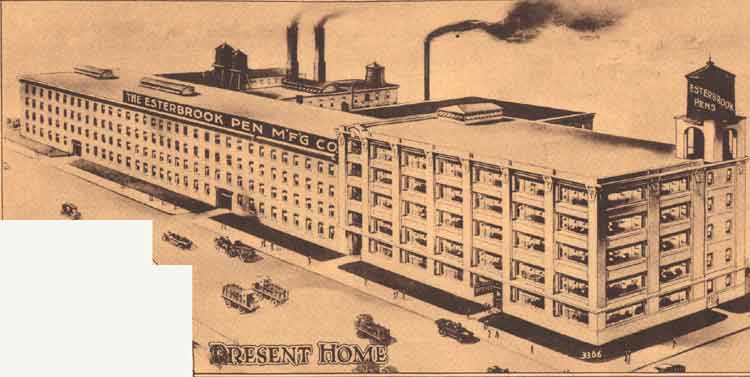
Photo of Esterbrook Pen Manufacturing Co. published in 1915 – Drawing of Esterbrook Pen Manufacturing Co. published in 1926
Camden Lodge of Elks at Broadway and Federal Street
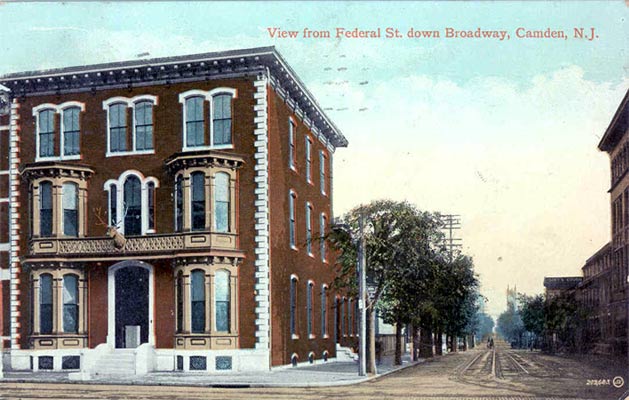
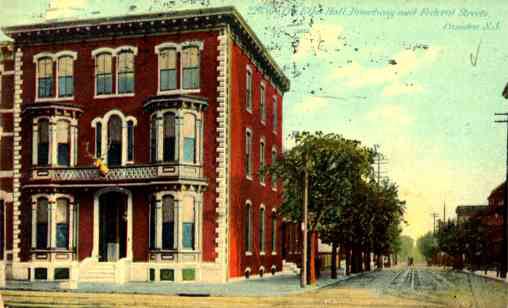
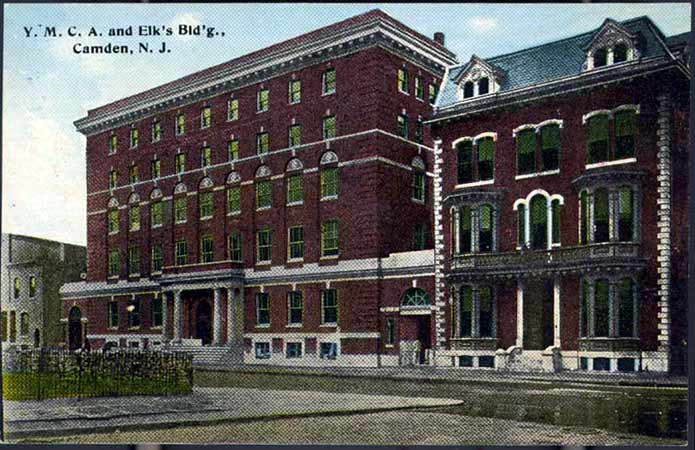
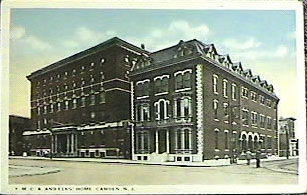
During the 1920s, Frank S. Van Hart was the Exalted Ruler of the Elks Lodge in Camden. He was the last to hold this post while the Elks were at this building, at the south-east corner of Broadway and Federal Street. The Elks erected a new building during the 1920s at 7th and Copper Street, which in 2004 is the home of the LEAP Academy charter school.
Dr. Kirk Joins Medical Corps
Philadelphia Inquirer —
War touched Camden City Council yesterday when a tentative adieu was given Dr Grant E Kirk, who has been a member for many years. He has passed the examination as a member of the Medical Reserve Corps, and is likely to be called at any time Councilman Frank Vanhart voiced the sentiments of his colleagues, when he said Dr. Kirk has been one of the most valuable members of the body
City Plan Commission Appointed
Philadelphia Inquirer —
A City Plan Commission for one year was appointed as follows: T. Gordon Coulter, F. A. Finkeldey, George Kappell, William C. Davis, Theodore T. Kausel, Allen Jarvis, Frank S. Vanhart, Frederick von Nieda and Joseph Forsyth, the last three being members of City Council. Dr. Charles P. Tuttle, Dr. H. F. Bushey, Chief of Police Gravenor and Policeman Charles Whaland were appointed the Police Pension Fund Commission.
Camden County in the Great War
Another weapon to defeat the enemy was the establishment of City Farm Gardens in the country. They were urged by the Government and not only provided food for city residents, but abolished unsightly vacant lots. Mayor Ellis named the first City Gardens Committee on April 19, 1917, as follows: E.G.C. Bleakly, Judge Frank T. Lloyd, Zed H. Copp, William Derham, L.E. Farnham, B.M. Hedrick, David Jester, O.B. Kern, M.F. Middleton, Dr. H.L. Rose, Asa L. Roberts, W.D. Sayrs, Jr., Charles A. Wolverton, Earl T. Jackson, H.R. Kuehner, Herbert N. Moffett and Hubert H. Pfeil. At the initial meeting of the above date B.M. Hedrick was elected chairman; Zed H. Copp secretary and M.F. Middleton treasurer. Brandin W. Wright, a farming expert, was employed as general superintendent on May 3, 1917. At a meeting on May 18, 1918, the names of Frank Sheridan and Daniel P. McConnell were added to the publicity committee in the place of Messrs. Pfeil and Jackson.
In his annual report to City Council on January 1, 1918, Mayor Ellis urged the appointment of a committee by City Council on City Gardens and Councilman Frederick Von Neida was named as chairman. This committee with a committee of representative citizens met in the City Hall in February, 1918, to organize for the ensuing summer. The members of the Councilmanic committee were: Frederick Von Neida, Frank S. Van Hart, William J. Kelly and John J. Robinson.
The committee planned an exposition of farm garden products for the fall of 1918, but this plan was frustrated by the Spanish influenza epidemic.
The war gardens became victory gardens in the year 1919 when the committee met on January 29, 1919. Meyers Baker was elected secretary and William D. Sayrs, Jr., treasurer. At the meeting on March 25 committees were appointed for the Victory War Gardens Exposition held in Third Regiment Armory from September 15 to 20. Benjamin Abrams was elected general manager and Frank Sheridan publicity agent.
Camden Mayor Advises Saving in City Budget
Philadelphia Inquirer —
Only Expenditures for Actual Needs of Municipality Recommended to Council
Mayor Ellis, of Camden, in presenting his annual message to City Council yesterday at its reorganization for the ensuing year, stated that in accordance with the government’s plea for the conservation of our resources, he refrained from offering suggestions that would mean the expenditure of large sums of money. His recommendations were therefore along lines of what he termed the city’s actual needs.
Pointing out that labor scarcity and war restrictions on materials had hampered street construction by the Highway Department, the Mayor stated since the establishment of the city-owned plant 161,[?] square yards of asphalt have been laid, in addition to an almost equal amount of resurfacing and patching, at a cost of much less than charged by private contract. He advocated the purchase of a boat to patrol the river front during the war, and called attention to the need of more men in both the Police and Fire Departments.
In discussing the proposed bridge connecting Camden and Philadelphia, Mayor Ellis stated New Jersey is in readiness to enact the need [sic] legislation, and that all that is necessary to give the project the impetus that will mean its construction is the taking of the necessary steps by the Pennsylvania Legislature.
Mayor Ellis spoke of the wisdom of the establishing of the auxiliary pumping station of the municipal water plant, and stated that during the year it is planned to bore more artesian wells. He urged that a special committee be appointed to supervise and lend financial aid to the summer war gardens. In connection with the library, the Mayor advocated the purchase of such books as will fit the youth of the city for the changed conditions brought about by the war.
Council confirmed a number of appointments recommended by Mayor Ellis. William H. Davis was reappointed a member of the City Board of Assessors, and Howard M. Cooper and Thomas French were made members of the Board of Library Trustees, the first succeeding himself, and the latter Wilbur F. Rose, resigned. Dr. A. Haines Lippincott was appointed police and fire surgeon, succeeding the late Dr. E. A. Y. Schellenger. Herbert A. Munger was reappointed a member of the Sinking Fund Commission for three years.
A City Plan Commission for one year was appointed as follows: T. Gordon Coulter, F. A. Finkeldey, George Kappell, William C. Davis, Theodore T. Kausel, Allen Jarvis, Frank S. Vanhart, Frederick von Nieda and Joseph Forsyth, the last three being members of City Council. Dr. Charles P. Tuttle, Dr. H. F. Bushey, Chief of Police Gravenor and Policeman Charles Whaland were appointed the Police Pension Fund Commission.
There are but two new members of City Council, William J. Kelly, of the Eighth ward, and Clifford K. Deacon, of the Tenth ward.
Camden Hails Her Sons, Conquerors, at Victory Jubilee
Philadelphia Inquirer —
Battle Flags Wave in Triumph O’er Parade Reviewed by Admiral
Gray Veterans of G. A. R. and Wounded Ride; Centopath Passes in Reverential Hush
The Peace with victory which Camden’s sons along with millions of other soldiers of all the Allied countries helped to bring home was celebrated by a jubilee in Camden yesterday which eclipsed anything that the city across the Delaware has ever attempted in her history.
Nearly every man, woman and child who did not actually march in the jubilee parade stood on the side lines and watched it and cheered themselves hoarse as the soldiers and sailors who went out from their town to fight marched past, this time as the conquerors in the world’s greatest war.
Favored by glorious sunshine, a sunshine that was reflected in the faces of the people, the day’s proceedings went off perfectly. For months Mayor Ellis and all his city family, together with a large committee of leading citizens, had been planning the affair. Their handiwork stood the test. It was good.
Admiral Henry Wilson, commander-in-chief of the Atlantic Fleet, came to his boyhood home to be the principal guest of the city and chief reviewing officer of the jubilee. With him were national statesmen and municipal officials.
Soldiers, sailors, war workers, members of fraternal orders and men who fought under the flags of Canada, England, Italy and Poland, marched in the parade which was miles long. Every succeeding division seemed just a little better than the one which preceded it, and, when it was all over and the soldiers and sailors had filed into the old Third Regiment Armory to sit down to a piping hot banquet, the hardest thing of all was to say which had made the finest showing.
All Honor to the Dead
Amidst all the gayety and happiness there was a sober note expressed by the memorial cenotaph which preceded the parade and which brought every hat off as it passed in solemn silence.
The heroic figure of an American soldier in bronze standing on a granite pedestal which bore a gold star with the number 135, symbolical of the Camden county men who laid down their lives in their country’s cause, was carried along the route ten minutes before the parade commenced. Encircler [sic] by flowers and palms, it moved through the reverential hush which had fallen over the throngs.
While every organization in the county of Philadelphia was represented in the parade, to the thousands who lined the sidewalks, there was really only one great big important factor—the service men. And when those self-same service men, many of whom bearing the Distinguished Service Cross of their own United States, others wearing the Croix de Guerre, bestowed on them by the sister republic of France, and still others carrying on their breasts the Italian and British War Crosses, given them by grateful countries, marched down the streets and avenues, all the pent up emotion in thousands of hearts was let loose.
It mattered not whether the men were officers or enlisted men, black or white, neat or untidy, they were all soldiers and they had done all that was asked of them. Their home town honored them. The men in blue and the women in blue, too, received a welcome not one whit less feeling than their brothers in khaki.
They had a certain advantage over the doughboys, for they put half a dozen of the prettiest and smartest yoemanettes that ever wore Uncle Sam’s uniform at the head of their division. The crowd simply had to be with them.
Canada and England, too, had a detachment of men in line. About two dozen of these veterans, half of whom wore the ribbon of the Mons Star, showing that they were in service in France in 1914, were in line, and they marched snappily and smartly and drew their full modicum of pleasurable comments.
Red Cross women, some of them grandmothers, others young girls still in their teens, marched in their snowy white uniforms with their crosses of red emblazoned on headcover and breast. Salvation Army lassies who had cooked doughnuts right up under the muzzles of the guns were there with Y. M. C. A. and Knights of Columbus workers.
Elks, Masons, Knights Templar, Red Men, Moose and scores of other fraternal organizations turned out in all their glorious trappings and regalia.
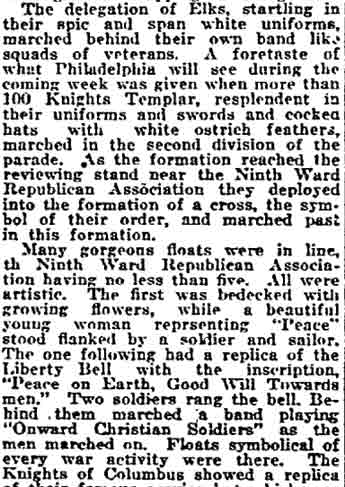
The delegation of Elks, startling in their spic and span white uniforms, marched behind their own band like squads of veterans. A foretaste of what Philadelphia will see during the coming week was given when more than 100 Knights Templar, resplendent in their uniforms and swords and cocked hats with white ostrich feathers, marched in the second division of the parade. As the formation reached the reviewing stand near the Ninth Ward Republican Association they deployed into the formation of a cross, the symbol of their order, and marched past in this formation.
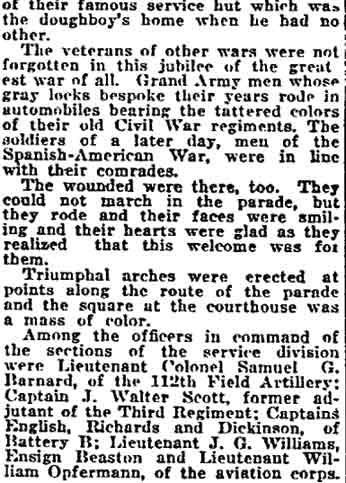
Many gorgeous floats were in line, th Ninth Ward Republican Association having no less than five. All were artistic. The first was bedecked with growing flowers, while a beautiful young woman reprsenting “Peace” stood flanked by a soldier and sailor. The one following had a replica of the Liberty Bell with the inscription, “Peace on Earth, Good Will Towards men.” Two soldiers rang the bell. Behind them marched a band playing “Onward Christian Soldiers” as the men marched on. Floats symbolical of every war activity were there. The Knights of Columbus showed a replica of their famous service hut which was the doughboy’s home when he had no other.
The veterans of other wars were not forgotten in this jubilee of the greatest war of all. Grand Army men whose gray locks bespoke their years rode in automobiles bearing the tattered colors of their old Civil War regiments. The soldiers of a later day, men of the Spanish-American War, were in line with their comrades.
The wounded were there, too. They could not march in the parade, but they rode and their faces were smiling and their hearts were glad as they realized that this welcome was for them.
Triumphal arches were erected at points along the route of the parade and the square at the courthouse was a mass of color.
Among the officers in command of the sections of the service division were Lieutenant Colonel Samuel G. Barnard, of the 112th Field Artillery; Captain J. Walter Scott, former adjutant of the Third Regiment; Captains English, Richards and Dickinson, of Battery B; Lieutenant J. G. Williams, Ensign Beaston and Lieutenant William Opfermann, of the aviation corps.
Battle Flags Wave Triumphant
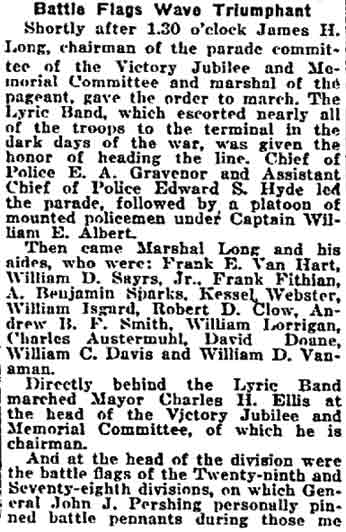
Shortly after 1.30 o’clock James H. Long, chairman of the parade committee of the Victory Jubilee and Memorial Committee and marshal of the pageant, gave the order to march. The Lyric Band, which escorted nearly all of the troops to the terminal in the dark days of the war, was given the honor of heading the line. Chief of Police E. A. Gravenor and Assistant Chief of Police Edward S. Hyde led the parade, followed by a platoon of mounted policemen under Captain William E. Albert.
Then came Marshal Long and his aides, who were: Frank E. Van Hart, William D. Sayrs, Jr., Frank Fithian, A. Benjamin Sparks, Kessel Webster, William Isgard, Robert D. Clow, Andrew B. F. Smith, William Lorrigan, Charles Austermuhl, David Doane, William C. Davis and William D. Vanaman.
Directly behind the Lyric Band marched Mayor Charles H. Ellis at the head of the Victory Jubilee and Memorial Committee, of which he is chairman.
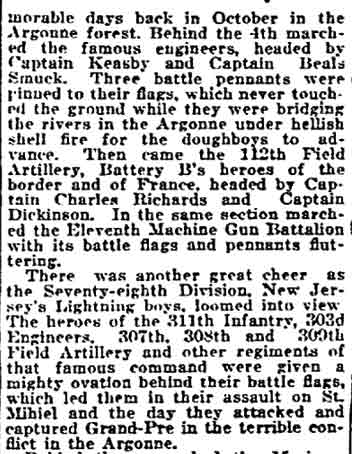
And at the head of the division were the battle flags of the Twenty-ninth and Seventy-eighth divisions, on which General John J. Pershing personally pinned battle pennants during those memorable days back in October in the Argonne forest. Behind the 4th marched the famous engineers, headed by Captain Keasby and Captain Beals Smuck. Three battle pennants were pinned to their flags, which never touched the ground while they were bridging the rivers in the Argonne under hellish shell fire for the doughboys to advance. Then came the 112th Field Artillery, Battery B’s heroes of the border and of France, headed by Captain Charles Richards and Captain Dickinson. In the same section marched the Eleventh Machine Gun Battalion with its battle flags and pennants fluttering.
There was another great cheer as the Seventy-eighth Division, New Jersey’s Lightning boys, loomed into view. The heroes of the 311th Infantry, 303d Engineers, 307th, 308th and 309th Field Artillery and other regiments of that famous command were given a mighty ovation behind their battle flags, which led them in their assault on St. Mihiel and the day they attacked and captured Grand-Pre in the terrible conflict in the Argonne.
Behind them marched the Marines, headed by Lieutenant Monitor Watchman, of the Fifth Regiment, Second Division. With the Marines marched the regular army units, men who had served in as many as five battles and wore three and four gold service stripes on their sleeves.
Then followed the naval contingent. They were commanded by Commander Francis W. Hoffman and Commander W. G. Hodgson.
The order “eyes left” flashed along the line as each platoon drew near the reviewing stand and Admiral Wilson with his band to his cap returned the salute. With the admiral on the stand were former United States Senator David Baird, Congressman William J. Browning, County Collector John S. Well, City Clerk W. D. Brown and others.
At the armory a splendid banquet was served to the soldiers and sailors. For days past corps Red Cross workers had been preparing the good things to eat and the men did full justice to them. They marched in the armory where the food was spread on the tables and enjoyed themselves while bands played. After dinner there were speeches. Mayor Ellis in welcoming the men said:
“This is one of the happiest moments of my life. I have waited patiently through months of trial for the glad day when I could bid you welcome to the City of Camden once again.
“We are planning to erect a lasting memorial in memory of those heroes who gave their lives and in memory of the valiant deeds you performed on land and sea.
“Camden will always cherish the memory of this day, rever the memory of your dead comrades and will inscribe your valiant deeds on that memorial. I bid you welcome in the name of the most patriotic little city in America. I thank you.”
Prosecutor Charles A. Wolverton welcomed the men on behalf of the county and paid a tribute to their valor recalling their wonderful victories of the Argonne and other battlefields of France.
Circuit Court Judge Frank T. Lloyd Accepts Chairmanship of Unemployment Committee
Philadelphia Inquirer —
Circuit Court Judge Frank T. Lloyd yesterday accepted chairmanship of the Camden Chamber of Commerce Committee which is to study the unemployment question and make suggestions for remedial measures. With Judge Lloyd on the committee are: Alban Eavenson, of Eavenson & Levering; Belford G. Royal, of the Victor Talking Machine Company; Congressman Francis F. Patterson; Mayor Charles H. Ellis; former United States Senator David Baird; L. A. Hawkes, of the Hunt Pen Company; Frank Vanhart, president of City Council, and an official of the Esterbrook Pen Company; John Prentice, director of the Board of Freeholders; Burleigh B. Draper, of the Broadway Trust Company; A. C. Dorrance, of the Campbell Soup Company; Lawyer William S. Darnell; C. W. Tomlinson, of the R. M. Hollinshed Company; James V. Moran, of the Hurley Company; Rev. Thomas J. Whelen, pastor of the Church of the Holy Name; L. D. Johnson, of the State Employment Bureau; Rev. Charles B. Dubell, rector of St. John’s P. E. Church; Elmer E. Long, of Munger & Long; Mrs. Dr. A. H. Lippincott, Mrs. W. Penn Carson [sic] and Mrs. Harry Pelouze.
The committee was named by William E. Bennett, president of the Chamber of Commerce, whose aims are to have an immediate inquiry with the idea of a report, being made by the end of the month.
Underworld Life Exposed as Hall Is Given Grilling
Camden Courier —
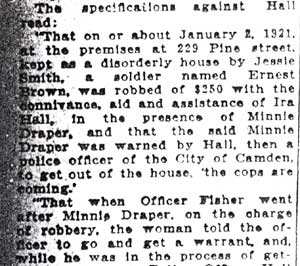
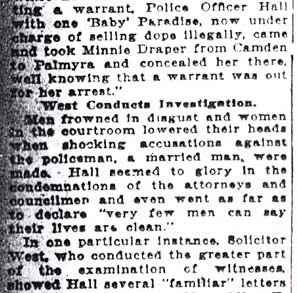
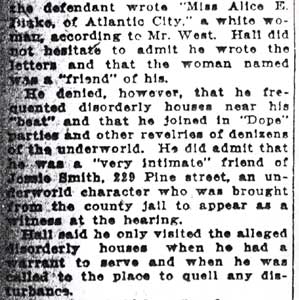
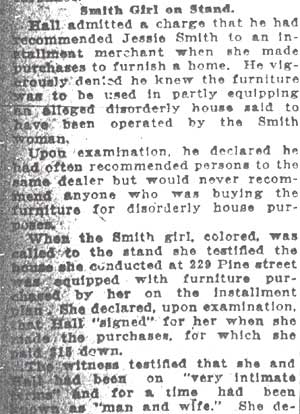
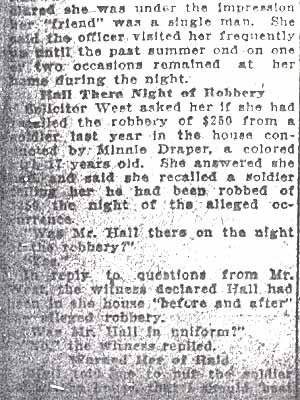
Denounced and flayed as a “moral degenerate,” Policeman Ira Hall was summarily dismissed by the police committee of City Council last night following the most sensational hearing in the history of that body.
Resignations of Detective George Murry and Policemen Tony Latorre and William Draper, also were accepted before the hearing adjourned. Councilman J. Hartley Bowen, who presided, declared that “on their face the resignations appeared as an admission from the men of their guilt.” None of the three who tendered their resignations were present at the hearing.
The four men have been charged by City Solicitor Bleakly with responsibility for “shocking” vice conditions found in recent investigations made by federal agents and city officials in the Third and Fifth wards.
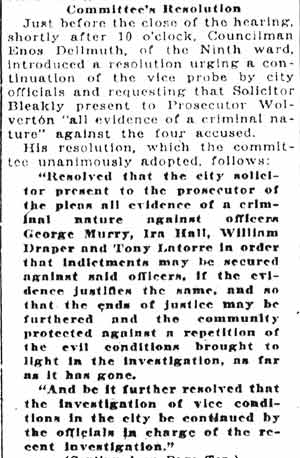
Committee’s Resolution
Just before the close of the hearing, shortly after 10 o’clock, Councilman Enos Dellmuth, of the Ninth ward, introduced a resolution urging a continuation of the vice probe by city officials and requesting that Solicitor Bleakly present to Prosecutor Wolverton “all evidence of a criminal nature” against the four accused.
His resolution, which the committee unanimously adopted, follows:
“Resolved that the city solicitor present to the prosecutor of the pleas all evidence of a criminal nature against officers George Murry, Ira Hall, William Draper and Tony Latorre in order that indictments may be secured against said officers, if the evidence justifies the same, and so that the ends of justice may be furthered and the community protected against a repetition of the evil conditions brought to light in the investigation, as far as it has gone.
“And be it further resolved that the investigation of vice conditions in the city be continued by the officials in charge of the recent investigation.”
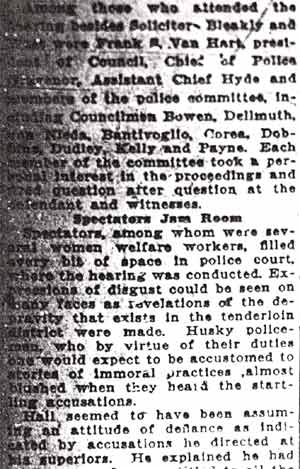
Among those who attended the hearing besides Solicitor Bleakly and [?] were Frank S. Van Hart, president of Council, Chief of Police Gravenor, Assistant Chief Hyde and members of the police committee, including Councilmen Bowen, Dellmuth, Von Nieda, Bantivoglio, Corea, Dobbins, Dudley, Kelly and Payne. Each member of the committee took a personal interest in the proceedings and [?] question after question at the defendant and witnesses.
Spectators Jam Room
Spectators, among whom were several women welfare workers, filled every bit of space in police court, where the hearing was conducted. Expressions of disgust could be seen on many faces as revelations of the depravity that exists in the tenderloin district were made. Husky policemen, who by virtue of their duties one would expect to be accustomed to stories of immoral practices, almost blushed when they heard the startling accusations.
Hall seemed to have been assuming an attitude of defiance as indicated by accusations he directed at his superiors. He explained he had no lawyer and was entitled to all the privileges of a witness under such circumstances. He sat most of the time in a chair opposite the witness stand.
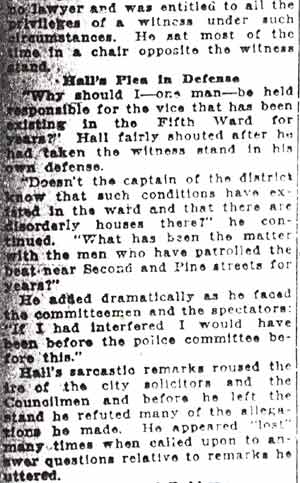
Hall’s Plea in Defense
“Why should I—one man—be held responsible for the vice that has been existing in the Fifth Ward for years?” Hall fairly shouted after he had taken the witness stand in his own defense.
“Doesn’t the captain of the district know that such conditions have existed in the ward and that there are disorderly houses there?” he continued. “What has been the matter with the men who have patrolled the beat near Second and Pine streets for years?”
He added dramatically as he faced the committeemen and the spectators: “If I had interfered I would have been before the police committee before this.”
Hall’s sarcastic remarks roused the ire of the city solicitors and the Councilmen and before he left the stand he refuted many of the allegations he made. He appeared “lost” many times when called upon to answer questions relative to remarks he uttered.
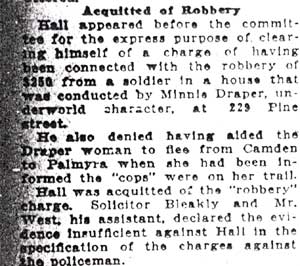
Acquitted of Robbery
Hall appeared before the committee for the express purpose of clearing himself of a charge of having been connected with the robbery of $250 from a soldier in a house that was conducted by Minnie Draper, underworld character, at 229 Pine street.
He also denied having aided the Draper woman to flee from Camden to Palmyra when she had been informed the “cops” were on her trail.
Hall was acquitted of the “robbery” charge. Solicitor Bleakly and Mr. West, his assistant, declared the evidence insufficient against Hall in the specification of the charges against the policeman.
The specifications against Hall read:
“That on or about January 2, 1921, at the premises at 229 Pine street, kept as a disorderly house by Jessie Smith, a soldier named Ernest Brown, was robbed of $250 with the connivance, aid and assistance of Ira Hall, in the presence of Minnie Draper, and that the said Minnie Draper was warned by Hall, then a police officer of the City of Camden, to get out of the house, ‘the cops are coming.’
“That when Officer Fisher went after Minnie Draper, on the charge of robbery, the woman told the officer to go and get a warrant, and, while he was in the process of getting a warrant, Police Officer Hall with one ‘Baby’ Paradise, now under charge of selling dope illegally, came and took Minnie Draper from Camden to Palmyra and concealed her there, well knowing that a warrant was out for her arrest.”
West Conducts Investigation.
Men frowned in disgust and women in the courtroom lowered their heads when shocking accusations against the policeman, a married man, were made. Hall seemed to glory in the condemnations of the attorneys and councilmen and even went as far as to declare “very few men can say their lives are clean.”
In one particular instance, Solicitor West, who conducted the greater part of the examination of witnesses, showed Hall several “familiar” letters the defendant wrote “Miss Alice E. [?]iske, of Atlantic City,” a white woman, according to Mr. West. Hall did not hesitate to admit he wrote the letters and that the woman named was a “friend” of his.
He denied, however, that he frequented disorderly houses near his “beat” and that he joined in “Dope” parties and other revelries of denizens of the underworld. He did admit that he was a “very intimate” friend of Jessie Smith, 229 Pine street, an underworld character who was brought from the county jail to appear as a witness at the hearing.
Hall said he only visited the alleged disorderly houses when he had a warrant to serve and when he was called to the place to quell any disturbance.
Smith Girl on Stand.
Hall admitted a charge that he had recommended Jessie Smith to an installment merchant when she made purchases to furnish a home. He vigorously denied he knew the furniture was to be used in partly equipping an alleged disorderly house said to have been operated by the Smith woman.
Upon examination, he declared he had often recommended persons to the same dealer but would never recommend anyone who was buying the furniture for disorderly house purposes.
When the Smith girl, colored, was called to the stand she testified the house she conducted at 229 Pine street was equipped with furniture purchased by her on the installment plan. She declared, upon examination, that Hall “signed” for her when she made the purchases, for which she paid $1[?] down.
The witness testified that she and Hall had been on “very intimate terms” and for a time had been known as “man and wife.” She declared she was under the impression her “friend” was a single man. She said the officer visited her frequently up until the past summer and on one or two occasions remained at her home during the night.
Hall There Night of Robbery
Solicitor West asked her if she had [?]ailed the robbery of $250 from a soldier last year in the house conducted by Minnie Draper, a colored girl 17 years old. She answered she [?] and said she recalled a soldier telling her he had been robbed of $250 the night of the alleged occurrence.
“Was Mr. Hall there on the night of the robbery?”
“Yes.”
In reply to questions from Mr. West, the witness declared Hall had been in the house “before and after” the alleged robbery.
“Was Mr. Hall in uniform?”
“No,” the witness replied.
Warned Her of Raid
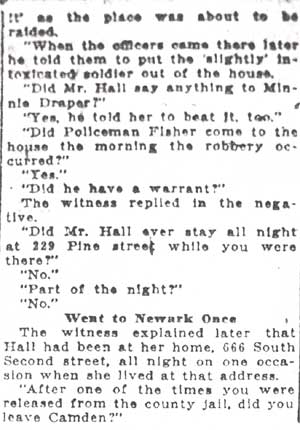
[?] told [?] to put the soldier [?] that I should beat it” as the place was about to be raided.
“When the officers came there later he told them to put the ‘slightly’ intoxicated soldier out of the house.
“Did Mr. Hall say anything to Minnie Draper?”
“Yes, he told her to beat it, too.”
“Did Policeman Fisher come to the house the morning the robbery occurred?”
“Yes.”
“Did he have a warrant?”
The witness replied in the negative.
“Did Mr. Hall ever stay all night at 229 Pine street while you were there?”
“No.”
“Part of the night?”
“No.”
Went to Newark Once
The witness explained later that Hall had been at her home, 666 South Second street, all night on one occasion when she lived at that address.
“After one of the times you were released from the county jail, did you leave Camden?”
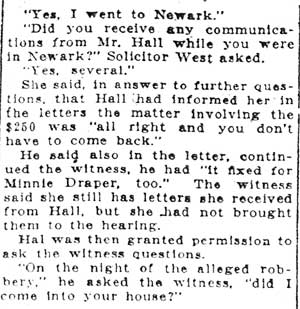
“Yes, I went to Newark.”
“Did you receive any communications from Mr. Hall while you were in Newark?” Solicitor West asked.
“Yes, several.”
She said, in answer to further questions, that Hall had informed her in the letters the matter involving the $250 was “all right and you don’t have to come back.”
He said also in the letter, continued the witness, he had “it fixed for Minnie Draper, too.” The witness said she still has letters she received from Hall, but she had not brought them to the hearing.
Hal [sic] was then granted permission to ask the witness questions.
“On the night of the alleged robbery,” he asked the witness, “did I come into your house?”
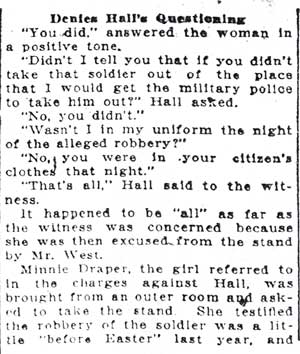
Denies Hall’s Questioning
“You did,” answered the woman in a positive tone.
“Didn’t I tell you that if you didn’t take that soldier out of the place that I would get the military police to take him out?” Hall asked.
“No, you didn’t.”
“Wasn’t I in my uniform the night of the alleged robbery?”
“No, you were in your citizen’s clothes that night.”
“That’s all,” Hall said to the witness.
It happened to be “all” as far as the witness was concerned because she was then excused from the stand by Mr. West.
Minnie Draper, the girl referred to in the charges against Hall, was brought from an outer room and asked to take the stand. She testified the robbery of the soldier was a little “before Easter” last year, and that Hall was there the evening it occurred.
Said “Cops” Surrounded House
“Hall told me to get out that night after the soldier had been robbed,” Minnie testified. “After the robbery occurred he told me ‘cops’ were surrounding the house and I should get out as fast as I could.”
She testified, upon being further examined by Mr. West, that Hall met her about two o’clock the night of the robbery and “went as far as Twenty-sixth street in a machine driven by Babe Paradise,” now under heavy bail on a charge of being a drug peddler. She said Hall alighted from the automobile at Twenty-sixth street and Paradise took her the rest of the way to Palmyra, where she remained, she said, from April until July.
She testified that on one occasion Hall visited a house where she was staying while she and other women were “enjoying a coke party.” She said that on another occasion she saw Hall and Jessie Smith in a room together acting in a “very familiar manner.”
Admits She Got Stolen Cash
She also testified that Detective Murry was given $50 to “squash” the robbery case, which, it has been alleged, involved Hall, herself and the Smith woman.
“Did you get any of the $250 stolen from the soldier?” Mr. West asked the witness.
“Yes. I know I got my part,” she answered. “The remainder went to Jessie Smith, but I suppose Mr. Hall got his share.”
“Was Mr. Hall in uniform when he gave you the caution to get out of the house the night of the robbery?”
“No,” the woman answered.
Fire Bells Toll as Capt. Carrigan Is Laid to Rest
Camden Daily Courier —
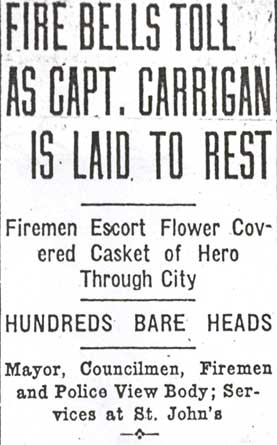
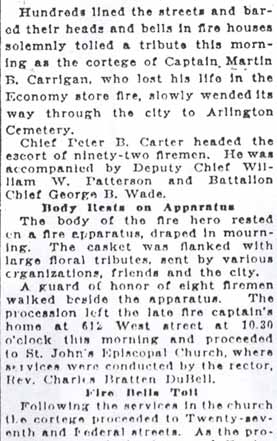
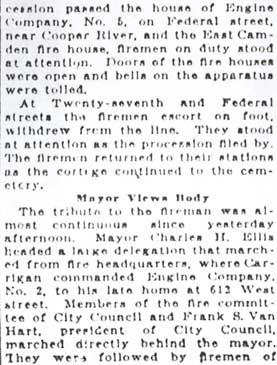
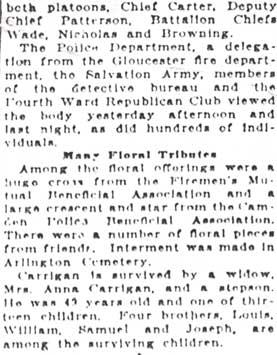
FIRE BELLS TOLL AS CAPT. CARRIGAN IS LAID TO REST
Firemen Escort Flower Covered Casket of Hero Through City
HUNDREDS BARE HEADS
Mayor, Councilmen, Firemen and Police View Body; Services at St. John's
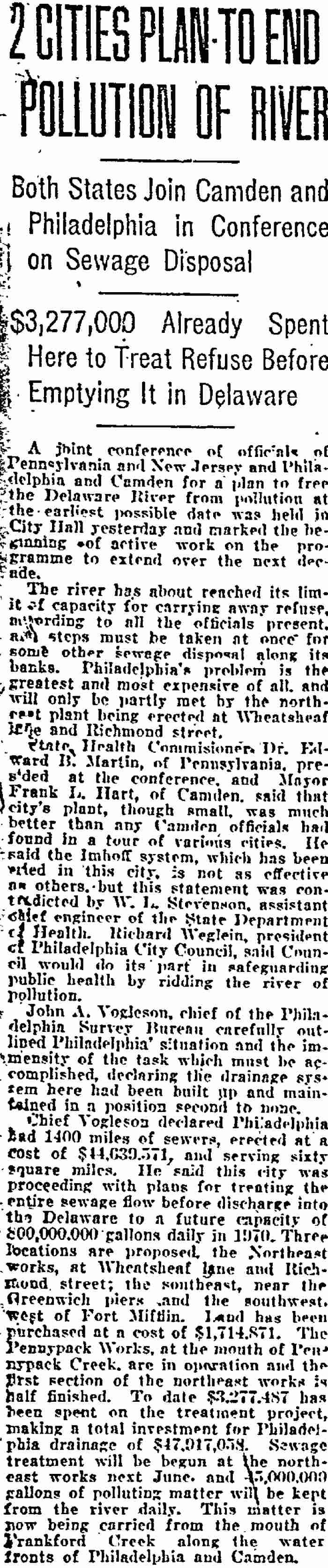
2 Cities Plan to End Pollution of River
Camden Daily Courier —
Named: Frank S. Van Hart, Frank Murray, Edward Hahn, Walter Christy, Albert Yost, Frank Pintozzi, John McTaggart, Frank Sattler, Walter Larson, August Pflederer, Kimber Street, North 5th Street, Howell Street, Waldorf Avenue, Cherry Street, Lansdowne Avenue, Jackson Street, Sylvan Street, and Pine Street.
Camden Is Warned Against Fireworks
Camden Daily Courier —

Mayor Van Hart Issues a Proclamation for Safe and Sane Fourth of July
Ferryboat Millville Put Into Service; Masons Conduct the Funeral of Weiser
In a proclamation issued yesterday Mayor Van Hart called on the people of Camden to strictly observe the fireworks regulations designed to give Camden a safe and sane Fourth of July. The Mayor declares that the regulations will be strictly enforced.
The city ordinance bars the use or sale of sparklers, rockets, squibs, dynamite crackers or powder crackers over two inches in length. Roman candles and blank cartridges are also barred. The use of small powder crackers, pinwheels, red lights and paper caps are permitted.
“Observance of these regulations means a celebration along peaceful and safe lines without loss of life or the incurring of injury such as have prompted the wisdom of Council to enact the ordinance,” the Mayor said. “I therefore call upon the people of Camden to strictly obey the regulations herein outlined that we may have a fitting celebration without the distress and sorrow which previously marked the day through the use of high and dangerous explosives.”
With Pilot Charles Lock at the wheel and Engineer Harry Lyons handling the machinery the new ferryboat Millville was put into service yesterday morning. Superintendent Greer and A. G. Mitchell, former head of the Atlantic division of the P. R. R., took the initial trip and expressed delight with the workings of the vessel, which stuck on the ways on her first launching attempt.
Taken to Cooper Hospital supposedly suffering from heat exhaustion, Charles Zeppo, 42 years old, of 251 Spruce street, was declared by doctors to be suffering from too much liquor. When revived Zeppo said he was treated to home-brew while buying junk.
A complication of ailments yesterday caused the death of Robert Finley, 76 years old, superintendent of the Camden police building, at the home of his son, William, 314 Point street. Prior to coming to Camden a score of years ago Finley was engaged in the retail shoe business in Philadelphia.
Forced to vacate its pound at Magnolia because of an edict of the Council of that place, the Camden County Society for the Prevention of Cruelty to Animals will start work tomorrow on a new dog refuge at City Line and White Horse pike on ground owned by the city. It will be constructed of concrete with garage, kennels and a special chamber wherein unclaimed dogs will be humanely killed.
A divorce decree has been recommended for George Smith, a Pennsylvania Railroad engineer, living at Glassboro, from his wife, Mrs. Mary Smith, on the ground that she was indiscreet with Charles McLaughlin. A decree has also been advised for Mrs. Margaret Jenkins, of 1418 Louis street, from her husband, John Jenkins, on the grounds of abuse.
The Grand Lodge of Masons conducted funeral services yesterday afternoon for William P. Weiser, who was the only active thirty-third degree Mason in Camden. Services were held at his late home, 224 North Seventh street, and were in charge of Grand Master Arthur Potterton and his staff. Religious services were conducted by Rev. George H. Hemingway, pastor of the First Presbyterian Church. Interment was made at Harleigh Cemetery.
In the presence of a host of friends, Miss Elizabeth Haines, daughter of Dr. R. I. Haines, yesterday became the bride of Frank J. Hineline, Jr., at St. John’s P. E. Church. The ceremony was performed by Rev. J. H. Townsend, an uncle of the bride, assisted by Rev. Charles R. Du Bell. Miss Mary Haines, sister of the bride, was maid of honor and James Krips, of Collingswood, was best man.
Nine New Police From Nine Wards
Camden Daily Courier —
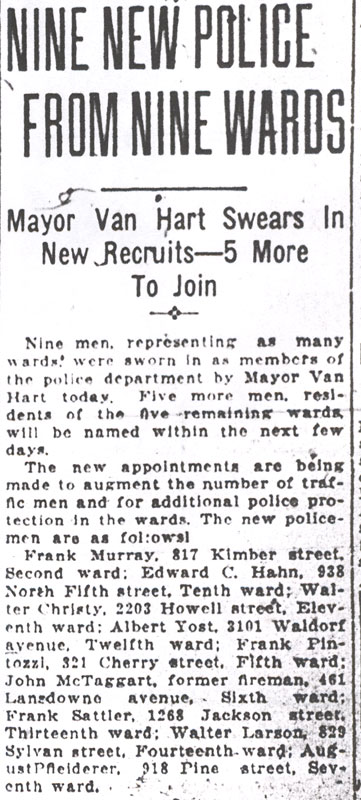
Mayor Van Hart Swears In New Recruits—5 More To Join
Nine men, representing as many wards, were sworn in as members of the police department by Mayor Van Hart today. Five more men, residents of the five remaining wards, will be named within the next few days.
The new appointments are being made to augment the number of traffic men and for additional police protection in the wards. The new policemen are as follows:
Frank Murray, 817 Kimber street, Second ward; Edward C. Hahn, 938 North Fifth street, Tenth ward; Walter Christy, 2203 Howell street, Eleventh ward; Albert Yost, 3101 Waldorf avenue, Twelfth ward; Frank Pintozzi, 321 Cherry street, Fifth ward; John McTaggart, former fireman, 461 Lansdowne avenue, Sixth ward; Frank Sattler, 1268 Jackson street, Thirteenth ward; Walter Larson, 829 Sylvan street, Fourteenth ward; August Pfleiderer, 918 Pine street, Seventh ward.
Frelinghuysen Majority Seen in Camden County
Philadelphia Inquirer —
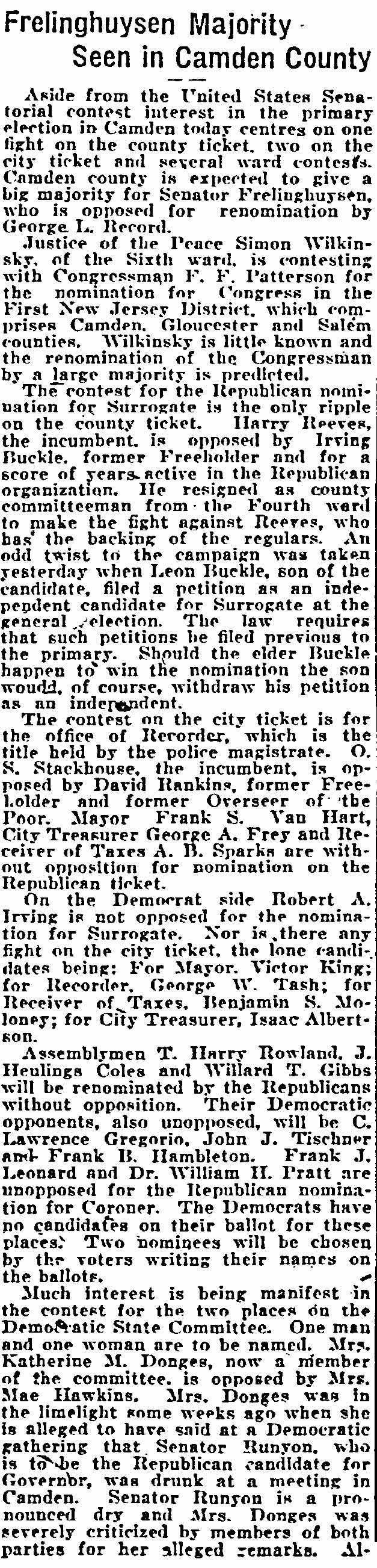
Aside from the United States Senatorial contest interest in the primary election in Camden today centres on one fight on the county ticket, two on the city ticket and several ward contests. Camden county is expected to give a big majority for Senator Frelinghuysen, who is opposed for renomination by George L. Record.
Justice of the Peace Simon Wilkinsky, of the Sixth ward, is contesting with Congressman F. F. Patterson for the nomination for Congress in the First New Jersey District, which comprises Camden, Gloucester and Salem counties. Wilkinsky is little known and the renomination of the Congressman by a large majority is predicted.
The contest for the Republican nomination for Surrogate is the only ripple on the county ticket. Harry Reeves, the incumbent, is opposed by Irving Buckle, former Freeholder and for a score of years active in the Republican organization. He resigned as county committeeman from the Fourth ward to make the fight against Reeves, who has the backing of the regulars. An odd twist to the campaign was taken yesterday when Leon Buckle, son of the candidate, filed a petition as an independent candidate for Surrogate at the general election. The law requires that such petitions be filed previous to the primary. Should the elder Buckle happen to win the nomination the son would, of course, withdraw his petition as an independent.
The contest on the city ticket is for the office of Recorder, which is the title held by the police magistrate. O. S. Stackhouse, the incumbent, is opposed by David Rankins, former Freeholder and former Overseer of the Poor. Mayor Frank S. Van Hart, City Treasurer George A. Frey and Receiver of Taxes A. B. Sparks are without opposition for nomination on the Republican ticket.
On the Democrat side Robert A. Irving is not opposed for the nomination for Surrogate. Nor is there any fight on the city ticket, the lone candidates being: For Mayor, Victor King; for Recorder, George W. Tash; for Receiver of Taxes, Benjamin S. Moloney; for City Treasurer, Isaac Albertson.
Assemblymen T. Harry Rowland, J. Heulings Coles and Willard T. Gibbs will be renominated by the Republicans without opposition. Their Democratic opponents, also unopposed, will be C. Lawrence Gregorio, John J. Tischner and Frank B. Hambleton. Frank J. Leonard and Dr. William H. Pratt are unopposed for the Republican nomination for Coroner. The Democrats have no candidates on their ballot for these places. Two nominees will be chosen by the voters writing their names on the ballots.
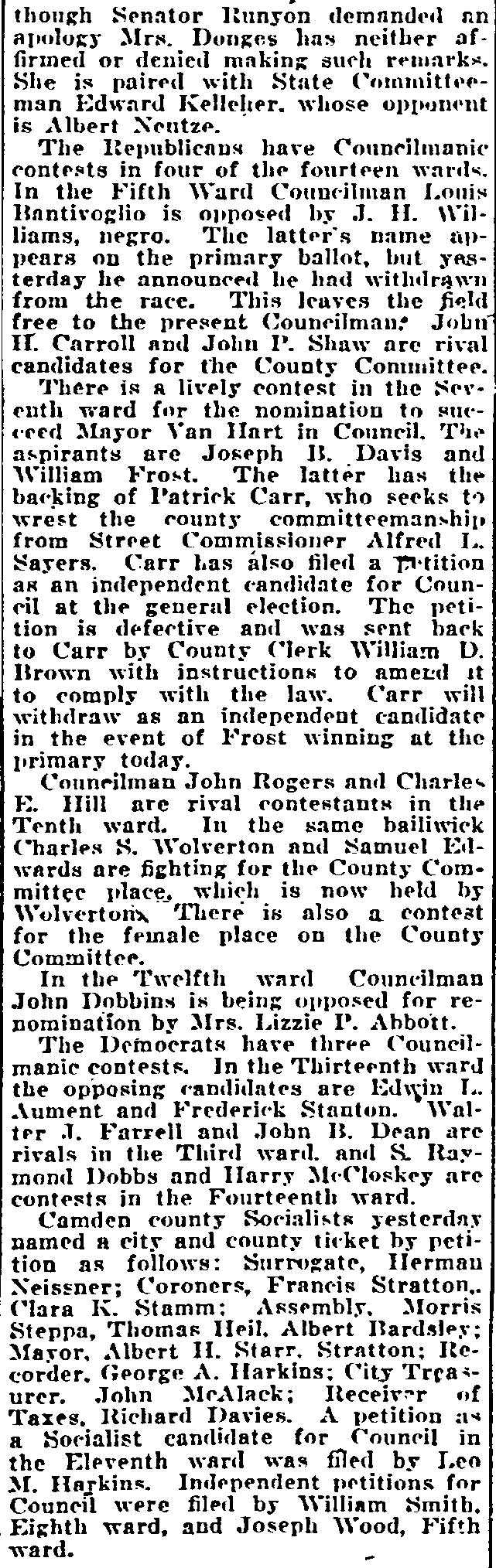
Much interest is being manifest in the contest for the two places on the Democratic State Committee. One man and one woman are to be named. Mrs. Katherine M. Donges, now a member of the committee, is opposed by Mrs. Mae Hawkins. Mrs. Donges was in the limelight some weeks ago when she is alleged to have said at a Democratic gathering that Senator Runyon, who is to be the Republican candidate for Governor, was drunk at a meeting in Camden. Senator Runyon is a pronounced dry and Mrs. Donges was severely criticized by members of both parties for her alleged remarks. Although Senator Runyon demanded an apology Mrs. Donges has neither affirmed or denied making such remarks. She is paired with State Committeeman Edward Kelleher, whose opponent is Albert Neutze.
The Republicans have Councilmanic contests in four of the fourteen wards. In the Fifth Ward Councilman Louis Bantivoglio is opposed by J. H. Williams, negro. The latter’s name appears on the primary ballot, but yesterday he announced he had withdrawn from the race. This leaves the field free to the present Councilman. John H. Carroll and John P. Shaw are rival candidates for the County Committee.
There is a lively contest in the Seventh ward for the nomination to succeed Mayor Van Hart in Council. The aspirants are Joseph B. Davis and William Frost. The latter has the backing of Patrick Carr, who seeks to wrest the county committeemanship from Street Commissioner Alfred L. Sayers. Carr has also filed a petition as an independent candidate for Council at the general election. The petition is defective and was sent back to Carr by County Clerk William D. Brown with instructions to amend it to comply with the law. Carr will withdraw as an independent candidate in the event of Frost winning at the primary today.
Councilman John Rogers and Charles E. Hill are rival contestants in the Tenth ward. In the same bailiwick Charles S. Wolverton and Samuel Edwards are fighting for the County Committee place, which is now held by Wolverton. There is also a contest for the female place on the County Committee.
In the Twelfth ward Councilman John Dobbins is being opposed for renomination by Mrs. Lizzie P. Abbott.
The Democrats have three Councilmanic contests. In the Thirteenth ward the opposing candidates are Edwin L. Aument and Frederick Stanton. Walter J. Farrell and John B. Dean are rivals in the Third ward, and S. Raymond Dobbs and Harry McCloskey are contests in the Fourteenth ward.
Camden county Socialists yesterday named a city and county ticket by petition as follows: Surrogate, Herman Neissner; Coroners, Francis Stratton, Clara K. Stamm; Assembly, Morris Steppa, Thomas Heil, Albert Bardsley; Mayor, Albert H. Starr, Stratton; Recorder, George A. Harkins; City Treasurer, John McAlack; Receiver of Taxes, Richard Davies. A petition as a Socialist candidate for Council in the Eleventh ward was filed by Leo M. Harkins. Independent petitions for Council were filed by William Smith, Eighth ward, and Joseph Wood, Fifth ward.
Camden Elks to Honor Past Exalted Rulers
Camden Courier-Post —
Past exalted rulers will be honored tonight by Camden Lodge of Elks with a dinner, ceremonial and entertainment.
The program will be nation-wide. A dinner will be served at 6:00 PM, followed by a business session. Harry G. Robinson, present exalted ruler, will open the ceremonial and turn the lodge over to the past officers.
The past exalted rulers expected are Samuel Kilpatrick, who served in 1900 and 1921; Dr. A. Haines Lippincott, Alexander J. Milliette, J. Harry Switzer, James H. Long, Marian Moriarty, Allen Jarvis, Albert Austermuhl, William L. Sauerhoff, former Mayor Frank S. Van Hart, D. Trueman Stackhouse, Harry Ellis, William G. Ferat, Judge Garfield Pancoast, Rudolph Preisendanz, Jr., Theodore T. Kausel, Edward J. Kelley, Mayor Roy R. Stewart, William H. Iszard, William S. Lehman and J. Harry Todd.
Camden Elks Hope to Get Convention
Camden Courier-Post —
Advisory Committee Will Present Formal Invitation for State Meet
The twenty-first annual reunion and the convention of the New Jersey State Elks Association will be held in Camden next June if efforts of the advisory board of Camden Lodge of Elks are successful at the state meeting in Newark on June 15, 16 and 17.
Members of the advisory board for the local lodge, who are past exalted rulers of the Camden lodge, will present the invitation to hold the 1934 meeting in Camden, at the twentieth reunion and convention in Newark.
Members of the lodge have adopted a resolution confirming the action of the advisory board and plans were made to set the necessary machinery in motion to bring the 1934 convention to Camden. It was pointed out that Camden Elks have the largest home in the state.
Samuel Kilpatrick, the oldest past exalted ruler of the lodge, is head of the advisory board, and Harry G. Robinson, youngest past exalted ruler, is delegate to the state association, which is composed of past exalted rulers of all Elks lodges in New Jersey.
Although the state association was formed in Camden, there has never been a reunion or convention of the association held here, it was pointed out.
The outstanding feature of each annual convention is the mammoth sessions, with thousands of Elks in line. It is estimated the parade would draw more than 50,000 persons to Camden, if the local lodge’s invitation is accepted.
The Camden lodge is sending the band and patrol to Newark for the parade, which will start at 7 p.m. on June 17. Arrangements are being made to have the largest delegation in the parade represent Camden.
Past exalted rulers who comprise the advisory board, and the year they took office, follow: Samuel Kirkpatrick, 1900; Dr. A. Haines Lippincott, 1901; Alex J. Milliette, 1906; J. Harry Switzer, 1908; James H. Long, 1911; Marion Moriarty, 1913; Allen Jarvis, 1914; Albert Austermuhl, 1915; William L. Sauerhoff, 1917; Theodore T. Kausel, 1918; Garfield Pancoast, 1919; William G. Ferat, 1920; Harry Ellis, 1921; Samuel A. Dobbins, 1923; D. Trueman Stackhouse, 1924; Frank S. Van Hart, 1925; Edward J. Kelly, 1926; Rud Preisendanz, Jr., 1927; Roy R. Stewart, 1928; William H. Iszard, 1929; William Lehman, 1930; J. Harry Todd, 1931, and Harry G. Robinson, 1932.
Deceased past exalted rulers and the year they took office are: John H. Foster, 1895; W.E.B. Miller, 1896; Philip Burch, 1897; D. Harry Condit, 1898; H.L. Hartshorn, 1891; George D. Borton, 1902; Maurice Rogers, 1904; Francis Warren, 1907; E. Wilmer Collins, 1909; Lewis H. Leigh, 1910; Morris Odell, 1912, and W. Wallace Balcom, 1922.
Banquet to Honor John S. M’Taggart
Camden Courier-Post —
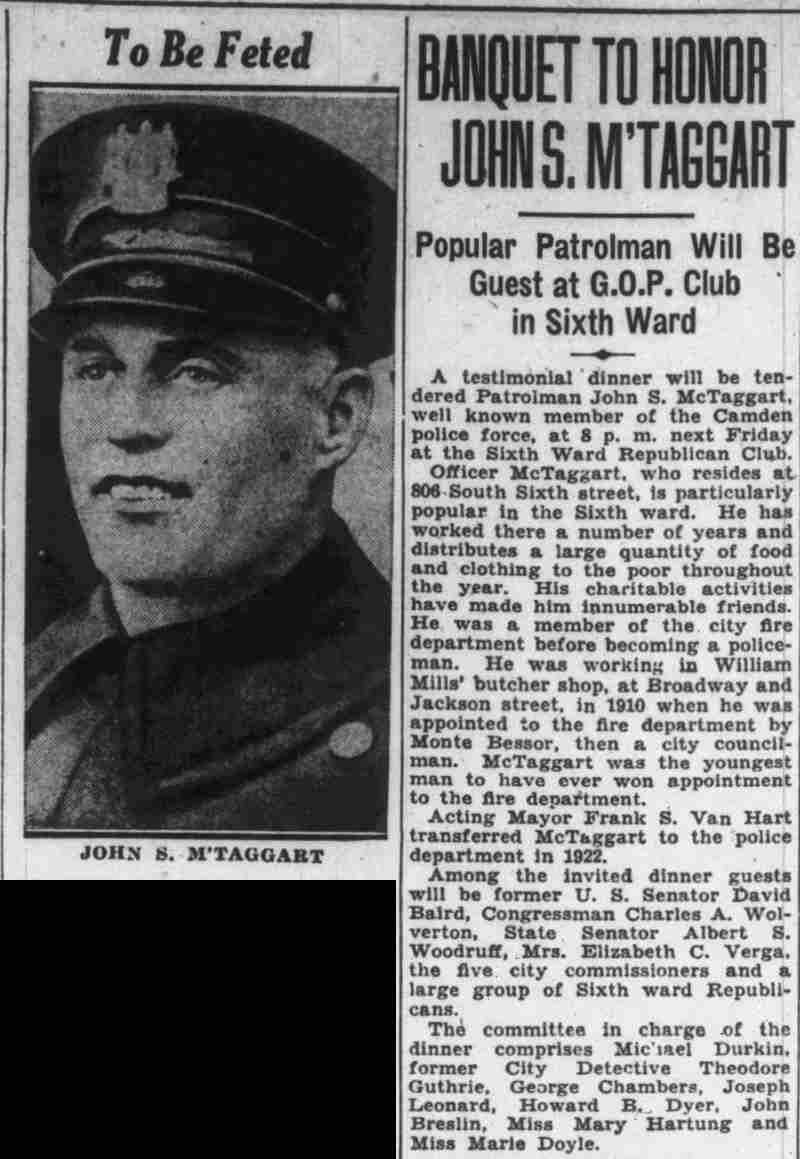
Popular Patrolman Will Be Guest at G.O.P. Club in Sixth Ward
To Be Feted
JOHN S. M’TAGGART
A testimonial dinner will be tendered Patrolman John S. McTaggart, well known member of the Camden police force, at 8 p. m. next Friday at the Sixth Ward Republican Club.
Officer McTaggart, who resides at 806 South Sixth street, is particularly popular in the Sixth ward. He has worked there a number of years and distributes a large quantity of food and clothing to the poor throughout the year. His charitable activities have made him innumerable friends. He was a member of the city fire department before becoming a policeman. He was working in William Mills’ butcher shop, at Broadway and Jackson street, in 1910 when he was appointed to the fire department by Monte Bessor, then a city councilman. McTaggart was the youngest man to have ever won appointment to the fire department.
Acting Mayor Frank S. Van Hart transferred McTaggart to the police department in 1922.
Among the invited dinner guests will be former U. S. Senator David Baird, Congressman Charles A. Wolverton, State Senator Albert S. Woodruff, Mrs. Elizabeth C. Verga, the five city commissioners and a large group of Sixth ward Republicans.
The committee in charge of the dinner comprises Michael Durkin, former City Detective Theodore Guthrie, George Chambers, Joseph Leonard, Howard B. Dyer, John Breslin, Miss Mary Hartung and Miss Marie Doyle.
F. S. Van Hart Dies of Heart Attack
Camden Courier-Post —
Former Camden Acting Mayor, 65, Stricken Suddenly at Pitman Home
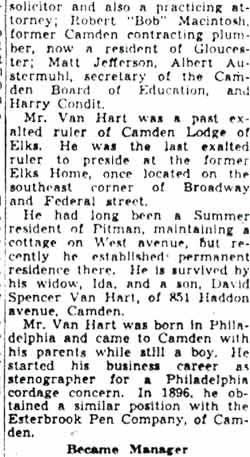
Frank S. Van Hart, 65, acting mayor of Camden from 1922 to 1923 and one-time president of Camden City Council, died of a heart attack Saturday in his apartment, Broadway and Second avenue, Pitman.
Mr. Van Hart, who retired four months ago as general manager for the Camden Lime Company, was in Camden Friday and attended a motion picture show that night. He complained of distress on his return and was stricken while seated in a chair. He died a few hours later.
He succeeded to the Camden mayoralty in 1922 when as president of City Council, he filled the vacancy caused by the resignation of former Mayor Charles H. Ellis, who became postmaster. Ellis died last year. Both were political lieutenants of the late U. S. Senator David Baird, once powerful South Jersey Republican leader.
Defeated by King
Mr. Van Hart was the last mayor to serve under councilmanic form of government. He served several years as councilman, representing the Seventh ward.
In 1923 Van Hart was named as the Republican candidate for Mayor. He was defeated by Victor King, then a Democratic councilman from the Twelfth ward. King was the first Democratic mayor elected in Camden in almost 30 years.
Opposed by an overwhelmingly strong Republican City Council, King astounded the political leaders by sponsoring a referendum to change Camden’s government from councilmanic to commission form. Voters of the city balloted two to one for the change.
King headed the Non-Partisan ticket which included Carroll P. Sherwood, Frank J. Hitchner, Melbourne F. Middleton and H. Raymond “Pat” Staley. The candidates were elected by large majorities. Camden has since been governed by city commissions. The first Non-Partisan city commission served only four years when Republicans elected their five candidates in 1927.
Mr. Van Hart never again sought public office, although he was mentioned as a candidate for various city and county posts.
One of Mr. Van Hart’s first orders as mayor was the abolishing of all left turns at Broadway, Haddon avenue and Federal street and at Broadway and Market street. Business men opposed the order and it was repealed.
Was Prominent Athlete
In his younger days, Mr. Van Hart was a versatile athlete, playing semi-professional baseball and football. He was considered one of the best second basemen in South Jersey and is said to have spurned offers to join minor league teams with the possibility of becoming a major league player.
He played his best ball with the old Howards and later the Camden A. A. teams. Games in those days were played at Fifth and State streets. As a football player, he was a member of the Camden A. A. eleven.
Some of the old time baseball stars with whom Van Hart played were William “Wid” Conroy, star infielder with the old New York Highlanders, Pittsburgh, and Washington in the American League; Kid Gleason, manager of the notorious Chicago “Black Sox” and later a coach with Connie Mack’s Philadelphia Athletics; Bob Black, who managed the old Camden baseball team, which played at Twelfth and Federal streets; Perry Verga and “Seck” Hewitt. He was familiarly known as “Ducky.”
In his football playing days, Mr. Van Hart was a team-mate along with the late District Court Judge William C. French, Samuel T. French, a brother of the judge and a widely-known practicing Camden lawyer; George and Martin Bergen, who also later became prominent Camden lawyers, and Tom Peterson. The Camden A. A. team played its games at Third and Erie streets.
Was Former Elks’ Ruler
As a member of the baseball team of Camden Lodge of Elks, Mr. Van Hart played with Howard Miller, former Camden city solicitor and also a practicing attorney; Robert “Bob” Macintosh, former Camden contracting plumber, now a resident of Gloucester; Matt Jefferson, Albert Austermuhl, secretary of the Camden Board of Education, and Harry Condit.
Mr. Van Hart was a past exalted ruler of Camden Lodge of Elks. He was the last exalted ruler to preside at the former Elks Home, once located on the southeast corner of Broadway and Federal street.
He had long been a Summer resident of Pitman, maintaining a cottage on West avenue, but recently he established permanent residence there. He is survived by his widow, Ida, and a son, David Spencer Van Hart, of 851 Haddon avenue, Camden.
Mr. Van Hart was born in Philadelphia and came to Camden with his parents while still a boy. He started his business career as stenographer for a Philadelphia cordage concern. In 1896, he obtained a similar position with the Esterbrook Pen Company, of Camden.
Became Manager
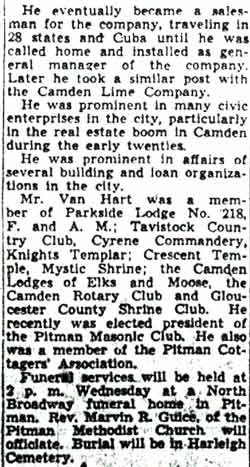
He eventually became a salesman for the company, traveling in 28 states and Cuba until he was called home and installed as general manager of the company. Later he took a similar post with the Camden Lime Company.
He was prominent in many civic enterprises in the city, particularly in the real estate boom in Camden during the early twenties.
He was prominent in affairs of several building and loan organizations in the city.
Mr. Van Hart was a member of Parkside Lodge No. 218, F. and A. M.; Tavistock Country Club, Cyrene Commandery, Knights Templar; Crescent Temple, Mystic Shrine; the Camden Lodges of Elks and Moose, the Camden Rotary Club and Gloucester County Shrine Club. He recently was elected president of the Pitman Masonic Club. He also was a member of the Pitman Cottagers’ Association.
Funeral services will be held at 2 p. m. Wednesday at a North Broadway funeral home in Pitman. Rev. Marvin R. Guice, of the Pitman Methodist Church will officiate. Burial will be in Harleigh Cemetery.
F. S. Van Hart Rites Will Be Held Today
Camden Courier-Post —
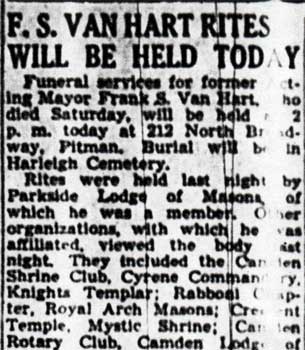
Funeral services for former Acting Mayor Frank S. Van Hart, who died Saturday, will be held at 2 p. m. today at 212 North Broadway, Pitman. Burial will be in Harleigh Cemetery.
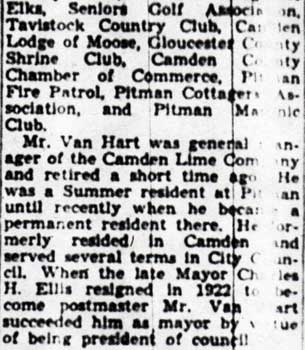
Rites were held last night by Parkside Lodge of Masons, of which he was a member. Other organizations, with which he was affiliated, viewed the body last night. They included the Camden Shrine Club, Cyrene Commandery, Knights Templar; Rabboni Chapter, Royal Arch Masons; Crescent Temple, Mystic Shrine; Camden Rotary Club, Camden Lodge of Elks, Seniors Golf Association, Tavistock Country Club, Camden Lodge of Moose, Gloucester County Shrine Club, Camden County Chamber of Commerce, Pitman Fire Patrol, Pitman Cottagers Association, and Pitman Masonic Club.
Mr. Van Hart was general manager of the Camden Lime Company and retired a short time ago. He was a Summer resident at Pitman until recently when he became a permanent resident there. He formerly resided in Camden and served several terms in City Council. When the late Mayor Charles H. Ellis resigned in 1922 to become postmaster Mr. Van Hart succeeded him as mayor by virtue of being president of council
Stern the maverick publisher cuts in
Camden Courier-Post —
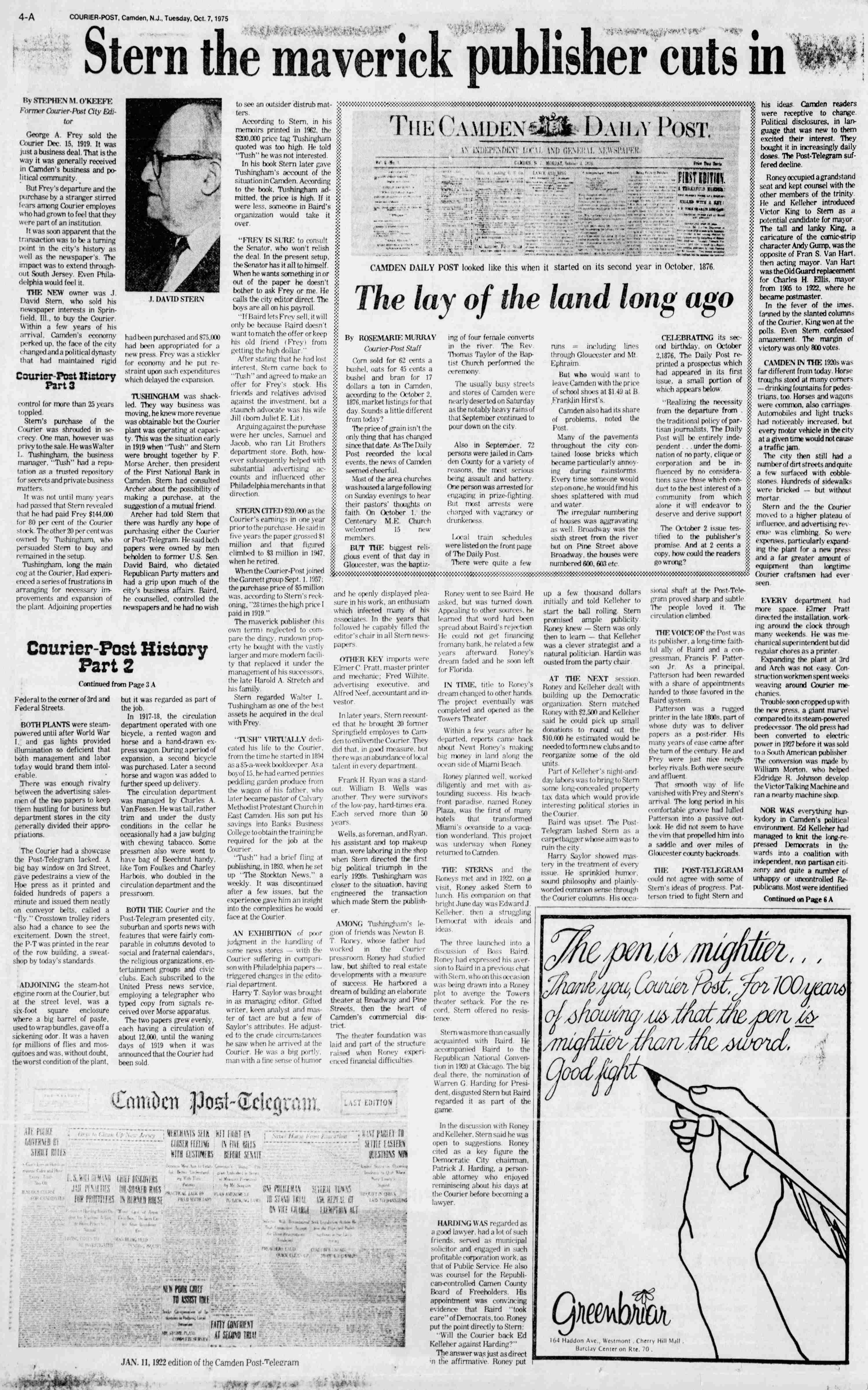

By STEPHEN M. O’KEEFE
Former Courier-Post City Editor
George A. Frey sold the Courier Dec. 15, 1919. It was just a business deal. That is the way it was generally received in Camden’s business and political community.
But Frey’s departure and the purchase by a stranger stirred fears among Courier employes who had grown to feel that they were part of an institution.
It was soon apparent that the transaction was to be a turning point in the city’s history as well as the newspaper’s. The impact was to extend throughout South Jersey. Even Philadelphia would feel it.
THE NEW owner was J. David Stern, who sold his newspaper interests in Springfield, Ill., to buy the Courier. Within a few years of his arrival, Camden’s economy perked up, the face of the city changed and a political dynasty that had maintained rigid control for more than 25 years toppled.
Stern’s purchase of the Courier was shrouded in secrecy. One man, however was privy to the sale. He was Walter L. Tushingham, the business manager. “Tush” had a reputation as a trusted repository for secrets and private business matters.
It was not until many years had passed that Stern revealed that he had paid Frey $144,000 for 80 per cent of the Courier stock. The other 20 per cent was owned by Tushingham, who persuaded Stern to buy and remained in the setup.
Tushingham, long the main cog at the Courier, had experienced a series of frustrations in arranging for necessary improvements and expansion of the plant. Adjoining properties had been purchased and $75,000 had been appropriated for a new press. Frey was a stickler for economy and he put restraint upon such expenditures which delayed the expansion.
TUSHINGHAM was shackled. They [sic] way business was moving, he knew more revenue was obtainable but the Courier plant was operating at capacity. This was the situation early in 1919 when “Tush” and Stern were brought together by F. Morse Archer, then president of the First National Bank in Camden. Stern had consulted Archer about the possibility of making a purchase, at the suggestion of a mutual friend.
Archer had told Stern that there was hardly any hope of purchasing either the Courier or Post-Telegram. He said both papers were owned by men beholden to former U.S. Sen. David Baird, who dictated Republican Party matters and had a grip upon much of the city’s business affairs. Baird, he counselled, controlled the newspapers and he had no wish to see an outsider distrub [sic] matters.
According to Stern, in his memoirs printed in 1962, the $200,000 price tag Tushingham quoted was too high. He told “Tush” he was not interested.
In his book Stern later gave Tushingham’s account of the situation in Camden. According to the book, Tushingham admitted, the price is high. If it were less, someone in Baird’s organization would take it over.
“FREY IS SURE to consult the Senator, who won’t relish the deal. In the present setup, the Senator has it all to himself. When he wants something in or out of the paper he doesn’t bother to ask Frey or me. He calls the city editor direct. The boys are all on his payroll.
“If Baird lets Frey sell, it will only be because Baird doesn’t want to match the offer or keep his old friend (Frey) from getting the high dollar.”
After stating that he had lost interest, Stern came back to “Tush” and agreed to make an offer for Frey’s stock. His friends and relatives advised against the investment, but a staunch advocate was his wife Jill (born Juliet E. Lit).
Arguing against the purchase were her uncles, Samuel and Jacob, who ran Lit Brothers department store. Both, however subsequently helped with substantial advertising accounts and influenced other Philadelphia merchants in that direction.
STERN CITED $20,000 as the Courier’s earnings in one year prior to the purchase. He said in five years the paper grossed $1 million and that figured climbed to $3 million in 1947, when he retired.
When the Courier-Post joined the Gannett group Sept. 1, 1957; the purchase price of $5 million was, according to Stern’s reckoning, “28 times the high price I paid in 1919.”
The maverick publisher (his own term) neglected to compare the dingy, rundown property he bought with the vastly larger and more modern facility that replaced it under the management of his successors, the late Harold A. Stretch and his family.
Stern regarded Walter L. Tushingham as one of the best assets he acquired in the deal with Frey.
“TUSH” VIRTUALLY dedicated his life to the Courier, from the time he started in 1894 as a $5-a-week bookkeeper. As a boy of 15, he had earned pennies peddling garden produce from the wagon of his father, who later became pastor of Calvary Methodist Protestant Church in East Camden. His son put his savings into Banks Business College to obtain the training he required for the job at the Courier.
“Tush” had a brief fling at publishing, in 1893, when he set up “The Stockton News,” a weekly. It was discontinued after a few issues, but the experience gave him an insight into the complexities he would face at the Courier.
AN EXHIBITION of poor judgment in the handling of some news stories — with the Courier suffering in comparison with Philadelphia papers — triggered changes in the editorial department.
Harry T. Saylor was brought in as managing editor. Gifted writer, keen analyst and master of tact are but a few of Saylor’s attributes. He adjusted to the crude circumstances he saw when he arrived at the Courier. He was a big portly man with a fine sense of humor and he openly displayed pleasure in his work, an enthusiam [sic] which infected many of his associates. In the years that followed he capably filled the editor’s chair in all Stern newspapers.
OTHER KEY imports were Elmer C. Pratt, master printer and mechanic; Fred Wilhite, advertising executive, and Alfred Neef, accountant and investor.
In later years, Stern recounted that he brought 20 former Springfield employes to Camden to enliven the Courier. They did that, in good measure, but there was an abundance of local talent in every department.
Frank H. Ryan was a standout. William B. Wells was another. They were survivors of the low-pay, hard-times era. Each served more than 50 years.
Wells, as foreman, and Ryan, his assistant and top makeup man, were laboring in the shop when Stern directed the first big political triumph in the early 1920s. Tushingham was closer to the situation, having engineered the transaction which made Stern the publisher.
AMONG Tushingham’s legion of friends was Newton B. T. Roney, whose father had worked in the Courier pressroom. Roney had studied law, but shifted to real estate developments with a measure of success. He harbored a dream of building an elaborate theater at Broadway and Pine Streets, then the heart of Camden’s commercial district.
The theater foundation was laid and part of the structure raised when Roney experienced financial difficulties.
Roney went to see Baird. He asked, but was turned down. Appealing to other sources, he learned that word had been spread about Baird’s rejection. He could not get financing from any bank, he related a few years afterward. Roney’s dream faded and he soon left for Florida.
IN TIME, title to Roney’s dream changed to other hands. The project eventually was completed and opened as the Towers Theater.
Within a few years after he departed, reports came back about Newt Roney’s making big money in land along the ocean side of Miami Beach.
Roney planned well, worked diligently and met with astounding success. His beachfront paradise, named Roney Plaza, was the first of many hotels that transformed Miami’s oceanside to a vacation wonderland. This project was underway when Roney returned to Camden.
THE STERNS and the Roneys met and in 1922, on a visit, Roney asked Stern to lunch. His companion on that bright June day was Edward J. Kelleher, then a struggling Democrat with ideals and ideas.
The three launched into a discussion of Boss Baird. Roney had expressed his aversion to Baird in a previous chat with Stern, who on this occasion was being drawn into a Roney plot to avenge the Towers theater setback. For the record, Stern offered no resistence [sic].
Stern was more than casually acquainted with Baird. He accompanied Baird to the Republican National Convention in 1920 at Chicago. The big deal there, the nomination of Warren G. Harding for President, disgusted Stern but Baird regarded it as part of the game.
In the discussion with Roney and Kelleher, Stern said he was open to suggestions. Roney cited as a key figure the Democratic City chairman, Patrick J. Harding, a personable attorney who enjoyed reminiscing about his days at the Courier before becoming a lawyer.
HARDING WAS regarded as a good lawyer, had a lot of such friends, served as municipal solicitor and engaged in such profitable corporation work, as that of Public Service. He also was counsel for the Republican-controlled Camen [sic] County Board of Freeholders. His appointment was convincing evidence that Baird “took care” of Democrats, too. Roney put the point directly to Stern:
“Will the Courier back Ed Kelleher against Harding?”
The answer was just as direct in the affirmative. Roney put up a few thousand dollars initially and told Kelleher to start the ball rolling. Stern promised ample publicity. Roney knew — Stern was only then to learn — that Kelleher was a clever strategist and a natural politician. Hardin [sic] was ousted from the party chair.
AT THE NEXT session, Roney and Kelleher dealt with building up the Democratic organization. Stern matched Roney with $2,500 and Kelleher said he could pick up small donations to round out the $10,000 he estimated would be needed to form new clubs and to reorganize some of the old units.
Part of Kelleher’s night-and-day labors was to bring to Stern some long-concealed property tax data which would provide interesting political stories in the Courier.
Baird was upset. The Post-Telegram lashed Stern as a carpetbagger whose aim was to ruin the city.
Harry Saylor showed mastery in the treatment of every issue. He sprinkled humor, sound philosophy and plainly-worded common sense through the Courier columns. His occasional shaft at the Post-Telegram proved sharp and subtle. The people loved it. The circulation climbed.
THE VOICE OF the Post was its publisher, a long-time faithful ally of Baird and a congressman, Francis F. Patterson Jr. As a principal, Patterson had been rewarded with a share of appointments handed to those favored in the Baird system.
Patterson was a rugged printer in the late 1800s, part of whose duty was to deliver papers as a post-rider. His many years of ease came after the turn of the century. He and Frey were just nice neighborley [sic] rivals. Both were secure and affluent.
That smooth way of life vanished with Frey and Stern’s arrival. The long period in his comfortable groove had lulled Patterson into a passive outlook. He did not seem to have the vim that propelled him into a saddle and over miles of Gloucester county backroads.
THE POST-TELEGRAM could not agree with some of Stern’s ideas of progress. Patterson tried to fight Stern and his ideas. Camden readers were receptive to change. Political disclosures, in language that was new to them excited their interest. They bought it in increasingly daily doses. The Post-Telegram suffered decline.
Roney occupied a grandstand seat and kept counsel with the other members of the trinity. He and Kelleher introduced Victor King to Stern as a potential candidate for mayor. The tall and lanky King, a caricature of the comic-strip character Andy Gump, was the opposite of Fran [sic] S. Van Hart, then acting mayor. Van Hart was the Old Guard replacement for Charles H. Ellis, mayor from 1905 to 1922, where he became postmaster.
In the fever of the imes [sic], fanned by the slanted columns of the Courier, King won at the polls. Even Stern confessed amazement. The margin of victory was only 800 votes.
CAMDEN IN THE 1920s was far different from today. Horse troughs stood at many corners — drinking fountains for pedestrians, too. Horses and wagons were common, also carriages. Automobiles and light trucks had noticeably increased, but every motor vehicle in the city at a given time would not cause a traffic jam.
The city then still had a number of dirt streets and quite a few surfaced with cobblestones. Hundreds of sidewalks were bricked — but without mortar.
Stern and the the [sic] Courier moved to a higher plateau of influence, and advertising revenue was climbing. So were expenses, particularly expanding the plant for a new press and a far greater amount of equipment than longtime Courier craftsmen had ever seen.
EVERY department had more space. Elmer Pratt directed the installation, working around the clock through many weekends. He was mechanical superintendent but did regular chores as a printer.
Expanding the plant at 3rd and Arch was not easy. Construction workmen spent weeks weaving around Courier mechanics.
Trouble soon cropped up with the new press, a giant marvel compared to its steam-powered predecessor. The old press had been converted to electric power in 1927 before it was sold to a South American publisher. The conversion was made by William Morton, who helped Eldridge R. Johnson develop the Victor Talking Machine and ran a nearby machine shop.
NOR WAS everything hunkydory in Camden’s political environment. Ed Kelleher had managed to knit the long-repressed Democrats in the wards into a coalition with independent, non partisan citizenry and quite a number of unhappy or uncontrolled Republicans. Most were identified with the Non-Partisan League and they were feeling their oats. The practical Roney and Kelleher, however, knew they had merely reached first base.
The two men huddled with Stern and came up with an idea — campaign for a new form of government for the city. The plan was worked out expertly, emphasizing the advantages of a compact, five-man governing group, each member accountable to voters all over the city.
The new plan was kept secret for a while. It was embodied in an exhaustive survey for the council by Mayor King. The new mayor startled the Old Guard and the city at large by calling for a referendum on a City Commission form of government. The speech prompted an abundance of favorable copy in the Courier; not so favorable comment in the Post-Telegram.
IN MARCH, 1923, the change was approved. In May, the voters elected the entire Non-Partisan League ticket. This put Baird and his organization out of business for the first time in 25 years.
Stern and the Courier were the chief beneficiaries of the change. The publisher — and now politician — was to know the stress of carrying water on both shoulders.
Patterson and the Post-Telegram were to feel the worst effect. With the downward turn of fortune, a frustrating decline in advertising and circulation revenues, the P-T was a loser each day.
STERN CALCULATED the advantages in buy [sic] the Post-Telegram, but Patterson wouldn’t consider a deal with Stern. He approached Baird and asked for a loan needed to fight Stern. Baird said he wanted Patterson to keep the competition and suggested a smaller loan. The Post publisher wouldn’t agree.
“The full amount or nothing,” Patterson declared.
Baird matched his stubbornness. Back in the office Patterson shared his misery with Upton S. Jefferys, the editor, and Frank S. Albright, city editor. Upton owned five shares of P-T stock. He and Albright had given their best efforts for many years, but the outlook was bleak.
THIS WAS the situation when Patterson saw Ed Kelleher enter the office. The two were not strangers, but Patterson had little reason to regard him warmly.
Kelleher came right out with an offer to buy the Post-Telegram. Patterson replied with equal candor:
“You know that I know, Ed, that you don’t have anough [sic] money to buy this paper.”
Kelleher put a hand in a coat pocket and was about to inform Patterson that he had come prepared to negotiate.
“I’m sure I know who you represent,” Patterson stated. “My answer is no.”
KELLEHER DREW a check from his pocket and placed it before Patterson. The publisher took a quick glance at the amount. It was $75,000. He then summoned his son, Frank F. Patterson 3d.
“Here, Frank, you’re the treasurer here; this is your department.”
Kelleher thought he was hearing a change of attitude by Patterson. The younger Patterson stared at both men. He glanced at both sides of the check as would an accountant, then turned to his parent.
“What am I supposed to do with this, Father?” he asked.
THE REPLY was intended for Kelleher:
“You are supposed to tear it up and throw the pieces in the waste basket, Son.”
Young Patterson obeyed.
Keleher [sic] accepted the gestured [sic] as finale. One minute later he was walking along Federal Street to the Courier building to report to Stern.
J. DAVID STERN
JAN. 11, 1922 edition of the Camden Post-Telegram
The lay of the land long ago
By ROSEMARIE MURRAY
Courier-Post Staff
Corn sold for 62 cents a bushel, oats for 45 cents a bushel and bran for 17 dollars a ton in Camden, according to the October 2, 1876, market listings for that day. Sounds a little different from today?
The price of grain isn’t the only thing that has changed since that date. As The Daily Post recorded the local events, the news of Camden seemed cheerful.
Most of the area churches was [sic] housed a large following on Sunday evenings to hear their pastors’ thoughts on faith. On October 1, the Centenary M.E. Church welcomed 15 new members.
BUT THE biggest religious event of that day in Gloucester, was the baptizing of four female converts in the river. The Rev. Thomas Taylor of the Baptist Church performed the ceremony.
The usually busy streets and stores of Camden were nearly deserted on Saturday as the notably heavy rains of that September continued to pour down on the city.
Also in September, 72 persons were jailed in Camden County for a variety of reasons, the most serious being assault and battery. One person was arrested for engaging in prize-fighting. But most arrests were charged with vagrancy or drunkeness [sic].
Local train schedules were listed on the front page of The Daily Post.
There were quite a few runs — including lines through Gloucester and Mt. Ephraim.
But who would want to leave Camden with the price of school shoes at $1.49 at B. Franklin Hirst’s.
Camden also had its share of problems, noted the Post.
Many of the pavements throughout the city contained loose bricks which became particularly annoying during rainstorms. Every time someone would step on one, he would find his shoes splattered with mud and water.
The irregular numbering of houses was aggravating as well. Broadway was the sixth street from the river but on Pine Street above Broadway, the houses were numbered 600, 603 etc.
CELEBRATING its second birthday, on October 2, 1876, The Daily Post reprinted a prospectus which had appeared in its first issue, a small portion of which appears below:
“Realizing the necessity from the departure from the traditional policy of partisan journalists, The Daily Post will be entirely independent . . . under the domination of no party, clique or corporation and be influenced by no considerations save those which conduct to the best interest of a community from which alone it will endeavor to deserve and derive support.”
The October 2 issue testified to the publisher’s promise. And at 2 cents a copy, how could the readers go wrong?
CAMDEN DAILY POST looked like this when it started on its second year in October, 1876.
Courier-Post History Part 2
Federal to the corner of 3rd and Federal Streets.
BOTH PLANTS were steam-powered until after World War I, and gas lights provided illumination so deficient that both management and labor today would brand them intolerable.
There was enough rivalry between the advertising salesmen of the two papers to keep them hustling for business but department stores in the city generally divided their appropriations.
The Courier had a showcase the Post-Telegram lacked. A big bay window on 3rd Street, gave pedestrains [sic] a view of the Hoe press as it printed and folded hundreds of papers a minute and issued them neatly on conveyor belts, called a “fly.” Crosstown trolley riders also had a chance to see the excitement. Down the street, the P-T was printed in the rear of the row building, a sweatshop by today’s standards.
ADJOINING the steam-hot engine room at the Courier, but at the street level, was a six-foot square enclosure where a big barrel of paste, used to wrap bundles, gave off a sickening odor. It was a haven for millions of flies and mosquitoes and was, without doubt, the worst condition of the plant, but it was regarded as part of the job.
In 1917-18, the circulation department operated with one bicycle, a rented wagon and horse and a hand-drawn express wagon. During a period of expansion, a second bicycle was purchased. Later a second horse and wagon was added to further speed up delivery.
The circulation department was managed by Charles A. Van Fossen. He was tall, rather trim and under the dusty conditions in the cellar he occasionally had a jaw bulging with chewing tabacco [sic]. Some pressmen also were wont to have bag of Beechnut handy, like Tom Foulkes and Charley Harbois, who doubled in the circulation department and the pressroom.
BOTH THE Courier and the Post-Telegram presented city, suburban and sports news with features that were fairly comparable in columns devoted to social and fraternal calendars, the religious organizations, entertainment groups and civic clubs. Each subscribed to the United Press news service, employing a telegrapher who typed copy from signals received over Morse apparatus.
The two papers grew evenly, each having a circulation of about 12,000, until the waning days of 1919 when it was announced that the Courier had been sold.
851 Haddon Avenue
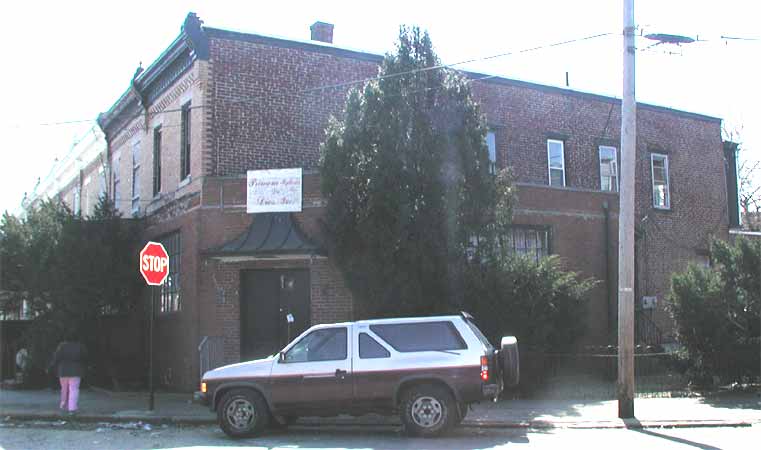
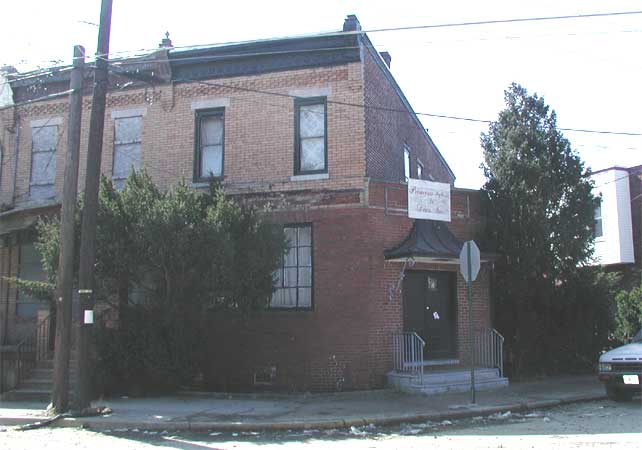
851 Haddon Avenue — March 15, 2003. Frank S. Van Hart and wife Ida lived here at the time of the 1920 census.