William J. Browning
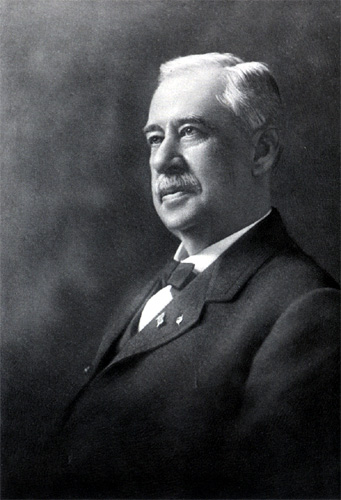
William J. Browning, U.S. Congressman
WILLIAM JOHN BROWNING had a distinguished career in public service, culminating in his election to the United States House of Representatives in November of 1910. He had previously served as a member of the Camden Board of Education and of the city council. William J. Browning was appointed postmaster of Camden on June 18, 1889, and served until June 1, 1894, when his successor Harry B. Paul was appointed.
William J. Browning was Chief Clerk of the House of Representatives of the United States from 1895 until 1911.
In June of 1903 William J. Browning was involved in resolving the affairs of Camden Postmaster Louis T. Derousse, a close personal friend, who had abandoned his position after suffering a mental breakdown.
In 1911 William J. Browning was elected as a Republican to the Sixty-second Congress to fill the vacancy caused by the death of Henry C. Loudenslager. A popular figure in South Jersey, he was reelected to the Sixty-third and to the three succeeding Congresses.
Upon his arrival in Congress on November 7, 1911, he was made a member of the Committee on Naval Affairs, and he was the ranking majority member of that committee at the time of his death. After falling ill during the winter of 1919–1920, he returned to work in Washington DC at the opening of the Congressional Session. William J. Browning passed away at the Capitol Building in Washington DC on March 24, 1920.
Congressman Browning was brought home and buried at Harleigh Cemetery in Camden NJ. William J. Browning was survived by his son, Dr. W. Kempton Browning, a prominent Camden physician. Shortly after his death, Evergreen Avenue, a street that ran east from Mount Ephraim Avenue opposite Evergreen Cemetery, was renamed Browning Street.
Camden Board of Education
Philadelphia Inquirer —
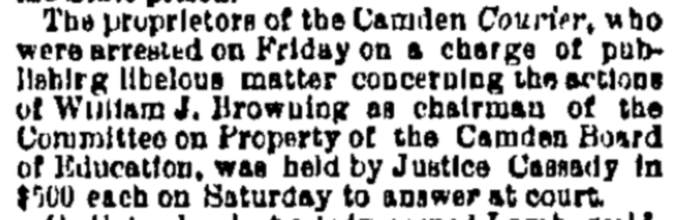
The proprietors of the Camden Courier, who were arrested on Friday on a charge of publishing libelous matter concerning the actions of William J. Browning as chairman of the Committee on Property of the Camden Board of Education, was held by Justice Cassady in $500 each on Saturday to answer at court.
First Ward Republican Club
Philadelphia Inquirer —
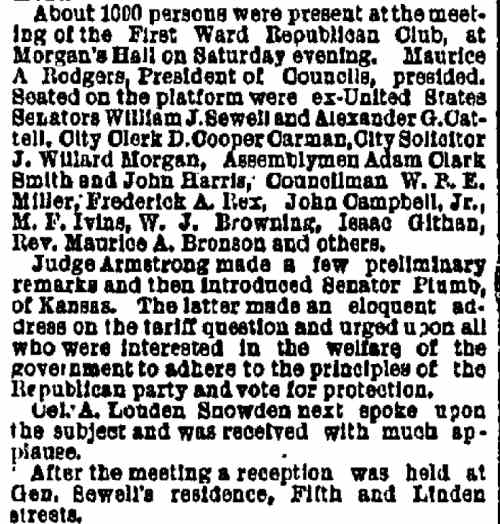
About 1000 persons were present at the meeting of the First Ward Republican Club, at Morgan’s Hall on Saturday evening. Maurice A. Rodgers, President of Councils, presided. Seated on the platform were ex-United States Senators William J. Sewell and Alexander G. Cattell, City Clerk D. Cooper Carman, City Solicitor J. Willard Morgan, Assemblymen Adam Clark Smith and John Harris; Councilman W. P. E. Miller, Frederick A. Rex, John Campbell, Jr., M. F. Ivins, W. J. Browning, Isaac Githean, Rev. Maurice A. Bronson and others.
Judge Armstrong made a few preliminary remarks and then introduced Senator Plumb, of Kansas. The latter made an eloquent address on the tariff question and urged upon all who were interested in the welfare of the government to adhere to the principles of the Republican party and vote for protection.
Col. A. Louden Snowden next spoke upon the subject and was received with much applause.
After the meeting a reception was held at Gen. Sewell’s residence, Fifth and Linden streets.
Camden News
Philadelphia Inquirer —
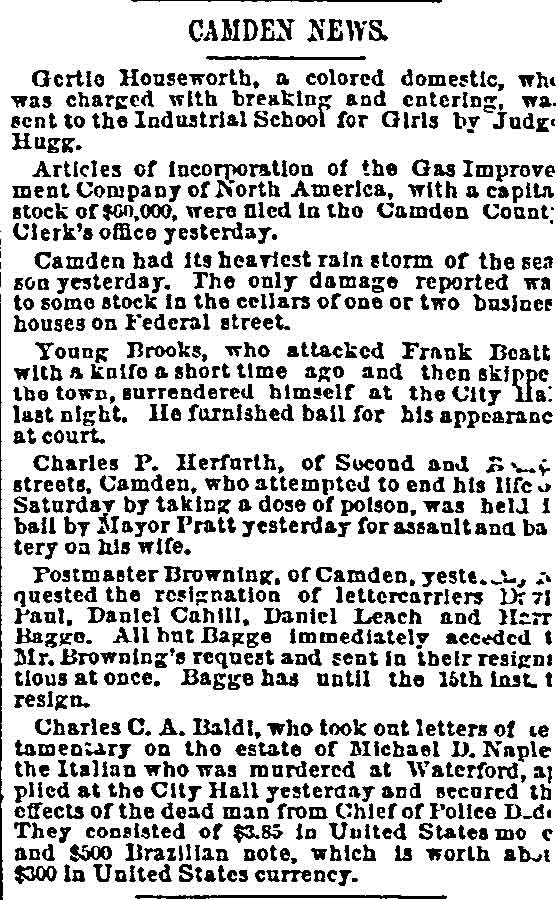
CAMDEN NEWS.
Gertie Houseworth, a colored domestic, who was charged with breaking and entering, was sent to the Industrial School for Girls by Judge Hugg.
Articles of incorporation of the Gas Improvement Company of North America, with a capital stock of $60,000, were filed in the Camden County Clerk’s office yesterday.
Camden had its heaviest rain storm of the season yesterday. The only damage reported was to some stock in the cellars of one or two business houses on Federal street.
Young Brooks, who attacked Frank Beatt with a knife a short time ago and then skipped the town, surrendered himself at the City Hall last night. He furnished bail for his appearance at court.
Charles P. Herfurth, of Second and [?] streets, Camden, who attempted to end his life on Saturday by taking a dose of poison, was held to bail by Mayor Pratt yesterday for assault and battery on his wife.
Postmaster Browning, of Camden, yesterday requested the resignation of lettercarriers David Paul, Daniel Cahill, Daniel Leach and Harry Bagge. All but Bagge immediately acceded to Mr. Browning’s request and sent in their resignations at once. Bagge has until the 15th inst. to resign.
Charles C. A. Baldi, who took out letters of testamentary on the estate of Michael D. Naple, the Italian who was murdered at Waterford, applied at the City Hall yesterday and secured the effects of the dead man from Chief of Police Dodd. They consisted of $3.85 in United States money and $500 Brazilian note, which is worth about $300 in United States currency.
Camden Politics
Philadelphia Inquirer —
Since the return of City Solicitor J. Willard Morgan from a trip to the Thousand Islands, political matters are beginning to boom. Mr. Morgan had several consultations with his trusted lieutenants yesterday, when it is said tactics for the fall campaign were discussed. The fight at the coming Republican primary election promises to be an interesting one. Mr. Morgan and General Sewell, who have always heretofore been the closest friends, will lead separate factions. The general will have such supporters as Postmaster Browning, Sheriff Baird, Congressman Bergen and Judge Armstrong. Mr. Morgan will be backed up by the entire force of officials and clerks at the City Hall and the entire police force and fire department.
Notes
Philadelphia Inquirer —
NOTES.
William Carrigan, Democrat of the Second ward, has sent his resignation to Postmaster Browning to take effect on the 15th instant.
J. W. Stow is locked up in the City Hall awaiting a hearing on the charge of assault and battery on Annie Genther.
Mayor Pratt is confined to his home suffering from grippe. Chief of Police Dodd is in style and also has the disease. Two of his sons are confined to their beds. Charles R. Bacon, of the Record, is one of the latest victims to succumb.
Policeman H. Wheaten, of the Second ward, has resigned as a patrolman. He will be succeeded by Ed Powell, an engineer in the Water Department. John Killmartin has been appointed to fill the latter’s piece.
Philip Harris and wife have been held in bail, charged with keeping a disorderly house at Front and Elm streets.
Camden Republican Club at Gettysburg, 1894
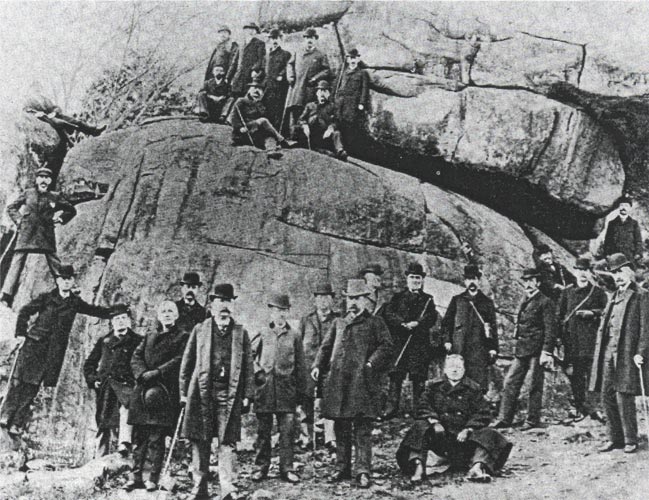

The Camden Republican Club at its annual outing at Gettysburg in 1894. Influential county leaders attending included J. J. Burleigh (standing on boulder third from left), Frank F. Patterson, Jr. (bottom row third from left), William J. Browning (front row sixth from right), and David J. Pancoast (front row second from right).
First Days of Carnegie Library
Philadelphia Inquirer —
FIRST DAYS OF CARNEGIE LIBRARY
During the first eight days of business at the Camden Free Public Library, at Broadway and Line street, Camden, 1562 readers had been registered. William J. Browning, chief clerk of the House of Representatives, has presented the library with a rare and finely illustrated set of “Census of the Philippine Islands.”
Camden Primaries
Philadelphia Inquirer —
CAMDEN PRIMARIES
Republicans Elect Delegates to the State Convention.
There were contests at the Republican primary election in Camden last night in the First, Fourth, Eighth and Ninth wards. In the last two wards the fight for ward leadership was hotly contested. The result in the Eighth could not be ascertained at a late hour last night. There were several fights around the polls in this ward. The police took a hand and some of the participants are nursing sore heads.
All the delegates to the Gubernatorial convention, with possibly two or three exceptions, will be for Senator Rogers on the first ballot and for John Kean, Jr., on the final vote. Dr. A. H. Lippincott seems to have secured a majority of the delegates to the Coroner’s convention, defeating Charles N. Robinson, the colored candidate.
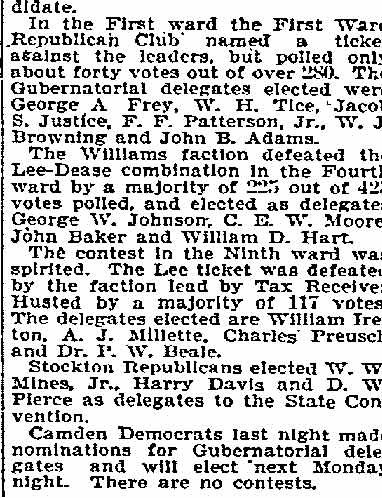
In the First ward the First Ward Republican Club named a ticket against the leaders, but polled only about forty votes out of over 280. The Gubernatorial delegates elected were George A. Frey, W. H. Tice, Jacob S. Justice, F. F. Patterson, Jr., W. J. Browning and John B. Adams.
The Williams faction defeated the Lee-Dease combination in the Fourth ward by a majority of 225 out of 421 votes polled, and elected as delegates George W. Johnson, C. E. W. Moore, John Baker and William D. Hart.
The contest in the Ninth ward was spirited. The Lee ticket was defeated by the faction lead by Tax Receiver Husted by a majority of 117 votes. The delegates elected are William Ireton, A. J. Millette, Charles Preusch and Dr. P. W. Beale.
Stockton Republicans elected W. W. Mines, Jr., Harry Davis and D. W. Pierce as delegates to the State Convention.
Camden Democrats last night made nominations for Gubernatorial delegates and will elect next Monday night. There are no contests.
William J. Browning
Philadelphia Inquirer —
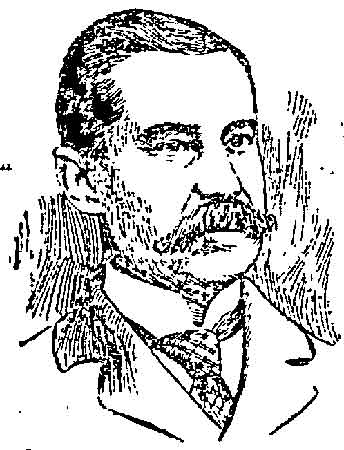
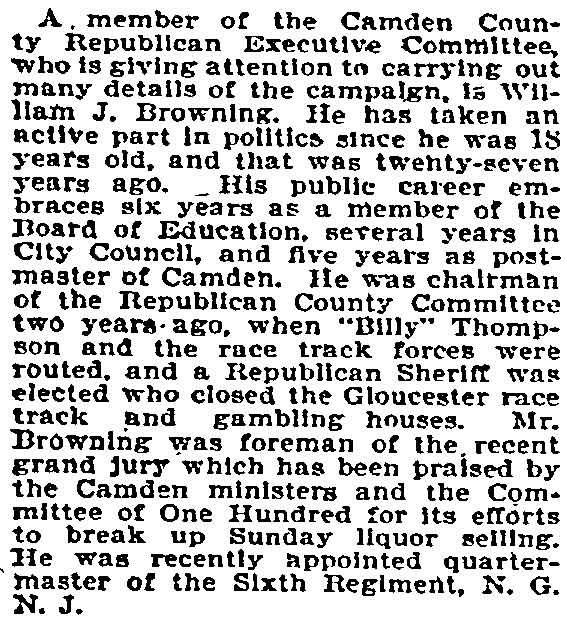
A member of the Camden County Republican Executive Committee, who is giving attention to carrying out many details of the campaign, is William J. Browning. He has taken an active part in politics since he was 18 years old, and that was twenty-seven years ago. His public career embraces six years as a member of the Board of Education, several years in City Council, and five years as postmaster of Camden. He was chairman of the Republican County Committee two years ago, when “Billy” Thompson and the race track forces were routed, and a Republican Sheriff was elected who closed the Gloucester race track and gambling houses. Mr. Browning was foreman of the recent grand jury which has been praised by the Camden ministers and the Committee of One Hundred for its efforts to break up Sunday liquor selling. He was recently appointed quartermaster of the Sixth Regiment, N. G. N. J.
Sewellites Coming to Trenton
Philadelphia Inquirer —
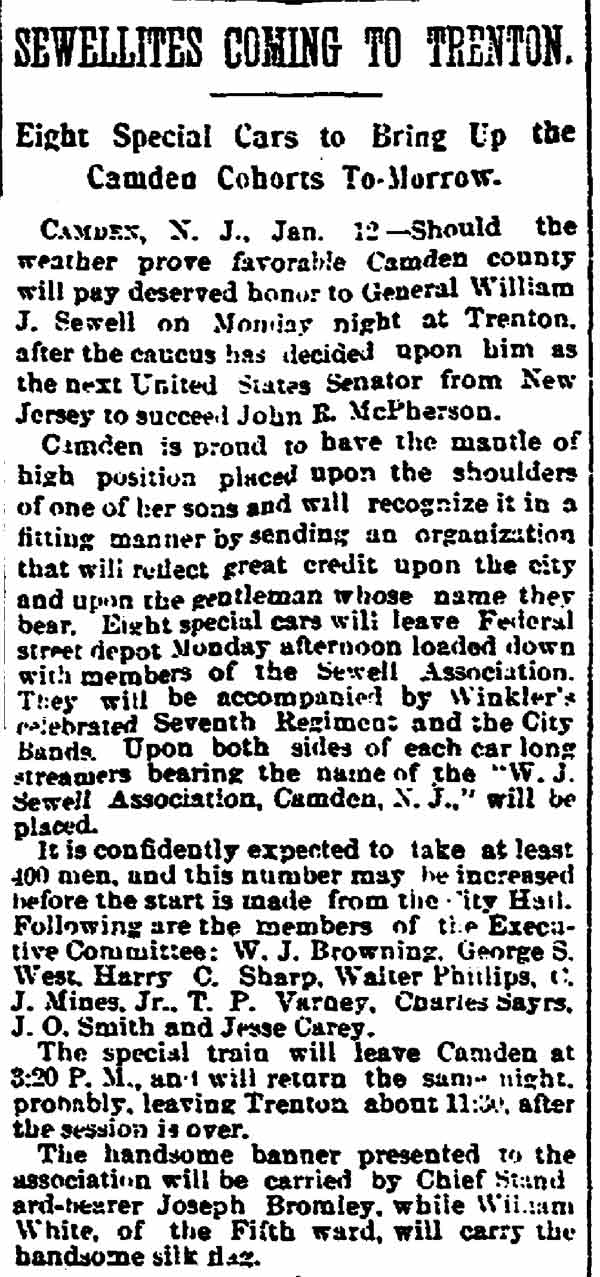
SEWELLITES COMING TO TRENTON.
Eight Special Cars to Bring Up the Camden Cohorts To-Morrow.
CAMDEN, N. J., Jan. 12—Should the weather prove favorable Camden county will pay deserved honor to General William J. Sewell on Monday night at Trenton, after the caucus has decided upon him as the next United States Senator from New Jersey to succeed John R. McPherson. Camden is proud to have the mantle of high position placed upon the shoulders of one of her sons and will recognize it in a fitting manner by sending an organization that will reflect great credit upon the city and upon the gentleman whose name they bear. Eight special cars will leave Federal street depot Monday afternoon loaded down with members of the Sewell Association. They will be accompanied by Winkler’s celebrated Seventh Regiment and the City Bands. Upon both sides of each car long streamers bearing the name of the “W. J. Sewell Association, Camden, N. J.,” will be placed.
It is confidently expected to take at least 400 men, and this number may be increased before the start is made from the City Hall. Following are the members of the Executive Committee: W. J. Browning, George S. West, Harry C. Sharp, Walter Phillips, C. J. Mines, Jr., T. P. Varney, Charles Sayrs, J. O. Smith and Jesse Carey.
The special train will leave Camden at 3:20 P. M., and will return the same night, probably, leaving Trenton about 11:30, after the session is over.
The handsome banner presented to the association will be carried by Chief Standard-bearer Joseph Bromley, while William White, of the Fifth ward, will carry the handsome silk flag.
Biographical Review
Biographical Review of New Jersey — 1897
WILLIAM J. BROWNING, chief Clerk of the National House of Representatives in Washington, D.C., and a resident of Camden, N.J., was born in this city at the family residence, 214 Market Street, on April 11, 1850. His parents were William C. and Mary C. (Burrough) Browning.
William C. Browning was reared in Moorestown, N.J., where he learned the trade of carriage trimmer. Later he officiated a number of years as Collector for the West Jersey Ferry. He married Mary C. Burrough, and they had three children: William J.; B. Frank; and Mary A., who married Edward Henclog. William C. Browning died at the age of forty-four, while his wife lived to be sixty-four. They were connected with the Society of Friends.
William J. Browning passed his early years at home, obtaining his education in the Camden public schools and at the Friends’ Central High School in Philadelphia. In 1865 he entered the employ of Davis, Kempton & Co., wholesale dry-goods dealers at 219 Market Street, Philadelphia, remaining in that establishment through several changes. In 1887 the firm went out of business; and Mr. Browning became associated with Howard Warner & Co., with whom he remained, or was represented, until July, 1896, when his interest ceased.
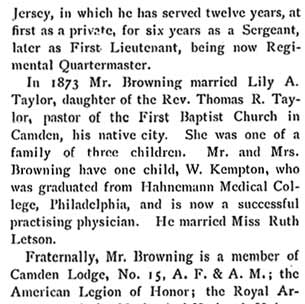
In politics he affiliates with the Republican party. Officially, he has served on the Board of Education four years and as a member of the City Council from 1886 to 1889. In June, 1889, he was appointed Postmaster by President Harrison, and served until July, 1894, being alone in the Camden post-office. In December, 1895, he was appointed Clerk of the House of Representatives, having been interested in politics from the time he was eighteen years of age. Mr. Browning is connected with the Camden Horse Railroad as Adjuster. He is a member of Company G of the Sixth Regiment, National Guard of the State of New Jersey, in which he has served twelve years, at first as a private, for six years as a Sergeant, later as First Lieutenant, being now Regimental Quartermaster.
In 1873 Mr. Browning married Lily A. Taylor, daughter of the Rev. Thomas R. Taylor, pastor of the First Baptist Church in Camden, his native city. She was one of a family of three children. Mr. and Mrs. Browning have one child, W. Kempton, who was graduated from Hahnemann Medical College, Philadelphia, and is now a successful practising physician. He married Miss Ruth Letson.
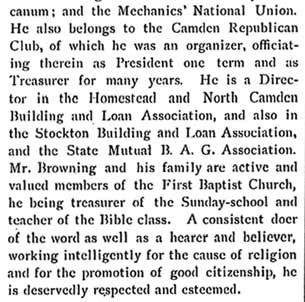
Fraternally, Mr. Browning is a member of Camden Lodge, No. 15, A. F. & A. M.; the American Legion of Honor; the Royal Arcanum; and the Mechanics’ National Union. He also belongs to the Camden Republican Club, of which he was an organizer, officiating therein as President one term and as Treasurer for many years. He is a Director in the Homestead and North Camden Building and Loan Association, and also in the Stockton Building and Loan Association, and the State Mutual B. A. G. Association. Mr. Browning and his family are active and valued members of the First Baptist Church, he being treasurer of the Sunday-school and teacher of the Bible class. A consistent doer of the word as well as a hearer and believer, working intelligently for the cause of religion and for the promotion of good citizenship, he is deservedly respected and esteemed.
New Republican Executive Committee
Philadelphia Inquirer —
New Republican Executive Committee.
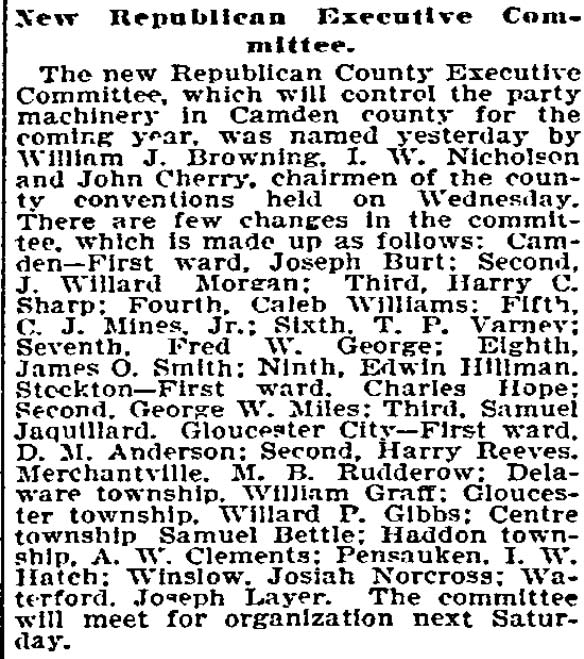
The new Republican County Executive Committee, which will control the party machinery in Camden county for the coming year, was named yesterday by William J. Browning, I. W. Nicholson and John Cherry, chairmen of the county conventions held on Wednesday. There are few changes in the committee, which is made up as follows: Camden—First ward, Joseph Burt; Second, J. Willard Morgan; Third, Harry C. Sharp; Fourth, Caleb Williams; Fifth, C. J. Mines, Jr.; Sixth, T. P. Varney; Seventh, Fred W. George; Eighth, James O. Smith; Ninth, Edwin Hillman. Stockton—First ward, Charles Hope; Second, George W. Miles; Third, Samuel Jaquillard. Gloucester City—First ward, D. M. Anderson; Second, Harry Reeves. Merchantville, M. B. Rudderow; Delaware township, William Graff; Gloucester township, Willard P. Gibbs; Centre township, Samuel Bettle; Haddon township, A. W. Clements; Pensauken, I. W. Hatch; Winslow, Josiah Norcross; Waterford, Joseph Layer. The committee will meet for organization next Saturday.
Camden
Philadelphia Inquirer —
CAMDEN
William J. Paul, city editor of the Review, has been spending several days in New York city.
Miss Florence Shimer, of Reiglesville, is visiting Miss Jennie Boyer.
Howard Pancoast, a student at Princeton University, is spending a few days at home visiting his father, former Judge D. J. Pancoast.
J. B. VanSciver and wife sailed for Europe on Wednesday for a Continental tour.
County Detective John Cherry, who had his face frozen during the recent blizzard, is able to be about again.
Sheriff David Baird has returned from a business trip to Mobile, Ala.
City Comptroller Samuel Hufty and Street Commissioner Lewis Mohrman spent Wednesday in New York city.
Mr. and Mrs. Frank Mulford, Mr. and Mrs. J. Alphens Vansant, Mr. and Mrs. John Nulty and William C. Riggs and family have been attending the Methodist Conference at Atlantic City this week.
The Fireside New Year’s Association on Tuesday evening elected the following officers: President, A. K. Snyder; first vice-president, Emil Geer; second vice-president, W. J. Stanton; recording secretary, Paul Faussel; financial secretary, R. Murr; trustees, R. Gordon, Harvey Dumphey, E. Kellogg, C. Lock, Edward Walls; captain, Walter J. Stanton; first lieutenant, W. Sillings; second lieutenant, W. Kinzler; third lieutenant, C. E. Stripe; fourth lieutenant, S. P. Verga; musical inspectors, C. Davis and D. Smith.
The Camden Camera Club organized at 926 Broadway, on Tuesday evening, with the following officers: Dr. W. W. Kain, as president; James Rowan, vice-president; Rev. G. W. Pettitt, secretary; Dallas R. Cann, treasurer.
August H. Reeve will take his family to California this spring.
Christopher C. Chew spent Thursday attending the M. E. Conference at Atlantic City.
Judge E. Ambler Armstrong and his mother are enjoying a trip to Florida.
Mr. and Mrs. Peter V. Voorhees and Master Dayton Voorhees are spending several weeks on a Southern tour.
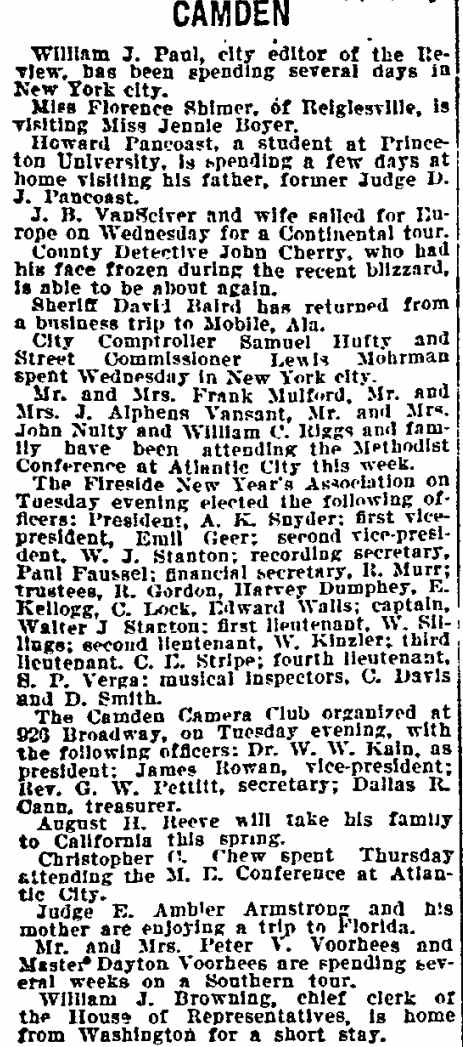
William J. Browning, chief clerk of the House of Representatives, is home from Washington for a short stay.
Over in Camden
Philadelphia Inquirer —
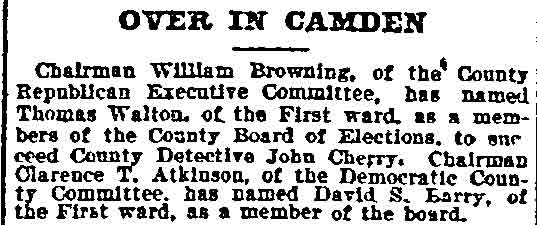
OVER IN CAMDEN
Chairman William Browning, of the County Republican Executive Committee, has named Thomas Walton, of the First ward, as a member of the County Board of Elections, to succeed County Detective John Cherry. Chairman Clarence T. Atkinson, of the Democratic County Committee, has named David S. Barry, of the First ward, as a member of the board.
Baird Holds a Christmas Party
Philadelphia Inquirer —
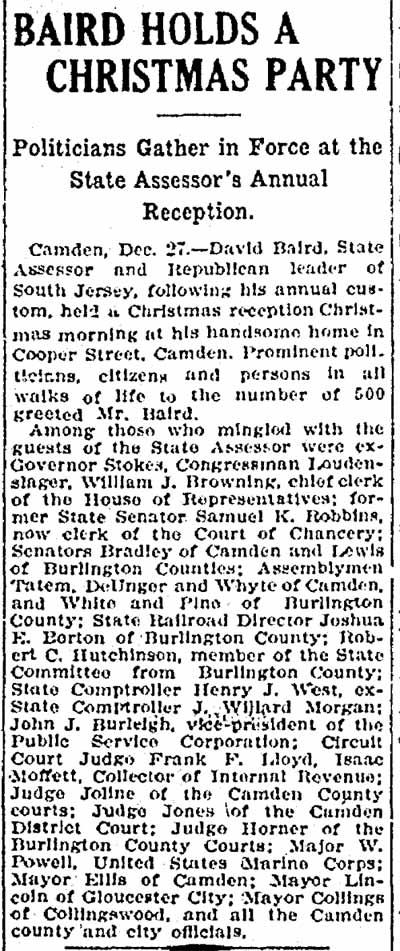
BAIRD HOLDS A CHRISTMAS PARTY
Politicians Gather in Force at the State Assessor’s Annual Reception.
Camden, Dec. 27.—David Baird, State Assessor and Republican leader of South Jersey, following his annual custom, held a Christmas reception Christmas morning at his handsome home in Cooper Street, Camden. Prominent politicians, citizens and persons in all walks of life to the number of 500 greeted Mr. Baird.
Among those who mingled with the guests of the State Assessor were ex-Governor Stokes, Congressman Loudenslager, William J. Browning, chief clerk of the House of Representatives; former State Senator Samuel K. Robbins, now clerk of the Court of Chancery; Senators Bradley of Camden and Lewis of Burlington Counties; Assemblymen Tatem, DeUnger and Whyte of Camden, and White and Pino of Burlington County; State Railroad Director Joshua E. Borton of Burlington County; Robert C. Hutchinson, member of the State Committee from Burlington County; State Comptroller Henry J. West, ex-State Comptroller J. Willard Morgan; John J. Burleigh, vice-president of the Public Service Corporation; Circuit Court Judge Frank F. Lloyd, Isaac Moffett, Collector of Internal Revenue; Judge Joline of the Camden County courts; Judge Jones of the Camden District Court; Judge Horner of the Burlington County Courts; Major W. Powell, United States Marine Corps; Mayor Ellis of Camden; Mayor Lincoln of Gloucester City; Mayor Collings of Collingswood, and all the Camden county and city officials.
Camden Regulars in Meeting Today
Philadelphia Inquirer —
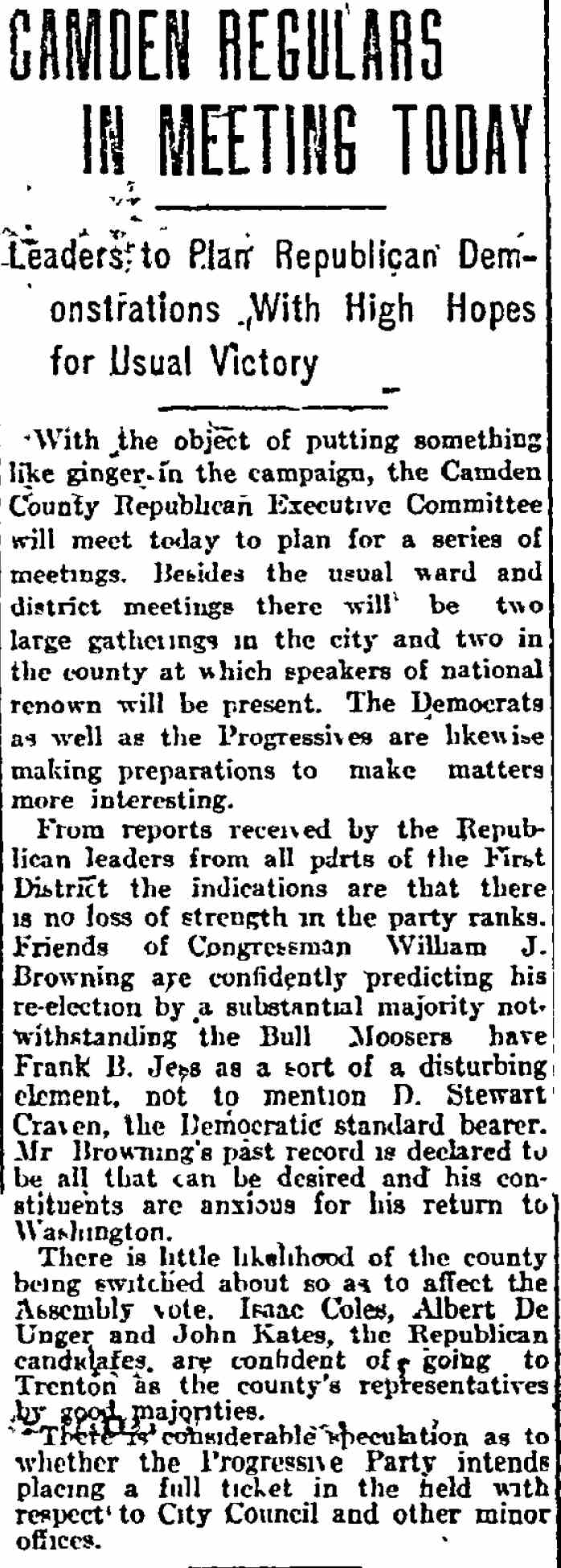
CAMDEN REGULARS IN MEETING TODAY
Leaders to Plan Republican Demonstrations With High Hopes for Usual Victory
With the object of putting something like ginger in the campaign, the Camden County Republican Executive Committee will meet today to plan for a series of meetings. Besides the usual ward and district meetings there will be two large gatherings in the city and two in the county at which speakers of national renown will be present. The Democrats as well as the Progressives are likewise making preparations to make matters more interesting.
From reports received by the Republican leaders from all parts of the First District the indications are that there is no loss of strength in the party ranks. Friends of Congressman William J. Browning are confidently predicting his re-election by a substantial majority notwithstanding the Bull Moosers have Frank B. Jess as a sort of a disturbing element, not to mention D. Stewart Craven, the Democratic standard bearer. Mr. Browning’s past record is declared to be all that can be desired and his constituents are anxious for his return to Washington.
There is little likelihood of the county being switched about so as to affect the Assembly vote. Isaac Coles, Albert De Unger and John Kates, the Republican candidates, are confident of going to Trenton as the county’s representatives by good majorities.
There is considerable speculation as to whether the Progressive Party intends placing a full ticket in the held with respect to City Council and other minor offices.
History of Camden County in the Great War
Camden, N.J.: Publicity and Historical Committee, 1919
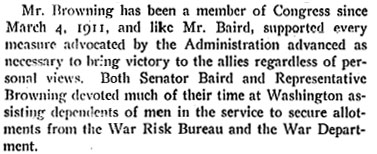
By the time America entered World War I, William J. Browning had become a member of Congress himself, as the representative from New Jersey’s First Congressional District, then comprising Camden, Gloucester, and Salem Counties.
Mr. Browning has been a member of Congress since March 4, 1911, and like Mr. Baird, supported every measure advocated by the Administration advanced as necessary to bring victory to the allies regardless of personal views. Both Senator Baird and Representative Browning devoted much of their time at Washington assisting dependents of men in the service to secure allotments from the War Risk Bureau and the War Department.
Camden Hails Her Sons, Conquerors, at Victory Jubilee
Philadelphia Inquirer —
Battle Flags Wave in Triumph O’er Parade Reviewed by Admiral
Gray Veterans of G. A. R. and Wounded Ride; Centopath Passes in Reverential Hush
The Peace with victory which Camden’s sons along with millions of other soldiers of all the Allied countries helped to bring home was celebrated by a jubilee in Camden yesterday which eclipsed anything that the city across the Delaware has ever attempted in her history.
Nearly every man, woman and child who did not actually march in the jubilee parade stood on the side lines and watched it and cheered themselves hoarse as the soldiers and sailors who went out from their town to fight marched past, this time as the conquerors in the world’s greatest war.
Favored by glorious sunshine, a sunshine that was reflected in the faces of the people, the day’s proceedings went off perfectly. For months Mayor Ellis and all his city family, together with a large committee of leading citizens, had been planning the affair. Their handiwork stood the test. It was good.
Admiral Henry Wilson, commander-in-chief of the Atlantic Fleet, came to his boyhood home to be the principal guest of the city and chief reviewing officer of the jubilee. With him were national statesmen and municipal officials.
Soldiers, sailors, war workers, members of fraternal orders and men who fought under the flags of Canada, England, Italy and Poland, marched in the parade which was miles long. Every succeeding division seemed just a little better than the one which preceded it, and, when it was all over and the soldiers and sailors had filed into the old Third Regiment Armory to sit down to a piping hot banquet, the hardest thing of all was to say which had made the finest showing.
All Honor to the Dead
Amidst all the gayety and happiness there was a sober note expressed by the memorial cenotaph which preceded the parade and which brought every hat off as it passed in solemn silence.
The heroic figure of an American soldier in bronze standing on a granite pedestal which bore a gold star with the number 135, symbolical of the Camden county men who laid down their lives in their country’s cause, was carried along the route ten minutes before the parade commenced. Encircler [sic] by flowers and palms, it moved through the reverential hush which had fallen over the throngs.
While every organization in the county of Philadelphia was represented in the parade, to the thousands who lined the sidewalks, there was really only one great big important factor—the service men. And when those self-same service men, many of whom bearing the Distinguished Service Cross of their own United States, others wearing the Croix de Guerre, bestowed on them by the sister republic of France, and still others carrying on their breasts the Italian and British War Crosses, given them by grateful countries, marched down the streets and avenues, all the pent up emotion in thousands of hearts was let loose.
It mattered not whether the men were officers or enlisted men, black or white, neat or untidy, they were all soldiers and they had done all that was asked of them. Their home town honored them. The men in blue and the women in blue, too, received a welcome not one whit less feeling than their brothers in khaki.
They had a certain advantage over the doughboys, for they put half a dozen of the prettiest and smartest yoemanettes that ever wore Uncle Sam’s uniform at the head of their division. The crowd simply had to be with them.
Canada and England, too, had a detachment of men in line. About two dozen of these veterans, half of whom wore the ribbon of the Mons Star, showing that they were in service in France in 1914, were in line, and they marched snappily and smartly and drew their full modicum of pleasurable comments.
Red Cross women, some of them grandmothers, others young girls still in their teens, marched in their snowy white uniforms with their crosses of red emblazoned on headcover and breast. Salvation Army lassies who had cooked doughnuts right up under the muzzles of the guns were there with Y. M. C. A. and Knights of Columbus workers.
Elks, Masons, Knights Templar, Red Men, Moose and scores of other fraternal organizations turned out in all their glorious trappings and regalia.
The delegation of Elks, startling in their spic and span white uniforms, marched behind their own band like squads of veterans. A foretaste of what Philadelphia will see during the coming week was given when more than 100 Knights Templar, resplendent in their uniforms and swords and cocked hats with white ostrich feathers, marched in the second division of the parade. As the formation reached the reviewing stand near the Ninth Ward Republican Association they deployed into the formation of a cross, the symbol of their order, and marched past in this formation.
Many gorgeous floats were in line, th Ninth Ward Republican Association having no less than five. All were artistic. The first was bedecked with growing flowers, while a beautiful young woman reprsenting “Peace” stood flanked by a soldier and sailor. The one following had a replica of the Liberty Bell with the inscription, “Peace on Earth, Good Will Towards men.” Two soldiers rang the bell. Behind them marched a band playing “Onward Christian Soldiers” as the men marched on. Floats symbolical of every war activity were there. The Knights of Columbus showed a replica of their famous service hut which was the doughboy’s home when he had no other.
The veterans of other wars were not forgotten in this jubilee of the greatest war of all. Grand Army men whose gray locks bespoke their years rode in automobiles bearing the tattered colors of their old Civil War regiments. The soldiers of a later day, men of the Spanish-American War, were in line with their comrades.
The wounded were there, too. They could not march in the parade, but they rode and their faces were smiling and their hearts were glad as they realized that this welcome was for them.
Triumphal arches were erected at points along the route of the parade and the square at the courthouse was a mass of color.
Among the officers in command of the sections of the service division were Lieutenant Colonel Samuel G. Barnard, of the 112th Field Artillery; Captain J. Walter Scott, former adjutant of the Third Regiment; Captains English, Richards and Dickinson, of Battery B; Lieutenant J. G. Williams, Ensign Beaston and Lieutenant William Opfermann, of the aviation corps.
Battle Flags Wave Triumphant
Shortly after 1.30 o’clock James H. Long, chairman of the parade committee of the Victory Jubilee and Memorial Committee and marshal of the pageant, gave the order to march. The Lyric Band, which escorted nearly all of the troops to the terminal in the dark days of the war, was given the honor of heading the line. Chief of Police E. A. Gravenor and Assistant Chief of Police Edward S. Hyde led the parade, followed by a platoon of mounted policemen under Captain William E. Albert.
Then came Marshal Long and his aides, who were: Frank E. Van Hart, William D. Sayrs, Jr., Frank Fithian, A. Benjamin Sparks, Kessel Webster, William Isgard, Robert D. Clow, Andrew B. F. Smith, William Lorrigan, Charles Austermuhl, David Doane, William C. Davis and William D. Vanaman.
Directly behind the Lyric Band marched Mayor Charles H. Ellis at the head of the Victory Jubilee and Memorial Committee, of which he is chairman.
And at the head of the division were the battle flags of the Twenty-ninth and Seventy-eighth divisions, on which General John J. Pershing personally pinned battle pennants during those memorable days back in October in the Argonne forest. Behind the 4th marched the famous engineers, headed by Captain Keasby and Captain Beals Smuck. Three battle pennants were pinned to their flags, which never touched the ground while they were bridging the rivers in the Argonne under hellish shell fire for the doughboys to advance. Then came the 112th Field Artillery, Battery B’s heroes of the border and of France, headed by Captain Charles Richards and Captain Dickinson. In the same section marched the Eleventh Machine Gun Battalion with its battle flags and pennants fluttering.
There was another great cheer as the Seventy-eighth Division, New Jersey’s Lightning boys, loomed into view. The heroes of the 311th Infantry, 303d Engineers, 307th, 308th and 309th Field Artillery and other regiments of that famous command were given a mighty ovation behind their battle flags, which led them in their assault on St. Mihiel and the day they attacked and captured Grand-Pre in the terrible conflict in the Argonne.
Behind them marched the Marines, headed by Lieutenant Monitor Watchman, of the Fifth Regiment, Second Division. With the Marines marched the regular army units, men who had served in as many as five battles and wore three and four gold service stripes on their sleeves.
Then followed the naval contingent. They were commanded by Commander Francis W. Hoffman and Commander W. G. Hodgson.
The order “eyes left” flashed along the line as each platoon drew near the reviewing stand and Admiral Wilson with his band to his cap returned the salute. With the admiral on the stand were former United States Senator David Baird, Congressman William J. Browning, County Collector John S. Well, City Clerk W. D. Brown and others.
At the armory a splendid banquet was served to the soldiers and sailors. For days past corps Red Cross workers had been preparing the good things to eat and the men did full justice to them. They marched in the armory where the food was spread on the tables and enjoyed themselves while bands played. After dinner there were speeches. Mayor Ellis in welcoming the men said:
“This is one of the happiest moments of my life. I have waited patiently through months of trial for the glad day when I could bid you welcome to the City of Camden once again.
“We are planning to erect a lasting memorial in memory of those heroes who gave their lives and in memory of the valiant deeds you performed on land and sea.
“Camden will always cherish the memory of this day, rever the memory of your dead comrades and will inscribe your valiant deeds on that memorial. I bid you welcome in the name of the most patriotic little city in America. I thank you.”
Prosecutor Charles A. Wolverton welcomed the men on behalf of the county and paid a tribute to their valor recalling their wonderful victories of the Argonne and other battlefields of France.