Introduction
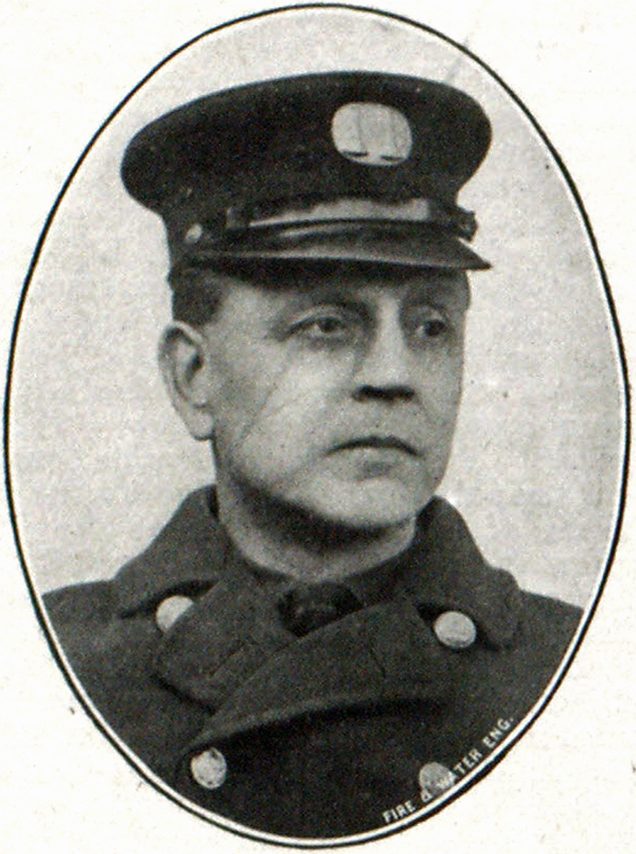
Charles Worthington, Camden Fire Chief
Charles Worthington was born, according to the 1900 Census in August of 1869 in England, and came to the United States in 1888. The 1910 Census, however, states that he came to America in 1887. He first appears in Camden’s city directories in 1890, when he was living at 1022 Linden Street, then working as a sawyer, which would indicate that he was working in a sawmill, the nearest being that of Charles Stockham at Vine Street and Delaware Avenue. He later worked at the Pavonia Car Shops, repairing railroad cars.
He married Mary Cullingford around 1897. The 1900 Census states that he was working as a wool sorter and living with his wife and son Arthur at 427 North 9th Street. At the time of the 1910 census, he had become an American citizen.
Charles Worthington was appointed to the Camden Fire Department in May of 1902, and began his service on June 1, 1902. He was serving with Engine Company 5 in February of 1906, and was seriously injured in the March 1906 fire at the Sixth Regiment Armory that took the lives of brother firemen William Jobes, George Shields, and William Hillman.
The 1910 Census shows Charles Worthington living at 1015 Penn Street with his wife Mary and sons Arthur, 12, and Frank, 4. Another child had passed away.
Charles Worthington succeeded Samuel S. Elfreth as Chief of the Camden Fire Department in the fall of 1913. During the tenure of Chief Worthington there were two major blazes that the Camden Fire Department responded to. To commemorate the 125th Anniversary of the Camden Fire Department, a history of the department was published. Concerning the two fires, the book reads as follows:
A spectacular fire destroyed the Woodlynne Park amusement park, with its large wooden roller coaster, in the Borough of Woodlynne on March 15, 1914. As a community without its own fire department, the Woodlynne blaze was controlled by a second alarm assignment from the City under the direction of Chief Worthington, assisted by mutual aid units from other nearby communities.
On May 8, 1914, three alarms were transmitted for a fire at the Camden Electroplating Company at Delaware Avenue and George Street, center city. Box 134 at Delaware Ave. and Market Streets was transmitted at 10:52 P.M. Chief of Department Worthington was one of the first units to arrive at the scene and observed heavy fire conditions on the top floor of the two-story building. Chief Worthington ordered an exterior attack from the roof area through large skylight openings. This operation was made particularly arduous by heavy smoke. The fire extended from the plating company at #12 George Street, to involve the New Jersey Automobile Supply Company at #38 Delaware Avenue. Over twenty automobiles and fifty horses were saved during the early stages of the fire.
On the roof, Chief Worthington conversed with Deputy Chief John A. Stockton and Captain Madison of Engine Company 5. Chief Worthington directed Stockton to go down to the street, transmit a second alarm, and also have an engine company stretch a line up the alley. Chief Worthington then left the men and proceeded along the roof to the south side of the building where he was last seen. When Stockton brought the hose team up the alleyway, he found the unconscious Chief laying next to the building. Chief Worthington had apparently stepped back on the roof to avoid a skylight and fell into a shaft between two buildings. The Chief had landed on a pile of scrap iron which inflicted serious wounds including a deep gash on his neck. Deputy Chief Stockton and Police Chief Elisha A. Gravenor assisted firemen in removing Chief Worthington from the alley where he was rushed to Cooper Hospital. The Chief was pronounced dead on arrival with a broken neck and fractured skull.
An official viewing for the Uniformed Force was held at Fire Headquarters where firemen viewed the remains of their Chief. On Tuesday Evening, May 12th, the Chief’s remains were moved to the Court House where, as a municipal official, Chief Worthington lay in state, the body resting upon a catafalque under the honor guard of four Uniformed Firemen. At 6:30 PM the City Hall bell tower tolled a mournful dirge for the late chief as ten thousand persons filed past the coffin. All firehouses and apparatus were draped in black crepe. All members of the Department were placed on continuous duty for a 48 hour period over May 12th and 13th.
On Wednesday, May 13th, a grand funeral procession carried Chief Worthington to his final resting place at Arlington Cemetery. The eulogy was given by Chief Sherman of the Fire Patrol, the Salvage Corps of the fire service operated by the Insurance Industry. Chief Worthington was 43 years of age when he made the Supreme Sacrifice. Chief John A. Stockton was appointed as his successor.
First Ward Republican Club
Philadelphia Inquirer —
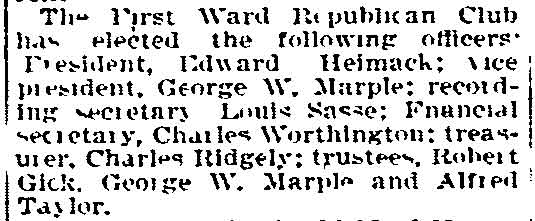
The First Ward Republican Club has elected the following officers: President, Edward Heimach; Vice president, George W. Marple; recording secretary, Louis Sasse; Financial secretary, Charles Worthington; treasurer, Charles Ridgely; trustees, Robert Gick, George W. Marple and Alfred Taylor.
Fireman Appointed
Post-Telegram (Camden) —
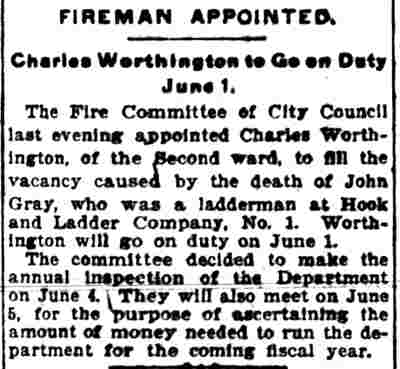
Charles Worthington to Go on Duty June 1.
The Fire Committee of City Council last evening appointed Charles Worthington, of the Second ward, to fill the vacancy caused by the death of John Gray, who was a ladderman at Hook and Ladder Company, No. 1. Worthington will go on duty on June 1.
The committee decided to make the annual inspection of the Department on June 4. They will also meet on June 5, for the purpose of ascertaining the amount of money needed to run the department for the coming fiscal year.
Fireman in a Mix-Up
Philadelphia Inquirer —
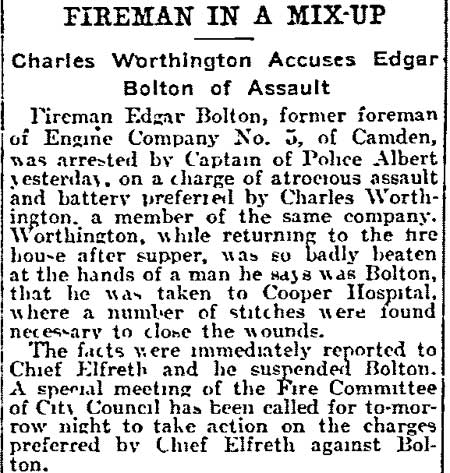
Charles Worthington Accuses Edgar Bolton of Assault
Fireman Edgar Bolton, former foreman of Engine Company No. 5, of Camden, was arrested by Captain of Police Albert yesterday, on a charge of atrocious assault and battery preferred by Charles Worthington, a member of the same company. Worthington, while returning to the fire house after supper, was so badly beaten at the hands of a man he says was Bolton, that he was taken to Cooper Hospital, where a number of stitches were found necessary to close the wounds.
The facts were immediately reported to Chief Elfreth and he suspended Bolton. A special meeting of the Fire Committee of City Council has been called for to-morrow night to take action on the charges preferred by Chief Elfreth against Bolton.
Three Firemen Met Death in Camden Blaze
Philadelphia Inquirer —
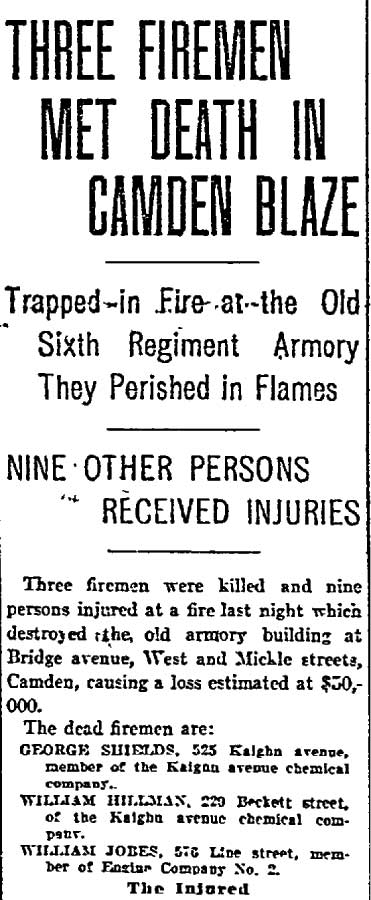
Trapped in Fire at the Old Sixth Regiment Armory They Perished in Flames
NINE OTHER PERSONS RECEIVED INJURIES
Three firemen were killed and nine persons injured at a fire last night which destroyed the old armory building at Bridge avenue, West and Mickle streets, Camden, causing a loss estimated at $50,000.
The dead firemen are: GEORGE SHIELDS, 525 Kaighn avenue, member of the Kaighn avenue chemical company. WILLIAM HILLMAN, 229 Beckett street, of the Kaighn avenue chemical company. WILLIAM JOBES, 57[?] Line street, member of Engine Company No. 2.
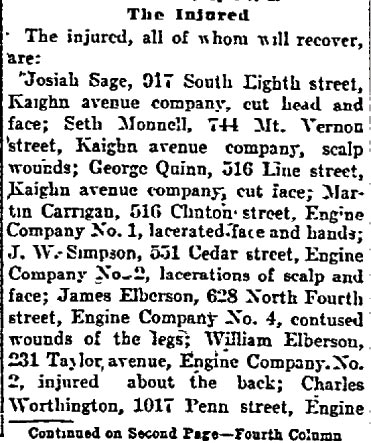
The Injured
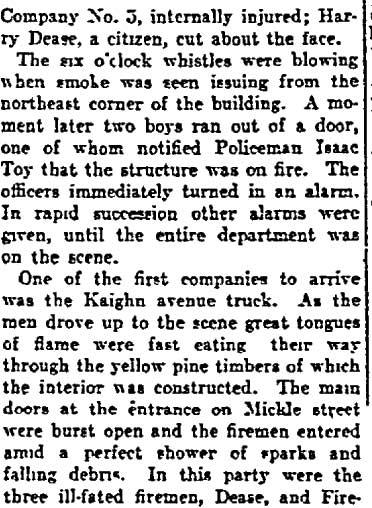
The injured, all of whom will recover, are: Josiah Sage, 917 South Eighth street, Kaighn avenue company, cut head and face; Seth Monnell, 744 Mt. Vernon street, Kaighn avenue company, scalp wounds; George Quinn, 516 Line street, Kaighn avenue company, cut face; Martin Carrigan, 516 Clinton street, Engine Company No. 1, lacerated face and hands; J. W. Simpson, 551 Cedar street, Engine Company No. 2, lacerations of scalp and face; James Elberson, 628 North Fourth street, Engine Company No. 4, contused wounds of the legs; William Elberson, 231 Taylor avenue, Engine Company No. 2, injured about the back; Charles Worthington, 1017 Penn street, Engine Company No. 3, internally injured; Harry Dease, a citizen, cut about the face.
The six o’clock whistles were blowing when smoke was seen issuing from the northeast corner of the building. A moment later two boys ran out of a door, one of whom notified Policeman Isaac Toy that the structure was on fire. The officers immediately turned in an alarm. In rapid succession other alarms were given, until the entire department was on the scene.
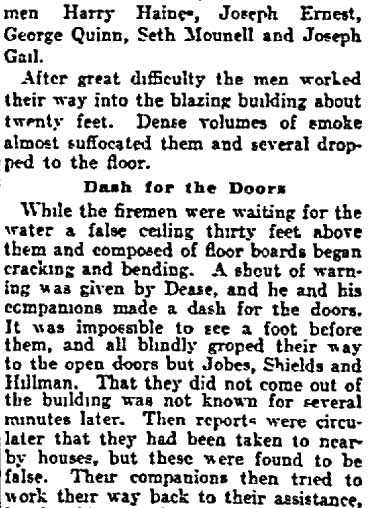
One of the first companies to arrive was the Kaighn avenue truck. As the men drove up to the scene great tongues of flame were fast eating their way through the yellow pine timbers of which the interior was constructed. The main doors at the entrance on Mickle street were burst open and the firemen entered amid a perfect shower of sparks and falling debris. In this party were the three ill-fated firemen, Dease, and Firemen Harry Haines, Joseph Ernest, George Quinn, Seth Mounell and Joseph Gail.
After great difficulty the men worked their way into the blazing building about twenty feet. Dense volumes of smoke almost suffocated them and several dropped to the floor.
Dash for the Doors
While the firemen were waiting for the water a false ceiling thirty feet above them and composed of floor boards began cracking and bending. A shout of warning was given by Dease, and he and his companions made a dash for the doors. It was impossible to see a foot before them, and all blindly groped their way to the open doors but Jobes, Shields and Hillman. That they did not come out of the building was not known for several minutes later. Then reports were circulated that they had been taken to nearby houses, but these were found to be false. Their companions then tried to work their way back to their assistance, but by this time the interior was a seething furnace.
Subsequently, when the blaze had been somewhat subdued, firemen and policemen instituted a search for the missing men. Where the latter had been there was a great pile of blackened timbers and twisted iron. After vigorous efforts this was removed.
Finding the Bodies
First there came to light Shield’s helmet, and a few feet distant his body and those of Hillman and Jobes, scorched and blackened almost beyond recognition, were found. It was then learned how they had met their deaths. Instead of going toward the open doorway they had evidently become bewildered and, turning, ran into a toilet room to which there was no outlet. There they were quickly cut off from their comrades and, becoming unconscious from the smoke, all three dropped to the floor, where death overtook them.
The bodies were carried out and taken to the Morgue.
In the meantime every portion of the structure became a mass of flames. Fed by the pine, great tongues of fire sprang into the air, across Mickle and West streets, where the dwellings were badly scorched. The families residing in these in several instances became panic-stricken and began removing their household effects. Men, women and children ran excitedly about. It is owing to the excellent work of the firemen that these structures were not destroyed.
Spectacular Blaze
Chief Elfieth quickly concluded there was no hope of saving the armory and he directed a dozen lines of hose toward the dwellings, many of which became so hot that the streams of water fairly sizzled.
The fire was a spectacular one, lighting up the heavens for miles around. Thousands of persons crowded the thoroughfares leading to the blaze, but excellent order was preserved under the direction of Acting Chief of Police Schregler, who quickly had the streets roped off and guarded by the officers.
There was considerable danger at first from falling electric wires, which spluttered among the firemen and ofttimes amidst the onlookers. These wires also fell across the Pennsylvania Railroad Company’s tracks on Bridge avenue and suburban trains were stalled for over an hour. At one time the flames approached so near the passenger coaches that they had to be taken back into the yard.
Stubborn Blaze
For three hours the firemen fought the flames before they got them under control and it was not until an early hour this morning that they left the smouldering ruins.
The building was occupied by several concerns, including the Camden Bowling Alleys Company; whose loss amounted to $6000; F. G. Hitchener, wall paper; loss $1000; Sperry & Hutchinson, household articles, loss $2000; William Morgenweck, lumber, loss $500, and M. W. Taylor, theatrical scenery, loss $500.
The houses badly scorched and their occupants follow; 102 West street, John Sharwood; 104, vacant; 106, John Ackerman; Lewis Certain; 110, Richard Carpenter; 112, and 114. Daniel Mehlin; 120, Mrs. Ida Paul; 122, Mrs. Farley; 124, John Campbell; 126, Harry Chase. 416 Mickle street, John Widden; 418, Nelson Hart; 420, H.-W. Wilson; 422, Jules Bosch; 424, Gardner Corson; 426, Mrs. Borquin.
The stable immediately adjoining on the west side of the armory, and belonging to C. M. Alcott, was flooded with water. At this place there were forty horses, all of which were rescued.
Formerly a Market
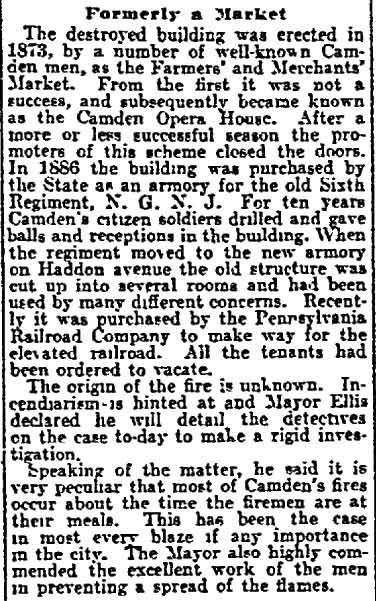
The destroyed building was erected in 1873, by a number of well-known Camden men, as the Farmers’ and Merchants’ Market. From the first it was not a success, and subsequently became known as the Camden Opera House. After a more or less successful season the promoters of this scheme closed the doors. In 1886 the building was purchased by the State as an armory for the old Sixth Regiment, N. G. N. J. For ten years Camden’s citizen soldiers drilled and gave balls and receptions in the building. When the regiment moved to the new armory on Haddon avenue the old structure was cut up into several rooms and had been used by many different concerns. Recently it was purchased by the Pennsylvania Railroad Company to make way for the elevated railroad. All the tenants had been ordered to vacate.
The origin of the fire is unknown. Incendiarism is hinted at and Mayor Ellis declared he will detail the detectives on the case to-day to make a rigid investigation.
Speaking of the matter, he said it is very peculiar that most of Camden’s fires occur about the time the firemen are at their meals. This has been the case in most every blaze if [sic] any importance in the city. The Mayor also highly commended the excellent work of the men in preventing a spread of the flames.
Roof Falls on Firemen
Altoona Mirror —
Three Killed and Nine Injured in Camden, N. J., Accident.
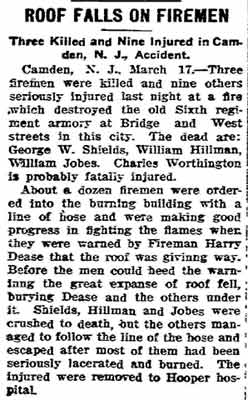
Camden, N. J., March 17.—Three firemen were killed and nine others seriously injured last night at a fire which destroyed the old Sixth regiment armory at Bridge and West streets in this city. The dead are: George W. Shields, William Hillman, William Jobes. Charles Worthington is probably fatally injured.
About a dozen firemen were ordered into the burning building with a line of hose and were making good progress in fighting the flames when they were warned by Fireman Harry Dease that the roof was giving way. Before the men could heed the warning the great expanse of roof fell, burying Dease and the others under it. Shields, Hillman and Jobes were crushed to death, but the others managed to follow the line of the hose and escaped after most of them had been seriously lacerated and burned. The injured were removed to Hooper hospital.
Camden News Notes
Philadelphia Inquirer —
These officers have been elected by the Camden Fire Department Pension Fund: President, Charles Worthington; secretary, Walter Browning; treasurer, Samuel Elfreth.
Camden Firemen Burned
Philadelphia Inquirer —
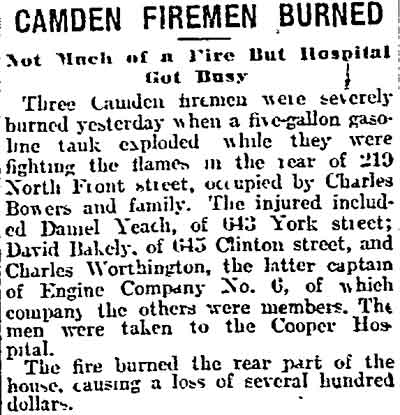
Not Much of a Fire But Hospital Got Busy
Three Camden firemen were severely burned yesterday when a five-gallon gasoline tank exploded while they were fighting the flames in the rear of 219 North Front street, occupied by Charles Bowers and family. The injured included Daniel Yeach, of 643 York street; David Bakely, of 645 Clinton street, and Charles Worthington, the latter captain of Engine Company No. 6, of which company the others were members. The men were taken to the Cooper Hospital.
The fire burned the rear part of the house, causing a loss of several hundred dollars.
Promotion News
Camden Post-Telegram —
After serving faithfully for a long time as chauffeur to Assistant Chief Stockton, Harry Selby will to-day take up his duties at No. 1 Engine Company to-day. Harry will drive the Robinson combination apparatus at the downtown house. The change was sanctioned by Chief Worthington at the request of Selby. His fellow firemen regret to see Harry leave and their best wishes for success go with him.
William McCauley, who was recently appointed a member of the department, filled the vacancy left by the transfer of Selby.
North Camden News
Camden Post-Telegram —
Real German sour krout served in inimitable style by popular Lieutenant Jim White was enjoyed by the “boys” at Fire Headquarters, Fifth and Arch streets, Saturday night, when the monthly supper was given in the basement of the building.
The presence of Chief Worthington and Assistant Chief Stockton, both of whom spoke, made the occasion a merry one. “Jim,” with the assistance of Joe Johnson, dished out the sour krout, mashed potatoes and “doggies,” and the participants made short work of the delicious food.
Music was furnished by the house talking machine, skillfully operated by Joe McCaulley, who almost foundered after partaking of a surplus amount of Jim’s fine cooking.
Those participating were: Chief Charles Worthington, Assistant Chief John A. Stockton, Captain George Wade, Lieutenant James White, Newton Ash, James Burris, William Laird, Joseph Johnson, Martin Carrigan, Charles Cook, Pete McCaulley, Joseph Allen, William Elberson, William R. Cason, Harry Hankins, Conn L. Mack.
Firemen Enjoy Week-End Supper at Headquarters
Camden Post-Telegram —
Firemen at headquarters, Fifth and Arch streets, enjoyed another of those week-end suppers Saturday night when Lieutenant Jim White prepared a large quantity of delicious chicken noodle soup with all the fixin’s. The linen-covered table was filled with all kinds of good things and the wants of the hungry fire-fighters and their friends were cared for by popular Jim and his affable assistant, Joe Johnson.
Those who enjoyed the feast were: Chief Worthington, Assistant Chief Stockton, Captain George Wade, William Laird, Joseph Allen, Charles Menicke, Tabor Quinn, Charles Cook, Orrie Burris, Harry Hankins, “Pete” McCaulley, William Elberson, Jim White and Joe Johnson.
Two Firemen Hurt in Crash With Car
Camden Post-Telegram —
Chemical Engine, Responding to Alarm, Sideswipes Kaighn Avenue Trolley.
HURLED TO STREET FROM APPARATUS
Responding to an alarm of fire at the home of Mrs. Elizabeth Caston, 740 Sycamore street, last night the chemical apparatus of No. 7 Company sideswiped an east-bound Kaighn avenue trolley car, and two firemen, Horace Cairns, of 439 Haddon avenue, and George Boone, of 605 Mount Vernon street, were thrown to the street and injured.
Cairns was injured about the hips and suffered body contusions. He was taken to the Homeopathic Hospital and later to his home, where he is now confined. Boone had two fingers crushed, but refused to go to the hospital and he remained on duty.
The report made to Chief Worthington by the crew of the fire apparatus blames the trolley company for the accident. It is alleged that a north-bound car trailed ahead of the speeding apparatus, and when the driver, Roy Smith, pulled the horses out of the tracks the accident happened. The jolt was not sufficient to damage the wagon, but the men on the rear were jostled off.
The fire, a slight one, was in a rear bedroom of the house. A bureau and some other furniture were damaged.
Snapper Soup at Fire Headquarters
Camden Post-Telegram —
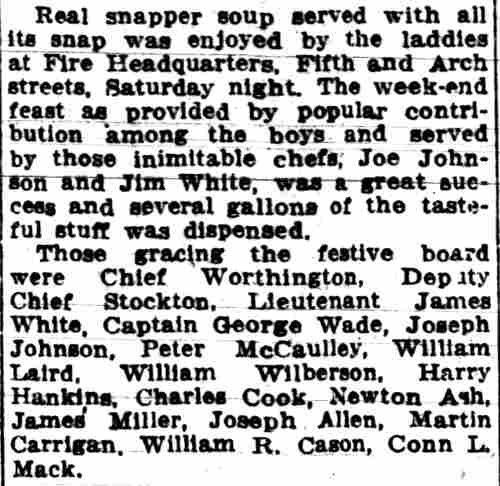
Real snapper soup served with all its snap was enjoyed by the laddies at Fire Headquarters, Fifth and Arch streets, Saturday night. The week-end feast as provided by popular contribution among the boys and served by those inimitable chefs, Joe Johnson and Jim White, was a great success and several gallons of the tasteful stuff was dispensed.
Those gracing the festive board were Chief Worthington, Deputy Chief Stockton, Lieutenant James White, Captain George Wade, Joseph Johnson, Peter McCaulley, William Laird, William Wilberson, Harry Hankins, Charles Cook, Newton Ash, James Miller, Joseph Allen, Martin Carrigan, William R. Cason, Conn L. Mack.
Firemen to Parade in Gloucester City
Philadelphia Inquirer —
Fifteen Companies to Participate in Pageant Saturday When New Engine Is Housed
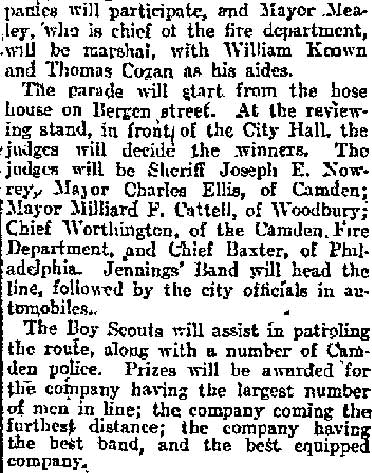
Special to The Inquirer. GLOUCESTER CITY, N. J., May 6.—At a meeting of the Board of Fire Commissioners and Fire Department today arrangements were completed for the firemen’s parade to be held on Saturday in connection with the housing of the new fire engine. About fifteen fire companies will participate, and Mayor Mealey, who is chief of the fire department, will be marshal, with William Known and Thomas Cozan as his aides.
The parade will start from the hose house on Bergen street. At the reviewing stand, in front of the City Hall, the judges will decide the winners. The judges will be Sheriff Joseph E. Nowrey, Mayor Charles Ellis, of Camden; Mayor Milliard F. Cattell, of Woodbury; Chief Worthington, of the Camden Fire Department, and Chief Baxter, of Philadelphia. Jennings’ Band will head the line, followed by the city officials in automobiles.
The Boy Scouts will assist in patrolling the route, along with a number of Camden police. Prizes will be awarded for the company having the largest number of men in line; the company coming the furthest distance; the company having the best band, and the best equipped company.
Fire Chief Killed Falling Off Roof of Burning Building
Camden Post-Telegram —
Charles Worthington Plunges to Death from George Street Building and Was Found Face Downward With His Neck Broken by John Stockton and Others Dragging Hose in Blind Alley.
Fire Chief Charles Worthington was killed last night in falling from the roof of the Camden Electro-Plating Company, at No. 12 George Street, while directing his men in fighting flames at the plant.
The Chief’s neck was broken and his skull fractured. He died in a police ambulance on the way to Cooper Hospital.
No one saw him fall, but it is surmised that he took the fatal plunge to avoid stepping on one of the many skylights in the roof. He fell into an areaway between two buildings and it is believed he lay in the alley at least five minutes before his senseless form was discovered.
Not since the death of the lamented Chief of Police Foster has the city been so stunned by the passing of any of its officials. Although he had been head of the department but six months, succeeding Samuel S. Elfreth as Chief on November 1 last, Charlie Worthington had already demonstrated that he was the right man in the right place.
Camden’s fire fighting force was making rapid strides forward under his leadership, and in last night’s fatality the city loses one of its most efficient servants. On every hand there are heard expressions of keen regret and in the several firehouses deep gloom prevails. The men liked their Chief. He had risen through the ranks through sheer merit. He knew the needs of the men under him and they realize that in his untimely passing they have lost their best friend.
In his little red flyer Chief Worthington was among the first to reach the blaze. There were three alarms, one by phone and two from boxes. The first box alarm came at 10:52 and the second seven minutes later.
The electro-plating plant was on the second floor of the George Street building. The first floor was occupied by the New Jersey Automobile Supply Company. The building connected with the auto company’s main store which fronts on Delaware Avenue, thus making it an L-shaped affair.
When the firemen arrived the upper floor of the building, or that section occupied by the electro-plating company, was a mass of flames, and Chief Worthington at once directed that the fire be attacked from the roof, ordering the lines of hose played on the blaze through the skylights.
It was only the work of an instant to run up a ladder and the Chief, wearing his gum coat and rubber boots, was among the first to gain the roof. In a few minutes several lines of hose were in operation and the Chief was moving here and there giving general directions and trying to get a line on the progress of the flames. This was difficult matter because of the dense smoke which almost suffocated the men and made it necessary for them to move cautiously over the roof to avoid the very fate in store for Worthington.
Leaving the men who were pouring tons of water on the flames through the skylights the Chief started over for the south side of the roof. That was the last seen of him alive.
Several minutes later Assistant Chief Stockton and a detail of men from headquarters were pulling a line of hose through the blind alley between the auto company’s main building and the stables on the south when they stumbled over what appeared to be a man’s body. Reaching down in the darkness Stockton got hold of a rubber coat. He knew at once that one of the men had fallen. The suffering face was downward and not until he turned the body over did Stockton know it was his Chief. The dim rays penetrating a blackened lantern globe showed the Chief was badly hurt. His eyes were closed his head hung limp to one side and there was no response to the frantic appeals of the rescuers calling to their superior to tell them where he was hurt.
Ripping open the Chief’s rubber coat Stockton placed his ear to the silent man’s breast. Detecting faint heart beats he shouted to his comrades to summon an ambulance. While two or three ran to obey others aided Stockton in tenderly carrying the body to George Street. An ambulance which had come to the scene with the firemen was ready. Chief of Police Gravenor pulled a stretcher form under the seat and aided in placing his fellow Chief in the wagon, at the same time directing the crew, Stanton and Lewis, to make all possible haste to the hospital. The run was in vain. Hospital doctors took a look at the inanimate form and shook their heads.
“The Chief’s dead” one of them said, and tears dimmed the eyes of every man within the hearing of his voice. With the doctors Coroner Schroeder made an examination of the body and found that the neck and skull were broken. Undertaker John Crawford took charge of the remains and the unpleasant task of breaking the sad news to relatives in East Camden. Mrs. Worthington is prostrated with grief, at her home, 1016 Penn Street. Two small children also survive.
Harry R. Read, chairman of the Fire Committee of City Council, reached Cooper Hospital shortly after the ambulance arrived. He was visibly affected when told that the Chief was dead and for a few moments stood with bowed head.
“This is terrible” said Mr. Read. “Camden has suffered a real loss and loses an ideal fire chief. I was very close to the Chief in his work and every move he made was for the best interest of Camden. He was conscientious in everything he undertook and was doing something every day to add to the efficiency of the force. Every man in the department realized that he was their friend. I can hardly believe that Charlie Worthington has gone.”
Mr. Read issued an order placing Assistant Chief Stockton in temporary charge of the department and called a meeting of the Fire Committee for 2:00 o’clock this afternoon to take action on the Chief’s death. He also directed that all the engine houses and apparatus be dressed in black, that the flags be placed at half-mast, and that every fireman wear a badge of mourning for thirty days. At the meeting this afternoon arrangements will be made for the funeral, which will likely be held from the First Presbyterian Church, the use of that edifice having been tendered, the date for the funeral has not been fixed.
Mayor Ellis was shocked when he learned of the tragedy early today and at once cancelled an engagement to view the firemen’s parade in Gloucester this afternoon. He and the dead Chief were to be judges at the parade. “I am deeply grieved at the Chief’s fate” said the Mayor. “He has frequently consulted with me about the work of the department and I greatly admired him for the earnestness he displayed in unfolding his plans. He was the ideal fire chief, and his death has shocked the entire city.” The Mayor will attend the Fire Committee’s meeting this afternoon.
“Another patriot has fallen” said Charles M. Curry, Secretary of the Board of Trade. “Charles Worthington is dead, a martyr to the call of duty, and all Camden mourns the loss of a man who had the in him the making of the best Fire Chief this city ever had. The question naturally arises as the whether the quenching of a fire is worth a life. In this instance the Chief was evidently blinded by smoke and made a misstep which caused his death. The work of the Chief and his men in keeping the fire within a small area, which was surrounded by all kinds of flammable material, including garages and hay markets, stands as a silent monument to their worth. It is no doubt the first duty of the firemen to save life and then to fight fire. Perhaps if our lamented Chief could have thought of his own welfare in his earnest endeavor to help others he would still be living. But he is dead and now sleeps the sleep of God’s noble patriots that have fallen for a good cause. His memory will ever be revered by all, especially the businesses of this city, who well knew the worth of the fallen Chief.”
At a special meeting of the Firemen’s Mutual Benefit Association today the following resolutions were adopted:
Whereas It has please Almighty God to remove from our midst our beloved brother, Chief Charles Worthington, and
“Whereas in his loss we the members of the Firemen’s Mutual Benevolent Association feel that we have parted with a friend to each one of us who in the long time he was connected with our Association always had it’s interests as well as his fellow members’ at heart; was untiring in his earnestness and zeal in his official obligations; therefore in recognition of the above and in a token of our love, be it
“Resolved, That our sincere and heartfelt sympathy be tendered to the bereaved family of the deceased brother; and be it
“Resolved, That the Association go into mourning for a period of thirty days from the death of our brother, and be it
“Resolved, That thee resolution be placed upon the minutes and suitably engrossed and sent to the family of our deceased brother.
“WILLIAM TATEM, President
William Miller, Secretary
Chief Worthington’s first service in the paid fire department began about thirteen years ago, when he was appointed a ladderman, later becoming a hoseman. His first promotion came to a lieutenancy in Engine Company No. 5 and when Engine Company No. 6 was organized in 1908, he was made its captain, which office he held until promoted to succeed Chief Elfreth. He also served for a long time as president of the Camden Fire Department Pension Fund and of the Camden branch of the New Jersey State Firemen’s Association for six years. He was 43 years old.
The plant of the Electro-Plating Company was gutted and its loss is estimated at $3,000. A like loss was sustained by the auto company, primarily on damages to stock by water. Crossed wires are blamed for fire.
The police arrangement were perfect. Chief Gravenor was personally in charge of a big detail of men, and the firemen were unhampered in there work, although they had no heart for work after they learned of the Chief’s death. The men were at work a little over an hour.
Fire Chief's Body Will Lie in State
Camden Post-Telegram —
Public Can View the Remains at the Court House Tomorrow Evening — Detail of Firemen as Guard of Honor
The Meaning of the Bells
(Dedicated to Charles Worthington, Camden’s Fire Chief, who lost his life in the line of duty.)
There’s a bell that rings for school time,
There’s a bell that rings for noon
There’s a bell that rings in sweet chime
For the happy bride and groom
There’s a bell that rings for sadness
There’s a bell that rings for glee
And there’s one that clangs in wild alarm
In stern and minor key.
‘Tis the bell that sends us thrilling
To the window, to the door,
As the firemen, anxious, willing,
Pass us looking to the fore
Ever ready for grim danger,
Ever ready for the fray,
There’s a sight to us no stranger,
Tho’ we see it every day!
True a soldier fights in battle,
For the enemy to rout;
But he hears the drum-heads rattle
And he hears his comrades shout,
But the fireman brave fights clinging
To a ladder, or a pole
And oft the bell that’s clanging
Is a brave man’s funeral toll.
‘Twas the bell that sent us thrilling
To the window, to the door
And out chief, his men instilling
Passed us, rushing to the fore!
Let us pause then, when we hear them,
And the clanging louder swells,
For perhaps some fireman’s requiem
Is the meaning of the bells.
— W.B. Williams
Haddonfield, N.J.
Fire Chief Worthington’s body will be borne to its last resting place in the new three-in-one apparatus recently added to the equipment. The apparatus is being fitted up to carry the casket bearing the remains of the beloved chief, who was killed in falling from a roof in Friday night’s fire.
At a special meeting of the Fire Committee Saturday, the action of Harry R. Reed, the chairman of the committee, in ordering all the houses draped with mourning was approved. It was raised at the meeting that the widow was opposed to any public display. She was told that there should be some public recognition of her husband, who sacrificed his life while performing a public duty. Mrs. Worthington finally consented, and the committee arranged to have the body of Chief Worthington lie in state in the corridor of the Court House tomorrow evening from 7 to 9 o’clock.
It was also decided to detail two men from each of the thirteen fire companies in the city to act as a guard of honor on Tuesday night, and the same guard of honor will be detailed to act as such at the funeral on Wednesday at the late residence of Chief Worthington, 1015 Penn Street. The services there will be conducted by Rev. R.E. Brestell, rector of St. Paul’s Episcopal Church. The interment will be made at Arlington Cemetery. The Fire Committee will act as the honorary pall bearers.
The committee adopted a resolution requesting Mayor Ellis to detail a sufficient number of police at the Court House on Tuesday night. The committee also instructed the clerk to request the Mayor, members of City Council and the heads of various departments to attend the funeral on Wednesday.
James Hewitt, president of Council and an ex-officio member of the committee suggested that the citizens display flags at half-mast on the day of the funeral. In making the suggestion, Mr. Hewitt also said he would take the authority to have all the city offices close a half-day on the day of the funeral and the bell tolled at City Hall. The committee will prepare a suitable minute on the death of the chief.
Besides his widow, Chief Worthington is survived by two sons, Arthur, 16 years old, and Frank, 7 years old.
The Court House was selected as the place to view the body because of the alterations being made at City Hall.
The change from the City Hall to the Court House for the public service was made at the suggestion of Mayor Ellis, Chairman Read at once concurring.
At a meeting of the Second Ward Republican Executive Committee, on Saturday, May 9, the following resolutions were adopted on the death of Chief Worthington:
Whereas, It has pleased the Almighty Ruler of the Universe to again visit us by the hand of death, and to call away to a higher life our beloved and esteemed fellow member and worker, Charles Worthington, one who always had the interest and principles of Republicanism at heart; therefore be it
“Resolved, That while the intelligence of his sudden death has created in our hearts a deep sorrow, yet we bow with humble submission to the will of our Almighty God, who doeth all things for our good; and be it further
“Resolved, That a copy of the resolution be sent to his widow and family.
John S. Broome
Melbourne F. Middleton Jr.
David B. Jester
James S. Smith
Charles Howarth
Joseph Hinger
Samuel Naylor
Harvey M. Watts
Robert A. Van Mater
Members of the Second Ward Republican Club are requested to meet at the headquarters, 1011 Market Street, tomorrow night at 7 o’clock preparatory to viewing the body of Chief Worthington.
Camden Pays Honor to Dead Fire Chief
Philadelphia Inquirer —
Body of Department Head Who Lost Life While on Duty to Lie in State
Camden is to pay fitting honor to its martyred Chief of the Fire Department, Charles Worthington, who was killed Friday night at the fire in North Delaware avenue when he fell from a roof while directing his men. Council’s Fire Commisioners [sic] met yesterday in special session and decided to have the body of Chief Worthington lie in state in the main corridor of the City Hall on Tuesday night from 7 to 9 o’clock. A special guard of twenty-six of the city firemen will be announced. Mayor Ellis, members of Council and others prominent in the municipality’s official life will pay their tribute to the fallen chief. The funeral will take place on Wednesday from Chief Worthington’s late home, at 101[?] Cooper street.
Chief Worthington had been at the head of the department less than a year, having succeeded Chief Elfreth, who had held that position for many years. A young man and filled with modern methods and ideas, Chief Worthington was bringing the department up to a high state of efficiency, which was recognized by the insurance and business people as well.
Until the appointment of Chief Worthington’s successor, Assistant Chief Stockton will have charge of the men.
Death Notice of Charles Worthington
Philadelphia Inquirer —
WORTHINGTON.—Suddenly, May 8, 1914. CHARLES WORTHINGTON, husband of Mary E. Worthington (nee Cullinford), aged 47 years. Relatives and friends, also Camden Fire Dept., Firemen’s Relief and Pension Fund, Camden Lodge, No. 111, L. O. O. M., Diamond Purple Star, L. O. L., No. 104; Second Ward Republican Club, Camden Republican Club and former fellow-employes of Pavonia Car Shops, are respectfully invited to attend funeral, on Wednesday, at 1 P. M., from his late residence, 1015 Penn st., Camden, N. J. Services at St. Paul’s P. E. Church at 2 o’clock. Interment at Arlington Cemetery. Remains will lie in state in Camden City Hall, Tuesday evening, from 7 until 9 o’clock. Remains may also be viewed at his residence later.
Funeral Photos
Horse drawn Hose Wagon as flower car with motorized pumper as hearse.
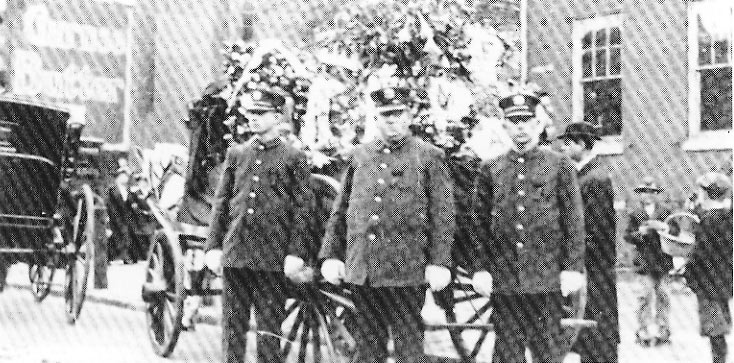
Funeral procession for Fire Chief Charles Worthington, killed in line of duty May 1914
Additional Funeral Photos
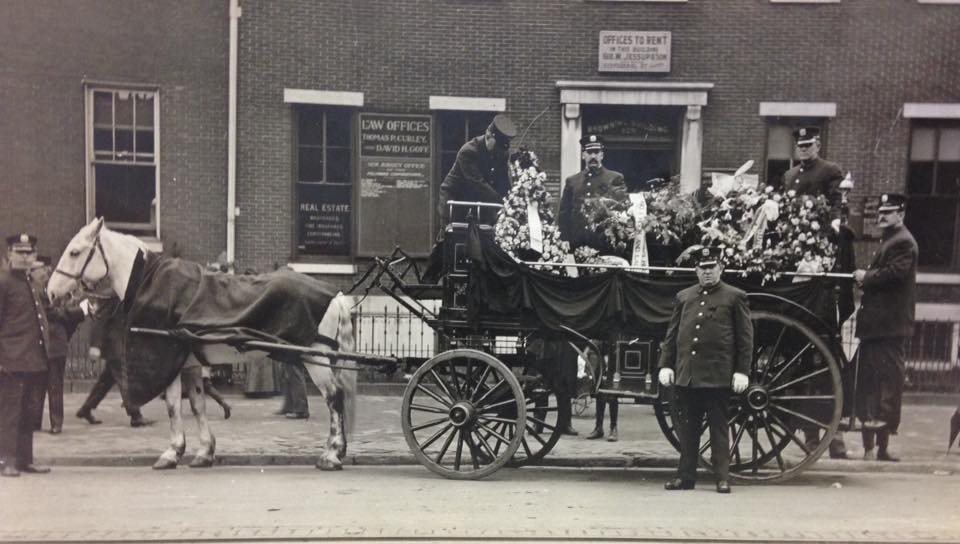
Funeral procession, photo 2
Final Funeral Photo
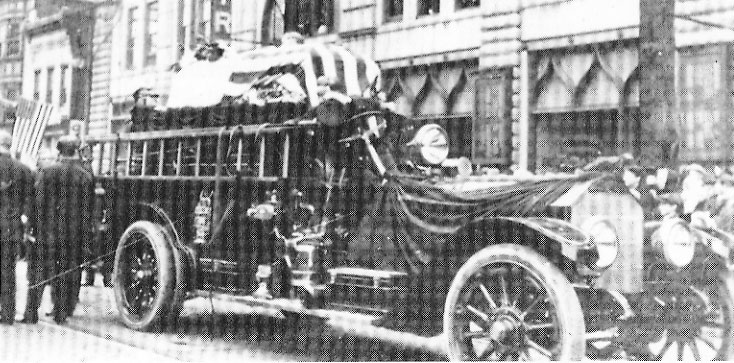
Funeral procession, photo 3
Honored Dead Fire Chief
Philadelphia Inquirer —
Camden paid last honors to its martyred fire chief, Charles Worthington, whose funeral took place yesterday from his home, at 1015 Penn street, services being held at St. Paul’s P. E. Church, where Rev. R. E. Brestell and Rev. H. O. Jones were in charge. A guard of honor and a delegation of Councilmen were in the funeral cortege.
Thousands View Chief's Remains
Camden Post-Telegram —
Throngs Jam Court House While Body Lies in State for Two Hours — Last Sad Rites This Afternoon
Not since the memorable funeral of Chief of Police Foster ten years ago, has there been such a genuine public tribute paid an official of Camden as was in evidence last night at the bier of the lamented Fire Chief Worthington, and today at his funeral. It is hard to estimate the number of persons in a crowd, but from 7 until 9 o’clock last night there was a steady stream of men, women and children, two abreast, who passed from the main entrance, through the center corridor and beneath the illuminated rotunda, where the body lay, and thence out by the west corridor. There was never a stop, and it is estimated that at least 10,000 persons were there, perhaps more.
There could not have been a more ideal location for the repose of the casket containing the honored dead, and the great array of beautiful flowers than beneath the rotunda. It seemed to be a sacred shrine in itself where the citizenry dropped a tear for the lamented departed. The effulgence of the soft lights from above specially installed by Electrical Chief Kelly but lent to the scene and as the dark garbed escort of firemen, the active pall bearers, stood, on guard, the scene was unusually impressive.
Chief Worthington, aside from the pallor that comes to the dead, looked as he did in life, for the thread had been snapped so quickly that it was while he was in his full vigor that the vital spark had taken its flight. There were some marks on his face that indicated the intense though momentary suffering through which he passed on his fateful plunge from the roof of the burning building to his quick death, and the passing crowd remarked this. But withal there was that calmness and repose feature which seemed to indicate that the gallant leader of Camden’s fire fighters but lay sleeping rather than that his soul had taken its eternal flight.
Public grief may be a mere ephemeral emotion, born of the moment and only to be succeeded by the acclaim of the newly arisen public idol, but last night’s encomiums seemed to come from hearts that overflowed with genuine and permanent sorrow over the untimely passing of so excellent a public servant. Many tear-suffused eyes indicated this, many expressions of grief, of sorrow, of condolence of those left showed this. The sentiment in evidence everywhere can only be likened to the sweetness of the wonderful flowers whose odor spread thorough all the corridors and in all the rooms of the great marble building.
High in the clock tower of the City Hall the bell began tolling at 6:30 o’clock. At half-minute intervals its doleful strains went forth on the cold blustery east wind which had succeeded at day of spring sunshine. The bell and the screeching wind seemed to combine as a knell indicating the passing grief of the city. It was the preliminaries to the marching of the funeral cortege from the stricken Chief’s home on Penn Street to the resting place at the Court House.
There were forty policemen in dress uniform with Chief Gravenor at their head. There were twenty-six fire heads from Philadelphia, with Chief William Murphy in the van, a tribute in itself of more than passing moment. There was the caisson on which was the black draped casket containing the body of he who all honored. There was the little red car in which Chief Worthington was wont to speed through the city at every alarm and there was his helmet and coat. There was Acting Chief Stockton and forty of the men who fought flames under the direction of he who lay so still. There as the family in cabs with curtains drawn, the members of City Council and the active pall bearers – Daniel Leach, Peter B. Carter, James White, William Patterson, Elmer Burkett, Samuel Harring.
When the cortege reached the Court House the Camden boys took up their position on the inside beneath rotunda while the Philadelphia visitors made an imposing array on the granite steps outside. And then came the public in its steady and unending stream.
Later the Philadelphia delegation was escorted to the Board of Freeholders room where tribute was paid to the dead and where a mingling of the two cities took place. Besides Chief Murphy the visitors included Battalion Chiefs William T. Barrett and George P. McConaghy, Captains L. F. Bunting, William Lindsey; H. Dinlocker, J. Higginson, J. E. Talbot, D. Campbell, T. O’Brien, F. Hughes, E. Basenfelder; H. Hutt, William McCusker, G. Rheim, R. Wilsey, J. Webb, H. Goers, H. Haines, Insurance Patrol Captain Joseph H. Shermer, William Hickman, William Rodgers, John Wyatt, David Phillip, John Clyde, H. Wilkinson.
President of City Council James E. Hewitt spoke of the work Chief Worthington had already accomplished, of his plans, of his value and worth to Camden. Chief Murphy responded in a fitting way and this incident in itself was one to be remembered.
An affecting sight was witnessed by the handful of spectators, among them being other firemen, city and county officials and policemen who remained after the big doors on Sixth Street had been closed. The last to view the Chief’s remains were a delegation of about twenty firemen. Solemnly the men passed by the bier and gazed upon the features of their departed brother.
As the last of the line approached Deputy Chief John A. Stockton was seen. He stopped and with his cap laid across his breast be looked down into the casket. For almost a minute Chief Stockton stood as though glued to the spot. Then he glanced about him and the sympathetic look upon his face thrilled all.
He heaved a sigh and perhaps the teardrops refused to come, but Chief Stockton, as the lines upon his face showed, was struggling with the inner man. His emotions were tugging at his heart, but a fire laddie cannot give way to his feelings although his brother superior officer and dear friend had answered his last alarm.
The floral pieces surrounding the bier bespoke the love, admiration and respect the donors held for the dead chief. One design particularly beautiful was a mammoth loving cup made of blossoms, flowers and roses. This was the token sent by members of City Council and other city officials.
Another was the design sent by the Electrical Bureau through Chief Kelly. The original fire box, No. 134, which was pulled on the night of the fire by Chief Worthington was enshrouded by roses, carnations and lilies.
A Maltese cross standing several feet high and bearing the initials of the organization was the tribute sent by the Firemen’s Mutual Benevolent Association. Chief Worthington was president of this association.
The Camden police sent a large shield of flowers and Council members offered a vacant chair of roses. The New Jersey Auto Supply Company, No. 2 Engine Company and No. 1 Truck sent beautiful broken circles and a wreath was the offering from the employees of the Victor Talking Machine Company.
A broken circle from member of the Sixth Ward Republican Club and a wreath from his friends in the sixth precinct of the Second Ward were other beautiful pieces. West Collingswood and Collingswood firemen sent two beautiful floral circles and from the Loyal Order Legion a wreath was received.
Other offerings were from the Camden Liquor Dealers league, a beautiful circle from No. 6 Engine Company, in which house Chief Worthington was captain previous to his elevation to the office of chief; sprays from the Bethany M.E. Church, Ladies Auxiliary of the Loyal Order of Moose; a wreath from the pupils of the eighth grade Sewell school, and a spray from North Baptist Church. There also were designs from members of the family and friends, all of which bespoke the great love held for the departed fire chief.
The impressive services of the P.E. Church marked the last sad rites this afternoon at St. Paul’s Church. The guard of honor and city officials left Fire Headquarters at 1:20 and proceeded to the Worthington home and escorted the remains to the church, where services were conducted by the rector, Rev. R.E. Brestell, and Rev. H.O. Jones, rector of St. Stephen’s P.E. Church. Interment was made at Arlington.
The honorary pallbearers were Mayor Ellis, Hon. David Baird, Frank F. Patterson, John W. Bell, General John A. Mather, Melbourne F. Middleton Jr., Harry R. Reed, Arthur L. Jones, Robert Gordon, David Jester, George Schneider, William Mills, J.O. Grear, William Hall, George L. Bender, and James E. Hewitt.
Stockton Appointed Chief
Philadelphia Inquirer —
Successor to Charles Worthington, Who Met Death on Duty, Must Be Very Capable
In connection with the annual inspection of the Fire Commissioners of Camden City Council it was stated yesterday that the matter of appointing a successor to Chief Charles Worthington, who was killed in line of duty, will be held in abeyance until the first of the year unless someone who fills the bill in every particular is encountered. It was declared that in this hustling community it will be necessary to have a man at the head of the department who has not only practical knowledge, but executive ability. It is the expressed desire of the commissioners to have a man who can continue the work so ably begun by the late chief. In the meantime Assistant Chief Stockton will look after the men.
John Stockton appointed Fire Chief following Charles Worthington’s death
Camden at a Glance
Philadelphia Inquirer —
Changes made necessary by the elevation of John A. Stockton to the post of Fire Chief were announced last evening by the Fire Committee of Camden City Council. Stockton will be succeeded as Deputy Chief by Captain Peter Carter, of Engine Company No. 1. Lieutenant Samuel Whitzell will take Carter’s place and will be succeeded by Charles Cook, who was chauffeur for the late Chief Worthington.
Pleading guilty to a charge of burglary at the store of Sig Schoenagle, 424 Federal street, Kim Lee, a Japanese, was yesterday sentenced by Judge Boyle to serve not less than three and a half years or more than seven years in the State Prison. With a paving stone Lee broke a bulk window at the store and stole two Panama hats.
His jaw broken and skull probably fractured by being kicked in the head by a horse in his father’s barn, 15-year-old Edgar Leech, of Paulsboro, is in a serious condition in Cooper Hospital, Camden. Hurried to Camden on a train, the boy was in an unconscious condition when admitted to the hospital, and was still in a state of coma last night.
Decreeing that the defendant concern was not responsible for the accident, Judge Boyle yesterday dismissed the liability claim filed by Henderson Martin against the Camden Iron Works. Martin sought damages for injuries sustained to an arm by a pipe rolling on it.
Headstone Memorial
Charles Worthington was buried in an unmarked grave at Arlington Cemetery in Pennsauken NJ.
Friends and members of the Camden Fire Department raised money and furnished a headstone in September of 2019.
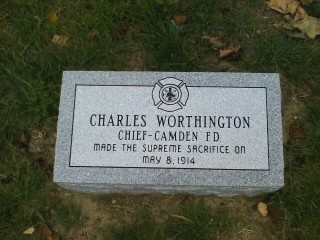
Headstone installed September 2019 at Arlington Cemetery, Pennsauken NJ
Carter Chief as Stockton Retires
Camden Post-Telegram —
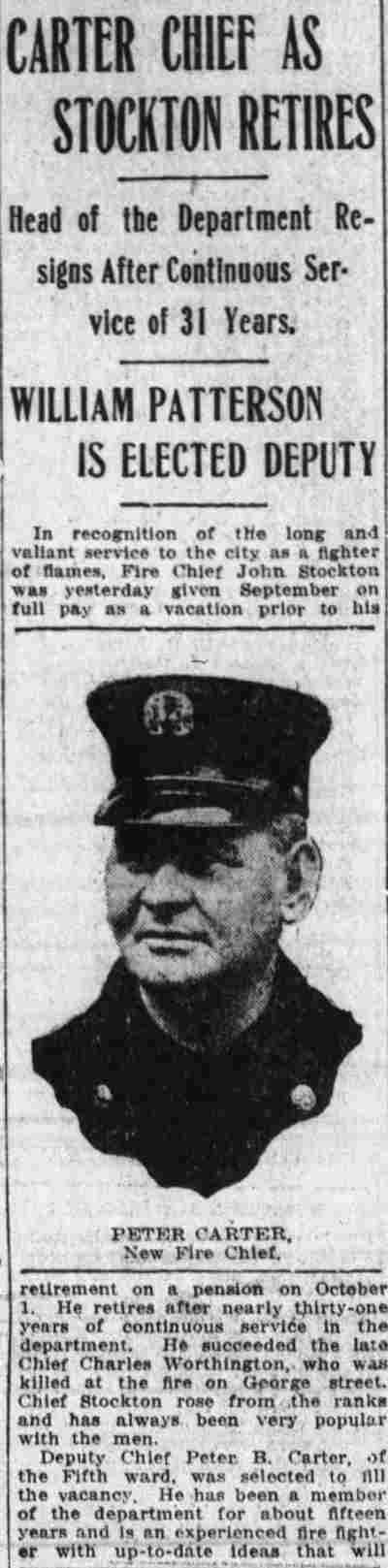
Head of the Department Resigns After Continuous Service of 31 Years.
WILLIAM PATTERSON IS ELECTED DEPUTY
PETER CARTER, New Fire Chief,
In recognition of the long and valiant service to the city as a fighter of flames, Fire Chief John Stockton was yesterday given September on full pay as a vacation prior to his retirement on a pension on October 1. He retires after nearly thirty-one years of continuous service in the department. He succeeded the late Chief Charles Worthington, who was killed at the fire on George street. Chief Stockton rose from the ranks and has always been very popular with the men.
Deputy Chief Peter B. Carter, of the Fifth ward, was selected to fill the vacancy. He has been a member of the department for about fifteen years and is an experienced fire fighter with up-to-date ideas that will bear fruition with the thorough motorization of the department.
Captain William Patterson, of No. 4 Engine Company and who hails from the Second ward, was made Deputy Chief, and Captain Thomas Nicholas, of No. 3 Engine Company and an Eighth warder, was made a battalion chief.
Other appointments made in the department included the following: Captains, William Cook, Fourth ward, and John Lennox, Ninth ward; lientenants [sic], William Cason, Fourth ward, and Walter Mertz, Fifth ward; engineer, Robert Whitley, Sixth ward; machinist, T. G. Middleton, second ward. John Hunt and George Cattell were appointed firemen.
Council also filled vacancies occasioned by the death of Chief Clerk Bowman H. Shivers, of the Highway Department. Walter W. Johnson, of the Seventh ward, who has been first assistant, was made chief clerk, and Walter W. Lee, of the Ninth ward, first assistant; Clarence Baker, Ninth ward, second, and Walter Wolverton, Tenth ward, third assistant.
Albert Denise, of the Fifth ward, was appointed an engineer in the Water Department to fill the vacancy occasioned by the recent death of William Barr.
Firemen of Long Service Receive Good Promotion
Camden Daily Courier —
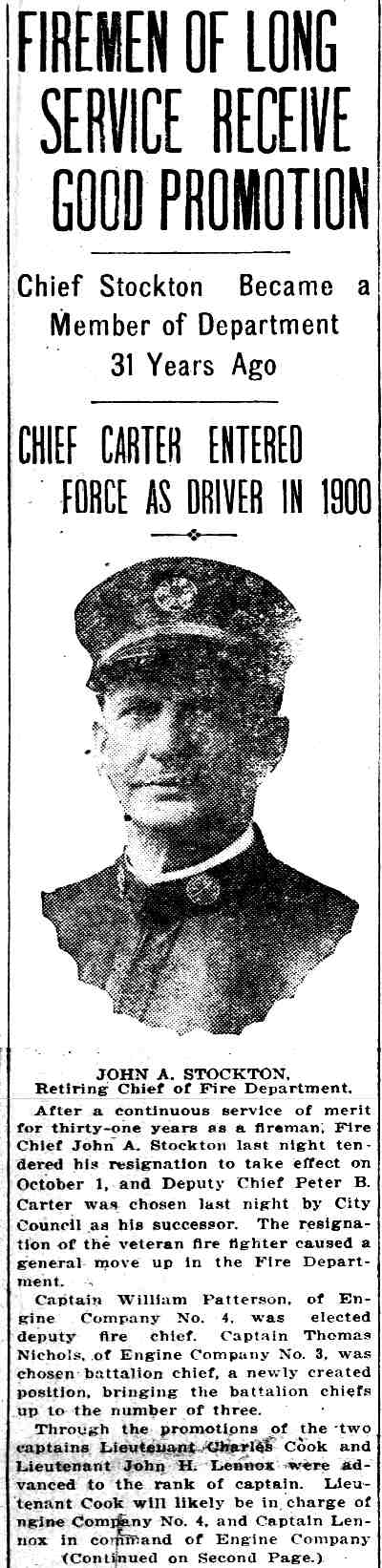
Chief Stockton Became a Member of Department 31 Years Ago
CHIEF CARTER ENTERED FORCE AS DRIVER IN 1900
JOHN A. STOCKTON, Retiring Chief of Fire Department.
After a continuous service of merit for thirty-one years as a fireman, Fire Chief John A. Stockton last night tendered his resignation to take effect on October 1, and Deputy Chief Peter B. Carter was chosen last night by City Council as his successor. The resignation of the veteran fire fighter caused a general move up in the Fire Department.
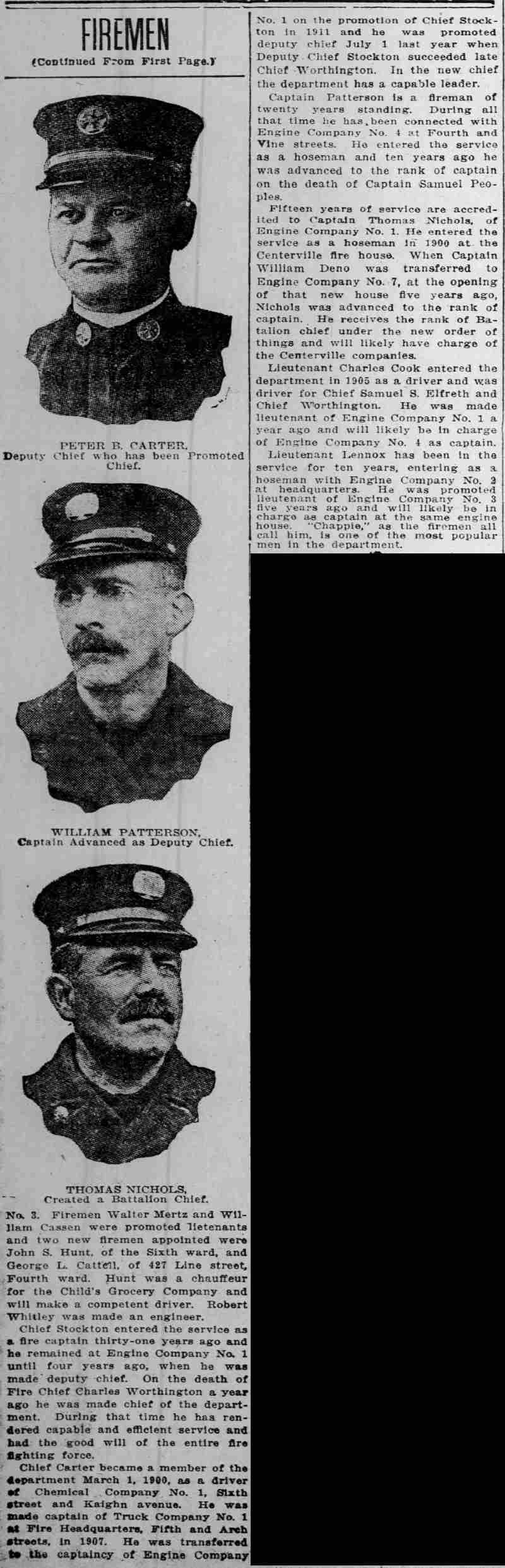
Captain William Patterson, of Engine Company No. 4, was elected deputy fire chief. Captain Thomas Nichols, of Engine Company No. 3, was chosen battalion chief, a newly created position, bringing the battalion chiefs up to the number of three.
Through the promotions of the two captains Lieutenant Charles Cook and Lieutenant John H. Lennox were advanced to the rank of captain. Lieutenant Cook will likely be in charge of Engine Company No. 4, and Captain Lennox in command of Engine Company No. 3. Firemen Walter Mertz and William Cassen were promoted lieutenants and two new firemen appointed were John S. Hunt, of the Sixth ward, and George L. Cattell, of 427 Line street, Fourth ward. Hunt was a chauffeur for the Child’s Grocery Company and will make a competent driver. Robert Whitley was made an engineer.
PETER B. CARTER, Deputy Chief who has been Promoted Chief.
WILLIAM PATTERSON, Captain Advanced as Deputy Chief.
THOMAS NICHOLS, Created a Battalion Chief.
Chief Stockton entered the service as a fire captain thirty-one years ago and he remained at Engine Company No. 1 until four years ago, when he was made deputy chief. On the death of Fire Chief Charles Worthington a year ago he was made chief of the department. During that time he has rendered capable and efficient service and had the good will of the entire fire fighting force.
Chief Carter became a member of the department March 1, 1900, as a driver of Chemical Company No. 1, Sixth street and Kaighn avenue. He was made captain of Truck Company No. 1 at Fire Headquarters, Fifth and Arch streets, in 1907. He was transferred to the captaincy of Engine Company No. 1 on the promotion of Chief Stockton in 1911 and he was promoted deputy chief July 1 last year when Deputy Chief Stockton succeeded late Chief Worthington. In the new chief the department has a capable leader.
Captain Patterson is a fireman of twenty years standing. During all that time he has been connected with Engine Company No. 4 at Fourth and Vine streets. He entered the service as a hoseman and ten years ago he was advanced to the rank of captain on the death of Captain Samuel Peoples.
Fifteen years of service are accredited to Captain Thomas Nichols, of Engine Company No. 1. He entered the service as a hoseman in 1900 at the Centerville fire house. When Captain William Deno was transferred to Engine Company No. 7, at the opening of that new house five years ago, Nichols was advanced to the rank of captain. He receives the rank of Battalion chief under the new order of things and will likely have charge of the Centerville companies.
Lieutenant Charles Cook entered the department in 1905 as a driver and was driver for Chief Samuel S. Elfreth and Chief Worthington. He was made lieutenant of Engine Company No. 1 a year ago and will likely be in charge of Engine Company No. 4 as captain.
Lieutenant Lennox has been in the service for ten years, entering as a hoseman with Engine Company No. 2 at headquarters. He was promoted lieutenant of Engine Company No. 3 five years ago and will likely be in charge as captain at the same engine house. “Chappie,” as the firemen all call him, is one of the most popular men in the department.
First City Fire House Located at 5th and Arch
Camden Courier-Post —

Hosemen, Tillermen and Laddermen Paid $50 Monthly While Call Men Received $75 a Year; Steam Engine Held for Emergency
This is the fourth installment of a history of fire fighting in Camden from the time of the formation of the first volunteer company in 1810 to 1936. It is the first complete history of the fire department written since 1886 and links the old volunteers with the new paid motorized department. It is being published in conjunction with Fire Prevention Week, which is being sponsored by the Camden County Fire Chiefs Association and the Camden Fire Department. Yesterday’s installment told of the disbanding of volunteer companies and city council creating a paid department in 1869.
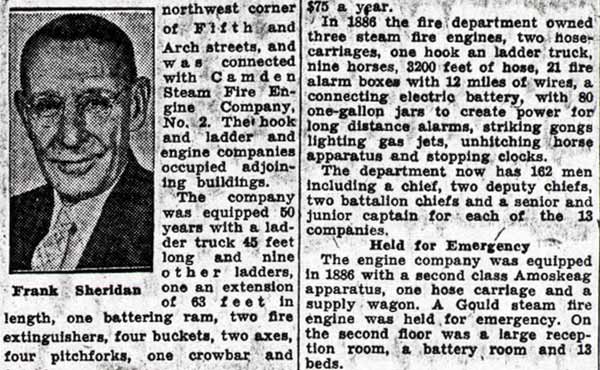
The Camden Hook and Ladder Company, No. 1, was organized in 1869 as a unit of the paid fire department with headquarters at the northwest corner of Fifth and Arch streets, and was connected with Camden Steam Fire Engine Company, No. 2. The hook and ladder and engine companies occupied adjoining buildings.
The company was equipped 50 years with a ladder truck 45 feet long and nine other ladders, one an extension of 63 feet in length, one battering ram, two fire extinguishers, four buckets, two axes, four pitchforks, one crowbar and four lamps.
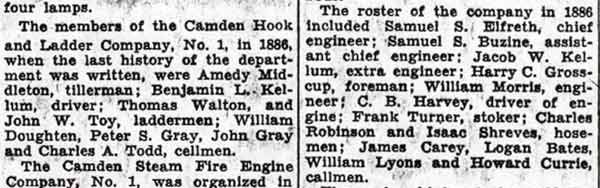
The members of the Camden Hook and Ladder Company, No. 1, in 1886, when the last history of the department was written, were Amedy Middleton, tillerman; Benjamin L. Kellum, driver; Thomas Walton, and John W. Toy, laddermen; William Doughten, Peter S. Gray, John Gray and Charles A. Todd, callmen.
The Camden Steam Fire Engine Company, No. 1, was organized in 1869 and stationed at Fourth and Pine streets, where Engine Company, No. 1, still is housed. The company was equipped with one second class steam fire engine made by the Amoskeag Manufacturing Company, Manchester, New Hampshire; one hose cart, manufactured by the Silsby Company, Seneca Falls, N. Y.; three horses and 1600 feet of hose.
The members of the company in 1886 were John A. Stockton, foreman; G. Rudolph Tenner, engineer; William Deno, driver; William W. Laird, stoker; Wilson Bromley and Jacob F. Nessen, hosemen; William Deith, Andrew Miller, William Bogia and W. Elwood Campbell, callmen.
Stockton became chief of the department in 1914.
Organized in 1869
The Camden Steam Fire Engine Company, No. 2, was organized in 1869 and located at the paid fire headquarters at Fifth and Arch streets. The ground floor had two connections with the hook and ladder company.
In 1886 the department consisted of one chief engineer, an assistant, 18 regular men and 12 call men. The regular men devoted full time to the service while the call men could go about their regular occupations.
Engineers received $60 monthly, hosemen, tillermen and laddermen $50 monthly. The call men received $75 a year.
In 1886 the fire department owned three steam fire engines, two hose-carriages, one hook an [sic] ladder truck, nine horses, 3200 feet of hose, 21 fire alarm boxes with 12 miles of wires, a connecting electric battery, with 80 one-gallon jars to create power for long distance alarms, striking gongs lighting gas jets, unhitching horse apparatus and stopping clocks.
The department now has 162 men including a chief, two deputy chiefs, two battalion chiefs and a senior and junior captain for each of the 13 companies.
Held for Emergency
The engine company was equipped in 1886 with a second class Amoskeag apparatus, one hose carriage and a supply wagon. A Gould steam fire engine was held for emergency. On the second floor was a large reception room, a battery room and 13 beds.
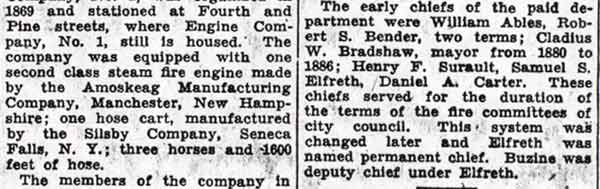
The roster of the company in 1886 included Samuel S. Elfreth, chief engineer; Samuel S. Buzine, assistant chief engineer; Jacob W. Kellum, extra engineer; Harry C. Grossup, foreman; William Morris, engineer; C. B. Harvey, driver of engine; Frank Turner, stoker; Charles Robinson and Isaac Shreves, hosemen; James Carey, Logan Bates, William Lyons and Howard Currie, callmen.
The early chiefs of the paid department were William Ables, Robert S. Bender, two terms; Cladius [sic] W. Bradshaw, mayor from 1880 to 1886; Henry F. Surault, Samuel S. Elfreth, Daniel A. Carter. These chiefs served for the duration of the terms of the fire committees of city council. This system was changed later and Elfreth was named permanent chief. Buzine was deputy chief under Elfreth.
(Tomorrow’s installment will describe a sudden succession of chiefs brought about by the resignation of Elfreth and the death of Charles Worthington, who was fatally injured in a fall from a roof at a fire.)
Motorization of Camden Fire Department Completed Under Chief P. B. Carter in 1915
Camden Courier-Post —


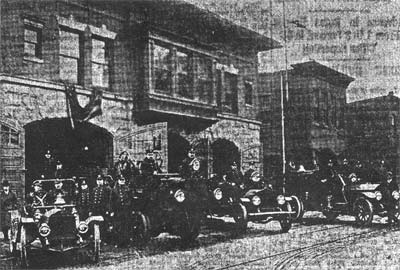
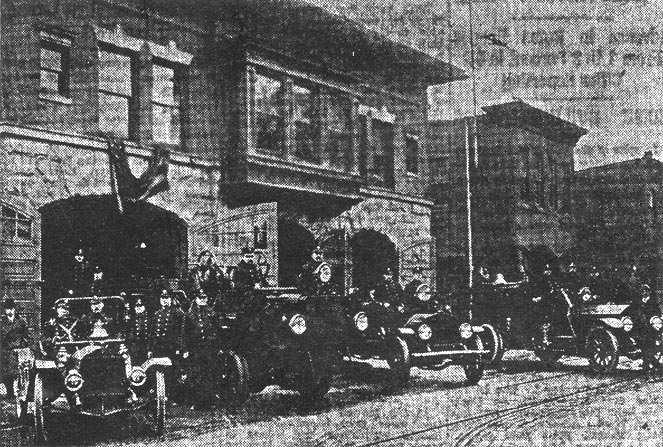
Above is shown a photo of part of the Camden Fire Department after it was motorized. The above companies are stationed at Fire Headquarters, Fifth and Arch streets.
This is the fifth installment of a history of fire fighting in Camden from the time of the formation of the first volunteer company in 1810 to 1936. It is the first complete history of the fire department written since 1886 and links the old volunteers with the new paid motorized department. It is being published in the interest [sic] with Fire Prevention Week, which was sponsored last week by the Camden County Fire Chiefs Association and the Camden Fire Department. Saturday’s installment told of the formation of the paid fire department.
Samuel S. Elfreth was reappointed for several terms as chief by the fire committee of city council before he was made permanent head of the department.
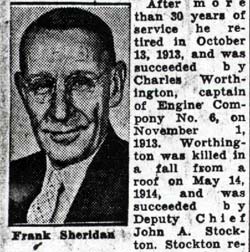
After more than 30 years of service he retired in October 13, 1913, and was succeeded by Charles Worthington, captain of Engine Compony [sic] No. 6, on November 1, 1913. Worthington was killed in a fall from a roof on May 14, 1914, and was succeeded by Deputy Chief John A. Stockton. Stockton retired the following year and was succeeded by Peter B. Carter on October 1, 1915.
Under Carter the motorization of the department was completed. Carter was injured in a fall from a roof when fire destroyed the interior of State Street Methodist Episcopal Church. He retired on a pension on March 31, 1926, to become chief of the Collingswood Fire Department. He remained as Collingswood’s chief until August 29, 1927, when he resigned. He was succeeded as chief of the Camden department by the late Thomas J. Nicholas. Nicholas retired in November, 1932, and was succeeded by John H. Lennox, who was named acting chief by former Mayor Roy R. Stewart on December 1, 1932. He was sworn in as a full-fledged chief on October 1, 1934.
Lennox Heads Department
Lennox is now chief. The deputy chiefs are William R. Harring and Walter A. Mertz and the battalion chiefs, Charles Erickson and Rollo R. Jones. Bernard J. Gallagher is fire marshal, James A. Howell, chief of the electrical bureau, and James H. Long, chief of the water department.
Deputy chiefs were known as assistant chiefs until the two-platoon system was inaugurated in Camden on January 1, 1921, under fromer [sic] Mayor Charles H. Ellis.
Company commanders were at first called foremen. Later they were named lieutenants. When the two-platoon system was adopted, requiring the men to be on duty one-half day instead of 24 hours the ranks of senior and junior captain were created.
The present equipment of the department includes two pieces of apparatus at Engine Companies No. 1, 2, 3, 6, 7, 8, and 9 and one piece at Nos. 10 and 11. The department also has four hook and ladder trucks. Three of these are aerial trucks stationed at Nos. 1, 2 and 4. Company No. 3 has a city service truck. The department also has a supply wagon, four chief cars and a coffee service wagon for third alarms.
Fire headquarters is now maintained at Fifth and Arch streets and the Electrical Bureau is in modern offices on the eighth floor of the new city hall. Engine Company No. 2 is housed with Truck Company No. 1, at headquarters.
The other companies are housed as follows: Engine Company, No. 1, Fourth and Pine streets; Engine Company No. 3, Broadway and Ferry avenue; Engine Company No. 6, Front and Linden streets; Engine Company No. 7, Kaighn avenue above Mt. Ephraim avenue; Engine Company No. 8, and Truck Company No. 2, Sixth street and Kaighn avenue; Engine Company No. 9, and Truck Company No. 3, Twenty-seventh and Federal streets; Engine Company No. 10, and Truck Company, No. 4, Ninth street and Morgan boulevard; Engine Company No. 11, Twenty-seventh street and Hayes avenue.
Engine Company No. 4, Fourth and Vine streets, was abolished in 1932 for economy reasons. Engine Company No. 5, Federal street and Cooper river, was closed with the building of the Federal street viaduct in 1926.
Company Commanders
Company commanders at present are: Engine Company, No. 1, Acting Senior Captain Harry Wagner, Jr., Acting Junior Captain Joseph Gentlesk; Engine Company, No. 2, Acting Senior Captain Rocco Fanelli Acting Captain Edward Ellender; Engine Company, No. 3, Senior Captain Leonard Megee, Junior Captain Eli Hunt; Engine Company, No. 6, Acting Senior Captain George Salnders, Junior Captain George Townsend; Engine Company No. 7, Senior Captain William F. Rose, Junior Captain Henry Zook; Engine Company No. 8, Senior Captain Lawrence Newton, Junior Captain Alvin Thompson; Engine Company No. 9, Senior Captain Daniel Smith, Junior Captain Howard Glick; Engine Company No. 10, Acting Senior Captain Jarrett Zanders, Acting Junior Captain Maurice O’Brien; Engine Company, No. 11, Senior Captain Charles Watkins, Junior Captain Herman Kreher.
Truck Company No. 1, (hook and ladder), Senior Captain William Van Pfeferle, Acting Junior Captain William Judge; Truck Company, No. 2, Acting Senior Captain James Young, Acting Junior Captain Frank Oberman; Truck Company No. 3, Senior Captain Clarence Madden, Acting Junior Captain David Humphreys; Truck Company No. 4, Senior Captain Mordecai Clark, Acting Junior Captain William Scholl.
The coffee wagon was presented to the department by Mrs. Laura Frey, widow of former City Treasurer George A. Frey, on July 20, 1930. The wagon was presented at the request of Frey. It is a modern kitchen on wheels, according to Chief Lennox.
The pumpers of Nos. 1, 2, 3 and 6 have pumping capacity of 1000 gallons per minute. Companies 7, 8, 9, 10, 11 can pump 750 gallons a minute. Nos. 9, 10 and 11 have three-in-one chemical, hose and pumping units. Companies No. 1 and 6 have booster tanks with 100 gallon capacity, replacing chemical, with three-quarter-inch rubber hose.
City Council authorized the motorization of the Camden Fire Department on January 1, 1913. The first motor car was assigned to Chief Elfreth. The motorization was completed under Chief Carter. Camden was one of the first cities in the country to motorize its department and was so equipped before Philadelphia began to use the modern equipment with powerful pumpers.
When the fire department was motorized City Council retained two of the steam pumpers, having them mounted on tractors. After a survey of the city’s fire, water and police equipment and building codes in 1932 by the National Board of Fire Underwriters a recommendation was made that this apparatus be replaced by more modern motor driven and operated equipment. This was done two years ago while former Mayor Roy R. Stewart was director of public safety.
Six Killed at Fire
Six men have been killed in the line of duty fighting fires. The worst catastrophe was at a fire which destroyed the old Fifth Regiment Armory at West and Mickle streets on March 16, 1905. The fire broke out at 5.55 p. m. William Jobes, Engine Company, No. 1; George Shields and William Hillman, Truck Company, No. 2, were trapped in a room in the building and were killed.
Chief Worthington was killed in a fall from a roof while directing the fighting of a fire at Delaware avenue and George street on May 14, 1914.
Capt. Martin Carrigan, of Engine Company, No. 2, was killed directing a fight against a fire which wrecked the interior of the Morris Handle department store at 427 and 429 Kaighn avenue on January 18, 1922.
Hoseman John J. Reilly was killed on January 19, 1925, when a fire extinguisher exploded while fighting a fire at 924 North Second street.
Two Camden firemen were crippled as a result of being caught under a falling wall while battling a fire at the Enterprise Wall Paper plant at Collingswood on January 6, 1915. Injured with them was a Westmont fireman and former Judge John B. Kates, of the Collingswood department, then a member of the General Assembly of New Jersey. The late Battalion Chief George B. Wade and the late William E. Laird, a hoseman, were caught under the falling debris and were in the West Jersey Hospital several weeks. Kates, Wade and Laird suffered crushed limbs.
(Tomorrow’s installment will tell of the most serious fires in the history of the city.)