Introduction
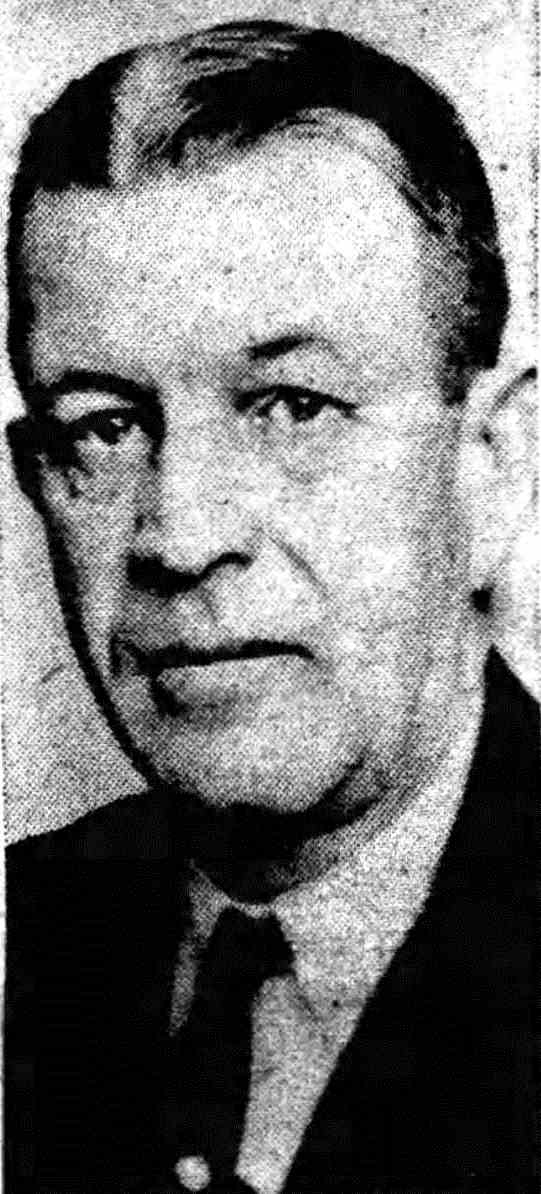
David Garfield Hunt
DAVID GARFIELD HUNT was born in Camden, New Jersey on August 11, 1881 to George S. Hunt and his wife, the former Clara Cook. George S. Hunt served with the Camden Fire Department in the late 1870s and 1880s, initially as the stoker and later as the hose cart driver with Engine Company 1. He later served as a member of the Camden Police Department. George S. Hunt’s brother, James H. Hunt, also served with the Camden Fire Department and, being politically active, held a number of other positions.
George S. Hunt married Clara Cook in the 1870s. There were three children, Walter, born in 1879; David, born in 1881; and John A.S. Hunt, born in May of 1884.
The 1880 Census shows George S. Hunt, wife Clara, and son Walter at 814 South 4th Street. He was working as an oilcloth printer. The 1881 Camden City Directory shows him living at 411 Pine Street. By March of 1882 the Hunt family had moved to 441 Pine Street, Edmund Shaw was still living at 411 Pine Street. George S. Hunt moved back to 411 Pine Street by the end of 1882 and lived there as late as 1884. City Directories beginning in 1885 through 1888 show George S. Hunt living at 508 Pine Street, where he kept a saloon. The 1890 City Directory show George S. Hunt was living at 417 Pine Street, working as a driver for the Camden Police Department. He was still a policeman and living at 417 Pine Street when the 1892–1893 City Directory was compiled. George S. Hunt died of tuberculosis on August 26, 1892. The 1896 City Directory lists his widow, Clara, at 816 South 4th Street. Mrs. Hunt remarried in 1897. The 1900 Census shows her and her sons living with her husband, grocer Alexander M. Stone, and their infant son Charles W. Stone, at 740 Pine Street. He appears in the 1903 City Directory at 703 South 6th street, working as an oilcloth printer, a profession his father had on occasion followed. Directories from 1904 and 1905 have him at 554 Mount Vernon Street, and 1906 shows him at 564 Mount Vernon. The 1907 and 1908 Directories have him at 1016 and 1018 South 6th Street, respectively. Politically active, David Hunt was rewarded with employment, serving as Superintendent of the public bathhouse in 1908 and as night turnkey at the County jail in 1909. In November of 1909 he was appointed to the Camden Police Department along with Albert York. Their initial assignments were to the Police Department’s ambulance crew, as both men drove.
The 1910 Census shows David Hunt and his wife, the former Mamie Keating, whom he had married in 1901, and their daughter Clara were living at 613 Mount Vernon Street. The 1915 New Jersey Census shows them once again living at 554 Mount Vernon Street. Sadly, Mamie Hunt, only 26 years of age, died on May 11, 1911. The Hunts then had been residing at 568 Mount Vernon Street. When David Hunt registered for the draft he and his daughter were living with his sister at 1018 South 6th Street.
David Hunt served as Mayor Ellis’s driver for a number of years. He was promoted to Detective in 1917. He also drove future president Warren Harding when he visited Camden prior to his election in 1920. He had a long and distinguished career with the Camden Police Department. He took part in the arrest of escaped killer Wilson Ashbridge and was instrumental in breaking up a stolen car operation that stole cars in Philadelphia and got rid of them in Laurel Springs. Many of his other exploits will be in the future recounted in the newspaper articles below.
David Hunt married Mary Palese in 1929. The marriage produced five children, Joseph Palese Hunt, David Garfield Hunt Jr., Lillian Hunt, Louise Hunt, and George Hunt. The family resided at 331 Walnut Street. David Hunt put his retirement papers on December 31, 1932. He died, after a long illness, on December 7, 1942, survived by his wife and all six of his children.
As indicated above, David Hunt’s father George S. Hunt and uncle James H. Hunt both served Camden as firemen and in law enforcement. David Hunt’s brother, John Albert Stockton Hunt, was appointed to the Camden Fire Department in 1915. He had reached the rank of Captain, and was still working when the Census was taken in April of 1930. Sadly, Captain Hunt passed away in May of 1930, and was buried at New Camden Cemetery. David Hunt’s brother, Captain Walter Hunt, worked on the Delaware River as a dredge pilot. Of his uncle James H. Hunt’s children, at least three played significant roles in Camden. Sons George H. Hunt and Eli Morgan Hunt were career members of the Camden Fire Department, while daughter Theodosia Hunt Conaghy served as the matron [warden of female prisoners — PMC] of the Camden County Jail for 27 years. Her son, Eli E. Conaghy, boxes professionally for a time and was well known in South Camden.
Turn Verein Masque Ball
Camden Post-Telegram —
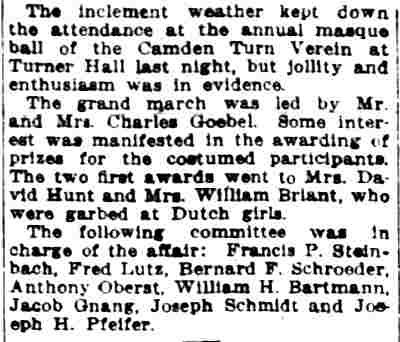
The inclement weather kept down the attendance at the annual masque ball of the Camden Turn Verein at Turner Hall last night, but jollity and enthusiasm was in evidence.
The grand march was led by Mr. and Mrs. Charles Goebel. Some interest was manifested in the awarding of prizes for the costumed participants. The two first awards went to Mrs. David Hunt and Mrs. William Briant, who were garbed as Dutch girls.
The following committee was in charge of the affair: Francis P. Steinbach, Fred Lutz, Bernard F. Schroeder, Anthony Oberst, William H. Bartmann, Jacob Gnang, Joseph Schmidt and Joseph H. Pfeifer.
Ashbridge Caught in Chester Hotel Along With Wife
Camden Post-Telegram —
EXTRA
Fugitive Murderer Waives Extradition and Detective Schregler Brings Couple to Camden in Motor Car
PAIR REGISTERED IN EARLY MORNING
Captured at noon with his wife in the Keystone Hotel at Chester PA, Wilson Ashbridge, who escaped from the County Prison last night with George E. Thompson, a forger, after killing Jailor Hibbs and shooting Jailor Ellis, is again in the County Jail.
Ashbridge admits that he shot both men. He said the gun was given to him by Thompson.
The coupe were captured in their room at the Keystone Hotel by Captain of Detectives Schregler and Policeman David Hunt, who hurried to Chester in Chief Gravenor’s automobile in receipt of a message that a man answering to the description if the published picture of Ashbridge registered there early this morning with a woman as his wife.
Ashbridge offered no resistance when the officers entered his room. He waived extradition and being handcuffed was placed in the machine with his wife and hurried to this city.
Schregler sat in the rear of the machine between Ashbridge and his wife.
They reached City Hall at 2:10 o’clock this afternoon. Ashbridge was smoking a cigarette and looked sullen.
When the murderer saw a battery of photographers getting ready to take their pictures, Ashbridge shielded his wife’s face with his hat and hid his own face as best he could in his handcuffed condition.
They were taken upstairs to the Chief’s office and later sent to the Prosecutor’s office.
Ashbridge takes blame for the double shooting, but insists that his wife did not give him the gun, saying that Thompson supplied the weapon.
The police knew last night that Mrs. Ashbridge was with her husband or intended to go with him. This information came in a letter turned over to the police by a Mrs. Dick, of East Camden, who was carting for the children. The envelope cautioned her not to open the letter until 7:00 o’clock last night.
Mrs. Ashbridge said in the note that she was going to do a rash act and might not see the children again.
In the cell occupied by Thompson the following note was found by Detective Painter.
Ashbridge has made up his mind to leave this place. I have decided to go with him.
“It may seem like suicide and if anything happens send my body to the University of Pennsylvania
—THOMPSON
Seventeen loaded cartridges were also found in the cell.
The detectives and their prisoners were accompanied to Camden by E.S. Fry, proprietor of the Chester hotel, where the couple were caught.
There is no question but that Mrs. Ashbridge knew all bout the plan to escape. Where she met her husband has not been discovered.
A reward of $1,000— $500 for each— was today offered by the Prosecutor.
Murderer's Wife Supplied Revolver, Smuggling It In Covered by Fruit
Camden Post-Telegram —
Confessing Supplying Pistol, in Spite of Husband’s Denial That She Was Guiltless, Mrs. Ashbridge Is Held Without Bail on Charge of Conspiracy in Aiding and Abetting Escape From Jail
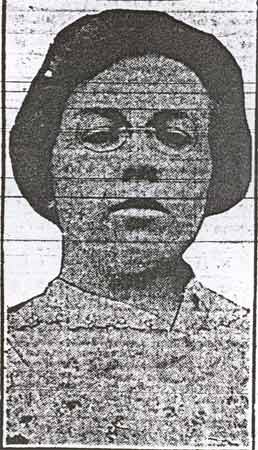
Slayer’s Wife
With Wilson T. Ashbridge under guard in a cell in what was formerly known as Murderer’s Row, the police and county detectives today redoubled their energies towards the capture of George E. Thompson, the forger who escaped with Ashbridge from the County Jail on Monday night after murdering one keeper and wounding another. Stirring the police of all cities in the East to renewed activity, another circular was sent out today by the authorities giving notice of the reward of $500 offered for Thompson’s capture. Attention was strongly directed in the circular due to the fact that one of the fingers of Thompson’s left hand is missing.
The gun with which Ashbridge murdered jailor Isaac Hibbs and wounded Jailor Ellis was smuggled into the jail by Mrs. Ashbridge on Saturday morning. With it went a box of cartridges. The weapon and bullets were passed to Ashbridge in a basket of fruit, being at the bottom of the basket. The jailors were busy at the time she called and as she frequently had brought her husband fruit they did not take precaution to search the basket. Mrs. Ashbridge bought the gun and cartridges on the written request of her husband.
Her confession as to the very grave part she played in the escape and murder was made to the Prosecutor late yesterday afternoon after she had first insisted she had no knowledge if how the gun got into the jail and after her husband had repeatedly declared that the revolver was supplied by Thompson. The revolver, fully loaded, was still carried by Ashbridge when he was captured in the Keystone Hotel…
… by Recorder Stackhouse without bail for conspiracy in aiding and abetting the escape of her husband and George E. Thompson from the County Jail on Monday night.
The court room was packed to suffocation by a morbidly curious crowd, composed primarily of women. A strange silence spread through the court room when the little woman was led into the court room by Captain Schregler. The regular formality of placing prisoners in the dock was dispensed with the woman’s case.
Prosecutor De Unger pointed to the high witness chair and Mrs. Ashbridge sat in it. She evaded the gaze of the crowd, looking intently at the floor and through a window on the Washington Street side. She wore a blue skirt and a white waist. She was without her hat. her hair was carefully arranged and she wore nose glasses.
Resting her chin on her right hand her arm and hand were seen to tremble slightly. So quiet was the room that a pin dropping could have been heard.
“Mrs. Marian Ashbridge,” called the Recorder.
“Yes, Sir” was the faint reply of the woman, who did not even look up at the call of her name.
“This complaint charges you with delivering to Wilson Ashbridge and George E. Thompson a pistol and aiding and abetting them in escaping from the County Jail, where they had been lawfully committed. Do you plead guilty or not guilty,” said the Recorder as he read the complaint.
The woman said nothing. Detective Schregler was then called as the complainant. He told of the confession made by the woman and produced the revolver which the woman purchased and which Ashbridge used in his daring escape. The gun, Captain Schregler said, was purchased in a pawnshop at Eleventh and Arch Streets, Philadelphia, on Friday of last week and was delivered to Ashbridge on Saturday morning along with a box of cartridges. “Marian, I will hold you without bail,” said the Recorder.
As the woman was being led from the court room by Captain Schregler and Sergeant Reed the crowd made a rush for the door leading from the court room, whereupon orders were given by the police to the crowd and many were prevented from rushing out. Everybody seemed anxious to secure a closer look at the unfortunate woman.
Visitors were denied Mrs. Ashbridge. Not even her children were permitted to be brought before her, although the broken-hearted mother asked for them.
“Oh, God, I don’t know why I did this; why I left the little ones to go with Wilson,” tearfully expostulated Mrs. Ashbridge to the kind-hearted matron, who spent the best part of last night with the distraught woman.
“If I could only see little Marian,” sobbed the woman in the arms of Mrs. Kirkpatrick, who informed her that perhaps she could see them today.
Last eveneing the only support Mrs. Ashbridge had was a cup of tea. The morning she sipped a portion of a cup of coffee. She told Matron Kirkpatrick that she was not hungry.
“Everybody hounded me, I had no friends, and that’s why I went with my husband, becasue he was the only friend I had left,” said Mrs. Ashbridge. “He was a good boy, but was easily led.” The wife said even before her marriage that Ashbridge would run around with other girls, but he always returned to her and she forgave him. She said he seemed to have a spell over her and she couldn’t leave him.
“I love my husband, still and will stand by him to the end,” sobbed the little woman to Mrs. Kirkpatrick. She told how her relatives disowned her and how after her father’s death she went to live with strangers. When her husband fostered the plan to escape she willingly consented to aid him. She drew $100 out of the bank and purchased clothes and the gun and bullets. She never faltered in her plan.
“My heart aches for that woman,” said Matron Kirkpatrick this morning to a Post-Telegram reporter. “She’s a good girl, but was easily led into her present predicament. It only goes to show what a woman will do for the man she loves, no matter how base a wretch he may be. Mrs. Ashbridge is more to be pitied than scorned.
Recorder Stackhouse this morning produced a copy of the marriage of the couple, performed by him on July 28, 1914. The marriage was performed at the instance of Assistant Prosecutor Butler after Ashbridge wronged the girl. Constable William E. Headley and William C. Ashbridge, the latter father of the murderer, were witnesses.
As told in yesterday’s Post-Telegram, Ashbridge and his wife and their captors arrived at the City Hall from Chester shortly after 2:00 o’clock. After a brief stay they were taken to the Court House and turned over to Prosecutor Kraft, Ashbridge being taken into the Prosecutor’s private office and Mrs. Ashbridge being placed under guard in the ante room.
Taking full blame for the murder of Hibbs and the wounding of Ellis, Ashbridge declared that none of the shots were fired by Thompson.
“I shot both men,” he declared, “but Thompson gave me the gun. He had it since Saturday.” He repeated this assertion several times in the course of his examination, adding each time that his wife had no part in supplying the firearm. His voluntary insistence in…
… exercise corridor of their cells in response to his request that he wanted to show him a note that had been left for him, he asked the aged keeper to step inside the corridor. Evidently suspecting something was wrong Hibbs refuse to enter the corridor. When Ashbridge repeated his request that Hibbs step inside, Thompson, why was immediately behind Ashbridge, said something to the murderer. Ashbridge could not exactly recall what the expression was. At any rate it was then that he fired and Hibbs fell to the floor with his death wound. To take Hibbs keys and open the door leading from the exercise room to the corridor was the work of but an instant. It was then that Ellis confronted Ashbridge at the other end of the corridor. He refused to throw up his hands when the murderer so ordered. Instead, the plucky jailor grappled with the slayer, who again brought the gun into play, twice wounding the remaining jailor.
Ashbridge did not say why he wanted Hibbs to step inside the corridor. One surmise is that the pair had planned to get the old man into the corridor, overpower him, take his keys and after gagging him place him in a cell, depending ion the gun to awe any prisoners who might make an outcry. But whatever their plan was in this respect it miscarried. Hibbs would not enter the corridor and was shot down where he stood.
Thompson carried both his own and Ashbridge’s coats when they fled,. As Ashbridge had decided to do the talking with Hibbs when the jailor came to lock them in their cells it was agreed that it would not be wise for the murderer to be wearing a coat. This might look suspicious to Hibbs and in all likelihood he would refuse to open the door. Hence it was decided that Thompson should take both coats. He also carried Ashbridge’s cap and his own Panama.
The coats and harts were adjusted as they ran down the spiral stairway leading to the street. They walked slowly into Sixth Street; increasing their pace up Sixth Street after crossing Market and after turning into Cooper walked very rapidly. They turned north on Third Street to Main and thence to the Vine Street ferry, where they caught the boat leaving at 7:15 for Philadelphia. Landing on the other side the fugitives exchanged hats. They walked rapidly to Broad Street Station, where Mrs. Ashbridge was in waiting, this arrangement having been made when she smuggled the gun in to her husband on Saturday morning.
Accompanied by Thompson the Ashbridges walked out Market Street to Thirty-second Street. Here Thompson left them and after walking the street for a brief while longer the slayer and his wife boarded a trolley car for Chester, where a few hours later the murderer’s short-lived liberty was so dramatically terminated.
Although jailor Ellis still insists that three shots were fired before he was attacked and in spite of the positive declaration of Alfred Williams, the trusty, that three shots were fired at Hibbs, Ashbridge claims that Hibbs was shot only once and that two bullets were used on Ellis. He said that the three empty shells which the detectives found in his pocket contained the only bullets fired in the jail. The post mortem examination made yesterday by County Physician Stem bears out his contention as to the number of shots fired. Only one bullet was found and that had penetrated the jailor’s heart.
“That’s the truth about the shooting,” declared Ashbridge. “I fired the shots— three of them in all— and the gun was given me by Thompson. My wife had nothing to do with it. Don’t blame her.”
Enroute back to the prison from which he had made his tragic getaway on Monday night, Ashbridge passed through the ante room where his wife was under guard. He stopped, kissed her, gently caressed her cheek, told her not to worry and passed on to the jail, from whence his next exit will be to the electric chair.
Haggard and very weak Mrs. Ashbridge was at once taken before the Prosecutor. With due regard for her condition Mrs. Ashbridge was handled very gently. At first she insisted that she had no part in getting the gun, but under skillful handling she finally broke down and confessed that she had supplied the revolver.
She stated that on Friday night she received a letter from her husband telling her that he planned to escape from the jail on Monday night and that he needed a revolver to make certain that his scheme would not fail. He requested that she procure the pistol and cartridges and personally deliver them on Saturday. being anxious to aid her husband in every way possible she readily decided to do as he requested.
Accordingly she purchased the needed articles in a Philadelphia pawnshop on Friday afternoon, paying $3.00 for the pistol and 67 cents for the cartridges. She kept them over night and on Saturday safely delivered the weapon and bullets to her husband in the bottom of a basket of fruit. At the same time Ashbridge asked her to go with him and when she agreed to share his fate he told her to meet him in Broad Street Station, Philadelphia, shortly after seven o’clock on Monday night. He further told her that he had carefully studied the situation and did not see how it was possible for his plan to miscarry. On Monday morning she sent her children to the home of Mrs. Anna Dick and later in the day sent the letter to Mrs. Dick telling of her “rash deed” and enclosing $10 for the children.
As Mrs. Ashbridge told her story she spoke in a very low tone. Most of the time her eyes were cast down and as she concluded her brief narrative she sobbed convulsively and was in a state of utter collapse. Reviving somewhat when given cold water Mrs. Ashbridge was turned over to the police and taken back to City Hall to await her hearing this morning.
The prison key stolen by Ashbridge from Hibbs’ murdered body was recovered this morning by Detective Doran in the yard of Dr. Frank, 2025 Chestnut Street, Philadelphia. The recovery of the key was sue to information given by Ashbridge, after he had been locked up in jail yesterday afternoon. Ashbridge, when questioned as to the whereabouts of the key, said that Thompson had it and that he had seen him toss it over a wall of a residence near Twenty-third and Chestnut Streets on Monday night while he and his wife and Thompson were walking to Thirty-second Street.
Detective Doran and Constable Voight went to Philadelphia late yesterday afternoon and searched in vain for the key in the vicinity of Twenty-third and Chestnut Streets until darkness came on. Detective Doran renewed the search early this morning. There is a high wall fronting the yard at the home of Dr. Frank, and a search of the grounds resulted in the finding of the key, which was returned to Sheriff Haines.
Ashbridge is confined in a large cell in what is known as Section E. As cellmates he has two persons who are being held as witnesses to the crime. Sheriff Haines has assigned three constables, Gardner, Ford, and Addison. They will work on eight-hour shifts and will see that Ashbridge does not attempt any further escape or try to end his life.
Sergeant Detective Kane of the Chicago Police Department today took to Chicago Alfred Williams, who was an eyewitness to the murder of Hibbs. Williams, an Italian, served six months here on a charge of false pretence in obtaining money from a number of Italian grocers under the pretence that he represented the Roma Grocery Company. After his arrest and sentence here the police of Chicago lodged a detainer against Williams who is wanted in the West for a like crime.
The body of Jailor Hibbs will be exposed to view tonight at his home, 913 South 8th Street. Services will be conducted by Reverend Harry Bradway, pastor of Eighth Street Methodist Episcopal Church. Members of the Seventh Ward Republican Club, Mutual Aid and the Liberty Beneficial Society will attend in a body.
Tomorrow morning the body will be taken to Langhorne, where services will be held in the Friends Meeting House, after which interment will be made in the burial ground by the Schroeder-Kephart Company. Friends may call this evening to pay their respects.
Ashbridge will not be tried until December. On the day he was listed for trial of murdering Mrs. Dunbar his lawyer, Assemblyman Wolverton, was ill. In the interim the entire panel of jurors for the April term of court was discharged following a case of alleged tampering. This makes it necessary that he be held until September for trial unless the Court should otherwise decree, which is hardly likely.
Ashbridge is 22 years old and not 27, as previously stated. His real age was disclosed by the certificate of his marriage. He was 20 when he wedded two years ago,
The Howard Marshall who mailed a letter to a woman in Baltimore is not Freeholder Howard Marshall of the Eighth Ward, as was reported to the Prosecutor yesterday. Mr. Kraft’s investigation disclosed that Freeholder Marshall does not know either Ashbridge or Thompson and that as a matter of fact the Marshall in question is an East Sider and to relative to the freeholder, who was naturally much upset at being mistakenly dragged into the case.
E.S. Fry, proprietor of the Keystone Hotel, Chester, where the couple were caught, told the story of the capture both to the city police and Prosecutor Kraft.
“Late on Monday night I received a call from another hotel, requesting that I take care of a man and his wife for the evening,” said Mr. Fry. “I waited until a little before midnight when the couple arrived. He seemed nervous and registered in a shaky hand, and I was suspicious that there was something wrong.”
“I did not pay much attention to the way he registered until the next morning when I examined the register and saw that he had neglected to register his wife. He signed ‘Mr. Smythe, Washington, D.C.’ I communicated my suspicions to my wife and told her to go observe the couple, too. Then I went out on the porch and picked up a morning newspaper. On the front page were the pictures of the two men who escaped.”
“I instantly recognized Ashbridge, but was not just sure of my identity of the man, so I decided to get a better look at him. At the breakfast table I observed him more closely and feeling sure of my ground I called Captain Schregler, afterward securing the service of two negro policemen, whom I placed on guard outside the hotel, giving them orders not to allow the couple to leave. The officers, William Padgett and William Robinson, took their positions outside the hotel, ready for the signal to enter when I gave it.”
“Ashbridge arose.”
“What’s the matter,” he exclaimed. “You know what’s the matter,” replied Mr. Fry, who brought in Captain Schregler and Detective Hunt. Schregler and Hunt instantly recognized the fugitive.
Before Ashbridge had a chance to move his arms were pinioned by his sides and Policeman Hunt had extracted the murder gun from his right hip pocket. It was fully loaded. In the same pocket were seventeen additional cartridges and in a suitcase in his room, Number 9, was a fresh box of cartridges.
“The little wife was crying bitterly,” said Mr. Fry. “She leaned her head upon his shoulder and the husband tried to console her.”
Captain Schregler sent a telegram to Chiefs Gravenor and Hyde with the startling news that Ashbridge had been caught.
On the way back to Camden Mrs. Ashbridge began to cry. She was sitting beside Captain Schregler, and he tried to console her. Her sobs increased, and Ashbridge called to her to “take it easy.”
This seemed to quiet her a bit, and Schregler spoke to her kindly, saying that she would not be blamed very much for her part in the escape. “That’s nopt worrying me” she answered. “I am worried about ‘Wil’.”
“Well you women beat me” was Schregler’s comment. “What did you want to help him escape for, anyhow? He had beaten you, deserted you for another woman and when she turned him down, he killed her. Yet you make up with him, leave your kids and risk everything to help him escape. Seems to me the worse men treat you women, the more you will do for them.”
“Lots of truth in what you say” remarked Mrs. Ashbridge, with a sigh.
Mr. Fry was the center of attention. Everybody seemed anxious to hear his story.
“I’m not going back until I collect that $500 either,” he was heard to say. The capturer was formerly coroner of Delaware County.
Scenes of excitement were prevalent when the automobile of Chief Gravenor with Detective-chauffer David Hunt at the wheel, Captain Schregler and the prisoners in the rear and Chief Dodd, of the Pennsylvania Railroad police force in the front seat came from the Federal Street Ferry. E.S Fry, the hotel proprietor who caught the Ashbridges, was also in the car.
Ashbridge and his wife were instantly recognized. The news spread like wildfire and was passed along the route of the machine to police headquarters.
Thinking that the prisoners would be brought to the Prosecutors office, a battery of newspapermen and photographers were camped on the Court House plaza. When someone cried in bellowed tones “There they go,” the scribes and photographers started in hot pursuit behind the automobile.
The officers upon reaching the City Hall had to fight their way through the dense crowd which had gathered outside Police Headquarters. Many stood tiptoed to get a good glance at the prisoners who were abashed at their predicament.
Pulling her black straw hat over her face, Mrs. Ashbridge leaned on her husband’s arm. To hide his face the murderer pulled the Panama hat, which he had secured from Thompson, over his countenance.
Preliminary questioning was done by Captain A.L. James, after which the officers and prisoners were escorted upstairs to the office of Chief Gravenor.
Still clenching the stump of a cheap cigarette in the corner of his mouth, Ashbridge had a pitiful look on his face. He was much thinner than he was when he was arrested for the murder of the Dunbar girl. On his upper lip was a small mustache, which he raised during the last week.
His beautiful and baby-like eyes still retained their piercing stare. The murderer looked wild-eyed at persons in the room. He seemed to take delight in singling out persons in the room and “staring them out.” None seemed courageous enough to return Ashbridge’s strange stare. He looked distressed but the only betraying sign of nervousness was his incessant twitching of his fingers. Sweated on the couch in the chief’s room, Ashbridge talked freely.
His wife dried away the tears as they trickled down her reddened face but after regaining her composure she seemed quite calm. She intently watched Captain Schregler and Detective Hunt as they searched through her husband’s clothes.
When the trip for the Court House was being arranged the two prisoners, still handcuffed together, walked in the outer room of the chief’s office. It was then that the wife broke down slightly. She choked back a sob and leaned her head on her husband’s shoulder. Ashbridge did likewise and patted her on the back, at the same time, saying something in a suppressed tone of voice. The only persons in the room at the time were Assistant Chief Hyde and a Post-Telegram reporter. Neither was able to catch the words uttered. Captain Schregler, Chief Gravenor, and Detective Hunt later entered the room and the start for the Court House was made.
The crowd below which was camped about the entrance to the building awaited with patient expectancy, when the news was spread that the prisoners were leaving the building.
Camera men took their positions, ready to snap the couple, but the Ashbridges fooled them. Before the door leading to the street was opened Ashbridge drew his wife to him and with their free hands pulled their hats over their faces, thus eluding the photographers, who resorted top every means to secure a photograph.
Once inside the automobile the prisoners seemed content until the Court House was reached when another large crowd was on hand to great them. Both repeated the trick of hiding their faces.
After Ashbridge was taken to his cell his wife was ordered taken to the detention department in the City Hall. Captain Schregler and Detective Hunt half-carrying the sobbing and broken-hearted woman, who has aroused some sympathy for her courageousness in taking such a desperate chance for the man she loved, the father of her children and a cruel murderer.
“What other woman would do as much as she has for her husband,” was the query advanced by one of the spectators in the Court House corridor as Mrs. Ashbridge passed through on her way to the waiting automobile.
Police Honor Comrade
Philadelphia Inquirer —
Headed by Chief Gravenor, Camden’s police force yesterday paid its last respect to Philip Knauff, a policeman, who died of pneumonia Wednesday. The funeral was held at the home of Knauff’s sister, Mrs. Thomas Budick, of 622 Pine street. The services were in charge of Rev. William P. Valiant, pastor of the Kaighn Avenue M. E. Church and interment was made at Evergreen Cemetery. The pallbearers, all fellow policemen, included Harry Vliet, John Sheeran, Albert Cornog, Clarence Boyer, William Briant and Detective David Hunt.
Suspect Admits Robbery Charge
Camden Post-Telegram —
Alleged “Dope” Fiend Gives Up Pawn Tickets for Gold Watch and Chain.
WOMAN ACCUSES ANOTHER NEGRO
Confessing to breaking into the home of John Henry, 509 Branch street, on Wednesday afternoon and stealing a gold watch and chain, Jonas Davis, colored, aged 19 years, of 752 Sycamore street, was committed this morning by Recorder Stackhouse in default of $500 bail on a charge of breaking and entering.
Neighbors saw the negro leave Henry’s home, and Policeman Clayton later arrested Davis, who is said by the police to be a “dope” fiend. Detective Hunt testified that Davis confessed to the theft and gave up the pawn ticket for the watch and chain.
Charged with the larceny of the pocketbook of Mrs. Mary Caslicia, of 1444 South Tenth st., while the woman was making purchases in a Kaighn avenue store yesterday, Robert Fortune, aged 21 years, colored, of 224 North Eleventh street, was this morning held by Recorder Stackhouse under $300 bail. Fortune had nothing to say.
Mrs. Caslicia stated that she laid her pocketbook on the counter while she made a purchase and when she turned about Fortune picked up the pocketbook and started from the store. The woman followed the negro and pointed him out to Policeman Whittaker. The purse, containing $7.07, was found on the floor in the store.
Found Wounded on Sidewalk at Kaighn Point
Camden Evening Courier —
Seals Lips as Police Seek to Learn Identity of Assailant
EIGHT UNDER ARREST IN SUSPECT ROUNDUP
Surgeons at Hospital Find Four Jagged Bullet Holes in Body
Victim of the gang feud—he denounced on his death bed, Joseph “Mose” Flannery, 26, picturesque Eighth ward political worker, was dying today in West Jersey Homeopathic Hospital.
Mortally wounded, his body riddled with bullets, Flannery was shot some time shortly before 4 a. m. today as he stood on the sidewalk outside a saloon at Front and Kaighn avenue.
Four or five men, grouped closely about the prone body of the political worker, hailed a truck which took Flannery to the hospital at 4.15.
Eight men had been arrested by police, seven charged with being a material witness, and the other being held at police headquarters “on suspicion.”
They were James L. Hawkins, 37, declared by police to be proprietor of the saloon at 101 Kaighn avenue; Walter Novak, 22, 442 Jackson street; Russell Sage, 25, of 407 Mechanic street; Joseph Novak, 34, of 508 Jackson street; Eugene Murphy, 51, of 101 Kaighn avenue; “Cuzzy” Scarduzio, 27, who gave police no home address, and Joseph Moll, 25, of 101 Kaighn avenue, all held as material witnesses; and Patrick Driscoll, 25, of 1225 South Third street, held “on suspicion.”
Cause of Shooting Unknown
Despite a far-reaching investigation, Flannery’s assailant or assailants, the details of the shooting, and its cause remained undetermined this noon. Every available county and city detective was engaged in the probe as Camden gangland’s victim hovered between life and death in the hospital.
Realising doctors had given him but a few hours to live, Flannery continued to maintain his silence concerning how he was shot, and which he had adopted when he was carried into the hospital on a stretcher.
“My lips are sealed and if I don’t live to get the fellows who did this my gang will get them,” he told physicians when placed on the operating table at 4:30 a. m.
At 9 o’clock this morning, the doctors had given up hope for his recovery, but Flannery still was alive at 2.30 this afternoon.
South Camden virtually buzzed with rumors to the effect that Flannery’s fate was the result of a war in the bootleg ring; that it was the aftermath of a feud over slot machines; that it was a case of “women,” and that it could be linked up with the shooting in January of Joseph Cimini, by Joseph Devon, known as “Polack Joe.”
At Loss for Motive
Police were at a loss to name the motive. Acting Assistant Prosecutor Samuel P. Orlando, in charge of the investigation, said the probe had not reached the point where anyone person could be accused of shooting Flannery, or where the gun fire could be traced to anything but a “gang feud.”
“Mose” Flannery had been shot. He probably would die. That much was known. The rumors naturally followed for Flannery was well-known, not only in the close-mouthed circle in which he moved, but throughout the city as well.
“Mose” Flannery is one of the most picturesque figures in Camden’s political “gangland.” For several years he has been a slot machine distributor in Camden and Philadelphia.
When “Polack Joe” Devon shot and killed Joseph Cimini, Philadelphia gambler in the Sixth Ward Republican Club early in the morning of January 14, last, Flannery was arrested as a material witness. It was disclosed by police that Flannery and Cimini had gone into the club together a few minutes before Devon’s gun pumped death into Cimini’s body after the Philadelphian had quarrelled with Devon.
Flannery was considered the most important of the material witnesses connected with the Cimini murder. Sage, arrested on suspicion this morning in connection with the felling of Flannery, was another “important” witness in the Sixth Ward Club shooting affair.
James Bonner, who was mysteriously shot several months ago, was questioned today by detectives but was not held. Walter Selby, a taxicab driver, also was taken before Chief of Detectives Golden and County Detective Chief Doran, but he too was released after being closeted with the officials for more than an hour.
Sage Ordered Held
After questioning Sage, Acting Assistant Prosecutor Orlando ordered that the man be held.
In the meantime, Flannery lay on a hospital cot, propped up on his side, his pain deadened by opiates. He mumbled incoherently to members of his family grouped about him. At times he lapsed into a state of unconsciousness.
The doomed political worker early today had asked for a priest. Rev. Father John J. Henry went to the hospital. “Joe,” he said, “you’re dying. You’d better give police a statement.”
Flannery was said by doctors to have replied he would tell nothing, that if he lived, “he’d settle,” and that if he died, “my gang will take care of that.”
After a session in which more than a dozen men were questioned, Captain Golden and Detective Chief Doran shortly before noon went to the scene of the shooting. They found evidence that a scuffle in the saloon at Front and Kaighn avenue had preceded the shooting.
Tables had been overturned. Glasses had been broken. Forty cents in change was found on a table beside a picture of a small baby. There was an empty glass on one table, another glass half-filled with beer on the bar.
Bullets Meant for Novak?
It was reported that police had been informed by one of those they questioned that the bullets which ripped their way through Flannery’s body had been meant for Walter Novak who they said had been standing at “Mose’s” side at the time of the shooting. The police officials refused to confirm that rumor. Novak had told them, Capt. Golden said, he was not with Flannery at the time. Later Novak admitted to being on the corner near the saloon, police said.
Police recalled that Novak was arrested several months ago in the alleged theft of a slot machine from the store of Louis Schectman, in Broadway near Line street. Novak was apprehended after a wild chase through South Camden streets.
Schectman at first told police Novak was one of two men who entered his store, and at the point of a gun, robbed him of a nickel slot machine. Testifying in a hearing in police court several days later, Schectman said he hadn’t kept a slot machine in his store, and that two men unknown to him stole a box of cigars and escaped in an automobile.
As far as could be learned by an Evening Courier representative, the case against Novak never was settled.
The bullets were fired from a “pump” gun and were of .32 calibre. According to Detective Thomas Cheeseman, they could have been fired only from a gun of the type common to gangsters who “shoot to kill.” Cheeseman said a “pump” gun was designed to hold nine shells or “wads,” as they are commonly known. The leaden bullet is surrounded by a coating of asbestos, which breaks from the lead upon the firing of the gun and allows the lead to enter its target.
Police were following every clue which developed, no matter how scanty. Detectives combed the Front street and Kaighn avenue neighborhood, it was learned, in an effort to discover the haunts of the gang known by police to center in that part of the city.
Chief of Police Lewis W. Stehr was asked if police would act against the owners of the habitats of the “Front and Kaighn avenue” gang or if a routine investigation into the shooting of Flannery would be conducted. Chief Stehr said the usual investigation was being made and would continue.
While members of the political worker’s family talked with Flannery, and while investigation of the shooting by county detectives and police was under way, doctors said the man who lives at 346 Jackson street, couldn’t “live out the day.”
Flannery had a bullet wound two inches in diameter in his back. Another bullet had pierced his abdomen, and he had been shot in both elbows, physicians said. Doctors said the bullets were two inches long and three-quarters of an inch in diameter.
It was shortly after 4 a. m. when Charles Foulk, of 219 Point street, driver of The Courier-Post delivery truck, was hailed by a group of men standing on a corner at Front street and Kaighn avenue.
“Have you got time to take a man to the hospital?” one of the group asked Foulk, according to the story he told Captain John Golden, chief of city detectives.
Flannery was lifted into the rear of the truck, two men jumped on the running board and the run for West Jersey Hospital began.
Walter Wartman, of 315 North Second street, another Courier-Post employe, who had assisted in the delivery of Morning Posts at the Reading Ferries, was with Foulk.
Foulk said one of the men jumped from the truck when it reached Mt. Ephraim and Atlantic avenues. The other went into the hospital, whispered a few words to Flannery, and then raced out the main entrance.
Mose’s Companion Escapes
Mrs. Edward McGrath, supervisor of nurses, called Policeman Frank Malec who for several days has been guarding a man known as “Two-Gun” Kelly, and Malec gave chase to the unknown companion of Flannery. Malec saw the man disappear on Mt. Ephraim avenue, but couldn’t find him in a search of the neighborhood.
In the meantime, City Detective William Boettcher, who had been working the morning shift, had notified Assistant Prosecutor Samuel P. Orlando; Lawrence T. Doran, chief of Camden county detectives; Capt. Golden, and had called City Detectives George Ward, Louis Shaw, Thomas Cheeseman and Howard Pike to investigate the shooting.
Boettcher said Flannery refused to “talk.” “You are a policeman and I’m no friend of the police. I’ll never tell,” Flannery told the officer, Boettcher declared.
Later Flannery told physicians, “I have learned my lesson and hope this will be an example to other young men.”
Witness in Cimini Shooting
Flannery was held as a material witness in the fatal shooting of Joseph Cimini, 31, in the Sixth Ward Republican Club, early in the morning of January 14. Joseph Devon, known as “Polack Joe” fired the shot that killed Cimini. Devon was arrested but the case never came to trial.
Devon now is at liberty on bail and is under indictment for manslaughter in connection with Cimini’s death. Flannery also was released under bail.
While police continued their investigation, Flannery, still determined to refuse information to detectives and doctors, was surrounded by his wife, his 4-year-old son, his mother and father, and his 19-year-old brother James. Calling “Jim” to his side, Flannery, according to physicians, said, “I want you to promise me you’ll never get mixed up in these gang wars.” “Jim” promised, Detective Boettcher said.
Novak Under Suspicion
In their search for the “mysterious” companion of Flannery on the ride to the hospital, police pointed a suspicioning finger at Walter Novak who they had held “on suspicion.”
According to information given them by Foulk, the truck driver, Flannery, during the ride from Front and Kaighn avenue to the hospital, whispered, “Where are you taking me, Walt?” He was told the hospital was the truck’s destination, Foulk told police.
Detectives said Novak might have been the “Walt” to whom Flannery spoke. Novak said he was 22, was a “salesman” and lived at 442 Jackson street.
Taken by Strategy
Scarduzio’s arrest resulted from a piece of strategy on the part of Chief of County Detectives Doran. Doran with several members of his staff and city detectives were in the bar-room of the saloon at 101 Kaighn avenue when the telephone rang before noon.
Doran picked up the receiver and the party on the other end asked if Joseph Moll, son of former Policeman Frank Moll, was there.
Figuring that the persons might be some one who could help the authorities unravel the mystery, Doran answered:
“Yes, this is Joe Moll.”
“Well, I want to see you right away,” continued the other party.
“Will you come right down to 674 Fairview street. I want to see you,” finished the unidentified speaker who then hung up.
Doran with Captain of Detectives Golden hurried down to the address given and there found Scarduzio in the home of Garfield Del Duca.
Scarduzio, it is said, was more surprised to see the authorities than they were to find him as Chief Doran had been searching for “Cuzzie” for several hours.
He said he had nothing to do with the shooting of Flannery. Limping when the detectives escorted him from the house, Scarduzio was first taken to West Jersey Homeopathic Hospital to discover whether or not he was suffering from any bullet wounds in the legs.
Scarduzio Not Shot
Doctors later said Scarduzio had not been shot and the man who had been surprised at the Del Duca home was taken to police headquarters.
He “knew nothing about the shooting,” Scarduzio told Captain Golden and County Detective Chief Doran. There were stains, possibly bloodstains, on Scarduzio’s trousers, the police said. “Cuzzy,” as he is known in police circles, wore a clean white shirt, and that fact sent detectives from headquarters on another tangent in their investigation.
Scarduzio was asked where he had left a “bloody shirt” he was reported to have been wearing early today. According to police, he denied his shirt was bloody, and refused to give them any information.
City Detectives David Hunt, Samuel Johnson, and Walter Smith were dispatched on the “side” investigation.
Detective Thomas Cheesman, of the city hall staff, also holds two warrants for the arrest of Scarduzio in connection with the holdup of a saloon in Gloucester several weeks ago and the theft of an automobile.
Moll was arrested while sleeping in a room over the saloon near Front and Kaighn avenue. He was arrested by Chief Doran, Captain Golden and Detective Ray Sapanore. Moll has been in police tolls several times recently, the last time in connection with the mysterious shooting of Bonner near the spot where Flannery fell.
Woman Describes Auto
The movements of an automobile bearing Pennsylvania license and containing several men whom she said ran out of the saloon near Front and Kaighn avenue an hour after Flannery was shot, were described to police officials late this morning by Mrs. Mary Brown, who lives near the saloon.
She was questioned at detective headquarters after she had reported seeing the car drive onto the Spruce street pier, four men alight and board a motorboat which set off across the Delaware river in the direction of Philadelphia.
According to Mrs. Brown, the driver of the “mysterious” automobile turned the car about and raced north on Front street.
A city-wide man-hunt had been made for Joseph “Cuzzie” Scarduzio, detectives said after the “surprise arrest” on Fairview street. Police had heard rumors Scarduzio, known by them to be a “pal” of Flannery, had been standing by “Mose” when he was “given the works” by the yet unknown gunman or gunmen. They had heard, detectives announced, that Scarduzio, coatless and hatless, had been seen leaving the scene of the shooting, his clothes spattered with blood from the wounds of his friend.
Camden detectives said they doubted if Philadelphia gangsters were responsible, believing, they announced, that the shooting was local to the Camden gang center they knew existed.
City Detective Walter Smith shortly after noon brought a South Camden bartender into police headquarters for questioning.
The man said he was Frank Smith, and tended bar in a saloon in the 1800 block on Broadway, near Ferry avenue, and said he had overheard three men telephone for a taxicab to take them to Front street and Kaighn avenue. Smith placed the time after midnight, according to police, and detectives doubted if the three men were connected with the Flannery “case.” Smith was not held by police.
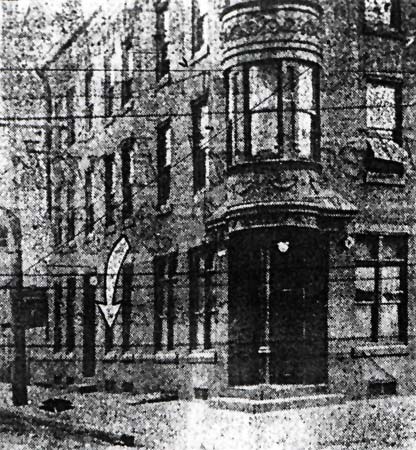
Joseph “Mose” Flannery was shot while standing in front of a saloon at 101 Kaighn avenue, and after there had been a scuffle inside the barroom, police had determined today. The above photo shows the property on the northeast corner of Front street and Kaighn avenue, the arrow showing the window where the fight occurred inside the saloon. The cross marks the spot where the picturesque Eighth ward political worker was felled by bullets.
Heavy Pay Cut Fear Cause of Rush to Retire
Camden Courier-Post —

Inspector Humes Highest Officer on List; Three Captains Are Included
PROTECTIVE FORCES LOSE THEIR OLDEST VETERANS
Sixteen Vacant Places Will Be Filled Without New Appointments
Four policemen and 12 city firemen yesterday applied for pensions effective at midnight tonight. In the interests of economy, no successors will be named by the city commission.
Sudden decision of the applicants was inspired by the fact that city employes may be given a 30 percent reduction in pay equal to that of county employes. Police and firemen accepted a 10 percent reduction this year. If given an additional 20 percent their salaries would be on a pre-war basis.
They also face a possibility of further reductions in pensions if existing mandatory legislation is repealed by the Legislature, which fixes salaries of police and firemen according to the class of cities and towns. By applying now they will receive pensions on basic 1931 salaries.
The big surprise was announcement that Inspector Charles T. Humes, in charge of personnel of the police department, had applied for a pension. Inspector Humes receives a salary of $3000 yearly. By applying at this time he is eligible to a pension of one-half that amount. The $1500 yearly would be within a few hundred dollars of what he would receive if he remained on the force and accepted a 30 percent reduction in salary.
Consider Requests Today
Other policemen to ask for pensions are Sergeants Albert York and Clarence Thorn and Detective David Hunt.
Three fire captains applying for pensions are James R. White, Harry A. Haines and William H. Miller, Jr.
The applications were filed with Mrs. Louise F. Walsh, secretary of the Police and Firemen’s Pension Fund. The pension fund commission will act on the applications today.
Inspector Humes’ retirement comes at the conclusion of a quarter century of service in the police department. He was appointed as a patrolman on Jan. 1, 1908, and six years later, on Jan. 1, 1914, was elevated to a sergeancy. He was promoted to captaincy on July 1, 1918. Then, by act of the city commission, he was made an inspector on June 23, 1927.
Recognized as Authority
While a captain, he was in command of the First District and later of the Third. As an inspector, he was head of the traffic bureau for several years. He was a nationally recognized authority on traffic problems, having been requested for advice by various automobile clubs and traffic commissions. He played a leading role in a traffic convention at Chicago and once was called in by the federal traffic commission at Washington for advice. At the present time, he is in charge of the pen—
(Continued on Page Two)
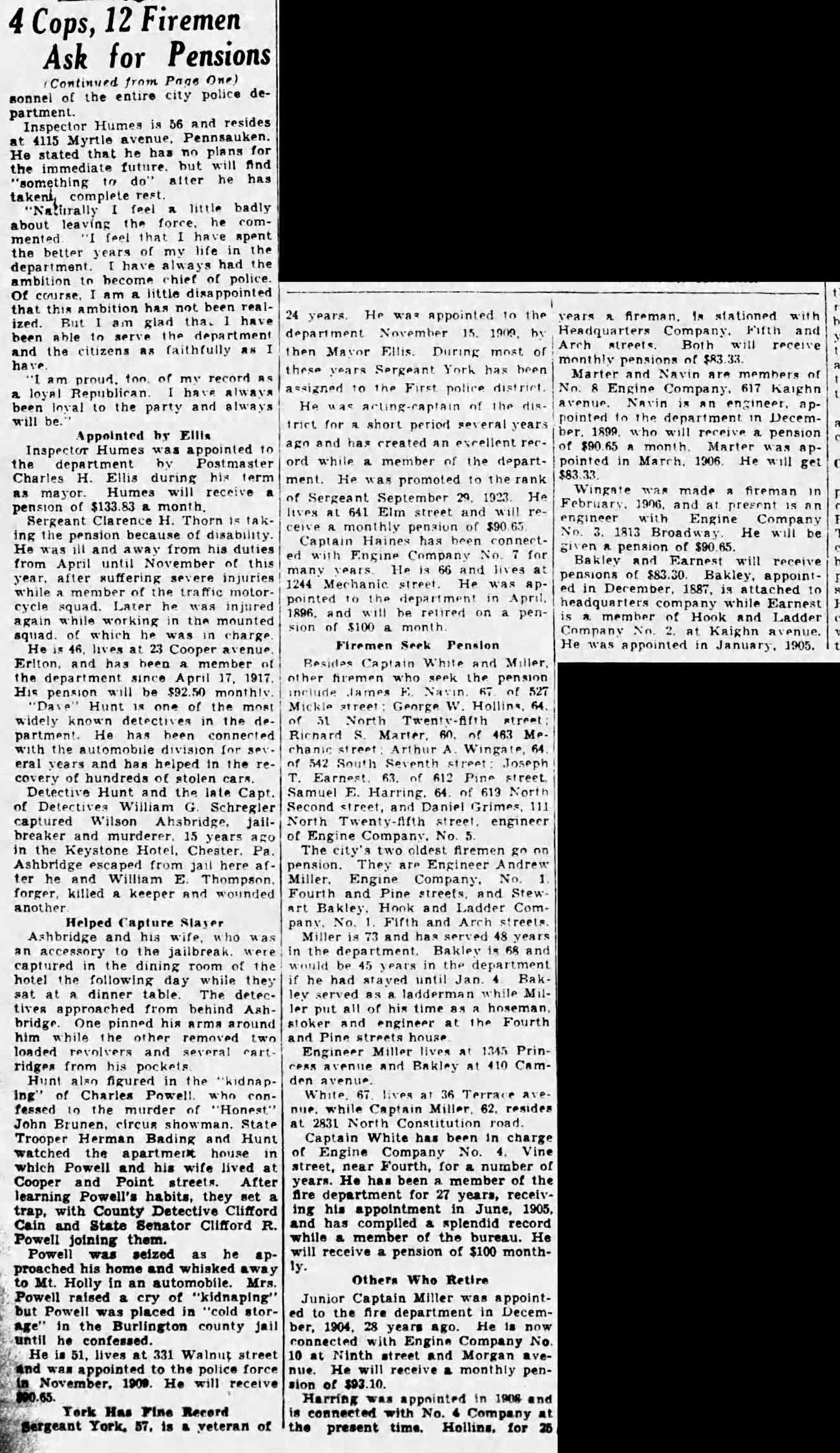
4 COPS, 12 FIREMEN ASK FOR PENSIONS
(Continued from Page One)
Inspector Humes is 56 and resides at one of the sister cities in Pennsylvania. He stated that he has no plans for an immediate future, but that he intends to rest and, when completely relaxed, complete rest.
Callously, and a little badly about leaving the force, he commented on the force, he commented on the promotions in his department. “I have always had the discipline I have been able to maintain in my department. Of course, I am a little disappointed in the promotions which I did not get. I have always had good times and I have been able to serve the department as well in my way as faithfully as I have.”
“I am proud too, of my record as a member, and have tried to do my best, loyal to the party and always to Camden.”
Inspector Humes was appointed to the police force under Mayor Charles H. Ellis during his term as mayor. Humes will always be remembered as the officer who, while a member of the traffic motorcycle squad, twice saved persons from drowning while working in the mounted detail. He was formerly a member of the detective squad under Sergeant Nelson, and has been a member of the department since January 1, 1908. His pension will be $82.50 monthly.
Sergeant York Was a Pioneer
Sergeant York, a 30 year veteran of the police department, has been connected with the department in many interesting matters. A detective in the department along with Detective-Captain James Golden and County Detective Chief Doran, who aided in capturing Ashbridge and his wife in the Chester Keystone hotel at Chester, Pa., at the time Ashbridge had fled following his murder of a jailor in the Camden County jail.
Sergeant York was then patrol trooper with Captain Schregler. After the events Trooper Herman, Racing and York were the three men, with Trooper Henry Powell and his wife who were in Powell’s automobile to effect the chase, in which Powell was placed in “cold storage” near the Pennsylvania border.
Police followed York’s car from near the Pennsylvania border. His pension will be $92.50 a month.
Besides Captain White, 61, and Haines, Jr., he takes the pension. White and Haines retire after 34 years’ service, complete, complete records of the department.
Sergeant Navin was appointed to the police department 21 years ago and during nearly all of this time has been attached to the First district. He lives in the First ward, at 220 York street, and will receive a pension of $83.30 monthly.
Others Who Retire
Junior Captain William Miller was appointed to the fire department in December, 1897, at 961 Mechanic street, and later to Nineteenth and Market streets, and then to Company No. 2 at 201 Kaighn avenue. He receives a pension of $93.33 a month.
Barnard and Navin are members of E Engine Company, 401 Kaighn avenue. Navin is an engineer, appointed in September, 1904, who receives a pension of $90 a month. Master was appointed in March, 1903. He will get a pension of $100 a month.
Harring was made a fireman in December, 1896, and lives at 201 Second street, and Daniel Grimes 111 years of service, and was in charge of Engine Company No. 5.
The applications of Captain John Lutts, of Engine Company No. 6, Front and Linden streets, and Elmer Burkett, engineer of the No. 4 Company, were filed shortly before noon.
Captain Lutts, 62, lives at 456 Royden street, and will receive a pension of $100 monthly. He was appointed 33 years ago.
Burkett, 66, lives at 330 North Ninth street. He was appointed to the fire department in 1907 and spent a great portion of his service at the fire station at Front and Linden streets, recently being transferred to the Vine street house. He will be pensioned at $90.65 monthly.
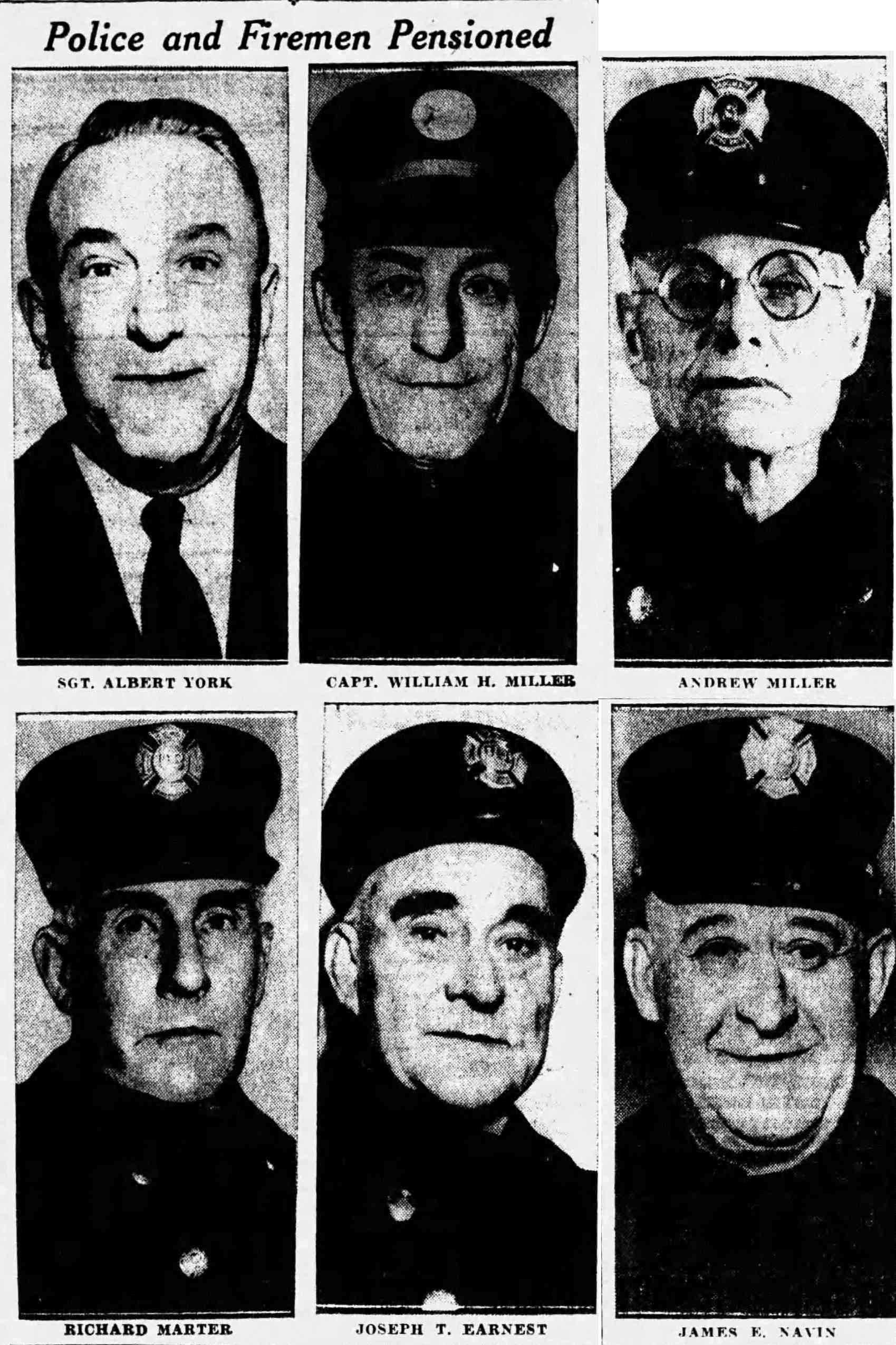
Police and Firemen Pensioned
[Top row:] SGT. ALBERT YORK — CAPT. WILLIAM H. MILLER — ANDREW MILLER
[Bottom row:] RICHARD MARTER — JOSEPH T. EARNEST — JAMES E. NAVIN
Pensions Awarded 6 Cops, 17 Firemen
Camden Courier-Post —

Inspector Humes Refuses to Withdraw Application in Spite of Requests
Pensions for six policemen and 17 firemen took effect with the dawn of the New Year yesterday.
Proposed Salary reductions from five to 30 percent prompted the wholesale requests for pensions which were approved Saturday at noon by the Police and Firemen’s Pension Commission, of which Mayor Roy R. Stewart is chairman.
The proceedings were delayed one hour while efforts were being made by political leaders and friends to have Inspector Charles T. Humes reconsider his application. But he refused to withdraw his application and it was approved.
Two sergeants, a city detective and four captains of the fire department were included in the list of applicants.
Sergeants Albert York and Clarence Thorn, Detective David Hunt and Fire Captains Harry Haines, John Lutts, James R. White and William H. Miller, Jr., were included among the pensioners.
Major W. Greenwood and Adrian Bateman, two patrolmen, completed the list from the police department, while the others receiving pension awards who are member of the fire department were:
Elmer Burkett, 66; Robert M. Coffman, 57; Howard E. Currie, 52; James E. Navin, 67; George W. Hollins, 64; Richard S. Marter, 60; Arthur A. Wingate, 64; Joseph T. Earnest, 63; Samuel E. Harring, 64; Andrew Miller, 73; Stewart Bakley, William K. Buzine, 63, and Daniel Grimes.
The application of Marter’s was passed, but an improviso was made by the commission which gave him the opportunity of recalling his decision but he failed to take advantage of it.
It was explained that the city commission’s resolution passed at noon, providing that members of the police and fire departments could continue in their employment under the 1933 wage scale, but that their pensions would not be affected by the cut and they could retire under the 1931 basic pay, might cause Marter to want to rescind his action.
Mayor Stewart and Commissioner Bennett, both members of the commission, said they regretted so many “young men” were asking to be pensioned at this time.
Greenwood, 54, was appointed to the police department 21 years ago and during nearly all of this time has been attached to the First district. He lives in the First ward, at 220 York street, and will receive a pension of $83.30 monthly.
Buzine is a veteran of nearly 28 years’ service. He is 63, lives at 856 Haddon avenue and will be pensioned at $90.65. He was classed as an engineer in the fire department.
The applications of Captain John Lutts, of Engine Company No. 6, Front and Linden streets, and Elmer Burkett, engineer of the No. 4 Company, were filed shortly before noon.
Captain Lutts, 62, lives at 456 Royden street, and will receive a pension of $100 monthly. He was appointed 33 years ago.
Burkett, 66, lives at 330 North Ninth street. He was appointed to the fire department in 1907 and spent a great portion of his service at the fire station at Front and Linden streets, recently being transferred to the Vine street house. He will be pensioned at $90.65 monthly.
David Hunt, 62, Dies; Ex-City Detective
Camden Courier-Post —
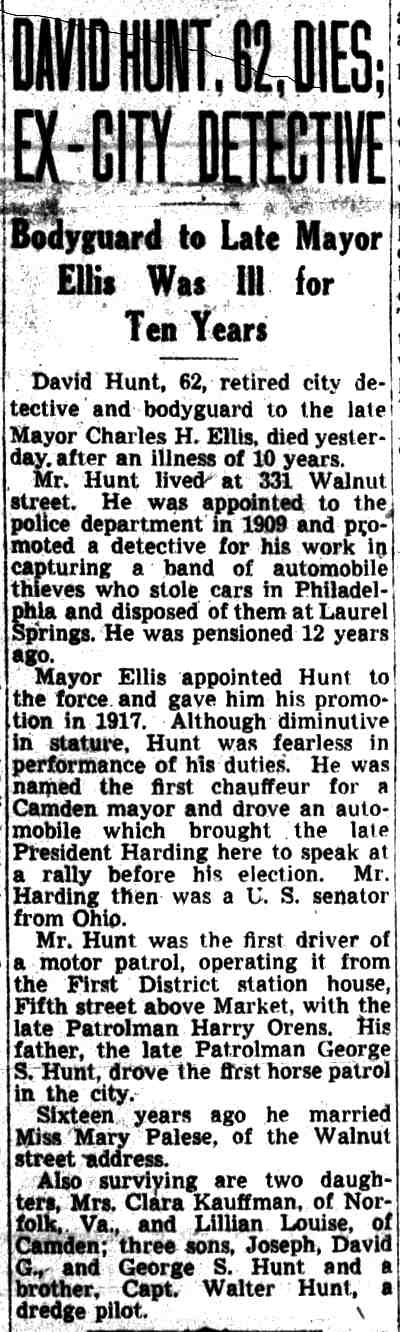
Bodyguard to Late Mayor Ellis Was Ill for Ten Years
David Hunt, 62, retired city detective and bodyguard to the late Mayor Charles H. Ellis, died yesterday, after an illness of 10 years.
Mr. Hunt lived at 331 Walnut street. He was appointed to the police department in 1909 and promoted a detective for his work in capturing a band of automobile thieves who stole cars in Philadelphia and disposed of them at Laurel Springs. He was pensioned 12 years ago.
Mayor Ellis appointed Hunt to the force and gave him his promotion in 1917. Although diminutive in stature, Hunt was fearless in performance of his duties. He was named the first chauffeur for a Camden mayor and drove an automobile which brought the late President Harding here to speak at a rally before his election. Mr. Harding then was a U. S. senator from Ohio.
Mr. Hunt was the first driver of a motor patrol, operating it from the First District station house, Fifth street above Market, with the late Patrolman Harry Orens. His father, the late Patrolman George S. Hunt, drove the first horse patrol in the city.
Sixteen years ago he married Miss Mary Palese, of the Walnut street address.
Also surviving are two daughters, Mrs. Clara Kauffman, of Norfolk, Va., and Lillian Louise, of Camden; three sons, Joseph, David G., and George S. Hunt and a brother, Capt. Walter Hunt, a dredge pilot.
Funeral Saturday for David Hunt, 62
Camden Courier-Post —
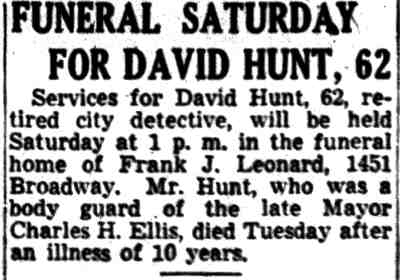
Services for David Hunt, 62, retired city detective, will be held Saturday at 1 p. m. in the funeral home of Frank J. Leonard, 1451 Broadway. Mr. Hunt, who was a body guard of the late Mayor Charles H. Ellis, died Tuesday after an illness of 10 years.