John Cherry
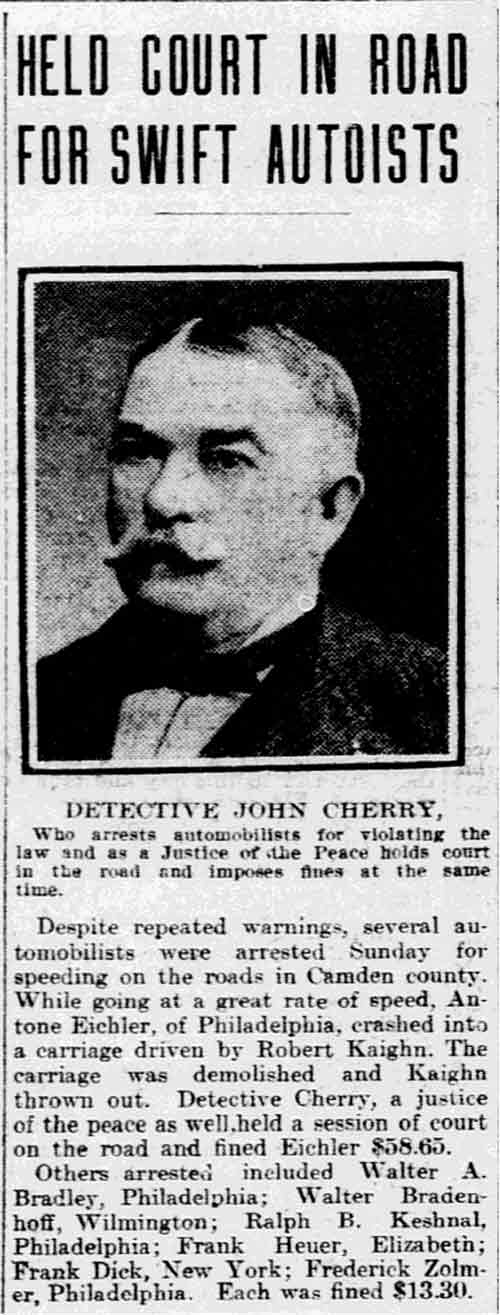
John Cherry, Camden County Detective
JOHN CHERRY born March 1844 (1900 Census) of Irish parents. His early years are a bit of a mystery, as all records and his own personal account prior to the 1920 Census state that he was a native New Yorker. He told the census taker in 1920, however that he had been born in Ireland, came to the United States in 1852, and was naturalized in 1867.
According to the 1890 Veteran’s Census, John Cherry served in Company B, 37th New York May to August 1862. After leaving the Army he traveled about the country before coming to New Jersey in the 1870s. He married around 1876. His wife Martha was a native of the state.
John Cherry first appears in Camden City Directories in 1878, living at 209 Bridge Avenue. By the time the 1881 City Directory was compiled he had opened a restaurant at 134 Federal Street. John Cherry stayed at that location as late as 1888. By 1890 he had moved his home and business to 550 Federal Street, where he conducted his restaurant until at least 1896. The 1897 City Directory shows him living at 217 South 5th Street. John and Martha Cherry, who never were blessed with children, are listed at 542 Federal Street in City Directories from 1898 to 1901. The 1902 Directory shows a move to 23 Hudson Street. By 1903 he and his wife had moved to 517 Benson Street, where they would live out their days.
By 1890 John Cherry had become quite active in Republican politics in Camden. By the spring of 1899 he had been rewarded for his activities with a position as a detective in the Camden County prosecutor’s office. He served in the Prosecutor’s office as late as 1913. By the time the 1914 City Directory was published, John Cherry had retired.
In his capacity as county detective, John Cherry was involved in all sorts of cases, both major and minor. For a time in the 1900s, John Cherry was also a Justice of the Peace, which put him in the position of policeman and judge simultaneously. He apparently kept that sort of activity confined to traffic cases.
Martha Cherry passed away on August 6, 1908. John Cherry lived with his widowed sister, Ellen F. Eagen from the late 1900s into the 1920s.
John Cherry died in 1923 and was buried next to his wife at Calvary Cemetery in what was then Delaware Township (present-day Cherry Hill), New Jersey.
Republican Primary Election
Philadelphia Inquirer —
Although the Republicans have held their primary election it is yet impossible to tell who will be the nominees for Excise Commissioner. Jehu Evans, who is now backing Jack Gnang in the fight, says that his man has fourteen votes. Where Mr. Gnang has the votes Mr. Evans does not say. Gnang is what might be called an anti-syndicate man. The syndicate claim that their ticket, which contains the names of John Cherry, Lewis McDowell and John Fury, will go through. They claim that they have three votes in the Second ward, three in the Third, one in the Fourth, three in the Fifth, one in the Sixth, three in the Seventh and three in the Eighth. If this be true they have enough to pull their man through. It takes fourteen votes to nominate. The convention will be held on Tuesday. Jehu Evans, the mainstay of Gnang, will call the convention to order. The syndicate will make a bid for the permanent chairmanship.
Camden’s Official Vote
Philadelphia Inquirer —
The Judges Compute the Results of the Recent Election—Other Trans-Delaware News.
The Board of Returning Judges met at the City Hall yesterday and canvassed the vote of Tuesday’s election. J. Oscar Nichnals, of the First ward, acted as chairman. Before the count was commenced, Lawyer Howard Carrow handed in two protests, one was from Jacob Neutze, who was beaten for City Council in the Fourth ward by Dr. William S. Jones, the Republican candidate; the other was from Emil Mettler, the Democratic candidate for Freeholder in the Eighth ward, who was defeated by Henry Sparrow, the Republican candidate. All of those mentioned as elected in the Camden edition of THE INQUIRER of Wednesday were returned accordingly.
The vote on Excise Commissioners was as follows: Cherry, 4,168; Fury, 4,313; Lewis McDowell, 4,415; Scheimer, 2,044; Kendall, 2,790; Cleary, 2,782; Cowperthwaite, 666; Hatton, 667; Bowden, 660. Kellum was the highest man on the Citizens’ ticket, he receiving 2,018 votes. The next board will be composed of Cherry, Fury, McDowell, Republicans, and Scheimer and Kendall, Democrats. Before the board adjourned a protest was presented by Samuel Mowery, the only defeated Republican Councilmanic candidate, against Dr. John W. Donges, of the Eighth ward, taking his seat. Cleary is also going to contest the seat of Kendall, who only defeated him by eight votes. Both men are Democrats.
Camden’s Excise Board
Philadelphia Inquirer —
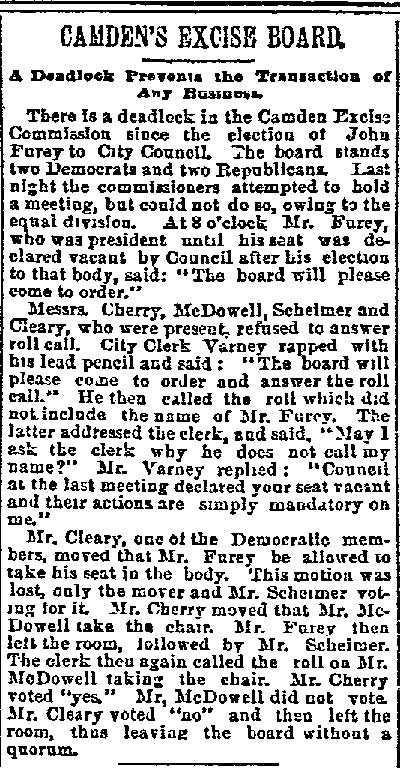
A Deadlock Prevents the Transaction of Any Business.
There is a deadlock in the Camden Excise Commission since the election of John Furey to City Council. The board stands two Democrats and two Republicans. Last night the commissioners attempted to hold a meeting, but could not do so, owing to the equal division. At 8 o’clock Mr. Furey, who was president until his seat was declared vacant by Council after his election to that body, said: “The board will please come to order.”
Messrs. Cherry, McDowell, Scheimer and Cleary, who were present, refused to answer roll call. City Clerk Varney rapped with his lead pencil and said: “The board will please come to order and answer the roll call.” He then called the roll which did not include the name of Mr. Furey. The latter addressed the clerk, and said, “May I ask the clerk why he does not call my name?” Mr. Varney replied: “Council at the last meeting declared your seat vacant and their actions are simply mandatory on me.”
Mr. Cleary, one of the Democratic members, moved that Mr. Furey be allowed to take his seat in the body. This motion was lost, only the mover and Mr. Scheimer voting for it. Mr. Cherry moved that Mr. McDowell take the chair. Mr. Furey then left the room, followed by Mr. Scheimer. The clerk then again called the roll on Mr. McDowell taking the chair. Mr. Cherry voted “yes.” Mr. McDowell did not vote. Mr. Cleary voted “no” and then left the room, thus leaving the board without a quorum.
Camden’s Dreary Outlook.
Philadelphia Inquirer —
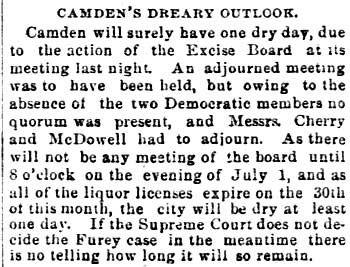
Camden will surely have one dry day, due to the action of the Excise Board at its meeting last night. An adjourned meeting was to have been held, but owing to the absence of the two Democratic members no quorum was present, and Messrs. Cherry and McDowell had to adjourn. As there will not be any meeting of the board until 8 o’clock on the evening of July 1, and as all of the liquor licenses expire on the 30th of this month, the city will be dry at least one day. If the Supreme Court does not decide the Furey case in the meantime there is no telling how long it will so remain.
New Jersey’s News Budget
Philadelphia Inquirer —
Camden’s Excise Muddle Legally Straightened Out.
HIGH LICENSE A PARTY CRY
A Public Park for the Pretty City Across the River—How Penurious Taxpayers Prevented the City From Making a Neat Sum—News From the State.
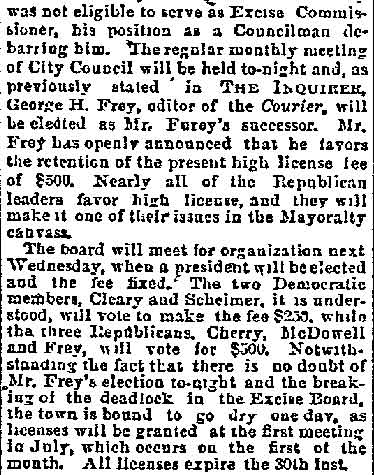
Camden saloon keepers will pay $500 for the privilege of selling liquor next year. This is due to the fact that the Supreme Court decided yesterday that John Furey was not eligible to serve as Excise Commissioner, his position as a Councilman debarring him. The regular monthly meeting of City Council will be held to-night and, as previously stated in THE INQUIRER, George H. Frey, editor of the Courier, will be elected as Mr. Furey’s successor. Mr. Frey has openly announced that he favors the retention of the present high license fee of $500. Nearly all of the Republican leaders favor high license, and they will make it one of their issues in the Mayoralty canvass.
The board will meet for organization next Wednesday, when a president will be elected and the fee fixed. The two Democratic members, Cleary and Scheimer, it is understood, will vote to make the fee $250, while the three Republicans, Cherry, McDowell and Frey, will vote for $500. Notwithstanding the fact that there is no doubt of Mr. Frey’s election to-night and the breaking of the deadlock in the Excise Board, the town is bound to go dry one day, as licenses will be granted at the first meeting in July, which occurs on the first of that month. All licenses expire the 30th inst.
1892 City Directory Advertisement
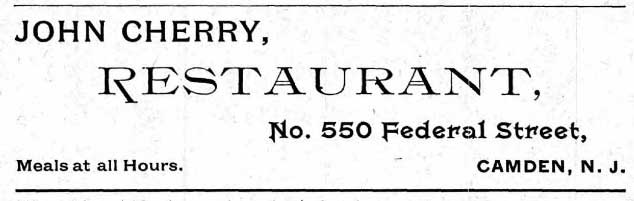
John Cherry’s 1892 Camden City Directory advertisement
Republican Legislative Nominations
Philadelphia Inquirer —
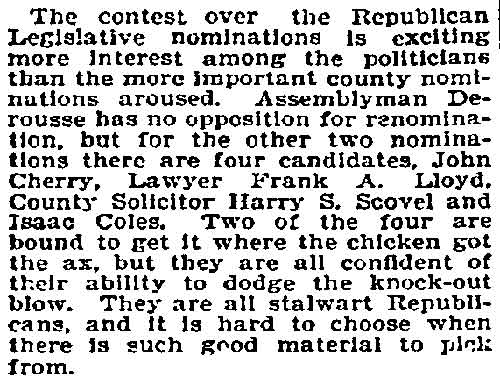
The contest over the Republican Legislative nominations is exciting more interest among the politicians than the more important county nominations aroused. Assemblyman Derousse has no opposition for renomination, but for the other two nominations there are four candidates, John Cherry, Lawyer Frank A. [sic] Lloyd, County Solicitor Harry S. Scovel and Isaac Coles. Two of the four are bound to get it where the chicken got the ax, but they are all confident of their ability to dodge the knock-out blow. They are all stalwart Republicans, and it is hard to choose when there is such good material to pick from.
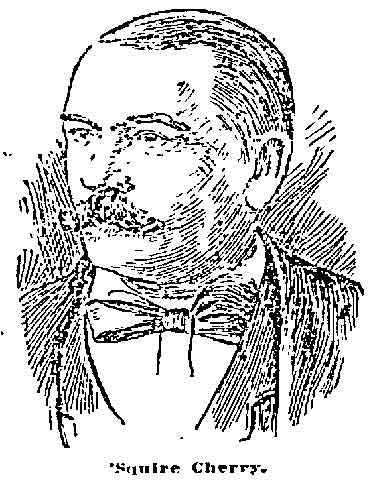
‘Squire Cherry.
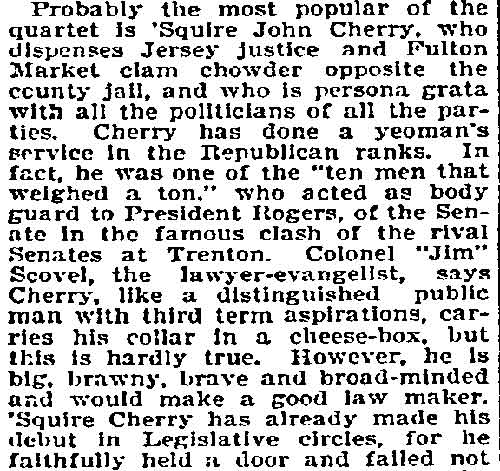
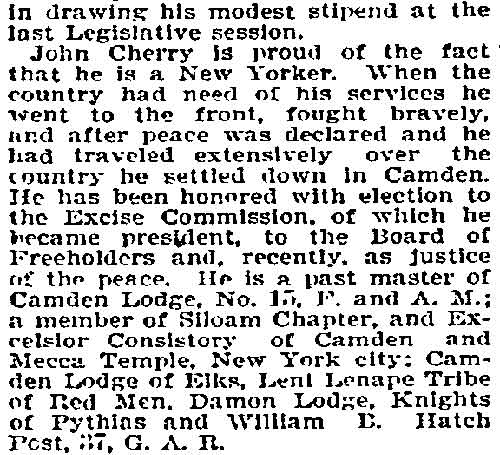
Probably the most popular of the quartet is ‘Squire John Cherry, who dispenses Jersey Justice and Fulton Market clam chowder opposite the county jail, and who is persona grata with all the politicians of all the parties. Cherry has done a yeoman’s service in the Republican ranks. In fact, he was one of the “ten men that weighed a ton,” who acted as body guard to President Rogers, of the Senate in the famous clash of the rival Senates at Trenton. Colonel “Jim” Scovel, the lawyer-evangelist, says Cherry, like a distinguished public man with third term aspirations, carries his collar in a cheese-box, but this is hardly true. However, he is big, brawny, brave and broad-minded and would make a good law maker. ‘Squire Cherry has already made his debut in Legislative circles, for he faithfully held a door and failed not in drawing his modest stipend at the last Legislative session.
John Cherry is proud of the fact that he is a New Yorker. When the country had need of his services he went to the front, fought bravely, and after peace was declared and he had traveled extensively over the country he settled down in Camden. He has been honored with election to the Excise Commission, of which he became president, to the Board of Freeholders and, recently, as Justice of the peace. He is a past master of Camden Lodge, No. 15, F. and A. M.; a member of Siloam Chapter, and Excelsior Consistory of Camden and Mecca Temple, New York city; Camden Lodge of Elks, Lenni Lenape Tribe of Red Men, Damon Lodge, Knights of Pythias and William B. Hatch Post, 37, G. A. R.
Offices and Office-Seekers
Philadelphia Inquirer —
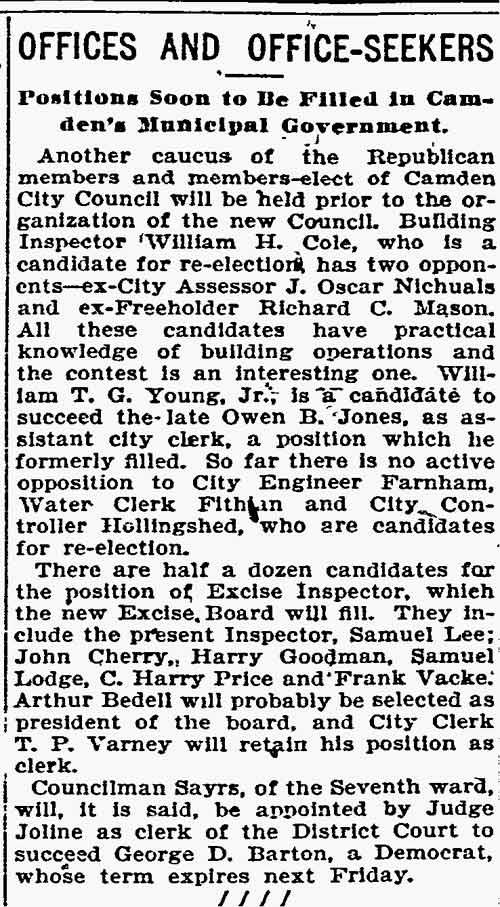
Positions Soon to Be Filled in Camden’s Municipal Government.
Another caucus of the Republican members and members-elect of Camden City Council will be held prior to the organization of the new Council. Building Inspector William H. Cole, who is a candidate for re-election, has two opponents—ex-City Assessor J. Oscar Nichuals and ex-Freeholder Richard C. Mason. All these candidates have practical knowledge of building operations and the contest is an interesting one. William T. G. Young, Jr., is a candidate to succeed the late Owen B. Jones, as assistant city clerk, a position which he formerly filled. So far there is no active opposition to City Engineer Farnham, Water Clerk Fithian and City Controller Hollingshed, who are candidates for re-election.
There are half a dozen candidates for the position of Excise Inspector, which the new Excise Board will fill. They include the present Inspector, Samuel Lee; John Cherry,, [sic] Harry Goodman, Samuel Lodge, C. Harry Price and Frank Vacke. Arthur Bedell will probably be selected as president of the board, and City Clerk T. P. Varney will retain his position as clerk.
Councilman Sayrs, of the Seventh ward, will, it is said, be appointed by Judge Joline as clerk of the District Court to succeed George D. Barton, a Democrat, whose term expires next Friday.
Philadelphia Inquirer — July 13, 1897
OVER IN CAMDEN
County Clerk Barber refused two more applicants for marriage licenses yesterday. He has not granted a license under the new law.
Vice-Chancellor Grey has made a decree in favor of Sarah M. Hall in her suit against the Home Building Company on foreclosure of a mortgage for $63,800.
Bertha Brown, colored, was committed to the county jail in default of bail by Justice Baldwin yesterday on a charge of larceny preferred by Martha Mitchell.
James Carter, colored, who was shot a week ago during a race riot in South Camden, is steadily improving, and Cooper Hospital surgeons now entertain hopes of his recovery.
Philip Botts, of 512 Chestnut street, was severely burned about the mouth and throat yesterday by drinking ammonia in mistake for medicine. He was taken to the Cooper Hospital.
Mayor Westcott yesterday sentenced George Wilmore, 12 years old, to ten days’ imprisonment on a charge of tapping the till in Mrs. Lizzie Stewart’s store, at Sixth and Royden streets.
Godfrey Lentz and his young son were held in bail yesterday by Justice Schmitz, charged with assault and battery on Charles Haug, against whom Lutz made a charge of perjury last week.
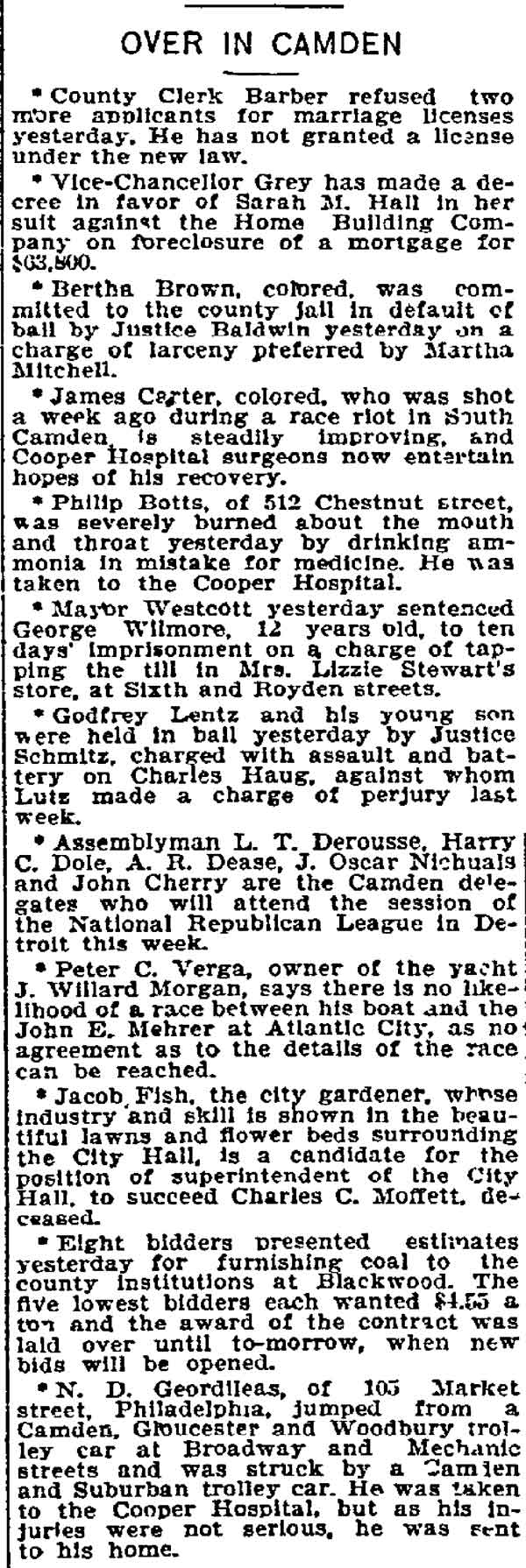
Assemblyman L. T. Derousse, Harry C. Dole, A. R. Dease, J. Oscar Nichuals and John Cherry are the Camden delegates who will attend the session of the National Republican League in Detroit this week.
Peter C. Verga, owner of the yacht J. Willard Morgan, says there is no likelihood of a race between his boat and the John E. Mehrer at Atlantic City, as no agreement as to the details of the race can be reached.
Jacob Fish, the city gardener, whose industry and skill is shown in the beautiful lawns and flower beds surrounding the City Hall, is a candidate for the position of superintendent of the City Hall, to succeed Charles C. Moffett, deceased.
Eight bidders presented estimates yesterday for furnishing coal to the county institutions at Blackwood. The five lowest bidders each wanted $4.55 a ton and the award of the contract was laid over until to-morrow, when new bids will be opened.
N. D. Geordileas, of 105 Market street, Philadelphia, jumped from a Camden, Gloucester and Woodbury trolley car at Broadway and Mechanic streets and was struck by a Camden and Suburban trolley car. He was taken to the Cooper Hospital, but as his injuries were not serious, he was sent to his home.
New Republican Executive Committee
Philadelphia Inquirer —
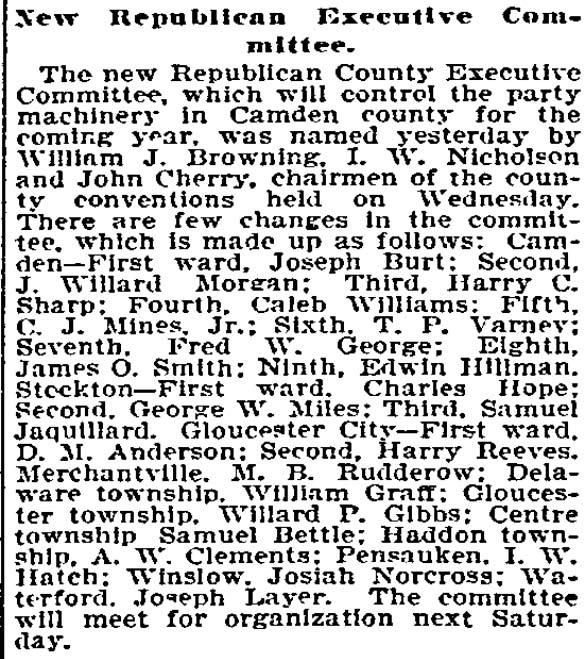
The new Republican County Executive Committee, which will control the party machinery in Camden county for the coming year, was named yesterday by William J. Browning, I. W. Nicholson and John Cherry, chairmen of the county conventions held on Wednesday. There are few changes in the committee, which is made up as follows: Camden—First ward, Joseph Burt; Second, J. Willard Morgan; Third, Harry C. Sharp; Fourth, Caleb Williams; Fifth, C. J. Mines, Jr.; Sixth, T. P. Varney; Seventh, Fred W. George; Eighth, James O. Smith; Ninth, Edwin Hillman. Stockton—First ward, Charles Hope; Second, George W. Miles; Third, Samuel Jaquillard. Gloucester City—First ward, D. M. Anderson; Second, Harry Reeves. Merchantville, M. B. Rudderow; Delaware township, William Graff; Gloucester township, Willard P. Gibbs; Centre township, Samuel Bettle; Haddon township, A. W. Clements; Pensauken, I. W. Hatch; Winslow, Josiah Norcross; Waterford, Joseph Layer. The committee will meet for organization next Saturday.
Philadelphia Inquirer — March 5, 1899
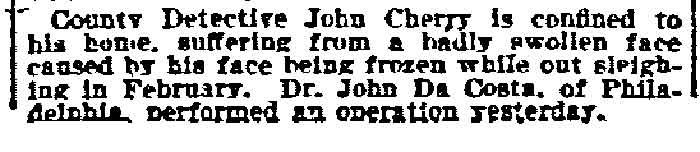
County Detective John Cherry is confined to his home, suffering from a badly swollen face caused by his face being frozen while out sleighing in February. Dr. John Da Costa, of Philadelphia, performed an operation yesterday.
County Detective Cherry Able to Be About Again
Philadelphia Inquirer —

County Detective John Cherry, who had his face frozen during the recent blizzard, is able to be about again.
Camden
Philadelphia Inquirer —
William J. Paul, city editor of the Review, has been spending several days in New York city.
Miss Florence Shimer, of Reiglesville, is visiting Miss Jennie Boyer.
Howard Pancoast, a student at Princeton University, is spending a few days at home visiting his father, former Judge D. J. Pancoast.
J. B. VanSciver and wife sailed for Europe on Wednesday for a Continental tour.
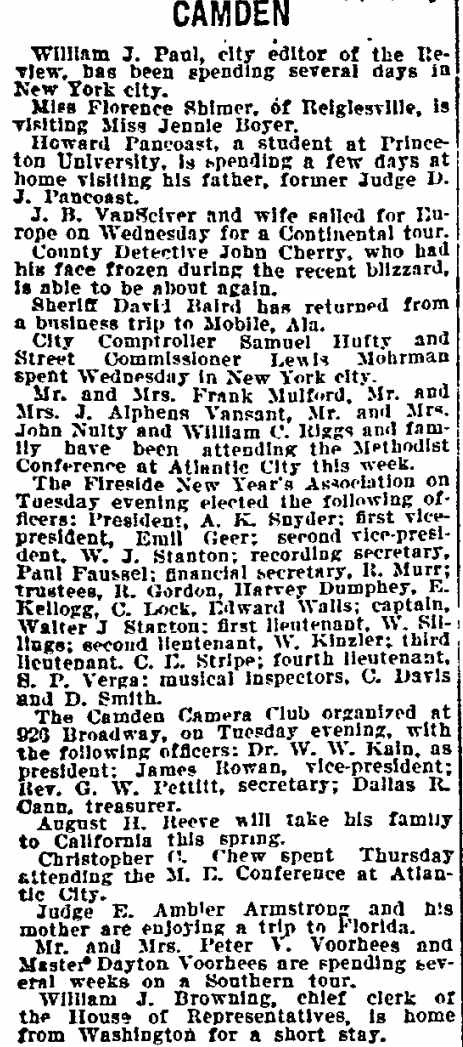
County Detective John Cherry, who had his face frozen during the recent blizzard, is able to be about again.
Sheriff David Baird has returned from a business trip to Mobile, Ala.
City Comptroller Samuel Hufty and Street Commissioner Lewis Mohrman spent Wednesday in New York city.
Mr. and Mrs. Frank Mulford, Mr. and Mrs. J. Alphens Vansant, Mr. and Mrs. John Nulty and William C. Riggs and family have been attending the Methodist Conference at Atlantic City this week.
The Fireside New Year’s Association on Tuesday evening elected the following officers: President, A. K. Snyder; first vice-president, Emil Geer; second vice-president, W. J. Stanton; recording secretary, Paul Faussel; financial secretary, R. Murr; trustees, R. Gordon, Harvey Dumphey, E. Kellogg, C. Lock, Edward Walls; captain, Walter J Stanton; first lieutenant, W. Sillings; second lieutenant, W. Kinzler; third lieutenant, C. E. Stripe; fourth lieutenant, S. P. Verga; musical inspectors, C. Davis and D. Smith.
The Camden Camera Club organized at 926 Broadway, on Tuesday evening, with the following officers: Dr. W. W. Kain, as president; James Rowan, vice-president; Rev. G. W. Pettitt, secretary; Dallas R. Cann, treasurer.
August H. Reeve will take his family to California this spring.
Christopher C. Chew spent Thursday attending the M. E. Conference at Atlantic City.
Judge E. Ambler Armstrong and his mother are enjoying a trip to Florida.
Mr. and Mrs. Peter V. Voorhees and Master Dayton Voorhees are spending several weeks on a Southern tour.
William J. Browning, chief clerk of the House of Representatives, is home from Washington for a short stay.
Over in Camden
Philadelphia Inquirer —
OVER IN CAMDEN
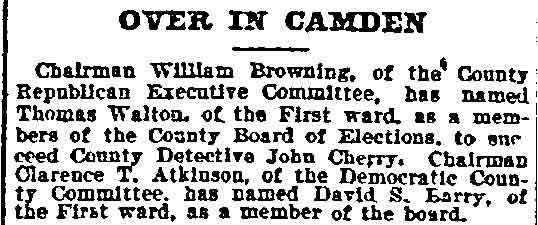
Chairman William Browning, of the County Republican Executive Committee, has named Thomas Walton, of the First ward, as a member of the County Board of Elections, to succeed County Detective John Cherry. Chairman Clarence T. Atkinson, of the Democratic County Committee, has named David S. Barry, of the First ward, as a member of the board.
Philadelphia Inquirer — August 11, 1899
Named: Carman Street, Haddon Avenue, James Flood, South 2nd Street, Benson Street, James Finley, William H. Carson, John Cherry, John S. Smith, Maurice Hertz, Locust Street, Kaighn Avenue, Charles Gilbert, and Charles M. Alcott.
Gilbert Now in Jail
Philadelphia Inquirer —
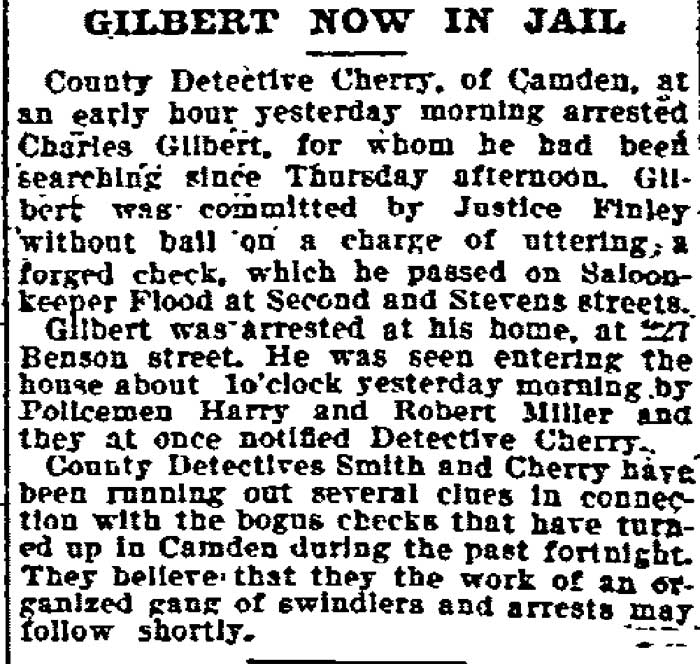
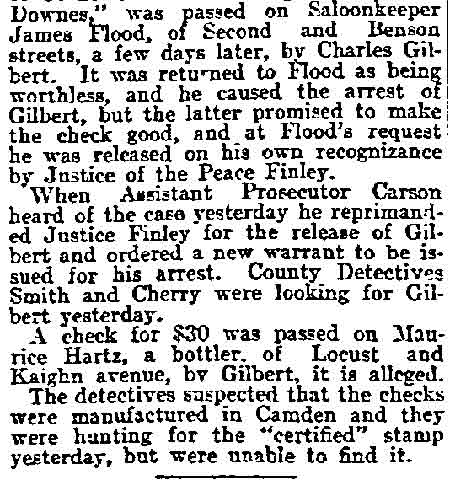
County Detective Cherry, of Camden, at an early hour yesterday morning arrested Charles Gilbert, for whom he had been searching since Thursday afternoon. Gilbert was committed by Justice Finley without bail on a charge of uttering a forged check, which he passed on Saloonkeeper Flood at Second and Stevens streets.
Gilbert was arrested at his home, at 227 Benson street. He was seen entering the house about 1o’clock yesterday morning by Policemen Harry and Robert Miller and they at once notified Detective Cherry.
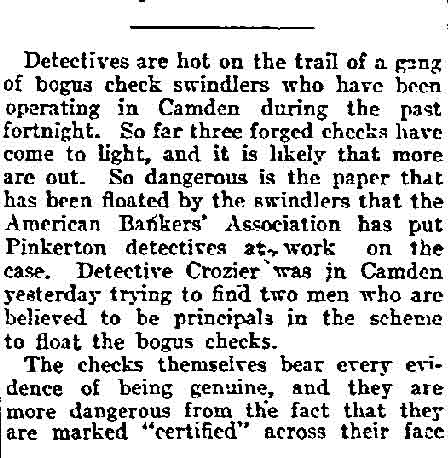
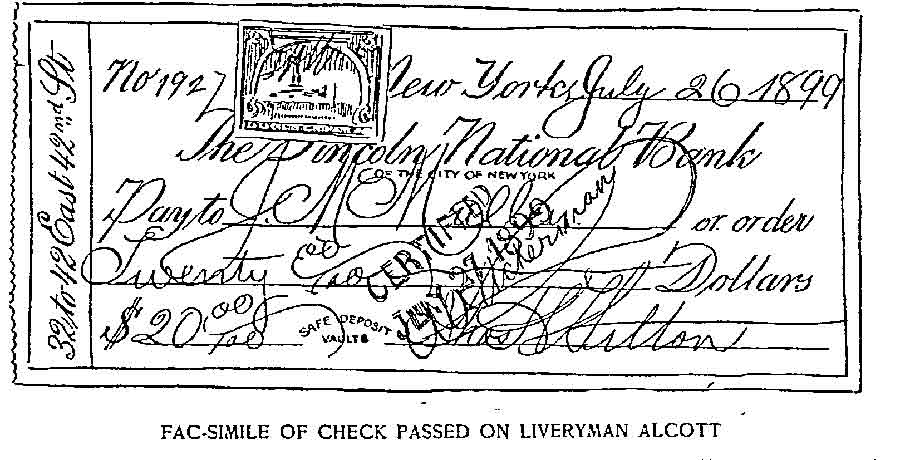
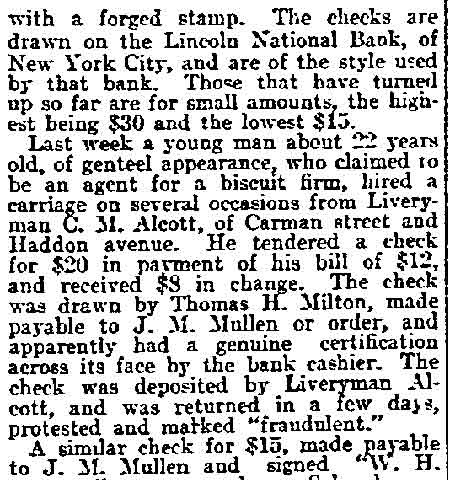
County Detectives Smith and Cherry have been running out several clues in connection with the bogus checks that have turned up in Camden during the past fortnight. They believe that they[sic] the work of an organized gang of swindlers and arrests may follow shortly.
Judge’s Residence Robbed
Philadelphia Inquirer —
William Plummer, a colored youth, was arrested last night in Camden by County Detective Cherry on the charge of robbing the residence of Judge E. A. Armstrong of $150.
Fire Department Investigation
Philadelphia Inquirer —
At the request of Presiding Elder Dobbins, Rev. J. W. Marshall, D. D., and Rev. John Handley. D. D., Prosecutor Lloyd yesterday sent County Detectives Cherry and Smith to investigate the recent destruction of the Hedding M. E. Church by fire to ascertain if fire was of incendiary origin.
Sunday Liquor Selling
Philadelphia Inquirer —

Joseph Potlaski, a saloonkeeper, of 1017 Chestnut Street, was arrested, by County Detectives Smith and Cherry, yesterday, on a bench warrant. He was fined $200 last spring for Sunday liquor selling, but has not yet paid up.
Murder Witness on the Rack
Philadelphia Inquirer —
Murder Witness on the Rack
County Detectives Smith and Cherry and City Detective Painter, of Camden, are investigating the death of Cornelius Preston, whose body was found in Big Timber Creek, near Westville, on March 5, 1899. Yesterday they had William Smith, of Camden, who furnished the clue to Preston’s alleged murder, taken before Prosecutor Lloyd for examination. The Prosecutor will not divulge the information given him by Smith until the detectives have had an opportunity to verify it.
On the Conductors and the Motormen
Philadelphia Inquirer —
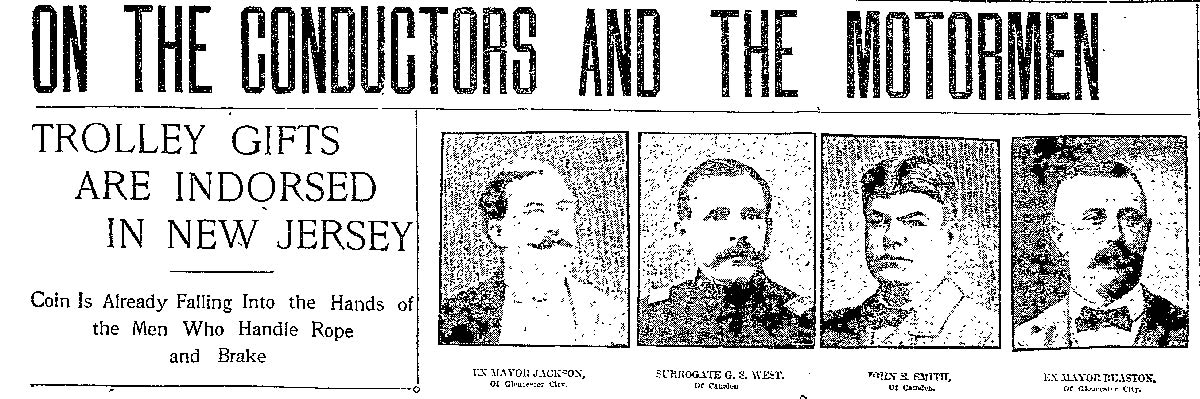
TROLLEY GIFTS ARE INDORSED IN NEW JERSEY
Coin Is Already Falling Into the Hands of the Men Who Handle Rope and Brake
EX MAYOR JACKSON, Of Gloucester City
SURROGATE G. S. WEST, Of Camden
JOHN S. SMITH, Of Camden
EX MAYOR BEASTON, Of Gloucester City
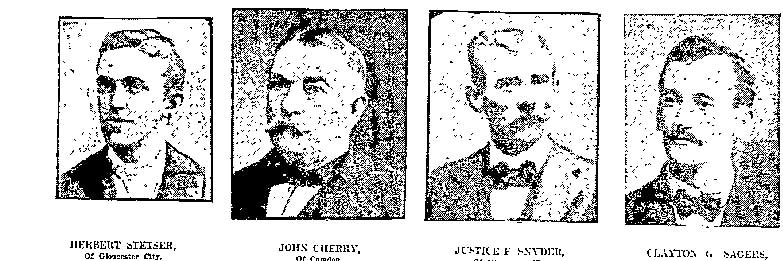
HERBERT STETSER, Of Gloucester City
JOHN CHERRY, Of Camden
JUSTICE F SNYDER, Of Gloucester City
CLAYTON G. SAGERS, Of Gloucester City
TALK WITH MEN WHO RUN THE CARS
Loud in Their Praise of The Inquirer’s Suggestion to Give to Worthy and Deserving Workmen
There is a determined effort in Camden to keep pace with other cities that have indorsed The Inquirer’s plan to give cheer to trolley conductors and motormen.
George S. West, Surrogate of Camden county, has been identified with all sorts of public movements, and is therefore qualified to speak with some authority about The Inquirer’s suggestion. “It is a good one,” he said yesterday. “I hope the people of Camden will act on it on Monday, and act liberally. These car men deserve a generous contribution.”
John Cherry and John S. Smith, Camden county detectives, use the trolley cars freely, and with characteristic readiness they had something to say about The Inquirer’s idea. “Tell the riders that hold free passes to remember the trolley men,” said Smith, while Cherry nodded assent. Cherry added: “We will contribute our share to the crew of every car we use on Monday.”
Prosecutor Frank T. Lloyd, of Camden county, said: “I approve of The Inquirer’s effort for the car men heartily, and I am glad to see The Inquirer push it so earnestly.”
John Wesley Sell, Sheriff of Camden county, said: “Yes, sir; put me down as one who indorses The Inquirer’s suggestion, and will act on it on Monday. The car men have always had my sympathy in their perpetually trying situations, and I would like to see everybody combine in a response to The Inquirer’s suggestion.”
Chief of Police John Foster, of Camden, is an earnest advocate of better treatment of men who spend their lives on the street in all sorts of weather. “The Inquirer’s idea of Christmas contributions to trolley men,” said he, “is one of the most practical suggestions I have ever heard of. I vote for it with both hands, and I hope the people of Camden will do their duty on Monday. I will do my part.”
“How would you like to be the conductor?”
Thus spoke Conductor George Gannett when he alighted from his car at the corner of Market and King streets, Gloucester City, yesterday afternoon after his day’s work, and holding up his change bag said to his fellow conductors waiting for their cars:
“This is what The Inquirer has done for me.”
There was just $6.35 in the bag, and that amount was given him in nickels and pennies through the suggestion of The Inquirer on his eight trips. Such was the case among other conductors on the Camden, Gloucester and Woodbury trolley cars, and together with the motormen they returned home to their families wreathed in smiles, as they were sure of having a Christmas turkey.
On all the cars of the Woodbury trolley road the passengers would either drop an extra nickel or say “keep the change.”
Conductor Gannett said to an Inquirer reporter after leaving the trolley office that he did not think he would get so much, but when the nickels came pouring in on every trip he opened his eyes and said to his motorman: “The Inquirer is a great paper and maybe we will not have turkey galore.”
Camden Trolley Men Wreathed in Smiles
Camden trolley men are looking with eagerness to a Christmas offering from their passengers on Monday, and some of the conductors are already wreathed in smiles over tips already given them by riders who do not expect to be in town on Monday. It is refreshing to see a meek-looking and mild-mannered conductor look closely at the change tendered him for a fare, and then smile expansively when he sees an extra coin for himself and the motorman.
“Thank you,” is uttered in tones that makes the riders smile at one another in pleasure. The conductor returns to the rear platform and beams on the passengers within the car, and when he reaches up and pulls the signal to the motorman to stop the car, the sound of the bell seems to be really musical.
Vice Chief of Glassblowers Speaks To the Editor of The Inquirer.
The Philadelphia Inquirer deserves great credit for the interest it has taken in the conductors and motormen of three States. There is none more worthy to be helped. These men suffer more through exposure for the comforts of the people than any other class of workmen. Wishing all street railway workmen shorter hours and more home comforts, I am, very sincerely, W. M. DOUGHERTY, Vice President Glass Bottle Blowers’ Association of United States and Canada.
From the Hammonton South Jersey Republican.
The Philadelphia Inquirer has originated a novel and praiseworthy scheme, viz.: That patrons of trolley cars everywhere in paying their fare give the conductor an extra cent or more on Monday next. At night all this surplus money will be divided between the conductor who hands it in and his motorman, and will go far toward making for their families a merry Christmas. A great scheme—worthy of a great paper.
From the Camden Democrat.
Camden will doubtless respond most cheerfully to the thoughtful and timely suggestion of The Philadelphia Inquirer to remember the trolley conductors and motormen on Monday next, the day before Christmas. This the local travelling public are requested to do by handing to the conductor in conjunction with their regular fare an extra cent, nickel or dime, according to their individual inclination and means. These extra pennies are to be divided between the regular car men and designed, of course, to help in adding to the material accessories of their Christmas dinner. The plan is a most praiseworthy one, and commends itself to the practical consideration of every patron of our street car lines.
Constable Voigt Touring Europe
Philadelphia Inquirer —
County Detective Cherry yesterday received a letter from Constable Fred Voigt, who, with Lawyer Harry Scovel, is touring Europe. Constable Voigt said they arrived in Cherbourg safe and well and are enjoying the continental sights immensely. They will return about September 1.
The Paul Woodward Murder Case — October 1, 1902 to January 14, 1903
On October 1, 1902 Paul Woodward murdered two young boys by giving them poison. Frank T. Lloyd, then Camden County prosecutor, was responsible for leading the investigation and prosecuting the case. County Detective Cherry was involved in the investigation. Woodward was arrested on October 4, 1902. Detective Cherry was present later that day when Woodward was identified as being seen with the two victims. Woodward was indicted, tried, convicted of murder in the first degree, and on January 7, 1903 executed at the Camden County Jail.
O. Glen Stackhouse — Hugh Boyle — George F. Kappel — Isaac Toy — Charles D. Ridgley — Rev. C.A. Adams — Rev. John Lyell — Rev. William H. Fishburn — Cooper School
Youth’s Strenuous Day — Taken to the Scene of the Tragedy and Closeted With the Prosecutor — Harry Bowen — Joseph Simpkins — Harry S. Scovel — Eli Shaw — Mrs. Edith Baker
Camden’s Mystery Is Still Unsolved
Philadelphia Inquirer —
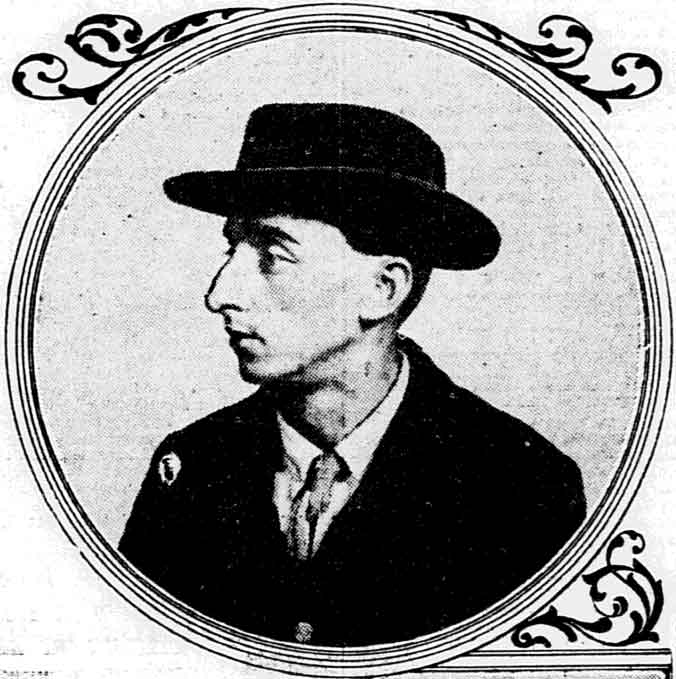
While Authorities Are at Work, Public Watch and Wait. Weaving a Net About Paul Woodward, the Young Suspect Now in Jail
Paul Woodward.
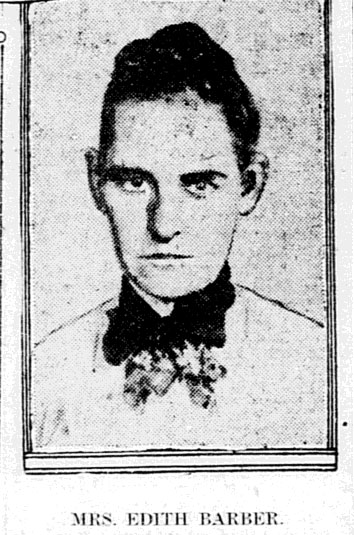
Mrs. Edith Barber.
It is now generally believed that the Camden county authorities have succeeded in establishing a clear case against young Paul Woodward, who is in the county jail, charged with the crime of taking away the lives of little John Coffin and Price Jennings. It was just a week ago yesterday when the boys went on their trip to Haddon Heights from which they were destined never to return alive.
Since the discovery of the bodies last Saturday partially hidden in rain-soaked weeds, the Prosecutor’s office, assisted by County Detectives Smith and Cherry and City Detectives Painter and Hart, have left no stone unturned.
No Confession
Prosecutor Lloyd yesterday reiterated his statement that Woodward had made no confession, but it is generally conceded as true that the accused youth did tell a story in which he makes some one else the principal criminal in the case.
Several incidents transpired yesterday that threw off the monotony of waiting for developments. Joseph Jennings, brother of one of the murdered boys, was taken to the cell in which Woodward is confined. He had no difficulty in recognizing the prisoner before. But as to whether he ever saw him in company with the dead lads he was not permitted to say.
Wild Rumor
There was much excitement about the Court House when it became rumored that Mrs. Edith Barber, the woman detained as a material witness against Woodward, had the small pox. To allay the alarm County Physician Jones called in representatives of the Board of Health, who concluded she had no sign of the disease.
After matters quieted somewhat the woman was taken into the Prosecutor’s office and questioned. When taken back to her cell she was crying and appeared to be almost unable to walk.
Woodward spent the day in his cell, smoking cigarettes as usual. He was visited in the morning by Lawyer Harry Scovel, who has not yet been engaged as counsel, as reported. Again in the afternoon Lawyer Scovel visited the youth in company with Woodward’s mother. At first Mrs. Woodward was denied admittance, but after waiting on the jail steps for nearly an hour she was permitted to go in and see her son. Lawyer Scovel and Mrs. Woodward were with the young man for a couple of hours.
Talked a Whole Lot
To all questions Lawyer Scovel said: “Woodward talked a whole lot, but I have nothing to say.”
He said he had not confessed to him. On the other hand Woodward had maintained his innocence.
When asked if Woodward could have a hearing if he demanded it Mr. Archer said he could. Asked if enough evidence was in hand to hold him, Mr. Archer said there was.
“On a simple assault charge?”
“No, sir, for the crime he is charged with—committing the murder of John Coffin,” replied Mr. Archer.
Coroner Litchfield said last night he would not set a date for the inquest before some time next week. Despite all reports to the contrary, Coroner Litchfield says Chemist George M. Beringer, who is analyzing the internal organs of the boys, will not complete the work before the end of the week.
Prosecutor Lloyd, who is still confined to his home with rheumatism, would make no statement last night, although admitting that the day’s work had not resulted in anything of material importance.
More Arrests in Camden Mystery
Philadelphia Inquirer —
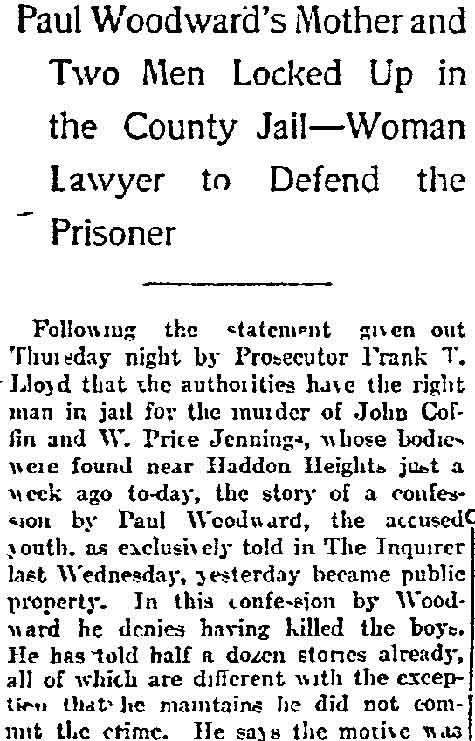
Paul Woodward’s Mother and Two Men Locked Up in the County Jail—Woman Lawyer to Defend the Prisoner
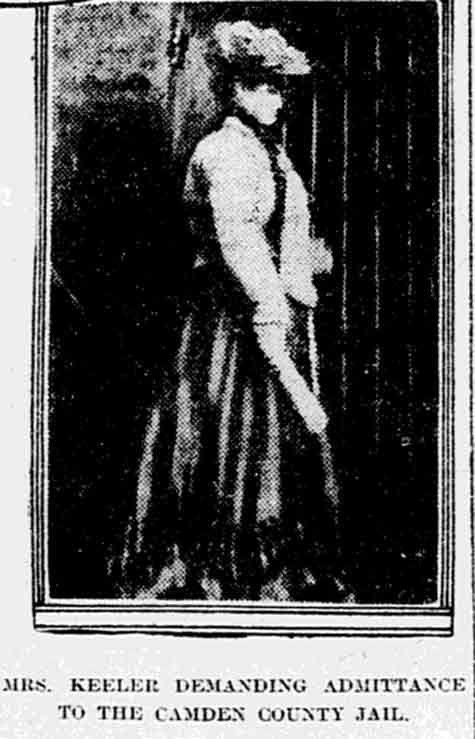
Mrs. Keeler Demanding Admittance to the Camden County Jail.
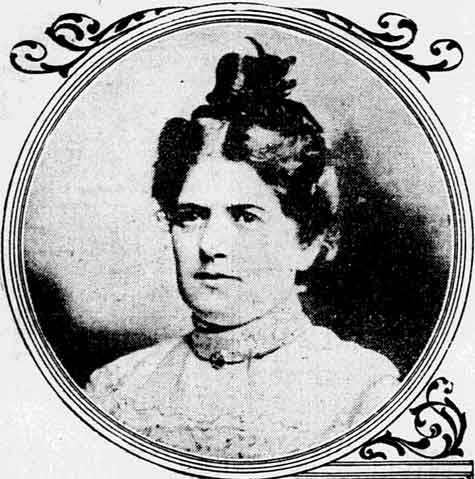
Mrs. Annie Irving Keeler,
Camden’s female lawyer, who has been engaged to defend young Woodward.
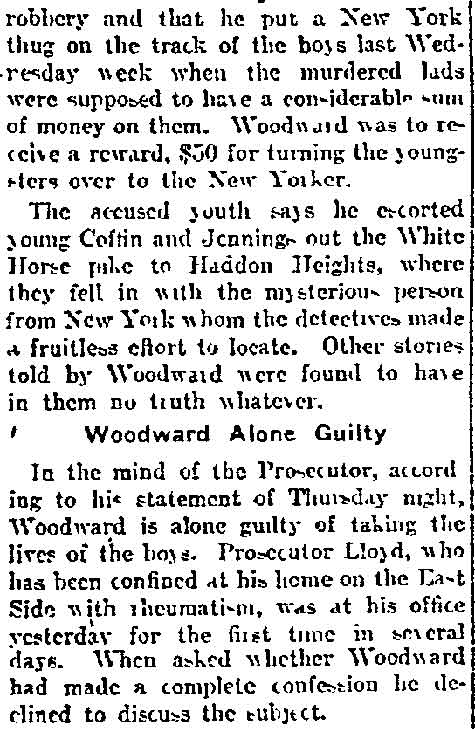
Following the statement given out Thursday night by Prosecutor Frank T. Lloyd that the authorities have the right man in jail for the murder of John Coffin and W. Price Jennings, whose bodies were found near Haddon Heights just a week ago to-day, the story of a confession by Paul Woodward, the accused youth, as exclusively told in The Inquirer last Wednesday, yesterday became public property. In this confession by Woodward he denies having killed the boys. He has told half a dozen stories already, all of which are different with the exception that he maintains he did not commit the crime. He says the motive was robbery and that he put a New York thug on the track of the boys last Wednesday week when the murdered lads were supposed to have a considerable sum of money on them. Woodward was to receive a reward, $50 for turning the youngsters over to the New Yorker.
The accused youth says he escorted young Coffin and Jennings out the White Horse pike to Haddon Heights, where they fell in with the mysterious person from New York whom the detectives made a fruitless effort to locate. Other stories told by Woodward were found to have in them no truth whatever.
Woodward Alone Guilty
In the mind of the Prosecutor, according to his statement of Thursday night, Woodward is alone guilty of taking the lives of the boys. Prosecutor Lloyd, who has been confined at his home on the East Side with rheumatism, was at his office yesterday for the first time in several days. When asked whether Woodward had made a complete confession he declined to discuss the subject.
More Arrests Made
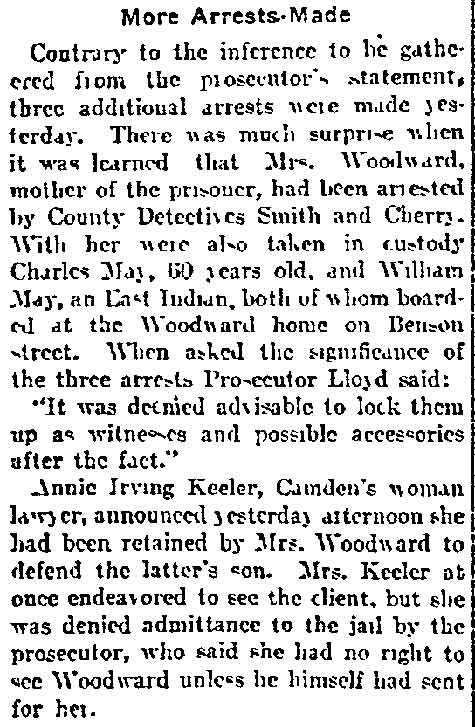
Contrary to the inference to be gathered from the prosecutor’s statement, three additional arrests were made yesterday. There was much surprise when it was learned that Mrs. Woodward, mother of the prisoner, had been arrested by County Detectives Smith and Cherry. With her were also taken in custody Charles May, 60 years old, and William May, an East Indian, both of whom boarded at the Woodward home on Benson street. When asked the significance of the three arrests Prosecutor Lloyd said:
“It was deemed advisable to lock them up as witnesses and possible accessories after the fact.”
Annie Irving Keeler, Camden’s woman lawyer, announced yesterday afternoon she had been retained by Mrs. Woodward to defend the latter’s son. Mrs. Keeler at once endeavored to see the client, but she was denied admittance to the jail by the prosecutor, who said she had no right to see Woodward unless he himself had sent for her.
Admitted to Jail
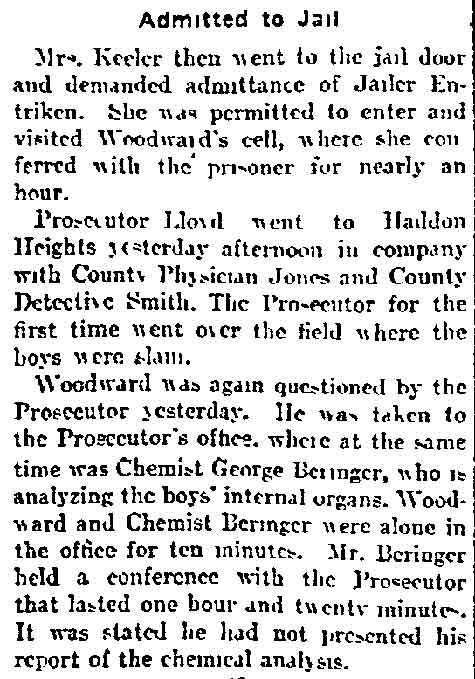
Mrs. Keeler then went to the jail door and demanded admittance of Jailer Entriken. She was permitted to enter and visited Woodward’s cell, where she conferred with the prisoner for nearly an hour.
Prosecutor Lloyd went to Haddon Heights yesterday afternoon in company with County Physician Jones and County Detective Smith. The Prosecutor for the first time went over the field where the boys were slain.
Woodward was again questioned by the Prosecutor yesterday. He was taken to the Prosecutor’s office, where at the same time was Chemist George Beringer, who is analyzing the boys’ internal organs. Woodward and Chemist Beringer were alone in the office for ten minutes. Mr. Beringer held a conference with the Prosecutor that lasted one hour and twenty minutes. It was stated he had not presented his report of the chemical analysis.
Unraveling the Camden Mystery
Philadelphia Inquirer —
Prosecutor Lloyd Declares That Woodward Is the Guilty Man
NO MORE ARRESTS LIKELY
Weaving Web Around Alleged Slayer of the Murdered Boys
“Beyond all question the murderer of these little boys is now in jail and the public’s anxiety can now be allayed,” said Prosecutor Frank T. Lloyd last night in making the first important statement concerning the tragedy of last week, when John Coffin and W. Price Jennings, two Camden lads, were murdered in an uncultivated field near Haddon Heights. The mystery which has enshrouded the case since the discovery of the bodies last Friday has almost been cleared up with the exception of the report of Chemist George M. Beringer, who is making an analysis of the internal organs of the boys.
Prosecutor Lloyd gave out the following statement shortly before 8 o’clock at his home on the East Side:
“Because of a suspicion that more than one person was engaged in the murder of these little boys the State has been obliged to work with much secrecy and to withhold from the press the result of our work. That suspicion is now removed. Beyond all question the murderer is now in jail and the public’s anxiety can be allayed. Woodward was alone the perpetrator of this crime.
Case Nearly Complete
“It is my duty to say this much in view of the deep public concern and the apprehension of other parents having little ones, but it would be improper for me to state the character or the quantity of evidence upon which our conclusions are based. I will only say that with the exception of the report of the chemist, which has not yet been received, the State’s case is almost complete.
“Woodward himself has made a number of statements, which, while not confessions, will be materially helpful toward securing his conviction.”
This statement precludes the possibility of another arrest being made in connection with the case, as has been currently reported during the week.
There were several conferences held yesterday between Assistant Prosecutor Archer and Detectives Smith, Cherry, Painter and Hart and Chief of Police Linderman, of Merchantville. During one of the conferences John Farmer, the colored man who recognized Woodward as having been seen with the boys last Wednesday afternoon, was called in and closely questioned. Following the detectives departed apparently on several different clues.
Detectives Hard at Work
Detective Hart subsequently returned with a Mrs. Somers, said to reside on Royden street. She was interviewed by the Assistant Prosecutor, but what connection she has with the case the authorities refused to divulge. The woman refused to talk.
Louis Ross, a German, who resides near Haddon Heights, was also called into the Prosecutor’s office late in the afternoon. At first he was thought to be an important witness, but it was afterwards learned that he knew little about the case.
Detective Robert J. McKentry, of Philadelphia, and Detective Smith took over the river Mrs. William H. Hubbert and another young woman. It is at the home of Mrs. Hubbert, at West Philadelphia, that Woodward said he was present last Friday night.
Woodward became rather obdurate yesterday, refusing the usual prison fare. He waited until his mother sent him coffee and other victuals. The accused youth was at first placed in the cell formerly occupied by Lafayette Gruff, the wife murderer, who was hanged September 19. He has now been placed in another cell.
Woodward Has Knowledge of Camden Murder
Philadelphia Inquirer —
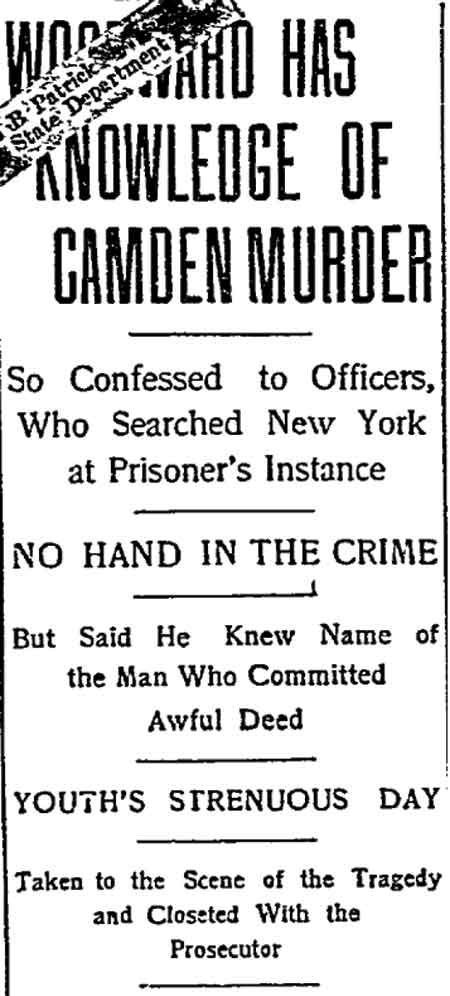
So Confessed to Officers, Who Searched New York at Prisoner’s Instance
NO HAND IN THE CRIME
But Said He Knew Name of the Man Who Committed Awful Deed
YOUTH’S STRENUOUS DAY
Taken to the Scene of the Tragedy and Closeted With the Prosecutor
It is believed the authorities of Camden have cleared up the mystery surrounding the deaths of John Coffin and Walter Price Jennings, the boys who mysteriously disappeared from their homes on October 1 and were found dead in a field. That the boys were murdered and that the law officers believe a strong case has already been made out against Paul Woodward, the suspect, there seems to be no doubt.
Last night, after a conference of the detectives at Prosecutor Lloyd’s home, the latter official gave out the following statement: “There is absolutely no truth in the story of Woodward’s confession. However, the State has enough to make a clear case against Woodward.”
Ever since the discovery of the bodies the city and county detectives have worked unceasingly on the case. On Sunday afternoon, while Woodward was being examined in the Prosecutor’s office in the county buildings, he admitted, it is said, that while he had no hand in the commission of the crime he knew the name of the man who did.
Gave a Name
He gave, it is said, the name of a white man who committed the murder, and said he was then in hiding in New York. He furnished the detectives with his whereabouts in that city.
Acting on this information Detectives Painter and Smith went to New York and made a thorough search, following closely the prisoner’s suggestions. The search proved fruitless.
On Monday Detective Painter learned that John Farmer, a colored man, employed by John H. Carroll, of Haddon Heights, had seen Price, Coffin and Woodward together in the field in which the bodies of the boys were afterwards discovered. Yesterday Farmer was brought to the Prosecutor’s office, where he stated that he had seen the boys alive in the field at 5 o’clock on the afternoon of the day they disappeared.
Last to See Them Alive
He was confronted with Woodward, and in his presence told the story. At its conclusion Woodward exclaimed, “You’re a liar!”
The authorities lay great stress on Farmers’ story, for he was the last man to see the boys alive and to their minds almost fixes the hour of the murder.
A prominent jail official said last night that Woodward said yesterday to a fellow prisoner: “I’ll never give the man away who done the job.”
In his cell last night Woodward was a picture of abject misery. He was trembling like an aspen leaf. He has barely touched his food for the last two days. His only consolation seems to be in cigarettes, of which he daily consumes several packs.
Taken to the Scene
The feature of yesterday was the taking of Woodward to Haddon Heights. He was driven to the scene of the murder in a double team and was accompanied by Assistant Prosecutor F. Morse Archer, County Detective John S. Smith and City Detective John Painter. Woodward was carefully manacled and guarded during the trip.
The party went over the field where the bodies were found in an endeavor to arouse some emotion in the youth that might lead to a confession. Instead he simply smoked cigarettes and picked up a few chestnuts lying about, and was apparently unmoved.
After going over the field he was taken to several places in the vicinity where persons saw the ill-fated lads last Wednesday afternoon. It was stated that in one instance at least Woodward was positively identified as the young man last seen with the boys late in that afternoon. From 1 o’clock until after 6 he was kept on the move.
When Assistant Prosecutor Archer arrived at the court house he was besieged with questions, but after a talk with his chief over the telephone he said: “The administration of justice would be seriously hampered if at this time the facts in the case were given to the public. The case is now in a critical stage.”
At Prosecutor’s Home
After coming in from the country the prisoner was taken to Prosecutor Lloyd’s home on the East side. Here Woodward was kept until after 6 o’clock, all the time being under a cross fire of questions. At half-past 6 he was admitted to the county jail, still manacled and still smoking cigarettes. He was visibly affected, trembling like a leaf.
Late yesterday afternoon County Detective Cherry and City Detective Hart visited the home of Woodward on Benson street and brought back with them some clothing and about fifty novels. The latter were of a trashy order.
Harry Bowen and Joseph Simpkins, a trolley crew on one of the West Collingswood cars of the Camden and Suburban Railway Company, were examined by Assistant Prosecutor Archer. They had charge of a car that left Camden at 10 43 and arrived at West Collingswood at 11 13 Wednesday morning. It is believed that on this car the two dead boys and Woodward went to West Collingswood and from there walked over to Haddon Heights.
Money for Defense
Mrs. Woodward, mother of the accused boy, was at the Court House yesterday and said her father had sent her $5000 with which to use in defense of his grandson. She claimed to have engaged the services of Harry S. Scovel, who defended Eli Shaw. Mrs. Woodward also said that the Mrs. Barber arrested Monday night was a personal friend of the family, and that Paul had simply boarded with her.
County Physician Jones has advanced a theory as to the killing of the boys. He maintains poison was administered with no intention of killing. According to his theory, the boys were given “knockout drops,” or chloral, in sufficient quantities to kill a man. It was the intention of the murderer, however, to just give them a sufficient quantity to render them unconscious, and while in this state discover them at the solicitation of the boys’ families and receive a reward.
Woman Involved in Camden Mystery
Philadelphia Inquirer —
After Being Questioned by the Prosecutor She Is Committed to the County Jail—Believed to Be an Important Arrest
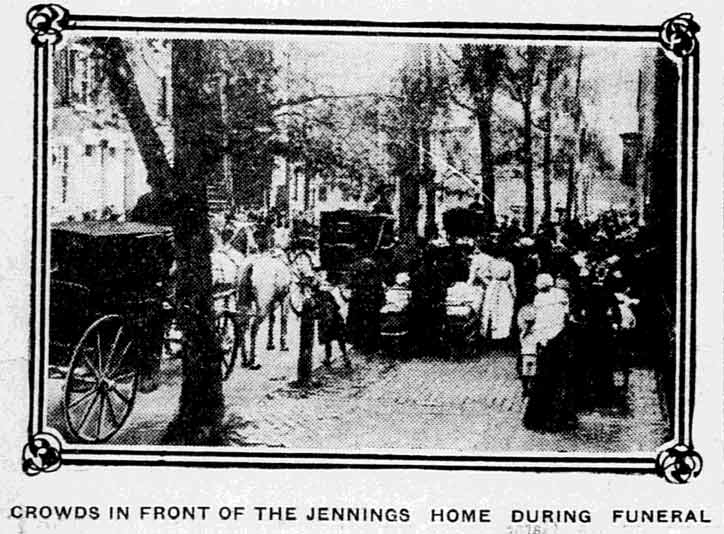
Crowds in Front of the Jennings Home During Funeral
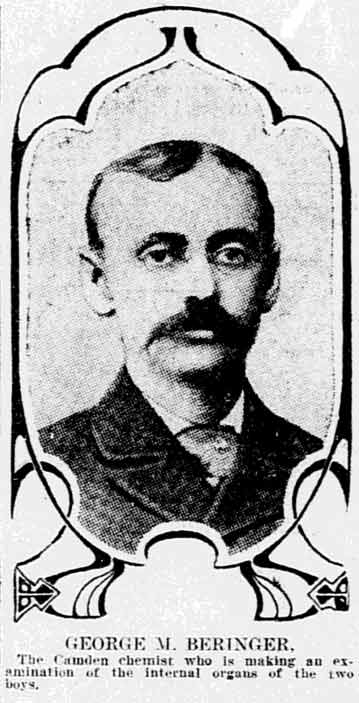
George M. Beringer.
The Camden chemist who is making an examination of the internal organs of the two boys.
While mystery apparently as absolute as ever still obscures the motive and the criminal in the case of John Houseman Coffin and W. Price Jennings, the unfortunate Camden lads whose trip to the country at Haddon Heights last Wednesday resulted so tragically, it is surmised from hints dropped now and again the matter may soon be cleared. However, those who are working so assiduously to bring the guilty person to justice are as close-mouthed as the proverbial clam, and but meagre information reaches the public.
Last night a woman, about 45 years old, was committed to the county jail by Recorder Stackhouse. On the commitment her name is given as Mrs. Barber. She was committed on complaint of County Detective John Cherry “as a material witness to prove certain allegations pending against one Paul Woodward, who is committed to the county jail charged with the murder of one John Coffin.”
The woman was placed under arrest after a long conference in the Prosecutor’s office. Prosecutor Lloyd said last night that the woman lives on a farm at Marlton, and that she is a very important witness in the case, so important, in fact, that she cannot regain her freedom without a good round sum being put up for her security.
Woodward Again Examined
The investigation into the case was somewhat retarded yesterday owing to an attack of rheumatism that made Prosecutor Frank T. Lloyd remain at home. The day’s responsibility rested on F. Morse Archer, the assistant prosecutor. The latter yesterday morning had Woodward brought into his office, where he underwent for the sixth time a thorough cross-examination. Mr. Archer said Woodward had made no confession, as had been rumored. On the contrary, he still maintained his innocence.
In answer to a question Mr. Archer said: “We are doing our best and while we are in possession of information which we consider important and vital to the case, it is impossible at this time to make it public.”
On the other hand, County Physician Jones was very emphatic in this particular, saying the boys were murdered beyond a doubt.
Boys’ Funerals
Yesterday afternoon the funeral of the boys took place at the same hour and within a square of one another’s homes. Although the hour set for the obsequies, 2 o’clock in the afternoon, had been kept secret scores of persons stood about in knots discussing the tragedy and eager to get a glimpse of the caskets containing the remains of the boys.
Police Captain Boyle and Policemen Kappel, Toy and Ridgeley guarded the houses, and no one except relatives and intimate friends were permitted to enter. But when the caskets were carried from the houses the crowd could not be kept back. Many persons crowded about, and the mourners entered the carriages between two solid phalanxes of curiosity seekers.
The services over Jennings were conducted at his home, 219 North Third street, by Rev. C. A. Adams and Rev. John Lyell. At the Coffin home, 305 North Third street, Rev. William H. Fishburn had charge of the obsequies. Companions of the boys acted as pallbearers. Jennings was buried at Evergreen and Coffin at Harleigh Cemetery.
George M. Beringer, a Camden chemist, who has the important duty of discovering, if possible, traces of poison in the stomachs of the boys, said yesterday he is making a thorough chemical analysis and is of necessity proceeding slowly. He said he will not be able to report the result for some days to come.
A pathetic little incident occurred at the Cooper School during recess yesterday morning when the children, school mates of the lads, gathered about and listened to the muffled beats of a drum. The school flag was at half mast and in every room there was a flag draped with black crepe. The youngsters were visibly affected.
Deep Mystery Still Envelops Camden Tragedy
Philadelphia Inquirer —
Authorities Apparently at Sea Regarding Theory for Lads’ Taking Off
THEY WERE MURDERED
Such Is the Belief of Prosecutor Lloyd and Others in the Case
WOODWARD UNDER FIRE
Declares Not Guilty of the Awful Crime—Two Boys to Be Buried To-day
Not since the Shaw murder of a few years ago has the Camden public been so much aroused as it is over the mysterious deaths of Price Jennings and John Houseman Coffin, the two lads of prominent families whose bodies were found Saturday morning lying in an uncultivated field at Haddon Heights.
City and county officials yesterday strove with all their abilities to throw some light on the mystery, but nothing of a startling character was evolved and the motive for the crime seems to be obscure.
As was to be expected, crowds of the morbidly curious tramped through the rain, over muddy roads and through a wild growth of brambles and weeds to get a view of the two spots where the bodies were found. Pieces of the chestnut tree, bark, limbs and leaves were carried off as mementoes. The spot where Coffin was found was marked by a pole stuck in the ground and from the top of which fluttered a piece of an umbrella covering.
The Motive Debated
During the day Prosecutor Lloyd, who is conducting the investigation, would say little. When pressed as to the motive of the crime he said he was of the opinion that it was either a case of malicious killing resulting from degeneracy, or the result of a desire for robbery.
A local physician, prominently identified with the case, said he is firmly convinced it is a clear case of murder. Whether the boys met their death by means of poison or strangulation he would not say, but inferred it was one of these methods that had ended their lives.
George M. Berringer, the Camden chemist, to whom were given the internal organs of the boys for analysis, began his work yesterday. He said it would take until to-morrow and probably longer to complete his analysis. He also said he would not stop if he found no traces of chloral, but would make a thorough examination in an endeavor to find any poison that might have been administered. In consequence of the length of time it will take to make the analysis Coroner Latchfield said he would not hold an inquest in the case for a week at least.
Detectives on the Scene
County Detectives Smith and Cherry and City Detective John Painter spent a portion of yesterday going over the scene of the tragedy. They reported they had found no new developments.
The work of weaving a web of guilt about Paul Woodward, the youth who was arrested charged by William Coffin, father of one of the boys, on information received from Detective Cherry, with “unlawfully, feloniously and of his malice aforethought, killing and murdering one John H. Coffin,” is proceeding rather slowly. The detectives yesterday started to run out the stories as given out by Woodward concerning his whereabouts on the days covering the disappearance of the dead boys.
Woodward was taken before Prosecutor Lloyd yesterday morning. The boy’s mother was also present. He was the centre of a crossfire of questions, but stolidly stood by his previous statements. He could not be shaken in a single instance, it was stated. The Prosecutor said it is a mistaken idea that Woodward is dull and listless. On the contrary he says his answers to questions give evidence of a fairly bright mind.
Prosecutor’s Statement
Prosecutor Lloyd late last night gave out this statement: “I have had Woodward under examination two or three times during the day. He reported his movements for the last week and adhered tenaciously to his original story that he had nothing to do with the doing away of the two children. I am awaiting the result of the chemical analysis of the organs of the two boys. There were no signs of strangulation, no bruises, scratches or scars excepting a slight cut on the left hand of one of the boys.”
Woodward spent Saturday night and yesterday in the manner of prisoners who are charged with petty offenses. Once, Saturday night, he is said to have cried. Aside from this evidence of feeling he slept and ate his food as though nothing out of the ordinary had occurred.
All the necessary arrangements for the funeral of the two boys have been completed and they will be buried this afternoon, young Coffin from his home, 305 North Third street, and Jennings from his home, 213 North Third street. Both funerals will be strictly private and no one except the respective families will be permitted to see the bodies.
Say Boys Were Seen
Several stories came from Haddon Heights to the effect that the boys were seen Wednesday afternoon near the spot where their bodies were found.
John Mann, colored, says he saw the two boys about 11 o’clock Wednesday morning on the Haddonfield road. Later he saw them under the chestnut tree in company with a man about 35 years old.
Edward Lippincott, who has a farm just below the scene of the murder, said a man who serves him with ice saw the boys about 5 o’clock in the afternoon. While he was not positive they were the boys, they tallied with the description.
The theory has been advanced the ill-fated lads met their deaths through eating some poisonous berry, but residents say there is nothing about there that would cause their death.
From what several persons say who saw the bodies before they were moved, they must have been laid down carefully, especially that of young Coffin, under whose head had been placed his hat neatly folded.
The small bottle of pellets taken from Woodward, which it was expected would figure in the case, were given back to him yesterday. They were simply homeopathic remedies given him at the Hahnemann Hospital.
The Trinity Baptist Sunday school yesterday adopted resolutions of regret and condolence on the death of young Jennings.
Missing Camden Boys Murdered in a Field
Philadelphia Inquirer —
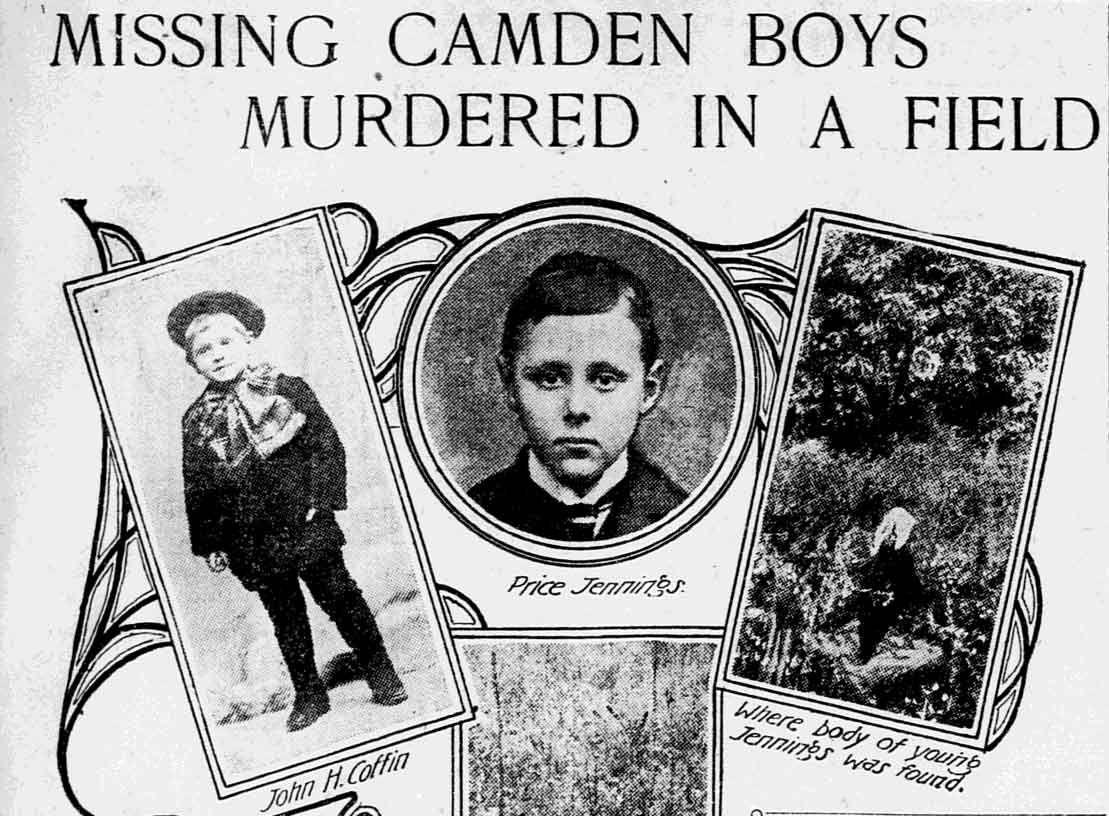
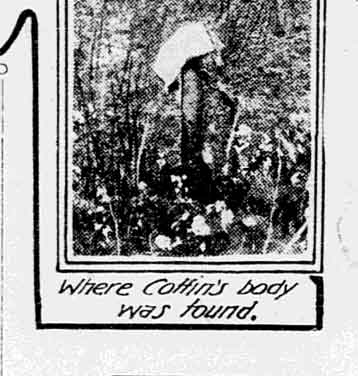
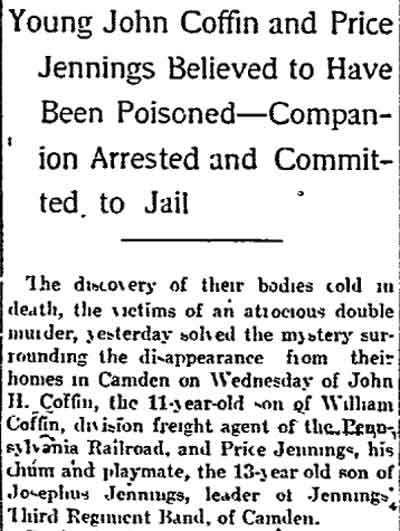
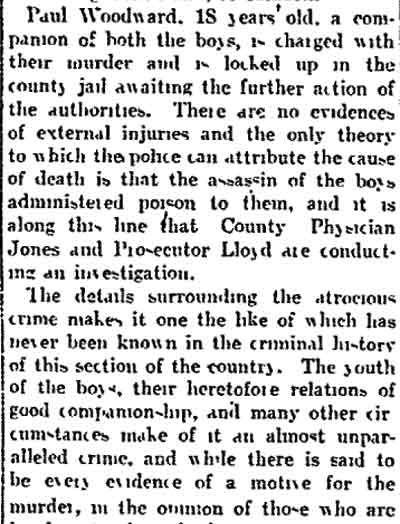
Young John Coffin and Price Jennings Believed to Have Been Poisoned—Companion Arrested and Committed to Jail
John H. Coffin
Price Jennings.
Where body of young Jennings was found.
Where Coffin’s body was found.
The discovery of their bodies cold in death, the victims of an atrocious double murder, yesterday solved the mystery surrounding the disappearance from their homes in Camden on Wednesday of John H. Coffin, the 11-year-old son of William Coffin, division freight agent of the Pennsylvania Railroad, and Price Jennings, his chum and playmate, the 13-year old son of Josephus Jennings, leader of Jennings’ Third Regiment Band, of Camden.
Paul Woodward, 18 years old, a companion of both the boys, is charged with their murder and is locked up in the county jail awaiting the further action of the authorities. There are no evidences of external injuries and the only theory to which the police can attribute the cause of death is that the assassin of the boys administered poison to them, and it is along this line that County Physician Jones and Prosecutor Lloyd are conducting an investigation.
The details surrounding the atrocious crime makes it one the like of which has never been known in the criminal history of this section of the country. The youth of the boys, their heretofore relations of good companionship, and many other circumstances make of it an almost unparalleled crime, and while there is said to be every evidence of a motive for the murder, in the opinion of those who are in close touch with the case, it is an instance in which the work is that of a degenerate boy in whom all sense of right and wrong have long since been dead. Certain it is that the crime has stirred the people of Camden and vicinity to a feverish heat to which it has not been stirred since the days following the murder of Annie Leconey.
Found in a Field
The bodies of both the lads were found yesterday morning in a field near the Haddon Heights Station of the Reading Railroad on what is known as the Lippincott farm, about a quarter mile from Station Avenue. The body of young Jennings was found lying in a clump of bushes and less than forty yards away lay the remains of Coffin. Both bodies were stiff and in a state of decomposition. Coffin’s body was the first discovered, and it was not long after when that of his companion was found.
No sooner did the news of the discovery become known than the greatest excitement prevailed through the city of Camden and its suburbs. All sorts of rumors began to circulate, some of them hinting that the bodies were in a horribly mutilated condition and that the work was that of a negro. In a short time, however, whatever element of mystery there was about the case, so far as present indications go, was dissipated when the identification of the bodies was made and the arrest of young Woodward was accomplished soon afterwards.
Then the mystery began to clear somewhat. Both boys disappeared from their homes on Wednesday afternoon. When they failed to return that night the police were notified and a description of them was sent around the country adjacent to Camden and also to Philadelphia. Some persons said they had gone to Trenton to the fair, while others told of having seen them in the vicinity of Haddon Heights Station. Nothing came of these statements at the time, and meanwhile the boys failed to return home. Coffin’s father was of the opinion that the boys had been kidnapped, but this theory was not held by the police.
First Body Discovered
Late Friday night, Clarence Kreuson, whose home is at Haddon Heights, and a friend of his, Frank Johnson, who lives in this city, were returning from an afternoon of blackbird shooting. While crossing the field they came across the body of a boy. It was lying in the bushes, half concealed, and when they made a closer examination they discovered that life was extinct. In alarm Kreuson and his companion ran to the home of A. H. Wood, near-by, and communicated their intelligence. Wood immediately sent a telephone message to Coroner Litchfield in Camden, apprising him of the discovery. That official, through some misunderstanding, thought it was a man named Brown who had been talking to him. He hitched up his horse and drove to Haddon Heights, but was unable to locate the body. He was also unable to locate anyone named Brown. Further investigation was, therefore, postponed until yesterday morning, when the Coroner again visited the scene and found the body in the bushes.
From the clothing worn it was thought at first it might be Coffin’s, and after it had been brought to the Morgue, William Coffin, the lad’s father, was sent for. He was accompanied by Kingston Jennings, elder brother of the other missing boy. Mr. Coffin when nerved to look at the remains, exclaimed, “My God, it’s Price. Where is my boy. He must be found.” The identification was then made complete by the dead boy’s brother.
Meanwhile a number of persons had been going over the field where the body had been found in the search for clues that might lead to a discovery of the murderer of the boy, when one of them chanced across the remains of the other lad lying under a dead tree. This body was identified on the spot by Detective Curtis, of the Pennsylvania Railroad. The lad’s body was also taken to the Morgue and laid on a slab alongside of his chum.
Police at Work
The police in the interim had not been idle, and after scouring the vicinity of the place where the bodies had been found, came across Lillian Martin, the 15-year-old daughter of J. Wilson Martin, who conducts a “Cyclers’ Rest” at Collings avenue and the White Horse pike. She remembered having seen two boys answering the description of the dead lads in their place on Wednesday. They were accompanied by an older and a taller boy. Jennings seemed to have considerable money and purchased three pies and three bottles of soda water. After that they left the place and she never saw them again until she looked upon their bodies.
Prosecutor Frank Lloyd at once set to work, and Detective Hart was sent in search of young Woodward. Inquiry at his home, at 221 Benson street, brought the response that he was not at home. His mother learned what he was wanted for, and about 2 o’clock sent for Detective Hart and turned the boy over to him. She accompanied him to the Prosecutor’s office and, talking to the newspaper reporters, said that beyond being addicted to the use of cigarettes Paul was a good boy. She persisted that he could not have committed the crime as he was home all of Wednesday, Thursday and yesterday until the afternoon, when he went to Philadelphia to visit relatives. What the police are reported to view with importance is a statement that the mother is also alleged to have made to the effect that on Wednesday he had bothered her a great deal about money for a hat and shoes. While the authorities will make no admission, it is intimated that the motive they ascribe for the crime is robbery, and that the fact that Jennings had $10 when he disappeared was what led to his murder, and the murder of the other little fellow followed as a necessity for hiding the crime, as well as to get possession of a silver watch he is said to have had.
Identified Woodward
After young Woodward was taken into the Prosecutor’s office, besides the Prosecutor there were present Assistant Prosecutor F. Morse Archer, Court Stenographer Berry, Chief of Police Foster, of Camden; Chief of Police Linderman, of Merchantville, and Detectives Painter and Hart. In a few minutes Detective Cherry arrived with Lillian Martin. The latter had been cautioned not to say anything to anybody, either in or out of the room. She was inside for less than thirty seconds, and when she came out she is reported to have said that Woodward was the young man whom she had seen with the boys on Wednesday in her father’s place. She was taken back a second and a third time, and after the latter, it is said, she told the detectives that she was certain he was the person. She then left for her home, where she resisted all attempts to interview her.
In the meantime Recorder Stackhouse issued a commitment for Woodward on the oath of Detective Cherry, charging the young man with the murder of Coffin. Jennings’ name was not mentioned, as Coffin’s answered the same purpose.
While this was going on County Physician Jones was holding an autopsy in the basement of the jail, where the morgue is located. A personal examination showed that there were no external marks of violence, and in order to clinch the result of the autopsy he summoned from Philadelphia Professors Copeland and Rosenberger, of the Jefferson Hospital. Dr. Copeland performed the autopsy, and was at work until nearly 6 o’clock, when it was announced that no results other than that death was not due to external injuries, had been accomplished.
Prosecutor Lloyd said: “There was a double murder. Of that much we are certain. Death was not due to external injuries. What we suspect you will have to conjecture. The organs of both the boys have been sent to a chemist for examination. More than that I cannot say, except that we have arrested Paul Woodward on suspicion and that he is charged with the murder. The same man that killed one of the boys no doubt killed the other. All I ask now is that judgment be suspended for a few days, when I believe all will be cleared up.”
Woodward Visited Mr. Coffin
Mr. Coffin, whose home is at 305 North Third street, yesterday said: “It’s an awful blow that has come to me and I hardly know what to say. It does seem to me that Paul Woodward exerted an evil influence over my boy. I remember now that on Thursday he came to the house and wanted me to hire him to look for John. He then said that he thought he could find him.”
At the Woodward home it was stated that the mother and father of the boy had gone to Philadelphia. Charles May, a boarder, said there would be no trouble in proving that Paul was home all day of Wednesday, as well as the day following. He said that on each of those nights the boy had been in bed by 8 o’clock. This testimony, he said, would be corroborated by the boy’s mother, father, sister and himself. The only time Paul was out of the house, he said, was when he went several errands for his mother.
Late yesterday afternoon Coroner Litchfield empaneled the following jury: David Kaighn, George Leathwite, Isaac Toone, George J. Pechin, Elmer E. Cox and T. L. Bear. At 5 o’clock they viewed the remains, after which the bodies were sent to their respective homes. No date for the inquest has been fixed.
The stomach and other organs of both the youthful victims are in the possession of George M. Beringer, a druggist and chemist, at Fifth and Federal streets. Last night he said he had begun his examination, but it would take him probably a day or two more to complete his analysis.
Found Body at Foot of Stairs
Philadelphia Inquirer —

Mystery in the Death of Pole in Camden—Five Men Placed Under Arrest
Coroner Litchfield is investigating the death of Frank Taianoski, a Pole, 35 years old, of Olyphant, Pa., whose body was found early yesterday morning at the foot of a stairway at 1049 Diamond street, Camden. Jacob Chopper, Peter Oplushi, John Schwenze, John Vannank and Stanlaus Weruski, Hungarians, who cannot speak English, were arrested by County Detectives Smith and Cherry on suspicion of knowing something about Taianoski’s death.
Shortly after 3 o’clock yesterday morning Coroner Litchfield was awakened by two men, who told him to go to 1049 Diamond street, where a man was being killed. Thinking it was a ruse to get him out of the house to do him bodily injury the Coroner refused to go. Some time after Edward Wolfe, an English speaking Pole, told the Coroner that there was a dead man at the Diamond street house. Coroner Litchfield at once went to the house and found Taianoski’s body at the foot of the stairway. Surrounding it were the five Hungarians, two of whom were recognized as the early morning visitors.
Nothing could be gleaned from the men, who told conflicting stories. One, who said he was a room-mate of the dead man, stated he had arrived home late and had fallen over the body. On examining the body the Coroner found Taianoski had received a bad fracture of the skull, which had caused his death.
Taianoski was a miner and went to Camden three weeks ago. His wife has been sent for in the hope that she can aid the officials in untangling the mystery. The body is now at the Morgue.
Wagner’s Trial for Stabbing Miller
Camden Daily Courier —


Witnesses Say Policeman Keaser Held Fellow Officer When He Was Knifed.
CUT DURING THIRD WARD RIOT
The main court room was crowded with interested Third warders this morning, when the first of the criminal complaints growing out of the riots at Third and Beckett streets, on the night of July 28, last, during the Congressional primary, was taken up. It charged Charles Wagner with assault and battery on Policeman Harry Miller. Judge Joline was on the bench. Prosecutor Lloyd appeared for the State and the defendant was represented by Lawyers Fred A. and William F. Rex. Some little trouble was experienced in getting a jury.
After Prosecutor Lloyd outlined the case, Policeman Miller was called to the stand. He said that on the night in question just before the close of the polls, a fight ensued between ex-Policeman “Bob” Miller and John Morrisey, the man who was killed. A general racket followed and “Bob” Miller, Policeman Keaser and others were brutally assaulting George Murray with a blackjack, when witness went to Murray’s aid. Keaser, he said, turned on him and grappled.
MILLER STABBED.
“He had a hold of me and I of him,” said Miller, “and while we were standing in that position, this man Wagner came up in front of me, jabbed his knife in my stomach, turned it like that (giving his hand a twist) and pulled it out. Keaser still had a hold of me and I could not help myself. Wagner ran away after stabbing me.”
Miller said he was taken to Cooper Hospital and was there four weeks.
On cross-examination by Mr. Rex, Miller said he was positive that Wagner was his assailant and denied saying in the hospital the morning after the stabbing, that he did not know who cut him. He also denied hitting Keaser with his blackjack.
When questioned concerning Morrisey, the man who was killed, Miller said he only met him that day and did not know whether he was a voter or not.
DIDN’T WANT DETAILS.
Mr. Rex tried to get the witness to detail a talk he had with Morrisey, but Mr. Lloyd objected. Mr. Rex seemed so anxious to carry the point that Mr. Lloyd said he was willing to withdraw the objection, provided Mr. Rex would not object to detailed conversation responses to his questions. Mr. Rex promptly vetoed the proposition and withdrew his questions.
Harry Selby, son of former Policeman Selby, followed on the stand. He said he did not see the stabbing, but that a few moments before the polls closed he saw Wagner try to stab Miller at the window of the polling place. The two, it appears, had had some words.
Dr. Grimes, of the Cooper Hospital staff, said that he helped dress Miller’s wound and that it was a dangerous one.
SAW WAGNER KNIFE MILLER.
William Laws, colored, corroborated Miller’s testimony. He said he saw Policeman Keaser hold Policeman Miller while Wagner stabbed him. This hapepned [sic] he said about four minutes of 8 o’clock.
Policeman Edward Hartman told of seeing Wagner having an open knife in his hand, of seeing him jab at several people and that he grabbed at him.
“You saw all of that did you?” asked Mr. Rex.
“I certainly did,” replied the officer.
“Then why didn’t you as a policeman arrest him?”
“I tried to, but his brother interfered.”
Mr. Rex had no more questions to ask.
George Murray, also told of seeing defendant have a knife in his hand.
Detectives Smith and Cherry told of making an unsuccessful search in this city for Wagner and finally locating him at Waterford living with a woman.
Detective Cherry said that Wagner told him that he had been at Hammonton.
“Hammonton is in Camden county, isn’t it?” asked Mr. Rex.
“No, sir, Atlantic county.”
“My geography is twisted somewhat commented Mr. Rex.” With these witnesses the State rested.
WAGNER DENIES CHARGE.
Addressing the jury Mr. Rex said the defense would be an alibi. Wagner then took the stand. He said he lived at 666 South Second street and that on the night of July 28, left the polling place about quarter of eight o’clock.
“Did you have a penknife in your hands at all?”
“No, sir.”
“Did you cut Harry Miller?”
“No, sir.”
In answer to questions by Mr. Rex, Wagner said he was with Constable “Bo” Bates nearly every day while in Waterford.
Cross-questioned by Mr. Lloyd Wagner said he went to Waterford on July 30—two days after the stabbing. He went down, he said, to visit a Mrs. Fox. His visit lasted until the middle of September, the time of his arrest. Previous visits he said never extended over a week. He said he had no knowledge that he was wanted for any crime until two weeks later when he read in the papers that he was charged with stabbing Miller. He told Mr. Bates about it. He further said that no trouble had occurred at all while he was at the polls.
Charles Cahill, a clerk at the Reading terminal, said he was at the polls and that at about quarter of eight o’clock he went up Beckett street in company with Wagner and another man. About fifty feet away, he said he went into an alley and Wagner proceeded up the street. Witness said he returned to the polling place just as the trouble began. He did not see Wagner.
Questioned by the Prosecutor Cahill said he was present as a challenger.
“Are you of the same political party that was holding the election?”
“I vote for the best man,” snapped Cahill in reply.
DIDN’T HAVE ANY POLITICS.
The Prosecutor repeated the question several times only to receive evasive answers such as “I was a Republican for that night,” and “I’m for the best man,” until Judge Joline was compelled to sharply admonish the witness to answer the question. Even then the spectators were in doubt as to Cahill’s politics, as he said he guessed he didn’t have any politics.
Owen McDonald testified to seeing Wagner and two other men pass up the street and despite the general excitement, Mr. McDonald said he watched Wagner until he got to Fourth street.
With the testimony of Butcher John Heim to the effect that he did not see Wagner at all around the polls until after the trouble was over court took a recess.
Policeman Albert Keaser was the first witness called this afternoon. He said he was present when the row started, that he took a blackjack from George Murray and also took a similar weapon from Policeman Harry Miller. The latter, he said, had hit him with the weapon. Witness said he saw Wagner leave the polling place and at that time Miller was not cut.
“Did Mr. Archer, the Assistant Prosecutor, tell you that he had a talk with Miller and that Miller said he didn’t know who cut him?”
Mr. Lloyd objected to the question, but expressed a willingness to allow it, provided Mr. Rex would let him call Mr. Archer to the stand.
Mr. Rex would not do so and the Prosecutor pressed his objection. It was sustained.
On cross examination Keaser denied saying to a man named Ogden that Wagner was “the fellow who did Miller.”
BEAT FELLOW POLICEMAN.
Policeman John Wagner, another of the defendants, said his brother went away before the fight started. In detailing the fracas Wagner voluntarily said he hit Harry Miller in the head with his jack and that he also hit Policeman Hartman.
Policeman Truitt also said he saw Wagner leave the polling place just before the fight started. While Mr. Lloyd was cross examining the witness Mr. Rex objected to the form of a question and remarked the “Court has ruled on that several times and I suppose I’ll get the same ruling.”
Judge Joline rebuked Mr. Rex for making such a statement. Mr. Rex begged the Court’s pardon, made the objection in regular form and it was sustained.
Mrs. Anna Hutner, a sister of the defendant, said she saw him go away about quarter of 8 o’clock and that he did not come back during the trouble. She explained her presence there by saying she had gone to prevent George Murray from shooting her brother.
William Ridgway said he was present during the trouble but did not see Wagner.
Constable “Bo” Bates said that Wagner was in his company nearly every day while he was visiting Waterford and that he made no attempt to escape.
SHIELDED WAGNER.
Prosecutor Lloyd’s only question was:
“You as an officer of this court knew that this man was accused of stabbing Harry Miller and you did not report it to the authorities, is that right?”
“Yes, sir; it is.”
When asked why, by Mr. Rex, the witness said the authorities could have got him at any time.
The defense rested and Mr. Lloyd called Mr. Ogden to the stand in rebuttal. He testified that Keaser told him that Wagner did Miller. Before the question was answered Judge Joline again rebuked Mr. Rex for his manner.
Argument commenced at 2.45 o’clock.
Royal Welcome for Ex-Sheriff Baird
Philadelphia Inquirer —
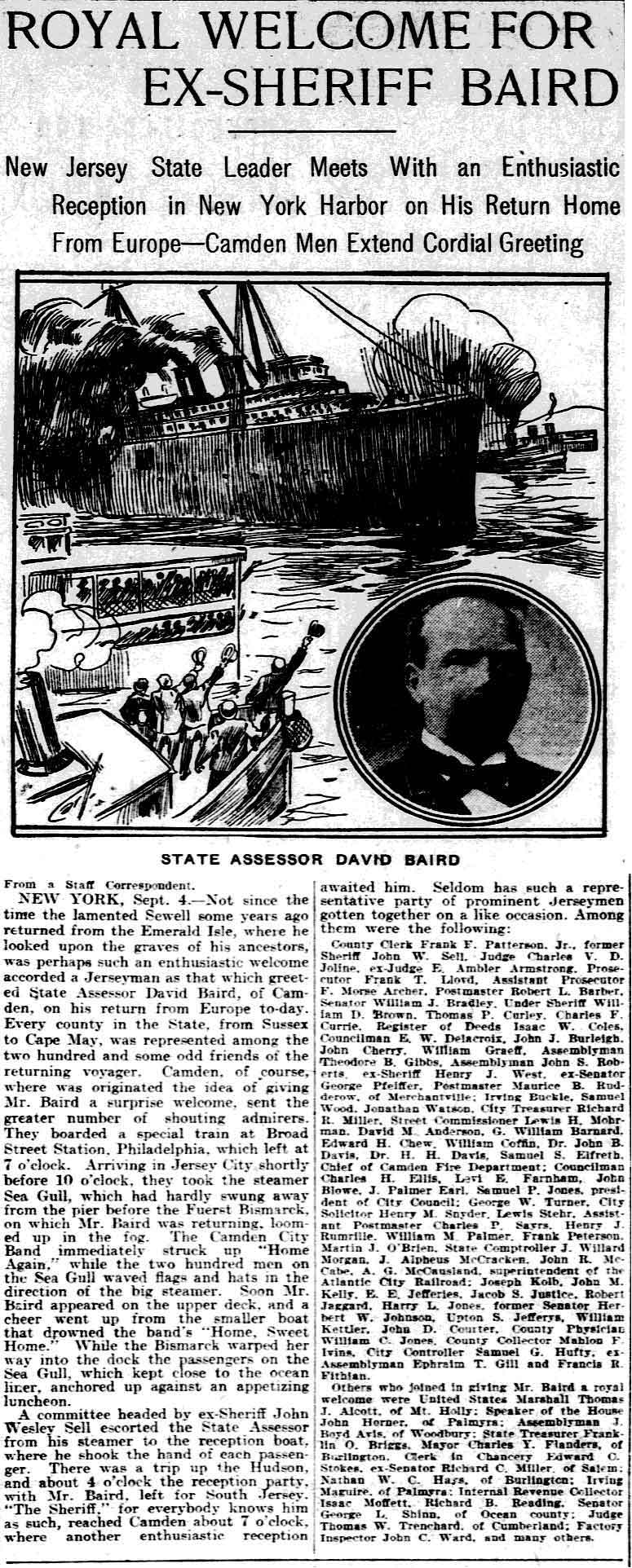
New Jersey State Leader Meets With an Enthusiastic Reception in New York Harbor on His Return Home From Europe—Camden Men Extend Cordial Greeting
STATE ASSESSOR DAVID BAIRD
From a Staff Correspondent.
NEW YORK, Sept. 4.—Not since the time the lamented Sewell some years ago returned from the Emerald Isle, where he looked upon the graves of his ancestors, was perhaps such an enthusiastic welcome accorded a Jerseyman as that which greeted State Assessor David Baird, of Camden, on his return from Europe to-day. Every county in the State, from Sussex to Cape May, was represented among the two hundred and some odd friends of the returning voyager. Camden, of course, where was originated the idea of giving Mr. Baird a surprise welcome, sent the greater number of shouting admirers. They boarded a special train at Broad Street Station, Philadelphia, which left at 7 o’clock. Arriving in Jersey City shortly before 10 o’clock, they took the steamer Sea Gull, which had hardly swung away from the pier before the Fuerst Bismarck, on which Mr. Baird was returning, loomed up in the fog. The Camden City Band immediately struck up “Home Again,” while the two hundred men on the Sea Gull waved flags and hats in the direction of the big steamer. Soon Mr. Baird appeared on the upper deck, and a cheer went up from the smaller boat that drowned the band’s “Home, Sweet Home.” While the Bismarck warped her way into the dock the passengers on the Sea Gull, which kept close to the ocean liner, anchored up against an appetizing luncheon.
A committee headed by ex-Sheriff John Wesley Sell escorted the State Assessor from his steamer to the reception boat, where he shook the hand of each passenger. There was a trip up the Hudson, and about 4 o’clock the reception party, with Mr. Baird, left for South Jersey. “The Sheriff,” for everybody knows him as such, reached Camden about 7 o’clock, where another enthusiastic reception awaited him. Seldom has such a representative party of prominent Jerseymen gotten together on a like occasion. Among them were the following:
County Clerk Frank F. Patterson, Jr., former Sheriff John W. Sell, Judge Charles V. D. Joline, ex-Judge E. Ambler Armstrong, Prosecutor Frank T. Lloyd, Assistant Prosecutor F. Morse Archer, Postmaster Robert L. Barber, Senator William J. Bradley, Under Sheriff William D. Brown, Thomas P. Curley, Charles F. Currie, Register of Deeds Isaac W. Coles, Councilman E. W. Delacroix, John J. Burleigh, John Cherry, William Graeff, Assemblyman Theodore B. Gibbs, Assemblyman John S. Roberts, ex-Sheriff Henry J. West, ex-Senator George Pfeiffer, Postmaster Maurice B. Rudderow, of Merchantville; Irving Buckle, Samuel Wood, Jonathan Watson, City Treasurer Richard R. Miller, Street Commissioner Lewis H. Mohrman, David M. Anderson, G. William Barnard, Edward H. Chew, William Coffin, Dr. John B. Davis, Dr. H. H. Davis, Samuel S. Elfreth, Chief of Camden Fire Department; Councilman Charles H. Ellis, Levi E. Farnham, John Blowe, J. Palmer Earl, Samuel P. Jones, president of City Council; George W. Turner, City Solicitor Henry M. Snyder, Lewis Stehr, Assistant Postmaster Charles P. Sayrs, Henry J. Rumrille, William M. Palmer, Frank Peterson, Martin J. O’Brien, State Comptroller J. Willard Morgan, J. Alpheus McCracken, John R. McCabe, A. G. McCausland, superintendent of the Atlantic City Railroad; Joseph Kolb, John M. Kelly, E. E. Jefferies, Jacob S. Justice, Robert Jaggard, Harry L. Jones, former Senator Herbert W. Johnson, Upton S. Jefferys, William Kettler, John D. Courter, County Physician William C. Jones, County Collector Mahlon F. Ivins, City Controller Samuel G. Hufty, ex-Assemblyman Ephraim T. Gill and Francis R. Fithian.
Others who joined in giving Mr. Baird a royal welcome were United States Marshall Thomas J. Alcott, of Mt. Holly; Speaker of the House John Herner, of Palmyra; Assemblyman J. Boyd Avis, of Woodbury; State Treasurer Franklin O. Briggs, Mayor Charles Y. Flanders, of Burlington, Clerk in Chancery Edward C. Stokes, ex-Senator Richard C. Miller, of Salem; Nathan W. C. Hays, of Burlington; Irving Maguire, of Palmyra; Internal Revenue Collector Isaac Moffett, Richard B. Reading, Senator George L. Shinn, of Ocean county; Judge Thomas W. Trenchard, of Cumberland; Factory Inspector John C. Ward, and many others.
Fürst Bismarck
1903
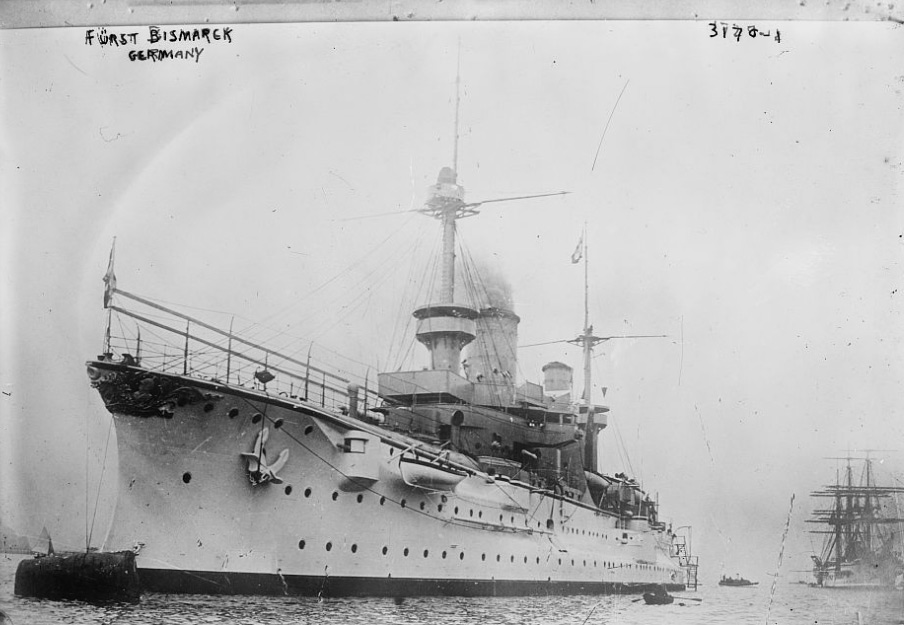
Philadelphia Inquirer — October 5, 1903
Thief in Court
M. B. Shelton, 19 years old, was arrested by County Detective Cherry for stealing $107 from W. W. Latcham. Shelton will be given a hearing before Judge Garrison. — John Cherry — Frank T. Lloyd
Camden News Notes
Philadelphia Inquirer —
County Detective Cherry has recovered $30 of the $107 alleged to have been stolen from W. W. Latcham, a milkman of Westmont, by Merrille Sheldon last week.
Philadelphia Inquirer — October 26, 1903
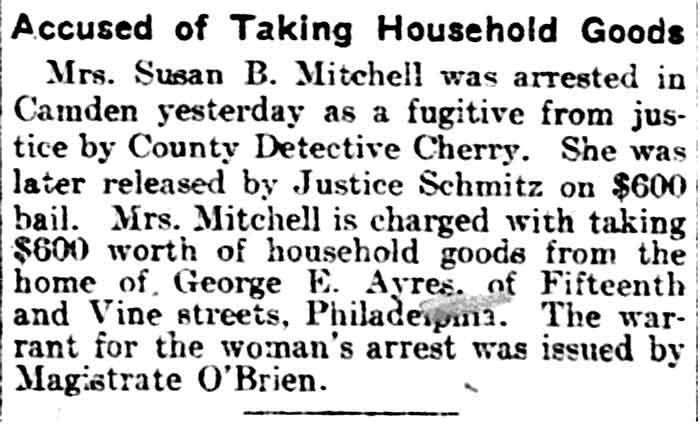
Accused of Taking Household Goods
Mrs. Susan B. Mitchell was arrested by County Detective Cherry on a charge of taking household goods belonging to Philip Schmitz, her landlord. She was held for court.
Trolley Hit Detective Cherry
Philadelphia Inquirer —
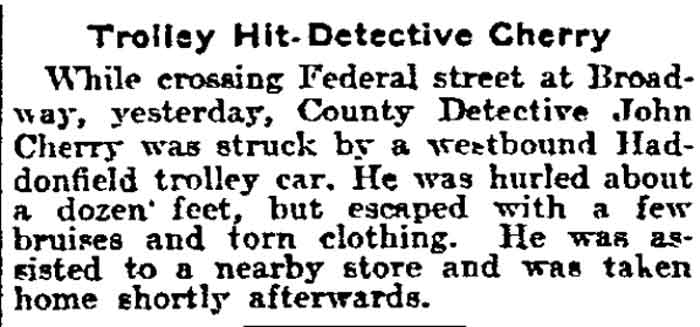
While crossing Federal street at Broadway, yesterday, County Detective John Cherry was struck by a westbound Haddonfield trolley car. He was hurled about a dozen feet, but escaped with a few bruises and torn clothing. He was assisted to a nearby store and was taken home shortly afterwards.
Attempted Assault
Philadelphia Inquirer —
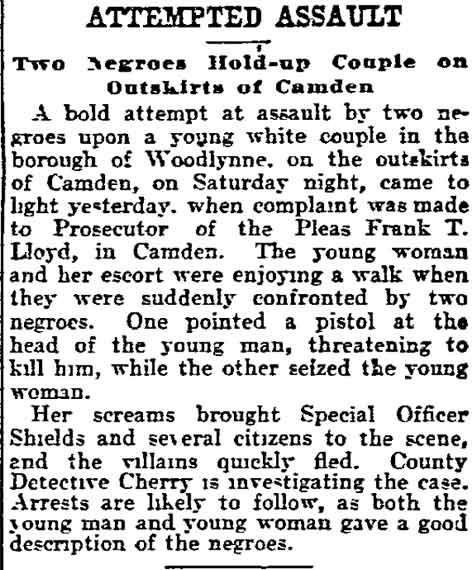
Two Negroes Hold-up Couple on Outskirts of Camden
A bold attempt at assault by two negroes upon a young white couple in the borough of Woodlynne, on the outskirts of Camden, on Saturday night, came to light yesterday, when complaint was made to Prosecutor of the Pleas Frank T. Lloyd, in Camden. The young woman and her escort were enjoying a walk when they were suddenly confronted by two negroes. One pointed a pistol at the head of the young man, threatening to kill him, while the other seized the young woman.
Her screams brought Special Officer Shields and several citizens to the scene, and the villains quickly fled. County Detective Cherry is investigating the case. Arrests are likely to follow, as both the young man and young woman gave a good description of the negroes.
Jailed as an Accessory
Philadelphia Inquirer —
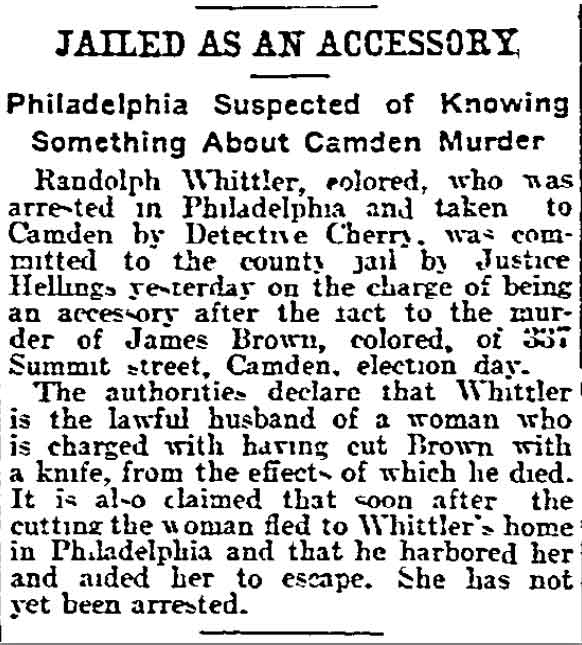
Philadelphia Suspected of Knowing Something About Camden Murder
Randolph Whittler, colored, who was arrested in Philadelphia and taken to Camden by Detective Cherry, was committed to the county jail by Justice Hellings yesterday on the charge of being an accessory after the fact to the murder of James Brown, colored, of 337 Summit street, Camden, election day.
The authorities declare that Whittler is the lawful husband of a woman who is charged with having cut Brown with a knife, from the effects of which he died. It is also claimed that soon after the cutting the woman fled to Whittler’s home in Philadelphia and that he harbored her and aided her to escape. She has not yet been arrested.
Philadelphia Inquirer — November 19, 1904
Woman Left Home, Created Big Scare
Disappearance of a Farmer’s Wife Caused Much Excitement in Camden County
The disappearance of Sadie F. Groff, wife of a Gloucester County farmer, caused great excitement. County Detective Cherry investigated. Frank T. Lloyd Sr.
War Veterans Indorse Tickets
Philadelphia Inquirer —
At the annual meeting of the War Veteran Association, No. 1, of Camden, resolutions were adopted pledging the support of the association to Roosevelt and Fairbanks and the city and county tickets; condemning Alton B. Parker, the Democratic candidate, for his criticism of President Roosevelt’s recent pension order; praising President Roosevelt for preventing the Schuylkill Arsenal clothing work from going into the hands of contractors and compelling its immediate return to the widows and orphans of soldiers. The following officers were elected: President, Samuel S. Weaver; vice president, A. R. Dease; secretary, William H. Chandler; Finance Committee, H. L. Hartshorne, John Cherry, Louis H. Leigh, A. R. Dease and Dr. John B. Davis.
Prosecutor Lloyd Investigates Robbery Case
Philadelphia Inquirer —
Prosecutor Lloyd has detailed County Detective Cherry to investigate the case of Charles Peters, of Williamstown, who says he was held up last week by three negroes and relieved of $90. The Camden authorities think it rather strange Peters did not tell anyone of the alleged hold up until some time after it occurred.
Murder Mystery in a Cellar
Philadelphia Inquirer —
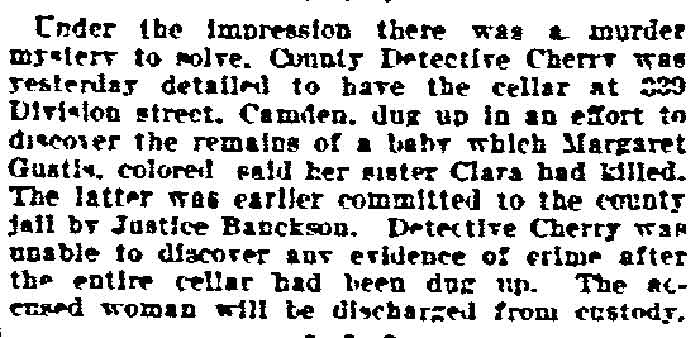
Under the impression there was a murder mystery to solve, County Detective Cherry was yesterday detailed to have the cellar at 3[?]9 Division street, Camden, dug up in an effort to discover the remains of a baby which Margaret [?]usti[?], colored, said her sister Clara had killed. The latter was earlier committed to the county jail by Justice Ba[?]ckson. Detective Cherry was unable to discover any evidence of crime after the entire cellar had been dug up. The accused woman will be discharged from custody.
Philadelphia Inquirer — August 13, 1905
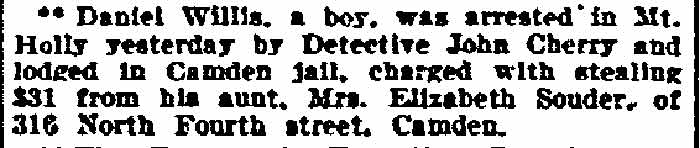
Boy Arrested in Mt. Holly
Daniel Willis, a boy, was arrested in Mt. Holly by County Detective Cherry and brought to Camden on a charge of stealing a bicycle from North 4th Street. Mrs. Elizabeth Souder
Four Autoists Put Up Fines
Philadelphia Inquirer —
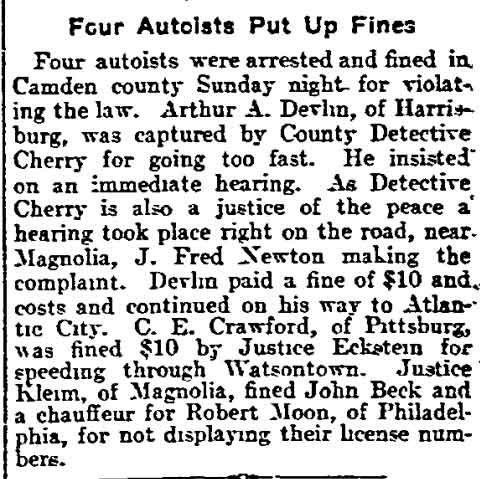
Four autoists were arrested and fined in Camden county Sunday night for violating the law. Arthur A. Devlin, of Harrisburg, was captured by County Detective Cherry for going too fast. He insisted on an immediate hearing. As Detective Cherry is also a justice of the peace a hearing took place right on the road, near Magnolia, J. Fred Newton making the complaint. Devlin paid a fine of $10 and costs and continued on his way to Atlantic City. C. E. Crawford, of Pittsburg, was fined $10 by Justice Eckstein for speeding through Watsontown. Justice Kleim, of Magnolia, fined John Beck and a chauffeur for Robert Moon, of Philadelphia, for not displaying their license numbers.
Philadelphia Inquirer — September 9, 1905
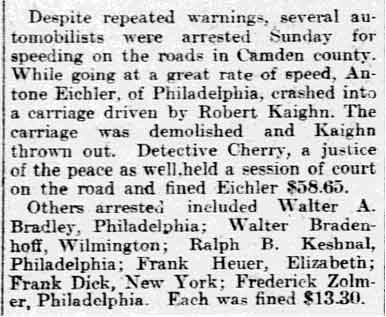
Held Court in Road for Swift Autoists
Justice of the Peace Cherry and Robert Kaighn held impromptu court on the roadway, stopping speeding automobiles and collecting fines on the spot.
Detectives Find Stolen Articles
Philadelphia Inquirer —
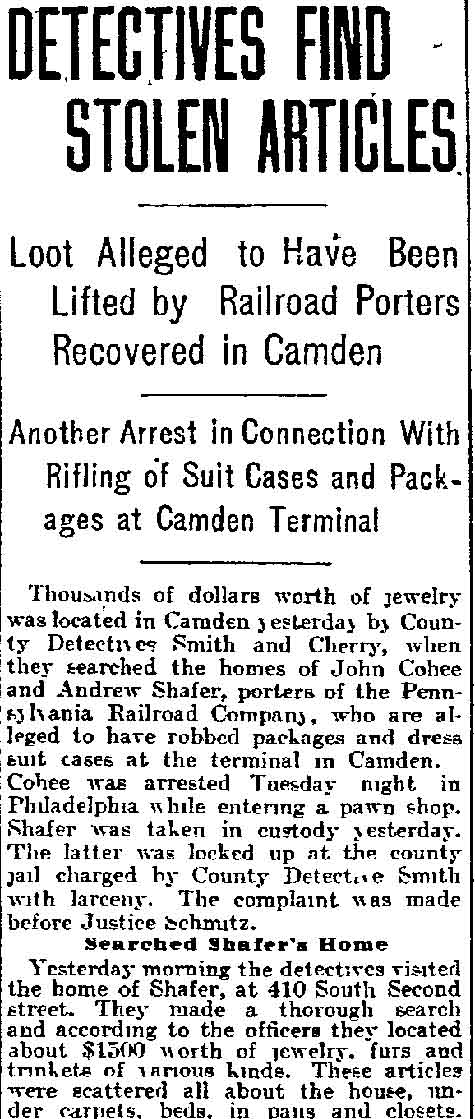
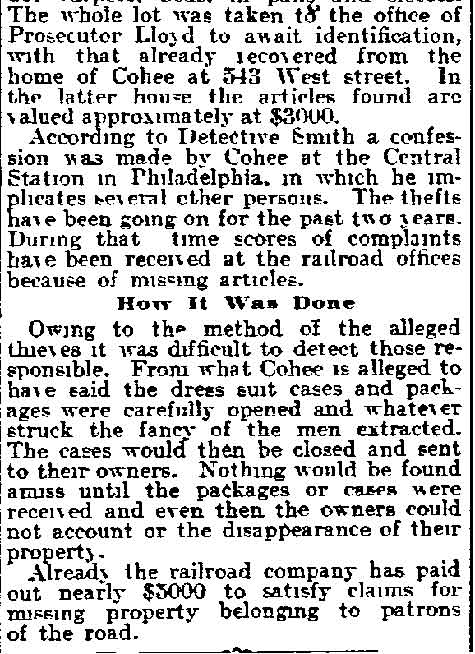
Loot Alleged to Have Been Lifted by Railroad Porters Recovered in Camden
Another Arrest in Connection With Rifling of Suit Cases and Packages at Camden Terminal
Thousands of dollars worth of jewelry was located in Camden yesterday by County Detectives Smith and Cherry, when they searched the homes of John Cohee and Andrew Shafer, porters of the Pennsylvania Railroad Company, who are alleged to have robbed packages and dress suit cases at the terminal in Camden. Cohee was arrested Tuesday night in Philadelphia while entering a pawn shop. Shafer was taken in custody yesterday. The latter was locked up at the county jail charged by County Detective Smith with larceny. The complaint was made before Justice Schmitz.
Searched Shafer’s Home
Yesterday morning the detectives visited the home of Shafer, at 410 South Second street. They made a thorough search and according to the officers they located about $1500 worth of jewelry, furs and trinkets of various kinds. These articles were scattered all about the house, under carpets, beds, in pans and closets. The whole lot was taken to the office of Prosecutor Lloyd to await identification, with that already recovered from the home of Cohee at 543 West street. In the latter house the articles found are valued approximately at $3000.
According to Detective Smith a confession was made by Cohee at the Central Station in Philadelphia, in which he implicates several other persons. The thefts have been going on for the past two years. During that time scores of complaints have been received at the railroad offices because of missing articles.
How It Was Done
Owing to the method of the alleged thieves it was difficult to detect those responsible. From what Cohee is alleged to have said the dress suit cases and packages were carefully opened and whatever struck the fancy of the men extracted. The cases would then be closed and sent to their owners. Nothing would be found amiss until the packages or cases were received and even then the owners could not account for the disappearance of their property.
Already the railroad company has paid out nearly $5000 to satisfy claims for missing property belonging to patrons of the road.
Detectives Dig Up Stolen Silverware
Philadelphia Inquirer —
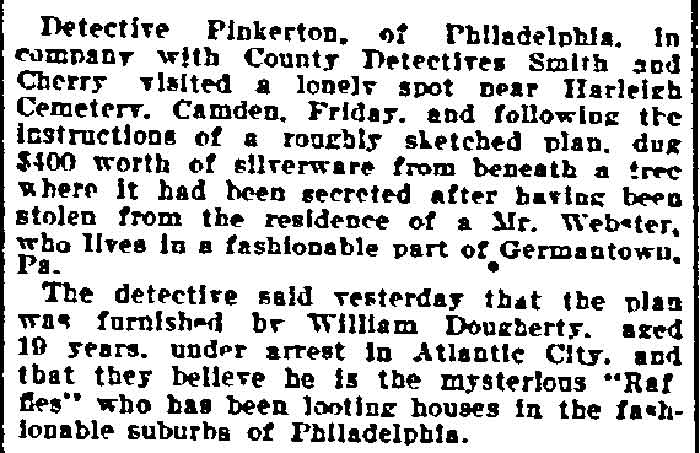
Detective Pinkerton, of Philadelphia, in company with County Detectives Smith and Cherry visited a lonely spot near Harleigh Cemetery, Camden, Friday, and following the instructions of a roughly sketched plan, dug $400 worth of silverware from beneath a tree where it had been secreted after having been stolen from the residence of a Mr. Webster, who lives in a fashionable part of Germantown, Pa.
The detective said yesterday that the plan was furnished by William Dougherty, aged 19 years, under arrest in Atlantic City, and that they believe he is the mysterious “Raffles” who has been looting houses in the fashionable suburbs of Philadelphia.
Stranger at Detective’s Desk Was Escaped Patient
Philadelphia Inquirer —
County Detective John S. Smith was somewhat taken aback yesterday morning when he walked into his office at the Court House to find a stranger occupying his desk and turning over the detective’s papers.
“What are you doing here?” inquired the detective.
“Why, I’m located here now. I’ve got a job,” replied the stranger, proceeding to open one of the detective’s private memorandum books.
Detective Smith was trying to regain his mental equilibrium when Detective Cherry walked in and recognized the stranger as A. H. Wells, who had recently been released from the asylum at Blackwood. Wells was later escorted home by a policeman.
Long Ride With Prisoner
Philadelphia Inquirer —
Camden Detectives Bring Alleged Murderer From Los Angeles
County Detectives Smith and Cherry arrived in Camden last night from Los Angeles, Cal., with Giovanni Cancelli, the Italian who is wanted for shooting to death Dominick Mercurio, a fellow countryman. The murder occurred last April at Fish House, and resulted from a quarrel over the possession of five cents. It was one of the longest trips ever made by Camden county officials after a prisoner. The detectives left Camden on November 4 and traveled nearly 7000 miles. Cancelli was safely landed in the county jail. He has already been indicted.
Court Officer Voigt also returned last night from Worcester, Mass., with Frank Millet. The latter is wanted on the charge of wife desertion.
Burton and Hicks Brought to Camden
Philadelphia Inquirer —

Daniel Burton and Alexander Hicks, negroes, were brought to Camden by County Detective Cherry yesterday to answer charges of committing about a dozen petty robberies.
Brained With Ax, Women Lie Dead
Philadelphia Inquirer —
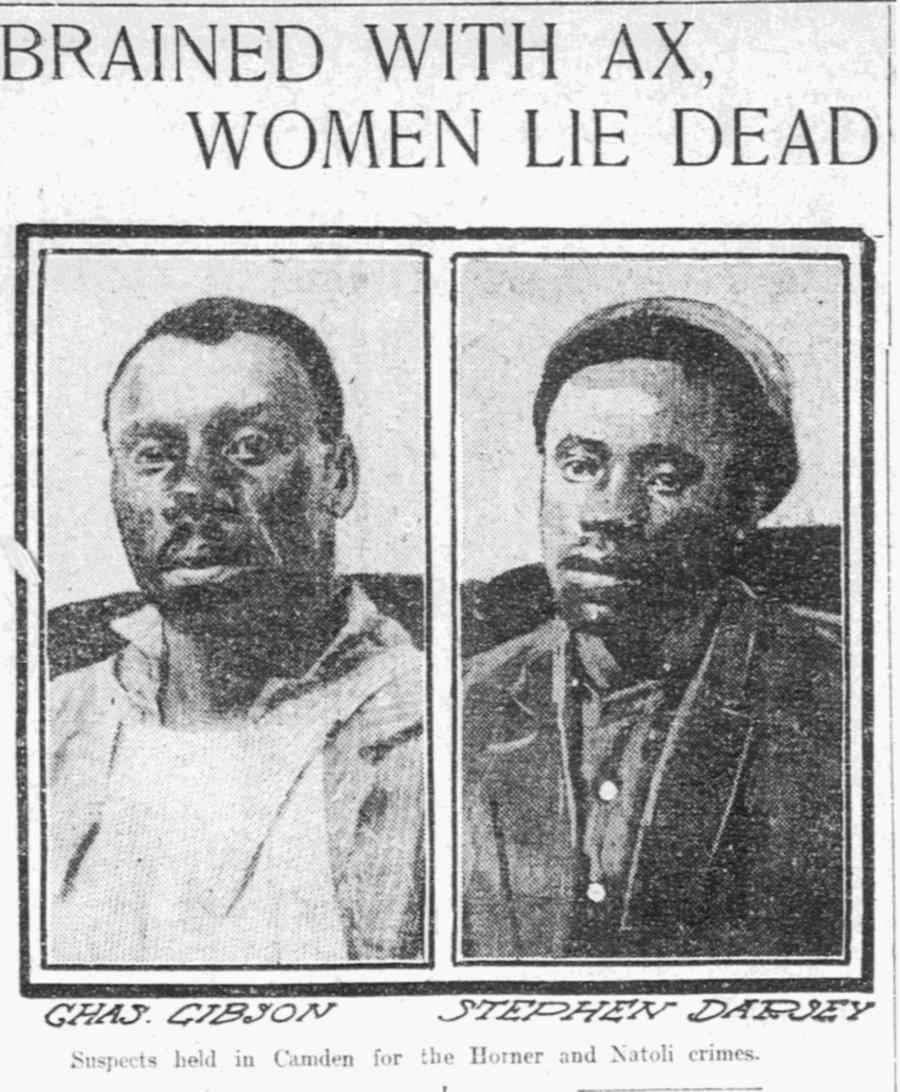
Fiend Fires Barn and While Owner Fights Flames Brutally Murders Aged Wife and Domestic—Suspects Arrested
CHAS. GIBSON STEPHEN DORSEY
Suspects held in Camden for the Horner and Natoli crimes.
Brained with an ax in the hands of a thief detected in the act of robbing, two women were foully murdered shortly after 4 o’clock yesterday morning in the farm house of Edward Horner, located along the banks of the Cooper Creek, about half a mile below the Browning road and a short distance from Camden. Mrs. Frances Horner, 63 years old, wife of the farmer, was instantly killed, while Victoria Natoli, 22 years old, of 82[?] Catharine street, Philadelphia, employed as a domestic, died two hours after her admission to the Cooper Hospital in Camden.
Less than four hours after he had worked on the apparent mystery, County Detective John S. Smith had taken into custody Charles Gibson and Stephen Dorsey, negroes, both of 2029 Mulford street, Camden. The evidence against the prisoners is such that Prosecutor Harry Scovel declared there is little doubt that they are the murderers. To attract the attention of the men folks about the house, the thieves set fire to a large frame barn about three hundred feet from the house, and it was while the farmer and his help were endeavoring to check the flames that the crime was committed.
Found Barn Ablaze
It was not until about 10 o’clock Monday night that Horner, who had been to market in Philadelphia with a load of hay, returned to his home. When he and his wife retired they planned to arise early this morning. They were unable to sleep well because of the incessant barking of a small fox terrier that was chained just outside of the kitchen. When the dog had been quieted at 2 o’clock in the morning the farmer and his wife fell into a deep sleep. They were again awakened at 4 o’clock by the terrier’s barking, when the farmer arose to go down to the creature he was startled to see the reflection of a fire on the window pane of his sleeping room. In an instant he had learned that the large barn, containing three horses and farming implements, was burning fiercely.
Without waiting to put on his clothes he ran down stairs, with his aged wife at his heels. Into the summer garden and down a pathway he hurried, calling for his farm hands, three Italians and a negro, who had sleeping quarters in a small frame structure to the south of the barn. These rushed out in their night clothes, among them being the Italian domestic.
“You go and help Mrs. Horner,” said he to the woman as he hurried past her, and Mrs. Natoli ran to the house in compliance.
Work of Incendiary
With the Italians and the negro the farmer turned his attention to the fire, which he found had consumed the lower part of the structure with the exception of the stalls where the three horses were confined. These were hastily taken out, but there was no time to save any of the implements. It seemed as though the blaze came from the central part of the structure where nothing of an inflammable character had been placed, and which proved that the barn had been deliberately fired. When Horner realized that the building could not be saved he concluded to return to the house and don his clothing.
Not more than twenty minutes had elapsed when he went to the side door leading to the kitchen. On trying to open the door he was surprised to find it securely fastened. He thought it had stuck at the bottom, and on looking down he saw two pools of blood, one of which had overrun, and crimson drops were falling to the ground a foot below. With superhuman force he smashed in the door, when he nearly fainted from the terrible scene that met his gaze.
Near the end of a long kitchen table lay his wife, her head resting in an ever-widening pool of blood. He stooped and placed his hand over her heart, but it had been stilled in death. Her face was almost unrecognizable because of the great gush of blood that had flowed from two horrible wounds on her head. He was about to go out and call for help when in the dim light he saw the form of the Italian woman. He found she was still alive and then he gave the alarm.
In an inconceivably short space of time farmers from miles around had flocked to the stricken house. One of these, John Thomas, who has a place across from the Horner farm, about half a mile distant, hastily procured a horse and team and drove at a mad pace into Camden with the dying Italian domestic. He arrived at the Cooper Hospital at 7 o’clock and two hours later, almost to the minute, Mrs. Natoli breathed her last without regaining consciousness. She was about to become a mother.
In the meantime the various county officials arrived. County Physician W. S. Jones. Coroner J. W. Fithian. County Detectives Smith and Cherry. Chief of Police Gravenor and others.
An autopsy was held on the body of Mrs. Horner by Drs. Jones and Fithian.
They found that her skull had been crushed in two places. The wound on the front of the head was shaped like a spearhead and was about three and one-half inches long. An examination showed that the blow that had inflicted this injury had been of such force as to split the skull in twain. The other wound, of a similar character, was at the base of the skull, the bones being crushed like an egg-shell. A subsequent examination made of the body of Mrs. Natoli at the hospital showed that the left side of her skull had been crushed with one terrible blow.
When a search was instituted for the weapon with which the crime had been committed it could not at first be located. It was subsequently found at the rear of the house. It was an old axe that had been used to cut wire from bales of hay, and the butt end was covered with blood and hair, showing that it was in that wise the victims had been struck by the murderer.
Horner, the stricken husband, a man 65 years old, threw the first light on the mystery and he gave a clue that finally resulted in the arrest of the negro Gibson and later of Dorsey. He said he had been having considerable trouble with his help this year. One of the men, who proved to be Gibson, was discharged about three weeks ago after a violent quarrel. At that time the negro left with the remark:
The Threat
“All right. I’ll get even. I’ll burn your barn.”
No more was seen of the man until just before Horner left for his trip to Philadelphia on Monday night. Then the farmer was surprised to see the man enter the farm yard and he appeared to be in a repentant mood. He pleaded with Horner to give him work, but as the farmer had little time to spare he told him to return in the morning. Then Gibson asked for permission to sleep in the barn and this was given him. The last seen of the negro, until his subsequent arrest, was when he left the house to go to the barn. That was about 11 o’clock Monday night, after Horner had returned from Philadelphia.
Armed with this information, County Detective Smith, who had been on the scene since 6 o’clock in the morning, began a search for Gibson. His quest led him into the southern section of Camden, known as Centreville.
In company with Policeman Valentine the detective found Gibson at 1831 South Eighth street. He was immediately placed under arrest and taken to the office of Prosecutor Scovel. He wore a defiant mien and sought to throw off any suspicion connecting him with the crime by declaring his entire ignorance of it.
Stripped of his clothing, he was carefully examined, but no blood marks were found on his body. When his pockets were searched, however, a pawn ticket, on which the ink was hardly dry, was found. It was issued by a Philadelphia pawnbroker at 125 Market street, and was given in exchange for a watch. A handkerchief literally soaked with blood, was also found in one of his pockets, together with a revolver. As to the handkerchief, he said the blood came from his nose.
Meanwhile a “flyer” had been sent out to all of the pawnbrokers at 9 o’clock, and just after Gibson had been taken into custody, Reader, the Market street broker, entered the office of Prosecutor Scovel and excitedly said that a negro had been in his place just twenty minutes before he was apprised of the crime and had pawned two watches. Reader had the watches with him. One bore the name of “Edward Horner.” The other was a woman’s watch, with long pendant chain. The pawnbroker was given a view of Gibson, and he exclaimed:
“That is the man that pawned these watches this morning, just exactly at ten minutes past nine o’clock. There is not the least question but what it is he.”
Gibson never moved, but looked at the officials and the pawnbroker with a defiant glare. He was then placed in a cell in the county jail, to await trial, which Prosecutor Scovel promises will be a speedy one.
Shortly after Gibson’s arrest Detective Smith received information which resulted in him seeking Dorsey. The negro was found at his home, on Mulford street. When taken to the office of Prosecutor Scovel, he at first denied having any knowledge of the matter. In fact, he endeavored to create the impression he was not acquainted with Gibson, but seeing the absurdity of this, he finally acknowledged being out with Gibson Monday night. Then he admitted he was with Gibson when the watches were pawned.
Horner was taken to the jail, and after positively identifying Gibson as the negro who had made the threats, and who Monday night asked to be taken back as a farmhand, the farmer also identified the watches as belonging to him and his wife. The revolver found on the negro was one of two which were stolen.
With tears coursing down his cheeks the stricken husband, who is 65 years old, spoke of the tragedy in a tear-choked voice.
“It is all too terrible to talk about,” said he. “I can’t realize it all. Why, only Sunday we had a family reunion here, when I celebrated my sixty-fifth birthday. My wife then plagued me, saying I wasn’t that old by far, and with our children and grandchildren we spent one of the most pleasant of days.
“How I ever got into that room,” continued he, speaking of when he broke in the door only to find his wife and the domestic stretched on the floor and weltering in their own blood. “I cannot tell. My poor wife lay between the end of the kitchen table and the door that leads into the shed. I saw that her eyes were closed, and when I saw those terrible pools of blood I at once realized a crime had been committed. I felt of her heart to see if she was still alive, but it had stopped beating, and then I knew she was past all earthly aid. Then I found that other poor woman and knew that she was still alive. I gave the alarm, but just how I cannot tell. I cannot realize it all,” concluded he, with a choked voice.
The house in which the murder occurred is an old structure built along Colonial lines. It is part of what is known as the Michelson estate, the farm being 70 acres in extent. The Horners have been farmers all their lives, and are known throughout South Jersey. The barn that was destroyed lay about three hundred feet to the south of the dwelling, and beside it were a number of smaller frame structures. It was in one of these that the Italian woman, her husband and the other farm help lived.
The news of the tragedy spread to surrounding communities with great rapidity and a large crowd was soon gathered about the place. Had the murderers been found at the time they would undoubtedly have been given short shrift. Three daughters survive the murdered Mrs. Horner: Mrs. Anna Marter, Mrs. Edward Megargee and Mrs. Isaac Beideman.
Philadelphia Inquirer — August 22, 1907


Camden Police Sure They Have the Right Men
Charles Gibson — Stephen Dorsey — Mulford Street — Edward Horner — Frances Horner — Victoria Natoli — John S. Smith — John Cherry — Charles G. Garrison — Dr. William S. Jones — J.W. Fithian — Henry S. Scovel
Mother Declared Note Was Forgery
Philadelphia Inquirer —
Camden Jury Rendered Verdict Against Son and Prosecutor at Once Began Criminal Action
Forging, it is alleged, the name of his mother to several promissory notes not only resulted in a jury before Circuit Court Judge Endicott, in Camden giving a verdict for $405 against William Schwab in favor of Samuel Paul, but also caused Prosecutor Scovel to take criminal action against him. When the jury gave its verdict a recommendation was made that Schwab be held responsible for his alleged act of forgery and upon information received County Detective John Cherry entered complaint before Justice Barr against the defendant.
On the witness stand Mrs. Schwab and her three sons declared that the signature appended to the promissory notes and imputed to be that of the woman was a forgery. The son William, who borrowed several hundred dollars from Paul, gave the latter the note.
Schwab Under Bail
Philadelphia Inquirer —
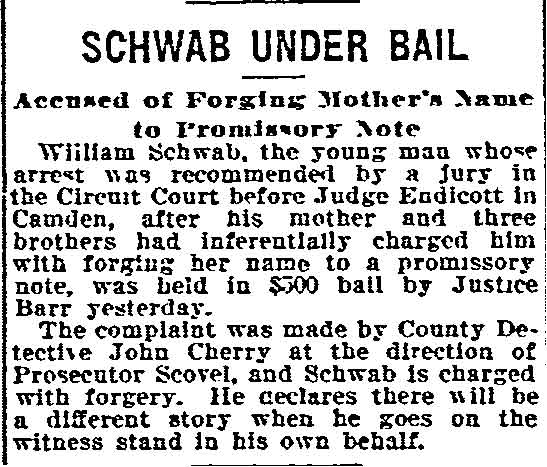
Accused of Forging Mother’s Name to Promissory Note
William Schwab, the young man whose arrest was recommended by a jury in the Circuit Court before Judge Endicott in Camden, after his mother and three brothers had inferentially charged him with forging her name to a promissory note, was held in $500 bail by Justice Barr yesterday.
The complaint was made by County Detective John Cherry at the direction of Prosecutor Scovel, and Schwab is charged with forgery. He declares there will be a different story when he goes on the witness stand in his own behalf.
Philadelphia Inquirer — December 11, 1908
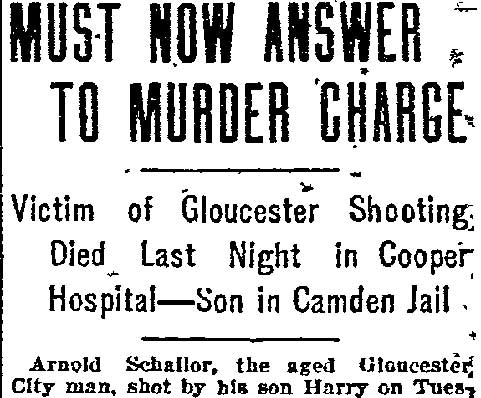
Must Now Answer to Murder Charge
Victim of Gloucester Shooting
Arnold Schallor and Harry Schallor must answer to a murder charge following the Gloucester shooting investigation by County Detective Cherry. Mary Powell
Not the Winslow Murderer
Philadelphia Inquirer —
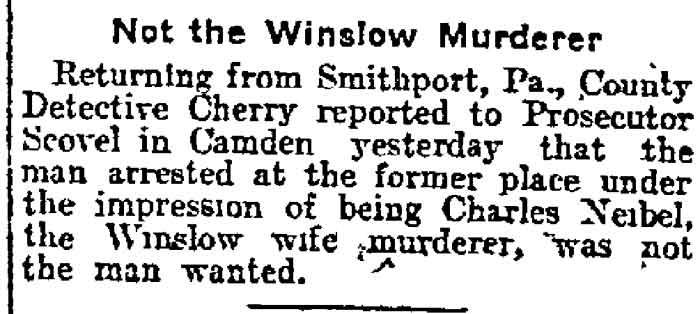
Returning from Smithport, Pa., County Detective Cherry reported to Prosecutor Scovel in Camden yesterday that the man arrested at the former place under the impression of being Charles Neibel, the Winslow wife murderer, was not the man wanted.
Philadelphia Inquirer — June 11, 1911
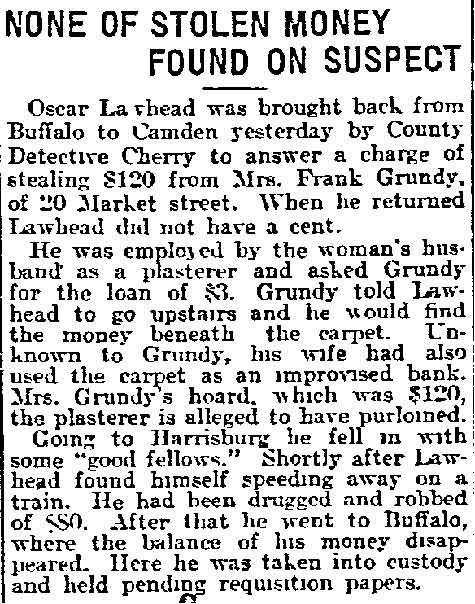
None of Stolen Money Found on Suspect
Oscar Lawhead, a suspect in the theft of money from a Market Street business, was arrested by County Detective Cherry at the request of Frank Grundy. None of the stolen money was found on Lawhead.
Philadelphia Inquirer — June 15, 1911
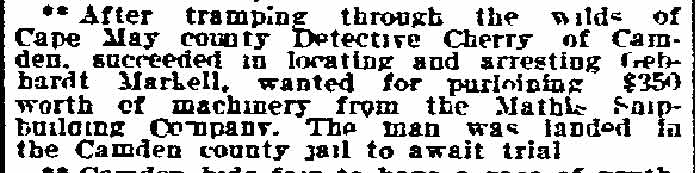
Found After Tramping Through Cape May County
After tramping through the wilds of Cape May county, Gebhardt Markell, a Mathis Shipyard employee sought by County Detective Cherry, was located and arrested.
Accused of Desertion
Philadelphia Inquirer —
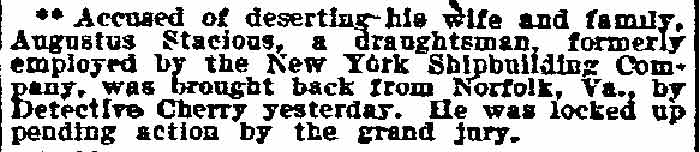
Accused of deserting his wife and family, Augustus Stacious, a draughtsman, formerly employed by the New York Shipbuilding Company, was brought back from Norfolk, Va., by Detective Cherry yesterday. He was locked up pending action by the grand jury.
Wife Suspected Bigamy
Philadelphia Inquirer —
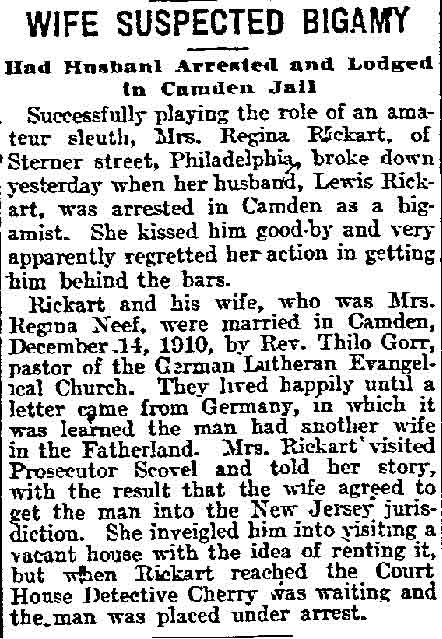
Had Husband Arrested and Lodged in Camden Jail
Successfully playing the role of an amateur sleuth, Mrs. Regina Rickart, of Sterner street, Philadelphia, broke down yesterday when her husband, Lewis Rickart, was arrested in Camden as a bigamist. She kissed him good-by and very apparently regretted her action in getting him behind the bars.
Rickart and his wife, who was Mrs. Regina Neef, were married in Camden, December 14, 1910, by Rev. Thilo Gorr, pastor of the German Lutheran Evangelical Church. They lived happily until a letter came from Germany, in which it was learned the man had another wife in the Fatherland. Mrs. Rickart visited Prosecutor Scovel and told her story, with the result that the wife agreed to get the man into the New Jersey jurisdiction. She inveigled him into visiting a vacant house with the idea of renting it, but when Rickart reached the Court House Detective Cherry was waiting and the man was placed under arrest.
Starts Panic on Trolley
Philadelphia Inquirer —
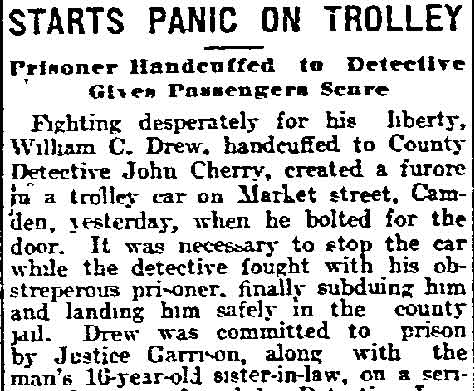
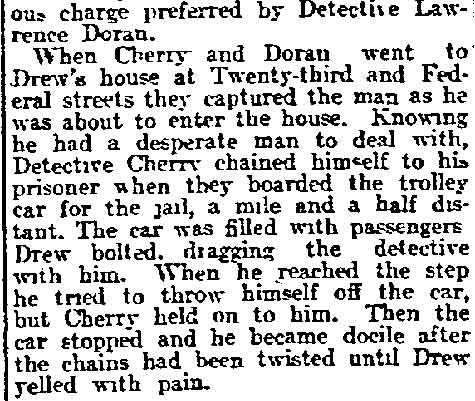
Prisoner Handcuffed to Detective Gives Passengers Scare
Fighting desperately for his liberty, William C. Drew, handcuffed to County Detective John Cherry, created a furore in a trolley car on Market street, Camden, yesterday, when he bolted for the door. It was necessary to stop the car while the detective fought with his obstreperous prisoner, finally subduing him and landing him safely in the county jail. Drew was committed to prison by Justice Garrison, along with the man’s 16-year-old sister-in-law, on a serious charge preferred by Detective Lawrence Doran.
When Cherry and Doran went to Drew’s house at Twenty-third and Federal streets they captured the man as he was about to enter the house. Knowing he had a desperate man to deal with, Detective Cherry chained himself to his prisoner when they boarded the trolley car for the jail, a mile and a half distant. The car was filled with passengers. Drew bolted, dragging the detective with him. When he reached the step he tried to throw himself off the car, but Cherry held on to him. Then the car stopped and he became docile after the chains had been twisted until Drew yelled with pain.
Probing Excise Board
Philadelphia Inquirer —
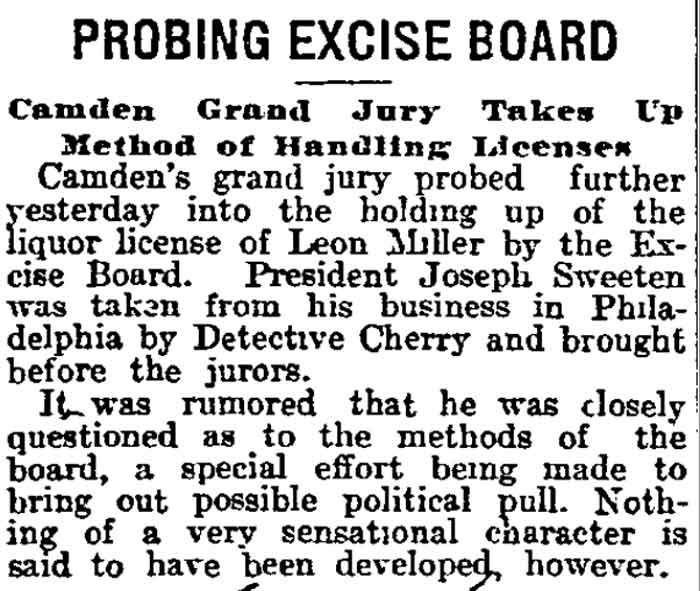
Camden Grand Jury Takes Up Method of Handling Licenses
Camden’s grand jury probed further yesterday into the holding up of the liquor license of Leon Miller by the Excise Board. President Joseph Sweeten was taken from his business in Philadelphia by Detective Cherry and brought before the jurors.
It was rumored that he was closely questioned as to the methods of the board, a special effort being made to bring out possible political pull. Nothing of a very sensational character is said to have been developed, however.
Abandons Child on Camden Road
Philadelphia Inquirer —
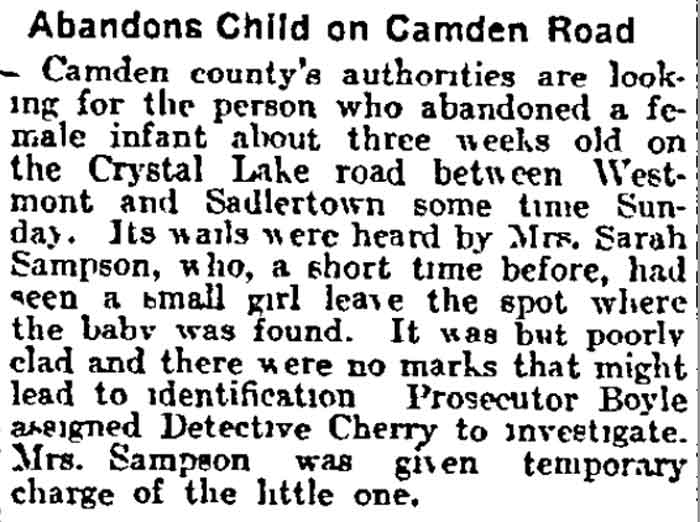
Camden county’s authorities are looking for the person who abandoned a female infant about three weeks old on the Crystal Lake road between Westmont and Sadlertown some time Sunday. Its wails were heard by Mrs. Sarah Sampson, who, a short time before, had seen a small girl leave the spot where the baby was found. It was but poorly clad and there were no marks that might lead to identification. Prosecutor Boyle assigned Detective Cherry to investigate. Mrs. Sampson was given temporary charge of the little one.
Mail Swindler Must Face Forgery Charge
Philadelphia Inquirer —
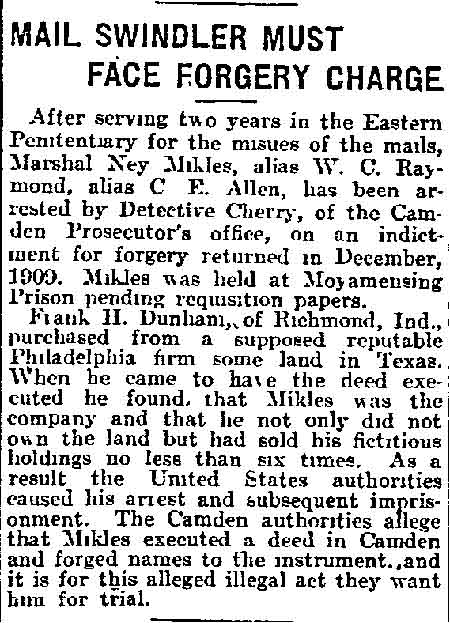
After serving two years in the Eastern Penitentiary for the misuse of the mails, Marshal Ney Mikles, alias W. C. Raymond, alias C. E. Allen, has been arrested by Detective Cherry, of the Camden Prosecutor’s office, on an indictment for forgery returned in December, 1909. Mikles was held at Moyamensing Prison pending requisition papers.
Frank H. Dunham, of Richmond, Ind., purchased from a supposed reputable Philadelphia firm some land in Texas. When he came to have the deed executed he found that Mikles was the company and that he not only did not own the land but had sold his fictitious holdings no less than six times. As a result the United States authorities caused his arrest and subsequent imprisonment. The Camden authorities allege that Mikles executed a deed in Camden and forged names to the instrument, and it is for this alleged illegal act they want him for trial.
Calvary Cemetery — Cherry Hill, New Jersey
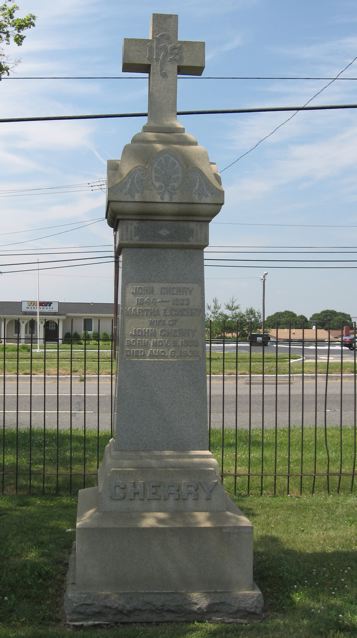
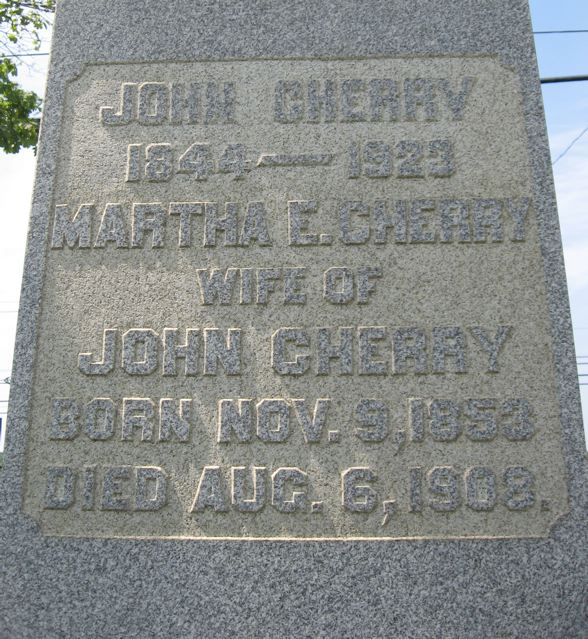
John and Martha Cherry are buried at Calvary Cemetery in Cherry Hill (formerly Delaware Township), New Jersey.