Introduction
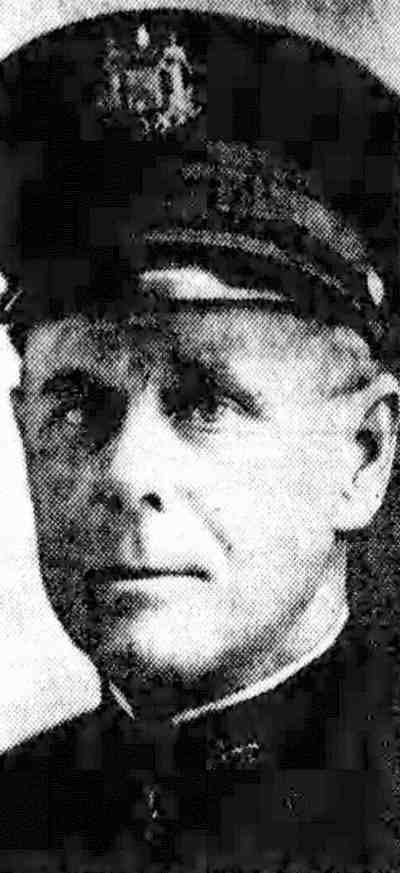
Robert T. Abbott, Camden police sergeant
ROBERT T. ABBOTT was born in Salem, New Jersey on March 21, 1866 to Benjamin P. Abbott and his wife, the former Beulah Horner. The family moved to the Wrightsville section of Stockton Township, what is now Camden, in the 1870s. The 1880 Census shows the family consisting of Mr. and Mrs. Abbott, Robert, and his younger siblings William, Flora, and Estella. Another sister, Beulah, born in 1876, had died before the end of the following year. Two more Abbott children were born in the 1880s, James Griffee Abbott and Emma Abbott. The Abbotts made their home at the corner of 24th and Federal Streets in the 1880s. Benjamin Abbott was in business as a commission merchant. By 1885, Robert T. Abbott was working for his father as a clerk.
Benjamin Abbott was active politically in Stockton Township and had served as a committeeman and as the town’s treasurer. Stockton reincorporated as the Town of Stockton, in 1894 and William Abbott served as Town Clerk in the years leading up to Camden’s annexation on Stockton.
On August 28, 1891 Robert T. Abbott married Margarette Schuck. She was the daughter of Ludwig Schuck, who operated liquor serving establishments at South 5th and Mickle Streets and at 23rd and Federal Streets in the 1880s and early 1890s, and sister of Charles Schuck, who had a 30 year long career as a newspaperman in Camden. A daughter, Edna was born in 1892. The 1892–1893 Camden City Directory shows the Abbotts at 17 North 23rd Street. 1893 saw them at 2602 Federal Street. The 1894–1895 edition shows them at 36 North 25th Street. 1896 showed a move to 2650 Federal Street. Robert Abbott worked in these years as a motorman for the Camden Horse Railroad.
On June 9, 1896, Robert T. Abbott was appointed a policeman in the Town of Stockton. In May of 1898 he was named Chief of Stockton’s Police Department and when Stockton was annexed by Camden in 1899, Robert T. Abbott was appointed to the Camden Police Department. The Abbotts lived at 114 North 24th Street in 1897 and 1898. They had moved to 116 North 24th Street by 1899, where they stayed until 1902.
Son Robert Benjamin Abbott had arrived in 1898, sadly, he died in November of 1899. Robert T. Abbott’s mother had died early in that year. Father Benjamin P. Abbott passed in 1903. Robert and Margarette Abbott were blessed with another daughter, Mabel, who was born in 1903. The Abbots were living at 2808 Federal Street that year. 1904 and 1905 found the family at 19 Church Street. 1906 saw them at 2602 Federal Street, and in 1907 and 1908 they were at 47 North 26th Street. In 1909 they were listed at 49 North 26th Street, where they appear to have stayed until 1912. These were difficult years for Robert Abbott, as his beloved wife had fallen victim to tuberculosis. The disease took her on December 12, 1910.
When the 1913 City Directory was compiled, Robert Abbott and his daughters had moved took to 119 North 23rd Street, where they stayed until 1921, when Robert T. Abbott retired.
On January 1, 1918 Robert T, Abbott was promoted to Sergeant. He served with the Camden Police Department until 1921, when he retired. Most of his time in service was spent in East Camden. Robert T. Abbott had a summer home at Wildwood Villas, and it appears that after leaving the police department, he spent much of his time there. He does not appear in Camden directories after 1921.
In his last years Robert T. Abbott lived with his daughters, Mrs. Edna Dunn and Miss Mabel Abbott, at 2891 Tuckahoe Road in Camden’s Fairview section.
Robert T. Abbott passed away on February 7, 1939 at West Jersey Hospital after a week’s illness. He was survived by his daughters, his brothers William and James and sisters Mrs. Emma Jakaway and Mrs. Florence Pennock. William Abbott had served on Camden’s Board of Education after Stockton had been annexed, and James was working as janitor of Woodrow Wilson High School when Robert T. Abbott died.
Old Stockton's Three Parks Kept Police Force on Jump
Camden Courier-Post —
Sergeant Horner Recalls Days When Horse-Drawn Patrol Toted Woozy Celebrants From Moist Recreation Centers to City Hall
East Camden used to have three parks “in the old days”—and to hear a veteran like Police Sergeant William C. Horner tell it—they certainly kept the police force “on its toes.”
Sergeant Horner, who has seen more than a quarter century of service on the police force in East Camden and is now head of the city missing persons bureau, often tells of those days.
“There was John Hoosey Park at the foot of Twenty-seventh street, Stockton Park at Twentieth and Federal streets, where Buck’s farm is now, and Pavonia Park at River road and State street,” Sergeant Horner said.
“A lot of folk from Philadelphia and other towns used to come out to the parks during the summer. There were picnic benches and dance pavilions and often some of them would imbibe too freely. It certainly used to keep us busy.
“Down in North and South Camden they used to use pushcarts to take drunks into headquarters but by the time the old town of Stockton was annexed to Camden as East Camden in 1900, the city had a horse-drawn patrol wagon that used to come slanging and clattering up Federal street from Fifth and Arch streets to be loaded with indiscreet park celebrants and sent back to headquarters.”
The old Stockton police force, according to Sergeant Horner, included 12 men with a captain and a sergeant. The captain when the annexation occurred was Robert Abbott, a brother of William S. Abbott, a member of the board of education. The former captain is now on the pension list.
Sergeant Horner can remember the days when farmland stretched from Twenty-seventh street on Federal street as far as Merchantville and along Westfield avenue from Twenty-eighth street as far as Parry.
“Anybody who moved away in those days and came back now would never recognize East Camden in these days with its paved streets, big shopping districts and acres of houses. The place sure has changed,” Sergeant Horner says.
‘Cross Cooper’s Creek
Camden Daily Courier —
Sad and Sudden Death of Mrs. Beulah Abbott Last Evening.
This community will be shocked to know of the death of Mrs. Beulah Abbott, wife of Benjamin Abbott, and mother of Town Clerk William S. Abbott and Chief Robert Abbott. It occurred yesterday afternoon at four o’clock. She was sick but a few hours. Shortly before nine o’clock, apparently as well as ever in her life, she went out in the back of the house to sweep some snow away. She had scarcely started the work when she came into the house and complained of feeling dizzy. Her daughter Flora, supposing her to be only in a faint, was not immediately alarmed until the mother took on a strange expression. Assistance was at once called in, and the doctor sent for, as were also the absent members of the family. It was soon learned that she had received a stroke. In a short time she became unconscious and remained in that state until she died, recognizing none of the family that were at her bedside. She sank rapidly during the afternoon and at four o’clock died without a struggle.
In the score or more of years she has lived here, Mrs. Abbott has been better known in the town by her peculiar devotedness to her home. Her whole life and ambition was devoted to the comfort and welfare of her family left to mourn her loss. Her motherly sacrifices and devotion will forever be cherished by them. In every sense of the words, Mrs. Abbott was both a mother and a wife. That she will be missed from home and community does not fully express the general feeling. Three daughters, Flora, Emma and Essie, and three sons, William, Robert and James, with the husband, are left, to whom the heart of the people here go out in sympathy. The funeral will take place on Friday at 2 o’clock from her late residence, 2602 Federal street.
Camden Daily Courier — April 21, 1899
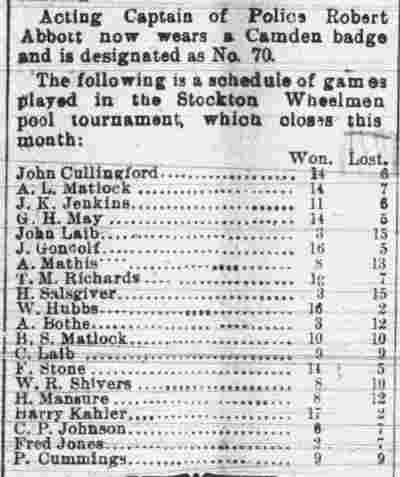
Acting Captain of Police Robert Abbott now wears a Camden badge and is designated as No. 70.
The following is a schedule of games played in the Stockton Wheelmen pool tournament, which closes this month:
Acting Captain of Police Robert Abbott now wears a Camden badge and is designated as No. 70.
The following is a schedule of games played in the Stockton Wheelmen pool tournament, which closes this month:
| Player | Won | Lost |
|---|---|---|
| John Cullingford | 14 | 6 |
| A. L. Matlock | 14 | 7 |
| J. K. Jenkins | 11 | 6 |
| G. H. May | 14 | 5 |
| John Laib | 3 | 15 |
| J. Gondolf | 16 | 5 |
| A. Mathis | 8 | 13 |
| T. M. Richards | 16 | 7 |
| H. Salsgiver | 3 | 15 |
| W. Hubbs | 16 | 2 |
| A. Boths | 3 | 12 |
| H. S. Matlock | 10 | 10 |
| C. Laib | 9 | 9 |
| F. Stone | 14 | 5 |
| W. R. Shivers | 8 | 19 |
| H. Mansure | 8 | 12 |
| Harry Kahler | 17 | 2 |
| C. P. Johnson | 6 | 7 |
| Fred Jones | 2 | 7 |
| P. Cummings | 9 | 9 |
Bluecoats for East End
Camden Daily Courier —
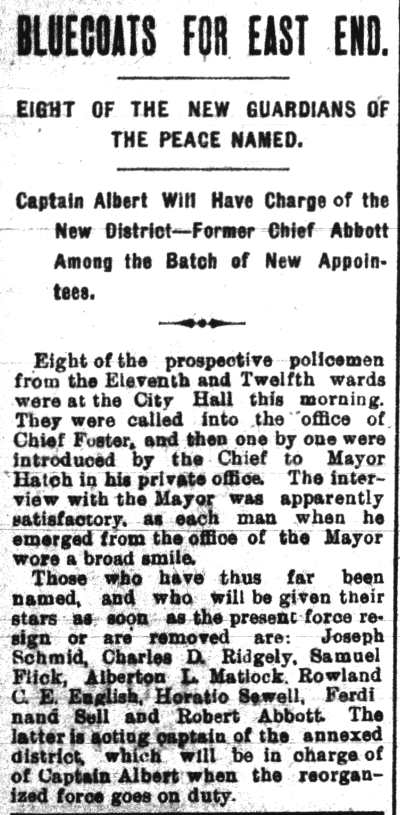
Eight of the New Guardians of the Peace Named.
Captain Albert Will Have Charge of the New District—Former Chief Abbott Among the Batch of New Appointees.
Eight of the prospective policemen from the Eleventh and Twelfth wards were at the City Hall this morning. They were called into the office of Chief Foster, and then one by one were introduced by the Chief to Mayor Hatch in his private office. The interview with the Mayor was apparently satisfactory, as each man when he emerged from the office of the Mayor wore a broad smile.
Those who have thus far been named, and who will be given their stars as soon as the present force resign or are removed are: Joseph Schmid, Charles D. Ridgely, Samuel Flick, Alberton L. Matlock, Rowland C. E. English, Horatio Sewell, Ferdinand Sell and Robert Abbott. The latter is acting captain of the annexed district, which will be in charge of Captain Albert when the reorganized force goes on duty.
Mystery of a Swamp
Harrisburg Patriot —
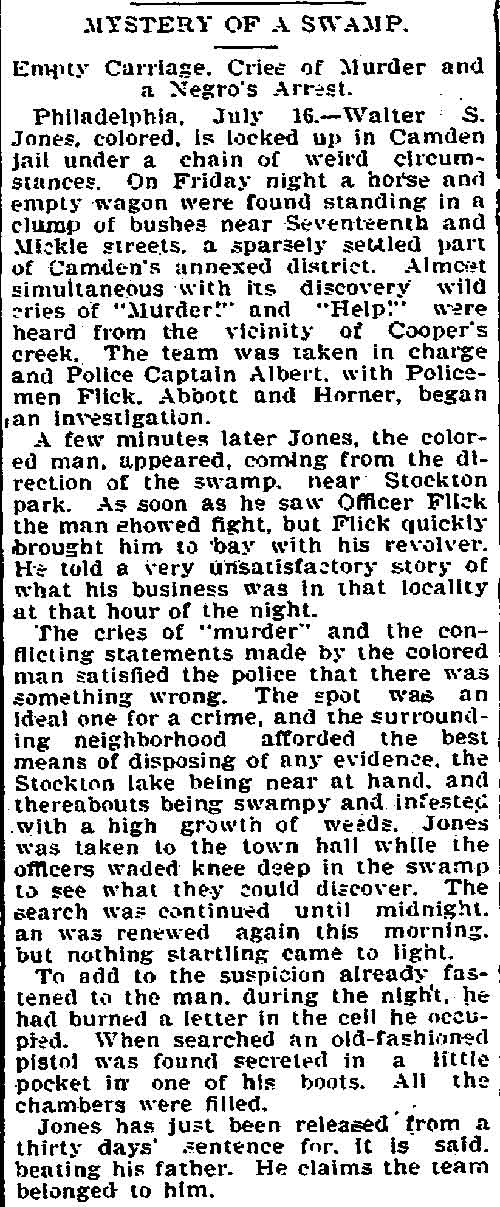
Empty Carriage. Cries of Murder and a Negro’s Arrest.
Philadelphia, July 16.—Walter S. Jones, colored, is locked up in Camden jail under a chain of weird circumstances. On Friday night a horse and empty wagon were found standing in a clump of bushes near Seventeenth and Mickle streets, a sparsely settled part of Camden’s annexed district. Almost simultaneous with its discovery wild cries of “Murder!” and “Help!” were heard from the vicinity of Cooper’s creek. The team was taken in charge and Police Captain Albert, with Policemen Flick, Abbott and Horner, began an investigation.
A few minutes later Jones, the colored man, appeared, coming from the direction of the swamp, near Stockton park. As soon as he saw Officer Flick the man showed fight, but Flick quickly brought him to bay with his revolver. He told a very unsatisfactory story of what his business was in that locality at that hour of the night.
The cries of “murder” and the conflicting statements made by the colored man satisfied the police that there was something wrong. The spot was an ideal one for a crime, and the surrounding neighborhood afforded the best means of disposing of any evidence, the Stockton lake being near at hand, and thereabouts being swampy and infested with a high growth of weeds. Jones was taken to the town hall while the officers waded knee deep in the swamp to see what they could discover. The search was continued until midnight, an was renewed again this morning [sic], but nothing startling came to light.
To add to the suspicion already fastened to the man, during the night, he had burned a letter in the cell he occupied. When searched an old-fashioned pistol was found secreted in a little pocket in one of his boots. All the chambers were filled.
Jones has just been released from a thirty days’ sentence for, it is said, beating his father. He claims the team belonged to him.
Louise Hogan Gets Thirty Days
Camden Post-Telegram —
Louise Hogan was again in Police Court this morning—this time a defendant herself. After the release yesterday of Howard Starn, who Miss Hogan had accused of assault, she proceeded to get drunk. She succeeded and was arrested by Policeman Abbott. The Recorder gave her thirty days.
Benjamin Abbott Dead
Camden Post-Telegram —
Benjamin P. Abbott, father of former Clerk of the Town of Stockton William S. Abbott and Policeman Robert Abbott, died last night after a long illness. Deceased was well well known [sic] in the East Side. In the old township days he held the office of Township Committeeman and always took an active part in politics. No arrangements have yet been made for the funeral.
Brief News Notes
Camden Daily Courier —
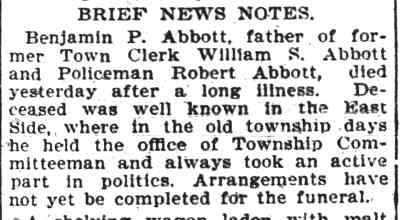
Benjamin P. Abbott, father of former Town Clerk William S. Abbott and Policeman Robert Abbott, died yesterday after a long illness. Deceased was well known in the East Side, where in the old township days he held the office of Township Committeeman and always took an active part in politics. Arrangements have not yet been completed for the funeral.
Camden Post-Telegram — November 3, 1906
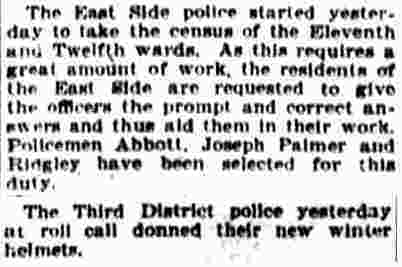
The East Side police started yesterday to take the census of the Eleventh and Twelfth wards. As this requires a great amount of work, the residents of the East Side are requested to give the officers the prompt and correct answers and thus aid them in their work. Policemen Abbott, Joseph Palmer and Ridgley have been selected for this duty.
The Third District police yesterday at roll call donned their new winter helmets.
Mrs. Abbott Dies in Her Husband’s Arms
Camden Post-Telegram —
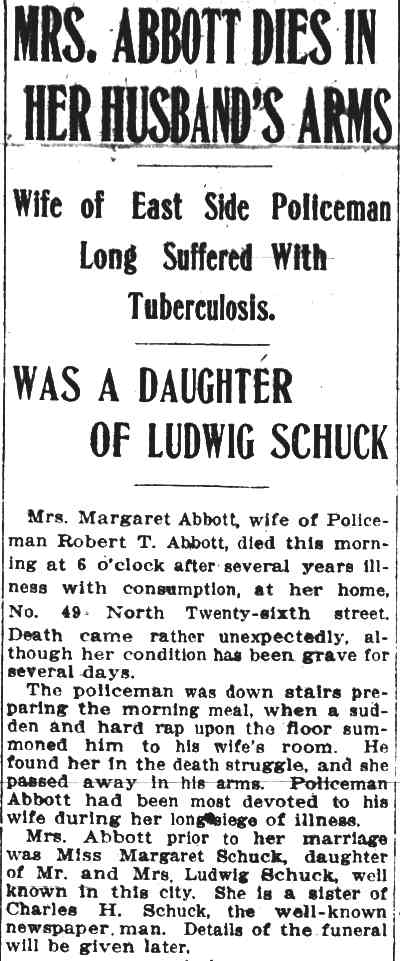
Wife of East Side Policeman Long Suffered With Tuberculosis.
Was a Daughter of Ludwig Schuck
Mrs. Margaret Abbott, wife of Policeman Robert T. Abbott, died this morning at 6 o’clock after several years illness with consumption, at her home, No. 49 North Twenty-sixth street. Death came rather unexpectedly, although her condition has been grave for several days.
The policeman was down stairs preparing the morning meal, when a sudden and hard rap upon the floor summoned him to his wife’s room. He found her in the death struggle, and she passed away in his arms. Policeman Abbott had been most devoted to his wife during her long siege of illness.
Mrs. Abbott prior to her marriage was Miss Margaret Schuck, daughter of Mr. and Mrs. Ludwig Schuck, well known in this city. She is a sister of Charles H. Schuck, the well-known newspaper man. Details of the funeral will be given later.
Boy’s Brutal Murderer Collapses at Hearing
Camden Post-Telegram —
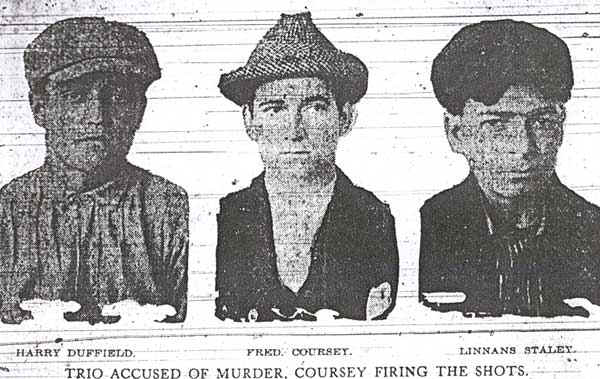
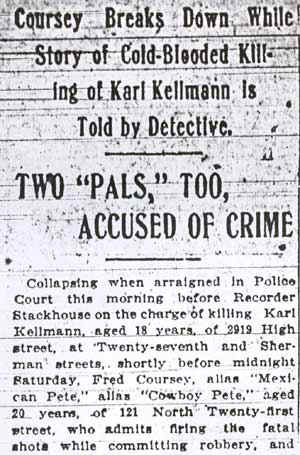
Coursey Breaks Down While Story of Cold-Blooded Killing of Karl Kellmann Is Told by Detective.
Two “Pals,” Too, Accused of Crime
Collapsing when arraigned in Police Court this morning before Recorder Stackhouse on the charge of killing Karl Kellmann, aged 18 years, of 2919 High street, at Twenty-seventh and Sherman streets, shortly before midnight Saturday, Fred Coursey, alias “Mexican Pete,” alias “Cowboy Pete,” aged 20 years, of 121 North Twenty-first street, who admits firing the fatal shots while committing robbery, and Harry Duffield, aged 21 years, of 407 North Forty-first street, who acknowledged masking his face with a handkerchief and being with Coursey, sobbed piteously, resting their heads on the railing of the dock, while John Painter, the veteran detective, was briefly reciting the story.
When Recorder Stackhouse asked what became of the young man who was shot and Painter replied that he died, Coursey and Duffield sobbed afresh, and when Recorder Stackhouse committed them without bail Policemen Frost and Kay had to help them.
Linnans Staley, aged 21 years, of 1819 Federal street, who confessed that he was in the robbery plot but later got scared and hid in the bushes, was scarcely able to stand, and when his mother broke down as he was committed as a principal he staggered and would have fallen but for Sergeant McClong.
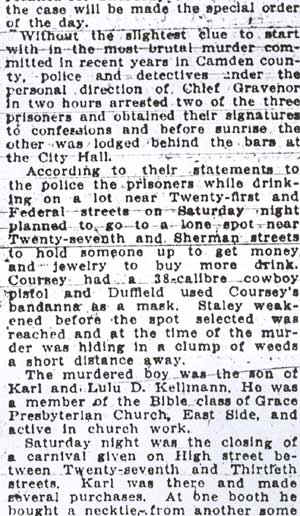
Prosecutor Boyle announced this morning that the Grand Jury will be recalled for Thursday of this week and the case will be made the special order of the day.
Without the slightest clue to start with in the most brutal murder committed in recent years in Camden county, police and detectives under the personal direction of Chief Gravenor in two hours arrested two of the three prisoners and obtained their signatures to confessions and before sunrise the other was lodged behind the bars at the City Hall.
According to their statements to the police the prisoners while drinking on a lot near Twenty-first and Federal streets on Saturday night planned to go to a lone spot near Twenty-seventh and Sherman streets to hold someone up to get money and jewelry to buy more drink. Coursey had a 38-calibre cowboy pistol and Duffield used Coursey’s bandanna as a mask. Staley weakened before the spot selected was reached and at the time of the murder was hiding in a clump of weeds a short distance away.
The murdered boy was the son of Karl and Lulu D. Kellmann. He was a member of the Bible class of Grace Presbyterian Church, East Side, and active in church work.
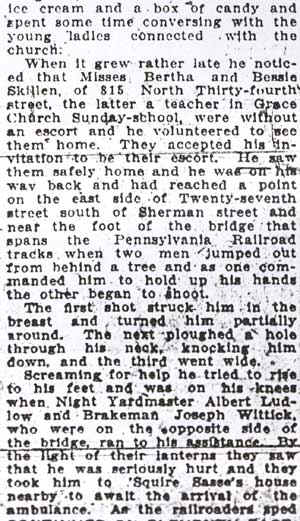
Saturday night was the closing of a carnival given on High street between Twenty-seventh and Thirtieth streets. Karl was there and made several purchases. At one booth he bought a necktie, from another some ice cream and a box of candy and spent some time conversing with the young ladies connected with the church.
When it grew rather late he noticed that Misses Bertha and Bessie Skillen, of 815 North Thirty-fourth street, the latter a teacher in Grace Church Sunday-school, were without an escort and he volunteered to see them home. They accepted his invitation to be their escort. He saw them safely home and he was on his way back and had reached a point on the east side of Twenty-seventh street south of Sherman street and near the foot of the bridge that spans the Pennsylvania Railroad tracks when two men jumped out from behind a tree and as one commanded him to hold up his hands the other began to shoot.
The first shot struck him in the breast and turned him partially around. The next ploughed a hole through his neck, knocking him down, and the third went wide.
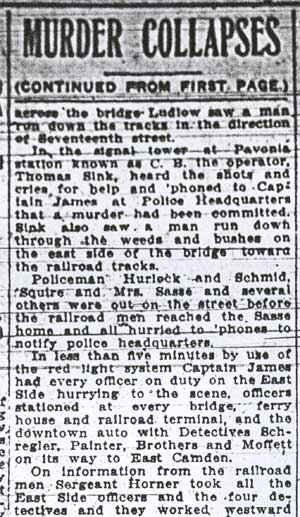
Screaming for help he tried to rise to his feet and was on his knees when Night Yardmaster Albert Ludlow and Brakeman Joseph Wittick, who were on the opposite side of the bridge, ran to his assistance. By the light of their lanterns they saw that he was seriously hurt and they took him to ‘Squire Sasse’s house nearby to await the arrival of the ambulance. As the railroaders sped across the bridge Ludlow saw a man run down the tracks in the direction of Seventeenth street.
In the signal tower at Pavonia station known as C. B. the operator, Thomas Sink, heard the shots and cries for help and ‘phoned to Captain James at Police Headquarters that a murder had been committed. Sink also saw a man run down through the weeds and bushes on the east side of the bridge toward the railroad tracks.
Policeman Hurlock and Schmid, ‘Squire and Mrs. Sasse and several others were out on the street before the railroad men reached the Sasse home and all hurried to ‘phones to notify police headquarters.
In less than five minutes by use of the red light system Captain James had every officer on duty on the East Side hurrying to the scene, officers stationed at every bridge, ferry house and railroad terminal, and the downtown auto with Detectives Schregler, Painter, Brothers and Moffett on its way to East Camden.
On information from the railroad men Sergeant Horner took all the East Side officers and the four detectives and they worked westward among the cars while Captain James started Policemen Colsey and Kelly to walk eastward from Fifteenth street until they met the main body.
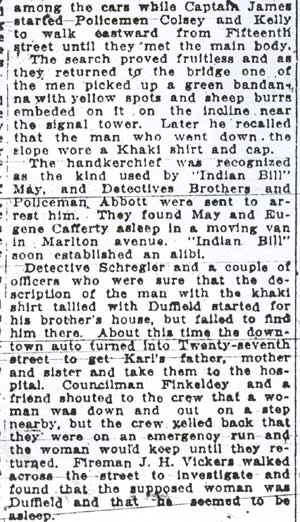
The search proved fruitless and as they returned to the bridge one of the men picked up a green bandanna with yellow spots and sheep burrs embedded on it on the incline near the signal tower. Later he recalled that the man who went down the slope wore a Khaki shirt and cap.
The handkerchief was recognized as the kind used by “Indian Bill” May, and Detectives Brothers and Policeman Abbott were sent to arrest him. They found May and Eugene Cafferty asleep in a moving van in Marlton avenue. “Indian Bill” soon established an alibi.
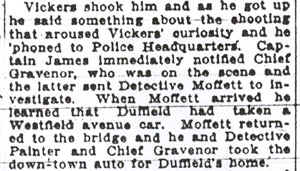
Detective Schregler and a couple of officers who were sure that the description of the man with the khaki shirt tallied with Duffield started for his brother’s house, but failed to find him there. About this time the downtown auto turned into Twenty-seventh street to get Karl’s father, mother and sister and take them to the hospital. Councilman Finkeldey and a friend shouted to the crew that a woman was down and out on a step nearby, but the crew yelled back that they were on an emergency run and the woman would keep until they returned. Fireman J. H. Vickers walked across the street to investigate and found that the supposed woman was Duffield and that he seemed to be asleep.
Vickers shook him and as he got up he said something about the shooting that aroused Vickers’ curiosity and he ‘phoned to Police Headquarters. Captain James immediately notified Chief Gravenor, who was on the scene and the latter sent Detective Moffett to investigate. When Moffett arrived he learned that Duffield had taken a Westfield avenue car. Moffett returned to the bridge and he and Detective Painter and Chief Gravenor took the down-town auto for Duffield’s home.
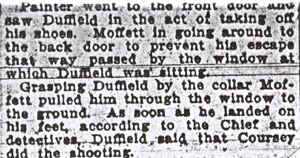
Painter went to the front door and saw Duffield in the act of taking off his shoes. Moffett in going around to the back door to prevent his escape that way passed by the window at which Duffield was sitting.
Grasping Duffield by the collar Moffett pulled him through the window to the ground. As soon as he landed on his feet, according to the Chief and detectives, Duffield said that Coursey did the shooting.
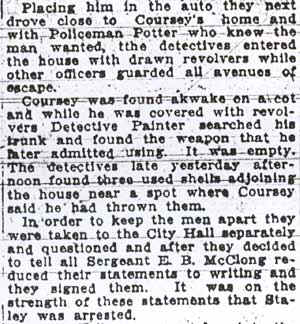
Placing him in the auto they next drove close to Coursey’s home and with Policeman Potter who knew the man wanted, the detectives entered the house with drawn revolvers while other officers guarded all avenues of escape.
Coursey was found awake on a cot and while he was covered with revolvers Detective Painter searched his trunk and found the weapon that he later admitted using. It was empty. The detectives late yesterday afternoon found three used shells adjoining the house near a spot where Coursey said he had thrown them.
In order to keep the men apart they were taken to the City Hall separately and questioned and after they decided to tell all Sergeant E. B. McClong reduced their statements to writing and they signed them. It was on the strength of these statements that Staley was arrested.
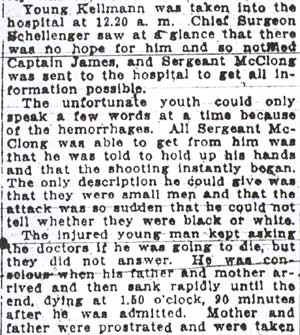
Young Kellmann was taken into the hospital at 12.20 a. m. Chief Surgeon Schellenger saw at a glance that there was no hope for him and so notified Captain James, and Sergeant McClong was sent to the hospital to get all information possible.
The unfortunate youth could only speak a few words at a time because of the hemorrhages. All Sergeant McClong was able to get from him was that he was told to hold up his hands and that the shooting instantly began. The only description he could give was that they were small men and that the attack was so sudden that he could not tell whether they were black or white.
The injured young man kept asking the doctors if he was going to die, but they did not answer. He was conscious when his father and mother arrived and then sank rapidly until the end, dying at 1.50 o’clock, 90 minutes after he was admitted. Mother and father were prostrated and were taken home by the up-town auto.
County Physician Jones conducted the autopsy yesterday morning. He said that either wound would have caused death. The bullet in the breast pierced the right lung at the top and lodged in the cavity. It is now in the doctor’s possession. The other bullet went clear through the neck.
Coursey and Duffield have been working in the Pavonia car yard. The former was born in El Paso, Texas, but has lived East nearly all his life. He is an expert shot and was a member of the vaudeville team of Coursey & Cook, according to their letter heads presenting a fifteen-minute thriller.
Duffield was only recently paroled for robbing Gallagher’s saloon, Nineteenth and Federal streets of a lot of drinkables. Staley has been arrested several times on petty charges but was never convicted of crime. When Duffield’s coat was examined at the City Hall, it was found to contain sheep burrs.
To a reporter Coursey said that whenever he was drinking he had to get his gun and shoot something or somebody. He insisted that all were in on the job and that they let the man who preceded Kellman go over the bridge without molestation because he didn’t look as if he had any too much money.
Yesterday morning Assistant Prosecutor Wolverton and Stenographer Cleary called at the City Hall. The prisoners were examined by Mr. Wolverton and their statements taken by Mr. Cleary, but there was little or nothing new elicited.
3 Policemen Hurt as Car Hits Ambulance
Philadelphia Inquirer —
Collision Occurs as Machine Speeds to Home of Man Who Attempted Suicide
Three Camden policemen were injured, one of them seriously, last night, when the First district auto ambulance was struck by a trolley car while responding to a call from 2310 Carman street, where Bodine Stratton, 59 years old, had shot himself over the heart. All were taken to Cooper Hospital.
Policeman Harry Newton, of Twenty-sixth and Sherman avenue, received a probable fracture of the skull; Policeman George R. Thompson, of 251 Mt. Vernon street, had his face and head badly lacerated, while Policeman Robert Abbott, of 110 North Twenty-third street, was cut and bruised. Stratton was seriously hurt by his self-inflicted wound.
When the call for aid came the ambulance, in charge of Patrolmen J. Oscar Weaver and Thompson, was sent to the Stratton house. It was crossing Westfield avenue at Thirtieth when a trolley car crashed into the rear. The three injured men were thrown against the side of the machine, although it was not wrecked. Weaver and Sergeant Golden took them to the hospital.
Stratton had been despondent, according to his wife, and it was while she was in the yard that she heard the shot, finding her husband lying on the floor with a bullet wound over his heart.
Police Department Changes
Philadelphia Inquirer —
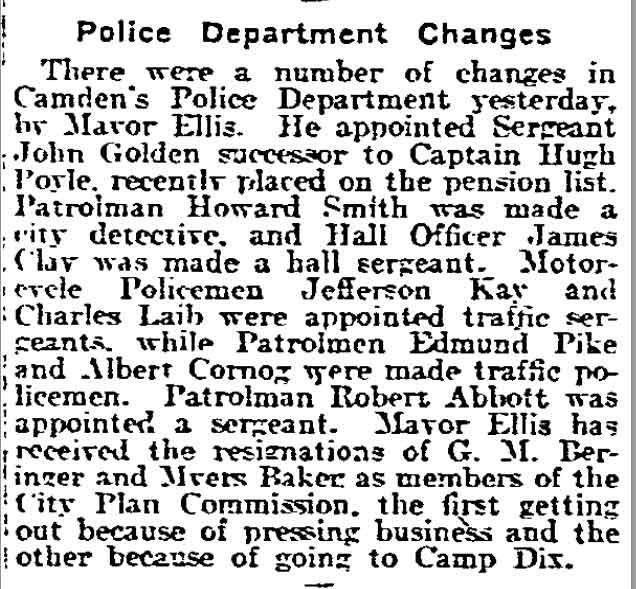
There were a number of changes in Camden’s Police Department yesterday, by Mayor Ellis. He appointed Sergeant John Golden successor to Captain Hugh Boyle, recently placed on the pension list. Patrolman Howard Smith was made a city detective, and Hall Officer James Clay was made a hall sergeant. Motorcycle Policemen Jefferson Kay and Charles Laib were appointed traffic sergeants, while Patrolmen Edmund Pike and Albert Cornog were made traffic policemen. Patrolman Robert Abbott was appointed a sergeant. Mayor Ellis has received the resignations of G. M. Beringer and Myers Baker as members of the City Plan Commission, the first getting out because of pressing business and the other because of going to Camp Dix.
Robert Abbott Dies, Ex-Policeman Here
Camden Courier-Post —
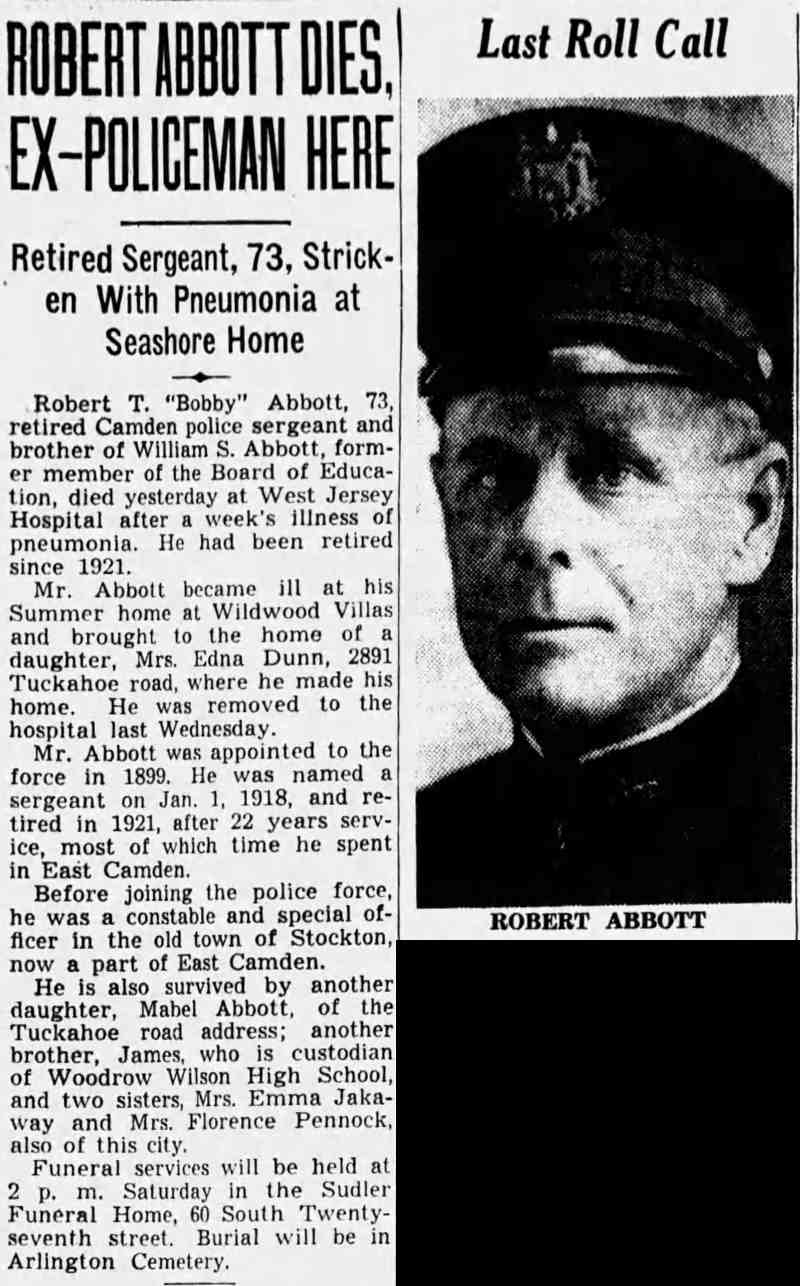
Retired Sergeant, 73, Stricken With Pneumonia at Seashore Home
Robert T. “Bobby” Abbott, 73, retired Camden police sergeant and brother of William S. Abbott, former member of the Board of Education, died yesterday at West Jersey Hospital after a week’s illness of pneumonia. He had been retired since 1921.
Mr. Abbott became ill at his Summer home at Wildwood Villas and brought to the home of a daughter, Mrs. Edna Dunn, 2891 Tuckahoe road, where he made his home. He was removed to the hospital last Wednesday.
Mr. Abbott was appointed to the force in 1899. He was named a sergeant on Jan. 1, 1918, and retired in 1921, after 22 years service, most of which time he spent in East Camden.
Before joining the police force, he was a constable and special officer in the old town of Stockton, now a part of East Camden.
He is also survived by another daughter, Mabel Abbott, of the Tuckahoe road address; another brother, James, who is custodian of Woodrow Wilson High School, and two sisters, Mrs. Emma Jakaway and Mrs. Florence Pennock, also of this city.
Funeral services will be held at 2 p. m. Saturday in the Sudler Funeral Home, 60 South Twenty-seventh street. Burial will be in Arlington Cemetery.
Camden Courier-Post — February 8, 1939
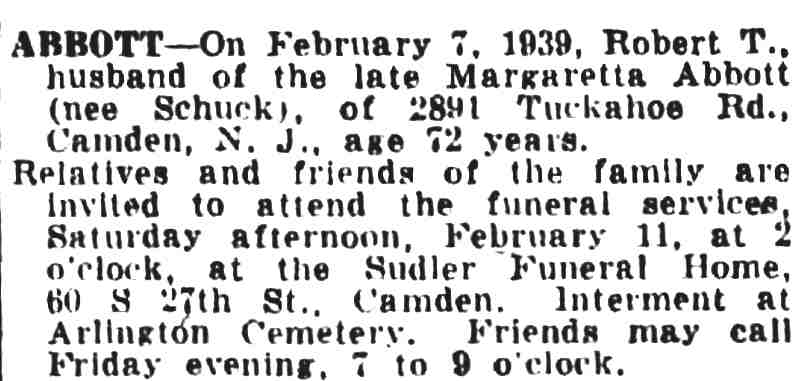
Robert T. Abbott — Tuckahoe Road
ABBOTT—On February 7, 1939, Robert T., husband of the late Margaretta Abbott (nee Schuck), of 2891 Tuckahoe Rd., Camden, N. J., age 72 years.
Relatives and friends of the family are invited to attend the funeral services, Saturday afternoon, February 11, at 2 o’clock, at the Sudler Funeral Home, 60 S. 27th St., Camden. Interment at Arlington Cemetery. Friends may call Friday evening, 7 to 9 o’clock.