First Methodist Episcopal Church
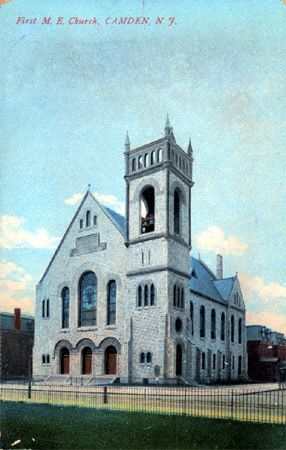
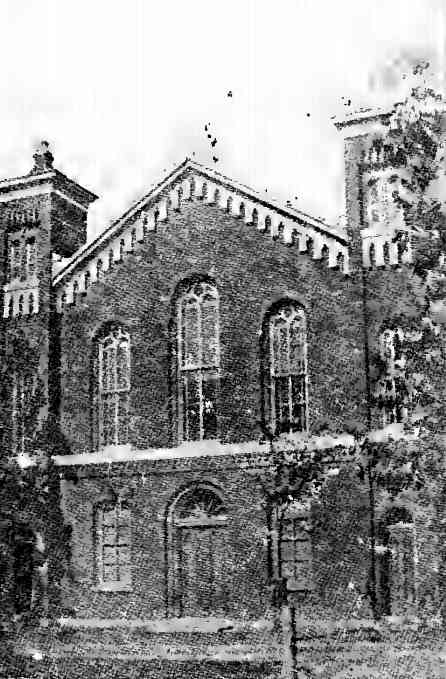
Named: Southwest Corner of South 6th & Stevens Streets, First Methodist Episcopal Church, 301 South 6th Street, Postcard based on 1890s photograph, and Razed in 2005.
The First Methodist Episcopal Church was founded in 1809. It was known as Third Street Methodist Episcopal Church from 1899 until its moving into a new building on June 5, 1893. The Third Street church was, in fact, the first Methodist Episcopal church in Camden, so the name was quite appropriate, especially as how the congregation was no longer on Third Street, and was also known prior to the move, as First Methodist. George Reeser Prowell noted their activities at the outbreak of the Civil War in his History of Camden County, New Jersey.
On the 22nd of April Samuel H. Grey made an address before the Board of Freeholders in a patriotic appeal, soliciting the board to make appropriations for the relief of families of volunteer soldiers. John S. Read offered a resolution favoring the appropriation of five thousand dollars, which was unanimously adopted. On the evening of the 25th the City Council voted four hundred dollars for the same purpose. On the same evening the First Methodist Episcopal Church of Camden collected one hundred and fifty dollars and purchased five hundred Bibles for the volunteer soldiers of Camden County.
The $150 dollars raised, being quite a significant sum in 1861, bears testimony to the standing of this church and its members in Camden at that time.
The church was always one of Camden’s more prominent churches, and remained so for many years, possibly in part to its proximity to City Hall and Cooper Hospital, which stood directly across the street. This church was built on land bought, with well-known Camden realtor George W. Jessup Sr. handling the transaction.
Prominent members of the church during its years on South 6th Street included J. Hartley Bowen, Colonel William H. Cooper, Joseph H. Murray, Charles T. Murray, James M. Cassady, and Samuel Barrett.
Two lists of pastors, one through 1886 and another through 1909, are below. Reverend Thomas Brock was pastor in 1924. Reverend Carlton Van Hook was the pastor in the late 1920s and early 1930s. By the spring of 1933 the Reverend George Yard was leading the church. The Reverend J.S. Pemberton led the church by February of 1938. The church is not listed, however in the 1956 New Jersey Bell Telephone Directory.
Sadly, the beautiful church at 6th and Stevens was razed by the management of Cooper Hospital in 2005 to make way for a parking garage.
From Prowell's History of Camden County, N.J.
George Reeser Prowell — 1886
Exactly when Methodist preachers, local or itinerant, commenced preaching at Camden is unknown, but in 1797, Rev. Benjamin Fisler, M.D., of Port Elizabeth, N. J., preached here several times, and we find subsequently that local preachers from St. George’s Church, in Philadelphia, made Camden one of their preaching-places.
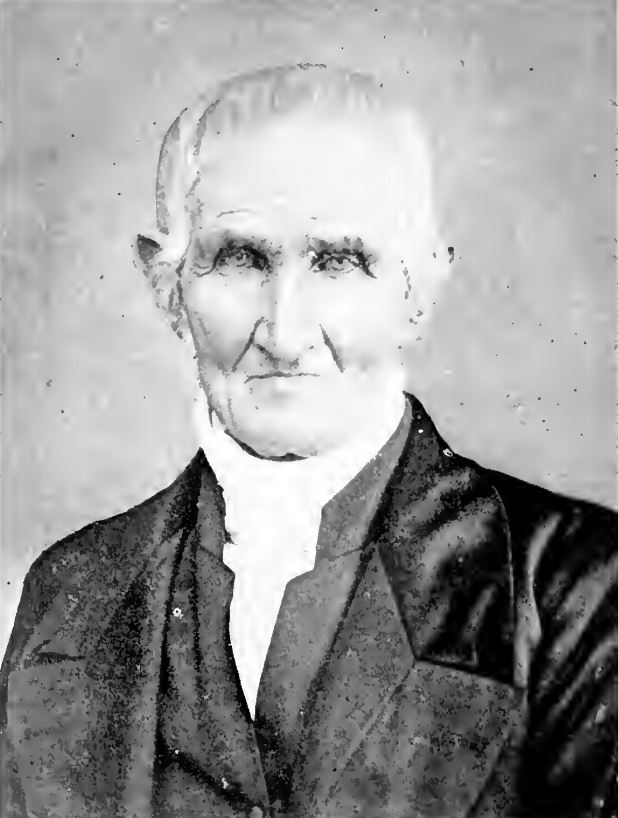
Dr. Benjamin Fisler
In 1808 the New Jersey District of the Philadelphia Conference was formed, with Joseph Totten presiding elder, and an appointment called “Gloucester Circuit” created, which included what is now Camden. Revs. Richard Sneath and William S. Fisher were appointed as preachers of the new circuit and the following year, 1809, Richard Sneath formed the first regular class in Camden, composed of James and Elizabeth Duer, Henry and Susannah Sawn, William and Martha Price and Phebe Peters, of which James Duer was appointed leader. Services by the circuit preachers were held once every two weeks, on Wednesday evening, in the academy which formerly stood on the corner of Market Street and Sixth. The same year, finding the academy insufficient for their wants, a regular church organization having been formed in the meantime, it was determined to erect a house of worship. A lot on the corner of Fourth Street and Federal was secured and a board of trustees elected, composed of James Duer, Jonathan Petherbridge, Henry Sawn and William Price, and the corporate name of “The Methodist Episcopal Church of Camden” given to the new organization. James Duer and Jonathan Petherbridge were made a building committee. Before the building was completed, Thomas Dunn, one of the preachers on the Gloucester Circuit, preached the first sermon in it from the text, “Who commanded you to build this house and to make up these walls?” The church was dedicated on the 25th of November, 1810, by Presiding Elder Joseph Totten. This was the first house of worship erected in the city of Camden and is still standing near the original site, corner of Fourth and Federal Streets.
In 1834, the congregation having so increased, it was determined to erect a new building more in keeping with the importance of the society and better adapted to its wants. During this time Camden was connected with Gloucester or Burlington Circuits, but it was then thought that it should become a station. Accordingly, a lot on Third Street, between Bridge Avenue and Federal Street, was purchased, and on the Fourth of July, 1834, the cornerstone of a new church was laid with appropriate services. December 14th, following, the church was dedicated by Rev. Charles Pitman, assisted by the pastor, Rev. William Granville. The new building cost about eight thousand dollars. In this new building the society did its work for over thirty years, increasing in numbers rapidly, especially during the great revival in 1837. The church building had been enlarged and improved to meet its increased wants, at considerable expense, and it was a crushing blow to the society when, on the 20th of November, 1867, the building was totally destroyed by fire, with but a slight insurance on it. But though for a moment paralyzed, the congregation soon recovered itself and, with commendable energy, immediately began the erection of a new building, and appointed Rev. Charles H. Whitecar, pastor, S. S. E. Cowperthwait, Thomas B. Atkinson, Morton Mills, E. S. Johnson and James M. Cassady a building committee to superintend the work. The lots on Third and Mickle Streets and Bridge Avenue were purchased, and the work was pushed forward with so much energy that the present beautiful house of worship, with a seating capacity of about fourteen hundred, and costing, with the lot, some sixty thousand dollars, was dedicated on September 1, 1869, in the presence of an immense concourse of people, by Bishop Simpson and the pastor, Rev. C. H. Whitecar.
In all its history this church has been firm in its adherence to the polity of the Methodist Episcopal Church, and in its support to the various religious work of the denomination.
Early in the history of this society, vigorous work in the Sunday school cause was commenced and has been unflagging in it ever since. The present Sunday school numbers over six hundred members, with sixty officers and teachers. Dr. William Shafer is its present superintendent. The church has had the following pastors:
| Year | Senior Preacher | Junior / Associate |
|---|---|---|
| 1809 | Richard Sneath | |
| 1809 | Thomas Dunn | Charles Read |
| 1810 | Peter Vannest | Joseph Osborn, Thomas Davis |
| 1811 | John Woolston | |
| 1812 | Joseph Osborn | John Woolston |
| 1813 | George Wooley | John Price |
| 1814 | George Wooley | Joseph Lybrand |
| 1815 | John Van Schoick | Joseph Rusling |
| 1816 | John Van Schoick | John Fox |
| 1817 | James Moore | Joseph Lybrand |
| 1818 | Solomon Sharp | David Best |
| 1819 | John Walker | James Long |
| 1820 | John Walker | John Potts |
| 1821 | John Potts | Benjamin Collins |
| 1822 | Sylvester G. Hill | Waters Burrows |
| 1823 | Sylvester G. Hill | Joseph Carey |
| 1824 | David Daily | Joseph Osborn |
| 1825 | Jacob Gruber | Wesley Wallace |
| 1826 | George Wooley | Robert Gerry |
| 1827 | George Wooley | Thomas Sovereign |
| 1828 | Henry Boehm | Levin M. Prettyman |
| 1829 | Henry Boehm | W.W. Foulks, Samuel Throckmorton |
| 1830 | William W. Foulks | Joseph Ashbrook |
| 1831 | John Walker | Jefferson Lewis |
| 1832 | John Walker | |
| 1833 | Edward Page | David W. Bartine |
| 1834–1835 | William Granville | |
| 1836 | Thomas Neal | |
| 1837 | James H. Dandy | |
| 1838–1839 | Joseph Ashbrook | |
| 1840 | John K. Shaw | William A. Brooks |
| 1841 | John K. Shaw | |
| 1842 | John L. Lenhart | |
| 1843–1844 | Isaac Winner | |
| 1845 | Abram K. Street | Elwood H. Stokes |
| 1846 | Abram K. Street | |
| 1847 | David W. Bartine | George A. Reybold |
| 1848 | David W. Bartine | Isaac S. Corbit |
| 1849 | Charles H. Whitecar | William H. Jeffreys |
| 1850 | Charles H. Whitecar | |
| 1851 | Isaac N. Felch | |
| 1852 | Richard W. Petherbridge | |
| 1853–1854 | James O. Rogers | |
| 1855 | John W. McDougal | |
| 1856–1857 | William E. Perry | |
| 1858–1859 | Elwood H. Stokes | |
| 1860–1861 | Samuel Y. Monroe | |
| 1862–1863 | Joseph R. Dobbins | |
| 1864–1866 | Samuel Vansant | |
| 1867–1869 | Charles H. Whitecar | |
| 1870–1871 | John H. Heisler | |
| 1872–1874 | Charles E. Hill | |
| 1875–1877 | Charles B. Hartranft | Pennel Coombs |
| 1878–1880 | J.B. Graw | |
| 1881–1883 | William W. Moffet | |
| 1884–1886 | G.B. Wight |
Since its organization, in 1809, Third Street Church has sent out the following church organizations, all of them at present flourishing churches in Camden, which are Union Church, Broadway Church, Tabernacle Church and Centenary Church.
From The Centennial History of Camden Methodism
Published 1909
History of the First Methodist Episcopal Church of Camden, N. J.
1809 was truly the “annus mirabilis.” That year chronicles the advent of the immortal Alfred Tennyson, the never-to-be-forgotten Oliver Wendell Holmes, the Grand Old Man, William Ewart Gladstone, and the best type of American manhood that ever lived — Abraham Lincoln.
These facts alone would have made 1809 a wonderful year. But the organization of the Methodist Episcopal Church in Camden must have its share of glory in that great epoch.
In April, 1809, the Holy Spirit led the Rev. Richard Sneath, who traveled the Gloucester circuit, to organize a class in the unpretentious village of Camden, then familiarly known as “Billy Cooper’s Ferry.” James Duer, a member of Street George Methodist Episcopal Church, of Philadelphia, having moved to Camden, was chosen the leader of the class. Seven persons constituted the class: James and Elizabeth Duer, Henry and Susanna Sawn, William and Martha Price and Phebe Peters. Hence we — “See how great a flame aspires, Kindled by a spark of grace.”
The first settlers of Camden were Friends, who built a meeting house on Mt. Vernon street in 1801. This building stands intact to-day, and doubtless the Camden Historical Society will safeguard and preserve it to posterity.
The Methodist Episcopal Church preceded all other denominations, save the Friends, by at least eight years. The Baptists were the next to follow as workers in the Lord’s vineyard in Camden.
When this regiment of the Lord’s army known as Methodists camped at Billy Cooper’s Ferry, there was no barrack for their shelter. In a certain sense they had to bivouac on the Lord’s battlefield. However, God is ever mindful of His own, and consequently better things were provided for these heroic few.
Having secured the use of the old academy, Sixth and Market streets, they had the beginning of a church home. Here every alternate Wednesday night the Gospel was preached, and every Thursday night prayer meeting was held. But at once satanic opposition to the Methodists was manifest. There was an unsuccessful attempt to oust this little band from the academy as their headquarters.
But as it was written of God’s people in ancient times: “He that toucheth you toucheth the apple of his eye,” so likewise these emissaries of his Satanic majesty suffered the recoil of their own action, and God’s people remained in the academy until they could build for themselves more favorable quarters.
When this little handful of people conceived the idea of building a church they undertook a Herculean task. But being possessed of an indomitable courage and an invincible zeal their efforts were crowned with great success. Great obstacles had to be surmounted when they launched this project of building a church. An attempt was made to purchase a lot from an old woman nearly a hundred years old. But this old antagonist to the Methodists determined no lot of her land should be sold for the erection of a Methodist Episcopal church thereon. And when she was besought to sell the lot she exclaimed, with all the vehemence of her nature: “No, no, the Methodists are only a nuisance here; they shall have no lot from me to build on.”
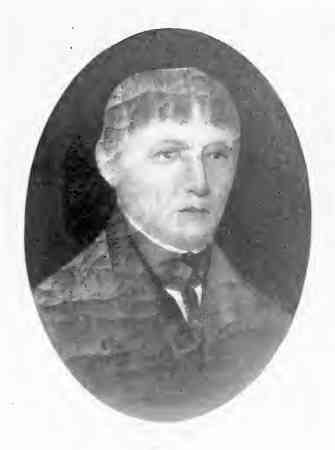
James Duer, from an oil painting
However, in November, 1809, a lot was purchased from Josiah Cooper, at the northwest corner of Fourth and Federal streets. The price paid for this lot was $70, and the deed was drawn by the venerable Josiah Atkinson. Every brother took a subscription paper to collect funds for the house. And so successful were they that on November 25, 1810, a wooden structure thirty feet square was dedicated to the service of Almighty God as the First Methodist Episcopal Church of Camden. Rev. James Totten, being the Presiding Elder, conducted the dedicatory service. This church attracted great attention.
The service of dedication was indeed a great one. Several joined the church by certificate that day, and the effects of the service were profoundly felt by the community.
James Duer, John Petherbridge, Henry Sawn and William Price were the first trustees elected. On March 1, 1810, the trustees authorized John Petherbridge to transact the entire business of the church. He purchased materials, paid the bills and managed the whole affair. He and James Duer were so indefatigable in their solicitations for money that by the year 1812 the entire cost of the structure was paid. Thus the early Methodists of Camden set all succeeding generations an example of possessing churches free of all financial encumbrance.
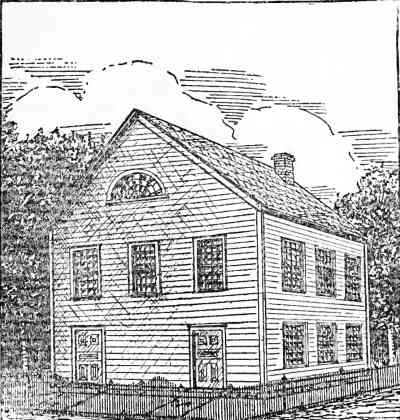
Named: First Methodist Episcopal Church, 1810, 1834, and Northwest Corner of Fourth Street and Federal Street.
This house so wonderfully dedicated to the service of the Lord, like Solomon’s temple, was filled with the glory of the Lord. A “watch night” service was held in the new church on New Year’s eve. For some reason unaccountable, they were having a dull time. About 10 o’clock some of the older brethren suggested that they “break up and go home.” But James Duer cried, “No, brethren, that will not do, let us pray again.” Phebe Peters was called upon to pray. The heavens bent, the windows of God’s power house were opened and the baptism of the Holy Spirit fell upon the entire congregation, and the church seemed to be filled with the Divine Presence and the members’ hearts overflowed with love and joy. The meeting did not “break up” till nearly daylight. From this time on the church progressed in strength, and gradually increased in numbers.
So marked was the progress of the church that in 1818 it became necessary to build side galleries thereto, in order to accommodate the people. Though this alteration was a considerable expense, nevertheless, the people gave so cheerfully that this cost was also met in its entirety.
In 1819 the progressive spirit of these Methodists was clearly seen. Then a camp meeting project seized them. In July, of that year, James Duer was authorized to collect money for this purpose. This he did to the amount of $53. This tent was taken to the woods, and the first camp meeting in the State of New Jersey was instituted by the Methodists of Camden.
Those who left their homes for this camp meeting did not go to be idle, nor for “a frolic,” nor for a “feast.” They took a few bundles of straw and blankets for beds, cold ham and bread or crackers for their food. But the days and nights of the camp meeting were periods of isolation from the detracting and distracting world, and seasons of being face to face with God. Here was where souls were converted, backsliders reclaimed and believers built up in their most holy faith.
In the early history of this church, a number of times great tidal waves of Pentecostal influence swept through the church and over the community. A very remarkable revival occurred during the administration of Father Walker — 1832 and 1833. During the summer of 1832 that dreadful scourge, the cholera, prevailed in Philadelphia, Camden and various other places. The people, standing face to face with death, were susceptible to the influence of gospel preaching. The preachers declared the whole counsel of God and thousands were saved by Divine grace. During this revival one night a great display of Divine power was exhibited. “When the mourners were invited to the altar they crowded up, of all ages and both sexes, until the large altar was filled in lines three deep.
They were then separated by placing benches in different parts of the house, so that all were accommodated. The whole house was like a battlefield — the slain of the Lord lay all over the house! Shouts of praise and cries of ‘power, fire and glory,’ ‘hallelujah,’ filled the house with sounds which must have been awful to the wicked.” This description by one whose name is not known, clearly shows how the arm of the Lord was revealed among the Methodists of Camden.
Originally, the whole State of New Jersey was one district, and belonged to the Philadelphia Conference. Afterwards the State was divided into two districts. The whole of West Jersey embraced what was called the West Jersey District. James Totten was Presiding Elder of this district. The town of Camden was included in the Gloucester circuit of this district, and, as already stated, Richard Sneath was Preacher-in-charge of that circuit. Later the Burlington Circuit was formed, of which Camden was a part.
In the spring of 1833 Rev. Edward Page was appointed senior preacher of what was known then as the Camden Circuit. Rev. D. W. Bartine was the junior preacher. By the Christian co-operation of these two preachers a great work was accomplished. In the autumn of that year a revival broke out, continuing for six weeks, when about one hundred were added to the church. Then it was decided that Camden should not be on the circuit, but should be a charge by itself. Rev. D. W. Bartine was retained as the preacher, and this eloquent young man had the honor of becoming the first pastor of “Camden Station.” This responsible position Brother Bartine continued to sustain until the Conference of 1834, when, according to the time limit, he received another appointment.
Then Rev. William Granville was appointed to Camden Station. Steamboat and railroad facilities had now brought many people hither. With the influx of the population there had been added a great deal of strength, numerical and financial, to the church. Mr. Granville was just the man to lead the people at this period of time. There was a cry: “We must build a new church!”
Consequently the time was ripe for such action. The preacher in charge was a splendid general. He led this host from victory unto victory.
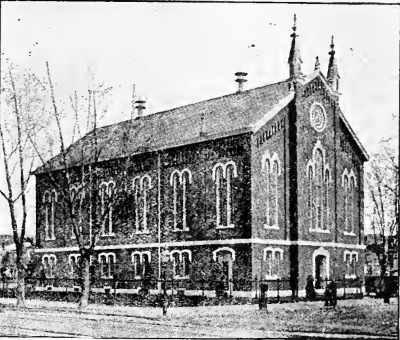
Named: First Methodist Episcopal Church, Southwest Corner of South 3rd Street and Taylor Avenue, 1834, 1868, and Destroyed by Fire, November 20, 1867.
A lot of ground on the S. W. corner of 3rd Street and Taylor Avenue, between Bridge Avenue and Federal Street, was purchased. The old church and lot was sold for $775, and subscriptions taken to make up the sum of thousands! Then a splendid brick structure 45 by 55 feet, with wide galleries on the two sides and front end, was built. There was also a basement in which a large room was equipped for Sunday-school work. The pulpit platform was neatly carpeted, the church nicely illuminated. The whole church within and without was such an ornament to the community that its dedication was the talk of the city. The dedication of this new church took place on December 14, 1834.
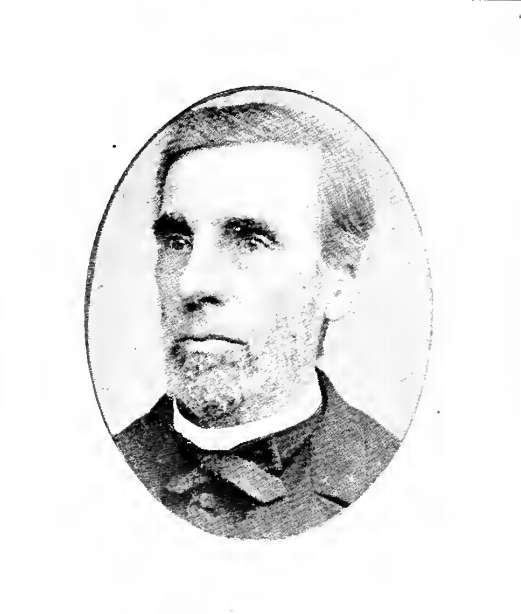
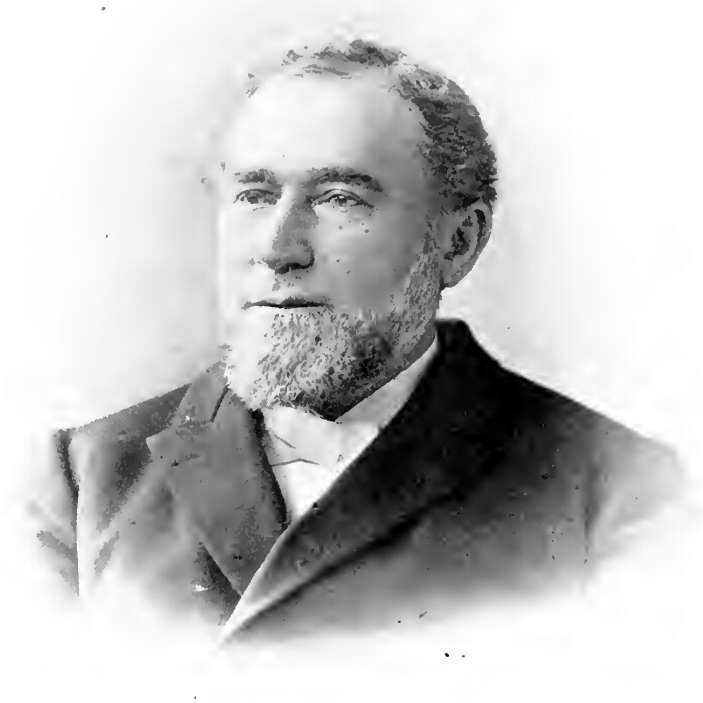
Rev. Charles H. Whitecar, D.D. — Rev. Jacob B. Graw, D.D.
Among the pastors of this church one of the more notable was Rev. John L. Lenhart, who went into the navy as a Chaplain and during the early days of the great civil war went down with the ill-fated Cumberland. Rev. Samuel Y. Monroe met his death by falling from a train.
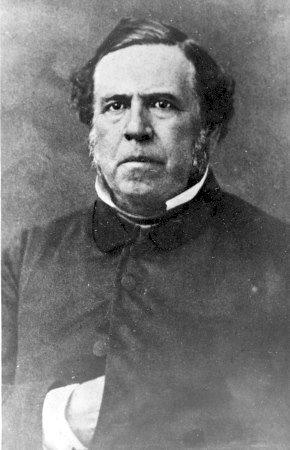
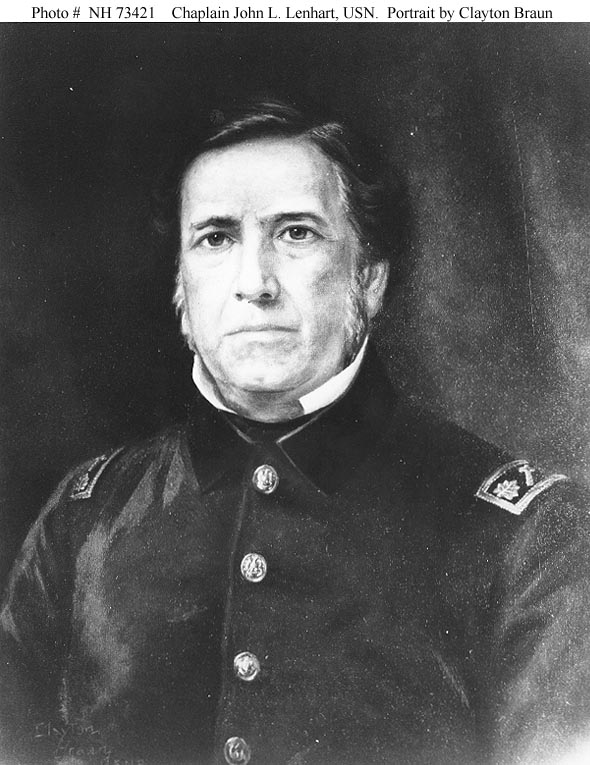
Rev. John L. Lenhart — Chaplain, United States Navy. A member of the Chaplain Corps from 1847 until 1862, he was the first U.S. Navy Chaplain to lose his life in battle. Chaplain Lenhart was killed in action during the March 8, 1862 action in Hampton Roads, Virginia, between USS Cumberland and CSS Virginia.
The following is a list of the pastors who have served this church, in the order as they served: Richard Sneath, Thomas Dunn, Charles Reed, Peter Vannest, Joseph Oshorn, Thomas Davis, John Woolston, George Wooley, John Price, Joseph VanSchaick, Joseph Rusling, James Moore, Joseph Lybrant, John Fox, Solomon Sharp, David Best, John Walker, James Long, John Potts, Benjamin Collins, Sylvester G. Hill, Walters Burroughs, Joseph Carey, Rohert Lutton, David Dailey, Jacob Gruber, Wesley Wallace, Robert Gerry, Thomas Sovereign, Henry Boehm, William W. Foulks, Levi M. Prettyman, Samuel Throckmorton, Joseph Ashbrook, John Walker, Jefferson Lewis, Edward Page, William Granville, Thomas Neal, James Dandy, Joseph Ashbrook, John K. Shaw, John L. Lenhart, Issac Winner, Abram K. Street, David W. Bartine, Charles H. Whitecar, Isaac N. Felch, Richard W. Petherbridge, James O. Rogers, John McDougal, W. E. Perry, Elwood H. Stokes, Samuel Y. Monroe, Joseph B. Dobbins, Samuel Vansant, Charles H. Whitecar, John S. Heisler, Charles E. Hill, Charles R. Hartranft, Jacob B. Graw, William W. Moffett, George B. Wight, John R. Westwood, Jacob B. Graw, John Handley, Wesley A. Hunsberger and Holmes F. Gravatt.
Of these sixty-five pastors, there are only five who survive, namely: Revs. W. W. Moffett, G. B. Wight, John Handley, W. A. Hunsberger, and the present incumbent, Holmes F. Gravatt. The others have passed from labor to reward and of them this mother church declares:
Servants of God, well done!
Your glorious warfare’s past;
The battle’s fought, the race is run,
And you are crowned at last.
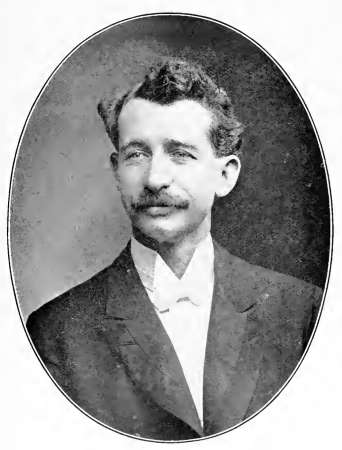
Rev. Holmes F. Gravatt
The great success of this church is due to the faithfulness of her laity. Surely no church ever had a nobler band of “laborers together with God” than have always been found here. While it is impossible to mention them all in this history, nevertheless, it is highly appropriate to name those who represented the entire laity during the erection of the different church edifices.
When the first church was built in 1810, James Duer, John Petherbridge, Henry Sawn, and William Price supervised the work. It is true, however, that John Petherbridge was their agent for the transaction of the entire business. Nevertheless, these men represented the whole church.
When the second structure was erected, in 1834, the following men were trustees and had the oversight of the building: John R. Cowperthwaite, Edward Daugherty, Isaac McDowell, Andrew Jenkins, Andrew Sweeten, Isaiah Toy and John Duer. Before the church was completed, Sweeten, Jenkins and Duer resigned. Edward Kaighn, Riley Barrett and William Balser succeeded them.
During the construction of the third house of worship the Building Committee was composed of men whose devotion to duty lingers with us yet. They were: S. S. E Cowperthwaite, James M. Cassady, Thomas B. Atkinson, Morton Mills and E. S. Johnson.
Ten were on the Building Committee during the time the present temple was built, and while only a few years since they attended so faithfully to the duties that were theirs, relative to supervision, yet out of these ten, there are only three on this side — seven having passed over to be forever with their Lord. Their names speak for themselves — their lives were and are their own best eulogies.
The committee was composed as follows: Daniel H. Erdman chairman; S. S. E. Cowperthwaite, Dr. Melbourne F. Middleton, Frank S. Wells, Jonathan Duffield, Dr. William Shafer, secretary; Dr. W. A. Davis, Samuel Robbins, William C. Kean, Rev. J. B. Graw, D.D.
When there was a determined effort to wipe out our entire indebtedness before our Centennial, God very graciously gave us two men, who in this respect were indeed masters in the church. Dr. William Shafer and Brother W. A. Colescott planned and prayed for this great achievement. But very suddenly one morning, Dr. Shafer “was not for God had took him.” This for a time being but somewhat of discouragement in our way. But God certainly laid his hand on Brother Colescott and he was obedient to the divine touch and by prayer, plan and ceaseless endeavor, in twenty-nine months this man led in a financial campaign whereby the entire balance of the debt, $25,000, and the interest during that time, of $2,400, and the snug sum of over $1,200 for improvements, were raised. That was nearly an average of $1,000 per month for twenty-nine months, besides paying every item of current expense. The enthusiasm of this layman, with the energetic shout of the people: “We must hold up Brother Colescott’s hands,” did the work.
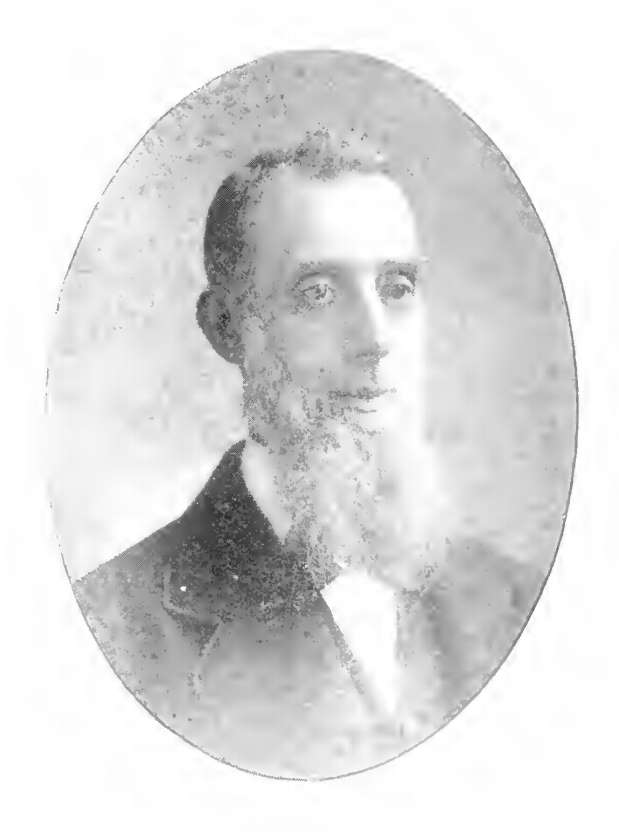
Daniel H. Erdman
Music has always had a large place in Methodism. On the wings of song many souls, through the agency of Methodism, have mounted up to the very presence of God. First Church has never lacked in this respect. She has had the best organs and the best choirs. Then she has been enabled, through the generosity of a friend, to have chimes in her steeple that has pealed forth her music to the multitudes that walk the streets. Every Sabbath and every national holiday these bells chime forth their music. Here is an illustration of the great good accomplished through these chimes: One Sunday evening a husband and wife sat in their home playing cards. The bells chimed out:
Nearer, my God, to thee, Nearer to thee!
Immediately the wife arose and said: “I’ll play no more cards.” They then agreed to go to church. Revival services were in progress at Broadway. They went to that church, yielding to the entreaties of the Holy Spirit. They were converted and lived a consistent life by faith in the Son of God. Not long since the husband went home to heaven and his wife, now surviving, declares that hymn chimed out that Sunday night led them at the feet of Jesus. Hence First Church and in fact the entire Methodism of Camden expresses unbounded gratitude to Mr. George Holl for this magnificent gift, in honor of his mother and to the cause of the Lord.
The Sunday School has been the recruiting station for this church, as it is for all churches. Hence on the roll of honor are emblazoned the names of all our Sunday School workers. Among them special mention must be made of the Superintendents. The following is the list: Edward L. Daugherty, Reiley Barrett, Benjamin A. Hammell, Hampton Williams, Charles Cox, Clayton Truax, Joseph De La Cour, David W. Bartine, Joshua Peacock, Morton Mills, Oliver M. Smith, James M. Cassady, Samuel Russell, James M. Peacock, Harry LaDow, Dr. William Shafer Charles Meves, A. K. Roberts, W. F. Kilgore, William C. Lore, Dr. William Shafer, Charles E. Graham, Robert T. Lee and C. Harold Lowden.
The work of the Sunday School in this church can never be properly written without mention of the invaluable service of Jennie T. King. For 37 years she was Superintendent of the Primry Department. Her devotion to her duty and her zeal to this cause made for her a large place in the hearts of both the children and parents. She had the privilege of having under her care children who passed out of her department through the other departments of the Sunday School, married and sent their children back to the same Primary Department through which these parents passed. Her long service gave her a grip on so many homes in the community that her name was like precious ointment poured forth in those families. And now while she rests from her labors, her works do certainly follow her. And though translated to the Glory Land, yet she continually speaks in her blessed influence, which will continue here to the end of time, and still live throughout the timeless state of eternity.
Official Board and Members of the Quarterly Conference of the First Methodist Episcopal Church, meets first Monday evening of each month.
District Superintendent, Rev. S. M. Nichols, Ph. D., Camden, N. J. Pastor, Rev. H. F. Gravatt, 309 South Sixth Street. Rev. W. A. Hunsberger, D. D., Instructor, Dickinson College. Local Deacon, Rev. C. T. Fisler, 585 Mickle Street. Local Elder, Rev. James B. Nixon, Collingswood, N. J. Financial Secretary, C. K. Morris, 428 Broadway. Treasurer, Harry C. Archer, 219 South Sixth Street. Recording Steward, Robert T. Lee, Ninth and Penn Street. Secretary of Official Board, A. Lincoln Severns, 329 Washington Street. Local Preachers — J. Howard Kirkbride, James L. Crawford. Exhorters — Charles Meves, John L. Bray, Isaac S. Walton. Trustees — W. A. Colescott, President; G. Frank Davis, Dr. W. A. Davis, M. F. Ivins, H. C. Archer, Secretary and Treasurer; P. H. Powell, Samuel Robbins, Capt. L. B. Shaw, William B. Castor. Class Leaders — John L. Bray, Isaac S. Walton, Mrs. Frank H. Powell, Frank H. Rice. Sunday School Superintendent, C. Harold Lowden. President of Epworth League, Dr. Stanley Ironsides. Superintendent of Junior League, Mrs. Leon A. Goff. President of Ladies’ Aid Society, Mrs. Frank S. Wells. Stewards — Robert T. Lee, Recording steward; Robert W. Meves, District steward; Henry Reeves, Alternate; Dr. F. William Shafer, Dr. Cromwell Ironsides, Powell G. Fithian, Charles S. Lewis, Leon A. Goff, Charles K. Morris, Joseph Driver, Joseph H. Murray, Robert A. Batchelor, Dr. Albert B. Davis, Charles E. Graham, John Hollopeter, A. L. Severns, Frank Ellis, Elias E. Truax, Frank H. Rice, John D. Collins, E. S. Mosley. Finance Committee — Robert T. Lee, President; C. K. Morris, Secretary; H. C. Archer, Treasurer; P. G. Fithian, A. L. Severns, Frank H. Rice.
Then also this Mother Church is not forgetful of those who were members of her flock, but now are ministers of the Gospel of the Son of God. Two veterans of the cross, members of the New Jersey Conference must be especially mentioned: Rev. Thos. S. Wilson and Rev. Edwin Waters. This Mother, on her Centennial Anniversary offers to these faithful and noble sons her most hearty congratulations. And now while — because of years — these sons have been compelled to lay aside the activities of the ministry, yet it is a pleasure to know that their lives are benedictions to those with whom they come in contact.
Among those who bowed at her altar and found Jesus Christ, their Lord and Saviour, and are now engaged in the active work of the ministry are Revs. Charles H. Elder, Edward Mount, Isaac Woodward, Orville S. Duffield and Samuel B. Goff, Jr.
The Choir of the Mother Church should have more than a passing mention. Among the most proficient leaders in the musical world have been her choristers. While every one of them have been men of marked ability and of great service to the church, yet, without uttering a word that may seem in the least invidious to any, it can be truthfully said, for efficiency in service and devotion to duty, the present organist and chorister, Professor Powell G. Fithian, has not been excelled. By his suggestion and under his direction a vested choir made its appearance in this church. At first this innovation met with somewhat of objection. But its utility and common sense so commends itself to the public that now it would be a very difficult matter to have the “vested choir” removed.
There is a uniformity of dress and no hats worn by the ladies. Hence the poorest of the poor, if there be a voice to sing, can enter this choir without any thought of distinction in dress. And those who hitherto have been kept out of this musical circle simply because they could not afford to buy fine clothes, now can sing for their Lord without any thought of embarrassment. This choir consists of about 80 voices, and their part in the worship of the Lord is indeed a very important one. In the regular service and in special revival efforts, they lead souls, on the wings of song, to the very presence of the Most High. Their religious service of song one night, during the Centennial Jubilee can never be forgotten. Their faithfulness to duty has the gratitude of the entire church and a number of times the Official Board has given testimonials to the choir, showing their great appreciation of this invaluable organization.
Then also the young men of the Mother Church have been and are still abundant in labors for God. For a long while Brother Frank S. Wells had charge of the ushering. Under his direction the young men were chosen as ushers. And with his careful eye everything went harmoniously. His selection of ushers were wise and his devotion to duty was without alloy. The Official Board felt that everything was perfectly safe entrusted to the care of this servant of God. But by the suggestion of Brother Wells, himself, authorized by the Official Board, an Ushers’ Union was organized. No one was more interested in this organization than the man who for a long while had had sole charge of directing the ushers. He was so anxious to have the organization perfected. Hence the night before he was translated, February 17, 1908, the organization was completed. He was present and seemed in perfect health. The young men would listen to no name for President but Frank S. Wells. He left the church about 10 o’clock, went to his home, attended to business the next day and seemed in perfect health and after reaching home from his place of business, delightfully happy, in an instant, at about 4 o’clock, God said: “Frank S. Wells, you have finished the work I gave you to do,” and immediately he stepped in the eternal presence of God. But his spirit still lingers with the young men and his example is imitated by them. C. Harry Archer was chosen to succeed Brother Wells, and now this noble band of young men are doing great work for God and the church in devoted zeal and energy in this work.
Thus what a history is the history of this Mother Church. She began the century with a little band of seven. Now, including the communicants of her daughters and grand daughters there is a membership of 7,000 Methodists in Camden. Jesus spoke a parable of a sower; who sowed seed upon good ground, “that brought forth some an hundred fold, some sixty fold, some thirty fold.” But the greatest rate of increase as illustrated by this parable was the hundred fold or 10,000 per cent, increase. But the Methodism of Camden during a century has had a greater increase. A gain of 7,000 members means a 700,000 per cent, increase. Consequently the words of Jesus have been verified: “The works that I do shall ye do also and greater works than these shall ye do; because I go to the Father.”
When that little coterie of seven people organized their class in April, 1809, then Camden had no Methodist church. In fact, Camden had no church building — save the Friends’ Meeting House. But now the Methodism of this city has $550,000 of equity in church property. This Mother Church, with her daughter, Broadway, only four squares apart, have properties whose combined value is at least $300,000. Upon these properties there is no debt.
Out of the home of First Church have gone loyal children to set up church homes for themselves. And by their spiritual devotion and consecrated earnestness in the Kingdom of our Lord, they rise up and call their Mother blessed.
The first child of this Mother is her daughter, “Union,” located at Mount Vernon and Fifth streets. Her more than seventy-five years of Christian service speaks eloquently for her. Beside this she has sent her daughters, Trinity, Kaighn Avenue, and Asbury out into the service of the Lord.
Broadway is the second daughter and after a life of more than fifty-five years she’s the strongest church numerically in the State. Wiley and Eighth Street are the children of Broadway and are favorably located for the extension of the Redeemer’s Kingdom.
Tabernacle is the third daughter and the fourth church building erected in Camden. She has done valiant service for God and has sent a strong, vigorous daughter into the field known as State Street Church.
The Centennial of American Methodism was properly celebrated in Camden when the Mother Church put her blessing upon some of her children and they set up a church on Fifth and Cooper streets, and named this daughter Centenary.
Bethany also belongs to the immediate family of the Mother Church, having begun her separate work more than a score of years ago at Tenth and Cooper streets.
Fairview is a child of Asbury and has a strategic situation at Twenty-third and River avenue.
St. George’s was organized under the leadership of J. H. Kirkbride, in 1894, and now is a commanding influence on the East Side.
Wesley is an adopted child from the Methodist Protestant Church, and now has a promising field of labor.
Bethel belonged originally to the Haddonfield Circuit, but was organized into a society known as the Bethel Methodist Episcopal Church, February 11, 1843. In 1893, having moved within the city limits, she became an adopted daughter of Camden Methodism.
These churches will have their individual histories chronicled in this book. But the history of the First Church would be incomplete without mentioning her children and grand children of whom she is justly proud.
The membership of the Mother Church is about 1,000. The membership of the sixteen Methodist Episcopal churches is about 7,000. It is safe to multiply the membership of any church by three and thereby discover its constituency. The population of Camden is about 92,000 If the constituency of Methodism is 21,000, then Methodism sways nearly one-fourth of the moral and spiritual influence of the entire city. How glorious are our privileges and yet how solemn are our responsibilities!
Surely then the Mother Church has fought and is fighting the good fight and under her influence the Methodism of Camden enters the new century in experience clear as the sun; in reputation fair as the moon; in opposition to wrong as terrible as an army with banners.
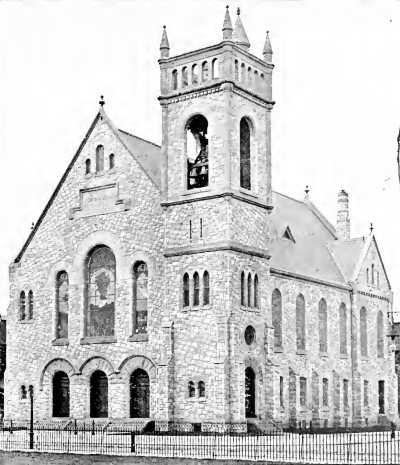
Named: First Methodist Episcopal Church, Dedicated in 1893, Razed in 2005, and Southwest Corner of South 6th Street and Stevens Street.
Worshipped in a New House
Philadelphia Inquirer —
Methodists Hold Services in the Handsome First Church, Camden.
The first services in the new First Methodist Church, at Sixth and Stevens streets, Camden, were held yesterday. The church is a handsome stone edifice, and will be used by the congregation, which for many years worshipped in the Third Street Church, at Third street and Bridge avenue, recently purchased by the Pennsylvania Railroad Company.
The services were held in the lecture room, which was formally dedicated by the pastor, Rev. J. B. Graw, D. D. The main auditorium is not yet completed.
Rev. S. L. Baldwin, D. D., of New York city, preached in the morning, a platform meeting was held in the afternoon and the dedication service in the evening.
Philadelphia Inquirer — June 22, 1896
The children’s day exercises that were postponed on account of the rain the Sunday previous were held yesterday in the following churches: Union M. E., Wiley M. E., First M. E., Union American, Bethany M. E., First Baptist and First Presbyterian. The churches were prettily decorated. Rev. Edward F. Hann, of Pennington Seminary, preached last evening in the Union M. E. Church.
Camden
Philadelphia Inquirer —
Rev. John Handley, D. D., pastor of First M. E. Church, was in Trenton on Wednesday, and offered prayer in the Senate at the opening of the day’s session.
Police in a Church
Philadelphia Inquirer —
POLICE IN A CHURCH
Camden Guardians of the Peace Attend Divine Service
Chief of Police John Foster, Captains Stanley, Boyle and Alberts, seventy policemen and Colonel D. B. Murphy, the police drill instructor, marched in a body from the Third Regiment Armory in Camden to Broadway M. E. Church last evening to attend divine service. A number of city firemen, trolley conductors and motormen were also in attendance. The pastor, Rev. James W. Marshall, D. D., preached on “Immortality.”
At the First Presbyterian Church last evening Rev. W. H. Fishburn, D. D., gave his second talk to bread-winners. His subject was “The Age of Hurry.”
Mr. Bipin Chandra Pal, of India, spoke at North Baptist Church last evening on “Life and Reforms in British India.”
Madame Lavah Barrakat, a Syrian woman, delivered an address at First M. E. Church last evening.
Members of the Ancient Order of United Workmen last evening attended the Eighth Street M. E. Church.
Pastor, Lilley [sic], of Trinity M. E. Church, last evening preached a special sermon to the Union Veteran Legion.
Camden Clergymen Preach on the Subject and Praise The Inquirer’s Leadership in the Work
Philadelphia Inquirer —

Rev. Wesley A. Hunsberger — Pastor of the First M. E. Church, Camden
The following Camden clergymen yesterday spoke from their pulpits on the anti-profanity movement: Rev. William J. Cambron, pastor of the Tabernacle Baptist Church; Rev. Dr. Arthur W. Spooner, pastor of the Calvary Presbyterian Church; Dean Mulligan, pastor of the Church of the Immaculate Conception; Rev. Dr. Wesley A. Hunsberger, pastor of the First M. E. Church; Rev. George T. Harris, pastor of the Trinity M. E. Church; Rev. Howard R. Blackwood, pastor of the Memorial M. P. Church; Rev. Dr. George H. Humason, pastor of the Centenary M. E. Church; Rev. C. I. Fitzgeorge, pastor of Wiley M. E. Church; Rev. Dr. James W. Marshall, pastor of the Broadway M. E. Church; Rev. J. R. Mason, pastor of the Kaighn Avenue M. E. Church; Rev. James Burns, pastor of the Eighth Street M. E. Church.
The clergy of Camden, irrespective of creed or denomination, yesterday expressed in no unmistakable terms its abhorrence of the evil of profanity and the great need of the movement inaugurated by The Inquirer toward stamping it out by moral suasion.
The Methodist Episcopal pastors were extremely busy yesterday in ending their conference year preparatory to the meeting of the New Jersey Methodist Episcopal Conference at Salem this week. However, as a rule, they found time to say something in behalf of the movement in the course of their sermons, either yesterday morning or last evening.
Rev. Dr. William J. Cambron, pastor of the Tabernacle Baptist Church, Broadway and Cherry streets, is enthusiastic over the movement. Yesterday morning he preached a sermon on “The Sin of Profanity,” taking for his text Exodus, xx, 7: “Thou shalt not take the name of the Lord thy God in vain; for the Lord will not hold him guiltless that taketh his name in vain.”
He said in part: “The sin of profanity is very great, and those who are in the habit of taking the name of the Deity in common speech are guilty before their Creator. ‘He will not hold them guiltless.’ ‘Holy and reverend is His name.’ Yet many associate His name with the vilest things that an evil mind can conceive or a polluted tongue can utter.
“Our God showers blessings upon the just and the unjust. We are given health and prosperity, our lives spared and those of our dear ones. We are granted the privilege of His great world house, the sun to shine on us, the air to breathe, water to drink, food to satisfy hunger. All these and more, yet many, in return for these blessings, give Him cursing and blasphemy, a profaning of the most holy name. Men, for His sake, stop!
“We have needed a trumpet peal to awaken the thoughtless millions to the gravity of this great sin. Every one who reverences the holy name should offer up a prayer of thanksgiving that The Philadelphia Inquirer is leading in a crusade against profanity. Let the clergy in city and country co-operate with The Inquirer in this great work.
“The field is large, so large! Let religious and secular journals join in this noble crusade until East and West, North and South shall honor the one name that is above every other name, and profanity shall be no more!
“All honor to The Philadelphia Inquirer for this noble effort in this most needed reform. May its message of reverence for the holy name reach the ears, eyes and hearts of millions who commit this sin every day and many times a day.”
At the close of the sermon every one of the several hundred in the congregation arose and thus signified their unanimous indorsement of the crusade. The Union Brotherhood, connected with the church, has adopted resolutions of indorsement.
Very Rev. Dean Mulligan, rector of the Church of the Immaculate Conception, Camden, preached a short sermon to the young people at the 9 o’clock mass yesterday morning on “The Evils of Cursing.” During the course of his remarks he said: “Among men cursing has become a habit more frequently indulged in than that of any other sin. We find boys, yes, even women frequently given to this abominable practice.
“The Psalmist says those who curse shall perish and St. Paul assures us that they shall not possess the Kingdom of Heaven.
“The evil has become entirely too universal and I am glad The Philadelphia Inquirer has taken up the question and is using its powerful influence to break up this pernicious practice.”
Rev. Dr. George H. Humason, pastor of the Centenary M. E. Church, Fifth and Cooper street, spoke last night in no mistaken language. He said:
“The intense life of our day puts a heavy strain upon the nerves of our people. Worn nerves engender irritability and lack of self-control. Profanity consequently is very prevalent in our midst among both sexes. A positive effort ought to be inaugurated to check this increasing evil.
Rev. Dr. Arthur Willis Spooner, pastor of the Calvary Presbyterian Church, Second and Pearl streets, and a former president of the New Jersey Christian Endeavor Union, is an enthusiastic advocate of The Inquirer’s crusade. He said, in part, as follows:
“God speed the crusade against profanity! Vulgarity, degeneracy, diabolism reach their climax in profane swearing. When a man or boy begins to swear he knocks away the foundation of true manliness and mortgages to Satan his divine birthright.
Rev. Gilbert H. Underhill, rector of St. John’s P. E. Church, Broadway and Royden streets, said he is fully in accord with the crusade. He said:
“I favor anything that will assist in stemming the tide of this evil. This habit is very prevalent among the young of both sexes. It is a terrible thing to dishonor God by taking his name in vain.”
Rev. Dr. Wesley A. Hunsberger, pastor of the First M. E. Church, Sixth and Stevens streets, is an earnest advocate of the crusade. Last night he referred to the movement. He said: “Profanity is not only a disgrace to humanity, but an evil that eventually evidences its baneful effects. It is a habit acquired through an ignorance of God’s laws or an indifference to the well-being of society. I am pleased to learn that there is so powerful agency at work in an effort to raise public opinion against this evil as The Inquirer. It needs agitation and the co-operation of Christian people.”
Rev. George T. Harris, pastor of the Trinity M. E. Church, Broadway and Emerald street, spoke on the subject yesterday morning. He said in part: “The use of profane language is rapidly on the increase. Profanity is a violation of the law of God, treating the Supreme Being with irreverence and dishonor.”
Rev. Howard R. Blackwood, pastor of the Memorial M. P. Church, Third and Liberty streets, in speaking of profanity and The Inquirer’s crusade, said:
“I know of no habit that so belittles a man in the minds of the good-thinking people as that of swearing. We have many times heard men say ‘I can’t help it; when I get mad it seems to be the only way I can express my feelings.’ This we believe is untrue. They do not take poison into the body
Continued on 3d Page—4th Col.
Philadelphia Inquirer — September 26, 1903
The First M. E. Church of Camden is arranging to celebrate its ninety-fourth anniversary on October 11. This is the oldest church organization in Camden and from it sprang most of the other Methodist churches.
Dr. Sarah Elliott to Speak in Camden
Philadelphia Inquirer —
Dr. Sarah Elliott, of Utah, national organizer of the W. C. T. U., will make three addresses in Camden to-day. In the morning she will speak in the State Street M. E. Church. In the afternoon she will address the men’s meeting at the Central Y. M. C. A., and in the evening she will occupy the pulpit of the First M. E. Church. At each meeting she will talk about Mormonism and life in Utah.
Philadelphia Inquirer — February 12, 1905
Camden News Notes
Several well-known Philadelphia Chinamen yesterday called on Low Kin, who is locked up in the Camden county jail awaiting a hearing next Wednesday before United States Commissioner Morgan on the charge of violating the Chinese Exclusion act.
Rev. W. A. Hunsburger, pastor of First M. E. Church, of which Kin is a member, and several other prominent men who are interested in the Chinaman’s behalf seem confident that Kin will be released at the hearing.
Camden News Notes
Philadelphia Inquirer —
Several well known Philadelphia Chinamen yesterday called on Lee Kin, who is locked up in the Camden county jail awaiting a hearing next Wednesday before United States Commissioner Morgan on the charge of violating the Chinese Exclusion act. Rev. W. A. Hunsberger, pastor of First M. E. Church, of which Kin is a member, and several other prominent men who are interested in the Chinaman’s behalf seem confident that Kin will be released at the hearing.
Superintendent of Police Sylvester, of Washington, D. C., telegraphed Chief of Police Foster, of Camden, yesterday, that a girl named Lottie Helm, aged 15 years, a former inmate of the Camden Home for Friendless Children, was in custody there. Chief Foster learned that the girl was apprenticed to C. Hermann, of Woodbine, N. J., in 1896 and that she disappeared July 4, 1904. As the trustees of the home were anxious to have the girl returned Sergeant Schregler was sent after her.
Peter Carter, driver of the Kaighn avenue chemical engine, met with a peculiar accident while responding to an alarm of fire at 1005 Mt. Ephraim avenue. While descending the hill the rear wheels of the engine began to slide and crashed into a barbed wire fence. Carter was thrown from his seat and lodged on top of the fence. He was released a minute later and escaped with a few scratches.
• There will be a flag raising at the new Kaighn School February 22. The ceremonies will be conducted by several secret societies. The school will be formally opened March 1.
• Henry D. Longacres, Charles H. Laird and George Leathwhite, recently constituted by the Circuit Court a commission to assess benefits accruing from the building of sewers, organized yesterday by the election of Mr. Longacre president and Joseph M. Creely, an assistant city engineer, secretary.
• Louis Simpson and William Kalt, boys, were committed to the county jail by Recorder Stackhouse on the testimony of Detective Painter, who said they admitted making burglar tools and planned to commit several robberies.
• State Deputy John A. Furey will institute a lodge of the Fraternal Order of Eagles at Orange to-morrow night. The lodge will have a membership of 105.
• William Jansen, of Schemeron street, Brooklyn, has written to Chief of Police Foster asking him to locate his wife, Grace Annie Jansen, who has been missing from home since December 17.
• Policeman Fitzsimmons saw a man acting suspiciously at Fourth street and Kaighn avenue early yesterday morning. When the policeman approached the man fled. The officer gave chase, but the man escaped. Later the policeman found that the front window of the saloon of George S. Dilmore had been forced and raised. Nothing of value was taken.
Class Soon to Leave Camden’s High School
Philadelphia Inquirer —
Named: Dr. James E. Bryan, Dr. Hyman I. Goldstein, and First Methodist Episcopal Church.
Philadelphia Inquirer — February 19, 1906
Miss Grace Todd, a representative of the Woman’s Foreign Missionary Society, delivered two addresses in Camden yesterday on “China.” In the morning she spoke at the First M. E. Church, and at night at the Broadway M. E. Church.
Camden News Notes
Philadelphia Inquirer —
Miss Grace Todd, a representative of the Woman’s Foreign Missionary Society, delivered two addresses in Camden yesterday on “China.” In the morning she spoke at the First M. E. Church, and at night at the Broadway M. E. Church.
Police Captain Stanley and a squad of officers early yesterday morning raided the house of Fannie Clark, colored, at 847 Locust street, on complaint of Rita Veratti. The officers expected to gather in a wagon load of prisoners, but the Clark woman was the only one they found found [sic]. She was sent to the city jail.
Rev. J. W. Lee, at the Kaighn Avenue M. E. Church, last night preached on “Why We Love the Memory of Washington.”
The fifteenth annual ball of the Butchers’ Beneficial Society will be given to-night at Turner Hall.
William St. Clair, colored, aged 65 years, was attacked by a crowd of men early yesterday morning at Broadway and Chestnut streets. He was badly cut on the chin with a razor. He was subsequently found and sent to the Cooper Hospital.
Forty houses are to be erected in the spring on a plot of ground west of the house occupied by the custodian of St. Patrick’s cemetery, East Camden. The ground has just been purchased from the Church of the Immaculate Conception, for $18,000.
Evangelist Howard Amer and wife conducted the services at the Wesley M. E. Church, East Camden, yesterday morning. With his bride of only two months, Evangelist Amer is making a tour of the large cities.
Camden News Notes
Philadelphia Inquirer —
Police Captain Stanley early yesterday morning raided the house at 139 Chestnut street and arrested Bessie Heisler and Emma Carll, the alleged proprietresses.
William Smith, 23 years old, of 419 Clinton street, fell on the sidewalk at Seventh and Benson streets yesterday as the result of an attack of heart disease. He was taken to the Cooper Hospital.
Rev. H. G. Fithian, chairman of the American Seaman’s Friend Society, preached at the Second Presbyterian Church yesterday.
Rev. Dr. George B. Wight, Commissioner of the Bureau of Correction, occupied the pulpit at the First M. E. Church yesterday.
The woman who was taken to the Cooper Hospital Saturday night, her mind a blank as the result of a fall, was yesterday found to be Mrs. Hannah Wood, of Fifth and Washington streets.
Not One Is Now Alive
Camden Daily Courier —


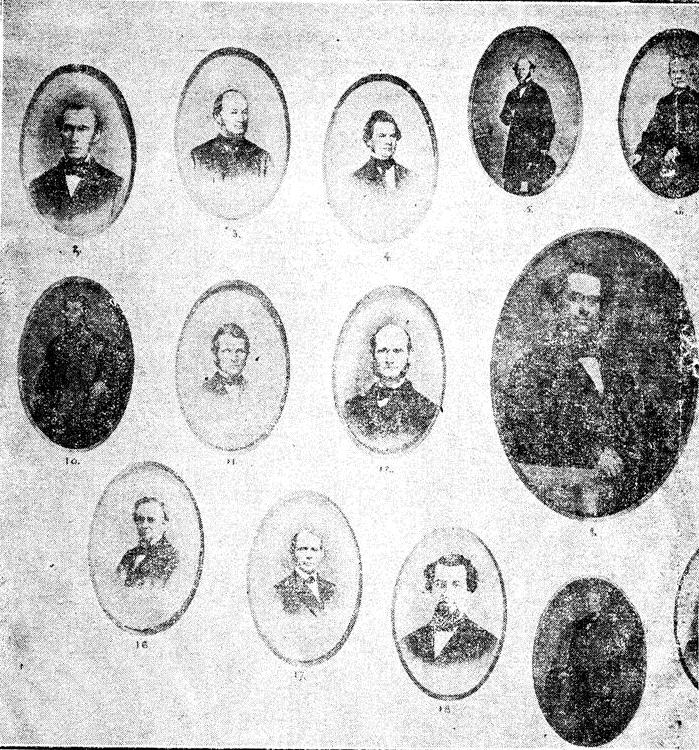
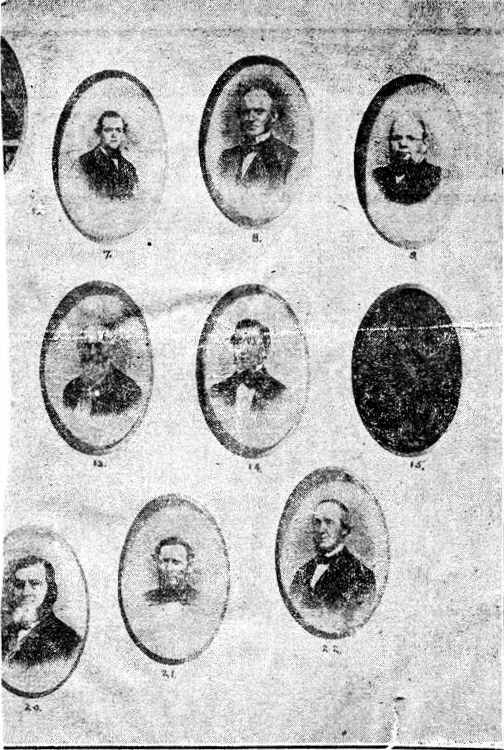
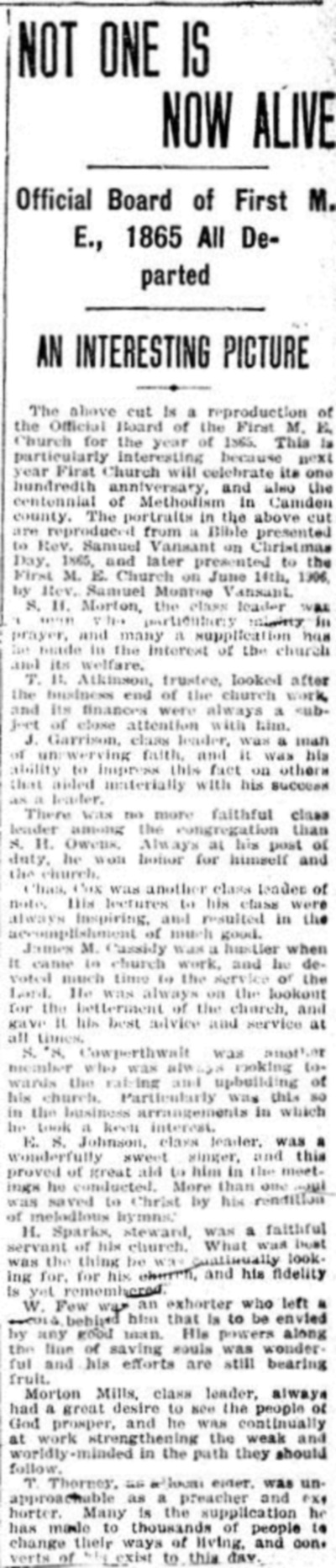
Official Board of First M. E., 1865 All Departed
AN INTERESTING PICTURE
OFFICIAL BOARD OF THE FIRST M. E. CHURCH FOR THE YEAR OF 1865; NOT ONE IS NOW ALIVE
The above cut is a reproduction of the Official Board of the First M. E. Church for the year of 1865. This is particularly interesting because next year First Church will celebrate its one hundredth anniversary, and also the centennial of Methodism in Camden county. The portraits in the above cut are reproduced from a Bible presented to Rev. Samuel Vansant on Christmas Day, 1865, and later presented to the First M. E. Church on June 14th, 1906, by Rev. Samuel Monroe Vansant.
S. H. Morton, the class leader, was a man who particularly mighty in prayer, and many a supplication has he made in the interest of the church and its welfare.
T. B. Atkinson, trustee, looked after the business end of the church work, and its finances were always a subject of close attention with him.
J. Garrison, class leader, was a man of unswerving faith, and it was his ability to impress this fact on others that aided materially with his success as a leader.
There was no more faithful class leader among the congregation than S. H. Owens. Always at his post of duty, he won honor for himself and the church.
Chas. Cox was another class leader of note. His lectures to his class were always inspiring, and resulted in the accomplishment of much good.
James M. Cassidy was a hustler when it came to church work, and he devoted much time to the service of the Lord. He was always on the lookout for the betterment of the church, and gave it his best advice and service at all times.
S. S. Cowperthwait was another member who was always looking towards the raising and upbuilding of his church. Particularly was this so in the business arrangements in which he took a keen interest.
E. S. Johnson, class leader, was a wonderfully sweet singer, and this proved of great aid to him in the meetings he conducted. More than one soul was saved to Christ by his rendition of melodious hymns.
H. Sparks, steward, was a faithful servant of his church. What was best was the thing he was continually looking for, for his church, and his fidelity is yet remembered.
W. Few was an exhorter who left a record behind him that is to be envied by any good man. His powers along the line of saving souls was wonderful and his efforts are still bearing fruit.
Morton Mills, class leader, always had a great desire to see the people of God prosper, and he was continually at work strengthening the weak and worldly-minded in the path they should follow.
T. Thorney, as a class [?], was unapproachable as a preacher and exhorter. Many is the supplication he has made to thousands of people to change their ways of living, and converts of his exist to this day.
Camden News Notes
Philadelphia Inquirer —
The First M. E. Church has adopted resolutions indorsing the action of Governor Fort in closing up Atlantic City’s saloons on the Sabbath.
Philadelphia Inquirer — May 5, 1909
Camden News Notes
Early in July Rev. Dr. Holmes F. Garnett, pastor of the First M. E. Church, Camden, will leave for a two months’ trip to Europe. He was very agreeably surprised when his congregation voted to give him this period. During his absence the church, which was recently cleared of debt, will be renovated.
Philadelphia Inquirer — September 12, 1910

Camden Preachers’ Meeting
There will be a resumption of the Camden Preachers’ Meeting at the First M. E. Church today. Rev. J. L. Surtees will preside at a general symposium on “Vacation Experiences.”
Rev. Holmes F. Gravatt Lectures on Europe
Philadelphia Inquirer —

Rev. Holmes F. Gravatt, pastor of the First M. E. Church, last night delivered a lecture at the Eighth Street M. E. Church on “Glimpses of Europe.” Rev. Dr. Gravatt recently returned from abroad.
Camden Will Observe Decoration Day
Philadelphia Inquirer —
Camden has completed its arrangements for the annual Memorial Day exercises. All the local G. A. R. posts will visit the cemeteries early in the day to decorate the graves of their comrades.
At the Soldiers’ Monument special exercises will be held, one of the features being the singing of patriotic airs by school children. The assemblage will be called to order by Comrade William Thompson, prayer will be offered by Rev. A. H. Newton, the children will sing and a volley of musketry will be fired. Exercises will afterwards be held in the First M. E. Church, the oration to be delivered by Hon. Isaac T. Nichols, of Bridgeton. Camp fires will be held at night.
Richard Dease is marshal of the parade and H. L. Hartshorn assistant.
The veterans have been assisted in their preparation by a citizens’ committee appointed by Mayor Ellis, as follows. William D. Vanaman, chairman; Charles S. Ackley, Charles M. Baldwin, James M. Bentley, John W. Coleman, C. K. Deacon, Malachi D. Cornish, Louis T. Derousse, William Fox, Abe Fuhrman, Harry C. Kramer, Ira E. Lute, J. W. Martindale, Jacob Neutze, Edward Nieland, H. S. Riddle, William Sangtinette, Bernard F. Schroeder, William Schmid, Sigismund Schoenagle, Daniel M. Stevens, W. L. Tushingham, Frank W. Tussey, Francis B. Wallen and Harry Whaland.
Camden News Notes
Philadelphia Inquirer —
Stricken with catarrhal jaundice, Rev. H. S. Kidd, pastor of the Tabernacle Baptist Church, was so ill he was unable to occupy his pulpit yesterday. Secretary William Cox, of the P. R. R. Y. M. C. A., spoke morning and evening.
At the First M. E. Church yesterday a sermon was preached by Rev Charles Henessy [sic] Newing, of Wyoming, Pa., a large congregation greeting him.
“The Claims of Christ Upon a Twentieth Century Man” was the subject of a sermon preached yesterday at the North Baptist Church by Rev Herbert L. White, of Hartford, Conn., who occupied the pulpit for Rev. M. J. Vosburgh, who is on his vacation.
An interesting service was held yesterday at the Bethany M. E. Church, in which Rev. J. G. Edwards, the pastor, gave a reception to twenty-eight members who were converted the past year.
Camden News Notes
Philadelphia Inquirer —
Rev. George Ridout, of Trenton, will address the Camden M. E. Preachers’ Meeting at the First M. E. Church this morning on “The Present Aspect of the Theological Situation.”
Rev. Harry Champe, of the Crozer Theological Seminary, addressed the congregation at the Wynn Memorial Baptist Church yesterday.
The special evangelistic services inaugurated last week at the North Baptist Church are meeting with great success. They are in charge of Evangelists Brooke, Lewis and Sawyer.
Roland Evans will be placed on trial for the murder of Robert Green in the Supreme Court before Judge Garrison this morning. The State will press for a first degree verdict.
The anti-tuberculosis exhibit now at the Free Public Library, where it is being held under the direction of the local Lodge of Moose and the Visiting Nurse Society, is attracting hundreds of visitors.
Photo — 1914
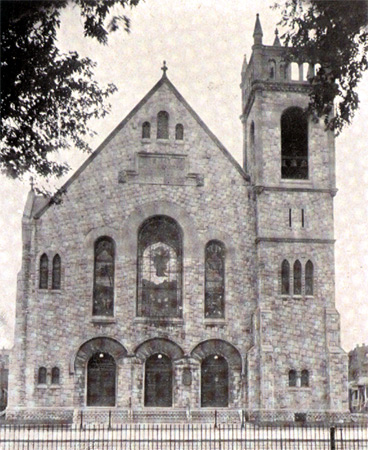
First Methodist Episcopal Church — 1914
Nurses Receive Diplomas
Philadelphia Inquirer —
Diplomas were last night conferred on eight young women at the commencement exercises of the Cooper Hospital Training School for Nurses at the First M. E. Church. The graduates were: Clara Evelyn Brandt, Camden; Mabel Devitt, Moorestown; Bertha Elliott Marriott, Pleasantville; Rebecca Day McNutt, Berkley, Md.; Edith Marie Owens, Burlington; Ida Margaret Stephenson, Pleasantville; Mary Kathryn West, Cape May, and Magdalena May Winters, Swedesboro. Dr. Rufus M. Jones, of Haverford College, and Miss Susan C. Francis, director of the Pennsylvania Division of the Red Cross Nursing Service, made addresses. The diplomas were awarded by Alexander C. Wood, vice president of the Board of Managers, and the class pins were presented by F. Morse Archer, chairman of the Training School Committee.
Sunday, May 11, 1924
The Chimes, First Methodist Episcopal Church —
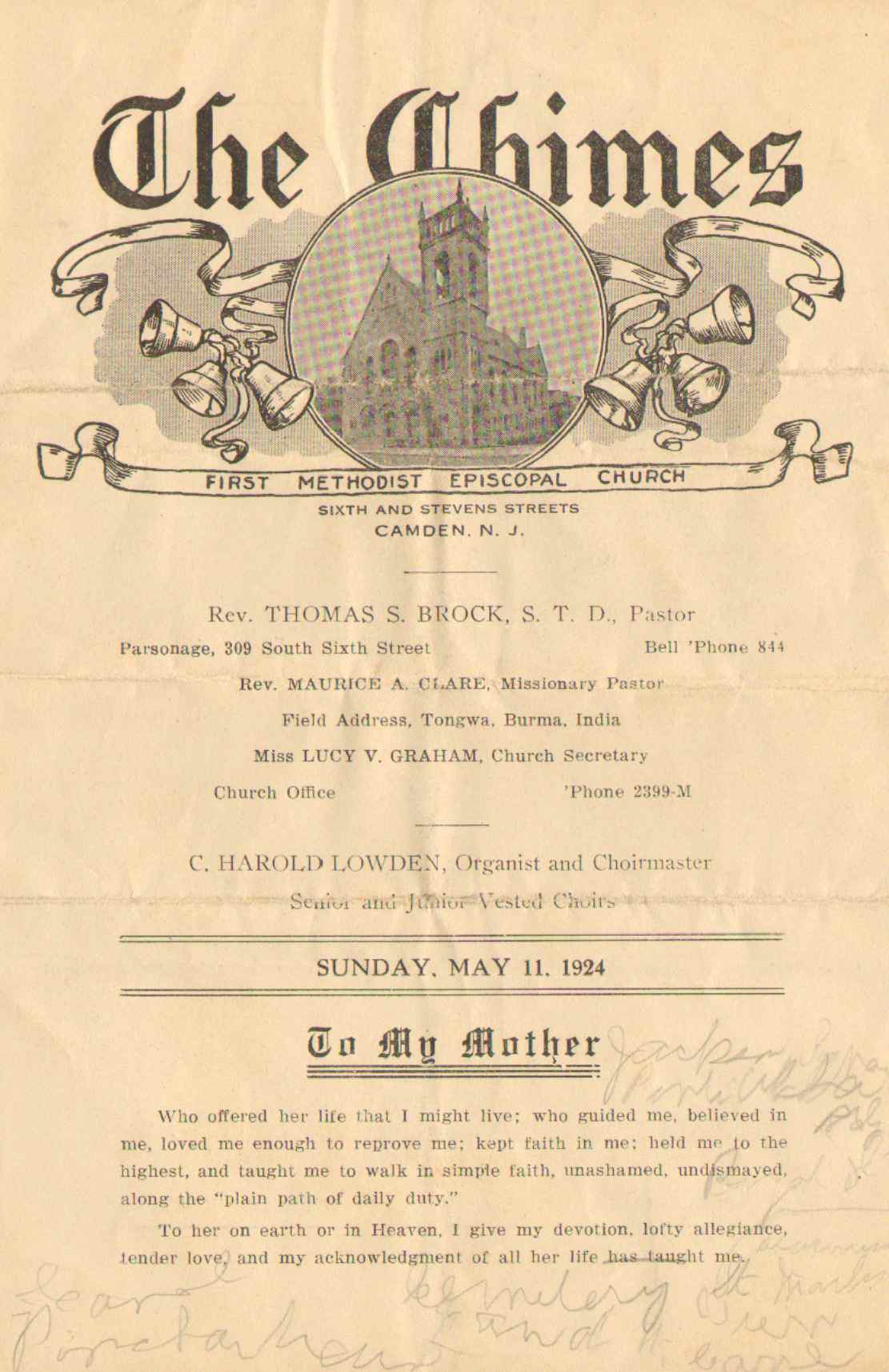
The Chimes
First Methodist Episcopal Church
Sixth and Stevens Streets
Camden, N. J.
Rev. Thomas S. Brock, S. T. D., Pastor
Parsonage, 309 South Sixth Street Bell ’Phone 844
Rev. Maurice A. Clare, Missionary Pastor
Field Address, Tongwa, Burma, India
Miss Lucy V. Graham, Church Secretary
Church Office ’Phone 2399-M
C. Harold Lowden, Organist and Choirmaster
Senior and Junior Vested Choirs
Sunday, May 11, 1924
To My Mother
Who offered her life that I might live; who guided me, believed in me, loved me enough to reprove me; kept faith in me; held me to the highest, and taught me to walk in simple faith, unashamed, undismayed, along the “plain path of daily duty.”
To her on earth or in Heaven, I give my devotion, lofty allegiance, tender love, and my acknowledgment of all her life has taught me.
---
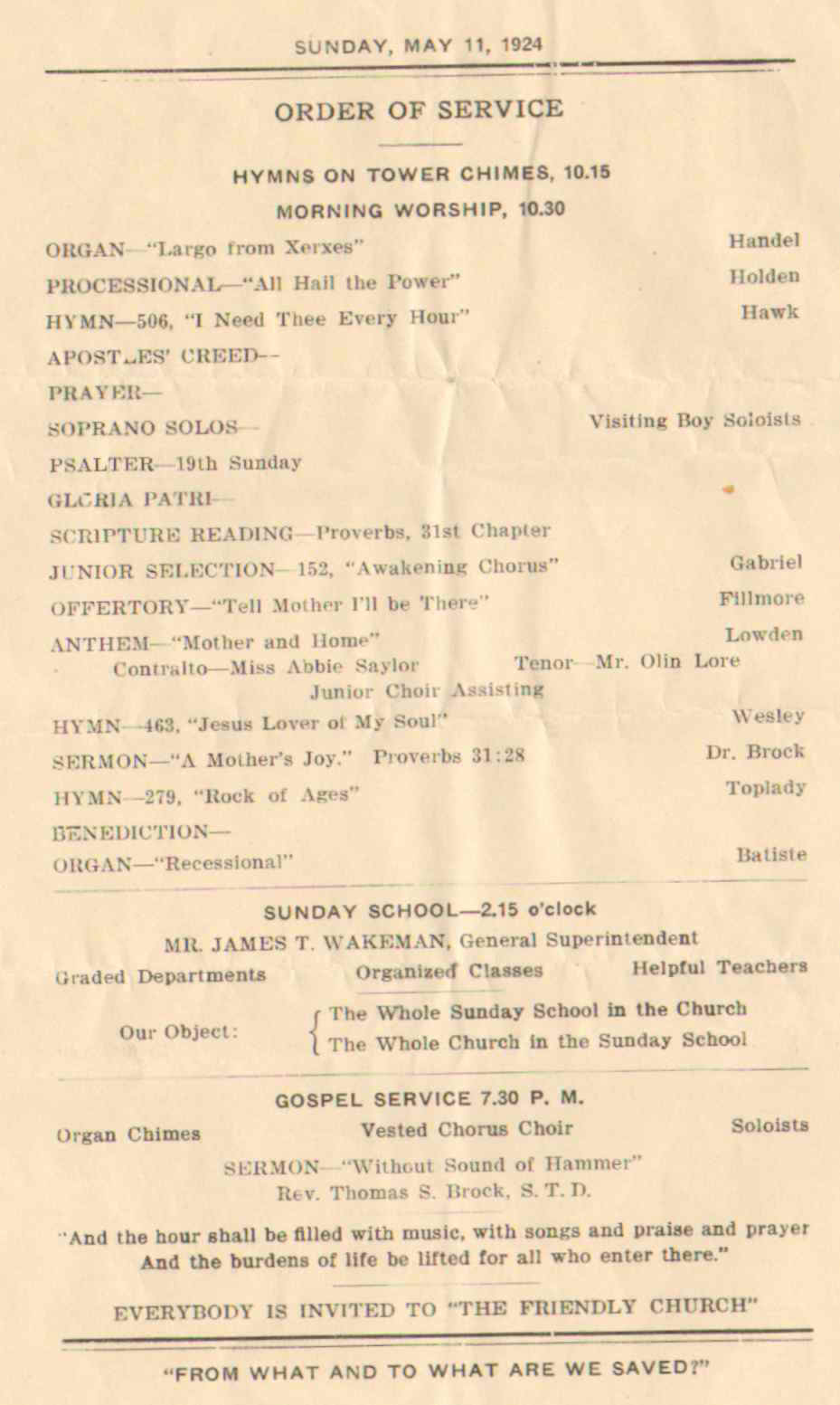
Sunday, May 11, 1924
Order of Service
Hymns on Tower Chimes, 10.15
Morning Worship, 10.30
Organ—“Largo from Xerxes” Handel
Processional—“All Hail the Power” Holden
Hymn—506, “I Need Thee Every Hour” Hawk
Apostles’ Creed—
Prayer—
Soprano Solos— Visiting Boy Soloists
Psalter—19th Sunday
Gloria Patri—
Scripture Reading—Proverbs, 31st Chapter
Junior Selection—152, “Awakening Chorus” Gabriel
Offertory—“Tell Mother I’ll be There” Fillmore
Anthem—“Mother and Home” Lowden
Contralto—Miss Abbie Saylor Tenor—Mr. Olin Lore
Junior Choir Assisting
Hymn—463, “Jesus Lover of My Soul” Wesley
Sermon—“A Mother’s Joy.” Proverbs 31:28 Dr. Brock
Hymn—279, “Rock of Ages” Toplady
Benediction—
Organ—“Recessional” Batiste
Sunday School—2.15 o’clock
Mr. James T. Wakeman, General Superintendent
Graded Departments Organized Classes Helpful Teachers
Our Object: The Whole Sunday School in the Church
The Whole Church in the Sunday School
Gospel Service 7.30 P. M.
Organ Chimes Vested Chorus Choir Soloists
Sermon—“Without Sound of Hammer”
Rev. Thomas S. Brock, S. T. D.
“And the hour shall be filled with music, with songs and praise and prayer
And the burdens of life be lifted for all who enter there.”
Everybody is Invited to “The Friendly Church”
“From What and to What Are We Saved?”
---
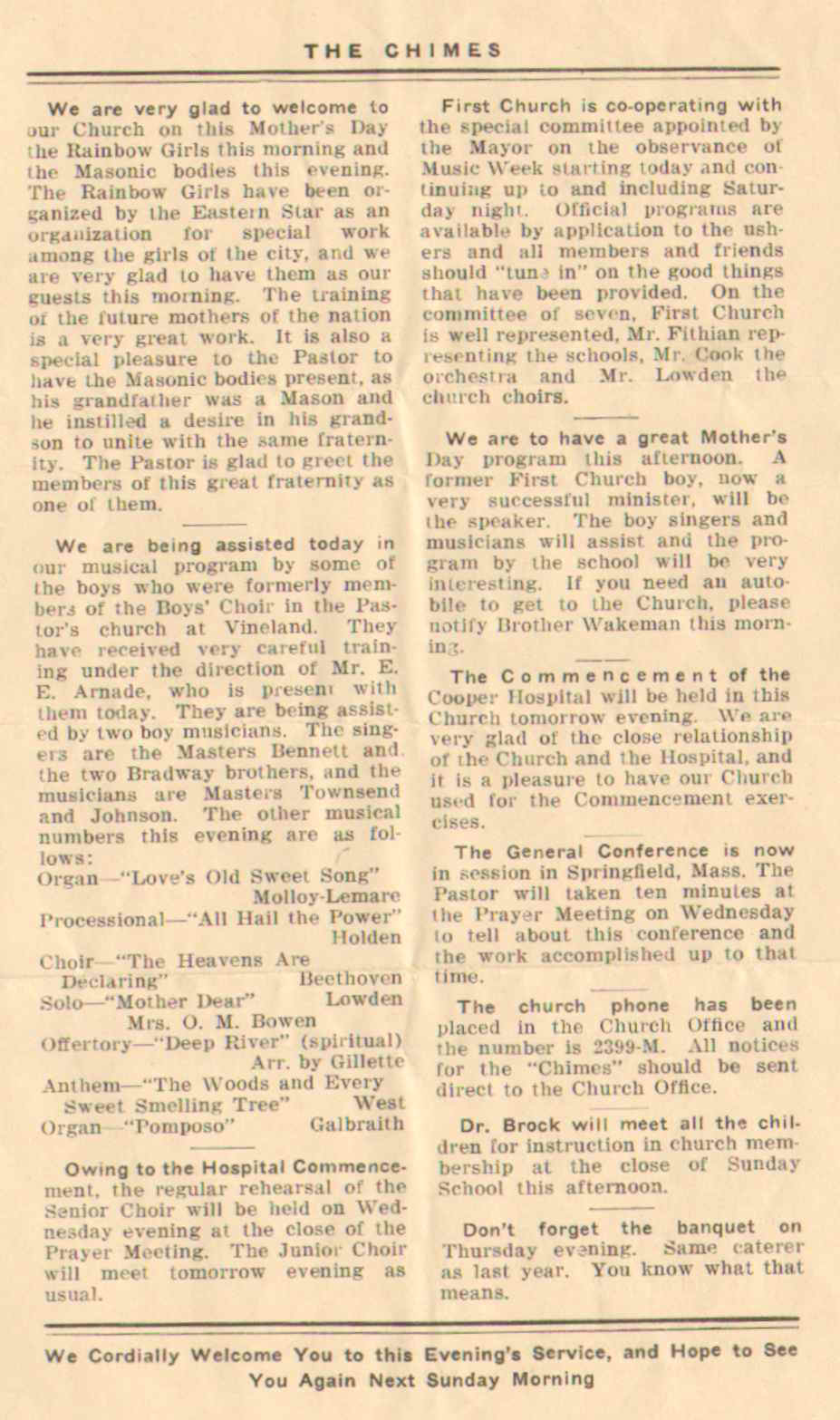
We are very glad to welcome to our Church on this Mother’s Day the Rainbow Girls this morning and the Masonic bodies this evening. The Rainbow Girls have been organized by the Eastern Star as an organization for special work among the girls of the city, and we are very glad to have them as our guests this morning. The training of the future mothers of the nation is a very great work. It is also a special pleasure to the Pastor to have the Masonic bodies present, as his grandfather was a Mason and he instilled a desire in his grandson to unite with the same fraternity. The Pastor is glad to greet the members of this great fraternity as one of them.
We are being assisted today in our musical program by some of the boys who were formerly members of the Boys’ Choir in the Pastor’s church at Vineland. They have received very careful training under the direction of Mr. E. E. Arnade, who is present with them today. They are being assisted by two boy musicians. The singers are the Masters Bennett and the two Bradway brothers, and the musicians are Masters Townsend and Johnson. The other musical numbers this evening are as follows:
Organ—“Love’s Old Sweet Song” Molloy-Lemare
Processional—“All Hail the Power” Holden
Choir—“The Heavens Are Declaring” Beethoven
Solo—“Mother Dear” Lowden
Mrs. O. M. Bowen
Offertory—“Deep River” (spiritual) Arr. by Gillette
Anthem—“The Woods and Every Sweet Smelling Tree” West
Organ—“Pomposo” Galbraith
Owing to the Hospital Commencement, the regular rehearsal of the Senior Choir will be held on Wednesday evening at the close of the Prayer Meeting. The Junior Choir will meet tomorrow evening as usual.
First Church is co-operating with the special committee appointed by the Mayor on the observance of Music Week starting today and continuing up to and including Saturday night. Official programs are available by application to the ushers and all members and friends should “tune in” on the good things that have been provided. On the committee of seven, First Church is well represented, Mr. Fithian representing the schools, Mr. Cook the orchestra and Mr. Lowden the church choirs.
We are to have a great Mother’s Day program this afternoon. A former First Church boy, now a very successful minister, will be the speaker. The boy singers and musicians will assist and the program by the school will be very interesting. If you need an automobile to get to the Church, please notify Brother Wakeman this morning.
The Commencement of the Cooper Hospital will be held in this Church tomorrow evening. We are very glad of the close relationship of the Church and the Hospital, and it is a pleasure to have our Church used for the Commencement exercises.
The General Conference is now in session in Springfield, Mass. The Pastor will taken ten minutes at the Prayer Meeting on Wednesday to tell about this conference and the work accomplished up to that time.
The church phone has been placed in the Church Office and the number is 2399-M. All notices for the “Chimes” should be sent direct to the Church Office.
Dr. Brock will meet all the children for instruction in church membership at the close of Sunday School this afternoon.
Don’t forget the banquet on Thursday evening. Same caterer as last year. You know what that means.
We Cordially Welcome You to this Evening’s Service, and Hope to See You Again Next Sunday Morning
---
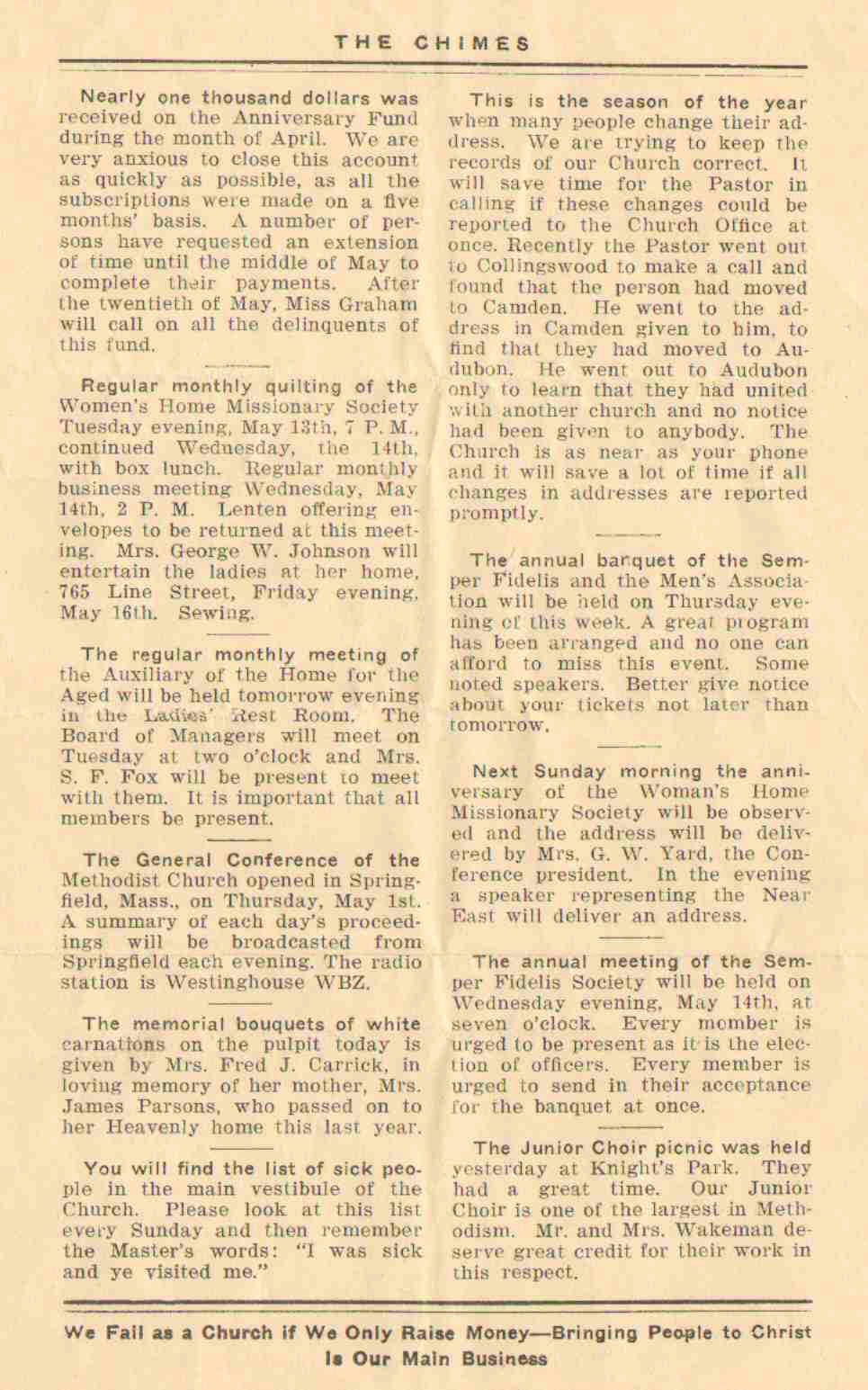
Nearly one thousand dollars was received on the Anniversary Fund during the month of April. We are very anxious to close this account as quickly as possible, as all the subscriptions were made on a five months’ basis. A number of persons have requested an extension of time until the middle of May to complete their payments. After the twentieth of May, Miss Graham will call on all the delinquents of this fund.
Regular monthly quilting of the Women’s Home Missionary Society Tuesday evening, May 13th, 7 P. M., continued Wednesday, the 14th, with box lunch. Regular monthly business meeting Wednesday, May 14th, 2 P. M. Lenten offering envelopes to be returned at this meeting. Mrs. George W. Johnson will entertain the ladies at her home, 765 Line Street, Friday evening, May 16th. Sewing.
The regular monthly meeting of the Auxiliary of the Home for the Aged will be held tomorrow evening in the Ladies’ Rest Room. The Board of Managers will meet on Tuesday at two o’clock and Mrs. S. F. Fox will be present to meet with them. It is important that all members be present.
The General Conference of the Methodist Church opened in Springfield, Mass., on Thursday, May 1st. A summary of each day’s proceedings will be broadcasted from Springfield each evening. The radio station is Westinghouse WBZ.
The memorial bouquets of white carnations on the pulpit today is given by Mrs. Fred J. Carrick, in loving memory of her mother, Mrs. James Parsons, who passed on to her Heavenly home this last year.
You will find the list of sick people in the main vestibule of the Church. Please look at this list every Sunday and then remember the Master’s words: “I was sick and ye visited me.”
This is the season of the year when many people change their address. We are trying to keep the records of our Church correct. It will save time for the Pastor in calling if these changes could be reported to the Church Office at once. Recently the Pastor went out to Collingswood to make a call and found that the person had moved to Camden. He went to the address in Camden given to him, to find that they had moved to Audubon. He went out to Audubon only to learn that they had united with another church and no notice had been given to anybody. The Church is as near as your phone and it will save a lot of time if all changes in addresses are reported promptly.
The annual banquet of the Semper Fidelis and the Men’s Association will be held on Thursday evening of this week. A great program has been arranged and no one can afford to miss this event. Some noted speakers. Better give notice about your tickets not later than tomorrow.
Next Sunday morning the anniversary of the Woman’s Home Missionary Society will be observed and the address will be delivered by Mrs. G. W. Yard, the Conference president. In the evening a speaker representing the Near East will deliver an address.
The annual meeting of the Semper Fidelis Society will be held on Wednesday evening, May 14th, at seven o’clock. Every member is urged to be present as it is the election of officers. Every member is urged to send in their acceptance for the banquet at once.
The Junior Choir picnic was held yesterday at Knight’s Park. They had a great time. Our Junior Choir is one of the largest in Methodism. Mr. and Mrs. Wakeman deserve great credit for their work in this respect.
We Fail as a Church if We Only Raise Money—Bringing People to Christ Is Our Main Business
Missing Girl Weds Bandit On Way to Pen
Camden Courier-Post —
Bridegroom Linked in Ashenfelter Case; Mother Faints
By ERNIE TALBOT
A prisoner in the Camden county jail awaiting removal today to state prison, married his sweetheart yesterday afternoon.
Last night the bride was reported as having been missing from her home in Westville Grove for two days.
The bride is Mary Lillie, 22, of Second and Cedar Avenues, Westville Grove, and her mother with the same name, was almost frantic when informed by a reporter from the Courier-Post of the marriage.
The bridegroom, Frank Tiedeman, 18, of 820 Beideman Avenue, was sentenced to five years in prison when he pleaded non vult to four robberies and carrying concealed deadly weapons, by Judge Samuel M. Shay last Monday.
Tiedeman was a member of the “North Cramer Hill gang,” two of whom participated in the robbery in which one bandit was killed after wounding City Detective Robert Ashenfelter.
The marriage was performed by Rev. Carlton R. Van Hook, of First M. E. Church, at the request of the prisoner.
Mary is a dressmaker. She is the sole support of her mother and two unemployed brothers. The family lives in meager circumstances. The bride’s weekly wage is their only provender.
Last night, it was learned the mother had heard from neighbors that her daughter loved Frank. Mary had expressed it by saying “I will wait ten years or longer, if he is found guilty and sent to jail.”
Mrs. Little, however, laughed it off. She didn’t believe Mary would marry Tiedeman.
When she heard the news she almost collapsed.
She told a reporter she would “report it to the police” and have a search made for Mary.
The girl left home Tuesday.
Mary’s two brothers, George and Edward, last night started to hunt for their sister and will order her home, if successful in their effort to locate her.
The others receiving sentences with Tiedeman were David Allaband, H. Gordon McCrea and Melbourne James. The last two, each got five years apiece and Allaband 6 years.
Wilfred M. Kaighn Fatally Stricken
Camden Courier-Post —
Descendant of Pioneer Camden Family Dies at Home on Benson Street
After an illness of 12 hours, Wilfred M. Kaighn, 66, a direct descendant of the first settlers of Kaighn’s Point, died yesterday at his home, 567 Benson street. Mr. Kaighn was stricken with a hemorrhage of the brain Thursday night. He was superintendent of the Baltimore Life Insurance Company until six years ago, when he retired. He was a member of the official board of First M. E. Church and Ionic Lodge No. 94, Free and Accepted Masons.
Survivors are: The widow, Mary A., and a daughter, Mrs. Vera Kaighn Nirella, soprano soloist in East Liberty Presbyterian Church, Pittsburgh, and former church singer in Philadelphia. Mr. Kaighn also is survived by two grandchildren.
Dr. George W. Yard, pastor of First M. E. Church, and Dr. Thomas S. Brock, pastor of St. Paul’s M. E. Church, Atlantic City, will conduct services at 2:00 PM, Tuesday, at the funeral home of Joseph H. Murray & Son, 408 Cooper street. Burial will be in Harleigh Cemetery.
Mr. Kaighn was a descendant of John Kaighn, who arrived from England at Byberry, Pa., in 1690 and later acquired all of the land in what now is Camden, from Line street to Line Ditch.
Pastor and Wife Injured in Crash
Camden Courier-Post —
Daughter of Rev. George W. Yard Escapes Injury in Pennsylvania
Rev. and Mrs. George William Yard, of 309 South Sixth street, Camden, were injured seriously late today, and their daughter, Frances, escaped injury, when their automobile collided with a team of mules and swerved into a field near Carlisle, Pennsylvania.
Rev. Yard, pastor of the First M.E. Church, Sixth and Stevens Streets, suffered severe scalp cuts. Mrs. Yard suffered a fractured shoulder blade, according to word received here.
They were returning to Camden from Dickinson College, Carlisle, following their daughter’s graduation.
At Hogestown, eight miles east of Carlisle, the Yard car skidded into the team, which was pulling a state highway department mower, the report from Carlisle said. One of the mules was killed. Rev. and Mrs. Yard were removed to a nearby hospital.
Children at Camden Home Have Big Time in Wading Pool
Camden Courier-Post —
Bathing Place, Given by Citizens Officially Opened — Four Youthful Charges, Left Motherless, to Return to Father
Bathing in the backyard is a privilege of the children of the Camden Home for Friendless Children that is enjoyed by few of the other youngsters in the city. Yesterday, 63 of the little charges of the institution romped and played in the newly opened wading pool in the home playground.
Built by contributions of residents of the city, the pool was officially opened yesterday for the first time this season to the delight of the children whose gay laughter and shouts resounded throughout the grounds.
The children, whose ages range from 4 to 12, finished their school term last Friday and are now on “vacation” during which time they are taken for sight-seeing trips and picnics by civic club groups and individuals.
Included among the recent outings given the children was a trip to the Philadelphia Zoological Gardens under auspices of the Camden Kiwanis Club. Plans are now complete for a picnic at Berlin Park under direction of Rev. George Yard and members of the First Methodist Episcopal Church.
Six of the children, some of whom have been at the home for more than six years, will leave the institution within the next few days. Four of those are returning to their father who was left with the motherless group upon the death of his wife.
Not all of the home inmates were among the “waders” at the pool yesterday. Five charges are but infants who are occupants of the “baby house,” and were unable to join the crowd.
The children who are under direction of Miss E. R. Schofield, superintendent of the home, apparently enjoy the period of vacation equally as much as youngsters whose parents take them to seashore or mountains, with the older children of the group acting as embryonic “dads” and mothers to the smaller inmates.
Childhood Sweethearts Reveal Marriage Seven Months Ago
Camden Courier-Post —
Herbert O. Hampton and Naomi Sturm Tell Parents They Just Could Not Keep Their Secret Any Longer
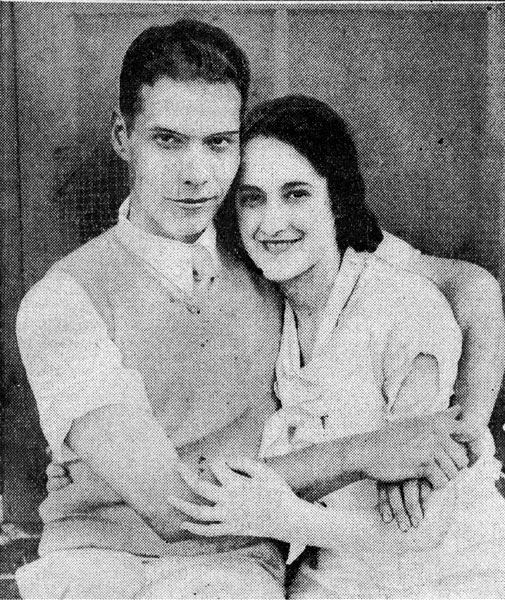
Although they were wed in Camden seven months ago, Mr. and Mrs. Herbert O. Hampton, both 21, succeeded in keeping their marriage a secret until Wednesday, and even then it was the couple themselves that revealed it.
Childhood sweethearts since they were 14 years old, Herbert O. Hampton, of 1020 Princess Avenue, and the former Miss Naomi Sturm, of 626 Pine Street, both 21, revealed yesterday that they had been married seven months ago.
Playing together, riding Herbert’s bicycle together, going to high school together throughout seven years, the couple were married on November 24 last year, and “just for the fun of it,” decided to keep their marriage a secret.
“We decided yesterday we just couldn’t hold out any longer,” Herbert said, “and so we told our parents.”
They were married at the parsonage here of Rev. George W. Yard, pastor of the First Methodist Episcopal Church, and were attended by a young married couple, Mr. and Mrs. William Buckley, of 1227 Magnolia Avenue, friends, who also promised they would keep the secret.
Herbert is the son of Mr. and Mrs. J. Oscar Hampton, of 1020 Princess Avenue, where the young couple will begin making their home temporarily. His bride is the daughter of Mr. and Mrs. William Sturm, of the Pine Street address.
Herbert graduated from Camden High School in the 1929 class. His wife left high school after two years’ attendance there. The couple became acquainted as children when Naomi resided at 1061 Princess Avenue with an aunt.
Cooper Auxiliary Pledges $3000 for Deep Therapy Fund
Camden Courier-Post —
Charity Ball Plans Occupy Women Hospital Workers; New Member Elected
PLANS for the Sixteenth Annual Charity Ball in the interest of Cooper Hospital occupied members of the main auxiliary of that institution yesterday when they met for their monthly business session.
According to present plans, the ball will be held on December 27 in Convention Hall. This year the music committee, of which Mrs. Joseph Wallworth, of Haddonfield, is chairman, will present an orchestra of national reputation.
Members of the patroness committee will meet with the chairman, Mrs. Charles T. Murray, at her home, 114 White Horse pike, Haddon Heights, on Friday morning, November 8, at ten o’clock.
Members of the auxiliary have issued a plea for magazines to be distributed throughout the wards. They will be received at the hospital at any time. The members also pledged the sum of $3000 to the board of managers of the Deep Therapy Fund.
Mrs. William Brown Thompson, of Collingswood, was elected a member of the main auxiliary at yesterday’s meeting, and two resignations were accepted, those of Miss Elizabeth Eggie and Mrs. Frank Burr, both of Collingswood. Both Miss Eggie and Mrs. Burr have been active members of the group for many years.
The semi-annual tea for the Associate Auxiliaries throughout the city and suburbs will be held on Thursday in the Nurses Hall, with a business session preceding in the First M. E. Church, Sixth and Stevens streets. Miss Mary Louise Robbins is president of the organization.
Mrs. Harvey N. Scheirer, of Haddonfield, is president of the main auxiliary and is serving as general chairman of the ball committee.
Bible Conference at First Methodist Episcopal Church
Camden Courier-Post —
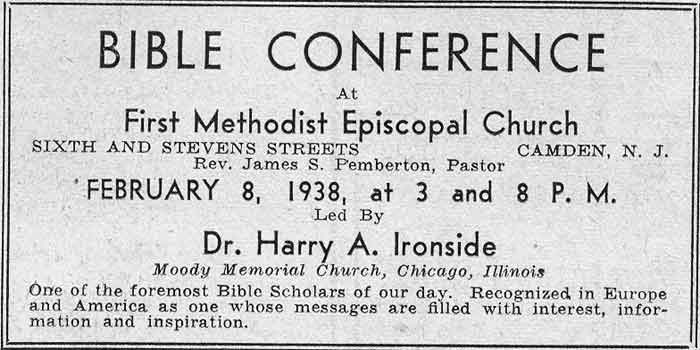
At First Methodist Episcopal Church, Sixth and Stevens Streets, Camden, N. J. — Rev. James S. Pemberton, Pastor
February 8, 1938, at 3 and 8 P. M.
Led By Dr. Harry A. Ironside, Moody Memorial Church, Chicago, Illinois
One of the foremost Bible Scholars of our day. Recognized in Europe and America as one whose messages are filled with interest, information and inspiration.
W.C.T.U. to Meet in First M.E. Church
Camden Courier-Post —
Central Branch of the Camden County W.C.T.U. will meet at 2 p. m. today in the parlors of the First M.E. Church, Sixth and Stevens Streets. Mrs. Charles E. Whinna, Collingswood, director of child welfare, will present her department report and there will be a social session in which members will be introduced to their “mystery” sisters.
Dr. Harry A. Ironside, of the Moody Memorial Church, Chicago, who is holding a three-day conference at the Camden church, will give an address.
Temperance Bodies Hold Meetings in Fairview, Camden
Camden Courier-Post —
Central Branch of the Camden County Women’s Christian Temperance Union will hear Dr. Harry A. Ironside, of Chicago, in an address following their monthly business meeting this afternoon in the parlors of the First M.E. Church, this city.
Dr. Ironside is pastor of the Moody Memorial Church, Chicago, and is conducting a three-day Bible conference at the First M.E. Church.
A business session will be conducted by the president, Dr. Josephine Kaye Williams, after which a program on child welfare will be presented by Mrs. Elizabeth Whinna, child welfare chairman of the branch.
Fairview Plans Memorial
Fairview Branch, Women’s Christian Temperance Union, will meet this afternoon at 2 o’clock at the home of Mrs. Clara Siddons, of 2855 Yorkship Road.
The meeting will be given to a program in memory of Lillian Stevens and Frances E. Willard, pioneers in the work of the organization. It also is the annual dues paying meeting.
Mrs. Anna Dewar will give a “Tribute to Mrs. Stevens” and following presentation of the Stevens legislation fund will be made by the branch president, Mrs. Myrtle Leiter. Mrs. Sue Clemmans will present the Willard Memorial Fund.
Junior Choir — 1938
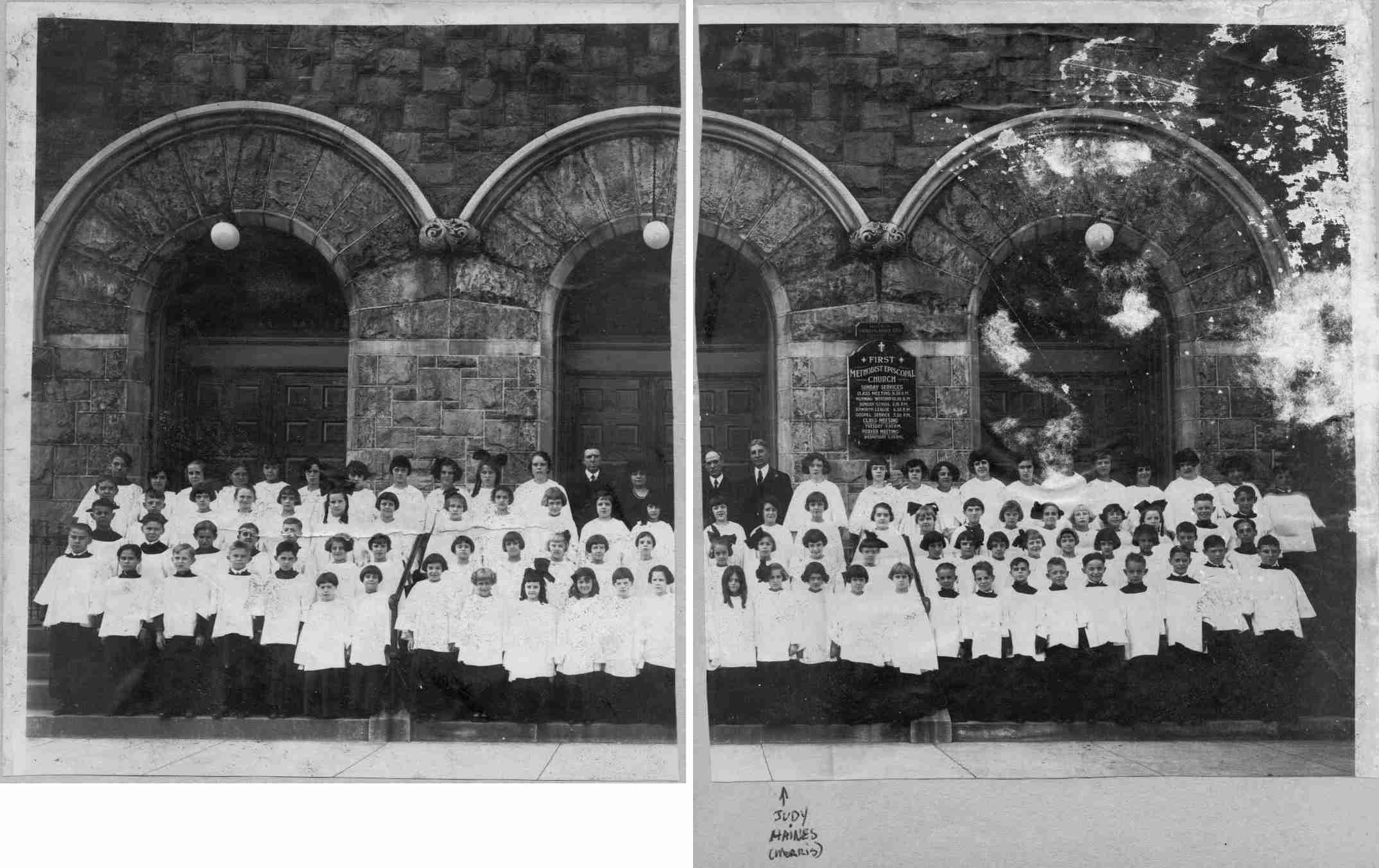
Right section of photo, Front Row, Second from middle: Judy Haines (Morris)
December 1938
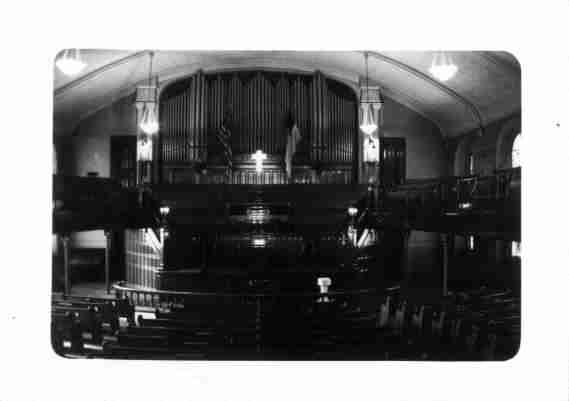
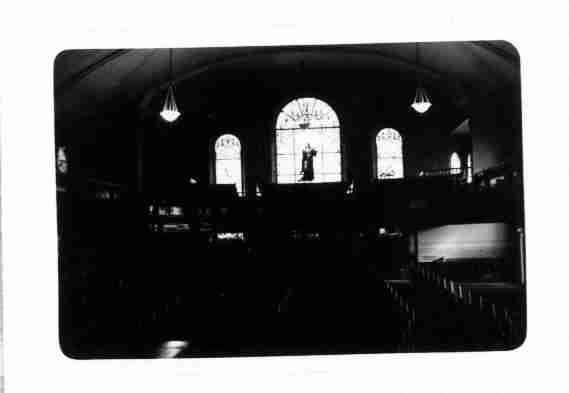
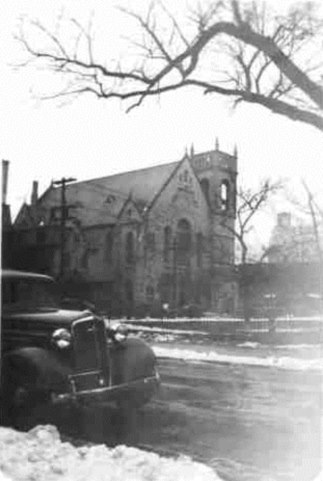
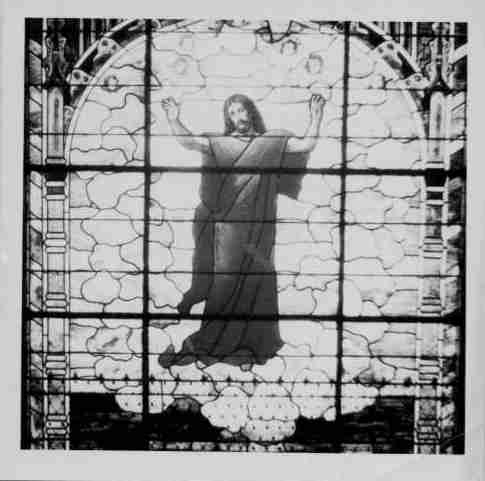
First Methodist Episcopal Church — December 1938
Death of Mrs. Maria Beck
Philadelphia Inquirer —
• Mrs. Maria Beck, wife of Andreas Beck, of 114 Federal street, died yesterday of congestion of the brain. She was a prominent member of the First M. E. Church, where the funeral services will be held on Monday.
Many Leave High School in Camden
Philadelphia Inquirer —
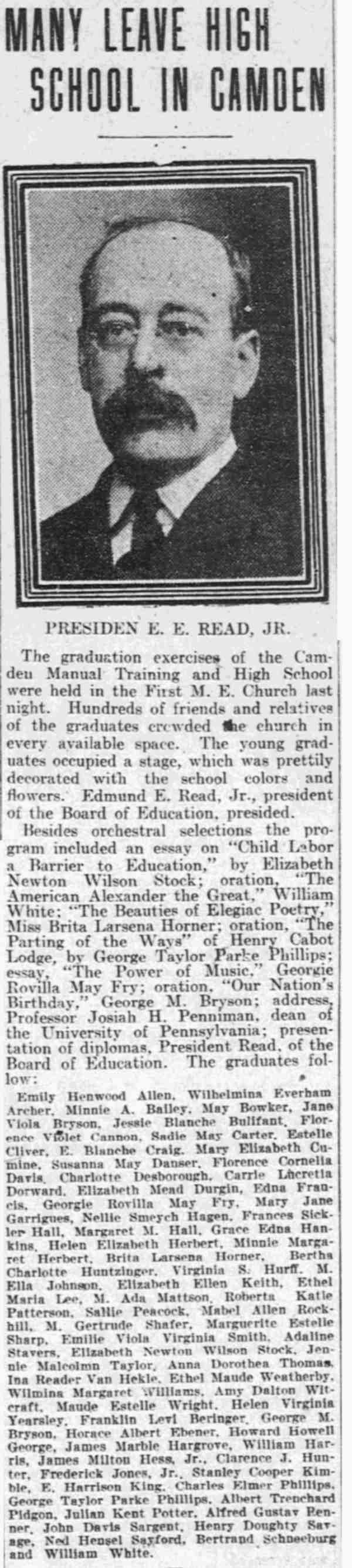
PRESIDEN[T] E. E. READ, JR.
The graduation exercises of the Camden Manual Training and High School were held in the First M. E. Church last night. Hundreds of friends and relatives of the graduates crowded the church in every available space. The young graduates occupied a stage, which was prettily decorated with the school colors and flowers. Edmund E. Read, Jr., president of the Board of Education, presided.
Besides orchestral selections the program included an essay on “Child Labor a Barrier to Education,” by Elizabeth Newton Wilson Stock; oration, “The American Alexander the Great,” William White; “The Beauties of Elegiac Poetry,” Miss Brita Larsena Horner; oration, “The Parting of the Ways” of Henry Cabot Lodge, by George Taylor Parke Phillips; essay, “The Power of Music,” Georgie Rovilla May Fry; oration, “Our Nation’s Birthday,” George M. Bryson; address, Professor Josiah H. Penniman, dean of the University of Pennsylvania; presentation of diplomas, President Read, of the Board of Education. The graduates follow:
Emily Henwood Allen, Wilhelmina Everham Archer, Minnie A. Bailey, May Bowker, Jane Viola Bryson, Jessie Blanche Bulifant, Florence Violet Cannon, Sadie May Carter, Estelle Cliver, E. Blanche Craig, Mary Elizabeth Cummine, Susanna May Danser, Florence Cornelia Davis, Charlotte Desborough, Carrie Lucretia Dorward, Elizabeth Mead Durgin, Edna Francis, Georgie Rovilla May Fry, Mary Jane Garrigues, Nellie Smeych Hagen, Frances Sickler Hall, Margaret M. Hall, Grace Edna Hankins, Helen Elizabeth Herbert, Minnie Margaret Herbert, Brita Larsena Horner, Bertha Charlotte Huntzinger, Virginia S. Hurff, M. Ella Johnson, Elizabeth Ellen Keith, Ethel Maria Lee, M. Ada Mattson, Roberta Katie Patterson, Sallie Peacock, Mabel Allen Rockhill, M. Gertrude Shafer, Marguerite Estelle Sharp, Emilie Viola Virginia Smith, Adaline Stavers, Elizabeth Newton Wilson Stock, Jennie Malcolmn Taylor, Anna Dorothea Thomas, Ina Reader Van Hekle, Ethel Maude Weatherby, Wilmina Margaret Williams, Amy Dalton Witcraft, Maude Estelle Wright, Helen Virginia Yearsley, Franklin Levi Beringer, George M. Bryson, Horace Albert Ebener, Howard Howell George, James Marble Hargrove, William Harris, James Milton Hess, Jr., Clarence J. Hunter, Frederick Jones, Jr., Stanley Cooper Kimble, E. Harrison King, Charles Elmer Phillips, George Taylor Parke Phillips, Albert Trenchard Pidgon, Julian Kent Potter, Alfred Gustav Renner, John Davis Sargent, Henry Doughty Savage, Ned Hensel Sayford, Bertrand Schneeburg and William White.