General Winfield Scott Price
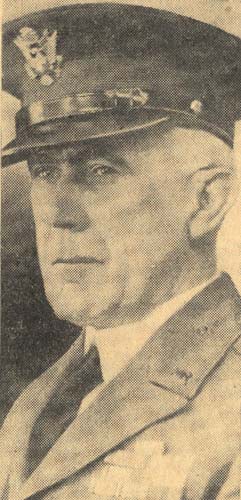
General Winfield Scott Price
WINFIELD SCOTT PRICE enlisted in the New Jersey National Guard as a private in 1892, and retired a Major General in June of 1939. In between he saw duty in the Spanish American War and World War I, and after serving on Camden NJ’s City Council for five years, became the Mayor of Camden NJ in 1927.
During his service in World War I, Winfield Price distinguished himself while serving under Lieutenant Colonel Harry C. Kramer in the creation and administration of the national selective service system.
In November of 1927 Mayor Price appointed a committee to arrange for the observance in February 1928 of the One Hundredth Anniversary of the City of Camden. The committee was composed of Charles S. Boyer, Chairman; T. Yorke Smith, E.G.C. Bleakly, Mahlon F. Ivins Jr., Fred S. Caperoon and Frank S. Albright.
During his four year term in office the new City Hall was erected. After his term as Mayor ended, he served as commander of the 44th Infantry Division, New Jersey National Guard until his retirement. During this time he formed the first African-American National Guard Battalion in New Jersey. He retired from the National Guard in June of 1939.
Company ’L’ Survivors to Hold Reunion Here
Camden Courier-Post —
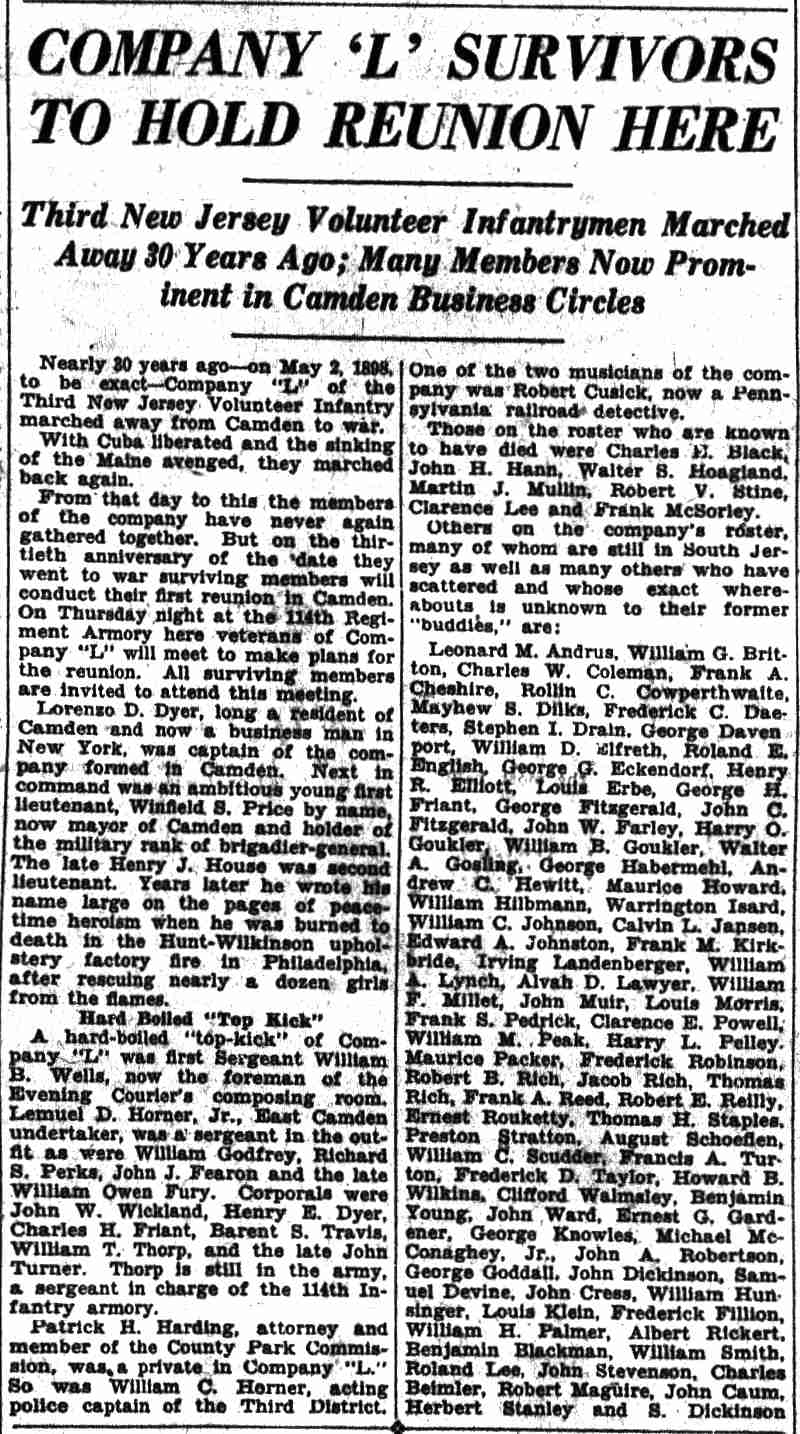
Third New Jersey Volunteer Infantrymen Marched Away 30 Years Ago; Many Members Now Prominent in Camden Business Circles
Nearly 30 years ago—on May 2, 1898, to be exact—Company “L” of the Third New Jersey Volunteer Infantry marched away from Camden to war.
With Cuba liberated and the sinking of the Maine avenged, they marched back again.
From that day to this the members of the company have never again gathered together. But on the thirtieth anniversary of the date they went to war surviving members will conduct their first reunion in Camden. On Thursday night at the 114th Regiment Armory here veterans of Company “L” will meet to make plans for the reunion. All surviving members are invited to attend this meeting.
Lorenzo D. Dyer, long a resident of Camden and now a business man in New York, was captain of the company formed in Camden. Next in command was an ambitious young first lieutenant, Winfield S. Price by name, now mayor of Camden and holder of the military rank of brigadier-general. The late Henry J. House was second lieutenant. Years later he wrote his name large on the pages of peace-time heroism when he was burned to death in the Hunt-Wilkinson upholstery factory fire in Philadelphia, after rescuing nearly a dozen girls from the flames.
Hard Boiled “Top Kick”
A hard-boiled “top-kick” of Company “L” was first Sergeant William B. Wells, now the foreman of the Evening Courier’s composing room. Lemuel D. Horner, Jr., East Camden undertaker, was a sergeant in the outfit as were William Godfrey, Richard S. Perks, John J. Fearon and the late William Owen Fury. Corporals were John W. Wickland, Henry E. Dyer, Charles H. Friant, Barent S. Travis, William T. Thorp, and the late John Turner. Thorp is still in the army, a sergeant in charge of the 114th Infantry armory.
Patrick H. Harding, attorney and member of the County Park Commission, was a private in Company “L.” So was William C. Horner, acting police captain of the Third District.
One of the two musicians of the company was Robert Cusick, now a Pennsylvania railroad detective.
Those on the roster who are known to have died were Charles D. Black, John H. Hann, Walter S. Hoagland, Martin J. Mullin, Robert V. Stine, Clarence Lee and Frank McSorley.
Others on the company’s roster, many of whom are still in South Jersey as well as many others who have scattered and whose exact whereabouts is unknown to their former “buddies,” are:
Leonard M. Andrus, William G. Britton, Charles W. Coleman, Frank A. Cheshire, Rollin C. Cowperthwaite, Mayhew S. Dilks, Frederick C. Daeters, Stephen I. Drain, George Davenport, William D. Elfreth, Roland E. English, George G. Eckendorf, Henry R. Elliott, Louis Erbe, George H. Friant, George Fitzgerald, John C. Fitzgerald, John W. Farley, Harry O. Goukler, William B. Goukler, Walter A. Gosling, George Habermehl, Andrew C. Hewitt, Maurice Howard, William Hilbmann, Warrington Isard, William C. Johnson, Calvin L. Jansen, Edward A. Johnston, Frank M. Kirkbride, Irving Landenberger, William A. Lynch, Alvah D. Lawyer, William F. Millet, John Muir, Louis Morris, Frank S. Pedrick, Clarence E. Powell, William M. Peak, Harry L. Pelley, Maurice Packer, Frederick Robinson, Robert B. Rich, Jacob Rich, Thomas Rich, Frank A. Reed, Robert E. Reilly, Ernest Rouketty, Thomas H. Staples, Preston Stratton, August Schoeflen, William C. Scudder, Francis A. Turton, Frederick D. Taylor, Howard B. Wilkins, Clifford Walmsley, Benjamin Young, John Ward, Ernest G. Gardener, George Knowles, Michael McConaghey, Jr., John A. Robertson, George Goddall, John Dickinson, Samuel Devine, John Cress, William Hunsinger, Louis Klein, Frederick Fillion, William H. Palmer, Albert Rickert, Benjamin Blackman, William Smith, Roland Lee, John Stevenson, Charles Beimler, Robert Maguire, John Caum, Herbert Stanley and S. Dickinson.
Company ‘L’, Third New Jersey Volunteer Infantry Regiment — Lorenzo D. Dyer — Winfield S. Price — Henry J. House — William B. Wells — Lemuel D. Horner Jr. — Patrick H. Harding — William C. Horner
Major Winfield S. Price commended on Sea Girt rifle range
Philadelphia Inquirer —

Major Winfield S. Price, who commands the Camden Battalion of the Third Regiment, N. J. N. G., is being congratulated on his excellent work on the Sea Girt rifle range this year.
History of Camden County in the Great War, 1917–1918
Camden, N.J.: Publicity and Historical Committee, 1919
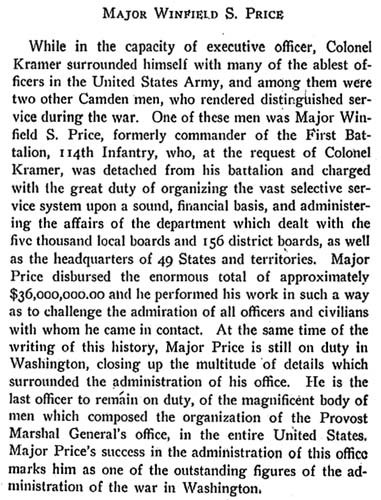
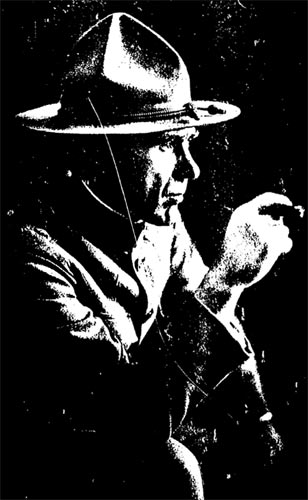
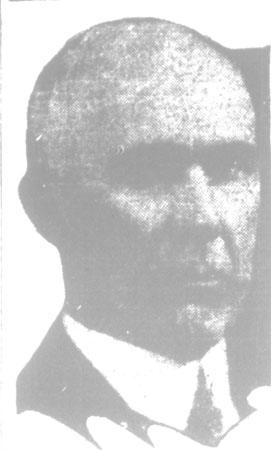
Winfield Scott Price, as pictured in History of Camden County in the Great War, 1917–1918.
Governor Ends Dispute In N.J. National Guard
Philadelphia Inquirer —
Units of 17th Infantry Brigade Are Reallocated to Original Status
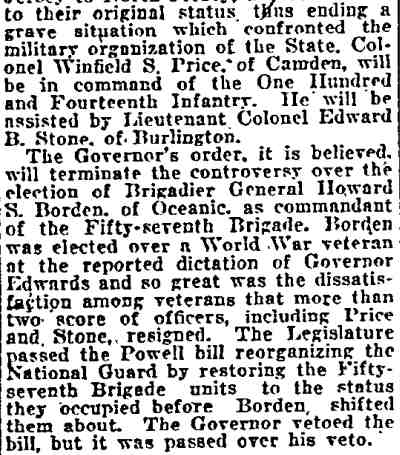
Special to The Inquirer. TRENTON, June 10.—Through an executive order just issued by Governor Edwards the several units of the Fifty-seventh Infantry Brigade, National Guard, which were moved from South Jersey to North Jersey, are reallocated to their original status, thus ending a grave situation which confronted the military organization of the State. Colonel Winfield S. Price, of Camden, will be in command of the One Hundred and Fourteenth Infantry. He will be assisted by Lieutenant Colonel Edward B. Stone, of Burlington.
The Governor’s order, it is believed, will terminate the controversy over the election of Brigadier General Howard S. Borden, of Oceanic, as commandant of the Fifty-seventh Brigade. Borden was elected over a World War veteran at the reported dictation of Governor Edwards and so great was the dissatisfaction among veterans that more than two score of officers, including Price and Stone, resigned. The Legislature passed the Powell bill reorganizing the National Guard by restoring the Fifty-seventh Brigade units to the status they occupied before Borden shifted them about. The Governor vetoed the bill, but it was passed over his veto.
Proclamation Made for Goodwill Sale
Camden Courier-Post —
Mayor Urges All South Jersey to Attend Merchandise Event Here
A proclamation issued by Mayor Winfield S. Price today urging all South Jersey to come to Camden January 5, 6 and 7 for Greater Camden’s Second Good Will Day.
More than 200 retail merchants are preparing for the sale, which, business leaders promise, will make the last three days of this week the most memorable in the merchandising history of the city.
The sale is under the retail merchant’s division of the Chamber of Commerce, and its purpose, like the Good Will Sale of last August, is to convince South Jersey shoppers that they save money when they buy in Camden.
‘Greater values create greater good will’ is the slogan for the drive.
“I cordially invite the people of South Jersey,” reads Mayor Price’s proclamation, “to come to Camden on January 5, 6, and 7 for this city’s second good will sale.”
“The retail business interests of Camden have made mighty strides forward in the past few years. Last August on the occasion of the first Good Will Sale, thousands of South Jersey shoppers learned what Camden had to offer in the ways of values and services. I am familiar with the plans for the coming sale and I know that it will demonstrate once and for all that Camden is the business center of South Jersey.
“I wish to congratulate the Chamber of Commerce on its good work and to wish Camden retail merchants success in this worthy campaign to develop this city and all South Jersey. I know that it will be a tremendous success and make thousands of new friends for Camden merchants.”
Practically every retail business establishment in Camden will take part in the sale Thursday, Friday and Saturday.
Local railroad freight departments and the officers of express companies have reported record-breaking shipments of merchandise into the city as plans for the selling campaign took definite form today.
Kausel Is Given $4000 Job Over Hot Protest By ‘Rebel’ In G.O.P.
Camden Courier-Post —
‘Not Fitted for Job and 20 of You Admitted it’ Declares Van Meter
Collingswood Man’s Insurgency Punished — Vocational School Incident is Recalled as Democrats Join in Battle
Joseph H. Van Meter, insurgent Republican freeholder from Collingswood, today declared that David Baird Jr., Republican leader, had admitted that Theodore Kausel was “not the man for the job” to which he was appointed by the Board of Freeholders yesterday.
Baird told him, however, said Van Meter, that a promise had been made “to take care of” Kausel because of the latter’s aid to the Republican Organization at the last municipal election.
Van Meter quotes Baird as follows:
“I’ll admit that Kausel is not the man for the job. But you have to help me out because we promised to take care of Kausel when he came over to us in the city election. And it was through Kausel that we got Hitchner and a lot of his crowd.”
“We’ve got ourselves tied up with him. We’ve got to take him, and I want you to go along, and help me out.”
“I know his business record and I know his political record. I know the freeholders don’t want him and our conference don’t want him, but we’ve got to eat crow, and I want you to help me out.”
Under the watchful eyes of organization leaders, Republican members of the Camden County Board of Freeholders yesterday took care of Theodore “Teddy” Kausel.
With David Baird Jr. and other chieftains of the party occupying front row seats, the board created the post of “general manager of county institutions” and promptly named Kausel for the job at an annual salary of $4,000.
Like ghosts at a feast, Baird and the other party leaders sat silently at the freeholders reorganization meeting. Like actors in a carefully pre-arranged play, a little uncertain of their cues, 20 Republican freeholders cast furtive eyes at the group of spectators.
They said no word, these freeholders. They made no reply when Joseph H. Van Meter, of Collingswood, breaking from their ranks, declared that 20 of them had told him that Kausel was unfit for the position to which he was being appointed. They listened in uncomfortable silence while Van Meter gave voice to a scathing denunciation of their “lack of backbone” and while a running fire of sarcasm from Democratic members fell upon their ears.
Scene Was Drama
The scene was drama. It might have been a revised performance of “Uncle Tom’s Cabin” with 28 furtive-eyed Uncle Toms and an impregnable line of Simon Legrees, cracking invisible whips in threatening gestures.
And the scene was also comedy. For of that score of men who, according to Van Meter, had agreed that Kausel was unfit for the job but “had to be taken care of,” none arose to protest against the action. Within their Hearts the chorus of Uncle Toms may have been saying.
“The county may own our bodies, but our souls belong to the Republican Organization.”
But if they thought this, they said no word.
Today it was pointed out that it will not be long before freeholders come up for renomination at the primaries. Today, it was also predicted that Van Meter has signed his political death warrant so far as the Republican organization was concerned. But at least he received the ungrudging tribute of the Democratic minority on the board, who joyfully proclaimed that they had found “at last a Republican with guts.”
Van Meter Fights Hard
Van Meter spared no words, took no half-measures. He accused his fellow Republican members of coercion, double-dealing and weakness. He fought the appointment bitterly. He raked up the vocational school matter, in which $85,000 had been paid for the school site on Kausel’s recommendation, a price later declared to be exorbitant.
Democratic members joined the Collingswood insurgent. They charged that the $4,000 appointment was the price of Kausel’s allegiance to the Republican party. They declared that he wasn’t worth it. They recalled, later, that Kausel had shifted from the Republican Organization to the Non-Partisan movement and then back again after being one of the loudest to criticize the Organization. They asserted that after his removal as chairman of the vocational school board, he had sought the appointment as city purchasing agent. They avowed that the Republican City Commissioners had “refused to handle Kausel” and had “wished him off on the county.”
The 26 other Republican freeholders—all of those present, excepting only Van Meter—continued to listen in silence. And when the vote came, every one of the 26 voted for the creation of the position of “general manager of county institutions” and for the appointment of Kausel.
A little later the reprisals upon Van Meter began. He was removed from the central plant and county farm committees of the board, shifted to the elections committee and allowed to remain on the printing and agricultural committees, regarded as unimportant groups.
Reprisals Were Threatened
“It doesn’t surprise me,” he said. “I was threatened with it. They told me they’d ruin me. But I couldn’t go back to Collingswood and ask the people to vote for me again if I hadn’t fought against this appointment.”
The defection of Van Meter came apparently as a surprise. The meeting had opened with the passage of the county budget on the first reading, the selection of Leslie H. Ewing, of Berlin, as director of the board, the calling of Frank P. Moles, of the Third Ward to be sworn in and his failure to respond or to appear for the gathering.
Minor matters had been attended to and then Fred W. George, clerk of the board, rose to his feet and began the task of reading a long list of proposed amendments to the rules. Buried far down in the list of revisions was that which, “for purposes of economy,” sought to place all county institutions under a central head to be known as general manager.
George lost his breath before he had more than half completed the list of amendments, and George Rothermel, pinch-hitting for Walter Keown as counsel for the board, took his place. Then Director Ewing called for a vote.
Schorpp Speaks
Frederick W. Schorpp, Eighth Ward Democrat, was the first to speak.
“I want to congratulate you gentlemen,” he said, “on the wonderful way you have camouflaged these changes.
“We have heard a long list of amendments to the rules read. But what the whole thing is can easily be seen. You gentlemen of the majority have a lame duck to take care of, and so you create this job. But I can’t see, really I can’t see why it is necessary to create a $4,000 plum for your lame duck and saddle it on the taxpayers.”
There was silence in the room. In the seat of the absent Freeholder William A. Robinson sat Baird. At the press table were Sheriff Walter Gross and City Commissioner William D. Sayrs, Jr. Ranged along the front row of the spectators’ section were Mayor Price and Commissioner Clay W. Reesman. They said nothing.
Louis C. Parker, Gloucester City Democrat, was next to speak.
“All these changes in the rules accomplish is to create a new job,” he declared, agreeing with Schorpp.
S. Raymond Dobbs, Fourteenth Ward Democrat, objected and moved that the resolution changing the rules be laid over until the regular January meeting. He was overruled by Director Ewing. Schorpp sought to have the rules voted upon separately, but James Davis, chairman of the committee, refused to accept the suggestion.
The roll call began. In alphabetical order the names were called and the freeholders voted. Republicans voted in favor of adoption of the changes. The three Democrats voted against the resolution. Van Meter’s name was the last to be called.
“No,” he said calmly, and there was a gasp of surprise in the room. The clerk recorded the vote on the resolution as 26 to 4 and then began reading again. This was a new resolution. It named Theodore T. Kausel to the position just created and explained that he was to report to the “Lakeland Central Committee.”
Van Meter Protests
Van Meter rose slowly. He obtained recognition from the director and began, quietly but decisively.
“Gentlemen,” he said calmly. “I have studied this proposition. I have known about it for three days and three nights. I have talked to 20 Republican members of this board and I have done all I could to get them to agree with me.
“And they did agree with me. They agreed, every one, that Kausel was not the man for this job. After what happened on the vocational school project, when Kausel was president of the school board, he is not the man. On his recommendation, the vocational school site was purchased for $85,000. And now you want to send him where he will handle about a million dollars of the taxpayers’ money.”
Van Meter’s tone was serious as he turned to his fellow members. Most of the latter sat silently in the seats. They did not glance at the Collingswood insurgent. Baird, Gross, Price, Sayrs and Reesman listened intently. A few of the freeholders craned their necks towards the windows as the Camden mummers, returning from the New Years Day parade in Philadelphia, marched past the courthouse. But Van Meter went on.
“There is not one of you that has backbone enough to come here and fight this thing.” Van Meter continued.
“I can’t see it go through. I couldn’t ask the people of Collingswood to vote for me again if I let it go through without a fight.
“You agreed with me that Kausel was not the man for the job. Haven’t you any backbone with which to fight his appointment now?”
Slowly, in complete silence that followed, he turned till he faced Horace G. Githens, the majority floor leader.
“Mr. Githens,” he said quietly and in a measured tone, “if you will throw away your messenger’s cap and wear a leader’s hat, I will follow you.”
He sat down and the silence continued.
Schorpp Lauds Van Meter
Schorpp rose again.
“I’m glad to see one Republican who has backbone,” he said. “I told you there was a lame duck in this and here is the lame duck.
“Woods (Samuel Woods, Republican freeholder from Haddonfield) and you others criticized Kausel and other members of the vocational school board for their purchasing of the land for the school, claiming that it was an exorbitant price to pay for the land.
“And now these same men who criticized Kausel are putting him in a position where he will handle millions of the taxpayers’ money.”
Dobbs followed on the floor.
“I don’t want to stand here and talk until 10 o’clock tonight just to give you reasons why Kausel shouldn’t get the job,” he said.
“In the first place, I couldn’t give all the reasons in that time, and in the second place, they wouldn’t register with this bunch.
“This is entirely unfair. It’s too high a price to pay Kausel to come back into the Republican ranks. The Republican leaders should pay it, however, and not saddle the price on the taxpayers.
“Personally, I don’t think he’s worth much politically. We had him for awhile and have had some experience as to the value of his services. I thought he could be bought for less than $4000 anyway.”
The resolution came to a vote. The Republicans, with the exception of Van Meter, again voted solidly. Twenty-six votes were cast for the appointment of Kausel. Van Meter and the three Democrats did not vote.
Van Meter issued a statement after the meeting, explaining his stand. He said:
“The reason I opposed Kausel’s appointment is because the man is extravagant. Director Ewing was one of the 20 Republicans I talked to who were opposed to him, but were afraid on the floor. I didn’t talk to the Democrats.
“Ewing and the other Republicans said, ‘What can we do. We must take care of him. We promised to.’”
Charges Unfair Tactics
“I knew when I went ahead with this that I’d be an outcast, but I was determined to do the right thing. This appointment is not the right thing.
“They told me I’d be ruined if I opposed them. Even up to the last minute before the meeting they came to my desk in the freeholder’s room and tried to throw a scare into me.
“I knew I’d be thrown out of committees and barred from the caucuses. They’ve let me remain on the printing committee. I’ve been on it a year, and it hasn’t met yet. Nevertheless, there is a $50,000 appropriation for printing.
“I’ve always tried to be on the level on this job. Why they had the workhouse slated for $120,000 but I fought and fought, and finally—well look at the budget—it’s cut down to $50,000.
“It’s not the first time I’ve saved them money. I don’t know Kausel personally, but I do know his record. It was because of his extravagance that he was fired from the Castle Kid Company.
“And when I say he is extravagant, I can prove every word of it.”
The new Lakeland central committee, authorized in the resolution appointing Kausel, was announced by Director Ewing at the close of the meeting. Ewing is to be a member, ex-officio, and Horace G. Githens becomes a member by virtue of being chairman of the finance committee.
The chairman of the asylum committee, of the County Hospital committee, of the Almshouse committee, of the Detention Home committee, and the Tuberculosis Hospital committee all will become members.
Name ‘Official’ Papers
An earlier vote had been taken in which the Democrats moved to designate The Evening Courier as the newspaper in which the budget was to be officially printed. The Republican majority had designated two weekly papers, the Camden Argus and the Berlin Breeze.
“It’s obvious,” said Dobbs, “why these designations have been made.”
Parker, Gloucester City Republican, agreed with this view and declared that the newspaper with the largest circulation in the county should be given the official county notices for publication as advertising.
Schorpp ironically suggested that the Christian Science Monitor be substituted for one of the two weeklies designated and the roll was called. The Argus and the Breeze were officially designated.
The appointment of Kausel brought the meeting to a conclusion. Of all the Republican freeholders, Davis was the only one to speak. He merely declared that he was not one of the 20 men who Van Meter had said agreed that Kausel was not the man for the job.
Mayor Delivers New Broadside Against Civil Service
Camden Courier-Post —
Declares Forsythe Bill Will Be Passed Over Probable Veto By Governor
Messick Sends Reply to ‘Dirty Office Talk’ — Says Price Was Under Merit System Himself and Invites Office Inspection
Adopting a new line of attack, Mayor Winfield S. Price today renewed his offensive against Civil Service by denouncing operation of the merit system as “the false alarm of a bunch of hamstringers.”
Pointing to specific cases in which he declared the Civil Service Commission had handicapped efficient government by the Camden City Commission, the mayor laid down a new barrage of denunciation, even more vigorous than that which he launched on Wednesday night at a Collingswood Republican rally.
Meanwhile, at Trenton, the mayor’s new statement and that which he made on Wednesday night drew a reply from Charles P. Messick, chief examiner of the State Civil Service Commission.
Attack Termed ‘Foolish’
The new attack was termed “merely foolish” by Messick, who added that “Mayor Price really ought to know better than that.”
“He is apparently laboring under a great many misunderstandings,” Messick said. “You will remember that he was a state employee, covered by Civil Service, for about 16 years, and so he must know better.
“Members of the Civil Service commission, of course, are merely agents of the law and not personal agents. But the attack dealing in personalities, calls for a reply, and a comprehensive statement of the commission’s stand will be issued later.”
Messick also took occasion to invite Mayor Price to Trenton to inspect the office of the Civil Service Commission in order that he may determine whether they are in the deplorable condition described by the Camden executive in his Collingswood speech. The mayor had declared that the State Capitol was “the dirtiest building in the United States” and had added that “pigeons actually roost on the wardrobe” in the commission’s office.
Struggle In Open
The new attack by the mayor, given in an interview today, is regarded as bringing further into the open the struggle over “Senate Bill No. 10,” the measure introduced in the legislature by Senator Joseph F. Forsyth which seeks to nullify Civil Service in Camden.
Prior to the mayor’s statement at Collingswood, the backers of the movement had endeavored to make it appear purely a “home rule” proposal having effect only on Camden. Mayor Price’s general arraignment of Civil Service, however, was regarded as contradicting the previous claims that the bill was local in character and to give strength to opponents of the measure who declare it to be an “opening wedge,” designed as a blow at Civil Service throughout the state.
A veteran military campaigner and a brigadier-general in the National Guard, Mayor Price today compared the operation of Civil Service to the army’s system. He predicted the passage of the Forsyth bill, its veto by Governor A. Harry Moore, and its re-passage over the veto.
In explaining his charge of “ham-stringing,” Mayor Price cited the cases of Howard B. Dyer, custodian of Convention Hall, and of Frank S. Albright, information clerk and city statistician. Dyer, the mayor said, was “superintendent” at Convention Hall for two years and eight months and was not required to take a Civil Service examination. He was appointed by the previous administration.
“The present city administration,” the mayor asserted, “retained Dyer because he was a competent man. Then suddenly, the Civil Service Commission woke up and insisted that Dyer take a test for the job. Why hadn’t the commission thought of that during the two years and eight months Dyer was ably filling the post? That’s something I’ve never had satisfactorily answered.”
“The present city commission,” he said, “appointed Albright, by resolution, as city publicity agent for one year. What does Civil Service do? It informs us that we can’t do that. Albright must take an examination, we are told, and it is not for city publicity agent, but for ‘information clerk and statistician.’ What use have we for a statistician? Somebody to tell us how many peanuts Camden had back in 1842 and how many it’s got now? No, what we wanted was a publicity agent and with that title.
Wanted Year Term
“Not only that, but we wanted to appoint a man for one year. If he didn’t prove efficient in that time, we could kick him out. We wouldn’t have had dead wood on our hands. Then again, we might not need him for more than a year; we might find that there would be no further use for the job. Appointed for only one year, we could let the holder out and abolish the position. That’s sensible isn’t it?
“But, no, the Civil Service board tells us we can’t do that. It must be a permanent appointment, and we have no right to have a man we want unless he takes a civil service examination and qualifies. Then, they ask the candidate a lot of foolish questions, some of them having no bearing on the job he seeks. And so we have a man, not for one year, but as long as he wants to stay, whether we need him or not.”
The mayor then cited what he declared to be the difference between the Army method of hiring and firing men and the way it is done in Camden under Civil service.
“Here we have nothing but the false alarm of a bunch of incompetent hamstringers,” he declares. “Any merit Civil Service might have in this city has been cast to the winds by these bunglers, never satisfied unless they are hamstringing. We can’t get rid of this kind of Civil Service too soon to suit me. It might be all right in other cities in the state, but it’s been a false alarm here.
Compared With Army
“There’s a wide difference between the way the army does things, and the way they are done by Civil Service in Camden,” he went on. “The difference lies in the fact that in the army there are competent boards for the appointment, promotion or demotion of the men. Each board is composed of superior officers experienced in that branch of service for which the candidate is taking the examination; for that reason because of their own fitness and experience these officers are well qualified to determine the fitness of any candidate for appointment or promotion.
“Take our Civil Service Board. The examiners in many cases know nothing whatever of the duties of the office for which they examine candidates except, perhaps, for the minor clerical positions.”
Mayor Price said that another fault with Civil Service is that a subordinate, under permanent appointment, “can lay down on the job and thus become insubordinate without fear of dismissal.”
“In Civil service,” the Mayor continued, “the appointee, knowing he cannot be removed so easily from his job, sometimes becomes defiant, and usually raises considerable dust before he is finally ousted. This wouldn’t happen if such a person were appointed, say, for a year. Then, if he proved inefficient, he could be kicked out. Realizing this, he would give his job the best in him to insure his reappointment for another year.”
“Civil service or no civil service, when a man is found inefficient he should be fired. When I make up my mind to fire a man, out he goes. What we want in the city government is efficient service. And that we can’t have as long as we have hamstringing civil service.”
Wants ‘Home Rule’
“We don’t want Civil Service here as we’ve had it and we’re going to get rid of it. If Governor Moore vetoes the anti-civil service bill introduced in the legislature for Camden, we’ll have it passed over his veto. That bill’s going to pass! After that, we’ll have no more hamstringing interference from outsiders. We’ll have home rule, and that’s what we need here for the best possible government of the city.”
Mayor Price insisted that no “spoils system” would result in Camden with the overthrow of the present Civil Service.
“There’s no spoils system existing in town now and there won’t be,” he declared. “We’ve aimed for efficient service. Unless we have that, the city government will fail. We’re not going to let that happen.”
In referring to Mayor Price’s address in Collingswood, Messick made the following statement:
“Mayor Price was a state employee under Civil Service from 1911 until 1927. He should know something of the working conditions at the state capital, and whether or not the fact that he was under Civil service regulation affected either the quantity or quality of his own work. There are no pigeons roosting in the office of the Civil service Commission, and we are not ashamed of the physical condition of the office or the quality and character of the work done therein. A large number of people come to this office every day. I should be glad to have the mayor come also and make an inspection. Of course, he’s not serious.”
The comment of the Mayor in his Collingswood address referred to by Mr. Messick was as follows:
“The best example of the inefficiency of Civil Service is its dirty quarters in the state capital. I tell you pigeons roost on the wardrobe in their quarters.”
As to charges of “bureaucracy,” the secretary to the Civil Service Board refused to comment on that phase of the Mayor’s speech.
State House observers regard the offices of the Civil Service Department as the best equipped and most representative of modern business management of all state agencies housed under the dome of the capital. They were planned under the supervision of Custodian John A. Smith, of Camden County, and a close friend of general Price. Mr. Smith is now ill at his home.
Mayor Price to Name 3 to Education Board
Camden Courier-Post —
Three appointments to the Camden Board of Education will be made by him late today or tomorrow, Mayor Price said this morning. The appointments were expected to be made yesterday, but they were delayed, the mayor explained, because a “very capable man” declined to accept as one of the appointees.
The mayor, under the law, has until January 15 to make the appointments, and the new appointees take office a month later. Three vacancies were to be filled by the mayor with the expiration of the terms of George C. Prince, George M. Bryson, and Albert Dudley. The mayor would not say whether or not he would re-appoint any of the three retiring members. Other members of the present board are Edwin I. Seabrook, president; Mrs. Anne D. Spooner, Irving T. Nutt, Meyer Wessel, Dr. Conrad G. Hoell and Dr. Jennie S. Sharp.
13th Ward G.O.P. Club Pays Tribute to Rhone
Camden Courier-Post —
A meeting which was described today as “a gathering in honor of David S. Rhone, director of public safety,” was held last night at the Thirteenth Ward Republican Club, Haddon Avenue and Mechanic Street.
The speakers included David Baird Jr., Mayor Price, Commissioner Clay W. Reesman, Sheriff Walter T. Gross, Urquhart Ward, ward committeeman, Theodore Kausel and Commissioner Rhone.
A large photograph of Commissioner Rhone was presented to the club by friends of the Commissioner, and has been placed in the clubroom. A photograph of Ward was also given the club.
Arrangements were made by the club for its annual ball to be held February 21. Plans were also discussed for the remodeling of the club’s headquarters.
$15 Pension Granted to Widow of Policeman
Camden Courier-Post —
A pension of $75 a month was granted to Mrs. Sadie Owens, 2402 South Eighth Street, following a meeting of the Police and Fireman’s Pension Fund Committee in the office of Mayor Price. Mrs. Owens is the widow of Harry F. Owens, who retired from the Camden Police Department on pension, February 19, 1924, because of physical disability.
Owens was a member of the ambulance crew of the police bureau. He became a member of the department December 3, 1906. He died December 17, 1927.
Officials Invited for Military Ball
Camden Courier-Post —
Governor, Senators, Pershing May Attend Affair of Vets Here Feb. 3
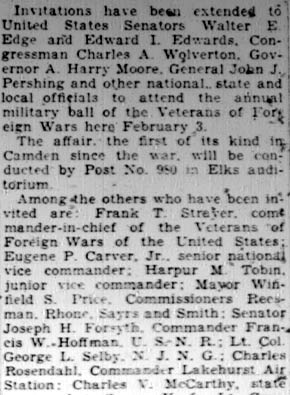
Invitations have been extended to United States Senators Walter E. Edge and Edward I. Edwards, Congressman Charles A. Wolverton, Governor A. Harry Moore, General John J. Pershing and other national, state and local officials to attend the annual military ball of the Veterans of Foreign Wars here February 3.
The affair, the first of its kind in Camden since the war, will be conducted by Post No. 980 in Elks auditorium.
Among the others who have been invited are: Frank T. Strayer, commander-in-chief of the Veterans of Foreign Wars of the United States; Eugene P. Carver, Jr., senior national vice commander; Harpur M. Tobin, junior vice commander; Mayor Winfield S. Price, Commissioners Reesman, Rhone, Sayrs and Smith; Senator Joseph H. Forsyth, Commander Francis W. Hoffman, U. S. N. R.; Lt. Col. George L. Selby, N. J. N. G.; Charles Rosendahl, Commander Lakehurst Air Station; Charles V. McCarthy, state commander; George Keefe, Lt. Commander U. S. N. R.; Arthur S. Grabowsky, senior vice commander; Charles W. Gilmour, chief of staff, state department, V. F. W., and Mrs. Florence E. Stark, national president; Mrs. Grace Davis, national secretary; Mrs. Margaret Soffel, state president of the ladies’ auxiliaries.
Gold star mothers of this vicinity have been invited to attend as guests of the post as well as post commanders of all the veteran organizations in Camden county.
The bugle corps of North Penn Post No. 676, of Glenside, Pa., consisting of 40 buglers, will be one of the attractions. The Phillips Bohemian orchestra will render the dance music during the evening.
John A. Pennington, post commander, heads the general committee. The other officers are James W. Connor, vice chairman; John Rouh, secretary, and Charles P. Bozian, treasurer.
Mayor Price Takes New Quarters at Hall
Camden Courier-Post —
Mayor Winfield S. Price was in his new office at City Hall today, the former headquarters of the Board of Education on the second floor. The mayor’s former office is deserted and no decision has been made as yet by city officials as to how it will be used.
The new office has been renovated and offers more adequate space than the old quarters, with the mayor’s own chamber, a conference room, secretary’s room and reception room.
Transfer to the new headquarters was completed over the week-end. Assisting in making the shift were B. Frank Alcott, the mayor’s secretary, and Miss Catherine Connor, stenographer. New telephone connections were completed by the phone companies today.
Mayor Asked to Speak at Dinner for King
Camden Courier-Post —
An invitation to be among the speakers at a testimonial dinner to former Mayor Victor King, at the Hotel Walt Whitman Saturday night, will be extended to Mayor Winfield S. Price by Edward L. Canning, secretary of the Victor King League, which is in charge of the dinner.
Royd Morrison, publisher of a trade paper in Philadelphia, will be toastmaster. Invocation will be offered by Rev. Elwood A. Harrar, while Rev. Brendan C. Shea will pronounce the benediction.
Among those who have sent acceptances as speakers are former Mayor James H. McNally, of Gloucester; H. Raymond Staley, former city commissioner; George Fox, business partner of former Mayor King, and J. Elwood Dukes. Arrangements for the banquet have been in charge of B. Frank Alcott, secretary to Mayor Price. Invitations have been sent to all the city commissioners.
Mayor Price Returns to Desk at City Hall
Camden Courier-Post —
Mayor Winfield S. Price returned to his office at City Hall today after an absence of three days.
The mayor had been a victim of the grippe and had been confined part of the time to bed at his home, 810 Linden street.
City Officials Go to Harbors Hearing
Camden Courier-Post —
C. of C., Port Body Send Delegates to Win U.S. Aid on Marine Terminal
City officials and representatives of the South Jersey Port Commission and the Camden Chamber of Commerce are leaving this afternoon for Washington to attend the hearing tomorrow before the Rivers and Harbors Committee on the deepening of the Delaware river channel in anticipation of construction of the $2,000,000 marine terminal.
Cost of the improvement to be made by the government, in accordance with its agreement to do the work with approval by Camden citizens of the terminal plans, will be approximately $300,000. The channel is to be dredged north of the terminal as far as Berkley street.
Mayor Price, commenting today on the project, declared that there should be no obstacle confronting the city in obtaining approval of the Government to the channel improvement.
“If the city is ready to spend $2,000,000, the Government would be willing to put up $300,000,” the mayor said.
The mayor, Commissioner T. Yorke Smith, and Harold W. Bennett, city solicitor, were among the group preparing to leave by train for the Capitol this afternoon.
Store’s Centennial Gift to City
Camden Courier-Post —
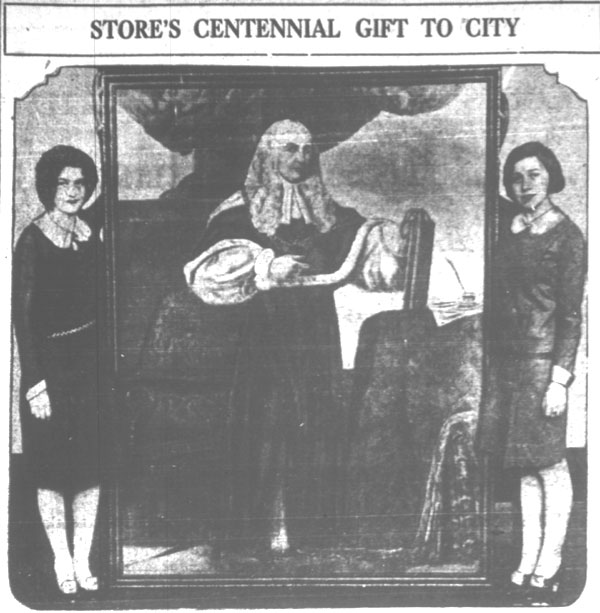

Named: W.R. Senseman, Francis E. Senseman, Celeste Powers, Alice Rakestraw, and Stecker Store.
Life Size Portrait of Lord Camden Is Presented to City
Camden Courier-Post —

Gift of Robert Stecker Received by Mayor in Laudatory Address
Ceremonies at Store
A life size oil painting of Lord Camden was presented to the City of Camden today by Robert D. Stecker, head of the local department store bearing his name. The painting was officially accepted by Mayor Winfield S. Price, and will be hung in City Hall.
The presentation took place before a crowd of several hundred persons, including representatives of the city and county. The presentation address was made by Samuel Hammer, secretary of the Stecker organization, who spoke for Mr. Stecker, who was unable to attend.
The spectators gathered at the foot of the stairway on the first floor. The veiled painting hung under a canopy of draperies on the first landing. On each side of the painting stood a pretty girl, Miss Celesta Powers and Miss Dorothy Phillips. Directly in front of the painting stood little Miss Dorothy Jean O’Brien, 5-year-old daughter of Thomas O’Brien, superintendent of the store and advertising manager.
A choir of 50 trained voices, led by Mrs. Marion Powers, opened the exercises with the singing of “America.”
Loyal D. Odhner, secretary of the Camden Chamber of Commerce, paid tribute to the civic pride of the members of the Stecker organization and told of the progress that would be made in Camden during 1928.
Predicts Great Year.
“This year will mean a great deal to Camden,” Mr. Odhner said. “It will be the greatest year in the history of our city. Just look at the actual and contemplated activities for Camden which have been announced or started during the past few months.
“A cold storage plant, which will be a $3,000,000 project; announcement by the Victor Company that 1928 is to be the biggest year in its history; $13,000,000 power plant at Pennsgrove; our shipbuilding program which, if it goes through, means a $100,000,000 project for this city; commencement of Campbell’s Soup Company additions, meaning the spending of millions; announcement for the plans of a new $15,000,000 highway from Camden to Atlantic City; commencement of activities on the $2,000,000 marine terminal project; continuation of the $2,000,000 county park program; announcement that the proposed Galen building is financed and work will be started this year; the Tacony-Palmyra bridge; vocational school.
“Then there are the two new bank buildings, the Camden Safe Deposit and Trust Company, and the First Camden National Bank and Trust Company; the apartment hotel, Fifth and Cooper streets; a proposed new theatre, high speed lines across the bridge, the $400,000 post office appropriation for a new building, a new proposed 13-story apartment house, a $2,000,000 sewage disposal plant in Camden, the dredging of the Delaware river on the Camden side, and the new court house annex.
“I could stand here and enumerate other big projects but I merely want to point out to you some of the big things in store for Camden.”
Mayor Accepts Gift
Mr. Odhner then introduced Mr. Hammer, who in turn introduced Mayor Price and officially presented him with the painting. In a short address Mayor Price accepted the gift and lauded the civic spirit of Mr. Stecker.
“There is nothing impossible for Camden,” Mayor Price said. “We could tear down all our buildings here and then pitch right in and build a bigger and better city. We, the residents of Camden, have that unconquerable spirit to do things. This beautiful painting will be placed in the old city hall. I hope we will soon have the money for a new city hall where his painting may hang.”
Then little Dorothy O’Brien pulled a silken cord and the covering on the big painting, revealing the work of Raphael Senseman, 719 Stokes avenue, Collingswood, illustrator and painter.
The chorus then sang the “Star Spangled Banner,” and the presentation exercises had been concluded. Among the guests were the following: Surrogate George Whyte, Register of Deeds Joshua Haines, and County Clerk Charles Wise, who represented Camden county; Mayor Price, City Commissioner T. Yorke Smith and City Clerk William Brown, who represented the city; Rev. Father Thomas J. Whelan, of the Church of the Holy Name; James V. Moran, of the Hurley Store, and Clarence Munger, who formerly operated the Stecker store when it was known as Munger and Long.
John Carroll Honored by Fifth Ward Club
Camden Courier-Post —
John H. Carroll, Fifth Ward Republican county committeeman, was honored last night by fellow-members of the Fifth Ward Republican Club at its meeting at the organization’s headquarters, 271 Kaighn avenue.
The club tendered a reception to the veteran political leader in token of his recovery and return from Cooper Hospital after a long period of illness.
Leo B. Rea, vice president of the club, served as toastmaster. Speeches were made by Mayor Winfield S. Price, Commissioners Clay W. Reesman and David S. Rhone, Bernard Bertman, police judge; Theodore Kausel, general manager of county institutions at Lakeland and Freeholders George Cotter, Thirteenth Ward, and Leonard Brehm, Fifth Ward.
The reception was in the charge of the club’s house committee, including William Kensler, R. Gimillo, and Charles H. Elfreth. Harley C. Shinn. is president of the club; Rea. ice president; Kirby Garwood, treasurer; George W. Nichols, secretary, and Elfreth, financial secretary.
Mayor Sees Need of Big Apartments
Camden Courier-Post —
MAYOR SEES NEED OF BIG APARTMENTS
Endorses Plans for Camden’s First Skyscraper Dwelling Structure
Modern apartment houses to attract new residents to Camden, particularly from Philadelphia, were seen today by Mayor Winfield S. Price, as “one of Camden’s greatest needs in this period of its growth.”
Mayor Price, endorsing plans to erect Camden’s first skyscraper apartment building at Seventh and Cooper streets, said he is not surprised by the response of public interest in the project. “As yet,” he said, “this city has no thoroughly modern apartment buildings to compete with those that have been erected in West Philadelphia.
“One of Camden’s greatest needs in this period of its growth is suitable apartment houses, which I believe will attract to our city a very large number of people who are doing business in the central section of Philadelphia and will find Camden a more convenient place of residence with reference to their business locations.”
The Mayor said he is “becoming steadily more impressed by the enthusiastic civic spirit of Camden’s people,” and termed the new apartment plan “a civic improvement in the best sense.”
“The spirit of the plan and of Camden as well,” he remarked, “is expressed by the slogan of those directly interested in the apartment project — ‘You can’t go wrong on Camden.’ That is true of every new business, every new building, every new industry and of every old industry or business that grows and expands. They can’t go wrong on Camden, and they have discovered it.”
Seventh Street — Winfield S. Price
City Will Begin Big Projects to Help Jobless
Camden Courier-Post —
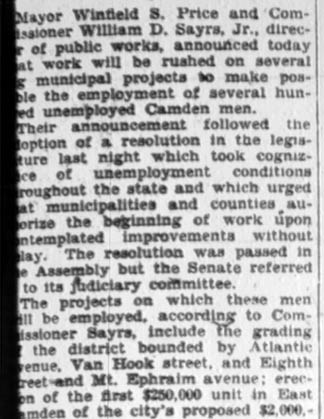
Mayor Winfield S. Price and Commissioner William D. Sayrs, Jr., director of public works, announced today that work will be rushed on several municipal projects to make possible the employment of several hundred unemployed Camden men.
Their announcement followed the adoption of a resolution in the legislature last night which took cognizance of unemployment conditions throughout the state and which urged that municipalities and counties authorize the beginning of work upon contemplated improvements without delay. The resolution was passed in the Assembly but the Senate referred to its judiciary committee.
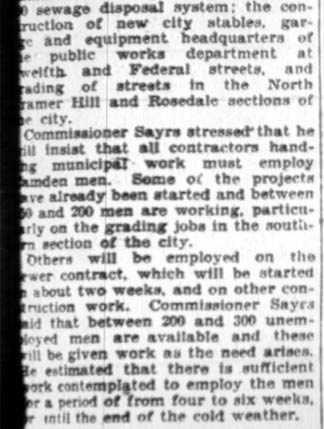
The projects on which these men will be employed, according to Commissioner Sayrs, include the grading of the district bounded by Atlantic Avenue, Van Hook street, and Eighth street and Mt. Ephraim avenue; erection of the first $250,000 unit in East Camden of the city’s proposed $2,000,000 sewage disposal system; the construction of new city stables, garage and equipment headquarters of the public works department at Twelfth and Federal streets, and grading of streets in the North Cramer Hill and Rosedale sections of the city.
Commissioner Sayrs stressed that he will insist that all contractors handling municipal work must employ Camden men. Some of the projects have already been started and between 50 and 200 men are working, particularly on the grading jobs in the southern section of the city.
Others will be employed on the sewer contract, which will be started in about two weeks, and on other construction work. Commissioner Sayrs said that between 200 and 300 unemployed men are available and these will be given work as the need arises. He estimated that there is sufficient work contemplated to employ the men for a period of from four to six weeks, until the end of the cold weather.
Winfield S. Price — William D. Sayrs — Atlantic Avenue — Van Hook Street — Federal Street — Eighth Street — Cramer Hill — North Camden
Mayor Sees Need of Big Apartments
Camden Courier-Post —
Throngs Mourn as W.L. Hurley Is Laid to Rest
Camden Courier-Post —
Thousands Pay Tribute To Merchant Prince at Home In Collingswood
SOLEMN REQUIEM MASS AT ST. JOHN’S CHURCH
Many Follow Funeral Cortege to Mausoleum in Calvary Cemetery
By BEN COURTER
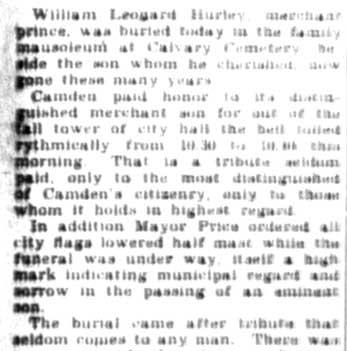
William Leonard Hurley, merchant prince, was buried today in the family mausoleum at Calvary Cemetery, beside the son whom he cherished, now gone these many years.
Camden paid honor to its distinguished merchant son for out of the tall tower of city hall the bell tolled rhythmically from 10.30 to 10.[?]0 this morning. That is a tribute seldom paid, only to the most distinguished of Camden’s citizenry, only to those whom it holds in highest regard.
In addition Mayor Price ordered all city flags lowered half mast while the funeral was under way, itself a high mark indicating municipal regard and sorrow in the passing of an eminent son.
The burial came after tribute that seldom comes to any man. There was no pomp with the glitter and glare that usually comes to the military great. There was none of the evidence of the peculiar fealty that comes with the close of a great political leader’s career.
But there was in evidence, last night and again today, something suggestive of a community paying full and really heart-felt tribute to one who had lived with lasting benefit to his fellow-man. “Dungarvan,” the home of the merchant prince, last night was the scene of an outpouring of the friends gained through the years who took farewell of one whom they had held in highest regard. Nor was it merely a formal viewing of one who had passed on, nor idle curiosity, nor a perfunctory performance of mere duty.
One passing through that great throng as it wound its way along the paths beneath the great pines and oaks, up to the immaculately white entrance guarded by the Hurley retainers, found evidence of the sincerity of it all. It came by way of expression from men and women who had driven to the palatial home on White Horse pike and again by those who had perhaps walked several miles. A great social gulf between, but with one commonalty of sorrow, of regret in the passing, of satisfaction in having known “Big-hearted Bill Hurley.” That expression was heard repeatedly—“Big hearted Bill Hurley”—and some of those who thus alluded to the one lying so quietly within the south parlor of the Hurley home evidently knew the full force of it, knew it from experience.
Cortege Under Way
George Blake, funeral director and long personal friend of Mr. Hurley, aided by Frank Leonard, had some difficulty in getting the cortege under way, even though state and Collingswood police had closed White Horse pike from the Crescent boulevard roundpoint to Collings avenue to traffic. Eventually it was accomplished and the merchant whom everyone seemed to recall with something worth while had gone forever from the portals he loved.
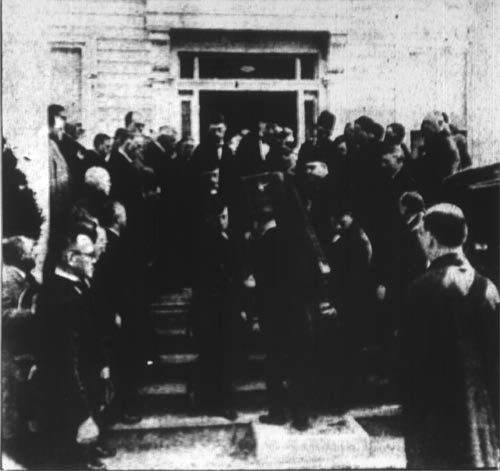
With a guard of motorcycle policemen, the funeral stretching squares wound its way along Knights Park just giving promise of the glory of young spring verdure. It reached the humble little one-story brown church, St. John’s Catholic, all but hidden by the evergreens, all but covered by ivy. There a vast crowd awaited. A rush would certainly have been made into the church before the arrival of the mourners, but the doors were locked. It was necessary for St. John’s church accommodates but 60[?]. Certainly a thousand would have tried to force an entrance.
But with the arrival of the family the doors were opened. The honorary pallbearers once more formed a lane through which the honored dead was carried up the steps, into the sanctuary, drawn to the altar where candles flickered in the filtered lights from the stained glass windows. Then came the rites.
A solemn high mass of requiem was sung. Rev. John O’Farrell, pastor of the church and good friend for many a year of the Hurley family, was celebrant. Rev. Joseph M. Corriston of St. Joan of Arc Church, Fairview, was deacon, and Rev. Paul Fairbrother, Church of the Immaculate Conception, was sub-deacon.
Priests at Altar
There were gathered about the altar Msgr. Bozzi, Sea Isle City, Rev. Joseph Phelan, Langhorne, Rev. Father Brendon Shea, Church of Our Lady of Mount Carmel, Rev. Father Sutcliffe, Gloucester City, Rev. Father Corrigan, Holy Name Church, Rev. Father Henry, Sacred Heart, [blacked out] Most [blacked out] of the prominent South [blacked out] were attending the [blacked out] Bishop McMa[blacked out] otherwise they would have been at the [blacked out] altar at the Hu[blacked out]. Sombre-garbed Sisters of Mercy were in the pews. Among them was Sister Christine, for whom Mr. Hurley had been godfather years ago [blacked out] now is teacher of literature at [blacked out] Camden Catholic high school.
During the solemn service for the dead, the Immaculate Conception quartet sang. That is composed of Harry Weiss, tenor; E. Ehrman, bass; Miss Marie Archer, soprano, and Mrs. Katherine Maloney, contralto, with Miss Mary Niles, accompanist.
Funeral Reaches Cemetery
The solemn ritual over the cortege bearing the dead proceeded to Calvary Cemetery. Long before its arrival hundreds had gathered along Marlton pike—hundreds who were undismayed by a keen, cutting north wind, even though the majority were elderly women. It was apparent they were, as a rule, the old, old patrons of the Hurley store, those whom the founder ever served. They braved the wind and the discomfort to pay their tribute to the dead.
Whether it was by coincidence or otherwise, two airplanes circled over the cemetery when the cortege arrived and continued until the mourners had left. They seemed like two great birds on guard. Some thought it a symbol significant to the occasion.
Headed by motorcycle policemen from the state, Camden, Collingswood and Delaware township, the funeral arrived, passed the guarded entrance.
Thousands Pass Bier
Last night they paid tribute to an old friend and chieftain—thousands of them. Seemingly there was a never-ending stream of notables, of the lowly, those in every walk of life. They came in limousines, in trolleys and many walked, but all were imbued with one object, to take parting of “Big-hearted Bill Hurley,” whom they had known through the years [blacked out] to increase their regard with mellow [blacked out].
There was Ben Maloney, pal of many [blacked out] a year in the hunting field, who made [blacked out] the trip to the Hurley h[blacked out] enough because of [blacked out] F[blacked out] strong was Maloney [blacked out] times when he and his old [blacked out] had trod the wood and fields. Tears came unrestrained.
There was venerable Philip M[blacked out]Mann, who came down from R[blacked out] to take parting with his old chief. F[blacked out] Mann is the oldest [blacked out] of the Hurley organiza[blacked out] many a year he trod the [blacked out] a collector. He has long [blacked out] pensioned.
There was a long, long line of Hurley employes who wound about the path leading to the home, who met by the bier while the son of the family, Jerome, and Harry and James Moran, executives, stood by the door.
There were plain Mr. and Mrs. John Smith and their more exalted neighbors, too, who passed through the room holding the honored dead.
Elks Hold Services
And there was Camden Lodge of Elks there to hold the memorial service for one who exemplified the principles of that great American order in an exalted degree. They were there, these Elks, to write the faults on the sands, the virtues on the tablets of loving memory.
There was Phil Wilson, for many a year close associate of Mr. Hurley, who had known him all through the years that brought success. And William J. Lorigan whose father had long been associated with Mr. Hurley in building enterprises and former Prosecutor William J. Kraft, nephew and good friend of the family.
But by far the most [blacked out] memory of the man who lay so quiet [blacked out] and still were the flowers [blacked out] Mr. Hurley in life loved the [blacked out] springtime of summer and of [blacked out] Dungarvan had ever been a [blacked out] estate under his direction with [blacked out] grand old trees but there were [blacked out] splashes of color, the great [blacked out] rhododendrons along the [blacked out] dary yet recalcitrant but with [blacked out] ising buds. There was the garden [blacked out] of fresh of flowers now but with [blacked out] secret expanses—the roses and [blacked out] gardens and the peonies [blacked out] host yet to put forth their splendor [blacked out]
Bower of Beauty
[blacked out] of Dungarvan within it was [blacked out] of blossoms [blacked out] and the [blacked out] life of revived nature. Dungarvan within was a veritable living bower of beauty, exquisite [blacked out] that surrounded the bier that mounted [blacked out] the walls to the ceiling. Under the light of the candles in golden [blacked out] the color was one wonderful [blacked out] of red and pink and garnet with [blacked out] roses [blacked out] everywhere. [blacked out] [blacked out] [blacked out]
These were the [blacked out] that [blacked out] friends who [blacked out] passing tributes that came from all parts of the city, the county, even from far parts of the country.
There was a great basket of American beauty roses and [blacked out] Mrs. Hurley [blacked out] [blacked out] [blacked out] [blacked out] [blacked out] [blacked out] island estate [blacked out] a long time [blacked out].
The Camden employes with a [blacked out] heart. From the staff of the Hurley-Loughran store at Wilkes-Barre came a perpetual membership in the purcha[blacked out] society, and win[blacked out]dre[blacked out] designs from the stores at Bridgeton, Trenton and Atlantic City.
Organizations Send Blossoms
There was a great wreath of acanthus leaves from the Chamber of Commerce, a cross from the Broadway Business Men’s Association, the cloak of purple and white from Camden Lodge of Elks, snapdragons from the banks with which he had been affiliated, a basket from the Cities Corporation Company, which controls the Hotel Walt Whitman, a basket from Wyoming Tribe of Red Men.
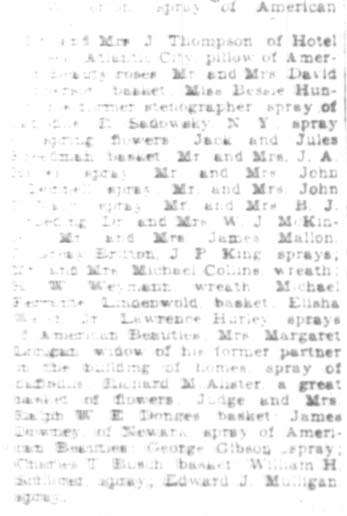
Others who sent their tribute of beauteous blossoms were Mr. and Mrs. J. Walter Staats, white lilies and lilacs; John Schlorer, calla lilies; A. J. Henderson, “spring garden flowers”; Mr. and Mrs. J. David Stern, roses, lilies and snapdragons; John Croft and family, spring flowers; Mrs. Gertrude McNichol, Jerome Hurley’s fiancee, a great basket of lilies, roses and white lilacs; her father, Daniel Dever, basket of flowers; Col. T. R. Donovan, a four-foot pillow of flowers.
Mr. and Mrs. Walter L. Tushingham, a spray of white lilies; Mr. and Mrs. Philip Wilson, lilies and roses; Mr. and Mrs. S. Canning Childs, spray of lilies and lilies of the valley; Dr. Harris, Savannah, Ga., spray of American beauty roses; J. B. Van[blacked out], basket of flowers; Howard E. Hemphill, basket; Robert Stecker, spray of lilies.
Flowers, Still More Flowers
Mr. and Mrs. Charles W. Auster[blacked out], spray of lilies; Camden Lions Club; Theodore Tiedeken and Brother, basket; Arthur Moffett, spray; J. C. Ra[blacked out], basket; H. Black, of the T[blacked out]n Upholstering Company, basket; [blacked out] Beau & Company, spray; Endowment B. & L., basket; Argonne B. & L., basket; St. John’s Men’s Club, Collingswood, basket; Charles Cramer, basket; Harry Pinsky, basket; Home Furniture Association, basket; Mr. and Mrs. J. A. Murphy, [blacked out] basket, cut flowers; Dr. [blacked out] Edward Mallon, Philadelphia; [blacked out] and Mrs. Charles [blacked out], spray of American [blacked out]
Mr. and Mrs. J. Thompson of Hotel [blacked out] Atlantic City, pillow of American beauty roses; Mr. and Mrs. David [blacked out], basket; Miss Bessie Hun[blacked out], [blacked out] former stenographer, spray of [blacked out]; [blacked out] D. Sadowsky, N. Y., spray [blacked out] spring flowers; Jack and Jules [blacked out]man, basket; Mr. and Mrs. J. A. [blacked out], spray; Mr. and Mrs. John [blacked out], spray; Mr. and Mrs. John [blacked out], spray; Mr. and Mrs. H. J. [blacked out]; Dr. and Mrs. W. J. McKin[blacked out]; Mr. and Mrs. James Mallon, [blacked out] Britton, J. P. King, sprays; Mr. and Mrs. Michael Collins, wreath; [blacked out] W. We[blacked out], wreath; Michael [blacked out], Lindenwold, basket; Elisha [blacked out] Jr., Lawrence Hurley, sprays of American Beauties; Mrs. Margaret Lorigan, widow of his former partner in the building of homes, spray of [blacked out]; Richard M. Alister, a great basket of flowers; Judge and Mrs. Ralph W. E. Donges, basket; James D[blacked out]ney, of Newark, spray of American Beauties; George Gibson, spray; Charles T. Busch, basket; William H. S[blacked out], spray; Edward J. Mulligan, spray.
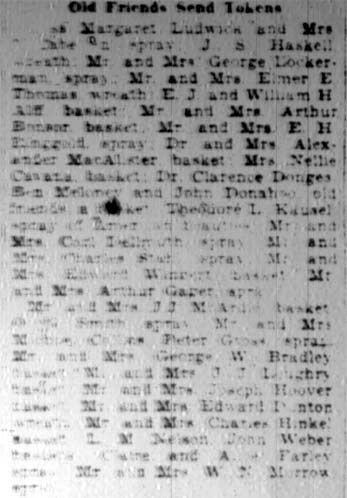
Old Friends Send Tokens
[blacked out]s Margaret Ludwick and Mrs. [blacked out], spray; J. S. Haskell, wreath; Mr. and Mrs. George Lockerman, spray; Mr. and Mrs. Elmer E. Thomas, wreath; E. J. and William H. [blacked out], basket; Mr. and Mrs. Arthur [blacked out], basket; Mr. and Mrs. E. H. [blacked out], spray; Dr. and Mrs. Alexander MacAlister, basket; Mrs. Nellie Cavata, basket; Dr. Clarence Donges; Ben Maloney and John Donahue, old friends, a basket; Theodore L. Kausel, spray of American Beauties; Mr. and Mrs. Carl Dellmuth, spray; Mr. and Mrs. Charles [blacked out], spray; Mr. and Mrs. Edward Windust, basket; Mr. and Mrs. Arthur Garet, spray.
Mr. and Mrs. J. J. McArdle, basket; [blacked out] Smith, spray; Mr. and Mrs. [blacked out]; Peter Gross, spray; Mr. and Mrs. George W. Bradley, [blacked out]; Mr. and Mrs. J. J. Loughry, [blacked out]; Mr. and Mrs. Joseph Hoover, [blacked out]; Mr. and Mrs. Edward P[blacked out]nton, wreath; Mr. and Mrs. Charles Hinkel, [blacked out]; L. M. Nelson, John Weber, [blacked out]; [blacked out] Clare and A. [blacked out] Farley, [blacked out]; Mr. and Mrs. W. N. Morrow, [blacked out]
The staff employed on the Hurley estate gave as their tribute a great [blacked out] of [blacked out]. They are Walter [blacked out], E. P. Haven, Edward Grant and [blacked out] Howard. And from Mr. and Mrs. [blacked out] Mathis came a basket of [blacked out] flowers. Mathis had been Mr. Hurley’s chauffeur for many years.
Camden Is Facing Big Vice Clean-Up
Camden Evening Courier —
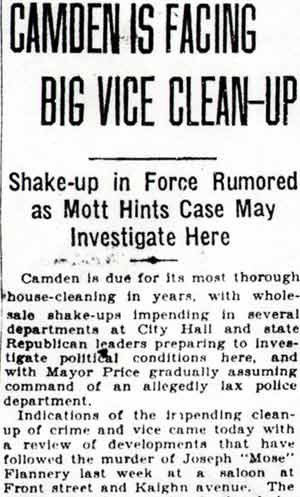
CAMDEN IS FACING BIG VICE CLEAN-UP
Shake-up in Force Rumored as Mott Hints Case May Investigate Here
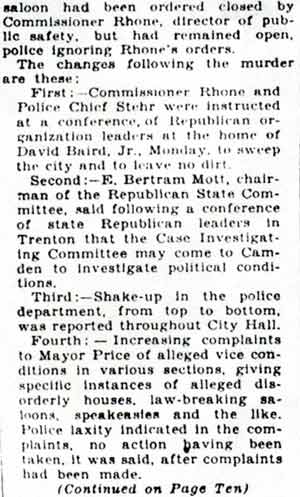
Camden is due for its most thorough house-cleaning in years, with wholesale shake-ups impending in several departments at City Hall and state Republican leaders preparing to investigate political conditions here, and with Mayor Price gradually assuming command of an allegedly lax police department.
Indications of the impending clean-up of crime and vice came today with a review of developments that have followed the murder of Joseph “Mose” Flannery last week at a saloon at Front street and Kaighn avenue. The saloon had been ordered closed by Commissioner Rhone, director of public safety, but had remained open, police ignoring Rhone’s orders.
The changes following the murder are these:
First:—Commissioner Rhone and Police Chief Stehr were instructed at a conference of Republican organization leaders at the home of David Baird, Jr., Monday, to sweep the city and to leave no dirt.
Second:—E. Bertram Mott, chairman of the Republican State Committee, said following a conference of state Republican leaders in Trenton that the Case Investigating Committee may come to Camden to investigate political conditions.
Third:—Shake-up in the police department, from top to bottom, was reported throughout City Hall.
Fourth:—Increasing complaints to Mayor Price of alleged vice conditions in various sections, giving specific instances of alleged disorderly houses, law-breaking saloons, speakeasies and the like. Police laxity indicated in the complaints, no action having been taken, it was said, after complaints had been made.
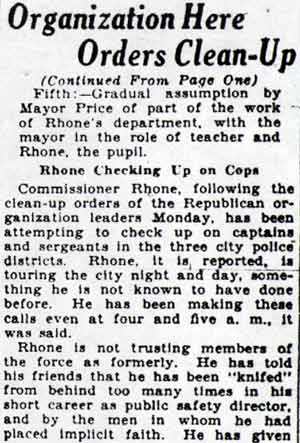
(Continued on Page Ten)
Organization Here Orders Clean-Up
(Continued From Page One)
Fifth:—Gradual assumption by Mayor Price of part of the work of Rhone’s department, with the mayor in the role of teacher and Rhone, the pupil.
Rhone Checking Up on Cops
Commissioner Rhone, following the clean-up orders of the Republican organization leaders Monday, has been attempting to check up on captains and sergeants in the three city police districts. Rhone, it is reported, is touring the city night and day, something he is not known to have done before. He has been making these calls even at four and five a. m., it was said.
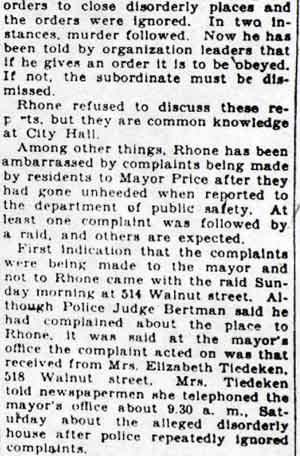
Rhone is not trusting members of the force as formerly. He has told his friends that he has been “knifed” from behind too many times in his short career as public safety director, and by the men in whom he had placed implicit faith. He has given orders to close disorderly places and the orders were ignored. In two instances, murder followed. Now he has been told by organization leaders that if he gives an order it is to be obeyed. If not, the subordinate must be dismissed.
Rhone refused to discuss these reports, but they are common knowledge at City Hall.
Among other things, Rhone has been ambarrassed [sic] by complaints being made by residents to Mayor Price after they had gone unheeded when reported to the department of public safety. At least one complaint was followed by a raid, and others are expected.
First indication that the complaints were being made to the mayor and not to Rhone came with the raid Sunday morning at 514 Walnut street. Although Police Judge Bertman said he had complained about the place to Rhone, it was said at the mayor’s office the complaint acted on was that received from Mrs. Elizabeth Tiedeken, 518 Walnut street. Mrs. Tiedeken told newspapermen she telephoned the mayor’s office about 9.30 a. m., Saturday about the alleged disorderly house after police repeatedly ignored complaints.
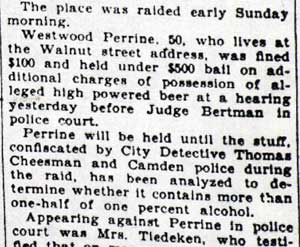
The place was raided early Sunday morning. Westwood Perrine, 50, who lives at the Walnut street address, was fined $100 and held under $500 bail on additional charges of possession of alleged high powered beer at a hearing yesterday before Judge Bertman in police court.
Perrine will be held until the stuff, confiscated by City Detective Thomas Cheesman and Camden police during the raid, has been analyzed to determine whether it contains more than one-half of one percent alcohol.
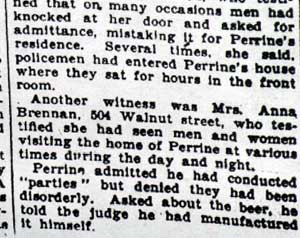
Appearing against Perrine in police court was Mrs. Tiedeken, who testified that on many occasions men had knocked at her door and asked for admittance, mistaking it for Perrine’s residence. Several times, she said, policemen had entered Perrine’s house where they sat for hours in the front room.
Another witness was Mrs. Anna Brennan, 504 Walnut street, who testified she had seen men and women visiting the home of Perrine at various times during the day and night.
Perrine admitted he had conducted “parties” but denied they had been disorderly. Asked about the beer, he told the judge he had manufactured it himself.
Dr. David Rhone — Joseph “Mose” Flannery — Lewis H. Stehr Jr. — Bernard Bertman — David Baird Jr. — Winfield Price — Thomas Cheeseman — Walnut Street — Kaighn Avenue
P. O. S. A. Will Present Flag to Junior High
Camden Courier-Post —
A parade is being planned by the Patriotic Order of Sons of America for Washington’s Birthday, when a flag will be presented to the new Woodrow Wilson Junior High School by Camp No. 25.
The parade will be formed at the Harry C. Sharp School, Thirty-second Street and Hayes Avenue, and proceed to the new school at Thirty-second and Federal Streets. George B. Cassidy, past district president, will be marshal of the parade.
The presentation will be made by Neal L. Jamerson, past state master of forms, and accepted by Samuel E. Fulton, president, on behalf of the board of education. Mayor Winfield S. Price will be among the speakers.
Lewis H. Stehr, Chief of Police, Dies Suddenly
Camden Morning Post —
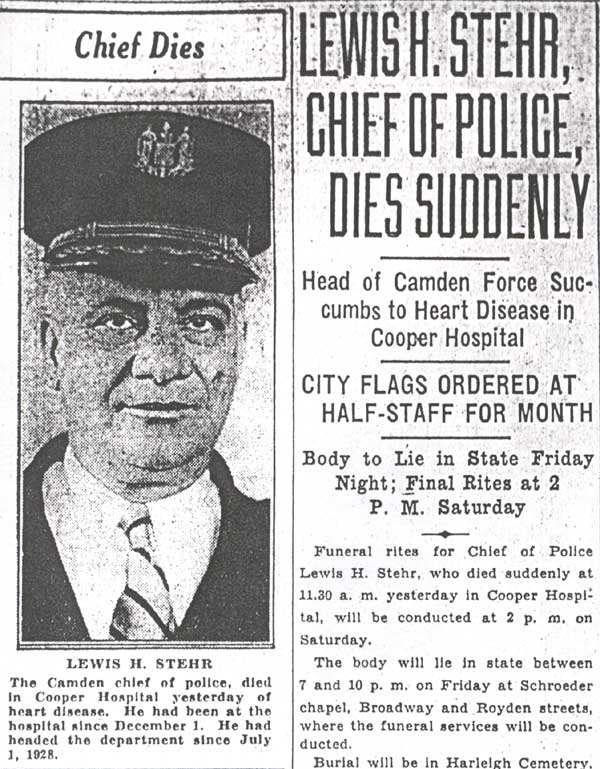
LEWIS H. STEHR — The Camden chief of police, died in Cooper Hospital yesterday of heart disease. He had been at the hospital since December 1. He had headed the department since July 1, 1928.
Head of Camden Force Succumbs to Heart Disease in Cooper Hospital
CITY FLAGS ORDERED AT HALF-STAFF FOR MONTH
Body to Lie in State Friday Night; Final Rites at 2 P. M. Saturday
Funeral rites for Chief of Police Lewis H. Stehr, who died suddenly at 11.30 a. m. yesterday in Cooper Hospital, will be conducted at 2 p. m. on Saturday.
The body will lie in state between 7 and 10 p. m. on Friday at Schroeder chapel, Broadway and Royden streets, where the funeral services will be conducted. Burial will be in Harleigh Cemetery.
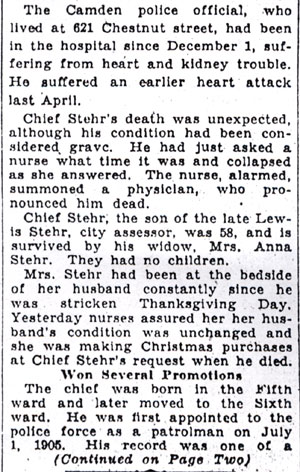
The Camden police official, who lived at 621 Chestnut street, had been in the hospital since December 1, suffering from heart and kidney trouble. He suffered an earlier heart attack last April.
Chief Stehr’s death was unexpected, although his condition had been considered grave. He had just asked a nurse what time it was and collapsed as she answered. The nurse, alarmed, summoned a physician, who pronounced him dead.
Chief Stehr, the son of the late Lewis Stehr, city assessor, was 58, and is survived by his widow, Mrs. Anna Stehr. They had no children.
Mrs. Stehr had been at the bedside of her husband constantly since he was stricken Thanksgiving Day. Yesterday nurses assured her her husband’s condition was unchanged and she was making Christmas purchases at Chief Stehr’s request when he died.
Won Several Promotions
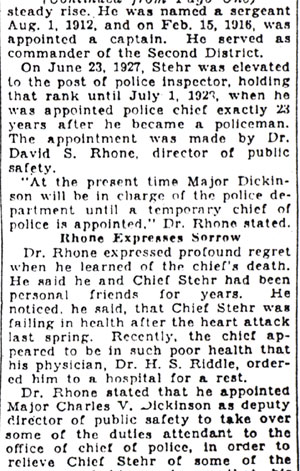
The chief was born in the Fifth ward and later moved to the Sixth ward. He was first appointed to the police force as a patrolman on July 1, 1905. His record was one of a steady rise. He was named a sergeant Aug. 1, 1912, and on Feb. 15, 1918, was appointed a captain. He served as commander of the Second District.
On June 23, 1927, Stehr was elevated to the post of police inspector, holding that rank until July 1, 1928, when he was appointed police chief exactly 23 years after he became a policeman. The appointment was made by Dr. David S. Rhone, director of public safety.
“At the present time Major Dickinson will be in charge of the police department until a temporary chief of police is appointed,” Dr. Rhone stated.
Rhone Expresses Sorrow
Dr. Rhone expressed profound regret when he learned of the chief’s death. He said he and Chief Stehr had been personal friends for years. He noticed, he said, that Chief Stehr was failing in health after the heart attack last spring. Recently, the chief appeared to be in such poor health that his physician, Dr. H. S. Riddle, ordered him to a hospital for a rest.
Dr. Rhone stated that he appointed Major Charles V. Dickinson as deputy director of public safety to take over some of the duties attendant to the office of chief of police, in order to relieve Chief Stehr of some of the pressure of his work, so that his health would not further be impaired.
The decedent was an active member of the Sixth Ward Republican Club, and was well liked not only by members of the police force but throughout the city.
Mayor Expresses Sorrow
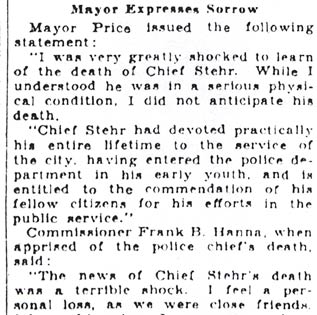
Mayor Price issued the following statement: “I was very greatly shocked to learn of the death of Chief Stehr. While I understood he was in a serious physical condition, I did not anticipate his death.
“Chief Stehr had devoted practically his entire lifetime to the service of the city, having entered the police department in his early youth, and is entitled to the commendation of his fellow citizens for his efforts in the public service.”
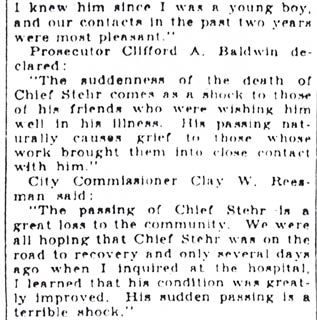
Commissioner Frank B. Hanna, when apprised of the police chief’s death, said: “The news of Chief Stehr’s death was a terrible shock. I feel a personal loss, as we were close friends. I knew him since I was a young boy, and our contacts in the past two years were most pleasant.”
Prosecutor Clifford A. Baldwin declared: “The suddenness of the death of Chief Stehr comes as a shock to those of his friends who were wishing him well in his illness. His passing naturally causes grief to those whose work brought them into close contact with him.”
City Commissioner Clay W. Reesman said: “The passing of Chief Stehr is a great loss to the community. We were all hoping that Chief Stehr was on the road to recovery and only several days ago when I inquired at the hospital, I learned that his condition was greatly improved. His sudden passing is a terrible shock.”
City officials last night ordered all flags lowered to half mast on all police stations for 30 days. Deputy Director Dickinson and Captain Arthur Colsey today will convey to Mrs. Stehr the police department’s official condolence.
Lewis H. Stehr — Dr. David S. Rhone — Charles V. Dickinson — Frank B. Hanna — Dr. H. S. Riddle — Clay W. Reesman — Arthur Colsey — Chestnut Street — Cooper Hospital — Sixth Ward Republican Club
Funeral for Stehr to Be Held Saturday
Camden Evening Courier —
FUNERAL FOR STEHR TO BE HELD SATURDAY
City in Mourning as Rites are Planned—Burial Will Be in Harleigh
With the city in mourning today, funeral arrangements were being completed for Chief of Police Lewis H. Stehr, who died yesterday in Cooper Hospital. Hundreds of friends will view the body in state tomorrow between 7 and 10 p. m. at the Schroeder Chapel, Broadway and Royden streets. Many others will attend the funeral services, which will be held at 2 p. m. Saturday at the chapel.
Burial will be in Harleigh Cemetery.
A list of honorary pall bearers was compiled today, as well as the police escort. The police stations in the four city districts were draped in black and flags were at half-mast today, and will remain so for 30 days.
The pallbearers will be Lieutenants Ralph Bakely and George Ward; Sergeants George Nowry and Frank Truax; Policemen Thomas Cheeseman and Harry Kyler.
Honorary pallbearers are Sergeants Herbert Anderson and John Skolski; District Detective Archie Reiss, Policemen John Kowal and Clarence Phifer, and Donald Swissler, clerk of the chief’s office.
There will be a guard of honor formed by the mounted squad of the police department which will be changed every two hours while the body is viewed. Funeral arrangements are in charge of Lieut. George Ward.
The police of the city will view the remains Friday at 7.30 p. m. at the funeral parlors.
(Continued on Page Two)
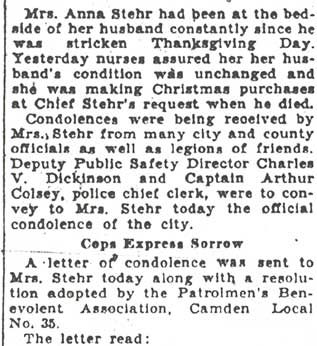
Mrs. Anna Stehr had been at the bedside of her husband constantly since he was stricken Thanksgiving Day. Yesterday nurses assured her her husband’s condition was unchanged and she was making Christmas purchases at Chief Stehr’s request when he died. Condolences were being received by Mrs. Stehr from many city and county officials as well as legions of friends. Deputy Public Safety Director Charles V. Dickinson and Captain Arthur Colsey, police chief clerk, were to convey to Mrs. Stehr today the official condolence of the city.
Cops Express Sorrow
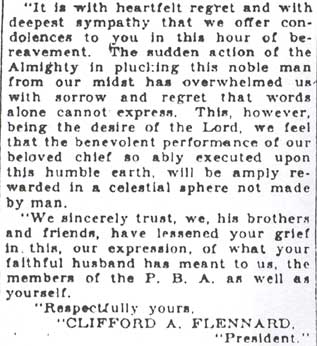
A letter of condolence was sent to Mrs. Stehr today along with a resolution adopted by the Patrolmen’s Benevolent Association, Camden Local No. 35. The letter read:
“It is with heartfelt regret and with deepest sympathy that we offer condolences to you in this hour of bereavement. The sudden action of the Almighty in plucking this noble man from our midst has overwhelmed us with sorrow and regret that words alone cannot express. This, however, being the desire of the Lord, we feel that the benevolent performance of our beloved chief so ably executed upon this humble earth, will be amply rewarded in a celestial sphere not made by man.
“We sincerely trust, we, his brothers and friends, have lessened your grief in this, our expression, of what your faithful husband has meant to us, the members of the P. B. A. as well as yourself.
“Respectfully yours, “CLIFFORD A. FLENNARD, “President.”
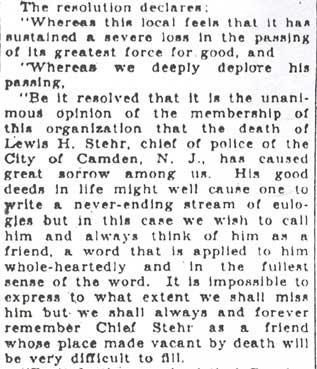
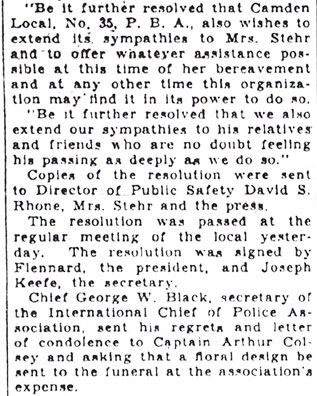
The resolution declares: “Whereas this local feels that it has sustained a severe loss in the passing of its greatest force for good, and “Whereas we deeply deplore his passing, “Be it resolved that it is the unanimous opinion of the membership of this organization that the death of Lewis H. Stehr, chief of police of the City of Camden, N. J., has caused great sorrow among us. His good deeds in life might well cause one to write a never-ending stream of eulogies but in this case we wish to call him and always think of him as a friend, a word that is applied to him whole-heartedly and in the fullest sense of the word. It is impossible to express to what extent we shall miss him but we shall always and forever remember Chief Stehr as a friend whose place made vacant by death will be very difficult to fill.
“Be it further resolved that Camden Local, No. 35, P. B. A., also wishes to extend its sympathies to Mrs. Stehr and to offer whatever assistance possible at this time of her bereavement and at any other time this organization may find it in its power to do so.
“Be it further resolved that we also extend our sympathies to his relatives and friends who are no doubt feeling his passing as deeply as we do so.”
Copies of the resolution were sent to Director of Public Safety David S. Rhone, Mrs. Stehr and the press. The resolution was passed at the regular meeting of the local yesterday. The resolution was signed by Flennard, the president, and Joseph Keefe, the secretary.
Chief George W. Black, secretary of the International Chief of Police Association, sent his regrets and letter of condolence to Captain Arthur Colsey and asking that a floral design be sent to the funeral at the association’s expense.
Mayor Expresses Sorrow
Mayor Price issued the following statement: “I was very greatly shocked to learn of the death of Chief Stehr. While I understood he was in a serious physical condition, I did not anticipate his death.
“Chief Stehr had devoted practically his entire lifetime to the service of the city, having entered the police department in his early youth, and is entitled to the commendation of his fellow citizens for his efforts in the public service.”
Commissioner Frank B. Hanna, when apprised of the police chief’s death, said: “The news of Chief Stehr’s death was a terrible shock. I feel a personal loss, as we were close friends. I knew him since I was a young boy, and our contacts in the past two years were most pleasant.”
Prosecutor Clifford A. Baldwin declared: “The suddenness of the death of Chief Stehr comes as a shock to those of his friends who were wishing him well in his illness. His passing naturally causes grief to those whose work brought them into close contact with him.”
City Commissioner Clay W. Reesman said: “The passing of Chief Stehr is a great loss to the community. We were all hoping that Chief Stehr was on the road to recovery and only several days ago when I inquired at the hospital, I learned that his condition was greatly improved. His sudden passing is a terrible shock.”
Lewis H. Stehr — Dr. David S. Rhone — Charles V. Dickinson — Arthur Colsey — George A. Ward — John Kowal — Clarence Phifer — John Skolski — Herbert Anderson — Thomas Cheeseman — Harry Kyler — George Nowrey — Frank Truax — Ralph Bakley — Clay W. Reesman — Broadway — Royden Street — Cooper Hospital — B.C. Schroeder
$2700 Given Needy by Sears, Roebuck
Camden Courier-Post —
Employees of Camden Store Donate Half, Employer Rest to Mayor’s Committee
Blazing the trail in a county-wide relief program, Sears, Roebuck & Company, of this city, and 170 of its employees yesterday made a joint contribution of $2700 toward a general campaign fund that will be used to alleviate the sufferings of unemployed and needy persons.
One-half of the $2700 was subscribed voluntarily from the pay envelopes of the company’s employees, while the other half was a donation from the concern “matching” the amount raised by the workers.
The money, in check form, was turned over to Mayor Price’s committee on employment and relief at brief exercises at the Sears, Roebuck store, Admiral Wilson Boulevard. In behalf of the employees and the company, A. D. Corson, general manager of the Sears, Roebuck store in Camden, presented the check to William J. Strandwitz, general chairman of the mayor’s relief committee.
Pioneer In Relief Movement
First in the country to adopt this cooperative method of contributing toward a community relief fund whereby, employee and employer share in giving, is the Sears, Roebuck Company. The new policy has been adopted in stores of the concern throughout the nation.
The plan whereby the local store and employees raised their contribution is unique. Each employee contributed one day’s pay at four-week intervals during the last eight weeks of 1930.
This same plan will be followed during the first eight weeks of this year and the amount raised will be turned into the general relief fund which will be raised by the mayor’s committee in a drive for $100,000 to open Monday, Corson announced today.
Delivering a brief address at exercises in the store, Corson said:
“The plan whereby the employee gives one day’s pay out of each four weeks during eight-week periods is intended to make contributions easier for the employee. In this way funds are raised that otherwise would not be available for distribution here. Every division of this company throughout the country has received this suggestion to help the needy with enthusiasm.”
Million to be Raised
Corson estimated that the fund to be raised under this plan in Sears, Roebuck stores throughout the country would exceed $1,000,000. In each instance, he said, money contributed by employees will be “matched” by the concern.
“It gives the men and women with jobs,” said Corson, “the opportunity to help those less fortunate who are without work.”
Strandwitz, accepting the money in behalf of the mayor’s committee, praised the cooperative movement of the store and employees and characterized it as “the most inspiring thing in the relief campaign.”
“The Sears, Roebuck Company,” said Strandwitz, “has set a fine example for other concerns in Camden county and points the ways by which money may be raised to help the deserving needy in this section.”
Loyal D. Odhner, manager of the relief committee’s campaign, also commended the Sears, Roebuck Company and the employees.
Sincerity of G.O.P. Flayed by French
Camden Courier-Post —
Former Bridge Official in Speech Asks Baird Seven Questions
Directing questions at David Baird, Republican candidate for governor, Samuel T. French, former president of the New Jersey Bridge and Tunnel Commission, last night attacked the sincerity of Baird’s campaign speeches.
French addressed more than 200 voters at the headquarters of the Woodrow Wilson Democratic Club, Atlantic and Louis Streets, in appealing for suffrage in the interest of A. Harry Moore, Democratic gubernatorial candidate.
“In a campaign speech at Plainfield on October 17,” French said, “Baird pledged himself to quick relief of the tax burden. In view of past events, I do not know what has come over Mr. Baird; I do not know what has changed his heart. He was a director of Public Service and the controlling power of the legislature when the legislature passed a bill, which relieved the Public Service of keeping the roadways and street surfaces in good condition between the rails on eighteen inches of either side. This resulted in a saving of millions of dollars to Public Service and put the bill in the hands of the taxpayers. Yet, Mr. Baird says conditions must be changed by a change of the taxation system. Is that the way to change taxation—by increasing it for the citizens and lowering it for the corporations?”
Asks Seven Questions
“If Camden County is where Mr. Baird derived inspiration for his Plainfield speech, I ask him to publicly answer these questions:
“First, what was the idea of buying the ground upon a portion of which is erected the county court house and city hall, when the city owned a plot of land much better located on which it would have been unnecessary to destroy property, which was paying into the city treasury annually approximately $70,000 in taxes?
“Secondly, why was it necessary to buy that whole tract of land and destroy all the tax producing property when the city only had use for less than 25 percent of it?
“Thirdly, from whom did the city purchase a large portion of this tract? Why was it necessary to build a city hall at the particular time? What was the total cost of the city hall and court house annex? And, of utmost importance, why was the contract price paid in full on or about December 1, 1930, when the work was only about 80 percent completed?
“Fourth, did Senator Baird approve of all the acts of the City Commission and the Board of Freeholders in the city’s and county’s activities in the purchase of all the land and the erection of the building?
“Fifth, if Mr. Baird’s answer is ‘yes,’ to that question, then I ask him why were former Mayor Price and Commissioner T. Yorke Smith, dropped from the Republican ticket in the municipal election? If Mr. Baird’s answer is ‘no,’ then I ask him why were not the entire five commissioners dropped from the Republican ticket at the last municipal election, instead of making Price and Smith the goats?
“Sixth, I ask Mr. Baird if he offered objection to the selection of the site or the expenditures in connection with the enterprise?
“Seventh. I ask the Republican candidate for governor, believing as he says he does in his Plainfield speech that the spending orgy must stop: What would have been the saving to the taxpayers of Camden city and county if the new city hall had been erected at the Civic Centre instead of its present location?”
Praises Moore’s Record
French lauded the record of A. Harry Moore, the Democratic candidate for governor, and charged the Republican state administration with “wanton expenditure and gross extravagance of the first water.”
“Property will be led to the point of confiscation if the Republicans are allowed to continue their orgy of spending,” French concluded, “and the only remedy is the election of Moore with a Democratic legislature to support him.”
Thomas Madden also spoke at the meeting.
Democratic rallies were also held last night in three wards of the city and in Ashland.
C. Lawrence Gregorio, former assistant prosecutor, and David L. Visor spoke at the First Ward Democratic Club, 315 North Second Street; Firmin Michel and Frank Connors at the Tenth Ward A. Harry Moore Club, 822 North Eighth Street; Albert Melnik, Gene Mariano and John Crean, at the Ninth Ward Democratic Club, 543 Washington Street, and Isaac Eason, former assistant attorney general of the United States at the A. Harry Moore Club of Ashland, Burnt Mill Road.
Legion Burial Lots to Be Dedicated
Camden Courier-Post —

City and Veteran Officials Will Speak Tomorrow at Locustwood Ceremony
American Legion and Locustwood Cemetery officials yesterday completed the program for dedication tomorrow afternoon of the first and only burial section set aside exclusively for American Legion members in New Jersey.
The ceremonies will be conducted at Locustwood Memorial Park, Marlton pike, Delaware township, amid impressive military display. Prominent Legion leaders, cemetery officials, and rulers of South Jersey municipalities will attend, with the general public, veterans and Boy Scouts.
The occasion will be the gift of 400 lots in Locustwood Memorial Park to the Legion. The lots are in Section 21 of the park and have an approximate value of $35,000. The gift has been made possible through the efforts of Aaron Heine, president of the Locustwood Cemetery Association; J. E. Laurencelle, chairman of the Memorial Graves Committee of the American Legion of New Jersey, and Martin C. Delaney, president of the Camden Memorial Park Sales Company, which is representing the Locustwood Cemetery Association.
Band Will Play
The dedication program will open with the playing of “America,” by bands composed of Burlington county and Millville veterans, and the advancing and massing of colors. The invocation will be delivered by Rev. John Pemberton, Jr., Centenary Tabernacle M. E. church.
Mayor Roy R. Stewart will deliver the address of welcome, after which Department Commander W. Rex McCrossen, of the American Legion, and Emma Florence Beach, state president of the American Legion Auxiliary, will place a wreath for the Unknown Soldier.
Salute by the battery of the 112th Field Artillery of Camden, accompanied by an air salute, air maneuvers and the dropping of flowers by the 44th Air Squadron of the New Jersey National Guard, under Major Croppsy, will follow. Remembrance will be rendered by the ritual team of the Thoirs Post 47, American Legion, the champion ritual team of the state.
Lt. Commander Thomas B. Mulroy will deliver the message for Gov. A. Harry Moore, who has been suffering from hoarseness due to a recent cold. After this message, Heine will present the deed to the Legion section, with the acceptance speech to be delivered by Department Commander McCrossen. The exercises will close with a band playing the “Star Spangled Banner,” and benediction by R. E. Brestell, D. D., of St. Paul’s Episcopal church.
Reception Committee
The reception committee includes J. E. Laurencelle, chairman; Harry A. Kelleher, Roland Cowan, department adjutant, American Legion; Herbert H. Blizzard, Heine and Delaney.
George W. Harley, of Collingswood, is chairman of the local committee on arrangements. Herbert H. Etter, county Scout executive, will be in charge of the Boy Scouts.
The field piece at the ceremonies will be from the 112th Field Artillery, under direction of Major Charles V. Dickinson, deputy director of public safety. The battery has been obtained through Brigadier Gen. Winfield S. Price and Gen. Frederick W. Gilkyson, of the New Jersey National Guard.
400 Friends Pay Homage To ‘Good Gray Poet’
Camden Courier-Post —
Men and Women From Many Sections Visit Walt Whitman’s Tomb and Old Mickle Street Home on His 114th Anniversary
“It’s just a little street where old friends meet”
That’s Mickle Street where Walt Whitman, the “Good Gray Poet,” once lived, and old friends came back here from near and far yesterday to mingle under the portals of the house in which he wrote his famous works, on the 114th anniversary of his birth.
Among them was Mrs. Augusta K. Dole, 71, of Metuchen, whose husband has been a sports writer on New York newspapers for 45 years.
“They call it a dingy street and some are ashamed to return and say they lived there,” Mrs. Dole said. And with a gesture of the hand she pointed out the homes of some of neighbors, who became famous.
Among them was Button; famous artist [architect]. Another was the grandmother of J. B. Van Sciver.
“I lived at 319 Mickle Street when I was a young lady,” she said. “I was one year old when we moved into the house right across the street from Whitman. I remember when he lived on Stevens Street before he moved to Mickle Street.
Knew Whitman Well
“We lived at the Mickle Street address about 15 or 16 or 20 years; I knew Whitman well. He always stopped and exchanged greetings with me. I frequently saw him on the ferryboats crossing the rivers.
“I want to take issue right here with those who have questioned his chastity. He was more like Christ than anyone else. I saw him admiring me as a young woman one day on a ferryboat.”
“Years later I read a description of myself in one of his works. I did not begin to read his work until 30 years ago. He wrote of the true things in life. He wrote of life as it is and as we see it. I am glad to come here today at the invitation of the committee,”
Mrs. Dole sat in the last chair in which the poet rested before his last illness. She was introduced to Dr. Alexander MacAlister, who was his personal physician in his last illness and who is a member of the Walt Whitman foundation.
Then she posed with an etching by Lewis Daniel, New York artist, at the Walt Whitman art gallery, 641 Market Street. It is one of 14 the young artist drew on “The Song of the Open Road.” Two lines taken from the book are sketched under the etching as follows:
“The earth is crude and incomprehensible at first— Nature is rude and incomprehensible at first.”
400 Visit Home
More than 400 guests visited the home of the poet during the day to be welcomed by members of the foundation. Mrs. Charles A. Wolverton, wife of Congressman Wolverton, was chairman of the reception committee.
Many of the guests visited the tomb of the poet in Harleigh Cemetery where the door is ajar at his request “that his spirit may come and go as I choose.’” But no flowers were placed there as he requested none.
Born on May 31, 1819, near Huntingdon, Long Island, he had a varied career as a writer, war correspondent and poet. During the Civil War he ministered the wounded of both the North and South at Washington. He spent the last 19 years of his life in Camden, where he died in 1892.
Under the bed in his second story front bed room today is a huge metal bathtub, which he designed for use in his invalid days. His library, horsehair furniture, his favorite rocking chair and a cane with which he knocked on the floor to call his housekeeper.
Some of his writings, manuscripts and other works are the property of Miss Ann Harned and Madge Barton Feurer. They are now at the New Jerseyanna Exhibition at the State House at Trenton.
New Painting Viewed
A new painting of Walt Whitman has been completed by Byron T. Connor, of 4320 Manor Avenue, Merchantville, and is now on display at the Hotel Walt Whitman. The painting was completed in three weeks, so as to be ready for the birthday ceremonies.
Later it will be moved from the hotel and placed either in the Whitman home or hung in the lobby of the Walt Whitman Theatre.
Miss Harned, daughter of the late Thomas B. Harned, one of Whitman’s literary executors; Joseph Praissman and Mrs. Martha Davis curator of the Whitman home, were members of the anniversary committee headed by Mrs. Wolverton.
With few exceptions, members of the Walt Whitman Foundation attended yesterday’s program, including Dr. Macalister, chairman; Dr. Cornelius Weygandt, vice chairman; Mrs. Juliet Lit Stern, Joseph M. Conover, Mrs. Helen Taft Manning, Mrs. Allen Drew Cook, Mrs. Nicholas Douty, Dr. Herbert Spencer Harned, J. Frederick Harned, Roy Helton, William T. Innes, Eldridge R. Johnson, William H. Ketler, Dr. Rufus M. Jones, former Mayor Victor King, Oscar Wolf, John Frederick Lewis, Jr., Dr. Bliss Perry, Harrison S. Morris, Agnes Repplier, former Mayor Winfield S. Price, Vernon Whitman Rich, Dr. J. Duncan Spaeth, Dr. Felix E. Schelling, Dr. Robert E. Spiller, Mrs. David Abeel Storer, Frederick Von Nieda and Ralph W. Wescott.
Among the visitors was former Assemblyman William H. Iszard, who is secretary of the committee, which acquired the home as a national shrine. Iszard sponsored legislation in the Assembly for its upkeep.
44th Division Ordered to War So Staff Officers Bend Over Maps in Theoretical Advance
Camden Courier-Post —
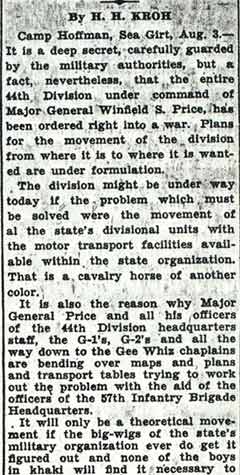
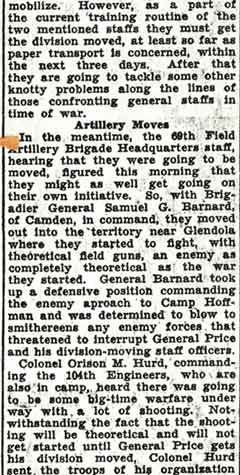
Artillery at Sea Girt Defend Headquarters from ’Enemy’
CASUALTIES WAIT ON MEDICAL CORPS
By H. H. Kroh
Camp Hoffman, Sea Girt, Aug. 3. — It is a deep secret, carefully guarded by the military authorities, but a fact, nevertheless, that the entire 44th Division under command of Major General Winfield S. Price, has been ordered right into a war. Plans for the movement of the division from where it is to where it is wanted are under formulation.
The division might be under way today if the problem which must be solved were the movement of al [sic] the state’s divisional units with the motor transport facilities available within the state organization. That is a cavalry horse of another color.
It is also the reason why Major General Price and all his officers of the 44th Division headquarters staff, the G-1’s, G-2’s and all the way down to the Gee Whiz chaplains are bending over maps and plans and transport tables trying to work out the problem with the aid of the officers of the 57th Infantry Brigade Headquarters.
It will only be a theoretical movement if the big-wigs of the state’s military organization ever do get it figured out and none of the boys in khaki will find it necessary to mobilize. However, as a part of the current training routine of the two mentioned staffs they must get the division moved, at least so far as paper transport is concerned, within the next three days. After that they are going to tackle some other knotty problems along the lines of those confronting general staffs in time of war.
Artillery Moves
In the meantime, the 69th Field Artillery Brigade Headquarters staff, hearing that they were going to be moved, figured this morning that they might as well get going on their own initiative. So, with Brigadier General Samuel G. Barnard, of Camden, in command, they moved out into the territory near Glendola where they started to fight, with theoretical field guns, an enemy as completely theoretical as the war they started. General Barnard took up a defensive position commanding the enemy aproach [sic] to Camp Hoffman and was determined to blow to smithereens any enemy forces that threatened to interrupt General Price and his division-moving staff officers.
Colonel Orison M. Hurd, commanding the 104th Engineers, who are also in camp, heard there was going to be some big-time warfare under way with a lot of shooting. Notwithstanding the fact that the shooting will be theoretical and will not get started until General Price gets his division moved, Colonel Hurd sent the troops of his organization out to the state rifle ranges for a little actual practice. They will be on the ranges for two or three days with Lieut. Colonel William F. Firth, of Hoboken, directing.
The war-like preparations under way here involved also several units of the 44th Division Special Troops under command of Major Joseph B. Leimer, of Orange. Military police under comand [sic] of Captain Grover P. Heinzmann, of Passaic, have had pistol ammunition ever since they protested their non-shooting encampment two years ago by using brickbats and putty shooters on the ranges. They are shooting pistols this year. The motorcycles of the Flemington motorcycle company are chug-chugging about camp, actually busy with a lot of theoretical things to be done. The signal company is in communication with friend and enemy alike and the ordnance maintenance company is getting all the rifles in shape.
No Casualties Yet
So far the war has been fought on a humane plane, not a single casualty having been reported. That may be because the 119th Medical Regiment isn’t due at Sea Girt for another two weeks.
Up to the present time the cavalry hasn’t been taken into the war. That is because the famous Essex Troop, isn’t a part of the division organization, but is classified as “army troops.” However, the regiment is reported waiting on its horses for a call to participate. If they aren’t called soon to help out with defending whatever it is theoretically that is to be defended they are coming to Sea Girt in about two weeks to start a war of their own.
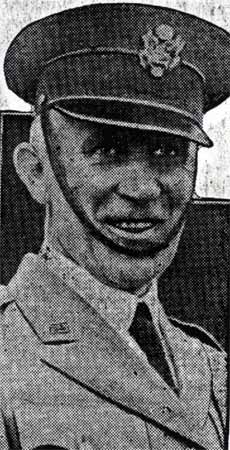
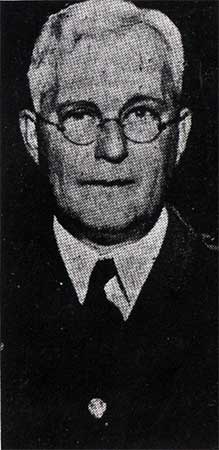
Left: Major General Winfield S. Price — Right: Brigadier General Samuel G. Barnard
Hoffman Principal Speaker at Unveiling of Monument
New Jersey Mirror —
Shaft Erected in Memory of Col. Edward B. Stone in Burlington Cemetery
Harold G. Hoffman, former governor of New Jersey and a member of the 29th Division Association, will be the principal speaker at the unveiling of the Colonel Edward B. Stone memorial in Odd Fellows Cemetery, Burlington, Sunday afternoon, November 13.
Two other distinguished speakers will also take part in the program. They are Major General Winfield S. Price, of Camden and the Rev. Charles DuBell, of St. Simon’s Episcopal Church, Philadelphia. The latter was a Chaplain in Colonel Stone’s regiment during the World War.
The monument will be unveiled by Colonel Stone’s grandchildren. His two daughters, Mrs. Frances Stone Ryan, of Trenton, and Mrs. William Tugwell, of Nashville, Tenn., and a brother Johnson Stone, of Tenafly, will attend the ceremonies. A parade, preceding the ceremonies at the cemetery, will start from Memorial Hall, at 2 p. m. with W. Thomas Montgomery, commander of the Captain James MacFarland Post, American Legion, as marshal. Members of the military organizations with which the Colonel was associated will take part in the parade.
All of Colonel Stone’s military associates and friends are invited to attend the ceremonies. The memorial, an impressive monument of Dix Island granite, surmounted by a bronze eagle, is 20 feet, three inches high. It has been erected through the efforts of a committee from MacFarland Post. Funds were contributed by friends of the deceased soldier and civic organizations.
Colonel Stone died in 1934 after a distinguished career of military service. He enlisted in the New Jersey National Guard at the age of 16 and six years later was commissioned captain of Company A, 3rd Infantry. Following a brilliant World War record, he was commissioned colonel of the 114th Infantry, National Guard, in 1924.
General Price Ends Military Career in Retirement Today
Camden Courier-Post —
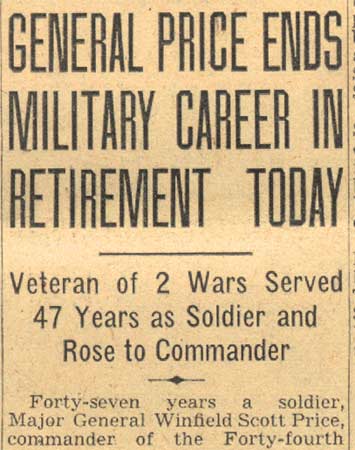
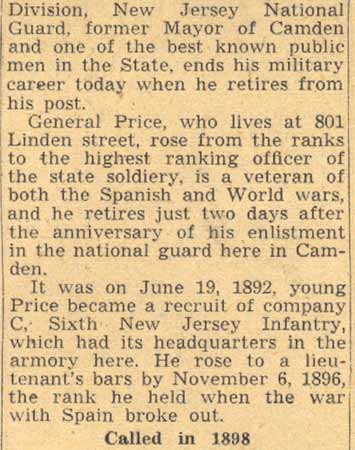
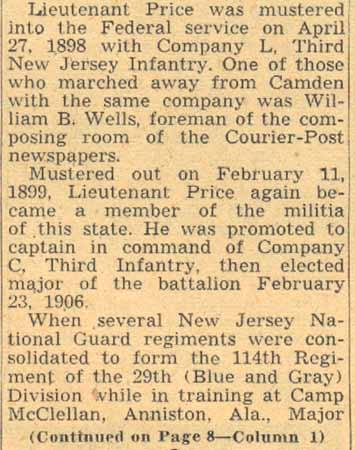
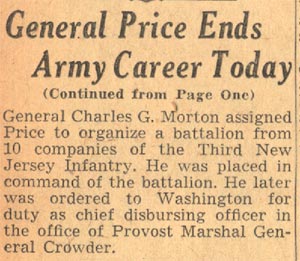
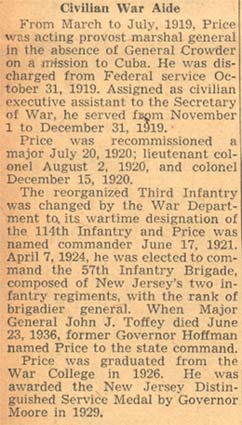
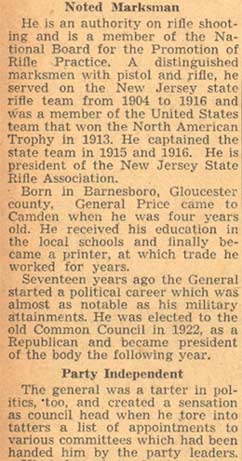
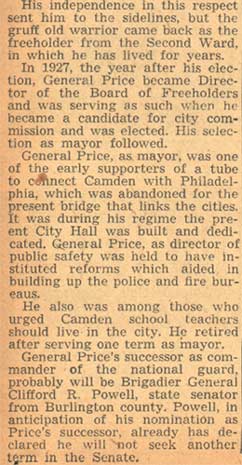
Veteran of 2 Wars Served 47 Years as Soldier and Rose to Commander
Forty-seven years a soldier, Major General Winfield Scott Price, commander of the Forty-fourth Division, New Jersey National Guard, former Mayor of Camden and one of the best known public men in the State, ends his military career today when he retires from his post.
General Price, who lives at 801 Linden street, rose from the ranks to the highest ranking officer of the state soldiery, is a veteran of both the Spanish and World wars, and he retires just two days after the anniversary of his enlistment in the national guard here in Camden.
It was on June 19, 1892, young Price became a recruit of company C, Sixth New Jersey Infantry, which had its headquarters in the armory here. He rose to a lieutenant’s bars by November 6, 1896, the rank he held when the war with Spain broke out.
Called in 1898
Lieutenant Price was mustered into the Federal service on April 27, 1898 with Company L, Third New Jersey Infantry. One of those who marched away from Camden with the same company was William B. Wells, foreman of the composing room of the Courier-Post newspapers. Mustered out on February 11, 1899, Lieutenant Price again became a member of the militia of this state. He was promoted to captain in command of Company C, Third Infantry, then elected major of the battalion February 23, 1906.
When several New Jersey National Guard regiments were consolidated to form the 114th Regiment of the 29th (Blue and Gray) Division while in training at Camp McClellan, Anniston, Ala., Major General Charles G. Morton assigned Price to organize a battalion from 10 companies of the Third New Jersey Infantry. He was placed in command of the battalion. He later was ordered to Washington for duty as chief disbursing officer in the office of Provost Marshal General Crowder.
Civilian War Aide
From March to July, 1919, Price was acting provost marshal general in the absence of General Crowder on a mission to Cuba. He was discharged from Federal service October 31, 1919. Assigned as civilian executive assistant to the Secretary of War, he served from November 1 to December 31, 1919.
Price was recommissioned a major July 20, 1920; lieutenant colonel August 2, 1920, and colonel December 15, 1920. The reorganized Third Infantry was changed by the War Department to its wartime designation of the 114th Infantry and Price was named commander June 17, 1921. April 7, 1924, he was elected to command the 57th Infantry Brigade, composed of New Jersey’s two infantry regiments, with the rank of brigadier general. When Major General John J. Toffey died June 23, 1936, Governor Hoffman named Price to the state command.
Price was graduated from the War College in 1926. He was awarded the New Jersey Distinguished Service Medal by Governor Moore in 1929.
Noted Marksman
He is an authority on rifle shooting and is a member of the National Board for the Promotion of Rifle Practice. A distinguished marksman with pistol and rifle, he served on the New Jersey state rifle team from 1904 to 1916 and was a member of the United States team that won the North American Trophy in 1913. He captained the state team in 1915. He is president of the New Jersey State Rifle Association.
Born in Barnesboro, Gloucester county, General Price came to Camden when he was four years old. He received his education in the local schools and finally became a printer, at which trade he worked for years.
Seventeen years ago the General started a political career which was almost as notable as his military attainments. He was elected to the old Common Council in 1922, as a Republican and became president of the body the following year.
Party Independent
The general was a tarter in politics, too, and created a sensation as council head when he tore into tatters a list of appointments to various committees which had been handed him by the party leaders.
His independence in this respect sent him to the sidelines, but the gruff old warrior came back as the freeholder from the Second Ward, in which he has lived for years. In 1927, the year after his election, General Price became Director of the Board of Freeholders and was serving as such when he became a candidate for city commission and was elected. His selection as mayor followed.
General Price, as mayor, was one of the early supporters of a tube to connect Camden and Philadelphia, which was abandoned for the present bridge that links the cities. It was during his regime the present City Hall was built and dedicated. General Price, as director of public safety was held to have instituted reforms which aided in building up the police and fire bureaus.
He also was among those who urged Camden school teachers should live in the city. He retired after serving one term as mayor.
General Price’s successor as commander of the national guard, probably will be Brigadier General Clifford R. Powell, state senator from Burlington county. Powell, in anticipation of his nomination as Price’s successor, has already declared he will not seek another term in the Senate.
Lt. Winfield Price Jr., Heads Drive For N.J. Guard Air Force Members
Camden Courier-Post —
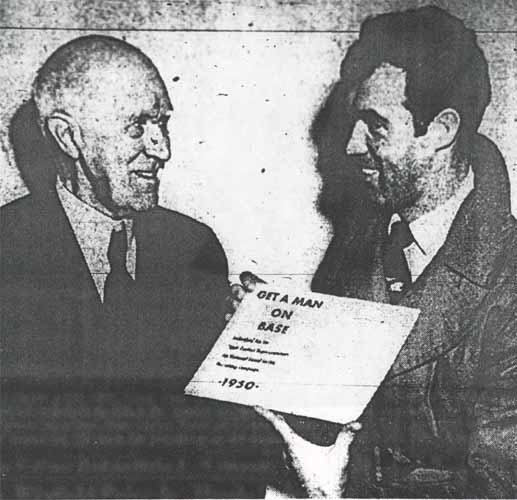
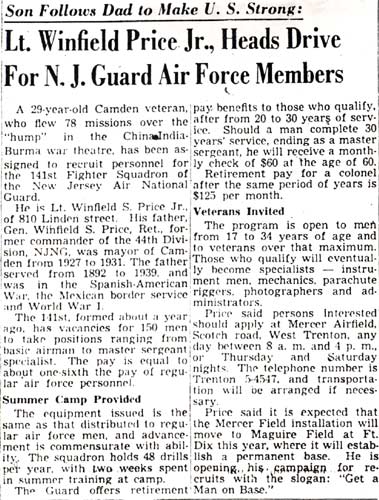

Son Follows Dad to Make U. S. Strong:
LT. WINFIELD PRICE JR., HEADS DRIVE FOR N.J. GUARD AIR FORCE MEMBERS
A 29-year-old Camden veteran, who flew 78 missions over the “hump” in the China-India-Burma war theatre, has been assigned to recruit personnel for the 141st Fighter Squadron of the New Jersey Air National Guard.
He is Lt. Winfield S. Price Jr. of 810 Linden street. His father, Gen. Winfield S. Price, Ret., former commander of the 44th Division, NJNG, was Mayor of Camden from 1927 to 1931. The father served from 1892 to 1939, and was in the Spanish-American War, the Mexican border service and World War I.
The 141st, formed about a year ago, has vacancies for 150 men to take positions ranging from basic airman to master sergeant specialist. The pay is equal to about one-sixth the pay of regular air force personnel.
The program is open to men from 17 to 34 years of age and to veterans over that maximum. Those who qualify will eventually become specialists—instrument men, mechanics, parachute riggers, photographers and administrators.
The Guard offers retirement pay benefits to those who qualify, after from 20 to 30 years of service. Should a man complete 30 years’ service, ending as a master sergeant, he will receive a monthly check of $60 at the age of 60. Retirement pay for a colonel after the same period of years is $125 per month.
Price said persons interested should apply at Mercer Airfield, Scotch road, West Trenton, any day between 8 a. m. and 4 p. m., or Thursday and Saturday nights. The telephone number is Trenton 5-4547, and transportation will be arranged if necessary.
Price said it is expected that the Mercer Field installation will move to Maguire Field at Ft. Dix this year, where it will establish a permanent base. He is opening his campaign for recruits with the slogan: “Get a Man on Base.”
News monopolist: into politics and out again
Camden Courier-Post —
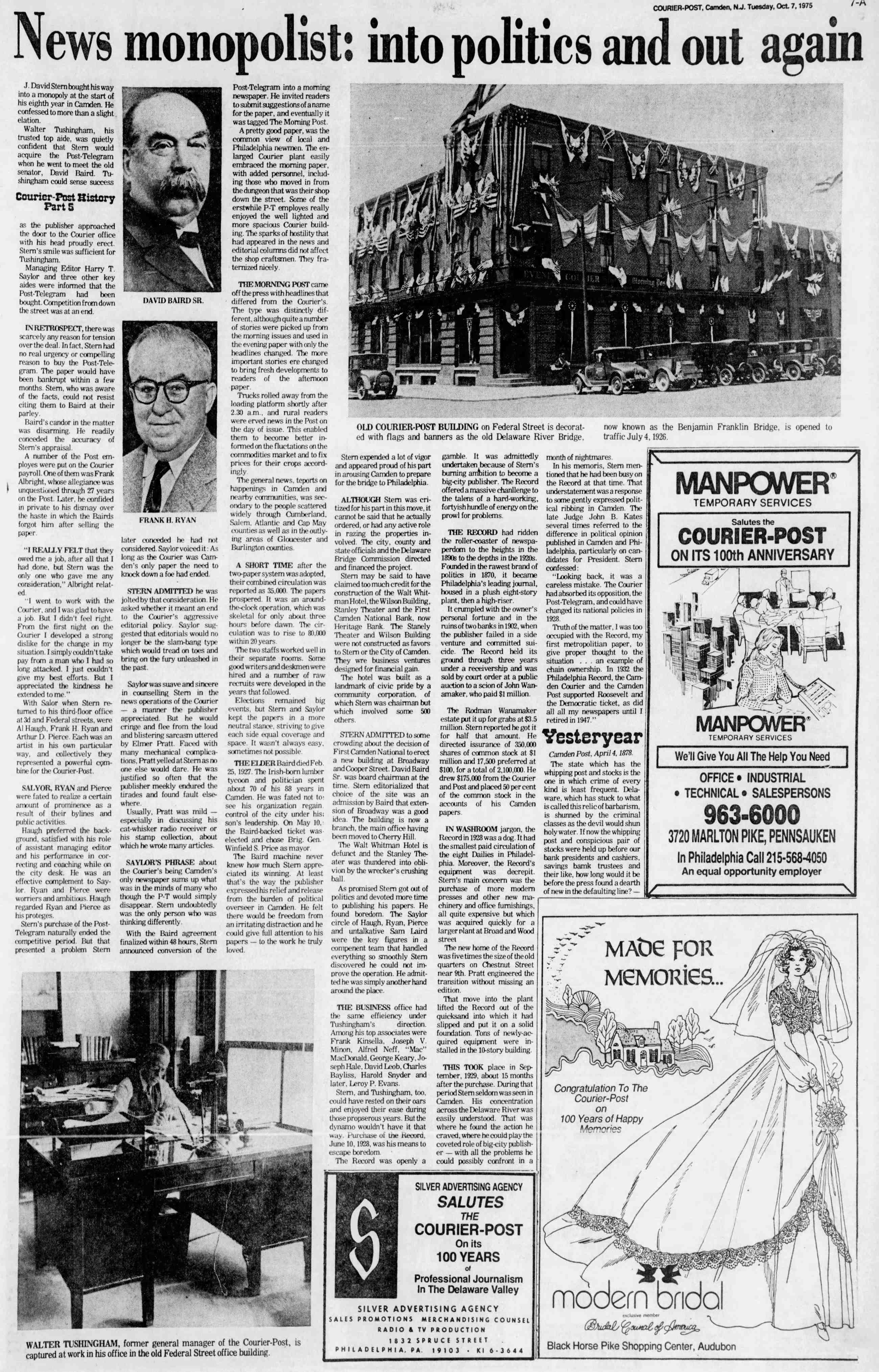
J. David Stern bought his way into a monopoly at the start of his eighth year in Camden. He confessed to more than a slight elation.
Walter Tushingham, his trusted top aide, was quietly confident that Stern would acquire the Post-Telegram when he went to meet the old senator, David Baird. Tushingham could sense success as the publisher approached the door to the Courier office with his head proudly erect. Stern’s smile was sufficient for Tushingham.
Managing Editor Harry T. Saylor and three other key aides were informed that the Post-Telegram had been bought. Competition from down the street was at an end.
IN RETROSPECT, there was scarcely any reason for tension over the deal. In fact, Stern had no real urgency or compelling reason to buy the Post-Telegram. The paper would have been bankrupt within a few months. Stern, who was aware of the facts, could not resist citing them to Baird at their parley.
Baird’s candor in the matter was disarming. He readily conceded the accuracy of Stern’s appraisal.
A number of the Post employes were put on the Courier payroll. One of them was Frank Albright, whose allegiance was unquestioned through 27 years on the Post. Later, he confided in private to his dismay over the haste in which the Bairds forgot him after selling the paper.
“I REALLY FELT that they owed me a job, after all that I had done, but Stern was the only one who gave me any consideration,” Albright related.
“I went to work with the Courier, and I was glad to have a job. But I didn’t feel right. From the first night on the Courier I developed a strong dislike for the change in my situation. I simply couldn’t take pay from a man who I had so long attacked. I just couldn’t give my best efforts. But I appreciated the kindness he extended to me.”
With Salor [sic] when Stern returned to his third-floor office at 3d and Federal streets, were Al Haugh, Frank H. Ryan and Arthur D. Pierce. Each was an artist in his own particular way, and collectively they represented a powerful combine for the Courier-Post.
SALYOR, RYAN and Pierce were fated to realize a certain amount of prominence as a result of their bylines and public activities.
Haugh preferred the background, satisfied with his role of assistant managing editor and his performance in correcting and coaching while on the city desk. He was an effective complement to Saylor. Ryan and Pierce were worriers and ambitious. Haugh regarded Ryan and Pierce as his proteges.
Stern’s purchase of the Post-Telegram naturally ended the competitive period. But that presented a problem Stern later conceded he had not considered. Saylor voiced it: As long as the Courier was Camden’s only paper the need to knock down a foe had ended.
STERN ADMITTED he was jolted by that consideration. He asked whether it meant an end to the Courier’s aggressive editorial policy. Saylor suggested that editorials would no longer be the slam-bang type which would tread on toes and bring on the fury unleashed in the past.
Saylor was suave and sincere in counselling Stern in the news operations of the Courier — a manner the publisher appreciated. But he would cringe and flee from the loud and blistering sarcasm uttered by Elmer Pratt. Faced with many mechanical complications, Pratt yelled at Stern as no one else would dare. He was justified so often that the publisher meekly endured the tirades and found fault elsewhere.
Usually, Pratt was mild — especially in discussing his cat-whisker radio receiver or his stamp collection, about which he wrote many articles.
SAYLOR’S PHRASE about the Courier’s being Camden’s only newspaper sums up what was in the minds of many who though [sic] the P-T would simply disappear. Stern undoubtedly was the only person who was thinking differently.
With the Baird agreement finalized within 48 hours, Stern announced conversion of the Post-Telegram into a morning newspaper. He invited readers to submit suggestions of a name for the paper, and eventually it was tagged The Morning Post.
A pretty good paper, was the common view of local and Philadelphia newmen. The enlarged Courier plant easily embraced the morning paper, with added personnel, including those who moved in from the dungeon that was their shop down the street. Some of the erstwhile P-T employes really enjoyed the well lighted and more spacious Courier building. The sparks of hostility that had appeared in the news and editorial columns did not affect the shop craftsmen. They fraternized nicely.
THE MORNING POST came off the press with headlines that differed from the Courier’s. The type was distinctly different, although quite a number of stories were picked up from the morning issues and used in the evening paper with only the headlines changed. The more important stories ere [sic] changed to bring fresh developments to readers of the afternoon paper.
Trucks rolled away from the loading platform shortly after 2.30 a.m., and rural readers were erved [sic] news in the Post on the day of issue. This enabled them to become better informed on the fluctations [sic] on the commodities market and to fix prices for their crops accordingly.
The general news, teports [sic] on happenings in Camden and nearby communities, was secondary to the people scattered widely through Cumberland, Salem, Atlantic and Cap May [sic] counties as well as in the outlying areas of Gloucester and Burlington counties.
A SHORT TIME after the two-paper system was adopted, their combined circulation was reported as 35,000. The papers prospered. It was an around-the-clock operation, which was skeletal for only about three hours before dawn. The circulation was to rise to 80,000 within 20 years.
The two staffs worked well in their separate rooms. Some good writers and deskmen were hired and a number of raw recruits were developed in the years that followed.
Elections remained big events, but Stern and Saylor kept the papers in a more neutral stance, striving to give each side equal coverage and space. It wasn’t always easy, sometimes not possible.
THE ELDER Baird died Feb. 25, 1927. The Irish-born lumber tycoon and politician spent about 70 of his 88 years in Camden. He was fated not to see his organization regain control of the city under his son’s leadership. On May 10, the Baird-backed ticket was elected and chose Brig. Gen. Winfield S. Price as mayor.
The Baird machine never knew how much Stern appreciated its winning. At least that’s the way the publisher expressed his relief and release from the burden of political overseer in Camden. He felt there would be freedom from an irritating distraction and he could give full attention to his papers — to the work he truly loved.
Stern expended a lot of vigor and appeared proud of his part in arousing Camden to prepare for the bridge to Philadelphia.
ALTHOUGH Stern was critized [sic] for his part in this move, it cannot be said that he actually ordered, or had any active role in razing the properties involved. The city, county and state officials and the Delaware Bridge Commission directed and financed the project.
Stern may be said to have claimed too much credit for the construction of the Walt Whitman Hotel, the Wilson Building, Stanley Theater and the First Camden National Bank, now Heritage Bank. The Stanely [sic] Theater and Wilson Building were not constructed as favors to Stern or the City of Camden. They wre [sic] business ventures designed for financial gain.
The hotel was built as a landmark of civic pride by a community corporation, of which Stern was chairman but which involved some 500 others.
STERN ADMITTED to some crowding about the decision of First Camden National to erect a new building at Broadway and Cooper Street. David Baird Sr. was board chairman at the time. Stern editorialized that choice of the site was an admission by Baird that extension of Broadway was a good idea. The building is now a branch, the main office having been moved to Cherry Hill.
The Walt Whitman Hotel is defunct and the Stanley Theater was thundered into oblivion by the wrecker’s crushing ball.
As promised Stern got out of politics and devoted more time to publishing his papers. He found boredom. The Saylor circle of Haugh, Ryan, Pierce and untalkative Sam Laird were the key figures in a compenent [sic] team that handled everything so smoothly Stern discovered he could not improve the operation. He admitted he was simply another hand around the place.
THE BUSINESS office had the same effieiency [sic] under Tushingham’s direction. Among his top associates were Frank Kinsella, Joseph V. Minon, Alfred Neff, “Mac” MacDonald, George Keary, Joseph Hale, David Leob, Charles Bayliss, Harold Snyder and later, Leroy P. Evans.
Stern, and Tushingham, too, could have rested on their oars and enjoyed their ease during those propserous [sic] years. But the dynamo wouldn’t have it that way. Purchase of the Record, June 10, 1928, was his means to escape boredom.
The Record was openly a gamble. It was admittedly undertaken because of Stern’s burning ambition to become a big-city publisher. The Record offered a massive chanllenge [sic] to the talens [sic] of a hard-working, fortyish hundle [sic] of energy on the prowl for problems.
THE RECORD had ridden the roller-coaster of newspaperdom to the heights in the 1890s to the depths in the 1920s. Founded in the rawest brand of politics in 1870, it became Philadelphia’s leading journal, housed in a plush eight-story plant, then a high-riser.
It crumpled with the owner’s personal fortune and in the ruins of two banks in 1902, when the publisher failed in a side venture and committed suicide. The Record held its ground through three years under a receivership and was sold by court order at a public auction to a scion of John Wanamaker, who paid $1 million.
The Rodman Wanamaker estate put it up for grabs at $3.5 million. Stern reported he got it for half that amount. He directed issurance [sic] of 350,000 shares of common stock at $1 million and 17,500 preferred at $100, for a total of 2,100,000. He drew $175,000 from the Courier and Post and placed 50 per cent of the common stock in the accounts of his Camden papers.
IN WASHROOM jargon, the Record in 1928 was a dog. It had the smallest paid circulation of the eight Dailies in Philadelphia. Moreover, the Record’s equipment was decrepit. Stern’s main concern was the purchase of more modern presses and other new machinery and office furnishings, all quite expensive but which was acquired quickly for a larger plant at Broad and Wood street.
The new home of the Record was five times the size of the old quarters on Chestnut Street near 9th. Pratt engineered the transition without missing an edition.
That move into the plant lifted the Record out of the quicksand into which it had slipped and put it on a solid foundation. Tons of newly-acquired equipment were installed in the 10-story building.
THIS TOOK place in September, 1929, about 15 months after the purchase. During that period Stern seldom was seen in Camden. His concentration across the Delaware River was easily understood. That was where he found the action he craved, where he could play the coveted role of big-city publisher — with all the problems he could possibly confront in a month of nightmares.
In his memoris [sic], Stern mentioned that he had been busy on the Record at that time. That understatement was a response to some gently expressed political ribbing in Camden. The late Judge John B. Kates several times referred to the difference in political opinion published in Camden and Philadelphia, particularly on candidates for President. Stern confessed:
“Looking back, it was a careless mistake. The Courier had absorbed its opposition, the Post-Telegram, and could have changed its national policies in 1928.
Truth of the matter, I was too occupied with the Record, my first metropolitan paper, to give proper thought to the situation . . . an example of chain ownership. In 1932 the Philadelphia Record, the Camden Courier and the Camden Post supported Roosevelt and the Democratic ticket, as did all all [sic] my newspapers until I retired in 1947.”
DAVID BAIRD SR.
FRANK H. RYAN
OLD COURIER-POST BUILDING on Federal Street is decorated with flags and banners as the old Delaware River Bridge, now known as the Benjamin Franklin Bridge, is opened to traffic July 4, 1926.
WALTER TUSHINGHAM, former general manager of the Courier-Post, is captured at work in his office in the old Federal Street office building.
Yesteryear
Camden Post, April 4, 1878.
The state which has the whipping post and stocks is the one in which crime of every kind is least frequent. Delaware, which has stuck to what is called this relic of barbarism, is shunned by the criminal classes as the devil would shun holy water. If now the whipping post and conspicuous pair of stocks were held up before our bank presidents and cashiers, savings bamk [sic] trustees and their like, how long would it be before the press found a dearth of new [sic] in the defaulting line? —
Camden: springboard into Philadelphia, N.Y. newspaper markets
Camden Courier-Post —
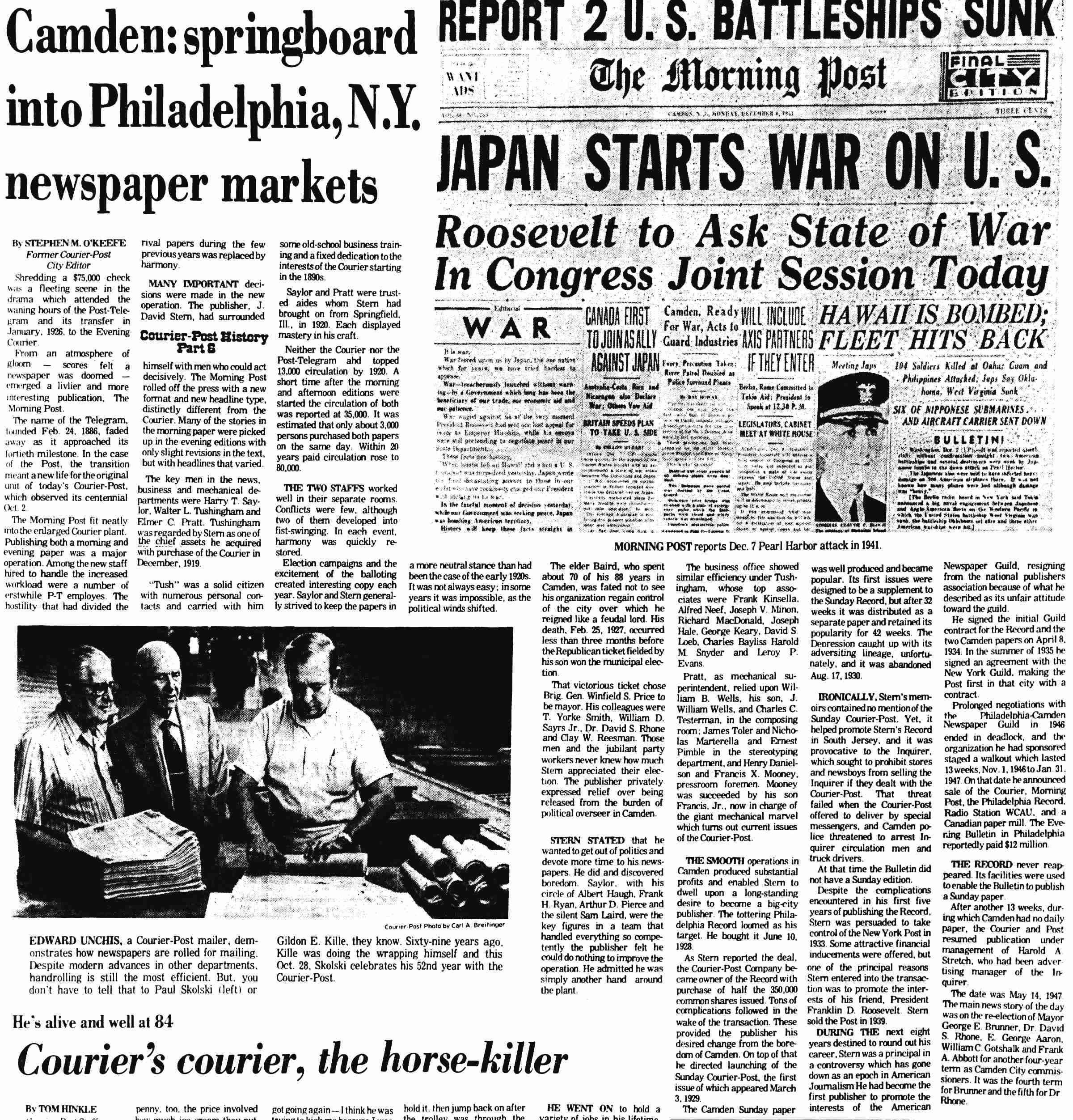
By STEPHEN M. O’KEEFE
Former Courier-Post City Editor
Shredding a $75,000 check was a fleeting scene in the drama which attended the waning hours of the Post-Telegram and its transfer in January, 1926, to the Evening Courier.
From an atmosphere of gloom — scores felt a newspaper was doomed — emerged a livlier and more interesting publication, The Morning Post.
The name of the Telegram, founded Feb. 24, 1886, faded away as it approached its fortieth milestone. In the case of the Post, the transition meant a new life for the original unit of today’s Courier-Post, which observed its centennial Oct. 2.
The Morning Post fit neatly into the enlarged Courier plant. Publishing both a morning and evening paper was a major operation. Among the new staff hired to handle the increased workload were a number of erstwhile P-T employes. The hostility that had divided the rival papers during the few previous years was replaced by harmony.
MANY IMPORTANT decisions were made in the new operation. The publisher, J. David Stern, had surrounded himself with men who could act decisively. The Morning Post rolled off the press with a new format and new headline type, distinctly different from the Courier. Many of the stories in the morning paper were picked up in the evening editions with only slight revisions in the text, but with headlines that varied.
The key men in the news, business and mechanical departments were Harry T. Saylor, Walter L. Tushingham and Elmer C. Pratt. Tushingham was regarded by Stern as one of the chief assets he acquired with purchase of the Courier in December, 1919.
“Tush” was a solid citizen with numerous personal contacts and carried with him some old-school business training and a fixed dedication to the interests of the Courier starting in the 1890s.
Saylor and Pratt were trusted aides whom Stern had brought on from Springfield, Ill., in 1920. Each displayed mastery in his craft.
Neither the Courier nor the Post-Telegram ahd [sic] topped 13,000 circulation by 1920. A short time after the morning and afternoon editions were started the circulation of both was reported at 35,000. It was estimated that only about 3,000 persons purchased both papers on the same day. Within 20 years paid circulation rose to 80,000.
THE TWO STAFFS worked well in their separate rooms. Conflicts were few, although two of them developed into fist-swinging. In each event, harmony was quickly restored.
Election campaigns and the excitement of the balloting created interesting copy each year. Saylor and Stern generally strived to keep the papers in a more neutral stance than had been the case of the early 1920s. It was not always easy; in some years it was impossible, as the political winds shifted.
The elder Baird, who spent about 70 of his 88 years in Camden, was fated not to see his organization regain control of the city over which he reigned like a feudal lord. His death, Feb. 25, 1927, occurred less than three months before the Republican ticket fielded by his son won the municipal election.
That victorious ticket chose Brig. Gen. Winfield S. Price to be mayor. His colleagues were T. Yorke Smith, William D. Sayrs Jr., Dr. David S. Rhone and Clay W. Reesman. Those men and the jubilant party workers never knew how much Stern appreciated their election. The publisher privately expressed relief over being released from the burden of political overseer in Camden.
STERN STATED that he wanted to get out of politics and devote more time to his newspapers. He did and discovered boredom. Saylor, with his circle of Albert Haugh, Frank H. Ryan, Arthur D. Pierce and the silent Sam Laird, were the key figures in a team that handled everything so competently the publisher felt he could do nothing to improve the operation. He admitted he was simply another hand around the plant.
The business office showed similar efficiency under Tushingham, whose top associates were Frank Kinsella, Alfred Neef, Joseph V. Minon, Richard MacDonald, Joseph Hale, George Keary, David S. Loeb, Charles Bayliss Harold M. Snyder and Leroy P. Evans.
Pratt, as mechanical superintendent, relied upon William B. Wells, his son, J. William Wells, and Charles C. Testerman, in the composing room; James Toler and Nicholas Marterella and Ernest Pimble in the stereotyping department, and Henry Danielson and Francis X. Mooney, pressroom foremen. Mooney was succeeded by his son Francis, Jr., now in charge of the giant mechanical marvel which turns out current issues of the Courier-Post.
THE SMOOTH operations in Camden produced substantial profits and enabled Stern to dwell upon a long-standing desire to become a big-city publisher. The tottering Philadelphia Record loomed as his target. He bought it June 10, 1928.
As Stern reported the deal, the Courier-Post Company became owner of the Record with purchase of half the 350,000 common shares issued. Tons of complications followed in the wake of the transaction. These provided the publisher his desired change from the boredom of Camden. On top of that he directed launching of the Sunday Courier-Post, the first issue of which appeared March 3, 1929.
The Camden Sunday paper was well produced and became popular. Its first issues were designed to be a supplement to the Sunday Record, but after 32 weeks it was distributed as a separate paper and retained its popularity for 42 weeks. The Depression caught up with its adversiting [sic] lineage, unfortunately, and it was abandoned Aug. 17, 1930.
IRONICALLY, Stern’s memoirs contained no mention of the Sunday Courier-Post. Yet, it helped promote Stern’s Record in South Jersey, and it was provocative to the Inquirer, which sought to prohibit stores and newsboys from selling the Inquirer if they dealt with the Courier-Post. That threat failed when the Courier-Post offered to deliver by special messengers, and Camden police threatened to arrest Inquirer circulation men and truck drivers.
At that time the Bulletin did not have a Sunday edition.
Despite the complications encountered in his first five years of publishing the Record, Stern was persuaded to take control of the New York Post in 1933. Some attractive financial inducements were offered, but one of the principal reasons Stern entered into the transaction was to promote the interests of his friend, President Franklin D. Roosevelt. Stern sold the Post in 1939.
DURING THE next eight years destined to round out his career, Stern was a principal in a controversy which has gone down as an epoch in American Journalism He had become the first publisher to promote the interests of the American Newspaper Guild, resigning from the national publishers association because of what he described as its unfair attitude toward the guild.
He signed the initial Guild contract for the Record and the two Camden papers on April 8, 1934. In the summer of 1935 he signed an agreement with the New York Guild, making the Post first in that city with a contract.
Prolonged negotiations with the Philadelphia-Camden Newspaper Guild in 1946 ended in deadlock, and the organization he had sponsored staged a walkout which lasted 13 weeks, Nov. 1, 1946 to Jan. 31, 1947. On that date he announced sale of the Courier, Morning Post, the Philadelphia Record, Radio Station WCAU, and a Canadian paper mill. The Evening Bulletin in Philadelphia reportedly paid $12 million.
THE RECORD never reappeared. Its facilities were used to enable the Bulletin to publish a Sunday paper.
After another 13 weeks, during which Camden had no daily paper, the Courier and Post resumed publication under management of Harold A. Stretch, who had been advertising manager of the Inquirer.
The date was May 14, 1947. The main news story of the day was on the re-election of Mayor George E. Brunner, Dr. David S. Rhone, E. George Aaron, William C. Gotshalk and Frank A. Abbott for another four-year term as Camden City commissioners. It was the fourth term for Brunner and the fifth for Dr Rhone.
MORNING POST reports Dec. 7 Pearl Harbor attack in 1941.
Courier-Post Photo by Carl A. Breitinger
EDWARD UNCHIS, a Courier-Post mailer, demonstrates how newspapers are rolled for mailing. Despite modern advances in other departments, handrolling is still the most efficient. But, you don’t have to tell that to Paul Skolski (left) or Gildon E. Kille, they know. Sixty-nine years ago, Kille was doing the wrapping himself and this Oct. 28, Skolski celebrates his 52nd year with the Courier-Post.
Fire-Fence Probe Refused by City
Camden Courier-Post —
Officials Declare They Have No Jurisdiction in Factory Blaze Controversy
City officials declared today they would make no investigation into the erection of two large fences which firemen say hampered them in fighting the $225,000 fire at the Varoma Building, Second and Erie streets, early Thursday morning.
The fence, erected by the John R. Evans & Company, cuts off Segal street and prevented the firemen from entering an alley from Front street which would have enabled them, they said, to fight the fire from the rear.
Bernard Gallagher, fire marshal, said there was sufficient water without the firemen using the blocked fire plug on Segal street.
“It required only 150 feet more of hose to circle the yard and this was attached so quickly the Segal street plug was not necessary. We are not planning any investigation,” he said.
Vincent P. Dougherty, vice president of the Allied Metal Stamping Company, whose firm suffered a $75,000 loss, and C. E. Perrin, head of the Philadelphia Metal Stamping Company, which lost $50,000 in the blaze, yesterday asked Mayor Price to order an investigation.
George W. Johnson, building inspector, said today the city had no authority or jurisdiction in the matter.
“The fence was built on the Evans property and no authority is necessary from the city for the erection of a fence,” he said. “There is no regulation I know of requiring gates to be placed in a private fence.”