Introduction
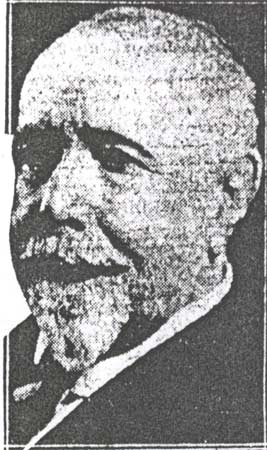
End Comes at Home of Daughter at 81; Ill For 5 Months
Noted Surgeon Dies
HEADED MOVES TO BAN HEALTH PERILS
Won Fame for Advances In Medical Science; Funeral Set for Monday
After an illness of five months Dr. Dowling Benjamin, noted surgeon, died yesterday at noon at the home of his daughter, Mrs. Marion Bibighaus, 3082 Federal street.
In the death of Dr. Benjamin, Camden loses one of its foremost citizens of other years. He sponsored an attack which resulted in Camden getting an artesian water supply and the wiping out of epidemics of typhoid fever.
He persuaded Andrew Carnegie to give the city $100,000 for the erection of the library at Broadway and Line street.
He was the first surgeon in the city to introduce the X-ray in his practice. He became a member of the first surgical staff when Cooper Hospital was opened in 1887. He introduced the first antiseptics in Cooper Hospital five years before any hospital in Philadelphia. He was the first physician in the city to use an automobile in his practice.
U. of P. Graduate
Dr. Benjamin was born in Baltimore in 1849. He graduated from the medical school of the University of Pennsylvania in 1877. A year before he graduated he wrote an essay which proved contagious disease was caused by a germ. This proclaimed him as a pioneer at the beginning of his profession because some doctors of the old school frowned on the theory that germs caused disease.
A professor, who taught Dr. Benjamin at the university, wrote afterward that his essay was “the first clear, logical and convincing argument in favor of the germ theory of disease written by any American physician.”
He was graduated from the university with highest honors. He began practice immediately in Camden. He was the first physician locally to blame the water system for a typhoid fever epidemic. He denounced politicians and threatened a taxpayers' suit to force the city to an artesian water supply. At that time 600 persons were ill in the city with the disease. Only two or three other New Jersey physicians agreed with Dr. Benjamin but he finally won.
When Dr. Benjamin introduced antiseptics in Cooper Hospital nurses graduating from Philadelphia colleges came here to take post-graduate courses.
Demanded Examinations
He was the first physician to advocate the establishment of a state medical examining board. Colleges were springing up all over the country giving five months' courses and diplomas to physicians. Dr. Benjamin demanded they be compelled to pass a state medical examination before being permitted to practice.
Andrew Carnegie sent Dr. Benjamin his personal check for $100,000 for the Carnegie Library here and the physician endorsed it as payable to the city.
Dr. Benjamin was a member of the Camden County and Camden City Medical Societies. He was chief surgeon of Cooper Hospital for many years and surgeon for the Pennsylvania Railroad and Camden Iron Works.
He lived at 215 Cooper street for many years until the death of his wife, Mrs. Sarah C. Benjamin, after which he made his home with his daughter.
He was a member of Trimble Lodge 117 F. and A. M., and the Sons of the Revolution. He was a great-grandson of “Light Horse Harry” Lee, one of Washington’s trusted generals.
In 1925 Dr. Benjamin had a gavel hewn from the ruins of the British Frigate Augusta, which was sunk off Gloucester Point in the Battle of Red Bank. He presented it to the Sons of the Revolution at Newark that year.
Wrote Many Articles
He contributed many essays to American publications. Among them were Dr. Godfrey’s “History of the Camden County Medical Society”; New York Medical Record, The Country Practitioner, the Medical Record, New York World, the Journal of the American Medical Association, Chicago Tribune, Brooklyn Eagle and the records of the New Jersey Medical Society. He also wrote articles for the Camden Daily Courier during the influenza epidemic in 1919.
He is survived by two daughters, the other of whom is Mrs. Clifford K. Deacon, wife of a former city councilman and sergeant-at-arms of the District Court.
The funeral will be held at 2 p.m., Monday, from 408 Cooper street. Services will be in charge of Rev. John Pemberton, pastor of Centenary Tabernacle M.E. Church, of which he was a member, and Rev. Edgar Miller, pastor of St. George’s M.E. Church. Burial will be in Arlington Cemetery.
DR. DOWLING BENJAMIN was born in Baltimore, Maryland in 1849. He studied under Dr. James Ridge and Dr. D. Hayes Agnew before graduating with his doctorate from the University of Pennsylvania School of Medicine in 1877. By 1880 he had come to Camden with his wife, the former Sarah Cooper White, and began practicing medicine. The Benjamins made their home through at least 1890 at 305 Stevens Street. They subsequently moved to 215 Cooper Street where they remained until Mrs. Benjamin’s passing in the mid-1920s.
Dr. Benjamin’s practice centered on surgery. On August 12, 1887 Cooper Hospital was dedicated, Dr. Benjamin being one of the original staff surgeons. The four original attending physicians were Dr. Pancoast, Dr. H. Genet Taylor, Dr. Alexander M. Mecray, and Dr. William A. Davis. The surgeons were Doctors E.L.B. Godfrey, O.P. Cross, Dowling Benjamin and J.F. Walsh, with Dr. Joseph H. Willis as the original pathologist and Dr. Harry B. Jarrett serving as the first Resident Physician. Dr. Benjamin was later a trustee of Cooper Hospital. Other positions included work as a physician at the Camden City Dispensary, and as an Assistant Physician at the University of Pennsylvania Hospital’s Department of Nervous Diseases.
Dr. Benjamin was a member of the Camden County Medical Society, and served as the President of that organization in 1884. He also was a member of the Camden City Medical Society, the American Medical Association, the New Jersey State Board of Health, the Cooper Club, and was a member and at one time President of the New Jersey State Sanitary Association.
Dr. Benjamin held teaching appointments at the Medico-Chirurgical College and Hospital of Philadelphia and at the New Jersey Training School for Nurses. He served his country as a Major and Assistant Surgeon of the Sixth Regiment, New Jersey National Guard for several years, and was with the unit during the Spanish-American War. Dr. Levi Hirst, who was still studying medicine, served under Dr. Benjamin as a hospital steward prior to receiving his doctorate in 1894.
Dr. Benjamin’s place in the annals of American medicine are beyond dispute. He was instrumental in proving diseases were caused by germs, introduced antiseptics five years before any Philadelphia physician began using them, was the first doctor in Camden to use X-ray equipment and to drive an automobile. He also was instrumental in New Jersey’s testing and licensing physicians.
Dr. Benjamin led the campaign to get the city to develop an artesian well-based water supply, which is still in use today. The use of this system ended the typhoid fever epidemics which had plagued Camden throughout the 1800s. He also personally convinced Andrew Carnegie to donate $100,000 to build Camden Free Public Library at Broadway and Line Street.
After Mrs. Benjamin passed, Dr. Dowling Benjamin went to live with his daughter, Mrs. Sarah Marion Bibinghaus, at 3082 Federal Street in East Camden. He died in October of 1930, survived by his daughters, Mrs. Sarah M. Bibinghaus and Mrs. Ada Deacon. Four other children, Stella, Helen, Dowling, and Paul, preceded him in death.
Daniel Lynch Injured at Camden Iron Works
Philadelphia Inquirer —
Daniel Lynch, twenty eight years of age, residing on Mechanic street, and employed at the Camden Iron Works, was injured yesterday morning by a wrought iron column falling upon him at the works. Dr. Benjamin was summoned. His injuries are feared to be serious.
Carnegie’s Library Offer to Camden
New York Times —
CAMDEN, N. J., Jan. 7.—Dr. Dowling Benjamin this morning received a letter from Andrew Carnegie in which he offers the City of Camden a free library to cost $100,000. The condition imposed by Mr. Carnegie is that the library must be maintained by the city at a cost of not less than $10,000 a year. The city officials say there is no doubt that Mr. Carnegie’s gift will be accepted.
Voters’ League Puts Up a City Ticket
Philadelphia Inquirer —
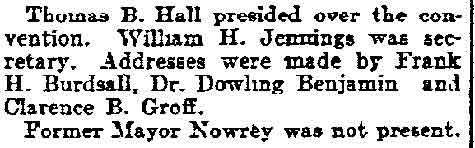
The city convention of the Legal Voters’ League was held last night at the Camden City Hall, when the following candidates were named:
Excise Commissioners—George Aultemus, R., Second ward; Frank Deveraux, D., Tenth ward; John R Wolf, R., Sixth ward; Wilfred M. Kaighn, R., Ninth ward; A. J. Vansant, R., Eighth ward; Councilman-at-large—Frank W. Tressey, D., First ward. City Council—John Vanderslice, R., First ward; Dr. W. I. Kelchner, R., Second ward; Robert Garrison, D., Third ward; George H. Watt, R., Fourth ward; Fifth ward, no nomination; John E. Smith, D., Sixth ward; Ludwig Winters, D., Seventh ward; Martin J. Ewe, D., Eighth ward; William S. Wilkins, R., Ninth ward; Levi Sharp, D., Tenth ward; Dr. W. H. Kensinger, D., Eleventh ward; Walter Hubbs, D., Twelfth ward. Board of Freeholders—George Martin, R., First ward; Thomas S. Armstrong, D., Second ward; Heulings Mulvey, D., Third ward; Josiah Kirkbride, R., Fourth ward; Fifth ward, no nomination; Lewis Schimer, D., Sixth ward; George H. Jones, D., Seventh ward; Thomas Pooley, D., Eighth ward; John J. Welsh, D., Ninth ward; Alfred R. Taylor, R., Tenth ward; Bernard Funfer, D., Eleventh ward; John Carver, D., Twelfth ward. Board of Education—Penrose W. Hirst, R., Second ward; Charles H. Mills, R., Eighth ward; James S. Pratt, D., Tenth ward.
Thomas B. Hall presided over the convention. William H. Jennings was secretary. Addresses were made by Frank H. Burdsall, Dr. Dowling Benjamin and Clarence B. Groff.
Former Mayor Nowrey was not present.
Finds Method of Preventing Lockjaw
New York Times —
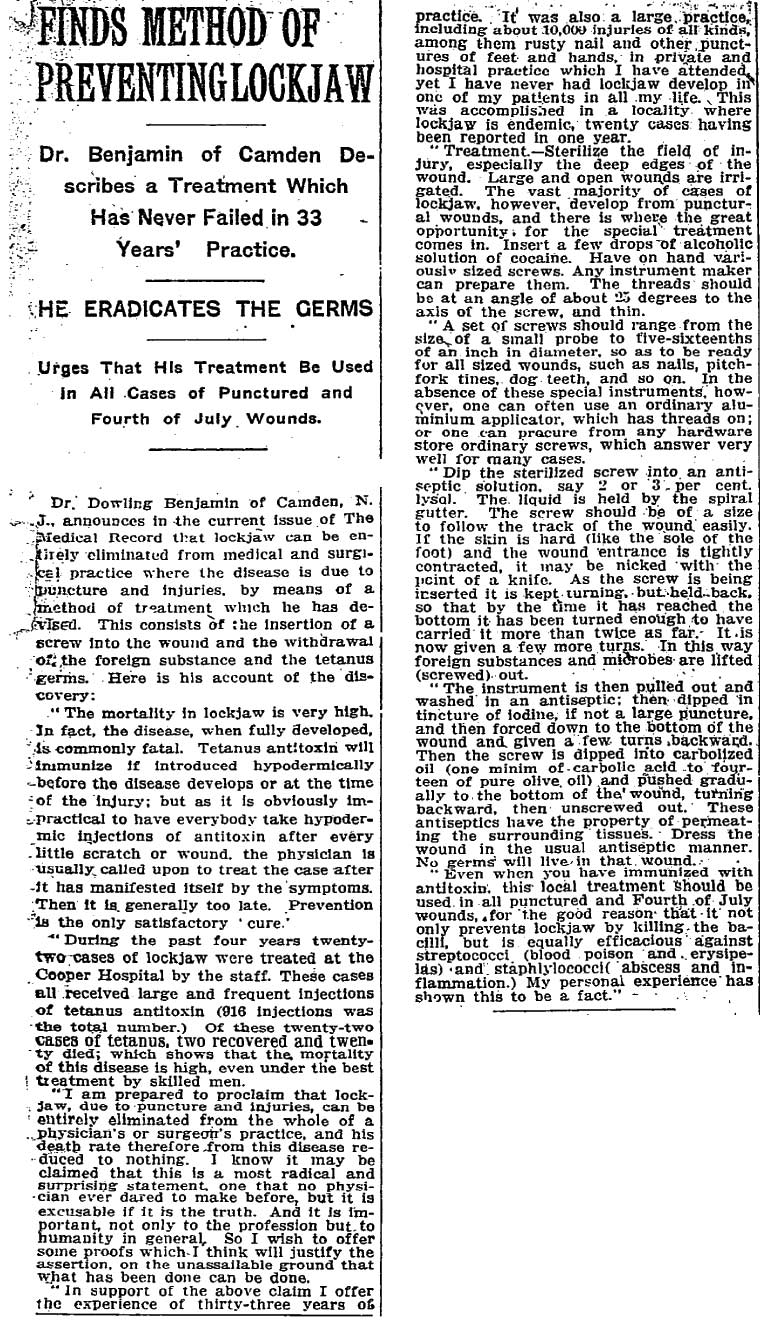
Dr. Benjamin of Camden Describes a Treatment Which Has Never Failed in 33 Years’ Practice.
He Eradicates the Germs
Urges That His Treatment Be Used In All Cases of Punctured and Fourth of July Wounds.
Dr. Dowling Benjamin of Camden, N. J., announces in the current issue of The Medical Record that lockjaw can be entirely eliminated from medical and surgical practice where the disease is due to puncture and injuries, by means of a method of treatment which he has devised. This consists of the insertion of a screw into the wound and the withdrawal of the foreign substance and the tetanus germs. Here is his account of the discovery:
“The mortality in lockjaw is very high. In fact, the disease, when fully developed, is commonly fatal. Tetanus antitoxin will immunize if introduced hypodermically before the disease develops or at the time of the injury; but as it is obviously impractical to have everybody take hypodermic injections of antitoxin after every little scratch or wound, the physician is usually called upon to treat the case after it has manifested itself by the symptoms. Then it is generally too late. Prevention is the only satisfactory ‘cure.’
“During the past four years twenty-two cases of lockjaw were treated at the Cooper Hospital by the staff. These cases all received large and frequent injections of tetanus antitoxin (916 injections was the total number.) Of these twenty-two cases of tetanus, two recovered and twenty died; which shows that the mortality of this disease is high, even under the best treatment by skilled men.
“I am prepared to proclaim that lockjaw, due to puncture and injuries, can be entirely eliminated from the whole of a physician’s or surgeon’s practice, and his death rate therefore from this disease reduced to nothing. I know it may be claimed that this is a most radical and surprising statement, one that no physician ever dared to make before, but it is excusable if it is the truth. And it is important, not only to the profession but to humanity in general. So I wish to offer some proofs which I think will justify the assertion, on the unassailable ground that what has been done can be done.
“In support of the above claim I offer the experience of thirty-three years of practice. It was also a large practice, including about 10,000 injuries of all kinds, among them rusty nail and other punctures of feet and hands, in private and hospital practice which I have attended, yet I have never had lockjaw develop in one of my patients in all my life. This was accomplished in a locality where lockjaw is endemic, twenty cases having been reported in one year.
“Treatment—Sterilize the field of injury, especially the deep edges of the wound. Large and open wounds are irrigated. The vast majority of cases of lockjaw, however, develop from punctural wounds, and there is where the great opportunity for the special treatment comes in. Insert a few drops of alcoholic solution of cocaine. Have on hand variously sized screws. Any instrument maker can prepare them. The threads should be at an angle of about 25 degrees to the axis of the screw, and thin.
“A set of screws should range from the size of a small probe to five-sixteenths of an inch in diameter, so as to be ready for all sized wounds, such as nails, pitch-fork tines, dog teeth, and so on. In the absence of these special instruments, however, one can often use an ordinary aluminium applicator, which has threads on; or one can procure from any hardware store ordinary screws, which answer very well for many cases.
“Dip the sterilized screw into an antiseptic solution, say 2 or 3 per cent. lysol. The liquid is held by the spiral gutter. The screw should be of a size to follow the track of the wound easily. If the skin is hard (like the sole of the foot) and the wound entrance is tightly contracted, it may be nicked with the point of a knife. As the screw is being inserted it is kept turning, but held back, so that by the time it has reached the bottom it has been turned enough to have carried it more than twice as far. It is now given a few more turns. In this way foreign substances and microbes are lifted (screwed) out.
“The instrument is then pulled out and washed in an antiseptic; then dipped in tincture of iodine, if not a large puncture, and then forced down to the bottom of the wound and given a few turns backward. Then the screw is dipped into carbolized oil (one minim of carbolic acid to fourteen of pure olive oil) and pushed gradually to the bottom of the wound, turning backward, then unscrewed out. These antiseptics have the property of permeating the surrounding tissues. Dress the wound in the usual antiseptic manner. No germs will live in that wound.
“Even when you have immunized with antitoxin, this local treatment should be used in all punctured and Fourth of July wounds, for the good reason that it not only prevents lockjaw by killing the bacilli, but is equally efficacious against streptococci (blood poison and erysipelas) and staphylococci (abscess and inflammation.) My personal experience has shown this to be a fact.”
Dr. Dowling Benjamin, Famous Surgeon, Dies; Leader in Civic Affairs
Camden Morning Post —
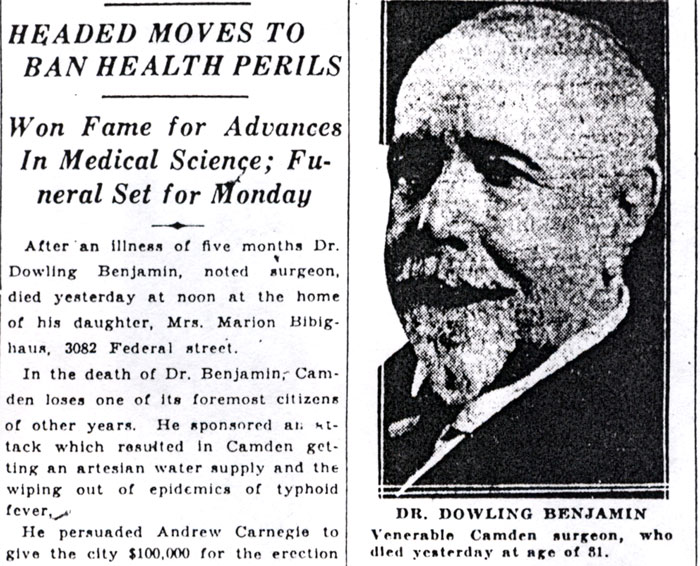
Headed Moves to Ban Health Perils
Won Fame for Advances In Medical Science; Funeral Set for Monday
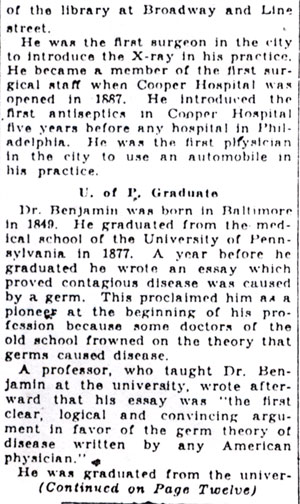
After an illness of five months Dr. Dowling Benjamin, noted surgeon, died yesterday at noon at the home of his daughter, Mrs. Marion Bibighaus, 3082 Federal street.
In the death of Dr. Benjamin, Camden loses one of its foremost citizens of other years. He sponsored an attack which resulted in Camden getting an artesian water supply and the wiping out of epidemics of typhoid fever.
He persuaded Andrew Carnegie to give the city $100,000 for the erection of the library at Broadway and Line street.
He was the first surgeon in the city to introduce the X-ray in his practice. He became a member of the first surgical staff when Cooper Hospital was opened in 1887. He introduced the first antiseptics in Cooper Hospital five years before any hospital in Philadelphia. He was the first physician in the city to use an automobile in his practice.
U. of P. Graduate
Dr. Benjamin was born in Baltimore in 1849. He graduated from the medical school of the University of Pennsylvania in 1877. A year before he graduated he wrote an essay which proved contagious disease was caused by a germ. This proclaimed him as a pioneer at the beginning of his profession because some doctors of the old school frowned on the theory that germs caused disease.
A professor, who taught Dr. Benjamin at the university, wrote afterward that his essay was “the first clear, logical and convincing argument in favor of the germ theory of disease written by any American physician.”
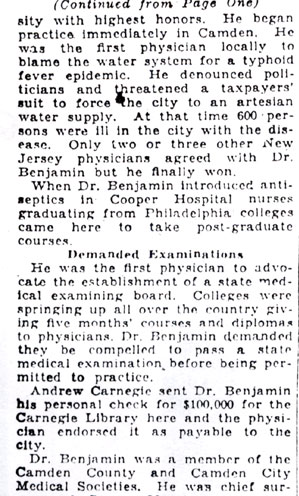
He was graduated from the university with highest honors. He began practice immediately in Camden. He was the first physician locally to blame the water system for a typhoid fever epidemic. He denounced politicians and threatened a taxpayers’ suit to force the city to an artesian water supply. At that time 600 persons were ill in the city with the disease. Only two or three other New Jersey physicians agreed with Dr. Benjamin but he finally won.
When Dr. Benjamin introduced antiseptics in Cooper Hospital nurses graduating from Philadelphia colleges came here to take post-graduate courses.
Demanded Examinations
He was the first physician to advocate the establishment of a state medical examining board. Colleges were springing up all over the country giving five months’ courses and diplomas to physicians. Dr. Benjamin demanded they be compelled to pass a state medical examination before being permitted to practice.
Andrew Carnegie sent Dr. Benjamin his personal check for $100,000 for the Carnegie Library here and the physician endorsed it as payable to the city.
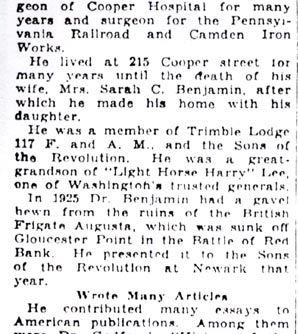
Dr. Benjamin was a member of the Camden County and Camden City Medical Societies. He was chief surgeon of Cooper Hospital for many years and surgeon for the Pennsylvania Railroad and Camden Iron Works.
He lived at 215 Cooper street for many years until the death of his wife, Mrs. Sarah C. Benjamin, after which he made his home with his daughter.
He was a member of Trimble Lodge 117 F. and A. M., and the Sons of the Revolution. He was a great-grandson of “Light Horse Harry” Lee, one of Washington’s trusted generals.
In 1925 Dr. Benjamin had a gavel hewn from the ruins of the British Frigate Augusta, which was sunk off Gloucester Point in the Battle of Red Bank. He presented it to the Sons of the Revolution at Newark that year.
Wrote Many Articles
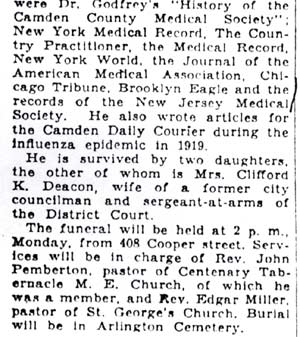
He contributed many essays to American publications. Among them were Dr. Godfrey’s “History of the Camden County Medical Society”; New York Medical Record, The Country Practitioner, the Medical Record, New York World, the Journal of the American Medical Association, Chicago Tribune, Brooklyn Eagle and the records of the New Jersey Medical Society. He also wrote articles for the Camden Daily Courier during the influenza epidemic in 1919.
He is survived by two daughters, the other of whom is Mrs. Clifford K. Deacon, wife of a former city councilman and sergeant-at-arms of the District Court.
The funeral will be held at 2 p.m., Monday, from 408 Cooper street. Services will be in charge of Rev. John Pemberton, pastor of Centenary Tabernacle M.E. Church, of which he was a member, and Rev. Edgar Miller, pastor of St. George’s M.E. Church. Burial will be in Arlington Cemetery.
The Camden Free Public Library (Carnegie Library)
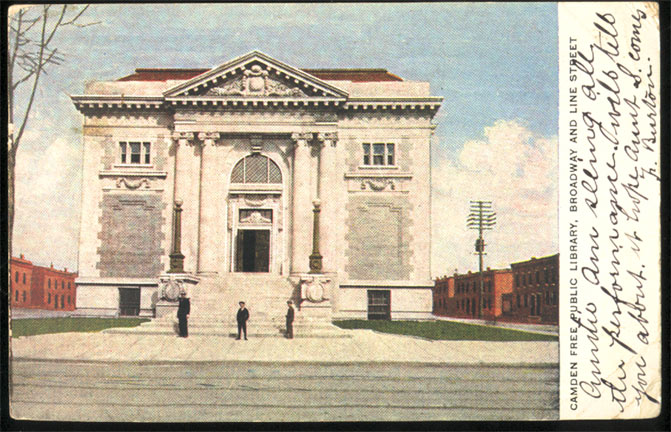
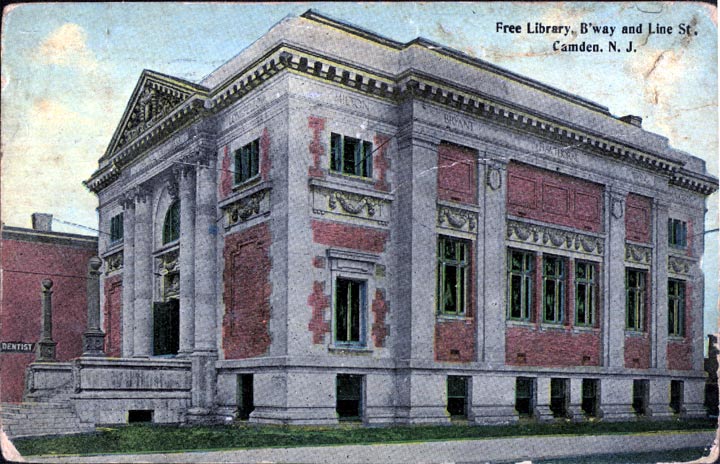
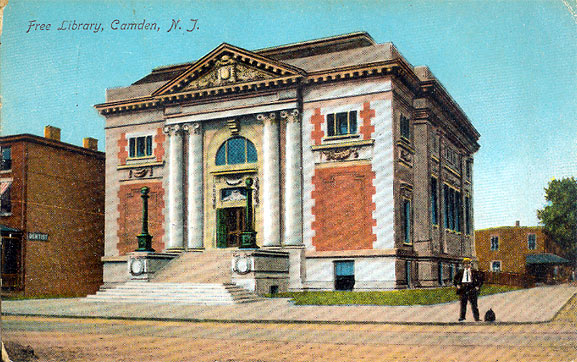
The Camden Free Public Library (Carnegie Library), Broadway & Line Street. The postmark on the first card is April 28, 1906.