Introduction
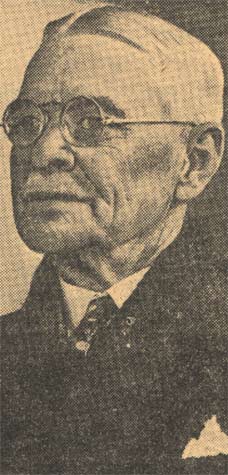
Charles H. Fitzsimmons III
CHARLES H. FITZSIMMONS III was born around 1856 in Philadelphia. He came to Camden in 1874. At the time of the 1880 Census he was married, living with wife, the former Anna Carey, and son Charles IV at 249 Sycamore Street, and working as a sail maker. He followed that trade into the 1890s. As he named his own son Charles Fitzsimmons and a grandson was born, also named Charles Fitzsimmons, in later years he was simply referred to by his full name or as Charles Fitzsimmons Sr.
Charles Fitzsimmons became active in local politics. He was appointed as an extra man to the Camden Fire Department in the spring of 1883, replacing William Suders. After serving for one year with Engine Company 2, Charles Fitzsimmons was replaced in turn by W.H. Whalland.
The 1887–1888 Camden City Directory shows him living at 287 Sycamore Street, the 1888–1889 Directory states 272 Sycamore. The 1890–1891 Directory gives 1133 South 3rd as his address. He was still following the sailmaker’s trade as late as 1890.
Charles H. Fitzsimmons was appointed to the police force on April 1, 1894 by then-Mayor John L. Westcott. After an exemplary and distinguished career in uniform, he began working as a detective in 1912, during the administration of Mayor Charles H. Ellis.
On August 1, 1913, Charles Fitzsimmons, along with Fiore Troncone and George V. Murry were promoted to the detective squad, then led by Captain William Schregler. All had been working in plainclothes for several months prior to the official promotion.
By 1900 Charles H. Fitzsimmons had moved next door to 1135 South 3rd Street. The family was still there as late as 1914, according to the Camden City Directory. By the spring of 1918 he, his wife, and daughter Anna had moved to 1421 Bradley Avenue in the Parkside section of Camden. This would be his home until he passed away. By January of 1920, when the Census was taken, Charles Fitzsimmons’ son Charles, daughter-in-law Nellie, and grand-daughter Anna were also living at the Bradley Avenue address.
Detective Fitzsimmons retired on December 31, 1931, due to age and problems with his eyesight. He had been assigned to watch over the Parkside Trust at Haddon and Kaighn Avenues as a result of his failing eyesight. He had faith that an operation could restore his vision, and this turned out to be the case.
Detective Charles H. Fitzsimmons III died at Cooper Hospital on June 8, 1938. He was preceded in death by his wife Anna, who left this earth in December of 1937, and his son, who had passed in 1922.
After a funeral at 1401 Princess Avenue, Charles H. Fitzsimmons III was buried at Harleigh Cemetery.
The Mayor Names
Camden Post —
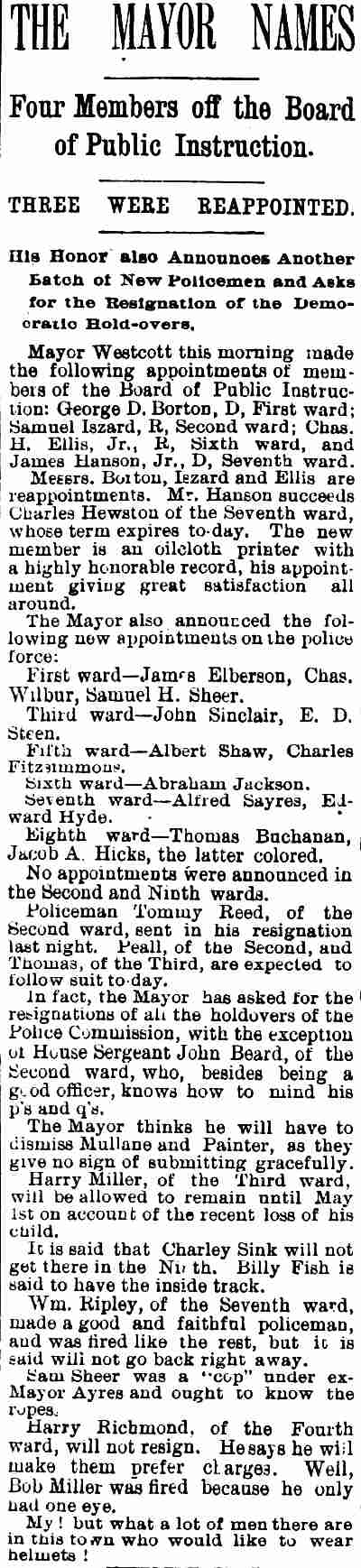
Four Members off the Board of Public Instruction.
THREE WERE REAPPOINTED.
His Honor also Announces Another Batch of New Policemen and Asks for the Resignation of the Democratic Hold-overs.
Mayor Westcott this morning made the following appointments of members of the Board of Public Instruction: George D. Borton, D, First ward; Samuel Iszard, R, Second ward; Chas. H. Ellis, Jr., R, Sixth ward, and James Hanson, Jr., D, Seventh ward. Messrs. Borton, Iezard [sic] and Ellis are reappointments. Mr. Hanson succeeds Charles Hewston of the Seventh ward, whose term expires to-day. The new member is an oilcloth printer with a highly honorable record, his appointment giving great satisfaction all around.
The Mayor also announced the following new appointments on the police force:
First ward—James Elberson, Chas. Wilbur, Samuel H. Sheer.
Third ward—John Sinclair, E. D. Steen.
Fifth ward—Albert Shaw, Charles Fitzsimmons.
Sixth ward—Abraham Jackson.
Seventh ward—Alfred Sayres, Edward Hyde.
Eighth ward—Thomas Buchanan, Jacob A. Hicks, the latter colored.
No appointments were announced in the Second and Ninth wards.
Policeman Tommy Reed, of the Second ward, sent in his resignation last night. Peall, of the Second, and Thomas, of the Third, are expected to follow suit to-day.
In fact, the Mayor has asked for the resignations of all the holdovers of the Police Commission, with the exception of House Sergeant John Beard, of the Second ward, who, besides being a good officer, knows how to mind his p’s and q’s.
The Mayor thinks he will have to dismiss Mullane and Painter, as they give no sign of submitting gracefully.
Harry Miller, of the Third ward, will be allowed to remain until May 1st on account of the recent loss of his child.
It is said that Charley Sink will not get there in the Ninth. Billy Fish is said to have the inside track.
Wm. Ripley, of the Seventh ward, made a good and faithful policeman, and was fired like the rest, but it is said will not go back right away.
Sam Sheer was a “cop” under ex-Mayor Ayres and ought to know the ropes.
Harry Richmond, of the Fourth ward, will not resign. He says he will make them prefer charges. Well, Bob Miller was fired because he only had one eye.
My! but what a lot of men there are in this town who would like to wear helmets!
The Mayor’s Appointments
Camden Daily Telegram —

He Announced Several This Noon.
COMMISSIONERS OF INSTRUCTION.
The Old Members Re-named With the Exception of the Member From the Seventh Ward—Police Appointments and Resignations.
Mayor Westcott this noon made the following appointments as Commissioners of Public instruction:
Messrs. George D. Borton, of the First ward; Samuel Iszard, of the Second ward; Charles H. Ellis, Jr., of the Sixth ward, and James Hanson, to succeed Charles Hewston, of the Seventh ward.
The officers of the Commission hold over another year.
The following appointments were made on the police force:
First Ward—James Elberson, Charles Wilbur, Samuel H. Sheer.
Second Ward—No appointments.
Third Ward—John Sinclair, E. D. Stein.
Fourth Ward—No appointments.
Fifth Ward—Albert Shaw, Charles Fitzsimmons.
Sixth Ward—Abraham Jackson.
Seventh Ward—Alfred Sayres, Edward Hyde.
Eighth Ward—Thomas Buchanan, Jacob A. Hicks (colored).
Ninth Ward—No appointments.
Mayor Westcott has requested the resignation of all the members of the police force who served under the Police Commission, to take effect May 1. They are Policemen Peall, Horner, Painter, Mullane, Miller and Reed.
POLITICAL POINTERS.
Who will be the postmaster?
Who will be the next prosecutor?
Many of the ward workers are suffering from election colds.
The name of Harry Moffitt was left out of the columns of honorable mention with the other hustlers of election day.
Senator Rogers and Messrs. Stafford and Watson, of the House are fully coming up to the expectations of their constituents.
If the Mayor could arrange it to hold his hearings a trifle earlier it would be a great source of satisfaction to the Camden afternoon papers.
There is still great anxiety on the part of the public as to the outcome of the present session of the legislature. Thus far their public acts have been highly commendable.
The abolishment of the Police Justice act restores to office the City Recorder, Benjamin M. Braker, who would be qualified to act in place of the Mayor should the Chief Executive be taken sick.
Jos. Potter, the new member of Council from the First ward is a man of wide business experience and will prove much advantage to the many large financial interests that will come under his care.
Owing to the satisfactory working of the present school commission in the two second-class counties up the State, the legislature made no change in the mode of placing the members as was anticipated.
Jos. B. Fox, of the Fourth ward, is what might be termed an old reliable, having had a long and varied experience in public affairs. He is always conservative in the expenditure of city money. He is always safe to trust.
Charles Sayrs, of the Seventh ward, who had a short experience in the present Council, but enough to make him feel at home among public affairs, is neck and ears in work between his real estate business and Councilmanic duties.
The colored people of the lower section of the city are anxious to see Squire Drake, the ex-Republican and ex-member of the School Board, come out of the Court House, where he holds a position under the Thompson Freeholders.
“Father” Figner is a proud sire. He was a member and president of Council in his days, and now sees his son treading in his footsteps. Mr. Figner, Jr., having been sent to Council from the Sixth ward on Tuesday by a large majority.
A special election will not be necessary for the new Board of Freeholders, as the City Council and Township Committees will appoint Freeholders who will serve until the Spring of 1895. The appointments will be made about the middle of May.
Arthur Bedell is spoken of as a candidate for the presidency of the new City Council. He is a stalwart and is never afraid to define his position on all public questions. He is one of those men who makes strong, warm friends and also creates an opposition of like force.
William D. Brown, the Secretary of the Board of Education, and Fred A. Rex, Treasurer, are quite pleased over the report of the committee on accounts and Expert O’Shaughnessy, they having examined the books of Messrs. Rex and Brown and found them correctly kept.
The library of the Camden public schools is one to be highly appreciated and much is due to the care with Miss Blowe the librarian has attended to her duties. She will hold over another year and should be allowed to retain the office as long as she merits it, and she surely does now.
J. R. Carson, the retiring member of Council from the First ward, is highly spoken of by his associates on committees and by Clerk Varney for the mature judgment displayed in the management of city affairs. It is with a general expression of regret that the city is to lose his service.
The reform in the Board of Freeholders can’t come too soon. If the public is to judge of the care of property given by the Democrats in the county, by the “hog combine” in this city, an inventory of the public property when turned over will make interesting reading. Ex-officials guarantee to save enough in the Board, if returned to their offices, to pay the expense of a special election, if one was necessary.
W. J. Bradley has been asked if he was a candidate for president of the new City Council. His reply was that he had not sought it in the first place, and would not seek it now, but whether he became president or remained merely a member on the floor, he would endeavor to discharge his duties in the interests of the city. He is commended by all who came in contact with him during the past year as one who had a new Camden at heart.
TAYLOR SHOT TO KILL HIM
Camden Daily Telegram —

EXTRA!
Sumner Derrickson Dangerously Wounded During a Row.
THEY FOUGHT OVER A WOMAN
The Participants All Had Their Guns and Knives Ready to Murder.
CAPTURED AFTER A HARD CHASE
The Man Who Did the Shooting Ran from Seventh and Sycamore Streets to the Federal Street Ferry With an Excited, Yelling Mob at His Heels—A Ferryboat Held Until the Police Arrived and Took the Fleeing Man Into Custody—The Wounded Man and His Brother Known as Bad Men.
Robert, alias Charles Taylor, colored, made a desperate attempt last night to murder Sumner Derrickson. Taylor is locked up at the City Hall and Derrickson is at the Cooper Hospital with a bullet wound in his abdomen. The doctors there say that Derrickson is resting easily to-day and that he is in no immediate danger of dying. Taylor claims that he shot Derrickson in self defense.
ROW OVER A WOMAN.
The shooting was the outcome of jealousy. Taylor and Charles Derrickson and the latter’s brother, Sweeney Derrickson, were gambling in a house on Baxter street, between Ann and Seventh streets. A dispute arose and Taylor says that the Derricksons, who are known as bad men, chased him from the house. Sumner Derrickson, Taylor says, had a gun, and Sweeney Derrickson had a knife. At Seventh and Sycamore streets Taylor states that he found his pursuers were pressing him too closely. He turned as he ran and drawing his pistol fired at the two men. The bullet struck Sumner Derrickson in the abdomen and he fell to the ground with a groan. Sweeney stopped to look after his wounded brother and Taylor continued his flight.
SURGEONS FOUND THE BALL.
The wounded man was taken to the Cooper Hospital where the surgeons found the bullet had taken an upward course and lodged beneath the skin in Derrickson’s chest. The ball was extracted and Derrickson was made as comfortable as possible for the night.
The news of the attempted murder spread rapidly and the police were notified at once. An alarm was sent throughout the city and every effort was exerted to capture Taylor who had fled from the scene of the shooting as fast as his legs would carry him. He ran down to Kaighn avenue with the evident intention of taking a ferryboat to Philadelphia where he lives. The crowd that followed him, however, prevented Taylor making his escape in that direction. Like a hunted animal he turned up Second street toward the northern section of the city. The crowd increased each moment and the excitement of the chase became intense.
EXCITEMENT WAS INTENSE.
Policeman Fitzsimmons joined the throng which by this time was yelling “Catch the murderer” and “Lynch him.” People who were retiring threw up their windows in alarm thinking that the police and the crowd were in pursuit of another man suspected of the double murder of Mrs. Zane and Mrs. Shaw of week ago. The chase grew hot along Second street, but Taylor proved himself fleet of foot and reached the Federal street ferry in time to catch the 10.45 p. m. boat.
POLICE CAPTURE TAYLOR.
Collector Andrew Frazee had been notified of the attempted murder and recognized Taylor as the man wanted. He instructed Gateman William Barnard to hold the boat while he sent word to the police that Taylor was at the ferry. The patrol wagon was sent there in a hurry.
In the meantime Policemen Al. Myers and George Cable had arrived and Policeman Fitzsimmons arrived a second later almost winded by his long run. Two respectable colored porters were taken into custody at first, but the policemen soon discovered their mistake and found Taylor crouched up in one corner of the boat. Policeman Fitzsimmons recognized Taylor by a scar on his neck and quickly grabbed him by the throat. The fellow made no resistance and was taken to the waiting patrol wagon by the three officers. Here he was hustled into the vehicle and sent to the City Hall. When arrested the revolver with which the shooting was done was found in Taylor’s pocket, but that individual had cutely reloaded the empty chambers as he ran so as to destroy what evidence there was against him.
Derrickson, brother of Sumner, was formerly of the firm of Reed & Derrickson who several years ago ran the notorious negro resort known as Olive Park where John Hill, a colored youth, shot Joseph Dodson, also colored. Hill afterwards was hanged for his crime and the police broke up the den where the tragedy occurred.
TAYLOR GIVEN A HEARING.
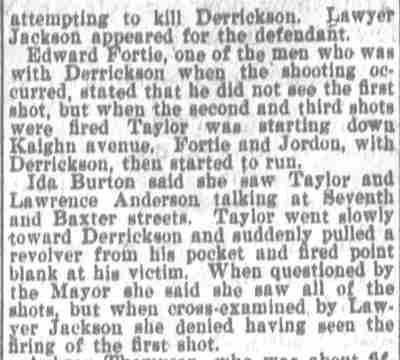
Taylor was given a hearing this morning by Mayor Westcott. The complaint was made by Lieutenant John Foster and accused Taylor of assaulting, shooting and attempting to kill Derrickson. Lawyer Jackson appeared for the defendant.
Edward Fortie, one of the men who was with Derrickson when the shooting occurred, stated that he did not see the first shot, but when the second and third shots were fired Taylor was starting down Kaighn avenue. Fortie and Jordon, with Derrickson, then started to run.
Ida Burton said she saw Taylor and Lawrence Anderson talking at Seventh and Baxter streets. Taylor went slowly toward Derrickson and suddenly pulled a revolver from his pocket and fired point blank at his victim. When questioned by the Mayor she said she saw all of the shots, but when cross-examined by Lawyer Jackson she denied having seen the firing of the first shot.
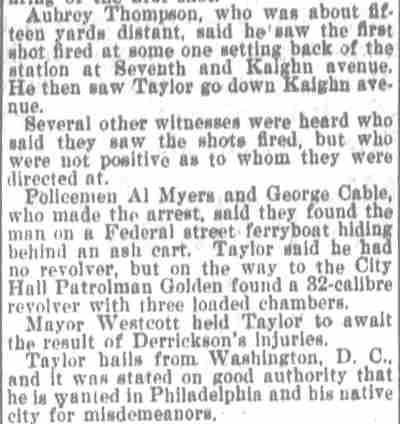
Aubrey Thompson, who was about fifteen yards distant, said he saw the first shot fired at some one setting back of the station at Seventh and Kaighn avenue. He then saw Taylor go down Kaighn avenue.
Several other witnesses were heard who said they saw the shots fired, but who were not positive as to whom they were directed at.
Policemen Al Myers and George Cable, who made the arrest, said they found the man on a Federal street ferryboat hiding behind an ash cart. Taylor said he had no revolver, but on the way to the City Hall Patrolman Golden found a 32-calibre revolver with three loaded chambers.
Mayor Westcott held Taylor to await the result of Derrickson’s injuries.
Taylor hails from Washington, D. C., and it was stated on good authority that he is wanted in Philadelphia and his native city for misdemeanors.
Here’s Camden’s Finest, With Whiskers, in 1898
Camden Courier-Post —
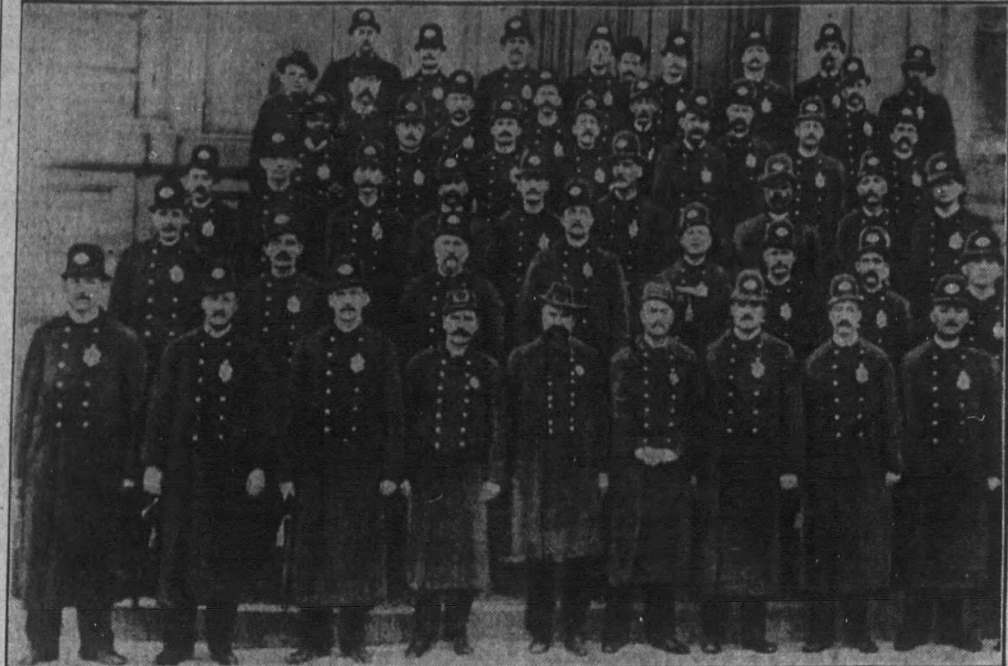
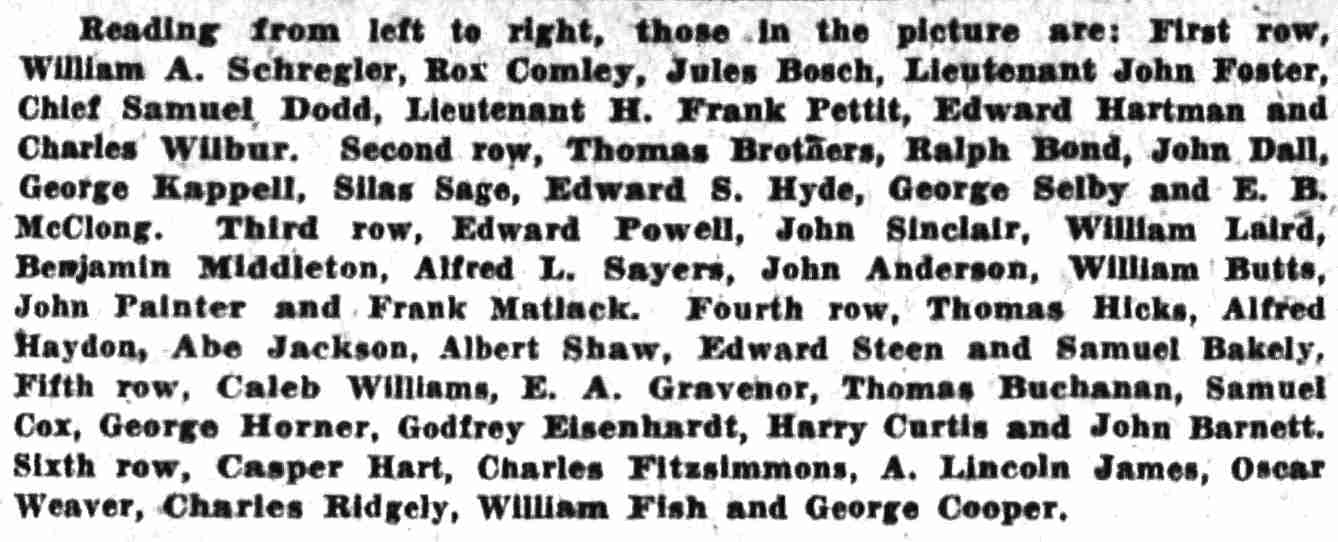
Reading from left to right, those in the picture are: First row, William A. Schregler, Rox Comley, Jules Bosch, Lieutenant John Foster, Chief Samuel Dodd, Lieutenant H. Frank Pettit, Edward Hartman and Charles Wilbur. Second row, Thomas Brothers, Ralph Bond, John Dall, George Kappell, Silas Sage, Edward S. Hyde, George Selby and E. B. McClong. Third row, Edward Powell, John Sinclair, William Laird, Benjamin Middleton, Alfred L. Sayers, John Anderson, William Butts, John Painter and Frank Matlack. Fourth row, Thomas Hicks, Alfred Haydon, Abe Jackson, Albert Shaw, Edward Steen and Samuel Bakely. Fifth row, Caleb Williams, E. A. Gravenor, Thomas Buchanan, Samuel Cox, George Horner, Godfrey Eisenhardt, Harry Curtis and John Barnett. Sixth row, Casper Hart, Charles Fitzsimmons, A. Lincoln James, Oscar Weaver, Charles Ridgely, William Fish and George Cooper.
Escapee Surrenders to Captain Stanley
Philadelphia Inquirer —
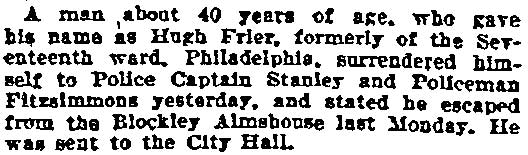
A man, about 40 years of age, who gave his name as Hugh Frier, formerly of the Seventeenth ward, Philadelphia, surrendered himself to Police Captain Stanley and Policeman Fitzsimmons yesterday, and stated he escaped from the Blockley Almshouse last Monday. He was sent to the City Hall.
Thieves Took to the Swamp
Philadelphia Inquirer —
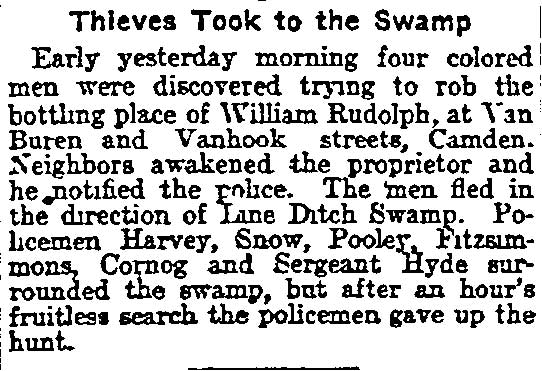
Early yesterday morning four colored men were discovered trying to rob the bottling place of William Rudolph, at Van Buren and Vanhook streets, Camden. Neighbors awakened the proprietor and he notified the police. The men fled in the direction of Lane Ditch Swamp. Policemen Harvey, Snow, Pooley, Fitzsimmons, Cornog and Sergeant Hyde surrounded the swamp, but after an hour’s fruitless search the policemen gave up the hunt.
Burglary Attempt at Dilmore’s Saloon
Philadelphia Inquirer —
Policeman Fitzsimmons saw a man acting suspiciously at Fourth street and Kaighn avenue early yesterday morning. When the policeman approached the man fled. The officer gave chase, but the man escaped. Later the policeman found that the front window of the saloon of George S. Dilmore had been forced and raised. Nothing of value was taken.
Officer Fitzsimmons Ill With Blood Poisoning
Philadelphia Inquirer —
As the result of receiving a slight scratch on the forehead while arresting a tramp a few days ago, Policeman Charles Fitzsimmons is ill at his home, on South Third street, with blood poisoning. The hobo resisted arrest and scratched the officer with a finger nail.
Beggar Made Threats When Refused Alms
Camden Post-Telegram —
The first arrest in conformity with Chief of Police Foster’s strict orders to abate the tramp nuisance, that of worthless hoboes harassing housewives at back doors, was made by Policeman Charles Fitzsimmons yesterday afternoon. The prisoner is a Fishtowner named Edward Lynch, who, although 41 years of age and able-bodied, is apparently too light for heavy work, for he has been begging about South Camden for several weeks.
Yesterday afternoon Policeman Fitzsimmons detected Lynch begging at back gates and then followed him to Fourth street and Kaighn avenue, where he accosted a man for a nickel and because refused threatened to “paste him one on the snout.”
It did not take “Fits” long to nab the abusive hoodlum by the coat collar and hustle him to the patrol box.
In Police Court this morning, Detective Harry Moffett said that Lynch was a pal of Mike McGurk, the thieving tramp sent to jail for three months by Recorder Stackhouse yesterday, for helping himself to an overcoat from Leaven’s clothing store on Kaighn avenue above Third, and had served time before.
Lynch had nothing to say and was given thirty days in the county jail.
Found Family Starving
Philadelphia Inquirer —
Stealing of Loaf of Bread Reveals Case of Destitution
Arrested for stealing a loaf of bread, William Creamer, 12 years old, of 1210 South Second street, Camden, yesterday took Policeman Fitzsimmons to his home. One of the saddest cases of destitution that has come to the attention of the Camden authorities was brought to light. The mother of the boy was found lying in bed too ill to move. Beside her were two small children ill with fever because of lack of food. There was nothing in the room to give heat and the unfortunates tried to warm themselves beneath the bed clothing.
Neighbors, apprised of the condition of affairs in the Creamer home, at once gave them aid. Superintendent Jefferis, of the Bureau of Charities, took charge of the case.
Boy Runaway Picked Up at Kaighn’s Point
Philadelphia Inquirer —
Wearing a sleeveless sweater and a pair of trousers large enough for a six-foot man, Howard Kingsland, 14 years old, of Hancock street, Philadelphia, was picked up at Kaighn’s Point, Camden, yesterday by Policeman Fitzsimmons. Howard said he had determined to see the world. He was held pending the arrival of his parents.
Demented Woman Found Wandering Street
Philadelphia Inquirer —

Ellen Stratton, a demented woman who strayed away from a cottage at Atlantic City several days ago, was picked up on the street by Policeman Fitzsimmons yesterday. She was held pending word from relatives.
Detective Fitzsimmons Arrests Cart Thief
Philadelphia Inquirer —

Following a chase of five miles across country, Detective Fitzsimmons yesterday arrested Abe Harker on a charge of purloining a cart from Isaac Barton. Harker was held in $500 bail for court by the Recorder.
Shots Fly After Fleeing Suspect
Camden Post-Telegram —
While Policeman Boyer was standing at Broadway and Pine street last night about 9 o’clock his attention was attracted by a crowd of men chasing a young man out that thoroughfare. As he started to investigate he was blocked by an automobile and the young man turned south on Broadway and into Division street, heading east. Seeing that Detective Moffett and Special Fitzsimmons were in close pursuit Boyer gave chase and was rapidly gaining on the young man as he turned into Division street.
Wrist Broken, Detective Jails Alleged Thief
Philadelphia Inquirer —
Camden News
WRIST BROKEN, DETECTIVE JAILS ALLEGED THIEF
In a desperate encounter with an alleged thief early yesterday morning, Detective Charles Fitzsommons, of the Camden Police Department, was thrown and his wrist was fractured, but he subdued the man and locked him up for a hearing before Recorder Stackhouse this morning. The prisoner gave the name of William Jubb, 28 years old, of Salem.
Detective Fitzsimmons was sitting on his step on South Third street when there were excited yells and three men ran into Third street from Kaighn avenue. They were pursued by a crowd, who shouted the fugitives had stolen dry goods from Solomon Rubenstein, of 305 Kaighn avenue. The sleuth went in pursuit and came up with Jubb, who tripped him. Fitzsimmons, although his wrist was broken, held on to the man with his other hand and then sent him to the city jail. When searched, the prisoner had several shirts stuffed in his trousers and shirt.
Held on Theft Charge
Philadelphia Inquirer —
Through the arrest of James Kelly, 1157 Penn street, by Detective Fitzsimmons, in Camden yesterday, the police believe they will be able to clear the mystery in connection with the disappearance of $200 worth of groceries from the Frank Lee Dickinson Company. Kelly was employed as a driver. According to Fitzsimmons the goods were taken and disposed of to certain persons whose arrests are anticipated.
Girl Victim’s Brother Accuses Man
Philadelphia Inquirer —
Traced to Camden by the brother of 15-year-old Elizabeth Jeter, of 3141 Heater street, New York, who was attacked and seriously injured, Joseph Zitz, aged 31 years, of Two-hundred-and-thirty-eighth street and Albany avenue, New York, was taken into custody by Detectives Schregler, Troncone and Fitzsimmons on Central avenue, Camden, yesterday. Zitz was accused of attacking the girl by Sinclair Jeter, the brother, and remanded to jail by Justice McClong pending requisition papers from New York.
Arrested When He Tried to Help Jailed Brother
Philadelphia Inquirer —
With one son in jail and another sent back to the Hunterdon Reformatory, Mrs. Catherine Petitt, of 881 Florence street, Camden, will have a sad New Year’s. Robert Petitt, aged 17 years, was committed to jail for purloining copper wire from a telephone company.
Through the fraternal affection of Robert’s brother, John, the latter was apprehended. He had been out of the Reformatory for several months, and he was charged with breaking his parole. None was the wiser until he went to police headquarters and tried to assist his younger brother in his difficulty.
When apprehended. [sic] John and his mother cried and later the brothers had a sad parting when Detective Fitzsimmons permitted them to meet for the last time in several months at least.
Detectives Find Fresh Clue to M’Carrick Boy
Philadelphia Inquirer —
Three Men With Lad Answering Description Seen in New Jersey
Philadelphia, Atlantic City and Camden Sleuths Conducting Search on Railroad
Ten days of relentless searching for 7-year-old Warren M’Carrick, who disappeared from near his home at 619 South Nineteenth street, a week ago last Thursday, received its first reward yesterday when detectives picked up in South Jersey the trail of three men, who, they believe, keep the boy in hiding during the daylight and travel with him by night.
Of the hundred or more clues and theories which have been thoroughly threshed out with the same discouraging result, the trail that was picked up at Clementon, N.J., and followed ten miles in a southern direction, supplied their first thread to a tangible solution of the mystery of the boy’s disappearance.
From a colored man who was not aware that the M’Carrick mystery was baffling the police, the first clue to the trio and the boy was obtained. The negro, Albert Hicks, was standing near the railroad station at Clementon, at 9.30 o’clock Saturday night, when he noticed three men, apparently Italians, and a 7-year-old boy resting on a darkened platform.
Unnoticed by anyone but Hicks, one of the three men removed a package containing cinnamon buns from his pocket and offered one to the lad, who was weeping. The boy took the bun in his free hand—one of the men held his other arm—and ate it ravenously.
Dragged Boy Down Tracks
Several minutes later, Hicks declared, the men, dragging the boy between them, continued down the railroad tracks. The treatment of the boy by the men impressed the colored man and prompted him to speak of the incident later. He considered a plan to offer to protect the lad, but feared to carry it out, believing that the supposed Italians carried knives.
Late Saturday night Hicks spoke of the three men and the boy to William Smith, a Clementon resident. Smith questioned the colored man and obtained from him a description of the lad. The description exactly tallied with the description of Warren M’Carrick, even to the long tassel on his red knitted cap and the rubber boots which the boy wore when he disappeared.
Employers of Hicks learned of the incident and communicated with Captain Cameron. The information was regarded in the same light as every other “clue” offered. The slightest suggestion or hint thus far given has been thoroughly investigated in the hope of at least obtaining a clue to work upon.
Detectives Impressed
Early yesterday morning Detectives Gleeson, Doyle and Belshaw went to Camden and conferred with Prosecutor Kraft. The Philadelphia detectives, with Prosecutor Kraft and Detectives Fitzsimmons and Brothers, of Camden, went to Clementon, where they interviewed Hicks.
The man’s narrative impressed the detectives, who immediately instituted a search in the vicinity. One of the detectives found the paper in which the cinnamon buns were wrapped and later discovered other evidences of the progress of the quartet along the railroad.
Hourly reports of their progress were made to Detective Lieutenant Tate who directed the search from City Hall yesterday. The reports of the investigators enthused others engaged, adding new vigor to the quest for the lad.
Convinced that the first semblance of a genuine clue had at last been uncovered Lieutenant Tate communicated with Chief of Police Woodruff of Atlantic City. The Atlantic City official was apprised of the developments and asked to co-operate in the search, which he willingly offered to do.
Railroad Lends Aid
Atlantic City detectives were sent northward along the tracks of the Atlantic City railroad while Philadelphia and Camden detectives and the constables of many New Jersey towns were proceeding southward. In this manner it was believed that if the supposed abductors were in the vicinity of the railroad they would be overtaken.
Officials of railroads operating in New Jersey also were notified of the clue and asked to give what aid they could. As a result station agents, brakemen and conductors were instructed to keep a sharp lookout for men answering the description of the suspects and the boy with them.
The New Jersey clue was further strengthened when a woman reported to the police that she had seen three men and a boy walking along the railroad tracks last night. At that time, she said, they were several miles north of Clementon. The woman did not know that Hicks had noticed them below Clementon.
Hicks accompanied the Philadelphia detectives on their search. He was questioned several times regarding the descriptions of the men who had the boy and each time the story he gave was the same. He declared that when the boy cried and refused to proceed with the trio one of them said: “Don’t do that or I will tell your mother.”
One of the suspects is described as being about 30 years old, 5 feet 6 inches in height and wearing a dark overcoat. The other two are said to be about 28 years old, and each wearing dark clothes. The three, Hicks declared, are dark complexioned.
In their search yesterday the detectives visited many farm houses and shacks. While they were in the vicinity of Clementon, Detectives Levins, Doran and Gribben, of the Camden force, conducted a search in that stretch of country between Berlin and Clementon, but without result.
To Renew Search Today
The development in New Jersey was regarded as a most important one by detectives. Early today the investigators will begin at the point they left off last night and will endeavor to find more traces of the three men and the boy. It is probable that an extra squad will take up the search tonight and remain at work until daylight.
James M’Carrick, father of the lad, spent yesterday afternoon in the Detective Bureau awaiting some definite word from the searchers. The clue from across the Delaware was by no means the only one which occupied the attention of investigators, as Captain Cameron is determined to investigate every clue no matter how idiotic it may seem.
Two of a score or more investigations made yesterday occupied many hours of the detectives’ time. One led to Jersey City and was followed out by Detective Frank O’Connor, who left the city late Saturday night and returned yesterday afternoon to report that his trip brought no result. The other led from Jenkintown to the extreme southern section of the city and was likewise unfounded.
A chance remark made by a colored woman living in a house in the rear of the M’Carrick home was responsible for the arrest of her and her husband yesterday morning. They are Henry Rosequeen and his wife, who live at 1821 Kater street. Neighbors reported to the police yesterday afternoon that while the couple were quarreling the woman said, “If you do that again I’ll tell what I know about you.”
Two policemen from the Twentieth and Fitzwater streets station went to the Kater street house and learned that the woman’s wrist had been cut. The colored man and his wife were taken to the police station and questioned. The remark, they learned, was a chance one and had nothing whatever to do with the McCarrick case.
With the New Jersey clue to spur them on the search for the boy will be continued with renewed vigor this morning. A reproduction of the lad’s photograph with the announcement that the city has offered $5000 reward for his recovery and the arrest of his supposed abductors is now in the police headquarters in almost every large city in the country.
Beginning tomorrow lantern slides bearing photographs of the lad will be flashed on the screen between performances in the motion picture theatres of Philadelphia and vicinity.
Held as Fugitive
Philadelphia Inquirer —
When George Kenney, aged 29 years, of Chester, Pa., was arraigned before Recorder Stackhouse, in Camden, yesterday, as a fugitive, it was next to impossible to make him understand why he was held. He pleaded he was too deaf to hear. Sergeant Reed finally yelled in his ear that he Kenney, was wanted at Chester for robbing Clementine Mielckine of about $250 worth of jewelry and clothing. The defendant nodded his head in the affirmative and was committed to jail to await requisition. He was arrested by Detective Fitzsimmons at the Homeopathic Hospital, where he had been a patient for a week.
Hard Luck Story Wins Freedom From Charges
Philadelphia Inquirer —
Declaring that he was made desperate because he could get no work and that he had a wife, an infant and sick mother depending on him, James Weeks, aged 23 years, of 1413 South Fourth street, Camden, was arrested early yesterday by Detective Fitzsimmons for purloining about $100 worth of jewelry from the home of John McAleck, of 414 Jackson street. When McAleck learned of the circumstances in the case he told Recorder Stackhouse he would not press a charge against the young man and Weeks was permitted to accompany his wife and little one home.
Weeks posed as an employe for a local wall paper concern. He said he had been sent to measure the walls at the McAleck home. It was while thus supposedly engaged that he took two rings, two lockets and two chains. All were recovered.
Presses Jitney Into Play to Arrest Man
Philadelphia Inquirer —

Camden Bartender Accused of Abduction Is Caught After Several Months’ Search
By pressing a jitney into service Detective Fitzsimmons was rushed to the home of Joseph J. Cooper, aged 21 years, 640 Central avenue, Camden, in time to arrest him on a charge of abduction. The accusation was made by Mrs. Kate Miller, mother of Mary Miller, aged 18 years, of 625 Ferry avenue. The young man will be given a hearing before Recorder Stackhouse today.
Cooper was employed as a bartender by the girl’s father. It was last August that he and Mary disappeared, resulting in the warrant for his arrest being issued. Nothing was seen of him until yesterday, when Detective Fitzsimmons was told that Cooper had returned. It was then that the detective hurried to Cooper’s home. The girl is said to be in New York.
Camden Man Locates His Missing Daughter
Philadelphia Inquirer —
Finds Girl in Providence, Rhode Island—Alleged Abductor Is Under Arrest
Vanishing in August last at the same time Joseph J. Cooper, a married man, who was employed by her father as a bartender at his hotel at 625 Ferry avenue, disappeared, Miss Mary Miller, aged 17 years, was located yesterday at Providence, Rhode Island, by her father and Policeman Gondolf on information, it is claimed, furnished by Cooper, who was arrested on Thursday when he returned to his home at 640 Central avenue for clothes.
The couple, according to the police, have been living in Providence as Mr. and Mrs. Myers and four months ago the girl gave birth to a little girl. With her infant she was brought to Camden by her father and will be used as a witness against Cooper, who is accused of abduction.
He will be given a hearing today.
Damage Suit Result of Alleged Abduction
Philadelphia Inquirer —
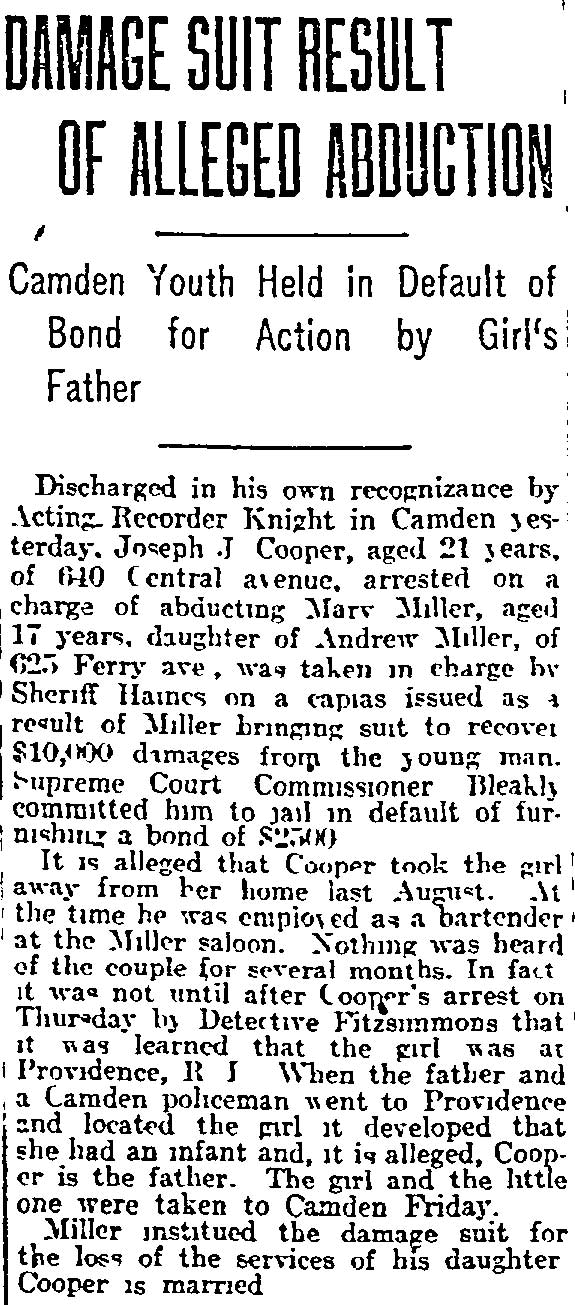
DAMAGE SUIT RESULT OF ALLEGED ABDUCTION
Camden Youth Held in Default of Bond for Action by Girl’s Father
Discharged in his own recognizance by Acting Recorder Knight in Camden yesterday, Joseph J. Cooper, aged 21 years, of 640 Central avenue, arrested on a charge of abducting Mary Miller, aged 17 years, daughter of Andrew Miller, of 625 Ferry ave., was taken in charge by Sheriff Haines on a capias issued as a result of Miller bringing suit to recover $10,000 damages from the young man. Supreme Court Commissioner Bleakly committed him to jail in default of furnishing a bond of $2,500.
It is alleged that Cooper took the girl away from her home last August. At the time he was employed as a bartender at the Miller saloon. Nothing was heard of the couple for several months. In fact it was not until after Cooper’s arrest on Thursday by Detective Fitzsimmons that it was learned that the girl was at Providence, R.I. When the father and a Camden policeman went to Providence and located the girl it developed that she had an infant and, it is alleged, Cooper is the father. The girl and the little one were taken to Camden Friday.
Miller instituted the damage suit for the loss of the services of his daughter. Cooper is married.
Arrested as Fugitive
Philadelphia Inquirer —
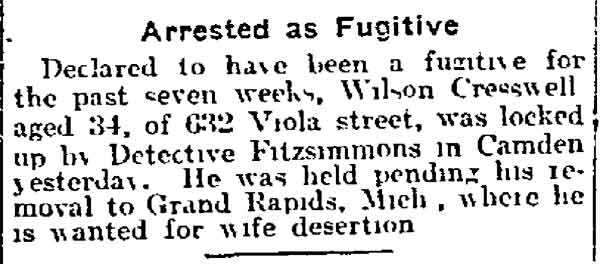
Declared to have been a fugitive for the past seven weeks, Wilson Cresswell, aged 34, of 632 Viola street, was locked up by Detective Fitzsimmons in Camden yesterday. He was held pending his removal to Grand Rapids, Mich., where he is wanted for wife desertion.
COLORED GIRL GETS BENEFIT OF DOUBT
Camden Post-Telegram —
Given the benefit of the doubt, Frances Benson, colored, aged 23 years, giving her address as Locust Street, was this morning freed by Recorder Stackhouse after she had been arraigned on a disorderly charge by Detective Fitzsimmons, who caught the girl trying back gates and doors of houses on Locust Street.
Suspicious of the girl’s actions, the detective arrested her. Represented by attorney Powell Martin, the girl said she was hunting for a friend who lived in the row.
Charles Fitzsimmons, 3d, Drowned
Philadelphia Inquirer —
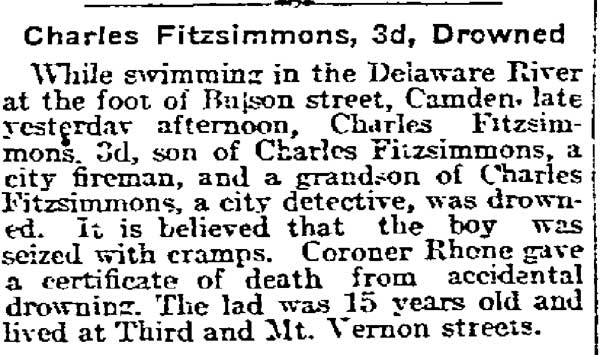
While swimming in the Delaware River at the foot of Bulson street, Camden, late yesterday afternoon, Charles Fitzsimmons, 3d, son of Charles Fitzsimmons, a city fireman, and a grandson of Charles Fitzsimmons, a city detective, was drowned. It is believed that the boy was seized with cramps. Coroner Rhone gave a certificate of death from accidental drowning. The lad was 15 years old and lived at Third and Mt. Vernon streets.
Boy Admits Burning Boat to Bring Peace in Family
Milwaukee Journal-Sentinel —

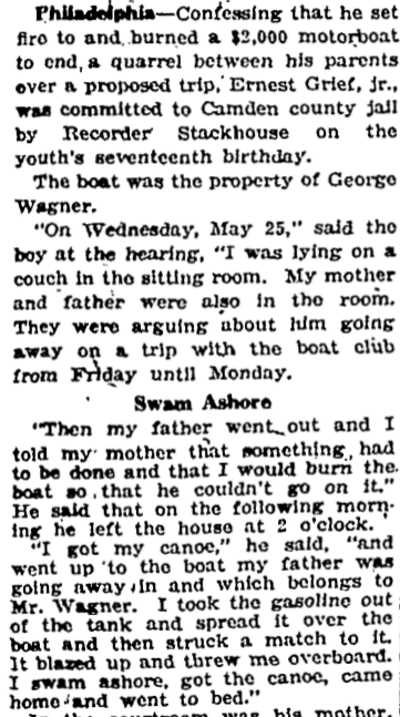
Philadelphia—Confessing that he set fire to and burned a $2,000 motorboat to end a quarrel between his parents over a proposed trip, Ernest Grief, Jr., was committed to Camden county jail by Recorder Stackhouse on the youth’s seventeenth birthday.
The boat was the property of George Wagner.
“On Wednesday, May 25,” said the boy at the hearing, “I was lying on a couch in the sitting room. My mother and father were also in the room. They were arguing about him going away on a trip with the boat club from Friday until Monday.
Swam Ashore
“Then my father went out and I told my mother that something had to be done and that I would burn the boat so that he couldn’t go on it.” He said that on the following morning he left the house at 2 o’clock.
“I got my canoe,” he said, “and went up to the boat my father was going away in and which belongs to Mr. Wagner. I took the gasoline out of the tank and spread it over the boat and then struck a match to it. It blazed up and threw me overboard. I swam ashore, got the canoe, came home and went to bed.”
In the courtroom was his mother, Mrs. Emma Grief. “I have had a good bit of trouble with my husband,” she said. “He belongs to a boat club at Forest Hill park. He said he was going on a trip with the club. I told him I didn’t want him to go. He called me names and said he would go. I said he would not go. We had some more words and then he went out.”
Police Trace Canoe
Stating that her son was on a couch at the time, Mrs. Grief continued: “After my husband went out Ernest said to me, ‘Mother, something will have to be done; I’ll burn the boat, then he can’t go on the trip and maybe it will make him better to you and he will treat you better.’ My son came downstairs Friday and said to me: ‘Mother, did you see the flames last night?’ I said I did not. Then he said: ‘Pop will never take that trip; I done this to save you, mom.’”
After the burning of the boat a hat was found along the banks of the river. City Detectives Fitzsimmons and Whaland in an investigation also learned that a green canoe had been seen along the river just before the fire. The canoe was traced to the home of the Grief boy. He admitted his guilt.
Note: This story erred in reporting, as retirement at age 65 was NOT mandatory at the time. William E. Albert, Richard Golden, Frank Matlack, and Edwin Thomas did retire. John Golden, John Painter, Charles Fitzsimmons, Thomas Brothers, and William Lyons continued to work in the Police Department. John Golden was eventually promoted to Chief of Police.
Changes Ordered in Camden Police
Philadelphia Inquirer —
Council Body Directs Solicitor Bleakly to Plan Re-organization of Department
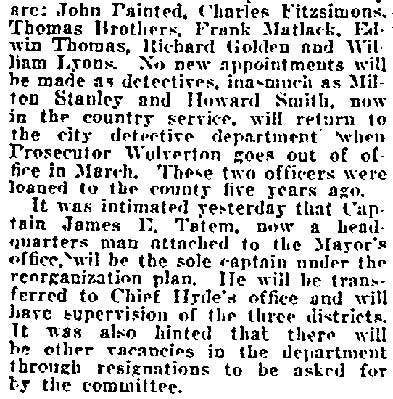
Following an extended conference, the police committee of Camden City Council yesterday directed Solicitor Bleakly to prepare an ordinance for a partial reorganization of the Police Department. The new ordinance will provide for one captain and three lieutenants to direct the work of the three districts. There are six captains in the department now. Two of these John Golden, of the First district, and William E. Albert, of the Third district, will retire on December 15. The titles of three of the four remaining captains will be changed to lieutenants, with one in charge of each of the three districts. This will take two captains from headquarters and leave the work there in charge of sergeants.
Seven members of the department who have reached the age limit of 65 years will be retired on pension. They are: John Painted [sic], Charles Fitzsimons, Thomas Brothers, Frank Matlack, Edwin Thomas, Richard Golden and William Lyons. No new appointments will be made as detectives, inasmuch as Milton Stanley and Howard Smith, now in the country [sic] service, will return to the city detective department when Prosecutor Wolverton goes out of office in March. These two officers were loaned to the county five years ago.
It was intimated yesterday that Captain James E. Tatem, now a headquarters man attached to the Mayor’s office, will be the sole captain under the reorganization plan. He will be transferred to Chief Hyde’s office and will have supervision of the three districts. It was also hinted that there will be other vacancies in the department through resignations to be asked for by the committee.
Obituary
Camden Courier-Post —
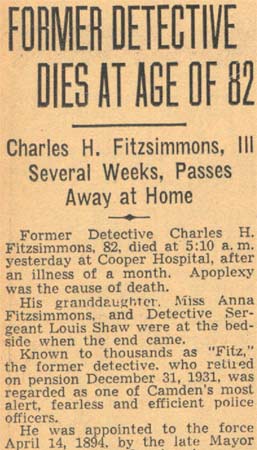
FORMER DETECTIVE DIES AT AGE OF 82
Charles H. Fitzsimmons, Ill Several Weeks, Passes Away at Home
Former Detective Charles H. Fitzsimmons, 82, died at 5:10 a.m. yesterday at Cooper Hospital, after an illness of a month. Apoplexy was the cause of death.
His granddaughter, Miss Anna Fitzsimmons, and Detective Sergeant Louis Shaw were at the bedside when the end came.
Known to thousands as “Fitz,” the former detective, who retired on pension December 31, 1931, was regarded as one of Camden’s most alert, fearless and efficient police officers.
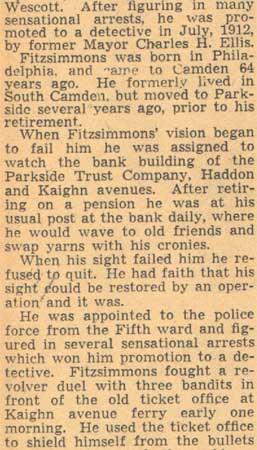
He was appointed to the force April 14, 1894, by the late Mayor Wescott. After figuring in many sensational arrests, he was promoted to a detective in July, 1912, by former Mayor Charles H. Ellis.
Fitzsimmons was born in Philadelphia, and came to Camden 64 years ago. He formerly lived in South Camden, but moved to Parkside several years ago, prior to his retirement.
When Fitzsimmons’ vision began to fail him he was assigned to watch the bank building of the Parkside Trust Company, Haddon and Kaighn avenues. After retiring on a pension he was at his usual post at the bank daily, where he would wave to old friends and swap yarns with his cronies.
When his sight failed him he refused to quit. He had faith that his sight could be restored by an operation and it was.
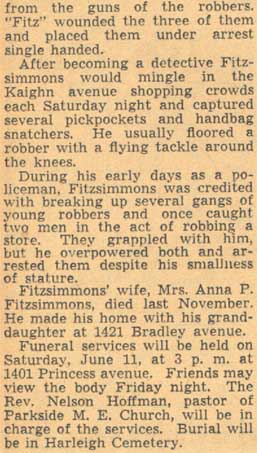
He was appointed to the police force from the Fifth ward and figured in several sensational arrests which won him promotion to a detective. Fitzsimmons fought a revolver duel with three bandits in front of the old ticket office at Kaighn avenue ferry early one morning. He used the ticket office to shield himself from the bullets from the guns of the robbers. “Fitz” wounded the three of them and placed them under arrest single handed.
After becoming a detective Fitzsimmons would mingle in the Kaighn avenue shopping crowds each Saturday night and captured several pickpockets and handbag snatchers. He usually floored a robber with a flying tackle around the knees.
During his early days as a policeman, Fitzsimmons was credited with breaking up several gangs of young robbers and once caught two men in the act of robbing a store. They grappled with him, but he overpowered both and arrested them despite his smallness of stature.
Fitzsimmons’ wife, Mrs. Anna P. Fitzsimmons, died last November. He made his home with his granddaughter at 1421 Bradley avenue.
Funeral services will be held on Saturday, June 11, at 3 p.m. at 1401 Princess avenue. Friends may view the body Friday night. The Rev. Nelson Hoffman, pastor of Parkside M. E. Church, will be in charge of the services. Burial will be in Harleigh Cemetery.
Police Shakeups of Today Mild Compared to Years Ago
Camden Courier-Post —
Force Changed Every Time Political Regime of City Shifted; Larry Doran Fired for Crossing Street to Get Cinnamon Bun; Old Patrol Recalled
By BEN COURTER
(Another in a series of articles on municipal affairs and personalities of yesteryear.)
Ben Courter
In “the good old days” when Camden’s police department was just about getting under way in accordance with the amended charter of 1872, the men in the ranks were the football of politics. Even if the phrase “to the victor belongs the spoils” had not yet been coined, it was in active force. A change of administration always meant a violent shakeup in the personnel of the department.
It has been so many years since Camden has had a real political shakeup, aside from the nonpartisan movement of seven years ago, that the younger element can have no personal recollection of upheavals marking the aftermath of Democrats succeeding Republicans or vice versa. Many of the men resigned on principle, but others stood their ground and with the faithful hungry for place on the police force it was necessary to take drastic measures.
Sometimes it did not require a party turnover, for bitter factional scraps resulted in reprisals. It then fell the lot of the police committee of city council to conduct hearings. They were usually acrimonious affairs with partisans of the G. O. P. often showing more spleen than in a strict party fight. These hearings were as a rule public, attracting big crowds of opponents and advocates of the accused. The charges ranged from conduct unbecoming an officer to neglect of duty and everything between.
Sometimes the charges were altogether ridiculous, as for instance when Larry Doran, now chief of the county detectives, was accused of going out of his beat to buy a cinnamon bun. He happened to be an appointee of Mayor Joseph E. Mowrey and no one questioned Doran’s ability as a cop or of his sincerity in patrolling his beat. But the Republicans had come back into the fold some 25 years ago and it was determined Larry should get out. Thus came the charge based on someone’s discovery he had crossed the street early one morning to get a bun. No one imagined it a very heinous offense at best, but it was all in the game of politics and the finding of the police committee was a foregone conclusion.
Findings, Usually Sustained
In some instances appeals were made to higher courts, but very little came of it since the committee was considered within its power to dismiss an officer if it saw fit. All necessary was to have the report accepted by council and since that was overwhelmingly Republican the work of the committee was a mere formality. Politics continues to play an important part in the appointments of cops or firemen, but for the past six years they have been under civil service, thus affording at least a measure of protection unless there actually has been some dereliction of duty.
Even though there were the changes wrought by political and factional wars, many men withstood the storms through the years. As a matter of fact it is evident that most of the men who have been accepted as representative of the force have had little difficulty in holding down their beats.
Mention has occasionally been made of one of Camden’s most spectacular police chiefs, Samuel Dodd. When he was first appointed by Mayor Pratt in the 80’s he was in the prime of life and certainly not inclined to give quarter to anyone. But he met with his first difficulties in the race track regime with the dual police departments, when the Democratic commission appointed William A. Davis in his stead. He was reinstated in 1893 after the Republicans had gained control of the state and had abolished the commissions.
Dodd then went along without further trouble until the advent of Hatch who appointed John Foster in 1898. Dodd was born in Burlington in 1841, but came to Camden as a young shoemaker and made himself vitally important to his fellow workers. In the 80’s Camden was a shoemaking and leather center. There were over 100 factories and hundreds of persons were employed. Thus it became an important factor in politics. Dodd loomed as a mayoralty candidate. Everything was cut and dried for him to enter the field when Pratt ran in 1885, but Dodd was prevailed upon to get out of the fight with the promise of being made police chief. That was later carried into effect.
Many years Chief Dodd has been dead, but old-timers around the city hall still have a very vivid recollection of him and his long coal black whiskers, which he had a habit of yanking when under some excitement.
First Patrol Wagon
It was during Dodd’s regime Camden sported its first patrol wagon, in May of 1893. It was something of an epochal event for Camden. Men nearing middle life who then were boys vividly recall the sensation created by the appearance of the little red wagon with “Camden Patrol” painted in gold on the red sides, not forgetting the big gong near the driver’s seat. And as the high steppers speeded through the city streets with a drunk or victim of an accident that gong was everlastingly sounded until the whole populace was brought to the doors. Chief Stehr’s father, Lewis H. Stehr; Oscar Weaver, “Si” Sage and “Nitchie” Golden were the first in the department who operated that famous wagon. It was the forerunner of the automobile police patrol and ambulance put in service July 14, 19[?].
When the first patrol went into service Camden’s streets were veritable “rocky roads to Dublin.” They were paved with cobble, even Broadway, Federal street and Kaighn avenue. Only Cooper street and a part of Benson sported asphalt blocks. Hence it was the object of the driver to pick out the best route possible by using horse car or trolley tracks if possible.
It certainly was no pleasure trip to the hall for a drunk and a road of torture to any unfortunate being toted to the hospital. But even at that it was an improvement over the archaic method of taking prisoners to jail by way of a pushcart. I have already mentioned in these annals the Roman holiday such an incident furnished the kids of the generation. If John Painter or Charlie Fitzsimmons pushed a cussin’ drunk from Kaighn Point to the hall they were sure to have a yelling mob of kids at their heels. Unfortunates who were ill or injured were usually taken to the hospital in horse-drawn cabs. But of course the conveniences of today were not even dreamed about.
Lieutenant Tommie Cunningham is among the veterans on the force who recalls those days of long ago, for last Tuesday marked the thirty-sixth anniversary of his appointment to the department. Tommie has seen the department grow from less than half a hundred men to five times that number. In all that time he has pounded a beat in South Camden or had charge of a detail of men or a district as at present.
“Jake” Woodside
In recalling some of the old-timers mention must also be made of Jacob Woodside, who was appointed October 1, 1898. He hailed from the Sixth ward and was among the valiant crew who sported luxurious mustaches. He was in his later years a sergeant in the Third district. Woodside, who had many staunch friends throughout the city, died several years ago.
Then there is “Cul” Errickson who was made a cop September 15, 1898, by Mayor Hatch. He was for many years sergeant at headquarters; a big, good-natured cop, too. He has been enjoying life these several years as a pensioner up around New Egypt.
Certainly one of the most substantial members of the force was Capt. Arthur A. Stanley, who was in charge of the downtown district for many years. He was appointed by Mayor Hatch July 15, 1898. Captain Stanley was a Civil war veteran and prominently identified with the G. A. R. He has been dead for many years. His son, Milton Stanley, was a detective in the department and also at the prosecutor’s office, but for several years has been living on a farm in South Jersey.
There is another veteran of the force still in harness, George Nowrey, brother of former Mayor Nowrey, appointed by Mayor Hatch August 1, 1898. He has been a sergeant in the department for many years.
On the same day Nowrey was appointed, John Reader was made a member of the force. He, too, was a sergeant when he died several years ago. He was father of Dr. A. B. Reader and Attorney Lawrence Reader, the latter one of the most prominent young men of the city when he died during the flu epidemic in 1918. “Larry” also was a member of council from the Thirteenth ward.