Introduction
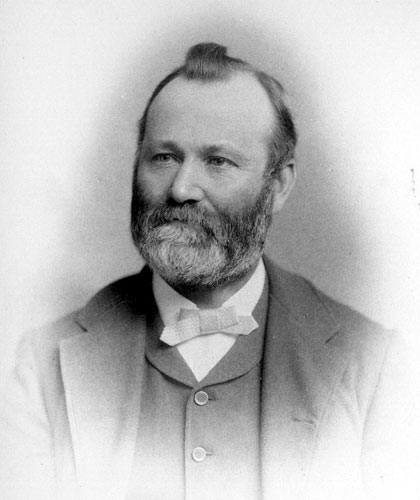
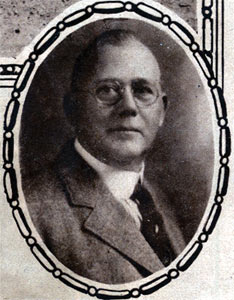
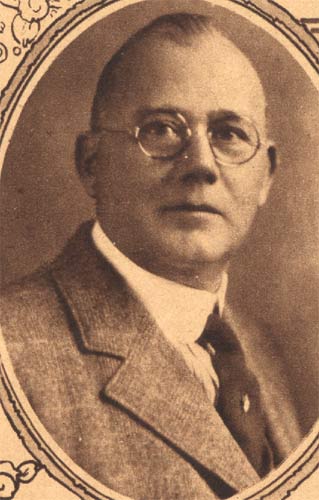
Volney G. Bennett Sr. – Volney G. Bennett Jr.
VOLNEY G. BENNETT established a lumber yard in Camden NJ in 1876. His sons Killam Edgar Bennett and Volney G. Bennett Jr. followed him into the business, and were quite prominent in their own right. The lumberyard remained in business on South 2nd Street in Camden NJ for over 100 years. By the late 1880s he had made his home at 310 North 6th Street in Camden.
Volney Sr. was an officer in several Camden Building & Loan Associations and was the first President of the Camden Board of Trade. In addition, he owned a local newspaper, The Post-Telegram, published in Camden, an ancestor of today’s Courier-Post. He served as the mayor of Riverton, New Jersey, where he resided. After studying medicine for a time, Volney Jr. stayed with the lumber firm. His distinguished career included service as president of the Camden Board of Trade, following the death of his father, the President of the South Jersey Sesquicentennial Exposition in 1926, and as mayor of Merchantville NJ, his place of residence. Alfred K., after serving as a Company incorporator, moved to Pasadena CA. He was instrumental in founding the Rose Bowl Parade.
The Volney Bennett Lumber Company, founded in 1876, played a great role in the construction, commercial, and industrial development of Camden until 1979, when, after 103 years in Camden, the firm was forced to move due to redevelopment and eminent domain. It now operates, along with Mr. Roberts Lumber Centers, at 50 Clements Bridge Road, Barrington NJ.
Former Lumber Yard Site in Camden, New Jersey Now An Historic Place
The remaining buildings and yard of the former Volney G. Bennett Lumber Company in Camden, New Jersey became a State and National Historic Place in 1993. Attaining approval for the State Register of Historic Places on June 28th and the National Register on August 5th, this former urban lumber yard stands alone as the only yard to be singularly recognized as an historic site.
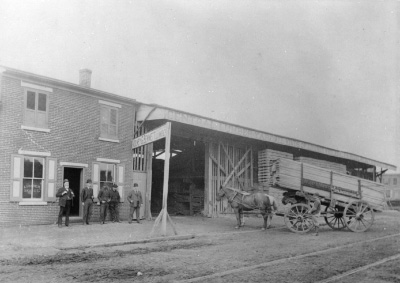
1876–1924
Until 1912 we delivered by horse and wagon. When a customer, a local truck manufacturer, was unable to pay his bill we took a truck in exchange for our lumber.
The Bennett firm can trace its roots to the year 1876, but the part that Camden, New Jersey played in regional lumber history extends even further back. The rafting of felled timber, from northeast Pennsylvania and adjoining New York, down the Delaware River began in 1764 and quickly proved to be the best method to move these logs to Philadelphia for processing. Soon the bustling port area of Philadelphia became clogged with rafts that proved a hazard to shipping. The local timber merchants cast a wistful eye at the mud flats and shallow shore line of New Jersey and began storing the large timber rafts on the eastern shore of the Delaware. Log pens were constructed by driving pilings into the riverbed. This prevented the timber from being carried off by the changing tides.
In a normal progression, saw mills began to appear on the Jersey shore of the river to process the stored timber. The first recorded mill built was by William Carmen in 1822 and was steam operated. Three lumber merchants were already conducting business in Camden when Carmen constructed his mill. Shingle manufacturing was another industry in this fledgling South Jersey town. Two shingle producers generated enough waste by-products that their refuse pile became known as Shingle-Shaving Hill and was a favorite of local children for winter sledding. Initially, the vast amount of sawdust produced by the numerous Camden saw mills created logistical problems. But uses were quickly found: much of the sawdust was dumped to fill lowlands, in some places as much as forty feet deep, while a substantial amount served as fuel in the mills and other businesses.
By the 1840’s, the lumbering industry accounted for a substantial amount of the expanding City’s waterfront from Cooper’s Point to Market Street, either for raft storage or with sawmills. Lumberyards also consumed a significant amount of land in the downtown area as the timber industry created homes, jobs and fortunes. The development of Camden neighborhoods indicated the local need for lumber, but lumber demand by wholesale dealers, housing and industrial use was even stronger across the river in Philadelphia. Camden sawmills produced almost every wooden housing component: joists, beams, floorboards, laths, doors, windows, sash, moldings, decorative work and roofing singles.
Lumber processing became the largest industry in Camden in the 1850’s as rafting traffic down the Delaware increased. In addition, rafts of timber, mostly white pine from central and northern Pennsylvania began moving down the Susquehanna River to Port Deposit, Maryland at the head of the Chesapeake Bay. Camden lumber merchants made purchases of this timber at either Port Deposit, Maryland or Marietta, Pennsylvania. The rafts then were moved through the Chesapeake and Delaware Canal to the Delaware River and towed to Camden.
In 1859, Volney G. Bennett, a 23 year old lumberman from the logging and rafting community of Hawley, Pike County, Pennsylvania arrived in Camden, reportedly on one of the Delaware River log rafts. His brother, Harvey, had been living in Camden since 1850 and worked in a local sawmill. Volney began as a laborer at the McKeen & Bingham Lumber Company, which operated a steam sawmill and gristmill as well as a lumber yard on Water Street above Cooper. Both McKeen and Bingham were also from Pike County. Bennett advanced quickly at the firm and by 1865 had become a clerk. He remained at this location until 1876.
William and Franklin Holbert, also from Pike County, influenced Volney to relocate to their establishment in central Camden. Their Holbert & Branning Lumber Company, established in 1872, conducted a steam sawmill, wharf and a sales operation known as the Central Lumberyard. The management of this company decided to concentrate their efforts on the processing and wholesale end of the lumber business. So after brief negotiations, Volney G. Bennett leased the Central Lumberyard in 1876. Located at this site was Bennett’s first sales office.
By the end of 1876, Bennett had purchased his first piece of property for lumberyard use, where he erected his second sales office, storage sheds and stables. Bennett assumed the Central Lumberyard name and continued to use it even after he moved his yard one block north of its original location. This move allowed Holbert and Branning to expand their drying yards. Volney Bennett still provided a local outlet for the sawn lumber and other wood products from the adjacent sawmill.
The Central Lumberyard had a banner year in 1887, when Volney Bennett purchased additional lots, expanding his business to fill an entire city block. An 1890 account of the yard described it as follows:
This enterprise had its inception in 1876. The premises occupied are 222 by 360 feet in Dimensions, extending from Front to (south) Second Streets and from Cherry to Spruce Streets. About one-half of the yard is covered with shedding for the storage of finer grades. An enormous stock is carried at all times of all kinds of Building Lumber, such as White and Yellow Pine, Hemlock, Spruce, etc. Mr. Bennett enjoys the closest relations with the dealers and manufacturers in the West and South and is thus enabled to handle stuff at the lowest figures… The business gives employment to about ten men and four teams are required for local delivery.
The Holbert & Branning sawmill was dismantled in 1893 and the drying yard land sold for other uses. Rafting on the Delaware River was discontinued in 1900 as the Upper Delaware timber regions had been clear cut. In a prudent business move, sawmills were relocated closer to the timber source, so that Bennett received an increasing amount of its lumber, by ship and railroad car, already cut, dried and dressed. Most of the sawmills disappeared from the Camden riverbank by this time, but the population of the area continued to grow and lumber merchants continued to prosper.
On February 20, 1899, Volney G. Bennett and his sons Alfred and Volney incorporated under the name of the Volney G. Bennett Lumber Company. The senior Bennett sold the Central Lumberyard to the corporation for $4500. From 1900 to 1906, the Volney G. Bennett Lumber Company acquired property yet another block north of the then-current location. The lumberyard now occupied two city blocks and had become the largest retail lumber operation in New Jersey. The volume of business in 1904 was six times what it was five years earlier, with a net worth of $74,854.28. At this time, each of the two city blocks stored a daily average of 1,000,000 board feet of lumber.
In 1904, the Volney G. Bennett Lumber Company erected a two-story, “most modern, brick, slow-burning stables for the housing of its many teams of horses” and a modern electric derrick to assist in handling lumber in the yard. As previously stated, in 1890 the firm used four teams of horses for delivery; after 1904, the number increased to twenty teams. The horses were kept on the first floor of the new stable, while the second was used for hay and harness storage. The following year broke all sales records for the company, with a net profit of $20,318.64 and three more teams and wagons added to the stable.
Volney G. Bennett retired from the business in 1905. Six years later, in 1911, the company was one of the first lumber firms in the state to be ushered into a new era. In lieu of a cash payment for an overdue account, Bennett Lumber acquired an autotruck belonging to a large Philadelphia trucking firm. The advantages over horses and wagons were quickly realized and soon trucks virtually replaced the wagons and teams. In 1917, the company sold the new stable to the local gas company’s coke operation for their teams and wagons. Another sale to the gas company occurred in 1922, which released the portion of the yard below Spruce Street. With the old yard sold and profits up, construction of a new sales office occurred to show off Volney G. Bennett Lumber Company’s corporate success. This new corporate image was manifested in the 1924 construction of a modern, one-story, Mission Revival-style ornamental concrete “cinder block” sales office, immediately adjacent to its former 1904 brick stable.
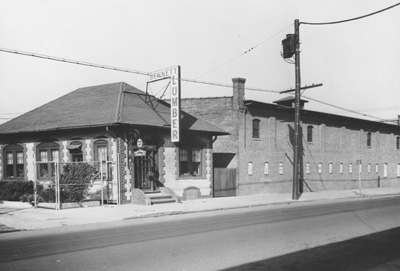
1924–1962. Our office, left, was the first “Cinder Block” office building in the world. The Stable, right, housed twenty teams of horses and two “Walking Mules.”
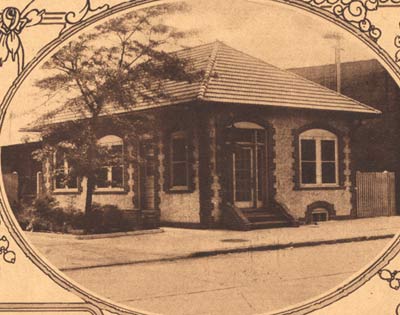
A 1926 view of the office.
Civic responsibilities and other careers were pursued by Bennett and his children. Volney G. was an officer in several Camden Building & Loan Associations and was the first President of the Camden Board of Trade. He also constructed many blocks of homes, both in Camden and its suburbs. Killam Bennett was a wholesaler of Yellow Pine. In addition, he owned a local newspaper, The Post-Telegram, published in Camden. For several years he was the mayor of Riverton, New Jersey, where he resided. Volney, Junior stayed with the lumber firm and had a long and distinguished career as president of the Camden Board of Trade, following the death of his father. He also served as mayor of Merchantville, New Jersey, his place of residence. Alfred K., after serving as a Company incorporator, moved to Pasadena, California and constructed a large hotel. He was also instrumental in the founding of the Rose Bowl Parade.
In the 1910’s the Volney G. Bennett Lumber Company corporate slogan was simply, “Buy Bennett’s Lumber.” By the 1920’s, it had become “As ‘Sterling’ is to Silver, so ‘Bennett’ is to Lumber.” By 1924, Bennett Lumber was advertising the sale of lumber, sheet-rock and Creo-Dipt shingles. Other period advertisements asked consumers “Are you planning to remodel your home?” and requested potential clients to come to Volney G. Bennett Lumber Company for suggestions. These ads indicated the company’s trade in a variety of building materials, besides lumber, and the firm’s appeal to the home-improvement market as early as the 1920’s.
Business for the company continued briskly, despite the vagaries of the Great Depression. However, in 1936 the Bennett family lost control of the corporation to Arthur Collins, who started working for the company in 1912 as a bookkeeper. During World War II, Bennett Lumber supplied much of the lumber required for the regional war effort. After the war ended, many of the firm’s customers continued to be local carpenters and contractors who followed the tradition, begun in 1876, of traveling to the city’s waterfront for their building material needs. The housing boom in the Camden suburbs was good for the local lumber wholesale and retail trade that now mainly sold processed lumber shipped in from various parts of the country. In the post-war era, many of the old Camden lumber firms along the waterfront either closed or moved to the suburbs.
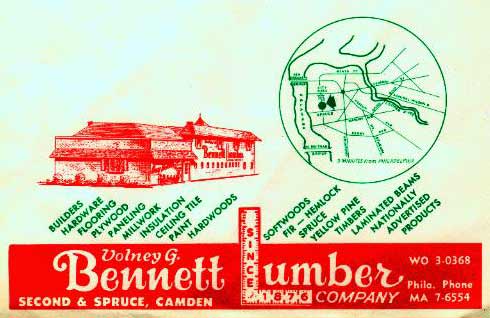
Volney G. Bennett Lumber Company yard.
By the mid 1950’s and into the 1960’s, homeowners began to repair, remodel and up-grade their houses. Lumber companies changed their stock and display to attract the new suburban home-improvement market. Carpenters and contractors continued to shop at the old lumber company, just as they had done since the founding. But the Volney G. Bennett Lumber Company realized that survival as an inner-city yard required changes to its physical plant and sales methods. Ironically, the first lumberyard to enter the autotruck era, was also the last to hang onto its old inner-city connections with the Delaware River and rail lines, even after most supplies arrived by tractor-trailer.
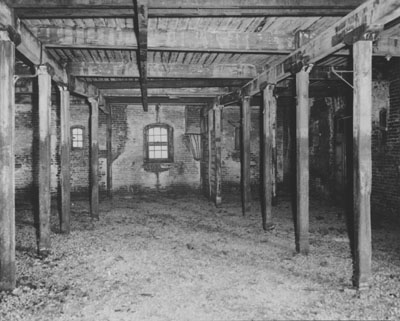
1963. The Stable before it was renovated. Most of the original structure was retained and kept as near to the original as possible.
In April 1962, the former stable was re-acquired by Bennett Lumber. The firm promptly remodeled the stable’s interior into a complete sales center for lumber and home-improvement products. The new sales center also contained a small museum commemorating the lumber trade through the exhibition of antique tools. By 1966, Harold Roberts had purchased all outstanding corporate stock which placed the firm back into Bennett family ownership. Roberts, a native of Vermont, married one of Volney G. Bennett’s great-granddaughters, Jerry Bennett, in 1946. He began working for the company as a yardman, eventually becoming a salesman and bookkeeper in 1950. Harold and Jerry Roberts’ sons, Stephen and Brian, both joined the firm in the 1970’s and now represent the fifth generation of the Bennett family operating the company. The firm updated the stable and 1924 office exterior features and joined the two structures to form a unified commercial storefront. All of this remodeling was accomplished in a Colonial Revival styling.
Despite Bennett Lumber’s last attempts to change its inner-city image to meet the new home-improvement market, the declining image of the City of Camden was too much to overcome. By the mid-1970’s, the City and the Camden Housing Authority declared the waterfront district and neighboring area “blighted.” The Housing Authority acquired the Volney G. Bennett Lumber Company Camden property in 1979 as part of a redevelopment plan for the improvement of the municipal port. To commemorate the historical significance of the Volney G. Bennett Lumber Company and its physical heritage, Harold Roberts insisted that the Camden Housing Authority amend its deed to memorialize this legacy. The amendment stated that the old sales office and brick stable would be “maintained by the Authority, its successors and assignees, in good and occupiable condition, pursuant to the National Historic Preservation Act of 1966.” Roberts also required that a statement be placed in the deed legally reserving space in the old stable for the construction of a lumbering museum. This museum would feature displays of photographs and old tools to celebrate Camden’s role in regional lumbering. It would also illustrate the share that the Volney G. Bennett Lumber Company and its officers played in the region’s heritage.
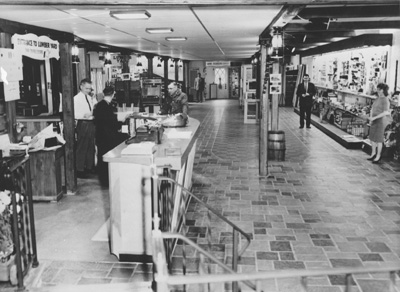
Later in 1963. The “Stable” after it was renovated. We had a “Museum” displaying old tools used in the past. It also told the history of Bennett Lumber Company and the Lumber Industry.
Upon settlement with the Camden Housing Authority, the Volney G. Bennett Lumber Company moved to Barrington, New Jersey where it continues to operate co-extensively with the Mr. Roberts Lumber Centers. Subsequently, the Camden property changed hands several times between quasi-governmental agencies. In 1980, a four-alarm fire swept through the yard, destroying all but one of the lumber sheds, the sales office and the stable. In 1991, the property was sold again and the former stable and office was converted into a restaurant, which continues to serve fine food today.
The lumberyard, sales office, stable and associated yard building of the Volney G. Bennett Lumber Company, like other contemporary lumberyards, have all been changed over time to reflect changes in technology, lumber supply, sales markets, fires, real estate demands and corporate image. However, they still exhibit the essential characteristics of the commercial late-19th and early-20th century lumberyard trade. They are significant because they embody the history of the origins, development and eventual demise of Camden’s lumber milling and lumberyard retail industries of that period in which Camden served as the regional center.
The stable is the last industrial stable left in the City of Camden. Once a ubiquitous structure in a city whose identity cannot be separated from its industrial history, the Volney G. Bennett Lumber Company stable serves as the last link to a long-forgotten past in a now-troubled northeastern city. Mr. Harold Roberts and family are grateful that both the State and Federal Government recognized the significance of this site. With the assistance of others in the timber and lumber industry, Harold Roberts is confident that a lumber museum will yet be located within the walls of the old stable building on South Second Street in Camden.
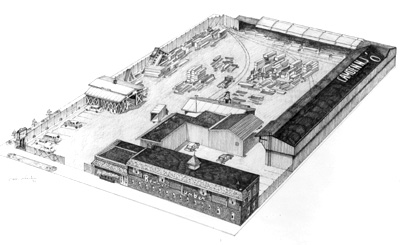
1963–1980. We were forced to move due to redevelopment but the “Deed” called for the property (the entire city block) be placed in the State and Federal Registry of Historic Sites. “AND IT WAS.”
1883–1884 Camden City Directory Advertisement
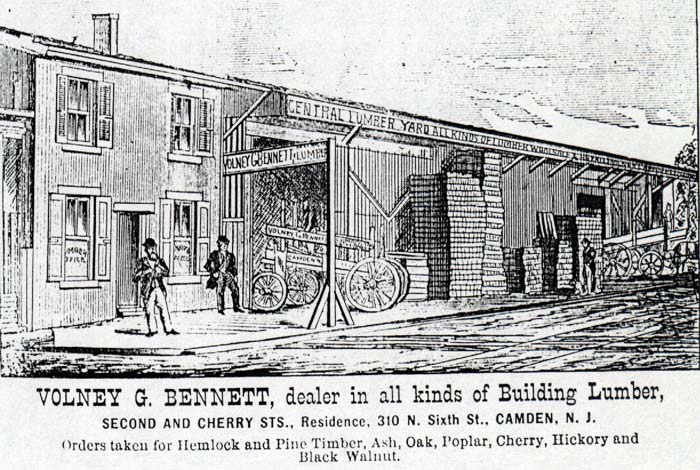
Named: Volney G. Bennett Lumber, 1883, and 1884 Camden City Directory Advertisement.
Historical and Industrial Review of Camden, N.J., 1890
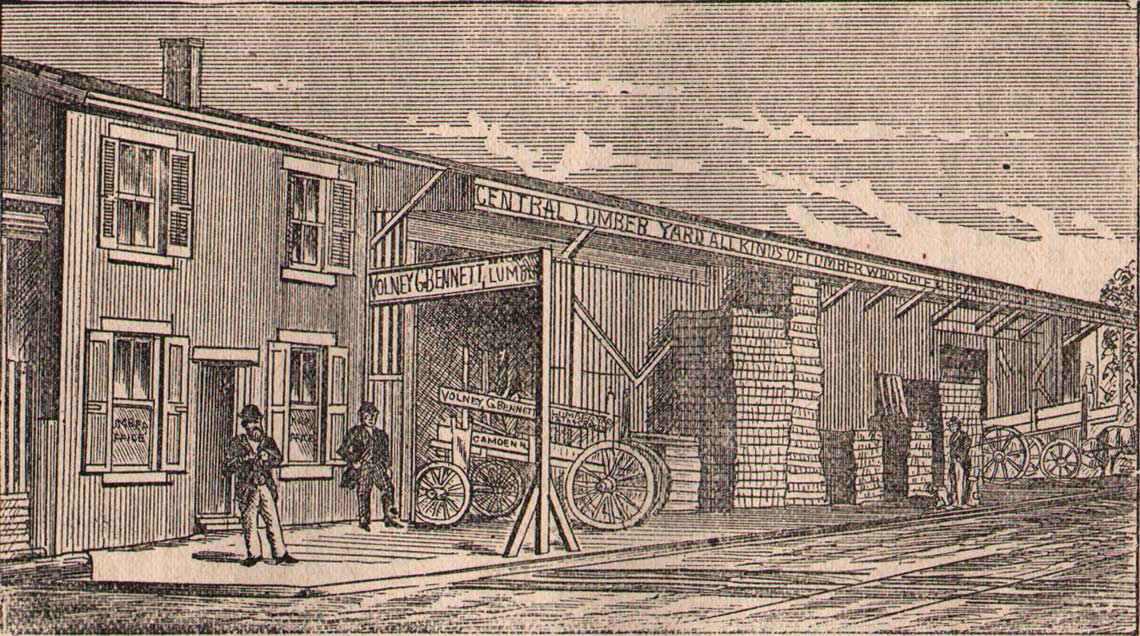
VOLNEY G. BENNETT, LUMBER, SECOND AND CHERRY STREETS
THE situation of Camden, with its great receiving and shipping facilities, makes it a most desirable point for the location of large lumber yards. Among the best known in the Southern section of the city may be mentioned that of Mr. Volney G. Bennett, a gentleman of vast experience in this line, having been in this line of trade all his business life.
This enterprise had its inception in 1876. The premises occupied are 222x360 feet in dimensions, extending from Front to Second streets and from Cherry to Spruce streets. About one-half of the yard is covered with shedding for the storage of the finer grades. An enormous stock is carried at all times of all kinds of Building Lumber, such as White and Yellow Pine, Hemlock, Spruce, etc.
Mr. Bennett enjoys the closest relations with the dealers and manufacturers in the West and South and is thus enabled to handle stuff at the lowest figures.
Mr. Bennett is also the proprietor of Hall’s Sheathing Lath. This is a great improvement over the ordinary kind. It consists of pieces of lumber having a series of dovetailed parallel grooves running lengthwise. This is nailed on in the same manner as other laths, only it is ready to receive the plaster. It is especially adapted for ceilings under floors where great strength is required and for city buildings where cornices and center pieces are to be added. The business gives employment to about ten men and four teams are required for local delivery.
Mr. Bennett is a native of Pike County, Pa., where he learned the entire art of cutting and manufacturing lumber. He came to this city in 1859, and has been engaged in this line since his arrival. He has always been prominent in all things tending toward the city’s welfare. He is an active officer in several building associations.
Biographical Review, 1897
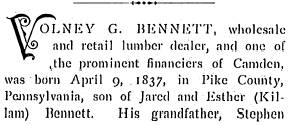
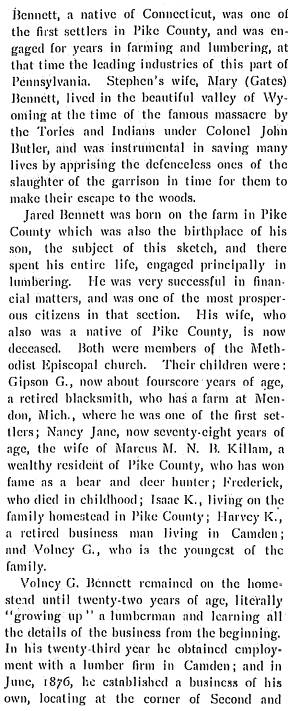
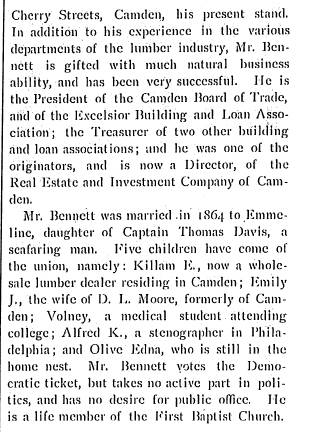
Biographical Review Containing Life Sketches of Leading Citizens of Camden And Burlington Counties — Biographical Review Publishing Co., Boston MA, 1897
Bennett, a native of Connecticut, was one of the first settlers in Pike County, and was engaged for years in farming and lumbering, at that time the leading industries of this part of Pennsylvania. Stephen’s wife, Mary (Gates) Bennett, lived in the beautiful valley of Wyoming at the time of the famous massacre by the Tories and Indians under Colonel John Butler, and was instrumental in saving many lives by apprising the defenceless ones of the slaughter of the garrison in time for them to make their escape to the woods.
Jared Bennett was born on the farm in Pike County which was also the birthplace of his son, the subject of this sketch, and there spent his entire life, engaged principally in lumbering. He was very successful in financial matters, and was one of the most prosperous citizens in that section. His wife, who also was a native of Pike County, is now deceased. Both were members of the Methodist Episcopal church. Their children were: Gipson G., now about fourscore years of age, a retired blacksmith, who has a farm at Mendon, Mich., where he was one of the first settlers; Nancy Jane, now seventy-eight years of age, the wife of Marcus M. N. B. Killam, a wealthy resident of Pike County, who has won fame as a bear and deer hunter; Frederick, who died in childhood; Isaac K., living on the family homestead in Pike County; Harvey K., a retired business man living in Camden; and Volney G., who is the youngest of the family.
Volney G. Bennett remained on the homestead until twenty-two years of age, literally “growing up” a lumberman and learning all the details of the business from the beginning. In his twenty-third year he obtained employment with a lumber firm in Camden; and in June, 1876, he established a business of his own, locating at the corner of Second and Cherry Streets, Camden, his present stand. In addition to his experience in the various departments of the lumber industry, Mr. Bennett is gifted with much natural business ability, and has been very successful. He is the President of the Camden Board of Trade, and of the Excelsior Building and Loan Association; the Treasurer of two other building and loan associations; and he was one of the originators, and is now a Director, of the Real Estate and Investment Company of Camden.
Mr. Bennett was married in 1864 to Emmeline, daughter of Captain Thomas Davis, a seafaring man. Five children have come of the union, namely: Killam E., now a wholesale lumber dealer residing in Camden; Emily J., the wife of D. L. Moore, formerly of Camden; Volney, a medical student attending college; Alfred K., a stenographer in Philadelphia; and Olive Edna, who is still in the home nest. Mr. Bennett votes the Democratic ticket, but takes no active part in politics, and has no desire for public office. He is a life member of the First Baptist Church.
Serious Charges by Defeated Candidate
Philadelphia Inquirer —
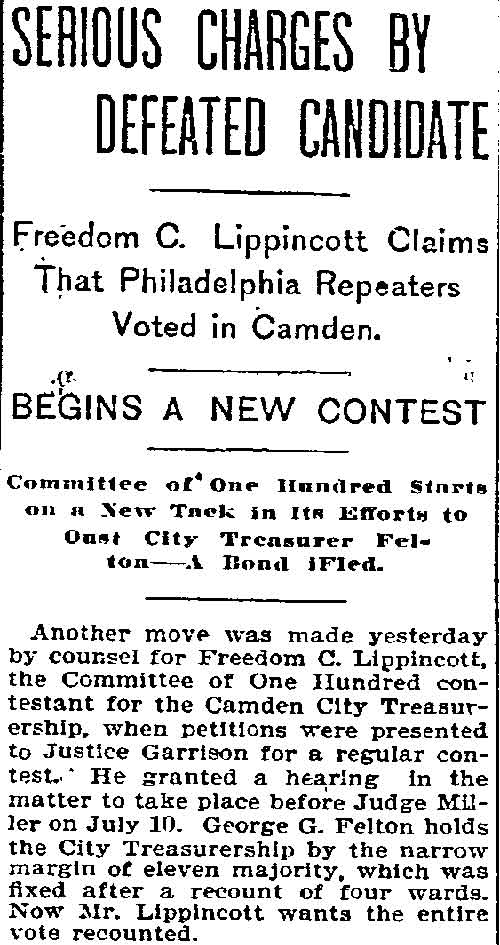
SERIOUS CHARGES BY DEFEATED CANDIDATE
Freedom C. Lippincott Claims That Philadelphia Repeaters Voted in Camden.
BEGINS A NEW CONTEST
Committee of One Hundred Starts on a New Tack in Its Efforts to Oust City Treasurer Felton—A Bond Filed.
Another move was made yesterday by counsel for Freedom C. Lippincott, the Committee of One Hundred contestant for the Camden City Treasurership, when petitions were presented to Justice Garrison for a regular contest. He granted a hearing in the matter to take place before Judge Miller on July 10. George G. Felton holds the City Treasurership by the narrow margin of eleven majority, which was fixed after a recount of four wards. Now Mr. Lippincott wants the entire vote recounted.
The petitioner contests the election on the grounds of “mal-conduct, fraud and corruption on the part of some of the members of the Registry Board in one of the wards sufficient to change the result; that illegal votes for Felton were cast and received, and that legal votes for Lippincott were rejected, and for error in the Board of Canvassers in counting the votes.
The petition also sets forth that seventeen ballots for Lippincott were rejected in the First precinct of the Ninth ward because they had the wrong precinct on the back.
The most serious charge in the petition is the allegation that fifteen repeaters were taken to the polls by Policeman George Anderson and E. B. McClong and given Felton tickets to vote. Accompanying the petition are affidavits of men who claim Philadelphia as their place of residence and who say they voted in Camden, although they were never qualified voters in the State of New Jersey. The names of the alleged repeaters and the names they voted on are given.
Lippincott filed a bond for $500 to carry on the contest, with Cooper B. Hatch and Volney G. Bennett as vouchers.
Greater Camden the Slogan at Board of Trade Banquet
Philadelphia Inquirer —
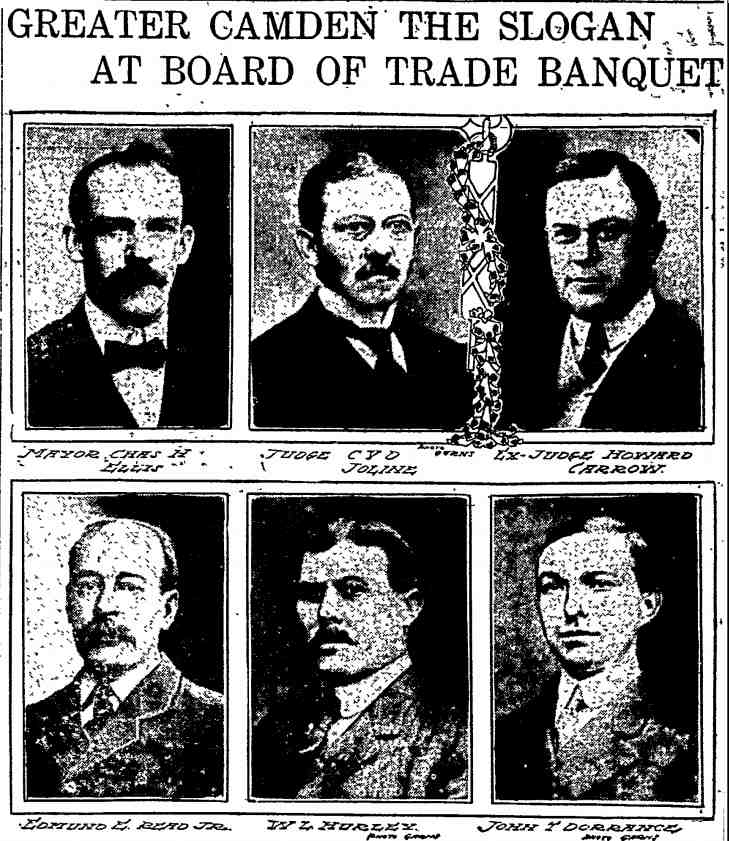
GREATER CAMDEN THE SLOGAN AT BOARD OF TRADE BANQUET
Men Prominent in Business Affairs Sound Praises of Growing City at Annual Feast
A greater, more progressive Camden was the watchword at he [sic] annual banquet given by Camden’s Board of Trade last night. And that this means something is evident from the fact that it came from the city’s “Captains of Industry” to the number of two hundred.
It was Camden’s rejuvenated Board of Trade that gave the banquet and the interest taken was manifested by the presence of representatives from every business concern of any prominence in the city.
There were bankers besides just ordinary business men, professional men of every character, and all were imbued with the spirit to make of Camden a place that will be known on the map throughout the country. William L. Hurley, president of the board, presided at the banquet.
“Generally speaking, we are satisfied with our city,” said Mayor Charles H. Ellis in responding to the toast, “Camden as it is,” “but, of course, there is room for improvement in many respects, and it rests with you gentlemen, you members of the Board of Trade to largely aid in solving our municipal problems.”
Former Judge Howard Carrow acted as toastmaster and, beside Mayor Ellis, those who responded to toasts were Congressman James H. Davidson, of Wisconsin, who spoke on “Boards of Trades;” Judge of the Court of Common Pleas C. V. D. Joline, “Camden’s Eighty Years;” Lawyer Edmund E. Read, president of the Board of Education, “Camden’s Future.”
One of the features of the occasion was the presentation of a life-size oil painting of President William Leonard Hurley. [sic] to the board, by Lawyer Harry C. Kramer. This came as a complete surprise to President Hurley, but he expressed his thorough appreciation of the honor.
Senator Philander C. Knox, of Pennsylvania, was among the specially invited guests and a warm welcome awaited him, but he was unavoidably detained.. [sic]
Some good points to Camden’s credit were enumerated in the menu cards as follows: “Camden has within its borders a population of nearly 100,000 and shipbuilding firms that can either supply a launch or the greatest battleship; the largest lace curtain manufacturers in America; a talking machine that speaks every known language; iron works that make enough pipe to girdle the earth; leather manufacturers who tan skins from all parts of the globe; the largest furniture house, whose products reach the Philippines; banks and trust companies whose resources are not affected by panics; artesian water that can be taken without adding anything.”
The committee in charge of the occasion included John T. Dorrance, chairman; Edwin G. C. Bleakly, Harry C. Kramer, David A. Henderson and Samuel W. Sparks.
Among the participants were Congressman Harry C. Loudenslager, Francis Howell, Walter Wood, Elmer E. Long, George W. Jessup, former Judge Joseph Gaskill, Volney G. Bennett, Wilbur F. Rose, Alexander C. Wood, George A. Frey, Charles A. Reynolds, Vice Chancellor E. B. Leaming, Heulings Lippincott, Charles K. Haddon, Fithian S. Simmons, Joseph B. Van Sciver, David Jester, Frank B. Sitley, Alpheus McCracken, Thomas S. Nekervis, DeCourcy May, Watson Depuy, Lionel C. Simpson, John M. Kelly, G. George Browning, William J. Browning, Isaac Ferris, John C. Danenhower, John R. McFeeley, Elias Davis, Anthony Kobus, Captain John B. Adams.
Second Bomb Found in Camden Lumber Yard
Philadelphia Inquirer —
SECOND BOMB FOUND IN CAMDEN LUMBER YARD
Explosives May Have Been Made by “Black Hand” Gang Which Threatened Rich Italian
Within a short distance of the spot where a crude bomb was found about a week ago, another one was uncovered yesterday by Alfred Suders, at the lumber yard of the Volney-Bennett Company, Second and Spruce streets, Camden. It was turned over to Detective Troncone, who fearlessly examined the contrivance. He found it was a discarded paint can containing about a quart of powder and other material, to which was attached a fuse. There was sufficient explosive to blow up a substantial structure. The police kept the bomb pending further investigation.
It is not believed that any attempt was made to damage the lumber yard, but that the improvised bombs were hidden for other work. The police believe the bombs may have something to do with a “black hand” letter which was sent to Innocenzo Barano, a wealthy junk dealer, of 707 Locust street, some days ago. The police have made several arrests in that case, but there has not been enough evidence to hold the prisoners.
The ones who sent the letter demanded $500, with the alternative of blowing him and his home up. He lives within two blocks of where the bomb was found and in the midst of the Italian colony.
War Work Director Named
Philadelphia Inquirer —
F. Morse Archer, president of the National State Bank, is to direct the Camden drive for the war work fund. Former Judge William T. Boyle and William J. Strandwitz are the vice chairmen; Walter J. Staats is the treasurer and E. A. Stoll and David S. Rush, Jr., are the directors. The work in Camden city is to be done in six districts and the captains are E. G. C. Bleakly, James H. Long, William L. Hurley, F. B. Wallen, Wilbert Pike and Volney Bennett. Camden county’s quota is $227,500.
Fusion Coup In Camden Election
Trenton Evening Times —
FUSION COUP IN CAMDEN ELECTION
Democrats Named at Primary Plan to Withdraw—Blow at Baird
(International News Service)
CAMDEN, Sept. 27.—Fusionists, combining Democratic forces with independent elements of the Republicans in Camden County, plan an election day coup here, it was learned today.
Democratic candidates named at the polls in primary elections Tuesday were run only as a matter of strategy, it was stated, and will withdraw in favor of Fusion men before the general election.
Frank Homan, nominee for Senator, will retire and Robert A. Irving, also a Democrat, it is reported, will be named by the Democratic Committee on Vacancy to take Homan’s place. A similar plan will be applied in the case of candidates for Sheriff and the Assembly. Volney Bennett, a Republican, will replace Horace L. Brewer, Democrat, as the candidate for Sheriff, according to authoritative sources.
The Fusion movement was born of the desire of Democrats and Republicans who have tired of the “Davy” Baird regime to take Camden County out of the hands of the latter’s forces. It was successful last fall, a Democrat being elected as mayor. Later the Fusionists sponsored the Commission Government movement, won out, and placed two Democrats on the Commission of five elected.
Camden has not sent a Democrat to the State Senate since 1887.
Camden Man Named on Lumber Group
Camden Courier-Post —
CAMDEN MAN NAMED ON LUMBER GROUP
Volney Bennett Appointed Co. Chairman for Retail Dealers Association
Volney Bennett, of the Volney G. Bennett Lumber Company, has been appointed chairman of the Camden county branch of the National Retail Lumber Dealers’ Association by L. P. Lewin, of Cincinnati, president of the organization, it was announced today.
Bennett will appoint committees to work with him in connection with a nationwide movement to promote the ownership of homes and the keeping of present structures in repair as well improved property. The county organization will operate under the direction of E. H. Hamilton, of Paterson, chairman for New Jersey.
“Build Now With Safety,” is the motto of the lumbermen, who are planning to spend $40,000,000 during the next four years.
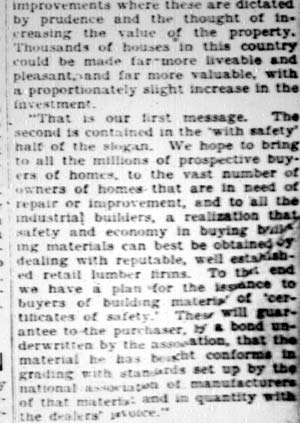
“This slogan, which will be the central theme of a large newspaper advertising campaign, contains two messages,” said Lewin’s announcement. “Coupled with this advocacy of home owning will be the thought of keeping that home at its best—of keeping it constantly in repair and of making improvements where these are dictated by prudence and the thought of increasing the value of the property. Thousands of houses in this country could be made far more liveable and pleasant, and far more valuable, with a proportionately slight increase in the investment.
“That is our first message. The second is contained in the ‘with safety’ half of the slogan. We hope to bring to all the millions of prospective buyers of homes, to the vast number of owners of homes that are in need of repair or improvement, and to all the industrial builders, a realization that safety and economy in buying building materials can best be obtained by dealing with reputable, well established retail lumber firms. To that end we have a plan for the issuance to buyers of building materials of ‘certificates of safety.’ These will guarantee to the purchaser, by a bond underwritten by the association, that the material he has bought conforms in grading with standards set up by the national association of manufacturers of that material and in quantity with the dealers’ invoice.”
Rotarians Have ‘Good Time,’ Even to Milking of Cows
Camden Courier-Post —
ROTARIANS HAVE ‘GOOD TIME,’ EVEN TO MILKING OF COWS
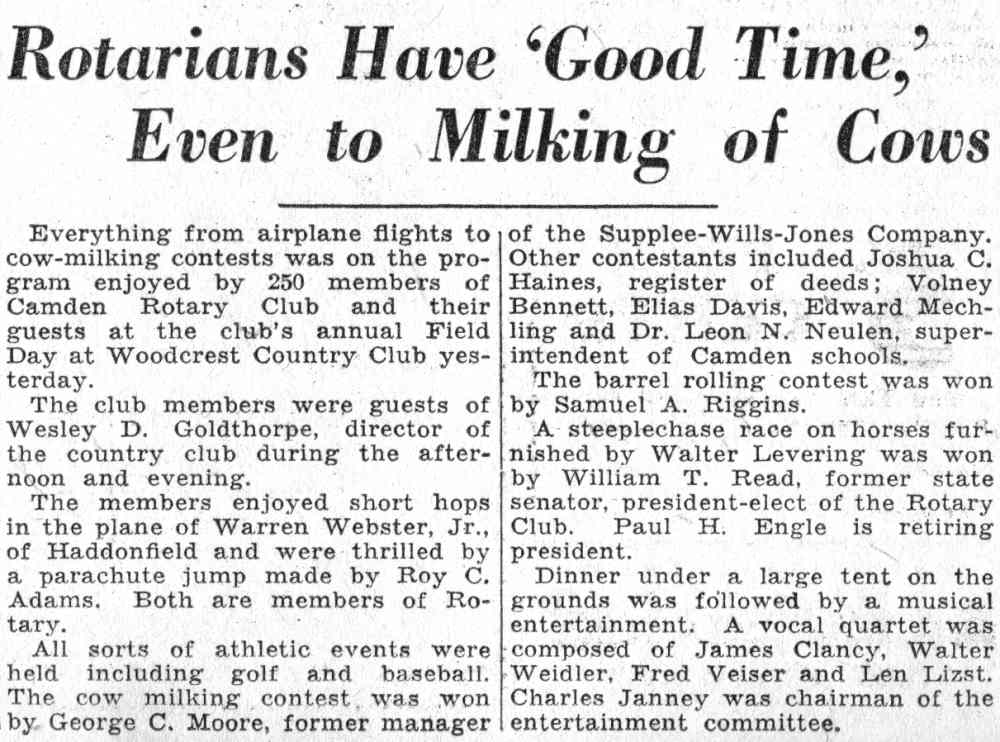
Everything from airplane flights to cow-milking contests was on the program enjoyed by 250 members of Camden Rotary Club and their guests at the club’s annual Field Day at Woodcrest Country Club yesterday.
The club members were guests of Wesley D. Goldthorpe, director of the country club during the afternoon and evening.
The members enjoyed short hops in the plane of Warren Webster, Jr., of Haddonfield and were thrilled by a parachute jump made by Roy C. Adams. Both are members of Rotary.
All sorts of athletic events were held including golf and baseball. The cow milking contest was won by George C. Moore, former manager of the Supplee-Wills-Jones Company. Other contestants included Joshua C. Haines, register of deeds; Volney Bennett, Elias Davis, Edward Mechling and Dr. Leon N. Neulen, superintendent of Camden schools.
The barrel rolling contest was won by Samuel A. Riggins.
A steeplechase race on horses furnished by Walter Levering was won by William T. Read, former state senator, president-elect of the Rotary Club. Paul H. Engle is retiring president.
Dinner under a large tent on the grounds was followed by a musical entertainment. A vocal quartet was composed of James Clancy, Walter Weidler, Fred Veiser and Len Lizst. Charles Janney was chairman of the entertainment committee.
First Camden National Bank & Trust Co.
Camden Courier-Post —
The Directors
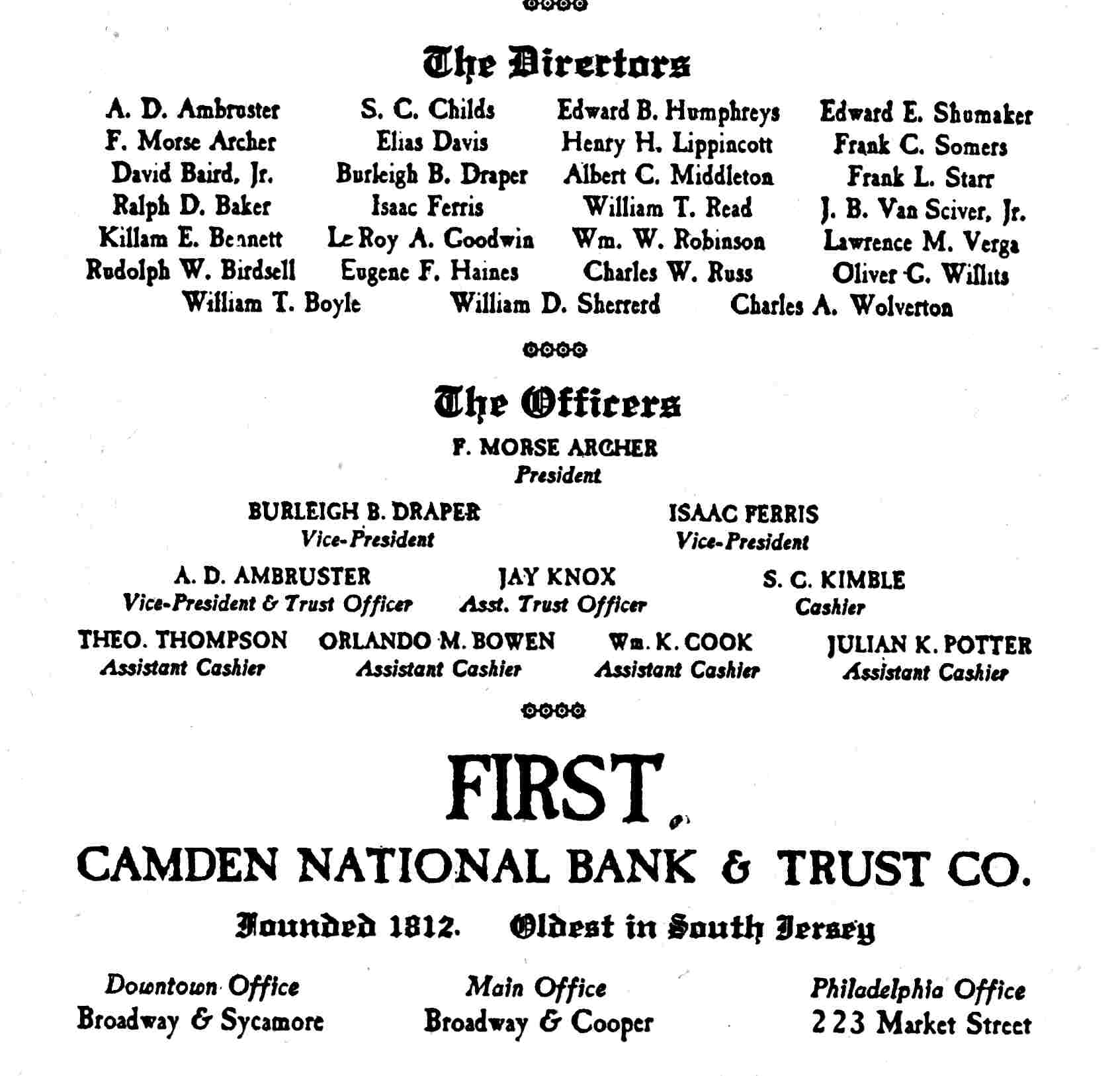
A. D. Ambruster – S. C. Childs – Edward B. Humphreys – Edward E. Shumaker – F. Morse Archer – Elias Davis – Henry H. Lippincott – Frank C. Somers – David Baird, Jr. – Burleigh B. Draper – Albert C. Middleton – Frank L. Starr – Ralph D. Baker – Isaac Ferris – William T. Read – J. B. Van Sciver, Jr. – Killam E. Bennett – Le Roy A. Goodwin – Wm. W. Robinson – Lawrence M. Verga – Rudolph W. Birdsell – Eugene F. Haines – Charles W. Russ – Oliver C. Willits – William T. Boyle – William D. Sherrerd – Charles A. Wolverton
The Officers: F. MORSE ARCHER, President. BURLEIGH B. DRAPER, Vice-President — ISAAC FERRIS, Vice-President. A. D. AMBRUSTER, Vice-President & Trust Officer — JAY KNOX, Asst. Trust Officer — S. C. KIMBLE, Cashier. THEO. THOMPSON, Assistant Cashier — ORLANDO M. BOWEN, Assistant Cashier — Wm. K. COOK, Assistant Cashier — JULIAN K. POTTER, Assistant Cashier.
First Camden National Bank & Trust Co. Founded 1812. Oldest in South Jersey. Downtown Office: Broadway & Sycamore — Main Office: Broadway & Cooper — Philadelphia Office: 223 Market Street.
U.S.O. Drive Here Reports $17,423
Camden Courier-Post —
U.S.O. DRIVE HERE REPORTS $17,423
Upward Swing of Contributions Continues; Goal Is $21,000
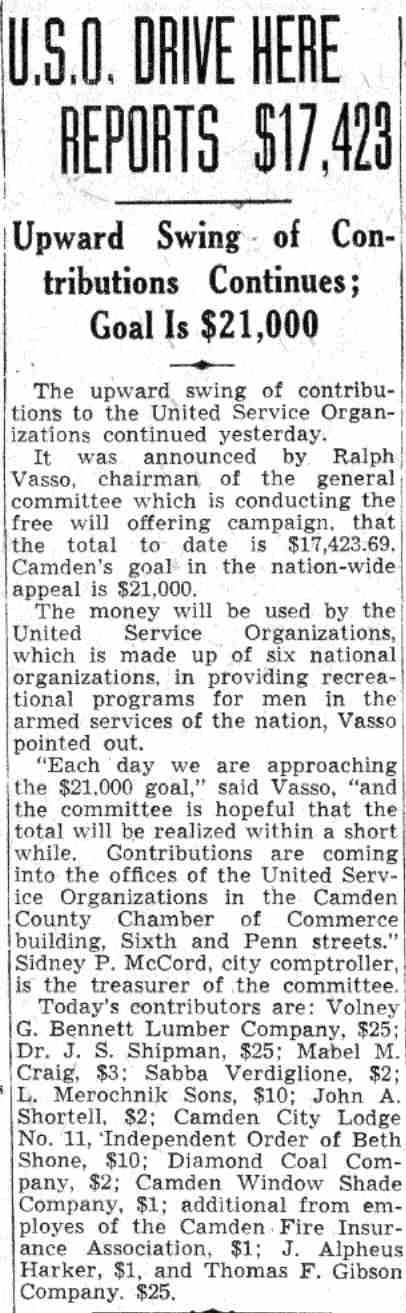
The upward swing of contributions to the United Service Organizations continued yesterday.
It was announced by Ralph Vasso, chairman of the general committee which is conducting the free will offering campaign, that the total to date is $17,423.69. Camden’s goal in the nation-wide appeal is $21,000.
The money will be used by the United Service Organizations, which is made up of six national organizations, in providing recreational programs for men in the armed services of the nation, Vasso pointed out.
“Each day we are approaching the $21,000 goal,” said Vasso, “and the committee is hopeful that the total will be realized within a short while. Contributions are coming into the offices of the United Service Organizations in the Camden County Chamber of Commerce building, Sixth and Penn streets.” Sidney P. McCord, city comptroller, is the treasurer of the committee.
Today’s contributors are: Volney G. Bennett Lumber Company, $25; Dr. J. S. Shipman, $25; Mabel M. Craig, $3; Sabba Verdiglione, $2; L. Merochnik Sons, $10; John A. Shortell, $2; Camden City Lodge No. 11, Independent Order of Beth Shone, $10; Diamond Coal Company, $2; Camden Window Shade Company, $1; additional from employes of the Camden Fire Insurance Association, $1; J. Alpheus Harker, $1, and Thomas F. Gibson Company, $25.
Photos
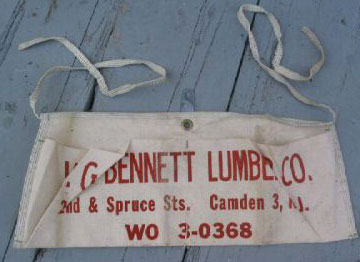
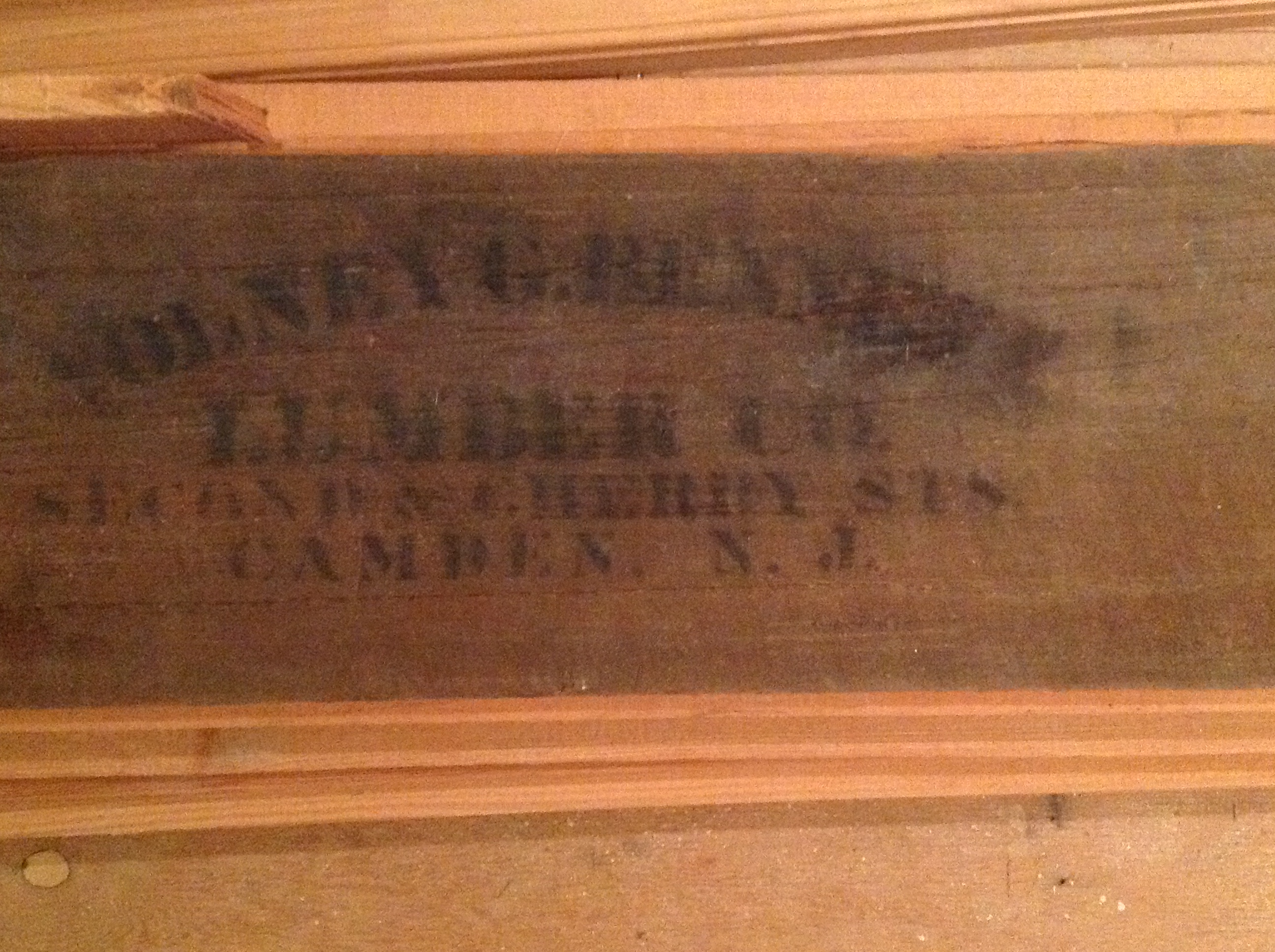
Volney G. Bennett Lumber Company
Arson Suspected in Lumberyard Blaze
Camden Courier-Post —
ARSON SUSPECTED IN LUMBERYARD BLAZE
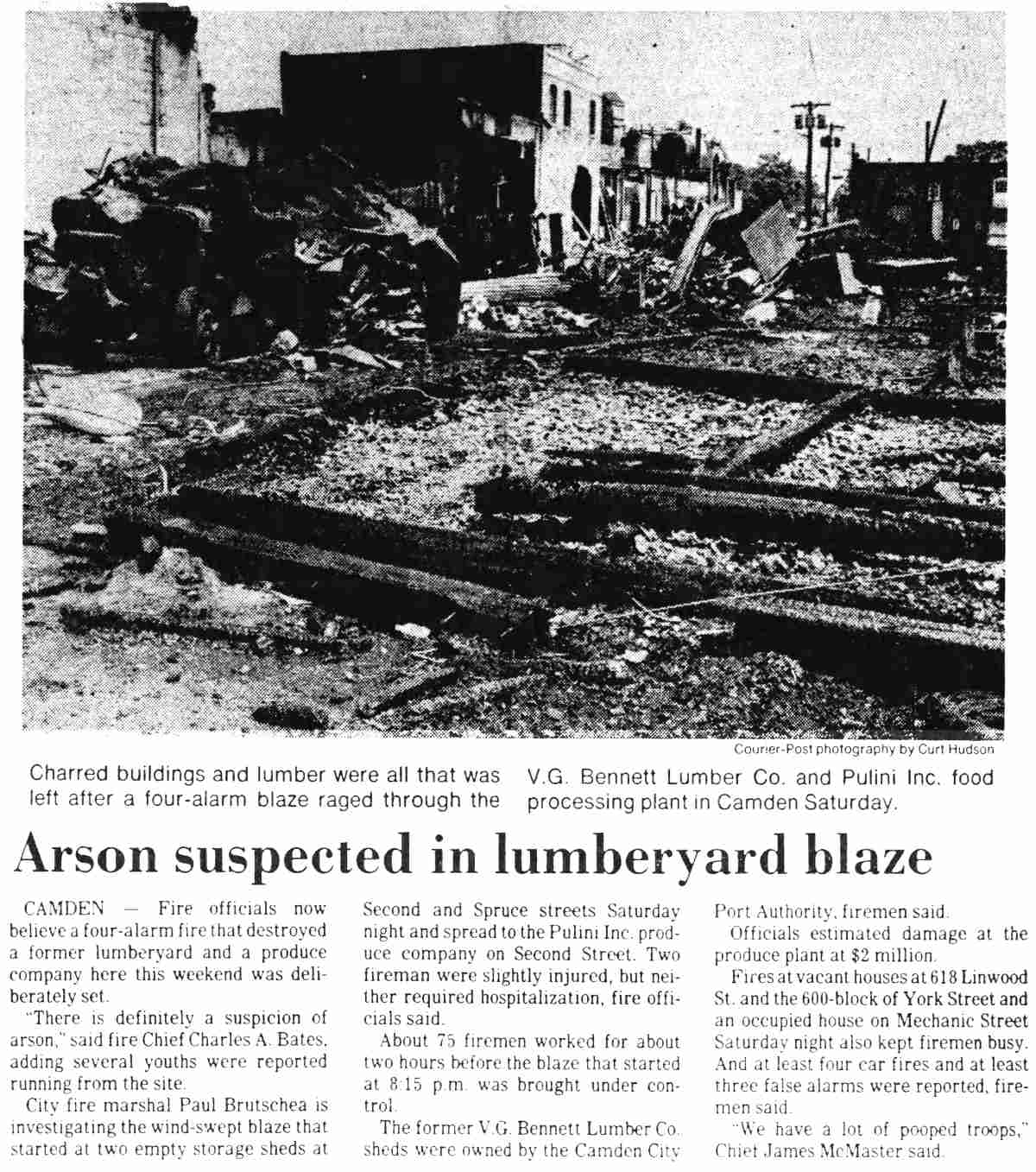
Charred buildings and lumber were all that was left after a four-alarm blaze raged through the V.G. Bennett Lumber Co. and Pulini Inc. food processing plant in Camden Saturday.
Camden — Fire officials now believe a four-alarm fire that destroyed a former lumberyard and a produce company here this weekend was deliberately set. “There is definitely a suspicion of arson,” said fire Chief Charles A. Bates, adding several youths were reported running from the site. City fire marshal Paul Brutschea is investigating the wind-swept blaze that started at two empty storage sheds at Second and Spruce streets Saturday night and spread to the Pulini Inc. produce company on Second Street. Two firemen were slightly injured, but neither required hospitalization, fire officials said.
About 75 firemen worked for about two hours before the blaze that started at 8:15 p.m. was brought under control. The former V.G. Bennett Lumber Co. sheds were owned by the Camden City Port Authority, firemen said. Officials estimated damage at the produce plant at $2 million.
Fires at vacant houses at 618 Linwood St. and the 600-block of York Street and an occupied house on Mechanic Street Saturday night also kept firemen busy. And at least four car fires and at least three false alarms were reported, firemen said. “We have a lot of pooped troops,” Chief James McMaster said.
In 2004
In 2004, the Volney Bennett Lumber Company stables were remodeled, and re-opened as The … A murder took place on premises in 2013.