Cooper Browning Hatch
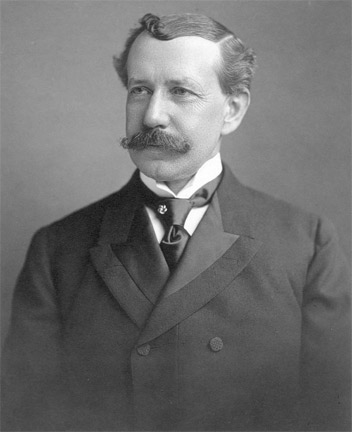
Cooper B. Hatch
COOPER BROWNING HATCH, one of Camden’s leading citizens in the late 19th and early 20th century. He was born to Joseph and Mary Hatch, and was born in the then farmhouse that now houses the Camden County Historical Society. Joseph Hatch owned a great deal of land in what is now East Camden, and Cooper B. Hatch grew up in the farmhouse which has stood since the 1890s at 2677 Mickle Street.
Cooper B. Hatch became involved in politics early in life. He served on the Board of Freeholders and on City Council, finally being elected mayor of the City of Camden in 1898. During his term, which ended in 1902, the Manual Training and High School was built, at the corner of Haddon and Newton Avenues. This building would serve as Camden’s high school until the completion of the current Camden High School at Park and Baird Boulevards in 1918. It was then renamed the Clara Burrough Junior High School.
Cooper B. Hatch promoted other projects while mayor of Camden, including the first asphalt paving in the city, and improvements to the municipal water system. After leaving the Mayor’s office, Cooper Hatch continued in public service, serving as the Sheriff of Camden County from 1908 to 1911.
Cooper B. Hatch sat on the Board of Directors of the Security Trust Company bank, at 301 Market Street in 1916.
A lifelong bachelor, Cooper B. Hatch later lived near Diamond Cottage Park. He spent the later years of his life living at 206 North 6th Street in Camden, with his mother and sister. He passed away on February 15, 1922.
Other members of the Hatch family played a prominent role in Camden’s history. Uncle Hugh Hatch was the proprietor of the Fairview Brick Works, whose offices were at 14th and Federal Street, while nephew Hugh Morgan Hatch, who with J.R. Mick, founded Camden’s pioneer Buick Agency, New Jersey Auto Supply, a dealership which stood for many years at Delaware Avenue between George and Market Street, before moving to Federal Street at Wright Avenue in the early 1940s. Another nephew, Isaiah S. Hatch, the brother of Hugh Morgan Hatch, served as Camden County’s sheriff from 1920 to 1923, was a co-founder of the Merchants Trust bank and in later years ran the Hatch family’s brick works in Pennsauken, New Jersey.
Cooper B. Hatch Middle School, which stands on the northwest corner of Park Boulevard and Bradley Avenue in the Parkside section of Camden NJ was named for him, and was completed in 1924.
The Camden Primaries
Philadelphia Inquirer —
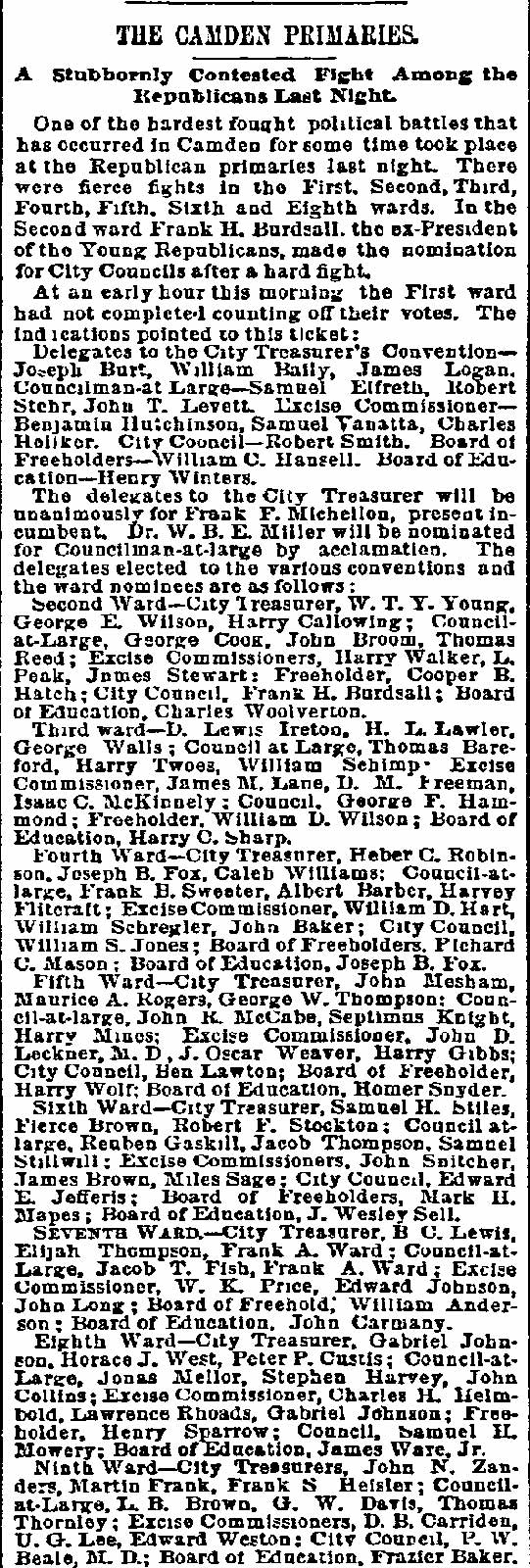
A Stubbornly Contested Fight Among the Republicans Last Night.
One of the hardest fought political battles that has occurred in Camden for some time took place at the Republican primaries last night. There were fierce fights in the First, Second, Third, Fourth, Fifth, Sixth and Eighth wards. In the Second ward Frank H. Burdsall, the ex-President of the Young Republicans, made the nomination for City Councils after a hard fight.
At an early hour this morning the First ward had not completed counting off their votes. The indications pointed to this ticket:
Delegates to the City Treasurer’s Convention—Joseph Burt, William Baily, James Logan. Councilman-at-Large—Samuel Elfreth, Robert Stehr, John T. Levett. Excise Commissioner—Benjamin Hutchinson, Samuel Vanatta, Charles Holiker. City Council—Robert Smith. Board of Freeholders—William C. Hansell. Board of Education—Henry Winters.
The delegates to the City Treasurer will be unanimously for Frank F. Michellon, present incumbent. Dr. W. B. E. Miller will be nominated for Councilman-at-large by acclamation. The delegates elected to the various conventions and the ward nominees are as follows:
Second Ward—City Treasurer, W. T. Y. Young, George E. Wilson, Harry Callowing; Council-at-Large, George Cook, John Broom, Thomas Reed; Excise Commissioners, Harry Walker, L. Peak, James Stewart; Freeholder, Cooper B. Hatch; City Council, Frank H. Burdsall; Board of Education, Charles Woolverton.
Third ward—D. Lewis Ireton, H. L. Lawler, George Walls; Council at Large, Thomas Bareford, Harry Twoes, William Schimp; Excise Commissioner, James M. Lane, D. M. Freeman, Isaac C. McKinnely; Council, George F. Hammond; Freeholder, William D. Wilson; Board of Education, Harry C. Sharp.
Fourth Ward—City Treasurer, Heber C. Robinson, Joseph B. Fox, Caleb Williams; Council-at-large, Frank B. Sweeter [sic], Albert Barber, Harvey Flitcraft; Excise Commissioner, William D. Hart, William Schregler, John Baker; City Council, William S. Jones; Board of Freeholders, Richard C. Mason; Board of Education, Joseph B. Fox.
Fifth Ward—City Treasurer, John Mesham, Maurice A. Rogers, George W. Thompson; Council-at-large, John R. McCabe, Septimus Knight, Harry Mines; Excise Commissioner, John D. Leckner, M. D., J. Oscar Weaver, Harry Gibbs; City Council, Ben Lawton; Board of Freeholder, Harry Wolf; Board of Education, Homer Snyder.
Sixth Ward—City Treasurer, Samuel H. Stiles, Pierce Brown, Robert F. Stockton; Council at large, Reuben Gaskill, Jacob Thompson, Samuel Stillwill; Excise Commissioners, John Snitcher, James Brown, Miles Sage; City Council, Edward E. Jefferis; Board of Freeholders, Mark H. Mapes; Board of Education, J. Wesley Sell.
SEVENTH WARD.—City Treasurer, B. C. Lewis, Elijah Thompson, Frank A. Ward; Council-at-Large, Jacob T. Fish, Frank A. Ward; Excise Commissioner, W. K. Price, Edward Johnson, John Long; Board of Freehold, William Anderson; Board of Education, John Carmany.
Eighth Ward—City Treasurer, Gabriel Johnson, Horace J. West, Peter P. Custis; Council-at-Large, Jonas Mellor, Stephen Harvey, John Collins; Excise Commissioner, Charles H. Helmbold, Lawrence Rhoads, Gabriel Johnson; Freeholder, Henry Sparrow; Council, Samuel H. Mowery; Board of Education, James Ware, Jr.
Ninth Ward—City Treasurers, John N. Zanders, Martin Frank, Frank S. Heisler; Councilman-at-Large, L. B. Brown, G. W. Davis, Thomas Thornley; Excise Commissioners, D. B. Carriden, U. G. Lee, Edward Weston; City Council, P. W. Beale, M. D.; Board of Education, Frazier Baker.
Camden Republican Outlook
Philadelphia Inquirer —
The present outlook is that there will be perfect harmony throughout Camden in the Republican ranks, and the following candidates will be named: First ward, the present incumbent, J. Leyton Wescott; Second ward, Freeholder, Cooper B. Hatch will succeed John Campbell; James H. Lane will be renominated and re-elected in the Third; Maylon F. Ivins will be unopposed in the Fourth ward, Dr. John D. Leckner will have opposition in the Fifth ward, but he will be returned. Eugene B. Roberts will be renominated and re-elected in the Sixth ward, as will Joseph Starr and Charles H. Sharp in the Seventh and Ninth wards respectively. The present indications are that Excise Commissioner Fury will be the next Councilman from the Eighth ward.
Camden's Warring Factions.
Philadelphia Inquirer —
John Furey Now in Council, But Out of the Excise Commission.
There was more excitement at the meeting of Camden City Council last night than there has been since the days when the Republicans had only a small majority. The trouble was over the selection of a Councilman to fill the vacancy in the Eighth ward, caused by the resignation of Isaac Ferris.
The Republicans caucused previous to the meeting, Excise Commissioner Furey receiving the largest vote of his party. Some of the members, however, refused to make the choice unanimous and carried their refusal into the Council chamber. Mr. Furey was nominated by Chairman Lane, of the caucus. Frank Burdsall, of the Second ward, nominated ex-Councilman Charles Helmbold. The vote resulted as follows:
For Furey—Messrs. Barber, Beale, Bedell, Hatch, Hogate, Jefferis, Lane, Miller, Roberts, Ross, Sharp, Smith, Starr, Wescott, Leckner, Lee. Total, 16.
For Helmbold—Messrs. Burdsall, Donges, Githens, Hammond, Jones, Lawton, Lord, Rogers, Scheperkotter—9.
Messrs. Donges, Scheperkotter and Lord are Democrats. As soon as the decision was announced Donges and Scheperkotter created a sensation by handing in their resignations. Mr. Furey moved to accept them, but Councilman Rogers moved to lay them over. The latter motion prevailed.
Mr. Snyder then asked the City Solicitor if Mr. Furey could hold the position of excise commissioner and Councilman at the same time. The City Solicitor decided that he could not and his position as excise commissioner was declared vacant. Councilman Edward E. Jefferis, of the Sixth ward, nominated Charles Lederman, of the Seventh ward, for the vacancy in the Excise Commission, and Mr. Burdsall nominated George A. Frey, editor of the Courier. Five ballots were taken without a result. Both Messrs. Schepperkotter and Donges, after handing in their resignations, left the Council chamber.
Masonic Temple Association Directors Elected
Philadelphia Inquirer —
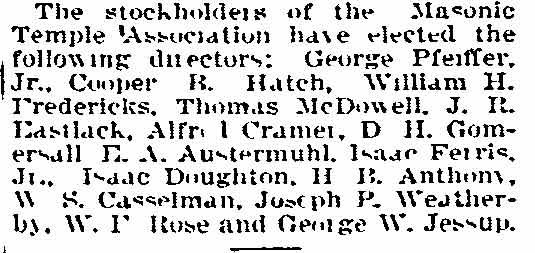
The stockholders of the Masonic Temple Association have elected the following directors: George Pfeiffer, Jr., Cooper B. Hatch, William H. Fredericks, Thomas McDowell, J. R. Eastlack, Alfred Cramer, D. H. Gomersall, E. A. Austermuhl, Isaac Ferris, Jr., Isaac Doughton, H. B. Anthony, W. S. Casselman, Joseph P. Weatherby, W. F. Rose and George W. Jessup.
Water Contract and Loan
Philadelphia Inquirer —
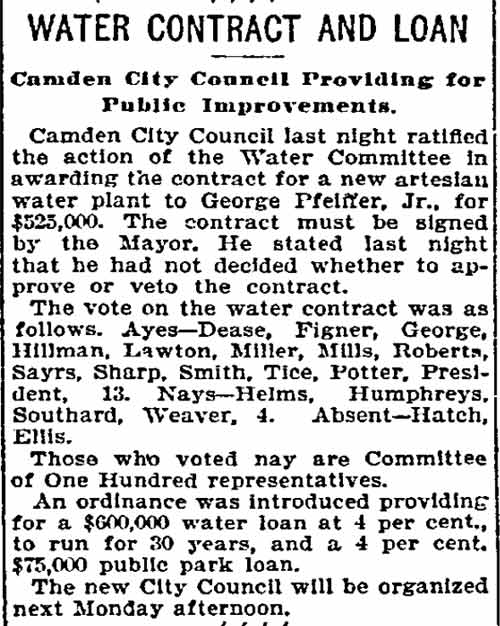
Camden City Council Providing for Public Improvements.
Camden City Council last night ratified the action of the Water Committee in awarding the contract for a new artesian water plant to George Pfeiffer, Jr., for $525,000. The contract must be signed by the Mayor. He stated last night that he had not decided whether to approve or veto the contract.
The vote on the water contract was as follows. Ayes—Dease, Figner, George, Hillman, Lawton, Miller, Mills, Roberts, Sayrs, Sharp, Smith, Tice, Potter, President, 13. Nays—Helms, Humphreys, Southard, Weaver, 4. Absent—Hatch, Ellis.
Those who voted nay are Committee of One Hundred representatives.
An ordinance was introduced providing for a $600,000 water loan at 4 per cent., to run for 30 years, and a 4 per cent. $75,000 public park loan.
The new City Council will be organized next Monday afternoon.
Serious Charges by Defeated Candidate
Philadelphia Inquirer —
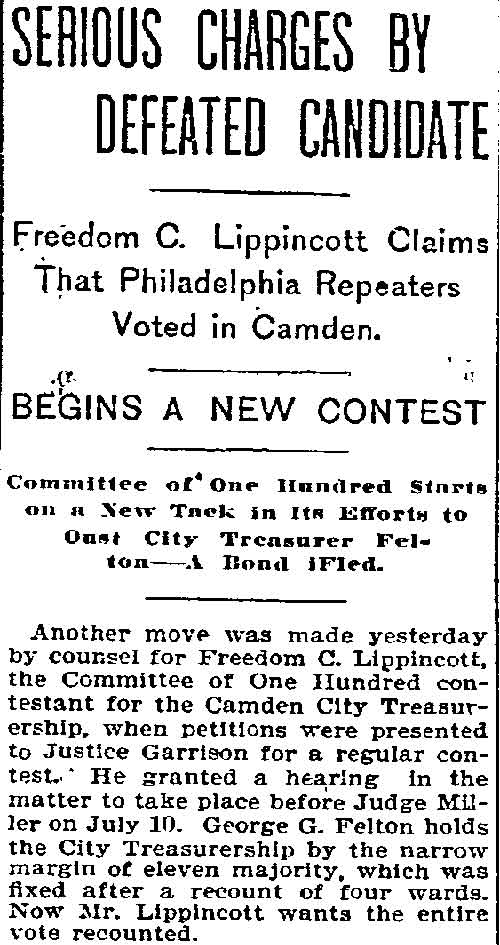
Freedom C. Lippincott Claims That Philadelphia Repeaters Voted in Camden.
BEGINS A NEW CONTEST
Committee of One Hundred Starts on a New Tack in Its Efforts to Oust City Treasurer Felton—A Bond Filed.
Another move was made yesterday by counsel for Freedom C. Lippincott, the Committee of One Hundred contestant for the Camden City Treasurership, when petitions were presented to Justice Garrison for a regular contest. He granted a hearing in the matter to take place before Judge Miller on July 10. George G. Felton holds the City Treasurership by the narrow margin of eleven majority, which was fixed after a recount of four wards. Now Mr. Lippincott wants the entire vote recounted.
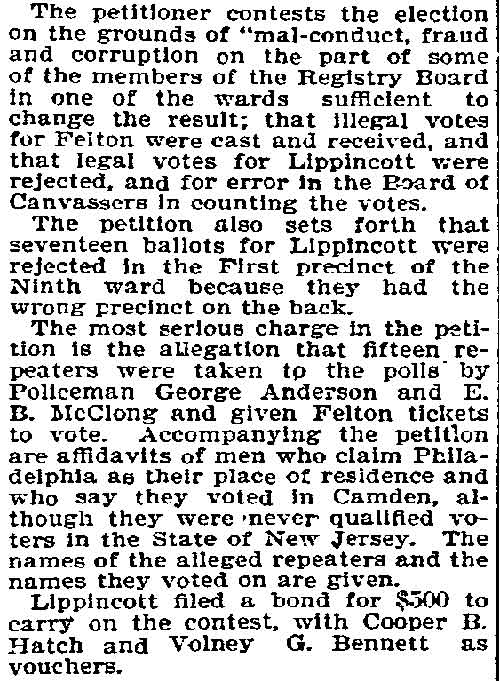
The petitioner contests the election on the grounds of “mal-conduct, fraud and corruption on the part of some of the members of the Registry Board in one of the wards sufficient to change the result; that illegal votes for Felton were cast and received, and that legal votes for Lippincott were rejected, and for error in the Board of Canvassers in counting the votes.
The petition also sets forth that seventeen ballots for Lippincott were rejected in the First precinct of the Ninth ward because they had the wrong precinct on the back.
The most serious charge in the petition is the allegation that fifteen repeaters were taken to the polls by Policeman George Anderson and E. B. McClong and given Felton tickets to vote. Accompanying the petition are affidavits of men who claim Philadelphia as their place of residence and who say they voted in Camden, although they were never qualified voters in the State of New Jersey. The names of the alleged repeaters and the names they voted on are given.
Lippincott filed a bond for $500 to carry on the contest, with Cooper B. Hatch and Volney G. Bennett as vouchers.
Camden
Philadelphia Inquirer —
Henry D. Moore, son and daughter, of Haddonfield, in company with Rev. F. R. Brace, D. D., of Blackwood, will sail from New York on the steamer Friesland, on Wednesday, February 6, for a two months’ tour of the Mediterranean, which will include visits to Italy, Greece, Egypt, Turkey, Northern Africa and Southern Spain.
Miss Boyer, of 524 Linden street, will give a tea next Wednesday from 3 until 5.
Miss Campbell, of Fifth and Cooper streets, gave a progressive euchre party on Monday evening in honor of Miss Richardson.
Voorhees Anderson entertained a number of young people at a progressive euchre party Wednesday evening.
Friends of Isaac W. Cole, of Delaware township, intend to present his name as a candidate for one of the county offices to be filled at the coming fall election.
On Monday Mr. and Mrs. William Parry, of Parry, started for California to attend the annual meeting of the American Pomological Society. They will be gone about a month, and will take in all the sights of the Golden State.
“Speaker” Ed Hartman, the popular Third ward policeman, was presented with a handsome and costly cane the other day by his admirers at No. 2 Engine House. David Logue presented the cane in an eloquent speech.
At the meeting of the Commercial Club Wednesday night the following officers were elected for the ensuing year: President, H. Land; Vice-President, S. C. Childs; Treasurer, J. H. Knerr; Financial Secretary, Philip Wilson; Recording Secretary, George W. Anthony; Directors, Geo. Leathwhite, L. W. Fernan, Jacob Ferris, H. G. Bonwill, Thomas J. Peterson, James M. Bentley, H. L. Merrick, John W. Croft, Daniel S. Garwood.
The stockholders of the Masonic Temple Association have elected the following directors: George Pfeiffer, Jr., Cooper B. Hatch, William H. Fredericks, Thomas McDowell, J. R. Eastlack, Alfred Cramer, D. H. Gomersall, E. A. Austermuhl, Isaac Ferris, Jr., Isaac Doughton, H. B. Anthony, W. S. Casselman, Joseph P. Weatherby, W. F. Rose and George W. Jessup.
Mayoralty Talk Over In Camden
Philadelphia Inquirer —

MAYORALTY TALK OVER IN CAMDEN
Election Not Far Off, But Leaders Cannot Agree on a Candidate
UP TOWN VS. DOWN
Committee of One Hundred Confident of Winning This Time—Democrats Divided
Camden’s municipal election, which will be held five weeks hence, promises to be one of the most hotly contested campaigns ever held in that city. The Committee of One Hundred, inspired by steady gains in the past, will make strenuous effort to wrest the control of municipal affairs from the Republicans. The prospects for their success seem brighter than in any previous campaign. A Mayor, Recorder and ten Councilmen are to be elected. The ordinances cutting off the fees of city officials will probably be passed in time to affect the officials elected this spring.
Although the election is not far distant the Republican leaders cannot agree upon a candidate for Mayor.
John Campbell, Jr., a wealthy real estate dealer, was urged to accept the nomination, and petitions were being circulated amongt he [sic] business men in his favor, but he announced yesterday that he would not stand.
City Clerk Varney and Street Supervisor John Blowe want a candidate from the lower section of the city, where the big Republican majorities are returned. Ex-Potmaster [sic] Henry B. Wilson, a coal dealer of Kaighn’s avenue, is the leading down-town candidate. City Counsel J. Willard Morgan is said to favor his candidacy. Harry Wolfe, Director of the Board of Freeholders, is looming up as a down-town candidate. He is backed by City Assessor Chris J. Mines, who aspires to be something more than a ward leader.
Mayor Westcott, who has had two terms, will not be a candidate for renomination. Isaac Doughten, the fearless foreman of the present grand jury, declines to stand as a candidate.
An effort is also being made to bring out R. H. Reeve, of the Second ward, for the Republican nomination for Mayor. He was a candidate for City Treasurer on the Committee of One Hundred ticket two years ago. It is claimed that he can divert some of the reform vote to the Republican ticket.
As the Committee of One Hundred name their candidates in secret conclave, but little is known of their plans. Either Cooper B. Hatch or Lewis H. Mohrman may head their ticket. Hatch came near defeating Mayor Westcott three years ago. Mohrman is the Reform leader in Council. Both are from the Second ward. Ex-Senator Maurice Rogers, of the Fifth ward, would like to head the Reform ticket.
The Democrats are split into two factions, the Regular and the County Democracy, and these are again divided on the question of making a hopeless fight with a straight ticket or indorsing the Committee of One Hundred nominees with the prospect of winning.
There will be a warm contest for the Republican nomination for City Recorder, which is to become a salaried position. The Councilmanic contests are still far from being settled.
Camden Political Chat
The Committee of One Hundred has certiorarled the ordinance creating two new precincts in the Fourth ward. The writ is returnable on February 19. Copies were served on City Clerk Varney and the County Board of Elections yesterday.
The County Board of Elections made several changes yesterday in precinct election boards. Secretary Fitzgerald called attention to precinct boards filling vacancies without notifying the County Board. The matter will be investigated.
Committee of One Hundred challengers started in yesterday to canvass for the spring election.
The Registry Boards will sit on next Tuesday, and again on the 18th instant.
The Sixth Ward Republican Club has indorsed Justice Charles M. Baldwin for the Republican nomination for Recorder.
Friends of Councilman Jesse C. Bond, of the First ward, want him to accept renomination on the Committee of One Hundred ticket.
The First Ward Republican Club has indorsed the candidacy of Joseph Potter for City Council. He also has the support of the Camden Republican Club. He was defeated for re-election as a Councilman last spring.
Camden’s Council Guarded by Police
Philadelphia Inquirer —
Their Services Were Not Needed, However, as the Crowd Was Orderly
A BRIEF SESSION HELD
President Taylor Names Four Committees—Roberts and Shafer Were Absent
When Camden’s City Council was called together in adjourned meeting last night the gallery was crowded with interested citizens and another large throng filled the space between the members’ desks and the walls of the chamber. A detail of twenty police, under Chief Dodd and Lieutenants Pettit and Foster, were scattered about the chamber to preserve order, but their presence was not needed.
Neither John S. Roberts nor Dr. William Shafer, the contestants for a seat as representative from the Third ward was present. Mr. Roberts was absent by advice of his counsel, it was stated. It could not be learned why Dr. Shafer did not appear. Another absentee was Charles E. Day, one of the Committee of One Hundred Councilmen from the Fifth ward, who was taken suddenly ill on Wednesday. Mr. Day is rapidly improving and will probably be out in a day or two.
There was no roll call. President Taylor announced the following committees:
Finance—Jessup, Burrough, Devinney, Silvers and Ellis.
Streets—Gibson, Maloney, Bond, Jessup and George.
Police—Burrough, Silvers and Gibson.
Fire—Southard, Burrough, Day, Devinney and Mills.
Council then adjourned until next Thursday evening, when the remainder of the standing committees will possibly be announced.
Chairman Jessup, of the Finance Committee, said, after the Council meeting, that he was unable to say just when the Finance Committee would get together and arrange to sell the bonds for paving the city’s six principal streets with asphalt. Mayor Hatch yesterday signed the ordinance authorizing the paving of the streets.
Counsel for the Committee of One Hundred were busy last night securing witnesses for the hearing before Supreme Court Commissioner Joline to-day, relative to the assault upon City Clerk Varrey [sic] last Friday, and the failure to obey the Supreme Court’s writ of certiorari. About thirty witnesses have been subpenaed by the Republicans.
City Clerk Varney got out of bed yesterday, but his physician states that he may not be able to leave his room for a week. Assistant City Clerk Young is improving rapidly and was about his home yesterday, but several days must elapse before he can resume his duties.
City Clerk Kramer will pay off all election officers to-morrow.
The papers in City Clerk Varney’s quo warranto proceedings against Harry C. Kramer were filed in the Supreme Court at Trenton yesterday.
Side-Splitting Farce Goes On
Camden Daily Telegram —
Chairman Burrough Did Not Sit With the Committee.
HE IS SAID TO BE DISGUSTED
Additional Charges Against Policemen, But the Witnesses Fail to Substantiate the Specifications Made by Office Seekers.
The Police Committee of City Council, last night, resumed the hearings of the charges against the policemen. The Council chamber was again crowded with prospective policemen and office seekers of all descriptions. Chairman Burroughs of the committee was absent and it was stated that he was disgusted at the manner in which the farce is being carried on. The other two members of the committee were present and Mr. Silvers, the Third ward statesman, acted as chairman. He was flanked on the right by His Honor, the Mayor. Previous to the hearings the Mayor heard some suggestions from his new adviser, who is William H. Sparks, of kidney cure fame, and a Democrat who had been an office seeker in the Democratic party for a number of years. Dr. “Mark Hanna” Davis for some reason or other is not participating in the deliberation of the Reformers. It is said that he is disgusted and was heard to make the remark that there are but two political parties, the Republican and Democratic, and he did not believe in Reform.
E. G. C. Bleakley, after some delay, moved the charges against Policeman Bond. Officer Bond was charged by ex-Policeman “Ikey” Shreeve with being asleep in the post office building on March 15, and also with leaving his post of duty.
The first witness called was the complainant, and he testified that on the morning in question he found Policeman Bond asleep in the post office building, about 4 o’clock. The witness fixed the time by a man on the street asking him the hour. He knew he was asleep from the fact that he heard him snoring.
Policeman Bond, in his own defense, admitted going into the post office to light his pipe, but denied being asleep. He stated that he did not see Mr. Shreeve, but saw Constable Voight.
John Hefferan was called, and testified that on the morning in question he was with Policeman Bond about 6 o’clock on Federal street.
Irving L. Buckle, a newspaper carrier, testified that he saw Bond on Federal street between half-past 3 and 4 o’clock.
Thomas A. Stockham also testified that he saw Officer Bond on the morning in question about 3 o’clock.
Joseph Robinson, night watchman at the post office, said that he never saw Mr. Bond asleep in the building.
The next case that was moved was the charges against Policeman A. Lincoln James. The charge in the case was made by a young man named John J. Browning, of Cedar street, near Fifth. He charged James with being in an intoxicated condition on the morning of April 13, in the saloon of Edward McCabe, No. 900 Market street. The first witness called in this case was the complainant. He testified that he was in McCabe’s saloon and saw James there about midnight and believed him to be intoxicated. On cross-examination he said he had been drinking and that James treated him. He said that he was not an applicant for a position on the police force.
The next witness in this case was a gem. He is known as John J., alias “Limpy,” Logan, and is a familiar figure on Market street between Fourth and Sixth at all hours of the day and night. He was recently appointed as a watchman in the Water Department, by the Reform Water Committee, but his appointment was one of those which was held up by a writ of certiorari. Logan swore that he saw James in McCabe’s saloon and said the policeman had about nine drinks. He felt certain that James was intoxicated and that he was half drunk when he came into the saloon. The witness on cross examination admitted that he had plenty of beer and that they were coming at a good gait.
John Dorsey, a companion of Logan, corroborated the testimony of his bosom friend and became very indignant when asked if James did not treat him. He said that he had been drinking and paid for all he got.
Policeman James admitted that he was in McCabe’s saloon on the date mentioned. He said he had been in Stockton and arrived at McCabe’s about midnight and while there he had four glasses of beer.
Edward McCabe, the proprietor of the saloon, testified that James was in his place about midnight, but denied that he was intoxicated.
I. Newton Hillman and Hilton Taylor also testified to seeing James and were positive that he was not in an intoxicated condition.
The charges against Policemen Elwyn Steen and William Comley were then taken up. Both of the men were charged with the same offense and were placed on trial together. Lawyer Grey opposed to going to trial without Comley being present as he said he had been informed that he was sick.
Mr. Bleakley opposed his motion and said that Comley was seen in the corridor of the hall early in the evening.
The committee decided to go on with the hearing.
The charge in this case was made by Thomas Neville who swore that both of the policemen were seen to enter the office of Messrs. Shivers & Moffett, on the morning of May 6, at 12.15, and that they remained there until 1.30 a. m.
Counsel for Policeman Steen admitted that his client was in the office of Shivers & Moffett on the date specified, but denied that he remained as long as was charged.
Policeman Steen was put on the stand and testified that on the morning of May 6 he met Policeman Comley, who informed him that he believed there was some person in the office of Shivers & Moffett and Comley asked him to go with him. He said that when they reached the office they found a window open. They then made a search of the premises and also the lumber yard. He testified that the place had been frequently robbed and that Messrs. Shivers & Moffett had furnished Policeman Comley with a key, for the purpose of going through the place.
Henry Moffett, a member of the firm of Shivers & Moffett, testified that the firm had furnished a key to Policeman Comley.
At this juncture Mr. Bleakley went through the crowd and finally landed ex-Excise Commissioner Jacob Gnang on the stand. He said that he knew Policeman Comley and saw him standing in the corridor of the Hall early in the evening.
After considerable delay, occasioned by a conference, between the committee, Mayor Hatch, Acting City Clerk Kramer and Lawyer Bleakley, the committee decided not to take up any more charges and adjourned the hearings until to-morrow night.
As soon as Mayor Hatch reached the Police Department he ordered Chief Dodd to suspend Policeman Comley.
No decisions were given in the other cases.
First Appointee of Mayor Hatch.
Camden Daily Courier —
Adrian C. Bateman, an employe of the Cooper’s Point and Philadelphia Ferry Company, was appointed a policeman to succeed William Comley, of the First ward, resigned, by Mayor Hatch on Saturday.
New Policeman Sworn In.
Adrian B. Bateman, the new appointee on the police force from the First ward, was at the hall this morning to take the oath of office. Bateman surrenders the position of collector at the Vine street ferry to don a policeman’s uniform.
Swinging the Official Ax
Philadelphia Inquirer —
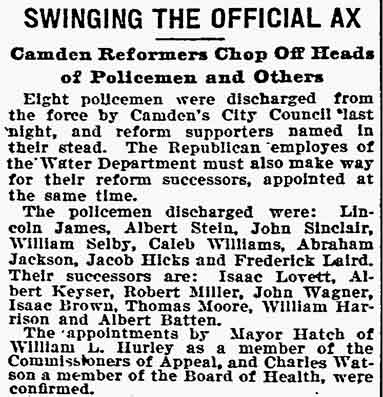
Camden Reformers Chop Off Heads of Policemen and Others
Eight policemen were discharged from the force by Camden’s City Council last night, and reform supporters named in their stead. The Republican employes of the Water Department must also make way for their reform successors, appointed at the same time.
The policemen discharged were: Lincoln James, Albert Stein, John Sinclair, William Selby, Caleb Williams, Abraham Jackson, Jacob Hicks and Frederick Laird. Their successors are: Isaac Lovett, Albert Keyser, Robert Miller, John Wagner, Isaac Brown, Thomas Moore, William Harrison and Albert Batten.
The appointments by Mayor Hatch of William L. Hurley as a member of the Commissioners of Appeal, and Charles Watson a member of the Board of Health, were confirmed.
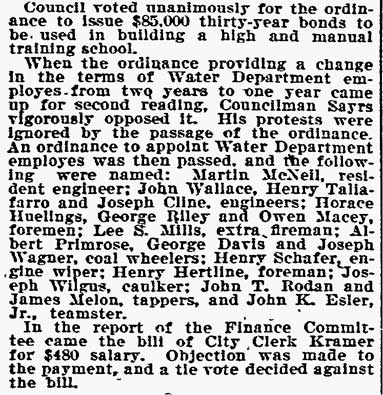
Council voted unanimously for the ordinance to issue $85,000 thirty-year bonds to be used in building a high and manual training school.
When the ordinance providing a change in the terms of Water Department employes from two years to one year came up for second reading, Councilman Sayrs vigorously opposed it. His protests were ignored by the passage of the ordinance. An ordinance to appoint Water Department employes was then passed, and the following were named: Martin McNeil, resident engineer; John Wallace, Henry Taliafarro and Joseph Cline, engineers; Horace Huelings, George Riley and Owen Macey, foremen; Lee S. Mills, extra fireman; Albert Primrose, George Davis and Joseph Wagner, coal wheelers; Henry Schafer, engine wiper; Henry Hertline, foreman; Joseph Wilgus, caulker; John T. Rodan and James Melon, tappers, and John K. Esler, Jr., teamster.
In the report of the Finance Committee came the bill of City Clerk Kramer for $480 salary. Objection was made to the payment, and a tie vote decided against the bill.
Thirteen Victims of the Reform Ax
Philadelphia Inquirer —
Republican Janitors Summarily Removed by Camden School Board
REFORMERS GET PLACES
Charges Against the Deposed Officials Not Made Public. High School Site
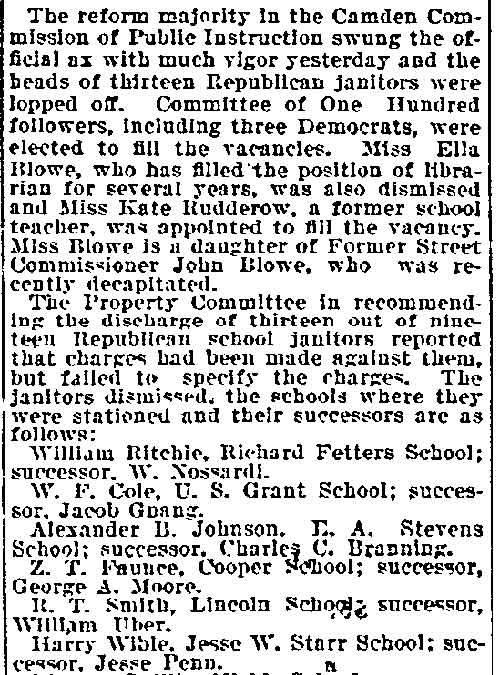
The reform majority in the Camden Commission of Public Instruction swung the official ax with much vigor yesterday and the heads of thirteen Republican janitors were lopped off. Committee of One Hundred followers, including three Democrats, were elected to fill the vacancies. Miss Ella Blowe, who has filled the position of librarian for several years, was also dismissed and Miss Kate Rudderow, a former school teacher, was appointed to fill the vacancy. Miss Blowe is a daughter of Former Street Commissioner John Blowe, who was recently decapitated.
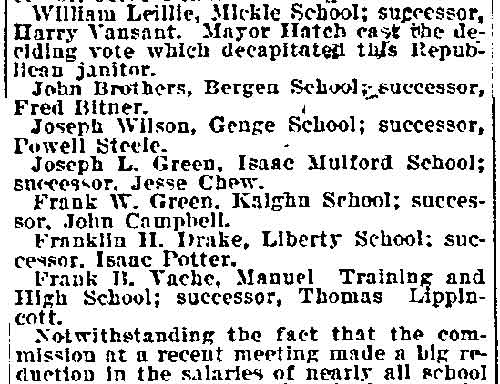
The Property Committee in recommending the discharge of thirteen out of nineteen Republican school janitors reported that charges had been made against them, but failed to specify the charges. The janitors dismissed, the schools where they were stationed and their successors are as follows:
William Ritchie, Richard Fetters School; successor, W. Nossardi.
W. F. Cole, U. S. Grant School; successor, Jacob Gnang.
Alexander B. Johnson, E. A. Stevens School; successor, Charles C. Branning.
Z. T. Faunce, Cooper School; successor, George A. Moore.
R. T. Smith, Lincoln School; successor, William Uber.
Harry Wible, Jesse W. Starr School; successor, Jesse Penn.
William Leillie, Mickle School; successor, Harry Vansant. Mayor Hatch cast the deciding vote which decapitated this Republican janitor.
John Brothers, Bergen School; successor, Fred Bitner.
Joseph Wilson, Genge School; successor, Powell Steele.
Joseph L. Green, Isaac Mulford School; successor, Jesse Chew.
Frank W. Green, Kaighn School; successor, John Campbell.
Franklin H. Drake, Liberty School; successor, Isaac Potter.
Frank B. Vache, Manual Training and High School; successor, Thomas Lippincott.
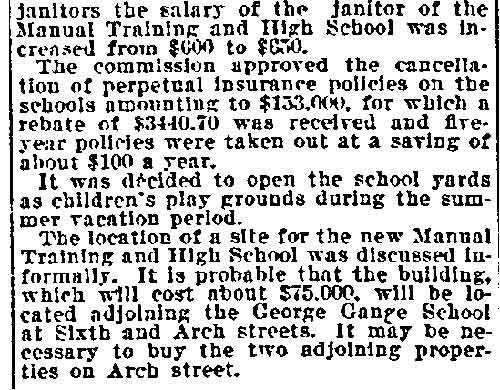
Notwithstanding the fact that the commission at a recent meeting made a big reduction in the salaries of nearly all school janitors the salary of the janitor of the Manual Training and High School was increased from $600 to $670.
The commission approved the cancellation of perpetual insurance policies on the schools amounting to $133,000, for which a rebate of $3440.70 was received and five-year policies were taken out at a saving of about $100 a year.
It was decided to open the school yards as children’s play grounds during the summer vacation period.
The location of a site for the new Manual Training and High School was discussed informally. It is probable that the building, which will cost about $75,000, will be located adjoining the George Genge School at Sixth and Arch streets. It may be necessary to buy the two adjoining properties on Arch street.
Hatch Will Rule With a Firm Hand
Philadelphia Inquirer —
Police Department to Be Reorganized and Excise Commission Abolished
MAYOR WILL BOSS POLICE
Lieutenant Foster Made Acting Chief—Reform Pledges to Be Carried Out in Camden
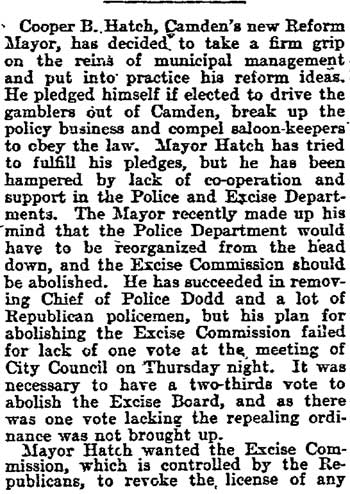
Cooper B. Hatch, Camden’s new Reform Mayor, has decided to take a firm grip on the reins of municipal management and put into practice his reform ideas. He pledged himself if elected to drive the gamblers out of Camden, break up the policy business and compel saloon-keepers to obey the law. Mayor Hatch has tried to fulfill his pledges, but he has been hampered by lack of co-operation and support in the Police and Excise Departments. The Mayor recently made up his mind that the Police Department would have to be reorganized from the head down, and the Excise Commission should be abolished. He has succeeded in removing Chief of Police Dodd and a lot of Republican policemen, but his plan for abolishing the Excise Commission failed for lack of one vote at the meeting of City Council on Thursday night. It was necessary to have a two-thirds vote to abolish the Excise Board, and as there was one vote lacking the repealing ordinance was not brought up.
Mayor Hatch wanted the Excise Commission, which is controlled by the Republicans, to revoke the license of any saloon-keeper twice convicted of violating the excise ordinances. Failing to get assurance of co-operation in compelling saloon-keepers to obey the law, the Mayor will have the commission abolished if it is possible to get the one needed vote. If the Excise Board is wiped out the power of granting and revoking liquor licenses will revert to City Council. Mayor Hatch’s reform crusade includes, it is said, the closing of a considerable number of saloons of a low order that are harboring places for policy writers and disreputable characters.
The Mayor intends to personally direct the work of the policemen in carrying out his reform ideas. The removal of Chief Dodd is to be followed by a vigorous shake-up throughout the department. Every wearer of the blue and brass will have to toe the mark and obey the Mayor’s orders, or charges will be preferred against him.
Lieutenant John Foster, of the South Camden district, yesterday was placed in charge of the Police Department as acting chief, and Policeman John Painter, who has been on the force for fifteen years, will succeed him as acting lieutenant. Lieutenant Foster is a Republican, but he does not allow politics to interfere with duty, and he will strictly carry out the Mayor’s orders. Policeman John Beard, who acted as hall sergeant and detective, has been transferred to patrol duty in the Fifth ward.
Chief of Police Dodd, who was ordered to surrender his post yesterday, did so under protest. He informed the Mayor that he had engaged Attorney-General Gray to contest his removal and to bring suit against the city for eleven months’ salary due him for the time he was kept out of his office by the Democratic Police Commission five years ago.
Mayor Will Be Chief
Camden Post —
Dodd’s Successor Not Yet Appointed—The New Patrolmen.
After the City Council had adjourned Mayor Hatch announced the following appointments to succeed the policemen dismissed:
Thomas Cunningham, Eighth ward, to succeed Alexander Osborne.
Frederick Triplett, Eighth ward, to succeed John Lightenberg.
Milus Appley, Seventh ward, to succeed C. H. Peters.
Harry Miller, Third ward, to succeed John Sailor.
Nelson Hubbs, Seventh ward, to succeed Josiah Sage
Thomas Pooley, Eighth ward, to succeed Thomas Buchanan.
Mayor Hatch stated that he would for the present make no appointment to fill the vacancy occasioned by the removal of Chief of Police Dodd, but that he would assume control of the office personally.
Dodd Will Appeal.
Mayor Hatch this morning officially notified Chief of Police Samuel Dodd of his dismissal. Chief Dodd will appeal to the courts.
Mayor Hatch to Appeal Court Contempt Fine
Philadelphia Inquirer —
Mayor Hatch, City Clerk Kramer and President of Council Taylor will probably appeal to the Court of Errors from the sentence of $200 fine and costs imposed by the Supreme Court for contempt in ignoring a writ of certiorari at the organization of City Council.
Police Appointments
Camden Daily Courier —
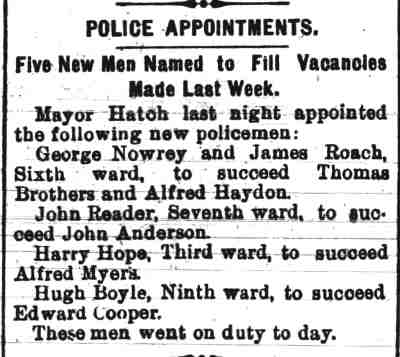
Five New Men Named to Fill Vacancies Made Last Week.
Mayor Hatch last night appointed the following new policemen:
George Nowrey and James Roach, Sixth ward, to succeed Thomas Brothers and Alfred Haydon.
John Reader, Seventh ward, to succeed John Anderson.
Harry Hope, Third ward, to succeed Alfred Myers.
Hugh Boyle, Ninth ward, to succeed Edward Cooper.
These men went on duty to day.
Camden to Go Dry
Philadelphia Inquirer —
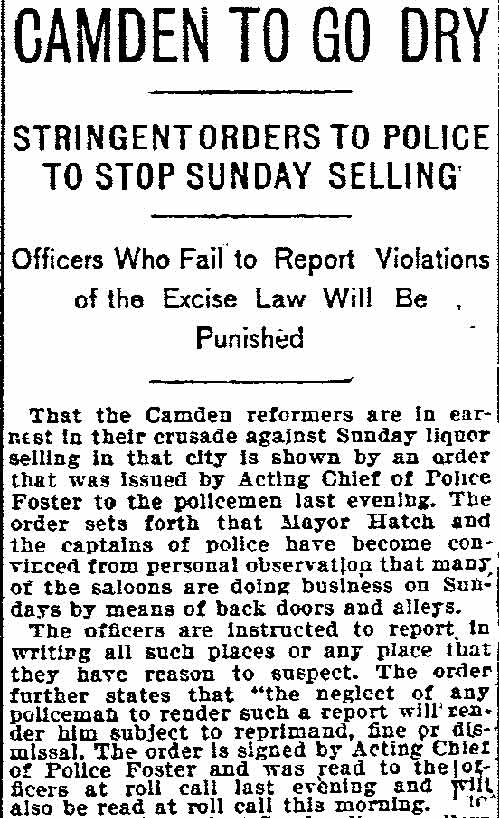
That the Camden reformers are in earnest in their crusade against Sunday liquor selling in that city is shown by an order that was issued by Acting Chief of Police Foster to the policemen last evening. The order sets forth that Mayor Hatch and the captains of police have become convinced from personal observation that many of the saloons are doing business on Sundays by means of back doors and alleys.
The officers are instructed to report in writing all such places or any place that they have reason to suspect. The order further states that “the neglect of any policeman to render such a report will render him subject to reprimand, fine or dismissal.” The order is signed by Acting Chief of Police Foster and was read to the officers at roll call last evening and will also be read at roll call this morning.
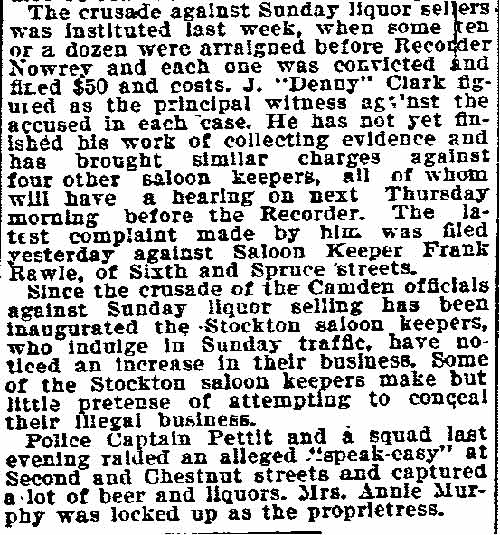
The crusade against Sunday liquor sellers was instituted last week, when some ten or a dozen were arraigned before Recorder Nowrey and each one was convicted and fined $50 and costs. J. “Denny” Clark figured as the principal witness against the accused in each case. He has not yet finished his work of collecting evidence and has brought similar charges against four other saloon keepers, all of whom will have a hearing on next Thursday morning before the Recorder. The latest complaint made by him was filed yesterday against Saloon Keeper Frank Rawle, of Sixth and Spruce streets.
Since the crusade of the Camden officials against Sunday liquor selling has been inaugurated the Stockton saloon keepers, who indulge in Sunday traffic, have noticed an increase in their business. Some of the Stockton saloon keepers make but little pretense of attempting to conceal their illegal business.
Police Captain Pettit and a squad last evening raided an alleged “speak-easy” at Second and Chestnut streets and captured a lot of beer and liquors. Mrs. Annie Murphy was locked up as the proprietress.
Camden’s New Chief of Police
Philadelphia Inquirer —
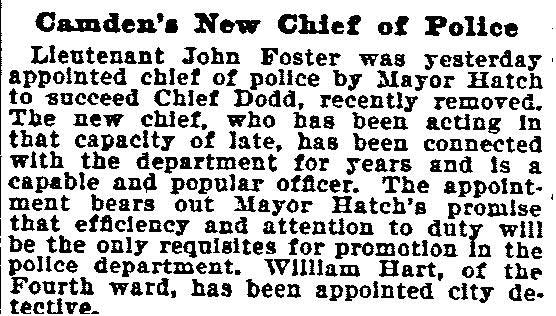
Lieutenant John Foster was yesterday appointed chief of police by Mayor Hatch to succeed Chief Dodd, recently removed. The new chief, who has been acting in that capacity of late, has been connected with the department for years and is a capable and popular officer. The appointment bears out Mayor Hatch’s promise that efficiency and attention to duty will be the only requisites for promotion in the police department. William Hart, of the Fourth ward, has been appointed city detective.
Over in Camden.
Philadelphia Inquirer —
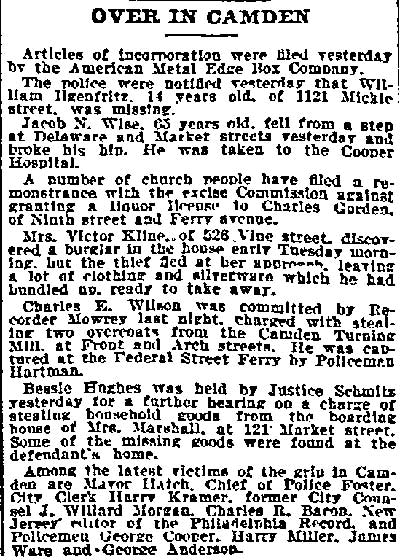
Articles of incorporation were filed yesterday by the American Metal Edge Box Company.
The police were notified yesterday that William Ilgenfritz, 14 years old, of 1121 Mickle street, was missing.
Jacob N. Wise, 65 years old, fell from a step at Delaware and Market streets yesterday and broke his hip. He was taken to the Cooper Hospital.
A number of church people have filed a remonstrance with the excise Commission against granting a liquor license to Charles Gorden, of Ninth street and Ferry avenue.
Mrs. Victor Kline, of 526 Vine street, discovered a burglar in the house early Tuesday morning, but the thief fled at her approach, leaving a lot of clothing and silverware which he had bundled up, ready to take away.
Charles E. Wilson was committed by Recorder Mowrey [sic] last night, charged with stealing two overcoats from the Camden Turning Mill, at Front and Arch streets. He was captured at the Federal Street Ferry by Policemen [sic] Hartman.
Bessie Hughes was held by Justice Schmitz yesterday for a further hearing on a charge of stealing household goods from the boarding house of Mrs. Marshall, at 121 Market street. Some of the missing goods were found at the defendant’s home.
Among the latest victims of the grip in Camden are Mayor Hatch, Chief of Police Foster, City Clerk Harry Kramer, former City Counsel J. Willard Morgan, Charles R. Baron, New Jersey editor of the Philadelphia Record, and Policemen George Cooper, Harry Miller, James Ware and George Anderson.
Captain Pettitt Reduced.
Camden Daily Telegram —
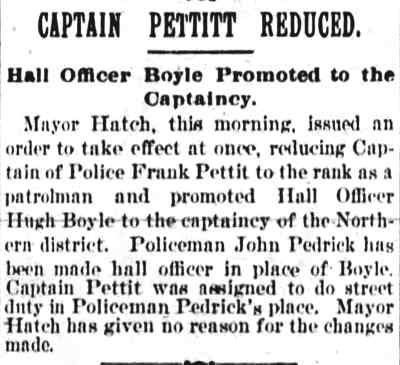
Hall Officer Boyle Promoted to the Captaincy.
Mayor Hatch, this morning, issued an order to take effect at once, reducing Captain of Police Frank Pettit to the rank as a patrolman and promoted Hall Officer Hugh Boyle to the captaincy of the Northern district. Policeman John Pedrick has been made hall officer in place of Boyle. Captain Pettit was assigned to do street duty in Policeman Pedrick’s place. Mayor Hatch has given no reason for the changes made.
"Bitter Primary Elections"
Camden Daily Telegram —
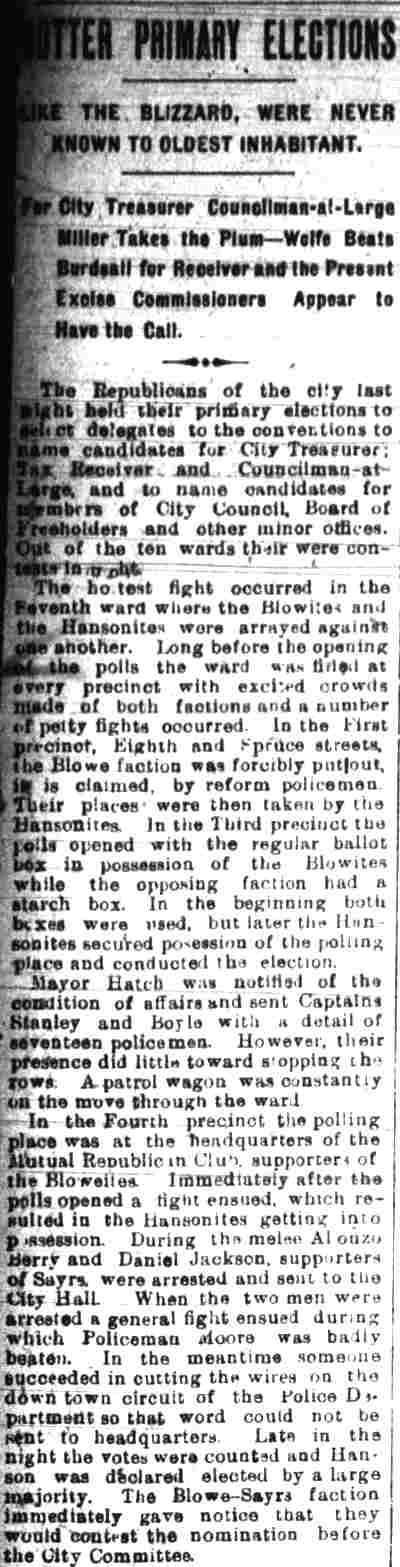
BITTER PRIMARY ELECTIONS
LIKE THE BLIZZARD, WERE NEVER KNOWN TO OLDEST INHABITANT.
For City Treasurer Councilman-at-Large Miller Takes the Plum — Wolfe Beats Burdsall for Receiver and the Present Excise Commissioners Appear to Have the Call.
The Republicans of the city last night held their primary elections to select delegates to the conventions to name candidates for City Treasurer, Tax Receiver and Councilman-at-Large, and to name candidates for members of City Council, Board of Freeholders and other minor offices. Out of the ten wards their were contests in eight.
The hottest fight occurred in the Seventh ward where the Blowites and the Hansonites were arrayed against one another. Long before the opening of the polls the ward was filled at every precinct with excited crowds made of both factions and a number of petty fights occurred. In the First precinct, Eighth and Spruce streets, the Blowe faction was forcibly put out, it is claimed, by reform policemen. Their places were then taken by the Hansonites. In the Third precinct the polls opened with the regular ballot box in possession of the Blowites while the opposing faction had a starch box. In the beginning both boxes were used, but later the Hansonites secured possession of the polling place and conducted the election.
Mayor Hatch was notified of the condition of affairs and sent Captains Stanley and Boyle with a detail of seventeen policemen. However, their presence did little toward stopping the rows. A patrol wagon was constantly on the move through the ward.
In the Fourth precinct the polling place was at the headquarters of the Mutual Republican Club, supporters of the Blowites. Immediately after the polls opened a fight ensued, which resulted in the Hansonites getting into possession. During the melee Alonzo Berry and Daniel Jackson, supporters of Sayrs, were arrested and sent to the City Hall. When the two men were arrested a general fight ensued during which Policeman Moore was badly beaten. In the meantime someone succeeded in cutting the wires on the down town circuit of the Police Department so that word could not be sent to headquarters. Late in the night the votes were counted and Hanson was declared elected by a large majority. The Blowe-Sayrs faction immediately gave notice that they would contest the nomination before the City Committee.
Camden G.A.R. Posts Preparing for National Encampment
Philadelphia Inquirer —
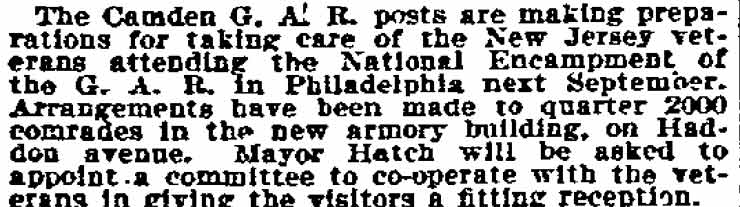
The Camden G. A. R. posts are making preparations for taking care of the New Jersey veterans attending the National Encampment of the G. A. R. in Philadelphia next September. Arrangements have been made to quarter 2000 comrades in the new armory building, on Haddon avenue. Mayor Hatch will be asked to appoint a committee to co-operate with the veterans in giving the visitors a fitting reception.
Bluecoats for East End
Camden Daily Courier —
EIGHT OF THE NEW GUARDIANS OF THE PEACE NAMED.
Captain Albert Will Have Charge of the New District—Former Chief Abbott Among the Batch of New Appointees.
Eight of the prospective policemen from the Eleventh and Twelfth wards were at the City Hall this morning. They were called into the office of Chief Foster, and then one by one were introduced by the Chief to Mayor Hatch in his private office. The interview with the Mayor was apparently satisfactory, as each man when he emerged from the office of the Mayor wore a broad smile.
Those who have thus far been named, and who will be given their stars as soon as the present force resign or are removed are: Joseph Schmid, Charles D. Ridgely, Samuel Flick, Alberton L. Matlock, Rowland C. E. English, Horatio Sewell, Ferdinand Sell and Robert Abbott. The latter is acting captain of the annexed district, which will be in charge of of [sic] Captain Albert when the reorganized force goes on duty.
Over in Camden
Philadelphia Inquirer —
Mayor Hatch last evening appointed Samuel Paul, of the First ward, a sub-policeman.
Commencing to-day the public schools will hold half-day sessions until vacation time.
The thirty-fourth anniversary of the Camden Home for Friendless Children was celebrated yesterday.
The East Side policemen recently appointed by Mayor Hatch went on duty at midnight last night. The deposed policemen gave up their positions without a protest.
Police Win Again
Philadelphia Inquirer —
Camden Trolley Company’s Latest Attempt at Track-Laying Easily Stopped
TROLLEY MEN ARRESTED
Mayor Hatch Rushed Out and Ordered Police to Clear the Street—Strategy That Was Not Successful
The Camden and Suburban Railway Company’s latest attempt to lay an additional track on Haddon avenue, Camden, was not a success. Their men were easily routed by the police yesterday. George Danks, foreman of a gang of laborers, and Willis Godfrey, colored, took picks and attempted to tear up the concrete foundation on the street, but were arrested and held for further hearings next Thursday. It is probable that the courts will be appealed to before the attempt to lay tracks on Haddon avenue is renewed.
During the clash with the city authorities yesterday General Manager Walter E. Harrington, of the trolley company, was present with a stenographer, and the latter made notes of all that was said and done. Mr. Harrington admitted that this was for the purpose of commencing legal proceedings.
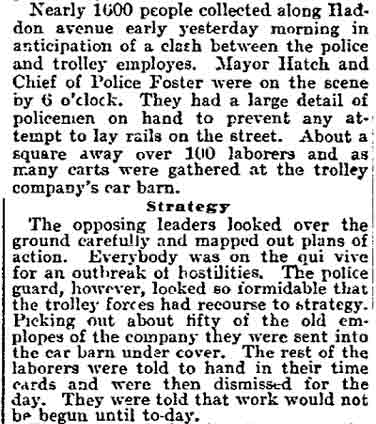
Nearly 1600 people collected along Haddon avenue early yesterday morning in anticipation of a clash between the police and trolley employes. Mayor Hatch and Chief of Police Foster were on the scene by 6 o’clock. They had a large detail of policemen on hand to prevent any attempt to lay rails on the street. About a square away over 100 laborers and as many carts were gathered at the trolley company’s car barn.
Strategy
The opposing leaders looked over the ground carefully and mapped out plans of action. Everybody was on the qui vive for an outbreak of hostilities. The police guard, however, looked so formidable that the trolley forces had recourse to strategy. Picking out about fifty of the old employes of the company they were sent into the car barn under cover. The rest of the laborers were told to hand in their time cards and were then dismissed for the day. They were told that work would not be begun until to-day.
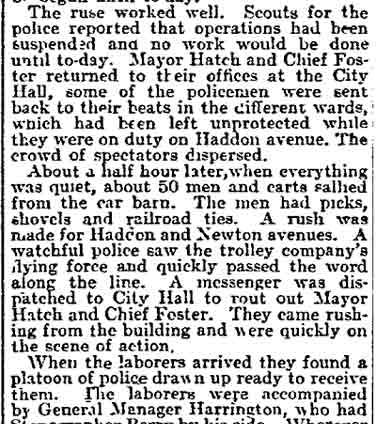
The ruse worked well. Scouts for the police reported that operations had been suspended and no work would be done until to-day. Mayor Hatch and Chief Foster returned to their offices at the City Hall, some of the policemen were sent back to their beats in the different wards, which had been left unprotected while they were on duty on Haddon avenue. The crowd of spectators dispersed.
About a half hour later, when everything was quiet, about 50 men and carts sallied from the car barn. The men had picks, shovels and railroad ties. A rush was made for Haddon and Newton avenues. A watchful police saw the trolley company’s flying force and quickly passed the word along the line. A messenger was dispatched to City Hall to rout out Mayor Hatch and Chief Foster. They came rushing from the building and were quickly on the scene of action.
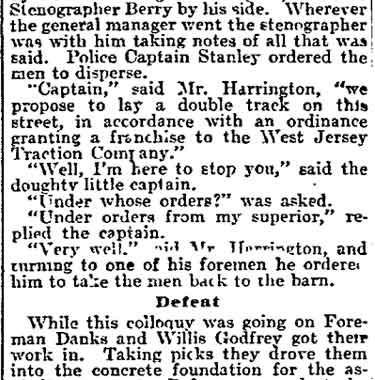
When the laborers arrived they found a platoon of police drawn up ready to receive them. The laborers were accompanied by General Manager Harrington, who had Stenographer Berry by his side. Wherever the general manager went the stenographer was with him taking notes of all that was said. Police Captain Stanley ordered the men to disperse.
“Captain,” said Mr. Harrington, “we propose to lay a double track on this street, in accordance with an ordinance granting a franchise to the West Jersey Traction Company.”
“Well, I’m here to stop you,” said the doughty little captain.
“Under whose orders?” was asked.
“Under orders from my superior,” replied the captain.
“Very well,” said Mr. Harrington, and turning to one of his foremen he ordered him to take the men back to the barn.
Defeat
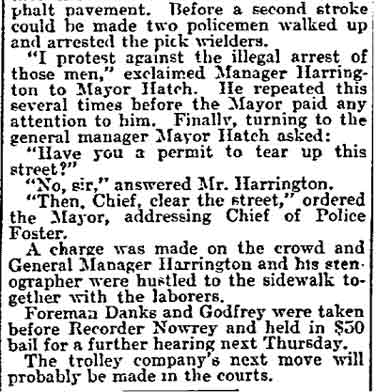
While this colloquy was going on Foreman Danks and Willis Godfrey got their work in. Taking picks they drove them into the concrete foundation for the asphalt pavement. Before a second stroke could be made two policemen walked up and arrested the pick wielders.
“I protest against the illegal arrest of those men,” exclaimed Manager Harrington to Mayor Hatch. He repeated this several times before the Mayor paid any attention to him. Finally, turning to the general manager Mayor Hatch asked:
“Have you a permit to tear up this street?”
“No, sir,” answered Mr. Harrington.
“Then, Chief, clear the street,” ordered the Mayor, addressing Chief of Police Foster.
A charge was made on the crowd and General Manager Harrington and his stenographer were hustled to the sidewalk together with the laborers.
Foreman Danks and Godfrey were taken before Recorder Nowrey and held in $50 bail for a further hearing next Thursday.
The trolley company’s next move will probably be made in the courts.
Mayor Hatch By His Veto Saves Money for Camden Taxpayers
Philadelphia Inquirer —
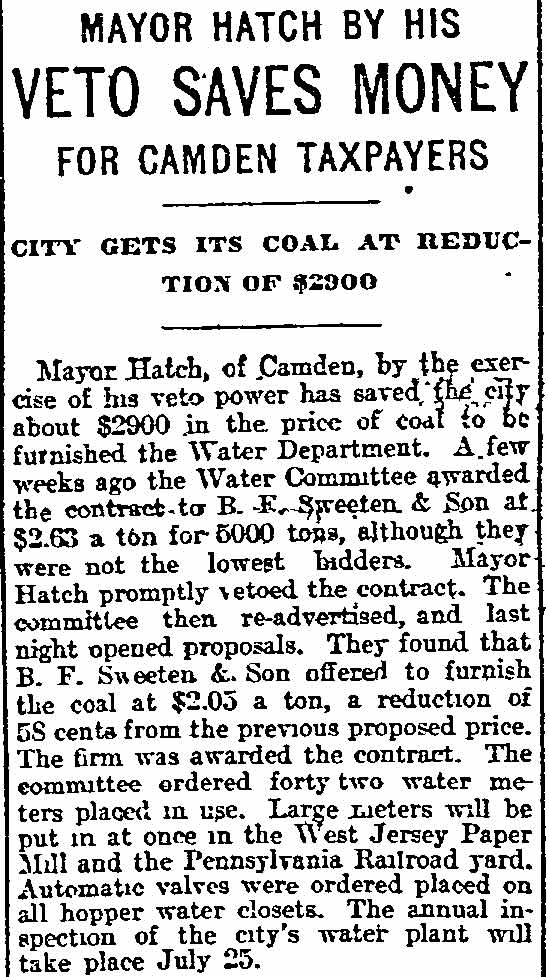
CITY GETS ITS COAL AT REDUCTION OF $2900
Mayor Hatch, of Camden, by the exercise of his veto power has saved the city about $2900 in the price of coal to be furnished the Water Department. A few weeks ago the Water Committee awarded the contract to B. F. Sweeten & Son at $2.63 a ton for 5000 tons, although they were not the lowest bidders. Mayor Hatch promptly vetoed the contract. The committee then re-advertised, and last night opened proposals. They found that B. F. Sweeten & Son offered to furnish the coal at $2.05 a ton, a reduction of 58 cents from the previous proposed price. The firm was awarded the contract. The committee ordered forty two water meters placed in use. Large meters will be put in at once in the West Jersey Paper Mill and the Pennsylvania Railroad yard. Automatic valves were ordered placed on all hopper water closets. The annual inspection of the city’s water plant will take place July 25.
Evil Doers Quake
Philadelphia Inquirer —

Mayor Hatch, of Camden, Starts in to Wipe Out Speak-Easies
FIRST RAID A SUCCESS
Fines Imposed by Recorder Nowrey for Operating Gambling Machines. Sunday Sellers Hope to Escape
Mayor Cooper B. Hatch is making life miserable for evil doers in Camden. After waging relentless warfare on Sunday liquor sellers and seizing all the gambling machines in saloons and cigar stores, he is now clearing out speak-easies. The first raid was made yesterday afternoon, when Captain Stanley, Sergeant Hyde, Detective Painter and Policeman Shaw swooped down on Mrs. Mary Mahan’s house, at 1062 South Front street. They found nearly enough liquor there to stock a saloon. There were two cases of bottled beer, five gallons of whisky, a large quantity of California wines, and other “wet” goods. This was all confiscated and was sent to the City Hall, together with Mrs. Mahan and a young girl.
For some time past Mayor Hatch’s private detectives have been gathering evidence against speak-easies and disorderly houses in different parts of the city, and several more arrests will be made.
The saloonkeepers arrested about ten days ago for operating slot machines in their places were arraigned yesterday before Recorder Nowrey. Maurice Hertz, of Locust street and Kaighn avenue, was the first to be tried. He was represented by former Judge Howard Carrow. The complaints against Hertz charged him with operating nickel-in-the-slot gambling machines on July 2 and 9.
Harry Williams, one of Secretary Gibboney’s detectives, who was employed in the recent Sunday liquor crusade, testified that he played “The Owl” in Hertz’s saloon on July 9. He lost five cents on the red but hit the black and quit even. On cross-examination Williams refused to tell by whom he was employed, and Recorder Nowrey would not compel him to answer. Detective Fields swore that he was with Williams in Hertz’s place, and also played the slot machine. Police Captain Stanley said he found four of the slot machines in Hertz’s place when he made the raid.
At this point Judge Carrow moved to dismiss the complaint, as it was dated in the year “189.” Decision was reserved, and the other complaint was taken up. Judge Carrow wanted this set aside on the ground that it did not specify the premises where the law was alleged to have been violated. Recorder Nowrey overruled the motion.
Detective Graper said he played the slot machine at Hertz’s saloon on Sunday, July 2. On cross-examination he refused to give his address, but said he worked for Mayor Hatch. He didn’t know, he said, whether he was on the city pay roll.
David B. Kaighn and other Kaighn avenue residents testified that they never saw slot machines in operation in Hertz’s place, but had seen them standing in the office.
Hertz, in his own defense, said he was agent for the slot machines, and those found in his office were samples to be examined by prospective purchasers.
Recorder Nowrey sentenced Hertz to pay a fine of $50 and costs. Judge Carrow gave notice that he would appeal the case, but the Recorder refused to permit Hertz to depart without paying the fine.
Peter Kelly, of Eighth street and Ferry avenue, was also convicted and paid his fine.
John Keefe, of Haddon avenue and Carman street, and Marshall Hutchinson, of Ninth and Walnut streets, pleaded guilty and were fined $50 and costs each. There were about seven more cases, which Recorder Nowrey adjourned until next Wednesday.
The 130 saloonkeepers rounded up in the recent crusade against Sunday liquor selling were in high glee yesterday over the discovery of a law that they hoped would save them from punishment for their alleged misdoings. This law was passed in 1874, and makes it unlawful to prosecute any person by indictment for violations of the liquor laws in municipalities where city ordinances provide punishment for such offenses. As the Supreme Court has set aside the Camden excise ordinance, the saloonkeepers hoped to escape further prosecution.
City Counsel Bleakly, after looking up the matter yesterday, said: “A house in which the unlawful sale of liquors is habitually made is an indictable nuisance, although there is a city ordinance prescribing penalty for such sales. Such traffic is not only a breach of the city law, but is also forbidden by the State law.” This decision was made by Judge Van Syckel in 1880, in the Court of Errors and Appeals, and was reaffirmed in 1888. It is now a State law.
The Excise Commission, at its regular meeting next Wednesday evening, will probably adopt a substitute ordinance against Sunday liquor selling to conform to the city charter, under the Supreme Court’s decision setting aside the old ordinance.
Policeman Butts’ Funeral
Camden Post-Telegram —
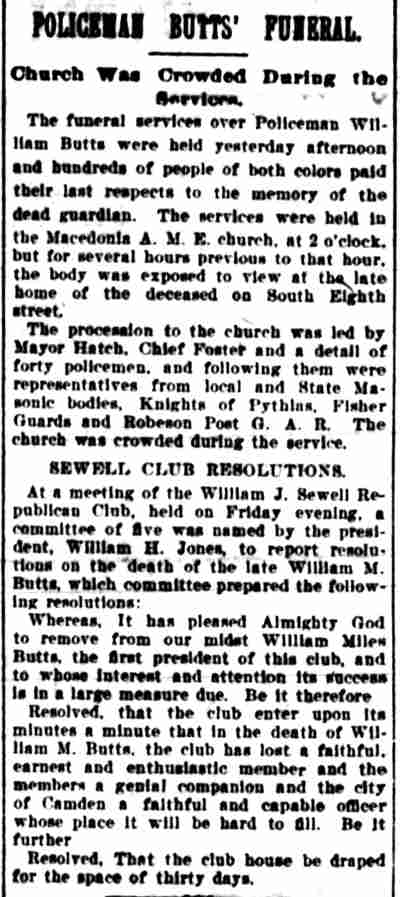
Church Was Crowded During the Services.
The funeral services over Policeman William Butts were held yesterday afternoon and hundreds of people of both colors paid their last respects to the memory of the dead guardian. The services were held in the Macedonia A. M. E. church, at 2 o’clock, but for several hours previous to that hour, the body was exposed to view at the late home of the deceased on South Eighth street.
The procession to the church was led by Mayor Hatch, Chief Foster and a detail of forty policemen, and following them were representatives from local and State Masonic bodies, Knights of Pythias, Fisher Guards and Robeson Post G. A. R. The church was crowded during the service.
SEWELL CLUB RESOLUTIONS.
At a meeting of the William J. Sewell Republican Club, held on Friday evening, a committee of five was named by the president, William H. Jones, to report resolutions on the death of the late William M. Butts, which committee prepared the following resolutions:
Whereas, It has pleased Almighty God to remove from our midst William Miles Butts, the first president of this club, and to whose interest and attention its success is in a large measure due. Be it therefore
Resolved, that the club enter upon its minutes a minute that in the death of William M. Butts, the club has lost a faithful, earnest and enthusiastic member and the members a genial companion and the city of Camden a faithful and capable officer, whose place it will be hard to fill. Be it further
Resolved, That the club house be draped for the space of thirty days.
William Horner Appointed Patrolman
Camden Daily Courier —
The appointment by Mayor Hatch of William Horner as patrolman will be very satisfactory here. “Bill” was a volunteer in the late war, and while he was not in actual battle, his disposition was good, and he would have given a good account of himself in action. He is a giant in size, and is perfectly familiar with the ground here.
Mayor Hatch to Name Thirteen New Policemen
Philadelphia Inquirer —

Now that the primary election is over Mayor Hatch will name the thirteen new policemen to go on duty on October 1. There are about ten applicants for each position.
Added to the “Finest.”
Camden Daily Courier —
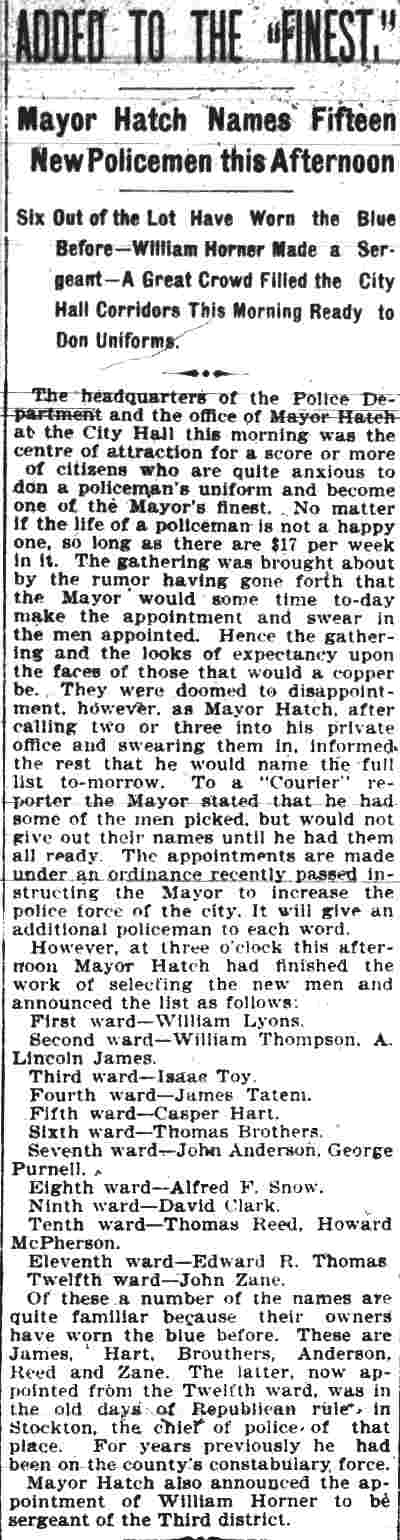
Mayor Hatch Names Fifteen New Policemen this Afternoon
Six Out of the Lot Have Worn the Blue Before—William Horner Made a Sergeant—A Great Crowd Filled the City Hall Corridors This Morning Ready to Don Uniforms.
The headquarters of the Police Department and the office of Mayor Hatch at the City Hall this morning was the centre of attraction for a score or more of citizens who are quite anxious to don a policeman’s uniform and become one of the Mayor’s finest. No matter if the life of a policeman is not a happy one, so long as there are $17 per week in it. The gathering was brought about by the rumor having gone forth that the Mayor would some time to-day make the appointment and swear in the men appointed. Hence the gathering and the looks of expectancy upon the faces of those that would a copper be. They were doomed to disappointment, however, as Mayor Hatch, after calling two or three into his private office and swearing them in, informed the rest that he would name the full list to-morrow. To a “Courier” reporter the Mayor stated that he had some of the men picked, but would not give out their names until he had them all ready. The appointments are made under an ordinance recently passed instructing the Mayor to increase the police force of the city. It will give an additional policeman to each word [sic].
However, at three o’clock this afternoon Mayor Hatch had finished the work of selecting the new men and announced the list as follows:
First ward—William Lyons.
Second ward—William Thompson. A. Lincoln James.
Third ward—Isaac Toy.
Fourth ward—James Tatem.
Fifth ward—Casper Hart.
Sixth ward—Thomas Brothers.
Seventh ward—John Anderson. George Purnell.
Eighth ward—Alfred F. Snow.
Ninth ward—David Clark.
Tenth ward—Thomas Reed. Howard McPherson.
Eleventh ward—Edward R. Thomas
Twelfth ward—John Zane.
Of these a number of the names are quite familiar because their owners have worn the blue before. These are James, Hart, Brouthers, Anderson, Reed and Zane. The latter, now appointed from the Twelfth ward, was in the old days of Republican rule, in Stockton, the chief of police of that place. For years previously he had been on the county’s constabulary force.
Mayor Hatch also announced the appointment of William Horner to be sergeant of the Third district.
Camden’s Police Force Increased
Philadelphia Inquirer —
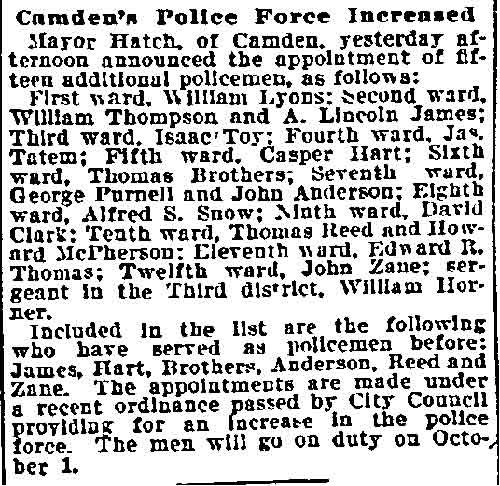
Mayor Hatch, of Camden, yesterday afternoon announced the appointment of fifteen additional policemen, as follows:
First ward, William Lyons; Second ward, William Thompson and A. Lincoln James; Third ward, Isaac Toy; Fourth ward, Jas. Tatem; Fifth ward, Casper Hart; Sixth ward, Thomas Brothers; Seventh ward, George Purnell and John Anderson; Eighth ward, Alfred S. Snow; Ninth ward, David Clark; Tenth ward, Thomas Reed and Howard McPherson; Eleventh ward, Edward R. Thomas; Twelfth ward, John Zane; sergeant in the Third district, William Horner.
Included in the list are the following who have served as policemen before: James, Hart, Brothers, Anderson, Reed and Zane. The appointments are made under a recent ordinance passed by City Council providing for an increase in the police force. The men will go on duty on October 1.
Could Not Agree on New Fireman
Philadelphia Inquirer —
Camden Councilmen From East Side Split on Selecting Appointees
There Is Also Trouble in the Second Ward — Benjamin Kellum Made Assistant Chief — Other Promotions
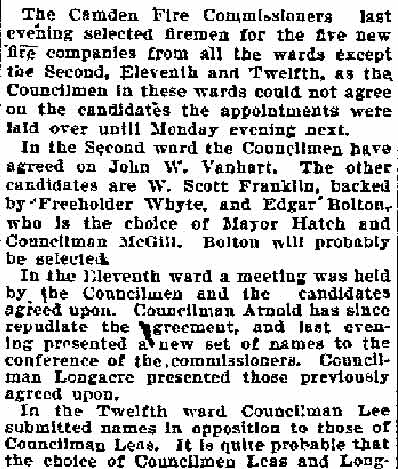
The Camden Fire Commissioners last evening selected firemen for the five new fire companies from all the wards except the Second, Eleventh and Twelfth, as the Councilmen in these wards could not agree on the candidates the appointments were laid over until Monday evening next.
In the Second ward the Councilmen have agreed on John W. Vanhart. The other candidates are W. Scott Franklin, backed by Freeholder Whyte, and Edgar Bolton, who is the choice of Mayor Hatch and Councilman McGill. Bolton will probably be selected.
In the Eleventh ward a meeting was held by the Councilmen and the candidates agreed upon. Councilman Arnold has since repudiate [sic] the agreement, and last evening presented a new set of names to the conference of the commissioners. Councilman Longacre presented those previously agreed upon.
In the Twelfth ward Councilman Lee submitted names in opposition to those of Councilman Leas. It is quite probable that the choice of Councilmen Leas and Longacre, who are members of the Fire Committee, will be selected.
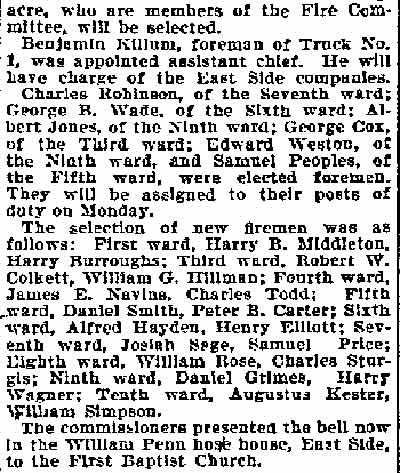
Benjamin Kellum, foreman of Truck No. 1, was appointed assistant chief. He will have charge of the East Side companies.
Charles Robinson, of the Seventh ward; George B. Wade, of the Sixth ward; Albert Jones, of the Ninth ward; George Cox, of the Third ward; Edward Weston, of the Ninth ward, and Samuel Peoples, of the Fifth ward, were elected foremen. They will be assigned to their posts of duty on Monday.
The selection of new firemen was as follows: First ward, Harry B. Middleton, Harry Burroughs; Third ward, Robert W. Colkett, William G. Hillman; Fourth ward, James E. Navins, Charles Todd; Fifth ward, Daniel Smith, Peter B. Carter; Sixth ward, Alfred Hayden, Henry Elliott; Seventh ward, Josiah Sage, Samuel Price; Eighth ward, William Rose, Charles Sturgis; Ninth ward, Daniel Grimes, Harry Wagner; Tenth ward, Augustus Kester, William Simpson.
The commissioners presented the bell now in the William Penn hose house, East Side, to the First Baptist Church.
Want to Be Firemen
Philadelphia Inquirer —
There’ll Be Trouble in Finding Places for All Hands
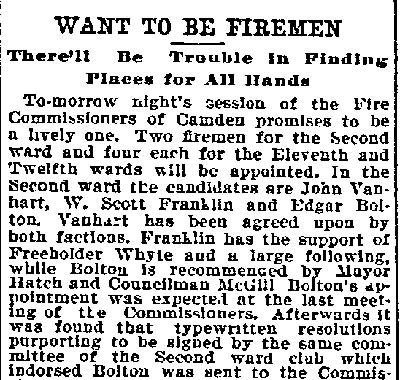
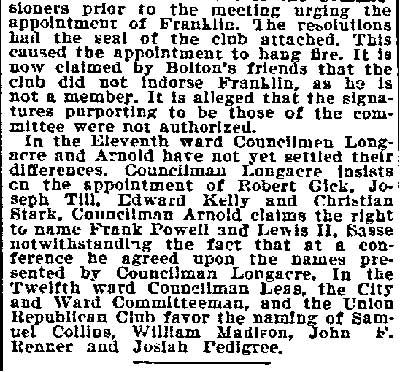
To-morrow night’s session of the Fire Commissioners of Camden promises to be a lively one. Two firemen for the Second ward and four each for the Eleventh and Twelfth wards will be appointed. In the Second ward the candidates are John Vanhart, W. Scott Franklin and Edgar Bolton. Vanhart has been agreed upon by both factions. Franklin has the support of Freeholder Whyte and a large following, while Bolton is recommended by Mayor Hatch and Councilman McGill. Bolton’s appointment was expected at the last meeting of the Commissioners. Afterwards it was found that typewritten resolutions purporting to be signed by the same committee of the Second ward club which indorsed Bolton was sent to the Commissioners prior to the meeting urging the appointment of Franklin. The resolutions had the seal of the club attached. This caused the appointment to hang fire. It is now claimed by Bolton’s friends that the club did not indorse Franklin, as he is not a member. It is alleged that the signatures purporting to be those of the committee were not authorized.
In the Eleventh ward Councilmen Longacre and Arnold have not yet settled their differences. Councilman Longacre insists on the appointment of Robert Gick, Joseph Till, Edward Kelly and Christian Stark. Councilman Arnold claims the right to name Frank Powell and Lewis H. Sasse notwithstanding the fact that at a conference he agreed upon the names presented by Councilman Longacre. In the Twelfth ward Councilman Leas, the City and Ward Committeeman, and the Union Republican Club favor the naming of Samuel Collins, William Madison, John F. Renner and Josiah Pedigree.
Firemen Selected
Philadelphia Inquirer —
Mayor Hatch’s Candidates Were Pushed to the Front
Increase in Camden Fire Department Agreed Upon After Sharp Contest
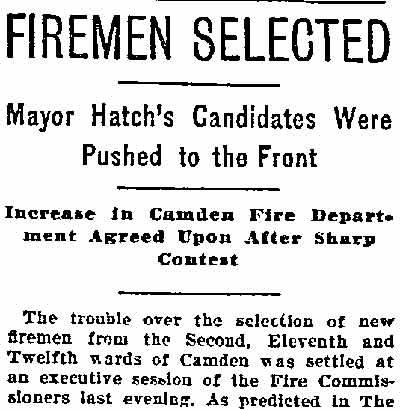
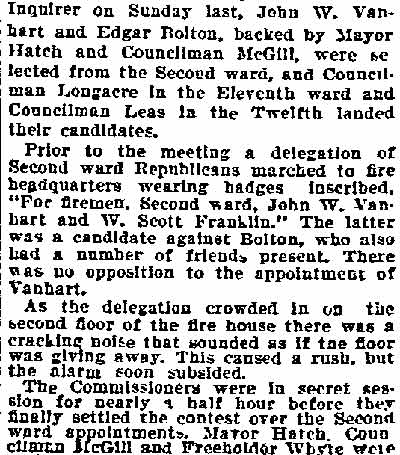
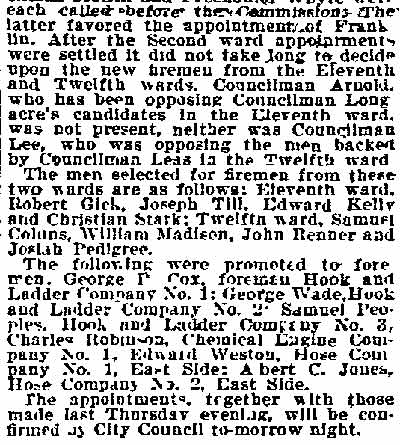
The trouble over the selection of new firemen from the Second, Eleventh and Twelfth wards of Camden was settled at an executive session of the Fire Commissioners last evening. As predicted in The Inquirer on Sunday last, John W. Vanhart and Edgar Bolton, backed by Mayor Hatch and Councilman McGill, were selected from the Second ward, and Councilman Longacre in the Eleventh ward and Councilman Leas in the Twelfth landed their candidates.
Prior to the meeting a delegation of Second ward Republicans marched to fire headquarters wearing badges inscribed, “For firemen, Second ward, John W. Vanhart and W. Scott Franklin.” The latter was a candidate against Bolton, who also had a number of friends present. There was no opposition to the appointment of Vanhart.
As the delegation crowded in on the second floor of the fire house there was a cracking noise that sounded as if the floor was giving away. This caused a rush, but the alarm soon subsided.
The Commissioners were in secret session for nearly a half hour before they finally settled the contest over the Second ward appointments. Mayor Hatch, Councilman McGill and Freeholder Whyte were each called before the Commissioners. The latter favored the appointment of Franklin. After the Second ward appointments were settled it did not take long to decide upon the new firemen from the Eleventh and Twelfth wards. Councilman Arnold, who has been opposing Councilman Longacre’s candidates in the Eleventh ward, was not present, neither was Councilman Lee, who was opposing the men backed by Councilman Leas in the Twelfth ward.
The men selected for firemen from these two wards are as follows: Eleventh ward, Robert Gick, Joseph Till, Edward Kelly and Christian Stark; Twelfth ward, Samuel Collins, William Madison, John Renner and Josiah Pedigree.
The following were promoted to foremen: George F. Cox, foreman Hook and Ladder Company No. 1; George Wade, Hook and Ladder Company No. 2; Samuel Peoples, Hook and Ladder Company No. 3; Charles Robinson, Chemical Engine Company No. 1; Edward Weston, Hose Company No. 1, East Side; Albert C. Jones, Hose Company No. 2, East Side.
The appointments, together with those made last Thursday evening, will be confirmed by City Council to-morrow night.
"Police Take a Hand at the Primaries"
Philadelphia Inquirer —
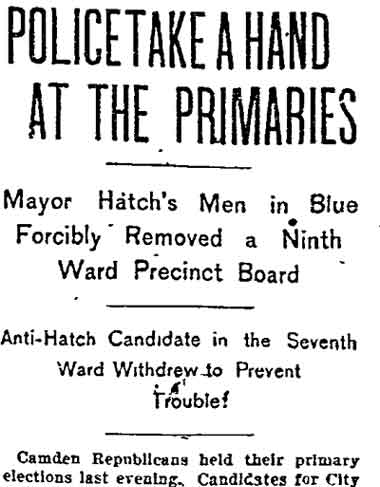
Mayor Hatch’s Men in Blue Forcibly Removed a Ninth Ward Precinct Board
Anti-Hatch Candidate in the Seventh Ward Withdrew to Prevent Trouble!
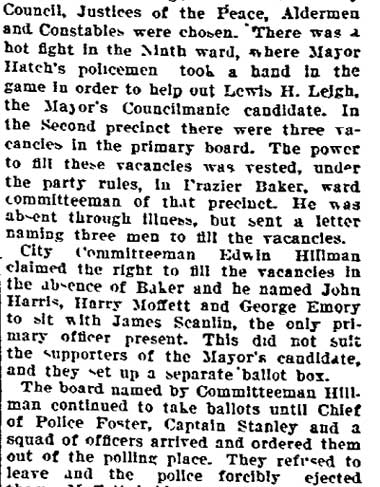
Camden Republicans held their primary elections last evening. Candidates for City Council, Justices of the Peace, Aldermen and Constables were chosen. There was a hot fight in the Ninth ward, where Mayor Hatch’s policemen took a hand in the game in order to help out Lewis H. Leigh, the Mayor’s Councilmanic candidate. In the Second precinct there were three vacancies in the primary board. The power to fill these vacancies was vested, under the party rules, in Frazier Baker, ward committeeman of that precinct. He was absent through illness, but sent a letter naming three men to fill the vacancies.
City Committeeman Edwin Hillman claimed the right to fill the vacancies in the absence of Baker and he named John Harris, Harry Moffett and George Emory to sit with James Scanlin, the only primary officer present. This did not suit the supporters of the Mayor’s candidate, and they set up a separate ballot box.
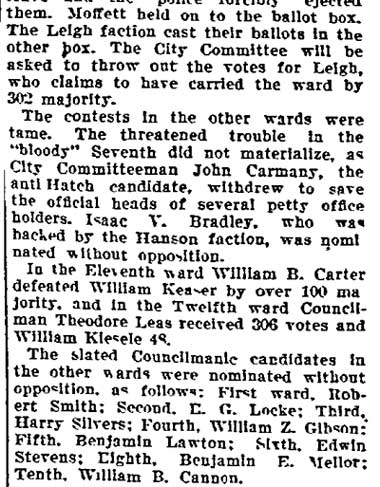
The board named by Committeeman Hillman continued to take ballots until Chief of Police Foster, Captain Stanley and a squad of officers arrived and ordered them out of the polling place. They refused to leave and the police forcibly ejected them. Moffett held on to the ballot box. The Leigh faction cast their ballots in the other box. The City Committee will be asked to throw out the votes for Leigh, who claims to have carried the ward by 302 majority.
The contests in the other wards were tame. The threatened trouble in the “bloody” Seventh did not materialize, as City Committeeman John Carmany, the anti Hatch candidate, withdrew to save the official heads of several petty office holders. Isaac V. Bradley, who was backed by the Hanson faction, was nominated without opposition.
In the Eleventh ward William B. Carter defeated William Keaser by over 100 majority, and in the Twelfth ward Councilman Theodore Leas received 306 votes and William Klesele 48.
The slated Councilmanic candidates in the other wards were nominated without opposition, as follows: First ward, Robert Smith; Second, E. G. Locke; Third, Harry Silvers; Fourth, William Z. Gibson; Fifth, Benjamin Lawton; Sixth, Edwin Stevens; Eighth, Benjamin E. Mellor; Tenth, William B. Cannon.
Still Probing Sunday Liquor Selling Cases
Philadelphia Inquirer —
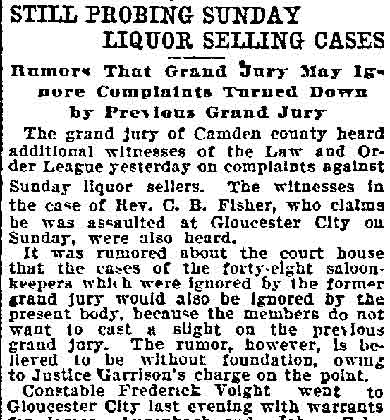
Rumors That Grand Jury May Ignore Complaints Turned Down by Previous Grand Jury
The grand jury of Camden county heard additional witnesses of the Law and Order League yesterday on complaints against Sunday liquor sellers. The witnesses in the case of Rev. C. B. Fisher, who claims he was assaulted at Gloucester City on Sunday, were also heard.
It was rumored about the court house that the cases of the forty-eight saloon-keepers which were ignored by the former grand jury would also be ignored by the present body, because the members do not want to cast a slight on the previous grand jury. The rumor, however, is believed to be without foundation, owing to Justice Garrison’s charge on the point.
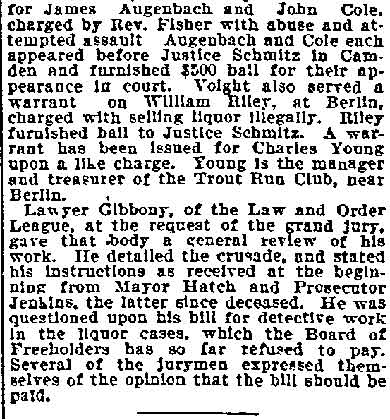
Constable Frederick Voight went to Gloucester City last evening with warrants for James Augenbach and John Cole, charged by Rev. Fisher with abuse and attempted assault. Augenbach and Cole each appeared before Justice Schmitz in Camden and furnished $[?]00 bail for their appearance in court. Voight also served a warrant on William Riley, at Berlin, charged with selling liquor illegally. Riley furnished bail to Justice Schmitz. A warrant has been issued for Charles Young upon a like charge. Young is the manager and treasurer of the Trout Run Club, near Berlin.
Lawyer Gibbony, of the Law and Order League, at the request of the grand jury, gave that body a general review of his work. He detailed the crusade, and stated his instructions as received at the beginning from Mayor Hatch and Prosecutor Jenkins, the latter since deceased. He was questioned upon his bill for detective work in the liquor cases, which the Board of Freeholders has so far refused to pay. Several of the jurymen expressed themselves of the opinion that the bill should be paid.
Policeman Matlack Suspended
Philadelphia Inquirer —
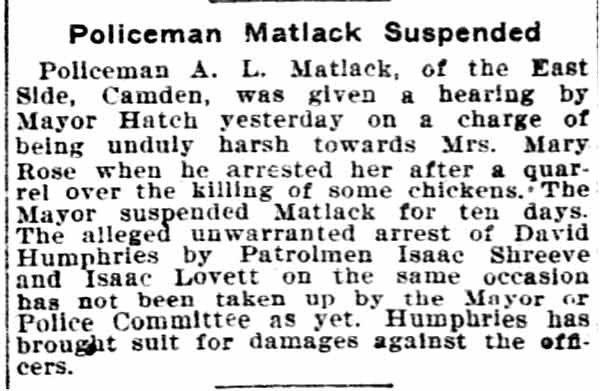
Policeman A. L. Matlack, of the East Side, Camden, was given a hearing by Mayor Hatch yesterday on a charge of being unduly harsh towards Mrs. Mary Rose when he arrested her after a quarrel over the killing of some chickens. The Mayor suspended Matlack for ten days. The alleged unwarranted arrest of David Humphries by Patrolmen Isaac Shreeve and Isaac Lovett on the same occasion has not been taken up by the Mayor or Police Committee as yet. Humphries has brought suit for damages against the officers.
Law and Order League Lauds Police Raids
Philadelphia Inquirer —
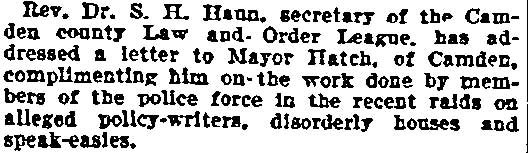
Rev. Dr. S. H. Hann, secretary of the Camden county Law and Order League, has addressed a letter to Mayor Hatch, of Camden, complimenting him on the work done by members of the police force in the recent raids on alleged policy-writers, disorderly houses and speak-easies.
Camden’s Pride Parades Before City’s People
Philadelphia Inquirer —
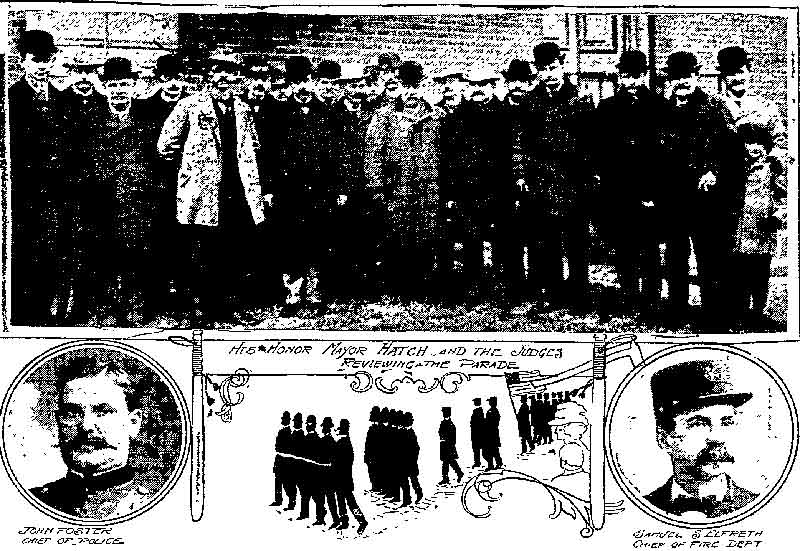
John Foster, Chief of Police
His Honor Mayor Hatch and the Judges Reviewing the Parade
Samuel S. Elfreth, Chief of Fire Dept.
Policemen and Firemen Make Their Initial Turnout and Present a Creditable Appearance—Reviewed by Officials—How the Departments Have Grown
With a line up that could not be surpassed by the famous “Broadway Squad” of New York, Camden’s policemen, or most of them, turned out in review yesterday. The military carriage of the men excited much favorable comment, especially among those who were not aware that the men have been drilled every week for a year past by Colonel D. B. Murphy, of the National Guard of New Jersey. The policemen were followed by an array of firemen and a variety of apparatus that made many of the natives gasp in astonishment. Altogether the procession was a revelation to Camden residents who thought they were well informed about their city.
The procession was headed by Jennings’ Third Regiment Band. Then came Chief John Foster, of the Police Department, followed by a line composed of Police Captains Stanley, Alberts and Doyle and Sergeant Bentley. Following them under the silken folds of “Old Glory,” which he carried with a steady grasp, was Policeman George A. Donovan, a colored member of the force. Two platoons of forty policemen each were led by Sergeants Horner and Hyde. The police patrol wagons and the city ambulance brought up the end of the policemen’s line. The total police force of the city consists of ninety nine men.
The City Band, followed by Chief Samuel S. Elfreth, of the Fire Department, in a carriage, marked the head of the firemen’s line. The seventy-two men of this department were in two sections, the first being led by Assistant Chief Samuel Buzine, of the department headquarters, and the second by Assistant Chief Benjamin Kellum of the East Side. Between the two sections marched the Ivy Fife and Drum Corps. The apparatus in line consisted of six hose carts, five engines, three hook and ladder trucks, two chemical engines and a supply wagon.
The growth of Camden’s police department may be seen by a comparison of the present with the year 1862, when six policemen sufficed to protect the entire city, which was then divided in three wards. In 1876 there were only sixteen policemen in the city and nine regular firemen under one chief. There were, however, thirty extra men subject to call by the chief.
The parade yesterday was reviewed by Mayor Hatch and the City Councilmen from the balcony on the Broadway side of the Court House.
Police Disperse Socialist Crowd
Philadelphia Inquirer —
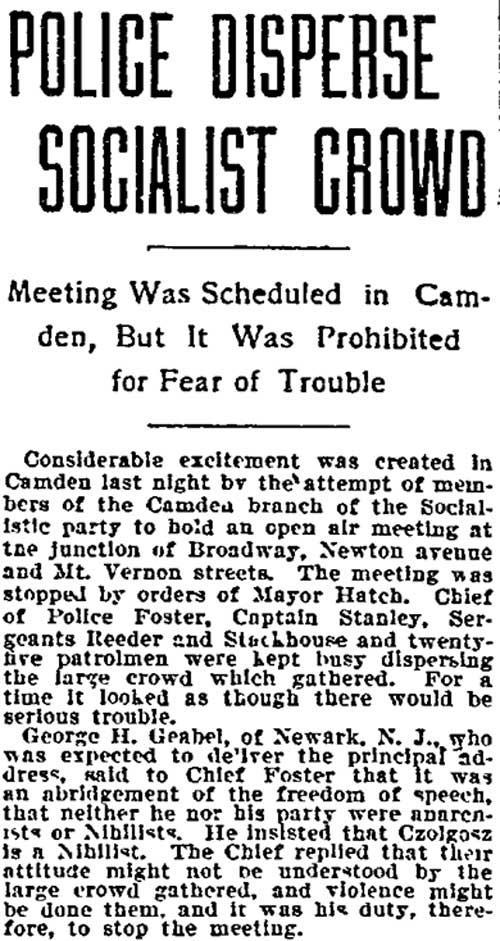
Meeting Was Scheduled in Camden, But It Was Prohibited for Fear of Trouble
Considerable excitement was created in Camden last night by the attempt of members of the Camden branch of the Socialistic party to hold an open air meeting at the junction of Broadway, Newton avenue and Mt. Vernon streets. The meeting was stopped by orders of Mayor Hatch. Chief of Police Foster, Captain Stanley, Sergeants Reeder [sic] and Stackhouse and twenty-five patrolmen were kept busy dispersing the large crowd which gathered. For a time it looked as though there would be serious trouble.
George H. Geabel, of Newark, N. J., who was expected to deliver the principal address, said to Chief Foster that it was an abridgement of the freedom of speech, that neither he nor his party were anarchists or Nihilists. He insisted that Czolgosz is a Nihilist. The Chief replied that their attitude might not be understood by the large crowd gathered, and violence might be done them, and it was his duty, therefore, to stop the meeting.
Camden Notes
Philadelphia Inquirer —
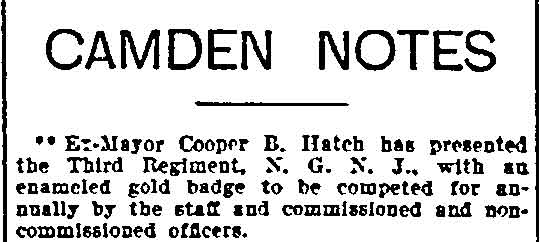
Ex-Mayor Cooper B. Hatch has presented the Third Regiment, N. G. N. J., with an enameled gold badge to be competed for annually by the staff and commissioned and non-commissioned officers.
More Policemen to Go in Camden
Philadelphia Inquirer —
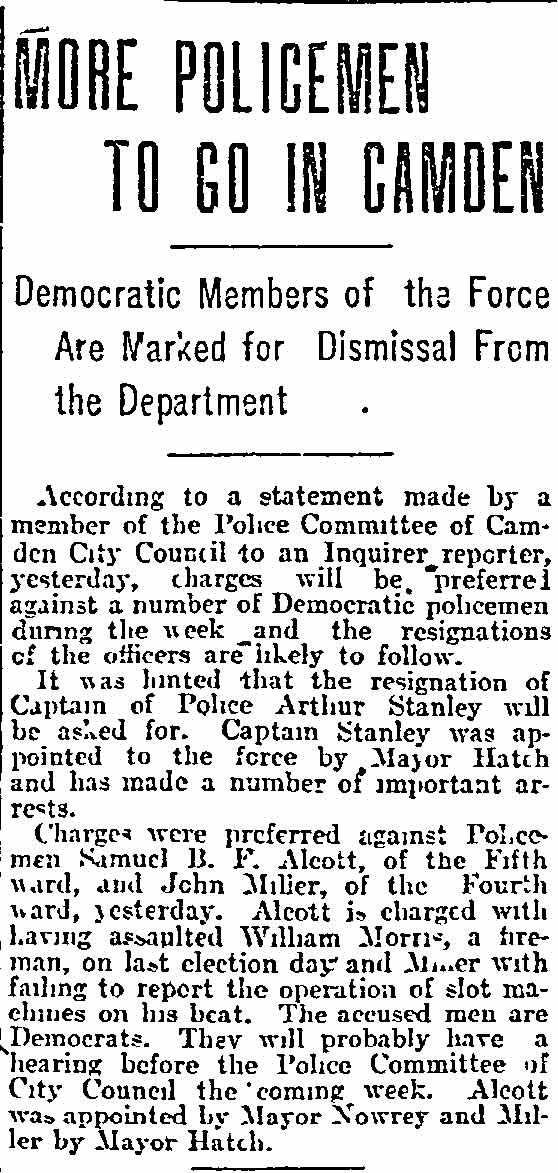
Democratic Members of the Force Are Marked for Dismissal From the Department
According to a statement made by a member of the Police Committee of Camden City Council to an Inquirer reporter, yesterday, charges will be preferred against a number of Democratic policemen during the week and the resignations of the officers are likely to follow.
It was hinted that the resignation of Captain of Police Arthur Stanley will be asked for. Captain Stanley was appointed to the force by Mayor Hatch and has made a number of important arrests.
Charges were preferred against Policemen Samuel B. F. Alcott, of the Fifth ward, and John Miller, of the Fourth ward, yesterday. Alcott is charged with having assaulted William Morris, a fireman, on last election day and Miller with failing to report the operation of slot machines on his beat. The accused men are Democrats. They will probably have a hearing before the Police Committee of City Council the coming week. Alcott was appointed by Mayor Nowrey and Miller by Mayor Hatch.
"Want Stanley Retained"
Philadelphia Inquirer —
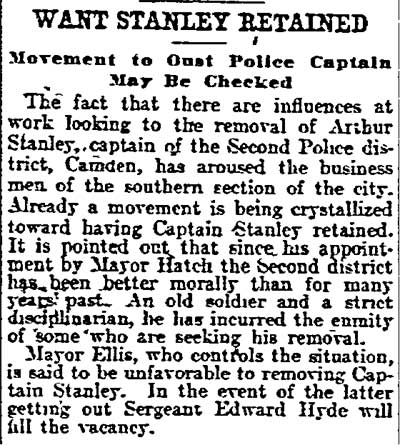
Want Stanley Retained
Movement to Oust Police Captain May Be Checked
The fact that there are influences at work looking to the removal of Arthur Stanley, captain of the Second Police district, Camden, has aroused the business men of the southern section of the city. Already a movement is being crystallized toward having Captain Stanley retained. It is pointed out that since his appointment by Mayor Hatch the Second district has been better morally than for many years past. An old soldier and a strict disciplinarian, he has incurred the enmity of some who are seeking his removal.
Mayor Ellis, who controls the situation, is said to be unfavorable to removing Captain Stanley. In the event of the latter getting out Sergeant Edward Hyde will fill the vacancy.
Mayor Hatch Averts Runaway Accident
Philadelphia Inquirer —
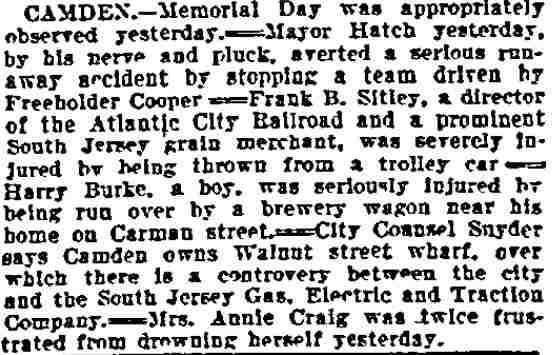
CAMDEN.—Memorial Day was appropriately observed yesterday.—Mayor Hatch yesterday, by his nerve and pluck, averted a serious runaway accident by stopping a team driven by Freeholder Cooper—Frank B. Sitley, a director of the Atlantic City Railroad and a prominent South Jersey grain merchant, was severely injured by being thrown from a trolley car—Harry Burke, a boy, was seriously injured by being run over by a brewery wagon near his home on Carman street.—City Counsel Snyder says Camden owns Walnut street wharf, over which there is a controversy between the city and the South Jersey Gas, Electric and Traction Company.—Mrs. Annie Craig was twice frustrated from drowning herself yesterday.
News of a Day in the City of Camden
Philadelphia Inquirer —
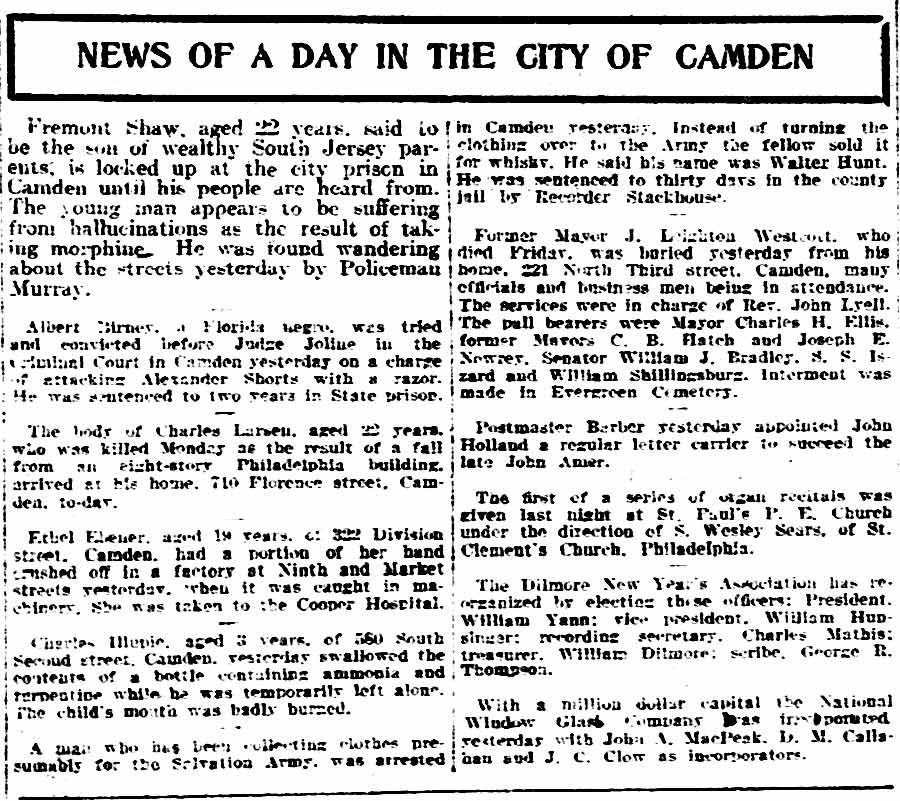
Fremont Shaw, aged 22 years, said to be the son of wealthy South Jersey parents, is locked up at the city prison in Camden until his people are heard from. The young man appears to be suffering from hallucinations as the result of taking morphine. He was found wandering about the streets yesterday by Policeman Murray.
Albert Birney, a Florida negro, was tried and convicted before Judge Joline in the criminal court in Camden yesterday on a charge of attacking Alexander Shorts with a razor. He was sentenced to two years in State prison.
The body of Charles Larsen, aged 22 years, who was killed Monday as the result of a fall from an eight-story Philadelphia building, arrived at his home, 710 Florence street, Camden, to-day.
Ethel Elzener, aged 1[?] years, of 322 Division street, Camden, had a portion of her hand crushed off in a factory at Ninth and Market streets yesterday, when it was caught in machinery. She was taken to the Cooper Hospital.
Charles Illupie, aged 3 years, of 560 South Second street, Camden, yesterday swallowed the contents of a bottle containing ammonia and turpentine while he was temporarily left alone. The child’s mouth was badly burned.
A man who has been collecting clothes presumably for the Salvation Army, was arrested in Camden yesterday. Instead of turning the clothing over to the Army the fellow sold it for whisky. He said his name was Walter Hunt. He was sentenced to thirty days in the county jail by Recorder Stackhouse.
Former Mayor J. Leighton Westcott, who died Friday, was buried yesterday from his home, 221 North Third street, Camden, many officials and business men being in attendance. The services were in charge of Rev. John Lyell. The pall bearers were Mayor Charles H. Ellis, former Mayors C. B. Hatch and Joseph E. Newrey, Senator William J. Bradley, S. S. Iszard and William Shillingsburg. Interment was made in Evergreen Cemetery.
Postmaster Berber yesterday appointed John Holland a regular letter carrier to succeed the late John Amer.
The first of a series of organ recitals was given last night at St. Paul’s P. E. Church under the direction of S. Wesley Sears, of St. Clement’s Church, Philadelphia.
The Dilmore New Year’s Association has reorganized by electing these officers: President, William Yann; vice president, William Hunsinger; recording secretary, Charles Mathis; treasurer, William Dilmore; scribe, George R. Thompson.
With a million dollar capital the National Window Glass Company was incorporated yesterday with John A. MacPeak, D. M. Callahan and J. C. Clow as incorporators.
Sheriff Hatch Names Camden’s Grand Jury
Philadelphia Inquirer —
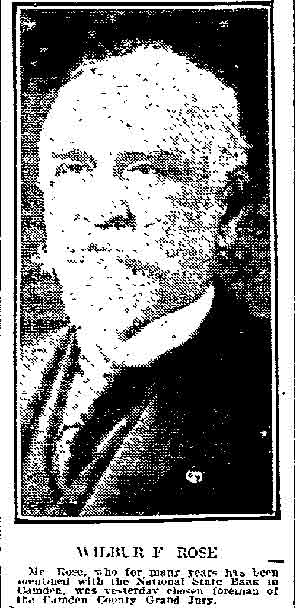
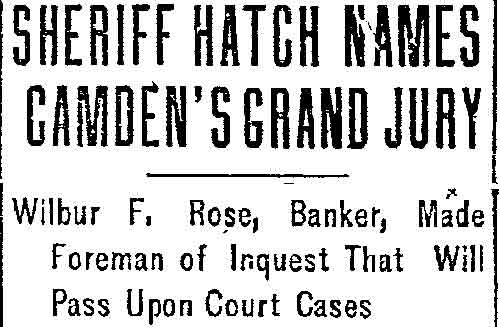
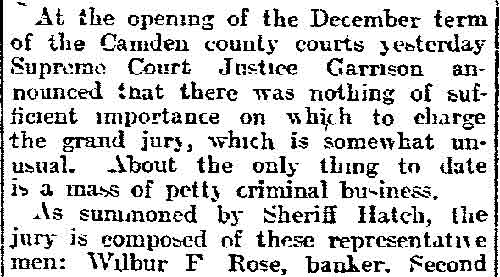
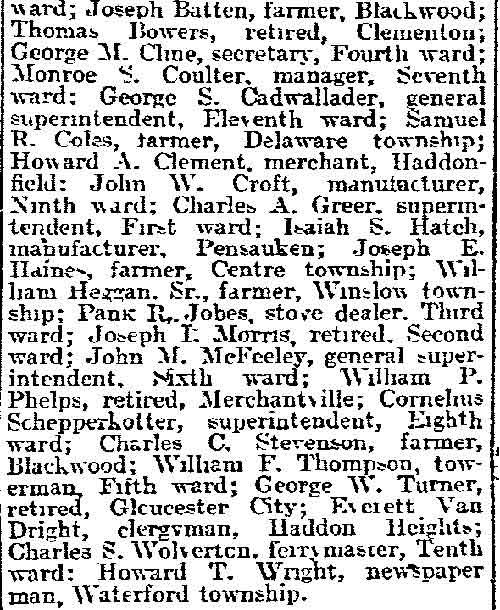
Wilbur F. Rose, Banker, Made Foreman of Inquest That Will Pass Upon Court Cases
At the opening of the December term of the Camden county courts yesterday Supreme Court Justice Garrison announced that there was nothing of sufficient importance on which to charge the grand jury, which is somewhat unusual. About the only thing to date is a mass of petty criminal business.
As summoned by Sheriff Hatch, the jury is composed of these representative men: Wilbur F. Rose, banker, Second ward; Joseph Batten, farmer, Blackwood; Thomas Bowers, retired, Clementon; George M. Cline, secretary, Fourth ward; Monroe S. Coulter, manager, Seventh ward; George S. Cadwallader, general superintendent, Eleventh ward; Samuel R. Coles, farmer, Delaware township; Howard A. Clement, merchant, Haddonfield; John W. Croft, manufacturer, Ninth ward; Charles A. Greer, superintendent, First ward; Isaiah S. Hatch, manufacturer, Pensauken; Joseph E. Haines, farmer, Centre township; William Heggan, Sr., farmer, Winslow township; Pank [sic] R. Jobes, stove dealer, Third ward; Joseph I. Morris, retired, Second ward; John M. McFeeley, general superintendent, Sixth ward; William P. Phelps, retired, Merchantville; Cornelius Schepperkotter, superintendent, Eighth ward; Charles C. Stevenson, farmer, Blackwood; William F. Thompson, towerman, Fifth ward; George W. Turner, retired, Gloucester City; Everett Van Dright, clergyman, Haddon Heights; Charles S. Wolverton, ferrymaster, Tenth ward; Howard T. Wright, newspaperman, Waterford township.
WILBUR F. ROSE. Mr. Rose, who for many years has been connected with the National State Bank in Camden, was yesterday chosen foreman of the Camden County Grand Jury.
Camden News Notes
Philadelphia Inquirer —
This morning 168 enumerators will begin taking the census for Uncle Sam in the First Congressional district of New Jersey, Camden, Gloucester and Salem counties. Supervisor William D. Brown in Camden yesterday gave final instructions to the corps of workers and he appointed Sidney P. McCord and Morris Odell to oversee the work in Camden City proper.
With the view of gathering information for future use, Mayor Charles H. Ellis, City Solicitor Bleakley, Senator William J. Bradley and members of City Council accompanied by the State Riparian Commission went along Camden’s river front yesterday. Camden intends developing its river front as rapidly as possible.
In a new market basket, with several changes of clothing and a bottle filled with milk by his side, a baby boy, apparently about six weeks old, was found early yesterday morning on a step on South Sixth street. Pinned to the youngster was this unsigned note: “To whoever finds this little dear: Will you kindly see that this baby is taken to the Homeopathic Hospital, where I know it will be properly cared for.”
Mayor Ellis yesterday received a letter from Louis Kennedy, of New Orleans, inquiring about Mrs. Ida S. Kennedy, whose whereabouts he desires to know.
A struck panel of forty-eight jurors was drawn yesterday by Sheriff Hatch to be used in the trial of former City Treasurer Ira S. Champion, of Ocean City, who is under indictment for forging a $7000 promissory note. The trial will take place next Wednesday.
Hatch’s Next Camden Grand Jury Is Puzzler
Philadelphia Inquirer —
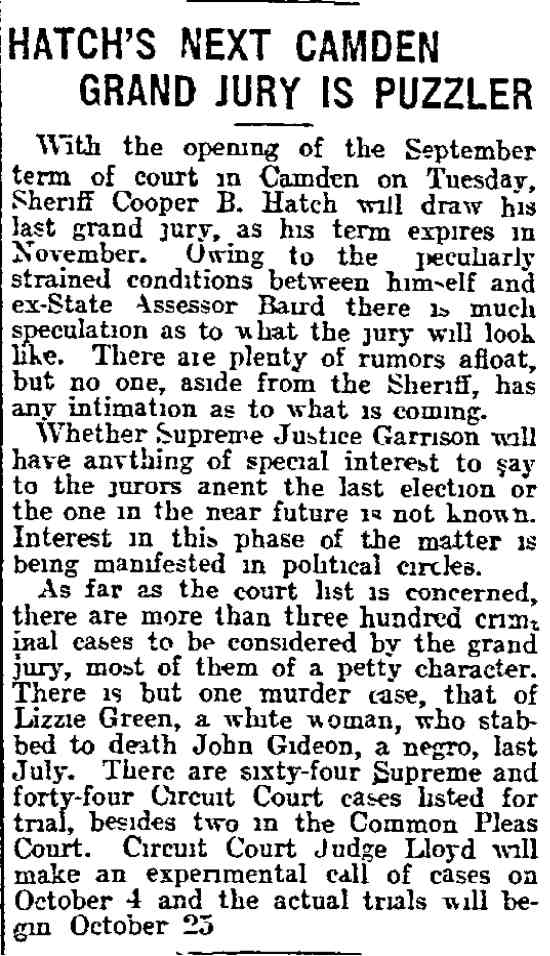
With the opening of the September term of court in Camden on Tuesday, Sheriff Cooper B. Hatch will draw his last grand jury, as his term expires in November. Owing to the peculiarly strained conditions between himself and ex-State Assessor Baird there is much speculation as to what the jury will look like. There are plenty of rumors afloat, but no one, aside from the Sheriff, has any intimation as to what is coming.
Whether Supreme Justice Garrison will have anything of special interest to say to the jurors anent the last election or the one in the near future is not known. Interest in this phase of the matter is being manifested in political circles.
As far as the court list is concerned, there are more than three hundred criminal cases to be considered by the grand jury, most of them of a petty character. There is but one murder case, that of Lizzie Green, a white woman, who stabbed to death John Gideon, a negro, last July. There are sixty-four Supreme and forty-four Circuit Court cases listed for trial, besides two in the Common Pleas Court. Circuit Court Judge Lloyd will make an experimental call of cases on October 4 and the actual trials will begin October 25.
Judge Made This Grand Jury Sit Up
Philadelphia Inquirer —
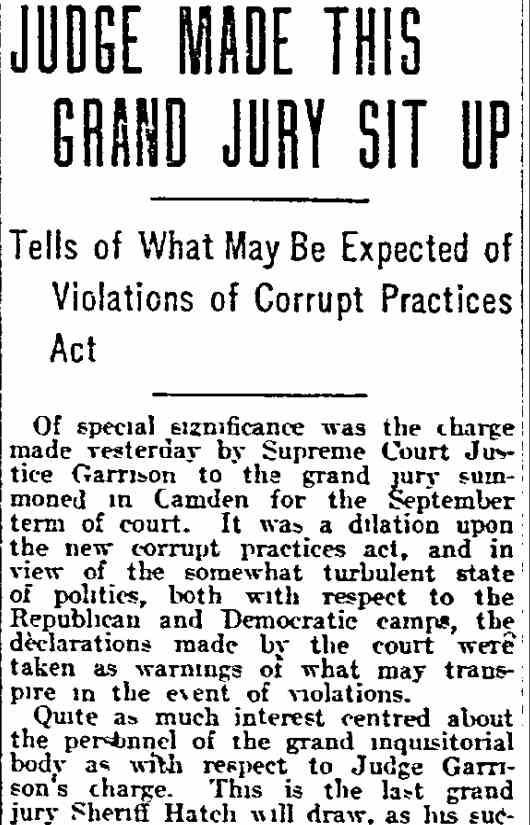
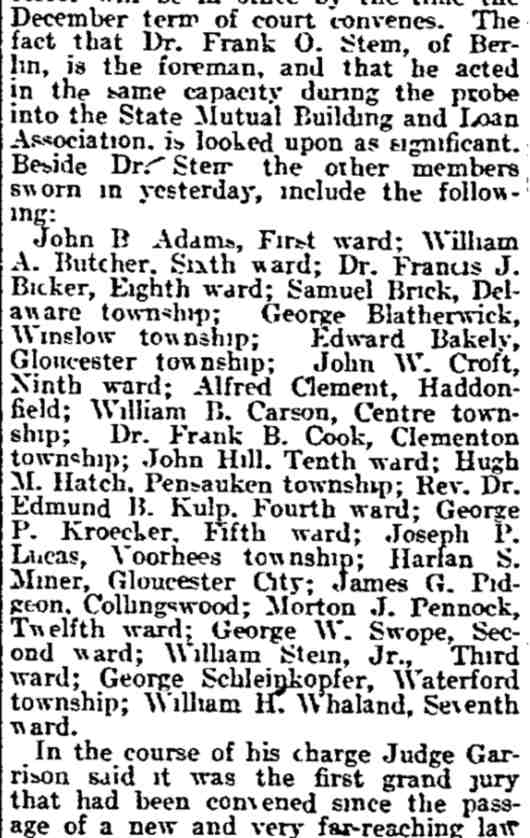
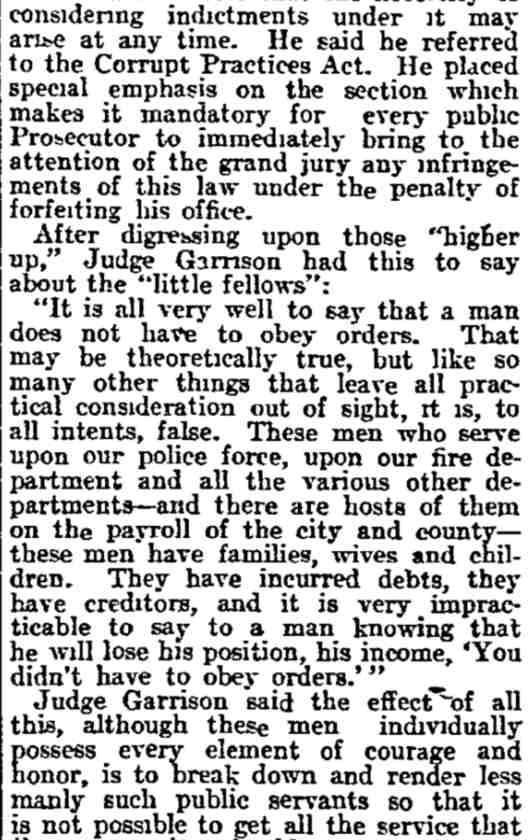
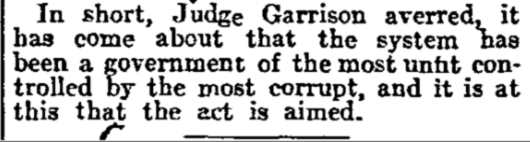
Tells of What May Be Expected of Violations of Corrupt Practices Act
Of special significance was the charge made yesterday by Supreme Court Justice Garrison to the grand jury summoned in Camden for the September term of court. It was a dilation upon the new corrupt practices act, and in view of the somewhat turbulent state of politics, both with respect to the Republican and Democratic camps, the declarations made by the court were taken as warnings of what may transpire in the event of violations.
Quite as much interest centred about the personnel of the grand inquisitorial body as with respect to Judge Garrison’s charge. This is the last grand jury Sheriff Hatch will draw, as his successor will be in place by the time the December term of court convenes. The fact that Dr. Frank O. Stem, of Berlin, is the foreman, and that he acted in the same capacity during the probe into the State Mutual Building and Loan Association, is looked upon as significant. Beside Dr. Stem the other members sworn in yesterday, include the following:
John B. Adams, First ward; William A. Butcher, Sixth ward; Dr. Francis J. Bicker, Eighth ward; Samuel Brick, Delaware township; George Blatherwick, Winslow township; Edward Bakely, Gloucester township; John W. Croft, Ninth ward; Alfred Clement, Haddonfield; William B. Carson, Centre township; Dr. Frank B. Cook, Clementon township; John Hill, Tenth ward; Hugh M. Hatch, Pennsauken township; Rev. Dr. Edmund B. Kulp, Fourth ward; George P. Kroecker, Fifth ward; Joseph P. Lucas, Voorhees township; Harlan S. Miner, Gloucester City; James G. Pidgeon, Collingswood; Morton J. Pennock, Twelfth ward; George W. Swope, Second ward; William Stein, Jr., Third ward; George Schleinkopfer, Waterford township; William H. Whaland, Seventh ward.
In the course of his charge Judge Garrison said it was the first grand jury that had been convened since the passage of a new and very far-reaching law considering indictments under it may arise at any time. He said he referred to the Corrupt Practices Act. He placed special emphasis on the section which makes it mandatory for every public Prosecutor to immediately bring to the attention of the grand jury any infringements of this law under the penalty of forfeiting his office.
After digressing upon those “higher up,” Judge Garrison had this to say about the “little fellows”:
“It is all very well to say that a man does not have to obey orders. That may be theoretically true, but like so many other things that leave all practical consideration out of sight, it is, to all intents, false. These men who serve upon our police force, upon our fire department and all the various other departments—and there are hosts of them on the payroll of the city and county—these men have families, wives and children. They have incurred debts, they have creditors, and it is very impracticable to say to a man knowing that he will lose his position, his income, ‘You didn’t have to obey orders.’”
Judge Garrison said the effect of all this, although these men individually possess every element of courage and honor, is to break down and render less manly such public servants so that it is not possible to get all the service that [the next line or lines are cut off between crops 03b and 04b]
In short, Judge Garrison averred, it has come about that the system has been a government of the most unfit controlled by the most corrupt, and it is at this that the act is aimed.
Says Civil Service Prevents Removal
Philadelphia Inquirer —
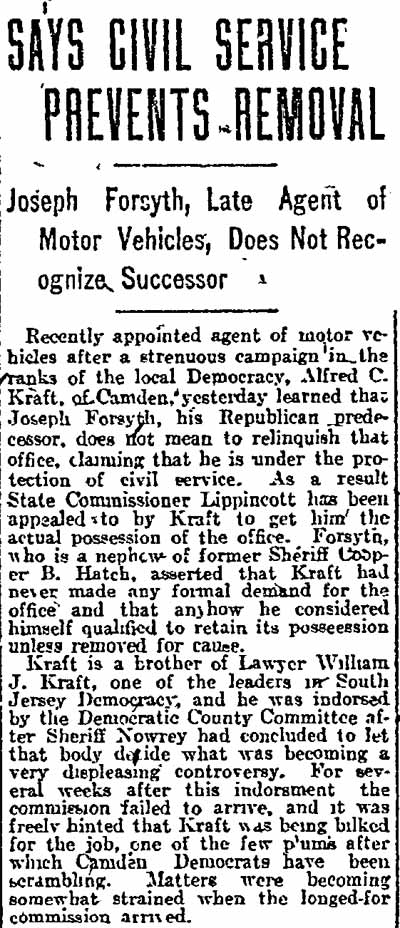
Joseph Forsyth, Late Agent of Motor Vehicles, Does Not Recognize Successor
Recently appointed agent of motor vehicles after a strenuous campaign in the ranks of the local Democracy, Alfred C. Kraft, of Camden, yesterday learned that Joseph Forsyth, his Republican predecessor, does not mean to relinquish that office, claiming that he is under the protection of civil service. As a result State Commissioner Lippincott has been appealed to by Kraft to get him the actual possession of the office. Forsyth, who is a nephew of former Sheriff Cooper B. Hatch, asserted that Kraft had never made any formal demand for the office and that anyhow he considered himself qualified to retain its possession unless removed for cause.
Kraft is a brother of Lawyer William J. Kraft, one of the leaders in South Jersey Democracy, and he was indorsed by the Democratic County Committee after Sheriff Nowrey had concluded to let that body decide what was becoming a very displeasing controversy. For several weeks after this indorsment the commission failed to arrive, and it was freely hinted that Kraft was being bilked for the job, one of the few p’ums after which Camden Democrats have been scrambling. Matters were becoming somewhat strained when the longed-for commission arrived.
Security Trust Company
Bank Directory, 1916
Security Trust Company
301 Market Street, Camden, N.J.
JOSHUA E. BORTON, President
HENRY D. MOORE, Vice President
C. H. POLHEMUS, Secretary and Treasurer
WALTER T. PRATT, Assistant Treasurer
HOWARD M. POTTER, Trust Officer
Thomas E. French, General Counsel
Directors:
| Joshua E. Borton | Henry D. Moore |
| David Baird Sr. | Harry Reeves |
| Howard Carrow | Thomas W. Synnott |
| John F. Harned | Isaac Ferris Jr. |
| Cooper B. Hatch | Dr. Paul Mecray |
| Francis C. Howell | Townsend Stites |
| S. Stanger Iszard | J. Spicer Leaming |
| Valentine Kissling | Anthony Kuser |
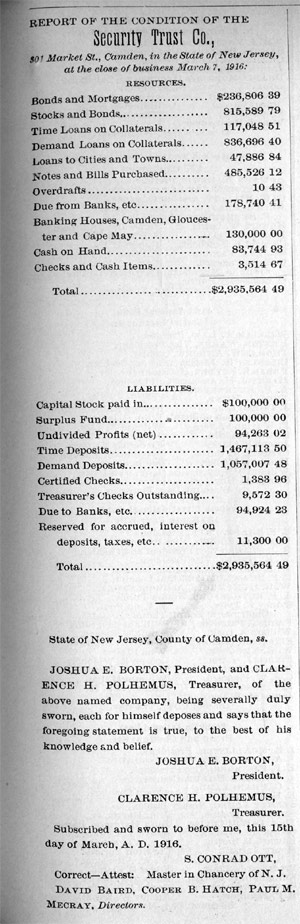
Policemen Retire on Pension Fund
Camden Daily Courier —
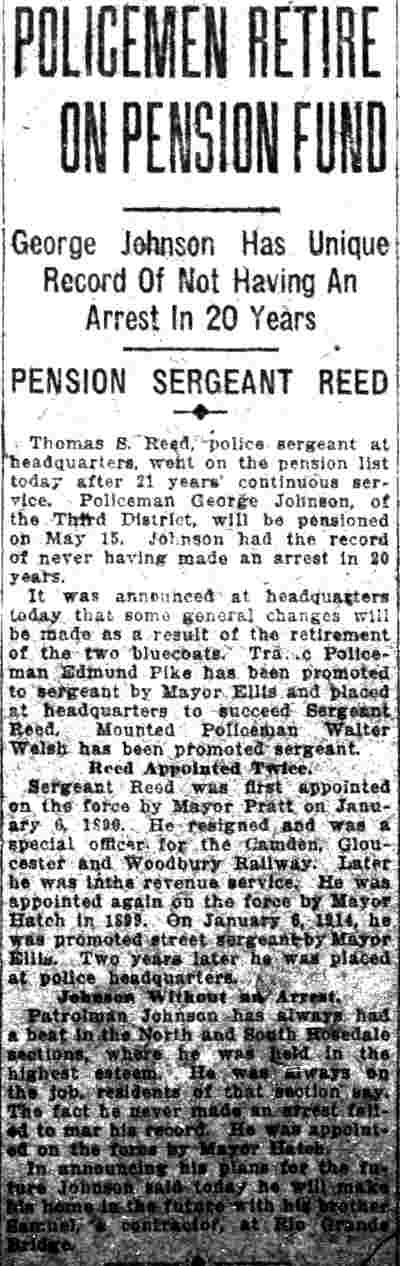
George Johnson Has Unique Record Of Not Having An Arrest In 20 Years
PENSION SERGEANT REED
Thomas S. Reed, police sergeant at headquarters, went on the pension list today after 21 years’ continuous service. Policeman George Johnson, of the Third District, will be pensioned on May 15. Johnson had the record of never having made an arrest in 20 years.
It was announced at headquarters today that some general changes will be made as a result of the retirement of the two bluecoats. Traffic Policeman Edmund Pike has been promoted to sergeant by Mayor Ellis and placed at headquarters to succeed Sergeant Reed. Mounted Policeman Walter Welsh has been promoted sergeant.
Reed Appointed Twice.
Sergeant Reed was first appointed on the force by Mayor Pratt on January 6, 189[?]. He resigned and was a special officer for the Camden, Gloucester and Woodbury Railway. Later he was in the revenue service. He was appointed again on the force by Mayor Hatch in 1899. On January 6, 1914, he was promoted street sergeant by Mayor Ellis. Two years later he was placed at police headquarters.
Johnson Without an Arrest.
Patrolman Johnson has always had a beat in the North and South Rosedale sections, where he was held in the highest esteem. He was always on the job, residents of that section say. The fact he never made an arrest failed to mar his record. He was appointed on the force by Mayor Hatch.
In announcing his plans for the future Johnson said today he will make his home in the future with his brother Samuel, a contractor, at Rio Grande Bridge.
Isaac Shreve Dies, Veteran Policeman
Camden Courier-Post —
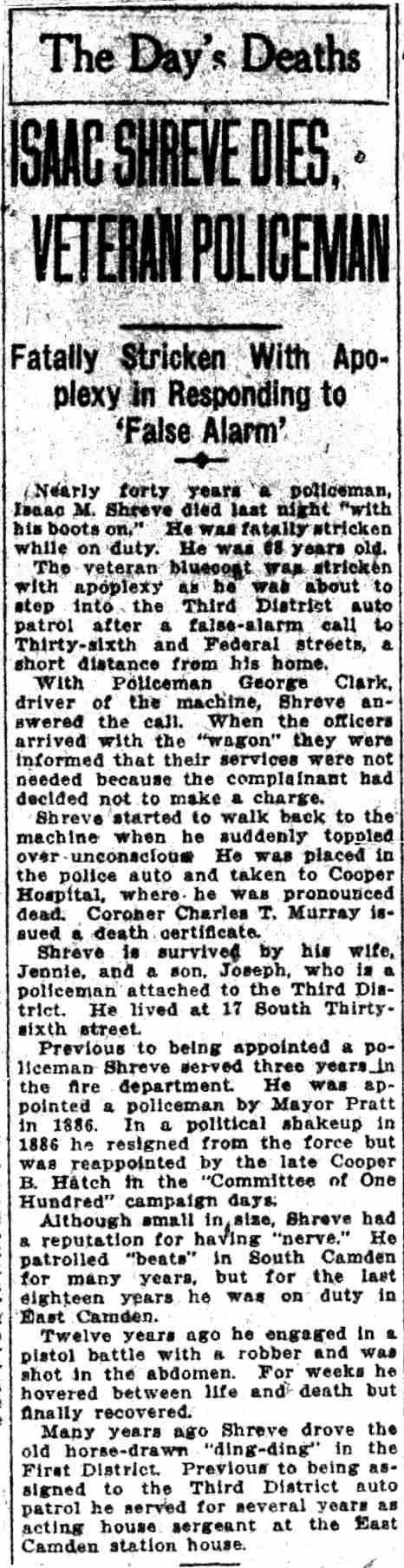
The Day’s Deaths
Fatally Stricken With Apoplexy in Responding to ‘False Alarm’
Nearly forty years a policeman, Isaac M. Shreve died last night “with his boots on.” He was fatally stricken while on duty. He was 6[?] years old.
The veteran bluecoat was stricken with apoplexy as he was about to step into the Third District auto patrol after a false-alarm call to Thirty-sixth and Federal streets, a short distance from his home.
With Policeman George Clark, driver of the machine, Shreve answered the call. When the officers arrived with the “wagon” they were informed that their services were not needed because the complainant had decided not to make a charge.
Shreve started to walk back to the machine when he suddenly toppled over unconscious. He was placed in the police auto and taken to Cooper Hospital, where he was pronounced dead. Coroner Charles T. Murray issued a death certificate.
Shreve is survived by his wife, Jennie, and a son, Joseph, who is a policeman attached to the Third District. He lived at 17 South Thirty-sixth street.
Previous to being appointed a policeman Shreve served three years in the fire department. He was appointed a policeman by Mayor Pratt in 1886. In a political shakeup in 1886 he resigned from the force but was reappointed by the late Cooper B. Hatch in the “Committee of One Hundred” campaign days.
Although small in size, Shreve had a reputation for having “nerve.” He patrolled “beats” in South Camden for many years, but for the last eighteen years he was on duty in East Camden.
Twelve years ago he engaged in a pistol battle with a robber and was shot in the abdomen. For weeks he hovered between life and death but finally recovered.
Many years ago Shreve drove the old horse-drawn “ding-ding” in the First District. Previous to being assigned to the Third District auto patrol he served for several years as acting house sergeant at the East Camden station house.
Along Memory Lane
Camden Courier-Post —

By Ben Courter
Harry Read, Camden’s leading milkman of long ago, former councilman and general all round good fellow, met Irving Buckle one day this week. They were looking over Cooper street, changing more in a week now than in a generation before the bridge came.
“Remember that sleigh ride I gave you over Cooper street 30 years ago?” inquired Read with a chuckle.
“You bet I do,” returned Buckle, former director of the Board of Freeholders and likewise a hail fellow well met in the days when fellowship really meant something. “I sure do, and I was darned near frozen!”
“But they were great old times at that,” returned Read.
* * *
And with these “traffic islands” planted in the middle of Camden’s erstwhile bon ton thoroughfare we wonder what the shades of such worthies as Cooper B. Hatch, David B. Kaighn, Samuel Davis and others of that coterie of 30 years agone must think o’ things.
Islands in Cooper street! Gadzooks! Winters do not seem what they used to be in spite of what the weather man might say. Of course, one might not expect to hear the joyous tinkle of the sleigh bell and the impatient whinny of the trotter in a day when gas buggies have relegated them to little else save memories. Still that would not stay Borean blasts laden with “the beautiful,” certainly scarce enough now compared to the period when Cooper street seemed covered the whole winter through.
And it was under that covering of glistening whiteness that Cooper Street was converted into an improvised speedway with the boys who had the fast steppers anxious to show their paces. Himself a lover of horseflesh, “Coop” Hatch saw to it that the amateur racers had free footing, for when he was mayor just before the dawn of the century he stationed cops at the intersections so that side street traffic would not interfere.
Thus with the stage all set one might find Read with his spick and span sorrel, Nellie Macklin, or “Dave” Kaighn with his Martin K., of “Esp” Ashton, “Stock” Woodward, Hatch or a few others making ‘em step along with glistening, steel shod hoofs fairly ringing over the frozen surface.
And there was the quiet but determined urging of the fellows back of the flashing steeds while the many always interested in horses, as they now seem to be in gas engines, stood along the curb line excited as they might be at the Kentucky derby. There was plenty of quiet betting in those days, too, and argument ran high over the relative merits of the speed kings.
It was indeed a grand, a rare old sport of the times and many there are still in the flesh who recall those exciting brushes along old Cooper street, those who, likewise remember just jogging along with the one girl in the world, when the speeders were through.
* * *
Somehow with all the luxuriousness, the comfort, the power, the convenience, the thousand and one superior points over the old fashioned horse and sleigh, there still re-echoes that tinkle of the bells that come down through the years as beautiful music. There is the gay laughter of beaux and maidens, sometimes half frozen, trying to eke out an element of warmth by poking feet beneath the straw spread over the board floor. And the occasional upsets brought shrieks of laughter, not screams of dismay as now when a speeding machine crashes into a tree or turns turtle.
Cooper street certainly can never again present that picture of sleighs and racers and the type of young bloods of that period. The “traffic islands” make it all the more certain that it can be but a memory, a memory to be cherished by the “old timers.”
Along Memory Lane
Camden Courier-Post Evening Courier —
It is not so many years ago, old timers say, since Fetters School at Third and Mount Vernon Street was considered large enough to accommodate youngsters for several generations. Now a six-room annex is to be built on the north side facing Walnut Street. Back in 1905 five rooms were added in the annex on Mount Vernon Street. With the new structure the school will contain 19 rooms, which would have thought far too large for a high school in the 90s, when Camden had its first experiment in that line. That was in the old Federal Street building later occupied by the Post-Telegram
Half a Century Ago
When Fetters School was built in 1875 it was considered about the last word as far as a school structure went. It was of stone, solidly constructed and furnished with gas, running water, and everything then regarded as thoroughly modern. The largest school downtown was the old Kaighn building on Newton Avenue, until the 1870s ample for the Kaighn Point area.
There were plenty of open lots when the Fetters School was built. Those days Camden was something of a struggling community with districts that had not yet lost their individuality. As a pupil in the early 90s in old Fetters I recall the section had many open spaces. Nothing remotely suggested the part-time classes was then necessary, certainly not thought of by Professor Horatio Draper, of blessed memory, who guided Camden’s educational system more than 30 years before he was displaced by the late Mayor Hatch at the close of the last century
The Melting Pot
Nothing had then been heard of a “melting pot” as applied to America and its schools. But around Kaighn Point even in the 80s there was the first evidence of a great influx of those from across the seas who were soon to follow the old families, who’s children were to enter that melting pot and become transformed into American citizens
The Fuhrmans, Auerbachs, Lichtensteins were among the first I recall. Many others followed; especially from the Russian Polish district where life was hard and oppression severe. Came the immigrant wave from South Italy whose descendants long since have taken possession of the district spreading from Third and Pine, once the stronghold of English, German, and Irish families. In a police census a quarter of a century ago it developed that the Fifth Ward could boast representatives from every nation on the face of the globe, even to a Finlander, some Turks with Japs and Chinese commonplace.
It was about the period when Miss Clara S. Burrough, long principal of the High School and now recovering from an operation in Cooper Hospital, was principal of Fetters that the big change came that the classes were composed largely of children of foreign parentage. Often they did not know a single world of English. Teachers had their problems and Miss Burrough will undoubtedly recall the great task involved in really making the “melting pot” down there in the old school at Third and Mount Vernon Street effective. But she and the valiant corps under here direction tackled it and by the time Miss Burrough was elevated to the principalship of Camden High, a very deserved promotion, by the way, the problem had been totally solved.
Hot Times in the Old Town
Incidentally Miss Burrough will likewise recall the hectic conditions in more ways than one for the period marked turmoil in the educational world hereabouts. “Old Drape” had been fired overnight by Hatch, indignation meetings were held, demands were made for his reinstatement but the Committee of Public Instruction, headed by the late C.S. Magrath, named by Hatch, naturally followed his direction. Martin Scheibner, a long, white-whiskered veteran of the Civil War, was named as Draper’s successor. But it was worse than handling a drove of wild horses. The venerable professor soon bowed out of the scene. It was not until the advent of Professor James E. Bryan that something like peace came. Bryan’s firm hand plus extraordinary ability and a determination not to surrender despite scholastic bedlam finally won.
But even yet, old friends of “Drape’s” who knew him in Fetters or in the makeshift “high school” have not forgotten the bitterness, have not forgiven the shabby way in which that fine Southern gentleman was treated. I recall him down at Fetters, sometimes with his setters on which he placed much store; often with a humorous story, which probably didn’t contribute to strict school discipline but which certainly left fragrant memories of days long ago.
2677 Mickle Street
The Joseph Hatch House
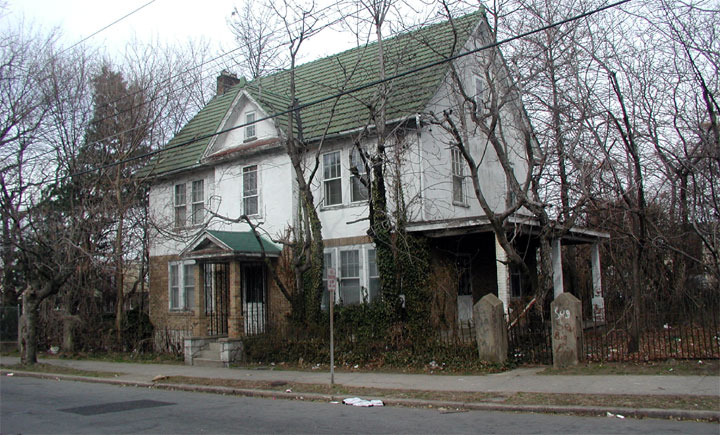
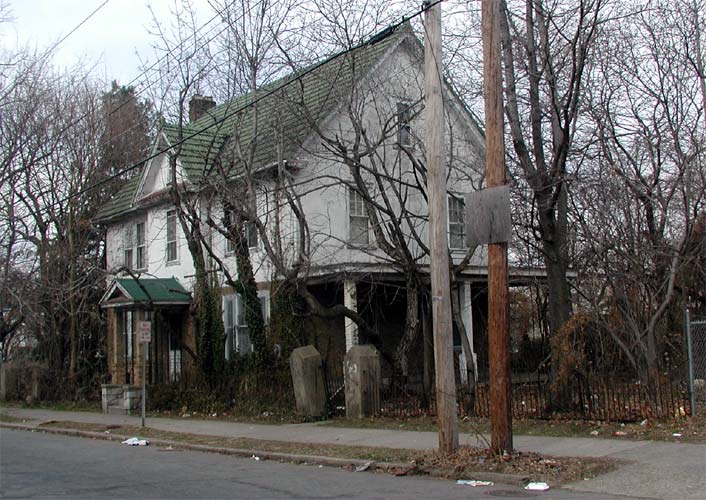
The Joseph Hatch House dates back to at least 1875, and was the center of one of several large farms that were a part of what was Stockton Township, present day East Camden.
The house was the home for many years of Michael J. Jubanyik, a successful builder in the 1930s, 1940s. Younger members of the Jubanyik family went into the practice of law in New Jersey
This house sits at the north end of Eutaw Street, between Grand Street and South 27th Street.
Manual Training and High School
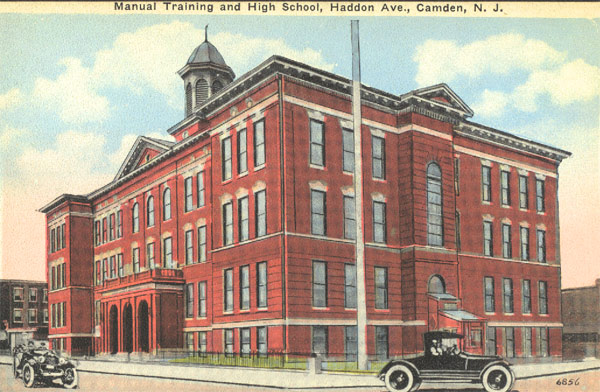
Manual Training and High School, Haddon Avenue, Camden NJ. This school was known as Junior High School Number 1 after 1918, and later as Clara S. Burrough Junior High School.
Hurley Based Success in Life and in Business on Square Deal to All
Camden Courier-Post —

By BEN COURTER
Nearly two score years ago an earnest young man called together a handful of employees in a small store at Fifth and Pine streets.
“Boys, see that door?” he said to them.
“Well, if by any chance I should be called upon to resort to unscrupulous methods in the conduct of this business that door will be closed and this enterprise will end. Square dealing is to be the principle on which we will do business, square dealing to everybody.”
That young man was William Leonard Hurley, then but 27 years old and virile, visioning a great business which he purposed to develop. It was the pronouncement of what then was nothing less than an ideal, for it was in a period when there was a tendency to take advantage of the unsuspecting to sell inferior goods at exorbitant prices. Many operated under what was known in the trade as the “borax system,” which resulted in the public looking askance at installment buying for the home.
Based on that determination to cultivate public confidence in his own business, Hurley built slowly but securely, his small enterprise into “the big trustful store,” with branches in half a dozen cities.
It was a determination that made him a kindred spirit, in later years, with Theodore Roosevelt whose guest the Rough Rider was to become in the midst of a political campaign that stirred the country from coast to coast. It was the straight-forward characteristic that likewise prompted his subsequent activities in the interest of Camden, that was to be a factor in throwing off the provincial spirit and entering the civic stride so pronounced in the advent of the Camden bridge and the extension of Broadway. In both these he was a strenuous advocate of civic expansion, scientifically planned.
Hurley Not Born With a ‘Silver Spoon’
When Hurley was born in Chester county, Pa., 65 years ago, it was not with a “silver spoon in his mouth.” His father, William Hurley, was a railroad man, an honest, hard-working father, who, in times which were hard enough for the bread-winner, struggled to keep his family in the necessities of life.
The son, William, obtained the rudiments of education under great difficulties, for schools were scarce and far between in the sparse settlement where his boyhood was spent. It was a school of hard knocks, an environment that evidenced the difficult problem the poorer class had in obtaining the bare necessities of life. It was the experience of those early years that William L. Hurley never forgot, for afterward, when success had come, he never was deaf to an appeal from those “pulling hard against the stream.”
At the age of 12 he obtained his first job on a farm in his native Chester county. Farming in those days was hard, strenuous work, seemingly never ending labor to the boy, even then strong and possessing much of the splendid physique of later years.
“I worked from four in the morning until after dark,” Hurley once said, in a reminiscent way. “The farmer usually woke me in the morning by pounding his cane on the floor.
“My duties? Well, they included milking ten cows, feeding chickens and pigs, cleaning the horses, husking corn and doing odd chores. The farmer paid me $4 a month and board.
“In those days boys worked just as hard as grown folks. It was no cinch and when darkness came I couldn’t run fast enough to the farmhouse and to bed. I was dead tired and the bed brought supreme happiness to me. Sleeping was about the only fun I had.”
So the years went on with the hard work on the farm. The future held no great promise. The railroad was more alluring. Since his father was a railroader, young Hurley decided to try that field.
Railroading in 80’s No ‘Automatic’ Job
Back in the 80’s railroading was a far different proposition than it is now. There was none of the automatic brakes and couplings and numberless other inventions that have made it comparatively a safe job today. The old-fashioned coupling pin, for instance, was the abomination of the brakeman. What it did to Hurley he carried to his dying day in the loss of the end of one of his middle fingers.
Not only did he act as brakeman but also as fireman. As he stoked the pulsing engine he dreamed of the day when he might take the throttle. It seemed a wonderful career then, but fate had other things in store for him. He sensed it when he concluded to better his wage of $1.[?]0 a day and get “something on the side.” That was by selling sewing machines at night, often after he had worked hard on drilling freights or stoking the engine through the day.
But this selling of sewing machines impressed young Hurley that perhaps after all there was something else in life other than guiding a great locomotive over the rails. At any rate he concluded to try it out and this in 1888, the year of the “great Blizzard” in this section, he obtained a job with Edward Gately & Co. in Philadelphia as canvasser. It was not long before he had two assistants who acted as collectors, one of whom, Harry F. Jones, was to become his partner in the Atlantic City store many years later.
Gately was a wealthy man who had made his money mostly in the installment business, one who ever had an eye open for the promising young men in his organization. It was his custom to give them a chance and take them into partnership, opening stores in various cities. Young Hurley was one of these promising young men. In 1890 the business of Gately & Hurley was started. To be exact it was on February 1 of that year that a small store was opened, the corner store under old Wildey Hall at Fifth and Pine streets. It was there that he was inspired to tell his then small force of his square dealing policy.
Worked Long Hours to Make Store Success
Young Hurley worked like a Trojan. None in the ranks put in longer hours than he, sometimes 18 or 20 before he was willing to call it a day.
Not only did he direct his force in garnering business, but he went out on the street, often with rugs across his shoulders, to obtain patronage. Many recall the stalwart, earnest young man and his breezy manner which seldom failed to bring result.
Nor was Hurley, in the flush of subsequent success, averse to recalling those strenuous days, usually with a chuckle and remembrance of old timers who had stood staunch and strong with his organization through the intervening years.
Four years later the business had grown to such proportions that he concluded another location was needed. That was after all the stores under Wildey Hall had been occupied. In 1894 the Gately & Hurley store was opened at Broadway and Pine streets. It was then 33 by 90 feet.
When Hurley impressed Gately with the necessity for expanding and having a real store he prepared plans for a four-story structure. Camden then was filled with the “can’t be dones.” Toone & Hollinshed at Broadway and Kaighn avenue was the biggest place on that thoroughfare. Mrs. Varney’s place was on Kaighn avenue, the store of E. V. Story at Sycamore street, Hughes Brothers at Walnut street, Fuhrman Brothers at Chestnut and a few notion places here and there. But the Hurley enterprise seemed so outlandish that one day as George Leathwhite, then Camden’s leading plumber, was looking over the building operation a prominent business man of the period asked.
“Who is the damn fool building this place?”
Nor was he mollified in the least when informed it was “Bill” Hurley. It was regarded altogether a foolhardy undertaking, one that would spell certain disaster. It was pointed out there was nothing just like it on Broadway and that there was nothing to warrant such an outlay.
As a matter of fact that pessimistic note eventually reached Gately. He had some misgivings and Hurley’s four-story building was kept down to three. Just two months after the store had been finished it was necessary to find warehousing room by renting the old bakery of William Kairer at Line and West street. Incidentally, it may be of interest to recall it was Kairer the baker, who had been shot and killed by a burglar in 1893. Theodore Lambert was hanged in the old county jail for that murder.
In 1900 Hurley bought the Gately interests, giving him exclusive ownership, and the business continued to grow making more additions necessary. The old Field properties, two and a half story bricks, were bought, torn down and the store extended.
In 1903 a store was established at Wilkes-Barre with Daniel Loughran as Hurley’s partner. Three years later Henry J. Tobin was made his partner in another store at Trenton. Then in 1912 John J. Powell was commissioned to open the Hurley-Powell store at Wilmington. Harry F. Jones, Hurley’s collector in the very early days opened the Hurley-Jones store at Atlantic City in 1915. Five years later another Hurley store started business at Bridgeton. And in 1923 the home store was remodeled and in the meantime, old Turner Hall, where many a gay night was had by the old timers in masked balls and other festivities, was converted into a warehouse with other structures doing like service. Hurley has long since been recognized as one of South Jersey’s merchant princes.
Roosevelt Given Support in Bull Moose Campaign
Although he never consented to leave the helm of his great business enterprises, save later in life when he spent part of the winters at Hilton Head or occasionally went abroad, Mr. Hurley found time to take an active interest in the affairs of Camden. He did not seek political preferment but for more than 30 years he sought the best that might come with [blacked out]n progressive government. He ever desired to see Camden forge ahead in business in a civic way. Frequently he chafed over a tendency on the part of the political powers to let things drift along. He had no particular objection to the Republican organization as it was constituted under the late Senator David Baird, but he did believe with all possible sincerity that if the progressive spirit could be injected into it much would be accomplished, things that were left to very, very slow evolution.
It was therefore quite in keeping with that tendency that he aligned himself with the late Cooper B. Hatch in the late 90’s when the Committee of 100 was born with the Courier then under S. Conrad Ott as city editor being a potent factor in the victory. It was then that Hurley gave financial and moral aid to the movement with Hatch as the leader and with Lewis H. Moorman, [blacked out], C. Kramer and others many of whom have long since gone fostering the cause. [blacked out] its purpose perhaps although within a few years it had passed with the usual disintegration of independent movements.
When Colonel Roosevelt formed the Bull Moose party and became the Presidential candidate in 1912 with William H. Taft and Woodrow Wilson in the field, Mr. Hurley was an earnest active advocate of the Rough Rider. In fact he was one of the delegates to the Bull Moose convention that nominated Roosevelt.
In the midst of that truly hectic campaign when Wilson, Taft and Roosevelt visited Camden, Wilson’s meeting was enthusiastic enough to please any Democrat. Taft’s was a frost and hardly more than a fringe, mostly office holders greeted him, but Roosevelt’s was what the Colonel himself called a “rip snorter.”
Teddy Was Guest at Home of Hurley During Visit Here
Hurley was his host on that occasion, a hot summer night, itself suggestive of the extremely hot campaign. These meetings were held at the Third Regiment armory, no other building then being available. One may yet recall very vividly the entrance of the Colonel, Mr. Hurley and the Camden Bull Moose leaders. The great drill hall was literally jammed, with yelling enthusiasts even hanging from the top girders. Just as he arrived a terrific thunder storm broke loose, the reverberation, the vivid flashes lost in the roar of the crowd.
“Where’s your hat, Teddy?” someone yelled.
And the Colonel tossed his old black slouch hat in the ring while Hurley led the cheer that followed, a cheer that seemingly tested the strength of the expansive roof. Roosevelt had been a guest at the Hurley home at West Collingswood where the leaders, the rank and file of the Bull Moosers met him. It was one gala night and Mr. Hurley was in the zenith of his glory.
None was more disappointed when Colonel Roosevelt failed at the November election, for Mr. Hurley felt that the country needed the hero of San Juan Hill particularly at that time. He sincerely mourned the Colonel’s passing, but to the very last cherished his memory, regarding him as the Great American.
Backed Non-Partisan Move, Aided Opening of Broadway
As has been indicated, Mr. Hurley had no particular feeling against the Republican organization, but he was certain that Camden was on the threshold of big things and that there should be an awakening. There appeared to be no intention of getting out of the rut so far as the political powers were concerned and with the assurance of the bridge he regarded it necessary to be alive to the opportunities certain to come. There had been talk of certain outlets from the bridge which did not meet the situation in his judgment. For one thing, he was impressed with the extension of Broadway.
For more years than one might recall, Broadway had been Camden’s principal street. Many regarded it as the city’s most important business thoroughfare. Mr. Hurley early realized that to extend it to where the bridge plaza would eventually be located was a real civic essential, but the city administration did not consider the financial outlay that would be involved justified in the extension.
That was one of the factors that resulted in the Non-Partisan movement of 1922, of Mr. Hurley’s advocacy of its cause, of his financial and moral support. He was one of the leaders in the civic revolution that first brought the victory for commission form of government and later that ushered the Non-Partisan candidates into office.
It was the realization of a cherished dream when the new administration bought property that assured Broadway’s extension to the bridge plaza. It justified his prediction that it would be like giving a new blood stream to the city, for the Walt Whitman Hotel, the Wilson Building and others rapidly rising about Broadway and Cooper streets prove it beyond all doubt.
Camden Bridge Proposition Given Approval by Hurley
Mr. Hurley not only gave his every influence toward the Camden bridge proposition in the days when it was regarded more or less a joke, but he worked assiduously to crystalize [sic] sentiment so that the century-old dream would be a dream no longer. New Jersey did its part when Walter Edge was governor, but there was plenty of backing and filling on the part of Philadelphia and Pennsylvania. There were many discouraging epochs, even after a joint commission had been created, but Mr. Hurley was among those who refused to give up hope. What was subsequently accomplished was due mainly to men of his faith, of his courage, of his energy.
After its completion the necessity for a second span was impressed upon him. Shortly after the Camden bridge was opened to the public he advocated another from Market street, Gloucester to Pattison avenue, Philadelphia. Since other sites have been suggested. A joint commission has been named to make preliminary surveys but has been at loggerheads over a proposal to build a span from Red Bank to League Island. Mr. Hurley regarded his suggestion as far more feasible and he supported it by arguments that were hard to answer.
Throughout his career Mr. Hurley had been an earnest advocate of co-operation among business interests of the city. For many years there was the Board of Trade rather an innocuous organization, usually attended by half a dozen men and voiceless so far as influence went. He concluded a rejuvenation was necessary, consented to act as president and speeded it up with the late Louis T. Derousse as secretary. Later Charles M. Curry held that position and until the present Chamber of Commerce was formed under a campaign directed by the American City Bureau. Mr. Hurley or his subordinates had given it every possible aid to make it a factor in the community.
Assessment Commissioner Was Only Political Post
Aside from his principal business, Mr. Hurley was associated for many years with the late William J. Lorigan in building homes. Their first extensive operation was the construction of two rows of dwellings in Princeton avenue. Others were constructed in various parts of Camden and the development of the district about Twenty-seventh and Federal streets was largely due to the firm. After the elder Lorigan’s death he was succeeded by his son, William H. Lorigan, who has been associated with Mr. Hurley.
While he sought no political honors, Mr. Hurley did once accept for a few years a position. It was during the Committee of 100 regime when he became a commissioner of assessment. He [?] served for many years as a delegate to the Atlantic Deeper Waterways Convention. He took a keen interest in that organization and in the work of actually having an inland waterway along the eastern seaboard. It is slowly developing with the possibility of becoming an actuality a few years hence, mainly through the effort of men of Mr. Hurley’s caliber.
When he came to Camden Mr. Hurley first resided on Stevens street, then at [?] Pine and from 1894 to 19[?]9 at 7[?]8 Broadway. In the latter year he bought the estate on White Horse pike at West Collingswood that had been used as a sanitarium. The building was virtually reconstructed, the grounds were laid out in beautiful shrubbery and there were already fine nut trees which made it a show place. He called it Dungarvan, after the county in Ireland where his father was born.
It was there at his palatial home, with the beautiful surroundings that Mr. Hurley delighted in acting the role of host, of gathering about him old friends and harking back to the times that were.
Unspoiled Good Will Befriended All in Need
Old friends cherish the memory of one outstanding characteristic of “Bill” Hurley. Increasing fortune never “spoiled” him. He remained democratic until the end, and those who had known him through the years called him “Bill” just as they had done in the days when he was forging ahead in spite of the “can’t-be-dones.”
Nor did he ever forget an old customer. It might be an old, old woman upon whom fortune had consistently refused to shine but who made her little purchases at his store. None was too lowly for him to give his personal attention under such circumstances. There was ever a real grip of the hand that spoke sincerity.
It was quite natural that he enjoyed hunting and fishing. For many years his summer home was at Sea Isle City, where his family went through the vacation period each year. There he never failed to go out to sea or to try his luck off the pier, usually with an old friend. Catching the piscatorial beauties, particularly a channel bass or a drum, was regarded with almost the same satisfaction as putting over a big business deal.
Over a dozen years ago he bought the island at Hilton Head, off the coast of South Carolina and 30 miles from Savannah. While he enjoyed all the comforts of civilization, the surroundings were kept in their primitive simplicity. Nothing delighted him more than taking an old friend along to the island estate and showing the guest the time of his life.
Men like Hurley do much that is unheralded to alleviate the suffering of the world. Creed or color meant nothing to him if aid were needed. What he gave in that respect no one knows. Those long associated with him declare it was sufficient to make happy a small army in adversity.
Aided Worthy Causes Regardless of Creeds
Charitable organizations, religious or otherwise, enjoyed his bounty. No one was aware of such aid unless it happened to be in a “campaign” to raise a specified sum. It was Hurley very often who started things going by way of a liberal contribution. It mattered not whether the cause was for Protestant, Catholic or Jew—just so it was worth while. When the vicious pogroms were sweeping Russia he was one of the most generous contributors to the Camden funds for the sufferers. In the flu epidemic of 1918 he was among the leaders who aided the stricken, who gave many a family a lift over rough places.
During the war he was active in every Liberty Loan drive, in every movement that aided ultimate victory. He was chairman of the Knights of Columbus drive, he was a potent factor in the United War Workers’ campaign, in the Red Cross and kindred movements. He took great interest in the boys who “went over there” for his own son, Jerome, was in the service.
Surely in glancing over Camden’s history in the past two-score years not an instance conducive to the city’s development may be cited without finding William L. Hurley’s name connected with it some way, some how. He was so much a part of its warp and woof that the civic fabric bears indelibly the impress of his personality.
Evergreen Cemetery
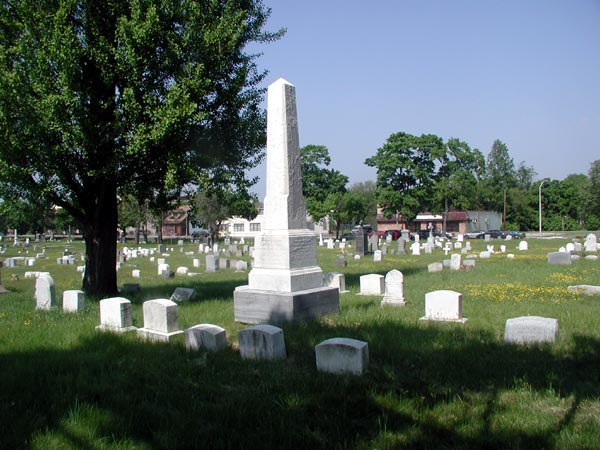
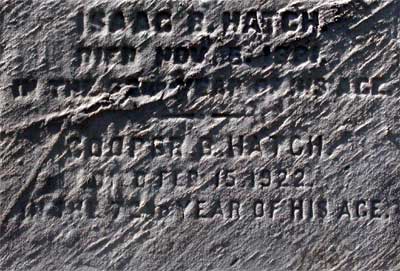
Older Brother: Isaac B. Hatch & Cooper B. Hatch
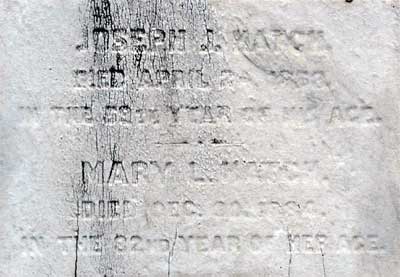
Parents: Joseph J. Hatch & Mary L. Hatch
Sisters: Rebecca Hatch & Caroline S. Hatch
Uncle Hugh Hatch & brother Joseph Hatch are buried nearby.
Police Shakeups of Today Mild Compared to Years Ago
Camden Courier-Post —
Force Changed Every Time Political Regime of City Shifted; Larry Doran Fired for Crossing Street to Get Cinnamon Bun; Old Patrol Recalled
By BEN COURTER
(Another in a series of articles on municipal affairs and personalities of yesteryear.)
Ben Courter
In “the good old days” when Camden’s police department was just about getting under way in accordance with the amended charter of 1872, the men in the ranks were the football of politics. Even if the phrase “to the victor belongs the spoils” had not yet been coined, it was in active force. A change of administration always meant a violent shakeup in the personnel of the department.
It has been so many years since Camden has had a real political shakeup, aside from the nonpartisan movement of seven years ago, that the younger element can have no personal recollection of upheavals marking the aftermath of Democrats succeeding Republicans or vice versa. Many of the men resigned on principle, but others stood their ground and with the faithful hungry for place on the police force it was necessary to take drastic measures.
Sometimes it did not require a party turnover, for bitter factional scraps resulted in reprisals. It then fell the lot of the police committee of city council to conduct hearings. They were usually acrimonious affairs with partisans of the G. O. P. often showing more spleen than in a strict party fight. These hearings were as a rule public, attracting big crowds of opponents and advocates of the accused. The charges ranged from conduct unbecoming an officer to neglect of duty and everything between.
Sometimes the charges were altogether ridiculous, as for instance when Larry Doran, now chief of the county detectives, was accused of going out of his beat to buy a cinnamon bun. He happened to be an appointee of Mayor Joseph E. Mowrey and no one questioned Doran’s ability as a cop or of his sincerity in patrolling his beat. But the Republicans had come back into the fold some 25 years ago and it was determined Larry should get out. Thus came the charge based on someone’s discovery he had crossed the street early one morning to get a bun. No one imagined it a very heinous offense at best, but it was all in the game of politics and the finding of the police committee was a foregone conclusion.
Findings, Usually Sustained
In some instances appeals were made to higher courts, but very little came of it since the committee was considered within its power to dismiss an officer if it saw fit. All necessary was to have the report accepted by council and since that was overwhelmingly Republican the work of the committee was a mere formality. Politics continues to play an important part in the appointments of cops or firemen, but for the past six years they have been under civil service, thus affording at least a measure of protection unless there actually has been some dereliction of duty.
Even though there were the changes wrought by political and factional wars, many men withstood the storms through the years. As a matter of fact it is evident that most of the men who have been accepted as representative of the force have had little difficulty in holding down their beats.
Mention has occasionally been made of one of Camden’s most spectacular police chiefs, Samuel Dodd. When he was first appointed by Mayor Pratt in the 80’s he was in the prime of life and certainly not inclined to give quarter to anyone. But he met with his first difficulties in the race track regime with the dual police departments, when the Democratic commission appointed William A. Davis in his stead. He was reinstated in 1893 after the Republicans had gained control of the state and had abolished the commissions.
Dodd then went along without further trouble until the advent of Hatch who appointed John Foster in 1898. Dodd was born in Burlington in 1841, but came to Camden as a young shoemaker and made himself vitally important to his fellow workers. In the 80’s Camden was a shoemaking and leather center. There were over 100 factories and hundreds of persons were employed. Thus it became an important factor in politics. Dodd loomed as a mayoralty candidate. Everything was cut and dried for him to enter the field when Pratt ran in 1885, but Dodd was prevailed upon to get out of the fight with the promise of being made police chief. That was later carried into effect.
Many years Chief Dodd has been dead, but old-timers around the city hall still have a very vivid recollection of him and his long coal black whiskers, which he had a habit of yanking when under some excitement.
First Patrol Wagon
It was during Dodd’s regime Camden sported its first patrol wagon, in May of 1893. It was something of an epochal event for Camden. Men nearing middle life who then were boys vividly recall the sensation created by the appearance of the little red wagon with “Camden Patrol” painted in gold on the red sides, not forgetting the big gong near the driver’s seat. And as the high steppers speeded through the city streets with a drunk or victim of an accident that gong was everlastingly sounded until the whole populace was brought to the doors. Chief Stehr’s father, Lewis H. Stehr; Oscar Weaver, “Si” Sage and “Nitchie” Golden were the first in the department who operated that famous wagon. It was the forerunner of the automobile police patrol and ambulance put in service July 14, 19[?].
When the first patrol went into service Camden’s streets were veritable “rocky roads to Dublin.” They were paved with cobble, even Broadway, Federal street and Kaighn avenue. Only Cooper street and a part of Benson sported asphalt blocks. Hence it was the object of the driver to pick out the best route possible by using horse car or trolley tracks if possible.
It certainly was no pleasure trip to the hall for a drunk and a road of torture to any unfortunate being toted to the hospital. But even at that it was an improvement over the archaic method of taking prisoners to jail by way of a pushcart. I have already mentioned in these annals the Roman holiday such an incident furnished the kids of the generation. If John Painter or Charlie Fitzsimmons pushed a cussin’ drunk from Kaighn Point to the hall they were sure to have a yelling mob of kids at their heels. Unfortunates who were ill or injured were usually taken to the hospital in horse-drawn cabs. But of course the conveniences of today were not even dreamed about.
Lieutenant Tommie Cunningham is among the veterans on the force who recalls those days of long ago, for last Tuesday marked the thirty-sixth anniversary of his appointment to the department. Tommie has seen the department grow from less than half a hundred men to five times that number. In all that time he has pounded a beat in South Camden or had charge of a detail of men or a district as at present.
“Jake” Woodside
In recalling some of the old-timers mention must also be made of Jacob Woodside, who was appointed October 1, 1898. He hailed from the Sixth ward and was among the valiant crew who sported luxurious mustaches. He was in his later years a sergeant in the Third district. Woodside, who had many staunch friends throughout the city, died several years ago.
Then there is “Cul” Errickson who was made a cop September 15, 1898, by Mayor Hatch. He was for many years sergeant at headquarters; a big, good-natured cop, too. He has been enjoying life these several years as a pensioner up around New Egypt.
Certainly one of the most substantial members of the force was Capt. Arthur A. Stanley, who was in charge of the downtown district for many years. He was appointed by Mayor Hatch July 15, 1898. Captain Stanley was a Civil war veteran and prominently identified with the G. A. R. He has been dead for many years. His son, Milton Stanley, was a detective in the department and also at the prosecutor’s office, but for several years has been living on a farm in South Jersey.
There is another veteran of the force still in harness, George Nowrey, brother of former Mayor Nowrey, appointed by Mayor Hatch August 1, 1898. He has been a sergeant in the department for many years.
On the same day Nowrey was appointed, John Reader was made a member of the force. He, too, was a sergeant when he died several years ago. He was father of Dr. A. B. Reader and Attorney Lawrence Reader, the latter one of the most prominent young men of the city when he died during the flu epidemic in 1918. “Larry” also was a member of council from the Thirteenth ward.