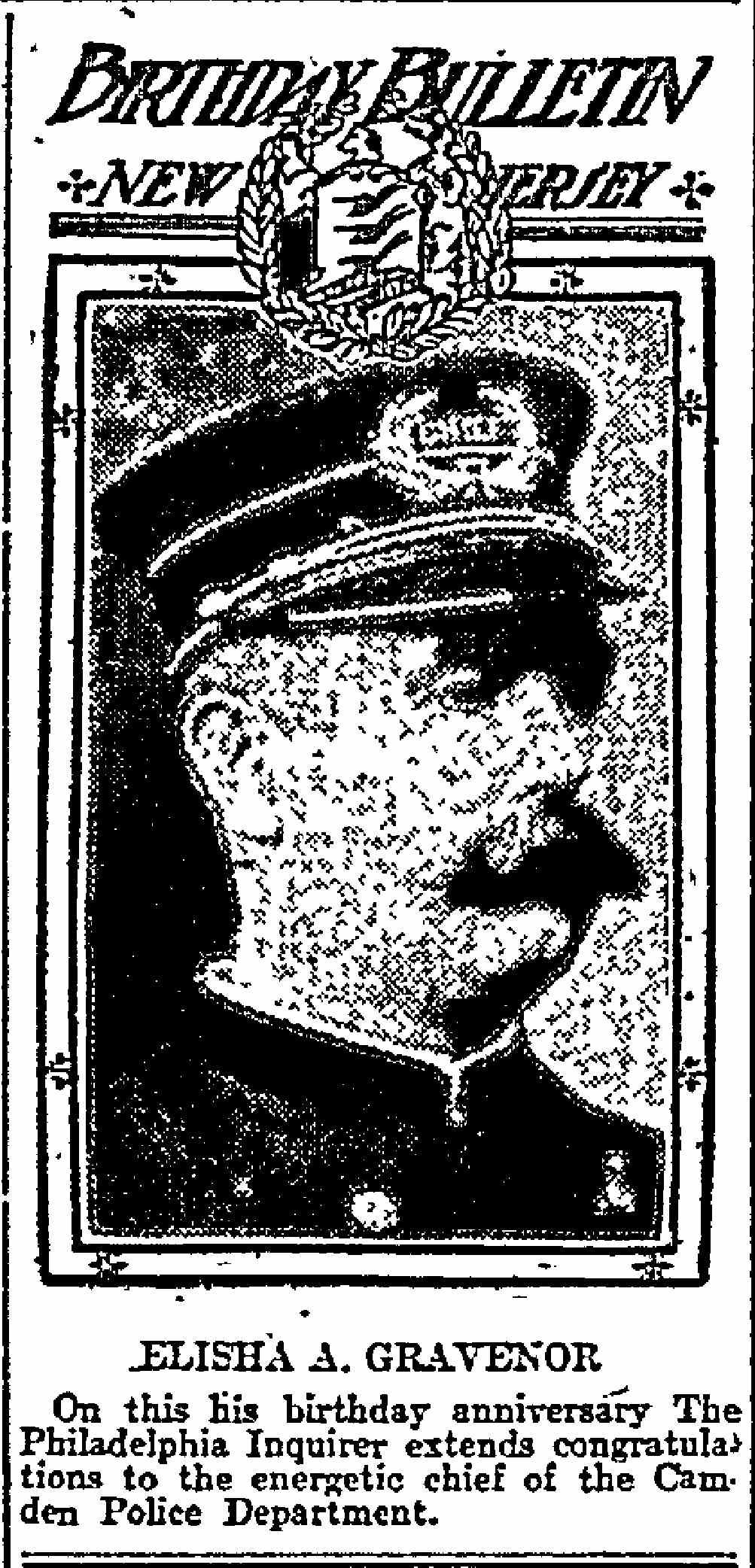
Elisha A. Gravenor
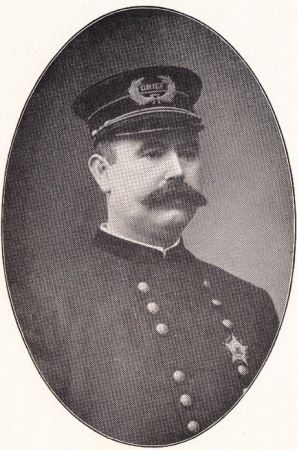
Elisha A. Gravenor, Chief of Police
ELISHA A. GRAVENOR was born in Maryland on January 14, 1868 to Benjamin P. and Ellenor Gravenor. His early years were spent in Barren Creek, Wicomico County MD, where his father owned a farm. Elisha and older brother Benjamin were still on the family farm in 1880.
By 1887 older brother Isaac Gravenor had moved to Camden NJ. Elisha Gravenor would follow, as did other family members. Elisha Gravenor married Almedia A. Bennett on January 26, 1898. When the Census was taken in 1900, Mr. and Mrs. Gravenor were making their home at 528 Elm Street in North Camden. He was working as a policeman.
Rising through the ranks, Elisha Gravenor was appointed Camden’s Chief of Police in 1907, during the administration of Mayor Charles H. Ellis. He succeeded John Foster.
In May of 1914 Camden Fire Department Chief Charles Worthington was killed in the line of duty while fighting a fire at the Camden Electroplating Company at Delaware Avenue and George Street, near the Pennsylvania Railroad Ferry in the center of Camden. Chief of Department Worthington was one of the first units to arrive at the scene and observed heavy fire conditions on the top floor of the two-story building. Chief Worthington ordered an exterior attack from the roof area through large skylight openings. This operation was made particularly arduous by heavy smoke. The fire extended from the plating company at 12 George Street, to involve the New Jersey Automobile Supply Company car dealership at 38 Delaware Avenue.
On the roof, Chief Worthington conversed with Deputy Chief John A. Stockton and Captain Madison of Engine Company 5. Chief Worthington directed Stockton to go down to the street, transmit a second alarm, and also have an engine company stretch a line up the alley. Worthington then left the men and proceeded along the roof to the south side of the building where he was last seen. When Stockton brought the hose team up the alleyway, he found the unconscious Chief laying next to the building. Chief Worthington had apparently stepped back on the roof to avoid a skylight and fell into a shaft between two buildings. The Chief had landed on a pile of scrap iron which inflicted serious wounds including a deep gash on his neck. Deputy Chief Stockton and Police Chief Elisha Gravenor assisted firemen in removing Chief Worthington from the alley where he was rushed to Cooper Hospital. He was pronounced dead on arrival with a broken neck and fractured skull.
Chief Gravenor retired on July 31, 1922. He was succeeded as Chief of Police by Edward Hyde, and in turn by James Tatem. Many innovations took place during his tenure, including the addition of motor vehicles to the force. Perhaps his most notable achievement was in bringing members of the new immigrant communities into the department, men such as Fiore Troncone and Benjamin Simon. He also promoted William Schregler to Captain of Detectives while Chief.
One appointment, probably not of his choosing, did not work out quite so well. George V. Murry, a political leader in Camden’s Third Ward, was brought into the police department and was made Camden’s first black detective. Murry was both quite intelligent and thoroughly corrupt. He promptly went into business for himself, holding the distinction of being Camden’s first organized crime boss.
When the Census was taken in 1920, Chief Gravenor lived with his wife and his brother-in-law Clarence Bennett, at 629 State Street in North Camden. Just across the way at 624 State Street was Police Sergeant Cullis Errickson. He was still living on State Street with his wife as late as April of 1930. The Gravenors moved back to Maryland shortly afterwards, to a town called Mardela Springs. Chief Gravenor died in 1935, his wife in 1939.
Here’s Camden’s Finest, With Whiskers, in 1898
Camden Courier-Post –
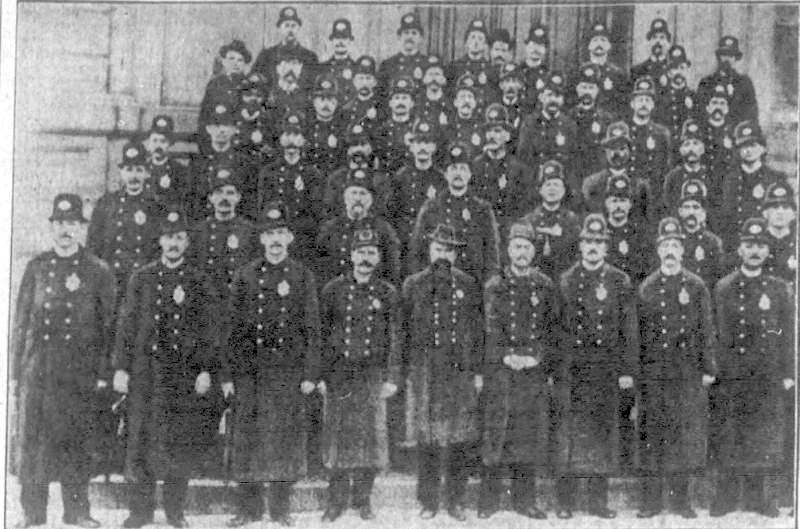
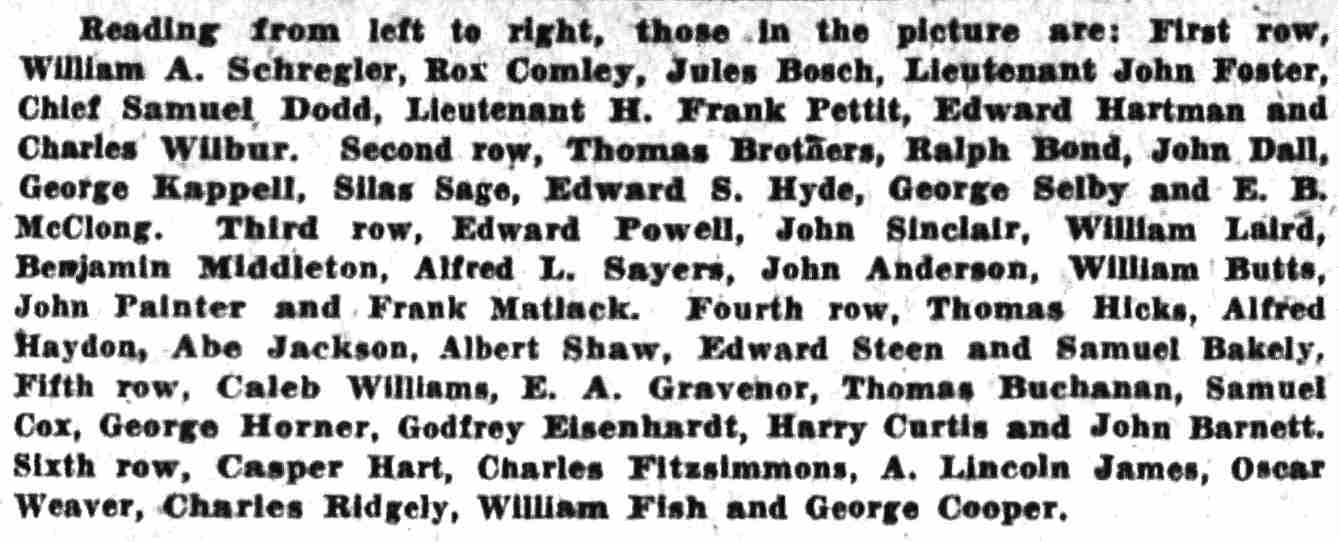
William A. Schregler — William “Rex” Comley — Jules Bosch — John Foster — Samuel Dodd — H. Franklin Pettit — Harry Mines — Edward Hartman — Charles Wilbur — Thomas Brothers — Ralph Bond — John Dall — George Kappell — Josiah Sage — Edward S. Hyde — William Selby — Elbridge B. McClong — Edward Powell — John Sinclair — William Laird — Benjamin Middleton — Alfred L. Sayers — John Anderson — William Butts — John Painter — Frank Matlack — Thomas Hicks — Alfred Hayden — Abe Jackson — Albert Shaw — Edward Steen — Samuel Bakley — Caleb Williams — Elisha A. Gravenor — Thomas Buchanan — Samuel Cox — George Horner — Godfrey Eisenhardt — Harry Curtis — George B. Johnson — John Barnett — Casper Hart — Charles Fitzsimmons — A. Lincoln James — J. Oscar Weaver Sr. — Charles Ridgely — William Fish — George Cooper
Harry Mines, not named above, is in the first row between H. Frank Pettit and Edward Hartman. In the fifth row, at the far right, “John Barnett” was a guess on the part of A. Lincoln James. Another person guessed George Johnson. Both were wrong and it is not known who that policeman is.
Philadelphia Inquirer – October 25, 1904
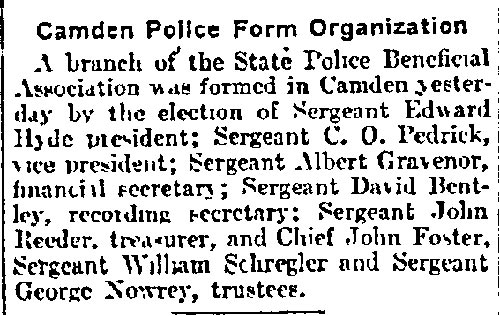
Camden Police Form Organization
A branch of the State Police Beneficial Association was formed in Camden yesterday by the election of Sergeant Edward Hyde president; Sergeant C. O. Pedrick, vice president; Sergeant Albert Gravenor, financial secretary; Sergeant David Bentley, recording secretary; Sergeant John Reeder, treasurer, and Chief John Foster, Sergeant William Schregler and Sergeant George Nowrey, trustees.
Philadelphia Inquirer – March 24, 1905

Elisha A. Gravenor
Philadelphia Inquirer – March 5, 1906
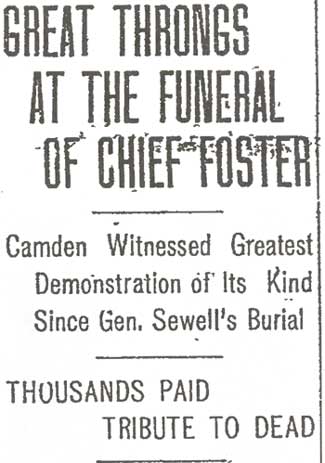

Camden Witnessed Greatest Demonstration of Its Kind Since Gen. Sewell’s Burial
THOUSANDS PAID TRIBUTE TO DEAD
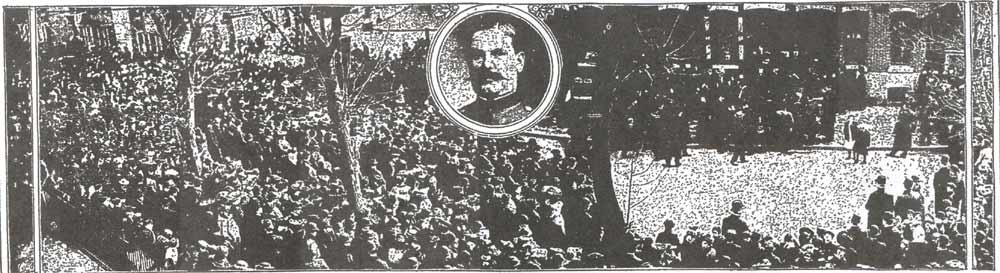
CROWD ABOUT THE FOSTER HOME AND PICTURE OF THE DEAD CHIEF
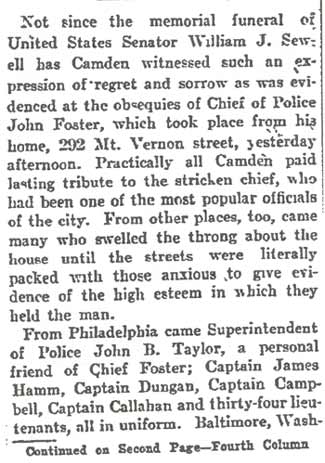
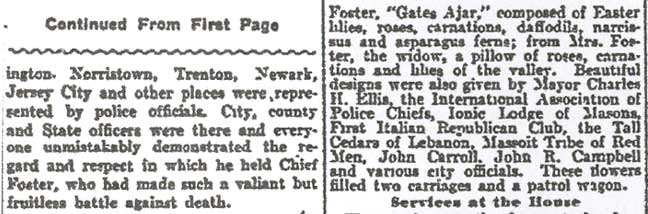
Not since the memorial funeral of United States Senator William J. Sewell has Camden witnessed such an expression of regret and sorrow as was evidenced at the obsequies of Chief of Police John Foster, which took place from his home, 292 Mt. Vernon street, yesterday afternoon. Practically all Camden paid lasting tribute to the stricken chief, who had been one of the most popular officials of the city. From other places, too, came many who swelled the throng about the house until the streets were literally packed with those anxious to give evidence of the high esteem in which they held the man.
From Philadelphia came Superintendent of Police John B. Taylor, a personal friend of Chief Foster; Captain James Hamm, Captain Dungan, Captain Campbell, Captain Callahan and thirty-four lieutenants, all in uniform. Baltimore, Washington, Norristown, Trenton, Newark, Jersey City and other places were represented by police officials. City, county and State officers were there and everyone unmistakably demonstrated the regard and respect in which he held Chief Foster, who had made such a valiant but fruitless battle against death.
Thousands Viewed Remains
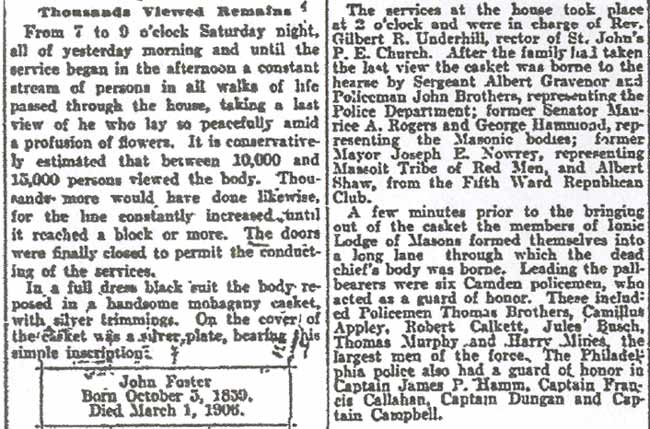
From 7 to 9 o’clock Saturday night, all of yesterday morning and until the service began in the afternoon a constant stream of persons in all walks of life passed through the house, taking a last view of he who lay so peacefully amid a profusion of flowers. It is conservatively estimated that between 10,000 and 15,000 persons viewed the body. Thousands more would have done likewise, for the line constantly increased, until it reached a block or more. The doors were finally closed to permit the conducting of the services.
In a full dress black suit the body reposed in a handsome mahogany casket, with silver trimmings. On the cover of the casket was a silver plate, bearing this simple inscription:
John Foster
Born October 5, 1839.
Died March 1, 1906.
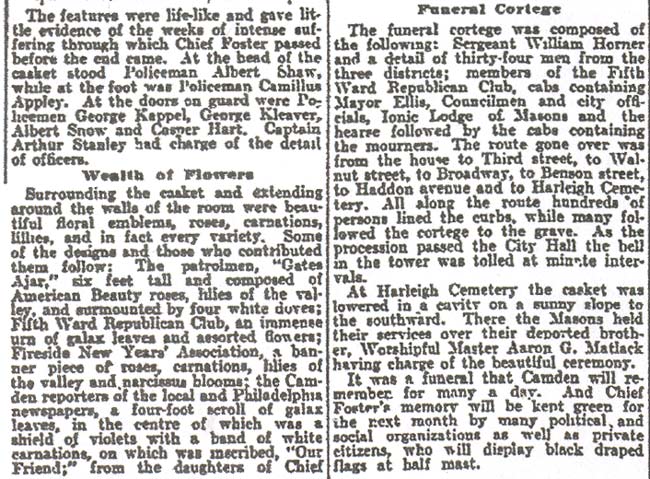
The features were life-like and gave little evidence of the weeks of intense suffering through which Chief Foster passed before the end came. At the head of the casket stood Policeman Albert Shaw, while at the foot was Policeman Camillus Appley. At the doors on guard were Policemen George Kappel, George Kleaver, Albert Snow and Casper Hart. Captain Arthur Stanley had charge of the detail of officers.
Wealth of Flowers
Surrounding the casket and extending around the walls of the room were beautiful floral emblems, roses, carnations, lillies, and in fact every variety. Some of the designs and those who contributed them follow: The patrolmen, “Gates Ajar,” six feet tall and composed of American Beauty roses, lilies of the valley, and surmounted by four white doves; Fifth Ward Republican Club, an immense urn of galax leaves and assorted flowers; Fireside New Years’ Association, a banner piece of roses, carnations, lilies of the valley and narcissus blooms; the Camden reporters of the local and Philadelphia newspapers, a four-foot scroll of galax leaves, in the centre of which was a shield of violets with a band of white carnations, on which was inscribed, “Our Friend;” from the daughters of Chief Foster, “Gates Ajar,” composed of Easter lilies, roses, carnations, daffodils, narcissus and asparagus ferns; from Mrs. Foster, the widow, a pillow of roses, carnations and lilies of the valley. Beautiful designs were also given by Mayor Charles H. Ellis, the International Association of Police Chiefs, Ionic Lodge of Masons, First Italian Republican Club, the Tall Cedars of Lebanon, Massoit Tribe of Red Men, John Carroll, John R. Campbell and various city officials. These flowers filled two carriages and a patrol wagon.
Services at the House
The services at the house took place at 2 o’clock and were in charge of Rev. Gilbert R. Underhill, rector of St. John’s P. E. Church. After the family had taken the last view the casket was borne to the hearse by Sergeant Albert Gravenor and Policeman John Brothers, representing the Police Department; former Senator Maurice A. Rogers and George Hammond, representing the Masonic bodies; former Mayor Joseph E. Nowrey, representing Massoit Tribe of Red Men, and Albert Shaw, from the Fifth Ward Republican Club.
A few minutes prior to the bringing out of the casket the members of Ionic Lodge of Masons formed themselves into a long lane through which the dead chief’s body was borne. Leading the pallbearers were six Camden policemen, who acted as a guard of honor. These included Policemen Thomas Brothers, Camillus Appley, Robert Calkett, Jules Busch, Thomas Murphy and Harry Mines, the largest men of the force. The Philadelphia police also had a guard of honor in Captain James P. Hamm, Captain Francis Callahan, Captain Dungan and Captain Campbell.
Funeral Cortege
The funeral cortege was composed of the following: Sergeant William Horner and a detail of thirty-four men from the three districts; members of the Fifth Ward Republican Club, cabs containing Mayor Ellis, Councilmen and city officials, Ionic Lodge of Masons and the hearse followed by the cabs containing the mourners. The route gone over was from the house to Third street, to Walnut street, to Broadway, to Benson street, to Haddon avenue and to Harleigh Cemetery. All along the route hundreds of persons lined the curbs, while many followed the cortege to the grave. As the procession passed the City Hall the bell in the tower was tolled at minute intervals.
At Harleigh Cemetery the casket was lowered in a cavity on a sunny slope to the southward. There the Masons held their services over their departed brother, Worshipful Master Aaron G. Matlack having charge of the beautiful ceremony.
It was a funeral that Camden will remember for many a day. And Chief Foster’s memory will be kept green for the next month by many political and social organizations as well as private citizens, who will display black draped flags at half mast.
Philadelphia Inquirer – March 21, 1906
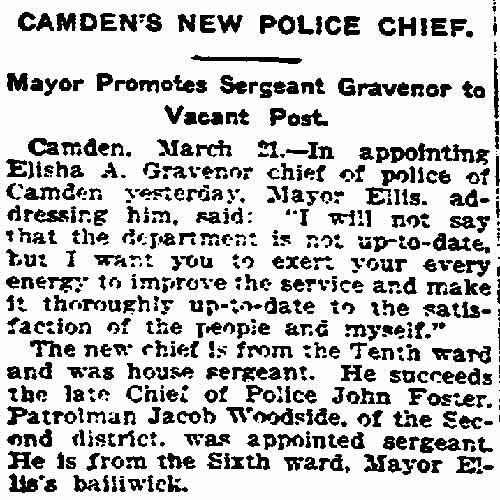
CAMDEN’S NEW POLICE CHIEF.
Mayor Promotes Sergeant Gravenor to Vacant Post.
Camden, March 21.—In appointing Elisha A. Gravenor chief of police of Camden yesterday, Mayor Ellis, addressing him, said: “I will not say that the department is not up-to-date, but I want you to exert your every energy to improve the service and make it thoroughly up-to-date to the satisfaction of the people and myself.”
The new chief is from the Tenth ward and was house sergeant. He succeeds the late Chief of Police John Foster. Patrolman Jacob Woodside, of the Second district, was appointed sergeant. He is from the Sixth ward, Mayor Ellis’s bailiwick.
Camden Post-Telegram – May 8, 1906
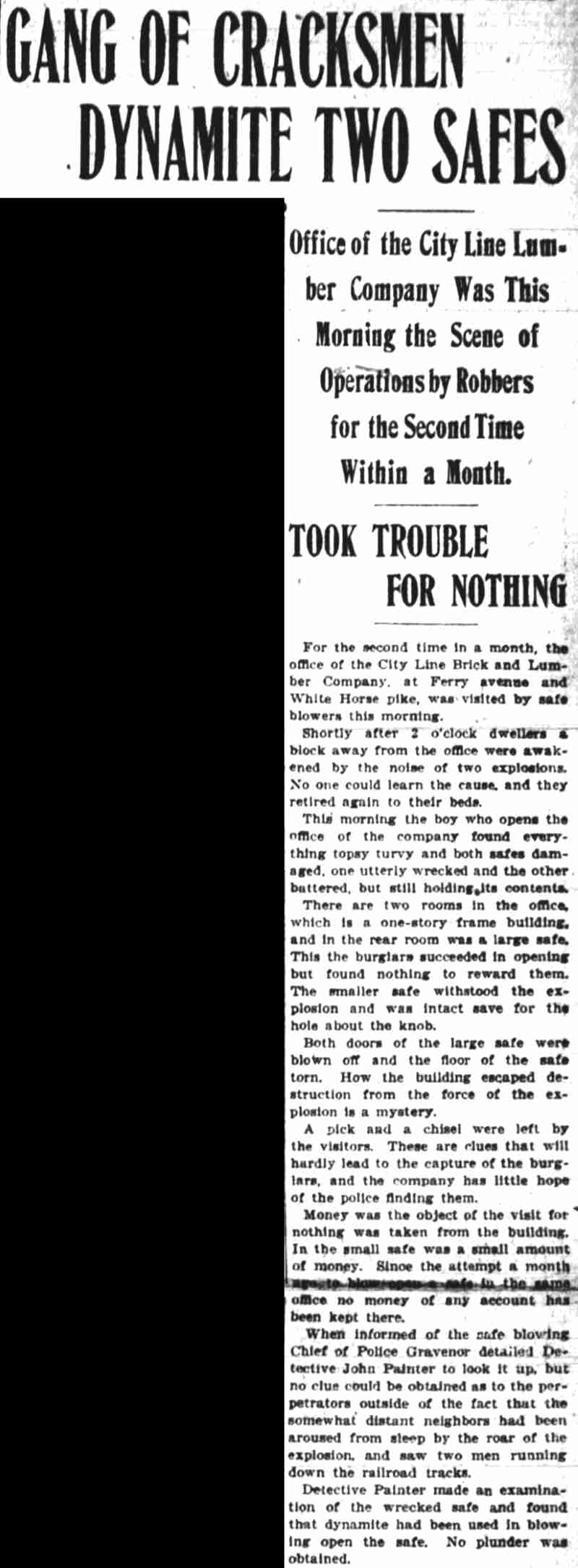
John Painter — Elisha A. Gravenor
Camden Daily Courier – July 12, 1906
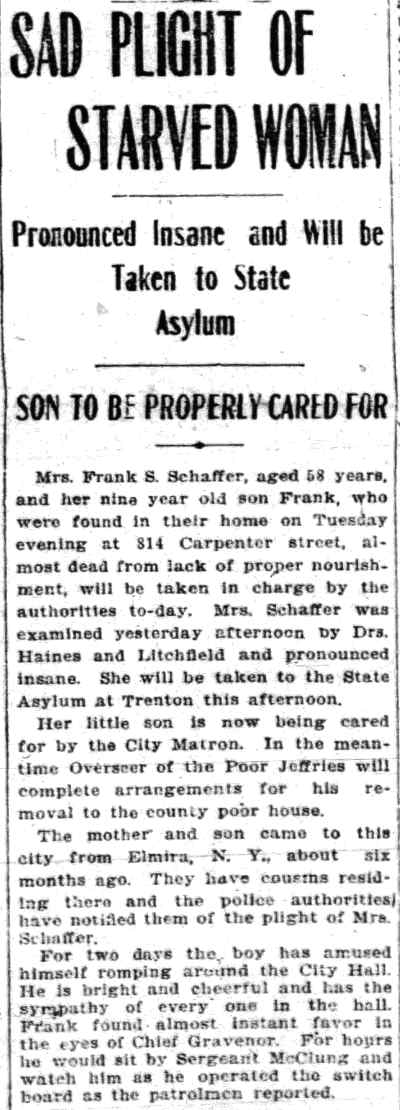
Named: Elisha A. Gravenor, E. E. Jefferis, Frank Schaffer, Carpenter Street, Dr. Rowland I. Haines, Dr. Paul N. Litchfield, and Elbridge B. McClong.
Philadelphia Inquirer – August 14, 1906

Elisha A. Gravenor
Philadelphia Inquirer – September 13, 1906
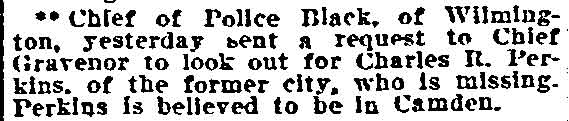
Elisha A. Gravenor
Bridgeton Evening News – December 31, 1906
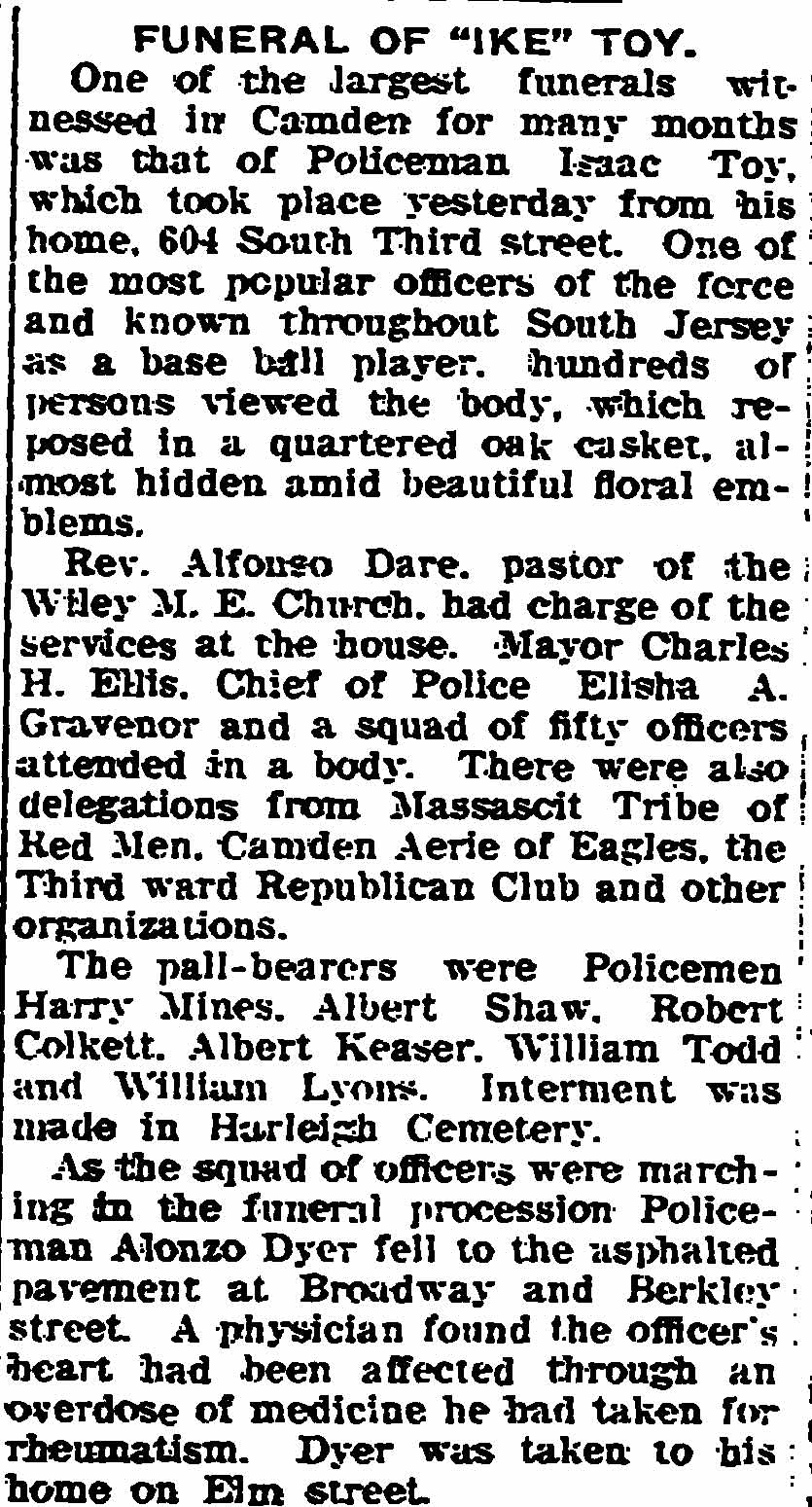
FUNERAL OF “IKE” TOY.
One of the largest funerals witnessed in Camden for many months was that of Policeman Isaac Toy, which took place yesterday from his home, 604 South Third street. One of the most popular officers of the force and known throughout South Jersey as a base ball player, hundreds of persons viewed the body, which reposed in a quartered oak casket, almost hidden amid beautiful floral emblems.
Rev. Alfonso Dare, pastor of the Wiley M. E. Church, had charge of the services at the house. Mayor Charles H. Ellis, Chief of Police Elisha A. Gravenor and a squad of fifty officers attended in a body. There were also delegations from Massascit Tribe of Red Men, Camden Aerie of Eagles, the Third ward Republican Club and other organizations.
The pall-bearers were Policemen Harry Mines, Albert Shaw, Robert Colkett, Albert Keaser, William Todd and William Lyons. Interment was made in Harleigh Cemetery.
As the squad of officers were marching in the funeral procession Policeman Alonzo Dyer fell to the asphalted pavement at Broadway and Berkley street. A physician found the officer’s heart had been affected through an overdose of medicine he had taken for rheumatism. Dyer was taken to his home on Elm street.
Philadelphia Inquirer – March 19, 1907
Elisha A. Gravenor
Philadelphia Inquirer – August 21, 1907
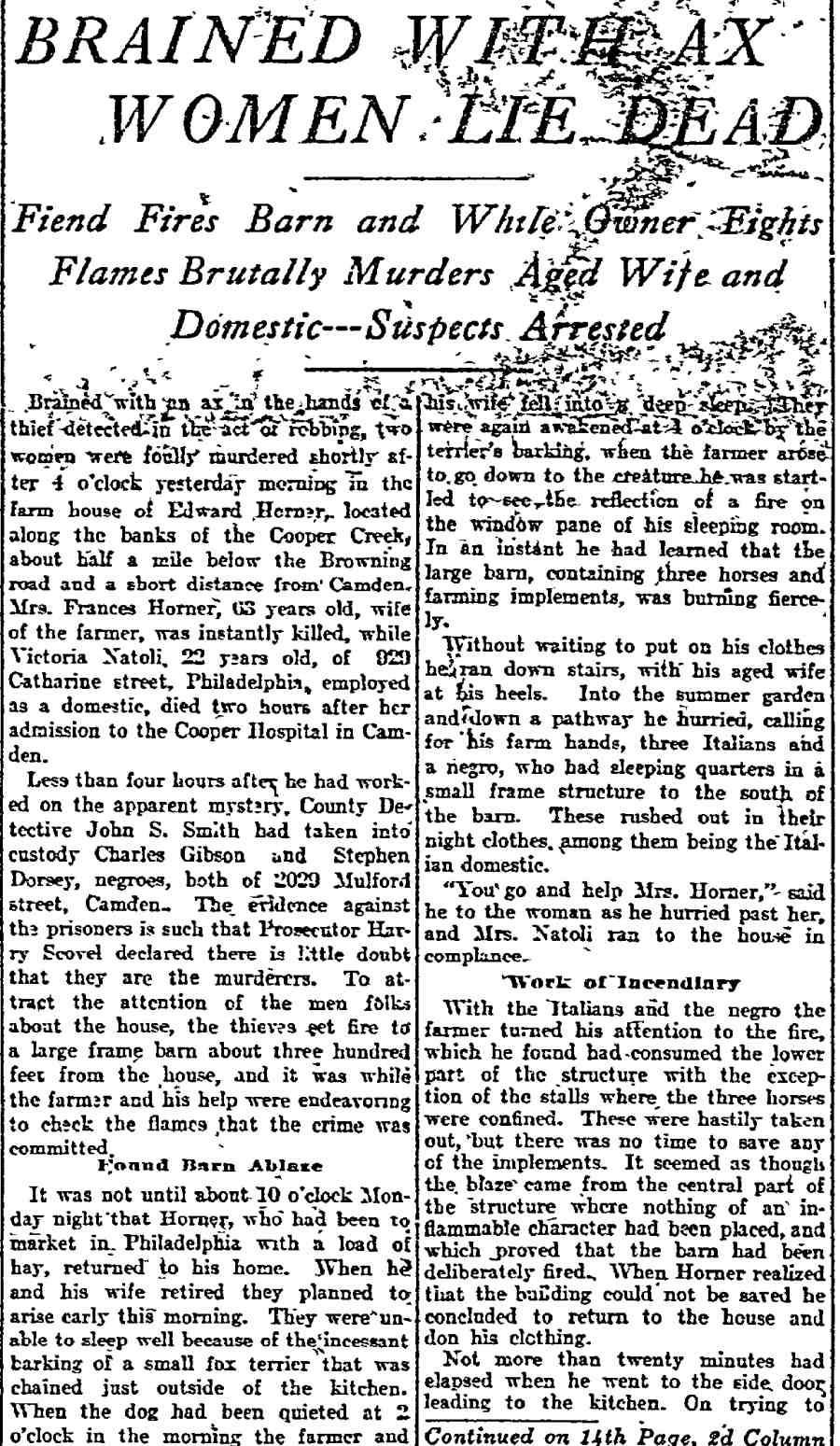
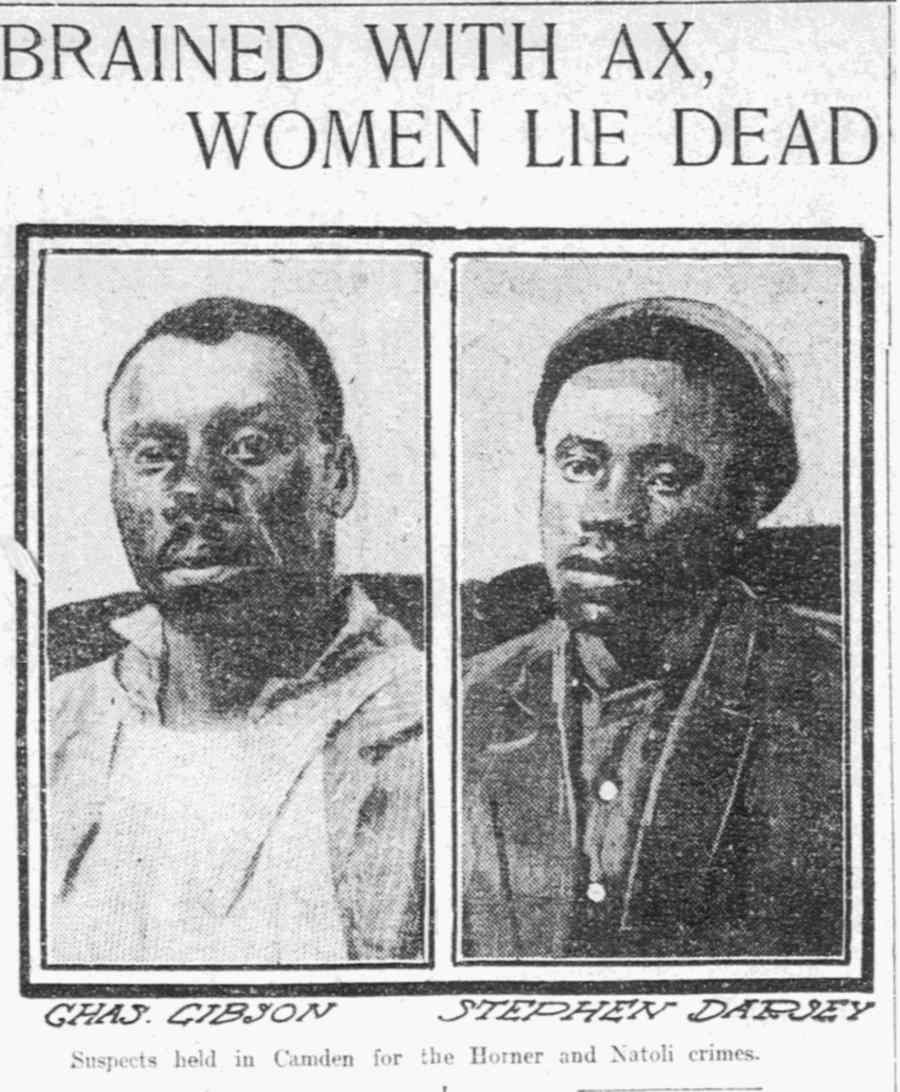
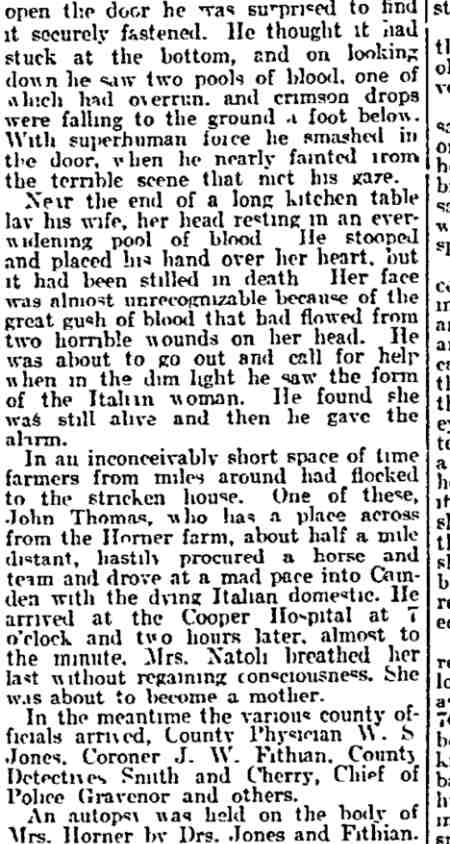
Named: Charles Gibson, Stephen Dorsey, Mulford Street, Edward Horner, Frances Horner, Victoria Natoli, John S. Smith, John Cherry, Elisha Gravenor, Dr. William S. Jones, J. W. Fithian, Henry S. Scovel, Mrs. Anna Marter, Mrs. Edward Megargee, and Mrs. Isaac Beideman.
Philadelphia Inquirer – November 2, 1908
West Indian Shot Woman at Their Home in Camden, Then Turned Revolver on Himself
Angered because his wife Anna declared she was going to leave him, Adolph Walker, 27 years old, a West Indian, shot and killed the woman at their home, 906 Coates’ alley, Camden, yesterday afternoon. Then the murderer turned the revolver on himself and shot himself in the left temple. Walker was taken to the Cooper Hospital, where it was stated that his chances for recovery were slight.
Just before lapsing into unconsciousness Walker was able to gasp out the following statement to Chief of Police Gravener:
“My wife deceived me. She went out all last night and didn’t come home until 7 o’clock this morning. We had a quarrel about it and then my wife told me she was going to leave. She said she was going to kill me first and then I went upstairs, got my revolver, went down and shot her. Then I shot myself.”
It was shortly before 1 o’clock that those living in the immediate vicinity were startled to hear two revolver shots. Little attention was paid to the occurrence, however, until Charles Olden, of 520 Spruce street, the side of whose home borders on Coates’ alley, saw Walker lying in the middle of the small thoroughfare. He managed to rise to his feet, although there was a gaping wound in his head. He was just about to speak when Policeman Matlack, who had been apprised of the shooting, took him in custody, subsequently sending him to the hospital.
Police Captain Stanley and several officers went to the house in which the Walkers lived when they found the woman lying on the kitchen floor dead. She had a bullet wound through the right temple. There was every evidence that Walker and his wife had been desperately struggling before the shooting. A table was upset and broken dishes were scattered all about the place. According to the police there was a woman in the case and the quarrels resulted from the murdered woman’s jealousy.
Philadelphia Inquirer – January 14, 1911
Philadelphia Inquirer – May 19, 1911
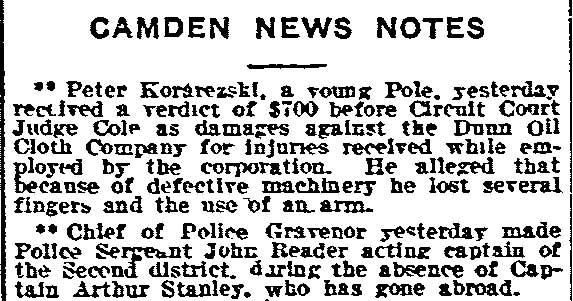
Camden News Notes
•• Peter Korarezski, a young Pole, yesterday received a verdict of $700 before Circuit Court Judge Cole as damages against the Dunn Oil Cloth Company for injuries received while employed by the corporation. He alleged that because of defective machinery he lost several fingers and the use of an arm.
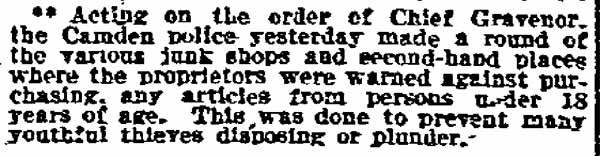
•• Chief of Police Gravenor yesterday made Police Sergeant John Reader acting captain of the Second district, during the absence of Captain Arthur Stanley, who has gone abroad.
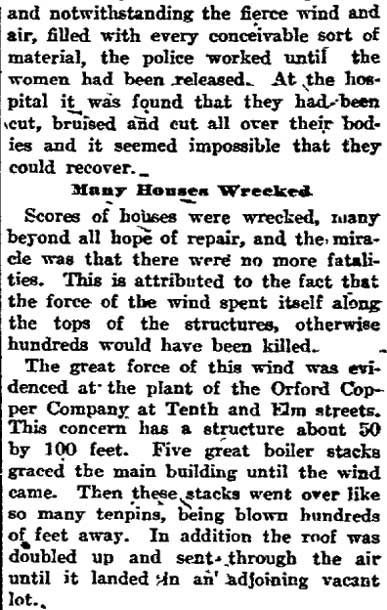
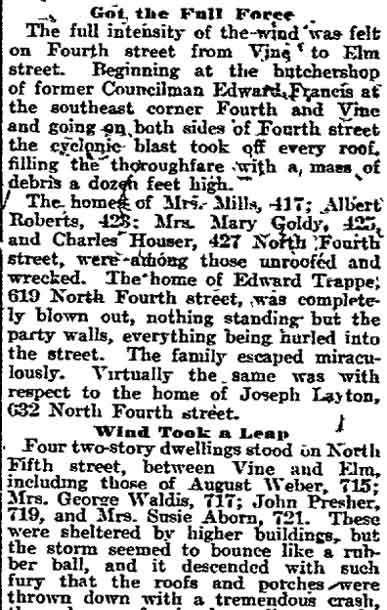
Cyclone of April 2, 1912
Philadelphia Inquirer –
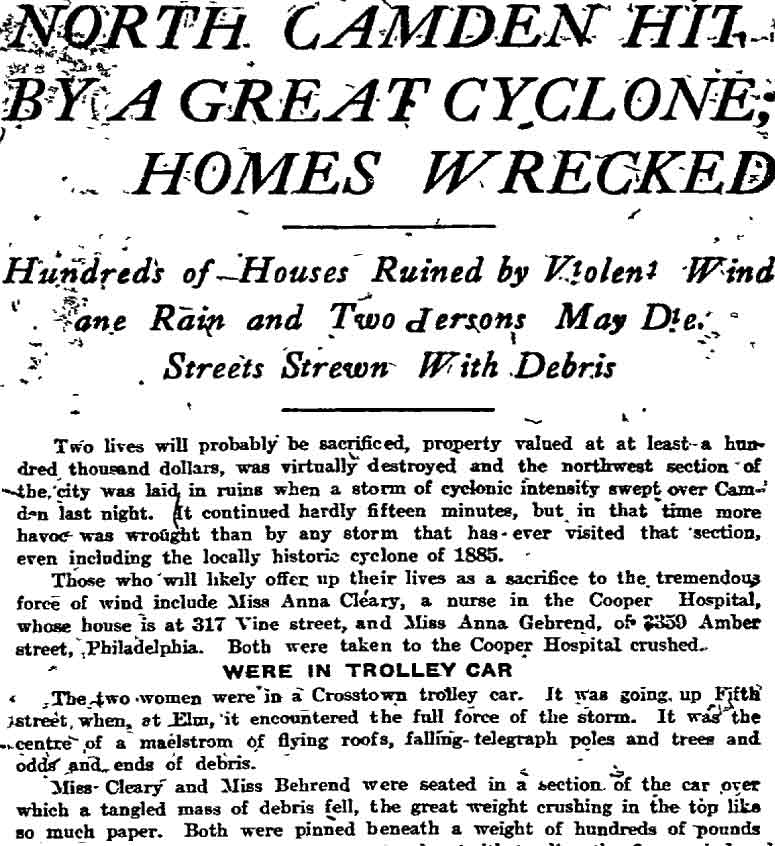
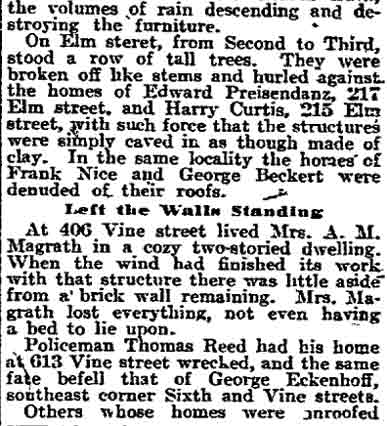
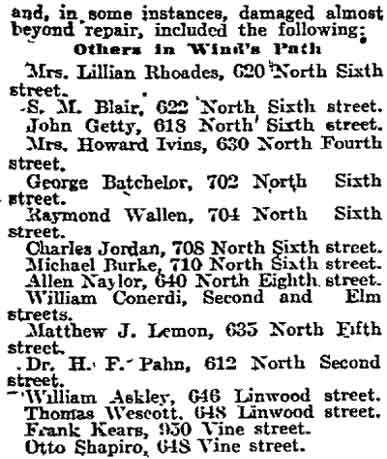
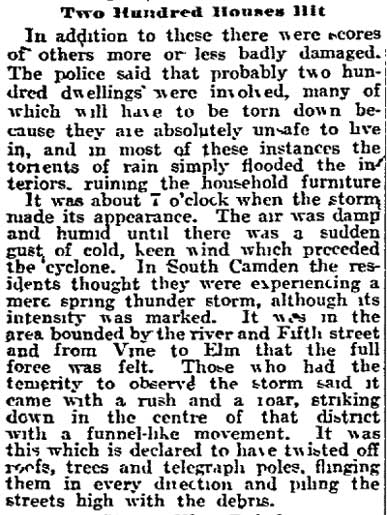
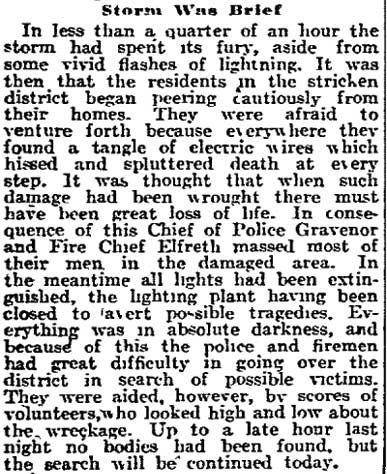
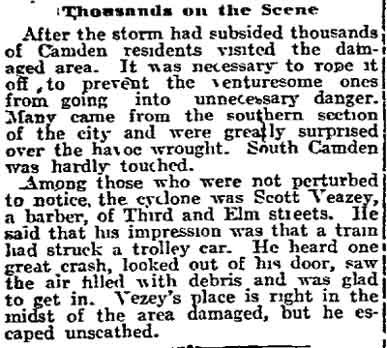
Anna Cleary — Anna Gehrend — Vine Street
Oxford Copper Company — North 4th Street — North 10th Street — Elm Street — Edward Francis — Mrs. Mills — Albert Roberts — Mary Goldy — Charles Houser — Edward Trappe — Joseph Layton — August Weber — Mrs. George Waldis — John Presher — Susie Aborn
Edward Priesendanz — Harry Curtis — Frank Nice — George Beckert — Mrs. A. M. Magrath — Thomas Reed — George Eckenhoff — Lillian Rhoades — S. M. Blair — John Getty — Mrs. Howard Ivins — George Batchelor — Raymond Wallen — Charles Jordan — Michael Burke — Allen Naylor — William Conerdi — Matthew J. Lemon — Dr. Howard F. Palm — William Ackley — Thomas Wescott — Frank Kears — Otto Shapiro — North 2nd Street — North 5th Street — North 8th Street — Linwood Street
Elisha A. Gravenor — Samuel S. Elfreth — Scott Veazey — Click on Images for PDF File of Complete Article
Boy’s Brutal Murderer Collapses at Hearing
Camden Post-Telegram –
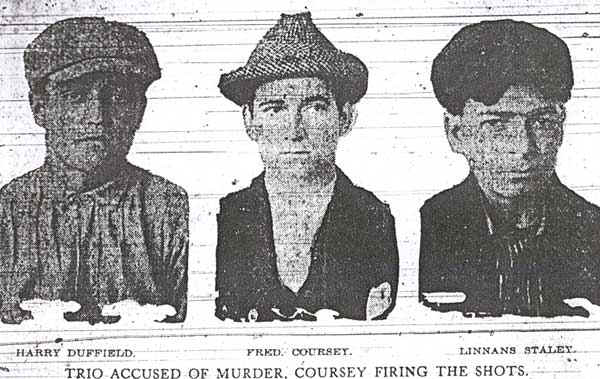
Trio Accused of Murder. Coursey Firing the Shots.
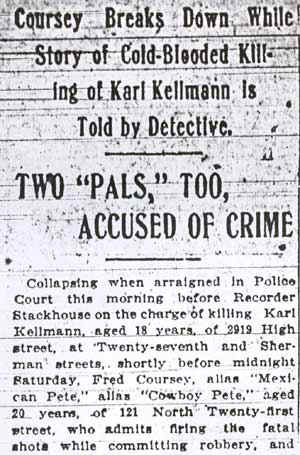
Coursey Breaks Down While Story of Cold-Blooded Killing of Karl Kellmann Is Told by Detective.
Two “Pals,” Too, Accused of Crime
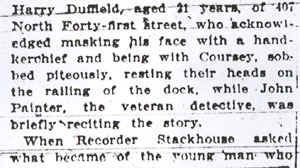
Collapsing when arraigned in Police Court this morning before Recorder Stackhouse on the charge of killing Karl Kellmann, aged 18 years, of 2919 High street, at Twenty-seventh and Sherman streets, shortly before midnight Saturday, Fred Coursey, alias “Mexican Pete,” alias “Cowboy Pete,” aged 20 years, of 121 North Twenty-first street, who admits firing the fatal shots while committing robbery, and Harry Duffield, aged 21 years, of 407 North Forty-first street, who acknowledged masking his face with a handkerchief and being with Coursey, sobbed piteously, resting their heads on the railing of the dock, while John Painter, the veteran detective, was briefly reciting the story.
When Recorder Stackhouse asked what became of the young man who was shot and Painter replied that he died, Coursey and Duffield sobbed afresh, and when Recorder Stackhouse committed them without bail Policemen Frost and Kay had to help them.
Linnans Staley, aged 21 years, of 1819 Federal street, who confessed that he was in the robbery plot but later got scared and hid in the bushes, was scarcely able to stand, and when his mother broke down as he was committed as a principal he staggered and would have fallen but for Sergeant McClong.
Prosecutor Boyle announced this morning that the Grand Jury will be recalled for Thursday of this week and the case will be made the special order of the day.
Without the slightest clue to start with in the most brutal murder committed in recent years in Camden county, police and detectives under the personal direction of Chief Gravenor in two hours arrested two of the three prisoners and obtained their signatures to confessions and before sunrise the other was lodged behind the bars at the City Hall.
According to their statements to the police the prisoners while drinking on a lot near Twenty-first and Federal streets on Saturday night planned to go to a lone spot near Twenty-seventh and Sherman streets to hold someone up to get money and jewelry to buy more drink. Coursey had a 38-calibre cowboy pistol and Duffield used Coursey’s bandanna as a mask. Staley weakened before the spot selected was reached and at the time of the murder was hiding in a clump of weeds a short distance away.
The murdered boy was the son of Karl and Lulu D. Kellmann. He was a member of the Bible class of Grace Presbyterian Church, East Side, and active in church work.
Saturday night was the closing of a carnival given on High street between Twenty-seventh and Thirtieth streets. Karl was there and made several purchases. At one booth he bought a necktie, from another some ice cream and a box of candy and spent some time conversing with the young ladies connected with the church.
When it grew rather late he noticed that Misses Bertha and Bessie Skillen, of 815 North Thirty-fourth street, the latter a teacher in Grace Church Sunday-school, were without an escort and he volunteered to see them home. They accepted his invitation to be their escort. He saw them safely home and he was on his way back and had reached a point on the east side of Twenty-seventh street south of Sherman street and near the foot of the bridge that spans the Pennsylvania Railroad tracks when two men jumped out from behind a tree and as one commanded him to hold up his hands the other began to shoot.
The first shot struck him in the breast and turned him partially around. The next ploughed a hole through his neck, knocking him down, and the third went wide.
Screaming for help he tried to rise to his feet and was on his knees when Night Yardmaster Albert Ludlow and Brakeman Joseph Wittick, who were on the opposite side of the bridge, ran to his assistance. By the light of their lanterns they saw that he was seriously hurt and they took him to ‘Squire Sasse’s house nearby to await the arrival of the ambulance. As the railroaders sped across the bridge Ludlow saw a man run down the tracks in the direction of Seventeenth street.
In the signal tower at Pavonia station known as C. B. the operator, Thomas Sink, heard the shots and cries for help and ‘phoned to Captain James at Police Headquarters that a murder had been committed. Sink also saw a man run down through the weeds and bushes on the east side of the bridge toward the railroad tracks.
Policeman Hurlock and Schmid, ‘Squire and Mrs. Sasse and several others were out on the street before the railroad men reached the Sasse home and all hurried to ‘phones to notify police headquarters.
In less than five minutes by use of the red light system Captain James had every officer on duty on the East Side hurrying to the scene, officers stationed at every bridge, ferry house and railroad terminal, and the downtown auto with Detectives Schregler, Painter, Brothers and Moffett on its way to East Camden.
On information from the railroad men Sergeant Horner took all the East Side officers and the four detectives and they worked westward among the cars while Captain James started Policemen Colsey and Kelly to walk eastward from Fifteenth street until they met the main body.
The search proved fruitless and as they returned to the bridge one of the men picked up a green bandanna with yellow spots and sheep burrs embedded on it on the incline near the signal tower. Later he recalled that the man who went down the slope wore a Khaki shirt and cap.
The handkerchief was recognized as the kind used by “Indian Bill” May, and Detectives Brothers and Policeman Abbott were sent to arrest him. They found May and Eugene Cafferty asleep in a moving van in Marlton avenue. “Indian Bill” soon established an alibi.
Detective Schregler and a couple of officers who were sure that the description of the man with the khaki shirt tallied with Duffield started for his brother’s house, but failed to find him there. About this time the downtown auto turned into Twenty-seventh street to get Karl’s father, mother and sister and take them to the hospital. Councilman Finkeldey and a friend shouted to the crew that a woman was down and out on a step nearby, but the crew yelled back that they were on an emergency run and the woman would keep until they returned. Fireman J. H. Vickers walked across the street to investigate and found that the supposed woman was Duffield and that he seemed to be asleep.
Vickers shook him and as he got up he said something about the shooting that aroused Vickers’ curiosity and he ‘phoned to Police Headquarters. Captain James immediately notified Chief Gravenor, who was on the scene and the latter sent Detective Moffett to investigate. When Moffett arrived he learned that Duffield had taken a Westfield avenue car. Moffett returned to the bridge and he and Detective Painter and Chief Gravenor took the down-town auto for Duffield’s home.
Painter went to the front door and saw Duffield in the act of taking off his shoes. Moffett in going around to the back door to prevent his escape that way passed by the window at which Duffield was sitting.
Grasping Duffield by the collar Moffett pulled him through the window to the ground. As soon as he landed on his feet, according to the Chief and detectives, Duffield said that Coursey did the shooting.
Placing him in the auto they next drove close to Coursey’s home and with Policeman Potter who knew the man wanted, the detectives entered the house with drawn revolvers while other officers guarded all avenues of escape.
Coursey was found awake on a cot and while he was covered with revolvers Detective Painter searched his trunk and found the weapon that he later admitted using. It was empty. The detectives late yesterday afternoon found three used shells adjoining the house near a spot where Coursey said he had thrown them.
In order to keep the men apart they were taken to the City Hall separately and questioned and after they decided to tell all Sergeant E. B. McClong reduced their statements to writing and they signed them. It was on the strength of these statements that Staley was arrested.
Young Kellmann was taken into the hospital at 12.20 a. m. Chief Surgeon Schellenger saw at a glance that there was no hope for him and so notified Captain James, and Sergeant McClong was sent to the hospital to get all information possible.
The unfortunate youth could only speak a few words at a time because of the hemorrhages. All Sergeant McClong was able to get from him was that he was told to hold up his hands and that the shooting instantly began. The only description he could give was that they were small men and that the attack was so sudden that he could not tell whether they were black or white.
The injured young man kept asking the doctors if he was going to die, but they did not answer. He was conscious when his father and mother arrived and then sank rapidly until the end, dying at 1.50 o’clock, 90 minutes after he was admitted. Mother and father were prostrated and were taken home by the up-town auto.
County Physician Jones conducted the autopsy yesterday morning. He said that either wound would have caused death. The bullet in the breast pierced the right lung at the top and lodged in the cavity. It is now in the doctor’s possession. The other bullet went clear through the neck.
Coursey and Duffield have been working in the Pavonia car yard. The former was born in El Paso, Texas, but has lived East nearly all his life. He is an expert shot and was a member of the vaudeville team of Coursey & Cook, according to their letter heads presenting a fifteen-minute thriller.
Duffield was only recently paroled for robbing Gallagher’s saloon, Nineteenth and Federal streets of a lot of drinkables. Staley has been arrested several times on petty charges but was never convicted of crime. When Duffield’s coat was examined at the City Hall, it was found to contain sheep burrs.
To a reporter Coursey said that whenever he was drinking he had to get his gun and shoot something or somebody. He insisted that all were in on the job and that they let the man who preceded Kellman go over the bridge without molestation because he didn’t look as if he had any too much money.
Yesterday morning Assistant Prosecutor Wolverton and Stenographer Cleary called at the City Hall. The prisoners were examined by Mr. Wolverton and their statements taken by Mr. Cleary, but there was little or nothing new elicited.
Philadelphia Inquirer – December 25, 1912
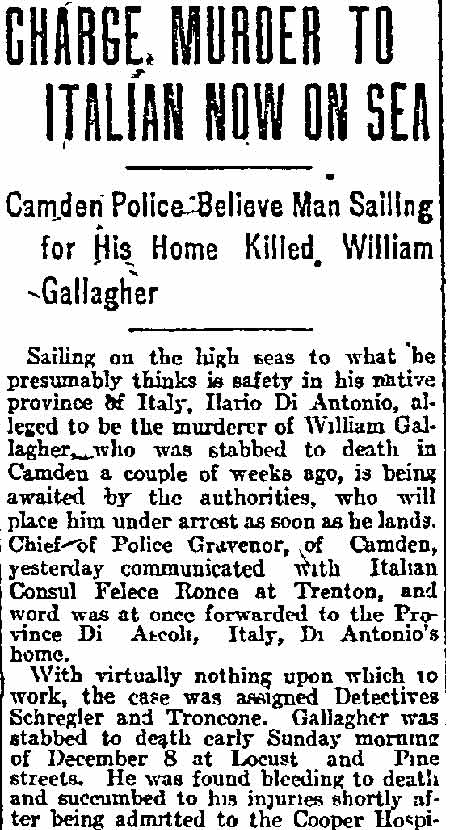
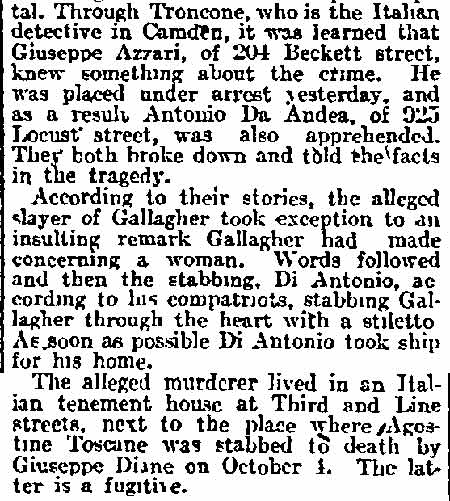
Named: Ilario DiAntonio, William Gallagher, Elisha Gravenor, Fiore Troncone, Felice Ronca, Giuseppe Azzari, Antonio DaAndea, Beckett Street, Locust Street, South 3rd Street, Line Street, Agostine Toscane, Giuseppe Diane, and Click on Image for PDF File.
Thousands View Chief’s Remains
Camden Post-Telegram –
Not since the memorable funeral of Chief of Police Foster ten years ago, has there been such a genuine public tribute paid an official of Camden as was in evidence last night at the bier of the lamented Fire Chief Worthington, and today at his funeral. It is hard to estimate the number of persons in a crowd, but from 7 until 9 o’clock last night there was a steady stream of men, women and children, two abreast, who passed from the main entrance, through the center corridor and beneath the illuminated rotunda, where the body lay, and thence out by the west corridor. There was never a stop, and it is estimated that at least 10,000 persons were there, perhaps more.
There could not have been a more ideal location for the repose of the casket containing the honored dead, and the great array of beautiful flowers than beneath the rotunda. It seemed to be a sacred shrine in itself where the citizenry dropped a tear for the lamented departed. The effulgence of the soft lights from above specially installed by Electrical Chief Kelly but lent to the scene and as the dark garbed escort of firemen, the active pall bearers, stood on guard, the scene was unusually impressive.
Chief Worthington, aside from the pallor that comes to the dead, looked as he did in life, for the thread had been snapped so quickly that it was while he was in his full vigor that the vital spark had taken its flight. There were some marks on his face that indicated the intense though momentary suffering through which he passed on his fateful plunge from the roof of the burning building to his quick death, and the passing crowd remarked this. But withal there was that calmness and repose feature which seemed to indicate that the gallant leader of Camden’s fire fighters but lay sleeping rather than that his soul had taken its eternal flight.
Public grief may be a mere ephemeral emotion, born of the moment and only to be succeeded by the acclaim of the newly arisen public idol, but last night’s encomiums seemed to come from hearts that overflowed with genuine and permanent sorrow over the untimely passing of so excellent a public servant. Many tear-suffused eyes indicated this, many expressions of grief, of sorrow, of condolence of those left showed this. The sentiment in evidence everywhere can only be likened to the sweetness of the wonderful flowers whose odor spread through all the corridors and in all the rooms of the great marble building.
High in the clock tower of the City Hall the bell began tolling at 6:30 o’clock. At half-minute intervals its doleful strains went forth on the cold blustery east wind which had succeeded a day of spring sunshine. The bell and the screeching wind seemed to combine as a knell indicating the passing grief of the city. It was the preliminaries to the marching of the funeral cortege from the stricken Chief’s home on Penn Street to the resting place at the Court House.
There were forty policemen in dress uniform with Chief Gravenor at their head. There were twenty-six fire heads from Philadelphia, with Chief William Murphy in the van, a tribute in itself of more than passing moment. There was the caisson on which was the black draped casket containing the body of he who all honored. There was the little red car in which Chief Worthington was wont to speed through the city at every alarm and there was his helmet and coat. There was Acting Chief Stockton and forty of the men who fought flames under the direction of he who lay so still. There was the family in cabs with curtains drawn, the members of City Council and the active pall bearers— Daniel Leach, Peter B. Carter, James White, William Patterson, Elmer Burkett, Samuel Harring.
When the cortege reached the Court House the Camden boys took up their position on the inside beneath the rotunda while the Philadelphia visitors made an imposing array on the granite steps outside. And then came the public in its steady and unending stream.
Later the Philadelphia delegation was escorted to the Board of Freeholders room where tribute was paid to the dead and where a mingling of the two cities took place. Besides Chief Murphy the visitors included Battalion Chiefs William T. Barrett and George P. McConaghy, Captains L. F. Bunting, William Lindsey, H. Dinlocker, J. Higginson, J. E. Talbot, D. Campbell, T. O’Brien, F. Hughes, E. Basenfelder, H. Hutt, William McCusker, G. Rheim, R. Wilsey, J. Webb, H. Goers, H. Haines, Insurance Patrol Captain Joseph H. Shermer, William Hickman, William Rodgers, John Wyatt, David Phillip, John Clyde, H. Wilkinson.
President of City Council James E. Hewitt spoke of the work Chief Worthington had already accomplished, of his plans, of his value and worth to Camden. Chief Murphy responded in a fitting way and this incident in itself was one to be remembered.
An affecting sight was witnessed by the handful of spectators, among them being other firemen, city and county officials and policemen who remained after the big doors on Sixth Street had been closed. The last to view the Chief’s remains were a delegation of about twenty firemen. Solemnly the men passed by the bier and gazed upon the features of their departed brother.
As the last of the line approached, Deputy Chief John A. Stockton was seen. He stopped and with his cap laid across his breast he looked down into the casket. For almost a minute Chief Stockton stood as though glued to the spot. Then he glanced about him and the sympathetic look upon his face thrilled all.
He heaved a sigh and perhaps the teardrops refused to come, but Chief Stockton, as the lines upon his face showed, was struggling with the inner man. His emotions were tugging at his heart, but a fire laddie cannot give way to his feelings although his brother superior officer and dear friend had answered his last alarm.
The floral pieces surrounding the bier bespoke the love, admiration and respect the donors held for the dead chief. One design particularly beautiful was a mammoth loving cup made of blossoms, flowers and roses. This was the token sent by members of City Council and other city officials.
Another was the design sent by the Electrical Bureau through Chief Kelly. The original fire box, No. 134, which was pulled on the night of the fire by Chief Worthington was enshrouded by roses, carnations and lilies.
A maltese cross standing several feet high and bearing the initials of the organization was the tribute sent by the Firemen’s Mutual Benevolent Association. Chief Worthington was president of this association.
The Camden police sent a large shield of flowers and Council members offered a vacant chair of roses. The New Jersey Auto Supply Company, No. 2 Engine Company and No. 1 Truck sent beautiful broken circles and a wreath was the offering from the employees of the Victor Talking Machine Company.
A broken circle from members of the Sixth Ward Republican Club and a wreath from his friends in the sixth precinct of the Second Ward were other beautiful pieces. West Collingswood and Collingswood firemen sent two beautiful floral circles and from the Loyal Order Legion a wreath was received.
Other offerings were from the Camden Liquor Dealers league, a beautiful circle from No. 6 Engine Company, in which house Chief Worthington was captain previous to his elevation to the office of chief; sprays from the Bethany M. E. Church, Ladies Auxiliary of the Loyal Order of Moose; a wreath from the pupils of the eighth grade Sewell school, and a spray from North Baptist Church. There also were designs from members of the family and friends, all of which bespoke the great love held for the departed fire chief.
The impressive services of the P. E. Church marked the last sad rites this afternoon at St. Paul’s Church. The guard of honor and city officials left Fire Headquarters at 1:20 and proceeded to the Worthington home and escorted the remains to the church, where services were conducted by the rector, Rev. R. E. Brestell, and Rev. H. O. Jones, rector of St. Stephen’s P. E. Church. Interment was made at Arlington.
The honorary pallbearers were Mayor Ellis, Hon. David Baird, Frank F. Patterson, John W. Bell, General John A. Mather, Melbourne F. Middleton Jr., Harry R. Reed, Arthur L. Jones, Robert Gordon, David Jester, George Schneider, William Mills, J. O. Grear, William Hall, George L. Bender, and James E. Hewitt.
Camden Courier-Post – July 8, 1914
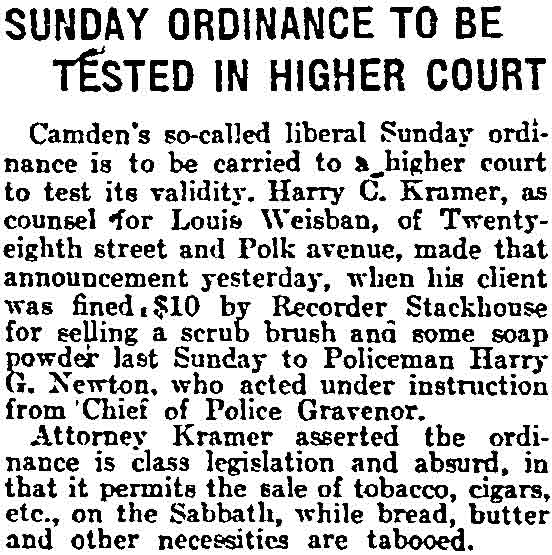
SUNDAY ORDINANCE TO BE TESTED IN HIGHER COURT
Camden’s so-called liberal Sunday ordinance is to be carried to a higher court to test its validity. Harry C. Kramer, as counsel for Louis Weisban, of Twenty-eighth street and Polk avenue, made that announcement yesterday, when his client was fined $10 by Recorder Stackhouse for selling a scrub brush and some soap powder last Sunday to Policeman Harry G. Newton, who acted under instruction from Chief of Police Gravenor.
Attorney Kramer asserted the ordinance is class legislation and absurd, in that it permits the sale of tobacco, cigars, etc., on the Sabbath, while bread, butter and other necessities are tabooed.
Trenton Evening Times – May 23, 1916
Extra: Ashbridge Caught in Chester Hotel Along With Wife
Camden Post-Telegram –
Captured at noon with his wife in the Keystone Hotel at Chester PA, Wilson Ashbridge, who escaped from the County Prison last night with George E. Thompson, a forger, after killing Jailor Hibbs and shooting Jailor Ellis, is again in the County Jail.
Ashbridge admits that he shot both men. He said the gun was given to him by Thompson.
The couple were captured in their room at the Keystone Hotel by Captain of Detectives Schregler and Policeman David Hunt, who hurried to Chester in Chief Gravenor’s automobile in receipt of a message that a man answering to the description in the published picture of Ashbridge registered there early this morning with a woman as his wife.
Ashbridge offered no resistance when the officers entered his room. He waived extradition and being handcuffed was placed in the machine with his wife and hurried to this city.
Schregler sat in the rear of the machine between Ashbridge and his wife.
They reached City Hall at 2:10 o’clock this afternoon. Ashbridge was smoking a cigarette and looked sullen.
When the murderer saw a battery of photographers getting ready to take their pictures, Ashbridge shielded his wife’s face with his hat and hid his own face as best he could in his handcuffed condition.
They were taken upstairs to the Chief’s office and later sent to the Prosecutor’s office.
Ashbridge takes blame for the double shooting, but insists that his wife did not give him the gun, saying that Thompson supplied the weapon.
Murderer’s Wife Supplied Revolver, Smuggling It in Covered by Fruit
Camden Post-Telegram –
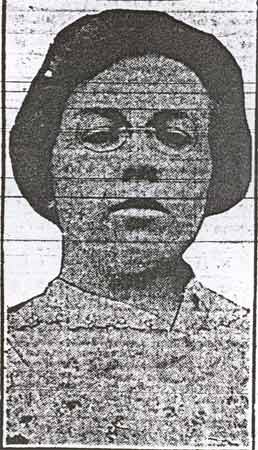
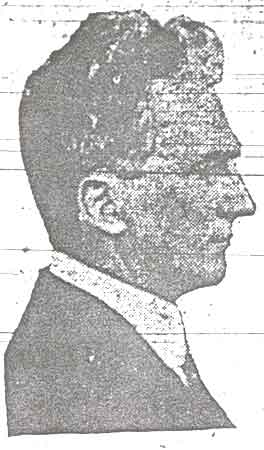
With Wilson T. Ashbridge under guard in a cell in what was formerly known as Murderer’s Row, the police and county detectives today redoubled their energies towards the capture of George E. Thompson, the forger who escaped with Ashbridge from the County Jail on Monday night after murdering one keeper and wounding another. The gun with which Ashbridge murdered jailor Isaac Hibbs and wounded Jailor Ellis was smuggled into the jail by Mrs. Ashbridge on Saturday morning. The weapon and bullets were passed to Ashbridge in a basket of fruit.
Mrs. Marion Ashbridge — George E. Thompson
Forger Thompson Still at Liberty
Camden Post-Telegram –
Evidently in hiding, George E. Thompson, who escaped from prison with Wilson Ashbridge on Monday night after murdering one jailor and wounding another, is still at liberty. No trace of him has been found after he left Ashbridge and Mrs. Ashbridge at Thirty-second and Chestnut Streets, Philadelphia, on Monday night.
Ashbridge has not eaten anything since his return to the jail. Just as soon as his nerves settle a bit and he becomes resigned to his fate Ashbridge will likely eat as heartily as before.
The murderer is much more composed today than he was yesterday. Practically all of yesterday he spent pacing the narrow confines of his cell in Murderers’ Row and for the greater part of the time he was crying. Toward evening he became less restless.
Seemingly more composed and realizing the gravity of her position, Mrs. Ashbridge still languishes in the detention Department of Police Headquarters, where she is under the care of the kindly matron, Mrs. Kirkpatrick.
The circular being sent out to the police all over the country reads as follows: $500 REWARD — WANTED FOR MURDER. On July 17th, 1916 at 7 o’clock p.m., George E. Thompson, alias Francis Murphy, shot and killed a jailor at Camden County Jail, Camden, New Jersey, shot and wounded another jailor, and escaped. George E. Thompson, alias Francis Murphy, is white, 41 years of age, 5 feet 7 inches in height, weighs 175 pounds, has dark brown hair mixed with gray, very bushy, light complexion, gray eyes, smooth face, first and middle finger of his left hand are missing, wears nose glasses. He was confined in the County Jail on charges of forgery and obtaining money under false pretences. He is well-educated and represents himself as an attorney-at-law. Five hundred dollars reward will be paid for the arrest or information leading to the arrest of this man.
The circular, which is signed by Prosecutor Kraft and Chief of Police Gravenor, discloses the fact that the first and middle fingers of the fugitive’s hand are missing.
Asked today if he would represent Ashbridge for the murder of Hibbs, Charles A. Wolverton, who is counsel for Ashbridge on the charge of shooting the Dunbar woman, said: “As an officer of the court I am subject to whatever order Judge Garrison may make… Whether I will be appointed to act for him in this last case I do not know. The matter is entirely in the hands of Judge Garrison, who has the right to appoint any member of the Bar he desires.”
Provisions for the temporary care of the Ashbridge babies — Marian and Thomas — was made last night. Mr. and Mrs. Gick, of 2744 Pierce Avenue, East Camden, notifying Secretary Walsh, of the S. P. C. C. that they would take the kiddies with them to Wildwood this afternoon.
Jailor Ellis is rapidly recovering at Cooper Hospital, Police Surgeon Schellenger stating today that his condition is fine.
Philadelphia Inquirer – March 18, 1917
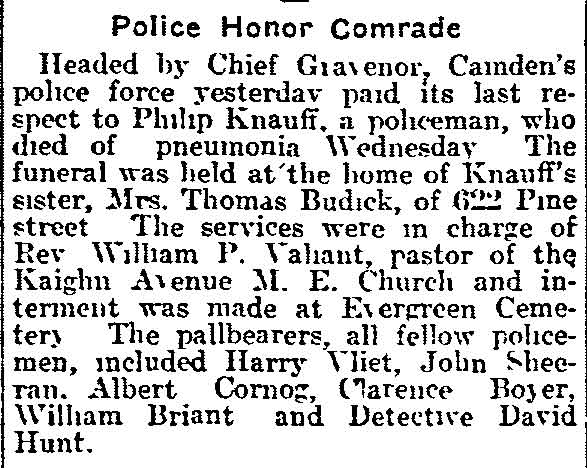
Police Honor Comrade
Headed by Chief Gravenor, Camden’s police force yesterday paid its last respect to Philip Knauff, a policeman, who died of pneumonia Wednesday. The funeral was held at the home of Knauff’s sister, Mrs. Thomas Budick, of 622 Pine street. The services were in charge of Rev. William P. Valiant, pastor of the Kaighn Avenue M. E. Church and interment was made at Evergreen Cemetery. The pallbearers, all fellow policemen, included Harry Vliet, John Sheeran, Albert Cornog, Clarence Boyer, William Briant and Detective David Hunt.
Philadelphia Inquirer – April 13, 1917
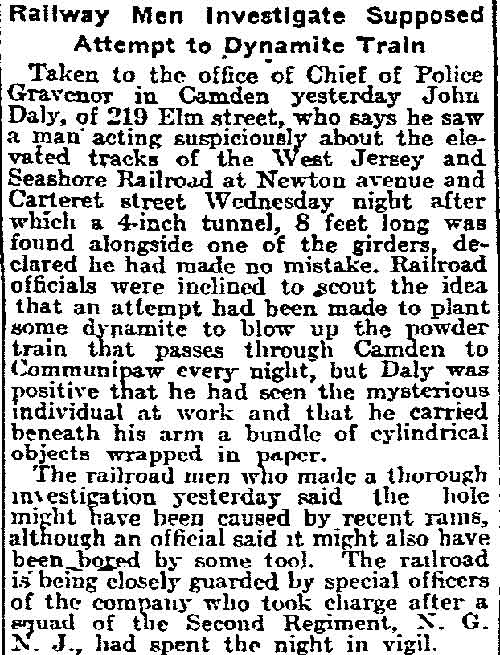
Railway Men Investigate Supposed Attempt to Dynamite Train
Taken to the office of Chief of Police Gravenor in Camden yesterday John Daly, of 219 Elm street, who says he saw a man acting suspiciously about the elevated tracks of the West Jersey and Seashore Railroad at Newton avenue and Carteret street Wednesday night after which a 4-inch tunnel, 8 feet long was found alongside one of the girders, declared he had made no mistake. Railroad officials were inclined to scout the idea that an attempt had been made to plant some dynamite to blow up the powder train that passes through Camden to Communipaw every night, but Daly was positive that he had seen the mysterious individual at work and that he carried away with him a bundle of cylindrical objects wrapped in cloth.
The railroad men who made a thorough investigation yesterday said the hole might have been caused by recent rains, although an official said it might also have been bored by some tool. The railroad is being closely guarded by special officers of the company who took charge after a squad of the Second Regiment, N. G. N. J., had spent the night in vigil.
Philadelphia Inquirer – January 2, 1918
A City Plan Commission for one year was appointed as follows: T. Gordon Coulter, F. A. Finkeldey, George Kappell, William C. Davis, Theodore T. Kausel, Allen Jarvis, Frank S. Vanhart, Frederick von Nieda and Joseph Forsyth, the last three being members of City Council. Dr. Charles P. Tuttle, Dr. H. F. Bushey, Chief of Police Gravenor and Policeman Charles Whaland were appointed the Police Pension Fund Commission.
Philadelphia Inquirer – September 7, 1919
Battle Flags Wave in Triumph O’er Parade Reviewed by Admiral
Gray Veterans of G. A. R. and Wounded Ride; Centopath Passes in Reverential Hush
The Peace with victory which Camden’s sons along with millions of other soldiers of all the Allied countries helped to bring home was celebrated by a jubilee in Camden yesterday which eclipsed anything that the city across the Delaware has ever attempted in her history.
Nearly every man, woman and child who did not actually march in the jubilee parade stood on the side lines and watched it and cheered themselves hoarse as the soldiers and sailors who went out from their town to fight marched past, this time as the conquerors in the world’s greatest war.
Favored by glorious sunshine, a sunshine that was reflected in the faces of the people, the day’s proceedings went off perfectly. For months Mayor Ellis and all his city family, together with a large committee of leading citizens, had been planning the affair. Their handiwork stood the test. It was good.
Admiral Henry Wilson, commander-in-chief of the Atlantic Fleet, came to his boyhood home to be the principal guest of the city and chief reviewing officer of the jubilee. With him were national statesmen and municipal officials.
Soldiers, sailors, war workers, members of fraternal orders and men who fought under the flags of Canada, England, Italy and Poland, marched in the parade which was miles long. Every succeeding division seemed just a little better than the one which preceded it, and, when it was all over and the soldiers and sailors had filed into the old Third Regiment Armory to sit down to a piping hot banquet, the hardest thing of all was to say which had made the finest showing.
All Honor to the Dead
Amidst all the gayety and happiness there was a sober note expressed by the memorial cenotaph which preceded the parade and which brought every hat off as it passed in solemn silence.
The heroic figure of an American soldier in bronze standing on a granite pedestal which bore a gold star with the number 135, symbolical of the Camden county men who laid down their lives in their country’s cause, was carried along the route ten minutes before the parade commenced. Encircler [sic] by flowers and palms, it moved through the reverential hush which had fallen over the throngs.
While every organization in the county of Philadelphia was represented in the parade, to the thousands who lined the sidewalks, there was really only one great big important factor—the service men. And when those self-same service men, many of whom bearing the Distinguished Service Cross of their own United States, others wearing the Croix de Guerre, bestowed on them by the sister republic of France, and still others carrying on their breasts the Italian and British War Crosses, given them by grateful countries, marched down the streets and avenues, all the pent up emotion in thousands of hearts was let loose.
It mattered not whether the men were officers or enlisted men, black or white, neat or untidy, they were all soldiers and they had done all that was asked of them. Their home town honored them. The men in blue and the women in blue, too, received a welcome not one whit less feeling than their brothers in khaki.
They had a certain advantage over the doughboys, for they put half a dozen of the prettiest and smartest yoemanettes that ever wore Uncle Sam’s uniform at the head of their division. The crowd simply had to be with them.
Canada and England, too, had a detachment of men in line. About two dozen of these veterans, half of whom wore the ribbon of the Mons Star, showing that they were in service in France in 1914, were in line, and they marched snappily and smartly and drew their full modicum of pleasurable comments.
Red Cross women, some of them grandmothers, others young girls still in their teens, marched in their snowy white uniforms with their crosses of red emblazoned on headcover and breast. Salvation Army lassies who had cooked doughnuts right up under the muzzles of the guns were there with Y. M. C. A. and Knights of Columbus workers.
Elks, Masons, Knights Templar, Red Men, Moose and scores of other fraternal organizations turned out in all their glorious trappings and regalia.
The delegation of Elks, startling in their spic and span white uniforms, marched behind their own band like squads of veterans. A foretaste of what Philadelphia will see during the coming week was given when more than 100 Knights Templar, resplendent in their uniforms and swords and cocked hats with white ostrich feathers, marched in the second division of the parade. As the formation reached the reviewing stand near the Ninth Ward Republican Association they deployed into the formation of a cross, the symbol of their order, and marched past in this formation.
Many gorgeous floats were in line, th Ninth Ward Republican Association having no less than five. All were artistic. The first was bedecked with growing flowers, while a beautiful young woman reprsenting “Peace” stood flanked by a soldier and sailor. The one following had a replica of the Liberty Bell with the inscription, “Peace on Earth, Good Will Towards men.” Two soldiers rang the bell. Behind them marched a band playing “Onward Christian Soldiers” as the men marched on. Floats symbolical of every war activity were there. The Knights of Columbus showed a replica of their famous service hut which was the doughboy’s home when he had no other.
The veterans of other wars were not forgotten in this jubilee of the greatest war of all. Grand Army men whose gray locks bespoke their years rode in automobiles bearing the tattered colors of their old Civil War regiments. The soldiers of a later day, men of the Spanish-American War, were in line with their comrades.
The wounded were there, too. They could not march in the parade, but they rode and their faces were smiling and their hearts were glad as they realized that this welcome was for them.
Triumphal arches were erected at points along the route of the parade and the square at the courthouse was a mass of color.
Among the officers in command of the sections of the service division were Lieutenant Colonel Samuel G. Barnard, of the 112th Field Artillery; Captain J. Walter Scott, former adjutant of the Third Regiment; Captains English, Richards and Dickinson, of Battery B; Lieutenant J. G. Williams, Ensign Beaston and Lieutenant William Opfermann, of the aviation corps.
Battle Flags Wave Triumphant
Shortly after 1.30 o’clock James H. Long, chairman of the parade committee of the Victory Jubilee and Memorial Committee and marshal of the pageant, gave the order to march. The Lyric Band, which escorted nearly all of the troops to the terminal in the dark days of the war, was given the honor of heading the line. Chief of Police E. A. Gravenor and Assistant Chief of Police Edward S. Hyde led the parade, followed by a platoon of mounted policemen under Captain William E. Albert.
Then came Marshal Long and his aides, who were: Frank E. Van Hart, William D. Sayrs, Jr., Frank Fithian, A. Benjamin Sparks, Kessel Webster, William Isgard, Robert D. Clow, Andrew B. F. Smith, William Lorrigan, Charles Austermuhl, David Doane, William C. Davis and William D. Vanaman.
Directly behind the Lyric Band marched Mayor Charles H. Ellis at the head of the Victory Jubilee and Memorial Committee, of which he is chairman.
And at the head of the division were the battle flags of the Twenty-ninth and Seventy-eighth divisions, on which General John J. Pershing personally pinned battle pennants during those memorable days back in October in the Argonne forest. Behind the 4th marched the famous engineers, headed by Captain Keasby and Captain Beals Smuck. Three battle pennants were pinned to their flags, which never touched the ground while they were bridging the rivers in the Argonne under hellish shell fire for the doughboys to advance. Then came the 112th Field Artillery, Battery B’s heroes of the border and of France, headed by Captain Charles Richards and Captain Dickinson. In the same section marched the Eleventh Machine Gun Battalion with its battle flags and pennants fluttering.
There was another great cheer as the Seventy-eighth Division, New Jersey’s Lightning boys, loomed into view. The heroes of the 311th Infantry, 303d Engineers, 307th, 308th and 309th Field Artillery and other regiments of that famous command were given a mighty ovation behind their battle flags, which led them in their assault on St. Mihiel and the day they attacked and captured Grand-Pre in the terrible conflict in the Argonne.
Behind them marched the Marines, headed by Lieutenant Monitor Watchman, of the Fifth Regiment, Second Division. With the Marines marched the regular army units, men who had served in as many as five battles and wore three and four gold service stripes on their sleeves.
Then followed the naval contingent. They were commanded by Commander Francis W. Hoffman and Commander W. G. Hodgson.
The order “eyes left” flashed along the line as each platoon drew near the reviewing stand and Admiral Wilson with his band to his cap returned the salute. With the admiral on the stand were former United States Senator David Baird, Congressman William J. Browning, County Collector John S. Well, City Clerk W. D. Brown and others.
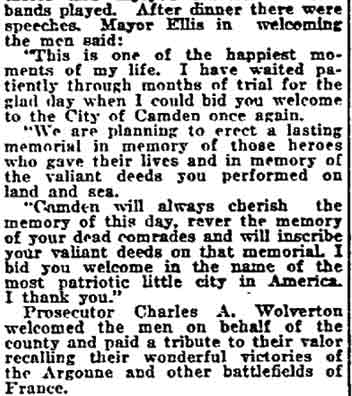
At the armory a splendid banquet was served to the soldiers and sailors. For days past corps Red Cross workers had been preparing the good things to eat and the men did full justice to them. They marched in the armory where the food was spread on the tables and enjoyed themselves while bands played. After dinner there were speeches. Mayor Ellis in welcoming the men said:
“This is one of the happiest moments of my life. I have waited patiently through months of trial for the glad day when I could bid you welcome to the City of Camden once again.
“We are planning to erect a lasting memorial in memory of those heroes who gave their lives and in memory of the valiant deeds you performed on land and sea.
“Camden will always cherish the memory of this day, rever the memory of your dead comrades and will inscribe your valiant deeds on that memorial. I bid you welcome in the name of the most patriotic little city in America. I thank you.”
Prosecutor Charles A. Wolverton welcomed the men on behalf of the county and paid a tribute to their valor recalling their wonderful victories of the Argonne and other battlefields of France.
Philadelphia Inquirer – August 24, 1920
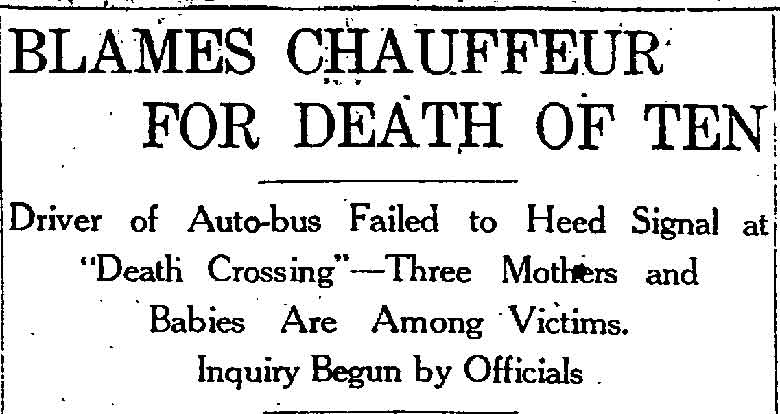
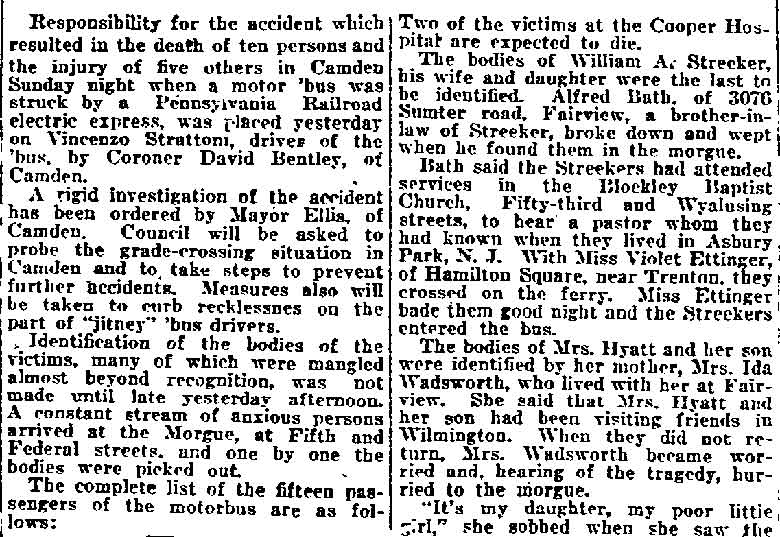
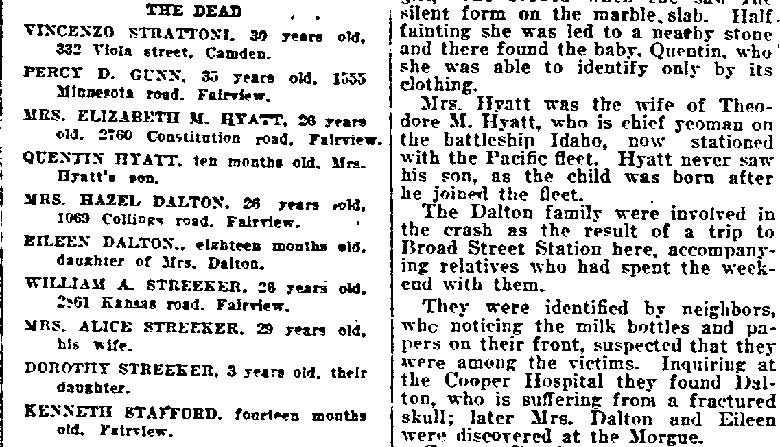
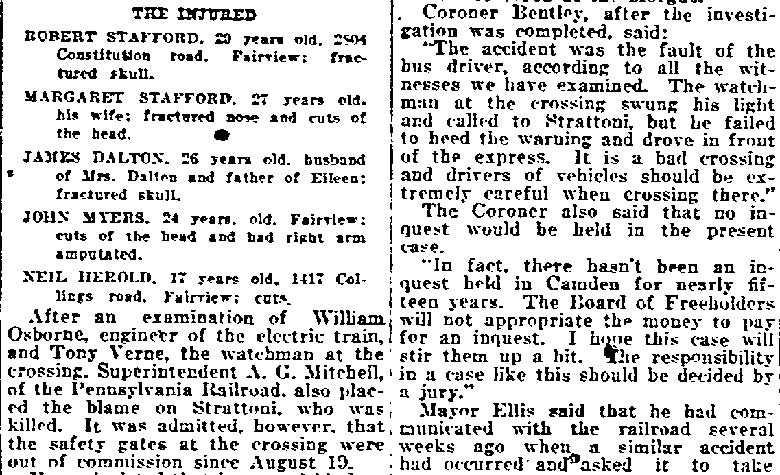
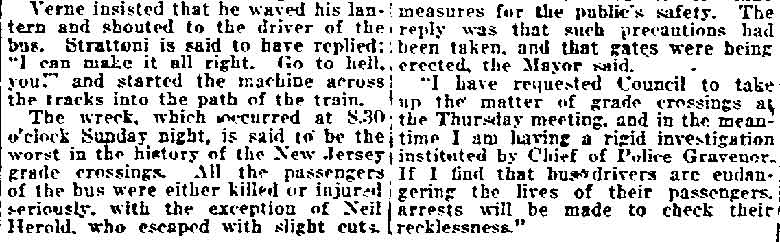
Named: Charles H. Ellis, David Bentley, Vincenzo Strattoni, Percy D. Gunn, Elizabeth M. Hyatt, Quentin Hyatt, Hazel Dalton, Eileen Dalton, Kenneth Stafford, William A. Streeker, Alice Streeker, Dorothy Streeker, James Dalton, John Myers, Neil Herold, Robert Stafford, Margaret Stafford, Tony Verne, William Osborne, Elisha Gravenor, Alfred Bath, Theodore M. Hyatt, Violet Ettinger, Ida Wadsworth, Viola Street, Sumter Road, Collings Road, Kansas Road, Minnesota Road, and Constitution Road.
October 1920 — David S. Paul Wanted Poster
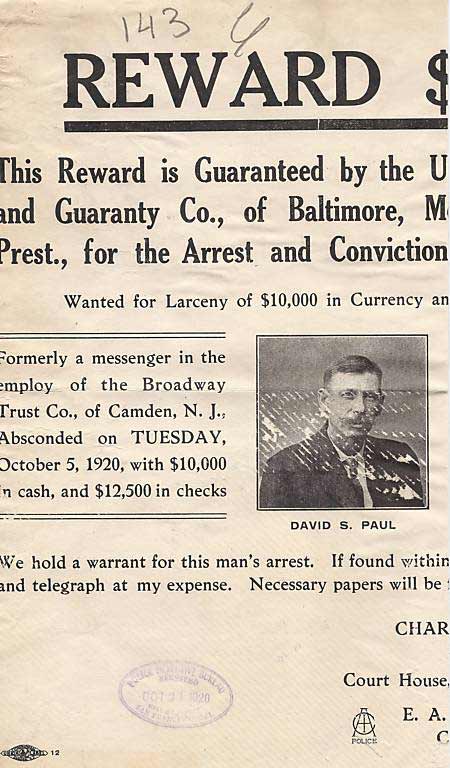
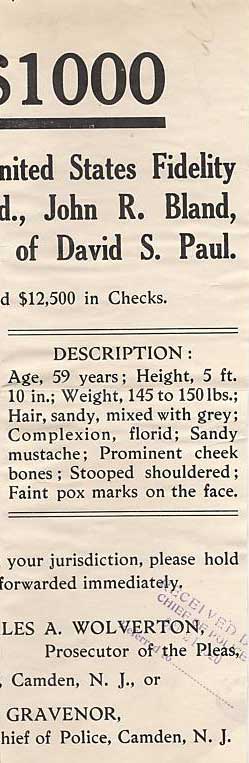
This wanted poster was circulated prior to the discovery of David S. Paul’s remains — David S. Paul — Elisha A. Gravenor — Charles A. Wolverton
Philadelphia Inquirer – December 9, 1921
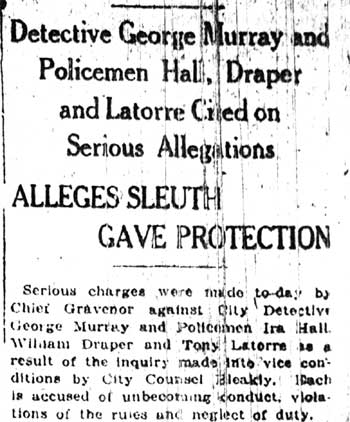
Charge Detective Murry Protected Vice
Camden Daily Courier –
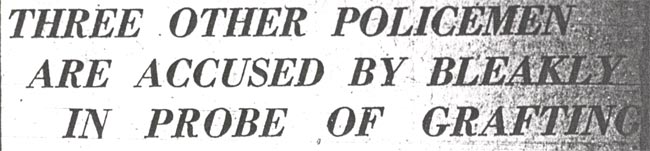

THREE OTHER POLICEMEN ARE ACCUSED BY BLEAKLY IN PROBE OF GRAFTING
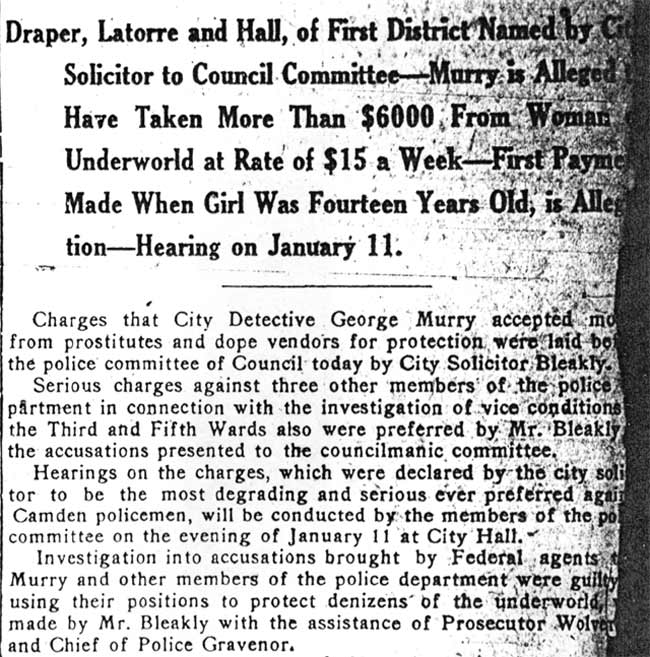
Draper, Latorre and Hall, of First District Named by Solicitor to Council Committee—Murry is Alleged to Have Taken More Than $6000 From Woman Underworld at Rate of $15 a Week—Made When Girl Was Fourteen Years Old, is His Definition—Hearing on January 11.
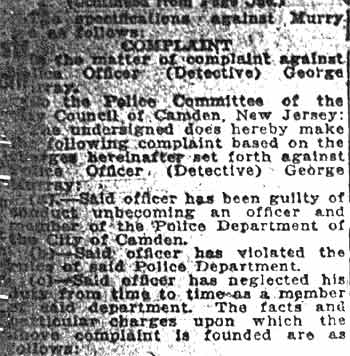
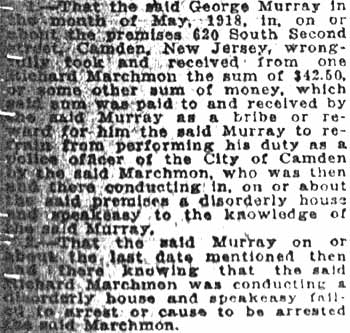
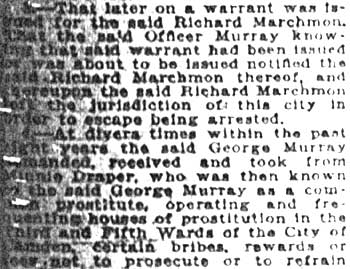
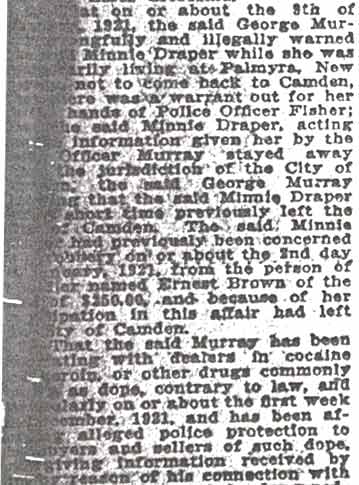
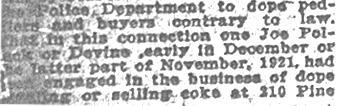
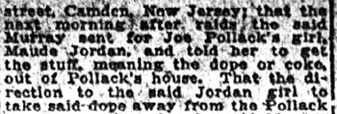
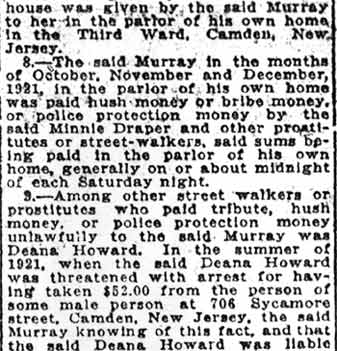
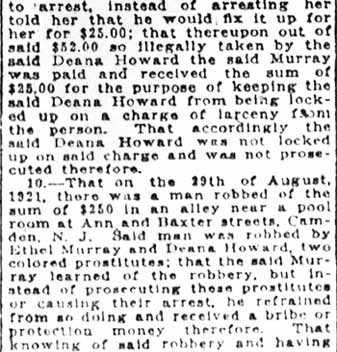
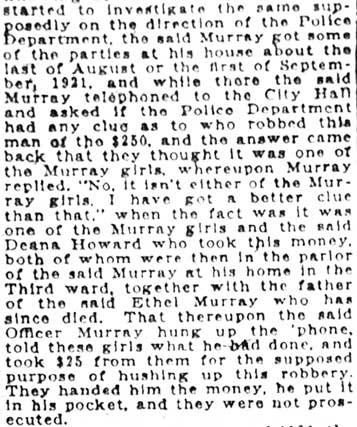
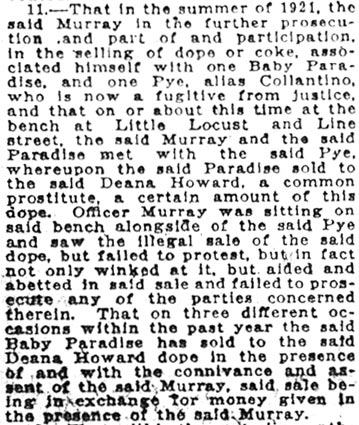
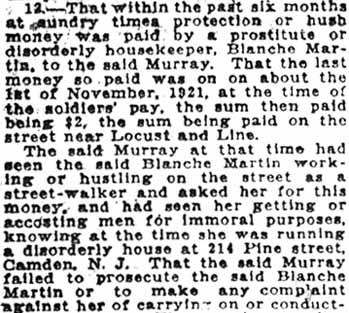
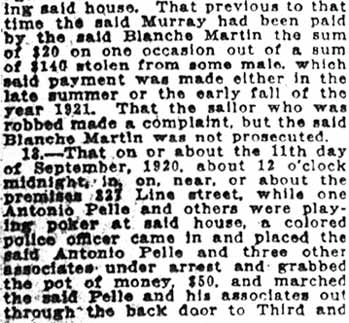
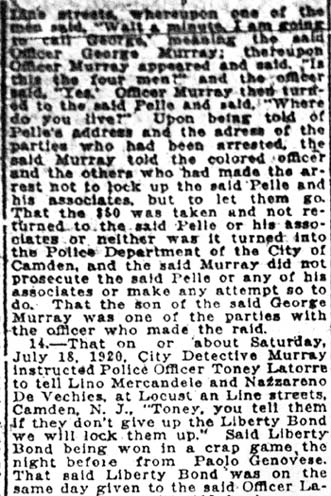
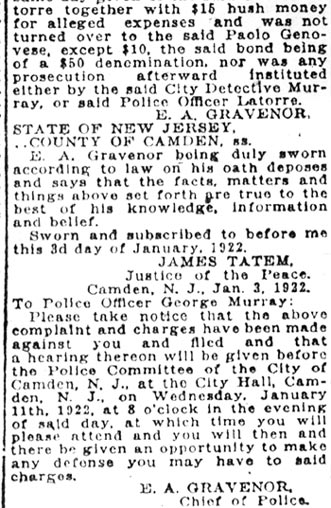
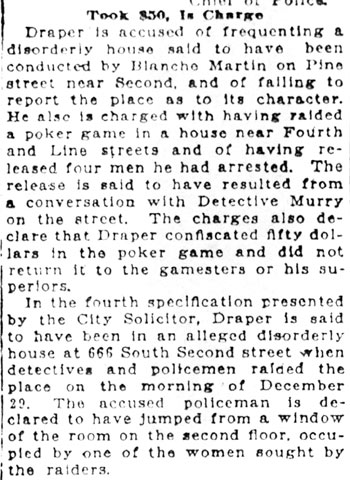
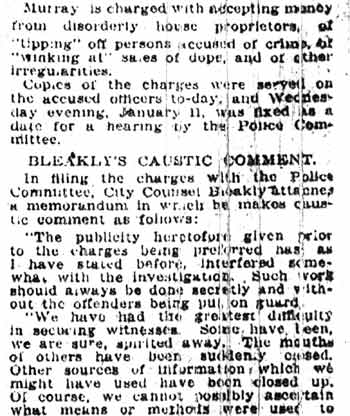
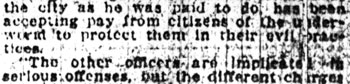
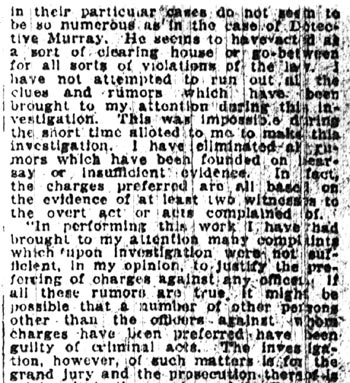
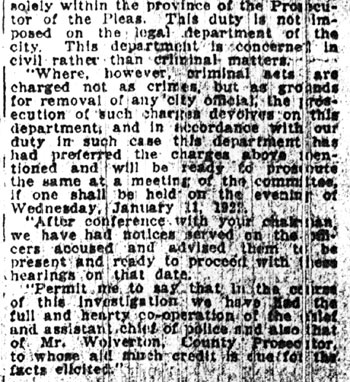
Charges that City Detective George Murry accepted money from prostitutes and dope vendors for protection were laid before the police committee of Council today by City Solicitor Bleakly. Evidence in connection with the investigation of vice conditions in the Third and Fifth Wards also were presented by Dr. Bleakly. Hearings on the charges, which were detailed by the city officials, will be held within ten days before members of the police department, while the hearing as to evidence of the affair of Murry and other members of the police department were guilty using their positions to protect vendors of the underworld was made by Mr. Bleakly with the assistance of Prosecutor Wolfe and Chief of Police Gravenor.
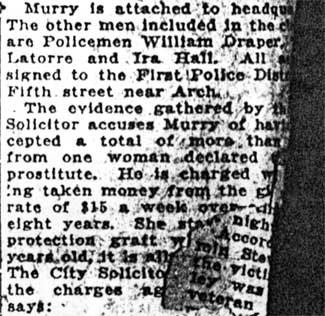
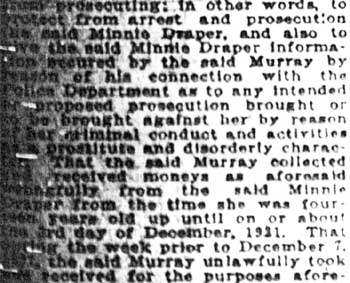
Murry is attached to headquarters. The other men included in the case are Policemen William Draper, Latorre and Ira Hall. All signed to the First Police District. The evidence gathered of Mr. Solicitor of having captured a total of $6,000 that from one woman declared to have become a prostitute. He is charged with having taken money from her at the rate of $15 a week for about eight years. She was given protection, it is stated, when the girl was fourteen years old. It is said by City Solicitor:
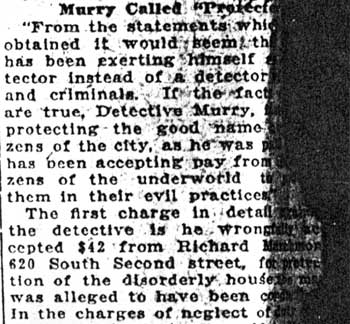
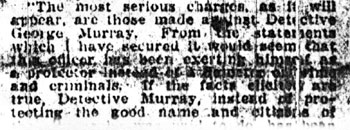
Murry Called “Protector”
From the statements which obtained it would seem that it has been exerting himself as a protector instead of a detective and criminals. If the facts are true, Detective Murry, as we are protecting the good citizens of the city, as he was seen with citizens of the underworld to help them in their evil practices. The first charge in detail is that the detective’s residence at 620 from Richard Marchmon and Minnie Draper who is in charge of the disorderly house was alleged to have been.
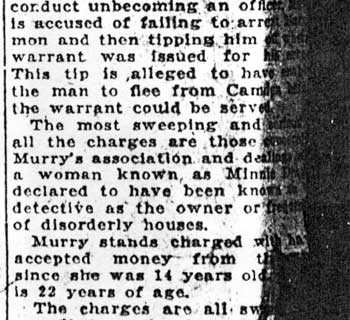
Murry Stands Charged
Murry stands charged accepted money from since the said a woman known, as Minnie declared to have been a detective as the owner of disorderly houses.
Murry stands charged accepted money from since an eight year period of age. He is 22 years of age. The charges are all sworn.
Draper in Another Role
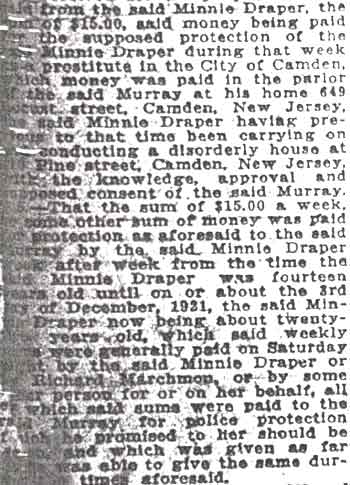
From the said Minnie Draper, the money was taken by police and money paid for the protection of the supposed prostitute in the City of Camden. The said Murry at his home 649 North Merrimack, within the partition of Minnie Draper having previously known her as conducting a disorderly house at 627 Line street Camden. The said, Minnie Draper said receiving an approval and knowledge and the sum of $15.00 a week from the said Minnie Draper, told him that during a certain week from the time the Minnie Draper was continued from about the 3rd of December, 1921, the said Murray, twenty-four years old, which said weekly generally paid to her by said Minnie Draper on Saturday for police protection to him and the said.
That the sum of $15.00 a week, one other sum of money, protection to said the said Minnie Draper, told him that during a certain week from the time the Minnie Draper was continued from about the 3rd of December, 1921, the said Murray, about twenty-four years old, which said weekly generally paid to her by said Minnie Draper on Saturday for police protection to him and other guns were paid to the other police for police protection to her. She should be given.
Money Furnished for Warrants
On or about the 8th of January, 1922, Murray illegally warned Minnie Draper while she was living in Palmyra. Now, notice is so fine back to Camden at once with a warrant for her arrest, and said the said Minnie Draper on the said Minnie Draper said receiving an approval and knowledge and the Minnie Draper; the said Minnie Draper left the Camden; the said, Minnie Draper and said Minnie Draper said receiving an approval and knowledge and the information given her by the said Murray, stated if the City of Solicitor the said, Minnie Draper who George Murray to the said Minnie Draper who had previously left the Camden. That the said Murray has been with “telling” Minnie Draper as a one of the allegations on police Officers and was with some kind of relation.
Officer Took $50, is Charge
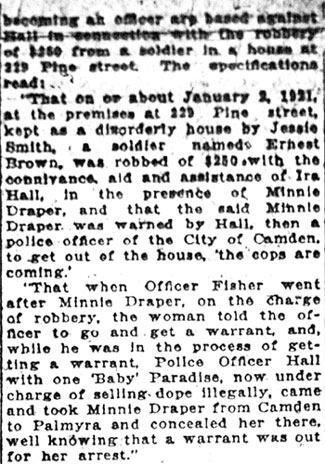
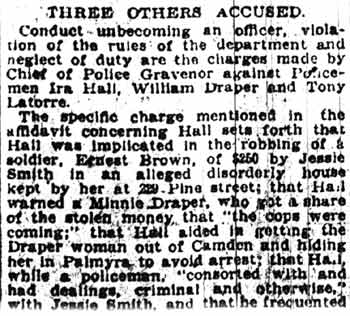
Officer Draper at instance of Frequency street near Second, and of failing to report the same as to the character. He also is charged with having raised a policeman’s house near another and not obtained four men had arrested. The charges are declared to have jumped from a window at a disorderly house account. The specifications read: That on or about the 1st of December or a house on an about January 2, 1921, at the premises at 320 Pine street, kept as a disorderly house by Jessie Smith, a soldier named Ernest Brown, robbed of $190 with the connivance, aid and assistance of Ira Hall. In the presence of Minnie Draper, and that the said Minnie Draper was warned by Hall, then a police officer of the City of Camden, to get out of the house, the cops are coming.
Latorre Specifications
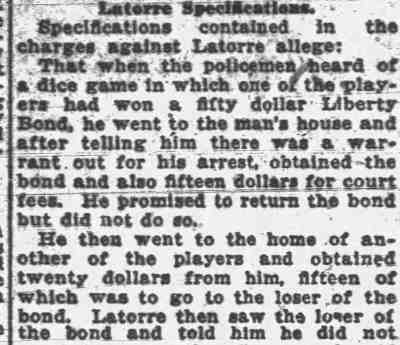
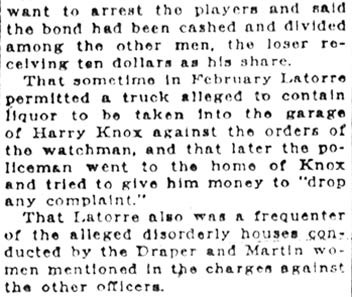
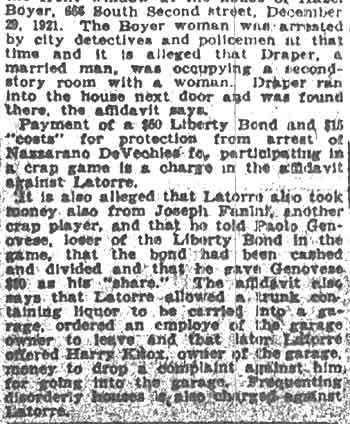
Specifications contained in the charges against Latorre alleged: That when the policemen heard of a dice game in which one of the players had won a $10 Liberty Bond, he went to the man’s house and after telling him there was a warrant the bond and also fifteen dollars for court fees. He promised to return the bond but did not do so. He then went to the home of another of the players and obtained twenty dollars from him, fifteen of which was to go to bond. Latorre then saw the lower of the bond and told him he did not want to arrest the players and said the bond had been cashed and divided among the other men. The lower receiving ten dollars as his share. That sometimes in February Latorre permitted a truck alleged to contain liquor to be taken into the garage of Harry Knox against the order of the watchman, and that later the policeman went to the home of Knox and tried to give him money or “hush” money. That Latorre also was a frequenter of the alleged disorderly houses conducted by Draper and women who were mentioned in the charges against the other officers.
Camden Post-Telegram – January 4, 1922
Named: John B. Kates, Walter Keown, George Ward, Howard Fisher, Anthony “Babe” Paradise, “Pye” Calletino, Polack Joe Devon, Richard Marchmon, E. G. C. Bleakly, George Murry, William Draper, Tony Latorre, Ira Hall, Harry “Dutch” Selby, Gus Davis, Albert “Salty” Cook, Ned Galvin, James Wilson, Sycamore Street, Pine Street, Rosetta Blue, and Deena Howard.
Camden Courier – January 5, 1922
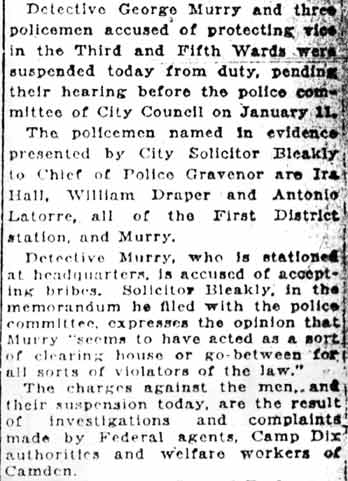

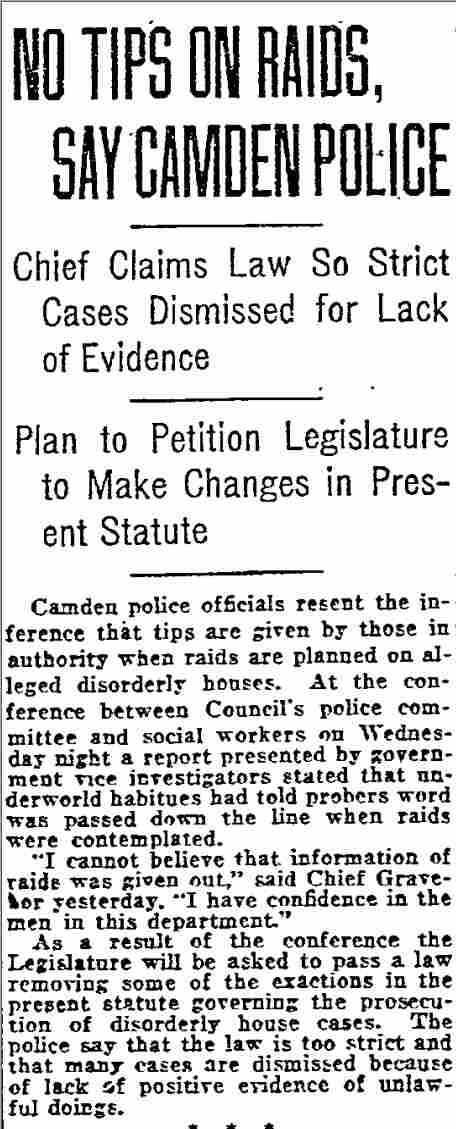
Detective George Murry and three policemen accused of protecting vice in the Third and Fifth Wards were suspended today from duty, pending their hearing before the police committee of City Council on January 11.
The policemen named as the evidence presented by City Solicitor Bleakly to Chief of Police Gravenor are Ira Hall, William Draper and Antonio Latorre, all of the First District station, and Murry.
Detective Murry, who is stationed at headquarters, is accused of accepting bribes. Solicitor Bleakly, in the memorandum he filed with the police committee, expressed the opinion that Murry seems to have acted as a sort of keeper; house or go-between for all sorts of violators of the law.
The charges against the men, and their suspension today, are the result of investigations and complaints made by Federal agents, Camp Dix authorities and welfare workers of Camden.
U.S. Agents Started Probe
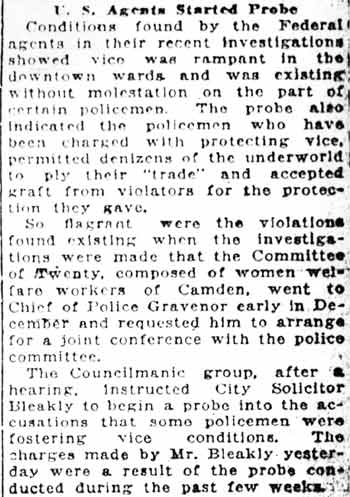
Conditions found by the Federal agents in their recent investigation showed vice was rampant in the downtown wards and was existing without molestation on the part of certain policemen. The indictment the policemen who have been charged with protecting vice, permitted denizens of the underworld to ply their “trade” and accepted contributions from violators of the protection they gave.
So flagrant were the violations found existing when the investigation were made that the Committee of Precept, comprised of women welfare workers of Camden, went to Chief of Police Gravenor early in December and reported the strange affair for a joint conference with the police committee.
The Councilmanic group, after a hearing, instructed City Solicitor Bleakly to begin a probe into the accusations that some policemen were found to have conditions. The charges made by Mr. Bleakly yesterday were the result of this investigation conducted during the past few weeks.
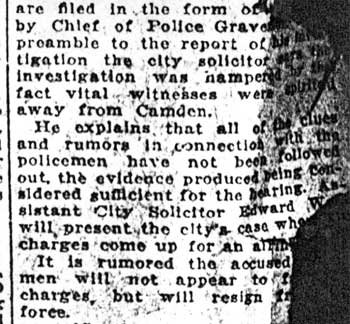
Men May Resign
It has been intimated that the four men suspended today will shortly sign from the police department.
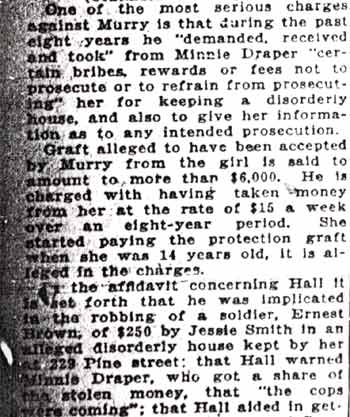
One of the most serious charges against Murry is that during the past eight years he “demanded, received and took” from Minnie Draper reward of fees by means of police connection, to prosecute or to refrain from prosecuting of her for keeping a disorderly house, and also to give her information as to any intended prosecutions that alleged to have been accepted money from the left and said to more than $6,000. He is charged with having taken money over an eight-year period. She charged the protection in all the charges.
The affidavit concerning Hall it forth that he is implicated in the robbing of a soldier, Ernest Smith in an allegedly disorderly house kept by her on Pine street: that Minnie Draper was warned by Hall, then a police officer of the City of Camden, to get out of the house, the cops are coming.
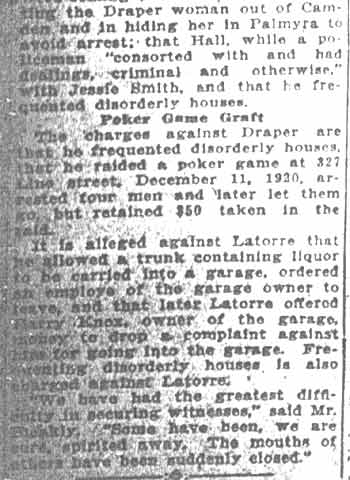
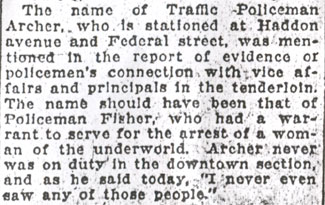
That when Officer Fisher went after Minnie Draper, on the charge of robbery, the woman told the officer to go and get a warrant, and while he was in the process of getting a warrant, Police Officer Hall with one baby Paradise, now under charge of selling dope illegally, came and rode Minnie Draper from Camden to Palmyra and concealed her there, and when Minnie Draper for her arrest.
Poker Game Graft
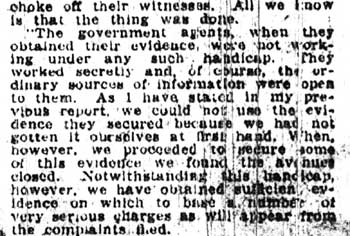
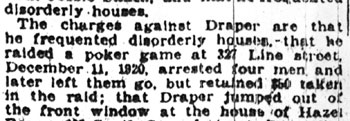
Draper and Latorre are frequented disorderly houses, had raided a craps game at 27 December, 11, 1920, arrested four men and later let them go in the alleged $60 stolen in the alleged against Latorre that allowed a trunk containing liquor to be carried into a garage, of the garage owner to order of the garage. An officer of Latorre ordered the garage owner of the garage. Preliminary statements that Draper conducted by Draper. Preliminary statements also have had the greatest difficulty convincing witnesses that said, Mr. Draper. Some have been, we are told the month witnesses’ said Mr. “suddenly closed.” Want to arrest the players and said the bond had been cashed and divided among the other men. The lower receiving ten dollars as his share. That sometimes in February Latorre permitted a truck alleged to contain liquor to be taken into the garage of Harry Knox against the order of the watchman, and that later the policeman went to the home of Knox and tried to give him money or “hush” money.
Camden Courier – January 6, 1922
Named: Elisha A. Gravenor, E. G. C. Bleakly, Charles A. Wolverton, George Murry, Ira Hall, William Draper, and Anthony Latorre.
Camden Courier – January 9, 1922
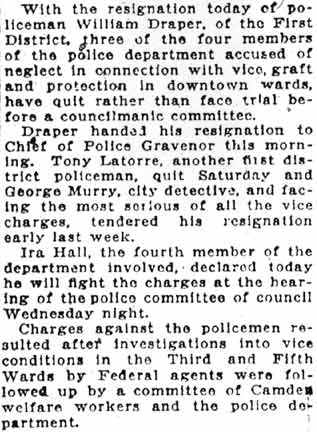
TWO MORE POLICEMEN RESIGN UNDER FIRE IN DOWNTOWN VICE PROBE
William Draper and Tony Latorre Quit Rather Than Fight Charges of Graft Before Police Committee—Hall Says He Will Face The Music
[Continuation — see gvm-cp-010922-01.md]
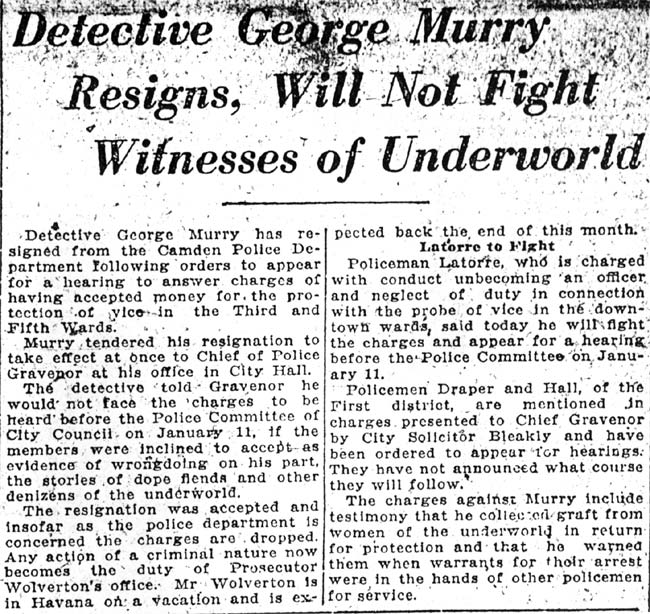
With the resignation today of policeman William Draper, of the First District, three of the four members of the police department accused of neglect in connection with vice, graft and protection in downtown wards, have quit rather than face trial before a councilmanic committee.
Draper handed his resignation to Chief of Police Gravenor this morning. Tony Latorre, another first district policeman, quit Saturday and George Murry, city detective, and facing the most serious of all the vice charges, tendered his resignation early last week.
Ira Hall, the fourth member of the department involved, declared today he will fight the charges at the hearing of the police committee of council Wednesday night.
Charges against the policemen resulted after investigations into vice conditions in the Third and Fifth Wards by Federal agents were followed up by a committee of Camden welfare workers and the police department.
Camden Courier – January 13, 1922
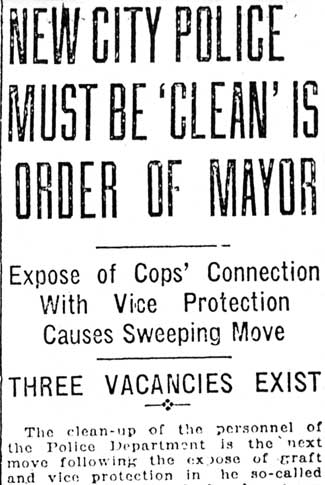
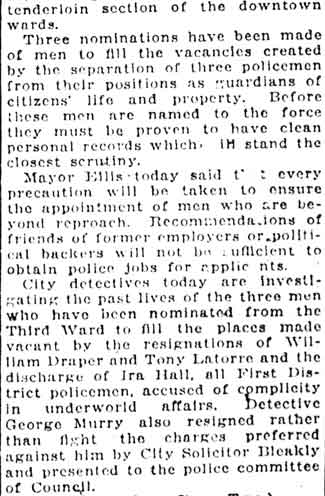
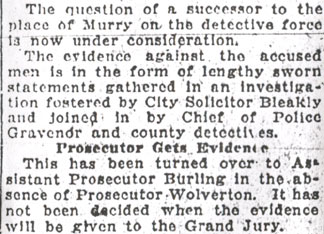
Camden Courier – January 16, 1922
RESIDENTS ASKED TO GIVE EVIDENCE OF POLICE GRAFT
Dozen Letters From Downtown Citizens Tell of Protection in Tenderloin
HABITUES STAGE EXODUS
Vacant Houses Reported in Third and Fifth Wards After Survey
[Continuation — see gvm-cp-011622-01.md]
Official Camden will “go the limit” to send to jail the four members of the police department accused of fostering vice in the downtown wards and accepting protection graft from underworld characters.
Assistant City Solicitor West today issued a call for all citizens to supply him with any evidence they may have of criminal acts on the part of policemen. This move was taken after the receipt of at least a dozen letters from citizens informing Mr. West of incidents connecting the policemen with disorderly persons and violations of the law.
Underworld Characters Exit
One result of the vice expose has been a general exodus from the downtown wards of tenderloin characters. Many houses are vacant and disorderly women, procurers, dope fiends and other types of underworld denizens have disappeared from the streets.
That condition was reported to Chief of Police Gravenor this morning by Captain Lewis Stehr, of the Second district. The Captain explained that his report was from policemen in citizens’ clothes who are covering the district twenty-four hours a day.
[Continuation — see gvm-cp-011622-01.md]
...covering the district twenty-four hours a day. Eight of these men have been detailed to the clean-up job and their report is that conditions in the district have improved to the extent that vacant houses are becoming common.
Most of the disorderly characters have left Camden and apparently are gone for good, the police report.
[Continuation — see gvm-cp-011622-01.md]
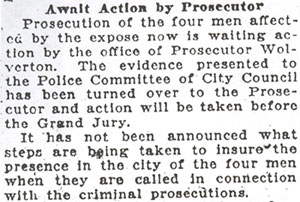
Await Action by Prosecutor
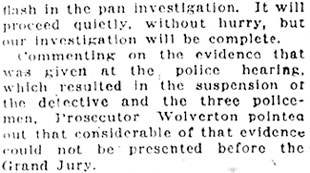
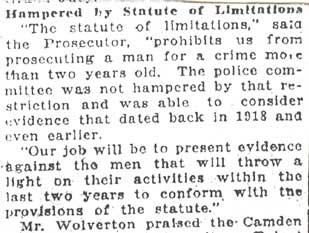
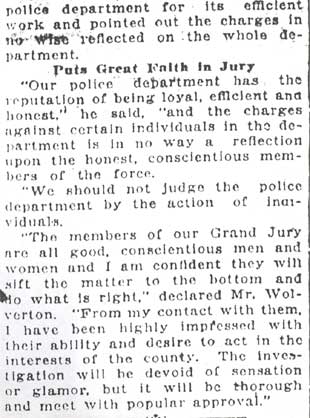
Prosecution of the four men affected by the expose now is waiting action by the office of Prosecutor Wolverton. The evidence presented to the Police Committee of City Council has been turned over to the Prosecutor and action will be taken before the Grand Jury. It has not been announced what steps are being taken to insure the presence in the city of the four men when they are called in connection with the criminal prosecutions.
[Continuation — see gvm-cp-011622-01.md]
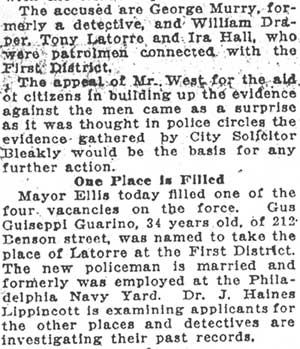
The accused are George Murry, formerly a detective, and William Draper, Tony Latorre and Ira Hall, who were patrolmen connected with the First District.
The appeal of Mr. West for the aid of citizens in building up the evidence against the men came as a surprise as it was thought in police circles the evidence gathered by City Solicitor Bleakly would be the basis for any further action.
One Place is Filled
Mayor Ellis today filled one of the four vacancies on the force. Gus Guiseppi Guarino, 34 years old, of 212 Benson street, was named to take the place of Latorre at the First District. The new policeman is married and formerly was employed at the Philadelphia Navy Yard. Dr. J. Haines Lippincott is examining applicants for the other places and detectives are investigating their past records.
Camden Courier – January 25, 1922
Camden Courier-Post – February 4, 1935
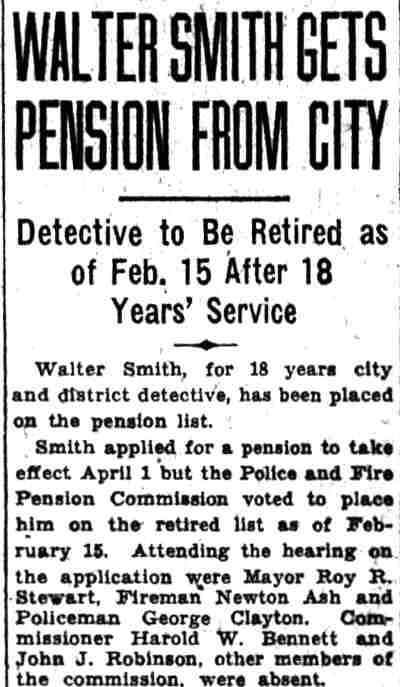
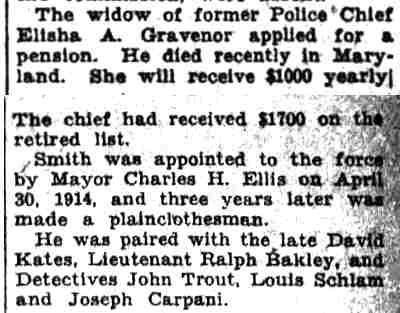
Named: Roy R. Stewart, Walter Smith, John Trout, Newton Ash, George Clayton, Harold W. Bennett, John J. Robinson, Elisha A. Gravenor, Charles H. Ellis, David Kates, Ralph Bakley, Joseph Carpani, and Louis Schlam.