Introduction
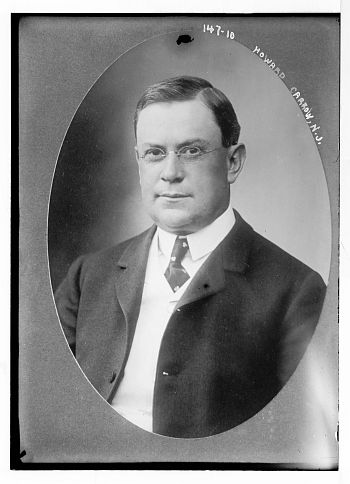
Howard Carrow circa 1900
Howard Carrow was born in Camden, Kent County, Delaware on September 30, 1860 to Margaret and Edward Carrow. Howard Carrow’s forebears were of Scotch-Irish and English extractions. They were principally farmers and lived in Maryland and Delaware for several generations. Mr. Carrow’s family came to Bridgeton right after the Civil War and resided there until 1873 when they moved to Camden.
Howard Carrow was educated in public and private schools and by tutors. He was prepared for college, but circumstances prevented his going. He studied law in the office of Thomas Harned. On October 16, 1878 at the residence of Samuel B. French, corner of Cooper Street and Front, Howard Carrow helped found the Camden chapter of the Young Men’s Christian Association, better known as the Y.M.C.A, along with George H. Davis, W. Howard Curtiss, Bartram L. Bonsall, Samuel B. French.
While not attending to work and his education Howard Carrow was quite interested in baseball. In 1881 he helped organize a team in Camden with J.K.R. Hewitt and John L. Semple, who later became a noted defense lawyer in Camden. In June of 1882 Howard Carrow was admitted to the New Jersey bar as an attorney. He became a counselor in 1885.
Howard Carrow was first married to Emma Bender, the daughter of Captain Robert S. Bender. A son, J. Russell Carrow was born on September 9, 1887. The Carrows lived at 515 North 4th Street through at least the middle of 1888. By the middle of 1890 the family had moved to Merchantville. The Carrows owned a large home at 39 North Maple Avenue. Besides J. Russell Carrow, the family also included younger daughters Margaret Linda and Helen.
Howard Carrow soon rose in Camden’s legal circles and also as a force in Democrat party politics. On merit he was appointed Judge of the District Court of the city of Camden by Governor Leon Abbett for a five-year term in April of 1891, a remarkable achievement for a man not yet 30 years of age. After leaving the bench, Howard Carrow returned to his law practice in Camden, at 207 Market Street. He was offered the post of Camden County prosecutor by Governor George T. Werts in 1894 but business reasons prompted him to decline.
Howard Carrow was also prominent in local and in particularly state-wide New Jersey Democratic politics. Not being closely allied to Gloucester’s William Thompson propelled Howard Carrow’s career politically, as he became prominent in the wake of Thompson’s loss of power when racetracks were banned in New Jersey. Carrow was being considered for a run for State Senator by New Jersey’s Citizens League in October of 1893, when Thompson obtained the nomination for Howard M. Cooper.
In 1894 Howard Carrow was named a member of the commission appointed by Governor Werts to suggest amendments to the state constitution respecting the judiciary system. Howard Carrow gave a speech at the meeting of the Democrat League in October of 1894, and was named permanent chairman of the New Jersey State Democrat party committee on September 26, 1895. On May 7, 1896 he was considered as a delegate to the 1896 Democrat National Convention, which nominated the late Chancellor Alexander T. McGill for Governor. In 1898 he was made a Member-at-Large of the Democratic State Committee, where he served until 1912. He attended the national convention as a Delegate-at-Large from New Jersey in 1904. In September of 1907 he helped launch Woodrow Wilson’s political career by helping Wilson gain the nomination for New Jersey governor. On April 28, 1908 he was named as a Delegate-at-Large to the national Democrat convention. He was made a member of the National Democratic Committee in 1908, but declined re-election in 1912. Politics in New Jersey was often a full-contact sport. In August of 1911 he was central in removal of James R. Nugent as chairman of the state Democrat Party.
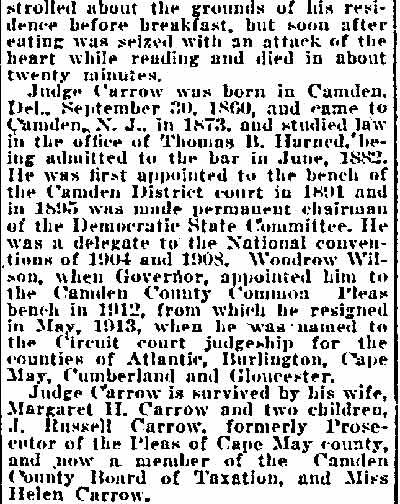
Howard Carrow retired from politics to accept an appointment from Governor Wilson as Judge of the Court of Common Pleas of Camden County. He resigned that position in 1913 to become Circuit Court Judge for Atlantic, Burlington, Gloucester, Cumberland, Salem, and Cape May Counties.
Howard Carrow also sat on the Board of Directors of the Security Trust Company bank in Camden, located at 301 Market Street.
Sadly, Emma Bender Carrow passed away in 1909, and daughter Margaret Linda also died young. Son J. Russell Carrow followed his father into the practice of law, and into politics as a Democrat. He was admitted to the New Jersey Bar in November of 1911. That same year father Howard Carrow served as president of the New Jersey Bar Association. On September 26, 1912 J. Russell Carrow was nominated for the State Assembly as a Democrat from Camden along with Albert Neutze and Bernard A. Gallagher. They ran against a Republican slate consisting of Isaac Coles, Albert DeUnger and John B. Kates. J. Russell Carrow was elected and served one term in the Assembly. His most notable achievement was the introduction of a bill naming the violet as New Jersey’s state flower.
On June 22, 1913 Howard Carrow married Miss Margaret Helm of Trenton, New Jersey. It was a double wedding, as his son J. Russell Carrow also took a bride that day.
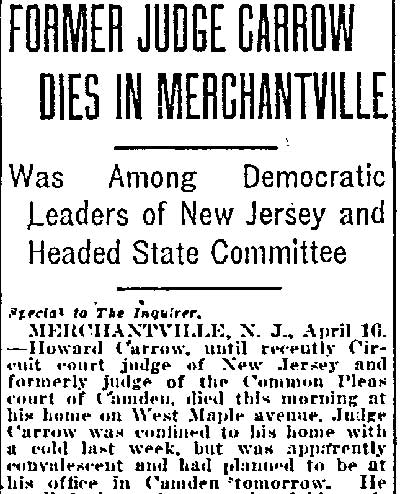
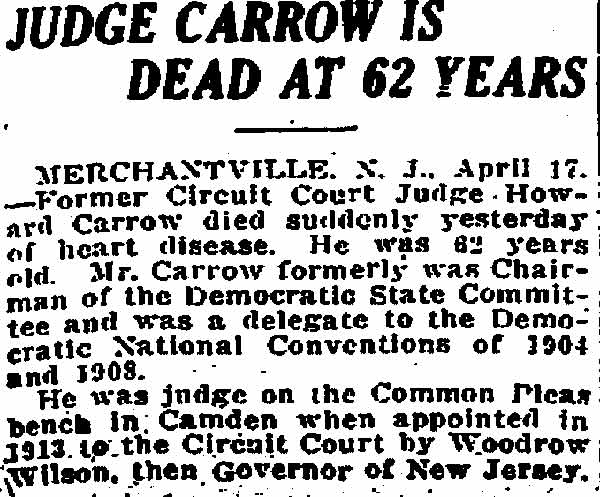
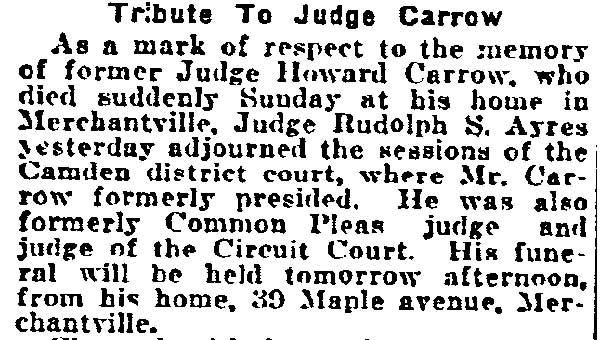
Howard Carrow passed away at home, on Easter Sunday morning, April 16, 1922.
Philadelphia Inquirer — August 27, 1881
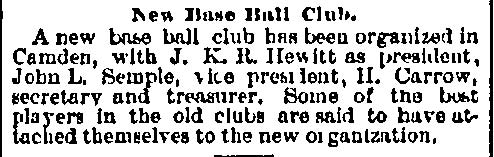
New Base Ball Club.
A new base ball club has been organized in Camden, with J. K. R. Hewitt as president, John L. Semple, vice president, H. Carrow, secretary and treasurer. Some of the best players in the old clubs are said to have attached themselves to the new organization.
Philadelphia Inquirer — October 14, 1884

A Democratic mass meeting will be held at Third and Market streets this evening. Addresses will be made by John W. Wescott, Howard Carrow, C.G. Garrison and others.
Camden Post — June 1, 1888

THE LOGUE ASSAULT.
Stratton and Mellon on Trial in Court.
LOGUE’S STORY OF THE ATTACK
The Young Woman Tells Her Story —Damaging Evidence Against the Defendants.
In the Quarter Sessions Court yesterday afternoon the case of John F. Stratton and Henry Mellon, the two young men charged with the murderous attack upon Joseph Logue, near Starr’s crossing, Tenth and Line streets, on May 6th, was begun. Ex-Judge Wescott and Howard Carrow conducted the defense and Prosecutor Jenkins appeared for the State. In response to the latter’s command for witnesses to take the benches on the right of the bar enclosure, fourteen persons arose from the audience and took seats there.
The first witness was Logue himself, who had been confined in the Cooper Hospital about ten days suffering from his injuries. He is a tall, well-built young fellow of 32. “On the evening of May 6th,” he said, “I was in company with Miss Sarah Lewine; I was walking along Haddon avenue. We started from Third and Royden street. We walked out Benson to Haddon avenue and out to Newton avenue, and turned up Newton avenue toward Federal street. Just after we crossed the Camden and Atlantic railroad, these two men sprang up and the tallest one, Stratton, took hold of the lady and the smaller one, Mellon, took hold of me. I asked them what they wanted and they said they arrested me. I asked them what I had done and they said I would find out. Stratton kept telling Mellon to take the woman away. Mellon pulled open his coat and showed what looked like a star, saying that was his authority for making the arrest. He hit me in the head with a blackjack. Then when I tried to get away Stratton stabbed me in the side with a knife.”
“Do you identify either of these men?” asked Mr. Jenkins.
“Yes, sir; I am positive Stratton is the tall one. Mellon looks like the smaller man of the two. I described the two men before I was arrested.”
Ex-Judge Wescott’s rigid cross-examination failed to shake his story in any detail. He identified Stratton, who was taken to him in the hospital, as the taller man of the two.
“What were you doing out there?” asked ex-Judge Wescott.
“Taking a walk.”
“Who was the lady?”
“Miss Sarah Lewine.”
“How long have you known her?”
“About six years.”
The next witness was Miss Lewine, a chestnut-haired, ruddy complexioned young woman, of about thirty summers. “I was to meet Mr. Logue at eight o’clock that night,” she began with a smile, “but it might have been a few minutes after.”
She corroborated Logue’s testimony, adding that as the men came up to them she pulled Logue’s coat to signal him to keep quiet. “After Mr. Logue was cut,” she said, “the two men ran past me. Mr. Logue came back to me and said he was stabbed, and that I should go home.”
She was unable to identify either of the defendants as the assailants of that night. Mr. Wescott tried hard to entangle her as to her ability to determine the difference in the sizes of the two men as they lay upon the ground, but she refused to be tangled up and adhered rigidly to her story with marked indications of deepest truth and sincerity.
“Now, Miss Lewine, you have frequently heard that one of the men was tall and the other short, haven’t you?” asked Mr. Wescott.
“Didn’t I see them?” answered the witness pertinaciously, and all further questioning failed to get more from her.
Christopher Smith, of 1904 Fillmore street, employed as night watchman on the Line street sewer, then in course of construction. On the night of the assault he saw Stratton and Mellon about 7 o’clock. Mellon came up to him and spoke, and shortly afterwards Stratton came up. Mellon took a knife out of his pocket, continued Smith, and handed it to Stratton. The latter said “If anybody bothers me, I’ll cut the d— guts out of them.” The blade, I guess, must have been three or four inches long. The handle was of bone, I think. They stayed there about half an hour and it was dark when they left, walking up Haddon avenue.
The point where the defendants were seen by Smith is a square from where the assault was committed. Mr. Jenkins tried to show that both young men frequented this particular locality, but it was objected to and withdrawn. Smith admitted that he saw Mellon have a blackjack one night at Haddon avenue and Line street. Stratton was with him at the time. That was on Friday, May 4th, two days before the assault.
The Court took a recess at this point till this morning.
When the case was resumed this morning Logue produced in evidence, the coat he wore the night he was assaulted, exhibiting the hole cut by the knife and the blood stains from the wounds in the head and side.
Then Dr. Henry Jarrett, resident physician of the Cooper Hospital, was called. He testified as to the wounds received and said the knife thrust might have been fatal if it had gone in deep enough, or Logue might have bled to death if a large enough blood vessel had been severed.
“Could he have bled to death from either of the wounds?” asked Mr. Jenkins.
“No, sir.”
“How long have you been practicing?” asked Mr. Wescott.
“I have been at Cooper Hospital since July 28th, last.”
“When did you graduate?”
“A year ago last April.”
“That will do.”
Charles R. Locke, a fellow employe of Mellon’s at the paper mill, 83 Cooper St., saw Mellon have, on the Friday before the assault, a large knife, such as sailors carry, with a blade two and a half or three inches long. It had a rough bone handle.
Knight Haines, a boy, on the Saturday night before the assault, between 8.30 and 9.30 saw Stratton and Mellon on the lots in front of the city hall, within a short distance of where Logue was attacked. Stratton and Mellon were on their hands and knees and when they recognized him they said: “Oh, is it you? Don’t give us away.” He said Stratton had a knife and Mellon a blackjack.
“Did you have a girl with you?” asked Mr. Wescott.
“I don’t know,” said Haines, smiling.
Camden Daily Courier — June 1, 1888
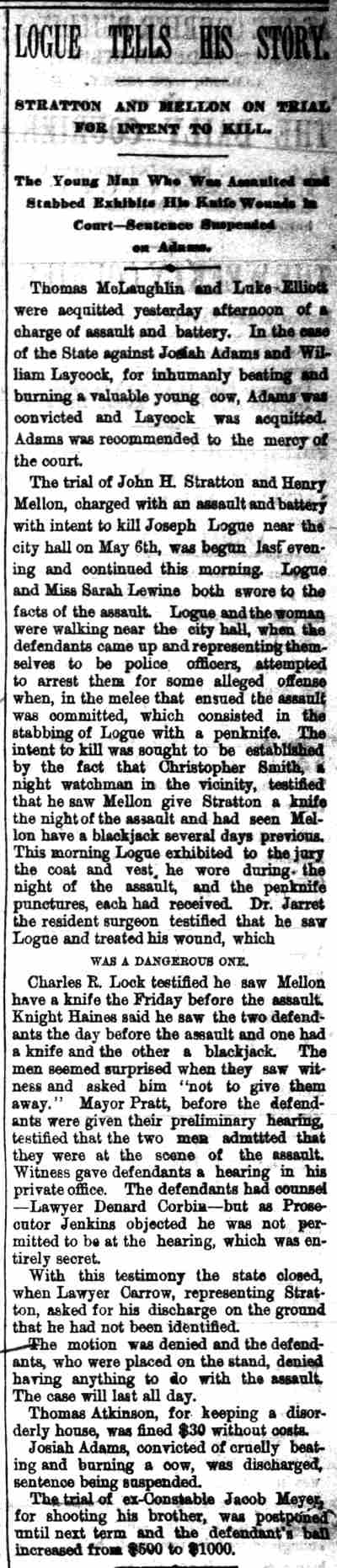
LOGUE TELLS HIS STORY.
STRATTON AND MELLON ON TRIAL FOR INTENT TO KILL.
The Young Man Who Was Assaulted and Stabbed Exhibits His Knife Wounds in Court—Sentence Suspended on Adams.
Thomas McLaughlin and Luke Elliot were acquitted yesterday afternoon of a charge of assault and battery. In the case of the State against Josiah Adams and William Laycock, for inhumanly beating and burning a valuable young cow, Adams was convicted and Laycock was acquitted. Adams was recommended to the mercy of the court.
The trial of John H. Stratton and Henry Mellon, charged with an assault and battery with intent to kill Joseph Logue near the city hall on May 6th, was begun last evening and continued this morning. Logue and Miss Sarah Lewine both swore to the facts of the assault. Logue and the woman were walking near the city hall, when the defendants came up and representing themselves to be police officers, attempted to arrest them for some alleged offense when, in the melee that ensued the assault was committed, which consisted in the stabbing of Logue with a penknife. The intent to kill was sought to be established by the fact that Christopher Smith, a night watchman in the vicinity, testified that he saw Mellon give Stratton a knife the night of the assault and had seen Mellon have a blackjack several days previous. This morning Logue exhibited to the jury the coat and vest he wore during the night of the assault, and the penknife punctures each had received. Dr. Jarret the resident surgeon testified that he saw Logue and treated his wound, which
WAS A DANGEROUS ONE.
Charles R. Lock testified he saw Mellon have a knife the Friday before the assault. Knight Haines said he saw the two defendants the day before the assault and one had a knife and the other a blackjack. The men seemed surprised when they saw witness and asked him “not to give them away.” Mayor Pratt, before the defendants were given their preliminary hearing, testified that the two men admitted that they were at the scene of the assault. Witness gave defendants a hearing in his private office. The defendants had counsel—Lawyer Denard Corbia—but as Prosecutor Jenkins objected he was not permitted to be at the hearing, which was entirely secret.
With this testimony the state closed, when Lawyer Carrow, representing Stratton, asked for his discharge on the ground that he had not been identified.
The motion was denied and the defendants, who were placed on the stand, denied having anything to do with the assault. The case will last all day.
Thomas Atkinson, for keeping a disorderly house, was fined $30 without costs.
Josiah Adams, convicted of cruelly beating and burning a cow, was discharged, sentence being suspended.
The trial of ex-Constable Jacob Meyer, for shooting his brother, was postponed until next term and the defendant’s bail increased from $500 to $1000.
Philadelphia Inquirer — February 18, 1890
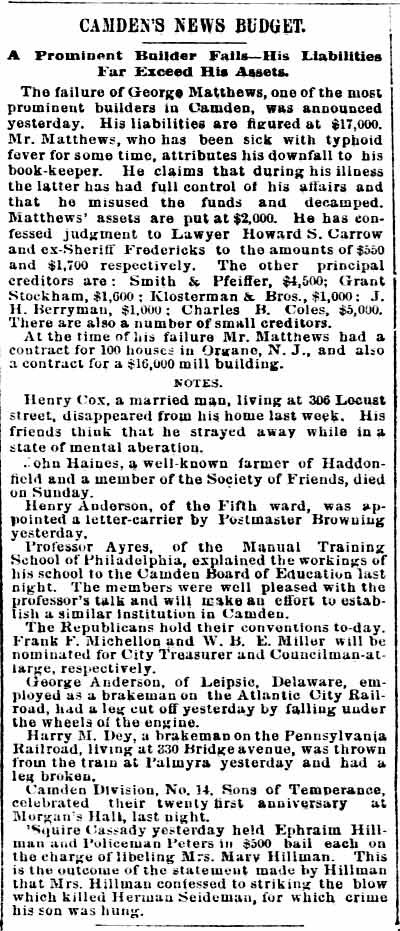
Named: Howard Carrow, George Matthews, Henry Fredericks
Smith & Pfeiffer, Grant Stockham, Klosterman & Brothers
J.H. Berryman, and C.B. Coles.
Philadelphia Inquirer — March 14, 1890
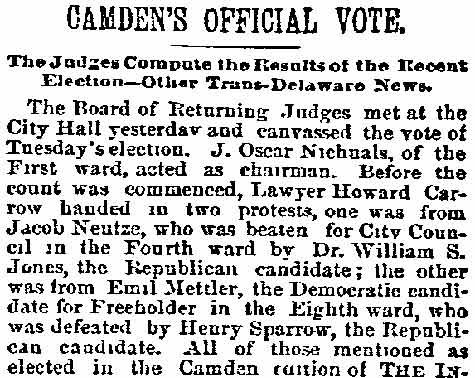
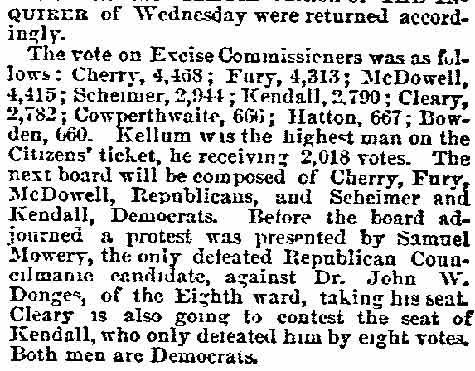
Named: John Furey, J. Oscar Nichuals, Howard Carrow, Jacob Neutze, Dr. William S. Jones
Emil Mettler, Henry Sparrow, Dr. John W. Donges, John Cherry, Lewis McDowell
Samuel Mowery, Scheimer, Kendall, Hatton, Bowden, Cowperthwaite, Kellum, and Cleary.
Camden County Bar Association — circa 1894
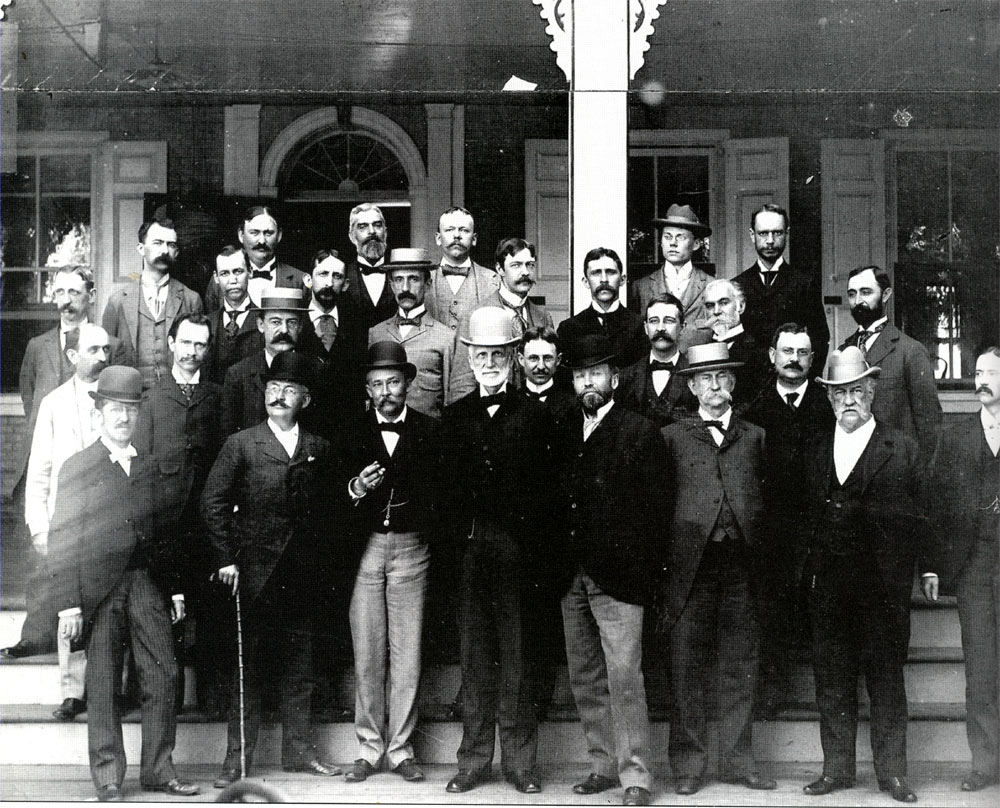
Members of the Camden County Bar Association pose for a photograph during their annual shad dinner, around 1894.
From left (first row) Judge Charles Joline, Supreme Court Justice Charles Garrison, Judge Richard R. Miller, vice chancellor Henry C. Pitney, Supreme Court Justice Alfred Reed, Benjamin Shreeve, Caleb Shreeve, George H. Pierce; (second row) William Casselman, Edwin Bleakly, J. Willard Morgan, Peter Voorhees, Samuel Beldon, Frank Shreeve, Schuyler Woodhull, Lewis Starr, H. S. Scovel, George Vroom, Charles Wooster, and Howard Carrow; (third row) Samuel Robbins, E. A. Armstrong, Thomas Curley, unknown Philadelphia lawyer, Charles Stevenson, H. F. Nixon, Henry I. Budd, Israel Roberts.
New York Times — May 18, 1894
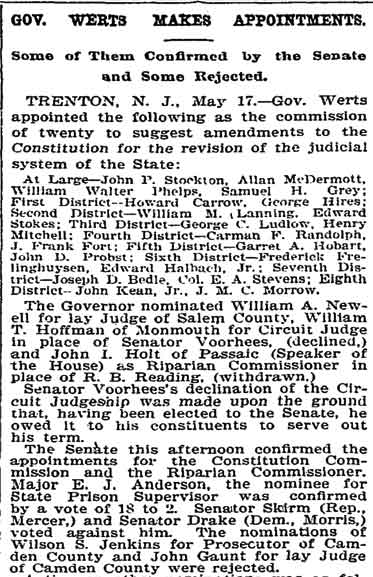
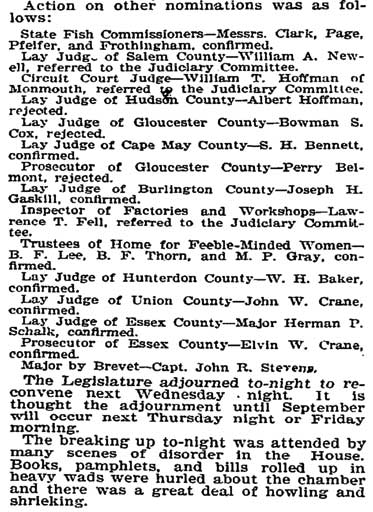
Howard Carrow — Samuel H. Grey
Philadelphia Inquirer — June 6, 1895
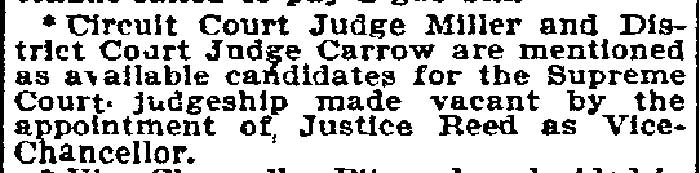
Howard Carrow
Camden Post — June 7, 1895

BENTON HALL CASE
Lawyer Crandall Asks for a New Writ of Error.
CASE OUT OF THE COURT’S HANDS
Judge Carrow Asks for a Reconsideration of Sentence in the Case — Still Trying to Keep Harriet Smith from State Prison.
Edward Benton and Joseph Hall, who were sentenced to three months each on conviction for criminal libel and whose appeal to the Supreme Court was dismissed on Tuesday, owing to the neglect of Counselor John J. Crandall, who failed to appear, have not yet given up their fight.
Judge Carrow has been retained, and the case assumes another phase. In court this morning Prosecutor Jenkins declared that if ever there was a manifestation of counsel’s neglect this was one.
The court gave Crandall an opportunity for argument tomorrow, when it is expected the remittitur will arrive.
Lawyer Wm. J. Kraft said that Judge Carrow was counsel in the case also, and would have something to say.
“If Carrow is in the case I’ll withdraw,” declared Lawyer Crandall.
Later on Judge Carrow appeared and asked that the Court reconsider the sentence of three months in jail and make the sentence a fine. He said that while he had not been acting openly he had all along been associated with the defense. He placed the case in Mr. Crandall’s hands.
Mr. Carrow did not appear as hired counsel, but the defendants were friends of his and he made this plea for them. Obvious punishment was already had. The crime was not of a serious character. The publication was made in good faith and for the good of the public. The defendant’s did not know that Kappel and Cable was the same man. There was some foundation for the article and it was admitted at the trial that money had been unlawfully obtained.
A fine, Judge Carrow said, would dispose of the matter, and the best element of this county wanted the sentence reconsidered.
The Court said it could do nothing now as it was out of the Court’s hands, but the matter could be heard when the records arrive from the Supreme Court.
In the matter of Harriet Smith, who was sentenced to one year in State Prison for policy writing, County Physician Jones was called to the stand. He said he had examined Mrs. Smith’s condition in jail and found her suffering from palpitation of the heart. Dr. Jones said that in his opinion there was nothing to prevent her being taken to State Prison.
Dr. McAllister corroborated Dr. Jones’ statement, he having also examined Mrs. Smith.
Counselor Harry S. Scovel, who with Mr. Rex appeared for the defendant, said he had nothing more to say, but that Judge Wescott had been brought into the case and would make a motion the nature of which Mr. Scovel did not know.
The Court laid the matter over until tomorrow to hear Judge Wescott, who is in Trenton today.
Mrs. Grantz, wife of Police Officer Grantz of Stockton, who got three months for assault and battery, appeared before the Court but could say nothing through her sobs. Judge Vroom questioned her for some time relative to her husband’s business and her family and then said the Court would consider the matter.
Philadelphia Inquirer — July 28, 1899

EVIL DOERS QUAKE
Mayor Hatch, of Camden, Starts in to Wipe Out Speak-Easies
FIRST RAID A SUCCESS
Fines Imposed by Recorder Nowrey for Operating Gambling Machines. Sunday Sellers Hope to Escape
Mayor Cooper B. Hatch is making life miserable for evil doers in Camden. After waging relentless warfare on Sunday liquor sellers and seizing all the gambling machines in saloons and cigar stores, he is now clearing out speak-easies. The first raid was made yesterday afternoon, when Captain Stanley, Sergeant Hyde, Detective Painter and Policeman Shaw swooped down on Mrs. Mary Mahan’s house, at 1062 South Front street. They found nearly enough liquor there to stock a saloon. There were two cases of bottled beer, five gallons of whisky, a large quantity of California wines, and other “wet” goods. This was all confiscated and was sent to the City Hall, together with Mrs. Mahan and a young girl.
For some time past Mayor Hatch’s private detectives have been gathering evidence against speak-easies and disorderly houses in different parts of the city, and several more arrests will be made.
The saloonkeepers arrested about ten days ago for operating slot machines in their places were arraigned yesterday before Recorder Nowrey. Maurice Hertz, of Locust street and Kaighn avenue, was the first to be tried. He was represented by former Judge Howard Carrow. The complaints against Hertz charged him with operating nickel-in-the-slot gambling machines on July 2 and 9.
Harry Williams, one of Secretary Gibboney’s detectives, who was employed in the recent Sunday liquor crusade, testified that he played “The Owl” in Hertz’s saloon on July 9. He lost five cents on the red but hit the black and quit even. On cross-examination Williams refused to tell by whom he was employed, and Recorder Nowrey would not compel him to answer. Detective Fields swore that he was with Williams in Hertz’s place, and also played the slot machine. Police Captain Stanley said he found four of the slot machines in Hertz’s place when he made the raid.
At this point Judge Carrow moved to dismiss the complaint, as it was dated in the year “189.” Decision was reserved, and the other complaint was taken up. Judge Carrow wanted this set aside on the ground that it did not specify the premises where the law was alleged to have been violated. Recorder Nowrey overruled the motion.
Detective Graper said he played the slot machine at Hertz’s saloon on Sunday, July 2. On cross-examination he refused to give his address, but said he worked for Mayor Hatch. He didn’t know, he said, whether he was on the city pay roll.
David B. Kaighn and other Kaighn avenue residents testified that they never saw slot machines in operation in Hertz’s place, but had seen them standing in the office.
Hertz, in his own defense, said he was agent for the slot machines, and those found in his office were samples to be examined by prospective purchasers.
Recorder Nowrey sentenced Hertz to pay a fine of $50 and costs. Judge Carrow gave notice that he would appeal the case, but the Recorder refused to permit Hertz to depart without paying the fine.
Peter Kelly, of Eighth street and Ferry avenue, was also convicted and paid his fine.
John Keefe, of Haddon avenue and Carman street, and Marshall Hutchinson, of Ninth and Walnut streets, pleaded guilty and were fined $50 and costs each. There were about seven more cases, which Recorder Nowrey adjourned until next Wednesday.
The 130 saloonkeepers rounded up in the recent crusade against Sunday liquor selling were in high glee yesterday over the discovery of a law that they hoped would save them from punishment for their alleged misdoings. This law was passed in 1874, and makes it unlawful to prosecute any person by indictment for violations of the liquor laws in municipalities where city ordinances provide punishment for such offenses. As the Supreme Court has set aside the Camden excise ordinance, the saloonkeepers hoped to escape further prosecution.
City Counsel Bleakly, after looking up the matter yesterday, said: “A house in which the unlawful sale of liquors is habitually made is an indictable nuisance, although there is a city ordinance prescribing penalty for such sales. Such traffic is not only a breach of the city law, but is also forbidden by the State law.” This decision was made by Judge Van Syckel in 1880, in the Court of Errors and Appeals, and was reaffirmed in 1888. It is now a State law.
The Excise Commission, at its regular meeting next Wednesday evening, will probably adopt a substitute ordinance against Sunday liquor selling to conform to the city charter, under the Supreme Court’s decision setting aside the old ordinance.
Philadelphia Inquirer — February 27, 1900
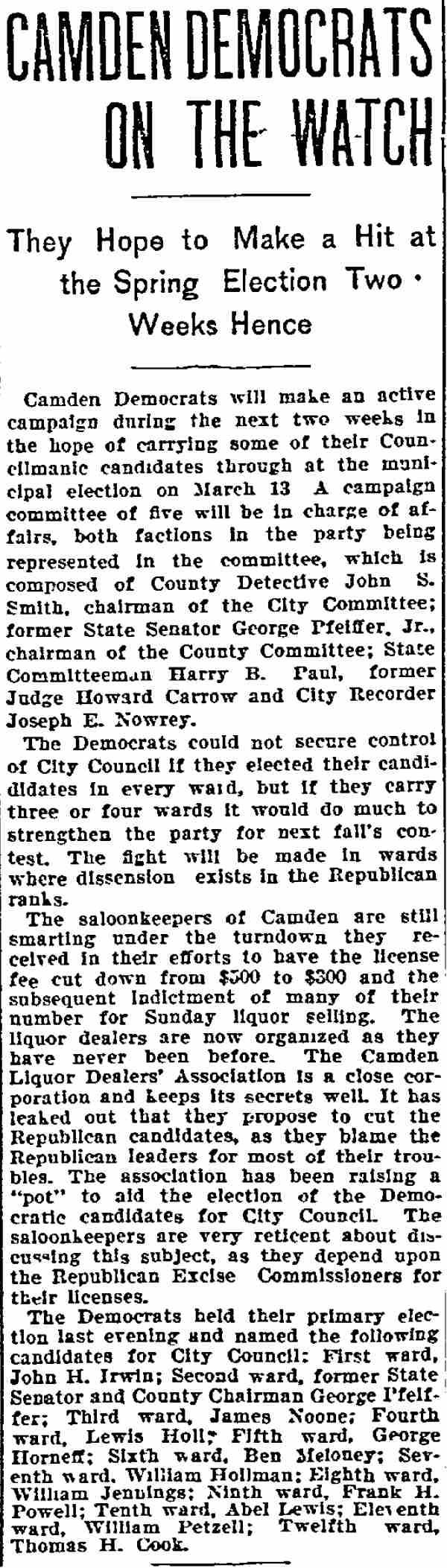
CAMDEN DEMOCRATS ON THE WATCH
They Hope to Make a Hit at the Spring Election Two Weeks Hence
Camden Democrats will make an active campaign during the next two weeks in the hope of carrying some of their Councilmanic candidates through at the municipal election on March 13. A campaign committee of five will be in charge of affairs, both factions in the party being represented in the committee, which is composed of County Detective John S. Smith, chairman of the City Committee; former State Senator George Pfeiffer, Jr., chairman of the County Committee; State Committeeman Harry B. Paul, former Judge Howard Carrow and City Recorder Joseph E. Nowrey.
The Democrats could not secure control of City Council if they elected their candidates in every ward, but if they carry three or four wards it would do much to strengthen the party for next fall’s contest. The fight will be made in wards where dissension exists in the Republican ranks.
The saloonkeepers of Camden are still smarting under the turndown they received in their efforts to have the license fee cut down from $500 to $300 and the subsequent indictment of many of their number for Sunday liquor selling. The liquor dealers are now organized as they have never been before. The Camden Liquor Dealers’ Association is a close corporation and keeps its secrets well. It has leaked out that they propose to cut the Republican candidates, as they blame the Republican leaders for most of their troubles. The association has been raising a “pot” to aid the election of the Democratic candidates for City Council. The saloonkeepers are very reticent about discussing this subject, as they depend upon the Republican Excise Commissioners for their licenses.
The Democrats held their primary election last evening and named the following candidates for City Council: First ward, John H. Irwin; Second ward, former State Senator and County Chairman George Pfeiffer; Third ward, James Noone; Fourth ward, Lewis Holl; Fifth ward, George Horneff; Sixth ward, Ben Meloney; Seventh ward, William Hollman; Eighth ward, William Jennings; Ninth ward, Frank H. Powell; Tenth ward, Abel Lewis; Eleventh ward, William Petzell; Twelfth ward, Thomas H. Cook.
New York Times — March 28, 1900
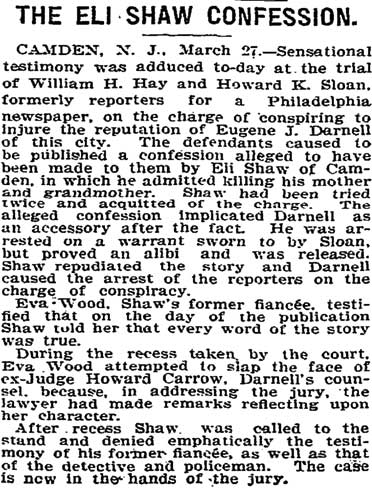
Howard Carrow
Trenton Evening Times — October 25, 1900
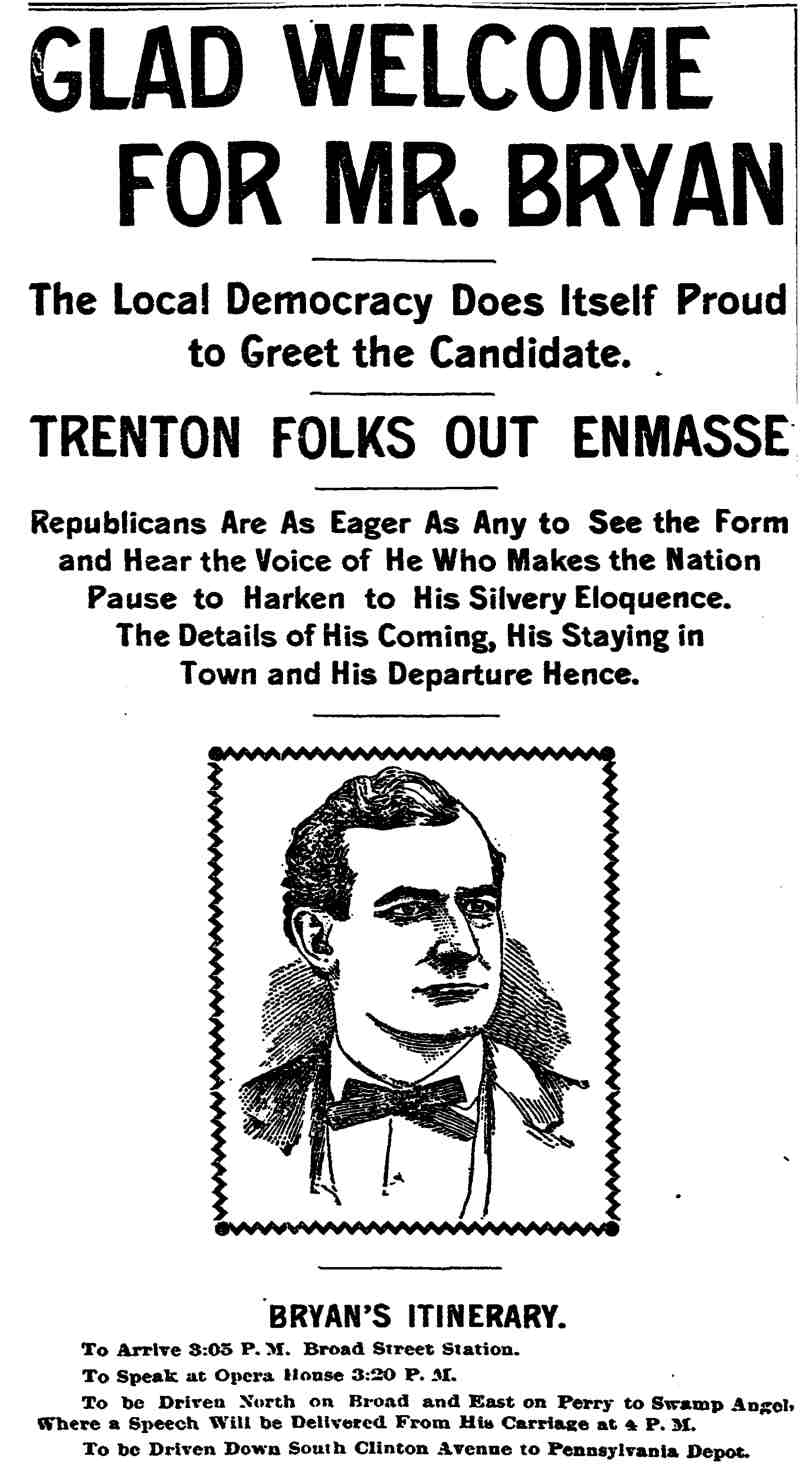
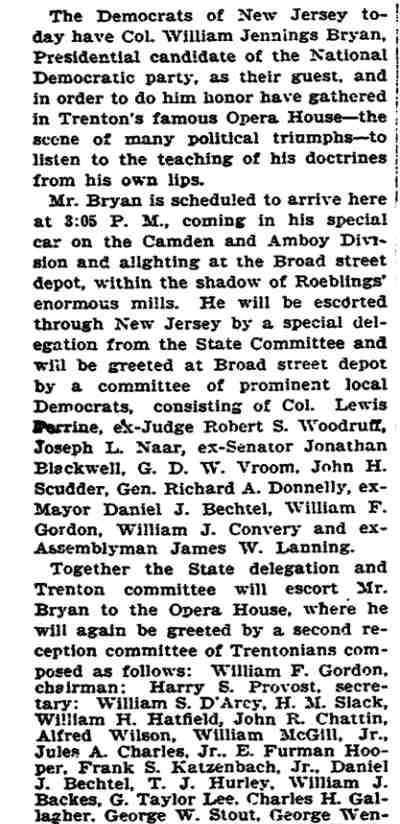
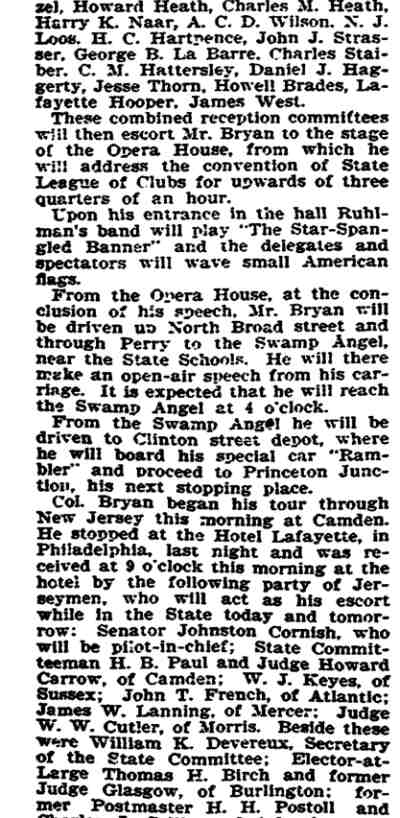
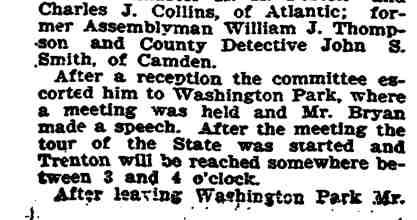
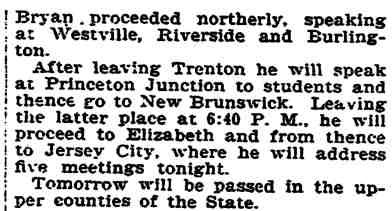
Named: Harry B. Paul, Howard Carrow, John S. Smith, and William J. Thompson.
Philadelphia Inquirer — January 12, 1906
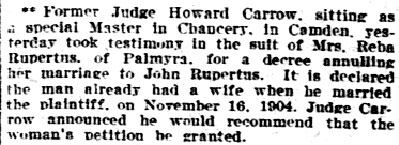
Howard Carrow
Philadelphia Inquirer — January 28, 1908
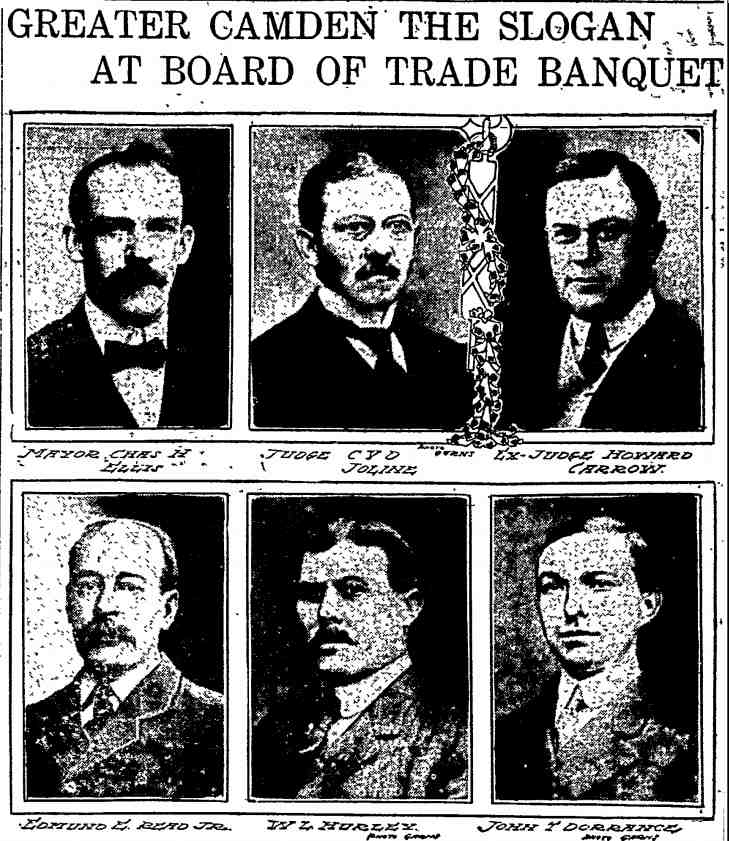
GREATER CAMDEN THE SLOGAN AT BOARD OF TRADE BANQUET
(Group photo: Mayor Chas H. Ellis, Judge C.V.D. Joline, Ex-Judge Howard Carrow, Edmund E. Read Jr., W.L. Hurley, John T. Dorrance)
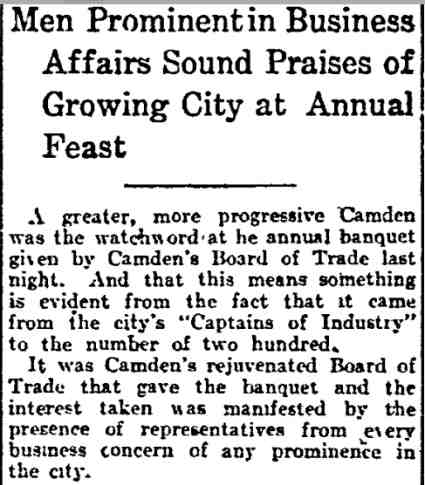
Men Prominent in Business Affairs Sound Praises of Growing City at Annual Feast
A greater, more progressive Camden was the watchword at he [sic] annual banquet given by Camden’s Board of Trade last night. And that this means something is evident from the fact that it came from the city’s “Captains of Industry” to the number of two hundred.
It was Camden’s rejuvenated Board of Trade that gave the banquet and the interest taken was manifested by the presence of representatives from every business concern of any prominence in the city.
All Represented
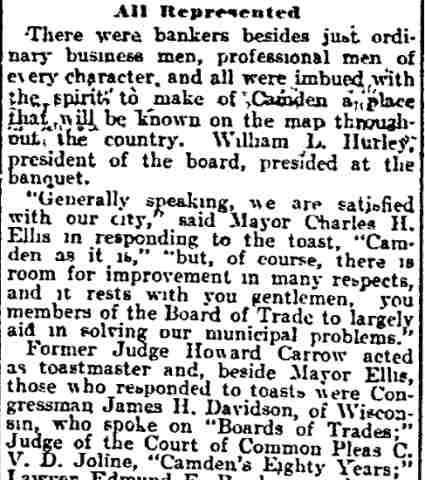
There were bankers besides just ordinary business men, professional men of every character, and all were imbued with the spirit to make of Camden a place that will be known on the map throughout the country. William L. Hurley, president of the board, presided at the banquet.
“Generally speaking, we are satisfied with our city,” said Mayor Charles H. Ellis in responding to the toast, “Camden as it is,” “but, of course, there is room for improvement in many respects, and it rests with you gentlemen, you members of the Board of Trade to largely aid in solving our municipal problems.”
Former Judge Howard Carrow acted as toastmaster and, beside Mayor Ellis, those who responded to toasts were Congressman James H. Davidson, of Wisconsin, who spoke on “Boards of Trades;” Judge of the Court of Common Pleas C. V. D. Joline, “Camden’s Eighty Years;” Lawyer Edmund E. Read, president of the Board of Education, “Camden’s Future.”
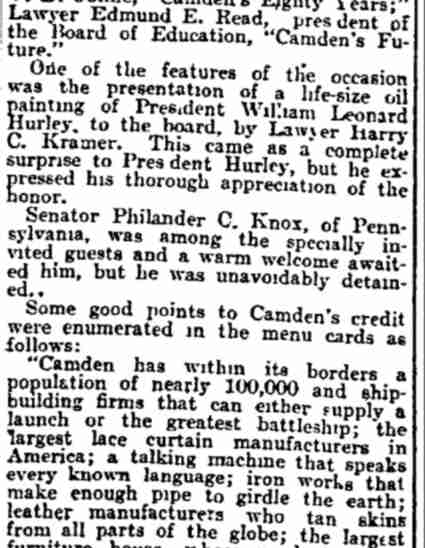
One of the features of the occasion was the presentation of a life-size oil painting of President William Leonard Hurley, to the board, by Lawyer Harry C. Kramer. This came as a complete surprise to President Hurley, but he expressed his thorough appreciation of the honor.
Senator Philander C. Knox, of Pennsylvania, was among the specially invited guests and a warm welcome awaited him, but he was unavoidably detained.. [sic]
Some good points to Camden’s credit were enumerated in the menu cards as follows:
“Camden has within its borders a population of nearly 100,000 and shipbuilding firms that can either supply a launch or the greatest battleship; the largest lace curtain manufacturers in America; a talking machine that speaks every known language; iron works that make enough pipe to girdle the earth; leather manufacturers who tan skins from all parts of the globe; the largest furniture house, whose products reach the Philippines; banks and trust companies whose resources are not affected by panics; artesian water that can be taken without adding anything.”
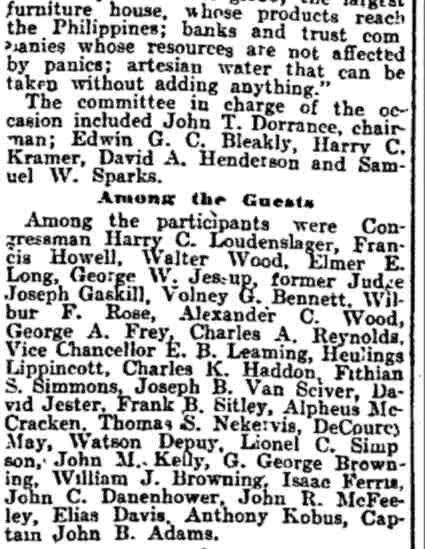
The committee in charge of the occasion included John T. Dorrance, chairman; Edwin G. C. Bleakly, Harry C. Kramer, David A. Henderson and Samuel W. Sparks.
Among the Guests
Among the participants were Congressman Harry C. Loudenslager, Francis Howell, Walter Wood, Elmer E. Long, George W. Jessup, former Judge Joseph Gaskill, Volney G. Bennett, Wilbur F. Rose, Alexander C. Wood, George A. Frey, Charles A. Reynolds, Vice Chancellor E. B. Leaming, Heulings Lippincott, Charles K. Haddon, Fithian S. Simmons, Joseph B. Van Sciver, David Jester, Frank B. Sitley, Alpheus McCracken, Thomas S. Nekervis, DeCourcy May, Watson Depuy, Lionel C. Simpson, John M. Kelly, G. George Browning, William J. Browning, Isaac Ferris, John C. Danenhower, John R. McFeeley, Elias Davis, Anthony Kobus, Captain John B. Adams.
[Continuation of article — see anthonykobus-012808-inq-2.md for full text]
All Represented
There were bankers besides just ordinary business men, professional men of every character, and all were imbued with the spirit to make of Camden a place that will be known on the map throughout the country. William L. Hurley, president of the board, presided at the banquet.
“Generally speaking, we are satisfied with our city,” said Mayor Charles H. Ellis in responding to the toast, “Camden as it is,” “but, of course, there is room for improvement in many respects, and it rests with you gentlemen, you members of the Board of Trade to largely aid in solving our municipal problems.”
Former Judge Howard Carrow acted as toastmaster and, beside Mayor Ellis, those who responded to toasts were Congressman James H. Davidson, of Wisconsin, who spoke on “Boards of Trades;” Judge of the Court of Common Pleas C. V. D. Joline, “Camden’s Eighty Years;” Lawyer Edmund E. Read, president of the Board of Education, “Camden’s Future.”
[Continuation of article — see anthonykobus-012808-inq-2.md for full text]
One of the features of the occasion was the presentation of a life-size oil painting of President William Leonard Hurley. [sic] to the board, by Lawyer Harry C. Kramer. This came as a complete surprise to President Hurley, but he expressed his thorough appreciation of the honor.
Senator Philander C. Knox, of Pennsylvania, was among the specially invited guests and a warm welcome awaited him, but he was unavoidably detained.. [sic]
Some good points to Camden’s credit were enumerated in the menu cards as follows:
“Camden has within its borders a population of nearly 100,000 and shipbuilding firms that can either supply a launch or the greatest battleship; the largest lace curtain manufacturers in America; a talking machine that speaks every known language; iron works that make enough pipe to girdle the earth; leather manufacturers who tan skins from all parts of the globe; the largest [furniture house...]”
[Continuation of article — see anthonykobus-012808-inq-2.md for full text]
...furniture house, whose products reach the Philippines; banks and trust companies whose resources are not affected by panics; artesian water that can be taken without adding anything.“
The committee in charge of the occasion included John T. Dorrance, chairman; Edwin G. C. Bleakly, Harry C. Kramer, David A. Henderson and Samuel W. Sparks.
Among the Guests
Among the participants were Congressman Harry C. Loudenslager, Francis Howell, Walter Wood, Elmer E. Long, George W. Jessup, former Judge Joseph Gaskill, Volney G. Bennett, Wilbur F. Rose, Alexander C. Wood, George A. Frey, Charles A. Reynolds, Vice Chancellor E. B. Leaming, Heulings Lippincott, Charles K. Haddon, Fithian S. Simmons, Joseph B. Van Sciver, David Jester, Frank B. Sitley, Alpheus McCracken, Thomas S. Nekervis, DeCourcy May, Watson Depuy, Lionel C. Simpson, John M. Kelly, G. George Browning, William J. Browning, Isaac Ferris, John C. Danenhower, John R. McFeeley, Elias Davis, Anthony Kobus, Captain John B. Adams.
Philadelphia Inquirer — August 30, 1910
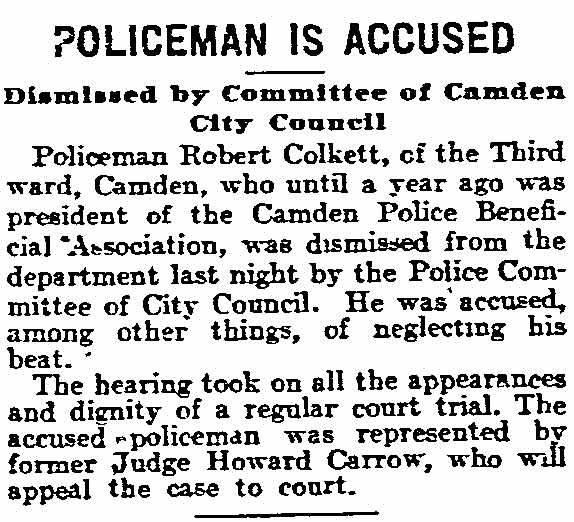
Dismissed by Committee of Camden City Council
Policeman Robert Colkett, of the Third ward, Camden, who until a year ago was president of the Camden Police Beneficial Association, was dismissed from the department last night by the Police Committee of City Council. He was accused, among other things, of neglecting his beat.
The hearing took on all the appearances and dignity of a regular court trial. The accused policeman was represented by former Judge Howard Carrow, who will appeal the case to court.
Philadelphia Inquirer — April 2, 1912
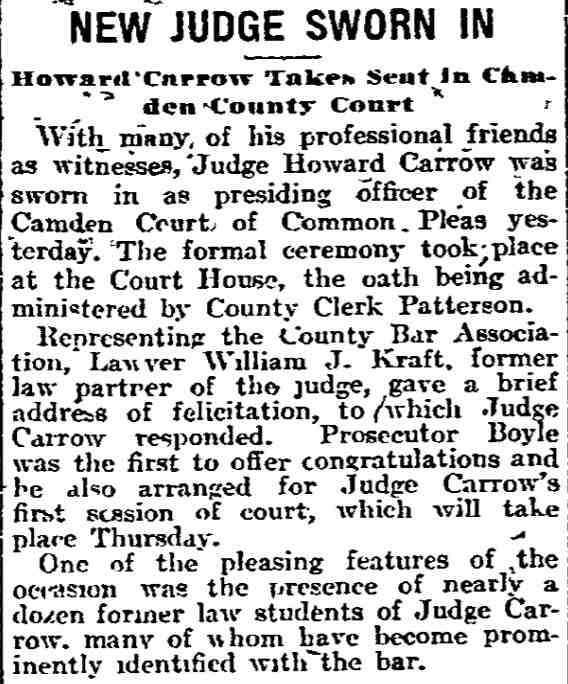
New Judge Sworn In
Howard Carrow Takes Seat in Camden County Court
With many of his professional friends as witnesses, Judge Howard Carrow was sworn in as presiding officer of the Camden Court of Common Pleas yesterday. The formal ceremony took place at the Court House, the oath being administered by County Clerk Patterson.
Representing the County Bar Association, Lawyer William J. Kraft, former law partner of the judge, gave a brief address of felicitation, to which Judge Carrow responded. Prosecutor Boyle was the first to offer congratulations and he also arranged for Judge Carrow’s first session of court, which will take place Thursday.
One of the pleasing features of the occasion was the presence of nearly a dozen former law students of Judge Carrow, many of whom have become prominently identified with the bar.
Philadelphia Inquirer — April 14, 1912
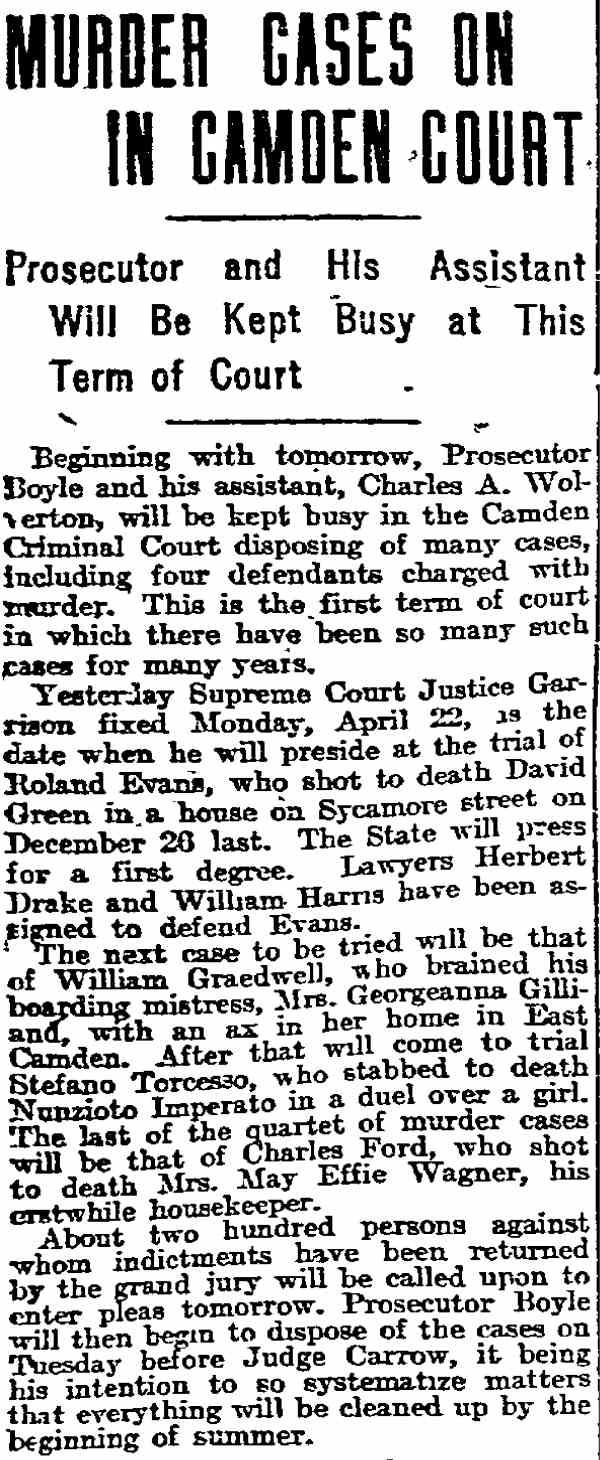
Prosecutor and His Assistant Will Be Kept Busy at This Term of Court
Beginning with tomorrow, Prosecutor Boyle and his assistant, Charles A. Wolverton, will be kept busy in the Camden Criminal Court disposing of many cases, including four defendants charged with murder. This is the first term of court in which there have been so many such cases for many years.
Yesterday Supreme Court Justice Garrison fixed Monday, April 22, as the date when he will preside at the trial of Roland Evans, who shot to death David Green in a house on Sycamore street on December 26 last. The State will press for a first degree. Lawyers Herbert Drake and William Harris have been assigned to defend Evans.
The next case to be tried will be that of William Graedwell, who brained his boarding mistress, Mrs. Georgeanna Gilliand, with an ax in her home in East Camden. After that will come to trial Stefano Torcesso, who stabbed to death Nunzioto Imperato in a duel over a girl. The last of the quartet of murder cases will be that of Charles Ford, who shot to death Mrs. May Effie Wagner, his erstwhile housekeeper.
About two hundred persons against whom indictments have been returned by the grand jury will be called upon to enter pleas tomorrow. Prosecutor Boyle will then begin to dispose of the cases on Tuesday before Judge Carrow, it being his intention to so systematize matters that everything will be cleaned up by the beginning of summer.
Philadelphia Inquirer — June 15, 1912
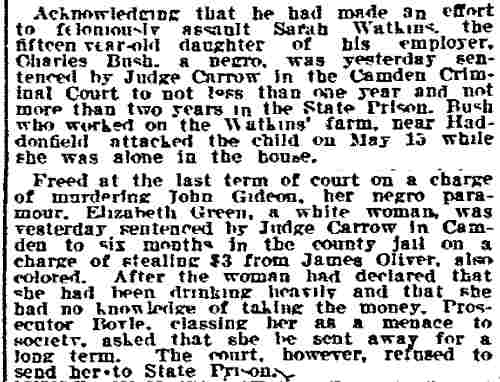
Named: Lizzie Green, John Gideon, James Oliver, Charles Bush
Sarah Watkins, William T. Boyle, and Howard Carrow.
New York Times — July 19, 1912
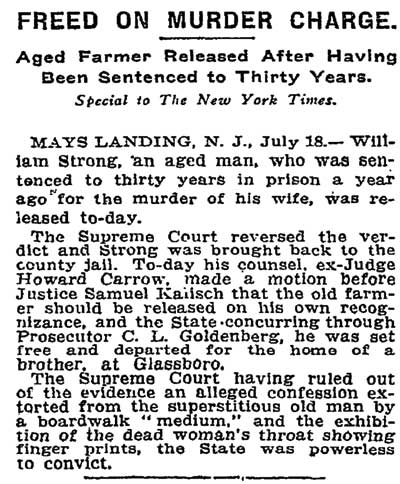
Howard Carrow
Philadelphia Inquirer — July 30, 1912

Howard Carrow
Philadelphia Inquirer — March 5, 1913
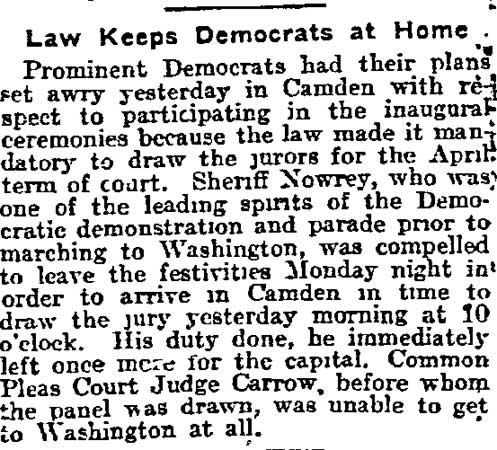
Joseph Nowrey — Howard Carrow
New York Times — May 18, 1916
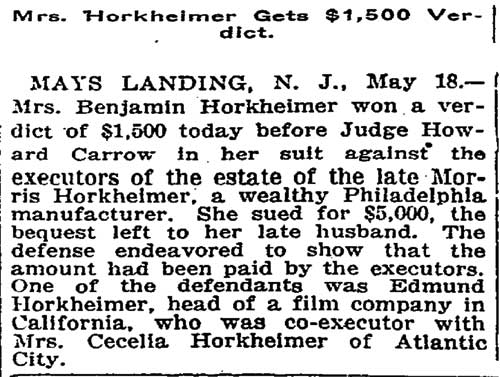
Howard Carrow
Security Trust Company — Bank Directory, March–December 1916
301 Market Street, Camden, N. J.
JOSHUA E. BORTON, President
HENRY D. MOORE, Vice President
C. H. POLHEMUS, Secretary and Treasurer
WALTER T. PRATT, Assistant Treasurer
HOWARD M. POTTER, Trust Officer
Thomas E. French, General Counsel
Directors:
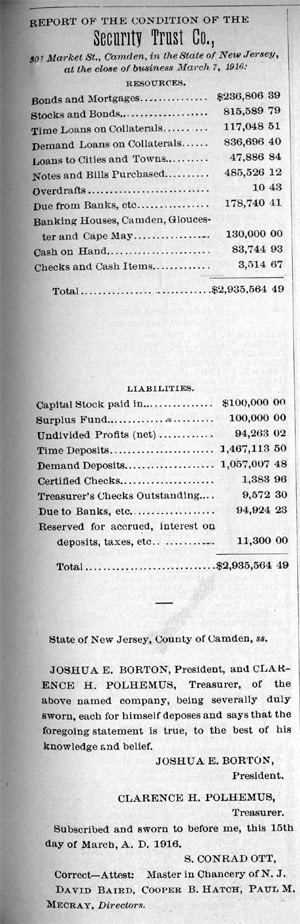
Philadelphia Inquirer — July 3, 1917
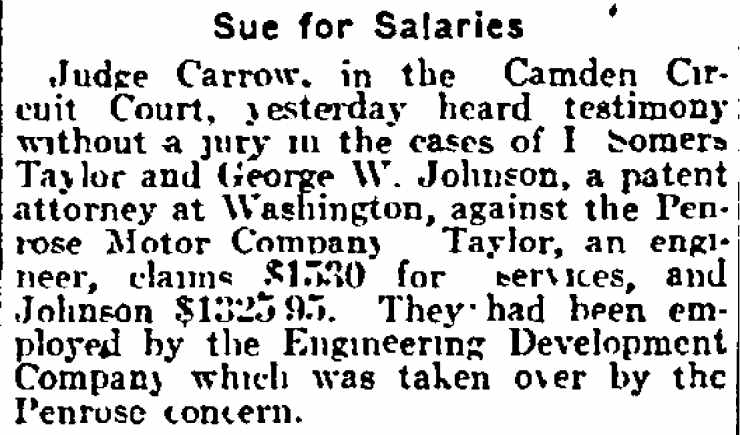
Howard Carrow
Philadelphia Inquirer — April 17, 1922
Howard Carrow
Trenton Times — April 17, 1922
Howard Carrow
Philadelphia Inquirer — April 17, 1922

Howard Carrow
Philadelphia Inquirer — April 18, 1922
Howard Carrow
Trenton Times — April 20, 1922
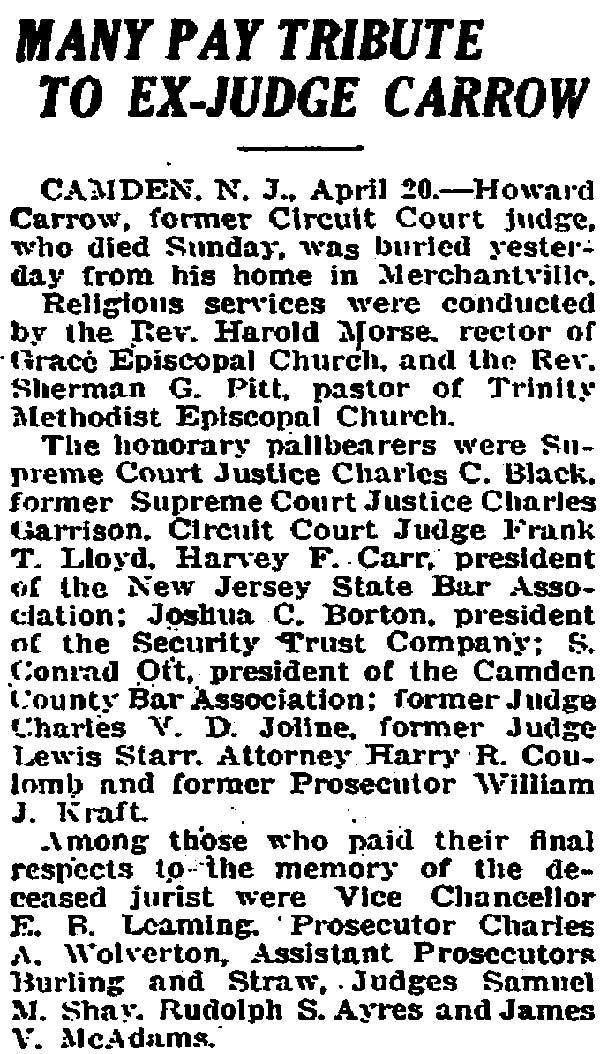
Howard Carrow