Introduction
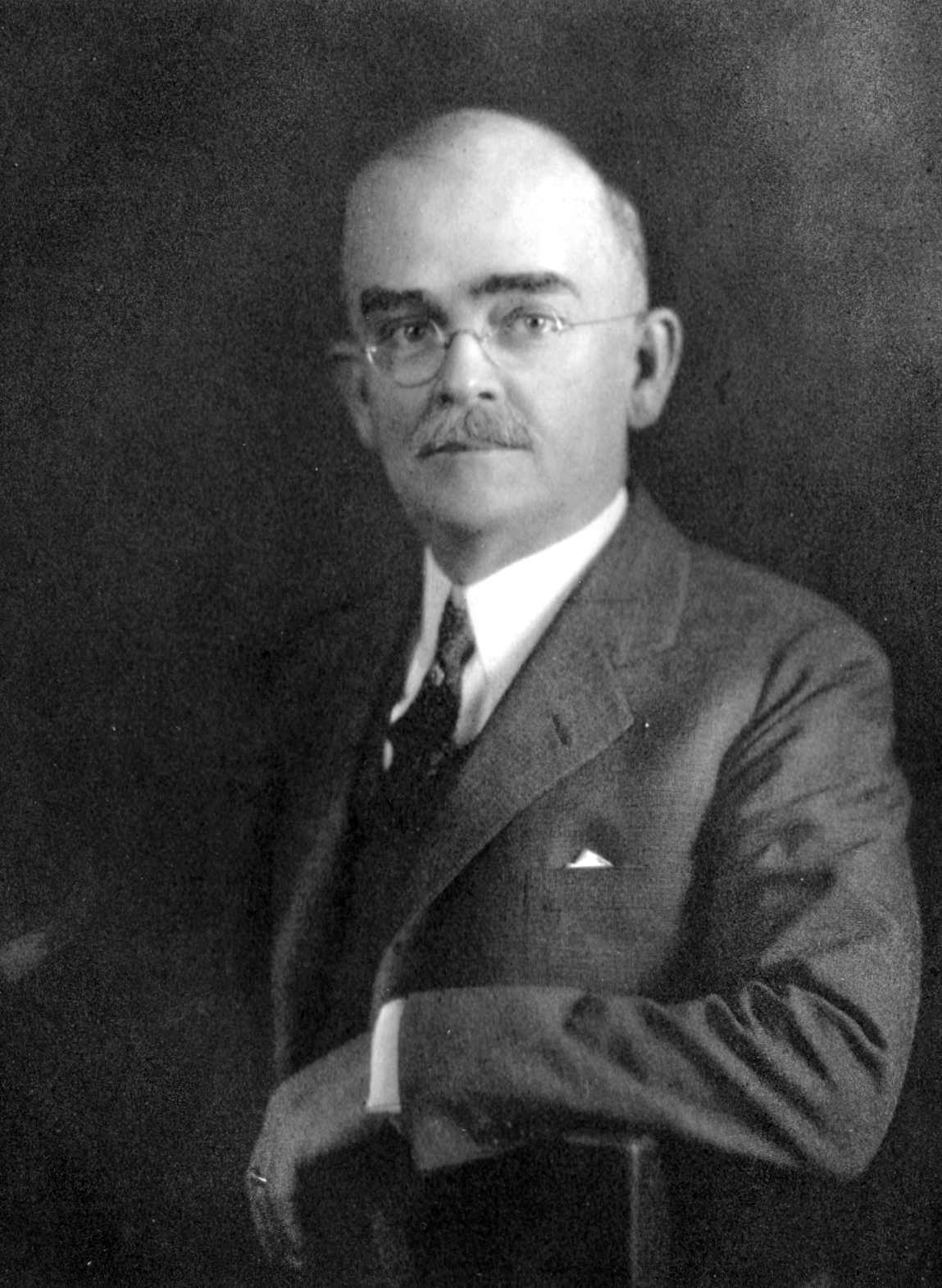
Charles A. Reynolds
CHARLES AUGUSTUS REYNOLDS was a highly successful businessman in Camden, who also, prior to his untimely death at the age of 54 in 1924, was very involved in all aspects of Camden’s civic affairs. He was co-founder and president of The Keystone Leather Company, one of Camden’s largest employers in its day, a co-founder and first president of the Merchants’ Trust Company bank, president of the West Jersey Homeopathic Hospital from 1908 until his passing, and had been vice-president of the Camden Young Men’s Christian Association from 1913 when he died.
In January of 1909 Charles A. Reynolds incorporated the Haddon Heights Park Company with George W. Jessup and his son to deal in real estate and as builders and contractors. In March of 1909 he incorporated the Haddon Highlands Company, again with George W. Jessup and his son to deal in real estate.
In 1910 Charles A. Reynolds and family lived at 711 Cooper Street in Camden.
Charles A. Reynolds belonged to Trimble Lodge No. 117, Free and Accepted Masons and other local Masonic groups, the Camden County Historical Society and also had belonged to the Camden Club and other business and social organizations. He was a member and a trustee of the First Baptist Church in Camden, and superintendent of the Sunday School for ten years.
In 1922 Mr. Reynolds founded the C. A. Reynolds Leather Company, located on Pine Street in Camden. He was engaged in business there when taken by death on June 23, 1924. In 1926 the C.A. Reynolds Leather Company plant was acquired by Frederick Himmelein.
From South Jersey: A History 1624–1924
CHARLES AUGUSTUS REYNOLDS was born at Portsmouth, Virginia May 18, 1870, the son of George C. Washington and Augusta Ann Reynolds. When he was eleven years of age his family moved to Philadelphia. His first work was in a shoe store in that city, and it was here that he became interested in the shoe and leather business which was to occupy him for the remainder of his life. Later he was employed by Burk Brothers, Philadelphia tanners; here he remained for five years, rising in their employ to the position of plant superintendent.
In 1894, in company with Herman Buchborn, he began independent business as a tanner under the firm name of Buchborn and Reynolds. Soon after beginning this business, the partners moved to Camden, New Jersey, taking possession of an old factory at Sixteenth and Mickle streets. In 1895, the company was reorganized as The Keystone Leather Company, and a period of expansion and prosperity began. Of this company Mr. Reynolds was president until 1922, when he resigned and founded the C. A. Reynolds Leather Company, located on Pine Street, Camden. Here he conducted business until his death on June 23, 1924. Mr. Reynolds was one of the founders of the Merchants’ Trust Company and its first president. He was president of the West Jersey Homeopathic Hospital from 1908 to the time of his death, and vice-president of the Camden Young Men’s Christian Association from 1913. He belonged to Trimble Lodge, Free and Accepted Masons of Camden; was a thirty-second degree Mason, being a member of Excelsior Consistory, of Camden: and the Knights Templar; he also was a member of Crescent Temple Ancient Arabic Order Nobles of the Mystic Shrine; he belonged also to the Union League and the Manufacturers’ Club of Philadelphia, the Camden Club and Tavistock Country Club. He was a member and a trustee of the First Baptist Church, and superintendent of the Sunday School for ten years.
Charles A. Reynolds was married in Philadelphia, on June 3, 1891, to Emma Elizabeth Wagner, born in Philadelphia, the daughter of Theodore and Katherine Wagner. To this couple were born four children: 1. Elizabeth Louise, now Mrs. E. W. G. Boogher of Merchantville, New Jersey. 2. Emma Katherine, who died in childhood. 3. George Washington, who married Jane Elizabeth Havey, and lives in Cynwyd, Pennsylvania: he is connected with the Keystone Leather Company. 4. Gertrude Christine.
Greater Camden the Slogan at Board of Trade Banquet
Philadelphia Inquirer —
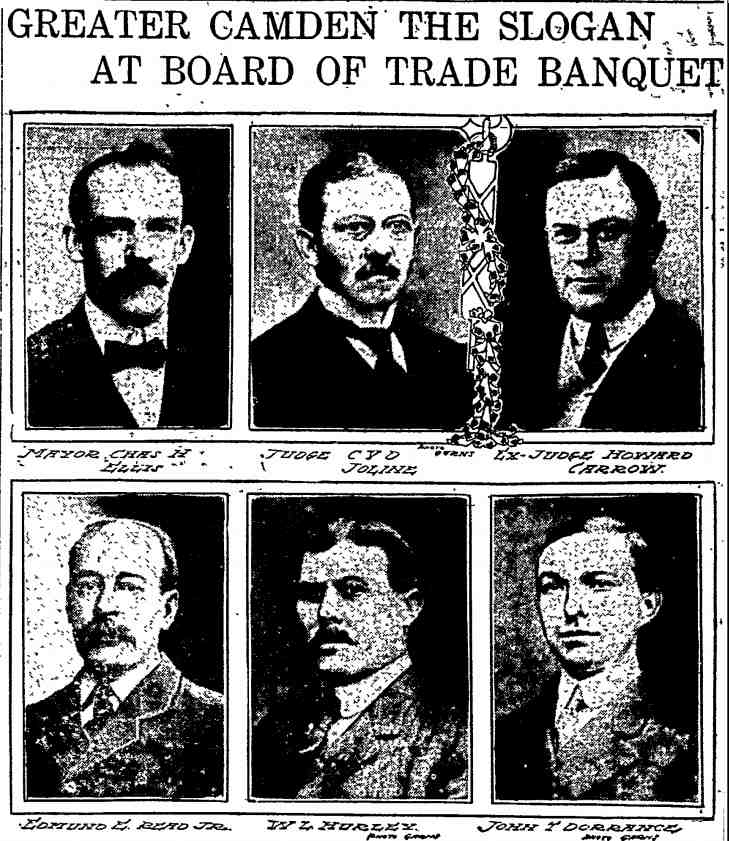
GREATER CAMDEN THE SLOGAN AT BOARD OF TRADE BANQUET
(Group photo: Mayor Chas H. Ellis, Judge C.V.D. Joline, Ex-Judge Howard Carrow, Edmund E. Read Jr., W.L. Hurley, John T. Dorrance)
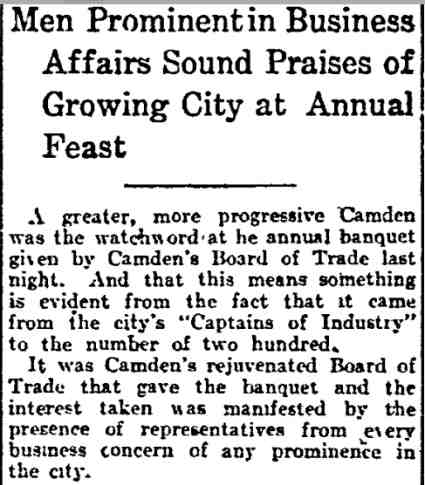
Men Prominent in Business Affairs Sound Praises of Growing City at Annual Feast
A greater, more progressive Camden was the watchword at he [sic] annual banquet given by Camden’s Board of Trade last night. And that this means something is evident from the fact that it came from the city’s “Captains of Industry” to the number of two hundred.
It was Camden’s rejuvenated Board of Trade that gave the banquet and the interest taken was manifested by the presence of representatives from every business concern of any prominence in the city.
All Represented
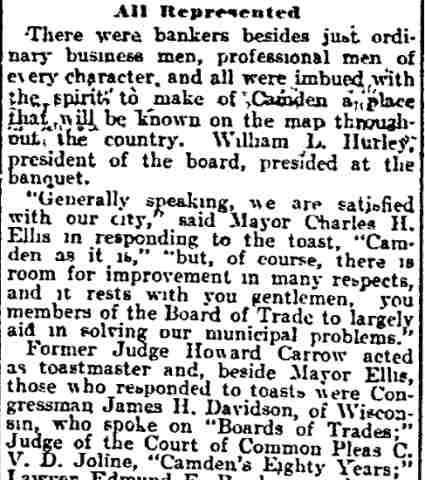
There were bankers besides just ordinary business men, professional men of every character, and all were imbued with the spirit to make of Camden a place that will be known on the map throughout the country. William L. Hurley, president of the board, presided at the banquet.
“Generally speaking, we are satisfied with our city,” said Mayor Charles H. Ellis in responding to the toast, “Camden as it is,” “but, of course, there is room for improvement in many respects, and it rests with you gentlemen, you members of the Board of Trade to largely aid in solving our municipal problems.”
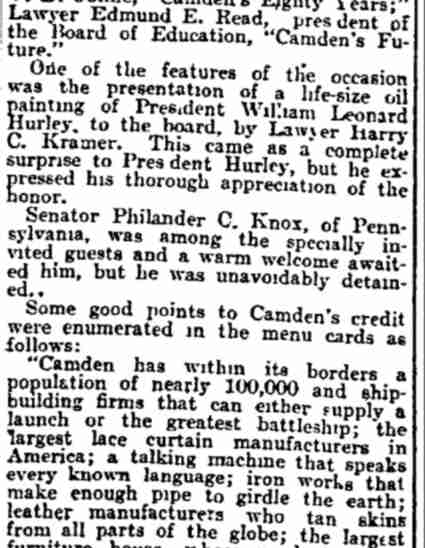
Former Judge Howard Carrow acted as toastmaster and, beside Mayor Ellis, those who responded to toasts were Congressman James H. Davidson, of Wisconsin, who spoke on “Boards of Trades;” Judge of the Court of Common Pleas C. V. D. Joline, “Camden’s Eighty Years;” Lawyer Edmund E. Read, president of the Board of Education, “Camden’s Future.”
One of the features of the occasion was the presentation of a life-size oil painting of President William Leonard Hurley, to the board, by Lawyer Harry C. Kramer. This came as a complete surprise to President Hurley, but he expressed his thorough appreciation of the honor.
Senator Philander C. Knox, of Pennsylvania, was among the specially invited guests and a warm welcome awaited him, but he was unavoidably detained.. [sic]
Some good points to Camden’s credit were enumerated in the menu cards as follows:
“Camden has within its borders a population of nearly 100,000 and shipbuilding firms that can either supply a launch or the greatest battleship; the largest lace curtain manufacturers in America; a talking machine that speaks every known language; iron works that make enough pipe to girdle the earth; leather manufacturers who tan skins from all parts of the globe; the largest furniture house, whose products reach the Philippines; banks and trust companies whose resources are not affected by panics; artesian water that can be taken without adding anything.”
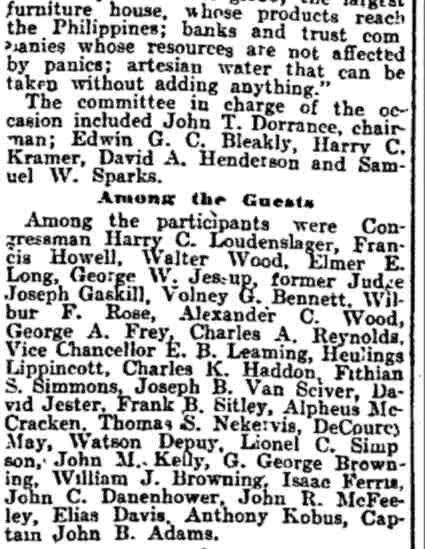
The committee in charge of the occasion included John T. Dorrance, chairman; Edwin G. C. Bleakly, Harry C. Kramer, David A. Henderson and Samuel W. Sparks.
Among the Guests
Among the participants were Congressman Harry C. Loudenslager, Francis Howell, Walter Wood, Elmer E. Long, George W. Jessup, former Judge Joseph Gaskill, Volney G. Bennett, Wilbur F. Rose, Alexander C. Wood, George A. Frey, Charles A. Reynolds, Vice Chancellor E. B. Leaming, Heulings Lippincott, Charles K. Haddon, Fithian S. Simmons, Joseph B. Van Sciver, David Jester, Frank B. Sitley, Alpheus McCracken, Thomas S. Nekervis, DeCourcy May, Watson Depuy, Lionel C. Simpson, John M. Kelly, G. George Browning, William J. Browning, Isaac Ferris, John C. Danenhower, John R. McFeeley, Elias Davis, Anthony Kobus, Captain John B. Adams.
[Continuation of article — see anthonykobus-012808-inq-2.md for full text]
All Represented
There were bankers besides just ordinary business men, professional men of every character, and all were imbued with the spirit to make of Camden a place that will be known on the map throughout the country. William L. Hurley, president of the board, presided at the banquet.
“Generally speaking, we are satisfied with our city,” said Mayor Charles H. Ellis in responding to the toast, “Camden as it is,” “but, of course, there is room for improvement in many respects, and it rests with you gentlemen, you members of the Board of Trade to largely aid in solving our municipal problems.”
Former Judge Howard Carrow acted as toastmaster and, beside Mayor Ellis, those who responded to toasts were Congressman James H. Davidson, of Wisconsin, who spoke on “Boards of Trades;” Judge of the Court of Common Pleas C. V. D. Joline, “Camden’s Eighty Years;” Lawyer Edmund E. Read, president of the Board of Education, “Camden’s Future.”
[Continuation of article — see anthonykobus-012808-inq-2.md for full text]
One of the features of the occasion was the presentation of a life-size oil painting of President William Leonard Hurley. [sic] to the board, by Lawyer Harry C. Kramer. This came as a complete surprise to President Hurley, but he expressed his thorough appreciation of the honor.
Senator Philander C. Knox, of Pennsylvania, was among the specially invited guests and a warm welcome awaited him, but he was unavoidably detained.. [sic]
Some good points to Camden’s credit were enumerated in the menu cards as follows:
“Camden has within its borders a population of nearly 100,000 and shipbuilding firms that can either supply a launch or the greatest battleship; the largest lace curtain manufacturers in America; a talking machine that speaks every known language; iron works that make enough pipe to girdle the earth; leather manufacturers who tan skins from all parts of the globe; the largest [furniture house...]”
[Continuation of article — see anthonykobus-012808-inq-2.md for full text]
...furniture house, whose products reach the Philippines; banks and trust companies whose resources are not affected by panics; artesian water that can be taken without adding anything.“
The committee in charge of the occasion included John T. Dorrance, chairman; Edwin G. C. Bleakly, Harry C. Kramer, David A. Henderson and Samuel W. Sparks.
Among the Guests
Among the participants were Congressman Harry C. Loudenslager, Francis Howell, Walter Wood, Elmer E. Long, George W. Jessup, former Judge Joseph Gaskill, Volney G. Bennett, Wilbur F. Rose, Alexander C. Wood, George A. Frey, Charles A. Reynolds, Vice Chancellor E. B. Leaming, Heulings Lippincott, Charles K. Haddon, Fithian S. Simmons, Joseph B. Van Sciver, David Jester, Frank B. Sitley, Alpheus McCracken, Thomas S. Nekervis, DeCourcy May, Watson Depuy, Lionel C. Simpson, John M. Kelly, G. George Browning, William J. Browning, Isaac Ferris, John C. Danenhower, John R. McFeeley, Elias Davis, Anthony Kobus, Captain John B. Adams.
Homeopathic Hospital Campaign
Philadelphia Inquirer —
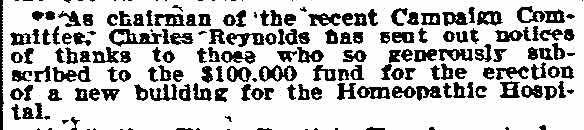
Charles A. Reynolds – West Jersey Homeopathic Hospital
To Help Those in Need
Philadelphia Inquirer —
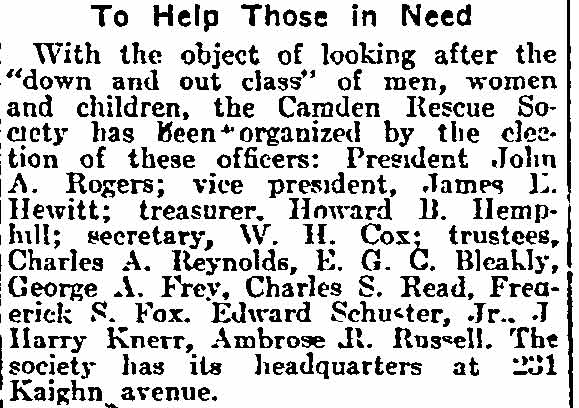
To Help Those in Need
With the object of looking after the “down and out class” of men, women and children, the Camden Rescue Society has been organized by the election of these officers: President John A. Rogers; vice president, James L. Hewitt; treasurer, Howard B. Hemphill; secretary, W. H. Cox; trustees, Charles A. Reynolds, E. G. C. Bleakly, George A. Frey, Charles S. Read, Frederick S. Fox, Edward Schuster, Jr., J. Harry Knerr, Ambrose R. Russell. The society has its headquarters at 231 Kaighn avenue.
Homeopathic Hospital Officers Elected
Philadelphia Inquirer —

The trustees of the Homeopathic Hospital have elected these officers: President, Charles A. Reynolds; vice president, Clayton W. Nichols; treasurer, Archibald G. Connell; secretary, H. Raymond Staley.
Keystone Leather Company
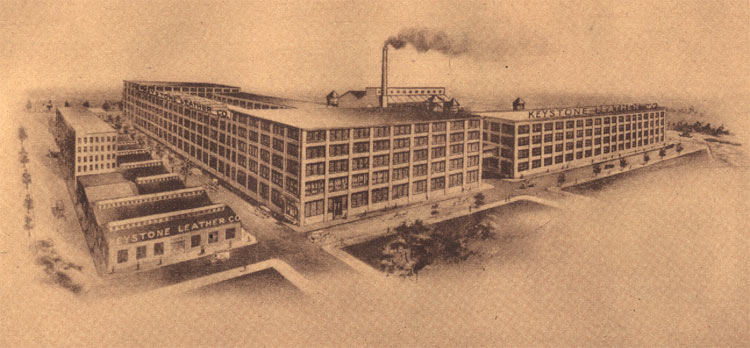
Keystone Leather Company — 1928
Himmelein & Bailey, Inc. Plant
1930
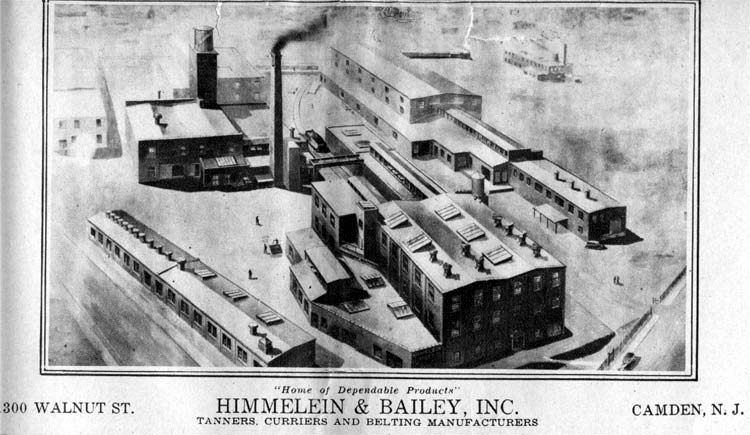
The Himmelein & Bailey, Inc. plant at 1300 Walnut Street, photographed in 1930, was the location of Charles A. Reynolds’ leather company after it was acquired by Frederick Himmelein in 1926.