George W. Shields
George W. Shields, Camden Fire Department
George W. Shields was born in Newton Township, Camden County NJ in the spring of 1860, the second son of Christopher and Margaret Shields, who both were Pennsylvania born. Christopher Shields was then working as a day laborer. A neighbor, James Dono, was a brickmaker, and Christopher Shields would pursue that trade later in life. Newton Township was subsequently absorbed into the City of Camden. George Shields lived virtually his entire life on Kaighn Avenue, within a block east or west of Broadway.
When the Census was taken in 1870, the Shields family had increased. George Shields’ grandparents, Thomas and Sophia Shields, were living with the family which included older brother Thomas and younger siblings Sallie and Samuel. The Gilling family lived next door; their son Frederick “Freddie” Gilling, was well known in later years in Camden as a newspaper dealer. Dry Goods merchant Charles Hollingshed lived a few doors away. Another family that lived in the neighborhood was that of John V. Jefferis. Boarding with the Shields family in 1870 and into the 1880s was Cornelius M. Brown, who had been a volunteer firefighter in the 1860s and who served with the Camden Fire Department from its inception in 1869 through 1882, with a few years off in the 1870s where among other things he served as a Camden police officer.
When the Census was taken in 1880 the Shields family lived at 458 Kaighn Avenue and the Jefferis family across the street at 441 Kaighn. George Shields was already working as an oilcloth printer, a trade he would follow into the 1890s. Perhaps it came as no surprise at all to those involved when George Shields married Jennie Jefferis, the girl across the street, late in 1881 or in early 1882.
George and Jennie Shields lived at 332 Chestnut Street when the 1887–1888 City Directory was compiled. They moved to 1020 South 5th Street by the end of 1888. A daughter, Jennie, was born in June of 1889, a son Wilmer George Shields came on August 17, 1892. Another child was born but did not survive. Interestingly enough, father-in-law John V. Jefferis Sr. had moved to the former Shields home at 458 Kaighn Avenue by 1887 and remained there into the early 1890s. John V. Jefferis Sr. for a time in the 1880s served as a Justice of the Peace.
On June 1, 1890 Engine Company 3 of the Camden Fire Department was organized on Broadway near Ferry Avenue. Charter members included Mortimer Wilson, foreman; Samuel Lodge, engineer; Joseph Reed, stoker; William Deno, driver; and John Ware. Fire Department records indicate that George Shields joined the company on August 14, 1890. By 1900 he had been reassigned to Ladder Co. 2, located at 619 Kaighn Avenue, just a short walk from his home.
When the Census was enumerated in 1900 the Shields family lived at 525 Kaighn Avenue, on the corner of Kaighn Avenue and Marion Street. Father-in-law John V. Jefferis Sr. lived with them, while Christopher and Margaret Shields, his parents, and older brother Thomas lived nearby at 521 Kaighn Avenue.
On March 16, 1906 Fireman Shields was killed along with brother fire fighters William Hillman of Ladder Company 2 and William Jobes of Engine Company 1 in the line of duty while fighting a fire at the former Sixth Regiment Armory at 4th and Mickle Streets.
After the death of Fireman Shields, his widow and children continued to reside at 525 Kaighn Avenue. By 1910, Jennie Shields owned a home at 430 Mechanic Street. Her son had by then found work at the New York Shipbuilding Corporation shipyard. The family lived here through at least 1914.
When the draft came in June of 1917, Jennie Shields and her grown children had moved to 1434 Kaighn Avenue, in Camden’s Parkside neighborhood. Her son was still working at the shipyard as an accounting clerk, a position he still held in January of 1920. Daughter Jennie was married to Henry Keyser by January of 1920. Mrs. Shields, her children and son-in-law Henry Keyser were still at 1434 Kaighn Avenue as late as April of 1930.
W. George Shields was still in Parkside, lodging at 1438 Kaighn Avenue, when the 1947 City Directory was compiled. By the mid-1950s he had moved to 1446 Kaighn Avenue, where he lived through at least the fall of 1977. W. George Shields would remain a Camden resident until his death in January of 1983.
In a strange coincidence, George F. Jefferis, a member of the Camden Police Department, who was a first cousin once removed of Fireman Shields’ wife Jennie, also lost his life serving Camden, dying of injuries sustained in the line of duty, on September 5, 1951.
Engine Company 3
Located in what was then Camden’s Eighth Ward, Engine Company 3 was organized on June 1, 1890 and entered service on the same date at 1813 Broadway, just south of Ferry Avenue in South Camden. Approval for the purchase of land for this firehouse and for that of the new Engine Company 4 had been granted on September 4, 1889. When first organized, Engine Company 3 consisted of a Foreman, an Engineer, a Driver, and two hosemen.
The first members of Engine Company 3 are as follows.
Engine Company 3 Roster
Camden Fire Department Engine Company 3 original members
Personnel
| Name ↕ | Position ↕ |
|---|---|
| Mortimer Wilson | Foreman |
| Samuel Lodge | Engineer |
| William Deno | Driver |
| Joseph Reed | Stoker |
| George W. Shields | Hoseman |
| John Ware | Hoseman |
Annual salaries for the members of the paid force in 1869 were $600 for the Engineer, $450 for the Driver and the Stoker and $50 for the extra men. All but the extra men were paid monthly. The Chief Marshall received $800, and the Assistant Marshall $200 per year as well.
Fireman Al. James, of No. 3 Engine, started off on his vacation this morning.
Camden Daily Courier —
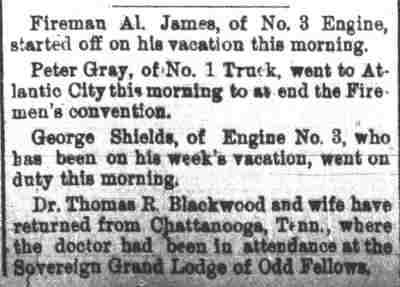
Fireman Al. James, of No. 3 Engine, started off on his vacation this morning.
Peter Gray, of No. 1 Truck, went to Atlantic City this morning to attend the Firemen’s convention.
George Shields, of Engine No. 3, who has been on his week’s vacation, went on duty this morning.
Dr. Thomas R. Blackwood and wife have returned from Chattanooga, Tenn., where the doctor had been in attendance at the Sovereign Grand Lodge of Odd Fellows.
No. 3 Firemen's Vacations.
Camden Evening Courier —
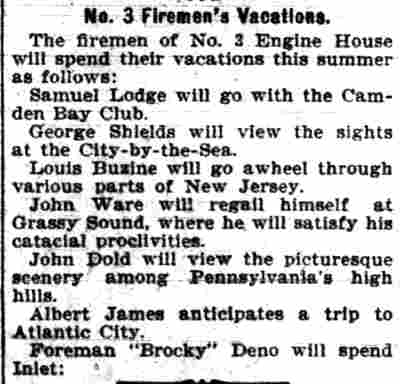
The firemen of No. 3 Engine House will spend their vacations this summer as follows:
Samuel Lodge will go with the Camden Bay Club.
George Shields will view the sights at the City-by-the-Sea.
Louis Buzine will go awheel through various parts of New Jersey.
John Ware will regail himself at Grassy Sound, where he will satisfy his catacial proclivities.
John Dold will view the picturesque scenery among Pennsylvania’s high hills.
Albert James anticipates a trip to Atlantic City.
Foreman “Brocky” Deno will spend Inlet:
Three Firemen Met Death in Camden Blaze
Philadelphia Inquirer —
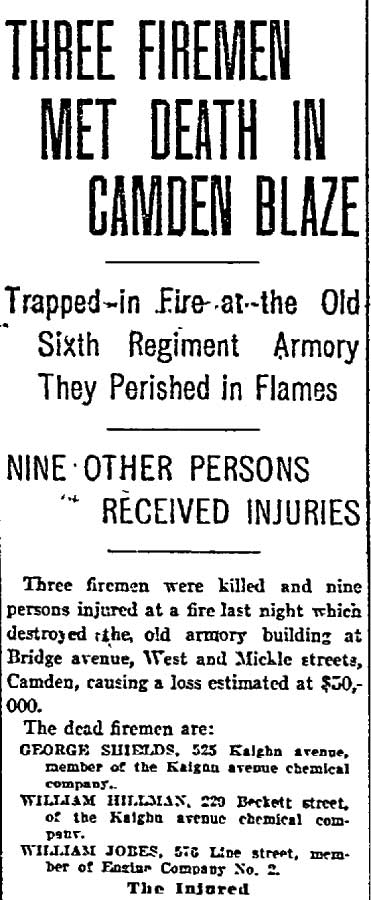
Trapped in Fire at the Old Sixth Regiment Armory They Perished in Flames
Nine Other Persons Received Injuries
Three firemen were killed and nine persons injured at a fire last night which destroyed the old armory building at Bridge avenue, West and Mickle streets, Camden, causing a loss estimated at $50,000.
The dead firemen are:
George Shields, 525 Kaighn avenue, member of the Kaighn avenue chemical company.
William Hillman, 229 Beckett street, of the Kaighn avenue chemical company.
William Jobes, 576 Line street, member of Engine Company No. 2.
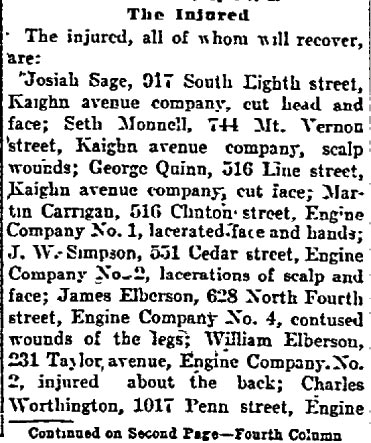
The injured, all of whom will recover, are: Josiah Sage, 917 South Eighth street, Kaighn avenue company, cut head and face; Seth Monnell, 744 Mt. Vernon street, Kaighn avenue company, scalp wounds; George Quinn, 516 Line street, Kaighn avenue company, cut face; Martin Carrigan, 516 Clinton street, Engine Company No. 1, lacerated face and hands; J. W. Simpson, 551 Cedar street, Engine Company No. 2, lacerations of scalp and face; James Elberson, 628 North Fourth street, Engine Company No. 4, contused wounds of the legs; William Elberson, 231 Taylor avenue, Engine Company No. 2, injured about the back; Charles Worthington, 1017 Penn street, Engine Company No. 3, internally injured; Harry Dease, a citizen, cut about the face.
The six o’clock whistles were blowing when smoke was seen issuing from the northeast corner of the building. A moment later two boys ran out of a door, one of whom notified Policeman Isaac Toy that the structure was on fire. The officers immediately turned in an alarm. In rapid succession other alarms were given, until the entire department was on the scene.
One of the first companies to arrive was the Kaighn avenue truck. As the men drove up to the scene great tongues of flame were fast eating their way through the yellow pine timbers of which the interior was constructed. The main doors at the entrance on Mickle street were burst open and the firemen entered amid a perfect shower of sparks and falling debris. In this party were the three ill-fated firemen, Dease, and Firemen Harry Haines, Joseph Ernest, George Quinn, Seth Mounell and Joseph Gail.
After great difficulty the men worked their way into the blazing building about twenty feet. Dense volumes of smoke almost suffocated them and several dropped to the floor.
Dash for the Doors
While the firemen were waiting for the water a false ceiling thirty feet above them and composed of floor boards began cracking and bending. A shout of warning was given by Dease, and he and his companions made a dash for the doors. It was impossible to see a foot before them, and all blindly groped their way to the open doors but Jobes, Shields and Hillman. That they did not come out of the building was not known for several minutes later. Then reports were circulated that they had been taken to nearby houses, but these were found to be false. Their companions then tried to work their way back to their assistance, but by this time the interior was a seething furnace.
Subsequently, when the blaze had been somewhat subdued, firemen and policemen instituted a search for the missing men. Where the latter had been there was a great pile of blackened timbers and twisted iron. After vigorous efforts this was removed.
Finding the Bodies
First there came to light Shield’s helmet, and a few feet distant his body and those of Hillman and Jobes, scorched and blackened almost beyond recognition, were found. It was then learned how they had met their deaths. Instead of going toward the open doorway they had evidently become bewildered and, turning, ran into a toilet room to which there was no outlet. There they were quickly cut off from their comrades and, becoming unconscious from the smoke, all three dropped to the floor, where death overtook them.
The bodies were carried out and taken to the Morgue.
In the meantime every portion of the structure became a mass of flames. Fed by the pine, great tongues of fire sprang into the air, across Mickle and West streets, where the dwellings were badly scorched. The families residing in these in several instances became panic-stricken and began removing their household effects. Men, women and children ran excitedly about. It is owing to the excellent work of the firemen that these structures were not destroyed.
Spectacular Blaze
Chief Elfieth quickly concluded there was no hope of saving the armory and he directed a dozen lines of hose toward the dwellings, many of which became so hot that the streams of water fairly sizzled.
The fire was a spectacular one, lighting up the heavens for miles around. Thousands of persons crowded the thoroughfares leading to the blaze, but excellent order was preserved under the direction of Acting Chief of Police Schregler, who quickly had the streets roped off and guarded by the officers.
There was considerable danger at first from falling electric wires, which spluttered among the firemen and ofttimes amidst the onlookers. These wires also fell across the Pennsylvania Railroad Company’s tracks on Bridge avenue and suburban trains were stalled for over an hour. At one time the flames approached so near the passenger coaches that they had to be taken back into the yard.
Stubborn Blaze
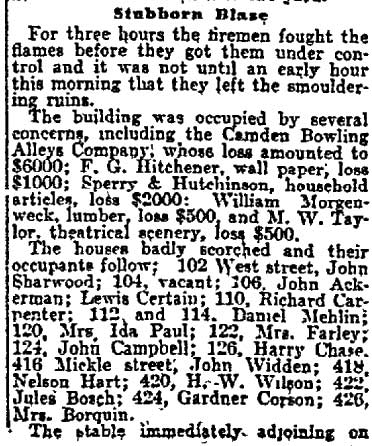
For three hours the firemen fought the flames before they got them under control and it was not until an early hour this morning that they left the smouldering ruins.
The building was occupied by several concerns, including the Camden Bowling Alleys Company, whose loss amounted to $6000; F. G. Hitchener, wall paper, loss $1000; Sperry & Hutchinson, household articles, loss $2000; William Morgenweck, lumber, loss $500, and M. W. Taylor, theatrical scenery, loss $500.
The houses badly scorched and their occupants follow: 102 West street, John Sharwood; 104, vacant; 106, John Ackerman; Lewis Certain; 110, Richard Carpenter; 112, and 114, Daniel Mehlin; 120, Mrs. Ida Paul; 122, Mrs. Farley; 124, John Campbell; 126, Harry Chase; 416 Mickle street: John Widden; 418, Nelson Hart; 420, H.-W. Wilson; 422, Jules Bosch; 424, Gardner Corson; 426, Mrs. Borquin.
The stable immediately adjoining on the west side of the armory, and belonging to C. M. Alcott, was flooded with water. At this place there were forty horses, all of which were rescued.
Formerly a Market
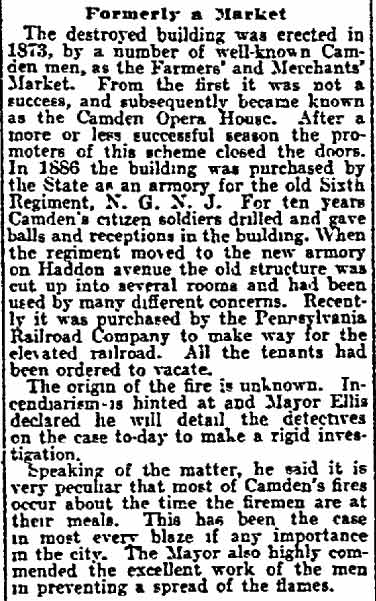
The destroyed building was erected in 1873, by a number of well-known Camden men, as the Farmers’ and Merchants’ Market. From the first it was not a success, and subsequently became known as the Camden Opera House. After a more or less successful season the promoters of this scheme closed the doors. In 1886 the building was purchased by the State as an armory for the old Sixth Regiment, N. G. N. J. For ten years Camden’s citizen soldiers drilled and gave balls and receptions in the building. When the regiment moved to the new armory on Haddon avenue the old structure was cut up into several rooms and had been used by many different concerns. Recently it was purchased by the Pennsylvania Railroad Company to make way for the elevated railroad. All the tenants had been ordered to vacate.
The origin of the fire is unknown. Incendiarism is hinted at and Mayor Ellis declared he will detail the detectives on the case to-day to make a rigid investigation.
Speaking of the matter, he said it is very peculiar that most of Camden’s fires occur about the time the firemen are at their meals. This has been the case in most every blaze if any importance in the city. The Mayor also highly commended the excellent work of the men in preventing a spread of the flames.
“Joseph Gail” was actually Joseph Daley. Gardner Corson was appointed to the Fire Department in November of 1907.
Roof Collapsed.
Lima Daily News (Lima, Ohio) —
Roof Collapsed.
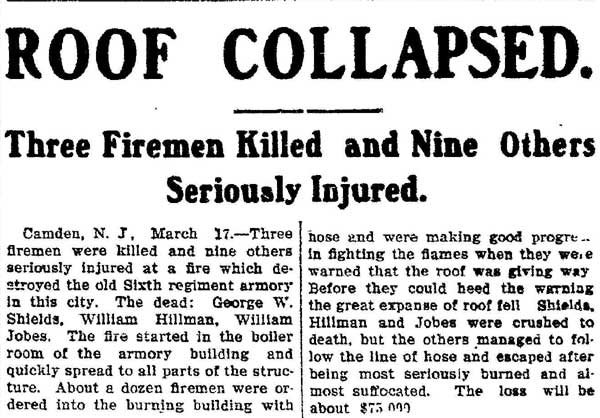
Three Firemen Killed and Nine Others Seriously Injured.
Camden, N. J., March 17.—Three firemen were killed and nine others seriously injured at a fire which destroyed the old Sixth regiment armory in this city. The dead: George W. Shields, William Hillman, William Jobes. The fire started in the boiler room of the armory building and quickly spread to all parts of the structure. About a dozen firemen were ordered into the burning building with hose and were making good progress in fighting the flames when they were warned that the roof was giving way. Before they could heed the warning the great expanse of roof fell. Shields, Hillman and Jobes were crushed to death, but the others managed to follow the line of hose and escaped after being most seriously burned and almost suffocated. The loss will be about $75,000.
Three Firemen Killed and Nine Others Seriously Injured.
Camden, N. J., March 17.—Three firemen were killed and nine others seriously injured at a fire which destroyed the old Sixth regiment armory in this city. The dead: George W. Shields, William Hillman, William Jobes. The fire started in the boiler room of the armory building and quickly spread to all parts of the structure. About a dozen firemen were ordered into the burning building with hose and were making good progress in fighting the flames when they were warned that the roof was giving way. Before they could heed the warning the great expanse of roof fell. Shields, Hillman and Jobes were crushed to death, but the others managed to follow the line of hose and escaped after being most seriously burned and almost suffocated. The loss will be about $75,000.
Roof Falls on Firemen
Altoona Mirror (Altoona, Pennsylvania) —
Altoona Mirror — March 17, 1906
Three Killed and Nine Injured in Camden, N. J., Accident.
Camden, N. J., March 17.—Three firemen were killed and nine others seriously injured last night at a fire which destroyed the old Sixth regiment armory at Bridge and West streets in this city. The dead are: George W. Shields, William Hillman, William Jobes. Charles Worthington is probably fatally injured.
About a dozen firemen were ordered into the burning building with a line of hose and were making good progress in fighting the flames when they were warned by Fireman Harry Dease that the roof was giving way. Before the men could heed the warning the great expanse of roof fell, burying Dease and the others under it. Shields, Hillman and Jobes were crushed to death, but the others managed to follow the line of the hose and escaped after most of them had been seriously lacerated and burned. The injured were removed to Hooper hospital.
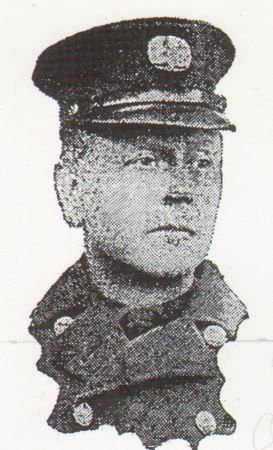
Charles Worthington, pictured at left, not only recovered from his injuries, but became the Chief of the Camden Fire Department in 1913. Tragically, Chief Worthington also died while fighting a fire, on May 8, 1914.
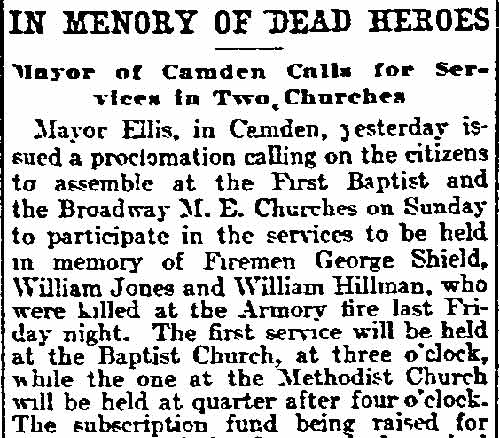
In Memory of Dead Heroes
Philadelphia Inquirer —
Mayor of Camden Calls for Services in Two Churches
Mayor Ellis, in Camden, yesterday issued a proclamation calling on the citizens to assemble at the First Baptist and the Broadway M. E. Churches on Sunday to participate in the services to be held in memory of Firemen George Shields, William Jones and William Hillman, who were killed at the Armory fire last Friday night. The first service will be held at the Baptist Church, at three o’clock, while the one at the Methodist Church will be held at quarter after four o’clock. The subscription fund being raised for the families of the firemen had reached nearly $2000 last night.
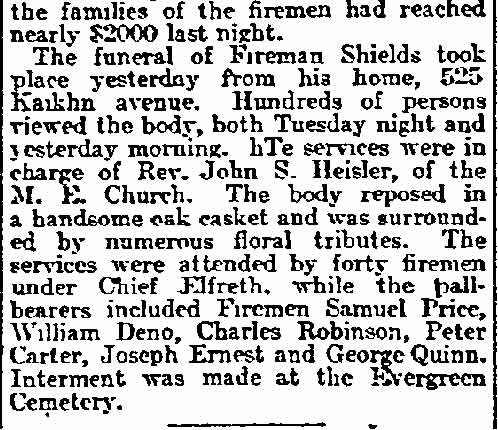
The funeral of Fireman Shields took place yesterday from his home, 525 Kaikhn [sic] avenue. Hundreds of persons viewed the body, both Tuesday night and yesterday morning. hTe [sic] services were in charge of Rev. John S. Heisler, of the M. E. Church. The body reposed in a handsome oak casket and was surrounded by numerous floral tributes. The services were attended by forty firemen under Chief Elfreth, while the pall-bearers included Firemen Samuel Price, William Deno, Charles Robinson, Peter Carter, Joseph Ernest and George Quinn. Interment was made at the Evergreen Cemetery.
In Memoriam
Camden Echo — 1906
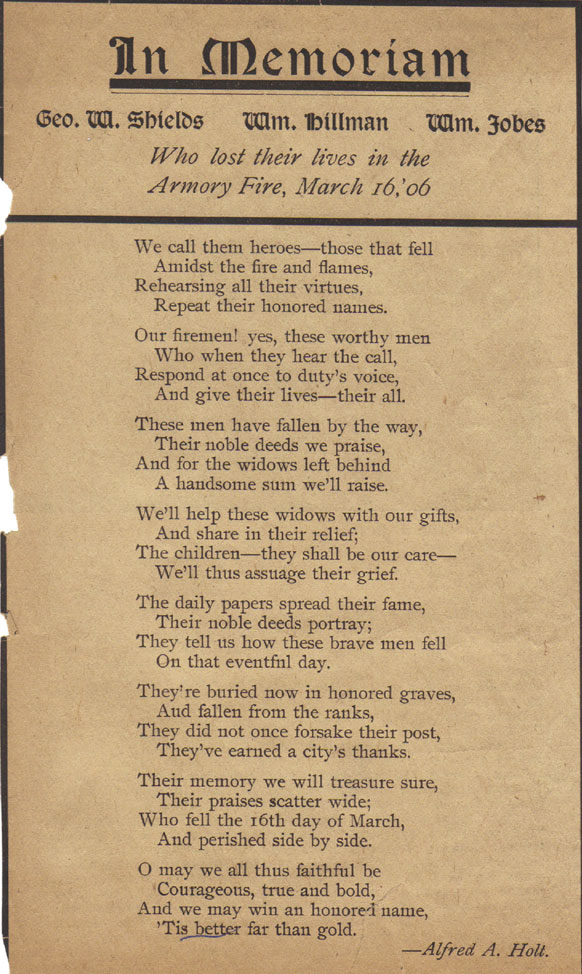
In Memoriam — a poem written by Alfred A. Holt in memory of Fire fighters Shields, Hillman, and Jobes
Geo. W. Shields Wm. Hillman Wm. Jobes
Who lost their lives in the Armory Fire, March 16, ’06We call them heroes—those that fell
Amidst the fire and flames,
Rehearsing all their virtues,
Repeat their honored names.Our firemen! yes, these worthy men
Who when they hear the call,
Respond at once to duty’s voice,
And give their lives—their all.These men have fallen by the way,
Their noble deeds we praise,
And for the widows left behind
A handsome sum we’ll raise.We’ll help these widows with our gifts,
And share in their relief;
The children—they shall be our care—
We’ll thus assuage their grief.The daily papers spread their fame,
Their noble deeds portray;
They tell us how these brave men fell
On that eventful day.They’re buried now in honored graves,
And fallen from the ranks,
They did not once forsake their post,
They’ve earned a city’s thanks.Their memory we will treasure sure,
Their praises scatter wide;
Who fell the 16th day of March,
And perished side by side.O may we all thus faithful be
Courageous, true and bold,
And we may win an honored name,
’Tis better far than gold.—Alfred A. Holt.
Albert A. Holt (1844–1909) was the editor publisher of the Camden Echo, a weekly newspaper devoted to church news and the prohibition of the sale and consumption of alcoholic beverages. The paper was published from 1884 until Holt’s death in July of 1909. The paper was distributed free of charge and had some measure of influence at one time, but very little by the time of Holt’s death.
100 Years Later
Story and Photos by Bob Bartosz, Camden NJ Fire Department Photographer
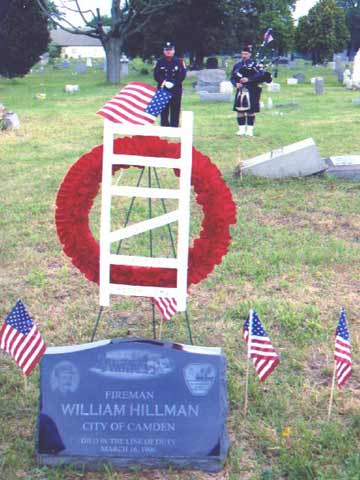
Honor guard at the dedication of the headstone for Camden Fireman William Hillman
On Saturday morning, May 20, 2006 a group of Camden Fire Fighters, Camden County Fire Fighters, retired members of the Fire Force, along with United States Congressman Robert Andrews, Camden City Mayor Gwendolyn A. Faison, Fire Chief Joseph Marini and Msgr. Michael T. Mannion, S.T.L. and other friends gathered at Evergreen Cemetery in South Camden for the 100th Anniversary of the tragic 1906 Camden Armory Fire that took the lives the three Gallant Fire Fighters.
Fireman William Jobes of Engine Co. 1, Fireman George Shields with Ladder Co. 2, along with Fireman William Hillman of Ladder Co. 2 died in the Line of Duty that day. In recent years it was found out that Fireman Hillman had been buried in an unmarked grave, and a fund was set up to provide him with a proper headstone.
While researching the events of this tragic fire some very strange and unusual and ghostly events had surfaced. All of the details have been documented by newspaper clippings and personal encounters from members of the present fire fighting force.
This story starts on the morning of March 16, 1906 when Fireman William Hillman is attending Roll Call and is physically upset, his Foreman says to him, “Bill what’s wrong?”
“Captain I have one of my bad feelings today. We are going to have a bad fire and some of us boys are going to get hurt.”
The Captain said he tried all day to talk Hillman out of his feelings but could not. He said, to him “Bill where is the fire going to be at?”
Hillman says “We are going to get the Armory on fire and some of us are not going to return.”
(Note: in 1906 Camden firemen were paid $600.00 a year and worked a straight 24 hour shift for twenty or more days before having a few days off. Each Member was allowed to go home for 1 hour a day for lunch or dinner, many of the firemen were in walking distance to their homes.).
On the afternoon of March 16, 1906 Fireman Jobes of Engine Co. 1 had left the Station to go to his home and have dinner with his family. About the same time Fireman George Shields left Ladder Co. 2 Station to walk a half of block to his home at 525 Kaighns Avenue which was just down the street from Ladder 2 Station.
(Note: Fireman Shields was a veteran fireman coming on the department in the 1890’s, his parents presented him with a shiny ID Tag with his name and fire company No. and his address on the ID Tag. These were similar to what Civil War soldiers carried to identify themselves if they were killed in battle. Shields had this ID Tag with him at all times. We feel that he may have had this ID Tag pinned to the inside of his fireman’s uniform coat.).
Shields had just arrived at his home and hung his coat in the closet near the kitchen and had just set down to dinner with his wife and children when he heard the bells from Engine Co. 8 clanging as they were leaving the station just up the street from his house. He knew that Ladder Co. 2 would be following them in a few more moments. He apparently raced from the table and grabbed his coat from the closet and out the front door as Ladder Co. 2 slowed which enabled him to jump on the side of the truck next to Hillman. And off they went into eternity.
(Note: When Shields grabbed his coat from the closet his ID Tag apparently fell from his uniform coat onto the floor of the closet, falling into a crack in the floor. There it would remain for almost 90 years.)
Almost at the same time Fireman Jobes, from Engine Co. 1 was told of the blaze and he to left the dinner table and his family and returned to Engine Co. 1’s quarters, picking up his leather helmet and rubber coat and boots and preceded to walk the 8 or 10 blocks to the fire. The fire was located at Box 174, on the corner of 4th and Mickle Streets at the Sixth Regiment Armory building. Hillman’s prediction was coming true.
When Jobes arrived at the fire members of his company and members of Ladder Co. 2 with Hillman and Shields were stretching a 2-1/2 inch line through the front door of this heavily involved building, which at one time was the home of the New Jersey National Guard’s Sixth Regiment and now housed a huge bowling alley, pool hall and many shops. Surrounding the building were many rows of two and three story dwellings.
As Jobes, Hillman and Shields along with eight other firemen were advancing the line into the blazing building, hoping to cut the spread of the fire off before it reached the homes, a worker yelled at them, “Boys don’t go in there, the roof is going to fall in and you will be killed” but to no avail.
The men were in about 50 feet with the charged line working when the roof came crashing in onto the second floor, which was housing the pool hall section with heavy slate pool tables, sending the tables and the floor crashing down to the first floor trapping all eleven firemen. Eight firemen were able to dig themselves free, many with cuts, burns and broken bones. Finding the hose line they were able to follow it to the outside where they were rushed by police and civilians to the nearby Camden Hospital. It would be many hours later before they were able to work there way in and recover the bodies of the three missing men.
The City of Camden went into mourning and thousands of Camden residents paid their respects to these three gallant firemen. The firemen were all poor, only making about 11 cents an hour. A fund drive was setup to raise money for the families. As it was found out later only Jobes and Shields had headstones on their graves.
It would be almost 90 years later when this tragedy would come to light. An off duty Camden Fire Chief found a postcard at a local flea market. The postcard had three photos of firemen with their names under the photos of Jobes, Shields, and Hillman, “Heroes of the Armory Fire, Camden N.J. March 16, 1906.”
The Chief brought this unusual post card into Fire Headquarters one day and showed it to Chief Joseph Marini, who was also a Fire Buff and knew quite a lot of the history of the Camden Fire Department. Chief Marini had not heard of this fire and did not know that we had lost three firemen at the same time. The postcard was placed into his desk drawer where it sat for a few more years.
The house where fireman George Shields lived was now run down and vacant along with the rest of the homes on this block. Numerous fires had occurred in a few of these homes and on one afternoon, Engine Co. 8 and Shields former unit, Ladder Co. 2 were dispatched to the 525 Kaighns Avenue for a report of an vacant house fire. As the Companies arrived they found heavy fire showing which was soon knocked down and brought under control. As members of Ladder Co. 2 were overhauling and shoveling debris out, one of the members of Ladder Co. 2 spotted a shiny object on the floor. He picked it up and placed it in his pocket. When they returned to Ladder Co. 2’s quarters he showed the shiny object to his Captain. He said, that he found it on the closet floor of the burned out dwelling they had just left.
As they cleaned the object up they found that it was an ID Tag. On the tag was written “525 Kaighns Avenue, George W. Shields, Camden Fire Dept. Camden N.J.” They though it was quite unusual for a fireman to find another fireman’s ID Tag in a burned out home. They preceded to Fire Headquarters with the ID Tag to show Fire Chief Joseph Marini to ask him if he had ever heard of this fireman.
Chief Marini said that the name sounded familiar and as he opened his desk drawer, there sitting in front of him was the old 1906 postcard with the three firemen’s photos on it, and the middle picture was a fireman by the name of Shields. It would be amazing that these two events would come together but still no one ever heard of the fire or these men.
At the same time a committee was now working on a book to mark the 125th Anniversary of the Camden Fire Department. Chief Marini gave the postcard and the ID Tag to the committee to research. This is how the “Mystery of the Three Gallant Firemen” came to light.
It was later found out that Shields did lose his ID Tag on the night he was killed. Was this a hidden message telling his brother firemen “Don’t forget about us”? How strange is it that a brother fire fighter from his same Company, Ladder Co. 2 would find this hidden message almost 90 years later.
It took another 10 years of in-depth research, over many hours of looking into microfilm of 1906 newspapers to find out more information about the fire, where it was found out that fireman Hillman did predict the Armory fire and his death. It took over three more years to find out the location of the three fireman of their burial sites. Evergreen Cemetery, at the southwest corner of Mt. Ephraim Avenue and Ferry Avenue, where Shields and Hillman are buried was under very depressed conditions and had been badly vandalized.
It was found out the Shields did have a headstone and so did Jobes, who is buried at Harleigh Cemetery not far from the grave of Walt Whitman, but fireman Hillman had lay buried in a cold unmarked grave for over 100 years.
Was it the ghost of these men, especially fireman Shields who left his hidden message with his lost ID Tag for his brother firemen to find to bring this story to an end?
A fund was started and a beautiful headstone was purchased. On the headstone is a picture of fireman Hillman along with an original photo of the 1906 Horsedrawn Ladder Co. 2. Hillman is standing next to Shields in this picture which is now embedded into this headstone.
On May 20, 2006 the tears from heaven started to pour down as brother firemen lined up at the opening ceremony on this 100 year Anniversary for the dedication of Hillman’s headstone.
As Fire Chief Marini saluted firemen Hillman’s grave, the sun came out, the rain clouds were no longer in the sky and a beautiful sunny day was now upon us. As if firemen Jobes, Shields and Hillman were saying Thank You. All of us from the Camden Fire Department are saying, Rest In Peace Brothers for your Gallant Sacrifice. This story has reached its Happy Ending.
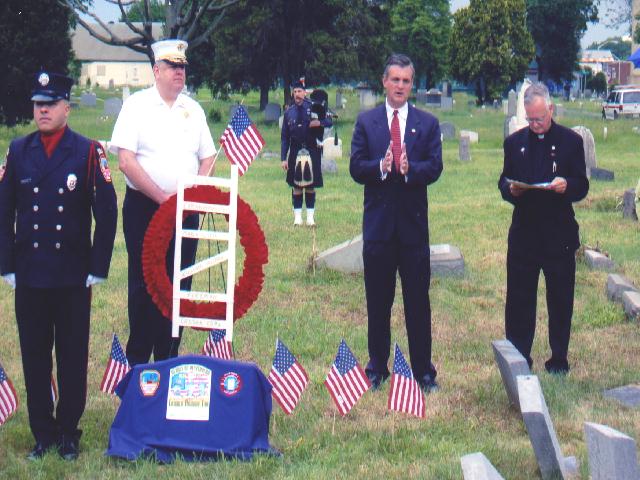
US Congressman Robert Andrews, second from the right, speaking at the dedication of the new Headstone for Camden Fireman William Hillman. Left to right in photo are, Honor Guard Camden FF David Melendez, Camden Chief of the Department Joseph Marini, in background Captain David Dilks with his Bagpipe, Congressman Robert Andrews and Msgr. Michael T. Mannion, S.T.L.
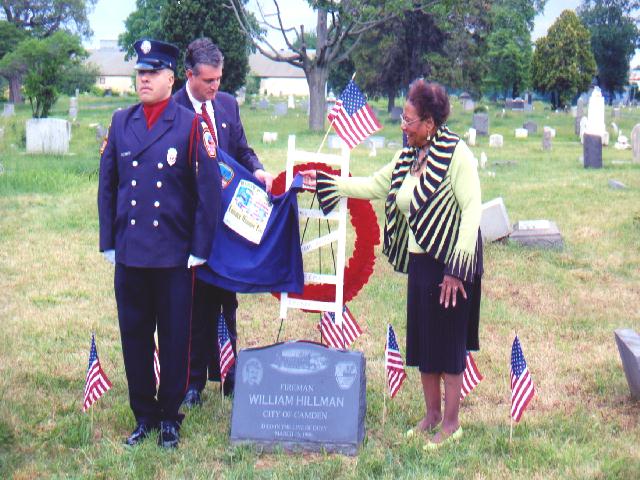
US Congressman Robert Andrews and Camden Mayor Gwendolyn A. Faison remove the cover from the headstone, as Honor Guard Camden FF David Melendez looks on.
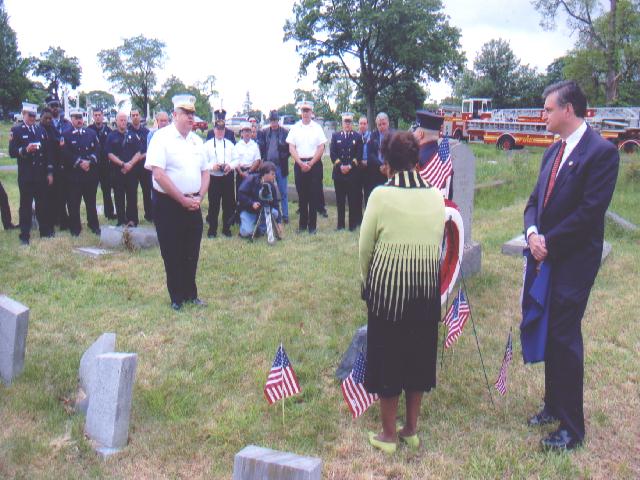
Camden Fire Chief Joseph Marini saying a few words about the tragic fire in 1906 which claimed the lives of three Gallant Fire Fighters—Jobes, Shields, Hillman.
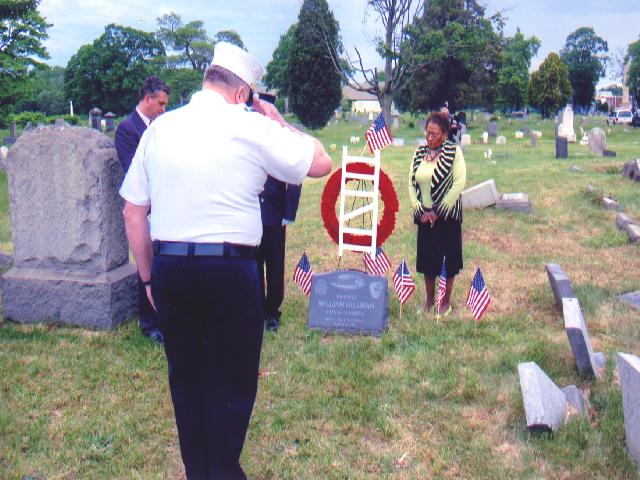
Chief of the Department Joseph Marini gives a final farewell salute to Fireman William Hillman who died in the Line Of Duty in 1906.
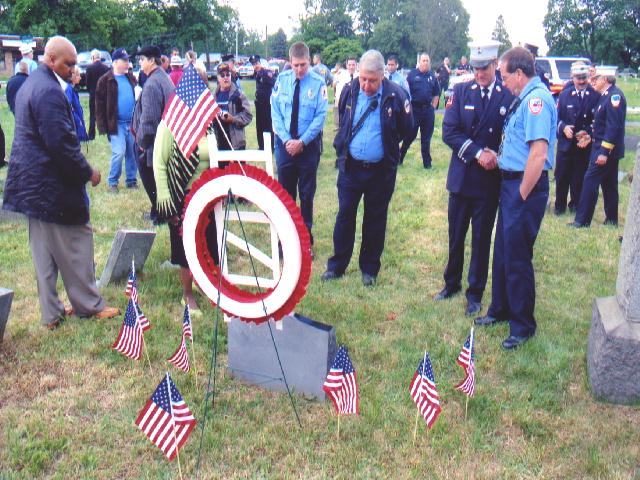
Firefighters admiring the new headstone at the gravesite of Hillman at the conclusion of the ceremonies.
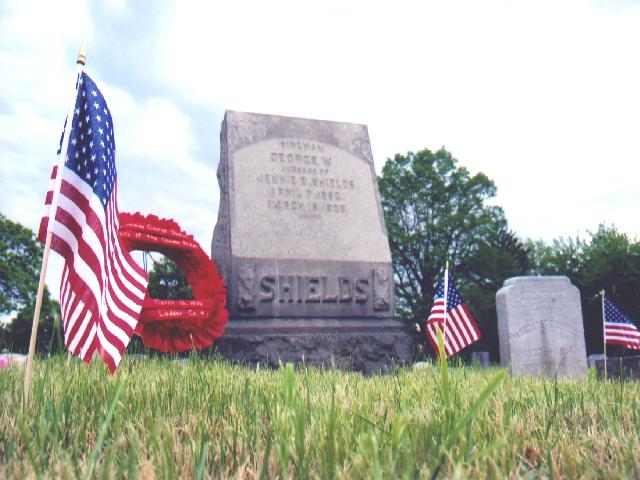
Flags and wreath at the grave site of Fireman George Shields who also died in the tragic 1906 fire.
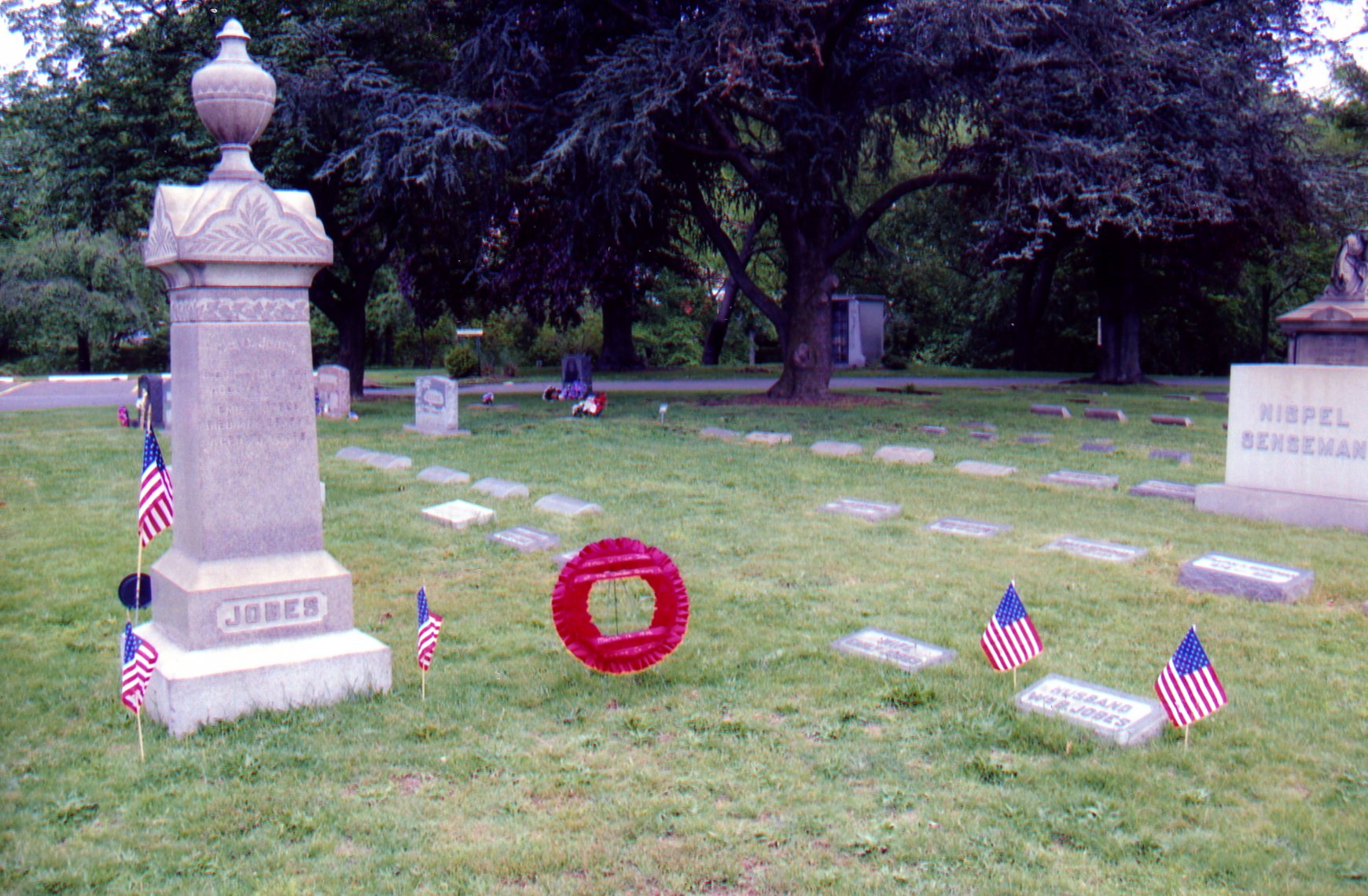
Flags and wreath at the grave site of Fireman William Jobes who also died in the tragic 1906 fire.
Camden NJ Fire Fighter’s Memorial