Introduction
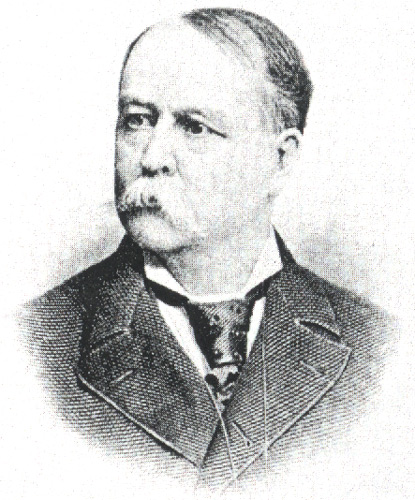
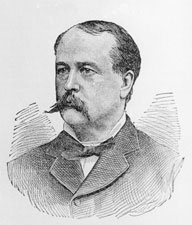
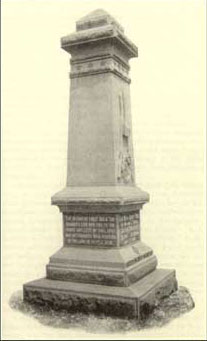
William Joyce Sewell
William Joyce Sewell was born on December 6, 1835 in Ireland. Orphaned at a young age, he emigrated to the United States in 1851. He was for a time employed in mercantile business in New York City, made several voyages as a sailor on merchant vessels, afterward engaged in business in Chicago IL. He moved to Camden NJ in 1860.
When the Civil War started, William Joyce Sewell raised a company of Volunteers, and was commissioned Captain and commander of Company C, 5th New Jersey Volunteer Infantry. He fought with his regiment in the Peninsular Campaign and at the Second Battle of Bull Run, and had been promoted to Lieutenant Colonel in July 1862. When the 5th New Jersey’s commander, Colonel Samuel H. Starr, was recalled in October 1862 from volunteer service back to the Regular Army, William Sewell became commander of the regiment and was promoted Colonel in January 1863 (on the recommendation of Colonel Starr himself).
Colonel Sewell led the unit at the May 1863 Battle of Chancellorsville, where he would render his most distinguished service of the War. In the heavy fight along the Plank Road, the 5th New Jersey’s brigade commander, Brig. General Gershom Mott, was severely wounded and had to leave the field. His brigade and other elements started to retreat, but Colonel Sewell, now in command of the brigade, rallied them around the brigade colors and successfully led a counterattack. Although wounded himself, he held his position, fending off several more attacks before his unsupported troops, out of ammunition, had to retreat. His bravery in rallying his men would win him the Congressional Medal of Honor 33 years later.
William Joyce Sewell would recover sufficiently from his wounds to be in command of the 5th New Jersey during the Gettysburg Campaign. On the second day of that great Battle, July 2, 1863 his unit was at first posted in the Trostle Woods with the rest of his brigade. When it became apparent that the Army of the Potomac’s III Corps line, dangerously extended to the Emmitsburg Road, needed re-enforcement, Colonel Sewell’s regiment was detached and sent to Emmitsburg Road in between the Rogers and Klingel Farm Houses. Late in the afternoon the regiment absorbed the first attacks by Confederate General Cadmus Wilcox’s brigade, holding their position until driven back, and stopping to support Lieutenant Francis W. Seeley’s Battery K, 4th United States Regular Artillery in front of the Klingel House. Here Colonel Sewell’s command took a great pounding from Confederate counter-battery fire, as well as pressure from Rebel troops to their front and left. Finally the 5th NJ was ordered to withdraw, and Colonel Sewell was again severely wounded.
William Joyce Sewell would not be able to rejoin his regiment for some time afterwards, but was sufficiently recovered to lead the unit during the Wilderness campaign. In that last battle fatigue and his wounds got the better of him, and he left the regiment, eventually resigning in July 1864 due to his ill health. Two months later his services were again called upon, and he was appointed as Colonel and commander of the newly raised 38th New Jersey Volunteer Infantry. He commanded his new unit, which mostly saw only garrison duty along the James River, until its muster out in July 1865. On March 13, 1865 he was brevetted Brigadier General, US Volunteers for “gallant and meritorious services at the Battle of Chancellorsville, Va.” and Major General, US Volunteers for “gallant and meritorious services during the war.”
After the war William Joyce Sewell returned to Camden, where he would make his home for the rest of his days. He built a large home at 500 Linden Streets, which was converted into a private hospital after he passed away.
William Joyce Sewell became a powerful railroad executive and a power broker within New Jersey state politics. He was vice-president of the West Jersey Railroad, and held interest in the Camden and Amboy Railroad Company and the Camden and Atlantic Railroad Companies. He was a director of the Camden & Philadelphia Steamship Ferry Company, the Camden Safe Deposit & Trust Company, and the West Jersey Mutual Insurance Company. He also served as president of the West Jersey Ferry corporation.
In 1889, a syndicate composed Sewell, Edward Ambler Armstrong, and real estate promoters Edward C. Knight and Edward N. Cohn, purchased the Camden Horse Railroad Company and converted the entire line to electricity. A year later, they extended the electric trolley line along Federal Street to Wrightsville, providing a major step towards the development of the agricultural area of Stockton Township, which is present day East Camden. With Samuel H. French he was an officer of the Stockton Rifle Range, which evolved into the ninety acre Stockton Park.
William Joyce Sewell developed neighborhoods in Camden, Cape May, and Gloucester counties—the Sewell section of Washington Township bearing his name.
He was the dominant figure politically in Camden, his protégé, David Baird Sr., taking care of things locally while Sewell was in Trenton and Washington. William Joyce Sewell served in the New Jersey State Senate from 1872 to 1880, being its President from 1876 to 1880.
In 1881 William Joyce Sewell was elected as a Senator from New Jersey in the United States Senate, serving from 1881 to 1887. During his first term as a senator chairman, he sat on the Committee on Enrolled Bills (Forty-seventh and Forty-eighth Congresses), Committee on Military Affairs (Forty-ninth Congress), Committee on the Library (Forty-ninth Congress). He was defeated in his re-election bid in 1887, and in subsequent bids in 1889 and 1893.
During his time out of office he remained in public life as one of the national commissioners for New Jersey to the World’s Columbian Exposition in Chicago in 1893. He was in command of the Second Brigade of the National Guard of New Jersey, and was appointed a member of the Board of Managers of the National Home for Disabled Volunteer Soldiers. He also was one of New Jersey’s Gettysburg Monument Battlefield Commissioners.
In 1895 William Joyce Sewell once again was elected to the Senate, and was the chairman, Committee on Enrolled Bills (Fifty-fourth through Fifty-seventh Congresses). On March 25, 1896 he was awarded the Congressional Medal of Honor.
William Joyce Sewell’s Congressional Medal of Honor citation reads: “Assuming command of a brigade, he rallied around his colors a mass of men from other regiments and fought these troops with great brilliancy through several hours of desperate conflict, remaining in command though wounded and inspiring them by his presence and the gallantry of his personal example.” His Medal was issued on March 25, 1896. He was the only New Jersey officer to be awarded the Congressional Medal of Honor while in command of a New Jersey regiment during the Civil War. In the Gettysburg National Military Park, his name is inscribed on the 5th New Jersey Infantry Monument, located on Emmitsburg Road just south of the Rogers Farm site.
William Joyce Sewell served as a Brigadier General in the New Jersey National Guard. When the Spanish-American War broke out in 1898, he was appointed as Major General of Volunteers by President William McKinley, but he declined the commission, which would have forced him resign his Senate seat.
William Joyce Sewell died on December 27, 1901. He was buried in the Spring Grove section of Harleigh Cemetery in Camden, NJ. His grave is decorated with a Celtic Cross designed by Alexander Sterling Calder.
Bellevue Hospital, occupying the former home of the late U.S. Senator William Joyce Sewell, at Fifth and Linden Streets, was opened on March 1, 1921 by Dr. J. Lynn Mahaffey and Dr. E.R. Schall, as a private hospital.
Sewell Street, in East Camden, was named in his honor.
Thanks to Russ Dodge for compiling much of the biography.
St. Paul's Episcopal Church Officers Elected
Philadelphia Inquirer —
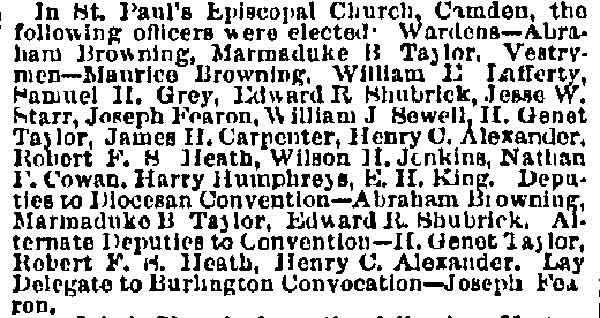
In St. Paul’s Episcopal Church, Camden, the following officers were elected: Wardens—Abraham Browning, Marmaduke B. Taylor. Vestrymen—Maurice Browning, William H. Lafferty, Samuel H. Grey, Edward R. Shubrick, Jesse W. Starr, Joseph Fearon, William J. Sewell, H. Genet Taylor, James H. Carpenter, Henry C. Alexander, Robert F. S. Heath, Wilson H. Jenkins, Nathan F. Cowan, Harry Humphreys, E. H. King. Deputies to Diocesan Convention—Abraham Browning, Marmaduke B. Taylor, Edward R. Shubrick. Alternate Deputies to Convention—H. Genet Taylor, Robert F. S. Heath, Henry C. Alexander. Lay Delegate to Burlington Convocation—Joseph Fearon.
The Day Inquest.
Philadelphia Inquirer —
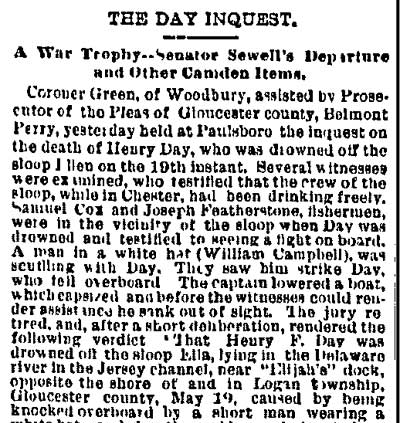
A War Trophy--Senator Sewell’s Departure and Other Camden Items.
Coroner Green, of Woodbury, assisted by Prosecutor of the Pleas of Gloucester county, Belmont Perry, yesterday held at Paulsboro the inquest on the death of Henry Day, who was drowned off the sloop I len [?] on the 19th instant. Several witnesses were examined, who testified that the crew of the sloop, while in Chester, had been drinking freely. Samuel Cox and Joseph Featherstone, fishermen, were in the vicinity of the sloop when Day was drowned and testified to seeing a light on board. A man in a white hat (William Campbell), was scuttling with Day. They saw him strike Day, who fell overboard The captain lowered a boat, which capsized and before the witnesses could render assistance he sank out of sight. The jury retired, and, after a short deliberation, rendered the following verdict: “That Henry F. Day was drowned off the sloop Ella, lying in the Delaware river in the Jersey channel, near ‘Elijah’s’ dock, opposite the shore of and in Logan township, Gloucester county, May 19, caused by being knocked overboard by a short man wearing a white hat, and by the evidence designated as ‘Billy’ Campbell, and that Samuel Tuttle and Thomas A. Joslyn were accessories thereto.” The prosecutor ordered the prisoners to be kept in confinement at Woodbury for trial, Campbell on the charge of manslaughter and Joslyn and Tuttle as accessories after the fact. Application will be made on Monday to have the prisoners released on habeas corpus.
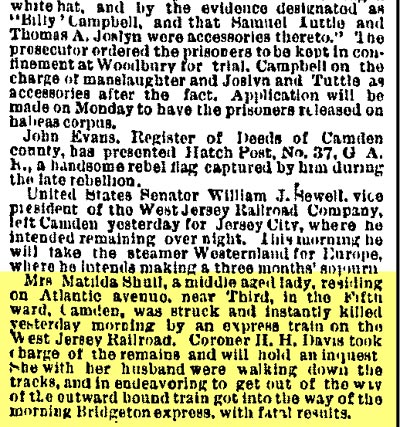
John Evans, Register of Deeds of Camden county, has presented Hatch Post, No. 37, G A. R., a handsome rebel flag captured by him during the late rebellion.
United States Senator William J. Sewell, vice president of the West Jersey Railroad Company, left Camden yesterday for Jersey City, where he intended remaining over night. This morning he will take the steamer Westernland for Europe, where he intends making a three months’ sojourn.
Mrs Matilda Shull, a middle aged lady, residing on Atlantic avenue, near Third, in the Fifth ward, Camden, was struck and instantly killed yesterday morning by an express train on the West Jersey Railroad. Coroner H. H. Davis took charge of the remains and will hold an inquest. She with her husband were walking down the tracks, and in endeavoring to get out of the way of the outward bound train got into the way of the morning Bridgeton express, with fatal results.
First Ward Republican Club
Philadelphia Inquirer —
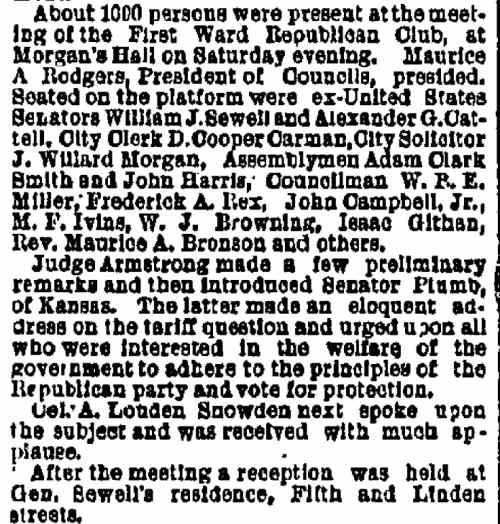
About 1000 persons were present at the meeting of the First Ward Republican Club, at Morgan’s Hall on Saturday evening. Maurice A. Rodgers, President of Councils, presided. Seated on the platform were ex-United States Senators William J. Sewell and Alexander G. Cattell, City Clerk D. Cooper Carman, City Solicitor J. Willard Morgan, Assemblymen Adam Clark Smith and John Harris; Councilman W. P. E. Miller, Frederick A. Rex, John Campbell, Jr., M. F. Ivins, W. J. Browning, Isaac Githean, Rev. Maurice A. Bronson and others.
Judge Armstrong made a few preliminary remarks and then introduced Senator Plumb, of Kansas. The latter made an eloquent address on the tariff question and urged upon all who were interested in the welfare of the government to adhere to the principles of the Republican party and vote for protection.
Col. A. Louden Snowden next spoke upon the subject and was received with much applause.
After the meeting a reception was held at Gen. Sewell’s residence, Fifth and Linden streets.
Off for Gettysburg
Camden Post —
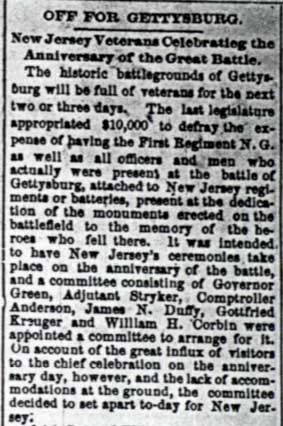
New Jersey Veterans Celebrating the Anniversary of the Great Battle.
The historic battlegrounds of Gettysburg will be full of veterans for the next two or three days. The last legislature appropriated $10,000 to defray the expense of having the First Regiment N.G. as well as all officers and men who actually were present at the battle of Gettysburg, attached to New Jersey regiments or batteries, present at the dedication of the monuments erected on the battlefield to the memory of the heroes who fell there. It was intended to have New Jersey’s ceremonies take place on the anniversary of the battle, and a committee consisting of Governor Green, Adjutant Stryker, Comptroller Anderson, James N. Duffy, Gottfried Kruger and William H. Corbin were appointed a committee to arrange for it. On account of the great influx of visitors to the chief celebration on the anniversary day, however, and the lack of accommodations at the ground, the committee decided to set apart to-day for New Jersey.
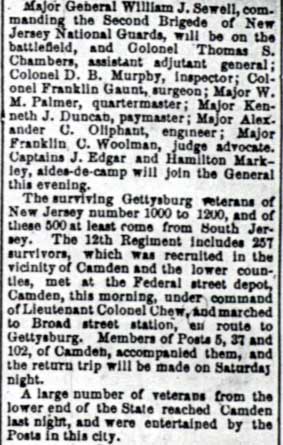
Major General William J. Sewell, commanding the Second Brigade of New Jersey National Guards, will be on the battlefield, and Colonel Thomas S. Chambers, assistant adjutant general; Colonel D. B. Murphy, inspector; Colonel Franklin Gaunt, surgeon; Major W. M. Palmer, quartermaster; Major Kenneth J. Duncan, paymaster; Major Alexander C. Oliphant, engineer; Major Franklin C. Woolman, judge advocate. Captains J. Edgar and Hamilton Markley, aides-de-camp will join the General this evening.
The surviving Gettysburg veterans of New Jersey number 1000 to 1200, and of these 500 at least come from South Jersey. The 12th Regiment includes 257 survivors, which was recruited in the vicinity of Camden and the lower counties, met at the Federal street depot, Camden, this morning, under command of Lieutenant Colonel Chew, and marched to Broad street station, en route to Gettysburg. Members of Posts 5, 37 and 102, of Camden, accompanied them, and the return trip will be made on Saturday night.
A large number of veterans from the lower end of the State reached Camden last night, and were entertained by the Posts in this city.
Camden Politics
Philadelphia Inquirer —
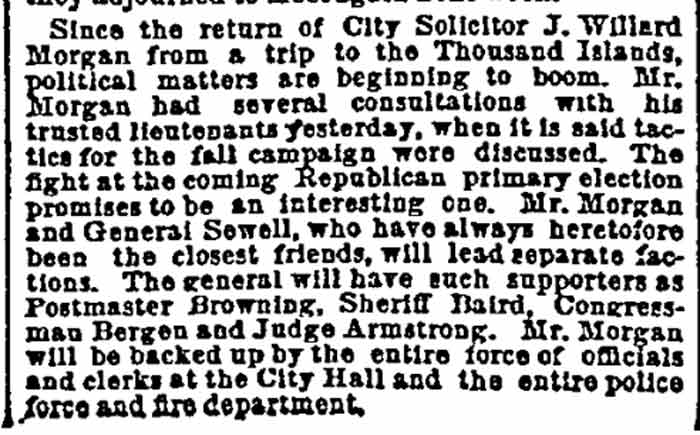
Since the return of City Solicitor J. Willard Morgan from a trip to the Thousand Islands, political matters are beginning to boom. Mr. Morgan had several consultations with his trusted lieutenants yesterday, when it is said tactics for the fall campaign were discussed. The fight at the coming Republican primary election promises to be an interesting one. Mr. Morgan and General Sewell, who have always heretofore been the closest friends, will lead separate factions. The general will have such supporters as Postmaster Browning, Sheriff Baird, Congressman Bergen and Judge Armstrong. Mr. Morgan will be backed up by the entire force of officials and clerks at the City Hall and the entire police force and fire department.
Camden Notes.
Philadelphia Inquirer —
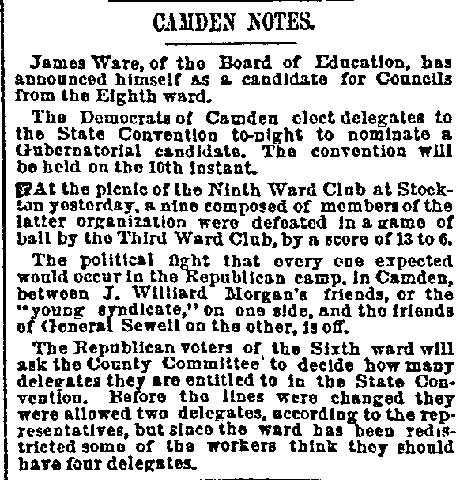
James Ware, of the Board of Education, has announced himself as a candidate for Councils from the Eighth ward.
The Democrats of Camden elect delegates to the State Convention to-night to nominate a Gubernatorial candidate. The convention will be held on the 10th instant.
At the picnic of the Ninth Ward Club at Stockton yesterday, a nine composed of members of the latter organization were defeated in a game of ball by the Third Ward Club, by a score of 13 to 6.
The political fight that every one expected would occur in the Republican camp, in Camden, between J. Willard Morgan’s friends, or the “young syndicate,” on one side, and the friends of General Sewell on the other, is off.
The Republican voters of the Sixth ward will ask the County Committee to decide how many delegates they are entitled to in the State Convention. Before the lines were changed they were allowed two delegates, according to the representatives, but since the ward has been redistricted some of the workers think they should have four delegates.
Corporation Elections
Philadelphia Inquirer —
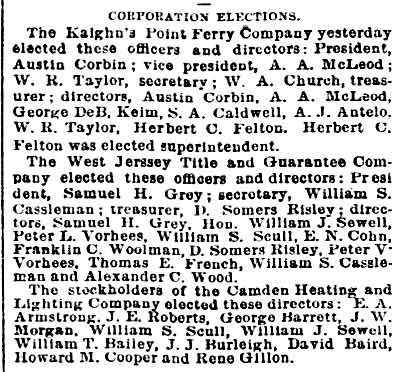
CORPORATION ELECTIONS.
The Kaighn’s Point Ferry Company yesterday elected these officers and directors: President, Austin Corbin; vice president, A. A. McLeod; W. R. Taylor, secretary; W. A. Church, treasurer; directors, Austin Corbin, A. A. McLeod, George DeB. Keim, S. A. Caldwell, A. J. Antelo. W. R. Taylor, Herbert C. Felton. Herbert C. Felton was elected superintendent.
The West Jersey Title and Guarantee Company elected these officers and directors: President, Samuel H. Grey; secretary, William S. Cassleman; treasurer, D. Somers Risley; directors, Samuel H. Grey, Hon. William J. Sewell, Peter L. Vorhees, William S. Scull, E. N. Cohn, Franklin C. Woolman, D. Somers Risley, Peter V. Vorhees, Thomas E. French, William S. Cassleman and Alexander C. Wood.
The stockholders of the Camden Heating and Lighting Company elected these directors: E. A. Armstrong, J. E. Roberts, George Barrett, J. W. Morgan, William S. Scull, William J. Sewell, William T. Bailey, J. J. Burleigh, David Baird, Howard M. Cooper and Rene Gillon.
General Sewell Goes Abroad
Philadelphia Inquirer —

Ex-United States Senator Sewell, wife and sons, left Camden yesterday for New York. The family will leave that city to-day on the steamer City of New York for a tour abroad. After visiting the principal European cities, the general will go to Hamburg for his health.
Camden’s Happy Contingent.
Philadelphia Inquirer —
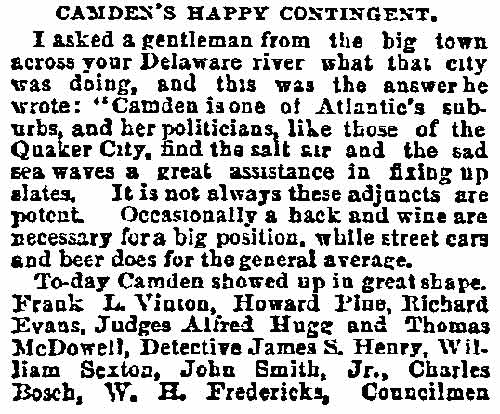
I asked a gentleman from the big town across your Delaware river what that city was doing, and this was the answer he wrote: “Camden is one of Atlantic’s suburbs, and her politicians, like those of the Quaker City, find the salt air and the sad sea waves a great assistance in fixing up slates. It is not always these adjuncts are potent. Occasionally a hack and wine are necessary for a big position, while street cars and beer does for the general average.
To-day Camden showed up in great shape. Frank L. Vinton, Howard Pine, Richard Evans, Judges Alfred Hugg and Thomas McDowell, Detective James S. Henry, William Sexton, John Smith, Jr., Charles Bosch, W. H. Fredericks, Councilmen James M. Lane, Robert F. Smith, John H. Furey and Arthur Bedell, Andrew Rabeau, Colonel D. B. Murphy, of General Sewell’s staff; F. F. Patterson, Sr. F. F. Patterson, Jr., of the Camden Sunday Review; John H. Fort, of the Camden Telegram; ex-Chief of Fire Department Daniel Carter, U. G. Styron, Wallace Armstrong, Joseph W. Cooper, C. C. Reeve “Lance,” Frank S. Heister and Fred Newton were among the visitors.
Camden
Philadelphia Inquirer —
General Sewell, wife and daughter, are now in Rome.
Harrison H. Voorhees, of this city, has been appointed solicitor for Holly Beach, Cape May county.
The Grocers’ Association sent James R. Carson delegate to the convention of the National Grocers’ Association, which met in New York on Wednesday.
After half century of long and faithful service as superintendent of the Camden and Philadelphia Ferry Company, Captain Andrew B. Frazee will retire May 1 to a well-deserved and richly earned rest.
William C. Dayton and family will spend the summer at Cape May.
Martin J. O’Brien was married on Wednesday by Father O’Brien, of Kellyville, Pa., to Miss Maggie Longworth, of Third and Royden streets. Nuptian [sic] mass was celebrated at the Church of the Immaculate Conception. Andrew Lyons was best man and Miss Cecelia O’Brien, a sister of the groom, bridesmaid. The ushers were Messrs. Martin Coyne, Secretary John M. Kelly, Francis Xavier O’Brien and ex-Assemblyman O’Brien.
Charles Livingstone, of Ferry avenue and Fillmore streets, entertained a number of friends at his home Tuesday evening.
Lieutenant John Foster has been acting as Chief of Police during the time that Chief Dodd was attending the Grand Lodge of the Legion of the Red Cross.
Postmaster Paul is able to attend to business after a protracted illness.
Howland Croft, senior member of the firm of Howland Croft Sons & Co., started on Thursday for California.
Oliver M. Smith and Mary A. Gregory were united in marriage at the home of the bride’s parents, Third and Mickle streets, by Rev. J. B. Graw, Wednesday night.
Politicians' Day at Mt. Holly
Philadelphia Inquirer —
POLITICIANS’ DAY AT MT. HOLLY
CANDIDATE GRIGGS SHOOK HUNDREDS OF HORNY HANDS AT THE BURLINGTON COUNTY FAIR.
CAMDEN WELL REPRESENTED
It Was a Fine Day, But the “Big Thursday” Crowd Was Smaller Than Last Year—A Canine Parachutist Killed—The Races—Other Jersey Matters.
Special to The Inquirer.
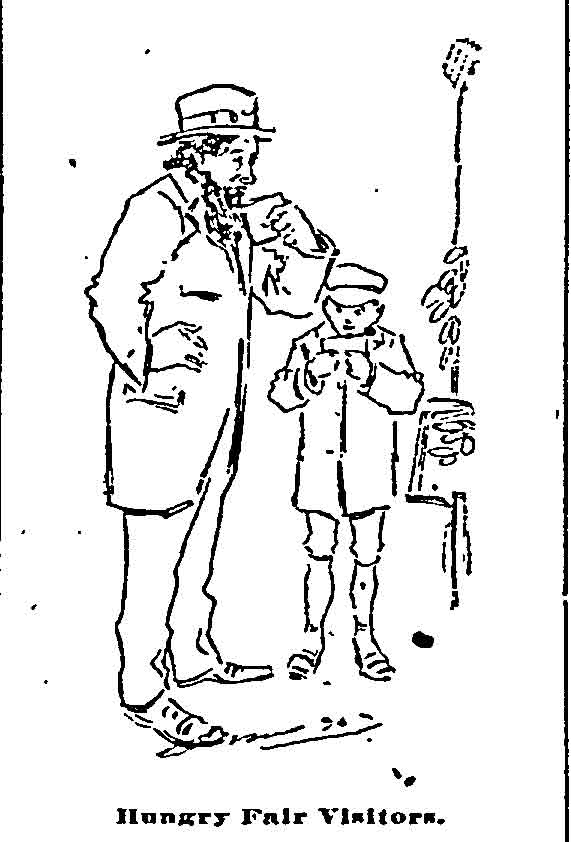
MOUNT HOLLY, N. J., Oct. 10.—The Mount Holly Fair, like all the other Jersey fairs, has its “Big Thursday.” That is the day the politicians get together to shake hands, swop stories and look after the political machine generally. The candidates make it a point to be present and try to win votes with cordial greetings and honeyed words. The Mount Holly Fair was favored with exceptionally fine weather for its “Big Thursday,” but the attendance was not as large as last year’s crowd.
The politicians congregated around a tent at the left of the grand stand. John W. Griggs, the Republican candidate for Governor, arrived on the grounds shortly after noon and was tendered a reception at the entrance. All the afternoon he was kept busy shaking hands with the grangers and telling them how glad he was to meet them. Mr. Griggs got lots of promises of votes. He made many friends among the farmers, who had their first chance of talking with him. Nearly every one addressed him as “Governor.”
Camden county was well represented by its leading political lights, among whom were: Senator William J. Sewell, ex-Sheriff David Baird, City Counsel J. Willard Morgan, City Clerk T. P. Varney, County Clerk Robert Barber, Mayor J. Leighton Westcott, Deputy Sheriff J. Wesley Sell, Frank Lloyd, William J. Thompson, Thomas P. Curley, Receiver of Taxes William A. Husted, Secretary of the Commission of Public Instruction W. D. Brown, Freeholder George Martin, ex-President of the City Council Arthur Bedell, Senator Maurice A. Rogers, ex-Senator George Pfeiffer, ex-Sheriff Henry J. West, William Bettle, Assemblyman Louis T. Derousse, Colonel George G. Felton, Coroner Jacob Justice, Councilman Richard Dease, ex-Sheriff Theodore B. Gibbs and Assemblyman William Barnard.
Gloucester county was represented by William Moore, Senator Daniel Packer, Congressman Henry C. Loudenslager, Dr. S. F. Stanger, County Clerk F. B. Ridgway and Lewis Starr.
Other prominent persons present were: Ex-Judge J. Frank Fort, State Comptroller W. S. Hancock, County Clerk Barker Gummere, of Mercer county; Prosecutor Charles E. Hendrickson, of Mount Holly; Frank B. Lee, son of Supreme Court Clerk Lee; Judge Clifford Stanley Simms, ex-Congressman James Buchanan, Lieutenant-Colonel Franklin Gaunt, of Burlington; Richard Miller, Robert Diamond and M. V. D. Dickinson, of Salem county; Judge Joseph H. Gaskill, Robert Hutchinson and ex-Sheriff Nathan Hays, of Burlington county.
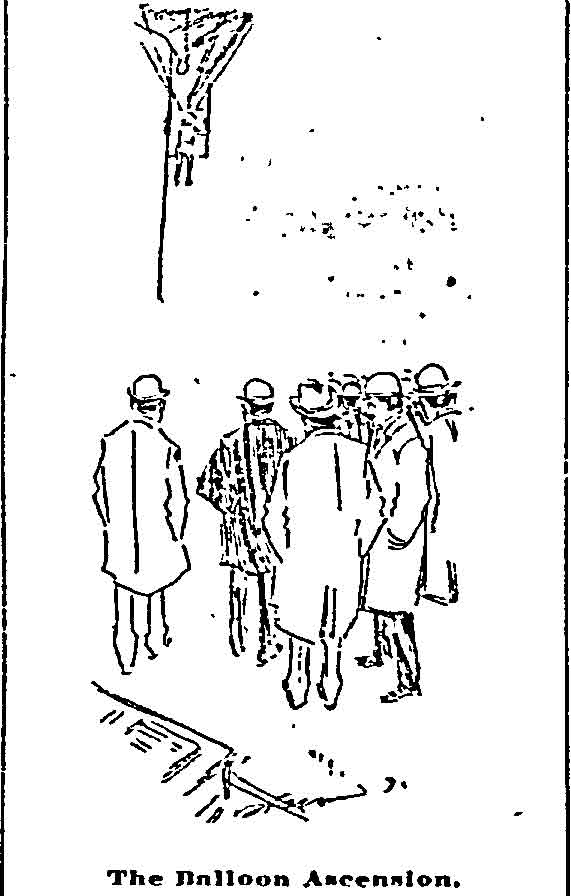
One of the features of the fair has been the daily ascension of a large balloon, from which a man and dog drop with parachutes. This afternoon the ropes which held the dog became loose. He dropped upon one of the booths and was killed.
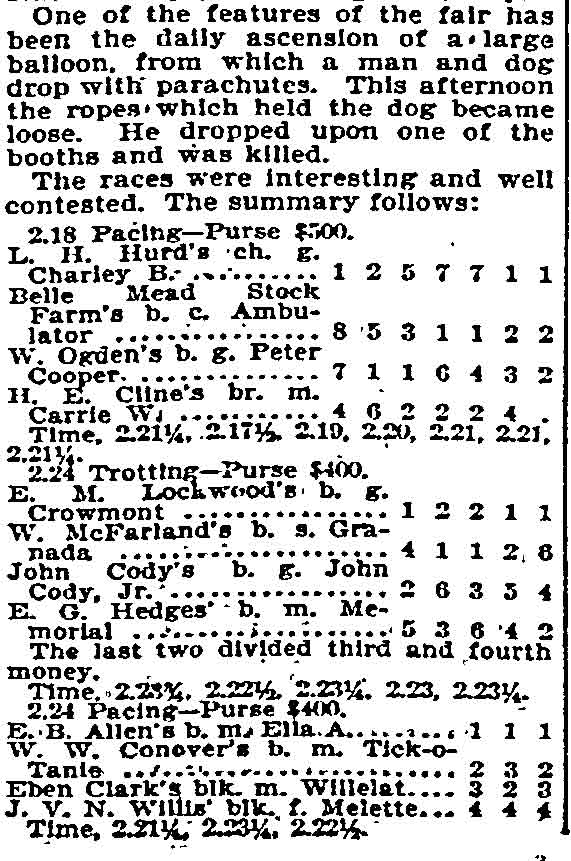
The races were interesting and well contested. The summary follows:
2.18 Pacing—Purse $500.
L. H. Hurd’s ch. g. Charley B....1 2 5 7 7 1 1
Belle Mead Stock Farm’s b. c. Ambulator....8 5 3 1 1 2 2
W. Ogden’s b. g. Peter Cooper....7 1 1 6 4 3 2
H. E. Cline’s br. m. Carrie W....4 6 2 2 2 4
Time. 2.21¼, 2.17½, 2.19, 2.20, 2.21, 2.21, 2.21¼.
2.24 Trotting—Purse $400.
E. M. Lockwood’s b. g. Crowmont....1 2 2 1 1
W. McFarland’s b. s. Granada....4 1 1 2 8
John Cody’s b. g. John Cody, Jr....2 6 3 5 4
E. G. Hedges’ b. m. Memorial....5 3 6 4 2
The last two divided third and fourth money.
Time. 2.23¾, 2.22½, 2.23¼, 2.23, 2.23¼.
2.24 Pacing—Purse $400.
E. B. Allen’s b. m. Ella A....1 1 1
W. W. Conover’s b. m. Tick-o-Tanie....2 3 2
Eben Clark’s blk. m. Willelat....3 2 3
J. V. N. Willis’ f. Melette....4 4 4
Time, 2.21¼, 2.23¼, 2.22½.
Sewellites Coming to Trenton
Philadelphia Inquirer —
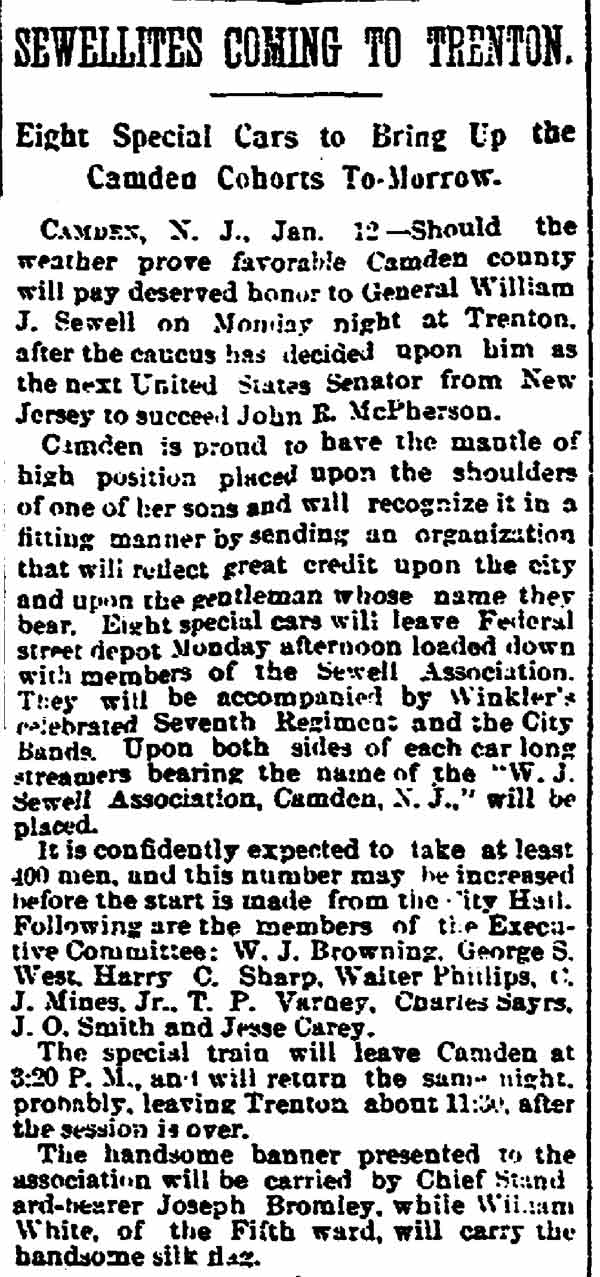
Eight Special Cars to Bring Up the Camden Cohorts To-Morrow.
CAMDEN, N. J., Jan. 12—Should the weather prove favorable Camden county will pay deserved honor to General William J. Sewell on Monday night at Trenton, after the caucus has decided upon him as the next United States Senator from New Jersey to succeed John R. McPherson. Camden is proud to have the mantle of high position placed upon the shoulders of one of her sons and will recognize it in a fitting manner by sending an organization that will reflect great credit upon the city and upon the gentleman whose name they bear. Eight special cars will leave Federal street depot Monday afternoon loaded down with members of the Sewell Association. They will be accompanied by Winkler’s celebrated Seventh Regiment and the City Bands. Upon both sides of each car long streamers bearing the name of the “W. J. Sewell Association, Camden, N. J.,” will be placed.
It is confidently expected to take at least 400 men, and this number may be increased before the start is made from the City Hall. Following are the members of the Executive Committee: W. J. Browning, George S. West, Harry C. Sharp, Walter Phillips, C. J. Mines, Jr., T. P. Varney, Charles Sayrs, J. O. Smith and Jesse Carey.
The special train will leave Camden at 3:20 P. M., and will return the same night, probably, leaving Trenton about 11:30, after the session is over.
The handsome banner presented to the association will be carried by Chief Standard-bearer Joseph Bromley, while William White, of the Fifth ward, will carry the handsome silk flag.
The News From Jersey
Philadelphia Inquirer —
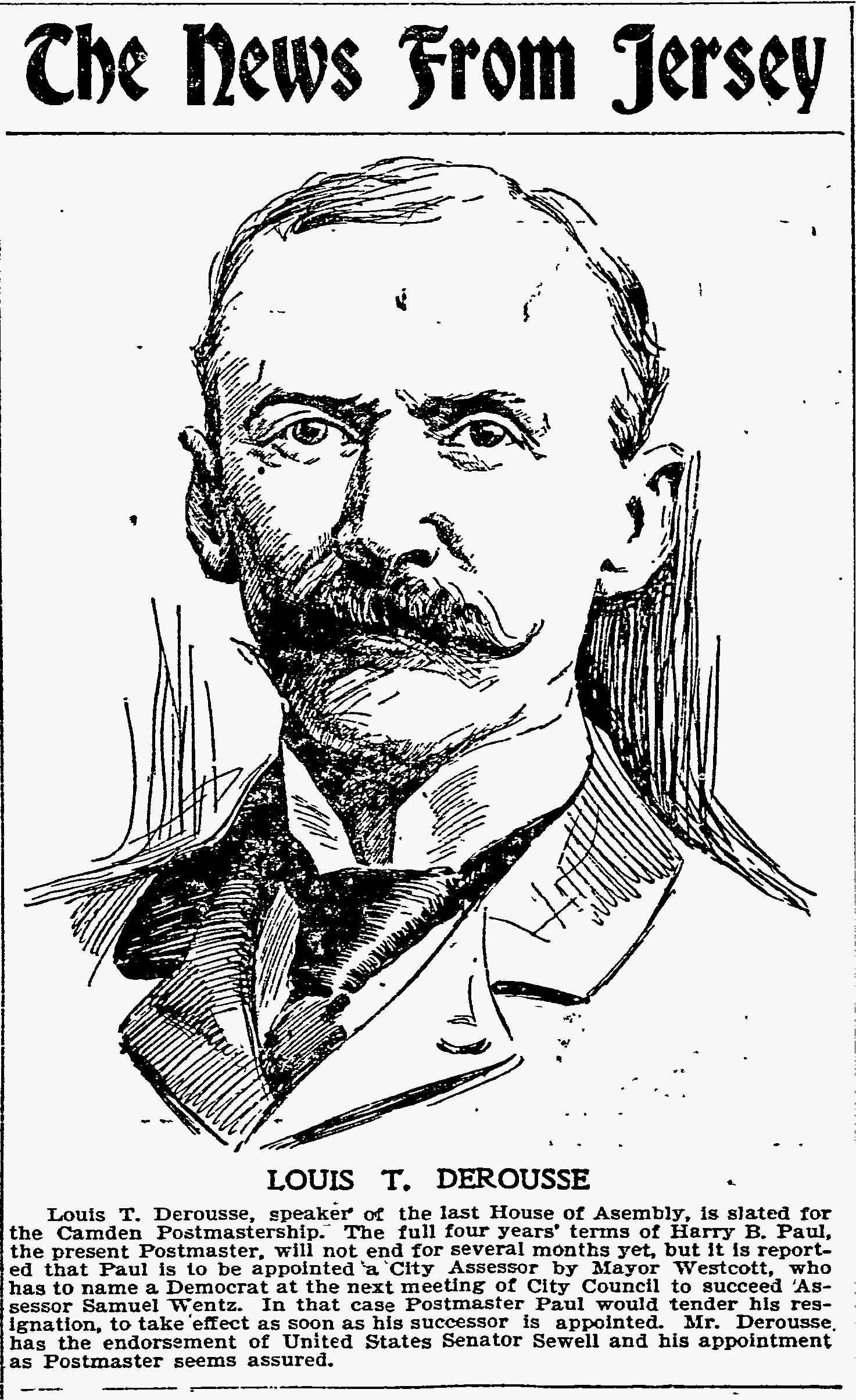
LOUIS T. DEROUSSE
Louis T. Derousse, speaker of the last House of Asembly [sic], is slated for the Camden Postmastership. The full four years’ terms of Harry B. Paul, the present Postmaster, will not end for several months yet, but it is reported that Paul is to be appointed a City Assessor by Mayor Westcott, who has to name a Democrat at the next meeting of City Council to succeed Assessor Samuel Wentz. In that case Postmaster Paul would tender his resignation, to take effect as soon as his successor is appointed. Mr. Derousse has the endorsement of United States Senator Sewell and his appointment as Postmaster seems assured.
Camden Lighting and Heating Company Annual Meeting
Philadelphia Inquirer —
At the annual meeting of the Camden Lighting and Heating Company, directors were elected as follows: William J. Sewell, David Baird, J. Willard Morgan, J. J. Burleigh, Colonel A. Louden Snowden, A. Seche, Joseph P. McCall, L. B. Byers and James E. Hays.
Camden
Philadelphia Inquirer —
Judge E. Ambler Armstrong is suffering from a severe cold.
Former Postmaster Harry B. Paul is able to be about again, after being confined to his home with the grip for a week.
Mr. H. J. Rumrille, private secretary to United States Senator Sewell, has pronounced inventive genius, and although a very busy man he has found time to perfect a number of useful inventions. One of these, and the latest of his ingenious contrivances, is a hair curler that should gain for him the favor of the fair sex. It will replace the awkward tongs most ladies use in fixing their hair, and with which they are forever burning their delicate fingers. Mr. Rumrille’s device is a small brass tube, with a simply-adjusted clamp to hold the hair, and a wooden handle that guards the fingers from the heat.
Mrs. Lizzie B. Koehler, of 708 Market street, Camden, daughter of George E. Boyer, Sr., is on a visit to Lansdale, Pa., where she is the guest of her sister, Mrs. S. S. Conver.
Mrs. Elizabeth Read, of Fifth and Cooper streets, is visiting her son, William Schellenger, at Wyncote, Pa.
William Swindell, of Baltimore, Md., was renewing acquaintanceships in Camden on Thursday.
Miss Sarah Mumford has returned from a visit to friends in Millville.
Florence Ivins, of 648 Locust street, entertained a number of friends on the occasion of her fifteenth birthday anniversary, on Thursday evening.
Rev. Joseph Garrison, the retiring pastor of Asbury M. E. Church, was tendered a farewell reception by his congregation on Thursday evening. He will assume charge of Medford M. E. Church to-day.
Miss Susie Lawrenson, of Mt. Ephraim, is visiting her sister, Mrs. W. A. Springer, of the East Side.
The Young Syndicate
Camden Courier-Post —
FROM AN OLD DIRECTORY
‘Coop’ Carman and Willard Morgan Led Movement for New Blood in G.O.P. Culminating in Bitter Battles of Race Track Days
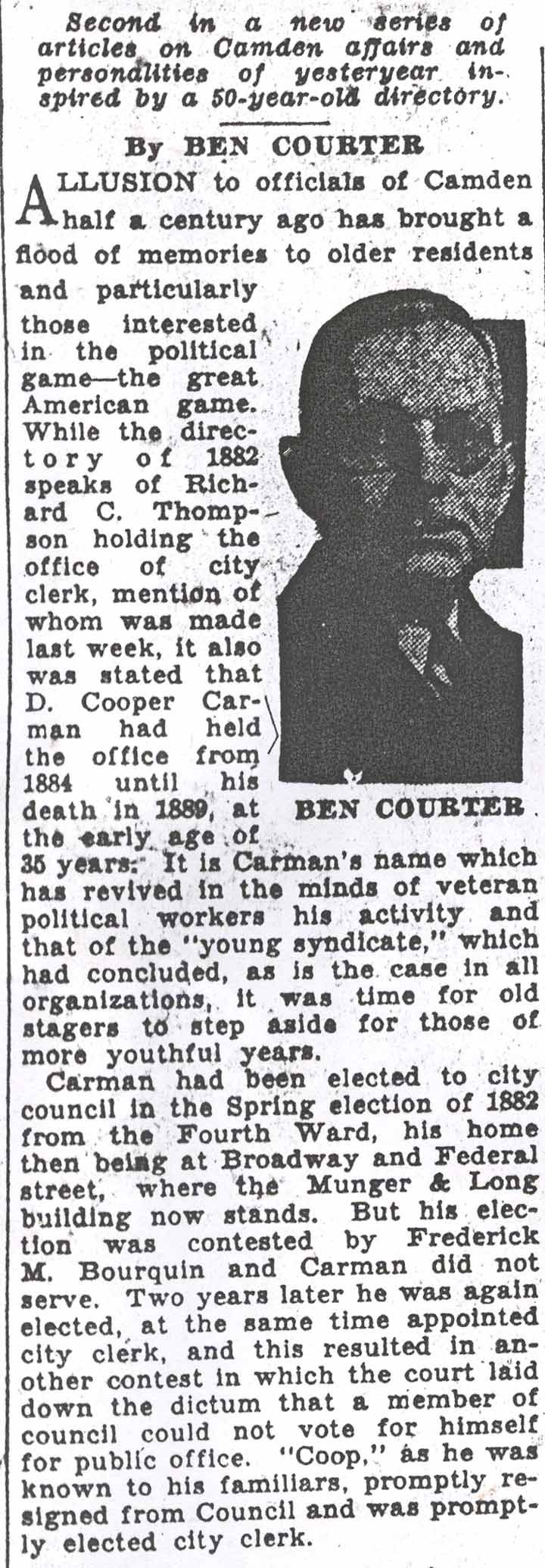
Second in a new series of articles on Camden affairs and personalities of yesteryear inspired by a 50-year-old directory.
By BEN COURTER
Allusion to officials of Camden half a century ago has brought a flood of memories to older residents and particularly those interested in the political game—the great American game. While the directory of 1882 speaks of Richard C. Thompson holding the office of city clerk, mention of whom was made last week, it also was stated that D. Cooper Carman had held the office from 1884 until his death in 1889, at the early age of 35 years. It is Carman’s name which has revived in the minds of veteran political workers his activity and that of the “young syndicate,” which had concluded, as is the case in all organizations, it was time for old stagers to step aside for those of more youthful years.
BEN COURTER
Carman had been elected to city council in the Spring election of 1882 from the Fourth Ward, his home then being at Broadway and Federal street, where the Munger & Long building now stands. But his election was contested by Frederick M. Bourquin and Carman did not serve. Two years later he was again elected, at the same time appointed city clerk, and this resulted in another contest in which the court laid down the dictum that a member of council could not vote for himself for public office. “Coop,” as he was known to his familiars, promptly resigned from Council and was promptly elected city clerk.
The ‘Young Syndicate’
With Carman, as former City Clerk William D. Brown recalls, was associated J. Willard Morgan and Henry M. Snyder, something of a balance between the two.
That combination carried things along pretty much as they pleased for a time and as one of the developments Maurice A. Rogers, down in the Fifth Ward and a councilman, was taken up as a Senatorial candidate against Colonel George Pfeiffer, Jr., a decade later to be the builder of Camden’s artesian water plant. The colonel, long one of Camden’s most popular men, had defeated the Republicans as a result of the factional fight between Henry L. Bonsall, editor of the Post, and Thomas Dudley, famed consul to Liverpool during Civil War days. But with the “young syndicate” back of him, Rogers won the Senate seat in 1890, taking his office January 1, 1891.
But in the meanwhile Carman suddenly died at his mother’s home, at 11.10 on the night of September 11, 1889. At the time apoplexy was given as the cause. His sudden demise caused a profound shock and at his funeral four days later leaders in business and politics paid homage, with such men as Gen. William J. Sewell, Sinnickson Chew, Howard Carrow, Wilson Jenkins, E. A. Armstrong, B. M. Braker and many others attending. The bell in the old City Hall tower tolled as the cortege passed on the way to old Camden cemetery. And even yet, after these more than four decades, “Coop” Carman is quite vividly recalled by those who were then active on the political stage.
Carman’s Death Big Loss
Carman’s death was a big loss to the “young syndicate,” but it did not halt its activity. Since Rogers had won so easily in the 1890 election it was concluded there would be nothing to it when he was renominated for another two-year term. Rogers was by no means friendly to “Billy” Thompson’s race track, then in the heyday of its popularity with the sports of Gloucester City, a period when that community had all the earmarks of a wild and wooly western city, attractive to thousands of lovers of horseflesh, touts, gamblers and the usual hangers-on.
Thompson concluded it would be far better to have someone in the Senate from Camden county who would regard his interests with more favor than Rogers.
Thus he decided on Frederick A. Rex, his personal counsel, a very able young attorney, and a Republican. Since at that time the Democratic police commission was in control of the cops it was considered easy to get possession of the polls. As Brown recalls it, the rivals of Rogers planned a “zero hour” at which cops, at the crack of a pistol, were to descend on polls considered close at the primaries, frighten off the regular voters and corral enough to elect Rex.
Particular effort was to be made to sweep the Sixth Ward, where Thad Varney, elected city clerk to succeed Carman, was “boss,” and thus give him a political black eye. In Varney’s precinct in particular when the rumpus started “Brockie” Deno and “Al” Haydon, both widely known firemen now dead, grabbed the ballot box, lowered it down a chimney, fished it out when the racket was passed, went to Avis’ livery stable, and later to Varney’s home, where the votes were counted. In these sophisticated days such counting would unquestionably not be considered “according to Hoyle,” but then anything went just so the particular faction had its bag of tricks in effective operation. Anyhow, Rogers won the primaries, but there still was the general election to hurdle and Thompson was by no means beaten. He had plenty of money and many followers, some sincere, many just sycophants.
Repeaters Foiled
It was charged a scheme was on foot to bring repeaters from Philadelphia, not an unusual procedure in the political game of Camden years ago in either party. One of the “young syndicate’s” lieutenants learned the plot, told General Sewell, who sent the informant to Dave Martin, then Philadelphia’s political boss, who heard the story. The upshot was General Sewell himself saw Martin later, who was quite willing to aid Jersey’s G.O.P. leader, flooded Camden with sleuths from over the river and such close tabs were kept on the repeating army its efforts were halted from the very dawn of that very stirring election day. Rogers was elected, was made president of the Senate and for a time loomed so large on Jersey’s political horizon he had gubernatorial aspirations, but they never were realized.
Thus out of the old yellowed book Frank Albright, city clerk of the present epoch, dug from the archives memories are revived of a very gallant young politician, “Coop” Carman, and some of the stirring incidents that make up Camden’s political history. The “young syndicate” was just one of the episodes, as the first “reform” outbreak in 1882, or the Committee of 100 scrap of 1897, or the Non-Partisan upheaval of ‘23, but such never lose interest to those who have joined those movements with enthusiasm, even though they were often not altogether satisfied with what had been accomplished.
Quits After Nearly 3 Score Years at Trade
Philadelphia Inquirer —
Camden’s Veteran Barber, Who Trimmed President Harrison’s Beard, Retires From Shop
Camden’s veteran barber, Andreas Beck, who has been in business at 116 Federal street for fifty-nine consecutive years, retired yesterday. He is to spend the balance of his years at 412 North Sixty-first street, Philadelphia. During his career Beck has attended to the wants of many notables, including President Benjamin Harrison and Senator William J. Sewell, the latter being a regular customer.
In the fifty-nine years since he went as an apprentice with John Jacob Somers, Mr. Beck has seen Camden grow from a small community to a thriving municipality of over 100,000. At that time the ferry house was located at Front and Federal streets, several squares inland from the present location. There was also the Round House, a famous hostelry frequented by Philadelphians and Camdenites. It was the place where men of prominence gathered and where many political slates were planned.
“A good many years ago General Sewell came into my office, as was his custom,” said Mr. Beck in a reminiscent mood yesterday, “and after I had finished with him he turned to a gentleman who was with him saying, ‘Mr. President, I think a good shave would help your appearance.’ I instantly recognized the gentleman as President Harrison. The President laughed at General Sewell’s remark and dryly said that he guessed he would feel better, and I trimmed his hair and beard. President Harrison was as kind a man as I ever met.”
Throughout the day the veteran wielder of the razor and shears was kept busy bidding his old friends good-by.
From Camden.
Philadelphia Inquirer —
Action of the Board of Health—Farmers’ Protective Association and Other Matters.
The Camden Board of Health is determined to take effective steps to prevent the engineers in the United States service from dumping dredgings near the Jersey shore, a short distance from Pavonia. The mud is dredged below Red Bank and deposited near where the city of Camden gets its supply of water for the inhabitants. The government dredges are depositing the mud to form a dyke in order to deepen the Pennsylvania channel at Philadelphia. The dyke being constructed from the Jersey shore to Petty’s Island, the pipes now receiving their supply will shortly be cut from the main stream and get the water from the pool that will form of stagnant water. Chairman Leckner and Secretary Carman visited Trenton yesterday to have an interview with the Governor and Comptroller in order to get an injunction against further proceedings, but those officials were not at Trenton.
The Farmers’ Protective Association of Camden County have offered a reward of $300 for the arrest and conviction of the thieves who have been operating recently in and around Haddonfield.
Charles West and Henry Beston, who were arrested in this city over a month ago, charged with stealing a boat from the wharf at Market street, Camden, were brought to Camden by Sheriff Smith yesterday on a requisition for trial.
The schools in Camden city will be opened on Monday next.
The Sixth Ward Republican Club have elected the following officers: President—Harry Green. Secretary—Jacob Woodsides Treasurer—Charles A. Sawyer.
James H. Nixon has been chosen a director of the West Jersey Railroad Company, to fill the vacancy caused by the death of Lewis Mulford, of Bridgeton.
Workmen commenced to mow the high grass and weeds in the orchard yesterday opposite the Stockton Park, where the unknown German is supposed to have dropped his revolver after shooting himself last week. The searchers are anxious to clear up the mystery to ascertain if possible whether the case was one of murder or suicide.
The first wing of the Sixth Regiment will go to Sea Girt to-day for rifle practice.
W. H. Carr, of Gloucester city, has been held to bail in the sum of $200 for trial, charged with stealing a wagon from John Cheeseman.
Jacob Cowan and George Hannold have been appointed deputy detectives by the West Jersey Game Protective Society for Gloucester city, to prevent illegal gunning.
The jurors for the October term of the Camden county courts will be drawn by Sheriff Smith next week.
Cards of invitation to the reception of General Sewell at the armory on his return from Europe were received by a select few yesterday.