Clay W. Reesman
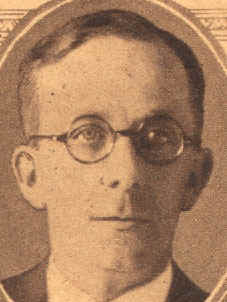
Clay W. Reesman, 1926
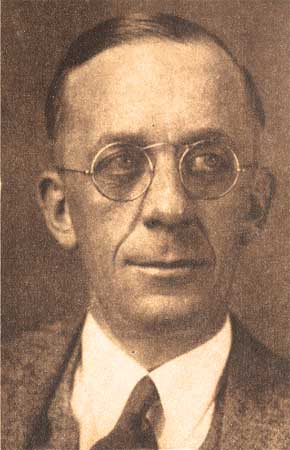
Clay W. Reesman, 1931
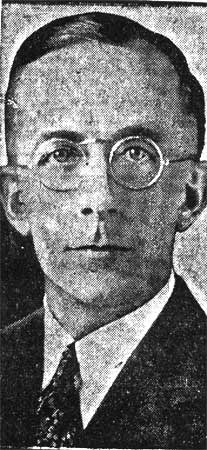
Clay W. Reesman, October 21, 1936
Clay Wolf Reesman Jr. was born in Pennsylvania around 1884. He married Alice Gibbs in the early 1900s.
He was living in Philadelphia PA in 1910. In November of 1911 he is listed as a member of St. Paul’s Methodist Episcopal Church at Thorofare, Gloucester County, New Jersey.
The Reesman family is not listed in the 1914 Camden City directory. However, by September of 1918 the family had moved to Camden, and had bought a home at 44 North 24th Street in East Camden. Clay Reesman was then working as a traveling salesman. The family at that point included two daughters, Alice and Mary, and a son, John Andrew Reesman. The Reesman family had moved to 2772 Mickle Street in East Camden by 1924.
After moving to Camden, Clay Reesman soon involved himself in the civic and political life of Camden. He was charter member and first vice-president of the Camden chapter of the American Business Clubs. Other members included auto dealer DeMotte Eggie, Jack Weinberg, and William Shirley.
A member of the Republican party, he defeated Sergeant Ray Smith, who was backed by Jake Schiller, in the 1926 election for ward committeeman in the Twelfth Ward. Clay W. Reesman was elected May 10 on May 10, 1927 to the Camden City Commission on an all-Republican slate. He took the oath of office May 17, 1927. The other commissioners were General Winfield S. Price, Mayor; T. Yorke Smith, William D. Sayrs Jr., and Dr. David S. Rhone. One of his duties as commissioner was to oversee Camden’s city-owned radio station, WCAM.
Although he had been elected to the City Commission as a Republican in 1927, Clay W. Reesman was chosen to succeed Otto Braun as City Clerk when control over hiring of city employees passed from the Republican Party to the Democrats in October of 1936. This change was the result of a New Jersey State Supreme Court decision which finally settled the disputed May 1935 election for Camden’s City Commission.
Clay W. Reesman was close to one-time Burlington County Chief of Detectives Ellis Parker Sr., who was sentenced to federal prison for his involvement in the kidnap of a witness involved in the Lindbergh kidnapping. Clay Reesman and his wife visited Parker only a few days before his death in February of 1940.
Clay and Alice Reesman were still living at 2772 Mickle Street as late as 1947. He was then still serving as Camden’s City Clerk, a position he held up to his passing, on January 3, 1949. Long-time assistant Mary MacClennon served as acting City Clerk for over five years, when in August of 1954, John Odorisio was named to the post. Alice Reesman remained at the Mickle Street home until her death in November of 1976.
Kausel Is Given $4000 Job Over Hot Protest by ‘Rebel’ in G.O.P.
Camden Courier-Post —
“Not Fitted for Job and 20 of You Admitted it” Declares Van Meter
Collingswood Man’s Insurgency Punished
Vocational School Incident is Recalled as Democrats Join in Battle
Joseph H. Van Meter, insurgent Republican freeholder from Collingswood, today declared that David Baird Jr., Republican leader, had admitted that Theodore Kausel was “not the man for the job” to which he was appointed by the Board of Freeholders yesterday.
Baird told him, however, said Van Meter, that a promise had been made “to take care of” Kausel because of the latter’s aid to the Republican Organization at the last municipal election.
Van Meter quotes Baird as follows:
“I’ll admit that Kausel is not the man for the job. But you have to help me out because we promised to take care of Kausel when he came over to us in the city election. And it was through Kausel that we got Hitchner and a lot of his crowd.”
“We’ve got ourselves tied up with him. We’ve got to take him, and I want you to go along, and help me out.”
“I know his business record and I know his political record. I know the freeholders don’t want him and our conference don’t want him, but we’ve got to eat crow, and I want you to help me out”
Under the watchful eyes of organization leaders, Republican members of the Camden County Board of Freeholders yesterday took care of Theodore “Teddy” Kausel.
With David Baird Jr. and other chieftains of the party occupying front row seats, the board created the post of “general manager of county institutions” and promptly named Kausel for the job at an annual salary of $4,000.
Like ghosts at a feast, Baird and the other party leaders sat silently at the freeholders reorganization meeting. Like actors in a carefully pre-arranged play, a little uncertain of their cues, 20 Republican freeholders cast furtive eyes at the group of spectators.
They said no word, these freeholders. They made no reply when Joseph H. Van Meter, of Collingswood, breaking from their ranks, declared that 20 of them had told him that Kausel was unfit for the position to which he was being appointed. They listened in uncomfortable silence while Van Meter gave voice to a scathing denunciation of their “lack of backbone” and while a running fire of sarcasm from Democratic members fell upon their ears.
Scene Was Drama
The scene was drama. It might have been a revised performance of “Uncle Tom’s Cabin” with 28 furtive-eyed Uncle Toms and an impregnable line of Simon Legrees, cracking invisible whips in threatening gestures.
And the scene was also comedy. For of that score of men who, according to Van Meter, had agreed that Kausel was unfit for the job but “had to be taken care of,” none arose to protest against the action. Within their Hearts the chorus of Uncle Toms may have been saying.
The county may own out bodies, but our souls belong to the Republican Organization.”
But if they thought this, they said no word.
Today it was pointed out that it will not be long before freeholders come up for re-nomination at the primaries. Today, it was also predicted that Van Meter has signed his political death warrant so far as the Republican organization was concerned. But at least he received the ungrudging tribute of the Democratic minority on the board, who joyfully proclaimed that they had found “at last a Republican with guts.”
Van Meter Fights Hard
Van Meter spared no words, took no half-measures. He accused his fellow Republican members of coercion, double-dealing and weakness. He fought the appointment bitterly. He raked up the vocational school matter, in which $85,000 had been paid for the school site on Kausel’s recommendation, a price later declared to be exorbitant.
Democratic members joined the Collingswood insurgent. They charges that the $4,000 appointment was the price of Kausel’s allegiance to the Republican party. They declared that he wasn’t worth it. They recalled, later, that Kausel had shifted from the Republican Organization to the Non-Partisan movement and then back again after being one of the loudest to criticize the Organization. They asserted that after his removal as chairman of the vocational school board, he had sought the appointment as city purchasing agent. They avowed that the Republican City Commissioners had ‘refused to handle Kausel” and had “wished him off on the county.”
The 26 other Republican freeholders— all of those present, excepting only Van Meter— continued to listen in silence. And when the vote came, every one of the 26 voted for the creation of the position of “general manager of county institutions” and for the appointment of Kausel.
A little later the reprisals upon Van Meter began. He was removed from the central plant and county farm committees of the board, shifted to the elections committee and allowed to remain on the printing and agricultural committees, regarded as unimportant groups.
Reprisal Were Threatened.
“It doesn’t surprise me,” he said. “I was threatened with it. They told me they’d ruin me. But I couldn’t go back to Collingswood and ask the people to vote for me again if I hadn’t fought against this appointment.”
The defection of Van Meter came apparently as a surprise. The meeting had opened with the passage of the county budget on the first reading, the selection of Leslie H. Ewing, of Berlin, as director of the board, the calling of Frank P. Moles, of the Third Ward to be sworn in and his failure to respond or to appear for the gathering.
Minor matters had been attended to and then Fred W. George, clerk of the board, rose to his feet and began the task of reading a long list of proposed amendments to the rules. Buried far down in the list of revisions was that which, “for purposes of economy,” sought to place all county institutions under a central head to be known as general manager.
George lost his breath before he had more than half completed the lost of amendments, and George Rothermel, pinch-hitting for Walter Keown as counsel for the board, took his place. Then Director Ewing called for a vote.
Schorpp Speaks
Frederick W. Schorpp, Eighth Ward Democrat, was the first to speak
“I want to congratulate you gentlemen,” he said, “on the wonderful way you have camouflaged these changes.
“We have heard a long list of amendments to the rules read. But what the whole thing is can easily be seen. You gentlemen of the majority have a lame duck to take care of, and so you create this job. But I can’t see, really I can’t see why it is necessary to create a $4,000 plum for your lame duck and saddle it on the taxpayers.”
There was silence in the room. In the seat of the absent Freeholder William A. Robinson sat Baird. At the press table were Sheriff Walter Gross and City Commissioner William D. Sayrs, Jr. Ranged along the front row of the spectators’ section were Mayor Winfield Price and Commissioner Clay W. Reesman. They said nothing.
Louis C. Parker, Gloucester City Democrat, was next to speak.
“All these changes in the rules accomplish is to create a new job,” he declared, agreeing with Schorpp.
S. Raymond Dobbs, Fourteenth Ward Democrat, objected and moved that the resolution changing the rules be laid over until the regular January meeting. He was overruled by Director Ewing. Schorpp sought to have the rules voted upon separately, but James Davis, chairman of the committee, refused to accept the suggestion.
The roll call began. In alphabetical order the names were called and the freeholders voted. Republicans voted in favor of adoption of the changes. The three Democrats voted against the resolution. Van Meter’s name was the last to be called.
“No,” he said calmly, and there was a gasp pf surprise in the room. The clerk recorded the vote on the resolution as 26 to 4 and then began reading again. This was a new resolution. It named Theodore T. Kausel to the position just created and explained that he was to report to the “Lakeland Central Committee.”
Van Meter Protests
Van Meter rose slowly. He obtained recognition from the director and began, quietly but decisively.
“Gentlemen,” he said calmly. “I have studied this proposition. I have known about it for three days and three nights. I have talked to 20 Republicans member of this board and I have done all I could to get then to agree with me.
And they did agree with me. They agreed, every one, that Kausel was not the man for this job. After what happened on the vocational school project, when Kausel was president of the school board, he is not the man. On his recommendation, the vocational school site was purchased for $85,000. And now you want to send him where he will handle about a million dollars of the taxpayers’ money.”
Van Meter’s tone was serious as he turned to his fellow members. Most of the latter sat silently in the seats. They did not glance at the Collingswood insurgent. Baird, Gross, Price, Sayrs and Reesman listened intently. A few of the freeholders craned their necks towards the windows as the Camden mummers, returning from the New Years Day parade in Philadelphia, marched past the courthouse. But Van Meter went on.
“There is not one of you that has backbone enough to come here and fight this thing.” Van Meter continued.
I can’t see it go through. I couldn’t ask the people of Collingswood to vote for me again if I let it go through without a fight.
“You agreed with me that Kausel was not the man for the job. Haven’t you any backbone with which to fight his appointment now?”
Slowly, in complete silence that followed, he turned till he faced Horace G. Githens, the majority floor leader.
“Mr. Githens,” he said quietly and in a measured tone, “ if you will throw away your messenger’s cap and wear a leader’s hat, I will follow you.”
He sat down and the silence continued.
Schorpp Lauds Van Meter
Schorpp rose again.
“I’m glad to see one Republican who has backbone,” he said. “I told you there was a lame duck in this and here is the lame duck.
“Woods (Samuel Woods, Republican freeholder from Haddonfield) and you others criticized Kausel and other members of the vocational school board for their purchasing of the land for the school, claiming that it was an exorbitant price to pay for the land.
“And now these same men who criticized Kausel are putting him in a position where he will handle millions of the taxpayers money.
Dobbs followed on the floor.
“I don’t want to stand here and talk until 10 o’clock tonight just to give you reasons why Kausel shouldn’t get the job,” he said.
“In the first place, I couldn’t give all the reasons in that time, and in the second place, they wouldn’t register with this bunch.
“This is entirely unfair. It’s too high a price to pay Kausel to come back into the Republican ranks. The Republican leaders should pay it, however, and not saddle the price on the taxpayers.
“Personally, I don’t think he’s worth much politically. We had him for awhile and have had some experience as to the value of his services. I thought he could be bought for less than $4000 anyway.”
The resolution came to a vote. The Republicans, with the exception of Van Meter, again voted solidly. Twenty-six votes were cast for the appointment of Kausel. Van Meter and the three Democrats did not vote.
Van Meter issued a statement after the meeting, explaining his stand. He said:
“The reason I opposed Kausel’s appointment is because the man is extravagant. Director Ewing was one of the 20 Republicans I talked to who were opposed to hum, but were afraid on the floor. I didn’t talk to the Democrats.
“Ewing and the other Republicans said, ‘What can we do. We must take care of him. We promised to.’
Charges Unfair Tactics
“I knew when I went ahead with this that I’d be an outcast, but I was determined to do the right thing. This appointment is not the right thing.
“They told me I’d be ruined if I opposed them. Even up to the last minute before the meeting they came to my desk in the freeholder’s room and tried to throw a scare into me.
“I knew I’d be thrown out of committees and barred from the caucuses. They’ve let me remain on the printing committee. I’ve been on it a year, and it hasn’t met yet. Nevertheless, there is a $50,000 appropriation for printing.
“I’ve always tried to be on the level on this job. Why they had the workhouse slated for $120,000 but I fought and fought, and finally— well look at the budget— it’s cut down to $50,000.
“It’s not the first time I’ve saved them money. I don’t know Kausel personally, but I do know his record. It was because of his extravagance that he was fired from the Castle Kid Company.
And when I say he is extravagant, I can prove every word of it.”
The new Lakeland central committee, authorized in the resolution appointing Kausel, was announced by Director Ewing at the close of the meeting. Ewing is to be a member, ex-officio, and Horace G. Githens becomes a member by virtue of being chairman of the finance committee.
The chairman of the asylum committee, of the County Hospital committee, of the Almshouse committee, of the Detention Home committee, and the Tuberculosis Hospital committee all will become members.”
Name ‘Official’ Papers
An earlier vote had been taken in which the Democrats moved to designate The Evening Courier as the newspaper in which the budget was to be officially printed. The Republican majority had designated two weekly papers, the Camden Argus and the Berlin Breeze.
“It’s obvious,” said Dobbs, “why these designations have been made.”
Parker, Gloucester City Republican, agreed with this view and declared that the newspaper with the largest circulation in the county should be given the official county notices for publication as advertising.
Schorpp ironically suggested that the Christian Science Monitor be substituted for one of the two weeklies designated and the roll was called. The Argus and the Breeze were officially designated.
The appointment of Kausel bought the meeting to a conclusion. Of all the Republican freeholders, Davis was the only one to speak. He merely declared that he was one not one of the 20 men who Van Meter had said agreed that Kausel was not the man for the job.
13th Ward G.O.P. Club Pays Tribute to Rhone
Camden Courier-Post —
A meeting which was described today as “a gathering in honor of David S. Rhone, director of public safety,” was held last night at the Thirteenth Ward Republican Club, Haddon Avenue and Mechanic Street.
The speakers included David Baird Jr., Mayor Winfield S. Price, Commissioner Clay W. Reesman, Sheriff Walter T. Gross, Urquhart Ward, ward committeeman, Theodore Kausel and Commissioner Rhone.
A large photograph of Commissioner Rhone was presented to the club by friends of the Commissioner, and has been placed in the clubroom. A photograph of Ward was also given the club.
Arrangements were by made by the club for its annual ball to be held February 21. Plans were also discussed for the remodeling of the club’s headquarters.
City Blasts Hopes for Broadway Lights
Camden Courier-Post —
Reesman Tells Merchants Funds Are Too Low to Make Improvements This Year
Hopes of the Broadway Business Men’s Association to obtain 75 more lights on that thoroughfare have been blasted, Commissioner Clay W. Reesman says no funds are available to make possible the improvement.
Reesman’s reply to the request for additional lights was contained in a letter received yesterday by Harry P. Pelouze, president of the organization. Members of the association have sought the new lighting for more than a year, contending that present facilities are inadequate for the volume of business.
At Reesman’s office today, it was said a smaller budget this year leaves no money available to pay for additional lights. The new standards themselves, it was reported would be erected by the Public Service Company, but the cost of obtaining them would amount to approximately $5,500 a year or from $72 to $75 for each new light.
The request for better lighting on Broadway was made by the businessmen to the previous city commissioners, who assured the merchants that provisions for the additional lights would be made in 1928. No appropriation, however, has bee voted. The association will decide on what further steps to take at its next meeting.
Reesman Denies Light Fund Shift
Camden Courier-Post —
Reesman Tells Broadway Merchants City Just Hasn’t Money for New Lamps
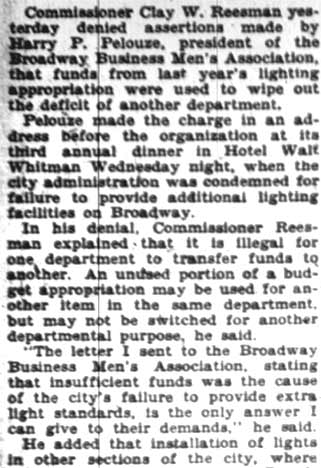
Reesman Denies Light Fund Shift
REESMAN DENIES LIGHT FUND SHIFT
Reesman Tells Broadway Merchants City Just Hasn't Money for New Lamps
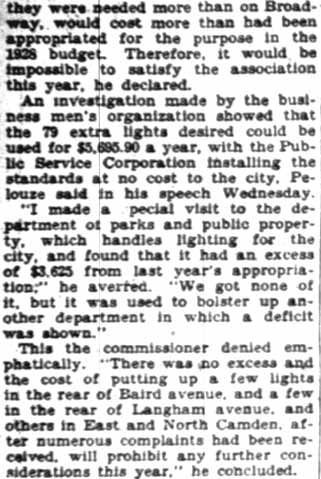
Commissioner Clay W. Reesman yesterday denied assertions made by Harry P. Pelouze, president of the Broadway Business Men's Association, that funds from last year's lighting appropriation were used to wipe out the deficit of another department.
Pelouze made the charge in an address before the organization at its third annual dinner in Hotel Walt Whitman Wednesday night, when the city administration was condemned for failure to provide additional lighting facilities on Broadway.
In his denial, Commissioner Reesman explained that it is illegal for one department to transfer funds to another. An unused portion of a budget appropriation may be used for another item in the same department, but may not be switched for another departmental purpose, he said.
"The letter I sent to the Broadway Business Men's Association, stating that insufficient funds was the cause of the city's failure to provide extra light standards, is the only answer I can give to their demands," he said.
He added that installation of lights in other sections of the city, where [continued in col. 2]
Photos
Camden Courier-Post —
Fifth Ward Republican Club
Camden Courier-Post —
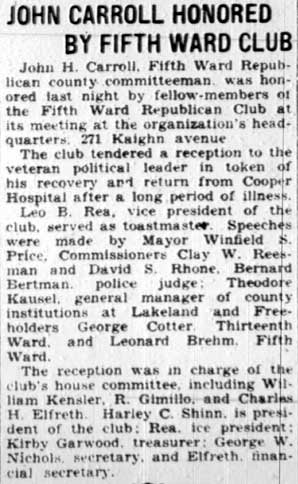
JOHN CARROLL HONORED BY FIFTH WARD CLUB
John H. Carroll, Fifth Ward Republican county committeeman, was honored last night by fellow-members of the Fifth Ward Republican Club at its meeting at the organization’s headquarters, 271 Kaighn avenue.
The club tendered a reception to the veteran political leader in token of his recovery and return from Cooper Hospital after a long period of illness.
Leo B. Rea, vice president of the club, served as toastmaster. Speeches were made by Mayor Winfield S. Price, Commissioners Clay W. Reesman and David S. Rhone, Bernard Bertman, police judge; Theodore Kausel, general manager of county institutions at Lakeland and Freeholders George Cotter, Thirteenth Ward, and Leonard Brehm, Fifth Ward.
The reception was in the charge of the club’s house committee, including William Kensler, R. Gimillo, and Charles H. Elfreth. Harley C. Shinn, is president of the club; Rea, ice president; Kirby Garwood, treasurer; George W. Nichols, secretary, and Elfreth, financial secretary.
William McKinley School
Camden Courier-Post —
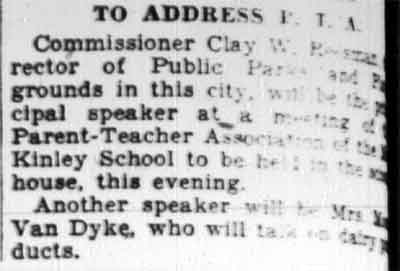
WCAM QSL Card
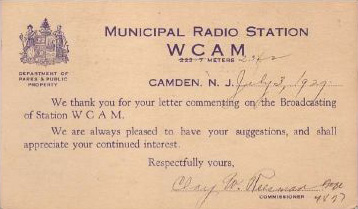
July 3, 1929 QSL Card from WCAM — Signed by Commissioner Clay W. Reesman
Twelfth Ward Baseball
Trenton Times —
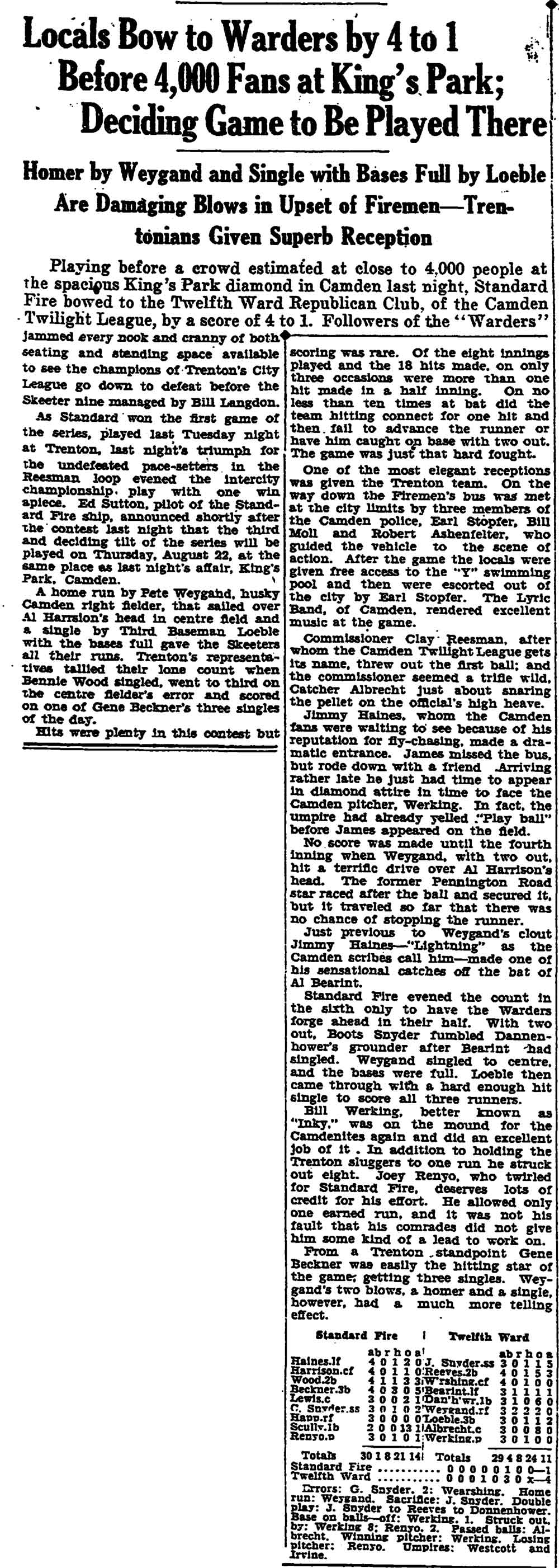
Playing before a crowd estimated at close to 4,000 people at the spacious King’s Park diamond in Camden last night, Standard Fire bowed to the Twelfth Ward Republican Club, of the Camden Twilight League, by a score of 4 to 1. Followers of the “Warders” jammed every nook and cranny of both seating and standing space available to see the champions of Trenton’s City League go down to defeat before the Skeeter nine managed by Bill Langdon.
As Standard won the first game of the series, played last Tuesday night at Trenton, last night’s triumph for the undefeated pace-setters in the Reesman loop evened the intercity championship play with one win apiece. Ed Sutton, pilot of the Standard Fire ship, announced shortly after the contest last night that the third and deciding tilt of the series will be played on Thursday, August 22, at the same place as last night’s affair, King’s Park, Camden.
A home run by Pete Weygand, husky Camden right fielder, that sailed over Al Harrison’s head in centre field and a single by Third Baseman Loeble with the bases full gave the Skeeters all their runs. Trenton’s representatives tallied their lone count when Bennie Wood singled, went to third on the centre fielder’s error and scored on one of Gene Beckner’s three singles of the day.
Hits were plenty in this contest but scoring was rare. Of the eight innings played and the 18 hits made, on only three occasions were more than one hit made in a half inning. On no less than ten times at bat did the team hitting connect for one hit and then fail to advance the runner or have him caught on base with two out. The game was just that hard fought.
One of the most elegant receptions was given the Trenton team. On the way down the Firemen’s bus was met at the city limits by three members of the Camden police, Earl Stopfer, Bill Moll and Robert Ashenfelter, who guided the vehicle to the scene of action. After the game the locals were given free access to the “Y” swimming pool and then were escorted out of the city by Earl Stopfer. The Lyric Band, of Camden, rendered excellent music at the game.
Commissioner Clay Reesman, after whom the Camden Twilight League gets its name, threw out the first ball; and the commissioner seemed a trifle wild, Catcher Albrecht just about snaring the pellet on the official’s high heave.
Jimmy Haines, whom the Camden fans were waiting to see because of his reputation for fly-chasing, made a dramatic entrance. James missed the bus, but rode down with a friend. Arriving rather late he just had time to appear in diamond attire in time to face the Camden pitcher, Werking. In fact, the umpire had already yelled “Play ball” before James appeared on the field.
No score was made until the fourth inning when Weygand, with two out, hit a terrific drive over Al Harrison’s head. The former Pennington Road star raced after the ball and secured it, but it traveled so far that there was no chance of stopping the runner.
Just previous to Weygand’s clout Jimmy Haines — “Lightning” as the Camden scribes call him — made one of his sensational catches off the bat of Al Bearint.
Standard Fire evened the count in the sixth only to have the Warders forge ahead in their half. With two out, Boots Snyder fumbled Dannenhower’s grounder after Bearint had singled. Weygand singled to centre, and the bases were full. Loeble then came through with a hard enough hit single to score all three runners.
Bill Werking, better known as “Inky,” was on the mound for the Camdenites again and did an excellent job of it. In addition to holding the Trenton sluggers to one run he struck out eight. Joey Renyo, who twirled for Standard Fire, deserves lots of credit for his effort. He allowed only one earned run, and it was not his fault that his comrades did not give him some kind of a lead to work on.
From a Trenton standpoint Gene Beckner was easily the hitting star of the game, getting three singles. Weygand’s two blows, a homer and a single, however, had a much more telling effect.
Standard Fire — ab r h o a: Haines, lf 4 0 1 2 0; Harrison, cf 4 0 1 1 0; Wood, 2b 4 1 1 3 3; Beckner, 3b 4 0 3 0 5; Lewis, c 3 0 0 2 1; G. Snyder, ss 3 0 1 0 2; Rapp, rf 3 0 0 0 0; Scully, 1b 2 0 0 13 1; Renyo, p 3 0 1 0 1. Totals 30 1 8 21 14.
Twelfth Ward — ab r h o a: J. Snyder, ss 3 0 1 1 5; Reeves, 2b 4 0 1 5 3; W’rshing, cf 4 0 1 0 0; Bearint, lf 3 1 1 1 1; Dan’h’wr, 1b 3 1 0 6 0; Weygand, rf 3 2 2 2 0; Loeble, 3b 3 0 1 1 2; Albrecht, c 3 0 0 8 0; Werking, p 3 0 1 0 0. Totals 29 4 8 24 11.
Standard Fire ……… 0 0 0 0 0 1 0 0—1
Twelfth Ward ……… 0 0 0 1 0 3 0 x—4
Errors: G. Snyder, 2; Wearshing. Home run: Weygand. Sacrifice: J. Snyder. Double play: J. Snyder to Reeves to Donnenhower. Base on balls—off: Werking, 1. Struck out by: Werking, 8; Renyo, 2. Passed balls: Albrecht. Winning pitcher: Werking. Losing pitcher: Renyo. Umpires: Westcott and Irvine.
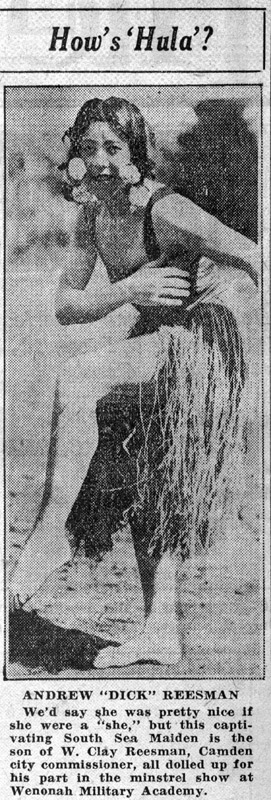
How’s ‘Hula’?
Camden Courier-Post —
Lewis H. Stehr, Chief of Police, Dies Suddenly
Camden Morning Post —
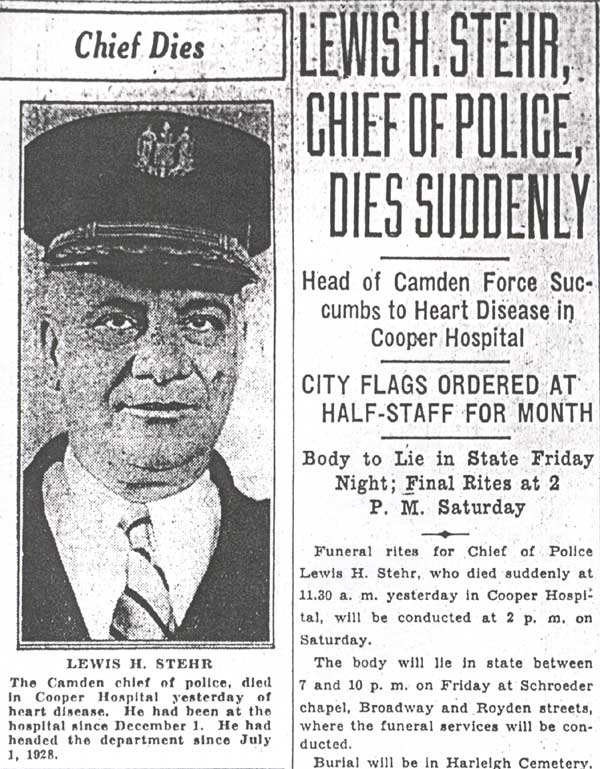
LEWIS H. STEHR — The Camden chief of police, died in Cooper Hospital yesterday of heart disease. He had been at the hospital since December 1. He had headed the department since July 1, 1928.
Head of Camden Force Succumbs to Heart Disease in Cooper Hospital
CITY FLAGS ORDERED AT HALF-STAFF FOR MONTH
Body to Lie in State Friday Night; Final Rites at 2 P. M. Saturday
Funeral rites for Chief of Police Lewis H. Stehr, who died suddenly at 11.30 a. m. yesterday in Cooper Hospital, will be conducted at 2 p. m. on Saturday.
The body will lie in state between 7 and 10 p. m. on Friday at Schroeder chapel, Broadway and Royden streets, where the funeral services will be conducted. Burial will be in Harleigh Cemetery.
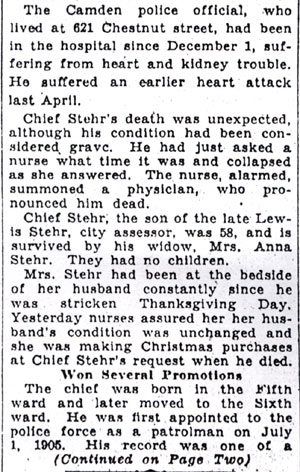
The Camden police official, who lived at 621 Chestnut street, had been in the hospital since December 1, suffering from heart and kidney trouble. He suffered an earlier heart attack last April.
Chief Stehr’s death was unexpected, although his condition had been considered grave. He had just asked a nurse what time it was and collapsed as she answered. The nurse, alarmed, summoned a physician, who pronounced him dead.
Chief Stehr, the son of the late Lewis Stehr, city assessor, was 58, and is survived by his widow, Mrs. Anna Stehr. They had no children.
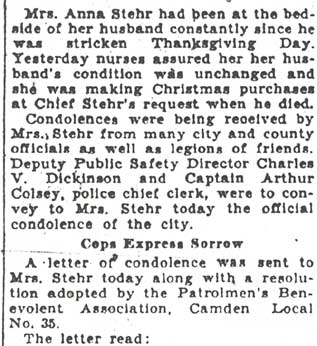
Mrs. Stehr had been at the bedside of her husband constantly since he was stricken Thanksgiving Day. Yesterday nurses assured her her husband’s condition was unchanged and she was making Christmas purchases at Chief Stehr’s request when he died.
Won Several Promotions
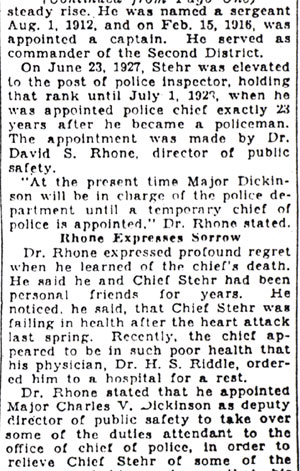
The chief was born in the Fifth ward and later moved to the Sixth ward. He was first appointed to the police force as a patrolman on July 1, 1905. His record was one of a steady rise. He was named a sergeant Aug. 1, 1912, and on Feb. 15, 1918, was appointed a captain. He served as commander of the Second District.
On June 23, 1927, Stehr was elevated to the post of police inspector, holding that rank until July 1, 1928, when he was appointed police chief exactly 23 years after he became a policeman. The appointment was made by Dr. David S. Rhone, director of public safety.
“At the present time Major Dickinson will be in charge of the police department until a temporary chief of police is appointed,” Dr. Rhone stated.
Rhone Expresses Sorrow
Dr. Rhone expressed profound regret when he learned of the chief’s death. He said he and Chief Stehr had been personal friends for years. He noticed, he said, that Chief Stehr was failing in health after the heart attack last spring. Recently, the chief appeared to be in such poor health that his physician, Dr. H. S. Riddle, ordered him to a hospital for a rest.
Dr. Rhone stated that he appointed Major Charles V. Dickinson as deputy director of public safety to take over some of the duties attendant to the office of chief of police, in order to relieve Chief Stehr of some of the pressure of his work, so that his health would not further be impaired.
The decedent was an active member of the Sixth Ward Republican Club, and was well liked not only by members of the police force but throughout the city.
Mayor Expresses Sorrow
Mayor Price issued the following statement: “I was very greatly shocked to learn of the death of Chief Stehr. While I understood he was in a serious physical condition, I did not anticipate his death.
“Chief Stehr had devoted practically his entire lifetime to the service of the city, having entered the police department in his early youth, and is entitled to the commendation of his fellow citizens for his efforts in the public service.”
Commissioner Frank B. Hanna, when apprised of the police chief’s death, said: “The news of Chief Stehr’s death was a terrible shock. I feel a personal loss, as we were close friends. I knew him since I was a young boy, and our contacts in the past two years were most pleasant.”
Prosecutor Clifford A. Baldwin declared: “The suddenness of the death of Chief Stehr comes as a shock to those of his friends who were wishing him well in his illness. His passing naturally causes grief to those whose work brought them into close contact with him.”
City Commissioner Clay W. Reesman said: “The passing of Chief Stehr is a great loss to the community. We were all hoping that Chief Stehr was on the road to recovery and only several days ago when I inquired at the hospital, I learned that his condition was greatly improved. His sudden passing is a terrible shock.” City officials last night ordered all flags lowered to half mast on all police stations for 30 days. Deputy Director Dickinson and Captain Arthur Colsey today will convey to Mrs. Stehr the police department’s official condolence.
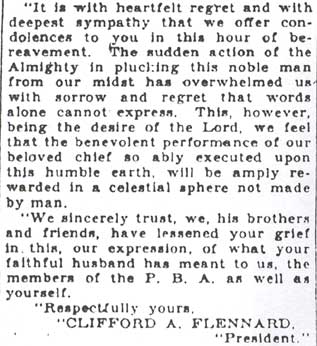
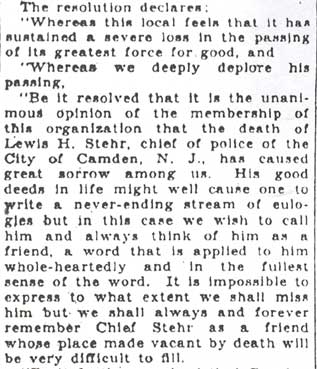
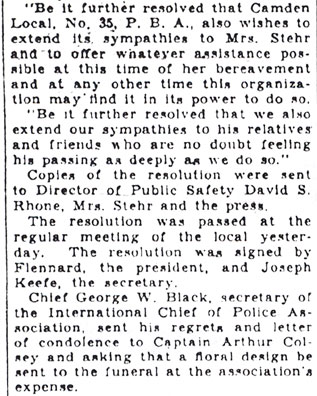
Named: Lewis H. Stehr, Dr. David S. Rhone, Charles V. Dickinson, Arthur Colsey, Donald Swissler, Clarence Phifer, Archie Reiss, George A. Ward, John Kowal, Harry Kyler, John Skolski, Herbert Anderson, Thomas Cheeseman, George Nowrey, Frank Truax, Ralph Bakley, Clay W. Reesman, Clifford A. Baldwin, Winfield S. Price, Clifford A. Flennard, Camden Local No. 35, P.B.A., B.C. Schroeder, Broadway, Royden Street, and Cooper Hospital.
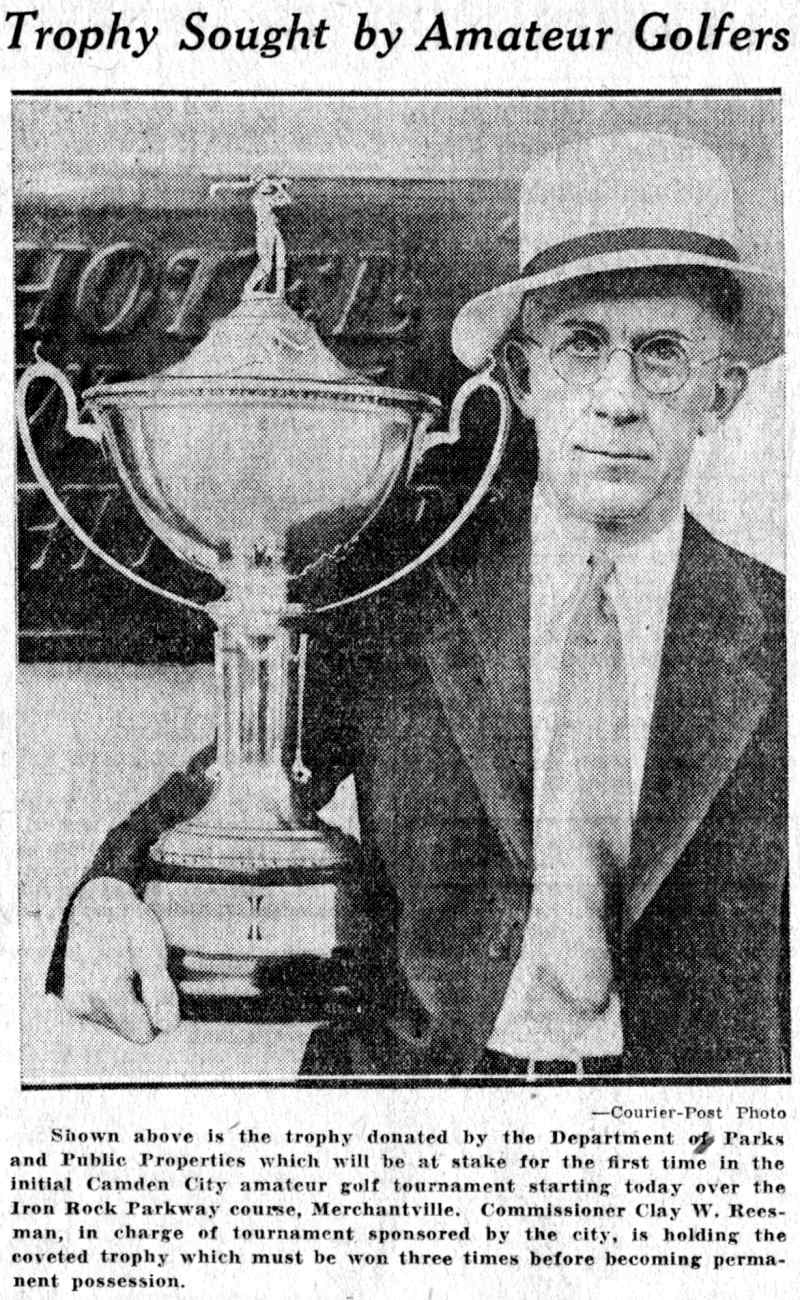
Trophy Sought by Amateur Golfers
Camden Courier-Post —
Friends Bid Adieu to Father Brennan
Camden Courier-Post —
Many Attend Farewell Dinner to Former Assistant at St. Joseph’s Church
More than 200 friends and fellow-clergymen attended a farewell dinner last night for Rev. William J. Brennan, former assistant pastor of St. Joseph’s Catholic Church, Twenty-ninth [sic] street and Westfield avenue. Father Brennan recently was appointed pastor of St. Cecelia’s Church at Islen [sic] and Menlo Park, in Middlesex county.
Dinner was served in the reception hall of St. Joseph’s School, adjoining the church. Rev. Charles G. McCorristin, pastor, and more than a dozen other priests joined in tribute to Father Brennan, who was extremely popular in East Camden.
City Commissioner Clay W. Reesman, director of parks and public property, also was a guest.
Father Brennan actively sponsored sports among the parishioners and students of St. Joseph’s. He took over his new charge last Tuesday but returned here to help direct a forthcoming play of the school children.
He was ordained 14 years ago and for a time was in charge of the Hopewell orphanage. He served as a chaplain during the World War. He is a native of Wallingford, Conn., and came to this city last March. His appointment to the North Jersey pastorate was announced early this week by Bishop John J. McMahon, at Trenton.
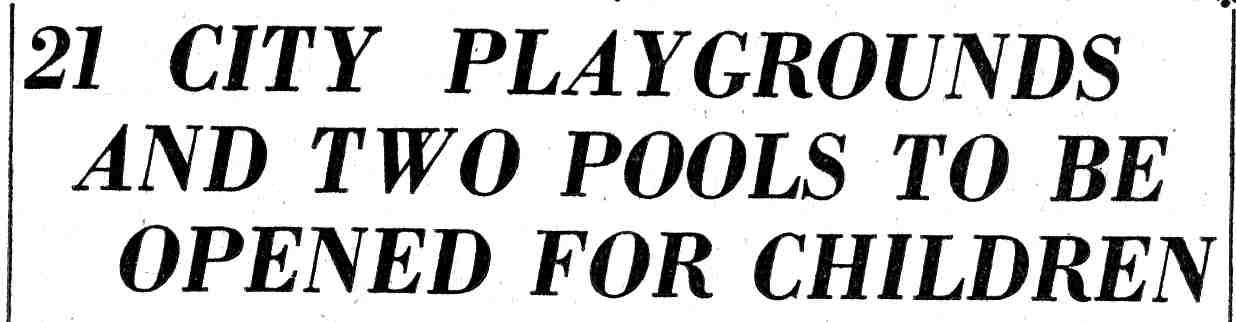
21 City Playgrounds and Two Pools to Be Opened for Children
Camden Courier-Post —
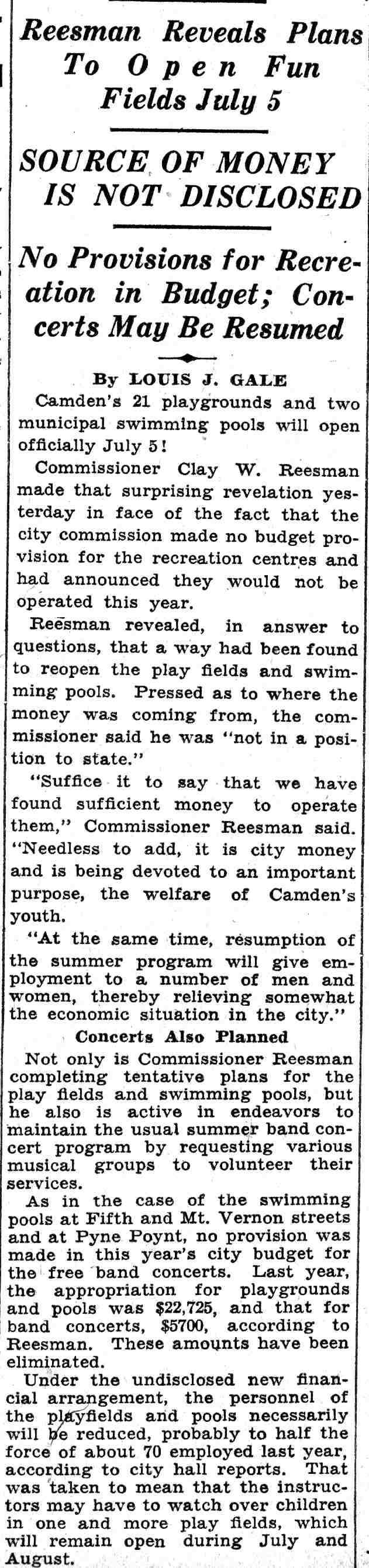
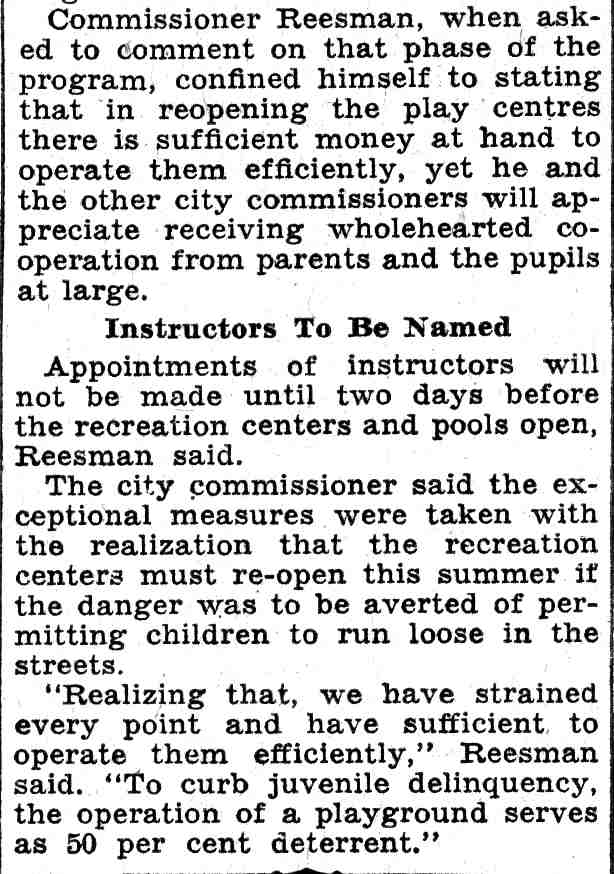
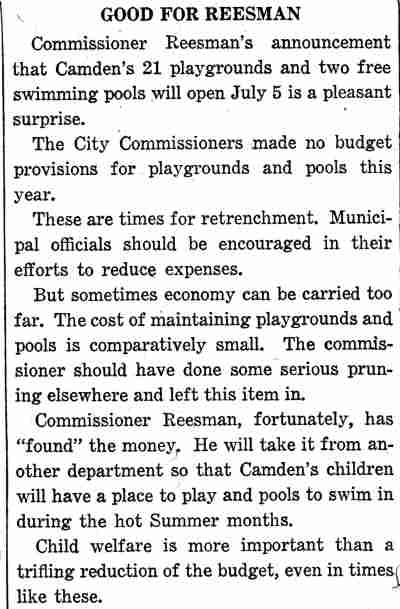
Instructors to Be Named for City Playgrounds
Camden Courier-Post —
Palese Peddles Tickets For His Own Testimonial
Camden Courier-Post —
Selling tickets for his own testimonial dinner is a distinction enjoyed by Assistant Prosecutor Rocco Palese.
The dinner, arranged as a testimonial to “the Polish Ambassador,” proved a surprise to Palese last night when 28 friends, members of the “Srelsihc Club,” let him share the secret in Hotel Walt Whitman.
The dinner, among other reasons, was tendered him because he was the only member of the club to put together a Courier-Post “Hi-Ho” puzzle. For a week prior to the affair he sold tickets to friends, not knowing the affair was in his honor.
With former Judge John B. Kates as toastmaster, wit and repartee passed the festive board, while entertainment was furnished by Bobby Heath and Billy James, famous writers of popular songs.
Those who did honor to Palese are: Judge Kates, Prosecutor Clifford A. Baldwin, Chief of County Detectives Lawrence T. Doran, John R. DiMona, Carl Kisselman, Herbert H. Blizzard, Robert Brest, Charles F. Knapp, Edward V. Martino, William Freeman, William Duby, Louis J. Gale, Edward Gorman, John J. Fitzgerald, City Commissioner Clay W. Reesman, Anthony Maltesta, F. J. Haws, Edward Neuman, Clifford Stratton, Jules Derowski, Bronislaw Derowski, Richard Troncone, T. Harry Rowland, William F. Lehman, William McDonald, Judge Frank F. Neutze and Robert W Saeger.
Joe Montana Wed to Miss Palladino
Camden Courier-Post —
Camden Wrestler and Bride Are Given Dinner Attended by Notables
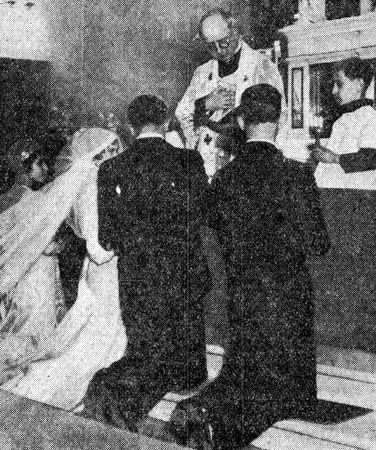
Miss Emma Palladino, one of the fairest daughters of Camden’s “Little Italy” yesterday became the bride of Joseph Montana, heavyweight wrestler, at Our Lady of Mt. Carmel Church, Fourth and Division streets.
Idol of Italian youth in this city Montana was hailed by hundreds of them outside the church. A number of relatives and friends, including prominent figures in the legal and professional life of the city, attended a dinner in honor of the couple at Overbrook Villa, Lindenwold, following the ceremony.
The bride, 20, is the daughter of Joseph Palladino, commercial photographer of 1115 South Fourth street. She graduated from Camden High school in 1928. Montana is 26 and a contender for the world’s heavy-weight wrestling diadem. Following a wedding tour through the West the couple plan to reside in Camden.
Miss Emenia D’ Alesio, of Audubon, and Miss Rose Marini and Miss Cecelia Szymanski, of Camden, served as bridesmaids. Attending the groom were Gene Mariano, Michel D’Ilesia and William Palladino. The bride carried a bouquet of lilies of the valley and white roses while her attendants held tulips and roses. The church was beautifully decorated with varied floral designs, gold ribbons, silks and satins.
The guest list at the bridal dinner included: Assemblyman Frank M. Travaline, Jr., City Commissioner Clay W. Reesman, director of parks and public property; Acting Chief of Police of John W. Golden, former Prosecutor and Mrs. Ethan P. Wescott, Samuel P. Orlando, Guido Laurini, Detective Fiore Troncone, Antonio Mecca, Mr. and Mrs. William Denof, Mr. and Mrs. Pasquale Ianuzzi, Frank H. Ryan, Thomas H. Ryan, Dr. and Mrs. Robert Principato, Mr. and Mrs. William Averall, Luke McKenna, Mr. and Mrs. Gene Mariani, Mr. and Mrs. Frank Abbott, Frank P. Cocchiaraley and Miss Regina Cocchiaraley, all of Camden; Miss Mary Montana, and Mr. and Mrs. Ettore Montana, of Columbus OH., and Aristadino D’Guilia and sons, Albert and Peter, of Buffalo, NY.
City Adopts Cut Budget After Clash
Camden Courier-Post —
Slash of $702,890 Is Revealed in Totals Passed at Session of Rulers
Lease Announced of Radio Station
Commissioners Debate With Von Nieda as He Charges Gross Extravagance
By Walt Batezel
The Camden City Commission yesterday approved the 1933 city budget after hearing and rejecting economy recommendations of several civic and labor organizations.
Eight speakers representing five organizations urged budget reductions and protested the total of $3,353,124.60. Verbal clashes over opinions were frequent between Commissioner Harold W. Bennett, director of finance and revenue, and former Councilman Frederick von Nieda and Thomas B. Hall, representatives of the Congress of Civic Associations of New Jersey.
Nearly 300 persons attended the hearing, in marked contrast to the 5000 who marched on city hall last year to demand budget reductions. The hearing lasted three hours. The departmental budget appropriations of $3,353,124.60 with the local school appropriation of $1,250,000 and other appropriations, totaling $960,060.55 to be added in the tax ordinance yet to be adopted, will give the city a total expense of $5,563,185.15 for 1933.
Tax Bill About Same
The tax rate will not be known until the tax ordinance is adopted. After the hearing Commissioner Bennett declared that due to equalization of assessments, the bills of some taxpayers will be a few dollars higher than last year, and a few dollars lower in other cases. The commission, after approving the budget on a motion by Commissioner Bennett, adopted a resolution leasing WCAM to the Broadcast Advertising Company for $1000 per year and a percentage of all receipts over $24,000. All maintenance costs will be born by the company, of which Rudolph Preisendanz, Jr., is head.
After the budget was adopted Bennett declared the City Commission would take into consideration an allegation of Frank J. Hartmann, Jr., secretary of the Civic Congress, that the $125,400 appropriation for street lighting was $26,450 higher than it should be according to figures obtained by him concerning the city’s lighting equipment. “If there has been an error the budget can be amended at any time,” Commissioner Bennett said.
Commissioner Clay W. Reesman, under whose department street lighting comes, declared that figures in his office concerning street lighting were different from those quoted by Hartmann. The figures he used, Hartmann said, were obtained by him from City Comptroller Sidney P. McCord.
Von Nieda Case
Von nieda was the first citizen to address the commission. Shifting papers in his hands, he faced the commissioners and said: “We have here $40,000 for your Recorder’s Court in 1932, and $25,000 for 1933.”
Commissioner Bennett jumped to his feet.
“Those 1932 figures,” Bennett said, “were merely an estimate of the receipts to be taken in, but that amount did not come in. This year we anticipate only $25,000, which we consider a fair estimate.”
“That’s fine” said von nieda, “but we have never had a chance to sit in with you on these figures.”
“You can sit in with us at any time,” responded Bennett, “We’re glad to have you.”
“I see here,” said von nieda, “that the transportation inspector is paid from fees, but you show no fees and the inspector should be paid by the Public Service. I also suggest that you turn Convention Hall over to the poor. Now in dealing with Station WCAM, I see you show a profit for the last three months of $1000, while in 1932, you show no records of receipts, and we are just wondering.’.
Worried by WCAM
“Do you want that answered now?” asked Bennett. “WCAM has given myself and the other commissioners some concern during the past year. It is our duty to see that we receive as much income as possible. Different methods have been used in the radio station to make it pay during the past three months, and during this time that station has been in the black. We figure that in 1933 there will be no deficit in this station, and we look for a profit of more than $1000.”
“Now in this matter of eliminating deputy directors,” von nieda said.
He was interrupted by Commissioner Reesman.
“I’ll tell you,” said Reesman, “about my deputy director Carlton Harris. My deputy receives $1750 a year. He has charge of all labor in the Department of Parks and Public Property. He is on the job every morning at 7:00 AM, and often works until 10 p. m., with the labor outside.”
“In speaking of the assessors,” von nieda continued, “we should have assessors who are not influenced by politicians or political dictators.”
“You know I won’t stand for that,” answered Bennett. “The readjustment of ratables is only a small part of the work we are doing. Each property is assessed on a basic principal. Any time you have a suggestion that will help us in our work we will be glad to hear from you but I firmly believe that real state must be relieved of its heavy tax burden by an income and sales tax, and this tax must come sooner or later.”
Seeking Relief
“As far as the city commissioners are concerned, we are studying it from day to day, in efforts to get out of the wilderness.
“In speaking of the purchasing department,” von nieda continued, “we know what happened there last year. You fired your purchasing agent, and if you had not fired him it probably would have afforded the public some interesting reading about this purchasing department.
“All of my men are working overtime,’ replied Bennett. “It is true the purchasing agent is out and his work is being done by an assistant (William Dilmore) at half his salary. We have got rid of as many people in these departments as we can. I had to let one girl go in the purchasing department and one girl in Controller McCord’s department. One man went on pension in the tax office and two were let out in efforts to balance the budget.
“In one of my departments where there were three girls I had to make a $900 cut by leaving one girl out. called the three girls into my office and told them that one had to go and asked them what their home responsibilities were. One had to take care of her family, including a 77-year-old aunt; another a family with a 66-year-old aunt, and the third was supporting three or four brothers with the help of another brother, who is a barber working for practically what tips he could get.
“But I had to make a $900 cut. The girls asked me not to dismiss any of them, as they each would take a $300 cut in addition to cuts already applied. Another man took an extra $260 cut so that he would not be out of work. But I had the budget to take care of, and I am ready to challenge any city the size of Camden to show so nearly a balanced budget. Our plan is to pay as we go.”
“You cite two or three instances,” protested von nieda. “But I want to show you scores of families which have no money and they are taxpayers. You say you have cut to the bone, but you should cut through the bone. This is no grandstand play by us. Maybe we can give you some help. Then, too, the debt interest must be paid on this tragedy,” he shouted, pointing to walls of the commission chamber.
“Maybe you can tell me how to get rid of the bonds,” suggested Bennett. “You must remember this year we have cut $900,000 from the budget.”
Offers Recommendation
Von nieda said the Civic Congress recommended that work now being done by two city solicitors should be done by one, that when more policemen and firemen are needed “little fellows” be restored first wherever possible; that the city incinerating plant be closed; that the personnel of the city’s two sewage disposal plants be reduced; that the city’s lighting bill be cut $40,000; that inspectors of lighting be abolished and their work done by policemen and the city’s engineer’s department. Personally he favored an income tax, he said, to relieve the burden on real estate.
“I realize,” von nieda said, “that the city commission has done a fair job, but of the congress, with conservatively 15,000 members, think you can do even better.
Commissioner Frank B. Hanna, director of public works, interrupted von nieda on the subject of the incinerating plant, which von nieda declared could be abandoned because it did not burn garbage, but only rubbish.
“Can you see me at 9:00 AM tomorrow and go through my department with me?” asked Hanna.
“Any time,” replied von nieda.
Warns of Tax Strike
“However,” von nieda continued, “we are wondering what the figures in the right hand corner of the tax bill will be. Assessments may be lower and the tax rate higher, and that does not give a true picture. I fear the bills will be more for 1933 and for one am willing now to take the 1932 assessment on my home.
“The congress vigorously opposes this personality tax. You expect to tax the homeowner for everything he has. I warn YOU gentlemen that if this tax is imposed in Camden there will be a run on banks and building and loan associations. If that happens homeowners and renters will leave this unfortunate city. There will be a tax strike here, and so help me God, I’m helping it!”
Von nieda was followed by William Hughes of 578 Mickle street, who spoke for the Unemployed Council of New Jersey.
Hughes reiterated demands of the union for increased relief payments to unemployed, urged a municipally-owned lighting plant, operated at a profit, the same as the city’s water department; a municipal lodging house; use of hand labor instead of machinery in all city contracts and the employment of labor to “tear down the slums in Camden.”
Hartmann was the next speaker. He read from a prepared statement which he declared was an analysis of the city’s 1932 lighting expenses, and which, he said, could be lowered “had we used larger lamps.”
Reesman Contradicts
After enumerating the individual costs of lamps of various candle power, and contending a change in the lamps would effect a saving this year, Hartmann charged the city has overpaid for electric energy in street lighting.
Commissioner Reesman declared that figures used by Hartmann were in error and that therefore, his computations as to possible savings were wrong. He announced, however, he would study the situation to discover if there was any error in the budget concerning street lighting, as alleged by Hartmann.
“The Civic Congress is now circulating petitions for a referendum on a municipal lighting plant,” Hartmann said. “We now have 10,000 of the required 11,000 signatures, and we do not intend to stop until we have 25,000. You commissioners can stop these petitions by adopting a resolution declaring a referendum on the question.”
He then asked that the work of the city electrical inspector be taken over by the National Board of Fire Underwriters, and that “when the next tax sale is held, all properties be advertised, including banks, garages and to whomever the property belongs.”
Commissioner Bennett then arose and said: “I’ve used discretion on that. There are some who are paying as low as $5 per month, and I think these people should be helped. We commissioners do not want to sell the home of anyone. That is what we are trying to stop. We are in perfect agreement on that.”
Debt Moratorium Asked
“How about the Bridge Garage?” some one in the audience shouted.
“The Bridge Garage has just paid $1500,” Bennett said, “and promises to pay something every month. We are trying to make the tax bills lower by getting in all the monies we can, and where possible to take in delinquent payments no matter how small.
Clarence Moullette, secretary of the Unemployed Union of New Jersey, then arose. He asked for a moratorium on the city debt service for five years, and urged the commission to adopt such a resolution memorializing the Legislature for that relief. He announced opposition to the personality tax.
“We are not questioning the actions of the commissioners,” Moullette said. “Spending less money will not help the situation. Commissioner Hanna told me if he had $51,000 additional in his department six closed garbage trucks could purchased. This will help give work. By cutting down salaries you decrease purchasing power. Work must be had. Eventually you will pay in scrip. Why not pay in scrip now and give out work.”
Hall asked that Convention Hall be abandoned and the building used for hospitalization work for the needy, and urged the city commission to “meet in the evenings so that citizens will know and see what is going on.” He asked for abolition of the positions of plumbing, building, sewer and heating inspectors.
‘Close High Schools’
“The commission should face conditions as they are,” he said. “I speak for myself, and not the Civic Congress. I ask that the high schools be closed. I heartily approve closing of the Vocational School, but if choice was to be made between high schools and the Vocational School, I would say close the high schools. Before selling the home of anyone to meet impossible taxes, I say cut to the bone by getting rid of everything that is not absolutely necessary.
“You commissioners must be made to realize that increased taxation is what has destroyed purchasing power in America. Meet this condition!
Commissioner Bennett challenged the statement of Hall that government costs were responsible for conditions of today.
“There are numerous causes,” Bennett said.
“I would rejoice in debating it with you or anyone you select,” Hall replied, “including United States senators, and convince them in 20 minutes.”
“I’ll debate that with him,” shouted Morris Stempa of Audubon from the audience. Stempa later addressed the commission, speaking for the Socialist party, and urged the moratorium advocated by Moullette, also a Socialist.
Eugene Wasilewski, speaking for you the South Camden Civic Association, denounced the commission for failing to call in civic association representatives in their preparation of the Budget.
Bennett Gives Reply
“You called in the bankers, but not those others of us who also are interested in city costs,” Wasilewski said. “You tell us now there is a reduction in assessments and then come along and wallop us with a higher tax rate. That is not fair. You were elected to look after our interests and that you have failed to do. You are making us eat red herring, and we want you to eat red herring with us.”
The last citizen to address the commission was Salvadore Guadelli, president of the Citizens-Taxpayers’ League. He made a general indictment of conditions, and asked that the city commission “do not let sectionalism creep into city affairs.”
Commissioner Bennett then arose and addressed his fellow commissioners and the audience.
“All these things suggested here today have been considered,” he said. “We five men came into office with the idea of serving the people. I know the business of financing the city is a serious problem. We have endeavored to move the budget into that realm of ‘pay-as-you-go!’ We appreciate everything presented here. Every taxpayer we look upon as an employer.
“Looking at it from every angle, this budget cannot be delayed any longer. You’ll find we were severe in preparing this budget; you’ll find we were severe last year. Last year we cut a half million. This year we cut $702,890.74, and to that the board of education, we hope, will add a cut of $250,000. That is a total cut of $952,890.74. Other cities in New Jersey show nothing to compare with it.
Budget Adopted
“I hesitate in making more cuts. I speak from experience when I say I’m a taxpayer. In the past two weeks I’ve been trying to raise money to pay taxes. I want all of you to know we commissioners can sympathize. It is not easy being at the head of a government in times like these. I hope that municipalities will receive federal relief in payment of debt service. There has been a tremendous cut in our budget, including the board of education figures. I feel the commissioners are to be commended for the work they’ve done this year.
“If we pass the budget we won’t stop at that particular point, but will see what else we can do all along the line. I feel the essential thing is to pass the budget. I’m proud of the fact we came through 1932, and are started in 1933 the same way, although I make no promise for the future. I wish for a moratorium for interest on bonds. There are the bondholders on one side and the taxpayers on the other, and the man out of work to be considered.
We are in sympathy with the man out of work. I say let the federal or government put some money into to the interest rate. We must pass this budget this afternoon. Do not delay longer. This is not an arbitrary stand on my part. I make a motion the budget now be passed.”
City Clerk Frank S. Albright called the roll and all five commissioners voting unanimously. No demonstration followed passage of the measure.
*Eugene Wasilewski referred to in this story was Eugene Waleskiewicz, who was later known as Eugene Wales.
Stewart Answers Civic Congress Demands For Additional Economies
Camden Courier-Post —
Mayor Announces City Workers Must Pay Tax Arrears
Explains That Suggestions For Savings Have Been Met Where Possible
Traffic Chief Upheld
Efforts will be made to have all city employees pay up their back taxes within three weeks, Mayor Roy R. Stewart promised yesterday. The mayor and Commissioner Clay W. Reesman issued statements to the press answering recommendations by the Congress of Civic Associations and other organizations which urged abolition of certain city jobs and municipal services.
One of the economies suggested by the Civic Congress was that all municipal workers be forced to pay whatever taxes they owe.
“I feel that this is entirely proper and an effort will be made to see that taxes on properties owned by city employees are paid within three weeks,” Stewart said.
Inspection Necessary
Answering a recommendation that the city eliminate electric inspection and have the work done by the National Board of Fire Underwriters, the mayor replied that Camden could not call upon the board to do the job. He said the work was imperative as a fire prevention measure. Stewart answered criticism of his personal city-owned automobile by saying it is used only in case of emergency and on special occasions, and that his chauffeur has been returned to police duty. Other cars formerly operated by the city have been eliminated as far as possible, he added.
It was urged that the position of transportation supervisor be abolished. The mayor declared that it would be inadvisable because the supervisor now is doing, in addition to his own job, the work of the mechanical inspector, who has been dropped from the payroll. Furthermore, Stewart stated, the supervisor’s salary is more than paid for by fees collected from the transportation companies.
The mayor defended the maintenance of telephones, at the city’s expense, in the homes of some employees. These phones, he said, are necessary for the efficient operation of the department of public safety. Those employees are required to be on call for any emergency. Many telephones found to be unnecessary have been eliminated, he said.
Regarding a suggestion for separate control of the police and fire bureaus, Stewart answered that “arrangements” already have been made to accomplish that purpose. He recalled that in the police department there are now only two captains, six Lieutenants and 16 sergeants on the force where there used to be six captains, eight lieutenants and 19 sergeants. Another recommendation concerned elimination of policemen in the parks. The mayor said he interpreted that to mean the elimination of park guards. He asserted that park guards have been released except three in Farnham park. Isolation of the park, he said, would create a rendezvous for disorderly persons.
Reesman declared that Convention Hall could not be closed, as urged by one group, or turned over to a board or private interests because under the law the responsibility for maintaining the building rests with the city commission.
Reesman to Address Audubon G.O.P. Women
Camden Courier-Post —
Clay W. Reesman, chairman of the Camden County Republican Executive Committee, will speak at the season’s last meeting of the Audubon Women Citizens Republican Club tomorrow night in Patriotic Order of America Hall on East Atlantic Avenue.
A musical program has been prepared for the occasion.
G.O.P. Will Dine County Leaders
Camden Courier-Post —
450 to Attend Affair for Reesman and Mrs. Verga on June 29
A testimonial dinner will be tendered Mrs. Elizabeth C. Verga and City Commissioner Clay W. Reesman by the Republican County Committee on June 29.
This was announced yesterday by Carlton M. Harris, Twelfth Ward committeeman, who has been chosen to direct arrangements for the event, to be held in the Walt Whitman Hotel.
Commissioner Reesman, director of public works, recently was elected chairman of the county committee and Mrs. Verga, who is vice-chairman of the state committee, was named to the same position on the county board.
It is planned to limit attendance at the dinner to 450 persons. Tickets are to be distributed by each member of the county committee.
Dickinson to Get Holloway’s Place
Camden Courier-Post —
Late Custodian’s Aide at Courthouse is Freeholders Choice
The Board of Freeholders will appoint Thomas Dickinson Jr. as acting custodian of the courthouse and the city hall-courthouse annex at its meeting this afternoon.
Mrs. Elizabeth C. Verga will be appointed to a new term of five years on the Board for the Supervision of Old Age Relief, of which she has been secretary-treasurer for one year. The post carries no salary.
Dr. Leslie H. Ewing, director of the freeholders, revealed the pending appointments. In the case of the custodianship, his announcement came as rumors spread that one of the bigger politicians would be named to the job left vacant since the death of Edward Holloway, the incumbent, last month.
“Dickinson, who was assistant to Holloway, will be named acting custodian to serve for the balance of the year,” Dr. Ewing said. “The freeholders will make the appointment tomorrow.”
Prior to Dr. Ewing’s announcement, rumors circulated at the city hall and courthouse mentioning postmaster Charles H. Ellis, City Commissioner Clay W. Reesman, Assemblyman F. Stanley Bleakly and former Sheriff Walter T. Gross among possibilities for the custodianship, which pays $2520 a year under the general county cut of 30 percent.
Reports that the aforementioned were candidates for the job could not be confirmed, and in certain quarters they were considered without foundation, mainly because the pay would be smaller in most instances than what those mentioned all possible candidates are now receiving in their other posts.
Other possibilities mentioned include Robert Brennan, First Ward Republican county committeeman, and Freeholders William P. Cotter and C. Leonard Brehm. Brennan had been employed for some time at the city hall and courthouse in maintenance of the building. Dickinson also is reported to be a candidate for the custodianship.
Acting custodian Dickinson will continue at the same salary he has been receiving as assistant, Dr. Ewing said. The director added that the freeholders may consider the custodianship vacancy again early next year, but whether the post will be filled is problematical because of the economic situation in the county.
Edge to Speak Here at G.O.P. Reception
Camden Courier-Post —
Kean and Barbour Also Coming to Affair for Reesman and Mrs. Verga
Former Ambassador Walter E. Edge today sent word to the committee in charge, that he will speak at the reception and dinner being given June 29 to Commissioner Clay W. Reesman and Mrs. Elizabeth C. Verga in honor of their election as chairman and vice chairman, respectively, of the Camden County Republican Committee.
In addition to Ambassador Edge, United States Senators Hamilton F. Kean and W. Warren Barbour have accepted invitations. Others on the speaking list are: Mrs. Edna B. Conklin, member of the Republican State committee from Bergen county; former U.S. Senator David Baird, Congressman Charles A. Wolverton, Registrar of Deeds Joshua C. Haines and Assemblywoman Isabella C. Reinert, retiring chairman and vice chairman of the county committee.
The reception is being held at the Walt Whitman Hotel, with tickets being distributed through county committee members.
State G.O.P. Chiefs Speak Here Tonight
Camden Courier-Post —
Stokes, Kean, Barbour Listed for Fete to Reesman and Mrs. Verga
A testimonial dinner will be given tonight by the Camden County Republican Committee in honor of party leaders with former Governor Edward C. Stokes as principal speaker.
Those to be honored are Mrs. Elizabeth C. Verga, vice chairman of the county committee and state committeewoman; Assemblyman Isabella C. Reinert, former vice chairman; Commissioner Clay W. Reesman, new chairman of the county committee, and Joshua C. Haines, register of deeds, the retiring chairman.
Other speakers will include Mrs. Edna B. Conklin, national committeewoman from Bergen county; Congressman Charles A. Wolverton; former U. S. Senator David Baird, Jr., U. S. Senators Hamilton F. Kean and W. Warren Barbour and E. Bertram Mott, state chairman.
State Senator Albert S. Woodruff will be toastmaster. Carlton M. Harris, chairman of the dinner committee, said last night that reservations have been made at the Hotel Walt Whitman for 500 guests and the committee is swamped with applications.
Other members of the committee in charge of the dinner are William D. Sayrs, Jr., treasurer, and Mrs. Pauline Caperoon, secretary.
Baird, Stokes Lash Richards Ambitions And ‘Horse Trading’
Camden Courier-Post —
Dinner to Reesman and Mrs. Verga Packs Whitman
Local Delegates Get High Praise
Ex-Governor Denounces Roosevelt Program, Hits Inflation
By Ransloe Boone
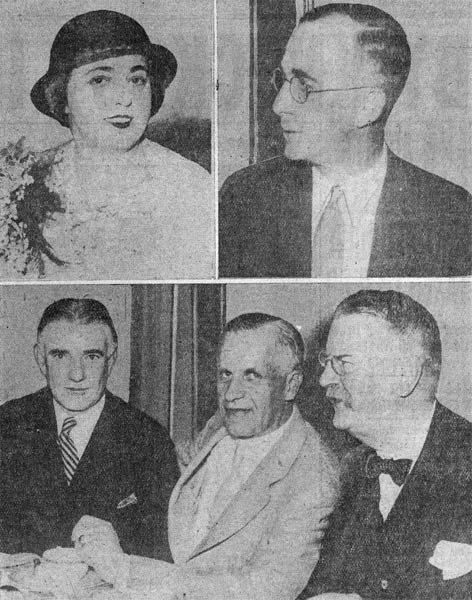
Bitter criticism of the “horse trading:” of the Legislature and the gubernatorial aspirations of Senate President Emerson L. Richards, were coupled with appeals for party loyalty and praise for Camden county’s leaders at a dinner of the Camden County Republican Committee in Hotel Walt Whitman last night.
The dinner, one of the largest ever held in the hotel, was in honor of City Commissioner Clay W. Reesman, new chairman of the county committee, Mrs. Elizabeth C. Verga, vice-chairman of the county and state committees; Joshua C. Haines, former chairman, and Mrs. Isabella C. Reinert, assemblywoman and former vice chairman.
Tribute was paid them by a distinguished gathering of more than 500 national, state and county leaders. So great was the crowd that the capacity of the main ball room was taxed and the junior ballroom was utilized also.
The attacks on “horse trading” and Richards were made by former Governor Edward C. Stokes and former United States Senator David Baird, Jr. Baird did not mention Richards by name.
Proud of Own Legislators
“We Republicans in Camden County have a faculty for victory,” Baird said, “but we can and will help to defeat selfish aspirants to office if they don’t play straight with the Republican party.”
“I am proud of the record of Senator Albert S. Woodruff and our Assembly members, Mrs. Isabella C. Reinert, F. Stanley Bleakly and Frank M. Travaline, Jr. They didn’t take any part in the trading of judges, highway commissioners and prosecutors.
“Camden County has been accused of not wanting civil service. When it came time to vote on the question Camden County stood by civil service as it always has, and beat the ripper.”
“Only when you play the game and stand four-square for the ideals of the party can you expect the people of the state to trust you.”
“Whose Legislature?’ Stokes declared:
“We won a great victory in New Jersey in the last presidential election. We did it by remaining loyal and not by trading with the Democrats.
“We thought we elected a Republican legislature. John Milton, Hudson County Democratic leader, however, says we elected a Republican legislature but the Democrats are putting on the show. But in that very paternal letter he wrote me not long ago, telling me what I should do and why I should not ‘interfere’ with’ the Legislature, Senator Richards assured me the Republicans controlled the Legislature, I’m glad to know that for, of course, Richards is always right.”
Stokes predicted history would repeat itself and the Republican party soon would come back into its own.
“The party that stands by its principles despite defeat always comes back.”
The former governor proposed two means of lowering the present high taxes and heavy expenditures.
“I wish this county committee and all those throughout the state would insist on legislation to prohibit municipalities from spending more than they have and from floating bond issues and I wish you would support legislation providing for a limited local tax rate and providing for a gradual reduction of taxes to that maximum.”
Doubts Roosevelt Plan
He expressed doubt as to the wisdom of some of the Roosevelt program. Inflation makes us prosperous, if revoking the gold standard aids us, amen, if calling 18 inches a yard will help us, that’s fine. If we can ask employers to sell us more and not throw more of our own workers out of work, that will be wonderful. But I can’t understand how we will be aided by those proposals. It’s too much for me.”
He demanded that, France, England, and the other nations pay their debts, declaring they were spending five times their debts on armaments.
Congressmen Defend F. D. R.
Wholehearted support of all of President Roosevelt’s measures which will promote relief from present economic conditions was pledged by United States Senators Hamilton F. Kean and W. Warren Barbour and Congressman Charles A. Wolverton.
Kean explained that he voted for the economy bill after he had been assured the president would not touch the compensation of those veterans whose injuries were service connected and that it was passed only because “pressure was brought to bear.”
After paying tribute to Reesman and Mrs. Verga, Kean said:
“One of the first bills introduced by the new administration was the economy bill. This bill authorized the president to consolidate departments of the government, of which there are a great many overlapping and which could be done without any injury to anybody except those receiving salaries or emoluments there from. The bill also authorized the president to adjust the wages of government employees and to examine in and make new rules for those receiving pensions from the government. A year ago we tried to give Mr. Hoover power to do away with a lot of these offices that were unnecessary and useless. Mr. Hoover promised if he had the power that he would do so, but this was beaten by the Democrats, so that Mr. Hoover never had the power to do away with these useless bureaus.
Economy Bill
“The history of the economy bill is this: After it was passed by the House, before they had time to read it and under a special rule the debate was so limited that nobody knew anything about it before it was voted on, it was then sent over to the Senate and referred to the finance committee. In the finance committee a Democrat moved that the president should not have authority to reduce anybody’s compensation more than 25 percent.
“Each senator voted for or against the measure or amendment under consideration. On this amendment, upon the call of the roll, the majority of the Democrats voted in favor of the amendment. Most of the Republicans voted against the amendment and it was a tie on the last Republican name on the committee. This was Senator Walcott, of Connecticut, and he voted ‘pay’ on the amendment. This beat the amendment. Next was the question of reporting the bill out of the committee to the floor of the Senate. This was again a tie vote when it came to Senator Walcott and he voted ‘aye,’ which reported the bill out.
Won on G.O.P. Votes
On the floor of the Senate the bill would not have passed but for the Republican votes. We were assured by the Democratic leaders that the president would not touch the compensation of those veterans whose injuries are service connected. In other words, the wounded. When the regulations came out, some two months after this bill had been passed, they had cut the wounded veterans to pieces.
“When the president saw that the Senate voted almost two-thirds to take away this power from him, he got up some compromise formula which was not satisfactory, and got it passed by the House. This was submitted to the Senate and it was on this proposition that every Republican senator voted to support the Senate amendment rather than the House amendment, and I believe that had no pressure been brought to bear on the senators that every senator in the chamber would have voted for the Senate amendment, rather than for the House amendment.”
‘Pay Tribute’
“I don’t criticize the president, I pay him tribute,” Barbour said. “He showed outstanding courage and initiative. He is taking a long chance in many respects and it is the duty of Congress to make the program succeed. It is the program of the nation and I hope it does succeed. However, I do not forget my loyalty to the Republican party. The test is coming this winter in the administration of these great pieces of legislation. I feel it my duty as a Republican not to play politics, but I shall raise potent protest against any unfair or unwise laws.”
He praised Mrs. Verga and Mrs. Edna B. Conklin, of Bergen county, national committeewoman, who was among the guests of honor.
“I never would have been elected if it were not for the combined efforts of those ladies,” he said.
Two future booms were launched.
Mrs. Verga for Senator
“Some day when Senator Woodruff gets tired of being Senator, I hope to see Mrs. Verga as Senator or, if Congressman Wolverton would become Governor, I should like to see Mrs. Verga in his place at Washington. She is marvelously capable of filling both jobs.”
In response Wolverton laughingly said:
“That’s the first time I ever heard a sober man nominate me for governor.”
Wolverton’s address follows:
‘Cites Relief Jigsaw’
“In the few minutes allotted to me, it will not be possible to speak upon several subjects as I would like. I do wish however, to touch briefly and in a general way upon what in my opinion should be the policy of the Republican party at this time with reference to national affairs.
“The economic condition that confronts our nation today, with its attendant paralysis of business, finance, industry and agriculture, creating widespread unemployment, destitution and need, has brought us face to face with an emergency surpassing in its possible consequences even that of the World War. Its devastating effect has brought distress to millions of our people.
“Demand for relief comes from every conceivable source. It is not confined to any particular class. Bankers, railroads, industrial corporations, farmers, homeowners, businessmen, sovereign states, local municipal governments, capital and labor, rich and poor, each with divergent views and often conflicting interests, but all with an insistent demand that each shall receive the particular kind of relief its individual need requires.
Defends Administration
“In answer to the demand of our people for relief, the president called Congress into special session. He submitted his program for relief and recovery to the Congress and it has been enacted into law. To provide effectual relief in the variety of ways made necessary by the different needs to be served required the entrance of our government into new fields of activity.
“There has been a disposition upon the part of some who hold representative positions in our party to criticize the enactment of such laws upon the basis that we have cast aside many of the fundamental traditions of our nation. Such criticism in my opinion is wrong. It overlooks entirely the serious emergency now existing affecting the welfare of our people and which in my opinion is sufficient justification for the enactment of such temporary legislation.
In times such as these, if we are to best serve our people, we cannot hold to the same course of action that has prevailed in other times.
“This is a time of distress and need— a time that calls for the application of new principles or a rearrangement of the old.
“Policies and principles of government set up and agreed upon in times of prosperity cannot be accepted as standards in times of economic distress when the financial and industrial organizations of the country are prostrate and our people in want.
Warns Of Criticism
“Nor do I believe our party can gain public confidence by inaugurating at this time a campaign of criticism against the program and policies recently enacted by Congress. It has not as yet had a chance or a trial. This is not time to be destructive denunciation without constructive proposals. This is no time to create doubt. It is a time when everyone regardless of party affiliations should co-operate to build confidence, dispel fear and create courage.
“What we need today is constructive co-operation by all political parties. Let each retain his party lines, but co-operate for the common good.
“As a party we must have the vision that will enable us to recognize that new conditions create new obligations and the necessity for the application of new and different policies of government to fulfill our entire responsibility.
“We must have not only the vision as to the necessity, but also the courage to do things which a few years ago would have been unthought of because contrary to accepted theories of what is a proper field of governmental activity and unjustified under the prosperous conditions then prevailing.
“No Place for Politics”
“Let our thought be in terms of the common good, then there will be no denial of the necessity or the propriety of the government— in times such as these, assuming a responsibility to promote the general welfare and seeking to fulfill that obligation by entering into enterprises or assuming functions, that otherwise would be unjustified.
“In this time of crisis, when we are seeking to relieve human misery, there is no place for small or mean partisan politics. Nor is this any time for demagogic utterances— this is a time for calm and deliberate consideration and judgment. A time when it is imperative that whatever gives promise of relief shall have our whole-hearted support.
“In conclusion, permit me to suggest that the greatest opportunity for our party in the days immediately before us is to give sympathetic consideration and support to those measures and policies that will best promote human rights. Our party had its origin in support of that great principle and the future measure of its success will depend upon the extent of our adherence to it.”
Baird also declared he would support the president.
“Mr. Roosevelt is our president. Republicans will support him, in every thing which is for the bests interests of the country. All should wish for his success,” Baird said.
Sales Tax Urged
Mott urged that Republicans support a sales tax as the most equitable means of raising needed money.
“A sales tax would distribute the cost equally and would be more fair than the income tax. As we know from the hearings in Washington, some aren’t paying their income tax, anyway.”
Mrs. Conklin paid tribute to Mrs. Verga for her great political sense, ability and understanding of human nature.
She urged that all Republicans work as enthusiastically as a minority party as they did as a majority.
“We must go along and build until we become the majority again,” she said.
Edge Sends Regrets
Walter E. Edge, former Ambassador to France, who was to have been the principal speaker, was unable to attend because he and his family are at their summer home in Maine. He sent a telegram expressing his regrets and his wishes for success to Mrs. Verga and Reesman. It had been reported Edge would be boomed for governor at the dinner but no mention of such a proposal was made.
The honor guests spoke briefly. Reesman asked for the support of the county committee and pledged himself to give all his energy towards the success of the party.
Mrs. Verga praised the committee members and thanked them for their support. She paid a special tribute to former Senator Baird.
“We have been successful in Camden County,” she said, “because we still stand solidly behind our leader, David Baird.” Her tribute was greeted by long applause.
Mrs. Reinert and Haines also spoke briefly pledging their support to the new chairman and vice chairman.
Woodruff Toastmaster
State Senator Albert S. Woodruff was toastmaster. He was introduced by Carlton M. Harris, chairman of the dinner committee.
The county committee presented a lounging chair to Reesman and a silver flower bowl to Mrs. Verga, as well as flowers to Mrs. Reinert and Haines. Flowers also were presented to the new chairman and vice chairman by the Twelfth Ward Republican Club and the ladies’ auxiliary, by the Young Republicans of Camden county through Harold Joyce, its president, and by the Bergen county Republicans, through Mrs. Conklin.
The dinner committee, in addition to Harris, was headed by Mrs. Pauline Caperoon, secretary; Mrs. Mary S. Hartung, assistant secretary, and William D. Sayrs, Jr., treasurer.
Sunday Beer Plea Faces Test Today
Camden Courier-Post —
Commissioners Deny Knowing Which Will Sponsor Ordinance
The Camden City Commission may consider a Sunday beer sale ordinance today.
That was admitted last night by several members of the commission, although all claimed they had no idea who would advance the ordinance.
A conference of the commission is scheduled for noon, prior to today’s regular meeting at 2:30 PM. It is believed that if an ordinance is to come up it will first be considered in caucus.
Request for Sunday beer was made in a resolution adopted unanimously by the Camden County Division of the New Jersey Licensed Beverage Association.
Proprietors of more than 60 of the city’s leading establishments voted in favor of Sunday beer at the time the resolution was adopted, a week ago.
Copies of the resolution were sent to each member of the city commission. They pointed out that “several communities bordering Camden permit the sale of beer in Sundays.”
Commissioners Frank B. Hanna and Dr. David S. Rhone are known to favor Sunday beer sales. Mayor Roy R. Stewart and Harold W. Bennett, director of finance, have expressed disapproval of it. Commissioner Clay W. Reesman has been straddling the issue.
Photos
Camden Courier-Post —

Named: Albert S. Woodruff, Elizabeth C. Verga, Emma Hyland, Harry L. Maloney, Hotel Walt Whitman, Firmin Michel, Carl Kisselman, Mitchell H. Cohen, Edward V. Martino, John J. Crean, Clay W. Reesman, William D. Sayrs, Pauline Caperoon, Abe Fuhrman, Harold W. Bennett, Mary Kobus, George E. Brunner, Frank J. Hartmann Jr., Frank T. Lloyd, and Frederick von Nieda.
Photos
Camden Courier-Post —
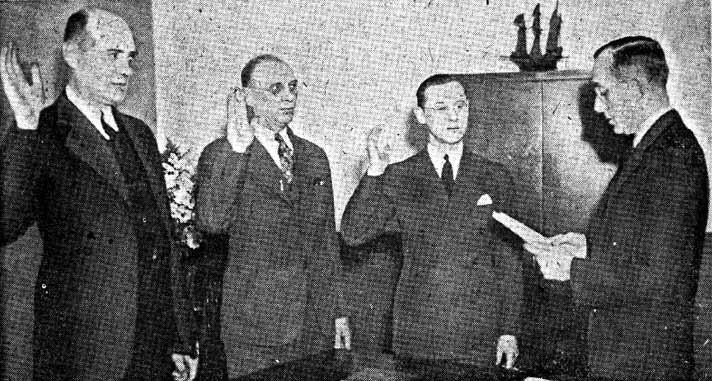
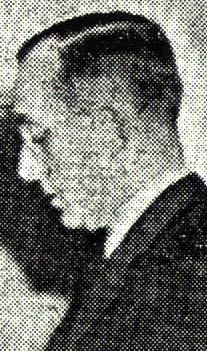
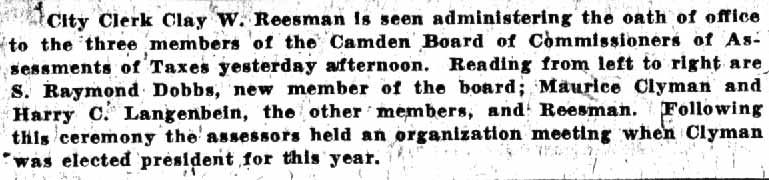
Named: S. Raymond Dobbs, Maurice Clyman, Harry C. Langebein, and Clay W. Reesman.
Employees of City for Insurance Plan
Camden Courier-Post —
Only Seven of 184 Polled to Date Oppose Group Security Proposal
Voting to date by Camden City employees on a group insurance plan indicates an overwhelming majority in favor of the proposal, City Clerk Clay W. Reesman revealed yesterday.
Of 184 votes cast so far, 177 are affirmative while only seven are opposed, said Reesman, in whose office the cards are deposited.
The plan would provide life insurance for 871 of Camden’s 880 municipal officers and workers at a cost of $1.20 per month per $1000, of which the employee would pay 90 cents and the city 30. For the plan to become operative, at least 75 percent of the 871 eligible must participate. The age limit is 70.
Reesman explained the comparatively few votes by pointing out most of the semi-monthly pay checks had been distributed Friday before the voting cards were sent to the office of Comptroller Sidney P. McCord. He pointed out the police and fire departments got theirs yesterday.
Those who voted against the plan said their opposition is based on the uncertainty of continuing in the city’s employ, and the fact that the policies have no cash surrender value. Although convertible into regular individual policies upon severance of municipal employment, they cite the possibility they might find themselves unable to pay premiums if unemployed.
Some dissatisfaction also was voiced with the salary classification system whereby workers receiving $1500 or less annually were restricted to $1000 policies; those in the $1501 to $2500 pay range, $2000, and all above $2500, $3000. It was argued the city should contribute less proportionately toward the larger policies of the higher-paid employees and officials. The cost to the city on a straight 25 percent basis, the maximum permitted under the law, if all 871 men and women accepted the insurance would be $5035.80 annually.
Parley Due Today on Light Plant Bill
Camden Courier-Post —
Burling to Confer With Hartmann; May Introduce Measure Wednesday
Hopeful of Introducing Camden’s light plant bill at Wednesday’s session of the Legislature, State Senator Albert E. Burling planned to confer today with City Commissioner Frank J. Hartmann and the latter’s assistant, Walter S. Anderson.
Anderson appeared before Burling and the Camden county Assembly delegation at the weekly forum Saturday with suggested revisions in previous bills, after contracting Dr. Clark Forman, of the PWA legal staff in Washington. Today’s conference was the outgrowth of that discussion.
City Clerk Clay W. Reesman, of Camden, asked the Legislators to amend the election law to defer certification of polling places until Fall in years when primaries are held in September.
Cites Election Law
Reesman pointed out that Article 8, paragraph 87 calls for municipal clerks to send polling place lists to county boards of election before March 1 and directs the county boards to certify them back by April 15.
“That was all right when primary elections were held in May each year,” Reesman said. “But now they are held in September except in Presidential years, and the dates should be changed to August 1 and September 1 except in Presidential years. As it now stands, changes are made all Summer after the list is certified, until the original list becomes unrecognizable.”
Clarence Dunkleberger, of the Eleventh Ward, reappeared to ask that a way be found to provide an underpass for school children who cross the railroad tracks between Cramer Hill and the Westfield Avenue section. There are no crossings between Twenty-seventh and Thirty-sixth Streets.
Asks About Trade Mark
Dunkleberger said it is his understanding that an existing law requires railroad companies to provide crossings at every other block, but if this is not so, he asked that a bill be introduced to compel railroads to provide crossings every half mile in second-class cities.
Charles Dieck, of Philadelphia, representing non-residents in business in New Jersey, appeared to ask questions concerning the Foran trademark bill, which it is estimated by its sponsor would provide $10,000,000 this year to help finance relief.
Dieck said he had been unable to obtain a copy of the bill, which was introduced in the upper house last Monday.
“I have been to the Courier-Post and the bills are not available.” Dieck said.
“You come down to my house and I’ll show you the bill,” put in Assemblyman Millard E. Allen, of Laurel Springs, who wants all employees of the publication “led to the guillotine.”
“How can you show him the bill?” asked Assemblyman Rocco Palese, “when they haven’t been printed yet?”
Maybe He Has Got it
“I got my bills yesterday,” Allen insisted.
“Was that bill among them?” inquired Burling. “I haven’t been able to get one yet,”
“I think it was, but I’m not positive,” admitted Allen. “At least I have some information on it.”
“I don’t think you have the bill,” Assemblyman Lawrence H. Ellis said. “I was told in Trenton they haven’t been printed yet.”
“Well, I said I’m not positive,” Allen declared. Shortly afterward he left the session.
The legislators voted to dispense with the regular weekly meeting next Saturday, because it is Lincoln’s birthday. They will be resumed February 19.
Burling Confers With Hartmann on Light Plant Bill
Camden Courier-Post —
Details of Possible Legislation to Enable City to Get PWA Funds Kept Secret
Anderson at Parley
A conference on Camden’s proposed legislative light plant bill was held yesterday by State Senator Albert E. Burling, Commissioner Frank J. Hartmann and his assistant, Walter S. Anderson. The session was held in Burling’s private office.
Neither Burling nor Hartmann would disclose if they had decided on any action to introduced a bill to provide enabling legislation to obtain Federal PWA funds for the proposed municipal electric light plant, for which voters of the city twice cast a majority vote.
“The conference was held at the request of Commissioner Hartmann,” Burling said. “We discussed possible legislation which may be favorably acted on by the Legislature.
“It was agreed that our plans not be discussed or made known for the present and not until the matter can be more thoroughly analyzed and discussed.”
Commissioner Hartmann was reluctant to discuss the conference.
“Out of courtesy to Senator Burling I do not desire to discuss the matter,” Hartmann said.
Anderson appeared before Burling and the Camden county Assembly delegation at the weekly forum Saturday with suggested revisions in previous bills, after contacting Dr. Clark Forman, of the PWA legal staff in Washington. Today’s conference was the outgrowth of that discussion.
City Clerk Clay W. Reesman, of Camden, asked the Legislators to amend the election law to defer certification of polling places until Fall in years when primaries are held in September.
Cites Election Law
Reesman pointed out that Article 8, paragraph 87, calls for municipal clerks to send polling place lists to county boards of election before March 1, and directs the county boards to certify them back by April 15.
“That was all right when primary elections were held in May each year,” Reesman said. “But now they are held in September except in Presidential years, and the dates should be changed to August 1 and September 1 except in Presidential years. As it now stands, changes are made all Summer after the list is certified, until the original list becomes unrecognizable.”
Clarence Dunkleberger, of the Eleventh Ward, reappeared to ask that a way be found to provide an underpass for school children who cross the railroad tracks between Cramer Hill and the Westfield Avenue section. There are no crossings between Twenty-seventh and Thirty-sixth streets.
Asks About Trade Mark
Dunkleberger said it is his understanding that an existing law requires railroad companies to provide crossings at every other block, but if this is not so, he asked that a bill be introduced to compel railroads to provide crossings every half mile in second-class cities.
Charles Dieck, of Philadelphia, representing non-residents in business in New Jersey, appeared to ask questions concerning the Foran trademark bill which, it is estimated by its sponsor, would provide $10,000,000 this year to help finance relief.
Dieck said he had been unable to obtain a copy of the bill, which was introduced in the upper house last Monday.
“I have been to the Courier-Post and the bills are not available,” Dieck said.
“You come down to my house and I’ll show you the bill,” put in Assemblyman Millard E. Allen, of Laurel Springs, who wants all employees of the publication “led to the guillotine.”
“How can you show him the bill?” asked Assemblyman Rocco Palese, “when they haven’t been printed yet?”
Maybe He Has Got It
“I got my bills yesterday” Allen insisted.
“Was that bill among them?” inquired Burling. “I haven’t been able to get one yet.”
“I think it was, but I’m not positive,” admitted Allen. “At least I have some information on it.”
“I don’t think you have the bill,” Assemblyman Lawrence H. Ellis said. “I was told in Trenton they haven’t been printed yet.”
“Well, I said I’m not positive,” Allen declared. Shortly afterward he left the session.
The legislators voted to dispense with the regular weekly meeting next Saturday, because it is Lincoln’s birthday. They will be resumed February 19.
Is Zat So?
Camden Courier-Post —
by Gordon MacKay
May we not at this time proffer a suggestion to Mayor Brunner, Eddie Kelleher and the other party sachems that should be a sure-fire plan to make Camden county safe for Democracy? We advise that the Democrats gather a fund of $4000, the money to be expended in giving testimonial dinners to Republican leaders, near-leaders and persons who figure themselves to be both.
Engage tables enough to accommodate about 350 persons. Invite representatives of all the various G. O. P. factions in the county, give a half dozen tickets to boisterous Democrats, so that the latter can sit back in their seats and enjoy the subsequent dogfight on a full stomach.
This idea that I am advancing to register about 5000 more Democrats in the county and paralyze the remnants of the once-powerful county G.O.P., was born when I attended the recent testimonial dinner to Louis Bantivoglio, freeholder from the Fifth ward.
Naturally my attendance was purely in a professional capacity. Speeches were made by divers and sundry spokesmen, the high-light being the sales talk for Bantivoglio and Baird by David Baird, Jr. The latter waxed wrathfully but warily in castigating the “half-breeds,” as he once sarcastically termed the Republicans of the ilk and stature and political leanings of Commissioner Mary W. Kobus.
Rarely, too, have we ever attended a banquet, either in the capacity of guest or reporter that ever awakened so many echoes of the past as did the dinner to the Fifth ward freeholder.
Mrs. Kobus Elected Louis
First came the information from friends of Commissioner Kobus that she was responsible for the election of Bantivoglio from the Fifth ward as freeholder. In view of the fact that Squire Baird seemed to feel that the freeholder’s election was a personal triumph, this appeared strange to yours truly.
We moseyed about, however, and discovered that whether the squire likes it or not Mary W. Kobus and her minions did elect Bantivoglio. The leaders of the Kobus faction who put the thing across were headed by a woman named Madeline Salvatore and a gentleman named “Bucky” Branch.
Bantivoglio was elected by something less than 40 votes. These votes could easily have been given to his opponent but there were strategic reasons why the Kobus faction didn’t want a Democrat chosen from the Fifth ward.
So Branch, who is a policeman, I believe, and who was not working on election day, it being his regular day off, went into his precinct and put over the votes that elected Bantivoglio.
And Mr. “Bucky” Branch, I have been informed, has been so sore at the fact that he did elect Louis Bantivoglio that he moans and cries and berates himself ever since the trick was turned.
Politicos who told me the story about the Kobus support for Bantivoglio gave a rather sensible reason for the step that was taken by the anti-Baird folk. The New Dealers among the Republicans sensed that the division between the Republicans and Democrats in the 1938 Board of Freeholders was going to be exceedingly close.
Too close, in fact, to take any chances. So it was decided to support Bantivoglio in the Fifth ward, because he was a regular Baird Republican and couldn’t be won to the coalition. The reasoning of the Kobusitees was clear and correct.
Had Bantivoglio been beaten by a Democrat, the board would have been divided equally. The Democrats would then have been able to deal with an individual rather than a faction. One vote would have given either side control. Thus by putting Bantivoglio across the Kobus faction made it imperative for the Democrats to deal with that clique; in fact Brunner and his minions had to do that little thing.
In view of this analysis I’m content to believe that the Kobus claim that the New Dealers elected Louis Bantivoglio is absolutely okay.
Lady “Copper” Not Trade Party
Now don’t get the information askew. Mrs. Kobus had no official or personal hand in this matter. It was the keen thought of some of her lieutenants, whose judgment appears to have been excellent, that fashioned this plan and executed it.
Meanwhile numerous politicos have been jibing Baird’s statement that he would “rather have one Louis Bantivoglio than 1000 ingrates.” These political seers and soothsayers declared that such a declaration proved that its author was all wet in his political judgment and short sighted in his political history.
These politicos ambushed Mackay the other day, crammed him into a corner and told him that if it “hadn’t been for Bantivoglio Baird would have control of the city commission today.”
These chuckling anti-Bairdites not only bearded me in my den, but dared me to disprove their statements by taking a look at the record. A stranger to politics in Camden, I didn’t know the import of this statement until I squinted at the ward returns for the 1935 city commission election.
There in black and white is the proof that Baird lost the city commission fight because of the Bantivoglio-Leo Rea alliance in the Fifth ward. Just to take a look at the record again and to refresh jaded memories, the regular Baird slate received the following votes in the Fifth ward:
Bennett, 1016; Leonard, 1001; Lummis, 962; Rhone, 963; von Nieda, 1081. The New Deal ticket, then supported by the Messrs. Bantivoglio and Rea, polled these votes: Baker, 1032; Brunner, 1022; Hartmann, 1001; Kobus, 1024, and Reesman, 930.
We would call your attention particularly to the Leonard-Hartmann vote. Louis and Leo supported candidates Brunner, Kobus and Hartmann, of the New Deal.
Leonard and Hartmann polled exactly the same vote, 1001. And the recount revealed Hartmann a winner by SEVEN votes, the box score showing Hartmann, 17,338, and Leonard, 17,331. And the Fifth ward turned the trick, for it would have been easy for Louis and Leo to have given Hartmann the same vote that Reesman received, or 71 less, and elected Leonard. There would have been no recount then.
Which scrutiny of the returns would seem to show that Bantivoglio as a friend of the squire proved his valor and vigilance in the cause by seating a New Deal commissioner and owing his seat in the Board of Freeholders to the Kobus clan.
In connection with this fund which the Democrats should raise to give testimonial dinners to G.O.P. leaders et cetera we might suggest that on each occasion they have, David Baird Jr., named for a new office. In order, that my friend, Florence Baker, can show her loyalty and friendship to the Old Guard Field Marshal by asking his election to the said office.
This suggestion to the Messrs. Brunner, Kelleher and the others is made tax-free, and no charge for usage. If that scheme doesn’t make Camden county safe for Democracy, nothing will.
City Seeks Bidders for Mid-City Plot
Camden Courier-Post —
$375 Minimum Monthly Rent Required by Rulers in Lease Offer
Present Holder Quits
Camden’s municipal parking “lot,” bounded by Federal, Arch and Fifth street, will be put on the auction block again.
The City Commission yesterday authorized the legal department to make provisions for offers on a month-to-month rental of the tract.
No bid will be accepted unless the rental bid is more than $375 monthly, payable in advance.
Monroe Y. Brett, present holder of the lease, was awarded the rental contract on his bid of $441 a month. Since taking over the plot for a paid parking space he has lost money, he informed Commissioner Hartmann last week. Brett’s lease expires Monday.
Available March 15
The resolution provides the lease shall be awarded the highest bidder for a term beginning March 15.
The lease, together with the terms agreed upon, will be filed with City Clerk Clay W. Reesman and shall lay over for two weeks to be open for public inspection.
Nothing is contained in the resolution that requires the city-owned plot shall be used for parking purposes. The resolution sets forth the “piece of ground is not needed for public use by the City of Camden.”
Anticipated action on a proposed lease for radio station WCAM failed to develop.
The lease with the Broadcasting Advertising Company expired February 1, and since that time the station has been operated by the city under supervision of the Department of Revenue and Finance of which Mayor Brunner is director.
Housing Plan Deferred
Hartmann withheld a resolution he had prepared, providing a municipal housing authority composed of five members to supplant the present housing committee.
Hartmann announced he desired to study similar authorities in other cities. The legislature has not approved four Assembly bills providing the enabling legislation necessary to secure U. S. Housing Authority funds for slum clearance and low-cost housing, he said.
Mayor Brunner said he has been directing operation of the radio station with negligible profits. “The station has been a big headache,” the mayor said. “I expect to lease it as soon as certain matters are adjusted to the satisfaction of the Federal Communications Commission.”
Merchants Cautioned to Get 1938 Licenses
Camden Courier-Post —
Photos
Camden Courier-Post —

Named: Frederick von Nieda, Frank J. Hartmann Jr., Clay W. Reesman, Firmin Michel, and Benjamin Shatz.
Wagner Asks Camden to Back Housing Bill
Camden Courier-Post —
City Clerk Clay W. Reesman yesterday received from U. S. Senator Robert F. Wagner a letter asking the Camden City Commission’s stand on Senate Bill 591, current housing bill before Congress. Pointing out that when the original housing act was before Congress in 1937 the City Commission passed a resolution of endorsement, Wagner appealed for support for his ’39 bill, authorizing the Federal Housing Authority to make loans to local housing authorities in the amount of $800,000,000 and to grant additional annual contributions to such agencies amounting to $45,000,000.
Only One Candidate Files for Primary
Camden Courier-Post —
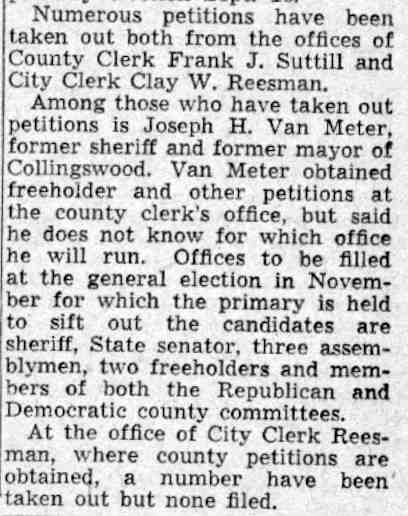
Named: Walter W. Johnson, Frank J. Suttill, Clay W. Reesman, Joseph H. Van Meter, and New Street.
Ewing, 3 Others File Committee Petitions
Camden Courier-Post —
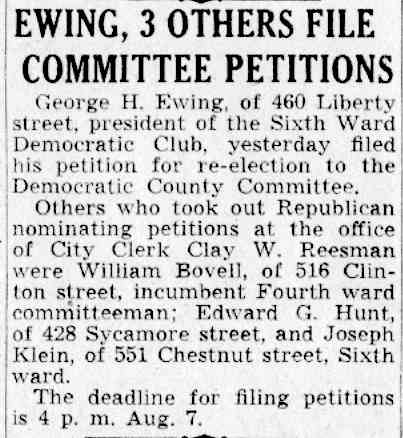
EWING, 3 OTHERS FILE COMMITTEE PETITIONS
George H. Ewing, of 460 Liberty street, president of the Sixth Ward Democratic Club, yesterday filed his petition for re-election to the Democratic County Committee.
Others who took out Republican nominating petitions at the office of City Clerk Clay W. Reesman were William Bovell, of 516 Clinton street, incumbent Fourth ward committeeman; Edward G. Hunt, of 428 Sycamore street, and Joseph Klein, of 551 Chestnut street, Sixth ward.
The deadline for filing petitions is 4 p. m. Aug. 7.
Henry Magin Laid to Rest By War Veteran Buddies
Camden Courier-Post —
Trucks of Flowers in Funeral Cortege
Funeral services for City Commissioner Henry Magin were held today with his colleagues in official and veterans circles participating.
Services were conducted in city commission chambers on the second floor of city hall, in charge of Rev. Dr. W.W. Ridgeway, rector of St. Wilfrid’s Episcopal Church.
The casket was carried by war veteran associates of the public works director, who died from a heart attack Friday. A color guard from the Veterans of Foreign Wars and the American Legion preceded the casket, followed by the four remaining members of the city commission, Mayor George Brunner and commissioners E. George Aaron, Mrs. Mary W. Kobus and Dr. David S. Rhone.
A guard of honor lined both sides of city hall steps, 22 policemen on one side and 22 firemen on the other, representing Magin’s age, 44 years.
Hundreds of men and women waited outside the building to pay their respects as the solemn procession filed by. Mayor Brunner had declared this morning a holiday for city employees. The casket was borne by Thomas Jackson and Samuel Magill, both past Legion commanders; Leon McCarty, past commander of August Walter Chapter, Disabled American Veterans; Richard Jermyn, past commander of Post 1270, Veterans of Foreign Wars; Benjamin P. Thomas, past captain of Sparrow Ship No. 1269, V. F. W.; and William Miller, past State commander, D. A. V.
Three trucks were required to carry the floral pieces from the scene of the services to the National Cemetery at Beverly, where burial took place.
An estimated 8000 persons from all walks of life paid their respects to the late official by viewing the body as it lay in state in the commission chambers.
The throng of mourners of Camden city and county was the largest to converge on a public building since the funeral of Fire Chief Charles Worthington, who was killed while fighting a fire almost 20 years ago. His body was placed on public view in the rotunda of the old county courthouse.
File Past Bier
A continuous progression of people filed past the flag draped bier for more than three and one-half hours. Scores of Republicans and hundreds of Democrats joined in the tribute.
Services were conducted by Camden lodges of Elks and Moose. Military rites were conducted by the Fairview Post, American Legion, of which Magin was a founder and past commander. The tribute was led by Mitchell Halin, post commander, and C. Richard Allen, past department commander.
James W. Conner, chief clerk of the city water bureau and past State Commander of the V.F.W., conducted rites at the grave.
Mayor Brunner and Commissioners Kobus, Aaron, and Rhone came early and remained throughout the hours of viewing. Mrs. Helen Magin, the widow, and daughter Helen, attired in deep mourning, arrived shortly after 7:00 PM.
Embraces Widow, Daughter
Commissioner Kobus, who knelt in prayer before the bier, arose and went over to Mrs. Magin and her daughter. Mrs. Kobus embraced and kissed the widow and daughter of the late commissioner. They were in tears.
Three firemen and three policemen maintained a vigil as a guard of honor. They were Patrolmen Jack Kaighn, George Weber, and William Deery and Firemen Arthur Batten, Warren Carter and William Reed.
American Legion and V. F. W. members in uniform alternated as members of the military guard of honor. A detail of 50 policemen was under command of Acting Lieutenant John Garrity. Fifty firemen, under supervision of Deputy Chief Walter Mertz, assisted the patrolmen in handling the crowd, which at times choked the stairways leading to the second floor.
Freeholders Arrive
Albert H. Molt, director of the Board of Freeholders and Freeholders John J. Tull, Oscar Moore, Ventorino Francesconi, Stanley Ciechanowski, Earl Armstrong and Emil J. McCall arrived shortly after 7:00 PM. Moore and Tull wore American Legion overseas caps. Albert S. Marvel, clerk of the board, accompanied the freeholders.
Employees of the various bureaus in the department of public works, headed by Commissioner Magin, came in delegations with the highway bureau having 150, the largest number.
Frank A. Abbott, acting director of the department, accompanied by James P. Carr, superintendent of Streets, led the highway bureau employees. Abbott is deputy director of revenue and finance and first assistant to Mayor Brunner. He was named by Brunner as acting director until the City Commission elects Mr. Magin’s successor.
County Clerk Frank J. Suttill, City Clerk Clay W. Reesman, Fire Chief John H. Lennox and James A. Howell, chief of the city electrical bureau, attended, as did Albert Austermuhl, secretary of the board of education. Every city department sent a floral piece.
Outstanding Floral Tribute
Outstanding among the floral tributes was a six-foot broken circle of varied flowers, an offering from Mayor Brunner and Commissioners Kobus, Aaron, and Rhone.
A floral chair was sent by the Camden Police and Firemen’s Association. The word “Rest” was made up of flowers. The offering of the Veterans League of South Jersey, an organization formed by Commissioner Magin and of which he was the first president, was a large floral pillow.
The freeholders and county officials gave a large floral basket. Floral tributes came from the employees of the board of education, the RCA Manufacturing Company, the police and fire bureaus, Pyne Point Athletic Association, the Elks, Moose and several Democratic clubs.
The floral tributes came in such numbers yesterday afternoon that Funeral Director Harry Leonard and his assistants could not find room for them in the commission chamber proper. They were banked on both sides, in the rear and over the casket.
Among prominent officials and citizens who came to pay their respects were Congressman Charles A. Wolverton and his son, Donnell, Assemblymen Joseph W. Cowgill and J. Frank Crawford, Sidney P. McCord, city comptroller, Thomas C. Schneider, president of Camden County Council No. 10, New Jersey Civil Service Association.
Others at Bier
Others were Sue Devinney, secretary to Mrs. Kobus; Fred S. Caperoon; Henry Aitken, city sealer of weights and measures, Horace R. Dixon, executive director of the Camden Housing Authority; George I. Shaw, vice president of the board of education.
Sgt. Ray Smith, chairman of the Elks Crippled Children Committee and commander of East Camden Post, V.F.W.; Albert Becker, commander of Camden County Post 126, Jewish War Veterans; Dr. Howard E. Primas and Wilbur F. Dobbins, members of the Camden Housing Authority; Postmaster Emma E. Hyland; Samuel E. Fulton, member of the Camden local assistance board.
Also former Assemblyman Rocco Palese, former Freeholder Maurice Bart and wife, County Detective James Mulligan, Deputy City Clerk William D. Sayrs, Mary King, secretary to City Clerk Reesman, Charles W. Anderson and John W. Diehl Jr., former members of the housing authority, Walter P. Wolverton, chief clerk of the public works department; Thomas J. Kenney, Maurice Hertz, Isadore Hermann, chief of the city tax title bureau; S. Raymond Dobbs; acting chief of city property, John Oziekanski, building inspector, Harry Langebein, city assessor.
Oliver H. Bond, housing manager of Clement T. Branch Village; former Judge Joseph Varbalow, acting city counsel John J. Crean, assistant City Counsel Edward V. Martino, Paul Day, secretary of city board of assessors, former Assemblyman William T. Iszard, Harry Roye, district director of NYA; Victor J. Scharle and Martin Segal, Democratic and Republican registrars, respectively, of the Camden County permanent registration bureau.
Mrs. Marian Garrity and Mrs. Mary F. Hendricks, vice chairman and secretary respectively, of the Republican City Committee; Dr. Ethan A. Lang and Dr. Richard P. Bowman, members of the board of education; Edward J. Borden, Carl Kisselman, Harry A. Kelleher, Samuel T. French Sr., former Freeholder Walter Budniak, Coroner Paul R. Rilatt, County Treasurer Edward J. Kelleher, William Shepp, of the city legal bureau, Marie Carr, stenographer, mayor’s office; Samuel T. French Jr., member, board of education.
Also John C. Trainor, member of the Camden County Board of Elections; Antonio Mecca, funeral director; Alexander Feinberg, solicitor of the housing authority, former Freeholder John T. Hanson, Sterling Parker and Paul Reihman, member of the county park commission.
James O’Brien, commander of the Camden Disabled American Veterans, was in charge of services by veterans at the cemetery. Former Freeholder Edward J. Quinlan, county vice-commander of the American Legion, directed last night memorial services and was in charge of the firing squad at the grave.
Reesman Swears In Two City Firemen
Camden Courier-Post —
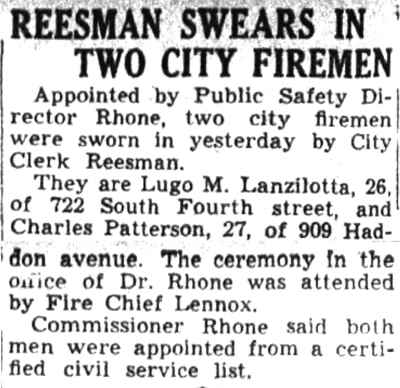
Appointed by Public Safety Director Rhone, two city firemen were sworn in yesterday by City Clerk Reesman.
They are Lugo M. Lanzilotta, 26, of 722 South Fourth street, and Charles Patterson, 27, of 909 Haddon avenue. The ceremony in the office of Dr. Rhone was attended by Fire Chief Lennox.
Commissioner Rhone said both men were appointed from a certified civil service list.