Henry "Harry" Green
HENRY “HARRY” GREEN was born around 1858.
Harry Green was appointed to the Camden Fire Department on April 21, 1905. Harry Green began work with Ladder Company 1 on July 1, 1905 along with Edward Finley. The two men worked side by side for the next nine years, when Finley passed away.
Despite his advanced age, Harry Green was still working as a firefighter as late as 1931, as there was no mandatory retirement age at the time. He finally retired in the early 1930s. Fire Department records from 1931 show him living at 434 Pine Street.
Harry Green was still living in Camden as late as 1939. By the time the 1943 Camden City Directory was compiled he had passed.
NEW FIREMEN ADDED TO CAMDEN'S FORCE
Philadelphia Inquirer —
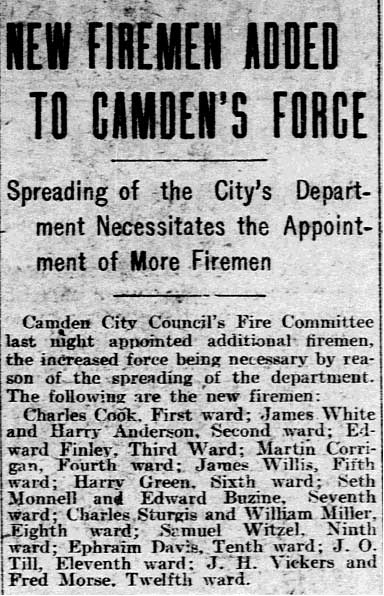
Spreading of the City’s Department Necessitates the Appointment of More Firemen
Camden City Council’s Fire Committee last night appointed additional firemen, the increased force being necessary by reason of the spreading of the department. The following are the new firemen: Charles Cook, First ward; James White and Harry Anderson, Second ward; Edward Finley, Third Ward; Martin Corrigan, Fourth ward; James Willis, Fifth ward; Harry Green, Sixth ward; Seth Monnell and Edward Buzine, Seventh ward; Charles Sturgis and William Miller, Eighth ward; Samuel Witzel, Ninth ward; Ephraim Davis, Tenth ward; J. O. Till, Eleventh ward; J. H. Vickers and Fred Morse, Twelfth ward.
BLUE JACKETS FIGHT FLAMES IN LUMBER YARD
Philadelphia Inquirer —
Blue Jackets Fight Flames in Lumber Yard
BLUE JACKETS FIGHT FLAMES IN LUMBER YARD
Fully Equipped They Push Off From Cruiser Etruria to the Jersey Shore
BATTLED WITH BLAZE IN THEIR BARE FEET
Mayor Sends Letter to Commander David—Baird's Big Plant Scene of Disastrous Conflagration
One hundred sailors from the Italian cruiser Etruria, now lying in the Delaware river, off Race street, materially assisted the Camden firemen yesterday afternoon in preventing a fire from destroying the plant of David Baird & Co., foot of Pearl street. While the flames did damage to the extent of $50,000, there would have been a much heavier loss but for the excellent work of the bluejackets.
It was shortly after 1 o'clock when the flames were discovered in the engine room by Howard Mulford. His efforts to extinguish the tiny blaze proved futile. In a few minutes the fire had eaten its way through the inflammable wooden structure and the long, red tongues had communicated with the spar shed. From this they leaped about twenty feet into the saw and planing mill. All these structures were blazing fiercely when the Camden firemen responded to a general alarm.
Italian Jackies Busy
It was at this juncture that a hundred white-capped sailors in command of Lieutenant Alyjgina Guardsumarsina made their landing at the Pearl street wharf in Camden. They were assembled by a bugler and with hand axes, hose and other apparatus they sallied forth to combat the flames which were fast eating their way through the extensive yard of the plant.
Many of the bluejackets were barefooted, but none of these stopped when burning timbers were encountered. They rushed through flame and smoke with all the vim and ardor that characterize the sailor when in action.
Attacked Blazing Planks
There was a huge lumber pile that stood near a shed that contained several hundred thousand feet of valuable timber. When the flames communicated with this the sailors, summoned by the bugler, made an attack on the great long blazing planks. Like veritable trojans they worked, running up to the flames with their axes and knocking the timbers in all directions.
The smoke was dense enough to make even the professional fire fighters seek cover, but the men from the Etruria stood their ground and managed to save much of the timber.
Hands and Feet Scorched
For over two hours they continued in service. Surgeon De Silvestor, with an assistant, had a busy time attending the burned feet and hands and scorched faces of his compatriots. They had a typical Red Cross outfit with them and when they had ended their work there was little left of the tape and liniments.
It was only after the fire was practically extinguished that Lieutenant Guardsumarsina gathered his men about him and returned to the Etruria. There were several thousand persons on the surrounding wharves and buildings and these gave three lusty cheers when the valiant sons of Italy left for the cruiser.
Fire a Scorcher
The fire was an extremely fierce one, fed as it was by thousands of feet of choice timber. Firemen Harry Green and Rollo Jones, of No. 1 Truck Company, were overcome by the intense heat, but they were quickly revived, the former by the Italian surgeon. Fireman John Lutz and Policeman George Kappel had severely burned hands treated by Surgeon De Silvestor also.
David Baird, Jr., a member of the firm, said he approximated the damage done at about $50,000. All the buildings and machinery were insured. The structures burned included a spar shed, 60 by 100 feet; planing mill, 40x100 feet, and a large lumber shed. About 4,000,000 feet of timber was in the yard, but much of this was saved through the good work of the sailors and the Camden firemen.
The Philadelphia tugboat Stokley also rendered excellent service when the fire was at its height.
It is not definitely known how the fire originated, but it is believed to have been caused by a spark generated by the engine.
Mayor Charles H. Ellis and many city and county officials were interested witnesses of the fire and the manner in which the Italian sailors and the firemen fought the flames. Mayor Ellis said the bluejackets were deserving of much praise for their aid, which came unsolicited but nevertheless at an opportune moment.
Mayor Thanks Sailors
Directly after the fire Mayor Ellis sent the following letter of appreciation to Captain Pericoli, of the Etruria:
Mayor's Office, Camden, N. J., June 17, 1907. Captain Riccard Pericoli, Commander Italian Cruiser Etruria, Philadelphia, Pa.
Dear Sir: On behalf of the people of Camden I express to you my hearty and sincere thanks for the efficient and heroic service rendered today by members of your crew at the disastrous fire on the river front of Camden.
I was on the scene within a few minutes after the alarm was sounded and personally observed the splendid work performed by your men. Although from a faraway country and total strangers to the city their show of bravery and zeal was equally as commendatory as that exhibited by those whose duty it is to protect life and property, and I was thrilled by their fearlessness and daring.
The thousands of people attracted to the scene of the fire was a unit in their praise for the assistance rendered by your crew, and I request that you convey to the brave boys of the Etruria my sincere appreciation and thanks for their magnificent work.
Very respectfully, CHARLES H. ELLIS, Mayor.
"That's My Place"
While the fire was at its height a ferryboat was making its way to Philadelphia. Both the forward and stern rails were crowded with passengers watching the flames, which made a brilliant picture, mirrored as they were in the water.
"I wonder whose place is burning?" remarked a man in the crowd, addressing the man standing by his side.
"That's my place" was the quiet rejoinder of the person asked, as he walked away. That man was David Baird, the owner of the saw mill in which the fire started.
Fully Equipped They Push Off From Cruiser Etruria to the Jersey Shore
BATTLED WITH BLAZE IN THEIR BARE FEET
Mayor Sends Letter to Commander David—Baird’s Big Plant Scene of Disastrous Conflagration
One hundred sailors from the Italian cruiser Etruria, now lying in the Delaware river, off Race street, materially assisted the Camden firemen yesterday afternoon in preventing a fire from destroying the plant of David Baird & Co., foot of Pearl street. While the flames did damage to the extent of $50,000, there would have been a much heavier loss but for the excellent work of the bluejackets.
It was shortly after 1 o’clock when the flames were discovered in the engine room by Howard Mulford. His efforts to extinguish the tiny blaze proved futile. In a few minutes the fire had eaten its way through the inflammable wooden structure and the long, red tongues had communicated with the spar shed. From this they leaped about twenty feet into the saw and planing mill. All these structures were blazing fiercely when the Camden firemen responded to a general alarm.
Italian Jackies Busy
It was at this juncture that a hundred white-capped sailors in command of Lieutenant Alyjgina Guardsumarsina made their landing at the Pearl street wharf in Camden. They were assembled by a bugler and with hand axes, hose and other apparatus they sallied forth to combat the flames which were fast eating their way through the extensive yard of the plant.
Many of the bluejackets were barefooted, but none of these stopped when burning timbers were encountered. They rushed through flame and smoke with all the vim and ardor that characterize the sailor when in action.
Attacked Blazing Planks
There was a huge lumber pile that stood near a shed that contained several hundred thousand feet of valuable timber. When the flames communicated with this the sailors, summoned by the bugler, made an attack on the great long blazing planks. Like veritable trojans they worked, running up to the flames with their axes and knocking the timbers in all directions.
The smoke was dense enough to make even the professional fire fighters seek cover, but the men from the Etruria stood their ground and managed to save much of the timber.
Hands and Feet Scorched
For over two hours they continued in service. Surgeon De Silvestor, with an assistant, had a busy time attending the burned feet and hands and scorched faces of his compatriots. They had a typical Red Cross outfit with them and when they had ended their work there was little left of the tape and liniments.
It was only after the fire was practically extinguished that Lieutenant Guardsumarsina gathered his men about him and returned to the Etruria. There were several thousand persons on the surrounding wharves and buildings and these gave three lusty cheers when the valiant sons of Italy left for the cruiser.
Fire a Scorcher
The fire was an extremely fierce one, fed as it was by thousands of feet of choice timber. Firemen Harry Green and Rollo Jones, of No. 1 Truck Company, were overcome by the intense heat, but they were quickly revived, the former by the Italian surgeon. Fireman John Lutz and Policeman George Kappel had severely burned hands treated by Surgeon De Silvestor also.
David Baird, Jr., a member of the firm, said he approximated the damage done at about $50,000. All the buildings and machinery were insured. The structures burned included a spar shed, 60 by 100 feet; planing mill, 40x100 feet, and a large lumber shed. About 4,000,000 feet of timber was in the yard, but much of this was saved through the good work of the sailors and the Camden firemen.
The Philadelphia tugboat Stokley also rendered excellent service when the fire was at its height.
It is not definitely known how the fire originated, but it is believed to have been caused by a spark generated by the engine.
Mayor Thanks Sailors
Mayor Charles H. Ellis and many city and county officials were interested witnesses of the fire and the manner in which the Italian sailors and the firemen fought the flames. Mayor Ellis said the bluejackets were deserving of much praise for their aid, which came unsolicited but nevertheless at an opportune moment.
Directly after the fire Mayor Ellis sent the following letter of appreciation to Captain Pericoli, of the Etruria:
Mayor’s Office,
Camden, N. J., June 17, 1907.
Captain Riccard Pericoli,
Commander Italian Cruiser Etruria,
Philadelphia, Pa.Dear Sir: On behalf of the people of Camden I express to you my hearty and sincere thanks for the efficient and heroic service rendered today by members of your crew at the disastrous fire on the river front of Camden.
I was on the scene within a few minutes after the alarm was sounded and personally observed the splendid work performed by your men. Although from a faraway country and total strangers to the city their show of bravery and zeal was equally as commendatory as that exhibited by those whose duty it is to protect life and property, and I was thrilled by their fearlessness and daring.
The thousands of people attracted to the scene of the fire was a unit in their praise for the assistance rendered by your crew, and I request that you convey to the brave boys of the Etruria my sincere appreciation and thanks for their magnificent work.
Very respectfully,
CHARLES H. ELLIS, Mayor.
“That’s My Place”
While the fire was at its height a ferryboat was making its way to Philadelphia. Both the forward and stern rails were crowded with passengers watching the flames, which made a brilliant picture, mirrored as they were in the water.
“I wonder whose place is burning?” remarked a man in the crowd, addressing the man standing by his side.
“That’s my place” was the quiet rejoinder of the person asked, as he walked away. That man was David Baird, the owner of the saw mill in which the fire started.
Wish Bone Club in Annual Banquet
Camden Post-Telegram —
WISH BONE CLUB IN ANNUAL BANQUET
The second annual dinner was given on New Year’s eve by the members of the Fire Department at headquarters, known as the Wish Bone Club, after having been called out twice to fires. The evening was spent in music and song, prayer being offered by Engineer Dold. They all sat down to an elaborate dinner prepared by Chef Wingate, assisted by Lieutenant John H. Lutts.
MENU.
Relishes—Celery, olives, pickles, chilli sauce.
Roast—Roast Turkey, oyster filling (a la Wimley), giblet sauce; jellied cranberries, browned sweet potatoes, mashed potatoes, stewed corn, stewed tomatoes.
Mince pie, Coffee, Vienna rolls, butter, aqua de lair.
— The following were the guests of the evening: Chief Samuel S. Elfreth, Assistant Chief Samuel Buzine, Captains George B. Wade, Peter B. Carter, Lieutenants John H. Lutts, Peter S. Gray, Engineer John A. Dold, Stoker Newton G. Ash, Drivers Joseph Johnson, Arthur Wingate, Joseph Maxwell, Richard Marter, Harry Barroughs, Laddermen and Hosemen William Elberson, John H. Lennox, Harry Selby, Harry Green, William Tatem; Houseman John Gardner.
Invited guests—Charles Minckle, of Public Service Corporation; Harry Lee, Collingwood; Reserve Chas. Hose.
The old year out and the new year in, they retired to well—just retired to their respective bunks.
Hook & Ladder Company No. 1
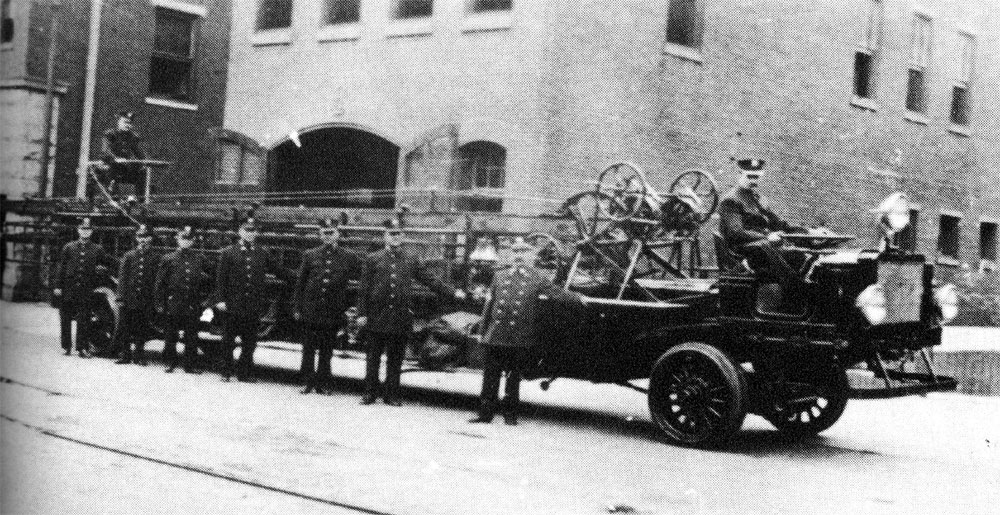
Hook & Ladder Company No. 1 with new 1914 American LaFrance 75’, 4 cylinder aerial ladder, in front of Fire Headquarters. From Left: tillerman Bill Tatem, firemen Edward Finley, Charles Gladney, and Harry Green, Lt. Harry Anderson, Firemen George Hollins and Steward Bakley, Captain Joseph Maxwell, and driver Harry Burroughs.
LIGHTNING STARTS FIRES, HITS TREES, STUNS THREE BOYS
Philadelphia Inquirer —
Philadelphia Inquirer, August 19, 1915 — Lightning Starts Fires, Hits Trees, Stuns Three Boys
Click to download PDF

Costly Blazes in Camden—Youths Under Awning Badly Shocked
Sudden Torrent of Rain, High Wind and Bolts Cause Widespread Damage
Sudden and furious was the electrical storm which yesterday afternoon took Philadelphia, Camden and nearby towns by surprise. Fires were started by lightning in many sections, rain fell in torrents and the wind rose suddenly and played wide-spread havoc.
Camden was the centre of the disturbance and suffered the heaviest damage. Three boys were severely shocked there and the total damage from fires mounted to the $50,000 mark. Bolts in Ardmore felled trees across many roads, split a flag pole in front of the Ardmore public school and tumbled a chimney off the building.
Between 2.45 and 3.15 in the afternoon the thermometer dropped twenty degrees, from 85 to 65, a southwesterly wind rising at the same time to a velocity of thirty miles an hour. Typical of summer thunderstorms was the unheralded start of the downpour and its brief duration. The precipitation from 3.12 to 3.35 in the afternoon, the time during which the rain fell, was only .45 of an inch, but the greater part of this poured down in ten minutes’ time.
Many Fires in Camden
Every piece of apparatus in the Camden Fire Department was pressed into service at one and the same time, only quick response to the alarms averting disastrous blazes in two instances.
Out along the Main Line little damage was done. The house of A. J. Francis, at the junction of Grandview and Argyle roads, Ardmore, was struck by lightning and the roads themselves were blockaded by uprooted trees which forced motorists to go slow to avoid collisions with the obstructions.
The three Camden boys who were shocked, A. Goldberg, 15 years old; Richard Noon, 14 years old, and Howard Robbins, 9 years old, living at 310, 336 and 330 North Tenth street respectively, were all taken to the Cooper Hospital. Only one of the trio, Goldberg, is still in a serious condition. All were paralyzed when admitted to the hospital.
Boys Hurled to Pavement
When the storm made itself manifest with vivid flashes of lightning and reverberating thunder, the boys sought shelter beneath an awning at Tenth and Penn streets. Goldberg was leaning against an iron pole with his companions nearby. There was a blinding flash and the next instant the three boys were hurled to the pavement.
Others beneath the awning went to their assistance, although several were slightly affected by the bolt also. The boys were apparently dead when placed in the auto ambulance, but after several hours of work at the hospital, the youthful victims were revived. They said it looked like a great greenish white ball which descended from the darkened skies and which apparently struck the pole against which Goldberg was leaning.
Within five minutes four alarms of fire had been turned into the Camden Electrical Bureau. One was from the Parkside school at Wildwood and Princess avenues, another from the elevated bridge of the Pennsylvania Railroad at Third and Bridge avenue, the third from the department store of Toone & Hollinshed, at Broadway and Kaighn avenue, and the fourth from the Camden Curtain Rod Factory, Broadway and Jackson streets. In each instance it was a bolt of lightning that struck electric wires that caused the blaze.
At the Toone & Hollinshed store, one of the largest in Camden, and which is located in a three-story building, the fire had its origin in the basement. There were large quantities of mens’ and boys’ furnishing and duplicate supplies of dry goods stored there ready for display. This material was excellent food for the flames, and for a time they threatened to mount up through the stairway of the main floors, but the quick work of the firemen averted such a contingency.
Woman Saves Firm’s Books
At the height of the blaze, which raged fiercely in the basement, Miss Anna Brennan, chief bookkeeper, mounted a fire escape to the second floor. Standing by a window from which the smoke issued in thick volumes, she superintended the rescuing of the firm’s books. Not until all had been taken out did she leave her post. Fireman John McTaggart, of Chemical Company No. 1, rescued the books.
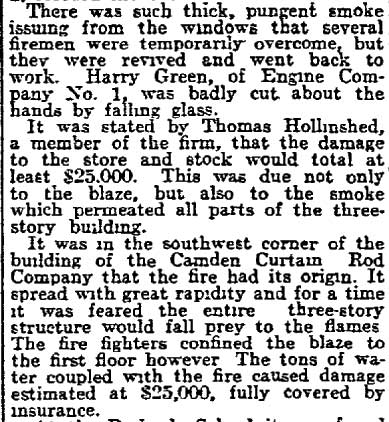
There was such thick, pungent smoke issuing from the windows that several firemen were temporarily overcome, but they were revived and went back to work. Harry Green, of Engine Company No. 1, was badly cut about the hands by falling glass.
It was stated by Thomas Hollinshed, a member of the firm, that the damage to the store and stock would total at least $25,000. This was due not only to the blaze, but also to the smoke which permeated all parts of the three-story building.
It was in the southwest corner of the building of the Camden Curtain Rod Company that the fire had its origin. It spread with great rapidity and for a time it was feared the entire three-story structure would fall prey to the flames. The fire fighters confined the blaze to the first floor however. The tons of water coupled with the fire caused damage estimated at $25,000, fully covered by insurance.
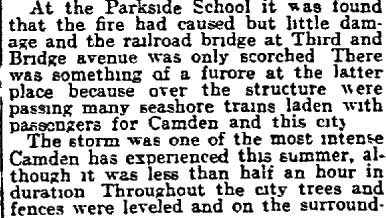
At the Parkside School it was found that the fire had caused but little damage and the railroad bridge at Third and Bridge avenue was only scorched. There was something of a furore at the latter place because over the structure were passing many seashore trains laden with passengers for Camden and this city.
The storm was one of the most intense Camden has experienced this summer, although it was less than half an hour in duration. Throughout the city trees and fences were leveled and on the surrounding roads, especially the White Horse pike, hundreds of autoists were forced to seek shelter. Some of the thoroughfares in the lower sections were converted into veritable torrents, so great was the rainfall.
FINAL HONORS FOR MRS. JOS. MAXWELL
Camden Post-Telegram —
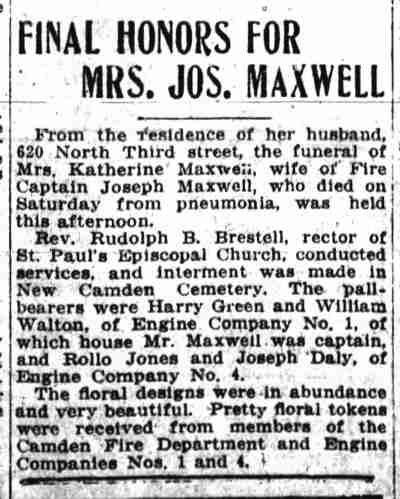
From the residence of her husband, 620 North Third street, the funeral of Mrs. Katherine Maxwell, wife of Fire Captain Joseph Maxwell, who died on Saturday from pneumonia, was held this afternoon.
Rev. Rudolph B. Brestell, rector of St. Paul’s Episcopal Church, conducted services, and interment was made in New Camden Cemetery. The pallbearers were Harry Green and William Walton, of Engine Company No. 1, of which house Mr. Maxwell was captain, and Rollo Jones and Joseph Daly, of Engine Company No. 4.
The floral designs were in abundance and very beautiful. Pretty floral tokens were received from members of the Camden Fire Department and Engine Companies Nos. 1 and 4.