Introduction
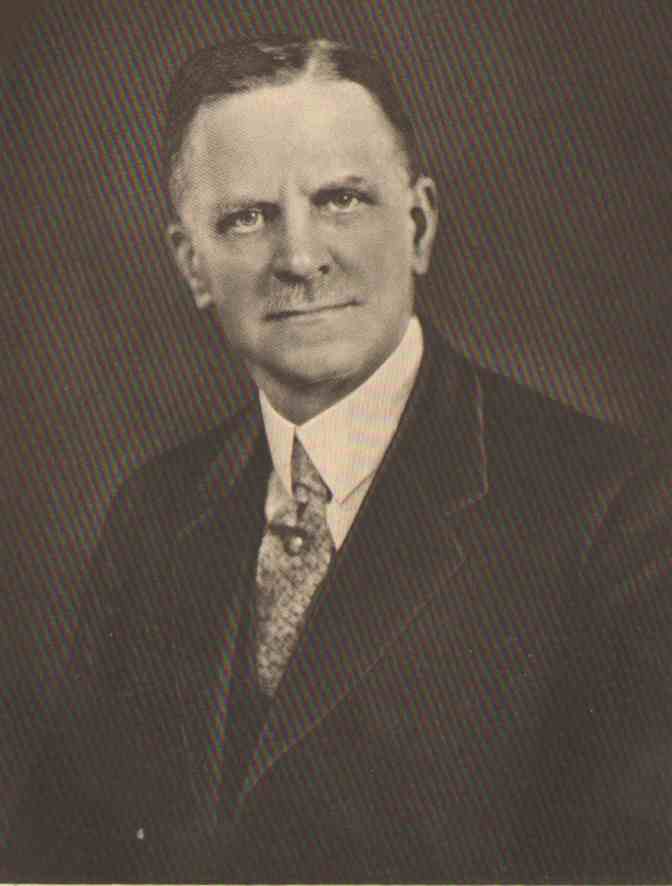
J. B. Van Sciver (1861–1943)
JOSEPH BISHOP VAN SCIVER was the founder and chief executive officer of the furniture manufacturing and retail business that bore his name. The Van Sciver operation at the corner of Delaware Avenue and Federal Street was world famous, shipping furniture all over the globe.
J. B. Van Sciver was born in Hainesport NJ on May 14, 1861. He grew up in Camden, where he attended the E. A. Stevens School. He founded his business in a small shop at 210 Federal Street in 1881. After moving to a four story building directly opposite the Pennsylvania Terminal and Ferry at Delaware and Federal in 1888, his business grew so that by 1923 it occupied ten acres, new construction and buildings having been added in 1890, 1896, 1902, and 1923. He later branched out to Trenton and Allentown, Pennsylvania. J. B. Van Sciver was also involved in other businesses relating to the manufacture and sale of construction materials.
On June 9, 1892 he married Florence Groff Kelly at the First Baptist Church in Camden. There were four children, Joseph B. Jr., Russell, Lloyd, and Ruth. The Van Scivers later made their home in the Chestnut Hill section of Philadelphia. J. B. Van Sciver remained actively involved in his business until about a year before his death, on June 19, 1943. He was succeeded by his son, Joseph Bishop Van Sciver, Jr.
The Van Sciver Family
Compiled by Sandra White-Grear, Haddon Township Historical Society
Anyone living in the Southern New Jersey/Philadelphia area between the years 1920 and 1970 will remember the vast J. B. Van Sciver Furniture Store in Camden, NJ. A lesser-known fact, perhaps, is that the Van Sciver family owned a 120-acre farm in Haddon Township from 1914 through the early 1960’s. As the farm’s acreage dwindled and suburban neighborhoods grew, 9 acres were portioned off for the development of the new Van Sciver Elementary School (est. 1957) in Haddon Township.
Joseph Bishop Van Sciver, Sr.
Joseph Bishop Van Sciver, Sr., circa 1924.
Joseph Bishop Van Sciver, Sr., founder of the Camden furniture store bearing his name, was born May 14, 1861 in Hainesport, Burlington County, NJ. His ancestors, Richard and Margaret Haines, came to America from England in 1683. Mr. Van Sciver’s father was Abraham Van Sciver (b. 1823; d. 1/23/1871), and his mother was Lydia Haines Bishop (b. 1/4/1836; d. 2/22/1902), daughter of John Bishop, notable co-owner of the first Shot Tower in America, built in 1808 at Carpenter and Front Streets in Philadelphia. Abraham and Lydia had 5 children: Joseph Bishop (b. 5/14/1861; d. 6/19/1943), George Dobbins (d. 5/31/1942), Abraham D., Anna, and Mary Carlile.
J. B. Van Sciver, Sr. attended the E. A. Stevens School in Camden, and founded his furniture business in a small shop at 210 Federal Street in 1881. He married Flora Groff Kelly, daughter of Samuel and Fanny Kelly, in the First Baptist Church in Camden on June 9, 1892. They had four children: Joseph Bishop, Jr. (b. 8/1/1893; d. 6/26/1981), Lloyd (b. 4/28/1896; d. 9/11/1954), Russell (b. 5/15/1898) and Ruth (b. 4/13/1906).
By 1896 a new seven-story building, designed by prolific Camden architect Thomas Stephen, rose above the streets of Camden, and the J. B. Van Sciver furniture empire grew to included carpet and drapery workrooms. The business expanded further in 1922 with a modern seven-story concrete building and four additional acres. At this time the phrase “Seven Acres of Furniture” was coined. By 1923 business totaled approximately $4 million annually. In 1932 a Trenton branch was constructed. Sometime later the Collings Carriage Company’s buildings in Camden were acquired to house mattress, woodworking and finishing shops. By 1937 demand for Van Sciver furniture necessitated further expansion into Allentown, PA.
J. B. Van Sciver, Sr. was involved in other enterprises beyond furniture manufacturing. With his brother George, he developed the Hainesport Mining & Transportation Company, and the De Frain Sand Company. These companies eventually consolidated into the Van Sciver Corporation. Mr. Van Sciver was also director of the Knickerbocker Lime Company. By the 1920’s these businesses were the premier manufacturers and distributors of building materials in the southern New Jersey/eastern Pennsylvania area, supplying much of the concrete making materials to create the foundations for the new suspension bridge spanning the Delaware River between Camden and Philadelphia (now called the Benjamin Franklin Bridge), as well as materials used in the construction of Philadelphia subways, banks, and office buildings. During World War I, Van Sciver Corporation supplied sand, gravel and concrete to build the Emergency Fleet Corporation’s shipyard on Hog Island in the Delaware River. The Van Sciver Corporation was sold to the Warner Company in 1929, but the furniture making business remained.
A resident of Chestnut Hill, PA, Mr. Van Sciver was a member of numerous organizations, including the Union League, the Franklin Institute, and the Pennsylvania Horticultural Society, and was known to have an extensive rare orchid and grape collection on his Chestnut Hill estate. J. B. Van Sciver, Sr. remained active in the furniture business until about a year before his death at 82 on June 19, 1943. He was pre-deceased by his wife in 1937. His children, six grandchildren, and his sister, Anna Van Sciver-Jarvis, survived him. Joseph Bishop Van Sciver, Sr. is remembered as a charitable man of high integrity, with a strong work ethic and modest demeanor. A 1943 Camden Evening Courier newspaper article described him as “the Horatio Alger hero of America’s furniture industry and the man who made Philadelphians come to Camden to furnish their homes.”
Anna Van Sciver-Jarvis
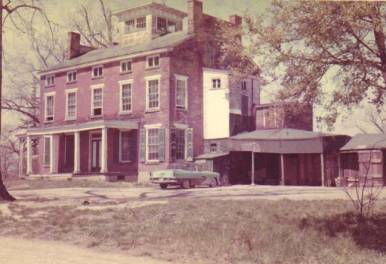
The Van Sciver/Jarvis farmhouse in Haddon Township, photographed in the mid-1960s shortly before it was abandoned. The house was destroyed by arson in October 1967.
It was Joseph Bishop Van Sciver Sr.’s sister Annie who lived on the 120-acre Haddon Township farm, along with her husband Ambrose W. Jarvis and their son Clarence (J. B. Van Sciver, Sr. owned the property but never lived on the farm). Annie and Ambrose were married on June 2, 1886 in Camden, NJ. Anna gave birth to Clarence in 1902 in Hainesport, NJ. Many Haddon Township residents remember the Van Sciver/Jarvis farm and produce stand on Cuthbert Boulevard. The property, which included farmland, woods, streams and buildings, encompassed what is presently the grounds of the Haddon Township High School and Middle School, the Rohrer Memorial Library, the Haddon View Apartments, the Westmont Shopping Plaza, the woods along Mac Arthur Boulevard up to Saddlertown, the Paul VI High School property, and the Van Sciver Elementary School grounds.
Throughout its history, the farmhouse, a historic building dating from the early-1800s, was the summer residence of several prominent Philadelphia businessmen, including Samuel V. Merrick and John Mickle Whitall, prior to being owned by J. B. Van Sciver. Mr. Van Sciver purchased the property for $15,000 on March 16, 1914 (Deed Book 386, Page 325) from Susanna H. Bodine and S. Lawrence Bodine, her husband. The farmhouse, barn and stables stood at the crest of a hill approximately where the SuperFresh Supermarket in the Westmont Plaza Shopping Center is now, just behind the convent of Paul VI High School.
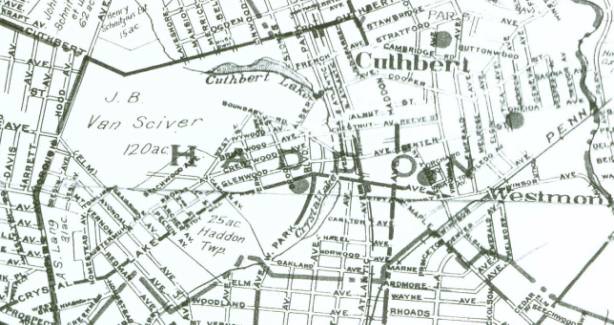
Map of Camden County and Vicinity, Franklin Survey Company, Philadelphia, PA (1935).
Joseph Bishop Van Sciver, Jr.
After J. B. Van Sciver, Sr. retired, his son Joseph Bishop Van Sciver, Jr. assumed leadership of the furniture corporation. During his tenure the company continued its expansion into new markets with retail outlets in Bala Cynwyd (PA), Wilmington (DE), and Lancaster (PA).
J. B. Van Sciver, Jr. graduated from Chestnut Hill Academy and Drexel Institute (now Drexel University). He began working for his father in 1914, working his way up to the presidency of J. B. Van Sciver Furniture. Mr. Van Sciver married Louise Evaland, an editorial assistant for Antique Automobile magazine. They had one son, J. B. Van Sciver, III. With 56 years dedicated to the Van Sciver furniture business, Mr. Van Sciver retired in 1970.
A pilot, yachtsman, and horseman, Joseph Bishop Van Sciver, Jr. was also recognized as one of the country’s pioneer collectors of antique and classic cars. Mr. Van Sciver was one of the founders of the Antique Auto Club of America, a car collector’s club. By 1980 he had over 30 vintage cars stored in his museum and on the grounds of his Chestnut Hill estate. Included in his collection were Stanley Steamers, a Maxwell, a Mercedes Raceabout, a 1902 Pierce-Arrow, a 1900 De Dion-Boutton, electric cars, and a 1909 six-cylinder Winton. The Van Scivers used the Winton as an open touring car, and had a Mercedes Daimler racer for tours and competitions. Their tours in post-war America included trips to Cape May, Atlantic City, Albany, and Detroit. World War I top American flying ace Eddie Rickenbacker, heavyweight boxing champion Gene Tunney, children’s book author Munroe Leaf, and founder of Firestone Tire and Rubber Company Harvey Firestone were antique automobile collectors, contemporaries and friends of Mr. Van Sciver. Together with an assortment of others, they participated in auto tours and friendly baseball games (umpired by Dale Carnegie).
Joseph Bishop Van Sciver, Jr. died on June 26, 1981 at age 87, at “Ingleside,” his Chestnut Hill estate formerly owned by his parents. He was survived by 3 grandchildren, his brother (Russell), and his sister (Ruth Van Sciver-Ketcham). Prior to his death, Mr. Van Sciver, Russell Van Sciver, Ruth Van Sciver-Ketcham (heirs and executors of the Joseph B. Van Sciver, Sr. estate) and their aunt, Annie Van Sciver-Jarvis, decided to sell the Van Sciver property in Haddon Township. A 9-acre parcel of the Haddon Township property, bordered by Rhoads Avenue and land owned by Mary L. and Charles S. Saddler, and running next to the border of land owned by the West Jersey/Pennsylvania Railroad (now known as “the gully”) was sold to the Board of Education of the Township of Haddon on April 16, 1956 for the sum of $22,500 (Deed Book 2009, Page 47). In gratitude, the Board of Education decided to pay lasting tribute to the late Joseph B. Van Sciver, Sr. and family by naming the school “Van Sciver Elementary School.”
Compiled by Sandra White-Grear, Co-Chairperson, Haddon Township Historical Society, 2007, www.haddontwphistoricalsociety.org.
Sources: “Rites Tomorrow For J. B. Van Sciver,” Camden Evening Courier, June 21, 1943 (p. 1); “Joseph B. Van Sciver Jr.: expanded furniture firm,” By Burr Van Atta, Staff Writer, Philadelphia Inquirer, June 28, 1981 (p.6-c); Map of Camden County and Vicinity, Franklin Survey Company, Philadelphia, PA (1935); “Official Historical Souvenir: Philadelphia, Its Founding and Development, 1683 to 1908” by William W. Matos, Philadelphia, PA: Joseph & Sefton, 1908; South Jersey, a History 1624–1924, Alfred M. Heston, Editor, NY: Lewis Historical Publishing, 1924; Unknown author, “Van Sciver Family History,” 1970, Camden County Historical Society Collection; Jarvis/Van Sciver House Photograph courtesy Herta Scheidhauer, Audubon, NJ; Copy of Original Deed, April 16, 1956, Book 2009, Page 47, Camden County Register of Deeds, Camden, NJ, courtesy Haddon Township Board of Education.
1908 Advertisement
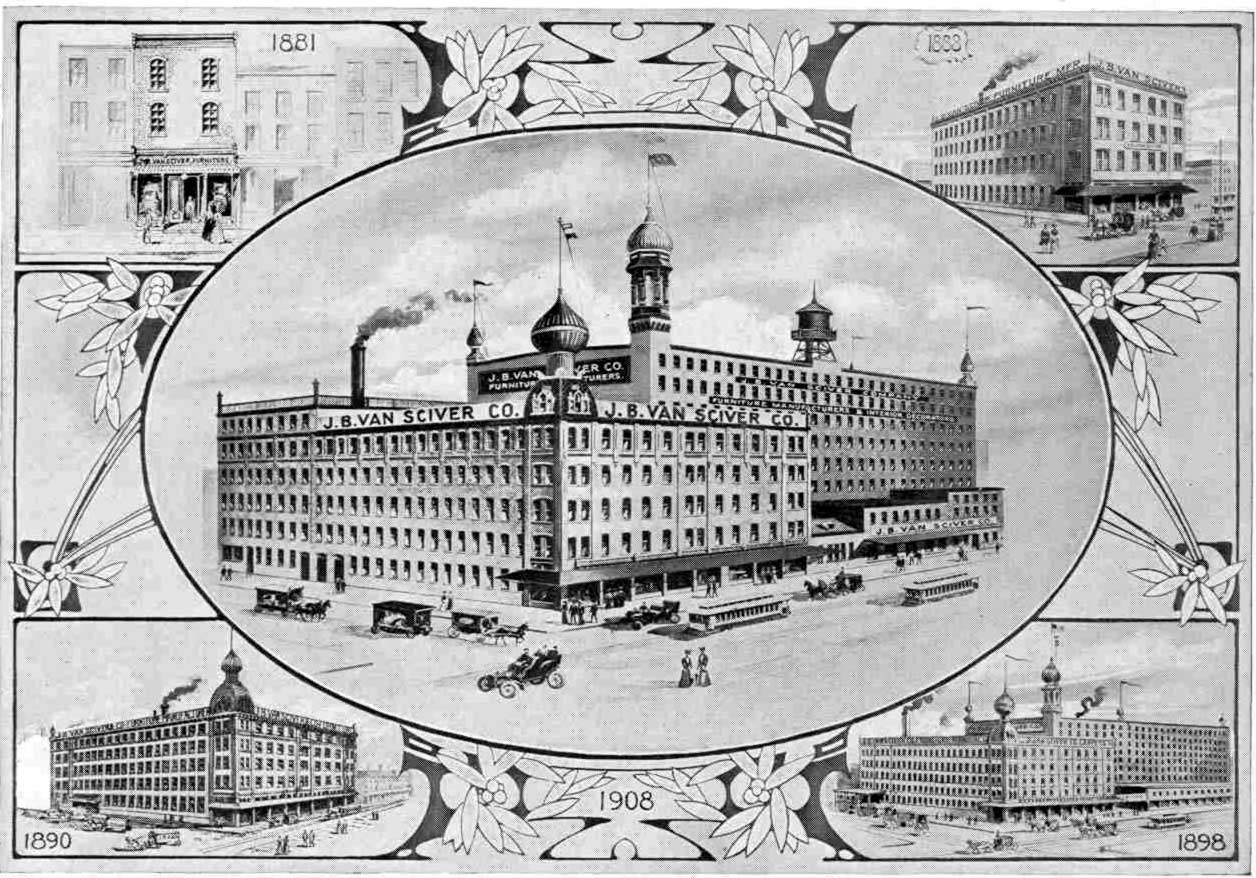
A 1908 advertisement from Official Historical Souvenir: Philadelphia, Its Founding and Development, 1683 to 1908, by William W. Matos (comp.), (Philadelphia, PA: Joseph & Sefton, 1908).
From South Jersey, A History 1624–1924
JOSEPH BISHOP VAN SCIVER—Residence, Philadelphia (Chestnut Hill), Pennsylvania. Furniture manufacturer and dealer, of Camden, New Jersey. Born near Hainesport, New Jersey, May 14, 1861; son of Abram and Lydia H. (Bishop) Van Sciver; married, at Camden, June 9, 1892, to Flora G. Kelly, daughter of Samuel and Fanny J. (Andrews) Kelly. Children: Joseph B., Jr., born August 1, 1893; Lloyd, born April 28, 1896; Russell, born May 15, 1898; Ruth, born April 13, 1906.
Joseph B. Van Sciver is the president and guiding head of the J. B. Van Sciver Company, manufacturers and retailers of furniture, whose ten-acre plant is in Camden. Incidentally Mr. Van Sciver is the great-great-grandson of John Bishop, Philadelphia Quaker, who is said to have built the first shot tower in America and whose conscientious scruples would not permit him to operate it during the War of 1812. This was a great opportunity for large business and profits but he stood by his principles and he declined to make shot, he said, “that was to be used in killing human beings,” so he disposed of the business.
Mr. Van Sciver is a descendant on the maternal side of Richard and Margaret Haines, the former having come to America from London in 1683; and on the paternal side from John Van Sciver and his wife, Charity Moris, both of whom came from Holland in Colonial times and settled in New Jersey. His father was Abraham Van Sciver and his mother was Lydia Haines Bishop, who was a member of the Society of Friends. The couple were married in New Jersey in 1836.
The seeds of the great furniture and home furnishing business that Mr. Van Sciver has built, were sown in a little twenty-foot wide store, No. 210 Federal Street, Camden, in 1881. A year previous to this, however, Mr. Van Sciver had begun to manufacture furniture. The growth of the business was phenomenal. The year 1888 found the business housed in a new four-story building erected for the purpose at Federal Street and Delaware Avenue, directly opposite the Pennsylvania Terminal and Ferry. The manufacturing facilities were enlarged, and the stocks were increased. It was a bold move to secure business from Philadelphia, and it proved a huge success. Customers from across the Delaware began to pour into the store. A new seven-story building was added in 1896, and the organization of the J. B. Van Sciver Company followed in 1898. More new buildings were added in 1902, and in 1923 a new structure comprising four additional acres was added to the great plant. Van Sciver furniture sold in every State in the Union and shipped to countries beyond the Seven Seas. The business totals approximately $4,000,000 annually.
Mr. Van Sciver, together with his brother George, developed the Hainesport Mining and Transportation Company and the De Frain Sand Company from small industries. He is vice-president of each organization. Mr. Van Sciver is a director of the Knickerbocker Lime Company. He is vice-president of the Van Sciver Corporation which includes the three organizations. These companies have become the greatest manufacturers and distributors of building materials in this section of New Jersey and Pennsylvania. They supplied much of the materials used in making the huge concrete foundations of the immense bridge spanning the Delaware between Camden and Philadelphia. During the World War they supplied the Government with the greater part of the gravel, crushed stone and other concrete materials used in constructing the plants and piers for the shipbuilding industries at Hog Island, Chester, Bristol, Camden, and Philadelphia.
Joseph B. Van Sciver was brought up and educated in the city of Camden, where he attended the E. A. Stevens School. Mr. Van Sciver and his family are members of the Temple Baptist Church, and he is a member of the following clubs: Union League, the Manufacturers’ Club, and the City Club, all of Philadelphia; Whitemarsh Valley Country Club; American Academy of Political and Social Science; New Jersey Society of Pennsylvania, and the Netherlands Society.
J. B. Van Sciver Co., Furniture Manufacturers
From Official Historical Souvenir: Philadelphia, Its Founding and Development, 1683 to 1908, Including the Complete Program of the Two Hundred and Twenty-Fifth Anniversary Celebration of the Founding of the City Government, October Fourth to Tenth, by William W. Matos (comp.), (Philadelphia, PA: Joseph & Sefton, 1908)
J. B. VAN SCIVER CO. — Furniture Manufacturers, Importers, Interior Decorators
It is a principle, pretty generally accepted in the business world, that back of every notable commercial enterprise will be found a clean-cut, well-defined idea. Nowhere has this principle had finer illustration than in the phenomenal growth of the great furniture house of J. B. Van Sciver Company. From the smallest of beginnings in 1881, a twenty-foot store on Federal Street, Camden, this business has developed by leaps and bounds until to-day it stands, undoubtedly, the largest exclusive retail furniture establishment in the country.
The basic idea lying behind this achievement, like all successful ideas, is extremely simple, viz.: that a store and factory inexpensively located at the Market Street Ferry, Camden, can manufacture and sell furniture of quality direct to the consumer at under market prices, and hence attract trade from the vast urban and suburban population of Philadelphia and adjacent territory.
The execution of this idea involved, of course, not only an inexpensive location, but also adequate manufacturing facilities, an immense output, and economical methods. With this in mind, in 1888, just twenty years ago, the founder and present head of the Company, Mr. J. B. Van Sciver, moved his store and factory into a new four-story building, erected for the purpose at the corner of Federal Street and Delaware Avenue, directly opposite the Pennsylvania Railroad Terminal and Ferry, and opened for business.
The response of the great furniture buying public to the stimulus of best quality furniture at lower prices than ever before known, was instantaneous; and what seemed at first an uncertain experiment soon proved to be an established success. In 1890 the plant was enlarged in area and a fifth story added. In 1898 the big seven-story factory adjoining the store was erected. Today, at this Twentieth Anniversary at the Ferry, the plant, including store, warehouse, and factory, covers more than six acres of floor space, and the business extends its operations to every country on the globe, at an estimated annual saving to its customers of over $100,000.00.
A recent feature of the business that has attracted much favorable comment is the Automobile Delivery Service, which delivers goods free and fits them up in the home.
Building History, 1881–1908
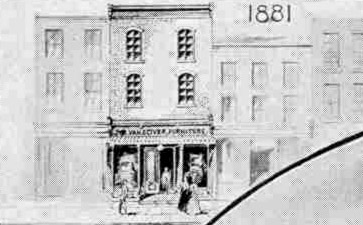
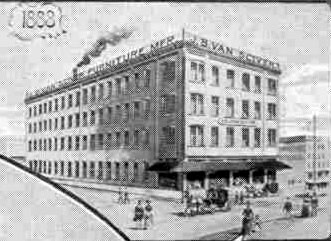
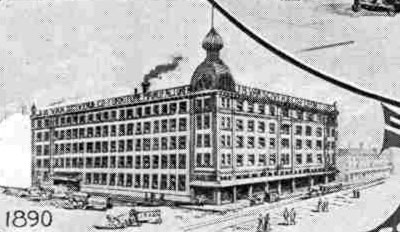
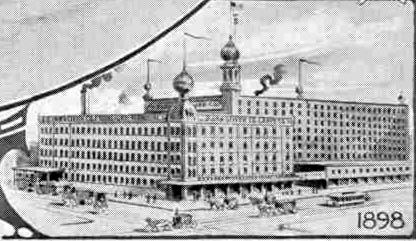
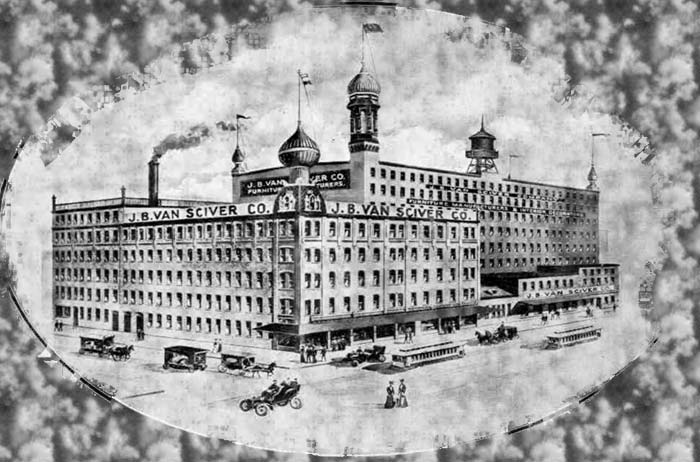
Building history of the J. B. Van Sciver complex: 1881 (first store, Federal Street); 1888 (four-story building at Delaware Ave. & Federal St.); 1890 (fifth story added); 1898 (seven-story factory built adjacent); 1908 (the complete complex).
Photos
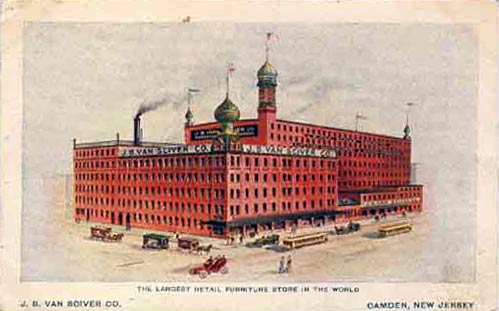
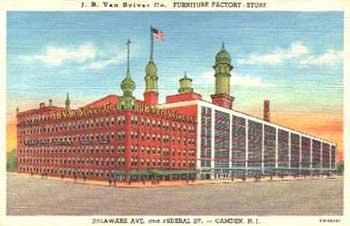
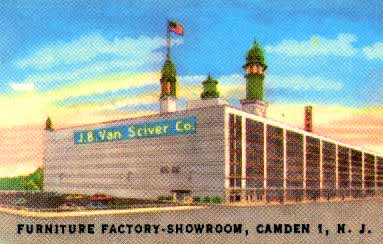
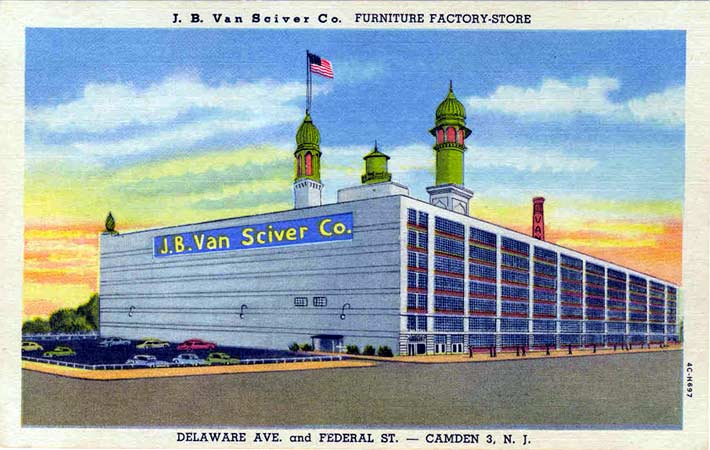
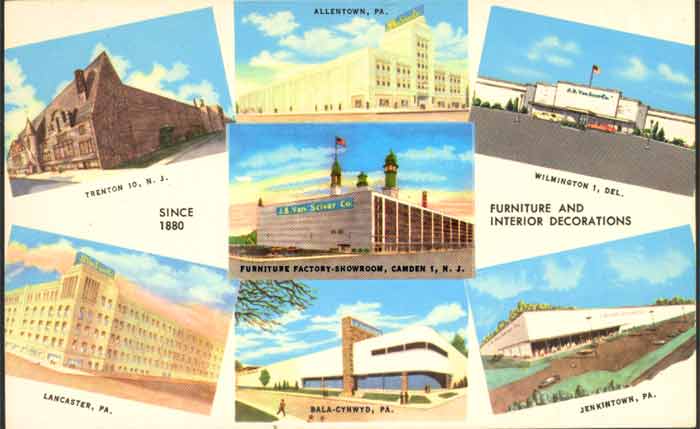
J. B. Van Sciver Furniture Factory & Store at Delaware Ave. & Federal St., Camden. Top row (left to right): around 1907; 1930s. Center: around 1950. Bottom: Factory, Showroom & satellite stores, 1960s.
South Camden Siftings
Camden Daily Telegram —
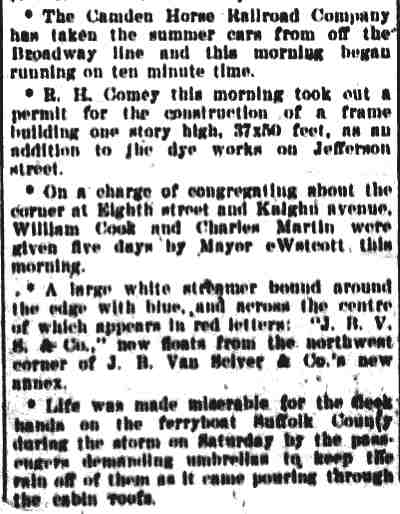
The Camden Horse Railroad Company has taken the summer cars from off the Broadway line and this morning began running on ten minute time.
R. H. Comey this morning took out a permit for the construction of a frame building one story high, 37x50 feet, as an addition to the dye works on Jefferson street.
On a charge of congregating about the corner at Eighth street and Kaighn avenue, William Cook and Charles Martin were given five days by Mayor eWatcott [sic] this morning.
A large white streamer bound around the edge with blue, and across the centre of which appears in red letters: “J. B. V. S. & Co.,” now floats from the northwest corner of J. B. Van Sciver & Co.’s new annex.
Life was made miserable for the deck hands on the ferryboat Suffolk County during the storm on Saturday by the passengers demanding umbrellas to keep the rain off of them as it came pouring through the cabin roofs.
How the Y. M. C. A. Benefits Camden
Philadelphia Inquirer —
Great Interest Taken in Association Work and Results Are Most Satisfactory.
A “Gym” Worth Praising
The New House of Muscle Is One of the Finest in the Eastern Section of the Country—Its Features, Methods and Instructor.
The inestimable benefit of a Young Men’s Christian Association branch to a large city has never been more forcibly demonstrated than in Camden, where for the past eighteen years an association has flourished, accomplishing good work with the most satisfactory results.
From the time of organization the work has been constantly enlarging, until now the association is one of the most healthy, in a financial way, in this section. Its splendid facilities for every branch of association work, the gymnasium, college, literary and religious departments make it exceedingly popular and its work is supported by a large number of Camden’s best known citizens.
The enthusiasm in matters relating to the association is at times remarkable and the churches assist greatly in the work, by pulpit utterances and help by the members of the congregations. The Y. M. C. A. and the churches work harmoniously together, and by co-operation mutual benefit is the result.
The present organization was formed at a private house, corner Front and Cooper streets, October 1[?], 187[?], it being the outgrowth of a union young people’s prayer meeting. Meetings were held for a short time in the rear room of what was then the Trinity Baptist Church, now known as the Hatch Post Building. Later quarters were secured at [?]18 Federal street, where they were located for more than a year. Then a move was made to Lincoln Hall, Third and Market, the second and third stories of that building being secured, where for ten years they remained. Then the Third and Federal streets building was used and from there the association moved to its present quarters.
Since the association moved from its old quarters at Third and Federal streets, the membership has been almost doubly increased, principally by the construction of one of the finest gymnasiums in this section of the country, being more complete than the central association of this city and possessing a fine swimming tank, which the mother branch here has not.
The “Gym’s” Great Attraction
There can be no doubt but that the athletic work in the Y. M. C. A. is its greatest attraction. It draws young men to the building, gets them interested in the work and lays the foundation for the accomplishment of the association’s purpose, leading them in the right path.
The Camden Association has had long and varied experience with gymnastics, and the addition of this great feature has more than proven its value to the work. The first “gym” in Camden was in the old building at the southeast corner of Third and Market streets. The space was very small, the athletic work suffering severely in the cramped quarters. However, the work was carried on there with great success for nearly four years, when the building at the southwest corner of Third and Federal streets was erected and the two upper floors engaged.
This change proved to be successful. A large gymnasium floor space was now at hand, with shower baths, dressing rooms and other features necessary for the carrying on of gymnastic work. The great drawback, however, was the ceiling, which was not more than fifteen feet in height. This prevented any development of flying and traveling ring work, while horizontal bar work was also handicapped to a certain extent. However, for nearly six years the work progressed there in the most satisfactory manner, the classes being large and interest at times very great.
The Present Quarters.
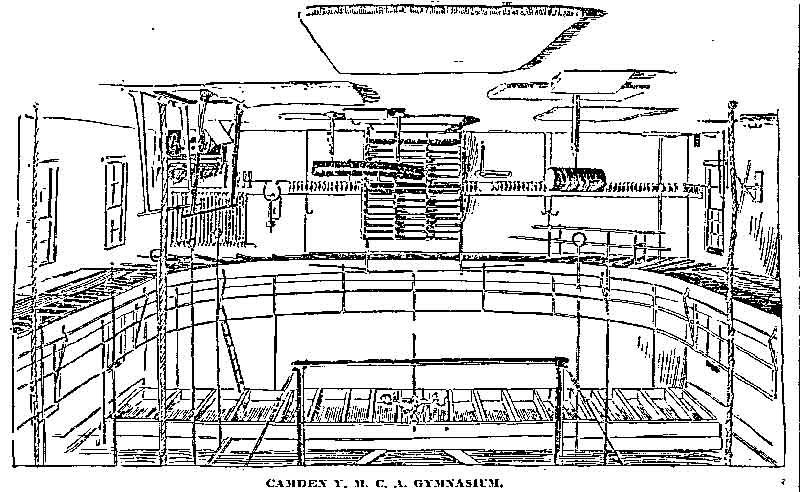
The building now in use at Broadway and Federal streets is the most complete the Camden Association ever had, and while the reading rooms, parlors and game rooms were not constructed especially for the work, yet they are almost exactly the desired arrangement. Just above the house was a space of ground nearly one hundred feet wide and very deep. On this space the “gym” was erected, and a beauty it is. It runs east and west, the front facing Federal street, and getting a good Southern sun exposure.
The gymnasium has a thoroughly modern equipment and, as said above, it has no superior in this section of the country. It is 43x7[?] feet, with a peaked roof thirty-two feet high. The running track overhead is a good feature in the “gym,” and it is, of course, very largely patronized.
Then the pool has been the means of drawing many men into the Association work. It is 21x39 feet, with a depth of water from four feet four inches to six feet. The sides and bottom are lined with white enameled bricks, and has a capacity of 33,000 gallons of water.
Physical Instructor Villee.
The gymnastic work is under the direction of A. G. Villee, who during his two years’ connection with the Camden Association has advanced and created great interest in the work. Mr. Villee is a follower of the Chicago Training School system, having received his gymnastic education there, and naturally believes in its teachings. He is 25 years old, a native of Lancaster, Pa., and has been in gymnastic work for the past five years. After his course at the training school he was appointed assistant at Milwaukee, going from there to Newcastle, Pa., then to Allentown, and then to Norfolk, Va., where he was stationed when he received his appointment as physical instructor at Camden.
Through Mr. Villee athletics have taken a healthy, vigorous turn, and there is a live, wide-awake interest in everything gymnastic in the Camden Association. The classes average eighteen a week, while the usual attendance by the senior members is thirty and the junior members thirty-five. The business men’s class at 5.15 has a usual attendance of fifteen.
With this year came a new feature in the association’s gymnastic work, that of indoor competitive athletic sports. The third of the series took place last evening. These meetings are trials or preliminaries to the final, which is slated for April. The men who have qualified in these trials will be handicapped according to their abilities for the finals, and the first three competitors will receive gold, silver and bronze medals respectively.
The class drill system introduced by Instructor Villee is an excellent one, and a person having a knowledge of gymnastic work will readily appreciate its good points. First there comes the health drill, which includes the free hand, arm, leg and body movement. Then the educative, which means work on the various apparatus, while the third, or recreative, covers games of various sorts on the floor of the gymnasium, exclusive of basket ball. This system is always maintained.
A leaders’ class is also a new feature adopted by Mr. Villee. The men who are included in this class are the best athletes in the association, who lead the different classes and assist the physical instructor. They meet once a week, practicing advanced work and becoming better acquainted with Mr. Villee’s system of physical education.
The junior membership is very large and among the boys, all of whom are under 16 years of age, there are some clever athletes. Mr. Villee also has junior leaders, the boys doing the best work being honored with the positions. This junior department also has a class of twelve club swingers, in which Mr. Villee takes great pride. He has them under his particular care, and without doubt they are a clever lot of boys.
There are many other interesting features in the gymnastic work, and the two fine bowling alleys and shuffleboards should not be forgotten in this brief review.
A feature in the winter’s work has been the series of “Health and First Aid to the Injured” talks. These began in November and will continue until April, the course being closed by Dr. E. M. Howard. The Saturday outings in summer will be continued the coming season. These delightful affairs are under Mr. Villee’s direction. A crowd of probably twenty leaves the association about 10 o’clock of a Saturday morning, riding as far as they can in the trolleys, then walking to some pretty spot, where all sorts of sports and games are indulged in.
The Association Officers.
The officers of the association are composed of Camden’s best-known men, and there is not a better known and more highly respected citizen than Walter M. Patton, who is now president. For years he has been an enthusiastic worker and supporter of the association. The secretaryship is in the hands of Harry Curtis, who has now been with the Camden Association about two years. Mr. Curtis is very popular with the members and has done much toward placing the branch where it is to-day.
The vice-president and treasurer is William J. Coxey, who has been long identified with the work. C. L. Craig is recording secretary. The Board of Directors is composed of Schuyler C. Woodhull, Joseph E. Roberts, William C. Lore, W. A. Davis, M. D., W. Bechtel, Gelbert Landis, Judge Frank Burdsall, Frank Sitley, Samuel D. Goff and Dr. E. M. Howard. The trustees are Abraham Anderson, Wilbur F. Rose, Harry Humphreys, Luther H. Kellum, W. J. Coxey, Carlton M. Williams, Joseph B. Van Sciver, Joseph E. Robert and Thomas E. Gifford. Frank Pierson is assistant secretary.
Camden Y. M. C. A. Gymnasium.
Business Men in Line
Philadelphia Inquirer —
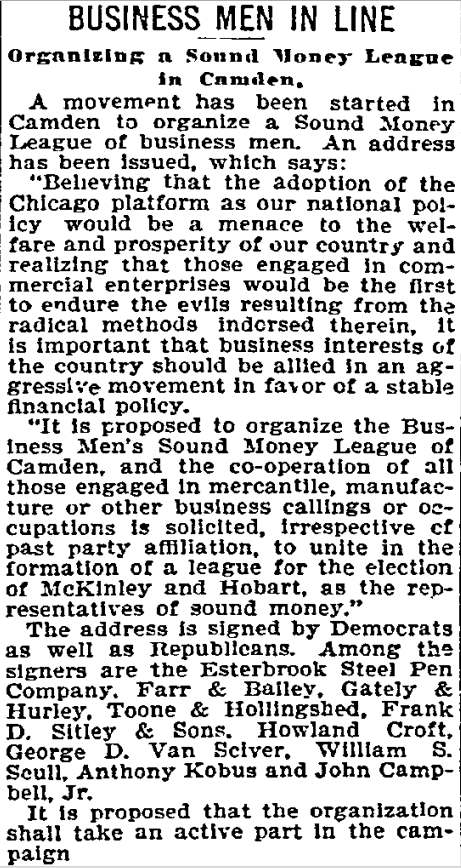
Organizing a Sound Money League in Camden.
A movement has been started in Camden to organize a Sound Money League of business men. An address has been issued, which says:
“Believing that the adoption of the Chicago platform as our national policy would be a menace to the welfare and prosperity of our country and realizing that those engaged in commercial enterprises would be the first to endure the evils resulting from the radical methods indorsed therein, it is important that business interests of the country should be allied in an aggressive movement in favor of a stable financial policy.
“It is proposed to organize the Business Men’s Sound Money League of Camden, and the co-operation of all those engaged in mercantile, manufacture or other business callings or occupations is solicited, irrespective of past party affiliation, to unite in the formation of a league for the election of McKinley and Hobart, as the representatives of sound money.”
The address is signed by Democrats as well as Republicans. Among the signers are the Esterbrook Steel Pen Company, Farr & Bailey, Gately & Hurley, Toone & Hollingshed, Frank D. Sitley & Sons, Howland Croft, George D. Van Sciver, William S. Scull, Anthony Kobus and John Campbell, Jr.
It is proposed that the organization shall take an active part in the campaign
J. B. VanSciver and Wife Sail for Europe
Philadelphia Inquirer —

J. B. VanSciver and wife sailed for Europe on Wednesday for a Continental tour.
Greater Camden the Slogan at Board of Trade Banquet
Philadelphia Inquirer —
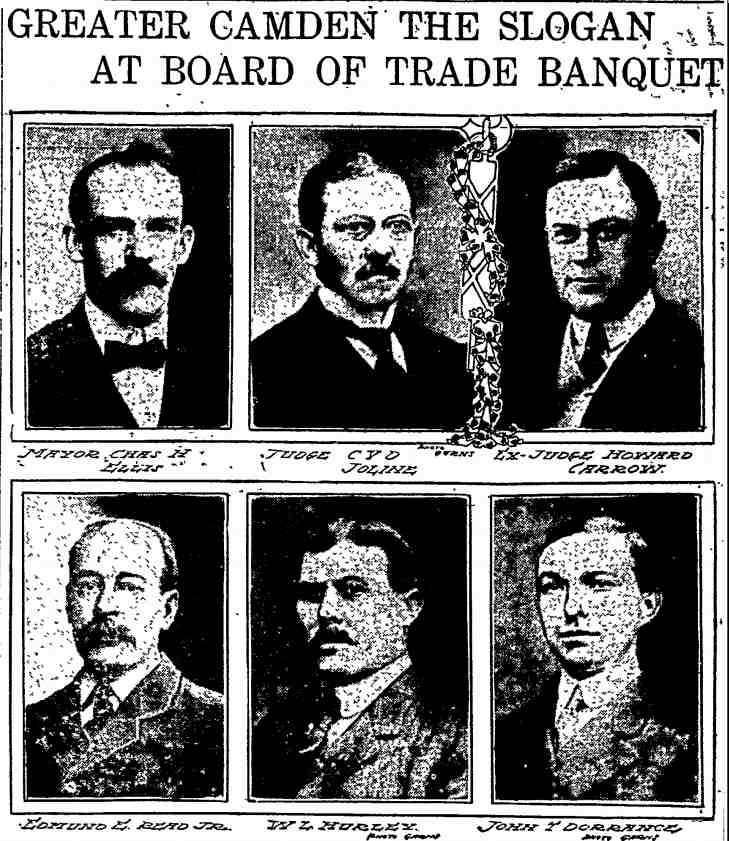
MAYOR CHAS H. ELLIS
JUDGE C V D JOLINE
EX-JUDGE HOWARD CARROW
EDMUND E. READ JR.
Men Prominent in Business Affairs Sound Praises of Growing City at Annual Feast
A greater, more progressive Camden was the watchword at he [sic] annual banquet given by Camden’s Board of Trade last night. And that this means something is evident from the fact that it came from the city’s “Captains of Industry” to the number of two hundred.
It was Camden’s rejuvenated Board of Trade that gave the banquet and the interest taken was manifested by the presence of representatives from every business concern of any prominence in the city.
All Represented
There were bankers besides just ordinary business men, professional men of every character, and all were imbued with the spirit to make of Camden a place that will be known on the map throughout the country. William L. Hurley, president of the board, presided at the banquet.
“Generally speaking, we are satisfied with our city,” said Mayor Charles H. Ellis in responding to the toast, “Camden as it is,” “but, of course, there is room for improvement in many respects, and it rests with you gentlemen, you members of the Board of Trade to largely aid in solving our municipal problems.”
Former Judge Howard Carrow acted as toastmaster and, beside Mayor Ellis, those who responded to toasts were Congressman James H. Davidson, of Wisconsin, who spoke on “Boards of Trades;” Judge of the Court of Common Pleas C. V. D. Joline, “Camden’s Eighty Years;” Lawyer Edmund E. Read, president of the Board of Education, “Camden’s Future.”
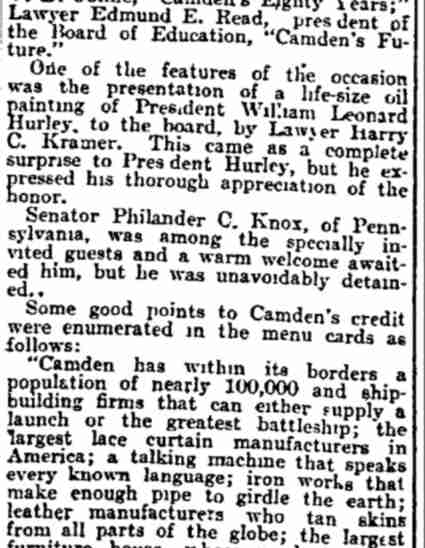
One of the features of the occasion was the presentation of a life-size oil painting of President William Leonard Hurley. [sic] to the board, by Lawyer Harry C. Kramer. This came as a complete surprise to President Hurley, but he expressed his thorough appreciation of the honor.
Senator Philander C. Knox, of Pennsylvania, was among the specially invited guests and a warm welcome awaited him, but he was unavoidably detained.. [sic]
Some good points to Camden’s credit were enumerated in the menu cards as follows:
“Camden has within its borders a population of nearly 100,000 and shipbuilding firms that can either supply a launch or the greatest battleship; the largest lace curtain manufacturers in America; a talking machine that speaks every known language; iron works that make enough pipe to girdle the earth; leather manufacturers who tan skins from all parts of the globe; the largest furniture house, whose products reach the Philippines; banks and trust companies whose resources are not affected by panics; artesian water that can be taken without adding anything.”
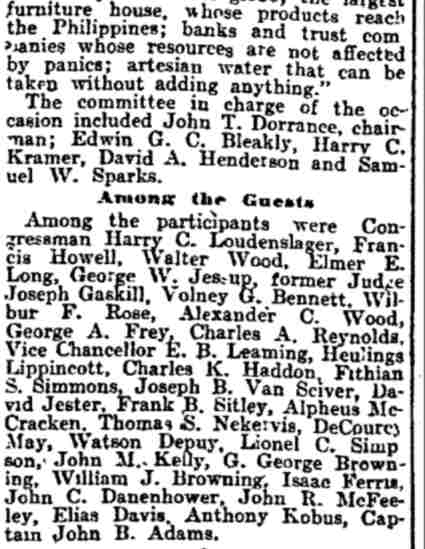
The committee in charge of the occasion included John T. Dorrance, chairman; Edwin G. C. Bleakly, Harry C. Kramer, David A. Henderson and Samuel W. Sparks.
Among the Guests
Among the participants were Congressman Harry C. Loudenslager, Francis Howell, Walter Wood, Elmer E. Long, George W. Jessup, former Judge Joseph Gaskill, Volney G. Bennett, Wilbur F. Rose, Alexander C. Wood, George A. Frey, Charles A. Reynolds, Vice Chancellor E. B. Leaming, Heulings Lippincott, Charles K. Haddon, Fithian S. Simmons, Joseph B. Van Sciver, David Jester, Frank B. Sitley, Alpheus McCracken, Thomas S. Nekervis, DeCourcy May, Watson Depuy, Lionel C. Simpson, John M. Kelly, G. George Browning, William J. Browning, Isaac Ferris, John C. Danenhower, John R. McFeeley, Elias Davis, Anthony Kobus, Captain John B. Adams.
J. B. Van Sciver Company — Resolutions on Death of W. H. Wagoner
Philadelphia Inquirer —

The Board of Directors of the J. B. Van Sciver Company, yesterday adopted resolutions of regret on the death of William H. Wagoner, who was vice president of the company,
First Camden National Bank & Trust Co. (advertisement)
Camden Courier-Post —
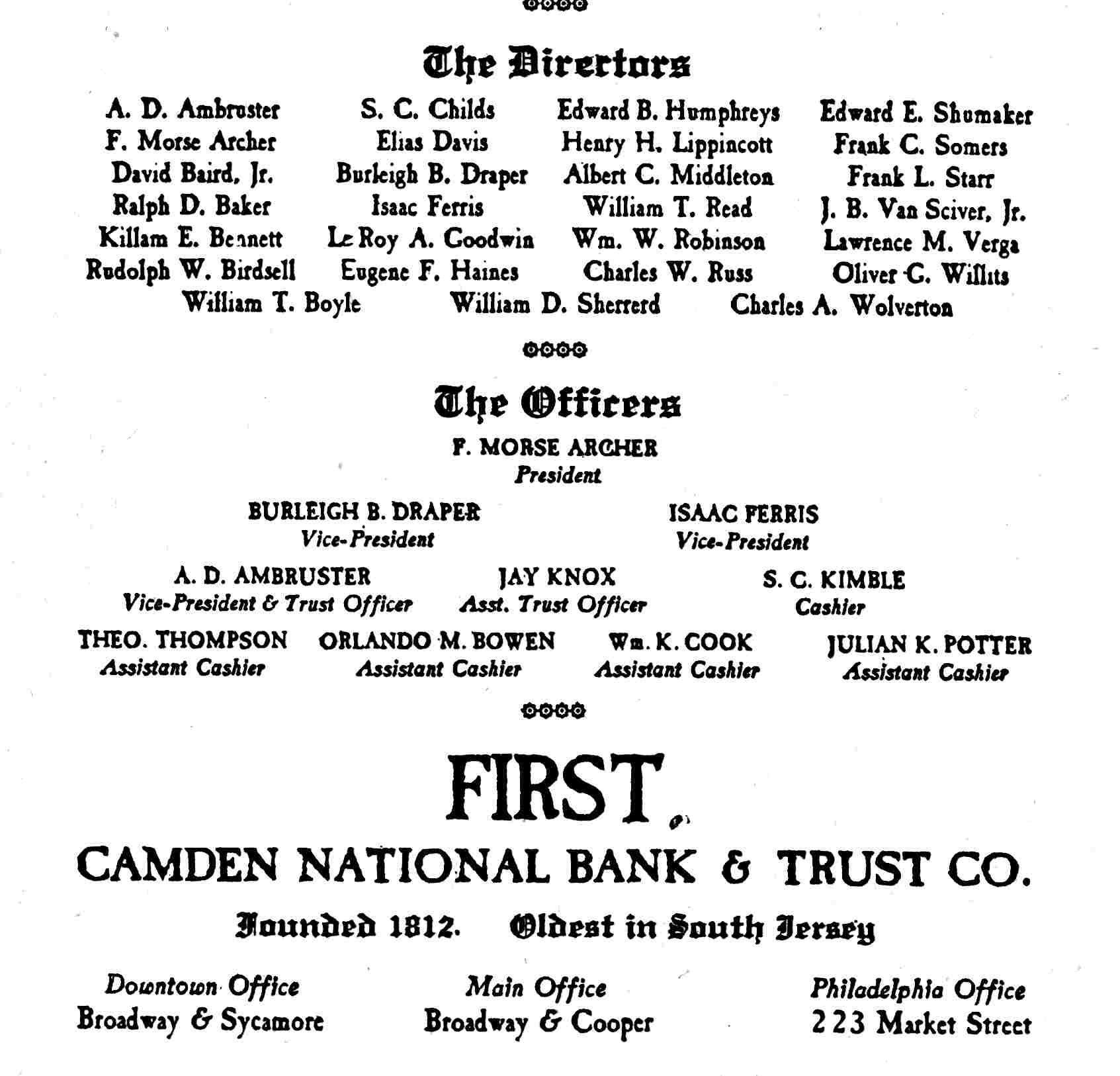
The Directors
A. D. Ambruster
S. C. Childs
Edward B. Humphreys
Edward E. Shumaker
F. Morse Archer
Elias Davis
Henry H. Lippincott
Frank C. Somers
David Baird, Jr.
Burleigh B. Draper
Albert C. Middleton
Frank L. Starr
Ralph D. Baker
Isaac Ferris
William T. Read
J. B. Van Sciver, Jr.
Killam E. Bennett
Le Roy A. Goodwin
Wm. W. Robinson
Lawrence M. Verga
Rudolph W. Birdsell
Eugene F. Haines
Charles W. Russ
Oliver C. Willits
William T. Boyle
William D. Sherrerd
Charles A. Wolverton
The Officers
F. MORSE ARCHER
President
BURLEIGH B. DRAPER
Vice-President
ISAAC FERRIS
Vice-President
A. D. AMBRUSTER
Vice-President & Trust Officer
JAY KNOX
Asst. Trust Officer
S. C. KIMBLE
Cashier
THEO. THOMPSON
Assistant Cashier
ORLANDO M. BOWEN
Assistant Cashier
Wm. K. COOK
Assistant Cashier
JULIAN K. POTTER
Assistant Cashier
FIRST
CAMDEN NATIONAL BANK & TRUST CO.
Founded 1812. Oldest in South Jersey
Downtown Office
Broadway & Sycamore
Main Office
Broadway & Cooper
Philadelphia Office
223 Market Street
400 Friends Pay Homage To ‘Good Gray Poet’
Camden Courier-Post —
Men and Women From Many Sections Visit Walt Whitman’s Tomb and Old Mickle Street Home on His 114th Anniversary
“It’s just a little street where old friends meet”
That’s Mickle Street where Walt Whitman, the “Good Gray Poet,” once lived, and old friends came back here from near and far yesterday to mingle under the portals of the house in which he wrote his famous works, on the 114th anniversary of his birth.
Among them was Mrs. Augusta K. Dole, 71, of Metuchen, whose husband has been a sports writer on New York newspapers for 45 years.
“They call it a dingy street and some are ashamed to return and say they lived there,” Mrs. Dole said. And with a gesture of the hand she pointed out the homes of some of neighbors, who became famous.
Among them was Button; famous artist [architect]. Another was the grandmother of J. B. Van Sciver.
“I lived at 319 Mickle Street when I was a young lady,” she said. “I was one year old when we moved into the house right across the street from Whitman. I remember when he lived on Stevens Street before he moved to Mickle Street.
Knew Whitman Well
“We lived at the Mickle Street address about 15 or 16 or 20 years; I knew Whitman well. He always stopped and exchanged greetings with me. I frequently saw him on the ferryboats crossing the rivers.
“I want to take issue right here with those who have questioned his chastity. He was more like Christ than anyone else. I saw him admiring me as a young woman one day on a ferryboat.”
“Years later I read a description of myself in one of his works. I did not begin to read his work until 30 years ago. He wrote of the true things in life. He wrote of life as it is and as we see it. I am glad to come here today at the invitation of the committee,”
Mrs. Dole sat in the last chair in which the poet rested before his last illness. She was introduced to Dr. Alexander MacAlister, who was his personal physician in his last illness and who is a member of the Walt Whitman foundation.
Then she posed with an etching by Lewis Daniel, New York artist, at the Walt Whitman art gallery, 641 Market Street. It is one of 14 the young artist drew on “The Song of the Open Road.” Two lines taken from the book are sketched under the etching as follows:
“The earth is crude and incomprehensible at first— Nature is rude and incomprehensible at first.”
400 Visit Home
More than 400 guests visited the home of the poet during the day to be welcomed by members of the foundation. Mrs. Charles A. Wolverton, wife of Congressman Wolverton, was chairman of the reception committee.
Many of the guests visited the tomb of the poet in Harleigh Cemetery where the door is ajar at his request “that his spirit may come and go as I choose.’” But no flowers were placed there as he requested none.
Born on May 31, 1819, near Huntingdon, Long Island, he had a varied career as a writer, war correspondent and poet. During the Civil War he ministered the wounded of both the North and South at Washington. He spent the last 19 years of his life in Camden, where he died in 1892.
Under the bed in his second story front bed room today is a huge metal bathtub, which he designed for use in his invalid days. His library, horsehair furniture, his favorite rocking chair and a cane with which he knocked on the floor to call his housekeeper.
Some of his writings, manuscripts and other works are the property of Miss Ann Harned and Madge Barton Feurer. They are now at the New Jerseyanna Exhibition at the State House at Trenton.
New Painting Viewed
A new painting of Walt Whitman has been completed by Byron T. Connor, of 4320 Manor Avenue, Merchantville, and is now on display at the Hotel Walt Whitman. The painting was completed in three weeks, so as to be ready for the birthday ceremonies.
Later it will be moved from the hotel and placed either in the Whitman home or hung in the lobby of the Walt Whitman Theatre.
Miss Harned, daughter of the late Thomas B. Harned, one of Whitman’s literary executors; Joseph Praissman and Mrs. Martha Davis curator of the Whitman home, were members of the anniversary committee headed by Mrs. Wolverton.
With few exceptions, members of the Walt Whitman Foundation attended yesterday’s program, including Dr. Macalister, chairman; Dr. Cornelius Weygandt, vice chairman; Mrs. Juliet Lit Stern, Joseph M. Conover, Mrs. Helen Taft Manning, Mrs. Allen Drew Cook, Mrs. Nicholas Douty, Dr. Herbert Spencer Harned, J. Frederick Harned, Roy Helton, William T. Innes, Eldridge R. Johnson, William H. Ketler, Dr. Rufus M. Jones, former Mayor Victor King, Oscar Wolf, John Frederick Lewis, Jr., Dr. Bliss Perry, Harrison S. Morris, Agnes Repplier, former Mayor Winfield S. Price, Vernon Whitman Rich, Dr. J. Duncan Spaeth, Dr. Felix E. Schelling, Dr. Robert E. Spiller, Mrs. David Abeel Storer, Frederick Von Nieda and Ralph W. Wescott.
Among the visitors was former Assemblyman William H. Iszard, who is secretary of the committee, which acquired the home as a national shrine. Iszard sponsored legislation in the Assembly for its upkeep.
He’s Dressing in the Window—tsch! tsch!
Camden Courier-Post —
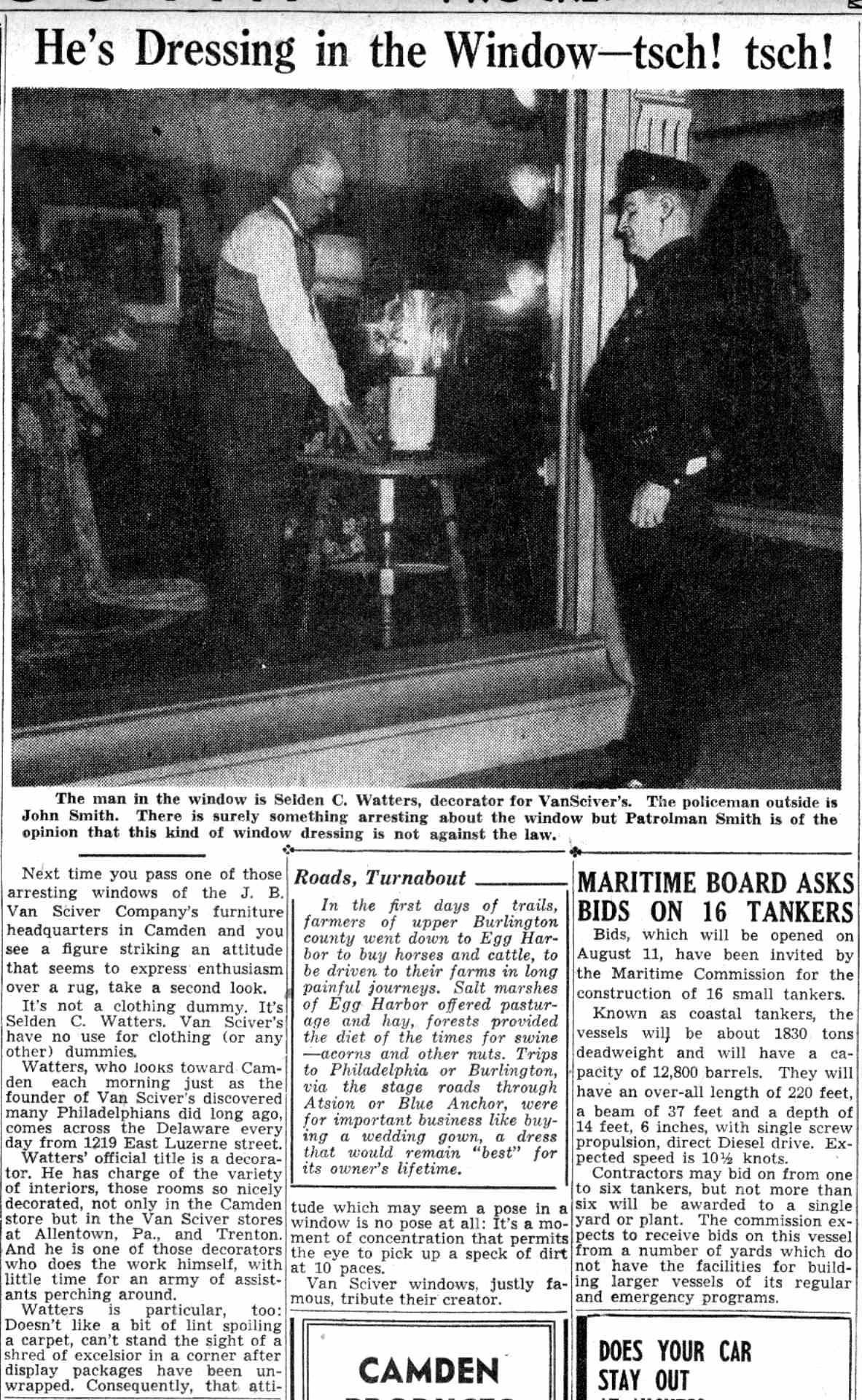
The man in the window is Selden C. Watters, decorator for VanSciver’s. The policeman outside is John Smith. There is surely something arresting about the window but Patrolman Smith is of the opinion that this kind of window dressing is not against the law.
Next time you pass one of those arresting windows of the J. B. Van Sciver Company’s furniture headquarters in Camden and you see a figure striking an attitude that seems to express enthusiasm over a rug, take a second look.
It’s not a clothing dummy. It’s Selden C. Watters. Van Sciver’s have no use for clothing (or any other) dummies.
Watters, who looks toward Camden each morning just as the founder of Van Sciver’s discovered many Philadelphians did long ago, comes across the Delaware every day from 1219 East Luzerne street.
Watters’ official title is a decorator. He has charge of the variety of interiors, those rooms so nicely decorated, not only in the Camden store but in the Van Sciver stores at Allentown, Pa., and Trenton. And he is one of those decorators who does the work himself, with little time for an army of assistants perching around.
Watters is particular, too: Doesn’t like a bit of lint spoiling a carpet, can’t stand the sight of a shred of excelsior in a corner after display packages have been unwrapped. Consequently, that attitude which may seem a pose in a window is no pose at all: It’s a moment of concentration that permits the eye to pick up a speck of dirt at 10 paces.
Van Sciver windows, justly famous, tribute their creator.
J. B. Van Sciver Co. Advertisement
Camden Courier-Post —
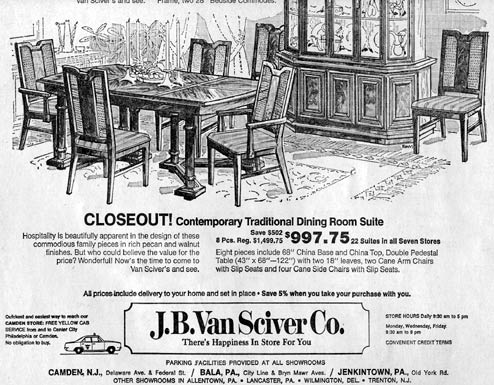
CLOSEOUT! Contemporary Traditional Dining Room Suite
Save $502. $997.75. 22 Suites in all Seven Stores.
Hospitality is beautifully apparent in the design of these commodious family pieces in rich pecan and walnut finishes. But who could believe the value for the price? Wonderful! Now is the time to come to Van Sciver's and see.
8 Pcs. Reg. $1,499.75. Eight pieces include 68" China Base and China Top, Double Pedestal Table (43" x 68"–122") with two 18" leaves, two Cane Arm Chairs with Slip Seats and four Cane Side Chairs with Slip Seats.
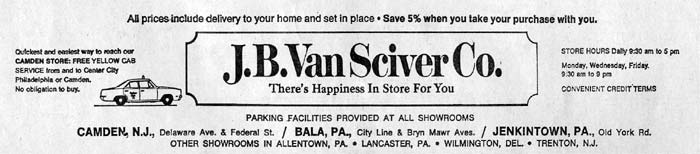
All prices include delivery to your home and set in place • Save 5% when you take your purchase with you.
J.B. Van Sciver Co. — There's Happiness In Store For You.
PARKING FACILITIES PROVIDED AT ALL SHOWROOMS. CAMDEN, N.J., Delaware Ave. & Federal St. / BALA, PA., City Line & Bryn Mawr Aves. / JENKINTOWN, PA., Old York Rd. OTHER SHOWROOMS IN ALLENTOWN, PA. • LANCASTER, PA. • WILMINGTON, DEL. • TRENTON, N.J.
Quickest and easiest way to reach our CAMDEN STORE: FREE YELLOW CAB SERVICE from and to Center City Philadelphia or Camden. No obligation to buy.
STORE HOURS Daily 9:30 am to 5 pm. Monday, Wednesday, Friday 9:30 am to 9 pm. CONVENIENT CREDIT TERMS
Moving Out: Camden Loses Again
Philadelphia Inquirer —
By William W. Sutton Jr., Inquirer Staff Writer
Camden’s last large retail business is leaving the city. Joseph B. Van Sciver 3d said that J.B. Van Sciver Co. would move its retail operation from Camden to Cherry Hill sometime in the spring.
His action, in part, is based on the same reasoning that led his grandfather, Joseph B. Van Sciver Sr., to expand his furniture stores to the suburbs during the Depression. Van Sciver Sr., who founded J.B. Van Sciver Co. more than a century ago, was following his customers. His grandson is doing the same, but Joseph B. Van Sciver 3d also is trying to cut his costs.
“This location is better suited for a warehouse than a retail operation,” Van Sciver 3d, president of the company, said in an interview in his third-floor office at Delaware Avenue and Federal Street. “The cost of air conditioning, heating and lighting here is just ridiculous.”
Van Sciver said the decision to relocate was in accord with the company’s policy of making all its stores more energy efficient by using less space.
“I think a lot more customers will find us in Cherry Hill,” he said. “Camden has remained rather static over the last 10 years, remaining at about the same (sales) level or maybe little bit better. I think we can do better elsewhere … The move will put us out where we belong, closer to other stores. Camden, going way, way back, was an enormous outlet. But I don’t see it having much of an impact in the future.”
Dozens of customers came to the seven-story store yesterday to take advantage of a relocation sale, which will continue until Van Sciver’s sells most of its merchandise. The 50 parking spaces were constantly filled.
Many of the customers said they were from Cherry Hill and other suburbs. The business volume, according to Van Sciver, was much more than normal.
One customer, Marie Paley of Cherry Hill, said the move did not disturb her. “To me, it wouldn’t make any difference (whether Van Sciver’s moves),” she said as she shopped. “It’s not like going to a grocery store weekly. You only go to a furniture store once in a while and, when you go, you go in your own car and don’t have to be bothered with public transportation.”
The last of Camden’s seven department stores, Kotlikoff’s, went out of business last month. The other department stores and other major retailers left the city during the last 30 years.
Van Sciver said the company expected to save “thousands of dollars” in utility costs when the retail portion moved from the Camden location to a building that had been a supermarket at Brace Road near Kresson Road in Cherry Hill.
Van Sciver said the company planned to open its new store in “three or four months” after renovations have been completed.
The Van Sciver name has been well known in this area ever since Van Sciver’s grandfather established the first store in Camden in 1880 at 210 Federal St.
Only a few years later, the store was moved to its current Camden location. Since then, the company has expanded to seven stores in Pennsylvania, New Jersey and Delaware, and the Camden store always has served as the company’s headquarters.
The Camden store also has served as the primary showroom since the 1950s. The company has its general administrative offices and warehouse units in the same building. Much of Van Sciver’s furniture, including cabinets and mattresses, is handmade at the Camden store.
Van Sciver said the company would retain the building in Camden as a warehouse, unless the building is sold. He said the company had not actively pursued a sale but is asking $500,000 for the one-block property.
Acknowledgements
Thanks to Harry Kyriakodis for his help in creating this page, Benedict Tisa for many of the postcard scans seen on this page, and Sandra White-Grear, for her article on the Van Sciver family.