Peter S. Gray
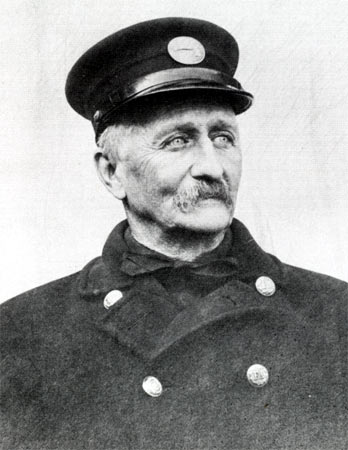
Peter S. Gray, circa 1890
PETER SCHULTZ GRAY was born in Pennsylvania on June 2, 1847. He was the son of John M. Gray and his wife Sarah. John M. Gray worked as a harness maker. The family was living in Philadelphia when the Census was taken in 1860. By the time the 1870 Census was taken, the family had moved to Camden’s North Ward. Peter S. Gray was living with his parents, older sister Sarah, and younger brother John Gray. The family lived next door to Albert Doughty, who would later serve in the Camden Fire Department, as did John M. Gray and both of his sons. Peter Gray was working in a carriage factory, brother John was working as a bricklayer.
John M. Gray was a harness maker by trade. He was living at 30 North 5th Street when he was appointed to the Camden Fire Department on February 8, 1872, taking the place of Charles Elfreth, who had been promoted to Driver. John M. Gray served as an extra man with the Hook and Ladder Company, known in more recent times as Ladder Company 1. John M. Gray resigned from the Fire Department on October 8, 1872.
Peter Gray’s brother John Gray was appointed to the Camden Fire Department in June of 1873 to replace Edward Allen, who had resigned from his position as an extra man with the Hook and Ladder Company. Peter Gray was appointed to the Camden Fire Department on April of 1874, when David Sparks resigned from Engine Company 2. About that same time Peter S. Gray moved from 30 North 5th Street to 34 North 5th Street. John Gray continued to lived at 30 North 5th. The Gray brothers remained with the Fire Department until the spring of 1876. They were not reappointed that year, but were reinstated in April of 1877. As extra men, they both worked regular jobs in addition to their work as firemen. Peter Gray worked as a machinist, John Gray as a bricklayer.
The 1878–1879 Camden City Directory shows Peter Gray at 819 Carpenter Street and John Gray having moved to 434 Lawrence Street.
In March of 1878 the Gray brothers’ father, John M. Gray, was appointed janitor of Camden’s City Hall. When the Census was again taken in 1880 he was still working as the janitor at Camden’s City Hall. He lived on premises with his wife Sarah. Suffering for some time with asthma, he died in mid-September of 1880.
Both Peter Gray and John Gray returned to their original companies in 1877, and served until 1882, when due to a change in politics, both were not reappointed. John Gray was brought back in 1884, and when Samuel Elfreth was again elected Chief of the Camden Fire Department in 1885, Peter Gray was reinstated. By the end of 1888 both Gray brothers were working as laddermen with the Hook and Ladder Company (later designated Ladder Company 1). This continued until April 19, 1902 when John Gray died from a heart attack. Peter Gray continued to serve with the Camden Fire Department’s Ladder Company 1 until February 1, 1913, when he resigned. He was replaced by William Walton.
The 1883–1884 and 1884–1885 City Directories show that the Gray brothers were both living at 831 Carpenter Street. The directories show that John was at 36 North 5th Street from 1887 through 1890 and at 38 North 5th Street from 1894 to 1896. He then moved to 418 Henry Street, where he lived out his days.
Peter S. Gray remained at 831 Carpenter Street through at least 1888. By 1890 he had moved to 818 Market Street, where he resided through 1894. By 1895 he had moved to 531 Cedar Street in North Camden. He passed away on May 15, 1926.
Over the River.
Philadelphia Inquirer —
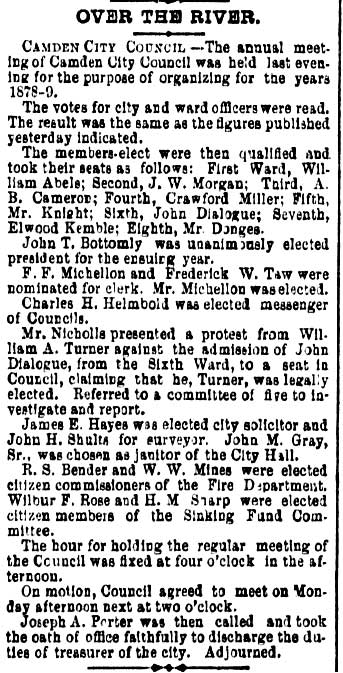
CAMDEN CITY COUNCIL—The annual meeting of Camden City Council was held last evening for the purpose of organizing for the years 1878–9.
The votes for city and ward officers were read. The result was the same as the figures published yesterday indicated.
The members-elect were then qualified and took their seats as follows: First Ward, William Abels; Second, J. W. Morgan; Third, A. B. Cameron; Fourth, Crawford Miller; Fifth, Mr. Knight; Sixth, John Dialogue; Seventh, Elwood Kemble; Eighth, Mr. Donges.
John T. Bottomly was unanimously elected president for the ensuing year.
F. F. Michellon and Frederick W. Taw were nominated for clerk. Mr. Michellon was elected.
Charles H. Helmbold was elected messenger of Councils.
Mr. Nichols presented a protest from William A. Turner against the admission of John Dialogue, from the Sixth Ward, to a seat in Council, claiming that he, Turner, was legally elected. Referred to a committee of five to investigate and report.
James E. Hayes was elected city solicitor and John H. Shultz for surveyor. John M. Gray, Sr., was chosen as janitor of the City Hall.
R. S. Bender and W. W. Mines were elected citizen commissioners of the Fire Department. Wilbur F. Rose and H. M. Sharp were elected citizen members of the Sinking Fund Committee.
The hour for holding the regular meeting of the Council was fixed at four o’clock in the afternoon.
On motion, Council agreed to meet on Monday afternoon next at two o’clock.
Joseph A. Porter was then called and took the oath of office faithfully to discharge the duties of treasurer of the city. Adjourned.
Not Expected to Live.
Philadelphia Inquirer —
Not Expected to Live.—Yesterday Dr. Mulford stated that he had no hopes of the recovery of John Gray, janitor of the Camden City Hall, who has been lying dangerously sick of asthma for some months past.
Funeral of Janitor Gray.
Philadelphia Inquirer —
Funeral of Janitor Gray.—Yesterday afternoon the funeral of John M. Gray, late janitor of the Camden City Hall, took place from the hall and was largely attended. Members of City Council and officers of the different departments attended in a body. Deceased was interred in the Camden Cemetery.
Camden City Council.
Philadelphia Inquirer —
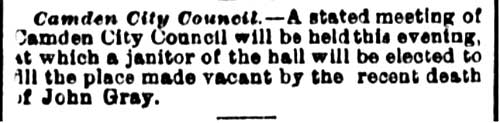
Camden City Council.—A stated meeting of Camden City Council will be held this evening, at which a janitor of the hall will be elected to fill the place made vacant by the recent death of John Gray.
Election of a Janitor.
Philadelphia Inquirer —
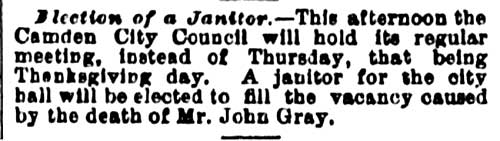
Election of a Janitor.—This afternoon the Camden City Council will hold its regular meeting, instead of Thursday, that being Thanksgiving day. A janitor for the city hall will be elected to fill the vacancy caused by the death of Mr. John Gray.
Camden News Budget.
Philadelphia Inquirer —
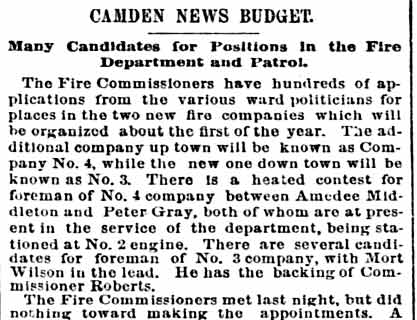
CAMDEN NEWS BUDGET.
Many Candidates for Positions in the Fire Department and Patrol.
The Fire Commissioners have hundreds of applications from the various ward politicians for places in the two new fire companies which will be organized about the first of the year. The additional company up town will be known as Company No. 4, while the new one down town will be known as No. 3. There is a heated contest for foreman of No. 4 company between Amedee Middleton and Peter Gray, both of whom are at present in the service of the department, being stationed at No. 2 engine. There are several candidates for foreman of No. 3 company, with Mort Wilson in the lead. He has the backing of Commissioner Roberts.
The Fire Commissioners met last night, but did nothing toward making the appointments. A …
[News brief — Camden fire department items]
Camden Daily Courier —
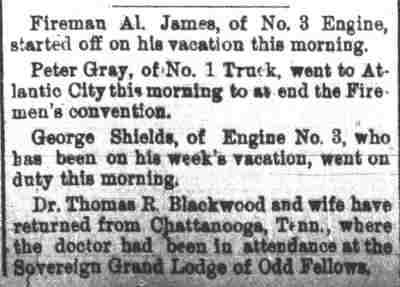
Fireman Al. James, of No. 3 Engine, started off on his vacation this morning.
Peter Gray, of No. 1 Truck, went to Atlantic City this morning to attend the Firemen’s convention.
George Shields, of Engine No. 3, who has been on his week’s vacation, went on duty this morning.
Dr. Thomas R. Blackwood and wife have returned from Chattanooga, Tenn., where the doctor had been in attendance at the Sovereign Grand Lodge of Odd Fellows.
Camden News Notes.
Philadelphia Inquirer —
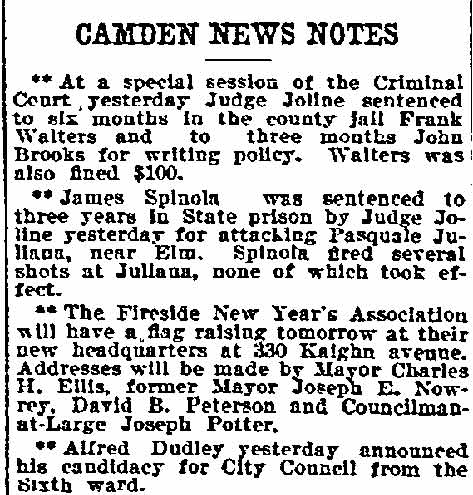
** At a special session of the Criminal Court yesterday Judge Joline sentenced to six months in the county jail Frank Walters and to three months John Brooks for writing policy. Walters was also fined $100.
** James Spinola was sentenced to three years in State prison by Judge Joline yesterday for attacking Pasquale Juliana, near Elm. Spinola fired several shots at Juliana, none of which took effect.
** The Fireside New Year’s Association will have a flag raising tomorrow at their new headquarters at 330 Kaighn avenue. Addresses will be made by Mayor Charles H. Ellis, former Mayor Joseph E. Nowrey, David B. Peterson and Councilman-at-Large Joseph Potter.
** Alfred Dudley yesterday announced his candidacy for City Council from the Sixth ward.
** The South Camden Pleasure Club was incorporated yesterday, with these trustees: Eugene McCarthy, Alfred Sayrs, Charles Welsh, John Genther and William Barr.
** Firemen William Rose, John Dold and Peter Gray have been appointed a committee to decorate the graves of deceased firemen tomorrow.
** Glass in a bulk window at the store of Joseph Jones, 2214 Federal street, East Camden, was smashed early yesterday morning and a five-pound box of candies was stolen.
** Many improvements have been made in the Rosedale section of East Camden in having the streets graded and curbed and the sidewalks paved, through the efforts of Councilman John W. Coleman, and now property owners are clamoring for sewers. Mr. Coleman has invited City Engineer Farnham to look the ground over and prepare plans.
Exciting Scenes Feature Big Fire.
Philadelphia Inquirer —

Conflagration in Paint and Varnish Works, in Camden, Resulted in Destruction of Much Valuable Property
More than five hundred thousand dollars-worth of property destroyed, three persons seriously injured and half a score of families forced to flee from their homes were a few of the effects of a disastrous fire which yesterday swept its way through the big plant of the N. Z. Graves Paint and Varnish Company, on Twelfth street, Camden, between Linden and Federal streets.
It was the explosion of a mixing tank that caused the blaze, but no reason has yet been assigned for the explosion, and the only workman who was near the vat at the time is now lying in a critical condition at the Cooper Hospital.
Explosion followed explosion with the same deafening roar as that made by opposing batteries in a battle, and during the three hours when the fire raged its fiercest more than two hundred tanks blew up.
Spectacular Blaze
From the spectacular viewpoint the blaze was one of the greatest in years, owing to the chemical nature of the varnishes and paints which were destroyed. Flames mounted as high as two hundred feet in the air and could be plainly seen from Twenty-first and Market streets in this city.
Often as a vat exploded a dense mass of black smoke would mount high towards the heavens and then suddenly burst open like a huge pyrotechnic and out would come a large ball of flame. Then suddenly the whole building would seem to send up a solid square of flame that, after becoming lost in the clouds of smoke which hid the sky, would suddenly veer to the east or west and set fire to some small building.
Not the least of the curious sights was the throwing by the sun of a beautiful rainbow whose arch was easily one hundred feet long across a background of smoke. The sun had caught the spray from a fire hose and reflected it across the small buildings which had caught fire, but from which no flames came, there issued a dense cloud of red smoke which gradually changed to purple, then became white and finally black.
Tanks Intact
While all these explosions occurred and while the heat of the flames was so great that it singed the hair of persons on the opposite side of the street, thirty large tanks containing from five to ten thousand gallons of gasoline and benzine and located almost directly in the rear of the blazing buildings, remained unharmed, although it was momentarily feared that they, too, would explode.
All but one of the eight buildings of the Graves Company were either totally destroyed or so badly damaged that they will have to be rebuilt. Three houses were badly damaged and half a score of other houses scorched.
The persons injured were Joseph Pease, of 341 Kimball street, this city; George Ward, foreman of Fire Company No. 2, and Peter Gray, a fireman.
Pease was the workman who was near the vat at the time the first explosion occurred, and he was thrown high in the air and had his face, arms and body burned by the flames.
Ward was injured while leading his men in an attack upon the flames. He was mounting a ladder leading to the room of a dwelling at 316 Twelfth street when the cornice of the roof came off, fell and struck him on the head and caused an ugly wound of the scalp. Ward kept his hold upon the ladder and managed to descend. He was immediately hurried to the hospital.
Fireman Peter Gray was burned by the flaming benzine from a small tank which exploded.
Attacked Flames With Vim
Although one of the largest buildings resembled an enormous cauldron when they arrived upon the scene the Camden firemen, nothing discouraged, attacked the fire with vim, and while they could not confine it to the one building, they did splendid work in saving a number of small houses of workmen which surround the plant. They also saved one of the large buildings of the plant.
The police boats Ashbridge and Visitor, from this city, were sent to the fire, but were unable to get up Cooper Creek, which is in the rear of the plant, owing to the ice and mud. The Pennsylvania Railroad’s fire tug Jamestown, however, got to the plant and did effectual service.
Mayor Ellis was early upon the scene and had his hair singed while directing the firemen.
In Philadelphia great interest was taken in the fire, and at one time it looked as though all Camden were ablaze.
It was about half-past eleven yesterday morning that Pease, while working in what is known as building No. 1, at the Greaves plant, a large three-story brick structure, fifty by one hundred and twenty-five feet, was suddenly hurled from his feet by the explosion in a vat. Accounts differ as to what really occurred, but it is certain that there was an explosion. This building is used partly as an office building and partly to mix paints and varnishes.
General Alarm Sounded
For a minute the flames did not spread rapidly and a call was sent to the police headquarters for a chemical engine. By the time this apparatus arrived the whole building was on fire and a general alarm was sent in.
In the few moments elapsing between the call for the chemical engine and its arrival upon the scene several other explosions occurred and caused the employes to flee for their lives. There were only about fifty men, or one-third the regular force, working yesterday.
As soon as the firemen all arrived they tried to save building No. 5, which is of the same size and structure as the No. 1 building, but in which were stored one hundred and eight large vats of various kinds of varnish and paint, and all of them combustible.
Between the two buildings was a narrow archway, and over this the flames crept and defeated the efforts of the fire fighters. Then began the series of explosions that not only lit up the skies, but carried the fire to half a dozen dwelling houses.
These buildings are double houses and are two and one-half stories high. When the house at 306 Twelfth street caught fire all the other occupants of the row started to throw their household goods in the street, and in several cases the sparks set fire to bed clothing. Later in the day the residents, still fearful of their homes, secured wagons and carted their belongings away.
Thought of His Hens’ Eggs
One man, James Demsey, when he found his house afire, thought only for a dozen of Plymouth Rock hens’ eggs which he had secured for the purpose of raising some chickens. Regardless of his danger he dashed into the burning building, secured the eggs, and then made his escape.
Prompt work by the firemen soon put an end to the flames which had attacked the dwellings, but against the blaze which raged in the two buildings of the paint works the fire fighters were helpless. It seemed that the more water was poured upon the buildings the wickeder the flames arose. Not until all the floors had fallen and everything burnable had been consumed did the flames cease their work of destruction, and the walls had been so scorched that half of them fell crashing into the interior of the buildings.
Besides the two large buildings the stable of the works caught fire but the employes of the plant were able to get all the horses and wagons out safely.
A. Graves, a son of the proprietor of the plant, stated that he did not know how great the loss would be nor could he tell exactly how the fire started. There is about $265,000 insurance upon the plant.
Bucket Brigade at Work
Later the residence at 1104 Linden street, where lives George Brown, was ignited. A bucket brigade did yeoman service there. To add to the excitement word reached the firemen that the plant of the R. F. Smith Lumber Company, Federal street and Cooper Creek, had been fired by sparks. An engine company was withdrawn and sent to the scene of the new blaze, which was extinguished with a trifling loss.
When the walls of No. 3 building fell, forcing the firemen to abandon their post, one of the recently purchased engines was left under the ruins. It wasn’t there long, however, a rope being attached and the steamer being pulled out by a hundred or so volunteers.
The first two dwellings to take fire were those of C. W. Sleighs, 306, and John Taylor, 304 North Twelfth street. The other houses in the row are tenanted as follows:
In 702 is Harry Smith; 300, vacant; 224, Frank Pullinger; 222, Mary Rass; 220, Joseph Eccles; 218, Charles Sibert; 216, Fred Exler; 214, Henry Palmer; 212, Charles Mills; 210, Samuel Ivins.
Wish Bone Club in Annual Banquet.
Camden Post-Telegram —
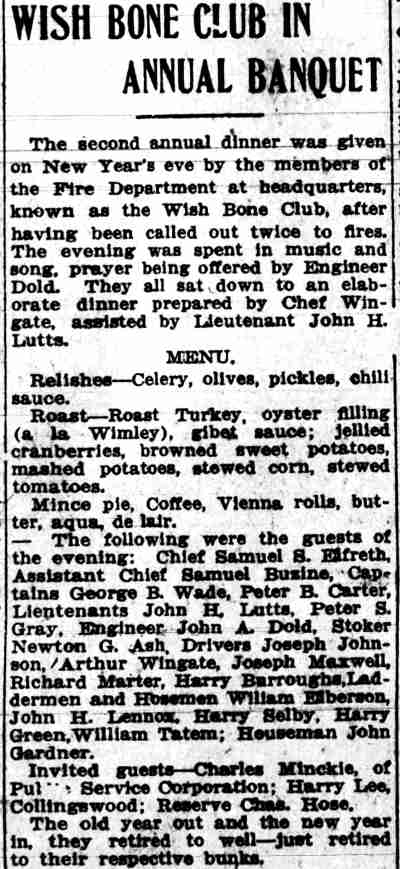
The second annual dinner was given on New Year’s eve by the members of the Fire Department at headquarters, known as the Wish Bone Club, after having been called out twice to fires. The evening was spent in music and song, prayer being offered by Engineer Dold. They all sat down to an elaborate dinner prepared by Chef Wingate, assisted by Lieutenant John H. Lutts.
MENU.
Relishes—Celery, olives, pickles, chilli sauce.
Roast—Roast Turkey, oyster filling (a la Wimley), giblet sauce; jellied cranberries, browned sweet potatoes, mashed potatoes, stewed corn, stewed tomatoes.
Mince pie, Coffee, Vienna rolls, butter, aqua de lair.
— The following were the guests of the evening: Chief Samuel S. Elfreth, Assistant Chief Samuel Buzine, Captains George B. Wade, Peter B. Carter, Lieutenants John H. Lutts, Peter S. Gray, Engineer John A. Dold, Stoker Newton G. Ash, Drivers Joseph Johnson, Arthur Wingate, Joseph Maxwell, Richard Marter, Harry Barroughs, Laddermen and Hosemen William Elberson, John H. Lennox, Harry Selby, Harry Green, William Tatem; Houseman John Gardner.
Invited guests—Charles Minckle, of Public Service Corporation; Harry Lee, Collingwood; Reserve Chas. Hose.
The old year out and the new year in, they retired to well—just retired to their respective bunks.
Shipyard Fire Will Not Retard Work.
Philadelphia Inquirer —
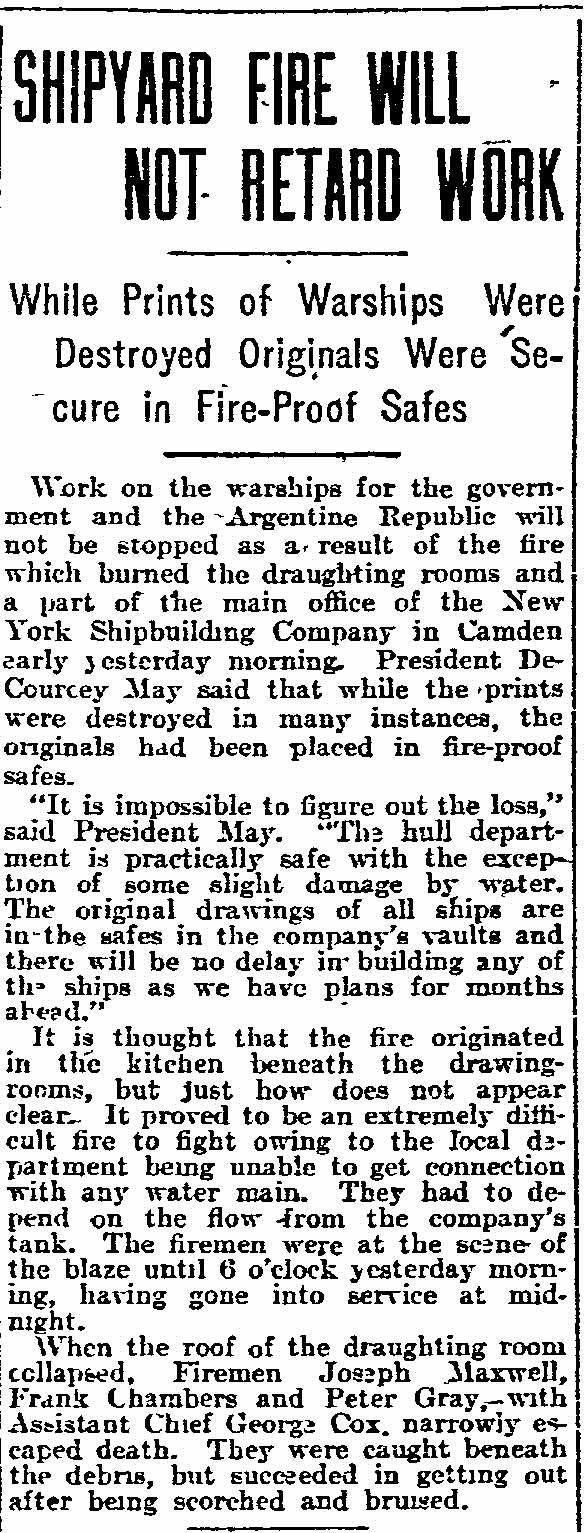
While Prints of Warships Were Destroyed Originals Were Secure in Fire-Proof Safes
Work on the warships for the government and the Argentine Republic will not be stopped as a result of the fire which burned the draughting rooms and a part of the main office of the New York Shipbuilding Company in Camden early yesterday morning. President DeCourcey May said that while the prints were destroyed in many instances, the originals had been placed in fire-proof safes.
“It is impossible to figure out the loss,” said President May. “The hull department is practically safe with the exception of some slight damage by water. The original drawings of all ships are in the safes in the company’s vaults and there will be no delay in building any of the ships as we have plans for months ahead.”
It is thought that the fire originated in the kitchen beneath the drawing rooms, but just how does not appear clear. It proved to be an extremely difficult fire to fight owing to the local department being unable to get connection with any water main. They had to depend on the flow from the company’s tank. The firemen were at the scene of the blaze until 6 o’clock yesterday morning, having gone into service at midnight.
When the roof of the draughting room collapsed, Firemen Joseph Maxwell, Frank Chambers and Peter Gray, with Assistant Chief George Cox, narrowly escaped death. They were caught beneath the debris, but succeeded in getting out after being scorched and bruised.
Firemen Trapped in Burning Store.
Camden Post-Telegram —
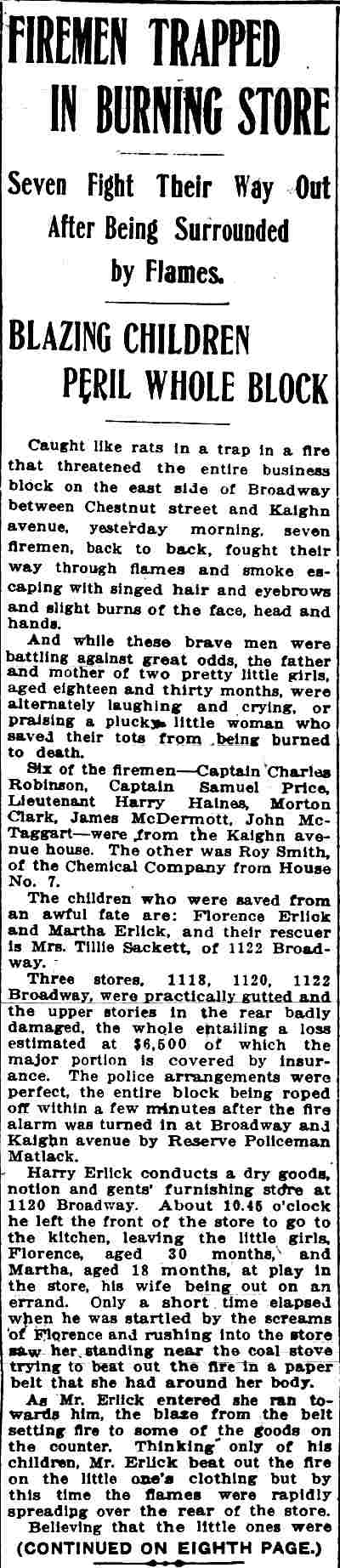

Seven Fight Their Way Out After Being Surrounded by Flames.
BLAZING CHILDREN PERIL WHOLE BLOCK
Caught like rats in a trap in a fire that threatened the entire business block on the east side of Broadway between Chestnut street and Kaighn avenue, yesterday morning, seven firemen, back to back, fought their way through flames and smoke escaping with singed hair and eyebrows and slight burns of the face, head and hands.
And while these brave men were battling against great odds, the father and mother of two pretty little girls, aged eighteen and thirty months, were alternately laughing and crying, or praising a plucky little woman who saved their tots from being burned to death.
Six of the firemen—Captain Charles Robinson, Captain Samuel Price, Lieutenant Harry Haines, Morton Clark, James McDermott, John McTaggart—were from the Kaighn avenue house. The other was Roy Smith, of the Chemical Company from House No. 7.
The children who were saved from an awful fate are: Florence Erlick and Martha Erlick, and their rescuer is Mrs. Tillie Sackett, of 1122 Broadway.
Three stores, 1118, 1120, 1122 Broadway, were practically gutted and the upper stories in the rear badly damaged, the whole entailing a loss estimated at $6,500 of which the major portion is covered by insurance. The police arrangements were perfect, the entire block being roped off within a few minutes after the fire alarm was turned in at Broadway and Kaighn avenue by Reserve Policeman Matlack.
Harry Erlick conducts a dry goods, notion and gents’ furnishing store at 1120 Broadway. About 10.45 o’clock he left the front of the store to go to the kitchen, leaving the little girls, Florence, aged 30 months, and Martha, aged 18 months, at play in the store, his wife being out on an errand. Only a short time elapsed when he was startled by the screams of Florence and rushing into the kitchen saw her standing near the coal stove trying to beat out the fire in a paper belt that she had around her body.
As Mr. Erlick entered she ran towards him, the blaze from the belt setting fire to some of the goods on the counter. Thinking only of his children, Mr. Erlick beat out the fire on the little one’s clothing but by this time the flames were rapidly spreading over the rear of the store.
Believing that the little ones were all right he took them into the store 1122 occupied by Edward T. Sackett, manager of a branch office of the Singer Sewing Machine Co. Calling to Mrs. Sackett to care for them, he started for the door to turn in an alarm. As Mrs. Sackett rose to go to the little ones she discovered that Martha’s dress was on fire and before she reached the child the dress of Martha was ablaze.
With great presence of mind Mrs. Sackett threw both children to the floor and covered them with a big rug, instantly smothering the flames, and she then tore off the children’s garments to be sure that there was no further danger. In the meantime the firemen had been summoned and by the time the companies from Kaighn Avenue arrived the flames were blazing above the roof of 1120. The children were then taken to the home of friends where it was found they were only slightly burned.
Assistant Chief Cox, of the southern district, immediately ordered a general alarm and it was undoubtedly due to this that the block was saved, for the frame buildings were rapidly going in the rear when powerful streams from nearly every engine in the Camden district checked the rapid spread of the flames and in less than thirty minutes the fire was out.
The seven firemen who had a close call went into the front of Mr. Erlick’s store with hose from two chemical engines to hold the blaze in check until water could be forced by the engines, and although they were fighting fiercely they were making but little progress owing to the inflammable nature of the stock and the fact that the building was frame and very old.
They were there only a few minutes when they were startled by the crashing of glass and in turning they saw the backs of the store ablaze on fire and that a sheet of flame was extending across the front of the building.
“Back to back and fight both ways” shouted Captain Robinson and the men obeyed, two streams being directed against the front of the store and two in the rear. In what seemed like an age, according to a statement made by Captain Robinson, after returning to the house, but in reality only a short space of time, the men had quenched the fire in the front part of the store and then attacked the rear body.
The flames rapidly communicated to the provision store of Mrs. Mary Palosky, 1118 Broadway. Two frame buildings on the north, by this time several of the engines were in service and lines of hose were run to the backs of the three houses where the fire could be fought to better advantage. When it looked as if H. Nurock’s store at 1124 Broadway, would be licked up, ladders were brought into play and extra streams were run in from the upper stories from Broadway, and from that instant all danger of a big conflagration was over.
The insurance on the Palosky’s household goods expired less than a month ago and they decided that they would not take out any more policies until after the first of the year, although a great many of their household goods were saved, their loss on stock and other goods is estimated at $1,000. The property is owned by Samuel Shane. The estimated loss is $500, covered by insurance.
Mr. Erlick places his loss at $2,000, with insurance. The property is probably damaged to the extent of $1,000. It is owned by Joseph Hermann and is fully insured.
No. 1122 is owned by the estate of Harry Pinsky. The property is damaged to the amount of $500. The loss of the Singer Sewing Machine Co. may amount to $1,000, and that of the tenant, Edward T. Sackett, $500, all covered by insurance.
Peter Gray and Harvey Watts, stationed at headquarters, were off duty at the time, but hearing of the fire returned to the house and went to the scene with the supply wagon.
After the fire a chorus of praise went their way though Gray had a rib cracked he remained on duty until the fire was out and when Chief Elfreth wanted to send him to a hospital Gray drove the team back and then went home.
And during the fire Jeweler Nurock’s store was heavily guarded by policemen and when everything was over he not only congratulated the officers but the heads of the Fire Department, stating that too much praise could not be given for the excellent service rendered. This view was shared by many other business men of the neighborhood.
On the Pension List.
Philadelphia Inquirer —
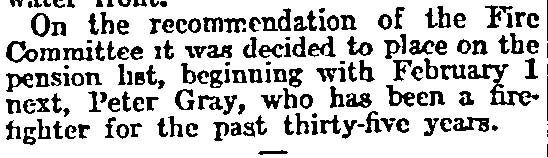
On the recommendation of the Fire Committee it was decided to place on the pension list, beginning with February 1 next, Peter Gray, who has been a fire-fighter for the past thirty-five years.