Introduction
SAMUEL S. ELFRETH was born in Camden on August 13, 1845 at 109 North 2nd Street in Camden NJ. He was the middle son of Samuel D. and Martha Elfreth, coming after Jeremiah and before Charles Elfreth. His father was a prosperous blacksmith in Camden. Samuel D. Elfreth had become a volunteer with the old Perseverance Fire Company upon moving to Camden in the 1820s; one could very well say that Samuel S. Elfreth was born into his future career. After attending school in Camden, he worked for two years as a machinist, before entering the sash and blind trade at the age of eighteen.
Samuel S. Elfreth became involved in firefighting in Camden in 1865, when it was still an all-volunteer force, and served until the volunteers were disbanded in 1869. In 1871 he was appointed a member of the paid fire department, serving as an extra hoseman in Engine Company No. 2, when he was named to replace Abraham Bradshaw, who had been removed from service on May 16th. Samuel S. Elfreth was removed from service on December 5, 1871. He returned to service in 1873 and served into the spring of 1876 as Foreman (the equivalent of today’s Captain) of Engine Company 2. He did not serve with the fire department during the period in which Claudius W. Bradshaw was Chief of the department.
In 1879 Samuel S. Elfreth was elected Chief, succeeding Claudius W. Bradshaw, who went on to become the Mayor of Camden. He served a three year term. He was succeeded by Daniel A. Carter, who served one term. Samuel S. Elfreth was reelected again in 1885 for another three year term. Robert S. Bender, who had been Chief in the early 1870s, won the election for the chief’s position in 1888. Samuel S. Elfreth was reelected once again in 1891, and when the position ceased to be an elective office, he was retained, and served until his retirement in 1913. He was Chief from 1879 to 1882, from 1885 to 1888, and from 1891 until 1913—a total of 28 years, longer than any other person to have served in that capacity in Camden.
Samuel S. Elfreth married Kate Baker in 1870. The marriage produced at least one child, a daughter Fannie. Fannie Elfreth later married Rollo R. Jones, who rose to the rank of Captain in the Camden Fire Department. The Elfreths lived through at least 1900 at 109 North 2nd Street, where he was born.
Chief Elfreth responded to his last fire alarm, at 445 South 5th Street, on November 1, 1913. He was succeeded as Chief by Charles Worthington. By 1920 he was living at 638 State Street with his daughter, son-in-law Rollo R. Jones, and a grand-daughter. Samuel S. Elfreth died of natural causes on July 16, 1927.
Samuel S. Elfreth was a member of the New Jersey Fireman’s Association, and he was Past Sachem of the Wyoming Tribe, No. 55, Improved Order of Red Men in Camden.
Portraits
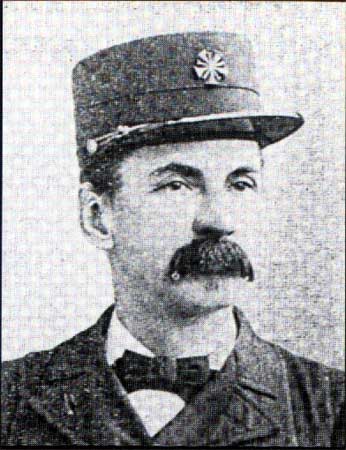
Samuel S. Elfreth, Chief of the Camden Fire Department
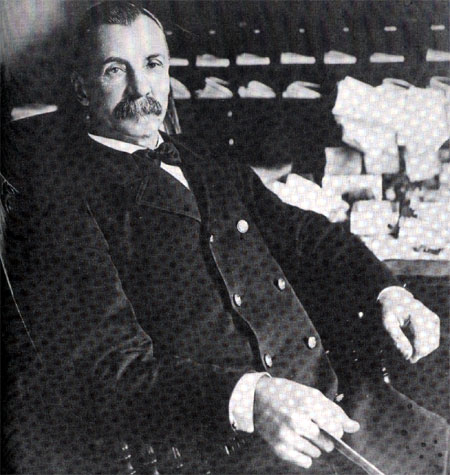
Chief Elfreth in his office at the 5th & Arch Street Firehouse, 1913
Biographical Revue, 1897
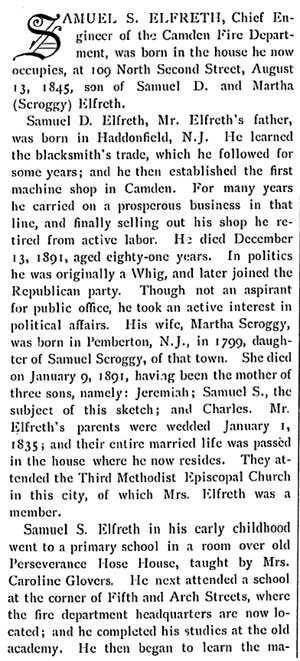
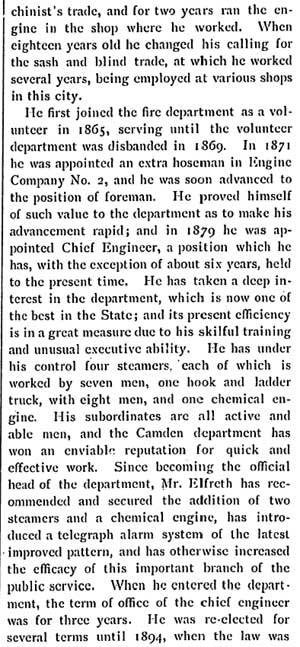
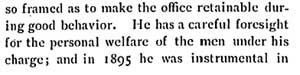
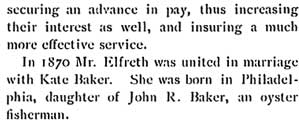
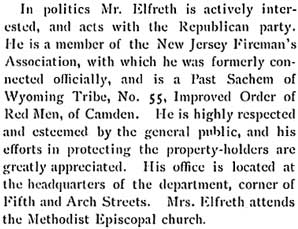
Samuel S. Elfreth, Biographical Revue of the Sixth Congressional District of New Jersey, 1897
The Camden Primaries
Philadelphia Inquirer —
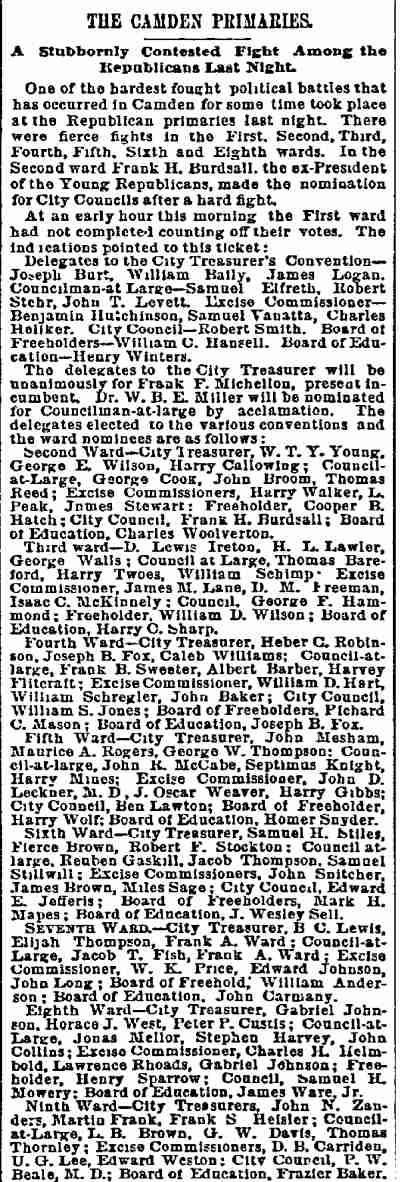
THE CAMDEN PRIMARIES
A Stubbornly Contested Fight Among the Republicans Last Night.
One of the hardest fought political battles that has occurred in Camden for some time took place at the Republican primaries last night. There were fierce fights in the First, Second, Third, Fourth, Fifth, Sixth and Eighth wards. In the Second ward Frank H. Burdsall, the ex-President of the Young Republicans, made the nomination for City Councils after a hard fight.
At an early hour this morning the First ward had not completed counting off their votes. The indications pointed to this ticket:
Delegates to the City Treasurer’s Convention—Joseph Burt, William Hally, James Logan. Councilman-at-Large—Samuel Elfreth, Robert Stehr, John T. Lovett. Excise Commissioner—Benjamin Hutchinson, Samuel Vanatta, Charles Heliker. City Council—Robert Smith. Board of Freeholders—William C. Hansell. Board of Education—Henry Winters.
The delegates to the City Treasurer will be unanimously for Frank F. Michellon, present incumbent. Dr. W.B.E. Miller will be nominated for Councilman-at-Large by acclamation. The delegates elected to the various conventions and the ward nominees are as follows:
Second Ward—City Treasurer, W. T. Y. Young, George E. Wilson, Harry Callowing; Council-at-Large, George Cook, John Broom, Thomas Reed; Excise Commissioners, Harry Walker, L. Peak, James Stewart; Freeholder, Cooper B. Hatch; City Council, Frank H. Burdsall; Board of Education, Charles Wolverton.
Third ward—D. Lewis Ireton, H. L. Lawler, George Walls; Council at Large, Thomas Bareford, Harry Twoes, William Schimp; Excise Commissioner, James M. Lane, D. M. Freeman, Isaac C. McKinnely; Council, George F. Hammond; Freeholder, William D. Wilson; Board of Education, Harry Sharp.
Fourth Ward—City Treasurer, Heber C. Robinson, Joseph B. Fox, Caleb Williams; Council-at-large, Frank B. Sweeten, Albert Barber, Harvey Flitcraft; Excise Commissioner, William D. Hart, William Schregler, John Baker; City Council, William S. Jones; Board of Freeholders, Richard C. Mason; Board of Education, Joseph B. Fox.
Fifth Ward—City Treasurer, John Mesham, Maurice A. Rogers, George W. Thompson; Council-at-large, John R. McCabe, Septimus Knight, Harry Mines; Excise Commissioner, John D. Leckner, M. D., J. Oscar Weaver, Harry Gibbs; Board of Freehold, Ben Lawton; Board of Education, Harry Wolfe; Homer Snyder.
Sixth Ward—City Treasurer, Samuel H. Stiles, Pierce Brown, Robert F. Stockton; Council at-large, Reuben Gaskill, Jacob Thompson, Samuel Stillwell; Excise Commissioners, John Snitcher, James Brown, Miles Sage; City Council, Edward E. Jefferis, Mark H. Mapes; Board of Freeholders, J. Wesley Sell.
Seventh Ward—City Treasurer, B. C. Lewis, Elijah Thompson, Frank A. Ward; Council-at-Large, Jacob T. Fish, Frank A. Ward; Excise Commissioner, W. K. Price, Edward Johnson, John Long; Board of Freehold, William Anderson; Board of Education, John Carmany.
Eighth Ward—City Treasurer, Gabriel Johnson, Horace J. West, Peter P. Custis; Council-at-Large, Jonas Mellor, Stephen Harvey, John Collins; Excise Commissioner, Charles H. Helmbold, Lawrence Rhoads, Gabriel Johnson; Freeholder, Henry Sparrow; Council, Samuel H. Mowery; Board of Education, James Ware, Jr.
Ninth Ward—City Treasurers, John N. Zanders, Martin Frank, Frank S. Heisler, L. B. Brown, G. W. Davis, Thomas Thornley; Excise Commissioners, D. B. Carriden, U. G. Lee, Edward Weston; City Council, P. W. Beale, M. D.; Board of Education, Frazier Baker.
"Charles Berry's Funeral"
Camden Post —
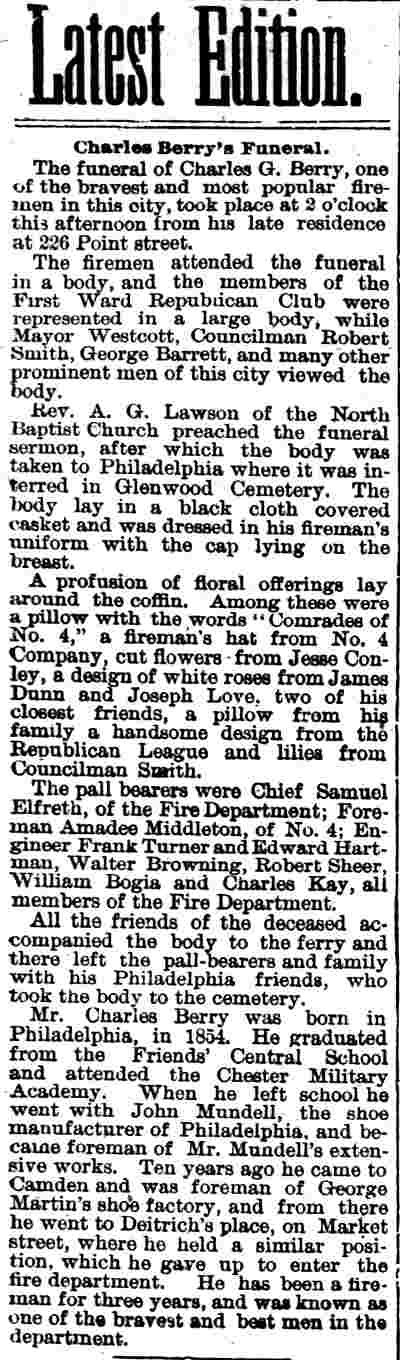
Named: First Ward Republican Club, John L. Westcott, Robert Smith, George Barrett, Rev. A.G. Lawson, North Baptist Church, Engine Company 4, Jesse Conley, James Dunn, Joseph Love, Samuel Elfreth, Amedee Middleton, Frank Turner, Edward Hartman, Walter Browning, Robert Steer, William Bogia, Charles Jefferson Kay, and George Martin.
Stockton News
Philadelphia Inquirer —
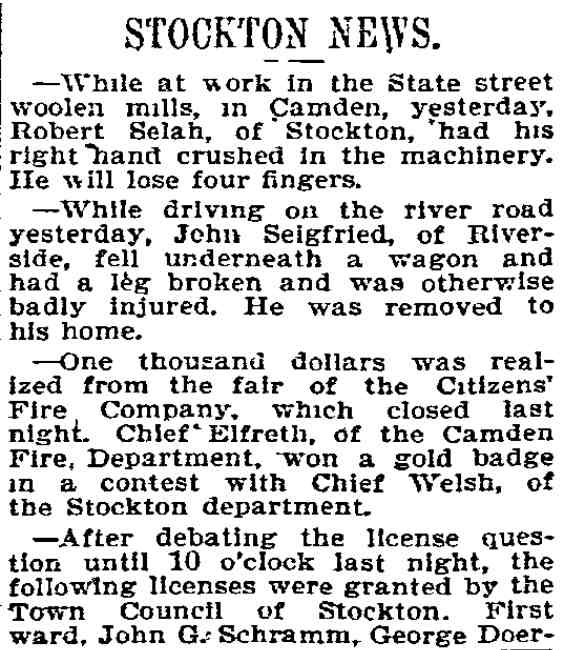
Stockton News
—While at work in the State street woolen mills, in Camden, yesterday, Robert Selah, of Stockton, had his right hand crushed in the machinery. He will lose four fingers.
—While driving on the river road yesterday, John Seigfried, of Riverside, fell underneath a wagon and had a leg broken and was otherwise badly injured. He was removed to his home.
—One thousand dollars was realized from the fair of the Citizens’ Fire Company, which closed last night. Chief Elfreth, of the Camden Fire Department, won a gold badge in a contest with Chief Welsh, of the Stockton department.
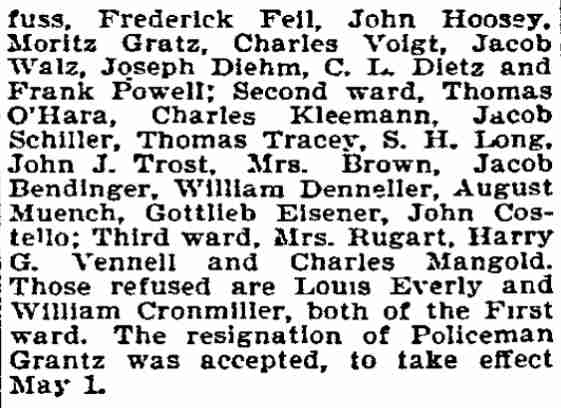
—After debating the license question until 10 o’clock last night, the following licenses were granted by the Town Council of Stockton.
fuss, Frederick Feil, John Hoosey, Moritz Gratz, Charles Voigt, Jacob Walz, Joseph Diehm, C. L. Dietz and Frank Powell; Second ward, Thomas O’Hara, Charles Kleemann, Jacob Schiller, Thomas Tracey, S. H. Long, John J. Trost, Mrs. Brown, Jacob Bendinger, William Denneller, August Muench, Gottlieb Eisener, John Costello; Third ward, Mrs. Rugart, Harry G. Vennell and Charles Mangold. Those refused are Louis Everly and William Cronmiller, both of the First ward. The resignation of Policeman Grantz was accepted, to take effect May 1.
Citizens’ Fire Company Fair
Philadelphia Inquirer —
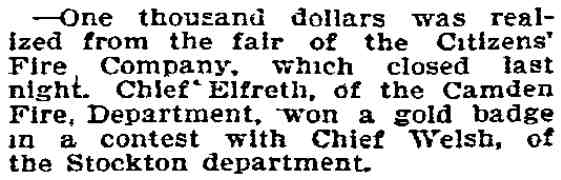
—One thousand dollars was realized from the fair of the Citizens’ Fire Company, which closed last night. Chief Elfreth, of the Camden Fire Department, won a gold badge in a contest with Chief Welsh, of the Stockton department.
Blaze in Camden
Philadelphia Inquirer —
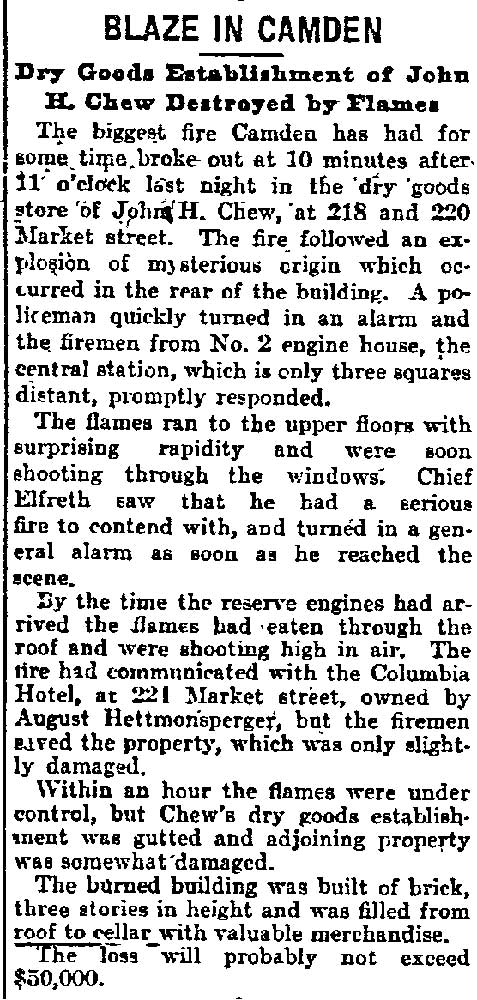
BLAZE IN CAMDEN
Dry Goods Establishment of John H. Chew Destroyed by Flames
The biggest fire Camden has had for some time broke out at 10 minutes after 11 o’clock last night in the dry goods store of John H. Chew, at 218 and 220 Market Street. The fire followed an explosion of mysterious origin which occurred in the rear of the building. A policeman quickly turned in an alarm and the firemen from No. 2 engine house, the central station, which is only three squares distant, promptly responded.
The flames ran to the upper floors with surprising rapidity and were soon shooting through the windows. Chief Elfreth saw that he had a serious fire to contend with, and turned in a general alarm as soon as he reached the scene.
By the time the reserve engines had arrived the flames had eaten through the roof and were about the high ceilings. The fire had communicated with the Columbia Hotel, at 221 Market Street, owned by August Hettmansperger, but the firemen saved the property, which was only slightly damaged.
Within an hour the flames were under control, but Chew’s dry goods establishment was gutted and adjoining property was somewhat damaged.
The destroyed building was built of brick, three stories in height and was filled from roof to cellar with valuable merchandise. The loss will probably not exceed $50,000.
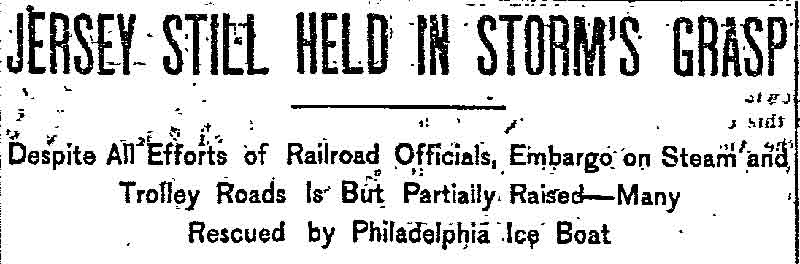
Jersey Still Held in Storm’s Grasp
Philadelphia Inquirer —
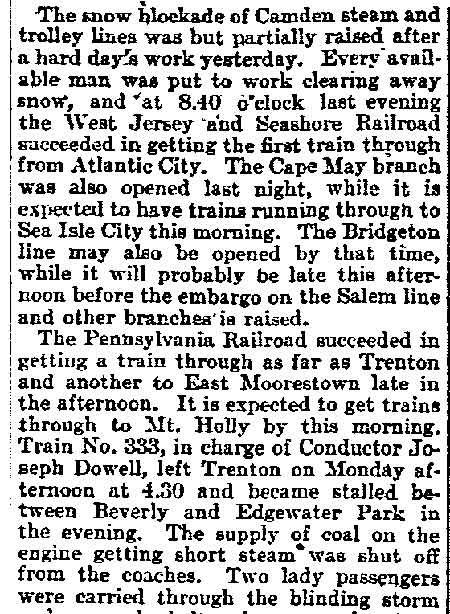
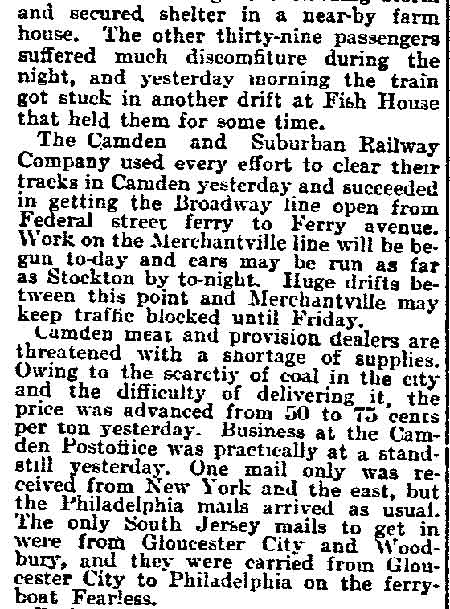
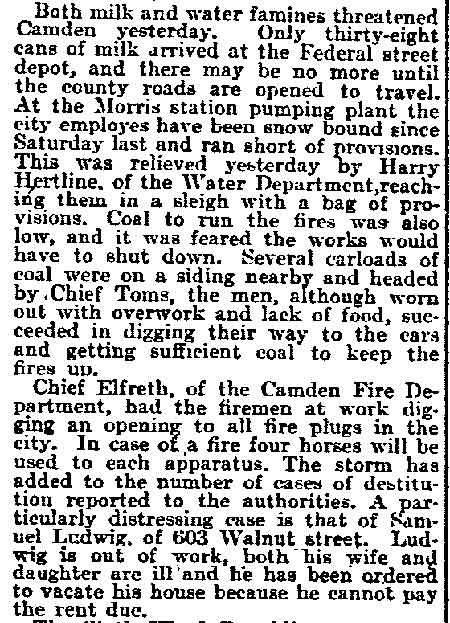
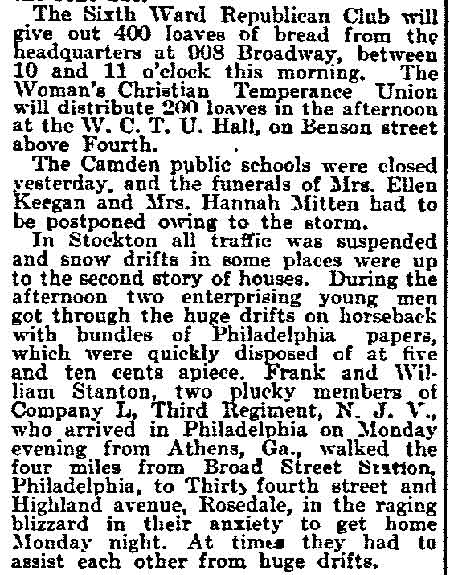
Named: Samuel S. Elfreth, Mrs. Ellen Keegan, Mrs. Hannah Mitten, Samuel Ludwig, Walnut Street, Sixth Ward Republican Club, W.C.T.U., Temperance Hall, Benson Street, South 4th Street, Frank Stanton, William Stanton, Broadway, South 34th Street, and Highland Avenue.
Over in Camden
Philadelphia Inquirer —
Over in Camden
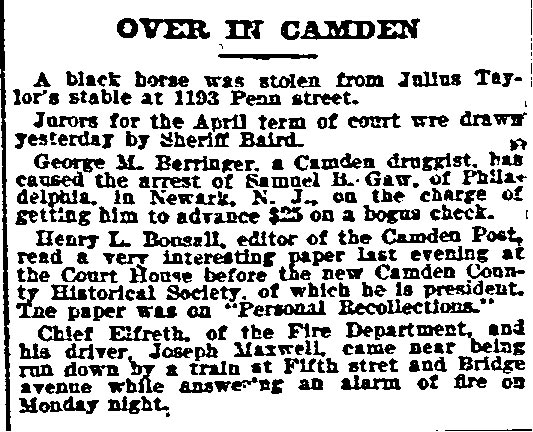
A black horse was stolen from Julius Taylor’s stable at 1193 Penn street.
Jurors for the April term of court were drawn yesterday by Sheriff Baird.
George M. Berringer, a Camden druggist, has caused the arrest of Samuel B. Gaw, of Philadelphia, in Newark, N. J., on the charge of getting him to advance $25 on a bogus check.
Henry L. Bonsall, editor of the Camden Post, read a very interesting paper last evening at the Court House before the new Camden County Historical Society, of which he is president. The paper was on “Personal Recollections.”
Chief Elfreth, of the Fire Department, and his driver, Joseph Maxwell, came near being run down by a train at Fifth street and Bridge avenue while answering an alarm of fire on Monday night.
More Pay for Firemen
Philadelphia Inquirer —
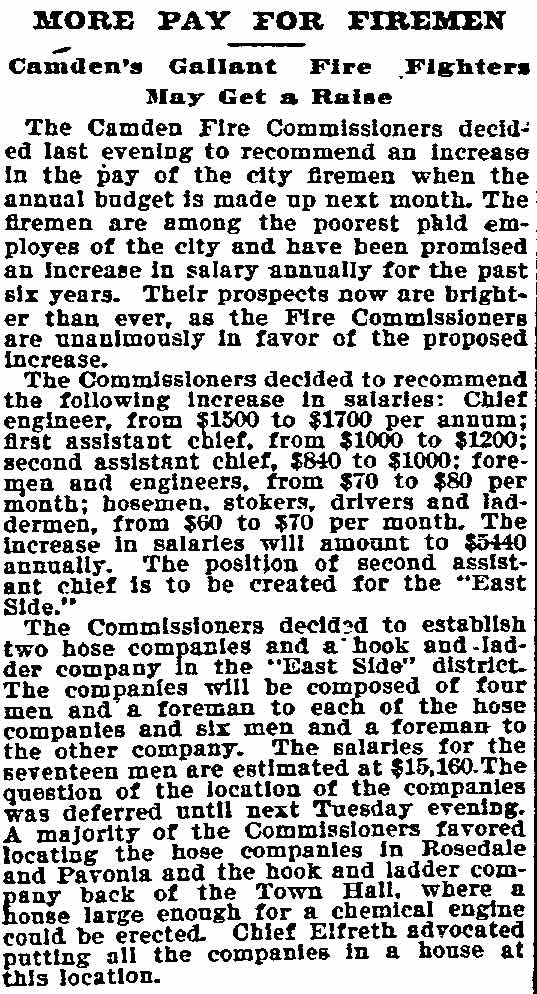
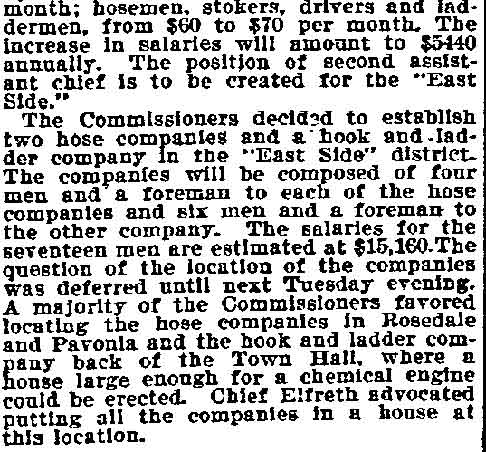
Samuel Elfreth
East Camden Firehouse
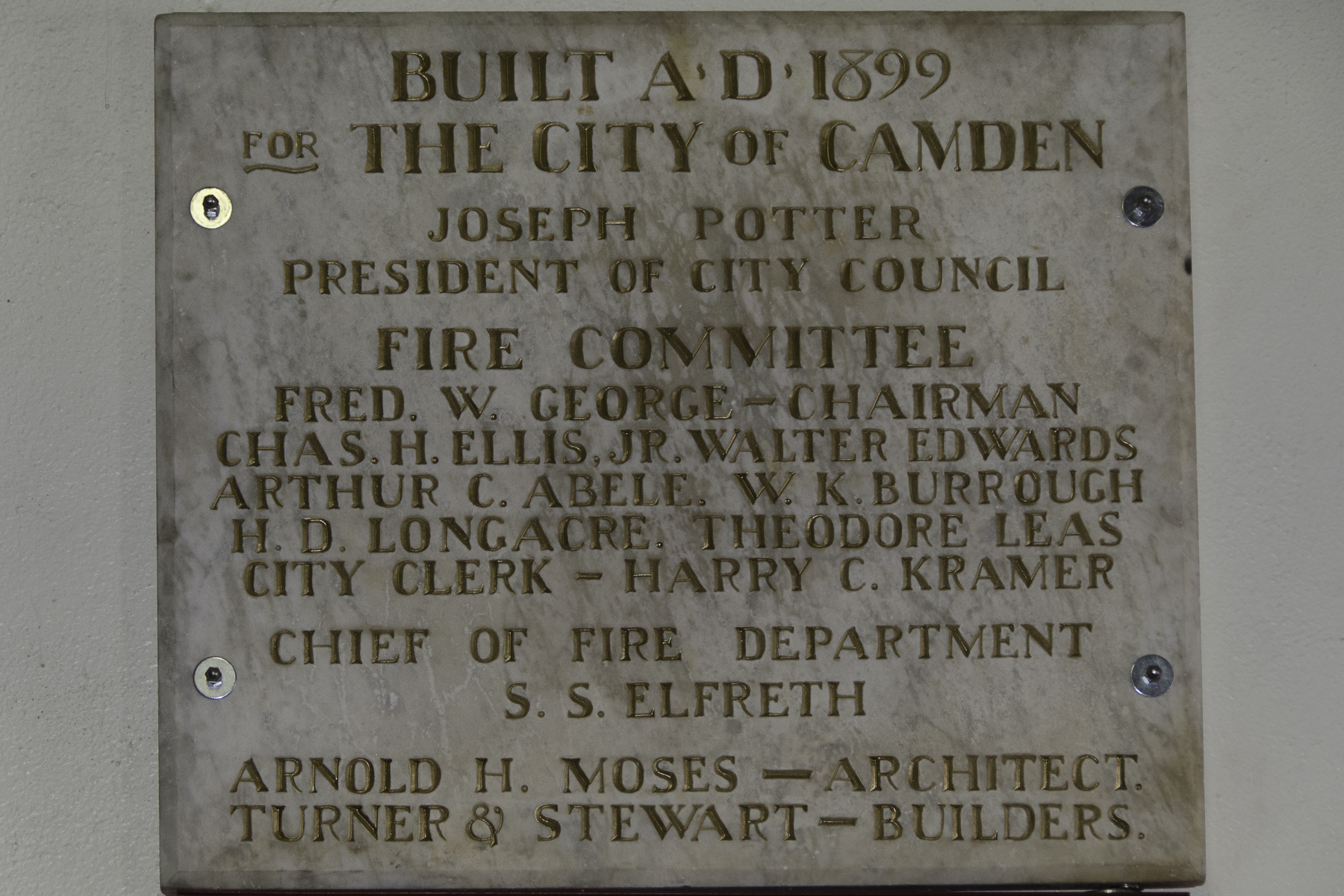
Named: Joseph Potter, Fred W. George, Charles H. Ellis, Arthur C. Abele, H.D. Longacre, Walter Edwards, W.K. Burrough, Theodore Leas, Harry C. Kramer, Samuel S. Elfreth, Arnold H. Moses, and Turner & Stewart (Frank Turner & Charles L. Stewart).
107, 109, & 111 North 2nd Street, circa 1900
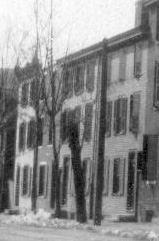
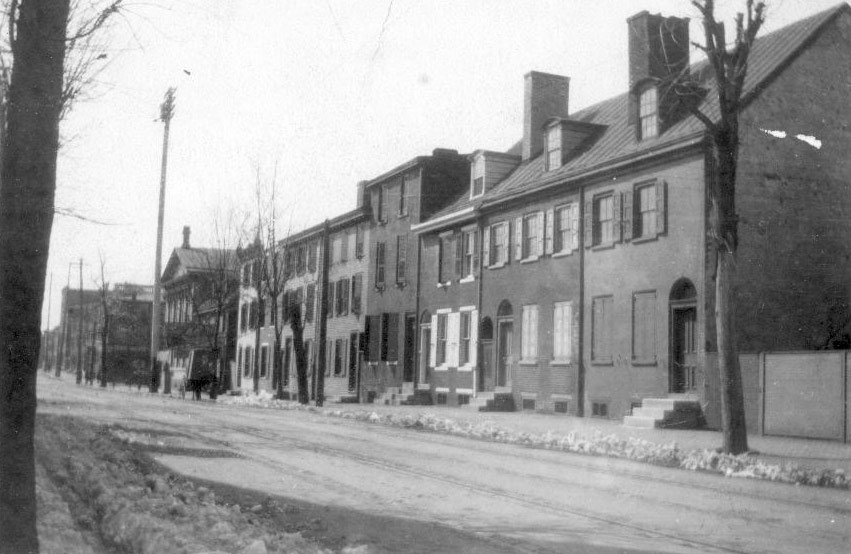
Samuel S. Elfreth lived at 109 North 2nd Street from his birth through at least 1897. Above: 107, 109, & 111 North 2nd Street. Below: 101 to 119 North 2nd Street.
Destructive Work of Flames in Camden
Philadelphia Inquirer —
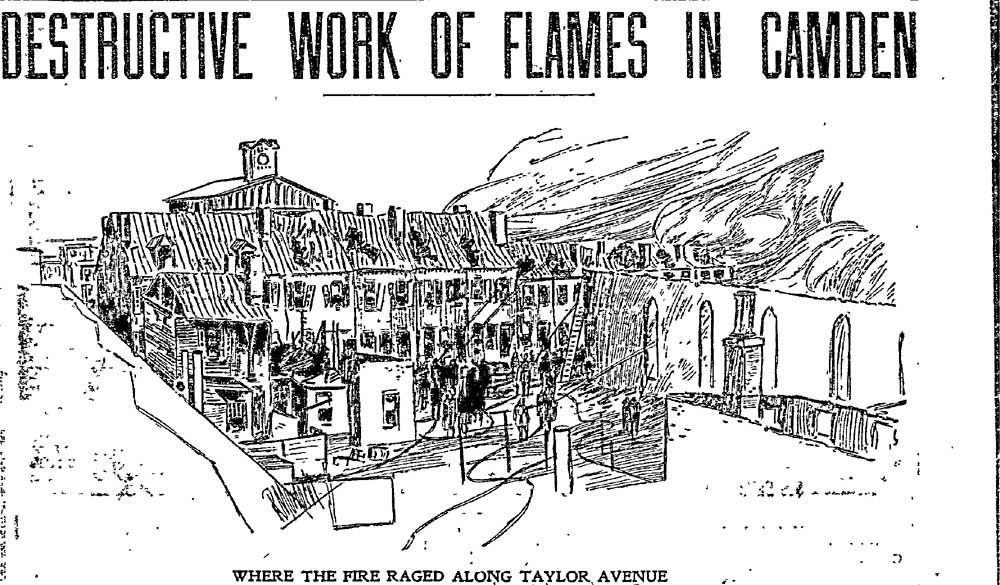
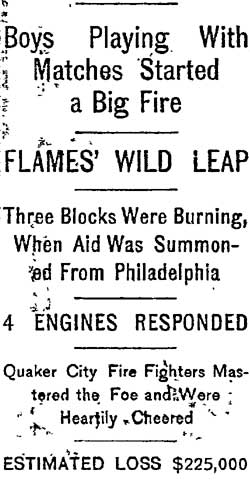
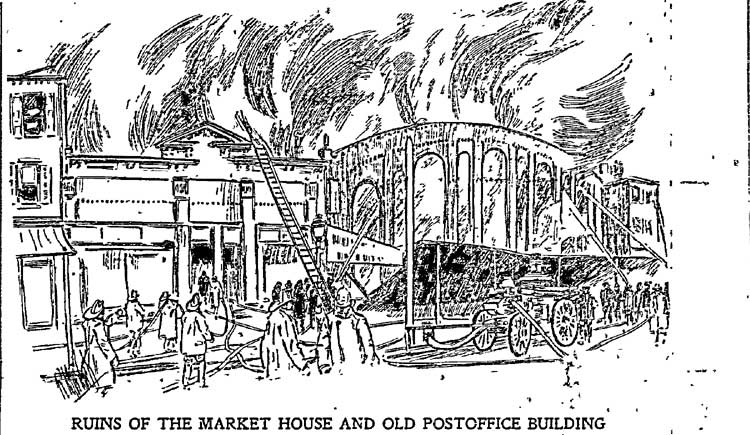
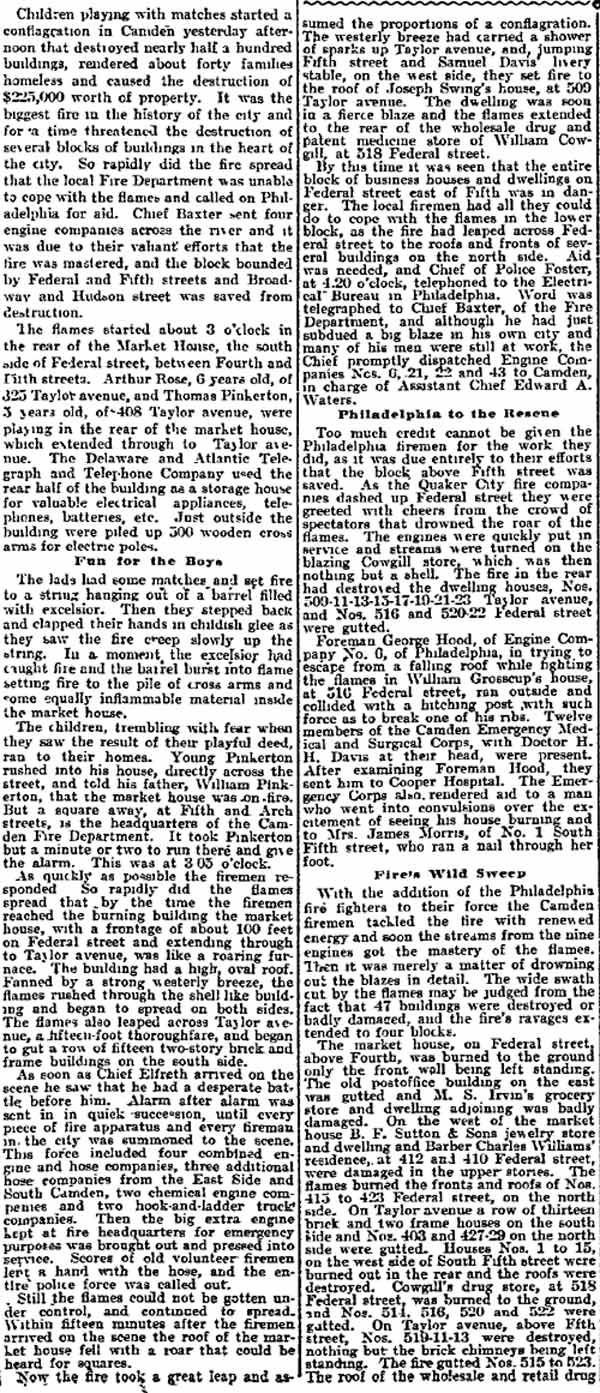

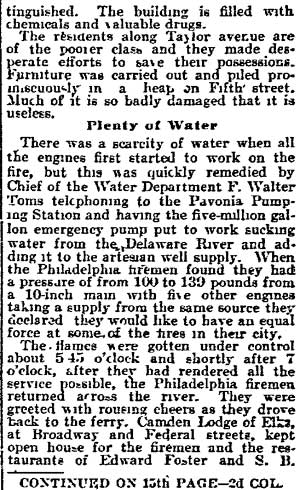
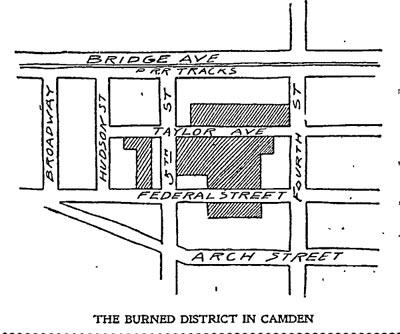
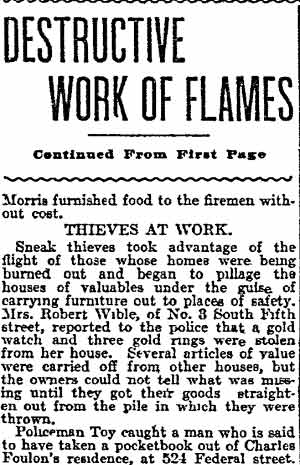
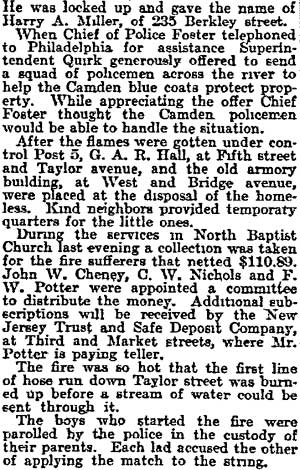
Named: Taylor Avenue, Federal Street, South 5th Street, Arch Street, Arthur Rose, Thomas Pinkerton, William Pinkerton, William Cowgill, William Grosscup, Mrs. James Morris, M.S. Irvin, B.F. Sutton, Charles Williams, Samuel Davis, Joseph Swing, Samuel S. Elfreth, Dr. Henry H. Davis, Cooper Hospital, George M. Beringer, F. Walter Toms, Camden Lodge of Elks No. 293, Edward Foster, S.B. Morris, Broadway, Mrs. Robert Wible, Isaac S. Toy, Charles Foulon, Harry A. Miller, John Foster, John W. Cheney, C.W. Nichols, F.W. Potter, North Baptist Church, Thomas M.K. Lee Post No. 5, G.A.R., New Jersey Safe Deposit & Trust Company, and Berkley Street.
Camden's Pride Parades Before City's People
Philadelphia Inquirer —
CAMDEN’S PRIDE PARADES BEFORE CITY’S PEOPLE
Policemen and Firemen Make Their Initial Turnout and Present a Creditable Appearance—Reviewed by Officials—How the Departments Have Grown
With a line up that could not be surpassed by the famous “Broadway Squad” of New York, Camden’s policemen, or most of them, turned out in review yesterday. The military carriage of the men excited much favorable comment, especially among those who were not aware that the men have been drilled every week for a year past by Colonel D. B. Murphy, of the National Guard of New Jersey. The policemen were followed by an array of firemen and a variety of apparatus that made many of the natives gasp in astonishment. Altogether the procession was a revelation to Camden residents who thought they were well informed about their city.
The procession was headed by Jennings’ Third Regiment Band. Then came Chief John Foster, of the Police Department, followed by a line composed of Police Captains Stanley, Alberts and Doyle and Sergeant Bentley. Following them under the silken folds of “Old Glory,” which he carried with a steady grasp, was Policeman George A. Donovan, a colored member of the force. Two platoons of forty policemen each were led by Sergeants Horner and Hyde. The police patrol wagons and the city ambulance brought up the end of the policemen’s line. The total police force of the city consists of ninety nine men.
The City Band, followed by Chief Samuel S. Elfreth, of the Fire Department, in a carriage, marked the head of the firemen’s line. The seventy-two men of this department were in two sections, the first being led by Assistant Chief Samuel Buzine, of the department headquarters, and the second by Assistant Chief Benjamin Kellum of the East Side. Between the two sections marched the Ivy Fife and Drum Corps. The apparatus in line consisted of six hose carts, five engines, three hook and ladder trucks, two chemical engines and a supply wagon.
The growth of Camden’s police department may be seen by a comparison of the present with the year 1862, when six policemen sufficed to protect the entire city, which was then divided in three wards. In 1876 there were only sixteen policemen in the city and nine regular firemen under one chief. There were, however, thirty extra men subject to call by the chief.
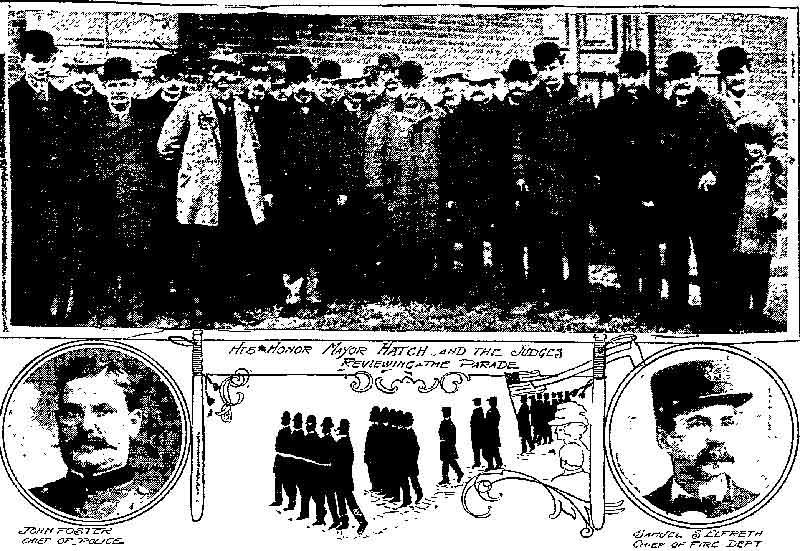
The parade yesterday was reviewed by Mayor Hatch and the City Councilmen from the balcony on the Broadway side of the Court House.
CAMDEN’S PRIDE PARADES BEFORE CITY’S PEOPLE
Policemen and Firemen Make Their Initial Turnout and Present a Creditable Appearance—Reviewed by Officials—How the Departments Have Grown
With a line up that could not be surpassed by the famous “Broadway Squad” of New York, Camden’s policemen, or most of them, turned out in review yesterday. The military carriage of the men excited much favorable comment, especially among those who were not aware that the men have been drilled every week for a year past by Colonel D. B. Murphy, of the National Guard of New Jersey. The policemen were followed by an array of firemen and a variety of apparatus that made many of the natives gasp in astonishment. Altogether the procession was a revelation to Camden residents who thought they were well informed about their city.
The procession was headed by Jennings’ Third Regiment Band. Then came Chief John Foster, of the Police Department, followed by a line composed of Police Captains Stanley, Alberts and Doyle and Sergeant Bentley.
Captains Stanley, Alberts and Doyle and Sergeant Bentley. Following them under the silken folds of “Old Glory,” which he carried with a steady grasp, was Policeman George A. Donovan, a colored member of the force. Two platoons of forty policemen each were led by Sergeants Horner and Hyde. The police patrol wagons and the city ambulance brought up the end of the policemen’s line. The total police force of the city consists of ninety nine men.
The City Band, followed by Chief Samuel S. Elfreth, of the Fire Department, in a carriage, marked the head of the firemen’s line. The seventy-two men of this department were in two sections, the first being led by Assistant Chief Samuel Buzine, of the department headquarters, and the second by Assistant Chief Benjamin Kellum of the East Side. Between the two sections marched the Ivy Fife and Drum Corps. The apparatus in line consisted of six hose carts, five engines, three hook and ladder trucks, two chemical engines and a supply wagon.
The growth of Camden’s police department may be seen by a comparison of the present with the year 1862, when six policemen sufficed to protect the entire city, which was then divided in three wards. In 1876 there were only sixteen policemen in the city and nine regular firemen under one chief. There were, however, thirty extra men subject to call by the chief.
The parade yesterday was reviewed by Mayor Hatch and the City Councilmen from the balcony on the Broadway side of the Court House.
Royal Welcome for Ex-Sheriff Baird
Philadelphia Inquirer —
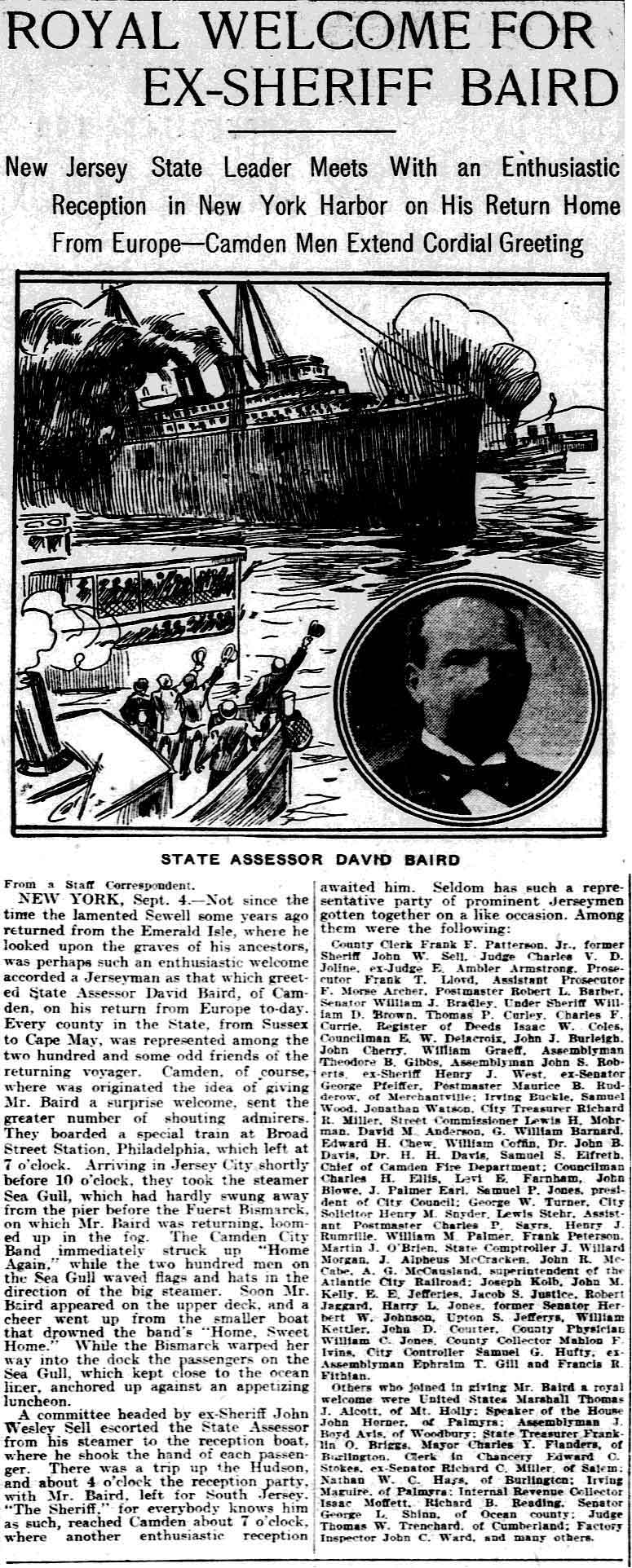
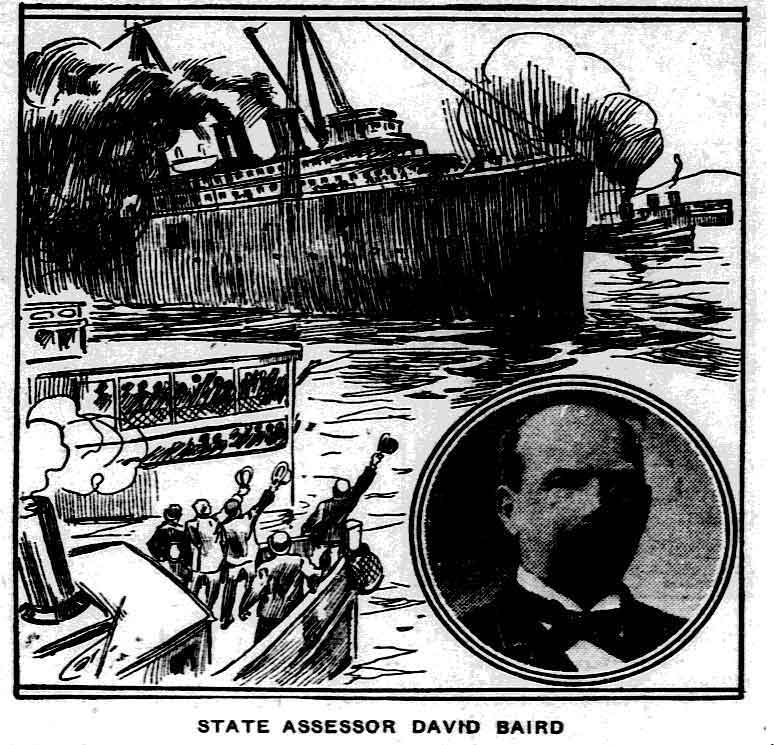
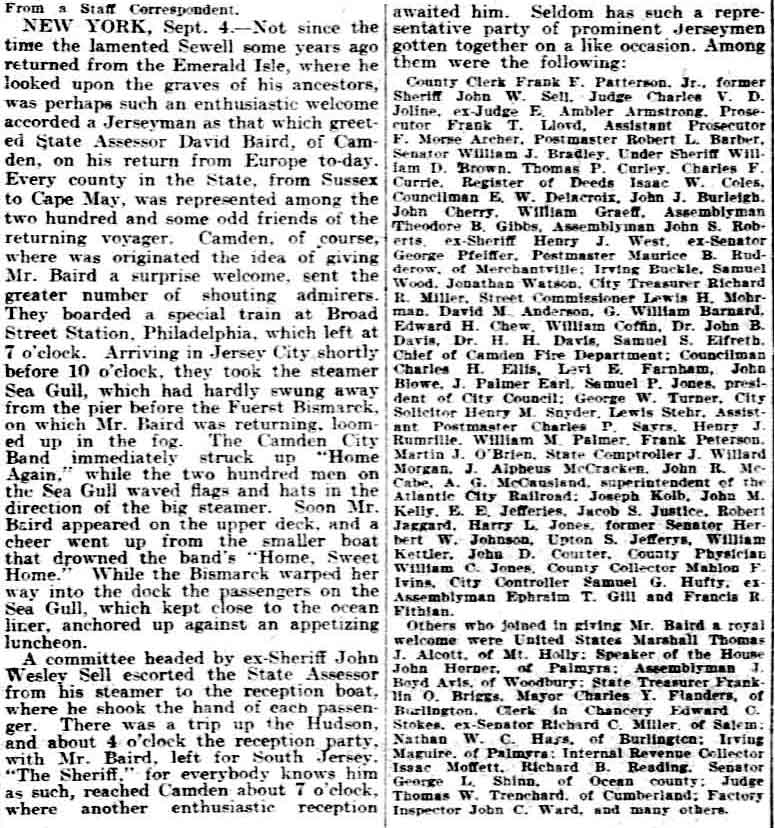
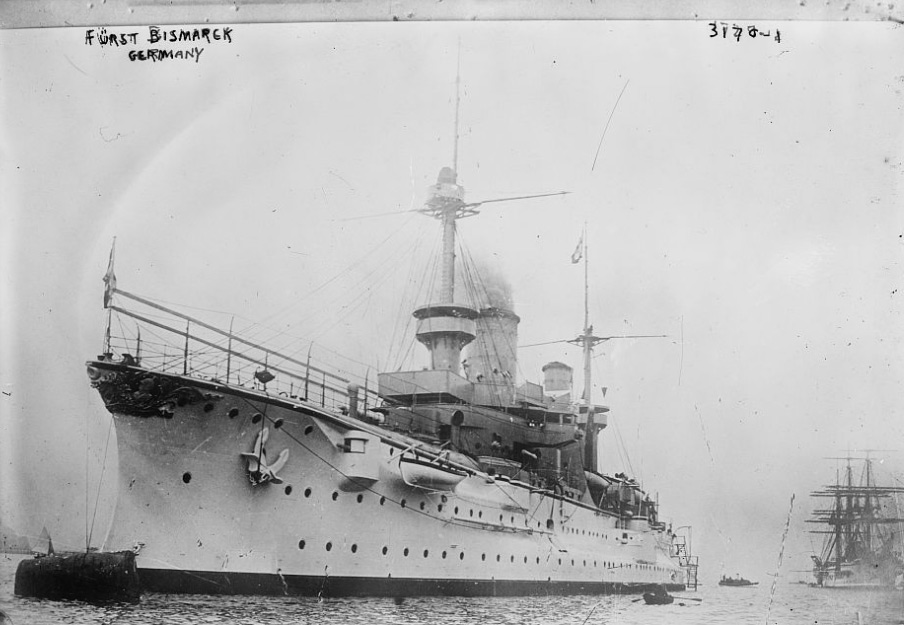
Named: David Baird Sr., J. Wesley Sell, Frank F. Patterson Jr., E.V.D. Joline, E. Ambler Armstrong, Frank T. Lloyd, F. Morse Archer, Robert L. Barber, William J. Bradley, William D. Brown, Thomas P. Curley, Charles F. Currie, Isaac W. Coles, E.W. Delacroix, John J. Burleigh, John Cherry, William Graeff, Theodore Gibbs, John S. Roberts, Henry J. West, George Pfeiffer Jr., Irving Buckle, Samuel Wood, Jonathan Watson, Maurice Redrow, Richard R. Miller, Lewis H. Mohrman, David M. Anderson, G. William Harned, Edward H. Chew, William Coffin, Dr. John B. Davis, Dr. Henry H. Davis, Samuel S. Elfreth, Charles H. Ellis, Levi Farnham, John Blowe, J. Palmer Earl, Samuel P. Jones, George W. Turner, Henry M. Snyder, Lewis Stehr Sr., Charles P. Sayrs, Henry J. Rumrille, William M. Palmer, Frank Peterson, Martin J. O’Brien, J. Willard Morgan, J. Alpheus McCracken, John R. McCabe, A.G. McCausland, Joseph Kolb, John M. Kelly, E.E. Jefferies, Jacob S. Justice, Robert Jaggard, Harry L. Jones, Upton S. Jefferys, William Kettler, John D. Courter, Dr. William S. Jones, Mahlon F. Ivins Sr., Samuel G. Hufty, Ephraim T. Gill, and Francis Fithian.
Camden Storage Warehouse Fire, May 1904
Camden Fire Department’s 125th Anniversary History, 1994
At 4:57 A.M. on May 6, 1904 a phone alarm and several pull boxes were received for a fire at the Camden Storage Warehouse at Delaware Avenue and Cooper Street. The massive five-story building contained 600 rooms with furniture storage. Smoke and fire could be seen coming from the fourth floor at the southeast corner of the warehouse. Upon arrival, Chief Samuel S. Elfreth transmitted a general alarm as the blaze spread through the entire fourth floor. Within minutes, engine companies had water on the fire as additional streams were directed from the roof of the adjoining E.G. Locke Paper Company. Hoselines were stretched down Penn and Cooper Streets and along Delaware Avenue to supplement water supplies.
Shortly after 5:00 A.M. part of the fourth floor collapsed, spreading the fire to the floor below. This collapse was quickly followed by the crashing of the fifth floor. By 5:30 A.M the front section of roof collapsed onto Cooper Street in a thundering roar, creating a shower of blazing embers that threatened numerous buildings along Amber Street. Within an hour of its discovery, the fire had engulfed the entire warehouse. Only through the gallant efforts of the firefighters was the huge blaze contained. While spectators described the fire scene as waves of withering heat, Camden’s Bravest held their ground within forty feet of the walls. The City of Philadelphia offered assistance but Chief Elfreth declined and by 7:00 A.M. he declared the fire under control.
While battling the blaze, Foreman Amedee Middleton was struck on the head by falling bricks. Only his helmet, which cracked, saved his life. Losses were placed at $50,000. Chief Elfreth and Assistant Chief Buzine stated that the blaze was harder to fight than the Victor Talking Machine fire two weeks prior. Engine Company 1 assigned to the foreground detail remained on the scene until 7:00 P.M. and before leaving found two black kittens still alive in an office area adjoining the ruins of the burned warehouse.
The Camden Post-Telegram newspaper described the departing crew of Engine Company 1 as “water soaked and the color of coal stained breaker boys.” A crowd of onlookers cheered the weary firefighters as they left the scene after fourteen hours at the fire.
Written by Lee Ryan for the Camden Fire Department’s 125th Anniversary history book, published in 1994.
Big Blaze in Camden Entailed Nearly Half a Million Loss
Philadelphia Inquirer —
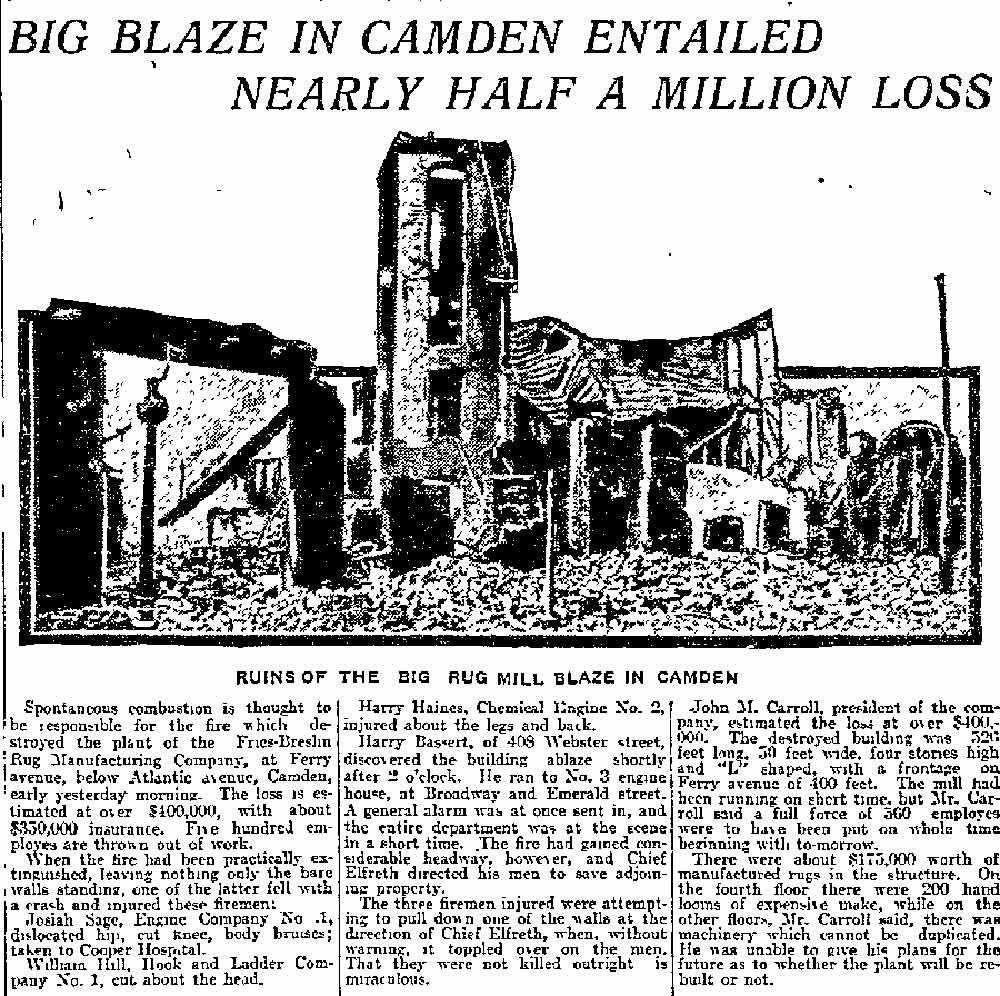
BIG BLAZE IN CAMDEN ENTAILED NEARLY HALF A MILLION LOSS
RUINS OF THE BIG RUG MILL BLAZE IN CAMDEN
Spontaneous combustion is thought to be responsible for the fire which destroyed the plant of the Fries-Breslin Rug Manufacturing Company, at Ferry avenue, below Atlantic avenue, Camden, early yesterday morning. The loss is estimated at over $400,000, with about $350,000 insurance. Five hundred employees are thrown out of work.
William Hill, Hook and Ladder Company No. 1, cut about the head; Harry Haines, Chemical Engine No. 2, injured about the legs and back.
Harry Bassert, of 408 Webster street, discovered the building ablaze shortly after 2 o’clock. He ran to No. 2 engine house, at Broadway and Emerald street. The department was at once sent in, and the entire department was at the scene in a short time. The fire had gained considerable headway, however, and Chief Elfreth directed his men to save adjoining property.
The three firemen injured were attempting to pull down one of the walls at the direction of Chief Elfreth, when, without warning, it toppled over on the men. That they were not killed outright is miraculous.
John M. Carroll, president of the company, estimated the loss at over $400,000. The destroyed building was 700 feet long, 50 feet wide, four stories high and “L” shaped, with a frontage on Ferry avenue of 400 feet. The mill had been running on short time, but Mr. Carroll said a full force of 300 employees were to have been put on whole time beginning with to-morrow.
There were about $175,000 worth of manufactured rugs in the structure. On the fourth floor there were 400 to 500 dozens of expensive china, while on the other floors, Mr. Carroll said, there was machinery which cannot be duplicated. The President did not care to say for the future as to whether the plant will be built or not.
Camden’s New Fire Engine Works Well
Philadelphia Inquirer —
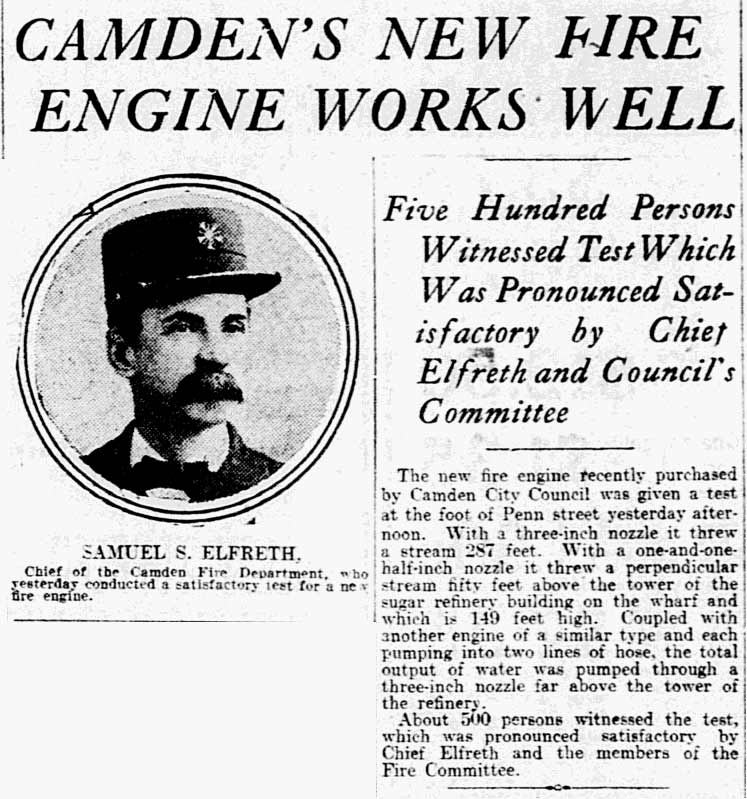
Philadelphia Inquirer, November 27, 1904
EIGHTEEN NEW FIREMEN NAMED
Camden Post-Telegram —
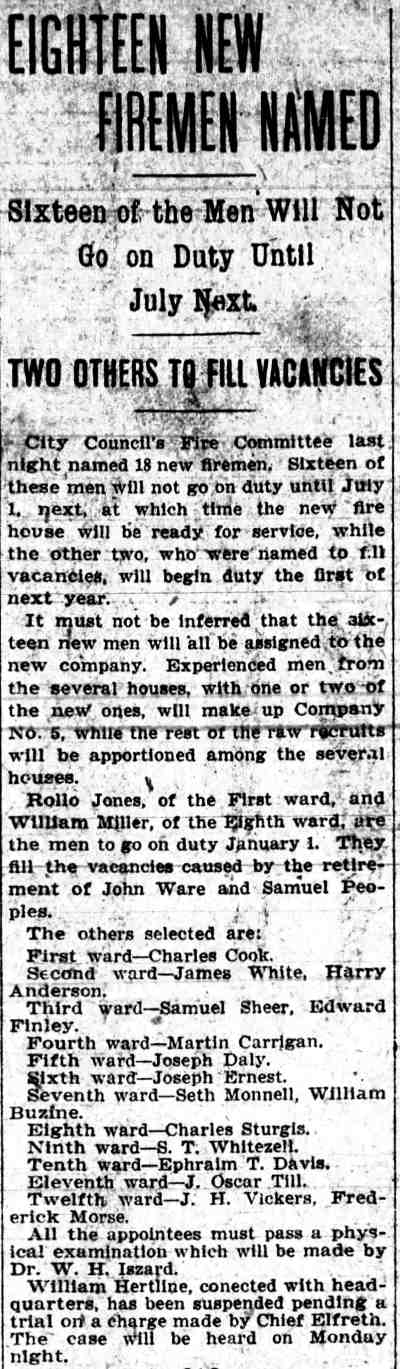
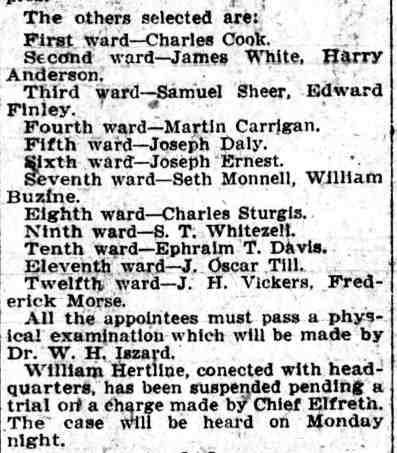
Named: John Ware, Samuel Peoples, Rollo Jones, Charles Cook, James White, Harry C. Anderson, Ephraim Davis, Samuel Sheer, Edward Finley, Martin Carrigan, Joseph T. Daley, Joseph Ernst, William K. Buzine, Seth Monell, Charles Sturgis, Samuel W. Whitzell, J. Oscar Till Jr., William Miller, John H. Vickers, Fred Morse, Dr. William H. Iszard, William Hertline, and Samuel S. Elfreth.
Flames Wreck Big Camden Elevator
Philadelphia Inquirer —
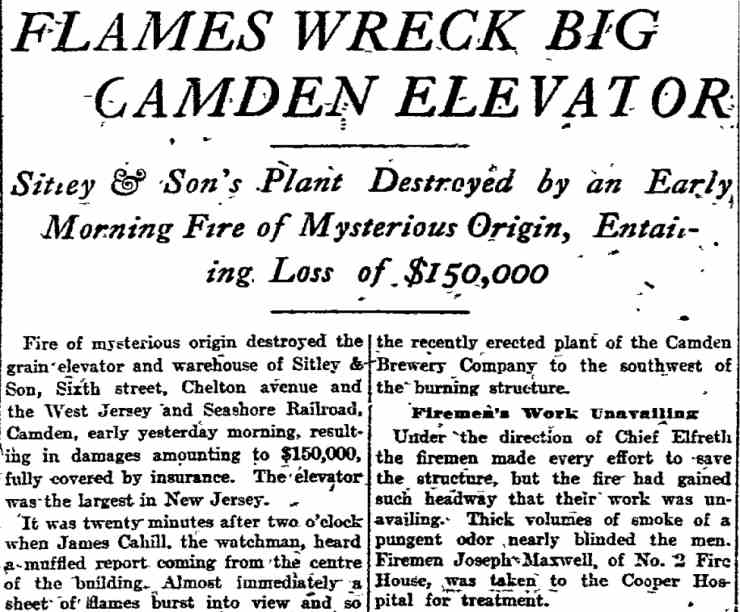
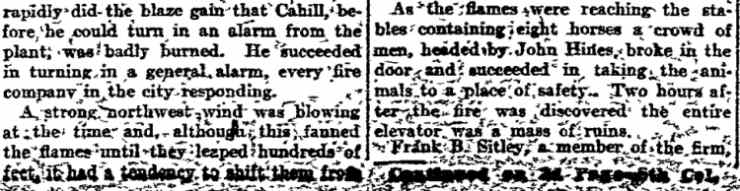
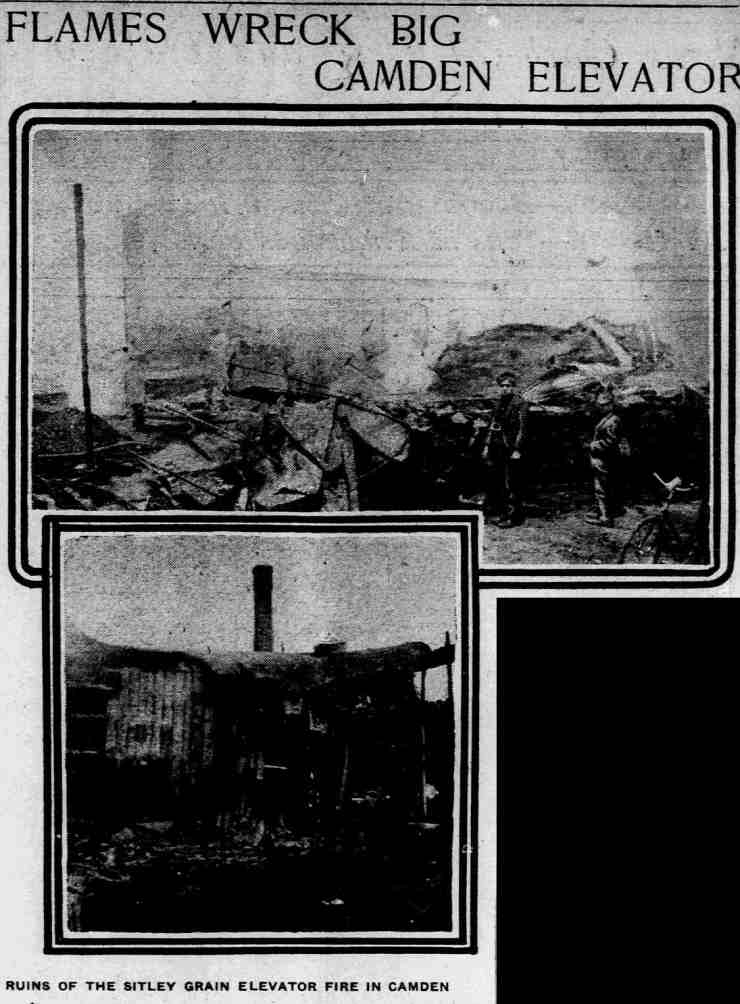
Named: James Cahill, Samuel S. Elfreth, Joseph Maxwell, John Hines, Sitley & Son, Frank Sagers, C. Oscar Brown, William F. Thompson, and South 2nd Street.
Eight Escape Broadway Fire
Philadelphia Inquirer —
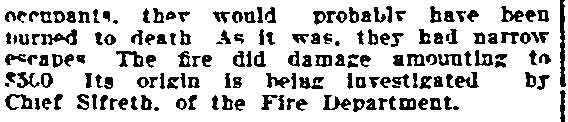
Eight members of the families of S. Asbell and L. Granoff, who occupy the rear of the house at 1114 Broadway, Camden, escaped in their night clothes when the structure became ablaze early yesterday morning. But for Policemen Brothers who aroused the sleeping occupants, they would probably have been burned to death. As it was, they had narrow escapes. The fire did damage amounting to $560. Its origin is being investigated by Chief Elfreth, of the Fire Department.
[continuation] occupants, they would probably have been burned to death. As it was, they had narrow escapes. The fire did damage amounting to $560. Its origin is being investigated by Chief Elfreth, of the Fire Department.
Fireman in a Mix-Up
Philadelphia Inquirer —
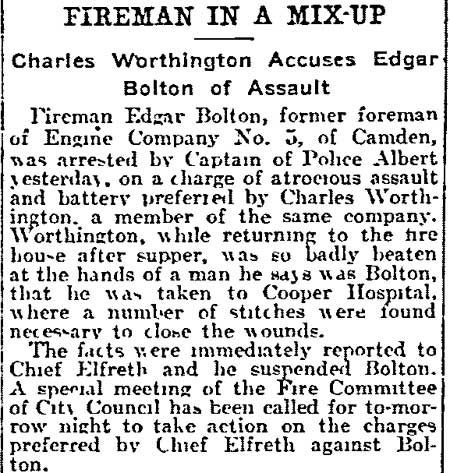
FIREMAN IN A MIX-UP
Charles Worthington Accuses Edgar Bolton of Assault
Fireman Edgar Bolton, former foreman of Engine Company No. 5, of Camden, was arrested by Captain of Police Albert yesterday, on a charge of atrocious assault and battery preferred by Charles Worthington, a member of the same company. Worthington, while returning to the fire house after supper, was so badly beaten at the hands of a man he says was Bolton, that he was taken to Cooper Hospital, where a number of stitches were found necessary to close the wounds.
The facts were immediately reported to Chief Elfreth and he suspended Bolton. A special meeting of the Fire Committee of City Council has been called for tomorrow night to take action on the charges preferred by Chief Elfreth against Bolton.
Three Firemen Met Death in Camden Blaze
Philadelphia Inquirer —
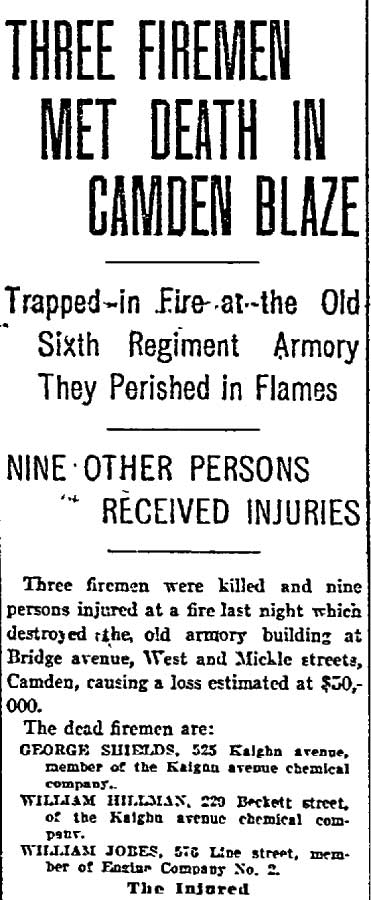
THREE FIREMEN MET DEATH IN CAMDEN BLAZE
Trapped in Fire at the Old Sixth Regiment Armory They Perished in Flames
NINE OTHER PERSONS RECEIVED INJURIES
Three firemen were killed and nine persons injured at a fire last night which destroyed the old armory building at Bridge avenue, West and Mickle streets, Camden, causing a loss estimated at $50,000.
The dead firemen are: GEORGE SHIELDS, 525 Kaighn avenue, member of the Kaighn avenue chemical company. WILLIAM HILLMAN, 229 Beckett street, of the Kaighn avenue chemical company. WILLIAM JOBES, 576 Line street, member of Engine Company No. 2.
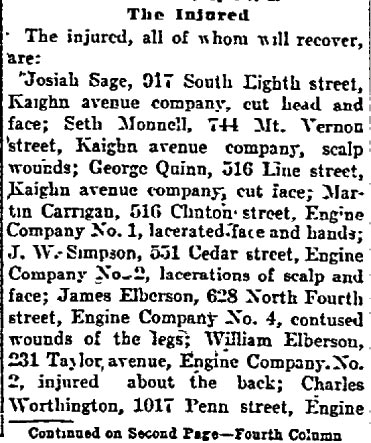
The Injured
The Injured
The injured, all of whom will recover, are: Josiah Sage, 917 South Eighth street, Kaighn avenue company, cut head and face; Seth Monnell, 744 Mt. Vernon street, Kaighn avenue company, scalp wounds; George Quinn, 516 Line street, Kaighn avenue company, cut face; Martin Carrigan, 516 Clinton street, Engine Company No. 1, lacerated face and hands; J. W. Simpson, 551 Cedar street, Engine Company No. 2, lacerations of scalp and face; James Elberson, 628 North Fourth street, Engine Company No. 4, contused wounds of the legs; William Elberson, 231 Taylor avenue, Engine Company No. 2, injured about the back; Charles Worthington, 1017 Penn street, Engine
Continued on Second Page—Fourth Column
Company No. 3, internally injured; Harry Dease, a citizen, cut about the face.
The six o’clock whistles were blowing when smoke was seen issuing from the northeast corner of the building. A moment later two boys ran out of a door, one of whom notified Policeman Isaac Toy that the structure was on fire. The officers immediately turned in an alarm. In rapid succession other alarms were given, until the entire department was on the scene.
One of the first companies to arrive was the Kaighn avenue truck. As the men drove up to the scene great tongues of flame were fast eating their way through the yellow pine timbers of which the interior was constructed. The main doors at the entrance on Mickle street were burst open and the firemen entered amid a perfect shower of sparks and falling debris. In this party were the three ill-fated firemen, Dease, and Fire-
men Harry Haines, Joseph Ernest, George Quinn, Seth Mounell and Joseph Gail.
After great difficulty the men worked their way into the blazing building about twenty feet. Dense volumes of smoke almost suffocated them and several dropped to the floor.
Dash for the Doors
While the firemen were waiting for the water a false ceiling thirty feet above them and composed of floor boards began cracking and bending. A shout of warning was given by Dease, and he and his companions made a dash for the doors. It was impossible to see a foot before them, and all blindly groped their way to the open doors but Jobes, Shields and Hillman. That they did not come out of the building was not known for several minutes later. Then reports were circulated that they had been taken to nearby houses, but these were found to be false. Their companions then tried to work their way back to their assistance,
but by this time the interior was a seething furnace.
Subsequently, when the blaze had been somewhat subdued, firemen and policemen instituted a search for the missing men. Where the latter had been there was a great pile of blackened timbers and twisted iron. After vigorous efforts this was removed.
Finding the Bodies
First there came to light Shield’s helmet, and a few feet distant his body and those of Hillman and Jobes, scorched and blackened almost beyond recognition, were found. It was then learned how they had met their deaths. Instead of going toward the open doorway they had evidently become bewildered and, turning, ran into a toilet room to which there was no outlet. There they were quickly cut off from their comrades and, becoming unconscious from the smoke, all three dropped to the floor, where death overtook them.
The bodies were carried out and taken to the Morgue.
In the meantime every portion of the structure became a mass of flames. Fed by the pine, great tongues of fire sprang into the air, across Mickle and West
streets, where the dwellings were badly scorched. The families residing in these in several instances became panic-stricken and began removing their household effects. Men, women and children ran excitedly about. It is owing to the excellent work of the firemen that these structures were not destroyed.
Spectacular Blaze
Chief Elfieth quickly concluded there was no hope of saving the armory and he directed a dozen lines of hose toward the dwellings, many of which became so hot that the streams of water fairly sizzled.
The fire was a spectacular one, lighting up the heavens for miles around. Thousands of persons crowded the thoroughfares leading to the blaze, but excellent order was preserved under the direction of Acting Chief of Police Schregler, who quickly had the streets roped off and guarded by the officers.
There was considerable danger at first from falling electric wires, which spluttered among the firemen and ofttimes amidst the onlookers. These wires also fell across the Pennsylvania Railroad Company’s tracks on Bridge avenue and suburban trains were stalled for over an hour. At one time the flames approached so near the passenger coaches that they had to be taken back into the yard.
Stubborn Blaze
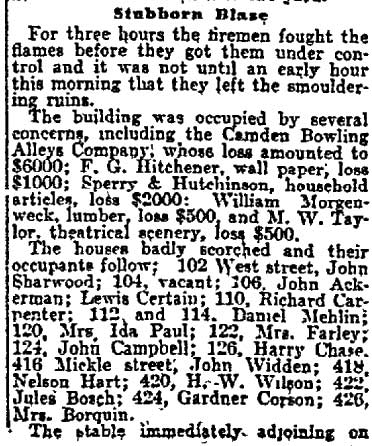
For three hours the firemen fought the flames before they got them under control and it was not until an early hour this morning that they left the smouldering ruins.
The building was occupied by several concerns, including the Camden Bowling Alleys Company, whose loss amounted to $6000; F. G. Hitchener, wall paper, loss $1000; Sperry & Hutchinson, household articles, loss $2000; William Morgenweck, lumber, loss $500, and M. W. Taylor, theatrical scenery, loss $500.
The houses badly scorched and their occupants follow: 102 West street, John Sharwood; 104, vacant; 106, John Ackerman; Lewis Certain; 110, Richard Carpenter; 112, and 114, Daniel Mehlin; 120, Mrs. Ida Paul; 122, Mrs. Farley; 124, John Campbell; 126, Harry Chase; 416 Mickle street: John Widden; 418, Nelson Hart; 420, H.-W. Wilson; 422, Jules Bosch; 424, Gardner Corson; 426, Mrs. Borquin.
The stable immediately adjoining on
the west side of the armory, and belonging to C. M. Alcott, was flooded with water. At this place there were forty horses, all of which were rescued.
Formerly a Market
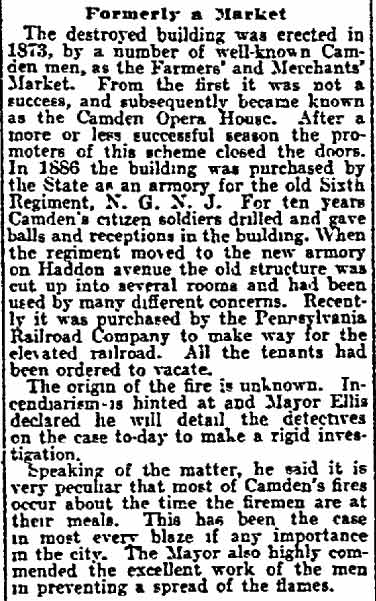
The destroyed building was erected in 1873, by a number of well-known Camden men, as the Farmers’ and Merchants’ Market. From the first it was not a success, and subsequently became known as the Camden Opera House. After a more or less successful season the promoters of this scheme closed the doors. In 1886 the building was purchased by the State as an armory for the old Sixth Regiment, N. G. N. J. For ten years Camden’s citizen soldiers drilled and gave balls and receptions in the building. When the regiment moved to the new armory on Haddon avenue the old structure was cut up into several rooms and had been used by many different concerns. Recently it was purchased by the Pennsylvania Railroad Company to make way for the elevated railroad. All the tenants had been ordered to vacate.
The origin of the fire is unknown. Incendiarism is hinted at and Mayor Ellis declared he will detail the detectives on the case to-day to make a rigid investigation.
Speaking of the matter, he said it is very peculiar that most of Camden’s fires occur about the time the firemen are at their meals. This has been the case in most every blaze if any importance in the city. The Mayor also highly commended the excellent work of the men in preventing a spread of the flames.
In Memory of Dead Heroes
Philadelphia Inquirer —
IN MEMORY OF DEAD HEROES
Mayor of Camden Calls for Services in Two Churches
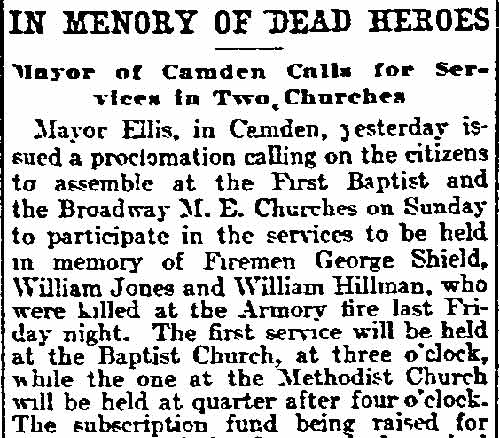
Mayor Ellis, in Camden, yesterday issued a proclamation calling on the citizens to assemble at the First Baptist and the Broadway M. E. Churches on Sunday to participate in the services to be held in memory of Firemen George Shields, William Jones and William Hillman, who were killed at the Armory fire last Friday night. The first service will be held at the Baptist Church, at three o’clock, while the one at the Methodist Church will be held at quarter after four o’clock. The subscription fund being raised for the families of the firemen had reached nearly $2000 last night.
The funeral of Fireman Shields took place yesterday from his home, 525 Kaighn avenue. Hundreds of persons viewed the body, both Tuesday night and yesterday morning. The services were in charge of Rev. John S. Heisler, of the M. E. Church. The body reposed in a handsome oak casket and was surrounded by numerous floral tributes. The services were attended by forty firemen under Chief Elfreth, while the pall-bearers included Firemen Samuel Price, William Deno, Charles Robinson, Peter Carter, Joseph Ernest and George Quinn. Interment was made in the Evergreen Cemetery.
the families of the firemen had reached nearly $2000 last night.
The funeral of Fireman Shields took place yesterday from his home, 525 Kaikhn [sic] avenue. Hundreds of persons viewed the body, both Tuesday night and yesterday morning. hTe [sic] services were in charge of Rev. John S. Heisler, of the M. E. Church. The body reposed in a handsome oak casket and was surrounded by numerous floral tributes. The services were attended by forty firemen under Chief Elfreth, while the pall-bearers included Firemen Samuel Price, William Deno, Charles Robinson, Peter Carter, Joseph Ernest and George Quinn. Interment was made at the Evergreen Cemetery.
[Camden Fire Department Pension Fund]
Philadelphia Inquirer —
** Articles incorporating the Camden City Fire Department Pension Fund were filed in the county clerk’s office yesterday. The trustees named are Henry C. Grosscup, George P. Cox, Walter Browning, John A. Stockton and Samuel S. Elfreth. The latter is chief of the Camden Fire Department.
Plenty of Mix Ups Caused by Blaze
Philadelphia Inquirer —
PLENTY OF MIX UPS CAUSED BY BLAZE
Fire Chief’s Horse Ran Away, Store Was Wrecked and Two Victims Went to Hospital
South Camden was thrown into a turmoil yesterday afternoon indirectly through a slight fire at the Dunn Oil Cloth Works, at Railroad Avenue and Jefferson Street. A vat of oil boiled over and Charles Hampton, of 2124 Miller Street, was terribly burned. He was removed to the Cooper Hospital. When the blazing oil set fire to the place an alarm was turned in.
On the way to the fire the carriage containing Chief Elfreth dashed into the moving van of John Schmidt, at Broadway and Chestnut Street. The horse ran away and collided with the awning pole of the Story Furniture Company, at Sycamore Street, the structure being partly wrecked.
Beneath the awning Harry Haines, a blind man, of 232 Kaighn Avenue, was playing a fife for alms. The noise startled him, and when he attempted to get out of the way the frenzied horse dashed over him. Haines was taken to the Cooper Hospital, suffering from lacerations and contusions pretty much all over the body.
The fire at the oil cloth factory did less than $25 worth of damage.
White Lead Works Wrecked by Flames
Philadelphia Inquirer —
WHITE LEAD WORKS WRECKED BY FLAMES
Fire of Unknown Origin Swept Through Camden Plant, Entailing Loss of About $50,000
Fire of mysterious origin destroyed a two-story brick building 50x150 feet, known as building No. 19, of the Camden White Lead Works, Inc., Sixth and Everett Streets, Camden, yesterday. William Rose, a fireman of Kaighn Avenue company, was injured about the head by a brick during one of the many explosions the firemen had to contend with. The loss is estimated at $50,000 and is fully covered by insurance. As in all previous fires, the officials of the company refused to give a statement as to the origin of the fire or the amount of the loss. They even refused to talk to Chief Elfreth.
Building No. 19 was used to manufacture red lead, and notwithstanding the reticence of the officials one of the workmen said the fire was caused by one of the big heating pans boiling over. At that time the night shift was about going off and the day men coming on. A series of explosions followed, and when the firemen reached the scene they were compelled to chop down the gates to effect an entrance. The explosions continued until the fire burned itself out and with each upheaval the firemen were treated to a dose of red lead until some of their rubber outfits looked as if they had been soaked in red paint pots.
The firemen devoted their energies to saving surrounding property, and in this they were successful. The explosions, Chief Elfreth stated after the fire was under control at 10.30 o’clock, were due to the mixing of ammonia water and sulphuric acid, both of which were in use in the burned building.
Occurring while great numbers of persons were on their way to work, thousands were attracted to the scene, but the explosions soon scared them off.
Fire Chief and Aides Hurled From Buggy
Philadelphia Inquirer —
FIRE CHIEF AND AIDES HURLED FROM BUGGY
They Barely Escape Death on Run to Barge Fire When Vehicle Hits Stump
Hurled from their carriage in responding to an alarm of fire from the shipyard of Peter Hagan, head of Thirty-sixth street, Camden, Fire Chief Samuel [continued in josephmaxwell-110509-2.jpg]
Elfreth and his driver, Joseph Maxwell, narrowly escaped fatal injury yesterday. While Chief Elfreth escaped with bruises and a general shaking up, Maxwell had the tendons of his neck strained, and his attending physician stated that he had escaped having his neck broken by a narrow margin.
They were driving rapidly out River road shortly after 11 o’clock, and owing to the darkness failed to see a stump. The wheels struck it with such force that both men were thrown through the air.
It is believed that the fire, which partly consumed four barges, was of incendiary origin. As the boats were located at the end of a long wharf it was necessary to use a line of hose 1000 feet in length. The loss of about $5000 was covered by insurance.
Wish Bone Club in Annual Banquet.
Camden Post-Telegram —
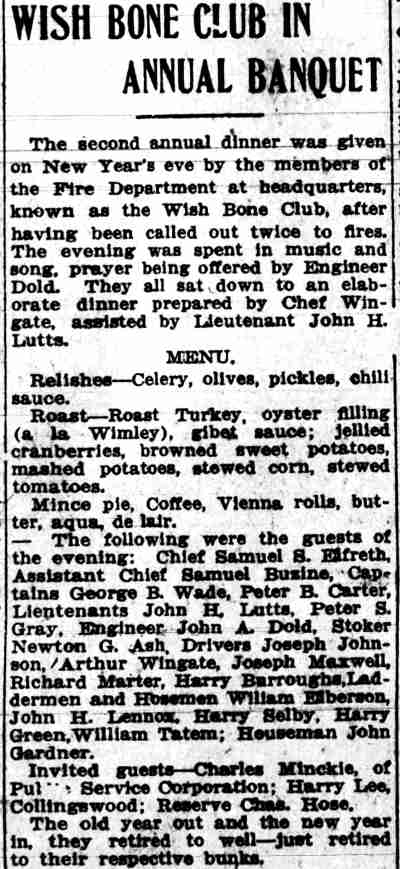
WISH BONE CLUB IN ANNUAL BANQUET
The second annual dinner was given on New Year’s eve by the members of the Fire Department at headquarters, known as the Wish Bone Club, after having been called out twice to fires. The evening was spent in music and song, prayer being offered by Engineer Dold. They all sat down to an elaborate dinner prepared by Chef Wingate, assisted by Lieutenant John H. Lutts.
MENU.
Relishes—Celery, olives, pickles, chilli sauce.
Roast—Roast Turkey, oyster filling (a la Wimley), giblet sauce; jellied cranberries, browned sweet potatoes, mashed potatoes, stewed corn, stewed tomatoes.
Mince pie, Coffee, Vienna rolls, butter, aqua de lair.
— The following were the guests of the evening: Chief Samuel S. Elfreth, Assistant Chief Samuel Buzine, Captains George B. Wade, Peter B. Carter, Lieutenants John H. Lutts, Peter S. Gray, Engineer John A. Dold, Stoker Newton G. Ash, Drivers Joseph Johnson, Arthur Wingate, Joseph Maxwell, Richard Marter, Harry Barroughs, Laddermen and Hosemen William Elberson, John H. Lennox, Harry Selby, Harry Green, William Tatem; Houseman John Gardner.
Invited guests—Charles Minckle, of Public Service Corporation; Harry Lee, Collingwood; Reserve Chas. Hose.
The old year out and the new year in, they retired to well—just retired to their respective bunks.
Camden News Notes
Philadelphia Inquirer —
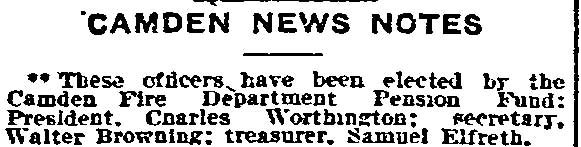
Camden News Notes
** These officers have been elected by the Camden Fire Department Pension Fund: President, Charles Worthington; secretary, Walter Browning; treasurer, Samuel Elfreth.
Flames Wrecked New High School
Philadelphia Inquirer —
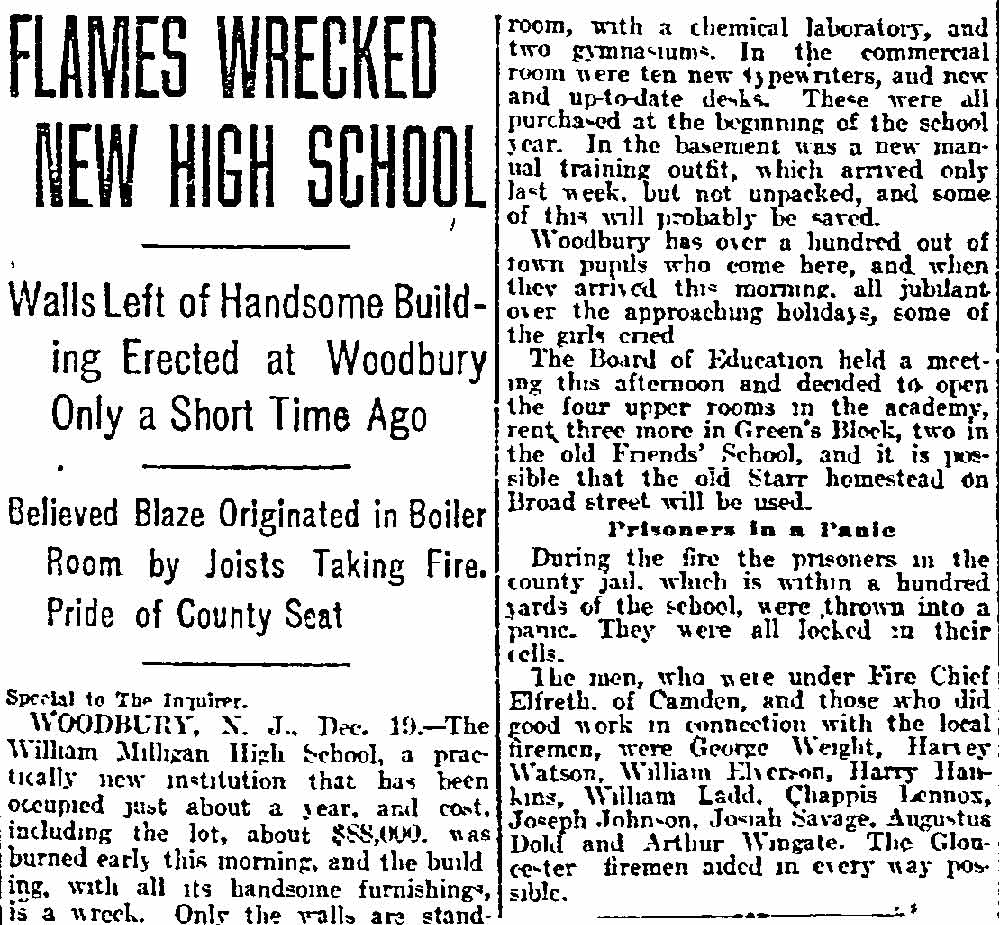
Flames Wrecked New High School
Walls Left of Handsome Building Erected at Woodbury Only a Short Time Ago
Believed Blaze Originated in Boiler Room by Joists Taking Fire, Pride of County Seat
WOODBURY, N. J., Dec. 19.—The William Milligan High School, a practically new institution that has been occupied just about a year, and cost, including the lot, about $88,000, was burned early this morning, and the building, with all its handsome furnishings, is a wreck. Only the walls are standing, with a chemical laboratory, and two gymnasiums. In the commercial room were ten new typewriters, and new and up-to-date desks. These were all purchased at the beginning of the school year. In the basement was a new manual training outfit, which arrived only last week, but not unpacked, and some of this will probably be saved.
Woodbury has over a hundred out of town pupils who come here, and when they arrived this morning, all jubilant over the approaching holidays, some of the girls cried.
The Board of Education held a meeting this afternoon and decided to open the four upper rooms in the academy, rent three more in Green’s Block, two in the old Friends’ School, and it is possible that the old Starr homestead on Broad Street will be used.
Prisoners in a Panic
During the fire the prisoners in the county jail, which is within a hundred yards of the school, were thrown into a panic. They were all locked in their cells.
The men, who were under Fire Chief Elfreth, of Camden, and those who did good work in connection with the local firemen, were George Weight, Harvey Watson, William Elverson, Harry Hankins, William Ladd, Chappis [sic] Lennox, Joseph Johnson, Josiah Savage, Augustus Dold and Arthur Wingate. The Gloucester firemen aided in every way possible.
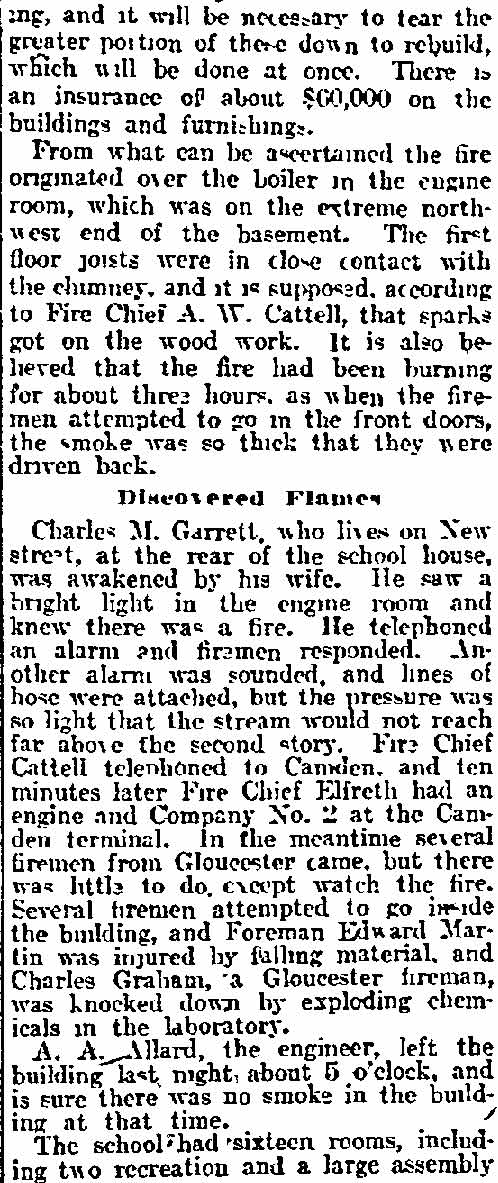
ing, and it will be necessary to tear the greater portion of these down to rebuild, which will be done at once. There is an insurance of about $60,000 on the buildings and furnishings.
From what can be ascertained the fire originated over the boiler in the engine room, which was on the extreme northwest end of the basement. The first floor joists were in close contact with the chimney, and it is supposed, according to Fire Chief A. W. Cattell, that sparks got on the wood work. It is also believed that the fire had been burning for about three hours, as when the firemen attempted to go in the front doors, the smoke was so thick that they were driven back.
Discovered Flames
Charles M. Garrett, who lives on New street, at the rear of the school house, was awakened by his wife. He saw a bright light in the engine room and knew there was a fire. He telephoned an alarm and firemen responded. Another alarm was sounded, and lines of hose were attached, but the pressure was so light that the stream would not reach far above the second story. Fire Chief Cattell telephoned to Camden, and ten minutes later Fire Chief Elfreth had an engine and Company No. 2 at the Camden terminal. In the meantime several firemen from Gloucester came, but there was little to do except watch the fire. Several firemen attempted to go inside the building, and Foreman Edward Martin was injured by falling material, and Charles Graham, a Gloucester fireman, was knocked down by exploding chemicals in the laboratory.
A. A. Allard, the engineer, left the building last night about 5 o’clock, and is sure there was no smoke in the building at that time.
The school had sixteen rooms, including two recreation and a large assembly [room].
Firemen Trapped in Burning Store.
Camden Post-Telegram —
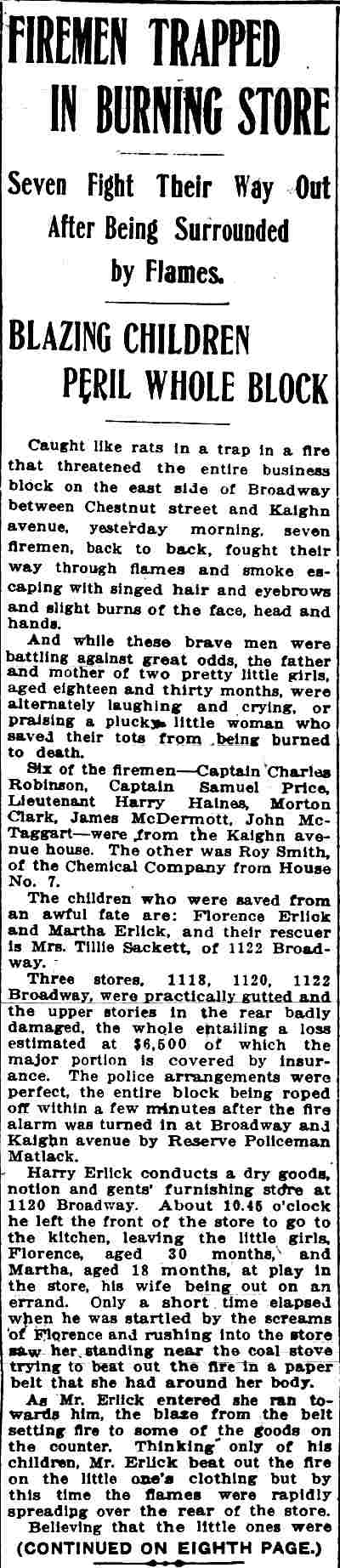
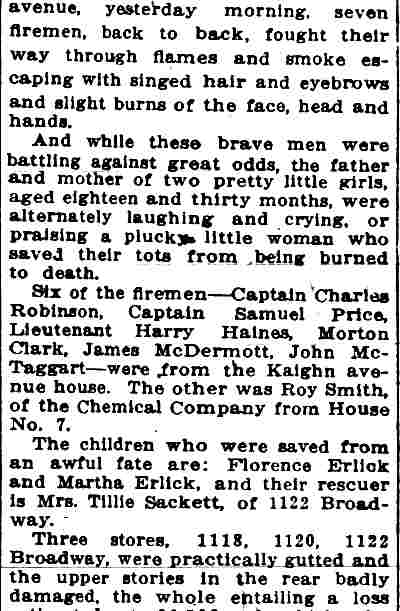
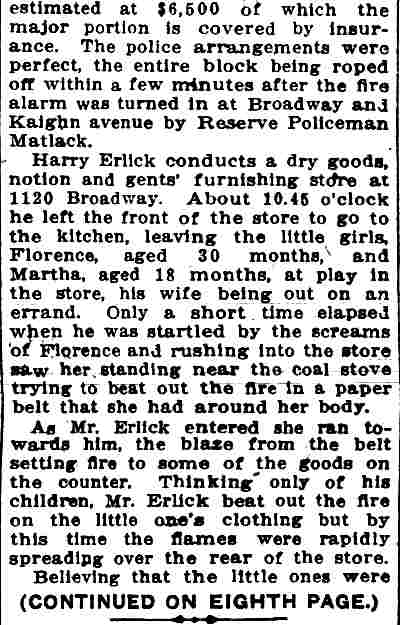

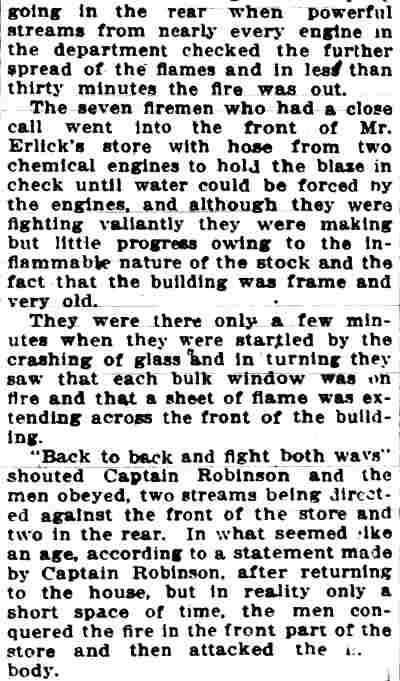
Named: Charles Robinson, Samuel Price, Harry Haines, Mortica Clark, James McDermott, John McTaggart, Roy A. Smith, Peter Gray, Harvey Watts, Samuel S. Elfreth, George P. Cox, Mrs. Tillie Sackett, Harry Ehrlich, Lena Ehrlich, Florence Ehrlich, Martha Ehrlich, Edward T. Sackett, Harry Pinsky, Mary Palosky, Joseph Hermann, Harry Nurock, Broadway, Albertson L. Matlack, and Engine Company 7.
Cyclone of April 2, 1912
Philadelphia Inquirer —
NORTH CAMDEN HIT BY A GREAT CYCLONE; HOMES WRECKED
Hundreds of Houses Ruined by Violent Wind and Rain and Two Persons May Die. Streets Strewn With Debris
Two lives will probably be sacrificed, property valued at at least a hundred thousand dollars, was virtually destroyed and the northwest section of the city was laid in ruins when a storm of cyclonic intensity swept over Camden last night. It continued hardly fifteen minutes, but in that time more havoc was wrought than by any storm that has ever visited that section, even including the locally historic cyclone of 1885.
Those who will likely offer up their lives as a sacrifice to the tremendous force of wind include Miss Anna Cleary, a nurse in the Cooper Hospital, whose house is at 317 Vine street, and Miss Anna Gebrend, of 2359 Amber street, Philadelphia. Both were taken to the Cooper Hospital crushed.
WERE IN TROLLEY CAR
The two women were in a Crosstown trolley car. It was going up Fifth street, when, at Elm, it encountered the full force of the storm. It was the centre of a maelstrom of flying roofs, falling telegraph poles and trees and odds and ends of debris.
Miss Cleary and Miss Behrend were seated in a section of the car over which a tangled mass of debris fell, the great weight crushing in the top like so much paper. Both were pinned beneath a weight of hundreds of pounds
and notwithstanding the fierce wind and air, filled with every conceivable sort of material, the police worked until the women had been released. At the hospital it was found that they had been cut, bruised and cut all over their bodies and it seemed impossible that they could recover.
Many Houses Wrecked
Scores of houses were wrecked, many beyond all hope of repair, and the miracle was that there were no more fatalities. This is attributed to the fact that the force of the wind spent itself along the tops of the structures, otherwise hundreds would have been killed.
The great force of this wind was evidenced at the plant of the Orford Copper Company at Tenth and Elm streets. This concern has a structure about 50 by 100 feet. Five great boiler stacks graced the main building until the wind came. Then these stacks went over like so many tenpins, being blown hundreds of feet away. In addition the roof was doubled up and sent through the air until it landed in an adjoining vacant lot.
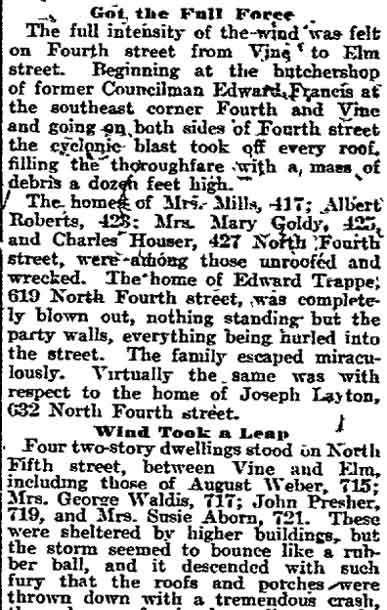
Got the Full Force
The full intensity of the wind was felt on Fourth street from Vine to Elm street. Beginning at the butchershop of former Councilman Edward Francis at the southeast corner Fourth and Vine and going on both sides of Fourth street the cyclonic blast took off every roof, filling the thoroughfare with a mass of debris a dozen feet high.
The homes of Mrs. Mills, 417; Albert Roberts, 423; Mrs. Mary Goldy, 425, and Charles Houser, 427 North Fourth street, were among those unroofed and wrecked. The home of Edward Trappe, 619 North Fourth street, was completely blown out, nothing standing but the party walls, everything being hurled into the street. The family escaped miraculously. Virtually the same was with respect to the home of Joseph Layton, 632 North Fourth street.
Wind Took a Leap
Four two-story dwellings stood on North Fifth street, between Vine and Elm, including those of August Weber, 715; Mrs. George Waldis, 717; John Presher, 719, and Mrs. Susie Aborn, 721. These were sheltered by higher buildings, but the storm seemed to bounce like a rubber ball, and it descended with such fury that the roofs and porches were thrown down with a tremendous crash,
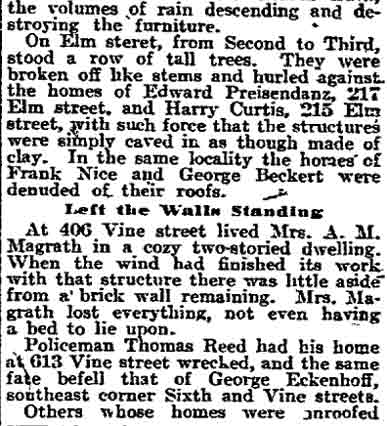
the volumes of rain descending and destroying the furniture.
On Elm street, from Second to Third, stood a row of tall trees. They were broken off like stems and hurled against the homes of Edward Preisendanz, 217 Elm street, and Harry Curtis, 215 Elm street, with such force that the structures were simply caved in as though made of clay. In the same locality the homes of Frank Nice and George Beckert were denuded of their roofs.
Left the Walls Standing
At 406 Vine street lived Mrs. A. M. Magrath in a cozy two-storied dwelling. When the wind had finished its work with that structure there was little aside from a brick wall remaining. Mrs. Magrath lost everything, not even having a bed to lie upon.
Policeman Thomas Reed had his home at 613 Vine street wrecked, and the same fate befell that of George Eckenhoff, southeast corner Sixth and Vine streets.
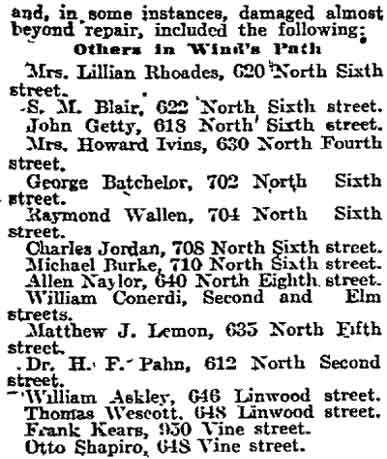
Others whose homes were unroofed
and, in some instances, damaged almost beyond repair, included the following:
Others in Wind’s Path
Mrs. Lillian Rhoades, 620 North Sixth street. S. M. Blair, 622 North Sixth street. John Getty, 618 North Sixth street. Mrs. Howard Ivins, 630 North Fourth street. George Batchelor, 702 North Sixth street. Raymond Wallen, 704 North Sixth street. Charles Jordan, 708 North Sixth street. Michael Burke, 710 North Sixth street. Allen Naylor, 640 North Eighth street. William Conerdi, Second and Elm streets. Matthew J. Lemon, 635 North Fifth street. Dr. H. F. Palm, 612 North Second street. William Askley, 646 Linwood street. Thomas Wescott, 648 Linwood street. Frank Kears, 950 Vine street. Otto Shapiro, 648 Vine street.
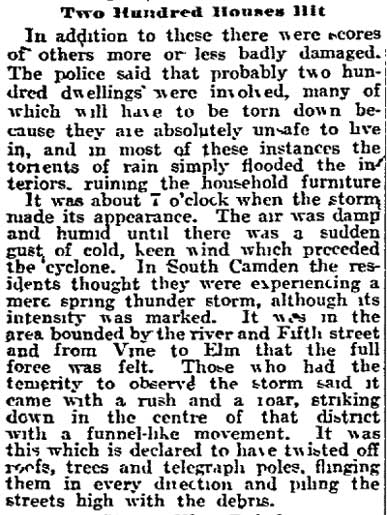
Two Hundred Houses Hit
In addition to these there were scores of others more or less badly damaged. The police said that probably two hundred dwellings were involved, many of which will have to be torn down because they are absolutely unsafe to live in, and in most of these instances the torrents of rain simply flooded the interiors, ruining the household furniture.
It was about 7 o’clock when the storm made its appearance. The air was damp and humid until there was a sudden gust of cold, keen wind which preceded the cyclone. In South Camden the residents thought they were experiencing a mere spring thunder storm, although its intensity was marked. It was in the area bounded by the river and Fifth street and from Vine to Elm that the full force was felt. Those who had the temerity to observe the storm said it came with a rush and a roar, striking down in the centre of that district with a funnel-like movement. It was this which is declared to have twisted off roofs, trees and telegraph poles, flinging them in every direction and piling the streets high with the debris.
Storm Was Brief
In less than a quarter of an hour the storm had spent its fury, aside from some vivid flashes of lightning. It was then that the residents in the stricken district began peering cautiously from their homes. They were afraid to venture forth because everywhere they found a tangle of electric wires which hissed and sputtered death at every step. It was thought that when such damage had been wrought there must have been great loss of life. In consequence of this Chief of Police Gravenor and Fire Chief Elfreth massed most of their men in the damaged area. In the meantime all lights had been extinguished, the lighting plant having been closed to avert possible tragedies. Everything was in absolute darkness, and because of this the police and firemen had great difficulty in going over the district in search of possible victims. They were aided, however, by scores of volunteers, who looked high and low about the wreckage. Up to a late hour last night no bodies had been found, but the search will be continued today.
Thousands on the Scene
After the storm had subsided thousands of Camden residents visited the damaged area. It was necessary to rope it off to prevent the venturesome ones from going into unnecessary danger. Many came from the southern section of the city and were greatly surprised over the havoc wrought. South Camden was hardly touched.
Among those who were not perturbed to notice, the cyclone was Scott Veazey, a barber, of Third and Elm streets. He said that his impression was that a train had struck a trolley car. He heard one great crash, looked out of his door, saw the air filled with debris and was glad to get in. Vezey’s place is right in the midst of the area damaged, but he escaped unscathed.
Celebrations by 3 Fire Companies.
Camden Post-Telegram —
CELEBRATIONS BY 3 FIRE COMPANIES
No. 7, Headquarters and No. 1 Truck Make Merry at Respective Homes.
CHIEF ELFRETH MAKES ADDRESS
Engine Company No. 7 is the baby company of the fire department, that is, in years of service, but in up-to-date completeness in every respect, harmony and quick response to duty, the men in blue out Kaighn avenue, under Captain Charles Todd, are right there on the tap of the gong. Captain Todd is a stickler for good feeling among his men for the good of the service, and at a New Year’s Eve banquet this unanimity of good fellowship was strongly manifested.
It was the first New Year’s blowout given by Company 7 and the guests had as grand a time as if they were gathered about their own firesides at home. From door to roof, the firehouse was ablaze with a glow of the holiday and patriotic spirit. Flags, festoons of green, Christmas bells, and lights gladdened all hearts and a Christmas tree glistening with tinsel and topped with an electric bulb gave the banquet hall a homelike air. Over the tree was the gladsome greeting, “Merry Christmas and Happy New Year.”
Fifteen guests sat down to the festive board. In the centre of the table glowed in a big fireman’s horn a big bunch of electric lit American Beauties and from one end of the board to the other it was one sweep of delicacies, turkey, raw and fried oysters, stuffing chicken salad, cake, pie and a lot of other luxuries that make life happier as far as the inner man is concerned.
Chief Kelly presided at the head of the table and made a genial toastmaster. Chief Kelly supplied the electrical effects with his usual aptness. “Brother” Lutz said a short and timely prayer and then the guests sat down and for two hours were regaled with all the palatable good things of the season of good cheer. Cigars of pungent aroma being passed around, “Jim” Nevins and George Boone entertained delightfully with grapophone selections, including “Has Anyone Here Seen Kelly?” He was there.
With the midnight hour came the blowing of factory whistles and the tolling of bells. And from below in the firehouse came a terrific clangor and clash and gongs and bells. The firemen instinctively made for the sliding pole, but soon came back a-laughing. It was only Chief Kelly and Chief Chef Lutz ringing in the first alarm of the New Year, No. 1-9-1-3.
Those who had the great pleasure to participate in this most happy affair are as follows:
City Electrician John W. Kelly, Jr., Captain Charles Todd, Lieutenant John Lutz, Engineer William Busine, Stoker James Nevins, Drivers Richard Marter and Joseph Sparks, Hoseman George Boone, Roy Smith and Edward Simpson, and as welcome guests, Richard Saeur, John Watson, Albert Glanders, William Robinson and Harry Knowles, the faithful houseman of No. 7.
Chief Elfreth and Assistant Chiefs Cox, Stockton, Wade and Browning, were to have been there, but business on a holiday kept them at Headquarters awaiting alarms.
AT HEADQUARTERS.
Under the auspices of the Wishbone Club, firemen at headquarters, Fifth and Arch streets, held their annual dinner on Tuesday evening. Cheer and good-fellowship was the by word and the fire laddies and their friends made the evening one long to be remembered.
A short address was given by Chief Elfreth and Assistant Chief Stockton. John Dold offered prayer before the guests partook of the tasty dishes as prepared by Arthur Wingate and William Laud. The table presented an attractive appearance and the laddies and guests greatly enjoyed the fine spread. The menu follows:
Roast Sweet Potatoes, Peas, Cranberry Sauce, Mince Pie, Coffee, Cigars, Aqua De Lair, Olives, Beets, Celery, Roast Turkey, Oyster Filling, Giblet Sauce Mashed White Potatoes.
Those participating were as follows: S. S. Elfreth, John S. Stockton, Captain George B. Wade, Lieutenant Jos. Ernest, John A. Dold, Josiah Sage, Daniel Smith, Arthur Wingate, Joseph Johnson, Harry Hankins, William Laird, William Elberson, John Lennox, Martin Carrigan, Charles Cook, Harry Belby, Harry Khrier, Charles Menke, Edward S. Gahan, D. P. McConnell.
With a fine feed, a grand graphophone concert, songs and speeches of a happy and humorous order, “the Jolly Nine” saw the old year out and the New Year in, at the house of Hook and Ladder Truck No. 1, on Fifth street above Arch street. Accoutred in their uniforms of blue, ready at a second’s tap of the gong to jump on the truck, the brave laddies and friends formed a happy picture of congeniality. The menu was most appetizing. Beginning with oysters on the shell and winding up with a delicious dish designated “Creme-a-la-Truck,” the guests were kept busy munching their molars, as the sedate and genial waiters, togged out in linen of spotless white. William Howell Tatem and “Chief” Harry Anderson did the elegant. Stewart Bakely, a slick Cooper river boat house cook from away back, was the popular chef of the feast, and that grand old fire hero, Captain “Joe” Maxwell, the Commander-in-Chief of festivities, who saw to it that no one got left as the plates passed around.
The floral and holiday decorations of the banquet hall were munificent and in happy accord with the gracious and good-natured gathering.
completeness in every respect, harmony and quick response to duty, the men in blue out Kaighn avenue, under Captain Charles Todd, are right there on the tap of the gong. Captain Todd is a stickler for good feeling among his men for the good of the service, and at a New Year’s Eve banquet this unanimity of good fellowship was strongly manifested.
It was the first New Year’s blowout given by Company 7 and the guests had as grand a time as if they were gathered about their own firesides at home. From door to roof, the firehouse was ablaze with a glow of the holiday and patriotic spirit. Flags, festoons of green, Christmas bells, and lights gladdened all hearts and a Christmas tree glistening with tinsel and topped with an electric bulb gave the banquet hall a homelike air. Over the tree was the gladsome greeting, “Merry Christmas and Happy New Year.”
Fifteen guests sat down to the festive board. In the centre of the table glowed in a big fireman’s horn a big bunch of electric lit American Beauties and from one end of the board to the
other it was one sweep of delicacies, turkey, raw and fried oysters, stuffing chicken salad, cake, pie and a lot of other luxuries that make life happier as far as the inner man is concerned.
Chief Kelly presided at the head of the table and made a genial toastmaster. Chief Kelly supplied the electrical effects with his usual aptness. “Brother” Lutz said a short and timely prayer and then the guests sat down and for two hours were regaled with all the palatable good things of the season of good cheer. Cigars of pungent aroma being passed around, “Jim” Nevins and George Boone entertained delightfully with grapophone selections, including ’Has Anyone Here Seen Kelly?“ He was there.
With the midnight hour came the blowing of factory whistles and the tolling of bells. And from below in the firehouse came a terrific clangor and clash and gongs and bells. The firemen instinctively made for the sliding pole,
but soon same back a-laughing. It was only Chief Kelly and Chief Chef Lutz ringing in the first alarm of the New Year, No. 1-9-1-3.
Those who had the great pleasure to participate in this most happy affair are as follows:
City Electrician John W. Kelly, Jr., Captain Charles Todd, Lieutenant John Lutz, Engineer William Busine, Stoker James Nevins, Drivers Richard Marter and Joseph Sparks, Hoseman George Boone, Roy Smith and Edward Simpson, and as welcome guests, Richard Saeur, John Watson, Albert Glanders, William Robinson and Harry Knowles, the faithful houseman of No. 7.
Chief Elfreth and Assistant Chiefs Cox, Stockton, Wade and Browning, were to have been there, but business on a holiday kept them at Headquarters awaiting alarms.
AT HEADQUARTERS.
Under the auspices of the Wishbone Club, firemen at headquarters, Fifth and Arch streets, held their annual
dinner on Tuesday evening. Cheer and good-fellowship was the by word and the fire laddies and their friends made the evening one long to be remembered.
A short address was given by Chief Elfreth and Assistant Chief Stockton. John Dold offered prayer before the guests partook of the tasty dishes as prepared by Arthur Wingate and William Laud. The table presented an attractive appearance and the laddies and guests greatly enjoyed the fine spread. The menu follows:
Roast Sweet Potatoes, Peas, Cranberry Sauce, Mince Pie, Coffee, Cigars, Aqua De Lair, Olives, Beets, Celery, Roast Turkey, Oyster Filling, Giblet Sauce Mashed White Potatoes.
Those participating were as follows: S. S. Elfreth, John S. Stockton, Captain George B. Wade, Lieutenant Jos. Ernest, John A. Dold, Josiah Sage, Daniel Smith, Arthur Wingate, Joseph Johnson, Harry Hankins, William Laird, William Elberson, John Lennox, Martin Carrigan, Charles Cook, Harry Belby, Harry Khrier, Charles Menke, Edward S. Gahan, D. P. McConnell.
With a fine feed, a grand graphophone concert, songs and speeches of a happy and humorous order, “the Jolly Nine” saw the old year out and the New Year in, at the house of Hook and Ladder Truck No. 1, on Fifth street above Arch street. Accoutred in their uniforms of blue, ready at a second’s tap of the gong to jump on the truck, the brave laddies and friends formed a happy picture of congeniality. The menu was most appetizing. Beginning with oysters on the shell and winding up with a delicious dish designated “Creme-a-la-Truck,” the guests were kept busy munching their molars, as the sedate and genial waiters, togged out in linen of spotless white. William Howell Tatem and “Chief” Harry Anderson did the elegant. Stewart Bakely, a slick Cooper river boat house cook from away back, was the popular chef of the feast, and that grand old fire hero, Captain “Joe” Maxwell, the Commander-in-Chief of festivities, who saw to it that no one got left as the plates passed around.
The floral and holiday decorations of the banquet hall were munificent and in happy accord with the gracious and good-natured gathering.
On Keeping Chimneys Clean
Camden Courier-Post —
First Act of Camden City Council, Over Century Ago, Was to Cut Down Fire Hazard By Way of Ordinance for ‘Sweeps’
By Ben Courter
COMPARING Camden’s fire-fighting equipment of today with what the city had when it was incorporated, 103 years ago, the wonder is that some of the fires did not wipe out the tiny community. With their pumpers, chemicals and water mains, the average suburban town is protected like a metropolis when we consider the methods in vogue a century ago.
Fire ever has been man’s most implacable foe, and even yet it is merely a matter of degree—from barbarian ancestors and their rude thatched shacks, to modern skyscraper as to the terror it inspires. Camden, in the late 20s of the last century, was merely a clutter of tiny dwellings, only the more prosperous citizenry such as the Coopers and Kaighns having brick domiciles graced with attics.
It was thus in keeping with the times to have thought first for safety from the fire demon when City Council held its first session, April 11, 1828. That was by way of an ordinance directed against those inclined to be careless and let their chimneys collect through the years, a great mass of soot. There were those who kept their chimneys clean as the proverbial whistle, first, so the fire would draw, and again to remove the fire hazard. But many apparently, took pot luck and let things go with little thought of what might happen until it did—oft-times in the dead of night with long tongues of flames wiping out their humble domicile.
Wood Exclusively Used
Electricity was little more than the mysterious force Ben Franklin had toyed with over the Delaware. Coal still was to be brought from its carboniferous beds in Pennsylvania. It had not even been proposed as “stones that would burn and give heat.” Oil came from whales and such and was used sparingly on new fangled mysteries called machinery. So the thick, clumps of trees here about were hewed down for heat in winter and to cook the meals. It was that constant use of wood that filled the chimneys with soot and soot evidently was most of the cause of fire.
When a fire started in Camden village it was a serious affair. If it wasn’t caught in the nick of time the house burned to the ground. So council passed its first ordinance to help the boys of old Perseverance in keeping down the fire record although in those days there were no records kept, of course. That first company, by the way, was on Second Street above Market, about where the National State Bank first built. The little frame shack was still there in the 70’s when the bank enlarged its building and tore it down, the company meanwhile having taken its quarters to Third Street.
But getting back to the ordinance of council, it required the thorough sweeping of every chimney at least once in three months. If a sweep tried the short cut to earning his money by burning out a chimney he was fined $1 because that method was declared to endanger surrounding property. The sweep was supposed to get into the chimney or at least sweep it in regulation fashion and not “cut corners,” as some persons have a habit of doing whether it’s sweeping chimneys or building a house.
That part of the ordinance is interesting for it provides “that if any person from or after the first day of May next, ensuing, shall burn his, her or their chimney, or suffer the same to burn or blaze out of the top thereof, unless the roof of the house thereof is covered with snow, or during the time of a storm of rain or snow, every such person shall forfeit and pay the sum of one dollar.” If a chimney should take fire the house owner was required to prove that it had been properly swept out within three months.
Further, it was provided if such a chimney burst into flame after it had been swept out the chimney sweep was to forfeit a dollar. That evidently was due to the determination of Laning, Cowperthwaite, Sloan and Lawrence, the city fathers, to make more and better chimney sweeps and to aid the Perseverance boys in staying the ravages of the flaming foe.
Outstanding Fireman
And if any of the boys of the present generation imagine they have the niftiest apparatus hereabouts; with all their compound engines, extension ladders and what not, they have nothing on Samuel D. Elfreth, who “ran” with old Perseverance so soon as he came to Camden, in 1824. Old annals relate, he was always on the spot when “she” was needed, meaning the hand engine, and was regarded as the outstanding fireman of Camden. In 1882 my grandfather wrote in the Courier that Elfreth, although verging on 80, was then still one of the most active volunteer firemen in Camden. He then resided within the shadow of his beloved old company and was filled with reminiscences of the days when he ran with the boys. His son, Samuel (S. Elfreth), then was chief of the paid fire department as he was in later years until his death some 15 years ago. Charles F. Elfreth, a veteran attaché of the city’s finance department, is a grandson of the first Elfreth, a nephew of the late chief.
Those old ordinances relative to keeping chimneys clean seem amusing now, but they were vitally important then. They were, in fact, the very beginning of the present day system of keeping down fire losses by way of every possible method in alarms, in equipment, in man efficiency. It is from such humble beginnings that have evolved the methods in battling blazes in skyscrapers, in extensive plants, in keeping tabs on the very last thing in conquering the foe ever ready, and seemingly willing, to raze the works of man.