Robert S. Bender
ROBERT S. BENDER was born in Pennsylvania in June of 1836, one of at least six children born to Jacob and Charlotte Bender. Jacob Bender was a bookbinder by trade, and he schooled his Robert Bender in that profession. The Bender family was living in South Camden when the 1850 Census was taken. Robert Bender married in November of 1856, his wife Jane McCowan giving him four children during their marriage. When the census was taken in 1860 Robert Bender and family lived at 223 Federal Street in Camden, where he ran the bookbindery his father had founded. Another bookbinder, brother-in-law John McCowan, lived with the family, as did what appear to be his younger brother, Thomas McCowan, who was learning the business.
George Reeser Prowell wrote about the two companies in his History of Camden County, New Jersey which was published in 1886.
The Independence Fire Company No. 1, organized with Lambert F. Beatty, president; William S. Frazer, secretary; and Joseph Wagner, treasurer. Among the early members were Jacob Prettyman, David Page, Thomas Stites, Andrew Stilwell, Francis E. Harpel, Restore Cook, John Wallace, Claudius W. Bradshaw, William H. Hawkins, Christopher J. Mines, Henry Bradshaw, William E. Walls, William Howard, Albert Dennis, Elwood Bounds, Samuel H. Stilwell, Albert V. Mills, Robert S. Bender, Lewis Yeager, Thomas McCowan and William W. Mines. The company met in a building at Third Street and Cherry for a year, when it was burned. Lewis Yeager gave the company free use of a lot on Third Street, above Cherry, where an engine-house of slabs, donated by Charles Stockham, was built. In 1853 a lot on Cherry Street, above Third, was purchased and on it a frame house was built. This was used until 1859, when, owing to a defect in the title, the sheriff advertised the property for sale. When he reached the ground on the day of the sale he found the house, with its contents, and a number of the members of the company, on an adjoining lot belonging to James B. Dayton, who permitted the action. The following year, 1860, they bought and built, on the north side of Pine Street, above Fourth, a three-story brick, then the most complete fire-engine house in Camden, and which was sold for four thousand five hundred dollars to the city. The Independence was a hose company until June 4, 1864, when they secured an Amoskeag engine, being the first fire-engine in use by the fire companies of Camden. Early in 1869 they purchased a larger engine and when the volunteer firemen were scattered, in the latter part of that year, they sold the Amoskeag to Millville, and the later purchase was kept until 1874, when it was sold to the city. Lambert F. Beatty, John Wallace, William H. Hawkins, J. Kelly Brown, William W. Mines and Edward Gilbert were presidents of the Independence, while its secretaries have been William L. Frazer, William W. Mines, Mortimer C. Wilson and Thomas McCowan; and the treasurers Joseph Wagner and Robert S. Bender, who, elected in 1854, served until October 13, 1874, when, with a roll of sixty members, they met. President Gilbert in the chair, paid all claims against them and formally disbanded.
After the Civil War, Robert Bender was one of the original members of the Camden Fire Department, entering service on December 7, 1869 as extra man of the Hook & Ladder Company, the original designation of what is now Ladder Company 1. In business as a bookbinder, he made his home at 223 Federal Street when he joined the department in the fall of 1869. Robert Bender had served as a volunteer fire fighter with the Independence Steam Engine Fire Company in the years leading up to the formation of the paid department, as did his employee, Thomas McCowan, who also was an original member of the Camden Fire Department. Other Independence men included Thomas Allibone, William W. Mines, Christopher Mines Jr., and Claudius Bradshaw. Allibone and William W. Mines became original Camden Fire Department members. Claudius Bradshaw later served as Chief of the Department and as Mayor, and Christopher Mines was at one time Camden County Sheriff.
About 5 P.M. on Saturday, July 18, 1868 flames were discovered coming from the engine room of Goldey & Cohn’s large box factory on Taylor Avenue. Flames spread through the building, feeding on the highly combustible stock. The entire building was soon engulfed in fire as was the late R.H. Middleton’s brick stable. A brisk southwest wind carried the flames across Taylor Avenue to the company’s lumber pile and onward to Middleton’s warerooms at #7 South Second Street and also his two and one-half story frame dwelling at #5 South Second Street.
Chief Engineer Ayers realized that additional help was needed and telegraphed Chief McClusker of Philadelphia for assistance. The blaze was already threatening to consume the most densely populated and most valuable section of the City. Chief McClusker responded with steamers from the Vigilant and Hibernia Fire Companies, the Fairmount, Lafayette, Neptune, America and Diligent Hose Companies and the Empire Hook & Ladder Company.
As the firemen placed the steamers along the Delaware River and laid their hose lines, the fire spread to the Ware & Marshall meat and provision store, a two story brick property at #3 South Second Street and to a two and one-half story brick dwelling at #1 South Second Street (owned by Joab Scull and occupied by Charles Armstrong). These buildings were destroyed as was Joab Scull’s wood frame grocery store on the southwest corner of Second and Federal Streets and an adjacent three story brick dwelling (also owned by Scull but occupied by Mr. Goldey).
The fire continued to spread destroying Mr. Test’s frame drugstore and extending to the home of James M. Cassady, Esquire’s house at 128 Federal Street. Firemen were successful in saving Cassady’s residence from complete destruction. Although the property sustained heavy water damage, only the rear of the building was destroyed. The fire fighters continued their determined stand against the oncoming flames and were able to save the property of the late Samuel McLain which adjoined Cassady’s residence.
Conrad Hoell’s saloon at the corner of Second and Federal Streets and the adjoining building occupied by L.G. Peterson ignited several times, but the flames were quenched by what the West Jersey Press called the “superhuman exertions” of the fire fighters.
Several firemen were overcome by the intense heat, including Captain Wesley P. Murray and Joseph Flanigan of the Weccacoe Hose and Robert S. Bender, Thomas McCowan and Thomas Allibone of the Independence Steam Engine. These men had to be removed from the scene.
Combined losses exceeding $54,000 were reported as a result of this devastating conflagration. Chief Engineer Ayers praised the efforts of his men and the good work done by Chief McClusker and his forces from Philadelphia. The grateful citizens joined in this praise.
On the afternoon of Monday, September 14, 1868 about 2 P.M. Camden’s volunteers along with others from Philadelphia were called to an inferno at the Washington Manufacturing Company in Gloucester City. This huge blaze caused a half million dollars in losses and destroyed hose belonging to the Weccacoe and Shiffler Hose Companies of Camden. Both companies received compensation for the damaged hose from the owners of the manufacturing firm.
THE INCEPTION OF THE PAID DEPARTMENT
Rivalry and frequent insubordination in the volunteer department led to its demise. An example of these problems can be found in an article in the West Jersey Press on September 23, 1868:
The discordant elements belonging to the Independence and Shiffler fire companies have found a common ground of compromise and settled upon it as we learned from Chief Murray. Hereafter, we are to have no more bricks and paving stones flying around loose. Let us have peace, long and enduring.
As a case in point, someone had cut the Independence Fire Company’s hose during the Nickel Works fire and a $50.00 reward had been offered for the identity of the culprit(s).
Still, the citizens supported their volunteers and vehemently opposed the creation of a paid department. The community-at-large was proud of the service rendered to them by the volunteers and leery of the costs involved to create and maintain a paid force. The proposed downsizing of the department to only five pieces of apparatus and forty-one members was another cause for concern. Numerous meetings were held and many articles appeared in newspapers expressing concerns about, and opposition to, the paid department.
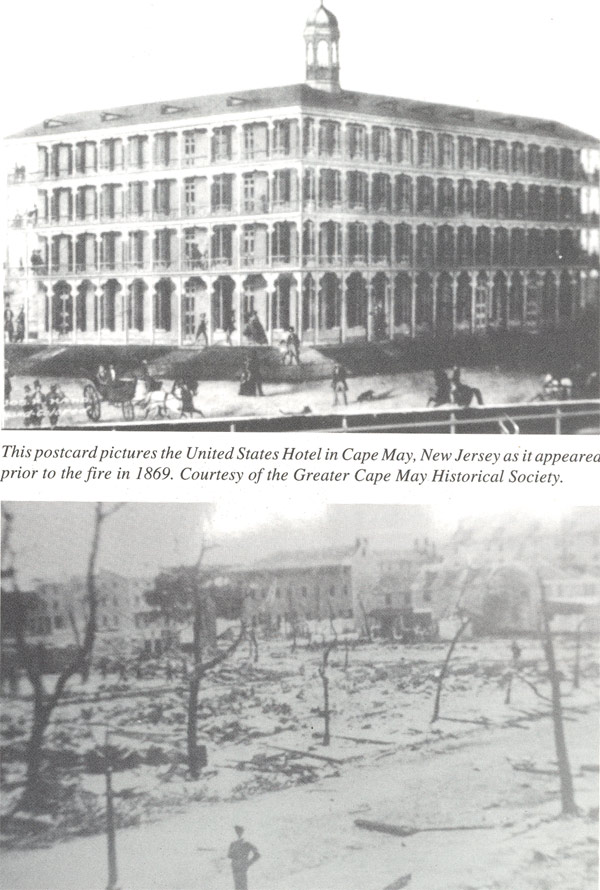
This early photo shows the devastation which resulted from the disastrous blaze at the United States Hotel in Cape May. The fire occurred on 8-31-1869. Courtesy of the Greater Cape May Historical Society.
Had the smaller paid department existed on August 31, 1869, Camden would not have been able to provide the much needed manpower and equipment to Cape May, New Jersey. On that day a conflagration threatened this shore resort at New Jersey’s southern most tip. An urgent call was received from the City of Cape May during the early morning hours.
A huge blaze, involving the famous United States Hotel and many other hotels, businesses and residences was burning out of control. Chief Murray dispatched the Shiffler and Independence steamers with 2000 feet of hose, the hook and ladder from the United States Fire Company, and manpower with apparatus from both the Weccacoe Engine and Hose companies to the Cape May fire. These units from Camden were sent 90 miles by special train where they “rendered gallant and efficient service in extinguishing the raging flames.” Camden’s citizens were proud that they could provide valuable service to neighbors in need, yet maintain adequate fire protection at home. This was something the proposed, much smaller paid department would not have been able to do.
Despite opposition, on September 2, 1869 City Council enacted a municipal ordinance creating a paid fire department. It provided for the annual appointment of five Fire Commissioners, one Chief Marshal (Chief of Department) and two Assistant Marshals. The City was also divided into two fire districts. The boundary line ran east and west, starting at Bridge Avenue and following the tracks of the Camden and Amboy Railroad to the city limits. District 1 was south of this line and District 2 was north. The commissioners also appointed the firemen who were scheduled to work six 24 hour tours per week. William Abels, from the Weccacoe Hose Company No. 2 was appointed Chief Marshal with William J. Mines, from the Independence Fire Company No. 3 as Assistant Marshal for the 1st District, and William H. Shearman as the Assistant Marshal for the 2nd District. Abels had served with the volunteer fire departments of Philadelphia, Mobile, Alabama and Camden for sixteen years prior to his appointment as Chief of the paid force.
On the morning of November 9, 1869 a fire destroyed nine frame dwellings at Cooper’s Point. Many of the occupants narrowly escaped death as flames spread rapidly. One resident, Mr. Elliot, was badly burned as were two of his children. His wife and mother were injured while escaping the flames. The steamer of the Weccacoe Hose Company overheated due to lack of water in the boiler and had to shut down. Steamers from the Weccacoe Engine Company and Shiffler supplied the hose streams that battled the blaze. An adjacent lumber yard owned by Perry & Packer was spared due to the efforts of firemen.
On November 10, 1869 City Council purchased the Independence Firehouse, the three-story brick building at 409 Pine Street, for $4500. The building was designated to serve as quarters for Engine Company 1 and the 1st District. On October 29, 1869 City Council authorized construction of a two-story brick building on the northwest corner of Fifth and Arch Streets as quarters for the 2nd District. On November 25th the Fire Commissioners signed a contract with M.N. Dubois in the amount of $3100 to erect this structure. The 2nd District would share these quarters with Engine Company 2 and the Hook & Ladder Company and the facility would also serve as department headquarters for the new paid force. The original contract remains part of the Camden County Historical Society collection.
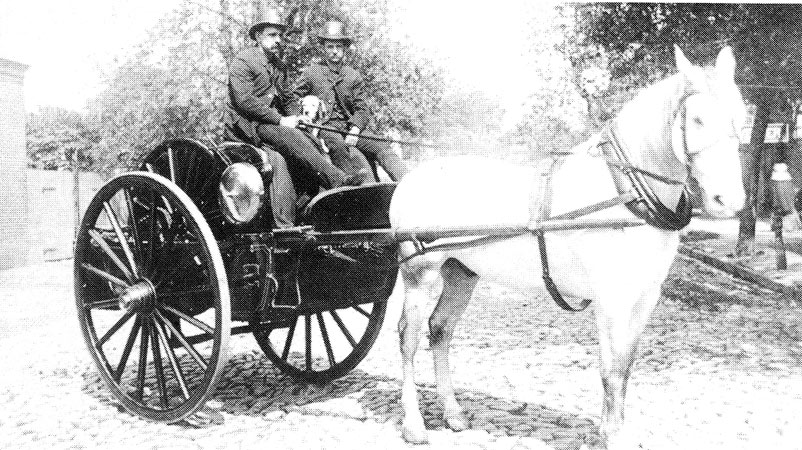
Engine Company 2 with 1869 Silsby Hose Cart. Photo Circa 1890. Note badges upon derby hats worn by Fire Fighters.
Two Amoskeag second class, double pump, straight frame steam engines were purchased at a cost of $4250 each. Two Silsby two wheel hose carts, each of which carried 1000 feet of hose, were another $550 each and the hook & ladder, built by Schanz and Brother of Philadelphia was $900. Each engine company received a steam engine and hose cart. Amoskeag serial #318 went to Engine Company 1, and serial #319 to Engine Company 2. The Fire Commission also secured the services of the Weccacoe and Independence steamers in case of fire prior to delivery of the new apparatus. Alfred McCully of Camden made the harnesses for the horses. Camden’s Twoes & Jones made the overcoats for the new firemen and a Mr. Morley, also of Camden, supplied the caps and belts which were manufactured by the Migeod Company of Philadelphia. The new members were also issued badges.
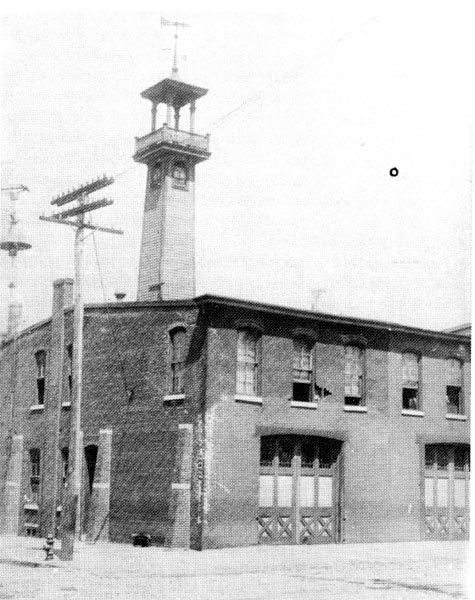
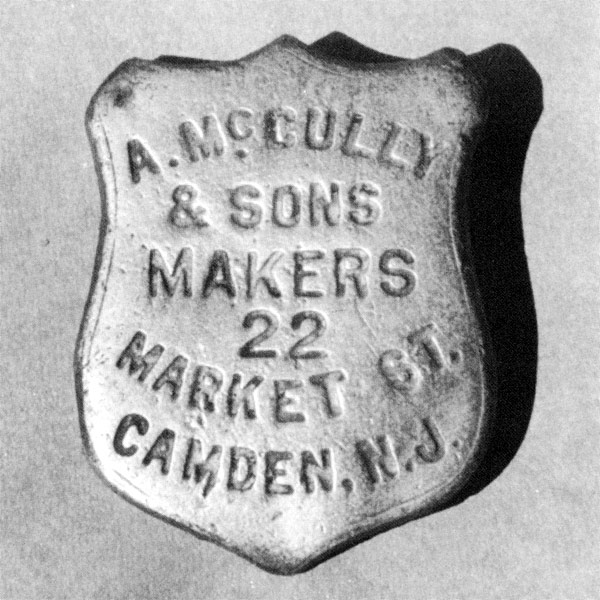
Left: This is the earliest known photo of fire headquarters on the northwest corner of Fifth and Arch Streets. Originally built in 1869, the building shows signs of wear some twenty years later. Note the weathervane shaped like a fireman’s speaking trumpet atop the tower. Right: This maker’s plate once was attached to a harness made by A. McCully & Sons, 22 Market Street, Camden, New Jersey. This firm provided the first harnesses for the paid fire department in 1869.
Badges worn by the marshals, engineers, stokers and engine drivers bore the initial letter of their respective positions and their district number. The tillerman and his driver used the number “3” to accompany their initial letter. The extra men of the 1st District were assigned badges 1–10; 2nd District badges were numbered 11–20 and the extra men of the hook & ladder wore numbers 21–30.
Although the Fire Commission intended to begin operation of the paid department on November 20, 1869, the companies did not actually enter service until December 7th at 6 P.M. because the new apparatus and buildings were not ready. The new apparatus was not tried (tested) until December 9th.
The new members of the paid force were:
Engine Company 1 Roster
Camden Fire Department Engine Company 1, 1869
Officers
| Name ↕ | Position ↕ | Badge ↕ |
|---|---|---|
| G. Rudolf Tenner | Engineer | |
| William H. Clark | Driver | |
| Thomas McLaughlin | Stoker |
Extra Men (Call Members)
| Name ↕ | Position ↕ | Badge ↕ |
|---|---|---|
| Thomas Allibone | Extra Man | 1 |
| William Deith | Extra Man | 2 |
| George Horneff | Extra Man | 3 |
| John J. Brown | Extra Man | 4 |
| William A.H. White | Extra Man | 5 |
| James Sutton | Extra Man | 6 |
| Cornelius M. Brown | Extra Man | 7 |
| Alexander Peacock | Extra Man | 8 |
| Samuel Buzine | Extra Man | 9 |
| Jesse Chew | Extra Man | 10 |
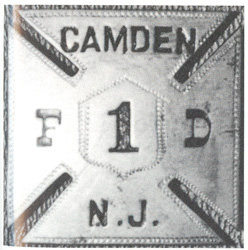
The first style of breast badge worn by members of the career department in the City of Camden. 1869. (Courtesy of the C.C.H.S. Collection.)
Engine Company 2 Roster
Camden Fire Department Engine Company 2, 1869
Officers
| Name ↕ | Position ↕ | Badge ↕ |
|---|---|---|
| William J. Ross | Engineer | |
| George Liebecke | Driver | |
| William T.G. Young Sr. | Stoker |
Extra Men
| Name ↕ | Position ↕ | Badge ↕ |
|---|---|---|
| Isaac Middleton | Extra Man | 11 |
| Samuel Patton | Extra Man | 12 |
| Elwood Cline | Extra Man | 13 |
| George W. Bates | Extra Man | 14 |
| Robert Pine | Extra Man | 15 |
| Theodore Zimmerman | Extra Man | 16 |
| Benjamin H. Connelly | Extra Man | 17 |
| Richard Houghtaling | Extra Man | 18 |
| Abraham Bradshaw | Extra Man | 19 |
| Richard Githens | Extra Man | |
| John Graham | Extra Man | 20 |
Hook & Ladder Company Roster
Camden Fire Department Hook & Ladder Company, 1869
Officers
| Name ↕ | Position ↕ | Badge ↕ |
|---|---|---|
| Edward J. Dodamead | Tillerman | |
| Frank S. Jones | Driver |
Extra Men
| Name ↕ | Position ↕ | Badge ↕ |
|---|---|---|
| Charles Baldwin | Extra Man | 21 |
| Charles G. Zimmerman | Extra Man | 22 |
| John Durkin | Extra Man | 23 |
| William C. Lee | Extra Man | 24 |
| James M. Lane | Extra Man | 25 |
| James Cassidy | Extra Man | 26 |
| Robert S. Bender | Extra Man | 27 |
| Thomas McCowan | Extra Man | 28 |
| Howard Lee | Extra Man | 29 |
| Abraham Lower | Extra Man | 30 |
Charles G. Zimmerman was the brother-in-law of Chief Abels, married to the Chief’s sister Keturah. Charles G. Zimmerman’s brother Theodore Zimmerman also was a charter member, serving with Engine Company 2. Thomas McCowan was an employee of Robert S. Bender, and lived with the Bender family at 223 Federal Street.
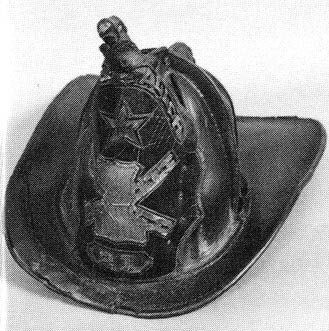
Leather helmet of natural grain believed to have been worn by Fireman Charles Baldwin, Hook & Ladder Company 1 when paid force was organized in 1869. Number 21 at bottom of frontpiece indicates member’s badge number. (Courtesy of the Camden County Historical Society Collection.)
The Board of Fire Commissioners consisted of Rudolphus Bingham, Chairman and Samuel C. Harbert, Richard Perks, Jonathon Kirkbride and Jacob Daubman.
Annual salaries for the members of the paid force were: Chief Marshal, $800; Assistant Marshal, $200; Engineer, $600; Driver, $450; Stoker, $450; Tillerman, $450; Extra Men, $50. All but Extra Men were paid monthly.
Many members of the newly organized paid department were former volunteers and had distinguished themselves as leaders through their dedication and hard work.
In October 1869, the Independence sold its newer carriage to the City of Rahway, New Jersey for use by its Washington Fire Company. Two months later, Independence sold its first Amoskeag steamer and old hose carriage with 800 feet of hose to Millville, New Jersey. In May 1871, Millville sold the steamer to the Friendship Engine and Hose Company No.1 of Chambersburg, Pennsylvania. The steamer remained in service until 1911 and was scrapped the following year. The Independence Firehouse had been purchased by the City of Camden as quarters for Engine Company 1 of the new department.
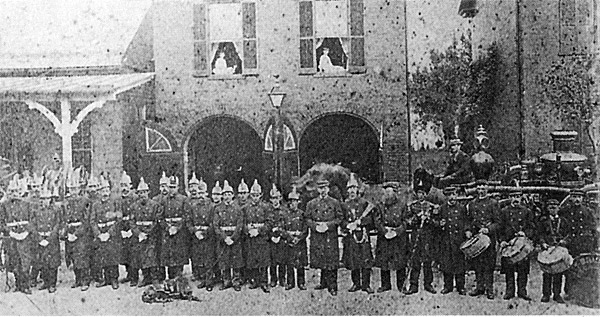
Photo taken 5-20-1871 in front of the Friendship Engine & Hose Company No.1 of Chambersburg, PA. The steam engine on the right has just arrived after being purchased from Millville, N.J. This apparatus was originally purchased by the Independence Fire Company No.3 of Camden in June 1864.
William Abels was politically active, however, he ran into some legal difficulty in January of 1871 involving a dispute over a glass factory purchased by then Sheriff Randall Morgan. William Abels served as Chief Marshal until his replacement on September 2, 1871. City Council appointed Robert S. Bender as his successor while the Assistant Marshals remained the same. Robert S. Bender had been working as Camden City’s coroner as recently as June of that year. He did both jobs until turning it over to his newly elected successor, Dr. James A. Armstrong, on November 28, 1871.
On Wednesday, November 29, 1871 about 6 P.M. a watchman discovered a fire at the Kaighns Point works of Dialogue & Wood. Within seconds the blaze engulfed the machine, pattern and blacksmith shops. Fortunately, a gale force wind from the northwest helped keep the flames from spreading to the main building. Camden Firemen pressed an all out attack with all companies in service, but the blaze resulted in a $70,000 loss.
The Fire Commission purchased a hose carriage for $60.00 from the Philadelphia Fire Department on January 24, 1872. The carriage had been on loan to Camden and was used while Hose Cart 2 was being repaired. This purchase enabled Camden to maintain a reserve hose carriage. In 1872 the Camden Fire Department consisted of forty-one members and seven horses. There were one hundred and fifteen fire hydrants in the city; a list of hydrants, giving both hydrant number and location, was posted in each firehouse.
A serious fire occurred at Cooper’s Point on February 28, 1872. The fire originated in a furnace in the spare shed of a Mr. Humes and spread rapidly to the boat shop of Butler & Cullings. Several dwellings were also damaged by flying embers. The fire fighters utilized fire extinguishers that had been given them by the Gardner Fire Extinguisher Company. Camden members were assisted by firemen from the Camden & Atlantic Railroad who responded with their Babcock fire extinguishers. This fire was the worst to occur since the blaze at English’s oil cloth factory.
On the Fourth of July, 1872, a fire damaged properties at 34, 36, 38, and 44 South Fifth Street below Market. The entire Department responded before the blaze could be brought under control.
Later that month the Department implemented a signal system for communications between fire stations. A red flag was used during daylight hours and a red light at night. Now one firehouse could inform another of a fire alarm without ringing the bells in the tower. Too many false alarms had resulted when church bells were mistaken for fire bells.
The first signal station (fire alarm box), made of wood, was located at West and Berkley Streets, South Camden, and midway between the two firehouses. An agent of the American Telegraphic Fire Alarm Company went before City Council on May 30, 1872 to propose a municipal fire system as follows: A series of wires would connect the quarters of Engine Company 2 (Fire HQ) with Coopers Point, the woolen mills, Starr’s Foundry, Kaighns Point and twelve more remote areas of the Seventh Ward in Camden. Twenty-five pull boxes would be placed in convenient locations and would transmit the alarm to both firehouses. The ten miles of cable also would enable the Chief Marshal to telegraph for assistance. The estimated cost of the system was a few thousand dollars with annual maintenance costs at two to three hundred dollars.
Chief Abels was replaced by Robert S. Bender as Chief of the Fire Department on September 2, 1871. When Bender took a leave of absence in September of 1872, despite a petition for him to be kept on as chief, Henry F. Surault was elected by city council to lead the department. Patrick Gallagher and Isaac McKinley were appointed Assistant Chiefs, replacing Assistant Chiefs William W. Mines and William H. Shearman. A greater crisis occurred on October 8, 1872 when most of the regular members of Engine Company 2 resigned at once. Replacements were found quickly, although in a few cases the first ones brought in did not work out and another man was needed to replace the original replacement. John J. Olden was also brought in as Assistant Chief of the Second Fire District in November, replacing Patrick Gallagher.
On a positive note, during his time in the Department Henry F. Surault convinced the Fire Commission to purchase hand extinguishers which he then placed strategically at Mr. Paul Anderson’s, Broadway and Kaighns Point Avenue; J.S. Henry’s office at Eighth and Walnut Streets; William Ross’ store on Central Avenue; and at the Flat Iron Tavern (and Hotel) at Broadway and Ferry Avenue. Each location received one fire extinguisher.
A devastating fire began on the morning of February 24, 1873 when a railroad employee dropped a match in the inspector’s room of a railroad building on Second Street below Bridge Avenue. Within minutes the oil soaked floor ignited and flames engulfed the structure. Strong northwest winds extended the fire to a storage shed filled with freight. Responding fire companies could not stop the rapidly spreading fire. Five frame dwellings on the north side of Weatherby’s Court, some sheds in the railroad car yard, three frame dwellings on Reed’s Court, two additional dwellings and numerous outbuildings became involved. Chief Surault telegraphed to Philadelphia for six engine companies which responded by special ferry. Three apparatus were placed in service while the balance of the manpower was used for fire control.
On May 28, 1873 City Council enacted an ordinance that reorganized the Fire Commission to consist of three members of Council, two citizens, the Chief Engineer, one Assistant Engineer, and one Secretary to be elected on July 1st of each year. The annual salaries for members of the Uniformed Force were to be: Chief, $800; Assistant, $200; Foreman, $100; Engineer, $660; Drivers, Stokers, and Tillermen $560 and Extra Men $50.
Benjamin Cavanaugh became the Department’s first Foreman on June 3, 1873, the day before Samuel Buzine was promoted to the rank of Assistant Chief Engineer.
At the Council meeting of December 1873 Chief Engineer Robert S. Bender recommended that the City purchase the second-class R.J. Gould steam engine owned by the Independence Fire Company. This apparatus had a double vertical pump and a boiler lined with copper flues to prevent rust and had seen service only two or three times in the spring of 1869. Chief Bender wanted this engine held in reserve at headquarters until the spring of 1874 when he planned to organize another district and fire station in the lower half of the city. He felt the expansion was necessary since a large number of factories, lumberyards and shipyards had recently been built there. A new engine company would reduce response time and prevent fires from gaining headway before additional help could arrive. Although the new firehouse was not built until 1890, the Gould engine was purchased and placed in reserve. It was removed from service in 1902.
The nation’s Centennial Year found the Democrats gaining control of City Council. On April 8, 1876 Claudius W. Bradshaw was elected Chief Engineer.
When the Census was taken in 1880 Robert Bender was living at 225 Federal Street, next door to Thomas McCowan, who lived at 223 Federal. McCowan was working as a watchman, while Robert Bender was employed as a collector. He would in time return to his bookbinding business. Three of the Bender’s four children were living at home at that time, C. Emma, H. Jennie, and Robert Louis Bender. Daughter Emma Bender lived elsewhere.
Robert S. Bender was re-elected Chief Engineer in 1888, succeeding Samuel S. Elfreth. He retained Elfreth’s officers. This was Robert Bender’s third tenure as Chief.
In December of 1888 the Whitney Brothers Glass Works burned for the fourth time. On May 29th of the following year a night watchman discovered still another fire at the Glass Works. Box 31 at Front Street and Kaighn Avenue was received at 5:15 A.M. The blaze, caused by an overheated furnace, threatened C.B. Coles’ lumberyard before being contained. Loss was $2500.
At the meeting of September 4, 1889 the Fire Commission approved the purchase from Joseph Franklin of property at 320 Vine Street in North Camden as the site for a new fire station. The cost was $5000 for this 50 x 100 foot property. A three-story home on the site had to be razed. At this same meeting approval was given to purchase a lot at 1813 Broadway for $1600. Firehouses for new units were erected at each location.
On June 1, 1890 Engine Company 3 was organized on Broadway near Ferry Avenue in what was Camden’s Eighth Ward. Their apparatus was a second class Clapp & Jones steamer (maker’s plate #527) and a Button hose carriage, each drawn by two horses. The company’s roster included Mortimer Wilson as Foreman, Samuel Lodge as Engineer, Joseph Reed as Stoker, William Deno as Driver, and hosemen George W. Shields and John Ware.
On the same day, Engine Company 4 entered service at Vine Street, North Camden with a two-hitch second class Button steam engine and a one-hitch Button hose carriage. The company Foreman was Amedee Middleton; Engineer Francis Turner; Stoker, Barney Harvey; Driver, Edward Hartman; and hosemen Walter W. Browning, Charles Berry.
Also on that day Driver Benjamin Kellum was promoted to become Ladder Company 1’s first foreman.
In early May, 1891 Samuel S. Elfreth replaced Robert S. Bender as Chief Engineer. Robert Bender returned to civilian life and his bookbinding business. Robert S. Bender resided at 25 Broadway from 1888 through 1895. The 1896 City Directory shows him at 725 Market Street. He lived at 27 Broadway in 1897 and 1898. Robert S. Bender was living at 56 Penn Street when the census was taken in 1900. By 1906 he had moved to 107 Penn Street. In 1886 George Reeser Prowell wrote the following concerning Robert Bender’s business:
Blank and Printed Book Bindery.—This business was first established in Camden by Jacob Bender, in 1850, at the southwest corner of Third and Arch Streets. In 1856 the location was changed to No. 223 Federal Street, when the entire business was sold out to his son, Robert S. Bender, who continued in this place until April, 1885. The bindery was then removed to No. 101 Market Street. Job binding and printed matter of all descriptions is executed, and the bindery is most complete in the necessary machinery for the purpose. A Davey safety engine and boiler furnishes the motive-power for the folders, stitchers, cutters, stamping presses, etc. Five workmen, five girls and five boys are employed.
Robert S. Bender was still in business as a bookbinder when the census was taken in 1910. He then was living with his wife Jane Bender at 107 Penn Street. Three of the Bender’s four children were then living, although none were then at home.
Robert Bender was involved in at least three fraternal organizations in Camden, Pontiac Tribe No. 134 of the Improved Order of Red Men, the Eureka Council of the Legion of the Red Cross, and the Independent Order of Mechanics Excelsior Lodge, No 9.
Excelsior Lodge, No. 9, was organized in Lincoln Hall, August 22, 1884, by Grand Officers Ellis W. Wolverton and Joseph Louder, assisted by members of Enterprise Lodge, No. 3, when these were initiated: Robert S. Bender; George M. Wolfe, William Shutt, John N. Noll, Edward Shuster, John Folwell, Sr., Amos Carrow, Albert Shinn, Jacob Green, Phineas Ash, William Fisher, Bowman Marshall, Edward L. Countiss, William S. Wolfe, Abraham Foust, Robert M. Laconey, Benjamin H. Thomas, Thomas Hickman, Edgar B. Slifer, Robert N. Bollevow, John Owens, Robert Gibberson, George Smith, Frank Marshall and Harry W. Sutton. The officers chosen were: S.M., Robert S. Bender; Treasurer, John N. Noll; W.M., William S. Wolfe; R.S., Abraham Foust; J.M., Edward Shuster; F.S., Robert M. Laconey. The lodge prospered and in 1886 numbered three hundred and fifteen members, with assets amounting to seven hundred and twenty-three dollars. The meeting-place was changed to Independence Hall, Fourth and Pine Streets. The Past Worthy Masters are Robert S. Bender, William S. Wolfe, George M. Wolfe, Leonhard Boehm, Thomas Locke, William Bell and David Ewan. The officers for 1886 were: W.M., Thomas Ainsley; F.S., George M. Wolfe; S.M., James Carnan; Treasurer, John N. Noll; J.M., David Ewan; Chap., Edgar Slifer; R.S., Abraham Foust; Con., Frank Seeds.
Robert Bender passed away July 10, 1912 and was buried at Harleigh Cemetery.
Many years after Robert S. Bender passed away, another Camden Fire Department member, George Smith, lived at 107 Penn Street.
Indigent and Disabled Firemen
Philadelphia Inquirer —
INDIGENT AND DISABLED FIREMEN.—A bill has been introduced into the New Jersey Legislature authorizing the establishment of a fund for the relief of indigent and disabled firemen in Camden, and their families, if in necessitous circumstances. The following gentlemen are named in the bill as trustees: Samuel Hufty, Robert S. Bender, Jacob Daubman, William Abels, James W. Ayers, Frank B. Holt. These gentlemen represent the different companies composing the Camden Fire Department.
Indigent and Disabled Firemen.
INDIGENT AND DISABLED FIREMEN. —A bill has been introduced into the New Jersey Legislature authorizing the establishment of a fund for the relief of indigent and disabled firemen in Camden, and their families, if in necessitous circumstances. The following gentlemen are named in the bill as trustees: Samuel Hufty, Robert S. Bender, Jacob Daubman, William Abels, James W. Ayers, Frank B. Holt. These gentlemen represent the different companies composing the Camden Fire Department.
Camden and Vicinity
Philadelphia Inquirer —
TOKEN OF ESTEEM.
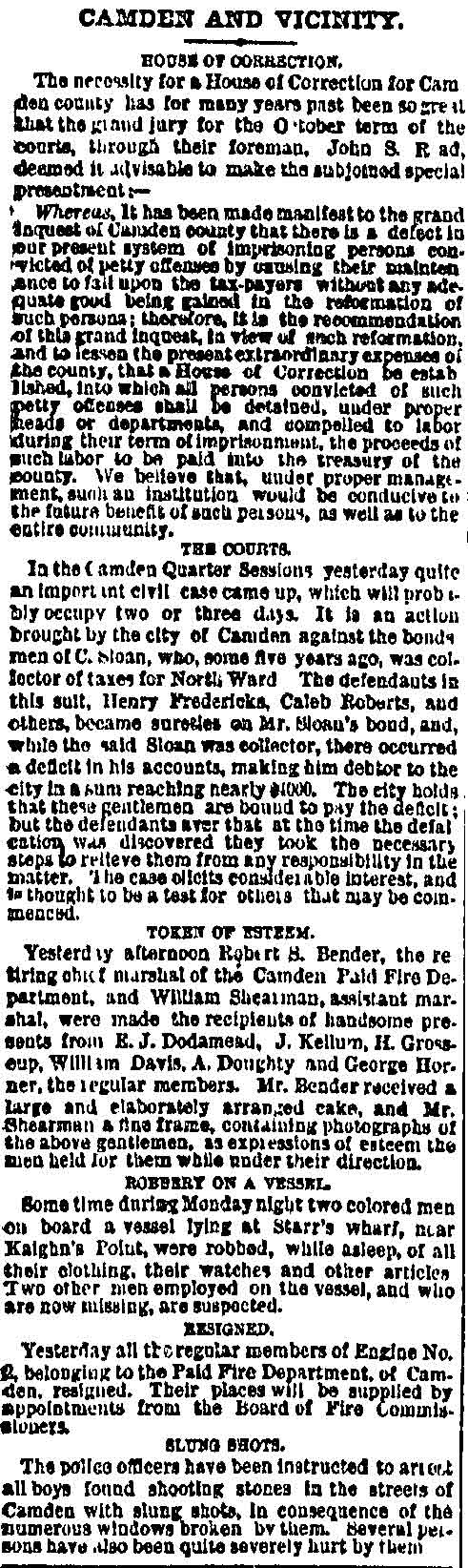
Yesterday afternoon Robert S. Bender, the retiring chief marshal of the Camden Paid Fire Department, and William Shearman, assistant marshal, were made the recipients of handsome presents by E. J. Dodamead, B. L. Kellum, H. Grosscup, William Davis, A. Doughty and George Horner, the regular members. Mr. Bender received a large and elaborately arranged cake and Mr. Shearman a fine frame, containing photographs of all those belonging to and the names of all the men held for them while under their direction.
RESIGNED.
Yesterday all the regular members of Engine No. 2, belonging to the Paid Fire Department, of Camden, resigned. Their places will be supplied by appointments from the Board of Fire Commissioners.
CAMDEN AND VICINITY.
HOUSE OF CORRECTION.
Whereas, It has been made manifest to the grand jurors of Camden county that there is a defect in our present system of imprisoning persons convicted of petty offences, and that it is a grievance to fall upon the tax-payers without any adequate good being gained in the reformation of such persons. Therefore, it is the recommendation of this grand inquest, in view of such reformation and to lessen the present extraordinary expense of maintaining the jail, that a workhouse be established, into which all persons convicted of such petty offences shall be detained, under proper board or department, and compelled to labor during their term of imprisonment, the proceeds of such labor to be paid into the treasury of the county. We believe that besides proper amusement, such an institution would be conducive to the future benefit of such persons, as well as to the entire community.
THE COURTS.
In the Camden Quarter Sessions yesterday quite an important civil case came up, which will probably be appealed to a higher court. It is an action brought by the city of Camden against the bondmen of C. Sloan, who, some five years ago, was collector of taxes for North Ward. The defendants in this suit, Henry Fredericks, Caleb Roberts, and others, became sureties on Mr. Sloan's bond, and, while he was Sloan was collector, there occurred a deficit in his accounts, making him debtor to the city in a sum reaching nearly $1000. The city holds that these gentlemen are bound to pay the deficit; but the defendants allege that after the irregularity was discovered they took the necessary steps to relieve them from any responsibility in the matter. The case is attracting much interest, as it is thought to be a test for others that may be commenced.
TOKEN OF ESTEEM.
Yesterday afternoon Robert S. Bender, the retiring chief marshal of the Camden Paid Fire Department, and William Shearman, assistant marshal, were made the recipients of handsome presents by E. J. Dodamead, B. L. Kellum, H. Grosscup, William Davis, A. Doughty and George Horner, the regular members. Mr. Bender received a large and elaborately arranged cake and Mr. Shearman a fine frame, containing photographs of all those belonging to and the names of all the men held for them while under their direction.
ROBBERY ON A VESSEL.
Some time during Sunday night two colored men on board a vessel lying at the wharf, near Kaighn's Point, were robbed, while asleep, of all their clothing, their watches and other articles. Two other men employed on the vessel, and who are now missing, are suspected.
RESIGNED.
Yesterday all the regular members of Engine No. 2, belonging to the Paid Fire Department, of Camden, resigned. Their places will be supplied by appointments from the Board of Fire Commissioners.
SLUNG SHOTS.
The police officers have been instructed to arrest all boys found shooting stones in the streets of Camden with slung shots, in consequence of the numerous windows broken by them. Several persons have also been quite severely hurt by them.
Extra Firemen Appointed
Philadelphia Inquirer —
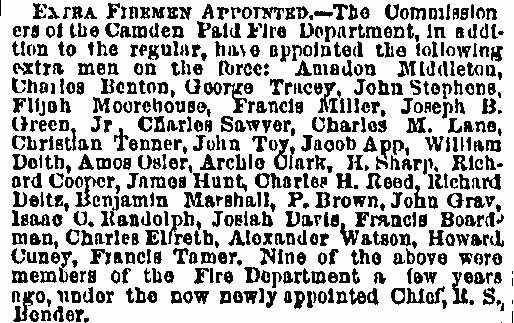
Extra Firemen Appointed.—The Commissioners of the Camden Paid Fire Department, in addition to the regular, have appointed the following extra men on the force: Amadon Middleton, Charles Benton, George Tracey, John Stephens, Elijah Moorehouse, Francis Miller, Joseph B. Green, Jr., Charles Sawyer, Charles M. Lane, Christian Tenner, John Toy, Jacob App, William Deith, Amos Osler, Archie Clark, H. Sharp, Richard Cooper, James Hunt, Charles H. Reed, Richard Deitz, Benjamin Marshall, P. Brown, John Gray, Isaac O. Randolph, Josiah Davis, Francis Boardman, Charles Elfreth, Alexander Watson, Howard Cuney, Francis Tamer. Nine of the above were members of the Fire Department a few years ago, under the now newly appointed Chief, R. S. Bender.
Extra Firemen Appointed
Extra Firemen Appointed.—The Commissioners of the Camden Paid Fire Department, in addition to the regular, have appointed the following extra men on the force: Amadon Middleton, Charles Benton, George Tracey, John Stephens, Elijah Moorehouse, Francis Miller, Joseph B. Green, Jr., Charles Sawyer, Charles M. Lane, Christian Tenner, John Toy, Jacob App, William Deith, Amos Osler, Archie Clark, H. Sharp, Richard Cooper, James Hunt, Charles H. Reed, Richard Deitz, Benjamin Marshall, P. Brown, John Gray, Isaac O. Randolph, Josiah Davis, Francis Boardman, Charles Elfreth, Alexander Watson, Howard Cuney, Francis Tamer. Nine of the above were members of the Fire Department a few years ago, under the now newly appointed Chief, R. S. Bender.
Over the River
Philadelphia Inquirer —
Camden City Council — Annual Meeting
CAMDEN CITY COUNCIL—The annual meeting of Camden City Council was held last evening for the purpose of organizing for the years 1878–9.
The votes for city and ward officers were read. The result was the same as the figures published yesterday indicated.
The members-elect were then qualified and took their seats as follows: First Ward, William Abels; Second, J. W. Morgan; Third, A. B. Cameron; Fourth, Crawford Miller; Fifth, Mr. Knight; Sixth, John Dialogue; Seventh, Elwood Kemble; Eighth, Mr. Donges.
John T. Bottomly was unanimously elected president for the ensuing year.
F. F. Michellon and Frederick W. Taw were nominated for clerk. Mr. Michellon was elected.
Charles H. Helmbold was elected messenger of Councils.
Mr. Nichols presented a protest from William A. Turner against the admission of John Dialogue, from the Sixth Ward, to a seat in Council, claiming that he, Turner, was legally elected. Referred to a committee of five to investigate and report.
James E. Hayes was elected city solicitor and John H. Shultz for surveyor. John M. Gray, Sr., was chosen as janitor of the City Hall.
R. S. Bender and W. W. Mines were elected citizen commissioners of the Fire Department. Wilbur F. Rose and H. M. Sharp were elected citizen members of the Sinking Fund Committee.
The hour for holding the regular meeting of the Council was fixed at four o’clock in the afternoon.
On motion, Council agreed to meet on Monday afternoon next at two o’clock.
OVER THE RIVER.
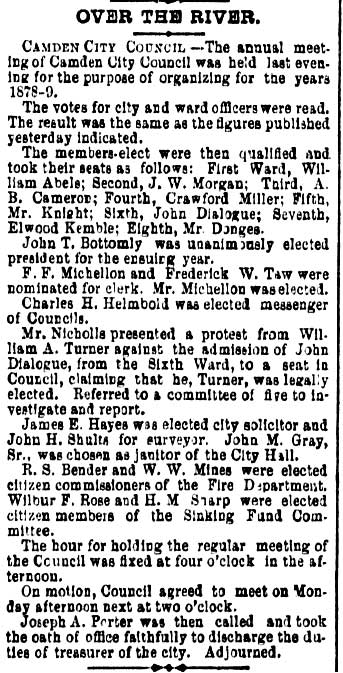
CAMDEN CITY COUNCIL — The annual meeting of Camden City Council was held last evening for the purpose of organizing for the years 1878-9. The votes for city and ward officers were read. The result was the same as the figures published yesterday indicated. The members-elect were then qualified and took their seats as follows: First Ward, William Abels; Second, J. W. Morgan; Third, A. B. Cameron; Fourth, Crawford Miller; Fifth, Mr. Knight; Sixth, John Dialogue; Seventh, Elwood Kemble; Eighth, Mr. Donges.
John T. Bottomly was unanimously elected president for the ensuing year.
F. F. Michellon and Frederick W. Taw were nominated for clerk. Mr. Michellon was elected. Charles H. Helmbold was elected messenger of Councils.
Mr. Nicholls presented a protest from William A. Turner against the admission of John Dialogue, from the Sixth Ward, to a seat in Council, claiming that he, Turner, was legally elected. Referred to a committee of five to investigate and report.
James E. Hayes was elected city solicitor and John H. Shultz for surveyor. John M. Gray, Sr., was chosen as janitor of the City Hall.
R. S. Bender and W. W. Mines were elected citizen commissioners of the Fire Department. Wilbur F. Rose and H. M. Sharp were elected citizen members of the Sinking Fund Committee.
The hour for holding the regular meeting of the Council was fixed at four o’clock in the afternoon. On motion, Council agreed to meet on Monday afternoon next at two o’clock.
Joseph A. Porter was then called and took the oath of office faithfully to discharge the duties of treasurer of the city. Adjourned.
Philadelphia Inquirer — July 23, 1888
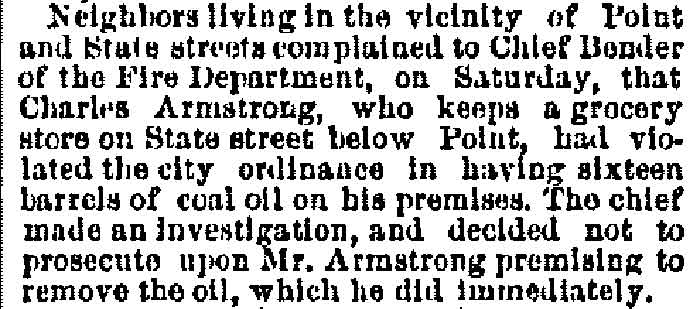
Neighbors living in the vicinity of Point and State streets complained to Chief Bender of the Fire Department, on Saturday, that Charles Armstrong, who keeps a grocery store on State street below Point, had violated the city ordinance in having sixteen barrels of coal oil on his premises. The chief made an investigation, and decided not to prosecute upon Mr. Armstrong promising to remove the oil, which he did immediately.
Coal Oil Complaint
Neighbors living in the vicinity of Point and State streets complained to Chief Bender of the Fire Department, on Saturday, that Charles Armstrong, who keeps a grocery store on State street below Point, had violated the city ordinance in having sixteen barrels of coal oil on his premises. The chief made an investigation, and decided not to prosecute upon Mr. Armstrong promising to remove the oil, which he did immediately.
Philadelphia Inquirer — October 19, 1889
The Philadelphia Board of Fire Insurance Writers have placed a Singer automatic fire alarm signal in Camden. The station where the first alarm will be received will be at Chief Bender’s office at the No. 2 Engine House.

Automatic Fire Alarm in Camden
The Philadelphia Board of Fire Insurance Writers have placed a Singer automatic fire alarm signal in Camden. The station where the first alarm will be received will be at Chief Bender's office at the No. 2 Engine House.
R. S. Bender & Son, Stationers
Historical and Industrial Review of Camden, N.J. — 1890
AMONG the most widely known houses in this section may be mentioned that of Messrs. R. S. Bender & Son. This business was started about thirty-five years ago by Mr. Robert S. Bender, and his son was taken into the firm a short time ago.
The store is about 20 x 30 feet in dimensions. Here may be found a large and varied stock of Stationery, Blank Books and Fancy Goods. A large Bindery is attached, in which line a good business is done. Ten capable assistants are constantly employed.
The individual members of the firm are Robert S. Bender and R. I. Bender.
Mr. Robert S. Bender is at present Chief of the Fire Department. He was in the late war, and has always been a popular and well-known resident of the city.
Camden’s Fire Laddies Parade
Philadelphia Inquirer —
An Event Which Enthused the Quiet City Across the River
The City Profusely Decorated in Honor of the Event and an Immense Crowd in Attendance — Brief Notes of Interest.
Yesterday was a red-letter day in Camden. It was the occasion of the first firemen’s parade in the city for years. From every flagstaff the American flag floated. Such elaborate decorations of business places, residences and public buildings have not been seen since the Presidential campaign. Flags and bunting adorned the fronts of the four engine houses, while the Morning News, Courier and Press Club had decorations which attracted much attention.
The parade started at half-past 2, with Chief Marshal W. B. E. Miller in command. Councilman E. E. Jefferies was assistant marshal. A platoon of twenty policemen, in charge of Chief Samuel Dodd, headed the line. The United States Fire Company, of Atlantic City, in command of Chief Locke, with Foreman E. J. Pettit as an assistant, attracted much attention. The company wore their coats and had their hose carriage and steamer with them.
The Fire Commissioners came next in carriages, Mayor Pratt and Camden officials in carriages, Councilmen and Recorder Joseph Bartlett and President of Council Robert Stroud, of Atlantic City; members of the press in carriages, police patrol, Sixth Regiment Band, Chief Engineer Bender and Assistant Chief Bazine, of the Camden Fire Department; Engine Company No. 1, Foreman John G. Stockton; Engine Company No. 2, Foreman Harry Grosscup; Engine Company No. 3, Foreman Mortimer Wilson; Engine Company No. 4, Foreman Amadee Middleton; extra engine, hose cart and supply wagon. All of the apparatus of the different companies was handsomely decorated.
As the parade passed the postoffice all of the clerks and carriers in full uniform were drawn up in line and reviewed the procession. A handsome floral offering was presented to Postmaster Browning as he rode by the postoffice in his carriage.
The route was the same as that published in yesterday’s Inquirer, with the exception of the Eighth ward portion, which had to be abandoned, owing to the heat.
OTHER ITEMS.
During the parade yesterday Thomas Murphy, a pick-pocket, of Newark, was caught in the act of “working” the crowd. While Patrolman Isaac McKinley was on his way to the City Hall with the prisoner two of his friends attempted to rescue him. The officer held on to the thief and with the aid of Albert Gilbert, of the Water Department, succeeded in landing him safely behind the bars.
The Property Committee, of the Board of Education, met last night and completed the arrangements for the purchasing of American flags for the public schools. The latter will be raised for the first time on the Fourth of July.
The Freeholders yesterday received a communication from the jury that tried Chalkley Leconey, asking for extra compensation. It was laid over for one month.
Named: Philadelphia Inquirer, June 12, 1890. W.B.E. Miller, E.E. Jefferis, Samuel Dodd, Jesse Pratt, Jennings’ Sixth Regiment Band, Robert Bender, Samuel S. Buzine, John A. Stockton, Henry Grosscup, Mortimer Wilson, Amedee Middleton, Thomas Murphy, Isaac McKinley, and Albert Gilbert..
Death Notice — Robert S. Bender
Philadelphia Inquirer —
BENDER—10th inst. ROBERT S. husband of A Jane Bender, aged 76. Relatives and friends, also Pontiac Tribe, No. 134, I O R M, Eureka Council, L O R C invited to funeral, Sat. 2 P M, residence 327 Washington st, Camden, N J. Interment private. Harleigh. Remains may be viewed Fri evenings.
Bender — Obituary Notice
BENDER—10th inst. ROBERT S. husband of A Jane Bender, aged 76 Relatives and friends, also Pontiac Tribe, No. 134, I O R M, Eureka Council, L O R C invited to funeral, Sat. 2 P M, residence 327 Washington st, Camden, N J. Interment private. Harleigh. Remains may be viewed Fri evenings.
Camden News Notes
Philadelphia Inquirer —
For violating the “safe and sane” Fourth ordinance, Allen Mulaney and Leonard Helmig, of Moorestown, were fined by Recorder Stackhouse yesterday. The defendants were charged with exploding revolvers.
Surrogate Reeves yesterday probated the will of the late Robert L. Bender, for many years chief of Camden’s Fire Department. The estate is bequeathed to his widow.
After asserting no “cop” could arrest him, Frank Manley, of Trenton, was sent to the Cooper Hospital with a badly battered head yesterday and then locked up. Special Officer Small found this necessary, for Manly was panhandling the crowds about the Pennsy terminal.
George Roberts, aged 37 years of Millville, was overcome by heat at the Federal street ferry yesterday. He was revived at the Cooper Hospital.
Camden News Notes
CAMDEN NEWS NOTES
Surrogate Reeves yesterday probated the will of the late Robert L. Bender, for many years chief of Camden's Fire Department. The estate is bequeathed to his widow.