Introduction
The Broadway Methodist Episcopal Church was organized on May 9, 1854. It was an outgrowth of the Berkeley Street Sabbath School, organized April 8, 1848. The cornerstone of the old church was laid on August 7, 1855. The lecture room was dedicated on December 25, 1855, and the main audience room January 29, 1857. In 1892 a chapel was erected in the rear of the main structure, the cornerstone of which was laid July 28, 1892. The cornerstone of the new church was laid on June 17, 1897. This church building was dedicated on May 14, 1898.
Broadway Methodist Episcopal Church
George Reeser Prowell’s History of Camden County, New Jersey, 1886
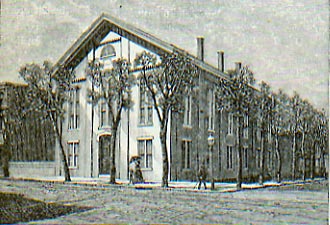
Broadway Methodist Episcopal Church — this building was built in 1855 and used until 1898, when the new church was dedicated.
At the house of Charles Sloan a meeting of Methodists was held on April 8, 1848, where, with Mr. Sloan as chairman and David Duffield, Jr., secretary, the Berkley Street Sabbath school of the Methodist Episcopal Church of Camden, N. J., was organized. Charles Sloan, David Duffield, Jr., Thomas L. Smith, Philander C. Brink, Benjamin A. Hammell, Levi C. Phifer, William Few, John Newton, Richard J. Sharp, I. B. Reed, John B. Thompson, Elizabeth Middleton, Susan H. Scott, Mary Adams, Harriet Davis, Mary Brooks, Hannah Souder, Mary Dunn and Sarah Cheeseman volunteered to become teachers. Chas. Sloan was elected superintendent. A lot was purchased and a schoolhouse built, which was dedicated April 15, 1849, by Rev. Dr. Bartine. The school then had twelve teachers and sixty-three scholars, which two years later was increased to one hundred and one scholars. A request was sent to Rev. Charles H. Whitecar, pastor of Third Street Methodist Episcopal Church, to form a class, of which Isaac B. Reed was appointed leader, and the other members were Hannah Chambers, Abigail Bishop, William Wood, Furman Sheldon, Priscilla Sheldon, Achsa Sutton, Mary Sutton, Mary Brooks, Elizabeth Bender, Ruthanna Bender, Charlotte Wilkinson, William Patterson, Sister Patterson, Sister Severns, Rebecca Thompson, Elizabeth McIntyre, Hannah A. Reed, Danie Stephenson, Rachel Stephenson, Susan Thomas, Samuel Severns, Mary E. Maguire and William Few. At a meeting held in the Sunday school room on Berkley Street, March 10, 1854, and at a subsequent meeting, May 9th, a church society was organized largely from members of the class above mentioned. Rev. Ralph S. Arndt was the first pastor. Forty certificates of membership were received, and John Lee, Isaac B. Reed and Conklin Mayhew were appointed class-leaders.
The first board of stewards was composed of John C. Clopper, Walter Rink, John M. Pascall and Logan Alcott. May 30, 1854, the board of trustees elected were Daniel Bishop, S. S. Cain, William Severns, Conklin Mayhew, Furman Sheldon, Logan Alcott and T. H. Stephens. At the same meeting the name of “Broadway Methodist Episcopal Church of Camden, N. J.,” was selected to designate the new society. Rev. J. H. Knowles was pastor from May, 1855, to the end of the pastoral year and part of next year, which was finished by Rev. J. J. Hanley, who remained to May, 1858. In February, 1856, John S. Newton, who afterwards lost his life with the unfortunates in the “New Jersey” steamboat, was appointed leader of a class of young converts. The trustees purchased the property corner of Broadway and Berkley Street, in 1854, subject to a claim, and on November 14, 1854, they bought an adjoining lot. The basement of the church was dedicated December 25, 1855, by Bishop Scott, and the main audience-room dedicated January 29, 1857, by Bishop Janes.
Rev. C. K. Fleming was pastor from 1858 to 1860. There were then two hundred full members and one hundred probationers. The Sunday schools under their charge had, in 1860, three hundred and seventy-five children.
From 1860 to 1872, inclusive, the successive pastors were C. W. Heisley, who went to the army as chaplain, Robert Stratton, R. S. Harris, George Hitchens, William Walton, R. A. Chalker and Geo. Hughes, and during this period the church prospered greatly, so that it became necessary to enlarge the church building. The original building was forty-eight feet by sixty-five feet, and during the pastorate of Rev. John S. Phelps, 1873–74, an addition of thirty feet was built to the rear. Rev. H. H. Brown was pastor during 1875. The parsonage, No. 512 Broadway, was purchased for five thousand dollars, April 20, 1873. Rev. George Reed was pastor in 1876, and had two very successful years in church work, making many conversions.
Rev. George B. Wight was pastor during 1878, 1879 and 1880. During this period a plan was adopted to liquidate the debt on the church, which was then nine thousand dollars, and which has been reduced to two thousand dollars. The new Methodist hymnal was adopted by the church in November, 1878. In 1879, December 31st, a new department in Sunday school work, called the Assembly, was started under the leadership of Joseph Elverson, who has held that position ever since. Rev. Milton Relyea was pastor from 1881 to 1884; during this period there was a great revival and a large number were added to the church. Mrs. Lizzie Smith did much earnest work at a revival in 1881. At an afternoon meeting held that year, Mrs. Clayton, a member, died very suddenly. In 1884 the church was newly frescoed, a pipe-organ put in position, and shortly thereafter the Annual Conference was held in this church. In October, 1883, the Sunday school numbered one thousand two hundred and forty-seven scholars, and had eighty-nine officers and teachers. The Pine Street Mission, formerly under charge of Union Methodist Episcopal Church, was transferred by mutual consent to the charge of Broadway Methodist Episcopal Church, March, 1884; soon after, a plot of ground ninety by one hundred and fifty feet, at Third Street and Beckett, was purchased by this church, on which to erect a chapel and receive the Sunday school and worshippers of Pine Street Mission. The old building on Pine Street was subsequently sold and the proceeds applied to the new building, which was dedicated in October, 1885. In 1885, under the preaching of Rev. D. B. Green, a great revival was held. In March, 1885, the Band of Hope passed into the charge of the Sunday school Association, and in May, Emmor Applegate was elected its superintendent. Rev. William P. Davis, D.D., commenced his pastorate of this church March, 1884, since which time many members have been added. The membership now (1886) is nearly eight hundred, and about two hundred probationers. The Sunday school has nearly one thousand two hundred members and the Mission school has about two hundred and seventy members. Dr. A. E. Street is the general superintendent of the school.
Additional Notes
By Phillip Cohen
Prominent citizens who later were involved with Broadway Methodist included trustee Dr. Joseph E. Roberts Jr., Police Sergeant Thomas M. Stanger, his brother, lawyer Howard Stanger, dentist Dr. A. E. Street, and undertaker William B. M. Burrell.
Photos
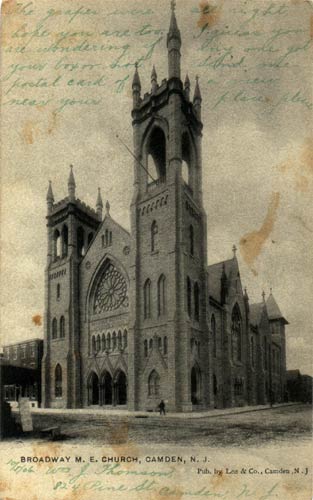
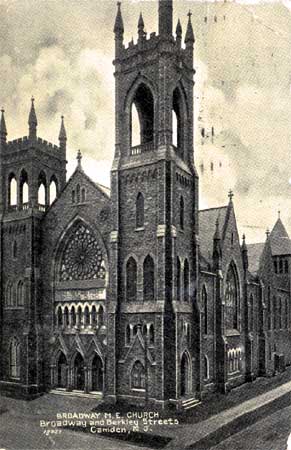
Broadway Methodist Episcopal Church — dedicated 1898.
History of Broadway Methodist Episcopal Church of Camden, N.J.
The Centennial History of Camden Methodism, 1909
Broadway M. E. Church is the outgrowth of a Sunday School that was organized April 8, 1848, at a meeting held at the house of Charles Sloan, on Berkley Street, when the following persons offered their services as teachers: Charles Sloan, David Duffield, Jr., Thos. L. Smith, Philander C. Brink, Benjamin A. Hammell, Levi Phifer, William Few, John Newton, Richard J. Sharp, J. B. Reed, John B. Thompson, Elizabeth Middleton, Susan Scott, Mary Adams, Harriet Davis, Mary Brooks, Mary Dunn and Sarah Cheeseman. (There is retained a complete minute of every board meeting held from then to the present date.)
A short time afterward a lot of ground was purchased and a school house built and dedicated April 15, 1849, by Rev. D. W. Bartine. At this time the school numbered 12 teachers and 63 scholars.
In August, 1849, a request was made to Rev. Charles H. Whitecar, then pastor of the Third Street M. E. Church, to form a class on Cooper Mill. Isaac B. Reed was appointed leader, with the following list of members: Hannah Chambers, Abigail Bishop, Mrs. Wood, Furman Sheldon and wife, Asa Sutton, Mary Sutton, Mary Brooks, Elizabeth Bender, Ruthanna Bender, Charlotte Wilkinson, William Patterson and wife, Rebecca Thompson, Elizabeth McIntyre, Hannah R. Reid, Daniel Stevenson and wife, Susan Thomas, Samuel Severns and wife, Mary E. Maguire and William Few. On March 10, 1854, a meeting was held to organize a new church, but the matter was deferred until after the annual conference, at the request of the Presiding Elder.
On May 9th a meeting was held for the purpose of organization, when forty certificates of membership from other charges were received. Added to those already named were: William Severns and wife, Jonathan Kirkbride and wife, Daniel Bishop, John Cheeseman and wife, John M. Paschall and wife, John C. Clopper and wife, John Lee, W. P. Price, Walter Rink and wife, Logan Alcott and wife, Samuel C. Cain and John Lee.
The Quarterly Conference was then organized: Rev. I. N. Felch, P. E.; Rev. R. S. Arndt, pastor; W. P. Price, exhorter; John Lee, J. B. Reed and Conklin Mayhew, leaders; John C. Clopper, Walter Rink, John M. Paschall and Logan Alcott, Stewards.
The first Board of Trustees were Daniel Bishop, Furman Sheldon, Logan Alcott, Thomas H. Stephens, William Severns, C. Mayhew and Samuel C. Cain. They were elected May 30, 1854, and before December of the same year they purchased the Cooper Hill property, corner of Broadway and Berkley Street, and assumed an indebtedness of $2,400. In one year from the organization, (May, 1855, Pastor J. H. Knowles) we find the church so vigorous and aggressive that a Sunday school No. 2 was organized on Pine street, Superintendents, Bros. Cain and Paschall. In the meantime the foundations of the first building (Broadway and Berkley Street) were laid and the Sunday school room dedicated December 25, 1855, by Bishop Scott. The church was completed and the main room dedicated two years later on January 29, 1857, by Bishop Janes, the total cost being $6,200. From 1855 to 1861 the pastors were: J. H. Knowles, J. J. Handley, C. K. Fleming, Charles W. Heisley and R. M. Stratton. The record shows a continuous increase of membership during these years. At the quarterly conference December, 1861, the Sunday school reported 320 scholars and school No. 2 (which was afterward moved to Eighth and Walnut streets), numbered 60 scholars and 11 teachers. Out of this Sunday School No. 2 evolved the present Eighth Street M. E. Church. The debt on our own church at this date was the Cooper mortgage, $1,300; the Bishop mortgage, $3,400; the Alcott mortgage, $1,100, and floating debt, $269. Total $6,069.
The conference years of 1862–3, under the pastorate of Rev. R. S. Harris, was in the dark days of the Civil War. During those years the Sabbath school was nearly depleted of its young men by the calls of war. At one time nearly a clean sweep was made of our male teachers, officers and librarians. Still the church kept nobly on and accomplished a grand work in the Master’s cause. During the time of Brother Harris, Broadway fought the battle of instrumental music for the Methodist churches of Camden and West and South Jersey. It was a hard battle. Some thirty or forty took their certificates because they could not worship in a church with a music box in the gallery.
From 1864 to 1873 the pastors were: George Hitchens, William Walton, R. A. Chalker and George Hughes. In the year 1868, under the pastorate of Brother Chalker the young people’s meeting was organized, under the leadership of Dr. Rufus Reed, which has been continued to the present time, without intermission, but recently known under the name of Epworth League.
These meetings have been a source of very great interest and success and contributed very much to the progress of the church. During these years quite a number of young men were added to the church who have been prominent in its work ever since. The growth was so great as to make it necessary to enlarge the church to nearly double its then capacity. This was done under the pastorate of Brother Phelps, in 1873, at a cost of $11,716.18. A parsonage, No. 512 Broadway, was also purchased at this time at a cost of $5,000. At this date the old debt, $6,069, had been cut down to $4,100, this added to the cost of addition making a total of $20,816.18. During the pastorate of Brothers Phelps, Brown and George Reed this debt was reduced to $9,000 on the church and $3,000 on the parsonage.
Brother George B. Wight was our next pastor, serving years 1878, 79, 80, under whose leadership a new financial plan was adopted, called the envelope plan, which proved to be a great success, and has since been adopted very largely throughout all Methodism. Pursuing this plan we proposed to pay off the balance of the church debt — $9,000, by raising $1,000 each year by weekly or monthly payments, which was begun in 1878, and the full amount was raised and the mortgage cancelled in April, 1888. Pursuing this plan we paid off the $3,000 mortgage on the parsonage in two years and cancelled that mortgage in 1890.
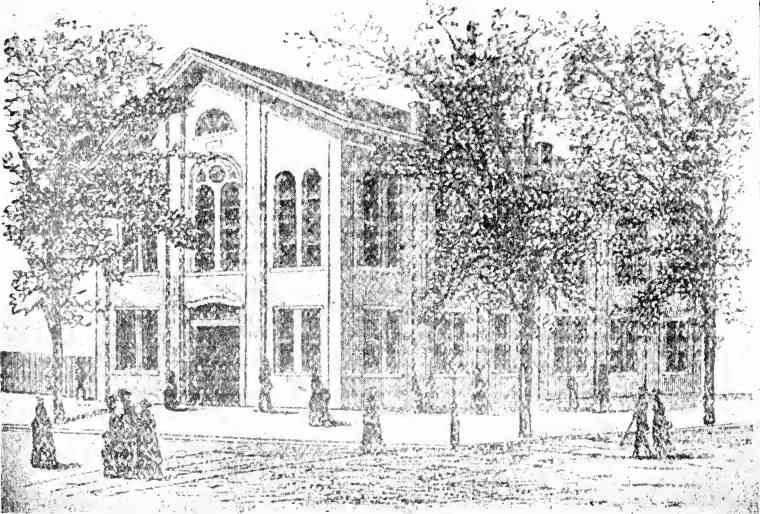
Broadway Methodist Episcopal Church — 1873.
In 1879 a new departure was inaugurated in the Sunday school work called the Broadway Sunday School Assembly, which grew out of a class of strangers under the leadership of Joseph E. Roberts as teacher. This grew in interest and numbers until they were compelled, for want of room, to go to the new main auditorium of the church, when it took the name of the Assembly, for adults, from the Sunday school and church in general with the motto, “The whole Sunday school in the church and the whole church in the Sunday school.” This, too, became very popular and has since been adopted substantially by all the leading churches.
In 1879 a children’s class was organized, under the leadership by Miss Carrie Gorman, now Mrs. Samuel H. Thompson. It has been of very great interest and benefit to the church in affording an opportunity for children of like age, thought and views to meet on common ground.
Rev. Milton Relyea was the pastor in 1881–2–3. During the last year, 1883, the increase of the church and Sunday school became so great that it was necessary to get, if possible, a little more room, so the old gallery was torn down, and a new one, going a little more than half way around the church, was built, and a new pipe organ put in at a total cost of $3,607.50.
Rev. William P. Davis, D. D., followed in 1884–5–6, with marked success. In his first year, 1884, another mission was started on Pine street below Third street, (formerly under the auspices of the Union M. E. Church, but at this time under the management of a few private individuals) and was assigned to our church. In 1885 we sold it for $600 and purchased a lot 90 feet by 150 feet at the corner of Third and Beckett streets, and built the Wiley M. E. Church and dedicated it in October, 1885, at a cost of $5,191.27. We sustained the mission until it was able to sustain itself, and then conveyed it, in 1890, to its present organization, subject to a mortgage debt of $2,500, at five per cent., and we paid the interest on it until 1892, when the necessity for further help was no longer apparent.
The growth of Broadway especially in the following 12 years was remarkable and the need of still more room was beginning to be manifest, so much so that in March, 1887, the Quarterly Conference appointed a committee, consisting of Joseph E. Roberts, Dr. A. E. Street, Joseph Elverson, Dr. Rufus Reed, Thomas I. Gifford, William C. Keen and Wilbur F. Carhart to consider the advisability of building a larger church and to secure plans, specifications, estimates of cost, etc., for the same. The committee organized by electing Joseph E. Roberts, chairman; Wilbur F. Carhart, secretary, and Thomas I. Gifford, treasurer.
On May 15, 1889, under the pastorate of Brother Strickland, our chapter No. 1217, of the Epworth League, was organized by the election of the following officers: President, Harry S. Springer; First Vice-President, Harry L. Titus; Second Vice-President, Miss Frances Heishon; Third Vice President, Miss Nellie D. Roberts; Fourth Vice President, Miss Lizzie R. Street; Secretary, Samuel H. Thompson; Treasurer, Harry W. Middleton. This, too, has been and is still flourishing in the good cause.
On November 16, 1890, our Junior Epworth League was organized under the leadership of Samuel H. Thompson, and is still accomplishing a grand and good work for the young people.
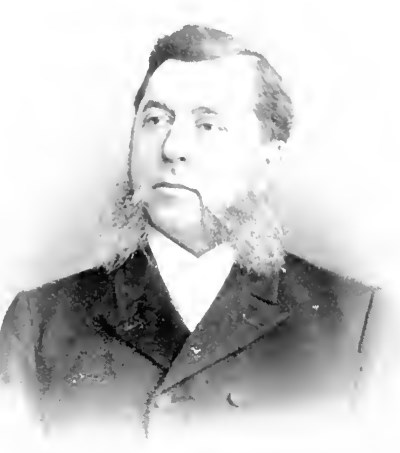
Rev. Edmund Hewitt, D.D.
In 1891 the church parsonage, at 512 Broadway, was sold, and the property at 507 Broadway, adjoining the church, was purchased for $5,300, including repairs, renovation and alterations.
On February 20, 1890, Brothers William C. Riggs, Albert L. Mulford, Harry L. Titus and Harry S. Springer were added to the committee. Continuing through the pastorate of Rev. W. P. C. Strickland the necessity for a new church continued to grow until the second year of Brother Hewitt’s administration.
On May 8, 1891, the committee secured the lots in the rear of the church, 80 feet on Berkley Street to William street, by 56 feet deep, at a cost of $7,900.
On the third Sunday in May, the 17th, 1891, we took a subscription in the church for $10,000, under our envelope plan, aggregating the sum of $10,214.60. On November 5, 1891, the committee was authorized by the Quarterly Conference to secure plans and specifications for the new Temple. On November 21, 1891, the committee invited nine architects to give plans for the same, without compensation only to the successful one. On April 4, 1892, Messrs. Moses & King’s plans were accepted and nine contractors were invited to bid on the plans and specifications for the new Temple. May 17, 1892, the bid of our Brother William Severns being the lowest, was accepted — his bid for the building being $23,578.00. Estimate for additional cost, furniture, heating, gas and electric appliances and everything complete, $9,000; add cost of land, $7,900, aggregating $40,478, the estimated total cost of the Temple.
On June 3, 1892, the committee reported to the Quarterly Conference of having secured in cash from subscriptions taken on May 17, 1891, as above $9,190.15 and approved unpaid subscription of $1,500, making a total of $10,690 (the difference being accounted for by other subscriptions being received since the subscription was taken) and at this meeting the committee recommended that another subscription of $10,000 be taken on the following Sunday, and, if secured, a contract be entered into with Brother Severns, the contractor, which was concurred in, and the Trustees were given authority by the Quarterly Conference to do all necessary legal acts in carrying out the same. At this time Brother Charles S. Ackley was added to the committee. July 28, 1892, the corner stone of the Temple was laid. On Sunday, April 23, 1893, the Temple was dedicated at a total cost of, including the land, extras, insurance, furniture, heating, new carpets in the old church, etc., $44,958.51; interest paid on the same, $4,028.78; total, $48,987.29.
On April 21, 1893, the building committee decided to renew the subscription to the building fund for the year beginning June 1, 1893, to be taken on dedication Sunday, April 23, 1893, for $10,000 and interest on the indebtedness.
On June 17, 1894, a weekly newspaper was started under the management of Dr. A. E. Street, known as the Broadway Record. This was a source of much interest, information and pleasure, but owing to the onerous duties connected with running it, after a season it was discontinued.
On May 11, 1894, under the pastorate of Brother Hancock, the building committee agreed that the subscription to the building fund for the next year should be taken the following Sunday in the same manner as of former years. The subscription was taken the third Sunday in May, 1895, for $7,000, the full amount having been raised.
At a meeting of the Quarterly Conference held February 21, 1896, the building committee reported the present debt on the Sunday School Temple, after deducting what they considered good of the unpaid subscription, was about $7,000, and recommended that they make an effort to raise this amount by subscription (payable in monthly installments during the year) on our next building fund day, and that we proceed at once to arrange for building our new church during 1897. On May 31, 1896, under the pastorate of Dr. Mace, the subscription to the building fund was taken for $7,000, as named above and fully secured. At this time the Woman’s Thousand Dollar Club was organized for the purpose of raising a thousand dollars in aid of the building fund. After having accomplished the same, on February 22, 1898, they agreed to raise a thousand dollars for the Mace memorial window, which they did. After raising the same they agreed to buy the new church organ at a cost of $5,000, (less $500 received from the sale of the old organ) on annual subscriptions of $1,000, which they have fully accomplished.
The funeral of the Rev. Dr. James R. Mace, the beloved pastor of the Broadway Methodist Episcopal Church, of Camden, whose death occurred on Saturday morning, January 16th, 1897, took place on Wednesday afternoon, January 20th, from the church of which he was pastor, and was one of the largest attended funerals that has been witnessed in Camden for many years.
The ministers of the New Jersey Conference and the representatives of the Philadelphia Conference, and the Evangelical Alliance, had seats reserved in the old church and on the platform of the Sunday School temple, which they occupied, together with the Official Board of the church. Shortly before 1 o’clock the clergy formed in line in open order on the pavement, between the parsonage and the church, and the remains of the dead divine, in a handsome black-cloth covered casket, were carried into the church and placed in front of the altar, just below the speaker’s platform.
The services, which were of a most impressive character, were in charge of Rev. D. B. Harris, the presiding elder of the Camden district, who announced the first hymn, after which Rev. George B. Wight, presiding elder of the Bridgeton district, offered prayer. The Scripture lessons were read by Rev. George Reed, presiding elder of the Trenton district, and Rev. W. P. C. Strickland, presiding elder of the New Brunswick district.
Rev. Edmund Hewitt, D. D., of the Tabernacle Church, next made a brief address, and presented the resolutions offered by the Methodist Preachers’ Association. These resolutions, framed by Rev. Dr. Handley, Rev. Dr. Marshall and Rev. Dr. Hewitt, included a brief sketch of Dr. Mace, and paid a glowing tribute to the life and labors of their deceased colleague.
J. Clarence Collins followed with the reading of the resolutions adopted by the Official Board of the church, which were eulogistic of the ministerial labors of Dr. Mace as pastor of Broadway Church, as an earnest Christian and a devoted servant of God, and expressing sympathy for the widow and children of the dead pastor.
Rev. J. C. Russell next followed by reading the resolutions of the Evangelical Alliance framed by Revs. M. M. Finch, J. C. Russell and J. W. Lyell, a synopsis of which is here given:
We part with our brother in tender grief and with sense of loss that he should be called away in the early prime and promise of a consecrated and most efficient ministry, but we bow in trustful submission to the will of Him who in infinite wisdom, goodness and power, ‘doeth all things well.
“We extend sympathy inexpressible to the sorely afflicted church, to all kindred and friends bereaved, but most specially and tenderly do we commend in our prayers his dear family, to ‘the Father of mercies and the God of all comfort.’ We pray they may realize the comfort of His exceeding great and precious promises, and that this affliction may work out for us all ‘a far more exceeding and eternal weight of glory.’
The committee of the Philadelphia Conference was represented by Rev. J. R. Westwood, who spoke feelingly of the departed minister, and, in conclusion, said: “Methodism loses a shining light in the death of Dr. Mace, a man strong in character, and whose death is a loss to the Church which seems incomputable.”
Rev. H. J. Zelley, who was a colleague of Dr. Mace in the Conference Class of ’82, also made a touching address on his dead classmate. The concluding address, which was one of the most affecting delivered, was made by Presiding Elder D. B. Harris, after which the sorrowing audience took final leave of the remains. The interment, which was private, was in Harleigh Cemetery.
January 2, 1897, plans for the new church were submitted to the Quarterly Conference by the building committee. January 14, 1897, seventeen contractors were invited to bid on the plans and specifications for the new church. March 8, 1897, the bids were opened, ranging from $80,269, the highest, to $49,483 the lowest bid. Average bid, $63,700. March 12, 1897, the building committee reported having secured a loan of $40,000 at six per cent, upon the church and parsonage property and had arranged for an individual loan of $15,000, and also recommended that a subscription of $10,000 be taken in the church and Sunday school on March 14, 1897, payable in weekly installments, within one year from June 1, 1897, and if the $10,000 be secured, that we proceed at once to erect the new auditorium, or church building, as contemplated. The report was accepted by the Quarterly Conference and the committee was authorized to build the church at a cost not to exceed $60,000.
On April 3, 1897, under the pastorate of Dr. James W. Marshall (who served from 1897 to 1903) the contract for the new church was awarded to Warner H. Jenkins & Co., of Philadelphia, for the sum of forty-five thousand, two hundred and thirty-five dollars ($45,235.00) for the building only. April 7, 1897, we commenced to tear down the old church building; June 17, 1897, the corner stone of the new church was laid; July, 1897, the committee was given authority to sell the old organ for $500 and purchase a new organ at a cost not to exceed $5,000.
February, 1898, a Literary Society was organized under the pastorate of Dr. James W. Marshall, under the management of Miss Nellie D. Roberts, and afterwards Dr. Marshall organized a Junior Literary Society, under the leadership of Brother S. H. Thompson. These have afforded much interest, instruction and literary entertainment to our young people.
On May 18, 1898, the Quarterly Conference agreed to dedicate the new church as soon as arrangements could be perfected. May 15 to 22, 1898, the new church was dedicated, with elaborate and impressive services.
From the dedication of the Main Auditorium, 1898, to our Semi-Centennial year, 1904, all the interest of the Church was fully maintained under the pastorate of Rev. J. W. Marshall, D. D., and Rev. George H. Neal. During this period we raised something over nine thousand dollars a year for the Building Fund. The same was applied to interest on debt, alterations and reduction of mortgage. All other collections were fully maintained.
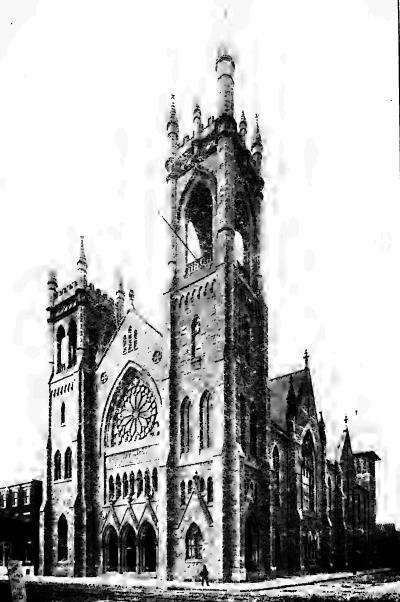
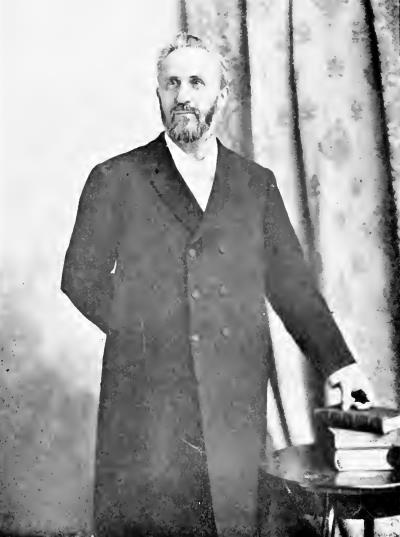
Left: Broadway Methodist Episcopal Church — 1909. Right: Rev. James W. Marshall, D.D.
October 9th to 16th, 1904, we celebrated our Semi-Centennial Anniversary by a grand jubilee. The first paper at the historical day service was the “History of Broadway Church,” by J. E. Roberts, who in part said: “Broadway Church was organized May 9th, 1854, it being the outgrowth of a Sunday-school that was organized April 8th, 1848, at a meeting held at the house of Charles Sloan, on Berkley Street.
“With our complete Sunday-school temple and auditorium edifice, second to none, possibly in our conference or State, at a total cost (including interest and incidentals) $134,137.00, subject only to a debt of $24,500. We have a church membership of 1462, and a Sunday-school of 2003, which includes 107 at our Epworth Mission; including Cradle Roll, 38, and Home Department, 90, we have a school of 2131.
“We have an Epworth League of 573 members, and a Junior League of 351; a Literary Circle, a Home Guards, a Ladies’ Parsonage Association, a Ladies’ Auxiliary to the Methodist Episcopal Home, a Woman’s Foreign Missionary Society, a Woman’s Home Missionary Society, a Poor Fund and Endowment (Folwell Legacy), our Woman’s Thousand Dollar Club, etc.
“And thus equipped we enter another fifty years for the Lord, for the church and for humanity, like a noble ship under full sail, with every prospect pleasing.
“The Philadelphia Inquirer said last week, ‘Broadway M. E. Church is the foremost church of that denomination in the United States.’”
Rev. Mr. Kulp, pastor of Trinity M. E. Church, delivered an able and instructive address at the Sunday-school service in the afternoon and in the evening Rev. Dr. William Anderson, of New York, secretary of the Educational Society, made a stirring and eloquent address at the anniversary exercises of the Epworth League. About 1600 persons attended the closing exercises. Dr. Anderson concluded with a ringing appeal and the Fiftieth Anniversary of Broadway Church passed into history with the singing of the doxology.
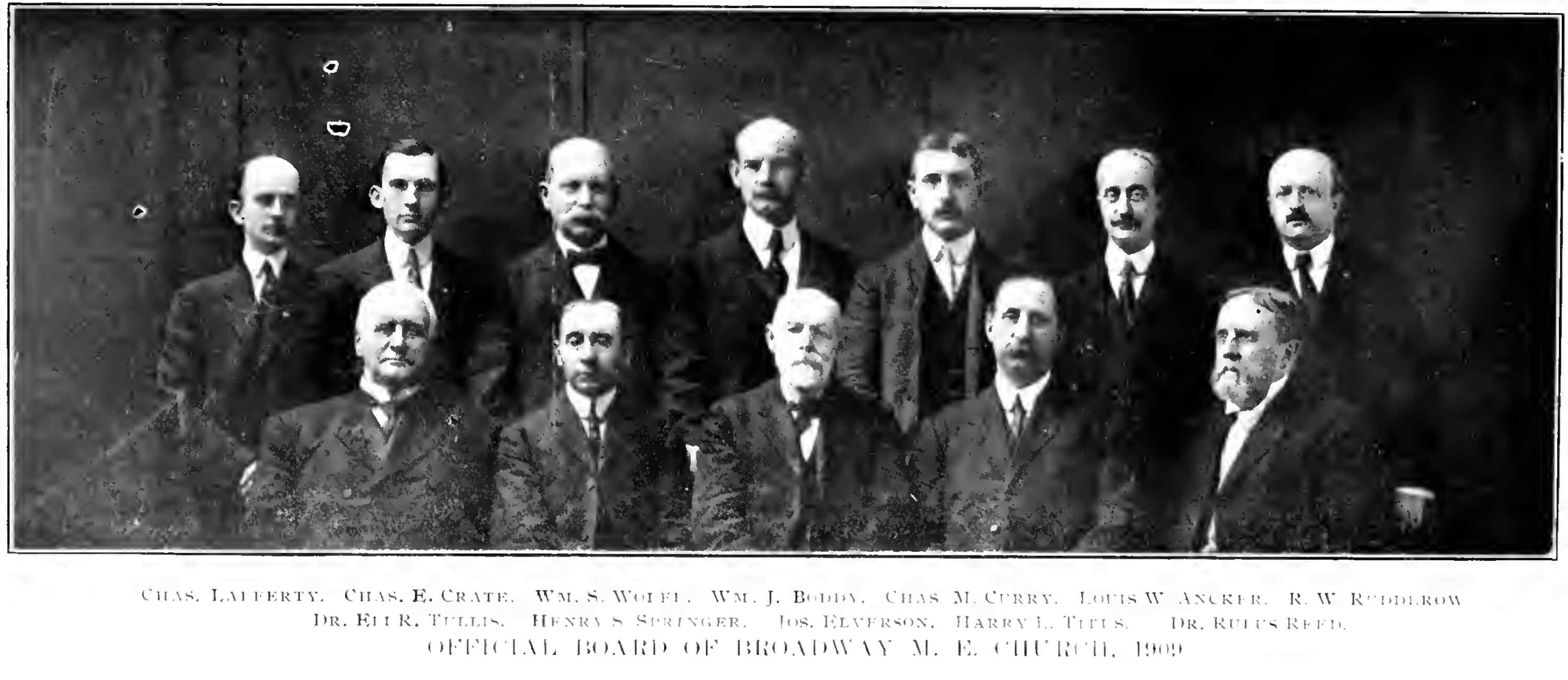
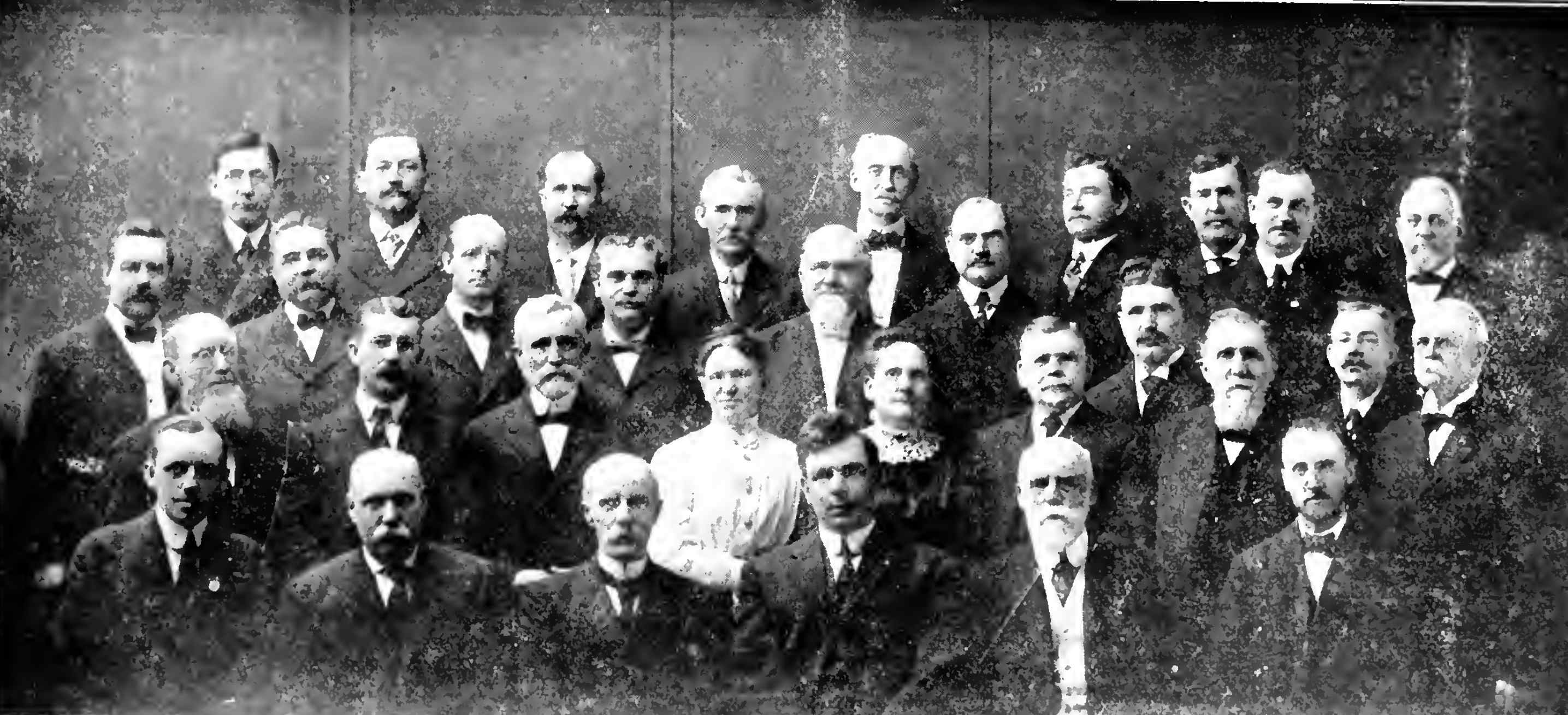
Named: Official Board of Broadway M.E. Church, 1909. Top photo, Standing: Charles Lafferty, Charles E. Crate, William S. Wolfe, William J. Boddy, Charles M. Curry, Louis W. Ancker, R. W. Rudderow. Seated: Dr. Eli R. Tullis, Henry S. Springer, Joseph Elverson, Harry L. Titus, Dr. Rufus Reed. Bottom photo, and Top Row: Dr. Wesley J. Barrett, R. L. Warren, Charles L. Creely, W. H. Jones, W. H. Vandever, Wilbert S. Sweeten, C. C. Reed, P. D. Hughes. 3rd Row: Jonathan Simpkins, Charles E. Lane, H. M. Restrick, H. Tyler, S. H. Thompson, Howard Taylor, J. C. White, W. S. Wilkins. 2nd Row: L. W. Faucett, H. P. Bailly, Dr. A. E. Street, Mrs. S. H. Thompson, Mrs. Smith S. Fogg, Smith S. Fogg, William H. Johnson, Charles H. Ackley. Front Row: William C. Riggs, Wilbur F. Carhart, Rev. Edmund J. Kulp, Joseph E. Roberts, Daniel B. Green..
Thus we crossed the semi-centennial line in 1904, under the pastorate of Rev. Geo. H. Neal, with a Building Fund debt as above of $24,500, which we continued to reduce at the rate of $5,000 to $6,000 a year, until June, 1909, under the pastorate of Rev. Edmund J. Kulp, the last dollar of debt was paid and we cancelled the mortgage and owed no man a dollar.
This occasion we celebrated on Sunday, June 6, 1909, by a grand Jubilee. The time drawing near when the church is to be free of debt the young men of the Official Board, feeling a deep sense of gratitude to their seniors, the Building Committee, proposed a testimonial banquet to them, which was unanimously adopted, and the following committee appointed to arrange for the same: Charles M. Curry, President of the Epworth League; Charles L. Creely, President of the Brotherhood; Marvin A. Street, General Superintendent of the Sunday school; Joseph C. White, First Vice-President of the Epworth League; John B. Kates, Superintendent of the Assembly.
The banquet was held on Thursday evening, April 22, 1909 at 7 o’clock, in the commodious lecture room of the church. Two hundred and fifty people were in attendance to do honor to the guests — the Building Committee. The Building Committee consisted of Joseph E. Roberts, chairman; Thomas I. Gifford, W. F. Carhart, Dr. A. E. Street, Joseph Elverson, Dr. Rufus Reed, Harry L. Titus, Albert L. Mulford, William C. Riggs and Charles S. Ackley.
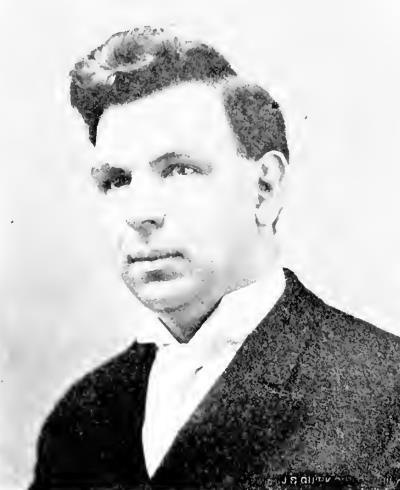
Rev. Edmund J. Kulp
Undated Interior Photos
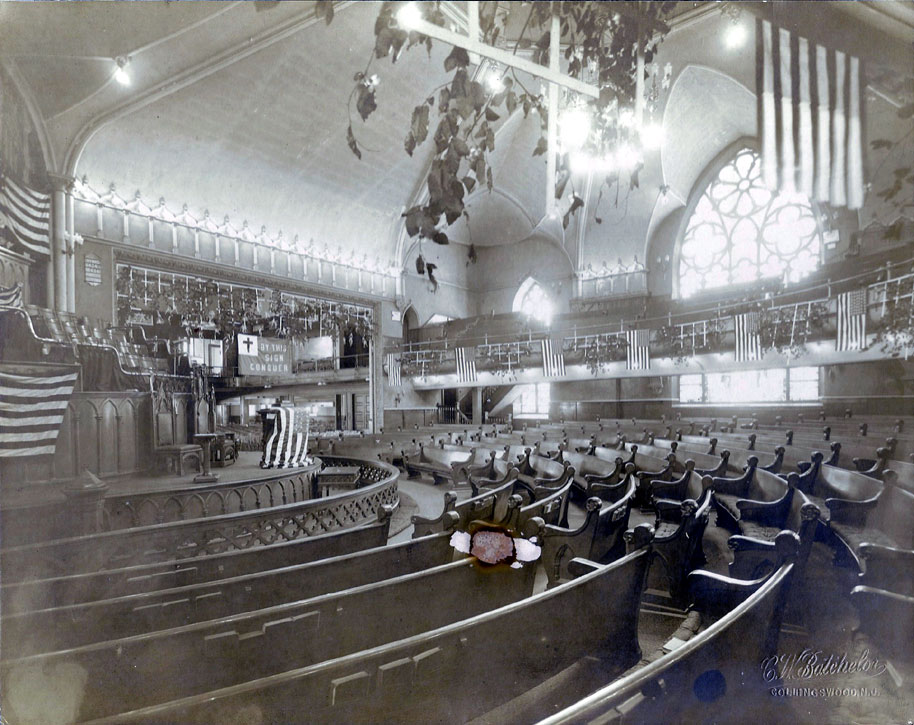
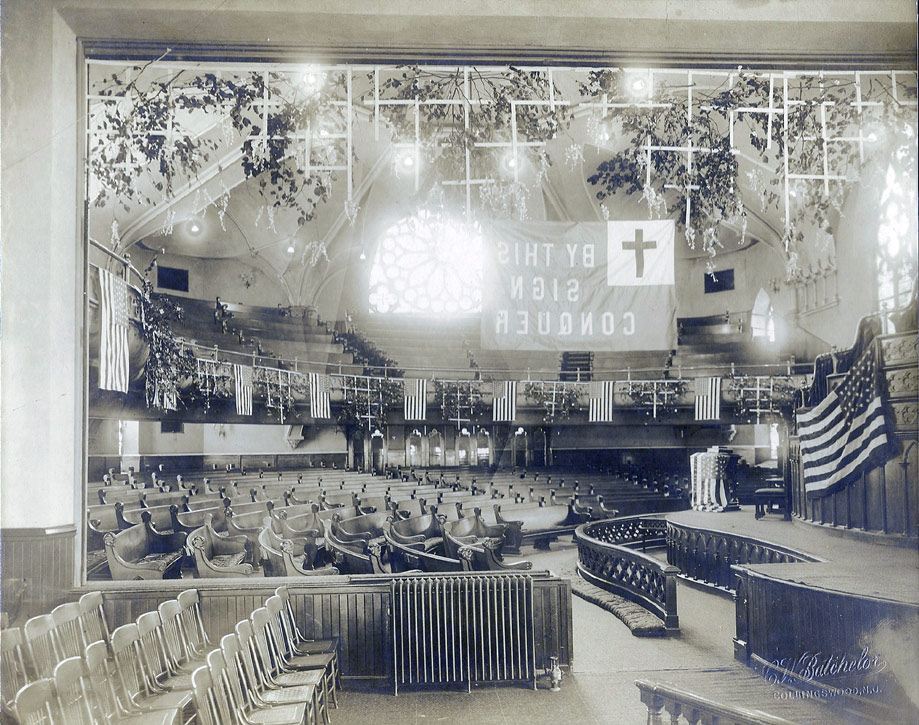
Undated interior photos of Broadway Methodist Episcopal Church, circa 1917–1918. Stamped “Harry Myers, No. 505 Benson Street, Camden, N.J.”
Over in Camden
Philadelphia Inquirer —
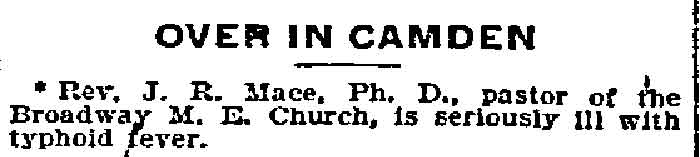
• Rev. J. R. Mace, Ph. D., pastor of the Broadway M. E. Church, is seriously ill with typhoid fever.
Police in a Church
Philadelphia Inquirer —
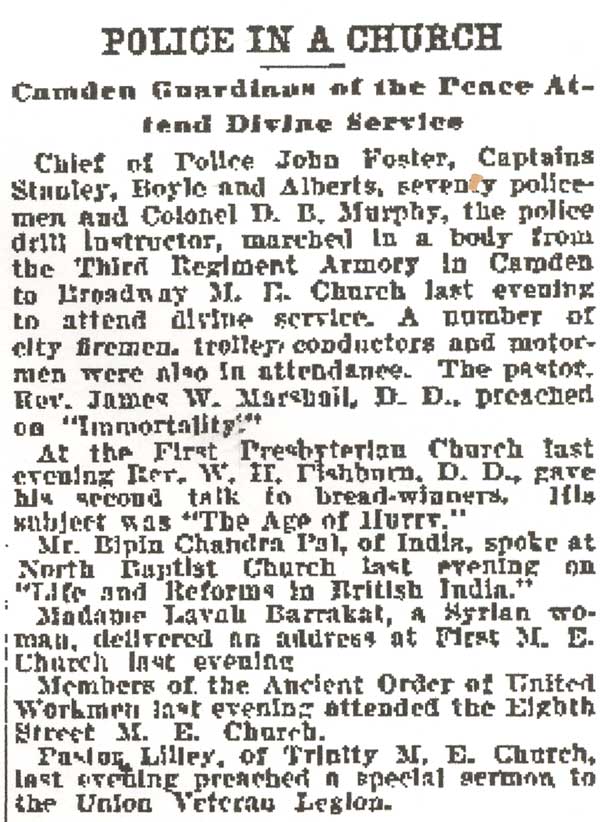
POLICE IN A CHURCH
Camden Guardians of the Peace Attend Divine Service
Chief of Police John Foster, Captains Stanley, Boyle and Alberts, seventy policemen and Colonel D. B. Murphy, the police drill instructor, marched in a body from the Third Regiment Armory in Camden to Broadway M. E. Church last evening to attend divine service. A number of city firemen, trolley conductors and motormen were also in attendance. The pastor, Rev. James W. Marshall, D. D., preached on “Immortality.”
At the First Presbyterian Church last evening Rev. W. H. Fishburn, D. D., gave his second talk to bread-winners. His subject was “The Age of Hurry.”
Mr. Bipin Chandra Pal, of India, spoke at North Baptist Church last evening on “Life and Reforms in British India.”
Madame Lavah Barrakat, a Syrian woman, delivered an address at First M. E. Church last evening.
Members of the Ancient Order of United Workmen last evening attended the Eighth Street M. E. Church.
50th Anniversary Photo
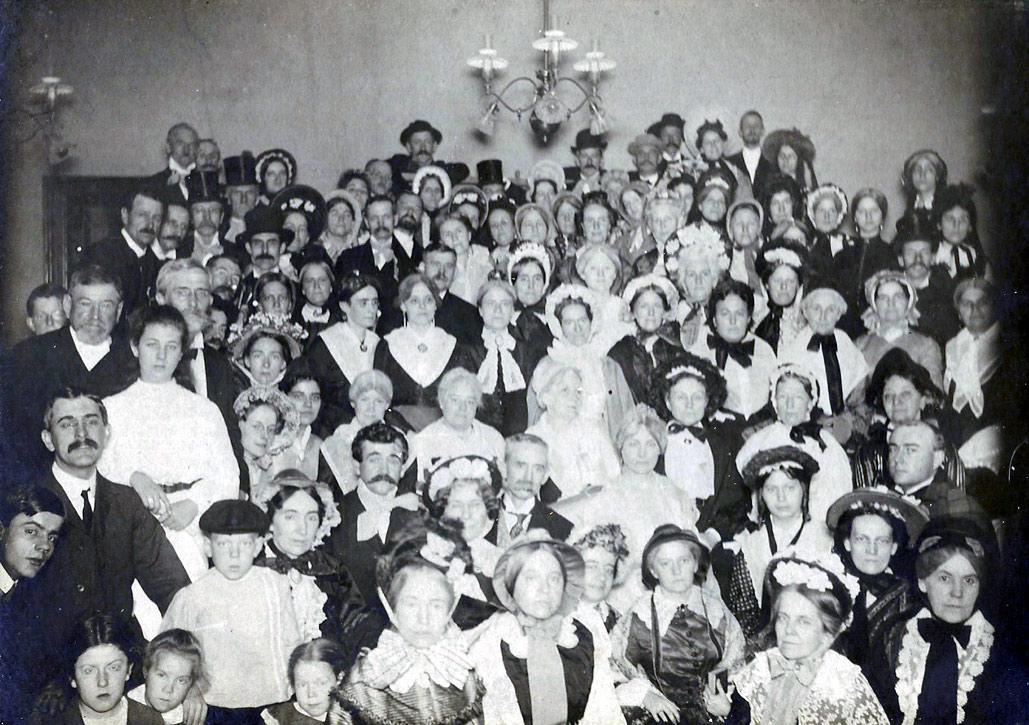
“50th Anniversary of Broadway Church, Camden, N.J.” Stamped Harry Myers, No. 505 Benson Street, Camden, N.J.
Camden News Notes
Philadelphia Inquirer —
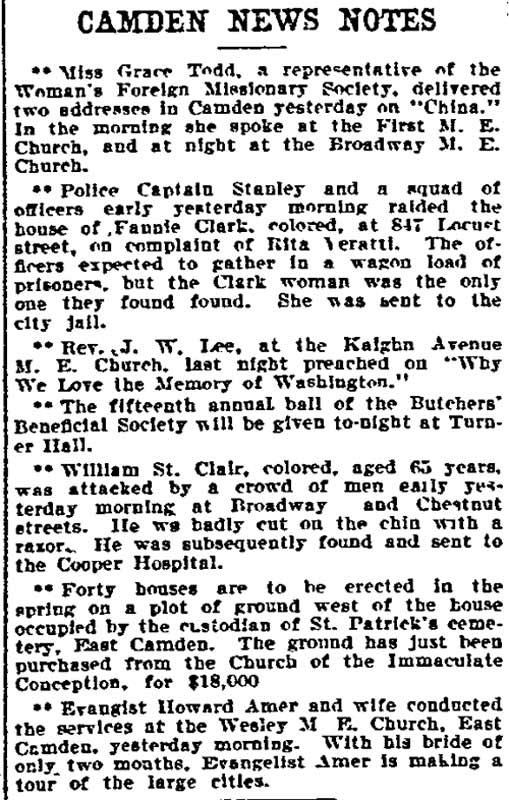
Miss Grace Todd, a representative of the Woman’s Foreign Missionary Society, delivered two addresses in Camden yesterday on “China.” In the morning she spoke at the First M. E. Church, and at night at the Broadway M. E. Church.
Police Captain Stanley and a squad of officers early yesterday morning raided the house of Fannie Clark, colored, at 847 Locust street, on complaint of Rita Veratti. The officers expected to gather in a wagon load of prisoners, but the Clark woman was the only one they found found [sic]. She was sent to the city jail.
Philadelphia Inquirer — March 23, 1908
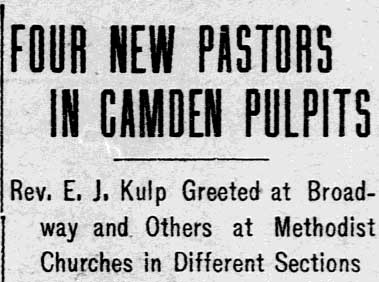
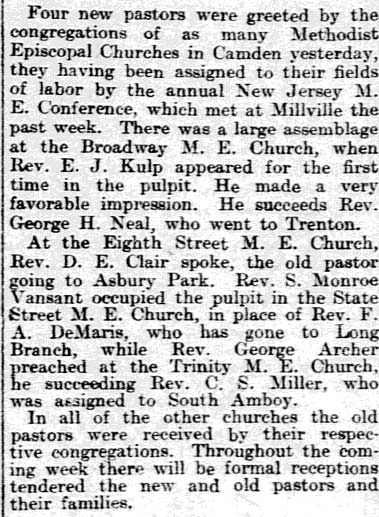
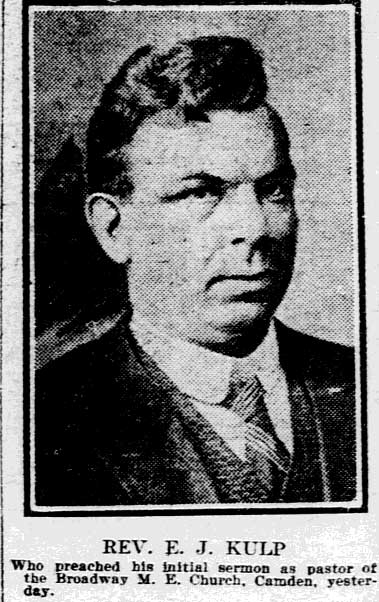
Philadelphia Inquirer, March 23, 1908 — Broadway Methodist Episcopal Church, Eighth Street Methodist Episcopal Church, State Street Methodist Episcopal Church, Trinity Methodist Episcopal Church. Rev. E. J. Kulp, Rev. D. E. Clare, Rev. S. Monroe Vansant, Rev. F. A. DeMaris, Rev. George Archer, Rev. C. S. Miller. Click images for full article PDF.
Epworth League Officers — circa 1910
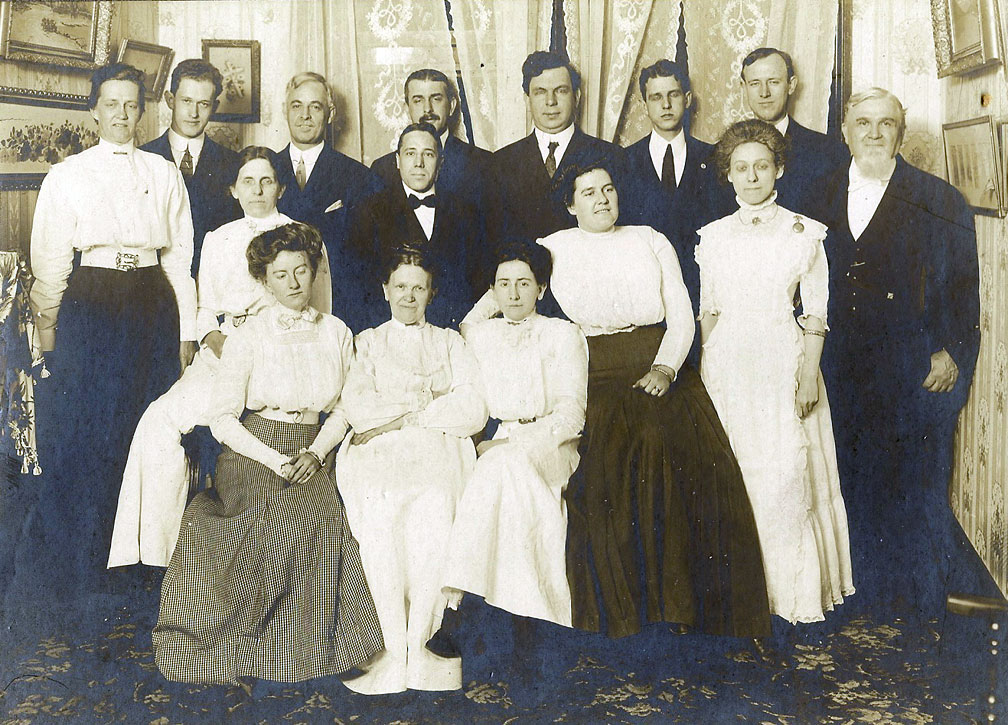
“Mrs. Elizabeth Ireton (Mother), Mrs. E. J. Kulp, Mrs. Carrie Thompson, Mrs. Agnes Hewitt, Miss Martha Hughes, Joseph Atkinson, Charles Ireton Dad, E. J. Kulp, Ralph D. Baker, Albertis Hewitt, S. H. Thompson.” Note: E. J. Kulp is standing, 5th from left.
League Officers — circa 1910
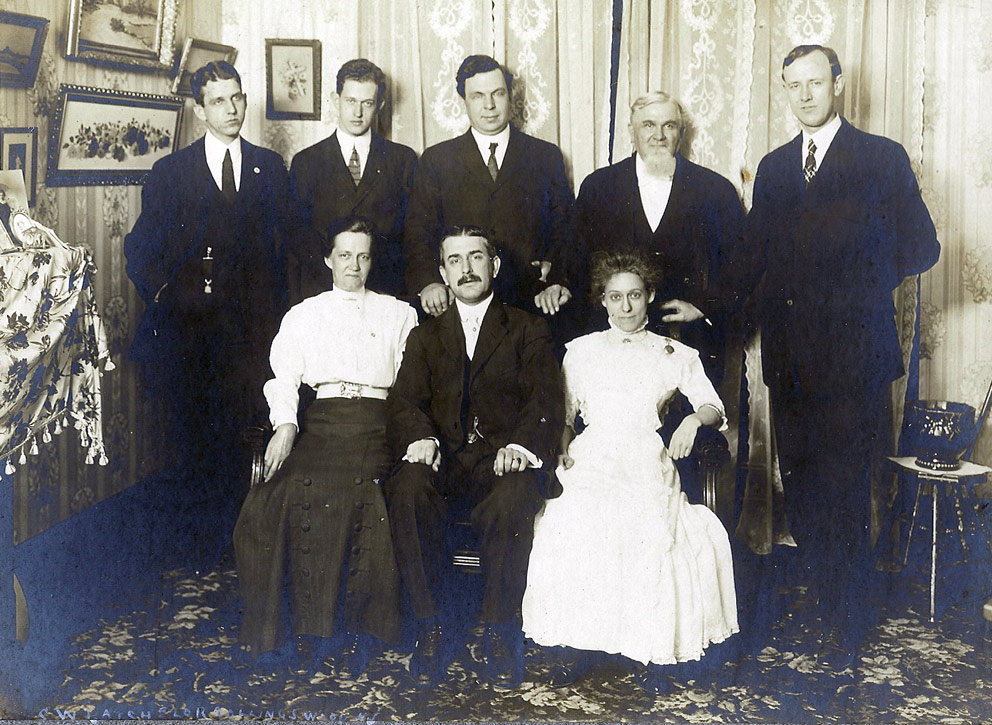
“League Officers — E. J. Kulp, S. H. Thompson, C. M. Curry, A. Hewitt, J. Atkinson, R. Baker, E. Ireton, M. Hughes.” Note: E. J. Kulp is standing, 3rd from left.
Official Broadway Church — circa 1910
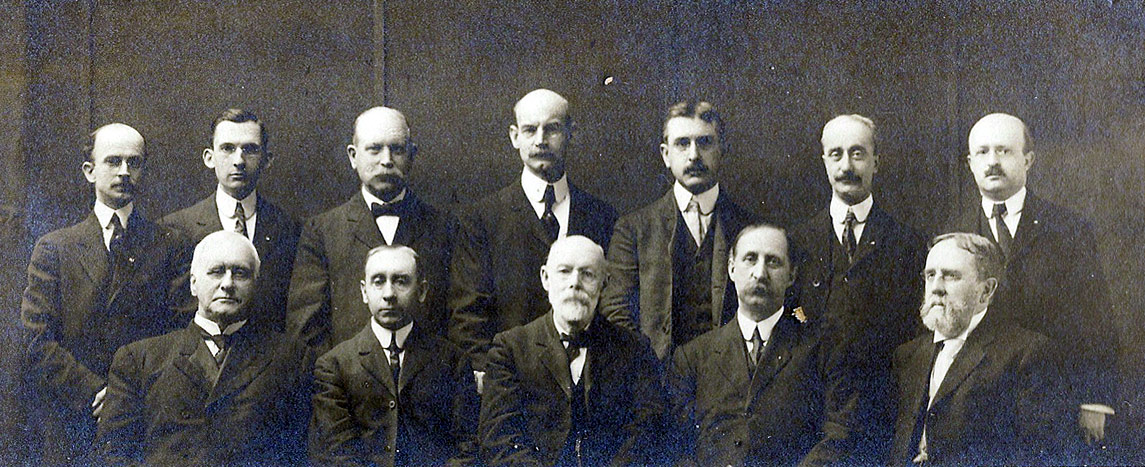
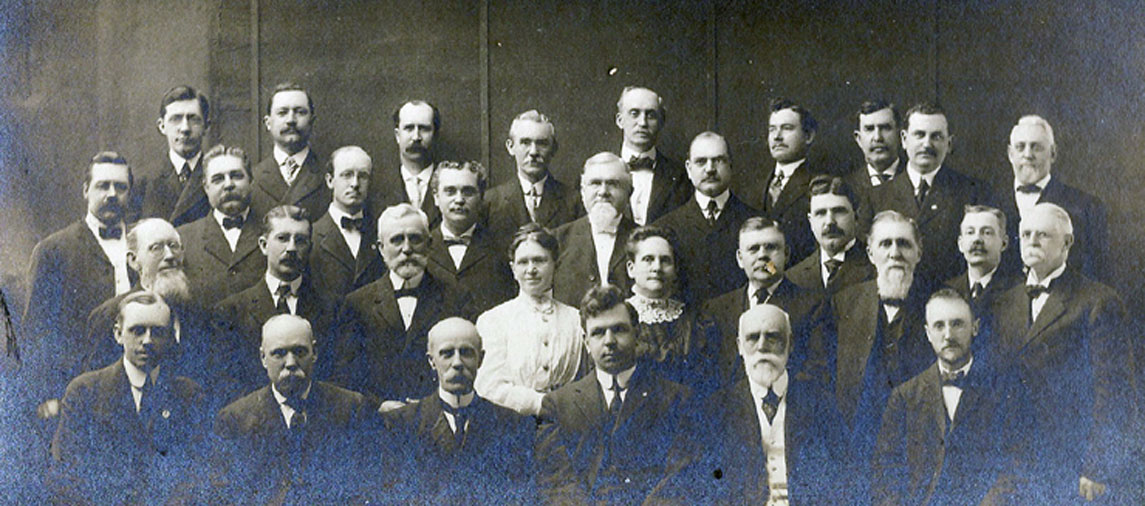
“Official Broadway Church, Camden, N.J.” — circa 1910.
Church Notes
Philadelphia Inquirer —
At the special musical program rendered last night at the First Presbyterian Church, Miss Josephine Stasen sang a contralto solo, “Saviour, Breathe an Evening Blessing.”
At the Broadway M. E. Church last night Rev. E. J. Kulp preached the first of a series of sermons on “Road to Right Living.” His topic was “Beside the Bonne Brier Bush — Christian Heroism in Common Life.”
Rev. Homer J. Fosburgh, at the North Baptist Church yesterday, preached a special sermon to school children on “The Value of Education.”
Many persons yesterday enjoyed the home concert given at the parsonage of Union M. E. Church, Miss Mehlin, the singer and composer, being present.
Rev. George H. Humason of Moorestown, and a former pastor of the Century M. E. Church, addressed large congregations at the Union M. E. Church yesterday.
Church Notes
Philadelphia Inquirer —
One of the features at the service held at the Union M. E. Church last night was the singing of Miss Vera Kaighn, a soprano.
At the Broadway M. E. Church last night Rev. Sanford H. Nichols, the district superintendent, occupied the pulpit.
Rev. Daniel Johnson, at the Wiley M. E. Church, yesterday morning received a large class of converts into membership.
Broadway M.E. to Hear State W.C.T.U. Head
Camden Post-Telegram —
The Mercy and Help Department of the Broadway M.E. Church will again do its share to care for the poor and needy on Christmas Day. Nearly two hundred baskets, containing poultry and all sorts of vegetables, are distributed among the poor absolutely free of charge. Too much credit cannot be given to the women who annually spend several days in preparing these baskets that the unfortunate ones would not go hungry on merry Christmas Day. [Full article PDF]
Broadway Methodist Church — circa 1914
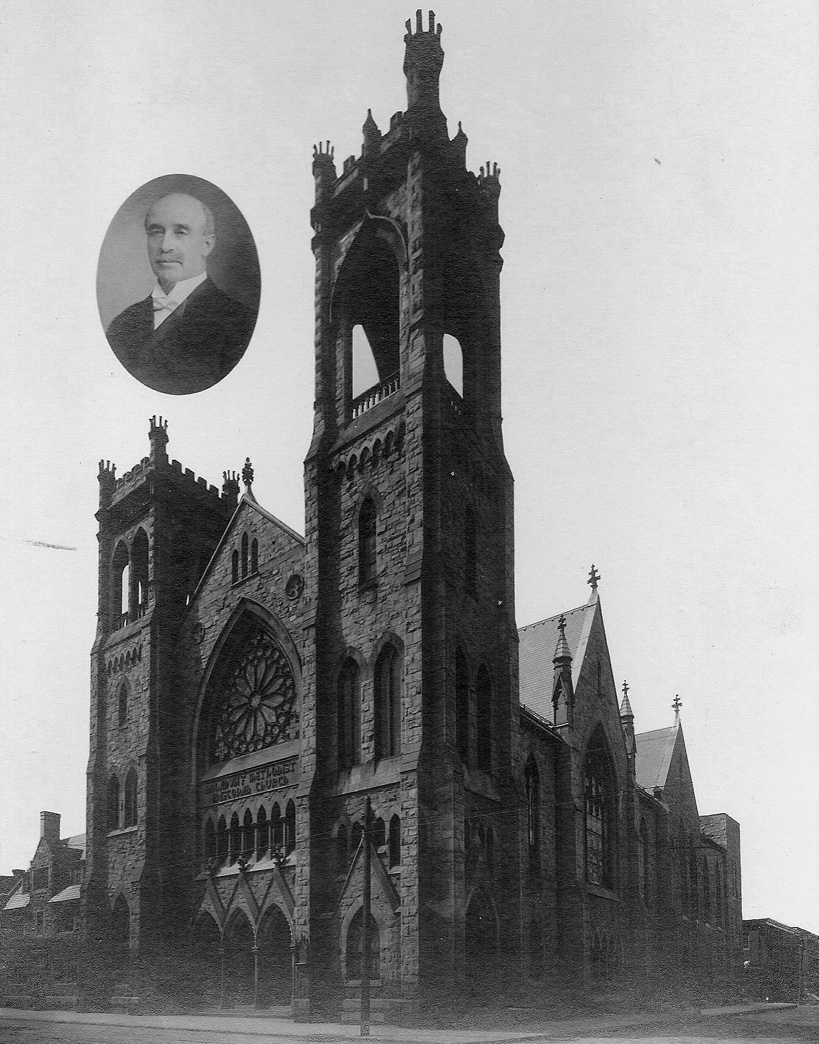
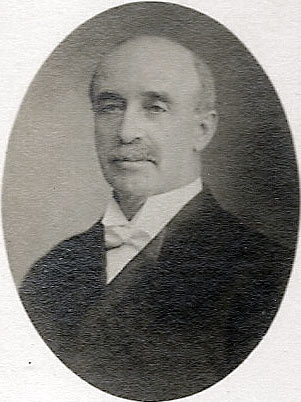
Broadway Methodist Church, circa 1914. Inset: Rev. Dr. John Handley.
Dinners to the Broadway Committee
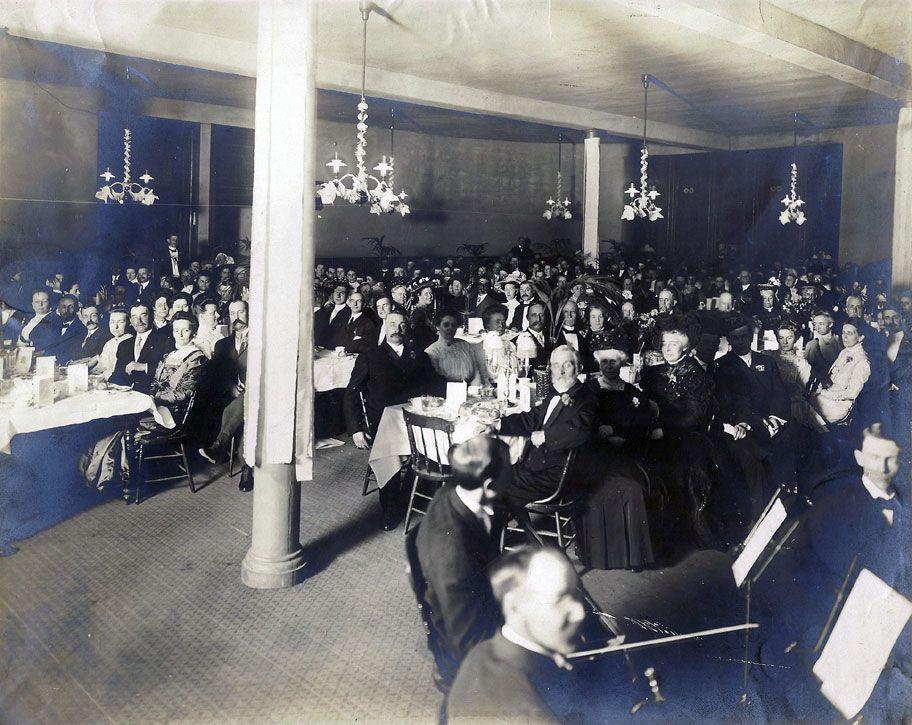
“Dinners to the Broadway Committee of Broadway Church, Camden, N.J.”
Sunday School Picnic — Knight Park, June 1914
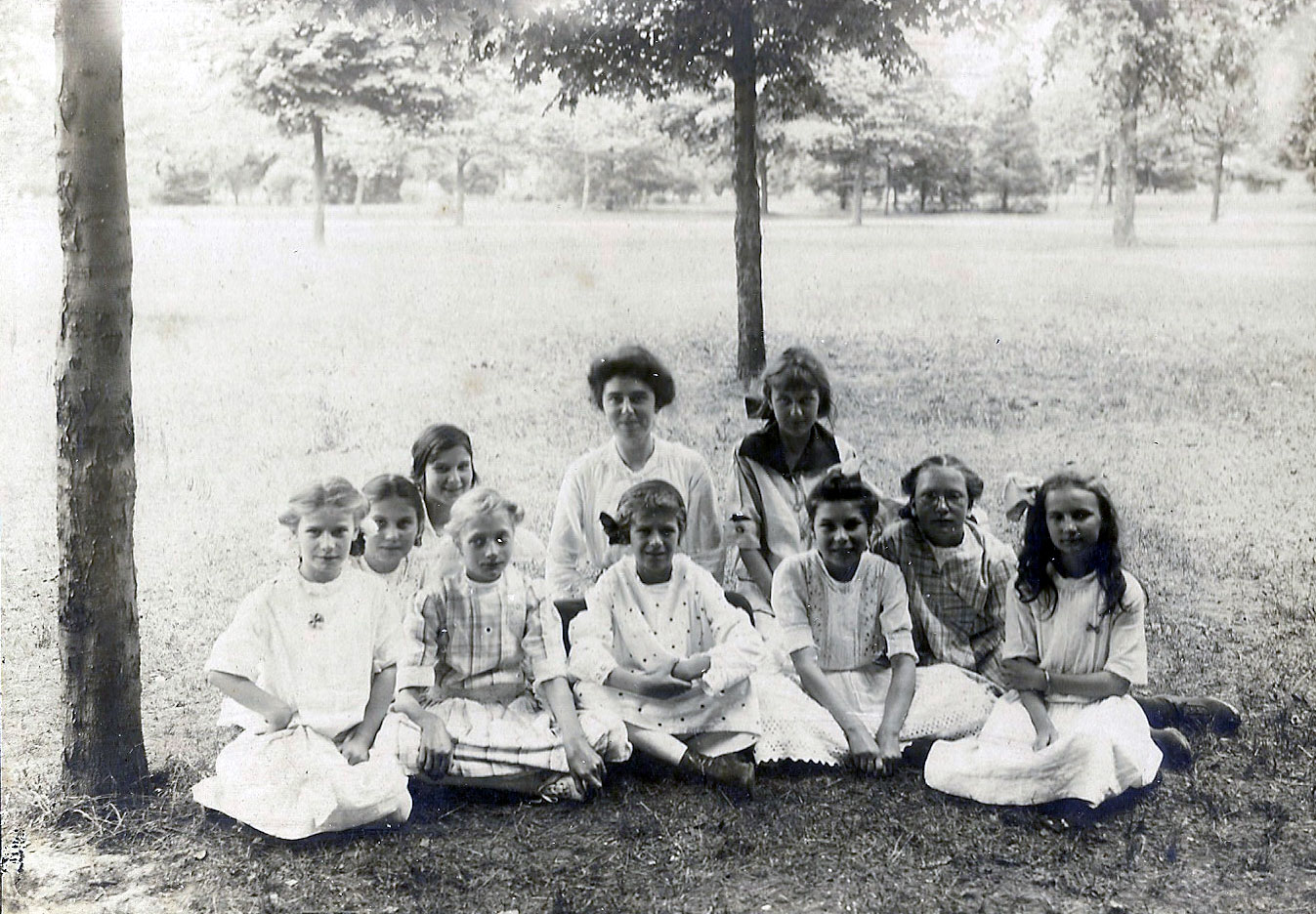
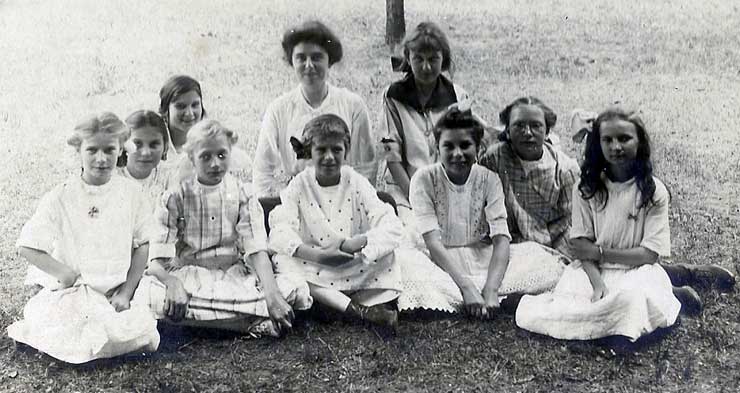
Sunday School Picnic at Knight Park, Collingswood, New Jersey — June 1914.
Camden at a Glance
Philadelphia Inquirer —
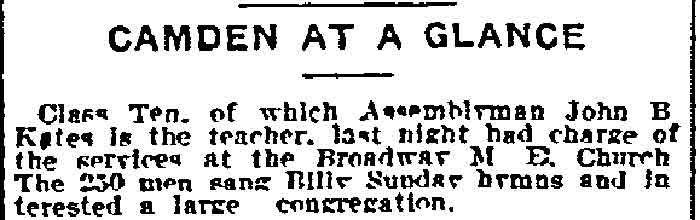
Class Ten, of which Assemblyman John B. Kates is the teacher, last night had charge of the services at the Broadway M. E. Church. The 230 men sang Billy Sunday hymns and interested a large congregation.
Broadway M.E. to Hear State W.C.T.U. Head
Camden Courier-Post —
Tomorrow in Broadway M.E. Church, Broadway and Berkley Street, will be dedicated to the eighth anniversary of the eighteenth amendment. At 10:30 the address will be delivered by Mrs. Nina G. Frantz, state president of the W.C.T.U.
At 7:30 PM there will be a patriotic service with selections by the quartet and chorus. Fifty young people will present an interesting and instructive “Patriotic Prohibition Pageant,” under the direction of Ethel M. Pierce, Uncle Sam and Mother Columbia will have their children of States who will offer their opinion in history of the eighteenth amendment.
Class meetings will be held Monday and Tuesday nights and prayer service on Wednesday evening.
Rev. N. D. Kelley, W. C. T. U. Speaker
Camden Courier-Post —
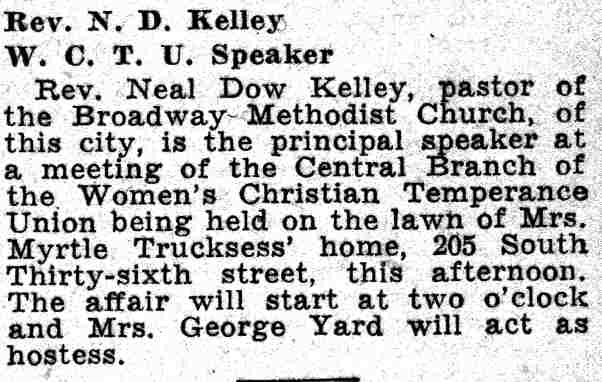
Rev. Neal Dow Kelley, pastor of the Broadway Methodist Church, of this city, is the principal speaker at a meeting of the Central Branch of the Women’s Christian Temperance Union being held on the lawn of Mrs. Myrtle Trucksess’ home, 205 South Thirty-sixth Street, this afternoon. The affair will start at two o’clock and Mrs. George Yard will act as hostess.
Missionary Group to Meet
Camden Courier-Post —
Members of the Home Missionary Society of the Broadway M. E. Church will meet this evening at the home of Mrs. Charles Tyler, 1601 West High Street, Haddon Heights.
Camden Parent-Teachers Council Plans Mid-Winter Session Feb. 24
Camden Courier-Post —
William Fidler, Audubon, Will Discuss Mort Plan in Morning
The mid-Winter meeting of the Camden County Council of the New Jersey Congress of Parents and Teachers will be held Thursday, Feb. 24, in the Broadway M. E. Church, Broadway and Berkley Streets.
The Mort Plan will be discussed by William T. Fidler, supervising principal of Audubon schools, during the morning session which will convene at 10 o’clock. The subject dealing with education is of current interest to the Parent-Teacher Associations.
A demonstration will be given by the Lip Reading Club of Philadelphia during the afternoon session, for 1:30 o’clock. A speaker will talk on “How to Detect the Hard of Hearing Child in the Home.” A demonstration of the Braille system will be given by eight students from the Overbrook School for the Blind.
Mrs. Walter Gross, 224 South Fifth Street, has charge of luncheon reservations which must be made by February 1. The meal will be served by the Ladies Aid Society of the Church.
Churches
Camden Courier-Post —
METHODIST: Broadway M. E. Church, Broadway and Berkley Streets, Rev. T. J. J. Wright.
Extension Service to Hold Luncheon
Camden Courier-Post —
The annual luncheon and meeting of the Camden County Home Economics Extension Service will be held Thursday, April 28, at the Broadway M. E. Church.
Mrs. L. H. Goettelman, of Brooklawn, heads the committee and is assisted by Mrs. William Straub, of West Berlin; Mrs. Verna Clegg, Ashland; Mrs. Adolph Grosser, Audubon; Mrs. George Luhrmann, Cedar Brook; Mrs. Howard Weeden, Camden, and Mrs. Thomas Hansen, Westmont. The program is being arranged by Miss Mary M. Learning, county home demonstration agent.