Introduction
Clinton Lloyd Bardo was born October 24, 1867 at Montgomery, Pennsylvania. By 1885 he had gone to work as a telegraph operator, working with railroads and with steamship companies. By 1907 he had worked his way up to the position of Superintendent of the New York Central & Hudson River Railway. He held that post through 1912. He was living in Manhattan when the census was taken in 1910.
In 1913 Clinton Bardo was made Assistant General Manager of the New York, New Haven & Hartford Railroad. He moved to New Haven, and in time was promoted to General Manager of the line. He was still with this railroad and living in New Haven in 1920. That year he became president of the Central New England Railway.
Widely known by this time as a highly capable executive, in 1928 he became the president of the New York Shipbuilding Corporation in Camden. He and wife Hannah made their home in Pine Valley when the census was taken in 1930. In March of 1933 the Bardos journeyed to Europe, returning home aboard the SS Leviathan by way of Cherbourg, France. Shortly thereafter, Clinton Bardo became involved in the tax protest movement in New Jersey.
Late in 1933 the Industrial Union of Marine and Shipbuilding Workers of America was founded at the New York Shipbuilding yard in Camden. The union went on strike in March of 1934. After a seven-week strike, Local 1 of the union and the corporation, represented by Mr. Bardo, settled on a contract.
Clinton Bardo passed away on August 2, 1937.
Photo
Camden Courier-Post —
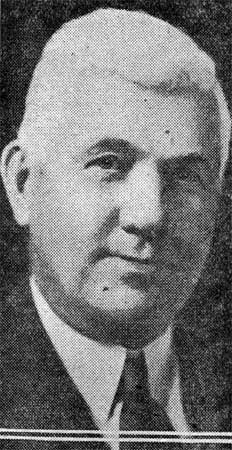
Clinton L. Bardo – President of the New York Shipbuilding Company, of Camden, re-elected president of the New Jersey Taxpayers’ Association, who presided at a mammoth tax protest meeting sponsored by the association in Trenton.
Photo
Camden Courier-Post —

KEOWN NAMED HEAD OF COUNTY G.O.P. AS WALLWORTH RESIGNS
Mrs. Verga Re-elected Vice Chairman at Reorganization Meeting of Committee
OTHER OFFICERS CHOSEN
When the Camden County Republican Executive Committee reorganized last night Walter S. Keown was elected chairman without opposition.
He succeeds former State Senator Joseph F. Wallworth, who was Republican county chairman six years, and a member 12 years. At a dinner preceding the executive session a silver set and a vase were presented to Wallworth by the committee. The retiring members of the committee received bronze elephants as emblems of the party.
At the executive session Mrs. Elizabeth Grotty Verga was re-elected vice chairman; Harry C. Sharp, treasurer; William D. Sayrs, assistant treasurer; Howard B. Dyer, secretary, and Mrs. Laura Silbers and Mrs. Lottie Stinson, assistant secretaries. Harold W. Bennett, Edward R. Diebert, Bernard Bertman, L. Scott Chercesky, Carl Kisselman and Frank Voigt were chosen solicitors.
Wallworth Reviews Work
Upon retiring as chairman Senator Wallworth said:
“During the six years I acted as your chairman considerable political history has been made in our county. The Republican party was on the rocks and loyalty seemed to have drifted away when Frank Patterson, Al Matthews, Penn Corson and Senator Baird begged me to take the chairmanship. In doing so I quickly discovered I had undertaken one of the hardest up hill battles of my life.”
When Keown took over the gavel he pointed out to the committee members they were political leaders of their districts. He said it was their duty to find out the cause of unrest.
“In some of your districts the trouble is your tax rates are too high,” said the chairman. “High taxe rates are an evil and it is your duty to find the cause and remedy the situation. When there is a spirit of satisfaction in your district there is satisfaction throughout the county.”
Wolverton Favors Plan
Congressman Charles A. Wolverton complimented the new chairman on his advice. Sharp and Sayrs, who have been identified with the committee more than 20 years, were also speakers.
Keown then turned the gavel over to Mrs. Verga, who thanked the committee for her re-election. She introduced Mrs. Silbers and Mrs. Stinson, who urged loyalty and work on the part of the women members of the committee.
Keown was nominated by Daniel Silbers, Pennsauken township. Colonel George L. Selby nominated Sharp and Dyer. All of the officers received a unanimous vote.
Ten new members took seats from the five boroughs recently created out of Clementon township. Among them was Clinton L. Bardo, president of New York Shipbuilding Corp., who was elected from the new borough of Pine Valley last Tuesday. Twelve members of last year’s committee retired either as a result of the primary election or not being candidates.
47 MORE MEN JOIN LEAGUE TO AID BAIRD
Camden Courier-Post —
Professional and Business Leaders Back Camden Man for Governor
Forty-seven more prominent professional and business men yesterday joined the Baird-for-Governor Business Men’s League and pledged themselves to work actively in interest of David Baird Jr., for governor, and add special impetus to his campaign.
The league was organized this week at an enthusiastic meeting of 18 outstanding Baird supporters in professional and business life at the Camden Club, 315 Cooper Street. The league membership is open only to business, professional and industrial leaders who are not holding public office and who are not politicians.
The latest enrollments among community leaders pledging themselves to devote themselves to the Baird cause are the following:
F. Morse Archer, president of the First Camden National Bank; Clinton L. Bardo, president of the New York Shipbuilding Company and of the New Jersey Taxpayers’ Association; George C. Baker, of the Baker-Flick Company; Watson Shallcross, president of the Camden County Chamber of Commerce; Howard J. Dudley, Broadway merchant; Thomas E. French, prominent attorney; J. David Stern, publisher of the Courier-Post newspapers and of the Philadelphia Record; Wellington K. Barto, of the West Jersey Trust Company; Dr. Joseph Roberts, Cooper Hospital; William Clement, of the Clement Coverall Paint Company; Robert Wright, of the Haddonfield National Bank; Arthur J. Podmore, of the Camden Pottery Company; Nathan Leopold, Haddonfield druggist; Dr. J. Edgar Howard, of Haddonfield.
Dr. Alfred N. Elwell, of this city; Edward Preisendanz, Clarence Peters, N. Franks, of Franks & Sweeney; U. G. Peters, Ralph D. Baker, prominent real estate man; Archibald Dingo, George Bachman, Sr., and George Bachman, Jr., Dr. O. W. Saunders, Henry Cooperson, Leon Cooperson, Herman Z. Cutler. Charles Bauman, Harry Rose, George Austermuhl, Walter Gulick, Albert Voeglin, Howard Fearn, John A. Schlorer, Ernest L. Bartelt.
William S. Casselman, George M. Carr, J. Price Myers, Carl R. Evered, former president of the Camden County Real Estate Board; Francis B. Wallen, former president of the Camden County Chamber of Commerce; William H. Alff, Edmund J. Alff, Harry Pelouze, Walter Campbell, Dr. Thomas R. Bunting, Joseph F. Kobus and Henry E. Kobus.
Enrollments, it was announced, may be made through the following committee of the league: Ludwig A. Kind, Thomas Gordon Coulter, Charles H. Laird, Walter J. Staats, Frank C. Middleton, Jr., Frank J. Hineline, William T. Read, Charles S. Boyer, W. W. Robinson, George R. Pelouze, Paul A. Kind, Dr. Paul A. Mecray, Jerome Hurley, Harry A. Moran, James V. Moran, William J. Strandwitz, former Judge Lewis Starr and Frank C. Norcross.
C. OF C. NAMES GROUP ON NATIONAL RECOVERY
Camden Courier-Post —
An Industrial Recovery Act Committee of the Camden County Chamber of Commerce was appointed yesterday.
A. C. Held was named chairman of the committee and immediately called a meeting for tomorrow, at 12:15 in Hotel Walt Whitman.
Other members of the committee include J. W. Burnison, Clinton L. Bardo, Harry A. Kelleher, Warren Webster, Jr., Harry C. Stevenson; T. David Stern, B. H. Hudson, Charles Wagner, A. W. Stedman, Stanley Cramer, and Loyal D. Odhner.
A study of the national recovery act passed by Congress for President Roosevelt is to be made by the committee to determine what action should be taken by Camden manufacturers and merchants toward price and wage recovery.
‘VIGILANTES’ URGED BY BARDO TO KEEP EYE ON POLITICIANS
Camden Courier-Post —
CITIZENS TOLD TO SET UP CITY BUDGET GUARDS
Head of Taxpayers Offers Plan at Mass Meeting in Trenton
PLATFORM ADOPTED TO PUT END TO WASTE
Association Asks Biennial Legislative Session and Wars on ‘Machine’ Rule
Trenton, June 9.—Creation of vigilance committees in each municipality of the state to act as “watchdogs” of the budgets and to force elected officials to carry out their platform pledges was urged tonight by Clinton L. Bardo, president of the New Jersey Taxpayers’ Association.
He spoke at a statewide mass meeting attended by more than 1500 taxpayers and representatives of civic groups to protest against high taxes and the inactivity and “horse trading” deals of the legislature. The meeting was held in the auditorium of the Soldiers’ and Sailors’ Memorial Building, the largest in the city.
Platform Adopted
At its annual convention earlier in the day, the association, which sponsored tonight’s meeting, adopted a platform containing eleven demands for improvement of state and local government.
After reviewing the taxation situation in New Jersey, Bardo sounded a keynote for the future.
“My advice and suggestion to you,” he told the audience, “is first, that you organize in every taxing subdivision of the state a committee of taxpayers who will be charged with the definite responsibility of carefully reviewing and analyzing your local budgets, suggesting to your governing authorities where economies and reductions in cost of government can be brought about, informing the public fully as to these public expenditures and insisting in every case that the taxpayer get his money’s worth.
Urges Vigilantes
“Secondly, that you organize in every taxing district of the state a vigilance committee of the same kind and determination that ruled the destinies of the people on the western frontier for many years. These committees should be made up of men free from political bias, sound in cumulative judgment on political and economic needs and business administration.
“They should be courageous in their determination to ascertain from every candidate for public offices, where he stands upon important questions and whether, if elected, he will be subject to political domination and rule, and if after being elected, he fails to carry out the pledges of the platform upon which he is elected and which he has made to his people, that he be called to account and made to answer for his conduct before the bar of public opinion or his constituents.
“Organized public opinion and publicity are the two most effective weapons within our grasp,” Bardo continued. “Courage and determination on the part of organized taxpayers in the interest of all the taxpayers will relieve the state and its political subdivisions of that form of political machine rule, nepotism and reprisals which is responsible, solely for our present deplorable conditions.”
New Jersey, Bardo said, now occupies fifth place among all the states in the per capita burden of taxpaying.
‘Taxpaying an Industry’
“Taxpaying has become our great national industry. No state in the Union except Florida has as high a cost of government in relation to wealth as New Jersey. Taxes of all kind levied in New Jersey in 1900 amounted to $28,000,000. In 1930, they totaled $459,000,000, or more than 16 times the earlier figure.
“The assessed value of all property in the state for this same period increased about six fold and the population but 2.15 times.”
Bardo declared that New Jersey has suffered severely from an industrial standpoint and that the down swing on farm prices and the rising rate of taxation on general property constitute a situation that is menacing the farmers of the state.
“Education in New Jersey’s most expensive public function” Bardo continued.
“Omitting some small items, the total cash expenditures for education in New Jersey in 1920 amounted to $44,000,000. In 1930, these expenditures totaled more than $133,000,000 or practically three times as much.”
Taking the various departments such as state highways, state institutions and the state bureaus, Bardo showed where the tax expenditures have soared to great heights.
Taxpayers Have Power
“However, the taxpayers have within their grasp the power to curb them. The taxpayers of the state will have efficient, economical and honest government when they recognize that this is government by the people, of the people and for the people and when they recognize that this Principle demands of every citizen not only his contribution to the common welfare in the form of taxes, but equally imperative his intelligent, constructive suggestions and criticisms, where necessary, of that form of government which no longer is representative of, which has fallen under the sad and damning blight of political machine rule.”
Bleakly Assailed
Harry Galhaber, of Lindenwold, a member of the Camden County Chamber of Commerce, attacked Assemblyman F. Stanley Bleakly of Camden county, for his introduction of a bill for a state income tax.
“Within the past 30 days,” he said, “you have seen the spectacle of a Camden county legislator advocating $34,500,000 in taxes which he says will reduce taxes. Can you conceive of such an asinine statement as that?”
He also protested appointment of George Grim as deputy state tax commissioner in charge of beer licenses at a salary of $7500 a year.
“Why do we need beer inspectors at $7500 a year with the number of barnacles already attached to the ship of state?” he asked.
Former Governor Edward C. Stokes, vice president of the association, who was unable to attend the mass meeting, sent a message opposing any proposal for an income tax which he said was unjustified.
Petitions to be Issued
A. L. Everson, executive secretary, announced that petitions would be circulated for presentation to Governor Moore and the Legislature condemning disregard for party platforms and demanding efficiency and economy in government.
Irwin Rubenstein, of the West New York and Hudson county units, declared “the disgraceful political deals in which the governor participated are traitorous.”
E. W. Wellmuth, vice president of the Newark Chamber of Commerce, criticized the proposal to have the federal government lend money to needy municipalities.
“We cannot get out of our troubles by creating greater debt. It is an unmoral attempt on the part of the Legislature to smooth over the frailties of ourselves and those we elected to office,” he said.
Among those attending the meeting were more than 40 from Camden county, representing the Camden County Chamber of Commerce, the Congress of Civic Associations and other civic bodies. The Chamber of Commerce delegation was led by Loyal D. Odhner, secretary; J. V. Moran, Harry A. Kelleher and Carl R. Evered.
At the convention, held in Stacy-Trent Hotel, Bardo was re-elected president of the association. He is president of the New York Shipbuilding Company of Camden.
Planks Set Forth
The eleven platform planks adopted by the association follow:
1—Provide absolute control of expenditures of public money.
2—Provide for budgeting of all state expenditures.
3—Change the present policy of state highway department management, placing control in charge of a highway engineer.
4—Investigate and if necessary revise the state pension laws.
5—Revise the debt procedure and limit debt.
6—Provide for adoption of a “pay-as-you-go” policy.
7—Make possible consolidation of municipalities.
8—Require an investigation of the methods and procedure of the educational system of the state and cause a reduction in expenditures to the extent that the cost will be brought to a level consistent with the ability of the people to pay.
9—Regulate and control local finances.
10—Provide permanent relief from mandatory laws, including tenure of office.
11—Permit the people to choose the form of local government without political interference.
Resolutions Adopted
The convention also adopted the following resolutions to be presented to the Legislature:
1—Demanding repeal of Chapter 30, laws of 1932, the Walsh act commission “ripper.”
2—Demanding enactment of laws to permit citizens to examine the public records at all reasonable times.
3—Urging immediate steps to provide for biennial sessions of the Legislature.
John C. McCabe, of Middlesex county, was chairman of the platform and resolutions committee.
The convention defeated an effort to amend the fourth plank to make it refer mainly to the state teachers’ pension fund.
After considerable discussion Irwin Rubenstein, of West New York, withdrew a resolution he had offered proposing a tax strike “until the Legislature enacts the program sponsored by the association,” and protesting against “abuses of authority and disgraceful bartering between the two political parties in appointments” by the Legislature.
War on ‘Machine’ Men
The association pledged itself and its entire resources to accomplish the objectives of its platform “and to eliminate from public office those whose only guiding star is that of the political machine and their personal and political fortunes.”
In addition to Bardo’s re-election, the association renamed former Governor E. C. Stokes as treasurer and A. R. Everson, of Trenton, executive secretary.
Vice presidents elected, included: J. B. Van Sciver, Jr., Camden; Isidore Schmeidler, Atlantic City; N. F. S. Russell, Burlington; Col. Edward E. Hollenbach, Avalon; William T. Lanning, Bridgeton; Amos W. Kirby, Mullica Hill; William J. Connor, Trenton; Leon Loblein, Point Pleasant, and R. F. Willis, Pennsgrove.
Bardo declared in a statement that the bills passed by the Senate this week giving the governor control over state expenditures do not carry out in full the recommendations of the Princeton Survey. He said the bills drawn by experts for the taxpayers’ association would have accomplished the desired objective better, but were rejected. He declared the taxpayers are “suspicious” of this action by the Senate.
“These bills were adopted because they were less drastic and since legislation had to be passed the original bills proved the easiest way out,” said Bardo.
“It is also well known that most of the work of the Legislature this year has consisted of political trading, which has reached even into the judicial branch of the government. Because of this and of the unsavory record of the Legislature during its five months’ session, we are suspicious of the reasons back of the adoption of these bills by the Senate.
“We shall continue to be suspicious of anything done by that body until something has been carried through to completion which will restore our good faith and then we shall be as eager to praise as we have been insistent in condemnation. The public is not so easily fooled now as in the past and will not in the slightest degree, desist from its intention to protest vigorously tonight at the protest meeting in Memorial Hall.
“The bills have yet to pass the Assembly and the taxpayers tonight are expected to take such action as will be necessary to have the bills amended before final passage so that when the fiscal control legislation is put on the books it shall be the best possible to meet the situation.”
Destructive Economy In Education Deplored
Camden Courier-Post —
“Destructive economy in education” is protested by the New Jersey State Federation of Women’s Clubs, in a resolution sent to C. L. Bardo, president of the Taxpayers’ Association of New Jersey, for presentation at the convention of the association meeting in Trenton.
The resolution was drawn up jointly by Mrs. M. Warren Cowles, chairman of the Department of Legislation and Citizenship, and Mrs. C. P. Kitchel, chairman of the Department of Education of the Federation of Women’s Clubs.
The resolution urges that the Taxpayers’ Association consider the educational situation with the same regard for the interpretation of the advice of experts and with the same regard for the underlying principles and needs as that which characterized their work on the fiscal control; that the association continue to confer with members of the commission on the study of education, that they base their study on these and other conferences with experts with careful consideration of the same, and that the report of this commission be made as soon as possible so that it may serve “as a guide for economy and a guide for legislative action.”
NORTH CAMDEN GROUP HITS TAXPAYERS’ ASS’N ON ‘FAILURE’ AT TRENTON
Camden Courier-Post —
State Organization Failed to Offer Constructive Plan, Charge
RAILROAD MERGER ALSO CONDEMNED
The New Jersey Taxpayers’ Association was criticized last night at the weekly meeting of the North Camden Civic Association, held at the Pyne Poynt Social Club, 939 North Fifth Street.
Frank J. Hartmann, Jr., secretary of the civic group, criticized the tax payers’ organization for “failing to do anything constructive for the individual taxpayer of the state.” As one of more than a score of persons from Camden who attended the taxpayers’ mass meeting last Friday at Trenton, Hartmann said he “heard nothing that he had not heard before.”
“All during the meeting,” Hartmann declared, “there was not a thing that came out for the benefit of the individual taxpayer. In my opinion the New Jersey Taxpayers’ Association should be called the Corporation Taxpayers’ Association.
“They appear to be against the income tax, while anyone who has studied conditions of today can readily realize that to tax those with ability to pay, is the first and foremost factor. Another thing that struck me was the fact that Clinton L. Bardo, president of the taxpayers, actually apologized for the remarks of one speaker who outlined an effective method of obtaining results from governing groups. That method was a tax strike.”
Harry Walton, who presided at the civic meeting with less than 20 persons in attendance, supported Hartmann’s report of the Trenton meeting. George I. Shaw, vice president of the civic organization, condemned the State Taxpayers’ Association for voting for candidates who have persistently refused to aid the public.
Shaw also rapped the New Jersey Board of Public Utility Commissioners for “approving the consolidation of the Pennsylvania and Reading railroad lines in South Jersey.”
“This merger, which has been authorized in Washington, will result in loss of jobs to 3500 persons and eventually will make Camden a way station,” Shaw declared. “The Public Utility Commissioners should be removed. They have not been working for the public welfare.” On Shaw’s recommendation the association moved to protest against the merger.
Mrs. Stephen Pfeil and William Coughlin reported that Acting Chief of Police John W. Golden has promised to co-operate in a campaign to curb vandalism by boys. Property owners have been complaining about damage to vacant houses.
The association and the Congress of Civic Associations will be represented tomorrow at a protest meeting against the Camden County Emergency Relief Administration. The meeting is to be held at the Convention Hall annex by the Unemployed Union of New Jersey.
Plans for the July 4 celebration of the Pyne Poynt Athletic Association also were discussed at the meeting last night.
The association will meet again next Thursday night.
BARDO TO APPOINT N.R.A. COMMITTEES
Camden Courier-Post —
Drive in Camden County Forges Ahead as More Firms Sign
The N.R.A. recovery drive in the Camden area forged ahead on three fronts yesterday.
Clinton L. Bardo, president of the New York Shipbuilding Company, was appointed chairman of the N.R.A. campaign committee for Camden city and county.
Two hundred and eight additional employers in Camden and vicinity pledged their aid to the drive yesterday by signing N.R.A. certificates of compliance at Camden post office.
Thirty Camden merchants met at Hotel Walt Whitman to organize a retail division of the Camden County Chamber of Commerce with the hope that a united front will better enable retailers to protest non-cooperation of N.R.A. merchants or any situation created whereby specific codes might harm one or more businesses in the city.
The total number of N.R.A. employers in the Camden area is now 1342. Among the firms signing the recovery pledge yesterday were the Progressive Garment Company, 60 employees; S. J. Huntzinger Company, 20; Sinnickson Chew and Sons Company, 16; American National Health and Accident Association, 15, and New Sanitary Laundry, 14.
Bardo Is Named
Other members of the N.R.A. campaign committee will be named by Bardo, he announced, in time to participate in their first meeting Friday at 3 p. m. in the offices of the Camden County Chamber of Commerce in Broadway-Stevens Building.
The committee of public, civic and industrial officials was requested to be formed by Gen. Hugh S. Johnson, National Recovery Act administrator, in a telegram to Loyal D. Odhner, chamber executive secretary, several weeks ago.
The purpose of the committee, Odhner explained, is to make a city and county-wide canvass of all industries and stores to discover whether they have signed the pledge. Furthermore they will also canvass the neighborhoods to determine if possible whether re-employment of men and women out of work is going on as rapidly as expected by N.R.A. officials.
Merchants Explain Hours
Considerable discussion developed over the limitation of retail store hours as provided in the President’s recovery agreement. S. Lester and Joseph Fuhrman, Broadway merchants, declared some smaller stores were under the impression they could not remain open beyond the 52 hours prescribed as minimum and at the same time justify display of the “Blue Eagle” symbol.
Both of these merchants said there were no restrictions under the recovery act other than a statement that a store must not operate less than 52 hours and further provided any store did not work its employees more than 40 hours a week.
Opening for longer than the minimum number of hours set forth in the recovery act, in their opinion, was thoroughly in harmony with the President’s drive since it would create work for more people to complete all store service over and above the minimum of 52 hours.
Retail Code Outlined
Odhner in response to several Camden merchants as to the statement he would make covering the N.R.A. regulations, said:
“A merchant in order to display a ‘Blue Eagle’ must pay his employees not less than the minimum wage prescribed by the code.
“Nor must he keep his store open less than the minimum hours prescribed by the code.
“All agreements between merchants of various communities regarding opening and closing hours are purely voluntary and are not required by the code.
“If those agreements on opening and closing hours are designed either to cut down the number of workers in the stores or to avoid taking on additional employees, then these agreements are a direct violation of the spirit of the code.
“If on the other hand these agreements are made to eliminate a chaotic condition in the trade and will result in the hiring of additional employees and in increased wages, they are within the spirit of the act and should be supported.”
N.R.A. DRIVE HERE OPENS TOMORROW; COMMITTEE NAMED
Camden Courier-Post —
168 Shoemakers in Three Counties Form Code; Big Firms Sign Pacts
HONOR ROLL LISTS 1749
The personnel of the National Recovery Act campaign committee for Camden city and county was announced yesterday by Chairman Clinton L. Bardo.
The committee members and their assignments follow:
James V. Moran, department stores; Leonard R. Baker, department stores; S. Lester, retail stores; Francis B. Wallen, miscellaneous business; A. D. Ambruster, banks; Clinton L. Bardo, shipbuilding; A. C. Held, industry; J. W. Burnison, industry; Harry A. Kelleher, industry; Warren Webster, Jr., industry; William H. Chew, Sr., printing; J. Alex Crothers, maritime interest; Carl R. Evered, real estate and building trades; Fred T. Gates, chain stores; B. H. Hudson, transportation; Harry C. Stevenson, public utilities; Watson Shallcross, automotive; Elwood S. Thompson, insurance of all types; Robert C. Perina, all professional lines, and J. David Stern, publicity.
Meet Friday Afternoon
The committee will hold its first organization meeting tomorrow afternoon in the offices of the Camden County Chamber of Commerce in Broadway-Stevens Building. A plan of action will be mapped out at this session, Chairman Bardo said.
Meanwhile, Postmaster Charles H. Ellis and his staff at Camden post office were still able to supply the “Blue Eagle” insignia in limited numbers while waiting for an additional 1500 copies from Washington. Several hundred insignias were obtained yesterday from the Philadelphia post office, Ellis disclosed, to meet the demand of Camden employers, but this supply was quickly exhausted when 190 additional employers signed the blanket code, raising the total N.R.A. employers in this area to 1749.
One hundred and sixty-eight shoemakers of Camden, Burlington and Gloucester counties have prepared a code to be forwarded to Brigadier General Hugh S. Johnson, National Recovery Administrator in Washington immediately.
The shoemakers who are organized under the name of the Shoe Rebuilders of Camden, Burlington and Gloucester counties, also entered into a “gentleman’s agreement” as to operating hours. Under the agreement, the stores will be opened from 8 a. m. to 6 p. m. on Mondays, Wednesdays and Thursdays and from 8 a. m. to 9 p. m. on Fridays and Saturdays.
Under provisions of the adopted code, no shoe repair shop owner shall employ his labor for more than 48 hours per week, no repair shop shall remain open less than 52 hours each week and no shops will be opened on Sundays or legal holidays.
The code also sets up a list of minimum wages. Under its provisions, manager or journeymen would receive $25 a week; bench men would be paid $21 a week; finishers would get $18 a week and unskilled apprentices would be paid $12 weekly.
Committee Meets Today
Some of the communications sought appointments to the committee selected by Chairman Clinton L. Bardo, president of the New York Shipbuilding Co. Others offered assistance and co-operation in any manner.
“Men and women from every line of endeavor—some rich and others humble—big and little storekeepers are among the letter writers,” Executive Secretary Loyal D. Odhner of the Chamber revealed.
“All want to be of some service in America’s fight to regain business and employment equilibrium.”