Introduction
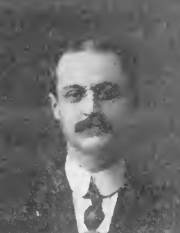
Dr. Henry Stanley Riddle, circa 1909
DR. HENRY STANLEY RIDDLE was born near Manasquan NJ on May 20, 1880. After graduating from medical school in 1904 he practiced medicine near his home in Monmouth County. Dr. Riddle came to Camden in 1907, first practicing at 318 Kaighn Avenue. In 1915 he opened an office at his residence, 1006 Newton Avenue, where he lived until his death in 1942. He was survived by his wife, the former Edith Brooks, who remained at the Newton Avenue address until at least 1947.
Besides his medical practice, Dr. Riddle was involved in politics as a Republican, serving two terms on the City Council, until it was abandoned when the City Commission was established in 1923.
From South Jersey: A History 1624–1924
DR. HENRY STANLEY RIDDLE—Not only is Dr. Henry Stanley Riddle one of the leading physicians of Camden, but he is also one of the most prominent men in public affairs and Republican circles of the city. A former member of the City Council of the city of Camden, he is also well-known throughout the State and is highly esteemed both as a medical man and as a public-spirited citizen.
Dr. Henry Stanley Riddle was born in Monmouth County, one mile west of Manasquan, May 20, 1880. His father was James H. Riddle, now deceased, a prominent resident and leading citizen of Manasquan, who for many years was a schoolmaster of the town and for many years, also, was the postmaster of Manasquan.
The senior Mr. Riddle was a Civil War veteran, having held the commission of first lieutenant in Company D, 14th Regiment, of the New Jersey State Volunteers, with which he saw active service throughout the conflict. Previous to the war he was a shoemaker in Manasquan, Monmouth County, and later was employed by the Pennsylvania Railroad, after which he retired in 1905, death coming to him in 1922. His wife, the mother of Dr. Riddle, was Lydia A. (Walling) Riddle, also deceased.
The future doctor and public official describes his education somewhat in this fashion:
I started to go to school in the district school at Blancinburg in the fall of 1885, whence I continued until the spring of 1889. In the winters of 1889 and 1890 I went to the grammar school of Long Branch, and in the winters of the following years attended the Manasquan High School, working at home during the summer months. In the winter of 1894 I went to the Long Branch High School and worked at home, and in the following winters, of 1895 to 1898, I was a student in the Manasquan High School, in the summers working, to pay my way, in a grocery store, in the State Camp or with pick and shovel on the streets.
Thenceforth, from the winter of 1899 to that of 1904, Dr. Riddle attended the Medico-Chirurgical College, of Philadelphia, his work during the summer including the driving of a milk wagon and the employment as brakeman for the Pennsylvania Railroad. On May 28, 1904, the date of his graduation, Henry Stanley Riddle received his degree of Doctor of Medicine from the medical college in Philadelphia. After a short vacation, during the summer of 1904 he began his practice in Manasquan. In the early part of the next year he moved to Long Branch and practiced there until October 22, 1906, when he returned to Manasquan, where he remained the second time until February 7, 1907. Subsequently, he came to Camden, opened offices at No. 318 Kaighn Avenue, and began his practice here. Shortly, thereafter, he was appointed medical examiner for the Federal Beneficial Association. On October 21, 1909, his practice now growing, Dr. Riddle transferred his offices to No. 582 Bush Street, in Camden, remaining there until January 1, 1914. For about a year and one-half he was representative for the concern of Sobering & Glatz, in Pennsylvania, resigning from their employ on September 1, 1915. He then opened offices at No. 1006 Newton Avenue, where he has remained to this day.
In November, 1920, as the regular Republican candidate, Dr. Riddle was elected for the first time to the City Council of Camden, and in the fall of 1922 he was reelected, as councilman from the Sixth Ward, in which his offices and home are located. He served the second term, until April, 1923, when Camden’s commission form of government went into effect. Dr. Riddle has retired from participation in the administration of Camden public affairs, but he maintains an active interest in civic and political affairs, and is a prominent Republican and citizen.
Dr. Riddle is active in medical fraternities of all kinds, and he is a member of the G. M. Boyd Obstetrical Society, and the William H. Rodman Surgical Society. He also belongs to the F. Savary Pierce Society; to the William B. Hatch Post, No. 38, of Camden, of the Sons of Veterans, of which he is a former commander; the Camden County Medical Association; the Farragut Motor Boat Association, and others. During the winter of 1920 he was physician for the Citizens’ Relief Association, and was in charge of the health bureau of the organization, which took care of all the invalid poor of the city of Camden. During the World War and previous to that he was active in all kinds of home war work and was of valuable assistance to the American Red Cross of Camden.
For his services in teaching first aid to employees of the Pennsylvania Railroad during the years 1914, 1915 and 1916, Dr. Riddle received a certificate of appreciation from the Red Cross. He and his family are prominent as members of the Broadway Methodist Episcopal Church of Camden.
Dr. Riddle married, in Camden, November 20, 1909, Edith M. Brooks, a native of Camden, the daughter of Frederick Brooks, a retired leather and shoe finder, and Amelia Brooks, who is deceased.
Camden Will Observe Decoration Day
Philadelphia Inquirer —
Camden has completed its arrangements for the annual Memorial Day exercises. All the local G. A. R. posts will visit the cemeteries early in the day to decorate the graves of their comrades.
At the Soldiers’ Monument special exercises will be held, one of the features being the singing of patriotic airs by school children. The assemblage will be called to order by Comrade William Thompson, prayer will be offered by Rev. A. H. Newton, the children will sing and a volley of musketry will be fired. Exercises will afterwards be held in the First M. E. Church, the oration to be delivered by Hon. Isaac T. Nichols, of Bridgeton. Camp fires will be held at night.
Richard Dease is marshal of the parade and H. L. Hartshorn assistant.
The veterans have been assisted in their preparation by a citizens’ committee appointed by Mayor Ellis, as follows. William D. Vanaman, chairman; Charles S. Ackley, Charles M. Baldwin, James M. Bentley, John W. Coleman, C. K. Deacon, Malachi D. Cornish, Louis T. Derousse, William Fox, Abe Fuhrman, Harry C. Kramer, Ira E. Lute, J. W. Martindale, Jacob Neutze, Edward Nieland, H. S. Riddle, William Sangtinette, Bernard F. Schroeder, William Schmid, Sigismund Schoenagle, Daniel M. Stevens, W. L. Tushingham, Frank W. Tussey, Francis B. Wallen and Harry Whaland.
League Baseball Plan for Camden
Camden Courier-Post —
Promoter of Club Here Given Support of Mayor and Councilman
Edward M. Higgins, a real estate operator of Camden, conferred today with Mayor Ellis regarding the forming of a professional baseball club in this city. At the conclusion of the conference it was announced that the Mayor would support the movement and so would Dr. Henry S. Riddle, City Councilman from the Sixth Ward.
Mr. Higgins hopes to obtain a franchise in the Tri-State League for the team. Failing in that he: proposes to form a league with teams in North and South Jersey. He plans to lease the “old line ditch” property from the city for baseball grounds and will erect a modern plant on that site.
The real estate man has written the mayors of the following New Jersey cities regarding the formation of the league; Bridgeton, Perth Amboy, Trenton, Paterson, Passaic, Atlantic City, New Brunswick, Elizabeth and Phillipsburg.
Chief Stehr Suffers From Heart Attack
Camden Morning Post —
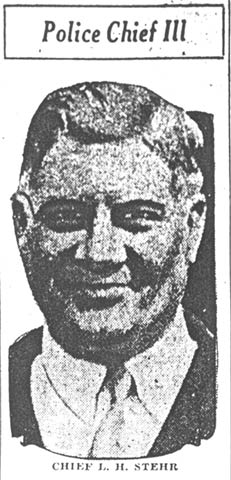
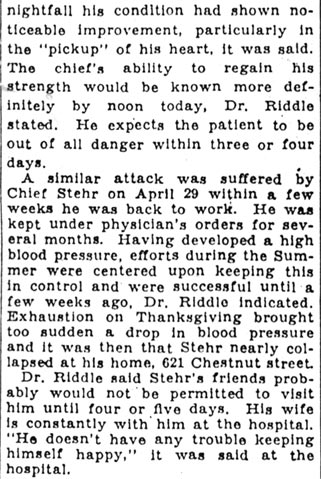
Chief Stehr Suffers From Heart Attack
Taken to Cooper Hospital as Pressure Becomes Alarming
Overwork, overexcitement and exhaustion put Chief Lewis H. Stehr in the hospital—care, calmness and a physical rebuilding will bring him out. That was what friends of Camden’s police chief were told last night by his physician, Dr. H. S. Riddle, 1006 Newton avenue.
Chief Stehr, who suffered a heart attack Thanksgiving Day, was removed to Cooper hospital yesterday. By nightfall his condition had shown noticeable improvement, particularly in the “pickup” of his heart, it was said. The chief’s ability to regain his strength would be known more definitely by noon today, Dr. Riddle stated. He expects the patient to be out of all danger within three or four days.
A similar attack was suffered by Chief Stehr on April 29 within a few weeks he was back to work. He was kept under physician’s orders for several months. Having developed a high blood pressure, efforts during the Summer were centered upon keeping this in control and were successful until a few weeks ago, Dr. Riddle indicated. Exhaustion on Thanksgiving brought too sudden a drop in blood pressure and it was then that Stehr nearly collapsed at his home, 621 Chestnut street.
Dr. Riddle said Stehr’s friends probably would not be permitted to visit him until four or five days. His wife is constantly with him at the hospital. “He doesn’t have any trouble keeping himself happy,” it was said at the hospital.
Stehr Is Improved, Physician Reports
Camden Evening Courier —
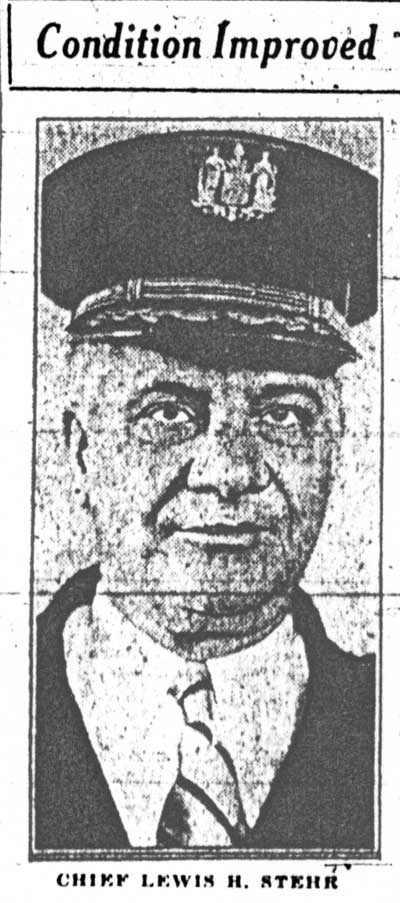
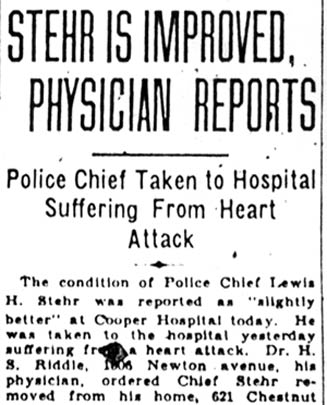
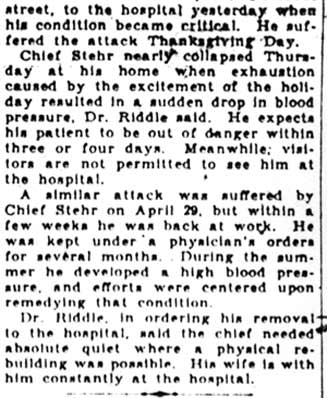
Stehr Is Improved, Physician Reports
Police Chief Taken to Hospital Suffering From Heart Attack
The condition of Police Chief Lewis H. Stehr was reported as “slightly better” at Cooper Hospital today. He was taken to the hospital yesterday suffering from a heart attack. Dr. H. S. Riddle, 1006 Newton avenue, his physician, ordered Chief Stehr removed from his home, 621 Chestnut street, to the hospital yesterday when his condition became critical. He suffered the attack Thanksgiving Day.
Chief Stehr nearly collapsed Thursday at his home when exhaustion caused by the excitement of the holiday resulted in a sudden drop in blood pressure, Dr. Riddle said. He expects his patient to be out of danger within three or four days. Meanwhile; visitors are not permitted to see him at the hospital.
A similar attack was suffered by Chief Stehr on April 29, but within a few weeks he was back at work. He was kept under a physician’s orders for several months. During the summer he developed a high blood pressure, and efforts were centered upon remedying that condition.
Dr. Riddle, in ordering his removal to the hospital, said the chief needed absolute quiet where a physical rebuilding was possible. His wife is with him constantly at the hospital.
Heart Attack Kills Chief Stehr After Illness of 10 Days
Camden Evening Courier —
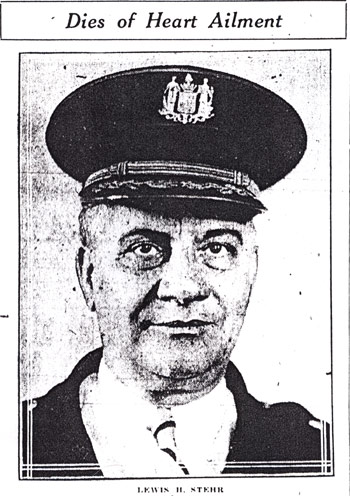
Dies of Heart Ailment
LEWIS H. STEHR
Police Chief Succumbs as He Asks Nurse Time; Had Been in Grave Condition But Was Expected to Recover.
Failing in Health Since Spring; Joined Force in 1905; Elevated From Captaincy to Inspectorship in 1927; Made Chief Year Later.
Chief of Police Lewis H. Stehr died at 11.30 a. m. today in Cooper Hospital.
The Camden police head, who resided at 621 Chestnut street, had been in the hospital since Dec. 1 stricken with a heart disease and kidney trouble. He had a similar attack last April.
His death was unexpected, although his condition was considered grave. He had just asked a nurse what time it was, and as she gave answer, he turned on his side, and his eyes closed. The nurse, alarmed, summoned a physician, who pronounced him dead.
Chief Stehr was 58, and is survived by his widow, Mrs. Anna Stehr They had no children. He was the son of the late Lewis Stehr, city assessor.
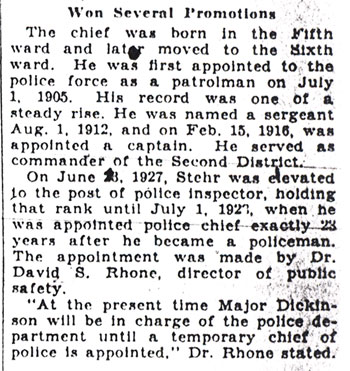
Won Several Promotions
The chief was born in the Fifth ward and later moved to the Sixth ward. He was first appointed to the police force as a patrolman on July 1, 1905. His record was one of a steady rise. He was named a sergeant Aug. 1, 1912, and on Feb. 15, 1916, was appointed a captain. He served as commander of the Second District.
On June 23, 1927, Stehr was elevated to the post of police inspector, holding that rank until July 1, 192[8], when he was appointed police chief exactly 23 years after he became a policeman. The appointment was made by Dr. David S. Rhone, director of public safety.
“At the present time Major Dickinson will be in charge of the police department until a temporary chief of police is appointed,” Dr. Rhone stated.
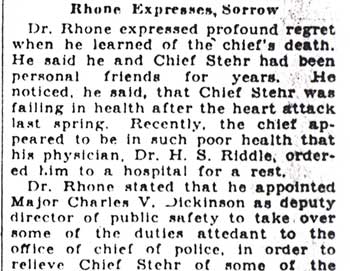
Rhone Expresses Sorrow
Dr. Rhone expressed profound regret when he learned of the chief’s death. He said he and Chief Stehr had been personal friends for years. He noticed, he said, that Chief Stehr was falling in health after the heart attack last spring. Recently, the chief appeared to be in such poor health that his physician, Dr. H. S. Riddle, ordered him to a hospital for a rest.
Dr. Rhone stated that he appointed Major Charles V. Dickinson as deputy director of public safety to take over some of the duties attendant to the office of chief of police, in order to relieve Chief Stehr of some of the pressure of his work, so that his health would not further be impaired.
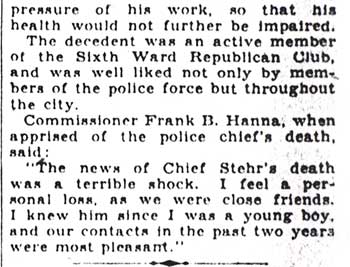
The decedent was an active member of the Sixth Ward Republican Club, and was well liked not only by members of the police force but throughout the city.
Commissioner Frank B. Hanna, when apprised of the police chief’s death, said:
“The news of Chief Stehr’s death was a terrible shock. I feel a personal loss, as we were close friends. I knew him since I was a young boy, and our contacts in the past two years were most pleasant.”
Lewis H. Stehr, Chief of Police, Dies Suddenly
Camden Morning Post —
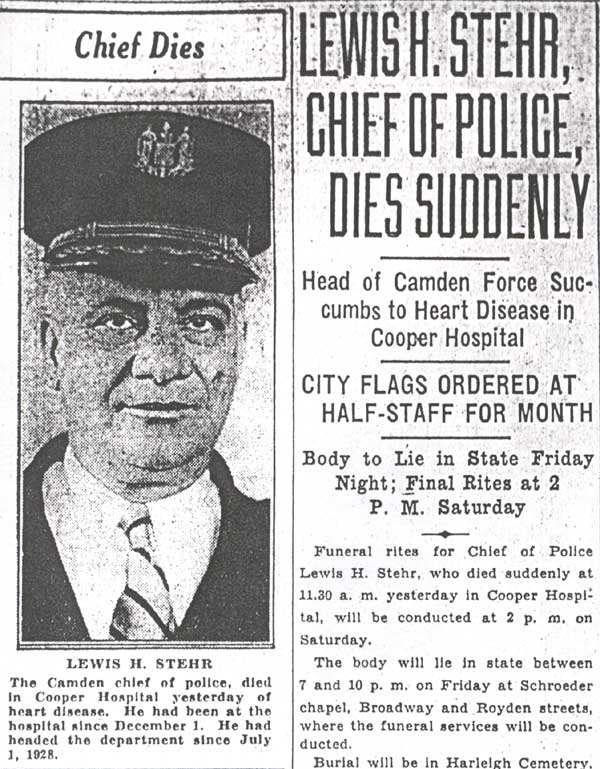
LEWIS H. STEHR — The Camden chief of police, died in Cooper Hospital yesterday of heart disease. He had been at the hospital since December 1. He had headed the department since July 1, 1928.
Head of Camden Force Succumbs to Heart Disease in Cooper Hospital
CITY FLAGS ORDERED AT HALF-STAFF FOR MONTH
Body to Lie in State Friday Night; Final Rites at 2 P. M. Saturday
Funeral rites for Chief of Police Lewis H. Stehr, who died suddenly at 11.30 a. m. yesterday in Cooper Hospital, will be conducted at 2 p. m. on Saturday.
The body will lie in state between 7 and 10 p. m. on Friday at Schroeder chapel, Broadway and Royden streets, where the funeral services will be conducted. Burial will be in Harleigh Cemetery.
The Camden police official, who lived at 621 Chestnut street, had been in the hospital since December 1, suffering from heart and kidney trouble. He suffered an earlier heart attack last April.
Chief Stehr’s death was unexpected, although his condition had been considered grave. He had just asked a nurse what time it was and collapsed as she answered. The nurse, alarmed, summoned a physician, who pronounced him dead.
Chief Stehr, the son of the late Lewis Stehr, city assessor, was 58, and is survived by his widow, Mrs. Anna Stehr. They had no children.
Mrs. Stehr had been at the bedside of her husband constantly since he was stricken Thanksgiving Day. Yesterday nurses assured her her husband’s condition was unchanged and she was making Christmas purchases at Chief Stehr’s request when he died.
Won Several Promotions
The chief was born in the Fifth ward and later moved to the Sixth ward. He was first appointed to the police force as a patrolman on July 1, 1905. His record was one of a steady rise. He was named a sergeant Aug. 1, 1912, and on Feb. 15, 1918, was appointed a captain. He served as commander of the Second District.
On June 23, 1927, Stehr was elevated to the post of police inspector, holding that rank until July 1, 1928, when he was appointed police chief exactly 23 years after he became a policeman. The appointment was made by Dr. David S. Rhone, director of public safety.
“At the present time Major Dickinson will be in charge of the police department until a temporary chief of police is appointed,” Dr. Rhone stated.
Rhone Expresses Sorrow
Dr. Rhone expressed profound regret when he learned of the chief’s death. He said he and Chief Stehr had been personal friends for years. He noticed, he said, that Chief Stehr was failing in health after the heart attack last spring. Recently, the chief appeared to be in such poor health that his physician, Dr. H. S. Riddle, ordered him to a hospital for a rest.
Dr. Rhone stated that he appointed Major Charles V. Dickinson as deputy director of public safety to take over some of the duties attendant to the office of chief of police, in order to relieve Chief Stehr of some of the pressure of his work, so that his health would not further be impaired.
The decedent was an active member of the Sixth Ward Republican Club, and was well liked not only by members of the police force but throughout the city.
Mayor Expresses Sorrow
Mayor Price issued the following statement: “I was very greatly shocked to learn of the death of Chief Stehr. While I understood he was in a serious physical condition, I did not anticipate his death.
“Chief Stehr had devoted practically his entire lifetime to the service of the city, having entered the police department in his early youth, and is entitled to the commendation of his fellow citizens for his efforts in the public service.”
Commissioner Frank B. Hanna, when apprised of the police chief’s death, said: “The news of Chief Stehr’s death was a terrible shock. I feel a personal loss, as we were close friends. I knew him since I was a young boy, and our contacts in the past two years were most pleasant.”
Prosecutor Clifford A. Baldwin declared: “The suddenness of the death of Chief Stehr comes as a shock to those of his friends who were wishing him well in his illness. His passing naturally causes grief to those whose work brought them into close contact with him.”
City Commissioner Clay W. Reesman said: “The passing of Chief Stehr is a great loss to the community. We were all hoping that Chief Stehr was on the road to recovery and only several days ago when I inquired at the hospital, I learned that his condition was greatly improved. His sudden passing is a terrible shock.” City officials last night ordered all flags lowered to half mast on all police stations for 30 days. Deputy Director Dickinson and Captain Arthur Colsey today will convey to Mrs. Stehr the police department’s official condolence.