Introduction
FREDERICK A. REX was born in March of 1850 in Pennsylvania, one of at least seven children born to John and Sarah Rex. His father owned a large farm in Whitpain Township, Montgomery County, Pennsylvania at the time of the 1850 Census.
When the Census was taken in 1870 Frederick Rex was working as bank clerk and living in Camden NJ. He subsequently went into the practice of law. Frederick A. Rex was not then married. The following year he helped found the Trimble Lodge No. 117, Free and Accepted Masons. He would wed M. Louise Fewsmith around 1877, a son, William, was born in December of that year. Daughter Elizabeth was born in late 1880. During the 1870s Frederick Rex also served as an officer with the Sixth Regiment, New Jersey National Guard.
Frederick A. Rex was a member of the First Presbyterian Church of Camden, where many other men prominent in the business and civic life of Camden attended, including Albert W. Markley, John F. Starr, Peter L. Voorhees, Charles Stockham, Christopher A. Bergen, Randal E. Morgan, L.T. Derousse, Charles Danenhower, Dr. James A. Armstrong, M.D., and Dr. J.V. Schenck, M.D.
At the time of the 1880 Census Frederick Rex and family lived at 726 Cooper Street. They moved to 533 Penn Street later in the decade, and lived there through 1890. Neighbors included F. Wayland Ayer and Richard Fetters Smith. During these years Frederick A. Rex was quite busy in both business and civic circles. Besides his law practice, he owned a coffee and tea business with an office at 20 Market Street and in Philadelphia. He also served as clerk in Camden’s District Court, and as treasurer of the Board of Education.
In 1895 Mrs. Louisa Rex was a charter member of the Woman’s Club of Camden.
Frederick A. Rex had moved to Merchantville by the summer of 1900, residing at 6 Clifton Avenue. The family was still there in 1910. He later took ill, and spent his last days in a South Jersey sanitarium. Frederick A. Rex died on July 17, 1916.
A Pleasant Surprise Party
Philadelphia newspaper — undated
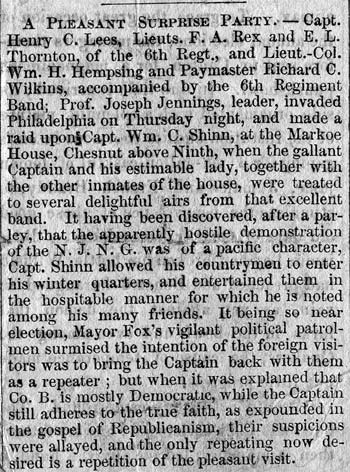
Capt. Henry C. Lees, Lieuts. F. A. Rex and E. L. Thornton, of the 6th Regt., and Lieut.-Col. Wm. H. Hempsing and Paymaster Richard C. Wilkins, accompanied by the 6th Regiment Band; Prof. Joseph Jennings, leader, invaded Philadelphia on Thursday night, and made a raid upon Capt. Wm. C. Shinn, at the Markoe House, Chesnut above Ninth, when the gallant Captain and his estimable lady, together with the other inmates of the house, were treated to several delightful airs from that excellent band. It having been discovered, after a parley, that the apparently hostile demonstration of the N. J. N. G. was of a pacific character, Capt. Shinn allowed his countrymen to enter his winter quarters, and entertained them in the hospitable manner for which he is noted among his many friends. It being so near election, Mayor Fox’s vigilant political patrolmen surmised the intention of the foreign visitors was to bring the Captain back with them as a repeater; but when it was explained that Co. B. is mostly Democratic, while the Captain still adheres to the true faith, as expounded in the gospel of Republicanism, their suspicions were allayed, and the only repeating now desired is a repetition of the pleasant visit.
Trade Cards from Frederick A. Rex & Company
1880s
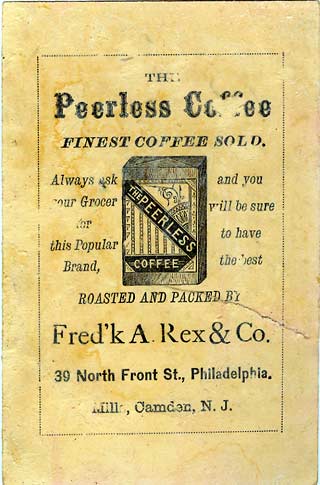
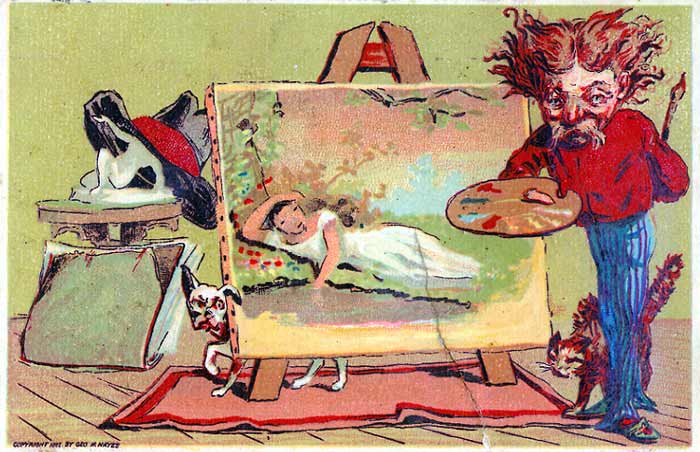
Trade cards from Frederick A. Rex & Company, 1880s
Newspaper Clipping
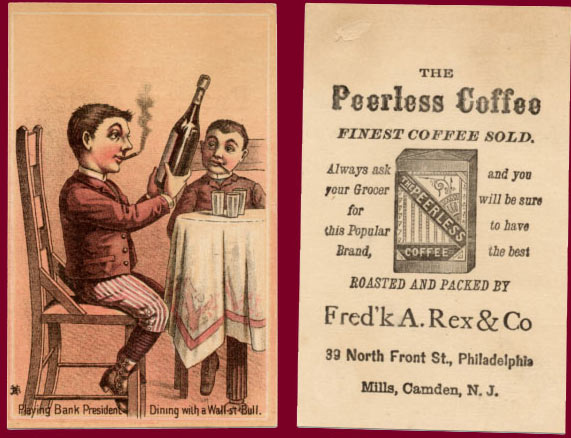
Newspaper clipping mentioning Frederick A. Rex
First Presbyterian Church
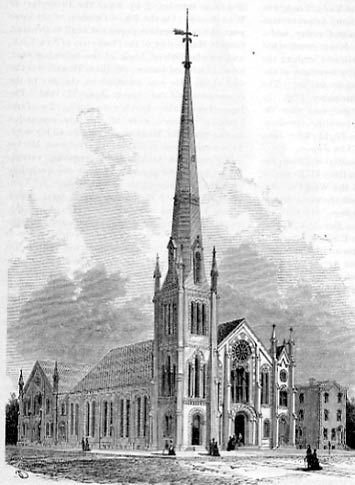
Named: First Presbyterian Church, Illustration published 1886, and Built by Mahlon E. Harden.
The First New Jersey District.
Philadelphia Inquirer —
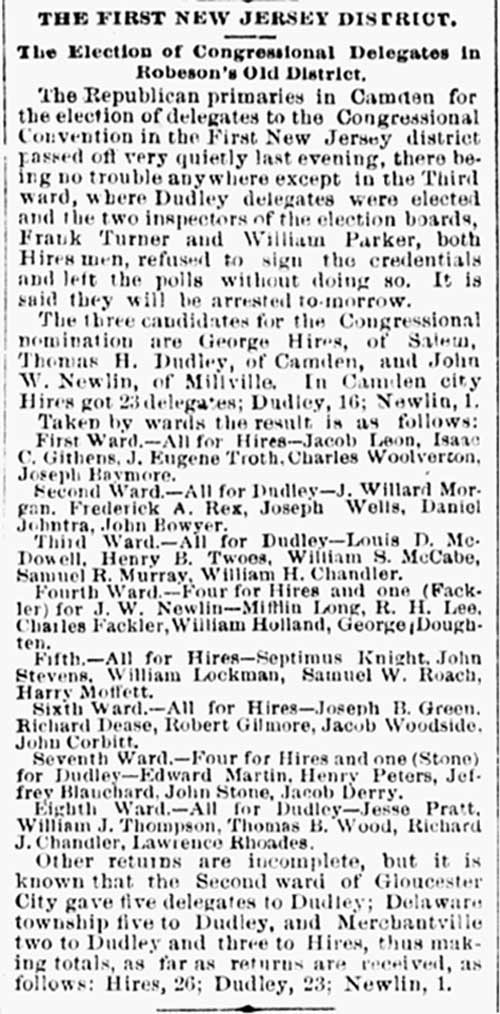
The Election of Congressional Delegates in Robeson’s Old District.
The Republican primaries in Camden for the election of delegates to the Congressional Convention in the First New Jersey district passed off very quietly last evening, there being no trouble anywhere except in the Third ward, where Dudley delegates were elected and the two inspectors of the election boards, Frank Turner and William Parker, both Hires men, refused to sign the credentials and left the polls without doing so. It is said they will be arrested to-morrow.
The three candidates for the Congressional nomination are George Hires, of Salem, Thomas H. Dudley, of Camden, and John W. Newlin, of Millville. In Camden city Hires got 23 delegates; Dudley, 16; Newlin, 1.
Taken by wards the result is as follows:
First Ward.—All for Hires—Jacob Leon, Isaac C. Githens, J. Eugene Troth, Charles Woolverton, Joseph Baymore.
Second Ward.—All for Dudley—J. Willard Morgan, Frederick A. Rex, Joseph Wells, Daniel Johntra, John Bowyer.
Third Ward.—All for Dudley—Louis D. McDowell, Henry B. Twoes, William S. McCabe, Samuel R. Murray, William H. Chandler.
Fourth Ward.—Four for Hires and one (Fackler) for J. W. Newlin—Mifflin Long, R. H. Lee, Charles Fackler, William Holland, George Doughten.
Fifth.—All for Hires—Septimus Knight, John Stevens, William Lockman, Samuel W. Roach, Harry Moffett.
Sixth Ward.—All for Hires—Joseph B. Green, Richard Dease, Robert Gilmore, Jacob Woodside, John Corbitt.
Seventh Ward.—Four for Hires and one (Stone) for Dudley—Edward Martin, Henry Peters, Jeffrey Blanchard, John Stone, Jacob Derry.
Eighth Ward.—All for Dudley—Jesse Pratt, William J. Thompson, Thomas B. Wood, Richard J. Chandler, Lawrence Rhoades.
Other returns are incomplete, but it is known that the Second ward of Gloucester City gave five delegates to Dudley; Delaware township five to Dudley, and Merchantville two to Dudley and three to Hires, thus making totals, as far as returns are received, as follows: Hires, 26; Dudley, 23; Newlin, 1.
First Ward Republican Club Meeting
Philadelphia Inquirer —
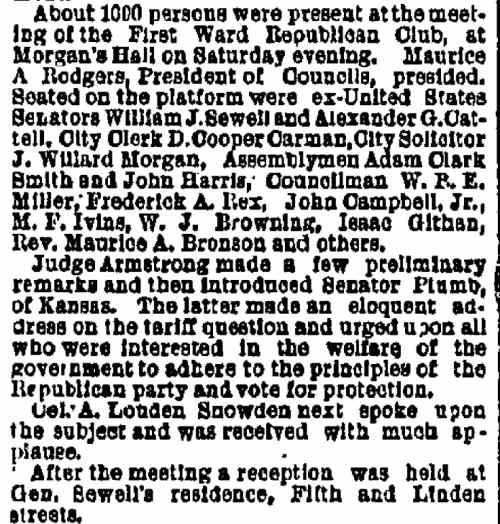
About 1000 persons were present at the meeting of the First Ward Republican Club, at Morgan’s Hall on Saturday evening. Maurice A. Rodgers, President of Councils, presided. Seated on the platform were ex-United States Senators William J. Sewell and Alexander G. Cattell, City Clerk D. Cooper Carman, City Solicitor J. Willard Morgan, Assemblymen Adam Clark Smith and John Harris; Councilman W. P. E. Miller, Frederick A. Rex, John Campbell, Jr., M. F. Ivins, W. J. Browning, Isaac Githean, Rev. Maurice A. Bronson and others.
Judge Armstrong made a few preliminary remarks and then introduced Senator Plumb, of Kansas. The latter made an eloquent address on the tariff question and urged upon all who were interested in the welfare of the government to adhere to the principles of the Republican party and vote for protection.
Col. A. Louden Snowden next spoke upon the subject and was received with much applause.
After the meeting a reception was held at Gen. Sewell’s residence, Fifth and Linden streets.
New Jersey News
Philadelphia Inquirer —
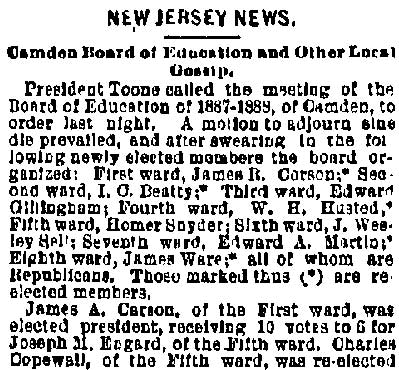
Camden Board of Education and Other Local Gossip.
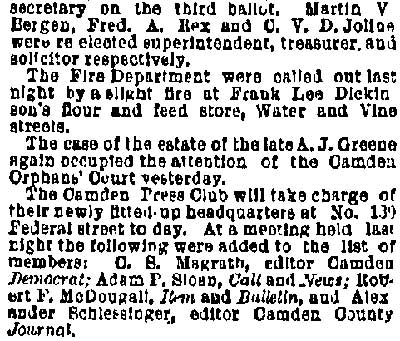
President Toone called the meeting of the Board of Education of 1887-1889, of Camden, to order last night. A motion to adjourn sine die prevailed, and after swearing in the following newly elected members the board organized: First ward, James R. Corson;* Second ward, I. C. Beatty;* Third ward, Edward Gillingham; Fourth ward, W. H. Husted,* Fifth ward, Homer Snyder; Sixth ward, J. Wesley Sell; Seventh ward, Edward A. Martin;* Eighth ward, James Ware;* all of whom are Republicans. Those marked thus (*) are re-elected members.
James A. Carson, of the First ward, was elected president, receiving 10 votes to 6 for Joseph M. Engard, of the Fifth ward. Charles Copewall, of the Fifth ward, was re-elected secretary on the third ballot. Martin V Bergen, Fred. A. Rex and C. V. D. Joline were re-elected superintendent, treasurer, and solicitor respectively.
The Fire Department were called out last night by a slight fire at Frank Lee Dickinson’s flour and feed store, Water and Vine Street.
The case of the estate of the late A. J. Greene again occupied the attention of the Camden Orphans’ Court yesterday.
The Camden Press Club will take charge of their newly fitted-up headquarters at No. 139 Federal Street to day. At a meeting held last night the following were added to the list of members: C. S. Magrath, editor Camden Democrat; Adam P. Sloan, Call and News; Robert F. McDougall, Item and Bulletin, and Alexander Schlessinger, editor Camden County Journal.
News in Camden County
Philadelphia Inquirer —
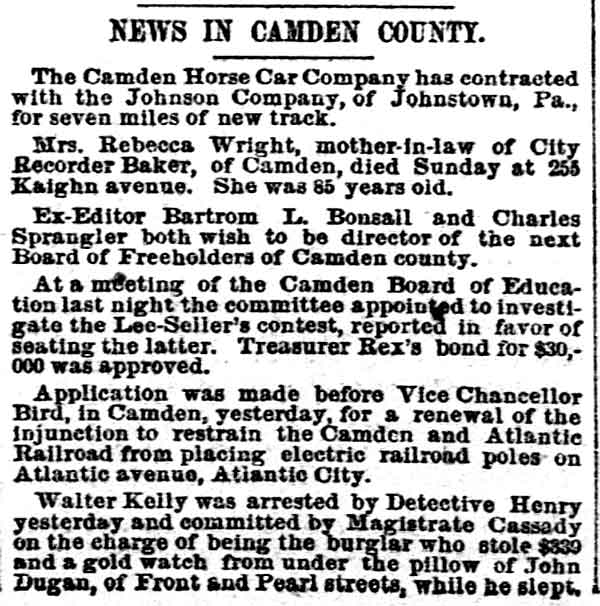
The Camden Horse Car Company has contracted with the Johnson Company, of Johnstown, Pa., for seven miles of new track.
Mrs. Rebecca Wright, mother-in-law of City Recorder Baker [sic], of Camden, died Sunday at 255 Kaighn avenue. She was 85 years old.
Ex-Editor Bartrom L. Bonsall and Charles Sprangler both wish to be director of the next Board of Freeholders of Camden county.
At a meeting of the Camden Board of Education last night the committee appointed to investigate the Lee-Seller’s contest, reported in favor of seating the latter. Treasurer Rex’s bond for $30,000 was approved.
Application was made before Vice Chancellor Bird, in Camden, yesterday, for a renewal of the injunction to restrain the Camden and Atlantic Railroad from placing electric railroad poles on Atlantic avenue, Atlantic City.
Walter Kelly was arrested by Detective Henry yesterday and committed by Magistrate Cassady on the charge of being the burglar who stole $339 and a gold watch from under the pillow of John Dugan, of Front and Pearl streets, while he slept.
A Dark Democratic Scheme
Philadelphia Inquirer —
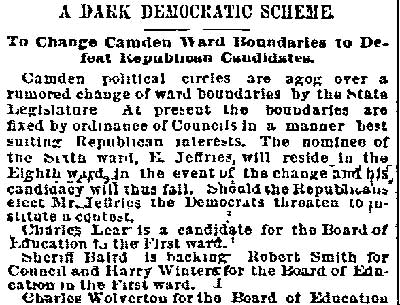
To Change Camden Ward Boundaries to Defeat Republican Candidates.
Camden political circles are agog over a rumored change of ward boundaries by the State Legislature. At present the boundaries are fixed by ordinance of Councils in a manner best suiting Republican interests. The nominee of the Sixth ward, E. Jeffries, will reside in the Eighth ward, in the event of the change and his candidacy will thus fail. Should the Republicans elect Mr. Jeffries the Democrats threaten to institute a contest.
Charles Lear is a candidate for the Board of Education to [sic] the First ward.
Sheriff Baird is backing Robert Smith for Council and Harry Winters for the Board of Education in the First ward.
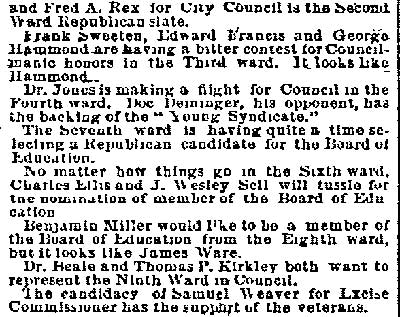
Charles Wolverton for the Board of Education and Fred A. Rex for City Council is the Second Ward Republican slate.
Frank Sweeten, Edward Francis and George Hammond are having a bitter contest for Councilmanic honors in the Third ward. It looks like Hammond.
Dr. Jones is making a fight for Council in the Fourth ward. Doc Deminger, his opponent, has the backing of the “Young Syndicate.”
The Seventh ward is having quite a time selecting a Republican candidate for the Board of Education.
No matter how things go in the Sixth ward, Charles Ellis and J. Wesley Sell will tussle for the nomination of member of the Board of Education.
Benjamin Miller would like to be a member of the Board of Education from the Eighth ward, but it looks like James Ware.
Dr. Heale and Thomas P. Kirkley both want to represent the Ninth Ward in Council.
The candidacy of Samuel Weaver for Excise Commissioner has the support of the veterans.
Camden’s News Budget
Philadelphia Inquirer —
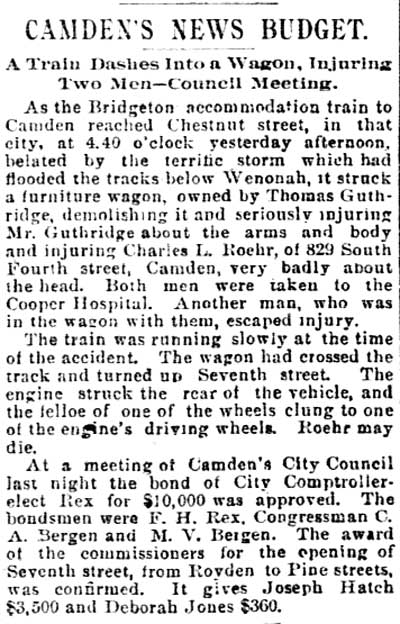
A Train Dashes Into a Wagon, Injuring Two Men—Council Meeting.
As the Bridgeton accommodation train to Camden reached Chestnut street, in that city, at 4.40 o’clock yesterday afternoon, belated by the terrific storm which had flooded the tracks below Wenonah, it struck a furniture wagon, owned by Thomas Guthridge, demolishing it and seriously injuring Mr. Guthridge about the arms and body and injuring Charles L. Roehr, of 829 South Fourth street, Camden, very badly about the head. Both men were taken to the Cooper Hospital. Another man, who was in the wagon with them, escaped injury.
The train was running slowly at the time of the accident. The wagon had crossed the track and turned up Seventh street. The engine struck the rear of the vehicle, and the felloe of one of the wheels clung to one of the engine’s driving wheels. Roehr may die.
At a meeting of Camden’s City Council last night the bond of City Comptroller-elect Rex for $10,000 was approved. The bondsmen were F. H. Rex, Congressman C. A. Bergen and M. V. Bergen. The award of the commissioners for the opening of Seventh street, from Royden to Pine streets, was confirmed. It gives Joseph Hatch $3,500 and Deborah Jones $360.
Hill Hired to Murder Dodson
Philadelphia Inquirer —

A Youthful Slayer’s Story of a Cold-Blooded Crime.
Plied With Liquor and Urged on by Reed and Derrickson.
Remarkable Defense in a Camden Murder Trial—The Prisoner Unconcerned—His Counsel Endeavoring to Secure a Second Degree Verdict.
Lolling in a big arm chair in the Camden Criminal Court yesterday John Hill, a diminutive specimen of colored humanity, listened with baffling unconcern to evidence which is likely to consign him to the gallows. He was on trial for the murder of Joseph Dodson, on October 16 last.
Hill is barely four feet and a half high, 18 years old and an orphan. If his story is true, he was hired to kill Dodson by Alfred Reed and Marwood Derrickson, proprietors of a colored saloon and “free-and-easy” at Seventh and Sycamore streets, where he was employed. Reed and Derrickson are under indictment as accomplices, and their trial will follow Hill’s.
POLITICS, WHISKY AND MURDER.
There seems to have been a combination of politics, hatred and whisky back of the Dodson murder. The parties concerned represent an element of Camden’s colored population which keeps the criminal court busy.
Besides keeping a saloon and dance hall Reed and Derrickson are Democratic “workers.” As a large majority of the colored voters of their ward are Republicans, political disputes and rows in their place are of frequent occurrence.
Dodson was just coming of age and had announced his intention of voting the Republican ticket. This put him in ill favor with Reed and Derrickson, as well as with young Hill, who was employed by them as floor manager of their dance hall.
Dodson was shot about 1 o’clock on Sunday morning, October 6. On the preceding Thursday night he raised a row in the dance hall and beat young Hill when the latter tried to eject him. On the following night Hill claims that Dodson chased him down the street with a revolver and threatened to kill him.
THE PRISONER’S STORY.
Hill’s story of the murder as told by himself on the witness stand in his own defense is as follows:
“On Saturday ‘Sweeney’ (Marwood) Derrickson came to me and said, ‘Hilly, if you’ll do something for me and let no one know it, I’ll give you $2.50. I want you to kill Dodson. No one can hurt you, as we stand in with the Democrats.’ I didn’t want to do it, and told them so.
“That night I took a drink Derrickson gave me, and it made me feel funny; it went to my head. He poured something out of a bottle with a seal on it into my blackberry brandy and made me drink it. He gave me the revolver and told me to go out. When I got out someone said ‘shoot,’ and I shot and hit somebody. Then I went into the saloon and got $1.50 from Reed. That’s all I remember until the next morning, when I was arrested.”
THE STATE’S EVIDENCE.
Supreme Court Justice Garrison and Lay Judge Gaunts sat on the bench when the case was opened by Prosecutor Jenkins. Hill, who was defended by Lawyers F. A. Rex and Harry S. Scovel, pleaded not guilty. After twenty-two challenges a jury was secured.
Dr. Edward S. Schellinger, former resident physician at the Cooper Hospital, testified that Dodson died in half an hour after his admission to the hospital. County Physician Iszard exhibited the murdered man’s skull, showing the hole made by the bullet, just above the left eye.
George Hinson, who was with Dodson when he was shot, said he saw a flash about 30 feet away and Dodson fell. They had just stepped out of Reed & Derrickson’s place and were on their way home.
Alexander Matthews testified that a few minutes before the shooting, while he was sitting on Reed & Derrickson’s step, Hill said to him that Dodson and another fellow were after him, and if they did anything to him he would shoot Dodson.
THREATENED TO KILL DODSON.
Moses Hanson and Charles Monroe told of threats Hill made on Saturday, that he was going to buy a “gun” and shoot Dodson. Monroe said that after the shooting Hill ran into the saloon and cried, “I shot Joe Dodson, but he shot at me first.” Hill asked Reed and Derrickson what he should do, and they said he would have to fix that for himself.
Prosecutor Jenkins tried to have the stenographic report of the evidence at the Coroner’s inquest introduced, but it was ruled out. Then he called Constable Beckett to testify that Hill had admitted at the inquest that he had killed Dodson.
DRUNK AND DRUGGED.
This closed the State’s case, and in opening for the defense Lawyer Scovel said they would show that Reed and Derrickson urged Hill on to do the shooting and plied him with liquor, and drugged him until he didn’t know what he was doing.
The youthful murderer was put on the stand and told his story as given above.
County Detective Gallagher testified to finding the revolver in a drawer in Reed and Derrickson’s saloon. It belonged to the latter. It is a self-cocking weapon of the “English bull-dog” pattern. Five chambers were loaded and two empty.
Several witnesses, all colored, testified that Hill was under the influence of liquor the night of the shooting.
DRUGGING DENIED.
Albert Reed and Marwood Derrickson were called in rebuttal by the State and both denied that they had drugged Hill’s liquor. Their criminal record was brought up against them by the defense on cross-examination.
All the evidence was in when court adjourned, and the case will be argued this morning. Hill’s lawyers’ hope, to secure a verdict of murder in the second degree.
Hill Convicted of Murder.
Philadelphia Inquirer —
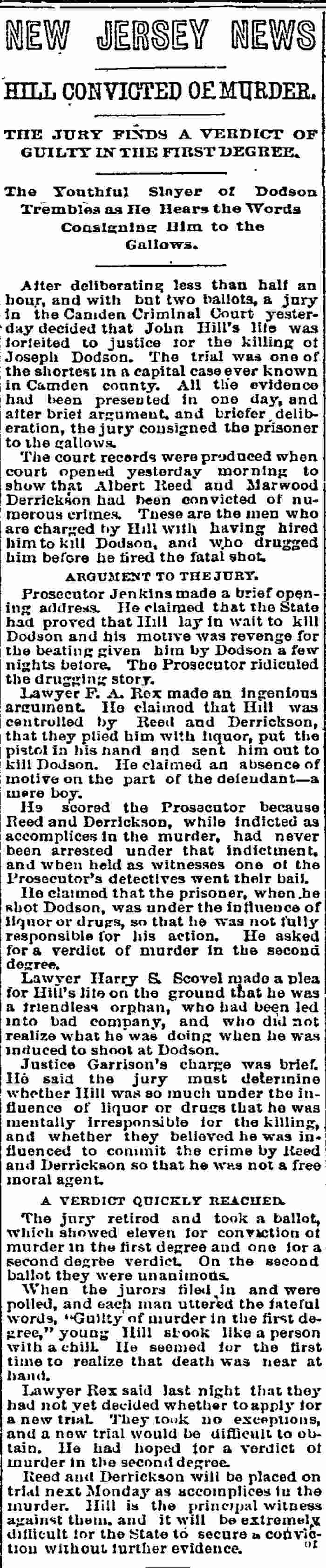
The Jury Finds a Verdict of Guilty in the First Degree.
The Youthful Slayer of Dodson Trembles as He Hears the Words Consigning Him to the Gallows.
After deliberating less than half an hour, and with but two ballots, a jury in the Camden Criminal Court yesterday decided that John Hill’s life was forfeited to justice for the killing of Joseph Dodson. The trial was one of the shortest in a capital case ever known in Camden county. All the evidence had been presented in one day, and after brief argument, and briefer deliberation, the jury consigned the prisoner to the gallows.
The court records were produced when court opened yesterday morning to show that Albert Reed and Marwood Derrickson had been convicted of numerous crimes. These are the men who are charged by Hill with having hired him to kill Dodson, and who drugged him before he fired the fatal shot.
ARGUMENT TO THE JURY.
Prosecutor Jenkins made a brief opening address. He claimed that the State had proved that Hill lay in wait to kill Dodson and his motive was revenge for the beating given him by Dodson a few nights before. The Prosecutor ridiculed the drugging story.
Lawyer F. A. Rex made an ingenious argument. He claimed that Hill was controlled by Reed and Derrickson, that they plied him with liquor, put the pistol in his hand and sent him out to kill Dodson. He claimed an absence of motive on the part of the defendant—a mere boy.
He scored the Prosecutor because Reed and Derrickson, while indicted as accomplices in the murder, had never been arrested under that indictment, and when held as witnesses one of the Prosecutor’s detectives went their bail.
He claimed that the prisoner, when he shot Dodson, was under the influence of liquor or drugs, so that he was not fully responsible for his action. He asked for a verdict of murder in the second degree.
Lawyer Harry S. Scovel made a plea for Hill’s life on the ground that he was a friendless orphan, who had been led into bad company, and who did not realize what he was doing when he was induced to shoot at Dodson.
Justice Garrison’s charge was brief. He said the jury must determine whether Hill was so much under the influence of liquor or drugs that he was mentally irresponsible for the killing, and whether they believed he was influenced to commit the crime by Reed and Derrickson so that he was not a free moral agent.
A VERDICT QUICKLY REACHED.
The jury retired and took a ballot, which showed eleven for conviction of murder in the first degree and one for a second degree verdict. On the second ballot they were unanimous.
When the jurors filed in and were polled, and each man uttered the fateful words, “Guilty of murder in the first degree,” young Hill shook like a person with a chill. He seemed for the first time to realize that death was near at hand.
Lawyer Rex said last night that they had not yet decided whether to apply for a new trial. They took no exceptions, and a new trial would be difficult to obtain. He had hoped for a verdict of murder in the second degree.
Reed and Derrickson will be placed on trial next Monday as accomplices in the murder. Hill is the principal witness against them, and it will be extremely difficult for the State to secure a conviction without further evidence.
Harrisburg Patriot — April 14, 1893

Named: Henry J. West, J. Wesley Sell, Joseph Porter, John Hill, Albert Reed, Frederick A. Rex, Charles G. Garrison, Joseph Dodson, Marwood Derrickson, and George W. Beckett.
Hill Faced Death with Firmness
Philadelphia Inquirer —

NEW JERSEY NEWS
The Youthful Colored Murderer Hanged in the Camden Jail.
Religion Braced His Nerves and He Felt No Fear.
A Quiet, Speedy Execution, and Death Was Quick and Apparently Painless—The Murder of Joseph Dodson Avenged Without the Usual Delay in Such Cases.
Camden county’s new gallows scored its first victim to-day when John Hill was hanged for the murder of Joseph Dodson. The execution took place at the County Jail. It was successfully conducted and was devoid of sensational incidents.
The gallows had been erected in a room with a lofty ceiling in the southeast corner of the jail building. Tall windows looked out on Federal street and Broadway, but they were veiled with dark curtains, which gave a sombre hue to the room. The instrument of death had been built on plans furnished by the Sheriff, modeled after the gallows used in the Philadelphia County Prison. There were two trap doors, which fell down when a lever was pulled, allowing the condemned man to fall about seven feet.
John Hill, the murderer, was a small, slender youth, in his 18th year. He had professed conversion after his conviction and walked firmly to the gallows, having overcome the terror of death by his religious faith.
AROUSED FROM HIS LAST SLEEP.
Hill was awakened from a sound slumber at 6.30 o’clock by Constable Renner, one of the death watch. He dressed himself in a new suit of black diagonal striped goods purchased by the Sheriff for the execution.
A gray mist hung like a veil before the jail windows, and Hill said he regretted this for he had hoped to see the sun shine once more before he died.
He displayed no fear of death, and when his lawyer, Frederick A. Rex, came at 8 o’clock to bid him good-bye the condemned lad said:
“I am not afraid to die, for I love Jesus.”
Hill ate sparingly of the breakfast of beefsteak and potatoes sent in from a neighboring restaurant, and satisfied his longing for pie by eating a big piece of the pastry. Then he lit a cigar and paced up and down the corridor until the arrival of his spiritual adviser, Rev. J. H. Scott, a colored Methodist minister. The last hour preceding the execution was spent in prayer and reading the Bible.
WORE A ROSE TO THE GALLOWS.
Before going to the gallows Constable Hunt handed the lad a white rose, which he pinned on his coat. When Hill’s body fell the rose broke from its stem.
At twenty minutes past 10 o’clock, County Clerk Barber called the roll of the Sheriff’s jury in the jailor’s office. They all responded and took the oath to see that the death penalty was carried into effect. Then the spectators were drawn up two by two, in a line at the left of the door from which the prisoner would emerge as he passed from the jail to the place of execution.
It was half-past 10 when these preparations were made and the condemned man sent for.
His hands had been secured behind his back with handcuffs and he walked with unfaltering steps down the iron stairways of the jail, through a dark passage way and into the corridor, where the Sheriff stood, with the black cap in his hand.
The minister walked by Hill’s side. In front were Deputy Sheriff Sell and ex-Deputy Joseph Porter. Constables Hunt and Renner, the death watch, brought up the rear. There was a shuffling of feet in the line of spectators and the procession moved along the corridor and into the dimly-lighted room, where the gallows stood.
FACED DEATH WITHOUT FLINCHING.
Hill looked at the instrument of death without flinching. He constantly repeated, in a whisper, “Jesus, save me.”
With firm tread he mounted the steps to the scaffold. The work of death was quickly done. There was no prayer or final speech. The minister whispered a last word of cheer and stepped back.
It took but a minute for the Sheriff to drop the noose over the lad’s head, for ex-Deputy Porter to pull down the black cap, and then both men stepped back from the drop. Hill did not waver.
The Sheriff reached for the cord attached to the lever under the drop, gave a short, quick pull, and as the doors fell with a crash the murderer’s body dropped, whirled once around, and then hung motionless.
A PAINLESS DEATH.
There were no convulsive movements of the body, although the legs were not pinioned. County Physician Iszard, assisted by Coroner’s Physician Mattern, of Philadelphia, and Drs. Tomlinson, Jones and Levis, of Camden, timed the fleeting spark of life.
In four minutes and fourteen seconds the pulse stopped beating and at the end of six minutes and fifty-seven seconds the action of the heart ceased. The body had been shaken slightly by a few tremors, but there was no death struggle.
After the body had been hanging for twenty minutes the noose was unloosened and the corpse carried into a room adjoining the jailor’s office. The eyes were closed and the face bore no evidence of a violent death.
The silent spectators formed a group around the corpse, while Rev. Mr. Scott read the Methodist service for the dead. Four hours later the physicians made an autopsy and late in the afternoon Coroner Jefferis conveyed the remains in his dead wagon to the New Camden Cemetery where they were interred in a grave paid for by the county.
SWIFT JERSEY JUSTICE.
Jersey justice has not been leaden-heeled in Hill’s case. It is less than six months since he committed the crime for which the law took his life. At 1 o’clock on Sunday morning, October 16, 1892, John Hill, secreted in the bushes near Reed & Derrickson’s saloon, at Seventh and Sycamore streets, fired a bullet into Joseph Dodson’s brain.
The latter was a young colored man who had beaten Hill during a row, a few days previously, in the dance hall attached to the saloon. Hill had threatened to get even with Dodson. He took a revolver from a drawer in the saloon, drank liquor to nerve himself for the deed, and then fired the fatal shot.
At the trial, early in February last, Hill swore that Reed & Derrickson, the proprietors of the saloon, had hired him to kill Dodson. The two men were tried as accessories and acquitted. Three weeks ago Hill confessed that his charge against these two men was false.
The Mayor’s Appointments
Camden Daily Telegram —

He Announced Several This Noon.
COMMISSIONERS OF INSTRUCTION.
The Old Members Re-named With the Exception of the Member From the Seventh Ward—Police Appointments and Resignations.
Mayor Westcott this noon made the following appointments as Commissioners of Public instruction:
Messrs. George D. Borton, of the First ward; Samuel Iszard, of the Second ward; Charles H. Ellis, Jr., of the Sixth ward, and James Hanson, to succeed Charles Hewston, of the Seventh ward.
The officers of the Commission hold over another year.
The following appointments were made on the police force:
First Ward—James Elberson, Charles Wilbur, Samuel H. Sheer.
Second Ward—No appointments.
Third Ward—John Sinclair, E. D. Stein.
Fourth Ward—No appointments.
Fifth Ward—Albert Shaw, Charles Fitzsimmons.
Sixth Ward—Abraham Jackson.
Seventh Ward—Alfred Sayres, Edward Hyde.
Eighth Ward—Thomas Buchanan, Jacob A. Hicks (colored).
Ninth Ward—No appointments.
Mayor Westcott has requested the resignation of all the members of the police force who served under the Police Commission, to take effect May 1. They are Policemen Peall, Horner, Painter, Mullane, Miller and Reed.
POLITICAL POINTERS.
Who will be the postmaster?
Who will be the next prosecutor?
Many of the ward workers are suffering from election colds.
The name of Harry Moffitt was left out of the columns of honorable mention with the other hustlers of election day.
Senator Rogers and Messrs. Stafford and Watson, of the House are fully coming up to the expectations of their constituents.
If the Mayor could arrange it to hold his hearings a trifle earlier it would be a great source of satisfaction to the Camden afternoon papers.
There is still great anxiety on the part of the public as to the outcome of the present session of the legislature. Thus far their public acts have been highly commendable.
The abolishment of the Police Justice act restores to office the City Recorder, Benjamin M. Braker, who would be qualified to act in place of the Mayor should the Chief Executive be taken sick.
Jos. Potter, the new member of Council from the First ward is a man of wide business experience and will prove much advantage to the many large financial interests that will come under his care.
Owing to the satisfactory working of the present school commission in the two second-class counties up the State, the legislature made no change in the mode of placing the members as was anticipated.
Jos. B. Fox, of the Fourth ward, is what might be termed an old reliable, having had a long and varied experience in public affairs. He is always conservative in the expenditure of city money. He is always safe to trust.
Charles Sayrs, of the Seventh ward, who had a short experience in the present Council, but enough to make him feel at home among public affairs, is neck and ears in work between his real estate business and Councilmanic duties.
The colored people of the lower section of the city are anxious to see Squire Drake, the ex-Republican and ex-member of the School Board, come out of the Court House, where he holds a position under the Thompson Freeholders.
“Father” Figner is a proud sire. He was a member and president of Council in his days, and now sees his son treading in his footsteps. Mr. Figner, Jr., having been sent to Council from the Sixth ward on Tuesday by a large majority.
A special election will not be necessary for the new Board of Freeholders, as the City Council and Township Committees will appoint Freeholders who will serve until the Spring of 1895. The appointments will be made about the middle of May.
Arthur Bedell is spoken of as a candidate for the presidency of the new City Council. He is a stalwart and is never afraid to define his position on all public questions. He is one of those men who makes strong, warm friends and also creates an opposition of like force.
William D. Brown, the Secretary of the Board of Education, and Fred A. Rex, Treasurer, are quite pleased over the report of the committee on accounts and Expert O’Shaughnessy, they having examined the books of Messrs. Rex and Brown and found them correctly kept.
The library of the Camden public schools is one to be highly appreciated and much is due to the care with Miss Blowe the librarian has attended to her duties. She will hold over another year and should be allowed to retain the office as long as she merits it, and she surely does now.
J. R. Carson, the retiring member of Council from the First ward, is highly spoken of by his associates on committees and by Clerk Varney for the mature judgment displayed in the management of city affairs. It is with a general expression of regret that the city is to lose his service.
The reform in the Board of Freeholders can’t come too soon. If the public is to judge of the care of property given by the Democrats in the county, by the “hog combine” in this city, an inventory of the public property when turned over will make interesting reading. Ex-officials guarantee to save enough in the Board, if returned to their offices, to pay the expense of a special election, if one was necessary.
W. J. Bradley has been asked if he was a candidate for president of the new City Council. His reply was that he had not sought it in the first place, and would not seek it now, but whether he became president or remained merely a member on the floor, he would endeavor to discharge his duties in the interests of the city. He is commended by all who came in contact with him during the past year as one who had a new Camden at heart.
Concluding Court.
Camden Post —

Still Gets One Year for Shooting His Wife.
HIS PLEA TO THE COURT TODAY.
Refusal to Commute Harriet Smith’s Sentence. Other Matters That Were Finished Up This Morning
In the Quarter Sessions this morning the remnants of the late session were finished up.
Wm. Henry Harrison Still, who plead guilty to shooting his wife, was sentenced to one year in State Prison.
Lawyer John L. Semple made a plea for Still, and the latter told on the stand how for months he had known of his wife’s intimacy with Harry Gray. For the sake of his eight children he condoned the offense. On the day previous to the shooting he had gone to work at the Kirkwood ice pond. Gray was working there, and when Still went to work Gray left the pond. When Still went home it was some time before his wife let him in the house.
On the following morning he found footsteps around the house. After quarrelling with his wife for some time he finally shot her three times. He thought a great deal of his wife and gave her his money at the end of every month.
The mother of Gray recently showed Still a letter, he said, in which his (Still’s) wife acknowledged that her last child was Gray’s.
Lawyer Semple contended that had Still stood trial instead of pleading guilty he would never have been convicted.
After being out for a half hour the court said it was satisfied that Still had attempted to kill his wife and that had he accomplished murder he would have been convicted of murder in the first degree.
The Court then sentenced him to one year at hard labor.
Gilbert Boulton’s case then came up. Boulton had been sentenced to one year for assault and battery. Boulton was a member of the notorious “Spider gang.”
Lawyer Fred. A. Rex appeared with Boulton’s father, but the Court refused to revoke the sentence.
Judge Vroom said he saw no injustice in the sentence imposed.
Lawyer Harry S. Scovel made a strong plea in behalf of Harriet Smith, who was sentenced to one year for policy writing.
Mr. Scovel said that on Friday last he had said to the Court that Mrs. Smith had previously been convicted, but after going over the court records he found that this was not so. He had advised her to plead non vult contendre because of this impression, and now he felt that her sentence came through his error. He asked that her sentence be changed to a term in the county jail and a fine. Mr. Scovel said she was in a bad state of health and this could be shown by several physicians. He did not ask for her escape from punishment, but for leniency.
Lawyer Rex followed Mr. Scovel, but the Court was determined, and after a conference Judge Vroom said the Court had carefully considered the matter and would absolve Mr. Scovel from anything he had said. They had had a careful consideration in the first place. They had an object in sentencing these people, and while they feel sorry for the woman they must adhere to the object in view and must decline to change the sentence.
Mrs. Garwood was in court to plead for a commutation of the sentence of her landlord, Walter Garwood, who got one year for policy writing.
The Court said it was willing to hear Mrs. Garwood, but it was positive that Garwood perjured himself on the stand and it was not inclined to reduce his fine.
Mrs. Garwood did not make herself heard. Court was adjourned.
No Hope for Policy Writers
Camden Daily Telegram —
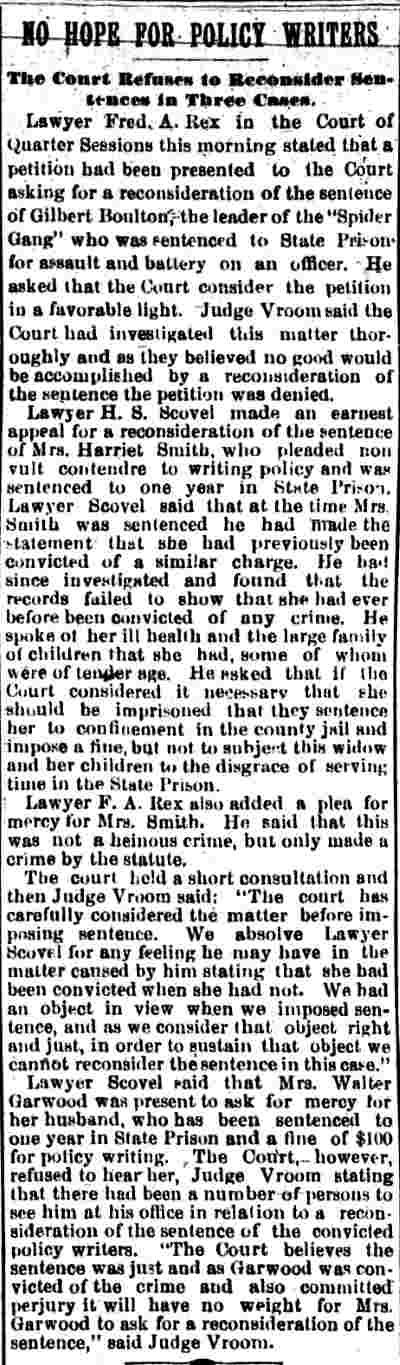
The Court Refuses to Reconsider Sentences in Three Cases.
Lawyer Fred. A. Rex in the Court of Quarter Sessions this morning stated that a petition had been presented to the Court asking for a reconsideration of the sentence of Gilbert Boulton, the leader of the “Spider Gang” who was sentenced to State Prison for assault and battery on an officer. He asked that the Court consider the petition in a favorable light. Judge Vroom said the Court had investigated this matter thoroughly and as they believed no good would be accomplished by a reconsideration of the sentence the petition was denied.
Lawyer H. S. Scovel made an earnest appeal for a reconsideration of the sentence of Mrs. Harriet Smith, who pleaded non vult contendre [sic] to writing policy and was sentenced to one year in State Prison. Lawyer Scovel said that at the time Mrs. Smith was sentenced he had made the statement that she had previously been convicted of a similar charge. He had since investigated and found that the records failed to show that she had ever before been convicted of any crime. He spoke of her ill health and the large family of children that she had, some of whom were of tender age. He asked that if the Court considered it necessary that she should be imprisoned that they sentence her to confinement in the county jail and impose a fine, but not to subject this widow and her children to the disgrace of serving time in the State Prison.
Lawyer F. A. Rex also added a plea for mercy for Mrs. Smith. He said that this was not a heinous crime, but only made a crime by the statute.
The court held a short consultation and then Judge Vroom said: “The court has carefully considered the matter before imposing sentence. We absolve Lawyer Scovel for any feeling he may have in the matter caused by him stating that she had been convicted when she had not. We had an object in view when we imposed sentence, and as we consider that object right and just, in order to sustain that object we cannot reconsider the sentence in this case.”
Lawyer Scovel said that Mrs. Walter Garwood was present to ask for mercy for her husband, who has been sentenced to one year in State Prison and a fine of $100 for policy writing. The Court, however, refused to hear her, Judge Vroom stating that there had been a number of persons to see him at his office in relation to a reconsideration of the sentence of the convicted policy writers. “The Court believes the sentence was just and as Garwood was convicted of the crime and also committed perjury it will have no weight for Mrs. Garwood to ask for a reconsideration of the sentence,” said Judge Vroom.
Did Not Go to Trenton
Camden Daily Telegram —
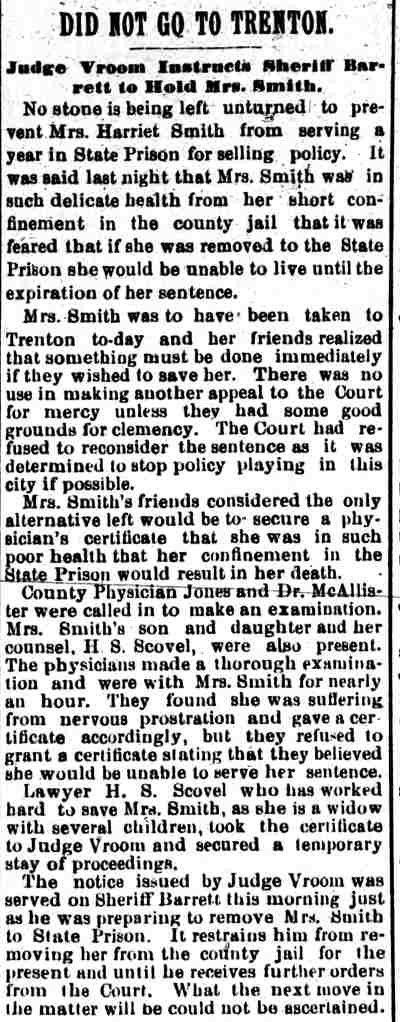
DID NOT GO TO TRENTON.
Judge Vroom Instructs Sheriff Barrett to Hold Mrs. Smith.
No stone is being left unturned to prevent Mrs. Harriet Smith from serving a year in State Prison for selling policy. It was said last night that Mrs. Smith was in such delicate health from her short confinement in the county jail that it was feared that if she was removed to the State Prison she would be unable to live until the expiration of her sentence.
Mrs. Smith was to have been taken to Trenton to-day and her friends realized that something must be done immediately if they wished to save her. There was no use in making another appeal to the Court for mercy unless they had some good grounds for clemency. The Court had refused to reconsider the sentence as it was determined to stop policy playing in this city if possible.
Mrs. Smith’s friends considered the only alternative left would be to secure a physician’s certificate that she was in such poor health that her confinement in the State Prison would result in her death.
County Physician Jones and Dr. McAllister were called in to make an examination. Mrs. Smith’s son and daughter and her counsel, H. S. Scovel, were also present. The physicians made a thorough examination and were with Mrs. Smith for nearly an hour. They found she was suffering from nervous prostration and gave a certificate accordingly, but they refused to grant a certificate stating that they believed she would be unable to serve her sentence.
Lawyer H. S. Scovel who has worked hard to save Mrs. Smith, as she is a widow with several children, took the certificate to Judge Vroom and secured a temporary stay of proceedings.
The notice issued by Judge Vroom was served on Sheriff Barrett this morning just as he was preparing to remove Mrs. Smith to State Prison. It restrains him from removing her from the county jail for the present and until he receives further orders from the Court. What the next move in the matter will be could not be ascertained.
Benton Hall Case
Camden Post —

BENTON HALL CASE
Lawyer Crandall Asks for a New Writ of Error.
CASE OUT OF THE COURT’S HANDS
Judge Carrow Asks for a Reconsideration of Sentence in the Case — Still Trying to Keep Harriet Smith from State Prison.
Edward Benton and Joseph Hall, who were sentenced to three months each on conviction for criminal libel and whose appeal to the Supreme Court was dismissed on Tuesday, owing to the neglect of Counselor John J. Crandall, who failed to appear, have not yet given up their fight.
Judge Carrow has been retained, and the case assumes another phase. In court this morning Prosecutor Jenkins declared that if ever there was a manifestation of counsel’s neglect this was one.
The court gave Crandall an opportunity for argument tomorrow, when it is expected the remitater [sic] will arrive.
Lawyer Wm. J. Kraft said that Judge Carrow was counsel in the case also, and would have something to say.
“If Carrow is in the case I’ll withdraw,” declared Lawyer Crandall.
Later on Judge Carrow appeared and asked that the Court reconsider the sentence of three months in jail and make the sentence a fine. He said that while he had not been acting openly he had all along been associated with the defense. He placed the case in Mr. Crandall’s hands.
Mr. Carrow did not appear as hired counsel, but the defendants were friends of his and he made this plea for them. Obvious punishment was already had. The crime was not of a serious character. The publication was made in good faith and for the good of the public. The defendant’s did not know that Kappel and Cable was the same man. There was some foundation for the article and it was admitted at the trial that money had been unlawfully obtained.
A fine, Judge Carrow said, would dispose of the matter, and the best element of this county wanted the sentence reconsidered.
The Court said it could do nothing now as it was out of the Court’s hands, but the matter could be heard when the records arrive from the Supreme Court.
In the matter of Harriet Smith, who was sentenced to one year in State Prison for policy writing, County Physician Jones was called to the stand. He said he had examined Mrs. Smith’s condition in jail and found her suffering from palpitation of the heart. Dr. Jones said that in his opinion there was nothing to prevent her being taken to State Prison.
Dr. McAllister corroborated Dr. Jones’ statement, he having also examined Mrs. Smith.
Counselor Harry S. Scovel, who with Mr. Rex appeared for the defendant, said he had nothing more to say, but that Judge Wescott had been brought into the case and would make a motion the nature of which Mr. Scovel did not know.
The Court laid the matter over until tomorrow to hear Judge Wescott, who is in Trenton today.
Mrs. Grantz, wife of Police Officer Grantz of Stockton, who got three months for assault and battery, appeared before the Court but could say nothing through her sobs. Judge Vroom questioned her for some time relative to her husband’s business and her family and then said the Court would consider the matter.
Fighting to Save Benton
Camden Daily Telegram —

FIGHTING TO SAVE BENTON.
Judge Carrow Comes to the Aid of Lawyer Crandall in the Case.
The case of Edward M. Benton and Joseph H. Hall, of the Citizen, came up before Judges Vroom, McDowell and Burdsall this morning in the Quarter Sessions Court. A number of members of the Committee of One Hundred were present as spectators. Lawyer J. J. Crandall appeared for the defendants. He made application for a new writ and attempted to throw the blame on County Clerk Barber and others for the dismissal of the other writ. He said he could not get the records from Clerk Barber nor could he secure the stenographic notes.
Later in the case Prosecutor Jenkins said he wished to make a statement for the public. He said that Mr. Crandall had cast reflections on County Clerk Barber and that the latter wanted it understood that he was not to blame in this matter as Mr. Crandall had not asked for the records until last Saturday. He had given Mr. Barber no time in which to get the records desired. Prosecutor Jenkins declared that if ever there was a manifestation of counsel’s neglect this case was one.
The Court refused to take any action in the matter, claiming that the records had been removed to the Supreme Court and no official notice had been received as to the action taken. The Court gave Crandall an opportunity for argument to-morrow, when it is expected the remitater [sic] will arrive.
Lawyer W. J. Kraft, who with Judge Carrow has been retained in the case, whispered to Mr. Crandall and the latter turned on him and shouted: “I want no advice from you.”
Lawyer Kraft said to the Court that Judge Carrow was also counsel in the case and would have something to say later.
“If Carrow is in the case I’ll withdraw” declared Lawyer Crandall.
Judge Carrow appeared later and asked the court to reconsider the sentence and make it a fine. He said that he was not regularly employed as counsel in the case, but was acting through friendship to the defendants. He said he had been in the case from the first and had placed the matter in the hands of Lawyer Crandall. Judge Carrow said the best element of the community desired to see the sentence reconsidered as the publication was made in good faith.
The court answered that nothing could be done until the records arrived.
County Physician Jones was called to the stand in the case of Mrs. Harriet Smith the convicted policy dealer, who was to have been taken to State Prison yesterday. He testified that he had examined Mrs. Smith’s condition in the county jail and found that she was suffering from nervous trouble and palpitation of the heart.
Dr. Jones stated in answer to questions by the Court, that in his opinion there was nothing to prevent her being taken to State Prison. Judge Vroom asked if it might precipitate a collapse.
“I stand by my certificate,” replied the County Physician. He said he did not believe that if Mrs. Smith had regular employment in the prison it would interfere with her condition. In reply to Lawyer Rex he said he did not think the shock of being taken to prison would produce serious results.
Dr. Alexander McAllister corroborated the testimony of County Physician Jones as he had also examined Mrs. Smith. He was asked if she could bring on these attacks at will. Dr. McAllister said to a certain extent she might as she could allow herself to become sufficiently excited.
The court laid the matter over until to-morrow in order that Judge Westcott, who has been retained by Mrs. Smith may be heard.
Mrs. Grantz, wife of Policeman Grantz, of Stockton, who was sentenced to three months in the county jail for assault and battery, appeared to ask for a reconsideration of his sentence. She could say nothing for her sobs and after asking her some questions about her husband’s business and family the matter was taken under consideration.
A short session of the Orphans’ Court was held when the Elliott case was laid over until to-morrow. A few minor motions were heard.
Talked About in Camden
Philadelphia Inquirer —

Among the progressive and successful business men of Camden is Hiram G. Hallinger, who is truly a self-made man. He was born in Bridgeton nearly thirty-seven years ago. At the age of 18 years he entered the steamboat brokerage business with his father in Philadelphia. Seven years ago he gave up this to go into the real estate business in Camden. He is one of the largest dealers in South Jersey and is an acknowledged authority on realty values. He is president of the Real Estate Title Company, of Camden, and a director in two other local institutions. He takes considerable interest in religious matters and is treasurer of one M. E. church and trustee in another. Mr. Hallinger is an extensive traveler and has visited every part of the United States during his annual vacations. His success is largely due to his integrity, perseverance and energy.
H. G. Hallinger.
Rev. F. F. Brace, D. D., ex-Superintendent of Public Education of Camden county, who has been seriously ill for several months past, is convalescent.
Miss Clara Shinn is visiting friends in Germantown.
Martin Bergen has returned from Iowa, where he has been coaching the Grinnell University football team.
William J. Thompson and wife, Richard J. Thompson, Mrs. Sweeney and Mrs. Flynn left on Thursday for a trip to Atlanta, Ga., to attend the Cotton Exposition.
County Clerk Robert L. Barber and Lawyer Fred A. Rex are at the Atlanta Exposition.
Alfred B. Sweeten and Miss Mary H. B. Middleton were married on Wednesday evening by Rev. E. C. Hancock.
James Hunt and George Beckett have been gunning in Cape May county the past two days.
Volney Bennett, Jr., has just completed a 10,900-mile trip throughout the United States that consumed ten months and three days.
Mrs. W. D. Brown is visiting at Auburn, Pa.
Miss R. Bourke has returned from the Atlanta Exposition.
Philip Nieukirk and wife, of Maryland, are spending a month visiting friends in Camden.
Charles Preisendanz and wife have returned from a trip through the South, stopping at Washington and the Atlanta Exposition.
Walter Wallace is at Norfolk, Va., on a two weeks’ visit.
Miss Alice Hastings is visiting relatives in Pottstown, Pa.
Miss Theresa Anthony, of Wilmington, Del., is visiting friends in Camden.
Dr. George Nicholson and wife are at the Atlanta Exposition.
Postmaster H. B. Paul and wife, Charles R. Bacon and wife, F. F. Patterson, Jr., Miss Bertie Patterson, Miss Belle Humphrey, Miss Kiegel, Upton S. Jeffreys and James M. Fitzgerald will return to-day from the Atlanta Exposition, where they have been spending the past week.
Josiah Bowden, of Montana, is visiting his father, Rev. Charles Bowden.
Editor Louis W. Albright has been spending the past two days gunning in Winslow township.
Register of Deeds Jacob Sickler took the oath of office for the second term of five years on Wednesday.
Ex-Sheriff David Baird, City Counsel J. Willard Morgan and City Clerk T. P. Varney left Tuesday night for Mobile, Ala. They will stop at the Atlanta Exposition.
John Truax and wife have returned from a trip to the Atlanta Exposition.
Grand Master Edwin Robinson, of the Shield of Honor, of New Jersey, is ill with typhoid fever.
Justice Charles M. Baldwin has been selected as chief marshal of the Volunteer Firemen’s Association for the parade at Haddonfield on Thanksgiving Day.
W. H. Etna is spending two weeks in the mountains of Pennsylvania.
Miss Fannie Hiers has been visiting friends at Merchantville.
Miss Leula Thomas, of Norristown, Pa., is visiting friends in Camden.
Miss Alice Jordan is on a visit at Pottsville, Pa.
Dr. A. B. Lippincott was sworn in as Coroner on Thursday.
On Trial for His Life
The North American —
Edward Melson Charged With the Murder of Ex-Policeman Lee.
Fired Before a Blow Was Struck
Testimony Tending to Show That the Shooting Was Not Done in Self Defence.
Edward Melson was placed on trial in the Camden County Court yesterday on a charge of killing Daniel Lee, an ex-policeman, in George Delmore’s saloon, at Fourth street and Kaighn avenue. The court-room was crowded. The jury was drawn with but little trouble.
In opening the case the States attorney said they would show that about 3 o’clock in the morning of December 12, while several persons were drinking and having a pleasant social time in Delmore’s saloon, the defendant, without provocation, drew a revolver and fired a bullet through ex-Policeman Lee’s heart.
One of the State’s chief witnesses, a man who was present when the fatal shot was fired, was George Emley, of 565 Walnut street. He knew both the deceased and the defendant. He said that he was in Delmore’s saloon nearly one hour when Melson came in. There were present Lee, Burrows, Martin, Charles Morgan and witness. Lee was in the saloon when the witness entered to the barroom. He said that Melson was requested to sing, which he did. There were some remarks made which the witness could not hear. Lee said, “Well, we will let that drop.” Melson replied, “Well, I will never leave you.”
Melson then backed off, pulled out a revolver, and shot Lee. Witness saw the shot fired, and saw Melson draw the revolver from his hip pocket. After Lee was shot he backed to the Kaighn avenue door, opened it, and fell to the floor. George Delmore, Jr., then knocked the revolver out of Melson’s hand. Burrows and the witness threw Melson down. Witness said that they had to wrestle with the defendant in order to get the pistol. Up to the time of the shooting there had not been a blow struck.
On cross-examination the witness said that Melson said, “Danny, it will do you no good to hit me.” Beyond this counsel for the defendant failed to shake his direct testimony.
Policemen Painter and Dall, who ran to the saloon and arrested Melson, testified that Lee made no resistance. The prisoner and his victim, who died a few minutes after the shooting, were taken to the City Hall together in a patrol wagon.
Lawyer Rex, in opening for the defence, said he would show that the killing of Daniel Lee was the result of a drunken brawl and not a case of premeditated murder. He would ask for a verdict of manslaughter, as the defendant thought that he had a perfect right to defend his life, knowing as he did the character of Lee.
He then called Melson to the stand. The latter said he resided at 220 Mt. Vernon street, and knew Lee. On the night of the tragedy he said he intended taking his wife to Mt. Royal, three miles below Woodbury, and he put the revolver in his pocket to protect himself. His wife afterwards changed her mind. Before going to Dilmore’s [sic] saloon he had several drinks. In the latter tavern he sang four songs. Lee asked him to have a glass of beer and then turned to him and said: “I don’t like you.” Then Lee said he could whip the whole Melson family. The crowd then surrounded the defendant and backed him to the wall. On the impulse of the moment he drew his pistol and the weapon went off. Melson said that he was afraid of Lee and the crowd that was there and they all appeared to be more intoxicated than he was. He tried to get out of the place before the revolver went off. Witness said that he was very much excited at the time. The case will be continued to-day.
Camden Bicycle Ordinance
Philadelphia Inquirer —
The Camden bicycle ordinance has been certioraried to the Supreme Court to test its legality. Lawyer Rex yesterday served the writ on Mayor Westcott. George B. Fithian, who was fined by the Mayor for driving on a bicycle path, is contesting the ordinance.
Distiller Taken Ill in Rex’s Office
Philadelphia Inquirer —

William T. Hahn, a distiller, of Norristown, Pa., was suddenly taken ill in Lawyer F. A. Rex’s office, 106 Market street. He was removed to the West Jersey Hotel and is improving.
The Paul Woodward Murder Case
to
On October 1, 1902 Paul Woodward murdered two young boys by giving them poison. Frank T. Lloyd, then Camden County prosecutor, was responsible for leading the investigation and prosecuting the case. Woodward was arrested on October 4, 1902, and was quickly indicted on murder charges. Woodward was tried and found guilty in November of 1902. Frederick Rex was a member of Woodward’s defense team; the evidence against him, however, was overwhelming. Woodward was sentenced to death, with sentence to be carried out on January 7, 1903. Frederick Rex was involved in the effort to gain a new trial and the appeal for clemency, this too proved a fruitless effort. Paul Woodward was executed on schedule at the Camden County jail, with Sheriff Christopher J. Mines Jr. supervising.
People and places connected to this case: Joseph Jennings — Jennings’ Third Regiment Band — Frank T. Lloyd — Dr. William S. Jones — William D. Hart — Dr. Paul N. Litchfield — F. Morse Archer — John Foster — John Painter — John Cherry — Isaac Toone — Paul Woodward — George M. Beringer — Charles G. Garrison — J. Wesley Sell — Christopher J. Mines Jr. — Frederick A. Rex — J. Frederick Voigt — George F. Kappel — Isaac Toy — Harry S. Scovel — Francis Ford Patterson Jr. / John S. Smith — O. Glen Stackhouse — Hugh Boyle — Charles D. Ridgley — Francis Abbatto — Eli Shaw — Lafayette Gruff — Annie Irving Keeler — David Kaighn — George Leathwhite — George J. Pechin — Elmer E. Cox — T.L. Bear — Patrick Harding — Frank S. Albright — William J. Paul — Thomas Walton — David E. Barry — Edward Wilcox — Dr. William H. Iszard — Dr. J.F. Leavitt — Dr. William H. Knowlton — Dr. William Miles — Dr. George H. Chapman — George H. Stineford Sr.
Woodward Smiled When He Heard Death Verdict
Philadelphia Inquirer —

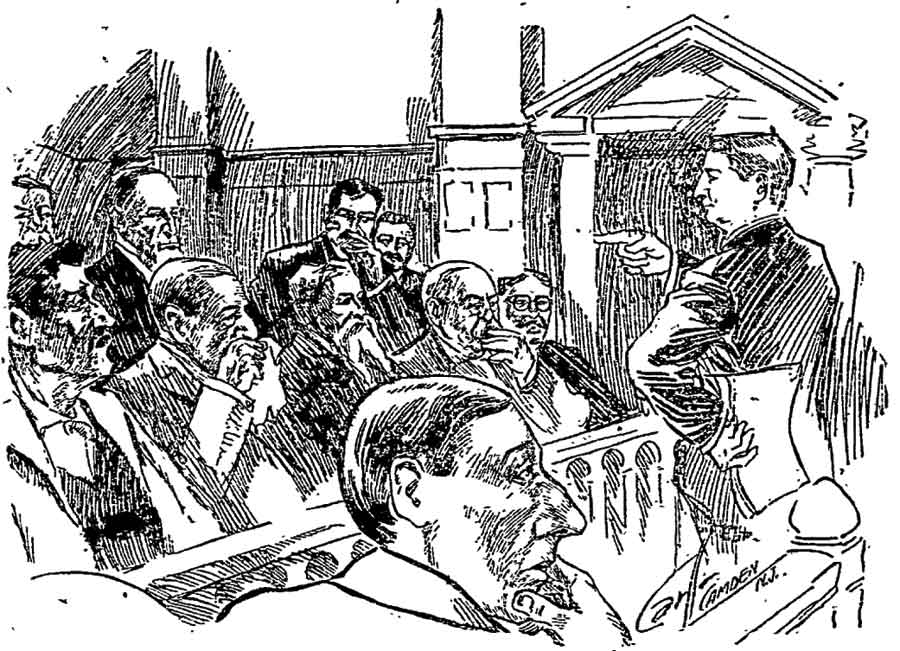

Camden Trial Came to a Sudden End With the Jury Returning a Conviction of Murder in the First Degree, After Deliberating Less Than an Hour
Attorney Robinson Making His Address to the Jury. Paul Woodward in Foreground.
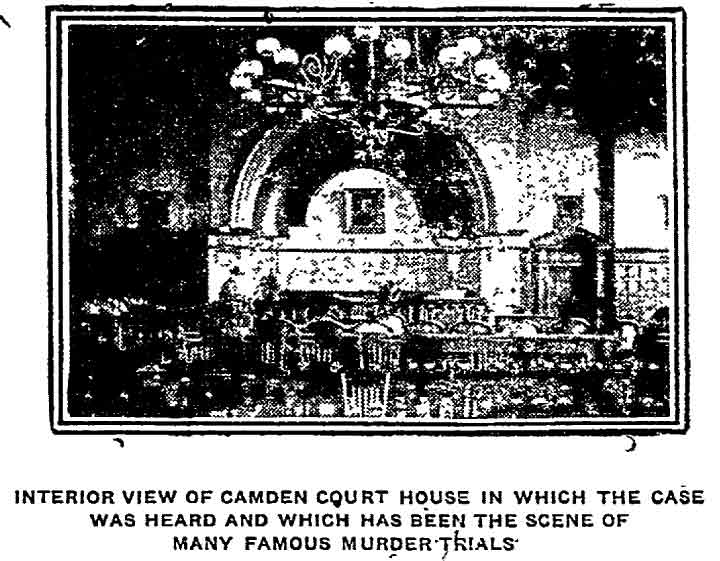
Interior View of Camden Court House in Which the Case Was Heard and Which Has Been the Scene of Many Famous Murder Trials.
Paul Woodward was last evening found guilty of murdering little John Coffin, whose body, with that of W. Price Jennings, was found in a field near Haddon Heights on October 4. Woodward’s trial began last Wednesday before Judge Garrison in Camden.
The jury retired at 3.45 o’clock, after a brief charge by Judge Garrison. At twenty minutes to 5 o’clock an agreement had been reached, but it was two minutes to 6 o’clock before Judge Garrison arrived, he having gone to his home at Merchantville.
In the meantime Woodward had been brought into the court room, and after the jury had filed in he was told to stand up. He arose without a tremor, looked at the ceiling, at the Judge and then turned to the twelve men who had his fate in their hands. His peculiar features lit up with a broad grin when the County Clerk said:
“Jury look upon the prisoner; prisoner look upon the jury.”
Guilty of Murder
Then when the jury was finally asked for its verdict and the foreman had solemnly announced “Guilty of murder in the first degree,” Woodward, apparently unmindful of the import of the words, turned to his counsel and laughed with a low chuckle. Each juror was polled and each man repeated “guilty of murder in the first degree.”
“The prisoner may retire,” said Judge Garrison, and with a sidelong glance at his counsel Woodward was led across the “bridge of sighs” to his cell in the county jail. He laughed loudly and slapped his custodian on the back in a playful mood, as if the whole proceedings had been a joke, but when he reached the jail he let go a tirade of profanity against the Prosecutor and those who appeared against him. He remarked that he did not care what became of him, all he cared for, he said, was his mother.
Motion for New Trial
Lawyer Rex immediately made a motion for a new trial, Judge Garrison stating he would hear argument on a date to be set. The jury was then discharged.
One of the features of the last day was the reappearance of Woodward’s mother, haggard, careworn and her eyes swollen with weeping. She was recalled to testify she had sworn falsely on Saturday when she denied even having been convicted of crime.
The climax in the defense’s case occurred in the morning, when Woodward, the defendant, was placed on the stand to testify. When he took his seat his eyes roamed about the room. He looked everywhere except in the direction of the jury. He admitted he was with the murdered boys, but denied absolutely having killed them. The alibi the defense tried to build about him during the period of the boys’ disappearance, was practically destroyed by contradictions made by Woodward concerning his movements. All the statements he made to Prosecutor Lloyd immediately following his arrest, he said, were false. He said he told the different stories because he was “scared.” The defense also tried to prove both boys were alive on Friday, October 3.
The defense called Dr. J. A. Leuf as an expert. He described the effects of strychnine on the human system. He said there were several other poisons that might have similar effects.
No Rebuttal Testimony
To the surprise of the assemblage no rebuttal testimony was given, Prosecutor Lloyd at once beginning his argument. He spoke for over an hour and at times was eloquent. He said the State asked for nothing but a first degree verdict, as the facts developed could have no other result consistent with the oath of the jury. It was a case of premeditation because there was first, an attempt at robbery, and second, because there was an attempt to do great bodily harm. The State, he said, had proved the crime against Woodward and followed him almost to the death bed of the boys.
Lawyer Robinson opened for the defense. He spoke for over an hour. “Paul is not guilty and if you follow the evidence you must acquit him,” concluded the defense.
Judge Garrison’s charge lasted just four minutes. He explained the law covering the case. He said anyone administering poison for robbery was guilty of murder in the first degree. If, however, it was not proven to the jury beyond a reasonable doubt that the defendant administered the poison, then he should be acquitted.
The jury then retired at 3.45.
Another postal card was received yesterday, asking for Woodward’s brain, but these seekers after the convicted man’s gray matter will be disappointed.
Woodward on Trial for Coffin Murder
Philadelphia Inquirer —
Less Than Six Weeks After Alleged Crime Case Is Called in Camden Court — The Prisoner’s Appearance — What State Will Try to Prove
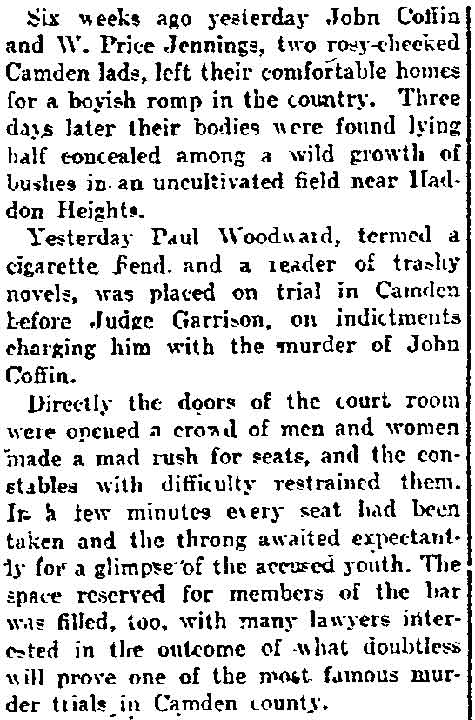
Six weeks ago yesterday John Coffin and W. Price Jennings, two rosy-cheeked Camden lads, left their comfortable homes for a boyish romp in the country. Three days later their bodies were found lying half concealed among a wild growth of bushes in an uncultivated field near Haddon Heights.
Yesterday Paul Woodward, termed a cigarette fiend and a reader of trashy novels, was placed on trial in Camden before Judge Garrison, on indictments charging him with the murder of John Coffin.
Directly the doors of the court room were opened a crowd of men and women made a mad rush for seats, and the constables with difficulty restrained them. In a few minutes every seat had been taken and the throng awaited expectantly for a glimpse of the accused youth. The space reserved for members of the bar was filled, too, with many lawyers interested in the outcome of what doubtless will prove one of the most famous murder trials in Camden county.
Court Opened
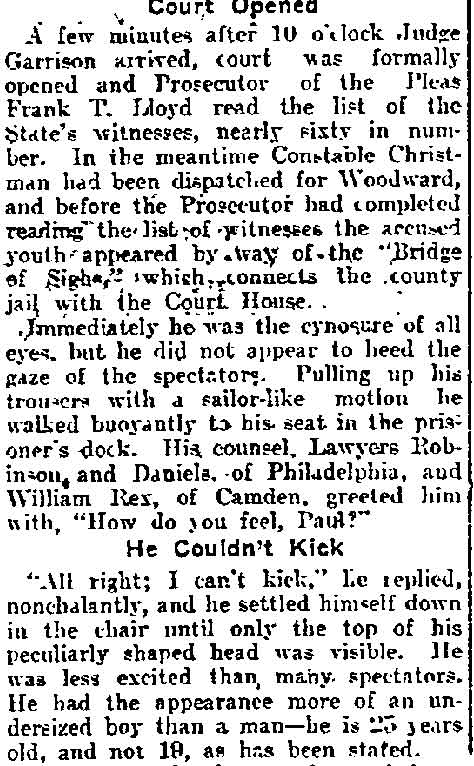
A few minutes after 10 o’clock Judge Garrison arrived, court was formally opened and Prosecutor of the Pleas Frank T. Lloyd read the list of the State’s witnesses, nearly sixty in number. In the meantime Constable Christman had been dispatched for Woodward, and before the Prosecutor had completed reading the list of witnesses the accused youth appeared by way of the “Bridge of Sighs,” which connects the county jail with the Court House.
Immediately he was the cynosure of all eyes, but he did not appear to heed the gaze of the spectators. Pulling up his trousers with a sailor-like motion he walked buoyantly to his seat in the prisoner’s dock. His counsel, Lawyers Robinson and Daniels, of Philadelphia, and William Rex, of Camden, greeted him with, “How do you feel, Paul?”
He Couldn’t Kick
“All right; I can’t kick,” he replied, nonchalantly, and he settled himself down in the chair until only the top of his peculiarly shaped head was visible. He was less excited than many spectators. He had the appearance more of an undersized boy than a man—he is 25[?] years old, and not 19[?], as has been stated.
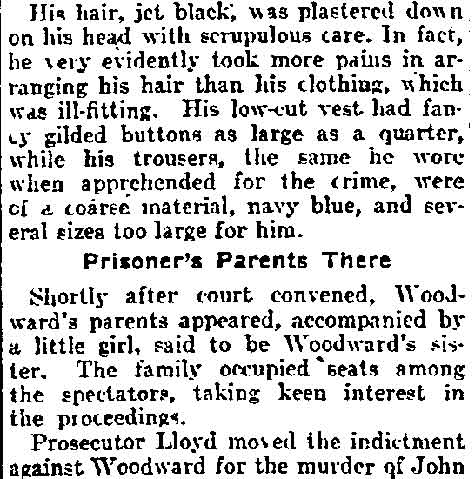
His hair, jet black, was plastered down on his head with scrupulous care. In fact, he very evidently took more pains in arranging his hair than his clothing, which was ill-fitting. His low-cut vest had fancy gilded buttons as large as a quarter, while his trousers, the same he wore when apprehended for the crime, were of a coarse material, navy blue, and several sizes too large for him.
Prisoner’s Parents There
Shortly after court convened, Woodward’s parents appeared, accompanied by a little girl, said to be Woodward’s sister. The family occupied seats among the spectators, taking keen interest in the proceedings.
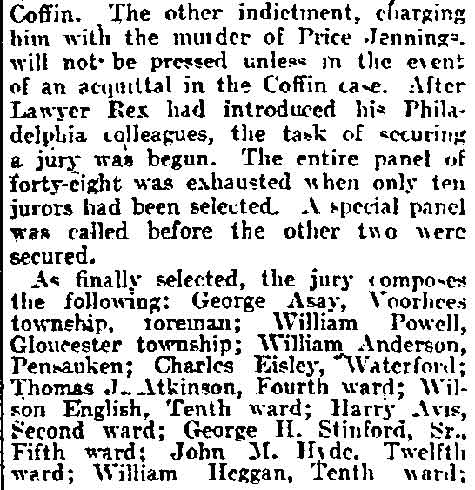
Prosecutor Lloyd moved the indictment against Woodward for the murder of John Coffin. The other indictment, charging him with the murder of Price Jennings, will not be pressed unless in the event of an acquittal in the Coffin case. After Lawyer Rex had introduced his Philadelphia colleagues, the task of securing a jury was begun. The entire panel of forty-eight was exhausted when only ten jurors had been selected. A special panel was called before the other two were secured.
As finally selected, the jury composes the following: George Asay, Voorhees township, foreman; William Powell, Gloucester township; William Anderson, Pensauken; Charles Eisley, Waterford; Thomas J. Atkinson, Fourth ward; Wilson English, Tenth ward; Harry Avis, Second ward; George H. Stinford, Sr., Fifth ward; John M. Hyde, Twelfth ward; William Heggan, Tenth ward; John St. Clair, Third ward; Charles S. Hess, Fifth ward.
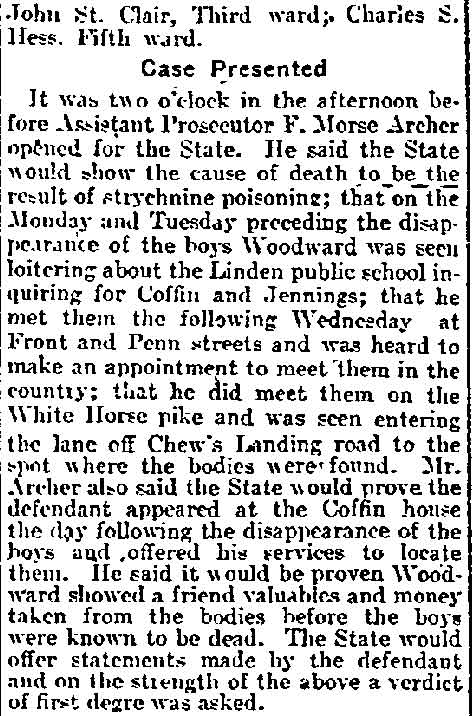
Case Presented
It was two o’clock in the afternoon before Assistant Prosecutor F. Morse Archer opened for the State. He said the State would show the cause of death to be the result of strychnine poisoning; that on the Monday and Tuesday preceding the disappearance of the boys Woodward was seen loitering about the Linden public school inquiring for Coffin and Jennings; that he met them the following Wednesday at Front and Penn streets and was heard to make an appointment to meet them in the country; that he did meet them on the White Horse pike and was seen entering the lane off Chew’s Landing road to the spot where the bodies were found. Mr. Archer also said the State would prove the defendant appeared at the Coffin house the day following the disappearance of the boys and offered his services to locate them. He said it would be proven Woodward showed a friend valuables and money taken from the bodies before the boys were known to be dead. The State would offer statements made by the defendant and on the strength of the above a verdict of first degree was asked.
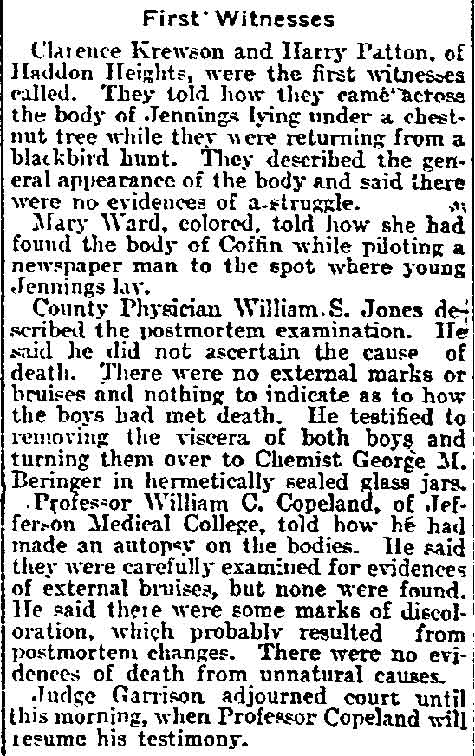
First Witnesses
Clarence Krewson and Harry Patton, of Haddon Heights, were the first witnesses called. They told how they came across the body of Jennings lying under a chestnut tree while they were returning from a blackbird hunt. They described the general appearance of the body and said there were no evidences of a struggle.
Mary Ward, colored, told how she had found the body of Coffin while piloting a newspaper man to the spot where young Jennings lay.
County Physician William S. Jones described the postmortem examination. He said he did not ascertain the cause of death. There were no external marks or bruises and nothing to indicate as to how the boys had met death. He testified to removing the viscera of both boys and turning them over to Chemist George M. Beringer in hermetically sealed glass jars.
Professor William C. Copeland, of Jefferson Medical College, told how he had made an autopsy on the bodies. He said they were carefully examined for evidences of external bruises, but none were found. He said there were some marks of discoloration, which probably resulted from postmortem changes. There were no evidences of death from unnatural causes.
Judge Garrison adjourned court until this morning, when Professor Copeland will resume his testimony.
Pardon Board on Woodward’s Case
Philadelphia Inquirer —
Governor Will Reprieve Prisoner If Action Is Not Taken by December 24
Special to The Inquirer.
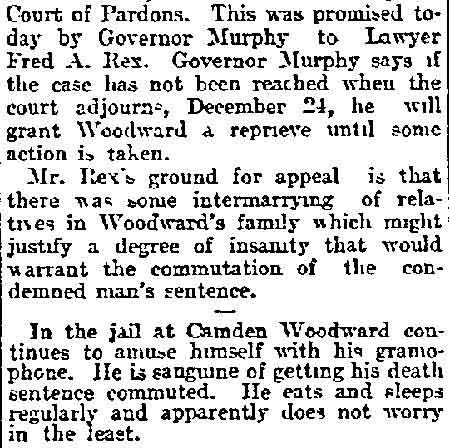
TRENTON, N. J., Dec. 16—The case of Paul Woodward, the condemned Camden murderer, is to be considered by the Court of Pardons. This was promised to-day by Governor Murphy to Lawyer Fred A. Rex. Governor Murphy says if the case has not been reached when the court adjourns, December 24, he will grant Woodward a reprieve until some action is taken.
Mr. Rex’s ground for appeal is that there was some intermarrying of relatives in Woodward’s family which might justify a degree of insanity that would warrant the commutation of the condemned man’s sentence.
In the jail at Camden Woodward continues to amuse himself with his gramophone. He is sanguine of getting his death sentence commuted. He eats and sleeps regularly and apparently does not worry in the least.
Last Effort to Save Woodward
Philadelphia Inquirer —
Lawyer Frederick A. Rex, counsel for Paul Woodward, the youth under sentence to be hanged January 7 for the murder of John Coffin and W. Price Jennings, will go to Trenton to-day to ask that Woodward’s sentence be commuted to life imprisonment.
Woodward’s counsel has little prospect of getting anything favorable from the Board of Pardons, however.
Woodward’s Last Hope Vanished
Philadelphia Inquirer —
Court of Pardons Refuses to Interfere in Case of Camden’s Condemned Murderer
Special to The Inquirer.
TRENTON, N. J., Dec. 30.—The Court of Pardons in special session this afternoon refused to interfere in the case of Paul Woodward, now under sentence of death in Camden for the killing of the Coffin and Jennings boys, and aged Mrs. Woodward, mother of the condemned youth, was sent back to her home a broken-hearted woman with the assurance that nothing short of a miracle will prevent the hanging of her son next week.
Lawyer Rex sent a letter to the court announcing that he had been unable to secure the additional evidence he expected and that it was not possible for him to present the case as he had anticipated. Prosecutor Lloyd, of Camden, then recited the events leading up to the sentencing of the youth and the application for commutation of sentence was dismissed.
Mrs. Woodward came to Trenton early to-day and remained at the State House until she was convinced there was no hope for her son.
Miller Gets a Certiorari
Camden Daily Courier —
Case of the Policeman Suspended from the Force to be Taken to the Supreme Court.
Lawyer Frederick A. Rex was to-day granted a writ of certiorari by Justice Garrison, carrying up the recent removal of Policeman Robert Miller from the force. Lawyer Rex claimed that Policeman Miller’s discharge by the Police Committee was unconstitutional, as it had merely recommended his dismissal and further that City Council had not complied with the provisions of the legislative act in the officer’s removal.
Wagner’s Trial for Stabbing Miller
Camden Daily Courier —


Witnesses Say Policeman Keaser Held Fellow Officer When He Was Knifed.
CUT DURING THIRD WARD RIOT
The main court room was crowded with interested Third warders this morning, when the first of the criminal complaints growing out of the riots at Third and Beckett streets, on the night of July 28, last, during the Congressional primary, was taken up. It charged Charles Wagner with assault and battery on Policeman Harry Miller. Judge Joline was on the bench. Prosecutor Lloyd appeared for the State and the defendant was represented by Lawyers Fred A. and William F. Rex. Some little trouble was experienced in getting a jury.
After Prosecutor Lloyd outlined the case, Policeman Miller was called to the stand. He said that on the night in question just before the close of the polls, a fight ensued between ex-Policeman “Bob” Miller and John Morrisey, the man who was killed. A general racket followed and “Bob” Miller, Policeman Keaser and others were brutally assaulting George Murray with a blackjack, when witness went to Murray’s aid. Keaser, he said, turned on him and grappled.
MILLER STABBED.
“He had a hold of me and I of him,” said Miller, “and while we were standing in that position, this man Wagner came up in front of me, jabbed his knife in my stomach, turned it like that (giving his hand a twist) and pulled it out. Keaser still had a hold of me and I could not help myself. Wagner ran away after stabbing me.”
Miller said he was taken to Cooper Hospital and was there four weeks.
On cross-examination by Mr. Rex, Miller said he was positive that Wagner was his assailant and denied saying in the hospital the morning after the stabbing, that he did not know who cut him. He also denied hitting Keaser with his blackjack.
When questioned concerning Morrisey, the man who was killed, Miller said he only met him that day and did not know whether he was a voter or not.
DIDN’T WANT DETAILS.
Mr. Rex tried to get the witness to detail a talk he had with Morrisey, but Mr. Lloyd objected. Mr. Rex seemed so anxious to carry the point that Mr. Lloyd said he was willing to withdraw the objection, provided Mr. Rex would not object to detailed conversation responses to his questions. Mr. Rex promptly vetoed the proposition and withdrew his questions.
Harry Selby, son of former Policeman Selby, followed on the stand. He said he did not see the stabbing, but that a few moments before the polls closed he saw Wagner try to stab Miller at the window of the polling place. The two, it appears, had had some words.
Dr. Grimes, of the Cooper Hospital staff, said that he helped dress Miller’s wound and that it was a dangerous one.
SAW WAGNER KNIFE MILLER.
William Laws, colored, corroborated Miller’s testimony. He said he saw Policeman Keaser hold Policeman Miller while Wagner stabbed him. This hapepned [sic] he said about four minutes of 8 o’clock.
Policeman Edward Hartman told of seeing Wagner having an open knife in his hand, of seeing him jab at several people and that he grabbed at him.
“You saw all of that did you?” asked Mr. Rex.
“I certainly did,” replied the officer.
“Then why didn’t you as a policeman arrest him?”
“I tried to, but his brother interfered.”
Mr. Rex had no more questions to ask.
George Murray, also told of seeing defendant have a knife in his hand.
Detectives Smith and Cherry told of making an unsuccessful search in this city for Wagner and finally locating him at Waterford living with a woman.
Detective Cherry said that Wagner told him that he had been at Hammonton.
“Hammonton is in Camden county, isn’t it?” asked Mr. Rex.
“No, sir, Atlantic county.”
“My geography is twisted somewhat commented Mr. Rex.” With these witnesses the State rested.
WAGNER DENIES CHARGE.
Addressing the jury Mr. Rex said the defense would be an alibi. Wagner then took the stand. He said he lived at 666 South Second street and that on the night of July 28, left the polling place about quarter of eight o’clock.
“Did you have a penknife in your hands at all?”
“No, sir.”
“Did you cut Harry Miller?”
“No, sir.”
In answer to questions by Mr. Rex, Wagner said he was with Constable “Bo” Bates nearly every day while in Waterford.
Cross-questioned by Mr. Lloyd Wagner said he went to Waterford on July 30—two days after the stabbing. He went down, he said, to visit a Mrs. Fox. His visit lasted until the middle of September, the time of his arrest. Previous visits he said never extended over a week. He said he had no knowledge that he was wanted for any crime until two weeks later when he read in the papers that he was charged with stabbing Miller. He told Mr. Bates about it. He further said that no trouble had occurred at all while he was at the polls.
Charles Cahill, a clerk at the Reading terminal, said he was at the polls and that at about quarter of eight o’clock he went up Beckett street in company with Wagner and another man. About fifty feet away, he said he went into an alley and Wagner proceeded up the street. Witness said he returned to the polling place just as the trouble began. He did not see Wagner.
Questioned by the Prosecutor Cahill said he was present as a challenger.
“Are you of the same political party that was holding the election?”
“I vote for the best man,” snapped Cahill in reply.
DIDN’T HAVE ANY POLITICS.
The Prosecutor repeated the question several times only to receive evasive answers such as “I was a Republican for that night,” and “I’m for the best man,” until Judge Joline was compelled to sharply admonish the witness to answer the question. Even then the spectators were in doubt as to Cahill’s politics, as he said he guessed he didn’t have any politics.
Owen McDonald testified to seeing Wagner and two other men pass up the street and despite the general excitement, Mr. McDonald said he watched Wagner until he got to Fourth street.
With the testimony of Butcher John Heim to the effect that he did not see Wagner at all around the polls until after the trouble was over court took a recess.
Policeman Albert Keaser was the first witness called this afternoon. He said he was present when the row started, that he took a blackjack from George Murray and also took a similar weapon from Policeman Harry Miller. The latter, he said, had hit him with the weapon. Witness said he saw Wagner leave the polling place and at that time Miller was not cut.
“Did Mr. Archer, the Assistant Prosecutor, tell you that he had a talk with Miller and that Miller said he didn’t know who cut him?”
Mr. Lloyd objected to the question, but expressed a willingness to allow it, provided Mr. Rex would let him call Mr. Archer to the stand.
Mr. Rex would not do so and the Prosecutor pressed his objection. It was sustained.
On cross examination Keaser denied saying to a man named Ogden that Wagner was “the fellow who did Miller.”
BEAT FELLOW POLICEMAN.
Policeman John Wagner, another of the defendants, said his brother went away before the fight started. In detailing the fracas Wagner voluntarily said he hit Harry Miller in the head with his jack and that he also hit Policeman Hartman.
Policeman Truitt also said he saw Wagner leave the polling place just before the fight started. While Mr. Lloyd was cross examining the witness Mr. Rex objected to the form of a question and remarked the “Court has ruled on that several times and I suppose I’ll get the same ruling.”
Judge Joline rebuked Mr. Rex for making such a statement. Mr. Rex begged the Court’s pardon, made the objection in regular form and it was sustained.
Mrs. Anna Hutner, a sister of the defendant, said she saw him go away about quarter of 8 o’clock and that he did not come back during the trouble. She explained her presence there by saying she had gone to prevent George Murray from shooting her brother.
William Ridgway said he was present during the trouble but did not see Wagner.
Constable “Bo” Bates said that Wagner was in his company nearly every day while he was visiting Waterford and that he made no attempt to escape.
SHIELDED WAGNER.
Prosecutor Lloyd’s only question was:
“You as an officer of this court knew that this man was accused of stabbing Harry Miller and you did not report it to the authorities, is that right?”
“Yes, sir; it is.”
When asked why, by Mr. Rex, the witness said the authorities could have got him at any time.
The defense rested and Mr. Lloyd called Mr. Ogden to the stand in rebuttal. He testified that Keaser told him that Wagner did Miller. Before the question was answered Judge Joline again rebuked Mr. Rex for his manner.
Argument commenced at 2.45 o’clock.
Another Case in Third Ward Riot
Camden Daily Courier —

Policeman Keaser and Ex-Policeman “Bob” Miller on Trial for Assault.
WAGNER JURY COULD NOT AGREE
In the Criminal Court this morning George V. Tucker, who was convicted of a charge of assault and battery, was sentenced by Judge Joline to pay a fine of $50 and costs and stand committed until the money is paid.
Henry J. Shuster pleaded guilty to a charge of embezzling $260.16 from King David Lodge, I. O. O. F., of which he was treasurer. Shuster served three months in the County Jail last spring on a similar charge. At that time he said he used the money to care for his wife, who was ill. It appears that he did use part of the money for this purpose, but that he squandered a large sum in poker playing.
Rev. Q. C. Davis, pastor of the Emmanuel Baptist church, testified that since Shuster has been out of jail he has led a correct life, and at the present time has a good position.
Prosecutor Lloyd made an appeal for clemency.
Judge Joline announced that he was not ready to decide the case and it went over.
POLICEMEN ON TRIAL.
The indictment against Policeman Albert Keaser and ex-Policeman Robert Miller, on charges of assault and battery on George Murray, was then moved. This is the second case to be tried as the outcome of the election riot, in the Third ward during the primary election last July. Considerable time was occopued [sic] in securing a jury.
After the jury was sworn Assistant Prosecutor Archer outlined the case, in which he said the two defendants at that time were policemen and the alleged assault took place at the polling place at Third and Beckett streets, and during the row, Robert Miller, struck George Murray several times with a blackjack. Keaser, it is alleged, assisted Miller in the assault.
The first witness called was George Murray, the complainant, who testified that while standing near the polling booth with some tickets “Bob” Miller, without any provocation, beat him with a blackjack. He said that Policeman Keaser and John Wagner came to Miller’s assistance. During the row, Policemen Hartman and Harry Miller came to his aid.
BEATEN WITH A BLACKJACK.
On cross-examination witness said he had no pistol or blackjack, but that Miller came up to him and deliberately struck witness with a blackjack. He denied that he said on the steps of the Third Ward Republican Club, in the presence of John Rodan, that if a certain —— would come along he would kill him.
William Laws, who testified in yesterday’s trial, gave corroborative testimony as to the blackjacking. He said that Murray did nothing to provoke the assault.
Spencer Moore, also gave corroborative testimony.
Policeman Harry Miller testified to seeing “Bob” Miller beating Murray with a blackjack while out in the middle of Beckett street. The witness said he surged in the crowd and struck at Keaser at the same time exclaiming:
“What are you trying to do, kill this man?”
The witness said he was thrown down, and was pulled up on his feet by Keaser, who grappled with him. He heard thre [sic] or four pistol shots.
The witness identified a blackjack, in the possession of Lawyer Rex, which he used on the night of the primaries.
Howard Roberts, a son of Assemblyman Roberts, also gave corroborative testimony.
DEFENSE OPENS.
At the afternoon session of the court the defense opened. Counsel said that the defendants were justified in using force to put Murray into subjection.
Policeman Toy testified that he saw the occurrence and thought that “Bob” Miller, was acting as a peacemaker. He saw Murray shoot off a revolver.
Daniel Ayres testified to seeing the riot and heard Murray say that he would get some one before the night was over. He saw Murray shoot off a revolver under a tree.
Ex-Policeman “Bob” Miller admitted that he struck Murray while attempting to arrest him. He also testified that he was knocked down and beaten and that some person had attempted to stab him. He exhibited his clothing which was soiled and cut.
Policeman Shaw testified that on July 28 he went to Third and Beckett streets and found George Murray in his home, where he was under arrest by Detective Hart. Witness recovered a revolver from the wife of Murray.
Mrs. Widener, who was a witness in the trial yesterday, gave the same line of evidence in this case.
CHEESEMAN SENTENCED.
At the noon recess Judge Joline imposed sentence on Thomas J. Cheeseman, the former secretary of Thomas Jefferson Council, No. 138, Jr. O. U. A. M., who was convicted of a charge of false pretenses on Thursday last. Before sentence was imposed Rev. J. R. Mason, pastor of the Kaighn Avenue M. E. church, and Rev. Robert Wesley Peach, pastor of the Second Presbyterian church, made appeals to the court for clemency in his case. Judge Joline sentenced Cheeseman to three months in the County Jail and a fine of $150 and costs.
After being out for seven hours without being able to agree on a verdict the jury in the case of Charles Wagner, tried yesterday on a charge of stabbing Policeman Harry Miller, at the time of the same election riot, were discharged at 10 o’clock last night.
Recital at Catholic Lyceum
Philadelphia Inquirer —
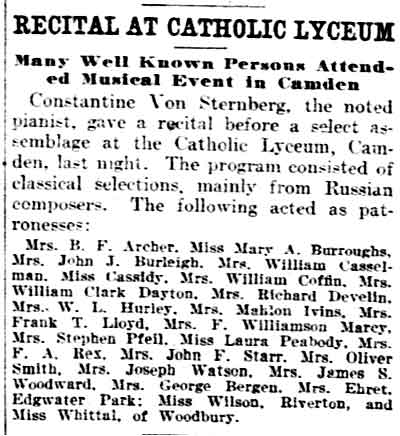
Many Well Known Persons Attended Musical Event in Camden
Constantine Von Sternberg, the noted pianist, gave a recital before a select assemblage at the Catholic Lyceum, Camden, last night. The program consisted of classical selections, mainly from Russian composers. The following acted as patronesses:
Mrs. B. F. Archer, Miss Mary A. Burroughs, Mrs. John J. Burleigh, Mrs. William Casselman, Miss Cassidy, Mrs. William Coffin, Mrs. William Clark Dayton, Mrs. Richard Develin, Mrs. W. L. Hurley, Mrs. Mahlon Ivins, Mrs. Frank T. Lloyd, Mrs. F. Williamson Marcy, Mrs. Stephen Pfeil, Miss Laura Peabody, Mrs. F. A. Rex, Mrs. John F. Starr, Mrs. Oliver Smith, Mrs. Joseph Watson, Mrs. James S. Woodward, Mrs. George Bergen, Mrs. Ehret, Edgewater Park; Miss Wilson, Riverton, and Miss Whittal, of Woodbury.
LAWYER F.A. REX IS LAID TO REST
Camden Post-Telegram —
The funeral of Lawyer Frederick A. Rex, who died last Monday at a sanitarium in South Jersey, took place today from the parlors of Funeral Director Martin J. O’Brien, 611 Market Street.
Members of Camden Lodge of Elks held services last night. The services today were conducted by Reverend J.W. Ohl, rector of the P.E. Church at Collingswood. The body was interred in Colestown Cemetery.
The pallbearers were Harry Blackburn, F.L. Vinton, Frederick Morse, John Schlorer, Harry Mayer, Harry Stains, James Thoirs, members of Camden Lodge of Elks. The remains rested in a polished oak casket with silver handles and name plate. The casket was adorned by many floral tributes.
Trimble Lodge No. 117 Marks 65th Anniversary
Camden Courier-Post — 1936
From an article marking the 65th Anniversary of the Trimble Lodge No. 117, F. & A.M.
…the lodge was constituted on February 2, 1871. Camden Lodge, No. 15, was the “mother” lodge of Trimble. The lodge was named for Joseph Trimble, who served three terms as master of Camden Lodge and three years as grand master of the state.
The organizers of the lodge were George H. Fairfield, George F. Fort, Marmaduke E. Taylor, Dr. H. Genet Taylor, Dr. William S. Fort, Wilbur F. Rose, Nathan F. Cowan, Frederick A. Rex and J. Graham Milligan.
At the first meeting, Rev. Joseph F. Garrison, rector of St. Paul’s Episcopal Church, was presented for membership. He was the father of former Secretary of War Lindley M. Garrison and the late Supreme Court Justice Charles C. Garrison.
The lodge was constituted in Morgan’s Hall, Fourth and Market streets, then known as Masonic Hall. Fairfield was the first worshipful master; George F. Fort, senior warden; Marmaduke Taylor, junior warden; Dr. Taylor, treasurer; Milligan, secretary; Cowan, senior deacon; Rex, junior deacon; Rose, master of ceremonies, and Charles H. Gordon, tiler.
The Young Syndicate
Camden Courier-Post —
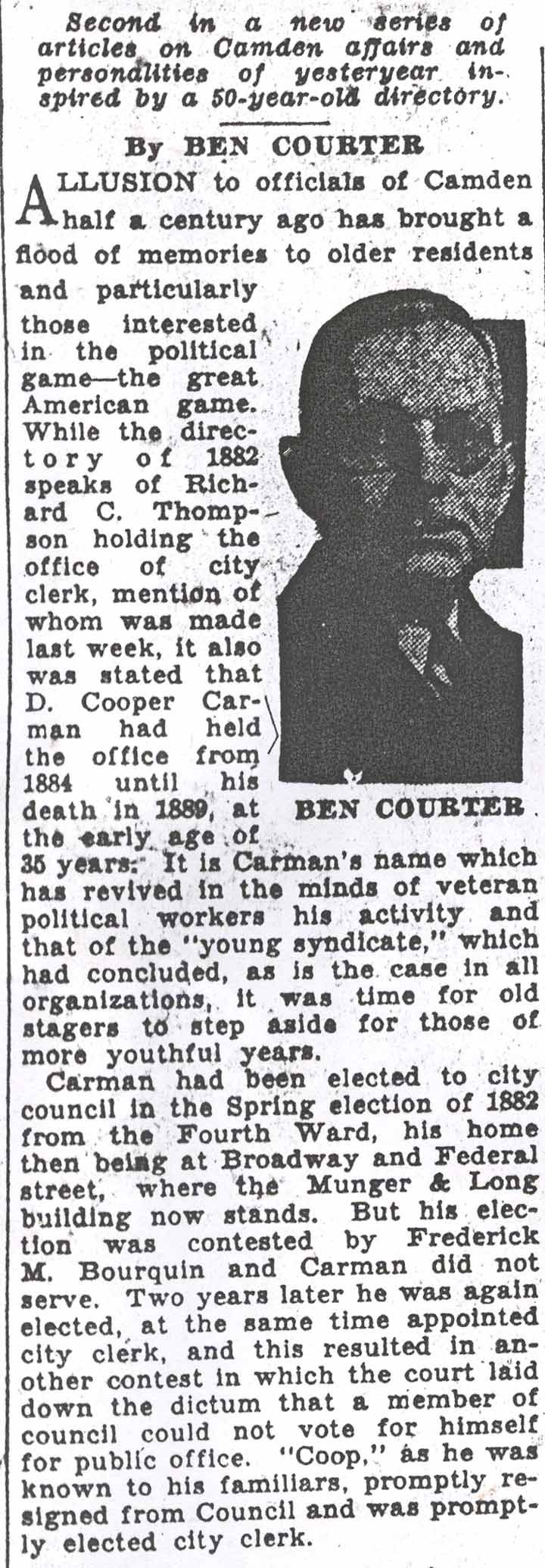
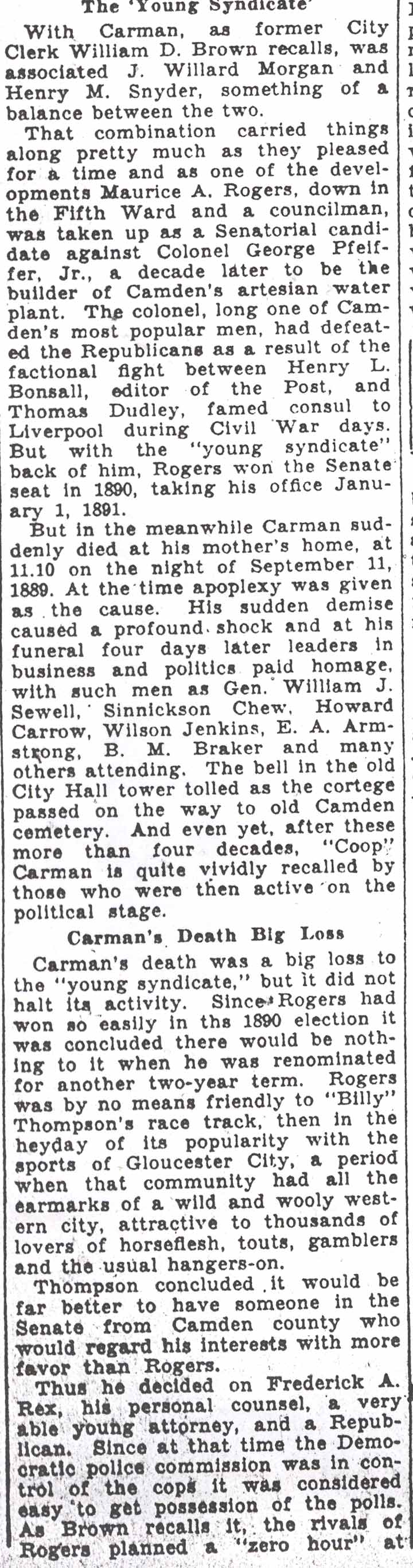
FROM AN OLD DIRECTORY
‘Coop’ Carman and Willard Morgan Led Movement for New Blood in G.O.P. Culminating in Bitter Battles of Race Track Days
Second in a new series of articles on Camden affairs and personalities of yesteryear inspired by a 50-year-old directory.
By BEN COURTER
Allusion to officials of Camden half a century ago has brought a flood of memories to older residents and particularly those interested in the political game—the great American game. While the directory of 1882 speaks of Richard C. Thompson holding the office of city clerk, mention of whom was made last week, it also was stated that D. Cooper Carman had held the office from 1884 until his death in 1889, at the early age of 35 years. It is Carman’s name which has revived in the minds of veteran political workers his activity and that of the “young syndicate,” which had concluded, as is the case in all organizations, it was time for old stagers to step aside for those of more youthful years.
BEN COURTER
Carman had been elected to city council in the Spring election of 1882 from the Fourth Ward, his home then being at Broadway and Federal street, where the Munger & Long building now stands. But his election was contested by Frederick M. Bourquin and Carman did not serve. Two years later he was again elected, at the same time appointed city clerk, and this resulted in another contest in which the court laid down the dictum that a member of council could not vote for himself for public office. “Coop,” as he was known to his familiars, promptly resigned from Council and was promptly elected city clerk.
The ‘Young Syndicate’
With Carman, as former City Clerk William D. Brown recalls, was associated J. Willard Morgan and Henry M. Snyder, something of a balance between the two.
That combination carried things along pretty much as they pleased for a time and as one of the developments Maurice A. Rogers, down in the Fifth Ward and a councilman, was taken up as a Senatorial candidate against Colonel George Pfeiffer, Jr., a decade later to be the builder of Camden’s artesian water plant. The colonel, long one of Camden’s most popular men, had defeated the Republicans as a result of the factional fight between Henry L. Bonsall, editor of the Post, and Thomas Dudley, famed consul to Liverpool during Civil War days. But with the “young syndicate” back of him, Rogers won the Senate seat in 1890, taking his office January 1, 1891.
But in the meanwhile Carman suddenly died at his mother’s home, at 11.10 on the night of September 11, 1889. At the time apoplexy was given as the cause. His sudden demise caused a profound shock and at his funeral four days later leaders in business and politics paid homage, with such men as Gen. William J. Sewell, Sinnickson Chew, Howard Carrow, Wilson Jenkins, E. A. Armstrong, B. M. Braker and many others attending. The bell in the old City Hall tower tolled as the cortege passed on the way to old Camden cemetery. And even yet, after these more than four decades, “Coop” Carman is quite vividly recalled by those who were then active on the political stage.
Carman’s Death Big Loss
Carman’s death was a big loss to the “young syndicate,” but it did not halt its activity. Since Rogers had won so easily in the 1890 election it was concluded there would be nothing to it when he was renominated for another two-year term. Rogers was by no means friendly to “Billy” Thompson’s race track, then in the heyday of its popularity with the sports of Gloucester City, a period when that community had all the earmarks of a wild and wooly western city, attractive to thousands of lovers of horseflesh, touts, gamblers and the usual hangers-on.
Thompson concluded it would be far better to have someone in the Senate from Camden county who would regard his interests with more favor than Rogers.
Thus he decided on Frederick A. Rex, his personal counsel, a very able young attorney, and a Republican. Since at that time the Democratic police commission was in control of the cops it was considered easy to get possession of the polls. As Brown recalls it, the rivals of Rogers planned a “zero hour” at which cops, at the crack of a pistol, were to descend on polls considered close at the primaries, frighten off the regular voters and corral enough to elect Rex.
Particular effort was to be made to sweep the Sixth Ward, where Thad Varney, elected city clerk to succeed Carman, was “boss,” and thus give him a political black eye. In Varney’s precinct in particular when the rumpus started “Brockie” Deno and “Al” Haydon, both widely known firemen now dead, grabbed the ballot box, lowered it down a chimney, fished it out when the racket was passed, went to Avis’ livery stable, and later to Varney’s home, where the votes were counted. In these sophisticated days such counting would unquestionably not be considered “according to Hoyle,” but then anything went just so the particular faction had its bag of tricks in effective operation. Anyhow, Rogers won the primaries, but there still was the general election to hurdle and Thompson was by no means beaten. He had plenty of money and many followers, some sincere, many just sycophants.
Repeaters Foiled
It was charged a scheme was on foot to bring repeaters from Philadelphia, not an unusual procedure in the political game of Camden years ago in either party. One of the “young syndicate’s” lieutenants learned the plot, told General Sewell, who sent the informant to Dave Martin, then Philadelphia’s political boss, who heard the story. The upshot was General Sewell himself saw Martin later, who was quite willing to aid Jersey’s G.O.P. leader, flooded Camden with sleuths from over the river and such close tabs were kept on the repeating army its efforts were halted from the very dawn of that very stirring election day. Rogers was elected, was made president of the Senate and for a time loomed so large on Jersey’s political horizon he had gubernatorial aspirations, but they never were realized.
Thus out of the old yellowed book Frank Albright, city clerk of the present epoch, dug from the archives memories are revived of a very gallant young politician, “Coop” Carman, and some of the stirring incidents that make up Camden’s political history. The “young syndicate” was just one of the episodes, as the first “reform” outbreak in 1882, or the Committee of 100 scrap of 1897, or the Non-Partisan upheaval of ‘23, but such never lose interest to those who have joined those movements with enthusiasm, even though they were often not altogether satisfied with what had been accomplished.
Historic American Buildings Survey
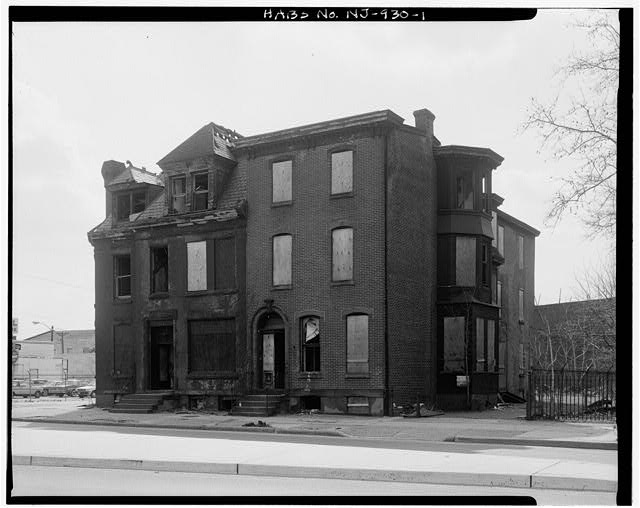
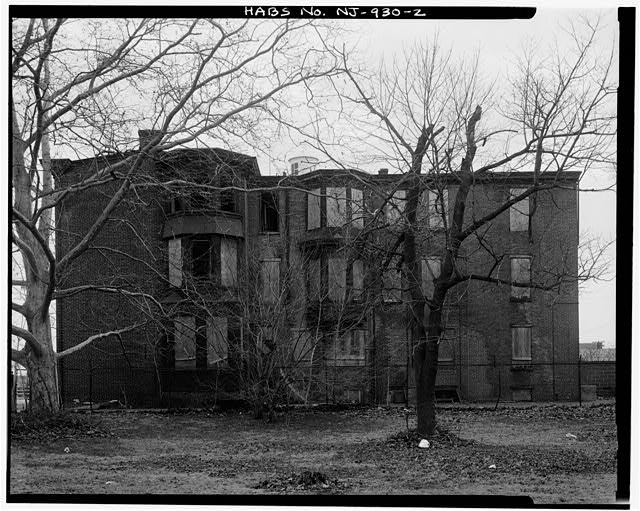
726 Cooper Street, where Frederick A. Rex lived (at right); 728 Cooper Street, the home of lawyer John Harned (at left)