Introduction
Arthur Colsey was born in Kidderminster, England in December of 1872 to John and Ann Colsey. His older brother, John G. Colsey, had come to America prior to the enumeration of the 1880 Census. At that time he and his wife Ada were living in Philadelphia, and working in the wool industry. By 1887, John G. Colsey had opened a dry goods store in Camden. The store was first located at 6th and Elm Streets in North Camden. This building was later the site of a grocery run by Samuel Molotsky. By 1900 the Colsey Store had moved to 9th and Market Street.
Arthur Colsey followed his brothers to America. Thomas Colsey had come in the 1880s, and was living in Philadelphia and working as a sheep shearer at the end of the 1880s. Arthur Colsey came to America at 17, joining older brother John, and married Lillian Thompson in 1894. Thomas Colsey came to Camden in the 1890s, and the Colsey brothers were in the department store business at 9th and Market Street for years. His niece Alice M. Colsey married Camden photographer George A. Wonfor a few years after the turn of the century.
Politically active, Arthur Colsey served on City Council from the Second Ward from 1907 to 1911. In these years and through the time of the 1920 census he was living at 339 North 8th Street, the corner of North 8th and Linden Streets. The Colseys lived next door to James Daly, who operated a tavern for many years at 8th & Linden Streets. Another neighbor was Walter Rowand, who also served for many years with the Camden Police.
Arthur Colsey was appointed to the Camden Police Department as a patrolman by Mayor Charles H. Ellis on March 12, 1912. He rose through the ranks and by 1915 was a detective. Although on vacation the night of July 17, 1916, when two prisoners escaped Camden County Jail, killing Turnkey Isaac Hibbs, Arthur Colsey reported for duty, and spent the evening shuttling policemen about the city in his own automobile.
Arthur Colsey worked in plain clothes and served as personal aide to Mayor Charles Ellis until his leaving office in 1922. In 1923 Arthur Colsey was appointed chief clerk of the police force, with the rank of captain.
In 1924 Arthur Colsey was placed in charge of Camden’s vice squad, not an easy assignment during the Prohibition years. Captain Colsey was serving in this capacity in 1925 when the case of Dr. Hyghcock, the “voodoo doctor” of Liberty Street, broke in April, and he was involved in the investigation of Hyghcock’s “voodoo den.”
A longtime resident of North Camden, by 1930 Arthur and Lillian Colsey had moved to East Camden, where they bought a home at 2937 Stevens Street. He joined the Twelfth Ward Republican Club, and was elected its president in 1932.
In December of 1931, Arthur Colsey was considered for Chief of Police, to replace Lewis H. Stehr Jr. The position, however, went to John W. Golden.
Upon the retirement of Chief John W. Golden in June of 1934, Mayor Roy R. Stewart named Arthur Colsey Acting Chief of Police. His appointment was made permanent on August 30, 1934, along with that of Fire Chief John Lennox. Sadly, a few days later Detective William Feitz became Camden’s first policeman to be killed in the line of duty. Chief Colsey worked closely with Commissioner Mary Walsh Kobus when she was elected to Camden’s City Commission in 1935 and made Director of Public Safety the following year. In Mrs. Kobus’ absence, Chief Colsey also served as Acting Director of Public Safety.
Arthur Colsey died in his sleep of a heart attack on September 15, 1939. He was survived by his wife, brother Thomas Colsey, son Arthur Jr., and two grandchildren, Arthur L. Colsey and Lillian Colsey. He was buried at Arlington Cemetery in Pennsauken NJ on September 18, 1939. Captain Ralph Bakley was named Acting Chief of Police a few days later.
Portraits
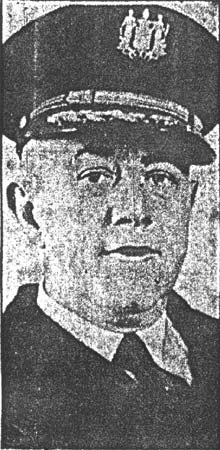
Arthur Colsey — Camden Courier-Post, September 16, 1939
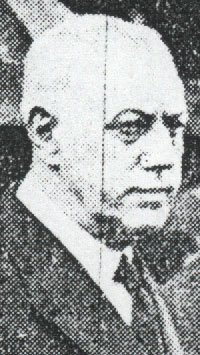
Arthur Colsey — Camden Courier-Post, September 8, 1934
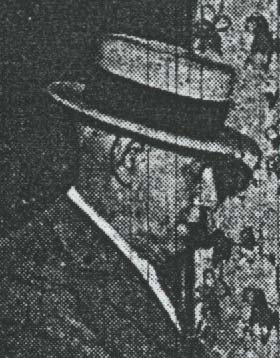
Arthur Colsey — Camden Courier-Post, September 3, 1934
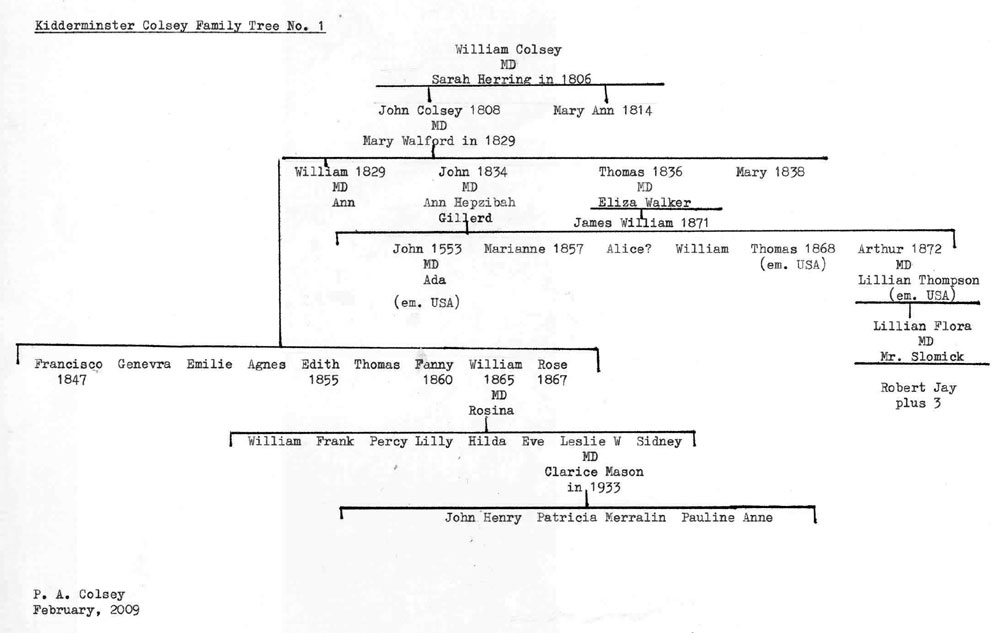
Kidderminster Colsey Family Tree No. 1
P. A. Colsey — 2009
William Colsey
MD
Sarah Herring in 1806
John Colsey 1808
MD
Mary Walford in 1829
Mary Ann 1814
William 1829
MD
Ann
John 1834
MD
Ann Hepzibah Gillerd
Thomas 1836
MD
Eliza Walker
Mary 1838
James William 1871
John 1553 [sic]
MD
Ada
(em. USA)
Marianne 1857
Alice?
William
Thomas 1868
(em. USA)
Arthur 1872
MD
Lillian Thompson
(em. USA)
Lillian Flora
MD
Mr. Slomick
Robert Jay
plus 3
Francisco 1847
Genevra
Emilie
Agnes
Edith 1855
Thomas
Fanny 1860
William 1865
MD
Rosina
Rose 1867
William
Frank
Percy
Lilly
Hilda
Eve
Leslie W
MD
Clarice Mason
in 1933
Sidney
John Henry
Patricia Merralin
Pauline Anne
P. A. Colsey
February, 2009
Colsey-Thompson Wedding
Camden Daily Courier —
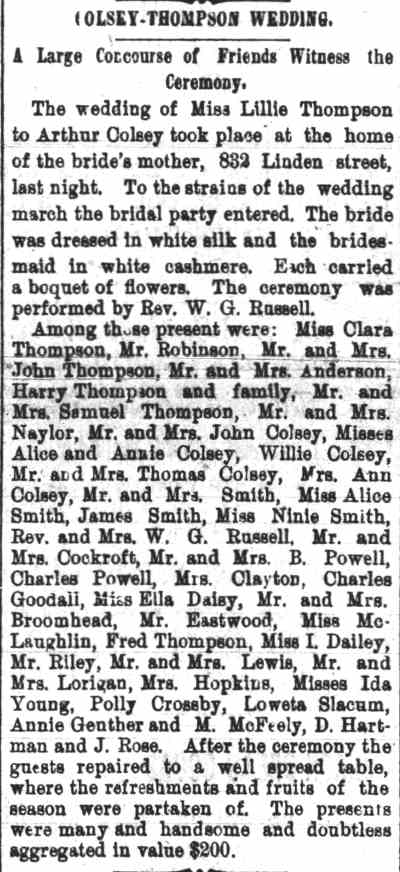
A Large Concourse of Friends Witness the Ceremony.
The wedding of Miss Lillie Thompson to Arthur Colsey took place at the home of the bride’s mother, 832 Linden street, last night. To the strains of the wedding march the bridal party entered. The bride was dressed in white silk and the bridesmaid in white cashmere. Each carried a bouquet of flowers. The ceremony was performed by Rev. W. G. Russell.
Among those present were: Miss Clara Thompson, Mr. Robinson, Mr. and Mrs. John Thompson, Mr. and Mrs. Anderson, Harry Thompson and family, Mr. and Mrs. Samuel Thompson, Mr. and Mrs. Naylor, Mr. and Mrs. John Colsey, Misses Alice and Annie Colsey, Willie Colsey, Mr. and Mrs. Thomas Colsey, Mrs. Ann Colsey, Mr. and Mrs. Smith, Miss Alice Smith, James Smith, Miss Ninie Smith, Rev. and Mrs. W. G. Russell, Mr. and Mrs. Cockroft, Mr. and Mrs. B. Powell, Charles Powell, Mrs. Clayton, Charles Goodall, Miss Ella Daisy, Mr. and Mrs. Broomhead, Mr. Eastwood, Miss McLaughlin, Fred Thompson, Miss I. Dailey, Mr. Riley, Mr. and Mrs. Lewis, Mr. and Mrs. Lorigan, Mrs. Hopkins, Misses Ida Young, Polly Crosby, Loweta Slacum, Annie Genther and M. McFeely, D. Hartman and J. Rose. After the ceremony the guests repaired to a well spread table, where the refreshments and fruits of the season were partaken of. The presents were many and handsome and doubtless aggregated in value $200.
Some Political Snap Shots
Philadelphia Inquirer —
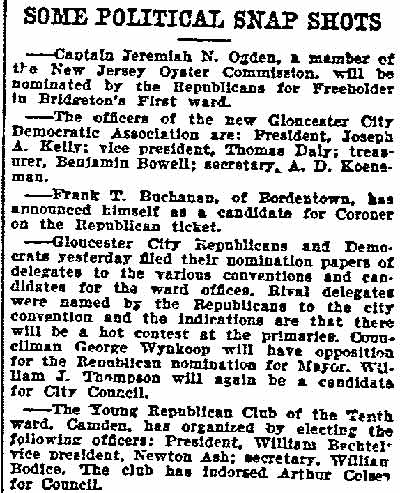
—Captain Jeremiah N. Ogden, a member of the New Jersey Oyster Commission, will be nominated by the Republicans for Freeholder in Bridgeton’s First ward.
—The officers of the new Gloucester City Democratic Association are: President, Joseph A. Kelly; vice president, Thomas Daly; treasurer, Benjamin Bowell; secretary, A. D. Koeneman.
—Frank T. Buchanan, of Bordentown, has announced himself as a candidate for Coroner on the Republican ticket.
—Gloucester City Republicans and Democrats yesterday filed their nomination papers of delegates to the various conventions and candidates for the ward offices. Rival delegates were named by the Republicans to the city convention and the indications are that there will be a hot contest at the primaries. Councilman George Wynkoop will have opposition for the Republican nomination for Mayor. William J. Thompson will again be a candidate for City Council.
—The Young Republican Club of the Tenth ward, Camden, has organized by electing the following officers: President, William Bechtel; vice president, Newton Ash; secretary, William Bodice. The club has indorsed Arthur Colsey for Council.
Councilman Colsey Seeks Re-Election
Philadelphia Inquirer —

••Councilman Arthur Colsey of the Second ward, announced yesterday that he is a candidate for re-election for a full term on the regular Republican ticket.
Eagles Mourned for Dead Members
Camden Post-Telegram —

Annual Memorial Services Held Yesterday at the Camden Theatre
RENDER ELABORATE PROGRAM
The annual memorial service of Camden Aerie, No. 65, Fraternal Order of Eagles, were held in the Camden Theatre yesterday afternoon. They were of the usual impressive character and the several hundred persons were at times very visibly affected.
The feature of the occasion was in the reading of the roll of the dead by Worthy Secretary Charles F. Sattler. In the rear of the stage there was a large painting representing the setting of the sun. The frame was draped in black crepe, incandescent lights being arranged about it at intervals. As the names of the departed were announced the lights were extinguished.
The oration was given by Grand Trustee Thomas C. Hayes, of Nevada. [sic] His address was a splendid, eloquent effort and was in thorough keeping with the occasion.
The balance of the program, replete with interesting features, included the following:
Orchestra—
(a) March-Coronation....Meyerbeer
(b) Overture—Morning, Noon and Night....Suppe
(c) Intermezzo-Traumerei....Schumann
Opening address....Worthy President Frank S. Devereaux.
Quartet, “Come Gracious Spirit”....Marzo
La Favorita Quartet.
Miss Julia Robinson, soprano; Miss Katharine Rosenkranz, contralto; A. D. McNichol, tenor; Henry Hotz, basso; W. Silvano Thunder, accompanist.
Prayer....Worthy Chaplain John L. Jarvis.
Tenor solo, “The Lord is my Light”....Allittson
A. D. McNichol.
Contralto solo, “From the Depths”....Campana
Miss Katharine Rosenkranz.
Remarks....Past Worthy President William M. Petzelt.
Duet, from “The Crucifixion”....Stainer
Misses Robinson and Rosenkranz.
Recitation, “The Last Hymn”....M. Farningham
Miss Marjorie R. Durgin.
Orchestra, “Serenade”....A. Emil Titl
Flute solo by Wm. A. Joseph.
Roll Call of Our Honored Dead....Worthy Secretary Chas. F. Sattler
Soprano solo, “Show Me Thy Ways”....Flotow
Miss Julia Robinson.
Memorial Address—Grand Trustee Thos. C. Hayes, of Newark, N. J.
Trio, “Protect Us Through the night,”....Nicolai
Misses Robinson and Rosenkranz and Mr. McNichol.
Orchestra, Inflamatus from “Stabat Mater”....Rossini
Bass solo, “Through the Darkness”....Rossini
Henry Hotz.
Quartet, “Incline Thine Ear”....Himmel
La Favorita Quartet.
Hymn, “Nearer My God, to Thee”....Mason
Sung by entire audience.
Benediction....Worthy Chaplain John L. Jarvis.
Orchestra, “Stars and Stripes”....Sousa
Brother Anthony J. Oberst, Musical Director.
Those in whose memory the services were held included the following:
Alfred Kemble, died June 16, 1901.
William Denneller, died October 4, 1902.
Conrad Brill, Jr., died July 8, 1903.
Charles Beale, died October 29, 1903.
Frank Burt, died March 10, 1904.
Dr. P. W. Beale, died June 7, 1904.
Jacob Hess, died August 16, 1904.
Daniel W. Broomley, died September 1, 1904.
Frederick Johnson, died December 3, 1904.
William H. Cole, died December 21, 1904.
J. S. B. Candler, died January 15, 1905.
Harry B. Middleton, died April 7, 1905.
George D. Strain, died July 9, 1905.
Martin MacNeil, died July 30, 1905.
Adolph Peschlow, died January 28, 1906.
H. J. McNermy, died March 2, 1906.
L. L. McClennan, died March 15, 1906.
Henry Price, died June 6, 1906.
Nathaniel Myers, died October 7, 1906.
Isaac Toy, died December 25, 1906.
Thomas J. Farnan, died March 12, 1907.
George Griffin, died March 18, 1907.
George W. Haman, died April 5, 1907.
Michael Raidon, died May 23, 1907.
Thomas Flatley, died August 8, 1907.
John F. Berton, died November 1, 1907.
Joseph E. Healy, died December 29, 1907.
Thomas Dwyler, died February 10, 1908.
Michael J. Lynch, died March 19, 1908.
Otto Heydrich, died March 24, 1908.
The officers of the local aerie include these:
Past Worthy Presidents, John H. Riddle, John A. Furey, James F. Cleary, Wm. H. Cole (deceased), Julius R. Schaaf, Wm. F. Jann, John J. Cleary, William M. Petzelt; Worthy President, Frank S. Devereaux; Worthy Vice President, Theodore B. Rambo; Worthy Secretary, Chas. F. Sattler; Worthy Treasurer, George S. Dilmore; Worthy Chaplain, John J. Jarvis; Worthy Conductor, Harry A. Durgin; Inside Guard, Robert M. Hartman; Outside Guard, B. Tierney; Worthy Trustees, Anthony J. Oberst, Harry C. Halbert, Charles E. Cullen; Worthy Physicians, Dr. W. P. Wingender, Dr. J. L. Mahaffey.
House Committee—A. J. Docherty, chairman; Edward Hagerty, Frank Applegate, Wm. Vander-Straeten, Wm. J. Lawler.
Memorial Committee—Anthony J. Oberst, chairman; William M. Petzelt, Julius R. Schaaf, William F. Jahn, Chas. F. Sattler, James F. Cleary, Theodore B. Rambo, George Fisher, George S. Dilmore, Harry A. Durgin, John L. Jarvis.
Ushers—John J. Burk, chairman; Frank Moncreif, Louis Bennett, Robert C. Barr, Wm. A. Atkin, Jr., John Lloyd, Joseph Taylor, Charles Mulner, Chas. Blank, Geo. W. Johnson, Arthur Colsey, Wm. D. Hoover, Fay La Fayette, Howard A. Fern.
Camden Candidates Ready for Primaries
Philadelphia Inquirer —
Though City Clerk Extends Time the Line Up of Contestants Is Virtually Complete
Virtually all of the municipal candidates, Republicans and Democrats, filed their petitions with City Clerk Brown in Camden yesterday. Although the new law apparently provided that yesterday was the last day on which the petitions could be filed, Clerk Brown placed a different construction on the act and extended the time until next Monday.
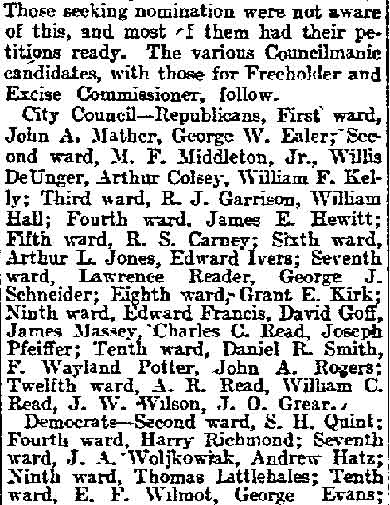
Those seeking nomination were not aware of this, and most of them had their petitions ready. The various Councilmanic candidates, with those for Freeholder and Excise Commissioner, follow.
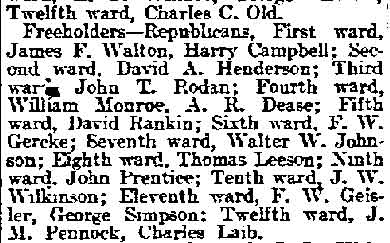
City Council—Republicans, First ward, John A. Mather, George W. Ealer; Second ward, M. F. Middleton, Jr., Willis DeUnger, Arthur Colsey, William F. Kelly; Third ward, R. J. Garrison, William Hall; Fourth ward, James E. Hewitt; Fifth ward, R. S. Carney; Sixth ward, Arthur L. Jones, Edward Ivers; Seventh ward, Lawrence Reader, George J. Schneider; Eighth ward, Grant E. Kirk; Ninth ward, Edward Francis, David Goff, James Massey, Charles C. Read, Joseph Pfeiffer; Tenth ward, Daniel R. Smith, F. Wayland Potter, John A. Rogers; Twelfth ward, A. R. Read, William C. Read, J. W. Wilson, J. O. Grear.
Democrats—Second ward, S. H. Quint; Fourth ward, Harry Richmond; Seventh ward, J. A. Woljkowiak, Andrew Hatz; Ninth ward, Thomas Lattlehales; Tenth ward, E. F. Wilmot, George Evans; [a partly cut line at the top of the next crop is not legible] Twelfth ward, Charles C. Old.
Freeholders—Republicans, First ward, James F. Walton, Harry Campbell; Second ward, David A. Henderson; Third ward, John T. Rodan; Fourth ward, William Monroe, A. R. Dease; Fifth ward, David Rankin; Sixth ward, F. W. Gercke; Seventh ward, Walter W. Johnson; Eighth ward, Thomas Leeson; Ninth ward, John Prentice; Tenth ward, J. W. Wilkinson; Eleventh ward, F. W. Geisler, George Simpson; Twelfth ward, J. M. Pennock, Charles Laib.
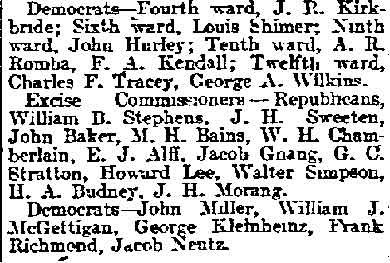
Democrats—Fourth ward, J. R. Kirkbride; Sixth ward, Louis Shimer; Ninth ward, John Hurley; Tenth ward, A. R. Romba, F. A. Kendall; Twelfth ward, Charles F. Tracey, George A. Wilkins.
Excise Commissioners—Republicans, William B. Stephens, J. H. Sweeten, John Baker, M. H. Bains, W. H. Chamberlain, E. J. Alff, Jacob Gnang, G. C. Stratton, Howard Lee, Walter Simpson, H. A. Budney, J. H. Morang.
Democrats—John Miller, William J. McGettigan, George Kleinheinz, Frank Richmond, Jacob Neutz.
Coursey Breaks Down While Story of Cold-Blooded Killing of Karl Kellmann Is Told by Detective
Camden Post-Telegram —
Two “Pals,” Too, Accused of Crime
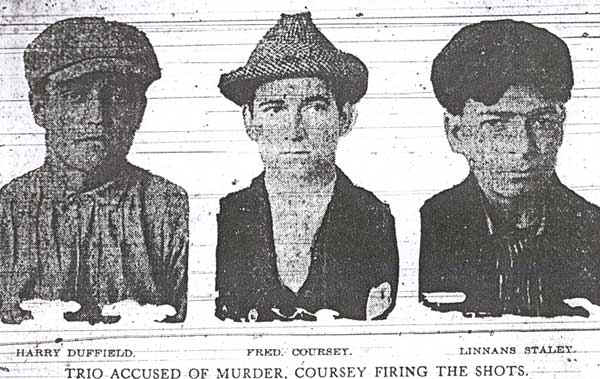
Harry Duffield. Fred. Coursey. Linnans Staley.
Trio Accused of Murder, Coursey Firing the Shots.
Collapsing when arraigned in Police Court this morning before Recorder Stackhouse on the charge of killing Karl Kellmann, aged 18 years, of 2919 High street, at Twenty-seventh and Sherman streets, shortly before midnight Saturday, Fred Coursey, alias “Mexican Pete,” alias “Cowboy Pete,” aged 20 years, of 121 North Twenty-first street, who admits firing the fatal shots while committing robbery, and Harry Duffield, aged 21 years, of 407 North Forty-first street, who acknowledged masking his face with a handkerchief and being with Coursey, sobbed piteously, resting their heads on the railing of the dock, while John Painter, the veteran detective, was briefly reciting the story.
When Recorder Stackhouse asked what became of the young man who was shot and Painter replied that he died, Coursey and Duffield sobbed afresh, and when Recorder Stackhouse committed them without bail Policemen Frost and Kay had to help them.
Linnans Staley, aged 21 years, of 1819 Federal street, who confessed that he was in the robbery plot but later got scared and hid in the bushes, was scarcely able to stand, and when his mother broke down as he was committed as a principal he staggered and would have fallen but for Sergeant McClong.
Prosecutor Boyle announced this morning that the Grand Jury will be recalled for Thursday of this week and the case will be made the special order of the day.
Without the slightest clue to start with in the most brutal murder committed in recent years in Camden county, police and detectives under the personal direction of Chief Gravenor in two hours arrested two of the three prisoners and obtained their signatures to confessions and before sunrise the other was lodged behind the bars at the City Hall.
According to their statements to the police the prisoners while drinking on a lot near Twenty-first and Federal streets on Saturday night planned to go to a lone spot near Twenty-seventh and Sherman streets to hold someone up to get money and jewelry to buy more drink. Coursey had a 38-calibre cowboy pistol and Duffield used Coursey’s bandanna as a mask. Staley weakened before the spot selected was reached and at the time of the murder was hiding in a clump of weeds a short distance away.
The murdered boy was the son of Karl and Lulu D. Kellmann. He was a member of the Bible class of Grace Presbyterian Church, East Side, and active in church work.
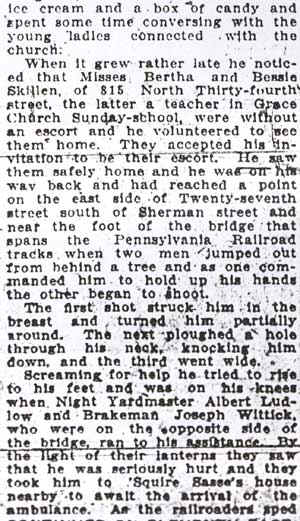
Saturday night was the closing of a carnival given on High street between Twenty-seventh and Thirtieth streets. Karl was there and made several purchases. At one booth he bought a necktie, from another some ice cream and a box of candy and spent some time conversing with the young ladies connected with the church.
When it grew rather late he noticed that Misses Bertha and Bessie Skillen, of 815 North Thirty-fourth street, the latter a teacher in Grace Church Sunday-school, were without an escort and he volunteered to see them home. They accepted his invitation to be their escort. He saw them safely home and he was on his way back and had reached a point on the east side of Twenty-seventh street south of Sherman street and near the foot of the bridge that spans the Pennsylvania Railroad tracks when two men jumped out from behind a tree and as one commanded him to hold up his hands the other began to shoot.
The first shot struck him in the breast and turned him partially around. The next ploughed a hole through his neck, knocking him down, and the third went wide.
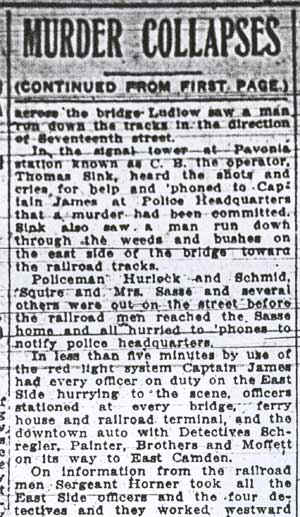
Screaming for help he tried to rise to his feet and was on his knees when Night Yardmaster Albert Ludlow and Brakeman Joseph Wittick, who were on the opposite side of the bridge, ran to his assistance. By the light of their lanterns they saw that he was seriously hurt and they took him to ’Squire Sasse’s house nearby to await the arrival of the ambulance. As the railroaders sped across the bridge Ludlow saw a man run down the tracks in the direction of Seventeenth street.
In the signal tower at Pavonia station known as C. B. the operator, Thomas Sink, heard the shots and cries for help and ’phoned to Captain James at Police Headquarters that a murder had been committed. Sink also saw a man run down through the weeds and bushes on the east side of the bridge toward the railroad tracks.
Policeman Hurlock and Schmid, ’Squire and Mrs. Sasse and several others were out on the street before the railroad men reached the Sasse home and all hurried to ’phones to notify police headquarters.
In less than five minutes by use of the red light system Captain James had every officer on duty on the East Side hurrying to the scene, officers stationed at every bridge, ferry house and railroad terminal, and the downtown auto with Detectives Schregler, Painter, Brothers and Moffett on its way to East Camden.
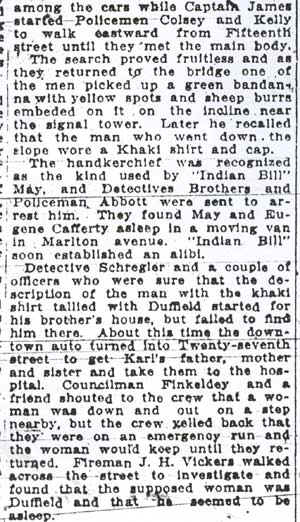
On information from the railroad men Sergeant Horner took all the East Side officers and the four detectives and they worked westward among the cars while Captain James started Policemen Colsey and Kelly to walk eastward from Fifteenth street until they met the main body.
The search proved fruitless and as they returned to the bridge one of the men picked up a green bandanna with yellow spots and sheep burrs embeded [sic] on it on the incline near the signal tower. Later he recalled that the man who went down the slope wore a Khaki shirt and cap.
The handkerchief was recognized as the kind used by “Indian Bill” May, and Detectives Brothers and Policeman Abbott were sent to arrest him. They found May and Eugene Cafferty asleep in a moving van in Marlton avenue. “Indian Bill” soon established an alibi.
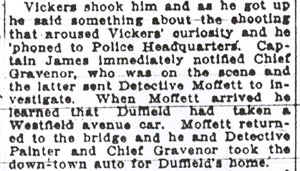
Detective Schregler and a couple of officers who were sure that the description of the man with the khaki shirt tallied with Duffield started for his brother’s house, but failed to find him there. About this time the downtown auto turned into Twenty-seventh street to get Karl’s father, mother and sister and take them to the hospital. Councilman Finkeldey and a friend shouted to the crew that a woman was down and out on a step nearby, but the crew yelled back that they were on an emergency run and the woman would keep until they returned. Fireman J. H. Vickers walked across the street to investigate and found that the supposed woman was Duffield and that he seemed to be asleep.
Vickers shook him and as he got up he said something about the shooting that aroused Vickers’ curiosity and he ’phoned to Police Headquarters. Captain James immediately notified Chief Gravenor, who was on the scene and the latter sent Detective Moffett to investigate. When Moffett arrived he learned that Duffield had taken a Westfield avenue car. Moffett returned to the bridge and he and Detective Painter and Chief Gravenor took the down-town auto for Duffield’s home.
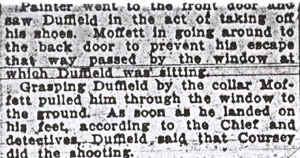
Painter went to the front door and saw Duffield in the act of taking off his shoes. Moffett in going around to the back door to prevent his escape that way passed by the window at which Duffield was sitting.
Grasping Duffield by the collar Moffett pulled him through the window to the ground. As soon as he landed on his feet, according to the Chief and detectives, Duffield said that Coursey did the shooting.
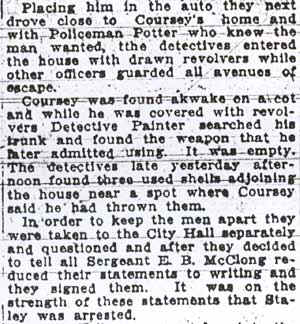
Placing him in the auto they next drove close to Coursey’s home and with Policeman Potter who knew the man wanted, the detectives entered the house with drawn revolvers while other officers guarded all avenues of escape.
Coursey was found akwake [sic] on a cot and while he was covered with revolvers Detective Painter searched his trunk and found the weapon that he later admitted using. It was empty. The detectives late yesterday afternoon found three used shells adjoining the house near a spot where Coursey said he had thrown them.
In order to keep the men apart they were taken to the City Hall separately and questioned and after they decided to tell all Sergeant E. B. McClong reduced their statements to writing and they signed them. It was on the strength of these statements that Staley was arrested.
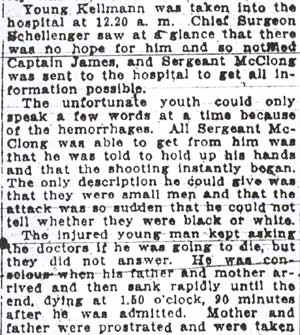
Young Kellmann was taken into the hospital at 12.20 a. m. Chief Surgeon Schellenger saw at a glance that there was no hope for him and so notified Captain James, and Sergeant McClong was sent to the hospital to get all information possible.
The unfortunate youth could only speak a few words at a time because of the hemorrhages. All Sergeant McClong was able to get from him was that he was told to hold up his hands and that the shooting instantly began. The only description he could give was that they were small men and that the attack was so sudden that he could not tell whether they were black or white.
The injured young man kept asking the doctors if he was going to die, but they did not answer. He was conscious when his father and mother arrived and then sank rapidly until the end, dying at 1.50 o’clock, 90 minutes after he was admitted. Mother and father were prostrated and were taken home by the up-town auto.
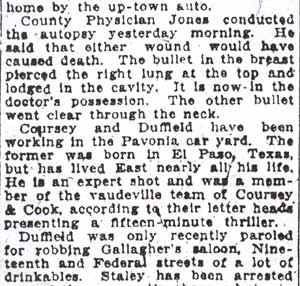
County Physician Jones conducted the autopsy yesterday morning. He said that either wound would have caused death. The bullet in the breast pierced the right lung at the top and lodged in the cavity. It is now in the doctor’s possession. The other bullet went clear through the neck.
Coursey and Duffield have been working in the Pavonia car yard. The former was born in El Paso, Texas, but has lived East nearly all his life. He is an expert shot and was a member of the vaudeville team of Coursey & Cook, according to their letter heads presenting a fifteen-minute thriller.
Duffield was only recently paroled for robbing Gallagher’s saloon, Nineteenth and Federal streets of a lot of drinkables. Staley has been arrested several times on petty charges but was never convicted of crime. When Duffield’s coat was examined at the City Hall, it was found to contain sheep burrs.
To a reporter Coursey said that whenever he was drinking he had to get his gun and shoot something or somebody. He insisted that all were in on the job and that they let the man who preceded Kellman go over the bridge without molestation because he didn’t look as if he had any too much money.
Yesterday morning Assistant Prosecutor Wolverton and Stenographer Cleary called at the City Hall. The prisoners were examined by Mr. Wolverton and their statements taken by Mr. Cleary, but there was little or nothing new elicited.
Wilson Ashbridge and George E. Thompson
Camden Post-Telegram —
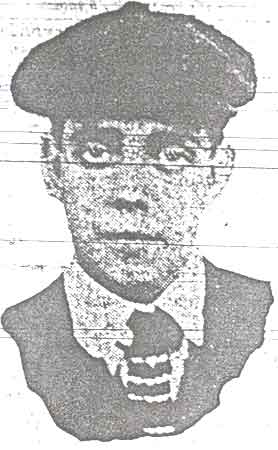
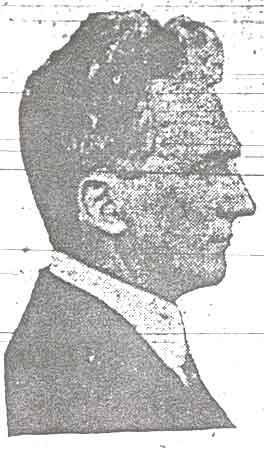
WILSON ASHBRIDGE — GEORGE E. THOMPSON
Murderer and Forger Escape Jail After Shooting Keepers, Killing One
Camden Post-Telegram —
Wilson Ashbridge, Who Shot and Killed Mrs. Elizabeth Dunbar and George E. Thompson, Check Swindler, Trap Jailor Hibbs by a Ruse and After Slaying Him Shoot Joe Ellis Who Intercepted Them in Flight.
Used Revolver Smuggled Into Prison by Confederates and Leave Jail Wide Open in Their Flight, a General Delivery Being Averted by Police Who Were Summoned by the Wounded Men.
Murdering one jailor and wounding another with a revolver that had been smuggled into them by outside confederates, Wilson T. Ashbridge, slayer of Mrs. Elizabeth Dunbar, and Francis Murphy, alias George E. Thompson, a check forger, made their escape from the county jail a few minutes before seven o’clock last night.
Ashbridge with his wife was caught at noon in the Keystone Hotel in Chester PA where they registered at one o’clock this morning.
Thompson is still at liberty but from the confident manner of Prosecutor Kraft his early arrest seems assured.
The murdered jailor was Isaac Hibbs, aged 65 years of 913 South 8th Street. The wounded keeper is Joseph Ellis, aged 45 years, of 416 Carteret Street. Shot twice, he is in Cooper Hospital. His condition today is very satisfactory.
Thompson, who is 41 years old, forged a check for $650 which he gave to V.M. Fulton as part of the purchase price of an automobile. The forgery was discovered before the deal was completed and his arrest followed on June 8. he also passed a forged check for $15 on State Motor Vehicle Agent Kraft. He, too, was awaiting trial. In spite of the positive evidence against him Thompson had spurned all efforts to have him plead guilty and it is now believed that he was sparring for time while hatching a plan to escape. He is no doubt the master mind.
R.L. Hunter, a farmer of Bensalem Township, Bucks County PA, about four miles above Torresdale, reported to the Philadelphia police the morning that he had seen a man answering Ashbridge’s description on the Bucks Road at daylight. The man asked the way to Riegelsville.
According to Hunter, the man was dressed in a dark suit, and had no hat. His clothing was wet. Hunter did not see anything suspicious in his actions, and after giving him directions, they parted.
Upon seeing the paper with a picture of Ashbridge, the farmer was struck by its resemblance to the man with whom he had talked. He hurried to Tacony and notified the police.
The State police, who patrol that section of the county, and who have an office at Langhorne, were immediately notified as were the surrounding towns.
The shootings took place in different parts of the jail. Hibbs was murdered in the exercise room just outside the cell room on the Sixth and Arch corner of the building. Ellis was shot down in the corridor just outside the Market Street end of the building when he heroically grappled with Ashbridge after the latter had pointed a gun at his head. In spite of his wounds Ellis dragged himself to a telephone and after notifying Police Headquarters of what had happened he collapsed.
Only one of the two bullets is still in Ellis. It entered the groin on the right side and is buried in the muscles of the leg, having taken a downward course for seven or eight inches. The other bullet struck Ellis in the right breast and came out in the left breast, traversing the upper fleshy parts of the body.
Hibbs was almost instantaneously killed by a bullet that went within an inch of his heart, producing a hemorrhage. The bullet was extracted this morning from the body early this morning in an autopsy performed at the morgue by County Physician Stem. In spite of the fact that it is pretty well established that three shots were fires in the attack on Hibbs, only one of the bullets took effect.
“But it makes little difference which of the two men handled the gun” said Prosecutor Kraft this morning. “Both are equally guilty of this murder and what we are concerned about now is the recapture of the gunmen.” Mr. Kraft added that it his purpose to examine all of the prisoners in that part of the jail where Hibbs was murdered to determine fully who fired the fatal shot.
The escape had been carefully planned and timed to the minute. Of course the desperate prisoners were aided by confederates on the outside and it is the general belief that a high powered motor car was in waiting for them not far from the jail. They are known to have been in possession of money and openly boasted yesterday that it was their intention to leave the prison last night. These boasts were made to two young ladies connected with a religious organization who called on the two men yesterday to offer spiritual reconciliation. The girls are frequent visitors to the jail and naturally their efforts at evangelization were directed in the main toward Ashbridge, because of the fact that he was accused of murder. These girls, whose identity officials will not disclose, were closeted with Prosecutor Kraft until one o’clock this morning. Both declared that on their visit yesterday they were told by Ashbridge and Thompson that it was the last day they expected to spend in jail.
“We are going to get away from here tonight and we’ve got money to help us after we are out ” said Ashbridge, who further told the girls he had considerable cash sewed up in the waistband of his trousers. The girls begged the prisoners not to do anything that would cause them more trouble and they told the Prosecutor that Ashbridge and Thompson promised them that they would not make any effort to escape. In their talks with the girls neither of the prisoners said a word that would indicate that they would kill if necessary to escape. The full force of their boast did not dawn on the religious workers and for this reason it never occurred to them to inform the Sheriff of what the prisoners had in said.
A general jail delivery of at least all the men confined in what is known as the untried department, where the two were held, was only averted by the prompt arrival of the police on their beat, which was made easy by means of the keys taken from the prostrate body of Hibbs. Ashbridge and Thompson left all of the doors open and the vanguard of the inrushing police found the prisoners swarming all over the corridors on the east side of the prison. In the wild excitement following the double shooting and escape none else thought of freedom and a checking up of the inmates after they had been herded in the exercise room of the untried department accounted for all but the fugitive slayers.
The department, in which the two men were confined is the same one which William Brown and Charles Berger made their sensational escape several years ago by sawing away the bars on the Federal Street front of the jail. Thrilling as it was, the former escape was insignificant in comparison with last night’s tragic event.
With the full force of the keepers out of the way— one dead and the other suffering from gunshot wounds at first supposed to have been fatal— Ashbridge and Thompson had nothing between them and freedom but the door entering from the spiral stairway leading to the narrow entrance of the Sixth and Market Streets end of the Court House. With the keys taken from Hibbs they opened the door and in a few seconds were breathing the free air. It was still daylight when the daring murderers walked from the building and although they were no doubt seen by some of the scores of persons passing it is certain that they managed to control themselves to such an extent as not to arouse any undue suspicion. The exit they used to escape is that used by the general public and therefore persons passing calmly in and out of the door would not in any manner be thought to have been connected with a jail delivery. However the shots which had laid low the keepers had been plainly heard on all four sides of the building and it is strange that no one has yet been found who can give positive information as to what course the fleeing men took and whether they were aided in their flight by an automobile.
While the police and detectives of Camden and all other cities in the East are watching railroad terminals, steamship lines, and all other avenues of travel in response to the general alarm sent out last night, Prosecutor Kraft is bending all his energies to learn who smuggled in the revolver which the fugitives used. Thus far this feature of the case is as complete a mystery as it was last night. Mr. Kraft and Sheriff Haines are satisfied, however, that only one gun was used for both shootings. It was at first thought that each man had a pistol when they left the jail; that one of them armed himself with the gun that Hibbs was supposed to have carried, but it was determined that Hibbs was not armed when he went into the jail last night. There was no occasion for him to come in contact with any of the prisoners and for that reason he left his revolver in his desk in the office. Even had he carried it he would have little chance to use it, so cold-bloodedly was he slain as he unsuspectingly fell into the trap laid for him by the desperate gunmen. There is also some conflict as to how at least one of the fugitives was dressed. Alfred Williams, who witnessed the murder of Hibbs, said that Ashbridge was without coat or hat when he dashed out of the cell-room, and that Thompson carried his coat and hat under his arm. However in a description of the two men given at the Prosecutor’s office it was set forth that Ashbridge wore a blue serge suit and a checkered cap. The coat that he is supposed to have taken bore the mark of “Tull— the Tailor,” of Jacksonville, Florida, and had been borrowed by him from another prisoner. He wore tan shoes. Ashbridge is 27 years old, 5 feet 7-1/2 inches in height and weighs 137 pounds. He has brown hair, smooth face and is of light complexion.
Thompson wore a brown suit and a Panama hat. He is 41 years old 5 feet seven inches in height, and weighs 175 pounds. He has brown bushy hair, is minus one of the fingers on his left hand, and is light complexioned.
The tan shoes worn by Ashbridge were also borrowed from one of the prisoners. He got them on Saturday and remarked that he wanted to look neat.
Keepers Ellis and Hibbs were reading in the prison office last evening when Hibbs glanced up at the clock and noticed that it was a few minutes of seven. “Joe, I’m going back and put the boys in their cells,” he said to Ellis and with his keys in his hand he started for the cell room in the untried department. A thirty foot long corridor runs from the office to the barred and grated door opening into the department in which the cells are situated. This department is about the size of three ordinary school rooms and in the southeastern corner of the jail are the cells, in two tiers.
Around the cells is a three foot corridor into which all the cells doors open and in which all the prisoners are permitted to walk when they are not allowed out in the main room. When the inmates are ordered into their cells and their doors closed the doors are locked from the outside of the steel cage by means of a lever worked by the jailor. Thus every cell door can be made secure without the keepers coming into actual contact with the prisoners. In addition to the bars around the corridor fronting on the double tier of cells there is a fine mesh heavy wire screening.
As Hibbs approached the lever which is operated to shut the cell doors after the prisoners have retired from the corridors, Ashbridge was leaning against the grating of his cell, Number 18. Thompson was lounging a few feet away.
“Daddy, open the door, I want you to see this note,” said Ashbridge to the keeper, at the same time displaying a piece of paper which he had in his hand. Never giving a thought that he was about to perform an act that which was absolutely necessary for the carrying-out of the well laid plot, or that he was going to his doom, or was even in danger, “Daddy,” as the aged keeper was known to all the prisoners, opened the door without hesitation.
As he swung wide the big steel frame, Ashbridge quickly stepped out and the next instant was pressing a gun against the abdomen of the jailor.
“Throw up your hands, you ___ ___ ___” he commanded.
“What are you up to, what’s this mean,” asked the keeper, apparently not realizing he had been trapped.
For reply Thompson jumped out the door, wrenched the gun from Ashbridge’s grasp and with an oath began firing at Hibbs, who sank to the floor at the first shot. Only a few feet away and the only other person in the exercise room, although the shooting could have been seen by any other prisoners who had not retired to their cells, Alfred Williams, trusty, is emphatic in his assertion that Thompson fired the shot that killed Hibbs and that he fired three times.
“It’s a wonder they did not get me,” said Williams. “Ashbridge and I could not hit it and in his desperate mood I am surprised he didn’t kill me, too.” Williams, who has just completed a six months’ sentence for obtaining money from Italian grocers by falsely representing himself as an agent for a wholesale house in Chicago and who is wanted in the Windy City for the same offense, says the whole transaction took less than a minute and that the moves came so fast he and the other prisoners were powerless to aid.
“It was like a flash of lightning” said Williams, “and before I could fully understand what had happened Ashbridge had grabbed Daddy’s keys’ which had fallen to the floor, and was off like a deer for the barred door. Ashbridge had taken the smoking gun from Thompson, who had his hat and coat under his arm and who was right behind the other one.
“As they hurried through the door after Ashbridge had opened it with Daddy’s keys Daddy called to me to raise him. I put my arm under his head and lifted him slightly from the floor. ‘Hold my hands’ he said to me. I took hold of his hands and the next minute he died in my arms. Then I heard two more shots and I knew they got Joe Ellis.”
Startled by the shots, and he is emphatic there were three in rapid succession, Ellis leaped to his feet and without taking the time to arm himself ran from the office and turned into the corridor just as Ashbridge, wild-eyed and gun in his hand, came running toward him. Halting three yards away Ashbridge pointed the revolver at Ellis’ head and ordered him to throw up his hands.
For reply and without fear of himself the keeper dashed at the murderer and the next instant they were locked in each others’ embrace. Working loose the hand which held the gun, Ashbridge pulled the trigger. The bullet struck Ellis in the breast, but the wound was not sufficient to render him helpless. However, before he could grip the pistol arm, Ashbridge fired again and the keeper fell back with a bullet in his groin.
“The second shot got me,” said Ellis to Prosecutor Kraft and Assistant Prosecutor Butler at the hospital. “The first one wasn’t bad but my strength left me when the second bullet struck. Ashbridge was the only one I saw. I did not see Thompson.”
Dragging himself to the office Ellis managed to reach a telephone and called up the police.
“This is Ellis at the county jail; come quick. Ashbridge has shot me” he weakly said over the phone to Captain Hyde. Then the receiver fell from his hand and he dropped to the floor, but after a minute or two managed to climb into chair.
While patrol loads of policemen were being hurried to the Court House from the First and Second District station houses, Reserve Officer Charles Hose, on duty at Broadway and Federal Street, who had heard the shots, ran to the Court House and from the office of Assistant Custodian John Lack phoned up to the jail. Ellis managed to answer and in a few words told what had happened. They ran up to the jail and were admitted by Ellis, who was rapidly growing weaker from loss of blood, the trail of which plainly showed just where the injured keeper had moved.
“I guess Ashbridge got away and the jail is all open, you had better take care of the rest of the prisoners,” said Ellis to Hose and Lack. The fugitive-murderers had left all doors open and the other occupants of the untried department were swarming through the corridors. Their curses and yells and the shrieks and cries of the female prisoners had turned the place into a perfect bedlam. With the aid of other policemen who swarmed into the Court House like bees, the prisoners were soon herded into the exercise room, where Trusty Williams checked them up and accounted for all but Ashbridge and Thompson.
With the faint hope that the missing pair had not risked leaving the building but had secreted themselves in the structure, the courthouse was searched from pit to dome, but no trace of the men were found.
Detective Doran was the first of the Prosecutor’s staff to reach the scene. Mr. Kraft and the balance of the staff soon followed. In the lower end of the county, on official business, Sheriff Haines was reached by phone and Under Sheriff Hewitt was summoned from Pitman and until an early hour this morning the officials were in conference and examining numerous prisoners.
State Detective Walter Le Torneau furnished Prosecutor Kraft with a promising “tip” this morning when he learned that Thompson gave a letter to Freeholder Howard Marshall, of the Eighth Ward, to mail on Sunday. Mr. Marshall states that the letter was addressed to a woman by the name of Mrs. Shelton, in Baltimore MD.
Marshall was attending religious service in the jail when Thompson approached him.
“Put this in your pocket and mail it for me when you go out,” said Thompson to Mr. Marshall, who agreed to carry out the request. Dropping the letter in the mail box Marshall allowed the incident to pass without further notice.
Detective Le Torneau learned this morning that Marshall had spoken to the incident to a friend and the sleuth notified the Prosecutor. The tip will be run down the Prosecutor stated.
Funeral services for Hibbs will be held on Thursday from his late residence. The body will be taken to Langhorne PA where interment will be made in the Friends’ Cemetery under the direction of the Schroeder-Kephart Company. Services will be conducted Wednesday evening by Reverend Henry Bradway, pastor of the Eighth Street Methodist Episcopal Church.
POLICE QUICKLY AT WORK
Although the murderous prisoners made their escape, it was no fault of the local police department, which threw out a “dragnet system” that covered practically every outlet from the city. As soon as the call reached headquarters the red lights were flashing and every officer and detective who could be reached was sent out on the “man hunt” which was pursued with vigor.
Passing automobiles were pressed into service by the detectives and officers and all haste was made for the ferries, railroad yards, terminals, and trolley points. Citizens cooperated with the police in their efforts to run down the escaping prisoners.
Assistant Chief Hyde received the call from Jailor Ellis, who though wounded himself summoned strength enough to reach the phone.
“This is Jailor Ellis. Hibbs and me have been shot by that man Ashbridge and help quick!” was the startling message which came over the phone to Chief Hyde about one minute past seven.
It was just at the time the shifts were going on and off at the local station houses. Chief Hyde lost no time. He called to Machine Operator “Eddie” King to send the message to the station houses and flash the red lights. This was done and as fast as the men could run they covered the various points.
The auto patrols were dispatched with all hands to the Court House and the wounded men hurried to the hospital. Coroner Robert G. Schroeder reached the hospital as Hibbs and Ellis were being admitted and he took charge of the situation and got in touch with Prosecutor Kraft and County Physician Stem.
Detective Captain Schregler was hurriedly summoned, and his men were sent in all directions. Detective Brothers boarded a waiting automobile and a record run was made for the Federal Street ferry. Sergeant Humes was picked up and in four minutes after the call was received from Ellis Detective Brothers had the ferry covered.
Detectives Troncone, Painter and Murry and captain Schregler covered the Kaighn Avenue, Vine Street, and Cramer Hill ferry lines.
Detective Brothers got in touch with the Pennsylvania Railroad officials who put their detective force to work searching freight and passenger cars. The orders were sent out from the railroad office to stop and search every freight train. Dispatches were also sent to Trenton, Mount Holly, and Burlington and it was not long before the news of the atrocious deed had spread throughout the country and many distant places.
Trolley cars were stopped and searched by the police, but not the slightest trace could be found of the escaped prisoners. The police left nothing undone in the “man-hunt.”
When news of the affair spread through the city phone calls began to come in to headquarters. Over fifty persons called up to tell the police that they had seen the two men at various places. The “tips” were all run down but none materialized.
Officers Arthur Colsey and Theodore Guthrie, who were on their vacations, lent their aid to Chief Hyde. Policeman Colsey pressed his automobile into service and carried the police to various parts of the city.
Co-operating closely with Prosecutor Kraft’s detectives the city officials formed a combination which in nine times out of ten would have been successful, but the escaped men cleverly eluded their pursuers.
Assisted by Coroner Schroeder, County Physician Stem held a post mortem examination on Hibbs’ body. The bullet which caused the death was located in the region of the heart, It passed through the victim’s lung, causing a hemorrhage, which resulted in death. Following the examination the body was taken by the Schroeder-Kephart Company at the family’s orders to be prepared for burial.
ASHBRIDGE’S FIRST CRIME
The brutal crime for which Ashbridge stood indicted but untried was committed on the night of January 22 at Ninth and Market Streets. It developed that the murderer had followed his intended victim from the morning hours. He trailed her to the home of her sister, a Mrs. Meredith, of 911 Market Street, and laid in wait in the darkness of a building that fatal Saturday night.
Mrs. Dunbar came out of the house and stood on the northeast corner while waiting for a ferry-bound trolley car. She intended going to Sicklerville that night to visit her relatives. With her at the time was her 7-year-old daughter, Eleanor, and her father, Charles Dunbar. Ashbridge advanced toward the woman, who was startled when she saw him. She called to her father that she “didn’t want anything to do with Ashbridge.”
Before the father could interfere the young murderer whipped out a revolver and covered the father and the woman. He then struck the woman violently in the face with his fist and as she was reeling under the force of the brutal blow Ashbridge fired, the first bullet taking effect in the woman’s chest. The brutal murderer then stood over his prostrate victim and holding the revolver less than five inches from his victim’s body he pumped four more shots into her.
Policeman Howard Smith and Policeman Taylor were a square distant. Smith saw the entire proceedings and screamed at Ashbridge to stop shooting. A crowd quickly gathered and Dr. Maldeis, who lives nearby, came running to the scene to aid the stricken woman.
Officer Taylor espied Ashbridge in the crowd. The murderer made no effort to run, but stood his ground. Detecting the murderer trying to slip something up his sleeve, Taylor pounced upon him and bore him to the ground, at the same time taking the gun away from him and slipping the handcuffs over the murderer’s wrists. Policeman Taylor had to draw his revolver to keep back the large crowd that was threatening. Showing no concern whatever, Ashbridge calmly waited until the police auto arrived. In the meantime the murdered woman’s still warm body was placed in a “jitney” and with Officer Smith and Dr. Maldeis a hurry run was made for Cooper Hospital but when the institution was reached, Mrs. Dunbar was pronounced dead.
Ashbridge was taken to the hospital by Policeman Taylor in the police auto. He asked “how she is.” Informed that he had accomplished his purpose, the young murderer asked to see the woman. When the white sheet covering the still form of the murdered woman was drawn from the face Ashbridge leaned over and kissed the forehead of the woman. He was then taken to the County jail and locked up. Before Recorder Stackhouse on the following Monday Ashbridge pleaded guilty.
Ashbridge was infatuated with the woman, who was a member of the Temple Theater chorus. Because of Ashbridge’s persistent attentions she was compelled to give up her position. Mrs. Dunbar had previously accepted Ashbridge’s attentions, thinking that he was unmarried, but upon learning that he had a wife and child she informed him that it would be best for them not to see each other, but the young man refused to discontinue his attentions.
On the day of the shooting Ashbridge was seen in various places. He is said to have followed the woman to the Federal Street ferry, but lost track of her. Around noon he was seen at Front and Pearl Streets by Policeman Boyd, who ordered him to move on. Boyd was about to arrest him as a suspicious character, but Ashbridge pleaded that he was looking for a friend. All that day Ashbridge followed the woman until night, when he cruelly murdered her.
The murderer came from a respectable family. Dissipation is thought to have caused the young man to lose his sense of reasoning. Rather good-looking, Ashbridge had tender baby-like eyes and his case excited sympathy among the more tender-hearted people.
Sweetmeats, tasty sandwiches, and other small luxuries were said to have been given the young murderer while he languished in his cell. He had many visitors. Recently Ashbridge was taken violently ill after eating some crabs which were given him by a friend. He and Jailor Hibbs were very friendly.
THOMPSON A CLEVER FORGER
Thompson, or Murphy, was a self-styled lawyer and was committed by Recorder Stackhouse in June for forging checks to the amount of $1,055. The worthless checks were “worked” on the McClelland-Fulton Auto Company and Motor Vehicle Agent A.C. Kraft.
When a check for $150 presented to the automobile company by Thompson and drawn to the order of “G.E. Thompson” on the Harrisonburg, Virginia National Bank came back from the home office of the Studebaker Company as worthless, Mr. Fulton called in the police.
Thompson had previously presented a check for $890 as payment on an automobile. This check was drawn on Thompson’s favor on the Coatesville National Bank and was purported to have been signed by Louis L. Gibney, a hotel man of Downington PA. This check was still in the possession of Mr. Fulton when Thompson was arrested after the first check was returned marked “no funds.”
The clever swindler also presented a bad check to Agent Kraft for $15 for which he received the license to operate the automobile which he proposed buying.
Detective Troncone arrested Thompson at Fifth and Market Streets on June 2. The defendant had been living in a room at 220 North Fifth Street.
Giving his home address as Daytona, Florida, Thompson represented himself as a lawyer. Well dressed and wearing nose glasses, Thompson was an intelligent appearing man, he had a bushy pompadour which was streaked with gray and talked in a persuasive manner. His forgeries on Mr. Gibney’s signature were so clever that Gibney himself could not tell the difference.
After Thompson’s arrest Detective Captain Schregler sent out notices to several southern cities. He received responses from Harrisonburg, Norfolk, and Petersburg Virginia and that Thompson was wanted in all three cities for check forgeries.
Bert Hibbs, a city foreman and a son of the slain jailor, was murdered early Sunday morning, December 25, 1910 when his throat was cut by Clement Ridgway, a negro, aged 22 years, of Seventh and Sycamore Streets. It was about 12:20 on Christmas morning that Hibbs while crossing the lots at Seventh and Sycamore was accosted by Ridgeway, who wanted to shake hands with Hibbs. The latter refused, a quarrel ensued and Ridgeway whipped out a razor and slashed Hibbs across the throat with such violence that his head was nearly severed. Hibbs died while on the way to the hospital. Ridgway was arrested after a battle by Detectives Schregler, Painter and Brothers and several officers at his home, 1207 Lilly Row.
Indicted for murder Ridgway pleaded non vult. On April 24, 1911, to a charge of murder in the second degree, he was sentenced to 25 years in state Prison at hard labor.
SECOND MURDER IN JAIL
This is the second murder and second escape from the present jail. The first murder took place in November, 1907, when George Stewart, a young negro, stabbed to death John Snell, who was awaiting trial for carrying in the business of fortune telling. Stewart was in jail on a charge of dealing in opium and cocaine. He had a complete opium layout in his cell. He and Snell had a quarrel and he stabbed Snell to death in his cell. He was tried and convicted and sentenced to be electrocuted during the week of February 8, 1908. He was electrocuted on February 4, being the first man to suffer the death penalty by electrocution.
On July 13, 1910 William T. Brown, alias Gillespie, who had been sentenced to seven years on a charge of forgery, and Charles Berger, who was under sentence for picking pockets, made their escape from jail after sawing the bars on the Federal Street front. They climbed over the balustrade to the roof, descended through a trapdoor, climbed down stairs and walked leisurely through the Court House building and out into the street unnoticed. They entered an automobile and were driven away. They crossed to Philadelphia on a North Cramer Hill Ferry boat.
Several weeks later Brown was arrested in New York City and was sentenced to Auburn Prison on an old charge. His term will expire shortly and he has also applied to the Court of Pardons of this State for a parole. A detainer has been lodged against him at the State prison where he is located and he will be brought back and resentenced. Berger was captured in Chicago and was brought back and served a term at Trenton.
Police Carnival Was a Gigantic Success
Philadelphia Inquirer —
Considered one of the most successful events ever given in Camden, the second annual industrial show and carnival of the Camden Police Beneficial Association came to a close in the Third Regiment Armory Saturday night with the “crowning of the queen.” Miss Margaret Rudolph, daughter of Chas. Rudolph, of Master street, was accorded that honor. It is estimated that during the week more than 30,000 persons visited the armory and participated in the festivities.
The committee that had charge of the affair included Milton Stanley, Captain Edward Hyde, Sergeant E. B. McClong, Frank Crawford, Peter Gondolf, William Lvone [sic], Harry Miller, Arthur Colsey, Thomas Reed, William Potter, Tabor Quinn, Charles Whaland, George Anderson, Albert Shaw, Sergeant Horner and Thomas Cunningham.
Police Elect Officers
Philadelphia Inquirer —
Camden’s Police Beneficial Association yesterday at its annual session donated $25 each to the Camden Day Nursery, Camden Home for Friendless Children, West Jersey Orphanage, Mary J. Ball Nursery, Homeopathic Hospital, Y. M. C. A. War Fund, S. P. C. C., and the Associated Charities. They elected the following officers for the ensuing year: President, Arthur Colsey; vice president, Thomas Cunningham; financial secretary, Edward Hyde; recording secretary, James E. Tatem; treasurer, E. B. McClong; trustees, Charles Humes, Charles Whaland, Howard Smith, Ralph Bond and John Develin.
Police Elect Officers
Philadelphia Inquirer —
Camden’s Police Beneficial Association yesterday at its annual session donated $25 each to the Camden Day Nursery, Camden Home for Friendless Children, West Jersey Orphanage, Mary J. Ball Nursery, Homeopathic Hospital, Y. M. C. A. War Fund, S. P. C. C., and the Associated Charities. They elected the following officers for the ensuing year: President, Arthur Colsey; vice president, Thomas Cunningham; financial secretary, Edward Hyde; recording secretary, James E. Tatem; treasurer, E. B. McClong; trustees, Charles Humes, Charles Whaland, Howard Smith, Ralph Bond and John Develin.
Prosecuting Witness Arrested
Philadelphia Inquirer —
After testifying against three negro women on a charge of stealing gin from his home, Andrews S. Heiser, a white man, was in turn arraigned on a charge made by Policeman Colsey, accusing him of keeping a disorderly house at 211 Pine street. The colored woman, against whom the charge of larceny was dismissed, testified that they had purchased beer and whisky at Heiser’s place. He was held under $500 bail.
‘Voodoo’ Is Held for Murder
Camden Courier —
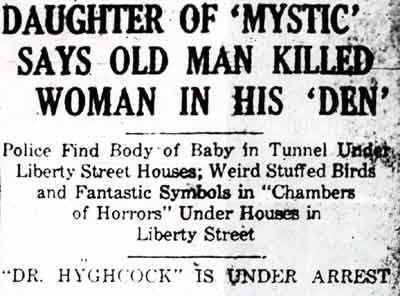
Daughter of ‘Mystic’ Says Old Man Killed Woman in His ‘Den’
Police Find Body of Baby in Tunnel Under Liberty Street Houses; Weird Stuffed Birds and Fantastic Symbols in “Chambers of Horrors” Under Houses in Liberty Street
“DR. HYGHCOCK” IS UNDER ARREST
Discovery of the body of a white baby several weeks old, human bones and other gruesome articles in a maze of dungeon-like caves and sub-cellars under 413 and 415 Liberty Street today have led the police to hold without bail “Doctor” H.H. Hyghcock, 71 year-old negro preacher, medicine man and undertaker. The weird discoveries were made in the fantastically furnished “torture chambers” and “witch caves” under the houses. In addition statements made to Patrolman Charles Naylor and a Courier reporter by a seven-year-old daughter of the accused man, point to a possibility of a woman having been murdered in the place only last week.
“Weirdest Ever” Says Tempest
The labyrinth of underground passages and chambers discovered under the houses is declared by Deputy Director Tempest to be the “strangest and weirdest layout” he ever has visited in all his long career in police work. Twisting and narrow underground passages and half-buried doors in almost inaccessible portions of the underground passages led to a belief that many more chambers remain for the police to enter in their underground exploration. Deputy Tempest has ordered that a complete search be made of every corner of the cellars and sub-cellars and that if necessary the two houses above be torn down to make examination possible. The earth of all the cave floors is being dug up by the police in search of further clues.
Bone of Forearm is Found
The white baby’s body was found shortly before 1:00 PM today, lying in a large glass jar in one of the sub-cellars. What is believed to be the bone of a child’s forearm had been found in one of the passages a short time before. In another glass jar the police found what they report to be a human stomach. To count the rooms, or divisions, of the many underground passages is impossible, because of the irregular arrangement, up and down and in all directions. Some of the policemen engaged in the exploring task have estimated there are more than 75 different compartments.
Second Arrest Is Made
While the police were exploring the place shortly after noon a colored man walked into the Liberty Street entrance and started down the tunnel leading to the underground chamber as if he were well acquainted with the place. Arrested and taken into police custody was Louis Reeves, 23 years, 1061 Ivins Street. He had been employed as a chauffer to drive the voodoo doctor’s automobile, he said, and he had been accustomed to visiting “Doctor” Hyghcock daily and being given a bottle of soda water. That was the only purpose of his visit today, he declared, and he disclaimed any knowledge of the activities of Hyghcock.
The little daughter of the “proprietor” of the strange “place of horrors” made her hair-raising statements while being questioned in regard to her father’s recent activities.
“Shot a Woman”—Took Her Away
“How many people has your father killed here?” she was asked. “He never killed nobody until last week” she replied with childish frankness. “Then he shot a woman, and he took her away in her automobile at night.” In his cell at City Hall, Hyghcock maintains an air of mysterious silence. He is of an impressive personal appearance. Although below medium height, he has a proud bearing, made more compelling by his white hair, mustache and imperial. He has boasted to acquaintances that he is the father of 32 children. Bootblacks tell of him giving 50 cent tips. Hyghcock was arrested last night when he appealed to police, demanding a warrant for an unknown thief about whom he told a weird tale of threats to return and kill him. Hyghcock styles himself a clergyman, physician, an undertaker, a real estate operator, a clairvoyant, a palmist, and a fortune teller. Hyghcock was held on $500 bail early today on the charge of obtaining money under false pretenses and in an equal amount on the charge of practicing medicine without a license when arraigned before Police Judge Cleary this morning. He could not raise the money and was held in jail. Then, when the other discoveries were made, he was held without bail.
A visit to his place by the police led to the exploration of the intricate series of underground chambers. They were separated by swinging doors operated by mechanical springs. Some of the cave-like dungeons contained weird contraptions, like ancient machinery of torture, believed to have been used in connection with “cures,” to which patients of the voodoo man were terrified.
Patient Believes In Him
Besides Hyghcock police arrested as material witnesses Mrs. Bipp Hyghcock, 43 years old, said to be his wife, and Mrs. Lotte Ingram, also a negress, 43 years old, of 59 North Peach Street, Philadelphia. Mrs. Ingram, who was found in the house at 413 Liberty Street, said she was there to receive treatment for heart disease from Hyghcock. In a statement to Detective Hunt, Mrs. Ingram said she gave Hyghcock $25 as part payment for the cure of her disease, and that she had been visiting his house for several months. Upon questioning she revealed further that Hyghcock had given her herb medicines, adding that she had faith in his powers and believed she was being healed. Hyghcock has no license to practice medicine, police say.
The revelation of the startling interior of the place and the practice of Hyghcock, at the Liberty Street houses, both of which were rented by him, was brought about when the “doctor” inquired for a magistrate to issue a warrant for a Philadelphia man who, he said, stole some automobile tools from him and threatened to return to slay him. Hyghcock made the first inquiry of Howard Westsell, 797 Mt. Vernon Street, who was standing at Railroad and Kaighn Avenues at 6:00 o’clock last night. Westsell referred him to Howard Fisher, a negro policeman of the Second District, who approached the two.
Cops Take Him Home
Fisher, becoming suspicious, questioned Hyghcock, who became evasive and insisted that the officer could not aid him. Fisher placed him under arrest, summoned Policeman James McTaggart and William Prucella, of the Second District, who were in plain clothes at the time, and went to the Hyghcock house, where they were admitted. In the house at 413 Liberty Street the policemen found Mrs. Ingram, Mrs. Hyghcock, and the latter’s 7 year old daughter. The two women were sent to police headquarters for questioning. The dingy front room of the house was heated with a glowing coal stove and dimly lighted with a flickering kerosene lamp, faintly disclosed several ancient and musty articles of furniture, several dozen bottles of soda water inside a glass showcase most of whose sides were missing or broken, several mysterious looking grips, bed-clothing, bric-a-brac, and other odd articles scattered about, it suggested what might be found in the rudely constructed entrances to chambers beyond. In the glow of their flashlights the officers made a hurried search of the premises.
Tunnels Explored
Entering the kitchen the trio descended a narrow, winding cellar-way into a gloomy cellar. McTaggart branched into one passageway, while Fisher and Prucella each chose a different path. After stumbling upon blind tunnels which ended in closets or in compartments from which there were no exits, the three officers joined into one party. Stooping at times under low ceilings, squeezing between the sides of converging walls, jumping over pits covered with rotted trapdoors, and pushing through a seemingly endless series of doors rudely constructed of odd pieces of lumber, and each equipped with a powerful spring, the officers wormed their way through a tunnel extending 50 feet under the yard after leaving the cellar. It ended at a trapdoor in the floor of a ramshackle refuse-littered woodshed in the rear of the yard. As soon as they emerged they took Hyghcock, who had accompanied them through the tunnels, to police headquarters.
Cops Go Look For More
Hyghcock, his wife, and Mrs. Ingram were placed under arrest. Captain Arthur Colsey assembled Sergeant Charles Smith and Policemen Prucella, McTaggart, Howard Fisher, Harry Kreher, William Bryant, Herbert Anderson, and John Bryant of headquarters for a needed investigation of the premises. On the way to the house the patrol picked up Officers Enoch Johnson, Charles Smith, and William Michalak. With the arrival of the patrol a crowd gathered in front of the unkempt buildings. Bordering the gloomy houses on each side are modest, well-kept two and three story homes, inhabited by white families. Guided by flashlights and lanterns, a long line of policemen laboriously wound through the circuitous underground passages, scrutinizing every nook, and opening every container upon which they came.
Many Rooms Entered
At least seventy-five rooms or compartments were entered and hurriedly examined. Contents of innumerable closets and holes in walls were left undisturbed for fear that they would litter the narrow passageway and block the progress of the searchers. In one room was found a large cartwheel daubed with dabs of white paint on each spoke. The wheel was mounted on a short upright axis set into the ground, permitting its rotation. Above the wheel was suspended a stuffed bird. The legs could be made to twitch and the wings to flap by the manipulation of a set of strings attached to them and fastened to a stick in an adjoining den. Beside these the room contained an old iron bed, an oil lamp, and an oil stove. Other dens were similarly furnished.
Wires and Bells and Things
Closets and alcoves revealed odd collections of preserves, trinkets, charms, and indescribable odds and ends. In one closet in the kitchen of 413 Liberty Street were discovered a complicated set of improvised signaling devices. Wires attached to sticks will ring bells and unlock doors and various rooms of the house. Each door was equipped with a spring and bolts, and contained bells of various shapes and sizes. In the rear of 413 Liberty Street, partitioned with odd boards, curtains, and rags, was a chapel. This room, about 10 feet wide by 13 feet long, contained an old wheezy organ, an altar, and religious pictures. Two more organs helped furnish two other rooms. In a bedroom on the third floor of 413 Liberty Street, evidently occupied by Hyghcock, the searchers found charms sewed up in bags, odd implements, and three high silk hats. Mrs. Hyghcock said that she, her husband and daughter had occupied the two houses for eight years. Hyghcock, she said, had been working on the tunnels and underground dens for four years, carrying out earth in small quantities and depositing it in the back yards. Police doubt that all the sand extracted from the subterranean dens would have been dumped in the yard, and believe that Hyghcock must have carried it away under the cover of darkness.
The Police Knew Him
A year ago Hyghcock was arrested by District Detectives David Kates and Walter Smith on Mount Ephraim Avenue near Van Hook Street. At that time he was searching for a policeman to report a hold-up. Looking into the closed automobile, the detectives found in the tonneau a bed in which lay a young negress, a lighted lantern hung from the roof, and a kerosene lamp on the floor. After questioning at police headquarters Hyghcock so changed his first story of an alleged hold-up on Kaighn Avenue and Cooper River bridge that the police disbelieved his tale. Captain Colsey will notify the fire department today to safeguard the buildings from fire hazards and also will call to the attention of the health department the unsanitary condition of the place. In his seventeen years completed with the police department, Captain Colsey said he has never seen such a layout.
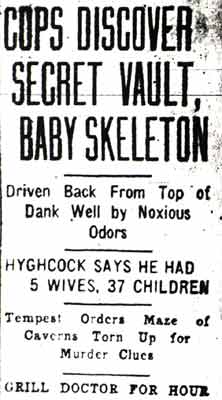
Cops Discover Secret Vault, Baby Skeleton
Camden Courier —
Voodoo Man Confesses Bigamy
Driven Back From Top of Dank Well by Noxious Odors
Hyghcock Says He Had 5 Wives, 37 Children
Tempest Orders Maze of Caverns Torn Up for Murder Clues
Grill Doctor for Hour
Camden Courier — An Independent Republican Newspaper — Final — Vol. 41, No. 267 — Camden, N. J., Friday, April 10, 1925 — 32 Pages—Two Cents
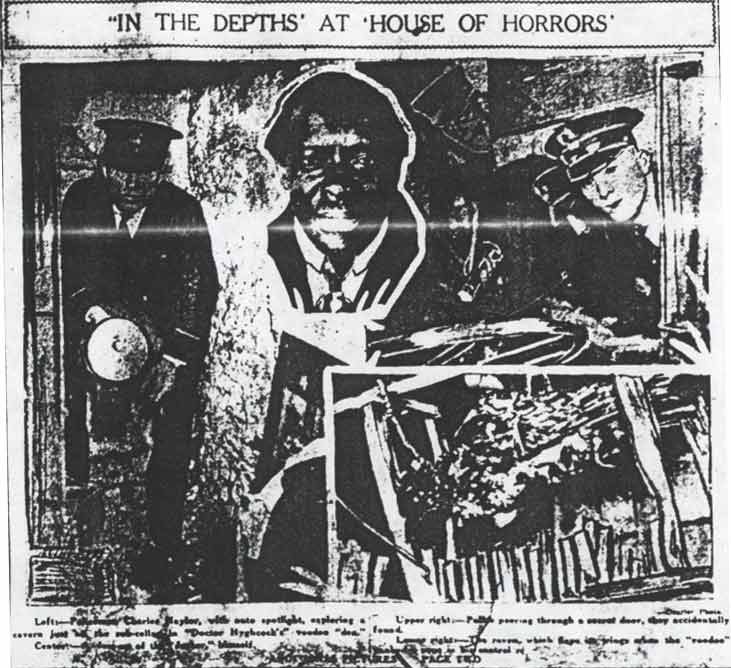
“In the Depths” at “House of Horrors”
Left:—Policeman Charles Naylor, with auto spotlight, exploring a cavern just [illegible] the sub-cellar in “Doctor Hyghcock’s” voodoo “den.” Center:—[illegible] of the “doctor” himself.
Upper right:—Police peering through a secret door, they accidentally found.
Lower right:—The room, which [illegible] the “voodoo” [illegible].
—Courier Photo
Additional Pictures Page Two
Police investigating the “voodoo den” of H.H. Hyghcock, 413–15 Liberty Street, whose arrest on suspicion of murder made several important discoveries today.
They are:
1 — The finding of a bloodstained hatchet buried under the floor of one of the underground rooms.
2 — Discovery of a hidden vault, the entrance freshly cemented and covered with wall-papered boards.
3 — Discovery of what is believed to be a well under the “sacrifice room.” When the police tore off the lid of the well today, they were driven from the underground passage by the odor that emanated from the large hole.
4 — A blood-stained mattress cover, hidden in a second story rear room, was found.
5 — Police digging in the underground den this afternoon unearthed the skeleton of a baby, the fourth infant’s body found in the “voodoo den.”
6 — Lastly, police say Hyghcock is the biggest liar they have ever seen.
When informed of the finding of the supposed vault Director Tempest instructed Captain Gordon to “tear it out if you have to tear down the house.”
The police questioned the “voodoo medicine man” for an hour this morning during which he admitted he is a bigamist. He confessed that he had five wives and is the father of 37 children.
Hyghcock Questioned For Hour
After spending the night in a prison cell, Hyghcock was taken before Deputy Director Tempest. In the room at the same time was Chief Tatem, Captains Colsey, Golden, Humes, and Sieh.
Hyghcock was visibly serious as he sat in a chair facing the police officials. He clasped and unclasped his hands and stroked his goatee as his eyes shifted around the room.
Director Tempest started the first shot of a barrage of questions that swept over the voodoo man before he was allowed to leave the room.
For nearly an hour the medicine man matched his wits with those of the police. Several times he seemed about to crack and reveal something startling but caught himself just as he was to fall into a trap.
As each question was asked him Hyghcock repeated it slowly and after thinking a few seconds made answer.
“Hyghcock,” Director Tempest began, “how many children have you?”
“Newspaper reporters printed stories that I have thirty-two children” the prisoner answered. “That is all wrong. I have thirty-seven children.”
Five Wives, Says Hyghcock
“How many wives have you had?”
“Five” he answered.
“All living?”
“Two are living.”
“Are you a bigamist?”
“Yes, I guess you would call me that. I don’t know where my fourth wife is now.”
“How long have you been married to this wife?”
“Thirty-two years.”
“All your children living?”
“All but two.”
“Where are the other thirty five?”
“Scattered all over.”
“How many women have you killed in your time?”
During the questioning of his married life Hyghcock smiled continuously as he answered the questions.
The last question had the effect of an electric shock upon the prisoner.
“Come on, come on,” Director Tempest said. “How many women have you killed?” This was one question that Hyghcock did not repeat.
Says He Bought Dead Bodies
“I never killed any women” he answered as he looked at the faces of those gathered around him.
“How many operations have you performed in that den of yours?”
“I didn’t perform any operations.”
“How do you account for the finding of those bodies of these infants in the cellar?”
“I bought those babies from Dr. White on South Street in Philadelphia.”
“You are lying, aren’t you?”
“No sir” Hyghcock said, as he toyed with his hat.
“Tell the truth now. How many women died in that house of yours?”
“Who said I killed anybody?”
“We have the goods on you, so you might as well come clean. Your daughter has told us she saw you kill that light skinned colored woman when your wife was away. What did you kill that woman for?”
“My daughter say that? She must be wrong.”
“Why should your daughter say you killed a woman if you did not? We know you shot that woman and your daughter saw you do it. Why should your daughter say such a thing if it were not true?”
Stumped by Daughter’s Tale
Beads of perspiration broke out on the prisoner’s face.
“I don’t know” he answered.
“Didn’t you take a woman’s body out of that house not so long ago?”
“No.”
“How many women have died in that house?”
“Only my daughter.”
“Are you a physician?”
“Sorta of a physician.”
“Why do you have the stethoscope in your home?”
“What kind of thing is that?”
“Are you a physician and well acquainted with surgical instruments?”
“Yes, sorta,” Hyghcock said. The stress was beginning to tell on him.
“And you don’t know what a stethoscope is? You are not a doctor, Hyghcock. You are a liar.”
“Yes sir” he answered.
“Are you a regular minister?”
“Sorta. I’m an evangelist.”
“Ordained?”
“What do you mean? I’ve been an evangelist since I was a child.”
“Ever been arrested before?”
“Yes, in Philadelphia. Man I was with shot a woman with a baby in her arms.”
“You did the shooting, didn’t you?”
“No sir.”
“But you shot the woman in your house on Liberty Street, didn’t you?”
“No sir.”
Women Boarders
“How many women do you keep at your house at one time?”
“Four or Five.”
“What for?”
“Boarders.”
“You are lying now, aren’t you?”
“No sir.”
“How many women have you killed?”
“None.”
“What do you know about the bloody hatchet we found in your cellar?”
“I don’t know anything about it. Where did you find it?”
“We are asking the questions, you just answer them.”
“Did you ever have a hatchet?”
“Yes, I lost it six months ago.”
“How did the blood get on it?”
“I don’t know.”
“Why did you cement that vault?”
“What vault?”
“The vault in your cellar that you just cemented a short time ago. You might as well come clean and tell us about what is hidden behind that cement wall because we are going to find it out.”
Hyghcock shifted in his chair and the perspiration flowed in a stream from his forehead. He bit his lips.
“There is nothing much there” he said after thinking for fully a minute.
Walls Against Water
“What did you build it for?”
“To keep the water out.”
“Why didn’t you cement up the rest of the cellar?”
“I don’t know.”
“You know that we know you are lying, don’t you?”
Hyghcock did not answer that question.
“Why did you dig out all those rooms in the cellar?”
“For church services.”
“Did you use about 65 small rooms underground for church services?”
“Yes.”
[TEXT illegible]
[TEXT illegible]
[TEXT illegible]
[TEXT illegible]
“In the room way back under the yard. That was the main church?”
“How can you take nine people and put them in 35 rooms?”
“I don’t know.”
“Then why did you have so many rooms?”
“The people wanted them.”
“What people?”
“My congregation.”
“Are you a regular minister?”
“Mr. Johnson in Newport News told me I could be a minister.”
“What was that room where the crow was swinging on the board supposed to be?”
Noah’s Ark Room
“That was the Noah’s ark room. The bird was on the ark.”
“What was the idea of having ropes to make the stuffed bird flap his wings?”
“That was part of the church service.”
“How many women are you in love with?”
“I don’t know. A lot are in love with me.”
“Hyghcock, you have been performing illegal operations in that house of yours, and we have more than 100 letters from women that were sent to you. Those letters contain evidence that will be used against you. What have you to say about them? You read the letters, because they were open when we found them.”
“Just what particular letters are you talking about?”
Director Tempest then went through some letters and mentioned the names and addresses of the senders. Many of them were from white women. To each letter called to his attention Hyghcock said:
“I just can’t recall reading that letter.”
“How about this letter from Ann Miller of Philadelphia telling you that she was thorough with you because you killed the man next door?”
“I don’t remember seeing that letter.”
“You are lying Hyghcock, and you had better come clean and tell the truth.”
“Women Stuck on Me”
Then letters containing endearing terms were read to him. Asked what he had to say about them, he answered:
“They are some of the women who are stuck on me.”
“How many women are stuck on you? Are there as many as 100?”
“I don’t think there are that many. I know women all over the country and they write to me.”
“What do women all over the country write to you for?”
“I guess they like me.”
“I guess they do,” Director Tempest said as he gazed at the prisoner, who averted his glances.
“Ever perform any operations on any of these women?”
“No sir.”
“Then what do they write to you about?”
“I don’t know.”
“What is in that well under the board in the cellar?”
“What well?”
“Did you throw any bodies down there?”
“No sir, I ain’t hid no bodies.”
“Where did you bury the women who died in your house?”
“Nobody died there.”
“Why did you go out late at night in your automobile with a shovel?”
“Who said so?”
“You did, didn’t you?”
“I can’t recall.”
Says He Took Women Into Tunnels
“Just think for a minute.”
“Nope, I can’t recall.”
“Did you take women into those underground rooms?”
“Yes, I took them down to church services.”
“Didn’t take any men down there, did you?”
“No sir.”
“How did you come to dig all those rooms?”
“I was looking for money.”
“What do you mean?”
“When I first moved into the house I dug in the cellar one day and found $25.00.”
“What has that got to do with the rooms?”
“Well, I kept on digging and found $300.00 more.”
“Yes, go on.”
“Go on where?”
“What gave you the idea for all of the rooms?”
“Well, when I moved into the house there were rooms directly under the [XXXXX] and I dug [XXXX] the back yard [XXXXX XXXX XXXXXXXX].”
“For how long have you been live there?”
“Eight or ten years.”
“Who dug that cellar with you?”
“A man by the name of ______ (Name withheld at the request of the police).”
“What did he do?”
Becomes Badly Mixed
“He helped me to make the room — the chapel.”
“Did he help you get rid of the bodies?”
“No sir.”
“Who did help you get rid of them?”
“Nobody.”
“Did it all yourself?”
“Did I do it all myself — yes, sir — no, sir.”
“Well, what do you mean?”
“I mean I didn’t do anything. I hid no bodies.”
“What did you bury the hatchet for?”
“I didn’t bury any hatchet.”
“How did it happen the hatchet was covered with blood?”
“I don’t know.”
“What did you have those shovels and picks down in the cellar for?”
“To dig with.”
“Dig what?”
“What is this religious college you have up by Willow Grove?”
“Who told you about that?”
“You tell me about it now.”
“I started a church up there.”
“You built shacks and rented them to colored people for $30.00 a month and then charged them $10.00 a month extra. What was the extra $10.00 for?”
“It was for the Lord.”
“What do you mean Lord Hyghcock?”
“No, for the church.”
Sold Willow Grove Settlement
“Do you still have the church settlement?”
“No, I sold it.”
“Sold the church too?”
“Yes.”
“Why did you tell your wife you would kill her if she went into the cellar of the house where all those rooms were?”
“Who said so?”
“You did, didn’t you?”
“I can’t recall.”
“When you would have a crowd of women in the rooms you would send your wife away, wouldn’t you?”
“Not exactly.”
“Speaking of illegal operations, do you know Miss…”
“Who ain’t one of the women I operated on.”
“Who are some of these women, then?”
“I ain’t operated on any women.”
“Did you tell women to keep away from you?”
“Yes.”
“Tell us about how you shot that woman and buried her body.”
“I ain’t shot nobody.”
“How did you kill her, with that hatchet?”
“No sir.”
“Come on, tell us how you killed her.”
“I didn’t kill any women.”
“The woman just died in the house, oh?”
“No sir.”
“How about the man who lived next door whom you said you killed?”
“I didn’t kill anybody.”
When Tempest finished, each of the police captains fired a barrage of questions at Hyghcock.
Several times under severe questioning by Captain Golden, Hyghcock became confused and gave evasive answers.
Turning to Captain Schregler, Director Tempest said:
“He’s a liar, take him upstairs.”
Mrs. Hyghcock Quizzed
Hyghcock was then taken up to the bureau for further questioning by detectives. His wife was quizzed in an adjoining room and when she was taken back to her cell, their seven year-old daughter, who told the police her father killed a woman in the house when she was questioned again repeated her version of the killing.
During the questioning of Hyghcock in the Detective Bureau, Commissioner Middleton came into the room. He sat with the detectives as they questioned the 71 year-old medicine man.
Where the Ropes Came From
A Broadway hardware merchant called at police headquarters today and told the police that he had been selling rope to Hyghcock for the past two years.
“He would come into the store and buy the rope in six foot lengths. He would also buy barn lanterns by the dozen. I often wondered what he intended to use them for but I never asked him.”
The ceiling of the underground den was a cobweb of ropes, which operated through pulling and rang bells, opened doors, and made the raven in “Noah’s Ark” flap his wings.
That Hyghcock contemplated more cement work, when discovered, was evident yesterday when the police found a load of sand in the front part of the cellar. In the afternoon a truck with fifteen bags of cement came to the Hyghcock house.
The driver, seeing the crowd, drove away, taking the cement with him.
Director Tempest sent a detail of police and firemen to destroy the maze of underground tunnels and “torture chambers” under the “voodoo” houses. The entire cellar of the two houses will be dug up to a depth of six feet in an effort to learn if any human bodies are buried there.
The “voodoo palace” was raided early yesterday morning by a detail of police who arrested “Dr.” H.H. Hyghcock, a 71 year-old “medicine man.” When the police searched the house yesterday they discovered the bodies of two small infants hidden in one of the underground rooms.
County detectives who went on the case yesterday and city police are endeavoring to learn if any women were murdered in the house. The decision to tear out the thirty-five underground rooms came at a conference at police headquarters last night between Prosecutor Wescott, City Prosecutor Bernard Bertman, Director Tempest, and Chief Tatem.
Each of the officials declared that he believed a digging up of the cellar would reveal the finding of human bodies.
Will Do It Monday
“I am going to order a detail of firemen and policemen to the cellar of the two houses” Director Tempest said, “with instructions to tear out every one of those rooms in the cellar. After the cellar is cleared the policemen and firemen will dig up every foot of the cellar. I have some information which I cannot divulge that leads one to believe that our search will not be unsuccessful. It is not probable, however, that the work of clearing up that underground ‘hotel’ will be started before Monday.”
“In my police experience I have never seen anything that compares with that underground voodoo den.”
Hyghcock was questioned for several hours last night by detectives. He refused to make any statements, even when he was shown incriminating letters that were found in his home. The police seized more than 100 of the letters which were mailed from every state in the Union. Many will be used against the “physician” when he is placed on trial as they reveal he practiced medicine without a license.
The police place great stress upon the statement of Hyghcock’s seven year-old daughter who told them that her father killed a woman in the house a week ago and buried her body. The child is being held in custody as a material witness as is the wife of the “medicine man.”
Last night more than 5,000 morbid curious people gathered at the Hyghcock house and stormed the doors seeking admittance to the underground passages. A detail of police inside the house fought back the crowd. A riot call was sounded at 9:00 o’clock and two details of police were rushed to the scene. The crowd was driven back and the street roped off. During the excitement the front door was smashed in by the crowd.
Today detectives are reading the large bale of letters found in the house. They also seized the prisoner’s set of books, which show he received large sums of money from superstitious persons for “love and enemy” charms. The books contain the names and addresses of more than 1,000 of Hyghcock’s customers.
Police said that although Hyghcock has only been a resident of this city for three years, he has amassed a small fortune and owns considerable property here and in Pennsylvania. They said that several years ago Hyghcock built a small chapel near Willow Grove. Around this chapel he erected 20 small frame houses. He rented them to colored folks who joined his religious sect and in addition to the rent paid him an assessment of $10 a month which he said he turned over to the Lord.
Three Years of Work
When Hyghcock was taken from his cell in police headquarters last night to be questioned he smiled as the cell doors clanged open. He was taken to detective headquarters and questioned, but refused to make any statement. He will be questioned again today.
The police said he must have spent nearly three years building the underground “chamber of horrors.” So quietly did he work that none of his neighbors knew the spooky subway rooms existed. Most of the excavating was done between midnight and 3 o’clock in the morning.
Entering the house at 413 Liberty Street, a visitor sees a small counter and a candy show case. Arrayed on shelves behind the counter are bottles of pop and packages of cigarettes. Three feet away from the counter toward the kitchen is a door leading into a hallway three feet square. A winding flight of steps lead to the upper floors and a door in the hallway opens onto a narrow winding stairway into the cellar.
Secret Winding Passages
Once in the cellar the visitor finds himself in a small alley running toward the front of the house. In this alley are shelves filled with roots and herbs. The aisle turns at right angles to the right and one sees a large door upon which is printed “Noxvill.” A heavy spring slams the door to. The visitor is then in complete darkness. In front of him is a winding, twisting passageway, barely three feet wide. Directly over his head are ropes running along the ceiling which control the opening and closing of doors and the ringing of bells.
To the right is a dark room. The rays of a flashlight thrown into the room reveals a stuffed bird resting on a swinging shelf. A pull on one of the many ropes causes the crow to flap his wings. Just ahead in the passageway, and to the right and left are three doors. Sleigh bells are fastened to each of the doors. The door to the right leads to a tunnel connecting with the house at 415 Liberty Street, next door. The other doors lead into other rooms and in the rooms are other doors leading into still other rooms.
Rooms Poorly Furnished
And so on down the entire length of the cellar.
In the rooms which are not more than four feet square there is very little furniture. The walls and partitions are made of packing box lumber covered with various pieces of wall paper, one shade bordering on the other. In each “den” a kerosene lantern, or lamp hung on a hook. The air is stifling.
In the room known to the police as the “Graveyard” are three lanterns and several spades and picks lying on the dirt floor. The soil shows that it has recently been dug up.
Still following the dark passages the visitor finds himself confronted with a door, with a glass panel in the bottom. A heavy spring makes the door hard to open, but a pull on one of the many strands of rope running along the ceiling and the door swings slowly open without the least effort. It is controlled in some mysterious manner by weights.
Hyghcock has undermined his entire back yard. Back under the yard runs the passageway with the dens turning off to the right or left. In one of the underground rooms a large clock instead of being placed high on the wall is fastened down near the ground. The clock was functioning yesterday but was four hours fast.
Tunnels Become Confusing
Now the passageways get narrower and darker and the odor is sickening. Towards the extreme rear of the room is the “Sacrifice Chapel.” This contains a baptismal bath, a large Bible, a [XXXXX] and a carriage wheel with various colored spokes. The wheel spins from an iron peg driven into the wall. Everywhere is seen patchwork carpenter work. A birds-eye view of the underground rooms reminds one of the futurist, or cubist, paintings. In one of the rooms the floors are covered with freshly laid cement. The police will endeavor to find if anything is buried underneath the flooring.
Just ahead is daylight. One finds a small hole in the roof where a chimney or an uphill coal stove extrudes into the yard. This follows another maze of doors. In several parts of the tunnel thick doors can be opened at the same time to form a triangle. Not twenty more feet down this dark passageway and a ladder leading upward is seen. It is a hastily constructed affair and the top rungs are covered with grips made of automobile tires.
A walk through the upper story of the two houses show that bedrooms have been partitioned off to make three rooms.
He Doted On Bells
Overhead is the network of ropes operating on pulleys the [XXXXX XX XXXX XXXX]. In the underground rooms and tunnels, [XXXX XXXXX] and a door [XXXX XXXX. XXXX XXXX] will open or a bell will ring. Hyghcock just doted on bells. The largest bell is fastened to a door on the third floor. This one can be sounded from the rear room in the tunnel by means of the rope. Bells are everywhere. They range from baby bell rattles to large cow bells.
The rooms on the upper floors each contain beds. Yesterday they were in disorder. The bed clothing was scattered on the floor and the floors were strewn with papers, letters, books, and clothing. In a closet in a third story room was found two new dolls in a basin, glassware, phonograph records — everything imaginable. The rooms resembled “junk shops.”
Yesterday the police spent most of their time searching for bloodstains on the floors and walls of the buildings. Trunks were forced open and those were found to contain soiled linens. The police questioned Hyghcock’s seven year-old daughter.
“How many men did your father kill in here?” Patrolman Charley Naylor asked the girl.
Says “Pop” Killed Woman
“My Pop did not kill any men” the child answered, “but when my mother was in Washington to see my sister not long ago, a woman came to the house and started to fight with Pop. It was late at night. They fought terrible and they were in the big room in the front of the house. I saw them fighting and my Pop got a gun and shot the woman. Pop took her out in the automobile and buried her. He told me to keep quiet and said the woman was sick and died and he buried her in a cemetery.”
The child was taken to police headquarters when she was again questioned by Director Tempest and Chief Tatem. The police tried to get her to change her story but she refused to do so and stuck to the narrative she first told in her home. Her mother was then arrested and detained as a material witness.
Persons living in the neighborhood said today that on two occasions they had seen Hyghcock place large bundles in the back of his car at night, place a shovel in the rear of the car and drive away.
The police have been unable to learn much so far about Hyghcock prior to coming to this city. They do know that he came here from Norfolk, VA where he still claims to be in the undertaking business.
Strange Powders Sold
Hyghcock, the police said, manufactured powders and sold them to colored people as good luck charms. If a woman was unfriendly with another woman she went to Hyghcock and for $12 she received a small bottle of powder. This she sprinkled in front of her enemy and from then on “everything will suffer for the enemy because she would be pursued by evil spirits and her luck would be something terrible.”
If a superstitious young man who “rolled the bones” as a pastime wanted to stage a winning streak, he would visit the medicine man. For $40.00 he would give the man with the gambling instinct a blue powder that he was supposed to rub on his hands just before it was his time to “roll.” Powder to keep another woman from stealing one’s husband went for $30.09, Hyghcock’s records show. What the 9 cents was for is not known. In one day, the police said, Hyghcock sold more than $190 worth of powder that originally cost about twenty cents.
The more serious charge against the prisoner is that he used the building for immoral purposes and for performing illegal operations.
Captains Shifted
Camden Courier-Post —
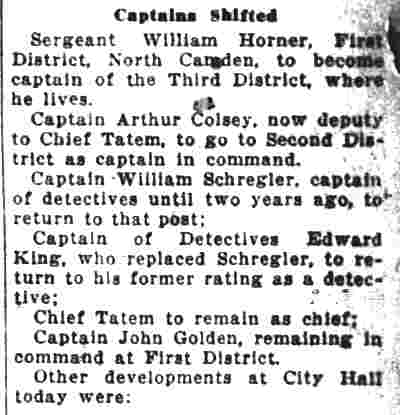
Sergeant William Horner, First District, North Camden, to become captain of the Third District, where he lives.
Captain Arthur Colsey, now deputy to Chief Tatem, to go to Second District as captain in command.
Captain William Schregler, captain of detectives until two years ago, to return to that post;
Captain of Detectives Edward King, who replaced Schregler, to return to his former rating as a detective;
Chief Tatem to remain as chief;
Captain John Golden, remaining in command at First District.
Other developments at City Hall today were:
Woman, Baby Killed, 14 Hurt in Crashes
Camden Courier-Post —
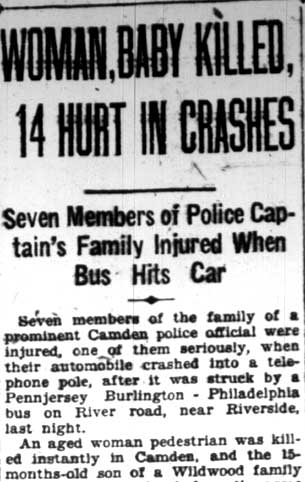
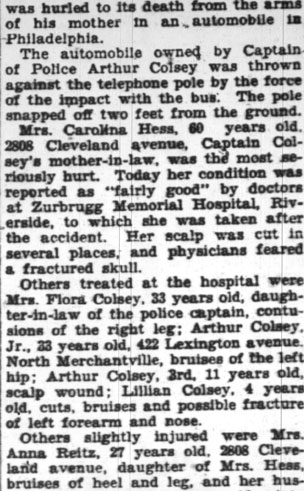
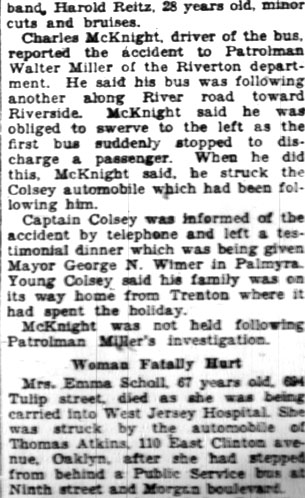
Seven Members of Police Captain's Family Injured When Bus Hits Car
Seven members of the family of a prominent Camden police official were injured, one of them seriously, when their automobile crashed into a telephone pole, after it was struck by a Pennjersey Burlington – Philadelphia bus on River road, near Riverside, last night.
An aged woman pedestrian was killed instantly in Camden, and the 15–months–old son of a Wildwood family was hurled to its death from the arms of his mother in an automobile in Philadelphia.
The automobile owned by Captain of Police Arthur Colsey was thrown against the telephone pole by the force of the impact with the bus. The pole snapped off two feet from the ground.
Mrs. Carolina Hess, 60 years old, 2808 Cleveland avenue, Captain Colsey’s mother–in–law, was the most seriously hurt. Today her condition was reported as “fairly good” by doctors at Zurbrugg Memorial Hospital, Riverside, to which she was taken after the accident. Her scalp was cut in several places, and physicians feared a fractured skull.
Others treated at the hospital were Mrs. Flora Colsey, 33 years old, daughter–in–law of the police captain, contusions of the right leg; Arthur Colsey, Jr., 23 years old, 422 Lexington avenue, North Merchantville, bruises of the left hip; Arthur Colsey, 3rd, 11 years old, scalp wound; Lillian Colsey, 4 years old, cuts, bruises and possible fracture of left forearm and nose.
Others slightly injured were Mrs. Anna Reitz, 27 years old, 2808 Cleveland avenue, daughter of Mrs. Hess, bruises of heel and leg, and her husband, Harold Reitz, 28 years old, minor cuts and bruises.
Charles McKnight, driver of the bus, reported the accident to Patrolman Walter Miller of the Riverton department. He said his bus was following another along River road toward Riverside. McKnight said he was obliged to swerve to the left as the first bus suddenly stopped to discharge a passenger. When he did this, McKnight said, he struck the Colsey automobile which had been following him.
Captain Colsey was informed of the accident by telephone and left a testimonial dinner which was being given Mayor George N. Wimer in Palmyra. Young Colsey said his family was on its way home from Trenton where it had spent the holiday.
McKnight was not held following Patrolman Miller’s investigation.
Woman Fatally Hurt
Mrs. Emma Scholl, 67 years old, 6[illegible]4 Tulip street, died as she was being carried into West Jersey Hospital. She was struck by the automobile of Thomas Atkins, 110 East Clinton avenue, Oaklyn, after she had stepped from behind a Public Service bus at Ninth street and Morgan boulevard.
Police Invite Bandits To Nice Shooting Party
Camden Courier-Post —
But Yeggs Must Leave Gats at Home While Cops Practice With Camden’s New Desperado Eliminators
Wanted: Targets for Camden’s new desperado eliminators. Bandits, burglars, snipers and their ilk are requested by Chief of Police James E. Tatem to apply at police headquarters Monday morning at 10 o’clock, when a practice shooting party will be held.
Chief Tatem said today Camden’s bandit-chasing squad is “just rarin’ to go” with six new automatic rifles guaranteed to shoot full of holes the toughest bandit in less time than it takes to say “Aligoop.”
For the further enlightenment of the bandit fraternity, Chief Tatem announced detailed instructions on how to use the new carbines will be given this afternoon at 3 o’clock to bandit chasing police by Captain Arthur Colsey and Herman Engle, a representative of Stein Brothers, this city.
The rifles arrived at police headquarters yesterday afternoon. They will be distributed in each of the city’s three police districts in the campaign to rid the city of desperadoes.
The weapons can fire a magazine of 20 shots in a few seconds. They will be mounted in the three red bandit chasing coupes used by the district squad members. One of the coupes is now being used by Archie Reiss and Vernon Jones in South Camden, while two others are expected to be delivered within a few days, according to Chief of Police James E. Tatem. They will be assigned to Walter Smith and Joseph Carpani, First district detectives and Louis Schlam and Richard Donnelly in the East Camden district.
Swivel attachments make it possible to fire the guns from a fixed point in an automobile. Detached they may be fired from the shoulder. Besides firing a magazine of 20 shots without stopping, they can be adjusted to single fire, using .45 caliber cartridges.
Instruction in the adjustment and use of the weapons will be given today by a representative of the company that sold them — at $175 each — to the city.
Acting Detective Suspended by Chief
Camden Courier-Post —
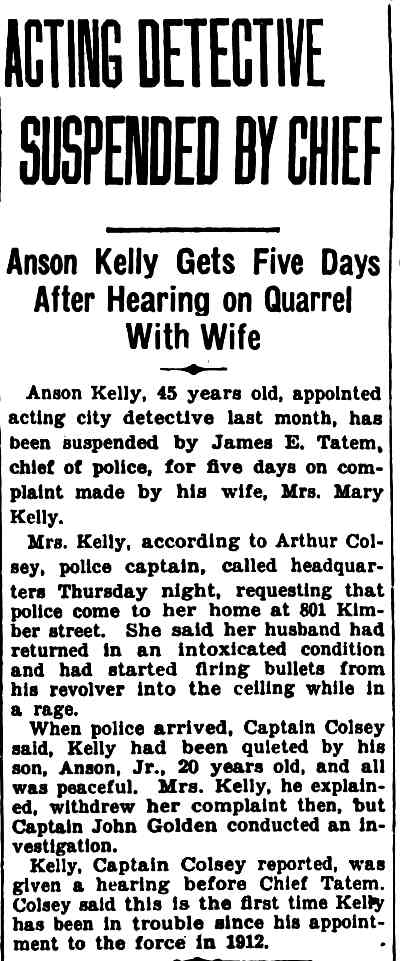
Anson Kelly Gets Five Days After Hearing on Quarrel With Wife
Anson Kelly, 45 years old, appointed acting city detective last month, has been suspended by James E. Tatem, chief of police, for five days on complaint made by his wife, Mrs. Mary Kelly.
Mrs. Kelly, according to Arthur Colsey, police captain, called headquarters Thursday night, requesting that police come to her home at 801 Kimber street. She said her husband had returned in an intoxicated condition and had started firing bullets from his revolver into the ceiling while in a rage.
When police arrived, Captain Colsey said, Kelly had been quieted by his son, Anson, Jr., 20 years old, and all was peaceful. Mrs. Kelly, he explained, withdrew her complaint then, but Captain John Golden conducted an investigation.
Kelly, Captain Colsey reported, was given a hearing before Chief Tatem. Colsey said this is the first time Kelly has been in trouble since his appointment to the force in 1912.
Machine Gun Bullets Await “Phantom Sniper”
Camden Courier-Post —
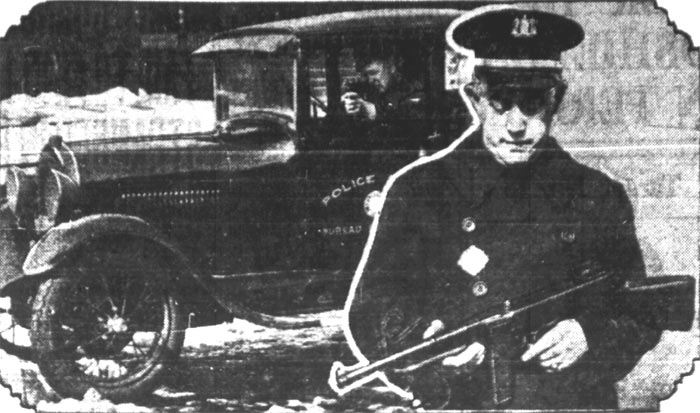
Camden’s “Phantom Sniper” had best remain a “phantom” and avoid appearing in mortal form, for the Camden police have a new sort of weapon ready for him. Six machine guns, mounted in new bandit-chasing automobiles, have arrived and were placed in operation today by the police. The photograph shows Arthur Colsey holding one of the guns, at the right. In the background another officer is shown aiming the gun from one of the new “bandit-chasers.”
Three Women Claim Body of ‘Gimp’ Thomas
Camden Courier-Post —
One Is ‘Daughter, Others Say They’re Wives; Badge Mystery Unexplained
Who is the legal wife of Howard “Gimp” Thomas, under cover man for Camden police, whose death in an automobile upset early Saturday morning near Ellisburg is being investigated by county authorities?
Three women have attempted to claim the body but it still remained in the morgue of Coroner Melvin Cain last night.
A mystery woman in black appeared at the coroner’s office Sunday and attempted to claim it. She declared she was Thomas’ wife.
“The body has already been claimed by Miss Marie Olive Thomas, 18, Harrisburg, Pa., daughter of Thomas,” said Cain.
“Well he is my husband,” replied the woman.
“I’m not going to get into any controversy over the legal claimant of the body,” Cain told her. “You will have to settle that argument with Miss Thomas.”
Threatens to See Lawyers
The woman left in an angry mood and threatened to “see a lawyer.”
Mrs. Harold Thomas, 6534 Sixth Avenue, Philadelphia, told the Delaware township police yesterday she believes the dead man is her husband, who deserted her two years ago. She said she was coming to Camden to identify the body.
She said her husband’s name was Harold and was of the opinion he had changed it to Howard. She said the description she received tallied with that of her husband.
Until late last night the woman had failed to visit Coroner Cain’s office. The newest mystery in connection with the case, however, has not yet eclipsed that impelling the question:
How did “Gimp” Thomas come into possession of badge No. 188 of the Camden Police Department?
The badge, taken from Thomas’ pocket when his body was found has been the subject of numerous theories. The police, unable to arrive at a satisfactory explanation, it is understood, are continuing their efforts to learn under what auspices Thomas came into possession of the badge.
Captain Arthur Colsey admitted the man had done some work for the Camden police but not often. He has been unable to account for the badge’s having the same number as one issued James Hollis, Detective Captain John Golden’s chauffeur.
Prosecutor Clifford A. Baldwin said he has asked the state police for a report on the death of Thomas and plans to check up reports that four men were with him instead of two on the fatal ride.
Harry McClain, 726 Kaighn Avenue, and William Hernisy, 1146 Liberty Street, who were with Thomas when he was killed, are in the county jail. Two other men, who were reported seated in the rear have escaped.
Hernisy was driving the car when Thomas was killed and is being held on a charge of manslaughter and larceny of the automobile. McClain is charged with being an accessory.
Both men claim Thomas met accidental death although McClain said the dead man was taking him “for a ride” and he “beat him to it.” The pair fled from the scene of the accident because they knew Thomas had stolen the car, they told police.
City Policeman Drowns in Lake at Blackwood
Camden Courier-Post —
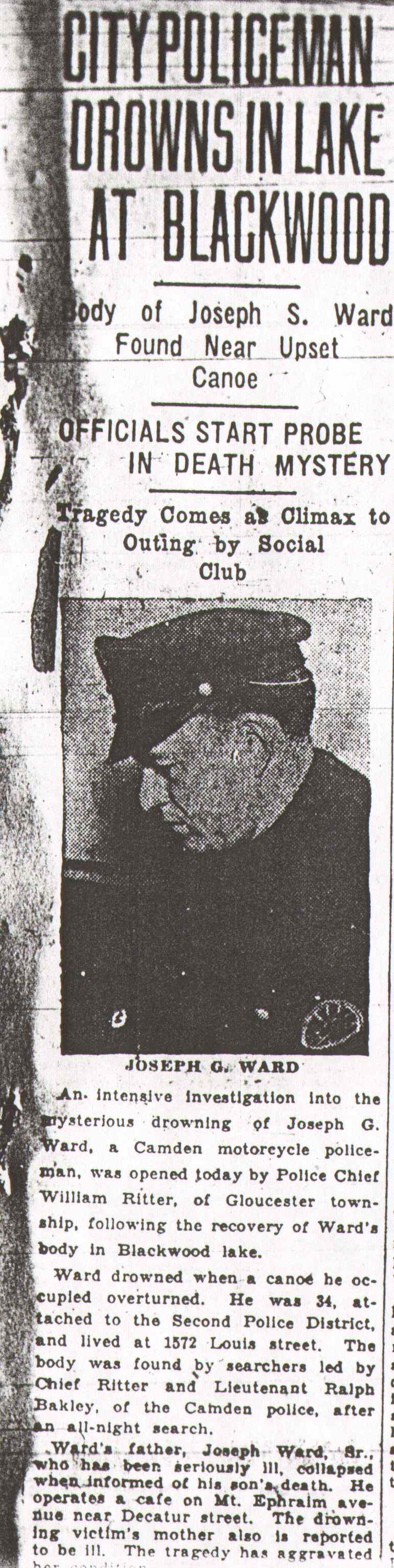
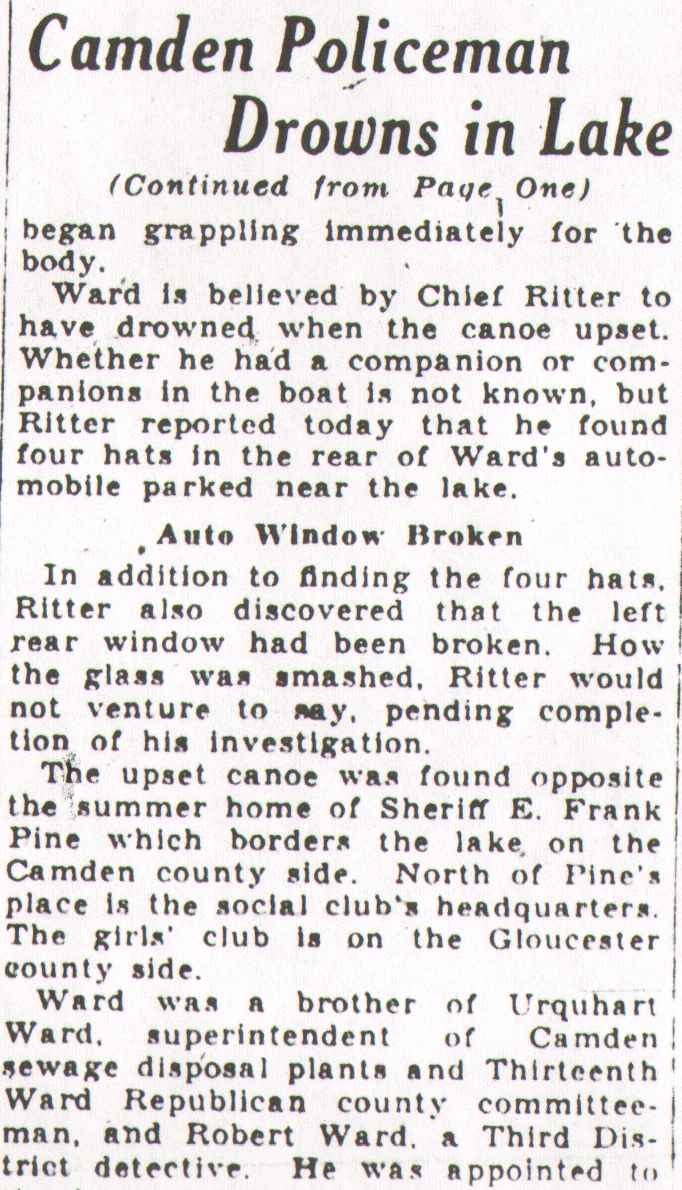
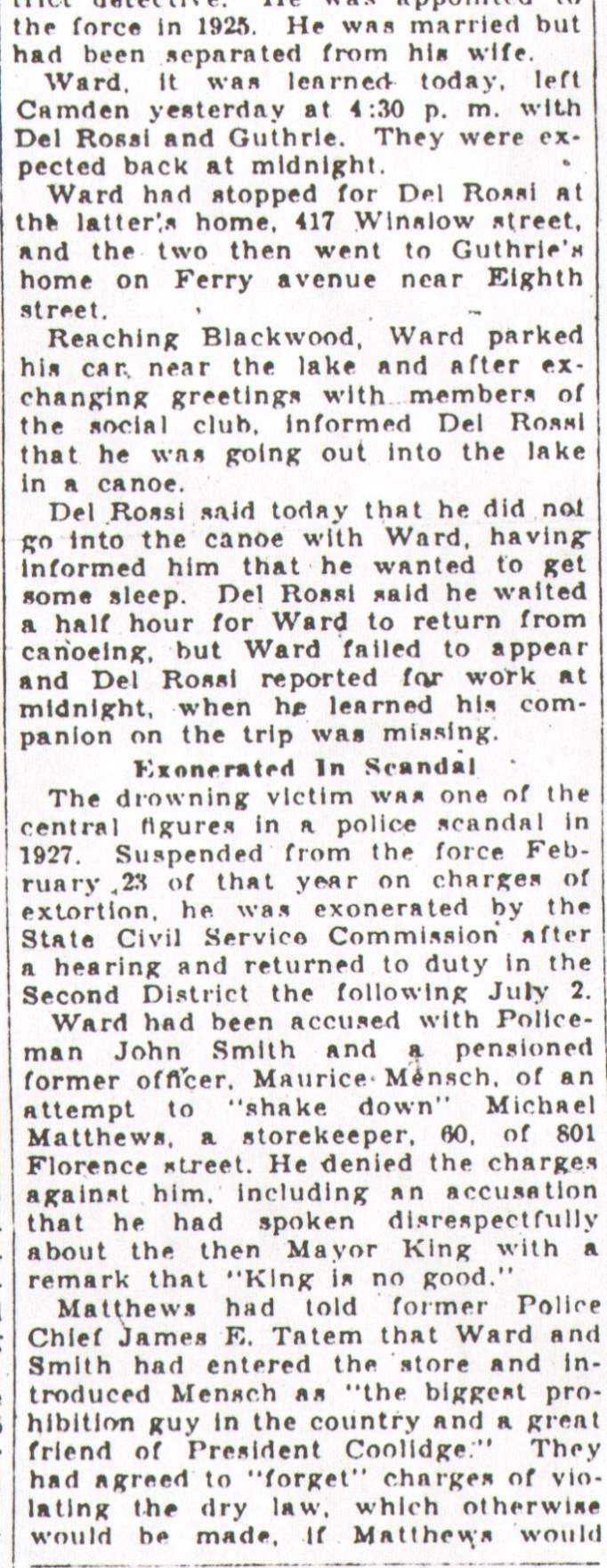
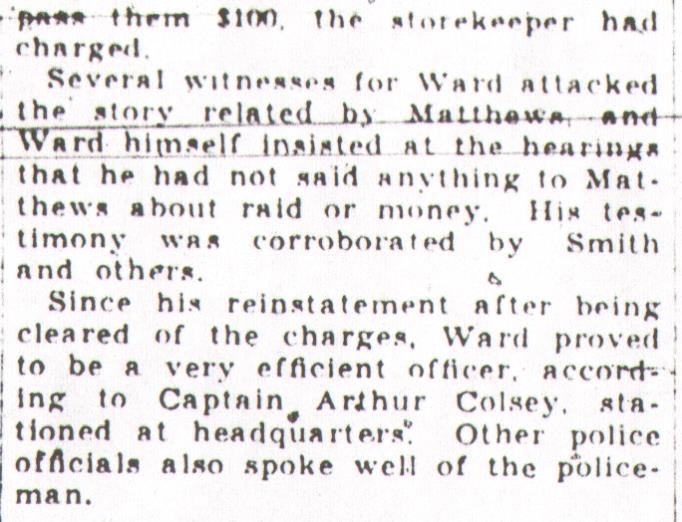
Body of Joseph S. [sic] Ward Found Near Upset Canoe
OFFICIALS START PROBE IN DEATH MYSTERY
Tragedy Comes as Climax to Outing by Social Club
JOSEPH G. WARD
An intensive investigation into the mysterious drowning of Joseph G. Ward, a Camden motorcycle policeman, was opened today by Police Chief William Ritter, of Gloucester township, following the recovery of Ward’s body in Blackwood lake.
Ward drowned when a canoe he occupied overturned. He was 34, attached to the Second Police District, and lived at 1572 Louis street. The body was found by searchers led by Chief Ritter and Lieutenant Ralph Bakley, of the Camden police, after an all-night search.
Ward’s father, Joseph Ward, Sr., who has been seriously ill, collapsed when informed of his son’s death. He operates a cafe on Mt. Ephraim avenue near Decatur street. The drowning victim’s mother also is reported to be ill. The tragedy has aggravated her condition.
The drowning is a tragic aftermath of an outing yesterday of the Moonlight Social Club, which rented a clubhouse at Blackwood two months ago. With Ward on the outing were Clifford Del Rossi, a driver of the Second District police patrol; Theodore “Dorie” Guthrie, Second District detective, and other members of the Camden police department whose names have not been learned.
Chief Ritter reported today having only meager clues as to the circumstances of the drowning. Ward is believed to have been in the canoe alone. Coroner Melvin Cain is expected to conduct an autopsy today or tomorrow.
Chief Ritter said there is no suspicion of foul play, as Ward’s body was unmarked. It was recovered at [?]:30 a. m. by William [sic] McGrath, a city detective, who had been diving for it with George Hess, near the clubhouse of the Moonlight Social Club.
The overturned canoe was found last night in the lake by girls who also have a clubhouse at Blackwood. Police Chief Ritter, with Peter English and Walter Wilkie, all of Blackwood, began grappling immediately for the body.
Ward is believed by Chief Ritter to have drowned when the canoe upset. Whether he had a companion or companions in the boat is not known, but Ritter reported today that he found four hats in the rear of Ward’s automobile parked near the lake.
Auto Window Broken
In addition to finding the four hats, Ritter also discovered that the left rear window had been broken. How the glass was smashed, Ritter would not venture to say, pending completion of his investigation.
The upset canoe was found opposite the summer home of Sheriff E. Frank Pine which borders the lake on the Camden county side. North of Pine’s place is the social club’s headquarters. The girls’ club is on the Gloucester county side.
Ward was a brother of Urquhart Ward, superintendent of Camden sewage disposal plants and Thirteenth Ward Republican county committeeman, and Robert Ward, a Third District detective. He was appointed to the force in 1925. He was married but had been separated from his wife.
Ward, it was learned today, left Camden yesterday at 4:30 p. m. with Del Rossi and Guthrie. They were expected back at midnight.
Ward had stopped for Del Rossi at the latter’s home, 417 Winslow street, and the two then went to Guthrie’s home on Ferry avenue near Eighth street.
Reaching Blackwood, Ward parked his car near the lake and after exchanging greetings with members of the social club, informed Del Rossi that he was going out into the lake in a canoe.
Del Rossi said today that he did not go into the canoe with Ward, having informed him that he wanted to get some sleep. Del Rossi said he waited a half hour for Ward to return from canoeing, but Ward failed to appear and Del Rossi reported for work at midnight, when he learned his companion on the trip was missing.
Exonerated In Scandal
The drowning victim was one of the central figures in a police scandal in 1927. Suspended from the force February 23 of that year on charges of extortion, he was exonerated by the State Civil Service Commission after a hearing and returned to duty in the Second District the following July 2.
Ward had been accused with Policeman John Smith and a pensioned former officer, Maurice Mensch, of an attempt to “shake down” Michael Matthews, a storekeeper, 60, of 801 Florence street. He denied the charges against him, including an accusation that he had spoken disrespectfully about the then Mayor King with a remark that “King is no good.”
Matthews had told former Police Chief James E. Tatem that Ward and Smith had entered the store and introduced Mensch as “the biggest prohibition guy in the country and a great friend of President Coolidge.” They had agreed to “forget” charges of violating the dry law, which otherwise would be made, if Matthews would pass them $100, the storekeeper had charged.
Several witnesses for Ward attacked the story related by Matthews, and Ward himself insisted at the hearings that he had not said anything to Matthews about raid or money. His testimony was corroborated by Smith and others.
Since his reinstatement after being cleared of the charges, Ward proved to be a very efficient officer, according to Captain Arthur Colsey, stationed at headquarters. Other police officials also spoke well of the policeman.
Hurley Gets Contract For Police Uniforms
Camden Courier-Post —
Contract for new police uniforms was awarded yesterday to the Hurley store by the city commission, which heretofore had contracted with a Philadelphia firm.
Changes in the uniforms of several of the police departments are planned by Chief Lewis H. Stehr and Captain Arthur Colsey. Because many bus companies have adopted uniforms similar to those of the police for their drivers, the new uniforms for the mounted police will include blue coat, blue hat and khaki breeches. Police attached to the ambulance patrol will wear dark gray whipcord uniforms. Traffic police and others will wear the regular blue uniform now in use.
Uniform inspection will be held Monday to ascertain the department’s needs.
Funeral for Stehr to Be Held Saturday
Camden Courier-Post —
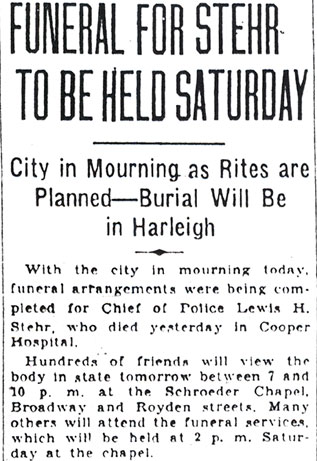
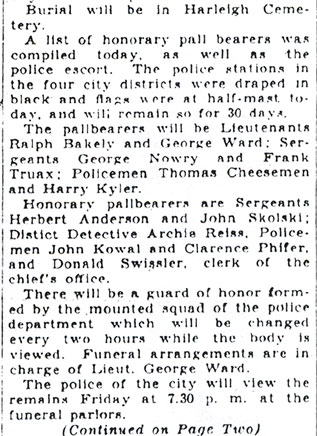
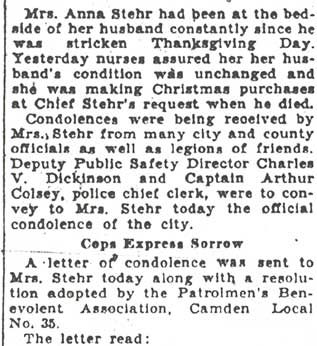
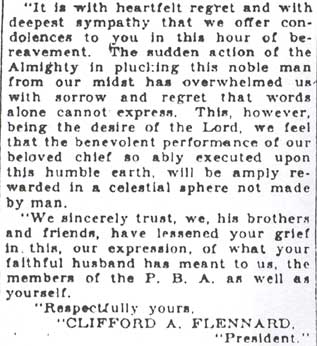
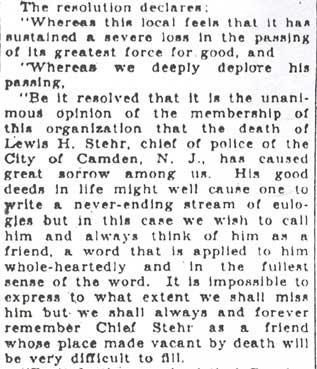
FUNERAL FOR STEHR TO BE HELD SATURDAY
City in Mourning as Rites are Planned—Burial Will Be in Harleigh
With the city in mourning today, funeral arrangements were being completed for Chief of Police Lewis H. Stehr, who died yesterday in Cooper Hospital. Hundreds of friends will view the body in state tomorrow between 7 and 10 p. m. at the Schroeder Chapel, Broadway and Royden streets. Many others will attend the funeral services, which will be held at 2 p. m. Saturday at the chapel.
Burial will be in Harleigh Cemetery.
A list of honorary pall bearers was compiled today, as well as the police escort. The police stations in the four city districts were draped in black and flags were at half-mast today, and will remain so for 30 days.
The pallbearers will be Lieutenants Ralph Bakely and George Ward; Sergeants George Nowry and Frank Truax; Policemen Thomas Cheeseman and Harry Kyler.
Honorary pallbearers are Sergeants Herbert Anderson and John Skolski; District Detective Archie Reiss, Policemen John Kowal and Clarence Phifer, and Donald Swissler, clerk of the chief’s office.
There will be a guard of honor formed by the mounted squad of the police department which will be changed every two hours while the body is viewed. Funeral arrangements are in charge of Lieut. George Ward.
The police of the city will view the remains Friday at 7.30 p. m. at the funeral parlors.
(Continued on Page Two)
Mrs. Anna Stehr had been at the bedside of her husband constantly since he was stricken Thanksgiving Day. Yesterday nurses assured her her husband’s condition was unchanged and she was making Christmas purchases at Chief Stehr’s request when he died. Condolences were being received by Mrs. Stehr from many city and county officials as well as legions of friends. Deputy Public Safety Director Charles V. Dickinson and Captain Arthur Colsey, police chief clerk, were to convey to Mrs. Stehr today the official condolence of the city.
Cops Express Sorrow
A letter of condolence was sent to Mrs. Stehr today along with a resolution adopted by the Patrolmen’s Benevolent Association, Camden Local No. 35. The letter read:
“It is with heartfelt regret and with deepest sympathy that we offer condolences to you in this hour of bereavement. The sudden action of the Almighty in plucking this noble man from our midst has overwhelmed us with sorrow and regret that words alone cannot express. This, however, being the desire of the Lord, we feel that the benevolent performance of our beloved chief so ably executed upon this humble earth, will be amply rewarded in a celestial sphere not made by man.
“We sincerely trust, we, his brothers and friends, have lessened your grief in this, our expression, of what your faithful husband has meant to us, the members of the P. B. A. as well as yourself.
“Respectfully yours, “CLIFFORD A. FLENNARD, “President.”
The resolution declares: “Whereas this local feels that it has sustained a severe loss in the passing of its greatest force for good, and “Whereas we deeply deplore his passing, “Be it resolved that it is the unanimous opinion of the membership of this organization that the death of Lewis H. Stehr, chief of police of the City of Camden, N. J., has caused great sorrow among us. His good deeds in life might well cause one to write a never-ending stream of eulogies but in this case we wish to call him and always think of him as a friend, a word that is applied to him whole-heartedly and in the fullest sense of the word. It is impossible to express to what extent we shall miss him but we shall always and forever remember Chief Stehr as a friend whose place made vacant by death will be very difficult to fill.
“Be it further resolved that Camden Local, No. 35, P. B. A., also wishes to extend its sympathies to Mrs. Stehr and to offer whatever assistance possible at this time of her bereavement and at any other time this organization may find it in its power to do so.
“Be it further resolved that we also extend our sympathies to his relatives and friends who are no doubt feeling his passing as deeply as we do so.”
Copies of the resolution were sent to Director of Public Safety David S. Rhone, Mrs. Stehr and the press. The resolution was passed at the regular meeting of the local yesterday. The resolution was signed by Flennard, the president, and Joseph Keefe, the secretary.
Chief George W. Black, secretary of the International Chief of Police Association, sent his regrets and letter of condolence to Captain Arthur Colsey and asking that a floral design be sent to the funeral at the association’s expense.
Mayor Expresses Sorrow
Mayor Price issued the following statement: “I was very greatly shocked to learn of the death of Chief Stehr. While I understood he was in a serious physical condition, I did not anticipate his death.
“Chief Stehr had devoted practically his entire lifetime to the service of the city, having entered the police department in his early youth, and is entitled to the commendation of his fellow citizens for his efforts in the public service.”
Commissioner Frank B. Hanna, when apprised of the police chief’s death, said: “The news of Chief Stehr’s death was a terrible shock. I feel a personal loss, as we were close friends. I knew him since I was a young boy, and our contacts in the past two years were most pleasant.”
Prosecutor Clifford A. Baldwin declared: “The suddenness of the death of Chief Stehr comes as a shock to those of his friends who were wishing him well in his illness. His passing naturally causes grief to those whose work brought them into close contact with him.”
City Commissioner Clay W. Reesman said: “The passing of Chief Stehr is a great loss to the community. We were all hoping that Chief Stehr was on the road to recovery and only several days ago when I inquired at the hospital, I learned that his condition was greatly improved. His sudden passing is a terrible shock.”
Local Police Heads Greeted at State Prison
Camden Courier-Post —
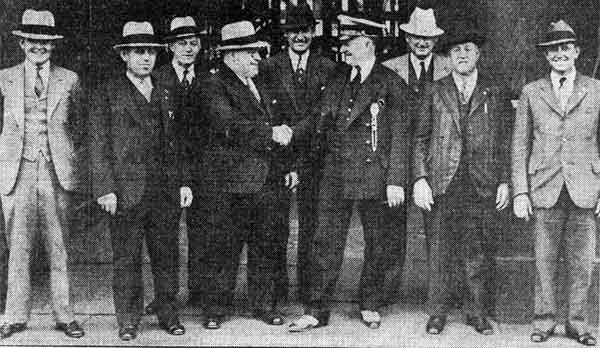
Headed by Major Charles V. Dickinson, local police officials made a tour of inspection yesterday of the state prison at Trenton. Photo shows Colonel George L. Selby, chief deputy warden at the prison, greeting Major Dickinson and his companions at the prison gates. Left to right: Patrolman John Stevenson – Lieutenant Herbert Anderson – Captain Arthur Colsey – Major Dickinson – Lieutenant George Frost – Colonel Selby – Lieutenants George Ward, Ralph Bakley and Walter Welch. The police officials were the guests of Colonel Selby at luncheon before the tour.
Colsey Completes 20 Years on Force
Camden Courier-Post —
Captain Was Named Policeman on March 12, 1912 by Chief Gravenor
Twenty years on the Camden Police Force were completed at 9:20 AM today by Captain Arthur Colsey.
Many friends and organizations sent baskets of flowers, transforming Captain Colsey’s office into a veritable bower of bloom. Many friends dropped in during the day to shake his hand and wish him “good luck.”
A card, unsigned, on one of the large wreaths, bears this legend: “Congratulations to Captain Arthur Colsey, for 20 years of faithful service — to the man of men who should have been made chief of police years ago. From an old friend who has been in very close touch with the police department for more than 40 years.”
Colsey was appointed a patrolman on March 12, 1912 by E.A. Gravenor, Chief of Police during the term of Mayor Charles H. Ellis. He was driver of the district patrol wagon for a short time, then was appointed a district detective. Shortly afterward he was transferred to the detective bureau under Captain William Schregler.
Colsey served for seven years in Mayor Ellis’ office as a plainclothes detective.
In 1923 he was appointed chief clerk with a rating as captain.
In 1924, when he was in charge of the vice squad, Colsey made 380 liquor raids, assisted in 180 raids made by Federal agents, raided 54 disorderly houses and 38 gambling establishments.
From 1907 to 1911 Colsey was councilman from the Second Ward and served as president of the Second Ward Republican Club. He moved to the Twelfth Ward in 1923, living at 2931 Stevens Street.
Colsey will be unopposed for president of the Twelfth Ward Republican Club at the election Tuesday night.
2 Cops Go on Trial Tuesday as Echo of Election Row
Camden Courier-Post —
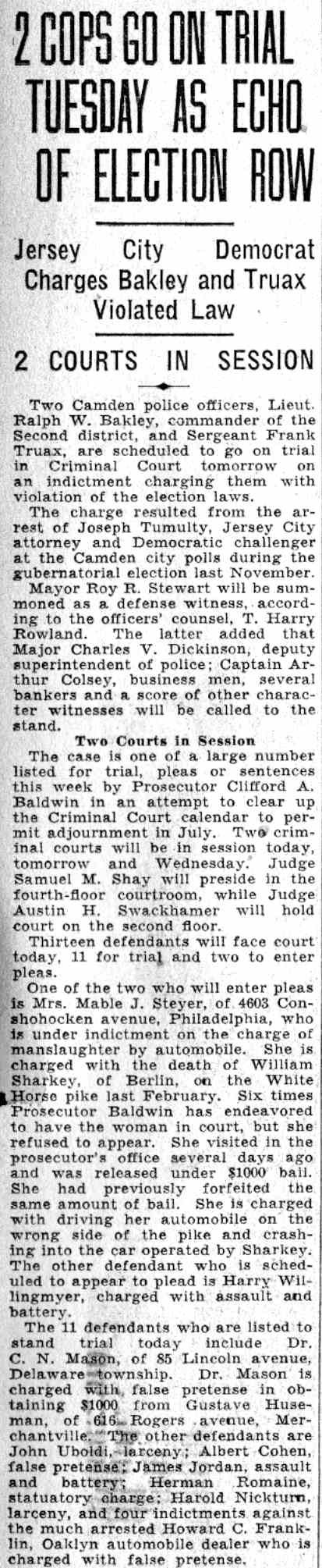
Jersey City Democrat Charges Bakley and Truax Violated Law
2 COURTS IN SESSION
Two Camden police officers, Lieut. Ralph W. Bakley, commander of the Second district, and Sergeant Frank Truax, are scheduled to go on trial in Criminal Court tomorrow on an indictment charging them with violation of the election laws.
The charge resulted from the arrest of Joseph Tumulty, Jersey City attorney and Democratic challenger at the Camden city polls during the gubernatorial election last November. Mayor Roy R. Stewart will be summoned as a defense witness, according to the officers’ counsel, T. Harry Rowland. The latter added that Major Charles V. Dickinson, deputy superintendent of police; Captain Arthur Colsey, business men, several bankers and a score of other character witnesses will be called to the stand.
Two Courts in Session
The case is one of a large number listed for trial, pleas or sentences this week by Prosecutor Clifford A. Baldwin in an attempt to clear up the Criminal Court calendar to permit adjournment in July. Two criminal courts will be in session today, tomorrow and Wednesday. Judge Samuel M. Shay will preside in the fourth-floor courtroom, while Judge Austin H. Swackhamer will hold court on the second floor.
Thirteen defendants will face court today, 11 for trial and two to enter pleas.
One of the two who will enter pleas is Mrs. Mable J. Steyer, of 4603 Conshohocken avenue, Philadelphia, who is under indictment on the charge of manslaughter by automobile. She is charged with the death of William Sharkey, of Berlin, on the White Horse pike last February. Six times Prosecutor Baldwin has endeavored to have the woman in court, but she refused to appear. She visited in the prosecutor’s office several days ago and was released under $1000 bail. She had previously forfeited the same amount of bail. She is charged with driving her automobile on the wrong side of the pike and crashing into the car operated by Sharkey.
The other defendant who is scheduled to appear to plead is Harry Willingmyer, charged with assault and battery.
The 11 defendants who are listed to stand trial today include Dr. C. N. Mason, of 85 Lincoln avenue, Delaware township. Dr. Mason is charged with false pretense in obtaining $1000 from Gustave Huseman, of 616 Rogers avenue, Merchantville. The other defendants are John Uboldi, larceny; Albert Cohen, false pretense; James Jordan, assault and battery; Herman Romaine, statuatory [sic] charge; Harold Nickturn, larceny, and four indictments against the much arrested Howard C. Franklin, Oaklyn automobile dealer who is charged with false pretense.
Tomorrow, Arthur “Gyp” Del Ducca, convicted disorderly house keeper, will be sentenced by Judge Swackhamer. Del Ducca was convicted in the criminal court last Wednesday of operating a resort at 764 Fairview street. Charles Fanelli, of 319 Penn street, who was convicted of holding up John Weeks, of Eighth and Tabor road, Philadelphia, on November 13, last, and robbing him of $50, will also be sentenced on Tuesday.
Several roadhouse proprietors whose establishments were recently raided, are also scheduled to appear in court tomorrow for trial. They include Harry Fleisher, 300 Rand street; John Cernivo, of Camden; Thomas Gibbons, of Gloucester; Walt Mills, alleged proprietor of the Maze Cafe in Stratford; Edward J. Walsh, alleged proprietor of the Little Grill, in West Collingswood Heights; Owen Sweeney, alleged proprietor of the Haddon Lake, at Mt. Ephraim; William Marshall, alleged proprietor of the Royal Haven Inn, at Berlin; Conrad Bittner, 456 Broadway, Gloucester, and Harry Underwood, also of Gloucester. There are two indictments against Underwood.
Walter Kennedy, former Camden boxer who fought under the ring name of Walter West, is also scheduled to go on trial tomorrow on a charge of carrying concealed deadly weapons. Kennedy, who is a shell-shocked World War veteran and former Camden soft drink parlor proprietor, is charged with attempting to hold up a Public Service bus on State street, four months ago.
Other defendants on tomorrow’s trial list are Louis Ward and Dean Kessler, larceny; Pasquale Massi, Jacob Melzer and Frank Atwater, attempted breaking and entering; Louis Scott, Edward Brady, Carl Pisco, Joseph Pisco, carrying concealed deadly weapons; Jim Jackson and Woodrow Stevens, breaking and entering; Frank Mucci, disorderly house; W. H. Seckel, false pretense; Davis Keese, statuatory [sic] charge, and Gustave Seletos, three indictments for false pretense.
On Wednesday ten defendants are scheduled to go on trial in the criminal courts. They are:
Roland Davis, desertion; William Bopergola, Tony Basile, Joseph Gogenti, Frank Carofolo, statuatory [sic] charges; Edward North, larceny; Joseph Carboni, larceny from person; George Huber, larceny; Roland Davis board bill; George Walters, tampering with meter.
Judge Shay will be asked tomorrow to sign court orders authorizing the prosecutor’s office to destroy all the liquors seized in the various roadhouse raids during the past year. The liquor is at present stored in the cellar of the old court house under lock and key.
Dr. Neulen Appointed to New Welfare Unit
Camden Courier-Post —
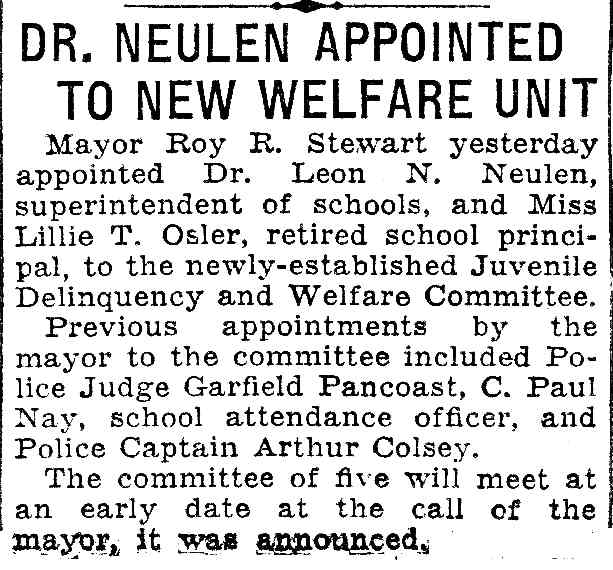
Mayor Roy R. Stewart yesterday appointed Dr. Leon N. Neulen, superintendent of schools, and Miss Lillie T. Osler, retired school principal, to the newly-established Juvenile Delinquency and Welfare Committee.
Previous appointments by the mayor to the committee included Police Judge Garfield Pancoast, C. Paul Nay, school attendance officer, and Police Captain Arthur Colsey.
The committee of five will meet at an early date at the call of the mayor, it was announced.
Murphy and Pedigree To End Long Service With Camden Police
Camden Courier-Post —
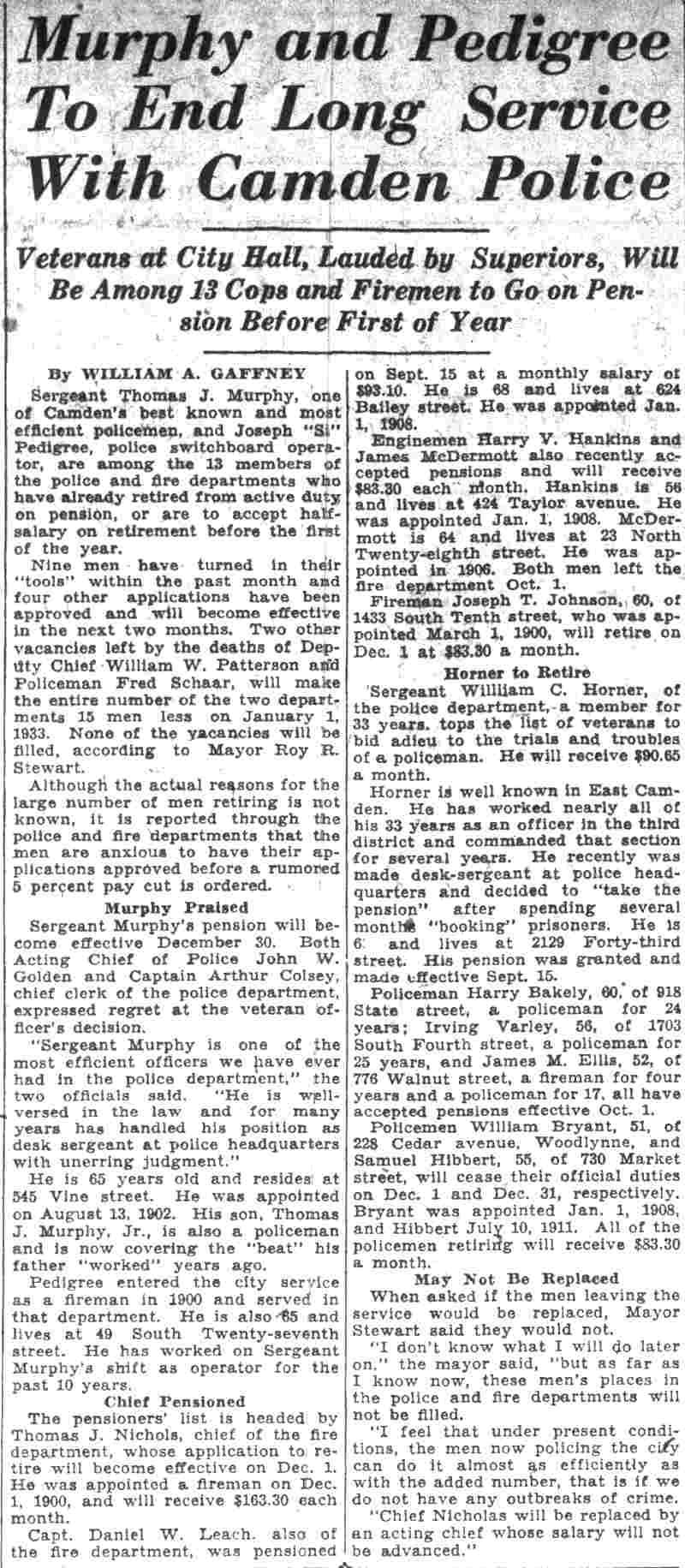
Veterans at City Hall, Lauded by Superiors, Will Be Among 13 Cops and Firemen to Go on Pension Before First of Year
By William A. Gaffney
Sergeant Thomas J. Murphy, one of Camden’s best known and most efficient policemen, and Joseph “Si” Pedigree, police switchboard operator, are among the 13 members of the police and fire departments who have already retired from active duty on pension, or are to accept half-salary on retirement before the first of the year.
Nine men have turned in their “tools” within the past month and four other applications have been approved and will become effective in the next two months. Two other vacancies left by the deaths of Deputy Chief William W. Patterson and Policeman Fred Schaar, will make the entire number of the two departments 15 men less on January 1, 1933. None of the vacancies will be filled, according to Mayor Roy R. Stewart.
Although the actual reasons for the large number of men retiring is not known, it is reported through the police and fire departments that the men are anxious to have their applications approved before a rumored 5 percent pay cut is ordered.
Murphy Praised
Sergeant Murphy’s pension will become effective December 30. Both Acting Chief of Police John W. Golden and Captain Arthur Colsey, chief clerk of the police department, expressed regret at the veteran officer’s decision.
“Sergeant Murphy is one of the most efficient officers we have ever had in the police department,” the two officials said. “He is well-versed in the law and for many years has handled his position as desk sergeant at police headquarters with unerring judgment.”
He is 65 years old and resides at 545 Vine street. He was appointed on August 13, 1902. His son, Thomas J. Murphy, Jr., is also a policeman and is now covering the “beat” his father “worked” years ago.
Pedigree entered the city service as a fireman in 1900 and served in that department. He is also 65 and lives at 49 South Twenty-seventh street. He has worked on Sergeant Murphy’s shift as operator for the past 10 years.
Chief Pensioned
The pensioners’ list is headed by Thomas J. Nichols, chief of the fire department, whose application to retire will become effective on Dec. 1. He was appointed a fireman on Dec. 1, 1900, and will receive $163.30 each month.
Capt. Daniel W. Leach, also of the fire department, was pensioned on Sept. 15 at a monthly salary of $93.10. He is 68 and lives at 624 Bailey street. He was appointed Jan. 1, 1908.
Enginemen Harry V. Hankins and James McDermott also recently accepted pensions and will receive $83.30 each month. Hankins is 56 and lives at 424 Taylor avenue. He was appointed Jan. 1, 1908. McDermott is 64 and lives at 23 North Twenty-eighth street. He was appointed in 1906. Both men left the fire department Oct. 1.
Fireman Joseph T. Johnson, 60, of 1433 South Tenth street, who was appointed March 1, 1900, will retire on Dec. 1 at $83.30 a month.
Horner to Retire
Sergeant William C. Horner, of the police department, a member for 33 years, tops the list of veterans to bid adieu to the trials and troubles of a policeman. He will receive $90.65 a month.
Horner is well known in East Camden. He has worked nearly all of his 33 years as an officer in the third district and commanded that section for several years. He recently was made desk-sergeant at police headquarters and decided to “take the pension” after spending several months “booking” prisoners. He is 6[?] and lives at 2129 Forty-third street. His pension was granted and made effective Sept. 15.
Policeman Harry Bakely, 60, of 918 State street, a policeman for 24 years; Irving Varley, 56, of 1703 South Fourth street, a policeman for 25 years, and James M. Ellis, 52, of 776 Walnut street, a fireman for four years and a policeman for 17, all have accepted pensions effective Oct. 1.
Policemen William Bryant, 51, of 228 Cedar avenue, Woodlynne, and Samuel Hibbert, 55, of 730 Market street, will cease their official duties on Dec. 1 and Dec. 31, respectively. Bryant was appointed Jan. 1, 1908, and Hibbert July 10, 1911. All of the policemen retiring will receive $83.30 a month.
May Not Be Replaced
When asked if the men leaving the service would be replaced, Mayor Stewart said they would not.
“I don’t know what I will do later on,” the mayor said, “but as far as I know now, these men’s places in the police and fire departments will not be filled.
“I feel that under present conditions, the men now policing the city can do it almost as efficiently as with the added number, that is if we do not have any outbreaks of crime.
“Chief Nicholas will be replaced by an acting chief whose salary will not be advanced.”
11th Ward Protests Removal of Police
Camden Courier-Post —
G.O.P. Club Resolutions Also Urge Captain Colsey as Chief
Opposition to abandonment of the Third District Police Station in East Camden for a more centralized police headquarters in new City Hall, was voiced yesterday by the Eleventh Ward Republican Club.
That organization in resolutions forwarded to the city commissioners and the Republican county committee members from the Eleventh ward, also requests the return of the police patrol to the Third District Station. Furthermore the club has gone on record as favoring appointment of Captain Arthur Colsey as permanent chief of police.
“We feel that these steps are necessary for the benefit and protection of not only the Eleventh ward but the Twelfth ward as well,” said Harold Mengle, recording secretary of the Eleventh Ward Republican Club in making public the resolutions.
The measures follow:
“Resolved, that the Eleventh Ward Republican Club go on record as strenuously objecting to the removal of the Third District Police Station and also request that the police patrol be replaced.” Signing the resolution are George H. Simpson, Harry C. Johnson and Mengle.
“Resolved that the Eleventh Ward Republican Club go on record as supporting Captain Colsey as chief of police, and inasmuch as we have only an acting chief, strenuously endorse his appointment.” Signing this measure are Louis H. Molineaux, Edward Huckel and Mengle.
Besides the city commissioners, Horace B. Beideman and Mrs. Etta C. Pfrommer, Republican county committeeman and woman from the Eleventh ward also received copies of the resolutions.
Mothers Hysterical In Boy Vandal Trial
Camden Courier-Post —
Pancoast Refuses Leniency to Sons, Blames Hartmann, Who Hits Back, Charges Inconsistency and Reveals Threat
Hysterics among three mothers, one of whom fainted, as their young sons were held for court yesterday inspired another attack on Police Judge Garfield Pancoast by Frank J. Hartmann, Jr., secretary of the North Camden Civic Association.
The three women shouted frantically as their sons, each 15, were led from the court to be taken to the Juvenile Detention Home on charges of incorrigibility. They had been accused of vandalism in North Camden. It was brought out, however, that Hartmann did not make the complaints against the boys, who will be detained until the next session of juvenile court is held by Judge Samuel M. Shay.
Hartmann in a statement last night disclosed that a threat had been made against him by the father of one of the boys who allegedly declared he “had a gun and was going to use it.”
Led from the courtroom after screaming and after one had fainted, the women cried so bitterly in the corridor that court attendants ordered them to leave.
The episode was one of the most turbulent in the history of the Camden police court, according to veteran attendants. So great was the turmoil there was question whether Pancoast would not have to recess other hearings.
Pancoast remained adamant in his decision despite the shrill protests of the mothers; the plea of one of the boys, who begged for release with arms outstretched, and of the complainant, who urged leniency.
Criticizes Hartmann
Pancoast criticized Hartmann for “condemning him for showing leniency in such cases, yet never making formal complaint himself against youthful vandals in a specific case.”
Pancoast added that he “was compelled to act as he did because of the facts in the case and general complaints against vandalism in North Camden and other parts of the city.”
The boys are: Lester Jamison, of 326 North Second Street; Frank Smith, of 521 Elm Street, and Henry Egerton, 15, of 212 Bailey Street.
Complaint against the youths was made by G.T. Moore, of 313 State Street, who charged that he had found the boys destroying a property at the northeast corner of Third and State Streets.
Value $25,000, Now 25 Cents
“That property once was worth about $25,000,” Moore testified, “Today it could be bought for 25 cents because of vandalism.”
The youths admitted they had been on the premises, but denied they had caused any damage.
The court then directed that a disorderly conduct charge against them be changed to incorrigibility, the complaint for which was signed by Moore.
Moore testified that the defendants and other boys had been warned to keep off the property, but they would cross the street and ridicule him. He urged leniency, however, when the court revealed that the boys would be sent to the detention home. He said he did not want to see the youths placed in confinement and their reputations blemished.
Calls Him Liar
“I can’t be lenient in his case,” Pancoast replied. “I’ve been charged by Mr. Hartmann, of the North Camden Civic Association, with taking care of criminals and politicians who come to this court, and that is a lie. Also there has been a great deal of publicity about vandalism in North Camden, columns and columns of it, yet Hartmann has never made a single formal complaint against any boy in my court. As a citizen, if he knows such things are going on, it is his duty, as well as that of other citizens, to make a complaint to us.”
“This occurrence by these boys is undoubtedly a part of the vandalism going on in North Camden and I’m going to send these boys to the detention home.”
Moore again pleaded for leniency for the boys, but Pancoast said he had no other alternative than to sentence them under the circumstances.
The arrests on complaint of Moore were made by Gus Reihm and Wilbur Prentiss, motorcycle policemen.
Civic Clubs Protest
Apprehension of youthful vandals has been urged repeatedly by the North Camden Civic Association officers, including Hartmann, who said recently that damage by the vandals in the city has reached more than $500,000 and the city officials and police have “done little or nothing about it.”
Hartmann and other officers of the association appeared before the city commission last week, urging prompt remedial measures by the city officials, and charging that too much leniency is shown in such cases. Mayor Stewart replied that the city had taken steps to eliminate the evil and was doing all that could be done to end it.
Hartmann, in company with Frederick von Nieda, president of the Congress of Civic Associations, to which the North Camden association is allied, and George I. Shaw, vice president of the uptown group, conferred with Captain Arthur Colsey at police headquarters. Captain Colsey promised further co-operation of the police in stamping out the practice of wrecking vacant dwellings and invited all citizens to report such instances to the police.
Hartmann’s Reply
In replying to Pancoast’s criticism Hartmann said:
“I learned from the father of one of the boys committed to jail by Judge Pancoast that the three boys could not be released unless I gave the word. This parent was quite alarmed, and I am told made threats against me. He declared that he had a gun and was going to use it. I can appreciate this man’s feelings, because I understand that when he returned he found his wife in a terribly excited condition, and because of the fact that their son was arrested for playing tag with some chums. But I can’t go to the detention home and order release of the boys. That’s impossible. Only the judge can do that.”
“The attitude of Judge Pancoast in criticizing me indirectly as the complainant not only is uncalled for but is the direct cause of this threat, as well as the distracted state of the boy’s mother.”
“Judge Pancoast is trying to throw a cloud over the real state of affairs in Camden.”
“As a member of the North Camden Civic Association I have helped to point out conditions here that have existed for a long time without the police taking any notice of them, conditions which should not have been tolerated and which have caused considerable expense to property owners.”
“This needless expense could have been prevented by the police and Judge Pancoast, in a quiet, yet determined manner.”
‘Children Victims of Anger’
“Simply because we have criticized him and the police is not reason for Judge Pancoast to vent his anger at us upon innocent children, such as he has done in this particular case.”
“He states that because we have complained it is necessary for him to hold the three young boys for court.”
“On top of this he said that we never made any complaints.”
“The latter is true, for we have not accused any child and do not intend to do so. It is the job of the police department to stop the wave of vandalism, not our task.”
“Judge Pancoast’s attempt to blame me in this situation is ridiculous. As I look at it he seems to be trying to evade the real issues.”
‘Reprimand Sufficient’
“He made a disgraceful example of three boys, to whom a reprimand would have been sufficient had they been brought before him for merely playing tag, but if they were accused of vandalism then I think his action in committing them to the detention home was justified. But, since the charge against them was changed from vandalism to incorrigibility it is apparent that there is some doubt in the judge’s mind.”
“Even with this reasonable doubt I cannot reconcile a case with the disposition of two others, immediately prior to the hearing of the three boys. I understand that two defendants on charges of stealing pipe from a vacant dwelling were dismissed.”
“The difference in these two instances, certainly does not give evidence of Judge Pancoast’s sincerity in dealing with vandalism, or convince me that he is co-operating with the mayor in correcting the evils of which the citizens and taxpayers have rightfully complained.”
‘Vigilantes’ To Curb Camden Vandals Suggested to City
Camden Courier-Post —
North Camden Group Would Have Citizens’ Committee and Junior Patrol — Up To Mayor Stewart
Formation of a “Citizens Committee” to curb vandalism and the development of a “Juvenile Patrol” to encourage young boys to co-operate with police, were suggested last night at a conference in the office of Police Captain Arthur Colsey.
The committee, it is proposed, would comprise special officers with authority to make arrests in the absence of patrolmen. The idea will be presented to Mayor Roy R. Stewart today by Captain Colsey. The latter has instructed Sergeant Richard Middleton to visit the various city playgrounds and organize groups of children into juvenile patrols.
Mrs. Stephen Pfeil, of the North Camden Civic Association, proposed the citizens’ committee. She heads a group of the uptown association, including Miss Elsie A. Stein and William Couglin, which recently made a survey in Camden and estimated that more than $500,000 damage has been caused by vandals. Others who attended the conference included Mrs. Grace Riggins, superintendent of the Camden Juvenile Detention Home; J. Louis Kollin, an attorney, and Joseph Munger, also of the North Camden Civic Association.
Mrs. Riggins suggested the civic group send speakers to schools to address students on good citizenship and to point out “the absolute unfairness of damaging property.” She advised the message also be imparted to parent-teacher associations.
The conference will result in regular meetings of the civic leaders and police, Mrs. Pfeil said.
12 Questioned, 2 Men Held in Murder Probe
Camden Evening Courier —

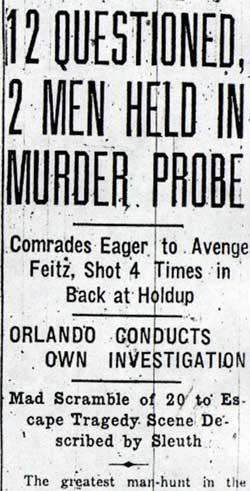
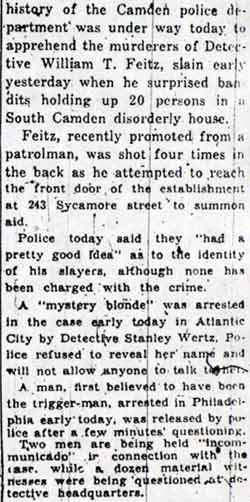
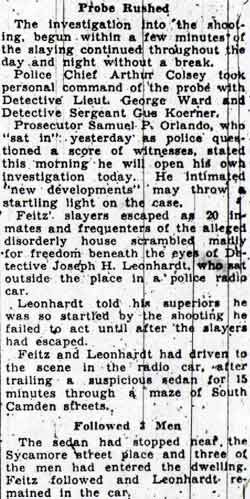
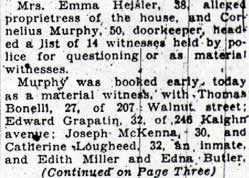
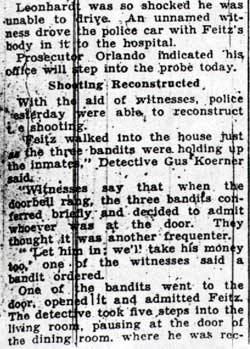

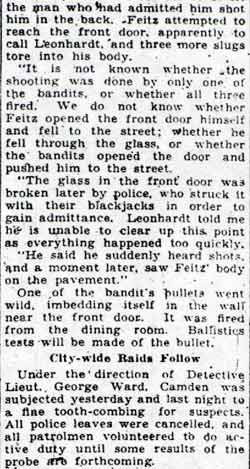
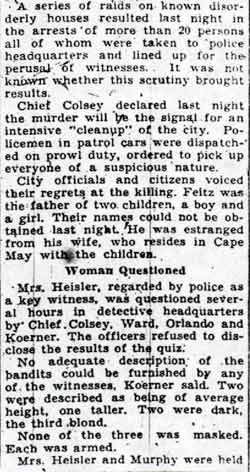
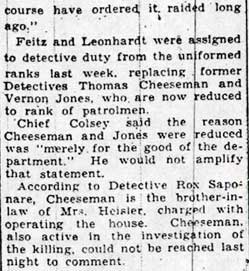
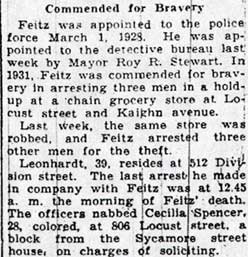
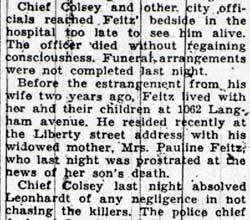
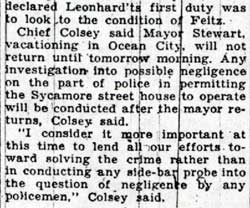
COLSEY LEADS CITY-WIDE HUNT FOR BANDIT KILLERS OF COP
Comrades Eager to Avenge Feitz, Shot 4 Times in Back at Holdup
ORLANDO CONDUCTS OWN INVESTIGATION
Mad Scramble of 20 to Escape Tragedy Scene Described by Sleuth
The greatest man-hunt in the history of the Camden police department was under way today to apprehend the murderers of Detective William T. Feitz, slain early yesterday when he surprised bandits holding up 20 persons in a South Camden disorderly house.
Feitz, recently promoted from a patrolman, was shot four times in the back as he attempted to reach the front door of the establishment at 243 Sycamore street to summon aid.
Police today said they “had a pretty good idea” as to the identity of his slayers, although none has been charged with the crime.
A “mystery blonde” was arrested in the case early today in Atlantic City by Detective Stanley Wertz [sic]. Police refused to reveal her name and will not allow anyone to talk to her.
A man, first believed to have been the trigger-man, arrested in Philadelphia early today, was released by police after a few minutes’ questioning.
Two men are being held “incommunicado” in connection with the case, while a dozen material witnesses were being questioned at detective headquarters.
Probe Rushed
The investigation into the shooting, begun within a few minutes of the slaying continued throughout the day and night without a break.
Police Chief Arthur Colsey took personal command of the probe with Detective Lieut. George Ward and Detective Sergeant Gus Koerner.
Prosecutor Samuel P. Orlando, who “sat in” yesterday as police questioned a score of witnesses, stated this morning he will open his own investigation today. He intimated “new developments” may throw a startling light on the case.
Feitz’ slayers escaped as 20 inmates and frequenters of the alleged disorderly house scrambled mainly for freedom beneath the eyes of Detective Joseph H. Leonhardt, who sat outside the place in a police radio car.
Leonhardt told his superiors he was so startled by the shooting he failed to act until after the slayers had escaped.
Feitz and Leonhardt had driven to the scene in the radio car, after trailing a suspicious sedan for 15 minutes through a maze of South Camden streets.
Followed 3 Men
The sedan had stopped near the Sycamore street place and three of the men had entered the dwelling. Feitz followed and Leonhardt remained in the car.
Mrs. Emma Heisler, 38, alleged proprietress of the house, and Cornelius Murphy, 50, doorkeeper, headed a list of 14 witnesses held by police for questioning or as material witnesses.
Murphy was booked early today as a material witness, with Thomas Bonelli, 27, of 207 Walnut street; Edward Grapatin, 32, of 246 Kaighn avenue; Joseph McKenna, 30, and Catherine Lougheed, 32, an inmate, and Edith Miller and Edna Butler, colored domestics employed by Mrs. Heisler.
Joseph Powell, 25, former Camden boxer, and Stanley, his brother, were the two men held incommunicado. Police refused to reveal what connection either had with the murder, although stating they were merely being held pending investigation.
Feitz died five minutes after being admitted to West Jersey Homeopathic hospital, where he was taken by Leonardt [sic] and McKenna, who stopped in his flight from the house to assist the wounded policeman. Three .32-calibre slugs were buried in his back and a fourth had pierced his wrist.
Lieutenant Ward today clamped down on news of the investigation, ordering all detectives and police to refuse information to news reporters.
Orlando said he would make known facts in the case known to him later today.
The Heisler woman, said by police to be the sister-in-law of Patrolman Thomas Cheeseman, recently demoted city detective, was not booked on the police docket this morning, but Ward declared he was not through questioning her and that she would be “booked” later in the day.
Several of the witnesses made their escape from the vicinity of the shooting in Powell’s car, police stated, one of whom was the mysterious woman arrested early today in Atlantic City.
Supreme Court Justice Frank T. Lloyd last night declared the case would be investigated by the September Grand Jury. It will not, he said, assume more importance in that body’s deliberations than the numbers racket.
Note Lack of Noise
Investigators were at a loss to understand why Feitz and Leonhardt, seated in an automobile on a quiet side street within 20 feet of where a holdup was taking place, did not hear any accompanying sounds. The belief was expressed that 20 men and women, being robbed, would become hysterical and noisy. The Sycamore street house is a ramshackle, two-story structure, with no vestibule leading into the parlor. There is no porch.
Powell drove first to the Lougheed woman’s home, where Mrs. Heisler, the Lougheed woman and Grapatin alighted. He then drove to Atlantic City with the unidentified girl, he said.
Police, advised of Powell’s presence in the house, dispatched the license number of his green sedan over the police teletype system.
Powell was apprehended at Folsom, 40 miles from Camden, as he was returning to Camden from Atlantic City. Sergeant Albert T. Varreiman of the Mt. Ephraim state police barracks stopped Powell’s machine and took him into custody. Powell was alone.
Feitz’s murder was a climax to half an hour’s scrutiny by him and Leonhardt into the suspicious actions of the four bandits. A car in which they were riding was sighted in the neighborhood by the two detectives at 2 a. m.
Trailed Car Fifteen Minutes
They trailed it in their police car for 15 minutes, as it wound through the narrow streets, repeatedly passing the Sycamore street house. Finally, the detectives saw the bandits park their machine on Locust street. Three of them emerged, walked down Sycamore street, and entered the house.
According to Leonhardt, neither he nor Feitz obtained the license number of the bandit car.
Upon seeing them enter the place, Leonhardt drove the police car around the block and stopped in front of the house.
Feitz and Leonhardt sat outside in their machine for 15 minutes. Finally, Leonhardt said, Feitz opened the door and stepped to the sidewalk.
“I’m going in there and see what’s going on,” he said.
Turning, he walked up the steps and rang the doorbell. Leonhardt said the door was opened after a short pause, and Feitz entered. The door was closed.
Hears Bandits’ Guns
Almost immediately, Leonhardt heard the muffled roar of the bandits’ revolvers. Feitz’s body came flying through the door. Pandemonium followed. As the persons in the house fled, neighbors came to doors and windows. Almost immediately, the street was filled.
Leonhardt was so shocked he was unable to drive. An unnamed witness drove the police car with Feitz’s body in it to the hospital.
Prosecutor Orlando indicated his office will step into the probe today.
Shooting Reconstructed
With the aid of witnesses, police yesterday were able to reconstruct the shooting.
“Feitz walked into the house just as the three bandits were holding up the inmates,” Detective Gus Koerner said.
“Witnesses say that when the doorbell rang, the three bandits conferred briefly and decided to admit whoever was at the door. They thought it was another frequenter.
“’Let him in; we’ll take his money too,’ one of the witnesses said a bandit ordered.
One of the bandits went to the door, opened it and admitted Feitz. The detective took five steps into the living room, pausing at the door of the dining room, where he was recognized by a bandit who was frisking the inmates.
“This bandit shouted: ‘It’s a dick; let ‘im have it!’”
Shot in Back
As Feitz reached for his revolver, the man who had admitted him shot him in the back. Feitz attempted to reach the front door, apparently to call Leonhardt, and three more slugs tore into his body.
“It is not known whether the shooting was done by only one of the bandits, or whether all three fired. We do not know whether Feitz opened the front door himself and fell to the street; whether he fell through the glass, or whether the bandits opened the door and pushed him to the street.
“The glass in the front door was broken later by police, who struck it with their blackjacks in order to gain admittance. Leonhardt told me he is unable to clear up this point as everything happened too quickly.
“He said he suddenly heard shots, and a moment later, saw Feitz’ body on the pavement.”
One of the bandit’s bullets went wild, imbedding itself in the wall near the front door. It was fired from the dining room. Ballistics tests will be made of the bullet.
City-wide Raids Follow
Under the direction of Detective Lieut. George Ward, Camden was subjected yesterday and last night to a fine tooth-combing for suspects. All police leaves were cancelled, and all patrolmen volunteered to do active duty until some results of the probe are forthcoming.
A series of raids on known disorderly houses resulted last night in the arrests of more than 20 persons all of whom were taken to police headquarters and lined up for the perusal of witnesses. It was not known whether this scrutiny brought results.
Chief Colsey declared last night the murder will be the signal for an intensive “cleanup” of the city. Policemen in patrol cars were dispatched on prowl duty, ordered to pick up everyone of a suspicious nature.
City officials and citizens voiced their regrets at the killing. Feitz was the father of two children, a boy and a girl. Their names could not be obtained last night. He was estranged from his wife, who resides in Cape May with the children.
Woman Questioned
Mrs. Heisler, regarded by police as a key witness, was questioned several hours in detective headquarters by Chief Colsey, Ward, Orlando and Koerner. The officers refused to disclose the results of the quiz.
No adequate description of the bandits could be furnished by any of the witnesses, Koerner said. Two were described as being of average height, one taller. Two were dark, the third blond.
None of the three was masked. Each was armed.
Mrs. Heisler and Murphy were held without bail as material witnesses. Powell, accompanied by Camden detectives, left for Atlantic City to show them where he dropped off the unidentified girl inmate of the house. They had not returned at a late hour last night.
According to Murphy, two of the bandits previously had visited the house as patrons, and at one time attempted to “shake down” Mrs. Heisler. She resisted their demands, Murphy declared.
Other persons arrested as material witnesses who, after hours of questioning were released in their own recognizance, include:
Frank Adams, 21, of 938 Atlantic avenue; Joseph MacDonald, 20, of 1605 South Sixth street; Henry Gorba, 19, of 17 North Twenty-first street and Edward McKenna, 31, of 1304 Broadway.
Edith Miller, 28, colored, of 205 Sycamore street, and Edna Butler, 32, also colored, 1122 South Second street, also were arrested and held as witnesses. They are inmates of the house, Koerner said.
Police said the bandits, in their search for booty, forced their victims to remove their shoes during the holdup to ascertain whether they were concealing any money. Only $8 was taken.
An autopsy performed on Feitz’ body yesterday by Coroner Arthur H. Holl and County Physician Edward B. Rogers showed that two of the bullets had penetrated the detective’s body. Coroner Holl, in whose undertaking establishment the detective’s body lay last night, declared death was virtually instant.
Chief Colsey last night denied Feitz and Leonhardt were acting under orders to watch the Sycamore street house.
“There have been general orders out to clean up all disorderly houses for a long time,” Colsey said. “I imagine the detectives were more interested in what the four men were doing than they were in the house. I talked at great length with Leonhardt and he told me neither he nor Feitz knew the place was a disorderly house.”
Leonhardt could not be reached last night to give his version of the affair. Colsey said Leonhardt was taking an active part in police efforts to solve the crime.
“If I had known the house in Sycamore street was a disorderly house,” Colsey said, “I would of course have ordered it raided long ago.”
Feitz and Leonhardt were assigned to detective duty from the uniformed ranks last week, replacing former Detectives Thomas Cheeseman and Vernon Jones, who are now reduced to rank of patrolmen.
Chief Colsey said the reason Cheeseman and Jones were reduced was “merely for the good of the department.” He would not amplify that statement.
According to Detective Rox Saponare, Cheeseman is the brother-in-law of Mrs. Heisler, charged with operating the house. Cheeseman, also active in the investigation of the killing, could not be reached last night to comment.
Commended for Bravery
Feitz was appointed to the police force March 1, 1928. He was appointed to the detective bureau last week by Mayor Roy R. Stewart. In 1931, Feitz was commended for bravery in arresting three men in a holdup at a chain grocery store at Locust street and Kaighn avenue.
Last week, the same store was robbed, and Feitz arrested three other men for the theft.
Leonhardt, 39, resides at 512 Division street. The last arrest he made in company with Feitz was at 12.45 a. m. the morning of Feitz’ death. The officers nabbed Cecilia Spencer, 28, colored, at 806 Locust street, a block from the Sycamore street house, on charges of soliciting.
Chief Colsey and other city officials reached Feitz’ bedside in the hospital too late to see him alive. The officer died without regaining consciousness. Funeral arrangements were not completed last night.
Before the estrangement from his wife two years ago, Feitz lived with her and their children at 1062 Langham avenue. He resided recently at the Liberty street address with his widowed mother, Mrs. Pauline Feitz, who last night was prostrated at the news of her son’s death.
Chief Colsey last night absolved Leonhardt of any negligence in not chasing the killers. The police chief declared Leonhardt’s first duty was to look to the condition of Feitz.
Chief Colsey said Mayor Stewart, vacationing in Ocean City, will not return until tomorrow morning. Any investigation into possible negligence on the part of police in permitting the Sycamore street house to operate will be conducted after the mayor returns, Colsey said.
“I consider it more important at this time to lend all our efforts toward solving the crime rather than in conducting any side-bar probe into the question of negligence by any policemen,” Colsey said.
Colsey and Detectives at Murder Scene and 2 Held for Quiz
Camden Evening Courier —

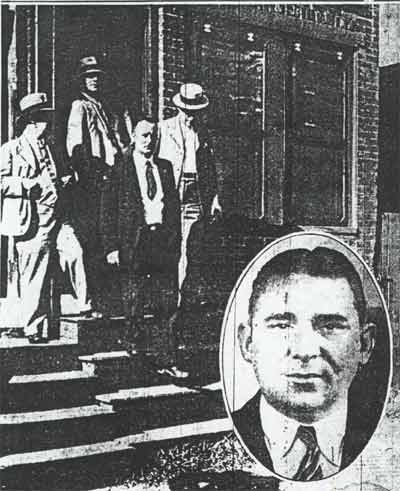
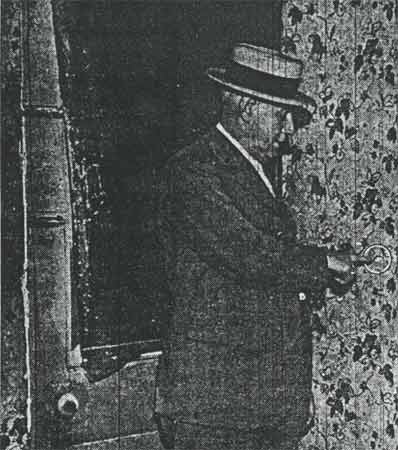
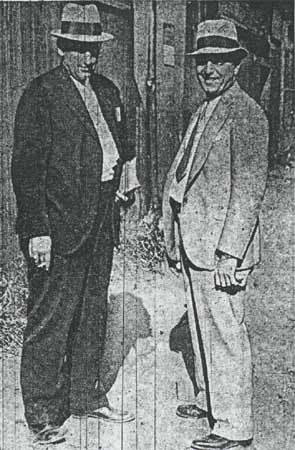
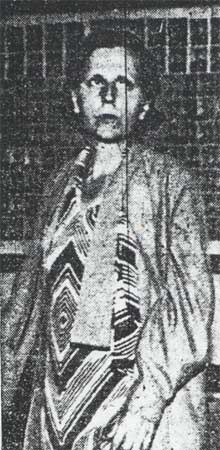
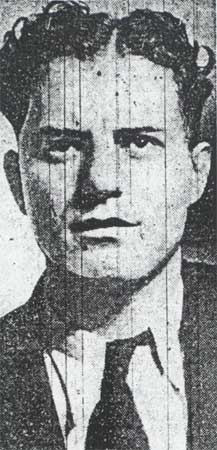
[Six photographs; the headline above them is the only printed text.]
Feitz Funeral Photographs
Camden Evening Courier —
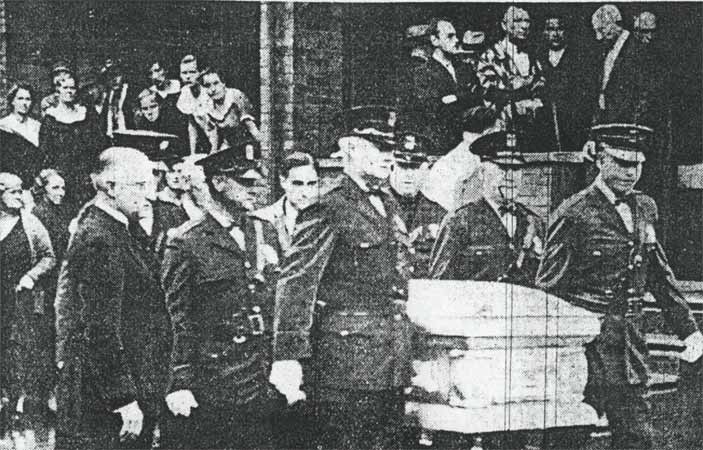
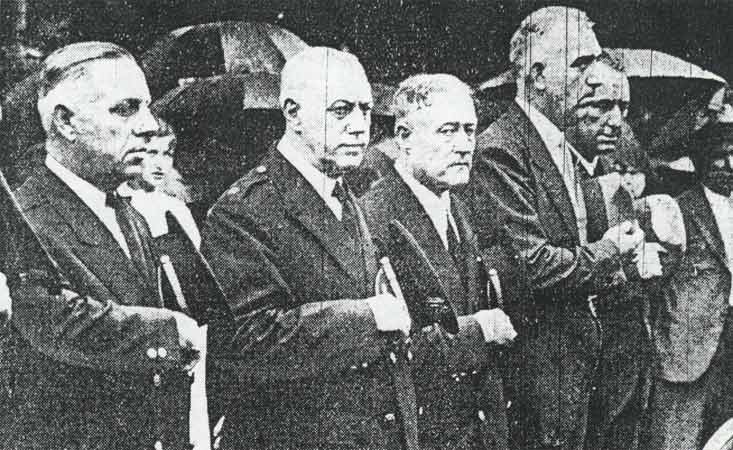

Police officials and fellow officers of Detective William T. Feitz, Jr., slain last Sunday in a disorderly house in Sycamore street, attended the funeral services Saturday. Top photo shows pall-bearers removing Feitz’s body from the undertaking establishment of Coroner Arthur H. Holl at left. The pall-bearers, left to right, are Patrolmen Joseph Leonhardt, Feitz’ companion the night he was slain; Otto Taperscer, Delaware Palmer, William Weaver and Paul Jackson. Lower photo shows police officials at the services. Left to right, Lt. Herbert Anderson, Chief Colsey, Lt. Ralph Bakely, E. Howard Broome, secretary to Mayor Stewart, and Lt. George Ward.
Lieut. Bakley and 11 Police Suspended in Feitz Inquiry
Camden Evening Courier —
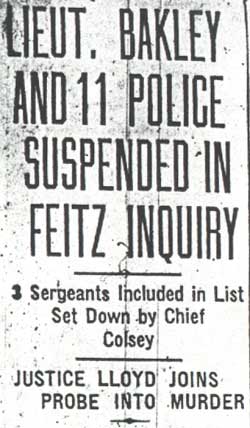
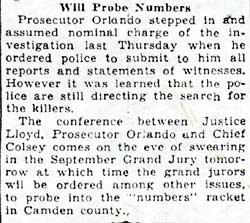
3 Sergeants Included in List Set Down by Chief Colsey
JUSTICE LLOYD JOINS PROBE INTO MURDER
Chief of Police Arthur Colsey at noon today announced the indefinite suspension of Lieut. Ralph Bakley, commander of the Second district of Camden police, and 11 other policemen in connection with the investigation into the killing of Detective William T. Feitz.
The full list of those suspended is as follows:
Lieut. Ralph Bakley, Sergt. John Garrity, Sergt. Walter Mattison, Acting Sergt. Edward Leonard, Sergt. Richard Cornog, Policemen George Weber, Joseph Leonhardt, Leon Branch, Thomas Cheeseman, Frank Wilmont [sic], John Houston and Vernon Jones.
Supreme Court Justice Frank T. Lloyd today entered the investigation into the murder of District Detective William T. Feitz in an alleged South Camden disorderly house Sept. 2.
The jurist, upon returning from his Summer vacation at Seaside Park, called an immediate conference with Prosecutor Samuel P. Orlando of Camden county and Police Chief Arthur Colsey of this city.
Although no confirmation could be obtained officially, it was learned from authoritative sources that Justice Lloyd would take up the charges made earlier in the week by Prosecutor Orlando that graft and corruption exist in the Camden police.
May Probe Suicide
The jurist was also expected to delve into the unusual circumstances surrounding the death of Mrs. Emma Heisler, 38, alleged operator of the disorderly house where Feitz met his death at 243 Sycamore street.
Mrs. Heisler, who was detained in the Camden detective bureau at the order of Detective Lieutenant George Ward instead of being locked in a cell, jumped from the fifth floor window of Ward’s office September 4 while two detectives assigned to guard her were nearby.
The progress of the police investigation into the killing of Feitz, whom police declare was shot when he surprised three bandits in the act of holding up 20 inmates and patrons, will be presented by both Prosecutor Orlando and Chief Colsey.
Mickey Blair to Give Up
Mickey Blair, boxer whose real name is Michael Tenerelli, 25, who has been living in New York City, but whose Camden address is 833 South Fourth street, is to be surrendered to Camden police for questioning in connection with the murder of Feitz.
He has been sought by detectives for grilling since a few hours after the shooting of Feitz.
His attorney, Edward V. Martino, of 540 Cooper street, notified Chief Colsey today that he would surrender Tenerelli or Blair to the police in his office at 1 p.m.
“Mickey knows absolutely nothing about the killing of Feitz,” Martino told newspapermen. “Learning through a friend that police were seeking him for questioning, he called me Saturday night and asked me to ascertain the facts.”
“I learned that police wanted to talk to him and telephoned him to that effect in New York City where he has been staying for the past few weeks. He later called me back and told me that he would be in Camden at 1 p.m. today.”
‘Attended Funeral’
Martino revealed that Tenerelli or Blair said he had been in Camden prior to the killing of Feitz and also on Labor Day, the day following the shooting of the detective. He was here to attend the funeral of a brother-in-law, Martino said.
Neither Chief Colsey or other police or detective officials would comment upon what they hoped to learn from Tenerelli that might bring an early solution of the murder and lead to the arrest of the killers.
Prosecutor Orlando at the conference with Justice Lloyd in his City Hall-Court House offices, was to present a complete report on the murder of the detective together with statements obtained from all persons who figured in the crime.
Will Probe Numbers
Prosecutor Orlando stepped in and assumed nominal charge of the investigation last Thursday when he ordered police to submit to him all reports and statements of witnesses. However it was learned that the police are still directing the search for the killers.
The conference between Justice Lloyd, Prosecutor Orlando and Chief Colsey comes on the eve of swearing in the September Grand Jury tomorrow at which time the grand jurors wil [sic] be ordered among other issues, to probe into the “numbers” racket in Camden county.
Grand Jury Vice Probe to Be Ordered by Lloyd; Stewart Quizzes Cops
Camden Evening Courier —
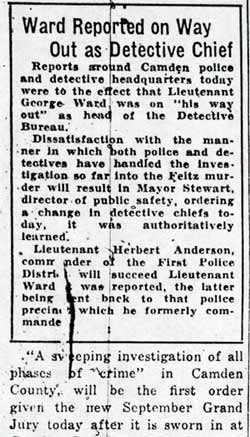
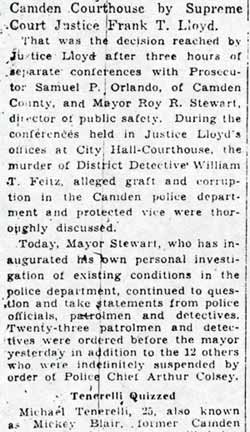
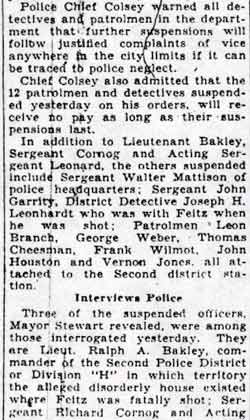
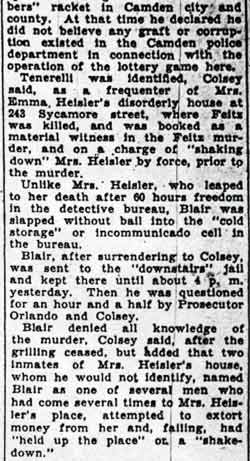
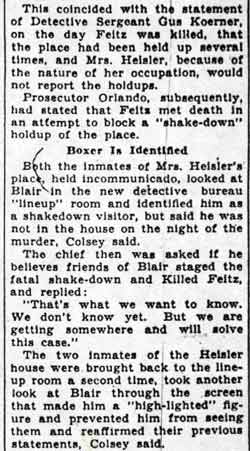
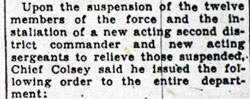
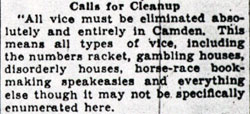
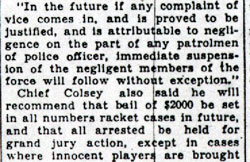
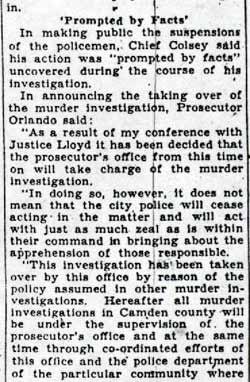
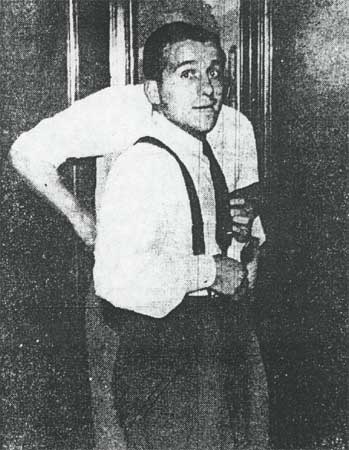

FEITZ MURDER, CITY GRAFTING TO FACE INQUIRY
Action Follows Parley With Orlando and Mayor on Conditions
MORE SUSPENSIONS OF POLICE INTIMATED
Mickey Blair Quizzed on Detective’s Killing; Stewart Warns, ‘Clean Up’
Questioned in Feitz Murder
Michael Tenerelli, 25, known in pugilistic circles as Mickey Blair, is shown above during a lull in the questioning by detectives investigating the murder of District Detective William Feitz. Tenerelli surrendered to police yesterday and on order of Prosecutor Orlando was held without bail on charges of being a material witness and with conspiracy in a robbery in connection with the holdup in progress in the South Camden alleged disorderly house at the time Feitz was shot.
Ward Reported on Way Out as Detective Chief
Reports around Camden police and detective headquarters today were to the effect that Lieutenant George Ward was on “his way out” as head of the Detective Bureau.
Dissatisfaction with the manner in which both police and detectives have handled the investigation so far into the Feitz murder will result in Mayor Stewart, director of public safety, ordering a change in detective chiefs today, it was authoritatively learned.
Lieutenant Herbert Anderson, commander of the First Police District, will succeed Lieutenant Ward as it was reported, the latter being sent back to that police precinct which he formerly commanded.
“A sweeping investigation of all phases of “crime” in Camden County, will be the first order given the new September Grand Jury today after it is sworn in at Camden Courthouse by Supreme Court Justice Frank T. Lloyd.
That was the decision reached by Justice Lloyd after three hours of separate conferences with Prosecutor Samuel P. Orlando, of Camden County, and Mayor Roy R. Stewart, director of public safety. During the conferences held in Justice Lloyd’s offices at City Hall-Courthouse, the murder of District Detective William T. Feitz, alleged graft and corruption in the Camden police department and protected vice were thoroughly discussed.
Today, Mayor Stewart, who has inaugurated his own personal investigation of existing conditions in the police department, continued to question and take statements from police officials, patrolmen and detectives. Twenty-three patrolmen and detectives were ordered before the mayor yesterday in addition to the 12 others who were indefinitely suspended by order of Police Chief Arthur Colsey.
Tenerelli Quizzed
Michael Tenerelli, 25, also known as Mickey Blair, former Camden lightweight boxer, was still being questioned at police headquarters in connection with the murder of Detective Feitz. Tenerelli who surrendered to police here yesterday after returning from New York, is booked as a material witness and on a charge of conspiracy in a robbery. Both charges were ordered placed against Tenerelli by Prosecutor Orlando who has assumed direct charge of the investigation. He is being held without bail.
Seven other men and women taken into custody by police after the shooting of Feitz in the alleged disorderly house operated by the late Mrs. Emma Heisler at 243 Sycamore street, were to have been arraigned in Camden Police Court today on orders of Prosecutor Orlando and then turned over to the county authorities. Bail, Prosecutor Orlando declared, would be “sufficiently high” to insure their later appearances when wanted.
However there were no appearances of material witnesses or others in the Feitz investigation before Judge J. Harry Switzer in Camden Police Court during its session today and it was unofficially reported that the prosecutor had changed his plans.
Police Chief Colsey warned all detectives and patrolmen in the department that further suspensions will follow justified complaints of vice anywhere in the city limits if it can be traced to police neglect.
Chief Colsey also admitted that the 12 patrolmen and detectives suspended yesterday on his orders, will receive no pay as long as their suspensions last.
In addition to Lieutenant Bakley, Sergeant Cornog and Acting Sergeant Leonard, the others suspended include Sergeant Walter Mattison of police headquarters; Sergeant John Garrity, District Detective Joseph H. Leonhardt who was with Feitz when he was shot; Patrolmen Leon Branch, George Weber, Thomas Cheeseman, Frank Wilmot, John Houston and Vernon Jones, all attached to the Second district station.
Interviews Police
Three of the suspended officers, Mayor Stewart revealed, were among those interrogated yesterday. They are Lieut. Ralph A. Bakley, commander of the Second Police District or Division “H” in which territory the alleged disorderly house existed where Feitz was fatally shot; Sergeant Richard Cornog and Acting [lines between the bottom of crop 15 and the top of crop 16 are not captured in the scanned crops]
Edwin Andrews, Winslow township; Joseph Dougherty, 140 Prospect avenue, Merchantville.
William Tomlinson, Glendale, Voorhees township; Edmund S. Stafford, 546 Stevens street; Harry Buffington, 123 East Clinton avenue, Oaklyn; Samuel A. Dobbins, 2599 Baird boulevard; Charles H. Thatcher, 129 Kendall boulevard, Oaklyn; Richard S. Thompson, East Zane avenue, Collingswood; Benjamin F. Stemmer, 420 Third Avenue, Haddon Heights; Horace J. Harvey, 721 Amherst avenue, Audubon; H. B. Cox, Evesham avenue, Voorhees township; Dr. Walter F. Wood, Collingswood; John W. Underwood, 801 Cumberland street, Gloucester; Clarence Alloway, Blackwood; Charles A. McWilliams, Blackwood; Louis G. Clark, Barrington; Albert J. Cline, 18 East Crystal Lake avenue, Westmont; Robert Bushbeck, First avenue, Pine Hill, Harry Burkhardt, Bell road, Mt. Ephraim; George T. Schuster, 223 Woodland terrace, Collingswood; Chesley L. Hutchins, 711 Market street, Gloucester and Otto Vierling, Evergreen avenue, Runnemede.
The order of Justice Lloyd for a wide grand jury probe of crime follows upon a decision he made 10 days ago to have the same body open an investigation into the “numbers” racket in Camden city and county. At that time he declared he did not believe any graft or corruption existed in the Camden police department in connection with the operation of the lottery game here.
Tenerelli was identified, Colsey said, as a frequenter of Mrs. Emma Heisler’s disorderly house at 243 Sycamore street, where Feitz was killed, and was booked as a material witness in the Feitz murder, and on a charge of “shaking down” Mrs. Heisler by force, prior to the murder.
Unlike Mrs. Heisler, who leaped to her death after 60 hours freedom in the detective bureau, Blair was slapped without bail into the “cold storage” or incommunicado cell in the bureau.
Blair, after surrendering to Colsey, was sent to the “downstairs” jail and kept there until about 4 p. m. yesterday. Then he was questioned for an hour and a half by Prosecutor Orlando and Colsey.
Blair denied all knowledge of the murder, Colsey said, after the grilling ceased, but added that two inmates of Mrs. Heisler’s house, whom he would not identify, named Blair as one of several men who had come several times to Mrs. Heisler’s place, attempted to extort money from her and, failing, had “held up the place” or a “shakedown.”
This coincided with the statement of Detective Sergeant Gus Koerner, on the day Feitz was killed, that the place had been held up several times, and Mrs. Heisler, because of the nature of her occupation, would not report the holdups.
Prosecutor Orlando, subsequently, had stated that Feitz met death in an attempt to block a “shake-down” holdup of the place.
Boxer Is Identified
Both the inmates of Mrs. Heisler’s place, held incommunicado, looked at Blair in the new detective bureau “lineup” room and identified him as a shakedown visitor, but said he was not in the house on the night of the murder, Colsey said.
The chief then was asked if he believes friends of Blair staged the fatal shake-down and killed Feitz, and replied:
“That’s what we want to know. We don’t know yet. But we are getting somewhere and will solve this case.”
The two inmates of the Heisler house were brought back to the lineup room a second time, took another look at Blair through the screen that made him a “high-lighted” figure and prevented him from seeing them and reaffirmed their previous statements, Colsey said.
Upon the suspension of the twelve members of the force and the installation of a new acting second district commander and new acting sergeants to relieve those suspended, Chief Colsey said he issued the following order to the entire department:
Calls for Cleanup
“All vice must be eliminated absolutely and entirely in Camden. This means all types of vice, including the numbers racket, gambling houses, disorderly houses, horse-race bookmaking speakeasies and everything else though it may not be specifically enumerated here.
“In the future if any complaint of vice comes in, and is proved to be justified, and is attributable to negligence on the part of any patrolmen of police officer [sic], immediate suspension of the negligent members of the force will follow without exception.”
Chief Colsey also said he will recommend that bail of $2000 be set in all numbers racket cases in future, and that all arrested be held for grand jury action, except in cases where innocent players are brought in.
‘Prompted by Facts’
In making public the suspensions of the policemen, Chief Colsey said his action was “prompted by facts” uncovered during the course of his investigation.
In announcing the taking over of the murder investigation, Prosecutor Orlando said:
“As a result of my conference with Justice Lloyd it has been decided that the prosecutor’s office from this time on will take charge of the murder investigation.
“In doing so, however, it does not mean that the city police will cease acting in the matter and will act with just as much zeal as is within their command in bringing about the apprehension of those responsible.
“This investigation has been taken over by this office by reason of the policy assumed in other murder investigations. Hereafter all murder investigations in Camden county will be under the supervision of the prosecutor’s office and at the same time through co-ordinated efforts of this office and the police department of the particular community where the murder takes place.
“As far as developments are concerned, there is nothing new in the case except the arrest of Mickey Blair, who was surrendered by his counsel and who is in the custody of the police until he is committed.”
Lieutenant Walter Welch in command of the Third Police District was assigned by Chief Colsey to replace Lieutenant Bakley and make the suspensions of all sergeants and patrolmen in that precinct effective immediately. Sergeant John Potter of the Third District was named an acting lieutenant to replace Lieutenant Welch as commander of that precinct.
Welch said he will instruct every policeman under his new command that he must work in harmony with earnest efforts to stamp out vice.
“If they do not do this,” Welch said, “I do not want them. They will be of no use to me. They know what to expect if they fail to cooperate. My efforts will be directed to maintaining order without vice in the Second district, just as I have done in the Third.”
Store Bandits To Be Quizzed in Chester on Feitz Murder
Camden Courier-Post —
Material Witness Will View Suspects Caught by Camden Sleuths — Brickner Questioned by Colsey on Holdup — Police Order All Persons Arrested to Face ‘Line Up’ in Slaying Probe
Seven men and women held by Camden police as material witnesses in the murder of Detective William T. Feitz two weeks ago in an alleged South Camden disorderly house will look over two men arrested in Chester PA after a store holdup here.
This was announced today by County Detective Lawrence T. Doran, who is directing the investigation for Prosecutor Samuel P. Orlando.
At the same time, Chief Doran disclosed that after a conference with Police Chief Arthur Colsey, orders were issued that every person arrested in Camden, whether the charge is trivial or serious, will be placed in a police “lineup” and the material witnesses will face them to see if any of Feitz’s killers are among them.
Chief Doran was not sure whether the Camden County authorities would be able to bring the two robbery suspects to Camden because they are also wanted in Pennsylvania for almost a score of other holdups and burglaries.
Will Visit Chester
In the event that Chester authorities will not turn the two men over to Camden detectives, the witnesses will go to Chester to examine them, Chief Doran said.
Those held in Chester in connection with the holdup Wednesday night of the candy store of Michael Guzik at 1301 Sheridan Street identified themselves as Peter Muraska, 10, of 342 McDowell Street, and Ray Tuttle, 30, of 2529 West Ninth Street, both of Chester.
While neither Chief Doran nor Chief Colsey believe Muraska or Tuttle may be implicated in the murder of the detective because they are not known to be killers, both declared the suspects will be questioned as to their whereabouts at the time Feitz was shot to death.
“We are letting nothing slip through our fingers at this stage of the investigation,” Chief Doran said. “There is a bare possibility that either of these two suspects may be implicated or have some knowledge that would be useful to us in solving this crime.”
While negotiations were under way between Camden County authorities and Chester police to bring the suspects here, Chief Colsey was making inquiry into the actions of Patrolman William Brickner during the holdup.
Questioned by Colsey
Brickner was summoned to Chief Colsey’s office at City Hall today to explain why he had rushed from his home at 1263 Chase Street to the scene of the holdup when told by neighbors that it was taking place and then gave his gun to his son Elmer so he could watch the place so he the policeman could telephone police headquarters for help.
According to Guzik, the proprietor of the store, the bandits were in his store 30 minutes. They locked the doors behind them and gagged Guzik and guarded his wife, Blanche, and her sister, Mary Pitura, 18.
The bandits broke open a trunk from which they took $100 in pennies, $30 in scrip, and $4 in silver. Guzik said the pennies represented his profit in a penny vending machine over a period of time.
It was while Guzik was left alone that he shouted from one of his windows and neighbors called Brickner who was at home and off duty. His son Elmer fired one shot at the fleeing car before the patrolman came back from telephoning for help.
Several numbers of the license plates on the bandits car were covered with tape but one of the youngsters in the neighborhood succeeded in pushing aside the tape and getting the complete number which was turned over to police. Yesterday Detective Lieutenant Ward, accompanied by Detective Sergeant Gus Koerner and Detective Joseph Carpani went to Chester and made the arrests.
The car, which carried Pennsylvania tags, was listed in the name of Archie Hendrickson of Morton Avenue, Chester, police said.
Crawford Smith — Feitz murder investigation
Camden Courier-Post —
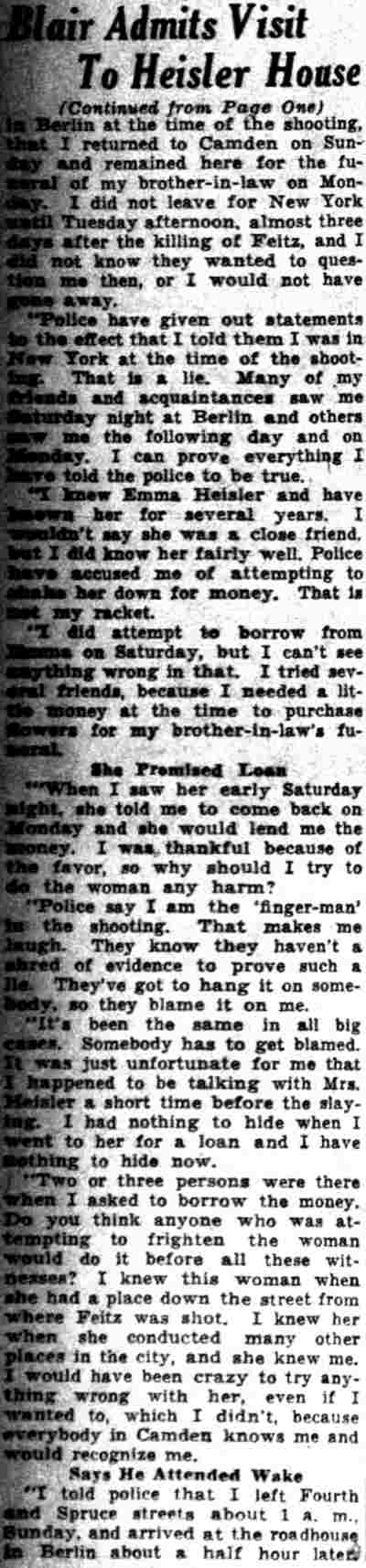
Mickey Blair Admits Visit to Heisler Home on Fatal Night
Boxer Tells of His Attempt to Borrow Money From Woman
STEWART LAUNCHES BANK ACCOUNT PROBE
Mickey Blair yesterday admitted to the Courier-Post that he was in Mrs. Emma Heisler’s house trying to borrow money a few hours before Detective William T. Feitz was shot to death.
Mayor Roy R. Stewart, at the same time, announced that he will launch an investigation of the bank accounts of “certain policemen” to determine their wealth.
The two statements summarized the day’s progress in the search for Feitz’s slayers and in the mayor’s investigation of police connections with vice graft.
Blair not only admitted to a newspaperman that he was in Mrs. Heisler’s house to negotiate a loan a few hours before the slaying but charged the police with manufacturing a fake alibi for him, for the purpose of tearing it down later.
Reports that patrolmen drawing from $25.50 to $36 a week were owners of expensive automobiles and spending money lavishly and still were amassing fortunes were believed to have stimulated the mayor to action in his bank account probe.
He would not amplify his statement other than to say that he will question those policemen whom he desires to question and are now on leave when they return.
In his broadside against the police, Blair said:
“Chief Colsey lies if he says police have broken down my alibi. I have no alibi, only that I know nothing about this murder.
“I told Lieutenant Ward, after I had voluntarily walked into detective bureau, where I had been from Saturday night until last Monday. At no time did I say that I was in New York at the time of the shooting.
“I told them I was at a roadhouse in Berlin at the time of the shooting, that I returned to Camden on Sunday and remained here for the funeral of my brother-in-law on Monday. I did not leave for New York until Tuesday afternoon, almost three days after the killing of Feitz, and I did not know they wanted to question me then, or I would not have gone away.
“Police have given out statements to the effect that I told them I was in New York at the time of the shooting. That is a lie. Many of my friends and acquaintances saw me Saturday night at Berlin and others saw me the following day and on Monday. I can prove everything I have told the police to be true.
“I knew Emma Heisler and have known her for several years. I wouldn’t say she was a close friend, but I did know her fairly well. Police have accused me of attempting to shake her down for money. That is not my racket.
“I did attempt to borrow from Emma on Saturday, but I can’t see anything wrong in that. I tried several friends, because I needed a little money at the time to purchase flowers for my brother-in-law’s funeral.
She Promised Loan
“When I saw her early Saturday night, she told me to come back on Monday and she would lend me the money. I was thankful because of the favor, so why should I try to do the woman any harm?
“Police say I am the ’finger-man’ in the shooting. That makes me laugh. They know they haven’t a shred of evidence to prove such a lie. They’ve got to hang it on somebody, so they blame it on me.
“It’s been the same in all big cases. Somebody has to get blamed. It was just unfortunate for me that I happened to be talking with Mrs. Heisler a short time before the slaying. I had nothing to hide when I went to her for a loan and I have nothing to hide now.
“Two or three persons were there when I asked to borrow the money. Do you think anyone who was attempting to frighten the woman would do it before all these witnesses? I knew this woman when she had a place down the street from where Feitz was shot. I knew her when she conducted many other places in the city, and she knew me. I would have been crazy to try anything wrong with her, even if I wanted to, which I didn’t, because everybody in Camden knows me and would recognize me.
Says He Attended Wake
“I told police that I left Fourth and Spruce streets about 1 a. m. Sunday, and arrived at the roadhouse in Berlin about a half hour later.
Many people saw me there. I stayed at the place until late Sunday afternoon and then returned to Camden.
“I was at home all of Sunday night until I attended a wake at the home of my sister on Decatur street. Then on Monday I was at the funeral and Monday night I visited several places in the city. I had made arrangements to go to New York, but postponed my trip until Tuesday after my brother-in-law’s death.
“While in New York I heard from a friend who told me police were looking for me. I immediately telephoned Edward V. Martino, who has represented me in other matters, and asked him to learn if that were true. He called me back and said it was. I told him my business in New York would be completed on Monday and that I would return to Camden at that time and visit detective headquarters.
“I paid my own expenses to get here, and since the time I gave myself up, police have constantly walked me about with handcuffs on. Do you think I would have surrendered to police if I had any intentions of running away?”
Martino Raps Police
“I have told the truth and I am innocent of any connection with the death of Detective Feitz. If police want to give out the true story, they will verify that everything I have told you is what I told them. And every word of it is the truth.”
Martino, who was present during the interview, added that it was “a disgrace” to the police department in the manner in which Blair has been treated since his surrender.
“When Blair gave himself up,” Martino said, “I instructed him to go to detective bureau by himself. I did not request the right to protect his constitutional rights, because it was my idea that by not interfering, the police could not find any excuse in their failure to solve the crime. They not only failed to appreciate the co-operation given them, but are continually giving out so many contradictory statements that the general public is given the impression that Blair is deliberately lying.”
Prosecutor Samuel P. Orlando, meanwhile, disclosed yesterday that the new grand jury will not hear witnesses in the Feitz murder case, or open a probe into vice conditions in Camden at its first session next Thursday.
“Facts in the murder probe and pertaining to vice conditions will not be ready in time for consideration by the new grand jury next Thursday,” the prosecutor said. “The veniremen will act on pending cases, including those of several alleged numbers barons arrested during the last week.”
Meanwhile, the police continued their crusade against the numbers racket, making their tenth and eleventh arrests in a week.
At the same time, Fred Klosterman, an alleged numbers baron, who surrendered Wednesday, was held in $5000 bail by Police Judge J. Harry Switzer for the grand jury. His brother, Joseph Klosterman, was held in similar bail previously, also on a charge of operating a numbers game.
The two men apprehended yesterday were arrested by George Clayton, a policeman, charged with being numbers writers. They will be given a hearing in police court today. The men gave their names as John Geronio, 52, of 1042 Cooper street, and Crawford Smith, 51, of 702 Carman street.
Fred Klosterman is 33 and gave his address as 1050 Mechanic street. Joseph Klosterman, 35, gave his address as 1400 Mechanic street.
The Klostermans, according to police, are among the topnotch numbers barons of the city. Both pleaded not guilty to the charges against them.
No disposition was made in police court of the case of Mrs. Mollie Schwartz, 42, who was arrested Wednesday on a charge of operating a still at a double dwelling at 3404 Rosedale avenue. Police Lieut. John Potter said the woman admitted operating the still.
Strict co-operation with the State Alcoholic Beverage Commission in the detection, closing up and prosecution of speakeasies is being given by the Camden police department.
That statement was made yesterday by Mayor Roy R. Stewart, who is the director of the department of public safety, and came as the result of an interview which Howard B. Dyer, an investigator of the state beverage commission had with the mayor. Dyer was formerly deputy city clerk.
An anonymous letter to Camden police led yesterday to the arerst [sic] of Glenn Brown, 48, colored, on a charge of operating a 50-gallon still at 141 Mt. Vernon street. Brown was held in $500 bail at police headquarters for a hearing today in police court.
Brown was arrested by Police Lieut. Walter Welch, who said the still was found in the basement of the Mt. Vernon street address and it had been in operation shortly before the raid.
The technical charge against Brown is violation of Section 48
Crawford Smith — Feitz murder investigation
Camden Courier-Post —
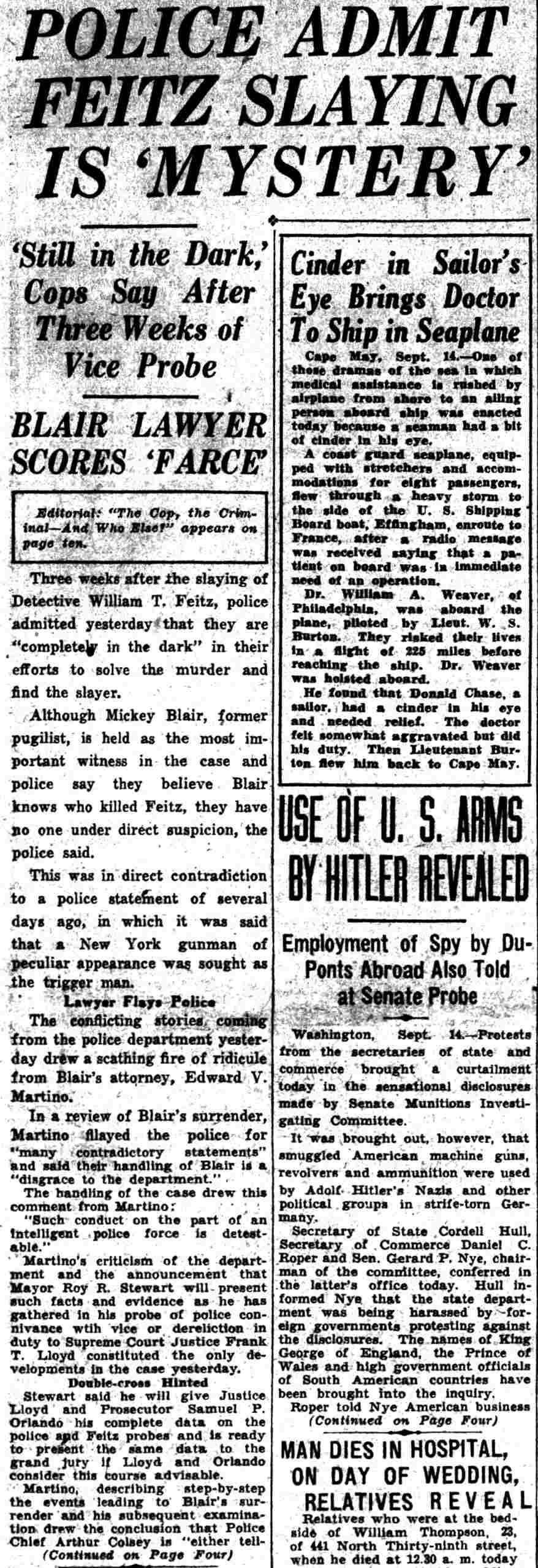
POLICE ADMIT FEITZ SLAYING IS ‘MYSTERY’
‘Still in the Dark,’ Cops Say After Three Weeks of Vice Probe
BLAIR LAWYER SCORES ‘FARCE’
Editorial: “The Cop, the Criminal—And Who Else?” appears on page ten.
Three weeks after the slaying of Detective William T. Feitz, police admitted yesterday that they are “completely in the dark” in their efforts to solve the murder and find the slayer.
Although Mickey Blair, former pugilist, is held as the most important witness in the case and police say they believe Blair knows who killed Feitz, they have no one under direct suspicion, the police said.
This was in direct contradiction to a police statement of several days ago, in which it was said that a New York gunman of peculiar appearance was sought as the trigger man.
Lawyer Flays Police
The conflicting stories coming from the police department yesterday drew a scathing fire of ridicule from Blair’s attorney, Edward V. Martino.
In a review of Blair’s surrender, Martino flayed the police for “many contradictory statements” and said their handling of Blair is a “disgrace to the department.”
The handling of the case drew this comment from Martino:
“Such conduct on the part of an intelligent police force is detestable.”
Martino’s criticism of the department and the announcement that Mayor Roy R. Stewart will present such facts and evidence as he has gathered in his probe of police connivance with vice or dereliction in duty to Supreme Court Justice Frank T. Lloyd constituted the only developments in the case yesterday.
Double-cross Hinted
Stewart said he will give Justice Lloyd and Prosecutor Samuel P. Orlando his complete data on the police and Feitz probes and is ready to present the same data to the grand jury if Lloyd and Orlando consider this course advisable.
Martino, describing step-by-step the events leading to Blair’s surrender and his subsequent examination drew the conclusion that Police Chief Arthur Colsey is “either telling a deliberate falsehood” or has been double-crossed with misinformation by his detectives. Martino said:
Police Admit Defeat In Vice Slaying
“On Saturday past, I received a New York telephone communication from Mickey Blair, and he told me that he had been advised that the police were looking for him. He requested me to ascertain whether this was true, and if so he would gladly come to Camden.
“I talked to Lieutenant George A. Ward on Sunday afternoon, and he told me that they did want Mickey. I talked with Mickey that afternoon, and he told me that he would come to Camden at about 1 p. m. on Monday.
“He entered my office at about 12 noon, and after talking to me about five minutes, during which time he told me that he knew absolutely nothing about the shooting, I advised him to go to the detective bureau alone.
Would Not Interfere
“I did not request the right to protect his constitutional rights, because it was my idea that by not interfering, the police could not find any excuse in their failure to solve the crime.
“They not only failed to appreciate the co-operation given them, but are continuously giving out so many contradictory statements that the general public is given the impression that Blair is deliberately lying. Chief Colsey has repeatedly told the newspapers that Blair stated that he was in New York at the time of the crime.
“Colsey is either telling a deliberate falsehood or he has been misinformed by one or two of his examiners. I talked with Blair at the county jail, and although he appeared tired and worn, he was surprised to learn of the story given out by Colsey.
“It is difficult to understand why the police did not arrest Mickey before he left Camden for New York, since he was in Camden until the Tuesday following the murder.
“He attended a wake at the home of his sister on Sunday, and attended the funeral on Monday (Labor Day) from his sister’s home on Decatur street, Camden. He did not leave Camden for New York until some time on Tuesday afternoon.
Called a Disgrace
“The general physical appearance of Blair before Judge J. Harry Switzer was a disgrace to the Camden City Police Department. He was handcuffed and chained, although he was thoughtful enough to pay his own expenses in traveling from New York, and willingly submit to the police. Such conduct on the part of an intelligent police force is detestable.
“My only hope is that the crime is solved, but in doing so, the officials in charge should be careful that they charge the guilty man or men with the crime.”
The sweeping grand jury investigation of crime and vice ordered of the grand jury by Justice Lloyd is not expected to start, Prosecutor Orlando disclosed, for at least two weeks.
“Our evidence is not entirely at hand,” said Orlando, “and until it is ready I will not proceed. Another reason why I can’t go ahead with it is the large number of cases which I have ready at this time and which must be presented to the grand jury when it opens its sessions next Thursday.”
Earlier, both Prosecutor Orlando and Police Chief Colsey admitted that the authorities were no nearer a solution to the murder of Feitz than they were 20 days ago when he was shot and killed in an alleged disorderly house in South Camden.
Furthermore, previous statements of the police notwithstanding, the identity of the killer or killers is shrouded in as much mystery as it ever was.
“Who killed Feitz?” was a question asked Prosecutor Orlando.
“I don’t know—do you?” was Orlando’s “two-way” reply.
Still ‘In Dark’
The prosecutor’s statement was the first revelation that police and Camden county authorities are still in the dark.
Police Chief Colsey echoed Prosecutor Orlando’s statement by telling newspapermen upon being questioned that he “wished he did know who killed Feitz.”
“We’re entirely in the dark,” he added.
Heretofore the police, through statements made by Chief Colsey, have expressed their confidence that they knew who the slayer or slayers of the detective were and were following important clues which would lead to their arrest.
While the authorities were admittedly groping about for clues in the Feitz murder, the police drive on gambling continued yesterday with the arrest of two alleged “numbers” bankers.
Held in $2000 bail to await the action of the grand jury on charges of operating a “numbers” lottery by Police Judge Switzer were Crawford Smith, 51, of 702 Carman street, and John Deronio, 52, of 1042 Cooper street. Smith pleaded not guilty to the charge which grew out of Deronio’s admission to police that he “wrote” the “numbers” for Smith for a considerable period of time.
Both Smith and Deronio were arrested by Patrolman George Clayton. Deronio pleaded guilty to the charge.
Will View 3 Suspects
Three suspects charged with the robbery of a South Camden candy store Wednesday night were either to be brought to Camden or material witnesses in the Feitz murder were to be taken to Chester, Pa., where they are being held, to learn whether either suspect could be identified as one of the killers.
Mayor Stewart continued his questioning of police yesterday, seeking data on crime and vice in this city.
Questioned by the mayor in his office were Lieutenant George Frost, commander of the police department’s one-man vice squad who is said to have told the mayor considerable about conditions, former City Detective Ben Simon who is now a patrolman; Vernon Jones, one of the 13 suspended policeman [sic] and the officer on the beat at Second and Sycamore streets the night Feitz was killed, and Detective Stanley Wirtz.
Chief County Detective Lawrence T. Doran, who is conducting Prosecutor Orlando’s investigation into the murder, said a search of the records of the city assessor’s office revealed the property in which the late Mrs. Emma Heisler was charged with operating a disorderly house is owned by the Hyman Varbalow Building and Loan Association.
Rented in Oct., 1933
It was rented, Chief Doran said, by Nathan U. Katz, a real estate agent of 410 Kaighn avenue, to a “Mary Dudley” on October 18, 1933, for $15 a month. However, the occupants did not enter the house immediately, according to Doran, because of needed repairs, which were made.
Katz told detectives that the rent was always paid in advance by a man who called at his real estate office. There was no lease on the property, it being rented from month to month.
“Had I known the place was being used for immoral purposes I would have ordered the people out long ago,” Katz told detectives.
At the same time, Chief Doran disclosed that after a conference with Police Chief Colsey, orders were issued that every person arrested in Camden, whether the charge is trivial or serious, will be placed in a police “lineup” and the material witnesses will face them to see if any of Feitz’s killers are among them.
Chief Doran was not sure whether Camden county authorities would be able to bring the two robbery suspects to Camden because they are also wanted in Pennsylvania for almost a score of other holdups and burglaries.
In the event Chester authorities will not turn the two men over to Camden detectives, the witnesses will go to Chester to examine them, Chief Doran said.
“We are letting nothing slip through our fingers at this stage of the investigation,” Chief Doran said. “There is a bare possibility that either of these two suspects may be implicated or have some knowledge that would be useful to us in solving this crime.”
Bribery Charged by Grand Jurors
Camden Courier-Post —
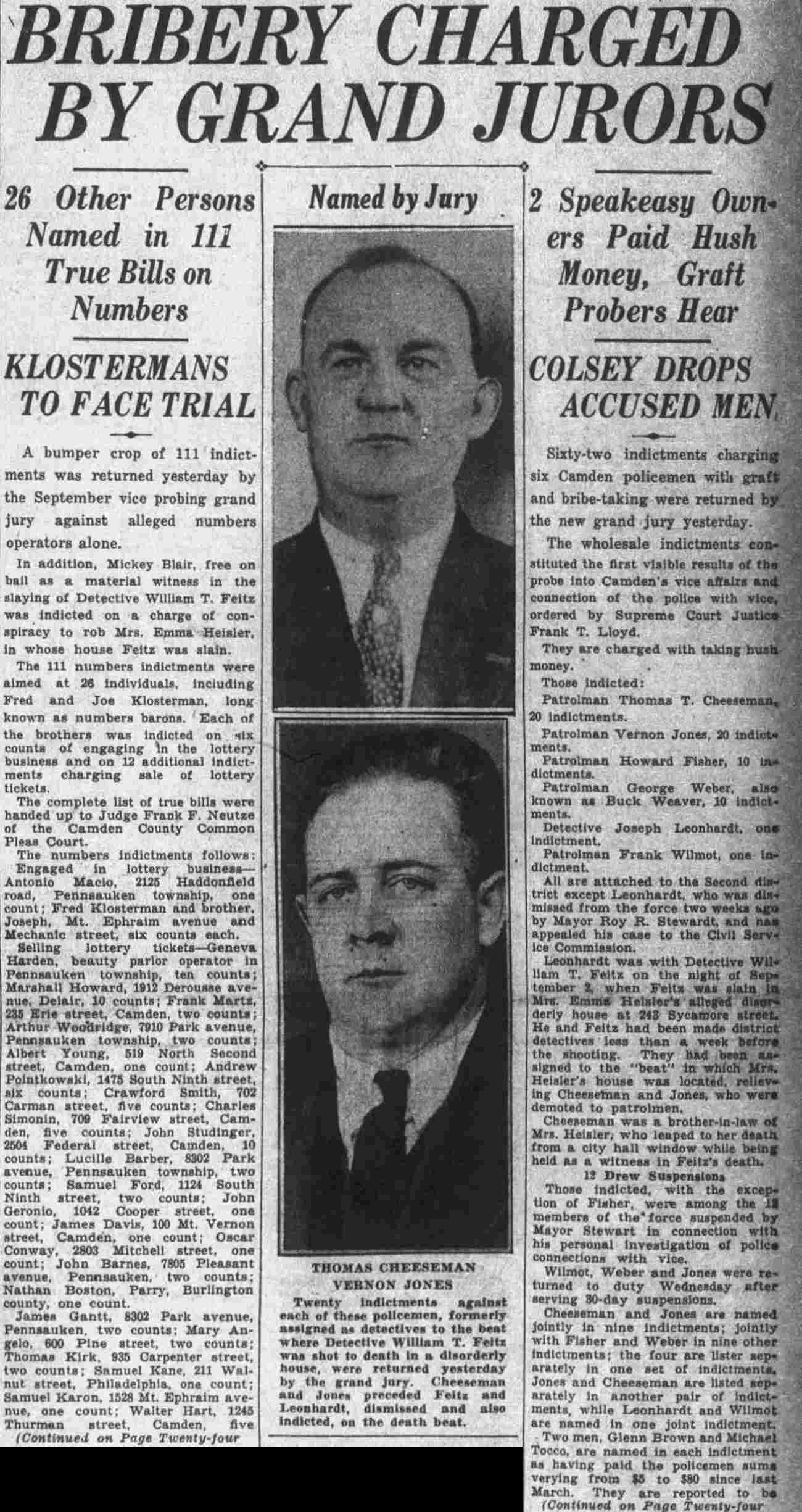
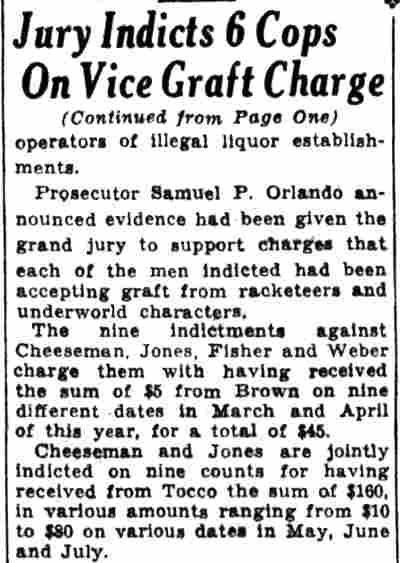
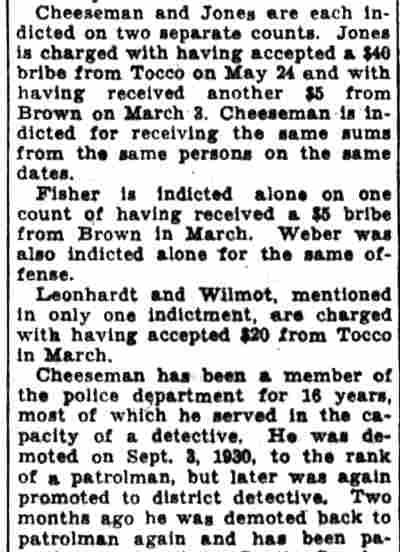
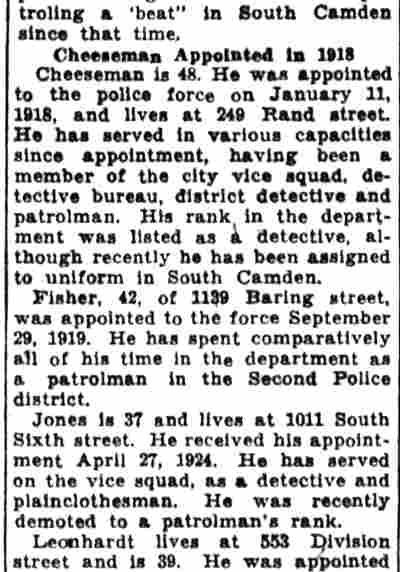
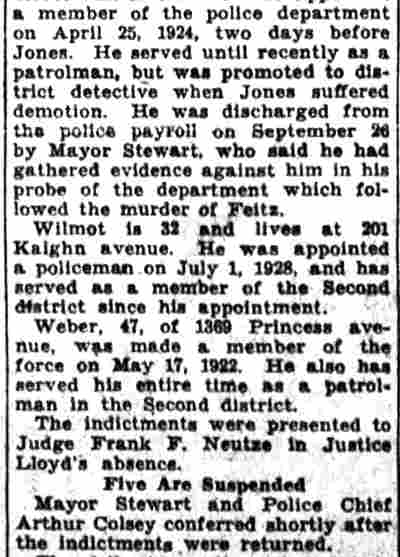
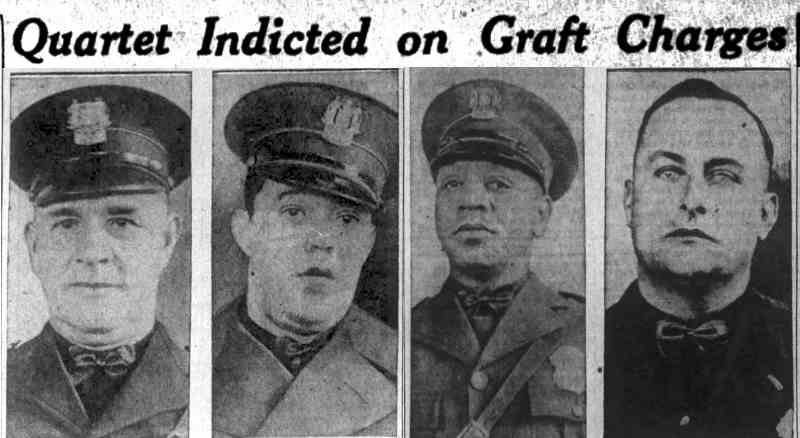

26 Other Persons Named in 111 True Bills on Numbers
KLOSTERMANS TO FACE TRIAL
A bumper crop of 111 indictments was returned yesterday by the September vice probing grand jury against alleged numbers operators alone.
In addition, Mickey Blair, free on bail as a material witness in the slaying of Detective William T. Feitz was indicted on a charge of conspiracy to rob Mrs. Emma Heisler, in whose house Feitz was slain.
The 111 numbers indictments were aimed at 26 individuals, including Fred and Joe Klosterman, long known as numbers barons. Each of the brothers was indicted on six counts of engaging in the lottery business and on 12 additional indictments charging sale of lottery tickets.
The complete list of true bills were handed up to Judge Frank F. Neutze of the Camden County Common Pleas Court.
The numbers indictments follows [sic]:
Engaged in lottery business—Antonio Macio, 2125 Haddonfield road, Pennsauken township, one count; Fred Klosterman and brother, Joseph, Mt. Ephraim avenue and Mechanic street, six counts each.
Selling lottery tickets—Geneva Harden, beauty parlor operator in Pennsauken township, ten counts; Marshall Howard, 1912 Derousse avenue, Delair, 10 counts; Frank Martz, 235 Erie street, Camden, two counts; Arthur Woodridge, 7910 Park avenue, Pennsauken township, two counts; Albert Young, 519 North Second street, Camden, one count; Andrew Pointkowski, 1475 South Ninth street, six counts; Crawford Smith, 702 Carman street, five counts; Charles Simonin, 709 Fairview street, Camden, five counts; John Studinger, 2504 Federal street, Camden, 10 counts; Lucille Barber, 8302 Park avenue, Pennsauken township, two counts; Samuel Ford, 1124 South Ninth street, two counts; John Geronio, 1042 Cooper street, one count; James Davis, 100 Mt. Vernon street, Camden, one count; Oscar Conway, 2803 Mitchell street, one count; John Barnes, 7805 Pleasant avenue, Pennsauken, two counts; Nathan Boston, Parry, Burlington county, one count.
James Gantt, 8302 Park avenue, Pennsauken, two counts; Mary Angelo, 600 Pine street, two counts; Thomas Kirk, 935 Carpenter street, two counts; Samuel Kane, 211 Walnut street, Philadelphia, one count; Samuel Karon, 1528 Mt. Ephraim avenue, one count; Walter Hart, 1245 Thurman street, Camden, five counts; Frank Kulzcnski, 1100 Orchard street, two counts.
The presentment required only three minutes and the grand jury immediately withdrew to its chambers to consider new evidence in its probe of vice and gambling here.
It was indicated that the first batch of indictments found by the grand jury was just that, and that further true bills would be forthcoming as the work of sifting the mass of evidence continues.
A quartet of former city detectives who were transferred to regular police duty June 14, and seven attaches of the county jail were among the list of witnesses subpoenaed.
The erstwhile plainclothesmen are Clarence Arthur, Benjamin Simon, Clifford Del Rossi and Leon Branch. All were put into uniform without explanation, and with the understanding, they declare, that they would not be displaced. All expressed surprise at their removal, inasmuch as others were later appointed to their posts, because they had good records while members of the detective bureau.
Arthur and Branch appeared briefly before the probing body.
Crawford Smith is the brother of Detective Walter Smith and former Detective Howard Smith, it was reported by Mayor Roy R. Stewart.
Michael Tenerelli, known in fistic cicles [sic] as Mickey Blair, was among those waiting in the grand jury anteroom when the jury adjourned to be called before the probers. All those called were subpoenaed on “John Doe” warrants.
Mickey told reporters he has no idea what form of questioning will be followed when he is called into the grand jury room. He was recently released under bail of $5000 as a material witness in the Feitz killing investigation.
Those who could not be heard by the grand jurors before adjournment yesterday were told to come back next Thursday.
Among the witnesses in the vice probe called into the jury room were two Camden county jail attaches, Mrs. Lillian Vincent, matron, and Frank Tyson, jail clerk.
Both were asked questions regarding the proceedure [sic] followed in releasing prisoners from the pail [sic], it was learned. Tyson was not asked by the grand jurors if the prisoners were ever allowed to leave jail before their terms were up, he said.
“We never discharged a prisoner during my long experience in the county jail,” he told reporters, “without the proper release slip. I do not know of any prisoner ever being released before his time was up.”
Other members of the county jail staff waiting to appear were Edmund Powell, former warden; William Kinsler, Walter Taylor, Joseph Rea and John Feitz.
Another witness to testify was Mrs. Anna Smallwood, of Fifth and Chestnut, who posted $5000 bail for Mickey Blair to effect the former boxer’s release in the Feitz murder case.
It is thought that the county jail attaches will be questioned in an endeavour to learn how prisoners are released before time, although confirmation of this report was lacking.
The grand jury also returned indictments against Robert R. Young and Fred H. Schmitz, both of Philadelphia, former employes of the RCA Victor Company, charging them with the theft of four automobile radio sets from the plant on September 19.
Harry Smith, John Lockwood, Edward Troutman and Thomas Moreland, of Camden, were charged with larceny of merchandise from the American Stores Company on August 30.
Stanley Gaisor and Henry Parewicz, both of Camden, were indicted on charges of the theft of an automobile owned by County Physician Edward B. Rogers. The automobile was stolen in Camden, August 31.
Paul Pralas was indicted on charges of atrocious assault and battery on Rocco Piliro on September 19 in Camden.
The following were indicted on charges of desertion and non-support: Cornelius Chambers, charged by his wife, Ethel, with deserting her and three small children.
Thomas Porter, of Clementon, with non-support of his three small children. Frank Drew, Camden, desertion and non-support of his wife, Martha, and three minor children. Walter Butterfield, Brooklawn, with desertion of his wife, Verna, and one minor child. Eugene Morselander, of Camden, with desertion of his wife, Gladys.
2 Speakeasy Owners Paid Hush Money, Graft Probers Hear
COLSEY DROPS ACCUSED MEN
Sixty-two indictments charging six Camden policemen with graft and bribe-taking were returned by the new grand jury yesterday.
The wholesale indictments constituted the first visible results of the probe into Camden’s vice affairs and connection of the police with vice, ordered by Supreme Court Justice Frank T. Lloyd.
They are charged with taking hush money.
Those indicted:
Patrolman Thomas T. Cheeseman, 20 indictments.
Patrolman Vernon Jones, 20 indictments.
Patrolman Howard Fisher, 10 indictments.
Patrolman George Weber, also known as Buck Weaver, 10 indictments.
Detective Joseph Leonhardt, one indictment.
Patrolman Frank Wilmot, one indictment.
All are attached to the Second district except Leonhardt, who was dismissed from the force two weeks ago by Mayor Roy R. Stewardt [sic], and has appealed his case to the Civil Service Commission.
Leonhardt was with Detective William T. Feitz on the night of September 2, when Feitz was slain in Mrs. Emma Heisler’s alleged disorderly house at 243 Sycamore street. He and Feitz had been made district detectives less than a week before the shooting. They had been assigned to the “beat” in which Mrs. Heisler’s house was located, relieving Cheeseman and Jones, who were demoted to patrolmen.
Cheeseman was a brother-in-law of Mrs. Heisler, who leaped to her death from a city hall window while being held as a witness in Feitz’s death.
12 Drew Suspensions
Those indicted, with the exception of Fisher, were among the 12 members of the force suspended by Mayor Stewart in connection with his personal investigation of police connections with vice.
Wilmot, Weber and Jones were returned to duty Wednesday after serving 30-day suspensions.
Cheeseman and Jones are named jointly in nine indictments; jointly with Fisher and Weber in nine other indictments; the four are lister [sic] separately in one set of indictments. Jones and Cheeseman are listed separately in another pair of indictments, while Leonhardt and Wilmot are named in one joint indictment.
Two men, Glenn Brown and Michael Tocco, are named in each indictment as having paid the policemen sums verying [sic] from $5 to $80 since last March. They are reported to be operators of illegal liquor establishments.
Jury Indicts 6 Cops On Vice Graft Charge
Prosecutor Samuel P. Orlando announced evidence had been given the grand jury to support charges that each of the men indicted had been accepting graft from racketeers and underworld characters.
The nine indictments against Cheeseman, Jones, Fisher and Weber charge them with having received the sum of $5 from Brown on nine different dates in March and April of this year, for a total of $45.
Cheeseman and Jones are jointly indicted on nine counts for having received from Tocco the sum of $160, in various amounts ranging from $10 to $80 on various dates in May, June and July.
Cheeseman and Jones are each indicted on two separate counts. Jones is charged with having accepted a $40 bribe from Tocco on May 24 and with having received another $5 from Brown on March 3. Cheeseman is indicted for receiving the same sums from the same persons on the same dates.
Fisher is indicted alone on one count of having received a $5 bribe from Brown in March. Weber was also indicted alone for the same offense.
Leonhardt and Wilmot, mentioned in only one indictment, are charged with having accepted $20 from Tocco in March.
Cheeseman has been a member of the police department for 16 years, most of which he served in the capacity of a detective. He was demoted on Sept. 3, 1930, to the rank of a patrolman, but later was again promoted to district detective. Two months ago he was demoted back to patrolman again and has been patrolling a ‘beat’ in South Camden since that time.
Cheeseman Appointed in 1918
Cheeseman is 48. He was appointed to the police force on January 11, 1918, and lives at 249 Rand street. He has served in various capacities since appointment, having been a member of the city vice squad, detective bureau, district detective and patrolman. His rank in the department was listed as a detective, although recently he has been assigned to uniform in South Camden.
Fisher, 42, of 1139 Baring street, was appointed to the force September 29, 1919. He has spent comparatively all of his time in the department as a patrolman in the Second Police district.
Jones is 37 and lives at 1011 South Sixth street. He received his appointment April 27, 1924. He has served on the vice squad, as a detective and plainclothesman. He was recently demoted to a patrolman’s rank.
Leonhardt lives at 553 Division street and is 39. He was appointed a member of the police department on April 25, 1924, two days before Jones. He served until recently as a patrolman, but was promoted to district detective when Jones suffered demotion. He was discharged from the police payroll on September 26 by Mayor Stewart, who said he had gathered evidence against him in his probe of the department which followed the murder of Feitz.
Wilmot is 32 and lives at 201 Kaighn avenue. He was appointed a policeman on July 1, 1928, and has served as a member of the Second district since his appointment.
Weber, 47, of 1369 Princess avenue, was made a member of the force on May 17, 1922. He also has served his entire time as a patrolman in the Second district.
The indictments were presented to Judge Frank F. Neutze in Justice Lloyd’s absence.
Five Are Suspended
Mayor Stewart and Police Chief Arthur Colsey conferred shortly after the indictments were returned.
[Text between this point and the next crop is not on the scan; crop 09a is not in the archive.]
and Judge Neutze to grant these men a speedy trial,” the mayor declared, “so that the cases against them will be disposed of and their guilt or innocence established. In this way the community will have the benefit of their services, if they be found not guilty, as soon as possible.”
None of the policemen indicted had been arrested last night.
Chief of County Detectives Lawrence T. Doran said he expects them to surrender today and post such bail as may be set.
Named by Jury
THOMAS CHEESEMAN
VERNON JONES
Twenty indictments against each of these policemen, formerly assigned as detectives to the beat where Detective William T. Feitz was shot to death in a disorderly house, were returned yesterday by the grand jury. Cheeseman and Jones preceded Feitz and Leonhardt, dismissed and also indicted, on the death beat.
Quartet Indicted on Graft Charges
Four of the six policemen indicted yesterday on charges of bribery. They are George Weber, (upper left) also known as “Bucky Weaver”; Frank Witmot [sic] (upper right), Howard Fisher, (lower left), and Joseph Leonhardt, (lower right), who had been dismissed from the police department.
Crawford Smith — Feitz murder trial
Camden Courier-Post —
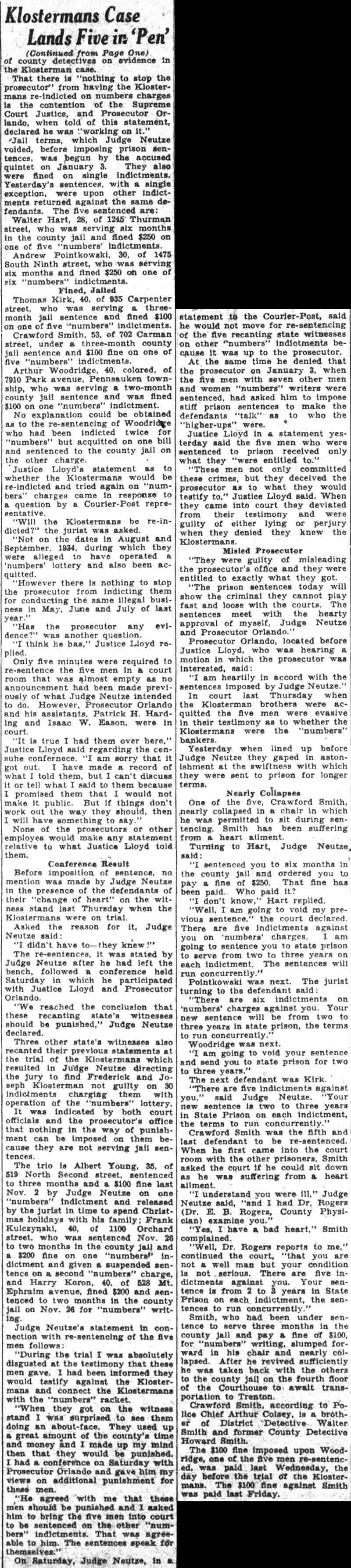
Lloyd Again Prods Orlando and Cops In Numbers Cases
Detectives Told to Produce or Quit by Jurist
FIVE GET ’PEN’ IN ABOUT-FACE
Five state witnesses, who thought they got off “easy” in numbers cases, yesterday underwent reversal of county jail terms and found themselves sentenced to the penitentiary.
Judge Frank F. Neutze sentenced them in Criminal Court.
Terms ranged from two to three years, and they followed the witnesses’ sudden “about-face” in the Klosterman brothers’ case. The five all convicted numbers writers, recanted testimony last week at the brothers’ trial.
Censure of the prosecutor’s office by Supreme Court Justice Frank T. Lloyd followed. Justice Lloyd called Prosecutor Samuel P. Orlando and his staff to his chambers on the fourth floor of the new courthouse. Attending the conference in addition to Orlando were:
Assistant Prosecutors Harding and Eason, Chief County Detective Lawrence T. Doran, County Detectives James J. Mulligan, James Wren, Joseph Bennie, Casimir Wojtwokiak [sic] and Elmer Mathis, and Mrs. Daisy Rourke and Mrs. Ethel Michener, stenographers.
“Go out and do some work, or else be replaced,” is the ultimatum said to have been hurled at the detectives by Justice Lloyd. He is said to be aroused over apparent inactivity of county detectives on evidence in the Klosterman case.
That there is “nothing to stop the prosecutor” from having the Klostermans re-indicted on numbers charges is the contention of the Supreme Court Justice, and Prosecutor Orlando, when told of this statement, declared he was “working on it.”
Jail terms, which Judge Neutze voided, before imposing prison sentences, was begun by the accused quintet on January 3. They also were fined on single indictments. Yesterday’s sentences, with a single exception, were upon other indictments returned against the same defendants. The five sentenced are:
Walter Hart, 28, of 1245 Thurman street, who was serving six months in the county jail and fined $250 on one of five “numbers’ indictments.
Andrew Pointkowski, 30, of 1475 South Ninth street, who was serving six months and fined $250 on one of six “numbers” indictments.
Fined, Jailed
Thomas Kirk, 40, of 935 Carpenter street, who was serving a three-month jail sentence and fined $100 on one of five “numbers” indictments.
Crawford Smith, 53, of 702 Carman street, under a three-month county jail sentence and $100 fine on one of five “numbers” indictments.
Arthur Woodridge, 40, colored, of 7910 Park avenue, Pennsauken township, who was serving a two-month county jail sentence and was fined $100 on one “numbers” indictment.
No explanation could be obtained as to the re-sentencing of Woodridge who had been indicted twice for “numbers” but acquitted on one bill and sentenced to the county jail on the other charge.
Justice Lloyd’s statement as to whether the Klostermans would be re-indicted and tried again on “numbers” charges came in response to a question by a Courier-Post representative.
“Will the Klostermans be re-indicted?” the jurist was asked.
“Not on the dates in August and September, 1934, during which they were alleged to have operated a ’numbers’ lottery and also been acquitted.
“However there is nothing to stop the prosecutor from indicting them for conducting the same illegal business in May, June and July of last year.”
Only five minutes were required to re-sentence the five men in a court room that was almost empty as no announcement had been made previously of what Judge Neutze intended to do. However, Prosecutor Orlando and his assistants, Patrick H. Harding and Isaac W. Eason, were in court.
“It is true I had them over here,” Justice Lloyd said regarding the censuhe [sic] confernece [sic]. “I am sorry that it got out. I have made a record of what I told them, but I can’t discuss it or tell what I said to them because I promised them that I would not make it public. But if things don’t work out the way they should, then I will have something to say.”
None of the prosecutors or other employes would make any statement relative to what Justice Lloyd told them.
Conference Result
Before imposition of sentence, no mention was made by Judge Neutze in the presence of the defendants of their “change of heart” on the witness stand last Thursday when the Klostermans were on trial.
Asked the reason for it, Judge Neutze said:
“I didn’t have to—they knew!”
The re-sentences, it was stated by Judge Neutze after he had left the bench, followed a conference held Saturday in which he participated with Justice Lloyd and Prosecutor Orlando.
“We reached the conclusion that these recanting state’s witnesses should be punished,” Judge Neutze declared.
Three other state’s witnesses also recanted their previous statements at the trial of the Klostermans which resulted in Judge Neutze directing the jury to find Frederick and Joseph Klosterman not guilty on 30 indictments charging them with operation of the “numbers” lottery.
It was indicated by both court officials and the prosecutor’s office that nothing in the way of punishment can be imposed on them because they are not serving jail sentences.
The trio is Albert Young, 35, of 519 North Second street, sentenced to three months and a $100 fine last Nov. 2 by Judge Neutze on one “numbers” indictment and released by the jurist in time to spend Christmas holidays with his family; Frank Kulczynski, 40, of 1100 Orchard street, who was sentenced Nov. 26 to two months in the county jail and a $200 fine on one “numbers” indictment and given a suspended sentence on a second “numbers” charge, and Harry Koron, 40, of 528 Mt. Ephraim avenue, fined $200 and sentenced to two months in the county jail on Nov. 26 for “numbers” writing.
Judge Neutze’s statement in connection with re-sentencing of the five men follows:
“During the trial I was absolutely disgusted at the testimony that these men gave. I had been informed they would testify against the Klostermans and connect the Klostermans with the “numbers” racket.
“When they got on the witness stand I was surprised to see them doing an about-face. They used up a great amount of the county’s time and money and I made up my mind then that they would be punished. I had a conference on Saturday with Prosecutor Orlando and gave him my views on additional punishment for these men.
“He agreed with me that these men should be punished and I asked him to bring the five men into court to be sentenced on the other “numbers” indictments. That was agreeable to him. The sentences speak for themselves.”
On Saturday, Judge Neutze, in a statement to the Courier-Post, said he would not move for re-sentencing of the five recanting state witnesses on other “numbers” indictments because it was up to the prosecutor.
At the same time he denied that the prosecutor on January 3, when the five men with seven other men and women “numbers” writers were sentenced, had asked him to impose stiff prison sentences to make the defendants “talk” as to who the “higher-ups” were.
Justice Lloyd in a statement yesterday said the five men who were sentenced to prison received only what they “were entitled to.”
“These men not only committed these crimes, but they deceived the prosecutor as to what they would testify to,” Justice Lloyd said. When they came into court they deviated from their testimony and were guilty of either lying or perjury when they denied they knew the Klostermans.
Misled Prosecutor
“They were guilty of misleading the prosecutor’s office and they were entitled to exactly what they got.
“The prison sentences today will show the criminal they cannot play fast and loose with the courts. The sentences meet with the hearty approval of myself, Judge Neutze and Prosecutor Orlando.”
Prosecutor Orlando, located before Justice Lloyd, who was hearing a motion in which the prosecutor was interested, said:
“I am heartily in accord with the sentences imposed by Judge Neutze.”
In court last Thursday when the Klosterman brothers were acquitted the five men were evasive in their testimony as to whether the Klostermans were the “numbers” bankers.
Yesterday when lined up before Judge Neutze they gaped in astonishment at the swiftness with which they were sent to prison for longer terms.
Nearly Collapses
One of the five, Crawford Smith, nearly collapsed in a chair in which he was permitted to sit during sentencing. Smith has been suffering from a heart ailment.
Turning to Hart, Judge Neutze said:
“I sentenced you to six months in the county jail and ordered you to pay a fine of $250. That fine has been paid.. Who paid it?
“I don’t know,” Hart replied.
“Well, I am going to void my previous sentence,” the court declared. There are five indictments against you on ’numbers’ charges. I am going to sentence you to state prison to serve from two to three years on each indictment. The sentences will run concurrently.”
Pointkowski was next. The jurist turning to the defendant said:
“There are six indictments on ’numbers’ charges against you. Your new sentence will be from two to three years in state prison, the terms to run concurrently.”
Woodridge was next.
“I am going to void your sentence and send you to state prison for two to three years.”
The next defendant was Kirk.
“There are five indictments against you,” said Judge Neutze. “Your new sentence is two to three years in State Prison on each indictment, the terms to run concurrently.”
Crawford Smith was the fifth and last defendant to be re-sentenced. When he first came into the court room with the other prisoners, Smith asked the court if he could sit down as he was suffering from a heart ailment.
“I understand you were ill,” Judge Neutze said, “and I had Dr. Rogers (Dr. E. B. Rogers, County Physician) examine you.”
“Yes, I have a bad heart,” Smith complained.
“Well, Dr. Rogers reports to me,” continued the court, “that you are not a well man but your condition is not serious. There are five indictments against you. Your sentence is from 2 to 3 years in State Prison on each indictment, the sentences to run concurrently.”
Smith, who had been under sentence to serve three months in the county jail and pay a fine of $100, for “numbers” writing, slumped forward in his chair and nearly collapsed. After he revived sufficiently he was taken back with the others to the county jail on the fourth floor of the Courthouse to await transportation to Trenton.
Crawford Smith, according to Police Chief Arthur Colsey, is a brother of District Detective Walter Smith and former County Detective Howard Smith.
The $100 fine imposed upon Woodridge, one of the five men re-sentenced, was paid last Wednesday, the day before the trial of the Klostermans. The $100 fine against Smith was paid last Friday.
Police Force Politics Banned Commissioner Kobus Declares
Camden Courier-Post —
Calls for 100% Efficiency and Promises Square Deal for All in Talk to Commanders; Stresses Fact Colsey is Chief
“I want 100% efficient police department and not a political machine.”
Commissioner Mary W. Kobus, new director of public safety, made that declaration yesterday afternoon at a joint police-press conference in her office at city hall before she was served with a writ restraining her from taking that office.
Commissioner Kobus was the kindly mother talking to her “boys” for the most of the conference— but at times she became the stern parent— with the birchrod in the cupboard— as she instructed the police heads to “divorce themselves from politics.”
“For many years I have nursed in my heart a desire to see Camden with a 100% efficient police department,” the commissioner said. “Now that time is at hand.”
“I have known all of you men for many years,” she told the assembled commanders, “and I don’t care what your respective political affiliations might be. You have a right to you opinions, but I want the police department to divorce itself from politics.
“You must know what is going on in your city and you must let me know. I must have 100 percent cooperation if I am to succeed in this new undertaking.
“If you have any complaints, don’t go around and growl, undermining the department. Lay your cards on the table, I guarantee you a fair deal.
“Chief Colsey is head of the police department and not in name only. You others in the rank you occupy are also commanders in fact and not in name. It is up to you.”
The commissioner urged a closer co-operation between police and the press and concluded by saying she wanted her “family” to be honest-to-goodness policemen “because there is no room in the department for those who are not.”
Attending the conference was Chief Arthur Colsey, Lieutenant Herbert Anderson, chief clerk of the bureau; Lieutenants George Frost, Ralph Bakley, Walter Welch, Samuel E. Johnson and George Ward.
Grand Jury Clears Number Suspects
Camden Courier-Post —
Pair Suspected by Police as Having Succeeded Klosterman Brothers
Two men alleged by city and county authorities to have succeeded the Klosterman brothers in controlling the Camden numbers racket last Spring, were exonerated by the Camden county grand jury.
Those whose cases were “no billed” are Chester “Gassy” Szalinski, 30, of 1188 Chestnut Street, and Joseph Putek, 29, of 2955 Tuckahoe Road.
At the same time, the grand jury in its report to the County Clerk Charles S. Wise, failed to find an indictment against Robert Bloodworth, another suspect arrested in connection with the operation of lotteries in Camden.
After the trial of the Klosterman brothers, Fred and Joe, both of whom were convicted last spring of number charges, Szalinski was named by Police Chief Arthur Colsey as the “Sixty-ninth Street mobster who had taken over the Klosterman numbers play.” Every policeman in Camden was ordered to arrest Szalinski on sight.
The suspected numbers operator was arrested and later released in $1500 bail to await the action of the grand jury.
Putek was arrested last April after police had engaged in a sensational chase of 15 blocks after a suspected numbers pickup automobile at which they fired a number of shots, one of which struck a bystander.
Police allege Putek joined Szalinski in control of the Klosterman numbers game. Arrests of both men climaxed orders to county police authorities by Supreme Court Justice Frank T. Lloyd and Prosecutor Samuel P. Orlando to clean up the number racket in this area.
“No bills” were returned by the grand jury for Harry Hartman and John Burke charged with attempts and breaking and entry; J.G. Flynn, accused of being a fugitive from justice from Philadelphia; Ralph Latshaw, Anna Green, and Theodore Jones, statutory charges.
Hartman and Burke were held for the grand jury last month on charges they attempted to enter the Saloon of Mrs. Mamie Piraine, Republican county committeewoman from the Eighth Ward, at 1944 Broadway.
Sunday Raids on 2 Saloons Trap Owners
Camden Courier-Post —

Nine Drinkers Nabbed as Witnesses as Police Continue War
THREE WOMEN ARRESTED IN NORTH CAMDEN PLACE
Continuing their drive against alleged violators of the Sunday closing ordinance, police yesterday raided two cafes and arrested the proprietors and nine patrons.
The drive was widened Saturday at the direction of Chief of Police Arthur Colsey to include investigation that minors were being sold alcoholic beverages in saloons and taprooms here.
In Sunday raids a week ago three saloon owners were arrested. Two were fined and one of them obtained a continuance of his hearing on the charges.
The first raid yesterday was made by Police Lieut. George Frost and Detective Marshall Thompson on a saloon at 939 North Third street.
Clem Bridgeman, 36, was arrested as the owner, while Mrs. Mary Frank, 64, who lives in an apartment over the taproom, was named by him as his partner. She was released in $10 bail, with bail for Bridgeman set at $500 for a hearing in police court today.
Frost said he found six customers sitting at tables in the saloon with drinks in front of them.
The customers were held in $10 bail each as material witnesses. They said they were Miss Monica Aument, 23, of 1493 Kenwood avenue; an unidentified woman, who, Frost said, was too intoxicated to talk; Albert Moyer, 53, of 419 Erie street; Charles Luers, 30, of 10 York street; Charles Sevcik, 45, of 225 Milton street; Ernest Ridge, 42, of 619 Cedar street, and Archibald Knox, 25, of 97 North street.
In the second place, at 773 Central avenue, Detectives Frank Wilmont and Joseph Schultz arrested the licensee, Louis Bruten, 58, colored, of that address; Eugene Clark, 43, of 907 Ferry avenue, and William Clark, 41, and Davis Ray, 34, both of New York City. Bruten was released in $500 bail and the patrons in $10 for hearings today.
In Camden Police Court Saturday the hearing of John Lynch, 32, former Camden policeman and proprietor of a saloon at 201 Cooper street, was continued by Judge Lewis Liberman until Wednesday on application of City Prosecutor John H. Reiners.
Lynch is charged with violating Section 422 of the city ordinance in allowing disorderly persons to congregate on his premises and is at liberty in $500 bail.
Cafe Owner Fined for Sunday Sales
Camden Courier-Post —
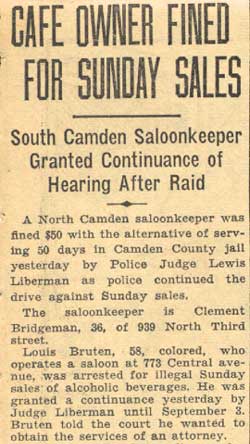
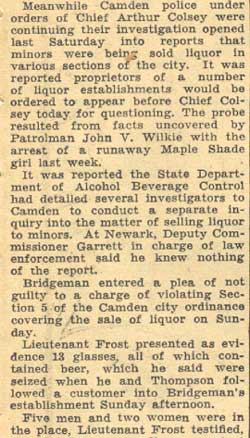
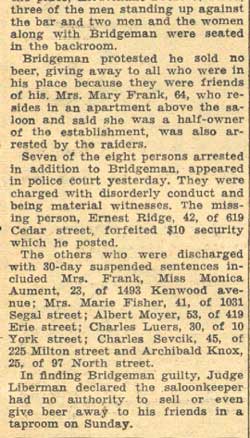
South Camden Saloonkeeper Granted Continuance of Hearing After Raid
A North Camden saloonkeeper was fined $50 with the alternative of serving 50 days in Camden County jail yesterday by Police Judge Lewis Liberman as police continued the drive against Sunday sales.
The saloonkeeper is Clement Bridgeman, 36, of 939 North Third street.
Louis Bruten, 58, colored, who operates a saloon at 773 Central avenue, was arrested for illegal Sunday sales of alcoholic beverages. He was granted a continuance yesterday by Judge Liberman until September 3. Bruten told the court he wanted to obtain the services of an attorney.
Meanwhile Camden police under orders of Chief Arthur Colsey were continuing their investigation opened last Saturday into reports that minors were being sold liquor in various sections of the city. It was reported proprietors of a number of liquor establishments would be ordered to appear before Chief Colsey today for questioning. The probe resulted from facts uncovered by Patrolman John V. Wilkie with the arrest of a runaway Maple Shade girl last week.
It was reported the State Department of Alcohol Beverage Control had detailed several investigators to Camden to conduct a separate inquiry into the matter of selling liquor to minors. At Newark, Deputy Commissioner Garrett in charge of law enforcement said he knew nothing of the report.
Bridgeman entered a plea of not guilty to a charge of violating Section 5 of the Camden city ordinance covering the sale of liquor on Sunday.
Lieutenant Frost presented as evidence 13 glasses, all of which contained beer, which he said were seized when he and Thompson followed a customer into Bridgeman’s establishment Sunday afternoon.
Five men and two women were in the place, Lieutenant Frost testified, three of the men standing up against the bar and two men and the women along with Bridgeman were seated in the backroom.
Bridgeman protested he sold no beer, giving away to all who were in his place because they were friends of his. Mrs. Mary Frank, 64, who resides in an apartment above the saloon and said she was a half-owner of the establishment, was also arrested by the raiders.
Seven of the eight persons arrested in addition to Bridgeman, appeared in police court yesterday. They were charged with disorderly conduct and being material witnesses. The missing person, Ernest Ridge, 42, of 619 Cedar street, forfeited $10 security which he posted.
The others who were discharged with 30-day suspended sentences included: Mrs. Frank, Miss Monica Aument, 23, of 1493 Kenwood avenue; Mrs. Marie Fisher, 41, of 1031 Segal street; Albert Moyer, 53, of 419 Erie street; Charles Luers, 30, of 10 York street; Charles Sevcik, 45, of 225 Milton street and Archibald Knox, 25, of 97 North street.
In finding Bridgeman guilty, Judge Liberman declared the saloonkeeper had no authority to sell or even give beer away to his friends in a taproom on Sunday.
John Lynch Faces Police Court Today
Camden Courier-Post —
Taproom Proprietor Charged With Allowing Disorderly Persons to Gather
John Lynch, 32, proprietor of a taproom and hotel at 201 Cooper street, is scheduled to be arraigned in police court today on a charge of allowing disorderly persons to congregate on the premises. The case has been twice continued.
Lynch was arrested August 23 when Chief of Police Arthur Colsey launched a drive against street brawling in front of saloons and disorderly conduct in such places.
The arerst [sic] was made by Lieut. George Frost on information obtained by Patrolman John Wilkie from a 17-year-old girl, Margaret Pone. She later was sentenced to 30 days in city jail and is now serving that term.
According to Wilkie, the girl told him that she and other girls and women frequented Lynch’s place and met men there that accompanied them to hotel rooms.
Her charges that minors were sold liquor in various saloons and taprooms also brought on an investigation, now underway.
Cafe Case Delayed By Girl Witnesses
Camden Courier-Post —
Hearing of Lynch, Second and Cooper, Put Off Third Time in Police Court
Charged with allowing disorderly persons to congregate at his cafe, John Lynch, 32, taproom and hotel proprietor of Second and Cooper streets, again heard his case postponed in police court yesterday because several girl witnesses had failed to appear.
Thrice postponed, the Lynch hearing is now scheduled for next Thursday.
Meanwhile, Judge Lewis Liberman, who granted the postponement at the request of City Prosecutor John H. Reiners, instructed Police Lieutenant George Frost to “go out and bring these girls in—see that they are on hand for next week’s hearing.”
Lynch, who denies the charge, was represented by Anthony Marino at the hearing.
Lynch was arrested August 23 when Chief of Police Arthur Colsey launched a drive against street brawling in front of saloons and disorderly conduct in such places.
The arrest was made by Lieut. George Frost on information obtained by Patrolman John Wilkie from a 17-year-old girl, Margaret Pone. She later was sentenced to 30 days in city jail and is now serving that term.
According to Wilkie, the girl told him that she and other girls and women frequented Lynch’s place and met men there that accompanied them to hotel rooms.
Her charges that minors were sold liquor in various saloons and taprooms also brought on an investigation, now underway.
Johnson Gets Ward’s Job as Kobus Orders Cop Shakeup
Camden Courier-Post —
Shaw Made Assistant in Place of Koerner
In a shakeup of Camden police officials yesterday afternoon Lieutenant Samuel E. Johnson was named acting chief of detectives by Commissioner Mary W. Kobus, director of public safety.
Lieutenant George A. Ward, who has been in charge of the detective bureau for a year, was transferred to take Johnson’s place in charge of headquarters.
Detective Louis Shaw was made assistant to Johnson, replacing Detective Sergeant Gus Koerner. Koerner was transferred to the Second District, for radio car and street duty. The new order became effective at 4:00 PM yesterday.
Police Chief Arthur Colsey announced the changes in the bureau after a two-hour conference with Commissioner Kobus yesterday afternoon.
Maurice Di Nicuolo, who has been an acting detective, was transferred to the First Police District, with former Acting Detective Clifford Del Rossi returning to his old post in the detective bureau.
In the only other transfer announced, Sergeant Harry Newton was switched from the First Police District to the Third, with Sergeant Edward Carroll going from the Third to the First.
Although no other changes were made public, it is believed yesterday’s are a forerunner of numerous shifts to be made today or early next week.
“These changes are being made for the good of the service,” Commissioner Kobus declared. “There will be other transfers of officers and men so that all the police may familiarize themselves with all the branches of the department.”
Lieutenant Johnson was appointed a policeman on January 1, 1910. After 10 years as a patrolman, he was promoted to a detective, where he made a splendid record. On November 28, 1928 he was made a sergeant, and again promoted on April 8, 1930, when he became a lieutenant.
Ward was appointed a policeman on August 2, 1917, promoted to detective January 1, 1927, sergeant November 14, 1928 and lieutenant on January 24, 1930.
Johnson was a detective sergeant when former Police Chief John W. Golden was head of that bureau, but later was transferred to police headquarters.
Ward has been in and out of the detective bureau several times. He served for a time as the commander of the First District and later was in charge of the police headquarters on the 12:00 midnight to 8:00 AM shift. He was a political lieutenant of former Public Safety Director David S. Rhone.
Court to Fine Drivers Disregarding ‘Tickets’
Camden Courier-Post —
Police will issue summonses for all traffic violators who fail to report to the traffic bureau after receiving a “ticket” from policemen and they will be fined in police court, Police Chief Arthur Colsey announced yesterday.
Chief Colsey said about 100 tags had been unaccounted for in the recent drive to end all-day parking.
He said the license numbers of those motorists who failed to appear, which is taken by the policeman, will be checked at the motor vehicle department at Trenton and a court summons issued for each offender.
George Clayton Made Chief Police Clerk
Camden Courier-Post —
George “Babe” Clayton yesterday afternoon was named acting chief clerk of the Camden police department by Chief Arthur Colsey, who held the post under former Chief John W. Golden.
Clayton has been functioning in the post for the last four months, but had not formally received the title of acting chief clerk.
Colsey said Clayton will receive the same salary he has been getting as a patrolman, $2040 a year minus 15 percent. He had been discussed recently for an acting captaincy, but decision was reached to appoint him to the clerkship instead.
5 Bitten by Mad Dog in North Camden Treated for Rabies
Camden Courier-Post —
State Test Shows Animal Infected, Dr. Helm Informed — Drive to Capture All Strays Pushed by Police Chief Colsey — Licenses Necessary
The dog which ran amok and bit five persons in North Camden Saturday night was suffering from rabies.
That was announced yesterday by Dr. David B. Helm, Jr., city sanitary inspector, after receipt of a telegram from the state board of health in Trenton. Examination of the head of the dog revealed the animal had rabies.
The five victims of the dog who received Pasteur treatment at Cooper Hospital pending examination of the dog, will continue to be treated, Doctor Helm said.
The victims were: William Wagner, 65, of 1554 Forty-eighth Street, Pennsauken township, bitten on leg. Miss Florence Smith, 19, of 833 Grant Street, bitten on wrist and leg. William Luers, 3, adopted child of Mrs. Frank Smith, 833 Grant Street. William Winstanley, 11, of 835 Grant Street, bitten on hands. Thomas Owens, 12, of 631 North Ninth Street, bitten on right forearm and left hand.
At the same time Doctor Helm announced he and Police Chief Arthur Colsey were co-operating to capture and destroy all unlicensed and stray dogs and cats found on city streets.
Return to Screens in Saloons Sought
Camden Courier-Post —
City Beverage Control Board Will Seek Repeal of Open Window Ordinance
Repeal of a chapter of a city ordinance which provides that the interior of Camden saloons shall be open to public view from the street will be sought by John L. Morrissey, chairman of the Municipal Board of Alcoholic Beverage Control.
Morrissey said he will discuss the subject with the two other members of the excise board, after which he will take up the subject with the City Commissioners.
The first non-partisan city commission, in 1924, during prohibition, adopted an ordinance requiring the public exposure of the saloon interior, Morrissey pointed out.
“That was so that the public could look in and see whether alcoholic beverages were being sold,” said Morrissey, “and in those days no saloon licenses were issued. They were known as soft drink licenses.
“With the repeal of prohibition, and with the regulations under which the saloons now are being operated, it seems to me that the chapter of the ordinance requiring that curtains be drawn on windows and doors so as to expose the interior defeats its own purpose.
“Besides it places the patrons of the saloons on public view.
“Also, frequently one can see children looking in through the curtain openings; you would think it was the nickel movies.”
Acting under orders of Police Chief Arthur Colsey, police of the city have been visiting saloons, advising them to so arrange curtains that a clear view may be had from outside.
The provision is chapter No. 8 of the alcoholic beverage ordinance adopted by the city commissioners on December 27, 1924.
Fingerprint Record of City Jail ‘Guests’ Ordered by Colsey
Camden Courier-Post —
All lodgers spending nights in the city jail will be fingerprinted in the future, Police Chief Arthur Colsey announced last night. He explained that this order has been issued to expedite the identification of lodgers in case something happens. A few nights ago a Gloucester man was found dead in the jail and the police were several hours establishing his identity.
Between 20 and 40 men seek shelter these cold nights in the jail, Colsey said. Detective Sergeant Rox Saponare, fingerprint expert, began recording their prints last night.
Illness Causes Shifts for Police Officials
Camden Courier-Post —
Temporary changes in the police department to offset the absence of Lieutenant George Frost, head of the First District, who is ill, and Lieutenant George Ward, of headquarters, who is away on police business, were announced yesterday by Chief Arthur Colsey.
Sgt. John Potter, of the Third District, is made acting lieutenant and placed in charge of the First. Patrolman Louis Schmidt, of the Third, replaces Potter as acting sergeant.
Lieutenant Herbert Anderson, of the Fourth District, replaces Ward at headquarters, with Sgt. John Skolski acting as lieutenant in charge of the Fourth.
Sgt. Gustav Koerner, of the Second District, who has been working in plain clothes, is to report in uniform.
Patrolman John Kowal, of the Second District, is shifted to the First district, with Patrolman William Schultz going from the First district to the Second district.
‘Joey’ Powell Rearrested as County Opens Holdup Probe
Camden Courier-Post —
Orlando Acts as City Cops Free Former Boxer in Payroll Plot — Frameup Charged by Another Suspect — Prisoner Says Ex-Fighter Got Him in on Theft, Tipped Police
Joseph “Joey” Powell, former boxer who was arrested by city police in connection with a South Camden holdup and subsequently released, was rearrested by county detectives last night.
Powell was taken into custody on orders of Prosecutor Samuel P. Orlando, who also ordered the arrest of a second suspect.
Camden police turned the case over to the prosecutor’s office after the arraignment of Walter Lewandowski, who was caught in a police trap Friday night as he allegedly attempted to steal an $800 payroll at the Eavenson & Levering Company’s plant at Fourth Street and Ferry Avenue. He formerly was employed there.
Two Others Implicated
Lewandowski implicated Powell, 25, of 46 Woodland Avenue, and Leonard Rogalski, 20, of 1219 South Tenth Street, in a plot to steal the payroll, according to Police Chief Arthur Colsey.
Powell thereupon was taken into custody and questioned, then, according to Colsey, he was released temporarily, in his own recognizance, pending further investigation. Rogalski was not arrested until County Detectives James Wren and Casimir Wojtkowiak took him in last night. The same detectives arrested Powell. Both suspects were charged with attempted holdup and robbery and committed to the county jail.
Lewandoski, 24, of 924 Atlantic Avenue, also in county jail, committed without bail by Police Judge Lewis Liberman Saturday.
According to Chief Colsey, Lewandowski made a statement in which he accused Powell of plotting the holdup and making him the “goat.”
“The holdup was Powell’s idea,” Colsey quoted Lewandowski as saying. “He got me in on it, and Rogalski was supposed to take part, too. Rogalski got ‘cold feet’ though, and Powell sent me in while he was supposed to watch outside.”
“Instead he beat it because he had tipped off the police that the place was going to be held up.”
Released After Quiz
On the strength of Lewandowski’s statement, patrolman Edward Suski was sent to arrest Powell. After questioning, however, the former pugilist was released.
“We found no evidence against Powell,” Colsey explained. “Lewandowski’s story looked like an attempt to get himself off easier.
“We turned the case over to the prosecutor’s office, as we always do after making an arrest that seems to clear up the case.”
Lewandowski was captured by Sergeant Gus Koerner and City Detective Clifford Carr. The detectives were tipped off that the factory office was to be held up and laid in wait for the man.
When Lewandowski showed up, Carr and Koerner pointed revolvers at him. He fled down a stairway and Carr fell on him. The two grappled and the detective says the man pointed a .32 caliber pistol at him. Carr overpowered him with blow on the head with the butt of his revolver.
Wirtz Ordered to Face Inquiry by Mrs. Kobus
Camden Courier-Post —
Carr and Koerner Will Be Questioned In Holdup Case — Caution Is Urged by Justice Lloyd
Detective Stanley Wirtz, suspended by Police Chief Arthur Colsey yesterday pending investigation into charges that he supplied the guns and an automobile for a holdup, has been ordered to appear today before Commissioner Mary W. Kobus, director of public safety.
Wirtz, who has been in charge of the city accident bureau, will be asked to “give his side of the story,” Commissioner Kobus said.
Later the public safety head will question City Detective Clifford Carr and Police Sergeant Gus Koerner in connection with the capture of an alleged bandit last Friday night, in an attempted holdup of the Eavenson & Levering Company payroll clerk.
Doran Accuses Wirtz
County Detective Chief Lawrence T. Doran yesterday charged that Wirtz had supplied the guns and automobile to be used in the holdup and then posted Carr and Koerner inside the plant to capture the bandits.
Wirtz, Doran said, admitted the charges in a statement given in the office of Prosecutor Samuel P. Orlando.
No motive for the detective’s action were revealed by Doran.
Following the questioning of Wirtz and Sergeant Koerner at the prosecutor’s office, both men visited the office of Justice Frank T. Lloyd late yesterday.
Justice Lloyd said later he had conferred with Commissioner Kobus in regard to the case.
“I advised the commissioner,” Justice Lloyd said, “to go cautiously with the investigation and gather the facts before taking any action. It is a common thing for officers to lay traps for men who are prone to commit crime, although they have no business to encourage crime. I think it is bad policy to suspend any policeman before the facts of the case have been heard.”
The charges against Wirtz came after an investigation was ordered into a statement made by Walter Lewandowski, 24 of 924 Atlantic Avenue, who was captured when he attempted to hold up a clerk at the wool scouring company, Ferry Avenue and Jackson Street. Lewandoski claimed he had “been framed” and named Joseph Powell, a police stool pigeon, as the one who planned the holdup and then informed Wirtz of the plans.
Powell has been a police informer for some time, according to Chief Colsey. The latter said he had taken Powell into custody for questioning and had released him in his own recognizance. Chief Colsey admitted Powell had given police the tip resulting in Lewandowski’s arrest.
When Lewandowski was nabbed, his gun was loaded with blank cartridges. This gun, according to Chief Doran, was given by Wirtz to Powell, who in turn gave it to Lewandowski. Another youth, Leonard Rogalski, 20, of 1219 South Tenth Street, was supposed to take part in the holdup, but “got cold feet and ran away” police were told by Lewandoski.
Doran’s statement follows:
Stanley Wirtz, Camden city detective, supplied the gun and the automobile used in the attempted hold-up of the Eavenson & Levering Company payroll office Friday night. Statements were given us by three suspects all tally.
Walter Lewandoski worked at the Eavenson & Levering plant, but was laid off there February 28. On March 3 he had money coming to him and he returned to the plant. Joseph Powell accompanied him. Powell talked to Lewandoski then of the payroll, and suggested the holdup. Powell then got in touch with Stanley Wirtz, and told him that Lewandoski was going to stick up the payroll March 4.
Wirtz on that night loaned Powell a car but someone got cold feet, and the holdup was not attempted. The following week, on March 13, last Friday, Wirtz took a car to Powell’s home and there turned over to him two guns and the automobile. Wirtz then had detectives posted at the scene to arrest the bandits when they made the holdup attempt.
Powell met Lewandowski and Rogalski and drove them to the plant. There Powell turned over to his two companions the two guns that had been given him by Wirtz. Rogalski got cold feet and refused to go through with the holdup. Powell then went into the plant with Lewandowski. After Lewandowski went in the door, Powell ran from the building.
Sergeant Gus Koerner and Detective Clifford Carr, hiding in the office arrested Lewandowski. Powell knew where these officers were hiding.
Wirtz was outside the building. He did not catch Powell.
Chief Doran said that no one implicates Koerner or Carr in any way in the statements received.
Koerner said:
I was doing police work. I was brought into this case on a tip that a holdup was going to be staged and I had no knowledge of the guns or the car. I didn’t know what it was all about but merely was there to perform my duties as a policeman.
Wirtz is 37 and lives at 1197 Thurman Street. He was one of the first of the new policemen to be appointed to the department in 1924 after Civil Service was put into effect following the adoption of Commission government in 1924. He is a veteran of the World War and got a special rating for that reason when he took the Civil Service examination. In 1931 Wirtz was appointed as an accident investigator in the detective bureau and has served in that capacity ever since. He has a good reputation as a policeman and has never been in trouble before.
About four years ago Wirtz figured in an automobile accident that caused serious injury to one of his legs.
Rogalski was not arrested until County Detectives James Wren and Casimir Wojtkowiak took him in Monday night. The same detectives arrested Powell. Both suspects were charged with attempted holdup and robbery and committed to the county jail.
Lewandowski also is in county jail, committed without bail by police Judge Lewis Liberman Saturday.
Wirtz to Hear Fate in Bandit Quiz Today
Camden Courier-Post —
Colsey Doubts Cop Will Face Charges; Case to Go to Grand Jury
Decision on any action to be taken against Stanley Wirtz, suspended Camden detective charged with having furnished the guns and automobile for a holdup, will be made today by Commissioner Mary W. Kobus and Police Chief Arthur Colsey.
Wirtz, with Sergeant Gus Koerner and Detective Clifford Carr, was questioned yesterday, and decision was reserved.
Prosecutor Samuel P. Orlando, however, said he would place the case before the grand jury.
The charge involved the attempted holdup of the Eavenson & Levering Company payroll, in which one of the alleged bandits was captured at the scene last Friday night.
“No charges have been preferred against Wirtz,” Mrs. Kobus announced after the investigation.
“And I don’t believe any charges will be made,” Colsey commented, adding: “Commissioner Kobus and I are going over the reports and statements of all concerned at 10:00 AM tomorrow and a decision will be made then.”
Suspended Tuesday
Wirtz was suspended Tuesday after County Detective Chief Lawrence T. Doran announced Wirtz had admitted supplying the pistols and car, allegedly used in the abortive attempt to obtain a $800 payroll at the wool-scouring plant.
Wirtz was still under suspension last night, Colsey announced.
William B. Macdonald, court stenographer, recorded the statements made by each man.
Koerner and Carr were “planted” in the office of the company before the holdup and frustrated the attempted crime, capturing Walter Lewandowski, 24, of 924 Atlantic Avenue.
“All three made full statements to us,” Colsey said and then declined to reveal what the statements contained.
Denies Stories Clash
Asked if there was any conflict between the statements made to Doran and those made to Mrs. Kobus and him, Colsey said: “No, I wouldn’t say so.”
Wirtz appeared briefly before the commissioner and chief at the start of their probe, which was conducted in Mrs. Kobus’ office. He left the room after about two minutes and told reporters, sitting outside: “I refused to make a statement. I made one yesterday and that is enough.”
Mrs. Kobus, however, said Wirtz did not refuse to make a statement but, instead, asked for a little time to consider his statement. “He said he had been in court all day and was nervous,” Mrs. Kobus said.
No Charges Made
Asked for a statement at the conclusion of the investigation, Mrs. Kobus said: “No charges have been preferred against Wirtz. This was not a hearing on any charge. This was an investigation of reports which I read in the newspapers. It is the duty of the police officials to investigate any such report, and Wirtz and the other two detectives who figured in the case were called in to make statements. This was not a trial and I do not care to make a statement now about what went on.”
The suspension of Wirtz came after an investigation was ordered into a statement made by Lewandowski.
Lewandowski charged that he had been “framed” by Joseph Powell, a police stool pigeon. He named Powell as the one who “planned the holdup” and said Powell then informed Wirtz of the plans.
Rearrest Made
Doran said Wirtz admitted dealing with Powell and giving Powell two pistols and an automobile for use in the holdup. As a result Powell, who had been arrested and released by city police, was rearrested by the county detectives.
In addition, Leonard “Rags” Rogalski, 20, of 1219 South 10th Street, was arrested by the county detectives. They said Lewandowski told them Rogalski originally was intended to take part in the holdup but got “cold feet,” and backed out at the last moment.
Powell, Lewandowski and Rogalski are held in the county jail.
When informed last night of the statements made by Mrs. Kobus and Colsey, Prosecutor Orlando said: “I have nothing to do with the discipline of the police department. I will present the full facts of this holdup to the grand jury and that body may take any action it desires.”
Jury to Get Case
Asked if he would request an indictment against Wirtz, Orlando said: “I will give the grand jury the full facts. The members will decide for themselves what action to follow.”
Doran was in conference briefly with Mrs. Kobus and Colsey before the three detectives were questioned. He said he gave them statements made by Lewandowski, Powell and Rogalski, and also by Wirtz.
Later Doran returned to Mrs. Kobus’ office with a copy of charge of carrying concealed deadly weapons, preferred in 1930 against Lewandowski in 1930, when Lewandowski was 18. This charge was no-billed, Doran said. “He was listed as a mental case,” Doran said, “and was examined by the county physician and pronounced O.K.”
Colsey Orders Police Drive On Pay-Off Game Machines
Camden Courier-Post —
Martino Rules New Type Pin Devices Being Operated In City Are Illegal; Calls for Ordinance To Regulate Apparatus
New nickle slot machines, with an automatic pay-off under the guise of pin-ball machines are being operated in Camden stores and cafes, it was reported yesterday to Assistant City Solicitor Edward V. Martino.
Martino, who was asked for an opinion as to the legality of the machines by an unnamed man, immediately declared them to be illegal.
Informed of the Martino opinion, Police Chief Arthur Colsey issued orders to the police department to pick up all such machines they find and to arrest the proprietor of any store where they are on display or being operated.
“Not only are the new machines illegal, but every pin-ball machine in the city that gives prizes is being operated illegally,” Martino declared.
“I favor a city ordinance to control the use of these pin-ball games. In that manner the city could charge a license fee for each machine and could regulate the machines so that no gambling could be accomplished.”
“The pin-ball machine in itself is not a gambling device, but merely a game of luck and skill. It does not become a gambling machine until prizes are put up. The new machines which have been brought to my attention are, however, clearly for the purpose of gambling as they have an automatic payoff.”
Cops Score High on This Slot Machine
Camden Courier-Post —
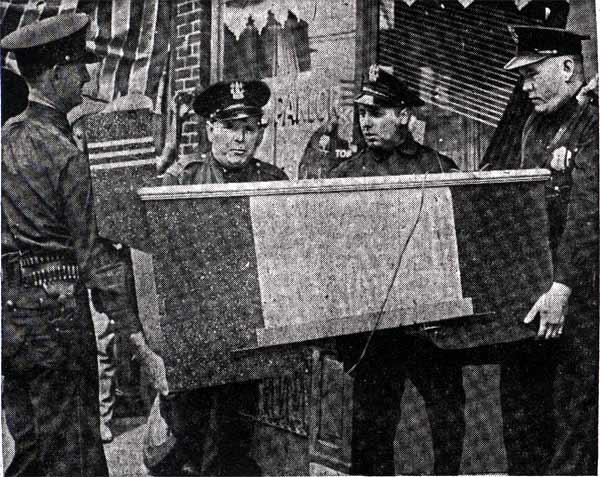

Cops Score High on This Slot Machine
Raiding a store at 1808 Broadway yesterday, Camden police seized this pin-ball slot machine, one of the type that has been barred by Chief of Police Arthur Colsey. The alleged owner was arrested for possession of a gambling device and is scheduled for arraignment in police court today. Another machine, of a different type, was seized a few doors away. Camden policemen, taking part in the raid, are, left to right, Patrolmen John Kaighn, Oliver Morgan, Earl Wright and John V. Wilkie.
Colsey’s ‘Secret Six’ Rout Gamblers, Numbers Writers
Camden Courier-Post —
No One Has Enough Influence or Power to Fix Any Case, Chief Reveals in Drive to Clean Up City
Camden now has its own “Secret Six,” a strong-arm squad working out of Chief Colsey’s office that has already jammed down the lid on the numbers racket and gambling in this city.
The squad has been ordered to sweep the gamblers and writers out of the picture and have been told that nobody is powerful enough to “put in a fix” to protect a single one of the underworld nabobs.
Chief Colsey made three revelations while insisting that Camden was a spotless city, with not a known numbers baron operating, and no big-shot gambler running a game.
The police department head outlined how this secret detail had been working for weeks. The gamblers recognized the official weight of their presence by shutting up shop and taking to the tall timbers, Colsey said.
“The squad is secret,” said the Chief, “and has been working out of my office for several weeks. Nobody except myself knows the names of the squad and whether I take them from the plain clothes department or the uniformed ranks.
“They work separately and secretly, too, and every day the list is changed, so that the gamblers and numbers writers won’t be able to spot the squad. They work in zones, too, patrolling districts which have been known in the past to be the haunts of gamblers and the districts where numbers writers worked the most.
“I want to say that so far as gambling conditions in Camden are concerned, I know the city is clean. I mean especially in regard to numbers and horse betting.
“And we’re going to keep it that way, too. I get daily reports on conditions from my own secret squad. This detail will work without fear or favor.
“There will be no ‘fix’ for anybody, high or low, and persons who are running a numbers racket or a gambling game will be arrested as fast as we discover that fact.
“There isn’t anybody who will have pull enough to stop our drive, either.”
Cigar Store Raided by ‘Secret 6’ Squad
Camden Courier-Post —
Alleged Proprietor is Held in $500 Bail for Police Court Hearing
Raiders of the “Secret 6” of the Camden police department yesterday arrested Oscar Bendler, 40, as the alleged proprietor of a cigar store at 217 Market Street, where they reported they seized horse racing sheets, three phones and $114.
Bendler, who gave his address as 310 Erie Street, is charged with violating the city ordinance prohibiting gambling and is held in $500 bail for a police court hearing today.
The raid on Bendler’s place was made after the police squad had searched five other small shops and found only legitimate business being conducted.
Two of the shops were located on the Market Street ferry walk, two on Market Street between Second and Third Street and on Federal Street between Second and Third Street.
Fine-combing of establishments where it is suspected the gambling gentry may flourish was ordered by Police Chief Arthur Colsey. The picked squad of men who operated as members of Colsey’s “Secret Six” yesterday were Detective Sergeant Clifford Del Rossi, Sergeant Walter Rowand, Detectives Benjamin Simon and Joseph Mardino.
Clayton Named ‘Chief’ in Colsey’s Absence
Camden Courier-Post —
Acting Chief Clerk George Clayton was named to head the Camden police department during the absence of Police Arthur Colsey yesterday by Commissioner Mary W. Kobus.
Chief Colsey leaves today for Kansas City where he will attend the International Police Chief’s convention. En route to the convention, Chief Colsey will stop at St. Louis and will return here via Chicago after the convention ends next Friday.
The Chicago and St. Louis visit will be on police duty, Chief Colsey said. He will discuss improvements, supervision, and police methods with police officials of those cities.
‘Babe’ Clayton’s Son Appointed as Cop
Camden Courier-Post —
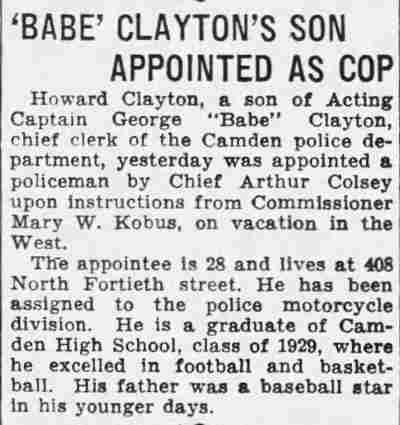
Howard Clayton, a son of Acting Captain George “Babe” Clayton, chief clerk of the Camden police department, yesterday was appointed a policeman by Chief Arthur Colsey upon instructions from Commissioner Mary W. Kobus, on vacation in the West.
The appointee is 28 and lives at 408 North Fortieth street. He has been assigned to the police motorcycle division. He is a graduate of Camden High School, class of 1929, where he excelled in football and basketball. His father was a baseball star in his younger days.
Clayton Promoted to Chief Clerk in Police Department
Camden Courier-Post —

Commissioner Kobus Continues Move for Elimination of ‘Acting’ Officers
In line with her plans to eliminate acting offices in the police department, Commissioner Mary W. Kobus last night announced the promotion of Patrolman George Clayton to chief clerk of the department.
Clayton, whose promotion has been rumored since last December, has been acting chief clerk for two years and was named chief clerk, August 16. The promotion carries an increase in salary of $360, the position paying $2400 annually less the 15 percent economy reduction now in effect. As a patrolman Clayton received $2040 a year.
The city commission is expected in the near future to pass a resolution giving the title of captain, as outlined in a city ordinance, and he then receives an additional increase of $180 in salary bringing the total to $2580. Clayton will act as chief of police in the absence of Chief Arthur Colsey.
Clayton Record Lauded
Commenting on Clayton’s promotion, Commissioner Kobus said: “This is another step toward the elimination of acting officers in the police department and more are to follow in the future. It is my purpose to replace all acting jobs wherever and whenever it is possible. Clayton is a fine officer with a splendid record and his promotion will increase the efficiency and uphold the morale of the department.”
Clayton, who is 49 and lives at 912 Mt. Ephraim avenue, was appointed to the department on February 2, 1918, while Charles H. Ellis was mayor. He has served in nearly every capacity in the department, having been a motorcycle patrolman, mounted policeman, jailor, acting desk sergeant and acting detective.
Clayton has been cited for bravery on several occasions.
Capturing a fugitive bandit single handed at the Camden postoffice on December 20, 1932, was one of Clayton’s most sensational exploits. The bandit, Robert I. Mears, was wanted in Delaware for more than a score of robberies and was spotted in Camden.
Floors Irate Interferer
Police were notified and Clayton was assigned to the postoffice to grab Mears when he appeared for mail. Clayton waited for several days before he was rewarded with the appearance of Mears. Not knowing whether the bandit was armed or not, Clayton pulled his gun.
A bystander thought a holdup was in progress and Clayton was the culprit. Clayton was assaulted by the bystander, making the chances of the capture look slim, but he promptly “floored” the would-be rescuer with a punch and then took Mears to headquarters where he was held for Delaware authorities.
Police Benevolent Association Baseball Team
Public Service Park — Federal Street & Newton Avenue — 1930s
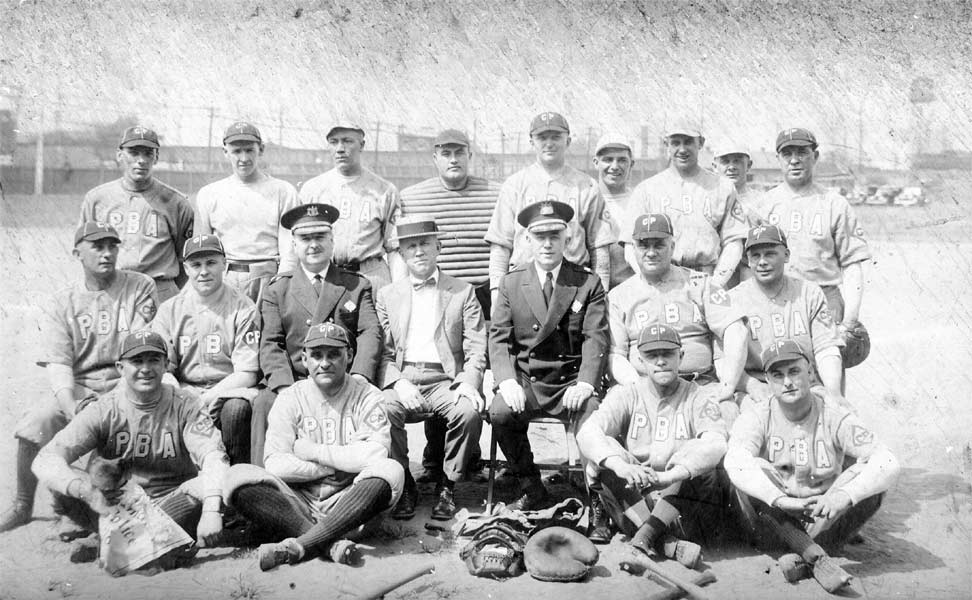
Police Benevolent Association Baseball Team. Chief Colsey is seated, wearing police uniform, at right.
‘Ireland Night’ Set by 6th Ward Club
Camden Courier-Post —
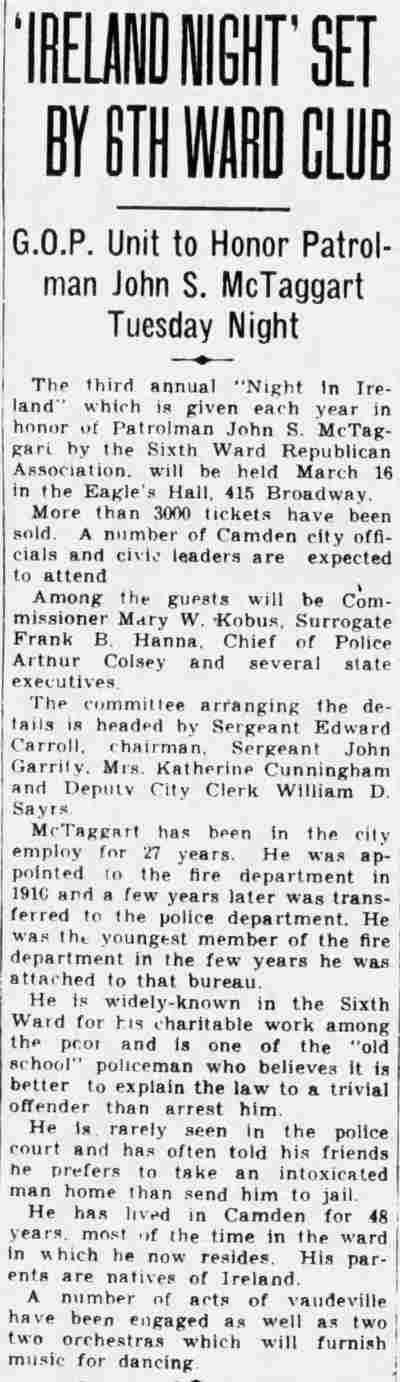
G.O.P. Unit to Honor Patrolman John S. McTaggart Tuesday Night
The third annual “Night in Ireland” which is given each year in honor of Patrolman John S. McTaggart by the Sixth Ward Republican Association, will be held March 16 in the Eagle’s Hall, 415 Broadway.
More than 3000 tickets have been sold. A number of Camden city officials and civic leaders are expected to attend.
Among the guests will be Commissioner Mary W. Kobus, Surrogate Frank B. Hanna, Chief of Police Arthur Colsey and several state executives.
The committee arranging the details is headed by Sergeant Edward Carroll, chairman, Sergeant John Garrity, Mrs. Katherine Cunningham and Deputy City Clerk William D. Sayrs.
McTaggart has been in the city employ for 27 years. He was appointed to the fire department in 1910 and a few years later was transferred to the police department. He was the youngest member of the fire department in the few years he was attached to that bureau.
He is widely-known in the Sixth Ward for his charitable work among the poor and is one of the “old school” policeman who believes it is better to explain the law to a trivial offender than arrest him.
He is rarely seen in the police court and has often told his friends he prefers to take an intoxicated man home than send him to jail.
He has lived in Camden for 48 years, most of the time in the ward in which he now resides. His parents are natives of Ireland.
A number of acts of vaudeville have been engaged as well as two two [sic] orchestras which will furnish music for dancing.
John M’Taggart’s Wife Dies As Friends Honor Him at Party
Camden Courier-Post —
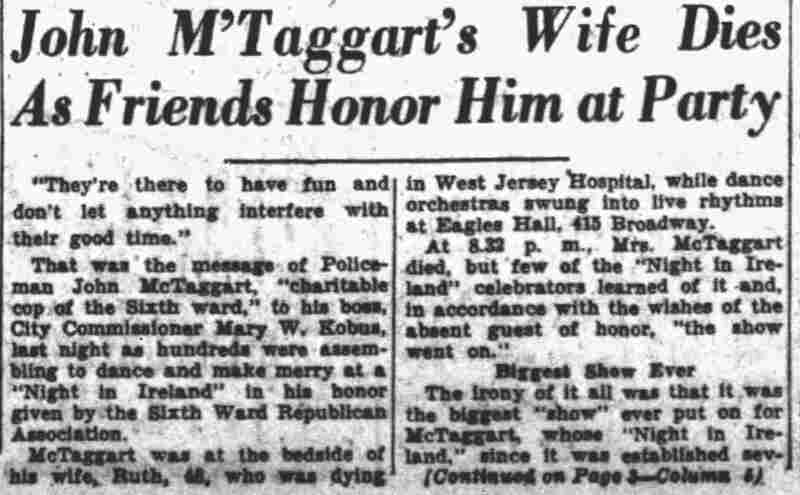
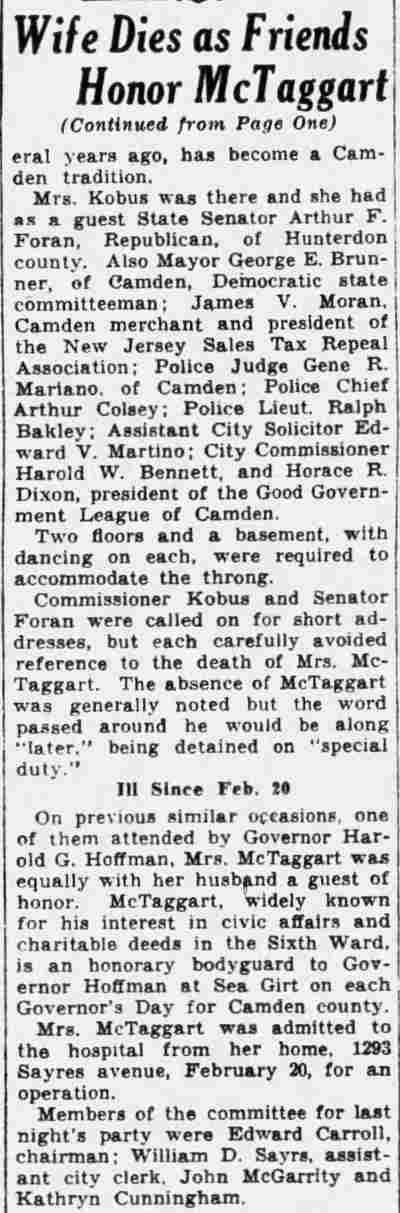
“They’re there to have fun and don’t let anything interfere with their good time.”
That was the message of Policeman John McTaggart, “charitable cop of the Sixth ward,” to his boss, City Commissioner Mary W. Kobus, last night as hundreds were assembling to dance and make merry at a “Night in Ireland” in his honor given by the Sixth Ward Republican Association.
McTaggart was at the bedside of his wife, Ruth, 4[?], who was dying in West Jersey Hospital, while dance orchestras swung into live rhythms at Eagles Hall, 415 Broadway.
At 8.32 p. m., Mrs. McTaggart died, but few of the “Night in Ireland” celebrators learned of it and, in accordance with the wishes of the absent guest of honor, “the show went on.”
Biggest Show Ever
The irony of it all was that it was the biggest “show” ever put on for McTaggart, whose “Night in Ireland,” since it was established several years ago, has become a Camden tradition.
Mrs. Kobus was there and she had as a guest State Senator Arthur F. Foran, Republican, of Hunterdon county. Also Mayor George E. Brunner, of Camden, Democratic state committeeman; James V. Moran, Camden merchant and president of the New Jersey Sales Tax Repeal Association; Police Judge Gene R. Mariano, of Camden; Police Chief Arthur Colsey; Police Lieut. Ralph Bakley; Assistant City Solicitor Edward V. Martino; City Commissioner Harold W. Bennett, and Horace R. Dixon, president of the Good Government League of Camden.
Two floors and a basement, with dancing on each, were required to accommodate the throng.
Commissioner Kobus and Senator Foran were called on for short addresses, but each carefully avoided reference to the death of Mrs. McTaggart. The absence of McTaggart was generally noted but the word passed around he would be along “later,” being detained on “special duty.”
Ill Since Feb. 20
On previous similar occasions, one of them attended by Governor Harold G. Hoffman, Mrs. McTaggart was equally with her husband a guest of honor. McTaggart, widely known for his interest in civic affairs and charitable deeds in the Sixth Ward, is an honorary bodyguard to Governor Hoffman at Sea Girt on each Governor’s Day for Camden county.
Mrs. McTaggart was admitted to the hospital from her home, 1293 Sayres avenue, February 20, for an operation.
Members of the committee for last night’s party were Edward Carroll, chairman; William D. Sayrs, assistant city clerk, John McGarrity and Kathryn Cunningham.
Mrs. M’Taggart Rites to Be Held Tomorrow
Camden Courier-Post —
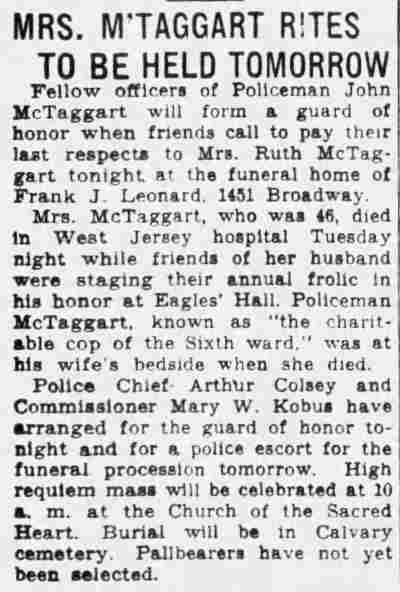
Fellow officers of Policeman John McTaggart will form a guard of honor when friends call to pay their last respects to Mrs. Ruth McTaggart tonight at the funeral home of Frank J. Leonard, 1451 Broadway.
Mrs. McTaggart, who was 46, died in West Jersey hospital Tuesday night while friends of her husband were staging their annual frolic in his honor at Eagles’ Hall. Policeman McTaggart, known as “the charitable cop of the Sixth ward,” was at his wife’s bedside when she died.
Police Chief Arthur Colsey and Commissioner Mary W. Kobus have arranged for the guard of honor tonight and for a police escort for the funeral procession tomorrow. High requiem mass will be celebrated at 10 a. m. at the Church of the Sacred Heart. Burial will be in Calvary cemetery. Pallbearers have not yet been selected.
Hundreds Pay Tribute to Mrs. M’Taggart
Camden Courier-Post —
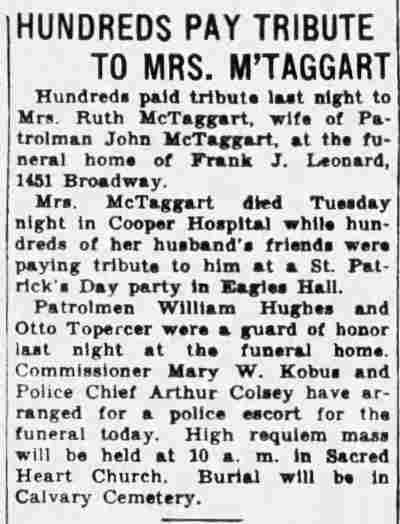
Hundreds paid tribute last night to Mrs. Ruth McTaggart, wife of Patrolman John McTaggart, at the funeral home of Frank J. Leonard, 1451 Broadway.
Mrs. McTaggart died Tuesday night in Cooper Hospital while hundreds of her husband’s friends were paying tribute to him at a St. Patrick’s Day party in Eagles Hall.
Patrolmen William Hughes and Otto Topercer were a guard of honor last night at the funeral home. Commissioner Mary W. Kobus and Police Chief Arthur Colsey have arranged for a police escort for the funeral today. High requiem mass will be held at 10 a. m. in Sacred Heart Church. Burial will be in Calvary Cemetery.
Kobus Warns Cops to Keep City Clean
Camden Courier-Post —
Expresses Belief Camden is ‘Remarkably Free of Vice and Gambling’
KOBUS WARNS COPS TO KEEP CITY CLEAN
Expresses Belief Camden is ’Remarkably Free of Vice and Gambling’
Expressing the belief that Camden is “remarkably free of vice, gambling and other unlawful elements,” City Commissioner Mary W. Kobus, director of public safety, yesterday said she wants the police to keep it that way.
Failure to comply with her order, she told a dozen police officials at an hour-long conference in her office, will result in “serious consequences.”
The session was held behind closed doors, but Commissioner Kobus later said she “laid down the law to those in charge of enforcing it.”
Believes Good Job Done
Police Chief Arthur Colsey headed the group, the others being Lieutenant Ralph Bakley, director of police personnel; Acting Lieutenant Herbert Botts, Acting Lieutenant of Detectives Louis Shaw, Acting Lieutenant John Skolsky, Lieutenant George Frost, Lieutenant Walter Welch and Sergeants Frank Evans, Nate Pettit, August Koerner, Edward Hahn and Harry Newton.
Colsey, with the others, declined to comment on the conference and referred all inquiries to Mrs. Kobus.
“I told them,” the latter said, “that I believed they and their men had done a good job in cleaning up conditions in Camden six months ago.
“I think Camden is remarkably free of vice, gambling and other unlawful elements and I want it kept that way.
It’s a 24-Hour Job
“Law enforcement is a 24-hour day in and day out job. It is a job requiring everlasting vigilance and those in charge of enforcement have got to be on their toes all the time.
“I think our police department is doing a good job, but just the same, I don’t want any letdowns and I told Chief Colsey and his subordinates that I don’t. We have rid the city of a lot of unpleasant elements and we are going to keep rid of them.
“I also told Chief Colsey and his staff that I want all members of the department to co-operate fully with other law enforcement agencies of the county. I particularly desire that reports on cases submitted to the grand jury be as complete and detailed as possible.”
Kobus Orders City Drive on Numbers Ring
Camden Courier-Post —
Issues Decree for Police to Tighten Up on Gaming Racket — FBI Agents Join Probe Here of $50,000 Bank — Phila. Leaders Held Lottery Czars Here
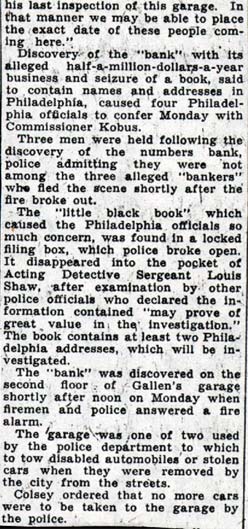
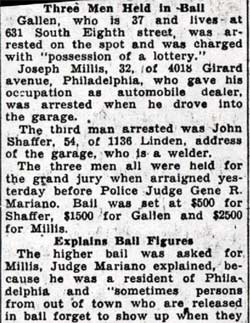
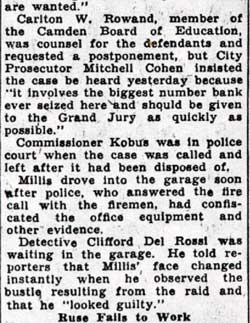
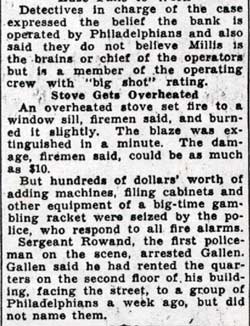
Kobus Orders City Drive on Numbers Ring
KOBUS ORDERS CITY DRIVE ON NUMBERS RING
Issues Decree for Police to Tighten Up on Gaming Racket — FBI Agents Join Probe Here of $50,000 Bank — Phila. Leaders Held Lottery Czars Here
An ultimatum that numbers racketeers must be driven out and kept out of Camden was issued yesterday by Commissioner Mary W. Kobus as G-men opened a probe in an endeavor to link a half million dollar numbers bank, uncovered in Camden Monday, with a Philadelphia gambler.
The director of public safety issued her edict at a conference attended by Police Chief Arthur Colsey, Lieut. Ralph Bakley and police sergeants of the First district, in which the numbers bank was located.
Mrs. Kobus revealed:
That she was satisfied the bank was operated by two Philadelphia “big-shots” and believed it had been doing business but three or four days.
That she would investigate fully a report that a Camden patrolman had been storing his car in the garage over which the bank was found.
That she would investigate to find on whose orders recovered stolen cars were stored in the garage.
That police would be ordered to check on every other garage and building in the city which might possibly house a numbers bank.
Agents of the Federal Bureau of Investigation, of Philadelphia, entered the picture in an effort to determine whether backers of the bank were working under “big shots,” believed to be the brains of a nation-wide lottery based on U. S. treasury report numbers.
FBI Checks Seized Articles
Three agents spent several hours minutely examining all papers, telephone addresses, adding machine and records seized by local police after discovery of the bank when a small fire had summoned them to a garage operated by John Gallen, 1136 Linden street. The bank was located over the garage.
The FBI agents, whose identity was not made public, were taken to the office of local police and spent more than an hour in examining every nook and corner of the 12 by 12 room used as the “bank.”
The conference between Mrs. Kobus and police officials lasted nearly an hour.
“The men who operated this numbers hide-out are known to the police of this city and Philadelphia,” Mrs. Kobus said after the conference. “I am satisfied this place had been running for only three or four days.”
The Commissioner said she does not believe any of the First district officers had time to ferret out the place.
The paraphernalia, consisting of six adding machines, telephones and other supplies indicated the layout of the place was not fully complete.
“I ordered Chief Colsey and others attending the conference to exercise more vigilance,” Commissioner Kobus continued. “Further I demanded that every garage or other type building where gambling or numbers hide-outs may be set up to be inspected.”
Demands Curb on Numbers
“So far as I know, numbers big shots and small-time writers in our own city are afraid to open up. This place on Linden street, we know, was headed up by two notorious Philadelphia numbers big shots.
“I am serving notice on all those engaged in the writing of numbers that they will not be permitted to locate or work in Camden as long as I am director of public safety. Every member of the police department understands just what I mean.”
Those attending the conference in the commissioner’s office, besides Colsey and Bakley, were Sergeants Walter Rowand, John Deith and Edward Hahn.
Mrs. Kobus said she plans to talk to detectives, plain clothes officers and the lieutenants of the Second and Third police districts either today or later in the week.
“I also intend to ask detectives in the accident bureau by whose orders stolen cars which have been recovered and cars figuring in accidents were stored in this same garage,” added Mrs. Kobus.
“I have issued an order to check every garage for other possible stolen cars as well as numbers gambling joints on upper floors.
“I am investigating a report that one patrolman has been storing his own car in the Gallen garage.”
Earlier in the day Commissioner Kobus said she would order Sergeant Rox Saponare, identification expert, to go over all of the equipment, including six telephones and six adding machines “with a fine-tooth comb” in an effort to locate fingerprints.
“And if any fingerprints are found, I want them sent to the Federal Bureau of Identification to see if we can identify the criminals who had this numbers bank.”
“I am certain this numbers bank was running with the full knowledge of John Gallen,” the commissioner continued. “I had a talk with him and told him that I suspected he knew what was going on. I asked him to be fair with the police and to give them whatever information he possesses so that they may arrest the backers of this band.”
Seeks to Fix Date
“I also will summon City Fire Marshal Bernard Gallagher to my office and ask him when he made his last inspection of this garage. In that manner we may be able to place the exact date of these people coming here.”
Discovery of the “bank” with its alleged half-a-million-dollars-a-year business and seizure of a book, said to contain names and addresses in Philadelphia, caused four Philadelphia officials to confer Monday with Commissioner Kobus.
Six men were held following the discovery of the numbers bank, police admitting they were not among the three alleged “bankers” who fled the scene shortly after the fire broke out.
The “little black book” which caused the Philadelphia officials so much concern was found in a locked filing box, which police broke open. It disappeared into the pocket of Acting Detective Sergeant Louis Shaw, after examination by other police officials who declared the information contained “may prove of great value in the investigation.” The book contains at least two Philadelphia addresses, which will be investigated.
The “bank” was discovered on the second floor of Gallen’s garage shortly after noon on Monday when firemen and police answered a fire alarm.
The garage was one of two used by the city police department to tow disabled automobiles or stolen cars when they were removed by the city from the streets.
Colsey ordered that no more cars were to be taken to the garage by the police.
Three Men Held in Bail
Gallen, who is 37 and lives at 631 South Eighth street, was arrested on the spot and was charged with “possession of a lottery.”
Joseph Millis, 32, of 4018 Girard avenue, Philadelphia, who gave his occupation as automobile dealer was arrested when he drove into the garage.
The third man arrested was John Shaffer, 54, of 1136 Linden, address of the garage, who is a welder.
The three men all were held for the grand jury when arraigned yesterday before Police Judge Gene R. Mariano. Bail was set at $500 for Shaffer, $1500 for Gallen and $2500 for Millis.
Explains Bail Figures
The higher bail was asked for Millis, Judge Mariano explained, because he was a resident of Philadelphia and “sometimes persons from out of town who are released in bail forget to show up when they are wanted.”
Carlton W. Rowand, member of the Camden Board of Education, was counsel for the defendants and requested a postponement, but City Prosecutor Mitchell Cohen insisted the case be heard yesterday because “it involves the biggest number bank ever seized here and should be given to the Grand Jury as quickly as possible.”
Commissioner Kobus was in police court when the case was called and left after it had been continued.
Millis drove into the garage soon after police, who answered the fire call with the firemen, had confiscated the office equipment and other evidence.
Detective Clifford Del Rossi was waiting in the garage. He told reporters that Millis’ face changed instantly when he observed the bustle resulting from the raid and that he “looked guilty.”
Ruse Fails to Work
Detectives in charge of the case expressed the belief the bank is operated by Philadelphians and also said they do not believe Millis is the brains or chief of the operators but is a member of the operating crew with “big name” backing.
Stove Gets Overheated
An overheated stove set fire to a window sill, firemen said, and burned it slightly. The blaze was extinguished in a minute. The damage, firemen said, could be as much as $10.
Hundreds of dollars’ worth of adding machines, filing cabinets and other equipment of a big-time gambling racket were seized by the police, who respond to all fire alarms.
Sergeant Rowand, the first policeman on the scene, arrested Gallen. Gallen said he had rented the exterior of the second floor of his building, facing the street, to a group of Philadelphians a week ago, but did not name them.
William Marter Made Detective
Camden Courier-Post —
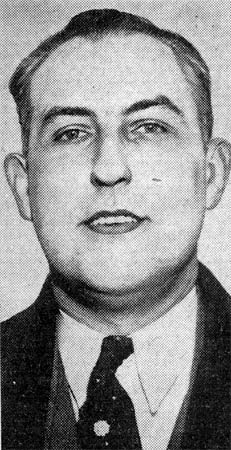
Made Detective — William Marter
Camden patrolman who has been shifted from the office of Commissioner Mary Kobus to the Detective Bureau, Police Chief Arthur Colsey announced last night. Marter will become an acting detective.
Pool Hall Owners’ Told Gaming Will Cost Permits
Camden Courier-Post —
Mrs. Kobus Warns Against Permitting Any Gambling on Premises; Cites Cards Played in Back Rooms
Operators of pool and billiard-halls were warned yesterday by Commissioner Mary W. Kobus, director of public safety, that permanent revocation of licenses will be the penalty if gambling is permitted on the premises.
Commissioner Kobus said she has been investigating reports that some poolroom licensees have been operating card games for large and small stakes in backrooms of their places.
The investigation, the commissioner said, failed to disclose any large gambling enterprises but a few friendly card games for small stakes were revealed.
“I will issue an order to Chief Arthur Colsey and all district lieutenants and sergeants that a closer watch be kept on these so-called poolrooms,” Mrs. Kobus said.
“In days past the average neighborhood room was only a blind for professional card games where the participants played for large stakes.
“Such licensed poolroom operators are amenable to the law, and if they are caught they will be charged as principals and their licenses will be permanently revoked. I will not accept the excuse of any proprietor that he doesn’t know there is gambling in his place.”
Majority Law-Abiding
The Commissioner said she believes the majority of persons holding pool room licenses are law-abiding and that pool and billiards are played for recreation.
It was disclosed by Mrs. Kobus that a former operator of a downtown poolroom, whose place was raided as a gambling resort, has been exerting political pressure to obtain a renewal of his license. Mrs. Kobus would not disclose the identity of the man mentioned by her.
“Any Camden citizen who wants a license to operate a poolroom where pool and billiards are to be played does not need to get the help of a politician or a lawyer,” Mrs. Kobus added. “I am not running the department of public safety to satisfy the whims of any politicians or lawyers.
No Lawyer Needed
“Any respectable citizen can have a license. He doesn’t have to pay a lawyer to help him get it, and neither does he have to depend on any politician.
“The applicant who attempts to support his application either with a lawyer or a politician will find himself behind the eight ball.”
Commissioner Kobus said each applicant for such a license will be examined as to his fitness to operate such a place. Those who have any criminal record will be denied such permit, she said.
“It might be a good thing if certain forms of gambling were legalized and revenue obtained for municipalities, the State or by the government,” Mrs. Kobus stated. “But so long as the law specifically states that gambling is illegal I intend to enforce the laws. I personally am opposed to all forms of organized or commercialized gambling.”
City Police Praised at Fete Honoring Acting Lieutenant Bott
Camden Courier-Post —
Camden police and firemen gathered last night to pay honor to Acting Lieutenant Herbert Bott, retiring president of the Policemen and Firemen’s Association, heard their highest superiors make these statements:
Commissioner Mary W. Kobus, director of Public Safety, declared she had heard stories about the policemen “taking” but that she wanted to say “that the entire force was honest and she was proud to say that it was as good, as honest and efficient as any in the United States.”
Mayor George E. Brunner asserted “the city had gone to ____ before the three New Deal commissioners took charge, and they had brought order out of chaos, collected taxes so thoroughly that on January 1, 1939, the policemen and firemen will be given back the last five percent reduction that had been made in their pay.”
Bott, who has been at the head of the association for the past five years, retires because, as he stated, he felt he could not give such service as he felt he had rendered in the past. The affair was held at Kenney’s and the ranking officials of the police and fire departments were on hand, together with guests from other parts of the state.
Wallace Lauds Men
Bruce A. Wallace was toastmaster, and he emphasized the remarks of Commissioner Kobus as to “the honesty of the men.”
“When you got that 30 percent reduction in pay,” said Wallace, “I know how you came to my office, worrying about how you would meet your building and loans, how you would pay various debts that you owed, and I know that some of you even gave up your homes, because you couldn’t afford to pay for them longer. That would never have happened if you were doing any ‘put and-take stuff.’”
Mrs. Kobus started with a tribute to Bott, for his own efficiency as a policeman and his fighting qualities as shown in the battles he made for his brother policemen.
“I knew Herb Bott,” she said, “before I got into the department but once in there my sweet dream changed to a nightmare, because every day Bott was there with a delegation wanting something done for the policemen, or asking that something be not done to them.
“We have gone through stormy times together, through strikes and labor troubles and of course I have always found out, through others, naturally that ‘the police are always wrong.’ I have told the employers where they were wrong, and told the strikers that the police could not have abused them or wronged them because they belonged to an association of their own, fighting for the things that the policemen and the firemen felt that they wanted.
Citizens Gave Praise
“I hadn’t been four weeks in the department before I thought every-body in Camden was affected by ‘letter writingitis.’ But after four weeks the other kind of letters began to come in, and the police were being given the credit which they had deserved and which they had won for themselves.
“And the longer I am in the department the prouder I am of the police and the fire departments of the city of Camden. I am proud of every policeman and of every fireman in both departments. I have been out at 1:30 a.m. and heard a call come for the car in which I was riding, and in one minute and a half that car was at the scene, in two minutes there was another and in four minutes a half a dozen cars had appeared on the scene.
“I want to say for the men of the police department that nowhere in the United States is there a more honest or more faithful group of men.
“I hear a lot of talk about policemen, I hear lots of talk of how they are ‘taking,’ but I also want to say that I haven’t found one yet who wasn’t honest and to prove it crime today in Camden is at its lowest ebb.
“Crime today in Camden has been lowered 40 to 60 percent, and I say to anybody who wants to know that you couldn’t have had this condition unless Camden was guarded by an honest, efficient police department.
“That crime in Camden is at its lowest ebb is due entirely to the vigilance of the police department, and to its loyalty to duty. I want to pay tribute to Chief Colsey, to Babe Clayton, to Herb Bott and the other officers of the department for having the police department where it can be proudly acclaimed as without a superior in the whole United States.”
Mayor Brunner, after paying his tribute to a personal friend, Herb Bott, declared “Mrs. Kobus is your superior but I’m the man who has to find the money to pay you. And that hasn’t been any easy job, I can tell you, as the tax collector’s job in any community is a tough one.”
“I want to say that things in Camden have gone to ___ in the past, and until the three New Deal Commissioners took charge of affairs, things continued in just that manner. And that we have given an honest, efficient administration is the thought of the average citizen of Camden today.
Promises Pay Restoration
“When we first came into power the people thought they had to pay no taxes. I say now that we have collected the taxes as they should have been collected in the past and as they will be collected in the future.
“Camden doesn’t need any new taxes. We have been successful in collecting the taxes because we made those who could pay to pay. The men we put in front, for the first collection of taxes, were the politicians who thought they stood in a favored group and could get away with it.
“I want to assure you policemen that on January 1, 1939, I feel sure that we’ll be able to give you back the last five percent that we had to take from you, when things were left in such a shape for us that we could not do anything else.
“People are responding to our tax collections, and the people feel that we are giving them 100 cents for a dollar and that’s the reason.
“We have no favorites on the tax rolls. We saw to it that the politicians headed the list of those who were the first to pay, and we’ve given the little fellow a chance. We’ve let him pay by the week, or the month or anyway that would suit him best, because we believe that the little fellow is entitled to his own homestead, and we’re going to see that he keeps it, but those who can afford to pay and wont are going to be made to pay.”
Carlton W. Rowand related that his father, a former police official, had recently told his son that “the police department today was the best in the history of Camden.”
Surrogate Frank B. Hanna also added his tribute to the department and to the guest of honor.
“The spirit of the police department,” Hanna said, “is shown to no better advantage than in the manner your association aids the underprivileged children of this city. I know, too, that whenever a committee is formed for a job to be done for the men in the department, Herb Bott jumps into action and does his level best for his associates.”
N. J. Crime Bill 10 Millions
Harry B. Gourley, of Paterson, president of the State Police Beneficial Association, declared that crime was costing the state of New Jersey $10,000,000 every year, and that the crime bill of the nation was more than $15,000,000,000.
He asked co-operation in crime prevention and declared that “any attempt to break down the morale of the police was wrong, and the way in which it was easiest broken down was when you dip into the pay check.”
He cited numerous instances of the heroism of the policemen, and asked that every citizen stand squarely behind the men in the matter of pensions.
Commissioner Harold W. Bennett also lauded the guest and the police department, as did Harry Wilkers, who succeeds Bott as president of the association and Robert Wonstetler, who becomes delegate to the state convention to replace Bott.
Mrs. Emma Shriver, retiring president of the Ladies Auxiliary, presented Bott with a check, while Wallace gave him the gift of his associates, 50 silver dollars. Mrs. Bott was remembered with flowers.
Willard Schriver was chairman of the committee having the dinner in charge, and associated with him were Charles Cook, Arthur Batten, Maurice F. O’Brien, William Marter, Edward Leonard, Mrs. Schriver, Mrs. Anna Gleason and Mrs. William McGrath.
4 Chinese Observers Inspect RCA Here on Tour of World
Camden Courier-Post —
Nanking Follows Purchase of Short-Wave Equipment by Wide Research — Visitors Saw Women and Children Slain in Shanghai
Four representatives of the Chinese Nanking government are on an official visit to Camden where they are studying methods used in the manufacture of radios at the RCA plant.
Mild-mannered and courteous, the four visitors are Yeh Woo, N. H. Teng, P. H. Shen and C. L. Tung, all university graduates whose government recently ordered 16 short wave radio transmission sets and equipment at a cost of about a half a million dollars from RCA. Their visit is sponsored by the department of telegraphs, ministry of communications, Nanking.
After leaving the United States in May, the party will visit radio manufacturing plants in Germany, England and other countries with the purpose of learning the best features of radio sets for commercial use.
Women and Children Slain
The group left China last September just after the Japanese opened hostilities with an air raid over Shanghai. In their first offensive move, Woo said, six of nine Japanese bombers were brought down by the fire of Chinese troops. Bombs from enemy planes, he added, failed on several occasions to explode when dropped during raids.
“However,” said Woo, “the Japanese bombers soon got into action and were dropping their explosives on schools and hospitals, killing women and children.
“The Japanese government is ambitious to conquer other countries and acquire new resources. We Chinese harbor no hatred for the Japanese people. They are victims of their own government’s misdeeds.
First Soviet, Then Rest of World
“Belief is common that if Japan should accomplish its campaign in China it will forge ahead into Siberian Russia. Then most any other country, including the United States, would be a goal of accomplishment.
“It is true that there is great suffering in China, but the Chinese are banded together for a common cause for the perpetuation of their country.”
The four Chinese representatives were escorted on a tour of inspection of the Camden police and detective departments in city hall, the city jail, firehouses and other places of interest by Policeman John V. Wilkie, Camden rooming house inspector. Wilkie volunteered his services in co-operation with a proposal made by Police Chief Arthur Colsey that the visitors see the city.
Uncle Sam and Camden Clash After Arrest of Mail Driver
Camden Courier-Post —
P.O. Official and Chief Colsey Will Confer on Incident; Police Warned of Federal Law Infraction Carries Fine and Jail Term
Uncle Sam had a new diplomatic worry yesterday but like other difficulties of state hoped to settle it today around the conference table. On the one side will be George L. Smith, superintendent of mails, and across the board will be Police Chief Arthur Colsey. The issue:
What to do when a Camden cop violates Paragraph 2357 of the Postal laws, which states, in part, that no one, not even a Camden cop, shall stop a mail truck or driver in pursuit of his duty on pain of a $100 fine, six months in jail, or both.
It all started when Patrolman Karl Friederichs, in plain clothes and his own automobile, arrested Postal Driver J. Edward Jacques, 805 Elm Street, on disorderly conduct and reckless driving charges after Jacques, in his mail truck, tried to pass Fredericks’ car on the right.
According to Friederichs, Jacques became abusive when he remonstrated and so he locked him up for a hearing today, Jacques, meanwhile, being released in his own recognizance.
When Superintendent Smith heard about the arrest he got in touch with Chief Colsey in nothing flat. Jacques’ story, he said, differed considerably from Fredericks’, but even so, made no difference.
Smith pointed out that Jacques was attempting the “swift completion of his appointed rounds,” in that he was delivering suburban mail to the central office to meet a delivery schedule and as a result of Fredericks’ interference the mails were delayed more than one-half hour.
Smith and Colsey decided that the best way out would be to have a conference in the chief’s office with Jacques and Friederichs present, to determine whether Smith should proceed under Paragraph 2357.
Jacques insisted that the only reason he tried to pass Fredericks on the right was because Friederichs stopped his car to talk to another man and wouldn’t move despite all of Jacques’ horn blowing.
Safety Council Reorganized Here
Camden Courier-Post —
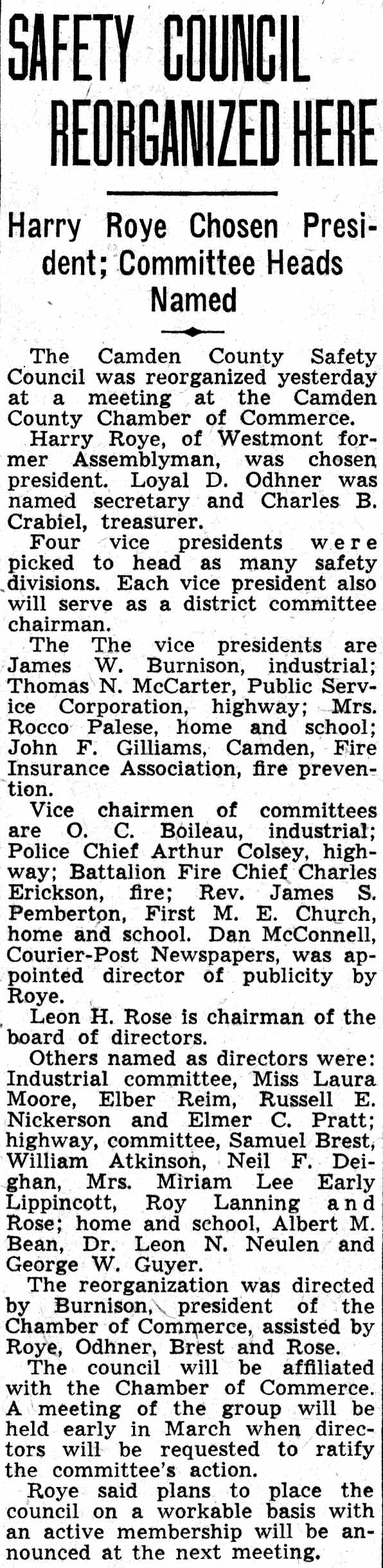
Harry Roye Chosen President; Committee Heads Named
The Camden County Safety Council was reorganized yesterday at a meeting at the Camden County Chamber of Commerce.
Harry Roye, of Westmont former Assemblyman, was chosen president. Loyal D. Odhner was named secretary and Charles B. Crabiel, treasurer.
Four vice presidents were picked to head as many safety divisions. Each vice president also will serve as a district committee chairman.
The The [sic] vice presidents are James W. Burnison, industrial; Thomas N. McCarter, Public Service Corporation, highway; Mrs. Rocco Palese, home and school; John F. Gilliams, Camden, Fire Insurance Association, fire prevention.
Vice chairmen of committees are O. C. Boileau, industrial; Police Chief Arthur Colsey, highway; Battalion Fire Chief Charles Erickson, fire; Rev. James S. Pemberton, First M. E. Church, home and school. Dan McConnell, Courier-Post Newspapers, was appointed director of publicity by Roye.
Leon H. Rose is chairman of the board of directors.
Others named as directors were: Industrial committee, Miss Laura Moore, Elber Reim, Russell E. Nickerson and Elmer C. Pratt; highway, committee, Samuel Brest, William Atkinson, Neil F. Deighan, Mrs. Miriam Lee Early Lippincott, Roy Lanning and Rose; home and school, Albert M. Bean, Dr. Leon N. Neulen and George W. Guyer.
The reorganization was directed by Burnison, president of the Chamber of Commerce, assisted by Roye, Odhner, Brest and Rose.
The council will be affiliated with the Chamber of Commerce. A meeting of the group will be held early in March when directors will be requested to ratify the committee’s action.
Roye said plans to place the council on a workable basis with an active membership will be announced at the next meeting.
Cop’s Guest Beaten; Colsey Probes Row
Camden Courier-Post —
Youth ‘Blackjacked’ at Party; Father Retains Lawyer, to Investigate
Police Chief Arthur Colsey yesterday detailed three detectives to investigate a street row early Sunday at Fourth and Mechanic streets in which a Fairview youth and a Camden policeman were involved.
The youth, Walter Callahan, 21, of 1375 Roanoke Road, is confined to Cooper Hospital with a slight brain concussion and head cuts he said he received when “blackjacked” by Policeman Earl Cunningham, of 448 Mechanic Street.
Chief Colsey removed Cunningham from duty yesterday afternoon pending completion of the probe.
The investigation ordered by Colsey followed after Walter Callahan Sr., father of the youth, retained an attorney for the purpose, he said, “of getting at the bottom of this.” Chief Colsey said that young Callahan had refused to talk to detectives at the hospital.
The elder Callahan, a Gloucester druggist, said he had learned that his son was “more or less of an innocent bystander” in a row that started in the Cunningham home and that he received a “severe beating” from Cunningham and the latter’s son, “Bud.”
“My son went to a party at the Cunningham home,” Callahan said, “and there, I am told, a row started between young Cunningham and a girl. My son objected to a remark passed to the girl and then Cunningham and his son jumped on my boy and beat him.”
“I have retained Charles A. Cogan, a Camden attorney, and have instructed him to make a thorough investigation preliminary to proceeding with court action.”
Prefers Drunk Charge
Detectives Clifford Carr, Donald Switzer and John Opfer were named by Colsey to make an investigation for the police department.
Cunningham, who caused a detainer to be lodged against Callahan on a charge of being drunk and disorderly, told his superiors he was forced to use his blackjack on Callahan when the youth attacked him and tore his shirt and underwear.
According to the policeman, who was off duty at the time, Callahan attended a party in the Cunningham home celebrating the policeman’s wedding anniversary. Cunningham said Callahan left the house and became engaged in a noisy argument with two girls outside. He said the youth attacked him when he came out and sought to quiet Callahan.
City Police to Use Code Air Messages
Camden Courier-Post —
System Adopted for Radio Cars to Prevent ‘Tipoffs’ to Lawbreakers
Important messages relayed through W3XAQ, the Camden police radio station, are being broadcast in code beginning yesterday to prevent lawbreakers from being “tipped off” as to activities of police.
That announcement was made by Police Chief Arthur Colsey, who declared he had received information to the effect that “at least one” Camden garage has a police receiving set and that several were believed installed in Camden homes.
The police official said it is unlawful to have a radio receiving set of the type used only by police in an automobile, garage or private home and he has ordered a probe to locate the “bootleg” sets. The system used by the Camden police is ultra low frequency and cannot be intercepted by ordinary low wave sets.
The code used by the station is in the hands of all radio car patrolmen, Chief Colsey said, and every policeman is expected to be able to decode messages from police headquarters.
The code is similar to one being used by major police departments throughout the country.
Chief Colsey said 10 two-way radio sets have been installed in Camden police cars, and eight one-way sets. Two of the one-way sets have been placed in city patrol wagons, to enable police headquarters to be in touch with the “wagon” at all times, whether it is parked at its station or “on a run.”
The two-way sets enable the radio patrolmen to converse with police headquarters at all times. They have been in operation for three weeks.
Colsey announced that 75 Camden policemen have passed the third class radio operator’s test, required by the Federal State Radio Communications Commission, enabling them to operate the two-way system.
Get Fingerprinted Gratis at Theatre
Camden Courier-Post —
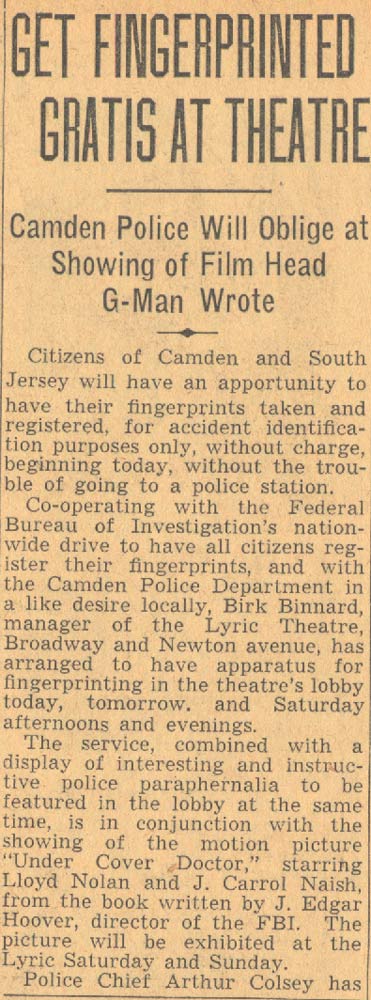
Camden Police Will Oblige at Showing of Film Head G-Man Wrote
Citizens of Camden and South Jersey will have an apportunity [sic] to have their fingerprints taken and registered, for accident identification purposes only, without charge, beginning today, without the trouble of going to a police station.
Co-operating with the Federal Bureau of Investigation’s nationwide drive to have all citizens register their fingerprints, and with the Camden Police Department in a like desire locally, Birk Binnard, manager of the Lyric Theatre, Broadway and Newton avenue, has arranged to have apparatus for fingerprinting in the theatre’s lobby today, tomorrow, and Saturday afternoons and evenings.
The service, combined with a display of interesting and instructive police paraphernalia to be featured in the lobby at the same time, is in conjunction with the showing of the motion picture “Under Cover Doctor,” starring Lloyd Nolan and J. Carrol Naish, from the book written by J. Edgar Hoover, director of the FBI. The picture will be exhibited at the Lyric Saturday and Sunday.
Police Chief Arthur Colsey has [cut off at the crop edge]
Chief Colsey Dies at 67 of Heart Attack
Camden Courier-Post —
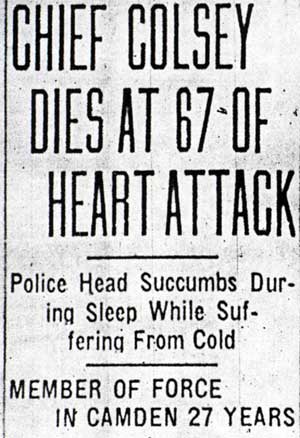
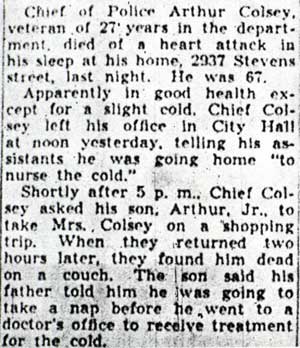
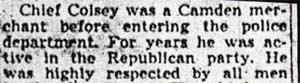
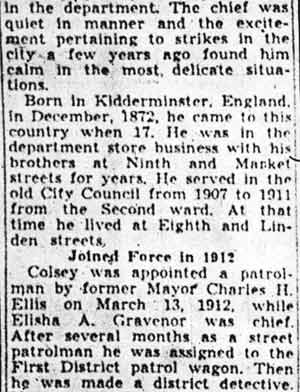
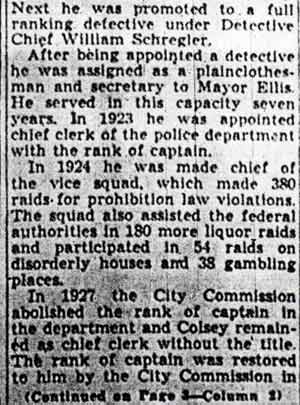
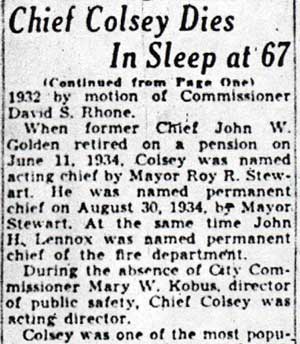
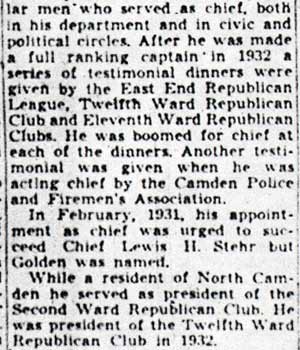
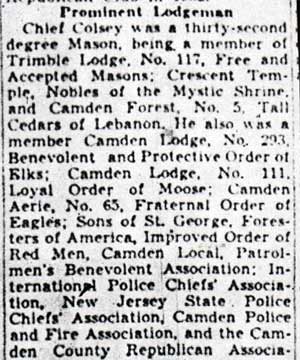
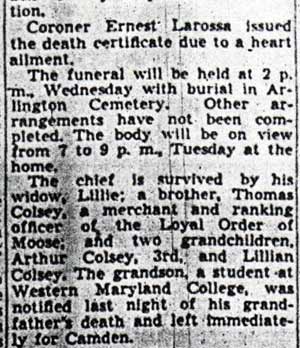
Police Head Succumbs During Sleep While Suffering From Cold
MEMBER OF FORCE IN CAMDEN 27 YEARS
Chief of Police Arthur Colsey, veteran of 27 years in the department, died of a heart attack in his sleep at his home, 2937 Stevens street, last night. He was 67.
Apparently in good health except for a slight cold, Chief Colsey left his office in City Hall at noon yesterday, telling his assistants he was going home “to nurse the cold.”
Shortly after 5 p. m., Chief Colsey asked his son, Arthur, Jr., to take Mrs. Colsey on a shopping trip. When they returned two hours later, they found him dead on a couch. The son said his father told him he was going to take a nap before he went to a doctor’s office to receive treatment for the cold.
Chief Colsey was a Camden merchant before entering the police department. For years he was active in the Republican party. He was highly respected by all men in the department. The chief was quiet in manner and the excitement pertaining to strikes in the city a few years ago found him calm in the most delicate situations.
Born in Kidderminster, England, in December, 1872, he came to this country when 17. He was in the department store business with his brothers at Ninth and Market streets for years. He served in the old City Council from 1907 to 1911 from the Second ward. At that time he lived at Eighth and Linden streets.
Joined Force in 1912
Colsey was appointed a patrolman by former Mayor Charles H. Ellis on March 13, 1912, while Elisha A. Gravenor was chief. After several months as a street patrolman he was assigned to the First District patrol wagon. Then he was made a district detective. Next he was promoted to a full ranking detective under Detective Chief William Schregler.
After being appointed a detective he was assigned as a plainclothesman and secretary to Mayor Ellis. He served in this capacity seven years. In 1923 he was appointed chief clerk of the police department with the rank of captain.
In 1924 he was made chief of the vice squad, which made 380 raids for prohibition law violations. The squad also assisted the federal authorities in 180 more liquor raids and participated in 54 raids on disorderly houses and 38 gambling places.
In 1927 the City Commission abolished the rank of captain in the department and Colsey remained as chief clerk without the title. The rank of captain was restored to him by the City Commission in 1932 by motion of Commissioner David S. Rhone.
When former Chief John W. Golden retired on a pension on June 11, 1934, Colsey was named acting chief by Mayor Roy R. Stewart. He was named permanent chief on August 30, 1934, by Mayor Stewart. At the same time John H. Lennox was named permanent chief of the fire department.
During the absence of City Commissioner Mary W. Kobus, director of public safety, Chief Colsey was acting director.
Colsey was one of the most popular men who served as chief, both in his department and in civic and political circles. After he was made a full ranking captain in 1932 a series of testimonial dinners were given by the East End Republican League, Twelfth Ward Republican Club and Eleventh Ward Republican Clubs. He was boomed for chief at each of the dinners. Another testimonial was given when he was acting chief by the Camden Police and Firemen’s Association.
In February, 1931, his appointment as chief was urged to succeed Chief Lewis H. Stehr but Golden was named.
While a resident of North Camden he served as president of the Second Ward Republican Club. He was president of the Twelfth Ward Republican Club in 1932.
Prominent Lodgeman
Chief Colsey was a thirty-second degree Mason, being a member of Trimble Lodge, No. 117, Free and Accepted Masons; Crescent Temple, Nobles of the Mystic Shrine, and Camden Forest, No. 5, Tall Cedars of Lebanon. He also was a member Camden Lodge, No. 293, Benevolent and Protective Order of Elks; Camden Lodge, No. 111, Loyal Order of Moose; Camden Aerie, No. 65, Fraternal Order of Eagles; Sons of St. George, Foresters of America, Improved Order of Red Men, Camden Local, Patrolmen’s Benevolent Association; International Police Chiefs’ Association, New Jersey State Police Chiefs’ Association, Camden Police and Fire Association, and the Camden County Republican Association.
Coroner Ernest Larossa issued the death certificate due to a heart ailment.
The funeral will be held at 2 p. m., Wednesday with burial in Arlington Cemetery. Other arrangements have not been completed. The body will be on view from 7 to 9 p. m., Tuesday at the home.
The chief is survived by his widow, Lillie; a brother, Thomas Colsey, a merchant and ranking officer of the Loyal Order of Moose; and two grandchildren, Arthur Colsey, 3rd., and Lillian Colsey. The grandson, a student at Western Maryland College, was notified last night of his grandfather’s death and left immediately for Camden.
Mary Kobus — George Frost — Ralph Bakley — Walter Welch — George Ward — Arthur Colsey
Trenton Times —
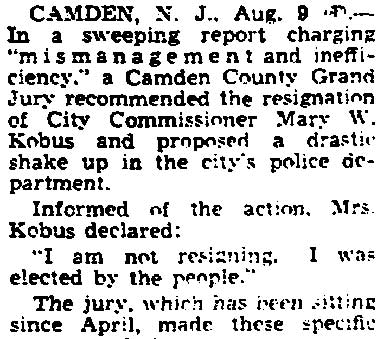
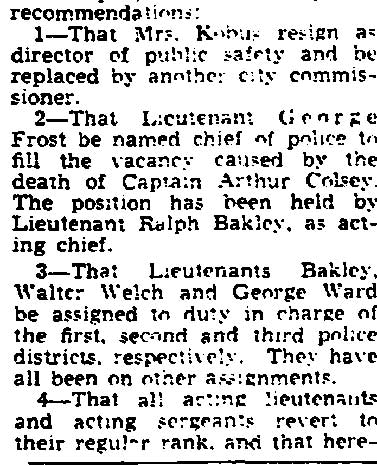
Named: Mary Kobus, George Frost, Ralph Bakley, Walter Welch, George Ward, and Arthur Colsey.
Mrs. Colsey Dies, Widow of Chief
Camden Courier-Post —
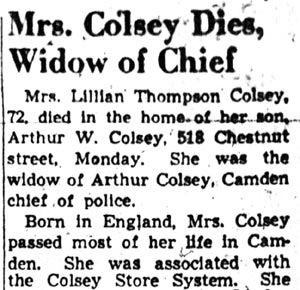
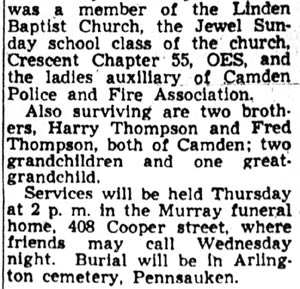
Mrs. Lillian Thompson Colsey, 72, died in the home of her son, Arthur W. Colsey, 518 Chestnut street, Monday. She was the widow of Arthur Colsey, Camden chief of police.
Born in England, Mrs. Colsey passed most of her life in Camden. She was associated with the Colsey Store System. She was a member of the Linden Baptist Church, the Jewel Sunday school class of the church, Crescent Chapter 55, OES, and the ladies auxiliary of Camden Police and Fire Association.
Also surviving are two brothers, Harry Thompson and Fred Thompson, both of Camden; two grandchildren and one great-grandchild.
Services will be held Thursday at 2 p. m. in the Murray funeral home, 408 Cooper street, where friends may call Wednesday night. Burial will be in Arlington cemetery, Pennsauken.
Kidderminster at the Turn of the Century
Courtesy of Pauline Colsey
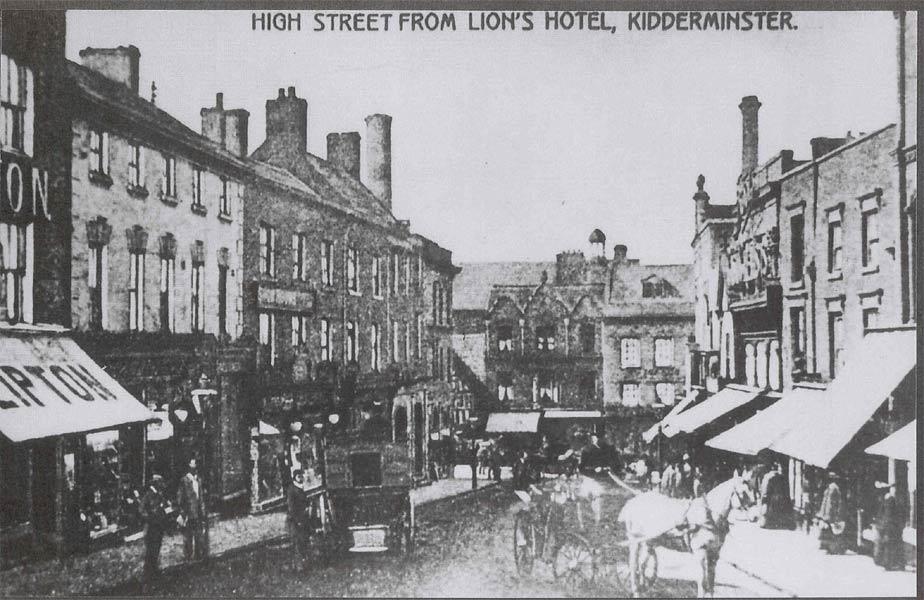
Kidderminster High Street around 1900
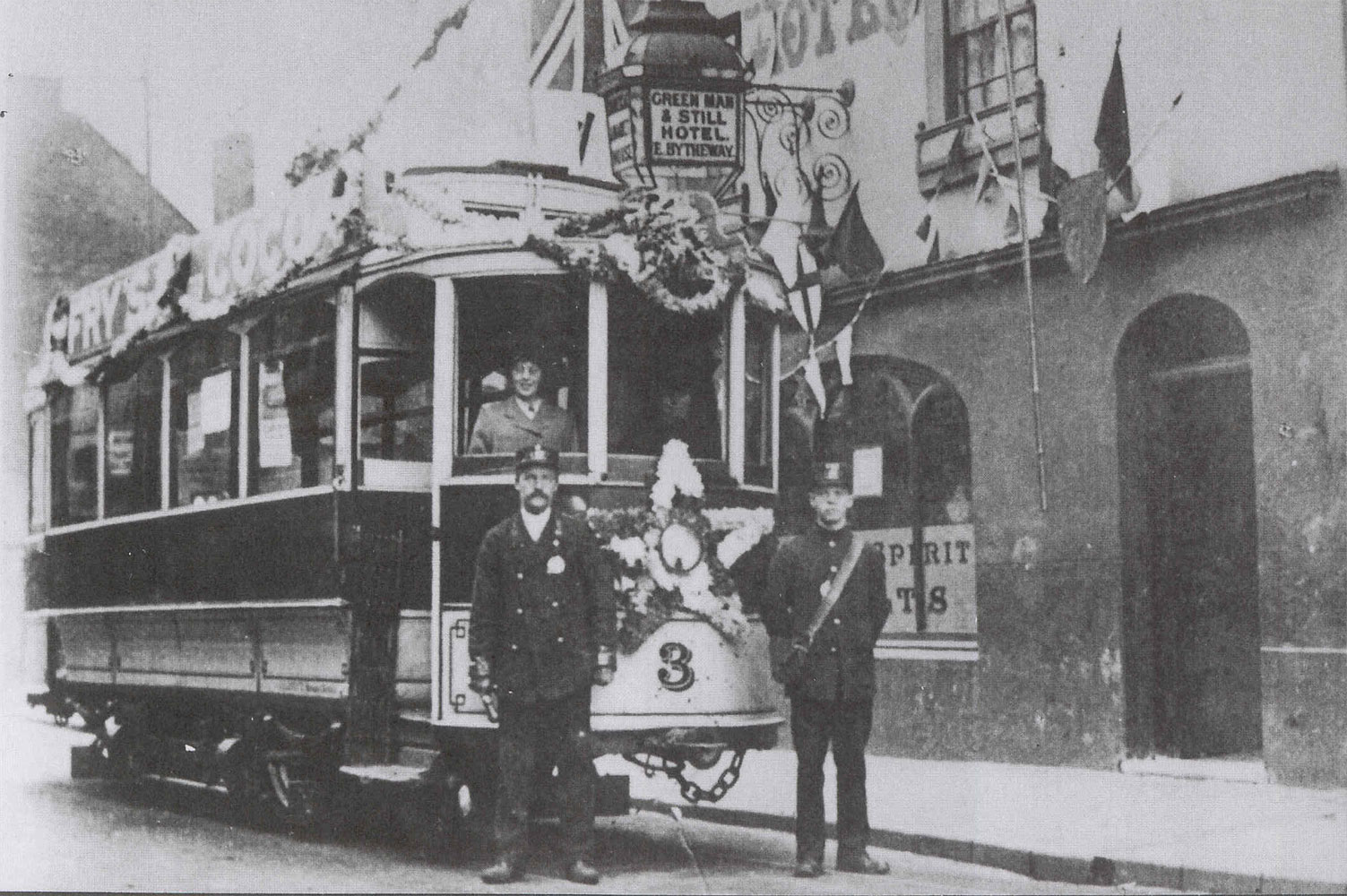
A local tram, well decorated. This was taken in 1902 and so the decorations may have been for the coronation of Edward VII or possibly simply the opening of the tram service.
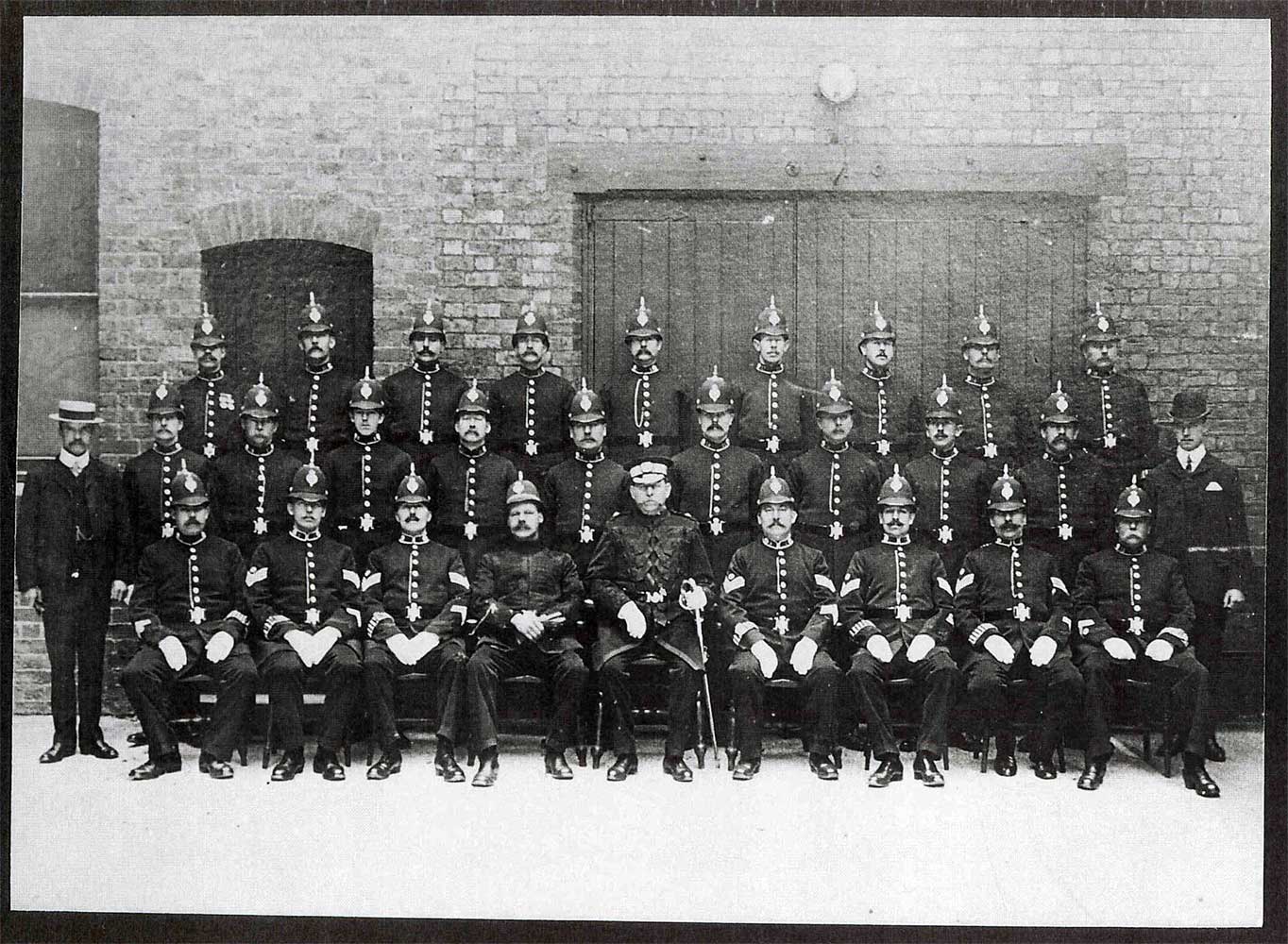
The picture of the local Kidderminster Borough Police I thought may be of particular interest… If Arthur had remained in England and joined the Police force, he would undoubtedly have been a “Bobby” like them. Probably would have to have grown a moustache though.
— Pauline Colsey, March 2009
Stewart Says Laxity on Vice Will Be Probed
Camden Evening Courier —
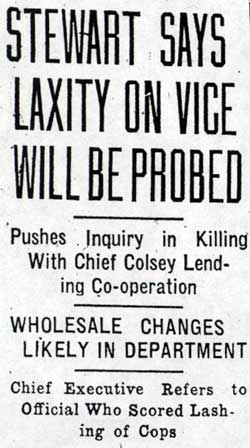
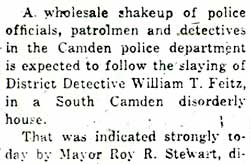
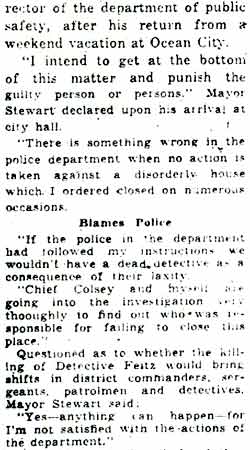
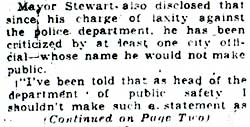
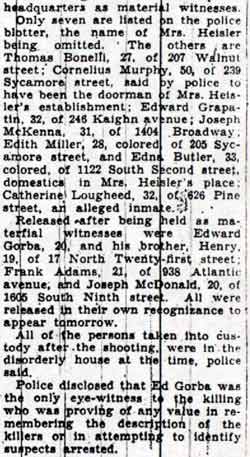
Pushes Inquiry in Killing With Chief Colsey Lending Co-operation
WHOLESALE CHANGES LIKELY IN DEPARTMENT
Chief Executive Refers to Official Who Scored Lashing of Cops
A wholesale shakeup of police officials, patrolmen and detectives in the Camden police department is expected to follow the slaying of District Detective William T. Feitz, in a South Camden disorderly house.
That was indicated strongly today by Mayor Roy R. Stewart, director of the department of public safety, after his return from a weekend vacation at Ocean City.
“I intend to get at the bottom of this matter and punish the guilty person or persons,” Mayor Stewart declared upon his arrival at city hall.
“There is something wrong in the police department when no action is taken against a disorderly house which I ordered closed on numerous occasions.
Blames Police
“If the police in the department had followed my instructions we wouldn’t have a dead detective as a consequence of their laxity.
“Chief Colsey and myself are going into the investigation very thooughly [sic] to find out who was responsible for failing to close this place.”
Questioned as to whether the killing of Detective Feitz would bring shifts in district commanders, sergeants, patrolmen and detectives, Mayor Stewart said:
“Yes—anything can happen—for I’m not satisfied with the actions of the department.”
Mayor Stewart also disclosed that since his charge of laxity against the police department, he has been criticized by at least one city official—whose name he would not make public.
“I’ve been told that as head of the department of public safety I shouldn’t make such a statement as I did yesterday because of the effect it would have on the morale of the police department.
Will Shield None
“Well, I want it to be known that I am not guilty of shielding anyone in the operation of this disorderly house. I have a right to protect anyone in the department who is not involved in this violation of my orders and that is what I intend to do in my investigation.”
Mayor Stewart’s first move when he reached his offices was to call Chief Colsey into conference to discuss the events leading up to the death of Detective Feitz early Sunday in the disorderly house allegedly operated by Mrs. Emma Heisler, 38, at 243 Sycamore street.
Later, he announced, he would confer with the district and detective lieutenants and sergeants to find out why his orders issued a number of times to close up Mrs. Heisler’s establishment, were not carried out. The conference, Mayor Stewart indicated, would take place this afternoon.
To Quiz Demoted Pair
Two district detectives who were demoted and returned to beats a few days before Detective Feitz was killed, who covered the neighborhood of Second and Sycamore streets, are also to be grilled by Mayor Stewart. One of the detectives, according to police, is a relative of Mrs. Heisler.
While Mayor Stewart and Chief Colsey were conferring, police and detectives still were engaged in running down clues to the identity of the slayers of the detective who was shot when he walked in on a holdup of 20 persons in the disorderly house.
Three bandits who shot Feitz then rushed out the door and directly past District Detective Joseph H. Leonhardt who was bending over Feitz’s body which had hurtled through the front door and dropped down the steps to the street.
The two detectives in a police radio car had been trailing a suspicious car containing the bandits for some time prior to the shooting [text between crops not shown]
Colsey Speaks Freely
Chief Colsey unlike Detective Lieutenant Ward who has persistently refused to talk to newspapermen or give them any information, spoke freely about the police investigation of Feitz’s death.
“I feel confident that within a few days we will have the killer or killers of Feitz under arrest,” Chief Colsey said.
He admitted that all of the suspects arrested here, in Philadelphia and Atlantic City to date had not been identified as members of the bandit mob.
A suspect who was arrested last night by Chief Colsey and a detective in cruising about the city was released after being questioned.
Another suspect arrested early today was still being held by the police, who refused to reveal his identity. Chief Colsey stated that he did not think the man was involved in the killing of Feitz.
8 Still Held
However, four men and four women are being held in cells at police headquarters as material witnesses.
Only seven are listed on the police blotter, the name of Mrs. Heisler being omitted. The others are Thomas Bonelli, 27, of 207 Walnut street; Cornelius Murphy, 50, of 239 Sycamore street, said by police to have been the doorman of Mrs. Heisler’s establishment; Edward Grapatin, 32, of 246 Kaighn avenue; Joseph McKenna, 31, of 1404 Broadway; Edith Miller, 28, colored, of 205 Sycamore street, and Edna Butler, 33, colored, of 1122 South Second street, domestics in Mrs. Heisler’s place; Catherine Lougheed, 32, of 626 Pine street, an alleged inmate.
Released after being held as material witnesses were Edward Gorba, 20, and his brother, Henry, 19, of 17 North Twenty-first street; Frank Adams, 21, of 938 Atlantic avenue, and Joseph McDonald, 20, of 1605 South Ninth street. All were released in their own recognizance to appear tomorrow.
All of the persons taken into custody after the shooting, were in the disorderly house at the time, police said.
Police disclosed that Ed Gorba was the only eye-witness to the killing who was proving of any value in remembering the description of the killers or in attempting to identify suspects arrested.