Walter Stanton Sr.
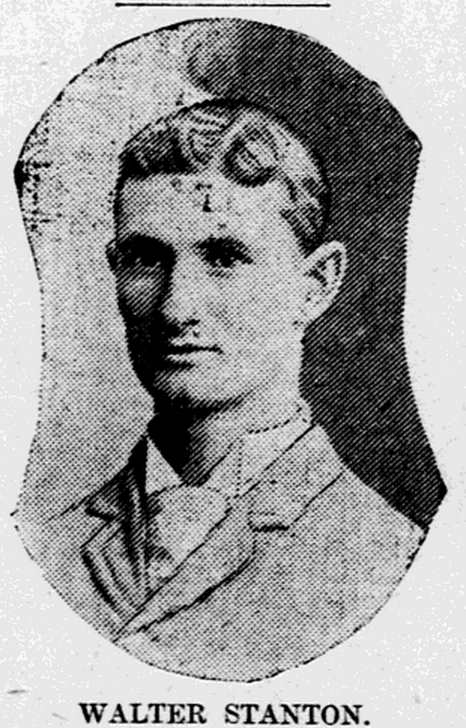
Walter Stanton Sr. — Philadelphia Inquirer, June 16, 1902.
WALTER JAMES ALOYSIUS STANTON SR. was born in March of 1867 to James and Emma Stanton. The 1870 Census shows the family in what was then Camden’s South Ward. The 1880 Census finds the Stanton family, which included older brother Willie and younger siblings Elizabeth and Wesley, at 439 Riley Street in the Fourth Ward. The Stanton family lived at 230 Washington Street in the late 1880s and 1890s. Walter Stanton worked as an upholsterer in the 1880s and 1890s.
Walter Stanton married Elizabeth Kelly around 1892. On September 27, 1893 a son, Walter Stanton Jr., was born. Another son, Thomas Carroll Stanton was born on January 1, 1901.
As a young man, and well into his 30s, Walter Stanton Sr. was well known in Camden as a baseball player. He worked at a number of different jobs after he married, alternately as a butcher, a driver, and a salesman. He also was involved with a number of social organizations, including the Camden Wheelmen, a group of bicycle enthusiasts.
The 1894 City Directory shows Walter Stanton at 450 South 2nd Street. He was at 226 Berkley the next year. The 1896 City Directory shows Walter Stanton and family at 434 South 2nd Street. He was then working as a driver for R.T. Robinson. By 1897 he was working as a driver and salesman for W. Mills & Brother, a meat business located at 1598 Broadway. The family then lived at 310 Clinton Street, before moving to 318 Berkley Street, where they stayed from 1898 through 1905. The Census of 1900 shows that his brother-in-law Joseph Kelly lived with the family. Walter Stanton Sr. was then still working as a butcher, most likely for W. Mills and Brother. Walter Stanton Sr. is listed as a driver in the 1901 and 1902 editions, probably still at the same place of employment. From 1903 through 1905 he worked as water tapper.
By 1906 the family had moved to 522 South 2nd Street. Walter Stanton Sr. had by then joined the Camden Police Department. The following year saw Walter Stanton Sr. playing right field for the Camden Police Department’s baseball team.
Walter Stanton Sr. served on the Camden Police Department into the 1930s. Son Thomas Stanton also was on the force from the mid-1920s through at least 1950.
When the Census was taken in 1910, the Stanton family lived at 1139 Pear Street, which was later renamed Whitman Avenue. Also at home was father-in-law John Kelly. Oldest son Walter Stanton Jr. was then working as a clerk, according to the Census, but he had other plans for himself that would take him to the vaudeville stage.
When it was time for him to register for the draft on June 5th of 1917, Walter Stanton Jr. and his parents and brother were living at 604 South 3rd Street. He was not working at the time. He joined the United States Navy on June 25, 1917 and served as an Able Seaman during World War I.
The Stanton family had moved to 618 South 2nd Street by the end of 1919. After returning from the Navy, Walter Stanton Jr. had by this time established himself on the vaudeville stage, listing his occupation as “vocalist.” Through the mid-1940s Walter Stanton Jr. partnered in a variety act with Joe Hamilton, a veteran vaudeville and minstrel show entertainer who lived in Camden. The act ended with Hamilton’s death in 1946.
The 1924 City Directory shows that the Walter Stanton Sr. family had moved to 533 Fulton Place. They remained at that address through at least April of 1930.
The 1940 Census shows Walter Stanton, although well past 70, still working as a Camden police officer. Mandatory retirement at age 65 would not come into play until after World War II. He and wife Elizabeth were then living at 362 Dudley Street in the then new Westfield Acres public housing project.
An A.C.S.N. Player Injured
Philadelphia Inquirer —
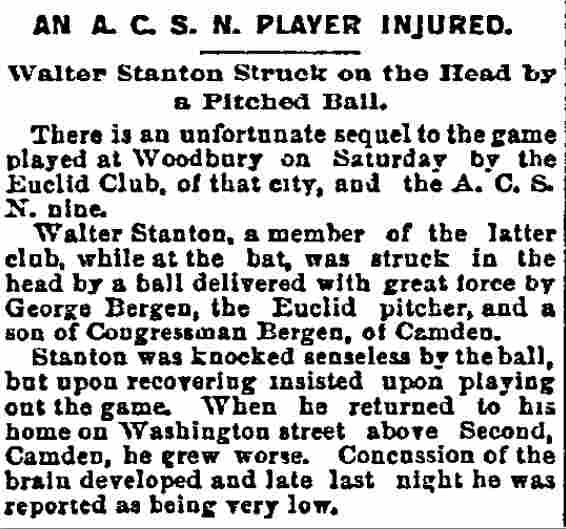
Walter Stanton Struck on the Head by a Pitched Ball.
There is an unfortunate sequel to the game played at Woodbury on Saturday by the Euclid Club, of that city, and the A. C. S. N. nine.
Walter Stanton, a member of the latter club, while at the bat, was struck in the head by a ball delivered with great force by George Bergen, the Euclid pitcher, and a son of Congressman Bergen, of Camden.
Stanton was knocked senseless by the ball, but upon recovering insisted upon playing out the game. When he returned to his home on Washington street above Second, Camden, he grew worse. Concussion of the brain developed and late last night he was reported as being very low.
New Year’s Day in Camden
Philadelphia Inquirer —
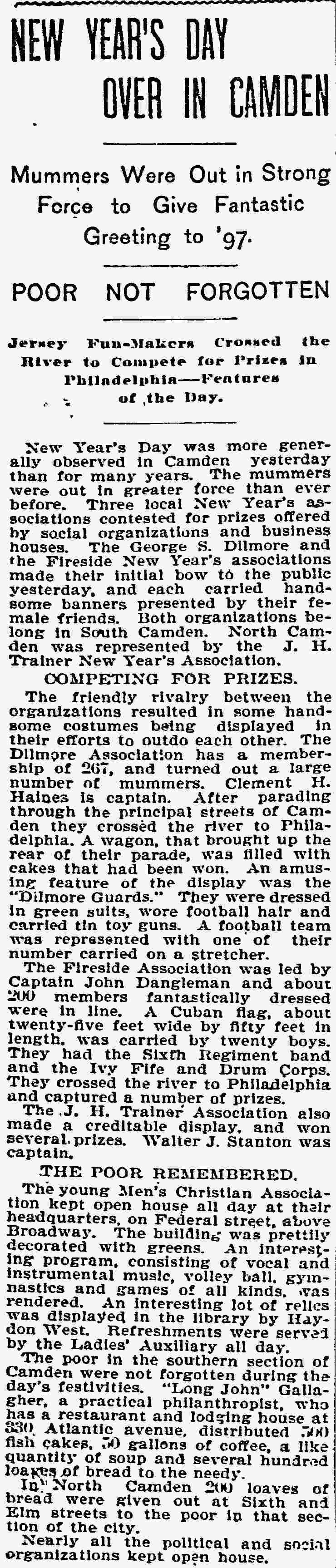
Mummers Were Out in Strong Force to Give Fantastic Greeting to ’97
Poor Not Forgotten
Jersey Fun-Makers Crossed the River to Compete for Prizes in Philadelphia — Features of the Day.
New Year’s Day was more generally observed in Camden yesterday than for many years. The mummers were out in greater force than ever before. Three local New Year’s associations contested for prizes offered by social organizations and audiences. The George S. Dilmore and the Fireside New Year’s associations made their initial bow to the public yesterday, and each carried handsome banners presented by their female friends. North Camden was represented by the J. H. Trainer New Year’s Association.
Competing for Prizes.
The friendly rivalry between the organizations resulted in some handsome costumes being displayed in various contests. The Dilmore Association had a membership of 267, and turned out a large number of mummers. Captain H. Haines is captain. After parading through the principal streets of Camden they crossed the river for Philadelphia. A wagon, that brought up the rear of the parade, was piled with cakes that had been won. An amusing feature of the display was the appearance of a small boy, dressed in green suits, wore football hair and carried banners. North Camden was represented with one of their number carried on a stretcher.
The J. H. Trainer Association was led by Captain John Dangleman and about 200 members fantastically dressed were in line. A 1,000 flag, twenty-five feet wide by fifty feet in length, was carried by the captain. They had the Sixth Regiment band and the Ivy Fife and Drum Corps. Captain Walter J. Stanton was captain of the J. H. Trainer Association also and made a creditable display, and the two having a good time, giving prizes to all they could find.
The Poor Remembered.
The Young Men’s Christian Association kept open house all day at their headquarters, on Federal street and Broadway. The building was prettily decorated and an interesting program, consisting of vocal and instrumental music, volley ball, gymnastics and other exercises, were rendered. An interesting lot of relics were displayed by the Camden chapter of the Daughters of the American Revolution. In North Camden 200 loaves of bread and 50 gallons of coffee were given to the poor in that section.
Crescent Wheelmen Annual Ball
Philadelphia Inquirer —
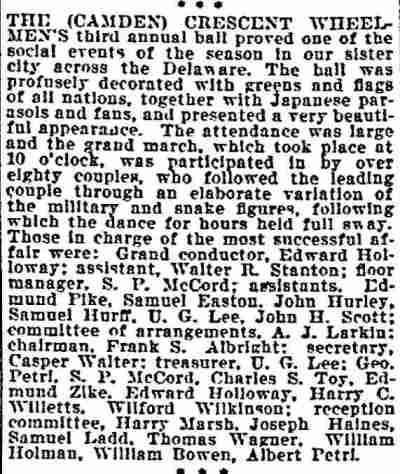
The (Camden) Crescent Wheelmen’s third annual ball proved one of the social events of the season in our sister city across the Delaware. The ball was profusely decorated with greens and flags of all nations, together with Japanese parasols and fans, and presented a very beautiful appearance. The attendance was large and the grand march, which took place at 10 o’clock, was participated in by over eighty couples, who followed the leading couple through an elaborate variation of the military and snake figures, following which the dance for hours held full sway.
Those in charge of the most successful affair were: Grand conductor, Edward Holloway; assistant, Walter R. Stanton; floor manager, S. P. McCord; assistants, Edmund Pike, Samuel Easton, John Hurley, Samuel Hurff, U. G. Lee, John H. Scott; committee of arrangements, A. J. Larkin; chairman, Frank S. Albright; secretary, Casper Walter; treasurer, U. G. Lee; Geo. Petri, S. P. McCord, Charles S. Toy, Edmund Zike, Edward Holloway, Harry C. Willetts, Wilford Wilkinson; reception committee, Harry Marsh, Joseph Haines, Samuel Ladd, Thomas Wagner, William Holman, William Bowen, Albert Petri.
Fireside New Year’s Association
Philadelphia Inquirer —
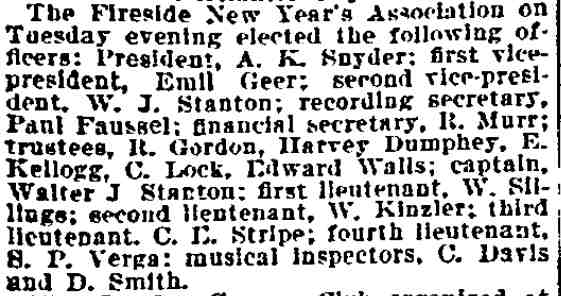
The Fireside New Year’s Association on Tuesday evening elected the following officers: President, A. K. Snyder; first vice-president, Emil Geer; second vice-president, W. J. Stanton; recording secretary, Paul Faussel; financial secretary, R. Murr; trustees, R. Gordon, Harvey Dumphey, E. Kellogg, C. Lock, Edward Walls; captain, Walter J. Stanton; first lieutenant, W. Sillings; second lieutenant, W. Kinzler; third lieutenant, C. E. Stripe; fourth lieutenant, S. P. Verga; musical inspectors, C. Davis and D. Smith.
Hot Ball Broke His Ear Drum
Philadelphia Inquirer —
Popular South Camden Man and Captain of His Team Seriously Injured in a Game
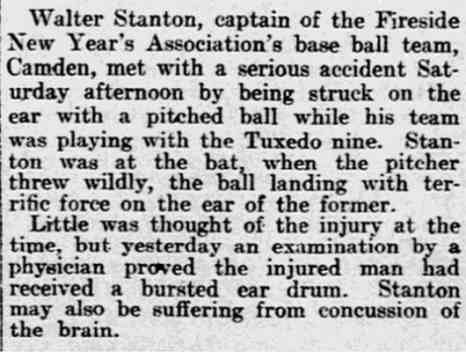
Walter Stanton, captain of the Fireside New Year’s Association’s base ball team, Camden, met with a serious accident Saturday afternoon by being struck on the ear with a pitched ball while his team was playing with the Tuxedo nine. Stanton was at the bat, when the pitcher threw wildly, the ball landing with terrific force on the ear of the former. Little was thought of the injury at the time, but yesterday an examination by a physician proved the injured man had received a bursted ear drum. Stanton may also be suffering from concussion of the brain.
Hackman Hurt by a Trolley Car
Philadelphia Inquirer —
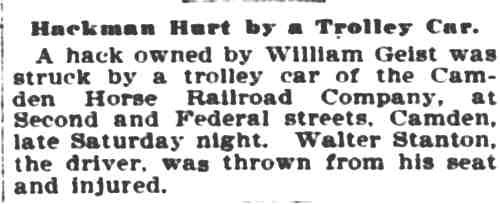
A hack owned by William Geist was struck by a trolley car of the Camden Horse Railroad Company, at Second and Federal streets, Camden, late Saturday night. Walter Stanton, the driver, was thrown from his seat and injured.
The Camden Police Team of 1907
From “When Father Was A Boy” — Camden Courier-Post,
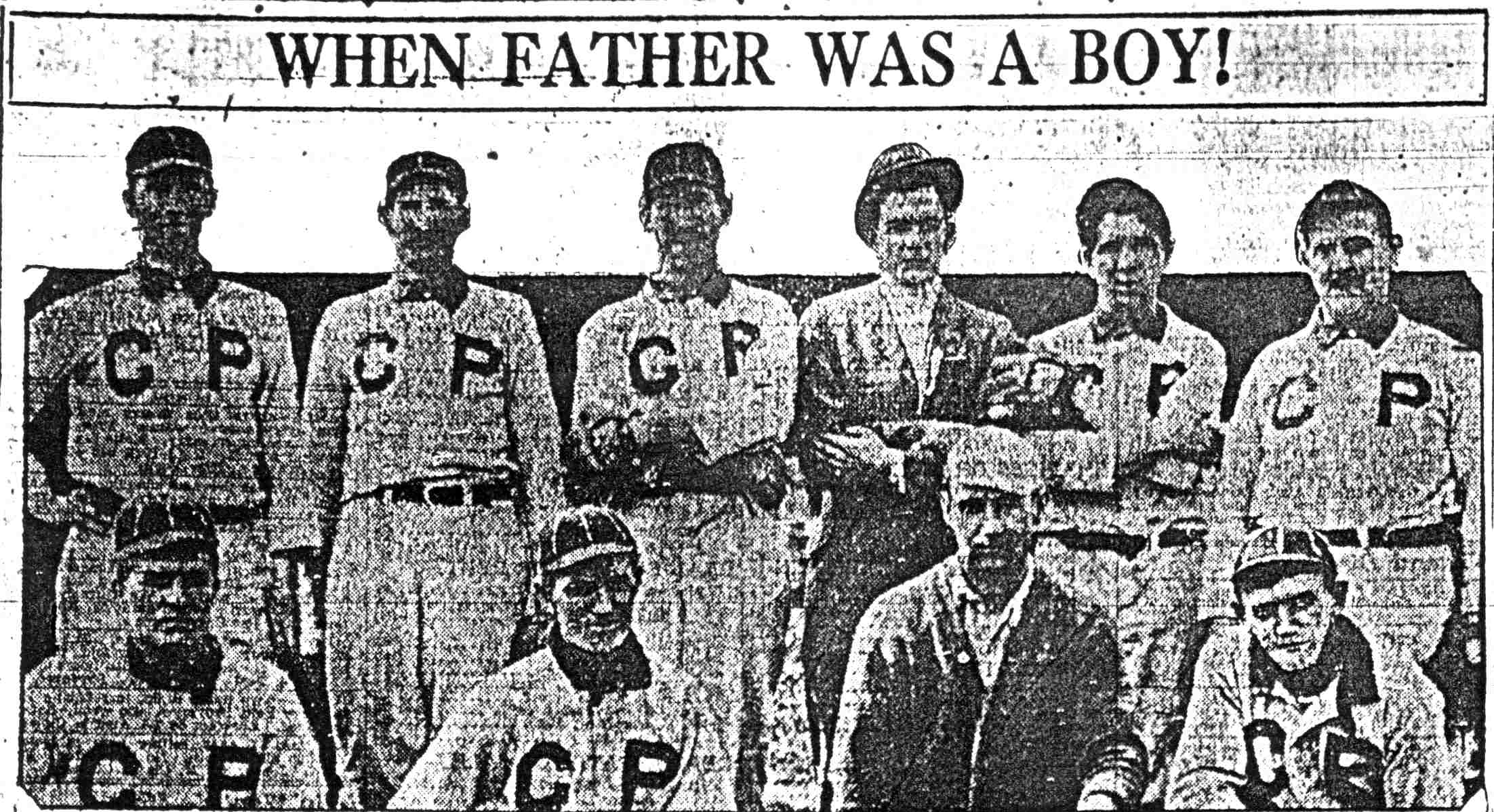

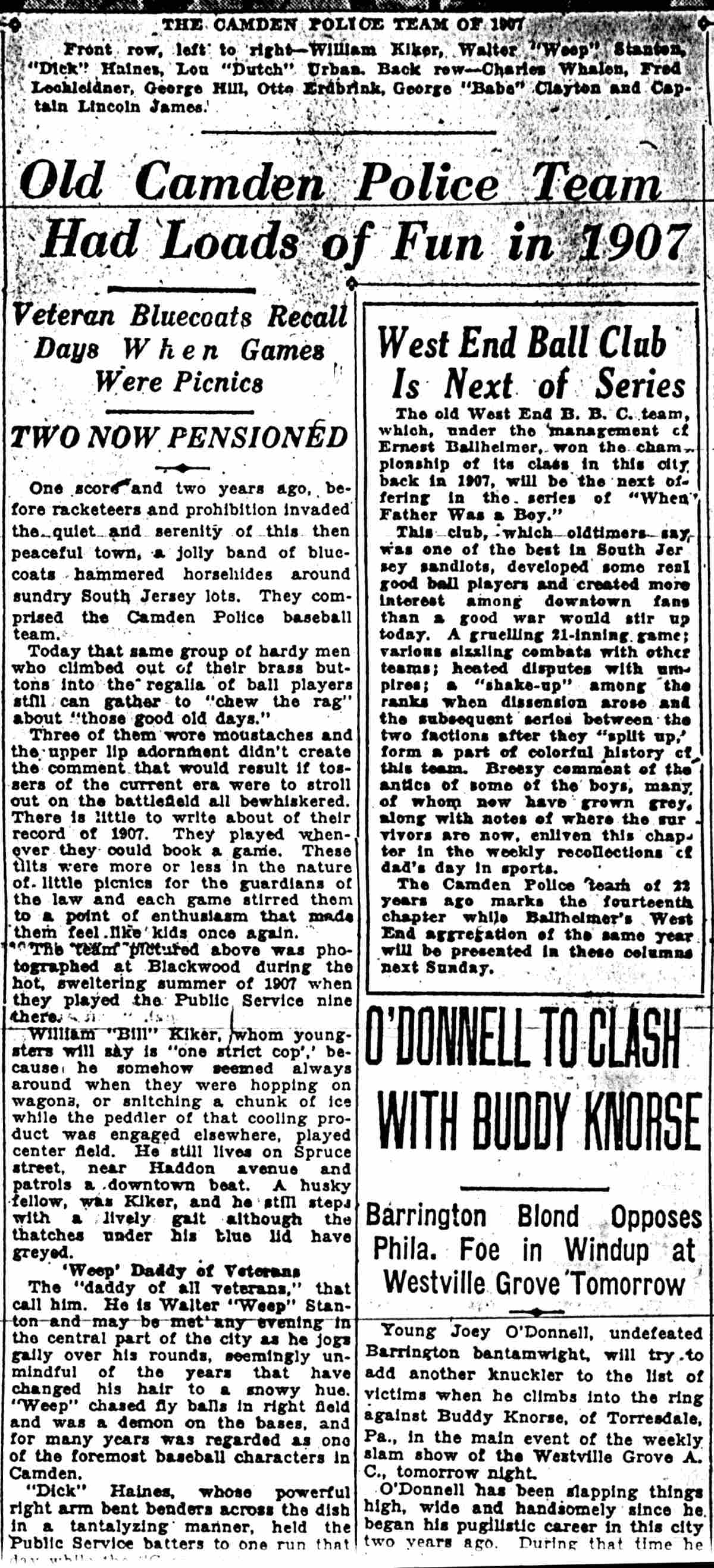
THE CAMDEN POLICE TEAM OF 1907. Front row, left to right — William Kiker, Walter “Weep” Stanton, “Dick” Haines, Lou “Dutch” Urban. Back row — Charles Whalen, Fred Lechleidner, George Hill, Otto Erdbrink, George “Babe” Clayton and Captain Lincoln James.
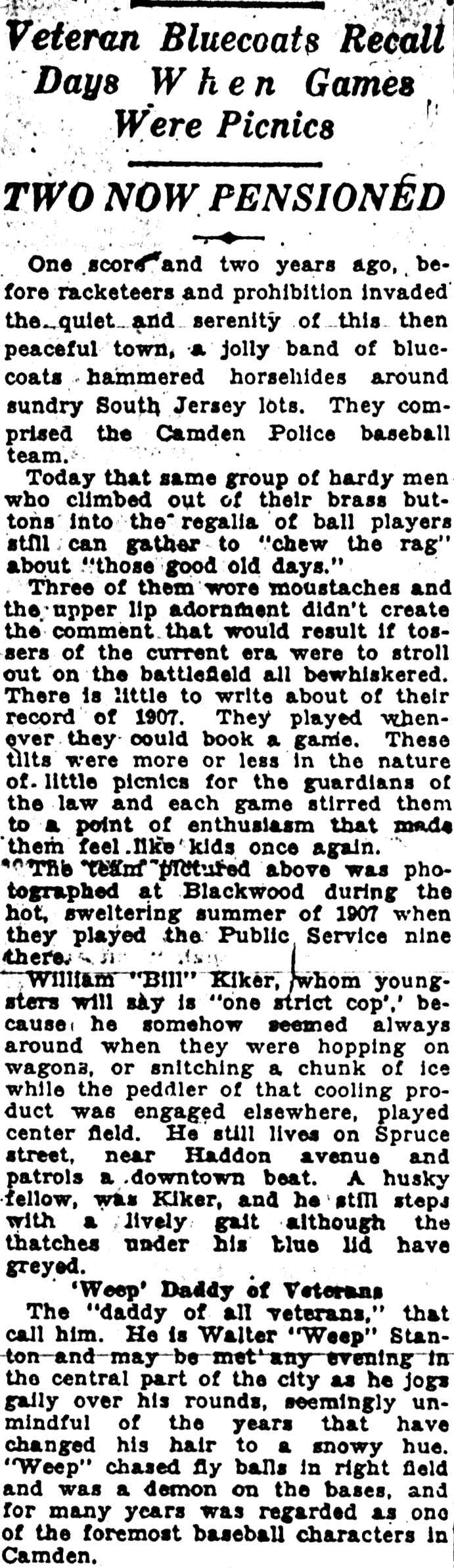
Veteran Bluecoats Recall Days When Games Were Picnics
Two Now Pensioned
One score and two years ago, before racketeers and prohibition invaded the quiet and serenity of this then peaceful town, a jolly band of bluecoats hammered horsehides around sundry South Jersey lots. They comprised the Camden Police baseball team.
Today that same group of hardy men who climbed out of their brass buttons into the regalia of ball players still can gather to “chew the rag” about “those good old days.”
Three of them wore moustaches and the upper lip adornment didn’t create the comment that would result if tossers of the current era were to stroll out on the battlefield all bewhiskered. There is little to write about of their record of 1907. They played whenever they could book a game. These little events, more or less in the nature of little picnics for the guardians of the law and each game stirred them to a point of enthusiasm that made them feel like kids once again.
The team pictured above was photographed at Blackwood during the hot, sweltering summer of 1907 when they played the Public Service nine there.
William “Bill” Kiker, whom youngsters will say is “one strict cop,” because he somehow seemed always around when they were hopping on wagons, or snitching a chunk of ice while the peddler of that cooling product was engaged elsewhere, played center field. He still lives on Spruce street, near Haddon avenue and patrols a downtown beat. As a husky fellow was Kiker, and he still steps with a lively gait although the thatches under his blue lid have greyed.
‘Weep’ Daddy of Veterans
The “daddy of all veterans,” that call him. He is Walter “Weep” Stanton and may be met any evening in the central part of the city as he jogs gaily over his rounds, seemingly unmindful of the years that have changed his hair to a snowy hue. “Weep” chased fly balls in right field and was a demon on the bases, and for many years was regarded as one of the foremost baseball characters in Camden.
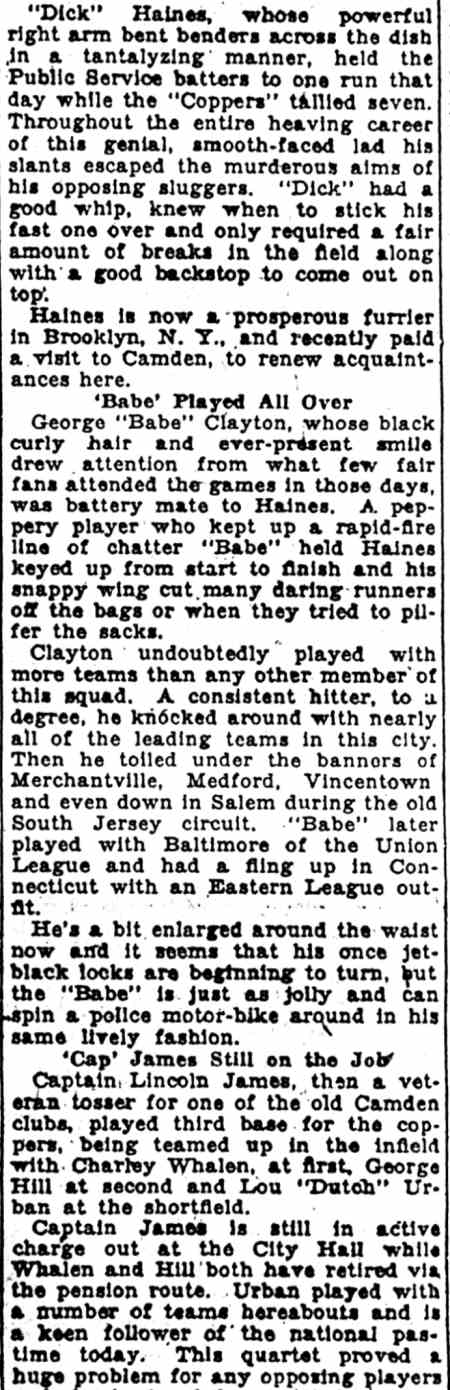
“Dick” Haines, whose powerful right arm bent benders across the dish in a tantalizing manner, held the Public Service batters to one run that day while the “Coppers” tallied seven. Throughout the entire heaving career of this genial, smooth-faced lad his slants escaped the murderous aims of his opposing sluggers. “Dick” had a good whip, knew when to stick his fast one over and only required a fair amount of breaks in the field along with a good backstop to come out on top. Haines is now a prosperous furrier in Brooklyn, N. Y., and recently paid a visit to Camden, to renew acquaintances here.
‘Babe’ Played All Over
George “Babe” Clayton, whose black curly hair and ever-present smile drew attention from what few fair fans attended the games in those days, was battery mate to Haines. A peppery player who kept up a rapid-fire line of chatter “Babe” held Haines keyed up from start to finish and his snappy wing cut many daring runners off the bags or when they tried to pilfer the sacks. Clayton undoubtedly played with more teams than any other member of this squad. A consistent hitter, to a degree, he knocked around with nearly all of the leading teams in this city. Then he toiled under the banners of Merchantville, Medford, Vincentown and even down in Salem during the old South Jersey circuit. “Babe” later played with Baltimore of the Union League and had a fling up in Connecticut with an Eastern League outfit. He’s a bit enlarged around the waist now and it seems that his once jet-black locks are beginning to turn, but the “Babe” is just as jolly and can spin a police motor-bike around in his same lively fashion.
‘Cap’ James Still on the Job
Captain Lincoln James, then a veteran tosser for one of the old Camden clubs, played third base for the coppers, being teamed up in the infield with Charley Whalen, at first, George Hill at second and Lou “Dutch” Urban at the shortfield. Captain James is still in active charge out at the City Hall while Whalen and Hill both have retired via the pension route. Urban played with a number of teams hereabouts and is a keen follower of the national pastime today. This quartet proved a huge problem for any opposing players and freely handed out headaches to umpires.
Fred Lechleidner, one of the outfielders who sported a moustache, patroled the left side of the pasture. He is that dignified gendarme who occupies the post of sergeant-at-arms in the Camden Police Court where Judge Garfield Pancoast is the umpire-in-chief.
Otto Erdbrink, shown in the above photo, was one of those fellows who liked to travel around with “the boys.” He was a loyal fan, rarely missing a game in which the “cops” were booked to battle.
Philadelphia Inquirer — July 28, 1907

Weep Stanton a well-known player of this place, took his Chestnut Hill team to Wildwood on Saturday and was defeated.
Camden Increases Its Police Force
Philadelphia Inquirer —
Mayor Ellis Adds Twenty-five New Officers to Growing City’s Department
Camden’s police force was increased by the appointment of twenty-five additional officers by Mayor Ellis yesterday. There were also several promotions, two new captains, two sergeants and one detective being made as follows: Captains, Edward Hyde and A. Lincoln James, advanced from sergeants; sergeants, E. B. McClong and Edward Hartman, advanced from patrolmen; detective, John Brothers, advanced from patrolman; new patrolmen: Fred Schwetzer, William Briant, Charles Hume, Charles Wilbur, Wright Cox, Walter Stanton, John Barnett, Tabor Quinn, John Gilbert, Joseph Palese, William Haines, Frederick Watson, Charles Whaland, William Kiker, James Hutt, George Krown, Ule Andrews, Daniel Stanton, Albert Archer, Harry Bakley, John Shuman, Oscar Till, Albertson Matlack, John Devlin, George Hollins, Frank Koplain, Edward King and George Beasley, substitutes.
For the past several weeks there has been much pulling and hauling of the political wires and the various ward leaders have had their own troubles in making selections. Each appointee was subjected to a regulation army examination by Dr. A. H. Lippincott before he was pronounced fit for the service. When the horses are procured, which may be by next June, six of the men will compose a mounted squad.
Run Down By an Electric Train
Philadelphia Inquirer —
Lying on the bank of the Newton Creek, near the abutment of the West Jersey and Seashore Railroad bridge, the body of an unknown man who had been killed by an electric train, was found yesterday by Mounted Officer Walter Stanton in Camden. It was taken to the Morgue to await identification. The train had crushed his skull and mangled his legs. There was a penknife found in the pocket bearing the name of “Charles Adlasiek.” Letters were found on him addressed to “Lydox Kozal, 2612 Woodstock street, Philadelphia, Pa.” and “St. Joseph’s Polish Home, 12 Broad street, New York City.”
Dog Bit Mounted Policeman
Philadelphia Inquirer —
In an effort to save several children from being bitten by a mad dog at Tenth and Pine streets, Camden, yesterday, Mounted Policeman Walter Stanton was himself attacked. One of his feet was badly torn, the injury being treated at the Cooper Hospital. Ella Runyar, 5 years old, of 713 Jayne street, was also bitten. The dog created a furore in the neighborhood before Policeman Stanton dispatched it with a revolver shot.
Handing Out Gunning Licenses in Camden
Philadelphia Inquirer —
County Clerk Patterson and His Office Force Work Overtime to Meet Gunners’ Demands
From the time County Clerk Frank Patterson opened his office in Camden yesterday until last night there was a constant coming and going of sportsmen anxious to get gunning licenses for the opening of the season tomorrow. The entire clerical force was kept busy, and, while usually the office closes at noon on Saturday, it was kept open until 5 o’clock to accommodate the sportsmen. Ofttimes they had their dogs with them and the occasional baying made the office sound like a field where cotton tails are skurrying to secure cover.
In all, it is estimated that at least three thousand licenses have been issued by Clerk Patterson, and it seems likely that the fields in and about Camden county will have a small army of gunners by the peep of day tomorrow morning. Not only have resident but non-resident licenses as well have been issued by the score, mostly to Philadelphians.
That the cotton tails will have to keep on the move is evident from the fact that Camden’s Police Department is to send to the woods such a squad of able sportsmen as Policemen James Clay, George Cooper, Fiore Troncone, Edward Pike, Walter Stanton, Oscar Weaver, Albert Shaw and Sergeants William Schregler, James Tatem and Edward Hartman.
Camden News-Notes
Philadelphia Inquirer —
Carroll Stanton, the 4-year-old son of Policeman Walter Stanton, of 1129 Pear street, had his cheek and eyelid torn by a bull terrier yesterday. The boy was treated by a physician.
A Policeman’s Experience
Savannah Tribune —
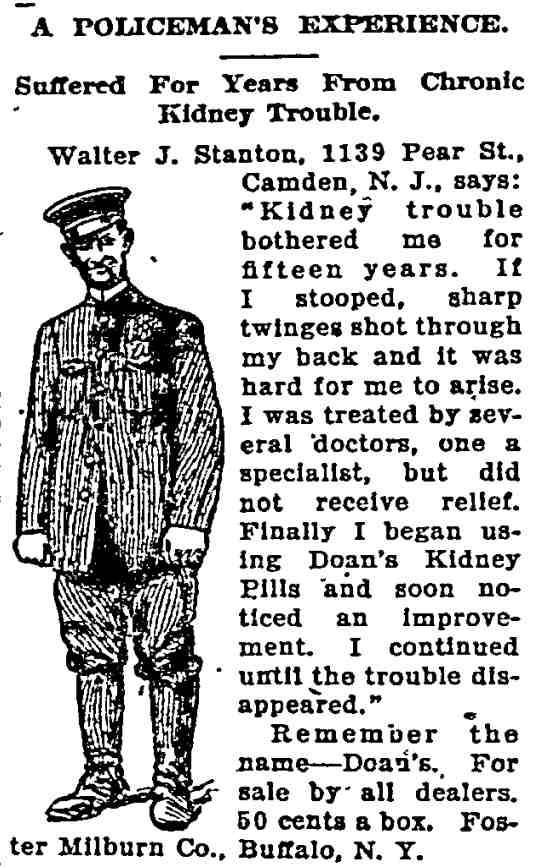
Suffered For Years From Chronic Kidney Trouble.
Walter J. Stanton, 1139 Pear St., Camden, N. J., says: “Kidney trouble bothered me for fifteen years. If I stooped, sharp twinges shot through my back and it was hard for me to arise. I was treated by several doctors, one a specialist, but did not receive relief. Finally I began using Doan’s Kidney Pills and soon noticed an improvement. I continued until the trouble disappeared.” Remember the name — Doan’s. For sale by all dealers. 50 cents a box. Foster Milburn Co., Buffalo, N. Y.
Philadelphia Inquirer — May 22, 1911
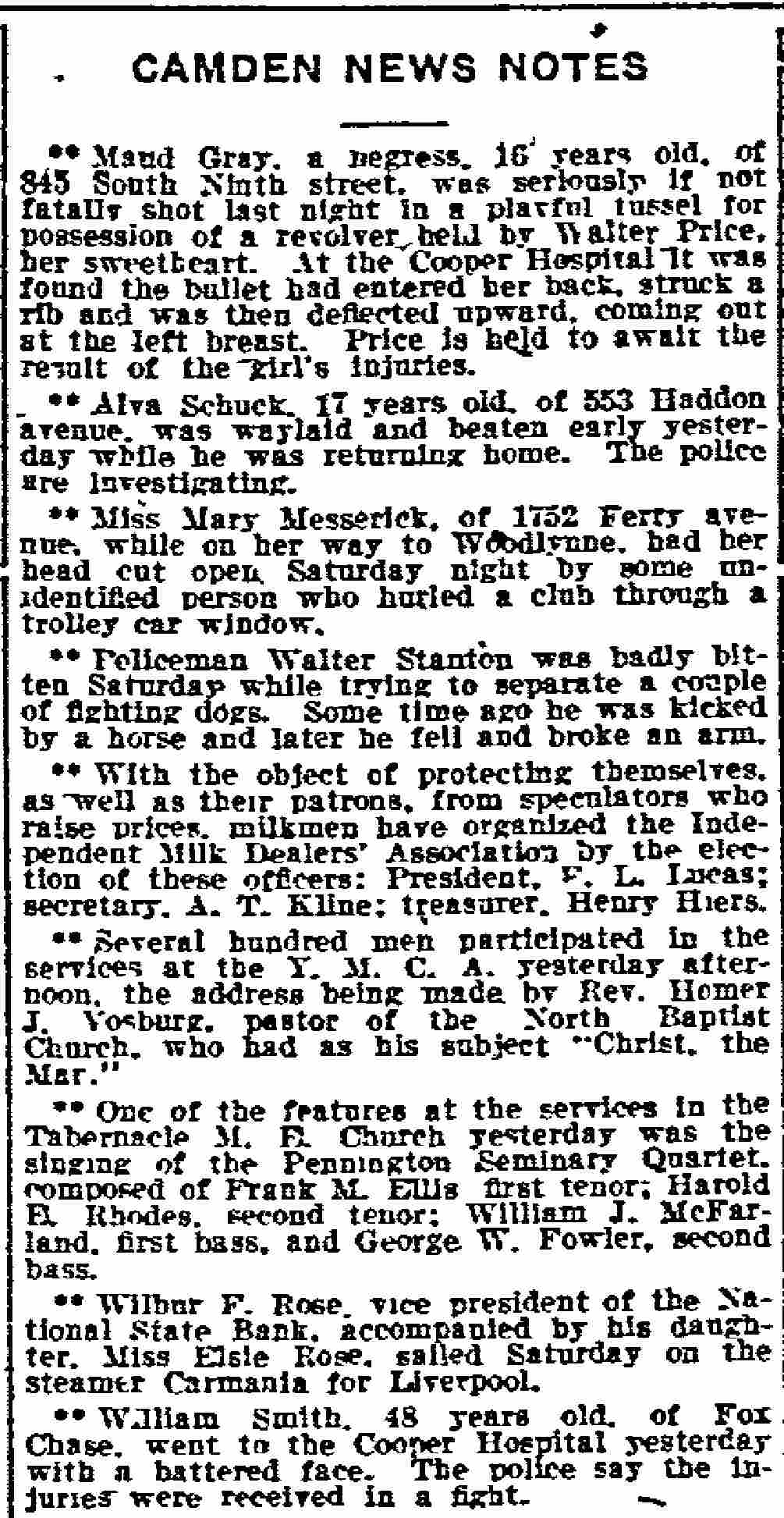
Policeman Walter Stanton was badly bitten Saturday while trying to separate a couple of fighting dogs. Some time ago he was kicked by a horse and later he fell and broke an arm.
Third Ward Club Holds Fine Ball
Camden Post-Telegram —
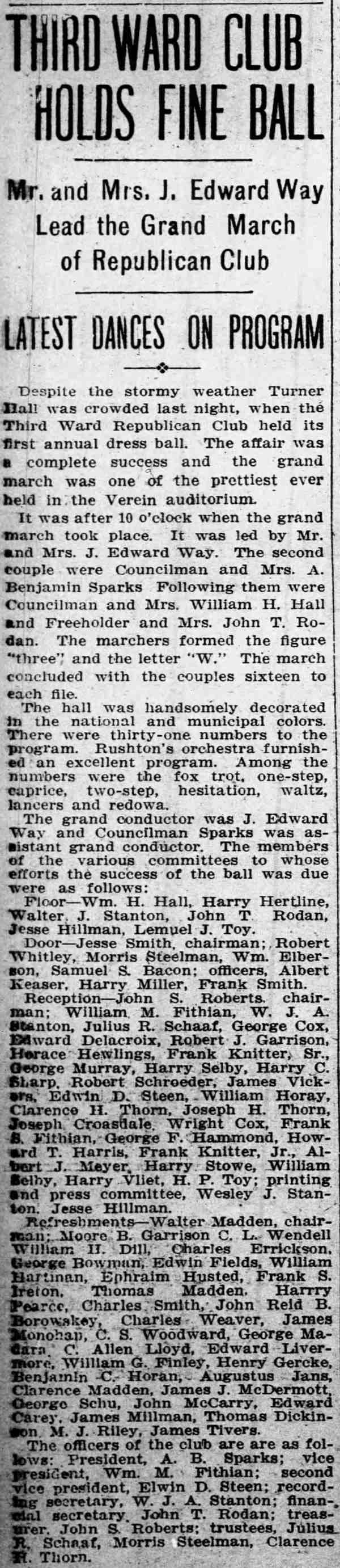
Third Ward Club Holds Fine Ball
Mr. and Mrs. J. Edward Way Lead the Grand March of Republican Club
Latest Dances on Program
Despite the stormy weather Turner Hall was crowded last night, when the Third Ward Republican Club held its first annual dress ball. The affair was a complete success and the grand march was one of the prettiest ever held in the Verein auditorium.
It was after 10 o’clock when the grand march took place. It was led by Mr. and Mrs. J. Edward Way. The second couple were Councilman and Mrs. A. Benjamin Sparks. Following them were Councilman and Mrs. William H. Hall and Freeholder and Mrs. John T. Rodan. The marchers formed the figure “three” and the letter “W.” The march concluded with the couples sixteen to each file.
The hall was handsomely decorated in the national and municipal colors. There were thirty-one numbers to the program. Rushton’s orchestra furnished an excellent program. Among the numbers were the fox trot, one-step, caprice, two-step, hesitation, waltz, lancers and redowa.
The grand conductor was J. Edward Way and Councilman Sparks was assistant grand conductor. The members of the various committees to whose efforts the success of the ball was due were as follows:
Floor—Wm. H. Hall, Harry Hertline, Walter J. Stanton, John T. Rodan, Jesse Hillman, Lemuel J. Toy.
Door—Jesse Smith, chairman; Robert Whitley, Morris Steelman, Wm. Elberson, Samuel S. Bacon; officers, Albert Keaser, Harry Miller, Frank Smith.
Reception—John S. Roberts, chairman; William M. Fithian, W. J. A. Stanton, Julius R. Schaaf, George Cox, Edward Delacroix, Robert J. Garrison, Horace Hewlings, Frank Knitter, Sr., George Murray, Harry Selby, Harry C. Sharp, Robert Schroeder, James Vickers, Edwin D. Steen, William Horay, Clarence H. Thorn, Joseph H. Thorn, Joseph Croasdale, Wright Cox, Frank S. Fithian, George F. Hammond, Howard T. Harris, Frank Knitter, Jr., Albert J. Meyer, Harry Stowe, William Selby, Harry Vliet, H. P. Toy; printing and press committee, Wesley J. Stanton, Jesse Hillman.
Refreshments—Walter Madden, chairman; Moore B. Garrison, C. L. Wendell, William H. Dill, Charles Errickson, George Bowman, Edwin Fields, William Hartman, Ephraim Husted, Frank S. Ireton, Thomas Madden, Harry Pearce, Charles Smith, John Reid B. Borowakey, Charles Weaver, James Monohan, C. S. Woodward, George Madura, C. Allen Lloyd, Edward Livermore, William G. Finley, Henry Gercke, Benjamin C. Horan, Augustus Jans, Clarence Madden, James J. McDermott, George Schu, John McCarry, Edward Carey, James Millman, Thomas Dickinson, M. J. Riley, James Tivers.
The officers of the club are are [sic] as follows: President, A. B. Sparks; vice president, Wm. M. Fithian; second vice president, Elwin D. Steen; recording secretary, W. J. A. Stanton; financial secretary, John T. Rodan; treasurer, John S. Roberts; trustees, Julius R. Schaaf, Morris Steelman, Clarence R. Thorn.
Thief Caught With Bread
Philadelphia Inquirer —
After being chased several squares, Harry Fredericks, aged 21 years, of 205 Washington street, was arrested early yesterday by Policemen Steelman and Stanton. The fugitive had two loaves of bread beneath his coat, which he asserted he had found. Recorder Stackhouse refused to believe him and sentenced him to a month in jail.
Policeman’s Wife Gets Thief
Philadelphia Inquirer —
Mrs. Walter Stanton, wife of Mounted Officer Stanton, of Camden, proved herself just as good a preserver of the peace as her husband yesterday, when she overhauled John Dilks, aged 48 years, of 333 Steven street, after the man had walked into her kitchen and purloined a pair of rubbers. Mrs. Stanton just caught a fleeting glimpse of the man as he was leaving the back yard. She went after him and cornered him in an alley. Dilks was given four months in jail.
Prevents “Flu” Better Than Cheap Tonic
Woodbury Daily Times —
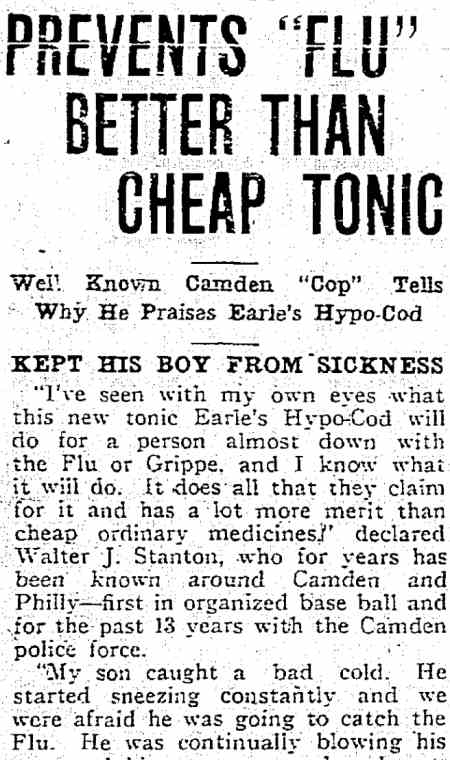
Well Known Camden “Cop” Tells Why He Praises Earle’s Hypo-Cod
Kept His Boy From Sickness
“I’ve seen with my own eyes what this new tonic Earle’s Hypo-Cod will do for a person almost down with the Flu or Grippe, and I know what it will do. It does all that they claim for it and has a lot more merit than cheap ordinary medicines,” declared Walter J. Stanton, who for years has been known around Camden and Philly — first in organized base ball and for the past 13 years with the Camden police force.
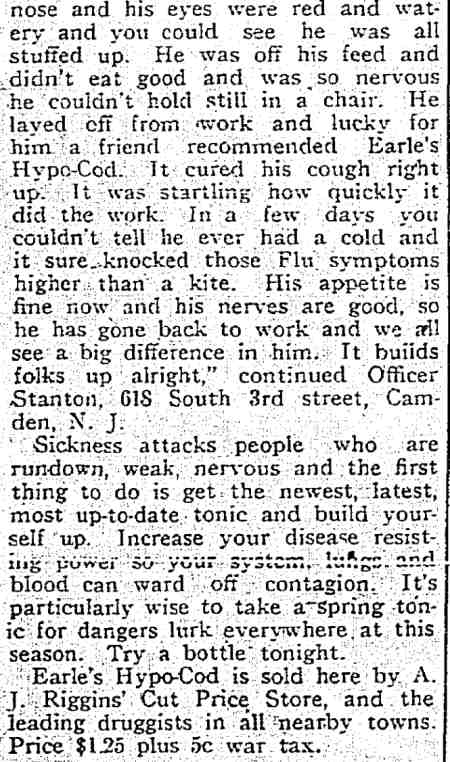
“My son caught a bad cold. He started sneezing constantly and we were afraid he was going to catch the Flu. He was continually blowing his nose and his eyes were red and watery and you could see he was all stuffed up. He was off his feed and didn’t eat good and was so nervous he couldn’t hold still in a chair. He layed off from work and lucky for him a friend recommended Earle’s Hypo-Cod. It cured his cough right up. It was startling how quickly it did the work. In a few days you couldn’t tell he ever had a cold and it sure knocked those Flu symptoms higher than a kite. His appetite is fine now and his nerves are good, so he has gone back to work and we all see a big difference in him. It builds folks up alright,” continued Officer Stanton, 618 South 3rd street, Camden, N. J.
Sickness attacks people who are rundown, weak, nervous and the first thing to do is get the newest, latest, most up-to-date tonic and build yourself up. Increase your disease resisting power so your system, lungs and blood can ward off contagion. It’s particularly wise to take a spring tonic for dangers lurk everywhere at this season. Try a bottle tonight. Earle’s Hypo-Cod is sold here by A. J. Riggins’ Cut Price Store, and the leading druggists in all nearby towns. Price $1.25 plus 5c war tax.