Introduction
Frank G. Hitchner was born in Upper Pittsgrove Township, Salem County NJ around 1871. His father Hiram Hitchner was a farmer. He married Emma Hogan around 1894. The 1900 Census shows the couple living at 308 Carteret Street. Mrs. Hitchner died in 1917. At the time of the 1920 census he was living at 3105 Westfield Avenue in Camden with his daughter Jessie, then 13. He remarried shortly after the 1920 census, to Mary Rowand, of Camden. Frank G. Hitchner owned the Hitchner Wallpaper Company and was a partner in Hitchner & Holmes at 5th & Mickle Streets in Camden, which sold hardwood flooring, millwork, and wallpaper. He also partnered with realtor Leon Todd, their firm, Hitchner & Todd, had built around 200 homes by 1924, 74 in that year alone. He also was one of the organizers of the East End Trust, on Federal Street in East Camden.
In 1923 he was elected to Camden’s new Board of Commissioners, and served for four years as Director of Public Safety, during the administration of Mayor Victor King. He served one term, stepping down in May of 1927. During his term as Director of Public Safety, the notorious Dr. Hyghcock incident occurred. He returned to his business after leaving City Hall.
By 1947 Frank Hitchner had moved to 316 Penn Street. He was then engaged primarily in real estate. Frank Hitchner passed away on June 3, 1957.
Portrait
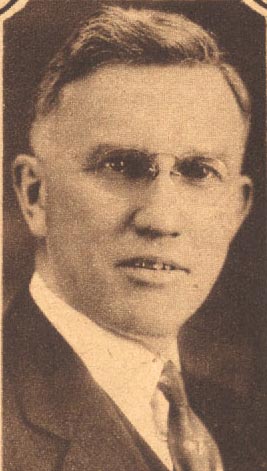
Frank G. Hitchner
South Jersey: A History 1624–1924
FRANK G. HITCHNER might be called a specialist in homes, for his chief interest lies in civic development and in the increase of the better homes and home owners. Indeed, the particular line of business in which Mr. Hitchner is engaged contributes to this end, for he has built up, step by step, a big wholesale and retail wall paper business and the largest molding mill in the East, outside of Baltimore — The Hitchner Wall Paper Company. His name is known all over the country among builders and wall paper merchants and his products are sent from Maine to Florida. His hardwood floor-laying establishment is the largest in New Jersey, known by the firm name Hitchner and Holmes. Two branch stores are located in Philadelphia.
Mr. Hitchner came to Camden from Elmer, in South Jersey, where he was born on a farm the early part of the last decade of the nineteenth century and began life as a salesman for the J. B. Van Sciver Company. After two years and a half of experience in this line, Mr. Hitchner was ready to begin for himself. He purchased a retail wall paper business, and devoted himself to making it grow for seven years. Then he entered a larger field, first, the manufacturing of wall paper, and later the wholesale distributing of same, developing the two firms above mentioned. In addition to supplying builders, he has done a big work himself in actual construction; under the firm name of Hitchner & Todd, about two hundred dwellings have been built. In 1924 alone, he put up seventy-four houses in and around Camden.
Even with his exacting business on hand, Mr. Hitchner does not live his life entirely for his own interests and his name appears in many of the business and social organizations of the city. He was one of the organizers and is a director of the East End Trust Company, a flourishing institution in East Camden, a director of the Ideal, Cooperative, Provident and the Public Safety Building & Loan Associations, of which latter, he is also the president. He serves on the Board of Directors of the Young Men’s Christian Association and is chairman of the Educational Committee. He was also one of the organizers of the new Camden Community Hotel: “Walt Whitman.”
In politics, Mr. Hitchner has likewise found time to do his share, filling the office of Director of Public Safety, to which he was elected as a Republican in a non-partisan Commission, April 1923.
Mr. Hitchner and his family are members of the Collingswood Methodist Episcopal Church. Socially, Mr. Hitchner is connected with the Masons, Camden Club, Rotary Club and the Tavistock Country Club.
Frank G. Hitchner married Emma H. Hogan in 1900, and six years later a daughter was born to them: Jessie H. Hitchner, who is now a student at Goucher College, Baltimore, Maryland. Mrs. Hitchner died in 1917 and after some years, Mr. Hitchner married again, his second wife being Mary A. Rowand, of Camden.
Three Firemen Met Death in Camden Blaze
Philadelphia Inquirer —
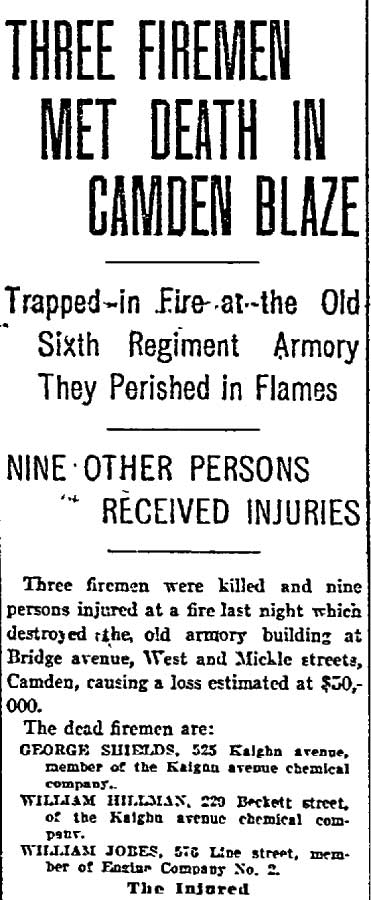
THREE FIREMEN MET DEATH IN CAMDEN BLAZE
Trapped in Fire at the Old Sixth Regiment Armory They Perished in Flames
NINE OTHER PERSONS RECEIVED INJURIES
Three firemen were killed and nine persons injured at a fire last night which destroyed the old armory building at Bridge avenue, West and Mickle streets, Camden, causing a loss estimated at $50,000.
The dead firemen are: GEORGE SHIELDS, 525 Kaighn avenue, member of the Kaighn avenue chemical company. WILLIAM HILLMAN, 229 Beckett street, of the Kaighn avenue chemical company. WILLIAM JOBES, 576 Line street, member of Engine Company No. 2.
The Injured
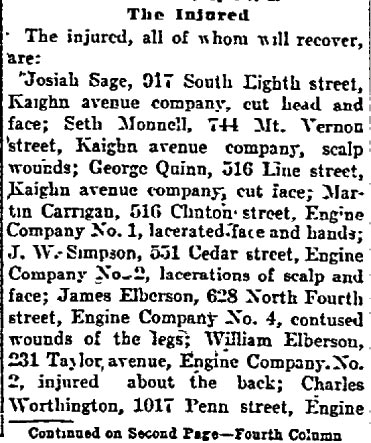
The Injured
The injured, all of whom will recover, are: Josiah Sage, 917 South Eighth street, Kaighn avenue company, cut head and face; Seth Monnell, 744 Mt. Vernon street, Kaighn avenue company, scalp wounds; George Quinn, 516 Line street, Kaighn avenue company, cut face; Martin Carrigan, 516 Clinton street, Engine Company No. 1, lacerated face and hands; J. W. Simpson, 551 Cedar street, Engine Company No. 2, lacerations of scalp and face; James Elberson, 628 North Fourth street, Engine Company No. 4, contused wounds of the legs; William Elberson, 231 Taylor avenue, Engine Company No. 2, injured about the back; Charles Worthington, 1017 Penn street, Engine
Continued on Second Page—Fourth Column
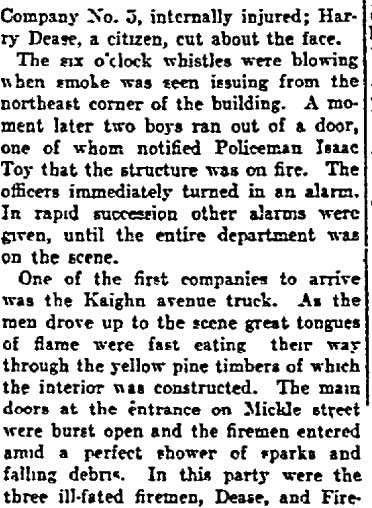
Company No. 3, internally injured; Harry Dease, a citizen, cut about the face.
The six o’clock whistles were blowing when smoke was seen issuing from the northeast corner of the building. A moment later two boys ran out of a door, one of whom notified Policeman Isaac Toy that the structure was on fire. The officers immediately turned in an alarm. In rapid succession other alarms were given, until the entire department was on the scene.
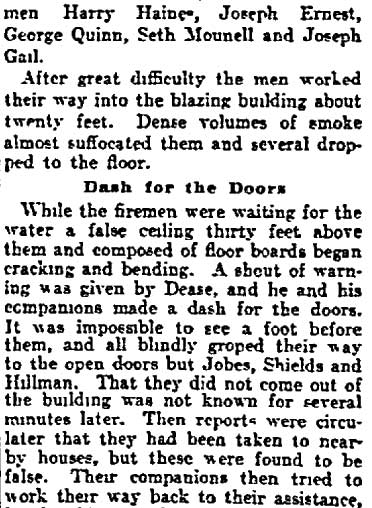
One of the first companies to arrive was the Kaighn avenue truck. As the men drove up to the scene great tongues of flame were fast eating their way through the yellow pine timbers of which the interior was constructed. The main doors at the entrance on Mickle street were burst open and the firemen entered amid a perfect shower of sparks and falling debris. In this party were the three ill-fated firemen, Dease, and Fire-
men Harry Haines, Joseph Ernest, George Quinn, Seth Mounell and Joseph Gail.
After great difficulty the men worked their way into the blazing building about twenty feet. Dense volumes of smoke almost suffocated them and several dropped to the floor.
Dash for the Doors
While the firemen were waiting for the water a false ceiling thirty feet above them and composed of floor boards began cracking and bending. A shout of warning was given by Dease, and he and his companions made a dash for the doors. It was impossible to see a foot before them, and all blindly groped their way to the open doors but Jobes, Shields and Hillman. That they did not come out of the building was not known for several minutes later. Then reports were circulated that they had been taken to nearby houses, but these were found to be false. Their companions then tried to work their way back to their assistance,
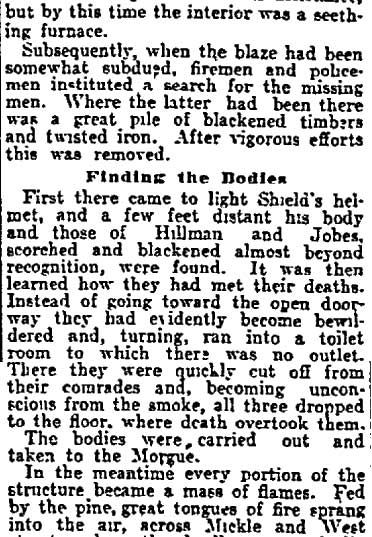
but by this time the interior was a seething furnace.
Subsequently, when the blaze had been somewhat subdued, firemen and policemen instituted a search for the missing men. Where the latter had been there was a great pile of blackened timbers and twisted iron. After vigorous efforts this was removed.
Finding the Bodies
First there came to light Shield’s helmet, and a few feet distant his body and those of Hillman and Jobes, scorched and blackened almost beyond recognition, were found. It was then learned how they had met their deaths. Instead of going toward the open doorway they had evidently become bewildered and, turning, ran into a toilet room to which there was no outlet. There they were quickly cut off from their comrades and, becoming unconscious from the smoke, all three dropped to the floor, where death overtook them.
The bodies were carried out and taken to the Morgue.
In the meantime every portion of the structure became a mass of flames. Fed by the pine, great tongues of fire sprang into the air, across Mickle and West
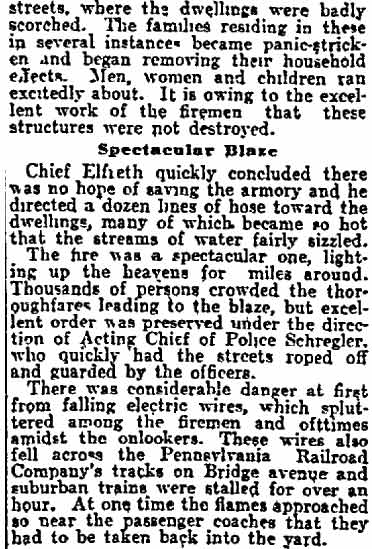
streets, where the dwellings were badly scorched. The families residing in these in several instances became panic-stricken and began removing their household effects. Men, women and children ran excitedly about. It is owing to the excellent work of the firemen that these structures were not destroyed.
Spectacular Blaze
Chief Elfieth quickly concluded there was no hope of saving the armory and he directed a dozen lines of hose toward the dwellings, many of which became so hot that the streams of water fairly sizzled.
The fire was a spectacular one, lighting up the heavens for miles around. Thousands of persons crowded the thoroughfares leading to the blaze, but excellent order was preserved under the direction of Acting Chief of Police Schregler, who quickly had the streets roped off and guarded by the officers.
There was considerable danger at first from falling electric wires, which spluttered among the firemen and ofttimes amidst the onlookers. These wires also fell across the Pennsylvania Railroad Company’s tracks on Bridge avenue and suburban trains were stalled for over an hour. At one time the flames approached so near the passenger coaches that they had to be taken back into the yard.
Stubborn Blaze
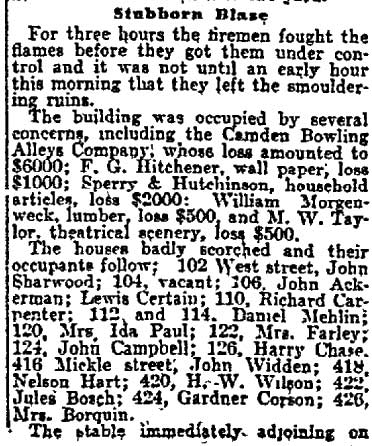
For three hours the firemen fought the flames before they got them under control and it was not until an early hour this morning that they left the smouldering ruins.
The building was occupied by several concerns, including the Camden Bowling Alleys Company, whose loss amounted to $6000; F. G. Hitchener, wall paper, loss $1000; Sperry & Hutchinson, household articles, loss $2000; William Morgenweck, lumber, loss $500, and M. W. Taylor, theatrical scenery, loss $500.
The houses badly scorched and their occupants follow: 102 West street, John Sharwood; 104, vacant; 106, John Ackerman; Lewis Certain; 110, Richard Carpenter; 112, and 114, Daniel Mehlin; 120, Mrs. Ida Paul; 122, Mrs. Farley; 124, John Campbell; 126, Harry Chase; 416 Mickle street: John Widden; 418, Nelson Hart; 420, H.-W. Wilson; 422, Jules Bosch; 424, Gardner Corson; 426, Mrs. Borquin.
The stable immediately adjoining on
the west side of the armory, and belonging to C. M. Alcott, was flooded with water. At this place there were forty horses, all of which were rescued.
Formerly a Market
The destroyed building was erected in 1873, by a number of well-known Camden men, as the Farmers’ and Merchants’ Market. From the first it was not a success, and subsequently became known as the Camden Opera House. After a more or less successful season the promoters of this scheme closed the doors. In 1886 the building was purchased by the State as an armory for the old Sixth Regiment, N. G. N. J. For ten years Camden’s citizen soldiers drilled and gave balls and receptions in the building. When the regiment moved to the new armory on Haddon avenue the old structure was cut up into several rooms and had been used by many different concerns. Recently it was purchased by the Pennsylvania Railroad Company to make way for the elevated railroad. All the tenants had been ordered to vacate.
The origin of the fire is unknown. Incendiarism is hinted at and Mayor Ellis declared he will detail the detectives on the case to-day to make a rigid investigation.
Speaking of the matter, he said it is very peculiar that most of Camden’s fires occur about the time the firemen are at their meals. This has been the case in most every blaze if any importance in the city. The Mayor also highly commended the excellent work of the men in preventing a spread of the flames.
14 Camden Firemen Overcome by Smoke
Philadelphia Inquirer —
14 CAMDEN FIREMEN OVERCOME BY SMOKE
Twelve-Hour Fight Follows Discovery of Smoldering Fire in Wall Paper Plant
Fourteen firemen were overcome by smoke, one of them being removed to Cooper Hospital, and about $20,000 in damage was done at a fire at the plant of the Frank G. Hitchner Wall Paper Manufacturing Company, Fifth and Mickle streets, Camden, yesterday. It was not until late yesterday afternoon,
after twelve hours’ fighting, that the flames were subdued, although not at any time was there a burst of flame.
Captain Joseph Maxwell, of No. 1 Truck Company, was taken to the hospital. Fire Chief Peter B. Carter was hurt about the ankle in a slight fall. The other firemen were able to resume their work after being treated by Fire Surgeon Scheilinger.
It was some time before three o’clock in the morning that John Wilfson, a watchman, saw the smoke issuing from the kiln. In this building thousands of feet of lumber to be converted into moulding is dried. It is placed on racks six inches apart, and it was because of this that the firemen could not reach the fire.
Pouring from the plant, the water ran into the cellars of nearby dwellings. Considerable damage was done at the home of Mrs. Sallie Gordon, at 215 South Fifth street, and John Orr, 441 Judson street. Others who suffered were Mrs. Mary Brooks, 217 South Fifth street; John Humphries, 445 Steven street, and L. J. Donavan, 434 Mickle street.
Deputy Fire Chief Trapped in Cellar
Camden Post-Telegram —
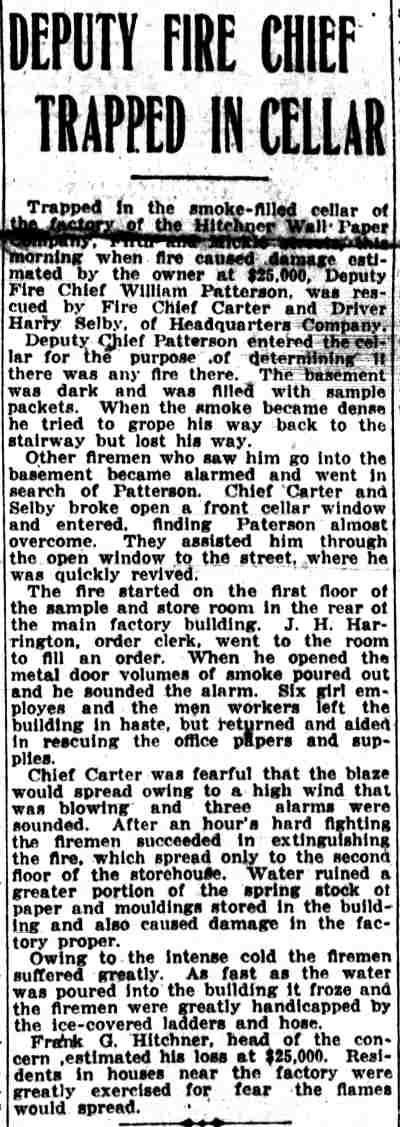
DEPUTY FIRE CHIEF TRAPPED IN CELLAR
Trapped in the smoke-filled cellar of the factory of the Hitchner Wall Paper Company, Fifth and Mickle streets, this morning when fire caused damage estimated by the owner at $25,000, Deputy Fire Chief William Patterson, was rescued by Fire Chief Carter and Driver Harry Selby, of Headquarters Company.
Deputy Chief Patterson entered the cellar for the purpose of determining if there was any fire there. The basement was dark and was filled with sample packets. When the smoke became dense he tried to grope his way back to the stairway but lost his way.
Other firemen who saw him go into the basement became alarmed and went in search of Patterson. Chief Carter and Selby broke open a front cellar window and entered, finding Paterson almost overcome. They assisted him through the open window to the street, where he was quickly revived.
The fire started on the first floor of the sample and store room in the rear of the main factory building. J.H. Harrington, order clerk, went to the room to fill an order. When he opened the metal door volumes of smoke poured out and he sounded the alarm. Six girl employes and the men workers left the building in haste, but returned and aided in rescuing the office papers and supplies.
Chief Carter was fearful that the blaze would spread owing to a high wind that was blowing and three alarms were sounded. After an hour’s hard fighting the firemen succeeded in extinguishing the fire, which spread only to the second floor of the storehouse. Water ruined a greater portion of the spring stock of paper and mouldings stored in the building and also caused damage in the factory proper.
Owing to the intense cold the firemen suffered greatly. As fast as the water was poured into the building it froze and the firemen were greatly handicapped by the ice-covered ladders and hose.
Frank G. Hitchner, head of the concern, estimated his loss at $25,000. Residents in houses near the factory were greatly exercised for fear the flames would spread.
Reception Given in Honor of Their Golden Wedding
Camden —
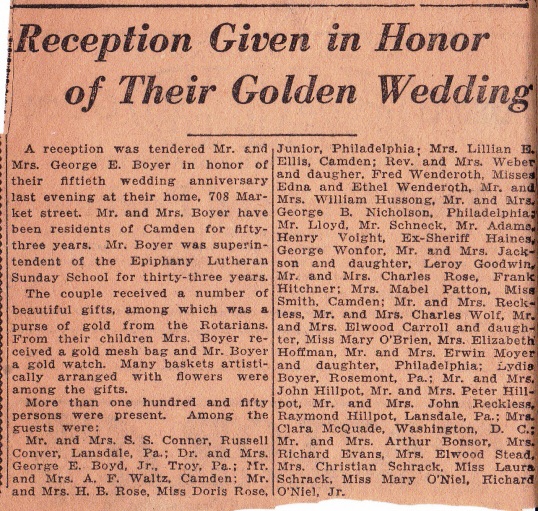
Reception Given in Honor of Their Golden Wedding
A reception was tendered Mr. and Mrs. George E. Boyer in honor of their fiftieth wedding anniversary last evening at their home, 708 Market street. Mr. and Mrs. Boyer have been residents of Camden for fifty-three years. Mr. Boyer was superintendent of the Epiphany Lutheran Sunday School for thirty-three years.
The couple received a number of beautiful gifts, among which was a purse of gold from the Rotarians. From their children Mrs. Boyer received a gold mesh bag and Mr. Boyer a gold watch. Many baskets artistically arranged with flowers were among the gifts.
More than one hundred and fifty persons were present. Among the guests were:
Mr. and Mrs. S. S. Conner, Russell Conver, Lansdale, Pa.; Dr. and Mrs. George E. Boyd, Jr., Troy, Pa.; Mr. and Mrs. A. F. Waltz, Camden; Mr. and Mrs. H. B. Rose, Miss Doris Rose, Junior, Philadelphia; Mrs. Lillian E. Ellis, Camden; Rev. and Mrs. Weber and daugher [sic], Fred Wenderoth, Misses Edna and Ethel Wenderoth, Mr. and Mrs. William Hussong, Mr. and Mrs. George B. Nicholson, Philadelphia; Mr. Lloyd, Mr. Schneck, Mr. Adams, Henry Voight, Ex-Sheriff Haines, George Wonfor, Mr. and Mrs. Jackson and daughter, Leroy Goodwin, Mr. and Mrs. Charles Rose, Frank Hitchner; Mrs. Mabel Patton, Miss Smith, Camden; Mr. and Mrs. Reckless, Mr. and Mrs. Charles Wolf, Mr. and Mrs. Elwood Carroll and daughter, Miss Mary O’Brien, Mrs. Elizabeth Hoffman, Mr. and Mrs. Erwin Moyer and daughter, Philadelphia; Lydia Boyer, Rosemont, Pa.; Mr. and Mrs. John Hillpot, Mr. and Mrs. Peter Hillpot, Mr. and Mrs. John Reckless, Raymond Hillpot, Lansdale, Pa.; Mrs. Clara McQuade, Washington, D. C.; Mr. and Mrs. Arthur Bonsor, Mrs. Richard Evans, Mrs. Elwood Stead, Mrs. Christian Schrack, Miss Laura Schrack, Miss Mary O’Niel, Richard O’Niel, Jr.
Chief of Camden Police Is Retired
Trenton Evening Times —
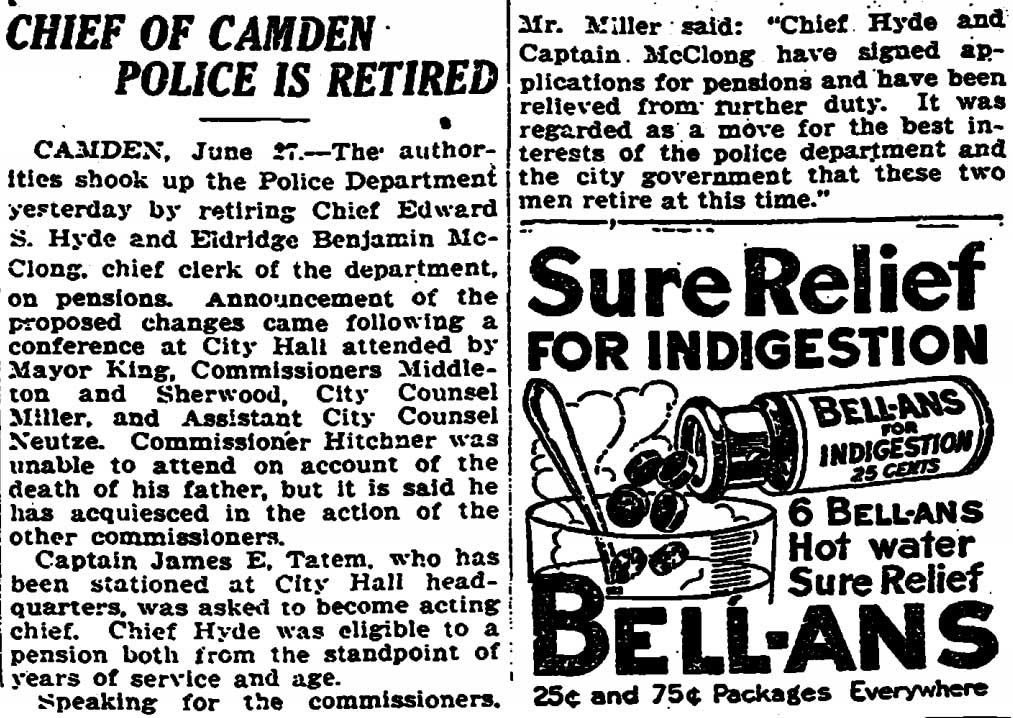
CHIEF OF CAMDEN POLICE IS RETIRED
CAMDEN, June 27.—The authorities shook up the Police Department yesterday by retiring Police Chief Edward S. Hyde and Eldridge Benjamin McClong, chief clerk of the department, on pensions. Announcement of the proposed changes came following a conference at City Hall attended by Mayor King, Commissioners Middleton and Sherwood, City Counsel Miller, and Assistant City Counsel Neutze. Commissioner Hitchner was unable to attend on account of the death of his father, but it is said he has acquiesced in the action of the other commissioners.
Captain James E. Tatem, who has been stationed at City Hall headquarters, was asked to become acting chief. Chief Hyde was eligible to a pension both from the standpoint of years of service and age.
Speaking for the commissioners, Mr. Miller said: “Chief Hyde and Captain McClong have signed applications for pensions and have been relieved from further duty. It was regarded as a move for the best interests of the police department and the city government that these two men retire at this time.”
Fireman Is Suspended for Being Intoxicated
Camden Daily Courier —
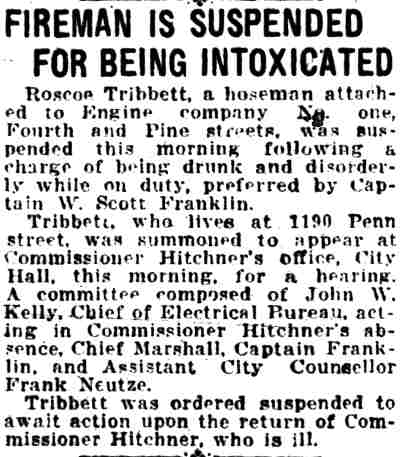
FIREMAN IS SUSPENDED FOR BEING INTOXICATED
Roscoe Tribbett, a hoseman attached to Engine company No. one, Fourth and Pine streets, was suspended this morning following a charge of being drunk and disorderly while on duty, preferred by Captain W. Scott Franklin.
Tribbett, who lives at 1190 Penn street, was summoned to appear at Commissioner Hitchner’s office, City Hall, this morning, for a hearing. A committee composed of John W. Kelly, Chief of Electrical Bureau, acting in Commissioner Hitchner’s absence, Chief Marshall, Captain Franklin, and Assistant City Counselor Frank Neutze.
Tribbett was ordered suspended to await action upon the return of Commissioner Hitchner, who is ill.
Four Firemen Are Trapped in Collapse of Brick Wall
Camden Evening Courier —
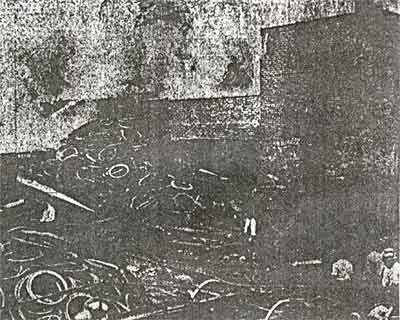
Flames Sweep Warehouse in South Camden
Fire Fighters are Rescued From Beneath Heaps of Hot Bricks
Burning Tires Send Up Clouds of Dense Smoke
Bantivoglio Junk Yard Destroyed — Loss Runs Into Thousands
Four firemen were buried under a falling brick wall, two of them believed to have been seriously hurt, and thousands of dollars worth of property was destroyed in a spectacular fire at the two story brick warehouse of Bantivoglio & Son, junk dealers, 252 Division Street, at 9:00 o’clock this morning.
The injured firemen attached to Engine Company No. 7, all of whom were taken to West Jersey Homeopathic Hospital, were:
Captain Charles Watkin 45 years old, 927 North Front street. Four fractured ribs and a punctured lung. he may die.
Nicholas Romaine, 43 years old, hoseman, 1271 Chase Street, lacerations of scalp and possible fracture of right ankle.
Louis Quinton, 25 years old, hoseman. 626 Viola Street, probable fracture of right shoulder.
Lester Anderson, 24 years old, hoseman, 1917 Niagara Road; lacerations of scalp and forehead and fractured left wrist.
None of the four were able to walk when they were lifted from where they had been struck down by the falling bricks. They were carried to the police ambulance and hurried at once to the hospital.
Residents of the neighborhood sat that a flash and a roar, as of an explosion, was their first warning of a blaze. The burned building has a frontage of 75 feet on Division Street. In a yard behind it there was a shed piled high with baled paper and three piled of used automobile tires. These caught fire and sent up black smoke that was visible for miles.
Smoke Hampers Firemen
A huge crowd of spectators already had gathered to watch the fire in this thickly populated section when the firemen arrived. The flames were threatening surrounding buildings, and the smoke was so dense that the men had difficulty finding their way out in the vicinity of the burning structure.
Captain Watkin and the three other fire fighters started along a driveway beside the building with a length of hose which they intended to use on the blazing sheds in the rear. They were passing a window when there was a muffled roar and a blast of dense smoke blinded and confused them. By shouts to one another they heard that there number was still intact. The blast of black smoke had been caused by the collapse of a loft and the falling of several bales of paper.
100,000 Tires Burn
More than 100,000 used automobile tires were destroyed in the blaze. The flames jumped a hundred feet into the air at one stage. Commissioner Hitchner watched the firemen at work from the roof of a nearby garage.
When the blaze had been extinguished Mr. Hitchner left to visit the injured firemen in the hospital. He commended the four men on their bravery and wished them a speedy recovery. Quinton is driver for Battalion Chief Wade.
The flames threatened to spread to the large garage of Louis Vananeri, on Spruce Street, directly in the rear of the junk yard. Firemen mounted the roof of this building and drove the flames back.
Today’s blaze was the fourth that had visited the warehouse this year. The fire today is believed to have been caused by spontaneous combustion.
Carter Directs Rescue
The quarter were stooping to take up their hose line again when there was a crack like the report of a pistol, followed by a terrific roar.
Fire Chief Carter, personally directing his men, was about 50 feet away, and saw the four men buried as the bricks thudded down from the crumbling wall.
“Come on boys, there are four men under here.” the chief yelled, and soon a score of hands were tearing frantically at the heaps of hot brick.
Bus Delays Ambulance
The police ambulance in which the injured men were placed was delayed for five minutes on its way to the hospital by the refusal of a Public Service bus driver to give it the right of way. According to Policeman Howard Fisher, the busman was arrested. The police say he will be prosecuted to the full extent of the ordinance in such cases. The ambulance was forced to remain behind the bus for a block and a half, according to the reports.
The pillar of smoke sent up by the blazing warehouse, sheds and 50-foot high piles of auto tires, drew thousands of spectators from all directions. Three alarms were turned in to the fire department in rapid succession. The police were called upon at once to establish lines for keeping back the crowd.
Bales of paper stored in the main building, as well as in the shed behind, absorbed tons of water poured into the place by the firemen’s hose, and the added weight snapped off fire-weakened floor beams like burning matches. The falling timbers and masses of packed paper added to the danger and difficulty of the firemen’s task.
Only by a long and stubborn fight were the foremen able to prevent a conflagration among surrounding buildings.
The big warehouse became a red hot furnace. The heat was so intense a half-hour after the fire was discovered that telephone and electric light poles on the other side of Division Street were ignited. “Trouble crews” from the telephone and electric companies were rushed to the place to guard their wires against falling and injuring persons below.
Loss Placed at $50,000
It was roughly estimated that the the damage to the junk sheds and warehouse would reach $50,000.
Mrs. Leona Brown, who had just moved today into the house at 264 Division Street, just east of the burned plant, was driven from her new home by the dense clouds of smoke from a blazing of automobile tires that towered above the west wall of her two-story dwelling.
She was unable to return for any of her belongings when the flames began to eat their way through the west wall of her house.
The fire was the second within a month in the junk yard, which is closely surrounded by frame residences, a frame negro church and other buildings on all sides.
Romaine Seriously Hurt
Hoseman Romaine was reported by surgeons at the West Jersey Homeopathic Hospital as the most seriously hurt of the firemen caught by the falling wall. He was cut above the head, badly bruised about the back, and one of his ankles is believed to have been fractured.
Captain Watkin suffered several fractured ribs.
Hoseman Anderson was cut and burned about the face and his right wrist.
Hoseman Quinton suffered burns, cuts and bruises, and it is believed that one of his shoulders was fractured.
Hitchner & Holmes
Camden Courier-Post —

Hitchner & Holmes at 5th & Mickle Streets
Kausel Is Given $4000 Job Over Hot Protest By ‘Rebel’ in G.O.P.
Camden Courier-Post —
‘Not Fitted for Job and 20 of You Admitted it’ Declares Van Meter
Collingswood Man’s Insurgency Punished
Vocational School Incident is Recalled as Democrats Join in Battle
Joseph H. Van Meter, insurgent Republican freeholder from Collingswood, today declared that David Baird Jr., Republican leader, had admitted that Theodore Kausel was “not the man for the job” to which he was appointed by the Board of Freeholders yesterday.
Baird told him, however, said Van Meter, that a promise had been made “to take care of” Kausel because of the latter’s aid to the Republican Organization at the last municipal election.
Van Meter quotes Baird as follows:
“I’ll admit that Kausel is not the man for the job. But you have to help me out because we promised to take care of Kausel when he came over to us in the city election. And it was through Kausel that we got Hitchner and a lot of his crowd.”
“We’ve got ourselves tied up with him. We’ve got to take him, and I want you to go along, and help me out.”
“I know his business record and I know his political record. I know the freeholders don’t want him and our conference don’t want him, but we’ve got to eat crow, and I want you to help me out.”
Under the watchful eyes of organization leaders, Republican members of the Camden County Board of Freeholders yesterday took care of Theodore “Teddy” Kausel.
With David Baird Jr. and other chieftains of the party occupying front row seats, the board created the post of “general manager of county institutions” and promptly named Kausel for the job at an annual salary of $4,000.
Like ghosts at a feast, Baird and the other party leaders sat silently at the freeholders reorganization meeting. Like actors in a carefully pre-arranged play, a little uncertain of their cues, 20 Republican freeholders cast furtive eyes at the group of spectators.
They said no word, these freeholders. They made no reply when Joseph H. Van Meter, of Collingswood, breaking from their ranks, declared that 20 of them had told him that Kausel was unfit for the position to which he was being appointed. They listened in uncomfortable silence while Van Meter gave voice to a scathing denunciation of their “lack of backbone” and while a running fire of sarcasm from Democratic members fell upon their ears.
Scene Was Drama
The scene was drama. It might have been a revised performance of “Uncle Tom’s Cabin” with 28 furtive-eyed Uncle Toms and an impregnable line of Simon Legrees, cracking invisible whips in threatening gestures.
And the scene was also comedy. For of that score of men who, according to Van Meter, had agreed that Kausel was unfit for the job but “had to be taken care of,” none arose to protest against the action. Within their Hearts the chorus of Uncle Toms may have been saying.
The county may own our bodies, but our souls belong to the Republican Organization.”
But if they thought this, they said no word.
Today it was pointed out that it will not be long before freeholders come up for renomination at the primaries. Today, it was also predicted that Van Meter has signed his political death warrant so far as the Republican organization was concerned. But at least he received the ungrudging tribute of the Democratic minority on the board, who joyfully proclaimed that they had found “at last a Republican with guts.”
Van Meter Fights Hard
Van Meter spared no words, took no half-measures. He accused his fellow Republican members of coercion, double-dealing and weakness. He fought the appointment bitterly. He raked up the vocational school matter, in which $85,000 had been paid for the school site on Kausel’s recommendation, a price later declared to be exorbitant.
Democratic members joined the Collingswood insurgent. They charges that the $4,000 appointment was the price of Kausel’s allegiance to the Republican party. They declared that he wasn’t worth it. They recalled, later, that Kausel had shifted from the Republican Organization to the Non-Partisan movement and then back again after being one of the loudest to criticize the Organization. They asserted that after his removal as chairman of the vocational school board, he had sought the appointment as city purchasing agent. They avowed that the Republican City Commissioners had ‘refused to handle Kausel’ and had “wished him off on the county.”
The 26 other Republican freeholders — all of those present, excepting only Van Meter — continued to listen in silence. And when the vote came, every one of the 26 voted for the creation of the position of “general manager of county institutions” and for the appointment of Kausel.
A little later the reprisals upon Van Meter began. He was removed from the central plant and county farm committees of the board, shifted to the elections committee and allowed to remain on the printing and agricultural committees, regarded as unimportant groups.
Reprisals Were Threatened
“It doesn’t surprise me,” he said. “I was threatened with it. They told me they’d ruin me. But I couldn’t go back to Collingswood and ask the people to vote for me again if I hadn’t fought against this appointment.”
The defection of Van Meter came apparently as a surprise. The meeting had opened with the passage of the county budget on the first reading, the selection of Leslie H. Ewing, of Berlin, as director of the board, the calling of Frank P. Moles, of the Third Ward to be sworn in and his failure to respond or to appear for the gathering.
Minor matters had been attended to and then Fred W. George, clerk of the board, rose to his feet and began the task of reading a long list of proposed amendments to the rules. Buried far down in the list of revisions was that which, “for purposes of economy,” sought to place all county institutions under a central head to be known as general manager.
George lost his breath before he had more than half completed the list of amendments, and George Rothermel, pinch-hitting for Walter Keown as counsel for the board, took his place. Then Director Ewing called for a vote.
Schorpp Speaks
Frederick W. Schorpp, Eighth Ward Democrat, was the first to speak.
“I want to congratulate you gentlemen,” he said, “on the wonderful way you have camouflaged these changes.”
“We have heard a long list of amendments to the rules read. But what the whole thing is can easily be seen. You gentlemen of the majority have a lame duck to take care of, and so you create this job. But I can’t see, really I can’t see why it is necessary to create a $4,000 plum for your lame duck and saddle it on the taxpayers.”
There was silence in the room. In the seat of the absent Freeholder William A. Robinson sat Baird. At the press table were Sheriff Walter Gross and City Commissioner William D. Sayrs, Jr. Ranged along the front row of the spectators’ section were Mayor Winfield Price and Commissioner Clay W. Reesman. They said nothing.
Louis C. Parker, Gloucester City Democrat, was next to speak.
“All these changes in the rules accomplish is to create a new job,” he declared, agreeing with Schorpp.
S. Raymond Dobbs, Fourteenth Ward Democrat, objected and moved that the resolution changing the rules be laid over until the regular January meeting. He was overruled by Director Ewing. Schorpp sought to have the rules voted upon separately, but James Davis, chairman of the committee, refused to accept the suggestion.
The roll call began. In alphabetical order the names were called and the freeholders voted. Republicans voted in favor of adoption of the changes. The three Democrats voted against the resolution. Van Meter’s name was the last to be called.
“No,” he said calmly, and there was a gasp of surprise in the room. The clerk recorded the vote on the resolution as 26 to 4 and then began reading again. This was a new resolution. It named Theodore T. Kausel to the position just created and explained that he was to report to the “Lakeland Central Committee.”
Van Meter Protests
Van Meter rose slowly. He obtained recognition from the director and began, quietly but decisively.
“Gentlemen,” he said calmly. “I have studied this proposition. I have known about it for three days and three nights. I have talked to 20 Republicans member of this board and I have done all I could to get then to agree with me.
“And they did agree with me. They agreed, every one, that Kausel was not the man for this job. After what happened on the vocational school project, when Kausel was president of the school board, he is not the man. On his recommendation, the vocational school site was purchased for $85,000. And now you want to send him where he will handle about a million dollars of the taxpayers’ money.”
Van Meter’s tone was serious as he turned to his fellow members. Most of the latter sat silently in the seats. They did not glance at the Collingswood insurgent. Baird, Gross, Price, Sayrs and Reesman listened intently. A few of the freeholders craned their necks towards the windows as the Camden mummers, returning from the New Years Day parade in Philadelphia, marched past the courthouse. But Van Meter went on.
“There is not one of you that has backbone enough to come here and fight this thing.” Van Meter continued.
“I can’t see it go through. I couldn’t ask the people of Collingswood to vote for me again if I let it go through without a fight.”
“You agreed with me that Kausel was not the man for the job. Haven’t you any backbone with which to fight his appointment now?”
Slowly, in complete silence that followed, he turned till he faced Horace G. Githens, the majority floor leader.
“Mr. Githens,” he said quietly and in a measured tone, “if you will throw away your messenger’s cap and wear a leader’s hat, I will follow you.”
He sat down and the silence continued.
Schorpp Lauds Van Meter
Schorpp rose again.
“I’m glad to see one Republican who has backbone,” he said. “I told you there was a lame duck in this and here is the lame duck.”
“Woods (Samuel Woods, Republican freeholder from Haddonfield) and you others criticized Kausel and other members of the vocational school board for their purchasing of the land for the school, claiming that it was an exorbitant price to pay for the land.”
“And now these same men who criticized Kausel are putting him in a position where he will handle millions of the taxpayers money.”
Dobbs followed on the floor.
“I don’t want to stand here and talk until 10 o’clock tonight just to give you reasons why Kausel shouldn’t get the job,” he said.
“In the first place, I couldn’t give all the reasons in that time, and in the second place, they wouldn’t register with this bunch.”
“This is entirely unfair. It’s too high a price to pay Kausel to come back into the Republican ranks. The Republican leaders should pay it, however, and not saddle the price on the taxpayers.”
“Personally, I don’t think he’s worth much politically. We had him for awhile and have had some experience as to the value of his services. I thought he could be bought for less than $4000 anyway.”
The resolution came to a vote. The Republicans, with the exception of Van Meter, again voted solidly. Twenty-six votes were cast for the appointment of Kausel. Van Meter and the three Democrats did not vote.
Van Meter issued a statement after the meeting, explaining his stand. He said:
“The reason I opposed Kausel’s appointment is because the man is extravagant. Director Ewing was one of the 20 Republicans I talked to who were opposed to him, but were afraid on the floor. I didn’t talk to the Democrats.”
“Ewing and the other Republicans said, ‘What can we do. We must take care of him. We promised to.’”
Charges Unfair Tactics
“I knew when I went ahead with this that I’d be an outcast, but I was determined to do the right thing. This appointment is not the right thing.”
“They told me I’d be ruined if I opposed them. Even up to the last minute before the meeting they came to my desk in the freeholder’s room and tried to throw a scare into me.”
“I knew I’d be thrown out of committees and barred from the caucuses. They’ve let me remain on the printing committee. I’ve been on it a year, and it hasn’t met yet. Nevertheless, there is a $50,000 appropriation for printing.”
“I’ve always tried to be on the level on this job. Why they had the workhouse slated for $120,000 but I fought and fought, and finally — well look at the budget — it’s cut down to $50,000.”
“It’s not the first time I’ve saved them money. I don’t know Kausel personally, but I do know his record. It was because of his extravagance that he was fired from the Castle Kid Company.”
“And when I say he is extravagant, I can prove every word of it.”
The new Lakeland central committee, authorized in the resolution appointing Kausel, was announced by Director Ewing at the close of the meeting. Ewing is to be a member, ex-officio, and Horace G. Githens becomes a member by virtue of being chairman of the finance committee.
The chairman of the asylum committee, of the County Hospital committee, of the Almshouse committee, of the Detention Home committee, and the Tuberculosis Hospital committee all will become members.
Name ‘Official’ Papers
An earlier vote had been taken in which the Democrats moved to designate The Evening Courier as the newspaper in which the budget was to be officially printed. The Republican majority had designated two weekly papers, the Camden Argus and the Berlin Breeze.
“It’s obvious,” said Dobbs, “why these designations have been made.”
Parker, Gloucester City Republican, agreed with this view and declared that the newspaper with the largest circulation in the county should be given the official county notices for publication as advertising.
Schorpp ironically suggested that the Christian Science Monitor be substituted for one of the two weeklies designated and the roll was called. The Argus and the Breeze were officially designated.
The appointment of Kausel bought the meeting to a conclusion. Of all the Republican freeholders, Davis was the only one to speak. He merely declared that he was not one of the 20 men who Van Meter had said agreed that Kausel was not the man for the job.
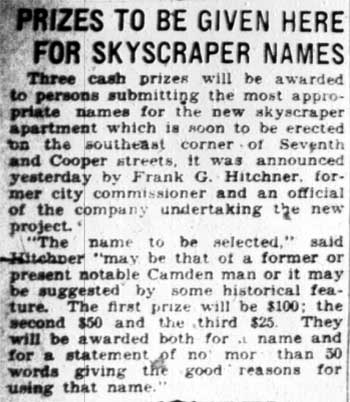
Prizes to Be Given Here for Skyscraper Names
Camden Courier-Post —
Lends Man His Car For Business Deal, He Trades It In
Camden Courier-Post —
Former Commissioner Hitchner Learns ‘Sale’ Was Made in Carolina
Two weeks ago, former Commissioner Frank G. Hitchner lent his automobile to a man for use during a business deal. Man and car disappeared.
Yesterday, insult was added to injury. The former commissioner received word from Florence, S.C., that a man representing himself as Frank G. Hitchner, of Camden, had traded in his car for another one and, after giving a worthless check, skipped.
Hitchner reported the theft January 23. At the time, he told police he loaned the car ten days before to a man who gave his name as Luke J. Kelly, who represented himself as a sweet potato buyer.
Kelly asked to borrow the car for a “couple of days,” Hitchner said, to call on farmers of the district to buy potatoes. The car was registered in the name of Hitchner’s wife, Mary.
Hitchner said Kelly was about 52, five feet eight inches tall, smooth shaven, with slightly gray hair and a scar on his right cheek. Hitchner who lives at 101 South Dudley street, served as city commissioner during the Non-Partisan League regime ten years ago.
Hitchner Indicted on Worker’s Charge
Camden Courier-Post —
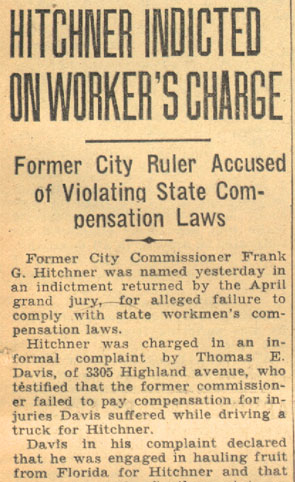
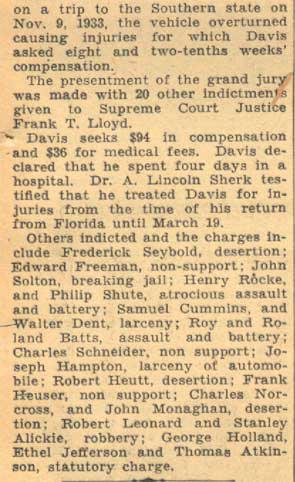
Named: Dr. A. Lincoln Sherk, Thomas Davis, Highland Avenue, and Frank T. Lloyd.
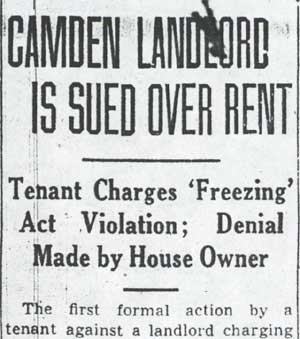
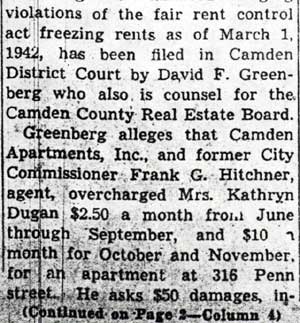
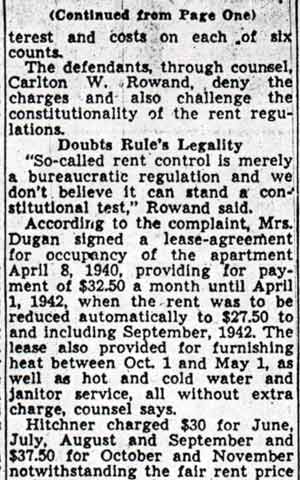
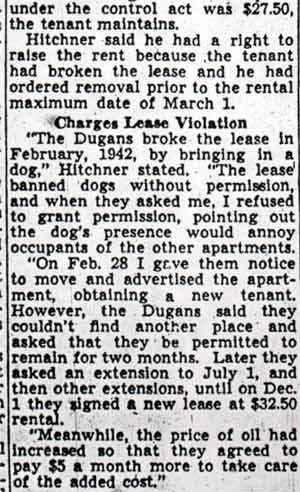
Camden Landlord Is Sued Over Rent
Camden Courier-Post —
Named: Carlton W. Rowand, David F. Greenberg, Mrs. Kathryn Dugan, and Penn Street.