Introduction
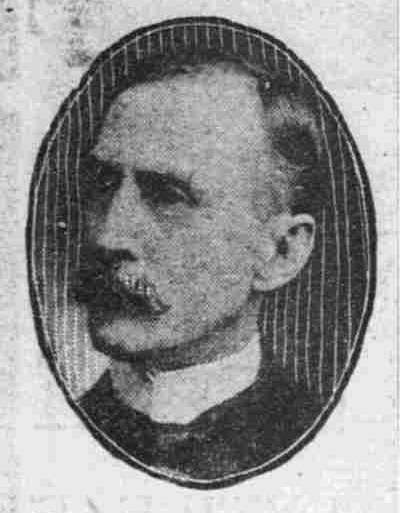
Louis T. DeRousse
Louis T. De Rousse, businessman, politician, and for a few years the postmaster of Camden, New Jersey, was born in Philadelphia, May 29, 1844.
His father, George De Rousse, was born in France and participated in the battle of Waterloo under Napoleon. Not long afterward he crossed the Atlantic to the United States, taking up his abode in Philadelphia, where he followed his trade of boot-crimping. A faithful member of the church, his life was honorable and upright, and at his death, which occurred in 1874, when he was eighty years of age, the community lost one of its valued citizens. He married Miss Christine Steiner, a native of Germany, whose father was a prominent citizen of that land and served as the mayor of the town in which he made his home. Mr. and Mrs. De Rousse became the parents of seven children.
Louis T. De Rousse pursued his education in the local schools until seventeen years of age and then began working in a lawyer’s office of Philadelphia, at fifty cents a week. He was subsequently employed in the office of the Philadelphia Ledger, but in 1864, at the age of twenty years, he put aside his personal considerations and offered his services to the government, enlisting in the Eighth Pennsylvania Reserves. When hostilities had ceased he entered the employ of W. H. Horstman & Sons, of Philadelphia, with whom he remained for eight years. In 1874 he became a resident of Camden and was with Wilson Fitzgerald, a flour, feed and grain merchant, for some time.
Mr. DeRousse was involved with founding the community of Delair (in today’s Pennsauken Township). This was accomplished in connection with Mr. Bonsall, editor of the Camden Daily Post. DeRousse Avenue is still one of the main thoroughfares in the community.
In 1900 the following was published about Louis T. Derousse in the book “Biographical, Genealogical and Descriptive History of the First Congressional District of New Jersey”:
Louis T. De Rousse has quite an active part in public affairs. In 1880 he was elected a freeholder from the first ward of Camden, and served one year. He was elected comptroller for a three-year term and was discharged his duties faithfully. He founded the Camden Republican Club and was its first president. In 1895 he was elected to the New Jersey legislature, where he served through the three succeeding years. In 1896 he was elected speaker, and in 1897 he was the Republican leader in the house. He has studied closely the questions and issues of the day and is an able champion of the principles of the party that has ever stood for the protection of American industries and institutions and which advocates the adoption of a sound-money basis and of expansion principles. His public course is one worthy of commendation, for he has ever placed the country’s good before personal aggrandizement. He is now an efficient and popular postmaster of Camden and his administration is invoking high praise.
Mr. De Rousse was married to Miss Anna W. Fitzgerald, a daughter of Wilson Fitzgerald, and they became the parents of three children. In his social relations Mr. De Rousse is a Mason, and Odd Fellow and an Elk. In manner he is genial, courteous and kindly,—qualities which make him very popular with all classes. He has a wide acquaintance among the most prominent men of the state, and inspires personal friendships of great strength. His marked individuality and force of character have gained him leadership in political circles, while his genuine worth has won him uniform respect.
As stated above, Louis T. Derousse was a Mason, belonging to Camden Lodge #15, Free and Accepted Masons, was a member of the Tall Cedars of Lebanon, and a member of Camden Lodge #293, Benevolent Protective Order of Elks. He was also active in veterans affairs, as a member of Colonel William B. Hatch Post No. 37 of the Grand Army of the Republic (G.A.R). His civic involvements included his being a co-founder of the Camden Microscopica Society and the Camden County Historical Society. He founded and was the first President of the Camden Republican Club, and was one of a group of citizens, which included Mrs. Clarence K. Binder, who organized a committee to establish a free public library in Camden City. In 1884, Louis T. Derousse was a director of the Y.M.C.A. in Camden, NJ. Late in life he served as Secretary of the Board of Trade, the forerunner of Camden’s Chamber of Commerce.
Louis T. Derousse was originally in the flour and grain trade, but was forced to discontinue this business for health reasons, which led to his government involvement and involvement in real estate. A Republican, he was elected to the Camden County Board of Freeholders representing the First Ward of Camden in 1880. The next year, he declined re-nomination. In 1888 he returned to government as the City Comptroller of Camden, a post he held for three years. He ran for State Assembly and served from 1895 through 1898. In 1896 he served as Speaker of the House, and was the Republican leader in the Assembly in 1897. On January 6, 1897 President William McKinley appointed Louis T. Derousse to the post of Postmaster of Camden. He took over his duties as postmaster in July of that year.
Louis T. Derousse served as Postmaster until June of 1903, when he abandoned his position due to personal issues.
Louis T. Derousse died on August 28, 1921 and was buried in the family plot at Harleigh Cemetery in Camden after services conducted at his home at 326 North 6th Street by Rev. Charles Bowden.
History of Camden County, N.J. (1886)
George Reeser Prowell — 1886
The following is derived from George Reeser Prowell’s History of Camden County, N.J., published in 1886.
WILLIAM B. HATCH POST No. 37, of Camden, was instituted and chartered November 25, 1879, with eighty-one members and the following named Post officers:
Post Commander, John E. Grubb; Senior Vice-Commander, Richard J. Robinson; Junior Vice-Commander, Daniel J. Fullen; Surgeon, Thomas G. Rowand, M.D.; Chaplain, John Quick; Officer of the Day, John A. Dall; Officer of the Guard, Edmund G. Jackson, Jr.; Quartermaster, Christopher J. Mines, Jr.; Adjutant, Benjamin J. Pierce; Sergeant-Major, William A. Tattern; Quartermaster-Sergeant, William B. E. Miller.
At the first meeting of the Post it was decided by a unanimous vote to name it in honor of the late Colonel William B. Hatch, of the Fourth Regiment. When Mrs. C. Hatch, the mother of the colonel was informed that the post had honored the memory of her son by naming it after him, she sent to the Post the following response:
Camden N. J., November 26th, 1879
John E. Grubb, Post Commander
Dear Sir, — It will afford me much pleasure to be identified with Post 37, G. A. R., named in honor of my son, William B. Hatch, by allowing me to present to the same its colors. The memory of my son is ever dear to me, and, while at the same moment I may have thought the sacrifice too great an affliction, yet I was consoled by the fact that I gave him up that this Union might be preserved. It was duty and patriotism that called him, and while I mourn him as a mother for a well-beloved son, yet I would not have stayed him, for the love of country and the upholding of this glorious Republic is what every mother should instill into her sons, as the purest and holiest spirit.
Yours truly, C. Hatch
The following is a complete roster of this post for 1886:
Post Commander, Benjamin H. Connelly; Senior Vice-Commander, Adam C. Smith; Junior Vice-Commander, William Haegele; Surgeon, George Pfau; Chaplain, Samuel Gaul; Officer of the Day, Robert Crawford; Officer of the Guard, John D. Cooper; Quartermaster, Samuel J. Fenner; Adjutant, William B. Summers; Sergeant-Major, Stacy H. Bassett; Quartermaster-Sergeant, Otto K. Lockhart.
Comrades: Philip Achenbach, George L. Allchin, Isaac Albertson, Joseph Applegate, John W. Barclay, Martin M. Barney, Joseph Baxter, William W. Bennett, Charles L. Bennett, Henry Bickering, Abel Biddle, George K. Biddle, John Bieri, Robert M. Bingham, Socrates T. Bittle, George W. Bittle, Benjamin F. Blizzard, Joseph Borton, Frederick Bowers, Benjamin M. Braker, John Breyer, William H. Brians, Wm. J. Broadwater, William Broadwater, John Brown, Harris Brooks, William H. Brooks, Joseph F. Bryan, Joseph Buddew, J. Q. Burniston, George Burton, Frederick Buser, Thomas L. Bush, William Butcher, Isaac B. Buzby, Edward C. Cattell, Joseph Cameron, James H. Carey, William Carey, James Chadwick, James Chafey, George M. Chester, James D. Chester, Lewis L. Chew, Henry S. Chew, John W. Churn, Andrew B. Cline, Charles Clarke, Samuel J. Cook, Levi E. Cole, John J. Collins, John C. Cooper, John W. Cotner, Thomas L. Conly, Harvey M. Cox, Jason S. Cox, Harris Crane, Charles Cress, Joel G. Cross, O. C. Cunningham, John A. Dall, John Dalby, John H. Damon, Westley Dare, John E. Dawson, Adam T. Dawson, James L. Davis, William Davis, Amos R. Dease, Henry Deford, lewis t. derousse, Michael Devinney, Glendora Devo, John Digney, Joseph Dilks, William A. Dobbins, George W. Dunlap, Aaron B. Eacritt, John J. Early, Christopher Ebele, Godfrey Eisenhart, John Elberson, Charles Elwell, Charles Eminecker, John Esler, John H. Evans, Charles S. Fackler, James Fanington, James A. Farraday, John H. Farry, John Faughey, Wm. H. Fenlin, George G. Felton, George W. Ferguson, Charles W. Fish, Israel L. Fish, James Finnan, Samuel B. Fisher, Edward L. Fisher, Ephraim B. Fithian, Jacob T. Fisher, Edward Fitzer, Samuel Flock, Leonard Flor, John Fox, John S. Fox, H. H. Franks, Chas. B. Frazer, Thomas J. Francis, Samuel W. Gahan, Chas. H. Gale, James Galbraith, Thomas Garman, Harry Garren, John W. Garwood, Josiah Garrison, John B. Gaskill, Richard Gaunt, Wm. German, Christopher Getsinger, Christopher Gifney, Jacob Giffens, Albert Gilbert, James Gillen, Wm. Giffins, C. C. Greany, Charles Green, W. H. Griffin, Louis Grosskops, William Grindrod, John B. Grubb, Mark H. Guest, John Guice, Alfred Haines, Charles G. Haines, Japhet Haines, George F. Hammond, Charles Hall, Solon B. Hankinson, Samuel P. Hankinson, James Hanson, Charles Hannans, H. A. Hartranft, Mahlon E. Harden, William F. Harper, George W. Hayter, Samuel B. Harbeson, J. T. Hazleton, H. Heinman, James Henderson, William H. Heward, Franklin Hewitt, James T. Hemmingway, Charles Hewitt, Edward K. Hess, Samuel B. Hickman, George Higgens, Ephraim Hillman, C. M. Hoagland, Guadaloupe Holl, William A. Holland, Isaac K. Horner, Count D. G. Hogan, William H. Howard, Baxter Howe, Alien Hubbs, Charles G. Hunsinger, Presmel D. Hughes, I. N. Hugg, Sebastian Hummell, Edward Hutchinson, C. Innes, Alfred Ivins, Benjamin Ivins, E. G. Jackson Sr., E. G. Jackson Jr., Thomas Jameson, George Jauss, William P. Jenkins, James L. Johnson, Alfred Jones, B. F. Jones, William Joline, Charles Joseph, Charles Justice, C. H. Kain, E. E. Kates, Benjamin Kebler, Frank Kebler, Peter Keen, Henry N. Killian, J. W. Kinsey, C. H. Knowlton, Thomas W. Krips, Joseph H. Large, John E. Leake, John Lecroy, Charles Leonhart, George W. Locke, E. J. Long, Charles L. Lukens, J. H. Lupton, Valentine Machemer, Edward Macloskey, Edward A. Martin, William P. Marsh, John Mapes, William Mead, William Metcalf, E. A. Meyer, C. Meyers, George Meilor, C. A. Michener, William B. E. Miller, Jacob Miller, W. D. Miller, Samuel Mills, William W. Mines, Christopher J. Mines, George Molesbury, William Moran, Edward More, Richard Morgan, John F. Moore, S. H. Moyer, Jacob L. Morton, John Muir, John J. Murphy, Isaac Murray, Charles Myers, W. H. McAllister, James McCracken, Edward C. McDowell, Hugh McGrogan, H. M. Mcllvaine, W. F. McKillip, W. J. McNeir, Lewis McPherson, E. McPherson, Jacob Naglee, William Naphas, Antonio Nosardi, Robert O’Keefe, John S. Owens, Robert Owens, Edward H. Pancoast, James Pancoast, Robert B. Patterson, William Patterson, E. W. Pease, John B. Pepper, Joel Perrine, John Peterson, D. E. Peugh, Frederick Phile, Samuel B. Pine, William M. Pine, Adon Powell, John Powell, John Portz, J. B. Prucelle, John Quick, S. E. Radcliffe, I. C. Randolph, James A. Regens, Philip Reilly, Charles P. Reynolds, Alexander Rhodes, Benjamin F. Richard, Andrew Ridgway, Benjamin Robbins, Edward C. Roberts, James Roberts, Richard J. Robinson, William B. Robertson, Isaac Rogers, John Rogers, William H. Rogers, Thomas G. Rowand, Sebastian Schaub, Maurice Schmidt, Christian K. Schallers, James Schofield, George W. Scott, John E. Scott, John M. Shemelia, Edward M. Siemers, John Simmons, Benjamin F. Shinn, Thomas Sheeran, James Shield, Charles Smith, George H. Smith, William W. Smith, Charles S. Small, Adolph Snow, W. Souder, Francis Senders, Robert Sparks, David C. Sprowl, Alfred L. Sparks, Abraham Springer, George W. Stewart, William L. Stevenson, Thomas G. Stephenson, Samuel R. Stockton, Thomas Stockton, Thomas H. Stone, Henry Strick, E. J. Strickland, Charles String, George F. Stull, George W. Swaney, Crosby Sweeten, William F. Tarr, William A. Tatem, Thomas S. Tanier, George Rudolph Tenner, Charles L. Test, Leonard Thomas, Benjamin Thomas, Henry C. Thomas, George F. Thorne, Wesley Thorn, Thomas W. Thornley, Alexander W. Titus, Joseph Tompkins, J. E. Troth, Isaac C. Toone, Samuel Tyier, Jacob M. Van Nest, Albert Vansciver, Joseph Wakeman, Theodore F. Walker, Charles Walton, George Walton, Joseph Welsh, David Watson, George W. Wentling, Edward West, Elmer M. West, George Weyman, Wilmer Whillden, James Whittaker, Samuel Wickward, Calvin T. Williams, George W. Williams, William H. Williams, John Williams, Samuel Winner, Amos P. Wilson, D. H. Wilson, G. A. Wilson, Richard Wilson, George Wispert, John W. Wood, Joseph Woodfield, Walter Wolfkill, E. W. Wolverton, Elijah Worthington, C. M. Wright, George B. Wright, Henry S. Wright, Wesley T. Wright, William Zane.
As of 1886, the Hatch Post met every Thursday evening in their own G. A. R. Hall, on Stevens Street, below Fifth Street. This same building had been used in the late 1870s as the original home of the congregation that formed the Tabernacle Baptist Church. The Hatch Post was affiliated with Hatch League No. 2, of the Loyal Ladies League, their auxiliary, which met at the Post Hall.
Market Street Fire
Philadelphia Inquirer —
A fire broke out about 7.30 last evening in the building in the rear of No. 18 Market street, Camden, and communicated to Nos. 16 and 14, causing damage principally by water to the amount of $2000. The buildings were occupied by John Hunt, a carpet weaver; Lewis T. Derrousse [sic], dealer in agricultural implements, and by Hoovey’s restaurant. Hunt and Derrousse are the heaviest loosers [sic].
Camden’s News Jottings
Philadelphia Inquirer —
A Quiet New Year’s Day, With Little Worth Chronicling.
New Year’s was an exceedingly quiet day in the city across the river. All of the public buildings and banks were closed. The various ferry companies did a rushing business, owing to the number of people who crossed the river to see the Quaker City New Year shooters. A number of clubs had open house, but there were no other special features or observances.
The choir boys of the St. John P. E. Church early yesterday morning serenaded the attendants at the Cooper Hospital and sang some excellent selections.
Excise Inspector Samuel Wilson has had his salary of $1,000 stopped by City Comptroller Derouse. This is done in accordance with a recent decision of the Supreme Court.
Thomas Guthridge, aged 24 years, while celebrating the incoming of the New Year accidentally shot himself in the hand. He was admitted to the Cooper Hospital.
George Jones, of 824 Division street, fell on the ice yesterday and badly lacerated his hand.
The State League Presidency
Philadelphia Inquirer —
Politicians’ Day at Mt. Holly
Philadelphia Inquirer —
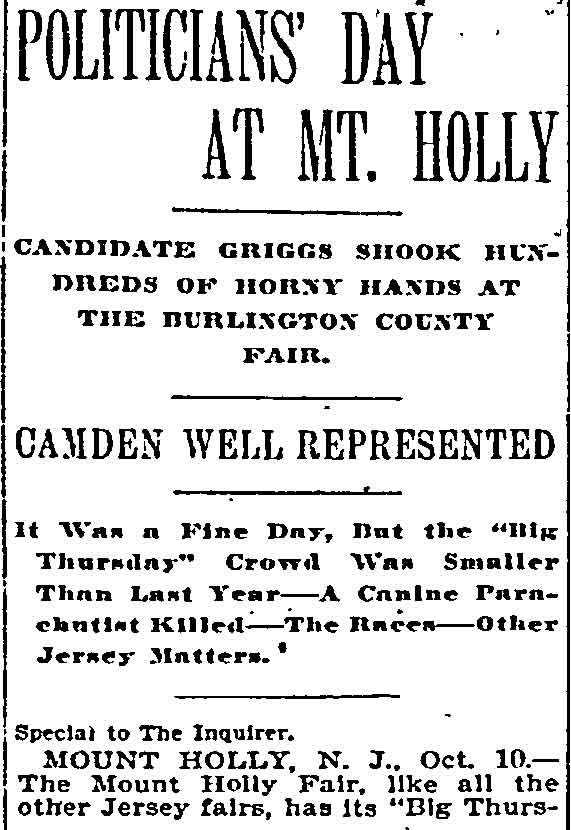
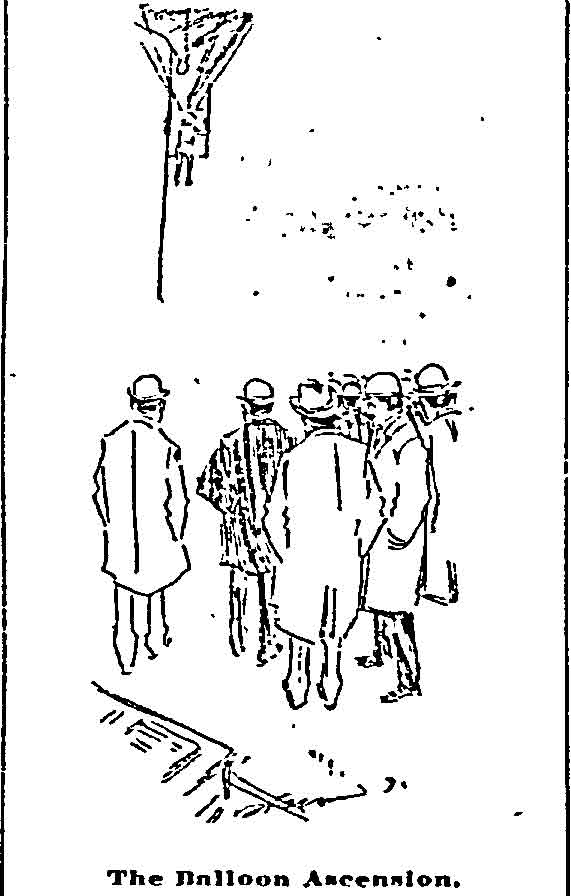
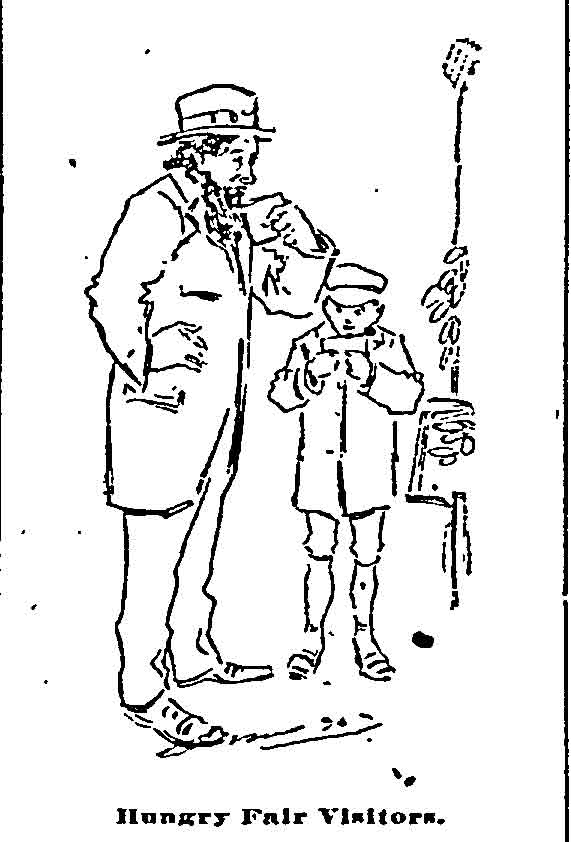
POLITICIANS’ DAY AT MT. HOLLY
CANDIDATE GRIGGS SHOOK HUNDREDS OF HORNY HANDS AT THE BURLINGTON COUNTY FAIR.
CAMDEN WELL REPRESENTED
It Was a Fine Day, But the “Big Thursday” Crowd Was Smaller Than Last Year—A Canine Parachutist Killed—The Races—Other Jersey Matters.
Special to The Inquirer.
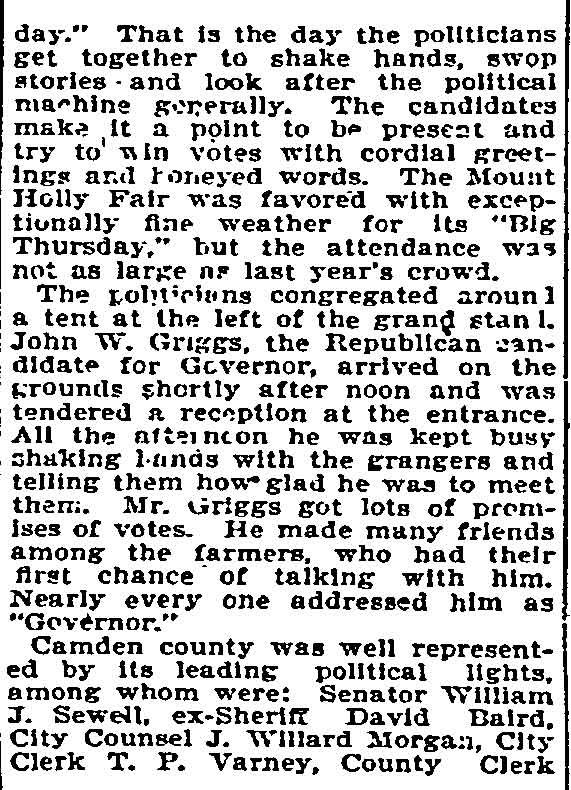
MOUNT HOLLY, N. J., Oct. 10.—The Mount Holly Fair, like all the other Jersey fairs, has its “Big Thursday.” That is the day the politicians get together to shake hands, swop stories and look after the political machine generally. The candidates make it a point to be present and try to win votes with cordial greetings and honeyed words. The Mount Holly Fair was favored with exceptionally fine weather for its “Big Thursday,” but the attendance was not as large as last year’s crowd.
The politicians congregated around a tent at the left of the grand stand. John W. Griggs, the Republican candidate for Governor, arrived on the grounds shortly after noon and was tendered a reception at the entrance. All the afternoon he was kept busy shaking hands with the grangers and telling them how glad he was to meet them. Mr. Griggs got lots of promises of votes. He made many friends among the farmers, who had their first chance of talking with him. Nearly every one addressed him as “Governor.”
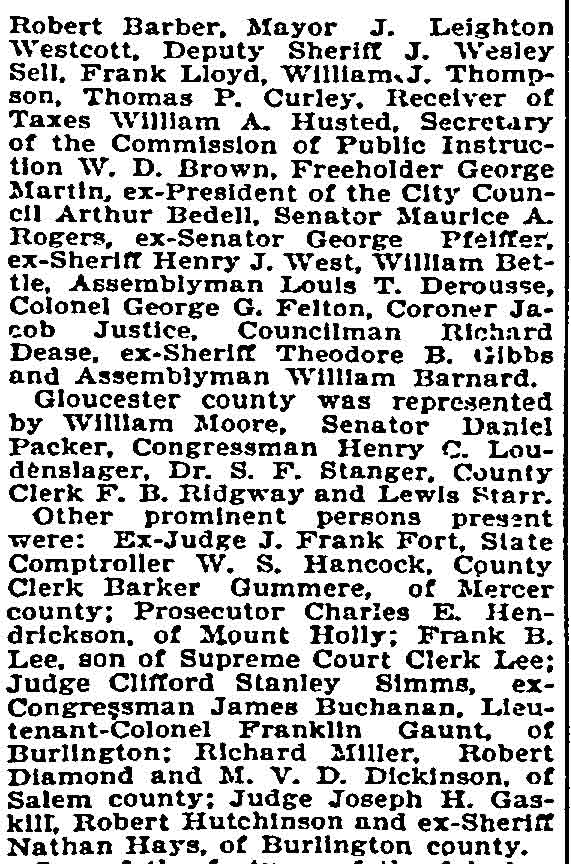
Camden county was well represented by its leading political lights, among whom were: Senator William J. Sewell, ex-Sheriff David Baird, City Counsel J. Willard Morgan, City Clerk T. P. Varney, County Clerk Robert Barber, Mayor J. Leighton Westcott, Deputy Sheriff J. Wesley Sell, Frank Lloyd, William J. Thompson, Thomas P. Curley, Receiver of Taxes William A. Husted, Secretary of the Commission of Public Instruction W. D. Brown, Freeholder George Martin, ex-President of the City Council Arthur Bedell, Senator Maurice A. Rogers, ex-Senator George Pfeiffer, ex-Sheriff Henry J. West, William Bettle, Assemblyman Louis T. Derousse, Colonel George G. Felton, Coroner Jacob Justice, Councilman Richard Dease, ex-Sheriff Theodore B. Gibbs and Assemblyman William Barnard.
Gloucester county was represented by William Moore, Senator Daniel Packer, Congressman Henry C. Loudenslager, Dr. S. F. Stanger, County Clerk F. B. Ridgway and Lewis Starr.
Other prominent persons present were: Ex-Judge J. Frank Fort, State Comptroller W. S. Hancock, County Clerk Barker Gummere, of Mercer county; Prosecutor Charles E. Hendrickson, of Mount Holly; Frank B. Lee, son of Supreme Court Clerk Lee; Judge Clifford Stanley Simms, ex-Congressman James Buchanan, Lieutenant-Colonel Franklin Gaunt, of Burlington; Richard Miller, Robert Diamond and M. V. D. Dickinson, of Salem county; Judge Joseph H. Gaskill, Robert Hutchinson and ex-Sheriff Nathan Hays, of Burlington county.
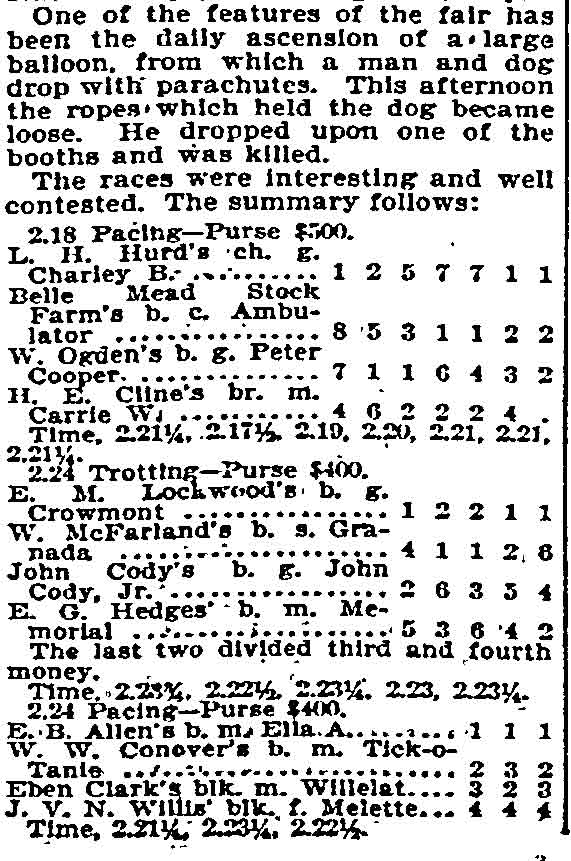
One of the features of the fair has been the daily ascension of a large balloon, from which a man and dog drop with parachutes. This afternoon the ropes which held the dog became loose. He dropped upon one of the booths and was killed.
The races were interesting and well contested. The summary follows:
2.18 Pacing—Purse $500.
L. H. Hurd’s ch. g. Charley B....1 2 5 7 7 1 1
Belle Mead Stock Farm’s b. c. Ambulator....8 5 3 1 1 2 2
W. Ogden’s b. g. Peter Cooper....7 1 1 6 4 3 2
H. E. Cline’s br. m. Carrie W....4 6 2 2 2 4
Time. 2.21¼, 2.17½, 2.19, 2.20, 2.21, 2.21, 2.21¼.
2.24 Trotting—Purse $400.
E. M. Lockwood’s b. g. Crowmont....1 2 2 1 1
W. McFarland’s b. s. Granada....4 1 1 2 8
John Cody’s b. g. John Cody, Jr....2 6 3 5 4
E. G. Hedges’ b. m. Memorial....5 3 6 4 2
The last two divided third and fourth money.
Time. 2.23¾, 2.22½, 2.23¼, 2.23, 2.23¼.
2.24 Pacing—Purse $400.
E. B. Allen’s b. m. Ella A....1 1 1
W. W. Conover’s b. m. Tick-o-Tanie....2 3 2
Eben Clark’s blk. m. Willelat....3 2 3
J. V. N. Willis’ f. Melette....4 4 4
Time, 2.21¼, 2.23¼, 2.22½.
Philadelphia Inquirer — July 13, 1897
Philadelphia Inquirer —
OVER IN CAMDEN
County Clerk Barber refused two more applicants for marriage licenses yesterday. He has not granted a license under the new law.
Vice-Chancellor Grey has made a decree in favor of Sarah M. Hall in her suit against the Home Building Company on foreclosure of a mortgage for $63,800.
Bertha Brown, colored, was committed to the county jail in default of bail by Justice Baldwin yesterday on a charge of larceny preferred by Martha Mitchell.
James Carter, colored, who was shot a week ago during a race riot in South Camden, is steadily improving, and Cooper Hospital surgeons now entertain hopes of his recovery.
Philip Botts, of 512 Chestnut street, was severely burned about the mouth and throat yesterday by drinking ammonia in mistake for medicine. He was taken to the Cooper Hospital.
Mayor Westcott yesterday sentenced George Wilmore, 12 years old, to ten days’ imprisonment on a charge of tapping the till in Mrs. Lizzie Stewart’s store, at Sixth and Royden streets.
Godfrey Lentz and his young son were held in bail yesterday by Justice Schmitz, charged with assault and battery on Charles Haug, against whom Lutz made a charge of perjury last week.
Assemblyman L. T. Derousse, Harry C. Dole, A. R. Dease, J. Oscar Nichuals and John Cherry are the Camden delegates who will attend the session of the National Republican League in Detroit this week.
Peter C. Verga, owner of the yacht J. Willard Morgan, says there is no likelihood of a race between his boat and the John E. Mehrer at Atlantic City, as no agreement as to the details of the race can be reached.
Jacob Fish, the city gardener, whose industry and skill is shown in the beautiful lawns and flower beds surrounding the City Hall, is a candidate for the position of superintendent of the City Hall, to succeed Charles C. Moffett, deceased.
Eight bidders presented estimates yesterday for furnishing coal to the county institutions at Blackwood. The five lowest bidders each wanted $4.55 a ton and the award of the contract was laid over until to-morrow, when new bids will be opened.
N. D. Geordileas, of 105 Market street, Philadelphia, jumped from a Camden, Gloucester and Woodbury trolley car at Broadway and Mechanic streets and was struck by a Camden and Suburban trolley car. He was taken to the Cooper Hospital, but as his injuries were not serious, he was sent to his home.
The News From Jersey
Philadelphia Inquirer —
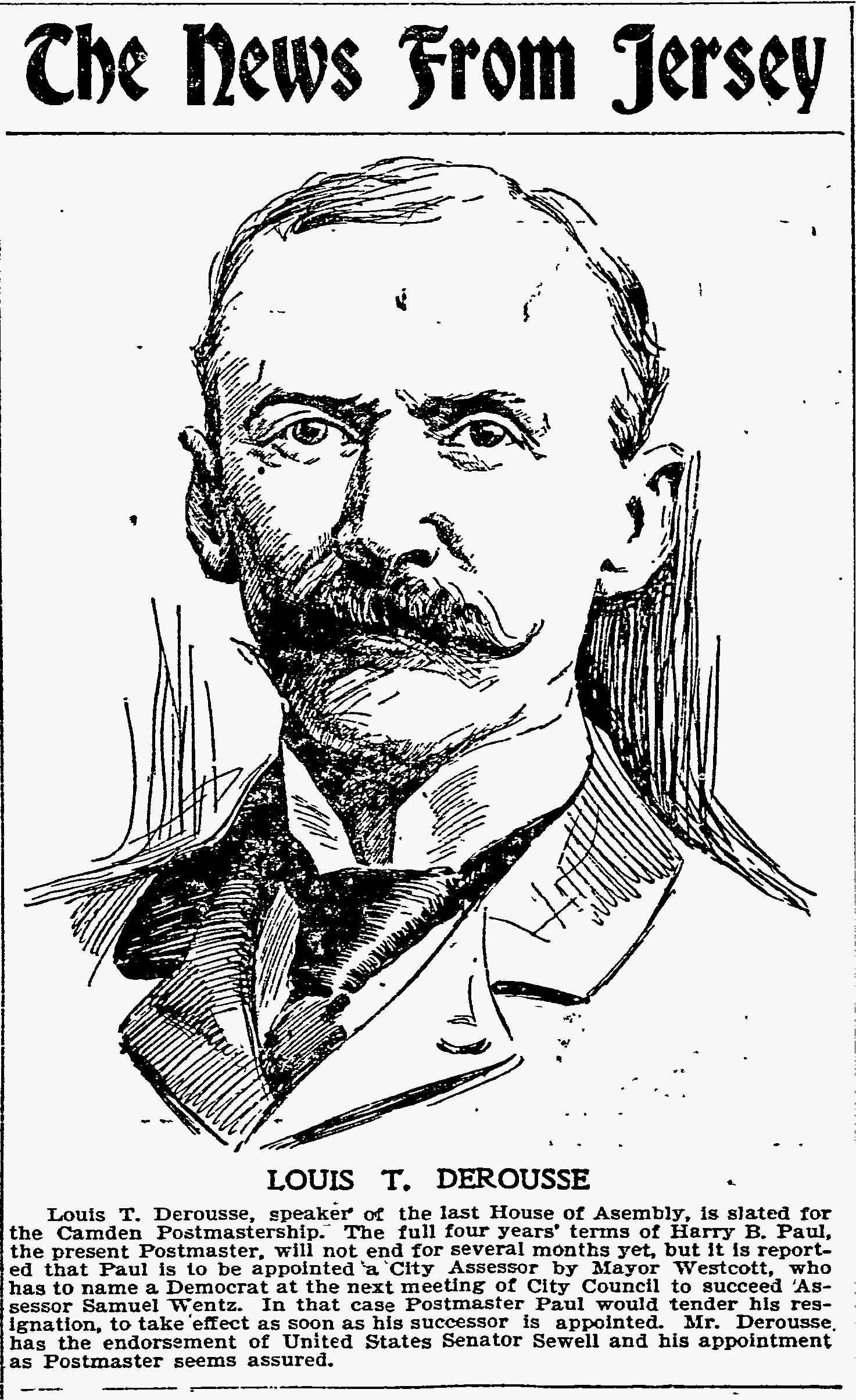
LOUIS T. DEROUSSE
Louis T. Derousse, speaker of the last House of Asembly [sic], is slated for the Camden Postmastership. The full four years’ terms of Harry B. Paul, the present Postmaster, will not end for several months yet, but it is reported that Paul is to be appointed a City Assessor by Mayor Westcott, who has to name a Democrat at the next meeting of City Council to succeed Assessor Samuel Wentz. In that case Postmaster Paul would tender his resignation, to take effect as soon as his successor is appointed. Mr. Derousse has the endorsement of United States Senator Sewell and his appointment as Postmaster seems assured.
Derousse Named for Postmaster
Philadelphia Inquirer —
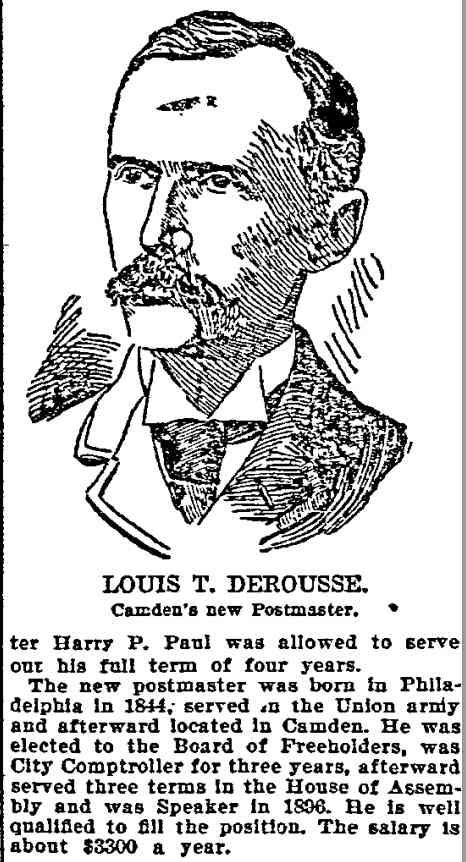
Former Speaker of the Assembly Will Handle the Mails in Camden — Was Strongly Indorsed — Postmaster Paul Allowed to Serve Out His Full Term
President McKinley yesterday sent to the Senate the nomination of Louis T. Derousse to be postmaster of Camden. It has been known for some time in Camden that Mr. Derousse would secure the position, as he had the indorsement of Senator Sewell, Vice-President Hobart, Attorney-General Griggs and the entire New Jersey Congressional delegation. Postmaster Harry P. Paul was allowed to serve out his full term of four years.
The new postmaster was born in Philadelphia in 1844; served in the Union army and afterward located in Camden. He was elected to the Board of Freeholders, was City Comptroller for three years, afterward served three terms in the House of Assembly and was Speaker in 1896. He is well qualified to fill the position. The salary is about $3300 a year.
Camden’s New Postoffice to Rise
Philadelphia Inquirer —
Ground was broken yesterday for Camden’s new postoffice building, at Third and Arch streets. The first shovelful of earth was thrown out by Postmaster Derousse with the remark: “Now, boys, for a new Camden.” He next passed the shovel to Miss Katie Mills, daughter of Assistant Postmaster Mills, who also tossed out a big shovelful of earth to start the new building that Camden has been so long waiting for. Collector of the Port F. F. Patterson and County Collector M. F. Ivins also used the shovel. It is expected that the building will be completed within a year.
Philadelphia Inquirer — March 24, 1899
Philadelphia Inquirer —
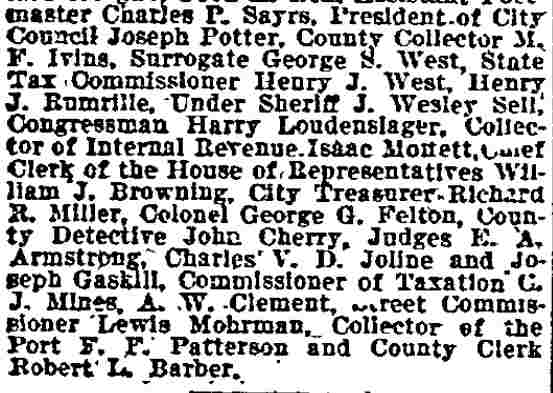
Named: William Joyce Sewell, Louis T. Derousse, David Baird Sr., Herbert W. Johnson, Robert Hand, J. Willard Morgan, Frederick A. Rex, Charles P. Sayrs, Joseph Potter, Mahlon F. Ivins Sr., George S. West, Henry J. West, Henry J. Runrille, J. Wesley Sell, Harry Loudenslager, Isaac Moffett, William J. Browning, Richard Miller, Col. George G. Felton, John Cherry, Charles V.D. Joline, Joseph Gaskill, Christopher Mines Jr., A.W. Clement, Lewis Mohrman, Francis Ford Patterson Jr., and Robert L. Barber.
Philadelphia Inquirer — July 12, 1899
Philadelphia Inquirer —
Congressman Loudenslager has notified Postmaster Derousse that the postoffice department is about to abolish the Cramer Hill and North Cramer postoffices, and establish sub-stations of the Camden postoffice in their stead, with free mail delivery for the East Side.
Philadelphia Inquirer — December 6, 1899
Philadelphia Inquirer —
Louis T. Derousse
$2,000 Shortage Reported in Postmaster Derousse's Accounts
Camden Post-Telegram —
A Telephone Message Says the Missing Official Is Ill at the House of a Friend in Baltimore
Assistant Sayrs In Charge Of Office
Derousse Sent a Letter to His Assistant, Postmarked “West Philadelphia,” Hinting at Intent to Commit Suicide.
Inspectors Still At Work Investigating Accounts
Missing Official Had Borrowed Money From His Friends and His Note Went to Protest.—Inspectors Were Sent For by Bondsmen.
City Treasurer J. Hampton Moore, of Philadelphia, telephoned the Post-Telegram at noon that Postmaster Derousse was at the home of a friend in Baltimore, under a physician’s care.
It is reported that the missing postmaster is short in his official accounts. The defalcation, it was stated this morning by one of his bondsmen, is approximately $2,000.
The bondsmen at a conference in the post office this morning agreed to put Assistant Postmaster Charles P. Sayrs in charge of the office.
Mr. Sayrs late last night received a letter, postmarked West Philadelphia, from the missing postmaster, in which it is said, Mr. Derousse practically admits that his accounts are not right and hints at a purpose to do away with himself.
Camden has not for many months received such a shock as was experienced yesterday when it was first rumored that Postmaster Louis T. Derousse had committed suicide and later it became known that he was missing and that inspectors were examining the accounts of the office. That Mr. Derousse left the city to avoid the consequences of exposure of a shortage in his accounts now seems apparent. His fight was unaccounted for at first, but later developments lead to the conclusion that he feared to face the inevitable.
The visit of two Post Office Inspectors to examine his accounts is said to be due to disclosure made to Former Judge D. J. Pancoast, who is counsel for Wilson H. Fitzgerald, Mr. Derousse’s father-in-law, and also one of his bondsmen, that there was something wrong in the office. After consulting with one or two of his fellow bondsmen, Lawyer Pancoast decided that the best thing to do was to send for the postal inspectors.
The visit of the inspectors was unlooked for by the Postmaster. He visited the establishment of Emil Moebius about 10 o’clock yesterday morning and procured two photographs of the post office building, saying that he wanted to present them to two friends. He also visited the Camden Wood Turning Company’s mill at Front and Arch streets, and ordered six racks for rubber stamp sawed out. From his actions up to the time the inspectors arrived he had apparently no thought of going away. He was chatting in his office with a Post-Telegram man a few minutes before 11 o’clock. Shortly afterward the inspectors arrived and at once took charge.
His Flight.
The postmaster must have known that he could not avoid the disclosure of irregularities in his accounts. The inspectors at once took charge of the office. He tendered them his aid for a short time and then said he had to go out for a few minutes and would be back to give them further aid.
Suspicion of the Postmaster’s flight was not aroused until about 2 o’clock. Then it was reported that he had committed suicide at his home. The report spread like wildfire. It was found to be untrue, but at once search was made for the missing man. The last trace of him was found at the Federal street terminal. Joseph Orr, a special officer there, saw him in the crowd. He spoke to him but the postmaster, who looked worried and distrait did not answer. Ore, who is an old friend and fellow G. A. R. man, thought this a strange action. Later when he looked for Derousse the postmaster had disappeared.
It is believed that he went across the river, as Assistant Postmaster Charles Sayrs received a letter about midnight, postmarked “West Philadelphia,” in which Mr. Derousse said things were wrong at the post office and he thought of ending his life. The letter was mailed late in the afternoon.
After reading the letter it was shown to Postal Inspectors Mehary and Buck and also exhibited to the bondsmen. The inspectors suggested that Chief of Police Foster be called in to the case.
Found In Baltimore.
Friends of the Postmaster continued the search for him all night. Telegrams were sent in every direction. The first authentic news of his whereabouts was received this morning.
City Treasurer J. Hampton Moore, of Philadelphia, called up the Post-Telegram at noon, and said he had just received a telephone message from a friend in Baltimore stating that Postmaster Derousse was at his house.
This message said that Mr. Derousse arrived there about midnight, that he was in a state of high nervous and mental excitement and talked of suicide. A physician had been called in and was treating him.
Treasurer Moore would not give the name or address of his informant at whose house Mr. Derousse was said to be sheltered, but said he was a former Camdenien. It may be that the former Camdenien is William H. Swindell, who was janitor at the Court House some years ago, but has been a resident of Baltimore for four or five years.
Shortage In His Accounts
The post office inspectors are still at work. They were busy in the private office of the postmaster until midnight and resumed their work early this morning. By 10 o’clock they had reached a conclusion as to the finances of the office and the postmaster’s bondsmen were summoned.
These bondsmen, who are liable for $20,000, are Wilson H. Fitzgerald, father-in-law of the postmaster; State Comptroller J. Willard Morgan, Judge Harrison H. Voorhees, Former Judge D. J. Pancoast and Former Receiver of Taxes Frank H. Burdsall.
The bondsmen were informed that a shortage of about $2,000 had been discovered. They agreed to put Assistant Postmaster Sayrs in charge of the office.
In addition to this alleged shortage Postmaster Derousse is said to have borrowed money or got indorsements from a number of his friends. One of these is Judge Harrison H. Voorhees, who about two months ago was induced to loan the postmaster his credit on a note for $1,200. The note, which was for 30 days, went to protest. The Postmaster subsequently paid $100 on it and renewed it. The same day that the original note was made Mr. Derousse is said to have borrowed $2,000 from his father-in-law.
State Comptroller Morgan is an endorser on some of his paper.
The amount of his personal indebtedness is not known. His father-in-law, Wilson H. Fitzgerald, was at the post office this morning. Mr. Derousse transacted some of his business and he is now going over his papers.
The wife of the postmaster is under the care of the family physician, suffering from prostration due to the disclosures.
Former Judge Pancoast, one of his bondsmen, when seen this morning said: “I hope the inspectors will make a rigid examination of the accounts of his office.”
The inspectors in their investigation discovered that the stamp clerk was carrying a personal check of Postmaster Derousse for $412. This check the inspectors took possession of. The work of investigating the affairs of the office by the inspectors may not be concluded until tomorrow. They have about completed their work in the main office and are now going over the accounts of the twelve sub-postal stations.
Mr. Derousse’s Career.
Mr. Derousse was born in Philadelphia on May 29, 1844. He was only a lad when the Civil War broke out but promptly enlisted and served throughout the struggle. After the war he was engaged as an accountant and later managed the flour and feed business on Market street below Front, owned by his father-in-law, Wilson Fitzgerald. He bought out this business but was compelled to give it up owing to ill health.
He was a member of the Board of Freeholders for one term, in 1881, was City Comptroller from 1888 to 1891 and served in the House of Assembly in 1895, ‘96 and ‘97, being elected Speaker in 1896. He was appointed Postmaster in 1897, succeeding the late Harry B. Paul, and was re-appointed for a second term a year ago. He is a member of William B. Hatch Post 37, G. A. R.
Investigation Going On.
Assistant Postmaster Sayrs, who is in charge of the office, was closeted with the two postal inspectors in the postmaster’s private office all day, giving them such information and assistance as they requested in the examination of the accounts. From time to time one or another of the clerks would be summoned to give information. All the accounts are being gone over with scrupulous care and attention.
The acting postmaster at a late hour this afternoon when requested for a statement of the affairs of the office said he could say nothing until the inspectors concluded their report. He said they expected to complete the investigation by to-morrow afternoon.
Asked as to Postmaster Derousse’s whereabouts, Mr. Sayrs said:
“We know that he is in Baltimore, at the house of a friend.”
“Has anyone gone to Baltimore to see him?”
“Someone will go this afternoon. More than that I cannot say.”
It was learned that Congressman Loudensinger, who was one of the first notified by City Treasurer Moore, of Philadelphia, of the whereabouts of Postmaster Derousse came across the river and had a conference with Internal Revenue Collector Moffett and Former Postmaster William J. Browning, both close friends of Mr. Derousse.
Arrangements were made to send someone to Baltimore to look after him.
It was reported that the government officials had taken steps to locate the Postmaster, and that he will be placed under surveillance, pending an official report from the postal inspectors and a decision as to further official action.
Government Is Secured.
A federal official is discussing the reported shortage in Postmaster Derousse’s accounts said the government would lose nothing, being fully secured by the bond. The bondsmen, it is understood, have agreed to make good any shortage.
The same official said: “I am utterly unable to account for Postmaster Derousse’s flight, even in view of the reported shortage. Had he made known his financial difficulties to his friends they would gladly have come to his relief, rather than have this happen. Mr. Derousse has been worried a great deal of late and talked of domestic trouble. He has spent a great deal of time at the post office, even sleeping on a couch there at nights occasionally of late. I think he anticipated something of this sort.”
The physician in attendance on Mrs. Derousse said this afternoon that her condition is critical. He broke the news to her as gently as possible of the locating of Mr. Derousse in Baltimore and he at once noticed a slight improvement in her condition. The family had no news directly from Mr. Derousse.
Postmaster Derousse in Balto.; Shortage Reported In Accounts
Camden Daily Courier —
Judge Pancoast and Bondsmen Alleged to Have Ordered Investigation
Inspector’s Report Will Not be Ready For a Day or Two
Congressman Loudenslager Reported to Have Gone to Visit Him.
Alleged Mrs. Derousse Was Endeavoring To Secure Divorce
The mystery surrounding the disappearance of Postmaster Louis T. Derousse is rapidly clearing. At his home, 326 North Sixth street, the following statement was given out this morning:
“We believe that Mr. Derousse has gone away while suffering from depressed spirits and melancholia and think he will return in two or three days.”
This theory proved to be correct, as was shown when J.. Hampton Moore, City Treasurer of Philadelphia, who is a great friend of Postmaster Derousse, telegraphed to this city shortly after 12 o’clock that he had received a telegram from Baltimore, Md., stating that Mr. Derousse had been found in that city. No details were given except that the Postmaster’s mind was affected.
It is learned that Mr. Derousse is at the house of a former Camden man, and it is presumed that it is William T. Swindell, who was formerly janitor of the Court House in this city. Mr. Derousse wandered in there about midnight, very ill, and is now in the care of a physician.
Undoubtedly A Shortage.
There is little doubt but what the Postmaster is short in his accounts at the Postoffice, although authentic information is not obtainable. The postoffice inspectors are not through their work and as they are the only ones who know just what and where the leak is, until they are ready to make a report no figures can be ascertained. It is said, though, that the shortage will foot up into the thousands.
The inspectors will be at work for a day or two yet and may not make a report until Saturday.
As soon as the information that Mr. Derousse had been located in Baltimore was received in this city, Congressman Harry Loudenslager made haste for a train for that point and sent for William J. Browning to accompany him. Mr. Browning immediately dropped out of sight, but it is not known whether he went to Baltimore or not.
Sayrs In Charge.
Assistant Postmaster Sayrs is in charge of the Postoffice at present and stated that he had no information to give out until the inspectors were ready with their report. He said he received a letter from Mr. Derousse late last night, in which the Postmaster said that things were not all right at the Postoffice and he would probably not be heard from again. This was interpreted at the time to mean that he intended to commit suicide, but later developments show that the construction was wrong.
Postmaster Sayrs said as far as he knew no warrant had been issued for Mr. Derousse’s arrest, although the indications were that he would be brought back to this city as soon as it was advisable. United States Commissioner Morgan is in Trenton to-day and could not be seen.
It is further said that considerable of Mr. Derousse’s paper has gone to protest in local banks and he is indebted to well known men for various sums of money. Judge Harrison H. Voorhees is said to have endorsed one note for $1,200, and Wilson Fitzgerald, his father-in-law, is reported to have loaned him $2,000 only recently.
Was Mrs. Derousse Applying For Divorce?
Another phase was added to the muddled affair this afternoon when it was given out that Mrs. Derousse was about to have commenced divorce proceedings against her husband. This information comes from an authentic source, but the informant said that matters had not proceeded far enough to warrant publication of the details. Papers, it is said, were being prepared and only yesterday morning Mr. Derousse was made aware of the fact that he would soon be called upon to reply to his wife’s alleged proceedings.
Judge Pancoast is mentioned as being the counsel for Mrs. Derousse and was approached upon the subject on Market street this afternoon. The Judge’s reply was a curt “I have nothing further to say.”
Hints Of Double Life.
Just what led up to the sudden visit of the inspectors to the Post office is still a matter of speculation, but it was reported this morning that ex-Judge Pancoast had ordered an investigation of Mr. Derousse’s accounts because of information to the effect that the Postmaster was leading a double life. A “Courier” reporter called on Judge Pancoast shortly before noon, and said:
“Judge, there is a report current to the effect that you have ordered an investigation of Mr. Derousse’s accounts on information you received to the effect that Mr. Derousse was leading a double life. Is it true?”
Judge Pancoast’s Significant Remarks.
“Well, now,” said the Judge, “I don’t think I ought to make any statement at this time.”
“Will you deny or affirm it?” queried the reporter.
“I think I shall make no statement just now,” answered the Judge.
The reporter then informed him that Robert Smith, a clerk in the office of Mr. Derousse, had informed him that the inspectors had dropped into the office casually and without any orders.
At this the judge smiled broadly and remarked that he didn’t care to make any statement just yet and went on with his work.
Later Judge Pancoast said to a “Courier” reporter: “I was aware there would be a special investigation of Postmaster Derousse’s accounts a day before it occurred. He further stated that he was aware of further misdoings on the part of the Postmaster and hoped the matter would be sifted to the bottom.
Judge Pancoast is one of Mr. Derousse’s bondsmen on a $20,000 bond. The others are former Judge Burdsall, J. Willard Morgan and Wilson Fitzgerald.
Conferences and tete-a-tete have been the order of business all morning with men high in the official life of the government. Congressman Loudenslager, Chief Clerk of the House of Representatives William J. Browning, Collector of Internal Revenue, Isaac Moffett and Assistant Postmaster Chas. P. Sayrs were in conference at the Post Office for a long time this morning.
Mr. Derousse had charge only of the moneys of the Money Order and Registry Departments of the office. The stamp money and money of other departments passed through the hands of Assistant Postmaster Sayrs and Clerk Smith. The money, Mr. Smith stated, is banked every day.
The inspectors will continue their work to-day and to-morrow and no report of the financial condition of the office is expected until to-morrow afternoon or Saturday.
His Family Much Affected.
At Mr. Derousse’s home his family is much distressed over his absence. Mrs. Derousse is said to be in a very nervous condition and the other members of the family are so worked up over the affair that they have refused to talk further than make the statement given out.
Mrs. Derousse, it was stated by a friend last night, had been in poor health for some months, and this fact greatly worried her husband.
It was said, however, that there was nothing alarming in her condition and that there was no need for worry on his part.
How He Disappeared.
Mr. Derousse was at his office as late as 11 o’clock yesterday morning, and two inspectors were there examining the accounts of the establishment. Just before that William Casperson, a painter, of Market street, who had known the Postmaster for many years, called upon him in relation to a business matter and was surprised to find him sitting at his desk with bowed head on his hands.
“He did not look up when I spoke,” said Mr. Casperson last night, “but asked in a dazed sort of way who I was and what my business was. I was surprised, but unable to get anything from the Postmaster I left him.”
Soon after 11 o’clock the Postmaster left the office and that was the last seen of him by any of the attaches of the office, and as to his movements all sorts of rumors and stories were afloat last night.
It was stated that at about 3.30 o’clock former Judge D. J. Pancoast, who is one of the Postmaster’s bondsmen, and counsel for Wilson Fitzgerald, the aged father of Mrs. Derousse, received a message from the family stating that the Postmaster had committed suicide. The same word was carried to the Post Office, it is stated, and Assistant Postmaster Charles P. Sayrs drove hastily to the Postmaster’s residence, where he was informed that the Postmaster was not at home.
Seen At Ferry.
Joseph Orr, a special officer at the Pennsylvania Railroad terminal in the city, declares that he saw the Postmaster at 1.40 o’clock yesterday afternoon with the crowd that was making its way to an Atlantic City train. Orr says he put out his hand to Mr. Derousse, but that the latter seemed to be dazed and failed to recognize him.
Many Strange Actions.
Thomas Samani, who keeps the lunch cafe on Federal street, had the Postmaster for breakfast on Friday morning last. Mrs. Samani took the order for breakfast.
“You don’t appear well to-day, Mr. Derousse,” remarked the lady behind the counter.
“Well, I guess I am well enough,” came the reply, “but I’ve got an awful case of the blues.”
Mr. Samani says he did not appear to be the same man. Not a great while ago, the Postmaster, in conversation with Mr. Samani, said that twenty-five years ago he was obliged to give up the grain business, then paying him $25,000 a year, on account of the despondent feelings that came over him at times of mental anxiety.
“Why,” said he, “all sorts of thoughts used to occupy my mind, and a horrible one among them was the thought of going out into the woods and blowing out my brains. My cooler judgment, however, brought to me the awful reaction on my family, and I dismissed the thought.”
Bondsmen Had Concern.
Mr. Pancoast, a brother to the Judge, one of the Postmaster’s bondsmen, was a very intimate acquaintance of more than twenty years. He frequently called at the post office and spent many a happy hour listening to the humor for which the missing official was famous.
Mr. Pancoast says he made one of these visits only last week and had been in his company but a short time when he knew by the actions of the official that something was bothering him. He had apparently no time to listen to conversation, but amused himself looking over stereopticon views, a pastime so foreign to his usual business notions, that it caused great concern to Mr. Pancoast.
At one o’clock yesterday he was seen in the vicinity of the “Courier” office and mounted and quickly descended the stair approach to an office, with which he certainly had no business. Other close friends can remember now, peculiar actions in the morning. Instead of that characteristic warmth and hearty greeting, he passed old time friends unnoticed. He appeared in an extremely excitable frame of mind.
Something Of His Life.
Louis Theodore Derousse was born in Philadelphia May 29, 1844. He is by profession an accountant. He was formerly in the flour, feed and grain business, but was forced to retire from it owing to ill health. He was a member of the Board of Freeholders for one term, 1881, and declined a renomination. He was City Comptroller of this city for three years, 1888 to 1891. He was elected a member of the Legislature in 1895, was made Speaker of the House in 1896 and was returned as a member for a third term in 1897. He was appointed Postmaster of this city by the late President McKinley in 1899, and was reappointed for a second term about six months ago. Mr. Derousse has two grown daughters, one of whom is married to a prominent physician in Philadelphia.
Philadelphia Inquirer — June 18, 1903
Philadelphia Inquirer —
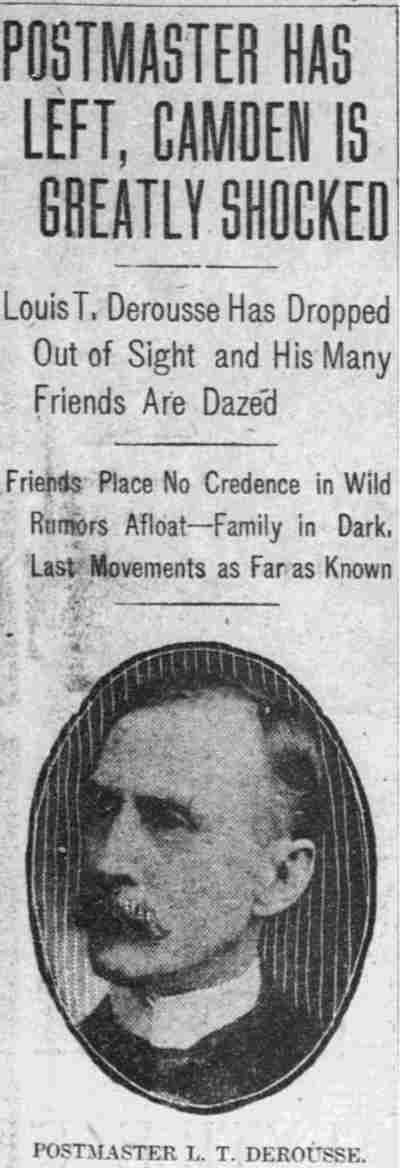
Named: Dr. Frank Neal Robinson, Charles P. Sayrs, Joseph Orr, Henry Loudenslafer, Isaac Moffett, and William J. Sewell.
Camden’s Missing Postmaster Case is Deep Mystery
Trenton Evening Times —
Louis T. Derousse, One of the Best Known Men in South Jersey, May Have Killed Himself.
Accounts Appear All Right
Philadelphia, June 18.—A rumor yesterday to the effect that Postmaster Louis T. Derousse of Camden, N. J., had sent a brief note to his family in which he announced his intention to end his life, caused one of the greatest sensations Camden has experienced in many years. This, coupled with the fact that he had not been found up to a late hour last night, made the circumstance all the more mysterious.
Dr. Frank Neal Robinson, the family physician of the postmaster, said that he had had a talk with Mrs. Derousse. She said, according to Dr. Robinson, that she had sent a short note to Judge Pancost, which bore on private affairs only. She denied absolutely that she had sent anything that might be interpreted as saying that Mr. Derousse had committed suicide.
Assistant Postmaster Charles P. Sayre, who was placed in charge of the office, said that he had no idea as to the whereabouts of his chief. The last he saw of him was about 11 o’clock. Up to that time he had been with two Government postal inspectors.
He said the inspectors would continue their work of going over the accounts of the missing postmaster and that nothing they have done thus far would be made public.
Among the first to start inquiries as to the whereabouts of Mr. Derousse was Congressman Henry C. Loudenslager, a close personal friend, who went directly to the Camden post office. He sent messages to the railroad offices and all important points, but learned nothing definite.
Mr. Derousse is one of the best known citizens of Camden, both politically and socially.
He was a close personal friend of the late United States Senator William J. Sewell and was prominent in Republican circles. For several terms he represented the Second ward in the City Council, and was City Comptroller for some years. He served three terms in the Assembly, being Speaker of the House in 1896.
Wife’s Illness Worried Him
By Publishers’ Press Direct Wire.
Camden, June 18.—The disappearance of Postmaster Louis F. Derousse becomes more mysterious with each hour. He cannot be located at Atlantic City, where he was rumored to have gone yesterday.
The examination of papers in his private office has revealed no reason for his unexplained departure.
His legion of friends have confidence in his integrity and the only cause known for his action is mental trouble, as he has been worried greatly over his wife’s illness.
She is prostrated at her home and it is doubtful if she will recover from the shock.
Led Double Life?
It is pretty well established that the inspection of his accounts was instigated by ex-Judge Pancoast, one of his bondsmen, to whose ears came a rumor that the postmaster was leading a double life. The truth of the latter and whether his accounts are crooked remain to be developed.
Postmaster Derousse Will Be Brought Back Here To-Day
Camden Daily Courier —
Friends Have Gone After Him and He Will be Moved as Soon as His Condition Will Permit It — Inspectors Are Through With the Postoffice and Are Working on the Sub-Stations.
There Will Be No Prosecution And His Accounts Will Be Squared
Postmaster Louis T. Derousse will be brought back to this city today. A friend left this city last night for Baltimore with instructions to bring him home as soon as his condition would permit it. The Postmaster is still very ill, but it is thought best to bring him to this city where he can be among friends, who will look after his interests. Dr. Iszard is mentioned as the man who has gone after him. Latest reports from Baltimore indicate that the Postmaster is in a dazed state of mind and all efforts to get a statement from him have been futile. It was further announced this morning that he would not be taken to his home on North Sixth street.
Inspectors About Through.
The government inspectors finished up their work at the Postoffice late last night and early this morning started on the sub-stations scattered throughout the city. This should take but a few hours to complete and, then the exact conditions of affairs in the local postal service will be known. The inspectors, however, will not talk and will only make a report to the authorities in Washington. In the meantime, Acting Postmaster Sayrs, who probably knows about as much as anybody about the affair, will not talk. He volunteered the information this morning that as soon as the inspectors made their report he would have something to say.
There Will Be No Prosecution.
That there will be no prosecution of the Postmaster seems certain. It is said that his offenses have been more on the outside than at the Postoffice, the alleged shortage at the Postoffice being described as technical. By this it is meant that the Postmaster’s checks have been offered to square his accounts and have been found to be worthless.
The amounts of these checks have not been made public. That there will be no prosecution seems to find favor with everybody in general, for Mr. Derousse was a popular and well liked man and only sorrow is expressed by those who knew him. This does not include those who have suffered by his actions.
Will Square His Accounts.
It is believed that after he is brought home and the inspectors make their reports, his friends will get together and make up to his bondsmen and to the government whatever shortage may be discovered, if there is any. His outside transactions, it is understood, are also to be squared and he is to be landed squarely on his feet as far as finances are concerned. There is hardly any possibility of the government taking any action in view of these transactions. His resignation as Postmaster will then be forthcoming and a new man appointed in his place. Several names have been mentioned, but none of them will hardly make the position. Mr. Derousse had barely finished six months of his second appointment and his successor will have three and one-half years to serve.
The Physician’s Statement.
Dr. Wegerfarth, who is attending the Postmaster at Baltimore, in speaking of the case, said: “I have seen the patient twice to-day, and I must say that there is no change for the better, and, in fact, if there is any change at all it is for the worse. Mr. Derousse is not in any immediate danger, but I do say that he is in a wretched condition mentally. His breakdown was not sudden, but is the result of several months of worry and trouble combined, possibly with overwork.
“I have tried at both visits to carry on a conversation with the Postmaster, but all efforts have been to no avail. He will make a few remarks about one thing, and then, without the slightest provocation, take up a new line of thought and break into the previous conversation with it. I feel that my patient has gone without sleep for several days, and I am satisfied that if he has a good sleep and rests well during the night he will be greatly improved in the morning. If I find this to be the case, I will allow him to be seen by his friends and the press, if he so desires.”
Sub-Stations Are All Right.
Temporary Postmaster Charles Sayrs said that while the deficiency in Postmaster Derousse’s accounts will aggregate $2,500, the sub-postoffices are considered in good shape.
“We allow them to carry but $50 stock or a total of $650 for the city. The Philadelphia papers make a wrong estimate on the business of this office in stating that we do but $4,000 a month. The receipts of the Money Order Department alone aggregate from eight to ten thousand dollars a month.”
Judge David J. Pancoast, who, as one of the bondsmen of the absent Postmaster, is pushing the investigation, was out of town when inquired for at his office to-day.
Derousse Has Left Baltimore
Camden Daily Courier —
Baltimore, Md., June 19— Postmaster Derousse has gone home, it is believed. “He left with Mr. Swindell,” said Mrs. Swindell this afternoon.
“Mr. Derousse was still in a bad mental condition, and had to be cared for. It is supposed that he is now at home, in Camden, N. J.,” she continued.
A number of government and county officials went across the river this afternoon, and Mr. Derousse is believed to be in Philadelphia, where he will remain for awhile.
Derousse Short $2,000
Woodbury Times —
Derousse Short $2000
Camden, N. J., Postmaster Found in Baltimore in Dazed Condition.
Postal Inspectors at Work
Bondsmen Declare He Is a Defaulter and Say His Downfall Was Caused By Leading a Double Life — Made Known By His Family.
Camden, N. J., June 19.—In a condition bordering on physical and mental collapse, Louis T. Derousse, the missing postmaster of this city, has been found at the home of W. H. Swindell, at Baltimore, Md., a former resident of this city. A newspaper reporter who saw the missing postmaster at the Swindell home reported by wire that Derousse replied to all questions by saying “yes,” and appeared to be demented. Dr. George D. Wedeforth, who was called by the Swindells to attend Derousse, said the sick man had told him in rambling remarks that he left Camden with the intention of going to the Schuylkill river and drowning himself. He got as far as Fairmount Park and sat down on a bench. What subsequently transpired Derousse said was blank, save that when he arrived over the Pennsylvania Railroad in Baltimore he went straight to Mr. Swindell’s. He had only 50 cents in his pocket when he arrived.
Shortly before the missing man was located two of his bondsmen, former Judge Pancoast and Harrison H. Voorhees, stated that Louis T. Derousse was a fugitive, and that a shortage of over $2,000 was discovered in his accounts by the postal inspectors, William J. Mehary and D. W. Buck.
The cause of his disappearance is said to be marital infelicity, and another woman is mentioned in the case.
It was through Mr. Derousse’s family that his alleged double life was made known to his bondsmen, and the postmaster was called upon for an explanation. This he could not give satisfactorily, and the postoffice department was notified and requested to make an examination of his accounts.
Former Judge David J. Pancoast was the first of his bondsmen, of whom there are five, to learn of Derousse’s difficulty. He said:
“Late last week I was informed by a member of Mr. Derousse’s family that he was not all that a husband and father should be. There was another woman mentioned, and the story told me so aroused me that I sent for Derousse and demanded an explanation. This he would not give, and I was painfully surprised, for I had known the man for years and believed him to be all that a man should be. Then I called a meeting of his bondsmen.”
Harrison H. Voorhees, Judge of the Cape May county court, who is one of the bondsmen, said: “Yes, I am out about $1,100 by Derousse’s actions, and I don’t know how much more it will be before the inspectors are through. I was told that a shortage of over $2,000 had been found and that the 13 sub-stations under Derousse’s care had not been investigated. The whole cause of his trouble is another woman. Who she is or where she was maintained I am not at liberty to say. That will all come out later.”
The news that Derousse is short in his accounts came as a severe shock to his numerous friends and relatives and to all of Camden. Lou Derousse, as he was familiarly known, was esteemed and respected by all, and no one for a moment would harbor a suspicious thought against him.
Mr. Derousse Returns And Is Reconciled To His Family
Camden Daily Courier —
The Postmaster Rapidly Regaining His Mental Faculties and is Being Cared for at His Home
The Bondsmen Made Good His Shortage This Morning
All seems to be happiness again at the Derousse homestead. Mr. Derousse is home and is apparently showing signs of returning reason. Mrs. Derousse met him affectionately at the door last evening as he returned. Everything had apparently been forgotten for the time being and husband and wife were most cordial in again meeting each other. In a great measure the man to whom is due the credit for Mr. Derousse’s return home as well as the loving reception by Mrs. Derousse of her unfortunate husband, is Dr. W. H. Iszard. Dr. Iszard brought the Postmaster from the home of William Swindell, 422 North Carey street, Baltimore. He bore to him a tender note from his wife pleading for his return.
Hesitated About Coming Home.
Mr. Derousse felt at first the heavy weight of troubles resting on him and refused to even consider returning home. He talked of meeting, of facing his friends again. What would they say? And his family, what would they think? Dr. Iszard told Mr. Derousse that friends were ready and eager to come to his assistance. He informed him that he would be welcome at his home and that he need not fear anything but a cordial reception there. Dr. Iszard handed him the note which he bore from Mrs. Derousse. Mr. Derousse read it, then said he would not return. He read it over and over again, and then he said he guessed he would. While in this frame of mind he was hurried to the Pennsylvania station and with Dr. Iszard took the 5.07 train for Philadelphia. They reached Broad Street Station, Philadelphia, at 7.07.
Met Friends At Station.
They met several friends, among them Congressman Loudenslager, ex-Sheriff Sell, William J. Browning, J. Willard Morgan and Frank H. Burdsall. They went to Kugler’s and had lunch, then took a car to the ferry. On their arrival here Dr. Iszard and Mr. Derousse got into a cab and were driven to the latter’s home, 326 North Sixth street.
A group of people, attracted by the rumbling of the carriage, gathered around the door of the Derousse home. They just got a glimpse of Mr. Derousse as he was hurried up the steps and ushered into the house.
In talking this morning over Mr. Derousse’s condition, Dr. Iszard said that if the unfortunate man is notified that his position as Postmaster is to be taken from him he will take a serious turn for the worse. Mr. Derousse has not yet been notified that he will have to relinquish the Postmastership. In order to save him from further humiliation it is said his bondsmen will make good his deficit and to save him from suspension will have him send in his resignation.
Again Started To Commit Suicide.
Mr. Derousse’s last day at the home of his friend, William Swindell, in Baltimore, was not without incident. At four o’clock in the morning, unbeknown to anyone in the house, Mr. Derousse got up, dressed and walked down to the Chesapeake Bay with the intention of committing suicide. When he reached the wharf he changed his mind and returned home.
Mr. Swindell was awakened by the slamming of a door. One glance at the bed sufficed, and the next moment he was bounding down the steps, thinking his friend was leaving the house. However, to his surprise, he found the Postmaster in the hallway in the act of hanging his hat upon the rack.
“Why, where are you going, Derousse?” he asked.
“Not going, William,” replied Mr. Derousse. “I am returning.”
This naturally caused a series of questions to follow, and the Postmaster admitted that he had left the house at 4 o’clock, and had gone down town for the purpose of finding the docks, and to there end his life.
“I got there all right, William,” he said. “I even rewrote the note and put it in my hat, but still I hesitated. It was not from any fear, though, but merely the fact that I determined I could not bring your name into so much trouble.
Thought For Friend
“You have taken care of me, and I appreciate it from the bottom of my heart; so I thought it would look base ingratitude if I killed myself after having sneaked from your house while you slept. Some people might censure you and say you did not do a friend’s duty by not watching me; so I decided to come back an wait.”
Mr. Swindell said nothing, but walked over to the rack and picked up the hat. Sure enough, there lay the note— a page from a memorandum book— and upon it was written:
“To Mr. William H. Swindell, 422 North Carey street.”
That was too much. Mr. Swindell tore the note into pieces without opening it, and with tears in his eyes begged his friend to give up his rash idea. Then followed a good long talk, during which Mr. Derousse connected his lines of thought better than he had ever done since his arrival, and told much of his trouble to his friend. This seemed to cheer him considerably and after breakfast he was much brighter.
Blame It On Domestic Affairs.
In an interview in Baltimore Dr. Iszard is quoted as having said: “I have known Derousse for many years, having been a close friend both politically and socially and his medical advisor as well. His condition, I know perfectly well, has been brought on through domestic affairs, and not the $2,000 shortage that has been discovered during his absence. I will say frankly that anyone could notice the change in the man this morning almost immediately after I arrived here and gave him a letter from his wife. He has braced up wonderfully since, but his condition even now is serious.
“No, indeed; his trouble has been caused mainly by his wife and their domestic relations, but all of this has been remedied. Mrs. Derousse sent by me a letter which was so pathetic, so loving and so good in its purpose that it has assured the postmaster that the breach which existed between the two is healed forever. Of course, I cannot tell you the exact contents of the letter because it is of a personal nature, but I will say that all the way through it the wife pleads with her husband to come back to her and his children; that she loves him more dearly than her own life and that the past is forgotten.
“Such a letter could not help but have its effect and the man gave vent to his feelings, which was more important at that time than one hundred doses of medicine. However, I think all will end well and matters will be arranged in Philadelphia to-night or to-morrow morning.”
Asked if Mr. Derousse had shown any signs of mental trouble or worry recently, Dr. Iszard answered that he had done one very peculiar thing just a few days before leaving. It seems that the postmaster owned a very fine collection of photographs of actors and actresses, and on last Monday evening he gathered them together and requested the physician to donate them to Lodge No. 293, of the Elks, of which he was a member. On the evening the presentation was to have been made the postmaster was missing. The fact that he was going to part with the collection seemed peculiar to the doctor, for he knew that Mr. Derousse valued them most highly. The postmaster, besides being an Elk, is a Mason of high standing, and a member of the Order of Odd Fellows.”
Shortage Said To Have Been Paid.
The post office inspectors who have been going over Mr. Derousse’s accounts as postmaster, since Wednesday, completed their investigation to-day. When Inspector Buck was seen in reference to making a statement he said that he had reported to the bondsmen of Mr. Derousse, who could give out any desired information. J. Willard Morgan, one of the bondsmen, was seen and gave out $2,178.71 as the accurate deficit in the Postmaster Derousse’s accounts.
“Will Mr. Derousse be asked to resign?” was asked Mr. Morgan.
“It is understood,” said he, “that Mr. Derousse is out.”
Inspector Buck said that all of the money Postmaster Derousse took from the post office accounts was taken from the bank with the exception of the moneys taken from Clerks Auble and Simpson, for which the postmaster gave them his personal check. The money placed in bank to the credit of the office Mr. Derousse had access to at all times.
Mr. Buck also stated that he could say that the shortage all happened during the last year, or since the books were audited before. The last time the books were audited was just a little over a year ago.
It was stated shortly before noon that some of the bondsmen have already paid their proportion of the deficit.
Bondsmen Pay Shortage of $2,178 For Derousse
Camden Post-Telegram —
Check Given as Soon as Inspectors Made Their Official Report and Notified the Bondsmen
Postmaster Brought Home And Is Much Improved
The postal inspectors having made an official report of a shortage of $2,718.71 in Postmaster Derousse’s accounts, his bondsmen met this morning and arranged for immediate payment of that amount. The bondsmen are Wilson H. Fitzgerald, Frank H. Burdsall, David J. Pancoast, J. Willard Morgan and Harrison H. Voorhees.
It is understood that the bondsmen divided the amount of the shortage in fifths, each assuming one share, and that Mr. Morgan made the settlement with the government inspectors at the post office.
When State Comptroller Morgan was seen, just before noon, he said: “Settlement has been made in full for the reported deficiency in Postmaster Derousse’s accounts. Payment was made by me as attorney for the bondsmen. I now have the receipt in my pocket. That’s all there is to say about it.”
At the post office one of the government inspectors who was tying up some papers preparatory to leaving, referred the Post-Telegram man to the bondsmen for information as to the settlement. He said that this did not relieve the bondsmen altogether, as they had consented to Assistant Postmaster Sayrs taking charge of the office and were responsible for the finances of the office until a new postmaster should qualify with new bondsmen. He would not say that Postmaster Derousse would be compelled to resign.
Derousse At Home
Postmaster Derousse arrived at his home, 326 North Sixth street, about quarter past 9 o’clock last night. A small crowd gathered in front of the house as his cab drove up. Former County Physician William H. Iszard, who had been commissioned to go to Baltimore for the missing man, was the first to step out of the vehicle. Dr. Iszard placed his hand in that of Derousse and the postmaster stepped out of the cab. He looked around for a second, and appeared entirely dazed at the sudden end of his peculiar flight.
Derousse walked up the steps of his home with the gait of an invalid. Dr. Iszard had to hold him by the arm and assist him into the house. There his wife, daughter and Assistant Postmaster Sayrs, who had entered the house a few minutes before, were waiting to greet him.
The scene that took place when the postmaster and Mrs. Derousse met for the first time since he went away is reported to have been a most affecting one. Dr. Iszard, who was present, said afterwards that it was all that one could expect from the most loving couple.
Assistant Postmaster Sayrs spent some time with Mr. Derousse after his return last night and when he left the Postmaster had fallen asleep. It was reported this morning that Mr. Derousse was improved physically and seemed to be more contented, now that he was at home. He was kept secluded from all but members of the family and Dr. Iszard, who called to see him shortly before noon. Rest and medical treatment will, it is believed, soon restore him to his normal mental and physical health.
Dr. Iszard’s Trip.
As told in yesterday’s Post-Telegram, Dr. Iszard went to Baltimore yesterday morning on the 10 a. m. train. He arrived at noon and drove at once to the residence of William A. Swindell, former custodian of the county buildings in Camden, at 422 North Carey street, where Derousse made his unexpected appearance after his flight from Camden.
The visit of his Camden friends had a tendency to cheer Mr. Derousse up in a measure. After a talk with him Dr. Iszard decided that the postmaster was in a condition to be removed to his home.
The doctor brought with him to Baltimore a sealed letter from Mrs. Derousse to her husband, which had been placed in the former’s hands by Dr. Frank Neall Robinson, the family physician. The letter was a pathetic plea from the wife for her husband to return home and that everything would be forgiven and forgotten.
It was after reading the letter that Mr. Derousse declared he would not return home. The letter he gave to Dr. Iszard. On the train he asked for it, and pondered over its contents, while tears trickled down his cheeks. Putting the letter in his pocket, he said, “Well, I may go home, after all.”
Cheerful Greeting
It was a cheerful greeting which Mr. Derousse extended to Dr. Iszard at Mr. Swindell’s hospitable home. He appeared the same “Lew” Derousse that everybody knew in Camden. But almost the next instant he was reverting to his troubles.
“I want to say that I owe my life to Will Swindell,” he exclaimed. “Had he not received me as he did I would have killed myself.”
“Did you know what I did this very morning,” said he. “I stole out of the house at 4 o’clock, went down to the steamship docks and picked out a place where I was about to jump overboard. But I thought of Swindell, my best friend—he my keeper, you might say, Leaving his home where I have been so well taken care of to commit suicide. I hurried back, and after wandering about the city for a couple of hours I returned to the house about 6 o’clock.”
That Derousse had really contemplated suicide is indicated by the fact that when he returned Mr. Swindell found a card in the postmaster’s hat on which was written: “Please notify Camden Lodge of Elks, No. 293.”
“How did you get to Baltimore?” he was asked. “Do you know I cannot tell,” he replied. “When I came over the river from Camden on Wednesday I went to a dry good store in the neighborhood of Sixteenth and Market streets, Philadelphia, where I wrote a letter to Charles Sayrs, assistant postmaster, telling him I had gone away and hoping that he would be appointed postmaster.
“Then I found myself out in Fairmount Park. Do you know that more than once I was about to leap into the Schuylkill?”
“Where did you next find yourself?” was asked.
“Oh, yes,” was the postmaster’s reply, “Now, where was that? Darby, Darby, that was the place. I boarded a trolley car and went to Chester. Arriving there I walked down to the river. There I again thought of ending it all, but there was a Providence that kept me back. How I got to Baltimore I cannot tell. I remember I had $5 with me at Chester. When I arrived in this city I had just fifty cents.”
With a knowledge that efforts were being made in Camden by his friends to straighten out the postmaster’s tangled financial affairs it suggested that everything would come out all right.
Back To Meet His Friends.
“Yes,” he exclaimed, “but I am going back and face my friends in a city where I have striven for thirty years to establish an honorable reputation. How am I going to meet my friends who have placed me in high positions? Oh, if those postal inspectors had not appeared just when they did. Why, I could have gone out and gotten thousands of dollars to make up any deficiency. Yes, they say there is a shortage of $2,000. I could have gotten ten times the amount in a very short time.
“They say I have led a dual life,” Derousse continued. “My home life has not been pleasant. If my wife had not written that letter to her attorney there would have been no such stories circulated as you hear to-day. If I did not give an account of my every action there was trouble.”
Here the poor man broke down and sobbed.
“I have had plenty of chances to make money. When I was Speaker of the House I could have made a fortune, simply by holding up bills. In the three years that I served in the Legislature at Trenton I could have made thousand of dollars. But my hands were clean. Why, do you know, I have had chances to make money in Philadelphia and elsewhere in some big transactions. I had a big deal on only a short time ago with a Philadelphian who is now dead. When he died the enterprise failed and the money was lost.
“I defy any one to show me a post office better conducted than that in Camden. I have more than once been complimented by the postal authorities at Washington on the standard maintained by the Camden post office. I had loyal support in the office, but I was a strict disciplinarian, possibly too strict. I don’t know.”
Says He Will Not Resign.
“Will you resign the postmastership?” a friend asked Mr. Derousse.
“I will not,” was the emphatic reply, which is somewhat at variance with his letter to Assistant Postmaster Sayrs, to whom he had written saying he hoped Mr. Sayrs would be appointed postmaster.
When Mr. Derousse was about to take the train for Philadelphia he was very much agitated. “Do you not feel better now that you are going home?” asked a newspaper correspondent.
“No; I cannot say that I do. Give me my library and I will seek a boarding house.”
Then again the suicidal mania manifested itself. “These rivers down here!” he exclaimed. “How I wish I had gone to the bottom of one of them. Do you know that coming down here Wednesday I was going to leap off the train into a stream. But, believing the conductor was watching me, I hesitated. A man who commits suicide is not a coward.”
Talk With Physician.
Derousse’s benefactor, Mr. Swindell, and his physician, Dr. Wegefarth, were at the depot when the postmaster left for Philadelphia. Dr. Wegefarth and Dr. Iszard held a consultation at the Swindell home regarding Mr. Derousse’s condition. Just before the departure of the train Dr. Wegefarth said:
“Mr. Derousse was in a serious condition yesterday, but to-day he is much improved. His mind still wanders, but his mental condition does not seem to be as bad as it was. He has slept fairly well since he has been in Baltimore. In fact, he told me that Wednesday night he had the best night’s sleep in weeks. I believe that if he is able to keep quiet and get plenty of sleep he will be all right in a few days.”
Derousse Meets Wife in the Camden Home
Philadelphia Inquirer —
Apparently almost a physical and mental wreck, Louis T. Derousse, the postmaster of Camden, who disappeared under peculiar and for a time mysterious circumstances Wednesday, returned to his Camden home at 326 North Sixth street last evening. A small crowd gathered in front of the house as his cab drove up, about a quarter of an hour after nine o’clock.
Former County Physician William H. Iszard, who had been commissioned to go to Baltimore for the missing man, was the first to step out of the vehicle. Dr. Iszard placed his hand in that of Derousse and the postmaster stepped out of the cab. He looked around for a second, and appeared entirely dazed at the sudden end of his peculiar flight. Derousse walked up the steps of his home with the gait of an invalid. Dr. Iszard had to hold him by the arm and assist him into the house. There his wife, daughter and Assistant Postmaster Sayrs, who had entered the house a few minutes before, were waiting to greet him. The scene that took place when the postmaster and Mrs. Derousse met for the first time since he went away is reported to have been a most affecting one. Dr. Iszard, who was present, said afterwards that it was all that one could expect from the most loving couple.
The return of Derousse to his home in Camden was only determined upon after many lengthy discussions among his bondsmen. It was at first intended to have him taken to the residence of his brother, on North Franklin street, this city, or to the home of one of his friends on this side of the river. Finally, all agreed that as long as he would have to come to Camden [cut off at the crop edge]
Philadelphia Inquirer — June 23, 1903
Philadelphia Inquirer —
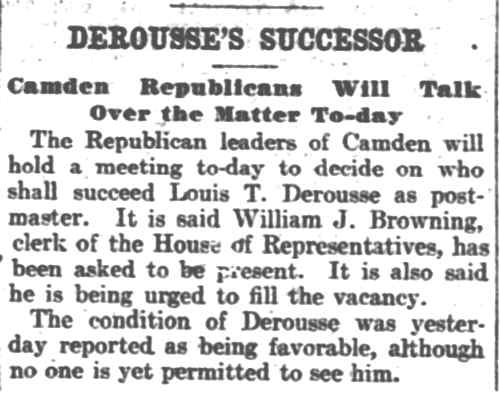
Derousse Has Been Removed
Trenton Evening Times —
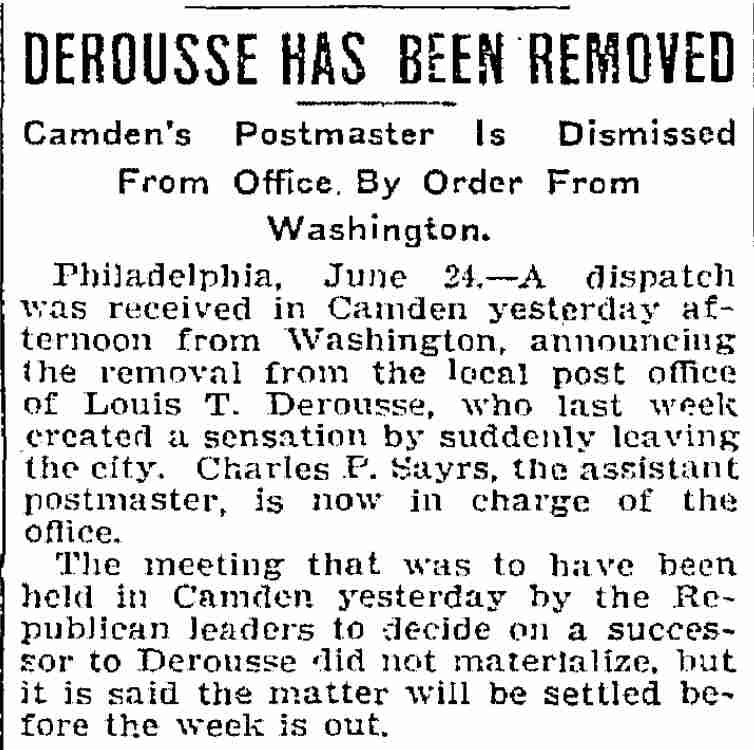
Barber Succeeds Derousse
Philadelphia Inquirer —
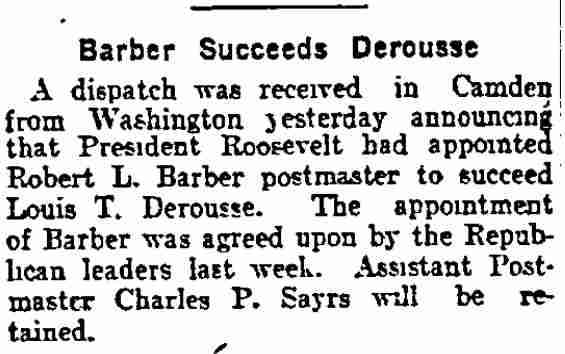
Sayrs for Postmaster
Philadelphia Inquirer —
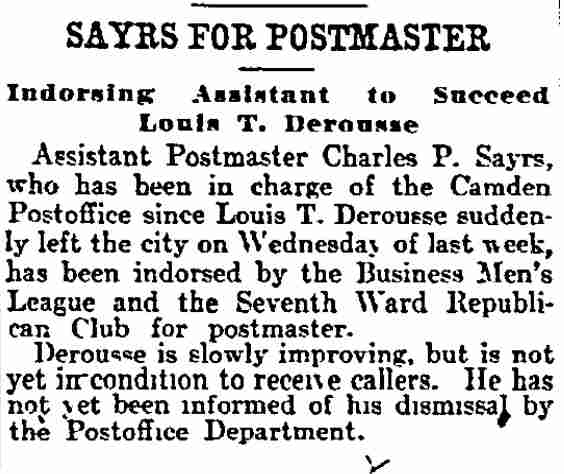
U.S. Grand Jury Begins New Term
Philadelphia Inquirer —
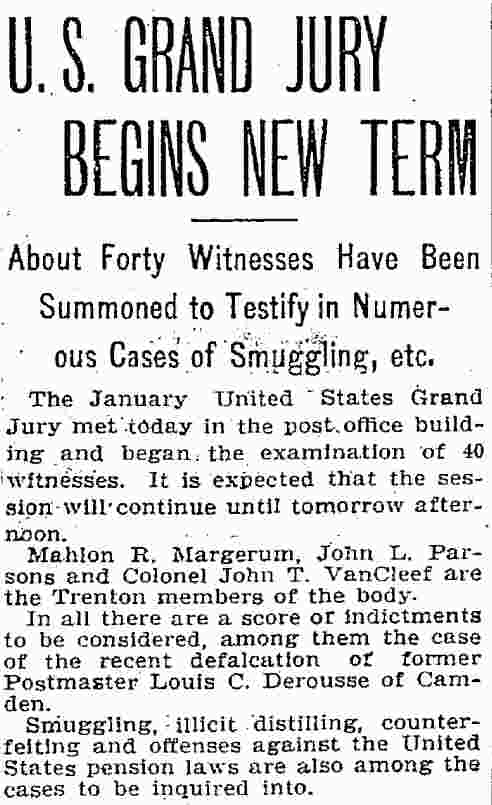
About Forty Witnesses Have Been Summoned to Testify in Numerous Cases of Smuggling, etc.
The January United States Grand Jury met today in the post office building and began the examination of 40 witnesses. It is expected that the session will continue until tomorrow afternoon.
In all there are a score of indictments to be considered, among them those of the recent defalcation of former Postmaster Louis T. Derousse of Camden. Smuggling, illicit distilling, counterfeiting and offences against the United States pension laws are also among the cases to be inquired into.
Boyer–DeRousse
“Boyer-Derousse… Miss Anna Wilson Derousse and Charles Shimer Boyer were married at the home of the bride’s parents, Mr. and Mrs. Louis T. Derousse, 326 North Sixth Street, last evening at 8 o’clock. Only the immediate relatives of the family witnessed the ceremony, which was performed by Rev. Clarence A. Binder, pastor of Epiphany Evangelical Lutheran Church, and uncle of the groom, assisted by Rev William H. Fishburn, pastor of the First Presbyterian Church. Miss Adele K. Stockham, a cousin of the bride, was the maid of honor, and Ralph Boyer, brother of the groom, best man. The groom is a member of the yarn manufacturing firm of B.F. Boyer and Company.”
Camden Memorial Day Committee
Philadelphia Inquirer —
In order that Camden veterans may have an elaborate celebration on Memorial Day, Mayor Ellis yesterday appointed the following committee of citizens to act in conjunction with them: William D. Vanaman, William Sangtinette, Frank W. Tussey, William Fox, Dr. J.W. Martindale, Walter L Tushingham, Ira E. Lutte, Harry C. Kramer, John W. Coleman, Bernhard Schroeder, Edward H. Nieland, Daniel M. Stevens, W.F. Powell, Abe Fuhrman, Jacob Neutze, Francis B. Wallen, Charles A. Ackley, Louis T. Derousse, James M. Bentley, John K. Newkirk, William Schmid, John Larsen, Sigismund Schoenagle, Charles M. Baldwin, and Harry A Whaland.
Camden Will Observe Decoration Day
Philadelphia Inquirer —
Camden has completed its arrangements for the annual Memorial Day exercises. All the local G. A. R. posts will visit the cemeteries early in the day to decorate the graves of their comrades.
At the Soldiers’ Monument special exercises will be held, one of the features being the singing of patriotic airs by school children. The assemblage will be called to order by Comrade William Thompson, prayer will be offered by Rev. A. H. Newton, the children will sing and a volley of musketry will be fired. Exercises will afterwards be held in the First M. E. Church, the oration to be delivered by Hon. Isaac T. Nichols, of Bridgeton. Camp fires will be held at night.
Richard Dease is marshal of the parade and H. L. Hartshorn assistant.
The veterans have been assisted in their preparation by a citizens’ committee appointed by Mayor Ellis, as follows. William D. Vanaman, chairman; Charles S. Ackley, Charles M. Baldwin, James M. Bentley, John W. Coleman, C. K. Deacon, Malachi D. Cornish, Louis T. Derousse, William Fox, Abe Fuhrman, Harry C. Kramer, Ira E. Lute, J. W. Martindale, Jacob Neutze, Edward Nieland, H. S. Riddle, William Sangtinette, Bernard F. Schroeder, William Schmid, Sigismund Schoenagle, Daniel M. Stevens, W. L. Tushingham, Frank W. Tussey, Francis B. Wallen and Harry Whaland.
Former Camden Postmaster Dies at 77, at Daughter’s Home
Philadelphia Inquirer —
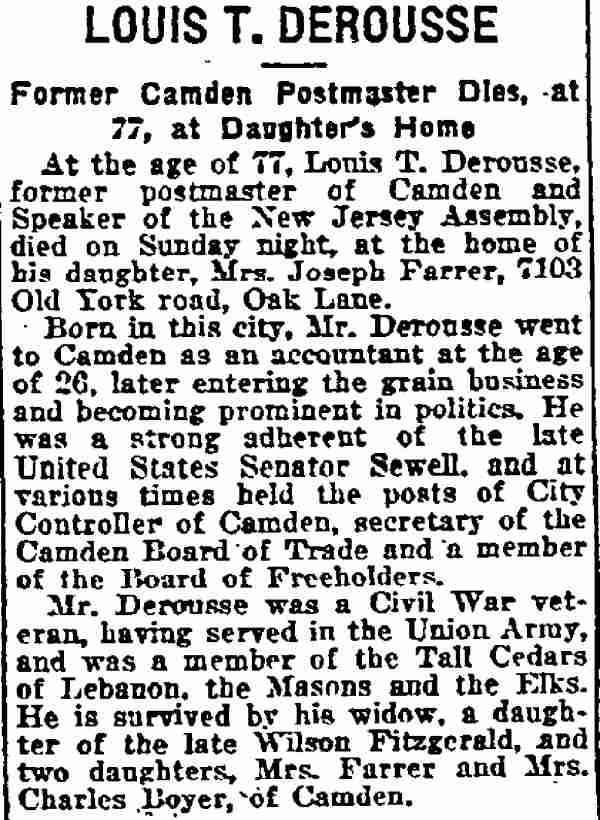
At the age of 77, Louis T. Derousse, former postmaster of Camden and Speaker of the New Jersey Assembly, died on Sunday night, at the home of his daughter, Mrs. Joseph Farrer, 7103 Old York road, Oak Lane.
Born in this city, Mr. Derousse went to Camden as an accountant at the age of 26, later entering the grain business and becoming prominent in politics. He was a strong adherent of the late United States Senator Sewell, and at various times held the posts of City Controller [sic] of Camden, secretary of the Camden Board of Trade and a member of the Board of Freeholders.
Mr. Derousse was a Civil War veteran, having served in the Union Army, and was a member of the Tall Cedars of Lebanon, the Masons and the Elks. He is survived by his widow, a daughter of the late Wilson Fitzgerald, and two daughters, Mrs. Farrer and Mrs. Charles Boyer, of Camden.
Hurley Based Success in Life and in Business on Square Deal to All
Camden Courier-Post —

By BEN COURTER
Nearly two score years ago an earnest young man called together a handful of employees in a small store at Fifth and Pine streets.
“Boys, see that door?” he said to them.
“Well, if by any chance I should be called upon to resort to unscrupulous methods in the conduct of this business that door will be closed and this enterprise will end. Square dealing is to be the principle on which we will do business, square dealing to everybody.”
That young man was William Leonard Hurley, then but 27 years old and virile, visioning a great business which he purposed to develop. It was the pronouncement of what then was nothing less than an ideal, for it was in a period when there was a tendency to take advantage of the unsuspecting to sell inferior goods at exorbitant prices. Many operated under what was known in the trade as the “borax system,” which resulted in the public looking askance at installment buying for the home.
Based on that determination to cultivate public confidence in his own business, Hurley built slowly but securely, his small enterprise into “the big trustful store,” with branches in half a dozen cities.
It was a determination that made him a kindred spirit, in later years, with Theodore Roosevelt whose guest the Rough Rider was to become in the midst of a political campaign that stirred the country from coast to coast. It was the straight-forward characteristic that likewise prompted his subsequent activities in the interest of Camden, that was to be a factor in throwing off the provincial spirit and entering the civic stride so pronounced in the advent of the Camden bridge and the extension of Broadway. In both these he was a strenuous advocate of civic expansion, scientifically planned.
Hurley Not Born With a ‘Silver Spoon’
When Hurley was born in Chester county, Pa., 65 years ago, it was not with a “silver spoon in his mouth.” His father, William Hurley, was a railroad man, an honest, hard-working father, who, in times which were hard enough for the bread-winner, struggled to keep his family in the necessities of life.
The son, William, obtained the rudiments of education under great difficulties, for schools were scarce and far between in the sparse settlement where his boyhood was spent. It was a school of hard knocks, an environment that evidenced the difficult problem the poorer class had in obtaining the bare necessities of life. It was the experience of those early years that William L. Hurley never forgot, for afterward, when success had come, he never was deaf to an appeal from those “pulling hard against the stream.”
At the age of 12 he obtained his first job on a farm in his native Chester county. Farming in those days was hard, strenuous work, seemingly never ending labor to the boy, even then strong and possessing much of the splendid physique of later years.
“I worked from four in the morning until after dark,” Hurley once said, in a reminiscent way. “The farmer usually woke me in the morning by pounding his cane on the floor.
“My duties? Well, they included milking ten cows, feeding chickens and pigs, cleaning the horses, husking corn and doing odd chores. The farmer paid me $4 a month and board.
“In those days boys worked just as hard as grown folks. It was no cinch and when darkness came I couldn’t run fast enough to the farmhouse and to bed. I was dead tired and the bed brought supreme happiness to me. Sleeping was about the only fun I had.”
So the years went on with the hard work on the farm. The future held no great promise. The railroad was more alluring. Since his father was a railroader, young Hurley decided to try that field.
Railroading in 80’s No ‘Automatic’ Job
Back in the 80’s railroading was a far different proposition than it is now. There was none of the automatic brakes and couplings and numberless other inventions that have made it comparatively a safe job today. The old-fashioned coupling pin, for instance, was the abomination of the brakeman. What it did to Hurley he carried to his dying day in the loss of the end of one of his middle fingers.
Not only did he act as brakeman but also as fireman. As he stoked the pulsing engine he dreamed of the day when he might take the throttle. It seemed a wonderful career then, but fate had other things in store for him. He sensed it when he concluded to better his wage of $1.[?]0 a day and get “something on the side.” That was by selling sewing machines at night, often after he had worked hard on drilling freights or stoking the engine through the day.
But this selling of sewing machines impressed young Hurley that perhaps after all there was something else in life other than guiding a great locomotive over the rails. At any rate he concluded to try it out and this in 1888, the year of the “great Blizzard” in this section, he obtained a job with Edward Gately & Co. in Philadelphia as canvasser. It was not long before he had two assistants who acted as collectors, one of whom, Harry F. Jones, was to become his partner in the Atlantic City store many years later.
Gately was a wealthy man who had made his money mostly in the installment business, one who ever had an eye open for the promising young men in his organization. It was his custom to give them a chance and take them into partnership, opening stores in various cities. Young Hurley was one of these promising young men. In 1890 the business of Gately & Hurley was started. To be exact it was on February 1 of that year that a small store was opened, the corner store under old Wildey Hall at Fifth and Pine streets. It was there that he was inspired to tell his then small force of his square dealing policy.
Worked Long Hours to Make Store Success
Young Hurley worked like a Trojan. None in the ranks put in longer hours than he, sometimes 18 or 20 before he was willing to call it a day.
Not only did he direct his force in garnering business, but he went out on the street, often with rugs across his shoulders, to obtain patronage. Many recall the stalwart, earnest young man and his breezy manner which seldom failed to bring result.
Nor was Hurley, in the flush of subsequent success, averse to recalling those strenuous days, usually with a chuckle and remembrance of old timers who had stood staunch and strong with his organization through the intervening years.
Four years later the business had grown to such proportions that he concluded another location was needed. That was after all the stores under Wildey Hall had been occupied. In 1894 the Gately & Hurley store was opened at Broadway and Pine streets. It was then 33 by 90 feet.
When Hurley impressed Gately with the necessity for expanding and having a real store he prepared plans for a four-story structure. Camden then was filled with the “can’t be dones.” Toone & Hollinshed at Broadway and Kaighn avenue was the biggest place on that thoroughfare. Mrs. Varney’s place was on Kaighn avenue, the store of E. V. Story at Sycamore street, Hughes Brothers at Walnut street, Fuhrman Brothers at Chestnut and a few notion places here and there. But the Hurley enterprise seemed so outlandish that one day as George Leathwhite, then Camden’s leading plumber, was looking over the building operation a prominent business man of the period asked.
“Who is the damn fool building this place?”
Nor was he mollified in the least when informed it was “Bill” Hurley. It was regarded altogether a foolhardy undertaking, one that would spell certain disaster. It was pointed out there was nothing just like it on Broadway and that there was nothing to warrant such an outlay.
As a matter of fact that pessimistic note eventually reached Gately. He had some misgivings and Hurley’s four-story building was kept down to three. Just two months after the store had been finished it was necessary to find warehousing room by renting the old bakery of William Kairer at Line and West street. Incidentally, it may be of interest to recall it was Kairer the baker, who had been shot and killed by a burglar in 1893. Theodore Lambert was hanged in the old county jail for that murder.
In 1900 Hurley bought the Gately interests, giving him exclusive ownership, and the business continued to grow making more additions necessary. The old Field properties, two and a half story bricks, were bought, torn down and the store extended.
In 1903 a store was established at Wilkes-Barre with Daniel Loughran as Hurley’s partner. Three years later Henry J. Tobin was made his partner in another store at Trenton. Then in 1912 John J. Powell was commissioned to open the Hurley-Powell store at Wilmington. Harry F. Jones, Hurley’s collector in the very early days opened the Hurley-Jones store at Atlantic City in 1915. Five years later another Hurley store started business at Bridgeton. And in 1923 the home store was remodeled and in the meantime, old Turner Hall, where many a gay night was had by the old timers in masked balls and other festivities, was converted into a warehouse with other structures doing like service. Hurley has long since been recognized as one of South Jersey’s merchant princes.
Roosevelt Given Support in Bull Moose Campaign
Although he never consented to leave the helm of his great business enterprises, save later in life when he spent part of the winters at Hilton Head or occasionally went abroad, Mr. Hurley found time to take an active interest in the affairs of Camden. He did not seek political preferment but for more than 30 years he sought the best that might come with [blacked out]n progressive government. He ever desired to see Camden forge ahead in business in a civic way. Frequently he chafed over a tendency on the part of the political powers to let things drift along. He had no particular objection to the Republican organization as it was constituted under the late Senator David Baird, but he did believe with all possible sincerity that if the progressive spirit could be injected into it much would be accomplished, things that were left to very, very slow evolution.
It was therefore quite in keeping with that tendency that he aligned himself with the late Cooper B. Hatch in the late 90’s when the Committee of 100 was born with the Courier then under S. Conrad Ott as city editor being a potent factor in the victory. It was then that Hurley gave financial and moral aid to the movement with Hatch as the leader and with Lewis H. Moorman, [blacked out], C. Kramer and others many of whom have long since gone fostering the cause. [blacked out] its purpose perhaps although within a few years it had passed with the usual disintegration of independent movements.
When Colonel Roosevelt formed the Bull Moose party and became the Presidential candidate in 1912 with William H. Taft and Woodrow Wilson in the field, Mr. Hurley was an earnest active advocate of the Rough Rider. In fact he was one of the delegates to the Bull Moose convention that nominated Roosevelt.
In the midst of that truly hectic campaign when Wilson, Taft and Roosevelt visited Camden, Wilson’s meeting was enthusiastic enough to please any Democrat. Taft’s was a frost and hardly more than a fringe, mostly office holders greeted him, but Roosevelt’s was what the Colonel himself called a “rip snorter.”
Teddy Was Guest at Home of Hurley During Visit Here
Hurley was his host on that occasion, a hot summer night, itself suggestive of the extremely hot campaign. These meetings were held at the Third Regiment armory, no other building then being available. One may yet recall very vividly the entrance of the Colonel, Mr. Hurley and the Camden Bull Moose leaders. The great drill hall was literally jammed, with yelling enthusiasts even hanging from the top girders. Just as he arrived a terrific thunder storm broke loose, the reverberation, the vivid flashes lost in the roar of the crowd.
“Where’s your hat, Teddy?” someone yelled.
And the Colonel tossed his old black slouch hat in the ring while Hurley led the cheer that followed, a cheer that seemingly tested the strength of the expansive roof. Roosevelt had been a guest at the Hurley home at West Collingswood where the leaders, the rank and file of the Bull Moosers met him. It was one gala night and Mr. Hurley was in the zenith of his glory.
None was more disappointed when Colonel Roosevelt failed at the November election, for Mr. Hurley felt that the country needed the hero of San Juan Hill particularly at that time. He sincerely mourned the Colonel’s passing, but to the very last cherished his memory, regarding him as the Great American.
Backed Non-Partisan Move, Aided Opening of Broadway
As has been indicated, Mr. Hurley had no particular feeling against the Republican organization, but he was certain that Camden was on the threshold of big things and that there should be an awakening. There appeared to be no intention of getting out of the rut so far as the political powers were concerned and with the assurance of the bridge he regarded it necessary to be alive to the opportunities certain to come. There had been talk of certain outlets from the bridge which did not meet the situation in his judgment. For one thing, he was impressed with the extension of Broadway.
For more years than one might recall, Broadway had been Camden’s principal street. Many regarded it as the city’s most important business thoroughfare. Mr. Hurley early realized that to extend it to where the bridge plaza would eventually be located was a real civic essential, but the city administration did not consider the financial outlay that would be involved justified in the extension.
That was one of the factors that resulted in the Non-Partisan movement of 1922, of Mr. Hurley’s advocacy of its cause, of his financial and moral support. He was one of the leaders in the civic revolution that first brought the victory for commission form of government and later that ushered the Non-Partisan candidates into office.
It was the realization of a cherished dream when the new administration bought property that assured Broadway’s extension to the bridge plaza. It justified his prediction that it would be like giving a new blood stream to the city, for the Walt Whitman Hotel, the Wilson Building and others rapidly rising about Broadway and Cooper streets prove it beyond all doubt.
Camden Bridge Proposition Given Approval by Hurley
Mr. Hurley not only gave his every influence toward the Camden bridge proposition in the days when it was regarded more or less a joke, but he worked assiduously to crystalize [sic] sentiment so that the century-old dream would be a dream no longer. New Jersey did its part when Walter Edge was governor, but there was plenty of backing and filling on the part of Philadelphia and Pennsylvania. There were many discouraging epochs, even after a joint commission had been created, but Mr. Hurley was among those who refused to give up hope. What was subsequently accomplished was due mainly to men of his faith, of his courage, of his energy.
After its completion the necessity for a second span was impressed upon him. Shortly after the Camden bridge was opened to the public he advocated another from Market street, Gloucester to Pattison avenue, Philadelphia. Since other sites have been suggested. A joint commission has been named to make preliminary surveys but has been at loggerheads over a proposal to build a span from Red Bank to League Island. Mr. Hurley regarded his suggestion as far more feasible and he supported it by arguments that were hard to answer.
Throughout his career Mr. Hurley had been an earnest advocate of co-operation among business interests of the city. For many years there was the Board of Trade rather an innocuous organization, usually attended by half a dozen men and voiceless so far as influence went. He concluded a rejuvenation was necessary, consented to act as president and speeded it up with the late Louis T. Derousse as secretary. Later Charles M. Curry held that position and until the present Chamber of Commerce was formed under a campaign directed by the American City Bureau. Mr. Hurley or his subordinates had given it every possible aid to make it a factor in the community.
Assessment Commissioner Was Only Political Post
Aside from his principal business, Mr. Hurley was associated for many years with the late William J. Lorigan in building homes. Their first extensive operation was the construction of two rows of dwellings in Princeton avenue. Others were constructed in various parts of Camden and the development of the district about Twenty-seventh and Federal streets was largely due to the firm. After the elder Lorigan’s death he was succeeded by his son, William H. Lorigan, who has been associated with Mr. Hurley.
While he sought no political honors, Mr. Hurley did once accept for a few years a position. It was during the Committee of 100 regime when he became a commissioner of assessment. He [?] served for many years as a delegate to the Atlantic Deeper Waterways Convention. He took a keen interest in that organization and in the work of actually having an inland waterway along the eastern seaboard. It is slowly developing with the possibility of becoming an actuality a few years hence, mainly through the effort of men of Mr. Hurley’s caliber.
When he came to Camden Mr. Hurley first resided on Stevens street, then at [?] Pine and from 1894 to 19[?]9 at 7[?]8 Broadway. In the latter year he bought the estate on White Horse pike at West Collingswood that had been used as a sanitarium. The building was virtually reconstructed, the grounds were laid out in beautiful shrubbery and there were already fine nut trees which made it a show place. He called it Dungarvan, after the county in Ireland where his father was born.
It was there at his palatial home, with the beautiful surroundings that Mr. Hurley delighted in acting the role of host, of gathering about him old friends and harking back to the times that were.
Unspoiled Good Will Befriended All in Need
Old friends cherish the memory of one outstanding characteristic of “Bill” Hurley. Increasing fortune never “spoiled” him. He remained democratic until the end, and those who had known him through the years called him “Bill” just as they had done in the days when he was forging ahead in spite of the “can’t-be-dones.”
Nor did he ever forget an old customer. It might be an old, old woman upon whom fortune had consistently refused to shine but who made her little purchases at his store. None was too lowly for him to give his personal attention under such circumstances. There was ever a real grip of the hand that spoke sincerity.
It was quite natural that he enjoyed hunting and fishing. For many years his summer home was at Sea Isle City, where his family went through the vacation period each year. There he never failed to go out to sea or to try his luck off the pier, usually with an old friend. Catching the piscatorial beauties, particularly a channel bass or a drum, was regarded with almost the same satisfaction as putting over a big business deal.
Over a dozen years ago he bought the island at Hilton Head, off the coast of South Carolina and 30 miles from Savannah. While he enjoyed all the comforts of civilization, the surroundings were kept in their primitive simplicity. Nothing delighted him more than taking an old friend along to the island estate and showing the guest the time of his life.
Men like Hurley do much that is unheralded to alleviate the suffering of the world. Creed or color meant nothing to him if aid were needed. What he gave in that respect no one knows. Those long associated with him declare it was sufficient to make happy a small army in adversity.
Aided Worthy Causes Regardless of Creeds
Charitable organizations, religious or otherwise, enjoyed his bounty. No one was aware of such aid unless it happened to be in a “campaign” to raise a specified sum. It was Hurley very often who started things going by way of a liberal contribution. It mattered not whether the cause was for Protestant, Catholic or Jew—just so it was worth while. When the vicious pogroms were sweeping Russia he was one of the most generous contributors to the Camden funds for the sufferers. In the flu epidemic of 1918 he was among the leaders who aided the stricken, who gave many a family a lift over rough places.
During the war he was active in every Liberty Loan drive, in every movement that aided ultimate victory. He was chairman of the Knights of Columbus drive, he was a potent factor in the United War Workers’ campaign, in the Red Cross and kindred movements. He took great interest in the boys who “went over there” for his own son, Jerome, was in the service.
Surely in glancing over Camden’s history in the past two-score years not an instance conducive to the city’s development may be cited without finding William L. Hurley’s name connected with it some way, some how. He was so much a part of its warp and woof that the civic fabric bears indelibly the impress of his personality.