Introduction
George Horneff was one of the original members of the Camden Fire Department, entering service on December 7, 1869 as an extra man with Engine Company 1.
George Horneff was born in the Duchy of Wurttemburg, in what is now Germany, in August of 1838 to Johann Jacob Horneff and his wife, the former Katherine Elisabethe Mayer. Records differ as to when he came to America, but seem to indicate that it would have been in 1860. A Jacob Horneff, aged 41, operated a lager beer saloon in Camden’s North Ward when the 1860 Census was taken. In any event George Horneff was in America when he was married in Camden, New Jersey on January 25, 1866 to Emma Cairoli. She bore him a son, John, around 1867. George Horneff supported his family by working as a machinist. The family lived at 908 South 3rd Street when he joined the Fire Department in the fall of 1869.
On September 2, 1869 City Council enacted a municipal ordinance creating a paid fire department. It provided for the annual appointment of five Fire Commissioners, one Chief Marshal (Chief of Department) and two Assistant Marshals. The City was also divided into two fire districts. The boundary line ran east and west, starting at Bridge Avenue and following the tracks of the Camden and Amboy Railroad to the city limits. District 1 was south of this line and District 2 was north. The commissioners also appointed the firemen who were scheduled to work six 24 hour tours per week. William Abels, from the Weccacoe Hose Company No. 2 was appointed Chief Marshal with William J. Mines, from the Independence Fire Company No. 3 as Assistant Marshal for the 1st District, and William H. Shearman as the Assistant Marshal for the 2nd District. Abels had served with the volunteer fire departments of Philadelphia, Mobile, Alabama and Camden for sixteen years prior to his appointment as Chief of the paid force.
On November 10, 1869 City Council purchased the Independence Firehouse, the three-story brick building at 409 Pine Street, for $4500. The building was designated to serve as quarters for Engine Company 1 and the 1st District. On October 29, 1869 City Council authorized construction of a two-story brick building on the northwest corner of Fifth and Arch Streets as quarters for the 2nd District. On November 25th the Fire Commissioners signed a contract with M.N. Dubois in the amount of $3100 to erect this structure. The 2nd District would share these quarters with Engine Company 2 and the Hook & Ladder Company and the facility would also serve as department headquarters for the new paid force. The original contract remains part of the Camden County Historical Society collection.
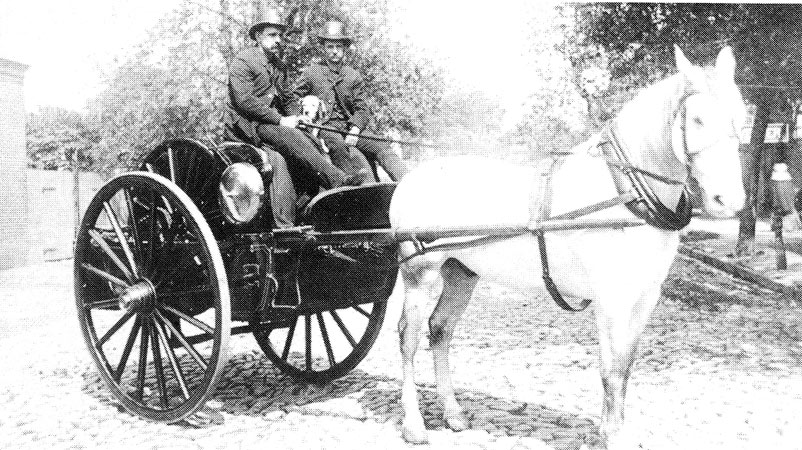
Engine Company 2 with 1869 Silsby Hose Cart. Photo Circa 1890. Note badges upon derby hats worn by Fire Fighters.
Two Amoskeag second class, double pump, straight frame steam engines were purchased at a cost of $4250 each. Two Silsby two wheel hose carts, each of which carried 1000 feet of hose, were another $550 each and the hook & ladder, built by Schanz and Brother of Philadelphia was $900. Each engine company received a steam engine and hose cart. Amoskeag serial #318 went to Engine Company 1, and serial #319 to Engine Company 2. The Fire Commission also secured the services of the Weccacoe and Independence steamers in case of fire prior to delivery of the new apparatus. Alfred McCully of Camden made the harnesses for the horses. Camden’s Twoes & Jones made the overcoats for the new firemen and a Mr. Morley, also of Camden, supplied the caps and belts which were manufactured by the Migeod Company of Philadelphia. The new members were also issued badges.
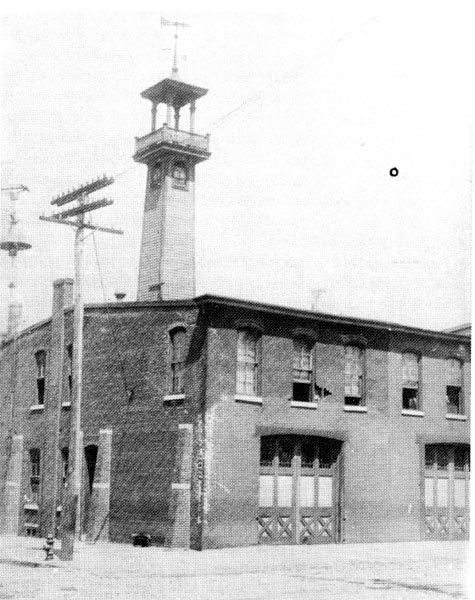
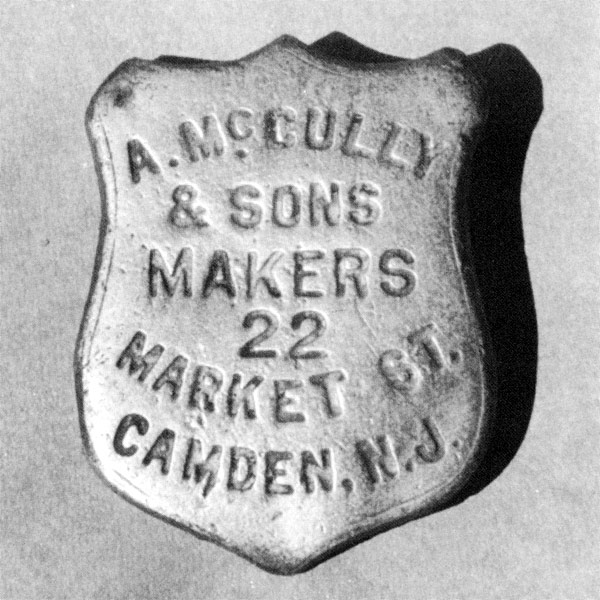
This is the earliest known photo of fire headquarters on the northwest corner of Fifth and Arch Streets. Originally built in 1869, the building shows signs of wear some twenty years later. Note the weathervane shaped like a fireman’s speaking trumpet atop the tower. Also, the fire alarm bell is pictured to the left of the telegraph pole above the rooftop. – This maker’s plate once was attached to a harness made by A. McCully & Sons, 22 Market Street, Camden, New Jersey. This firm provided the first harnesses for the paid fire department in 1869.
Badges worn by the marshals, engineers, stokers and engine drivers bore the initial letter of their respective positions and their district number. The tillerman and his driver used the number “3” to accompany their initial letter. The extra men of the 1st District were assigned badges 1-10; 2nd District badges were numbered 11-20 and the extra men of the hook & ladder wore numbers 21-30.
Although the Fire Commission intended to begin operation of the paid department on November 20, 1869, the companies did not actually enter service until December 7th at 6 P.M. because the new apparatus and buildings were not ready. The new apparatus was not tried (tested) until December 9th.
The new members of the paid force were:
Engine Company 1 Roster
Camden Fire Department Engine Company 1, 1869
Officers
| Name ↕ | Position ↕ | Badge ↕ |
|---|---|---|
| G. Rudolf Tenner | Engineer | |
| William H. Clark | Driver | |
| Thomas McLaughlin | Stoker |
Extra Men (Call Members)
| Name ↕ | Position ↕ | Badge ↕ |
|---|---|---|
| Thomas Allibone | Extra Man | 1 |
| William Deith | Extra Man | 2 |
| George Horneff | Extra Man | 3 |
| John J. Brown | Extra Man | 4 |
| William A.H. White | Extra Man | 5 |
| James Sutton | Extra Man | 6 |
| Cornelius M. Brown | Extra Man | 7 |
| Alexander Peacock | Extra Man | 8 |
| Samuel Buzine | Extra Man | 9 |
| Jesse Chew | Extra Man | 10 |
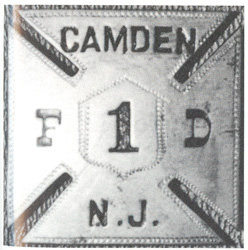
The first style of breast badge worn by members of the career department in the City of Camden. 1869. (Courtesy of the C.C.H.S. Collection).
George Horneff, wife Emma, and son John were living at 908 South 3rd Street, near the corner of South 3rd Street and Joint Alley, when he joined the department in the fall of 1869, and were still at that address when the Census was taken in the summer of 1870. His neighbors at 910 South 3rd Street were the John Holl family, son George Holl, who lived there as a Civil War veteran and would become a prominent builder in Camden in later years. At 906 South 3rd Street lived bar-owner Adam Kolb Sr. and his son Adam Kolb Jr. By the fall of 1871 George Horneff and family had moved to 269 Mount Vernon Street. A daughter, Mary Horneff, was born in April of 1872.
On October 23, 1872 George Horneff’s nephew, Henry Wagner, was appointed to the Camden Fire Department as an extra man with Engine Company 1.
George Horneff served with Engine Company 1 until April of 1876 when he was promoted to Assistant Chief Engineer, serving under Claudius Bradshaw for three years. George Horneff’s brother-in-law George H. Middleton Sr. joined him in the Fire Department at that time. George Horneff left the Camden Fire Department in 1879, when Samuel S. Elfreth was elected Chief. George Horneff returned to working as a machinist. Among his employers were the Camden & Amboy railroad in the 1880s and the Pennsylvania Railroad at the Pavonia facility in what is now East Camden during the 1890s and early 1900s.
By the time the 1878 City Directory was compiled, George Horneff and family had moved to 267 Mount Vernon Street. They remained in this home through 1890. By the latter half of 1891 they had moved to 273 Mount Vernon Street.
George Horneff was a Democrat, which probably had a great deal to do with his promotion within the Fire Department under Claudius Bradshaw and his leaving when Republican Samuel S. Elfreth was elected. In 1882 George Horneff ran for City Council from the Fifth Ward as a Democrat.
The 1900 Census has George and Emma Horneff, with daughter Mary, at 273 Mount Vernon Street. George Horneff was still working as a machinist.
Emma Horneff passed away on March 1, 1902 and was buried at Harleigh Cemetery. Her obituary states that she was active in several fraternal organizations, and it is highly likely that George Horneff was active in the men’s branches, specifically with the Lenni Lenape Tribe, No. 2 of the Improved Order of Red Men and the Brotherhood of the Union.
In 1886 George Reeser Prowell wrote the following about Brotherhood of the Union’s Lydia Darrah Home Communion, No. 1 of which Emma Horneff was a member:
LYDIA DARRAH HOME COMMUNION, No. 1, meets in Mechanics’ Hall, Fourth and Spruce, and was instituted by S.W. George L. Toy, in Independence Hall, Fourth and Pine, May 12, 1867, when these officers were installed: G., Benjamin M. Braker; H.S.K., Wm. J. Maguire; P., Hannah G. Ivins; H.R., Sarah T. Winner; H.T., Philip Beaber. The Past Grand Guardians are: Hannah G. Ivins, Susanna Quinn and Elizabeth Portz, and the Past Guardians: Margaret Boyd, Margaret Caperoon, Mary E. Sloan, Missouri Pierce, Ruth A. Ross, Josiah Bozarth, Emma Knipe, Margaret Deith, Augusta Oeherle, Sarah Kirby, Rachel B. Stone, Elizabeth Eames, Annie Curtis, Lizzie Eames, Annie M. Quick, Mary M. Davis, Rachel Stephen, Benj. Smith, Isaac Warr, Emily Weldey, Elizabeth Cleaver, Elizabeth Stricker, Samuel W. Stivers, Keturah Tenner, Sarah Wiatt, Eliza J. Leibach, Elizabeth C. Butler, Margaret A. Davis, Mary Ore, Julia Coleman, Sallie Tracy, Emma J. Doyle.
The Home has had a useful life, and after assisting many has eight hundred dollars invested, with a membership of eighty-one. The officers for 1886 are: P.G., Mary Ore; G., Rachel Stephen; Pro., Benjamin Smith; Prophet, Maggie Caperoon; Prophetess, Emily Weldey; Priest, Mary J. Cooper; Priestess, Emma J. Doyle; H.S.K., Annie M. Quick; H.R., Rachel B. Stone; H.T., Elizabeth Cleaver; W.D., Clara Davis; W.N., Emma Horneff.
In 1886 George Reeser Prowell wrote the following about Lenni Lenape Tribe, No. 2:
LENNI LENAPE TRIBE, No. 2, is the oldest existing tribe of the order in the State, and in numbers and wealth the strongest and richest in the United States. It was instituted May 10, 1850, by Great Incohonee William B. Davis, assisted by Francis Fullerton, of Lenni Lenape Tribe, No. 8, of Pennsylvania, and Great Chief of Records of the United States. These were the charter members: Nathaniel Chew, William F. Colbert, John T. Davis, Timothy C. Moore, Sylvester Rainhard, Joseph Shipley, Daniel S. Garwood, William Beckett, George Wood, E.D. Brister, John Wood, Joseph Myers, Albert Robertson, John W. Hoey, James B. Richardson, Robert Maguire, Joseph B. Hawkins, James O. Stillwell and Anthony Joline. The officers were as follows: P., Timothy C. Moore; S., Nathaniel Chew; S.S., John Wood; J.S., William F. Colbert; C. of R., Joseph Myers; K. of W., Albert Robertson.
Lenni Lenape has had an eventful career, at times flourishing and at other times so short of funds that a few faithful members paid expenses and benefits out of their private purses, but persistence won at last and a flood tide of prosperity set in, which has continued until the Lenni Lenapes number seven hundred and thirty-two and the wampum belt contains $21,370.89.
Among its members are these Past Great Sachems: George W. Watson, John T. Davis, Charles H. Gordon, Thomas J. Francis and Daniel M. Stevens; and of its Past Sachems these are living: Timothy C. Moore, Henry A. Breyer, Lewis Zeigler, Samuel J. Fenner, Edward J. Steer, William F. Farr, Samuel D. Watson, George Horneff, George A. Cairoli (Brother of Mrs. Emma Horneff), Thomas J. Rowand, Samuel A. Owens, Benjamin M. Braker, Lambert Banes, George Pfeiffer, William Sheridan, Thomas F. Muckelson, Hope Sutton, James P. Moore, D.D. Worts, Leonard L. Roray, Benjamin J. Price, John A. Hall, B.S.M. Branning, Abraham Davis, Harry B. Garrison, Walter E. Garwood, George A. Rogers, William C. Davis, Frank P. Jackson, H. Frank Pettit, John A. Harbeson, John Quick, Angus B. Cameron, Lewis Z. Noble, George Leathwhite, Conrad F. Austermuhl, John K. Seagrove, Charles L. Vansciver, Harry Hoffman, Harry B. Tyler, James H. Reeve and George W. Davis. The officers are: P., G.W. Davis; S., Edward Francis; S.S., Samuel Baker; J.S., Joseph Watson; C. of R., L.Z. Noble; K. of W., C.F. Austermuhl; Trustees, T.J. Francis, T.F. Muckelson, J.K. Reeve, Leonard L. Roray and H.F. Pettit.
George Horneff was still living at 273 Mount Vernon Street when the 1906 Camden City Directory was compiled. In 1909 Mary Horneff married Eugene von Glahn, who was a clerk in the Hall of Records in the City of Brooklyn, New York. When the census was taken in 1910, George Horneff, now a widower, had left Camden and was living with his daughter and son-in-law at 539 75th Street in Brooklyn. George Horneff passed away in 1917.
A Clothing Dealer's Desperate Struggle With a Colored Thief
Philadelphia Inquirer —
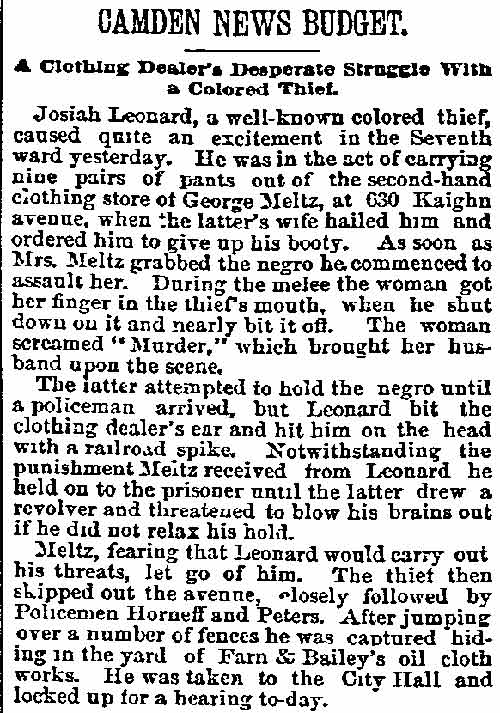
A Clothing Dealer’s Desperate Struggle With a Colored Thief.
Josiah Leonard, a well-known colored thief, caused quite an excitement in the Seventh ward yesterday. He was in the act of carrying nine pairs of pants out of the second-hand clothing store of George Meltz, at 630 Kaighn Avenue, when the latter’s wife hailed him and ordered him to give up his booty. As soon as Mrs. Meltz grabbed the negro he commenced to assault her. During the melee the woman got her finger in the thief’s mouth, when he shut down on it and nearly bit it off. The woman screamed “Murder,” which brought her husband upon the scene.
The latter attempted to hold the negro until a policeman arrived, but Leonard bit the clothing dealer’s ear and hit him on the head with a railroad spike. Notwithstanding the punishment Meitz received from Leonard he held on to the prisoner until the latter drew a revolver and threatened to blow his brains out if he did not relax his hold.
Meitz, fearing that Leonard would carry out his threats, let go of him. The thief then skipped out the avenue, closely followed by Policemen Horneff and Peters. After jumping over a number of fences he was captured hiding in the yard of Farn & Bailey’s oil cloth works. He was taken to the City Hall and locked up for a hearing to-day.
Camden Democrats on the Watch
Philadelphia Inquirer —
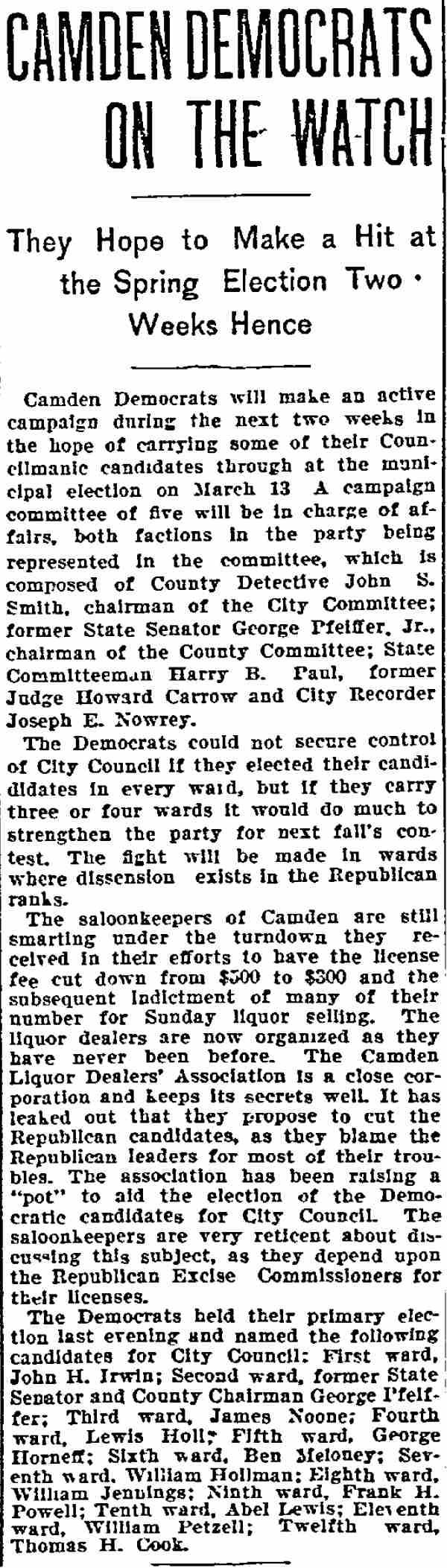
They Hope to Make a Hit at the Spring Election Two Weeks Hence
Camden Democrats will make an active campaign during the next two weeks in the hope of carrying some of their Councilmanic candidates through at the municipal election on March 13. A campaign committee of five will be in charge of affairs, both factions in the party being represented in the committee, which is composed of County Detective John S. Smith, chairman of the City Committee; former State Senator George Pfeiffer, Jr., chairman of the County Committee; State Committeeman Harry B. Paul, former Judge Howard Carrow and City Recorder Joseph E. Nowrey.
The Democrats could not secure control of City Council if they elected their candidates in every ward, but if they carry three or four wards it would do much to strengthen the party for next fall’s contest. The fight will be made in wards where dissension exists in the Republican ranks.
The saloonkeepers of Camden are still smarting under the turndown they received in their efforts to have the license fee cut down from $500 to $300 and the subsequent indictment of many of their number for Sunday liquor selling. The liquor dealers are now organized as they have never been before. The Camden Liquor Dealers’ Association is a close corporation and keeps its secrets well. It has leaked out that they propose to cut the Republican candidates, as they blame the Republican leaders for most of their troubles. The association has been raising a “pot” to aid the election of the Democratic candidates for City Council. The saloonkeepers are very reticent about discussing this subject, as they depend upon the Republican Excise Commissioners for their licenses.
The Democrats held their primary election last evening and named the following candidates for City Council: First ward, John H. Irwin; Second ward, former State Senator and County Chairman George Pfeiffer; Third ward, James Noone; Fourth ward, Lewis Holl; Fifth ward, George Horneff; Sixth ward, Ben Meloney; Seventh ward, William Hollman; Eighth ward, William Jennings; Ninth ward, Frank H. Powell; Tenth ward, Abel Lewis; Eleventh ward, William Petzell; Twelfth ward, Thomas H. Cook.
Emma R. Horneff
Philadelphia Inquirer —
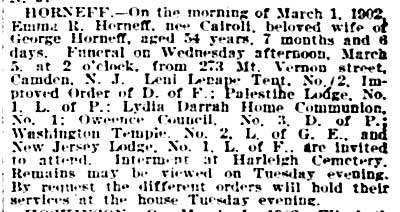
HORNEFF.—On the morning of March 1, 1902, Emma R. Horneff, nee Cairoli, beloved wife of George Horneff, aged 54 years, 7 months and 6 days. Funeral on Wednesday afternoon, March 5, at 2 o’clock, from 273 Mt. Vernon street, Camden, N.J. Leni Lenape Tent, No. 2, Improved Order of D. of F.; Palestine Lodge, No. 1, L. of P.; Lydia Darrah Home Communion, No. 1; Owence Council, No. 3, D. of P.; Washington Temple, No. 2, L. of G. E., and New Jersey Lodge, No. 1, L. of F., are invited to attend. Interment at Harleigh Cemetery. Remains may be viewed on Tuesday evening. By request the different orders will hold their services at the house Tuesday evening.
Camden Cop's First Night on the Force
Philadelphia Inquirer —
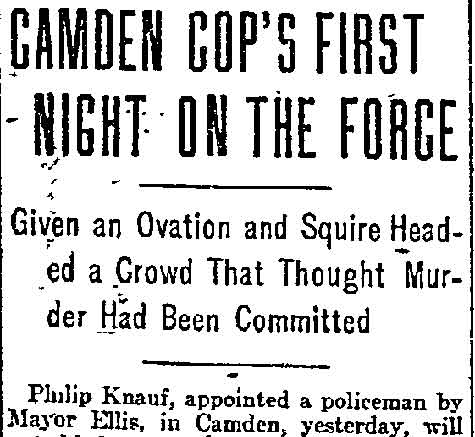
Given an Ovation and Squire Headed a Crowd That Thought Murder Had Been Committed
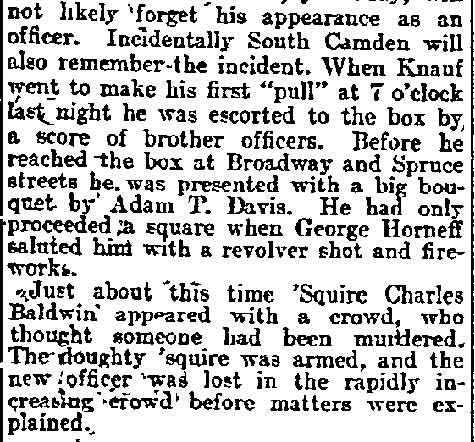
Philip Knauf, appointed a policeman by Mayor Ellis, in Camden, yesterday, will not likely forget his appearance as an officer. Incidentally South Camden will also remember the incident. When Knauf went to make his first “pull” at 7 o’clock last night he was escorted to the box by a score of brother officers. Before he reached the box at Broadway and Spruce streets he was presented with a big bouquet by Adam P. Davis. He had only proceeded a square when George Horneff saluted him with a revolver shot and fireworks.
Just about this time Squire Charles Baldwin appeared with a crowd, who thought someone had been murdered. The doughty squire was armed, and the new officer was lost in the rapidly increasing crowd before matters were explained.