Peter B. Carter
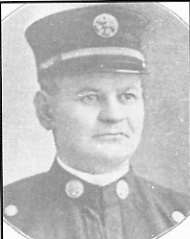
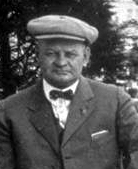
Peter B. Carter
PETER B. CARTER was born in New Jersey in August of 1870. He was the son of Daniel and Mary Carter. Daniel Carter was working as a laborer on a farm in North Hanover Township, Burlington County NJ at the time of the 1880 census. Daniel Carter later live and work in Trenton NJ, where he was a constable, and is not to be confused with Daniel A. Carter, chief of the Camden Fire Department in the early 1880s.
Peter B. Carter married around 1886. He first appears in Camden City Directories in 1888, living at 332 Stevens Street, working as a salesman. He does not appear in City Directories again until 1897. The 1897 and 1898 Camden City Directory show him living with his wife Elmyra at 1102 South 3rd Street, working as a meat cutter in 1897 and as salesman for Kolbe, Baker & Company the following year. He was at the same address, working as a driver in the 1899 directory.
Peter B. Carter was appointed to the Camden Fire Department on November 29, 1899. At the time of the 1900 Census he was serving with Hook and Ladder Company 1 which operated out of the Fire Department Headquarters building on North 5th Street at Arch Street.
Peter Carter and his family were still living at 1102 South 3rd Street as late as 1906. When the Census was enumerated in 1910 he was then living at 329 Chestnut Street with his wife of 14 years, Elmira, and daughters Mary and Mildred. The Carters were still living at this address as late as the spring of 1918.
Six weeks prior to the census, the Reeves Garage, a large commerce building at 106–108 North Seventh Street, was destroyed in a spectacular fire and explosion on March 16, 1910. Night Watchman Albert Bell discovered heavy fire roaring in the basement about 1:30 A.M. He drove his vehicle to fire headquarters and reported a verbal alarm. As the blaze spread quickly, a second alarm was transmitted shortly after arrival. As Hosemen John Lennox and John Lutts of Engine Company 2 were advancing a big line near the blazing building a tremendous explosion carried them twenty feet across the street.
This mishap probably saved the lives of both members in that the blazing building literally blew apart, propelling broken masonry with the force of shrapnel. The west wall of the garage penetrated the adjacent Lutheran Church, leaving a gaping hole in the church wall. A general alarm was sounded following the explosion. Lennox and Lutts suffered lacerations and bruises as did Captain Carter of Hook & Ladder Company 1. Twenty-three automobiles were destroyed in the blaze with an estimated loss of $80,000.
On July 29th of 1915, after a career that spanned four decades, Chief John A. Stockton retired effective October 1st. He was succeeded as Chief by Peter B. Carter. Chief Carter would serve until 1926, during which time the city of Camden saw much growth and several large fires. Under Chief Carter’s administration, the last of the horse-drawn units would be motorized.
On January 3, 1915, one of the worst fires in Department history occurred at Kaighns Point and the Delaware River, South Camden. The fire was discovered in the men’s waiting room of the Reading Terminal. Fanned by frigid 40 MPH winds off the river, the fire rapidly involved the ferry house and jumped Kaighn Avenue, igniting frame umbrella sheds and over one hundred frame passenger coaches. Box 31 at Front Street and Kaighn Avenue was pulled at 5:55 A.M. First alarm units were greeted by a near conflagration as the fire swept eastward into the big lumber mill of C.B. Coles & Sons, and simultaneously southward igniting frame buildings in the Dialogue Shipyard. Large burning embers floating on the water, set fire to a ship on the river. Four alarms plus numerous calls for mutual aid halted this blaze that caused injuries to 150 persons including more than 100 fire fighters. A field hospital was established in the offices of the C.B. Coles Company by Dr. Maldeis of Homeopathic Hospital to treat the numerous injuries. He was assisted by the Department Fire Surgeon, Dr. Schellinger. In the history of the Department, never had so many firemen been injured at a single incident.
January 6, 1915, the Department again responded to the Borough of Collingswood on mutual aid for a fire at the Enterprise Wall Paper Company. Two members of the Department were seriously injured by falling walls. Battalion Chief George Wade and Hoseman William Laird were hospitalized for several weeks, with crushed limbs.
Another disastrous fire occurred on March 27, 1915 at the plant of the Collings Carriage Company at Front and Arch Streets, center city. The three-story factory was used to build automobile bodies. John Ashton, the principal clerk for the Pennsylvania Railroad, saw the flames and pulled Box 51. Box 52 was also transmitted by employees of the carriage plant. The fire started in a varnish room located on the top floor at the southwest corner of the building. The afternoon blaze was fed by varnish and other inflammable materials within the building. The officer of the first due engine ordered a general alarm on arrival, as fire raced through the factory. The fire brigade of the Pennsylvania Railroad responded to assist Fire Fighters and while doing so, the whistle blew at the Van Sciver furniture factory also summoning its fire brigade as several nearby plants were threatened. While operating on the roof of the burning factory, some twenty Camden Firemen heard an ominous cracking sound. As they leaped across a shaft to the roof of an adjoining two-story building, the roof of the blazing factory collapsed with a deafening roar. Four companies of men narrowly escaped with their lives. With the assistance of the Industrial Fire Brigades, the blaze was brought under control by late afternoon. Damage exceeded $100,000.
A near conflagration in the Village of Gibbsboro at the Lucas Paint Works summoned a mutual aid response from the Department on August 1, 1915. Fire threatened to destroy the entire residential district of Gibbsboro, a community without local fire services. Camden Fire Fighters drafted from the Gibbsboro Lake and contained the fire to the factory complex. This was one of Camden’s first mutual aid responses with motorized apparatus. Also during 1915, the Haddon Heights Volunteer Fire Company purchased the former apparatus of Engine Company 3, a Clapp and Jones steamer.
In January 2,1916, Camden Fire Fighters performed gallant service at the scene of a conflagration involving the Taubel Hosiery Mills in Riverside. Gale force winds and sub-zero temperatures created punishing conditions for fire fighters.
Something akin to a miracle occurred on the frigid night of January 11, 1916 at the State Street Methodist Episcopal Church, Sixth and State Streets, North Camden. At 10 P.M., three alarms were transmitted in rapid succession for a serious fire involving the main auditorium of the church. Heavy fire conditions extended to destroy the roof, the organ loft, the altar, Sunday School classrooms, and the entire pew area throughout the auditorium. When the blaze was finally extinguished, all that remained standing were four granite walls. On the south side of the building along State Street, was a magnificent stained glass window of gigantic proportion depicting Christ breaking bread with Martha and Mary, the sisters of Lazarus. The window had inexplicably withstood the flames and heat. The scene from the life of Christ was not blistered, scorched or marred in anyway. It has never been retouched and still stands as a miracle, surviving one of the most disastrous church fires in City history. Chief of Department Peter Carter was injured at this incident when he fell through a passageway between the auditorium and the school building. He was hospitalized for several weeks. Captain Joseph Maxwell and Fireman Steward Bakley of Hook & Ladder Company 1, Fireman John A.S. Hunt of Engine Company 3, and Fireman William McCauley of Chemical Company 1 were injured when the church roof collapsed on them. Under heavy smoke conditions and following some difficulty, the members were able to extricate themselves, three of them safely. Captain Maxwell was admitted to the hospital for a brief stay.
On April 6, 1916, the Department’s fleet became fully motorized with twenty-five pieces of apparatus and vehicles. On that date Ladder Company 2 was the last unit to relinquish its horses, quite reluctantly among many of its members. Contemporary fire fighters cannot understand the degree of personal affection and the bond that existed between the old time fireman and his beloved steeds. Fire horses were not regarded as firehouse pets or mascots, as were other animals like dogs. Firemen considered their horses to be an integral part of the team, with almost human like qualities and a level of affection that transcended anything even akin to a master’s love for his pet.
Upon full motorization, twelve horses with eleven sets of double harnesses and one single harness were given to the Highway Department. Another sixteen horses and harnesses were privately sold and the proceeds of the sale in an amount of $1952.50 were donated to the Firemen’s Pension Fund. Ten days after the Department became fully motorized, the last horse was sold thus ending a memorable era.
Today’s fire fighter can hardly appreciate the tremendous burden and extraordinary performance, that those magnificent fire horses were so famous for. Imagine a bitterly cold night in the dead of winter, as Engine Company 3 responded first due on the Fourth Alarm to North Camden. A two horse hitch pulling a 3,000 pound brass and iron steamer at full gallop, non-stop from Ferry Avenue to State Street. Upon arriving at the scene, the horses in a full sweat would be uncoupled from the apparatus and made to stand patiently by for hours, in howling arctic winds, often immersed in choking and blinding smoke, without relief. These animals were creatures of rare and remarkable disposition.
The glorious days of the magnificent fire horse and the old time fireman have long since passed, replaced by the diesel belching monsters of the modern fire service. But perhaps still somewhere in time, from very long ago, the distant sound of a clanging bell and the sharp clatter of hoofs can be heard, as Engine Company 3 rumbles up Broadway.
The annual report of the Department for the year 1916 included the following inventory on apparatus and vehicles:
| 5– | Steam engines with electric tractors. |
| 5– | Tractor powered steam engine. |
| 1– | Hose wagon of triple combination design with one thousand feet of hose. |
| 7– | Combination hose and chemical wagons with electric tractors each equipped with twin thirty-five gallon chemical tanks and one thousand feet of hose. |
| 1– | Aerial ladder truck, American LaFrance 75’. |
| 1– | Aerial ladder truck, Boyd 85’. |
| 1– | City service truck with twin thirty-five gallon chemical tanks. |
| 1– | Chief’s car, Cadillac. |
| 1– | Deputy Chief’s car, Buick. |
| 2– | Battalion Chief’s cars, Buick. |
| 1– | Staff car, Buick. |
| 1– | Supply wagon with electric tractor. |
In 1916, the Department occupied eleven firehouses throughout the city; seven of which were single unit stations, and the remaining as double unit quarters. Camden became one of the very first fully motorized and fully paid fire departments in the United States. While some departments were fully motorized earlier but still had volunteers, others were fully paid sooner, but still used horses.
During 1916, Fire Headquarters was renovated by William Wrifford at a cost of $9450. New furnishings and other related work increased this expenditure to $11,686.
On April 6, 1916, Engine Company 8 was organized as a conventional fire company in the former quarters of Chemical Company 2 at 617 Kaighn Avenue, South Camden. Engine 8 would share the firehouse with Hook & Ladder Company 2 which occupied the adjoining bay at 619 Kaighn Avenue.
On March 27, 1917, City Council created a Public Safety Committee. The purpose of the committee was to organize and designate police and firemen to guard public buildings; utilities and military armories during the war. A special badge with individual number was issued to each designated member of both departments to signify war time security.
During 1918, the City of Camden annexed the Village of Yorkship from Haddon Township, New Jersey. This residential community, originally built during the First World War to provide housing for thousands of families employed at the New York Shipyards in South Camden, was later renamed Fairview Village. This section extended the City to the far regions of South Camden, beyond what had been Morgan Village and the city limits along the Newton Creek.
On March 3, 1918, eighteen large trolley cars were destroyed in a blaze at the Public Service Railway Company in South Camden. The fire was discovered about 4:30 A.M. when two Motormen entered the barn to take out their cars. Firemen could not advance hoselines to the seat of the fire due to closely parked trolleys and the lack of space to maneuver. Engine companies stretched lines to the roof and battled the flames under punishing conditions of extreme heat and heavy smoke. The damage was confined to a single barn as several new trolley cars were saved. The fire was thought to have been set by a disgruntled employee. The damage from fire loss was estimated at $150,000. Just a week earlier, thirty brass handles had been stolen from the same building.
In August 1918, Engine Company 9 was organized as a conventional fire company in the former quarters of Hose and Chemical Company 1 at 27th and Federal Streets, East Camden. Engine 9 would operate as a two piece unit, utilizing one of the chemical company’s apparatus. Engine 9 would share the firehouse with Hook & Ladder Company 3 which occupied the adjoining bay.
A serious fire occurred on September 11, 1918, at the New York Ship Yard, Broadway and Morgan Streets, South Camden. The facility when opened during the first world war, was the largest private ship building installation in the United States. The fire started in the metal shop on lower Broadway above the Newton Creek. At the time of the blaze, thousands of spectators lined Broadway during a Liberty Bond Parade, while sixteen Navy Destroyers were under construction on the open ways just west of the burning buildings. As the ships were vital to the prevailing war effort, fire fighters held a defensive position between the main body of fire and the exposed ships. Mutual aid from Camden County and the City of Philadelphia was summoned to control the blazing fire buildings while Camden Fire Fighters succeeded in saving the seriously exposed Destroyers. U.S. Marines from League Island assisted Police in controlling the throngs of spectators that crowded the surrounding area to view the blaze.
With the annexation of Fairview, construction began in 1919 for a new fire station at 2500 Morgan Boulevard, South Camden. While new apparatus for Engine Company 10 and Ladder Company 4 was delivered in May 1920, the building would not become operational until its completion on September 16th. Engine 10 entered service as a one piece unit with a 1920 Robinson 750 GPM pumper, and Ladder 4 with a 1920 American LaFrance City Service Truck with chemical tank. These new quarters when opened for service was the only firehouse in the Department never to have held horses.
By the end of 1919 Chief Peter Carter and his wife and family had moved to 1507 Baird Boulevard in the Parkside section of Camden. Many of Camden’s leading businessmen were their immediate neighbors. His daughter Mary Carter graduated from Camden High School as member of the Class of 1923.
Under the administration of Chief Carter, the first black firemen were hired by the Camden Fire Department in 1920. In those years virtually all fire companies nationwide were segregated, as were the armed forces of the United States. For many years Engine Company 1 at the South 4th and Pine Street firehouse was the only black unit in Camden’s Fire Department. It should be noted that the racial make-up of the city in 1920 was far different than what it was 30, 50, and 80 years later.
Well respected by his peers across the country, Chief Carter was elected treasurer of the International Association of Fire Engineers in 1920 and 1921.
By action of the New Jersey Legislature, a state civil service authority was enacted on January 1, 1921 establishing standards for the selection and promotion of Police and Fire Personnel at the local government level, based on the merit system. This enactment precluded the long standing spoils system where political patronage had been the principal means by which appointments were made to the Uniformed Force. Also on January 1, 1921, the Department adopted the 84 hour work week by implementing a two platoon system. This new schedule replaced the old one platoon, continuous duty cycle.
In 1921, the Department occupied twelve firehouses throughout the city among eleven Engine Companies; four Ladder Companies; and three Battalions. Also during 1921, the installation of the final leg of a municipal fire alarm system begun in 1872, was completed by extending terminal coverage to the Fairview section of the City. Cable plant and alarm boxes had been previously extended to the East Camden and Cramer Hill sections, and the far regions of South Camden during the first decade of the new century. Fairview now completed “the loop” among several hundred signal stations. Also during 1921, the Department abolished the rank of Lieutenant and established a two tier position of Captain in both Junior and Senior grade.
Another conflagration originated in the Sargol Shoe Store at 455 Kaighn Avenue, South Camden, during the early morning hours of December 14, 1921. Police Officer Arthur Levington while walking his beat along Broadway near Kaighn Avenue, smelled the strong odor of pungent wood smoke. Upon rounding the corner at Kaighn Avenue, Levington saw flames shooting from the top floor windows and quickly turned in the alarm. By the time Engine 8 and Ladder 2 arrived first due, all three floors of the shoe store were blowing heavy fire out the rear. The shoe store had been part of the Toone and Hollinshed Department Store. Only a door separated both properties at an elevator shaft. As units scrambled to get water on the blaze, the fire rapidly communicated up the shaft to involve the Toone and Hollinshed Mercantile. This property erected in 1881 measured 60 x 100 feet and was the City’s first Department Store. The mercantile was heavily stocked with goods and wares at the height of the Christmas shopping season. Greater Alarms were transmitted in quick succession. Companies advanced lines to the roof of the exposure to gain a vantage position from which to darken the fire in the shoe store, but the blaze extended to involve the top floor of the mercantile. Several fire fighters nearly fell to their death when the tin roof on which they stood froze over with encrusted ice despite extreme heat from the fire. Fireman Charles Gladney, Aide to Assistant Chief Patterson, was saved from certain death while working on the roof. He fell and began a perilous slide to the street. At the last moment, a fast and tenuous grasp by brother fire fighter averted tragedy. As the blaze illuminated the surrounding neighborhood, roof positions became untenable as companies were withdrawn to the street.
Adjoining the shoe store was the Sugar Bowl at 451 Kaighn Avenue, a well known confectionery. Only through the extraordinary efforts of fire fighters was the fire prevented from extending to this property. Numerous master streams poured tons of water on the blaze before it was finally brought under control nearly six hours after it began. Although the fire did not reach the first two levels of the mercantile, smoke and water damage took its toll upon the stock on the lower floors. Toone and Hollinshed sustained $175,000 in damage while the adjoining shoe store was reduced to ruins. The mercantile had suffered $50,000 damage in another blaze on August 8, 1913 when the property was struck by lightning during a fierce summer storm.
Another tragic blaze occurred on January 18, 1922 at the Economy Department Store, 427 Kaighn Avenue, South Camden. Companies responding to an alarm from Box 34 at Broadway and Kaighn Avenue arrived to find what they thought was a minor fire, amid light smoke conditions. But while Engine Company 8 was stretching the first line, the fire blossomed with such intensity that the first floor lit up and became a sea of flames. As Greater Alarms were quickly transmitted, the fire entered a broad staircase on the main floor and in minutes spread upward to involve all floors of the building. Heavy stream appeared to have little effect on the blaze as members gained access to the roof via aerial ladder in hopes of confining the fire to the original building. Captain Martin Carrigan was fatally injured while fighting this fire.
In May of 1922 Chief Carter went to San Francisco, California as a member of the advance committee organizing the meeting of the International Association of Fire Engineers which was held in August of that year.
On January 1, 1923 the City of Camden adopted the commission form of government and reorganized the Police and Fire Departments as Bureaus under the jurisdiction of a Public Safety Commissioner.
On June 1, 1923 the Department organized a Fireman’s Band. This unit consisted of some twenty members with musical talents among a variety of instruments and was reputed to be quite good. This band not only served the Department at official functions, but was also asked to attend other municipal and civic events to provide appropriate musical accompaniment. The band actively functioned well into the nineteen-forties.
A blaze badly damaged the Steamboats Columbia, Princeton and the Twilight on October 17, 1923. The old riverboats were moored at the yards of the Camden Shipbuilding Company at Fifth Street and the Delaware River, North Camden.
On the following morning of October 18, 1923, the Department sent two engine companies on mutual aid to the Borough of Clementon to assist numerous county fire companies in battling a blaze along Erial Road north of the railroad. Several homes were destroyed in this fire.
During July 1924, Engine Company 11 was organized as a conventional fire company in the former quarters of Hose and Chemical Company 2 at 27th Street and Hayes Avenue, Cramer Hill. This reorganization would provide the East Camden and Cramer Hill regions of the City with the services of a second engine company.
During the evening of November 17, 1924, units of the 3rd Battalion were placed on standby for a mutual aid response to Atlantic City, New Jersey. A serious fire on the Boardwalk between Virginia and Pennsylvania Avenues, destroyed three hotels and involved the Steel Pier. This request for mutual aid standby was later cancelled.
A back fire from a heater furnace caused a blaze that destroyed the Hitchner Wall Paper Company at Fifth and Mickle Streets, South Camden. About 5:00 AM on the morning of December 10, 1924, Watchman Harry Jensen was stirring the coals in the furnace chamber when a backdraft occurred. He ran for a fire extinguisher but by the time he returned, the entire room was ablaze. A passerby, Mrs. Anna Patterson, pulled the nearby alarm box to summon the Fire Department. Chief of Department Peter Carter was delayed in arriving at the scene as his Aide, Fireman Maurice Foley, was involved in an automobile accident on Haddon Avenue while responding to pick up the Chief. When he did arrive, Chief Carter transmitted the “three threes,” the telegraph signal ordering a general alarm response to the fire. Chief Carter found the wall paper factory heavily involved with dense acrid smoke blanketing the neighborhood, making it nearly impossible to breathe. Residents on the south side of the fire building found their wooden window shutters and rear sheds in the backyards igniting from severe radiant heat.
Quick action by firemen extinguished these extension fires and prevented the blaze from spreading further. Chief Carter requested mutual aid from the Philadelphia Fire Department and Engine Companies 1 and 6 responded to assist. The damage from this latest fire was estimated at $100,000. The plant had been the scene of several previous smaller blazes.
On January 19, 1925, Fireman John Reilly of Engine Company 4 made the Supreme Sacrifice in the line of duty. About 9:30 P.M. that Monday evening, Engine 4 turned out on a phone alarm reporting an oil stove fire in an occupied building near Second and State Streets, North Camden. The fire occurred in the residence of Max Kosh, located above his grocery store. Upon arrival, Firemen John Reilly and Albert Reauber carried a large copper portable extinguisher to the second floor. The flames were quickly extinguished and the nozzle closed. Suddenly, the fire extinguisher exploded like a bomb. Fireman Reilly was struck in the face by pieces of the fragmented appliance. He was killed instantly. Fireman Reauber sustained serious lacerations and bruises, requiring an overnight admission at Cooper Hospital. Probationary Fireman John Reilly was thirty-five years old and a member of the Department for seven months. He had become quite popular among the members and neighbors of Engine Company 4.
On July 27, 1925 a fire at the Bantivoglio & Son junk yard in the 200 block of Division Street resulted in the injury of four members of Engine Company 7, when a brick wall collapsed on them. Chief Carter, who was on the scene directing firefighting efforts, saw the wall collapse and directed rescue efforts. One firefighter, Nicholas Romaine, died several years later as a result of injuries sustained in this incident.
In 1926, Thomas Nicholas was appointed Chief of Department succeeding Chief Peter B. Carter. Nicholas was the first Chief to be appointed by the merit system of the newly established civil service authority.
Peter B. Carter worked as a salesman for a supply house for a few years after leaving the Camden Fire Department. At the time of the 1930 Census Peter and Elmyra Carter were still at the Baird Boulevard address, as were there two daughters. Also living them was his father, Daniel Carter, then 89 years of age. Peter Carter was still living at 1507 Baird Boulevard as late as 1947.
Philadelphia Inquirer — November 24, 1899
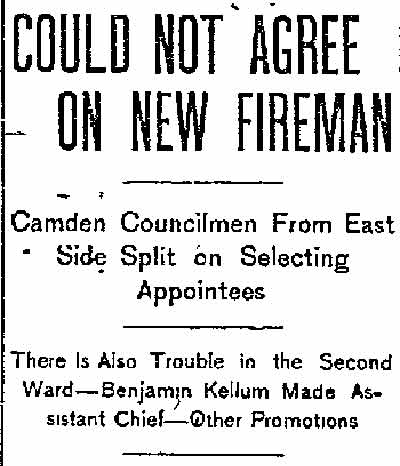
Camden Councilmen From East Side Split on Selecting Appointees
There Is Also Trouble in the Second Ward — Benjamin Kellum Made Assistant Chief — Other Promotions
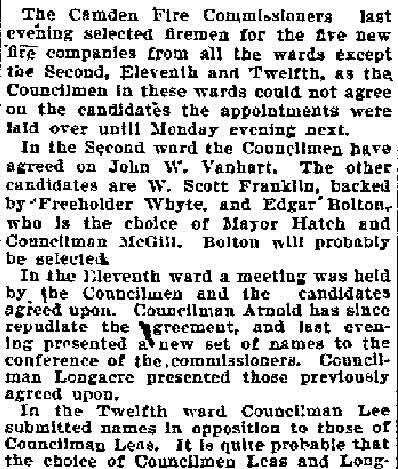
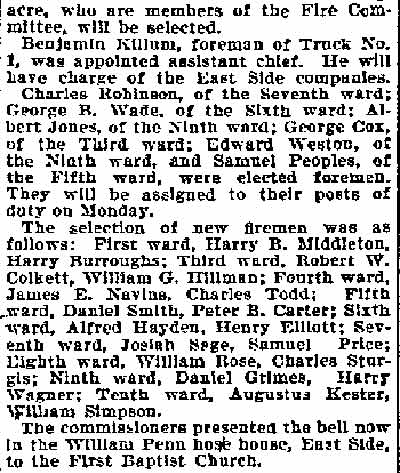
The Camden Fire Commissioners last evening selected firemen for the five new fire companies from all the wards except the Second, Eleventh and Twelfth, as the Councilmen in these wards could not agree on the candidates the appointments were laid over until Monday evening next.
In the Second ward the Councilmen have agreed on John W. Vanhart. The other candidates are W. Scott Franklin, backed by Freeholder Whyte, and Edgar Bolton, who is the choice of Mayor Hatch and Councilman McGill. Bolton will probably be selected.
In the Eleventh ward a meeting was held by the Councilmen and the candidates agreed upon. Councilman Arnold has since repudiated the agreement, and last evening presented a new set of names to the conference of the commissioners. Councilman Longacre presented those previously agreed upon.
In the Twelfth ward Councilman Lee submitted names in opposition to those of Councilman Leas. It is quite probable that the choice of Councilmen Leas and Longacre, who are members of the Fire Committee, will be selected.
Benjamin Kellum, foreman of Truck No. 1, was appointed assistant chief. He will have charge of the East Side companies.
Charles Robinson, of the Seventh ward; George B. Wade, of the Sixth ward; Albert Jones, of the Ninth ward; George Cox, of the Third ward; Edward Weston, of the Ninth ward, and Samuel Peoples, of the Fifth ward, were elected foremen. They will be assigned to their posts of duty on Monday.
The selection of new firemen was as follows: First ward, Harry B. Middleton, Harry Burroughs; Third ward, Robert W. Colkett, William G. Hillman; Fourth ward, James E. Navins, Charles Todd; Fifth ward, Daniel Smith, Peter B. Carter; Sixth ward, Alfred Hayden, Henry Elliott; Seventh ward, Josiah Sage, Samuel Price; Eighth ward, William Rose, Charles Sturgis; Ninth ward, Daniel Grimes, Harry Wagner; Tenth ward, Augustus Kester, William Simpson.
The commissioners presented the bell now in the William Penn hose house, East Side, to the First Baptist Church.
The Camden Fire Commissioners last evening selected firemen for the five new fire companies from all the wards except the Second, Eleventh and Twelfth, as the Councilmen in these wards could not agree on the candidates the appointments were laid over until Monday evening next.
In the Second ward the Councilmen have agreed on John W. Vanhart. The other candidates are W. Scott Franklin, backed by Freeholder Whyte, and Edgar Bolton, who is the choice of Mayor Hatch and Councilman McGill. Bolton will probably be selected.
In the Eleventh ward a meeting was held by the Councilmen and the candidates agreed upon. Councilman Arnold has since repudiate the agreement, and last evening presented a new set of names to the conference of the commissioners. Councilman Longacre presented those previously agreed upon.
In the Twelfth ward Councilman Lee submitted names in opposition to those of Councilman Leas. It is quite probable that the choice of Councilmen Leas and Long-
acre, who are members of the Fire Committee, will be selected.
Benjamin Kellum, foreman of Truck No. 1, was appointed assistant chief. He will have charge of the East Side companies.
Charles Robinson, of the Seventh ward; George B. Wade, of the Sixth ward; Albert Jones, of the Ninth ward; George Cox, of the Third ward; Edward Weston, of the Ninth ward, and Samuel Peoples, of the Fifth ward, were elected foremen. They will be assigned to their posts of duty on Monday.
The selection of new firemen was as follows: First ward, Harry B. Middleton, Harry Burroughs; Third ward, Robert W. Colkett, William G. Hillman; Fourth ward, James E. Navins, Charles Todd; Fifth ward, Daniel Smith, Peter B. Carter; Sixth ward, Alfred Hayden, Henry Elliott; Seventh ward, Josiah Sage, Samuel Price; Eighth ward, William Rose, Charles Sturgis; Ninth ward, Daniel Grimes, Harry Wagner; Tenth ward, Augustus Kester, William Simpson.
The commissioners presented the bell now in the William Penn hose house, East Side, to the First Baptist Church.
Philadelphia Inquirer — November 26, 1899
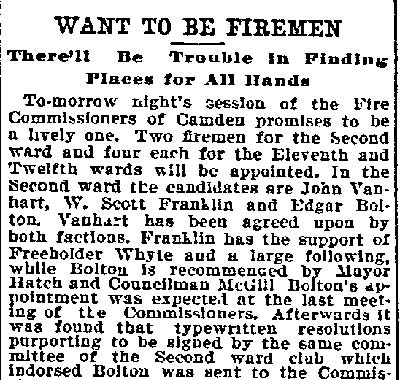
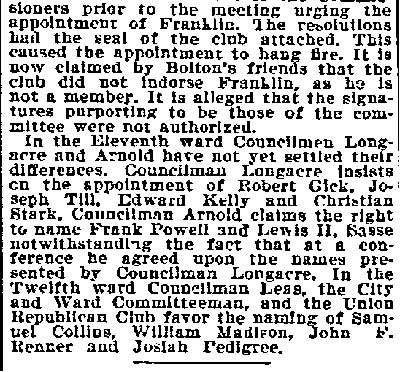
Named: Cooper B. Hatch, George W. Whyte, Edgar Bolton, John W. Vanhart, W. Scott Franklin, Robert Gick, Joseph Till, Edward Kelly, Christian Stark, Frank Powell, Lewis H. Sasse, Samuel Collins, William Madison, John F. Renner, and Josiah Pedigree.
Philadelphia Inquirer — November 28, 1899
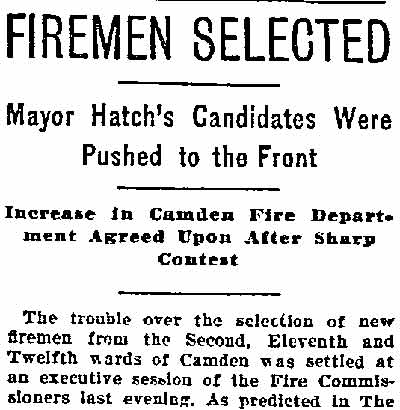
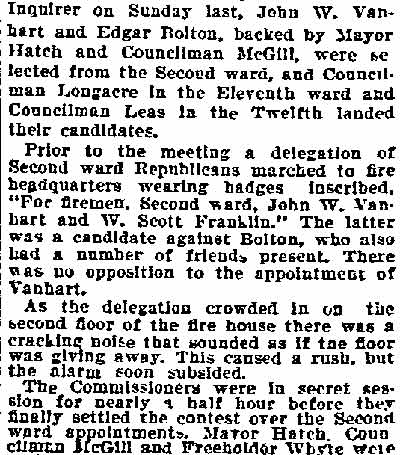
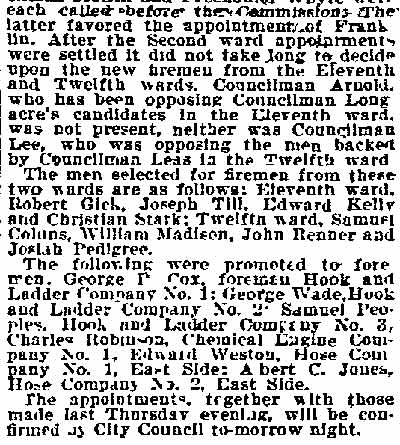
Named: Cooper B. Hatch, George W. Whyte, Edgar Bolton, John W. Vanhart, W. Scott Franklin, Robert Gick, Joseph Till, Edward Kelly, Christian Stark, Samuel Collins, William Madison, John F. Renner, Josiah Pedigree, Charles Robinson, George B. Wade, Albert Jones, George Cox, Edward Weston, and Samuel Peoples.
Philadelphia Inquirer — June 24, 1900
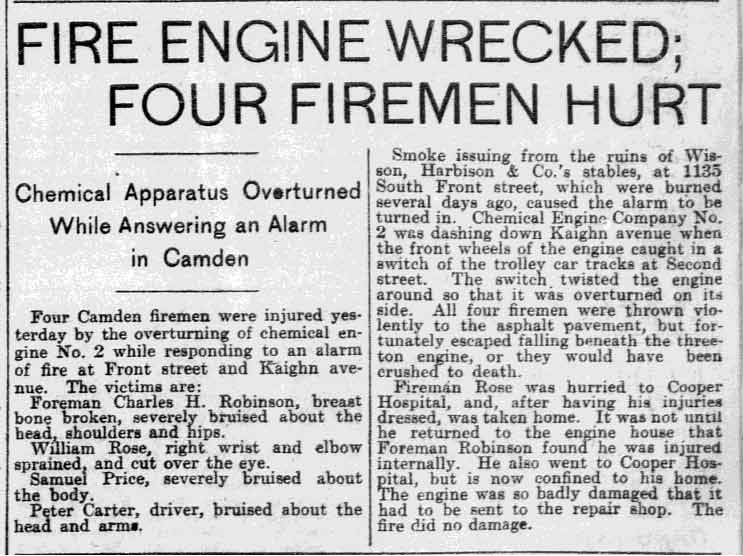
FIRE ENGINE WRECKED; FOUR FIREMEN HURT
Chemical Apparatus Overturned While Answering an Alarm in Camden
Four Camden firemen were injured yesterday by the overturning of chemical engine No. 2 while responding to an alarm of fire at Front street and Kaighn avenue. The victims are: Foreman Charles H. Robinson, breast bone broken, severely bruised about the head, shoulders and hips. William Rose, right wrist and elbow sprained, and cut over the eye. Samuel Price, severely bruised about the body. Peter Carter, driver, bruised about the head and arms.
Smoke issuing from the ruins of Wisson, Harbison & Co.’s stables, at 1135 South Front street, which were burned several days ago, caused the alarm to be turned in. Chemical Engine Company No. 2 was dashing down Kaighn avenue when the front wheels of the engine caught in a switch of the trolley car tracks at Second street. The switch twisted the engine around so that it was overturned on its side. All four firemen were thrown violently to the asphalt pavement, but fortunately escaped falling beneath the three-ton engine, or they would have been crushed to death.
Fireman Rose was hurried to Cooper Hospital, and, after having his injuries dressed, was taken home. It was not until he returned to the engine house that Foreman Robinson found he was injured internally. He also went to Cooper Hospital, but is now confined to his home. The engine was so badly damaged that it had to be sent to the repair shop. The fire did no damage.
Philadelphia Inquirer — December 1, 1901
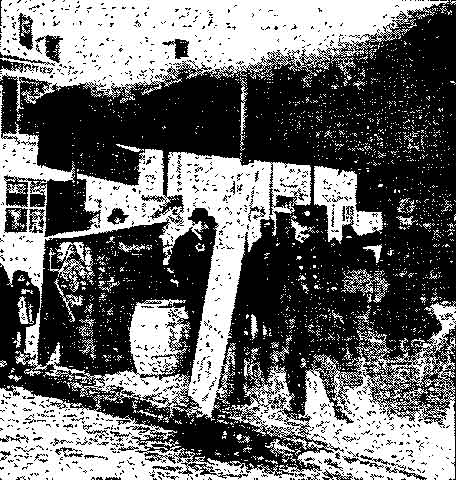

Named: Samuel Vanstavern, Daniel Lamb, Peter B. Carter, O. Glen Stackhouse, B.F. Archer, Frederick Griffith, Chestnut Street, Mount Vernon Street, South 3rd Street, and South 4th Street.
Philadelphia Inquirer — February 12, 1905
Philadelphia Inquirer — March 22, 1906
IN MEMORY OF DEAD HEROES
Mayor of Camden Calls for Services in Two Churches
Mayor Ellis, in Camden, yesterday issued a proclamation calling on the citizens to assemble at the First Baptist and the Broadway M. E. Churches on Sunday to participate in the services to be held in memory of Firemen George Shields, William Jones and William Hillman, who were killed at the Armory fire last Friday night. The first service will be held at the Baptist Church, at three o’clock, while the one at the Methodist Church will be held at quarter after four o’clock. The subscription fund being raised for the families of the firemen had reached nearly $2000 last night.
The funeral of Fireman Shields took place yesterday from his home, 525 Kaighn avenue. Hundreds of persons viewed the body, both Tuesday night and yesterday morning. The services were in charge of Rev. John S. Heisler, of the M. E. Church. The body reposed in a handsome oak casket and was surrounded by numerous floral tributes. The services were attended by forty firemen under Chief Elfreth, while the pall-bearers included Firemen Samuel Price, William Deno, Charles Robinson, Peter Carter, Joseph Ernest and George Quinn. Interment was made in the Evergreen Cemetery.
the families of the firemen had reached nearly $2000 last night.
The funeral of Fireman Shields took place yesterday from his home, 525 Kaikhn [sic] avenue. Hundreds of persons viewed the body, both Tuesday night and yesterday morning. hTe [sic] services were in charge of Rev. John S. Heisler, of the M. E. Church. The body reposed in a handsome oak casket and was surrounded by numerous floral tributes. The services were attended by forty firemen under Chief Elfreth, while the pall-bearers included Firemen Samuel Price, William Deno, Charles Robinson, Peter Carter, Joseph Ernest and George Quinn. Interment was made at the Evergreen Cemetery.
Camden Post-Telegram — January 3, 1910
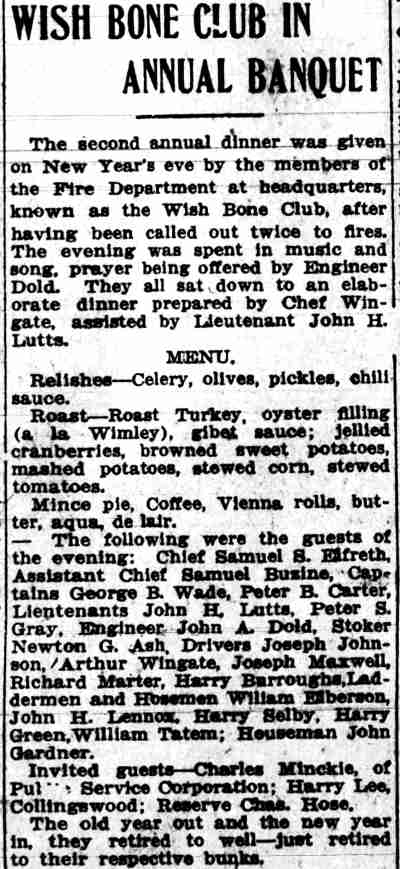
WISH BONE CLUB IN ANNUAL BANQUET
The second annual dinner was given on New Year’s eve by the members of the Fire Department at headquarters, known as the Wish Bone Club, after having been called out twice to fires. The evening was spent in music and song, prayer being offered by Engineer Dold. They all sat down to an elaborate dinner prepared by Chef Wingate, assisted by Lieutenant John H. Lutts.
MENU.
Relishes—Celery, olives, pickles, chilli sauce.
Roast—Roast Turkey, oyster filling (a la Wimley), giblet sauce; jellied cranberries, browned sweet potatoes, mashed potatoes, stewed corn, stewed tomatoes.
Mince pie, Coffee, Vienna rolls, butter, aqua de lair.
— The following were the guests of the evening: Chief Samuel S. Elfreth, Assistant Chief Samuel Buzine, Captains George B. Wade, Peter B. Carter, Lieutenants John H. Lutts, Peter S. Gray, Engineer John A. Dold, Stoker Newton G. Ash, Drivers Joseph Johnson, Arthur Wingate, Joseph Maxwell, Richard Marter, Harry Barroughs, Laddermen and Hosemen William Elberson, John H. Lennox, Harry Selby, Harry Green, William Tatem; Houseman John Gardner.
Invited guests—Charles Minckle, of Public Service Corporation; Harry Lee, Collingwood; Reserve Chas. Hose.
The old year out and the new year in, they retired to well—just retired to their respective bunks.
Thousands View Chief’s Remains
Camden Post-Telegram —
Throngs Jam Court House While Body Lies in State for Two Hours.
LAST SAD RITES THIS AFTERNOON
Not since the memorable funeral of Chief of Police Foster ten years ago, has there been such a genuine public tribute paid an official of Camden as was in evidence last night at the bier of the lamented Fire Chief Worthington, and today at his funeral. It is hard to estimate the number of persons in a crowd, but from 7 until 9 o’clock last night there was a steady stream of men, women and children, two abreast, who passed from the main entrance, through the center corridor and beneath the illuminated rotunda, where the body lay, and thence out by the west corridor. There was never a stop, and it is estimated that at least 10,000 persons were there, perhaps more.
There could not have been a more ideal location for the repose of the casket containing the honored dead, and the great array of beautiful flowers than beneath the rotunda. It seemed to be a sacred shrine in itself where the citizenry dropped a tear for the lamented departed. The effulgence of the soft lights from above specially installed by Electrical Chief Kelly but lent to the scene and as the dark garbed escort of firemen, the active pall bearers, stood, on guard, the scene was unusually impressive.
Chief Worthington, aside from the pallor that comes to the dead, looked as he did in life, for the thread had been snapped so quickly that it was while he was in his full vigor that the vital spark had taken its flight. There were some marks on his face that indicated the intense though momentary suffering through which he passed on his fateful plunge from the roof of the burning building to his quick death, and the passing crowd remarked this. But withal there was that calmness and repose feature which seemed to indicate that the gallant leader of Camden’s fire fighters but lay sleeping rather than that his soul had taken its eternal flight.
Public grief may be a mere ephemeral emotion, born of the moment and only to be succeeded by the acclaim of the newly arisen public idol, but last night’s encomiums seemed to come from hearts that overflowed with genuine and permanent sorrow over the untimely passing of so excellent a public servant. Many tear-suffused eyes indicated this, many expressions of grief, of sorrow, of condolence of those left showed this. The sentiment in evidence everywhere can only be likened to the sweetness of the wonderful flowers whose odor spread thorough all the corridors and in all the rooms of the great marble building.
High in the clock tower of the City Hall the bell began tolling at 6:30 o’clock. At half-minute intervals its doleful strains went forth on the cold blustery east wind which had succeeded at day of spring sunshine. The bell and the screeching wind seemed to combine as a knell indicating the passing grief of the city. It was the preliminaries to the marching of the funeral cortege from the stricken Chief’s home on Penn Street to the resting place at the Court House.
There were forty policemen in dress uniform with Chief Gravenor at their head. There were twenty-six fire heads from Philadelphia, with Chief William Murphy in the van, a tribute in itself of more than passing moment. There was the caisson on which was the black draped casket containing the body of he who all honored. There was the little red car in which Chief Worthington was wont to speed through the city at every alarm and there was his helmet and coat. There was Acting Chief Stockton and forty of the men who fought flames under the direction of he who lay so still. There as the family in cabs with curtains drawn, the members of City Council and the active pall bearers— Daniel Leach, Peter B. Carter, James White, William Patterson, Elmer Burkett, Samuel Harring.
When the cortege reached the Court House the Camden boys took up their position on the inside beneath rotunda while the Philadelphia visitors made an imposing array on the granite steps outside. And then came the public in its steady and unending stream.
Later the Philadelphia delegation was escorted to the Board of Freeholders room where tribute was paid to the dead and where a mingling of the two cities took place. Besides Chief Murphy the visitors included Battalion Chiefs William T. Barrett and George P. McConaghy, Captains L. F. Bunting, William Lindsey; H. Dinlocker, J. Higginson, J. E. Talbot, D. Campbell, T. O’Brien, F. Hughes, E. Basenfelder; H. Hutt, William McCusker, G. Rheim, R. Wilsey, J. Webb, H. Goers, H. Haines, Insurance Patrol Captain Joseph H. Shermer William Hickman, William Rodgers, John Wyatt, David Phillip, John Clyde, H. Wilkinson.
President of City Council James E. Hewitt spoke of the work Chief Worthington had already accomplished, of his plans, of his value and worth to Camden. Chief Murphy responded in a fitting way and this incident in itself was one to be remembered.
An affecting sight was witnessed by the handful of spectators, among them being other firemen, city and county officials and policemen who remained after the big doors on Sixth Street had been closed. The last to view the Chief’s remains were a delegation of about twenty firemen. Solemnly the men passed by the bier and gazed upon the features of their departed brother.
As the last of the line approached Deputy Chief John A. Stockton was seen. He stopped and with his cap laid across his breast be looked down into the casket. For almost a minute Chief Stockton stood as though glued to the spot. Then he glanced about him and the sympathetic look upon his face thrilled all.
He heaved a sigh and perhaps the teardrops refused to come, but Chief Stockton, as the lines upon his face showed, was struggling with the inner man. His emotions were tugging at his heart, but a fire laddie cannot give way to his feelings although his brother superior officer and dear friend had answered his last alarm.
The floral pieces surrounding the bier bespoke the love, admiration and respect the donors held for the dead chief. One design particularly beautiful was a mammoth loving cup made of blossoms, flowers and roses. This was the token sent by members of City Council and other city officials.
Another was the design sent by the Electrical Bureau through Chief Kelly. The original fire box, No. 134, which was pulled on the night of the fire by Chief Worthington was enshrouded by roses, carnations and lilies.
A maltese cross standing several feet high and bearing the initials of the organization was the tribute sent by the Firemen’s Mutual Benevolent Association. Chief Worthington was president of this association.
The Camden police sent a large shield of flowers and Council members offered a vacant chair of roses. The New Jersey Auto Supply Company, No. 2 Engine Company and No. 1 Truck sent beautiful broken circles and a wreath was the offering from the employees of the Victor Talking Machine Company.
A broken circle from member of the Sixth Ward Republican Club and a wreath from his friends in the sixth precinct of the Second Ward were other beautiful pieces. West Collingswood and Collingswood firemen sent two beautiful floral circles and from the Loyal Order Legion a wreath was received.
Other offerings were from the Camden Liquor Dealers league, a beautiful circle from No. 6 Engine Company, in which house Chief Worthington was captain previous to his elevation to the office of chief; sprays from the Bethany M.E. Church, Ladies Auxiliary of the Loyal Order of Moose; a wreath from the pupils of the eighth grade Sewell school, and a spray from North Baptist Church. There also were designs from members of the family and friends, all of which bespoke the great love held for the departed fire chief.
The impressive services of the P.E. Church marked the last sad rites this afternoon at St. Paul’s Church. The guard of honor and city officials left Fire Headquarters at 1:20 and proceeded to the Worthington home and escorted the remains to the church, where services were conducted by the rector, Rev. R.E. Brestell, and Rev. H.O. Jones, rector of St. Stephen’s P.E. Church. Interment was made at Arlington.
The honorary pallbearers were Mayor Ellis, Hon. David Baird, Frank F. Patterson, John W. Bell, General John A. Mather, Melbourne F. Middleton Jr., Harry R. Reed, Arthur L. Jones, Robert Gordon, David Jester, George Schneider, William Mills, J.O. Grear, William Hall, George L. Bender, and James E. Hewitt.
Philadelphia Inquirer — June 27, 1914
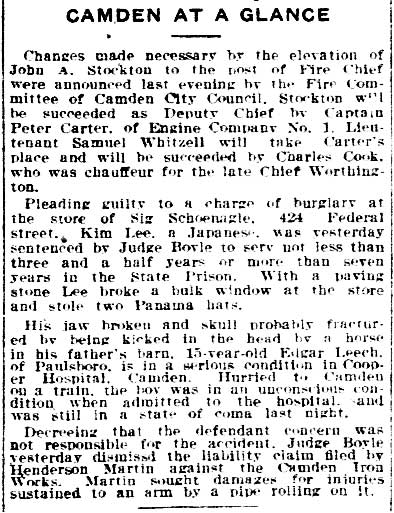
Named: John A. Stockton, Peter B. Carter, Charles Worthington, Samuel Whitezell, Charles Cook, and Engine Company 1.
Outside Fire Headquarters — About 1914
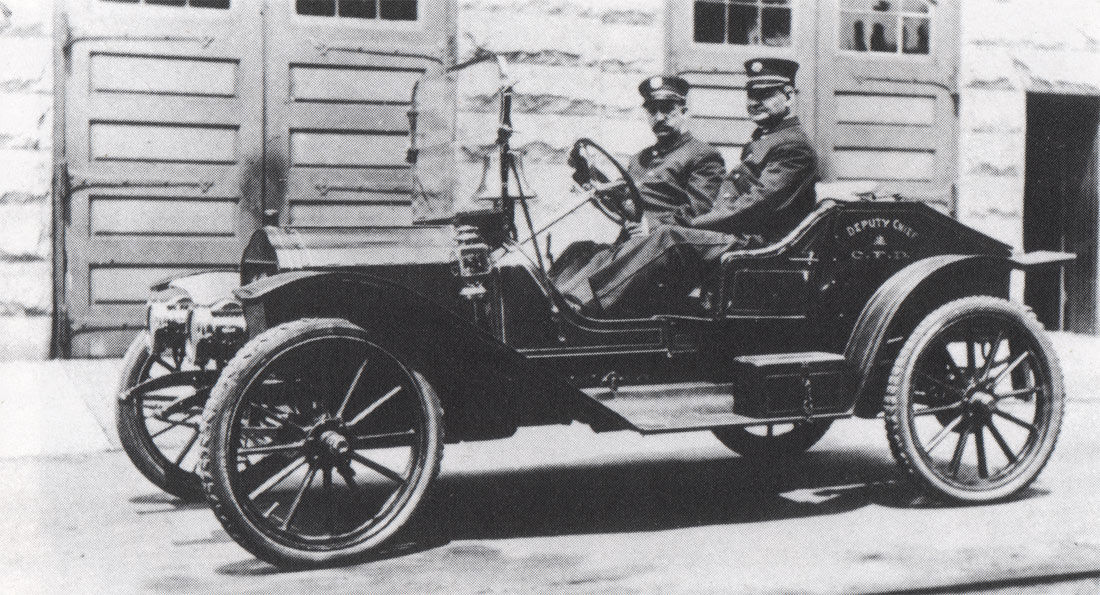
Deputy Chief Peter B. Carter and his Aide, Fireman Harry V. Hankins
Philadelphia Inquirer — July 18, 1914
Victim of Triple Accident Sent to Hospital—One Fireman Breaks Wrist, Heat Overcomes Another
Enroute to a fire which destroyed the big stone barn at Dudley Grange, Deputy Chief Carter’s red auto and the First District motor ambulance figured in a triple collision at Fifteenth and Federal
streets, which sent one man to Cooper Hospital. In an effort to avoid striking a wagon driven by Harry Green, aged thirty-one years, of 1840 South Eighth street, the ambulance crashed into the chief’s machine and hurled the latter car against Green’s wagon. Green was thrown from the seat, and at Cooper Hospital was found to have sustained contusions of the head and shoulder and lacerations of the hand. The occupants of the two autos escaped injury but both machines were put out of commission.
The firemen confined the flames to the barn, which was part of the beautiful homestead of Attorney Edward Dudley, who recently figured in a national divorce proceedings. Fireman William B. McCauley had his right wrist broken by a falling timber and Fireman William Rushworth was overcome by the heat. The loss was about $5000.
Camden Daily Courier — January 25, 1915
FIREMEN ESCORT STEER’S REMAINS
Chief Stockton Heads Big Delegation at Funeral of Lamented Colleague.
QUARTER CENTURY IN CITY’S SERVICE
With an honorary escort of sixty firemen and Fire Chiefs John A. Stockton, Peter B. Carter and Walter Browning attending his funeral, Fireman Robert B. Steer, for twenty-five years a member of the local fire department, and who died on Wednesday, was laid to rest yesterday afternoon in Arlington Cemetery.
Services were conducted at the Steer residence, 310 Howard street, by Rev. J. L. Surtees, pastor of State Street M. E. Church, and Rev. Isaac W. Bagley, chaplain of the department.
The pall-bearers were members of No. 4 Engine Company. They follow: Captain William W. Patterson, Robert Brice, Ephraim Hires, James Elberson, Daniel Grimes, Charles Watkins, Jr., Joseph Daly and David Logue.
The escort of firemen marched beside the hearse as far as No. 5 Engine Company. Chief John A. Stockton led the delegation. The flower designs completely enshrouded the bier. They came from people in all walks of life, who also came to pay their last respects to the lamented fire fighter.
Mr. Steer served as a fireman for almost twenty-five years, and he was one of the most popular men in the department. He was known to hundreds of people and his death has caused wide and genuine sorrow in North Camden.
He is survived by his wife, one son, Robert Steer, Jr., and a daughter, Miss Carrier Steer.
Philadelphia Inquirer — June 19, 1915
City Council to Refit Apparatus Now in Use Rather Than Purchase New Engines
After mature consideration of the numerous proposals presented, the Fire Committee of Camden City Council yesterday decided that instead of buying new auto engines for the five companies being refited, it would motorize the five engines and five combination wagons.
The contract for this work was given to the Commercial Truck Company of Philadelphia, which will place tractors on the ten pieces of apparatus for $15,000. The Federal Motor Truck Company was awarded the contract for motorizing the supply wagon at $2443. James Boyd & Co., of Philadelphia, was given the contract for an 85-foot aerial truck for $10,632.86 and the old Babcock aerial in exchange, and a city service truck for $5592.86 and an old truck in exchange. The same company is to supply a combination engine and hose wagon for $7542.86 and an old steamer in exchange.
All the apparatus will represent the very latest in fire fighting appliance, driven by electric power. The committee has saved upwards of $20,000 by deciding to motorize the present apparatus instead of buying entirely new machines.
Camden Daily Courier — July 30, 1915
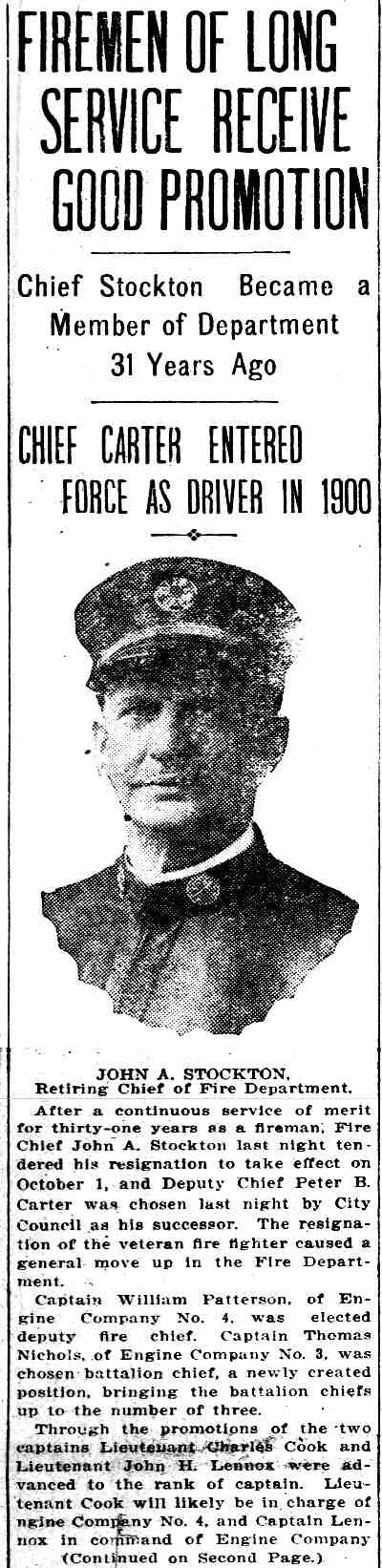
FIREMEN OF LONG SERVICE RECEIVE GOOD PROMOTION
Chief Stockton Became a Member of Department 31 Years Ago
CHIEF CARTER ENTERED FORCE AS DRIVER IN 1900
After a continuous service of merit for thirty-one years as a fireman, Fire Chief John A. Stockton last night tendered his resignation to take effect on October 1, and Deputy Chief Peter B. Carter was chosen last night by City Council as his successor. The resignation of the veteran fire fighter caused a general move up in the Fire Department.
Captain William Patterson, of Engine Company No. 4, was elected deputy fire chief. Captain Thomas Nichols, of Engine Company No. 3, was chosen battalion chief, a newly created position, bringing the battalion chiefs up to the number of three.
Through the promotions of the two captains Lieutenant Charles Cook and Lieutenant John H. Lennox were advanced to the rank of captain. Lieutenant Cook will likely be in charge of Engine Company No. 4, and Captain Lennox in command of Engine Company (Continued on Second Page.)
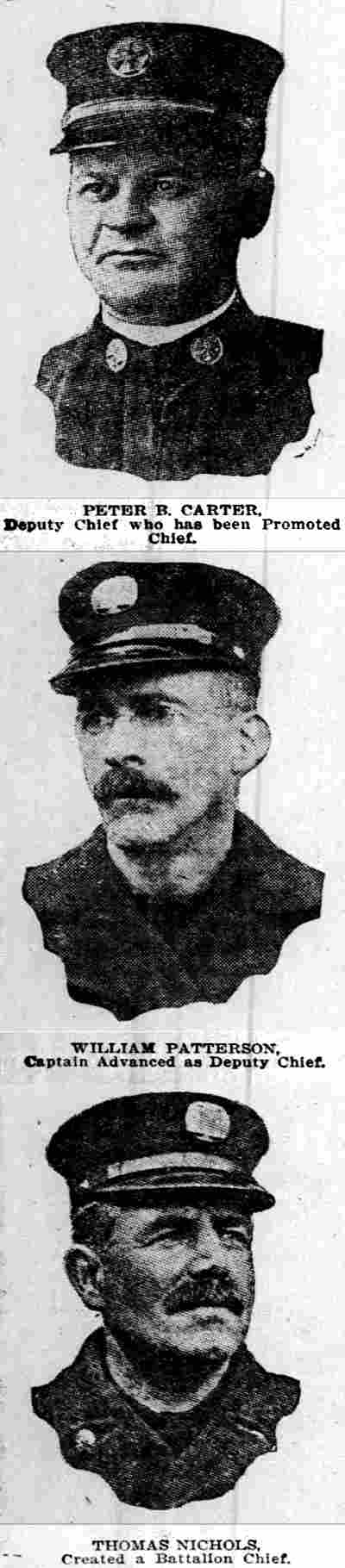
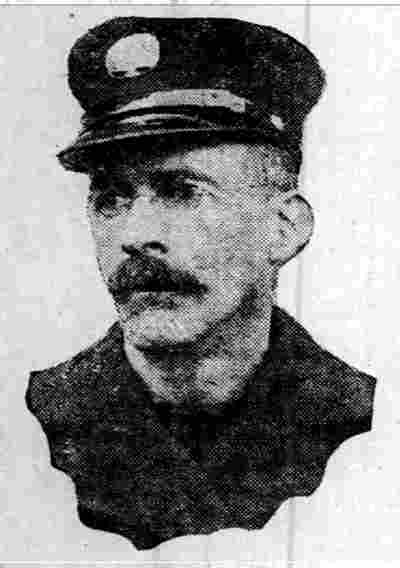
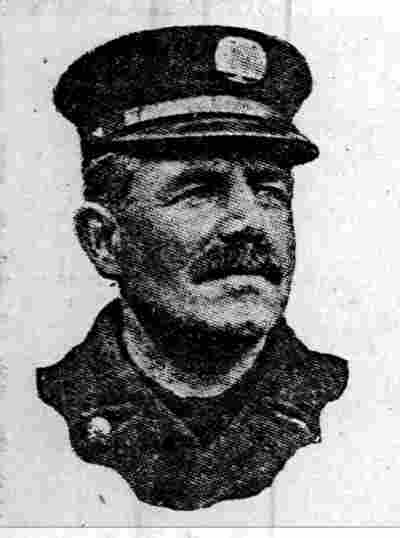
Named: John Stockton, Peter B. Carter, William Patterson, and Thomas J. Nicholas.
Camden Post-Telegram — July 30, 1915
CARTER CHIEF AS STOCKTON RETIRES
Head of the Department Resigns After Continuous Service of 31 Years.
WILLIAM PATTERSON IS ELECTED DEPUTY
In recognition of the long and valiant service to the city as a fighter of flames, Fire Chief John Stockton was yesterday given September on full pay as a vacation prior to his retirement on a pension on October 1. He retires after nearly thirty-one years of continuous service in the department. He succeeded the late Chief Charles Worthington, who was killed at the fire on George street. Chief Stockton rose from the ranks and has always been very popular with the men.
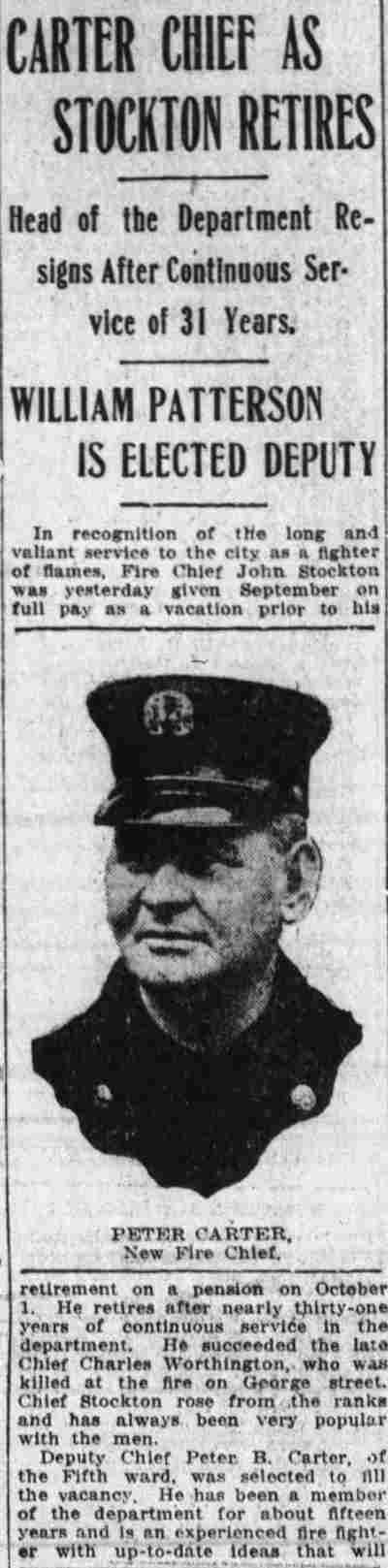
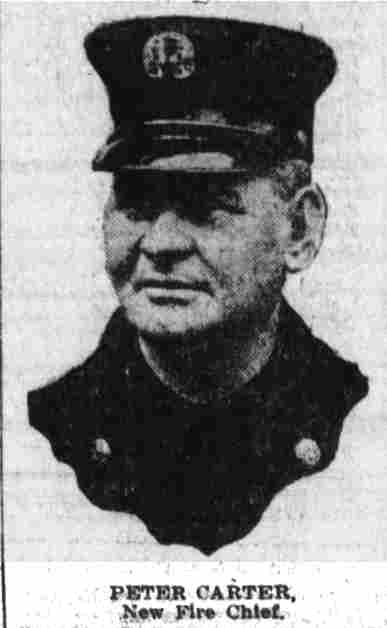
Deputy Chief Peter B. Carter, of the Fifth ward, was selected to fill the vacancy. He has been a member of the department for about fifteen years and is an experienced fire fighter with up-to-date ideas that will [article continues]
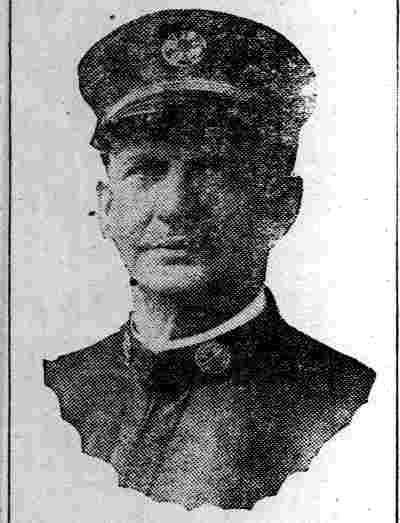
PETER CARTER, New Fire Chief.
[No text on the scan.]
Philadelphia Inquirer — July 30, 1915
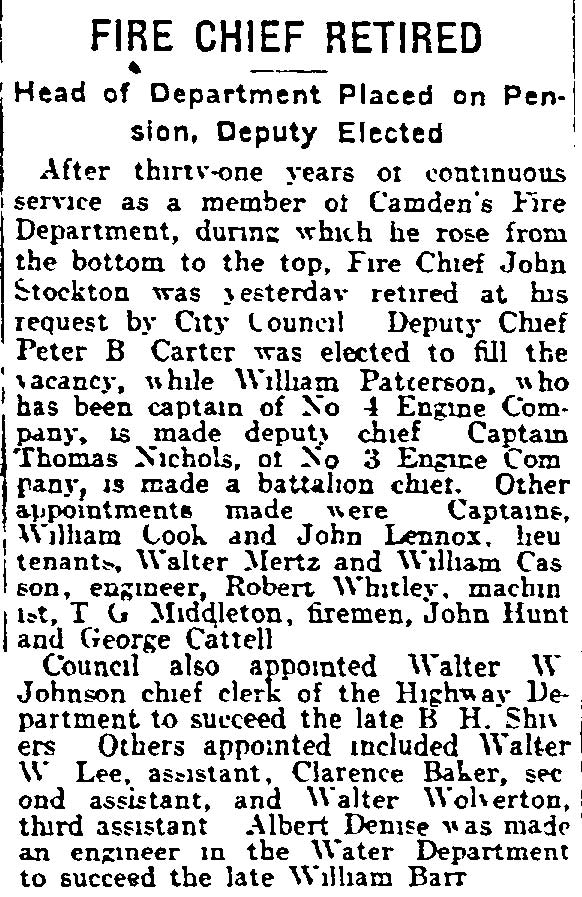
FIRE CHIEF RETIRED
Head of Department Placed on Pension, Deputy Elected
After thirty-one years of continuous service as a member of Camden’s Fire Department, during which he rose from the bottom to the top, Fire Chief John Stockton was yesterday retired at his request by City Council. Deputy Chief Peter B. Carter was elected to fill the vacancy, while William Patterson, who has been captain of No. 4 Engine Company, is made deputy chief. Captain Thomas Nichols, of No. 3 Engine Company, is made a battalion chief. Other appointments made were: Captains, William Cook and John Lennox, lieutenants, Walter Mertz and William Casson, engineer, Robert Whitley, machinist, T. G. Middleton, firemen, John Hunt and George Cattell.
Council also appointed Walter W. Johnson chief clerk of the Highway Department to succeed the late B. H. Shivers. Others appointed included Walter W. Lee, assistant, Clarence Baker, second assistant, and Walter Wolverton, third assistant. Albert Denise was made an engineer in the Water Department to succeed the late William Barr.
Philadelphia Inquirer — October 2, 1915
Camden Fire Chief Retires
After thirty-three years of service in the department, John A. Stockton yesterday retired as Camden’s Fire Chief, being succeeded by Peter B. Carter, whose place as Deputy Chief is taken by William Patterson. Battalion Chiefs Cox and Browning will be aides to Chief Carter at headquarters and Battalion Chief Nicholas assumed charge of the South Camden district, with headquarters at No. 3 Engine Company.
Camden Daily Courier — November 24, 1915
CHARM PRESENTED TO DEPUTY CHIEF
William Patterson Honored at Dinner Given to Members to No. 4 Engine Company.
BIG TURKEY FEED ENJOYED BY MANY
As a mark of appreciation for their splendid work while he was captain of No. 4 Engine Company, Deputy Fire Chief William Patterson last evening tendered the company members a fine turkey supper at No. 4 Engine House, Vine street near Fourth.
The caterers were Engineer Daniel Grimes, Firemen Robert Brice and Joseph Daly.
At the beginning of the banquet Capt. Charles Cook sprung a surprise when he presented the chief with a handsome watch charm of the Junior Order United American Mechanics. On the back was an inscription expressing the esteem of the members of the engine company. Chief Patterson expressed his appreciation for the gift and in a short address told the men he would always wear and cherish the gift.
Following the banquet addresses were made by Chief Peter B. Carter, Freeholder James M. Walton and Secretary Harvey Watts. Chief Carter spoke of the fellowship in the department at the present time and Freeholder Walton urged the men to be loyal. Lieutenant Joseph Logue, one of the oldest members of the company, spoke feelingly of his former captain. Then each guest was called upon and all expressed their esteem for Chief Patterson and showed their pleasure in his merited advancement.
Only one member of the company was absent, Ephraim Hires, who is ill at his home. Fireman Rollo Jones proposed a toast to former and departed members of the company and it was drunk in silence.
Gathered about the festive board were Deputy Chief William Patterson, Chief Peter B. Carter, Freeholder James M. Walton, Secretary Harvey Watts, Capt. Charles Cook, Firemen Arthur Wingate, Charles Hankins, Si Sage, Joseph Logue, Abraham Kerns, Charles Watkins, Jr., Martin Carrigan, Dollo Jones, Robert Brice, Joseph Daly, Daniel Grimes, John Miller and Frank Sheridan. The menu follows:
Oysters on Half-shell, Biscuits, Roast Turkey, Stewed Tomatoes, Green Peas, Mashed Potatoes, Cranberry Sauce, Cold Slaw, Olives, Coffee, After-dinner Mints, Celery, Layer Cake, Dan Grimes’ Punch, Cigars.
Philadelphia Inquirer — May 10, 1916
Dead Fireman Buried
With the body mounted on the auto supply wagon, the funeral of Fireman Harry C. Anderson, who died in Cooper Hospital from injuries received in being thrown from the auto truck in responding to an alarm of fire a couple of weeks ago, took place yesterday from his home at 1147 Federal street, Camden. An escort of sixty men with Fire Chief Peter B. Carter at the head accompanied the body to the burying place at Harleigh. Chaplain Isaac Bagley, of the department, officiated at the services. The pall-bearers were fellow-firemen.
Engine Company No. 5
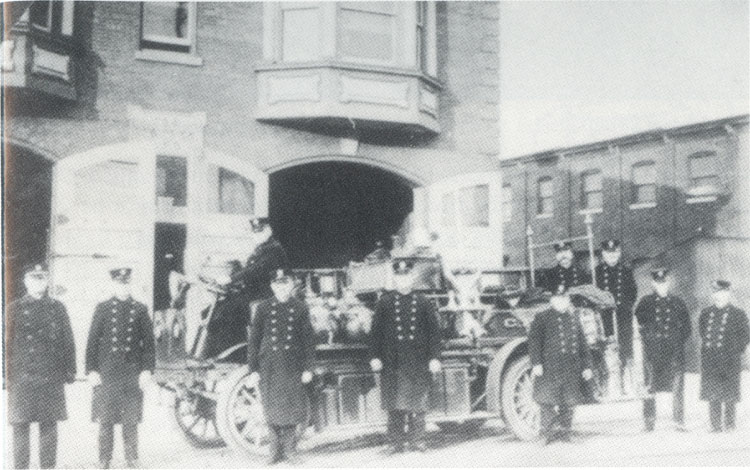
Engine Company No. 5 at 14th and Federal Streets, with newly converted hose wagon. Originally a horse drawn rig, it was modified to electric power by the Commercial Truck Company of Philadelphia PA. A storage battery powered each wheel. Pictured with apparatus are (l to r): Chief Peter Carter, Fireman W. Scott Franklin, Chauffeur Bert Coffman, firemen Edward Kelley, William Buzine, John Prucella, Charles Schultz, Horace Cairns, Daniel Grimes and chief’s aide, fireman Harry Hankins.
Philadelphia Inquirer — January 4, 1917
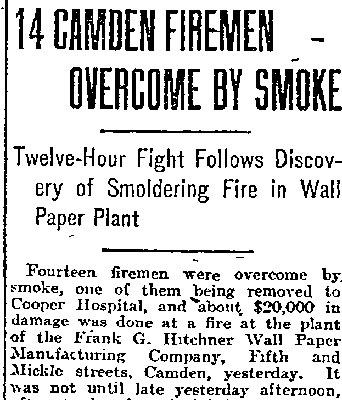
14 CAMDEN FIREMEN OVERCOME BY SMOKE
Twelve-Hour Fight Follows Discovery of Smoldering Fire in Wall Paper Plant
Fourteen firemen were overcome by smoke, one of them being removed to Cooper Hospital, and about $20,000 in damage was done at a fire at the plant of the Frank G. Hitchner Wall Paper Manufacturing Company, Fifth and Mickle streets, Camden, yesterday. It was not until late yesterday afternoon,
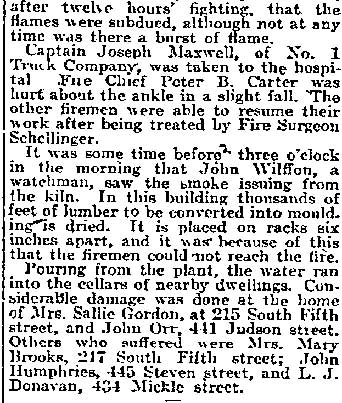
after twelve hours’ fighting, that the flames were subdued, although not at any time was there a burst of flame.
Captain Joseph Maxwell, of No. 1 Truck Company, was taken to the hospital. Fire Chief Peter B. Carter was hurt about the ankle in a slight fall. The other firemen were able to resume their work after being treated by Fire Surgeon Scheilinger.
It was some time before three o’clock in the morning that John Wilfson, a watchman, saw the smoke issuing from the kiln. In this building thousands of feet of lumber to be converted into moulding is dried. It is placed on racks six inches apart, and it was because of this that the firemen could not reach the fire.
Pouring from the plant, the water ran into the cellars of nearby dwellings. Considerable damage was done at the home of Mrs. Sallie Gordon, at 215 South Fifth street, and John Orr, 441 Judson street. Others who suffered were Mrs. Mary Brooks, 217 South Fifth street; John Humphries, 445 Steven street, and L. J. Donavan, 434 Mickle street.
Camden Post-Telegram — March 22, 1918
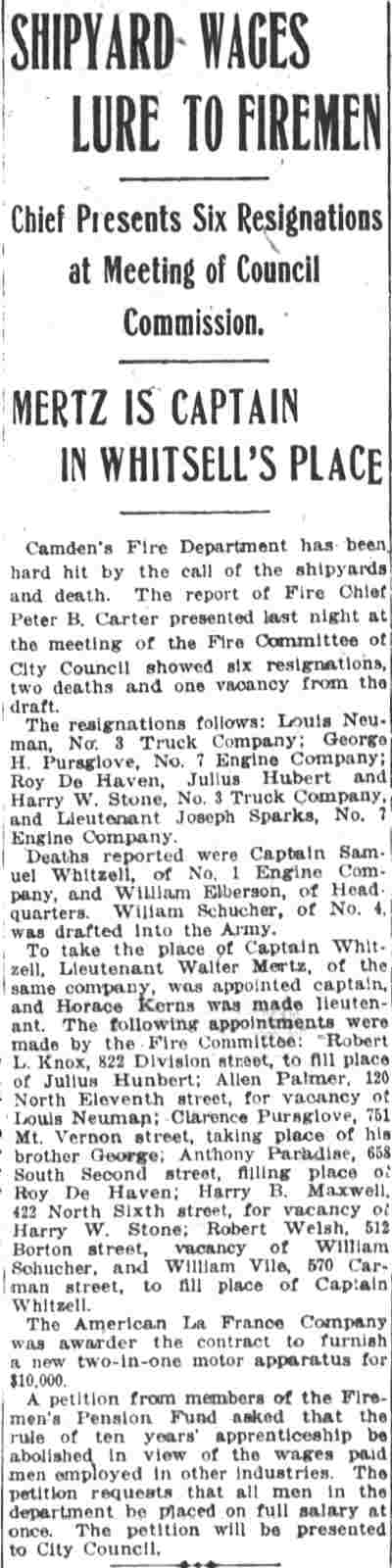
SHIPYARD WAGES LURE TO FIREMEN
Chief Presents Six Resignations at Meeting of Council Commission.
MERTZ IS CAPTAIN IN WHITSELL’S PLACE
Camden’s Fire Department has been hard hit by the call of the shipyards and death. The report of Fire Chief Peter B. Carter presented last night at the meeting of the Fire Committee of City Council showed six resignations, two deaths and one vacancy from the draft.
The resignations follows: Louis Neuman, No. 3 Truck Company; George H. Pursglove, No. 7 Engine Company; Roy De Haven, Julius Hubert and Harry W. Stone, No. 3 Truck Company, and Lieutenant Joseph Sparks, No. 7 Engine Company.
Deaths reported were Captain Samuel Whitzell, of No. 1 Engine Company, and William Elberson, of Headquarters. William Schucher, of No. 4, was drafted into the Army.
To take the place of Captain Whitzell, Lieutenant Walter Mertz, of the same company, was appointed captain, and Horace Kerns was made lieutenant. The following appointments were made by the Fire Committee: Robert L. Knox, 822 Division street, to fill place of Julius Hubert; Allen Palmer, 120 North Eleventh street, for vacancy of Louis Neuman; Clarence Pursglove, 751 Mt. Vernon street, taking place of his brother George; Anthony Paradise, 658 South Second street, filling place of Roy De Haven; Harry B. Maxwell, 422 North Sixth street, for vacancy of Harry W. Stone; Robert Welsh, 512 Borton street, vacancy of William Schucher, and William Vile, 570 Carman street, to fill place of Captain Whitzell.
The American La France Company was awarded the contract to furnish a new two-in-one motor apparatus for $10,000.
A petition from members of the Firemen’s Pension Fund asked that the rule of ten years’ apprenticeship be abolished in view of the wages paid men employed in other industries. The petition requests that all men in the department be placed on full salary at once. The petition will be presented to City Council.
Philadelphia Inquirer — March 23, 1918
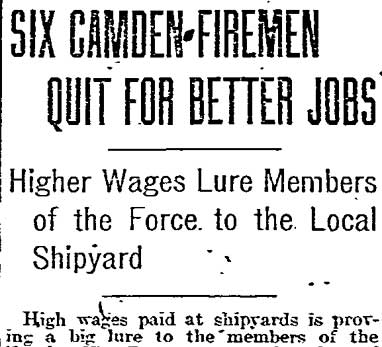
Named: Peter B. Carter, Harry B. Maxwell, Allen Palmer, Louis Neumann, George H. Pursglove, Roy DeHaven, Julius Herbert, Harry W. Stone, Joseph Sparks, Robert Knox, Clarence Pursglove, Anthony Paradise, Robert Welsh, Walter Mertz, Horace Cairns, and Samuel Whitzell.
Philadelphia Inquirer — September 11, 1918
Philadelphia Inquirer — September 11, 1918. New York Ship Yard fire.
Camden Post-Telegram — February 19, 1919
DEPUTY FIRE CHIEF TRAPPED IN CELLAR
Trapped in the smoke-filled cellar of the factory of the Hitchner Wall Paper Company, Fifth and Mickle streets, this morning when fire caused damage estimated by the owner at $25,000, Deputy Fire Chief William Patterson, was rescued by Fire Chief Carter and Driver Harry Selby, of Headquarters Company.
Deputy Chief Patterson entered the cellar for the purpose of determining if there was any fire there. The basement was dark and was filled with sample packets. When the smoke became dense he tried to grope his way back to the stairway but lost his way.
Other firemen who saw him go into the basement became alarmed and went in search of Patterson. Chief Carter and Selby broke open a front cellar window and entered, finding Paterson almost overcome. They assisted him through the open window to the street, where he was quickly revived.
The fire started on the first floor of the sample and store room in the rear of the main factory building. J.H. Harrington, order clerk, went to the room to fill an order. When he opened the metal door volumes of smoke poured out and he sounded the alarm. Six girl employes and the men workers left the building in haste, but returned and aided in rescuing the office papers and supplies.
Chief Carter was fearful that the blaze would spread owing to a high wind that was blowing and three alarms were sounded. After an hour’s hard fighting the firemen succeeded in extinguishing the fire, which spread only to the second floor of the storehouse. Water ruined a greater portion of the spring stock of paper and mouldings stored in the building and also caused damage in the factory proper.
Owing to the intense cold the firemen suffered greatly. As fast as the water was poured into the building it froze and the firemen were greatly handicapped by the ice-covered ladders and hose.
Frank G. Hitchner, head of the concern, estimated his loss at $25,000. Residents in houses near the factory were greatly exercised for fear the flames would spread.
Philadelphia Inquirer — December 28, 1919
Peter B. Carter — George L. Bender
Philadelphia Public Ledger — February 12, 1920
$200,000 DAMAGE AS FIRE DESTROYS BIG CAMDEN PLANT
Firemen Battle 7 Hours With Flames That Wreck Grain Elevator and Warehouse
NEW YORK SHIPYARD IS THREATENED BY SPARKS
All Fire Apparatus in South Jersey Called to Save Sitley & Sons’ Property
[Headline image only — article text continues in sitley-021220-ppl-02.jpg through sitley-021220-ppl-06.jpg]
Fire destroyed the grain elevator, warehouse and outbuildings of Sitley & Son, Inc., grain and feed merchant, Camden, during the night. The loss is estimated at nearly $200,000.
The blaze was a spectacular one. All the fire apparatus of Camden, Gloucester and neighboring towns was called [continued in sitley-021220-ppl-03.jpg]
Victor Cabinets Destroyed
The plant occupies the block bounded by Sixth street, Chelten avenue, the West Jersey and Seashore Railroad and the Atlantic City Railroad. It consisted of the elevator, office and warehouse, stable, garage and various outbuildings.
Frank B. Sitley, of Haddonfield, is the owner of the building. When he heard of the fire, Mr. Sitley hurried to the scene of the blaze and remained throughout the night.
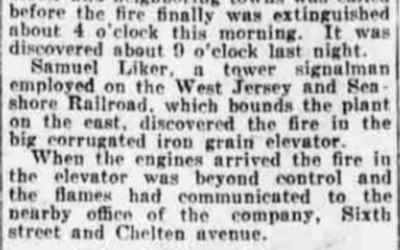
before the fire finally was extinguished about 4 o’clock this morning. It was discovered about 9 o’clock last night.
Samuel Liker, a tower signalman employed on the West Jersey and Seashore Railroad, which bounds the plant on the east, discovered the fire in the big corrugated iron grain elevator.
When the engines arrived the fire in the elevator was beyond control and the flames had communicated to the nearby office of the company, Sixth street and Chelten avenue.
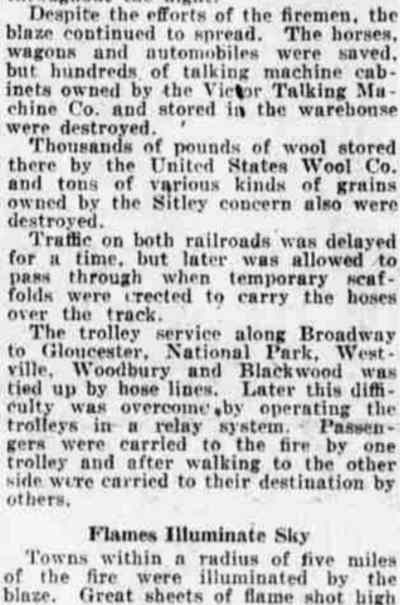
Despite the efforts of the firemen, the blaze continued to spread. The horses, wagons and automobiles were saved, but hundreds of talking machine cabinets owned by the Victor Talking Machine Co. and stored in the warehouse were destroyed.
Thousands of pounds of wool stored there by the United States Wool Co. and tons of various kinds of grains owned by the Sitley concern also were destroyed.
Traffic on both railroads was delayed for a time, but later was allowed to pass through when temporary scaffolds were erected to carry the hoses over the track.
The trolley service along Broadway to Gloucester, National Park, Westville, Woodbury and Blackwood was tied up by hose lines. Later this difficulty was overcome by operating the trolleys in a relay system. Passengers were carried to the fire by one trolley and after walking to the other side were carried to their destination by others.
Flames Illuminate Sky
Towns within a radius of five miles of the fire were illuminated by the blaze. Great sheets of flame shot high [continued in sitley-021220-ppl-06.jpg]
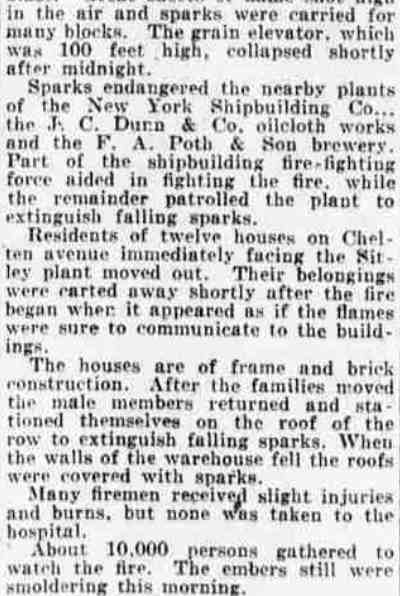
in the air and sparks were carried for many blocks. The grain elevator, which was 100 feet high, collapsed shortly after midnight.
Sparks endangered the nearby plants of the New York Shipbuilding Co., the J. C. Dunn & Co. oilcloth works and the F. A. Poth & Son brewery. Part of the shipbuilding fire-fighting force aided in fighting the fire, while the remainder patrolled the plant to extinguish falling sparks.
Residents of twelve houses on Chelten avenue immediately facing the Sitley plant moved out. Their belongings were carted away shortly after the fire began when it appeared as if the flames were sure to communicate to the buildings.
The houses are of frame and brick construction. After the families moved the male members returned and stationed themselves on the roof of the row to extinguish falling sparks. When the walls of the warehouse fell the roofs were covered with sparks.
Many firemen received slight injuries and burns, but none was taken to the hospital.
About 10,000 persons gathered to watch the fire. The embers still were smoldering this morning.
Philadelphia Inquirer — February 12, 1920
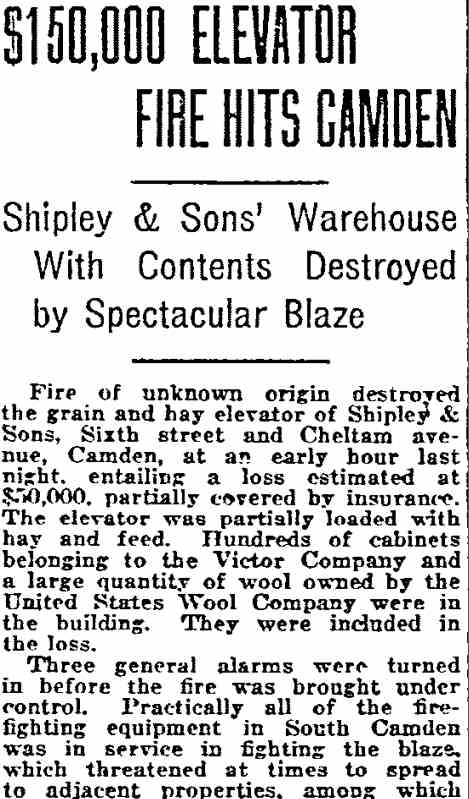
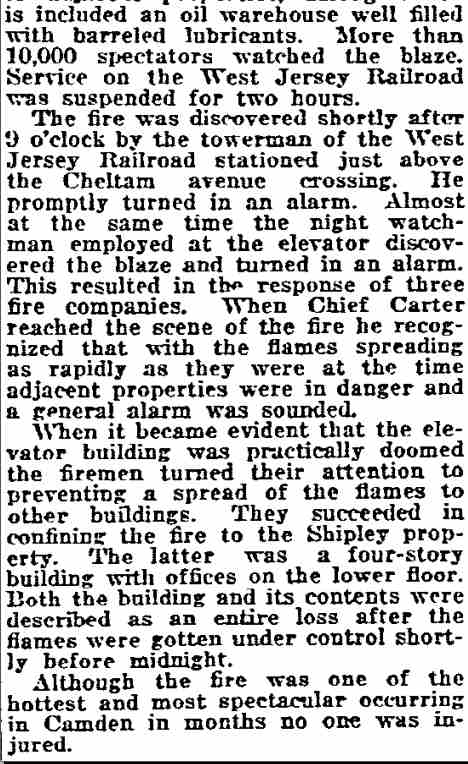
$150,000 ELEVATOR FIRE HITS CAMDEN
Shipley & Sons’ Warehouse With Contents Destroyed by Spectacular Blaze
Fire of unknown origin destroyed the grain and hay elevator of Shipley & Sons, Sixth street and Cheltam avenue, Camden, at an early hour last night, entailing a loss estimated at $150,000, partially covered by insurance. The elevator was partially loaded with hay and feed. Hundreds of cabinets belonging to the Victor Company and a large quantity of wool owned by the United States Wool Company were in the building. They were included in the loss.
Three general alarms were turned in before the fire was brought under control. Practically all of the fire-fighting equipment in South Camden was in service in fighting the blaze, which threatened at times to spread to adjacent properties, among which [continued in sitley-021220-inq-02.jpg]
is included an oil warehouse well filled with barreled lubricants. More than 10,000 spectators watched the blaze. Service on the West Jersey Railroad was suspended for two hours.
The fire was discovered shortly after 9 o’clock by the towerman of the West Jersey Railroad stationed just above the Cheltam avenue crossing. He promptly turned in an alarm. Almost at the same time the night watchman employed at the elevator discovered the blaze and turned in an alarm. This resulted in the response of three fire companies. When Chief Carter reached the scene of the fire he recognized that with the flames spreading as rapidly as they were at the time adjacent properties were in danger and a general alarm was sounded.
When it became evident that the elevator building was practically doomed the firemen turned their attention to preventing a spread of the flames to other buildings. They succeeded in confining the fire to the Shipley property. The latter was a four-story building with offices on the lower floor. Both the building and its contents were described as an entire loss after the flames were gotten under control shortly before midnight.
Although the fire was one of the hottest and most spectacular occurring in Camden in months no one was injured.
Philadelphia Inquirer — February 13, 1920
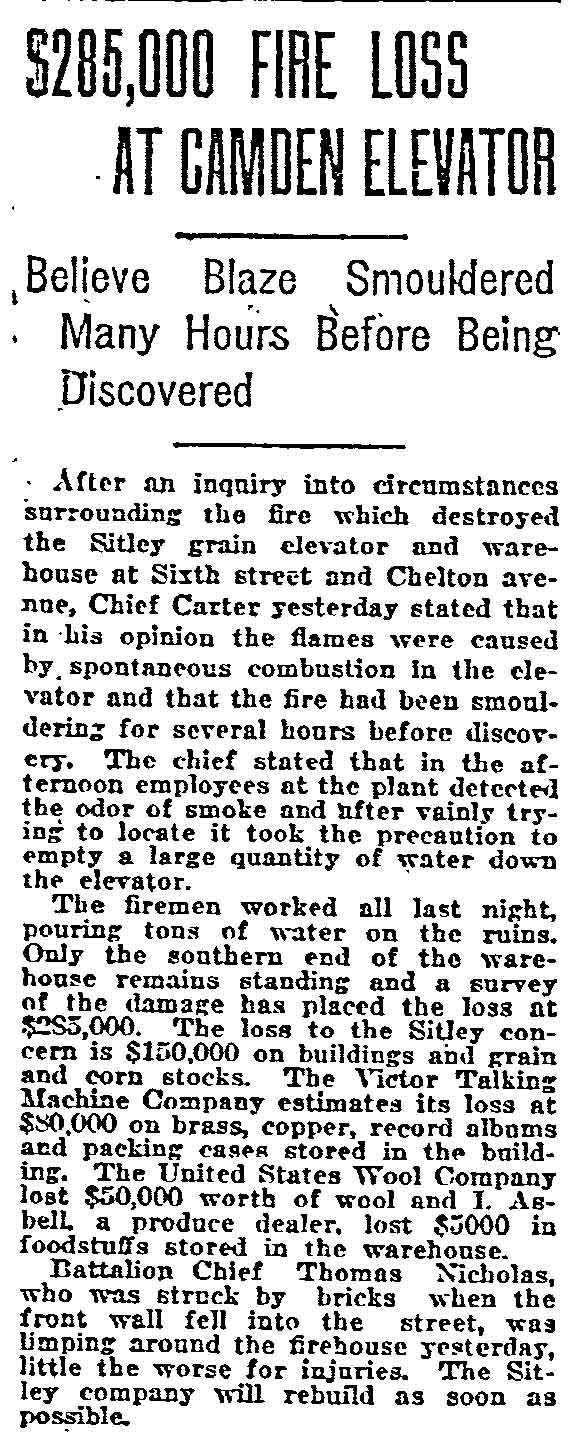
$285,000 FIRE LOSS AT CAMDEN ELEVATOR
Believe Blaze Smouldered Many Hours Before Being Discovered
After an inquiry into circumstances surrounding the fire which destroyed the Sitley grain elevator and warehouse at Sixth street and Chelton avenue, Chief Carter yesterday stated that in his opinion the flames were caused by spontaneous combustion in the elevator and that the fire had been smouldering for several hours before discovery. The chief stated that in the afternoon employees at the plant detected the odor of smoke and after vainly trying to locate it took the precaution to empty a large quantity of water down the elevator.
The firemen worked all last night, pouring tons of water on the ruins. Only the southern end of the warehouse remains standing and a survey of the damage has placed the loss at $285,000. The loss to the Sitley concern is $150,000 on buildings and grain and corn stocks. The Victor Talking Machine Company estimates its loss at $80,000 on brass, copper, record albums and packing cases stored in the building. The United States Wool Company lost $50,000 worth of wool and I. Agbell, a produce dealer, lost $5000 in foodstuffs stored in the warehouse.
Battalion Chief Thomas Nicholas, who was struck by bricks when the front wall fell into the street, was limping around the firehouse yesterday, little the worse for injuries. The Sitley company will rebuild as soon as possible.
Philadelphia Inquirer — October 24, 1920
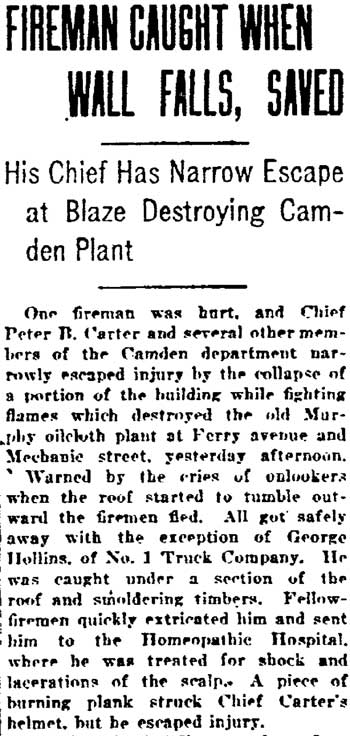
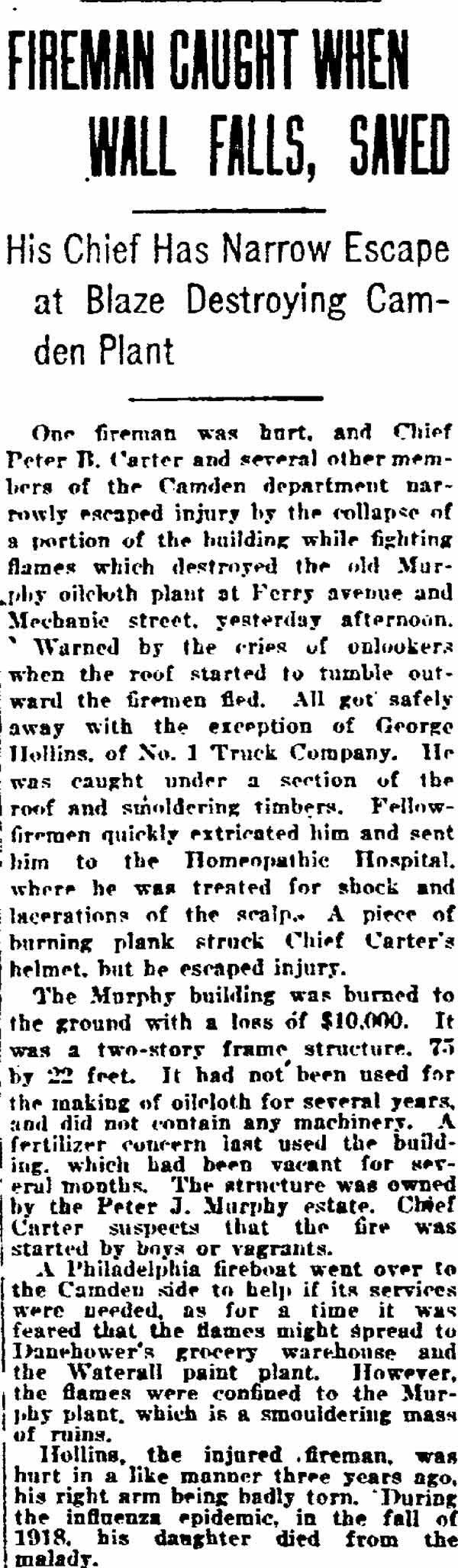
Named: Peter B. Carter, George Hollins, Ladder Company 1, West Jersey Hospital, Ferry Avenue, Mechanic Street, and Peter J. Murphy.
Camden Post-Telegram — December 30, 1920
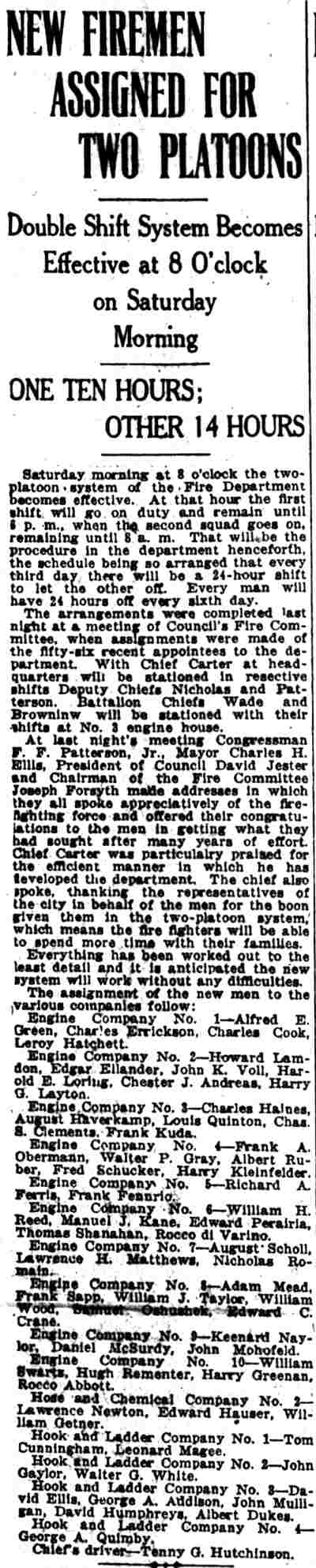
NEW FIREMEN ASSIGNED FOR TWO PLATOONS
Double Shift System Becomes Effective at 8 O’clock on Saturday Morning
One Ten Hours; Other 14 Hours
Saturday morning at 8 o’clock the two-platoon system of the Fire Department becomes effective. At that hour the first shift will go on duty and remain until 6 p. m., when the second squad goes on, remaining until 8 a. m. That will be the procedure in the department henceforth, the schedule being so arranged that every third day there will be a 24-hour shift to let the other off. Every man will have 24 hours off every sixth day.
The arrangements were completed last night at a meeting of Council’s Fire Committee, when assignments were made of the fifty-six recent appointees to the department. With Chief Carter at headquarters will be stationed in reserve shifts Deputy Chiefs Nicholas and Patterson. Battalion Chiefs Wade and Browning will be stationed with their shifts at No. 3 engine house.
At last night’s meeting Congressman F. F. Patterson, Jr., Mayor Charles H. Ellis, President of Council David Jester and Chairman of the Fire Committee Joseph Forsyth made addresses in which they all spoke appreciatively of the fire-fighting force and offered their congratulations to the men in getting what they had sought after many years of effort. Chief Carter was particularly praised for the efficient manner in which he has developed the department. The chief also spoke, thanking the representatives of the city in behalf of the men for the boon given them in the two-platoon system, which means the fire fighters will be able to spend more time with their families.
Everything has been worked out to the least detail and it is anticipated the new system will work without any difficulties.
The assignment of the new men to the various companies follow:
Engine Company No. 1—Alfred E. Green, Charles Errickson, Charles Cook, Leroy Hatchett.
Engine Company No. 2—Howard Lamdon, Edgar Ellander, John K. Voll, Harold E. Lorang, Chester J. Andreas, Harry G. Layton.
Engine Company No. 3—Charles Haines, August Haverkamp, Louis Quinton, Chas. S. Clements, Frank Kuda.
Engine Company No. 4—Frank A. Obermann, Walter P. Gray, Albert Ruber, Fred Schucker, Harry Kleinfelder.
Engine Company No. 5—Richard A. Ferris, Frank Fennrio.
Engine Company No. 6—William H. Reed, Manuel J. Kane, Edward Perairia, Thomas Shanahan, Rocco di Varino.
Engine Company No. 7—August Scholl, Lawrence H. Matthews, Nicholas Romain.
Engine Company No. 8—Adam Mead, Frank Sapp, William J. Taylor, William Wood, Samuel Oshushek, Edward C. Crane.
Engine Company No. 9—Keenard Naylor, Daniel McSurdy, John Mohofeld.
Engine Company No. 10—William Swarts, Hugh Rementer, Harry Greenan, Rocco Abbott.
Hose and Chemical Company No. 2—Lawrence Newton, Edward Hauser, William Getner.
Hook and Ladder Company No. 1—Tom Cunningham, Leonard Magee.
Hook and Ladder Company No. 2—John Gaylor, Walter G. White.
Hook and Ladder Company No. 3—David Ellis, George A. Addison, John Mulligan, David Humphreys, Albert Dukes.
Hook and Ladder Company No. 4—George A. Quimby.
Chief’s driver—Tenny G. Hutchinson.
Atlanta Constitution — October 15, 1921
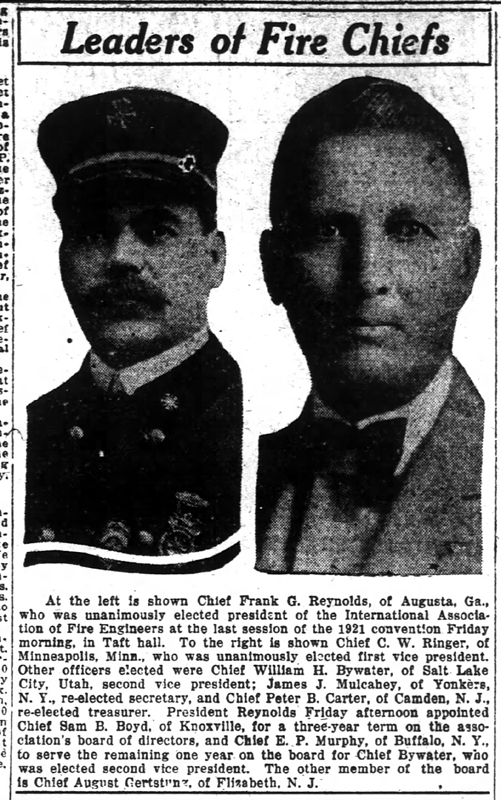
Atlanta Constitution — October 15, 1921. Peter B. Carter at the International Association of Fire Engineers meeting.
Philadelphia Inquirer — November 21, 1921
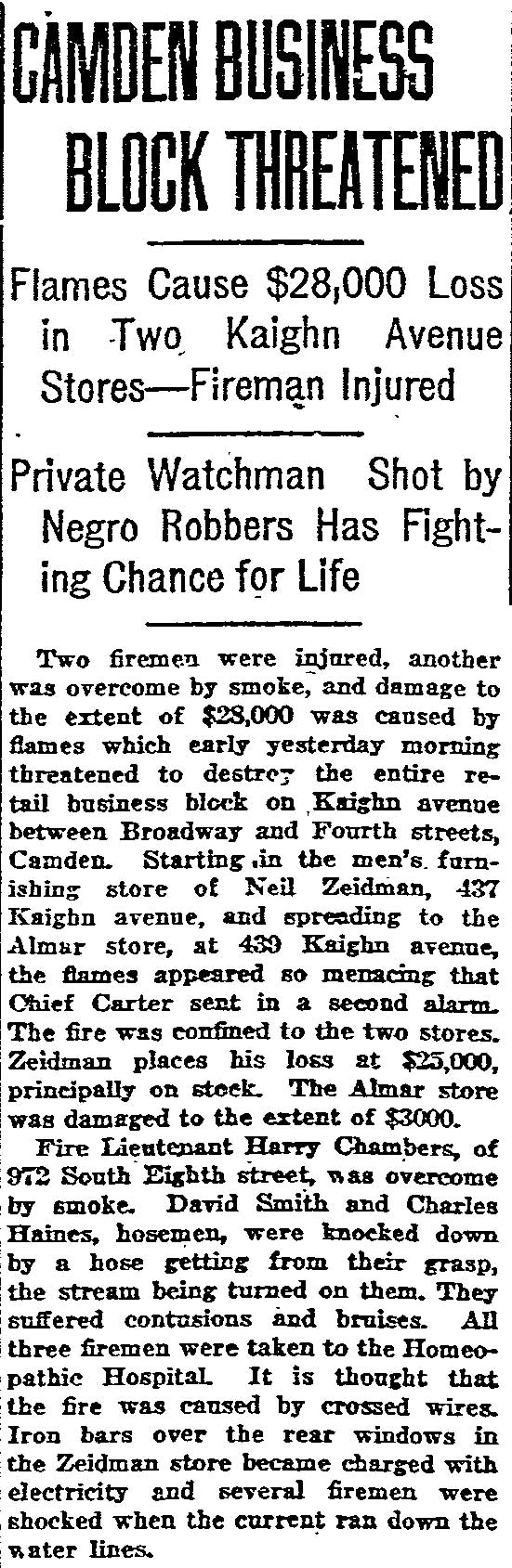
CAMDEN BUSINESS BLOCK THREATENED
Flames Cause $28,000 Loss in Two Kaighn Avenue Stores—Fireman Injured
Private Watchman Shot by Negro Robbers Has Fighting Chance for Life
Two firemen were injured, another was overcome by smoke, and damage to the extent of $28,000 was caused by flames which early yesterday morning threatened to destroy the entire retail business block on Kaighn avenue between Broadway and Fourth streets, Camden. Starting in the men’s furnishing store of Neil Zeidman, 437 Kaighn avenue, and spreading to the Almar store, at 439 Kaighn avenue, the flames appeared so menacing that Chief Carter sent in a second alarm. The fire was confined to the two stores. Zeidman places his loss at $25,000, principally on stock. The Almar store was damaged to the extent of $3000.
Fire Lieutenant Harry Chambers, of 972 South Eighth street, was overcome by smoke. David Smith and Charles Haines, hosemen, were knocked down by a hose getting from their grasp, the stream being turned on them. They suffered contusions and bruises. All three firemen were taken to the Homeopathic Hospital. It is thought that the fire was caused by crossed wires. Iron bars over the rear windows in the Zeidman store became charged with electricity and several firemen were shocked when the current ran down the water lines.
Philadelphia Inquirer — November 25, 1921
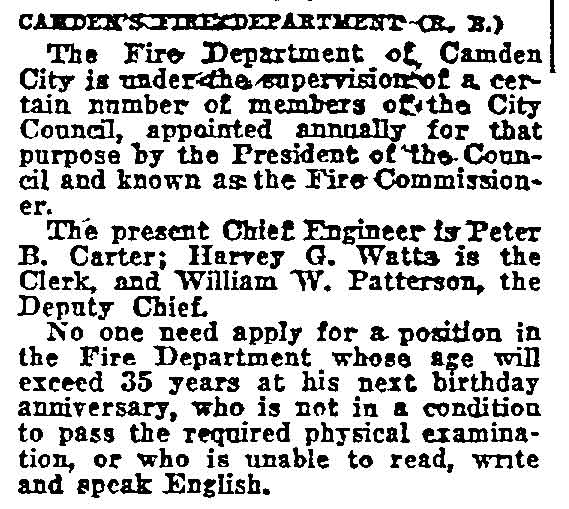
CAMDEN’S FIRE DEPARTMENT (R. B.)
The Fire Department of Camden City is under the supervision of a certain number of members of the City Council, appointed annually for that purpose by the President of the Council and known as the Fire Commissioner.
The present Chief Engineer is Peter B. Carter; Harvey G. Watts is the Clerk, and William W. Patterson, the Deputy Chief.
No one need apply for a position in the Fire Department whose age will exceed 35 years at his next birthday anniversary, who is not in a condition to pass the required physical examination, or who is unable to read, write and speak English.
Broadway Automobile Agency Burns
Camden Daily Courier —
Gardner Garage Fire ‘Worst Case of Arson I Ever Saw’ Says Carter
What is described by Fire Chief Peter D. Carter as the “worst case of arson I ever saw or read about” came to light today with the arrest of Boleslaw Ziemba*, 1555 Mt. Ephraim Avenue, an employee of the Gardner Automobile Sales Agency, Broadway and Atlantic Avenue.
Ziemba* was arrested by special policemen Ward and Shaw after fire broke out in the auto sales agency building. Firemen saved the building from destruction after the first floor was partly consumed by flames.
On an examination of the building, Chief Carter said he found kindling wood, saturated with gasoline and oil, placed in piles between joists of the second floor. The chief also said oily rags had been placed between cracks in the flooring and where the fire is believed to have started.
Firemen Save Evidence
A flue leading to the chimney had also been saturated with oil or gasoline, the Chief asserted.
The evidence which was saved by quick work on the part of the firemen was taken to police headquarters. The arrest of Ziemba* followed.
The building is occupied in the first floor by the automobile agency. The second and third floors were unoccupied.
* Newspaper reported name as “William Zambro”
$3000 Man’s Lure to Fire Building
Camden Daily Courier —
Prisoner Confesses to Arson; Blames His Employer, —Both Under Arrest
Boleslaw Ziemba, 1555 Mt. Ephraim Avenue, confessed today to Captain of Detectives Schregler that he set fire to the property at 1426 Broadway at the instigation of his employer, John Makel, so he could obtain $3000 he had put into the business. Makel conducted an automobile agency at the Broadway address. Both men are under arrest and will face charges of arson preferred by Fire Chief Peter D. Carter.
Ziemba told the detective chief in the presence of his aides, King and Painter, who investigated the case, that sometime ago he had loaned Makel $3000 and in turn had been given a job at the agency. He stated that he had asked Makel for his money and his employer then said that he, Ziemba, set fire to the building and that the insurance money would provide the means to erect a new and handsome building and he could have a better job and get his money back quicker.
Firemen saved the building from destruction after the first floor had been partly consumed by flames.
On an examination of the premises, Chief Carter said he found kindling wood saturated with gasoline and oil placed in piles between joists of the second floor. He also discovered that rags soaked in oil had been placed in cracks in the flooring. Even the driveway had been liberally dosed with gasoline and oil, the chief stated. The arrests followed the examination of the arson evidence at police headquarters.
Police to Probe $200,000 Kaighn Ave. Fire
Camden Daily Courier —
Fire Captain May Die, Four Others Injured; Damage Is $200,000
Economy Store and Other Buildings Near Broadway Swept by Flames Early This Morning — Falling Debris Carries Men Through Roof And Into Cellar — Sleeping Inmates of Apartments Roused and Invalid Carried to Safety — Mayor Sees Rescues
Mayor Ellis has ordered an investigation to determine the cause of the $200,000 fire which swept the properties at 427 and 429 Kaighn Avenue and caused injury to five firemen, one of whom may be fatally hurt.
The fire centered about the property occupied by the Economy Store, formerly Handle’s, and quickly spread to four adjoining buildings.
The fireman whose recovery is despaired of is Captain Martin B. Carrigan, of Engine Company No. 2, Fifth and Arch Streets. Carrigan, who lives at 618 West Street, is suffering from a fractured skull and severe burns and cuts of the face, legs, and body. He is unconscious at Cooper Hospital.
The firemen were injured when a wall, weakened by the intense heat, crumbled and crashed through a roof upon which they were standing, dragging them through the floor below, and into a cellar. Sensational rescues followed as police, firemen, and citizens with bare hands tore at the hot debris. The men were quickly extricated and carried to the street.
“We certainly shall investigate this fire,” the Mayor declared today. “Just what was the cause and who is to blame has not been determined but there will be a thorough investigation.”
“There have been too many of these fires during the past few weeks” continued the mayor. “Surely all of them did not just happen and I am sure there has been someone responsible in one or two of the fires.”
The conflagration was one of the most spectacular of a series of large fires that have visited the city in the past six weeks. The block in which it occurred— Kaighn Avenue between Broadway and Fourth Street is one of the most prominent business squares in Camden.
Flames shot 200 feet in the air, giving the sky a fiery hue and attracted attention for miles before the firemen brought it under control. The flame-lit sky was clearly seen in Philadelphia, Merchantville, East Camden, Gloucester and other communities.
More than a score of families living in the vicinity were forced to flee from their homes in scant attire when the fire threatened them. They were cared for by neighbors.
Fireman George Boone, 46 years old, of Engine Company No. 2, also is in a serious condition. He is suffering from burns of the right hand, right thigh and foot and probable internal injuries. Boone lives at 607 Mount Vernon Street.
The other injured firemen are:
John Voll, 22 years old, 509 Royden Street: both hands badly burned.
C.J. Andrus, aged 31 years, 570 Mount Vernon Street: burns of hands and legs.
Harold Lorang, 29 years old, 19 Hudson Street: burns of right hand and legs and sprained ankle.
Firemen Prove Heroes
Carrigan and Boone are in the hospital. The other firemen were discharged after their wounds were dressed. After being released from the hospital they returned to the scene of the fire and insisted upon continuing their duties. Chief Peter B. Carter, however, ordered them home.
Most of the loss was suffered by the Economy Store. A few charred walls remain of the large building. The interior was completely gutted. It was estimated today that the damage to that property will total $60,000. At least $50,000 damage, it was said, was done to the stock.
Morris Handle, local theatrical man, who owns the building, declared today that the property was insured for $30,000. “My loss will be quite heavy,” said Mr. Handle. “The insurance will not pay one-half the property damage.”
The adjoining building at 431 Kaighn Avenue is occupied by Dr. S.I. Yubas, optometrist, and L.R. Yubas, his father, a jeweler.
Invalid is Rescued
The rear and upper floors of the Yubas property were gutted and the stock sustained a heavy loss, due to water and smoke. The damage will total $40,000, Mr. Yubas estimated today.
Five persons who were asleep on the upper floors of the Yubas dwelling had narrow escapes. They were awakened by Samuel Goldstein, haberdasher, 417 Kaighn Avenue, who discovered the fire in the Economy Store and turned in the alarm. Mrs. L.R. Yubas, an invalid, was rescued with difficulty.
The property occupied by Mrs. Sadie Bodner, a widow, at 433 Kaighn Avenue, as a house furnishings store, was scorched and also damaged by water and smoke.
Adjoining the Economy Store on the west at 425 Kaighn Avenue is a vacant one-story structure, formerly occupied by the United Beef Company. Firemen were on the roof of that building when the west wall of the Economy Store collapsed. The wall tumbled down on the small roof and hurled the firemen through a hole in the roof, through the floor and then into the cellar.
Several Stores Damaged
Three policemen, Joseph Sparks, Thomas Cheeseman, and George Hill— and several spectators braved the fire and smoke to rescue the trapped firemen.
The property at 423 Kaighn Avenue, occupied by the Charles Jamison Department Store, was damaged in the rear and the stock ruined by water and smoke. The Kresge Five-and-Ten-Cent Store, at 519–531 Kaighn Avenue, was also damaged by water.
Louis Richelson, who owns the properties from 519 to 525 Kaighn Avenue, was unable to estimate his loss today.
Collapse of Wall
Hundreds of spectators, who were watching the fire from the opposite side of the street, shuddered as they saw a brick wall, weakened by the intense heat, totter and sway. Before the firemen on the smaller roof below could scurry to safety, it collapsed.
A groan escaped the crowd as they heard the cries of the entrapped firemen and the deafening thud of the bricks as they landed on the roof where the firemen were at work.
As the full weight of the bricks struck the roof, it caved in forming a gaping hole. The firemen were literally swept into the opening.
The bricks tumbled down, causing another hole in the floor between the first story and the cellar and dragging the imperiled firemen into the cellar with them.
Mayor Charles H. Ellis was among the spectators who witnessed the collapse of the wall. Other officials were Chief James H. Long, of the Water Department; Fire Chief Carter, Assistant Police Chief Edward S. Hyde, Captain Lewis Stehr of the Second Police District, and Street Commissioner Alfred L. Sayers.
Firemen Under Debris
Observing the peril of the trapped firemen, Policemen Sparks, Cheeseman and Hill, together with a dozen other spectators, rushed across the street to the vacant store. They rushed through the smoke and fire, leaped into the cellar and reached the struggling firemen.
Sparks, the first to leap into the cellar, reached Voll, who had been pinned beneath a pile of debris and was pleading to be rescued. The policeman feverishly extricated Voll from his precarious position and carried him out into the street to safety.
Policeman Cheeseman had accidentally fallen into the cellar and, though himself injured, groped about in the dark until he found Boone, whom he dragged outside.
Policeman Hill carried Carrigan out of the cellar in his arms.
The five firemen were carried to a waiting police ambulance and rushed to Cooper Hospital. Carrigan was unconscious. He had a slim fighting chance to recover.
Carrigan was promoted to a captaincy the first of the year. He is popular among his comrades and has the reputation of being a fearless fireman.
Mayor Praises Firemen
Mayor Ellis praised the work of the firemen and the bravery of the policemen who had risked their lives to effect the rescue.
“Never did I see such remarkable work” said the Mayor. “When I arrived at the scene, it looked as if the whole block was doomed. The flames were shooting upward and the whole sky seemed lit up. The firemen tackled their job with dispatch and courage. I was proud of them. They knew their business and showed it by confining it to a comparatively small area. The work of the police also was commendable.”
Mr. Goldstein discovered the fire shortly before midnight.
“I had just left my home at 417 Kaighn Avenue,” explained Mr. Goldstein, “intending to get a soda. As I passed the Economy Store I noticed strong odor of smoke. I peered into the glass doorway of the store. I immediately saw the place was afire.”
Rescues Sleeping Family
“Then I ran back to my store” continued Mr. Goldstein, “and I telephoned police headquarters. I went out again and returned to the scene. I remembered that the Yubas family were asleep on the second and third floors and rapped on the doors. Mr. Yubas came down in a bathrobe. He was not aware of the fire.”
The six persons asleep in the Yubas home were Dr. Yubas, Mr. and Mrs. L.R. Yubas, Bernard Helfand, Miss Bertha Cuden and Anna Recowitz, a domestic.
Mrs. Yubas, who is recovering from an illness, was too weak to make her way outside through the smoke. Assisted by her husband, Policemen Becker and Cheeseman and Constable John Cunningham, Mrs. Yubas was half carried downstairs, and out through the rear of the building to safety.
Blaze Had Big Start
“The fire had gained such rapid headway,” said Sergeant Thomas Cunningham, “that when the firemen arrived, smoke was actually issuing from cracks in the sidewalks and between the cobbles near the trolley tracks.”
The second and third floors of 419 to 423 Kaighn Avenue are occupied by private families as apartments. In the rear were number of frame dwellings. More than a score of families were obliged to leave their homes in scant attire when the firemen began playing hose upon their properties as a precaution against the fire spreading.
Mrs. Catherine Fox, 410 Sycamore Street, and Mrs. E. Chambers, 412 Sycamore Street, whose homes are in the rear of the Economy Store property, had removed part of the furniture to the street. Even after firemen assured them the danger of their homes catching on fire was over, the women and children could hardly be persuaded to return.
Crumbling walls and cracking of glass hampered the firemen in their work and made their task hazardous. The firemen were further handicapped by the big start the fire had gained. Despite this, they stuck dangerously close to the flames.
To play hose upon the fire to advantage, several firemen scaled the outside walls of adjoining properties and reached cornices, from which they directed streams of water.
High Wind Fanned Flames
A high wind gave them great difficulty. A number of times, when the firemen seemed to have the fire under control, the flames burst out afresh and compelled them to retreat. Then the reflection would light up the sky overhead.
Water Chief Long gave the firemen great service in maintaining the water at a high pressure to ensure facility in getting the streams to play upon the flames.
Kaighn Avenue, between Broadway and Fourth Street, was literally alive with residents and passers-by attracted by the flames. Included among the spectators were scores of persons who came from Philadelphia and distant points, in the belief the blaze was much more serious.
According to the estimate of the loss made today, the insurance on the property and stock damaged by the fire will not pay for one-half the loss sustained.
Chief Carter was determined to take no chances with the fire because of the high wind and the fire was attacked on all sides. While firemen were fighting the flames from Kaighn Avenue several companies of firemen had worked their way into the yard in the rear, from whence they played streams of hose.
An effort is being made today to determine the origin of the blaze.
Thomas Shanahan, Engine Company 6, was a spectator when the wall crashed in. Hearing the cries of the buried men, he immediately dashed into the dirt. Six men, including Harry Seeley, formed a human chain and pulled four of the men from the heap of rubbish.
Someone had the presence of mind to turn off the nozzle of a hose, which was playing directly on the mound. When found, the water was trickling through to the pinned men.
Fire Bells Toll as Capt. Carrigan Is Laid to Rest
Camden Daily Courier —
Firemen Escort Flower Covered Casket of Hero Through City
HUNDREDS BARE HEADS
Mayor, Councilmen, Firemen and Police View Body; Services at St. John’s
Hundreds lined the streets and bared their heads and bells in fire houses solemnly tolled a tribute this morning as the cortege of Captain Martin B. Carrigan, who lost his life in the Economy store fire, slowly wended its way through the city to Arlington Cemetery.
Chief Peter B. Carter headed the escort of ninety-two firemen. He was accompanied by Deputy Chief William W. Patterson and Battalion Chief George B. Wade.
Body Rests on Apparatus
The body of the fire hero rested on a fire apparatus, draped in mourning. The casket was flanked with large floral tributes, sent by various organizations, friends and the city. A guard of honor of eight firemen walked beside the apparatus. The procession left the late fire captain’s home at 612 West street at 10:30 o’clock this morning and proceeded to St. John’s Episcopal Church, where services were conducted by the rector, Rev. Charles Bratten DuBell.
Fire Bells Toll
Following the services in the church the cortege proceeded to Twenty-seventh and Federal streets. As the procession passed the house of Engine Company, No. 5, on Federal street, near Cooper River, and the East Camden fire house, firemen on duty stood at attention. Doors of the fire houses were open and bells on the apparatus were tolled.
At Twenty-seventh and Federal streets the firemen escort on foot, withdrew from the line. They stood at attention as the procession filed by. The firemen returned to their stations as the cortege continued to the cemetery.
Mayor Views Body
The tribute to the fireman was almost continuous since yesterday afternoon. Mayor Charles H. Ellis headed a large delegation that marched from fire headquarters, where Carrigan commanded Engine Company No. 2, to his late home at 612 West street. Members of the fire committee of City Council and Frank S. Van Hart, president of City Council, marched directly behind the mayor. They were followed by firemen of both platoons, Chief Carter, Deputy Chief Patterson, Battalion Chiefs Wade, Nicholas and Browning.
The Police Department, a delegation from the Gloucester fire department, the Salvation Army, members of the detective bureau and the Fourth Ward Republican Club viewed the body yesterday afternoon and last night, as did hundreds of individuals.
Many Floral Tributes
Among the floral offerings were a huge cross from the Firemen’s Mutual Beneficial Association and a large crescent and star from the Camden Police Beneficial Association. There were a number of floral pieces from friends. Interment was made in Arlington Cemetery.
Carrigan is survived by a widow, Mrs. Anna Carrigan, and a stepson. He was 43 years old and one of thirteen children. Four brothers, Louis, William, Samuel and Joseph, are among the surviving children.
Alarms of Fire Before and After Carrigan Funeral
Camden Evening Courier —
Just before Camden firemen were planning to leave headquarters yesterday to march to the home of Captain Martin B. Carrigan, who lost his life in the falling roof at the Economy Store fire, they were summoned to a three alarm fire at the stables of Hugh A. Greenan, 1736 South 7th Street.
When Engine Companies No. 7 and 8 reached their fire houses this morning after the Carrigan funeral, an alarm was received from the drugstore of W.J. Grobiowski, 1250 Everett Street.
The Grobowski fire had its origin in a pile of rubbish in the basement and was extinguished with a small loss.
Six Horses Saved in Sunday Blaze
Camden Evening Courier —
Nearly All of City’s Apparatus At Fire That Destroys Building
Fire, believed to have started through the drying of animal hair, destroyed the frame building of Hugh A. Greenan, 1736 South 7th Street, shortly before noon yesterday. The loss is estimated at $3,000.
When Fire Chief Peter B. Carter arrived at the scene, the building was doomed. Fearing for the safety of adjoining buildings and homes, Chief Carter sounded a second and then a general alarm. Nearly every piece of the city’s fire apparatus was on the scene of the fire.
A man who resides near the rear of the building saw smoke issuing from the center of the buildings at 11:15 o’clock. An investigation showed hair, used in the manufacture of a patent plaster for building purposes, was ablaze. Another neighbor ran to a nearby fire box and sounded the alarm.
Both men joined in rescuing six horses that were in the stable adjoining the fire. Frank Clements, Policeman Carl Quinton and Samuel Ward arrived on the scene and succeeded in saving harness, two wagons and an automobile before the flames spread to the stables.
Hugh A. Greenan, owner of the buildings and business, said his loss, amounting to approximately $32,000, was partly covered by insurance.
Hundreds of persons returning home from church were attracted to the fire scene and viewed the work of the firemen from beyond the fire lines. No one was injured, although falling timber from the building constantly hampered the progress of the fire fighters.
Philadelphia Inquirer — March 16, 1922
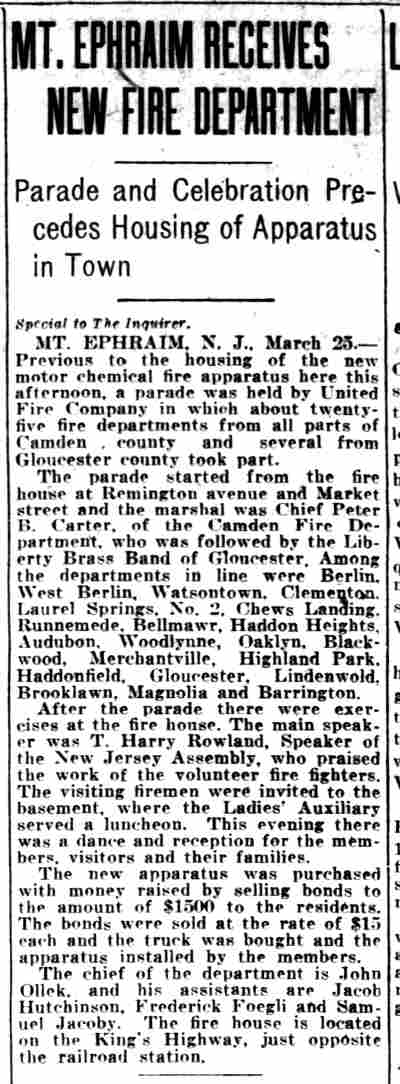
Named: John Ollek, Jacob Hutchinson, Frederick Foegli, Samuel Jacoby, and T. Harry Rowland.
Advance Committee — International Association of Fire Engineers
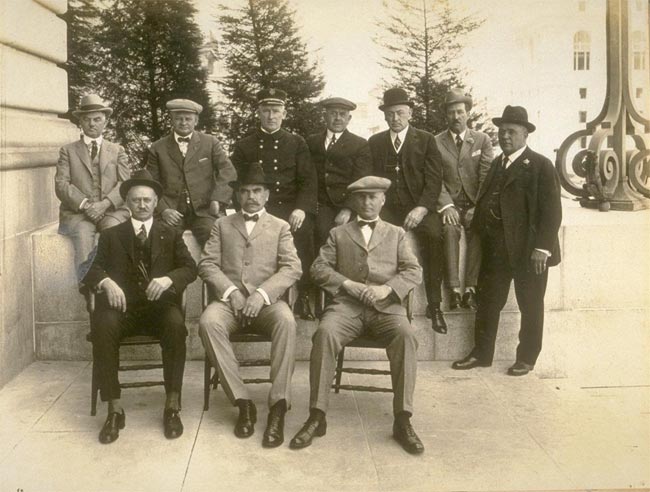
San Francisco, February 1922 — Advance Committee organizing the August 1922 meeting of the International Association of Fire Engineers. Top Row, L. to R.: Chief William Bywater, Salt Lake City; Chief Peter B. Carter, Camden N.J.; Chief Thomas R. Murphy, San Francisco; Chief August Gerstrung, Elizabeth, N.J.; Chief Edward T. Murphy, Buffalo, N.Y.; Chief Samuel Boyde, Knoxville, Tennessee; Chief Samuel H. Hunter, Springfield, Ohio. Front Row: Chief James Mulcahey, Secretary, Yonkers, N.Y.; Chief Frank G. Reynolds, President, Augusta, Georgia; Chief Chas. Ringer, Minneapolis, Minnesota.
Philadelphia Public Ledger — August 5, 1922
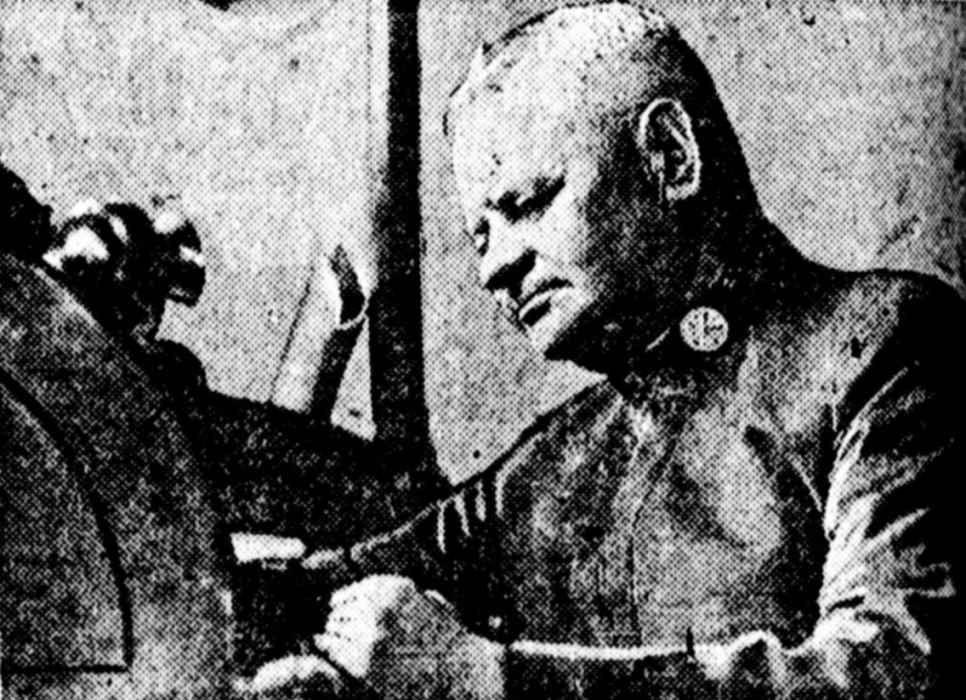
Philadelphia Public Ledger — August 5, 1922. International Association of Fire Engineers meeting, San Francisco.
San Francisco Chronicle — August 19, 1922
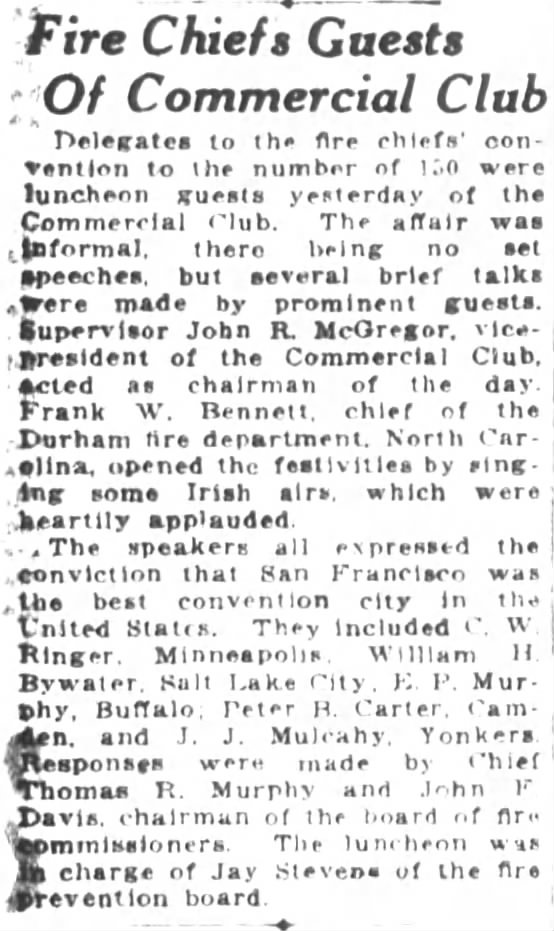
San Francisco Chronicle — August 19, 1922.
Camden Post-Telegram — September 9, 1922

3 FIREMEN HURT IN $75,000 FIRE AT LEATHER PLANT
Flames of Unknown Origin Wreck Upper Story of Keystone Factory
SMOKE BLOCKS BATTLE
Firm Loses Stock of Hides Valued at $50,000, One Fireman in Hospital
Three firemen were overcome with smoke when flames gutted the upper stories of the drying building of the Keystone Leather Company, Seventeenth and Carman streets, last night. The loss is estimated today at $75,000. The origin is unknown.
Captain J. J. Vickers, of the East Camden Company, was overcome by smoke, and revived by City Physician Lippincott. Fireman George Addison, of the same company, was dragged from the building by other firemen, and revived by the physician.
Nelson Andrews, fireman, of Engine Company No. 9, was in a serious condition when taken from the building. He was prostrated by smoke, and was rushed to Cooper Hospital, where he was reported as much improved today.
Smoke Blocks Traffic
Smoke was so dense that vehicular traffic on Federal street, two squares away, was blocked for nearly an hour.
The flames had gained a great deal of headway when discovered by a watchman. When the firemen arrived on the scene, they faced a hard task because of great volumes of smoke pouring from the building, in which was stored a large stock of hides.
It was one of the most stubborn fires the department has faced in years. The firemen were unable to locate the flames at first because of the smoke. Chief Carter sent in two more alarms after arriving on the scene.
After thirty minutes of battle the flames suddenly shot skyward, illuminating the heavens for miles. They leaped to the fourth floor, and through the roof. In a short time the roof collapsed, sending a great shower of sparks in all directions.
It was three hours before the first fire companies were able to leave the scene.
It was estimated today that the damage to the building will reach $25,000. The company lost about $50,000 in stock. A large stock of hides on the first two floors were ruined by tons of water.
The building is one of the first built by the company, and directly adjoins the main concrete plant at Seventeenth and Mickle streets.
Lieutenant W. Scott Franklin, of Engine Company, No. 1, fell from a one-story roof of an adjoining building while pulling up hose but fortunately escaped injury.
Philadelphia Inquirer — October 20, 1922
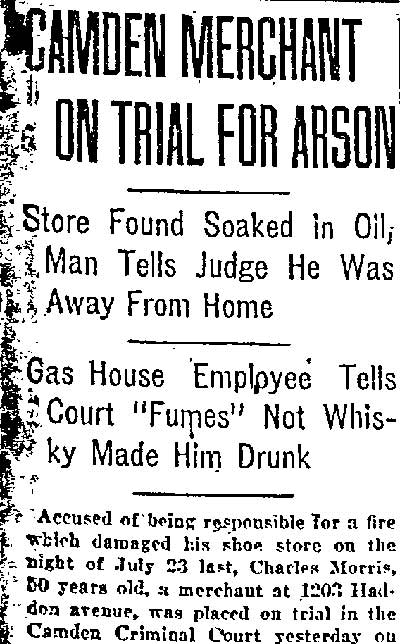
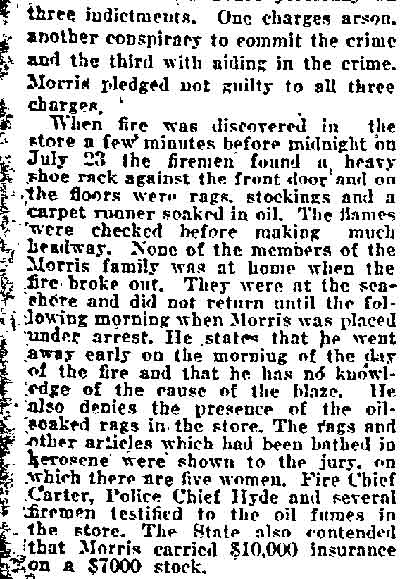
Store Found Soaked in Oil; Man Tells Judge He Was Away From Home
Gas House Emplpyee Tells Court “Fumes” Not Whisky Made Him Drunk
Accused of being responsible for a fire which damaged his shoe store on the night of July 23 last, Charles Morris, 50 years old, a merchant at 1203 Haddon avenue, was placed on trial in the Camden Criminal Court yesterday on three indictments. One charges arson, another conspiracy to commit the crime and the third with aiding in the crime. Morris pledged not guilty to all three charges.
When fire was discovered in the store a few minutes before midnight on July 23 the firemen found a heavy shoe rack against the front door and on the floors were rags, stockings and a carpet runner soaked in oil. The flames were checked before making much headway. None of the members of the Morris family was at home when the fire broke out. They were at the seashore and did not return until the following morning when Morris was placed under arrest. He states that he went away early on the morning of the day of the fire and that he has no knowledge of the cause of the blaze. He also denies the presence of the oil-soaked rags in the store. The rags and other articles which had been bathed in kerosene were shown to the jury, on which there are five women. Fire Chief Carter, Police Chief Hyde and several firemen testified to the oil fumes in the store. The State also contended that Morris carried $10,000 insurance on a $7000 stock.
Philadelphia Inquirer — October 21, 1922
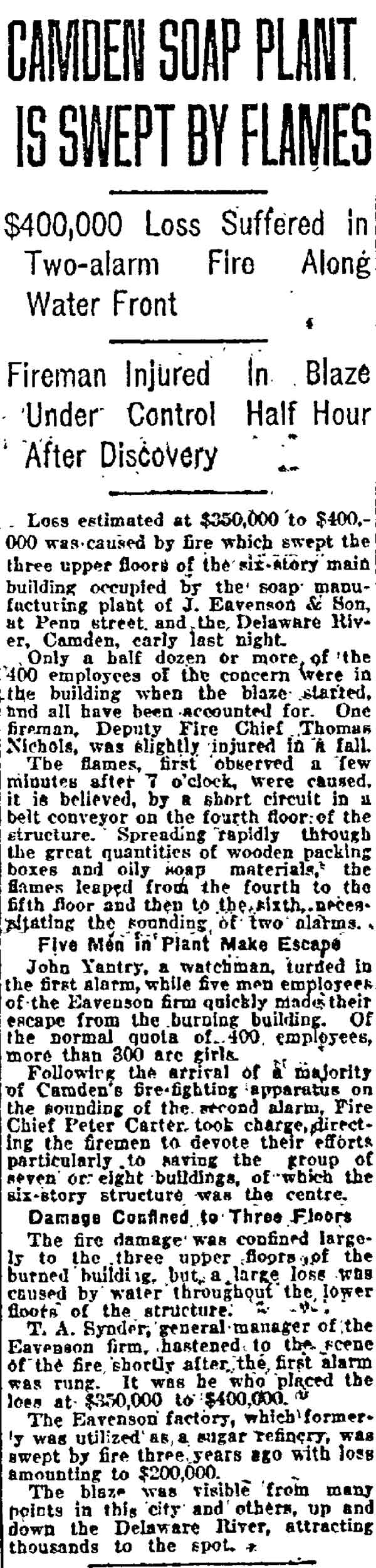
CAMDEN SOAP PLANT IS SWEPT BY FLAMES
$400,000 Loss Suffered in Two-alarm Fire Along Water Front
Fireman Injured In Blaze ’Under Control Half Hour After Discovery
Loss estimated at $350,000 to $400,000 was caused by fire which swept the three upper floors of the six-story main building occupied by the soap manufacturing plant of J. Eavenson & Son, Delaware avenue and the Delaware River, Camden, early last night.
Only a half dozen or more, of the 400 employees of the concern were in the building when the blaze started, and all have been accounted for. One fireman, Deputy Fire Chief Thomas Nichols, was slightly injured in a fall.
The flames, first observed a few minutes after 7 o’clock were caused, it is believed, by a short circuit in a belt conveyor on the fourth floor of the structure. Spreading rapidly through the great quantities of wooden packing boxes and oily soap materials, the flames leaped from the fourth to the fifth floor and then to the sixth, necessitating the sounding of two alarms.
Five Men in Plant Make Escape
John Yantry, a watchman, turned in the first alarm, while five men employees of the Eavenson firm quickly made their escape from the burning building. Of the normal quota of 400 employees, more than 300 are girls.
Following the arrival of a majority of Camden’s fire-fighting apparatus on the sounding of the second alarm, Fire Chief Peter Carter took charge, directing the firemen to devote their efforts particularly to saving the group of seven or eight buildings, of which the six-story structure was the centre.
Damage Confined to Three Floors
The fire damage was confined largely to the three upper floors of the burned building. But a large loss was caused by water throughout the lower floors of the structure.
T. A. Snyder, general manager of the Eavenson firm, hastened to the scene of the fire shortly after the first alarm was rung. It was he who placed the loss at $350,000 to $400,000.
The Eavenson factory, which formerly was utilized as a sugar refinery, was swept by fire three years ago with loss amounting to $200,000.
The blaze was visible from many points in this city and others, up and down the Delaware River, attracting thousands to the spot.
Fireman Dies in Explosion of Chemicals
Camden Courier —
Companion Hurt As Extinguisher Explodes at Second Street Fire
CAUSE OF BLAST MYSTERY TO FIREMEN
Injured Fireman Finds Self Lying on Comrade’s Dead Body
WAS FIREMAN EIGHT MONTHS
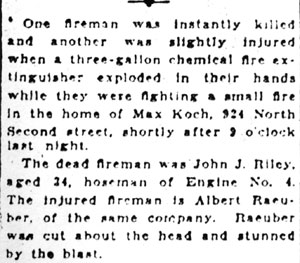
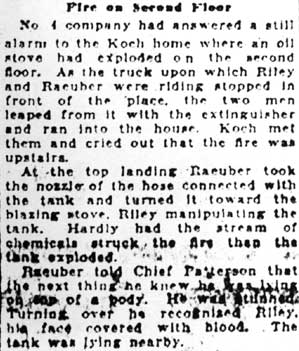
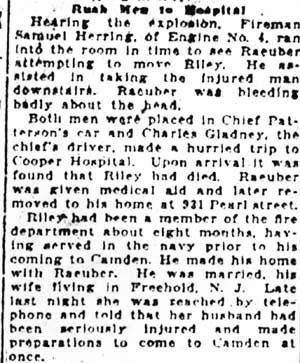
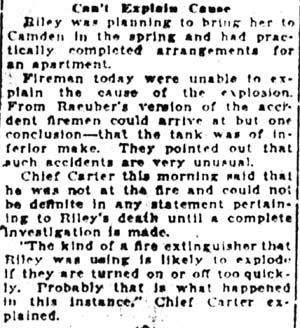
Named: John J. Reilly, Charles Gladney, Samuel Harring, William W. Patterson, Albert Raeuber, Max Koch, North 2nd Street, Pearl Street, and Engine Company 4.
Four Firemen Are Trapped in Collapse of Brick Wall
Camden Evening Courier —
FLAMES SWEEP WAREHOUSE IN SOUTH CAMDEN
Fire Fighters are Rescued From Beneath Heaps of Hot Bricks
BURNING TIRES SEND UP CLOUDS OF DENSE SMOKE
Bantivoglio Junk Yard Destroyed — Loss Runs Into Thousands
Four firemen were buried under a falling brick wall, two of them believed to have been seriously hurt, and thousands of dollars worth of property was destroyed in a spectacular fire at the two story brick warehouse of Bantivoglio & Son, junk dealers, 252 Division Street, at 9:00 o’clock this morning.
The injured firemen attached to Engine Company No. 7, all of whom were taken to West Jersey Homeopathic Hospital, were:
Captain Charles Watkin, 45 years old, 927 North Front Street. Four fractured ribs and a punctured lung. He may die.
Nicholas Romaine, 43 years old, hoseman, 1271 Chase Street, lacerations of scalp and possible fracture of right ankle.
Louis Quinton, 25 years old, hoseman, 626 Viola Street, probable fracture of right shoulder.
Lester Anderson, 24 years old, hoseman, 1917 Niagara Road; lacerations of scalp and forehead and fractured left wrist.
None of the four were able to walk when they were lifted from where they had been struck down by the falling bricks. They were carried to the police ambulance and hurried at once to the hospital.
Residents of the neighborhood said that a flash and a roar, as of an explosion, was their first warning of a blaze. The burned building has a frontage of 75 feet on Division Street. In a yard behind it there was a shed piled high with baled paper and three piles of used automobile tires. These caught fire and sent up black smoke that was visible for miles.
Smoke Hampers Firemen
A huge crowd of spectators already had gathered to watch the fire in this thickly populated section when the firemen arrived. The flames were threatening surrounding buildings, and the smoke was so dense that the men had difficulty finding their way out in the vicinity of the burning structure.
Captain Watkins and the three other fire fighters started along a driveway beside the building with a length of hose which they intended to use on the blazing sheds in the rear. They were passing a window when there was a muffled roar and a blast of dense smoke blinded and confused them. By shouts to one another they heard that their number was still intact. The blast of black smoke had been caused by the collapse of a loft and the falling of several bales of paper.
100,000 Tires Burn
More than 100,000 used automobile tires were destroyed in the blaze. The flames jumped a hundred feet into the air at one stage. Commissioner Hitchner watched the firemen at work from the roof of a nearby garage.
When the blaze had been extinguished Mr. Hitchner left to visit the injured firemen in the hospital. He commended the four men on their bravery and wished them a speedy recovery. Quinton is driver for Battalion Chief Wade.
The flames threatened to spread to the large garage of Louis Vananeri, on Spruce Street, directly in the rear of the junk yard. Firemen mounted the roof of this building and drove the flames back.
Today’s blaze was the fourth that had visited the warehouse this year. The fire today is believed to have been caused by spontaneous combustion.
Carter Directs Rescue
The quarter were stooping to take up their hose line again when there was a crack like the report of a pistol, followed by a terrific roar.
Fire Chief Carter, personally directing his men, was about 50 feet away, and saw the four men buried as the bricks thudded down from the crumbling wall.
“Come on boys, there are four men under here.” the chief yelled, and soon a score of hands were tearing frantically at the heaps of hot brick.
Bus Delays Ambulance
The police ambulance in which the injured men were placed was delayed for five minutes on its way to the hospital by the refusal of a Public Service bus driver to give it the right of way. According to Policeman Howard Fisher, the busman was arrested. The police say he will be prosecuted to the full extent of the ordinance in such cases. The ambulance was forced to remain behind the bus for a block and a half, according to the reports.
The pillar of smoke sent up by the blazing warehouse, sheds and 50-foot high piles of auto tires, drew thousands of spectators from all directions. Three alarms were turned in to the fire department in rapid succession. The police were called upon at once to establish lines for keeping back the crowd.
Bales of paper stored in the main building, as well as in the shed behind, absorbed tons of water poured into the place by the firemen’s hose, and the added weight snapped off fire-weakened floor beams like burning matches. The falling timbers and masses of packed paper added to the danger and difficulty of the firemen’s task.
Only by a long and stubborn fight were the firemen able to prevent a conflagration among surrounding buildings.
The big warehouse became a red hot furnace. The heat was so intense a half-hour after the fire was discovered that telephone and electric light poles on the other side of Division Street were ignited. “Trouble crews” from the telephone and electric companies were rushed to the place to guard their wires against falling and injuring persons below.
Loss Placed at $50,000
It was roughly estimated that the damage to the junk sheds and warehouse would reach $50,000.
Mrs. Leona Brown, who had just moved today into the house at 264 Division Street, just east of the burned plant, was driven from her new home by the dense clouds of smoke from a blazing of automobile tires that towered above the west wall of her two-story dwelling.
She was unable to return for any of her belongings when the flames began to eat their way through the west wall of her house.
The fire was the second within a month in the junk yard, which is closely surrounded by frame residences, a frame negro church and other buildings on all sides.
Romaine Seriously Hurt
Hoseman Romaine was reported by surgeons at the West Jersey Homeopathic Hospital as the most seriously hurt of the firemen caught by the falling wall. He was cut above the head, badly bruised about the back, and one of his ankles is believed to have been fractured.
Captain Watkins suffered several fractured ribs.
Hoseman Anderson was cut and burned about the face and his right wrist.
Hoseman Quinton suffered burns, cuts and bruises, and it is believed that one of his shoulders was fractured.
Trenton Evening Times — January 27, 1929
HAINESPORT FIREMEN RECEIVE NEW ENGINE
MT. HOLLY, Jan. 26.—Hainesport Fire Company, No. 1, housed a new three-tank chemical apparatus this afternoon after a street parade.
The apparatus was housed by America Fire Company, No. 4, of Mt. Holly. Members of the Burlington County Firemen’s Associations and all fire companies in the county were in the line of march.
The speakers at the housing event in the Hainesport Fire Hall included State Senator Clifford R. Powell, Mayor George N. Wimer, of Palmyra; Freeholder Charles R. Stout, of Florence; Battalion Fire Chief Rollo Jones, of Camden, and former Chief Peter B. Carter, of Camden.
The Ladies’ Auxiliary of the Hainesport Company served luncheon to the visiting firemen in the school.
Peter B. Carter & Family — 1930 Census
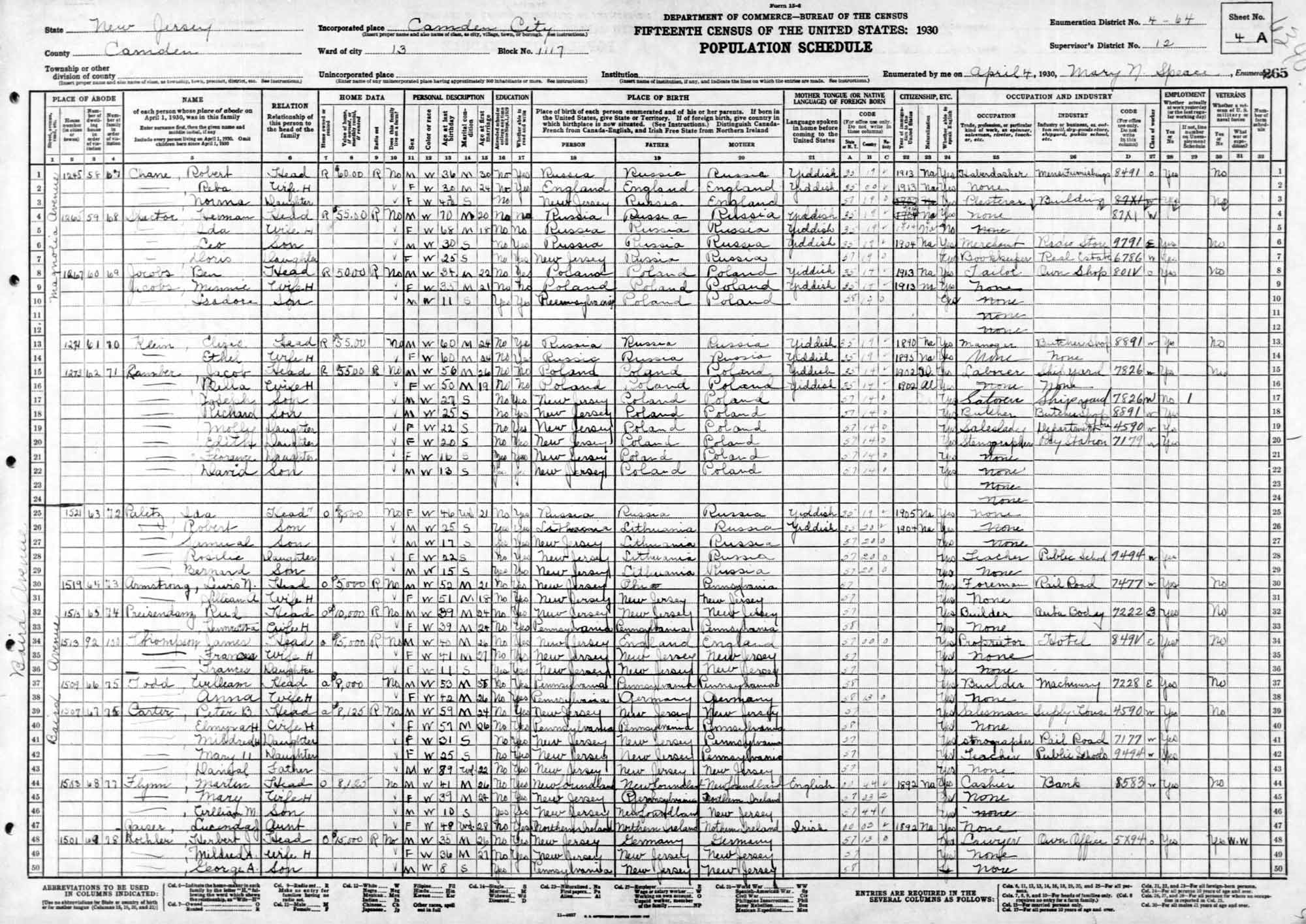
Peter B. Carter & Family — 1930 Census
Trenton Times — November 10, 1931
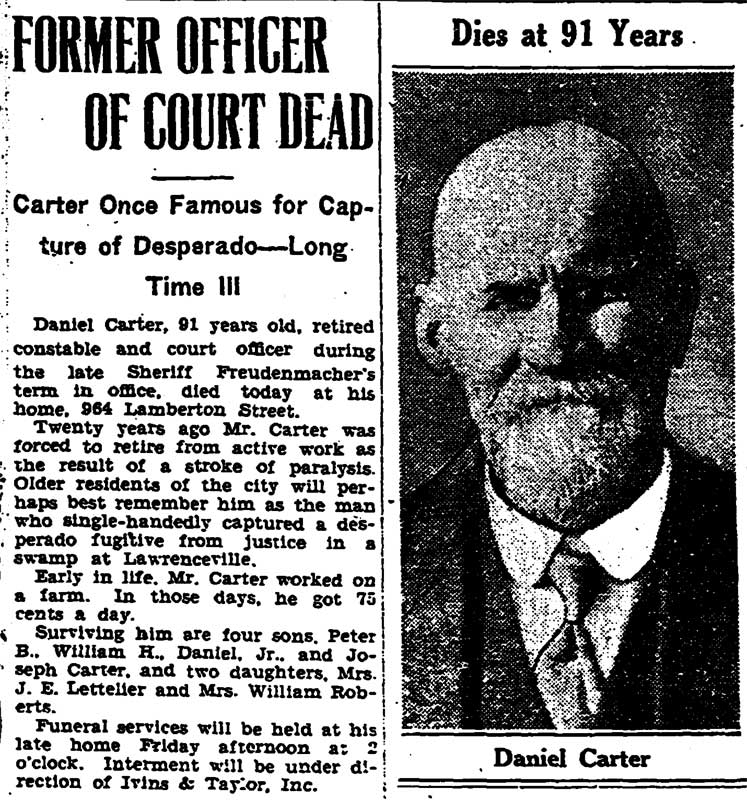
FORMER OFFICER OF COURT DEAD
Carter Once Famous for Capture of Desperado—Long Time Ill
Daniel Carter, 91 years old, retired constable and court officer during the late Sheriff Freudenmacher’s term in office, died today at his home, 964 Lamberton Street. Twenty years ago Mr. Carter was forced to retire from active work as the result of a stroke of paralysis. Older residents of the city will perhaps best remember him as the man who single-handedly captured a desperado fugitive from justice in a swamp at Lawrenceville. Early in life, Mr. Carter worked on a farm. In those days, he got 75 cents a day.
Surviving him are four sons, Peter B., William H., Daniel, Jr., and Joseph Carter, and two daughters, Mrs. J. E. Lettelier and Mrs. William Roberts.
Funeral services will be held at his late home Friday afternoon at 2 o’clock. Interment will be under direction of Ivins & Taylor, Inc.