Introduction
Frederick A. Finkeldey was born on September 8, 1860 in Philadelphia to Johann Friedrich (John F.) Finkeldey and Louisa F. Birkenhauer. His father had emigrated from Germany in 1839 and was a lithographer and printer in Philadelphia. After his father’s death in 1883, Fred and his brother Werner continued the family business at 218 Walnut Street, Philadelphia until 1896, and Fred had artistic talent.
Frederick Finkeldey had planned to become a Lutheran minister, but developed tuberculosis and became interested in gymnastics and calisthenics. He attended a gymnastics program in Milwaukee, and in 1905 received a degree from Temple University in Philadelphia. In the 1890s, he became a physical education teacher in the Camden, New Jersey school system. In 1903 he left the Camden schools to become Director of Physical Education at Girard College, in Philadelphia, and worked there until 1918. He then returned to employment in Camden as Director of Physical Education. He established the playground system in Camden, and was founding member and trustee of the East End Trust bank on Federal Street. A staunch Republican, he was a member of the Camden City Council for many years, and served as Council president in 1914. In 1907 was an unsuccessful primary campaign for Mayor against Charles H. Ellis, but quickly mended fences with the Mayor, and went on to be a significant figure in city politics.
Frederick Finkeldey brought his family to Camden in the 1890s when he was placed in charge of Turner Hall, which stood in the 500 block of Pine Street. Frederick Finkeldey was a member of the Turn Verein, also known as Turners, a German-American social organization that placed a great emphasis on athleticism and physical fitness.
City Directories from 1894 through 1899 indicate that they lived at 554 Spruce Street from 1894 through 1899, and they were still at that address when the Census was taken in June of 1900. Directories from 1901 through 1905 show that the family had moved to 232 North 32nd Street in East Camden. The Finkeldeys remained at that address until moving into a newly built home at 220 North 32nd Street in 1906. This would be Frederick Finkeldey’s home until his death in 1921.
At the time of his death he was described as “Dynamic, Energetic. Advocated and fought for better civil government. Was popularly known as ‘The Man Who Can’t Be Bossed.’ For the last ten years of his life devoted himself with a zeal that was almost a passion to the recreation and playground movement for young children.”
Frederick married Fredericka Meine (1863–1935) on August 27, 1888 at St. Peter’s Episcopal Church in Philadelphia. They had two sons, Frederick Adam (1889–1944) and William Henry (1892–1974).
Besides his involvement with the Turn Verein, Frederick Finkeldey was also a member of the Trimble Lodge No. 117, Free and Accepted Masons; Camden Lodge 293 of the Elks; and the Patriotic Order of Sons of America. Frederick Finkeldey died on October 24, 1921 and was buried at Arlington Cemetery in Pennsauken, New Jersey. On the day of his funeral all the Camden schools were closed and all flags were lowered to half mast. Mrs. Finkeldey remained on North 32nd Street as late as 1929. By 1931 she had moved out of Camden, and joined her husband in 1935.
Son William Finkeldey married Miriam Nulty, daughter of John Nulty, a step-brother of builder Joseph E. Roberts Sr., who was father to noted physician Dr. Joseph E. Roberts Jr.
South Jersey: A History
Alfred M. Heston, Editor-in-Chief — 1864–1924
Few public men of Southern New Jersey have been so greatly loved and admired by constituents and few have left behind them so brilliant a record of achievement in behalf of their public as Frederick Adolph Finkeldey. While his activities as a member of the Camden City Council and of the City Planning Commission and as president of the Board of Recreation Commissioners have made him well known to the people of his city, he is nationally known as an authority on the physical education of school children, and as a champion of the playground movement in America. His work in Camden as director of physical training in the Camden Public Schools and in the police and fire departments and in Philadelphia as director of physical training at Girard College and as an instructor in physical education at the University of Pennsylvania, and at Temple University, has gained for him an enviable reputation in this his chosen profession.
Frederick Adolph Finkeldey was born in Philadelphia, in the old Finkeldey home at Juniper and Pine streets, on September 8, 1861. His father, John Frederick Finkeldey, was born in Frankenberg, Hessen, Germany, on September 8, 1821. He came to America in 1838, His first home in this country was in Baltimore, Maryland. Later he moved to Philadelphia, where on January 1, 1858, he married Louisa Fredricka Birckenhauer. The children were: Frederick Adolph, Louisa, Anna, and Werner.
Adolph Finkeldey was a graduate of Temple University, graduating in 1905 in Physical Education. His pedagogical course of training was obtained in the Milwaukee (Wisconsin) Normal School.
Preparation for his life-work began with his studies with the North American Gymnastic Union, from which he graduated in 1890. From 1889 to 1891, while still a student, he taught physical training at the Rugby Academy, in Philadelphia, and from 1891 to 1894 he was physical instructor at the Philadelphia Young Men’s Christian Association. The following six years were spent in directing the physical culture activities of the Camden Turn Verein. In 1900 he was made physical director of the Camden Public Schools.
His fine, erect presence upon entering the schoolroom, his unfailing courtesy and the atmosphere of friendly humor he created endeared him to teachers and pupils alike. His efficient outlines of work for the schools were intelligently planned to meet the needs of the growing child, and the splendid results obtained therefrom in the physical well-being of hundreds of children form a lasting monument to the memory of this truly great teacher.
In 1904 he accepted the position of director of physical training at Girard College, at which post he served until 1915 when, to the deep satisfaction of hosts of friends, he returned to the Camden Public Schools, where he continued to work until a few days before his untimely death on October 24, 1921.
Mr. Finkeldey’s public career began in 1905, when he was elected a member of the Camden City Council from the Eleventh Ward in which he lived most of his life. He served on the city council until 1915. From 1913 to 1921 he was president of the Board of Recreation Commissioners of the city of Camden, and for years served on the City Planning Commission.
Mr. Finkeldey became famous for his work in the Camden City Council. A witty, terse speaker of convincing eloquence, his humor colored many a political argument. A vigorous agitator in behalf of the citizens of Camden and an opponent of cliques, political machines and grafters, Mr. Finkeldey waged a lifelong battle against unscrupulous, self-interested political groups.
It was through his efforts that the railroad was forced to erect a modern stone and steel bridge at Pavonia; he fought for and won a playground for children in Reservoir Park, Camden; he secured the passage of an ordinance providing electric arc lights for the Eleventh Ward. He was instrumental in acquiring a large area to be set aside as an athletic field for the use of the school children of Camden. He was also the prime figure in the fight to get two-cent ferry rates across the river from Camden to Philadelphia, and the leader in the movement that brought about the erection of the public markets. It was partly due to his efforts that street lighting and paving costs were reduced. He also secured the passage of the ordinance permitting in Camden, the sale of ice, milk, drugs, and other necessities on Sunday.
For these many services to the public, and his activities against sinister political cliques, Mr. Finkeldey came to be much loved and respected. He was the sort of man who not only through his immutable integrity and public interest, refused to accept graft from schemers, but went further and disclosed the operations and the machinations of the grafters. Thus he died, a man of little material wealth, though opulent in public affection and esteem.
Mr. Finkeldey was a director in the East End Trust Company, and in the Westfield Building and Loan Association. He was a member of the Young Men’s Christian Association; of Trimble Lodge No. 117, of the Free and Accepted Masons, of Camden; the Camden Lodge, No. 293 of the Benevolent and Protective Order of Elks; the Patriotic Order of the Sons of America, the American Playground Association, the New Jersey State Physical Education Association, of which he was a member from March 4, 1898, to the date of his death; the American Association for the Advancement of Physical Education, and the Camden Teachers’ Club. He was a devout believer in the Bible, at one time in his early youth having begun studies preliminary to those leading to the ministry.
Mr. Finkeldey married Fredericka Meine, daughter of William G. and Eliese (Casche) Meine, in St. Peter’s Protestant Episcopal Church, on Third and Pine Streets, Philadelphia, on August 27, 1888. There are two sons: Frederick Adam, born December 6, 1889; and William Henry, born May 26, 1892. Both are married and each has three children.
Photos
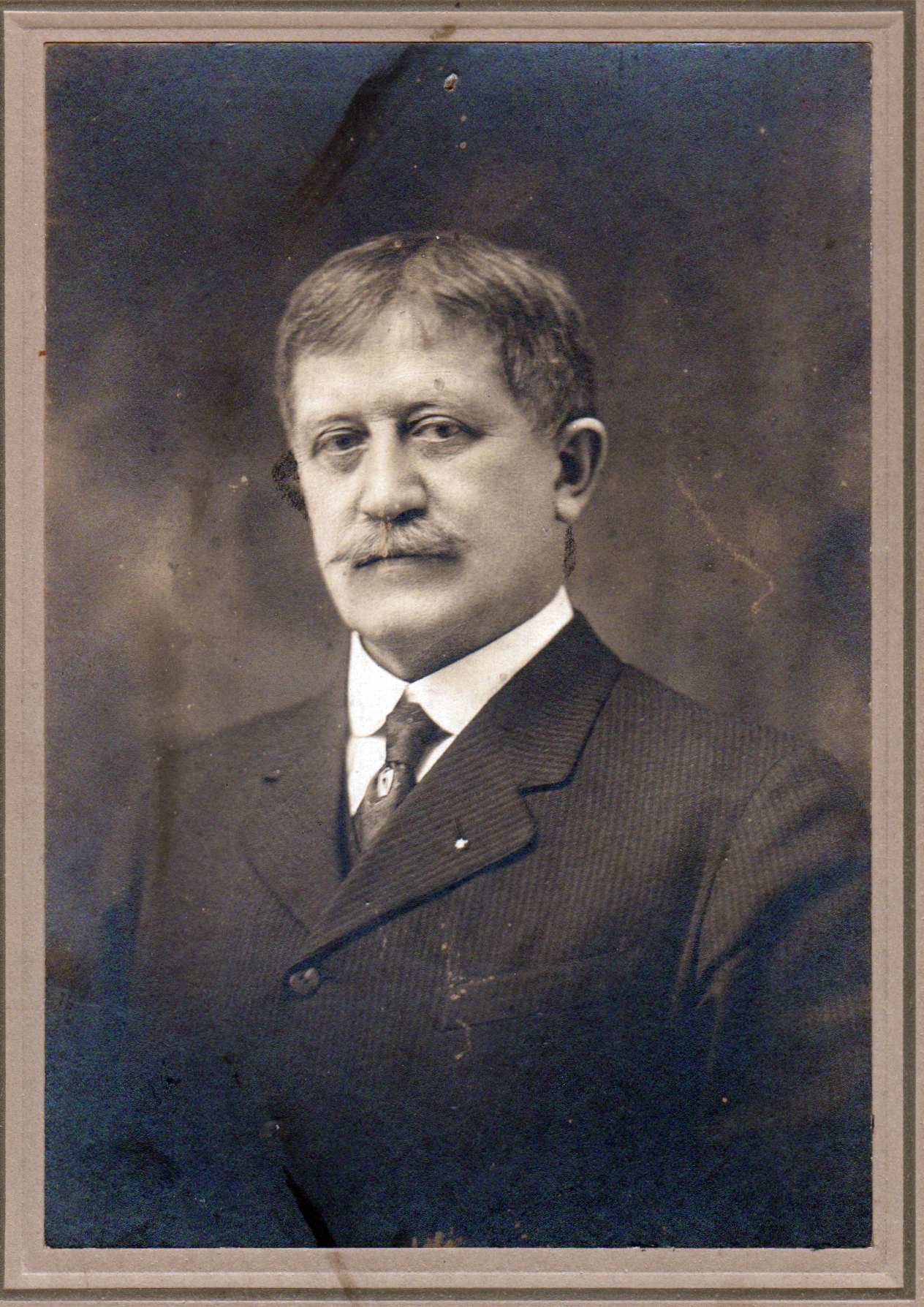
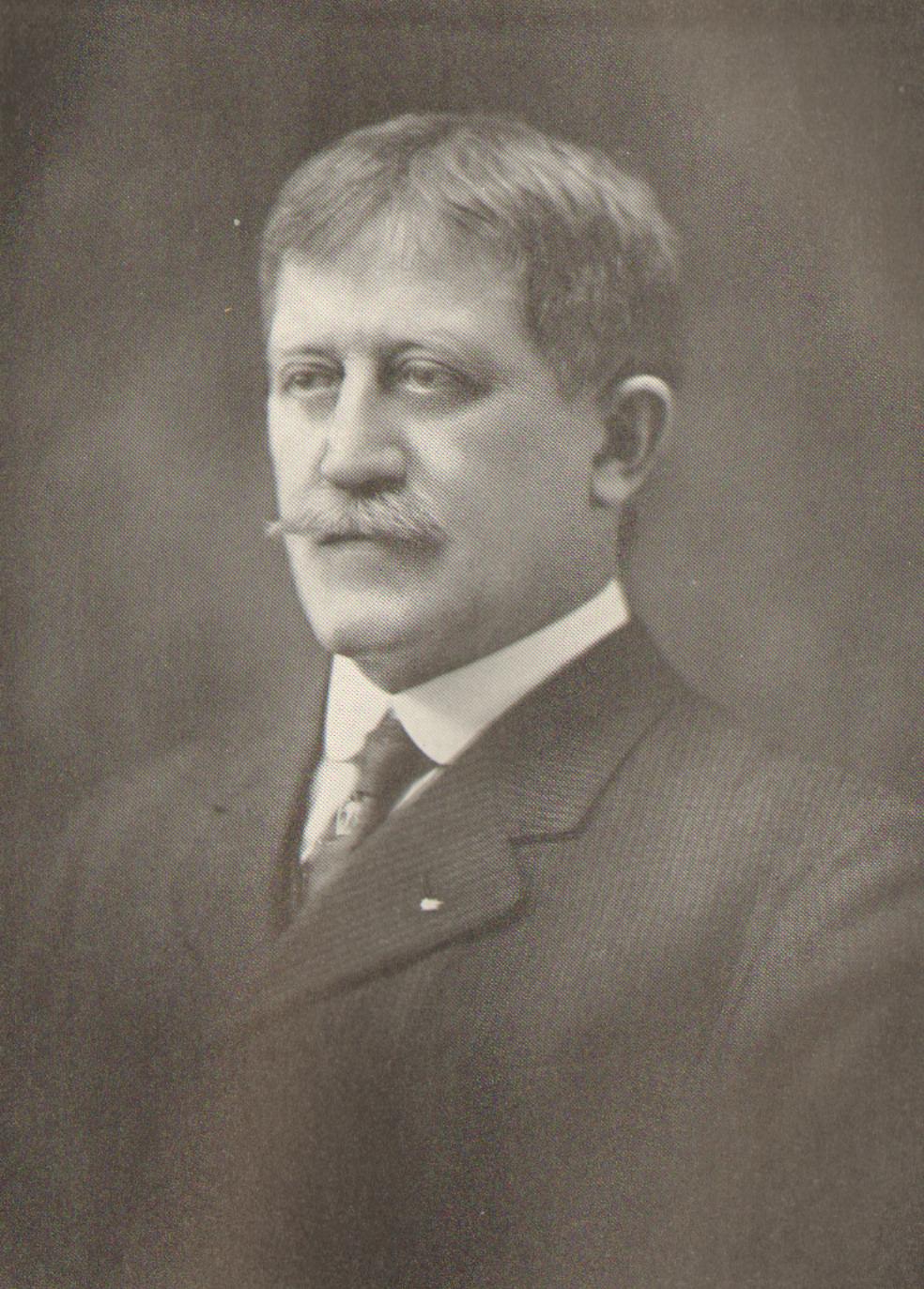
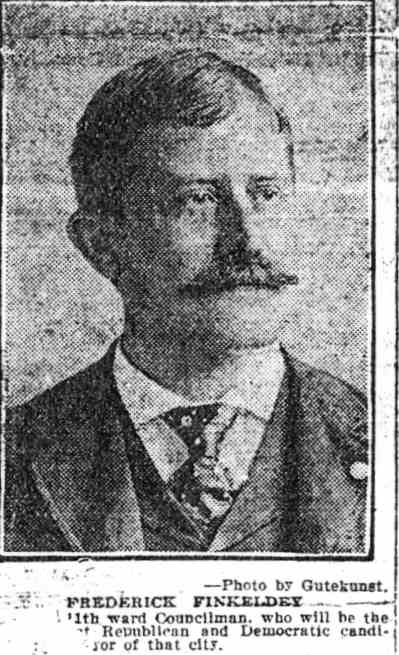
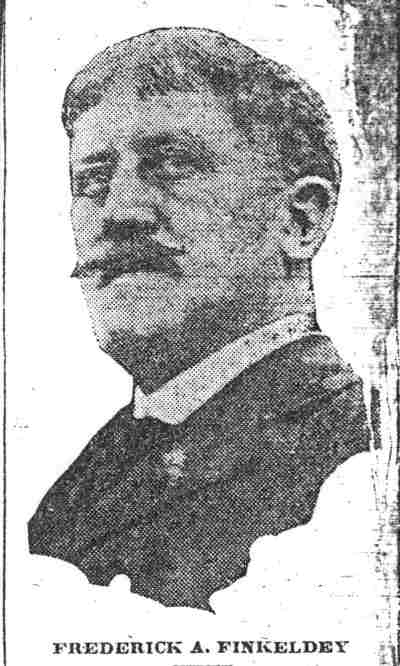
Frederick A. Finkeldey
Camden Mayor Advises Saving in City Budget
Philadelphia Inquirer —
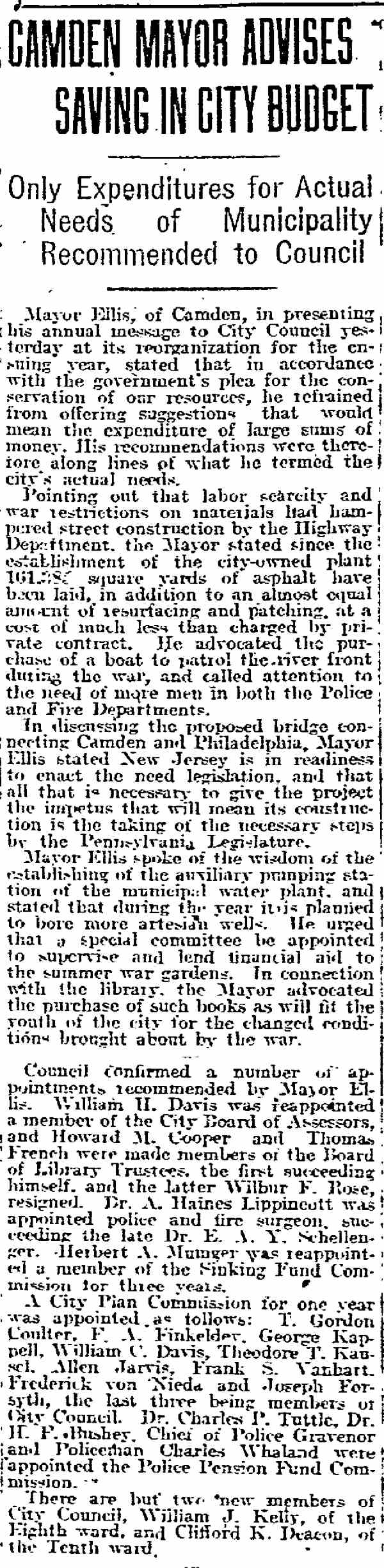
Only Expenditures for Actual Needs of Municipality Recommended to Council
Mayor Ellis, of Camden, in presenting his annual message to City Council yesterday at its reorganization for the ensuing year, stated that in accordance with the government’s plea for the conservation of our resources, he refrained from offering suggestions that would mean the expenditure of large sums of money. His recommendations were therefore along lines of what he termed the city’s actual needs.
Pointing out that labor scarcity and war restrictions on materials had hampered street construction by the Highway Department, the Mayor stated since the establishment of the city-owned plant 161,[?] square yards of asphalt have been laid, in addition to an almost equal amount of resurfacing and patching, at a cost of much less than charged by private contract. He advocated the purchase of a boat to patrol the river front during the war, and called attention to the need of more men in both the Police and Fire Departments.
In discussing the proposed bridge connecting Camden and Philadelphia, Mayor Ellis stated New Jersey is in readiness to enact the need [sic] legislation, and that all that is necessary to give the project the impetus that will mean its construction is the taking of the necessary steps by the Pennsylvania Legislature.
Mayor Ellis spoke of the wisdom of the establishing of the auxiliary pumping station of the municipal water plant, and stated that during the year it is planned to bore more artesian wells. He urged that a special committee be appointed to supervise and lend financial aid to the summer war gardens. In connection with the library, the Mayor advocated the purchase of such books as will fit the youth of the city for the changed conditions brought about by the war.
Council confirmed a number of appointments recommended by Mayor Ellis. William H. Davis was reappointed a member of the City Board of Assessors, and Howard M. Cooper and Thomas French were made members of the Board of Library Trustees, the first succeeding himself, and the latter Wilbur F. Rose, resigned. Dr. A. Haines Lippincott was appointed police and fire surgeon, succeeding the late Dr. E. A. Y. Schellenger. Herbert A. Munger was reappointed a member of the Sinking Fund Commission for three years.
A City Plan Commission for one year was appointed as follows: T. Gordon Coulter, F. A. Finkeldey, George Kappell, William C. Davis, Theodore T. Kausel, Allen Jarvis, Frank S. Vanhart, Frederick von Nieda and Joseph Forsyth, the last three being members of City Council. Dr. Charles P. Tuttle, Dr. H. F. Bushey, Chief of Police Gravenor and Policeman Charles Whaland were appointed the Police Pension Fund Commission.
There are but two new members of City Council, William J. Kelly, of the Eighth ward, and Clifford K. Deacon, of the Tenth ward.
554 Spruce Street
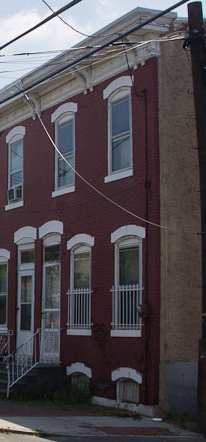
554 Spruce Street – May 29, 2012 – Frederick A. Finkeldey and family lived here from 1894 through 1900
Camden Turn-Verein Gymnastic Exhibition
Philadelphia Inquirer —
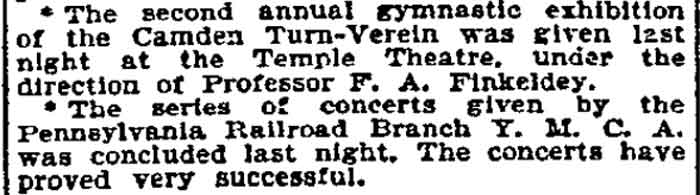
The second annual gymnastic exhibition of the Camden Turn-Verein was given last night at the Temple Theatre, under the direction of Professor F. A. Finkeldey.
The series of concerts given by the Pennsylvania Railroad Branch Y. M. C. A. was concluded last night. The concerts have proved very successful.
Frederick Finkeldey
1896
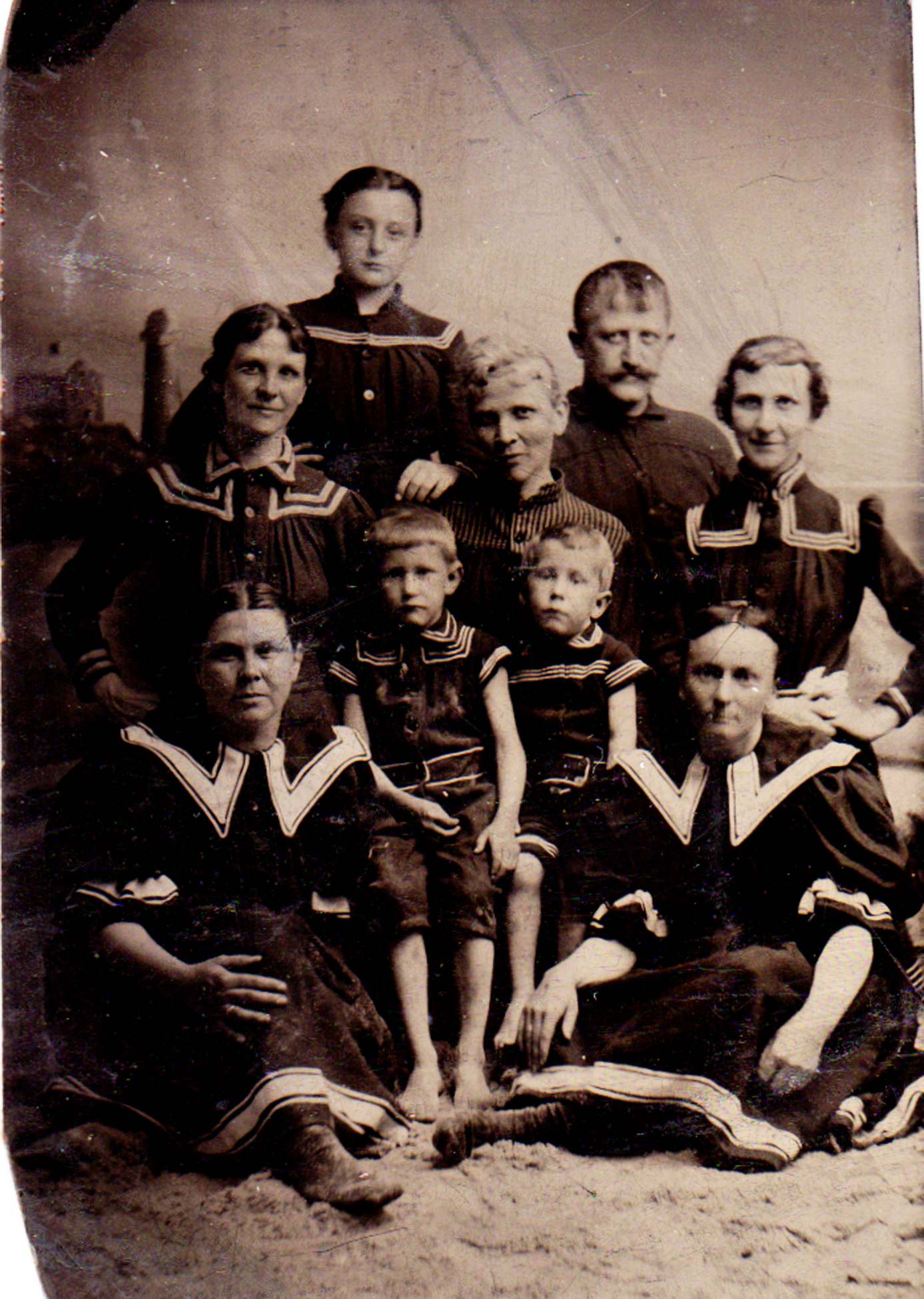
1896 photo of Frederick Finkeldey (back row) and Fredericka (front left), their two young sons William and Fred Jr. and five unidentified persons
Finkeldey Seeks to Relax Sunday Laws
Philadelphia Inquirer —
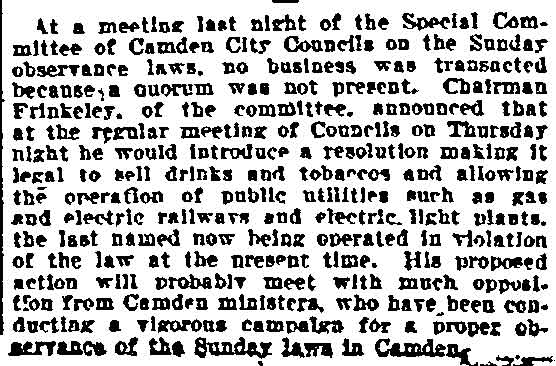
At a meeting last night of the Special Committee of Camden City Councils on the Sunday observance laws, no business was transacted because a quorum was not present. Chairman Frinkeley [sic], of the committee, announced that at the regular meeting of Councils on Thursday night he would introduce a resolution making it legal to sell drinks and tobaccos and allowing the operation of public utilities such as gas and electric railways and electric light plants, the last named now being operated in violation of the law at the present time. His proposed action will probably meet with much opposition from Camden ministers, who have been conducting a vigorous campaign for a proper observance of the Sunday laws in Camden.
220 North 32nd Street
Camden, New Jersey
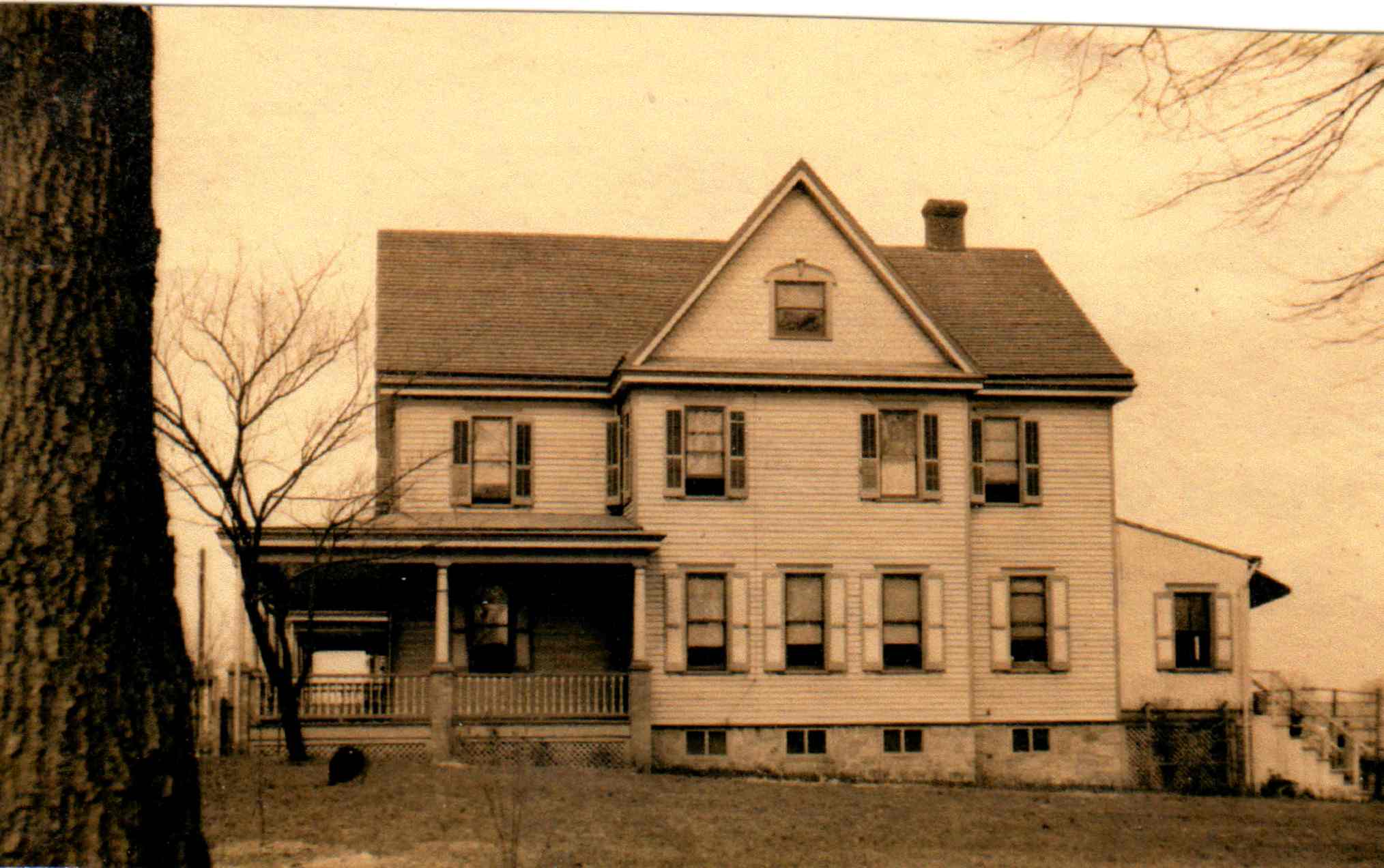
220 North 32nd Street, Camden, New Jersey – home of Frederick A. Finkeldey from 1906 until his death in 1921
Finkeldey Refuses Asphalt Until Trust Lowers Rates
Philadelphia Inquirer —

•• Councilman Finkeldey declares not a square yard of asphalt will be laid until the trust lowers its present rates.
1906–1907
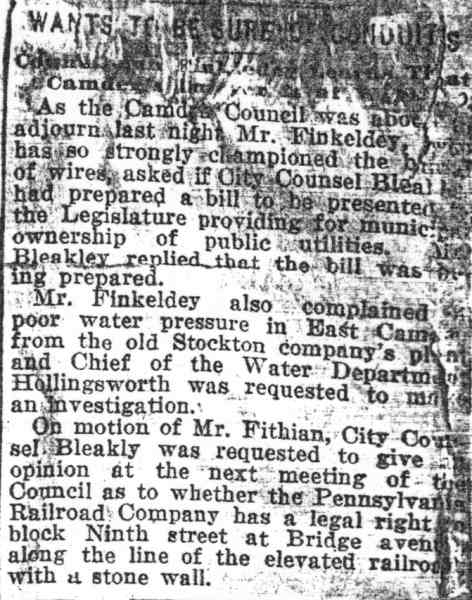
Named: Frederick A. Finkeldey, Frank S. Fithian, E.G.C. Bleakly, and Robert Hollingsworth.
Sensation Sprung in Camden’s Council
Philadelphia Inquirer —
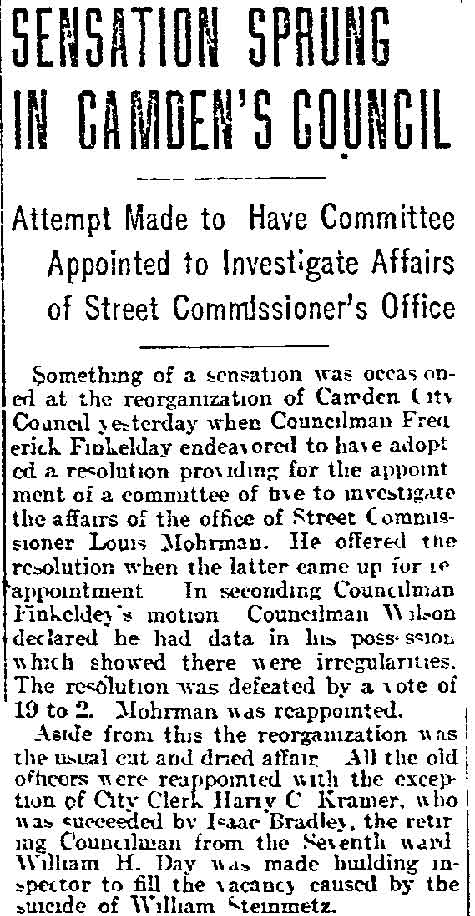
Attempt Made to Have Committee Appointed to Investigate Affairs of Street Commissioner’s Office
Something of a sensation was occasioned at the reorganization of Camden City Council yesterday when Councilman Frederick Finkeldey endeavored to have adopted a resolution providing for the appointment of a committee of five to investigate the affairs of the office of Street Commissioner Louis Mohrman. He offered the resolution when the latter came up for reappointment. In seconding Councilman Finkeldey’s motion Councilman Wilson declared he had data in his possession which showed there were irregularities. The resolution was defeated by a vote of 19 to 2. Mohrman was reappointed.
Aside from this the reorganization was the usual cut and dried affair. All the old officers were reappointed with the exception of City Clerk Harry C. Kramer, who was succeeded by Isaac Bradley, the retiring Councilman from the Seventh ward. William H. Day was made building inspector to fill the vacancy caused by the suicide of William Steinmetz.
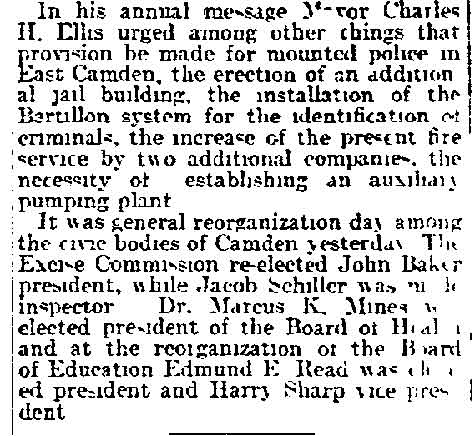
In his annual message Mayor Charles H. Ellis urged among other things that provision be made for mounted police in East Camden, the erection of an additional jail building, the installation of the Bertillon system for the identification of criminals, the increase of the present fire service by two additional companies, the necessity of establishing an auxiliary pumping plant.
It was general reorganization day among the civic bodies of Camden yesterday. The Excise Commission re-elected John Baker president, while Jacob Schiller was made inspector. Dr. Marcus K. Mines was elected president of the Board of Health, and at the reorganization of the Board of Education Edmund E. Read was elected president and Harry Sharp vice president.
Finkeldey the Ideal Mayor for Camden
Philadelphia Telegraph —
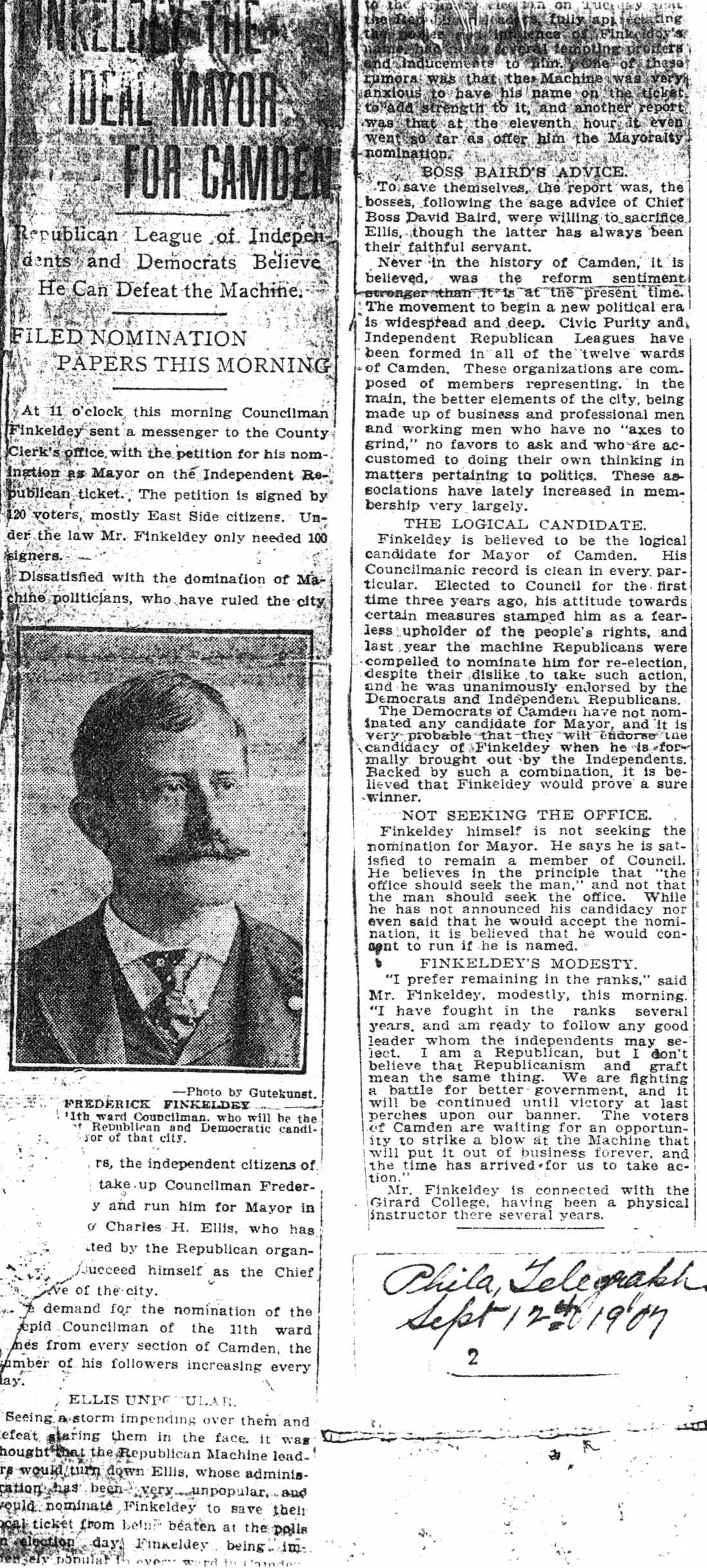
Named: Frederick A. Finkeldey, Charles H. Ellis, and David Baird.
January 1908
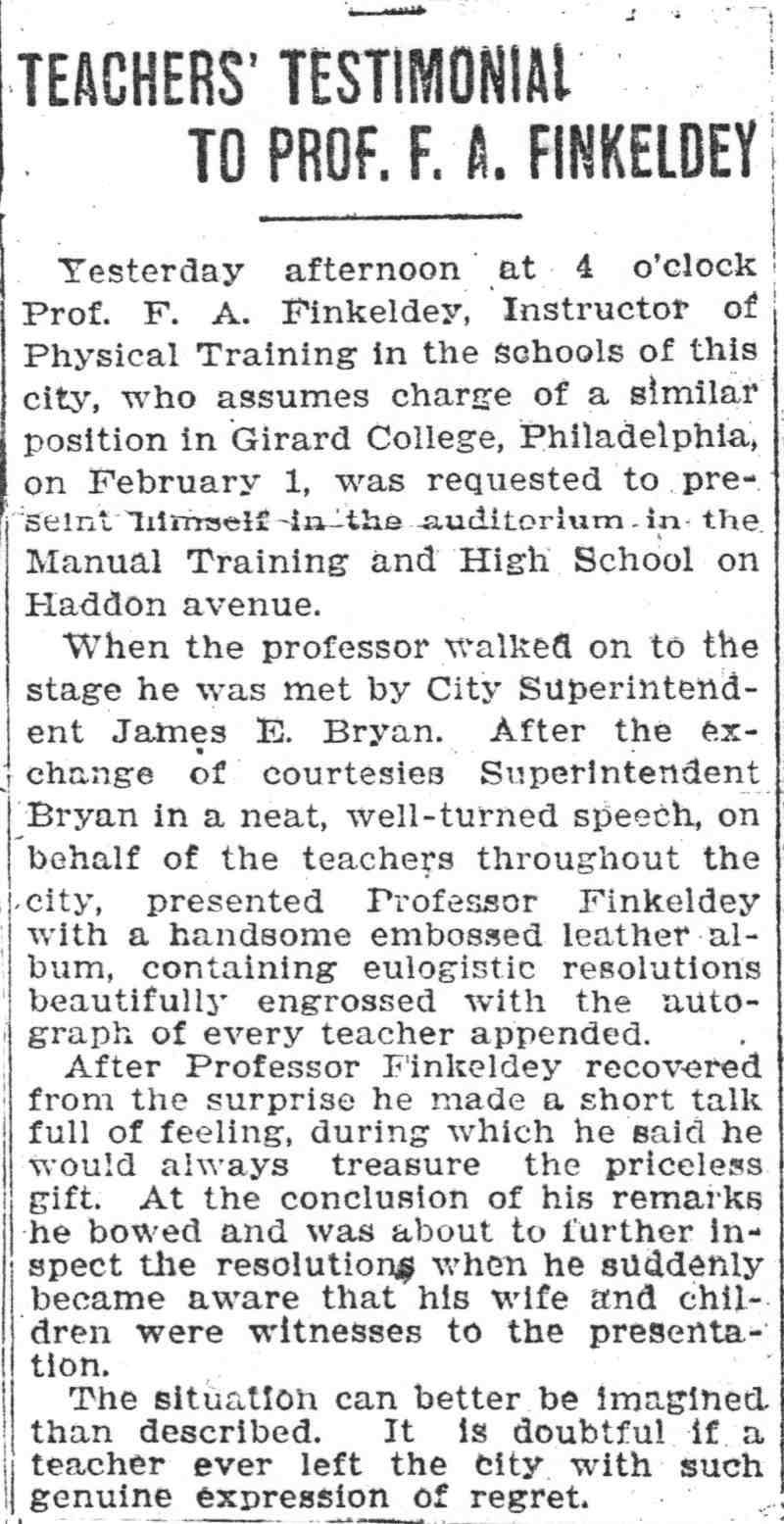
Named: Dr. James E. Bryan, Frederick A. Finkeldey, and Camden Manual Training and High School.
Camden’s Mayor Has Field to Himself
Philadelphia Inquirer —
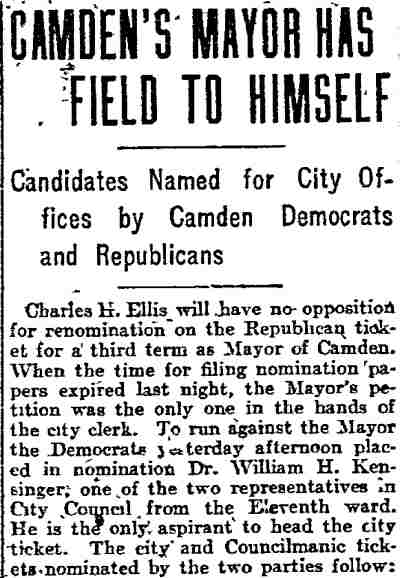
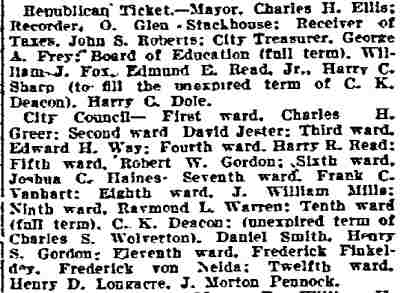
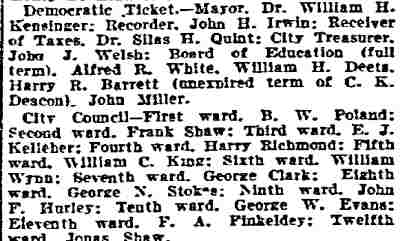
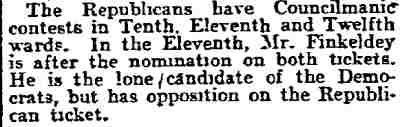
Candidates Named for City Offices by Camden Democrats and Republicans
Charles H. Ellis will have no opposition for renomination on the Republican ticket for a third term as Mayor of Camden. When the time for filing nomination papers expired last night, the Mayor’s petition was the only one in the hands of the city clerk. To run against the Mayor the Democrats yesterday afternoon placed in nomination Dr. William H. Kensinger; one of the two representatives in City Council from the Eleventh ward. He is the only aspirant to head the city ticket. The city and Councilmanic tickets nominated by the two parties follow:
Republican Ticket.—Mayor, Charles H. Ellis; Recorder, O. Glen Stackhouse; Receiver of Taxes, John S. Roberts; City Treasurer, George A. Frey; Board of Education (full term), William J. Fox, Edmund E. Read, Jr., Harry C. Sharp (to fill the unexpired term of C. K. Deacon), Harry C. Dole.
City Council—First ward, Charles H. Greer; Second ward David Jester; Third ward, Edward H. Way; Fourth ward, Harry R. Read; Fifth ward, Robert W. Gordon; Sixth ward, Joshua C. Haines; Seventh ward, Frank C. Vanhart; Eighth ward, J. William Mills; Ninth ward, Raymond L. Warren; Tenth ward (full term), C. K. Deacon; (unexpired term of Charles S. Wolverton), Daniel Smith, Henry S. Gordon; Eleventh ward, Frederick Finkeldey; Frederick von Neida; Twelfth ward, Henry D. Longacre, J. Morton Pennock.
Democratic Ticket.—Mayor, Dr. William H. Kensinger; Recorder, John H. Irwin; Receiver of Taxes, Dr. Silas H. Quint; City Treasurer, John J. Welsh; Board of Education (full term), Alfred R. White, William H. Deets, Harry R. Barrett (unexpired term of C. K. Deacon), John Miller.
City Council—First ward, B. W. Poland; Second ward, Frank Shaw; Third ward, E. J. Kelleher; Fourth ward, Harry Richmond; Fifth ward, William C. King; Sixth ward, William Wynn; Seventh ward, George Clark; Eighth ward, George N. Stokes; Ninth ward, John F. Hurley; Tenth ward, George W. Evans; Eleventh ward, F. A. Finkeldey; Twelfth ward, Jonas Shaw.
The Republicans have Councilmanic contests in Tenth, Eleventh and Twelfth wards. In the Eleventh, Mr. Finkeldey is after the nomination on both tickets. He is the lone candidate of the Democrats, but has opposition on the Republican ticket.
To the Citizens
August–
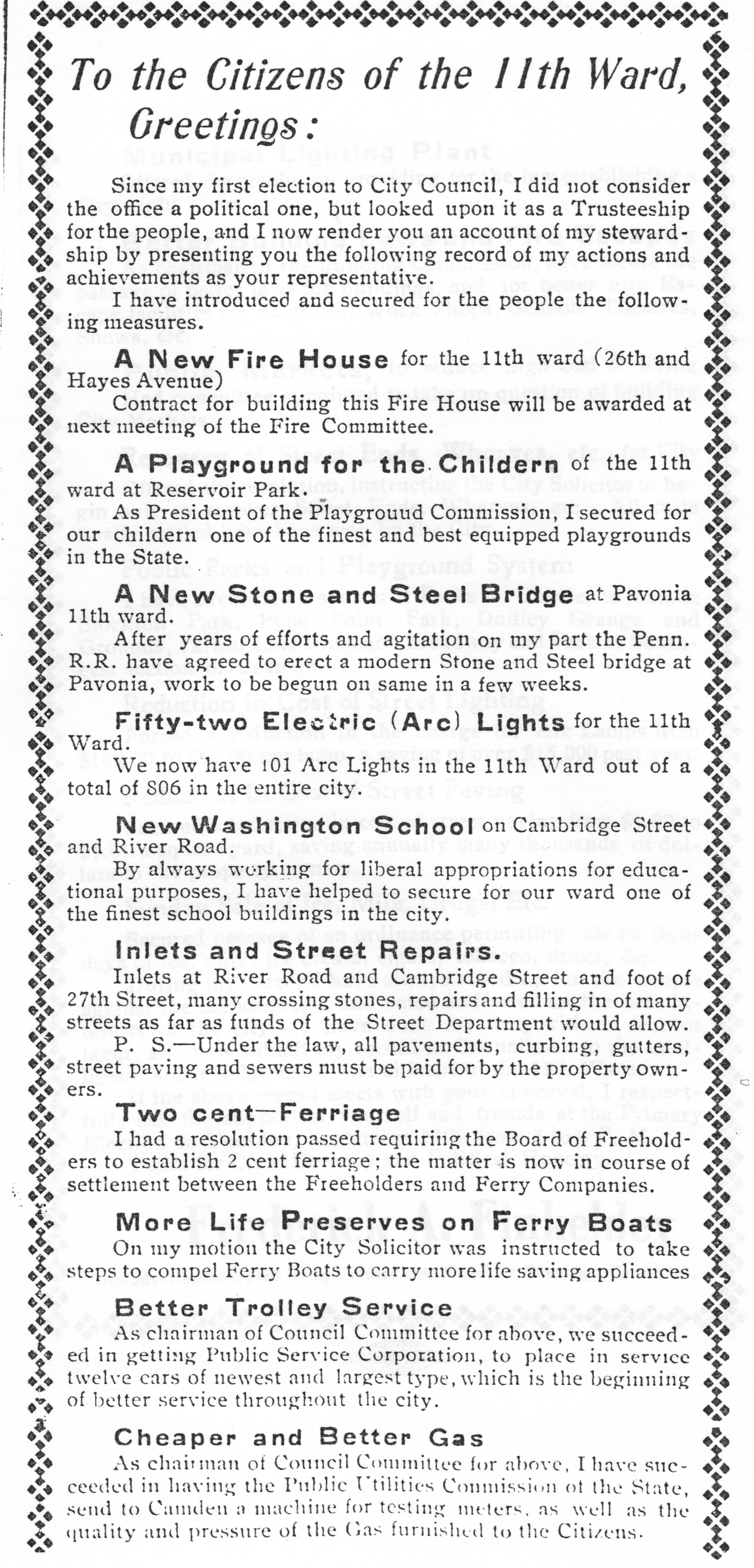
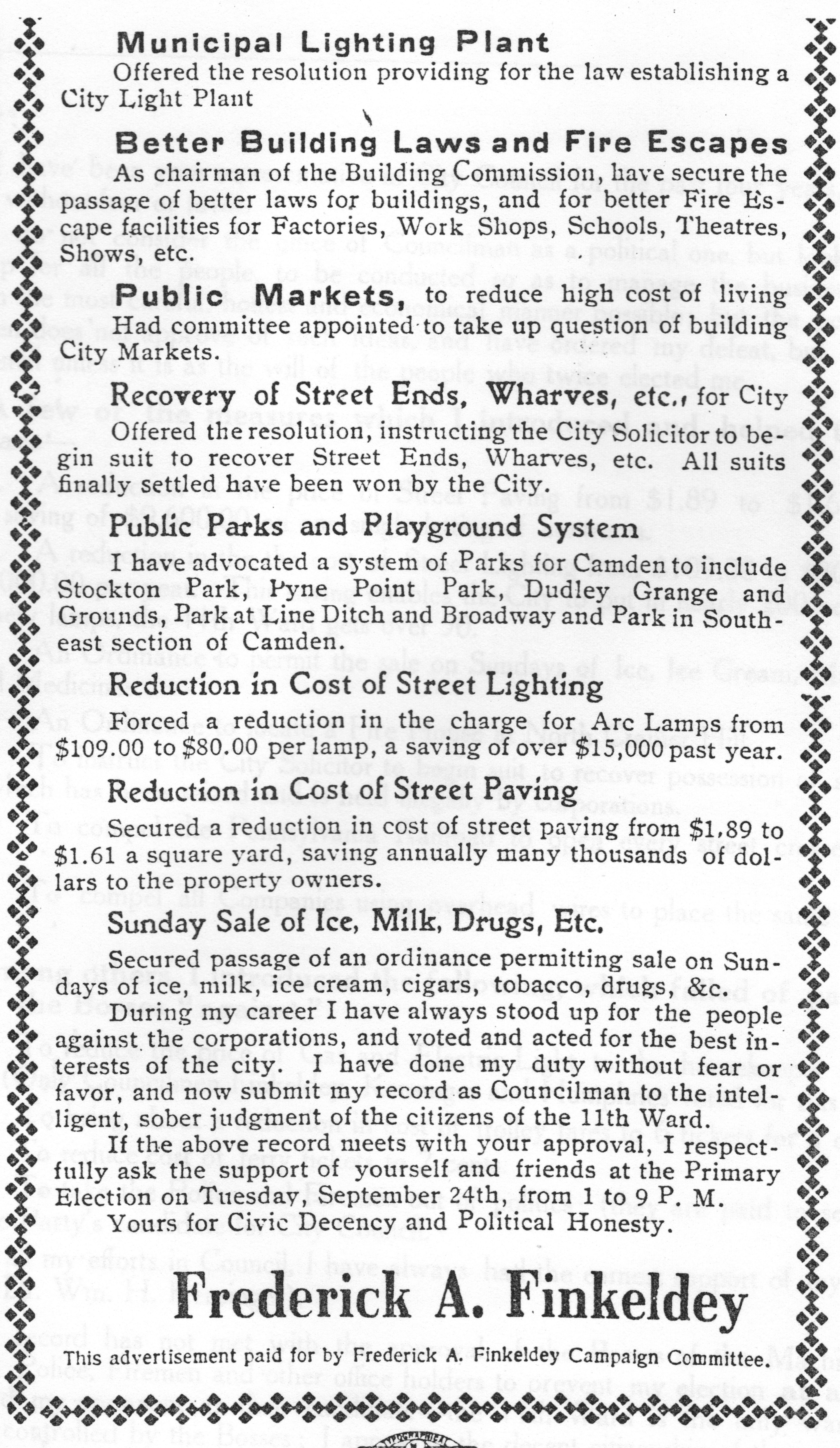
Frederick A. Finkeldey – Washington School
Camden Citizens Honored at German-American Alliance Meeting
Camden Post-Telegram —
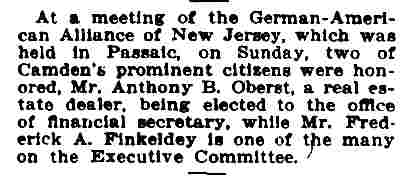
At a meeting of the German-American Alliance of New Jersey, which was held in Passaic, on Sunday, two of Camden’s prominent citizens were honored, Mr. Anthony B. Oberst, a real estate dealer, being elected to the office of financial secretary, while Mr. Frederick A. Finkeldey is one of the many on the Executive Committee.
Coursey Breaks Down While Story of Cold-Blooded Killing of Karl Kellmann Is Told by Detective
Camden Post-Telegram —
Two “Pals,” Too, Accused of Crime
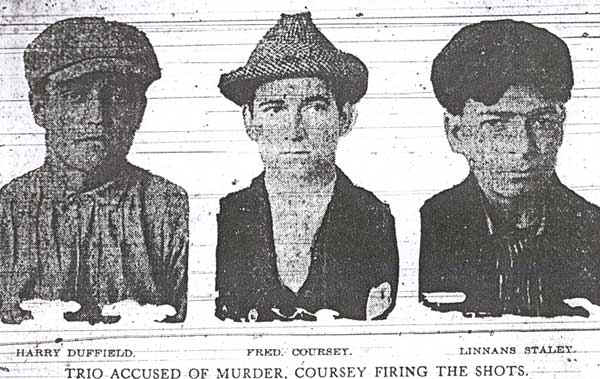
Harry Duffield. Fred. Coursey. Linnans Staley.
Trio Accused of Murder, Coursey Firing the Shots.
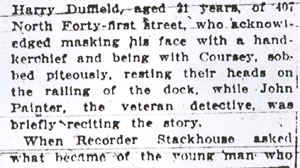
Collapsing when arraigned in Police Court this morning before Recorder Stackhouse on the charge of killing Karl Kellmann, aged 18 years, of 2919 High street, at Twenty-seventh and Sherman streets, shortly before midnight Saturday, Fred Coursey, alias “Mexican Pete,” alias “Cowboy Pete,” aged 20 years, of 121 North Twenty-first street, who admits firing the fatal shots while committing robbery, and Harry Duffield, aged 21 years, of 407 North Forty-first street, who acknowledged masking his face with a handkerchief and being with Coursey, sobbed piteously, resting their heads on the railing of the dock, while John Painter, the veteran detective, was briefly reciting the story.
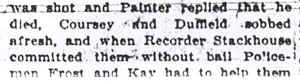
When Recorder Stackhouse asked what became of the young man who was shot and Painter replied that he died, Coursey and Duffield sobbed afresh, and when Recorder Stackhouse committed them without bail Policemen Frost and Kay had to help them.
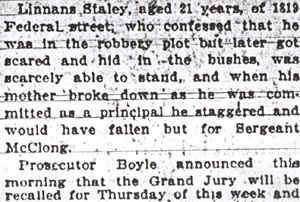
Linnans Staley, aged 21 years, of 1819 Federal street, who confessed that he was in the robbery plot but later got scared and hid in the bushes, was scarcely able to stand, and when his mother broke down as he was committed as a principal he staggered and would have fallen but for Sergeant McClong.
Prosecutor Boyle announced this morning that the Grand Jury will be recalled for Thursday of this week and the case will be made the special order of the day.
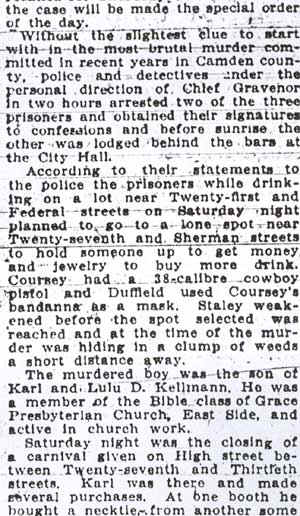
Without the slightest clue to start with in the most brutal murder committed in recent years in Camden county, police and detectives under the personal direction of Chief Gravenor in two hours arrested two of the three prisoners and obtained their signatures to confessions and before sunrise the other was lodged behind the bars at the City Hall.
According to their statements to the police the prisoners while drinking on a lot near Twenty-first and Federal streets on Saturday night planned to go to a lone spot near Twenty-seventh and Sherman streets to hold someone up to get money and jewelry to buy more drink. Coursey had a 38-calibre cowboy pistol and Duffield used Coursey’s bandanna as a mask. Staley weakened before the spot selected was reached and at the time of the murder was hiding in a clump of weeds a short distance away.
The murdered boy was the son of Karl and Lulu D. Kellmann. He was a member of the Bible class of Grace Presbyterian Church, East Side, and active in church work.
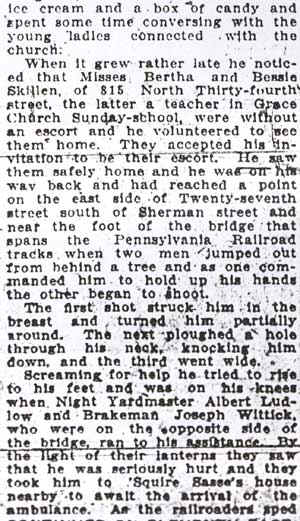
Saturday night was the closing of a carnival given on High street between Twenty-seventh and Thirtieth streets. Karl was there and made several purchases. At one booth he bought a necktie, from another some ice cream and a box of candy and spent some time conversing with the young ladies connected with the church.
When it grew rather late he noticed that Misses Bertha and Bessie Skillen, of 815 North Thirty-fourth street, the latter a teacher in Grace Church Sunday-school, were without an escort and he volunteered to see them home. They accepted his invitation to be their escort. He saw them safely home and he was on his way back and had reached a point on the east side of Twenty-seventh street south of Sherman street and near the foot of the bridge that spans the Pennsylvania Railroad tracks when two men jumped out from behind a tree and as one commanded him to hold up his hands the other began to shoot.
The first shot struck him in the breast and turned him partially around. The next ploughed a hole through his neck, knocking him down, and the third went wide.
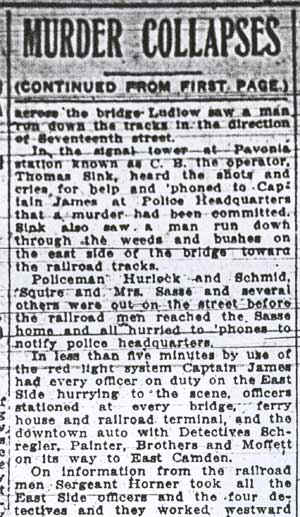
Screaming for help he tried to rise to his feet and was on his knees when Night Yardmaster Albert Ludlow and Brakeman Joseph Wittick, who were on the opposite side of the bridge, ran to his assistance. By the light of their lanterns they saw that he was seriously hurt and they took him to ’Squire Sasse’s house nearby to await the arrival of the ambulance. As the railroaders sped across the bridge Ludlow saw a man run down the tracks in the direction of Seventeenth street.
In the signal tower at Pavonia station known as C. B. the operator, Thomas Sink, heard the shots and cries for help and ’phoned to Captain James at Police Headquarters that a murder had been committed. Sink also saw a man run down through the weeds and bushes on the east side of the bridge toward the railroad tracks.
Policeman Hurlock and Schmid, ’Squire and Mrs. Sasse and several others were out on the street before the railroad men reached the Sasse home and all hurried to ’phones to notify police headquarters.
In less than five minutes by use of the red light system Captain James had every officer on duty on the East Side hurrying to the scene, officers stationed at every bridge, ferry house and railroad terminal, and the downtown auto with Detectives Schregler, Painter, Brothers and Moffett on its way to East Camden.
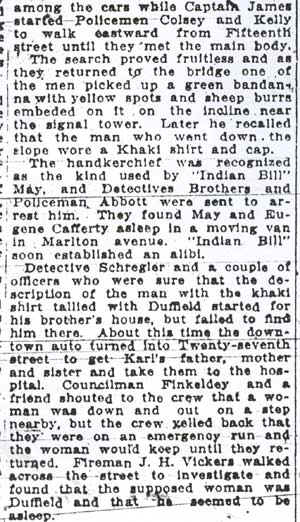
On information from the railroad men Sergeant Horner took all the East Side officers and the four detectives and they worked westward among the cars while Captain James started Policemen Colsey and Kelly to walk eastward from Fifteenth street until they met the main body.
The search proved fruitless and as they returned to the bridge one of the men picked up a green bandanna with yellow spots and sheep burrs embeded [sic] on it on the incline near the signal tower. Later he recalled that the man who went down the slope wore a Khaki shirt and cap.
The handkerchief was recognized as the kind used by “Indian Bill” May, and Detectives Brothers and Policeman Abbott were sent to arrest him. They found May and Eugene Cafferty asleep in a moving van in Marlton avenue. “Indian Bill” soon established an alibi.
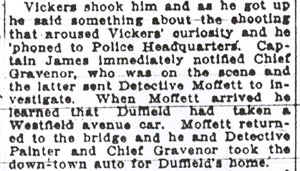
Detective Schregler and a couple of officers who were sure that the description of the man with the khaki shirt tallied with Duffield started for his brother’s house, but failed to find him there. About this time the downtown auto turned into Twenty-seventh street to get Karl’s father, mother and sister and take them to the hospital. Councilman Finkeldey and a friend shouted to the crew that a woman was down and out on a step nearby, but the crew yelled back that they were on an emergency run and the woman would keep until they returned. Fireman J. H. Vickers walked across the street to investigate and found that the supposed woman was Duffield and that he seemed to be asleep.
Vickers shook him and as he got up he said something about the shooting that aroused Vickers’ curiosity and he ’phoned to Police Headquarters. Captain James immediately notified Chief Gravenor, who was on the scene and the latter sent Detective Moffett to investigate. When Moffett arrived he learned that Duffield had taken a Westfield avenue car. Moffett returned to the bridge and he and Detective Painter and Chief Gravenor took the down-town auto for Duffield’s home.
Painter went to the front door and saw Duffield in the act of taking off his shoes. Moffett in going around to the back door to prevent his escape that way passed by the window at which Duffield was sitting.
Grasping Duffield by the collar Moffett pulled him through the window to the ground. As soon as he landed on his feet, according to the Chief and detectives, Duffield said that Coursey did the shooting.
Placing him in the auto they next drove close to Coursey’s home and with Policeman Potter who knew the man wanted, the detectives entered the house with drawn revolvers while other officers guarded all avenues of escape.
Coursey was found akwake [sic] on a cot and while he was covered with revolvers Detective Painter searched his trunk and found the weapon that he later admitted using. It was empty. The detectives late yesterday afternoon found three used shells adjoining the house near a spot where Coursey said he had thrown them.
In order to keep the men apart they were taken to the City Hall separately and questioned and after they decided to tell all Sergeant E. B. McClong reduced their statements to writing and they signed them. It was on the strength of these statements that Staley was arrested.
Young Kellmann was taken into the hospital at 12.20 a. m. Chief Surgeon Schellenger saw at a glance that there was no hope for him and so notified Captain James, and Sergeant McClong was sent to the hospital to get all information possible.
The unfortunate youth could only speak a few words at a time because of the hemorrhages. All Sergeant McClong was able to get from him was that he was told to hold up his hands and that the shooting instantly began. The only description he could give was that they were small men and that the attack was so sudden that he could not tell whether they were black or white.
The injured young man kept asking the doctors if he was going to die, but they did not answer. He was conscious when his father and mother arrived and then sank rapidly until the end, dying at 1.50 o’clock, 90 minutes after he was admitted. Mother and father were prostrated and were taken home by the up-town auto.
County Physician Jones conducted the autopsy yesterday morning. He said that either wound would have caused death. The bullet in the breast pierced the right lung at the top and lodged in the cavity. It is now in the doctor’s possession. The other bullet went clear through the neck.
Coursey and Duffield have been working in the Pavonia car yard. The former was born in El Paso, Texas, but has lived East nearly all his life. He is an expert shot and was a member of the vaudeville team of Coursey & Cook, according to their letter heads presenting a fifteen-minute thriller.
Duffield was only recently paroled for robbing Gallagher’s saloon, Nineteenth and Federal streets of a lot of drinkables. Staley has been arrested several times on petty charges but was never convicted of crime. When Duffield’s coat was examined at the City Hall, it was found to contain sheep burrs.
To a reporter Coursey said that whenever he was drinking he had to get his gun and shoot something or somebody. He insisted that all were in on the job and that they let the man who preceded Kellman go over the bridge without molestation because he didn’t look as if he had any too much money.
Yesterday morning Assistant Prosecutor Wolverton and Stenographer Cleary called at the City Hall. The prisoners were examined by Mr. Wolverton and their statements taken by Mr. Cleary, but there was little or nothing new elicited.
Finkeldey Out for Sheriff Nomination
Philadelphia Inquirer —
In Contest Among Republicans Are Prominent Officials—Democrats Seem Listless
It was announced in Camden yesterday by Councilman Frederick A. Finkeldey, of the Eleventh ward, that he is a candidate for the Republican Shrievalty nomination. He asserts that he is in the contest until the end. He is understood to have the backing of the German-American Alliance.
This contest among the Republicans bids fair to become much more interesting than in the Democratic camp. Others in the contest with Finkeldey include President of Council James E. Hewitt, Councilman Joshua C. Haines, Sheriff’s Clerk Harry Marter, George Starn, in the city, and Jacob Price, of Gloucester township, and Willard Gibbs, in Clementon township.
Among the Democrats it is hardly likely that anyone other than Under Sheriff Alvin B. Pitman will have a chance for the nomination. He is the unqualified choice of Sheriff Nowrey, the nominal leader at least of Camden’s Democracy. But there is some factional trouble brewing.
Wanted Grounds for Play Center
Camden Post-Telegram or Courier —
Tract at Second and State Streets May be Acquired by the Commissioners.
PRESIDENT TAKES BENEFICIAL TRIP
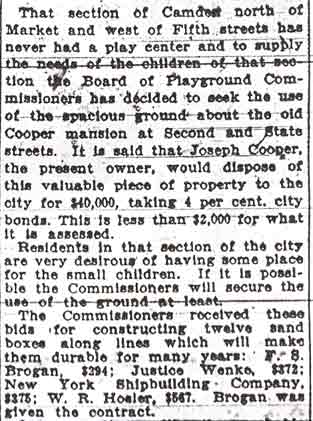
That section of Camden north of Market and west of Fifth streets has never had a play center and to supply the needs of the children of that section the Board of Playground Commissioners has decided to seek the use of the spacious ground about the old Cooper mansion at Second and State Streets. It is said that Joseph Cooper, the present owner, would dispose of this valuable piece of property to the city for $40,000, taking 4 per cent. city bonds. This is less than $2,000 for what it is assessed.
Residents in that section of the city are very desirous of having some place for the small children. If it is possible the Commissioners will secure the use of the ground at least.
The Commissioners received these bids for constructing twelve sand boxes along lines which will make them durable for many years: F. S. Brogan, $294; Justice Wenke, $372; New York Shipbuilding Company, $375; W. R. Hosier, $567. Brogan was given the contract.
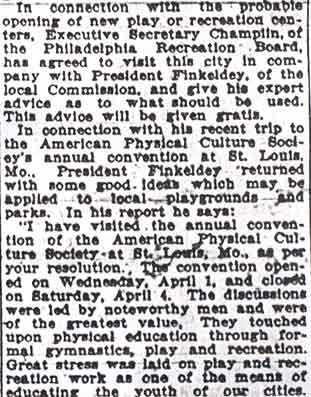
In connection with the probable opening of new play or recreation centers, Executive Secretary Champlin, of the Philadelphia Recreation Board, has agreed to visit this city in company with President Finkeldey, of the local Commission, and give his expert advice as to what should be used. This advice will be given gratis.
In connection with his recent trip to the American Physical Culture Society’s annual convention at St. Louis, Mo., President Finkeldey returned with some good ideas which may be applied to local playgrounds and parks. In his report he says:
“I have visited the annual convention of the American Physical Culture Society at St. Louis, Mo., as per your resolution. The convention opened on Wednesday, April 1, and closed on Saturday, April 4. The discussions were led by noteworthy men and were of the greatest value. They touched upon physical education through formal gymnastics, play and recreation. Great stress was laid on play and recreation work as one of the means of educating the youth of our cities.”
Formal Opening of Recreation Centre
Philadelphia Inquirer —
Addresses by Mayor and Commissioners at Flag-raising---Twelve Playgrounds in Use
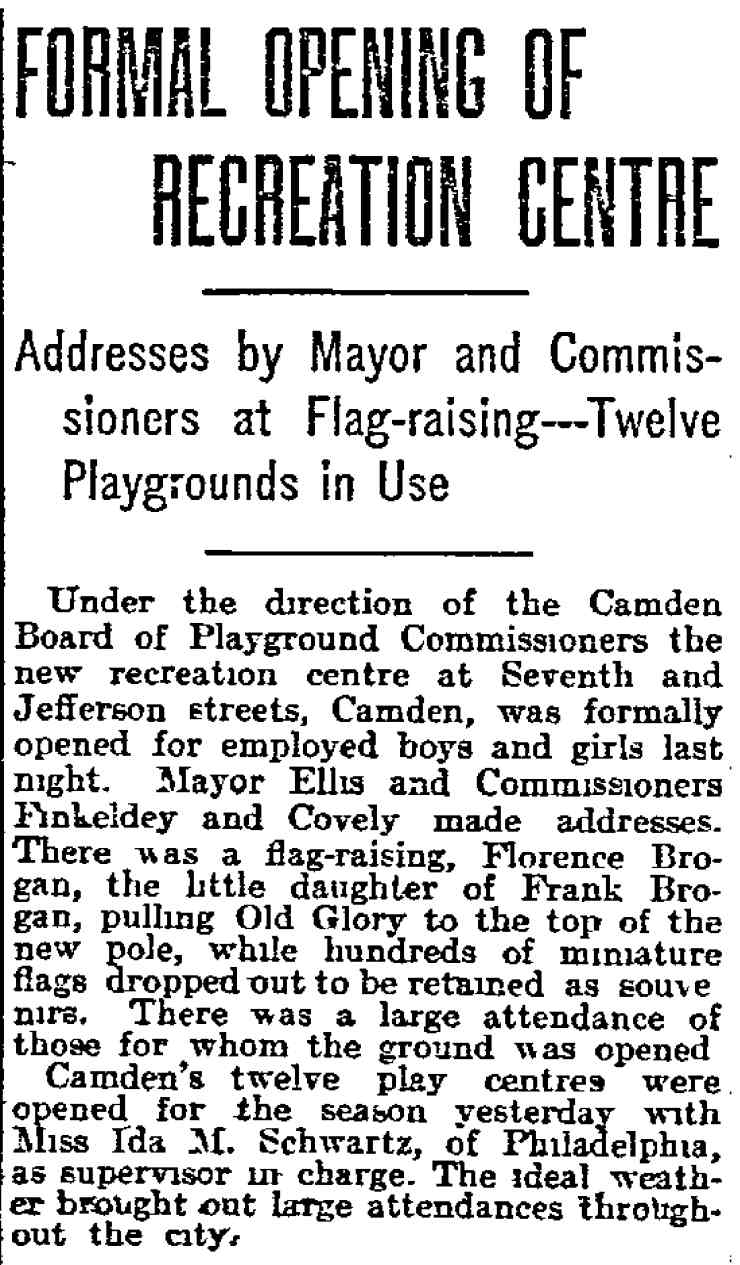
Under the direction of the Camden Board of Playground Commissioners the new recreation centre at Seventh and Jefferson streets, Camden, was formally opened for employed boys and girls last night. Mayor Ellis and Commissioners Finkeldey and Covely made addresses. There was a flag-raising, Florence Brogan, the little daughter of Frank Brogan, pulling Old Glory to the top of the new pole, while hundreds of miniature flags dropped out to be retained as souvenirs. There was a large attendance of those for whom the ground was opened
Camden’s twelve play centres were opened for the season yesterday with Miss Ida M. Schwartz, of Philadelphia, as supervisor in charge. The ideal weather brought out large attendances throughout the city.
Retiring Councilman to Serve as President
Philadelphia Inquirer —
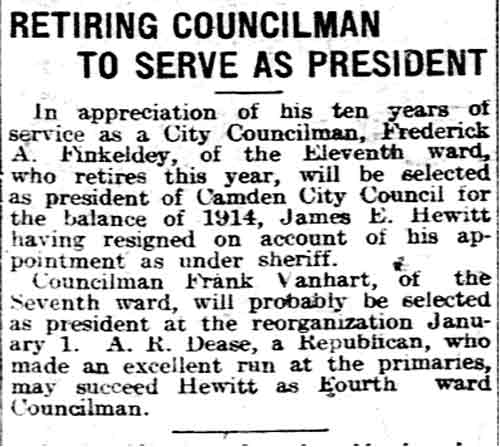
In appreciation of his ten years of service as a City Councilman, Frederick A. Finkeldey, of the Eleventh ward, who retires this year, will be selected as president of Camden City Council for the balance of 1914, James E. Hewitt having resigned on account of his appointment as under sheriff.
Councilman Frank Vanhart, of the Seventh ward, will probably be selected as president at the reorganization January 1. A. R. Dease, a Republican, who made an excellent run at the primaries, may succeed Hewitt as Fourth ward Councilman.
Finkeldey Always for City Interest
Camden Post-Telegram — Fall 1915
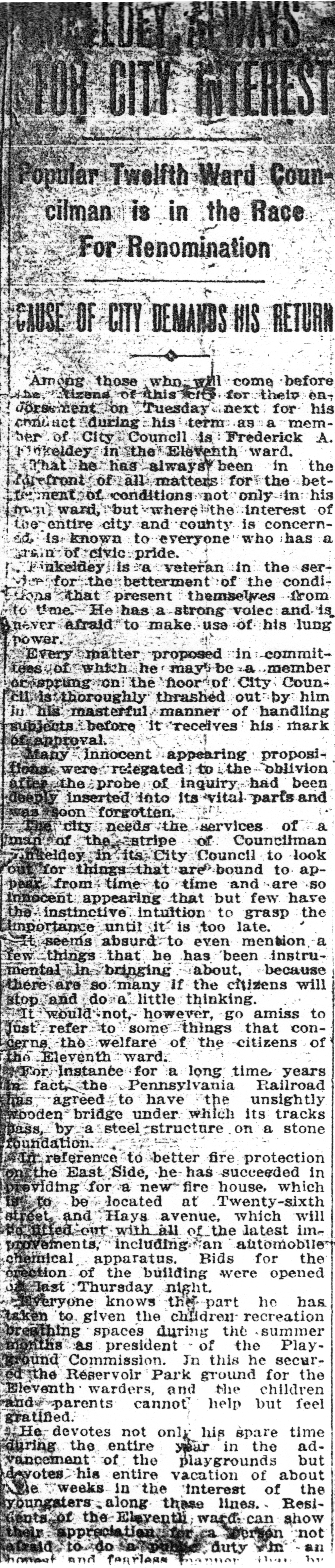
Camden Post-Telegram – Fall 1915 – Camden City Council Election
Lectures About Playgrounds
Philadelphia Inquirer —
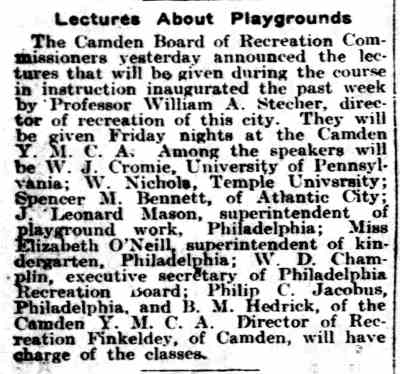
The Camden Board of Recreation Commissioners yesterday announced the lectures that will be given during the course in instruction inaugurated the past week by Professor William A. Stecher, director of recreation of this city. They will be given Friday nights at the Camden Y. M. C. A. Among the speakers will be W. J. Cromie, University of Pennsylvania; W. Nichols, Temple University; Spencer M. Bennett, of Atlantic City; J. Leonard Mason, superintendent of playground work, Philadelphia; Miss Elizabeth O’Neill, superintendent of kindergarten, Philadelphia; W. D. Champlin, executive secretary of Philadelphia Recreation Board; Philip C. Jacobus, Philadelphia, and B. M. Hedrick, of the Camden Y. M. C. A. Director of Recreation Finkeldey, of Camden, will have charge of the classes.
April 20, 1917
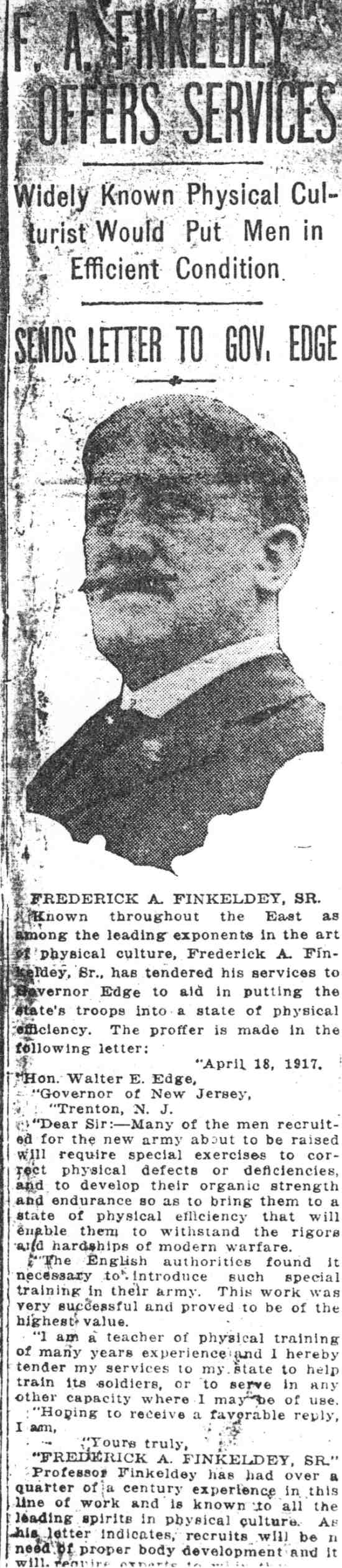
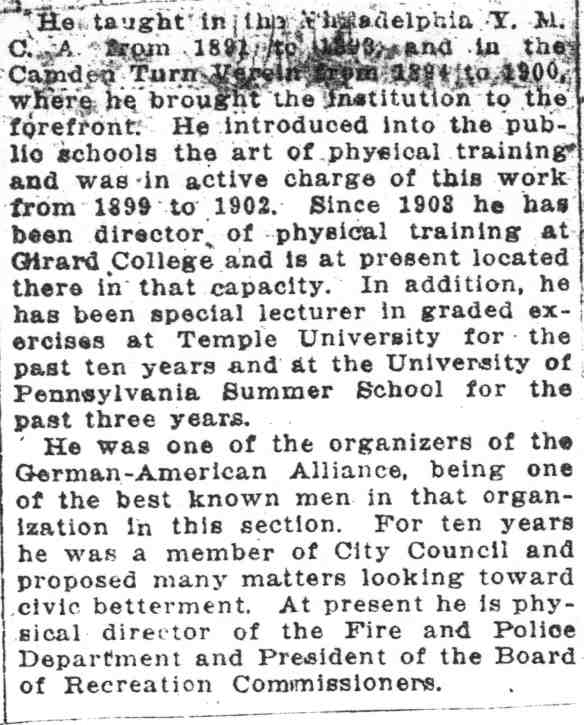
April 20, 1917
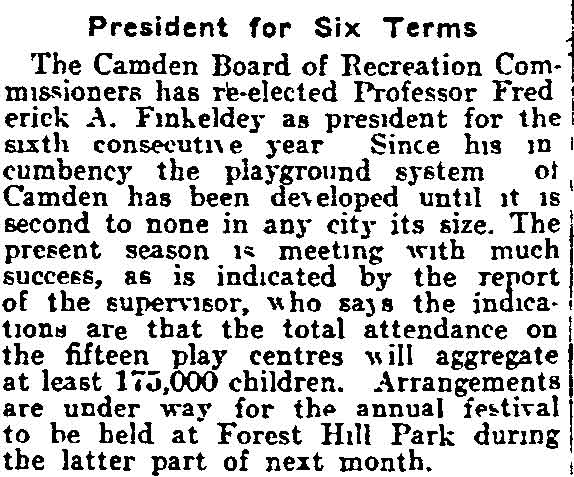
President for Six Terms
Philadelphia Inquirer —
City Plan Commission Appointed
Philadelphia Inquirer —
A City Plan Commission for one year was appointed as follows: T. Gordon Coulter, F. A. Finkeldey, George Kappell, William C. Davis, Theodore T. Kausel, Allen Jarvis, Frank S. Vanhart, Frederick von Nieda and Joseph Forsyth, the last three being members of City Council. Dr. Charles P. Tuttle, Dr. H. F. Bushey, Chief of Police Gravenor and Policeman Charles Whaland were appointed the Police Pension Fund Commission.
Return to Camden
1918
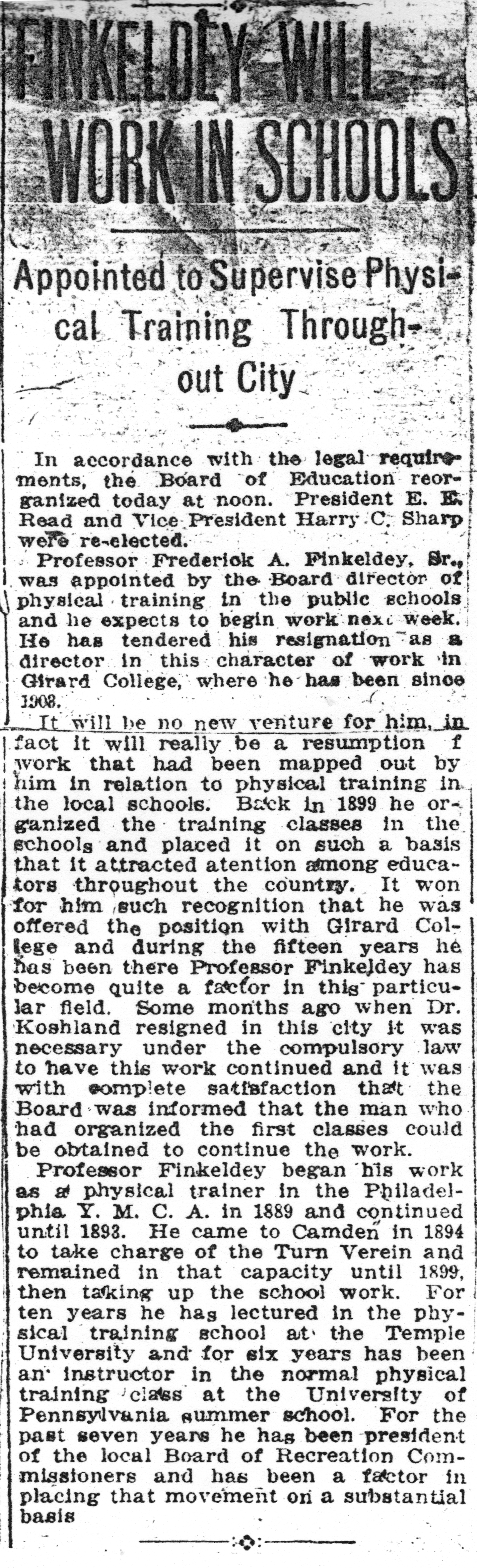
1918 – Frederick A. Finkeldey returns to Camden
Left Girard College
1918
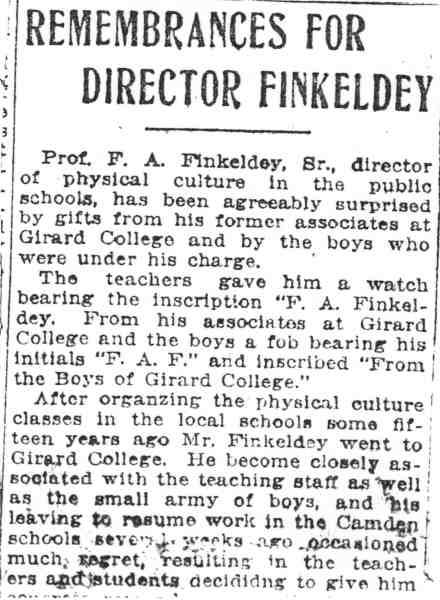
1918 – Frederick A. Finkeldey left Girard College
Camden Playgrounds Open Tuesday
Philadelphia Inquirer —
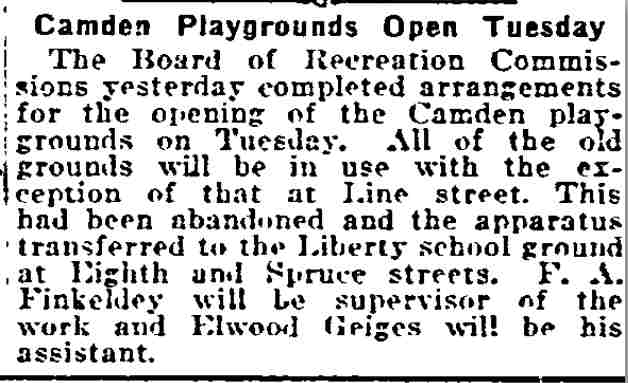
The Board of Recreation Commissions yesterday completed arrangements for the opening of the Camden playgrounds on Tuesday. All of the old grounds will be in use with the exception of that at Line street. This had been abandoned and the apparatus transferred to the Liberty school ground at Eighth and Spruce streets. F. A. Finkeldey will be supervisor of the work and Elwood Geiges will be his assistant.
Camden Playgrounds Close
Philadelphia Inquirer —
East Camden Bank
Philadelphia Inquirer —
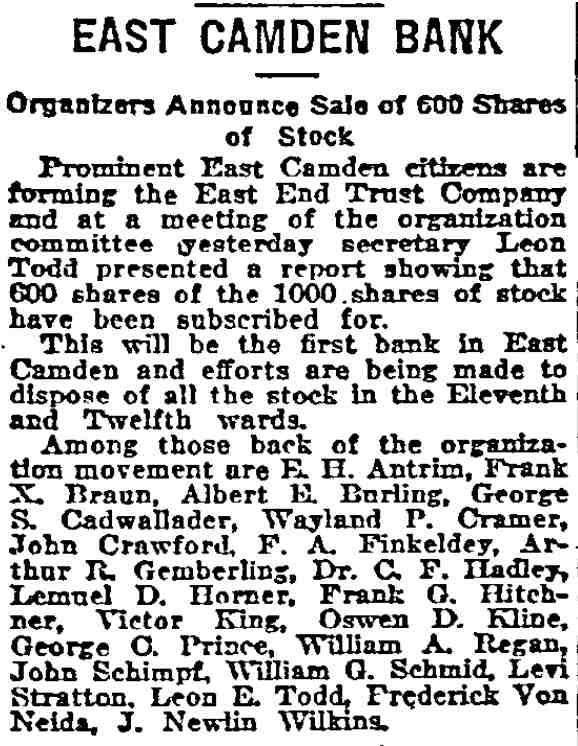
Prominent East Camden citizens are forming the East End Trust Company and at a meeting of the organization committee yesterday secretary Leon Todd presented a report showing that 600 shares of the 1,000 shares of stock have been subscribed for.
This will be the first bank in East Camden and efforts are being made to dispose of all the stock in the Eleventh and Twelfth wards.
Among those back of the organization movement are F. H. Antrim, Frank X. Braun, Albert E. Burling, George S. Cadwallader, Wayland P. Cramer, John Crawford, F. A. Finkeldey, Arthur R. Gemberling, Dr. C. F. Hadley, Lemuel D. Horner, Frank G. Hitchner, Victor King, Oswen D. Kline, George C. Prince, William A. Regan, John Schimpf, William Schmid, Levi Stratton, Leon E. Todd, Frederick Von Neida, J. Newlin Wilkins.
Frederick & Fredericka Finkeldey
Circa 1919
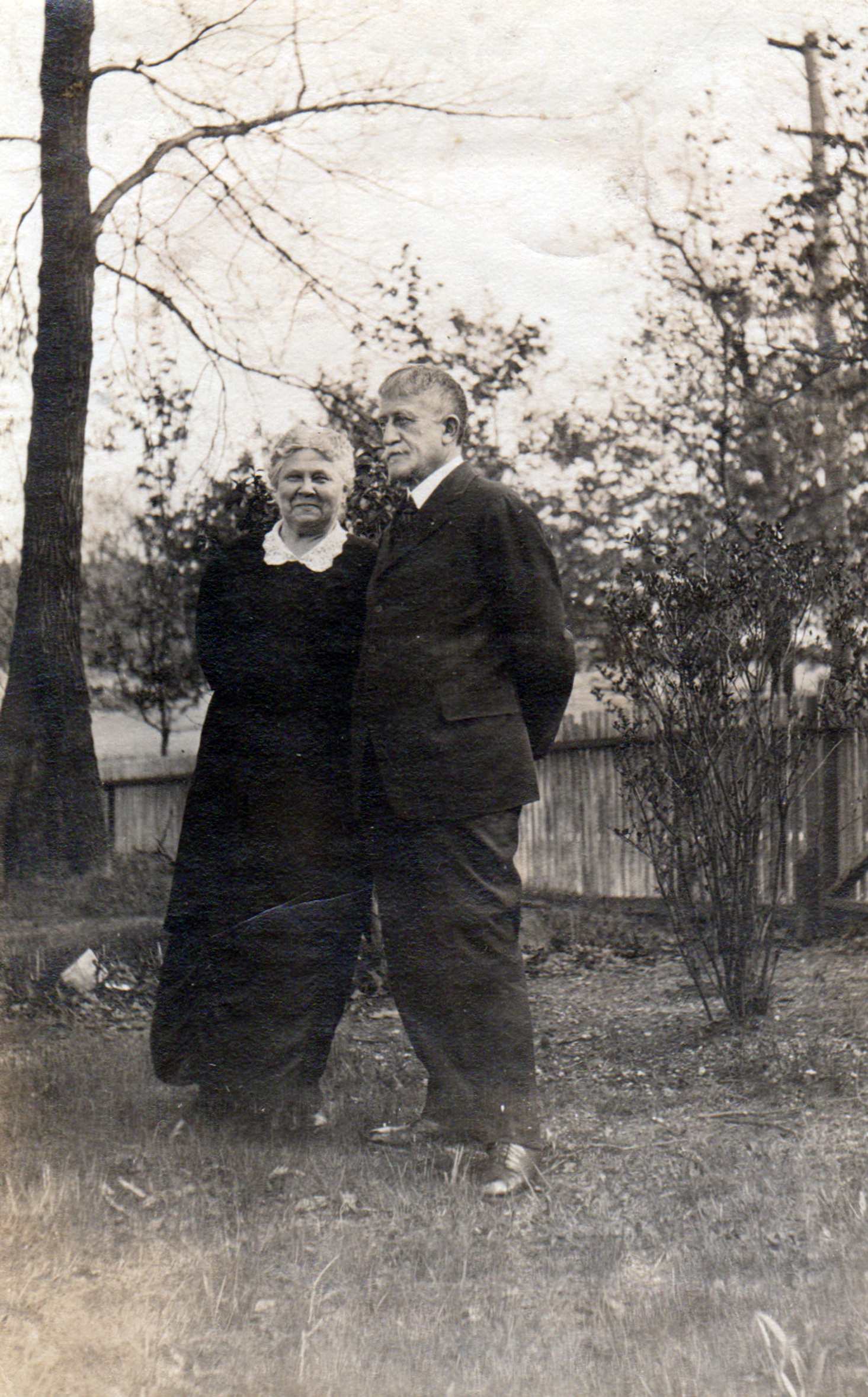
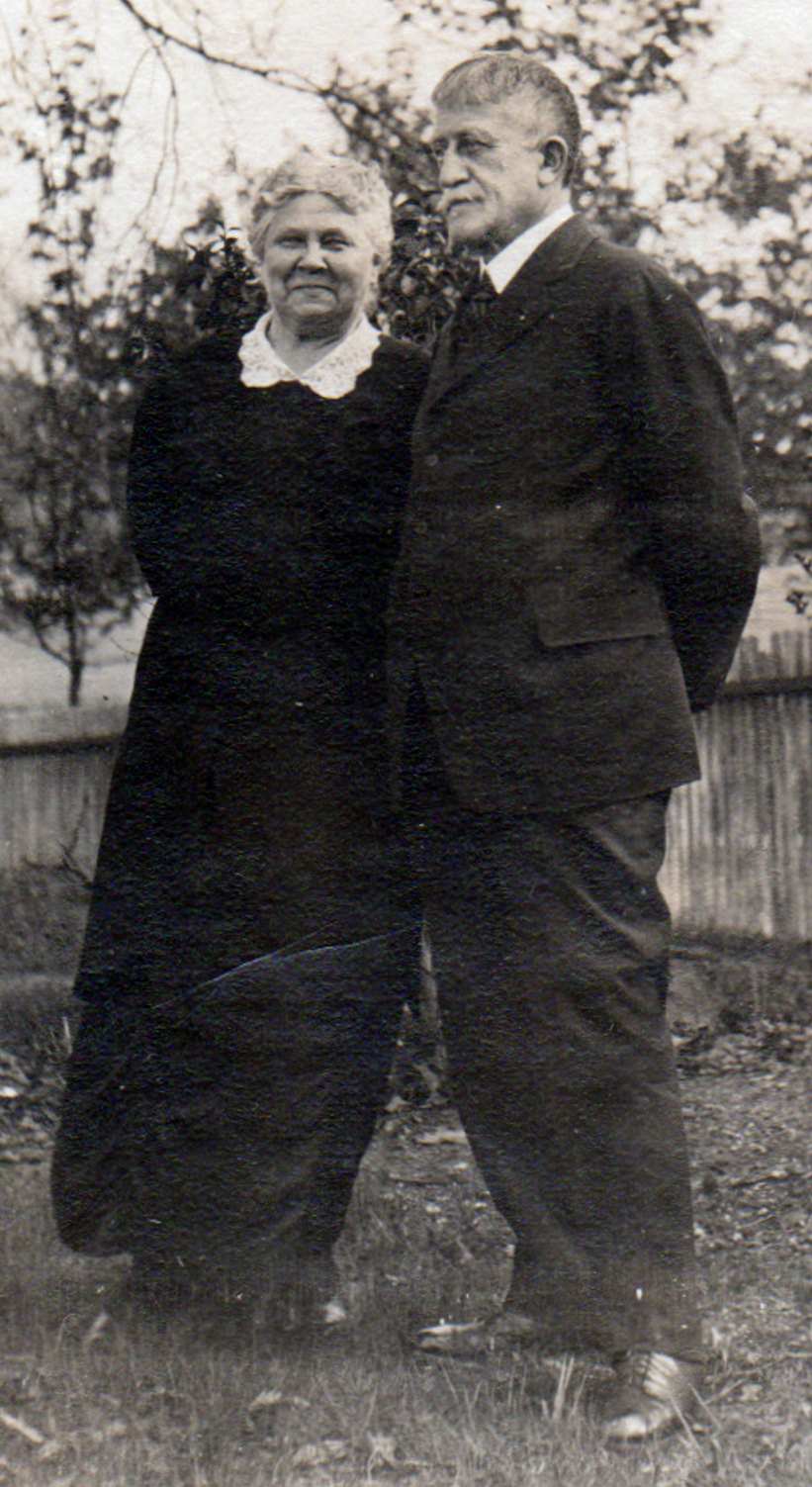
Frederick & Fredericka Finkeldey at 220 North 32nd Street, Camden NJ – Circa 1919
Speech to the Rotary Club of Camden
Circa 1920
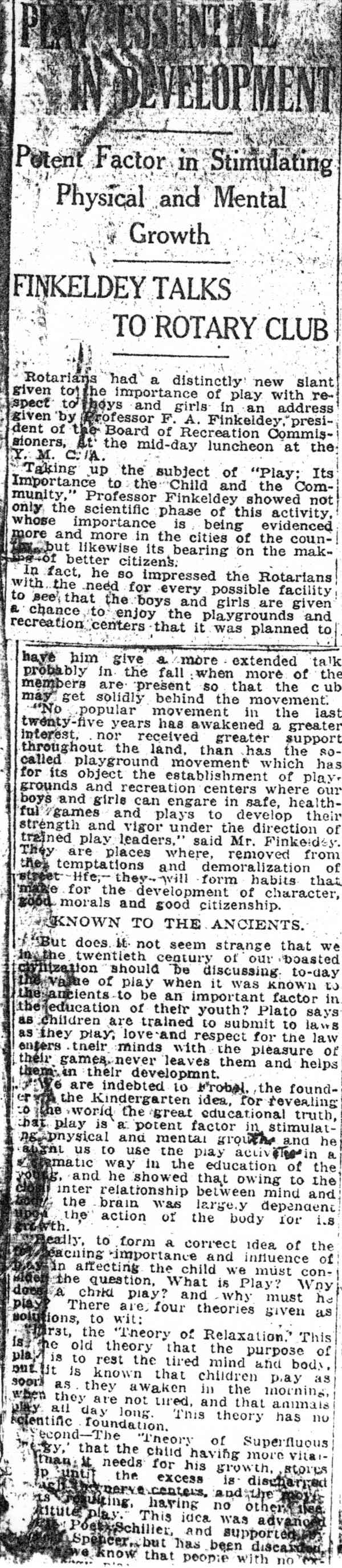
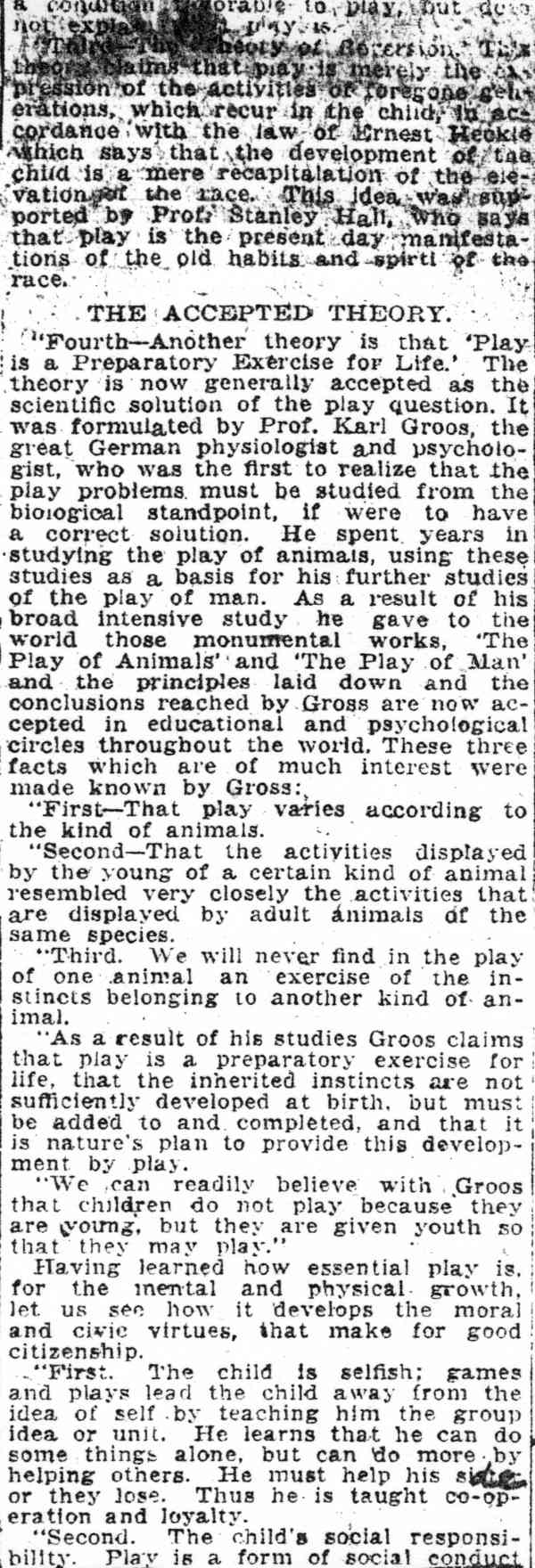

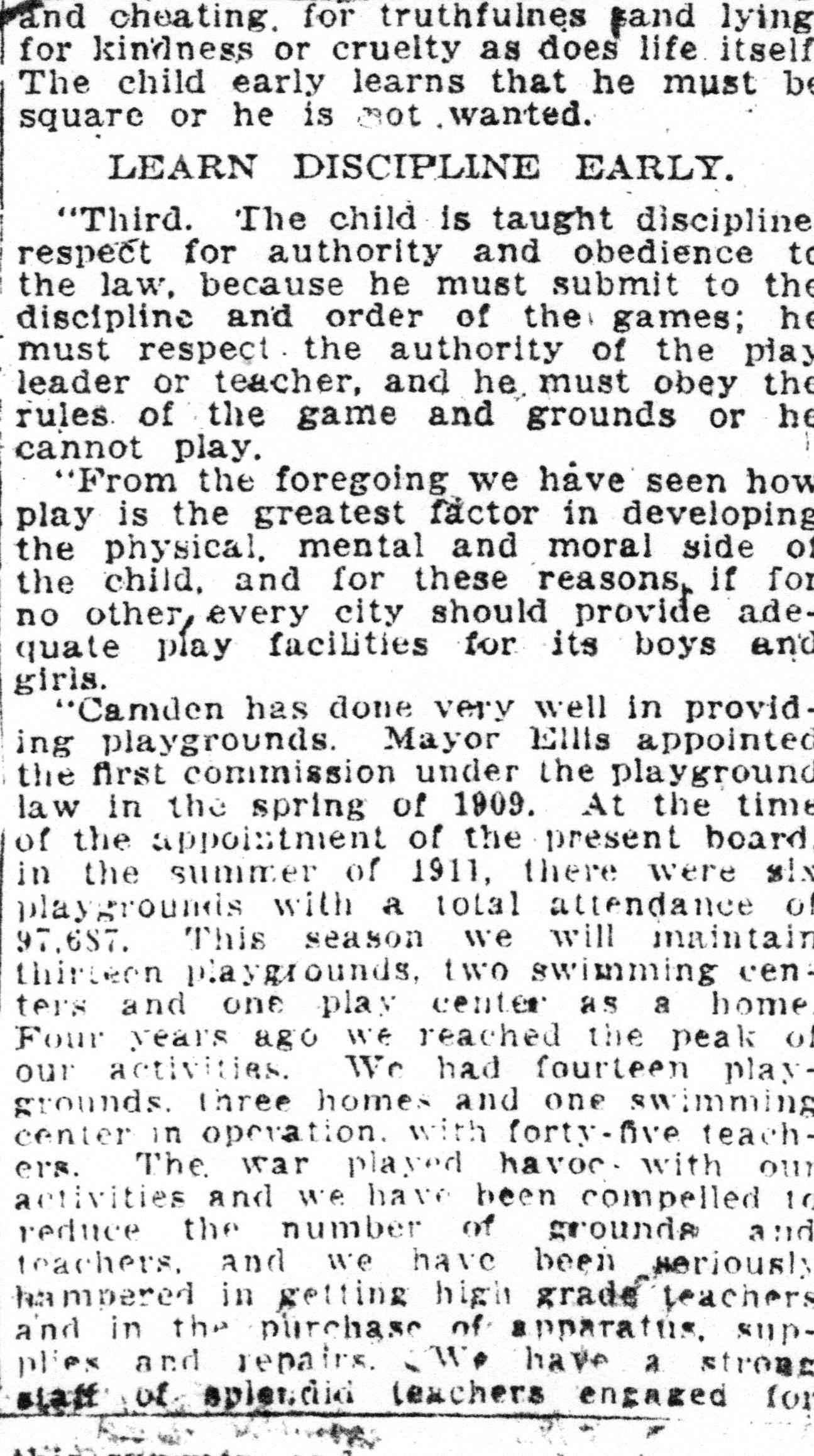
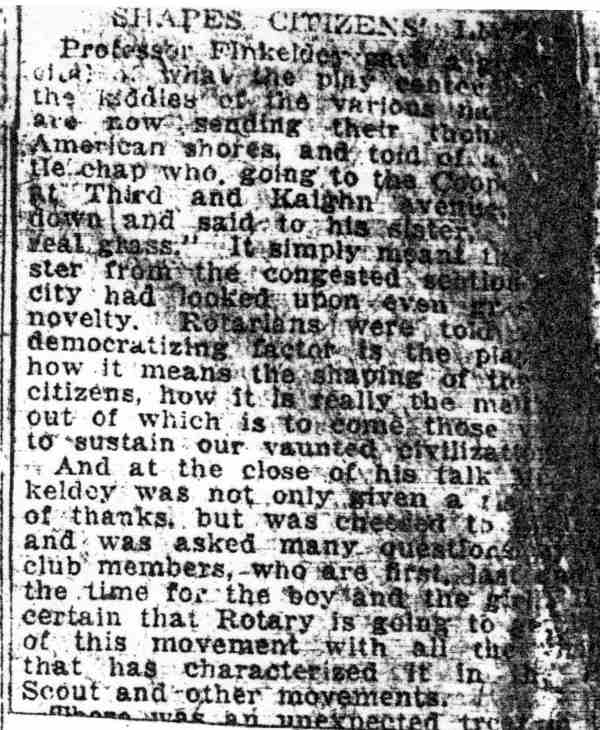
Speech to the Rotary Club of Camden by Frederick A. Finkeldey – Circa 1920 – …a line left out when printed, note handwritten by Frederick A. Finkeldey…
Prof. Finkeldey Dies in Hospital
Camden Post-Telegram or Camden Courier —
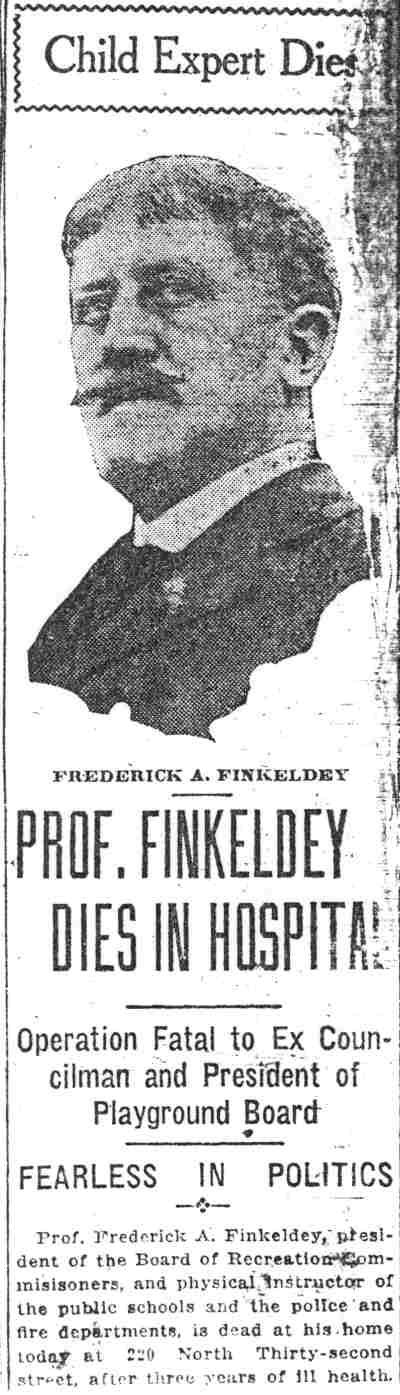
Child Expert Dies — Frederick A. Finkeldey
Operation Fatal to Ex Councilman and President of Playground Board
FEARLESS IN POLITICS
Prof. Frederick A. Finkeldey, president of the Board of Recreation Commissioners, and physical instructor of the public schools and the police and fire departments, is dead at his home today at 220 North Thirty-second street, after three years of ill health.
Fred Finkeldey Taken by Death
Camden Post-Telegram or Camden Courier —
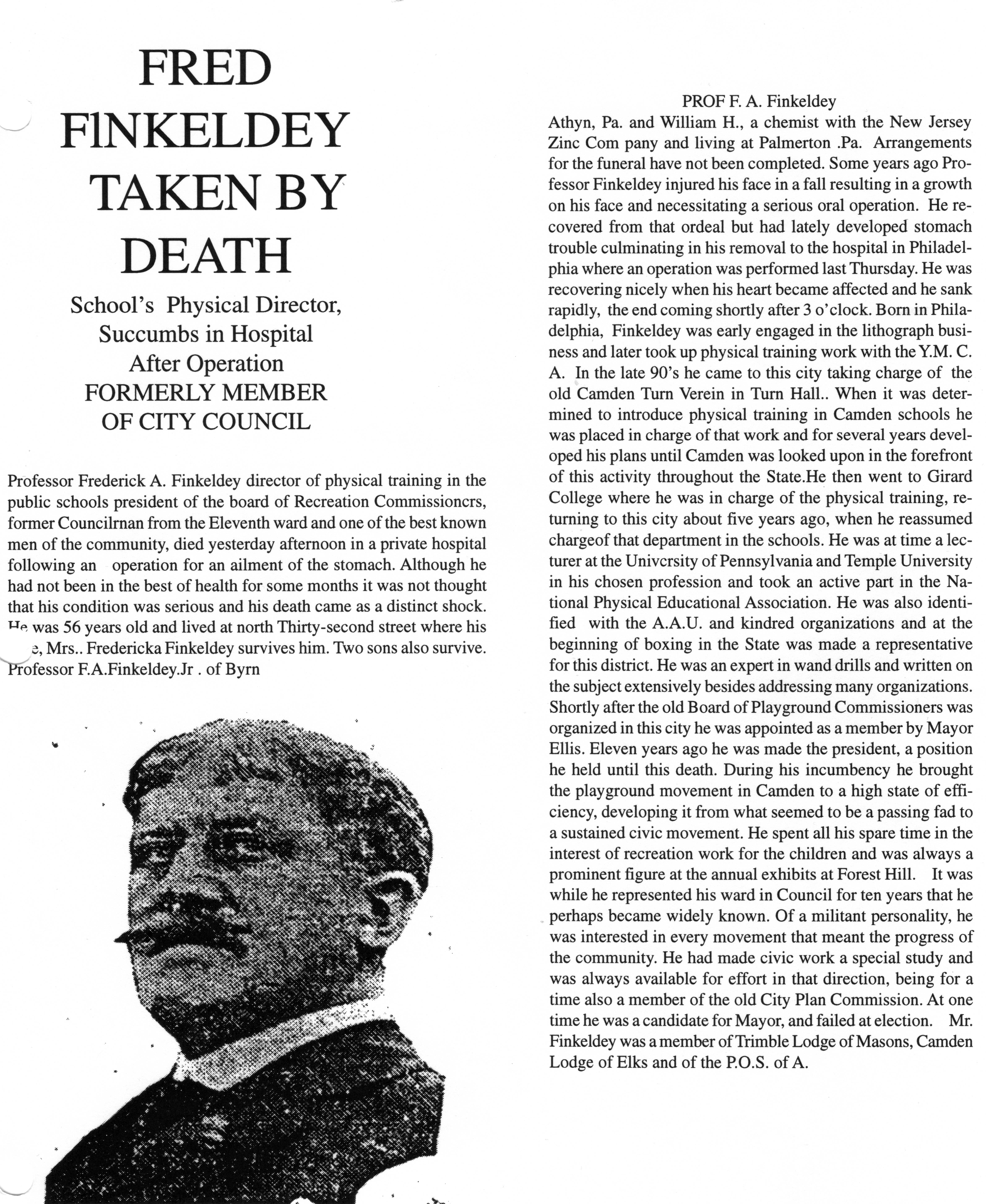
School’s Physical Director, Succumbs in Hospital After Operation
FORMERLY MEMBER OF CITY COUNCIL
Professor Frederick A. Finkeldey, director of physical training in the public schools, president of the board of Recreation Commissioners, former Councilman from the Eleventh ward and one of the best known men of the community, died yesterday afternoon in a private hospital following an operation for an ailment of the stomach. Although he had not been in the best of health for some months it was not thought that his condition was serious and his death came as a distinct shock. He was 56 years old and lived at north Thirty-second street where his wife, Mrs. Fredericka Finkeldey survives him. Two sons also survive, Professor F. A. Finkeldey, Jr., of Byrn [sic] Athyn, Pa. and William H., a chemist with the New Jersey Zinc Company and living at Palmerton, Pa. Arrangements for the funeral have not been completed. Some years ago Professor Finkeldey injured his face in a fall resulting in a growth on his face and necessitating a serious oral operation. He recovered from that ordeal but had lately developed stomach trouble culminating in his removal to the hospital in Philadelphia where an operation was performed last Thursday. He was recovering nicely when his heart became affected and he sank rapidly, the end coming shortly after 3 o’clock.
Born in Philadelphia, Finkeldey was early engaged in the lithograph business and later took up physical training work with the Y. M. C. A. In the late 90’s he came to this city taking charge of the old Camden Turn Verein in Turn Hall. When it was determined to introduce physical training in Camden schools he was placed in charge of that work and for several years developed his plans until Camden was looked upon in the forefront of this activity throughout the State. He then went to Girard College where he was in charge of the physical training, returning to this city about five years ago, when he reassumed charge of that department in the schools. He was at time [sic] a lecturer at the University of Pennsylvania and Temple University in his chosen profession and took an active part in the National Physical Educational Association. He was also identified with the A. A. U. and kindred organizations and at the beginning of boxing in the State was made a representative for this district. He was an expert in wand drills and written on the subject extensively besides addressing many organizations.
Shortly after the old Board of Playground Commissioners was organized in this city he was appointed as a member by Mayor Ellis. Eleven years ago he was made the president, a position he held until this death. During his incumbency he brought the playground movement in Camden to a high state of efficiency, developing it from what seemed to be a passing fad to a sustained civic movement. He spent all his spare time in the interest of recreation work for the children and was always a prominent figure at the annual exhibits at Forest Hill. It was while he represented his ward in Council for ten years that he perhaps became widely known. Of a militant personality, he was interested in every movement that meant the progress of the community. He had made civic work a special study and was always available for effort in that direction, being for a time also a member of the old City Plan Commission. At one time he was a candidate for Mayor, and failed at election. Mr. Finkeldey was a member of Trimble Lodge of Masons, Camden Lodge of Elks and of the P. O. S. of A.
F. A. Finkeldey
Philadelphia Inquirer —
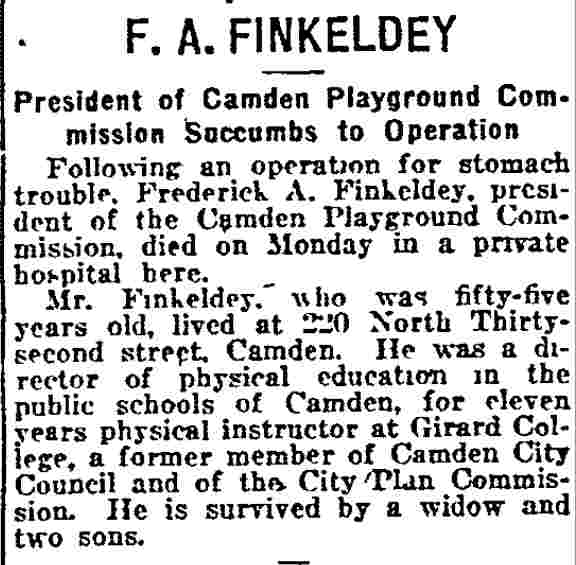
President of Camden Playground Commission Succumbs to Operation
Following an operation for stomach trouble, Frederick A. Finkeldey, president of the Camden Playground Commission, died on Monday in a private hospital here.
Mr. Finkeldey, who was fifty-five years old, lived at 220 North Thirty-second street, Camden. He was a director of physical education in the public schools of Camden, for eleven years physical instructor at Girard College, a former member of Camden City Council and of the City Plan Commission. He is survived by a widow and two sons.