Henry C. Moffett
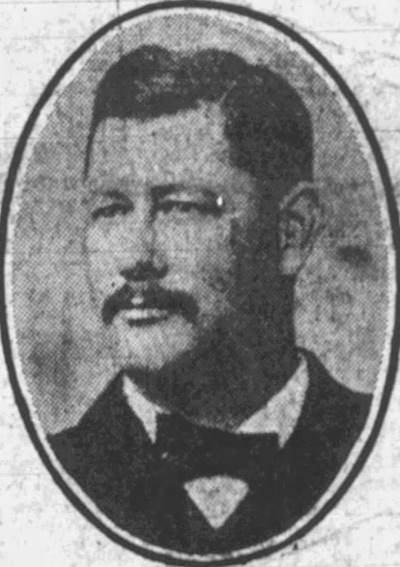
Henry C. Moffett, Camden City Detective — Camden Post-Telegram, July 1, 1905
HENRY CLAY MOFFETT, who was also often referred to in the press as Harry Moffett, was the son of Charles C. “Chauncey” Moffett, who was a member of City Council in 1876, and later janitor at Camden’s City Hall.
Henry C. Moffett was born in Philadelphia on March 19, 1858. His father brought the family to Camden around 1869, settling in a two-story frame home in the 300 block of Liberty Street, a few doors away from Memorial Methodist Protestant Church, where Boston Corbett had been pastor in 1867. The elder Moffett ran an “eating saloon.” He was also politically active, and was elected to the Camden County Board of Freeholders from the Fifth Ward in 1878. After his term as Freeholder expired, Charles C. Moffett took his family to Kansas and tried farming, but returned to Camden in short order. By the time the 1881 City Directory was compiled, the family was back on Liberty Street. Charles C. Moffett and family are shown at 306 Liberty Street up to 1878, in Kansas in the 1880 Census, and at 304 Liberty Street from 1881 through 1887. This may have been the same house or Moffett may have owned both properties, as Sanborn maps show that the house numbering was irregular in the 1870s and 1880s.
Henry C. Moffett worked for a time at the C.B. Coles lumber yard, then, in 1885, started his own lumber business in partnership with William Shivers, at 55–67 Delaware Avenue. He is listed in City Directories at 308 Chestnut Street from 1884 through 1888. The partnership dissolved in 1899. Henry Moffett next worked for the Public Service gas and electric utility as a claim representative and as a detective. City Directories give his address as 602 Broadway from 1894 to 1901.
On July 1, 1905 he was appointed to the police department as a detective by Mayor Charles H. Ellis. On his first day he made an arrest, taking into custody the arsonist who set the fire that destroyed George Shimer’s textile mill at the head of North 5th Street. When George V. Murry was made the Camden Police Department’s first Black detective in 1912, from 1912 through 1919 he was partnered with Henry C. Moffett.
Henry C. Moffett was living at 304 Liberty Street when he joined the police department in 1905. The 1906 Directory has him at 266 Kaighn Avenue. He is listed at 298 Kaighn Avenue from 1907 through 1914 and at 1464 Bradley Avenue from 1915 through 1918. He then moved to 1434 Ormond Avenue, his last address.
Henry C. Moffett began having health issues around the beginning of 1918. He suffered a stroke and died several days later, on January 24, 1920 at his home at 1454 Ormond Avenue in Camden’s Parkside section.
Henry Moffett was survived by his wife, Elizabeth Grisenwaithe Moffett, and one son, Charles Moffett. He was buried at Harleigh Cemetery. She joined him on October 27, 1936. Charles died in 1942.
For City Council, Fifth Ward
Camden Post —
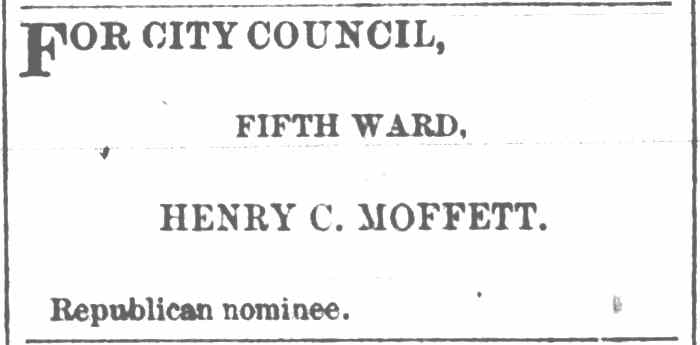
FOR CITY COUNCIL, FIFTH WARD, HENRY C. MOFFETT. Republican nominee.
Fifth Ward City Council Election Results
Camden Post —
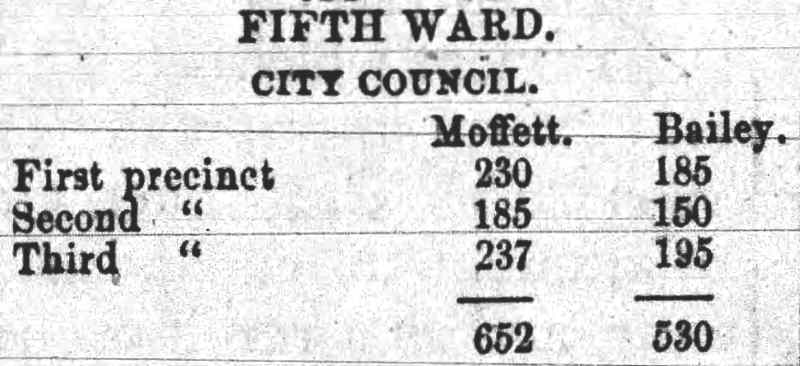
FIFTH WARD. CITY COUNCIL.
Moffett. — Bailey.
First precinct — 230 — 185
Second precinct — 185 — 160
Third precinct — 237 — 195
652 — 530
Business Change
Camden Post —
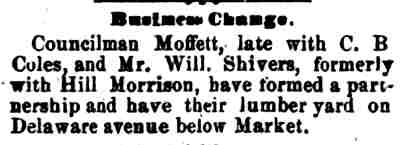
Business Change.
Councilman Moffett, late with C. B Coles, and Mr. Will. Shivers, formerly with Hill Morrison, have formed a partnership and have their lumber yard on Delaware avenue below Market.
Burglary on Liberty Street
Camden County Courier —
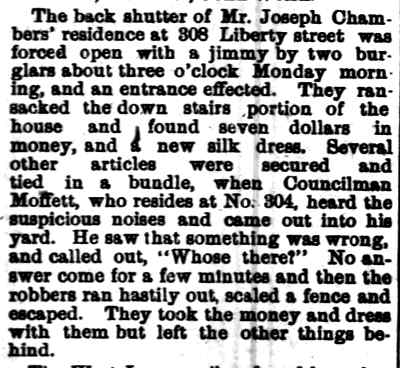
The back shutter of Mr. Joseph Chambers’ residence at 308 Liberty street was forced open with a jimmy by two burglars about three o’clock Monday morning, and an entrance effected. They ransacked the down stairs portion of the house and found seven dollars in money, and a new silk dress. Several other articles were secured and tied in a bundle, when Councilman Moffett, who resides at No. 304, heard the suspicious noises and came out into his yard. He saw that something was wrong, and called out, “Whose there?” No answer come for a few minutes and then the robbers ran hastily out, scaled a fence and escaped. They took the money and dress with them but left the other things behind.
Liberty Street — Joseph Chambers — Henry C. Moffett
History of Camden County, New Jersey (1886)
THE LUMBER-YARD of Shivers & Moffett is located on the west side of Delaware Avenue, below Market Street. It was first started in January, 1885, by the present firm, the individual members being William M. Shivers, who had been for a long time with Mr. Morrison, the lumber dealer, above Market Street, and Henry C. Moffett, late with C.B. Coles. The yard has a frontage of four hundred and fifty feet on Delaware Avenue and is one thousand five hundred feet in depth to the port warden’s line. The stock consists of all kinds of builders’ lumber. The trade extends to Pennsylvania, through Southern New Jersey and to points along the Delaware River.
History of Camden County, New Jersey by George R. Prowell, L.J. Richards & Co. — 1886
1890 Historical and Industrial Review of Camden, New Jersey
SHIVERS & MOFFETT, LUMBER, DELAWARE AVENUE
NO review of Camden’s industries would do the city’s commercial activity justice were it to fail to call attention to the importance of the lumber industry in our midst. Among the representative houses in this department is that of Shivers & Moffett which this well-known firm established in 1885. They occupy a neatly arranged office, adjoining which is an enormous yard of 120x300 feet in dimensions half stocked with general builders’ lumber of the most approved stock excellence.
The business done is a large one and is constantly developing in consequence of the energy and aim which is put into it by its enterprising owners, who employ seven assistants in the transaction of business.
Mr. Shivers is a native of Camden County and Mr. Moffett of Philadelphia. The latter gentleman has been one of our city councilmen. Both are wide-awake and pushing merchants whose success is richly merited.
1893 Camden City Directory Advertisement
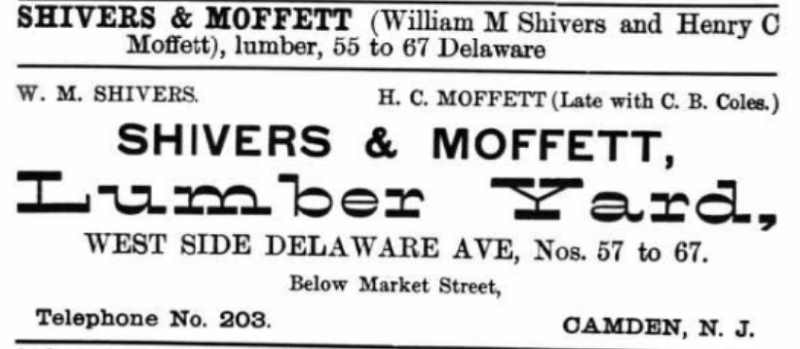
SHIVERS & MOFFETT (William M. Shivers and Henry C. Moffett), lumber, 55 to 67 Delaware
W. M. SHIVERS. — H. C. MOFFETT (Late with C. B. Coles.)
SHIVERS & MOFFETT, Lumber Yard,
WEST SIDE DELAWARE AVE, Nos. 57 to 67.
Below Market Street,
Telephone No. 203. — CAMDEN, N. J.
The Mayor's Appointments
Camden Daily Telegram —

THE MAYOR’S APPOINTMENTS
He Announced Several This Week.
COMMISSIONERS OF INSTRUCTION.
The Old Members Re-Instated With the Exception of the Member From the Seventh Ward—Police Appointments and Resignations.
Mayor Wood made the following appointments as Commissioners of Instruction:
The following appointments were made: First Ward—George D. Borton, of the First Ward; Charles H. Ellis, Jr., of the Sixth ward, and John L. Westcott, of the Third ward.
The following appointments were made on the police force:
First Ward—James Elberson, Charles Wilbur, Samuel H. Sheer.
Second Ward—No appointments.
Third Ward—John Sinclair, E. D. Stein.
Fourth Ward—No appointments.
Fifth Ward—Albert Shaw, Charles Fitzsimmons.
Sixth Ward—Abraham Jackson.
Seventh Ward—Alfred Sayres, Edward Hyde.
Eighth Ward—Thomas Buchanan, Jacob A. Hicks (colored).
Ninth Ward—No appointments.
Mayor Westcott has requested the resignation of all the members of the police force who served under the Police Commission, to take effect May 1. They are Policemen Peall, Horner, Painter, Mullane, Miller and Reed.
POLITICAL POINTERS.
Who will be the postmaster?
Who will be the next prosecutor?
Many of the ward workers are suffering from election colds.
The name of Harry Moffitt was left out of the columns of honorable mention with the other hustlers of election day.
Senator Rogers and Messrs. Stafford and Watson, of the House are fully coming up to the expectations of their constituents.
If the Mayor could arrange it to hold his hearings a trifle earlier it would be a great source of satisfaction to the Camden afternoon papers.
There is still great anxiety on the part of the public as to the outcome of the present session of the legislature. Thus far their public acts have been highly commendable.
The abolishment of the Police Justice act restores to office the City Recorder, Benjamin M. Braker, who would be qualified to act in place of the Mayor should the Chief Executive be taken sick.
Jos. Potter, the new member of Council from the First ward is a man of wide business experience and will prove much advantage to the many large financial interests that will come under his care.
Owing to the satisfactory working of the present school commission in the two second-class counties up the State, the legislature made no change in the mode of placing the members as was anticipated.
Jos. B. Fox, of the Fourth ward, is what might be termed an old reliable, having had a long and varied experience in public affairs. He is always conservative in the expenditure of city money. He is always safe to trust.
Charles Sayrs, of the Seventh ward, who had a short experience in the present Council, but enough to make him feel at home among public affairs, is neck and ears in work between his real estate business and Councilmanic duties.
The colored people of the lower section of the city are anxious to see Squire Drake, the ex-Republican and ex-member of the School Board, come out of the Court House, where he holds a position under the Thompson Freeholders.
“Father” Figner is a proud sire. He was a member and president of Council in his days, and now sees his son treading in his footsteps. Mr. Figner, Jr., having been sent to Council from the Sixth ward on Tuesday by a large majority.
A special election will not be necessary for the new Board of Freeholders, as the City Council and Township Committees will appoint Freeholders who will serve until the Spring of 1895. The appointments will be made about the middle of May.
Arthur Bedell is spoken of as a candidate for the presidency of the new City Council. He is a stalwart and is never afraid to define his position on all public questions. He is one of those men who makes strong, warm friends and also creates an opposition of like force.
William D. Brown, the Secretary of the Board of Education, and Fred A. Rex, Treasurer, are quite pleased over the report of the committee on accounts and Expert O’Shaughnessy, they having examined the books of Messrs. Rex and Brown and found them correctly kept.
The library of the Camden public schools is one to be highly appreciated and much is due to the care with Miss Blowe the librarian has attended to her duties. She will hold over another year and should be allowed to retain the office as long as she merits it, and she surely does now.
J. R. Carson, the retiring member of Council from the First ward, is highly spoken of by his associates on committees and by Clerk Varney for the mature judgment displayed in the management of city affairs. It is with a general expression of regret that the city is to lose his service.
The reform in the Board of Freeholders can’t come too soon. If the public is to judge of the care of property given by the Democrats in the county, by the “hog combine” in this city, an inventory of the public property when turned over will make interesting reading. Ex-officials guarantee to save enough in the Board, if returned to their offices, to pay the expense of a special election, if one was necessary.
W. J. Bradley has been asked if he was a candidate for president of the new City Council. His reply was that he had not sought it in the first place, and would not seek it now, but whether he became president or remained merely a member on the floor, he would endeavor to discharge his duties in the interests of the city. He is commended by all who came in contact with him during the past year as one who had a new Camden at heart.
Photos
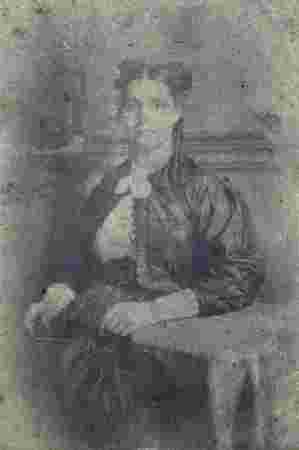
Susan Moffett, wife of Charles C. Moffett
Funeral of Mrs. Moffett
Camden Daily Telegram —
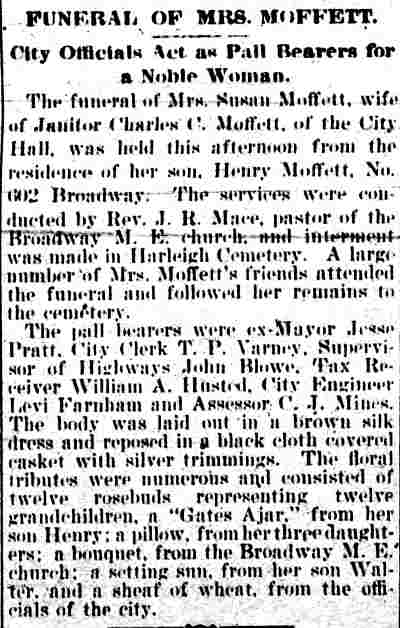
FUNERAL OF MRS. MOFFETT.
City Officials Act as Pall Bearers for a Noble Woman.
The funeral of Mrs. Susan Moffett, wife of Janitor Charles C. Moffett, of the City Hall, was held this afternoon from the residence of her son, Henry Moffett, No. 602 Broadway. The services were conducted by Rev. J. R. Mace, pastor of the Broadway M. E. church, and interment was made in Harleigh Cemetery. A large number of Mrs. Moffett’s friends attended the funeral and followed her remains to the cemetery.
The pall bearers were ex-Mayor Jesse Pratt, City Clerk T. P. Varney, Supervisor of Highways John Blowe, Tax Receiver William A. Husted, City Engineer Levi Farnham and Assessor C. J. Mines. The body was laid out in a brown silk dress and reposed in a black cloth covered casket with silver trimmings. The floral tributes were numerous and consisted of twelve rosebuds representing twelve grandchildren, a “Gates Ajar,” from her son Henry; a pillow, from her three daughters; a bouquet, from the Broadway M. E. church; a setting sun, from her son Walter, and a sheaf of wheat, from the officials of the city.
Funeral of Mrs. Moffett
Camden Post —
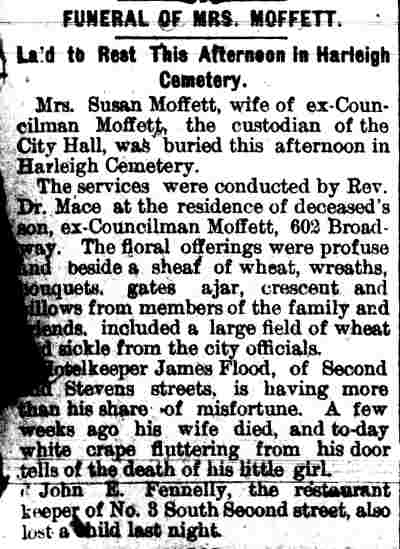
Named: Henry C. Moffett, Broadway, Rev. J.R. Mace, Charles C. Moffett, James Flood, John E. Fennelly, Stevens Street, and South 2nd Street.
Charles C. Moffett
Camden Daily Courier —
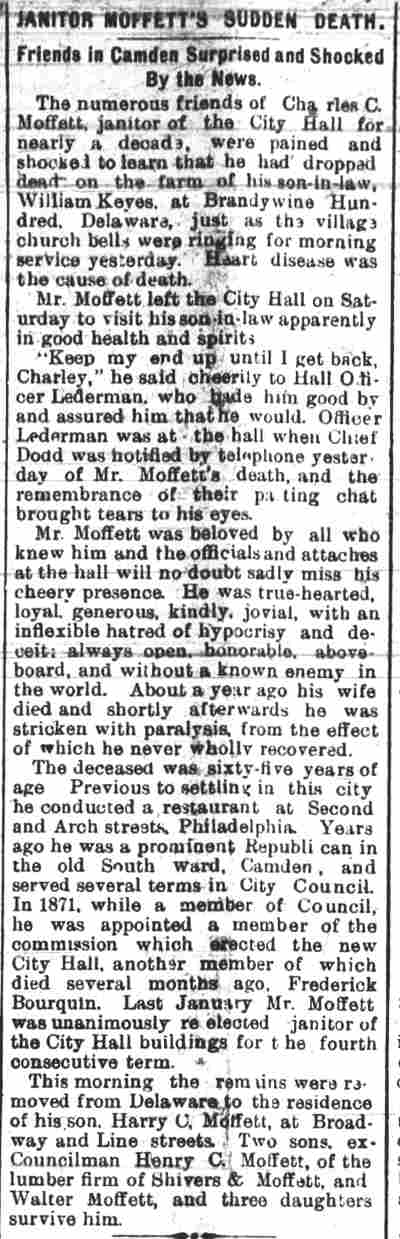
Named: Charles C. Moffett, Charles Lederman, Frederick Bourquin, William Keyes, Walter Moffett, and Henry C. Moffett.
Charles C. Moffett
Camden Post —
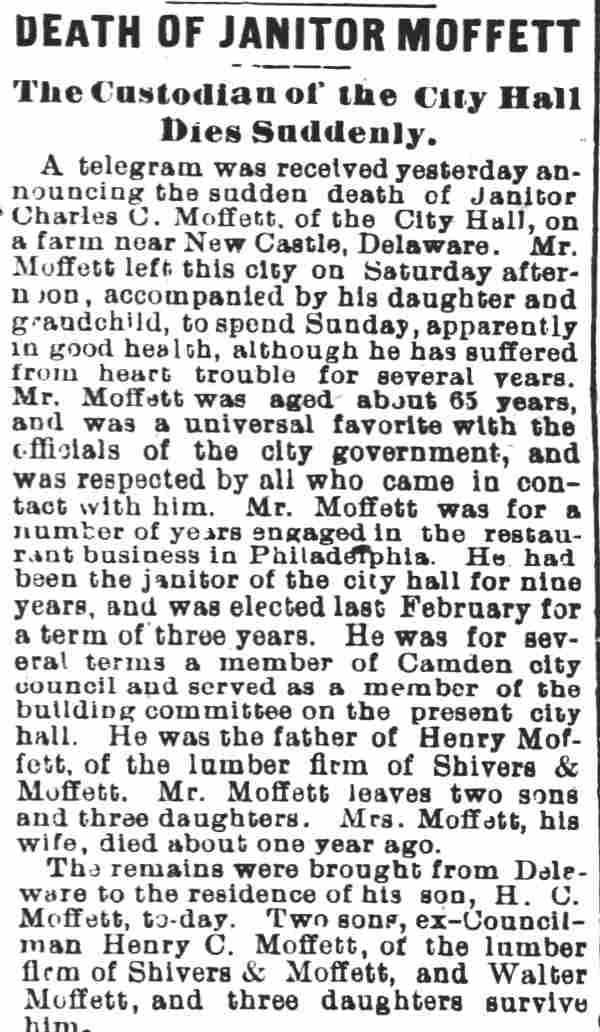
Walter Moffett — Henry C. Moffett
Camden Daily Telegram — December 8, 1897
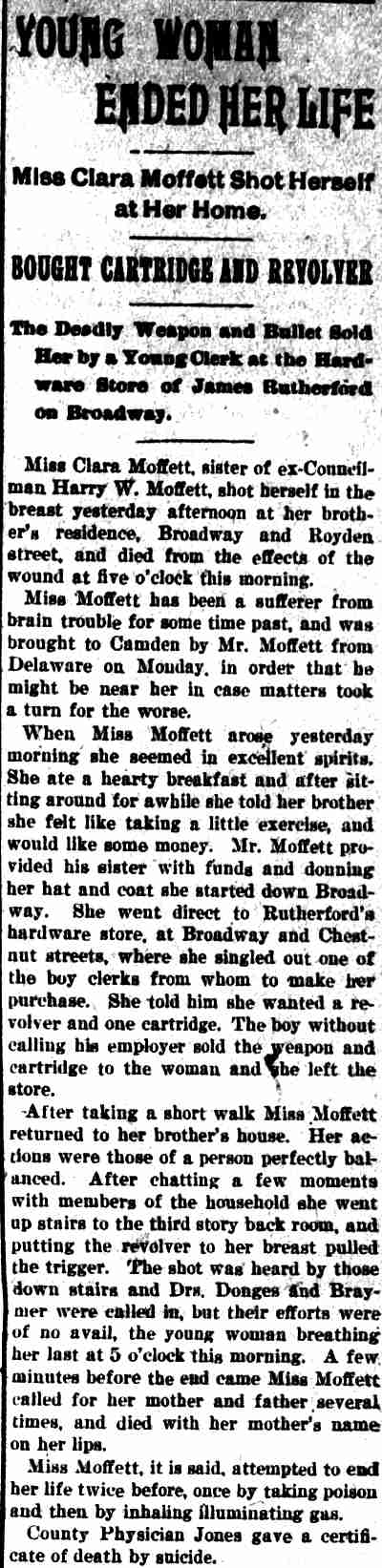
Named: Henry C. Moffett, Clara Moffett, Dr. John W. Donges, Dr. O.W. Braymer, Dr. William S. Jones, James Rutherford, Rutherford’s Hardware, and 1100 Broadway.
Side-Splitting Farce Goes On
Camden Daily Telegram —
SIDE-SPLITTING FARCE GOES ON
Chairman Burrough Did Not Sit With the Committee.
HE IS SAID TO BE DISGUSTED
Additional Charges Against Policemen, But the Witnesses Fail to Substantiate the Specifications Made by Office Seekers.
The Police Committee of City Council, last night, resumed the hearings of the charges against the policemen. The Council chamber was again crowded with prospective policemen and office seekers of all descriptions. Chairman Burroughs of the committee was absent and it was stated that he was disgusted at the manner in which the farce is being carried on. The other two members of the committee were present and Mr. Silvers, the Third ward statesman, acted as chairman. He was flanked on the right by His Honor, the Mayor. Previous to the hearings the Mayor heard some suggestions from his new adviser, who is William H. Sparks, of kidney cure fame, and a Democrat who had been an office seeker in the Democratic party for a number of years. Dr. “Mark Hanna” Davis for some reason or other is not participating in the deliberation of the Reformers. It is said that he is disgusted and was heard to make the remark that there are but two political parties, the Republican and Democratic, and he did not believe in Reform.
E. G. C. Bleakley, after some delay, moved the charges against Policeman Bond. Officer Bond was charged by ex-Policeman “Ikey” Shreeve with being asleep in the post office building on March 15, and also with leaving his post of duty.
The first witness called was the complainant, and he testified that on the morning in question he found Policeman Bond asleep in the post office building, about 4 o’clock. The witness fixed the time by a man on the street asking him the hour. He knew he was asleep from the fact that he heard him snoring.
Policeman Bond, in his own defense, admitted going into the post office to light his pipe, but denied being asleep. He stated that he did not see Mr. Shreeve, but saw Constable Voight.
John Hefferan was called, and testified that on the morning in question he was with Policeman Bond about 6 o’clock on Federal street.
Irving L. Buckle, a newspaper carrier, testified that he saw Bond on Federal street between half-past 3 and 4 o’clock.
Thomas A. Stockham also testified that he saw Officer Bond on the morning in question about 3 o’clock.
Joseph Robinson, night watchman at the post office, said that he never saw Mr. Bond asleep in the building.
The next case that was moved was the charges against Policeman A. Lincoln James. The charge in the case was made by a young man named John J. Browning, of Cedar street, near Fifth. He charged James with being in an intoxicated condition on the morning of April 13, in the saloon of Edward McCabe, No. 900 Market street. The first witness called in this case was the complainant. He testified that he was in McCabe’s saloon and saw James there about midnight and believed him to be intoxicated. On cross-examination he said he had been drinking and that James treated him. He said that he was not an applicant for a position on the police force.
The next witness in this case was a gem. He is known as John J., alias “Limpy,” Logan, and is a familiar figure on Market street between Fourth and Sixth at all hours of the day and night. He was recently appointed as a watchman in the Water Department, by the Reform Water Committee, but his appointment was one of those which was held up by a writ of certiorari. Logan swore that he saw James in McCabe’s saloon and said the policeman had about nine drinks. He felt certain that James was intoxicated and that he was half drunk when he came into the saloon. The witness on cross examination admitted that he had plenty of beer and that they were coming at a good gait.
John Dorsey, a companion of Logan, corroborated the testimony of his bosom friend and became very indignant when asked if James did not treat him. He said that he had been drinking and paid for all he got.
Policeman James admitted that he was in McCabe’s saloon on the date mentioned. He said he had been in Stockton and arrived at McCabe’s about midnight and while there he had four glasses of beer.
Edward McCabe, the proprietor of the saloon, testified that James was in his place about midnight, but denied that he was intoxicated.
I. Newton Hillman and Hilton Taylor also testified to seeing James and were positive that he was not in an intoxicated condition.
The charges against Policemen Elwyn Steen and William Comley were then taken up. Both of the men were charged with the same offense and were placed on trial together. Lawyer Grey opposed to going to trial without Comley being present as he said he had been informed that he was sick.
Mr. Bleakley opposed his motion and said that Comley was seen in the corridor of the hall early in the evening.
The committee decided to go on with the hearing.
The charge in this case was made by Thomas Neville who swore that both of the policemen were seen to enter the office of Messrs. Shivers & Moffett, on the morning of May 6, at 12.15, and that they remained there until 1.30 a. m.
Counsel for Policeman Steen admitted that his client was in the office of Shivers & Moffett on the date specified, but denied that he remained as long as was charged.
Policeman Steen was put on the stand and testified that on the morning of May 6 he met Policeman Comley, who informed him that he believed there was some person in the office of Shivers & Moffett and Comley asked him to go with him. He said that when they reached the office they found a window open. They then made a search of the premises and also the lumber yard. He testified that the place had been frequently robbed and that Messrs. Shivers & Moffett had furnished Policeman Comley with a key, for the purpose of going through the place.
Henry Moffett, a member of the firm of Shivers & Moffett, testified that the firm had furnished a key to Policeman Comley.
At this juncture Mr. Bleakley went through the crowd and finally landed ex-Excise Commissioner Jacob Gnang on the stand. He said that he knew Policeman Comley and saw him standing in the corridor of the Hall early in the evening.
After considerable delay, occasioned by a conference, between the committee, Mayor Hatch, Acting City Clerk Kramer and Lawyer Bleakley, the committee decided not to take up any more charges and adjourned the hearings until to-morrow night.
As soon as Mayor Hatch reached the Police Department he ordered Chief Dodd to suspend Policeman Comley.
No decisions were given in the other cases.
Suspected of Starting a Blaze in the Lumber District
Camden Post —

Named: Henry C. Moffett, Shivers & Moffett, and Lumber District.
Shivers & Moffett
Camden Daily Courier —
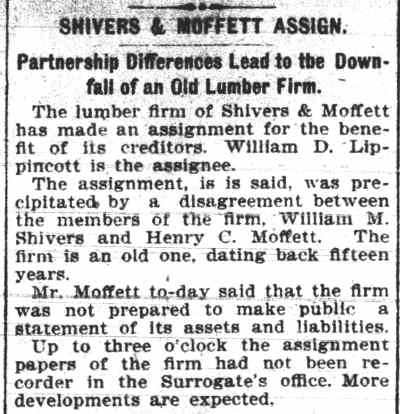
Named: Shivers & Moffett, William M. Shivers, and Henry C. Moffett.
Police Take a Hand at the Primaries
Philadelphia Inquirer —
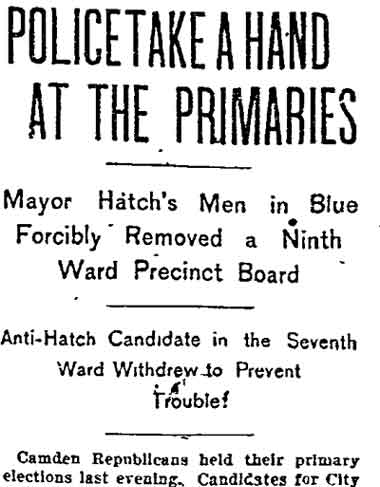
Mayor Hatch’s Men in Blue Forcibly Removed a Ninth Ward Precinct Board
Anti-Hatch Candidate in the Seventh Ward Withdrew to Prevent Trouble!
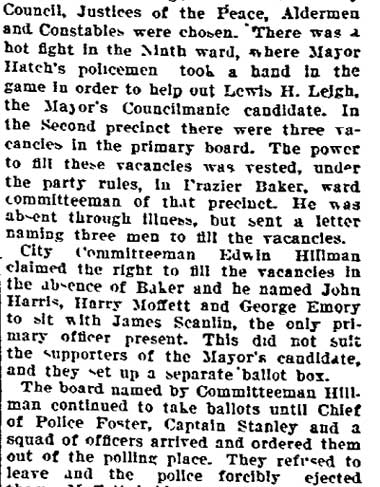
Camden Republicans held their primary elections last evening. Candidates for City Council, Justices of the Peace, Aldermen and Constables were chosen. There was a hot fight in the Ninth ward, where Mayor Hatch’s policemen took a hand in the game in order to help out Lewis H. Leigh, the Mayor’s Councilmanic candidate. In the Second precinct there were three vacancies in the primary board. The power to fill these vacancies was vested, under the party rules, in Frazier Baker, ward committeeman of that precinct. He was absent through illness, but sent a letter naming three men to fill the vacancies.
City Committeeman Edwin Hillman claimed the right to fill the vacancies in the absence of Baker and he named John Harris, Harry Moffett and George Emory to sit with James Scanlin, the only primary officer present. This did not suit the supporters of the Mayor’s candidate, and they set up a separate ballot box.
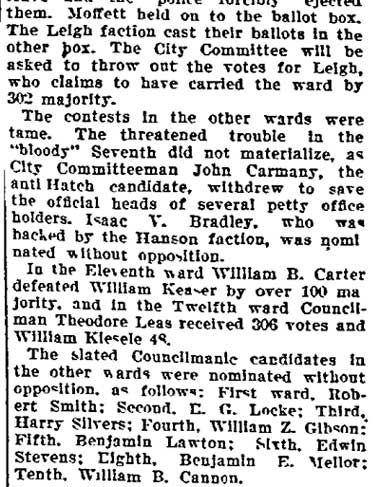
The board named by Committeeman Hillman continued to take ballots until Chief of Police Foster, Captain Stanley and a squad of officers arrived and ordered them out of the polling place. They refused to leave and the police forcibly ejected them. Moffett held on to the ballot box. The Leigh faction cast their ballots in the other box. The City Committee will be asked to throw out the votes for Leigh, who claims to have carried the ward by 302 majority.
The contests in the other wards were tame. The threatened trouble in the “bloody” Seventh did not materialize, as City Committeeman John Carmany, the anti Hatch candidate, withdrew to save the official heads of several petty office holders. Isaac V. Bradley, who was backed by the Hanson faction, was nominated without opposition.
In the Eleventh ward William B. Carter defeated William Keaser by over 100 majority, and in the Twelfth ward Councilman Theodore Leas received 306 votes and William Klesele 48.
The slated Councilmanic candidates in the other wards were nominated without opposition, as follows: First ward, Robert Smith; Second, E. G. Locke; Third, Harry Silvers; Fourth, William Z. Gibson; Fifth, Benjamin Lawton; Sixth, Edwin Stevens; Eighth, Benjamin E. Mellor; Tenth, William B. Cannon.
Philadelphia Inquirer — July 1, 1905
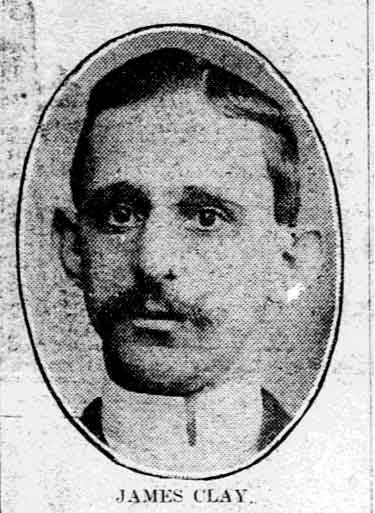
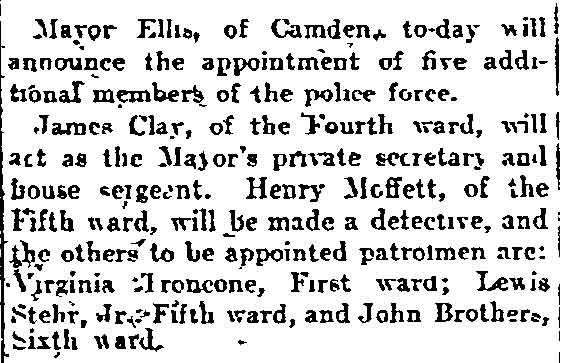
Named: Charles H. Ellis, James Clay, Henry C. Moffett, Fiore Troncone, Lewis Stehr Jr., and John Brothers.
Detective Moffett Begins His Duties
Camden Post-Telegram —
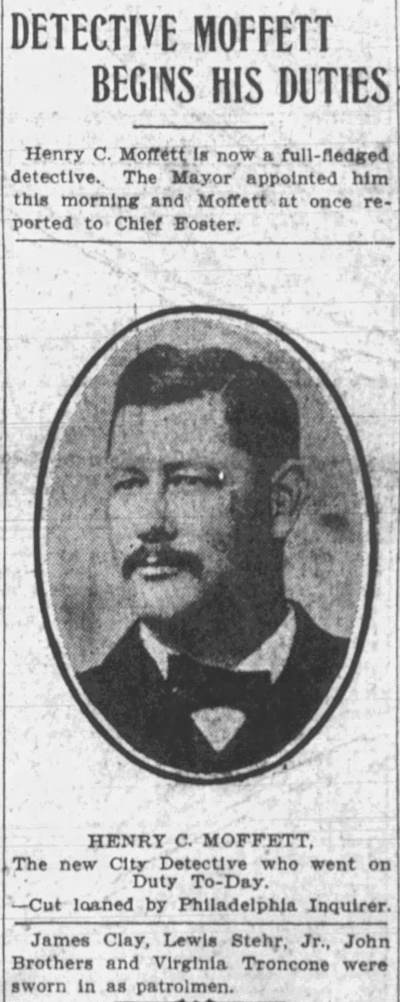
Henry C. Moffett is now a full-fledged detective. The Mayor appointed him this morning and Moffett at once reported to Chief Foster.
HENRY C. MOFFETT, The new City Detective who went on Duty To-Day. —Cut loaned by Philadelphia Inquirer.
James Clay, Lewis Stehr, Jr., John Brothers and Virginia Troncone were sworn in as patrolmen.
New Officers Sworn In
Philadelphia Inquirer —
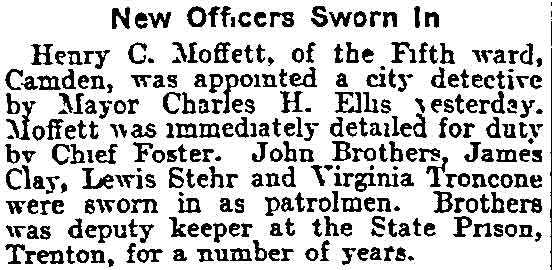
New Officers Sworn In. Henry C. Moffett, of the Fifth ward, Camden, was appointed a city detective by Mayor Charles H. Ellis yesterday. Moffett was immediately detailed for duty by Chief Foster. John Brothers, James Clay, Lewis Stehr and Virginia Troncone were sworn in as patrolmen. Brothers was deputy keeper at the State Prison, Trenton, for a number of years.
Prisoner Committed to a Charge of Arson
Camden Post-Telegram —
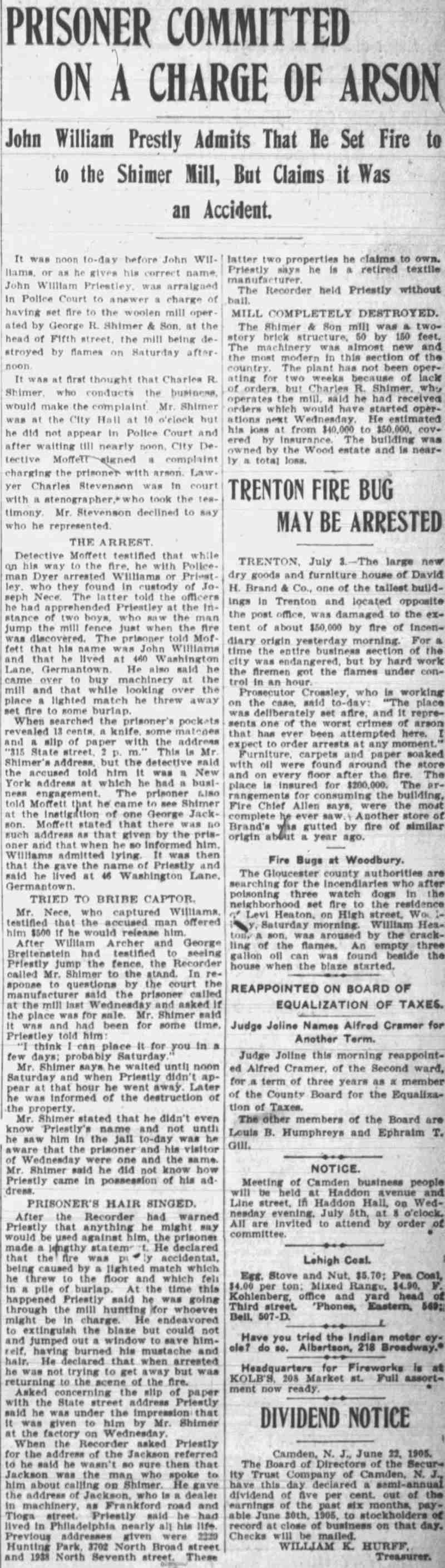
PRISONER COMMITTED TO A CHARGE OF ARSON
John William Prestly Admits That He Set Fire to the Shimer Mill, But Claims it Was an Accident.
MILL COMPLETELY DESTROYED.
TRENTON FIRE BUG MAY BE ARRESTED.
John William Prestly — Charles R. Shimer — Henry C. Moffett — Charles Stevenson — Joseph Nece — State Street — William Archer — George Breitenstien
Philadelphia Inquirer — December 9, 1905
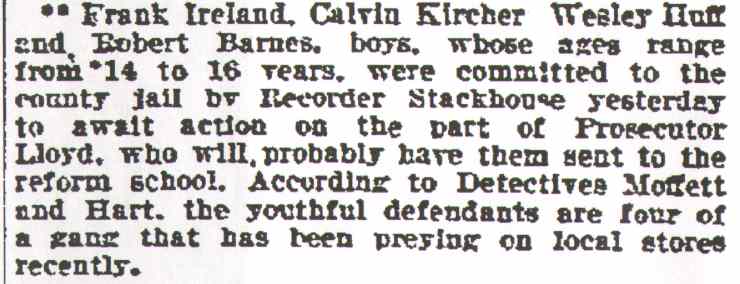
Named: Frank T. Lloyd Sr., O. Glen Stackhouse, Robert Barnes, Calvin Kircher, Wesley Huff, Frank Ireland, Henry C. Moffett, and William D. Hart.
Camden Post-Telegram — January 12, 1906
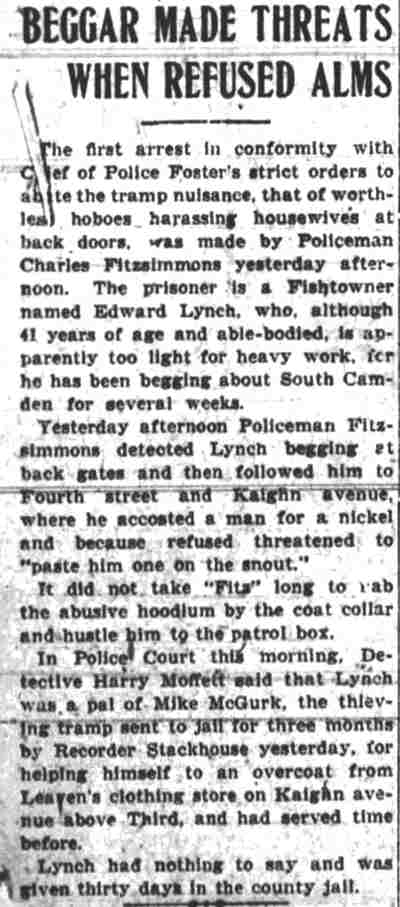
BEGGAR MADE THREATS WHEN REFUSED ALMS
The first arrest in conformity with Chief of Police Foster’s strict orders to abate the tramp nuisance, that of worthless hoboes harassing housewives at back doors, was made by Policeman Charles Fitzsimmons yesterday afternoon. The prisoner is a Fishtowner named Edward Lynch, who, although 41 years of age and able-bodied, is apparently too light for heavy work, for he has been begging about South Camden for several weeks.
Yesterday afternoon Policeman Fitzsimmons detected Lynch begging at back gates and then followed him to Fourth street and Kaighn avenue, where he accosted a man for a nickel and because refused threatened to “paste him one on the snout.”
It did not take “Fits” long to nab the abusive hoodlum by the coat collar and hustle him to the patrol box.
In Police Court this morning, Detective Harry Moffett said that Lynch was a pal of Mike McGurk, the thieving tramp sent to jail for three months by Recorder Stackhouse yesterday, for helping himself to an overcoat from Leaven’s clothing store on Kaighn avenue above Third, and had served time before.
Lynch had nothing to say and was given thirty days in the county jail.
Philadelphia Inquirer — February 25, 1906
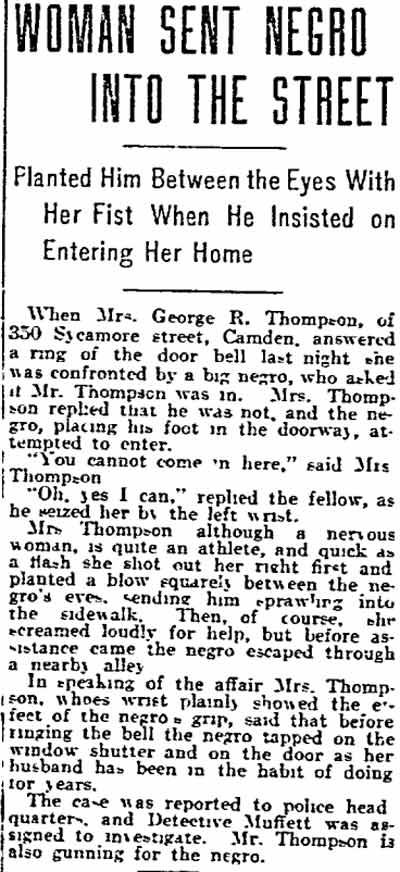
WOMAN SENT NEGRO INTO THE STREET
Planted Him Between the Eyes With Her Fist When He Insisted on Entering Her Home
When Mrs. George R. Thompson, of 350 Sycamore street, Camden, answered a ring of the door bell last night she was confronted by a big negro, who asked if Mr. Thompson was in. Mrs. Thompson replied that he was not, and the negro, placing his foot in the doorway, attempted to enter.
“You cannot come in here,” said Mrs. Thompson.
“Oh, yes I can,” replied the fellow, as he seized her by the left wrist.
Mrs. Thompson although a nervous woman, is quite an athlete, and quick as a flash she shot out her right first and planted a blow squarely between the negro’s eyes, sending him sprawling into the sidewalk. Then, of course, she screamed loudly for help, but before assistance came the negro escaped through a nearby alley.
In speaking of the affair Mrs. Thompson, whoes wrist plainly showed the effect of the negro’s grip, said that before ringing the bell the negro tapped on the window shutter and on the door as her husband has been in the habit of doing for years.
The case was reported to police headquarters, and Detective Muffett was assigned to investigate. Mr. Thompson is also gunning for the negro.
Philadelphia Inquirer — May 27, 1906
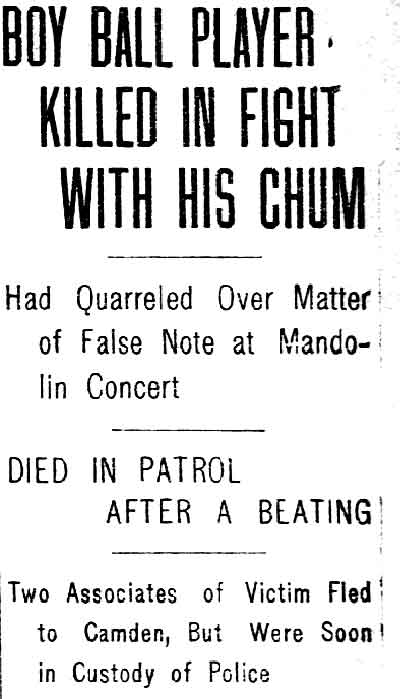
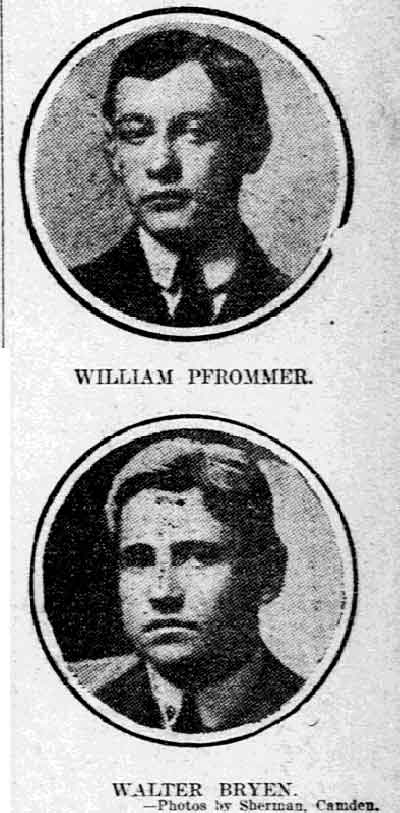
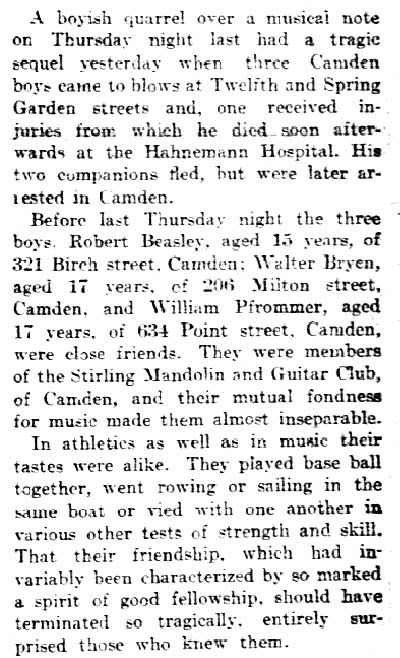
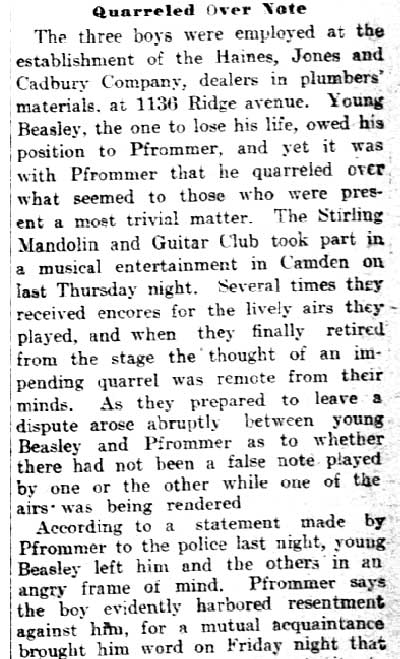
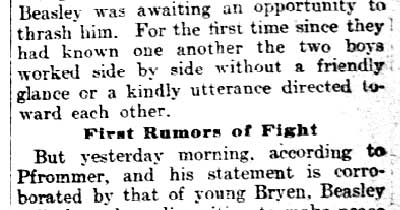
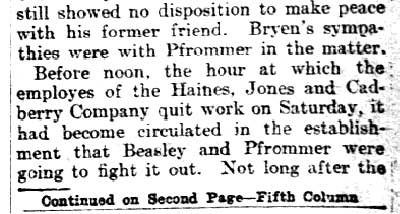
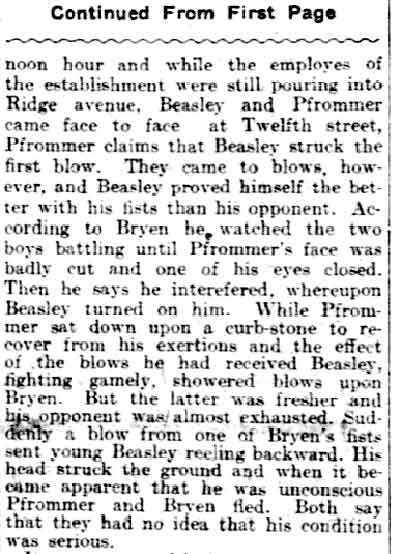
Named: William Pfrommer, Walter Bryen, Robert Beasley, James McDonald, Theodore Forgeng, Birch Street, Milton Street, Point Street, North 24th Street, North 25th Street, River Avenue, State Street, Henry C. Moffett, William D. Hart, John Painter, North 29th Street, and Garfield Avenue.
Trenton Evening Times — July 28, 1909
Named: William Knight, Henry C. Moffett, and Elbridge B. McClong.
Philadelphia Inquirer — September 2, 1909
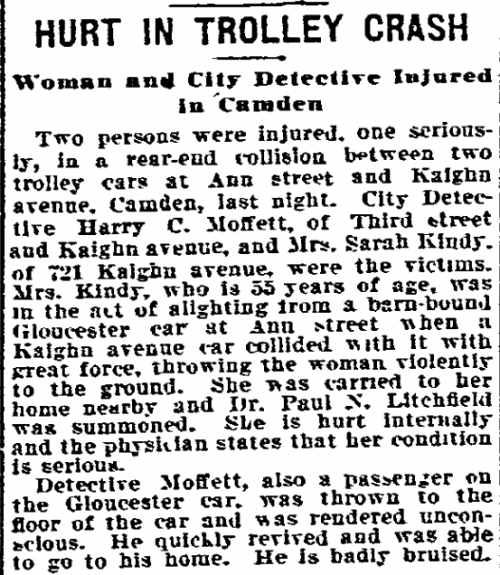
Named: Ann Street, Kaighn Avenue, Sarah Kindy, Henry C. Moffett, and Dr. Paul N. Litchfield.
Shots Fly After Fleeing Suspect
Camden Post-Telegram —
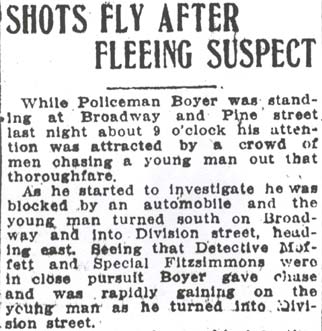
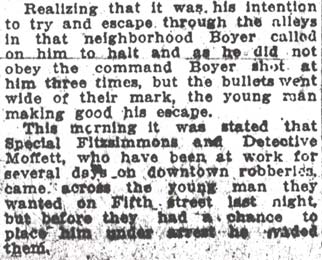
SHOTS FLY AFTER FLEEING SUSPECT
While Policeman Boyer was standing at Broadway and Pine street last night about 9 o’clock his attention was attracted by a crowd of men chasing a young man out that thoroughfare. As he started to investigate he was blocked by an automobile and the young man turned south on Broadway and into Division street, heading east. Seeing that Detective Moffett and Special Fitzsimmons were in close pursuit Boyer gave chase and was rapidly gaining on the young man as he turned into Division street.
Boy's Brutal Murderer Collapses at Hearing
Camden Post-Telegram —
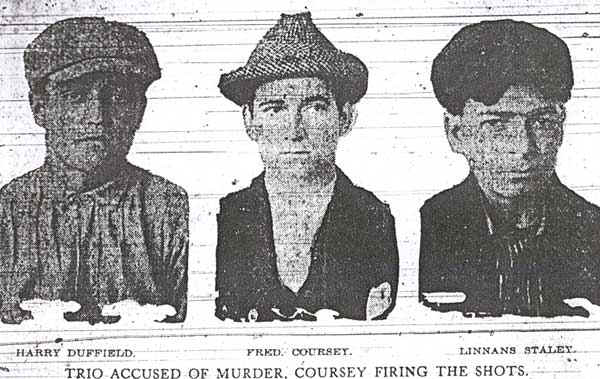
Trio Accused of Murder. Coursey Firing the Shots.
Coursey Breaks Down While Story of Cold-Blooded Killing of Karl Kellmann Is Told by Detective.
Two “Pals,” Too, Accused of Crime
Collapsing when arraigned in Police Court this morning before Recorder Stackhouse on the charge of killing Karl Kellmann, aged 18 years, of 2919 High street, at Twenty-seventh and Sherman streets, shortly before midnight Saturday, Fred Coursey, alias “Mexican Pete,” alias “Cowboy Pete,” aged 20 years, of 121 North Twenty-first street, who admits firing the fatal shots while committing robbery, and Harry Duffield, aged 21 years, of 407 North Forty-first street, who acknowledged masking his face with a handkerchief and being with Coursey, sobbed piteously, resting their heads on the railing of the dock, while John Painter, the veteran detective, was briefly reciting the story.
When Recorder Stackhouse asked what became of the young man who was shot and Painter replied that he died, Coursey and Duffield sobbed afresh, and when Recorder Stackhouse committed them without bail Policemen Frost and Kay had to help them.
Linnans Staley, aged 21 years, of 1819 Federal street, who confessed that he was in the robbery plot but later got scared and hid in the bushes, was scarcely able to stand, and when his mother broke down as he was committed as a principal he staggered and would have fallen but for Sergeant McClong.
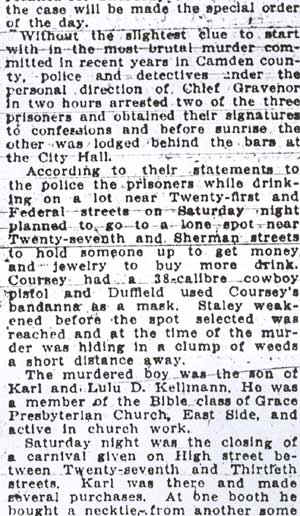
Prosecutor Boyle announced this morning that the Grand Jury will be recalled for Thursday of this week and the case will be made the special order of the day.
Without the slightest clue to start with in the most brutal murder committed in recent years in Camden county, police and detectives under the personal direction of Chief Gravenor in two hours arrested two of the three prisoners and obtained their signatures to confessions and before sunrise the other was lodged behind the bars at the City Hall.
According to their statements to the police the prisoners while drinking on a lot near Twenty-first and Federal streets on Saturday night planned to go to a lone spot near Twenty-seventh and Sherman streets to hold someone up to get money and jewelry to buy more drink. Coursey had a 38-calibre cowboy pistol and Duffield used Coursey’s bandanna as a mask. Staley weakened before the spot selected was reached and at the time of the murder was hiding in a clump of weeds a short distance away.
The murdered boy was the son of Karl and Lulu D. Kellmann. He was a member of the Bible class of Grace Presbyterian Church, East Side, and active in church work.
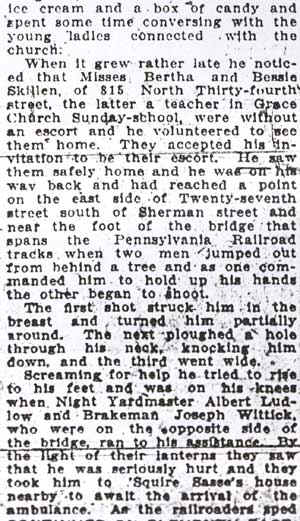
Saturday night was the closing of a carnival given on High street between Twenty-seventh and Thirtieth streets. Karl was there and made several purchases. At one booth he bought a necktie, from another some ice cream and a box of candy and spent some time conversing with the young ladies connected with the church.
When it grew rather late he noticed that Misses Bertha and Bessie Skillen, of 815 North Thirty-fourth street, the latter a teacher in Grace Church Sunday-school, were without an escort and he volunteered to see them home. They accepted his invitation to be their escort. He saw them safely home and he was on his way back and had reached a point on the east side of Twenty-seventh street south of Sherman street and near the foot of the bridge that spans the Pennsylvania Railroad tracks when two men jumped out from behind a tree and as one commanded him to hold up his hands the other began to shoot.
The first shot struck him in the breast and turned him partially around. The next ploughed a hole through his neck, knocking him down, and the third went wide.
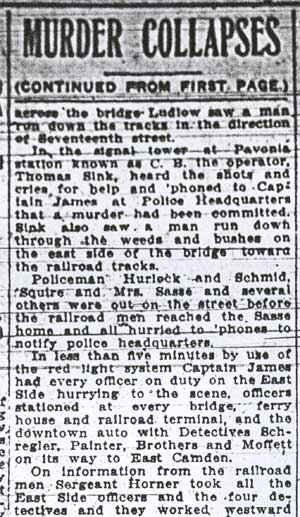
Screaming for help he tried to rise to his feet and was on his knees when Night Yardmaster Albert Ludlow and Brakeman Joseph Wittick, who were on the opposite side of the bridge, ran to his assistance. By the light of their lanterns they saw that he was seriously hurt and they took him to ‘Squire Sasse’s house nearby to await the arrival of the ambulance. As the railroaders sped across the bridge Ludlow saw a man run down the tracks in the direction of Seventeenth street.
In the signal tower at Pavonia station known as C. B. the operator, Thomas Sink, heard the shots and cries for help and ‘phoned to Captain James at Police Headquarters that a murder had been committed. Sink also saw a man run down through the weeds and bushes on the east side of the bridge toward the railroad tracks.
Policeman Hurlock and Schmid, ‘Squire and Mrs. Sasse and several others were out on the street before the railroad men reached the Sasse home and all hurried to ‘phones to notify police headquarters.
In less than five minutes by use of the red light system Captain James had every officer on duty on the East Side hurrying to the scene, officers stationed at every bridge, ferry house and railroad terminal, and the downtown auto with Detectives Schregler, Painter, Brothers and Moffett on its way to East Camden.
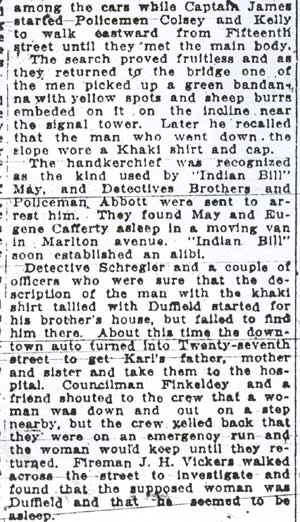
On information from the railroad men Sergeant Horner took all the East Side officers and the four detectives and they worked westward among the cars while Captain James started Policemen Colsey and Kelly to walk eastward from Fifteenth street until they met the main body.
The search proved fruitless and as they returned to the bridge one of the men picked up a green bandanna with yellow spots and sheep burrs embedded on it on the incline near the signal tower. Later he recalled that the man who went down the slope wore a Khaki shirt and cap.
The handkerchief was recognized as the kind used by “Indian Bill” May, and Detectives Brothers and Policeman Abbott were sent to arrest him. They found May and Eugene Cafferty asleep in a moving van in Marlton avenue. “Indian Bill” soon established an alibi.
Detective Schregler and a couple of officers who were sure that the description of the man with the khaki shirt tallied with Duffield started for his brother’s house, but failed to find him there. About this time the downtown auto turned into Twenty-seventh street to get Karl’s father, mother and sister and take them to the hospital. Councilman Finkeldey and a friend shouted to the crew that a woman was down and out on a step nearby, but the crew yelled back that they were on an emergency run and the woman would keep until they returned. Fireman J. H. Vickers walked across the street to investigate and found that the supposed woman was Duffield and that he seemed to be asleep.
Vickers shook him and as he got up he said something about the shooting that aroused Vickers’ curiosity and he ‘phoned to Police Headquarters. Captain James immediately notified Chief Gravenor, who was on the scene and the latter sent Detective Moffett to investigate. When Moffett arrived he learned that Duffield had taken a Westfield avenue car. Moffett returned to the bridge and he and Detective Painter and Chief Gravenor took the down-town auto for Duffield’s home.
Painter went to the front door and saw Duffield in the act of taking off his shoes. Moffett in going around to the back door to prevent his escape that way passed by the window at which Duffield was sitting.
Grasping Duffield by the collar Moffett pulled him through the window to the ground. As soon as he landed on his feet, according to the Chief and detectives, Duffield said that Coursey did the shooting.
Placing him in the auto they next drove close to Coursey’s home and with Policeman Potter who knew the man wanted, the detectives entered the house with drawn revolvers while other officers guarded all avenues of escape.
Coursey was found awake on a cot and while he was covered with revolvers Detective Painter searched his trunk and found the weapon that he later admitted using. It was empty. The detectives late yesterday afternoon found three used shells adjoining the house near a spot where Coursey said he had thrown them.
In order to keep the men apart they were taken to the City Hall separately and questioned and after they decided to tell all Sergeant E. B. McClong reduced their statements to writing and they signed them. It was on the strength of these statements that Staley was arrested.
Young Kellmann was taken into the hospital at 12.20 a. m. Chief Surgeon Schellenger saw at a glance that there was no hope for him and so notified Captain James, and Sergeant McClong was sent to the hospital to get all information possible.
The unfortunate youth could only speak a few words at a time because of the hemorrhages. All Sergeant McClong was able to get from him was that he was told to hold up his hands and that the shooting instantly began. The only description he could give was that they were small men and that the attack was so sudden that he could not tell whether they were black or white.
The injured young man kept asking the doctors if he was going to die, but they did not answer. He was conscious when his father and mother arrived and then sank rapidly until the end, dying at 1.50 o’clock, 90 minutes after he was admitted. Mother and father were prostrated and were taken home by the up-town auto.
County Physician Jones conducted the autopsy yesterday morning. He said that either wound would have caused death. The bullet in the breast pierced the right lung at the top and lodged in the cavity. It is now in the doctor’s possession. The other bullet went clear through the neck.
Coursey and Duffield have been working in the Pavonia car yard. The former was born in El Paso, Texas, but has lived East nearly all his life. He is an expert shot and was a member of the vaudeville team of Coursey & Cook, according to their letter heads presenting a fifteen-minute thriller.
Duffield was only recently paroled for robbing Gallagher’s saloon, Nineteenth and Federal streets of a lot of drinkables. Staley has been arrested several times on petty charges but was never convicted of crime. When Duffield’s coat was examined at the City Hall, it was found to contain sheep burrs.
To a reporter Coursey said that whenever he was drinking he had to get his gun and shoot something or somebody. He insisted that all were in on the job and that they let the man who preceded Kellman go over the bridge without molestation because he didn’t look as if he had any too much money.
Yesterday morning Assistant Prosecutor Wolverton and Stenographer Cleary called at the City Hall. The prisoners were examined by Mr. Wolverton and their statements taken by Mr. Cleary, but there was little or nothing new elicited.
Philadelphia Inquirer — January 31, 1915
Named: Benson Street, George Murry, Henry C. Moffett, O. Glen Stackhouse, and William Burns.
Fugitive Leaps From Window
Philadelphia Inquirer —
Fugitive Leaps From Window. Taken by surprise after entering the home of John Hildebrand, at 564 North Twenty-seventh street, East Camden, Edward Finn, aged 17 years, of 2617 Howell street, leaped from the second-story window and escaped. He was arrested later by Detective Moffett and Murray and held pending a hearing before Recorder Stackhouse today. Finn told the police that after he had entered the Hildebrand house he heard someone coming upstairs and then leaped from the window. He secured $62 in cash and a gold watch and chain. He is also accused of robbing the home of Mrs. Maggie McClosky, at Second and Pine streets.
Philadelphia Inquirer — July 4, 1917
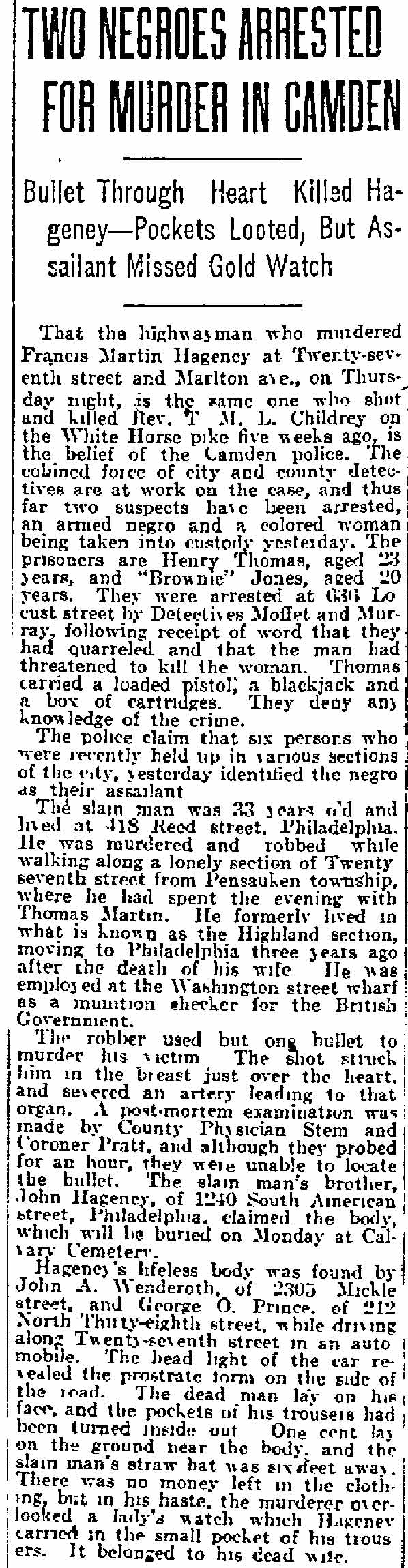
Named: George Murry, Francis Martin Hegency, South 27th Street, Marlton Avenue, Rev. T.M.L. Childrey, Henry Thomas “Brownie” Johnson, Locust Street, Henry C. Moffett, Thomas Martin, John Wenderoth, Mickle Street, and North 38th Street.
Two Sailors Convicted of Assault in Camden
Philadelphia Inquirer —
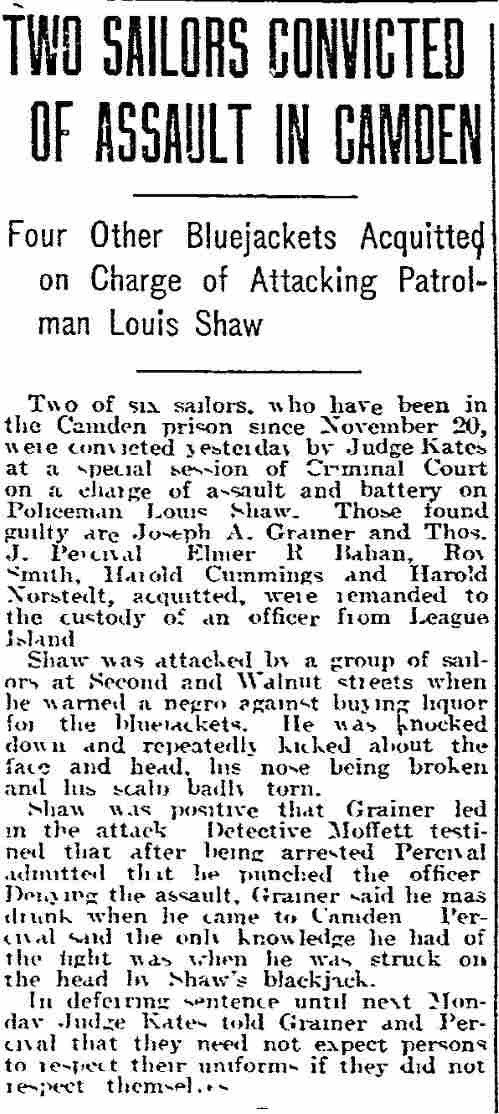
TWO SAILORS CONVICTED OF ASSAULT IN CAMDEN
Four Other Bluejackets Acquitted on Charge of Attacking Patrolman Louis Shaw
Two of six sailors, who have been in the Camden prison since November 20, were convicted yesterday by Judge Kates at a special session of Criminal Court on a charge of assault and battery on Policeman Louis Shaw. Those found guilty are Joseph A. Grainer and Thos. J. Percival. Elmer R. Bahan, Roy Smith, Harold Cummings and Harold Norstedt, acquitted, were remanded to the custody of an officer from League Island.
Shaw was attacked by a group of sailors at Second and Walnut streets when he warned a negro against buying liquor for the bluejackets. He was knocked down and repeatedly kicked about the face and head, his nose being broken and his scalp badly torn.
Shaw was positive that Grainer led in the attack. Detective Moffett testified that after being arrested Percival admitted that he punched the officer. Denying the assault, Grainer said he was drunk when he came to Camden. Percival said the only knowledge he had of the fight was when he was struck on the head by Shaw’s blackjack.
In deferring sentence until next Monday Judge Kates told Grainer and Percival that they need not expect persons to respect their uniforms if they did not respect themselves.
Philadelphia Inquirer — April 17, 1918
Taken into custody by Detectives Moffett and Murray, Thomas Hansby, a colored boy, is declared by the police to have confessed to stealing the lead fastenings from the stained glass windows at the Wynn Memorial Baptist Church.
Philadelphia Inquirer — May 27, 1918
50 TAKEN IN VICE RAIDS
Camden Determined to Get Rid of “Undesirables”
A big haul in one of the biggest number of raids were made in several parts of South Camden during yesterday morning. In the dragnet the police and detectives caught old and young, white and blacks. Police officials stated that it was another move toward ridding Camden of undesirables. Just about the time Captain of Police Lewis Stehr and other officers failed the alleged disorderly house at Louis Jackson, a years old, 811 Kossuth Street, City Detective Stanley and officers raided the home of a colored woman, at 731 Baxter Street, Sergeant Snow and officers raid Etta Shorts on Joint Alley and Robert Fish-olds at 754 on 7th Street. City Detectives Moffett and Murray arrested Mary Peoples, the old, in a raid on her house at 219 Joint Alley. More than this men and women were arrested in the raids and ordered held as prisoners for their appearance before Recorder Stackhouse this morning.
Henry C. Moffett Claimed by Death
Camden Daily Courier —
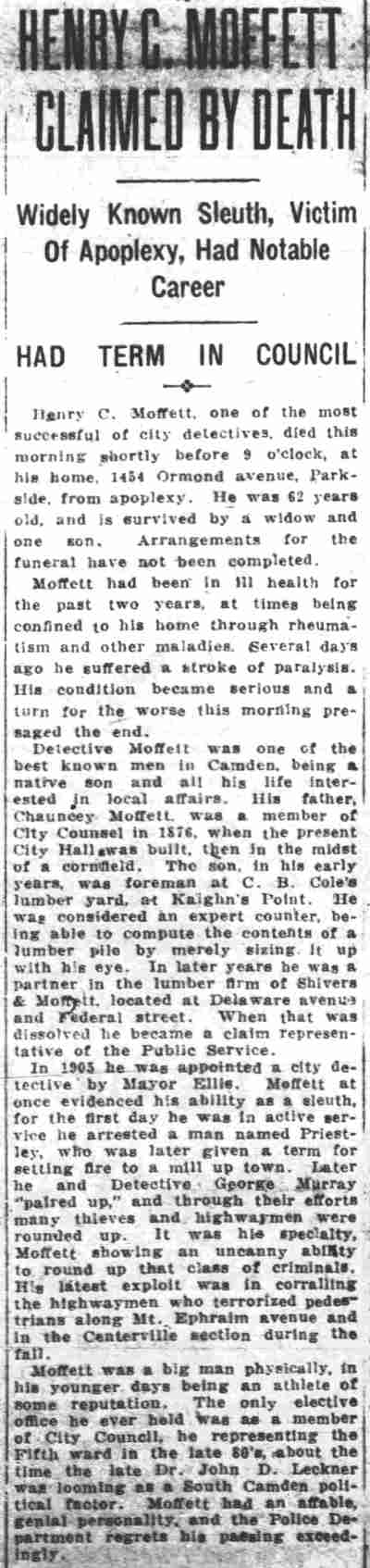
HENRY C. MOFFETT CLAIMED BY DEATH
Widely Known Sleuth, Victim Of Apoplexy, Had Notable Career
HAD TERM IN COUNCIL
Henry C. Moffett, one of the most successful of city detectives, died this morning shortly before 9 o’clock, at his home, 1454 Ormond avenue, Parkside, from apoplexy. He was 62 years old, and is survived by a widow and one son. Arrangements for the funeral have not been completed.
Moffett had been in ill health for the past two years, at times being confined to his home through rheumatism and other maladies. Several days ago he suffered a stroke of paralysis. His condition became serious and a turn for the worse this morning presaged the end.
Detective Moffett was one of the best known men in Camden, being a native son and all his life interested in local affairs. His father, Chauncey Moffett, was a member of City Council in 1876, when the present City Hall was built, then in the midst of a cornfield. The son, in his early years, was foreman at C. B. Cole’s lumber yard, at Kaighn’s Point. He was considered an expert counter, being able to compute the contents of a lumber pile by merely sizing it up with his eye. In later years he was a partner in the lumber firm of Shivers & Moffett, located at Delaware avenue and Federal street. When that was dissolved he became a claim representative of the Public Service.
In 1905 he was appointed a city detective by Mayor Ellis. Moffett at once evidenced his ability as a sleuth, for the first day he was in active service he arrested a man named Priestley, who was later given a term for setting fire to a mill up town. Later he and Detective George Murray “paired up,” and through their efforts many thieves and highwaymen were rounded up. It was his specialty, Moffett showing an uncanny ability to round up that class of criminals. His latest exploit was in corralling the highwaymen who terrorized pedestrians along Mt. Ephraim avenue and in the Centerville section during the fall.
Moffett was a big man physically, in his younger days being an athlete of some reputation. The only elective office he ever held was as a member of City Council, he representing the Fifth ward in the late 80’s, about the time the late Dr. John D. Leckner was looming as a South Camden political factor. Moffett had an affable, genial personality, and the Police Department regrets his passing exceedingly.
George V. Murry — Ormond Avenue — Charles Chauncey Moffett — Dr. John D. Leckner — Charles H. Ellis — C.B. Coles
Camden Daily Courier — January 26, 1920
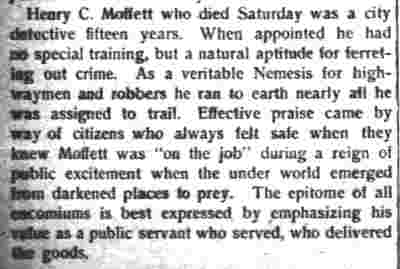
Henry C. Moffett who died Saturday was a city detective fifteen years. When appointed he had no special training, but a natural aptitude for ferreting out crime. As a veritable Nemesis for highwaymen and robbers he ran to earth nearly all he was assigned to trail. Effective praise came by way of citizens who always felt safe when they knew Moffett was “on the job” during a reign of public excitement when the under world emerged from darkened places to prey. The epitome of all encomiums is best expressed by emphasizing his value as a public servant who served, who delivered the goods.
Moffett — Funeral Notice
Camden Daily Courier —
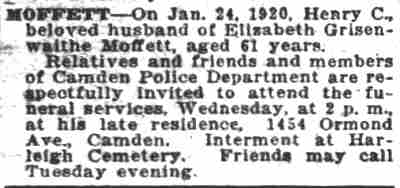
MOFFETT — On Jan. 24, 1920, Henry C., beloved husband of Elizabeth Grisenwalthe Moffett, aged 61 years. Relatives and friends and members of Camden Police Department are respectfully invited to attend the funeral services, Wednesday, at 2 p.m., at his late residence, 1454 Ormond Ave., Camden. Interment at Harleigh Cemetery. Friends may call Tuesday evening.
Mrs. Moffett Funeral Will Be Held Monday
Camden Courier-Post —
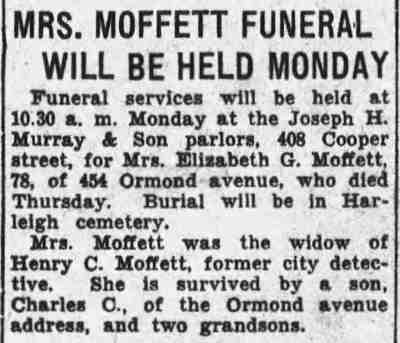
MRS. MOFFETT FUNERAL WILL BE HELD MONDAY
Funeral services will be held at 10.30 a. m. Monday at the Joseph H. Murray & Son parlors, 408 Cooper street, for Mrs. Elizabeth G. Moffett, 78, of 454 Ormond avenue, who died Thursday. Burial will be in Harleigh cemetery.
Mrs. Moffett was the widow of Henry C. Moffett, former city detective. She is survived by a son, Charles C., of the Ormond avenue address, and two grandsons.
Chas. Moffett Dies After Heart Attack
Camden Daily Courier —
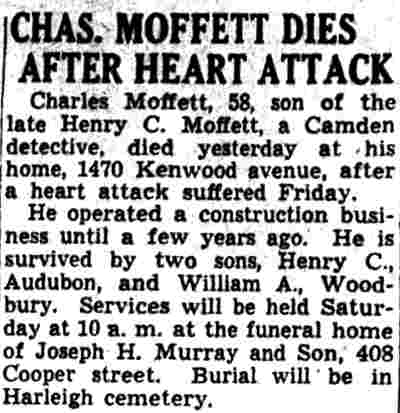
CHAS. MOFFETT DIES AFTER HEART ATTACK
Charles Moffett, 58, son of the late Henry C. Moffett, a Camden detective, died yesterday at his home, 1470 Kenwood avenue, after a heart attack suffered Friday.
He operated a construction business until a few years ago. He is survived by two sons, Henry C., Audubon, and William A., Woodbury. Services will be held Saturday at 10 a. m. at the funeral home of Joseph H. Murray and Son, 408 Cooper street. Burial will be in Harleigh cemetery.
Charles C. Moffett — Kenwood Avenue — William A. Moffett — Henry C. Moffett II