James W. Burnison
JAMES W. BURNISON was born in New York on December 16, 1889. He married his wife Minnie around 1913, and a daughter, Janet, was born in New York late in 1919. The Burnison family lived in Schenectady, NY at the time of the 1920 Census. At some point in the 1920s the family came to South Jersey. At the time of the 1930 Census the Burnison family lived in Moorestown NJ. The Burnisons later moved to Haddonfield. Through October of 1936 he worked as a vice-president for the Radio Corporation of America in Camden. He resigned his position in October of that year to open up his own consulting business.
By 1936 James W. Burnison had become president of the Camden Chamber of Commerce, and was serving on the City Commission’s advisory committee. He later returned to New York, and died in Schenectady in December of 1977. He was survived by his wife Minnie, who passed in Schenectady in 1982.
Camden Courier-Post — December 20, 1932
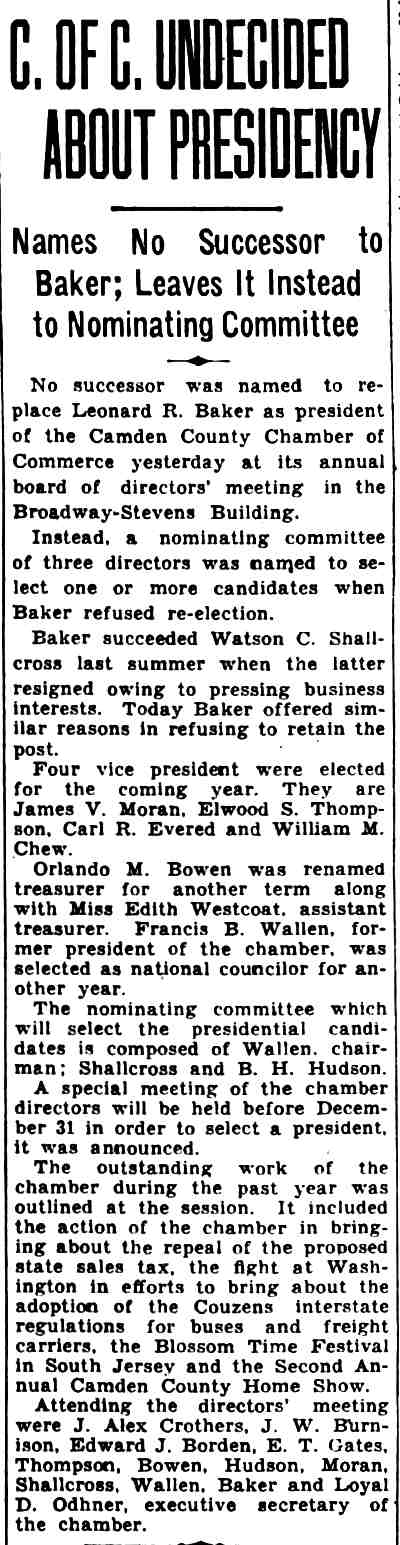
C. OF C. UNDECIDED ABOUT PRESIDENCY
Names No Successor to Baker; Leaves It Instead to Nominating Committee
No successor was named to replace Leonard R. Baker as president of the Camden County Chamber of Commerce yesterday at its annual board of directors’ meeting in the Broadway-Stevens Building.
Instead, a nominating committee of three directors was named to select one or more candidates when Baker refused re-election.
Baker succeeded Watson C. Shallcross last summer when the latter resigned owing to pressing business interests. Today Baker offered similar reasons in refusing to retain the post.
Four vice presidents were elected for the coming year. They are James V. Moran, Elwood S. Thompson, Carl R. Evered and William M. Chew.
Orlando M. Bowen was renamed treasurer for another term along with Miss Edith Westcoat, assistant treasurer. Francis B. Wallen, former president of the chamber, was selected as national councilor for another year.
The nominating committee which will select the presidential candidates is composed of Wallen, chairman; Shallcross and B. H. Hudson.
A special meeting of the chamber directors will be held before December 31 in order to select a president, it was announced.
The outstanding work of the chamber during the past year was outlined at the session. It included the action of the chamber in bringing about the repeal of the proposed state sales tax, the fight at Washington in efforts to bring about the adoption of the Couzens interstate regulations for buses and freight carriers, the Blossom Time Festival in South Jersey and the Second Annual Camden County Home Show.
Attending the directors’ meeting were J. Alex Crothers, J. W. Burnison, Edward J. Borden, E. T. Gates, Thompson, Bowen, Hudson, Moran, Shallcross, Wallen, Baker and Loyal D. Odhner, executive secretary of the chamber.
C. of C. Names Group on National Recovery
Camden Courier-Post —
C. OF C. NAMES GROUP ON NATIONAL RECOVERY
An Industrial Recovery Act Committee of the Camden County Chamber of Commerce was appointed yesterday.
A.C. Held was named chairman of the committee and immediately called a meeting for tomorrow, at 12:15 in Hotel Walt Whitman.
Other members of the committee include J.W. Burnison, Clinton L. Bardo, Harry A. Kelleher, Warren Webster, Jr., Harry C. Stevenson; T. David Stern, B. H. Hudson, Charles Wagner, A. W. Stedman, Stanley Cramer, and Loyal D. Odhner.
A study of the national recovery act passed by Congress for President Roosevelt is to be made by the committee to determine what action should be taken by Camden manufacturers and merchants toward price and wage recovery.
N.R.A. Drive Here Opens Tomorrow; Committee Named
Camden Courier-Post —
N.R.A. DRIVE HERE OPENS TOMORROW; COMMITTEE NAMED
168 Shoemakers in Three Counties Form Code; Big Firms Sign Pacts
Honor Roll Lists 1749
The personnel of the National Recovery Act campaign committee for Camden city and county was announced yesterday by Chairman Clinton L. Bardo.
The committee members and their assignments follow:
James V. Moran, department stores; Leonard R. Baker, department stores; S. Lester, retail stores; Francis B. Wallen, miscellaneous business; A. D. Ambruster, banks; Clinton L. Bardo, shipbuilding; A. C. Held, industry; J. W. Burnison, industry; Harry A. Kelleher, industry; Warren Webster, Jr., industry; William H. Chew, Sr., printing; J. Alex Crothers, maritime interest.; Carl R. Evered, real estate and building trades; Fred T. Gates, chain stores; B. H. Hudson, transportation; Harry C. Stevenson, public utilities; Watson Shallcross, automotive; Elwood S. Thompson, insurance of all types; Robert C. Perina, all professional lines, and J. David Stern, publicity.
Meet Friday Afternoon
The committee will hold its first organization meeting tomorrow afternoon in the offices of the Camden County Chamber of Commerce in Broadway-Stevens Building. A plan of action will be mapped out at this session, Chairman Bardo said.
Meanwhile, Postmaster Charles H. Ellis and his staff at Camden post office were still able to supply the “Blue Eagle” Insignia in limited numbers while waiting for an additional 1500 copies from Washington. Several hundred Insignias were obtained yesterday from the Philadelphia post office, Ellis disclosed, to meet the demand of Camden employers, but this supply was quickly exhausted when 190 additional employers signed the blanket code, raising the total N.R.A. employers in this area to 1749.
One hundred and sixty-eight shoemakers of Camden, Burlington and Gloucester counties have prepared a code to be forwarded to Brigadier General Hugh S. Johnson, National Recovery Administrator in Washington immediately.
The shoemakers who are organized under the name of the Shoe Rebuilders of Camden, Burlington and Gloucester counties, also entered into a “gentleman’s agreement” as to operating hours.
Under the agreement, the stores will be opened from 8 a. m. to 6 p. m. on Mondays, Wednesdays and Thursdays and from 8 a.m. to 9 p. m. on Fridays and Saturdays.
Under provisions of the adopted code, no shoe repair shop owner shall employ his labor for more than 48 hours per week, no repair shop shall remain open less than 52 hours each week and no shops will be opened on Sundays or legal holidays.
The code also sets up a list of minimum wages.
Under its provisions, manager or journeymen would receive $25 a week; bench men would be paid $21 a week; finishers would get $18 a week and unskilled apprentices would be paid $12 weekly.
A list of minimum prices are included in the code.
Among local firms signing the President’s agreement yesterday are the Prudential Life Insurance Company, with 30 employees in its Camden office; the American Oil Company, 30 local employees; the Hajoca Corporation, 15, and the Sinclair Refining Company; 12.
It was announced by C. R. Moore, manager of the Household Finance Corporation, 130 North Broadway, that the concern had signed the President’s agreement and already placed it in effect.
Camden Rotary Club
Camden Courier-Post —
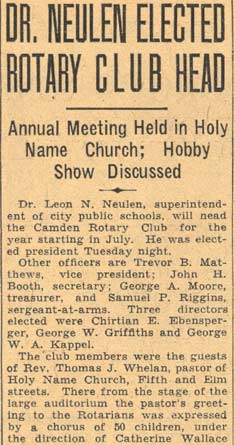
DR. NEULEN ELECTED ROTARY CLUB HEAD
Annual Meeting Held in Holy Name Church; Hobby Show Discussed
Dr. Leon N. Neulen, superintendent of city public schools, will head the Camden Rotary Club for the year starting in July. He was elected president Tuesday night.
Other officers are Trevor B. Matthews, vice president; John H. Booth, secretary; George A. Moore, treasurer, and Samuel P. Riggins, sergeant-at-arms. Three directors elected were Chirtian [sic] E. Ebensperger, George W. Griffiths and George W. A. Kappel.
The club members were the guests of Rev. Thomas J. Whelan, pastor of Holy Name Church, Fifth and Elm streets. There from the stage of the large auditorium the pastor’s greeting to the Rotarians was expressed by a chorus of 50 children, under the direction of Catherine Wallace and Anne McHugh, in song and dance.
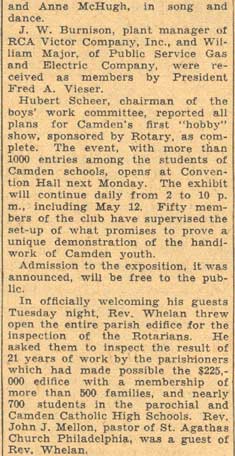
J. W. Burnison, plant manager of RCA Victor Company, Inc., and William Major, of Public Service Gas and Electric Company, were received as members by President Fred A. Vieser.
Hubert Scheer, chairman of the boys’ work committee, reported all plans for Camden’s first “hobby” show, sponsored by Rotary, as complete. The event, with more than 1000 entries among the students of Camden schools, opens at Convention Hall next Monday. The exhibit will continue daily from 2 to 10 p. m., including May 12. Fifty members of the club have supervised the set-up of what promises to prove a unique demonstration of the handiwork of Camden youth.
Admission to the exposition, it was announced, will be free to the public.
In officially welcoming his guests Tuesday night, Rev. Whelan threw open the entire parish edifice for the inspection of the Rotarians. He asked them to inspect the result of 21 years of work by the parishioners which had made possible the $225,000 edifice with a membership of more than 500 families, and nearly 700 students in the parochial and Camden Catholic High Schools. Rev. John J. Mellon, pastor of St. Agatha’s Church Philadelphia, was a guest of Rev. Whelan.
Community Center Sought for East Camden
Camden Courier-Post —
COMMUNITY CENTER SOUGHT FOR EAST CAMDEN
Construction Costs of Project Would Be Separate of Homes
Plans Include Hall and Pool
A community house, with an auditorium and swimming pool, as an adjunct to the $3,000,000 P.W.A. housing project for East Camden is being sought by the City Federal Housing Committee.
The plan, as outlined by the committee yesterday, is to attempt to have the community house and pool built in connection with a school which the federal authorities have indicated a willingness to finance and separate from the housing project.
The community house, the committee announced, will be sought as a convenience not only to occupants of the low-cost housing project, but also for the benefit of dwellers in the adjacent territory.
James W. Burnison, chairman of the committee, which was appointed by Mayor von Nieda, said the entire committee feels construction of the community house and pool as part of the P.W.A. project would run the rental cost per room too high for those whom it is intended to aid—present dwellers in sub-standard homes, with incomes of $60 to $125 a month.
U. S. to Bear Costs
The plan, Burnison said, contemplates that the Federal Government would bear practically all of the cost of construction of both the school and the community house.
The commission and the board of education will be consulted on “the feasibility and desirability” of the community house construction, Burnison announced.
The entire committee concurred orally in Burnison’s outline of this and other matters discussed at its first meeting.
Other members of the committee are A. J. Rosenfeld, secretary; Charles F. Hollopeter, Joseph Mitton and James V. Moran.
Burnison is vice president of RCA Manufacturing Company and president of the Camden County Chamber of Commerce. Rosenfeld is a real estate man. Hollopeter is chairman of the Camden Labor Housing Committee, Inc., which was instrumental in bringing the housing project to Camden, and also is president of the Central Labor Union. Mitton is vice president of the Camden Labor Housing Committee, Inc., and represents industrial unions.
Appointed as Individuals
It was emphasized by Burnison that each member, however, was appointed as an individual and that his actions are not binding on the organizations with which he is connected.
“The big problems facing the committee,” Burnison said, “are to see that the project does not burden the city and add to the tax rate, and to see that, in any event, the project will recompense the city for all governmental services accruing to it.
The committee also went on record as insisting that all labor and materials for the housing project “be procured locally.”
The committee will report to the city commission.
Educator to Tell Ethiopian View
Camden Courier-Post —
EDUCATOR TO TELL ETHIOPIAN VIEW
Former U. S. Consul Listed on Public Forum Program Tonight
Dr. James Weldon Johnson, noted colored educator, lawyer, author and former United States consul, will present the Ethiopian viewpoint in the Italo-Ethiopian conflict at the fourth public forum of the People’s University of Camden.
The forum will be conducted tonight in the auditorium of the Woodrow Wilson High School, Federal and Thirty-first streets. James W. Burnison, president of the Camden County Chamber of Commerce, will preside.
The Italian viewpoint in the international dispute was given at the second of the series of forums two weeks ago. The English viewpoint will be outlined next Tuesday night by Sir Wilmott Lewis.
Dr. Johnson is professor of creative literature at Fisk University, Nashville, Tenn. He has written novels, poems, spirituals and an autobiography. He served as secretary of the National Association for Advancement of Colored People from 1916 to 1930.
Admitted to the Florida bar in 1897, he served as consul at Nicaragua from 1909 to 1912.
Scout Fund Drive Brings In $10,481
Camden Courier-Post —
SCOUT FUND DRIVE BRINGS IN $10,481
Delayed Reports Will Put $15,000 Campaign ‘Over the Top’
Camden county’s drive for a $15,000 fund for Boy Scouts netted $10,481 with several districts unrecorded and which will put the campaign “over the top.”
Such was the report of leaders of the campaign at a meeting last night at Hotel Walt Whitman under leadership of J. W. Burnison, president of the Camden County Chamber of Commerce.
Reports of the initial gifts committee indicated that group had exceeded its quota. Leonardo List, chairman, returned pledges totaling $7311.30.
Captains of the city district committee reported pledges totaling $1910, recorded as follows: Armel Nutter, $444; Dr. Martin H. Collier, $604.50; Herman Hensgen, $422.25; Trevor Mathews, $439.55.
Among reports of districts in the county were: Collingswood, $400.50; Haddonfield, $252; Haddon Heights, $90.50; Audubon, $37; Merchantville, $120; Oaklyn, $22; Laurel Springs, $62.75; Gibbsboro, $51.50; Ashland, $22; Atco, $11; Pennsauken, $76; Woodlynne, $60; Runnemede, $32.35; Westmont, $1.
Burnison lauded efforts of the workers and announced plans are being completed for a Scout circus to be staged during the early months of next year at Convention Hall.
Among other officials of the campaign who praised the campaign workers were Commissioner Arthur E. Armitage, of Collingswood, and County Superintendent of Schools Albert M. Bean.
Von Nieda Opposes New City School
Camden Courier-Post —
VON NIEDA OPPOSES NEW CITY SCHOOL
Asserts U.S. Should Make 100% Grant for Housing Project Building
Objection to the city burdening itself with any more school expenses, was voiced yesterday by Mayor Frederick von Nieda at a meeting of the Mayor’s Housing Committee.
The mayor’s viewpoint was made clear to members of the committee who met in his office to map out a plan to be submitted to Washington which would make possible a 100 percent grant by the government for the proposed school to be erected at the $3,000,000 “Westfield Acres” housing project.
The mayor declared his objection to any additional school burden after it was brought out that the office of W.P.A. Administrator Harold L. Ickes had notified the committee the city’s proposal for a 30-room school has been held up because there are no available government funds.
“I am opposed to any additional school expense on the city because of this project,” Mayor von Nieda said. “If the housing project is to come here, the government must meet its share.
“We want another school and not a shack. There is already a temporary school on Thirty-second street between Hayes and River avenues, and we don’t want any more of that. I am against any more spending so far as the city is concerned. The board of education has all it can stand. There will be no more spending, only over my dead body.”
Following the mayor’s statement, James W. Burnison, chairman of the committee, named a subcommittee to confer with the board of education and other local educational officials in an effort to map out some plan acceptable to Washington. The sub-committee consists of A. J. Rosenfeld, Charles F. Hollopeter and Joseph N. Hettel.
Mayor von Nieda told the group that a 30-room school would cost at least $250,000, and that approximately 400 families would be housed at the development, with at least one child to every family.
Burnison urged passage of federal legislation which would give the city definite assurance that it would be paid all service charges, such as sewer and water, in lieu of taxes.
A dedication committee was named to arrange for exercises at such time as the project gets under way. The committee includes George V. Walsh, project manager, Hollopeter and Burnison. Other members of the housing committee are James V. Moran, Joseph Mitton and Rosenfeld.
A covered rack in which bicycles can be parked from either side is a German invention.
Advisers Bar 60 Fund Plan; Approve of 77
Camden Courier-Post —
ADVISERS BAR 60 FUND PLAN; APPROVE OF 77
Forget Politics and Adopt an Honest Budget, City Rulers Told
Collect Taxes, Report Urges
Commissions Also Urged to County Affairs
By W. OLIVER KINCANNON
Disregard Chapter 60.
Refinance under Chapter 77.
Reinforce that with what security you can give by resolution or ordinance, but Disregard Chapter 60.
Use a business rather than a political basis.
Take an active Interest in the management of Camden County as well as Camden city, acting as a committee of inquiry on county management.
These are some of the points of advice given to the City Commission yesterday, at a special meeting of the Commission, by its Citizens’ Advisory Committee.
In trip-hammer style, James W. Burnison, chairman of the advisory group, read a report that followed with these recommendations:
Forget politics and work as a unit.
Cut expenses and stay within your budgets.
Prepare a complete and honest budget.
Let the taxpayers decide when an emergency exists that requires an addition to the budget. Fight shy of gamblers’ interest rates.
Don’t default; it’s too costly.
Get on a cash basis and stay there.
Make every taxpayer in the city realize and live up to his tax responsibility.
Think about Camden city and county in a patriotic rather than a political sense.
Vote to Act Quickly
The commission voted to take quick action by passing a motion introduced by Commissioner Harold W. Bennett, director of revenue and finance.
This motion empowers Bennett to call, as quickly as possible, a meeting of the commission, representatives of its advisory committee, the finance committee of the board of freeholders, representatives of the city’s bonding attorneys, Hawkins, Delafield and Longfellow, representatives of Lehman Brothers and other bond houses to determine what arrangement can be effected to solve the city’s financial problems. Setting forth that it is not our intent or desire to criticize the performances of past or present city officers, “the report nevertheless, contained frank condemnation of emergency deficiency appropriations for items that are and were left off budgets.
Hits Past Budgets
It contained also implied condemnation of all the city budgets since 1930 and pointed out: “That Camden City receipts have been running behind expenditures approximately $1,000,000 a year since 1930.”
“Our yearly budgets do not at present, and did not in the past, in the opinion of your committee, give a frank clear picture of anticipated income and expenditures.
“The job of contacting bondholders to procure interest reductions, your committee finds, has not been handled as frankly as it deserves. We can find no evidence of a sincere effort to layout a program and attack this problem logically. No more than 30 cents can be lopped off the tax rate if the contacting program were completely successful. The committee has failed to receive a requested report of efforts to contact bondholders.
The committee was convinced that it is futile to expect any large-scale interest cuts from bondholders.
Hopeful of Rate Cut
It believes the majority of high interest-bearing bonds can be refunded at substantially lower interest rates if constructive action is taken immediately. The committee has been informed that the state has refused to accept “reasonable rates” on the city’s bonds held by the State.
Furthermore, “the present difference of opinion on this subject among members of our present city commission would in itself effectively block any real work along this line,” and “We feel that real results along this line require a united front on the part of our commission and the county freeholders.” “Our sinking fund, we are informed, is stuffed with our own frozen paper. Such financing, in our estimation, kills the purpose of such funds.”
“The present plan of singling out a few wards in our city and call for sporadic tax sales is neither fair to the delinquent taxpayers in these wards nor is it fair to the taxpayers throughout the city.”
Has Detail Report
After concluding his reading of the summarized report, Burnison informed the commissioners the committee has completed a detailed report of “40 to 42 pages of homework for you” and said that will be submitted today.
“That will contain detailed recommendations, including some errors in figures and in judgment, but we ask that you disregard the errors and use the good in it,” Burnison said.
He explained that when he mentioned 30 cents as the maximum figure to be lopped from the tax rate of the city were completely successful in obtaining interest reductions, he figured that would be the result if the city got 2% to 3 percent rates on all its bonds.
“There’s a large number of these bonds you can’t hope to refund at lower interest rates, as the rates already are low. You couldn’t get under 4 or 4½ percent on your first refunding under Chapter 77 and almost all of the bonds not immediately refundable are around those figures,” he said.
Commissioner Bennett immediately opened up argument concerning what the committee thinks will replace his favored refunding plan—Chapter 60 combined with Chapter 77.
Tells Objection to 60 Plan
“Sixty seems to give the other fellow more advantages than us; that’s our objection to it,” Burnison said.
“Apparently you have been assured from some source that we can avoid an increase in the tax rate without adopting Chapter 60,” Bennett said and continued:
“I see no way of keeping down this year’s budget without 60. Politics is out in my argument, but I honestly believe 60 and 77 combined make the only plan for us. Under the present plan the rate will go up this year. Won’t you tell us your source of assurance that it will not?”
Burnison did not answer the question immediately and Bennett said: “We would have to pass resolutions committing us to procedure similar to that under Chapter 60, wouldn’t we?”
“Yes,” Burnison answered, “but not binding you to as close supervision. You can’t continue to exceed receipts and improve conditions anyway.”
“Well,” Bennett said, “give us the advantage of your sources assurance.”
Tells Sources
“We have two such sources,” Burnison said. “Mr. Middleton is one.
(Melbourne F. Middleton, Jr., former city director of revenue and finance and now a bond dealer interested in the city’s refunding issues.)
“Lehman Brothers (New York bankers who have handled many of the city’s bonds in the past and were interviewed last Friday by the advisory committee) also said if we showed a sincere frank idea of economizing and staying within our budget, the bondholders would accept our bonds without necessity of recourse to Chapter 60.
“They said 60 ‘meant no more to the bondholder than resolutions and ordinances, if you get together and go on record to give security and then do it.
“I don’t think the city commission should have any compunction in binding itself not to exceed the budget. Then, if you find it is impossible for you to operate on what you are taking in under the present tax rate, call in a group of taxpayers—say 200 of them—and explain the situation and raise the tax rate.
“Any reasonable man or group will see the necessity and logic of that. They will go along with you.
“But under Chapter 60 you put yourself under a rigorous unbending set of restrictions.”
Mrs. Kobus Urges Action
“Let’s quit arguing and do it,” Commissioner Mary W. Kobus suggested, and Mayor Frederick von Nieda asked: “If we take an average of the income for the past three years would you not consider that average for this year?”
“Yes,” said Burnison.
At that point Bennett made his motion for power to call a special meeting of the freeholders, commissioners, citizens’ group, bond attorneys and bond dealers, and it was passed unanimously after Commissioner George E. Brunner seconded it.
“I reserve the right own discretion about dealers will be asked” Bennett remarked.
“It may be that Lehman Brothers are the only ones who will trust us,” Burnison said. “They know the lines we are working along. They work with other houses, and there may be other sources of credit we can tap.”
“Well, 42 of the largest cities in New Jersey with 62 percent of all at the ratables of the state are under Chapter 60 now,” Bennett said.
“Sixty-two percent could be wrong,” Burnison answered and laughed, adding: “In my opinion, those cities going under 60 haven’t looked very far ahead.”
“That’s what we have done,” Bennett replied. “My department has done that and that is why we are advocating 60.”
Burnison Disagrees
“Well there are members on our committee who know a good bit about that sort of thing and they say the city is justified in not going under 60,” Burnison said.
“The Legislature is going to pass a new budget law that will act just the same as Chapter 60, though it will not be passed in time to effect this year’s budget,” Bennett said.
“Well,” said Burnison, “I’d think the commission would prefer to adopt a safe course voluntarily than to be forced into it.”
“We have no assurance that those who will have charge of the city’s affairs for the next 15 or 18 years will follow the course we lay down for them,” Bennett said and added: “Past political experience shows that they won’t.”
This brought the argument to a close and Burnison, questioned by a reporter, said: “We are not unalterably opposed to Chapter 60. We oppose it, yes. We believe under 77 a better job for us can be worked out.”
Members of the committee, in addition to Burnison, who attended the session are Carl R. Evered, James V. Moran and A. Lincoln Michener.
Camden Votes to Pay Expert on Refunding of City Debts
Camden Courier-Post —
CAMDEN VOTES TO PAY EXPERT ON REFUNDING OF CITY DEBTS
Applicants With Programs to Be Considered by Board Today
Commissioners Agree on Kobus Suggestion
Chapter 60 and 77 Author Overruled in Plea to Disregard Proposal
Camden’s city commissioners yesterday agreed to select a paid financial adviser to guide the city out of its financial morass.
They said they expect to make the selection today.
A special gathering of the commissioners in Mayor Frederick von Nieda’s offices at noon today was arranged to hear applications of candidates for the job.
No candidate will be considered unless he has a plan to submit that looks attractive to the commissioners they said.
Decision to select the paid adviser came near the end of a hectic two and one-half hour conference of the commissioners with their citizens’ advisory committee, members of the Freeholders budget committee, various bond brokers, and bankers and attorneys for the city and the bond dealers.
Proposed by Mrs. Kobus
The commissioners decided to engage the adviser against the recommendation and despite an eloquent plea of their bond attorney—L. Arnold Frye, of Hawkins, Delafield and Longfellow, New York attorneys.
It was at the suggestion of Commissioner Mary W. Kobus that the decision to bring in paid help was taken.
The action was taken under such a way as to leave at least one bond house’s representatives under the impression the commission is actually, though not legally, committed to accepting whatever plan their paid counselor may suggest.
His questions on this line, however, brought no definite answer.
“Oh, we’ll agree,” Mrs. Kobus said. “I think by the time we select the man we will select the plan,” Commissioner Harold W. Bennett, director of revenue and finance, said.
Beyond that, the commissioners did not commit themselves.
Bennett, however, announced that the adviser’s tenure will be “for whatever period we decide to engage him.”
Names Confidential
Commissioner George E. Brunner suggested that the advisory committee submit the names of three prospects for the adviser’s job and that committee’s sub-committee on finance withdrew and returned to offer two names. They explained they could not suggest more than two.
The names were held confidential and no one knowing them would reveal their identity.
There was some speculation as to whether they were Melbourne F. Middleton, Jr., Philadelphia bond broker and former city director of revenue and finance, and Norman S. Tabor, noted New York adviser on municipal fiscal affairs.
Fall to Make Pick
The commissioners, as soon as they received the two names in secret, withdrew into the mayor’s private office for ten minutes to discuss the suggested helpers, but returned to announce that all applicants for the job will be heard at noon today.
This was accepted as tacit admission that no final agreement was reached on either name suggested.
Bennett announced: “We are going to pick the man on a basis of his helpfulness to Camden. I want to say now that we will not necessarily select the man who offers to help us at the lowest cost.
“We want those applicants for the position who appear tomorrow to have a definite idea of what plan they expect the city to follow if they are engaged.
“Of course, we do not expect any minute detailed plan from any man not already acquainted with the situation, but we want it to be definite enough to enable us to know whether we will follow it.
“We want to keep the cost as low as possible, and we advise now that the cost of this help or advice must be low, but we will not pick the adviser on a cost basis purely.
‘No Private Talks’
“We will make no commitments in advance. We will talk to no applicant until the time comes tomorrow. My conception of how we will select the adviser is this:
“Ability will come first. Then contacts, experience, the cost to the city and, of course, the acceptability of the plan offered.”
The conference was called to discuss proposed refunding plans for Camden city, with most of the talk centering on the controversy over Chapter 60 as a refinancing basis.
Mrs. Kobus suggested appointment of the financial adviser at a meeting of the city commission to be held immediately.
“I have thought similarly during the last few days,” said Bennett. “I realize it would be a big expense, but the City is reaching a crisis and it might be money well spent.”
Brunner asked the advisory committee to submit three names for appointment as an adviser. The committee suggested two names which were not revealed.
Frye, in requesting the commission not to employ an adviser, revealed himself the principal author of New Jersey’s two refunding or bond issuing acts around which the commissions’ difference of opinion as to method has revolved—Chapters 60 and 77.
“You can finance your indebtedness entire,” Frye said, “under Chapter 77, or partly under Chapter 60 and partly under 77. I personally have no preference, as the principal author of both.
Frye Plan Refused
“As to your tax rate, set what you can set and what the taxpayers can stand. Don’t you think you could get together and settled this among yourselves? Don’t you think that would be better?”
Bennett passed off Frye’s suggestion thus: “No, Mr. Frye, I think it can best be settled by use of an adviser. I am anxious to settle it quickly. We have been unable to agree thus far and I am on the uneasy seat for Camden faces a crisis and I want to get it past.”
Frye’s suggestion came after all of the bond brokers present, except Middleton, had advised the city to use the stringent budget, making restrictions of Chapter 60.
James W. Burnison, chairman of the citizens’ advisory committee, reiterated that group’s objections to Chapter 50, saying the same guarantees can be provided for bondholders under 77, without putting the city under such rigid state supervision for so long a period.
Every person present was invited to speak. Most of the freeholders viewed the matter as a city and not a county problem, but promised cooperation.
Burnison, Carl R. Evered, A. Lincoln Michener and James V. Moran form the sub-committee which selected the two names submitted to the commissioners for consideration as fiscal adviser.
The meeting started as a closed session, but after 25 minutes behind closed doors in the mayor’s office, Evered came to the door and admitted reporters.
The reporters, however, were given to understand that the only statements they were to use were those from Burnison, chairman of the committee; James V. Moran, a member, or Evered, and from other speakers only with their permission.
Attending were the five city commissioners, William H. Heiser, chairman of the Board of Freeholders’ budget committee; Freeholders James S. Caskey, Maurice Bart, William Myers, and James W. Wood; George D. Rothermel, assistant county solicitor; City Comptroller Sidney P. McCord; Meyer Sakin and John R. Di Mona, assistant city solicitors; Burnison, Evered, Moran, and Michener, of the Citizens’ Advisory Committee; E. Howard Broome, deputy director of finance; Middleton, John T. Trimble, counsel for Middleton; three representatives of Hawkins, Delafield & Longfellow, New York including Frye, Henry Russell and Alfred Gregory; Walter Shuman, representing Rollins & Sons, of Philadelphia and New York; C. C. Collings, of the C. C. Collings Company, Philadelphia; Russell McInes, representing Lehman Brothers, New York; J. M. G. Brown and Samuel S. Blackman, representing Analyses, Inc., Philadelphia, and Leon C. Guest and Herbert Glucksman, Camden bond brokers.
Chapter 77 Favored, J. W. Burnison Declares
Camden Courier-Post —
CHAPTER 77 FAVORED J. W. BURNISON DECLARES
James W. Burnison, chairman of the Advisory Committee to the city commissioners, was speaker last night at a meeting of the Civic Association of South Camden held in Parish Hall, Tenth and Liberty streets.
Burnison outlined the work of the advisory committee and said the group was in favor of Chapter 77 to correct the city’s financial difficulties.
Chapter 60, Burnison said, would effect a heavy increase in the tax bill while Chapter 77 would give a longer term of payment in the money borrowed.
John Dziekanski, president, was chairman of the meeting. More than 200 were present.
Burnison Favors Park-O-Meters As Inducement to Local Buying
Camden Courier-Post —
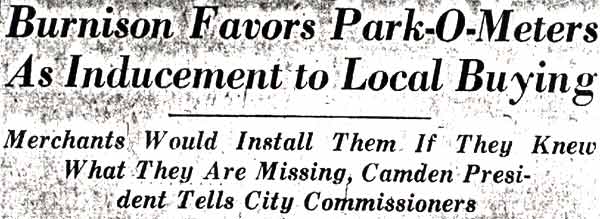
BURNISON FAVORS PARK-O-METERS AS INDUCEMENT TO LOCAL BUYING
Merchants Would Install Them If They Knew What They Are Missing, Camden President Tells City Commissioners
James W. Burnison, chairman of the city commission advisory committee yesterday informed City Commissioners George E. Brunner and Frank J. Hartmann, Jr., that the merchants of the city “would be trying to install park-o-meters in front of their business houses if they knew what they are missing.”
The question came up at a conference of the two commissioners with the advisory group, and Burnison and James V. Moran added their praises to the park-o-meter system which previously had been endorsed by Carl R. Evered.
Burnison and Evered said the park-o-meter system enables more people to shop at the city’s stores than is possible under the present conditions, because “workers park their cars in one spot all day and it is almost impossible to park your car in the Camden business district.”
“It’s easier for me to go to Philadelphia and shop, using the subway or the ferry or both than it is for me to shop in Camden and if I wasn’t president of the Chamber of Commerce and highly civic minded, I don’t know but what I should do my buying in Philadelphia, because it is more convenient,” Burnison said.
“People in cities where they have park-o-meters are crazy about them—both the merchants and the people who do not park their cars in one place all day,” Burnison added.
Moran agreed the merchants should have the “protection” of the new parking system.
J. W. Burnison Resigns as Official of RCA
Camden Courier-Post —
J. W. BURNISON RESIGNS AS OFFICIAL OF RCA
James W. Burnison yesterday announced his resignation as vice president of the RCA Manufacturing Company to open offices as consultant on industrial and personnel engineering.
Burnison, who lives at 408 Queensboro lane, Haddonfield, is president of the Camden County Chamber of Commerce and chairman of the Camden City Municipal Advisory Committee.
Budget Slash Seen in Unified Offices
Camden Courier-Post —
BUDGET SLASH SEEN IN UNIFIED OFFICES
Merger of Surrogate, Registrar and County Clerk Posts Advised by Burnison
James W. Burnison, chairman of the Joint Taxation Committee’s executive committee, yesterday sent a letter to Dr. W. Carleton Harris, city-county financial adviser, making several recommendations in the hope of maintaining or even reducing the county tax rate.
Pointing out that if the county budget is adopted on first reading tonight only a 10 percent change can be made later in the tax levy, Burnison urged that the committee’s suggestions be acted upon at once.
Among the recommendations were these:
1. Consolidation of the offices of county clerk, register of deeds and surrogate to prevent a $14,000 loss incurred by the first two named offices and even show a profit.
2. County should ask the city to bid on maintenance of both the city and county buildings, as Commissioner Frank J. Hartmann had stated the city could do so at a saving of at least $40,000.
3. A thorough survey of jobs and salaries. Two pay increases were cited and questioned by Burnison, as examples.
Burnison’s letter, which also compliments Dr. Harris for discovering an unnecessary $45,000 road item in the budget, follows:
Too Late for Full Study
“We received a copy of the proposed 1938 budget for Camden County too late to make the study of it that is necessary for intelligent recommendations for savings prior to its introduction, after which time a change of only ten percent can be made in each item. We are therefore hastening to bring to your attention certain matters which we have previously taken up with the freeholders in former years that may offer the savings necessary for preventing an increase in the 1938 tax rate or making an actual decrease possible.
“We commend you for detecting the road item amounting to $45,000, which you brought to the public’s attention this morning.
“Last year Commissioner Frank J. Hartmann of the City of Camden, made a statement that he could operate the City Hall and Courthouse at a tremendous saving over the $122,111 which the county is asking for 1938. In our opinion the cursory examination of the operating expenses of the Courthouse showed that material savings could be made. We know for instance that in the Courthouse operating expenses an allowance is made for an electrician at $1800, and an electrician’s helper at $1500. On the other hand we notice that for all of the institutions at Lakeland there is only an allowance of $1620 for an electrician and $1500 for an electrician’s helper.
Suggests City Make Bid
“This is but one of the many items that a more careful study of the 1938 budget would disclose in connection with courthouse operation.
“Why doesn’t the county ask the city to make a bid for operating and maintaining the city hall and courthouse for 1938? From our understanding of Commissioner Hartmann’s statement last year, the city would propose to do this at a saving of not less than $40,000 under the figure which the county is asking. This item alone would be nearly enough to prevent an increase in the county’s tax rate, and combined with the $45,000 that you have found in the highway fund, would make a decrease possible.
‘The anticipated income from the county clerk’s and register of deed’s office totals $50,000. The appropriation for expenses totals $64,407, a loss of $14,407. We repeat our request made to Mr. Gerhard, chairman of the finance committee, that legislation be requested for the combination not only of these two offices, but also of the surrogate’s office to permit economy in operation. We are confident that such combination of offices would prevent any further loss in the operating of the register of deed and county clerk’s offices, thus saving at least $14,000 a year and probably would make the combined offices show a profit. Pending such legislation we request a thorough review of the pay schedules of these offices, and of other county offices.
Comment on Pay Boosts
“We cite but two examples. The 1936 budget shows an Elizabeth P. Haines as having been restored from a $665 pay schedule to the regular pay schedule of $700. But the 1938 budget showed an E. P. Haines whom we presume is the same person as having received $1200 in 1937 and as listed for a salary of $1200 for 1938. At the same time, it does not disclose that she took office of any person who was dropped from the payroll, as the payroll budget is supposed to show. What accounted for her increase of $500 in salary?
“That this is not an isolated case is evident from a similar instance to be found in connection with the salary schedule of William P. Cotter, supervising bridge attendant. He is shown in the 1936 budget as being listed for a regular salary of $1500. But in the 1937 budget he was increased from $1287.50—not to $1500 but to $1800, and $1800 is again requested for him in the 1938 budget. And in addition thereto, $750 is now asked for vacation and sick relief that did not appear in any previous budget.
“Time does not permit us at this moment to go into further detail concerning the proposed 1938 budget. We are convinced from the items mentioned that savings can be found that not only will eliminate the proposed increase in tax rate, but will make another cut possible.”
Uncle Sam and Boy, 12, Enter Third Annual Stamp Exhibition
Camden Courier-Post —
Named: Gordon Mackay, James W. Burnison, Hotel Walt Whitman, and Jack Wallace..