Introduction
WILLIAM PENN CORSON was born February 27, 1873, in Camden, the son of Elias Lake Corson, a sea captain who had commanded a vessel during the Civil War. At the time of the 1880 census, the Corson family lived at 442 Hartman Street. In 1882 Hartman Street was renamed Clinton Street. Two doors away, at 401 Broadway, lived contractor Joseph E. Roberts, who built many homes in Camden during the later part of the 1800s. His son Joseph E. Roberts Jr. had a long and distinguished medical career in Camden. During the late 1880s the Corson family lived at 610 North 5th, moving in late 1889 or early 1890 to 525 North 2nd Street.
Known locally in his time as W. Penn Corson, he attended Camden's public schools. In 1898 he began working for Frank B. Sweeten, who was a general contractor, where he learned enough about the construction business to set up his own firm, in 1904. After establishing himself paving streets and building sewers in Camden, he completed many large projects in the new suburban towns, including the sewage systems in Westmont and Haddonfield. Perhaps his most notable project was the paving of the White Horse Pike from Haddon Heights to Camden, a distance of four miles.
At the time of the 1910 Census W. Penn Corson, his wife and family lived at 540 Newton Avenue, in Camden’s Ninth ward.
W. Penn Corson was also involved in Camden with professional basketball. He was co-owner, with veterinarian and one-time Camden City purchasing agent Dr. Charles B. Helm of the Camden franchise of the Eastern Basket Ball League from 1913 through 1925. The team, coached by William “Billy” Morgenweck was known as the Camden Alphas prior to World War I. The Alphas were the league champions in 1914–1915.
1917 was a year of turmoil in the world as the United States entered World War I. On December 3 the league disbanded abruptly as two teams withdrew from the league without warning. An unsuccessful attempt was made to reorganize with a four team league and the league remained inactive until the 1919-20 season. One of Camden’s players during this abridged season was future Olympic rowing star, Jack Kelly. He later would become the father of Grace Kelly, movie star and Princess of Monaco.
The team was renamed the Camden Crusaders after World War I. The Camden five were champions again in 1919–1920, winning both halves of the split-season with a combined 30 and 9 record. The team was renamed once again as the Camden Skeeters for the 1921–1922 season. They were one of the league’s better teams, until it disbanded in 1923. A team was fielded in a new Eastern Basketball League in 1925 (note the new spelling of “Basketball”), but did not do well, and that marked the end of the professional game in Camden for several years.
The Camden team was generally a winner in the league. Besides bringing players to Camden from out of town, Corson and Helm’s team employed and/or developed many fine players from Camden, including Eddie Ferat, Sam Lennox, Roy Steele, Joe Hyde, Neil Deighan, and his brother Rich Deighan.
W. Penn Corson served as Camden County Sheriff from 1917 to 1920. By 1914 he had moved to 506 Haddon Avenue in Camden. He later moved to 119 White Horse Pike in Haddon Heights, passing away on November 29, 1927. He was survived by his wife Katherine and three children, W. Wallace Corson, C. Hobart Corson, and E. Mahlon Corson. Katherine Corson and her sons returned to the Haddon Avenue address, where she resided in the fall of 1936. C. Hobart Corson was still residing there as late as 1947.
Camden Crusaders 1919–1920 Eastern Basketball League Champs
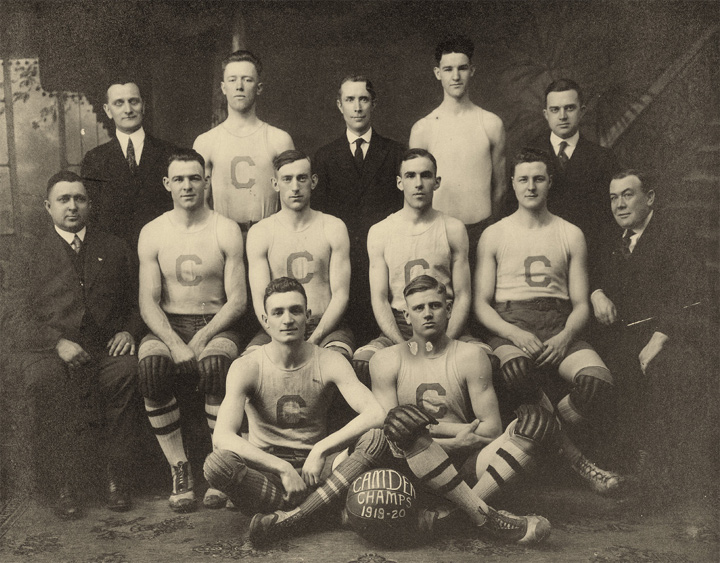
Front row, left to right: Jimmy “Soup” Campbell and Joe Hyde.
Second row, left to right: Dr. Charles B. Helm, Neil Deighan, Roy Steele, Eddie Dolin, Dave Kerr and Sheriff W. Penn Corson.
Back row, left to right: Bill Mitchell, trainer; Sam Lennox, Manager Bill Kennedy, Richie Deighan and Timekeeper Jim Kane.
South Jersey: A History 1624–1924
WILLIAM PENN CORSON—An active factor in the modern development of Camden and vicinity, a native of the city, a credit to his ancestry and the community, Mr. Corson is widely known and esteemed for manly worth and public spirit. He was born February 27, 1873, in Camden, and is a lineal descendant of John Corson, who was one of the settlers of Gravesend, Long Island, New York, in 1640. He was one of a party headed by Lady Deborah Moody and, after residing some time at Gravesend, removed to Cape May County, New Jersey. His son, Peter Corson, was the father of Jonathan Corson, who was born November 18, 1768. He married, December 21, 1797, Lydia Lake, born March 17, 1776, daughter of Daniel and Sarah (Lucas) Lake. Absalom Corson, son of Jonathan and Lydia, was born May 3, 1803, and married Sarah Corson, born January 3, 1812. They were the parents of Elias Lake Corson, who was born June 14, 1835, was a sea captain, master of a vessel during the Civil War, retired to Ocean City, where he died in November, 1916, the day before Election Day. He married Eleanor Hughes Young, who was born April, 1838, and is now living in Camden, near the close of her eighty-seventh year.
William Penn Corson grew up in Camden and attended its public schools. In 1898 he entered the employ of B. F. Sweeten & Son, general contractors, and continued with them six years, gaining an extensive knowledge of their line of business. In 1904 he began taking contracts on his own account, and has since completed many of the public improvements in the vicinity of Camden. His first engagements were in the line of street paving and sewer construction in Camden and, later, laying sewage systems and water lines in the suburbs. The sewage systems in Westmont and Haddonfield were constructed by him, and he laid most of the sewer lines in Camden. The “White Horse” pike, from Haddon Heights to Camden, a distance of four miles, was paved by Mr. Corson, like a city street, forty feet wide, plus gutters. In five months, or one hundred and twenty working days, 82,000 square yards of paving were laid. Mr. Corson has shown himself one of the most public-spirited and efficient of men, and has applied the same executive ability to matters enhancing the public progress and welfare that has characterized his private labors. During the World War, he was chairman of Draft Board No. 1 (Camden County), and served as “four-minute” speaker and on teams in Victory and Liberty Loan, Red Cross and Salvation Army drives. W. Penn Corson was one of the twenty-nine organizations that assisted in the formation and management of the Camden Forge Company, used by the Government as a war shop. For fifteen years, Mr. Corson was Republican committeeman representing the Ninth Ward of Camden, and served as sheriff of Camden County from 1917 to 1920. He is a member of the Ninth Ward Republican Association, the Contractors’ Association of New Jersey, and the Camden Club, and is also affiliated with several fraternal organizations, including Camden Lodge, No. 293, Benevolent and Protective Order of Elks; Camden Lodge 111, Loyal Order of Moose; and Wyoming Tribe, Improved Order of Red Men.
Mr. Corson was married, May 30, 1899, at St. Mary’s, Pennsylvania, to Katherine Kronenwetter, who was born there, daughter of Charles and Kunegunde (Call) Kronenwetter, both of whom were born and lived and died at that place. Mr. and Mrs. Corson are the parents of three sons, namely: William Wallace, born March 16, 1900; Charles Hobart, born July 23, 1902; Edward Mahlon, born December 8, 1907.
Skeeters Brought Camden Only E.L. Court Crown
Camden Courier-Post —
Dolin, N. Deighan, Campbell, Kerr, Steele 1919-20 Pro Champions
By JACK CARTY
There was an era when Camden was known for more than its production of ships, soups, radios and sundry other commercial items. That was when the Camden Skeeters were the scourge of the Eastern Professional Basketball League.
It was over 35 years ago when a banner line screamed across four columns of an old Daily Courier sports page proclaiming that “All Hail the Champions!”
The date was March 11, 1920. It was the day after the Camden team won its first and only championship of the old Eastern League.
Kennedy Was Manager
After 10 years of striving to bring home the coveted flag, Manager “Whispering Will” Kennedy’s Skeeters sewed up the title by defeating the Bridgeport, Conn., quintet, 45-34 at the Third Regiment Armory, now known as the Camden Armory at Haddon avenue and Mickle st.
The date is a memorable one for many, especially those who were around in the days when professional basketball was “the thing” in Camden. Days when such outstanding stars as Neil Deighan, Jimmy “Soup” Campbell, Rich Deighan, Dave Kerr, Roy Steele, Eddie Dolin and others were the masters of the cage game. They mastered it to the delight of two and three thousand fans every time they stepped on the floor at the Armory.
That season and that 1919-20 basketball team provide one of the proudest sports memories in the history of Camden. Although its short-lived glory lasted for less than two years, the mark the Skeeters left is indelible.
Corson, Helm Owners
The Skeeters, owned and financed by former Sheriff W. Penn Corson and Dr. Charles B. Helm, a veterinarian, had many near misses in the search for the pennant. But they never made the direct hit until Kennedy stepped into the picture.
It was the first season the Eastern League had resumed operation following World War I that the ex-Jasper coach took over the club.
He molded a winner with three veterans of former years—Steele, the captain, Dolin and Neil Deighan—with a couple of comparative unknowns, Kerr, and a youngster named Campbell.
With this aggregation as his nucleus, Kennedy won the pennant for Camden and it seemed that only he could have done it.
Frank H. Ryan, late editor of The Courier-Post, who then was sports editor of The Daily Courier, wrote of Kennedy following the team’s successful first half finish:
Describes Kennedy
“He has been connected with the cage game for a score of years, never bullyrags his men and can get results where others fail. Working hand and glove with Steele, who is captain and the king pin of the men on the floor, Kennedy has succeeded in giving Camden what others have failed to do, namely, the much coveted pennant. If the Skeeters can crown their achievement with the second half crown the natives from the city of ships, phonographs, soaps, furniture and fair zone activities can well afford to look our way and give us a silent sneer.”
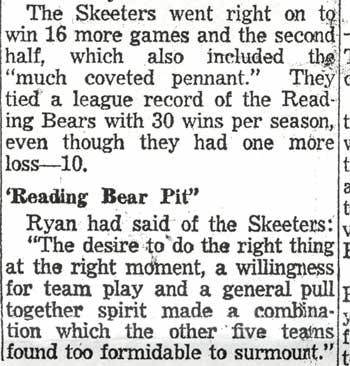
And they did.
The Skeeters went right on to win 16 more games and the second half, which also included the “much coveted pennant.” They tied a league record of the Reading Bears with 30 wins per season, even though they had one more loss—10.
‘Reading Bear Pit’
Ryan had said of the Skeeters: “The desire to do the right thing at the right moment, a willingness for team play and a general pull together spirit made a combination which the other five teams found too formidable to surmount.”
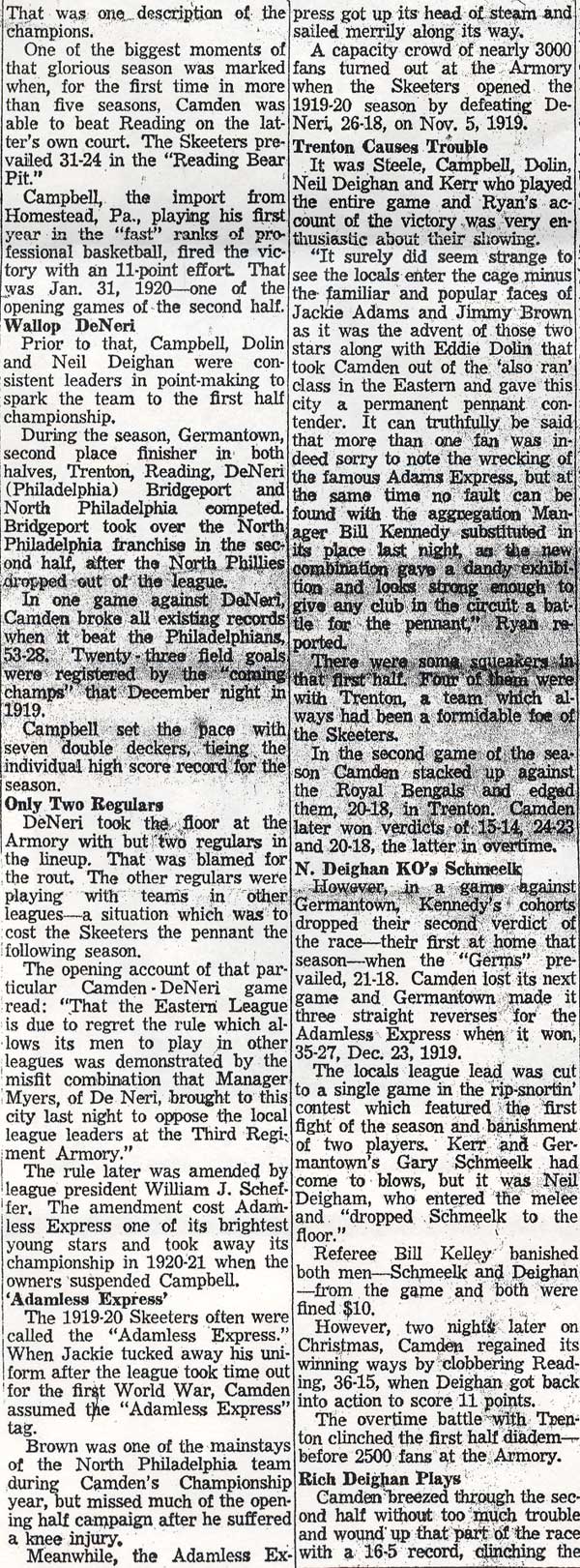
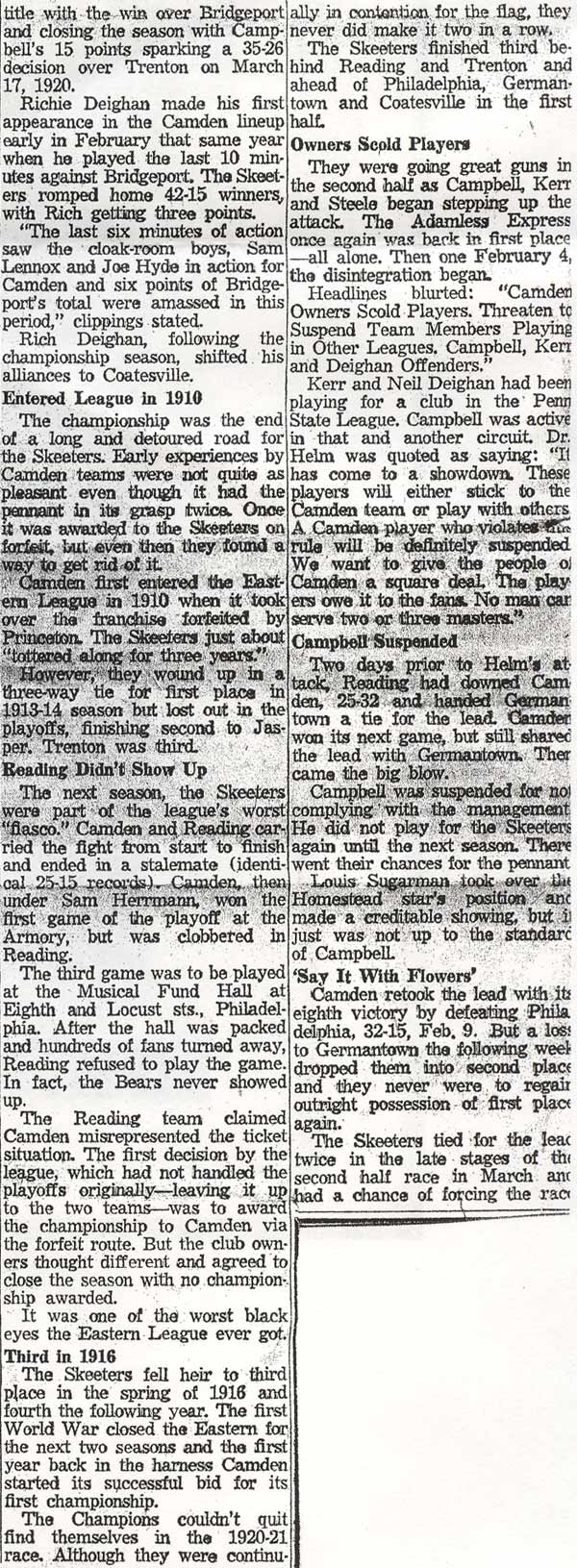
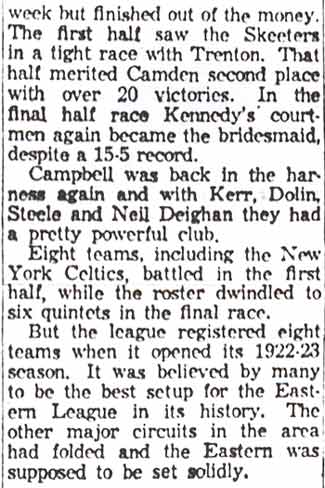
The first half saw the Skeeters in a tight race with Trenton. That half merited Camden second place with over 20 victories. In the final half race Kennedy’s courtmen again became the bridesmaid, despite a 15-5 record.
Campbell was back in the harness again and with Kerr, Dolin, Steele and Neil Deighan they had a pretty powerful club.
Eight teams, including the New York Celtics, battled in the first half, while the roster dwindled to six quintets in the final race.
But the league registered eight teams when it opened its 1922-23 season. It was believed by many to be the best setup for the Eastern League in its history. The other major circuits in the area had folded and the Eastern was supposed to be set solidly.
League Folds
It started an early season (October) and that was the beginning of the end. Football was in full swing. Baseball had just ended. Fans like their sports in season.
The league began to crumble when Scranton and then Wilkes-Barre dropped out. Atlantic City and Reading were next to toss in the towel. A meeting at Musical Fund Hall saved the league for a short time when Trenton, Camden, Coatesville and Philadelphia vowed to make a go of it.
However, in mid-January of 1923 the Eastern League succumbed as the four remaining teams went broke. The main reason for the crackup was put to the “inflated salaries” of the players. But the Skeeters’ backers decried that explanation when they said “every Camden player was worth every cent.” They had kept Camden in first place until the league folded.
Fans Were Confused
Following one of the last games played in the league in Camden, Ryan wrote, “Wednesday night’s crowd would have been a disgrace to the East Side Church League.” That about summed it up.
Constant rearrangement of the league had jumbled the schedule. Fans never knew when or where their teams were playing. The gates were pitiful and the teams couldn’t operate without the money.
That was the end of the championship era of players like Steele, the Deighans, Campbell, Kerr, Dolin and the others. Some of them competed in the Philadelphia League the following season, but Camden dropped out of that league in 1924-25.
Old-timers who can recall the days of the championship Skeeters claim it was the “greatest basketball” team the East ever had.
Players Still Around
And some of the boys who played on that club are still around to verify that. Neil Deighan runs a restaurant in Gloucester and brother Rich manages the Sports Center here in Camden.
Eddie Dolin is a familiar figure as the bridge operator at 12th and Federal sts. Sam Lennox tends bar on Hudson st. and Davey Kerr deals in sporting goods in Ohio.
The rest—Steele, Campbell, Hyde, timekeeper Jim Kane, Helm, Corson and Kennedy—have passed away. But the memories of their court capabilities are very much alive.
Ellis Named for Mayor of Camden
Philadelphia Inquirer —
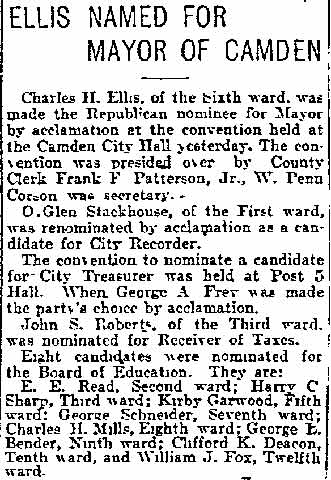
Charles H. Ellis, of the Sixth ward, was made the Republican nominee for Mayor by acclamation at the convention held at the Camden City Hall yesterday. The convention was presided over by County Clerk Frank F. Patterson, Jr., W. Penn Corson was secretary.
O. Glen Stackhouse, of the First ward, was renominated by acclamation as a candidate for City Recorder.
The convention to nominate a candidate for City Treasurer was held at Post 5 Hall. When George A. Frey was made the party’s choice by acclamation.
John S. Roberts, of the Third ward, was nominated for Receiver of Taxes.
Eight candidates were nominated for the Board of Education. They are:
E. E. Read, Second ward; Harry C. Sharp, Third ward; Kirby Garwood, Fifth ward; George Schneider, Seventh ward; Charles H. Mills, Eighth ward; George E. Bender, Ninth ward; Clifford K. Deacon, Tenth ward, and William J. Fox, Twelfth ward.
Camden Lodge No. 293, B.P.O.E. — April 18, 1906 Meeting
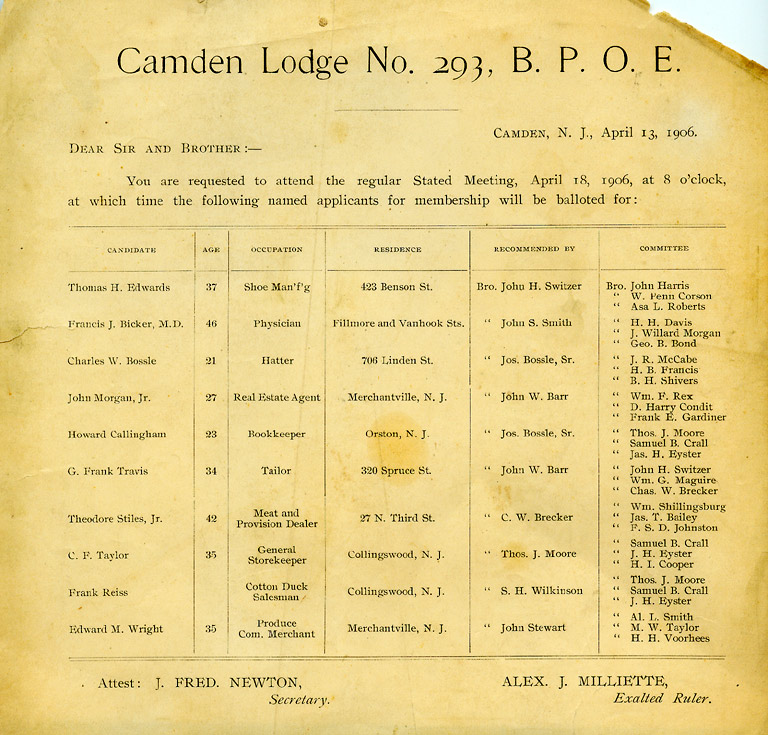
Camden Lodge No. 293, B. P. O. E. — April 18, 1906 meeting notice
CAMDEN, N. J., April 13, 1906
DEAR SIR AND BROTHER:
You are requested to attend the regular Stated Meeting, April 18, 1906, at 8 o’clock, at which time the following named applicants for membership will be balloted for:
| Candidate | Age | Occupation | Residence | Endorsed By | Committee |
|---|---|---|---|---|---|
| Thomas H. Edwards | 37 | Shoe Man’f’g | 423 Benson St. | Bro. John H. Switzer | Bro. John Harris, Bro. W. Penn Corson, Bro. Asa L. Roberts |
| Francis J. Bicker M.D. | 46 | Physician | Fillmore & VanHook Sts. | Bro. John S. Smith | Bro. H.H. Davis, Bro. J. Willard Morgan, Bro. George B. Bond |
| Charles W. Bossle | 31 | Hatter | 706 Linden Street | Bro. Joseph Bossle Sr. | Bro. J.R. McCabe, Bro. H.B. Francis, Bro. B.H. Shivers |
| John Morgan Jr. | 27 | Real Estate Agent | Merchantville, N.J. | Bro. John W. Barr | Bro. William F. Rex, Bro. D. Harry Condit, Bro. Frank E. Gardiner |
| Howard Callingham | 23 | Bookkeeper | Orston, N.J. | Bro. Joseph Bossle Sr. | Bro. Tomas J. Moore, Bro. Samuel B. Crall, Bro. James H. Eyster |
| G. Frank Travis | 34 | Tailor | 320 Spruce Street | Bro. John W. Barr | Bro. John H. Switzer, Bro. William G. Maguire, Bro. Charles W. Brecker |
| Theodore Stiles Jr. | 42 | Meat and Provision Dealer | 27 N. Third Street | Bro. C.W. Brecker | Bro. Wm. Shillingsburg, Bro. James T. Bailey, Bro. P.S.D. Johnston |
| C.F. Taylor | 35 | General Storekeeper | Collingswood, N.J. | Bro. Thomas J. Moore | Bro. Samuel B. Crall, Bro. James H. Eyster, Bro. H.I. Cooper |
| Frank Reiss | Cotton Duck Salesman | Collingswood, N.J. | Bro. S.H. Wilkinson | Bro. Thomas J. Moore, Bro. Samuel B. Crall, Bro. James H. Eyster | |
| Edward M. Wright | 35 | Produce Com. Merchant | Merchantville, N.J. | Bro. John Stewart | Bro. Al. L. Smith, Bro. M.W. Taylor, Bro. H.H. Voorhees |
Attest: J. FRED. NEWTON, Secretary — ALEX. J. MILLIETTE, Exalted Ruler.
Wallace Corson Accidentally Shot
Philadelphia Inquirer —
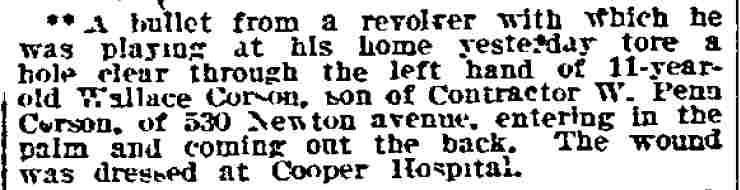
A bullet from a revolver with which he was playing at his home yesterday tore a hole clear through the left hand of 11-year-old Wallace Corson, son of Contractor W. Penn Corson, of 530 Newton avenue, entering in the palm and coming out the back. The wound was dressed at Cooper Hospital.
W. Penn Corson Operated On
Philadelphia Inquirer —

Operated on at Hahnemann Hospital. W. Penn Corson, Republican County Committeeman, was yesterday reported to be in a favorable condition. He has been ill several weeks with blood poisoning.
Camden Police Plan Round-Up of Loafers
Philadelphia Inquirer —
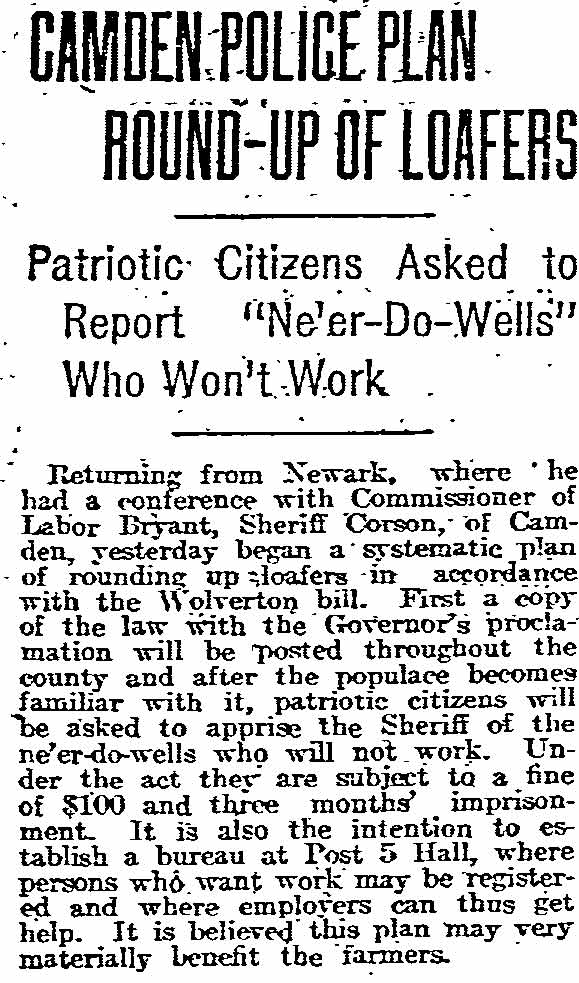
Patriotic Citizens Asked to Report “Ne’er-Do-Wells” Who Won’t Work
Returning from Newark, where he had a conference with Commissioner of Labor Bryant, Sheriff Corson, of Camden, yesterday began a systematic plan of rounding up loafers in accordance with the Wolverton bill. First a copy of the law with the Governor’s proclamation will be posted throughout the county and after the populace becomes familiar with it, patriotic citizens will be asked to apprise the Sheriff of the ne’er-do-wells who will not work. Under the act they are subject to a fine of $100 and three months’ imprisonment. It is also the intention to establish a bureau at Post 5 Hall, where persons who want work may be registered and where employers can thus get help. It is believed this plan may very materially benefit the farmers.
Grand Jury Drawn
Philadelphia Inquirer —
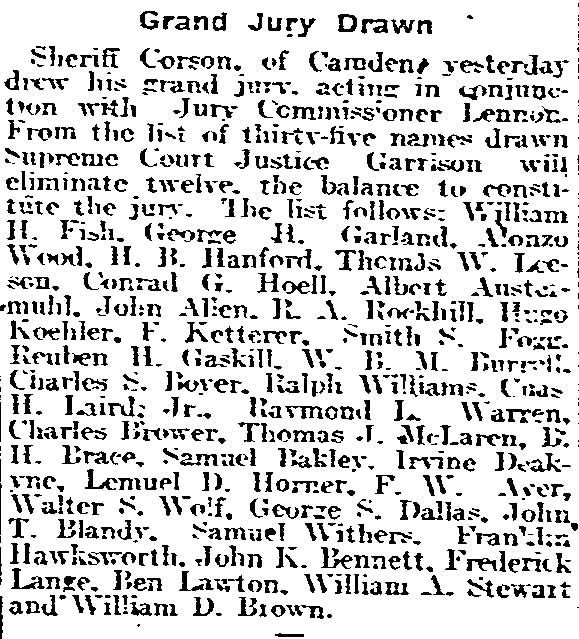
Sheriff Corson, of Camden, yesterday drew his grand jury, acting in conjunction with Jury Commissioner Lennor. From the list of thirty-five names drawn Supreme Court Justice Garrison will eliminate twelve, the balance to constitute the jury. The list follows: William H. Fish, George H. Garland, Alonzo Wood, H. B. Hanford, Thomas W. Leeson, Conrad G. Hoell, Albert Austermuhl, John Allen, R. A. Rockhill, Hugo Koehler, F. Ketterer, Smith S. Fogg, Reuben H. Gaskill, W. B. M. Burrell, Charles S. Boyer, Ralph Williams, Chas. H. Laird, Jr., Raymond L. Warren, Charles Brower, Thomas J. McLaren, B. H. Brace, Samuel Bakley, Irvine Deakyne, Lemuel D. Horner, F. W. Ayer, Walter S. Wolf, George S. Dallas, John T. Blandy, Samuel Withers, Franklin Hawksworth, John K. Bennett, Frederick Lange, Ben Lawton, William A. Stewart and William D. Brown.
Circuit Court Judge Frank T. Lloyd Accepts Chairmanship of Unemployment Committee
Philadelphia Inquirer —
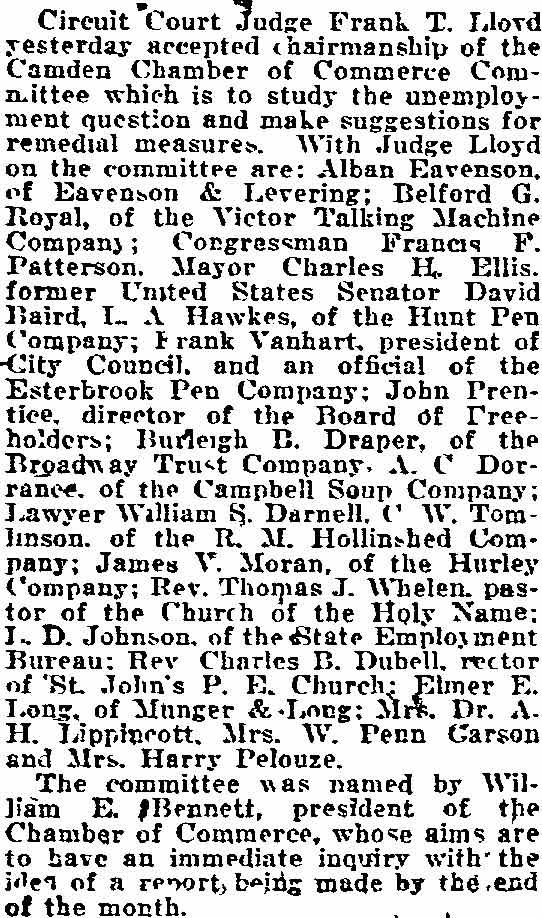
Circuit Court Judge Frank T. Lloyd yesterday accepted chairmanship of the Camden Chamber of Commerce Committee which is to study the unemployment question and make suggestions for remedial measures. With Judge Lloyd on the committee are: Alban Eavenson, of Eavenson & Levering; Belford G. Royal, of the Victor Talking Machine Company; Congressman Francis F. Patterson; Mayor Charles H. Ellis; former United States Senator David Baird; L. A. Hawkes, of the Hunt Pen Company; Frank Vanhart, president of City Council, and an official of the Esterbrook Pen Company; John Prentice, director of the Board of Freeholders; Burleigh B. Draper, of the Broadway Trust Company; A. C. Dorrance, of the Campbell Soup Company; Lawyer William S. Darnell; C. W. Tomlinson, of the R. M. Hollinshed Company; James V. Moran, of the Hurley Company; Rev. Thomas J. Whelen, pastor of the Church of the Holy Name; L. D. Johnson, of the State Employment Bureau; Rev. Charles B. Dubell, rector of St. John’s P. E. Church; Elmer E. Long, of Munger & Long; Mrs. Dr. A. H. Lippincott; Mrs. W. Penn Carson and Mrs. Harry Pelouze.
The committee was named by William E. Bennett, president of the Chamber of Commerce, whose aims are to have an immediate inquiry with the idea of a report being made by the end of the month.
Parties Name Chiefs in Camden County
Trenton Times —
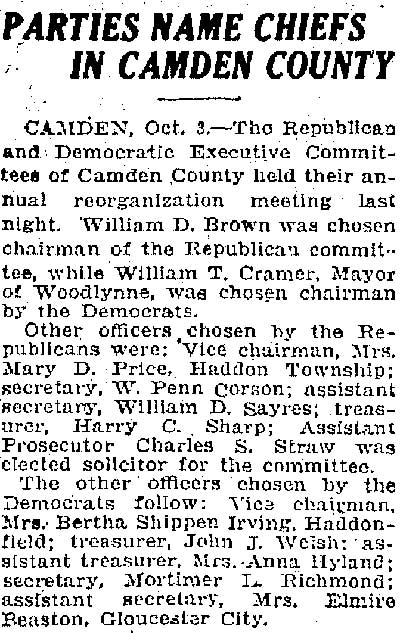
CAMDEN, Oct. 3.—The Republican and Democratic Executive Committees of Camden County held their annual reorganization meeting last night. William D. Brown was chosen chairman of the Republican committee, while William T. Cramer, Mayor of Woodlynne, was chosen chairman by the Democrats.
Other officers chosen by the Republicans were: Vice chairman, Mrs. Mary D. Price, Haddon Township; secretary, W. Penn Corson; assistant secretary, William D. Sayres; treasurer, Harry C. Sharp; Assistant Prosecutor Charles S. Straw was elected solicitor for the committee.
The other officers chosen by the Democrats follow: Vice chairman, Mrs. Bertha Shippen Irving, Haddonfield; treasurer, John J. Welsh; assistant treasurer, Mrs. Anna Hyland; secretary, Mortimer L. Richmond; assistant secretary, Mrs. Elmire Reaston, Gloucester City.
Keown Named Head of County G.O.P. as Wallworth Resigns
Camden Courier-Post —

When the Camden County Republican Executive Committee reorganized last night Walter S. Keown was elected chairman without opposition.
He succeeds former State Senator Joseph F. Wallworth, who was Republican county chairman six years, and a member 12 years. At a dinner preceding the executive session a silver set and a vase were presented to Wallworth by the committee. The retiring members of the committee received bronze elephants as emblems of the party.
At the executive session Mrs. Elizabeth Grotty Verga was re-elected vice chairman; Harry C. Sharp, treasurer; William D. Sayrs, assistant treasurer; Howard B. Dyer, secretary, and Mrs. Laura Silbers and Mrs. Lottie Stinson, assistant secretaries. Harold W. Bennett, Edward R. Diebert, Bernard Bertman, L. Scott Chercesky, Carl Kisselman and Frank Voigt were chosen solicitors.
Wallworth Reviews Work
Upon retiring as chairman Senator Wallworth said:
“During the six years I acted as your chairman considerable political history has been made in our county. The Republican party was on the rocks and loyalty seemed to have drifted away when Frank Patterson, Al Matthews, Penn Corson and Senator Baird begged me to take the chairmanship. In doing so I quickly discovered I had undertaken one of the hardest up hill battles of my life.”
When Keown took over the gavel he pointed out to the committee members they were political leaders of their districts. He said it was their duty to find out the cause of unrest.
“In some of your districts the trouble is your tax rates are too high,” said the chairman. “High taxe rates are an evil and it is your duty to find the cause and remedy the situation. When there is a spirit of satisfaction in your district there is satisfaction throughout the county.”
Wolverton Favors Plan
Congressman Charles A. Wolverton complimented the new chairman on his advice. Sharp and Sayrs, who have been identified with the committee more than 20 years, were also speakers.
Keown then turned the gavel over to Mrs. Verga, who thanked the committee for her re-election. She introduced Mrs. Silbers and Mrs. Stinson, who urged loyalty and work on the part of the women members of the committee.
Keown was nominated by Daniel Silbers, Pennsauken township. Colonel George L. Selby nominated Sharp and Dyer. All of the officers received a unanimous vote.
Ten new members took seats from the five boroughs recently created out of Clementon township. Among them was Clinton L. Bardo, president of New York Shipbuilding Corp., who was elected from the new borough of Pine Valley last Tuesday. Twelve members of last year’s committee retired either as a result of the primary election or not being candidates.
Bus Bumps Into Auto Backing From Garage
Camden Courier-Post —
A bus struck the automobile of William C. Corson, yesterday as he was backing out of the driveway at his home, 119 White Horse Pike, Haddon Heights. Corson is a son of the late W. Penn Corson, former sheriff.
Corson escaped with slight cuts and bruises. The driver of the bus was Albert J. Shaw, of 1912 Sycamore Street.