Introduction
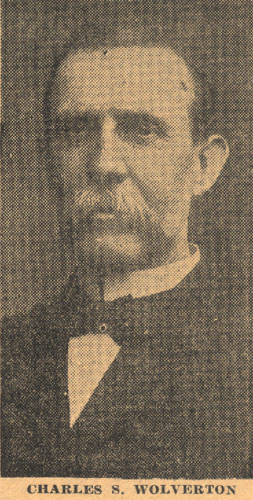
Charles S. Wolverton
Charles S. Wolverton was born in Camden about 1857. A lifelong resident of North Camden, he married Martha Anderson about 1878. He was a close friend of David Baird Sr. and involved in many civic activities. He served on City Council, and was president of the Council for a time. He was one of the prime movers behind the drive that culminated in the establishment of Pyne Point Park. He lived at 601 State Street in North Camden for over 25 years, until his passing on August 8, 1935.
Charles S. Wolverton worked for the Pennsylvania Railroad for almost 50 years. He worked for many years on the ferry. The 1880 Census shows him working as a steam boat pilot and living at 313 Birch Street. By 1887 he was working as a toll collector at the Vine Street Ferry. In the mid 1880s the Wolverton family lived at 66 Vine Street, where they are listed as living in the 1887–1888 Camden City Directory. He is listed in the city directories from 1888 through 1891 as living at 612 North 5th Street. Charles S. Wolverton rose to the position of Superintendent of the Cooper’s Point Ferry, and held that post until it discontinued its service on October 31, 1926. He also served on the Camden Board of Education up until the time of his death in August of 1935. In that role he was the first chairman of the Camden Training and High School, later known as Burrough Junior High. Charles S. Wolverton grew up as a member of Tabernacle Methodist Episcopal Church and served in a number of capacities as a church officer over the course of his lifetime at Tabernacle and, after the 1924 merger, of Centenary-Tabernacle Methodist Episcopal Church.
Charles S. Wolverton was survived by two sons, Walter P. Wolverton, and Charles A. Wolverton, who served 16 terms as a Congressman from New Jersey.
The Vine Street Ferry Terminal
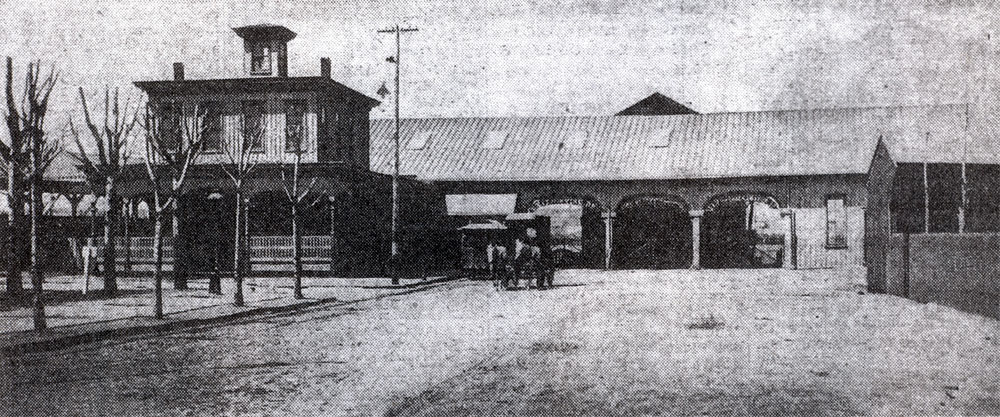
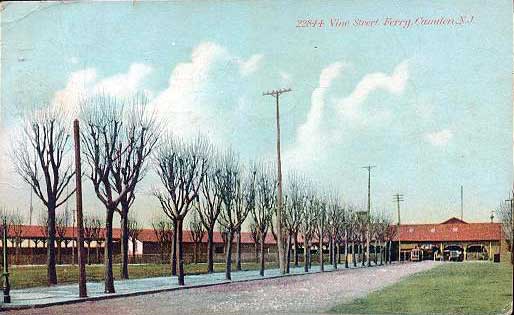
The Vine Street Ferry Terminal
Operated for many years by the Pennsylvania Railroad, the Cooper’s Point, or Vine Street Ferry operated between Camden and Philadelphia. The Ferry was able to remain profitable even with competition from three other ferries in Camden, but the opening of the Delaware River Bridge brought a quick end to the service. The last run of the ferry was made on October 31, 1926, only a few months after the opening of the then new bridge. The top photo dates from the 1890s. Charles S. Wolverton was the superintendent of the ferry for many years, retiring when it closed.
The First New Jersey District.
Philadelphia Inquirer —
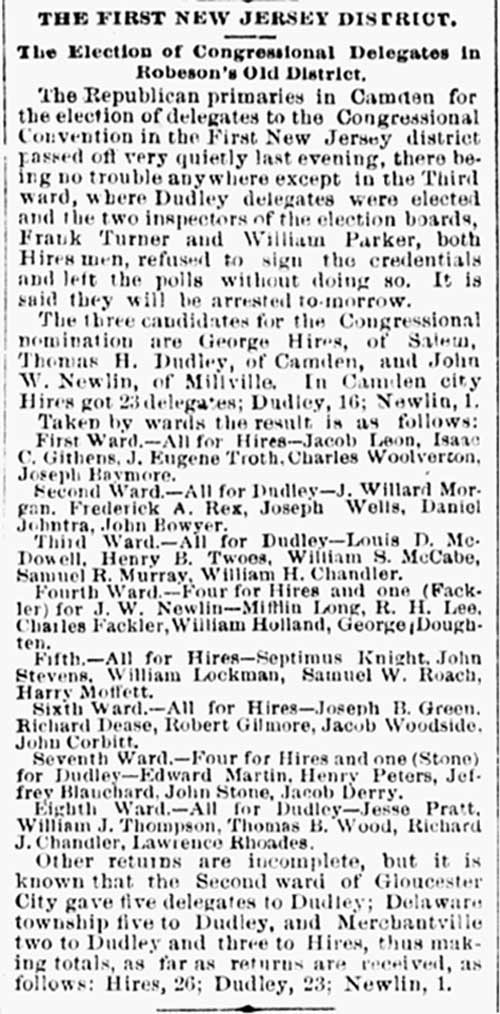
The Election of Congressional Delegates in Robeson’s Old District.
The Republican primaries in Camden for the election of delegates to the Congressional Convention in the First New Jersey district passed off very quietly last evening, there being no trouble anywhere except in the Third ward, where Dudley delegates were elected and the two inspectors of the election boards, Frank Turner and William Parker, both Hires men, refused to sign the credentials and left the polls without doing so. It is said they will be arrested to-morrow.
The three candidates for the Congressional nomination are George Hires, of Salem, Thomas H. Dudley, of Camden, and John W. Newlin, of Millville. In Camden city Hires got 23 delegates; Dudley, 16; Newlin, 1.
Taken by wards the result is as follows:
First Ward.—All for Hires—Jacob Leon, Isaac C. Githens, J. Eugene Troth, Charles Woolverton, Joseph Baymore.
Second Ward.—All for Dudley—J. Willard Morgan, Frederick A. Rex, Joseph Wells, Daniel Johntra, John Bowyer.
Third Ward.—All for Dudley—Louis D. McDowell, Henry B. Twoes, William S. McCabe, Samuel R. Murray, William H. Chandler.
Fourth Ward.—Four for Hires and one (Fackler) for J. W. Newlin—Mifflin Long, R. H. Lee, Charles Fackler, William Holland, George Doughten.
Fifth.—All for Hires—Septimus Knight, John Stevens, William Lockman, Samuel W. Roach, Harry Moffett.
Sixth Ward.—All for Hires—Joseph B. Green, Richard Dease, Robert Gilmore, Jacob Woodside, John Corbitt.
Seventh Ward.—Four for Hires and one (Stone) for Dudley—Edward Martin, Henry Peters, Jeffrey Blanchard, John Stone, Jacob Derry.
Eighth Ward.—All for Dudley—Jesse Pratt, William J. Thompson, Thomas B. Wood, Richard J. Chandler, Lawrence Rhoades.
Other returns are incomplete, but it is known that the Second ward of Gloucester City gave five delegates to Dudley; Delaware township five to Dudley, and Merchantville two to Dudley and three to Hires, thus making totals, as far as returns are received, as follows: Hires, 26; Dudley, 23; Newlin, 1.
The Camden Primaries
Philadelphia Inquirer —
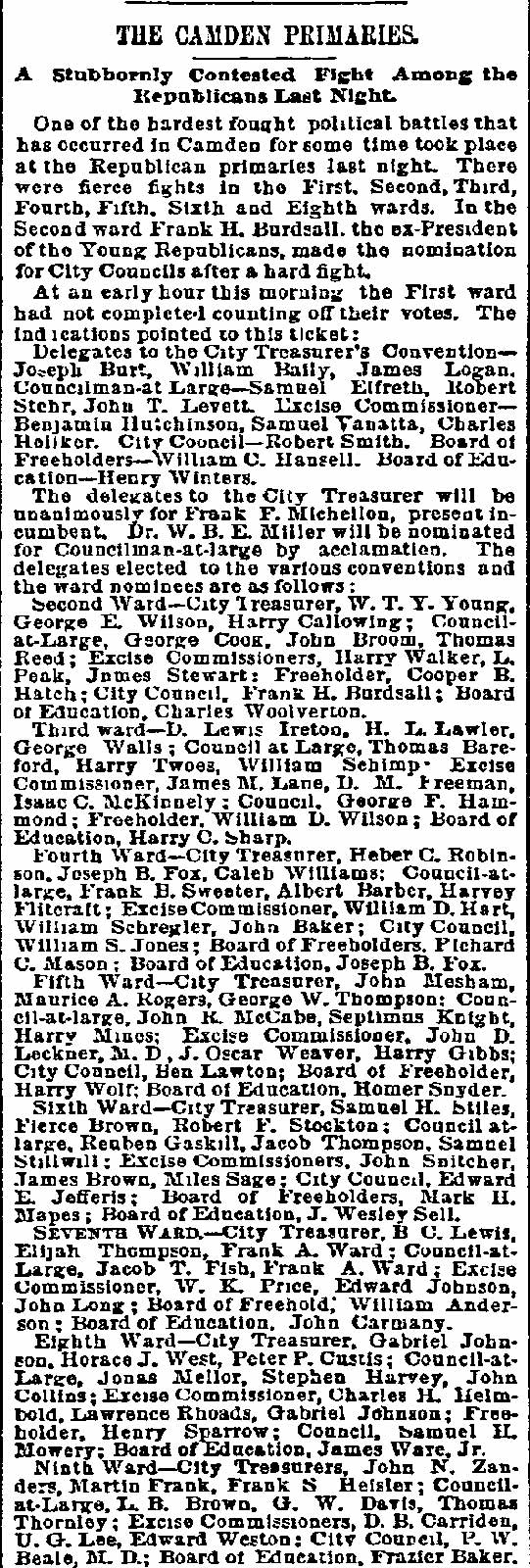
A Stubbornly Contested Fight Among the Republicans Last Night.
One of the hardest fought political battles that has occurred in Camden for some time took place at the Republican primaries last night. There were fierce fights in the First, Second, Third, Fourth, Fifth, Sixth and Eighth wards. In the Second ward Frank H. Burdsall, the ex-President of the Young Republicans, made the nomination for City Councils after a hard fight.
At an early hour this morning the First ward had not completed counting off their votes. The indications pointed to this ticket:
Delegates to the City Treasurer’s Convention—Joseph Burt, William Baily, James Logan. Councilman-at-Large—Samuel Elfreth, Robert Stehr, John T. Levett. Excise Commissioner—Benjamin Hutchinson, Samuel Vanatta, Charles Holiker. City Council—Robert Smith. Board of Freeholders—William C. Hansell. Board of Education—Henry Winters.
The delegates to the City Treasurer will be unanimously for Frank F. Michellon, present incumbent. Dr. W. B. E. Miller will be nominated for Councilman-at-large by acclamation. The delegates elected to the various conventions and the ward nominees are as follows:
Second Ward—City Treasurer, W. T. Y. Young, George E. Wilson, Harry Callowing; Council-at-Large, George Cook, John Broom, Thomas Reed; Excise Commissioners, Harry Walker, L. Peak, James Stewart; Freeholder, Cooper B. Hatch; City Council, Frank H. Burdsall; Board of Education, Charles Woolverton.
Third ward—D. Lewis Ireton, H. L. Lawler, George Walls; Council at Large, Thomas Bareford, Harry Twoes, William Schimp; Excise Commissioner, James M. Lane, D. M. Freeman, Isaac C. McKinnely; Council, George F. Hammond; Freeholder, William D. Wilson; Board of Education, Harry C. Sharp.
Fourth Ward—City Treasurer, Heber C. Robinson, Joseph B. Fox, Caleb Williams; Council-at-large, Frank B. Sweeter [sic], Albert Barber, Harvey Flitcraft; Excise Commissioner, William D. Hart, William Schregler, John Baker; City Council, William S. Jones; Board of Freeholders, Richard C. Mason; Board of Education, Joseph B. Fox.
Fifth Ward—City Treasurer, John Mesham, Maurice A. Rogers, George W. Thompson; Council-at-large, John R. McCabe, Septimus Knight, Harry Mines; Excise Commissioner, John D. Leckner, M. D., J. Oscar Weaver, Harry Gibbs; City Council, Ben Lawton; Board of Freeholder, Harry Wolf; Board of Education, Homer Snyder.
Sixth Ward—City Treasurer, Samuel H. Stiles, Pierce Brown, Robert F. Stockton; Council at large, Reuben Gaskill, Jacob Thompson, Samuel Stillwill; Excise Commissioners, John Snitcher, James Brown, Miles Sage; City Council, Edward E. Jefferis; Board of Freeholders, Mark H. Mapes; Board of Education, J. Wesley Sell.
SEVENTH WARD.—City Treasurer, B. C. Lewis, Elijah Thompson, Frank A. Ward; Council-at-Large, Jacob T. Fish, Frank A. Ward; Excise Commissioner, W. K. Price, Edward Johnson, John Long; Board of Freehold, William Anderson; Board of Education, John Carmany.
Eighth Ward—City Treasurer, Gabriel Johnson, Horace J. West, Peter P. Custis; Council-at-Large, Jonas Mellor, Stephen Harvey, John Collins; Excise Commissioner, Charles H. Helmbold, Lawrence Rhoads, Gabriel Johnson; Freeholder, Henry Sparrow; Council, Samuel H. Mowery; Board of Education, James Ware, Jr.
Ninth Ward—City Treasurers, John N. Zanders, Martin Frank, Frank S. Heisler; Councilman-at-Large, L. B. Brown, G. W. Davis, Thomas Thornley; Excise Commissioners, D. B. Carriden, U. G. Lee, Edward Weston; City Council, P. W. Beale, M. D.; Board of Education, Frazier Baker.
Police Committee Sustained; Matlack and Miller Discharged
Camden Post-Telegram —
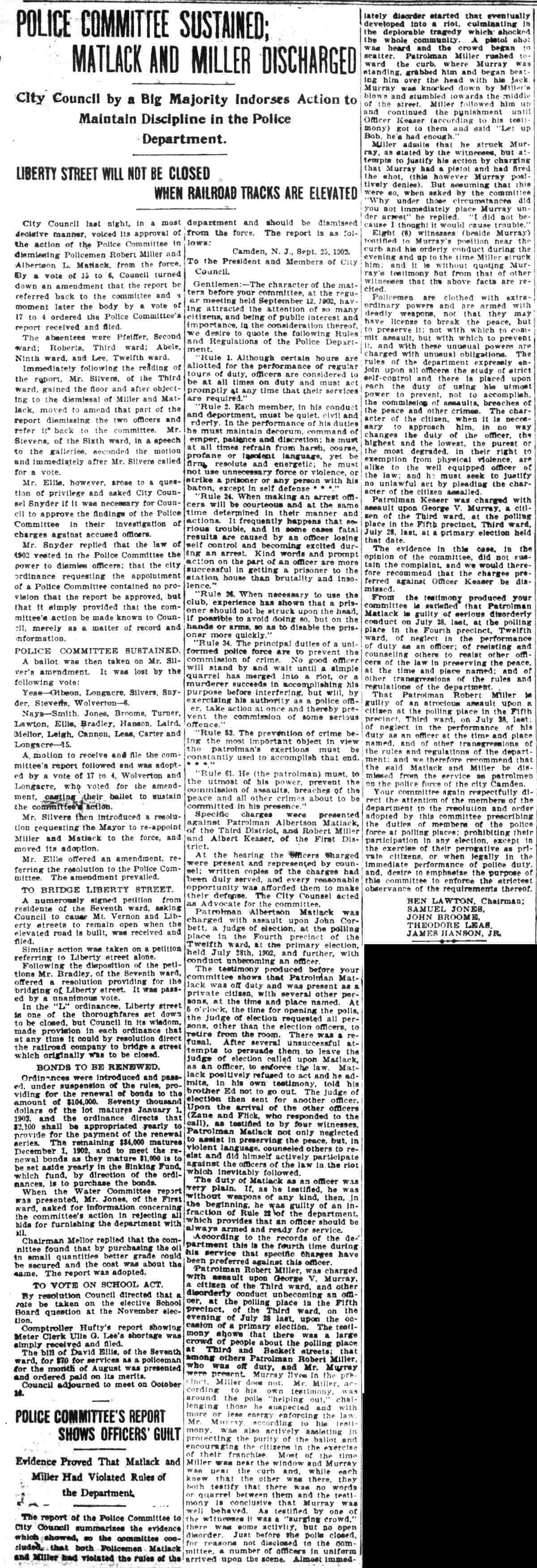
City Council by a Big Majority Indorses Action to Maintain Discipline in the Police Department.
LIBERTY STREET WILL NOT BE CLOSED WHEN RAILROAD TRACKS ARE ELEVATED
City Council last night, in a most decisive manner, voiced its approval of the action of the Police Committee in dismissing Policemen Robert Miller and Albertson L. Matlack, from the force. By a vote of 15 to 6, Council turned down an amendment that the report be referred back to the committee and a moment later the body by a vote of 17 to 4 ordered the Police Committee’s report received and filed.
The absentees were Pfeiffer, Second ward; Roberts, Third ward; Abele, Ninth ward, and Lee, Twelfth ward.
Immediately following the reading of the report, Mr. Silvers, of the Third ward, gained the floor and after objecting to the dismissal of Miller and Matlack, moved to amend that part of the report dismissing the two officers and refer it back to the committee. Mr. Stevens, of the Sixth ward, in a speech to the galleries, seconded the motion and immediately after Mr. Silvers called for a vote.
Mr. Ellis, however, arose to a question of privilege and asked City Counsel Snyder if it was necessary for Council to approve the findings of the Police Committee in their investigation of charges against accused officers.
Mr. Snyder replied that the law of 1902 vested in the Police Committee the power to dismiss officers; that the city ordinance requesting the appointment of a Police Committee contained no provision that the report be approved, but that it simply provided that the committee’s action be made known to Council, merely as a matter of record and information.
POLICE COMMITTEE SUSTAINED.
A ballot was then taken on Mr. Silver’s amendment. It was lost by the following vote:
Yeas—Gibson, Longacre, Silvers, Snyder, Stevens, Wolverton—6.
Nays—Smith, Jones, Broome, Turner, Lawton, Ellis, Bradley, Hanson, Laird, Mellor, Leigh, Cannon, Leas, Carter and Longacre—15.
A motion to receive and file the committee’s report followed and was adopted by a vote of 17 to 4, Wolverton and Longacre, who voted for the amendment, casting their ballot to sustain the committee’s action.
Mr. Silvers then introduced a resolution requesting the Mayor to re-appoint Miller and Matlack to the force, and moved its adoption.
Mr. Ellis offered an amendment, referring the resolution to the Police Committee. The amendment prevailed.
TO BRIDGE LIBERTY STREET.
A numerously signed petition from residents of the Seventh ward, asking Council to cause Mt. Vernon and Liberty streets to remain open when the elevated road is built, was received and filed.
Similar action was taken on a petition referring to Liberty street alone.
Following the disposition of the petitions Mr. Bradley, of the Seventh ward, offered a resolution providing for the bridging of Liberty street. It was passed by a unanimous vote.
In the “L” ordinances, Liberty street is one of the thoroughfares set down to be closed, but Council in its wisdom, made provision in each ordinance that at any time it could by resolution direct the railroad company to bridge a street which originally was to be closed.
BONDS TO BE RENEWED.
Ordinances were introduced and passed, under suspension of the rules, providing for the renewal of bonds to the amount of $104,000. Seventy thousand dollars of the lot matures January 1, 1903, and the ordinance directs that $2,100 shall be appropriated yearly to provide for the payment of the renewal series. The remaining $34,000 matures December 1, 1902, and to meet the renewal bonds as they mature $1,000 is to be set aside yearly in the Sinking Fund, which fund, by direction of the ordinances, is to purchase the bonds.
When the Water Committee report was presented, Mr. Jones, of the First ward, asked for information concerning the committee’s action in rejecting all bids for furnishing the department with oil.
Chairman Mellor replied that the committee found that by purchasing the oil in small quantities better grade could be secured and the cost was about the same. The report was adopted.
TO VOTE ON SCHOOL ACT.
By resolution Council directed that a vote be taken on the elective School Board question at the November election.
Comptroller Hufty’s report showing Meter Clerk Ulie G. Lee’s shortage was simply received and filed.
The bill of David Ellis, of the Seventh ward, for $70 for services as a policeman for the month of August was presented and ordered paid on its merits.
Council adjourned to meet on October 16.
POLICE COMMITTEE’S REPORT SHOWS OFFICERS’ GUILT
Evidence Proved That Matlack and Miller Had Violated Rules of the Department.
The report of the Police Committee to City Council summarizes the evidence which showed, so the committee concluded, that both Policemen Matlack and Miller had violated the rules of the department and should be dismissed from the force. The report is as follows:
Camden, N. J., Sept. 25, 1902.
To the President and Members of City Council.
Gentlemen:—The character of the matters before your committee, at the regular meeting held September 12, 1902, having attracted the attention of so many citizens, and being of public interest and importance, in the consideration thereof, we desire to quote the following Rules and Regulations of the Police Department.
“Rule 1. Although certain hours are allotted for the performance of regular tours of duty, officers are considered to be at all times on duty and must act promptly at any time that their services are required.”
“Rule 2. Each member, in his conduct and deportment, must be quiet, civil and orderly. In the performance of his duties he must maintain decorum, command of temper, patience and discretion; he must at all times refrain from harsh, coarse, profane or insolent language, yet be firm, resolute and energetic; he must not use unnecessary force or violence, or strike a prisoner or any person with his baton, except in self defense * * *.”
“Rule 24. When making an arrest officers will be courteous and at the same time determined in their manner and actions. It frequently happens that serious trouble, and in some cases fatal results are caused by an officer losing self control and becoming excited during an arrest. Kind words and prompt action on the part of an officer are more successful in getting a prisoner to the station house than brutality and insolence.”
“Rule 26. When necessary to use the club, experience has shown that a prisoner should not be struck upon the head, if possible to avoid doing so, but on the hands or arms, so as to disable the prisoner more quickly.”
“Rule 34. The principal duties of a uniformed police force are to prevent the commission of crime. No good officer will stand by and wait until a simple quarrel has merged into a riot, or a murderer succeeds in accomplishing his purpose before interfering, but will, by exercising his authority as a police officer, take action at once and thereby prevent the commission of some serious offence.”
“Rule 53. The prevention of crime being the most important object in view the patrolman’s exertions must be constantly used to accomplish that end. * * *”
“Rule 61. He (the patrolman) must, to the utmost of his power, prevent the commission of assaults, breaches of the peace and all other crimes about to be committed in his presence.”
Specific charges were presented against Patrolman Albertson Matlack, of the Third District, and Robert Miller and Albert Keaser, of the First District.
At the hearing the officers charged were present and represented by counsel; written copies of the charges had been duly served, and every reasonable opportunity was afforded them to make their defense. The City Counsel acted as Advocate for the committee.
Patrolman Albertson Matlack was charged with assault upon John Corbett, a judge of election, at the polling place in the Fourth precinct of the Twelfth ward, at the primary election held July 28th, 1902, and further, with conduct unbecoming an officer.
The testimony produced before your committee shows that Patrolman Matlack was off duty and was present as a private citizen, with several other persons, at the time and place named. At 5 o’clock, the time for opening the polls, the judge of election requested all persons, other than the election officers, to retire from the room. There was a refusal. After several unsuccessful attempts to persuade them to leave the judge of election called upon Matlack as an officer, to enforce the law. Matlack positively refused to act and he admits, in his own testimony, told his brother Ed not to go out. The judge of election then sent for another officer. Upon the arrival of the other officers (Zane and Flick, who responded to the call), as testified to by four witnesses, Patrolman Matlack not only neglected to assist in preserving the peace, but, in violent language, counseled others to resist and did himself actively participate against the officers of the law in the riot which inevitably followed.
The duty of Matlack as an officer was very plain. If, as he testified, he was without weapons of any kind, then, in the beginning, he was guilty of an infraction of Rule 22 of the department, which provides that an officer should be always armed and ready for service.
According to the records of the department this is the fourth time during his service that specific charges have been preferred against this officer.
Patrolman Robert Miller, was charged with assault upon George V. Murray, a citizen of the Third ward, and other disorderly conduct unbecoming an officer, at the polling place in the Fifth precinct, of the Third ward, on the evening of July 28 last, upon the occasion of a primary election. The testimony shows that there was a large crowd of people about the polling place at Third and Beckett streets; that among others Patrolman Robert Miller, who was off duty, and Mr. Murray were present. Murray lives in the precinct, Miller does not. Mr. Miller, according to his own testimony, was around the polls “helping out,” challenging those he suspected and with more or less energy enforcing the law. Mr. Murray according to his testimony, was also actively assisting in protecting the purity of the ballot and encouraging the citizens in the exercise of their franchise. Most of the time Miller was near the window and Murray was near the curb and, while each knew that the other was there, they both testify that there was no words or quarrel between them and the testimony is conclusive that Murray was well behaved. As testified by one of the witnesses it was a “surging crowd,” there was some activity, but no open disorder. Just before the polls closed, for reasons not disclosed to the committee, a number of officers in uniform arrived upon the scene. Almost immediately disorder started that eventually developed into a riot, culminating in the deplorable tragedy which shocked the whole community. A pistol shot was heard and the crowd began to scatter. Patrolman Miller rushed toward the curb, where Murray was standing, grabbed him and began beating him over the head with his jack. Murray was knocked down by Miller’s blows and stumbled towards the middle of the street. Miller followed him up and continued the punishment until Officer Keaser (according to his testimony) got to them and said “Let up Bob, he’s had enough.”
Miller admits that he struck Murray, as stated by the witnesses, but attempts to justify his action by charging that Murray had a pistol and had fired the shot, (this however Murray positively denies). But assuming that this were so, when asked by the committee “Why under those circumstances did you not immediately place Murray under arrest” he replied, “I did not because I thought it would cause trouble.”
Eight (8) witnesses (beside Murray) testified to Murray’s position near the curb and his orderly conduct during the evening and up to the time Miller struck him; and it is without quoting Murray’s testimony but from that of other witnesses that the above facts are recited.
Policemen are clothed with extraordinary powers and are armed with deadly weapons, not that they may have license to break the peace, but to preserve it; not with which to commit assault, but with which to prevent it, and with these unusual powers are charged with unusual obligations. The rules of the department expressly enjoin upon all officers the study of strict self-control and there is placed upon each the duty of using his utmost power to prevent, not to accomplish, the commission of assaults, breaches of the peace and other crimes. The character of the citizen, when it is necessary to approach him, in no way changes the duty of the officer, the highest and the lowest, the purest or the most degraded, in their right to exemption from physical violence, are alike to the well equipped officer of the law; and he must seek to justify no unlawful act by pleading the character of the citizen assailed.
Patrolman Keaser was charged with assault upon George V. Murray, a citizen of the Third ward, at the polling place in the Fifth precinct, Third ward, July 28, last, at a primary election held that date.
The evidence in this case, in the opinion of the committee, did not sustain the complaint, and we would therefore recommend that the charges preferred against Officer Keaser be dismissed.
From the testimony produced your committee is satisfied that Patrolman Matlack is guilty of serious disorderly conduct on July 28, last, at the polling place in the Fourth precinct, Twelfth ward, of neglect in the performance of duty as an officer; of resisting and counseling others to resist other officers of the law in preserving the peace, at the time and place named; and of other transgressions of the rules and regulations of the department.
That Patrolman Robert Miller be guilty of an atrocious assault upon a citizen at the polling place in the Fifth precinct, Third ward, on July 28, last; of neglect in the performance of his duty as an officer at the time and place named, and of other transgressions of the rules and regulations of the department; and we therefore recommend that the said Matlack and Miller be dismissed from the service as patrolmen on the police force of the city Camden.
Your committee again respectfully direct the attention of the members of the department to the resolution and order adopted by this committee prescribing the duties of members of the police force at polling places; prohibiting their participation in any election, except in the exercise of their perogative [sic] as private citizens, or when legally in the immediate performance of police duty, and desire to emphasize the purpose of this committee to enforce the strictest observance of the requirements thereof.
BEN LAWTON, Chairman; SAMUEL JONES, JOHN BROOME, THEODORE LEAS, JAMES HANSON, JR.
Council Committees to Be Named
Philadelphia Inquirer —

President Wolverton will announce the various standing committees at an adjourned meeting of City Council tonight.
Sheriff Hatch Names Camden’s Grand Jury
Philadelphia Inquirer —
Wilbur F. Rose, Banker, Made Foreman of Inquest That Will Pass Upon Court Cases
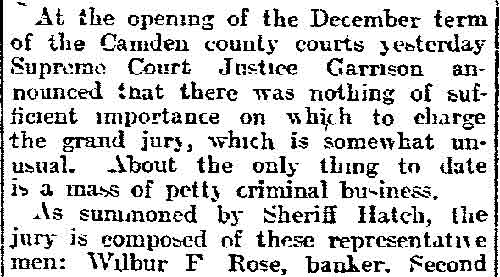
At the opening of the December term of the Camden county courts yesterday Supreme Court Justice Garrison announced that there was nothing of sufficient importance on which to charge the grand jury, which is somewhat unusual. About the only thing to date is a mass of petty criminal business.
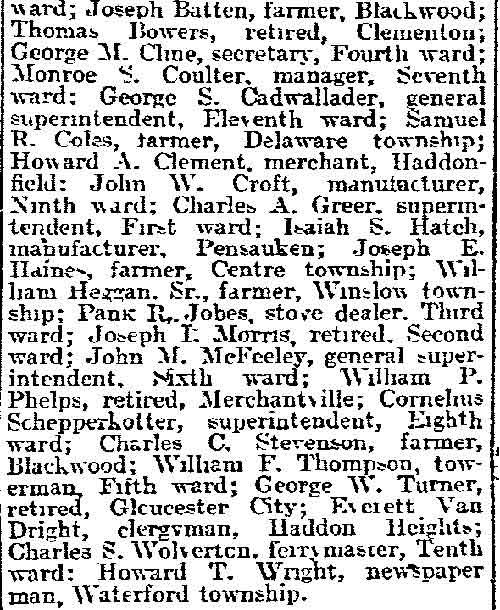
As summoned by Sheriff Hatch, the jury is composed of these representative men: Wilbur F. Rose, banker, Second ward; Joseph Batten, farmer, Blackwood; Thomas Bowers, retired, Clementon; George M. Cline, secretary, Fourth ward; Monroe S. Coulter, manager, Seventh ward; George S. Cadwallader, general superintendent, Eleventh ward; Samuel R. Coles, farmer, Delaware township; Howard A. Clement, merchant, Haddonfield; John W. Croft, manufacturer, Ninth ward; Charles A. Greer, superintendent, First ward; Isaiah S. Hatch, manufacturer, Pensauken; Joseph E. Haines, farmer, Centre township; William Heggan, Sr., farmer, Winslow township; Pank [sic] R. Jobes, stove dealer, Third ward; Joseph I. Morris, retired, Second ward; John M. McFeeley, general superintendent, Sixth ward; William P. Phelps, retired, Merchantville; Cornelius Schepperkotter, superintendent, Eighth ward; Charles C. Stevenson, farmer, Blackwood; William F. Thompson, towerman, Fifth ward; George W. Turner, retired, Gloucester City; Everett Van Dright, clergyman, Haddon Heights; Charles S. Wolverton, ferrymaster, Tenth ward; Howard T. Wright, newspaperman, Waterford township.
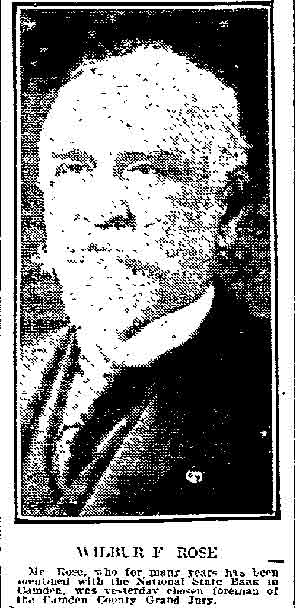
WILBUR F. ROSE. Mr. Rose, who for many years has been connected with the National State Bank in Camden, was yesterday chosen foreman of the Camden County Grand Jury.
Camden’s Mayor Has Field to Himself
Philadelphia Inquirer —
Candidates Named for City Offices by Camden Democrats and Republicans
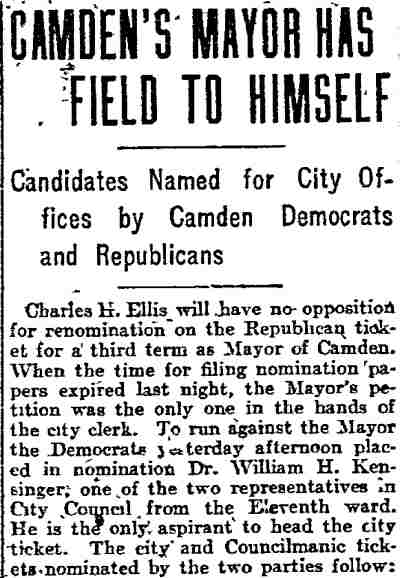
Charles H. Ellis will have no opposition for renomination on the Republican ticket for a third term as Mayor of Camden. When the time for filing nomination papers expired last night, the Mayor’s petition was the only one in the hands of the city clerk. To run against the Mayor the Democrats yesterday afternoon placed in nomination Dr. William H. Kensinger; one of the two representatives in City Council from the Eleventh ward. He is the only aspirant to head the city ticket. The city and Councilmanic tickets nominated by the two parties follow:
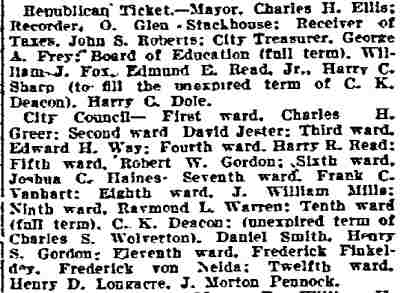
Republican Ticket.—Mayor, Charles H. Ellis; Recorder, O. Glen Stackhouse; Receiver of Taxes, John S. Roberts; City Treasurer, George A. Frey; Board of Education (full term), William J. Fox, Edmund E. Read, Jr., Harry C. Sharp (to fill the unexpired term of C. K. Deacon), Harry C. Dole.
City Council—First ward, Charles H. Greer; Second ward David Jester; Third ward, Edward H. Way; Fourth ward, Harry R. Read; Fifth ward, Robert W. Gordon; Sixth ward, Joshua C. Haines; Seventh ward, Frank C. Vanhart; Eighth ward, J. William Mills; Ninth ward, Raymond L. Warren; Tenth ward (full term), C. K. Deacon; (unexpired term of Charles S. Wolverton), Daniel Smith, Henry S. Gordon; Eleventh ward, Frederick Finkeldey; Frederick von Neida; Twelfth ward, Henry D. Longacre, J. Morton Pennock.
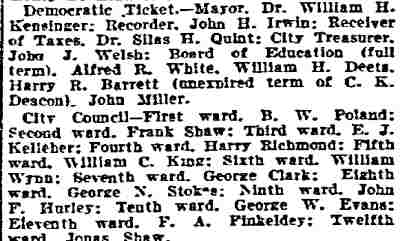
Democratic Ticket.—Mayor, Dr. William H. Kensinger; Recorder, John H. Irwin; Receiver of Taxes, Dr. Silas H. Quint; City Treasurer, John J. Welsh; Board of Education (full term), Alfred R. White, William H. Deets, Harry R. Barrett (unexpired term of C. K. Deacon), John Miller.
City Council—First ward, B. W. Poland; Second ward, Frank Shaw; Third ward, E. J. Kelleher; Fourth ward, Harry Richmond; Fifth ward, William C. King; Sixth ward, William Wynn; Seventh ward, George Clark; Eighth ward, George N. Stokes; Ninth ward, John F. Hurley; Tenth ward, George W. Evans; Eleventh ward, F. A. Finkeldey; Twelfth ward, Jonas Shaw.
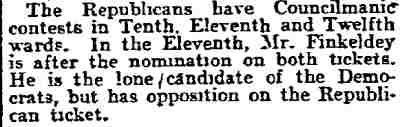
The Republicans have Councilmanic contests in Tenth, Eleventh and Twelfth wards. In the Eleventh, Mr. Finkeldey is after the nomination on both tickets. He is the lone candidate of the Democrats, but has opposition on the Republican ticket.
Frelinghuysen Majority Seen in Camden County
Philadelphia Inquirer —
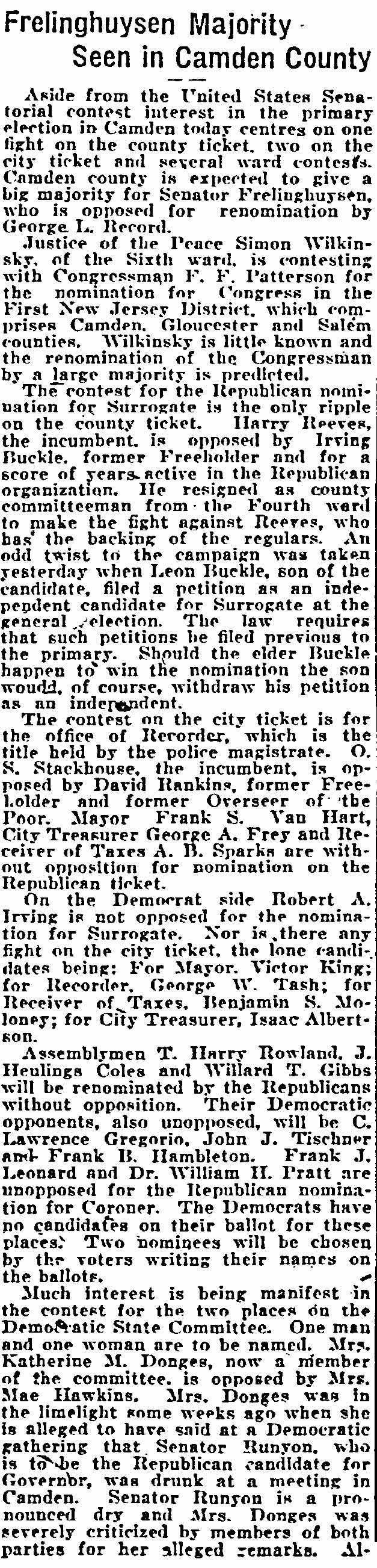
Aside from the United States Senatorial contest interest in the primary election in Camden today centres on one fight on the county ticket, two on the city ticket and several ward contests. Camden county is expected to give a big majority for Senator Frelinghuysen, who is opposed for renomination by George L. Record.
Justice of the Peace Simon Wilkinsky, of the Sixth ward, is contesting with Congressman F. F. Patterson for the nomination for Congress in the First New Jersey District, which comprises Camden, Gloucester and Salem counties. Wilkinsky is little known and the renomination of the Congressman by a large majority is predicted.
The contest for the Republican nomination for Surrogate is the only ripple on the county ticket. Harry Reeves, the incumbent, is opposed by Irving Buckle, former Freeholder and for a score of years active in the Republican organization. He resigned as county committeeman from the Fourth ward to make the fight against Reeves, who has the backing of the regulars. An odd twist to the campaign was taken yesterday when Leon Buckle, son of the candidate, filed a petition as an independent candidate for Surrogate at the general election. The law requires that such petitions be filed previous to the primary. Should the elder Buckle happen to win the nomination the son would, of course, withdraw his petition as an independent.
The contest on the city ticket is for the office of Recorder, which is the title held by the police magistrate. O. S. Stackhouse, the incumbent, is opposed by David Rankins, former Freeholder and former Overseer of the Poor. Mayor Frank S. Van Hart, City Treasurer George A. Frey and Receiver of Taxes A. B. Sparks are without opposition for nomination on the Republican ticket.
On the Democrat side Robert A. Irving is not opposed for the nomination for Surrogate. Nor is there any fight on the city ticket, the lone candidates being: For Mayor, Victor King; for Recorder, George W. Tash; for Receiver of Taxes, Benjamin S. Moloney; for City Treasurer, Isaac Albertson.
Assemblymen T. Harry Rowland, J. Heulings Coles and Willard T. Gibbs will be renominated by the Republicans without opposition. Their Democratic opponents, also unopposed, will be C. Lawrence Gregorio, John J. Tischner and Frank B. Hambleton. Frank J. Leonard and Dr. William H. Pratt are unopposed for the Republican nomination for Coroner. The Democrats have no candidates on their ballot for these places. Two nominees will be chosen by the voters writing their names on the ballots.
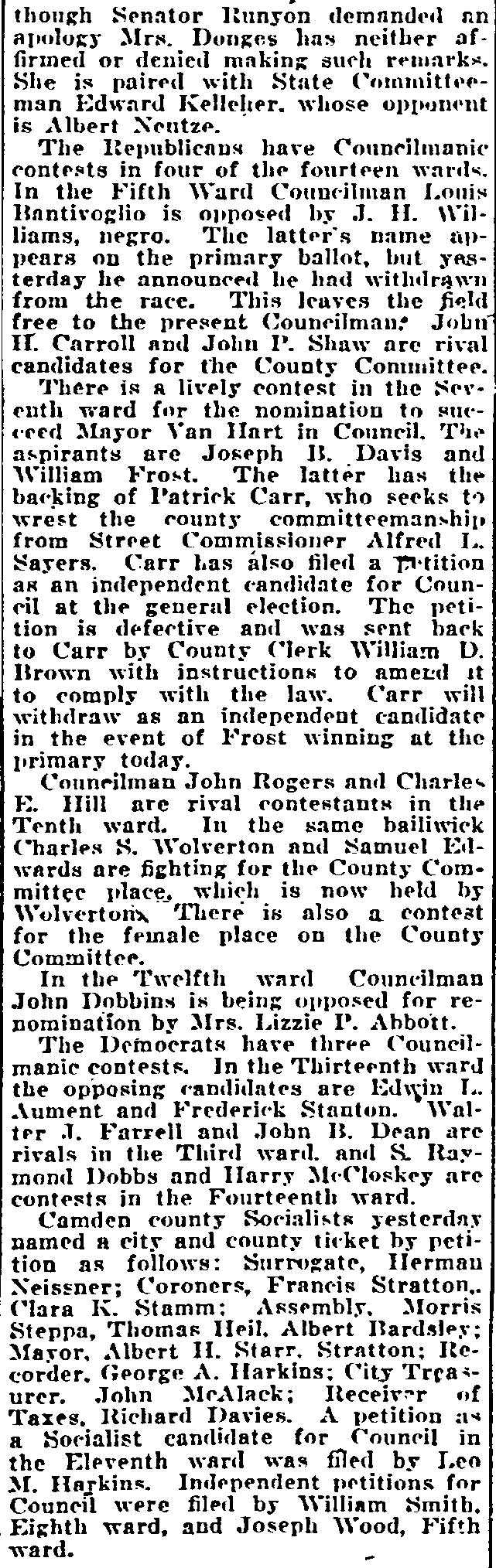
Much interest is being manifest in the contest for the two places on the Democratic State Committee. One man and one woman are to be named. Mrs. Katherine M. Donges, now a member of the committee, is opposed by Mrs. Mae Hawkins. Mrs. Donges was in the limelight some weeks ago when she is alleged to have said at a Democratic gathering that Senator Runyon, who is to be the Republican candidate for Governor, was drunk at a meeting in Camden. Senator Runyon is a pronounced dry and Mrs. Donges was severely criticized by members of both parties for her alleged remarks. Although Senator Runyon demanded an apology Mrs. Donges has neither affirmed or denied making such remarks. She is paired with State Committeeman Edward Kelleher, whose opponent is Albert Neutze.
The Republicans have Councilmanic contests in four of the fourteen wards. In the Fifth Ward Councilman Louis Bantivoglio is opposed by J. H. Williams, negro. The latter’s name appears on the primary ballot, but yesterday he announced he had withdrawn from the race. This leaves the field free to the present Councilman. John H. Carroll and John P. Shaw are rival candidates for the County Committee.
There is a lively contest in the Seventh ward for the nomination to succeed Mayor Van Hart in Council. The aspirants are Joseph B. Davis and William Frost. The latter has the backing of Patrick Carr, who seeks to wrest the county committeemanship from Street Commissioner Alfred L. Sayers. Carr has also filed a petition as an independent candidate for Council at the general election. The petition is defective and was sent back to Carr by County Clerk William D. Brown with instructions to amend it to comply with the law. Carr will withdraw as an independent candidate in the event of Frost winning at the primary today.
Councilman John Rogers and Charles E. Hill are rival contestants in the Tenth ward. In the same bailiwick Charles S. Wolverton and Samuel Edwards are fighting for the County Committee place, which is now held by Wolverton. There is also a contest for the female place on the County Committee.
In the Twelfth ward Councilman John Dobbins is being opposed for renomination by Mrs. Lizzie P. Abbott.
The Democrats have three Councilmanic contests. In the Thirteenth ward the opposing candidates are Edwin L. Aument and Frederick Stanton. Walter J. Farrell and John B. Dean are rivals in the Third ward, and S. Raymond Dobbs and Harry McCloskey are contests in the Fourteenth ward.
Camden county Socialists yesterday named a city and county ticket by petition as follows: Surrogate, Herman Neissner; Coroners, Francis Stratton, Clara K. Stamm; Assembly, Morris Steppa, Thomas Heil, Albert Bardsley; Mayor, Albert H. Starr, Stratton; Recorder, George A. Harkins; City Treasurer, John McAlack; Receiver of Taxes, Richard Davies. A petition as a Socialist candidate for Council in the Eleventh ward was filed by Leo M. Harkins. Independent petitions for Council were filed by William Smith, Eighth ward, and Joseph Wood, Fifth ward.
RESIDENTS PROTEST COOPER STREET WIDENING
Camden Courier-Post —
Two of the Cooper Street property owners who appeared at a hearing this morning at City Hall protested assessments to be levied against them for the widening of the thoroughfare from Fourth to Ninth Streets.
The objectors declared they did not feel that it was fair that they should be taxed for improvements from which they derive no benefit. Their protests were heard by the Commissioner of Assessments in the commission chambers at the hall.
The commissioners, Charles S. Wolverton, Wilbur B. Ellis, and James F. Lennon, said after the hearing that they will give further consideration to the complaints before submitting their report to the city commission. This will be done, they said, in the case of two complaints from property owners along Baird Boulevard, who protested being taxed for the planting of trees and the grading of “islands” on that thoroughfare from Bank Street to Maplewood Avenue. A public hearing on this improvement also was conducted this morning.
Thomas J. Daley, city engineer and clerk of the assessment commission by virtue of his position, explained after the hearing that the two Baird Boulevard property owners said they felt that the expenses of the improvement should be borne by the people who erected the properties along the highway.
Daley said that each abutting property owner on Cooper Street, from Fourth to Ninth Street, will pay an assessment of approximately $5.50 per front foot for the widening. The city taxpayers as a whole, he said, will also bear $5.50 per front foot, the other half of the cost of the improvement. The total cost of the widening, he reported was $35,126, of which abutting property owners will pay $17,400, and the city taxpayers about $17,700.
The Baird Boulevard improvement, Daley said, cost a total of $3,020, of which the abutting property owners will pay $2,140 and the city taxpayer, as whole, $880. The cost to such property owner per lot, he explained, will be about $10, all lots being about 20 feet wide.
An assessment on both improvements, Daley reported, will be fixed by the city after the commissioners of assessment file their report. The city commission will then fix a date when property owners who may have objections may appear at a public hearing.
Levies on Water Pipes by City Go Unprotested
Camden Courier-Post —
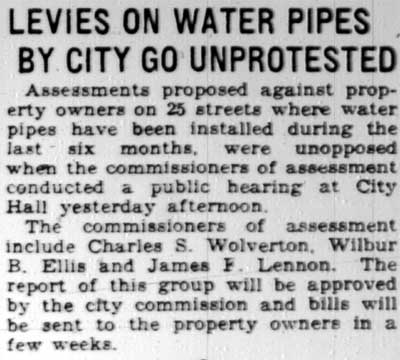
Levies on Water Pipes by City Go Unprotested
Assessments proposed against property owners on 25 streets where water pipes have been installed during the last six months, were unopposed when the commissioners of assessment conducted a public hearing at City Hall yesterday afternoon.
The commissioners of assessment include Charles S. Wolverton, Wilbur B. Ellis and James F. Lennon. The report of this group will be approved by the city commission and bills will be sent to the property owners in a few weeks.
C. S. Wolverton, 79, Civic Leader Here, Dies at Hospital
Camden Courier-Post —
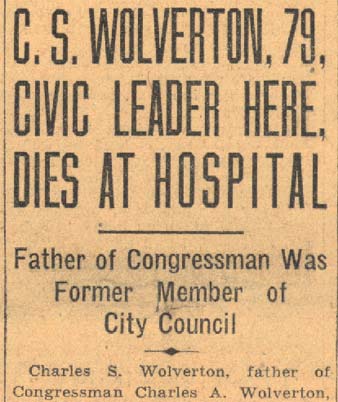
Father of Congressman Was Former Member of City Council
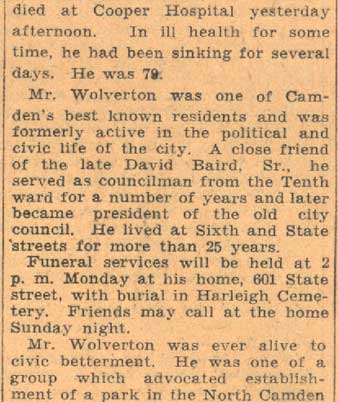
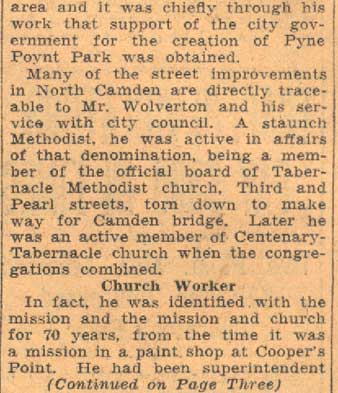
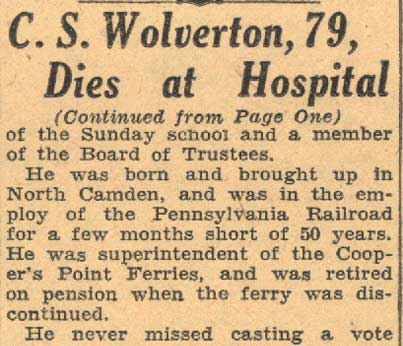
Charles S. Wolverton, father of Congressman Charles A. Wolverton, was one of Camden’s oldest and best known civic leaders. It was chiefly through his work that support of the city government for the creation of Pyne Pount Park was obtained. Many of the street improvements in North Camden are directly traceable to Mr. Wolverton and his service with city council.
A staunch Methodist, he was active in affairs of that denomination, being a member of the official board of Tabernacle Methodist Church, Third and Pearl streets, torn down to make way for Camden bridge. Later he was an active member of Centenary Tabernacle church when the congregations combined. In fact, he was identified with the mission and church for 70 years, from the time it was a mission in a little shop at Cooper’s Point. He had been superintendent of the Sunday school and a member of the Board of Trustees.
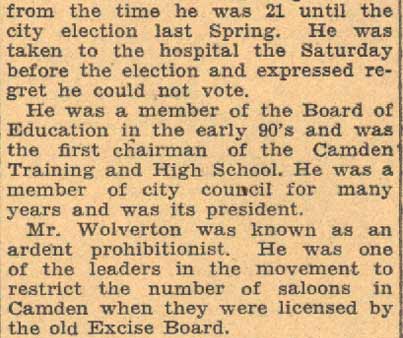
He was born and brought up in North Camden, and was in the employment of the Pennsylvania Railroad for a few months short of 50 years. He was superintendent of the Cooper’s Point Ferries, and was retired on pension when the ferry was discontinued. He never missed casting a vote from the time he was 21 until the city election last Spring. He was taken to the hospital the Saturday before the election and expressed regret he could not vote.
He was a member of the Board of Education in the early 90’s and was the first chairman of the Camden Training and High School. He was a member of city council for many years and was its president. Mr. Wolverton was known as an ardent prohibitionist. He was one of the leaders in the movement to restrict the number of saloons in Camden when they were licensed by the old Excise Board.
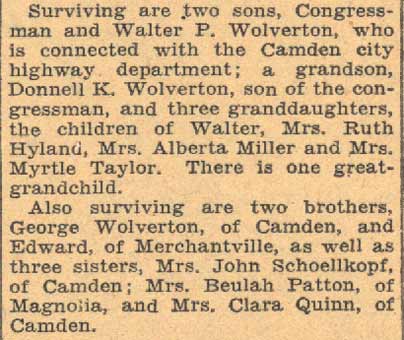
Surviving are two sons, Congressman Charles A. Wolverton and Walter P. Wolverton, who is connected with the Camden city highway department; a grandson, Donnell K. Wolverton, son of the congressman, and three granddaughters, the children of Walter, Mrs. Ruth Hyland, Mrs. Alberta Miller and Mrs. Myrtle Taylor. There is one great-grandchild. Also surviving are two brothers, George Wolverton, of Camden, and Edward, of Merchantville, as well as three sisters, Mrs. John Schoellkopf, of Camden; Mrs. Beulah Patton, of Magnolia, and Mrs. Clara Quinn, of Camden.
Last Tribute Paid to C.S. Wolverton
Camden Courier-Post —
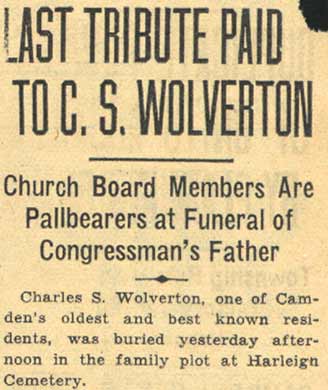
Church Board Members Are Pallbearers at Funeral of Congressman’s Father
Charles S. Wolverton, one of Camden’s oldest and best known residents, was buried yesterday afternoon in the family plot at Harleigh Cemetery.
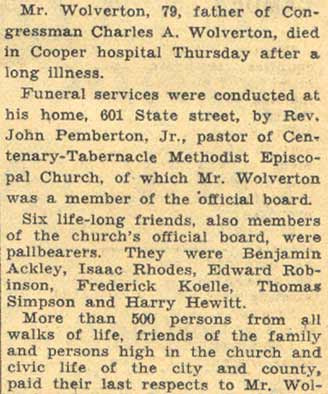
Mr. Wolverton, 79, father of Congressman Charles A. Wolverton, died in Cooper hospital Thursday after a long illness.
Funeral services were conducted at his home, 901 State Street, by Rev. John Pemberton, Jr., pastor of Center-Tabernacle Methodist Episcopal Church, of which Mr. Wolverton was a member of the official board.
Six life-long friends, also members of the church’s official board, were pallbearers. They were Benjamin Addis, Isaac Rhodes, Edward Robinson, Frederick Koelle, Thomas Simpson and Harry Hewitt.
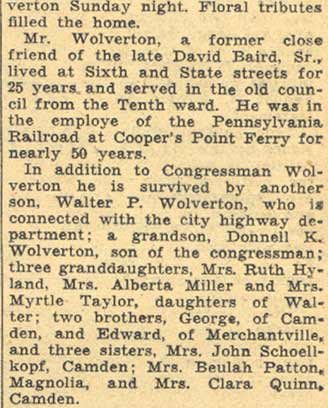
More than 500 persons from all walks of life, friends of the family and members high in the church and civic life of the city and county, paid their last respects to Mr. Wolverton Sunday night. Floral tributes filled the home.
Mr. Wolverton, a former close friend of the late David Baird Sr., lived at Sixth and State Street for 25 years and served in the old council from the Tenth ward. He was in the employ of the Pennsylvania Railroad at Cooper’s Point Ferry for nearly 40 years.
In addition to Congressman Wolverton he is survived by another son, Walter P. Wolverton, who is connected with the city highways department; a grandson, Donnell K. Wolverton, son of the congressman; three granddaughters, Mrs. Ruth Hyland, Mrs. Alberta Miller and Mrs. Myrtle Taylor, daughters of Walter Wolverton; two brothers, George, of Camden, and Edward, of Merchantville, and three sisters, Mrs. John Scholkopf, Camden; Mrs. Beulah Patton, Magnolia, and Mrs. Clara Stocker, Camden.