Introduction
MANUEL KANE was born in Pennsylvania around 1883. He came to Camden with his wife and children sometime after 1914. By September of 1918 he was living at 703 North 3rd Street with his wife Florence, daughter Elva and son Earl. When he registered for the draft he was employed as a watchman at the New York Shipbuilding Corporation shipyard. He was employed at a chemical factory when the 1920 Census was taken.
By 1924 he had been appointed to the Camden Fire Department. Manuel Kane was still a member of the Department and still residing at 703 North 3rd Street when the 1931 Camden City Directory was compiled. By 1940 Manuel and Florence Kane had moved to 1223 North 20th Street in Cramer Hill. He passed away on April 11, 1942 and was buried in Oakland Cemetery in the Frankford section of Philadelphia, Pennsylvania. Florence Kane was still living at the Cramer Hill address as late as 1947.
World War I Draft Card
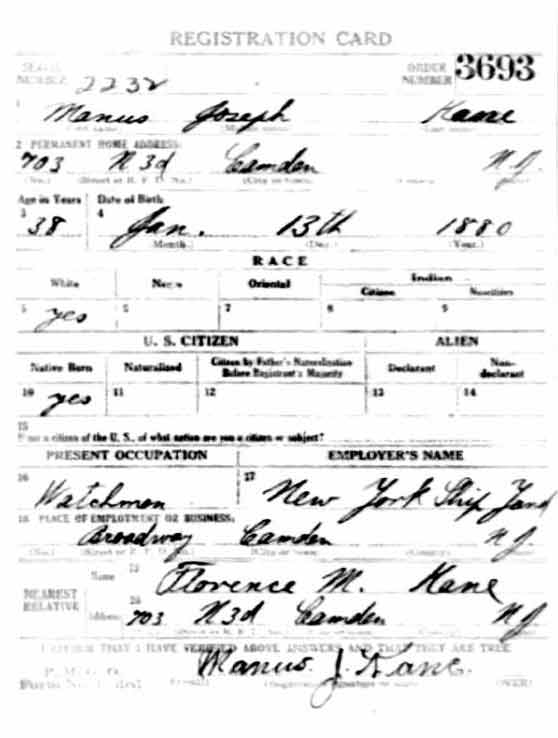
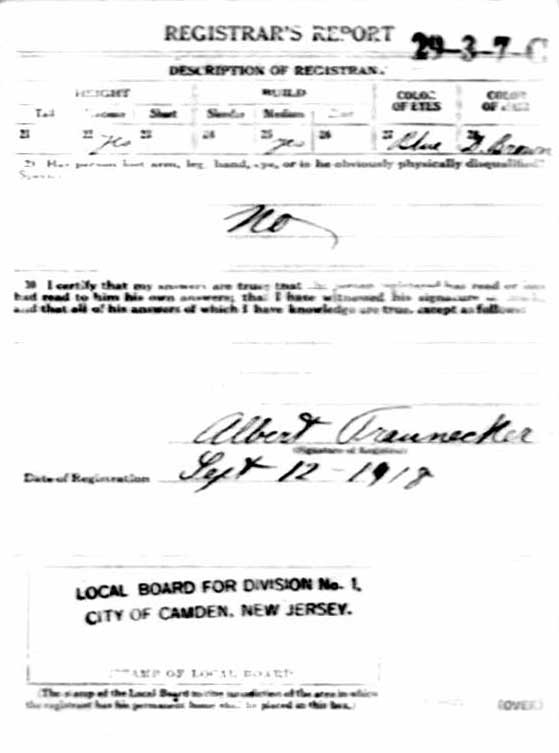
World War I draft registration card for Manus Joseph Kane, September 12, 1918. Local Board for Division No. 1, City of Camden, New Jersey.
Name: Manus Joseph Kane. Permanent home address: 703 N 3d [Street], Camden, NJ. Date of birth: January 13, 1880. Race: White. U.S. Citizen: Native Born. Present occupation: Watchman. Employer’s name: New York Ship[building Corporation]. Place of employment: Broadway, Camden, NJ. Nearest relative: Florence M. Kane, 703 N 3d, Camden, NJ.
New Firemen Assigned for Two Platoons
Camden Post-Telegram —
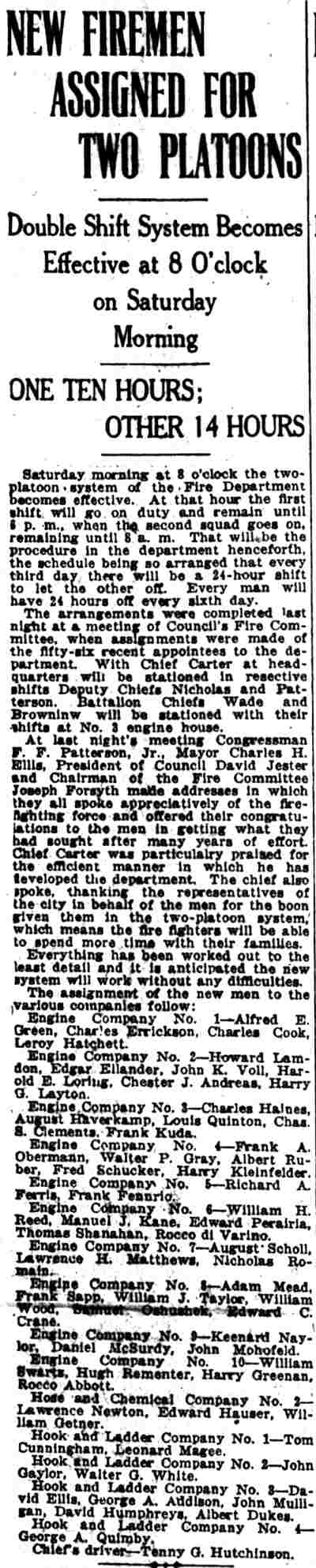
NEW FIREMEN ASSIGNED FOR TWO PLATOONS
Double Shift System Becomes Effective at 8 O’clock on Saturday Morning
One Ten Hours; Other 14 Hours
Saturday morning at 8 o’clock the two-platoon system of the Fire Department becomes effective. At that hour the first shift will go on duty and remain until 6 p. m., when the second squad goes on, remaining until 8 a. m. That will be the procedure in the department henceforth, the schedule being so arranged that every third day there will be a 24-hour shift to let the other off. Every man will have 24 hours off every sixth day.
The arrangements were completed last night at a meeting of Council’s Fire Committee, when assignments were made of the fifty-six recent appointees to the department. With Chief Carter at headquarters will be stationed in reserve shifts Deputy Chiefs Nicholas and Patterson. Battalion Chiefs Wade and Browning will be stationed with their shifts at No. 3 engine house.
At last night’s meeting Congressman F. F. Patterson, Jr., Mayor Charles H. Ellis, President of Council David Jester and Chairman of the Fire Committee Joseph Forsyth made addresses in which they all spoke appreciatively of the fire-fighting force and offered their congratulations to the men in getting what they had sought after many years of effort. Chief Carter was particularly praised for the efficient manner in which he has developed the department. The chief also spoke, thanking the representatives of the city in behalf of the men for the boon given them in the two-platoon system, which means the fire fighters will be able to spend more time with their families.
Everything has been worked out to the least detail and it is anticipated the new system will work without any difficulties.
The assignment of the new men to the various companies follow:
Engine Company No. 1—Alfred E. Green, Charles Errickson, Charles Cook, Leroy Hatchett.
Engine Company No. 2—Howard Lamdon, Edgar Ellander, John K. Voll, Harold E. Lorang, Chester J. Andreas, Harry G. Layton.
Engine Company No. 3—Charles Haines, August Haverkamp, Louis Quinton, Chas. S. Clements, Frank Kuda.
Engine Company No. 4—Frank A. Obermann, Walter P. Gray, Albert Ruber, Fred Schucker, Harry Kleinfelder.
Engine Company No. 5—Richard A. Ferris, Frank Fennrio.
Engine Company No. 6—William H. Reed, Manuel J. Kane, Edward Perairia, Thomas Shanahan, Rocco di Varino.
Engine Company No. 7—August Scholl, Lawrence H. Matthews, Nicholas Romain.
Engine Company No. 8—Adam Mead, Frank Sapp, William J. Taylor, William Wood, Samuel Oshushek, Edward C. Crane.
Engine Company No. 9—Keenard Naylor, Daniel McSurdy, John Mohofeld.
Engine Company No. 10—William Swarts, Hugh Rementer, Harry Greenan, Rocco Abbott.
Hose and Chemical Company No. 2—Lawrence Newton, Edward Hauser, William Getner.
Hook and Ladder Company No. 1—Tom Cunningham, Leonard Magee.
Hook and Ladder Company No. 2—John Gaylor, Walter G. White.
Hook and Ladder Company No. 3—David Ellis, George A. Addison, John Mulligan, David Humphreys, Albert Dukes.
Hook and Ladder Company No. 4—George A. Quimby.
Chief’s driver—Tenny G. Hutchinson.
$225,000 Fire Ruins 5 Uptown Plants
Camden Courier-Post —
How Flames Gutted Big Industrial Building
Residents Flee as Flames Rage in Big Building
Factory of Evans Leather Co. Saved by Valiant Work of Firemen
Apparatus Is Disabled; Debris Buried Fire Plug
Metal Stamping Firm, Textile Concern Heavy Losers; Pattern Shop Saved
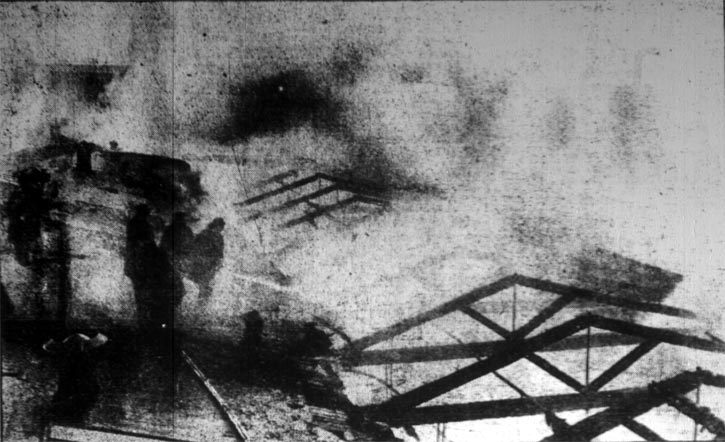

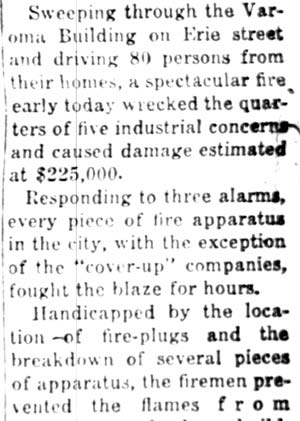
Sweeping through the Varoma Building on Erie street and driving 80 persons from their homes, a spectacular fire early today wrecked the quarters of five industrial concerns and caused damage estimated at $225,000.
Responding to three alarms, every piece of fire apparatus in the city, with the exception of the “cover-up” companies, fought the blaze for hours.
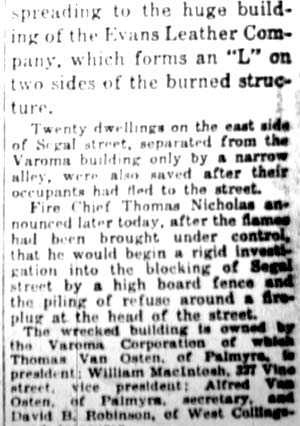
Handicapped by the location of fire-plugs and the breakdown of several pieces of apparatus, the firemen prevented the flames from spreading to the huge building of the Evans Leather Company, which forms an “L” on two sides of the burned structure.
Twenty dwellings on the east side of Segal street, separated from the Varoma building only by a narrow alley, were also saved after their occupants had fled to the street.
Fire Chief Thomas Nicholas announced later today, after the flames had been brought under control, that he would begin a rigid investigation into the blocking of Segal street by a high board fence and the piling of refuse around a fire-plug at the head of the street.
The wrecked building is owned by the Varoma Corporation of which Thomas Van Osten, of Palmyra, is president; William MacIntosh, 277 Vine street, vice president; Alfred Van Osten, of Palmyra, secretary, and David B. Robinson, of West Collingswood.
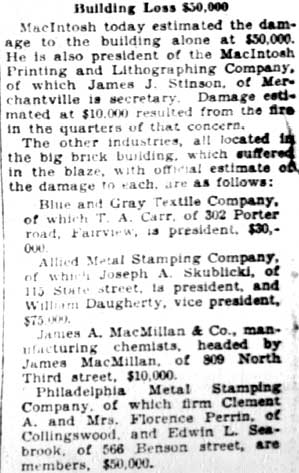
Building Loss $50,000
MacIntosh today estimated the damage to the building alone at $50,000. He is also president of the MacIntosh Printing and Lithographing Company, of which James J. Stinson, of Merchantville is secretary. Damage estimated at $10,000 resulted from the fire in the quarters of that concern.
The other industries, all located in the big brick building, which suffered in the blaze, with official estimate of the damage to each, are as follows:
Blue and Gray Textile Company, of which T. A. Carr, of 302 Porter road, Fairview, is president, $30,000.
Allied Metal Stamping Company, of which Joseph A. Skublicki, of 115 State street, is president, and William Daugherty, vice president, $75,000.
James A. MacMillan & Co., manufacturing chemists, headed by James MacMillan, of 809 North Third street, $10,000.
Philadelphia Metal Stamping Company, of which firm Clement A. and Mrs. Florence Perrin, of Collingswood, and Edwin L. Seabrook, of 566 Benson street, are members, $50,000.
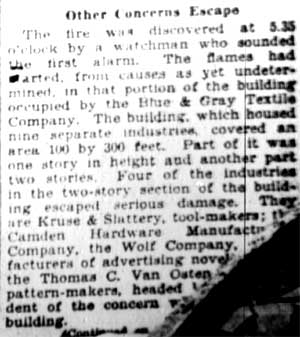
Other Concerns Escape
The fire was discovered at 5:35 o’clock by a watchman who sounded the first alarm. The flames had started, from causes as yet undetermined, in that portion of the building occupied by the Blue & Gray Textile Company. The building, which housed nine separate industries, covered an area 100 by 300 feet. Part of it was one story in height and another part two stories. Four of the industries in the two-story section of the building escaped serious damage. They are Kruse & Slattery, tool-makers; the Camden Hardware Manufacturing Company, the Wolf Company, manufacturers of advertising novelties; the Thomas C. Van Osten, pattern-makers, headed by president of the concern who is in the building.
The structure, at 105–107 Erie street, extends back almost to Segal street and has a frontage covering most of the block on Erie street between Second and Burns streets.
Arriving in response to the watchman’s alarm, Chief Nicholas visioned the danger of repetition of the fire nine years ago when buildings at the same location were wiped out by flames. He immediately sounded the second and third alarms, bringing almost every piece of apparatus in the city to the scene.
Carr, president of the textile company, estimated the loss there at $30,000, stating that a large shipment of intricate machinery from Germany had arrived only a few days ago. The concern was anticipating removal, in a short time, to larger quarters at Ninth and State streets, Carr added.
From the two large rooms occupied by the Blue & Gray textile firm, the flames swung over to the quarters of the Allied Metal Stamping Company. Daugherty, the vice-president of this concern, said his company was filling a large order for electric switch-boxes and had been working at capacity for several weeks. Switch-boxes valued at $40,000 were destroyed by the fire with machinery and other equipment valued by Daugherty at an additional $35,000.
Blasts Add to Perils
Moving northward, the flames next struck the MacMillan plant, where chemicals are manufactured for paints and drug companies. Here the flames reached a number of containers of chemicals and, for a time, the blaze was punctuated by a series of explosions. Here, firemen risked imminent peril to their lives by carrying other containers of chemicals out of reach of the flames.
Still continuing northward; the fire next reached the Macintosh lithographing plant and spread through the cutting and shipping rooms, causing damage estimated at $10,000 before firemen succeeded in dragging five lines of hose into this section of the building and driving back the flames.
The Philadelphia Metal Supply Company went next as the fire swept eastward. In this plant, metal cornices and valuable hand-made dies were destroyed at a loss estimated by Perrin, a member of the firm, at $50,000.
Arriving at the scene, apparatus from Engine Companies No. 1 and No. 7 developed boiler trouble and were unable to work. Firemen were further handicapped by the fact that the Evans Leather Company has blocked off Segal street at the north end by a high board fence. A fireplug at this point was also blocked by a pile of chemical containers, declared to have been placed there by the leather company.
Declaring that he could have attached at least four more hose lines had this plug not been blocked, Chief Nicholas announced that he would conduct an investigation. He said also that the leather company had failed to place gates in the Segal street fence, as city officials required them to do when permission was given for erection of the barrier.
Hose lines were taken to the flat roof of the Evans Company, high above the burning building, and water poured onto the flames from this altitude. Hundreds of persons were attracted to the scene by the spectacular nature of the fire, which was visible from the Camden bridge and for miles around. A police detail under Chief James E. Tatem and Deputy Inspector Lewis Etehr kept the crowds in check.
Firemen escaped injury while fighting the flames at their height, but while they were still pouring streams of water onto the ruins shortly before noon today, the first casualty occurred. Emanuel Kane, of 703 North Third street, a fireman attached to Engine Company No. 6, was struck on the head and knocked down by a 12-foot length of steel bar, six inches thick, which pinned him under it as he fell. Companions ran to his aid, lifted the bar from him and revived him. Hospital treatment was not necessary.
Eight other firemen narrowly escaped serious injury a few minutes later when a section of the east wall fell. The eight men were standing under the wall when one of them saw it totter. They dashed from the spot just in time to avoid being buried by the falling debris. Three of these firemen were from Engine Company No. 4, at Fifth and Arch streets; three from No. 4, Fourth and Vine streets, and two from No. 2 Company, Front and Ahden streets.
Jack Sperry, an Evening Courier photographer, was walking along the rest of a part of the burned building when he fell through a portion of it which had been burned from beneath. Pinned at his arm-pits, he was dragged out. He got his picture.
While carrying a hose line into the structure, Firemen Harry Lee and David Ellis were knocked down when a coupling blew off the hose but were not hurt.
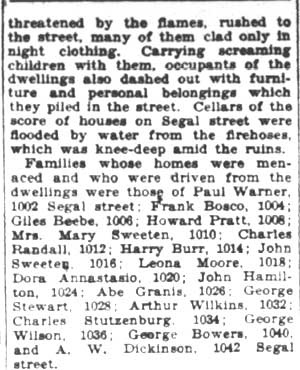
A wild confusion was in the street when members whose homes were threatened by the flames, rushed to the street, many of them clad only in night clothing. Carrying screaming children with them, occupants of the dwellings also dashed out with furniture and personal belongings which they piled in the street. Cellars of the score of houses on Segal street were flooded by water from the firehoses, which was knee-deep amid the ruins.
Families whose homes were menaced and who were driven from the dwellings were those of Paul Warner, 1002 Segal street; Frank Bosco, 1004; Giles Beebe, 1006; Howard Pratt, 1008; Mrs. Mary Sweeten, 1010; Charles Randall, 1012; Harry Burr, 1014; John Sweeten, 1016; Leona Moore, 1018; Dora Annastasio, 1020; John Hamilton, 1024; Abe Granis, 1026; George Stewart, 1028; Arthur Wilkins, 1032; Charles Stutzenburg, 1034; George Wilson, 1036; George Bowers, 1040, and A. W. Dickinson, 1042 Segal street.
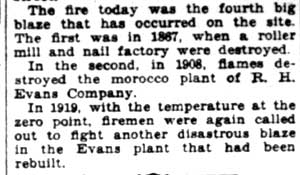
The fire today was the fourth big blaze that has occurred on the site. The first was in 1867, when a roller mill and nail factory were destroyed. In the second, in 1908, flames destroyed the morocco plant of R. H. Evans Company. In 1919, with the temperature at the zero point, firemen were again called out to fight another disastrous blaze in the Evans plant that had been rebuilt.