Introduction
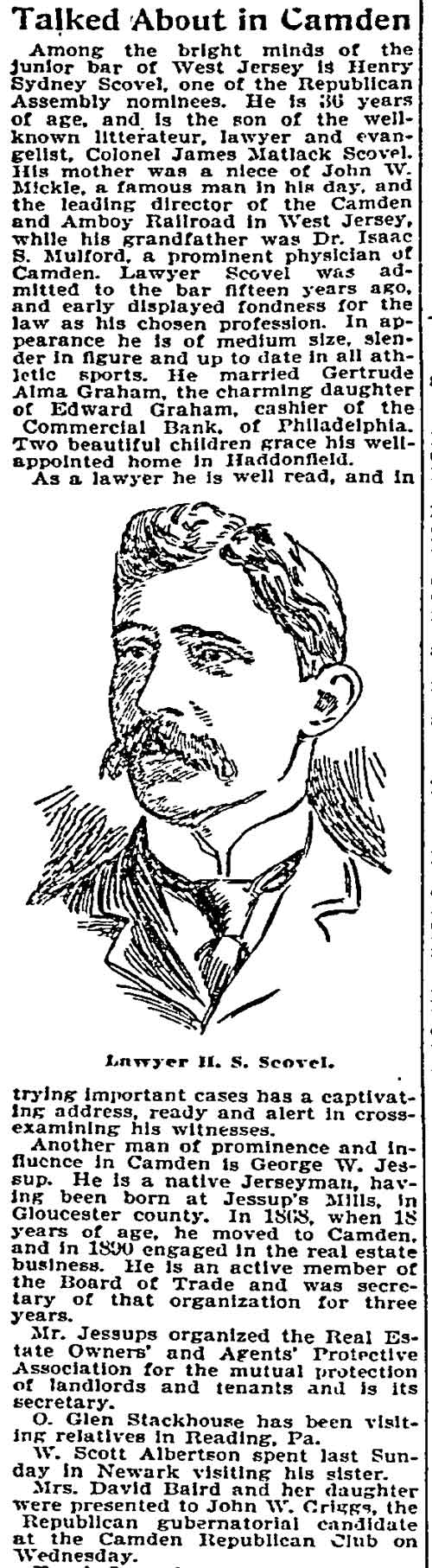
Talked About in Camden
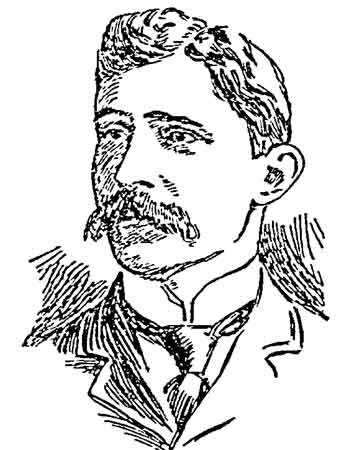
Among the bright minds of the Junior bar of West Jersey is Henry Sidney Scovel, a member of the Republican Assembly Committee. He is 26 years of age, a native of New Jersey, graduated at Princeton, and studied law in the office of his father, Colonel James Matlack Scovel, one of the most distinguished orators and early displayed fondness for the bar. He is prominent in Masonic circles. In appearance he is stylish and modern in figure and up to date in all athletics. Since his recent marriage to Gertrude Alma Graham, the charming daughter of Edward L. Graham, a brother of the late Senator Graham, he has settled down to professional life. These two beautiful children grew his well appointed home in Haddonfield. He is clearly a young man with a career.
Lawyer H. S. Scovel, the counsel trying important cases has a captivating address which is most effective in examining his witnesses.
HENRY SIDNEY SCOVEL was a prominent lawyer who served as Camden County prosecutor from 1905 to 1912. He was a member of the New Jersey State Assembly in 1897. He was also a good friend of the poet Walt Whitman as early as September of 1885.
Henry S. Scovel was born in 1858, and resided in the North Ward as late as 1870. His father, Colonel James Matlock Scovel, was locally famous as an orator, evangelist, and lawyer. His mother was the niece of John W. Mickle, and his maternal grandfather was Dr. Isaac S. Mulford, both of whom had schools named after them in Camden in the 1870s, which is a fairly good gauge of the two men's local importance and reputation.
On January 28, 1897 Henry S. Scovel was one of several dignitaries who were in attendance at the opening of the Catholic Lyceum on Broadway at Federal Street, adjacent to the church. Other attendees included Governor John W. Griggs, Mayor John L. Westcott, Attorney-General Samuel H. Grey, Camden city solicitor J. Willard Morgan, Senator H. W. Johnson, Assemblyman Louis DeRousse, J.J. Burleigh, Sheriff David Baird Sr., then Postmaster Harry B. Paul, ex-Judge Armstrong, Architect Henry S. Dagit, George A. Frey, and H. L. Bonsall. The Lyceum would evolve into Camden Catholic High School.
In 1898 he had a run-in with Stockton (later East Camden) politician Jake Schiller. It was during the second trial of Eli Shaw for the murder of his mother and grandmother, Mrs. Anna Shaw and Mrs. Emma Zane. They were found shot to death in September, 1897, in their bedroom of their home on Line Street near Third. Detective John Painter had found a revolver hidden in the chimney, one of several points in the circumstantial evidence that resulted in the indictment of Shaw. He was then a widely known young man about town and his arrest caused a big sensation. As time drew near for the trial feeling was intense, for there were adherents for and against the son and grandson, those arguments often grew bitter.
Henry Sidney Scovel, then one of the prominent criminal lawyers of Camden county, was retained to defend Shaw. Scovel was son of James Matlack Scovel, himself one of the leading barristers of this section. When the trial of Shaw was under way the city was astounded when it was charged Scovel had tampered with the jury. It was Schiller who made the charge.
The trial stopped abruptly. Scovel emphatically denied the story of Schiller and demanded vindication. An indictment for embracery was returned and at a trial, which had Camden on the tip toe of expectancy for days, it developed there was absolutely nothing to verify the charge, and Scovel was acquitted. He acted in two subsequent trials of Shaw, the second being a disagreement and the third acquittal for the son and grandson of the slain women.
Schiller, strangely enough, in later years became friendly with Scovel and when the latter was prosecutor from 1905 to 1912, “Jake,” as he was familiarly known, was usually to be found in the office at the courthouse. Scovel was then a white haired man of flowery speech and impressive personality who let bygones be bygones.
Henry Scovel married Gertrude Alma Graham in 1889. There were three children, daughters Ethel and Beatrice, and a son, Henry Graham Scovel, who followed his father into the practice of law.
In the fall of 1902 Henry S. Scovel was reported have been engaged to conduct the defense of Paul Woodward, who was on trial for murder. This was not the case however, and Mr. Scovel took no part in the proceedings. Woodward was found guilty and was executed at the Camden County jail on January 7, 1903.
Henry S. Scovel served for a time around 1905 in the New Jersey State Assembly. While there he sponsored a bill in the legislature compelling traction companies to construct front and rear enclosed platforms on trolley cars.
A resident of Haddonfield by 1910, Henry S. Scovel passed away there on October 5, 1918. He had been ill for some time prior to his demise.
Walt Whitman Surprised
New York Times –

PHILADELPHIA, Sept. 14.—At the dinner this evening, as Walt Whitman was half dozing over a pile of manuscripts, Tom Donaldson, acting for a committee of friends of whom he was a favorite, the son of an old school chum of his, and started to playfully announce a presentation ceremony and started to talk in rhymes.
“What’s all this noise about you,” he replied. “It is a solemn fact,” they announced “that you have a presentation to make. You are 76 years old. You came here to this old city of Camden 21 years ago. You’ve seen a good many things happen. This city has a natural pride in you. You’ve helped make it famous. You sit here in a portentous armchair, too fat and too lazy to get around. Yet you must get around. A little exercise would do you good. You wrote so beautifully about horses that a good many persons have decided to give you one to get around with. Here is a horse and phaeton complete. You need not do anything but get in and go wherever you like.”
His friends and admirers waited in silence. The white-haired poet seemed much overcome and a glittering mist came over his old blue eyes and ran down his cheeks. At last he slowly rose to his feet, leaning on his big stick, and commenced a reply in a rather husky voice, but with steady choice of words: “If there was never any reason for a man to be glad that he was born this is my reason. These friends and their generosity—how could anyone receive anything more welcome. I am old, I know it—not that I feel it much but it is so. I did help make old Camden famous—a little, maybe. I have been lame and rheumatic. I needed something like this, and you have brought it to me in the shape of this horse and phaeton. I am very, very grateful, but can hardly tell you how much.”
The presentation was made by Tom Donaldson of Philadelphia, and it was the outcome of a subscription got up by the friends of old Walt on both sides of the Delaware, supplemented by contributions from John Greenleaf Whittier, Mark Twain, Oliver Wendell Holmes, and Edwin Booth.
The horse, a very pretty and docile one, was led before the old man’s house on Mickle Street in Camden, and Henry S. Scovel, a Camden lawyer, took old Walt Whitman for a short drive in the new phaeton.
Lawyer Scovel on Trial
New York Times –
He Is Charged With Embracery in the Shaw Murder Case
CAMDEN, N. J., April 6—H. S. Scovel, the lawyer who started to defend Eli Shaw, the young man accused of murdering his mother and grandmother, was put on trial here today charged with embracery arising out of the Shaw case. Information coming to Judge Dixon during the second day of the Shaw trial caused the case to be suspended at that point, and an investigation by the Grand Jury resulted in the indictment of Scovel.
The indictment charged the defendant with offering Jacob Schiller, a panel juror in the Shaw case, the sum of $100 in consideration of the latter giving a verdict favorable to the defendant. But one similar case is cited in the law books, and the penalty fixed by law is $600 fine and two years’ imprisonment.
Edward Enterken, the County Jailer, the State’s first witness, swore that after the Shaw panel was drawn, Scovel came to him in the county jail, and, calling his attention to the list, asked if Schiller was “all right.” Enterken said he thought he was. Scovel then told the witness to tell Schiller there was $100 in it for him if he were “all right.” When the first call of the case resulted in a mistrial, the witness testified that Scovel came to him and asked him never to say anything about the $100.
Juror Schiller was the next witness, but his evidence was indeterminate. Scovel denied the charge in every particular. Eli Shaw, who was brought from his cell to testify, said he knew nothing of attempts to bribe anyone.
The case will close tomorrow. An acquittal is looked for.
Officials Celebrate Birthdays
Philadelphia Inquirer –
Officials Celebrate Birthdays
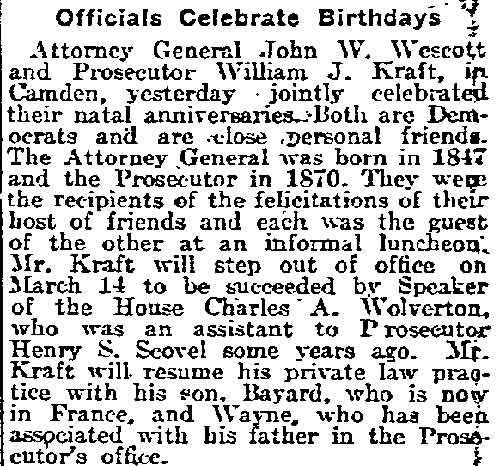
Attorney General John W. Wescott and Prosecutor William J. Kraft, in Camden, yesterday jointly celebrated their natal anniversaries. Both are Democrats and are close personal friends. The Attorney General was born in 1847 and the Prosecutor in 1870. They were the recipients of the felicitations of their host of friends and each was the guest of the other at an informal luncheon. Mr. Kraft will step out of office on March 14 to be succeeded by Speaker of the House Charles A. Wolverton, who was an assistant to Prosecutor Henry S. Scovel some years ago. Mr. Kraft will resume his private law practice with his son, Bayard, who is now in France, and Wayne, who has been associated with his father in the Prosecutor’s office.
Photos
More Gamblers Arrested
MORE GAMBLERS ARRESTED.
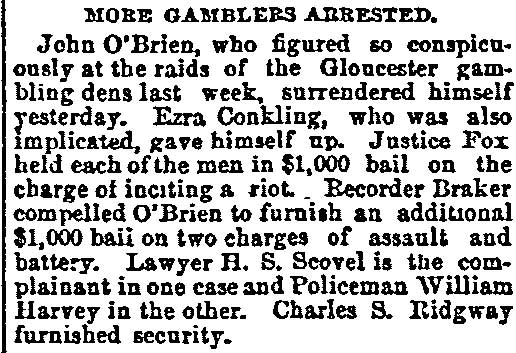
John O'Brien, who figured so conspicuously at the raids of the Gloucester gambling dens last week, surrendered himself yesterday. Ezra Conkling, who was also implicated, gave himself up. Justice Fox held each of the men in $1,000 bail on the charge of inciting a riot. Recorder Braker compelled O'Brien to furnish an additional $1,000 bail on two charges of assault and battery. Lawyer H. S. Scovel is the complainant in one case and Policeman William Harvey in the other. Charles S. Ridgway furnished security.
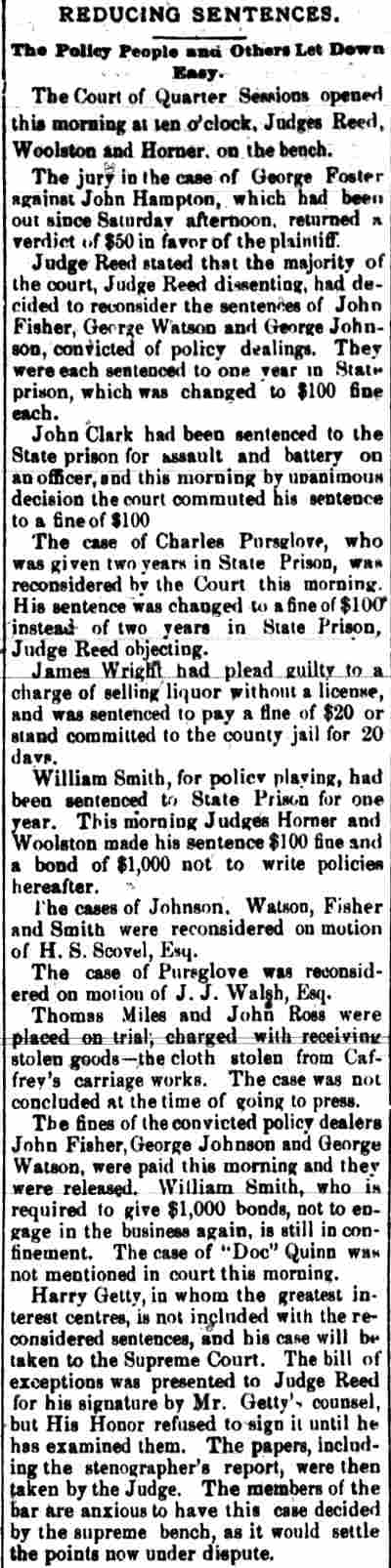
Camden Post, February 26, 1883. William “Policy Bill” Smith, Harriet Smith, John Fisher, George Watson, George Johnson, Harry Getty, John Clark, Charles Pursglove, James Wright, J.J. Walsh, Isaiah S. Woolston, Henry S. Scovel, Joel Horner, Theodore B. Gibbs, Thomas Miles, John Ross, “Doc” Quinn, Caffrey’s Carriage Works
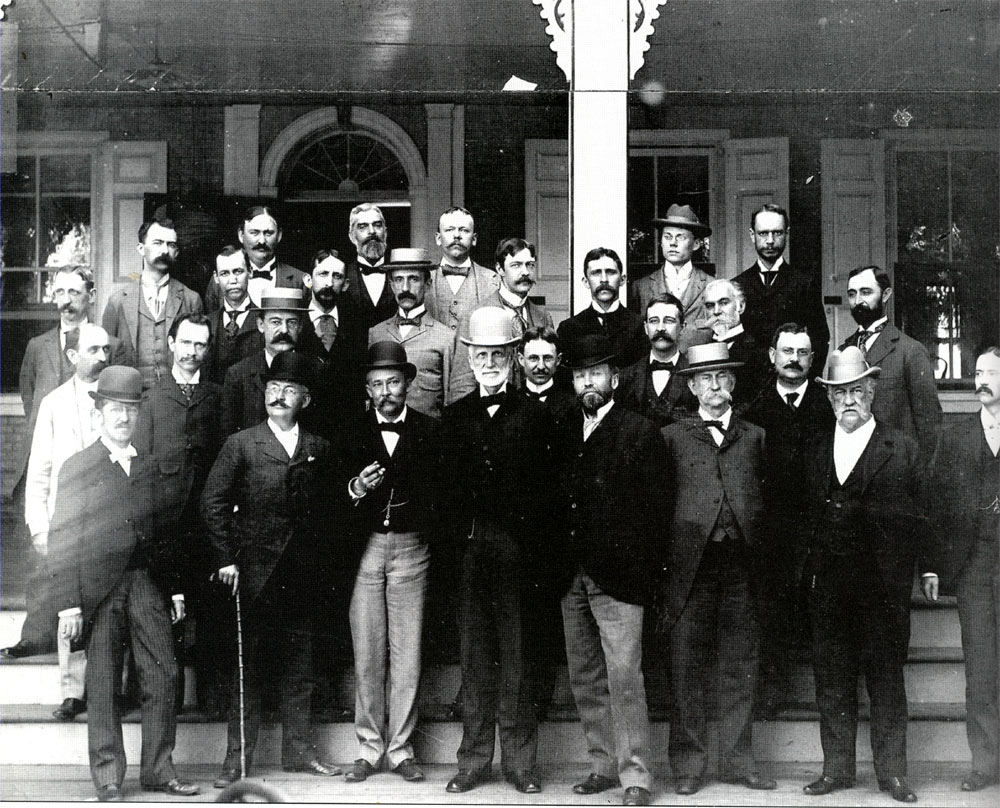
Members of the Camden County Bar Association, pose for a photograph during their annual shad dinner, around 1894. From left (first row) Judge Charles Joline, Supreme Court Justice Charles Garrison, Judge Richard R. Miller, vice chancellor Henry C. Pitney, Supreme Court Justice Alfred Reed, Benjamin Shreeve, Caleb Shreeve, George H. Pierce; (second row) William Casselman, Edwin Bleakly, J. Willard Morgan, Peter Voorhees, Samuel Beldon, Frank Shreeve, Scuyler Woodhull, Lewis Starr, H. S. Scovel, George Vroom, Charles Wooster, and Howard Carrow; (third row) Samuel Robbins, E. A. Armstrong, Thomas Curley, unknown Philadelphia lawyer, Charles Stevenson, H. F. Nixon, Henry I. Budd, Israel Roberts.
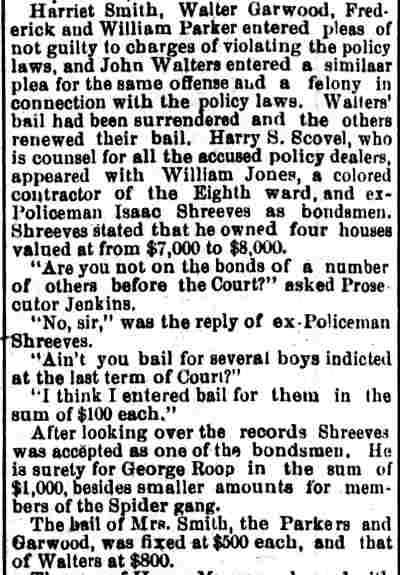
Camden Daily Telegram, May 2, 1895. Harriet Smith, Walter Garwood, John Walters, Fred Parker, William Parker, Isaac Shreeve, Wilson Jenkins, George Roop, Henry S. Scovel, William Jones
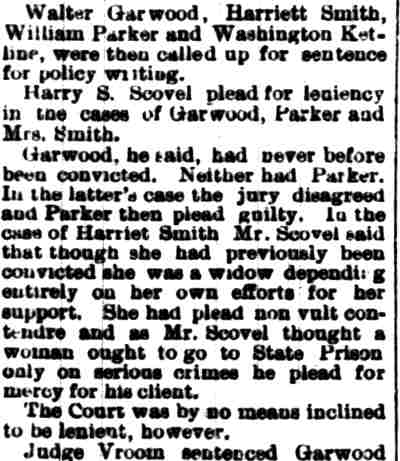
Camden Post, May 24, 1895. Harriet Smith, Walter Garwood, William Parker, Washington Ketline, Henry S. Scovel, J.J. Crandall, Joseph Swing, John Cochran, Taylor Avenue, Pine Street, Garret D.W. Vroom

Camden Post, May 24, 1895. Harriet Smith, Walter Garwood, William Parker, Washington Ketline, Henry S. Scovel, J.J. Crandall, Willie Jacobs, George Whittington, David Fry, Georgianna Fry, Henry Thomas, Jeptha Hickman, Smith Costell, William Wright, Mary Scovel, Joseph Gallagher, Frank Nelson, John Lane, Federal Street, Garret D.W. Vroom, George Barrett, Robert L. Barber

Camden Post, May 27, 1895. Harriet Smith, Frederick Rex, Henry S. Scovel, Garret D.W. Vroom
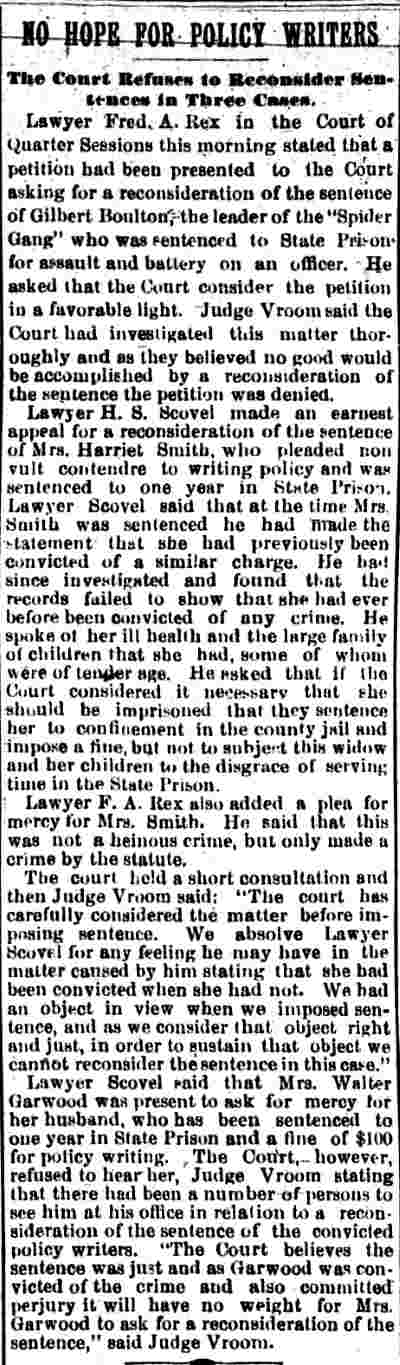
Camden Daily Telegram, May 27, 1895. Harriet Smith, Frederick Rex, Henry S. Scovel, Garret D.W. Vroom
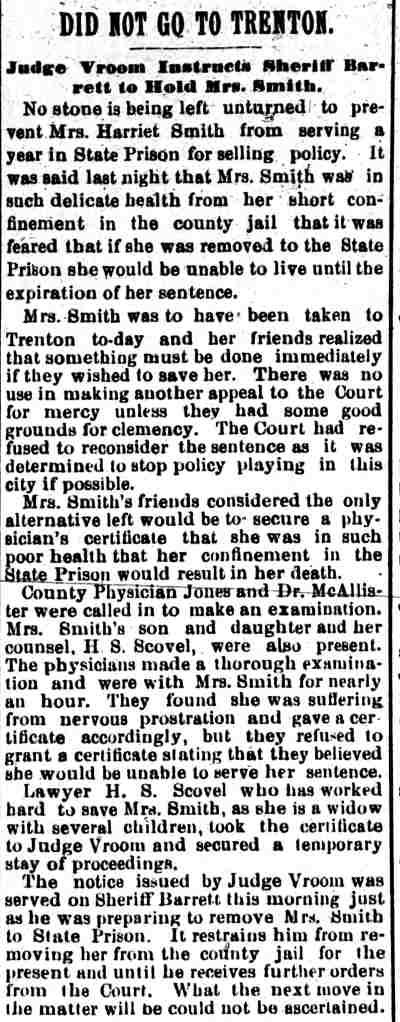
Camden Daily Telegram, June 6, 1895. Harriet Smith, Henry S. Scovel, Dr. William S. Jones, Dr. Alexander McAllister, George Barrett, Garret D.W. Vroom

Camden Post, June 7, 1895. Howard Carrow, John W. Wescott, Harriet Smith, Henry S. Scovel, Dr. William S. Jones, Dr. Alexander McAllister, Frederick Rex, Garret D.W. Vroom

Camden Daily Telegram, June 7, 1895. John W. Wescott, Harriet Smith, Dr. William S. Jones, Dr. Alexander McAllister, Garret D.W. Vroom

Policy and Pleasantries
A grand-stand collection of alleged policy slip sellers, witnesses, spectators and principals were packed in the Peace County this morning, where at the opening of the alleged sale of lottery slips, persons were heard aggressively the policy slip violators. A lawyer, Thomas Hampton, and others, was the jury, and the witnesses were sworn and the case proceeded.
Harriet Smith’s policy case proceeded with testimony from multiple witnesses. Harriet Sampson, colored, and Benjamin Derry, a nineteen-year-old lad, were called for the prosecution. The witness was handed a policy slip said to have been purchased from the accused.
Richard Quinn, colored, was next witness for the State. Jacob Derry identified the slip purchased. Janet Derry, colored, was called for the state as the young woman who sold a constable a policy slip. She gave testimony that Harriet Smith had been selling policy slips.
Harriet-Drake, colored, the sister in law of Sue Smith Kinsey, appeared. She had seen Sue Smith Kinsey and the defendant, Harriet Smith, selling policy slips.
The case was held to $500 bail, as Prosecutor Scovel was confident of his case.

Camden Daily Telegram, July 23, 1895. Harriet Smith, Sue Smith Kinsey, Isaac Shreeve, James M. Cassady, Henry S. Scovel, Archie Clark, Kate Miskelly, William Sampson, Benjamin Shaw, Richard Quinn, Samuel Davis, Jacob Derry, Baxter’s Court, Edward Bassett, Herbert Drake, Fred Parker, John Scanlon, John Brady, John Walters, W. Harry Getty, Charles Gilbert, Philip Schmitz, Mary Ellis
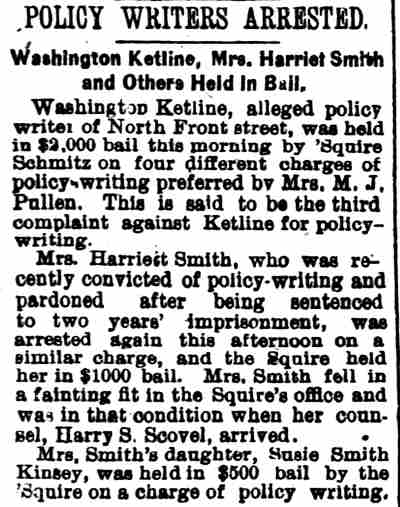
Camden Post, September 11, 1895. Harriet Smith, Washington Ketline, Philip Schmitz, Mrs. M.J. Pullen, Sue Smith Kinsey, Henry S. Scovel
Republican Legislative Nominations
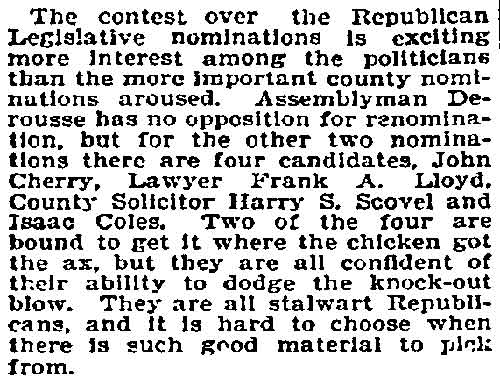
The contest over the Republican Legislative nominations is exciting more interest among the politicians than the more important county nominations aroused. Assemblyman Derousse has no opposition for renomination, but for the other two nominations there are four candidates, John Cherry, Lawyer Frank A. Lloyd, County Solicitor Harry S. Scovel and Isaac Coles. Two of the four are bound to get it where the chicken got the ax, but they are all confident of their ability to dodge the knock-out blow. They are all stalwart Republicans, and it is hard to choose when there is such good material to pick from.
Philadelphia Inquirer, October 20, 1895. Henry S. Scovel, John Cherry, Frank T. Lloyd, Isaac Coles, Louis DeRousse
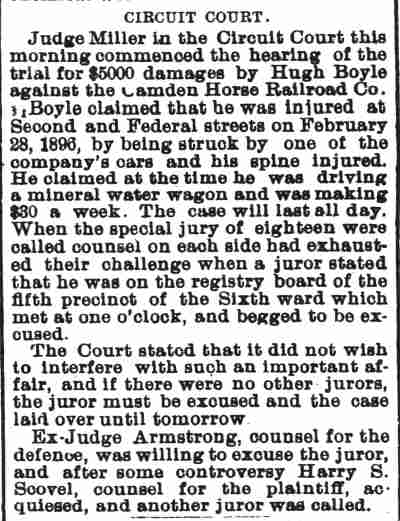
Camden Post, September 29, 1896. Hugh Boyle, Camden Horse Railroad Company, E. Ambler Armstrong, Henry S. Scovel
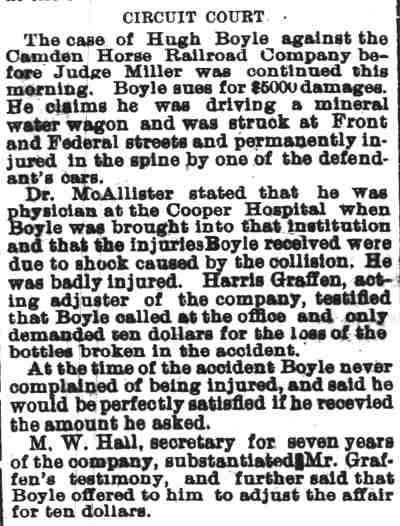
CIRCUIT COURT.
The case of Hugh Boyle against the Camden Horse Railroad Company before Judge Miller was continued this morning. Boyle sues for $5000 damages. He claims he was driving a mineral water wagon and was struck at Front and Federal streets and permanently injured in the spine by one of the defendant's cars.
Dr. McAllister stated that he was physician at the Cooper Hospital when Boyle was brought into that institution and that the injuries Boyle received were due to shock caused by the collision. He was badly injured. Harris Graffen, acting adjuster of the company, testified that Boyle called at the office and only demanded ten dollars for the loss of the bottles broken in the accident.
At the time of the accident Boyle never complained of being injured, and said he would be perfectly satisfied if he received the amount he asked.
M. W. Hall, secretary for seven years of the company, substantiated Mr. Graffen's testimony, and further said that Boyle offered to him to adjust the affair for ten dollars.
Boyle Gets $900 Damages
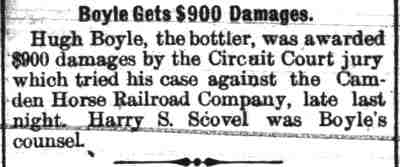
Boyle Gets $900 Damages.
Hugh Boyle, the bottler, was awarded $900 damages by the Circuit Court jury which tried his case against the Camden Horse Railroad Company, late last night. Harry S. Scovel was Boyle's counsel.
Testing the Lloyd Law
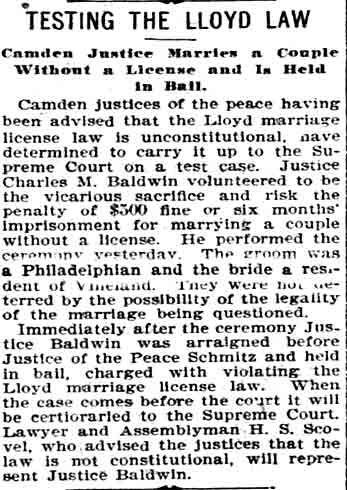
TESTING THE LLOYD LAW
Camden Justice Marries a Couple Without a License and Is Held in Bail.
Camden justices of the peace having been advised that the Lloyd marriage license law is unconstitutional, have determined to carry it up to the Supreme Court on a test case. Justice Charles M. Baldwin volunteered to be the vicarious sacrifice and risk the penalty of $300 fine or six months' imprisonment for marrying a couple without a license. He performed the ceremony yesterday. The groom was a Philadelphian and the bride a resident of Vineland. They were not deterred by the possibility of the legality of the marriage being questioned.
Immediately after the ceremony Justice Baldwin was arraigned before Justice of the Peace Schmitz and held in bail, charged with violating the Lloyd marriage license law. When the case comes before the court it will be certioraried to the Supreme Court. Lawyer and Assemblyman H. S. Scovel, who advised the justices that the law is not constitutional, will represent Justice Baldwin.
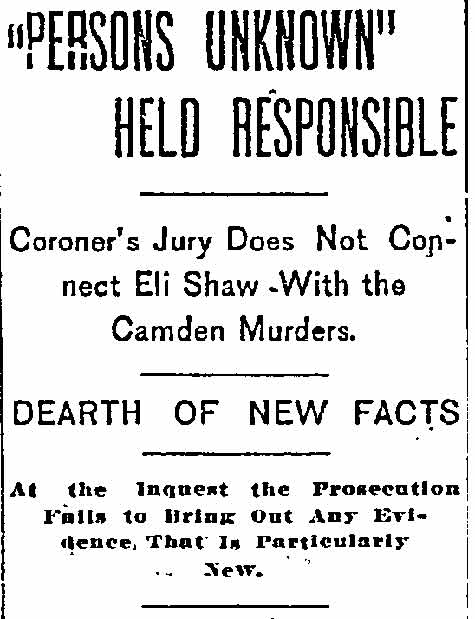
Philadelphia Inquirer, October 30, 1897 — Eli Shaw murder case. Henry S. Scovel, Emma Zane, Eli Shaw, Wilson H. Jenkins, Dr. William S. Jones, Dr. A. Haines Lippincott, James E. Tatem, John Painter, John Foster, H. Frank Pettit, Charles M. Lane, John Sinclair, Mrs. Anna Knight. Click image for PDF of complete article.
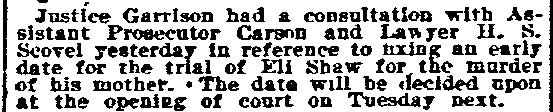
Justice Garrison had a consultation with Assistant Prosecutor Carson and Lawyer H. S. Scovel yesterday in reference to fixing an early date for the trial of Eli Shaw for the murder of his mother. The date will be decided upon at the opening of court on Tuesday next.
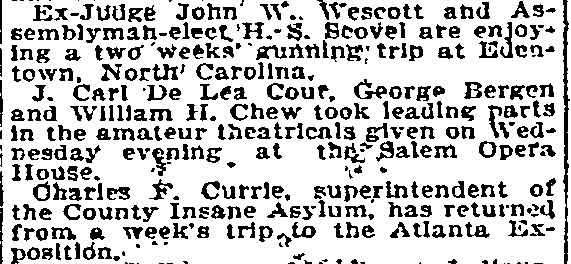
Ex-Judge John W. Wescott and Assemblyman-elect H. S. Scovel are enjoying a two weeks’ running trip at Edentown, North Carolina.
J. Carl De La Cour, George Bergen and William H. Chew took leading parts in the amateur theatricals given on Wednesday evening at the Salem Opera House.
Charles F. Currie, superintendent of the County Insane Asylum, has returned from a week’s trip to the Atlanta Exposition.
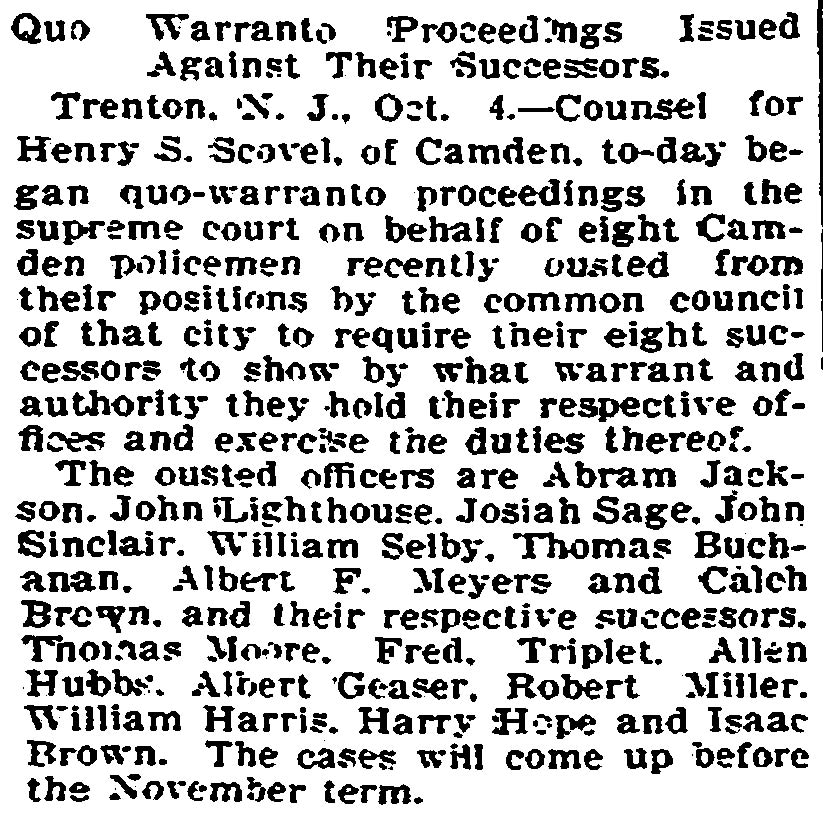
Quo Warranto Proceedings Issued Against Their Successors
Quo Warranto Proceedings Issued Against Their Successors.
Trenton, N. J., Oct. 4.—Counsel for Henry S. Scovel, of Camden, to-day began quo-warranto proceedings in the supreme court on behalf of eight Camden policemen recently ousted from their positions by the common council of that city to require their eight successors to show by what warrant and authority they hold their respective offices and exercise the duties thereof.
The ousted officers are Abram Jackson, John Lighthouse, Josiah Sage, John Sinclair, William Selby, Thomas Buchanan, Albert F. Meyers and Caleb Brown, and their respective successors, Thomas Moore, Fred. Triplet, Allen Hubbs, Albert Geaser, Robert Miller, William Harris, Harry Hope and Isaac Brown. The cases will come up before the November term.
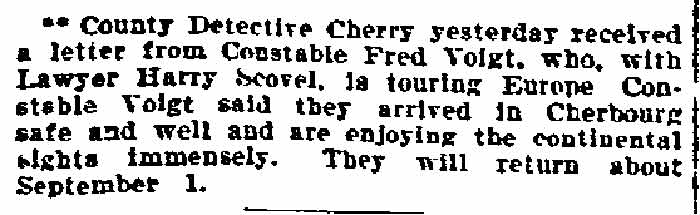
Constable Voigt Touring Europe
County Detective Cherry yesterday received a letter from Constable Fred Voigt, who, with Lawyer Harry Scovel, is touring Europe. Constable Voigt said they arrived in Cherbourg safe and well and are enjoying the continental sights immensely. They will return about September 1.
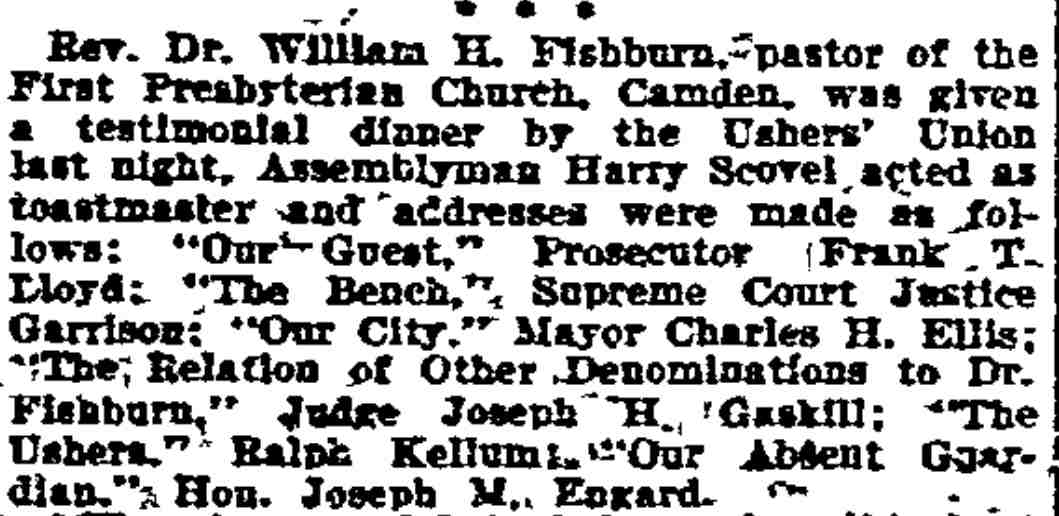
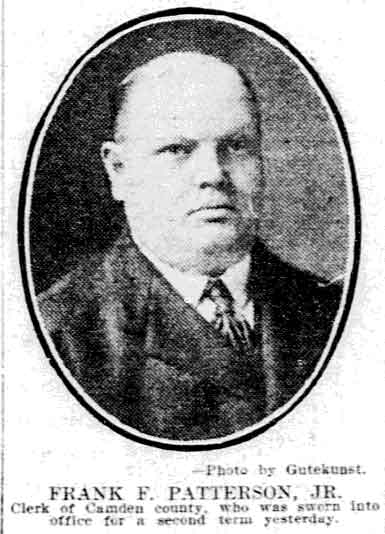
Philadelphia Inquirer, February 25, 1906. Frank F. Patterson Jr., Edward Van Dyke Joline, Howard Truax, Frank Voight, David Baird Sr., J. Wesley Sell, William J. Bradley, Charles G. Garrison, Allen B. Endicott, Harry C. Loudenslager, J. Willard Morgan, Henry S. Scovel, Theodore Gibbs, Samuel P. Jones, John G. Horner, J. Boyd Avis, Wood McKee, W.H. Jackson, Frank Somers, Frank T. Lloyd, Edward S. Delacroix, F. Morse Archer, Harry Reeves, William D. Brown, Robert Leyburne, Theodore N. Patterson, Wolcott J. Patterson, Irving Buckle, Joseph Burt, Dr. William S. Jones, Dr. E.A.Y. Schellenger, Henry J. Cloud, Charles Middleton, Edward W. Humphreys
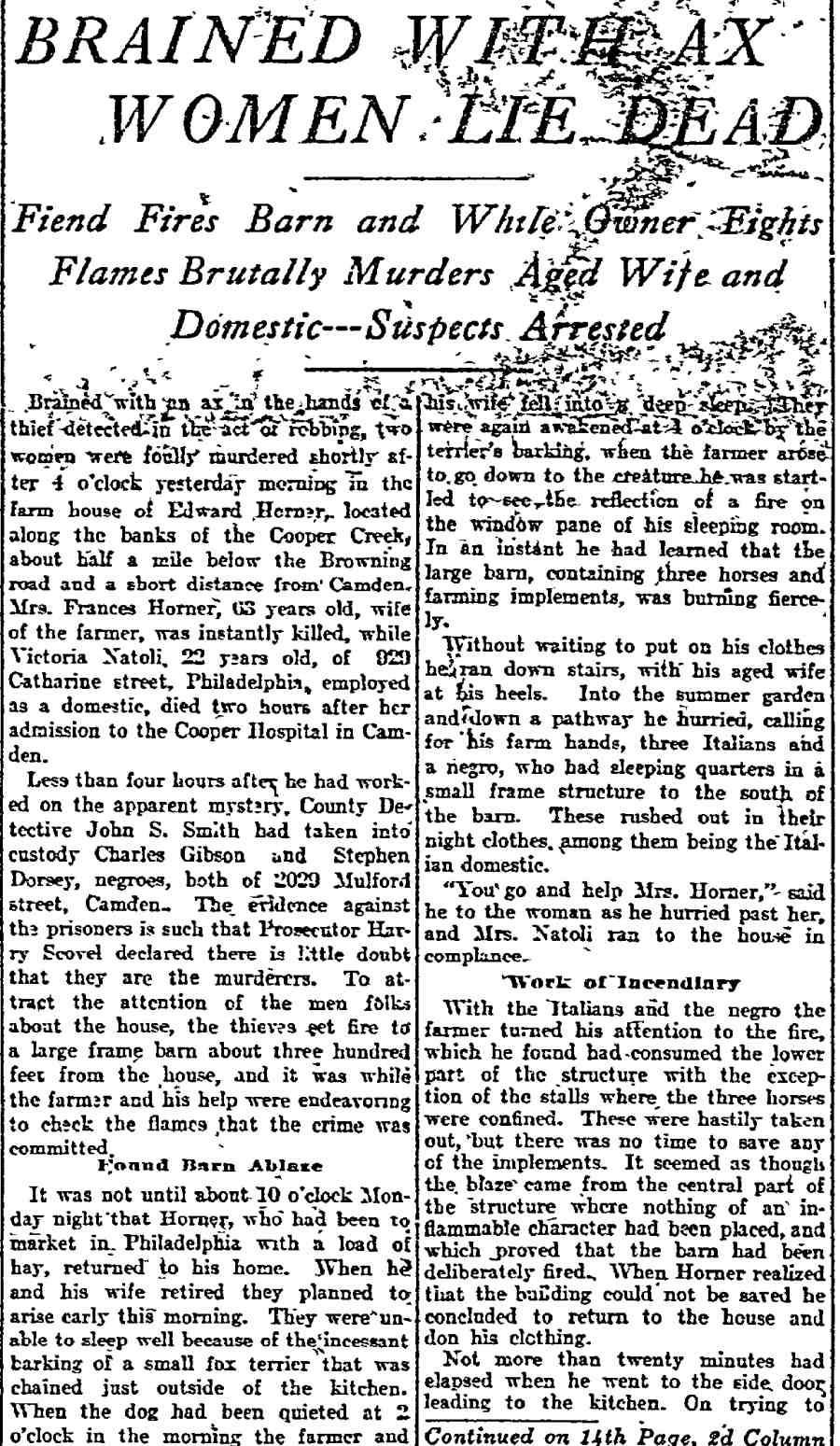
Philadelphia Inquirer, August 21, 1907. Charles Gibson, Stephen Dorsey, Mulford Street, Edward Horner, Frances Horner, Victoria Natoli, John S. Smith, John Cherry, Elisha Gravenor, Dr. William S. Jones, J.W. Fithian, Henry S. Scovel, Mrs. Anna Marter, Mrs. Edward Megargee, Mrs. Isaac Beideman

Camden Police Sure They Have the Right Men
CAMDEN POLICE SURE THEY HAVE THE RIGHT MEN
Detectives Find Plenty of Evidence Connecting Two Negroes
Camden officials are convinced that there is now no question but that Charles Gibson and Stephen Dorsey, the negroes arrested in connection with the double murder on the Horner farm, located on the Broads, a road about a mile south of Camden, are the right men. They have been formally charged with killing Mrs. Frances Horner, 63 years old, wife of Edward Horner, the farmer, and Victoria Natoli, 22 years old, the Italian domestic. As an evidence that Prosecutor Scovel is confident of his case against them, he issued the following statement late yesterday afternoon from his office in Camden: "The Prosecutor's office has finished its investigation in the case of the Horner murder. Any further investigation will simply lead to minor details. Charles Gibson and Stephen Dorsey have been formally charged with the murder and committed to the county jail, together with several witnesses. No mistakes have been made. Justice will be done, and the guilty parties will be punished."
Getting the Evidence
County Detective John W. Smith, who arrested the men a few hours after the horrid deed was committed, made the complaint against them before Justice Schmitz on information received. He has worked on the case in connection with County Detective John Cherry since the discovery of the slain victims, and in consequence of their investigation the evidence has been woven so completely that it is believed the defendants cannot escape. They have traced the men from a few hours prior to the murder until a short time before they were arrested.
Since the men were taken into custody the detectives have taken into detailed account everything the prisoners have said. Most of these are said to be very important witnesses, who can be used at the trial in order to demolish the effort of the secured negroes to establish an alibi. In fact, it is stated that with an eye to the trial, Prosecutor Scovel has already torn their conflicting stories to pieces. Each of them has freely made statements as to their whereabouts on the morning of the murder when the double killing took place and are said to have been found untrue by the production of a number of the witnesses. Referring to the investigation, Prosecutor Scovel said: "By their inquiries we have not only succeeded in breaking down the entire alibi story but have traced Gibson and Dorsey until 2 o'clock Tuesday morning. They were together at that time at the house of [name] in Camden. The next we hear of them is in the Philadelphia farmhouse — they had the horse which was taken from the Horner farmhouse. This was within a few hours after the murder was committed."
There was a persistent rumor that one of the negroes had broken down under the "third degree," which was applied to them yesterday. Prosecutor Scovel refused to either affirm or deny that either defendant broke down, and in the statement he issued later indicated that the evidence was entirely circumstantial.
Continued on 4th Page, 1st Column
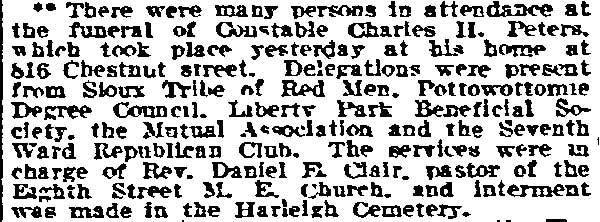
Bridgeton Evening News, October 8, 1907. Charles Gibson, Mrs. Frances Horner, Henry S. Scovel, Charles G. Garrison, Charles H. Peters
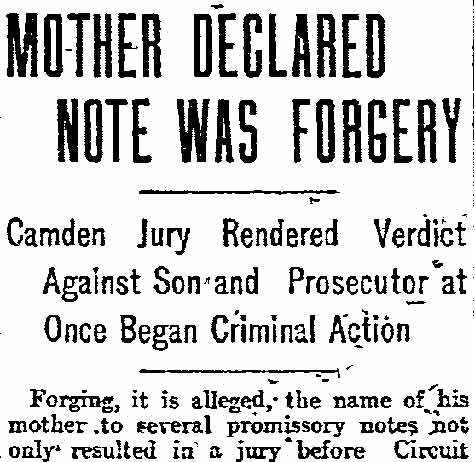
Philadelphia Inquirer, October 30, 1907. William Schwab, John Cherry, Henry S. Scovel, Judge Allen B. Endicott, Samuel Paul, John W. Barr. Click image for PDF of complete article.
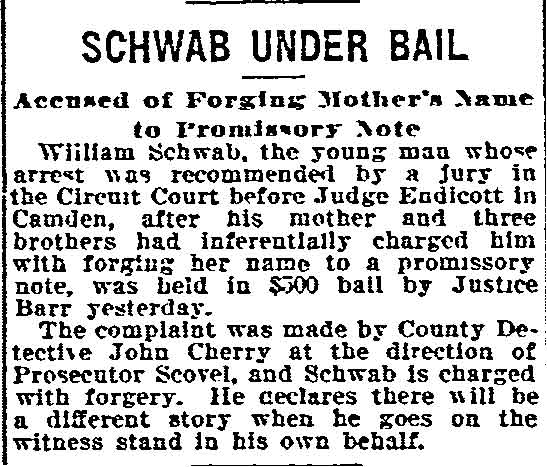
Schwab Under Bail
Accused of Forging Mother’s Name to Promissory Note
William Schwab, the young man whose arrest was recommended by a jury in the Circuit Court before Judge Endicott in Camden, after his mother and three brothers had inferentially charged him with forging her name to a promissory note, was held in $500 bail by Justice Barr yesterday.
The complaint was made by County Detective John Cherry at the direction of Prosecutor Scovel, and Schwab is charged with forgery. He declares there will be a different story when he goes on the witness stand in his own behalf.
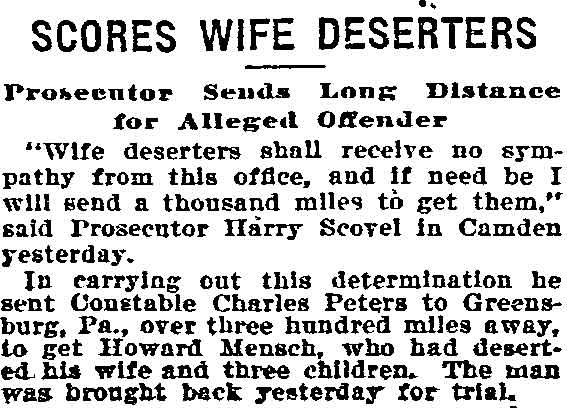
Scores Wife Deserters
Prosecutor Sends Long Distance for Alleged Offender
“Wife deserters shall receive no sympathy from this office, and if need be I will send a thousand miles to get them,” said Prosecutor Harry Scovel in Camden yesterday.
In carrying out this determination he sent Constable Charles Peters to Greensburg, Pa., over three hundred miles away, to get Howard Mensch, who had deserted his wife and three children. The man was brought back yesterday for trial.
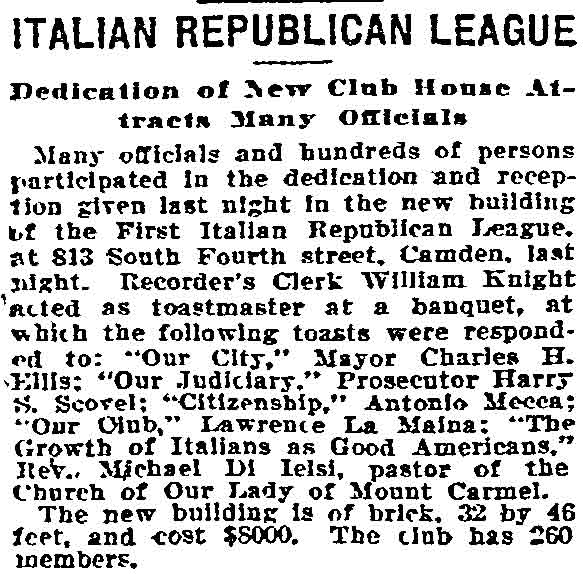
Italian Republican League
Dedication of New Club House Attracts Many Officials
Many officials and hundreds of persons participated in the dedication and reception given last night in the new building of the First Italian Republican League, at 813 South Fourth street, Camden. Recorder’s Clerk William Knight acted as toastmaster at a banquet, to which the following toasts were responded to: “Our City,” Mayor Charles H. Ellis; “Our Judiciary,” Prosecutor Harry S. Scovel; “Citizenship,” Antonio Mecca; “Our Club,” Lawrence La Maina; “The Growth of Italian American Good Americans,” Rev. Michael Di Ielsi, pastor of the Church of Our Lady of Mount Carmel.
The new building is of brick, 32 by 46 feet, and cost $8,000. The club has 260 members.
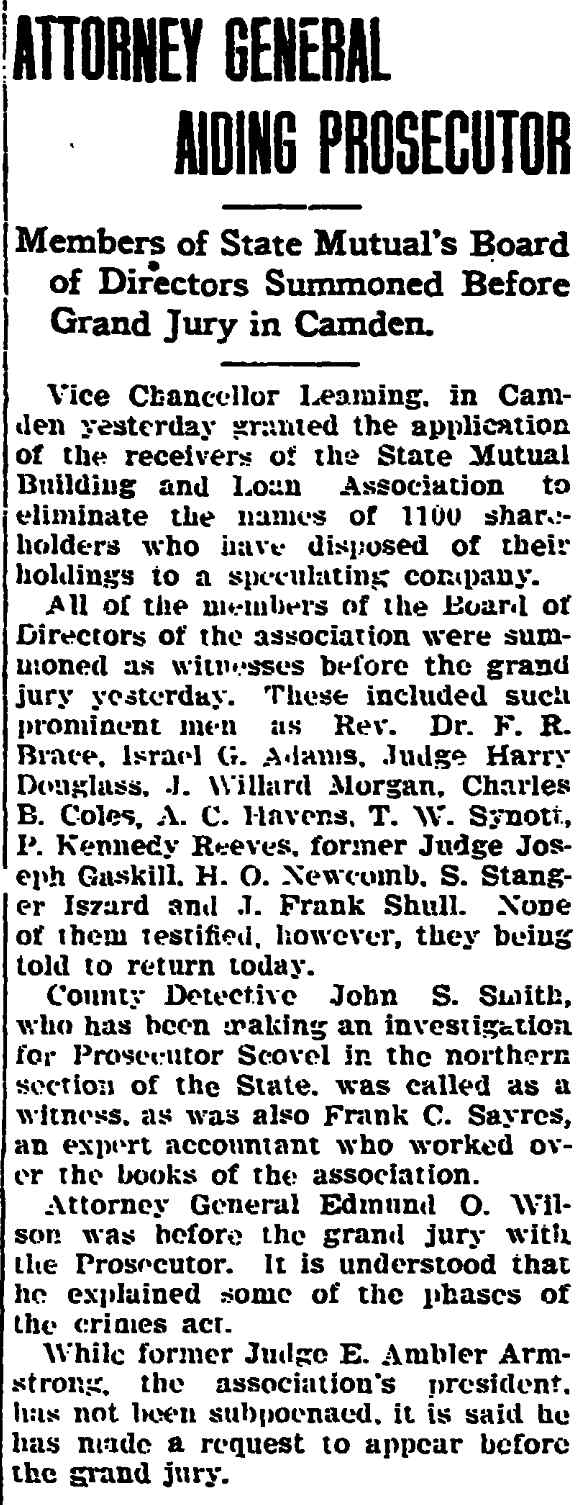
Bridgeton Evening News, February 16, 1909. J. Frank Shull, John S. Smith, Henry S. Scovel, Frank C. Sayres, E. Ambler Armstrong, Edmund O. Wilson, J. Willard Morgan, Charles B. Coles, Dr. F.R. Brace, Harry Douglass, A.C. Havens, T.W. Synott, P. Kennedy Reeves, Joseph Gaskill, H.O. Newcomb, S. Stanger Izard, Israel G. Adams
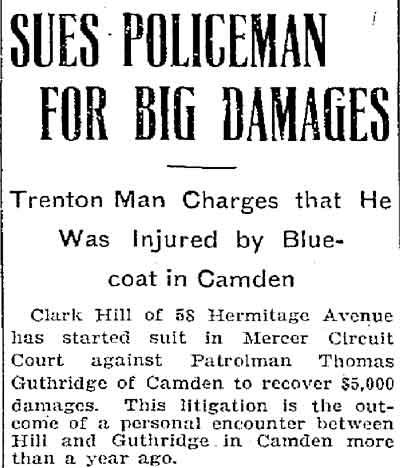
Sues Policeman for Big Damages
Trenton Man Charges that He Was Injured by Bluecoat in Camden
Clark Hill of 58 Hermitage Avenue has started suit in Mercer Circuit Court against Patrolman Thomas Guthridge of Camden to recover $5,000 damages. This litigation is the outcome of a personal encounter between Hill and Guthridge in Camden more than a year ago.
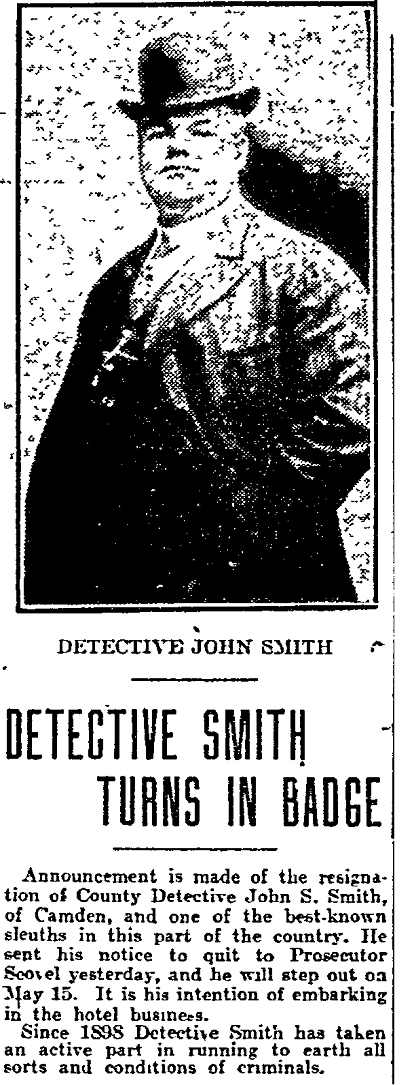
Detective Smith Turns In Badge
Announcement is made of the resignation of County Detective John S. Smith, of Camden, and one of the best-known sleuths in this part of the country. He sent his notice to quit to Prosecutor Scovel yesterday, and he will step out on May 15. It is his intention of embarking in the hotel business.
Since 1898 Detective Smith has taken an active part in running to earth all sorts and conditions of criminals.
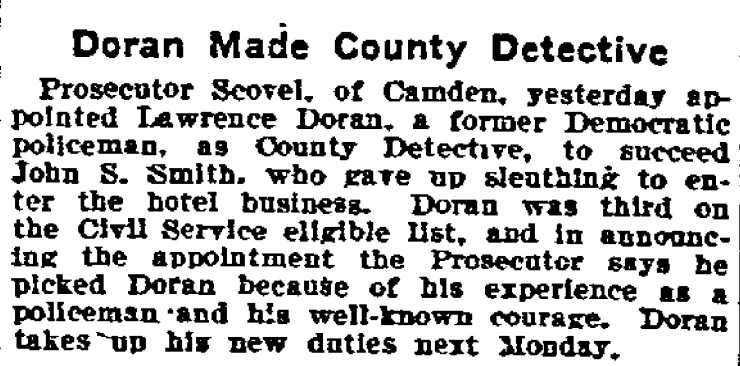
Doran Made County Detective
Doran Made County Detective
Prosecutor Scovel, of Camden, yesterday appointed Lawrence Doran, a former Democratic policeman, as County Detective, to succeed John S. Smith, who gave up sleuthing to enter the hotel business. Doran was third on the Civil Service eligible list, and in announcing the appointment the Prosecutor says he picked Doran because of his experience as a policeman and his well-known courage. Doran takes up his new duties next Monday.
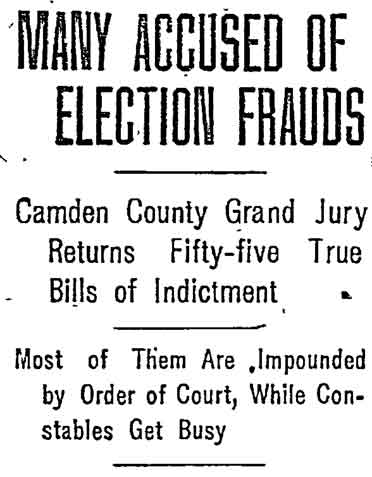
Philadelphia Inquirer, January 24, 1911. Charles G. Garrison, Frank Ford Patterson Jr., Charles VanDyke Joline, Lawrence Doran, Samuel Flick, Isaac Shreve, Francis J. McAdams, James Smith, Thomas Noland, A. Lincoln James, John Broome, Albert Shaw, James Lewis, John Golden, William C. Parker, Daniel Woods, John H. Carroll, Harris D. Stow, Henry S. Scovel, Martin Carrigan, Aerie No. 5, Fraternal Order of Eagles. Click image for PDF of complete article.
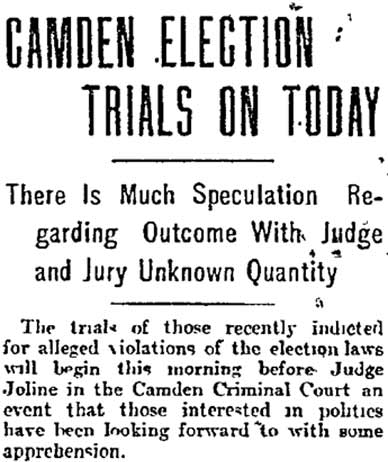
Camden Election Trials On Today
CAMDEN ELECTION TRIALS ON TODAY
There Is Much Speculation Regarding Outcome With Judge and Jury Unknown Quantity
The trials of those recently indicted for alleged violations of the election laws will begin this morning before Judge Joline in the Camden Criminal Court an event that those interested in politics have been looking forward to with some apprehension.
It is the idea of Prosecutor Scovel to try two cases a day if possible, those scheduled to undergo the ordeal this morning being Martin Carrigan and Charles Crane. In the event of them continuing to enter pleas of not guilty it is likely that the legal battle will be somewhat strenuous from the fact that the defendants have secured the services of former Attorney General Robert McCarter to look after their interests. A small army of witnesses has been summoned. The jury is an unknown quantity because very few of those on the present panel have ever before served in a like capacity.
Speculation is rife as to what will be done with those who may be convicted. Some say they will escape with fines, but as a matter of fact no one is aware of what Judge Joline will do, and it will be up to him alone. It is not likely that any sentences will be imposed until all of the cases have been disposed of.
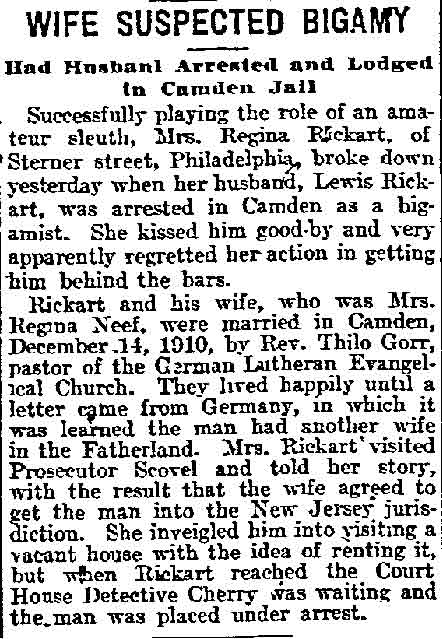
Wife Suspected Bigamy
Had Husband Arrested and Lodged in Camden Jail
Successfully playing the role of an amateur sleuth, Mrs. Regina Rickart, of Sterner street, Philadelphia, broke down yesterday when her husband, Lewis Rickart, was arrested in Camden as a bigamist. She kissed him good-by and very apparently regretted her action in getting him behind the bars.
Rickart and his wife, who was Mrs. Regina Neef, were married in Camden, December 14, 1910, by Rev. Thilo Gorr, pastor of the German Lutheran Evangelical Church, at the Trinity German Lutheran Evangelical Church. After the ceremony the wife received a letter from Germany, in which it was learned the man had another wife in the Fatherland. The wife consulted a friend and told her story, with the result that the wife agreed to get the man into the New Jersey jurisdiction.
She inveigled him into visiting a show house, sold him the idea of renting it, but when Rickart reached the Court House Detective Cherry was waiting and the man was placed under arrest.
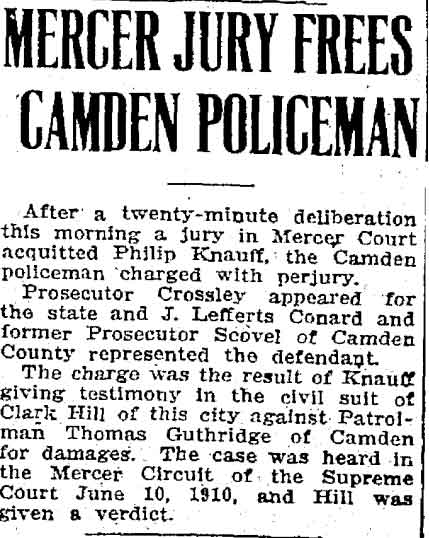
Mercer Jury Frees Camden Policeman
After a twenty-minute deliberation this morning a jury in Mercer Court acquitted Philip Knauff, the Camden policeman charged with perjury.
Prosecutor Crossley appeared for the state and J. Lefferts Conard and former Prosecutor Scovel of Camden County represented the defendant.
The charge was the result of Knauff giving testimony in the civil suit of Clark Hill of this city against Patrolman Thomas Guthridge of Camden for damages. The case was heard in the Mercer Circuit of the Supreme Court June 10, 1910, and Hill was given a verdict.
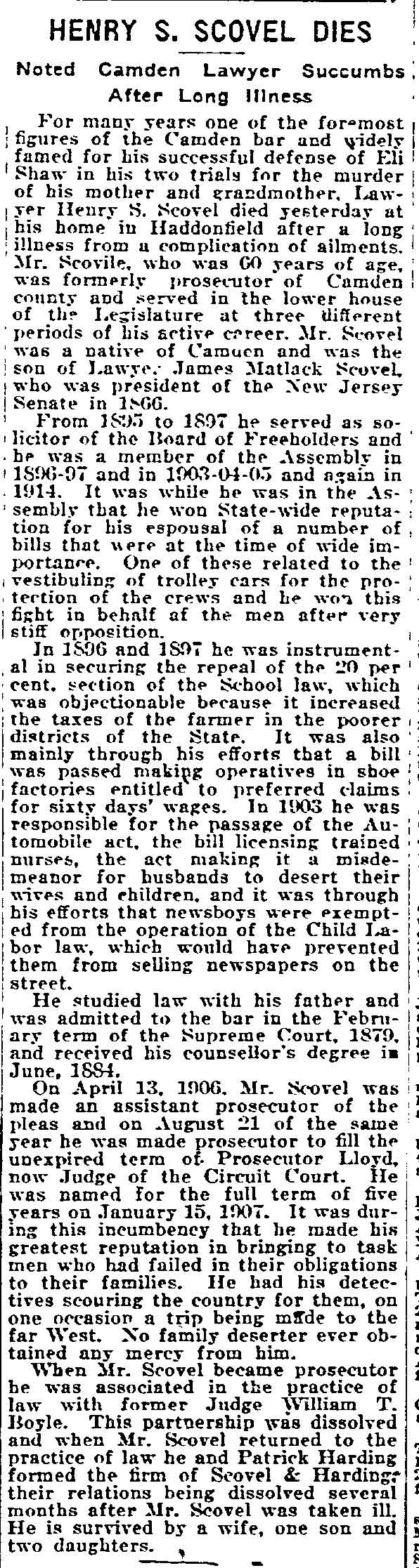
Henry S. Scovel Dies
Noted Camden Lawyer Succumbs After Long Illness
For many years one of the foremost figures in the Camden bar and widely known as the defender of the notorious Eli Shaw in his two trials for the murder of his mother and grandmother, Mrs. Eliza Zane, Henry S. Scovel died yesterday at his home in Haddonfield, after a long illness from a complication of ailments. Mr. Scovel was 60 years old. He was formerly prosecutor of Camden county, serving from 1905 to 1912. He served several terms in the Assembly at different periods of his active career.
From 1896 to 1897 he served as solicitor of the Board of Freeholders and was in the State Assembly from 1896 to 1897, 1903, 1904, and 1905, and again in 1914. He was also a member of the law firm of Scovel & Harding with his son. His unexpired term of Prosecutor Lloyd, from August of 1912 to 1915, he was named for the full term of five years, being elected in 1905. It was during this incumbency that he made his greatest efforts on behalf of destitute women whose husbands refused to contribute to their families.
He studied law with his father and was admitted to the bar at the January term of the Supreme Court, 1876. He is survived by his son Henry Graham Scovel, and daughters Ethel and Beatrice. Col. James Matlack Scovel was his father. Frank T. Lloyd, William T. Boyle, and Patrick Harding were among those noted in the obituary, as was Eli Shaw.
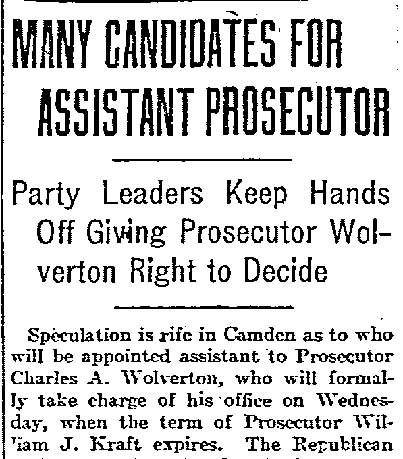
Philadelphia Inquirer, March 11, 1918. Charles A. Wolverton, Henry S. Scovel, Lawrence B. Reader, J. Stuart Straw, T. Harry Rowland, Frank Voigt, John Penn, Walter Keown, William J. Kraft. Click image for PDF of complete article.
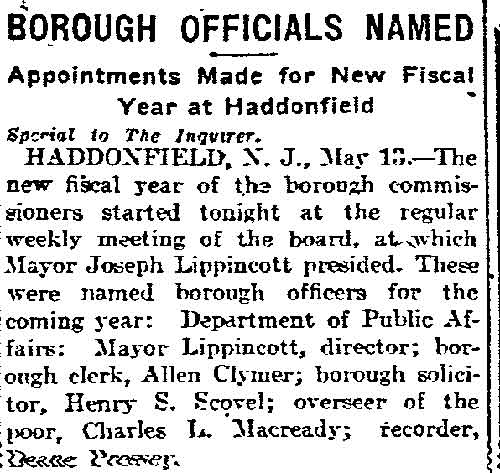
Borough Officials Named
Appointments Made for New Fiscal Year at Haddonfield
HADDONFIELD, N. J., May 13.—The new fiscal year of the borough commissioners started tonight at the regular weekly meeting of the board, at which Mayor Joseph Lippincott presided. These were named borough officers for the coming year: Department of Public Affairs: Mayor Lippincott, director; borough clerk, Allen Clymer; borough solicitor, Henry S. Scovel; overseer of the poor, Charles L. Macready; recorder, Dean Pressey.

HADDONFIELD.—Former Assemblyman and Prosecutor Henry S. Scovel has suffered a relapse and is in a serious condition. Click image for PDF of complete article.
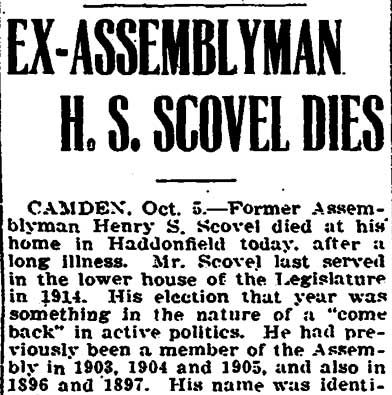
Ex-Assemblyman H. S. Scovel Dies
CAMDEN, Oct. 5.—Former Assemblyman Henry S. Scovel died at his home in Haddonfield today, after a long illness. Mr. Scovel last served in the lower house of the Legislature in 1914. His election that year was something in the nature of a “come back” in active politics.
He had previously been a member of the Assembly in 1903, 1904 and 1905, and also in 1896 and 1897.
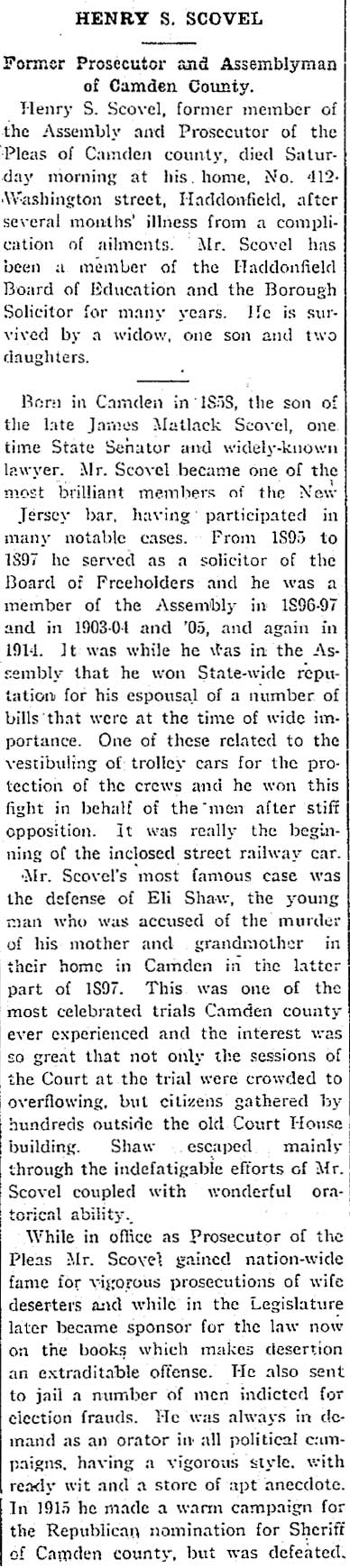
Henry S. Scovel
Henry S. Scovel, former member of the Camden County bar, died Saturday at his home in Haddonfield. He was in his 61st year.
Mr. Scovel served as Camden County Prosecutor for seven years, from 1905 to 1912. He was born in Camden in 1858, the son of the late James Matlack Scovel, one of the most distinguished lawyers and orators of South Jersey. He was a Republican, having participated in the political activities of Camden for many years.
While in office as Prosecutor of the county, Harry Scovel became particularly and deservedly famous for vigorous prosecution of wife deserters. He also became well known through his espousal of the law now known as the “desertion act.”
He is survived by a daughter, Ethel, and a son Henry, and two daughters.