George V. Murry
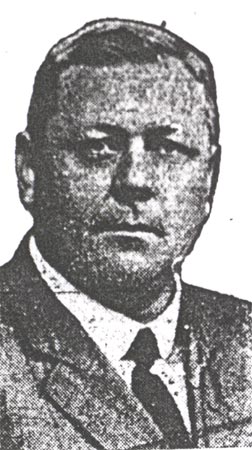
George V. Murry
GEORGE V. MURRY (his name sometimes appears as Murray) was born in New Jersey in October of 1871.
By the time of the 1900 Census enumeration George Murry owned a home at 649 Locust Street. He and his then wife of nine years, Henrietta, were childless. He was then working in construction. George Murry remarried around 1902. Second wife Cora had bore four children by 1910, three of whom were then still living.
Politically active and not at all afraid to do battle in the full contact sport that was Camden politics at the turn of the century, George Murry was appointed to the Camden Police Department on March 1, 1905. He began working as a detective on April 1, 1913, the first Black police officers to hold that rank. On August 1, 1913 George V. Murry, along with Fiore Troncone and Charles Fitzsimmons were officially promoted to the detective squad, then led by Captain William Schregler. All had been working in plainclothes for several months prior to the official promotion.
George Murray was still residing at 649 Locust Street when the Census was taken in January of 1920, with his wife Cora J. Murphy and several children.
Late in 1921 drug trafficking and police corruption in Camden’s Third and Fifth Wards had become so flagrant that an investigation was launched. Detective Murry, along with Camden police officers William Draper, Tony Latorre, and Ira Hall were summoned to City Hall to answer charges placed by City Council’s police committee. By January 21, 1922 Murry, Draper, and Latorre had resigned, and Hall was fired after a hearing.
George Murry apparently died under “mysterious circumstances” on January 29, 1922, shortly before he was to go on trial for graft. By 1924 Cora Murphy had remarried. She was still residing at 649 Locust Street, with new husband Henry Butler.
George Murry’s political empire was taken over in part by Polack Joe Deven, who held sway through most of the 1920s until sent to jail as a result of a shooting at the Sixth Ward Republican Club on Broadway.
Murder and Bloodshed in Camden Primary Elections
Philadelphia Inquirer —

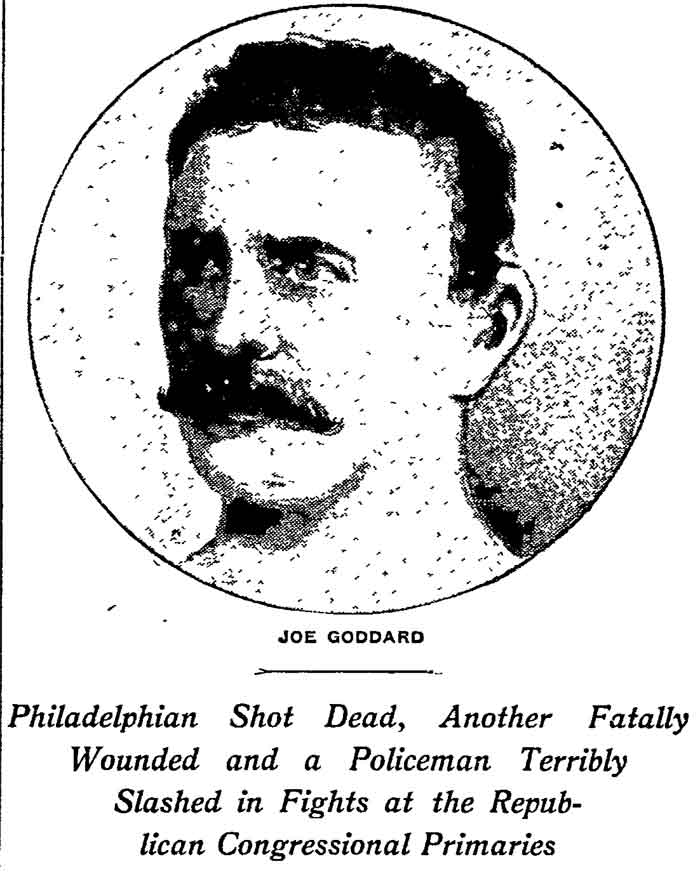
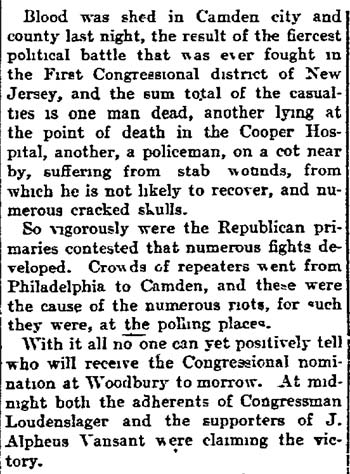
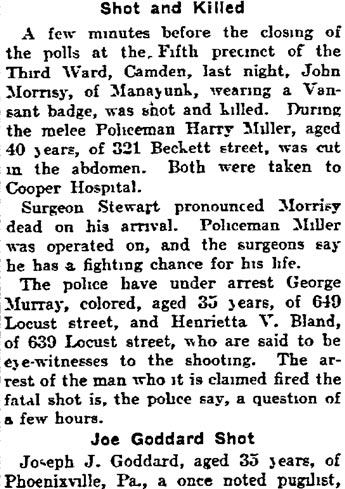
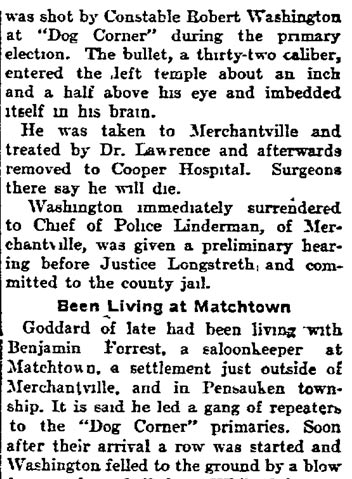
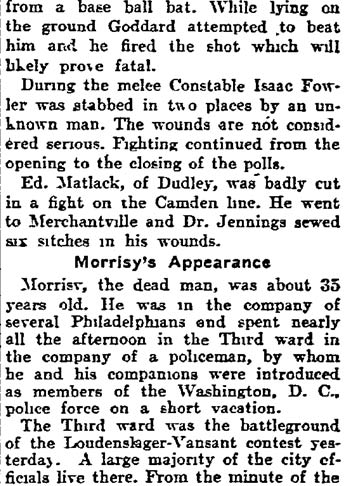
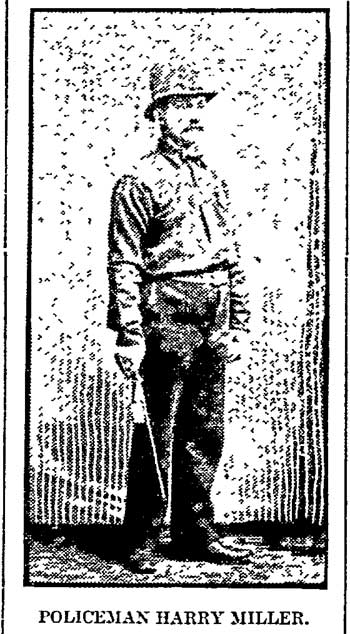
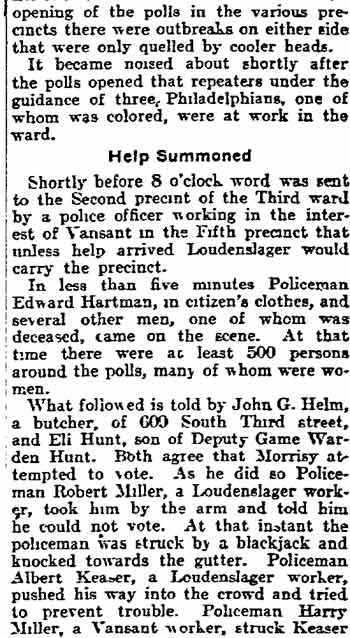
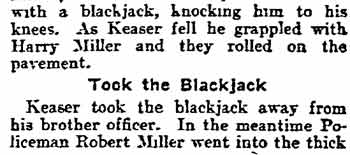
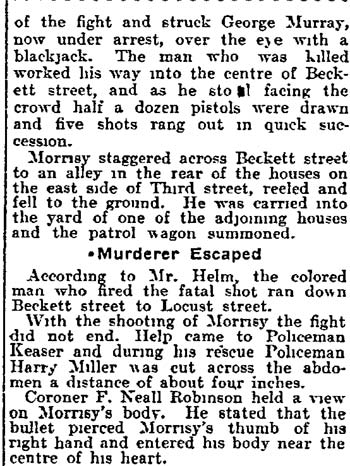
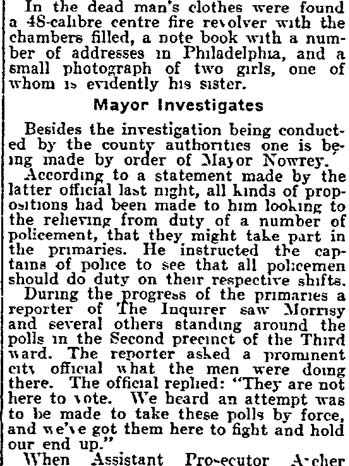
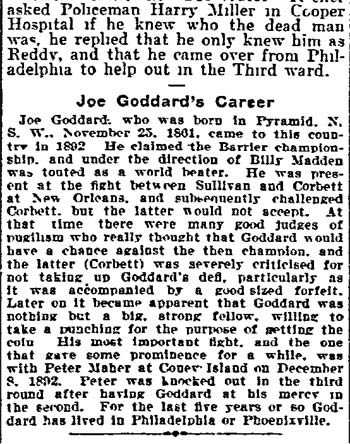
Philadelphia Inquirer, July 29, 1902 — Related: John Foster, F. Morse Archer, Joseph Nowrey, Eli Hunt, Harry Miller, Robert F. Miller, Edward Hartman, South 3rd Street, Beckett Street, Liberty Street, Locust Street
Murder and Riot in Camden Primary;
Trenton Evening Times —
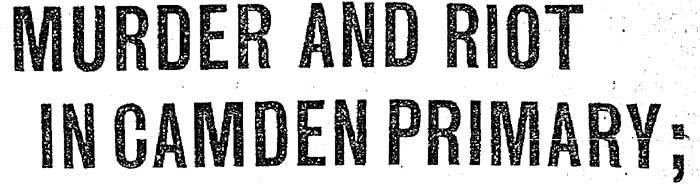
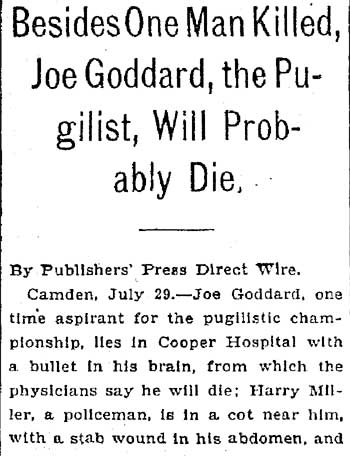
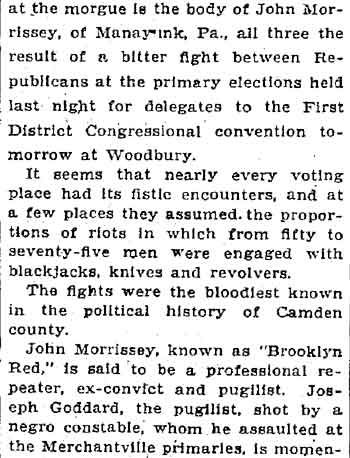
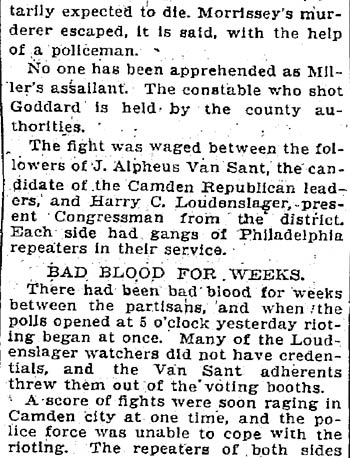
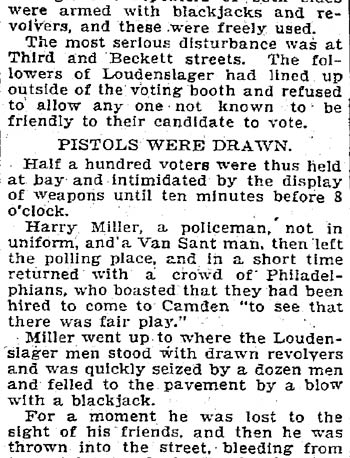
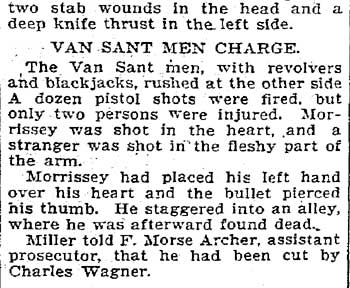
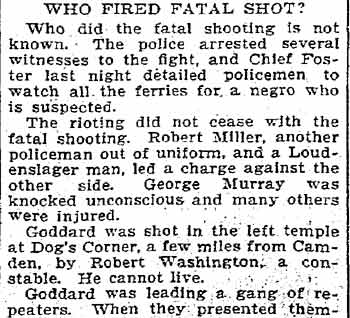
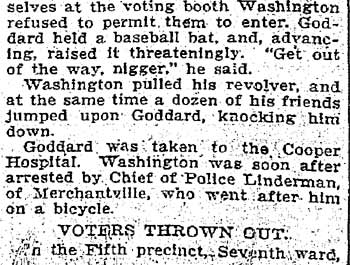
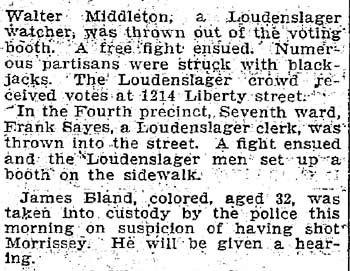
Trenton Evening Times, July 29, 1902 — Related: John Foster, F. Morse Archer, Harry Miller, South 3rd Street, Beckett Street, Liberty Street
Held for Morrison's Death
Philadelphia Inquirer —
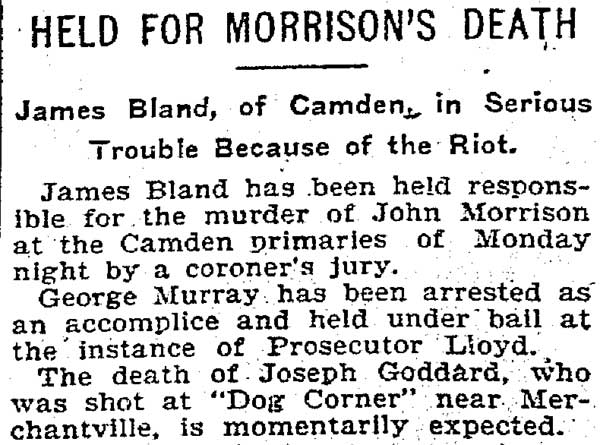
Held for Morrison's Death
HELD FOR MORRISON'S DEATH
James Bland, of Camden, in Serious Trouble Because of the Riot.
James Bland has been held responsible for the murder of John Morrison at the Camden primaries of Monday night by a coroner's jury. George Murray has been arrested as an accomplice and held under bail at the instance of Prosecutor Lloyd. The death of Joseph Goddard, who was shot at "Dog Corner" near Merchantville, is momentarily expected.
Miller and Matlack Sentenced to Dismissal
Camden Daily Courier —
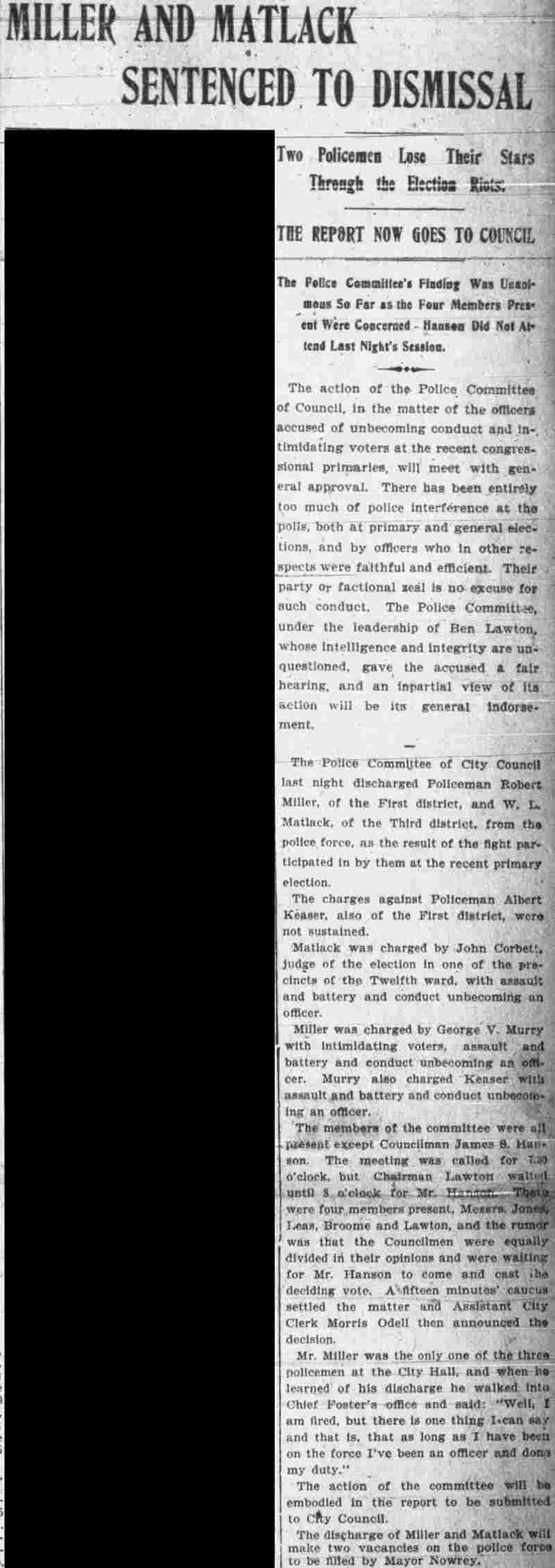
Camden Daily Courier, September 18, 1902 — Related: Robert F. Miller, Morris Odell, Joseph Nowrey
Police Committee Sustained; Matlack and Miller Discharged
Camden Post-Telegram —
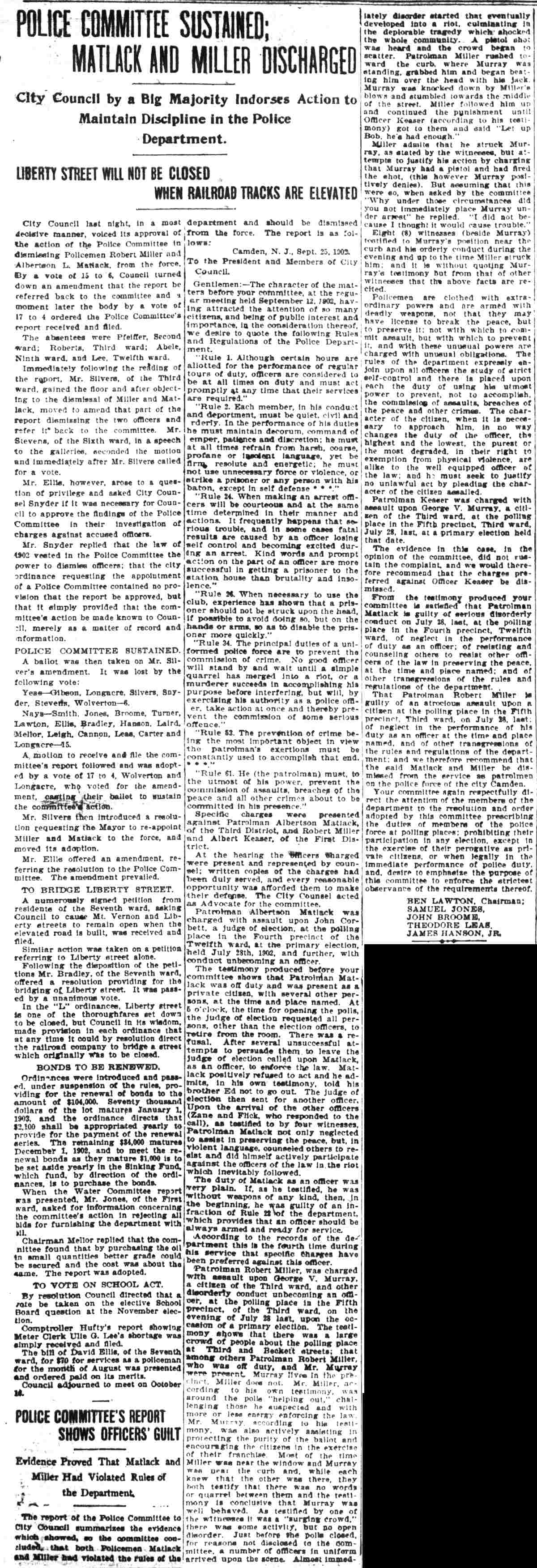
POLICE COMMITTEE SUSTAINED; MATLACK AND MILLER DISCHARGED
City Council by a Big Majority Indorses Action to Maintain Discipline in the Police Department.
LIBERTY STREET WILL NOT BE CLOSED WHEN RAILROAD TRACKS ARE ELEVATED
City Council last night, in a most decisive manner, voted its approval of the action of the Police Committee in dismissing Policeman Robert Miller and Alderman B. Matlack of the Third ward from the police force.
Grand Jury Gets Through Its Work
Camden Post-Telegram —
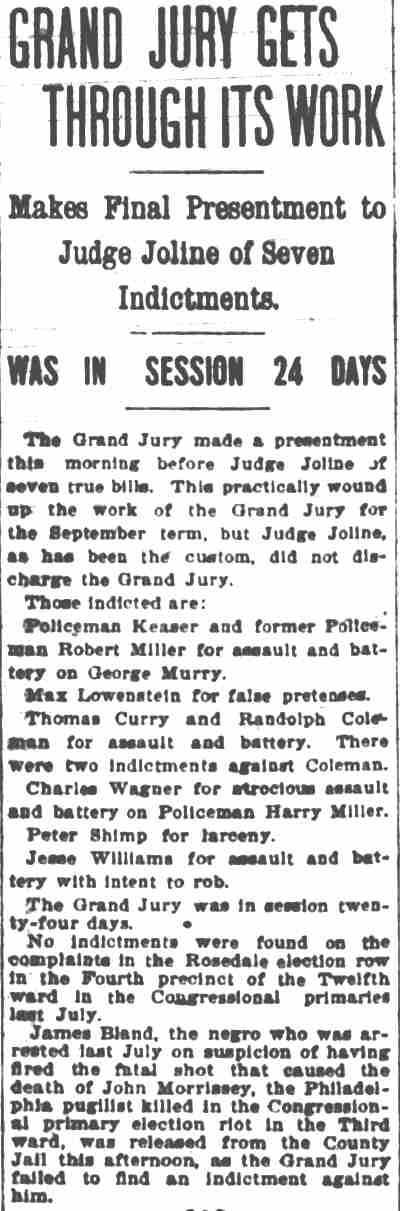
Camden Post-Telegram, November 19, 1902 — Related: Robert F. Miller
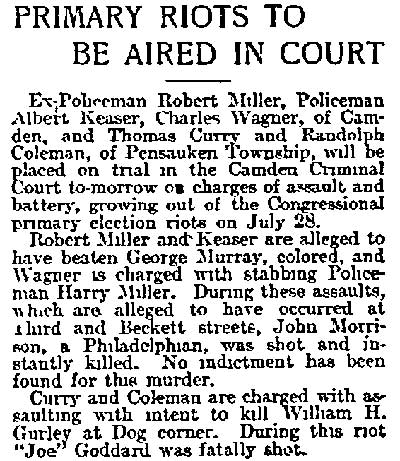
Primary Riots to Be Aired in Court
Philadelphia Inquirer —
Primary Riots to Be Aired in Court
PRIMARY RIOTS TO BE AIRED IN COURT
Ex-Policeman Robert Miller, Policeman Albert Keaser, Charles Wagner, of Camden, and Thomas Curry and Randolph Coleman, of Pensauken Township, will be placed on trial in the Camden Criminal Court to-morrow on charges of assault and battery, growing out of the Congressional primary election riots on July 28. Robert Miller and Keaser are alleged to have beaten George Murray, colored, and Wagner is charged with stabbing Policeman Harry Miller. During these assaults, which are alleged to have occurred at Third and Beckett streets, John Morrison, a Philadelphian, was shot and instantly killed. No indictment has been found for this murder. Curry and Coleman are charged with assaulting with intent to kill William H. Gurley at Dog corner. During this riot "Joe" Goddard was fatally shot.
"WAGNER'S TRIAL FOR STABBING MILLER"
Camden Daily Courier —

WAGNER'S TRIAL FOR STABBING MILLER
Witnesses Say Policeman Keaser Held Fellow Officer When He Was Knifed.
CUT DURING THIRD WARD RIOT
The main court room was crowded with interested Third warders this morning, when the first of the criminal complaints growing out of the riots at Third and Beckett streets, on the night of July 28, last, during the Congressional primary, was taken up. It charged Charles Wagner with assault and battery on Policeman Harry Miller. Judge Joline was on the bench. Prosecutor Lloyd appeared for the State and the defendant was represented by Lawyers Fred A. and William F. Rex. Some little trouble was experienced in getting a jury.
After Prosecutor Lloyd outlined the case, Policeman Miller was called to the stand. He said that on the night in question just before the close of the polls, a fight ensued between ex-Policeman “Bob” Miller and John Morrisey, the man who was killed. A general racket followed and “Bob” Miller, Policeman Keaser and others were brutally assaulting George Murray with a blackjack, when witness went to Murray's aid. Keaser, he said, turned on him and grappled.
MILLER STABBED.
“He had a hold of me and I of him,” said Miller, “and while we were standing in that position, this man Wagner came up in front of me, jabbed his knife in my stomach, turned it like that (giving his hand a twist) and pulled it out. Keaser still had a hold of me and I could not help myself. Wagner ran away after stabbing me.”
Miller said he was taken to Cooper Hospital and was there four weeks.
On cross-examination by Mr. Rex, Miller said he was positive that Wagner was his assailant and denied saying in the hospital the morning after the stabbing, that he did not know who cut him. He also denied hitting Keaser with his blackjack.
When questioned concerning Morrisey, the man who was killed, Miller said he only met him that day and did not know whether he was a voter or not.
DIDN'T WANT DETAILS.
Mr. Rex tried to get the witness to detail a talk he had with Morrisey, but Mr. Lloyd objected. Mr. Rex seemed so anxious to carry the point that Mr. Lloyd said he was willing to withdraw the objection, provided Mr. Rex would not object to detailed conversation responses to his questions. Mr. Rex promptly vetoed the proposition and withdrew his questions.
Harry Selby, son of former Policeman Selby, followed on the stand. He said he did not see the stabbing, but that a few moments before the polls closed he saw Wagner try to stab Miller at the window of the polling place. The two, it appears, had had some words.
Dr. Grimes, of the Cooper Hospital staff, said that he helped dress Miller's wound and that it was a dangerous one.
SAW WAGNER KNIFE MILLER.
William Laws, colored, corroborated Miller's testimony. He said he saw Policeman Keaser hold Policeman Miller while Wagner stabbed him. This happened he said about four minutes of 8 o'clock.
Policeman Edward Hartman told of seeing Wagner having an open knife in his hand, of seeing him jab at several people and that he grabbed at him.
“You saw all of that did you?” asked Mr. Rex.
“I certainly did,” replied the officer.
“Then why didn't you as a policeman arrest him?”
“I tried to, but his brother interfered.”
Mr. Rex had no more questions to ask.
George Murray, also told of seeing defendant have a knife in his hand.
Detectives Smith and Cherry told of making an unsuccessful search in this city for Wagner and finally locating him at Hammonton. He was wounded.
Detective Cherry said that Wagner told him that he had been at Hammonton.
“Hammonton is in Camden county, isn't it?” asked Mr. Rex.
“No, sir, Atlantic county.”
“My geography is twisted somewhat,” commented Mr. Rex.“ With these witnesses the State rested.
WAGNER DENIES CHARGE.
Addressing the jury Mr. Rex said the defense would be an alibi. Wagner then took the stand. He said he lived at 668 South Second street and that on the night of July 28 he was at the polling place about quarter of eight o'clock.
“Did you have a penknife in your hands at all?”
“No, sir.”
“Did you cut Harry Miller?”
“No, sir.”
In answer to questions by Mr. Rex, Wagner said he was with Constable Bates and nearly everybody knew him at Waterford.
When questioned by Mr. Lloyd Wagner said he went to Waterford on July 30 — two days after the stabbing. He went to see his sick wife at Mr. Archer's. His visit lasted until the middle of September, the time of his arrest. Previous to his wife's illness he was away over a week. He said he had no knowledge that he was wanted for any crime until his later arrest. It was news to him in papers that he was charged with stabbing Miller. He said he had no knife.
He further said that no trouble had occurred at all while he was at the polls.
Charles Cahill, a clerk at the Reading terminal, said he was at the polls and about a quarter past seven o'clock he went up Beckett street in company with Wagner and another man. About fifty feet away, he said he went into an alley and Wagner proceeded up the street. When Cahill returned to the polling place just as the trouble began. He did not see Wagner.
Questioned by the Prosecutor Cahill said he was present as a challenger.
“For which party?” “For the party that was holding the election?”
“We wanted the best man,” snapped Cahill in reply.
DIDN'T HAVE ANY POLITICS.
The Prosecutor repeated the question several times only to receive evasive answers, such as “I was a Republican for that night,” and “I'm for the best man,” until Judge Joline was compelled to sharply reprimand the witness to answer the question. Even then the spectators laughed. Cahill said he had no politics, as he said he guessed he didn't have any politics.
John McDonald testified to seeing Wagner and two other men pass up the street and despite the general excitement Mr. McDonald said he did not see Wagner until he got to Fourth street.
With the testimony of Butcher John Morrisey, who declared he did not see Wagner at all around the polls until after the trouble, was over court took a recess.
Policeman Albert Keaser was the first witness called after recess. He said he was present when the row started, that he took a blackjack from George Murray and also that he took a club from Policeman Harry Miller. The latter, he said, had hit him with the weapon. Witness said he was at the window of the polling place and at that time Miller was not cut.
“Did Mr. Archer, the Assistant Prosecutor, tell you that he had a talk with Miller and that Miller said he didn't know who cut him?”
Mr. Lloyd objected to the question because it showed a willingness to allow it. Mr. Rex would let him call witness and then attack him.
Mr. Rex would not do so and the Prosecutor pressed his objection. It was sustained.
On cross examination Keaser denied agreeing to a man named Ogden that Wagner was the fellow who did Miller.
BEAT FELLOW POLICEMAN.
Policeman John Wagner, another of the defendants, said his brother went away before the fight started. In detailing the fracas Wagner voluntarily said he hit Hartman (the policeman) with his jack and that he also hit Policeman Hartman.
Policeman Pruitt also said he saw Wagner leave the polling place just before the disturbance. When Mr. Lloyd was cross examining the witness Mr. Rex objected to the form of a question and remarked that he had objected to that several times and “I suppose I'll get the same ruling.”
Judge Joline rebuked Mr. Rex for making such a statement. Mr. Rex then made his objection but put it as an objection in regular form and it was sustained.
Anna Hutner, a sister of the defendant, said she saw him go away about quarter of 8 o'clock and that he did not have anything to do with the trouble. She explained her presence there by saying she had gone there to keep George Murray from shooting her brother.
William Ridgway said he was present during the trouble but did not see Wagner.
Constable “Bo” Bates said that Wagner was in his company nearly every day while he was visiting Waterford and that he made no attempt to escape.
SHIELDED WAGNER.
Prosecutor Lloyd's only question was:
“You as an officer of this court knew that this man was charged with cutting Harry Miller and you did not report it to the authorities, is that right?”
“I forgot it sir.”
When asked why, by Mr. Rex, the witness said the authorities could find out him at any time.
The defense rested and Mr. Lloyd replied with a brief but vigorous rebuttal. He testified that Keaser told him that Wagner did cut Miller and related the incident. Mr. Lloyd again rebuked Mr. Rex for his manner.
Argument commenced at 2.45 o'clock.
"ANOTHER CASE IN THIRD WARD RIOT"
Camden Daily Courier —

ANOTHER CASE IN THIRD WARD RIOT
Policeman Keaser and Ex-Policeman “Bob” Miller on Trial for Assault.
WAGNER JURY COULD NOT AGREE
In the Criminal Court this morning George V. Tucker, who was convicted of a charge of assault and battery, was sentenced by Judge Joline to pay a fine of $50 and costs and stand committed until the money is paid.
Henry J. Shuster pleaded guilty to a charge of embezzling $260.16 from King David Lodge, No. 155, of which he was treasurer. Shuster served three months in the County Jail last spring on a similar charge. At that time he said he used the money to care for his wife, who was ill. It appears that he did use part of the money for this purpose, but that he squandered a large sum in poker playing.
Rev. Q. C. Davis, pastor of the Emmanuel Baptist church, testified that since Shuster has been out of jail he has led a correct life, and at the present time has a good position.
Prosecutor Lloyd made an appeal for clemency.
Judge Joline announced that he was not ready to decide the case and it went over.
POLICEMEN ON TRIAL.
The indictment against Policeman Albert Keaser and ex-Policeman Robert Miller, on charges of assault and battery on George Murray, was then called. This is the second case to be tried as the outcome of the election riot at the Third Ward polling during the primary election last July. Considerable time was occupied in securing a jury.
At the afternoon session Assistant Prosecutor Archer outlined the case, in which he said the two defendants “lined with a polling system” and the alleged assault took place at the polling place at Third and Beckett streets, and during the row, Robert Miller, struck George Murray several times with a blackjack, and Keaser, it is alleged, assisted Miller in the assault.
The first witness called was George Murray, the alleged victim, who testified that while standing near the polling place with several other “Bob” Miller, without any provocation, beat him with a blackjack. He said that Policeman Keaser was present and came to Miller's assistance. During the row, Policemen Hartman and Harry Miller came to his aid.
BEATEN WITH A BLACKJACK.
On cross-examination witness said he had no pistol or blackjack, but that three days before the election Miller had struck witness with a blackjack. He further said that he had been told at the Third Ward Republican Club, in the presence of John Rodan, that if a certain man would come along, he would kill him.
William Laws, who testified next, gave further and corroborative testimony as to the blackjacking. He said that Murray did nothing to provoke the assault.
Spencer Moore, also gave corroborating testimony.
Policeman Harry Miller testified to seeing “Bob” Miller beating Murray while Policeman Keaser stood at the side of Beckett street. The witness said that he was not allowed to see Policeman Keaser at the same time explaining.
What are you trying to do, kill this man.
The witness said he was thrown down, and was pushed over by Keaser, and Miller grappled with him. He heard three or four pistol shots.
The witness identified the blackjack, in the possession of Lawyer Rex, which he used on the night of the primaries.
Edward Roberts, formerly Assembly man Roberts, also gave corroborative testimony.
DEFENSE OPENS.
At the afternoon session of the court the defense opened. Counsel said that the defendants were officers of the law, force to put the riot into subjection.
Policeman Toy testified that he saw two opponents quarreling, that Robert Miller, was acting as a peacemaker. He saw Murray shoot off a revolver.
Policeman Cunningham was also at the riot and heard Murray say that he would get some one before the night was over. He found the gunshot off a revolver under a tree.
On cross-examination Miller admitted that he struck Murray while attempting to arrest him. He also testified that he had a conversation with Murray; that some person had attempted to stab him. He exhibited his clothing which was cut with a knife.
Policeman Shaw testified that on July 23, visited George Murray's residence and found George Murray in his home, where he was under arrest by Detective Burke, who also found a revolver from the wife of Murray.
Mrs. Widener, who was a witness in the trial yesterday, is not the same piece of evidence in this case.
CHEESEMAN SENTENCED.
At the noon recess Judge Joline imposed sentence on O. U. Cheeseman, the former secretary of Thomas Jefferson Council, No. 155, Jr. O. U. A. M., who was convicted of a charge of false pretenses on Thursday last. Rev. Samuel Ellesworth, Rev. R. A. M. Mason, pastor of the Kaighn Avenue M. E. church, and Rev. Robert Wesley Johnson, pastor of the Second Presbyterian church, made appeals to the court for clemency in his case. Judge Joline sentenced Cheeseman to four months in the County Jail and a fine of $50 and costs.
After being out for seven hours without being able to agree on a verdict the jury in the case of Policeman Harry Miller tried yesterday on a charge of stabbing Policeman Harry Miller, at the time of the election riot last, were discharged at 10 o'clock last night.
Policemen Acquitted
Camden Daily Courier —
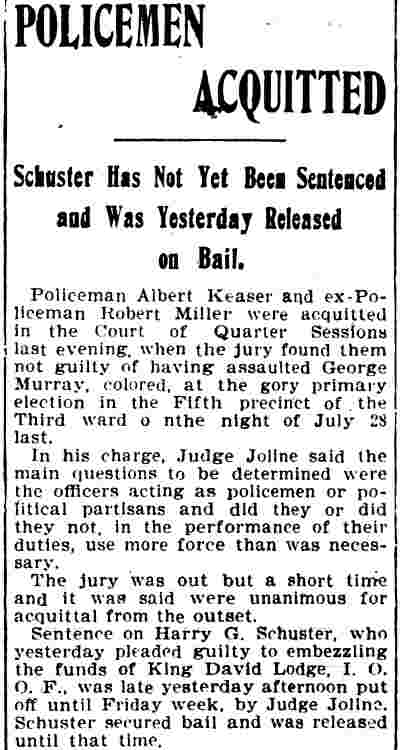
Camden Daily Courier, January 28, 1903 — Related: Robert F. Miller, Odd Fellows
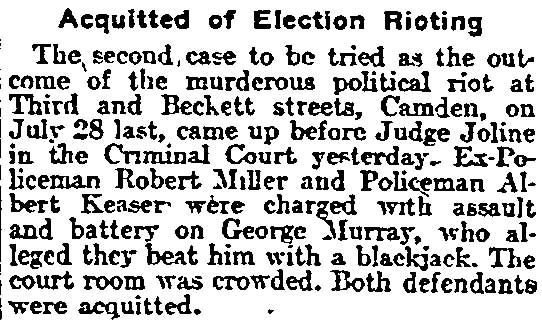
Acquitted of Election Rioting
Philadelphia Inquirer —
Acquitted of Election Rioting
Acquitted of Election Rioting
The second case to be tried as the outcome of the murderous political riot at Third and Beckett streets, Camden, on July 28 last, came up before Judge Joline in the Criminal Court yesterday. Ex-Policeman Robert Miller and Policeman Albert Keaser were charged with assault and battery on George Murray, who alleged they beat him with a blackjack. The court room was crowded. Both defendants were acquitted.
Rush for Work Brings on Riot
Philadelphia Inquirer —
Rush for Work Brings on Riot
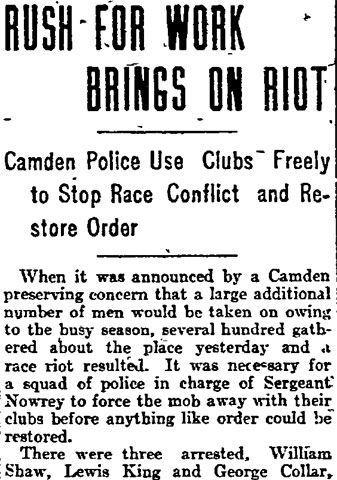
RUSH FOR WORK BRINGS ON RIOT
Camden Police Use Clubs Freely to Stop Race Conflict and Restore Order
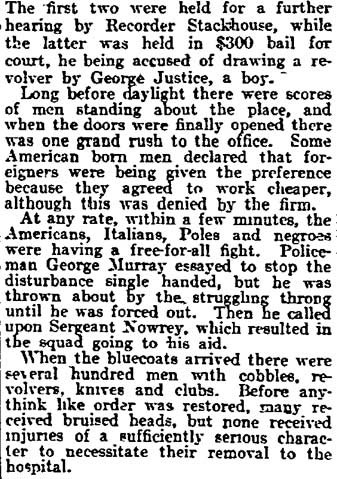
When it was announced by a Camden preserving concern that a large additional number of men would be taken on owing to the busy season, several hundred gathered about the place yesterday and a race riot resulted. It was necessary for a squad of police in charge of Sergeant Nowrey to force the mob away with their clubs before anything like order could be restored. There were three arrested, William Shaw, Lewis King and George Collar,
More in the Net of Bar Committee
Philadelphia Inquirer —
More in the Net of Bar Committee
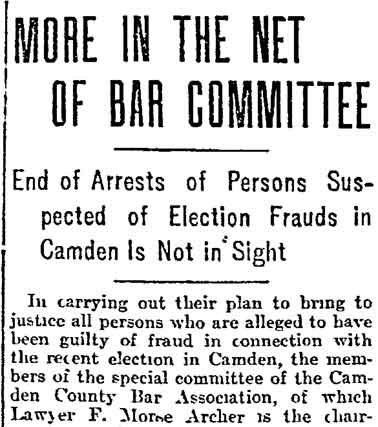
MORE IN THE NET OF BAR COMMITTEE
End of Arrests of Persons Suspected of Election Frauds in Camden Is Not in Sight
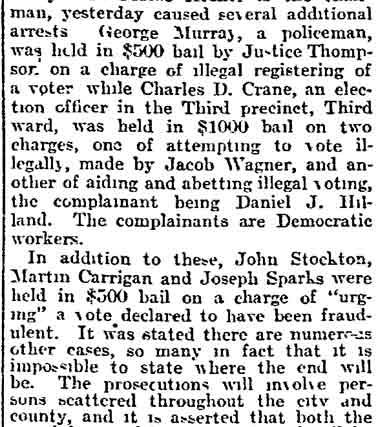
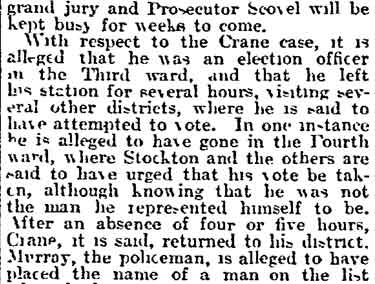
In carrying out their plan to bring to justice all persons who are alleged to have been guilty of fraud in connection with the recent election in Camden, the members of the special committee of the Camden County Bar Association, of which Lawyer F. Morse Archer is the chairman, yesterday caused several additional arrests George Murray, a policeman, was held in $500 bail by Justice Thompson on a charge of illegal registering of a voter while Charles D. Crane, an election officer in the Third precinct, Third ward, was held in $1000 bail on two charges, one of attempting to vote illegally, made by Jacob Wagner, and another of aiding and abetting illegal voting, the complainant being Daniel J. Hiland. The complainants are Democratic workers.
In addition to these, John Stockton, Martin Carrigan and Joseph Sparks were held in $500 bail on a charge of "urging" a vote declared to have been fraudulent. It was stated there are numerous other cases, so many in fact that it is impossible to state where the end will be. The prosecutions will involve persons scattered throughout the city and county, and it is asserted that both the grand jury and Prosecutor Scovel will be kept busy for weeks to come.
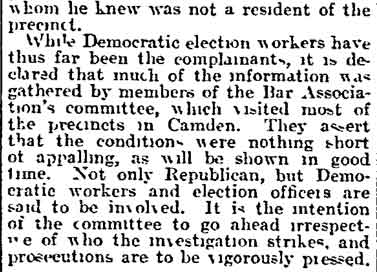
With respect to the Crane case, it is alleged that he was an election officer in the Third ward, and that he left his station for several hours, visiting several other districts, where he is said to have attempted to vote. In one instance he is alleged to have gone in the Fourth ward, where Stockton and the others are said to have urged that his vote be taken, although knowing that he was not the man he represented himself to be. After an absence of four or five hours, Crane, it is said, returned to his district. Murray, the policeman, is alleged to have placed the name of a man on the list whom he knew was not a resident of the precinct.
While Democratic election workers have thus far been the complainants, it is declared that much of the information was gathered by members of the Bar Association's committee, which visited most of the precincts in Camden. They assert that the conditions were nothing short of appalling, as will be shown in good time. Not only Republican, but Democratic workers and election officers are said to be involved. It is the intention of the committee to go ahead irrespective of who the investigation strikes, and prosecutions are to be vigorously pressed.
Accused Admits Robbery
Philadelphia Inquirer —
Accused Admits Robbery
Accused Admits Robbery
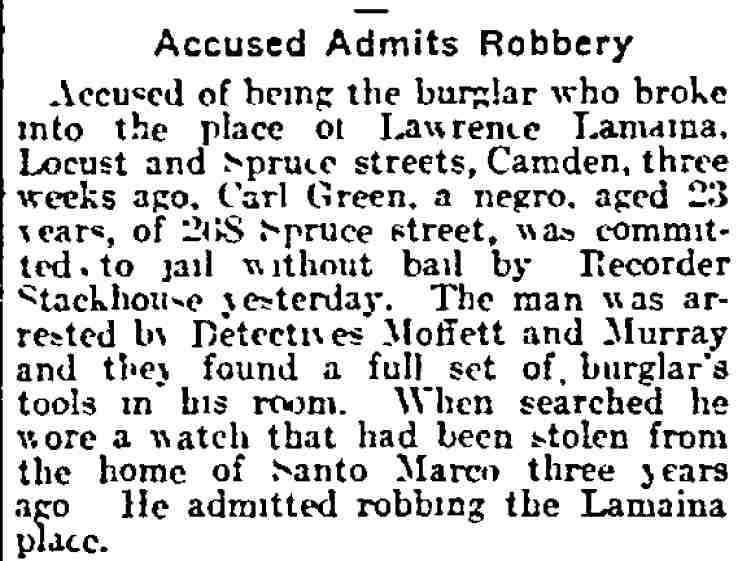
Accused of being the burglar who broke into the place of Lawrence Lamaina, Locust and Spruce streets, Camden, three weeks ago, Carl Green, a negro, aged 23 years, of 268 Spruce street, was committed to jail without bail by Recorder Stackhouse yesterday. The man was arrested by Detectives Moffett and Murray and they found a full set of burglar's tools in his room. When searched he wore a watch that had been stolen from the home of Santo Marco three years ago. He admitted robbing the Lamaina place.
Third Ward Club Holds Fine Ball
Camden Post-Telegram —
Third Ward Club Holds Fine Ball
Mr. and Mrs. J. Edward Way Lead the Grand March of Republican Club
Latest Dances on Program
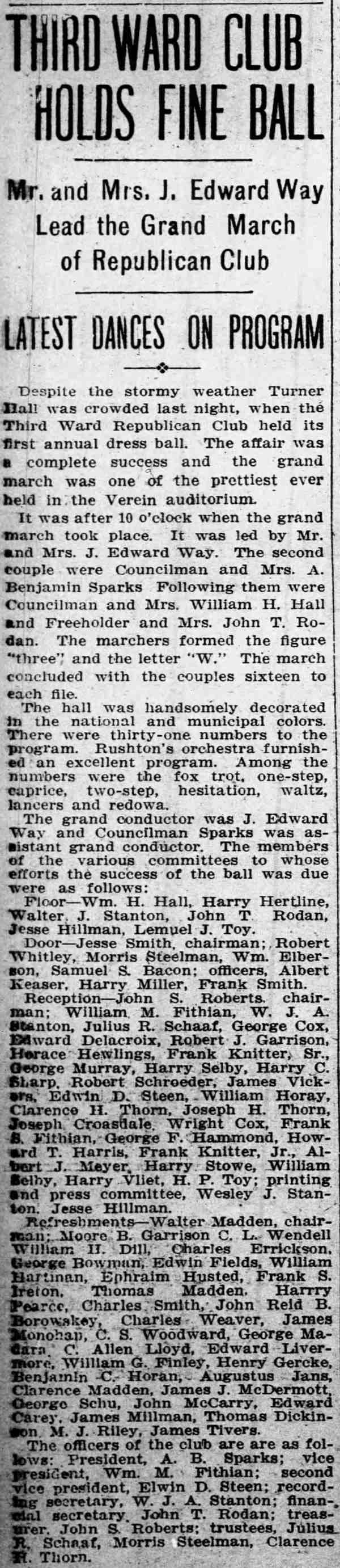
Despite the stormy weather Turner Hall was crowded last night, when the Third Ward Republican Club held its first annual dress ball. The affair was a complete success and the grand march was one of the prettiest ever held in the Verein auditorium.
It was after 10 o’clock when the grand march took place. It was led by Mr. and Mrs. J. Edward Way. The second couple were Councilman and Mrs. A. Benjamin Sparks. Following them were Councilman and Mrs. William H. Hall and Freeholder and Mrs. John T. Rodan. The marchers formed the figure “three” and the letter “W.” The march concluded with the couples sixteen to each file.
The hall was handsomely decorated in the national and municipal colors. There were thirty-one numbers to the program. Rushton’s orchestra furnished an excellent program. Among the numbers were the fox trot, one-step, caprice, two-step, hesitation, waltz, lancers and redowa.
The grand conductor was J. Edward Way and Councilman Sparks was assistant grand conductor. The members of the various committees to whose efforts the success of the ball was due were as follows:
Floor—Wm. H. Hall, Harry Hertline, Walter J. Stanton, John T. Rodan, Jesse Hillman, Lemuel J. Toy.
Door—Jesse Smith, chairman; Robert Whitley, Morris Steelman, Wm. Elberson, Samuel S. Bacon; officers, Albert Keaser, Harry Miller, Frank Smith.
Reception—John S. Roberts, chairman; William M. Fithian, W. J. A. Stanton, Julius R. Schaaf, George Cox, Edward Delacroix, Robert J. Garrison, Horace Hewlings, Frank Knitter, Sr., George Murray, Harry Selby, Harry C. Sharp, Robert Schroeder, James Vickers, Edwin D. Steen, William Horay, Clarence H. Thorn, Joseph H. Thorn, Joseph Croasdale, Wright Cox, Frank S. Fithian, George F. Hammond, Howard T. Harris, Frank Knitter, Jr., Albert J. Meyer, Harry Stowe, William Selby, Harry Vliet, H. P. Toy; printing and press committee, Wesley J. Stanton, Jesse Hillman.
Refreshments—Walter Madden, chairman; Moore B. Garrison, C. L. Wendell, William H. Dill, Charles Errickson, George Bowman, Edwin Fields, William Hartman, Ephraim Husted, Frank S. Ireton, Thomas Madden, Harry Pearce, Charles Smith, John Reid B. Borowakey, Charles Weaver, James Monohan, C. S. Woodward, George Madura, C. Allen Lloyd, Edward Livermore, William G. Finley, Henry Gercke, Benjamin C. Horan, Augustus Jans, Clarence Madden, James J. McDermott, George Schu, John McCarry, Edward Carey, James Millman, Thomas Dickinson, M. J. Riley, James Tivers.
The officers of the club are are [sic] as follows: President, A. B. Sparks; vice president, Wm. M. Fithian; second vice president, Elwin D. Steen; recording secretary, W. J. A. Stanton; financial secretary, John T. Rodan; treasurer, John S. Roberts; trustees, Julius R. Schaaf, Morris Steelman, Clarence R. Thorn.
Arrested for Desertion
Philadelphia Inquirer —
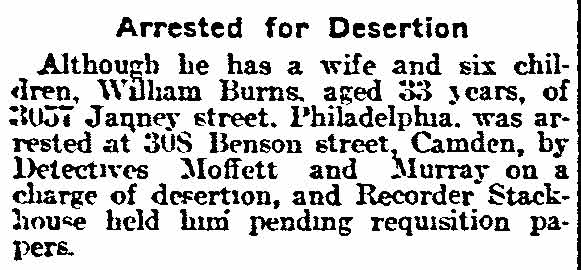
Philadelphia Inquirer, January 31, 1915 — Related: Benson Street, Henry C. Moffett
Fugitive Leaps From Window
Philadelphia Inquirer —
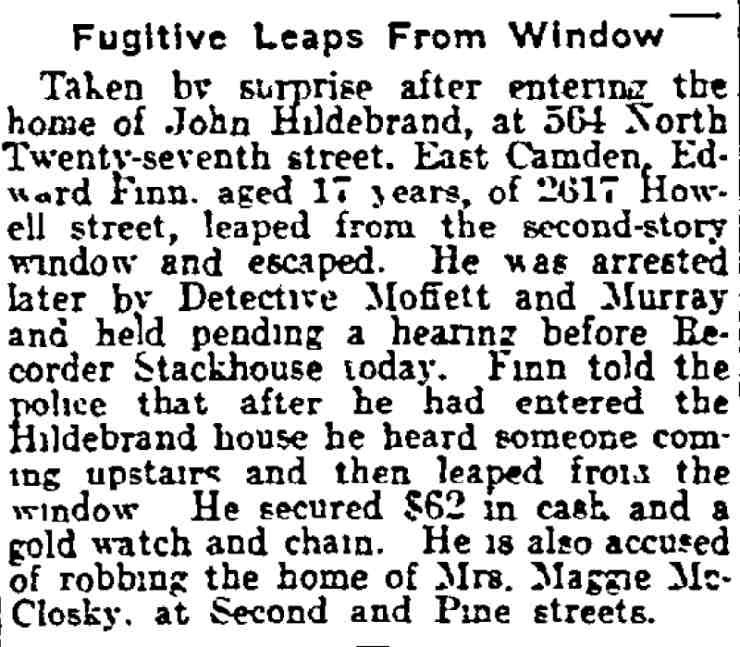
Fugitive Leaps From Window
Fugitive Leaps From Window
Taken by surprise after entering the home of John Hildebrand, at 564 North Twenty-seventh street, East Camden, Edward Finn, aged 17 years, of 2617 Howell street, leaped from the second-story window and escaped. He was arrested later by Detective Moffett and Murray and held pending a hearing before Recorder Stackhouse today. Finn told the police that after he had entered the Hildebrand house he heard someone coming upstairs and then leaped from the window. He secured $62 in cash and a gold watch and chain. He is also accused of robbing the home of Mrs. Maggie McClosky, at Second and Pine streets.
Murderer and Forger Escape Jail After Shooting Keepers, Killing One
Camden Post-Telegram —
Wilson Ashbridge, Who Shot and Killed Mrs. Elizabeth Dunbar and George E. Thompson, Check Swindler, Trap Jailor Hibbs by a Ruse and After Slaying Him Shoot Joe Ellis Who Intercepted Them in Flight. Used Revolver Smuggled Into Prison by Confederates and Leave Jail Wide Open in Their Flight, a General Delivery Being Averted by Police Who Were Summoned by the Wounded Men.
Murdering one jailor and wounding another with a revolver that had been smuggled into them by outside confederates, Wilson T. Ashbridge, slayer of Mrs. Elizabeth Dunbar, and Francis Murphy, alias George E. Thompson, a check forger, made their escape from the county jail a few minutes before seven o’clock last night.
Ashbridge with his wife was caught at noon in the Keystone Hotel in Chester PA where they registered at one o’clock this morning.
Thompson is still at liberty but from the confident manner of Prosecutor Kraft his early arrest seems assured.
The murdered jailor was Isaac Hibbs, aged 65 years of 913 South 8th Street. The wounded keeper is Joseph Ellis, aged 45 years, of 416 Carteret Street. Shot twice, he is in Cooper Hospital. His condition today is very satisfactory.
Thompson, who is 41 years old, forged a check for $650 which he gave to V.M. Fulton as part of the purchase price of an automobile. The forgery was discovered before the deal was completed and his arrest followed on June 8. he also passed a forged check for $15 on State Motor Vehicle Agent Kraft. He, too, was awaiting trial. In spite of the positive evidence against him Thompson had spurned all efforts to have him plead guilty and it is now believed that he was sparring for time while hatching a plan to escape. He is no doubt the master mind.
R.L. Hunter, a farmer of Bensalem Township, Bucks County PA, about four miles above Torres dale, reported to the Philadelphia police the morning that he had seen a man answering Ashbridge’s description on the Bucks Road at daylight. The man asked the way to Riegelsville.
According to Hunter, the man was dressed in a dark suit, and had no hat. His clothing was wet. Hunter did not see anything suspicious in his actions, and after giving him directions, they parted.
Upon seeing the paper with a picture of Ashbridge, the farmer was struck by its resemblance to the man with whom he had talked. He hurried to Tacony and notified the police.
The State police, who patrol that section of the county, and who have an office at Langhorne, were immediately notified as were the surrounding towns.
The shootings took place in different parts of the jail. Hibbs was murdered in the exercise room just outside the cell room on the Sixth and Arch corner of the building. Ellis was shot down in the corridor just outside the Market Street end of the building when he heroically grappled with Ashbridge after the latter had pointed a gun at his head. In spite of his wounds Ellis dragged himself to a telephone and after notifying Police Headquarters of what had happened he collapsed.
Only one of the two bullets is still in Ellis. It entered the groin on the right side and is buried in the muscles of the leg, having taken a downward course for seven or eight inches. The other bullet struck Ellis in the right breast and came out in the left breast, traversing the upper fleshy parts of the body.
Hibbs was almost instantaneously killed by a bullet that went within an inch of his heart, producing a hemorrhage. The bullet was extracted this morning from the body early this morning in an autopsy performed at the morgue by County Physician Stem. In spite of the fact that it is pretty well established that three shots were fired in the attack on Hibbs, only one of the bullets took effect.
“But it makes little difference which of the two men handled the gun” said Prosecutor Kraft this morning. “Both are equally guilty of this murder and what we are concerned about now is the recapture of the gunmen.” Mr. Kraft added that it his purpose to examine all of the prisoners in that part of the jail where Hibbs was murdered to determine fully who fired the fatal shot.
The escape had been carefully planned and timed to the minute. Of course the desperate prisoners were aided by confederates on the outside and it is the general belief that a high powered motor car was in waiting for them not far from the jail. They are known to have been in possession of money and openly boasted yesterday that it was their intention to leave the prison last night. These boasts were made to two young ladies connected with a religious organization who called on the two men yesterday to offer spiritual reconciliation. The girls are frequent visitors to the jail and naturally their efforts at evangelization were directed in the main toward Ashbridge, because of the fact that he was accused of murder. These girls, whose identity officials will not disclose, were closeted with Prosecutor Kraft until one o’clock this morning. Both declared that on their visit yesterday they were told by Ashbridge and Thompson that it was the last day they expected to spend in jail.
“We are going to get away from here tonight and we’ve got money to help us after we are out,” said Ashbridge, who further told the girls he had considerable cash sewed up in the waistband of his trousers. The girls begged the prisoners not to do anything that would cause them more trouble and they told the Prosecutor that Ashbridge and Thompson promised them that they would not make any effort to escape. In their talks with the girls neither of the prisoners said a word that would indicate that they would kill if necessary to escape. The full force of their boast did not dawn on the religious workers and for this reason it never occurred to them to inform the Sheriff of what the prisoners had in said.
A general jail delivery of at least all the men confined in what is known as the untried department, where the two were held, was only averted by the prompt arrival of the police on their beat, which was made easy by means of the keys taken from the prostrate body of Hibbs. Ashbridge and Thompson left all of the doors open and the vanguard of the inrushing police found the prisoners swarming all over the corridors on the east side of the prison. In the wild excitement following the double shooting and escape none else thought of freedom and a checking up of the inmates after they had been herded in the exercise room of the untried department accounted for all but the fugitive slayers.
The department, in which the two men were confined is the same one which William Brown and Charles Berger made their sensational escape several years ago by sawing away the bars on the Federal Street front of the jail. Thrilling as it was, the former escape was insignificant in comparison with last night’s tragic event.
With the full force of the keepers out of the way— one dead and the other suffering from gunshot wounds at first supposed to have been fatal— Ashbridge and Thompson had nothing between them and freedom but the door entering from the spiral stairway leading to the narrow entrance of the Sixth and Market Streets end of the Court House, With the keys taken from Hibbs they opened the door and in a few seconds were breathing the free air. It was still daylight when the daring murderers walked from the building and although they were no doubt seen by some of the scores of persons passing it is certain that they managed to control themselves to such an extent as not to arouse any undue suspicion. The exit they used to escape is that used by the general public and therefore persons passing calmly in and out of the door would not in any manner be thought to have been connected with a jail delivery. However the shots which had laid low the keepers had been plainly heard on all four sides of the building and it is strange that no one has yet been found who can give positive information as to what course the fleeing men took and whether they were aided in their flight by an automobile.
While the police and detectives of Camden and all other cities in the East are watching railroad terminals, steamship lines, and all other avenues of travel in response to the general alarm sent out last night, Prosecutor Kraft is bending all his energies to learn who smuggled in the revolver which the fugitives used. Thus far this feature of the case is as complete a mystery as it was last night. Mr. Kraft and Sheriff Haines are satisfied, however, that only one gun was used for both shootings. It was at first thought that each man had a pistol when they left the jail; that one of them armed himself with the gun that Hibbs was supposed to have carried, but it was determined that Hibbs was not armed when he went into the jail last night. There was no occasion for him to come in contact with any of the prisoners and for that reason he left his revolver in his desk in the office. Even had he carried it he would have little chance to use it, so cold-bloodedly was he slain as he unsuspectingly fell into the trap laid for him by the desperate gunmen. There is also some conflict as to how at least one of the fugitives was dressed. Alfred Williams, who witnessed the murder of Hibbs, said that Ashbridge was without coat or hat when he dashed out of the cell-room, and that Thompson carried his coat and hat under his arm. However in a description of the two men given at the Prosecutor’s office it was set forth that Ashbridge wore a blue serge suit and a checkered cap. The coat that he is supposed to have taken bore the mark of “Tull— the Tailor,” of Jacksonville, Florida, and had been borrowed by him from another prisoner. He wore tan shoes. Ashbridge is 27 years old, 5 feet 7-1/2 inches in height and weighs 137 pounds. He has brown hair, smooth face and is of light complexion.
Thompson wore a brown suit and a Panama hat. He is 41 years old 5 feet seven inches in height, and weighs 175 pounds. He has brown bushy hair, is minus one of the fingers on his left hand, and is light complexioned.
The tan shoes worn by Ashbridge were also borrowed from one of the prisoners. He got them on Saturday and remarked that he wanted to look neat.
Keepers Ellis and Hibbs were reading in the prison office last evening when Hibbs glanced up at the clock and noticed that it was a few minutes of seven. “Joe, I’m going back and put the boys in their cells,” he said to Ellis and with his keys in his hand he started for the cell room in the untried department. A thirty foot long corridor runs from the office to the barred and grated door opening into the department in which the cells are situated. This department is about the size of three ordinary school rooms and in the southeastern corner of the jail are the cells, in two tiers.
Around the cells is a three foot corridor into which all the cells doors open and in which all the prisoners are permitted to walk when they are not allowed out in the main room. When the inmates are ordered into their cells and their doors closed the doors are locked from the outside of the steel cage by means of a lever worked by the jailor. Thus every cell door can be made secure without the keepers coming into actual contact with the prisoners. In addition to the bars around the corridor fronting on the double tier of cells there is a fine mesh heavy wire screening.
As Hibbs approached the lever which is operated to shut the cell doors after the prisoners have retired from the corridors, Ashbridge was leaning against the grating of his cell, Number 18. Thompson was lounging a few feet away.
“Daddy, open the door, I want you to see this note,” said Ashbridge to the keeper, at the same time displaying a piece of paper which he had in his hand. Never giving a thought that he was about to perform an act that was absolutely necessary for the carrying-out of the well laid plot, or that he was going to his doom, or was even in danger, “Daddy,” as the aged keeper was known to all the prisoners, opened the door without hesitation.
As he swung wide the big steel frame, Ashbridge quickly stepped out and the next instant was pressing a gun against the abdomen of the jailor.
“Throw up your hands, you ___ ___ ___” he commanded.
“What are you up to, what’s this mean,” asked the keeper, apparently not realizing he had been trapped.
For reply Thompson jumped out the door, wrenched the gun from Ashbridge’s grasp and with an oath began firing at Hibbs, who sank to the floor at the first shot. Only a few feet away and the only other person in the exercise room, although the shooting could have been seen by any other prisoners who had not retired to their cells, Alfred Williams, trusty, is emphatic in his assertion that Thompson fired the shot that killed Hibbs and that he fired three times.
“It’s a wonder they did not get me,” said Williams. “Ashbridge and I could not hit it and in his desperate mood I am surprised he didn’t kill me, too.” Williams, who has just completed a six months’ sentence for obtaining money from Italian grocers by falsely representing himself as an agent for a wholesale house in Chicago and who is wanted in the Windy City for the same offense, says the whole transaction took less than a minute and that the moves came so fast he and the other prisoners were powerless to aid.
“It was like a flash of lightning” said Williams, “and before I could fully understand what had happened Ashbridge had grabbed Daddy’s keys which had fallen to the floor, and was off like a deer for the barred door. Ashbridge had taken the smoking gun from Thompson, who had his hat and coat under his arm and who was right behind the other one.
“As they hurried through the door after Ashbridge had opened it with Daddy’s keys Daddy called to me to raise him. I put my arm under his head and lifted him slightly from the floor. ‘Hold my hands’ he said to me. I took hold of his hands and the next minute he died in my arms. Then I heard two more shots and I knew they got Joe Ellis.”
Startled by the shots, and he is emphatic there were three in rapid succession, Ellis leaped to his feet and without taking the time to arm himself ran from the office and turned into the corridor just as Ashbridge, wild-eyed and gun in his hand, came running toward him. Halting three yards away Ashbridge pointed the revolver at Ellis’ head and ordered him to throw up his hands.
For reply and without fear of himself the keeper dashed at the murderer and the next instant they were locked in each other’s embrace. Working loose the hand which held the gun, Ashbridge pulled the trigger. The bullet struck Ellis in the breast, but the wound was not sufficient to render him helpless. However, before he could grip the pistol arm, Ashbridge fired again and the keeper fell back with a bullet in his groin.
“The second shot got me,” said Ellis to Prosecutor Kraft and Assistant Prosecutor Butler at the hospital. “The first one wasn’t bad but my strength left me when the second bullet struck. Ashbridge was the only one I saw. I did not see Thompson.”
“Dragging himself to the office Ellis managed to reach a telephone and called up the police.
“This is Ellis at the county jail; come quick. Ashbridge has shot me” he weakly said over the phone to Captain Hyde. Then the receiver fell from his hand and he dropped to the floor, but after a minute or two managed to climb into chair.
While patrol loads of policemen were being hurried to the Court House from the First and Second District station houses, Reserve Officer Charles Hose, on duty at Broadway and Federal Street, who had heard the shots, ran to the Court House and from the office of Assistant Custodian John Lack phoned up to the jail. Ellis managed to answer and in a few words told what had happened. They ran up to the jail and were admitted by Ellis, who was rapidly growing weaker from loss of blood, the trail of which plainly showed just where the injured keeper had moved.
“I guess Ashbridge got away and the jail is all open, you had better take care of the rest of the prisoners,” said Ellis to Hose and Lack. The fugitive-murderers had left all doors open and the other occupants of the untried department were swarming through the corridors. Their curses and yells and the shrieks and cries of the female prisoners had turned the place into a perfect bedlam. With the aid of other policemen who swarmed into the Court House like bees, the prisoners were soon herded into the exercise room, where Trusty Williams checked them up and accounted for all but Ashbridge and Thompson.
With the faint hope that the missing pair had not risked leaving the building but had secreted themselves in the structure, the courthouse was searched from pit to dome, but no trace of the men were found.
Detective Doran was the first of the Prosecutor’s staff to reach the scene. Mr. Kraft and the balance of the staff soon followed. In the lower end of the county, on official business, Sheriff Haines was reached by phone and Under Sheriff Hewitt was summoned from Pitman and until an early hour this morning the officials were in conference and examining numerous prisoners.
State Detective Walter Le Torneau furnished Prosecutor Kraft with a promising “tip” this morning when he learned that Thompson gave a letter to Freeholder Howard Marshall, of the Eighth Ward, to mail on Sunday. Mr. Marshall states that the letter was addressed to a woman by the name of Mrs. Shelton, in Baltimore MD.
Marshall was attending religious service in the jail when Thompson approached him.
“Put this in your pocket and mail it for me when you go out,” said Thompson to Mr. Marshall, who agreed to carry out the request. Dropping the letter in the mail box Marshall allowed the incident to pass without further notice.
Detective Le Torneau learned this morning that Marshall had spoken to the incident to a friend and the sleuth notified the Prosecutor. The tip will be run down the Prosecutor stated.
Funeral services for Hibbs will be held on Thursday from his late residence. The body will be taken to Langhorne PA where interment will be made in the Friends’ Cemetery under the direction of the Schroeder-Kephart Company. Services will be conducted Wednesday evening by Reverend Henry Bradway, pastor of the Eighth Street Methodist Episcopal Church.
POLICE QUICKLY AT WORK
Although the murderous prisoners made their escape, it was no fault of the local police department, which threw out a “dragnet system” that covered practically every outlet from the city. As soon as the call reached headquarters the red lights were flashing and every officer and detective who could be reached was sent out on the “man hunt” which was pursued with vigor.
Passing automobiles were pressed into service by the detectives and officers and all haste was made for the ferries, railroad yards, terminals, and trolley points. Citizens cooperated with the police in their efforts to run down the escaping prisoners.
Assistant Chief Hyde received the call from Jailor Ellis, who though wounded himself summoned strength enough to reach the phone.
“This is Jailor Ellis. Hibbs and me have been shot by that man Ashbridge and help quick!” was the startling message which came over the phone to Chief Hyde about one minute past seven.
It was just at the time the shifts were going on and off at the local station houses. Chief Hyde lost no time. He called to Machine Operator “Eddie” King to send the message to the station houses and flash the red lights. This was done and as fast as the men could run they covered the various points.
The auto patrols were dispatched with all hands to the Court House and the wounded men hurried to the hospital. Coroner Robert G. Schroeder reached the hospital as Hibbs and Ellis were being admitted and he took charge of the situation and got in touch with Prosecutor Kraft and County Physician Stem.
Detective Captain Schregler was hurriedly summoned, and his men were sent in all directions. Detective Brothers boarded a waiting automobile and a record run was made for the Federal Street ferry. Sergeant Humes was picked up and in four minutes after the call was received from Ellis Detective Brothers had the ferry covered.
Detectives Troncone, Painter and Murray and Captain Schregler covered the Kaighn Avenue, Vine Street, and Cramer Hill ferry lines.
Detective Brothers got in touch with the Pennsylvania Railroad officials who put their detective force to work searching freight and passenger cars. The orders were sent out from the railroad office to stop and search every freight train. Dispatches were also sent to Trenton, Mount Holly, and Burlington and it was not long before the news of the atrocious deed had spread throughout the country and many distant places.
Trolley cars were stopped and searched by the police, but not the slightest trace could be found of the escaped prisoners. The police left nothing undone in the “man-hunt.”
When news of the affair spread through the city phone calls began to come in to headquarters. Over fifty persons called up to tell the police that they had seen the two men at various places. The “tips” were all run down but none materialized.
Officers Arthur Colsey and Theodore Guthrie, who were on their vacations, lent their aid to Chief Hyde. Policeman Colsey pressed his automobile into service and carried the police to various parts of the city.
Co-operating closely with Prosecutor Kraft’s detectives the city officials formed a combination which in nine times out of ten would have been successful, but the escaped men cleverly eluded their pursuers.
Assisted by Coroner Schroeder, County Physician Stem held a post mortem examination on Hibbs’ body. The bullet which caused the death was located in the region of the heart. It passed through the victim’s lung, causing a hemorrhage, which resulted in death. Following the examination the body was taken by the Schroeder-Kephart Company at the family’s orders to be prepared for burial.
ASHBRIDGE’S FIRST CRIME
The brutal crime for which Ashbridge stood indicted but untried was committed on the night of January 22 at Ninth and Market Streets. It developed that the murderer had followed his intended victim from the morning hours. He trailed her to the home of her sister, a Mrs. Meredith, of 911 Market Street, and laid in wait in the darkness of a building that fatal Saturday night.
Mrs. Dunbar came out of the house and stood on the northeast corner while waiting for a ferry-bound trolley car. She intended going to Sicklerville that night to visit her relatives. With her at the time was her 7-year-old daughter, Eleanor, and her father, Charles Dunbar. Ashbridge advanced toward the woman, who was startled when she saw him. She called to her father that she “didn’t want anything to do with Ashbridge.”
Before the father could interfere the young murderer whipped out a revolver and covered the father and the woman. He then struck the woman violently in the face with his fist and as she was reeling under the force of the brutal blow Ashbridge fired, the first bullet taking effect in the woman’s chest. The brutal murderer then stood over his prostrate victim and holding the revolver less than five inches from his victim’s body he pumped four more shots into her.
Policeman Howard Smith and Policeman Taylor were a square distant. Smith saw the entire proceedings and screamed at Ashbridge to stop shooting. A crowd quickly gathered and Dr. Maldeis, who lives nearby, came running to the scene to aid the stricken woman.
Officer Taylor espied Ashbridge in the crowd. The murderer made no effort to run, but stood his ground. Detecting the murderer trying to slip something up his sleeve, Taylor pounced upon him and bore him to the ground, at the same time taking the gun away from him and slipping the handcuffs over the murderer’s wrists. Policeman Taylor had to draw his revolver to keep back the large crowd that was threatening. Showing no concern whatever, Ashbridge calmly waited until the police auto arrived. In the meantime the murdered woman’s still warm body was placed in a “jitney” and with Officer Smith and Dr. Maldeis a hurry run was made for Cooper Hospital but when the institution was reached, Mrs. Dunbar was pronounced dead.
Ashbridge was taken to the hospital by Policeman Taylor in the police auto. He asked “how she is.” Informed that he had accomplished his purpose, the young murderer asked to see the woman. When the white sheet covering the still form of the murdered woman was drawn from the face Ashbridge leaned over and kissed the forehead of the woman. He was then taken to the County jail and locked up. Before Recorder Stackhouse on the following Monday Ashbridge pleaded guilty.
Ashbridge was infatuated with the woman, who was a member of the Temple Theater chorus. Because of Ashbridge’s persistent attentions she was compelled to give up her position. Mrs. Dunbar had previously accepted Ashbridge’s attentions, thinking that he was unmarried, but upon learning that he had a wife and child she informed him that it would be best for them not to see each other, but the young man refused to discontinue his attentions.
On the day of the shooting Ashbridge was seen in various places. He is said to have followed the woman to the Federal Street ferry, but lost track of her. Around noon he was seen at Front and Pearl Streets by Policeman Boyd, who ordered him to move on. Boyd was about to arrest him as a suspicious character, but Ashbridge pleaded that he was looking for a friend. All that day Ashbridge followed the woman until night, when he cruelly murdered her.
The murderer came from a respectable family. Dissipation is thought to have caused the young man to lose his sense of reasoning. Rather good-looking, Ashbridge had tender baby-like eyes and his case excited sympathy among the more tender-hearted people.
Sweetmeats, tasty sandwiches, and other small luxuries were said to have been given the young murderer while he languished in his cell. He had many visitors. Recently Ashbridge was taken violently ill after eating some crabs which were given him by a friend. He and Jailor Hibbs were very friendly.
THOMPSON A CLEVER FORGER
Thompson, or Murphy, was a self-styled lawyer and was committed by Recorder Stackhouse in June for forging checks to the amount of $1,055. The worthless checks were “worked” on the McClelland-Fulton Auto Company and Motor Vehicle Agent A.C. Kraft.
When a check for $150 presented to the automobile company by Thompson and drawn to the order of “G.E. Thompson” on the Harrisonburg, Virginia National Bank came back from the home office of the Studebaker Company as worthless, Mr. Fulton called in the police.
Thompson had previously presented a check for $890 as payment on an automobile. This check was drawn on Thompson’s favor on the Coatesville National Bank and was purported to have been signed by Louis L. Gibney, a hotel man of Downingtown PA. This check was still in the possession of Mr. Fulton when Thompson was arrested after the first check was returned marked “no funds.”
The clever swindler also presented a bad check to Agent Kraft for $15 for which he received the license to operate the automobile which he proposed buying.
Detective Troncone arrested Thompson at Fifth and Market Streets on June 2. The defendant had been living in a room at 220 North Fifth Street.
Giving his home address as Daytona, Florida, Thompson represented himself as a lawyer. Well dressed and wearing nose glasses, Thompson was an intelligent appearing man, he had a bushy pompadour which was streaked with gray and talked in a persuasive manner. His forgeries on Mr. Gibney’s signature were so clever that Gibney himself could not tell the difference.
After Thompson’s arrest Detective Captain Schregler sent out notices to several southern cities. He received responses from Harrisonburg, Norfolk, and Petersburg Virginia and that Thompson was wanted in all three cities for check forgeries.
Bert Hibbs, a city foreman and a son of the slain jailor, was murdered early Sunday morning, December 25, 1910 when his throat was cut by Charles Ridgway, a negro, aged 22 years, of Seventh and Sycamore Streets. It was about 12:20 on Christmas morning that Hibbs while crossing the lots at Seventh and Sycamore was accosted by Ridgeway, who wanted to shake hands with Hibbs. The latter refused, a quarrel ensued and Ridgeway whipped out a razor and slashed Hibbs across the throat with such violence that his head was nearly severed. Hibbs died while on the way to the hospital. Ridgway was arrested after a battle by Detectives Schregler, Painter and Brothers and several officers at his home, 1207 Lilly Row.
Indicted for murder Ridgway pleaded non vult. On April 24, 1911, to a charge of murder in the second degree, he was sentenced to 25 years in state Prison at hard labor.
SECOND MURDER IN JAIL
This is the second murder and second escape from the present jail. The first murder took place in November, 1907, when George Stewart, a young negro, stabbed to death John Snell, who was awaiting trial for carrying in the business of fortune telling. Stewart was in jail on a charge of dealing in opium and cocaine. He had a complete opium layout in his cell. He and Snell had a quarrel and he stabbed Snell to death in his cell. He was tried and convicted and sentenced to be electrocuted during the week of February 8, 1908. He was electrocuted on February 4, being the first man to suffer the death penalty by electrocution.
On July 13, 1910 William T. Brown, alias Gillespie, who had been sentenced to seven years on a charge of forgery, and Charles Berger, who was under sentence for picking pockets, made their escape from jail after sawing the bars on the Federal Street front. They climbed over the balustrade to the roof, descended through a trapdoor, climbed down stairs and walked leisurely through the Court House building and out into the street unnoticed. They entered an automobile and were driven away. They crossed to Philadelphia on a North Cramer Hill Ferry boat.
Several weeks later Brown was arrested in New York City and was sentenced to Auburn Prison on an old charge. His term will expire shortly and he has also applied to the Court of Pardons of this State for a parole. A detainer has been lodged against him at the State prison where he is located and he will be brought back and resentenced. Berger was captured in Chicago and was brought back and served a term at Trenton.
Ten-Year-Old Is Victim of Negro
Camden Post-Telegram —
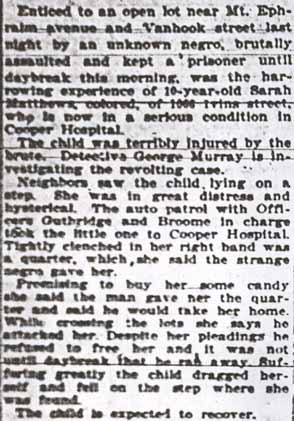
Ten-Year-Old Is Victim of Negro
Ten-Year-Old Is Victim of Negro
Found on Down-town Step Child Tells Terrible Story of Suffering.
Seriously Ill in Cooper Hospital
Two Negroes Arrested for Murder in Camden
Philadelphia Inquirer —
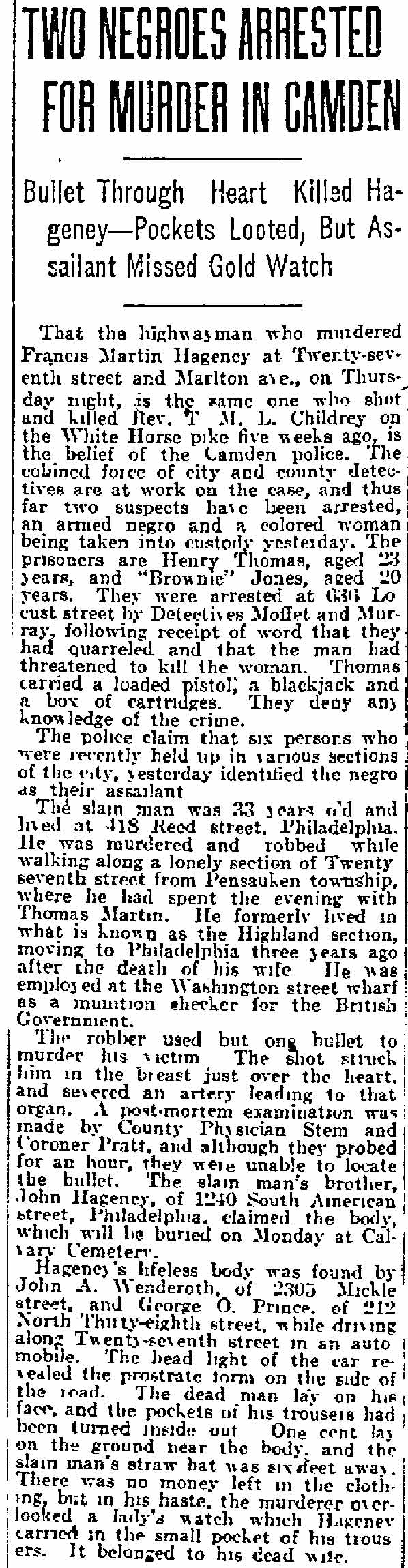
Philadelphia Inquirer, July 4, 1917 — Related: South 27th Street, Marlton Avenue, Locust Street, Henry C. Moffett, Mickle Street, North 38th Street
Alleged Hold-up and Robbery
Philadelphia Inquirer —
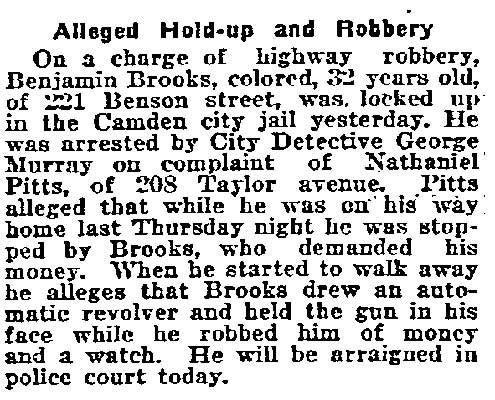
Alleged Hold-up and Robbery
Alleged Hold-up and Robbery
On a charge of highway robbery, Benjamin Brooks, colored, 32 years old, of 221 Benson street, was locked up in the Camden city jail yesterday. He was arrested by City Detective George Murray on complaint of Nathaniel Pitts, of 208 Taylor avenue. Pitts alleged that while he was on his way home last Thursday night he was stopped by Brooks, who demanded his money. When he started to walk away he alleges that Brooks drew an automatic revolver and held the gun in his face while he robbed him of money and a watch. He will be arraigned in police court today.
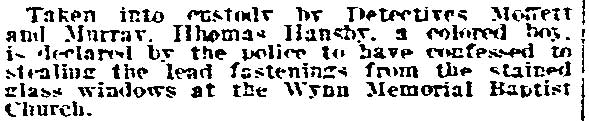
Boy Confesses to Stealing Church Window Lead
Philadelphia Inquirer —
(Wynn Memorial Baptist Church theft)
Taken into custody by Detectives Moffett and Murray, Thomas Hansby, a colored boy, is declared by the police to have confessed to stealing the lead fastenings from the stained glass windows at the Wynn Memorial Baptist Church.
50 Taken in Vice Raids
Philadelphia Inquirer —
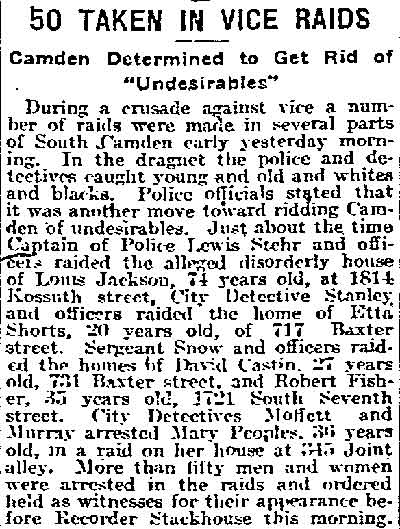
Philadelphia Inquirer, May 27, 1918 — Related: Lewis H. Stehr Jr., Milton Stanley, Alfred S. Snow, Henry C. Moffett, Kossuth Street, Baxter Street, South 7th Street, Joint Alley
Held on Disorderly Charge
Philadelphia Inquirer —
Held on Disorderly Charge
Held on Disorderly Charge
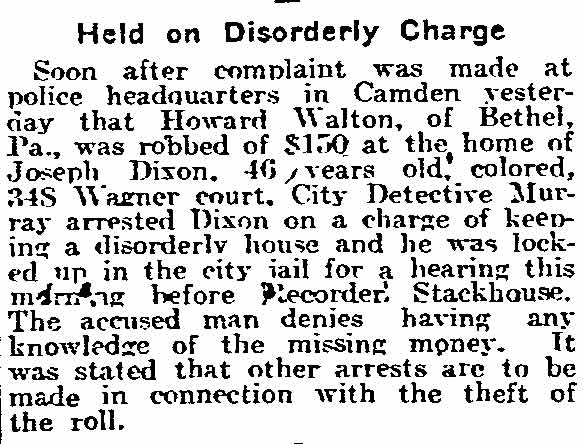
Soon after complaint was made at police headquarters in Camden yesterday that Howard Walton, of Bethel, Pa., was robbed of $150 at the home of Joseph Dixon, 46 years old, colored, 348 Wagner court, City Detective Murray arrested Dixon on a charge of keeping a disorderly house and he was locked up in the city jail for a hearing this morning before Recorder Stackhouse. The accused man denies having any knowledge of the missing money. It was stated that other arrests are to be made in connection with the theft of the roll.
Three Other Policemen Are Accused by Bleakly in Probe of Grafting
Camden Daily Courier —
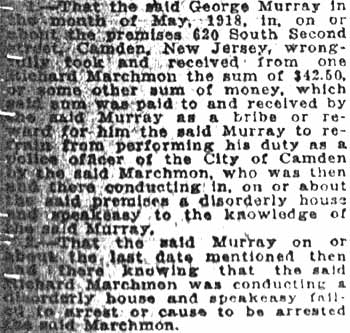
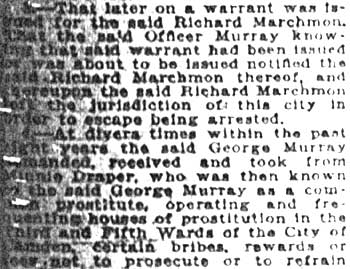
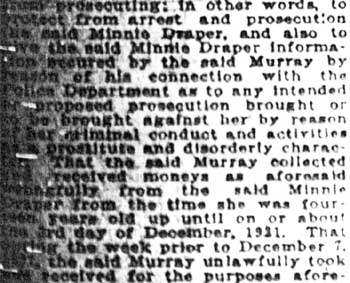
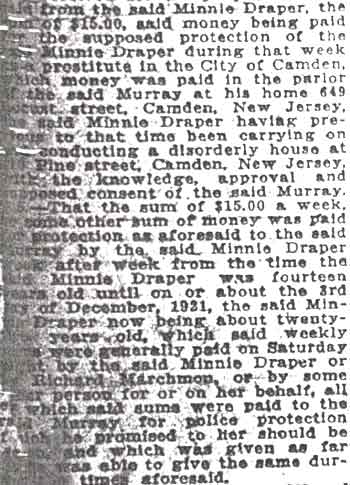
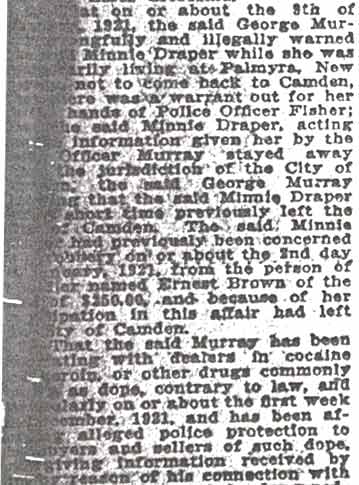
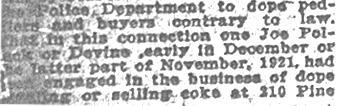
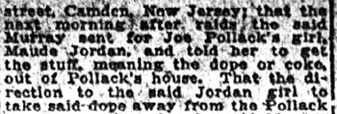
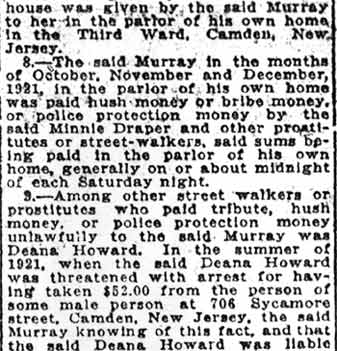
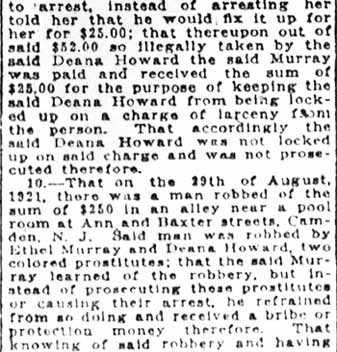
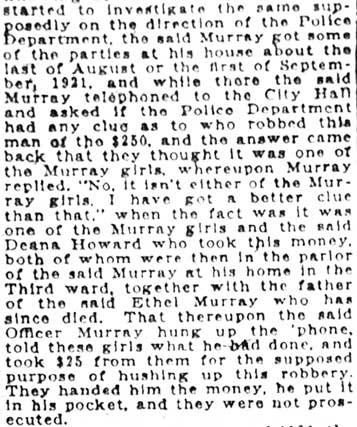
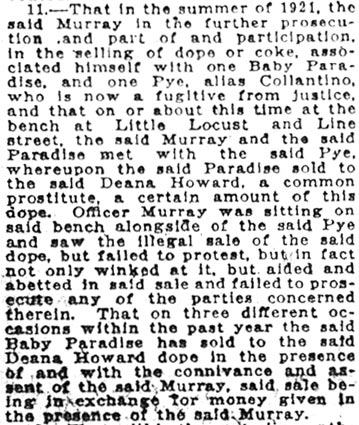
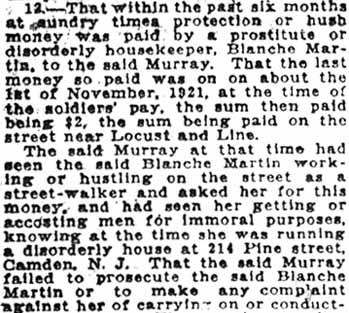
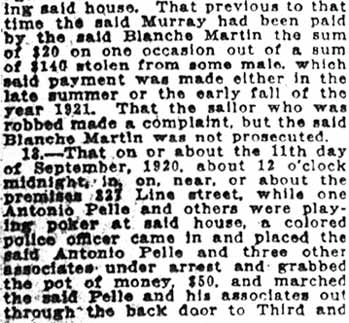
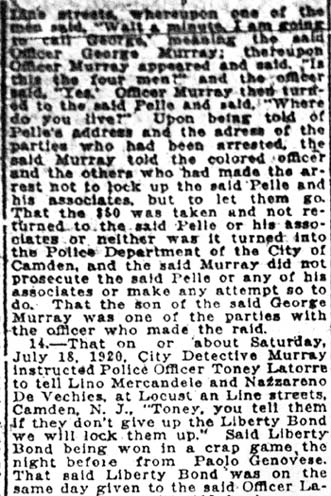
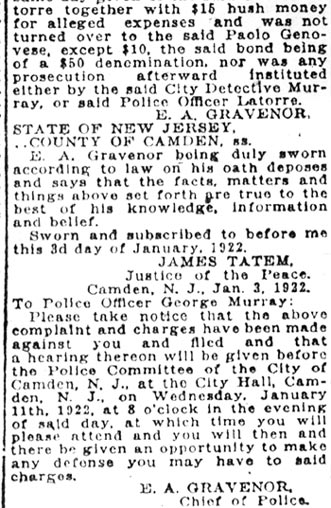
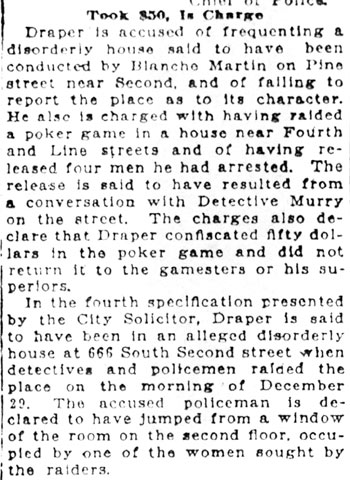

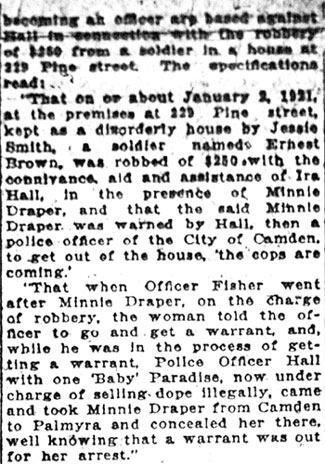
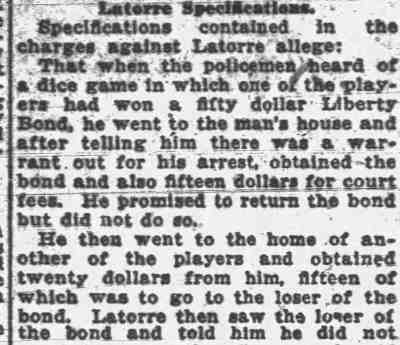
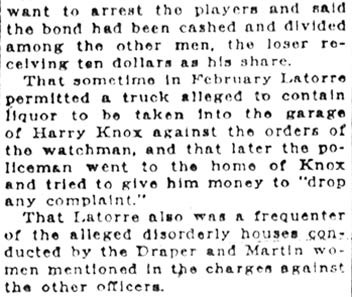
Camden Daily Courier, January 4, 1922 — Related: James E. Tatem, Elisha A. Gravenor, E.G.C. Bleakly, Anthony “Babe” Paradise, Polack Joe Devon, Ira Hall, South 2nd Street, South 3rd Street, South 4th Street, Line Street, Pine Street, Ann Street, Baxter Street, Sycamore Street
Chief Accuses Four Officers in Vice Probe
Camden Post-Telegram —
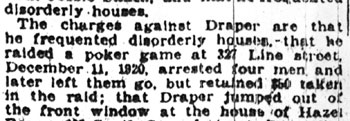
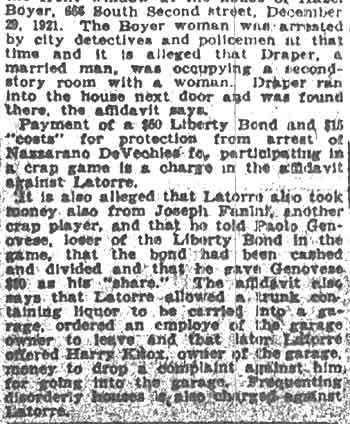
Camden Post-Telegram, January 4, 1922 — Related: Anthony “Babe” Paradise, Polack Joe Devon, Ira Hall, Sycamore Street, Pine Street
Vice Graft Probe Brings Suspensions for 4 Policemen
Camden Courier —
Detective George Murry and Patrolmen Draper, Hall and Latorre Affected
Hearings Set for January 11
Men Accused of Giving Protection to Tenderloin of Downtown Wards
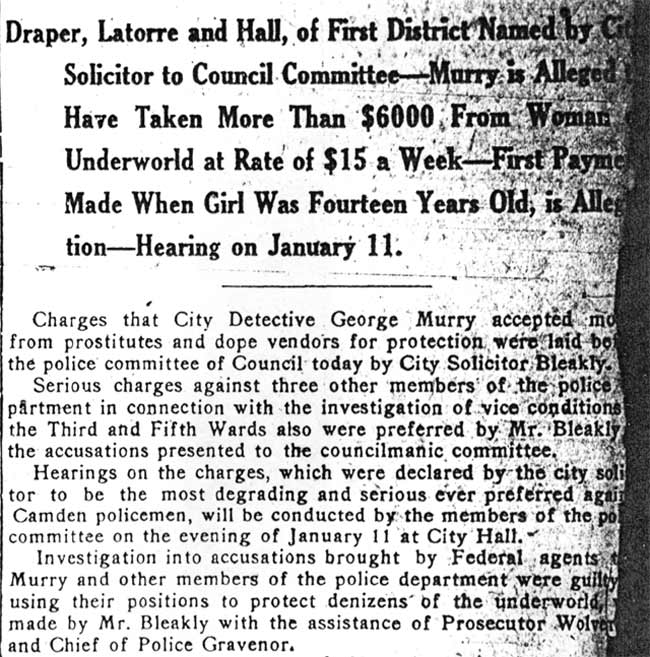
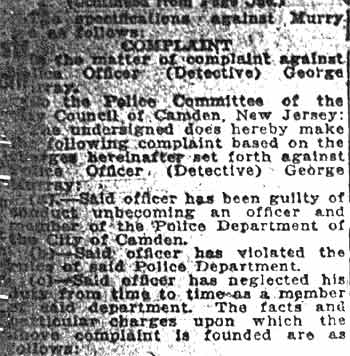
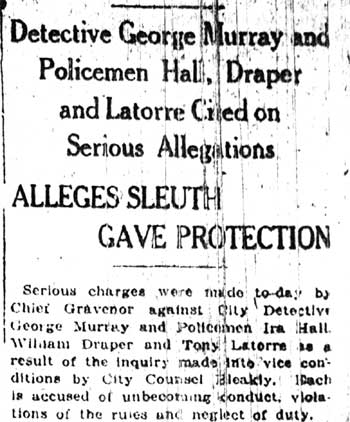
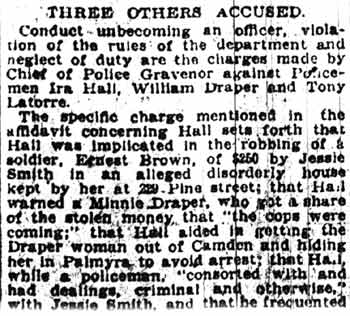
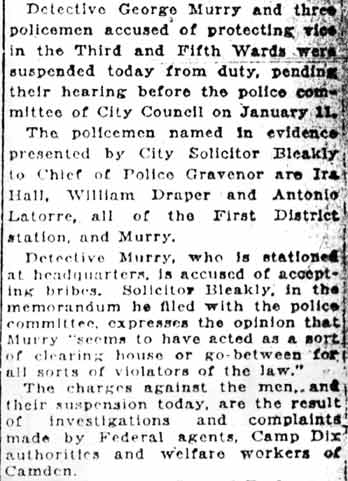
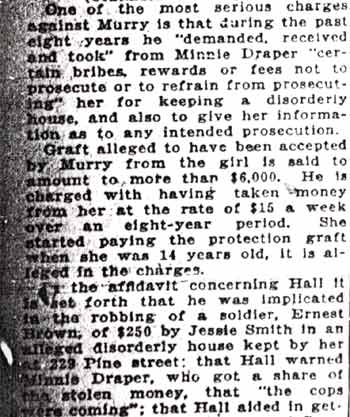
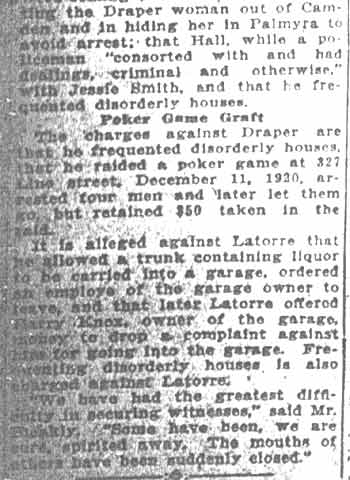
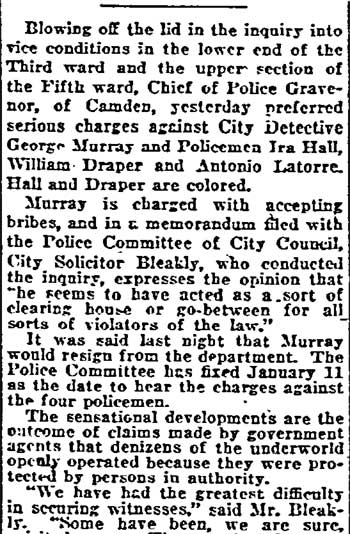
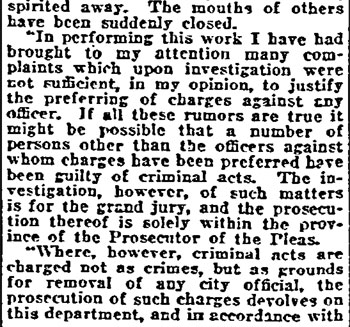
Detective George Murry and three policemen accused of protecting vice in the Third and Fifth Wards were suspended today from duty, pending their hearing before the police committee of City Council on January 11.
The policemen named in evidence presented by City Solicitor Bleakly to Chief of Police Gravenor are Ira Hall, William Draper and Antonio Latorre, all of the First District station, and Murry.
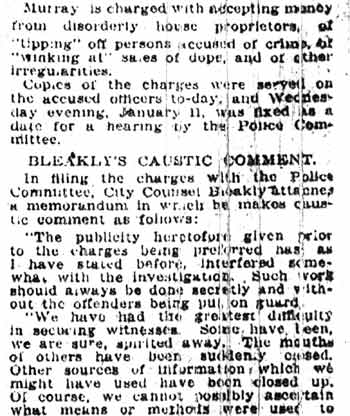
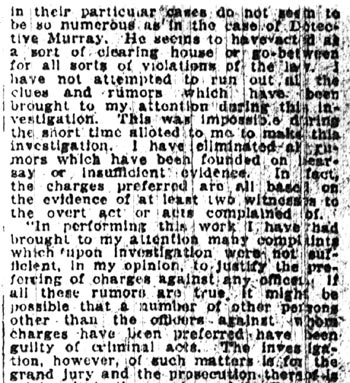
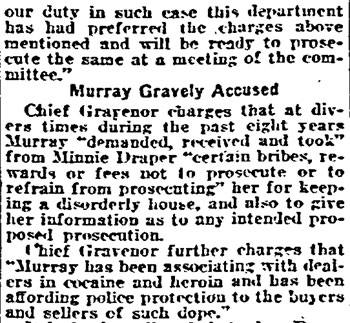
Detective Murry, who is stationed at headquarters, is accused of accepting bribes. Solicitor Bleakly, in the memorandum he filed with the police committee, expresses the opinion that Murry “seems to have acted as a sort of clearing house or go-between for all sorts of violators of the law.”
The charges against the men, and their suspension today, are the result of investigations and complaints made by Federal agents, Camp Dix authorities and welfare workers of Camden.
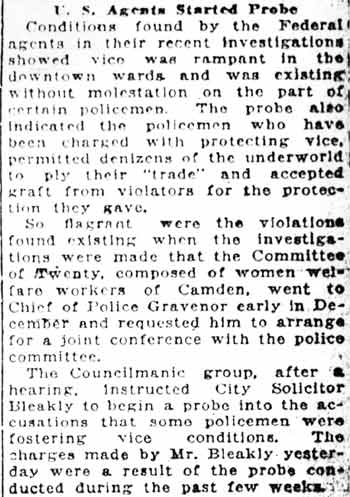

Camden Courier, January 5, 1922 — Related: Elisha A. Gravenor, E.G.C. Bleakly, Ira Hall, Line Street, Pine Street
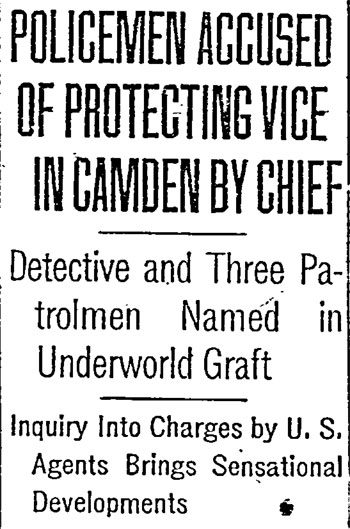
Policemen Accused of Protecting Vice in Camden by Chief
Philadelphia Inquirer —
Detective George Murry Resigns, Will Not Fight Witnesses of Underworld
Camden Courier —
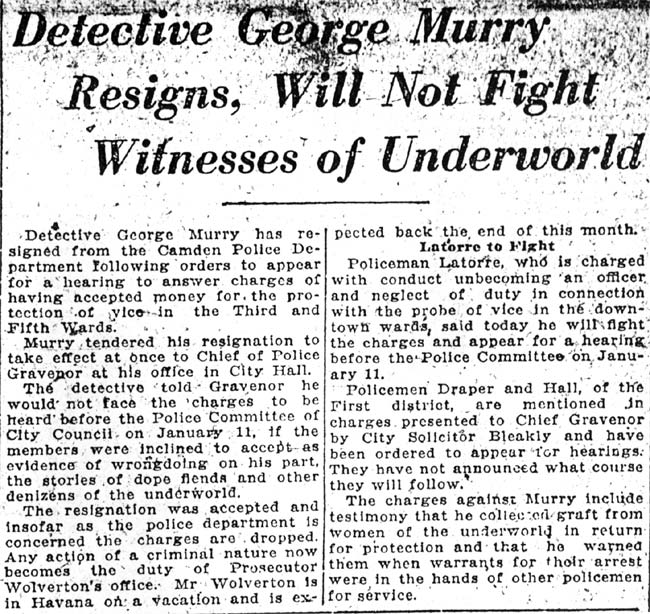
Camden Courier, January 6, 1922 — Related: Elisha A. Gravenor, E.G.C. Bleakly, Charles A. Wolverton, Ira Hall
Two More Policemen Resign Under Fire in Downtown Vice Probe
Camden Courier —
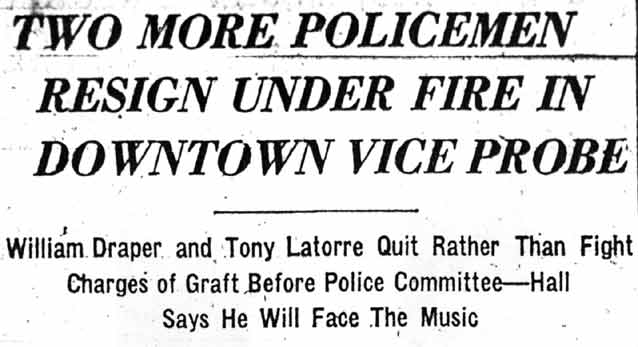
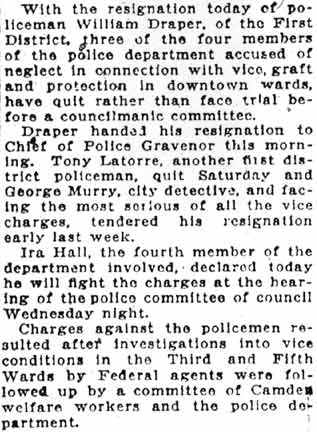
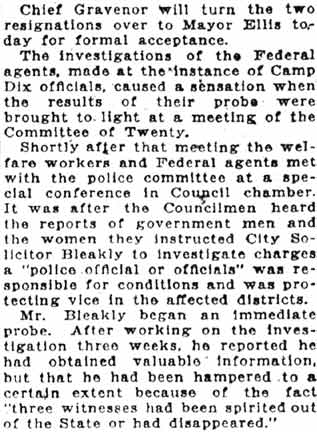
Camden Courier, January 9, 1922 — Related: Elisha A. Gravenor, E.G.C. Bleakly, Charles H. Ellis, Ira Hall
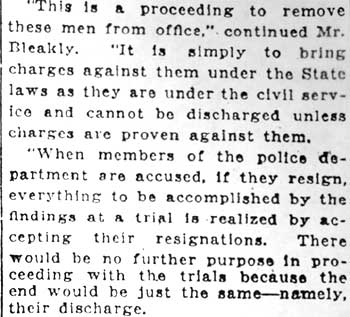
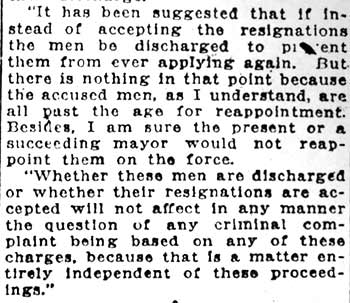
Council's Police Hearing Tonight
Camden Courier —
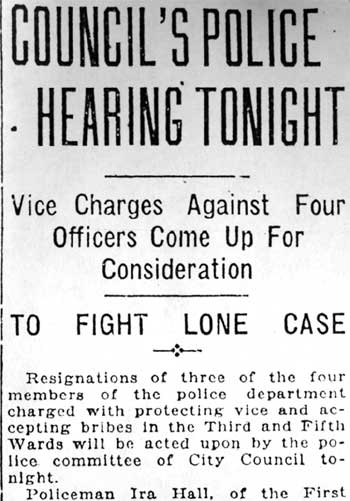
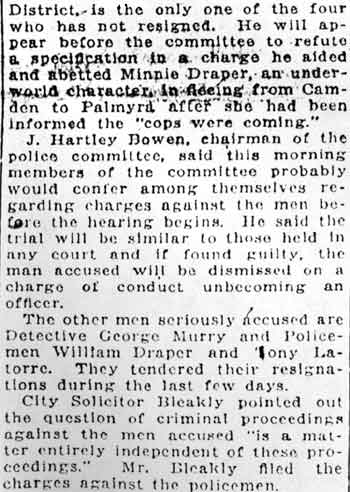
Camden Courier, January 11, 1922 — Related: E.G.C. Bleakly, J. Hartley Bowen, Ira Hall
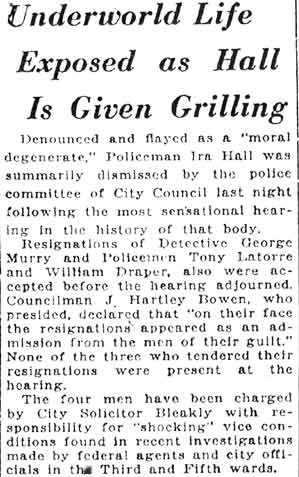
Ira Hall Is Dismissed, Evidence Against Four Men Given Prosecutor
Camden Courier —
Criminal Prosecution of Murry, Latorre, Draper and Hall Looms as Result of Sensational Hearing by Police Committee— ‘Dope’ Sellers Linked With Detective and Policemen in Lurid Testimony at Crowded Session— Predict Speedy Action
Policeman as Own Attorney Given Grilling
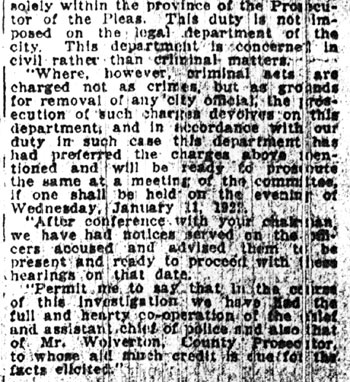
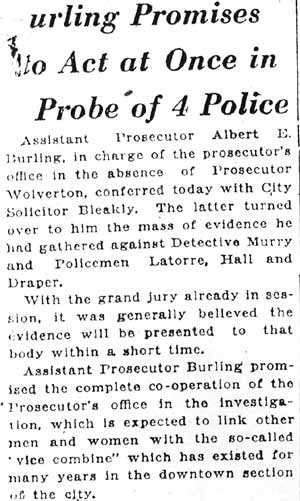
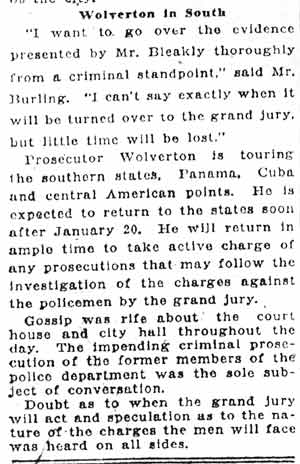
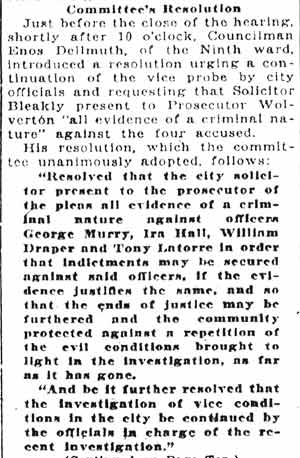
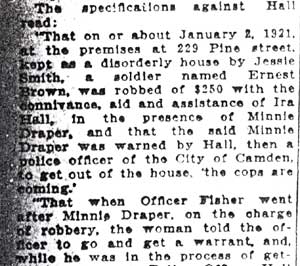
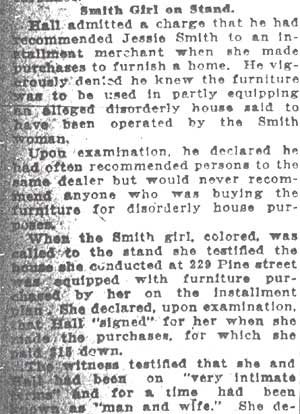
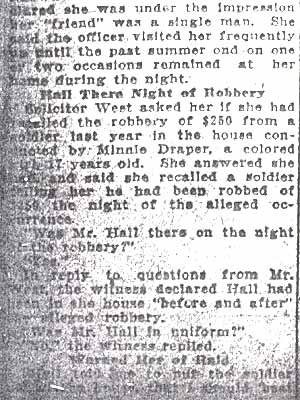
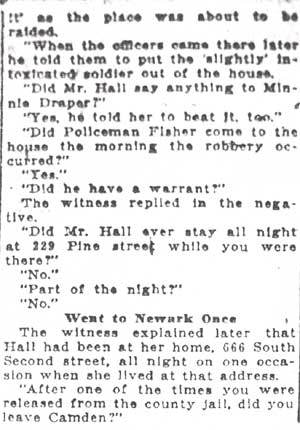
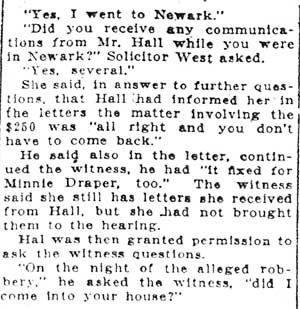
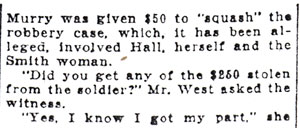
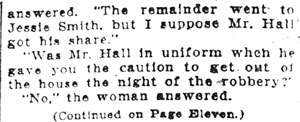
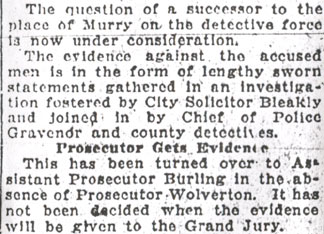
Criminal prosecution of Detective George Murry and Policemen Tony Latorre, William Draper and Ira Hall for their alleged “protection” of vice in the downtown underworld loomed today. At a sensational hearing before the police committee of City Council last night it was unanimously decided to turn the mass of evidence against the four men, gathered by City Solicitor Bleakly, over to Prosecutor Wolverton’s office.
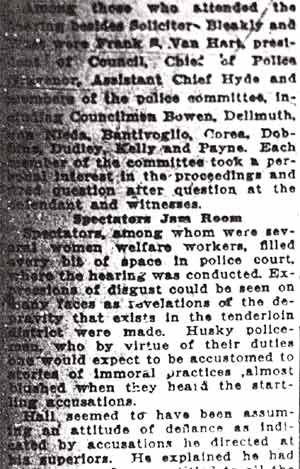
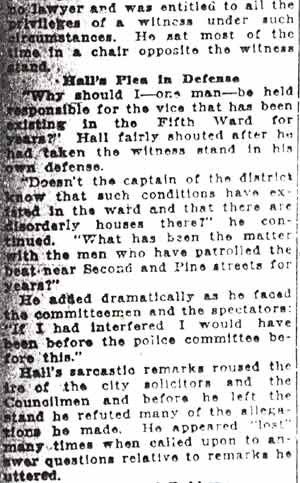
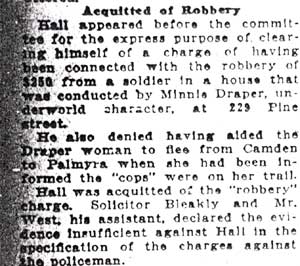
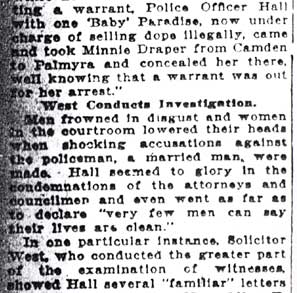
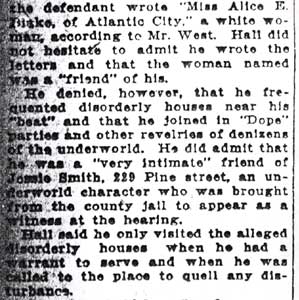
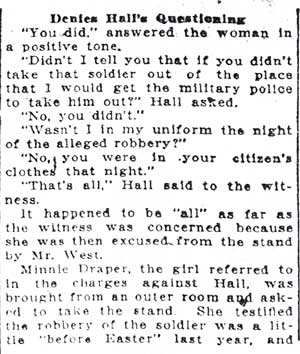
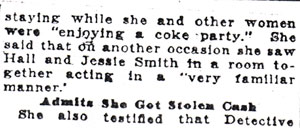
At the hearing, Policeman Hall was summarily dismissed from the department, classed as a “moral degenerate” and roundly flayed when, after he acted as his own attorney, he was cross-questioned by every member of the police committee.
Hall was the only one of the quartette of accused officers who made any attempt to defend himself. Murry, Latorre and Draper resigned several days ago. At the police committee session last night it was the sense of the members that their resignations was a tacit admission of guilt and that their mere removal from the police department is not sufficient punishment for their underworld activities.
The grand jury convened on Tuesday of this week. The next step will be the presentation of evidence gathered by Mr. Bleakly against the four men to the prosecutor’s office who, in turn, will turn it over to the grand jury. Quick action may be expected, it was predicted today in official circles.
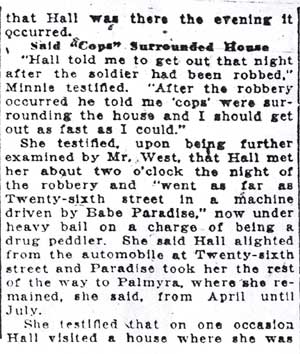
Policeman Hall’s friendship for Anthony Paradise, charged with peddling “dope,” was brought out at last night’s hearing.
Camden Courier, January 12, 1922 — Related: E.G.C. Bleakly, Charles A. Wolverton, Ira Hall, Anthony “Babe” Paradise, South 2nd Street, 26th Street, Pine Street
New City Police Must Be 'Clean' Is Order of Mayor
Camden Courier —
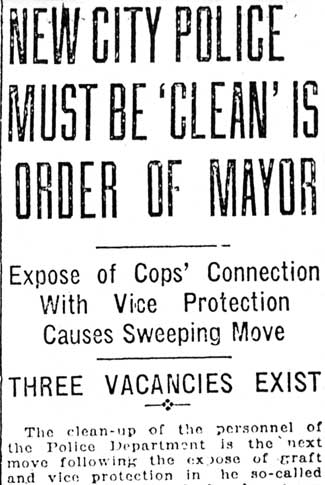
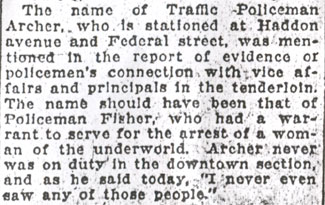
NEW CITY POLICE MUST BE 'CLEAN' IS ORDER OF MAYOR
Expose of Cops' Connection With Vice Protection Causes Sweeping Move
THREE VACANCIES EXIST
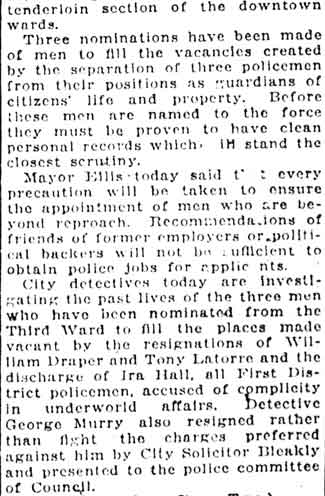
The clean-up of the personnel of the Police Department is the next move following the expose of graft and vice protection in the so-called tenderloin section of the downtown wards.
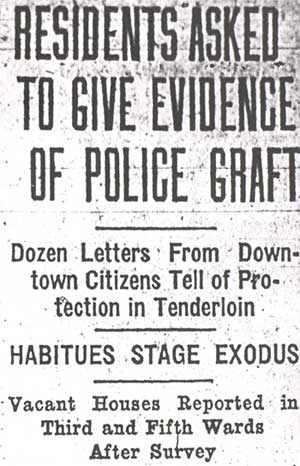
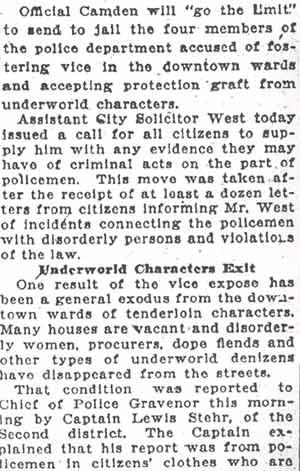
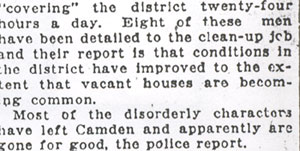
Residents Asked to Give Evidence of Police Graft
Camden Courier —
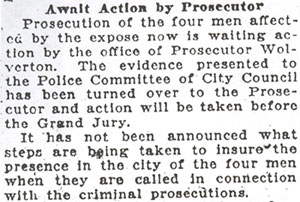
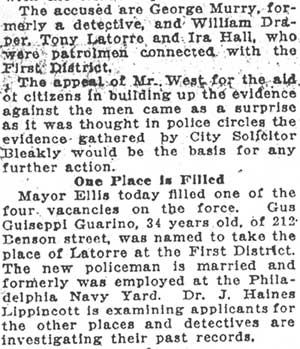
Camden Courier, January 16, 1922 — Related: E.G.C. Bleakly, Charles H. Ellis, Elisha A. Gravenor, Charles A. Wolverton, Ira Hall, Dr. A. Haines Lippincott, Benson Street, Lewis Stehr Jr.
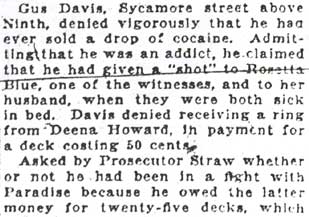
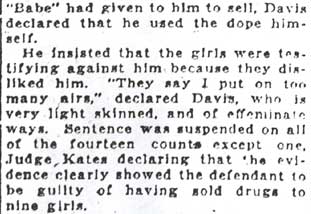
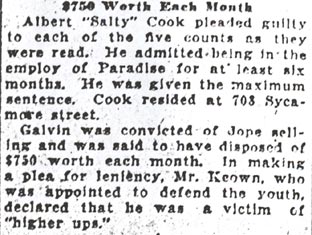
Sellers of Dope in Keen Rivalry Slashed Prices
Camden Daily Courier —
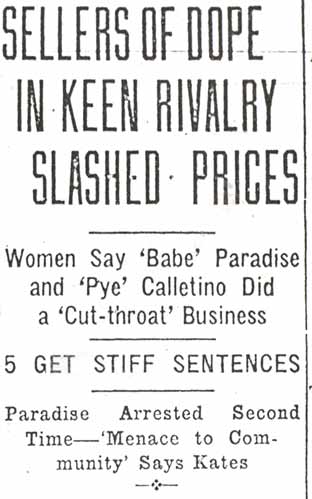
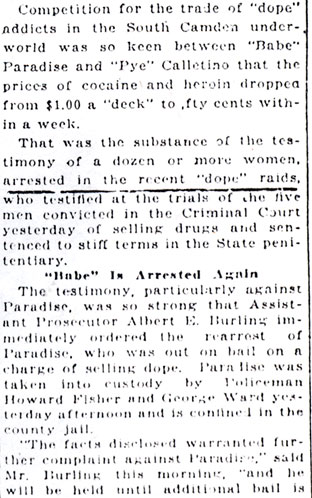
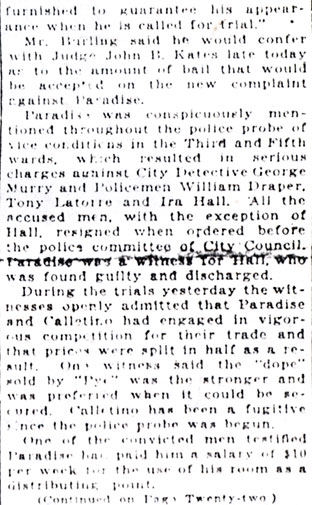
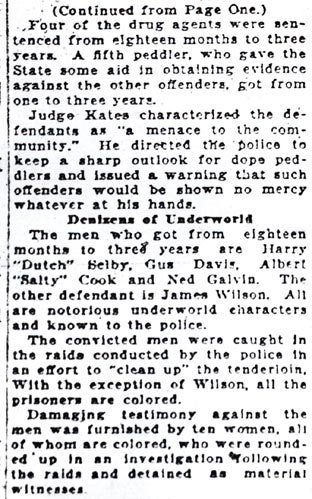
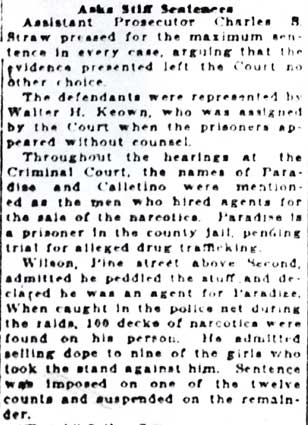
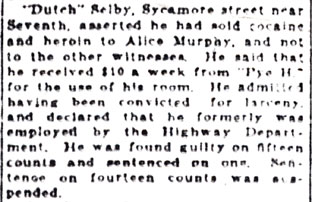
Camden Daily Courier, January 21, 1922 — Related: John B. Kates, George Ward, Anthony “Babe” Paradise, Polack Joe Devon, Ira Hall, Sycamore Street, Pine Street
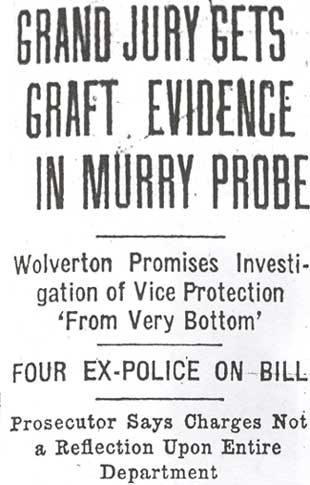
Grand Jury Gets Graft Evidence in Murry Probe
Camden Courier —
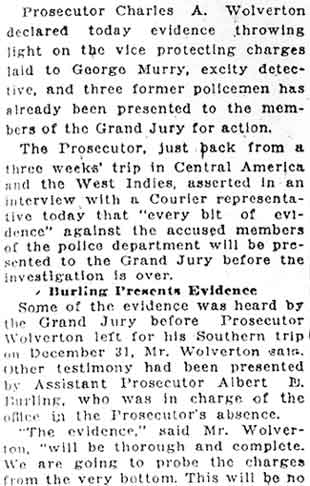
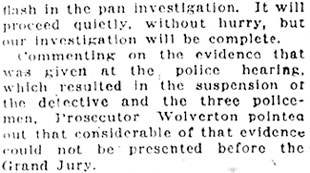
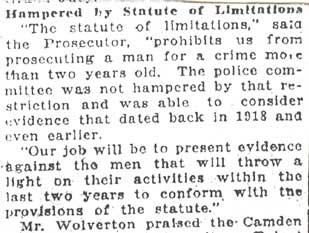
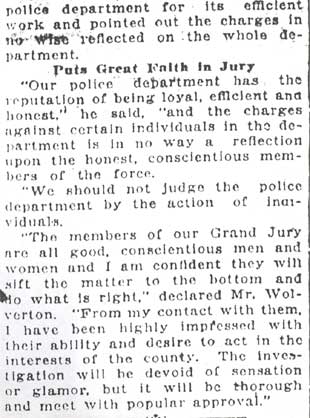
Camden Courier, January 25, 1922 — Related: E.G.C. Bleakly, Elisha A. Gravenor, Charles A. Wolverton, Ira Hall, Dr. A. Haines Lippincott, Benson Street, Lewis Stehr Jr.
Former Detective Murry Drops Dead in Street
Camden Courier —
Sleuth Accused of Graft Found Dead Near Home
Tragic End Automatically Halts Probe of His Vice Activities
Neighbors Find Body
Leaves Wife and Eight Children— Once Powerful Leader in Third Ward
Funeral on Thursday
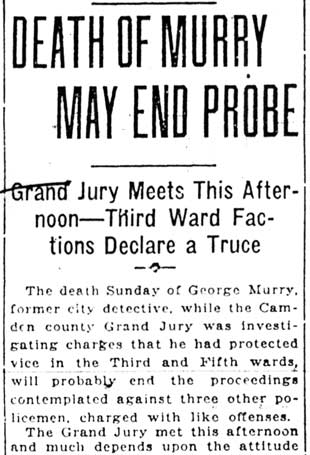
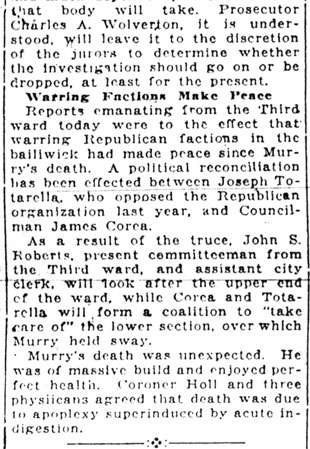
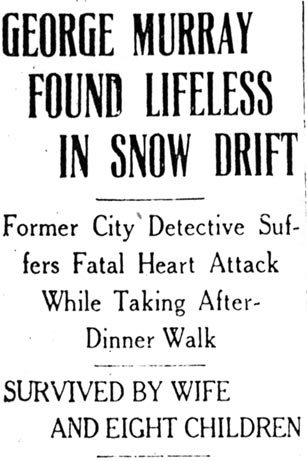
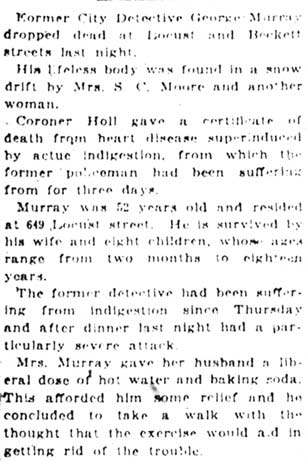
George Murry, ex-city detective, who resigned from the police department after being charged with promoting vice in the Third and Fifth Wards, was found dead on a doorstep near Locust and Line Streets shortly after nine o’clock last night.
A death certificate issued by Coroner Holl ascribes Murry’s death as due to apoplexy, superinduced by acute indigestion.
Grand Jury Probe Starts
Murry’s death came as a tragic aftermath of his exposure as a protector of prostitution and dope selling in the downtown tenderloin, in the role of which he is said to have amassed a snug fortune.
His death automatically puts to an end the proceedings that were begun to present his activities in the tenderloin before the Grand Jury with a view of bringing criminal prosecution.
Murry will be buried Thursday afternoon at Mt. Peace Cemetery, of which he was part owner. Funeral services will be conducted at the home and in the Macedonia Church, 3rd and Spruce Street, at noon.
Neighbors Find Body
Murry was 50 years old. According to his wife, Mrs. Cora J. Murry, former city detective had been suffering for several days with indigestion.
After supper last night, Mrs. Murry said, her husband complained of feeling ill and she gave him a tablespoon of baking soda. He shortly after decided to take a walk in the belief the air might benefit him.
Half an hour later, neighbors came upon his lifeless body across a doorstep on Locust street, between Beckett and Line Streets.
The body was carried to the Murry home, at 649 Locust Street, a few doors away. Two physicians were called. Owing to the storm, the doctors were delayed in reaching the house. Dr. Clement T. Branch, of 721 Walnut Street, the first physician to arrive, said he believed Murry had died as he fell.
Mother Died 2 Years Ago, Same Hour
Besides his widow, Murry is survived by eight children, ranging in age from two months to 18 years. Curiously, Murry’s mother died exactly two years ago, to the very hour. Murry was colored, although many persons were unaware of his race because of his light complexion. He was a tall, powerful man. He was more than six feet in height and weighed about 230 pounds. His complexion was ruddy and his hair iron gray.
Murry’s death was a passing incident in the tenderloin today. Before he was shorn of his power, which he wielded proudly and with great vigor, his decease might have caused a great flurry.
Murry, in the height of his power, was formidable, and a man whose favor the denizens and habitués of the underworld crave; stripped of that power, he was ignored and deserted as rats would desert a sinking ship
Boss For Many Years
His loss of power probably worried Murry more than the outcome over the exposure of the criminal phase of the exposure. Murry had been the undisputed political “boss” of the Third and Fifth wards for years. The transition was too great; his fall too disgraceful.
Prosecutor Charles A. Wolverton pointed out today that with Murry dead, the presentation of evidence of vice conditions in the Fifth Ward to the Grand Jury would be dropped for the present and in all probability for good.
The reason is obvious, said Mr. Wolverton. “There’s nobody to convict.”
United States Started Probe
Murry’s downfall was due largely to the activities of attaches of the United States Interdepartmental Social Hygiene Bureau, who investigated vice conditions here at the request of the Camp Dix military authorities.
Officers of the camp complained many of the men had contracted contagious diseases during visits to the tenderloin in South Camden.
A series of meetings was held under the auspices of the bureau and a number of women prominent in social welfare work in the city.
With the co-operation of the Federal authorities, the local police began a “cleanup” of the tenderloin. No one was spared. Dope peddlers, prostitutes, bootleggers and gamblers fell in the clutches of the authorities. Questioned, their stories seemed to coincide on one fact— that Murry was the “invisible government” which sanctioned or frowned upon their industry and who had to be “greased” if they wished to ply their trade without molestation or criminal prosecution.
Three Other Members Accused
Three other members of the police department were accused of malfeasance along with Murry. They are Policemen William Draper, Tony Latorre and Ira Hall. The three men were dismissed by the police committee of City Council. Hall, who opposed his dismissal and demanded a trial, was excoriated by the committee and summarily dropped from the department.
Murry resigned from the force declaring that the evidence against him was untrustworthy, having been obtained from dope fiends and “other irresponsible people.” It was understood, however, that he resigned, believing it would put an end to the proceedings. He seemed to worry over the contemplated action by the Grand Jury.
Said He Amassed Wealth
Murry, however, boasted openly he had amassed wealth while he reigned as the “tenderloin boss.”
“I’ve got mine,” he declared only recently. “I’ve got enough to keep me and my family in clover for the rest of our lives. If they let up on me and don’t push this jail thing, I’m willing to lay down.”
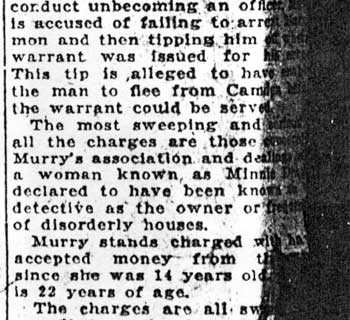
In addition, Murry was specifically charged with accepting graft from dope peddlers and with “tipping off” criminals against whom warrants were issued in City Hall.
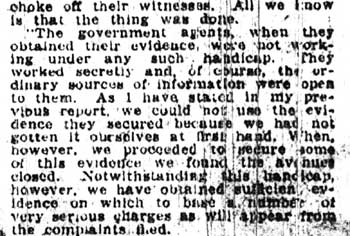
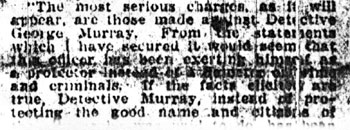
City Solicitor E.G.C. Bleakly drew up the complaint and charges against the detective. Commenting on the charges when they were first made public, Mr. Bleakly said:
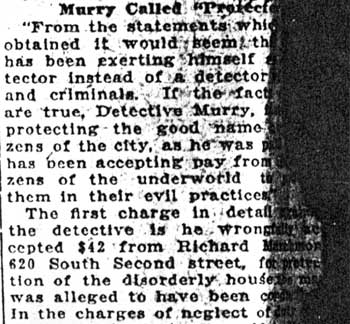
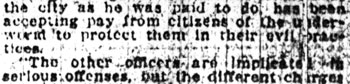
“From the statements I have obtained it would seem this officer has been exerting himself as a protector instead of a detector of crime and criminals. If the facts elicited are true, Detective Murry, instead of protecting the good name and citizens of our city, as he was paid to do, has been accepting pay from the citizens of the underworld to protect them in their evil practices.”
In Department 16 Years
Murry was a member of the police department for 16 years, having been appointed in 1905. He was made a detective in 1913.
Camden Courier, January 30, 1922 — Related: Charles A. Wolverton, Arthur H. Holl
George Murray Found Lifeless in Snow Drift
Camden Post-Telegram —
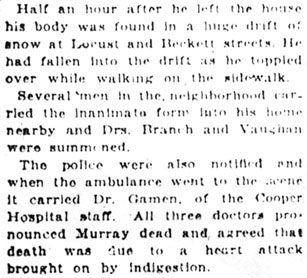
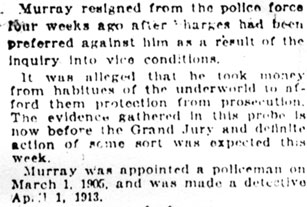
Camden Post-Telegram, January 30, 1922 — Related: Arthur H. Holl, Dr. Clement T. Branch, Cooper Hospital, Line Street, Beckett Street
Former Detective Dies
Philadelphia Inquirer —
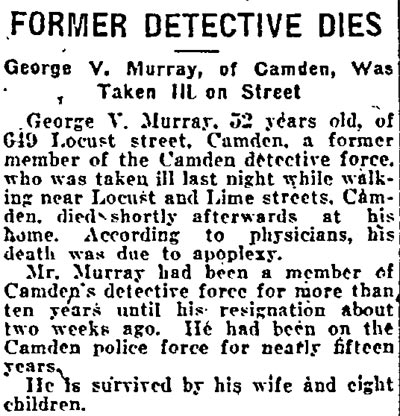
Death of Murry May End Probe
Camden Courier —
Camden Courier, January 31, 1922 — Related: Charles A. Wolverton, Arthur H. Holl, James Corea
Mayor Ellis Names New Policemen
Philadelphia Inquirer —
Succeeding Edward Rapp, who died suddenly, James H. Biddle, of East Camden, yesterday was appointed a policeman by Mayor Ellis. The Mayor also named Clarence Arthur, of the Third ward, a member of the police force. He fills one of the vacancies caused by the resignations of three men following the vice probe.
Widow Disputes Claims to Murry Estate
Philadelphia Public Ledger —
Declaring that her husband left no will and had no personal estate, Mrs. Clara Diggs Murry, widow of George Murry, colored, formerly detective of Camden who died suddenly after his exposure in connection with alleged graft, disputes the claims made by Mrs. Henrietta Lamb Murry, colored of 1516 Bainbridge street, this city, that she is the real widow of Murry.
“My husband left nothing but his clothes when he died.” said Mrs. Murry at her home, 649 Locust Street, Camden last night. “This woman who claims to be his wife can have them if she wants them.”
The Camden wife of Murry stated that her husband had no real or personal estate. All the estate her husband was supposed to have, Mrs. Murry said, has always been and is now in her name. She challenges the Philadelphia woman to obtain any of it.
A search of the records at the office of City Clerk Brown in Camden failed to disclose any record of Murry’s alleged marriage to the Lamb woman.
Second Mrs. Murry Drops Estate Fight
Camden Courier-Post —
Eight-Year Controversy over Property of Former Detective Ends Here
An eight-year controversy over the estate of former City Detective George Murry, one time alleged vice czar of the Third Ward, ended yesterday when Wife No.2 withdrew her claims.
Murry, who died under mysterious circumstances on the eve of going on trial for graft January 29, 1922, died intestate and Cora J. Murry, who claimed to be his wife, applied for letters of administration. She was the mother of 10 children of the detective. She since has remarried, her name now being Butler.
Elizabeth Murry came forward after the man’s death and made a claim that she was the real widow and the other woman was only the detective’s common law wife.
Former State Senator Albert S. Woodruff yesterday withdrew Elizabeth Murry’s claim in the estate and Judge Shay granted letters of administration to Cora J. Murry Butler upon application of Surrogate George W. Whyte.
Murry’s sudden death caused a sensation in political and police circles. He had been accused of offering protection to gambling dives, dope sellers and disorderly house proprietors for which he was said to have received large sums of money.
It was reported at the time of his death that he drew $200,000 from a bank the day before and gave it to the Butler woman. He once was reputed to have owned nearly all of the property in the Third Ward tenderloin,
The inventory filed in the application for administration papers, however, shows but $2000 in real estate as visible assets.
Collapse of Homes to Bring Probe of All Old Buildings
Camden Courier-Post —
Mayor Stewart to Rush Action Following Death of Man
Laxity Is Charged
Investigation was ordered yesterday into the tragic collapse of the front walls of two vacant houses here Sunday. Mayor Roy R. Stewart announced he would push a probe to determine who is responsible for allowing the condemned buildings at 829 and 831 Bridge Avenue, to remain standing without repairs.
The mayor also declared that a move is under way to demolish 825 other unsafe buildings in Camden.
Jerry White, 22, colored, of 759 Carman Street, died yesterday of injuries suffered Sunday when he was buried under a ton of bricks. He was seated in front of one of the dwellings when the collapse occurred.
Mayor Stewart conferred with real estate and insurance agents yesterday and announced that he would ask the municipal legal department to proceed against other dangerous properties. In directing his investigation the mayor said he is anxious to determine whether there had been any laxity in connection with condemnation of the Bridge Avenue properties. City records reported them “torn down.”
The mayor revealed correspondence over a year between his office, the fire, health and legal departments and the owners of properties, regarding their condition as alleged fire and health menaces.
“I assumed action had been taken in condemnation of the properties, but apparently that was not done and it is exceedingly regrettable that a life has been lost,” Mayor Stewart said.
Will Rush Action
“Certainly no other lives will be given if I can help it, and I am forthwith ordering that legal action be taken immediately in the tearing down of 825 properties in the city that have been found in a recent survey to be unsafe.
“Many citizens in the community, including prominent men and women, are heartily in favor of the action the city is taking in ordering dilapidated properties torn down.
“The death of the Carman Street man reveals glaringly the need for immediate action. That death should not have occurred. It could have been prevented had there been no delay in removing the hazardous buildings.
“At this time, I am placing no direct responsibility, and will not do so until I have made a thorough investigation. This is, indeed, a serious situation, and by no means must there be a repetition. It shows without question that such things as unsafe buildings cannot be permitted to remain indefinitely. I feel that the owners themselves should come to the front, and notify the city of their unsafe properties, and co-operate with us.”
City Not Wholly Lax
The mayor said the letters he has written regarding the Bridge Avenue properties show that the city had not been wholly lax regarding them. He added, however, that there has been laxity somewhere, and he is determined to find out who is to blame.
City Solicitor E. G. C. Bleakly said records in his office showed that the houses were “torn down.”
Bleakly was asked who made the report the houses were wrecked.
“I do not know at this time, but I shall join with the mayor in a thorough investigation,” the city solicitor said.
The mayor and Bleakly pointed out that vandals had been tearing properties apart in their efforts to obtain fixtures, lumber, etc. The mayor said the 829 Bridge Avenue property is owned by Mrs. George Murry, of 649 Locust Street, the widow of George Murry, the late city detective. He said he is checking to learn who is the owner of 831 Bridge Avenue.
The houses have been unoccupied for a number of years. They are believed to have been weakened by vandals who had stripped the interiors of wooden supports and fixtures.
Recent damage by vandals throughout the city has been estimated at $500,000.