George Pfeiffer Jr.
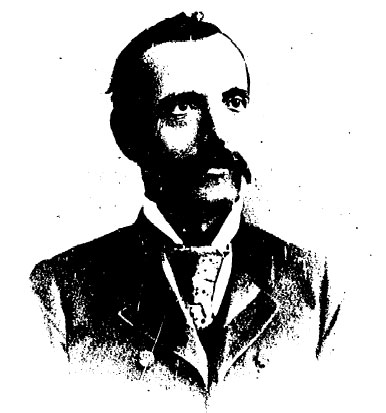
George Pfeiffer Jr., circa 1897
GEORGE PFEIFFER JR. was born in Camden on March 16, 1856 to George and Catherine Pfeiffer, who had both emigrated from Germany and met in the United States. George Pfeiffer Sr. was a successful businessman, who owned a saloon and restaurant on South 4th Street, and later the George Pfeiffer & Sons brick and coal yard at Federal Street and the Coopers Creek Bridge. George Jr. followed him into the business world. His business interests would span the state, from Camden to Manahawkin.
George Pfeiffer engaged in a variety of business early in his career, including oil, bottling, real estate, and hotel keeping. He pursued the bottling business for five years with great success. By the late 1880s George Pfeiffer Jr. was involved in real estate and construction. He built a row of two story, five room brick houses opposite the Pennsylvania Railroad car shops that all sold within a roughly nine week period in the late spring and early summer of 1888, in what was then Stockton Township, present day East Camden. He also built and sold houses in Camden proper. He was involved with T.P. Newell in developing Harvey Cedars on Long Beach Island, and served as secretary and treasurer of the Harvey Cedars Beach Company in the late 1880s and early 1890s. In 1890 he partnered with lumber yard owned Richard Fetters Smith, whose business was quite near the Pfeiffer family business on Federal Street. In these years George Pfeiffer Jr. lived at 312 South 5th Street in Camden.
George Pfeiffer Jr. is most noted for his business ventures regarding water. He was the president of the Stockton Water Company in Stockton Township, which became East Camden, and he was the contractor who drilled Camden’s artesian water wells in the 1890s.
Besides the above mentioned business activities, George R. Pfeiffer Jr. also served as a Director on the board of the New Jersey Trust & Safe Deposit Company, and was president of the Sea Isle City and Egg Harbor water works.
George Pfeiffer was a member of the Democrat party. He was a member of City Council in Camden, and served in the New Jersey Assembly and State Senate, besides holding other posts in state government. He also served as a United States Marshal.
George Pfeiffer Jr. married Adaline Adams in 1877. There were seven children, four of whom were still alive in 1897, Newell, Howard, Katherine, and Ada. His later years were in Merchantville NJ, where he owned a home at 35 Walnut Street. A grandson, George Pfeiffer III, was born in 1914. George Pfeiffer Jr. passed away in 1926 and was buried at Harleigh Cemetery in the family plot. Pfeiffer Street in East Camden was named in his honor.
George Pfeiffer III moved from Merchantville to Northern California in 1949, where in 1955 he founded and operated the Hilltop Hobbies Press for almost 40 years. He passed away in 1997. His children, Douglas and Lynne have followed him into printing and publishing, operating the Sandcastle Press and The Imaginary Press.
The Parents of George Pfeiffer Jr.
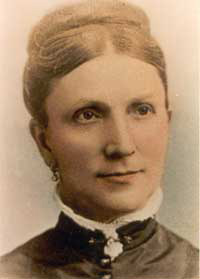
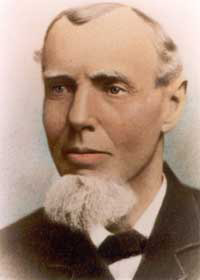
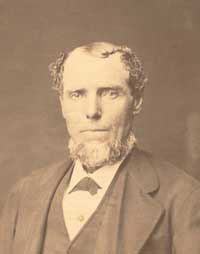
Left: Catherine K. Pfeiffer (born Catherina Kuemmerer). Center and right: George Pfeiffer Sr. (born Johan Georg Pfeiffer).
Politics in Jersey.
Philadelphia Inquirer —
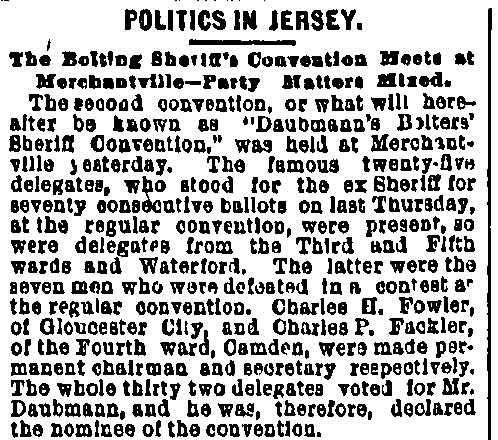
The Bolting Sheriff’s Convention Meets at Merchantville—Party Matters Mixed.
The second convention, or what will hereafter be known as “Daubmann’s Bolters’ Sheriff Convention,” was held at Merchantville yesterday. The famous twenty-five delegates, who stood for the ex-Sheriff for seventy consecutive ballots on last Thursday, at the regular convention, were present, so were delegates from the Third and Fifth wards and Waterford. The latter were the seven men who were defeated in a contest at the regular convention. Charles H. Fowler, of Gloucester City, and Charles P. Fackler, of the Fourth ward, Camden, were made permanent chairman and secretary reepectively [sic]. The whole thirty two delegates voted for Mr. Daubmann, and he was, therefore, declared the nominee of the convention.
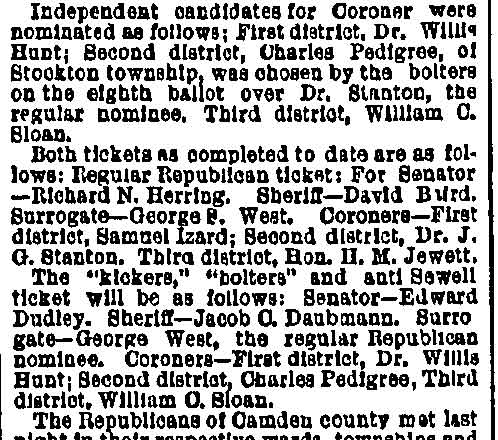
Independent candidates for Coroner were nominated as follows; First district, Dr. Willis Hunt; Second district, Charles Pedigree, of Stockton township, was chosen by the bolters on the eighth ballot over Dr. Stanton, the regular nominee. Third district, William C. Sloan.
Both tickets as completed to date are as follows: Regular Republican ticket: For Senator—Richard N. Herring. Sheriff—David Burd [sic]. Surrogate—George S. West. Coroners—First district, Samuel Izard; Second district, Dr. J. G. Stanton. Third district, Hon. H. M. Jewett.
The “kickers,” “bolters” and anti Sewell ticket will be as follows: Senator—Edward Dudley. Sheriff—Jacob C. Daubmann. Surrogate—George West, the regular Republican nominee. Coroners—First district, Dr. Willis Hunt; Second district, Charles Pedigree. Third district, William O. Sloan.
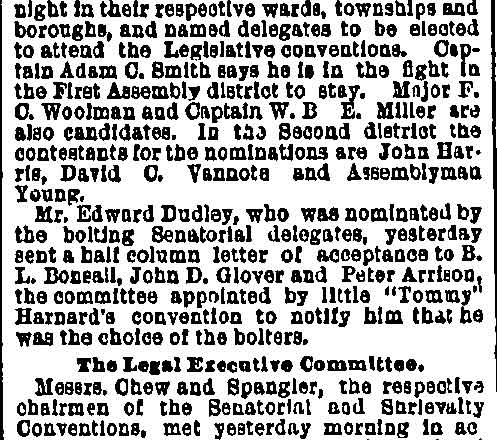
The Republicans of Camden county met last night in their respective wards, townships and boroughs, and named delegates to be elected to attend the Legislative conventions. Captain Adam C. Smith says he is in the fight in the First Assembly district to stay. Major F. C. Woolman and Captain W. B. E. Miller are also candidates. In the Second district the contestants for the nominations are John Harris, David C. Vannots and Assemblyman Young.
Mr. Edward Dudley, who was nominated by the bolting Senatorial delegates, yesterday sent a half column letter of acceptance to B. L. Bonsall, John D. Glover and Peter Arrison, the committee appointed by little “Tommy” Harnard’s convention to notify him that he was the choice of the bolters.
The Legal Executive Committee.
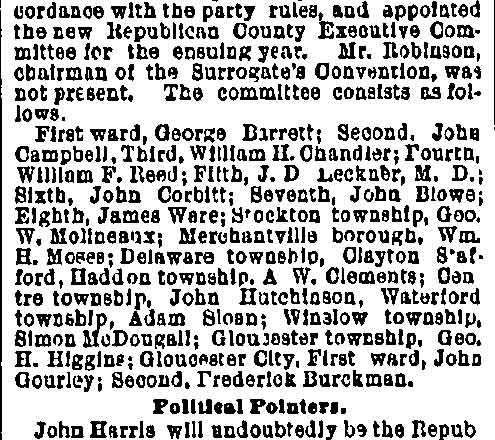
Messrs. Chew and Spangler, the respective chairmen of the Senatorial and Surlevalty Conventions, met yesterday morning in accordance with the party rules, and appointed the new Republican County Executive Committee for the ensuing year. Mr. Robinson, chairman of the Surrogate’s Convention, was not present. The committee consists as follows.
First ward, George Barrett; Second, John Campbell, Third, William H. Chandler; Fourth, William F. Reed; Fifth, J. D. Leckner, M. D.; Sixth, John Corbitt; Seventh, John Blowe; Eighth, James Ware; Stockton township, Geo. W. Molineaux; Merchantville borough, Wm. H. Moses; Delaware township, Clayton Stafford, Haddon township, A. W. Clements; Centre township, John Hutchinson, Waterford township, Adam Sloan; Winslow township, Simon McDougall; Gloucester township, Geo. H. Higgins; Gloucester City, First ward, John Gourley; Second, Frederick Burckman.
Political Pointers.
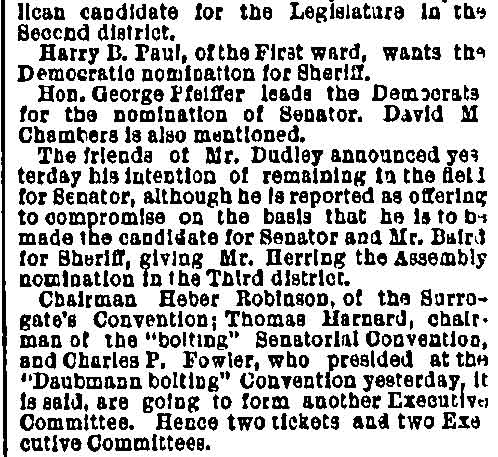
John Harris will undoubtedly be the Republican candidate for the Legislature in the Second district.
Harry B. Paul, of the First ward, wants the Democratic nomination for Sheriff.
Hon. George Pfeiffer leads the Democrats for the nomination of Senator. David M Chambers is also mentioned.
The friends of Mr. Dudley announced yesterday his intention of remaining in the field for Senator, although he is reported as offering to compromise on the basis that he is to be made the candidate for Senator and Mr. Baird for Sheriff, giving Mr. Herring the Assembly nomination in the Third district.
Chairman Heber Robinson, of the Surrogate’s Convention; Thomas Harnard, chairman of the “bolting” Senatorial Convention, and Charles P. Fowler, who presided at the “Daubmann bolting” Convention yesterday, it is said, are going to form another Executive Committee. Hence two tickets and two Executive Committees.
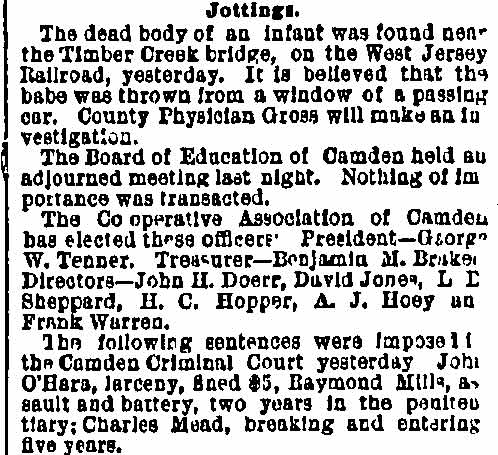
Jottings.
The dead body of an infant was found near the Timber Creek bridge, on the West Jersey Railroad, yesterday. It is believed that the babe was thrown from a window of a passing car. County Physician Gross will make an investigation.
The Board of Education of Camden held an adjourned meeting last night. Nothing of importance was transacted.
The Co-operative Association of Camden has elected these officers: President—George W. Tenner. Treasurer—Benjamin M. Braker. Directors—John H. Doerr, David Jones, L. D. Sheppard, H. C. Hopper, A. J. Hoey and Frank Warren.
The following sentences were imposed at the Camden Criminal Court yesterday: John O’Hara, larceny, fined $5; Raymond Mills, assault and battery, two years in the penitentiary; Charles Mead, breaking and entering five years.
For Sale — 23 Two Story Five Room Brick Houses
Camden Post —
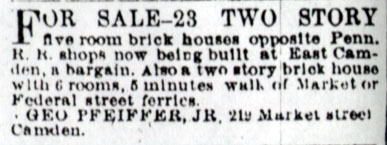
FOR SALE—23 TWO STORY five room brick houses opposite Penn. R. R. shops now being built at East Camden, a bargain. Also a two story brick house with 6 rooms, 5 minutes walk of Market or Federal street ferries.
GEO. PFEIFFER, JR., 219 Market street Camden.
For Sale — 1 5-Room Brick House
Camden Post —
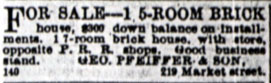
FOR SALE—1, 5-ROOM BRICK house, $300 down balance on installments. 1 7-room brick house, with store, opposite P. R. R. shops. Good business stand.
GEO. PFEIFFER & SON, 219 Market street.
Smith & Pfeiffer, Lumber and Mill Work
Historical and Industrial Review of Camden, N.J. — 1890
SMITH & PFEIFFER, LUMBER AND MILL WORK,
AND
GEORGE PFEIFFER & SON, COAL, BRICK, STONE, etc.,
COOPER’S CREEK, FEDERAL STREET
THE lumber industry is one which is specially well represented in Camden, and among the many large firms engaged in this most essential and staple branch of trade, the house of Messrs. Smith & Pfeiffer stands in the first rank in all respects. The firm was started in January, 1889, and they are the successors to the lumber department of the old-established house of Messrs. George Pfeiffer & Son, so long and favorably known in the commercial circles of this city, which latter firm now confines their operations exclusively to the branch of coal, brick and stone. The premises of the two firms adjoin each other, occupying a large space of ground between Federal street on the southern side, the Pennsylvania Railroad and Cooper’s Creek. The lumber yard of Smith & Pfeiffer is of the extent of 300 feet by 200, with ample shedding for keeping the lumber under cover, and is at all times kept fully stocked with a supply of dressed and undressed lumber, averaging between three and four million feet. All the usual sorts of building lumber are kept on hand, such as flooring, fencing, sidings, planks, joists, wainscoting, etc., with many special kinds, and also a general stock of mill work—mouldings, doors, sash, brackets, etc.—in short, all the material of this character usually found in first-class establishments, the splendid facilities of the firm and their perfect knowledge of the trade, enabling them to offer customers lowest prices, and superior inducements They carry all classes of woods, both hard and soft, but the specialties are hemlock and white and yellow pine. The conveniences for shipment and handling goods are unsurpassed—the wharf on Cooper’s Creels providing for water transportation, and the railroad side-tracks for that by rail.
The members of the firm are Mr. Richard F. Smith and Mr. George Pfeiffer, Jr., the latter being also the present proprietor of the business of George Pfeiffer & Son, the trade of which is of the same complete and extensive character in its department as that of lumber in its line. Their products are coal, hard brick, as as well as that known as “salmon” and “stretchers,” and foundation stone, in all of which they are the representative establishment in this city, conducting a business probably unsurpassed in this section.
Both Mr. Smith and Mr. Pfeiffer are prominent citizens of Camden, and business men of high ability and enterprise. They have also held prominent political positions—Mr. Pfeiffer now being State Senator, while Mr. Smith has held the offices of City Treasurer and Sheriff of Camden..
Masonic Temple Association Directors Elected
Philadelphia Inquirer —
The stockholders of the Masonic Temple Association have elected the following directors: George Pfeiffer, Jr., Cooper B. Hatch, William H. Fredericks, Thomas McDowell, J. R. Eastlack, Alfred Cramer, D. H. Gomersall, E. A. Austermuhl, Isaac Ferris, Jr., Isaac Doughton, H. B. Anthony, W. S. Casselman, Joseph P. Weatherby, W. F. Rose and George W. Jessup.
Camden
Philadelphia Inquirer —
Henry D. Moore, son and daughter, of Haddonfield, in company with Rev. F. R. Brace, D. D., of Blackwood, will sail from New York on the steamer Friesland, on Wednesday, February 6, for a two months’ tour of the Mediterranean, which will include visits to Italy, Greece, Egypt, Turkey, Northern Africa and Southern Spain.
Miss Boyer, of 524 Linden street, will give a tea next Wednesday from 3 until 5.
Miss Campbell, of Fifth and Cooper streets, gave a progressive euchre party on Monday evening in honor of Miss Richardson.
Voorhees Anderson entertained a number of young people at a progressive euchre party Wednesday evening.
Friends of Isaac W. Cole, of Delaware township, intend to present his name as a candidate for one of the county offices to be filled at the coming fall election.
On Monday Mr. and Mrs. William Parry, of Parry, started for California to attend the annual meeting of the American Pomological Society. They will be gone about a month, and will take in all the sights of the Golden State.
“Speaker” Ed Hartman, the popular Third ward policeman, was presented with a handsome and costly cane the other day by his admirers at No. 2 Engine House. David Logue presented the cane in an eloquent speech.
At the meeting of the Commercial Club Wednesday night the following officers were elected for the ensuing year: President, H. Land; Vice-President, S. C. Childs; Treasurer, J. H. Knerr; Financial Secretary, Philip Wilson; Recording Secretary, George W. Anthony; Directors, Geo. Leathwhite, L. W. Fernan, Jacob Ferris, H. G. Bonwill, Thomas J. Peterson, James M. Bentley, H. L. Merrick, John W. Croft, Daniel S. Garwood.
The stockholders of the Masonic Temple Association have elected the following directors: George Pfeiffer, Jr., Cooper B. Hatch, William H. Fredericks, Thomas McDowell, J. R. Eastlack, Alfred Cramer, D. H. Gomersall, E. A. Austermuhl, Isaac Ferris, Jr., Isaac Doughton, H. B. Anthony, W. S. Casselman, Joseph P. Weatherby, W. F. Rose and George W. Jessup.
Politicians' Day at Mt. Holly
Philadelphia Inquirer —
POLITICIANS’ DAY AT MT. HOLLY
CANDIDATE GRIGGS SHOOK HUNDREDS OF HORNY HANDS AT THE BURLINGTON COUNTY FAIR.
CAMDEN WELL REPRESENTED
It Was a Fine Day, But the “Big Thursday” Crowd Was Smaller Than Last Year—A Canine Parachutist Killed—The Races—Other Jersey Matters.
Special to The Inquirer.
MOUNT HOLLY, N. J., Oct. 10.—The Mount Holly Fair, like all the other Jersey fairs, has its “Big Thursday.” That is the day the politicians get together to shake hands, swop stories and look after the political machine generally. The candidates make it a point to be present and try to win votes with cordial greetings and honeyed words. The Mount Holly Fair was favored with exceptionally fine weather for its “Big Thursday,” but the attendance was not as large as last year’s crowd.
The politicians congregated around a tent at the left of the grand stand. John W. Griggs, the Republican candidate for Governor, arrived on the grounds shortly after noon and was tendered a reception at the entrance. All the afternoon he was kept busy shaking hands with the grangers and telling them how glad he was to meet them. Mr. Griggs got lots of promises of votes. He made many friends among the farmers, who had their first chance of talking with him. Nearly every one addressed him as “Governor.”
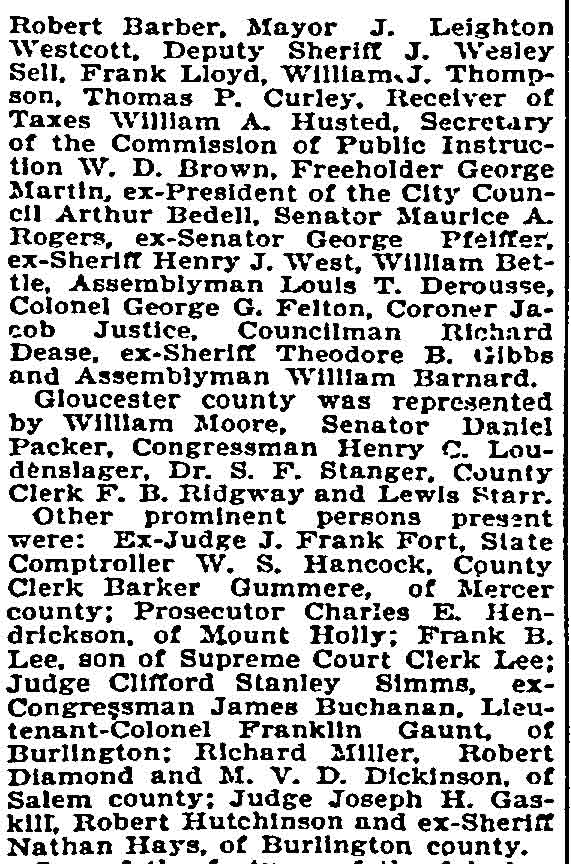
Camden county was well represented by its leading political lights, among whom were: Senator William J. Sewell, ex-Sheriff David Baird, City Counsel J. Willard Morgan, City Clerk T. P. Varney, County Clerk Robert Barber, Mayor J. Leighton Westcott, Deputy Sheriff J. Wesley Sell, Frank Lloyd, William J. Thompson, Thomas P. Curley, Receiver of Taxes William A. Husted, Secretary of the Commission of Public Instruction W. D. Brown, Freeholder George Martin, ex-President of the City Council Arthur Bedell, Senator Maurice A. Rogers, ex-Senator George Pfeiffer, ex-Sheriff Henry J. West, William Bettle, Assemblyman Louis T. Derousse, Colonel George G. Felton, Coroner Jacob Justice, Councilman Richard Dease, ex-Sheriff Theodore B. Gibbs and Assemblyman William Barnard.
Gloucester county was represented by William Moore, Senator Daniel Packer, Congressman Henry C. Loudenslager, Dr. S. F. Stanger, County Clerk F. B. Ridgway and Lewis Starr.
Other prominent persons present were: Ex-Judge J. Frank Fort, State Comptroller W. S. Hancock, County Clerk Barker Gummere, of Mercer county; Prosecutor Charles E. Hendrickson, of Mount Holly; Frank B. Lee, son of Supreme Court Clerk Lee; Judge Clifford Stanley Simms, ex-Congressman James Buchanan, Lieutenant-Colonel Franklin Gaunt, of Burlington; Richard Miller, Robert Diamond and M. V. D. Dickinson, of Salem county; Judge Joseph H. Gaskill, Robert Hutchinson and ex-Sheriff Nathan Hays, of Burlington county.
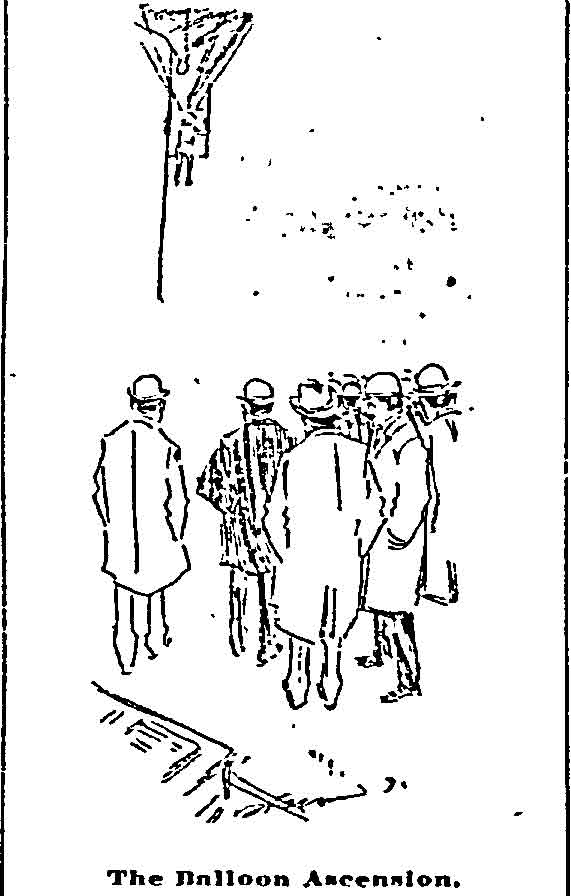
One of the features of the fair has been the daily ascension of a large balloon, from which a man and dog drop with parachutes. This afternoon the ropes which held the dog became loose. He dropped upon one of the booths and was killed.
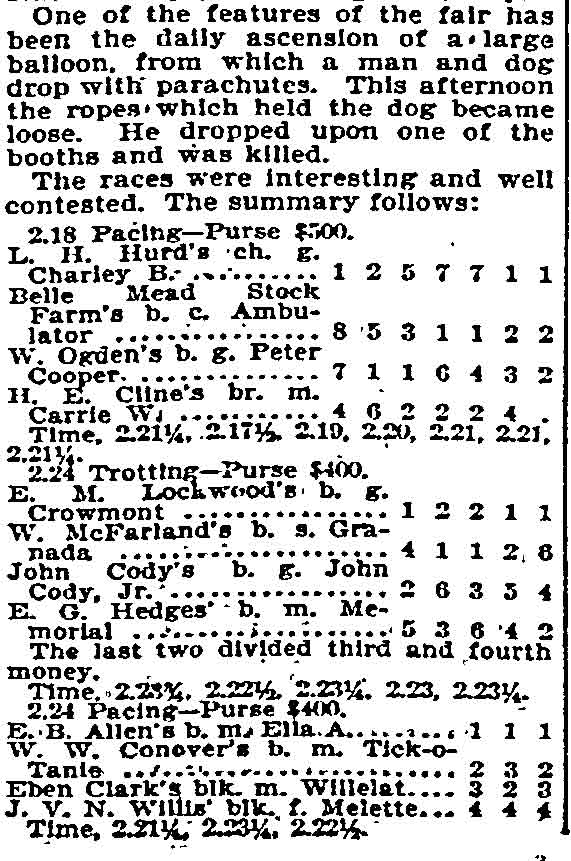
The races were interesting and well contested. The summary follows:
2.18 Pacing—Purse $500.
L. H. Hurd’s ch. g. Charley B....1 2 5 7 7 1 1
Belle Mead Stock Farm’s b. c. Ambulator....8 5 3 1 1 2 2
W. Ogden’s b. g. Peter Cooper....7 1 1 6 4 3 2
H. E. Cline’s br. m. Carrie W....4 6 2 2 2 4
Time. 2.21¼, 2.17½, 2.19, 2.20, 2.21, 2.21, 2.21¼.
2.24 Trotting—Purse $400.
E. M. Lockwood’s b. g. Crowmont....1 2 2 1 1
W. McFarland’s b. s. Granada....4 1 1 2 8
John Cody’s b. g. John Cody, Jr....2 6 3 5 4
E. G. Hedges’ b. m. Memorial....5 3 6 4 2
The last two divided third and fourth money.
Time. 2.23¾, 2.22½, 2.23¼, 2.23, 2.23¼.
2.24 Pacing—Purse $400.
E. B. Allen’s b. m. Ella A....1 1 1
W. W. Conover’s b. m. Tick-o-Tanie....2 3 2
Eben Clark’s blk. m. Willelat....3 2 3
J. V. N. Willis’ f. Melette....4 4 4
Time, 2.21¼, 2.23¼, 2.22½.
Water Contract and Loan
Philadelphia Inquirer —
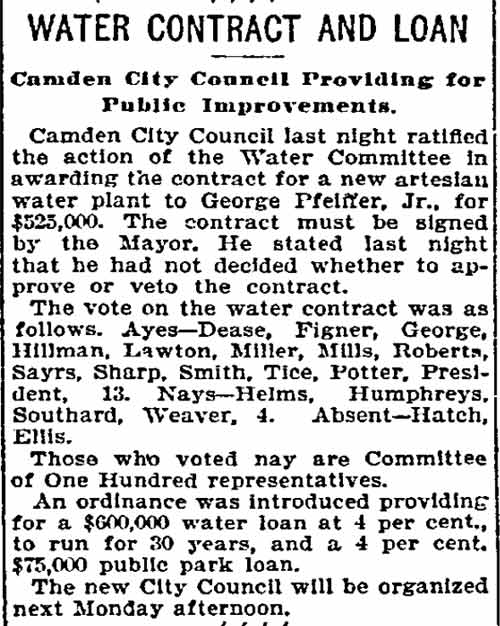
Camden City Council Providing for Public Improvements.
Camden City Council last night ratified the action of the Water Committee in awarding the contract for a new artesian water plant to George Pfeiffer, Jr., for $525,000. The contract must be signed by the Mayor. He stated last night that he had not decided whether to approve or veto the contract.
The vote on the water contract was as follows. Ayes—Dease, Figner, George, Hillman, Lawton, Miller, Mills, Roberts, Sayrs, Sharp, Smith, Tice, Potter, President, 13. Nays—Helms, Humphreys, Southard, Weaver, 4. Absent—Hatch, Ellis.
Those who voted nay are Committee of One Hundred representatives.
An ordinance was introduced providing for a $600,000 water loan at 4 per cent., to run for 30 years, and a 4 per cent. $75,000 public park loan.
The new City Council will be organized next Monday afternoon.
Biographical Review
1897
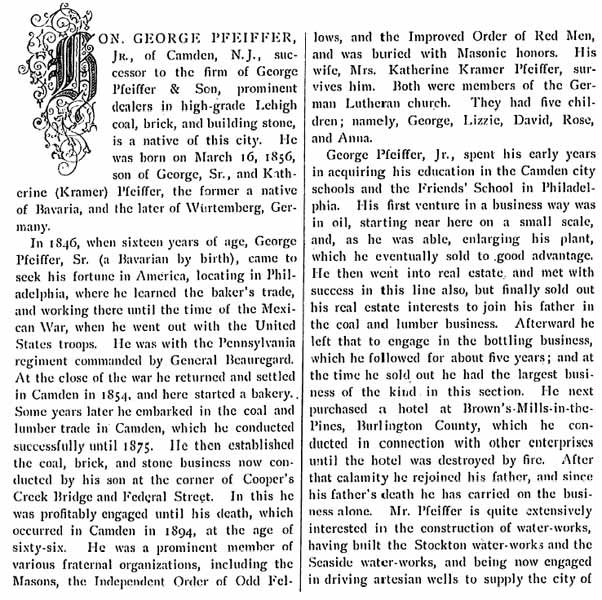
HON. GEORGE PFEIFFER, Jr., of Camden, N.J., successor to the firm of George Pfeiffer & Son, prominent dealers in high-grade Lehigh coal, brick, and building stone, is a native of this city. He was born on March 16, 1856, son of George, Sr., and Katherine (Kramer) Pfeiffer, the former a native of Bavaria, and the later of Wirtemberg, Germany.
In 1846, when sixteen years of age, George Pfeiffer, Sr. (a Bavarian by birth), came to seek his fortune in America, locating in Philadelphia, where he learned the baker’s trade, and working there until the time of the Mexican War, when he went out with the United States troops. He was with the Pennsylvania regiment commanded by General Beauregard. At the close of the war he returned and settled in Camden in 1854, and here started a bakery. Some years later he embarked in the coal and lumber trade in Camden, which he conducted successfully until 1875. He then established the coal, brick, and stone business now conducted by his son at the corner of Cooper’s Creek Bridge and Federal Street. In this he was profitably engaged until his death, which occurred in Camden in 1894, at the age of sixty-six. He was a prominent member of various fraternal organizations, including the Masons, the Independent Order of Odd Fellows, and the Improved Order of Red Men, and was buried with Masonic honors. His wife, Mrs. Katherine Kramer Pfeiffer, survives him. Both were members of the German Lutheran church. They had five children; namely, George, Lizzie, David, Rose, and Anna.
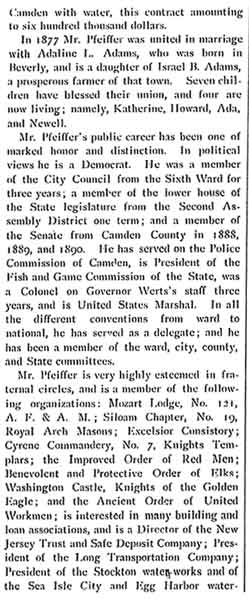
George Pfeiffer, Jr., spent his early years in acquiring his education in the Camden city schools and the Friends’ School in Philadelphia. His first venture in a business way was in oil, starting near here on a small scale, and, as he was able, enlarging his plant, which he eventually sold to good advantage. He then went into real estate, and met with success in this line also, but finally sold out his real estate interests to join his father in the coal and lumber business. Afterward he left that to engage in the bottling business, which he followed for about five years; and at the time he sold out he had the largest business of the kind in this section. He next purchased a hotel at Brown’s-Mills-in-the-Pines, Burlington County, which he conducted in connection with other enterprises until the hotel was destroyed by fire. After that calamity he rejoined his father, and since his father’s death he has carried on the business alone. Mr. Pfeiffer is quite extensively interested in the construction of water-works, having built the Stockton water-works and the Seaside water-works, and being now engaged in driving artesian wells to supply the city of Camden with water, this contract amounting to six hundred thousand dollars.
In 1877 Mr. Pfeiffer was united in marriage with Adaline I. Adams, who was born in Beverly, and is a daughter of Israel B. Adams, a prosperous farmer of that town. Seven children have blessed their union, and four are now living; namely, Katherine, Howard, Ada, and Newell.
Mr. Pfeiffer’s public career has been one of marked honor and distinction. In political views he is a Democrat. He was a member of the City Council from the Sixth Ward for three years; a member of the lower house of the State legislature from the Second Assembly District one term; and a member of the Senate from Camden County in 1888, 1889, and 1890. He has served on the Police Commission of Camden, is President of the Fish and Game Commission of the State, was a Colonel on Governor Werts’s staff three years, and is United States Marshal. In all the different conventions from ward to national, he has served as a delegate; and he has been a member of the ward, city, county, and State committees.
Mr. Pfeiffer is very highly esteemed in fraternal circles, and is a member of the following organizations: Mozart Lodge, No. 121, A. F. & A. M.; Siloam Chapter, No. 19, Royal Arch Masons; Excelsior Consistory; Cyrene Commandery, No. 7, Knights Templars; the Improved Order of Red Men; Benevolent and Protective Order of Elks; Washington Castle, Knights of the Golden Eagle; and the Ancient Order of United Workmen; is interested in many building and loan associations, and is a Director of the New Jersey Trust and Safe Deposit Company; President of the Long Transportation Company; President of the Stockton water-works and of the Sea Isle City and Egg Harbor water-works; President of the Manahawkin and Long Beach Transportation Company, and a director in many other enterprises. He and his wife and family are members of the Lutheran church.
Camden Iron Works Suit
Philadelphia Inquirer —
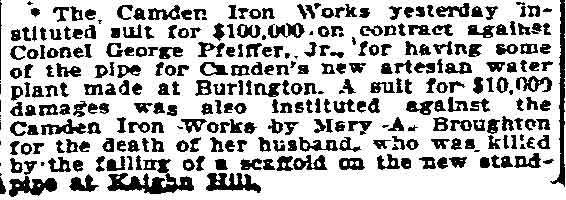
The Camden Iron Works yesterday instituted suit for $100,000 on contract against Colonel George Pfeiffer, Jr., for having some of the pipe for Camden’s new artesian water plant made at Burlington. A suit for $10,000 damages was also instituted against the Camden Iron Works by Mary A. Broughton for the death of her husband, who was killed by the falling of a scaffold on the new standpipe at Kaighn Hill.
Reformers Lop Off Chief Dodd’s Head
Philadelphia Inquirer —
Six Republican Policemen Also Removed and Reformers Take Their Places
ADOPT ANNUAL BUDGET
Slight Reduction in Appropriations—Water Compromise Ratified by Council
Camden City Council last evening fixed the annual appropriations at $516,160, ratified the compromise with Contractor Pfeiffer by which pure water will be turned on to-morrow and dismissed Chief of Police Dodd and six Republican policemen. The appropriations as compared with last year are as follows:
| 1897. | 1898. | |
|---|---|---|
| Police . . . | $60,000 | $68,000 |
| Lighting . . . | 71,000 | 72,000 |
| Salaries . . . | 35,000 | 38,964 |
| Streets . . . | 42,000 | 38,000 |
| Culverts . . . | 12,000 | 12,000 |
| Water . . . | 56,000 | 60,000 |
| Liquidating Indebtedness . . . | 25,000 | 12,500 |
| Excise . . . | 2,500 | 2,500 |
| Dispensaries . . . | 4,000 | 4,000 |
| Parks . . . | 1,400 | 4,000 |
| Interest . . . | 115,000 | 105,946 |
| Building Commission . . . | 100 | 50 |
| Fire . . . | 47,000 | 44,000 |
| Property . . . | 8,000 | 6,500 |
| Elections . . . | 8,000 | 6,000 |
| District Court . . . | 4,000 | 4,000 |
| Printing . . . | 7,000 | 7,500 |
| Contingent . . . | 6,600 | 3,500 |
| Board of Health . . . | 4,000 | 3,500 |
| Poor . . . | 2,000 | 2,000 |
| G. A. R. . . . | 200 | 200 |
| Park Special Bonds . . . | 3,000 | |
| Sinking Fund . . . | 10,000 | 21,000 |
| Deficiency . . . | 10,000 | |
| Total . . . | $533,700 | $516,160 |
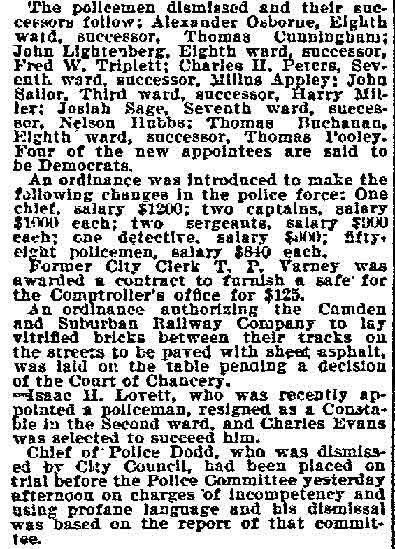
The policemen dismissed and their successors follow: Alexander Osborne, Eighth ward, successor, Thomas Cunningham; John Lightenberg, Eighth ward, successor, Fred W. Triplett; Charles H. Peters, Seventh ward, successor, Milins Appley; John Sailor, Third ward, successor, Harry Miller; Josiah Sage, Seventh ward, successor, Nelson Hubbs; Thomas Buchanan, Eighth ward, successor, Thomas Pooley. Four of the new appointees are said to be Democrats.
An ordinance was introduced to make the following changes in the police force: One chief, salary $1200; two captains, salary $1[?]00 each; two sergeants, salary $900 each; one detective, salary $[?]00; fifty-eight policemen, salary $840 each.
Former City Clerk T. P. Varney was awarded a contract to furnish a safe for the Comptroller’s office for $125.
An ordinance authorizing the Camden and Suburban Railway Company to lay vitrified bricks between their tracks on the streets to be paved with sheet asphalt, was laid on the table pending a decision of the Court of Chancery.
Isaac H. Lovett, who was recently appointed a policeman, resigned as a Constable in the Second ward, and Charles Evans was selected to succeed him.
Chief of Police Dodd, who was dismissed by City Council, had been placed on trial before the Police Committee yesterday afternoon on charges of incompetency and using profane language and his dismissal was based on the report of that committee.
Artesian Water Test
Philadelphia Inquirer —
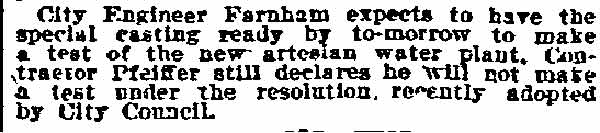
City Engineer Farnham expects to have the special casting ready by to-morrow to make a test of the new artesian water plant. Contractor Pfeiffer still declares he will not make a test under the resolution, recently adopted by City Council.
Doings in Realty
Camden Daily Courier —
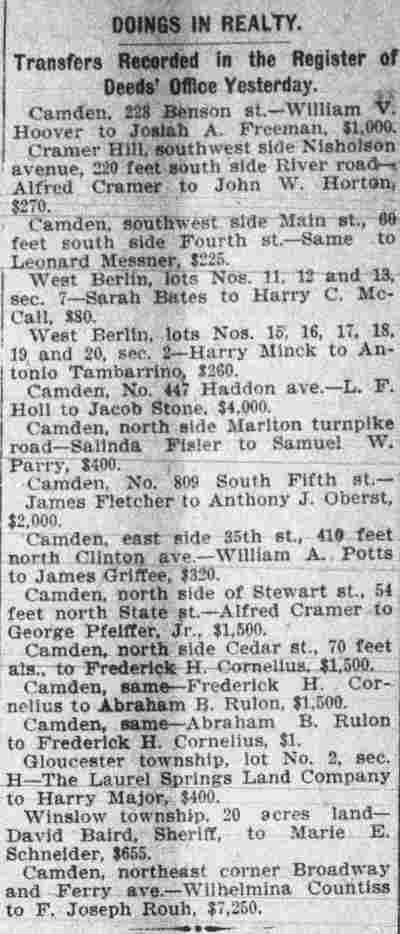
Transfers Recorded in the Register of Deeds’ Office Yesterday.
Camden, 228 Benson st.—William V. Hoover to Josiah A. Freeman, $1,000.
Cramer Hill, southwest side Nisholson [sic] avenue, 220 feet south side River road—Alfred Cramer to John W. Horton, $270.
Camden, southwest side Main st., 60 feet south side Fourth st.—Same to Leonard Messner, $225.
West Berlin, lots Nos. 11, 12 and 13, sec. 7—Sarah Bates to Harry C. McCall, $80.
West Berlin, lots Nos. 15, 16, 17, 18, 19 and 20, sec. 2—Harry Minck to Antonio Tambarrino, $260.
Camden, No. 447 Haddon ave.—L. F. Holl to Jacob Stone, $4,000.
Camden, north side Marlton turnpike road—Salinda Fisler to Samuel W. Parry, $400.
Camden, No. 809 South Fifth st.—James Fletcher to Anthony J. Oberst, $2,000.
Camden, east side 35th st., 410 feet north Clinton ave.—William A. Potts to James Griffee, $320.
Camden, north side of Stewart st., 54 feet north State st.—Alfred Cramer to George Pfeiffer, Jr., $1,500.
Camden, north side Cedar st., 70 feet als., to Frederick H. Cornelius, $1,500.
Camden, same—Frederick H. Cornelius to Abraham B. Rulon, $1,500.
Camden, same—Abraham B. Rulon to Frederick H. Cornelius, $1.
Gloucester township, lot No. 2, sec. H—The Laurel Springs Land Company to Harry Major, $400.
Winslow township, 20 acres land—David Baird, Sheriff, to Marie E. Schneider, $655.
Camden, northeast corner Broadway and Ferry ave.—Wilhelmina Countiss to F. Joseph Rouh, $7,250.
Camden Democrats on the Watch
Philadelphia Inquirer —
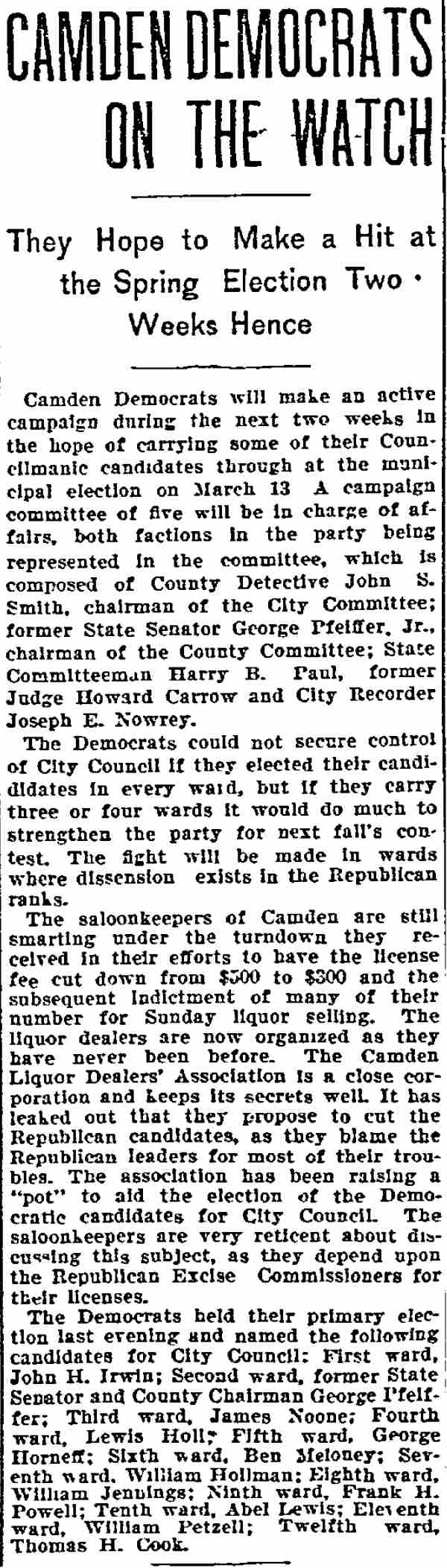
They Hope to Make a Hit at the Spring Election Two Weeks Hence
Camden Democrats will make an active campaign during the next two weeks in the hope of carrying some of their Councilmanic candidates through at the municipal election on March 13 A campaign committee of five will be in charge of affairs, both factions in the party being represented in the committee, which is composed of County Detective John S. Smith, chairman of the City Committee; former State Senator George Pfeiffer, Jr., chairman of the County Committee; State Committeeman Harry B. Paul, former Judge Howard Carrow and City Recorder Joseph E. Nowrey.
The Democrats could not secure control of City Council if they elected their candidates in every ward, but if they carry three or four wards it would do much to strengthen the party for next fall’s contest. The fight will be made in wards where dissension exists in the Republican ranks.
The saloonkeepers of Camden are still smarting under the turndown they received in their efforts to have the license fee cut down from $500 to $300 and the subsequent indictment of many of their number for Sunday liquor selling. The liquor dealers are now organized as they have never been before. The Camden Liquor Dealers’ Association is a close corporation and keeps its secrets well. It has leaked out that they propose to cut the Republican candidates, as they blame the Republican leaders for most of their troubles. The association has been raising a “pot” to aid the election of the Democratic candidates for City Council. The saloonkeepers are very reticent about discussing this subject, as they depend upon the Republican Excise Commissioners for their licenses.
The Democrats held their primary election last evening and named the following candidates for City Council: First ward, John H. Irwin; Second ward, former State Senator and County Chairman George Pfeiffer; Third ward, James Noone; Fourth ward, Lewis Holl; Fifth ward, George Horneff; Sixth ward, Ben Meloney; Seventh ward, William Hollman; Eighth ward, William Jennings; Ninth ward, Frank H. Powell; Tenth ward, Abel Lewis; Eleventh ward, William Petzell; Twelfth ward, Thomas H. Cook.
New Jersey Delegates Ready to Start for Kansas City
Philadelphia Inquirer —
They’re All for Bryan and “Silver Bill” Daly Is at Their Head
BOB DAVIS STAYS AT HOME
Will Work With Tammany for a New York Man for Vice President
Special to The Inquirer.
TRENTON, June 30.—Headed by the Honorable William D. Daly as spokesman for City Collector Robert Davis, of Jersey City, the real power behind the throne, the New Jersey contingent will leave for Kansas City to-morrow evening, to attend the national convention that is to once more place William Jennings Bryan in nomination for the Presidency. The party will travel in two special Pullmans over the Pennsylvania Railroad, and before the start is made each member will be taxed $75 to pay for the transportation, sleeper and cramp preventatives that will be used aboard the train. This will only include the sleep one way and meals will be charged for extra. Besides the delegates, it is expected that many other Jerseymen will journey to Kansas City for the coming week. The return trip will not be made by any special trains or cars. The delegates and others will come back as it suits themselves best, although it is expected that a party will be made up immediately after the convention adjourns, to return to the Garden State.
The New Jersey delegation will be for Bryan. That is certain. The State was not pledged at the convention, but it will support the silver champion just the same at Kansas City. Had New York State shown a preference for another candidate New Jersey would have followed suit, but it is well settled that Croker will give the Tammany support to Bryan, and whatever Tammany does New Jersey will do also. The delegation from this State is in the palm of the hand of Davis, and it will adhere closely to the course of the New Yorkers. Mr. Davis says that New Jersey will favor McClellan, Hill, Danforth or Sulzer in the order named.
“Jerseymen naturally have a leaning to McClellan,” said the Hudson boss, in discussing the matter to-day, “because he is a native of this State and the son of a man honored and respected by us as one of the greatest generals of the Cival [sic] War and afterwards Governor of the State. Mr. McClellan is one of the few sons of illustrious fathers who has proven himself worthy of recognition.
“Every Democrat who remembers David B. Hill’s remarkable victories in the Empire State cannot but regard him as an available candidate, but he is especially strong because the Democrats who were lukewarm towards Bryan have full confidence in New York’s ex-Governor. He would unquestionably greatly strengthen the ticket.”
DAVIS WILL NOT GO.
Although “Bob” Davis practically controls the delegation, he surprised his friends to-day by announcing that he will not go to the Kansas City Convention. He is city collector of Jersey City and he says he will have to remain at home because a Martin act tax sale is scheduled for next Tuesday and the city collector is required to officiate at those sales. It is believed the sale could easily have been postponed if the collector was anxious to go to Kansas City.
“Police Judge James J. Murphy is my regular alternate, and he will ably represent my views at the convention,” said Mr. Davis when asked who would go in his place.
He will go to the Pennsylvania Railroad depot to-morrow night to see the delegates start, but will not be able to attend the caucus, which is to take place on the train while it is flying westward.
Mr. Davis’ announcement that he would not go to Kansas City occasioned much comment. His friends say the collector, who is a short, heavily built man, feels the heat greatly, and dreads hot spells. The fear that he would have to swelter out West was one of the things that caused him to decide to stay at home. Men close to Davis argue that if he and the State organization keep clear of any share of responsibility for the nomination of Bryan, in view of his almost certain defeat, they will be so much the stronger next year.
THE JERSEY DELEGATES.
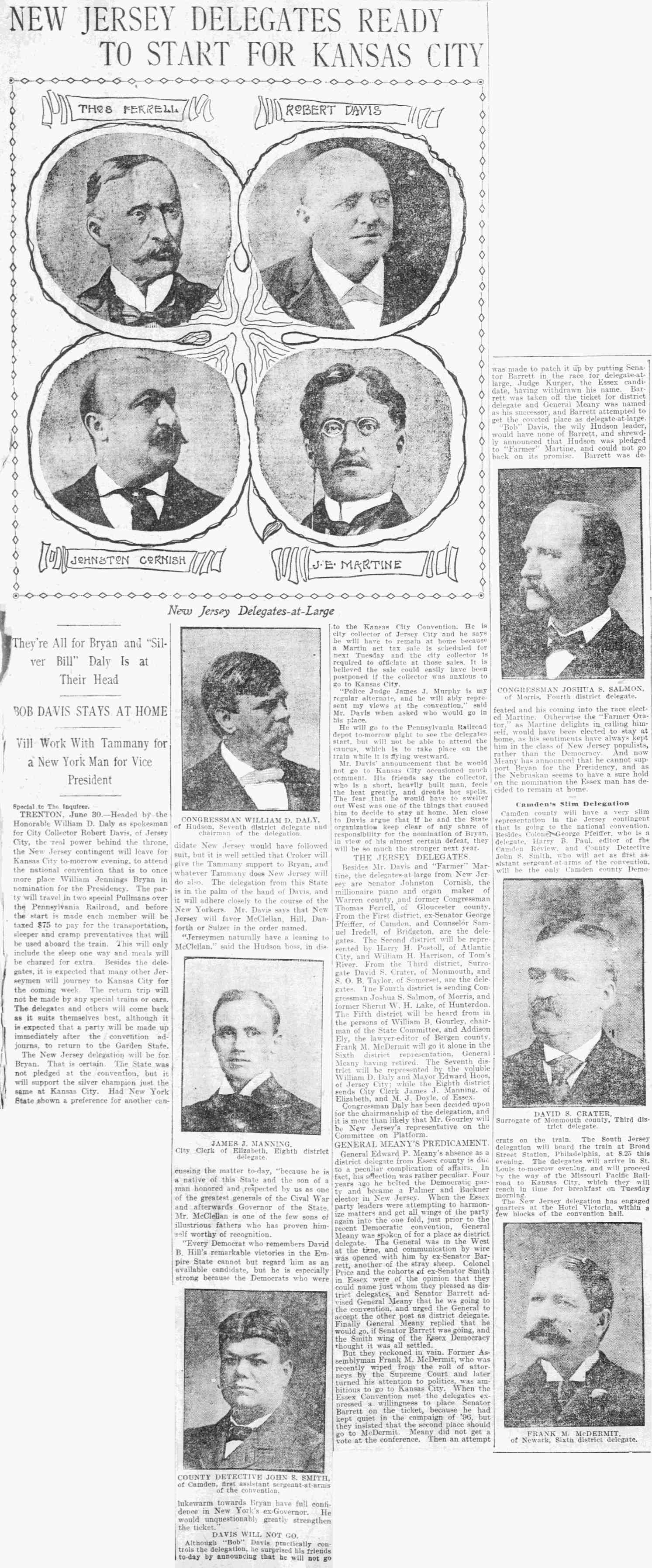
Besides Mr. Davis and “Farmer” Martine, the delegates-at-large from New Jersey are Senator Johnston Cornish, the millionaire piano and organ maker of Warren county, and former Congressman Thomas Ferrell, of Gloucester county. From the First district, ex-Senator George Pfeiffer, of Camden, and Counselor Samuel Iredell, of Bridgeton, are the delegates. The Second district will be represented by Harry H. Postoll, of Atlantic City, and William H. Harrison, of Tom’s River. From the Third district, Surrogate David S. Crater, of Monmouth, and S. O. B. Taylor, of Somerset, are the delegates. The Fourth district is sending Congressman Joshua S. Salmon, of Morris, and former Sheriff W. H. Lake, of Hunterdon. The Fifth district will be heard from in the persons of William B. Gourley, chairman of the State Committee, and Addison Ely, the lawyer-editor of Bergen county. Frank M. McDermit will go it alone in the Sixth district representation, General Meany having retired. The Seventh district will be represented by the voluble William D. Daly and Mayor Edward Hoos, of Jersey City; while the Eighth district sends City Clerk James J. Manning, of Elizabeth, and M. J. Doyle, of Essex.
Congressman Daly has been decided upon for the chairmanship of the delegation, and it is more than likely that Mr. Gourley will be New Jersey’s representative on the Committee on Platform.
GENERAL MEANY’S PREDICAMENT.
General Edward P. Meany’s absence as a district delegate from Essex county is due to a peculiar complication of affairs. In fact, his selection was rather peculiar. Four years ago he belted the Democratic party and became a Palmer and Buckner elector in New Jersey. When the Essex party leaders were attempting to harmonize matters and get all wings of the party again into the one fold, just prior to the recent Democratic convention, General Meany was spoken of for a place as district delegate. The General was in the West at the time, and communication by wire was opened with him by ex-Senator Barrett, another of the stray sheep. Colonel Price and the cohorts of ex-Senator Smith in Essex were of the opinion that they could name just whom they pleased as district delegates, and Senator Barrett advised General Meany that he ws [sic] going to the convention, and urged the General to accept the other post as district delegate. Finally General Meany replied that he would go, if Senator Barrett was going, and the Smith wing of the Essex Democracy thought it was all settled.
But they reckoned in vain. Former Assemblyman Frank M. McDermit, who was recently wiped from the roll of attorneys by the Supreme Court and later turned his attention to politics, was ambitious to go to Kansas City. When the Essex Convention met the delegates expressed a willingness to place Senator Barrett on the ticket, because he had kept quiet in the campaign of ‘96, but they insisted that the second place should go to McDermit. Meany did not get a vote at the conference. Then an attempt was made to patch it up by putting Senator Barrett in the race for delegate-at-large, Judge Kurger [sic], the Essex candidate, having withdrawn his name. Barrett was taken off the ticket for district delegate and General Meany was named as his successor, and Barrett attempted to get the coveted place as delegate-at-large. “Bob” Davis, the wily Hudson leader, would have none of Barrett, and shrewdly announced that Hudson was pledged to “Farmer” Martine, and could not go back on its promise. Barrett was defeated and his coming into the race elected Martine. Otherwise the “Farmer Orator,” as Martine delights in calling himself, would have been elected to stay at home, as his sentiments have always kept him in the class of New Jersey populists, rather than the Democracy. And now Meany has announced that he cannot support Bryan for the Presidency, and as the Nebraskan seems to have a sure hold on the nomination the Essex man has decided to remain at home.
Camden’s Slim Delegation
Camden county will have a very slim representation in the Jersey contingent that is going to the national convention. Besides Colonel George Pfeiffer, who is a delegate, Harry B. Paul, editor of the Camden Review, and County Detective John S. Smith, who will act as first assistant sergeant-at-arms of the convention, will be the only Camden county Democrats on the train. The South Jersey delegation will board the train at Broad Street Station, Philadelphia, at 8.25 this evening. The delegates will arrive in St. Louis to-morrow evening, and will proceed by the way of the Missouri Pacific Railroad to Kansas City, which they will reach in time for breakfast on Tuesday morning.
The New Jersey delegation has engaged quarters at the Hotel Victoria, within a few blocks of the convention hall.
[Portrait captions]
Thos Ferrell. Robert Davis. Johnston Cornish. J. E. Martine. New Jersey Delegates-at-Large.
CONGRESSMAN WILLIAM D. DALY, of Hudson, Seventh district delegate and chairman of the delegation.
JAMES J. MANNING, City Clerk of Elizabeth, Eighth district delegate.
COUNTY DETECTIVE JOHN S. SMITH, of Camden, first assistant sergeant-at-arms of the convention.
CONGRESSMAN JOSHUA S. SALMON, of Morris, Fourth district delegate.
DAVID S. CRATER, Surrogate of Monmouth county, Third district delegate.
FRANK M. McDERMIT, of Newark, Sixth district delegate.
Morris Station Water Plant
Philadelphia Inquirer —
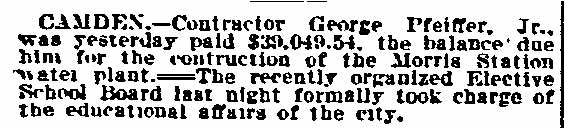
CAMDEN.—Contractor George Pfeiffer, Jr., was yesterday paid $39,049.54, the balance due him for the contruction [sic] of the Morris Station water plant.—The recently organized Elective School Board last night formally took charge of the educational affairs of the city.
The First Drill for the Artesian Water Supply of Camden, N.J.
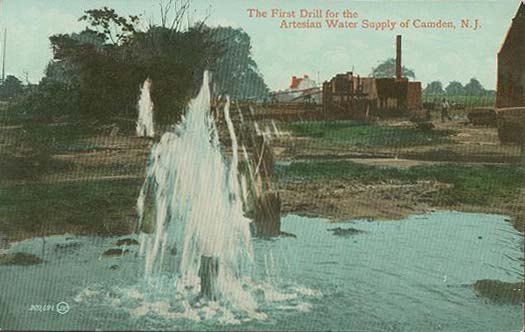
Turn of the Century Postcard — “The First Drill for the Artesian Water Supply of Camden, N.J.”
Police Committee Sustained; Matlack and Miller Discharged
Camden Post-Telegram —
City Council by a Big Majority Indorses Action to Maintain Discipline in the Police Department.
LIBERTY STREET WILL NOT BE CLOSED WHEN RAILROAD TRACKS ARE ELEVATED
City Council last night, in a most decisive manner, voiced its approval of the action of the Police Committee in dismissing Policemen Robert Miller and Albertson L. Matlack, from the force. By a vote of 15 to 6, Council turned down an amendment that the report be referred back to the committee and a moment later the body by a vote of 17 to 4 ordered the Police Committee’s report received and filed.
The absentees were Pfeiffer, Second ward; Roberts, Third ward; Abele, Ninth ward, and Lee, Twelfth ward.
Immediately following the reading of the report, Mr. Silvers, of the Third ward, gained the floor and after objecting to the dismissal of Miller and Matlack, moved to amend that part of the report dismissing the two officers and refer it back to the committee. Mr. Stevens, of the Sixth ward, in a speech to the galleries, seconded the motion and immediately after Mr. Silvers called for a vote.
Mr. Ellis, however, arose to a question of privilege and asked City Counsel Snyder if it was necessary for Council to approve the findings of the Police Committee in their investigation of charges against accused officers.
Mr. Snyder replied that the law of 1902 vested in the Police Committee the power to dismiss officers; that the city ordinance requesting the appointment of a Police Committee contained no provision that the report be approved, but that it simply provided that the committee’s action be made known to Council, merely as a matter of record and information.
POLICE COMMITTEE SUSTAINED.
A ballot was then taken on Mr. Silver’s amendment. It was lost by the following vote:
Yeas—Gibson, Longacre, Silvers, Snyder, Stevens, Wolverton—6.
Nays—Smith, Jones, Broome, Turner, Lawton, Ellis, Bradley, Hanson, Laird, Mellor, Leigh, Cannon, Leas, Carter and Longacre—15.
A motion to receive and file the committee’s report followed and was adopted by a vote of 17 to 4, Wolverton and Longacre, who voted for the amendment, casting their ballot to sustain the committee’s action.
Mr. Silvers then introduced a resolution requesting the Mayor to re-appoint Miller and Matlack to the force, and moved its adoption.
Mr. Ellis offered an amendment, referring the resolution to the Police Committee. The amendment prevailed.
TO BRIDGE LIBERTY STREET.
A numerously signed petition from residents of the Seventh ward, asking Council to cause Mt. Vernon and Liberty streets to remain open when the elevated road is built, was received and filed.
Similar action was taken on a petition referring to Liberty street alone.
Following the disposition of the petitions Mr. Bradley, of the Seventh ward, offered a resolution providing for the bridging of Liberty street. It was passed by a unanimous vote.
In the “L” ordinances, Liberty street is one of the thoroughfares set down to be closed, but Council in its wisdom, made provision in each ordinance that at any time it could by resolution direct the railroad company to bridge a street which originally was to be closed.
BONDS TO BE RENEWED.
Ordinances were introduced and passed, under suspension of the rules, providing for the renewal of bonds to the amount of $104,000. Seventy thousand dollars of the lot matures January 1, 1903, and the ordinance directs that $2,100 shall be appropriated yearly to provide for the payment of the renewal series. The remaining $34,000 matures December 1, 1902, and to meet the renewal bonds as they mature $1,000 is to be set aside yearly in the Sinking Fund, which fund, by direction of the ordinances, is to purchase the bonds.
When the Water Committee report was presented, Mr. Jones, of the First ward, asked for information concerning the committee’s action in rejecting all bids for furnishing the department with oil.
Chairman Mellor replied that the committee found that by purchasing the oil in small quantities better grade could be secured and the cost was about the same. The report was adopted.
TO VOTE ON SCHOOL ACT.
By resolution Council directed that a vote be taken on the elective School Board question at the November election.
Comptroller Hufty’s report showing Meter Clerk Ulie G. Lee’s shortage was simply received and filed.
The bill of David Ellis, of the Seventh ward, for $70 for services as a policeman for the month of August was presented and ordered paid on its merits.
Council adjourned to meet on October 16.
POLICE COMMITTEE’S REPORT SHOWS OFFICERS’ GUILT
Evidence Proved That Matlack and Miller Had Violated Rules of the Department.
The report of the Police Committee to City Council summarizes the evidence which showed, so the committee concluded, that both Policemen Matlack and Miller had violated the rules of the department and should be dismissed from the force. The report is as follows:
Camden, N. J., Sept. 25, 1902.
To the President and Members of City Council.
Gentlemen:—The character of the matters before your committee, at the regular meeting held September 12, 1902, having attracted the attention of so many citizens, and being of public interest and importance, in the consideration thereof, we desire to quote the following Rules and Regulations of the Police Department.
“Rule 1. Although certain hours are allotted for the performance of regular tours of duty, officers are considered to be at all times on duty and must act promptly at any time that their services are required.”
“Rule 2. Each member, in his conduct and deportment, must be quiet, civil and orderly. In the performance of his duties he must maintain decorum, command of temper, patience and discretion; he must at all times refrain from harsh, coarse, profane or insolent language, yet be firm, resolute and energetic; he must not use unnecessary force or violence, or strike a prisoner or any person with his baton, except in self defense * * *.”
“Rule 24. When making an arrest officers will be courteous and at the same time determined in their manner and actions. It frequently happens that serious trouble, and in some cases fatal results are caused by an officer losing self control and becoming excited during an arrest. Kind words and prompt action on the part of an officer are more successful in getting a prisoner to the station house than brutality and insolence.”
“Rule 26. When necessary to use the club, experience has shown that a prisoner should not be struck upon the head, if possible to avoid doing so, but on the hands or arms, so as to disable the prisoner more quickly.”
“Rule 34. The principal duties of a uniformed police force are to prevent the commission of crime. No good officer will stand by and wait until a simple quarrel has merged into a riot, or a murderer succeeds in accomplishing his purpose before interfering, but will, by exercising his authority as a police officer, take action at once and thereby prevent the commission of some serious offence.”
“Rule 53. The prevention of crime being the most important object in view the patrolman’s exertions must be constantly used to accomplish that end. * * *”
“Rule 61. He (the patrolman) must, to the utmost of his power, prevent the commission of assaults, breaches of the peace and all other crimes about to be committed in his presence.”
Specific charges were presented against Patrolman Albertson Matlack, of the Third District, and Robert Miller and Albert Keaser, of the First District.
At the hearing the officers charged were present and represented by counsel; written copies of the charges had been duly served, and every reasonable opportunity was afforded them to make their defense. The City Counsel acted as Advocate for the committee.
Patrolman Albertson Matlack was charged with assault upon John Corbett, a judge of election, at the polling place in the Fourth precinct of the Twelfth ward, at the primary election held July 28th, 1902, and further, with conduct unbecoming an officer.
The testimony produced before your committee shows that Patrolman Matlack was off duty and was present as a private citizen, with several other persons, at the time and place named. At 5 o’clock, the time for opening the polls, the judge of election requested all persons, other than the election officers, to retire from the room. There was a refusal. After several unsuccessful attempts to persuade them to leave the judge of election called upon Matlack as an officer, to enforce the law. Matlack positively refused to act and he admits, in his own testimony, told his brother Ed not to go out. The judge of election then sent for another officer. Upon the arrival of the other officers (Zane and Flick, who responded to the call), as testified to by four witnesses, Patrolman Matlack not only neglected to assist in preserving the peace, but, in violent language, counseled others to resist and did himself actively participate against the officers of the law in the riot which inevitably followed.
The duty of Matlack as an officer was very plain. If, as he testified, he was without weapons of any kind, then, in the beginning, he was guilty of an infraction of Rule 22 of the department, which provides that an officer should be always armed and ready for service.
According to the records of the department this is the fourth time during his service that specific charges have been preferred against this officer.
Patrolman Robert Miller, was charged with assault upon George V. Murray, a citizen of the Third ward, and other disorderly conduct unbecoming an officer, at the polling place in the Fifth precinct, of the Third ward, on the evening of July 28 last, upon the occasion of a primary election. The testimony shows that there was a large crowd of people about the polling place at Third and Beckett streets; that among others Patrolman Robert Miller, who was off duty, and Mr. Murray were present. Murray lives in the precinct, Miller does not. Mr. Miller, according to his own testimony, was around the polls “helping out,” challenging those he suspected and with more or less energy enforcing the law. Mr. Murray according to his testimony, was also actively assisting in protecting the purity of the ballot and encouraging the citizens in the exercise of their franchise. Most of the time Miller was near the window and Murray was near the curb and, while each knew that the other was there, they both testify that there was no words or quarrel between them and the testimony is conclusive that Murray was well behaved. As testified by one of the witnesses it was a “surging crowd,” there was some activity, but no open disorder. Just before the polls closed, for reasons not disclosed to the committee, a number of officers in uniform arrived upon the scene. Almost immediately disorder started that eventually developed into a riot, culminating in the deplorable tragedy which shocked the whole community. A pistol shot was heard and the crowd began to scatter. Patrolman Miller rushed toward the curb, where Murray was standing, grabbed him and began beating him over the head with his jack. Murray was knocked down by Miller’s blows and stumbled towards the middle of the street. Miller followed him up and continued the punishment until Officer Keaser (according to his testimony) got to them and said “Let up Bob, he’s had enough.”
Miller admits that he struck Murray, as stated by the witnesses, but attempts to justify his action by charging that Murray had a pistol and had fired the shot, (this however Murray positively denies). But assuming that this were so, when asked by the committee “Why under those circumstances did you not immediately place Murray under arrest” he replied, “I did not because I thought it would cause trouble.”
Eight (8) witnesses (beside Murray) testified to Murray’s position near the curb and his orderly conduct during the evening and up to the time Miller struck him; and it is without quoting Murray’s testimony but from that of other witnesses that the above facts are recited.
Policemen are clothed with extraordinary powers and are armed with deadly weapons, not that they may have license to break the peace, but to preserve it; not with which to commit assault, but with which to prevent it, and with these unusual powers are charged with unusual obligations. The rules of the department expressly enjoin upon all officers the study of strict self-control and there is placed upon each the duty of using his utmost power to prevent, not to accomplish, the commission of assaults, breaches of the peace and other crimes. The character of the citizen, when it is necessary to approach him, in no way changes the duty of the officer, the highest and the lowest, the purest or the most degraded, in their right to exemption from physical violence, are alike to the well equipped officer of the law; and he must seek to justify no unlawful act by pleading the character of the citizen assailed.
Patrolman Keaser was charged with assault upon George V. Murray, a citizen of the Third ward, at the polling place in the Fifth precinct, Third ward, July 28, last, at a primary election held that date.
The evidence in this case, in the opinion of the committee, did not sustain the complaint, and we would therefore recommend that the charges preferred against Officer Keaser be dismissed.
From the testimony produced your committee is satisfied that Patrolman Matlack is guilty of serious disorderly conduct on July 28, last, at the polling place in the Fourth precinct, Twelfth ward, of neglect in the performance of duty as an officer; of resisting and counseling others to resist other officers of the law in preserving the peace, at the time and place named; and of other transgressions of the rules and regulations of the department.
That Patrolman Robert Miller be guilty of an atrocious assault upon a citizen at the polling place in the Fifth precinct, Third ward, on July 28, last; of neglect in the performance of his duty as an officer at the time and place named, and of other transgressions of the rules and regulations of the department; and we therefore recommend that the said Matlack and Miller be dismissed from the service as patrolmen on the police force of the city Camden.
Your committee again respectfully direct the attention of the members of the department to the resolution and order adopted by this committee prescribing the duties of members of the police force at polling places; prohibiting their participation in any election, except in the exercise of their perogative [sic] as private citizens, or when legally in the immediate performance of police duty, and desire to emphasize the purpose of this committee to enforce the strictest observance of the requirements thereof.
BEN LAWTON, Chairman; SAMUEL JONES, JOHN BROOME, THEODORE LEAS, JAMES HANSON, JR.
Royal Welcome for Ex-Sheriff Baird
Philadelphia Inquirer —
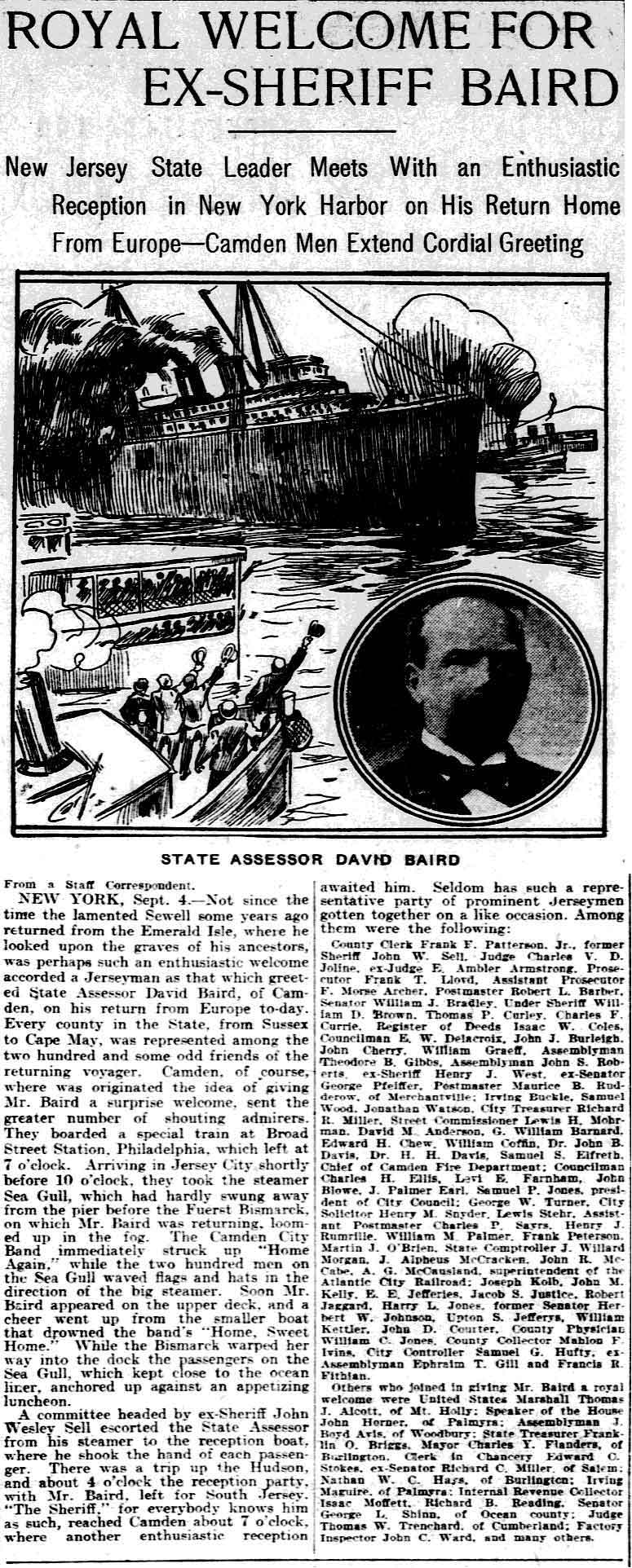
New Jersey State Leader Meets With an Enthusiastic Reception in New York Harbor on His Return Home From Europe—Camden Men Extend Cordial Greeting
STATE ASSESSOR DAVID BAIRD
From a Staff Correspondent.
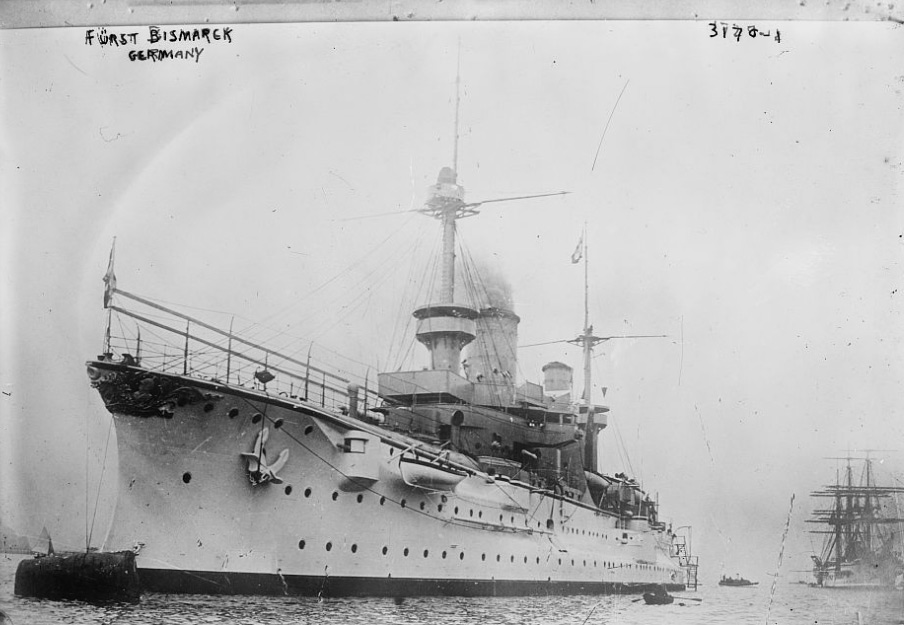
NEW YORK, Sept. 4.—Not since the time the lamented Sewell some years ago returned from the Emerald Isle, where he looked upon the graves of his ancestors, was perhaps such an enthusiastic welcome accorded a Jerseyman as that which greeted State Assessor David Baird, of Camden, on his return from Europe to-day. Every county in the State, from Sussex to Cape May, was represented among the two hundred and some odd friends of the returning voyager. Camden, of course, where was originated the idea of giving Mr. Baird a surprise welcome, sent the greater number of shouting admirers. They boarded a special train at Broad Street Station, Philadelphia, which left at 7 o’clock. Arriving in Jersey City shortly before 10 o’clock, they took the steamer Sea Gull, which had hardly swung away from the pier before the Fuerst Bismarck, on which Mr. Baird was returning, loomed up in the fog. The Camden City Band immediately struck up “Home Again,” while the two hundred men on the Sea Gull waved flags and hats in the direction of the big steamer. Soon Mr. Baird appeared on the upper deck, and a cheer went up from the smaller boat that drowned the band’s “Home, Sweet Home.” While the Bismarck warped her way into the dock the passengers on the Sea Gull, which kept close to the ocean liner, anchored up against an appetizing luncheon.
A committee headed by ex-Sheriff John Wesley Sell escorted the State Assessor from his steamer to the reception boat, where he shook the hand of each passenger. There was a trip up the Hudson, and about 4 o’clock the reception party, with Mr. Baird, left for South Jersey. “The Sheriff,” for everybody knows him as such, reached Camden about 7 o’clock, where another enthusiastic reception awaited him. Seldom has such a representative party of prominent Jerseymen gotten together on a like occasion. Among them were the following:
County Clerk Frank F. Patterson, Jr., former Sheriff John W. Sell, Judge Charles V. D. Joline, ex-Judge E. Ambler Armstrong, Prosecutor Frank T. Lloyd, Assistant Prosecutor F. Morse Archer, Postmaster Robert L. Barber, Senator William J. Bradley, Under Sheriff William D. Brown, Thomas P. Curley, Charles F. Currie, Register of Deeds Isaac W. Coles, Councilman E. W. Delacroix, John J. Burleigh, John Cherry, William Graeff, Assemblyman Theodore B. Gibbs, Assemblyman John S. Roberts, ex-Sheriff Henry J. West, ex-Senator George Pfeiffer, Postmaster Maurice B. Rudderow, of Merchantville; Irving Buckle, Samuel Wood, Jonathan Watson, City Treasurer Richard R. Miller, Street Commissioner Lewis H. Mohrman, David M. Anderson, G. William Barnard, Edward H. Chew, William Coffin, Dr. John B. Davis, Dr. H. H. Davis, Samuel S. Elfreth, Chief of Camden Fire Department; Councilman Charles H. Ellis, Levi E. Farnham, John Blowe, J. Palmer Earl, Samuel P. Jones, president of City Council; George W. Turner, City Solicitor Henry M. Snyder, Lewis Stehr, Assistant Postmaster Charles P. Sayrs, Henry J. Rumrille, William M. Palmer, Frank Peterson, Martin J. O’Brien, State Comptroller J. Willard Morgan, J. Alpheus McCracken, John R. McCabe, A. G. McCausland, superintendent of the Atlantic City Railroad; Joseph Kolb, John M. Kelly, E. E. Jefferies, Jacob S. Justice, Robert Jaggard, Harry L. Jones, former Senator Herbert W. Johnson, Upton S. Jefferys, William Kettler, John D. Courter, County Physician William C. Jones, County Collector Mahlon F. Ivins, City Controller Samuel G. Hufty, ex-Assemblyman Ephraim T. Gill and Francis R. Fithian.
Others who joined in giving Mr. Baird a royal welcome were United States Marshall Thomas J. Alcott, of Mt. Holly; Speaker of the House John Herner, of Palmyra; Assemblyman J. Boyd Avis, of Woodbury; State Treasurer Franklin O. Briggs, Mayor Charles Y. Flanders, of Burlington, Clerk in Chancery Edward C. Stokes, ex-Senator Richard C. Miller, of Salem; Nathan W. C. Hays, of Burlington; Irving Maguire, of Palmyra; Internal Revenue Collector Isaac Moffett, Richard B. Reading, Senator George L. Shinn, of Ocean county; Judge Thomas W. Trenchard, of Cumberland; Factory Inspector John C. Ward, and many others.
Fürst Bismarck
1903
Pfeiffer Family Plot at Harleigh Cemetery
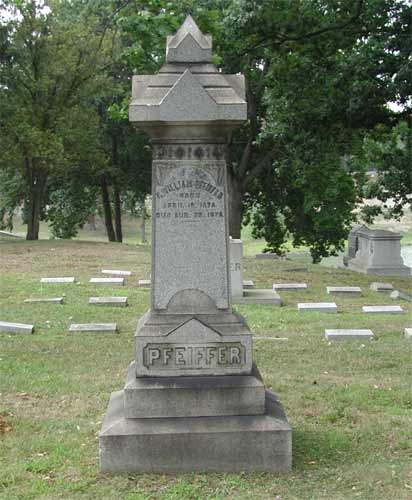
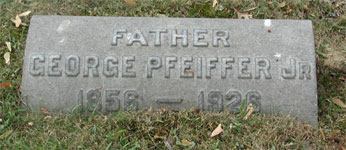
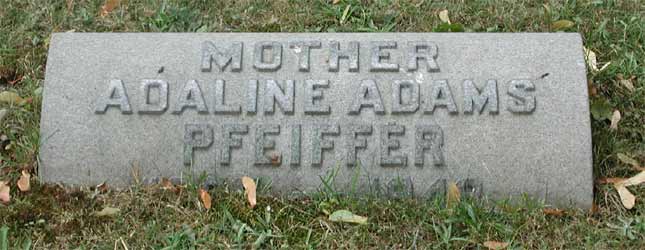
Pfeiffer Family Plot at Harleigh Cemetery
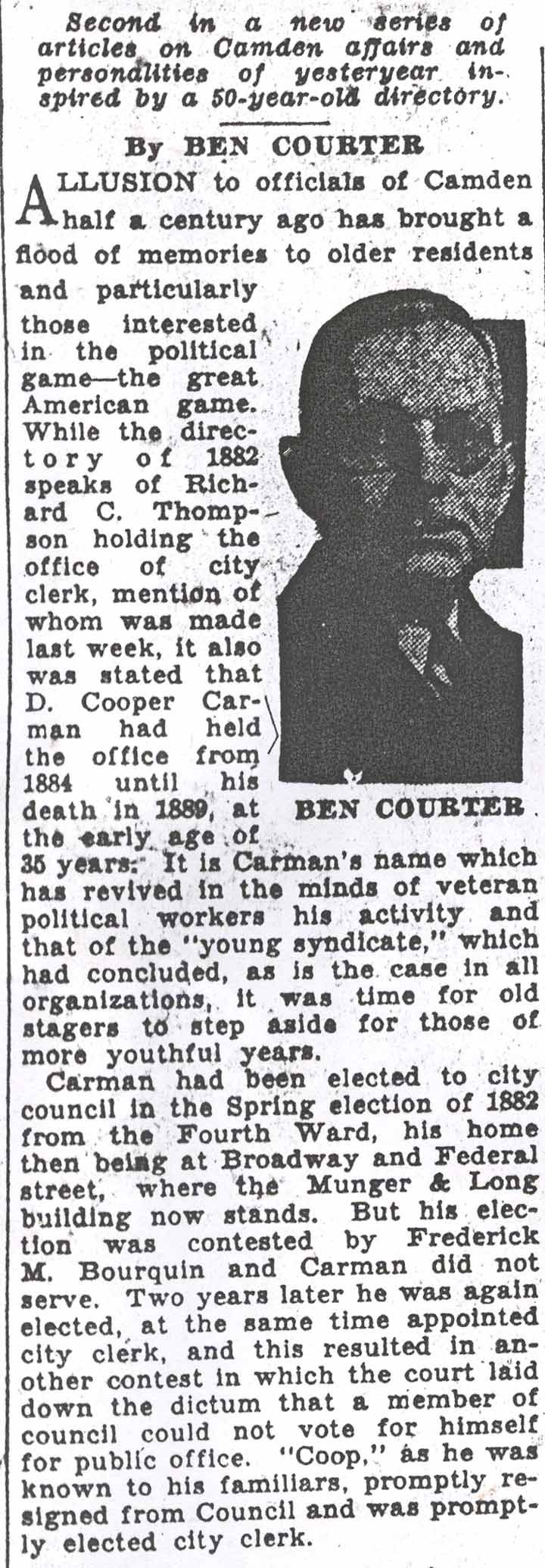
The Young Syndicate
Camden Courier-Post —
FROM AN OLD DIRECTORY
‘Coop’ Carman and Willard Morgan Led Movement for New Blood in G.O.P. Culminating in Bitter Battles of Race Track Days
Second in a new series of articles on Camden affairs and personalities of yesteryear inspired by a 50-year-old directory.
By BEN COURTER
Allusion to officials of Camden half a century ago has brought a flood of memories to older residents and particularly those interested in the political game—the great American game. While the directory of 1882 speaks of Richard C. Thompson holding the office of city clerk, mention of whom was made last week, it also was stated that D. Cooper Carman had held the office from 1884 until his death in 1889, at the early age of 35 years. It is Carman’s name which has revived in the minds of veteran political workers his activity and that of the “young syndicate,” which had concluded, as is the case in all organizations, it was time for old stagers to step aside for those of more youthful years.
BEN COURTER
Carman had been elected to city council in the Spring election of 1882 from the Fourth Ward, his home then being at Broadway and Federal street, where the Munger & Long building now stands. But his election was contested by Frederick M. Bourquin and Carman did not serve. Two years later he was again elected, at the same time appointed city clerk, and this resulted in another contest in which the court laid down the dictum that a member of council could not vote for himself for public office. “Coop,” as he was known to his familiars, promptly resigned from Council and was promptly elected city clerk.
The ‘Young Syndicate’
With Carman, as former City Clerk William D. Brown recalls, was associated J. Willard Morgan and Henry M. Snyder, something of a balance between the two.
That combination carried things along pretty much as they pleased for a time and as one of the developments Maurice A. Rogers, down in the Fifth Ward and a councilman, was taken up as a Senatorial candidate against Colonel George Pfeiffer, Jr., a decade later to be the builder of Camden’s artesian water plant. The colonel, long one of Camden’s most popular men, had defeated the Republicans as a result of the factional fight between Henry L. Bonsall, editor of the Post, and Thomas Dudley, famed consul to Liverpool during Civil War days. But with the “young syndicate” back of him, Rogers won the Senate seat in 1890, taking his office January 1, 1891.
But in the meanwhile Carman suddenly died at his mother’s home, at 11.10 on the night of September 11, 1889. At the time apoplexy was given as the cause. His sudden demise caused a profound shock and at his funeral four days later leaders in business and politics paid homage, with such men as Gen. William J. Sewell, Sinnickson Chew, Howard Carrow, Wilson Jenkins, E. A. Armstrong, B. M. Braker and many others attending. The bell in the old City Hall tower tolled as the cortege passed on the way to old Camden cemetery. And even yet, after these more than four decades, “Coop” Carman is quite vividly recalled by those who were then active on the political stage.
Carman’s Death Big Loss
Carman’s death was a big loss to the “young syndicate,” but it did not halt its activity. Since Rogers had won so easily in the 1890 election it was concluded there would be nothing to it when he was renominated for another two-year term. Rogers was by no means friendly to “Billy” Thompson’s race track, then in the heyday of its popularity with the sports of Gloucester City, a period when that community had all the earmarks of a wild and wooly western city, attractive to thousands of lovers of horseflesh, touts, gamblers and the usual hangers-on.
Thompson concluded it would be far better to have someone in the Senate from Camden county who would regard his interests with more favor than Rogers.
Thus he decided on Frederick A. Rex, his personal counsel, a very able young attorney, and a Republican. Since at that time the Democratic police commission was in control of the cops it was considered easy to get possession of the polls. As Brown recalls it, the rivals of Rogers planned a “zero hour” at which cops, at the crack of a pistol, were to descend on polls considered close at the primaries, frighten off the regular voters and corral enough to elect Rex.
Particular effort was to be made to sweep the Sixth Ward, where Thad Varney, elected city clerk to succeed Carman, was “boss,” and thus give him a political black eye. In Varney’s precinct in particular when the rumpus started “Brockie” Deno and “Al” Haydon, both widely known firemen now dead, grabbed the ballot box, lowered it down a chimney, fished it out when the racket was passed, went to Avis’ livery stable, and later to Varney’s home, where the votes were counted. In these sophisticated days such counting would unquestionably not be considered “according to Hoyle,” but then anything went just so the particular faction had its bag of tricks in effective operation. Anyhow, Rogers won the primaries, but there still was the general election to hurdle and Thompson was by no means beaten. He had plenty of money and many followers, some sincere, many just sycophants.
Repeaters Foiled
It was charged a scheme was on foot to bring repeaters from Philadelphia, not an unusual procedure in the political game of Camden years ago in either party. One of the “young syndicate’s” lieutenants learned the plot, told General Sewell, who sent the informant to Dave Martin, then Philadelphia’s political boss, who heard the story. The upshot was General Sewell himself saw Martin later, who was quite willing to aid Jersey’s G.O.P. leader, flooded Camden with sleuths from over the river and such close tabs were kept on the repeating army its efforts were halted from the very dawn of that very stirring election day. Rogers was elected, was made president of the Senate and for a time loomed so large on Jersey’s political horizon he had gubernatorial aspirations, but they never were realized.
Thus out of the old yellowed book Frank Albright, city clerk of the present epoch, dug from the archives memories are revived of a very gallant young politician, “Coop” Carman, and some of the stirring incidents that make up Camden’s political history. The “young syndicate” was just one of the episodes, as the first “reform” outbreak in 1882, or the Committee of 100 scrap of 1897, or the Non-Partisan upheaval of ‘23, but such never lose interest to those who have joined those movements with enthusiasm, even though they were often not altogether satisfied with what had been accomplished.